Ratio Analysis Submitted by:-  Hardik Baghmar
Liquidity Ratios Leverage Ratios Efficiency Ratios Profitability Ratios A ratio is a numerical relationship between two numbers in financial statements.
Liquidity Ratios Current Ratio It is the most popularly used ratio to judge liquidity of a firm. It is defined as the ratio between current assets and current liabilities i.e. Current Ratio = Current Assets/Current Liabilities Current Assets include cash, debtors, marketable securities, bills receivable, inventories, loans and advances, and prepaid expenses, while Current Liabilities include loans and advances (taken), creditors, bills payable, accrued expenses and provisions.
It measures a firm’s ability to meet short term obligations. The higher the current ratio, the more is the firm’s ability to meet current obligations, and greater is the safety of funds of short term creditors. A current ratio of 1.5:1 implies that for every one rupee of current liability, current assets of one-and-half rupees are available to meet the obligation
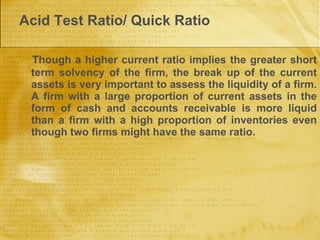
Acid Test Ratio/ Quick Ratio Though a higher current ratio implies the greater short term solvency of the firm, the break up of the current assets is very important to assess the liquidity of a firm. A firm with a large proportion of current assets in the form of cash and accounts receivable is more liquid than a firm with a high proportion of inventories even though two firms might have the same ratio.
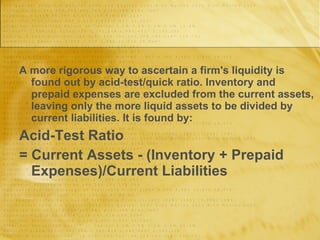
A more rigorous way to ascertain a firm's liquidity is found out by acid-test/quick ratio. Inventory and prepaid expenses are excluded from the current assets, leaving only the more liquid assets to be divided by current liabilities. It is found by: Acid-Test Ratio = Current Assets - (Inventory + Prepaid Expenses)/Current Liabilities
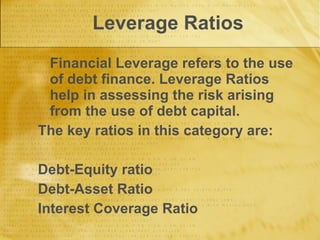
Leverage Ratios Financial Leverage refers to the use of debt finance. Leverage Ratios help in assessing the risk arising from the use of debt capital. The key ratios in this category are: Debt-Equity ratio Debt-Asset Ratio Interest Coverage Ratio
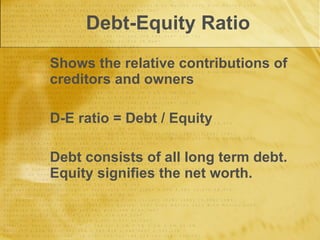
Debt-Equity Ratio Shows the relative contributions of creditors and owners D-E ratio = Debt / Equity Debt consists of all long term debt. Equity signifies the net worth.
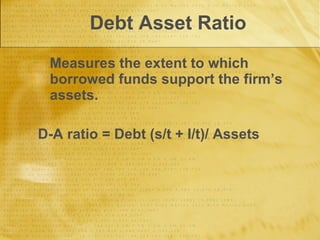
Debt Asset Ratio Measures the extent to which borrowed funds support the firm’s assets. D-A ratio = Debt (s/t + l/t)/ Assets
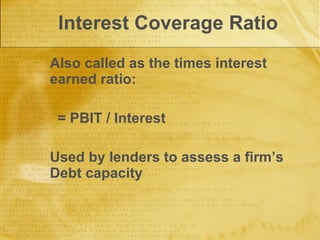
Interest Coverage Ratio Also called as the times interest earned ratio: = PBIT / Interest Used by lenders to assess a firm’s Debt capacity
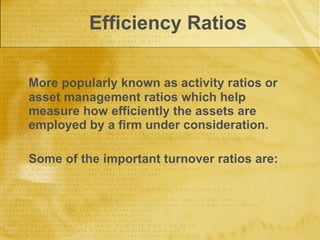
Efficiency Ratios More popularly known as activity ratios or asset management ratios which help measure how efficiently the assets are employed by a firm under consideration.  Some of the important turnover ratios are:
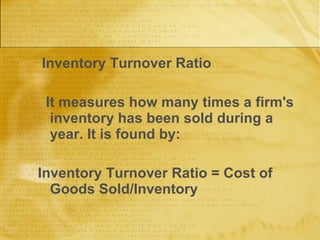
Inventory Turnover Ratio It measures how many times a firm's inventory has been sold during a year. It is found by: Inventory Turnover Ratio = Cost of Goods Sold/Inventory
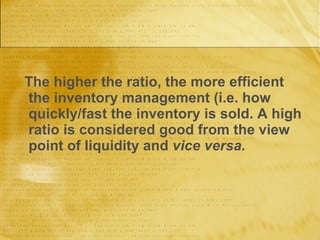
The higher the ratio, the more efficient the inventory management (i.e. how quickly/fast the inventory is sold. A high ratio is considered good from the view point of liquidity and  vice versa.
Debtors’ Turnover This ratio shows how many times sundry debtors turn over during the year. The higher the ratio, the greater the efficiency of credit management: = Net Credit Sales / Average Sundry  Debtors (receivables)
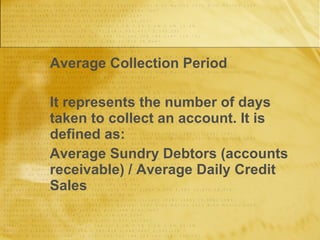
Average Collection Period It represents the number of days taken to collect an account. It is defined as: Average Sundry Debtors (accounts receivable) / Average Daily Credit Sales
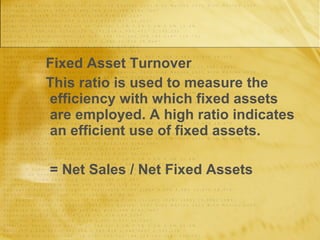
Fixed Asset Turnover  This ratio is used to measure the efficiency with which fixed assets are employed. A high ratio indicates an efficient use of fixed assets. = Net Sales / Net Fixed Assets
Profitability Ratios Gross Profit Margin : Shows the margin left after meeting manufacturing costs. It measures the efficiency of production as well as pricing. Net Profit Margin: Shows the earnings left for shareholders as a percentage of net sales.
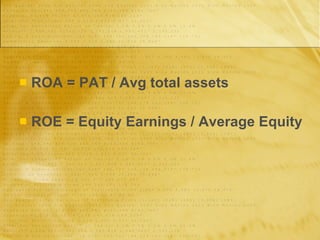
ROA = PAT / Avg total assets ROE = Equity Earnings / Average Equity

Ratio Analysis

  • 1.
    Ratio Analysis Submittedby:- Hardik Baghmar
  • 2.
    Liquidity Ratios LeverageRatios Efficiency Ratios Profitability Ratios A ratio is a numerical relationship between two numbers in financial statements.
  • 3.
    Liquidity Ratios CurrentRatio It is the most popularly used ratio to judge liquidity of a firm. It is defined as the ratio between current assets and current liabilities i.e. Current Ratio = Current Assets/Current Liabilities Current Assets include cash, debtors, marketable securities, bills receivable, inventories, loans and advances, and prepaid expenses, while Current Liabilities include loans and advances (taken), creditors, bills payable, accrued expenses and provisions.
  • 4.
    It measures afirm’s ability to meet short term obligations. The higher the current ratio, the more is the firm’s ability to meet current obligations, and greater is the safety of funds of short term creditors. A current ratio of 1.5:1 implies that for every one rupee of current liability, current assets of one-and-half rupees are available to meet the obligation
  • 5.
    Acid Test Ratio/Quick Ratio Though a higher current ratio implies the greater short term solvency of the firm, the break up of the current assets is very important to assess the liquidity of a firm. A firm with a large proportion of current assets in the form of cash and accounts receivable is more liquid than a firm with a high proportion of inventories even though two firms might have the same ratio.
  • 6.
    A more rigorousway to ascertain a firm's liquidity is found out by acid-test/quick ratio. Inventory and prepaid expenses are excluded from the current assets, leaving only the more liquid assets to be divided by current liabilities. It is found by: Acid-Test Ratio = Current Assets - (Inventory + Prepaid Expenses)/Current Liabilities
  • 7.
    Leverage Ratios FinancialLeverage refers to the use of debt finance. Leverage Ratios help in assessing the risk arising from the use of debt capital. The key ratios in this category are: Debt-Equity ratio Debt-Asset Ratio Interest Coverage Ratio
  • 8.
    Debt-Equity Ratio Showsthe relative contributions of creditors and owners D-E ratio = Debt / Equity Debt consists of all long term debt. Equity signifies the net worth.
  • 9.
    Debt Asset RatioMeasures the extent to which borrowed funds support the firm’s assets. D-A ratio = Debt (s/t + l/t)/ Assets
  • 10.
    Interest Coverage RatioAlso called as the times interest earned ratio: = PBIT / Interest Used by lenders to assess a firm’s Debt capacity
  • 11.
    Efficiency Ratios Morepopularly known as activity ratios or asset management ratios which help measure how efficiently the assets are employed by a firm under consideration. Some of the important turnover ratios are:
  • 12.
    Inventory Turnover RatioIt measures how many times a firm's inventory has been sold during a year. It is found by: Inventory Turnover Ratio = Cost of Goods Sold/Inventory
  • 13.
    The higher theratio, the more efficient the inventory management (i.e. how quickly/fast the inventory is sold. A high ratio is considered good from the view point of liquidity and vice versa.
  • 14.
    Debtors’ Turnover Thisratio shows how many times sundry debtors turn over during the year. The higher the ratio, the greater the efficiency of credit management: = Net Credit Sales / Average Sundry Debtors (receivables)
  • 15.
    Average Collection PeriodIt represents the number of days taken to collect an account. It is defined as: Average Sundry Debtors (accounts receivable) / Average Daily Credit Sales
  • 16.
    Fixed Asset Turnover This ratio is used to measure the efficiency with which fixed assets are employed. A high ratio indicates an efficient use of fixed assets. = Net Sales / Net Fixed Assets
  • 17.
    Profitability Ratios GrossProfit Margin : Shows the margin left after meeting manufacturing costs. It measures the efficiency of production as well as pricing. Net Profit Margin: Shows the earnings left for shareholders as a percentage of net sales.
  • 18.
    ROA = PAT/ Avg total assets ROE = Equity Earnings / Average Equity