Photo: Robin Asselmayer
Vi Agroforestry for Inclusive,Sustainable Food Systems
Diana Njihia
Vi Agroforestry is a Swedish non-profit foundation established in 1983.
We work with local partner organizations in East Africa, mainly in
Kenya, Tanzania and Uganda to empower smallholders’ farmers and
their organizations to improving their living conditions.
Vi Agroforestry has 40 years of experience in promoting agroforestry,
sustainable agriculture, human rights-based approaches, gender
equality, and empowerment of women, men, youth, and children.
Who we are
Vision A sustainable environment that
enables women and men living in
poverty to improve their lives
Vision and Mandate
Mission : To fight poverty and climate change –
together. Empowering smallholder farmer
families socially and economically, building
their resilience while enhancing
biodiversity and climate change mitigation
through sustainable agricultural land
management, including agroforestry.
Vision and Mandate
• Smallholder farmer families – with a special focus on
women, youth and children living in a situation of poverty.
We target farmer families who are likely to have limited
access to productive resources and opportunities, and
who experience food insecurity and the effects of climate
change.
Target Groups
• Promotes Agroforestry and Other sustainable
Agricultural Land Management Practices that include
nutrient management, soil and water conservation,
Agronomic practices, integrated livestock
management, integrated pest management, tillage
and residue management, energy conservation
restoration and rehabilitation
Key Programme Methodology
• Human rights-based approach (HRBA)
• Gender transformative approach
• Leave no one behind
• Conflict sensitive approach
• Anti-corruption
• Enabling civic space
• Local to global advocacy
• Multi-stakeholder engagement
Approaches to development work
1. Core partner:
These are the small holder member-based farmers’
organisations. The membership in these organisations enables
the reach to the grassroots. The focus here is to strengthen the
capacity of these organisations to engage duty bearers, while at
the same time having the ability to provide a support system to
the members.
Types of partners in Vi agroforestry
2. Technical Partners: These are organisations that might not
necessarily be member based but have specialised capacity and
skills that could be a gap for the core partners.
3. Strategic Partners: These are regional bodies, research
organisations, universities, peer organisations, among others that
are relevant to our working areas. Vi Agroforestry is keen on
strengthening alliances and building relationships that make it
efficient to jointly act such as codesigning interventions for bigger
impact.
Role of Vi Agroforestry in transforming food systems into inclusive
and sustainable food systems
Key Result Area Intervention Areas
1. Strengthening Farmer
Organizations
• Strengthen governance of the partners at
leadership and management. It should be
inclusive of women, youth and
underrepresented groups
• Encouraging inclusive membership to farmer
organization e.g expand the membership
criteria to include the schools.
Role of Vi Agroforestry in transforming food systems into inclusive
and sustainable food systems
Key Result Area Intervention Areas
1. Strengthening Farmer
Organizations
• Support women and youth dialogues with
communities on gender inequities in
decision making in access and control of
resources.
Role of Vi Agroforestry in transforming food systems into inclusive
and sustainable food systems
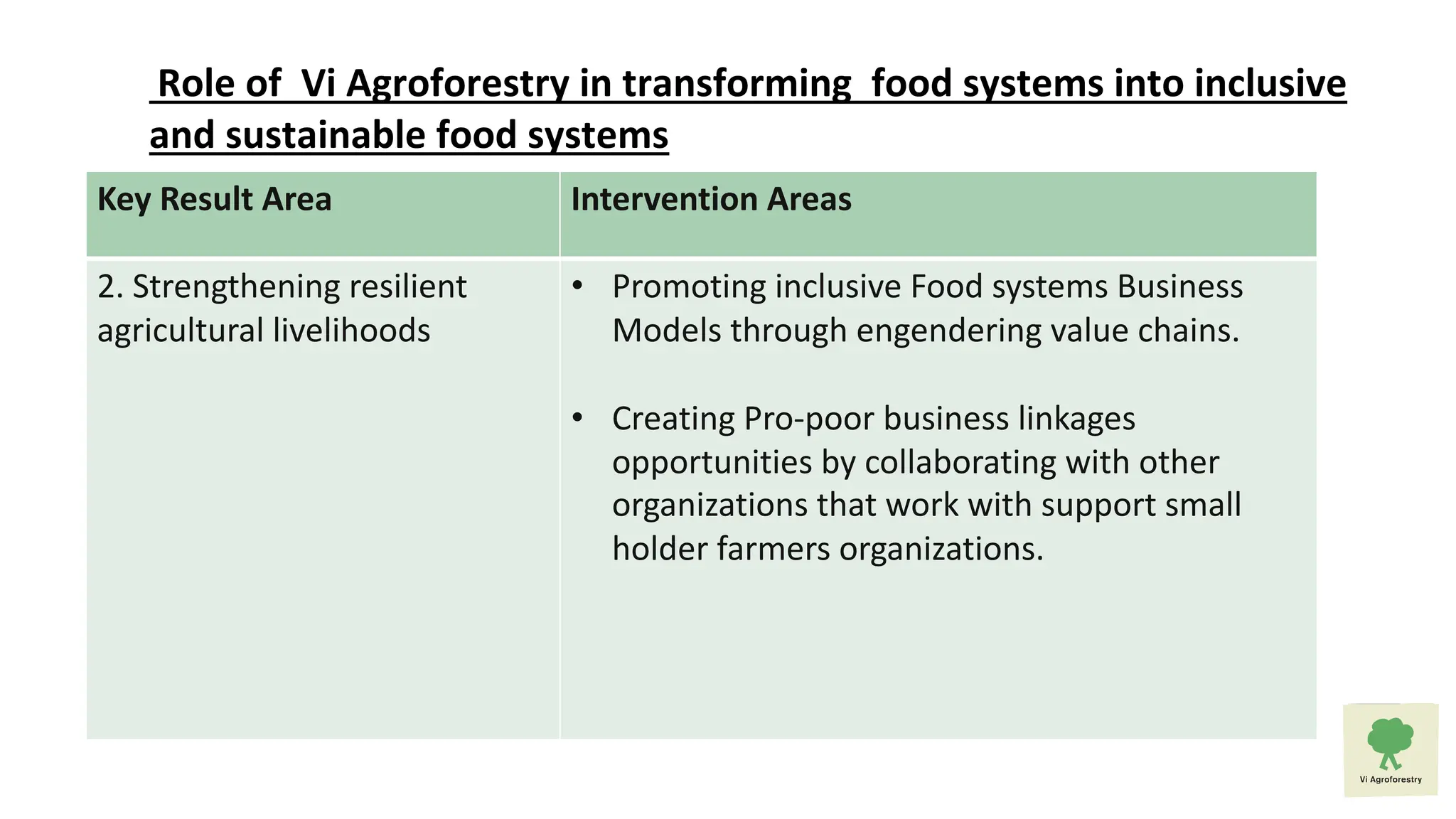
Key Result Area Intervention Areas
2. Strengthening resilient
agricultural livelihoods
• Promoting inclusive Food systems Business
Models through engendering value chains.
• Creating Pro-poor business linkages
opportunities by collaborating with other
organizations that work with support small
holder farmers organizations.
Role of Vi Agroforestry in transforming food systems into inclusive
and sustainable food systems
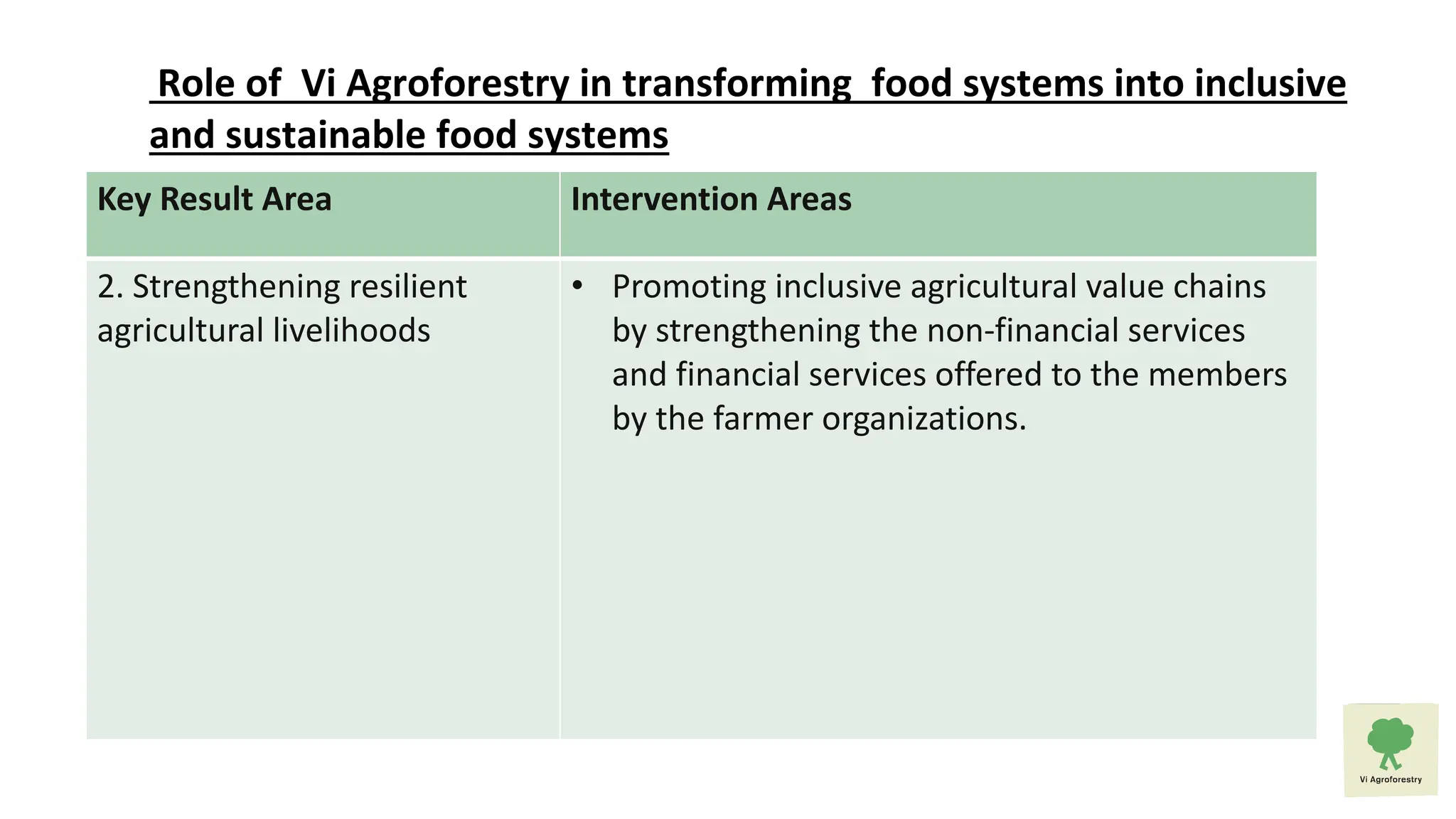
Key Result Area Intervention Areas
2. Strengthening resilient
agricultural livelihoods
• Promoting inclusive agricultural value chains
by strengthening the non-financial services
and financial services offered to the members
by the farmer organizations.
Role of Vi Agroforestry in transforming food systems into inclusive
and sustainable food systems
Key Result Area Intervention Areas
3. Promoting Environment
conservation, Climate change
and Biodiversity
Enhancing the capacity of farmer organizations to
conduct environment, climate change and gender
analysis/impact on the production practices that
they are promoting.
Encourage tree, crop and animal diversity
practices among the farmers including traditional
indigenous foods.
Promoting Sustainable Agriculture land
Management practices and seed saving
Role of Vi Agroforestry in transforming food systems into inclusive
and sustainable food systems
Key Result Area Intervention Areas
3. Promoting Environment
conservation, Climate change
and Biodiversity
• Collaborating on Innovation and technology to
realizing efficiency of food systems e.g KARLO
collaboration on growing of beans (nyota)
which are rich in iron and drought tolerant
• Climate offsetting through agricultural
techniques promoted increase carbon
sequestration in trees and soils support Small
holder participation in carbon markets.
Role of Vi Agroforestry in transforming food systems into inclusive
and sustainable food systems
Key Result Area Intervention Areas
4. Food and Nutrition Security • Building the capacity of the farmer organizations
on food security.
• Promoting nutrition education in schools,
among farmer organizations.
• Promoting nutrient rich foods like enriched
beans with more iron, yellow fleshed sweet
potatoes.
• Promoting food utilization of indigenous foods.
Role of Vi Agroforestry in transforming food systems into inclusive
and sustainable food systems
Key Result Area Intervention Areas
5. Policy and Advocacy • Supporting Inclusivity environment in policy
development. Community-members, youth,
women, underrepresented groups engagement
in policy making, Implementation and
monitoring.
• Building the capacity of farmer organizations to
undertake advocacy and policy engagement to
ensure development of responsive policies.
Role of Vi Agroforestry in transforming food systems into inclusive
and sustainable food systems
Key Result Area Intervention Areas
5. Policy and Advocacy • Promoting the adoption of the agroforestry
strategy, food security and environmental
policies to enhance and protect agricultural land
resources.
OUR FUTURE
Agrobiodiversity on farm
https://viagroforestry.org/
More Information & Contacts
Thank you!

Diana Njihia Vi Agroforestry.pdf

  • 1.
    Photo: Robin Asselmayer ViAgroforestry for Inclusive,Sustainable Food Systems Diana Njihia
  • 2.
    Vi Agroforestry isa Swedish non-profit foundation established in 1983. We work with local partner organizations in East Africa, mainly in Kenya, Tanzania and Uganda to empower smallholders’ farmers and their organizations to improving their living conditions. Vi Agroforestry has 40 years of experience in promoting agroforestry, sustainable agriculture, human rights-based approaches, gender equality, and empowerment of women, men, youth, and children. Who we are
  • 3.
    Vision A sustainableenvironment that enables women and men living in poverty to improve their lives Vision and Mandate
  • 4.
    Mission : Tofight poverty and climate change – together. Empowering smallholder farmer families socially and economically, building their resilience while enhancing biodiversity and climate change mitigation through sustainable agricultural land management, including agroforestry. Vision and Mandate
  • 5.
    • Smallholder farmerfamilies – with a special focus on women, youth and children living in a situation of poverty. We target farmer families who are likely to have limited access to productive resources and opportunities, and who experience food insecurity and the effects of climate change. Target Groups
  • 6.
    • Promotes Agroforestryand Other sustainable Agricultural Land Management Practices that include nutrient management, soil and water conservation, Agronomic practices, integrated livestock management, integrated pest management, tillage and residue management, energy conservation restoration and rehabilitation Key Programme Methodology
  • 7.
    • Human rights-basedapproach (HRBA) • Gender transformative approach • Leave no one behind • Conflict sensitive approach • Anti-corruption • Enabling civic space • Local to global advocacy • Multi-stakeholder engagement Approaches to development work
  • 8.
    1. Core partner: Theseare the small holder member-based farmers’ organisations. The membership in these organisations enables the reach to the grassroots. The focus here is to strengthen the capacity of these organisations to engage duty bearers, while at the same time having the ability to provide a support system to the members. Types of partners in Vi agroforestry
  • 9.
    2. Technical Partners:These are organisations that might not necessarily be member based but have specialised capacity and skills that could be a gap for the core partners. 3. Strategic Partners: These are regional bodies, research organisations, universities, peer organisations, among others that are relevant to our working areas. Vi Agroforestry is keen on strengthening alliances and building relationships that make it efficient to jointly act such as codesigning interventions for bigger impact.
  • 10.
    Role of ViAgroforestry in transforming food systems into inclusive and sustainable food systems Key Result Area Intervention Areas 1. Strengthening Farmer Organizations • Strengthen governance of the partners at leadership and management. It should be inclusive of women, youth and underrepresented groups • Encouraging inclusive membership to farmer organization e.g expand the membership criteria to include the schools.
  • 11.
    Role of ViAgroforestry in transforming food systems into inclusive and sustainable food systems Key Result Area Intervention Areas 1. Strengthening Farmer Organizations • Support women and youth dialogues with communities on gender inequities in decision making in access and control of resources.
  • 12.
    Role of ViAgroforestry in transforming food systems into inclusive and sustainable food systems Key Result Area Intervention Areas 2. Strengthening resilient agricultural livelihoods • Promoting inclusive Food systems Business Models through engendering value chains. • Creating Pro-poor business linkages opportunities by collaborating with other organizations that work with support small holder farmers organizations.
  • 13.
    Role of ViAgroforestry in transforming food systems into inclusive and sustainable food systems Key Result Area Intervention Areas 2. Strengthening resilient agricultural livelihoods • Promoting inclusive agricultural value chains by strengthening the non-financial services and financial services offered to the members by the farmer organizations.
  • 14.
    Role of ViAgroforestry in transforming food systems into inclusive and sustainable food systems Key Result Area Intervention Areas 3. Promoting Environment conservation, Climate change and Biodiversity Enhancing the capacity of farmer organizations to conduct environment, climate change and gender analysis/impact on the production practices that they are promoting. Encourage tree, crop and animal diversity practices among the farmers including traditional indigenous foods. Promoting Sustainable Agriculture land Management practices and seed saving
  • 15.
    Role of ViAgroforestry in transforming food systems into inclusive and sustainable food systems Key Result Area Intervention Areas 3. Promoting Environment conservation, Climate change and Biodiversity • Collaborating on Innovation and technology to realizing efficiency of food systems e.g KARLO collaboration on growing of beans (nyota) which are rich in iron and drought tolerant • Climate offsetting through agricultural techniques promoted increase carbon sequestration in trees and soils support Small holder participation in carbon markets.
  • 16.
    Role of ViAgroforestry in transforming food systems into inclusive and sustainable food systems Key Result Area Intervention Areas 4. Food and Nutrition Security • Building the capacity of the farmer organizations on food security. • Promoting nutrition education in schools, among farmer organizations. • Promoting nutrient rich foods like enriched beans with more iron, yellow fleshed sweet potatoes. • Promoting food utilization of indigenous foods.
  • 17.
    Role of ViAgroforestry in transforming food systems into inclusive and sustainable food systems Key Result Area Intervention Areas 5. Policy and Advocacy • Supporting Inclusivity environment in policy development. Community-members, youth, women, underrepresented groups engagement in policy making, Implementation and monitoring. • Building the capacity of farmer organizations to undertake advocacy and policy engagement to ensure development of responsive policies.
  • 18.
    Role of ViAgroforestry in transforming food systems into inclusive and sustainable food systems Key Result Area Intervention Areas 5. Policy and Advocacy • Promoting the adoption of the agroforestry strategy, food security and environmental policies to enhance and protect agricultural land resources.
  • 19.
  • 20.
  • 21.
  • 22.