PRESENTED BY :-
RASHID ANWAR
B.TECH (M.E.)
1135993
ASRA COLLEGE OF ENGINEERING & TECHNOLOGY
PRESENTATION ON
The Sasan Ultra Mega Power Project (UMPP) is a Government of India initiative
to develop a
large power plant in India. Sasan Power Limited (SPL) is currently developing a
3,960 MW
coal-fired UMPP to be located in Sasan, Madhya Pradesh, approximately 25 km
from three
captive pithead coalmines. The Sasan project will be a 6x660 MW coal-fired
project.
Sasan Power Limited (SPL) was incorporated on February 10, 2006. This
company was
incorporated as a wholly owned subsidiary of Power Finance Corporation Limited
in order to
build, own, operate and maintain the Sasan Ultra Megawatt Power Project at
Sasan, Madhya
Pradesh. It was transferred to Reliance Power under the provisions of a share
purchase
agreement dated August 7, 2007 and is now a fully owned subsidiary of Reliance
Power.
Summary:
· Location: Sasan, Madhya Pradesh, a 3,000 acre cluster of 5 villages Sidhikhurg,
Sidhikala, Tiyara, Jhanjhi and Harrhawa containing a population of about 10,000
located
approximately 25 km from three captive pithead coalmines.
· Date Initiated: Feb 10, 2006 with the incorporation of Sasan Power limited (SPL).
· Size: 3,960 MW coal-fired ultra mega power project (UMPP) - 6x660 MW
· Annual Emmissions: 26,000-27,000 tonnes of carbon dioxide per year or 832 grams
carbon dioxide per kilowatt hour
· Local Displacement: About 6,000 people will lose their land and homes once the Rs
20,000-crore ($200 billion) project takes off. Both issues are critical because the green
cover here belies the stark poverty of an area that has just one or two pakka
(permanent)
houses. Most farmers and daily labourers live in mud hutments.
· Power Use: The states sharing the power are Madhya Pradesh (Lead Procurer) with a
37.50% share, followed by Punjab (15%), Uttar Pradesh (12.5%), Delhi (11.25%),
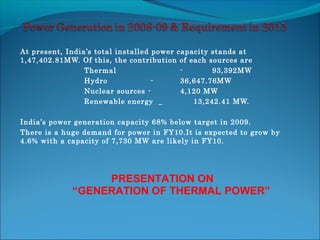
At present, India’s total installed power capacity stands at
1,47,402.81MW. Of this, the contribution of each sources are
Thermal - 93,392MW
Hydro - 36,647.76MW
Nuclear sources - 4,120 MW
Renewable energy _ 13,242.41 MW.
India’s power generation capacity 68% below target in 2009.
There is a huge demand for power in FY10.It is expected to grow by
4.6% with a capacity of 7,730 MW are likely in FY10.
PRESENTATION ON
“GENERATION OF THERMAL POWER”
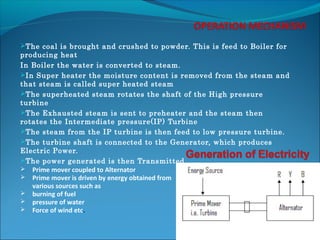
The coal is brought and crushed to powder. This is feed to Boiler for
producing heat
In Boiler the water is converted to steam.
In Super heater the moisture content is removed from the steam and
that steam is called super heated steam
The superheated steam rotates the shaft of the High pressure
turbine
The Exhausted steam is sent to preheater and the steam then
rotates the Intermediate pressure(IP) Turbine
The steam from the IP turbine is then feed to low pressure turbine.
The turbine shaft is connected to the Generator, which produces
Electric Power.
The power generated is then Transmitted.
 Prime mover coupled to Alternator
 Prime mover is driven by energy obtained from
various sources such as
 burning of fuel
 pressure of water
 Force of wind etc.
 Nuclear power plants use a nuclear reactor’s heat to operate a steam
turbine generator
 Fossil fuelled power plants may also use a steam turbine generator or in
the case of natural gas fired plants may use a combustion turbine.
 Geothermal power plants use steam extracted from hot underground
rocks
 Renewable energy plants may be fuelled by waste from sugar cane,
municipal solid waste, landfill methane, or other forms of biomass
 In integrated steel mills, blast furnace exhaust gas is a low-cost, although
low-energy-density, fuel
 Waste heat from industrial processes is occasionally concentrated enough
to use for power generation, usually in a steam boiler and turbine
 Solar thermal electric plants use sunlight to boil water, which turns the
generator
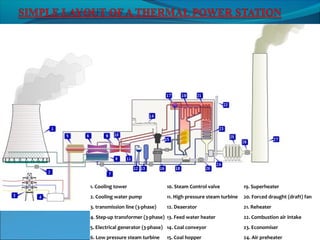
1. Cooling tower 10. Steam Control valve 19. Superheater
2. Cooling water pump 11. High pressure steam turbine 20. Forced draught (draft) fan
3. transmission line (3-phase) 12. Deaerator 21. Reheater
4. Step-up transformer (3-phase) 13. Feed water heater 22. Combustion air intake
5. Electrical generator (3-phase) 14. Coal conveyor 23. Economiser
6. Low pressure steam turbine 15. Coal hopper 24. Air preheater
In India 65% of total power is generated by the Thermal Power Stations .
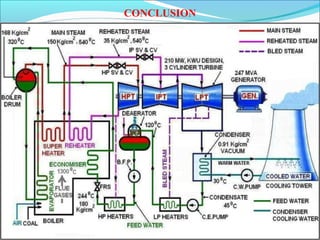
Thermal power plant basically works on Rankine cycle
In thermal power station, water is heated, turns into steam and spins a steam turbine
which drives an electrical generator. After it passes through the turbine, the steam is
condensed in a condenser & recycled to where it was heated; this is known as Rankine
cycle
Coal handling plant
Coal conveyor
pulverizer
Boiler
Super-heater and re-heaters
Economizer
Steam turbine generator
Condensers
Ash handling plant
Generator
Cooling tower
Switch yard & Control room
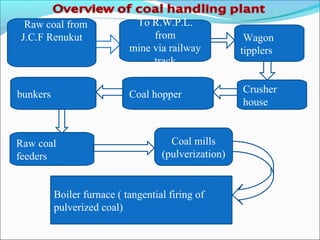
Raw coal from
J.C.F Renukut
To R.W.P.L.
from
mine via railway
track
Wagon
tipplers
Crusher
house
Coal hopperbunkers
Raw coal
feeders
Coal mills
(pulverization)
Boiler furnace ( tangential firing of
pulverized coal)
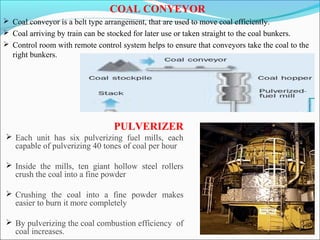
COAL CONYEYOR
 Coal conveyor is a belt type arrangement, that are used to move coal efficiently.
 Coal arriving by train can be stocked for later use or taken straight to the coal bunkers.
 Control room with remote control system helps to ensure that conveyors take the coal to the
right bunkers.
PULVERIZER
 Each unit has six pulverizing fuel mills, each
capable of pulverizing 40 tones of coal per hour
 Inside the mills, ten giant hollow steel rollers
crush the coal into a fine powder
 Crushing the coal into a fine powder makes
easier to burn it more completely
 By pulverizing the coal combustion efficiency of
coal increases.
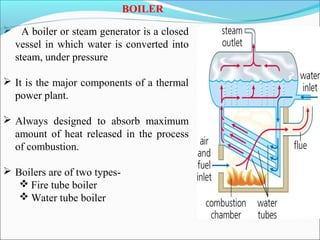
BOILER
 A boiler or steam generator is a closed
vessel in which water is converted into
steam, under pressure
 It is the major components of a thermal
power plant.
 Always designed to absorb maximum
amount of heat released in the process
of combustion.
 Boilers are of two types-
 Fire tube boiler
 Water tube boiler
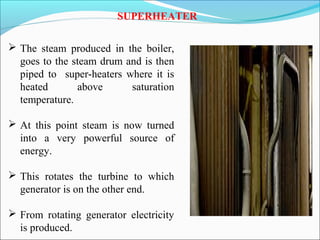
SUPERHEATER
 The steam produced in the boiler,
goes to the steam drum and is then
piped to super-heaters where it is
heated above saturation
temperature.
 At this point steam is now turned
into a very powerful source of
energy.
 This rotates the turbine to which
generator is on the other end.
 From rotating generator electricity
is produced.
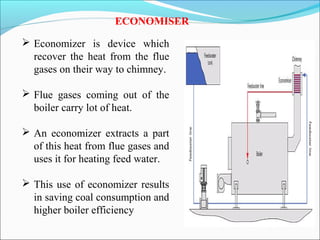
ECONOMISER
 Economizer is device which
recover the heat from the flue
gases on their way to chimney.
 Flue gases coming out of the
boiler carry lot of heat.
 An economizer extracts a part
of this heat from flue gases and
uses it for heating feed water.
 This use of economizer results
in saving coal consumption and
higher boiler efficiency
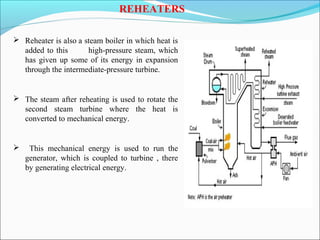
REHEATERS
 Reheater is also a steam boiler in which heat is
added to this high-pressure steam, which
has given up some of its energy in expansion
through the intermediate-pressure turbine.
 The steam after reheating is used to rotate the
second steam turbine where the heat is
converted to mechanical energy.
 This mechanical energy is used to run the
generator, which is coupled to turbine , there
by generating electrical energy.
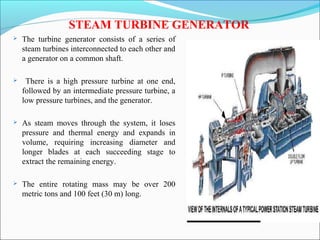
STEAM TURBINE GENERATOR
 The turbine generator consists of a series of
steam turbines interconnected to each other and
a generator on a common shaft.
 There is a high pressure turbine at one end,
followed by an intermediate pressure turbine, a
low pressure turbines, and the generator.
 As steam moves through the system, it loses
pressure and thermal energy and expands in
volume, requiring increasing diameter and
longer blades at each succeeding stage to
extract the remaining energy.
 The entire rotating mass may be over 200
metric tons and 100 feet (30 m) long.
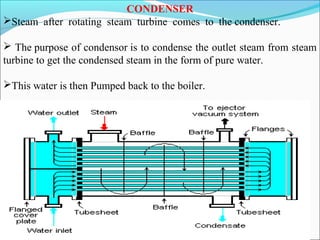
CONDENSER
Steam after rotating steam turbine comes to the condenser.
 The purpose of condensor is to condense the outlet steam from steam
turbine to get the condensed steam in the form of pure water.
This water is then Pumped back to the boiler.
ASH HANDLING PLANT
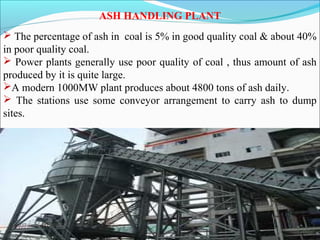
 The percentage of ash in coal is 5% in good quality coal & about 40%
in poor quality coal.
 Power plants generally use poor quality of coal , thus amount of ash
produced by it is quite large.
A modern 1000MW plant produces about 4800 tons of ash daily.
 The stations use some conveyor arrangement to carry ash to dump
sites.
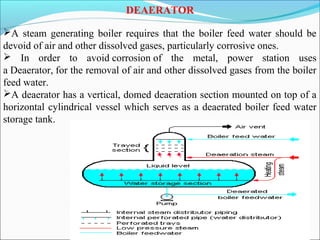
DEAERATOR
A steam generating boiler requires that the boiler feed water should be
devoid of air and other dissolved gases, particularly corrosive ones.
 In order to avoid corrosion of the metal, power station uses
a Deaerator, for the removal of air and other dissolved gases from the boiler
feed water.
A deaerator has a vertical, domed deaeration section mounted on top of a
horizontal cylindrical vessel which serves as a deaerated boiler feed water
storage tank.
GENERATOR
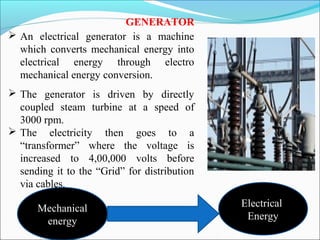
 An electrical generator is a machine
which converts mechanical energy into
electrical energy through electro
mechanical energy conversion.
 The generator is driven by directly
coupled steam turbine at a speed of
3000 rpm.
 The electricity then goes to a
“transformer” where the voltage is
increased to 4,00,000 volts before
sending it to the “Grid” for distribution
via cables.
Mechanical
energy
Electrical
Energy
COOLING TOWER
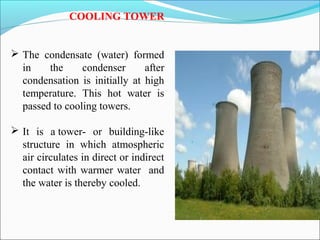
 The condensate (water) formed
in the condenser after
condensation is initially at high
temperature. This hot water is
passed to cooling towers.
 It is a tower- or building-like
structure in which atmospheric
air circulates in direct or indirect
contact with warmer water and
the water is thereby cooled.
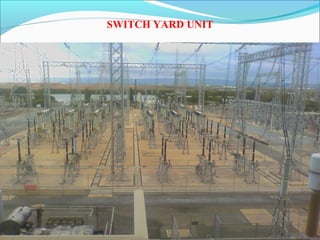
SWITCH YARD
 Placed where switching operation of power distribution is performed.
 Air insulated switch yard of 220KV-400KV are used.
Main Components of Switch Yard:
 Circuit breaker
 Isolator
 Lightening arrester
 Bus bar
 Current Transformer
 Potential Transformer
SWITCH YARD UNIT
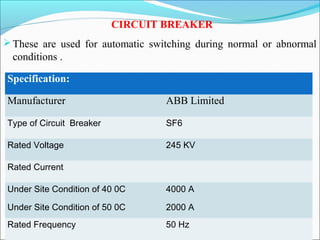
CIRCUIT BREAKER
These are used for automatic switching during normal or abnormal
conditions .
Specification:
Manufacturer ABB Limited
Type of Circuit Breaker SF6
Rated Voltage 245 KV
Rated Current
Under Site Condition of 40 0C
Under Site Condition of 50 0C
4000 A
2000 A
Rated Frequency 50 Hz
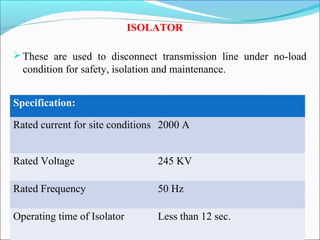
ISOLATOR
These are used to disconnect transmission line under no-load
condition for safety, isolation and maintenance.
Specification:
Rated current for site conditions 2000 A
Rated Voltage 245 KV
Rated Frequency 50 Hz
Operating time of Isolator Less than 12 sec.
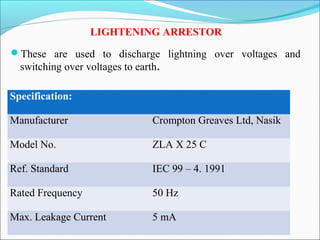
LIGHTENING ARRESTOR
These are used to discharge lightning over voltages and
switching over voltages to earth.
Specification:
Manufacturer Crompton Greaves Ltd, Nasik
Model No. ZLA X 25 C
Ref. Standard IEC 99 – 4. 1991
Rated Frequency 50 Hz
Max. Leakage Current 5 mA
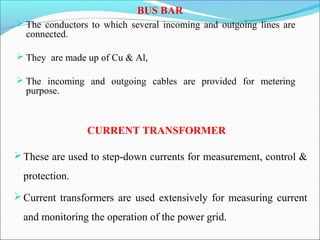
BUS BAR
 The conductors to which several incoming and outgoing lines are
connected.
 They are made up of Cu & Al,
 The incoming and outgoing cables are provided for metering
purpose.
CURRENT TRANSFORMER
These are used to step-down currents for measurement, control &
protection.
Current transformers are used extensively for measuring current
and monitoring the operation of the power grid.
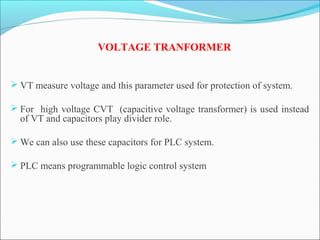
VOLTAGE TRANFORMER
 VT measure voltage and this parameter used for protection of system.
 For high voltage CVT (capacitive voltage transformer) is used instead
of VT and capacitors play divider role.
 We can also use these capacitors for PLC system.
 PLC means programmable logic control system
CONCLUSION
FOR YOUR ATTENTION

RASHID ANWAR RAAZ ppt

  • 1.
    PRESENTED BY :- RASHIDANWAR B.TECH (M.E.) 1135993 ASRA COLLEGE OF ENGINEERING & TECHNOLOGY PRESENTATION ON
  • 2.
    The Sasan UltraMega Power Project (UMPP) is a Government of India initiative to develop a large power plant in India. Sasan Power Limited (SPL) is currently developing a 3,960 MW coal-fired UMPP to be located in Sasan, Madhya Pradesh, approximately 25 km from three captive pithead coalmines. The Sasan project will be a 6x660 MW coal-fired project. Sasan Power Limited (SPL) was incorporated on February 10, 2006. This company was incorporated as a wholly owned subsidiary of Power Finance Corporation Limited in order to build, own, operate and maintain the Sasan Ultra Megawatt Power Project at Sasan, Madhya Pradesh. It was transferred to Reliance Power under the provisions of a share purchase agreement dated August 7, 2007 and is now a fully owned subsidiary of Reliance Power.
  • 3.
    Summary: · Location: Sasan,Madhya Pradesh, a 3,000 acre cluster of 5 villages Sidhikhurg, Sidhikala, Tiyara, Jhanjhi and Harrhawa containing a population of about 10,000 located approximately 25 km from three captive pithead coalmines. · Date Initiated: Feb 10, 2006 with the incorporation of Sasan Power limited (SPL). · Size: 3,960 MW coal-fired ultra mega power project (UMPP) - 6x660 MW · Annual Emmissions: 26,000-27,000 tonnes of carbon dioxide per year or 832 grams carbon dioxide per kilowatt hour · Local Displacement: About 6,000 people will lose their land and homes once the Rs 20,000-crore ($200 billion) project takes off. Both issues are critical because the green cover here belies the stark poverty of an area that has just one or two pakka (permanent) houses. Most farmers and daily labourers live in mud hutments. · Power Use: The states sharing the power are Madhya Pradesh (Lead Procurer) with a 37.50% share, followed by Punjab (15%), Uttar Pradesh (12.5%), Delhi (11.25%),
  • 4.
    At present, India’stotal installed power capacity stands at 1,47,402.81MW. Of this, the contribution of each sources are Thermal - 93,392MW Hydro - 36,647.76MW Nuclear sources - 4,120 MW Renewable energy _ 13,242.41 MW. India’s power generation capacity 68% below target in 2009. There is a huge demand for power in FY10.It is expected to grow by 4.6% with a capacity of 7,730 MW are likely in FY10. PRESENTATION ON “GENERATION OF THERMAL POWER”
  • 5.
    The coal isbrought and crushed to powder. This is feed to Boiler for producing heat In Boiler the water is converted to steam. In Super heater the moisture content is removed from the steam and that steam is called super heated steam The superheated steam rotates the shaft of the High pressure turbine The Exhausted steam is sent to preheater and the steam then rotates the Intermediate pressure(IP) Turbine The steam from the IP turbine is then feed to low pressure turbine. The turbine shaft is connected to the Generator, which produces Electric Power. The power generated is then Transmitted.  Prime mover coupled to Alternator  Prime mover is driven by energy obtained from various sources such as  burning of fuel  pressure of water  Force of wind etc.
  • 6.
     Nuclear powerplants use a nuclear reactor’s heat to operate a steam turbine generator  Fossil fuelled power plants may also use a steam turbine generator or in the case of natural gas fired plants may use a combustion turbine.  Geothermal power plants use steam extracted from hot underground rocks  Renewable energy plants may be fuelled by waste from sugar cane, municipal solid waste, landfill methane, or other forms of biomass  In integrated steel mills, blast furnace exhaust gas is a low-cost, although low-energy-density, fuel  Waste heat from industrial processes is occasionally concentrated enough to use for power generation, usually in a steam boiler and turbine  Solar thermal electric plants use sunlight to boil water, which turns the generator
  • 7.
    1. Cooling tower 10. Steam Control valve 19. Superheater 2. Cooling water pump11. High pressure steam turbine 20. Forced draught (draft) fan 3. transmission line (3-phase) 12. Deaerator 21. Reheater 4. Step-up transformer (3-phase) 13. Feed water heater 22. Combustion air intake 5. Electrical generator (3-phase) 14. Coal conveyor 23. Economiser 6. Low pressure steam turbine 15. Coal hopper 24. Air preheater
  • 8.
    In India 65%of total power is generated by the Thermal Power Stations . Thermal power plant basically works on Rankine cycle In thermal power station, water is heated, turns into steam and spins a steam turbine which drives an electrical generator. After it passes through the turbine, the steam is condensed in a condenser & recycled to where it was heated; this is known as Rankine cycle Coal handling plant Coal conveyor pulverizer Boiler Super-heater and re-heaters Economizer Steam turbine generator Condensers Ash handling plant Generator Cooling tower Switch yard & Control room
  • 9.
    Raw coal from J.C.FRenukut To R.W.P.L. from mine via railway track Wagon tipplers Crusher house Coal hopperbunkers Raw coal feeders Coal mills (pulverization) Boiler furnace ( tangential firing of pulverized coal)
  • 10.
    COAL CONYEYOR  Coalconveyor is a belt type arrangement, that are used to move coal efficiently.  Coal arriving by train can be stocked for later use or taken straight to the coal bunkers.  Control room with remote control system helps to ensure that conveyors take the coal to the right bunkers. PULVERIZER  Each unit has six pulverizing fuel mills, each capable of pulverizing 40 tones of coal per hour  Inside the mills, ten giant hollow steel rollers crush the coal into a fine powder  Crushing the coal into a fine powder makes easier to burn it more completely  By pulverizing the coal combustion efficiency of coal increases.
  • 11.
    BOILER  A boileror steam generator is a closed vessel in which water is converted into steam, under pressure  It is the major components of a thermal power plant.  Always designed to absorb maximum amount of heat released in the process of combustion.  Boilers are of two types-  Fire tube boiler  Water tube boiler
  • 12.
    SUPERHEATER  The steamproduced in the boiler, goes to the steam drum and is then piped to super-heaters where it is heated above saturation temperature.  At this point steam is now turned into a very powerful source of energy.  This rotates the turbine to which generator is on the other end.  From rotating generator electricity is produced.
  • 13.
    ECONOMISER  Economizer isdevice which recover the heat from the flue gases on their way to chimney.  Flue gases coming out of the boiler carry lot of heat.  An economizer extracts a part of this heat from flue gases and uses it for heating feed water.  This use of economizer results in saving coal consumption and higher boiler efficiency
  • 14.
    REHEATERS  Reheater isalso a steam boiler in which heat is added to this high-pressure steam, which has given up some of its energy in expansion through the intermediate-pressure turbine.  The steam after reheating is used to rotate the second steam turbine where the heat is converted to mechanical energy.  This mechanical energy is used to run the generator, which is coupled to turbine , there by generating electrical energy.
  • 15.
    STEAM TURBINE GENERATOR The turbine generator consists of a series of steam turbines interconnected to each other and a generator on a common shaft.  There is a high pressure turbine at one end, followed by an intermediate pressure turbine, a low pressure turbines, and the generator.  As steam moves through the system, it loses pressure and thermal energy and expands in volume, requiring increasing diameter and longer blades at each succeeding stage to extract the remaining energy.  The entire rotating mass may be over 200 metric tons and 100 feet (30 m) long.
  • 16.
    CONDENSER Steam after rotatingsteam turbine comes to the condenser.  The purpose of condensor is to condense the outlet steam from steam turbine to get the condensed steam in the form of pure water. This water is then Pumped back to the boiler.
  • 17.
    ASH HANDLING PLANT The percentage of ash in coal is 5% in good quality coal & about 40% in poor quality coal.  Power plants generally use poor quality of coal , thus amount of ash produced by it is quite large. A modern 1000MW plant produces about 4800 tons of ash daily.  The stations use some conveyor arrangement to carry ash to dump sites.
  • 18.
    DEAERATOR A steam generatingboiler requires that the boiler feed water should be devoid of air and other dissolved gases, particularly corrosive ones.  In order to avoid corrosion of the metal, power station uses a Deaerator, for the removal of air and other dissolved gases from the boiler feed water. A deaerator has a vertical, domed deaeration section mounted on top of a horizontal cylindrical vessel which serves as a deaerated boiler feed water storage tank.
  • 19.
    GENERATOR  An electricalgenerator is a machine which converts mechanical energy into electrical energy through electro mechanical energy conversion.  The generator is driven by directly coupled steam turbine at a speed of 3000 rpm.  The electricity then goes to a “transformer” where the voltage is increased to 4,00,000 volts before sending it to the “Grid” for distribution via cables. Mechanical energy Electrical Energy
  • 20.
    COOLING TOWER  Thecondensate (water) formed in the condenser after condensation is initially at high temperature. This hot water is passed to cooling towers.  It is a tower- or building-like structure in which atmospheric air circulates in direct or indirect contact with warmer water and the water is thereby cooled.
  • 21.
    SWITCH YARD  Placedwhere switching operation of power distribution is performed.  Air insulated switch yard of 220KV-400KV are used. Main Components of Switch Yard:  Circuit breaker  Isolator  Lightening arrester  Bus bar  Current Transformer  Potential Transformer
  • 22.
  • 23.
    CIRCUIT BREAKER These areused for automatic switching during normal or abnormal conditions . Specification: Manufacturer ABB Limited Type of Circuit Breaker SF6 Rated Voltage 245 KV Rated Current Under Site Condition of 40 0C Under Site Condition of 50 0C 4000 A 2000 A Rated Frequency 50 Hz
  • 24.
    ISOLATOR These are usedto disconnect transmission line under no-load condition for safety, isolation and maintenance. Specification: Rated current for site conditions 2000 A Rated Voltage 245 KV Rated Frequency 50 Hz Operating time of Isolator Less than 12 sec.
  • 25.
    LIGHTENING ARRESTOR These areused to discharge lightning over voltages and switching over voltages to earth. Specification: Manufacturer Crompton Greaves Ltd, Nasik Model No. ZLA X 25 C Ref. Standard IEC 99 – 4. 1991 Rated Frequency 50 Hz Max. Leakage Current 5 mA
  • 26.
    BUS BAR  Theconductors to which several incoming and outgoing lines are connected.  They are made up of Cu & Al,  The incoming and outgoing cables are provided for metering purpose. CURRENT TRANSFORMER These are used to step-down currents for measurement, control & protection. Current transformers are used extensively for measuring current and monitoring the operation of the power grid.
  • 27.
    VOLTAGE TRANFORMER  VTmeasure voltage and this parameter used for protection of system.  For high voltage CVT (capacitive voltage transformer) is used instead of VT and capacitors play divider role.  We can also use these capacitors for PLC system.  PLC means programmable logic control system
  • 28.
  • 29.