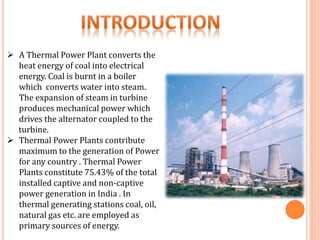
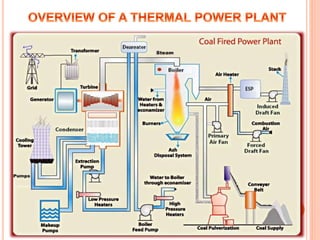

 A Thermal Power Plant converts the
heat energy of coal into electrical
energy. Coal is burnt in a boiler
which converts water into steam.
The expansion of steam in turbine
produces mechanical power which
drives the alternator coupled to the
turbine.
 Thermal Power Plants contribute
maximum to the generation of Power
for any country . Thermal Power
Plants constitute 75.43% of the total
installed captive and non-captive
power generation in India . In
thermal generating stations coal, oil,
natural gas etc. are employed as
primary sources of energy.
 Established in 7th July 1948 as the first multipurpose river valley
project of independent India to arrest the fury by the river of sorrow
and to harness the resources of Damodar Valley command area in
Jharkhand and West Bengal.
 With the time DVC developed and expanded its infrastructure, seven
thermal power stations with a capacity of 8910MW, three
hydroelectric power stations with a capacity of 147 MW.
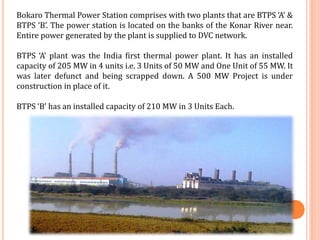
Bokaro Thermal Power Station comprises with two plants that are BTPS ‘A’ &
BTPS ‘B’. The power station is located on the banks of the Konar River near.
Entire power generated by the plant is supplied to DVC network.
BTPS ‘A’ plant was the India first thermal power plant. It has an installed
capacity of 205 MW in 4 units i.e. 3 Units of 50 MW and One Unit of 55 MW. It
was later defunct and being scrapped down. A 500 MW Project is under
construction in place of it.
BTPS ‘B’ has an installed capacity of 210 MW in 3 Units Each.
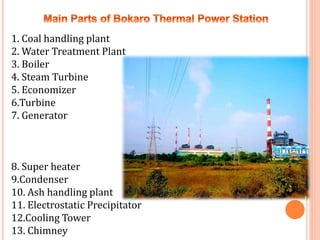
1. Coal handling plant
2. Water Treatment Plant
3. Boiler
4. Steam Turbine
5. Economizer
6.Turbine
7. Generator
8. Super heater
9.Condenser
10. Ash handling plant
11. Electrostatic Precipitator
12.Cooling Tower
13. Chimney
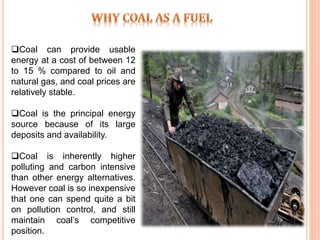
Coal can provide usable
energy at a cost of between 12
to 15 % compared to oil and
natural gas, and coal prices are
relatively stable.
Coal is the principal energy
source because of its large
deposits and availability.
Coal is inherently higher
polluting and carbon intensive
than other energy alternatives.
However coal is so inexpensive
that one can spend quite a bit
on pollution control, and still
maintain coal’s competitive
position.
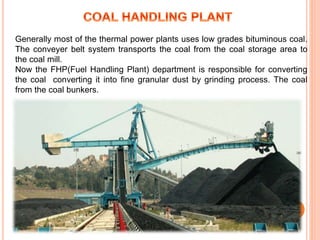
Generally most of the thermal power plants uses low grades bituminous coal.
The conveyer belt system transports the coal from the coal storage area to
the coal mill.
Now the FHP(Fuel Handling Plant) department is responsible for converting
the coal converting it into fine granular dust by grinding process. The coal
from the coal bunkers.
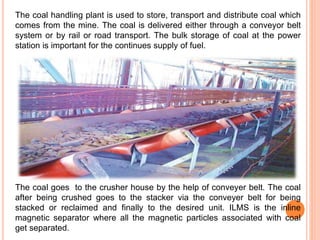
The coal handling plant is used to store, transport and distribute coal which
comes from the mine. The coal is delivered either through a conveyor belt
system or by rail or road transport. The bulk storage of coal at the power
station is important for the continues supply of fuel.
The coal goes to the crusher house by the help of conveyer belt. The coal
after being crushed goes to the stacker via the conveyer belt for being
stacked or reclaimed and finally to the desired unit. ILMS is the inline
magnetic separator where all the magnetic particles associated with coal
get separated.
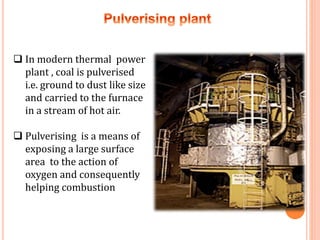
 In modern thermal power
plant , coal is pulverised
i.e. ground to dust like size
and carried to the furnace
in a stream of hot air.
 Pulverising is a means of
exposing a large surface
area to the action of
oxygen and consequently
helping combustion
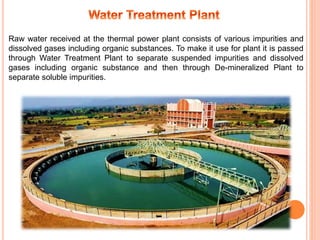
Raw water received at the thermal power plant consists of various impurities and
dissolved gases including organic substances. To make it use for plant it is passed
through Water Treatment Plant to separate suspended impurities and dissolved
gases including organic substance and then through De-mineralized Plant to
separate soluble impurities.
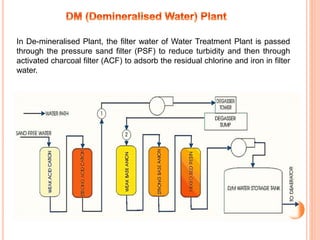
In De-mineralised Plant, the filter water of Water Treatment Plant is passed
through the pressure sand filter (PSF) to reduce turbidity and then through
activated charcoal filter (ACF) to adsorb the residual chlorine and iron in filter
water.
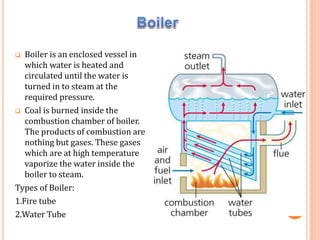
 Boiler is an enclosed vessel in
which water is heated and
circulated until the water is
turned in to steam at the
required pressure.
 Coal is burned inside the
combustion chamber of boiler.
The products of combustion are
nothing but gases. These gases
which are at high temperature
vaporize the water inside the
boiler to steam.
Types of Boiler:
1.Fire tube
2.Water Tube
 Economizer tubes recover some of the heat from the
heat carried away in the flue gases up the stack and
utilize for heating the feed water to the boiler
 Air Preheater which increased the temperature of air
supplied to the boiler. The purpose of air pre heater is
to recover the heat from the boiler flue gases which
increased the thermal efficiency of the boiler by
reducing the useful heat lost in the flue gas.
Boiler Drum: Consists of steam separators and dryers.
Separate water and steam from the mixture generated
in water wells.
Furnace is primary part of boiler where the combustion
of oil and pulverized coal takes place.
Super heater are placed in the flue gas path to transfer
heat by radiation and convection in such proportion that
the outlet steam temperature can be maintained fairly
constant at all loads
Reheater for reheating the low pressure steam.
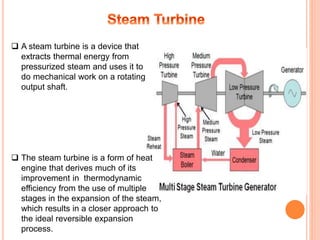
 A steam turbine is a device that
extracts thermal energy from
pressurized steam and uses it to
do mechanical work on a rotating
output shaft.
 The steam turbine is a form of heat
engine that derives much of its
improvement in thermodynamic
efficiency from the use of multiple
stages in the expansion of the steam,
which results in a closer approach to
the ideal reversible expansion
process.
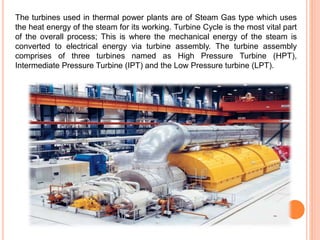
The turbines used in thermal power plants are of Steam Gas type which uses
the heat energy of the steam for its working. Turbine Cycle is the most vital part
of the overall process; This is where the mechanical energy of the steam is
converted to electrical energy via turbine assembly. The turbine assembly
comprises of three turbines named as High Pressure Turbine (HPT),
Intermediate Pressure Turbine (IPT) and the Low Pressure turbine (LPT).
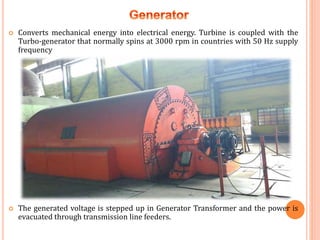
 Converts mechanical energy into electrical energy. Turbine is coupled with the
Turbo-generator that normally spins at 3000 rpm in countries with 50 Hz supply
frequency
 The generated voltage is stepped up in Generator Transformer and the power is
evacuated through transmission line feeders.
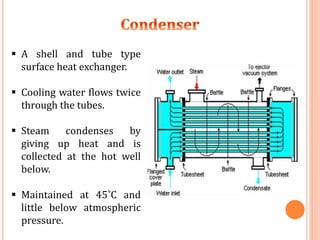
 A shell and tube type
surface heat exchanger.
 Cooling water flows twice
through the tubes.
 Steam condenses by
giving up heat and is
collected at the hot well
below.
 Maintained at 45˚C and
little below atmospheric
pressure.
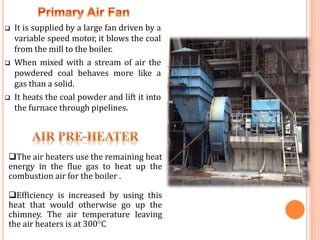
 It is supplied by a large fan driven by a
variable speed motor, it blows the coal
from the mill to the boiler.
 When mixed with a stream of air the
powdered coal behaves more like a
gas than a solid.
 It heats the coal powder and lift it into
the furnace through pipelines.
The air heaters use the remaining heat
energy in the flue gas to heat up the
combustion air for the boiler .
Efficiency is increased by using this
heat that would otherwise go up the
chimney. The air temperature leaving
the air heaters is at 300°C
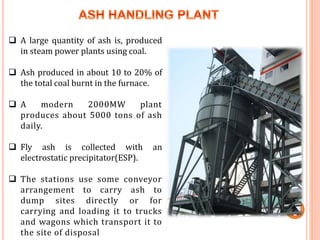
 A large quantity of ash is, produced
in steam power plants using coal.
 Ash produced in about 10 to 20% of
the total coal burnt in the furnace.
 A modern 2000MW plant
produces about 5000 tons of ash
daily.
 Fly ash is collected with an
electrostatic precipitator(ESP).
 The stations use some conveyor
arrangement to carry ash to
dump sites directly or for
carrying and loading it to trucks
and wagons which transport it to
the site of disposal
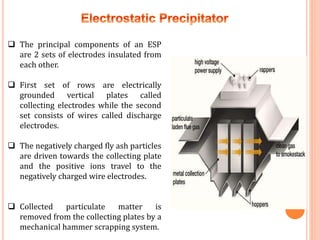
 The principal components of an ESP
are 2 sets of electrodes insulated from
each other.
 First set of rows are electrically
grounded vertical plates called
collecting electrodes while the second
set consists of wires called discharge
electrodes.
 The negatively charged fly ash particles
are driven towards the collecting plate
and the positive ions travel to the
negatively charged wire electrodes.
 Collected particulate matter is
removed from the collecting plates by a
mechanical hammer scrapping system.
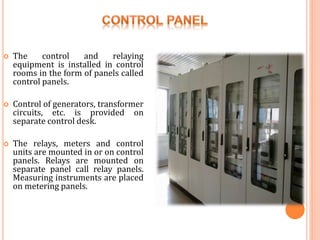
 The control and relaying
equipment is installed in control
rooms in the form of panels called
control panels.
 Control of generators, transformer
circuits, etc. is provided on
separate control desk.
 The relays, meters and control
units are mounted in or on control
panels. Relays are mounted on
separate panel call relay panels.
Measuring instruments are placed
on metering panels.
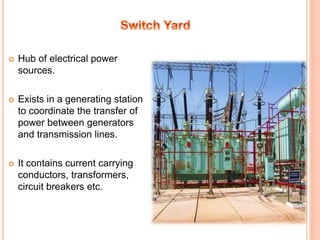
 Hub of electrical power
sources.
 Exists in a generating station
to coordinate the transfer of
power between generators
and transmission lines.
 It contains current carrying
conductors, transformers,
circuit breakers etc.
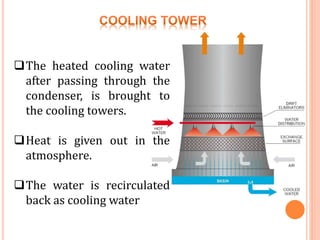
The heated cooling water
after passing through the
condenser, is brought to
the cooling towers.
Heat is given out in the
atmosphere.
The water is recirculated
back as cooling water
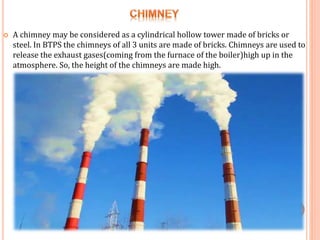
 A chimney may be considered as a cylindrical hollow tower made of bricks or
steel. In BTPS the chimneys of all 3 units are made of bricks. Chimneys are used to
release the exhaust gases(coming from the furnace of the boiler)high up in the
atmosphere. So, the height of the chimneys are made high.
Bokaro Thermal Power Plant

Bokaro Thermal Power Plant

  • 2.
     A ThermalPower Plant converts the heat energy of coal into electrical energy. Coal is burnt in a boiler which converts water into steam. The expansion of steam in turbine produces mechanical power which drives the alternator coupled to the turbine.  Thermal Power Plants contribute maximum to the generation of Power for any country . Thermal Power Plants constitute 75.43% of the total installed captive and non-captive power generation in India . In thermal generating stations coal, oil, natural gas etc. are employed as primary sources of energy.
  • 3.
     Established in7th July 1948 as the first multipurpose river valley project of independent India to arrest the fury by the river of sorrow and to harness the resources of Damodar Valley command area in Jharkhand and West Bengal.  With the time DVC developed and expanded its infrastructure, seven thermal power stations with a capacity of 8910MW, three hydroelectric power stations with a capacity of 147 MW.
  • 4.
    Bokaro Thermal PowerStation comprises with two plants that are BTPS ‘A’ & BTPS ‘B’. The power station is located on the banks of the Konar River near. Entire power generated by the plant is supplied to DVC network. BTPS ‘A’ plant was the India first thermal power plant. It has an installed capacity of 205 MW in 4 units i.e. 3 Units of 50 MW and One Unit of 55 MW. It was later defunct and being scrapped down. A 500 MW Project is under construction in place of it. BTPS ‘B’ has an installed capacity of 210 MW in 3 Units Each.
  • 6.
    1. Coal handlingplant 2. Water Treatment Plant 3. Boiler 4. Steam Turbine 5. Economizer 6.Turbine 7. Generator 8. Super heater 9.Condenser 10. Ash handling plant 11. Electrostatic Precipitator 12.Cooling Tower 13. Chimney
  • 7.
    Coal can provideusable energy at a cost of between 12 to 15 % compared to oil and natural gas, and coal prices are relatively stable. Coal is the principal energy source because of its large deposits and availability. Coal is inherently higher polluting and carbon intensive than other energy alternatives. However coal is so inexpensive that one can spend quite a bit on pollution control, and still maintain coal’s competitive position.
  • 8.
    Generally most ofthe thermal power plants uses low grades bituminous coal. The conveyer belt system transports the coal from the coal storage area to the coal mill. Now the FHP(Fuel Handling Plant) department is responsible for converting the coal converting it into fine granular dust by grinding process. The coal from the coal bunkers.
  • 9.
    The coal handlingplant is used to store, transport and distribute coal which comes from the mine. The coal is delivered either through a conveyor belt system or by rail or road transport. The bulk storage of coal at the power station is important for the continues supply of fuel. The coal goes to the crusher house by the help of conveyer belt. The coal after being crushed goes to the stacker via the conveyer belt for being stacked or reclaimed and finally to the desired unit. ILMS is the inline magnetic separator where all the magnetic particles associated with coal get separated.
  • 10.
     In modernthermal power plant , coal is pulverised i.e. ground to dust like size and carried to the furnace in a stream of hot air.  Pulverising is a means of exposing a large surface area to the action of oxygen and consequently helping combustion
  • 11.
    Raw water receivedat the thermal power plant consists of various impurities and dissolved gases including organic substances. To make it use for plant it is passed through Water Treatment Plant to separate suspended impurities and dissolved gases including organic substance and then through De-mineralized Plant to separate soluble impurities.
  • 12.
    In De-mineralised Plant,the filter water of Water Treatment Plant is passed through the pressure sand filter (PSF) to reduce turbidity and then through activated charcoal filter (ACF) to adsorb the residual chlorine and iron in filter water.
  • 13.
     Boiler isan enclosed vessel in which water is heated and circulated until the water is turned in to steam at the required pressure.  Coal is burned inside the combustion chamber of boiler. The products of combustion are nothing but gases. These gases which are at high temperature vaporize the water inside the boiler to steam. Types of Boiler: 1.Fire tube 2.Water Tube
  • 14.
     Economizer tubesrecover some of the heat from the heat carried away in the flue gases up the stack and utilize for heating the feed water to the boiler  Air Preheater which increased the temperature of air supplied to the boiler. The purpose of air pre heater is to recover the heat from the boiler flue gases which increased the thermal efficiency of the boiler by reducing the useful heat lost in the flue gas.
  • 15.
    Boiler Drum: Consistsof steam separators and dryers. Separate water and steam from the mixture generated in water wells. Furnace is primary part of boiler where the combustion of oil and pulverized coal takes place. Super heater are placed in the flue gas path to transfer heat by radiation and convection in such proportion that the outlet steam temperature can be maintained fairly constant at all loads Reheater for reheating the low pressure steam.
  • 16.
     A steamturbine is a device that extracts thermal energy from pressurized steam and uses it to do mechanical work on a rotating output shaft.  The steam turbine is a form of heat engine that derives much of its improvement in thermodynamic efficiency from the use of multiple stages in the expansion of the steam, which results in a closer approach to the ideal reversible expansion process.
  • 17.
    The turbines usedin thermal power plants are of Steam Gas type which uses the heat energy of the steam for its working. Turbine Cycle is the most vital part of the overall process; This is where the mechanical energy of the steam is converted to electrical energy via turbine assembly. The turbine assembly comprises of three turbines named as High Pressure Turbine (HPT), Intermediate Pressure Turbine (IPT) and the Low Pressure turbine (LPT).
  • 18.
     Converts mechanicalenergy into electrical energy. Turbine is coupled with the Turbo-generator that normally spins at 3000 rpm in countries with 50 Hz supply frequency  The generated voltage is stepped up in Generator Transformer and the power is evacuated through transmission line feeders.
  • 19.
     A shelland tube type surface heat exchanger.  Cooling water flows twice through the tubes.  Steam condenses by giving up heat and is collected at the hot well below.  Maintained at 45˚C and little below atmospheric pressure.
  • 20.
     It issupplied by a large fan driven by a variable speed motor, it blows the coal from the mill to the boiler.  When mixed with a stream of air the powdered coal behaves more like a gas than a solid.  It heats the coal powder and lift it into the furnace through pipelines. The air heaters use the remaining heat energy in the flue gas to heat up the combustion air for the boiler . Efficiency is increased by using this heat that would otherwise go up the chimney. The air temperature leaving the air heaters is at 300°C
  • 21.
     A largequantity of ash is, produced in steam power plants using coal.  Ash produced in about 10 to 20% of the total coal burnt in the furnace.  A modern 2000MW plant produces about 5000 tons of ash daily.  Fly ash is collected with an electrostatic precipitator(ESP).  The stations use some conveyor arrangement to carry ash to dump sites directly or for carrying and loading it to trucks and wagons which transport it to the site of disposal
  • 22.
     The principalcomponents of an ESP are 2 sets of electrodes insulated from each other.  First set of rows are electrically grounded vertical plates called collecting electrodes while the second set consists of wires called discharge electrodes.  The negatively charged fly ash particles are driven towards the collecting plate and the positive ions travel to the negatively charged wire electrodes.  Collected particulate matter is removed from the collecting plates by a mechanical hammer scrapping system.
  • 23.
     The controland relaying equipment is installed in control rooms in the form of panels called control panels.  Control of generators, transformer circuits, etc. is provided on separate control desk.  The relays, meters and control units are mounted in or on control panels. Relays are mounted on separate panel call relay panels. Measuring instruments are placed on metering panels.
  • 24.
     Hub ofelectrical power sources.  Exists in a generating station to coordinate the transfer of power between generators and transmission lines.  It contains current carrying conductors, transformers, circuit breakers etc.
  • 25.
    The heated coolingwater after passing through the condenser, is brought to the cooling towers. Heat is given out in the atmosphere. The water is recirculated back as cooling water
  • 26.
     A chimneymay be considered as a cylindrical hollow tower made of bricks or steel. In BTPS the chimneys of all 3 units are made of bricks. Chimneys are used to release the exhaust gases(coming from the furnace of the boiler)high up in the atmosphere. So, the height of the chimneys are made high.