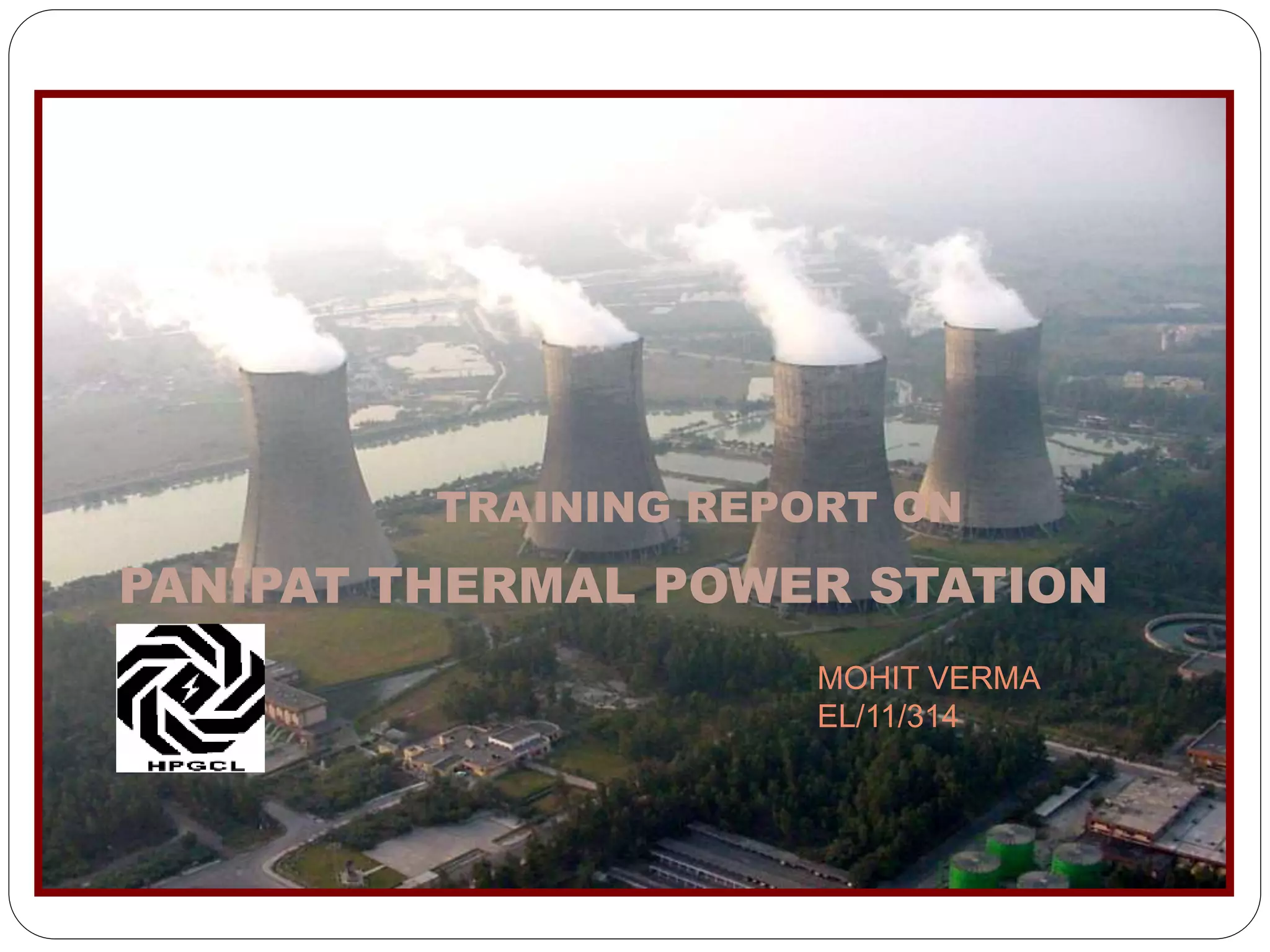
TRAINING REPORT ON 
PANIPAT THERMAL POWER STATION 
MOHIT VERMA 
EL/11/314
INTRODUCTION 
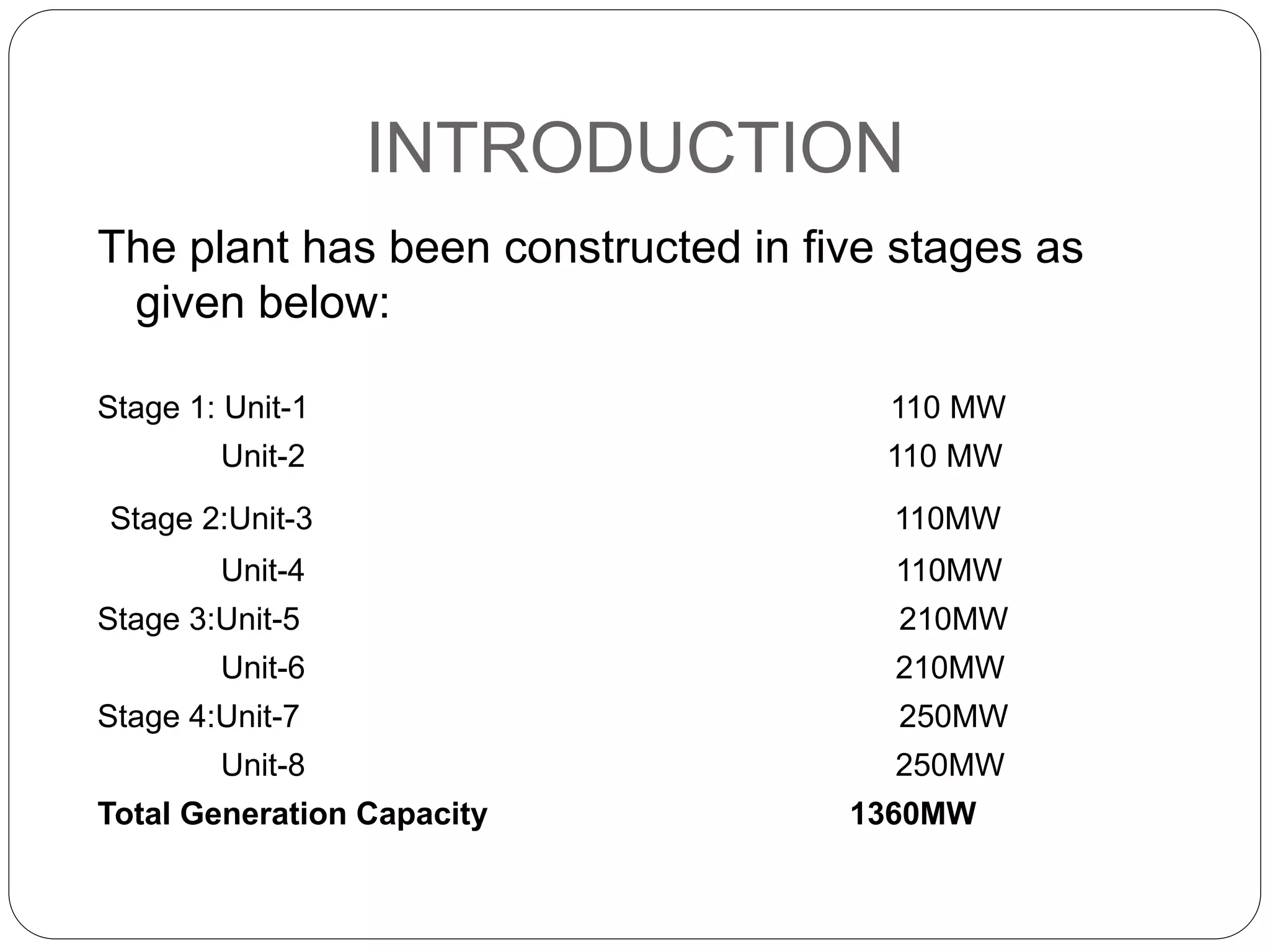
The plant has been constructed in five stages as 
given below: 
Stage 1: Unit-1 110 MW 
Unit-2 110 MW 
Stage 2:Unit-3 110MW 
Unit-4 110MW 
Stage 3:Unit-5 210MW 
Unit-6 210MW 
Stage 4:Unit-7 250MW 
Unit-8 250MW 
Total Generation Capacity 1360MW
Basic Idea of Electricity 
Generation 
Coal is unloaded by electric traction system at Coal Yard 
Coal is crushed to finer pieces of order 20 mm 
Pulverization of Coal 
Coal is send to furnace with the help of FD fan 
Steam is generated at 540°C and 135 kg/sq.m 
Steam is send to Super heater 
Superheated steam is send to turbine 
Production of Electricity by the generator coupled with
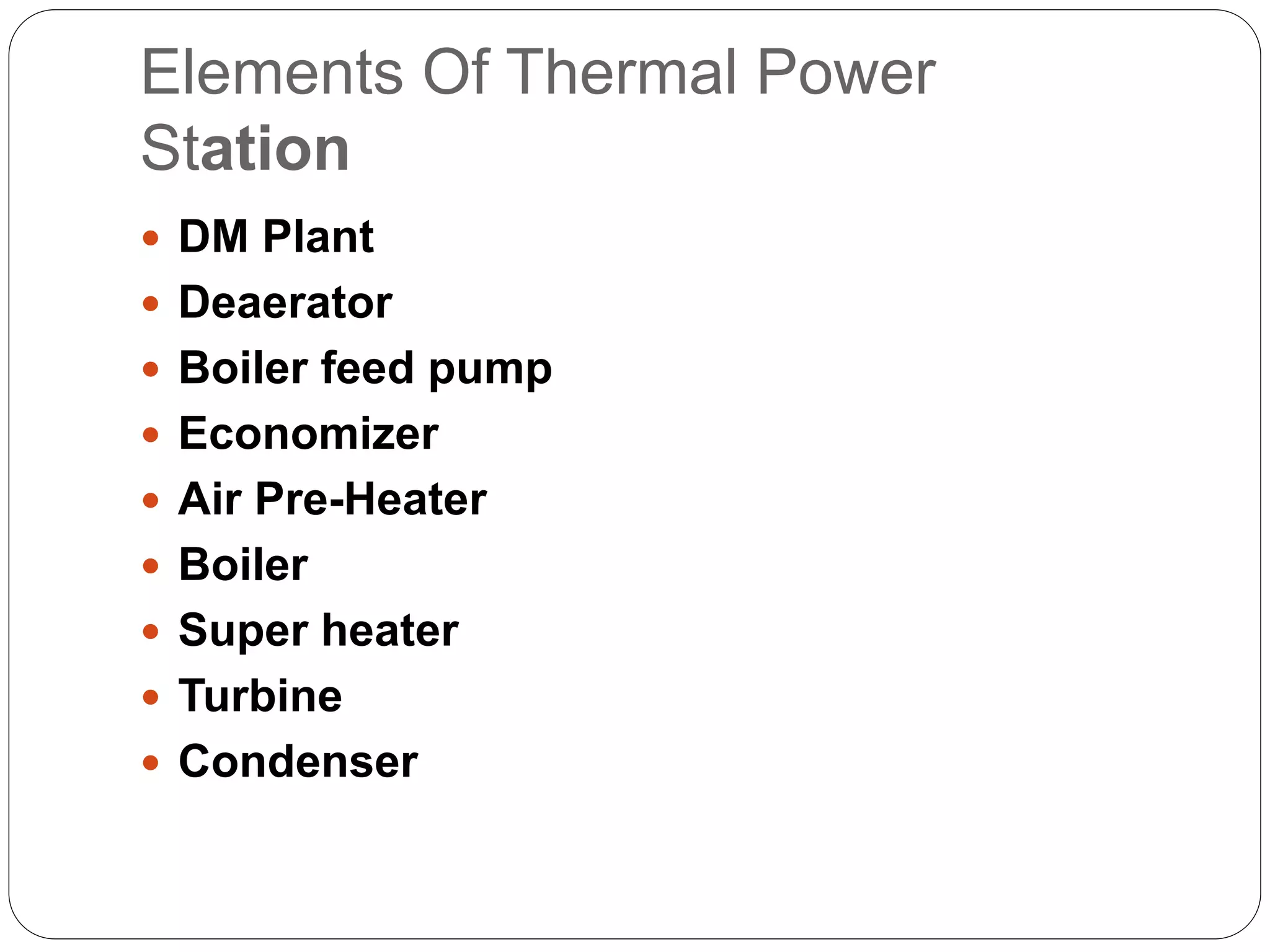
Elements Of Thermal Power 
Station 
 DM Plant 
 Deaerator 
 Boiler feed pump 
 Economizer 
 Air Pre-Heater 
 Boiler 
 Super heater 
 Turbine 
 Condenser
COAL FEEDING SYSTEM 
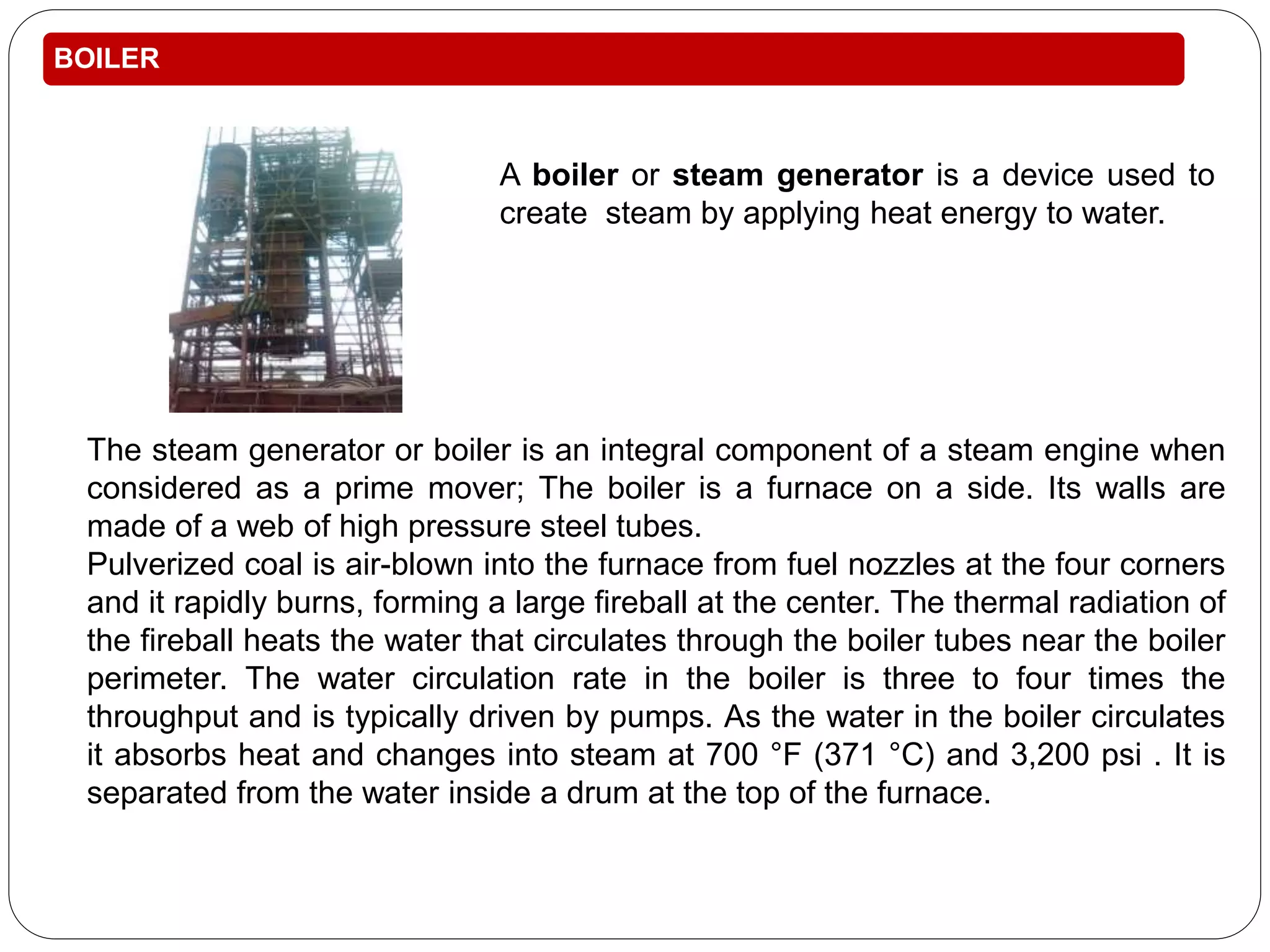
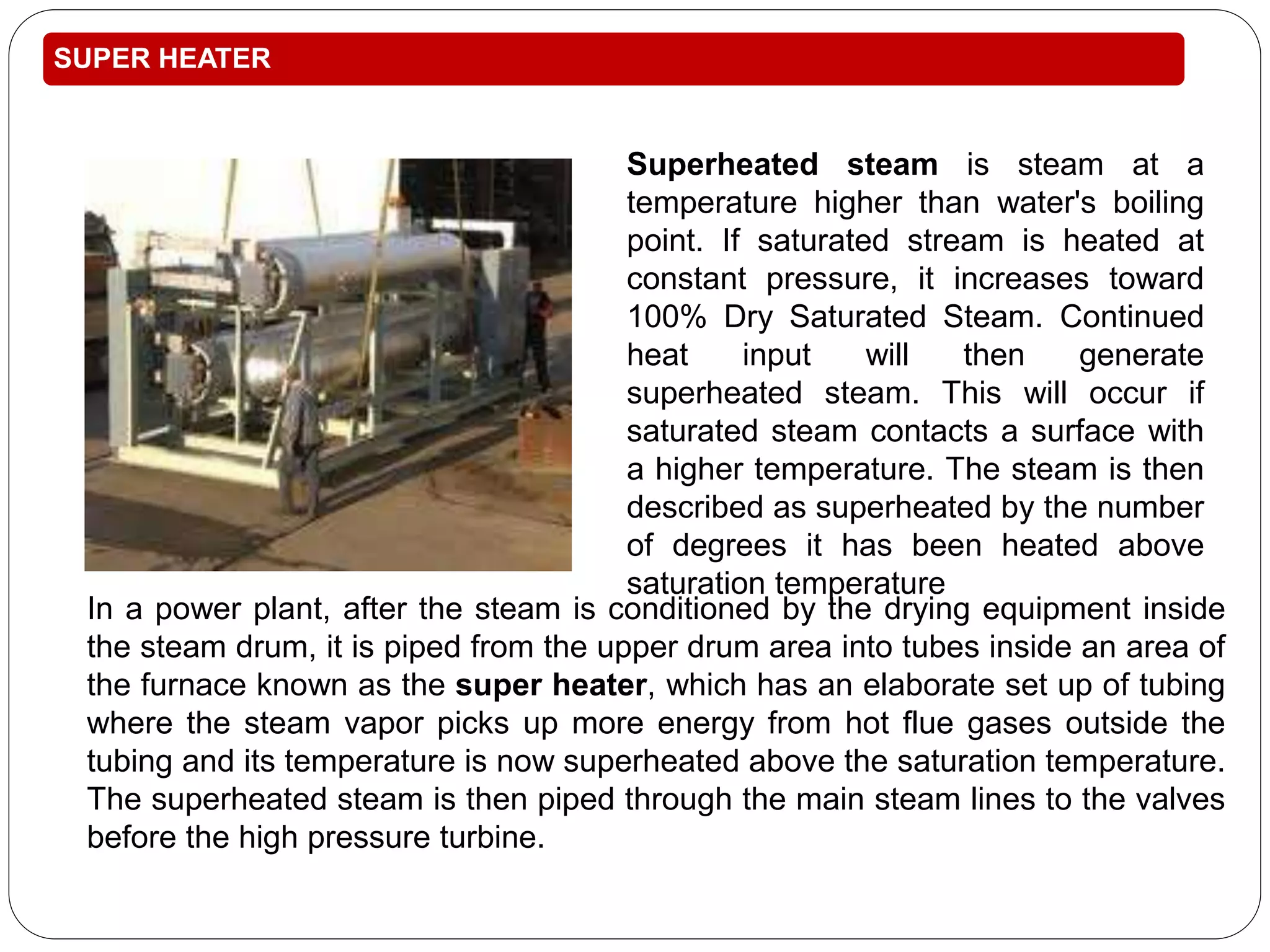
Conveyor Coal Hopper 
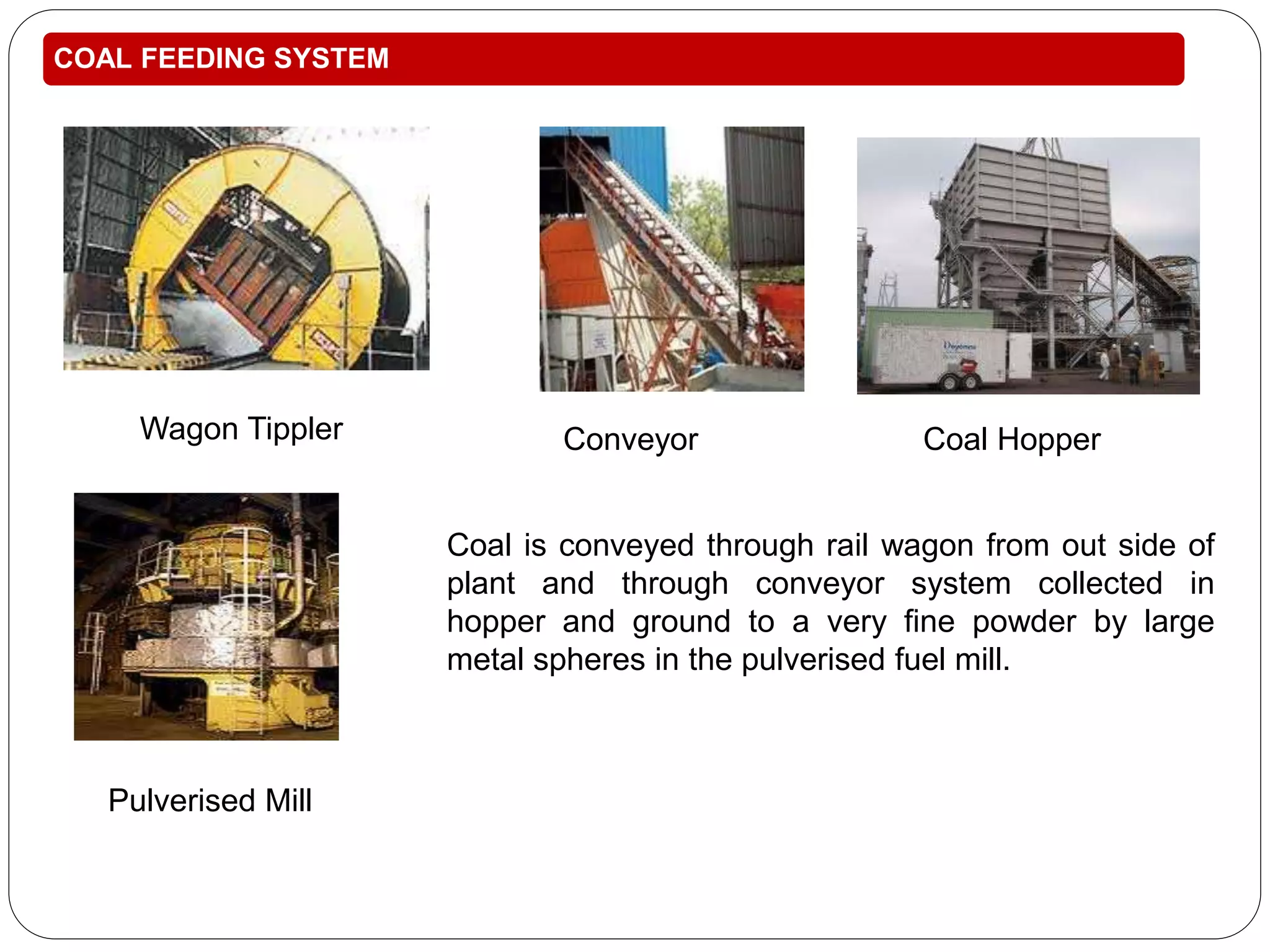
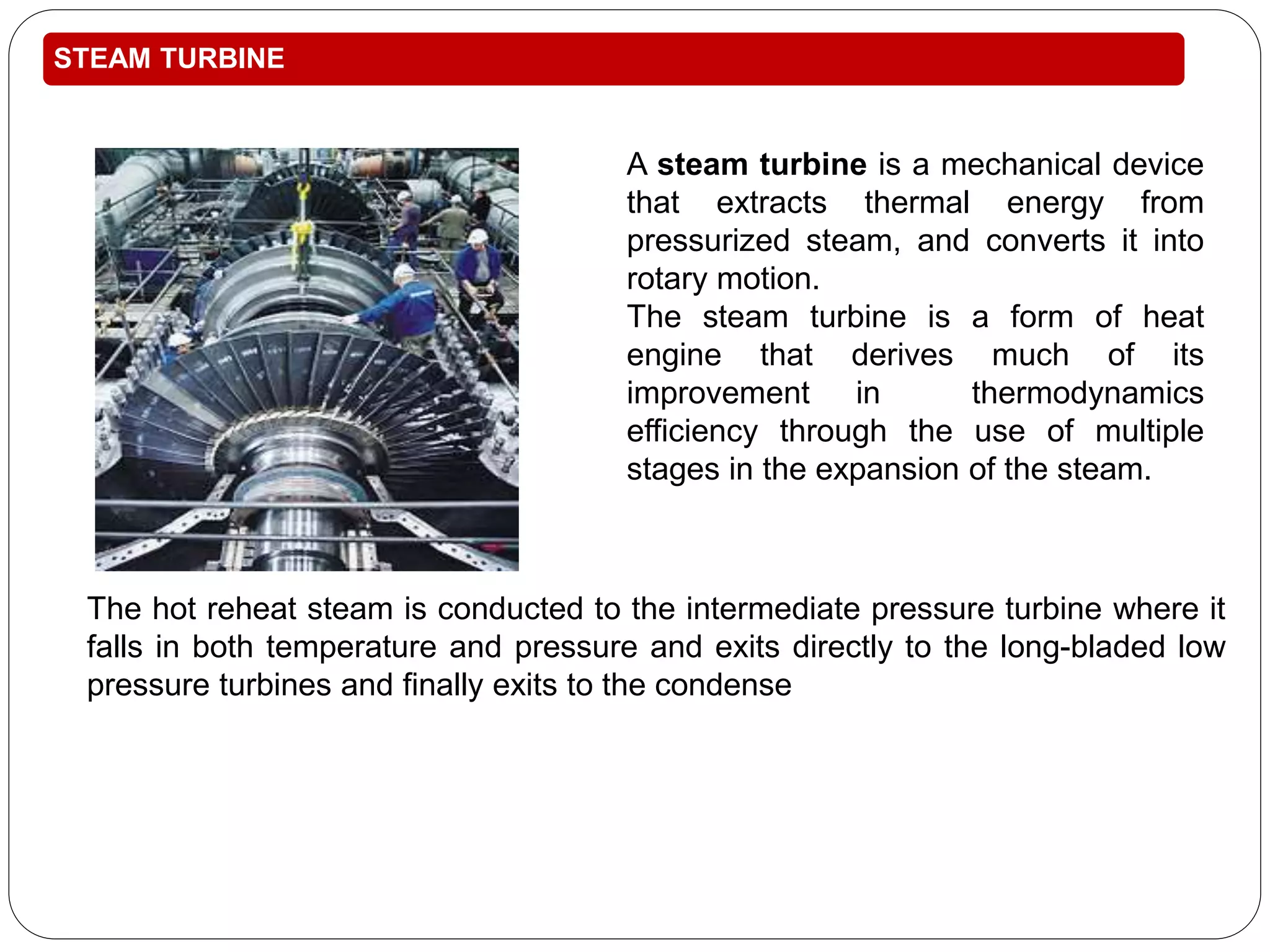
Coal is conveyed through rail wagon from out side of 
plant and through conveyor system collected in 
hopper and ground to a very fine powder by large 
metal spheres in the pulverised fuel mill. 
Wagon Tippler 
Pulverised Mill
COAL FEEDING SYSTEM 
Air Pre-heater Forced Draft Fan 
Then it is mixed with preheated air driven by the forced draught fan. The hot air-fuel 
mixture is forced at high pressure into the boiler.
BOILER 
A boiler or steam generator is a device used to 
create steam by applying heat energy to water. 
The steam generator or boiler is an integral component of a steam engine when 
considered as a prime mover; The boiler is a furnace on a side. Its walls are 
made of a web of high pressure steel tubes. 
Pulverized coal is air-blown into the furnace from fuel nozzles at the four corners 
and it rapidly burns, forming a large fireball at the center. The thermal radiation of 
the fireball heats the water that circulates through the boiler tubes near the boiler 
perimeter. The water circulation rate in the boiler is three to four times the 
throughput and is typically driven by pumps. As the water in the boiler circulates 
it absorbs heat and changes into steam at 700 °F (371 °C) and 3,200 psi . It is 
separated from the water inside a drum at the top of the furnace.
BOILER FEED PUMP 
NDE BEARING DE BEARING 
SLEEVE 
SOLE PLATE 
(BASE PLATE) 
KEY 
FOUNDATION BOLT 
9 PMI Revision 00 28 August 2014 
18
ASH HANDLING SYSTEM 
At the bottom of the furnace, there is a hopper for collection of bottom ash. This 
hopper is always filled with water to quench the ash and clinkers falling down 
from the furnace. Some arrangement is included to crush the clinkers and for 
conveying the crushed clinkers and bottom ash to a storage site.
SUPER HEATER 
Superheated steam is steam at a 
temperature higher than water's boiling 
point. If saturated stream is heated at 
constant pressure, it increases toward 
100% Dry Saturated Steam. Continued 
heat input will then generate 
superheated steam. This will occur if 
saturated steam contacts a surface with 
a higher temperature. The steam is then 
described as superheated by the number 
of degrees it has been heated above 
saturation temperature 
In a power plant, after the steam is conditioned by the drying equipment inside 
the steam drum, it is piped from the upper drum area into tubes inside an area of 
the furnace known as the super heater, which has an elaborate set up of tubing 
where the steam vapor picks up more energy from hot flue gases outside the 
tubing and its temperature is now superheated above the saturation temperature. 
The superheated steam is then piped through the main steam lines to the valves 
before the high pressure turbine.
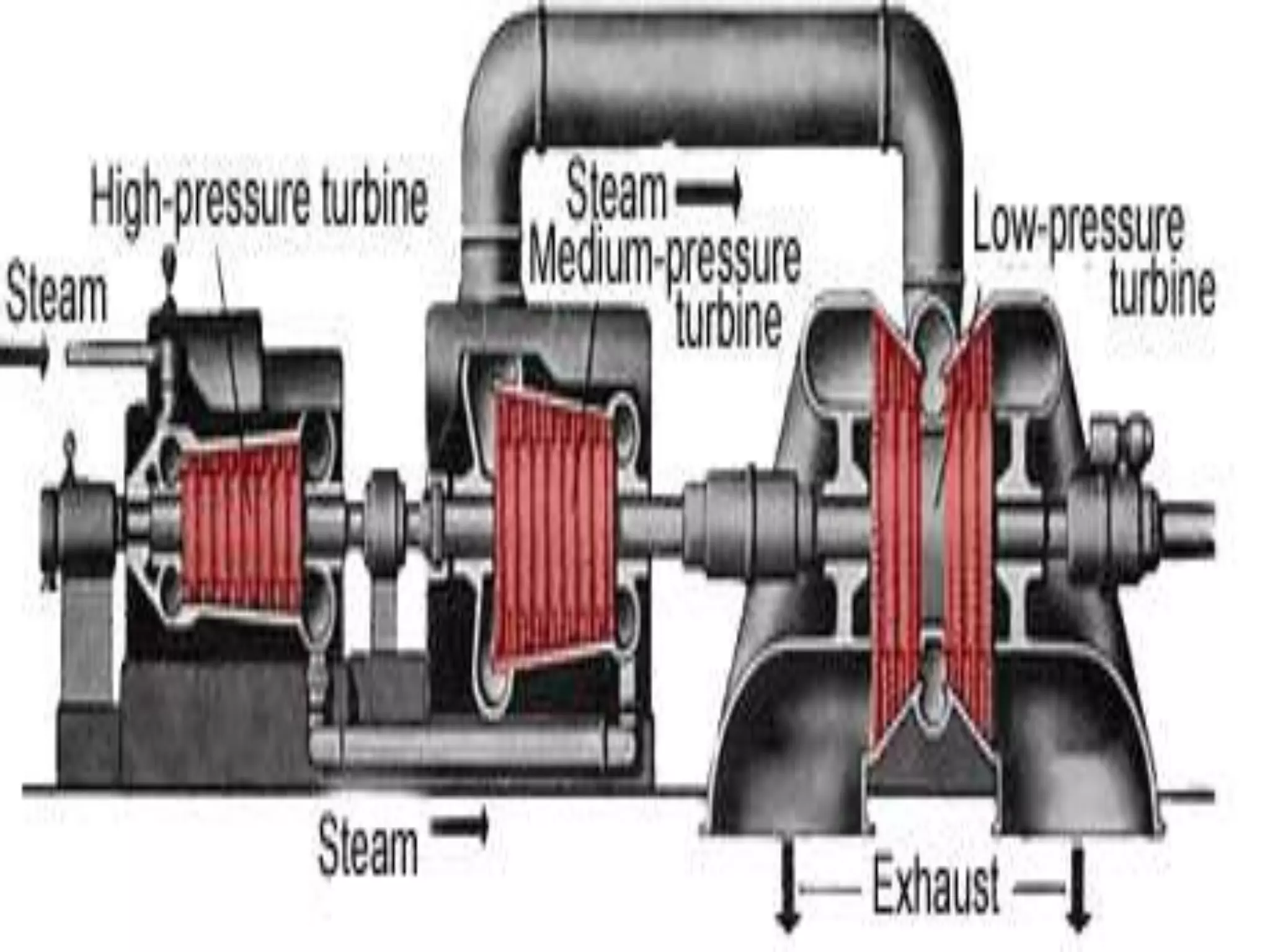
STEAM TURBINE 
A steam turbine is a mechanical device 
that extracts thermal energy from 
pressurized steam, and converts it into 
rotary motion. 
The steam turbine is a form of heat 
engine that derives much of its 
improvement in thermodynamics 
efficiency through the use of multiple 
stages in the expansion of the steam. 
The hot reheat steam is conducted to the intermediate pressure turbine where it 
falls in both temperature and pressure and exits directly to the long-bladed low 
pressure turbines and finally exits to the condense
ROTORS
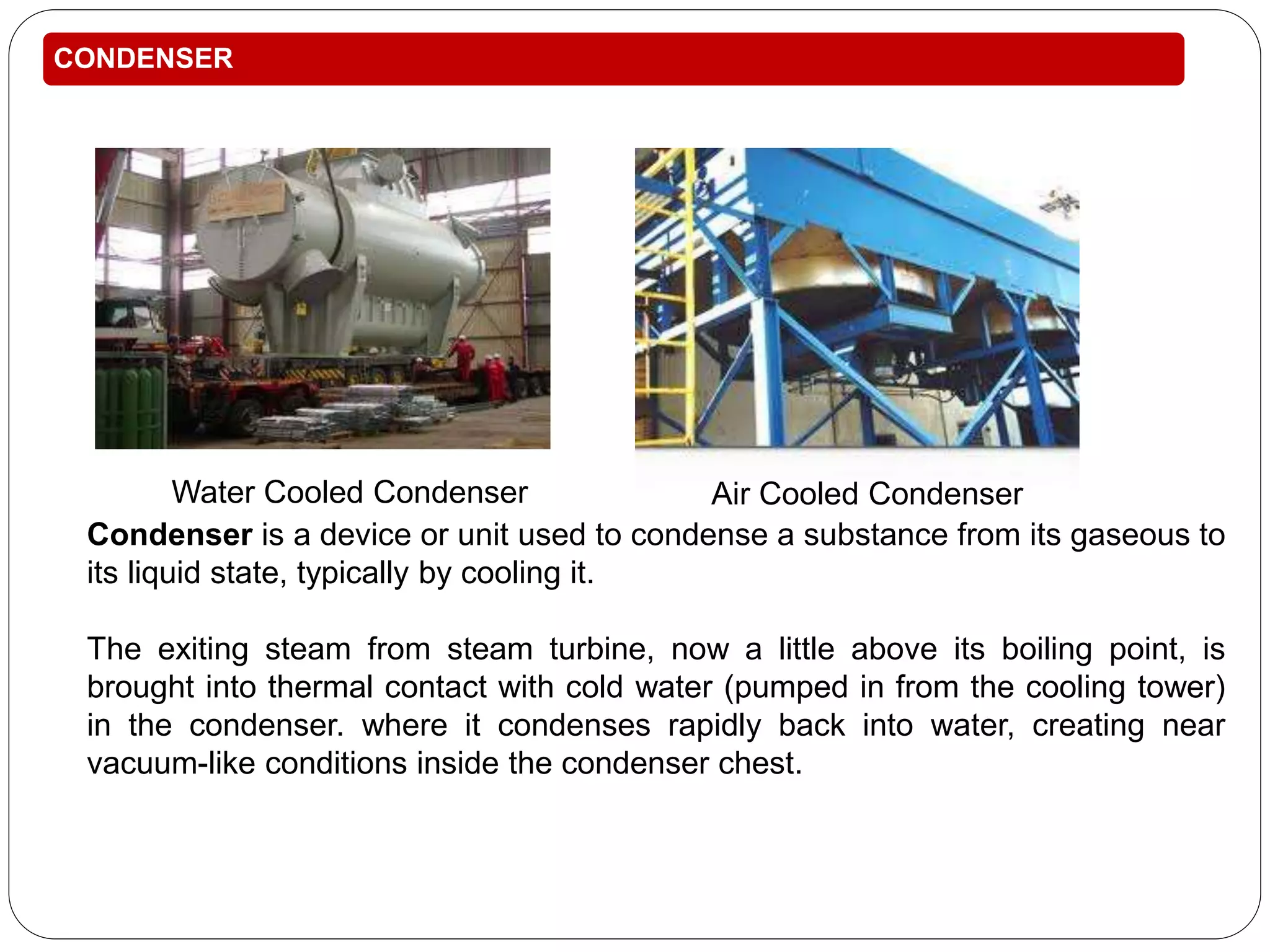
CONDENSER 
Water Cooled Condenser Air Cooled Condenser 
Condenser is a device or unit used to condense a substance from its gaseous to 
its liquid state, typically by cooling it. 
The exiting steam from steam turbine, now a little above its boiling point, is 
brought into thermal contact with cold water (pumped in from the cooling tower) 
in the condenser. where it condenses rapidly back into water, creating near 
vacuum-like conditions inside the condenser chest.
COOLING TOWER 
Natural Draft Cooling 
Tower 
Cooling towers are heat removal devices used to transfer process waste heat 
to the atmosphere. Cooling towers either use the evaporation of water to 
remove process heat and cool the working fluid or in the case of closed circuit 
dry cooling towers rely solely on air to cool the working fluid.
DE AREATOR 
De Areator 
A deaerator is a device that is widely 
used for the removal of air and other 
dissolved gases from the feed water to 
steam-generating boiler. 
The condensed water is then passed by a feed pump through a deaerater.
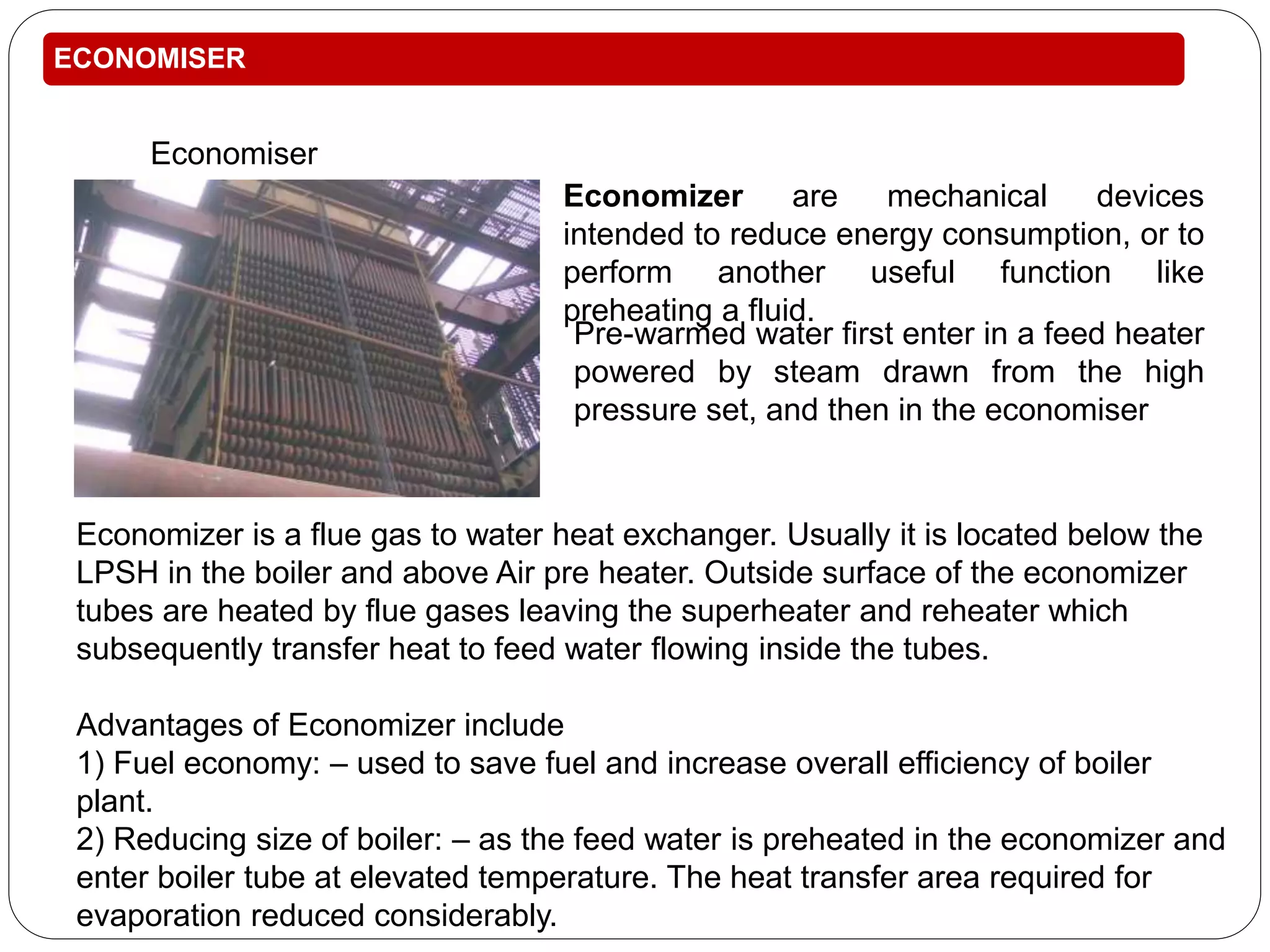
ECONOMISER 
Economiser 
Economizer are mechanical devices 
intended to reduce energy consumption, or to 
perform another useful function like 
preheating a fluid. 
Pre-warmed water first enter in a feed heater 
powered by steam drawn from the high 
pressure set, and then in the economiser 
Economizer is a flue gas to water heat exchanger. Usually it is located below the 
LPSH in the boiler and above Air pre heater. Outside surface of the economizer 
tubes are heated by flue gases leaving the superheater and reheater which 
subsequently transfer heat to feed water flowing inside the tubes. 
Advantages of Economizer include 
1) Fuel economy: – used to save fuel and increase overall efficiency of boiler 
plant. 
2) Reducing size of boiler: – as the feed water is preheated in the economizer and 
enter boiler tube at elevated temperature. The heat transfer area required for 
evaporation reduced considerably.
CHIMNEY 
A chimney is a structure for venting hot 
gases or smoke from a boiler, furnace or 
fireplace to the outside atmosphere. 
A chimney is a vertical structure for venting 
hot flue gases or smoke from a boiler to the 
outside atmosphere by means of the stack 
effect. The space inside a chimney is called 
aflue. The height of chimneys plays a role in 
their ability to transfer flue gases using 
stack effect. The dispersion of pollutants at 
higher altitude helps to ease down its 
influence on surroundings and reduces their 
concentrations in compliance with 
regulatory limits. 
Exhaust gas from electrostatic precipitator vented through the chimney tack.
SWITCHYARD 
A switch yard is a part of an electrical generation, transmission, 
system. Switchyard transform voltage from high to low, 
or the reverse, or perform any of several other important functions.
CONTROL ROOM 
A control room is a room serving as a centre where a large physical 
facility or physically dispersed service can be monitored and controlled.
Instrumentation In Thermal 
Power 
Plant 
When the balance is disturbed, all the process variables 
deviate 
from their normal values thus creating the necessity for the 
following:- 
i)Instruments : To measure and indicate the amount of 
deviation. 
ii)Automatic Control: To correct the deviation and bring 
back 
system to normal 
iii) Annunciation : To warn about the excessive 
deviations, if 
any. 
iv) Protection : To isolate the equipments process from 
dangerous operating conditions cause due to such 
excessive
Temperature 
The degree of hotness and coldness measured 
on the definite scale. 
 Methods of Temperature Measurement 
 Resistance Temperature Detector(R.T.D) 
 Thermocouple
Resistance Temperature 
Detector 
 Resistance of certain metals 
changes as the 
 temp. changes as per formula 
given below :- 
 Rt=Ro(1+wt) 
 Where Rt=Resistance at temp. to 
be measured. Ro=Resistance at 0 
degree C. 
 w=Temp. coefficient of res. 
Thermometer metal 
 t=Temp. to be measured. 
 Mainly three metals copper, nickel 
and platinum are used as RTD.
Thermocouple 
It consists of a pair of wire 
of different materials. 
Wires are joined at both 
ends one junction is 
kept at a high 
temp.called hot junction 
and the 
other is kept at a fixed at 
lower temp. called cold 
junction. Due to which 
emf is setup in the ckt 
known as Thermo emf.
Pressure 
Units for pressure 
measurement are 
Newton/m2 
, Kg/cm2, mm of water 
column & mm of 
mercury 
column. 
Devices for Pressure 
Measurement 
Bourden Tube Pressure 
Gauge 
Manometer
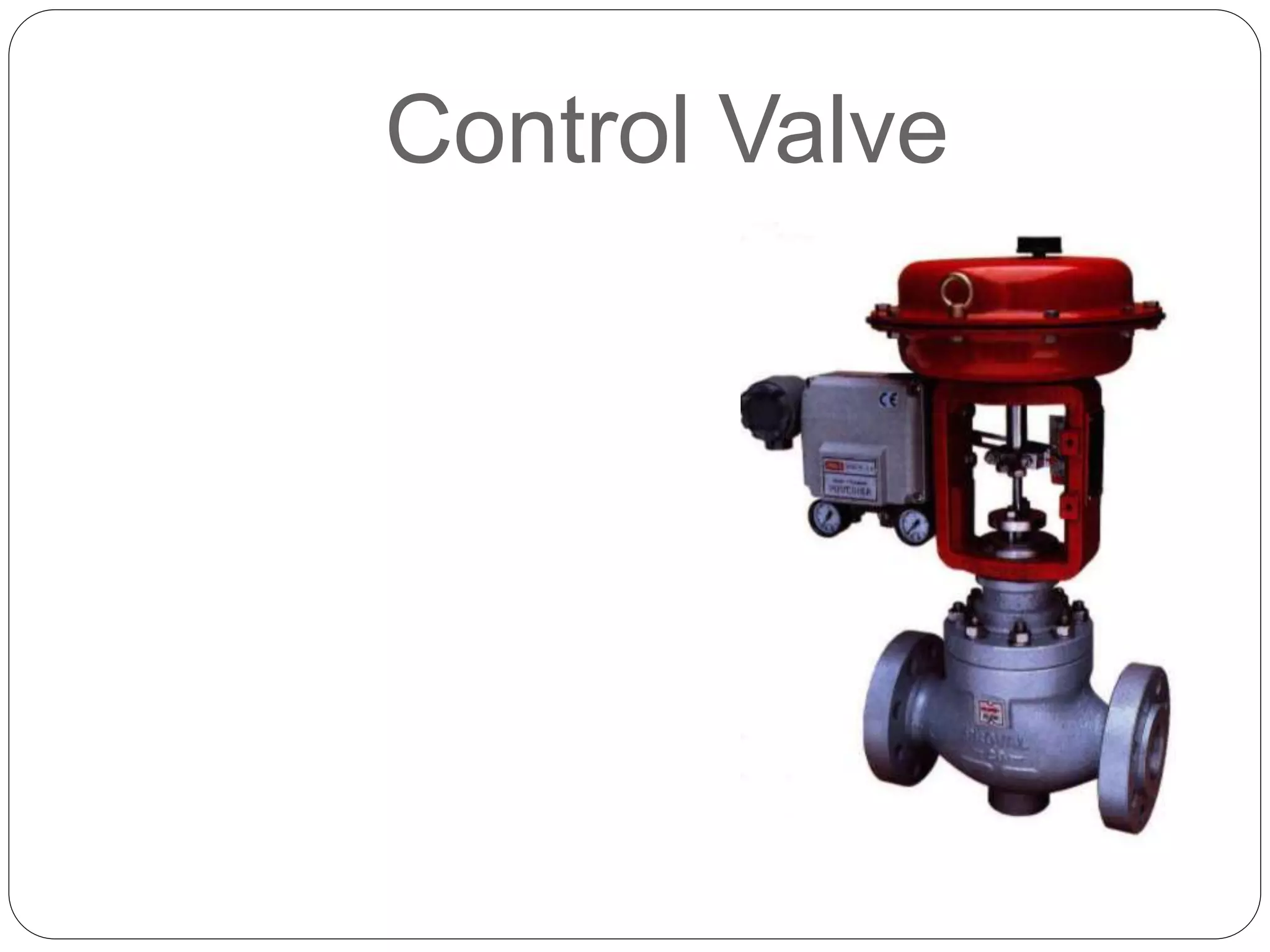
Control Valve
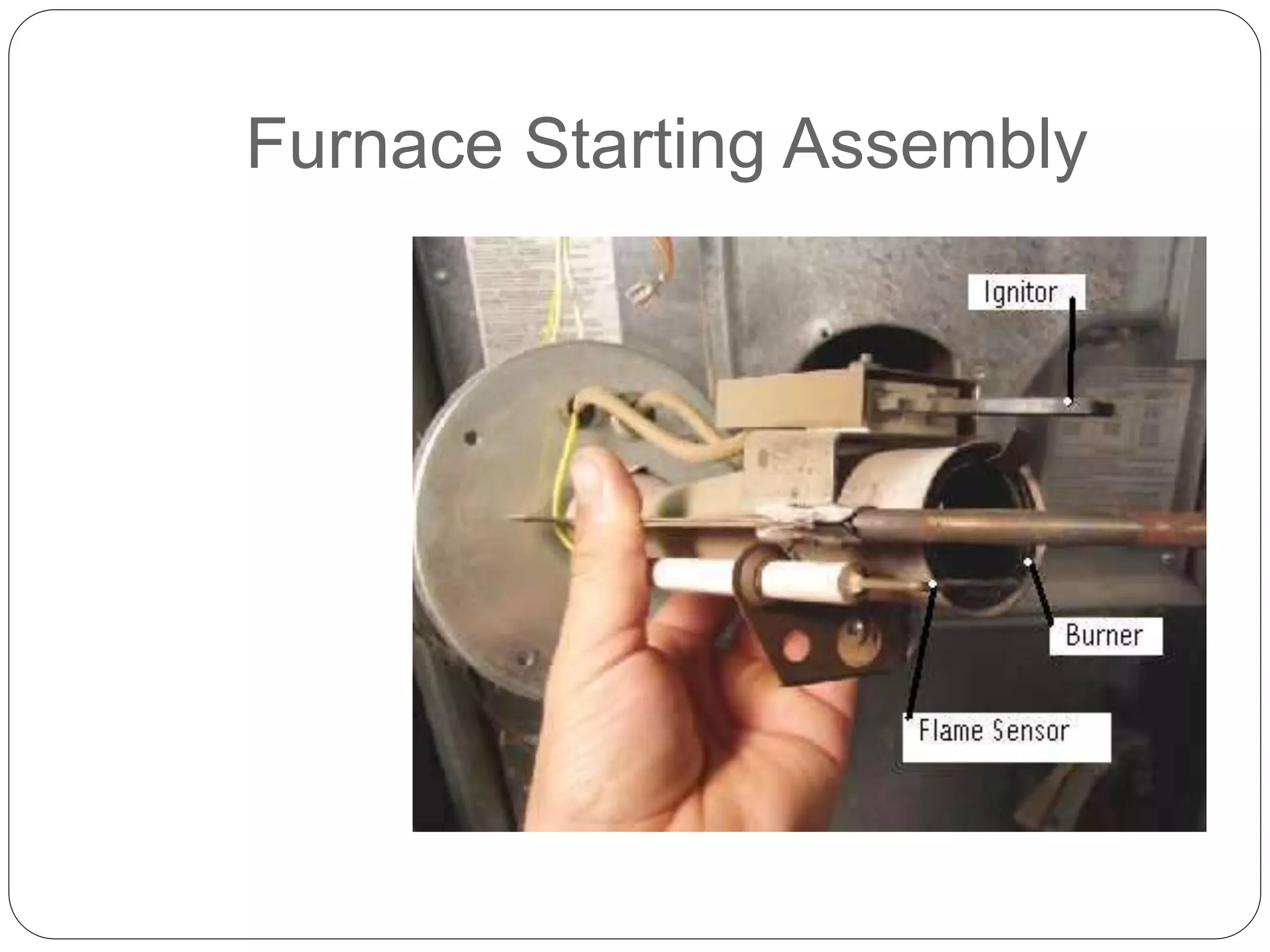
Furnace Starting Assembly
Thank you

Panipat thermal power station training ppt

  • 1.
    TRAINING REPORT ON PANIPAT THERMAL POWER STATION MOHIT VERMA EL/11/314
  • 2.
    INTRODUCTION The planthas been constructed in five stages as given below: Stage 1: Unit-1 110 MW Unit-2 110 MW Stage 2:Unit-3 110MW Unit-4 110MW Stage 3:Unit-5 210MW Unit-6 210MW Stage 4:Unit-7 250MW Unit-8 250MW Total Generation Capacity 1360MW
  • 3.
    Basic Idea ofElectricity Generation Coal is unloaded by electric traction system at Coal Yard Coal is crushed to finer pieces of order 20 mm Pulverization of Coal Coal is send to furnace with the help of FD fan Steam is generated at 540°C and 135 kg/sq.m Steam is send to Super heater Superheated steam is send to turbine Production of Electricity by the generator coupled with
  • 5.
    Elements Of ThermalPower Station  DM Plant  Deaerator  Boiler feed pump  Economizer  Air Pre-Heater  Boiler  Super heater  Turbine  Condenser
  • 6.
    COAL FEEDING SYSTEM Conveyor Coal Hopper Coal is conveyed through rail wagon from out side of plant and through conveyor system collected in hopper and ground to a very fine powder by large metal spheres in the pulverised fuel mill. Wagon Tippler Pulverised Mill
  • 7.
    COAL FEEDING SYSTEM Air Pre-heater Forced Draft Fan Then it is mixed with preheated air driven by the forced draught fan. The hot air-fuel mixture is forced at high pressure into the boiler.
  • 8.
    BOILER A boileror steam generator is a device used to create steam by applying heat energy to water. The steam generator or boiler is an integral component of a steam engine when considered as a prime mover; The boiler is a furnace on a side. Its walls are made of a web of high pressure steel tubes. Pulverized coal is air-blown into the furnace from fuel nozzles at the four corners and it rapidly burns, forming a large fireball at the center. The thermal radiation of the fireball heats the water that circulates through the boiler tubes near the boiler perimeter. The water circulation rate in the boiler is three to four times the throughput and is typically driven by pumps. As the water in the boiler circulates it absorbs heat and changes into steam at 700 °F (371 °C) and 3,200 psi . It is separated from the water inside a drum at the top of the furnace.
  • 9.
    BOILER FEED PUMP NDE BEARING DE BEARING SLEEVE SOLE PLATE (BASE PLATE) KEY FOUNDATION BOLT 9 PMI Revision 00 28 August 2014 18
  • 10.
    ASH HANDLING SYSTEM At the bottom of the furnace, there is a hopper for collection of bottom ash. This hopper is always filled with water to quench the ash and clinkers falling down from the furnace. Some arrangement is included to crush the clinkers and for conveying the crushed clinkers and bottom ash to a storage site.
  • 11.
    SUPER HEATER Superheatedsteam is steam at a temperature higher than water's boiling point. If saturated stream is heated at constant pressure, it increases toward 100% Dry Saturated Steam. Continued heat input will then generate superheated steam. This will occur if saturated steam contacts a surface with a higher temperature. The steam is then described as superheated by the number of degrees it has been heated above saturation temperature In a power plant, after the steam is conditioned by the drying equipment inside the steam drum, it is piped from the upper drum area into tubes inside an area of the furnace known as the super heater, which has an elaborate set up of tubing where the steam vapor picks up more energy from hot flue gases outside the tubing and its temperature is now superheated above the saturation temperature. The superheated steam is then piped through the main steam lines to the valves before the high pressure turbine.
  • 12.
    STEAM TURBINE Asteam turbine is a mechanical device that extracts thermal energy from pressurized steam, and converts it into rotary motion. The steam turbine is a form of heat engine that derives much of its improvement in thermodynamics efficiency through the use of multiple stages in the expansion of the steam. The hot reheat steam is conducted to the intermediate pressure turbine where it falls in both temperature and pressure and exits directly to the long-bladed low pressure turbines and finally exits to the condense
  • 14.
  • 15.
    CONDENSER Water CooledCondenser Air Cooled Condenser Condenser is a device or unit used to condense a substance from its gaseous to its liquid state, typically by cooling it. The exiting steam from steam turbine, now a little above its boiling point, is brought into thermal contact with cold water (pumped in from the cooling tower) in the condenser. where it condenses rapidly back into water, creating near vacuum-like conditions inside the condenser chest.
  • 16.
    COOLING TOWER NaturalDraft Cooling Tower Cooling towers are heat removal devices used to transfer process waste heat to the atmosphere. Cooling towers either use the evaporation of water to remove process heat and cool the working fluid or in the case of closed circuit dry cooling towers rely solely on air to cool the working fluid.
  • 17.
    DE AREATOR DeAreator A deaerator is a device that is widely used for the removal of air and other dissolved gases from the feed water to steam-generating boiler. The condensed water is then passed by a feed pump through a deaerater.
  • 18.
    ECONOMISER Economiser Economizerare mechanical devices intended to reduce energy consumption, or to perform another useful function like preheating a fluid. Pre-warmed water first enter in a feed heater powered by steam drawn from the high pressure set, and then in the economiser Economizer is a flue gas to water heat exchanger. Usually it is located below the LPSH in the boiler and above Air pre heater. Outside surface of the economizer tubes are heated by flue gases leaving the superheater and reheater which subsequently transfer heat to feed water flowing inside the tubes. Advantages of Economizer include 1) Fuel economy: – used to save fuel and increase overall efficiency of boiler plant. 2) Reducing size of boiler: – as the feed water is preheated in the economizer and enter boiler tube at elevated temperature. The heat transfer area required for evaporation reduced considerably.
  • 19.
    CHIMNEY A chimneyis a structure for venting hot gases or smoke from a boiler, furnace or fireplace to the outside atmosphere. A chimney is a vertical structure for venting hot flue gases or smoke from a boiler to the outside atmosphere by means of the stack effect. The space inside a chimney is called aflue. The height of chimneys plays a role in their ability to transfer flue gases using stack effect. The dispersion of pollutants at higher altitude helps to ease down its influence on surroundings and reduces their concentrations in compliance with regulatory limits. Exhaust gas from electrostatic precipitator vented through the chimney tack.
  • 20.
    SWITCHYARD A switchyard is a part of an electrical generation, transmission, system. Switchyard transform voltage from high to low, or the reverse, or perform any of several other important functions.
  • 21.
    CONTROL ROOM Acontrol room is a room serving as a centre where a large physical facility or physically dispersed service can be monitored and controlled.
  • 22.
    Instrumentation In Thermal Power Plant When the balance is disturbed, all the process variables deviate from their normal values thus creating the necessity for the following:- i)Instruments : To measure and indicate the amount of deviation. ii)Automatic Control: To correct the deviation and bring back system to normal iii) Annunciation : To warn about the excessive deviations, if any. iv) Protection : To isolate the equipments process from dangerous operating conditions cause due to such excessive
  • 23.
    Temperature The degreeof hotness and coldness measured on the definite scale.  Methods of Temperature Measurement  Resistance Temperature Detector(R.T.D)  Thermocouple
  • 24.
    Resistance Temperature Detector  Resistance of certain metals changes as the  temp. changes as per formula given below :-  Rt=Ro(1+wt)  Where Rt=Resistance at temp. to be measured. Ro=Resistance at 0 degree C.  w=Temp. coefficient of res. Thermometer metal  t=Temp. to be measured.  Mainly three metals copper, nickel and platinum are used as RTD.
  • 25.
    Thermocouple It consistsof a pair of wire of different materials. Wires are joined at both ends one junction is kept at a high temp.called hot junction and the other is kept at a fixed at lower temp. called cold junction. Due to which emf is setup in the ckt known as Thermo emf.
  • 26.
    Pressure Units forpressure measurement are Newton/m2 , Kg/cm2, mm of water column & mm of mercury column. Devices for Pressure Measurement Bourden Tube Pressure Gauge Manometer
  • 27.
  • 28.
  • 29.