Tracheal Intubation
Why ?
 Primary objective – Adequate Ventilation and Oxygenation
 Protect Airway
 To decrease work of breathing
Indications;
Respiratory Failure
Unconscious patient / GCS < 8
Cardiac arrest
Maintenance or protection of an intact airway
Airway Anatomy
RSI – Rapid Sequence Intubation
 RSI is the virtually simultaneous administration of a sedative and a
neuromuscular blocking agent to render a patient rapidly unconscious
and flaccid in order to facilitate emergent endotracheal intubation and to
minimize the risk of aspiration.
Advantages of RSI
 Facilitates and expedites endotracheal intubation
1. Increase success rate
2. Decreased time for intubation
 Minimizes trauma during laryngoscopy
 Minimizes hypoxia and hypercapnia
 Minimizes risk of aspiration
 Minimizes hemodynamic effects of intubation
Seven “P” of RSI
1. Preparation
2. Pre oxygenation
3. Pre treatment
4. Paralysis with induction
5. Protection and positioning
6. Placement with proof
7. Post intubation management
Preparation
(10 mins before intubation )
 Prepare the Patient
 Prepare the equipment
 Prepare the team
 Prepare for difficulty
Preoxygenation/De nitrogenation
(5 mins before intubation)
 To replace all the nitrogen in the lungs with oxygen prior to intubation
 Act as a O2 reservoir during apneic period of RSI
 Maximal FiO2 for 3 – 5 mins
 Conscious patient 8 full vital capacity breaths
If SpO2 cannot increased > 93% after optimal preoxygenation We can use NPPV or
mask ventilation with a positive end expiratory pressure
PREOXYGENATION APNEIC OXYGENATION
Pre treatment ( 3 mins before intubation)
 Laryngoscopy can activate coughing ang gagging
 Infants – Bradycardia
Adults – Pressure response Change in BP , Increase ICP HR, Bronchospasm,
Dysrhythmias
Drugs
 Glycopyrolate – Anticholinergic decrease secretion and prevent aspiration
Dosage ; 5-10 micrograms / kg
 Atropine – Reduce incidence of bradycardia
Dosage ; 0.01 mg/kg or 10 micrograms / kg
 Fentanyl – Reduce pressor response and prevent rise in ICP
Dosage ; 2-3 microgram/kg given at a rate of 1-2 microgram/kg/min
 Lidocaine – 1.5-2 mg/kg iv over 30-60secs
Paralysis with induction
To induce loss of consciousness
Head injury or Stroke
we have to maintain adequate cerebral perfusion and maintain arterial pressure.
1. Etomidate 0.3 mg/kg – Excellent sedation, does not cause hypotension
2. Ketamine 1-2 mg/kg – Hypotensive patient with head injury, Septic shock,
Bronchospasm. Avoid in cerebral hemorrhage
3. Midazolam, Propofol can be used in head injury but risk of hypotension.
Paralysis with induction
Status Epilepticus – Midazolam (0.2-0.3mg/kg) can cause hypotension
use etomidate if hemodynamic compromise
do not use ketamine due to stimulant effect
Severe Bronchospasm
Hemodynamically stable – Ketamine, Propofol, Etomidate, Midazolam
Unstable- Ketamine or Etomidate
Cardiovascular – Etomidate
Shock – Etomidate or Ketamine
NEUROMUSCULAR BLOCKING AGENTS
PRODUCE PARALYSIS. NOT PROVIDE SEDATION OR ANALGESIA. USED IMMEDIATELY
AFTER INDUCTION AGENTS.
DEPOLARIZING: Succinylcholine (Sch), binds to Ach receptors produces
fasciculation's and paralysis.
NON DEPOLARIZING: Rocuronium, Vecuronium, and Pancuronium. Competitively
inhibit the post- synaptic Ach receptor and produce paralysis.
DEPOLARIZING PARALYTICS
SUCCINYLCHOLINE (1-2 mg/kg): Mostly preferred agent due to rapid onset (45-60
sec) and offset (6-10 mins). Better to overdose than under dose.
Absolute Contraindications:
SIGNIFICANT HYPERKALEMIA DEMONSTRATED BY ECG FINDING.
MALIGNANT HYPERTHERMIA (FAMILY OR PERSONAL Hx.)
RHABDOMYOLYSIS
STROKE OR BURN 72 HOUR OLD, DUE TO UPREGULATION OF Ach RECEPTORS
SIGNIFICANT NEUROMUSCULAR Dx OR MUSCULAR DYSTROPHY
NONDEPOLARIZING NEUROMUSCULAR BLOCKING
AGENTS (NMBAS)
USED WHEN DEPOLARIZING AGENTS ARE CONTRAINDICATED OR PROLONGED
BLOCKADE IS WARRANTED.
ROCURONIUM (1 mg/kg): Short onset (45-60 sec), duration upto 45 mins. Effect
comparable to Succinylcholine.
VECURONIUM (0.15 mg/kg): onset about 90 sec.
A predicted difficult airway is the most common relative contraindication to
the use of nondepolarizing NMBAs for RSI
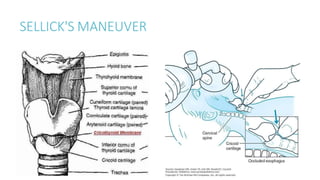
PROTECTION (CRICOID PRESSURE) AND
POSITIONING
This phase of RSI refers to protecting the airway against aspiration prior to
placement of the endotracheal tube by avoiding bag-mask ventilation and
applying cricoid pressure (Sellick's maneuver). Bag-mask ventilation is
unnecessary if the patient has been successfully preoxygenated.
A common error is to apply pressure to the thyroid cartilage
(Adam's apple).
SELLICK'S MANEUVER
PLACEMENT WITH PROOF
After paralysis has been achieved finally the tube is placed through glottis and cuff
is inflated.
The most accurate means of confirming ETT placement is End-tidal CO2
(EtCO2) determination.
A single-view chest radiograph is only useful to determine depth of placement (eg,
tracheal versus right mainstem).
ET Tube Size
POSTINTUBATION MANAGEMENT
RSI remains incomplete until the properly placed endotracheal tube is secured.
Several techniques are commonly used to secure the tube, including taping, tying
etc.
Hypotension can occur due to decreased venous return from increased
intrathoracic pressure due to mechanical ventilation or due to sedatives.
Other Technique
 Delayed sequence intubation
 Awake oral intubation
 Oral intubation without pharmacologic agent
Other devices – Video laryngoscopy
Indications;
 Routine emergency intubation
 Failed DL, Known or Suspected difficult airway
 Morbid obesity
 Trauma patient with C Spine immobilization
Contraindications;
 Limited mouth opening
 Severe kyphosis
 Copious blood or secretions
Complications;
 Dental trauma
 Oropharyngeal trauma
Airway scope Optical laryngoscope
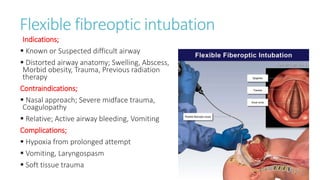
Flexible fibreoptic intubation
Indications;
 Known or Suspected difficult airway
 Distorted airway anatomy; Swelling, Abscess,
Morbid obesity, Trauma, Previous radiation
therapy
Contraindications;
 Nasal approach; Severe midface trauma,
Coagulopathy
 Relative; Active airway bleeding, Vomiting
Complications;
 Hypoxia from prolonged attempt
 Vomiting, Laryngospasm
 Soft tissue trauma
Intubating LMA
Indications;
 Failed RSI
 Cannot intubate/Cannot ventilate
 Difficult mask ventilation
 Refractory hypoxemia despite preoxygenation
Contraindications;
 Unable to open mouth
 Awake patient
Complications;
 Laryngeal or Oesophageal injury
 Aspiration
Retrograde intubation
Indications;
 Need for definitive airway other failed
 Trismus, Maxillofacial trauma
 Upper airway mass
Contraindications;
 Inability to open mouth
 Rapid airway control
Complications;
 Haemorrhage
 Subcutaneous emphysema
Soft tissue infection
Failure to achieve intubation

Tracheal sugeries

  • 1.
  • 2.
    Why ?  Primaryobjective – Adequate Ventilation and Oxygenation  Protect Airway  To decrease work of breathing
  • 3.
    Indications; Respiratory Failure Unconscious patient/ GCS < 8 Cardiac arrest Maintenance or protection of an intact airway
  • 4.
  • 5.
    RSI – RapidSequence Intubation  RSI is the virtually simultaneous administration of a sedative and a neuromuscular blocking agent to render a patient rapidly unconscious and flaccid in order to facilitate emergent endotracheal intubation and to minimize the risk of aspiration.
  • 6.
    Advantages of RSI Facilitates and expedites endotracheal intubation 1. Increase success rate 2. Decreased time for intubation  Minimizes trauma during laryngoscopy  Minimizes hypoxia and hypercapnia  Minimizes risk of aspiration  Minimizes hemodynamic effects of intubation
  • 7.
    Seven “P” ofRSI 1. Preparation 2. Pre oxygenation 3. Pre treatment 4. Paralysis with induction 5. Protection and positioning 6. Placement with proof 7. Post intubation management
  • 8.
    Preparation (10 mins beforeintubation )  Prepare the Patient  Prepare the equipment  Prepare the team  Prepare for difficulty
  • 14.
    Preoxygenation/De nitrogenation (5 minsbefore intubation)  To replace all the nitrogen in the lungs with oxygen prior to intubation  Act as a O2 reservoir during apneic period of RSI  Maximal FiO2 for 3 – 5 mins  Conscious patient 8 full vital capacity breaths If SpO2 cannot increased > 93% after optimal preoxygenation We can use NPPV or mask ventilation with a positive end expiratory pressure
  • 15.
  • 16.
    Pre treatment (3 mins before intubation)  Laryngoscopy can activate coughing ang gagging  Infants – Bradycardia Adults – Pressure response Change in BP , Increase ICP HR, Bronchospasm, Dysrhythmias
  • 17.
    Drugs  Glycopyrolate –Anticholinergic decrease secretion and prevent aspiration Dosage ; 5-10 micrograms / kg  Atropine – Reduce incidence of bradycardia Dosage ; 0.01 mg/kg or 10 micrograms / kg  Fentanyl – Reduce pressor response and prevent rise in ICP Dosage ; 2-3 microgram/kg given at a rate of 1-2 microgram/kg/min  Lidocaine – 1.5-2 mg/kg iv over 30-60secs
  • 18.
    Paralysis with induction Toinduce loss of consciousness Head injury or Stroke we have to maintain adequate cerebral perfusion and maintain arterial pressure. 1. Etomidate 0.3 mg/kg – Excellent sedation, does not cause hypotension 2. Ketamine 1-2 mg/kg – Hypotensive patient with head injury, Septic shock, Bronchospasm. Avoid in cerebral hemorrhage 3. Midazolam, Propofol can be used in head injury but risk of hypotension.
  • 19.
    Paralysis with induction StatusEpilepticus – Midazolam (0.2-0.3mg/kg) can cause hypotension use etomidate if hemodynamic compromise do not use ketamine due to stimulant effect Severe Bronchospasm Hemodynamically stable – Ketamine, Propofol, Etomidate, Midazolam Unstable- Ketamine or Etomidate Cardiovascular – Etomidate Shock – Etomidate or Ketamine
  • 20.
    NEUROMUSCULAR BLOCKING AGENTS PRODUCEPARALYSIS. NOT PROVIDE SEDATION OR ANALGESIA. USED IMMEDIATELY AFTER INDUCTION AGENTS. DEPOLARIZING: Succinylcholine (Sch), binds to Ach receptors produces fasciculation's and paralysis. NON DEPOLARIZING: Rocuronium, Vecuronium, and Pancuronium. Competitively inhibit the post- synaptic Ach receptor and produce paralysis.
  • 21.
    DEPOLARIZING PARALYTICS SUCCINYLCHOLINE (1-2mg/kg): Mostly preferred agent due to rapid onset (45-60 sec) and offset (6-10 mins). Better to overdose than under dose. Absolute Contraindications: SIGNIFICANT HYPERKALEMIA DEMONSTRATED BY ECG FINDING. MALIGNANT HYPERTHERMIA (FAMILY OR PERSONAL Hx.) RHABDOMYOLYSIS STROKE OR BURN 72 HOUR OLD, DUE TO UPREGULATION OF Ach RECEPTORS SIGNIFICANT NEUROMUSCULAR Dx OR MUSCULAR DYSTROPHY
  • 22.
    NONDEPOLARIZING NEUROMUSCULAR BLOCKING AGENTS(NMBAS) USED WHEN DEPOLARIZING AGENTS ARE CONTRAINDICATED OR PROLONGED BLOCKADE IS WARRANTED. ROCURONIUM (1 mg/kg): Short onset (45-60 sec), duration upto 45 mins. Effect comparable to Succinylcholine. VECURONIUM (0.15 mg/kg): onset about 90 sec. A predicted difficult airway is the most common relative contraindication to the use of nondepolarizing NMBAs for RSI
  • 23.
    PROTECTION (CRICOID PRESSURE)AND POSITIONING This phase of RSI refers to protecting the airway against aspiration prior to placement of the endotracheal tube by avoiding bag-mask ventilation and applying cricoid pressure (Sellick's maneuver). Bag-mask ventilation is unnecessary if the patient has been successfully preoxygenated. A common error is to apply pressure to the thyroid cartilage (Adam's apple).
  • 24.
  • 25.
    PLACEMENT WITH PROOF Afterparalysis has been achieved finally the tube is placed through glottis and cuff is inflated. The most accurate means of confirming ETT placement is End-tidal CO2 (EtCO2) determination. A single-view chest radiograph is only useful to determine depth of placement (eg, tracheal versus right mainstem).
  • 27.
  • 30.
    POSTINTUBATION MANAGEMENT RSI remainsincomplete until the properly placed endotracheal tube is secured. Several techniques are commonly used to secure the tube, including taping, tying etc. Hypotension can occur due to decreased venous return from increased intrathoracic pressure due to mechanical ventilation or due to sedatives.
  • 31.
    Other Technique  Delayedsequence intubation  Awake oral intubation  Oral intubation without pharmacologic agent
  • 32.
    Other devices –Video laryngoscopy Indications;  Routine emergency intubation  Failed DL, Known or Suspected difficult airway  Morbid obesity  Trauma patient with C Spine immobilization Contraindications;  Limited mouth opening  Severe kyphosis  Copious blood or secretions Complications;  Dental trauma  Oropharyngeal trauma
  • 33.
  • 34.
    Flexible fibreoptic intubation Indications; Known or Suspected difficult airway  Distorted airway anatomy; Swelling, Abscess, Morbid obesity, Trauma, Previous radiation therapy Contraindications;  Nasal approach; Severe midface trauma, Coagulopathy  Relative; Active airway bleeding, Vomiting Complications;  Hypoxia from prolonged attempt  Vomiting, Laryngospasm  Soft tissue trauma
  • 35.
    Intubating LMA Indications;  FailedRSI  Cannot intubate/Cannot ventilate  Difficult mask ventilation  Refractory hypoxemia despite preoxygenation Contraindications;  Unable to open mouth  Awake patient Complications;  Laryngeal or Oesophageal injury  Aspiration
  • 36.
    Retrograde intubation Indications;  Needfor definitive airway other failed  Trismus, Maxillofacial trauma  Upper airway mass Contraindications;  Inability to open mouth  Rapid airway control Complications;  Haemorrhage  Subcutaneous emphysema Soft tissue infection Failure to achieve intubation