Exercise
Prepared by
Ms Shiwani Sah
Lecturer
Mobility
• Mobility refers to a person’s ability to move about freely.
• Immobility refers to a person’s inability to move about freely.
• Mobility & immobility are the endpoints of a continuum with
many degrees of partial immobility in between.
mobility immobility
• Some clients move back and forth, some clients remain absolute.
Range of Motion Exercise (ROM)
• ROM exercises, in which a body part is moved through a range of
motion, are carried out to promote circulation, maintain muscle tone
& promote flexibility. In doing this, joint stiffness & debilitating
contractures are prevented.
• Active ROM is range of motion carried out by the patient. It is a
form of isotonic exercise & as such, it maintains strength, tone &
flexibility.
• In patients unable to move body parts due to paralysis or extreme
illness, ROM is performed by someone else.
• Passive ROM helps to maintain joint flexibility & prevent stiffness &
contractures. Because this type of exercise involves no active
movement on the part of the muscles, it does not contribute to muscle
tone or strength.
Types of ROM exercises
• Active – exercises the client is able to perform independently.
• Passive – exercises performed for the client by someone else.
• Active assisted – performed by a client with some assistance
– client can move a limb partially through its ROM, but needs
help completing the ROM.
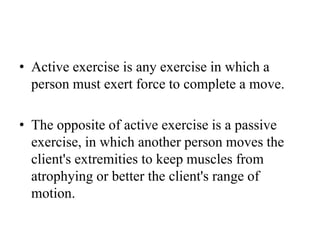
• Active exercise is any exercise in which a
person must exert force to complete a move.
• The opposite of active exercise is a passive
exercise, in which another person moves the
client's extremities to keep muscles from
atrophying or better the client's range of
motion.
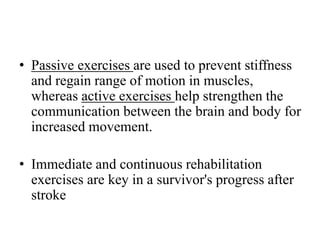
• Passive exercises are used to prevent stiffness
and regain range of motion in muscles,
whereas active exercises help strengthen the
communication between the brain and body for
increased movement.
• Immediate and continuous rehabilitation
exercises are key in a survivor's progress after
stroke
Two Purposes of ROM
1. Maintain joint function
2. Restore joint function
• Do not exercise joints beyond the point of
resistance or to the point of fatigue or pain
Contraindications to ROM
• ROM requires energy & increased circulation, any
illness/disorder where increased use of energy or increased
circulation is hazardous is contraindicated; puts strain/stress
in soft tissues of the joint & bony structures, therefore not
done with swollen, inflamed joints.
Perform Exercises in Head to Toe Format
• Start with the head and move down, always do bilaterally
• Do not grasp the joint directly
• Cup the joint gently (prevents pressure)
• Do not grasp fingernail or toenail
• Important joints – thumb, hip, knee, ankle
• Return to correct anatomic position
• Move joint through movement 5 times/session
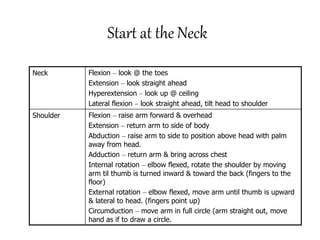
Start at the Neck
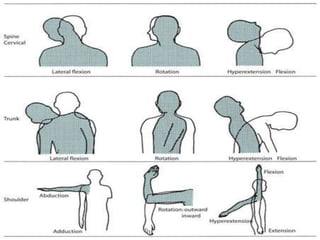
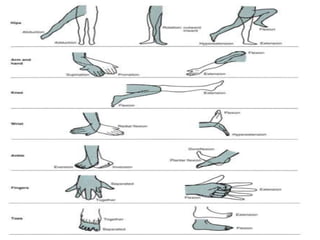
Neck Flexion – look @ the toes
Extension – look straight ahead
Hyperextension – look up @ ceiling
Lateral flexion – look straight ahead, tilt head to shoulder
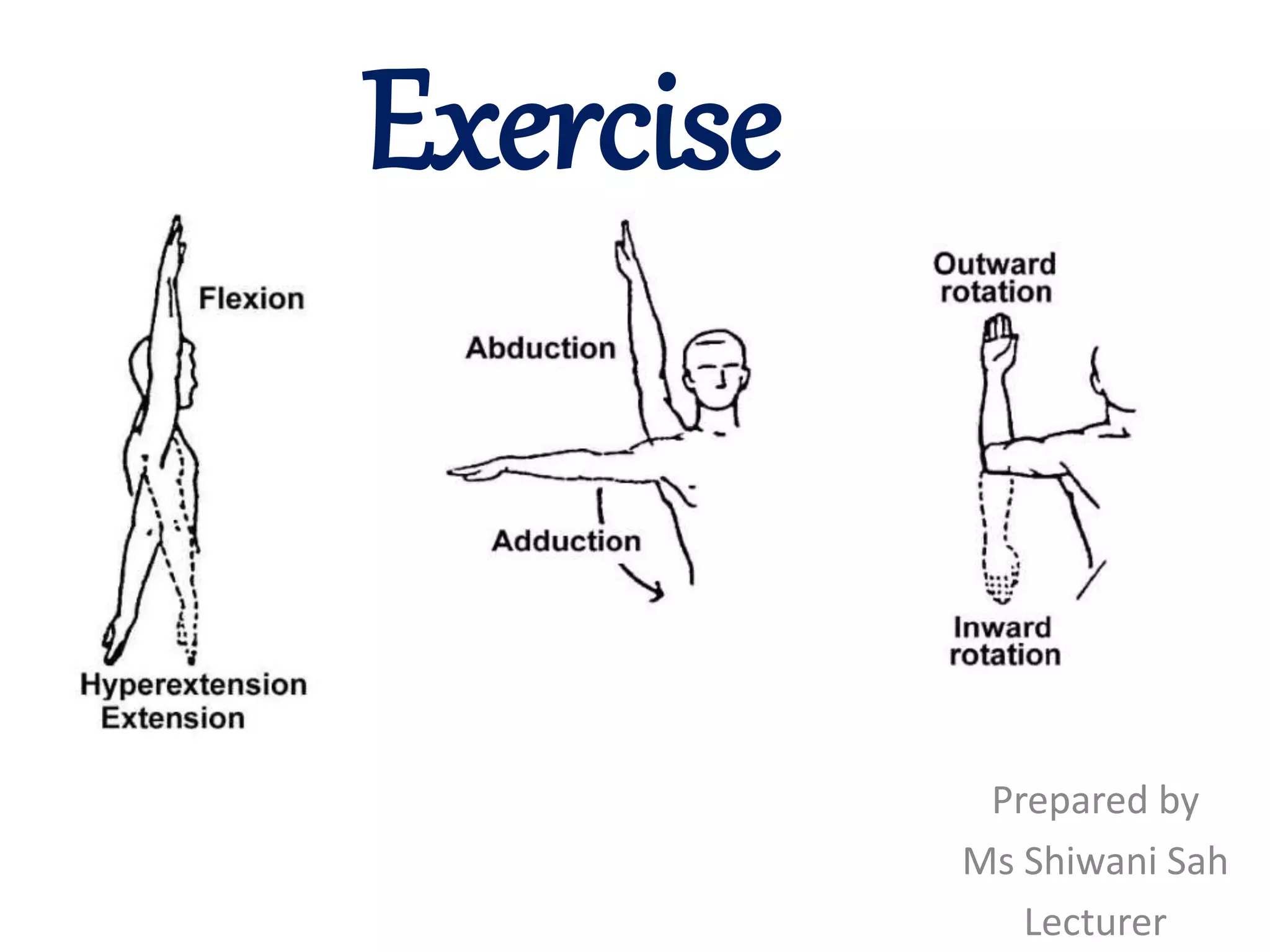
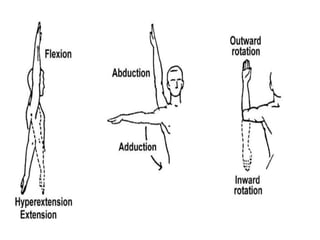
Shoulder Flexion – raise arm forward & overhead
Extension – return arm to side of body
Abduction – raise arm to side to position above head with palm
away from head.
Adduction – return arm & bring across chest
Internal rotation – elbow flexed, rotate the shoulder by moving
arm til thumb is turned inward & toward the back (fingers to the
floor)
External rotation – elbow flexed, move arm until thumb is upward
& lateral to head. (fingers point up)
Circumduction – move arm in full circle (arm straight out, move
hand as if to draw a circle.
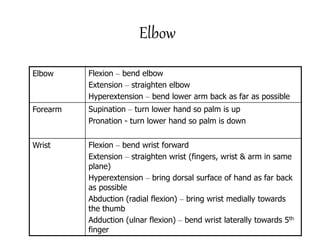
Elbow
Elbow Flexion – bend elbow
Extension – straighten elbow
Hyperextension – bend lower arm back as far as possible
Forearm Supination – turn lower hand so palm is up
Pronation - turn lower hand so palm is down
Wrist Flexion – bend wrist forward
Extension – straighten wrist (fingers, wrist & arm in same
plane)
Hyperextension – bring dorsal surface of hand as far back
as possible
Abduction (radial flexion) – bring wrist medially towards
the thumb
Adduction (ulnar flexion) – bend wrist laterally towards 5th
finger
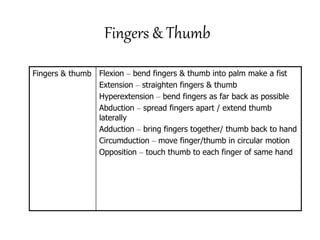
Fingers & Thumb
Fingers & thumb Flexion – bend fingers & thumb into palm make a fist
Extension – straighten fingers & thumb
Hyperextension – bend fingers as far back as possible
Abduction – spread fingers apart / extend thumb
laterally
Adduction – bring fingers together/ thumb back to hand
Circumduction – move finger/thumb in circular motion
Opposition – touch thumb to each finger of same hand
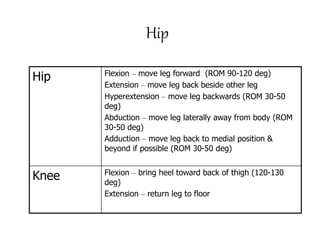
Hip
Hip Flexion – move leg forward (ROM 90-120 deg)
Extension – move leg back beside other leg
Hyperextension – move leg backwards (ROM 30-50
deg)
Abduction – move leg laterally away from body (ROM
30-50 deg)
Adduction – move leg back to medial position &
beyond if possible (ROM 30-50 deg)
Knee Flexion – bring heel toward back of thigh (120-130
deg)
Extension – return leg to floor
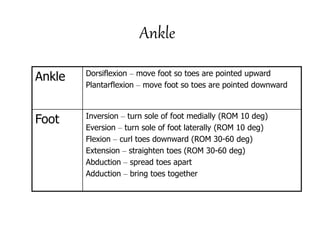
Ankle
Ankle Dorsiflexion – move foot so toes are pointed upward
Plantarflexion – move foot so toes are pointed downward
Foot Inversion – turn sole of foot medially (ROM 10 deg)
Eversion – turn sole of foot laterally (ROM 10 deg)
Flexion – curl toes downward (ROM 30-60 deg)
Extension – straighten toes (ROM 30-60 deg)
Abduction – spread toes apart
Adduction – bring toes together
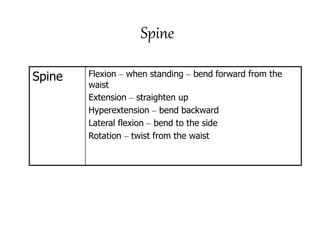
Spine
Spine Flexion – when standing – bend forward from the
waist
Extension – straighten up
Hyperextension – bend backward
Lateral flexion – bend to the side
Rotation – twist from the waist
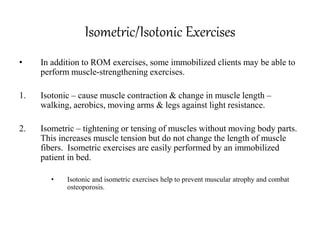
Isometric/Isotonic Exercises
• In addition to ROM exercises, some immobilized clients may be able to
perform muscle-strengthening exercises.
1. Isotonic – cause muscle contraction & change in muscle length –
walking, aerobics, moving arms & legs against light resistance.
2. Isometric – tightening or tensing of muscles without moving body parts.
This increases muscle tension but do not change the length of muscle
fibers. Isometric exercises are easily performed by an immobilized
patient in bed.
• Isotonic and isometric exercises help to prevent muscular atrophy and combat
osteoporosis.
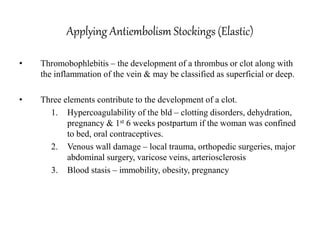
Applying Antiembolism Stockings (Elastic)
• Thromobophlebitis – the development of a thrombus or clot along with
the inflammation of the vein & may be classified as superficial or deep.
• Three elements contribute to the development of a clot.
1. Hypercoagulability of the bld – clotting disorders, dehydration,
pregnancy & 1st 6 weeks postpartum if the woman was confined
to bed, oral contraceptives.
2. Venous wall damage – local trauma, orthopedic surgeries, major
abdominal surgery, varicose veins, arteriosclerosis
3. Blood stasis – immobility, obesity, pregnancy
Antiembolism stockings
• Promote venous return by maintaining pressure on
superficial veins to prevent venous pooling.
• Prevent passive dilation of veins
• Application of antiembolism stockings (refer to p.
845 P&P)
Orthostatic hypotension
• A drop in blood pressure that occurs when the client rises from lying to sitting or from sitting
to standing. (A decrease in systolic pressure >15 mmHg or decrease diastolic pressure >10
mmHg.)
• At risk clients
• Immobilized clients
• Prolonged bed red
• Measures to minimized Orthostatic Hypotension
• Maintain muscle tone
• Increase venous return to the heart
• Decrease stasis of bld in the lower extremities
– ROM/isometric exercises/TED’s
– Mobilize ASAP
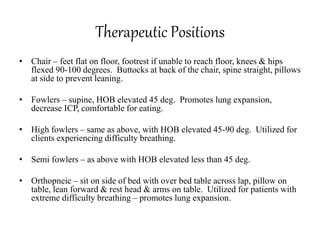
Therapeutic Positions
• Chair – feet flat on floor, footrest if unable to reach floor, knees & hips
flexed 90-100 degrees. Buttocks at back of the chair, spine straight, pillows
at side to prevent leaning.
• Fowlers – supine, HOB elevated 45 deg. Promotes lung expansion,
decrease ICP, comfortable for eating.
• High fowlers – same as above, with HOB elevated 45-90 deg. Utilized for
clients experiencing difficulty breathing.
• Semi fowlers – as above with HOB elevated less than 45 deg.
• Orthopneic – sit on side of bed with over bed table across lap, pillow on
table, lean forward & rest head & arms on table. Utilized for patients with
extreme difficulty breathing – promotes lung expansion.
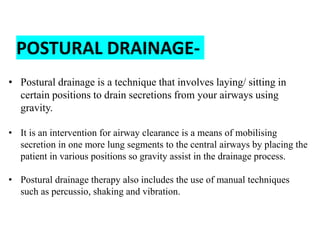
POSTURAL DRAINAGE-
• Postural drainage is a technique that involves laying/ sitting in
certain positions to drain secretions from your airways using
gravity.
• It is an intervention for airway clearance is a means of mobilising
secretion in one more lung segments to the central airways by placing the
patient in various positions so gravity assist in the drainage process.
• Postural drainage therapy also includes the use of manual techniques
such as percussio, shaking and vibration.
Indication-
● Patient with pulmonary diseases that are associated with increased
production or viscosity of mucous such as chronic bronchitis.
● Patient who are on prolonged bed rest.
● Patient who have received general anaesthesia and who may have
painful incision that restrict deep breathing and coughing.
● Any patient who is on ventilator.
● Remove accumulated secretion from lungs.
● Patient with acute/chronic lung disease.
● Patient who are generally very weak or elderly.
Contraindications-
● Never allow a patient to force expiration. Expiration should be
relaxed and lightly controlled.
● Don't allow a patient to take a highly prolonged expiration.
● Don't allow a patient to initiate inspiration with the accessory
muscles and the upper chest.
● Allow the patient to perform deep breathing for only 3or 4
inspirations and expirations at a time to avoid hyperventilation.
● Recent neurosurgery
● Severe hypertension
● Unstable angina
● Recent myocardial infarction
● Cardiac arrhythmia
● Pulmonary embolism/pleural effusion
● Congestive heart failure
● Pulmonary oedema
● Severe Haemoptsis
Postural Drainage Techniques
• The person lies or sits in various positions so the part of
the lung to be drained is as high as possible.
• That part of the lung is then drained using percussion,
vibration and gravity. Your cystic fibrosis care team
may tailor these positions to your or your child’s needs.
• Percussion or clapping by the caregiver on the chest
wall over the part of the lung to be drained helps move
the mucus into the larger airways.
• The hand is cupped as if to hold water but with the
palm facing down.
• The cupped hand curves to the chest wall and traps a
cushion of air to soften the clapping.
Manual techniques used with
postural drainage-
Percussion
● It is used to augment , mobilisation of secretions by mechanically
dislodging viscous or adherent mucous from the airways. It is
performed with cupped hands. The therapist should try to keep
shoulders, elbow and wrist loose.
● Percussion is continued for several minutes or until the patient needs
to alter position to cough, the procedure should not be painful or
uncomfortable.
Vibration-
● Its another manual technique often is used with percussion to help
move secretion to larger airways. It's applied only during the
expiratory phase as the patient is deep breathing.
● Vibration is applied by placing both hands directly on the chest wall
(one on top of other) and gently compressing and rapidly vibrating
the chest wall.
● The vibrating action is achieved by the therapist Isomettrically
contracting the muscle of upper extremities from shoulder to hand.
Shaking-
It is more vigorous form of vibration applied during exhalation. The
therapist thumb are locked together, the open hands are placed directly on
the patients chest wall. The therapist simultaneously compress and shakes
the chest wall.
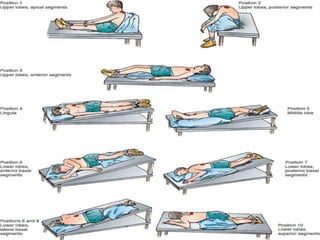
Postural drainage positions-
Right and left upper lobes-
1.Anterior apical segment-Place the patient in high sitting position with
back resting on a pillow. Percussion is applied directly under the clavicle.
2.Posterior apical segment-Forward lean sitting position is assumed by
the patient. Percussion is applied above the scapula fingers curve over
the top of shoulders.
3.Anterior segment-Placed the patient in supine position. Percussion is
applied bilaterally directly over the chest.
4.Left posterior segment-
Patient lies flat and one quarter turn from prone on the right side.
Percussion is applied directly over the left scapula.
5.Right posterior segment-
Patient lies flat and one quarter turn from prone on the left side.
Percussion is applied directly over the right scapula.
6.Lingula segment-
Patient lies quarter turn from supine on the right side supported with
pillow in a 30° head down position. Percussion is applied under the left
chest area.
7.Middle lobe-
Patient lies quarter turn from supine on the left side supported with
pillows behind the back in a 30° head down position. Percussion is
applied under the right chest area.
Right and left lower lobes-
1.Anterior segment-
Patient lies supine with pillows under the knee in a 45° head down
position. Percussion is applied bilaterally over the lower portion of the
ribs.
2.Posterior segment-
Patient lies prone with a pillow under the abdomen in a 45°head down
position. Percussion is applied directly over the lower portion of the ribs.
3.Left lateral segment-
Patient lies on the right side in a 45° head down position. Percussion is
applied over the lower lateral aspect of the left rib cage.
4.Right lateral segment-
Patient lies on the left side in 45° head down position. Percussion is
applied over the lower lateral aspect of the right rib cage.
5.Superior segment-
Patient lies prone with a pillow under the abdomen to flatten the back.
Percussion is applied bilaterally directly below the scapula.
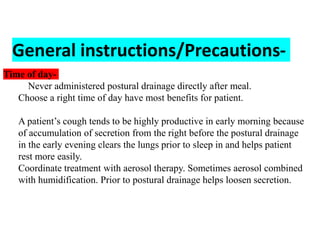
General instructions/Precautions-
Time of day-
 Never administered postural drainage directly after meal.
 Choose a right time of day have most benefits for patient.
 A patient’s cough tends to be highly productive in early morning because
of accumulation of secretion from the right before the postural drainage
in the early evening clears the lungs prior to sleep in and helps patient
rest more easily.
 Coordinate treatment with aerosol therapy. Sometimes aerosol combined
with humidification. Prior to postural drainage helps loosen secretion.
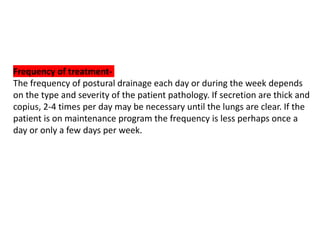
Frequency of treatment-
The frequency of postural drainage each day or during the week depends
on the type and severity of the patient pathology. If secretion are thick and
copius, 2-4 times per day may be necessary until the lungs are clear. If the
patient is on maintenance program the frequency is less perhaps once a
day or only a few days per week.
THANK
YOU

Unit 16. Exercise.pptx

  • 1.
  • 2.
    Mobility • Mobility refersto a person’s ability to move about freely. • Immobility refers to a person’s inability to move about freely. • Mobility & immobility are the endpoints of a continuum with many degrees of partial immobility in between. mobility immobility • Some clients move back and forth, some clients remain absolute.
  • 3.
    Range of MotionExercise (ROM) • ROM exercises, in which a body part is moved through a range of motion, are carried out to promote circulation, maintain muscle tone & promote flexibility. In doing this, joint stiffness & debilitating contractures are prevented. • Active ROM is range of motion carried out by the patient. It is a form of isotonic exercise & as such, it maintains strength, tone & flexibility. • In patients unable to move body parts due to paralysis or extreme illness, ROM is performed by someone else. • Passive ROM helps to maintain joint flexibility & prevent stiffness & contractures. Because this type of exercise involves no active movement on the part of the muscles, it does not contribute to muscle tone or strength.
  • 4.
    Types of ROMexercises • Active – exercises the client is able to perform independently. • Passive – exercises performed for the client by someone else. • Active assisted – performed by a client with some assistance – client can move a limb partially through its ROM, but needs help completing the ROM.
  • 5.
    • Active exerciseis any exercise in which a person must exert force to complete a move. • The opposite of active exercise is a passive exercise, in which another person moves the client's extremities to keep muscles from atrophying or better the client's range of motion.
  • 6.
    • Passive exercisesare used to prevent stiffness and regain range of motion in muscles, whereas active exercises help strengthen the communication between the brain and body for increased movement. • Immediate and continuous rehabilitation exercises are key in a survivor's progress after stroke
  • 10.
    Two Purposes ofROM 1. Maintain joint function 2. Restore joint function • Do not exercise joints beyond the point of resistance or to the point of fatigue or pain
  • 11.
    Contraindications to ROM •ROM requires energy & increased circulation, any illness/disorder where increased use of energy or increased circulation is hazardous is contraindicated; puts strain/stress in soft tissues of the joint & bony structures, therefore not done with swollen, inflamed joints.
  • 12.
    Perform Exercises inHead to Toe Format • Start with the head and move down, always do bilaterally • Do not grasp the joint directly • Cup the joint gently (prevents pressure) • Do not grasp fingernail or toenail • Important joints – thumb, hip, knee, ankle • Return to correct anatomic position • Move joint through movement 5 times/session
  • 13.
    Start at theNeck Neck Flexion – look @ the toes Extension – look straight ahead Hyperextension – look up @ ceiling Lateral flexion – look straight ahead, tilt head to shoulder Shoulder Flexion – raise arm forward & overhead Extension – return arm to side of body Abduction – raise arm to side to position above head with palm away from head. Adduction – return arm & bring across chest Internal rotation – elbow flexed, rotate the shoulder by moving arm til thumb is turned inward & toward the back (fingers to the floor) External rotation – elbow flexed, move arm until thumb is upward & lateral to head. (fingers point up) Circumduction – move arm in full circle (arm straight out, move hand as if to draw a circle.
  • 14.
    Elbow Elbow Flexion –bend elbow Extension – straighten elbow Hyperextension – bend lower arm back as far as possible Forearm Supination – turn lower hand so palm is up Pronation - turn lower hand so palm is down Wrist Flexion – bend wrist forward Extension – straighten wrist (fingers, wrist & arm in same plane) Hyperextension – bring dorsal surface of hand as far back as possible Abduction (radial flexion) – bring wrist medially towards the thumb Adduction (ulnar flexion) – bend wrist laterally towards 5th finger
  • 15.
    Fingers & Thumb Fingers& thumb Flexion – bend fingers & thumb into palm make a fist Extension – straighten fingers & thumb Hyperextension – bend fingers as far back as possible Abduction – spread fingers apart / extend thumb laterally Adduction – bring fingers together/ thumb back to hand Circumduction – move finger/thumb in circular motion Opposition – touch thumb to each finger of same hand
  • 16.
    Hip Hip Flexion –move leg forward (ROM 90-120 deg) Extension – move leg back beside other leg Hyperextension – move leg backwards (ROM 30-50 deg) Abduction – move leg laterally away from body (ROM 30-50 deg) Adduction – move leg back to medial position & beyond if possible (ROM 30-50 deg) Knee Flexion – bring heel toward back of thigh (120-130 deg) Extension – return leg to floor
  • 17.
    Ankle Ankle Dorsiflexion –move foot so toes are pointed upward Plantarflexion – move foot so toes are pointed downward Foot Inversion – turn sole of foot medially (ROM 10 deg) Eversion – turn sole of foot laterally (ROM 10 deg) Flexion – curl toes downward (ROM 30-60 deg) Extension – straighten toes (ROM 30-60 deg) Abduction – spread toes apart Adduction – bring toes together
  • 18.
    Spine Spine Flexion –when standing – bend forward from the waist Extension – straighten up Hyperextension – bend backward Lateral flexion – bend to the side Rotation – twist from the waist
  • 19.
    Isometric/Isotonic Exercises • Inaddition to ROM exercises, some immobilized clients may be able to perform muscle-strengthening exercises. 1. Isotonic – cause muscle contraction & change in muscle length – walking, aerobics, moving arms & legs against light resistance. 2. Isometric – tightening or tensing of muscles without moving body parts. This increases muscle tension but do not change the length of muscle fibers. Isometric exercises are easily performed by an immobilized patient in bed. • Isotonic and isometric exercises help to prevent muscular atrophy and combat osteoporosis.
  • 20.
    Applying Antiembolism Stockings(Elastic) • Thromobophlebitis – the development of a thrombus or clot along with the inflammation of the vein & may be classified as superficial or deep. • Three elements contribute to the development of a clot. 1. Hypercoagulability of the bld – clotting disorders, dehydration, pregnancy & 1st 6 weeks postpartum if the woman was confined to bed, oral contraceptives. 2. Venous wall damage – local trauma, orthopedic surgeries, major abdominal surgery, varicose veins, arteriosclerosis 3. Blood stasis – immobility, obesity, pregnancy
  • 21.
    Antiembolism stockings • Promotevenous return by maintaining pressure on superficial veins to prevent venous pooling. • Prevent passive dilation of veins • Application of antiembolism stockings (refer to p. 845 P&P)
  • 22.
    Orthostatic hypotension • Adrop in blood pressure that occurs when the client rises from lying to sitting or from sitting to standing. (A decrease in systolic pressure >15 mmHg or decrease diastolic pressure >10 mmHg.) • At risk clients • Immobilized clients • Prolonged bed red • Measures to minimized Orthostatic Hypotension • Maintain muscle tone • Increase venous return to the heart • Decrease stasis of bld in the lower extremities – ROM/isometric exercises/TED’s – Mobilize ASAP
  • 23.
    Therapeutic Positions • Chair– feet flat on floor, footrest if unable to reach floor, knees & hips flexed 90-100 degrees. Buttocks at back of the chair, spine straight, pillows at side to prevent leaning. • Fowlers – supine, HOB elevated 45 deg. Promotes lung expansion, decrease ICP, comfortable for eating. • High fowlers – same as above, with HOB elevated 45-90 deg. Utilized for clients experiencing difficulty breathing. • Semi fowlers – as above with HOB elevated less than 45 deg. • Orthopneic – sit on side of bed with over bed table across lap, pillow on table, lean forward & rest head & arms on table. Utilized for patients with extreme difficulty breathing – promotes lung expansion.
  • 24.
    POSTURAL DRAINAGE- • Posturaldrainage is a technique that involves laying/ sitting in certain positions to drain secretions from your airways using gravity. • It is an intervention for airway clearance is a means of mobilising secretion in one more lung segments to the central airways by placing the patient in various positions so gravity assist in the drainage process. • Postural drainage therapy also includes the use of manual techniques such as percussio, shaking and vibration.
  • 25.
    Indication- ● Patient withpulmonary diseases that are associated with increased production or viscosity of mucous such as chronic bronchitis. ● Patient who are on prolonged bed rest. ● Patient who have received general anaesthesia and who may have painful incision that restrict deep breathing and coughing. ● Any patient who is on ventilator. ● Remove accumulated secretion from lungs. ● Patient with acute/chronic lung disease. ● Patient who are generally very weak or elderly.
  • 27.
    Contraindications- ● Never allowa patient to force expiration. Expiration should be relaxed and lightly controlled. ● Don't allow a patient to take a highly prolonged expiration. ● Don't allow a patient to initiate inspiration with the accessory muscles and the upper chest. ● Allow the patient to perform deep breathing for only 3or 4 inspirations and expirations at a time to avoid hyperventilation. ● Recent neurosurgery ● Severe hypertension ● Unstable angina
  • 28.
    ● Recent myocardialinfarction ● Cardiac arrhythmia ● Pulmonary embolism/pleural effusion ● Congestive heart failure ● Pulmonary oedema ● Severe Haemoptsis
  • 29.
    Postural Drainage Techniques •The person lies or sits in various positions so the part of the lung to be drained is as high as possible. • That part of the lung is then drained using percussion, vibration and gravity. Your cystic fibrosis care team may tailor these positions to your or your child’s needs. • Percussion or clapping by the caregiver on the chest wall over the part of the lung to be drained helps move the mucus into the larger airways. • The hand is cupped as if to hold water but with the palm facing down. • The cupped hand curves to the chest wall and traps a cushion of air to soften the clapping.
  • 30.
    Manual techniques usedwith postural drainage- Percussion ● It is used to augment , mobilisation of secretions by mechanically dislodging viscous or adherent mucous from the airways. It is performed with cupped hands. The therapist should try to keep shoulders, elbow and wrist loose. ● Percussion is continued for several minutes or until the patient needs to alter position to cough, the procedure should not be painful or uncomfortable.
  • 31.
    Vibration- ● Its anothermanual technique often is used with percussion to help move secretion to larger airways. It's applied only during the expiratory phase as the patient is deep breathing. ● Vibration is applied by placing both hands directly on the chest wall (one on top of other) and gently compressing and rapidly vibrating the chest wall. ● The vibrating action is achieved by the therapist Isomettrically contracting the muscle of upper extremities from shoulder to hand.
  • 32.
    Shaking- It is morevigorous form of vibration applied during exhalation. The therapist thumb are locked together, the open hands are placed directly on the patients chest wall. The therapist simultaneously compress and shakes the chest wall.
  • 33.
    Postural drainage positions- Rightand left upper lobes- 1.Anterior apical segment-Place the patient in high sitting position with back resting on a pillow. Percussion is applied directly under the clavicle. 2.Posterior apical segment-Forward lean sitting position is assumed by the patient. Percussion is applied above the scapula fingers curve over the top of shoulders. 3.Anterior segment-Placed the patient in supine position. Percussion is applied bilaterally directly over the chest.
  • 34.
    4.Left posterior segment- Patientlies flat and one quarter turn from prone on the right side. Percussion is applied directly over the left scapula. 5.Right posterior segment- Patient lies flat and one quarter turn from prone on the left side. Percussion is applied directly over the right scapula. 6.Lingula segment- Patient lies quarter turn from supine on the right side supported with pillow in a 30° head down position. Percussion is applied under the left chest area. 7.Middle lobe- Patient lies quarter turn from supine on the left side supported with pillows behind the back in a 30° head down position. Percussion is applied under the right chest area.
  • 35.
    Right and leftlower lobes- 1.Anterior segment- Patient lies supine with pillows under the knee in a 45° head down position. Percussion is applied bilaterally over the lower portion of the ribs. 2.Posterior segment- Patient lies prone with a pillow under the abdomen in a 45°head down position. Percussion is applied directly over the lower portion of the ribs. 3.Left lateral segment- Patient lies on the right side in a 45° head down position. Percussion is applied over the lower lateral aspect of the left rib cage.
  • 36.
    4.Right lateral segment- Patientlies on the left side in 45° head down position. Percussion is applied over the lower lateral aspect of the right rib cage. 5.Superior segment- Patient lies prone with a pillow under the abdomen to flatten the back. Percussion is applied bilaterally directly below the scapula.
  • 37.
    General instructions/Precautions- Time ofday-  Never administered postural drainage directly after meal.  Choose a right time of day have most benefits for patient.  A patient’s cough tends to be highly productive in early morning because of accumulation of secretion from the right before the postural drainage in the early evening clears the lungs prior to sleep in and helps patient rest more easily.  Coordinate treatment with aerosol therapy. Sometimes aerosol combined with humidification. Prior to postural drainage helps loosen secretion.
  • 38.
    Frequency of treatment- Thefrequency of postural drainage each day or during the week depends on the type and severity of the patient pathology. If secretion are thick and copius, 2-4 times per day may be necessary until the lungs are clear. If the patient is on maintenance program the frequency is less perhaps once a day or only a few days per week.
  • 39.