Acquired Nasolacrimal Duct Obstruction:  Etiology & Managment Neda Ahmadi PGY-4 11/18/10 Georgetown University Hospital
Case Presentation
Imaging
Outline
Anatomy Puntal opening - ~0.3mm in diameter  Canaliculus - Extends 2mm vertically Turns 90 degrees toward the medial canthus &  travels through the orbicularis muscle (8mm) Inferior & superior canaliculi form a common  canaliculus - 90% to 94% of individuals Common canaliculus and lacrimal sac -  Between ant. & post limbs medial canthal ligament  (MCL) Valve of Rosenmuller Lacrimal sac – 12-15 mm Extends 3-5mm superior to MCL Chastain JB, Sindwani R.  Anatomy of the orbit, lacrimal apparatus, and lateral nasal wall. Otolaryngol Clin North Am. 2006 Oct;39(5):855-64, v-vi.
Anatomy Lacrimal sac lies within the lacrimal fossa Avg. width of lacrimal fossa – 8mm Anterior lacrimal crest - Formed by frontal process  of maxilla Posterior lacrimal crest - Formed by lacrimal bone  Chastain JB, Sindwani R.  Anatomy of the orbit, lacrimal apparatus, and lateral nasal wall. Otolaryngol Clin North Am. 2006 Oct;39(5):855-64, v-vi.
Intranasal Anatomy Frontal process of maxilla covers anterior half of sac  Thin lacrimal bone covers posterior half.  Almost always sac lies anterior to middle turbinate 0% and 20% of sac - Above the attachment of MT Sac extends on average 8.8mm superior to insertion of MT Wormald PJ, et al. Intranasal anatomy of the nasolacrimal sac in endoscopic dacryocystorhinostomy.  Otolaryngol Head Neck Surg . 2000 Sep;123(3):307-10.
Retrospective study  38 subject w/ recurrent epiphora - CT dacryocystogram (DCG)  Height of sac measured Common Canaliculus   Middle turbinate insertion
Conclusions No difference between measurements taken in relation to the long axis of the sac and those parallel to supraorbital ridge (P>0.05) A major portion of the sac was located above the MT The common canaliculus provides a valuable landmark for endoscopic surgeon bc a significant portion of sac lies above its insertion. Wormald PJ, et al. Intranasal anatomy of the nasolacrimal sac in endoscopic dacryocystorhinostomy.  Otolaryngol Head Neck Surg . 2000 Sep;123(3):307-10.
Intranasal anatomy NLD - ~4mm anterior to maxillary sinus ostium (MSO) NLD orifice  - Roof of inferior meatus ~25mm from anterior nasal spine ~13.7 +/- 3.15mm from nasal floor ~14.3 +/- 2.05mm from anterior attachment of inferior turbinate  NLD courses superiorly and anteriorly from the orifice toward the anterior attachment of MT  Average NLD length - 22mm (18-24mm)  Intraosseous – 12mm R & L canals run parallel Slope posteriorly 15-25 o Tatlisumak E et al. Surgical anatomy of the nasolacrimal duct on the lateral nasal wall as revealed by serial dissections. Anat Sci Int. 2010 Mar;85(1):8-12.  Janssen AG, Diameter of the bony lacrimal canal: normal values and values related to nasolacrimal duct obstruction: assessment with CT. AJNR Am J Neuroradiol. 2001 May;22(5):845-50.
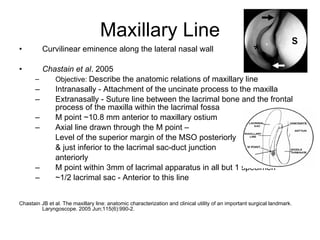
Maxillary Line Curvilinear eminence along the lateral nasal wall  Chastain et al . 2005 Objective:  Describe the anatomic relations of maxillary line Intranasally - Attachment of the uncinate process to the maxilla  Extranasally - Suture line between the lacrimal bone and the frontal process of the maxilla within the lacrimal fossa M point ~10.8 mm anterior to maxillary ostium Axial line drawn through the M point –  Level of the superior margin of the MSO posteriorly  & just inferior to the lacrimal sac-duct junction  anteriorly M point within 3mm of lacrimal apparatus in all but 1 specimen ~1/2 lacrimal sac - Anterior to this line Chastain JB et al. The maxillary line: anatomic characterization and clinical utility of an important surgical landmark. Laryngoscope. 2005 Jun;115(6):990-2.
Retrospective study; 314 patients (64% M: 36% F) w/o epiphora or pathologic conditions affecting NLD  Axial maxillofacial CT (3-4mm) Results  Mean AP diameter 5.6 mm (0.4-10.9mm)  Mean transverse 5.0mm (2.2-8.7mm) diameter  AP diameter greater in M (5.8mm) vs F (5.3mm) (P<0.001) Transverse diameter greater in M (5.1mm) vs F (4.8mm) (P<0.005) Cross sectional area of bony NLD greater in M (23.6mm 2 ) vs. F (20.6mm 2 ) (P<0.001) Shigeta K et al. Sex and age differences in the bony nasolacrimal canal: an anatomical study. Arch Ophthalmol. 2007 Dec;125(12):1677-81.
Age affected  Male Transverse diameter (P=0.002),  Cross sectional area (P=0.002)  Trend for AP diameter to increase with age  (P=0.04) Female AP diameter (P<0.001) Cross sectional area (P,0.001)  Trend for transverse diameter to increase with  age (P=0.02) Overall Female AP diameter ~0.6mm smaller Transverse diameter ~0.3mm smaller Cross sectional area ~13% smaller in F pts
Etiology 3% of all ophthalmology visits Congenital  Prevalence ~20% Most common cause – Persistent membrane at valve of Hasner Normally resolves spontaneously at 6-14  months of age Acquired Incidence - 20.24 per 100,000  Presenting symptoms Epiphora  Dacryocystitis Lee-Wing MW, Clinicopathologic analysis of 166 patients with primary acquired nasolacrimal duct obstruction. Ophthalmology. 2001 Nov;108(11):2038-40.
Examination Lacrimal pump function Lower punctum – Medial translation and inward rotation normally w/ blinking.  Not observed – Consider lacrimal pump failure Shirmer testing Measures basal & stimulated  Differentiates primary hypersecretion from reflex hypersecretion W/o anesthesia (Stimulated)  Normal – 10-30mm at 5 min <10mm at 5min indicates dry eye which may be associated with reflex hypersecretion and epiphora W/ anesthesia (Basal)  Normal - >10mm at 5 min Primary hypersecretion if whole strip wet
Examination Jones I

random

  • 1.
    Acquired Nasolacrimal DuctObstruction: Etiology & Managment Neda Ahmadi PGY-4 11/18/10 Georgetown University Hospital
  • 2.
  • 3.
  • 4.
  • 5.
    Anatomy Puntal opening- ~0.3mm in diameter Canaliculus - Extends 2mm vertically Turns 90 degrees toward the medial canthus & travels through the orbicularis muscle (8mm) Inferior & superior canaliculi form a common canaliculus - 90% to 94% of individuals Common canaliculus and lacrimal sac - Between ant. & post limbs medial canthal ligament (MCL) Valve of Rosenmuller Lacrimal sac – 12-15 mm Extends 3-5mm superior to MCL Chastain JB, Sindwani R. Anatomy of the orbit, lacrimal apparatus, and lateral nasal wall. Otolaryngol Clin North Am. 2006 Oct;39(5):855-64, v-vi.
  • 6.
    Anatomy Lacrimal saclies within the lacrimal fossa Avg. width of lacrimal fossa – 8mm Anterior lacrimal crest - Formed by frontal process of maxilla Posterior lacrimal crest - Formed by lacrimal bone Chastain JB, Sindwani R. Anatomy of the orbit, lacrimal apparatus, and lateral nasal wall. Otolaryngol Clin North Am. 2006 Oct;39(5):855-64, v-vi.
  • 7.
    Intranasal Anatomy Frontalprocess of maxilla covers anterior half of sac Thin lacrimal bone covers posterior half. Almost always sac lies anterior to middle turbinate 0% and 20% of sac - Above the attachment of MT Sac extends on average 8.8mm superior to insertion of MT Wormald PJ, et al. Intranasal anatomy of the nasolacrimal sac in endoscopic dacryocystorhinostomy. Otolaryngol Head Neck Surg . 2000 Sep;123(3):307-10.
  • 8.
    Retrospective study 38 subject w/ recurrent epiphora - CT dacryocystogram (DCG) Height of sac measured Common Canaliculus Middle turbinate insertion
  • 9.
    Conclusions No differencebetween measurements taken in relation to the long axis of the sac and those parallel to supraorbital ridge (P>0.05) A major portion of the sac was located above the MT The common canaliculus provides a valuable landmark for endoscopic surgeon bc a significant portion of sac lies above its insertion. Wormald PJ, et al. Intranasal anatomy of the nasolacrimal sac in endoscopic dacryocystorhinostomy. Otolaryngol Head Neck Surg . 2000 Sep;123(3):307-10.
  • 10.
    Intranasal anatomy NLD- ~4mm anterior to maxillary sinus ostium (MSO) NLD orifice - Roof of inferior meatus ~25mm from anterior nasal spine ~13.7 +/- 3.15mm from nasal floor ~14.3 +/- 2.05mm from anterior attachment of inferior turbinate NLD courses superiorly and anteriorly from the orifice toward the anterior attachment of MT Average NLD length - 22mm (18-24mm) Intraosseous – 12mm R & L canals run parallel Slope posteriorly 15-25 o Tatlisumak E et al. Surgical anatomy of the nasolacrimal duct on the lateral nasal wall as revealed by serial dissections. Anat Sci Int. 2010 Mar;85(1):8-12. Janssen AG, Diameter of the bony lacrimal canal: normal values and values related to nasolacrimal duct obstruction: assessment with CT. AJNR Am J Neuroradiol. 2001 May;22(5):845-50.
  • 11.
    Maxillary Line Curvilineareminence along the lateral nasal wall Chastain et al . 2005 Objective: Describe the anatomic relations of maxillary line Intranasally - Attachment of the uncinate process to the maxilla Extranasally - Suture line between the lacrimal bone and the frontal process of the maxilla within the lacrimal fossa M point ~10.8 mm anterior to maxillary ostium Axial line drawn through the M point – Level of the superior margin of the MSO posteriorly & just inferior to the lacrimal sac-duct junction anteriorly M point within 3mm of lacrimal apparatus in all but 1 specimen ~1/2 lacrimal sac - Anterior to this line Chastain JB et al. The maxillary line: anatomic characterization and clinical utility of an important surgical landmark. Laryngoscope. 2005 Jun;115(6):990-2.
  • 12.
    Retrospective study; 314patients (64% M: 36% F) w/o epiphora or pathologic conditions affecting NLD Axial maxillofacial CT (3-4mm) Results Mean AP diameter 5.6 mm (0.4-10.9mm) Mean transverse 5.0mm (2.2-8.7mm) diameter AP diameter greater in M (5.8mm) vs F (5.3mm) (P<0.001) Transverse diameter greater in M (5.1mm) vs F (4.8mm) (P<0.005) Cross sectional area of bony NLD greater in M (23.6mm 2 ) vs. F (20.6mm 2 ) (P<0.001) Shigeta K et al. Sex and age differences in the bony nasolacrimal canal: an anatomical study. Arch Ophthalmol. 2007 Dec;125(12):1677-81.
  • 13.
    Age affected Male Transverse diameter (P=0.002), Cross sectional area (P=0.002) Trend for AP diameter to increase with age (P=0.04) Female AP diameter (P<0.001) Cross sectional area (P,0.001) Trend for transverse diameter to increase with age (P=0.02) Overall Female AP diameter ~0.6mm smaller Transverse diameter ~0.3mm smaller Cross sectional area ~13% smaller in F pts
  • 14.
    Etiology 3% ofall ophthalmology visits Congenital Prevalence ~20% Most common cause – Persistent membrane at valve of Hasner Normally resolves spontaneously at 6-14 months of age Acquired Incidence - 20.24 per 100,000 Presenting symptoms Epiphora Dacryocystitis Lee-Wing MW, Clinicopathologic analysis of 166 patients with primary acquired nasolacrimal duct obstruction. Ophthalmology. 2001 Nov;108(11):2038-40.
  • 15.
    Examination Lacrimal pumpfunction Lower punctum – Medial translation and inward rotation normally w/ blinking. Not observed – Consider lacrimal pump failure Shirmer testing Measures basal & stimulated Differentiates primary hypersecretion from reflex hypersecretion W/o anesthesia (Stimulated) Normal – 10-30mm at 5 min <10mm at 5min indicates dry eye which may be associated with reflex hypersecretion and epiphora W/ anesthesia (Basal) Normal - >10mm at 5 min Primary hypersecretion if whole strip wet
  • 16.