REGULATED FISH
MARKETING THROUGH
    submitted by
   COOPERATIVES


           Submitted By:
           Remisha.O
           IIIrd sem M.sc IF
           Roll No. 12
OBJECTIVES

• What is cooperative?

• What are the benefits and
  drawbacks of cooperatives?

• What are some examples of
  successful cooperatives?
What is co-operative?
• These are user owned, user
  controlled, and user benefit
  associations.
• They can include components of
  marketing transportation, supply,
  purchase and processing capacity.
• Members of cooperatives can
  increase       product     quality,
  bargaining and purchasing power.
• Main objectives of cooperatives
  india is to promote economic and
  general welfare of it’s members.
Types of cooperatives in fisheries
 Marketing cooperatives
Purchasing cooperatives
• purchasing       cooperatives
  reduce costs of goods,
  supplies, and services .
• In fisheries it could be a
  good way to get cheaper fuel,
  gear and other accessories.
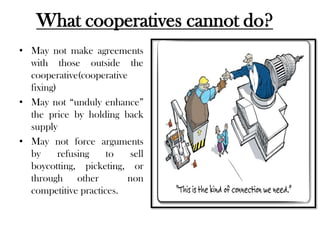
What cooperatives cannot do?
• May not make agreements
  with those outside the
  cooperative(cooperative
  fixing)
• May not “unduly enhance”
  the price by holding back
  supply
• May not force arguments
  by      refusing   to   sell
  boycotting, picketing, or
  through other          non
  competitive practices.
Cooperative features
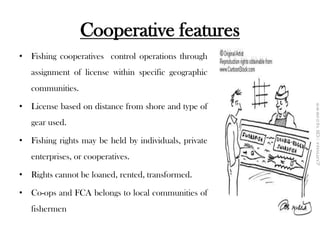
• Fishing cooperatives control operations through
   assignment of license within specific geographic
   communities.

• License based on distance from shore and type of
   gear used.

• Fishing rights may be held by individuals, private
   enterprises, or cooperatives.

• Rights cannot be loaned, rented, transformed.

• Co-ops and FCA belongs to local communities of
   fishermen
How they work ?
 They maximize on profits , skill of members
 Enhance advocacy and bargaining power
 Enhance financial accessibility
 Boost social capital and promote investments
 Provide education opportunity for members.
 Improve market access and promote income
   generation for the small scale producers
 The main challenge has been lack of skill in
   management
Advantages of co-operative fish
              marketing.
Based on traditional fishing practices and
 shared use of resources.
Avoid crowding and depletion of resources.
Share risk as well as benefits.
Lower costs, increase capacity, and improve
 power in the marketplace.
 Make possible co-operation
  among communities.
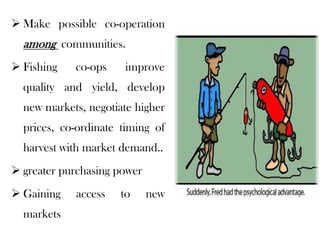
 Fishing   co-ops    improve
  quality and yield, develop
  new markets, negotiate higher
  prices, co-ordinate timing of
  harvest with market demand..
 greater purchasing power
 Gaining   access   to      new
  markets
 Accountability

 Community independence

 Stability and risk

 Sustainability

 Strengthening community and
  economic development

 flexibility
Disadvantages

• Need to work cooperatively

• Initial shock at complicated start up

• Lost of start up

• Needs for professional management
Role of Fisheries Cooperative
            Association (FCA)
 Assignment /acknowledgement of fishing rights

 Marketing, processing, and other support
  (supplies, transport, training, financing, etc.)

 Dispute resolution

 Implement and enforce national and prefecture
  legislation
BMU used as an entry point for co-
          management
Role of BMU

  – Participation in regulation      &   policy   development
    &implementation
  – Protection of breeding grounds
  – Cleanliness of beach
  – Search & rescue operations
  – Beach sanitation and development
  – Welfare issues and training
NGOs
• Train BMU & local staff
• Provide rural development services
• Advocacy for fisheries stakeholders rights
• Assist in development of alternative income generation
  activities within fishing communities
• Provide credit facilities
• HIV/AIDS advocacy and sensitization
Role of development partners
International agencies such as world bank, FAO,
  UNDP, EU, etc :
• Advice on long-term development strategies
• Partner with Govt & NGOs to build capacity of
  BMUs through fisheries research & management
• Financial   and  technical assistance         for
  implementation of management plans           and
  programmes
Concluding remarks..........
• Cooperative allow members of an industry
   to engage in additional purchasing and
   marketing activities.
• Cooperatives are used in several regions and
   it sources is widely applicable in agriculture
   as well as fisheries.
• Before starting a cooperation one needs to
   consider both the benefits and drawbacks
   and evaluate the likelihood of success
Previous year questions
•   Co-operative       in     fish     marketing-
    november2008

•   Advantages     of co-operative fish marketing
    June 2001 ,November 2006. October 1997

•   Explain the concept of regulated markets and
    describe the significance of marketing of fish
    through co-operatives. November 2009

•   What you mean by regulated markets ?
    What are the advantages of cooperative
    marketing. November 2010.

•   Explain fishermen co-operatives and fisheries
    corporations April 2010
thank you

REGULATION OF FISH MARKETING THROUGH COOPERATIVES

  • 1.
    REGULATED FISH MARKETING THROUGH submitted by COOPERATIVES Submitted By: Remisha.O IIIrd sem M.sc IF Roll No. 12
  • 2.
    OBJECTIVES • What iscooperative? • What are the benefits and drawbacks of cooperatives? • What are some examples of successful cooperatives?
  • 3.
    What is co-operative? •These are user owned, user controlled, and user benefit associations. • They can include components of marketing transportation, supply, purchase and processing capacity. • Members of cooperatives can increase product quality, bargaining and purchasing power. • Main objectives of cooperatives india is to promote economic and general welfare of it’s members.
  • 4.
    Types of cooperativesin fisheries  Marketing cooperatives Purchasing cooperatives • purchasing cooperatives reduce costs of goods, supplies, and services . • In fisheries it could be a good way to get cheaper fuel, gear and other accessories.
  • 5.
    What cooperatives cannotdo? • May not make agreements with those outside the cooperative(cooperative fixing) • May not “unduly enhance” the price by holding back supply • May not force arguments by refusing to sell boycotting, picketing, or through other non competitive practices.
  • 6.
    Cooperative features • Fishingcooperatives control operations through assignment of license within specific geographic communities. • License based on distance from shore and type of gear used. • Fishing rights may be held by individuals, private enterprises, or cooperatives. • Rights cannot be loaned, rented, transformed. • Co-ops and FCA belongs to local communities of fishermen
  • 7.
    How they work?  They maximize on profits , skill of members  Enhance advocacy and bargaining power  Enhance financial accessibility  Boost social capital and promote investments  Provide education opportunity for members.  Improve market access and promote income generation for the small scale producers  The main challenge has been lack of skill in management
  • 8.
    Advantages of co-operativefish marketing. Based on traditional fishing practices and shared use of resources. Avoid crowding and depletion of resources. Share risk as well as benefits. Lower costs, increase capacity, and improve power in the marketplace.
  • 9.
     Make possibleco-operation among communities.  Fishing co-ops improve quality and yield, develop new markets, negotiate higher prices, co-ordinate timing of harvest with market demand..  greater purchasing power  Gaining access to new markets
  • 10.
     Accountability  Communityindependence  Stability and risk  Sustainability  Strengthening community and economic development  flexibility
  • 11.
    Disadvantages • Need towork cooperatively • Initial shock at complicated start up • Lost of start up • Needs for professional management
  • 12.
    Role of FisheriesCooperative Association (FCA)  Assignment /acknowledgement of fishing rights  Marketing, processing, and other support (supplies, transport, training, financing, etc.)  Dispute resolution  Implement and enforce national and prefecture legislation
  • 13.
    BMU used asan entry point for co- management Role of BMU – Participation in regulation & policy development &implementation – Protection of breeding grounds – Cleanliness of beach – Search & rescue operations – Beach sanitation and development – Welfare issues and training
  • 14.
    NGOs • Train BMU& local staff • Provide rural development services • Advocacy for fisheries stakeholders rights • Assist in development of alternative income generation activities within fishing communities • Provide credit facilities • HIV/AIDS advocacy and sensitization
  • 15.
    Role of developmentpartners International agencies such as world bank, FAO, UNDP, EU, etc : • Advice on long-term development strategies • Partner with Govt & NGOs to build capacity of BMUs through fisheries research & management • Financial and technical assistance for implementation of management plans and programmes
  • 16.
    Concluding remarks.......... • Cooperativeallow members of an industry to engage in additional purchasing and marketing activities. • Cooperatives are used in several regions and it sources is widely applicable in agriculture as well as fisheries. • Before starting a cooperation one needs to consider both the benefits and drawbacks and evaluate the likelihood of success
  • 17.
    Previous year questions • Co-operative in fish marketing- november2008 • Advantages of co-operative fish marketing June 2001 ,November 2006. October 1997 • Explain the concept of regulated markets and describe the significance of marketing of fish through co-operatives. November 2009 • What you mean by regulated markets ? What are the advantages of cooperative marketing. November 2010. • Explain fishermen co-operatives and fisheries corporations April 2010
  • 18.

Editor's Notes

  • #2 Submitted By:Remisha.OIIIrdsem M.sc IFRoll No. 13