A
Project Report
on
“Marketing strategies of LAKME”
In partial fulfillment for the award of the degree of Bachelor of Business
Administration (BBA Batch 2011-2014) of
GURU GOBIND SINGH INDRAPRASTHA UNIVERSITY
Under the Guidance of: Submitted by:
Dr.Bhawna Bhatnagar Suzye Chhabra
(Faculty Guide)
NEW DELHI INSTITUTE OF MANAGEMENT
TUGHALAKABAD INSTITUTIONAL AREA
NEW DELHI – 110062
ACKNOWLEDGEMENT
I take this opportunity to express my heartiest gratitude to New Delhi Institute of
Management for permitting me to undertake this research and supporting me during this
research and otherwise also.
I would like to thank Dr.Bhawna Bhatnagar who not only played the role of my
philosopher and guide but also mentored me at every stage of my project work. I would like to
extend my hearty thanks to entire faculty members of BBA department for their constant
cooperation and support to take decision during the course of my research. I would also like to
thank my parents for their support and blessing without which this project could not have been
completed. Indeed I shall remain ever grateful to them.
I am also thankful to college library and computer laboratory management staff for their
constant support.
The experience I gained during this research project is of immense importance in the
academically and more on professionally.
SUZYE CHHABRA
ROLL NO: - 05315501711
CERTIFICATE
I hereby certify that this project report entitled “A study of Marketing Strategy of
“LAKME” is based on an original project study conducted by Suzye Chhabra under my
guidance. This has not formed basis for the award of any degree/diploma of this institution or
any other University.
Dr. Bhawna Bhatnagar
(Faculty Guide)
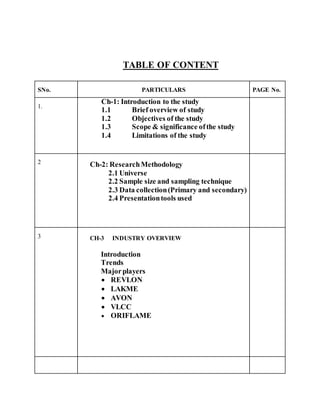
TABLE OF CONTENT
SNo. PARTICULARS PAGE No.
1.
Ch-1: Introduction to the study
1.1 Brief overview of study
1.2 Objectives of the study
1.3 Scope & significance ofthe study
1.4 Limitations of the study
2 Ch-2: ResearchMethodology
2.1 Universe
2.2 Sample size and sampling technique
2.3 Data collection(Primary and secondary)
2.4 Presentationtools used
3 CH-3 INDUSTRY OVERVIEW
Introduction
Trends
Majorplayers
 REVLON
 LAKME
 AVON
 VLCC
 ORIFLAME
4
CHAPTER-4
COMPANYOVERVIEW
Introduction
Principal executive offices
Achievements
Organization structure
Customer satisfactionthrough 4P’s of
marketing
mix
 Product
 Price
 Promotion
 Place distribution
Service offeredto customers in product mix
INTRODUCTION
BRIEF OVERVIEW OF STUDY
This report is on the company Lakme. It is the global leader in cosmetics, with 25 brands.
They have 4 key areas of expertise − hair care, skincare, make-up and fragrances. There is a huge
motive behind the study of Lakme. The study will help us to understand the operations which are
carried out by L’Oreal. The operations such as, business marketing strategies, business plans
of company at a glance, business structure, management and operating structures, competitors
position as per this company, business development, discussion of business strategies, SWOT
analysis to understand the different pros and cons of the company, so as to report properly to
operate effectively and deal smartly .This study offers a comprehensive analysis of the
organization, its business segments, and competitors. It analyzes the business and marketing
strategies adopted by the company, to gain a competitive edge in the industry. The profile also
evaluates the strengths of the company and the opportunities present in the market. This study
presents the key facts & figures, business description, products & services offered and corporate
timeline of the company. It involves analysis of the company at three levels – segments,
organizational structure and ownership composition. Both business and geographic segments are
analyzed along with their recent financial performance. It further discusses the major subsidiaries
of the company and the recent merger & acquisitions. It also examines the significant
developments and milestone that have taken place in the company. It is a form of news analysis
where the most critical company news is discussed. Also the factor Financial Performance
included in this study. It discusses the most recent financials of the company and also compares
the historical sales & income figures with the current and projected figures. The objective is to
evaluate the financial health of the company. The analyst opinion and stock performance help
anyone in evaluating the performance of the company from an investor’s viewpoint.
The Lakme Group is the world's largest cosmetics and Beauty Company. Lakme is
an Indian brand of cosmetics, owned by Unilever and run by CEO Anil Chopra. Lakme started as
a 100% subsidiary of Tata Oil Mills, part of the Tata Group; it was named after
the French opera Lakme, which itself is the French form of Lakshmi, the goddess of wealth, also
renowned for her beauty. Indian cosmetic Lakme was started in 1952, famously because the then
Prime Minister, Jawaharlal Nehru, was concerned that Indian women were spending precious
foreign exchange on beauty products, and personally requested JRD Tata to manufacture them in
India. Simone Tata joined the company as director, and went on to become its chairman.
In 1996 Tata sold off their stakes in Lakme Lever to HLL, for Rs 200 Crore (45 million
US$), and went on to create Trent and Westside. Even today, when most multinational beauty
products are available in India, Lakme still occupies a special place in the hearts of Indian
women.
Lakme also started its new business in the beauty industry by setting up Lakme Beauty
Salons all over India. Now HUL (Hindustan Unilever Limited) has about 110 salons all over
India providing beauty services. Lakme' has been ranked as 47th most trusted brand in India
by The Brand Trust Report. The company is the title sponsor for Lakme Fashion Week (LFW) a
bi-annual fashion event which takes place in Mumbai.
OBJECTIVES:
• The main objective behind the study of this project is to evaluate the distribution channel
for Lakme Company.
• To study the marketing strategies of Lakme cosmetics.
• To study the 4ps of marketing.
• To study Lakme market shares in cosmetic industry in comparison to other brands.
• To analyze the reason for Lakme’s initial strategy in India.
• . To know and analyze the level of satisfaction of customers with regard to Lakme as one
of the major players in Cosmetic industry
 To understand the relationship between customers (who demand the product) and the
suppliers or manufacturers (who produce the product).
 For understanding the company’s structure and functioning among various departments
like finance, accounts, HR, etc better.
SCOPE OF THE STUDY:
This study uncovers the impact, utility and effectiveness & efficiency of marketing
strategies of Lakme on the success of cosmetic industry. A special emphasis is laid down on
Lakme cosmetics.
The project begins with detailed information about marketing strategies and the impact of
measuring customer satisfaction in cosmetic industry. Further, it covers topics as data collection
tools and research methodology used for the project. Then it gives a complete analysis of the
data collected and it is then used to reach to a conclusion. The study took nearly 2 months to
complete. The study is useful for the better understanding of marketing strategies towards the
Lakme cosmetic industry.
For the purpose of this study, a questionnaire was designed based on different parameters to
judge and understand the consumer behavior towards Lakme cosmetics. Target group of the
project was mainly Lakme customers.
As this study is confined to Lakme, it covers an analysis of consumer behavior, attitude,
perceptions, marketing strategies and satisfaction with respect to Lakme as a BRAND in
cosmetic industry.
The study takes into account the customers of Lakme in New Delhi and Gurgaon.
LIMITATIONS:
 Geographical scope of the study was limited to a small area, which may not represent the
whole sector of India. Size of the sample is 100, which is, of course small in comparison to
entire population.
 Due to limitation of time only few people were selected for the study. So the sample of
consumer was not enough to generalize the finding of the study.
 There can be many interpretations and explanation to the data collected. This is empirical
study and the research and the research provides the explanation as understood by the
researcher only.
 The source of data for the study was primary data with the help of self-administered
questionnaire. Hence, the chances of unbiased information are less.
RESEARCH
METHODOLOGY
Research Methodology is a way to systematically solve the research problem.
The Research Methodology includes the various methods and techniques for
conducting a Research. “Marketing Research is the systematic design, collection,
analysis and reporting of data and finding relevant solution to a specific marketing
situation or problem”. D. Slesinger and M. Stephenson in the encyclopedia of
Social Sciences define Research as “the manipulation of things, concepts or
symbols for the purpose of generalizing to extend, correct or verify knowledge,
whether that knowledge aids in construction of theory or in the practice of an art”.
Research is, thus, an original contribution to the existing stock of knowledge
making for its advancement. The purpose of Research is to discover answers to the
Questions through the application of scientific procedures. Our project has a
specified framework for collecting data in an effective manner. Such framework is
called “Research Design”. The research process followed by us consists of
following steps:
4.1Research Design:-
4.1.1 Conclusion Oriented Research: - The research was conclusion oriented
because this research aimed at identifying the characteristics of a successful
entrepreneur. In other words it is a research when we give our own views
about the research.
4.1.2 Descriptive Research: - The research was a descriptive research as it was
concerned with specific predictions, with narration of facts and
characteristics concerning individuals specially entrepreneurs. In other
words descriptive research is a research where in researcher has no control
over variable. He just presents the picture which has already studied.
4.2 Sample Design: - A sampling design is a definite plan for obtaining a sample
from a given population. It refers to the technique or the procedure the
researcher adopts in selecting items for the sample. The following factors need to
be decided within the scope of sample design:
4.2.1 Universe of the Study: - The universe of the study included
respondents specially entrepreneurs in gurgaon city.
4.2.2 Sample Size: - Sample size is the number of elements to be included
in a study. Keeping in mind all the constraints 100 respondents was
selected..
4.2.3 Sampling Techniques: - The sampling techniques used are
convenience sampling technique and simple random sampling
technique.
UNIVERSE
All items in any field of enquiry constitute a ‘Universe’ or ‘Population’. A complete
enumeration of all items in the population is known as a census enquiry.
SAMPLE SIZE AND SAMPLING TECHNIQUE
The number of items selected from the universe to represent the universe is called size of the
sample. The sample size of 100 served the purpose of the study. The sampling method used is
non-probability convenience sampling.
DATA COLLECTION METHOD
The task of data collection begins after a research problem has been defined and research
design plan checked out. While deciding about the method of collection of data to be used for the
study two types of data should be kept in mind vie, primary and secondary. For the study, both
primary data and secondary data were collected.
For primary data, this is those, which are collected afresh and for the first Time, and thus
happen to be original in character. There are many ways of data collection of primary data like
observation method, interview method, through schedules, pantry Reports, distributors audit,
consumer panel etc. The Team Managers and employees of both the Department were consulted
to get information about procedure of both the online and off line share trading. But the method
used by us for the primary data collection was through questionnaires.
For secondary data, these are those data, which are not collected afresh and are used earlier
also and thus they cannot be considered as original in character. There are
many ways of data collection of secondary data like publications of the state and central govern
ment, reports prepared byresearchers, reports of various associations connected with business,
Industries, banks etc. And the method, which was used by us, was with the help of reports of the
company.
QUESTIONNAIRE METHOD
For the collection of primary data I used questionnaire method. A formal list of questions,
which are to be asked, is prepared in a questionnaire and questions are asked on those bases.
There are some merits and demerits of this method. These as under: -
Merits: -
1. Low cost even when universe is large.
2. It is free from bias of interviewer.
3. Respondents have proper time to answer.
4. Respondents who are not easily approachable can also be reachable.
5. Large samples can be made.
DATA COLLECTION METHOD
The data has been presented by way of pie charts and graphs. These have been specifically
used to present the data collected from respondents through questionnaire.
INDUSTRY
OVERVIEW
PAST, PRESENT & FUTURE TRENDS IN MAKEUP
Cosmetics (colloquially known as makeup or make-up) are care substances used to enhance
the appearance or odor of the human body. They are generally mixtures of chemical compounds,
some being derived from natural sources, many being synthetic.
In the U.S., the Food and Drug Administration (FDA) which regulates cosmetics, defines
cosmetics as "intended to be applied to the human body for cleansing, beautifying, promoting
attractiveness, or altering the appearance without affecting the body's structure or functions."
This broad definition includes, as well, any material intended for use as a component of a
cosmetic product. The FDA specifically excludes soap from this category.
The word cosmetics derives from the Greek κοσμητική τέχνη (kosmetikē tekhnē), meaning
"technique of dress and ornament", from κοσμητικός (kosmētikos), "skilled in ordering or
arranging"] and that from κόσμος (kosmos), meaning amongst others "order" and "ornament"
Archeological evidence of cosmetics dates at least from ancient Egypt and Greece.
According to one source, early major developments include:[1]
 Castor oil by ancient Egypt as a protective balm.
 Skin creams made of beeswax, olive oil, and rosewater described by Romans.
 Vaseline and lanolin in the nineteenth century.
 Nivea Creme in 1911.
The Ancient Greeks also used cosmetics. Cosmetics are mentioned in the Old Testament—2
Kings 9:30 where Jezebel painted her eyelids—approximately 840 BC—and the book of Esther
describes various beauty treatments as well.
Cosmetic use was frowned upon at many points in Western history. For example, in the 19th
century, Queen Victoria publicly declared makeup improper, vulgar, and acceptable only for use
by actors
Of the major cosmetics firms, the largest isLAKME, run by Unilever and owned by CEO Anil
Chopra.
Beauty products are now widely available from dedicated internet-only retailers, who have
more recently been joined online by established outlets, including the major department stores
and traditional bricks and mortar beauty retailers.
Although modern make-up has been used mainly by women traditionally, gradually an
increasing number of males are using cosmetics usually associated to women to enhance or cover
their own facial features.
PRESENT & FUTURE TRENDS IN MAKEUP
Values in clients’ personal lives have changed and that leads to a change in how they
consume. People are spending more time with friends and family, and are focusing on what they
consider to be the more important things in life. Consuming for the sake of consumption is no
longer a way of life. Cosmetic consumers are demanding more quality products with multiple
benefits, and what is inside the package will soon become more important than the package
itself. Although packaging and presentation will always be very important, it will not be enough
to hold a client, and it will not be the foundation upon which to build a business.
To predict how and where mineral makeup will grow in the future, it is important to revisit
its history and evolution. Traditional makeup was initially used to add color accents to the face,
and after a while, it was used to cover up imperfections. Mineral makeup brought the evolution
to not only color and cover, but also to protect and enhance. Mineral makeup today is almost as
much about skin care benefits as it is about the color and coverage.
That is not to say that mineral makeup is intended to replace skin care; it is meant to enhance
it. The mineral makeup category must continue to offer innovative and exciting formulations in
order to lead the cosmetic industry. Currently, most mineral formulas are cosmetic-grade only,
but the future could bring drug formulas right into color formulas. The beauty of this is that the
consumer is more likely to use color more consistently than skin care. The more a person uses
products with beneficial ingredients, the better the results will be.
Following are the coming trends for mineral makeup.
Face color formulations. Formulations for the face will do more than just correct uneven
skin tone; they will address texture issues, such as large pores, scars and pitted skin. The
coverage will camouflage without a heavy look or feel. Look for products that will address issues
such as discoloration; not just covering it, but also reversing its symptoms, whether red (rosacea
and acne), blue (dark circle and bruising), brown (hyper pigmentation) or white (hypo
pigmentation).
Eye color formulations. Formulations for the eyes will still help make the eyes look larger
and brighter, but will also address issues such as wrinkles, dark circles, sagging, and thinning
eyelashes and eyebrows. Look for concealers and eye shadows that have powerful ingredients
included directly in the color formula.
New pharmaceutical skin care formulations are offering solutions for longer and darker
eyelashes. This will create resurgence in the sale of mascara and eye liner, as well as other eye
color products in general. In particular, the category of tubular mascara will skyrocket.
Tubular mascara formulas use a flexible copolymer instead of traditional oils and waxes and
can literally be built on top of the lashes to add even more length. Tubular mascara offers a
water-resistant formula without compromising the lashes; it is easily removed with just warm
water and pressure. Women pay approximately $120 per month for the upkeep of longer, darker
lashes, and they will demand a mascara formula that will not break them down. One weakness of
the tubular mascara is that it does not offer the thickening power of traditional oil and wax
formulas. Look for a product that does both in one application. So far, most options require a
two-step process to enjoy both of these benefits.
Lip color formulations. Formulations for the lips have already addressed long-wearing,
plumping and moisturizing issues. The one area that needs to be seriously examined is the long-
term damage that high-shine lip glosses are doing to the lips. Lip melanomas have increased
dramatically during the past few years, and wearing high-shine lip gloss is like wearing a
magnifying glass over the lips. To counteract this danger of sun damage, future formulas should
include protective ingredients, such as zinc and titanium dioxide. Chemical sunscreens on the
lips will raise the heat factor on the lips and exacerbate conditions, such as canker sores.
Sun care formulations. Formulations for sun care will continue to improve, and the category
of powder sunscreen has brought sun care formulas to a new level. The heat factor of chemical
sunscreens is important because heat can exacerbate skin conditions, especially acne and hyper
pigmentation.
Clients are more ingredient-savvy than ever and are aware of which ingredients work. They
have raised their standards and now must have real results from their cosmetic products. They
expect a product to offer multiple benefits. The consumer is still spending money on cosmetic
products, but is looking for value; it is not so much about price as it is about value. If a product
delivers real results and can do double-duty, it will be successful. That is why authentic mineral
makeup formulas will still lead the cosmetic industry as a major force.
MAJOR PLAYERS & THEIR MARKET SHARE
REVLON
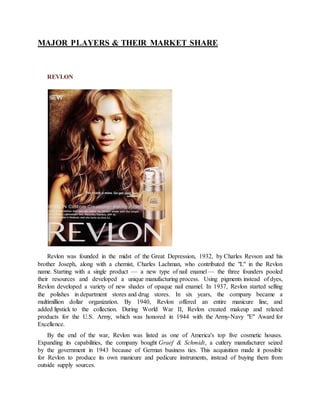
Revlon was founded in the midst of the Great Depression, 1932, by Charles Revson and his
brother Joseph, along with a chemist, Charles Lachman, who contributed the "L" in the Revlon
name. Starting with a single product — a new type of nail enamel — the three founders pooled
their resources and developed a unique manufacturing process. Using pigments instead of dyes,
Revlon developed a variety of new shades of opaque nail enamel. In 1937, Revlon started selling
the polishes in department stores and drug stores. In six years, the company became a
multimillion dollar organization. By 1940, Revlon offered an entire manicure line, and
added lipstick to the collection. During World War II, Revlon created makeup and related
products for the U.S. Army, which was honored in 1944 with the Army-Navy "E" Award for
Excellence.
By the end of the war, Revlon was listed as one of America's top five cosmetic houses.
Expanding its capabilities, the company bought Graef & Schmidt, a cutlery manufacturer seized
by the government in 1943 because of German business ties. This acquisition made it possible
for Revlon to produce its own manicure and pedicure instruments, instead of buying them from
outside supply sources.
AVON
Avon Product is a multi-level marketing company. The company's CEO is Sherilyn S.
McCoy, who was appointed to that position in April 2012.The former CEO, Andrea Jung,
became the executive chairman of the board. Jung was the longest tenured female CEO among
Fortune 500 companies.
Avon uses both door-to-door sales people ("Avon ladies," primarily and a growing number of
men) and brochures to advertise its products.
n addition to its corporate pursuits, the Avon corporation is involved in philanthropic causes.
The Avon Foundation for Women, public charity, is the largest corporate-affiliated
philanthropy for women in the world. Avon founded the Avon Foundation for Women with its
first grant, a $400 scholarship, in 1955. Avon was committed to helping women achieve their
highest potential of economic opportunity and self-fulfillment by empowering them through
scholarships and support for other forms of educational and occupational training and
advancement. Women's empowerment continued to be the focus through the early 1990s when
Avon began to increase its philanthropy with a new emphasis on breast cancer; the Avon
Foundation still awards scholarships for Avon Sales Representatives and their families, as well
as for the children of Avon associates. The Avon Foundation is currently focused on two key
causes: breast cancer and domestic violence. The Foundation approved $38 million in grants in
2011. In 2012, Avon launched its first global fundraising scheme. The symbol of this fundraising
action is the Women's Empowerment Bracelet.
VLCC
The guiding image of VLCC is ‘Transforming Lives’, which refers to the transforming self,
transforming future and spreading happiness. These are the three pillars, which are VLCC’s
hallmarks which were established in 1989 by Mrs. Vandana Luthra. One of the above mentioned
hallmarks, the foundation has continued to grow as a leading beauty brand. VLCC, a re-defining
wellness business has revolutionized the beauty industry as well as acquired the position of
largest beauty brand and heath in India. VLCC today is the solitary mammoth competitor in the
industry with a Pan India presence of around 225 outlets in approximately 75 cities, 1 outlet in
Katmandu, Omen, Bahrain and 8 outlets in UAE.
The VLCC is a ‘Super brand’ serving as a sunshade for its other products such as VLCC
Health Care, Personal Care and Institute of Health, Management and Beauty. Its services offer
holistic wellness, traditional therapies and marrying a scientific research. Having served more
than millions of consumers since its beginning, VLCC, at present, has achieved a start status all
over the world. It is India’s most preferred and largest Slimming, Health and Beauty brand.
VLCC – Vision
To provide better quality life to everyone, by pursuing and adopting socially and ethically
significant business practices, which are aimed at shaping up the confidence of people and
making Beauty Care, Health and Fitness available to each and every section of the society.
ORIFLAME
Oriflame Cosmetics S.A. (Luxembourg) is a cosmetics group, founded in 1967 in
Sweden by the brothers Jonas AF Jochnick and Robert AF Jochnick. The company sells skin
care, cosmetic products and related products through an independent sales force of over 3 million
people.
Oriflame Cosmetics is an international beauty company selling direct. The company began
operations in 1967 in Sweden and has today a presence in over 60 countries worldwide. The
company has over 3.5 million "consultants" worldwide with annual sales of €1.5 billion.
Oriflame has been listed on NASDAQ OMX Stockholm since 2004.
The brand got its name from the royal banner of medieval France which was unfurled only
on the battlefield and accompanied by the war cry Montjoie Saint Denis Oriflame gained its
first UK consultant in 1970.
Oriflame is involved in several programs for example the "World Childhood
Foundation", SOS Children's Villages as well as in local small charities.
The company has been ranked 8.5 out of 9 in the Palm Oil Buyers’ Scorecard which is
compiled by the World Wide Fund and rates purchasers of palm oil on environmental
sustainability.
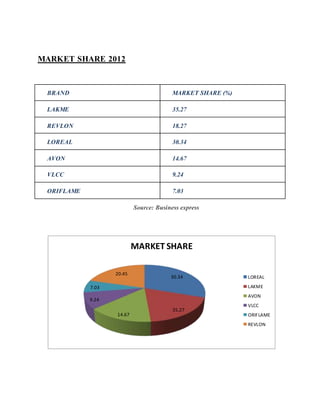
MARKET SHARE 2012
BRAND MARKET SHARE (%)
LAKME 35.27
REVLON 18.27
LOREAL 30.34
AVON 14.67
VLCC 9.24
ORIFLAME 7.03
Source: Business express
30.34
35.27
14.67
9.24
7.03
20.45
MARKET SHARE
LOREAL
LAKME
AVON
VLCC
ORIFLAME
REVLON
COMPANY
PROFILE
COMPANY PROFILE
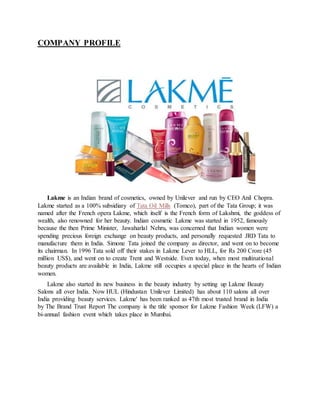
Lakme is an Indian brand of cosmetics, owned by Unilever and run by CEO Anil Chopra.
Lakme started as a 100% subsidiary of Tata Oil Mills (Tomco), part of the Tata Group; it was
named after the French opera Lakme, which itself is the French form of Lakshmi, the goddess of
wealth, also renowned for her beauty. Indian cosmetic Lakme was started in 1952, famously
because the then Prime Minister, Jawaharlal Nehru, was concerned that Indian women were
spending precious foreign exchange on beauty products, and personally requested JRD Tata to
manufacture them in India. Simone Tata joined the company as director, and went on to become
its chairman. In 1996 Tata sold off their stakes in Lakme Lever to HLL, for Rs 200 Crore (45
million US$), and went on to create Trent and Westside. Even today, when most multinational
beauty products are available in India, Lakme still occupies a special place in the hearts of Indian
women.
Lakme also started its new business in the beauty industry by setting up Lakme Beauty
Salons all over India. Now HUL (Hindustan Unilever Limited) has about 110 salons all over
India providing beauty services. Lakme' has been ranked as 47th most trusted brand in India
by The Brand Trust Report The company is the title sponsor for Lakme Fashion Week (LFW) a
bi-annual fashion event which takes place in Mumbai.
Makeup types
Cosmetics include skin-care creams, lotions, powder, perfumes, lipsticks,
fingernail and toe nail polish, eye and facial makeup ,towelettes, permanent
waves, colored contact lenses, hair colors, hair sprays and gels, deodorants, hand
sanitizer, baby products, bath oils, bubble baths, bath salts, butters and many other
types of products. A subset of cosmetics is called "make-up," which refers
primarily to colored products intended to alter the user’s appearance. Many
manufacturers distinguish between decorative cosmetics and care cosmetics.
Most cosmetics are distinguished by the area of the body intended for
application.
• Face Primer, Come in various formulas to suit individual skin concerns. Most
are meant to reduce the appearance of pore size, prolong the wear of makeup,
and allow for a smoother application of makeup. Applied before foundation.
• Eye Primer, Used to prolong the wear of eye shadows on the eye as well as
intensify color payoff from shadows.
• Lip gloss, is a sheer form of lipstick that is in a liquid form.
• Lipstick, lip gloss, lip liner, lip plumper, lip balm, lip conditioner, lip primer,
and lip boosters. Lip stains have a water or gel base and may contain alcohol to
help the product stay on the lips. The idea behind lip stains is to temporarily
saturate the lips with a dye, rather than covering them with a colored wax.
Usually designed to be waterproof, the product may come with an applicator
brush or be applied with a finger.
• Concealer, makeup used to cover any imperfections of the skin. Concealer is
often used for any extra coverage needed to cover blemishes, or any other
marks. Concealer is often thicker and more solid than foundation, and provides
longer lasting, and more detailed coverage. Some formulations are meant only
for the eye or only for the face.
• Foundation, used to smooth out the face and cover spots or uneven skin
coloration. Usually a liquid, cream, or powder, as well as most recently, a light
and fluffy mousse, which provides excellent coverage as well. Foundation
primer can be applied before or after to get a smoother finish. Some primers
come in powder or liquid form to be applied before foundation as a base, while
other primers come as a spray to be applied after you are finished to help make-
up last longer.
• Face powder, used to set the foundation, giving a matte finish, and also to
conceal small flaws or blemishes.
• Rouge, blush or blusher, cheek coloring used to bring out the color in
the cheeks and make the cheekbones appear more defined. This comes in
powder, cream, and liquid forms.
• Contour powder/creams, used to define the face. It can be used to give the
illusion of a slimmer face or to even modify a person’s face shape as desired.
Usually a few shades darker than one’s own skin tone and matte in finish to
create the illusion of depth. A darker toned foundation/concealer can be used
instead to contour to create a more natural look.
• Highlight, used to draw attention to the high points of the face as well as to add
glow to the face. It comes in liquid, cream, and powder form. Often contains
shimmer, but sometimes does not. A lighter toned foundation/concealer can be
used instead to highlight create a more natural look.
• Bronzer, used to give skin a bit of color by adding a golden or bronze
glow. Can come in either matte, semi matte/satin, or shimmer finishes.
Mascara is used to darken, lengthen, and thicken the eyelashes. It is available in
natural colors such as brown and black, but also comes in bolder colors such as
blue, pink, or purple. There are many different formulas, including waterproof for
those prone to allergies or sudden tears. Often used after an eyelash curler and
mascara primer. There are now also many mascaras with certain components to
help lashes to grow longer and thicker. There are specific minerals and proteins
that are combined with the mascara that can benefit, as well as beautify.
MISSION:
BEAUTY FOR ALL
For more than a century, Lakme has devoted itself solely to one
business: beauty. It is a business rich in meaning as it enables all
individuals to express their personality gain self-confidence itself and
open up to others.
Beauty is a language.
Lakme has set itself the mission of offering men & women worldwide
the best cosmetics innovation in terms of quality; efficacy & safety .It
purses this goal by infinite diversity of beauty needs and desires all over
the world.
Beauty is universal.
Since its creation by a researcher, the group has pushing back the
frontiers of knowledge. Its unique research arms it to continually explore
new territories & invent the products of the future, while drawing
inspiration from beauty rituals the world over.
Beauty is science.
By drawing on the diversity on its teams, & the richness & the
complementarily of its brand portfolio, Lakme has made the
universalisation of beauty its project for the years to come.
Lakme offering beauty for all.
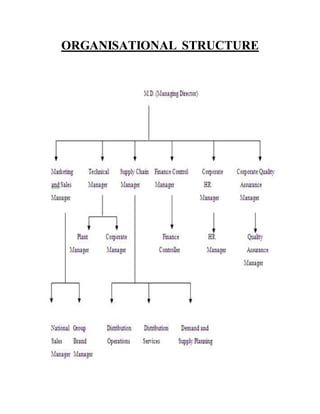
ORGANISATIONAL STRUCTURE
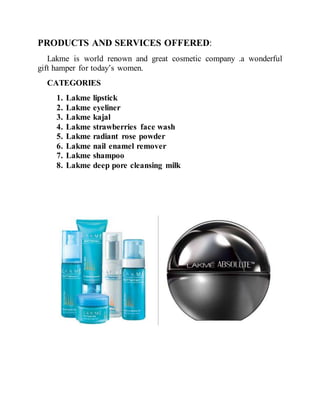
PRODUCTS AND SERVICES OFFERED:
Lakme is world renown and great cosmetic company .a wonderful
gift hamper for today’s women.
CATEGORIES
1. Lakme lipstick
2. Lakme eyeliner
3. Lakme kajal
4. Lakme strawberries face wash
5. Lakme radiant rose powder
6. Lakme nail enamel remover
7. Lakme shampoo
8. Lakme deep pore cleansing milk
Marketing Strategy for Customer Satisfaction:
Promotional strategies
 Promotional posters.
 Launch of beauty magazines.
 Advertisement through film Commercials.
 Open spa to promote the Brand.
 Selecting reputed brand ambassador.
 Sponsoring and Social Responsibility.
 Start campaign for safe cosmetics which will be started in February 2013.
Positioning strategies:
 Most innovative.
 High Quality, Advanced products & affordable price.
 Only cosmetic brand in world that has products in all the segments
Consumer, Luxury, Professional & Pharmaceuticals.
Distribution strategies:
 Widen distribution network by giving various incentives to distributors,
retailers, stockiest etc in order, not to lose self space Product Modification
 By modifying the product by adding SPF, so that lips can be protected from
harmful.
FUTURE PLANS:
 The company plans to open 110 cosmetics shops outlets across the globe
next year, the share of Indian market to Lakme turnover of euro 15.8 billion
small, but is growing.
With other emerging economies India’s contribution to global cosmetics
amounts to 60%.
 Lakme turns to cheap products to spur future growth.
 Lakme is focusing on south market & is planning to open 10 stores in
Chennai & Hyderabad.
 The company has drawn up a fresh strategy, including aggressive discounts
& opening up of new stores.
 At present the company is operating 25 stores in 8 Indian cities under a
franchise agreement with retail major Future group.
THEORETICAL
PERSPECTIVE
THEORITICAL PERSPECTIVE:
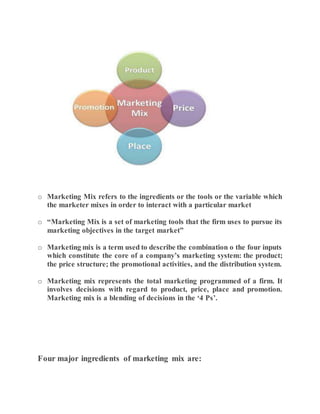
o Marketing Mix refers to the ingredients or the tools or the variable which
the marketer mixes in order to interact with a particular market
o “Marketing Mix is a set of marketing tools that the firm uses to pursue its
marketing objectives in the target market”
o Marketing mix is a term used to describe the combination o the four inputs
which constitute the core of a company’s marketing system: the product;
the price structure; the promotional activities, and the distribution system.
o Marketing mix represents the total marketing programmed of a firm. It
involves decisions with regard to product, price, place and promotion.
Marketing mix is a blending of decisions in the ‘4 Ps’.
Four major ingredients of marketing mix are:
 Product
A productis any good or service that consumers want. It is a bundle of
utilities or a cluster of tangible and intangible attributes. Productcomponent
of the marketing mix involves planning, developing and producing the right
type of products and services. It deals with the dimensions of productline,
durability and other qualities. Productpolicy of a firm also deals with proper
branding, right packaging, appropriate color and other productfeatures. The
total productshould be such that it really satisfies the needs of the target
market. In short, productmix requires decisions with regard to
 Size and weight of the product.
 Quality of the product.
 Design of the product.
 Volume of output.
 Brand name.
 Packaging.
 Productrange.
 Price.
Price is an important factor affecting the success ofa firm. Pricing
decisions and policies have a direct influence on sales volume and profits of
business.
Price is, therefore, an important element in the marketing mix. In practice, it
is very difficult to fix the right price. Right price can be determined through
pricing research and test marketing.
Demand, cost, competition, govt. regulation, etc. are the vital factors that
must be taken into consideration in the determination of the price. Price mix
involves decisions regarding base price, discounts, allowances, fright
payment, credit, etc.
 Promotion.
Promotion componento the marketing mix is concerned with bringing
products to the knowledge of customers and persuading them to buy. It is the
function of informing and influencing the customer.
Promotion mix involves decisions with respect to advertising, personal
selling and sales promotion. All these techniques help to promote the sale of
products and to fight the competition in the market.
No single method of promotion is effective alone and, therefore, a
promotional campaign usually involves a combination of two or more
promotional methods.
Growing competition and widening market have made simultaneous use
of more than one promotional method all the more necessary. Combination
of two or more methods in a single promotional campaign requires an
effective blending of promotional inputs so as to optimize the expenditure on
each.
 Place (Distribution)
This element of marketing mix involves a choice of the place where the products
are to be displayed and made available to the customers. It is concerned with
decisions relating to the wholesale and retail outlets or channels of distribution.
The objective of selecting and managing trade channels is to provide the products
to the right customer at the right time and place on a continuing basis. In deciding
where and through whom to sell, management should consider where the customer
wants the goods to be available.
A manufacturer may distribute his goods through his own outlets or he
may employ wholesalers and retailers for this purpose. Irrespective of the
channel used management must continuously evaluate channel performance
and make changes whenever performance falls short of expected targets. In
addition, management must develop a physical distribution system for
handling and transporting the products through the selected channels. In the
determination of distribution mix or marketing logistics, a firm has to make
decision with regard to the mode of transporting of goods to middle-men,
use of company vehicles or both.
FINDINGS & ANALYSIS
GENERAL FINDINGS:
Lakme is the global leader in cosmetics, with 25 global brands. It has five key
areas of expertise- hair care, skincare, make-up and fragrances. This company has
over 63,358 employees working currently. And it sells its products around in
130countries all over the world. Its consolidated sales are recorded in over 17,063
in millionaires .The company manufacture well above 4.7 billion units annually. It
also has investments above 560 million euro s in R&D investments.
On the analysis and interpretation of research conducted. It was found that
certain findings are very critical and are directly or indirectly affecting the Lakme
products.
•There is a good awareness of Lakme cosmetics products among the consumers.
•The quality of Lakme is very satisfactory viewed by the majority of customers.
•There is a neck to neck competition between L’Oreal, Oriflame, VLCC,
Revlon etc
•75% of the customers are fully satisfied with existing quality While 25% are
partly satisfied.
•Majority of women are using Lakme products.
•Consumers prefer the Lakme products because it provides good quality, good
results, good services, etc and it all fulfills their needs.
DATA ANALSIS
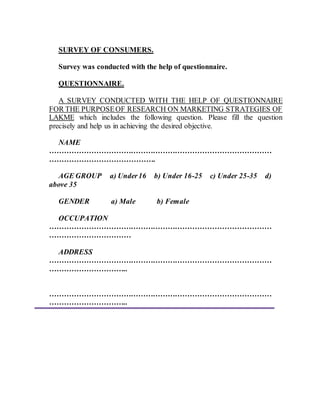
SURVEY OF CONSUMERS.
Survey was conducted with the help of questionnaire.
QUESTIONNAIRE.
A SURVEY CONDUCTED WITH THE HELP OF QUESTIONNAIRE
FOR THE PURPOSEOF RESEARCH ON MARKETING STRATEGIES OF
LAKME which includes the following question. Please fill the question
precisely and help us in achieving the desired objective.
NAME
………………………………………………………………………………
…………………………………….
AGE GROUP a) Under16 b) Under 16-25 c) Under 25-35 d)
above 35
GENDER a) Male b) Female
OCCUPATION
………………………………………………………………………………
……………………………
ADDRESS
………………………………………………………………………………
…………………………..
………………………………………………………………………………
…………………………..
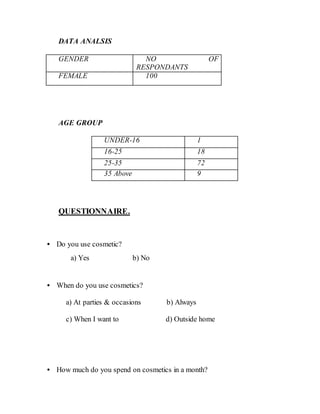
DATA ANALSIS
GENDER NO OF
RESPONDANTS
FEMALE 100
AGE GROUP
UNDER-16 1
16-25 18
25-35 72
35 Above 9
QUESTIONNAIRE.
• Do you use cosmetic?
a) Yes b) No
• When do you use cosmetics?
a) At parties & occasions b) Always
c) When I want to d) Outside home
• How much do you spend on cosmetics in a month?
a) Less than 200 b) Between 200 & 400
c) 400-800 d) More than 800
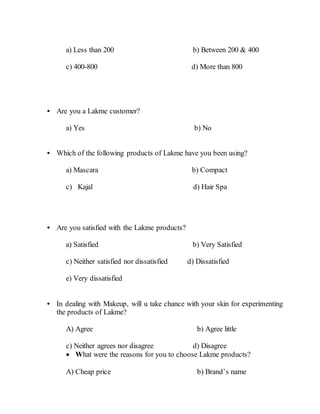
• Are you a Lakme customer?
a) Yes b) No
• Which of the following products of Lakme have you been using?
a) Mascara b) Compact
c) Kajal d) Hair Spa
• Are you satisfied with the Lakme products?
a) Satisfied b) Very Satisfied
c) Neither satisfied nor dissatisfied d) Dissatisfied
e) Very dissatisfied
• In dealing with Makeup, will u take chance with your skin for experimenting
the products of Lakme?
A) Agree b) Agree little
c) Neither agrees nor disagree d) Disagree
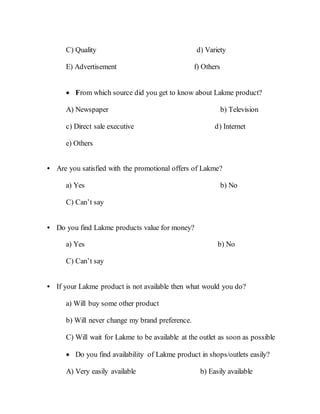
 What were the reasons for you to choose Lakme products?
A) Cheap price b) Brand’s name
C) Quality d) Variety
E) Advertisement f) Others
 From which source did you get to know about Lakme product?
A) Newspaper b) Television
c) Direct sale executive d) Internet
e) Others
• Are you satisfied with the promotional offers of Lakme?
a) Yes b) No
C) Can’t say
• Do you find Lakme products value for money?
a) Yes b) No
C) Can’t say
• If your Lakme product is not available then what would you do?
a) Will buy some other product
b) Will never change my brand preference.
C) Will wait for Lakme to be available at the outlet as soon as possible
 Do you find availability of Lakme product in shops/outlets easily?
A) Very easily available b) Easily available
c) Neither easily nor difficult available d) Very difficult
E) Difficult
 Would you recommend Lakme to your friends & relatives?
A) Yes b) No
c) Can’t say
• What improvements do you suggest to Lakme for its products?
A) Reduction in price b) Easily available
c) Improve promotional activities d) others
FINDINGS BASED ON QUESTIONNAIRE RESPONSES
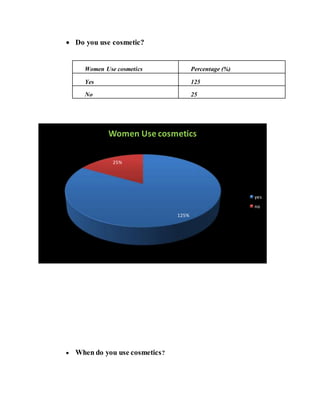
 Do you use cosmetic?
Women Use cosmetics Percentage (%)
Yes 125
No 25
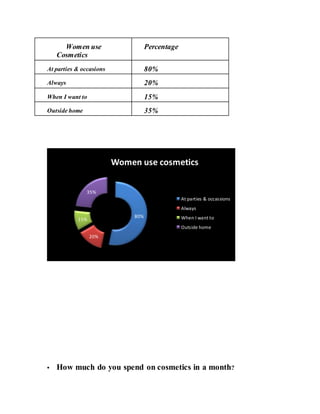
 When do you use cosmetics?
125%
25%
Women Use cosmetics
yes
no
Women use
Cosmetics
Percentage
At parties & occasions 80%
Always 20%
When I want to 15%
Outside home 35%
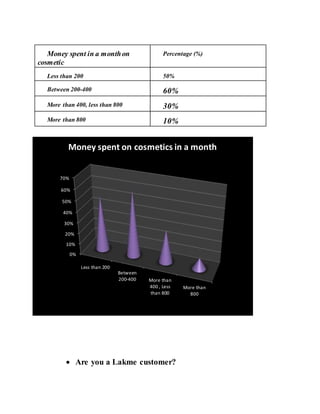
• How much do you spend on cosmetics in a month?
80%
20%
15%
35%
Women use cosmetics
At parties & occassions
Always
When I want to
Outside home
Money spent in a monthon
cosmetic
Percentage (%)
Less than 200 50%
Between 200-400 60%
More than 400, less than 800 30%
More than 800 10%
 Are you a Lakme customer?
Less than 200
Between
200-400 More than
400 , Less
than 800
More than
800
0%
10%
20%
30%
40%
50%
60%
70%
Money spent on cosmetics in a month
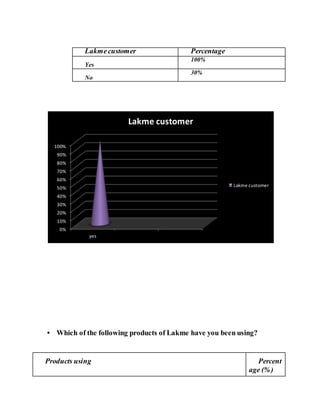
Lakmecustomer Percentage
Yes
100%
No
30%
• Which of the following products of Lakme have you been using?
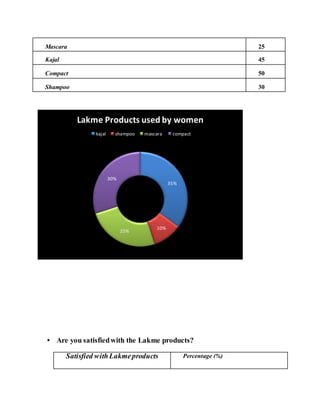
Products using Percent
age (%)
0%
10%
20%
30%
40%
50%
60%
70%
80%
90%
100%
yes
Lakme customer
Lakme customer
Mascara 25
Kajal 45
Compact 50
Shampoo 30
• Are you satisfiedwith the Lakme products?
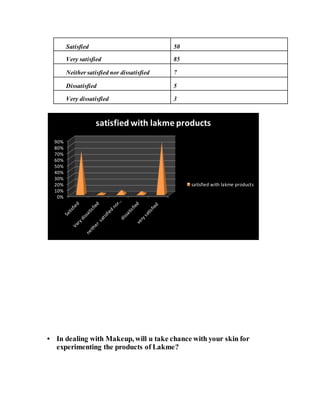
Satisfied withLakmeproducts Percentage (%)
35%
10%
25%
30%
Lakme Products used by women
kajal shampoo mascara compact
Satisfied 50
Very satisfied 85
Neither satisfied nor dissatisfied 7
Dissatisfied 5
Very dissatisfied 3
• In dealing with Makeup, will u take chance with your skin for
experimenting the products of Lakme?
0%
10%
20%
30%
40%
50%
60%
70%
80%
90%
satisfied with lakme products
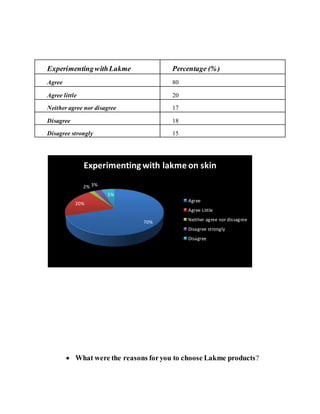
ExperimentingwithLakme Percentage (%)
Agree 80
Agree little 20
Neither agree nor disagree 17
Disagree 18
Disagree strongly 15
 What were the reasons foryou to choose Lakme products?
70%
20%
2% 3%
5%
Experimentingwith lakme on skin
Agree
Agree Little
Neither agree nor dissagree
Disagree strongly
Disagree
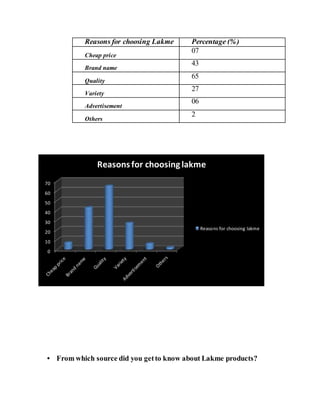
Reasons for choosing Lakme Percentage (%)
Cheap price
07
Brand name
43
Quality
65
Variety
27
Advertisement
06
Others
2
• From which source did you getto know about Lakme products?
0
10
20
30
40
50
60
70
Reasonsfor choosing lakme
Reasons for choosing lakme
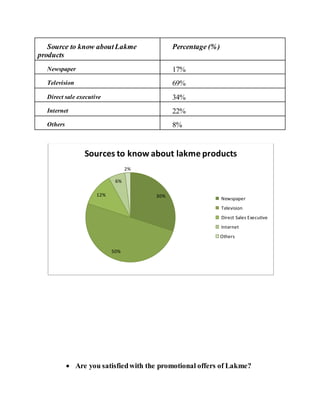
Source to know aboutLakme
products
Percentage (%)
Newspaper 17%
Television 69%
Direct sale executive 34%
Internet 22%
Others 8%
 Are you satisfiedwith the promotional offers of Lakme?
30%
50%
12%
6%
2%
Sources to know about lakme products
Newspaper
Television
Direct Sales Executive
Internet
Others
Satisfied withpromotional
offers
Percentage (%)
Yes
106
No
25
Can’t say
19
Do you find Lakme products value for money?
Products valuefor money Percentage(%)
Yes 112
No 10
Can’t say 28
YES
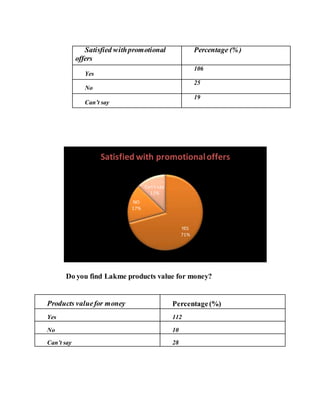
71%
NO
17%
Can't say
12%
Satisfied with promotionaloffers
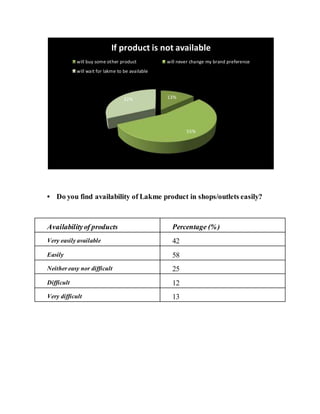
 If your Lakme product is not available then what would you do?
Product is not availablethen Percentage (%)
Will buy some other brand 20
Will never change my brand preference 82
Will wait for Lakme to be available at the
outlet as soon as possible
48
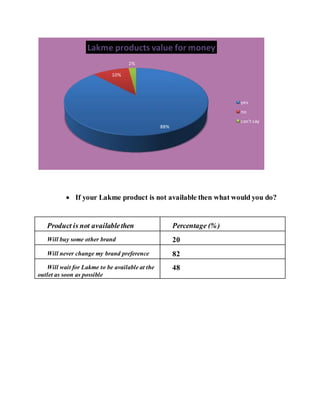
88%
10%
2%
Lakme products value for money
yes
no
can't say
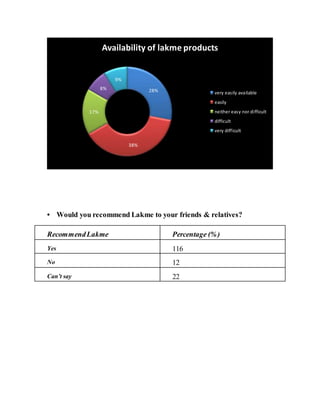
• Do you find availability of Lakme product in shops/outlets easily?
Availabilityof products Percentage (%)
Very easily available 42
Easily 58
Neither easy nor difficult 25
Difficult 12
Very difficult 13
13%
55%
32%
If product is not available
will buy some other product will never change my brand preference
will wait for lakme to be available
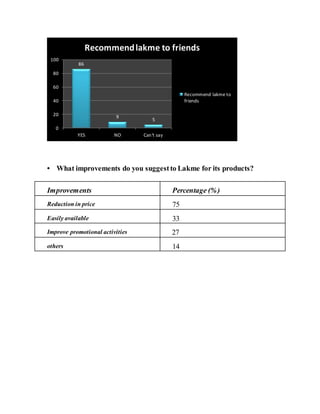
• Would you recommend Lakme to your friends & relatives?
RecommendLakme Percentage (%)
Yes 116
No 12
Can’t say 22
28%
38%
17%
8%
9%
Availability of lakme products
very easily available
easily
neither easy nor difficult
difficult
very difficult
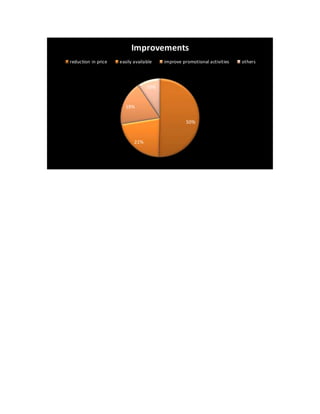
• What improvements do you suggestto Lakme for its products?
Improvements Percentage (%)
Reduction in price 75
Easily available 33
Improve promotional activities 27
others 14
86
9
5
0
20
40
60
80
100
YES NO Can't say
Recommendlakme to friends
Recommend lakme to
friends
50%
22%
18%
10%
Improvements
reduction in price easily available improve promotional activities others
CONCLUSION
&
RECOMMENDATION
CONCLUSION:
The competition is fierce in the multi-channel retailing environment.
A business that hopes to grow and prosper requires a comprehensive
logistics and transportation strategy, executed flawlessly. The dilemma
for management lies in trying to meet consumers’ growing expectations
while keeping costs in check. In response to these issues of multi-
channel growth, more and more carriers are branching out to offer
logistics services.
Those businesses that work to build successful relationships with
logistics and transportation vendors will find that their efforts lead to
improved customer service and profitability. It’s not an easy task, but it
is certainly one that’s achievable with the tools and technology available
today.
Lakme has been found to be the most preferred brand it meet the
promise made to the customer. Consumer relies on the Lakme products
because it provides good quality, good results, good services, etc. So
that customer may prefer Lakme products.
While conducting survey I found that the customer may like the
showrooms of the Lakme products. They still likes the easily availability
of various products. So the Lakme products customers are fully satisfied
to use the products.
SUGGESTIONS:
•The supply must be properly fulfilled so the need of the customer
satisfies.
•Target selling for the dealer / agent can increase the sales of
company.
•The company must concern to the satisfaction of customer demand.
•The company and dealer should develop its marketing information
system up to date information of competitor's policy, price and product,
target market, so the company can know its strengths and weaknesses.
•Brand preference studies reveal that comparatively there is more
preference for Lakme among consumers so in order to attract and
maintain his consumers. Advertising programs should be intensified.
•Perception of the consumer is changing rapidly. They seek new
benefits and values in their preferred brand. Moreover, consumer likes to
have brand at low rate. So Lakme should insert it so as to meet the
changing preference of the consumer.
•Lakme is the market leader in make-up products. Most of the
consumers are brand loyal. They should be treated as intangible assets.
Lakme should ever strive to satisfy them.
•Fulfill the consumer needs.
my own lakme project (3)

my own lakme project (3)

  • 1.
    A Project Report on “Marketing strategiesof LAKME” In partial fulfillment for the award of the degree of Bachelor of Business Administration (BBA Batch 2011-2014) of GURU GOBIND SINGH INDRAPRASTHA UNIVERSITY Under the Guidance of: Submitted by: Dr.Bhawna Bhatnagar Suzye Chhabra (Faculty Guide) NEW DELHI INSTITUTE OF MANAGEMENT TUGHALAKABAD INSTITUTIONAL AREA NEW DELHI – 110062
  • 2.
    ACKNOWLEDGEMENT I take thisopportunity to express my heartiest gratitude to New Delhi Institute of Management for permitting me to undertake this research and supporting me during this research and otherwise also. I would like to thank Dr.Bhawna Bhatnagar who not only played the role of my philosopher and guide but also mentored me at every stage of my project work. I would like to extend my hearty thanks to entire faculty members of BBA department for their constant cooperation and support to take decision during the course of my research. I would also like to thank my parents for their support and blessing without which this project could not have been completed. Indeed I shall remain ever grateful to them. I am also thankful to college library and computer laboratory management staff for their constant support. The experience I gained during this research project is of immense importance in the academically and more on professionally. SUZYE CHHABRA ROLL NO: - 05315501711
  • 3.
    CERTIFICATE I hereby certifythat this project report entitled “A study of Marketing Strategy of “LAKME” is based on an original project study conducted by Suzye Chhabra under my guidance. This has not formed basis for the award of any degree/diploma of this institution or any other University. Dr. Bhawna Bhatnagar (Faculty Guide)
  • 4.
    TABLE OF CONTENT SNo.PARTICULARS PAGE No. 1. Ch-1: Introduction to the study 1.1 Brief overview of study 1.2 Objectives of the study 1.3 Scope & significance ofthe study 1.4 Limitations of the study 2 Ch-2: ResearchMethodology 2.1 Universe 2.2 Sample size and sampling technique 2.3 Data collection(Primary and secondary) 2.4 Presentationtools used 3 CH-3 INDUSTRY OVERVIEW Introduction Trends Majorplayers  REVLON  LAKME  AVON  VLCC  ORIFLAME
  • 5.
    4 CHAPTER-4 COMPANYOVERVIEW Introduction Principal executive offices Achievements Organizationstructure Customer satisfactionthrough 4P’s of marketing mix  Product  Price  Promotion  Place distribution Service offeredto customers in product mix
  • 6.
  • 7.
    BRIEF OVERVIEW OFSTUDY This report is on the company Lakme. It is the global leader in cosmetics, with 25 brands. They have 4 key areas of expertise − hair care, skincare, make-up and fragrances. There is a huge motive behind the study of Lakme. The study will help us to understand the operations which are carried out by L’Oreal. The operations such as, business marketing strategies, business plans of company at a glance, business structure, management and operating structures, competitors position as per this company, business development, discussion of business strategies, SWOT analysis to understand the different pros and cons of the company, so as to report properly to operate effectively and deal smartly .This study offers a comprehensive analysis of the organization, its business segments, and competitors. It analyzes the business and marketing strategies adopted by the company, to gain a competitive edge in the industry. The profile also evaluates the strengths of the company and the opportunities present in the market. This study presents the key facts & figures, business description, products & services offered and corporate timeline of the company. It involves analysis of the company at three levels – segments, organizational structure and ownership composition. Both business and geographic segments are analyzed along with their recent financial performance. It further discusses the major subsidiaries of the company and the recent merger & acquisitions. It also examines the significant developments and milestone that have taken place in the company. It is a form of news analysis where the most critical company news is discussed. Also the factor Financial Performance included in this study. It discusses the most recent financials of the company and also compares the historical sales & income figures with the current and projected figures. The objective is to evaluate the financial health of the company. The analyst opinion and stock performance help anyone in evaluating the performance of the company from an investor’s viewpoint. The Lakme Group is the world's largest cosmetics and Beauty Company. Lakme is an Indian brand of cosmetics, owned by Unilever and run by CEO Anil Chopra. Lakme started as a 100% subsidiary of Tata Oil Mills, part of the Tata Group; it was named after the French opera Lakme, which itself is the French form of Lakshmi, the goddess of wealth, also renowned for her beauty. Indian cosmetic Lakme was started in 1952, famously because the then Prime Minister, Jawaharlal Nehru, was concerned that Indian women were spending precious foreign exchange on beauty products, and personally requested JRD Tata to manufacture them in India. Simone Tata joined the company as director, and went on to become its chairman.
  • 8.
    In 1996 Tatasold off their stakes in Lakme Lever to HLL, for Rs 200 Crore (45 million US$), and went on to create Trent and Westside. Even today, when most multinational beauty products are available in India, Lakme still occupies a special place in the hearts of Indian women. Lakme also started its new business in the beauty industry by setting up Lakme Beauty Salons all over India. Now HUL (Hindustan Unilever Limited) has about 110 salons all over India providing beauty services. Lakme' has been ranked as 47th most trusted brand in India by The Brand Trust Report. The company is the title sponsor for Lakme Fashion Week (LFW) a bi-annual fashion event which takes place in Mumbai.
  • 9.
    OBJECTIVES: • The mainobjective behind the study of this project is to evaluate the distribution channel for Lakme Company. • To study the marketing strategies of Lakme cosmetics. • To study the 4ps of marketing. • To study Lakme market shares in cosmetic industry in comparison to other brands. • To analyze the reason for Lakme’s initial strategy in India. • . To know and analyze the level of satisfaction of customers with regard to Lakme as one of the major players in Cosmetic industry  To understand the relationship between customers (who demand the product) and the suppliers or manufacturers (who produce the product).  For understanding the company’s structure and functioning among various departments like finance, accounts, HR, etc better.
  • 10.
    SCOPE OF THESTUDY: This study uncovers the impact, utility and effectiveness & efficiency of marketing strategies of Lakme on the success of cosmetic industry. A special emphasis is laid down on Lakme cosmetics. The project begins with detailed information about marketing strategies and the impact of measuring customer satisfaction in cosmetic industry. Further, it covers topics as data collection tools and research methodology used for the project. Then it gives a complete analysis of the data collected and it is then used to reach to a conclusion. The study took nearly 2 months to complete. The study is useful for the better understanding of marketing strategies towards the Lakme cosmetic industry. For the purpose of this study, a questionnaire was designed based on different parameters to judge and understand the consumer behavior towards Lakme cosmetics. Target group of the project was mainly Lakme customers. As this study is confined to Lakme, it covers an analysis of consumer behavior, attitude, perceptions, marketing strategies and satisfaction with respect to Lakme as a BRAND in cosmetic industry. The study takes into account the customers of Lakme in New Delhi and Gurgaon.
  • 11.
    LIMITATIONS:  Geographical scopeof the study was limited to a small area, which may not represent the whole sector of India. Size of the sample is 100, which is, of course small in comparison to entire population.  Due to limitation of time only few people were selected for the study. So the sample of consumer was not enough to generalize the finding of the study.  There can be many interpretations and explanation to the data collected. This is empirical study and the research and the research provides the explanation as understood by the researcher only.  The source of data for the study was primary data with the help of self-administered questionnaire. Hence, the chances of unbiased information are less.
  • 12.
  • 13.
    Research Methodology isa way to systematically solve the research problem. The Research Methodology includes the various methods and techniques for conducting a Research. “Marketing Research is the systematic design, collection, analysis and reporting of data and finding relevant solution to a specific marketing situation or problem”. D. Slesinger and M. Stephenson in the encyclopedia of Social Sciences define Research as “the manipulation of things, concepts or symbols for the purpose of generalizing to extend, correct or verify knowledge, whether that knowledge aids in construction of theory or in the practice of an art”. Research is, thus, an original contribution to the existing stock of knowledge making for its advancement. The purpose of Research is to discover answers to the Questions through the application of scientific procedures. Our project has a specified framework for collecting data in an effective manner. Such framework is called “Research Design”. The research process followed by us consists of following steps: 4.1Research Design:- 4.1.1 Conclusion Oriented Research: - The research was conclusion oriented because this research aimed at identifying the characteristics of a successful entrepreneur. In other words it is a research when we give our own views about the research. 4.1.2 Descriptive Research: - The research was a descriptive research as it was concerned with specific predictions, with narration of facts and characteristics concerning individuals specially entrepreneurs. In other words descriptive research is a research where in researcher has no control over variable. He just presents the picture which has already studied.
  • 14.
    4.2 Sample Design:- A sampling design is a definite plan for obtaining a sample from a given population. It refers to the technique or the procedure the researcher adopts in selecting items for the sample. The following factors need to be decided within the scope of sample design: 4.2.1 Universe of the Study: - The universe of the study included respondents specially entrepreneurs in gurgaon city. 4.2.2 Sample Size: - Sample size is the number of elements to be included in a study. Keeping in mind all the constraints 100 respondents was selected.. 4.2.3 Sampling Techniques: - The sampling techniques used are convenience sampling technique and simple random sampling technique.
  • 15.
    UNIVERSE All items inany field of enquiry constitute a ‘Universe’ or ‘Population’. A complete enumeration of all items in the population is known as a census enquiry. SAMPLE SIZE AND SAMPLING TECHNIQUE The number of items selected from the universe to represent the universe is called size of the sample. The sample size of 100 served the purpose of the study. The sampling method used is non-probability convenience sampling. DATA COLLECTION METHOD The task of data collection begins after a research problem has been defined and research design plan checked out. While deciding about the method of collection of data to be used for the study two types of data should be kept in mind vie, primary and secondary. For the study, both primary data and secondary data were collected. For primary data, this is those, which are collected afresh and for the first Time, and thus happen to be original in character. There are many ways of data collection of primary data like observation method, interview method, through schedules, pantry Reports, distributors audit, consumer panel etc. The Team Managers and employees of both the Department were consulted to get information about procedure of both the online and off line share trading. But the method used by us for the primary data collection was through questionnaires. For secondary data, these are those data, which are not collected afresh and are used earlier also and thus they cannot be considered as original in character. There are many ways of data collection of secondary data like publications of the state and central govern ment, reports prepared byresearchers, reports of various associations connected with business, Industries, banks etc. And the method, which was used by us, was with the help of reports of the company.
  • 16.
    QUESTIONNAIRE METHOD For thecollection of primary data I used questionnaire method. A formal list of questions, which are to be asked, is prepared in a questionnaire and questions are asked on those bases. There are some merits and demerits of this method. These as under: - Merits: - 1. Low cost even when universe is large. 2. It is free from bias of interviewer. 3. Respondents have proper time to answer. 4. Respondents who are not easily approachable can also be reachable. 5. Large samples can be made. DATA COLLECTION METHOD The data has been presented by way of pie charts and graphs. These have been specifically used to present the data collected from respondents through questionnaire.
  • 17.
  • 18.
    PAST, PRESENT &FUTURE TRENDS IN MAKEUP Cosmetics (colloquially known as makeup or make-up) are care substances used to enhance the appearance or odor of the human body. They are generally mixtures of chemical compounds, some being derived from natural sources, many being synthetic. In the U.S., the Food and Drug Administration (FDA) which regulates cosmetics, defines cosmetics as "intended to be applied to the human body for cleansing, beautifying, promoting attractiveness, or altering the appearance without affecting the body's structure or functions." This broad definition includes, as well, any material intended for use as a component of a cosmetic product. The FDA specifically excludes soap from this category. The word cosmetics derives from the Greek κοσμητική τέχνη (kosmetikē tekhnē), meaning "technique of dress and ornament", from κοσμητικός (kosmētikos), "skilled in ordering or arranging"] and that from κόσμος (kosmos), meaning amongst others "order" and "ornament" Archeological evidence of cosmetics dates at least from ancient Egypt and Greece. According to one source, early major developments include:[1]  Castor oil by ancient Egypt as a protective balm.  Skin creams made of beeswax, olive oil, and rosewater described by Romans.  Vaseline and lanolin in the nineteenth century.  Nivea Creme in 1911. The Ancient Greeks also used cosmetics. Cosmetics are mentioned in the Old Testament—2 Kings 9:30 where Jezebel painted her eyelids—approximately 840 BC—and the book of Esther describes various beauty treatments as well. Cosmetic use was frowned upon at many points in Western history. For example, in the 19th century, Queen Victoria publicly declared makeup improper, vulgar, and acceptable only for use by actors Of the major cosmetics firms, the largest isLAKME, run by Unilever and owned by CEO Anil Chopra. Beauty products are now widely available from dedicated internet-only retailers, who have more recently been joined online by established outlets, including the major department stores and traditional bricks and mortar beauty retailers. Although modern make-up has been used mainly by women traditionally, gradually an increasing number of males are using cosmetics usually associated to women to enhance or cover their own facial features.
  • 19.
    PRESENT & FUTURETRENDS IN MAKEUP Values in clients’ personal lives have changed and that leads to a change in how they consume. People are spending more time with friends and family, and are focusing on what they consider to be the more important things in life. Consuming for the sake of consumption is no longer a way of life. Cosmetic consumers are demanding more quality products with multiple benefits, and what is inside the package will soon become more important than the package itself. Although packaging and presentation will always be very important, it will not be enough to hold a client, and it will not be the foundation upon which to build a business. To predict how and where mineral makeup will grow in the future, it is important to revisit its history and evolution. Traditional makeup was initially used to add color accents to the face, and after a while, it was used to cover up imperfections. Mineral makeup brought the evolution to not only color and cover, but also to protect and enhance. Mineral makeup today is almost as much about skin care benefits as it is about the color and coverage. That is not to say that mineral makeup is intended to replace skin care; it is meant to enhance it. The mineral makeup category must continue to offer innovative and exciting formulations in order to lead the cosmetic industry. Currently, most mineral formulas are cosmetic-grade only, but the future could bring drug formulas right into color formulas. The beauty of this is that the consumer is more likely to use color more consistently than skin care. The more a person uses products with beneficial ingredients, the better the results will be. Following are the coming trends for mineral makeup. Face color formulations. Formulations for the face will do more than just correct uneven skin tone; they will address texture issues, such as large pores, scars and pitted skin. The coverage will camouflage without a heavy look or feel. Look for products that will address issues such as discoloration; not just covering it, but also reversing its symptoms, whether red (rosacea and acne), blue (dark circle and bruising), brown (hyper pigmentation) or white (hypo pigmentation). Eye color formulations. Formulations for the eyes will still help make the eyes look larger and brighter, but will also address issues such as wrinkles, dark circles, sagging, and thinning eyelashes and eyebrows. Look for concealers and eye shadows that have powerful ingredients included directly in the color formula. New pharmaceutical skin care formulations are offering solutions for longer and darker eyelashes. This will create resurgence in the sale of mascara and eye liner, as well as other eye color products in general. In particular, the category of tubular mascara will skyrocket. Tubular mascara formulas use a flexible copolymer instead of traditional oils and waxes and can literally be built on top of the lashes to add even more length. Tubular mascara offers a water-resistant formula without compromising the lashes; it is easily removed with just warm
  • 20.
    water and pressure.Women pay approximately $120 per month for the upkeep of longer, darker lashes, and they will demand a mascara formula that will not break them down. One weakness of the tubular mascara is that it does not offer the thickening power of traditional oil and wax formulas. Look for a product that does both in one application. So far, most options require a two-step process to enjoy both of these benefits. Lip color formulations. Formulations for the lips have already addressed long-wearing, plumping and moisturizing issues. The one area that needs to be seriously examined is the long- term damage that high-shine lip glosses are doing to the lips. Lip melanomas have increased dramatically during the past few years, and wearing high-shine lip gloss is like wearing a magnifying glass over the lips. To counteract this danger of sun damage, future formulas should include protective ingredients, such as zinc and titanium dioxide. Chemical sunscreens on the lips will raise the heat factor on the lips and exacerbate conditions, such as canker sores. Sun care formulations. Formulations for sun care will continue to improve, and the category of powder sunscreen has brought sun care formulas to a new level. The heat factor of chemical sunscreens is important because heat can exacerbate skin conditions, especially acne and hyper pigmentation. Clients are more ingredient-savvy than ever and are aware of which ingredients work. They have raised their standards and now must have real results from their cosmetic products. They expect a product to offer multiple benefits. The consumer is still spending money on cosmetic products, but is looking for value; it is not so much about price as it is about value. If a product delivers real results and can do double-duty, it will be successful. That is why authentic mineral makeup formulas will still lead the cosmetic industry as a major force.
  • 21.
    MAJOR PLAYERS &THEIR MARKET SHARE REVLON Revlon was founded in the midst of the Great Depression, 1932, by Charles Revson and his brother Joseph, along with a chemist, Charles Lachman, who contributed the "L" in the Revlon name. Starting with a single product — a new type of nail enamel — the three founders pooled their resources and developed a unique manufacturing process. Using pigments instead of dyes, Revlon developed a variety of new shades of opaque nail enamel. In 1937, Revlon started selling the polishes in department stores and drug stores. In six years, the company became a multimillion dollar organization. By 1940, Revlon offered an entire manicure line, and added lipstick to the collection. During World War II, Revlon created makeup and related products for the U.S. Army, which was honored in 1944 with the Army-Navy "E" Award for Excellence. By the end of the war, Revlon was listed as one of America's top five cosmetic houses. Expanding its capabilities, the company bought Graef & Schmidt, a cutlery manufacturer seized by the government in 1943 because of German business ties. This acquisition made it possible for Revlon to produce its own manicure and pedicure instruments, instead of buying them from outside supply sources.
  • 22.
    AVON Avon Product isa multi-level marketing company. The company's CEO is Sherilyn S. McCoy, who was appointed to that position in April 2012.The former CEO, Andrea Jung, became the executive chairman of the board. Jung was the longest tenured female CEO among Fortune 500 companies. Avon uses both door-to-door sales people ("Avon ladies," primarily and a growing number of men) and brochures to advertise its products. n addition to its corporate pursuits, the Avon corporation is involved in philanthropic causes. The Avon Foundation for Women, public charity, is the largest corporate-affiliated philanthropy for women in the world. Avon founded the Avon Foundation for Women with its first grant, a $400 scholarship, in 1955. Avon was committed to helping women achieve their highest potential of economic opportunity and self-fulfillment by empowering them through scholarships and support for other forms of educational and occupational training and advancement. Women's empowerment continued to be the focus through the early 1990s when Avon began to increase its philanthropy with a new emphasis on breast cancer; the Avon Foundation still awards scholarships for Avon Sales Representatives and their families, as well as for the children of Avon associates. The Avon Foundation is currently focused on two key causes: breast cancer and domestic violence. The Foundation approved $38 million in grants in 2011. In 2012, Avon launched its first global fundraising scheme. The symbol of this fundraising action is the Women's Empowerment Bracelet.
  • 23.
    VLCC The guiding imageof VLCC is ‘Transforming Lives’, which refers to the transforming self, transforming future and spreading happiness. These are the three pillars, which are VLCC’s hallmarks which were established in 1989 by Mrs. Vandana Luthra. One of the above mentioned hallmarks, the foundation has continued to grow as a leading beauty brand. VLCC, a re-defining wellness business has revolutionized the beauty industry as well as acquired the position of largest beauty brand and heath in India. VLCC today is the solitary mammoth competitor in the industry with a Pan India presence of around 225 outlets in approximately 75 cities, 1 outlet in Katmandu, Omen, Bahrain and 8 outlets in UAE. The VLCC is a ‘Super brand’ serving as a sunshade for its other products such as VLCC Health Care, Personal Care and Institute of Health, Management and Beauty. Its services offer holistic wellness, traditional therapies and marrying a scientific research. Having served more than millions of consumers since its beginning, VLCC, at present, has achieved a start status all over the world. It is India’s most preferred and largest Slimming, Health and Beauty brand. VLCC – Vision To provide better quality life to everyone, by pursuing and adopting socially and ethically significant business practices, which are aimed at shaping up the confidence of people and making Beauty Care, Health and Fitness available to each and every section of the society.
  • 24.
    ORIFLAME Oriflame Cosmetics S.A.(Luxembourg) is a cosmetics group, founded in 1967 in Sweden by the brothers Jonas AF Jochnick and Robert AF Jochnick. The company sells skin care, cosmetic products and related products through an independent sales force of over 3 million people. Oriflame Cosmetics is an international beauty company selling direct. The company began operations in 1967 in Sweden and has today a presence in over 60 countries worldwide. The company has over 3.5 million "consultants" worldwide with annual sales of €1.5 billion. Oriflame has been listed on NASDAQ OMX Stockholm since 2004. The brand got its name from the royal banner of medieval France which was unfurled only on the battlefield and accompanied by the war cry Montjoie Saint Denis Oriflame gained its first UK consultant in 1970. Oriflame is involved in several programs for example the "World Childhood Foundation", SOS Children's Villages as well as in local small charities. The company has been ranked 8.5 out of 9 in the Palm Oil Buyers’ Scorecard which is compiled by the World Wide Fund and rates purchasers of palm oil on environmental sustainability.
  • 25.
    MARKET SHARE 2012 BRANDMARKET SHARE (%) LAKME 35.27 REVLON 18.27 LOREAL 30.34 AVON 14.67 VLCC 9.24 ORIFLAME 7.03 Source: Business express 30.34 35.27 14.67 9.24 7.03 20.45 MARKET SHARE LOREAL LAKME AVON VLCC ORIFLAME REVLON
  • 26.
  • 27.
    COMPANY PROFILE Lakme isan Indian brand of cosmetics, owned by Unilever and run by CEO Anil Chopra. Lakme started as a 100% subsidiary of Tata Oil Mills (Tomco), part of the Tata Group; it was named after the French opera Lakme, which itself is the French form of Lakshmi, the goddess of wealth, also renowned for her beauty. Indian cosmetic Lakme was started in 1952, famously because the then Prime Minister, Jawaharlal Nehru, was concerned that Indian women were spending precious foreign exchange on beauty products, and personally requested JRD Tata to manufacture them in India. Simone Tata joined the company as director, and went on to become its chairman. In 1996 Tata sold off their stakes in Lakme Lever to HLL, for Rs 200 Crore (45 million US$), and went on to create Trent and Westside. Even today, when most multinational beauty products are available in India, Lakme still occupies a special place in the hearts of Indian women. Lakme also started its new business in the beauty industry by setting up Lakme Beauty Salons all over India. Now HUL (Hindustan Unilever Limited) has about 110 salons all over India providing beauty services. Lakme' has been ranked as 47th most trusted brand in India by The Brand Trust Report The company is the title sponsor for Lakme Fashion Week (LFW) a bi-annual fashion event which takes place in Mumbai.
  • 28.
    Makeup types Cosmetics includeskin-care creams, lotions, powder, perfumes, lipsticks, fingernail and toe nail polish, eye and facial makeup ,towelettes, permanent waves, colored contact lenses, hair colors, hair sprays and gels, deodorants, hand sanitizer, baby products, bath oils, bubble baths, bath salts, butters and many other types of products. A subset of cosmetics is called "make-up," which refers primarily to colored products intended to alter the user’s appearance. Many manufacturers distinguish between decorative cosmetics and care cosmetics. Most cosmetics are distinguished by the area of the body intended for application. • Face Primer, Come in various formulas to suit individual skin concerns. Most are meant to reduce the appearance of pore size, prolong the wear of makeup, and allow for a smoother application of makeup. Applied before foundation. • Eye Primer, Used to prolong the wear of eye shadows on the eye as well as intensify color payoff from shadows. • Lip gloss, is a sheer form of lipstick that is in a liquid form. • Lipstick, lip gloss, lip liner, lip plumper, lip balm, lip conditioner, lip primer, and lip boosters. Lip stains have a water or gel base and may contain alcohol to help the product stay on the lips. The idea behind lip stains is to temporarily saturate the lips with a dye, rather than covering them with a colored wax. Usually designed to be waterproof, the product may come with an applicator brush or be applied with a finger. • Concealer, makeup used to cover any imperfections of the skin. Concealer is often used for any extra coverage needed to cover blemishes, or any other marks. Concealer is often thicker and more solid than foundation, and provides longer lasting, and more detailed coverage. Some formulations are meant only for the eye or only for the face. • Foundation, used to smooth out the face and cover spots or uneven skin coloration. Usually a liquid, cream, or powder, as well as most recently, a light and fluffy mousse, which provides excellent coverage as well. Foundation primer can be applied before or after to get a smoother finish. Some primers come in powder or liquid form to be applied before foundation as a base, while other primers come as a spray to be applied after you are finished to help make- up last longer. • Face powder, used to set the foundation, giving a matte finish, and also to conceal small flaws or blemishes.
  • 29.
    • Rouge, blushor blusher, cheek coloring used to bring out the color in the cheeks and make the cheekbones appear more defined. This comes in powder, cream, and liquid forms. • Contour powder/creams, used to define the face. It can be used to give the illusion of a slimmer face or to even modify a person’s face shape as desired. Usually a few shades darker than one’s own skin tone and matte in finish to create the illusion of depth. A darker toned foundation/concealer can be used instead to contour to create a more natural look. • Highlight, used to draw attention to the high points of the face as well as to add glow to the face. It comes in liquid, cream, and powder form. Often contains shimmer, but sometimes does not. A lighter toned foundation/concealer can be used instead to highlight create a more natural look. • Bronzer, used to give skin a bit of color by adding a golden or bronze glow. Can come in either matte, semi matte/satin, or shimmer finishes. Mascara is used to darken, lengthen, and thicken the eyelashes. It is available in natural colors such as brown and black, but also comes in bolder colors such as blue, pink, or purple. There are many different formulas, including waterproof for those prone to allergies or sudden tears. Often used after an eyelash curler and mascara primer. There are now also many mascaras with certain components to help lashes to grow longer and thicker. There are specific minerals and proteins that are combined with the mascara that can benefit, as well as beautify.
  • 30.
    MISSION: BEAUTY FOR ALL Formore than a century, Lakme has devoted itself solely to one business: beauty. It is a business rich in meaning as it enables all individuals to express their personality gain self-confidence itself and open up to others. Beauty is a language. Lakme has set itself the mission of offering men & women worldwide the best cosmetics innovation in terms of quality; efficacy & safety .It purses this goal by infinite diversity of beauty needs and desires all over the world. Beauty is universal. Since its creation by a researcher, the group has pushing back the frontiers of knowledge. Its unique research arms it to continually explore new territories & invent the products of the future, while drawing inspiration from beauty rituals the world over. Beauty is science. By drawing on the diversity on its teams, & the richness & the complementarily of its brand portfolio, Lakme has made the universalisation of beauty its project for the years to come.
  • 31.
  • 32.
  • 33.
    PRODUCTS AND SERVICESOFFERED: Lakme is world renown and great cosmetic company .a wonderful gift hamper for today’s women. CATEGORIES 1. Lakme lipstick 2. Lakme eyeliner 3. Lakme kajal 4. Lakme strawberries face wash 5. Lakme radiant rose powder 6. Lakme nail enamel remover 7. Lakme shampoo 8. Lakme deep pore cleansing milk
  • 34.
    Marketing Strategy forCustomer Satisfaction: Promotional strategies  Promotional posters.  Launch of beauty magazines.  Advertisement through film Commercials.  Open spa to promote the Brand.  Selecting reputed brand ambassador.  Sponsoring and Social Responsibility.  Start campaign for safe cosmetics which will be started in February 2013. Positioning strategies:  Most innovative.  High Quality, Advanced products & affordable price.  Only cosmetic brand in world that has products in all the segments Consumer, Luxury, Professional & Pharmaceuticals. Distribution strategies:  Widen distribution network by giving various incentives to distributors, retailers, stockiest etc in order, not to lose self space Product Modification  By modifying the product by adding SPF, so that lips can be protected from harmful.
  • 35.
    FUTURE PLANS:  Thecompany plans to open 110 cosmetics shops outlets across the globe next year, the share of Indian market to Lakme turnover of euro 15.8 billion small, but is growing. With other emerging economies India’s contribution to global cosmetics amounts to 60%.  Lakme turns to cheap products to spur future growth.  Lakme is focusing on south market & is planning to open 10 stores in Chennai & Hyderabad.  The company has drawn up a fresh strategy, including aggressive discounts & opening up of new stores.  At present the company is operating 25 stores in 8 Indian cities under a franchise agreement with retail major Future group.
  • 36.
  • 37.
    o Marketing Mixrefers to the ingredients or the tools or the variable which the marketer mixes in order to interact with a particular market o “Marketing Mix is a set of marketing tools that the firm uses to pursue its marketing objectives in the target market” o Marketing mix is a term used to describe the combination o the four inputs which constitute the core of a company’s marketing system: the product; the price structure; the promotional activities, and the distribution system. o Marketing mix represents the total marketing programmed of a firm. It involves decisions with regard to product, price, place and promotion. Marketing mix is a blending of decisions in the ‘4 Ps’. Four major ingredients of marketing mix are:
  • 38.
     Product A productisany good or service that consumers want. It is a bundle of utilities or a cluster of tangible and intangible attributes. Productcomponent of the marketing mix involves planning, developing and producing the right type of products and services. It deals with the dimensions of productline, durability and other qualities. Productpolicy of a firm also deals with proper branding, right packaging, appropriate color and other productfeatures. The total productshould be such that it really satisfies the needs of the target market. In short, productmix requires decisions with regard to  Size and weight of the product.  Quality of the product.  Design of the product.  Volume of output.  Brand name.  Packaging.  Productrange.  Price. Price is an important factor affecting the success ofa firm. Pricing decisions and policies have a direct influence on sales volume and profits of business. Price is, therefore, an important element in the marketing mix. In practice, it is very difficult to fix the right price. Right price can be determined through pricing research and test marketing. Demand, cost, competition, govt. regulation, etc. are the vital factors that must be taken into consideration in the determination of the price. Price mix involves decisions regarding base price, discounts, allowances, fright payment, credit, etc.  Promotion.
  • 39.
    Promotion componento themarketing mix is concerned with bringing products to the knowledge of customers and persuading them to buy. It is the function of informing and influencing the customer. Promotion mix involves decisions with respect to advertising, personal selling and sales promotion. All these techniques help to promote the sale of products and to fight the competition in the market. No single method of promotion is effective alone and, therefore, a promotional campaign usually involves a combination of two or more promotional methods. Growing competition and widening market have made simultaneous use of more than one promotional method all the more necessary. Combination of two or more methods in a single promotional campaign requires an effective blending of promotional inputs so as to optimize the expenditure on each.  Place (Distribution) This element of marketing mix involves a choice of the place where the products are to be displayed and made available to the customers. It is concerned with decisions relating to the wholesale and retail outlets or channels of distribution. The objective of selecting and managing trade channels is to provide the products to the right customer at the right time and place on a continuing basis. In deciding where and through whom to sell, management should consider where the customer wants the goods to be available. A manufacturer may distribute his goods through his own outlets or he may employ wholesalers and retailers for this purpose. Irrespective of the channel used management must continuously evaluate channel performance and make changes whenever performance falls short of expected targets. In addition, management must develop a physical distribution system for handling and transporting the products through the selected channels. In the determination of distribution mix or marketing logistics, a firm has to make decision with regard to the mode of transporting of goods to middle-men, use of company vehicles or both.
  • 40.
  • 41.
    Lakme is theglobal leader in cosmetics, with 25 global brands. It has five key areas of expertise- hair care, skincare, make-up and fragrances. This company has over 63,358 employees working currently. And it sells its products around in 130countries all over the world. Its consolidated sales are recorded in over 17,063 in millionaires .The company manufacture well above 4.7 billion units annually. It also has investments above 560 million euro s in R&D investments. On the analysis and interpretation of research conducted. It was found that certain findings are very critical and are directly or indirectly affecting the Lakme products. •There is a good awareness of Lakme cosmetics products among the consumers. •The quality of Lakme is very satisfactory viewed by the majority of customers. •There is a neck to neck competition between L’Oreal, Oriflame, VLCC, Revlon etc •75% of the customers are fully satisfied with existing quality While 25% are partly satisfied. •Majority of women are using Lakme products. •Consumers prefer the Lakme products because it provides good quality, good results, good services, etc and it all fulfills their needs. DATA ANALSIS
  • 42.
    SURVEY OF CONSUMERS. Surveywas conducted with the help of questionnaire. QUESTIONNAIRE. A SURVEY CONDUCTED WITH THE HELP OF QUESTIONNAIRE FOR THE PURPOSEOF RESEARCH ON MARKETING STRATEGIES OF LAKME which includes the following question. Please fill the question precisely and help us in achieving the desired objective. NAME ……………………………………………………………………………… ……………………………………. AGE GROUP a) Under16 b) Under 16-25 c) Under 25-35 d) above 35 GENDER a) Male b) Female OCCUPATION ……………………………………………………………………………… …………………………… ADDRESS ……………………………………………………………………………… ………………………….. ……………………………………………………………………………… …………………………..
  • 43.
    DATA ANALSIS GENDER NOOF RESPONDANTS FEMALE 100 AGE GROUP UNDER-16 1 16-25 18 25-35 72 35 Above 9 QUESTIONNAIRE. • Do you use cosmetic? a) Yes b) No • When do you use cosmetics? a) At parties & occasions b) Always c) When I want to d) Outside home • How much do you spend on cosmetics in a month?
  • 44.
    a) Less than200 b) Between 200 & 400 c) 400-800 d) More than 800 • Are you a Lakme customer? a) Yes b) No • Which of the following products of Lakme have you been using? a) Mascara b) Compact c) Kajal d) Hair Spa • Are you satisfied with the Lakme products? a) Satisfied b) Very Satisfied c) Neither satisfied nor dissatisfied d) Dissatisfied e) Very dissatisfied • In dealing with Makeup, will u take chance with your skin for experimenting the products of Lakme? A) Agree b) Agree little c) Neither agrees nor disagree d) Disagree  What were the reasons for you to choose Lakme products? A) Cheap price b) Brand’s name
  • 45.
    C) Quality d)Variety E) Advertisement f) Others  From which source did you get to know about Lakme product? A) Newspaper b) Television c) Direct sale executive d) Internet e) Others • Are you satisfied with the promotional offers of Lakme? a) Yes b) No C) Can’t say • Do you find Lakme products value for money? a) Yes b) No C) Can’t say • If your Lakme product is not available then what would you do? a) Will buy some other product b) Will never change my brand preference. C) Will wait for Lakme to be available at the outlet as soon as possible  Do you find availability of Lakme product in shops/outlets easily? A) Very easily available b) Easily available
  • 46.
    c) Neither easilynor difficult available d) Very difficult E) Difficult  Would you recommend Lakme to your friends & relatives? A) Yes b) No c) Can’t say • What improvements do you suggest to Lakme for its products? A) Reduction in price b) Easily available c) Improve promotional activities d) others FINDINGS BASED ON QUESTIONNAIRE RESPONSES
  • 47.
     Do youuse cosmetic? Women Use cosmetics Percentage (%) Yes 125 No 25  When do you use cosmetics? 125% 25% Women Use cosmetics yes no
  • 48.
    Women use Cosmetics Percentage At parties& occasions 80% Always 20% When I want to 15% Outside home 35% • How much do you spend on cosmetics in a month? 80% 20% 15% 35% Women use cosmetics At parties & occassions Always When I want to Outside home
  • 49.
    Money spent ina monthon cosmetic Percentage (%) Less than 200 50% Between 200-400 60% More than 400, less than 800 30% More than 800 10%  Are you a Lakme customer? Less than 200 Between 200-400 More than 400 , Less than 800 More than 800 0% 10% 20% 30% 40% 50% 60% 70% Money spent on cosmetics in a month
  • 50.
    Lakmecustomer Percentage Yes 100% No 30% • Whichof the following products of Lakme have you been using? Products using Percent age (%) 0% 10% 20% 30% 40% 50% 60% 70% 80% 90% 100% yes Lakme customer Lakme customer
  • 51.
    Mascara 25 Kajal 45 Compact50 Shampoo 30 • Are you satisfiedwith the Lakme products? Satisfied withLakmeproducts Percentage (%) 35% 10% 25% 30% Lakme Products used by women kajal shampoo mascara compact
  • 52.
    Satisfied 50 Very satisfied85 Neither satisfied nor dissatisfied 7 Dissatisfied 5 Very dissatisfied 3 • In dealing with Makeup, will u take chance with your skin for experimenting the products of Lakme? 0% 10% 20% 30% 40% 50% 60% 70% 80% 90% satisfied with lakme products satisfied with lakme products
  • 53.
    ExperimentingwithLakme Percentage (%) Agree80 Agree little 20 Neither agree nor disagree 17 Disagree 18 Disagree strongly 15  What were the reasons foryou to choose Lakme products? 70% 20% 2% 3% 5% Experimentingwith lakme on skin Agree Agree Little Neither agree nor dissagree Disagree strongly Disagree
  • 54.
    Reasons for choosingLakme Percentage (%) Cheap price 07 Brand name 43 Quality 65 Variety 27 Advertisement 06 Others 2 • From which source did you getto know about Lakme products? 0 10 20 30 40 50 60 70 Reasonsfor choosing lakme Reasons for choosing lakme
  • 55.
    Source to knowaboutLakme products Percentage (%) Newspaper 17% Television 69% Direct sale executive 34% Internet 22% Others 8%  Are you satisfiedwith the promotional offers of Lakme? 30% 50% 12% 6% 2% Sources to know about lakme products Newspaper Television Direct Sales Executive Internet Others
  • 56.
    Satisfied withpromotional offers Percentage (%) Yes 106 No 25 Can’tsay 19 Do you find Lakme products value for money? Products valuefor money Percentage(%) Yes 112 No 10 Can’t say 28 YES 71% NO 17% Can't say 12% Satisfied with promotionaloffers
  • 57.
     If yourLakme product is not available then what would you do? Product is not availablethen Percentage (%) Will buy some other brand 20 Will never change my brand preference 82 Will wait for Lakme to be available at the outlet as soon as possible 48 88% 10% 2% Lakme products value for money yes no can't say
  • 58.
    • Do youfind availability of Lakme product in shops/outlets easily? Availabilityof products Percentage (%) Very easily available 42 Easily 58 Neither easy nor difficult 25 Difficult 12 Very difficult 13 13% 55% 32% If product is not available will buy some other product will never change my brand preference will wait for lakme to be available
  • 59.
    • Would yourecommend Lakme to your friends & relatives? RecommendLakme Percentage (%) Yes 116 No 12 Can’t say 22 28% 38% 17% 8% 9% Availability of lakme products very easily available easily neither easy nor difficult difficult very difficult
  • 60.
    • What improvementsdo you suggestto Lakme for its products? Improvements Percentage (%) Reduction in price 75 Easily available 33 Improve promotional activities 27 others 14 86 9 5 0 20 40 60 80 100 YES NO Can't say Recommendlakme to friends Recommend lakme to friends
  • 61.
    50% 22% 18% 10% Improvements reduction in priceeasily available improve promotional activities others
  • 62.
  • 63.
    CONCLUSION: The competition isfierce in the multi-channel retailing environment. A business that hopes to grow and prosper requires a comprehensive logistics and transportation strategy, executed flawlessly. The dilemma for management lies in trying to meet consumers’ growing expectations while keeping costs in check. In response to these issues of multi- channel growth, more and more carriers are branching out to offer logistics services. Those businesses that work to build successful relationships with logistics and transportation vendors will find that their efforts lead to improved customer service and profitability. It’s not an easy task, but it is certainly one that’s achievable with the tools and technology available today. Lakme has been found to be the most preferred brand it meet the promise made to the customer. Consumer relies on the Lakme products because it provides good quality, good results, good services, etc. So that customer may prefer Lakme products. While conducting survey I found that the customer may like the showrooms of the Lakme products. They still likes the easily availability of various products. So the Lakme products customers are fully satisfied to use the products.
  • 64.
    SUGGESTIONS: •The supply mustbe properly fulfilled so the need of the customer satisfies. •Target selling for the dealer / agent can increase the sales of company. •The company must concern to the satisfaction of customer demand. •The company and dealer should develop its marketing information system up to date information of competitor's policy, price and product, target market, so the company can know its strengths and weaknesses. •Brand preference studies reveal that comparatively there is more preference for Lakme among consumers so in order to attract and maintain his consumers. Advertising programs should be intensified. •Perception of the consumer is changing rapidly. They seek new benefits and values in their preferred brand. Moreover, consumer likes to have brand at low rate. So Lakme should insert it so as to meet the changing preference of the consumer. •Lakme is the market leader in make-up products. Most of the consumers are brand loyal. They should be treated as intangible assets. Lakme should ever strive to satisfy them. •Fulfill the consumer needs.