Raman Spectrometry
Kusum Shrestha, Nepal
Ph.D. Student 1st year 2021
MC230P80 – Analytical Spectrometry
Faculty of Science
Charles University
Contents
 Introduction
 Basic principle
 Instrumentation
 Types of Raman Spectroscopy
 Applications
 Draw backs
• Chandrashekhar Venkata Raman in 1928.
• Complimentary of IR spectrometry.
• Identification of organic, inorganic and biological molecules.
• Chemical and structural information about molecules as its fingerprint.
Raman Spectroscopy:
• measurement of wavelength and intensity of inelastically scattered light
from the molecules.
• It occurs at wavelengths that are shifted from the incident light by the
energies of molecular vibrations.
Introduction
3
https://carex.com/blogs/resources/understanding-the-
light-spectrum-and-its-benefits
4
https://www.google.com/url?sa=i&url=https%3A%2F%2Fgfycat.com%2Fgifs%2Fsearch%2Fspectroscopy&psig=AOvVaw2buZcI8hgoABJSR
9_ioY-0&ust=1639666790391000&source=images&cd=vfe&ved=0CAsQjRxqFwoTCLCK1PqI5vQCFQAAAAAdAAAAABAD
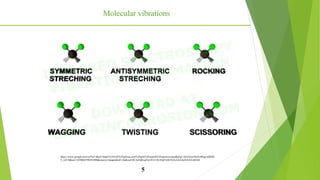
Molecular vibrations
5
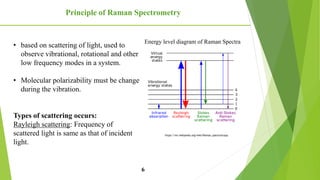
Energy level diagram of Raman Spectra
https://en.wikipedia.org/wiki/Raman_spectroscopy
Principle of Raman Spectrometry
• based on scattering of light, used to
observe vibrational, rotational and other
low frequency modes in a system.
• Molecular polarizability must be change
during the vibration.
Types of scattering occurs:
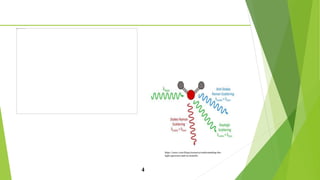
Rayleigh scattering: Frequency of
scattered light is same as that of incident
light.
6
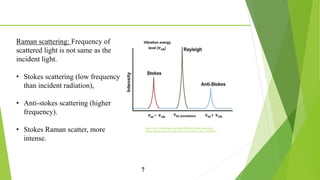
Raman scattering: Frequency of
scattered light is not same as the
incident light.
• Stokes scattering (low frequency
than incident radiation),
• Anti-stokes scattering (higher
frequency).
• Stokes Raman scatter, more
intense.
https://www.researchgate.net/figure/Rayleigh-scattering-versus-
Stokes-Raman-and-anti-Stokes-Raman-scattering_fig4_342986781
7
Instrumentation of Raman Spectrometry
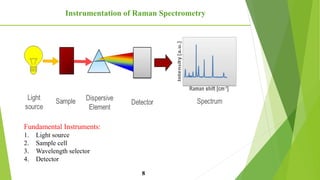
Fundamental Instruments:
1. Light source
2. Sample cell
3. Wavelength selector
4. Detector
8
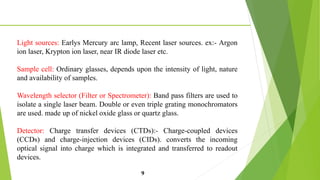
Light sources: Earlys Mercury arc lamp, Recent laser sources. ex:- Argon
ion laser, Krypton ion laser, near IR diode laser etc.
Sample cell: Ordinary glasses, depends upon the intensity of light, nature
and availability of samples.
Wavelength selector (Filter or Spectrometer): Band pass filters are used to
isolate a single laser beam. Double or even triple grating monochromators
are used. made up of nickel oxide glass or quartz glass.
Detector: Charge transfer devices (CTDs):- Charge-coupled devices
(CCDs) and charge-injection devices (CIDs). converts the incoming
optical signal into charge which is integrated and transferred to readout
devices.
9
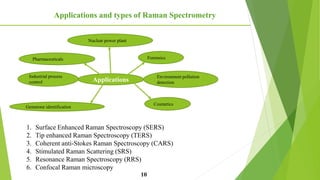
Applications and types of Raman Spectrometry
10
Applications
Gemstone identification
Industrial process
control
Cosmetics
Environment pollution
detection
Nuclear power plant
Forensics
Pharmaceuticals
1. Surface Enhanced Raman Spectroscopy (SERS)
2. Tip enhanced Raman Spectroscopy (TERS)
3. Coherent anti-Stokes Raman Spectroscopy (CARS)
4. Stimulated Raman Scattering (SRS)
5. Resonance Raman Spectroscopy (RRS)
6. Confocal Raman microscopy
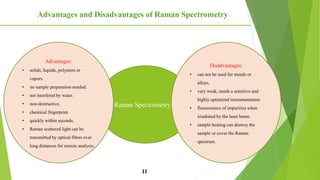
Advantages and Disadvantages of Raman Spectrometry
11
Raman Spectrometry
Disadvantages:
• can not be used for metals or
alloys.
• very weak, needs a sensitive and
highly optimized instrumentation.
• fluorescence of impurities when
irradiated by the laser beam.
• sample heating can destroy the
sample or cover the Raman
spectrum.
Advantages:
• solids, liquids, polymers or
vapors.
• no sample preparation needed.
• not interfered by water.
• non-destructive.
• chemical fingerprint.
• quickly within seconds.
• Raman scattered light can be
transmitted by optical fibers over
long distances for remote analysis.
12

Raman spectrometry pptx 21 dec2021

  • 1.
    Raman Spectrometry Kusum Shrestha,Nepal Ph.D. Student 1st year 2021 MC230P80 – Analytical Spectrometry Faculty of Science Charles University
  • 2.
    Contents  Introduction  Basicprinciple  Instrumentation  Types of Raman Spectroscopy  Applications  Draw backs
  • 3.
    • Chandrashekhar VenkataRaman in 1928. • Complimentary of IR spectrometry. • Identification of organic, inorganic and biological molecules. • Chemical and structural information about molecules as its fingerprint. Raman Spectroscopy: • measurement of wavelength and intensity of inelastically scattered light from the molecules. • It occurs at wavelengths that are shifted from the incident light by the energies of molecular vibrations. Introduction 3
  • 4.
  • 5.
  • 6.
    Energy level diagramof Raman Spectra https://en.wikipedia.org/wiki/Raman_spectroscopy Principle of Raman Spectrometry • based on scattering of light, used to observe vibrational, rotational and other low frequency modes in a system. • Molecular polarizability must be change during the vibration. Types of scattering occurs: Rayleigh scattering: Frequency of scattered light is same as that of incident light. 6
  • 7.
    Raman scattering: Frequencyof scattered light is not same as the incident light. • Stokes scattering (low frequency than incident radiation), • Anti-stokes scattering (higher frequency). • Stokes Raman scatter, more intense. https://www.researchgate.net/figure/Rayleigh-scattering-versus- Stokes-Raman-and-anti-Stokes-Raman-scattering_fig4_342986781 7
  • 8.
    Instrumentation of RamanSpectrometry Fundamental Instruments: 1. Light source 2. Sample cell 3. Wavelength selector 4. Detector 8
  • 9.
    Light sources: EarlysMercury arc lamp, Recent laser sources. ex:- Argon ion laser, Krypton ion laser, near IR diode laser etc. Sample cell: Ordinary glasses, depends upon the intensity of light, nature and availability of samples. Wavelength selector (Filter or Spectrometer): Band pass filters are used to isolate a single laser beam. Double or even triple grating monochromators are used. made up of nickel oxide glass or quartz glass. Detector: Charge transfer devices (CTDs):- Charge-coupled devices (CCDs) and charge-injection devices (CIDs). converts the incoming optical signal into charge which is integrated and transferred to readout devices. 9
  • 10.
    Applications and typesof Raman Spectrometry 10 Applications Gemstone identification Industrial process control Cosmetics Environment pollution detection Nuclear power plant Forensics Pharmaceuticals 1. Surface Enhanced Raman Spectroscopy (SERS) 2. Tip enhanced Raman Spectroscopy (TERS) 3. Coherent anti-Stokes Raman Spectroscopy (CARS) 4. Stimulated Raman Scattering (SRS) 5. Resonance Raman Spectroscopy (RRS) 6. Confocal Raman microscopy
  • 11.
    Advantages and Disadvantagesof Raman Spectrometry 11 Raman Spectrometry Disadvantages: • can not be used for metals or alloys. • very weak, needs a sensitive and highly optimized instrumentation. • fluorescence of impurities when irradiated by the laser beam. • sample heating can destroy the sample or cover the Raman spectrum. Advantages: • solids, liquids, polymers or vapors. • no sample preparation needed. • not interfered by water. • non-destructive. • chemical fingerprint. • quickly within seconds. • Raman scattered light can be transmitted by optical fibers over long distances for remote analysis.
  • 12.