Probiotics and intestinal health
B.S. Ramakrishna
Director
SIMS Institute of Gastroenterology, Hepatobiliary Science &
Transplantation
Vadapalani, Chennai
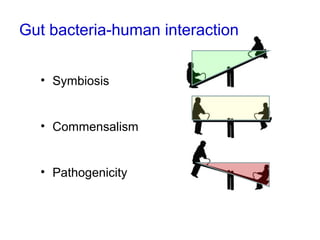
Gut bacteria-human interaction
• Symbiosis
• Commensalism
• Pathogenicity
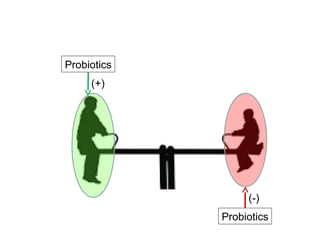
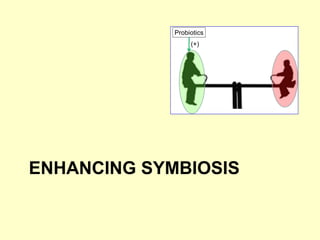
Probiotics
Probiotics
(+)
(-)
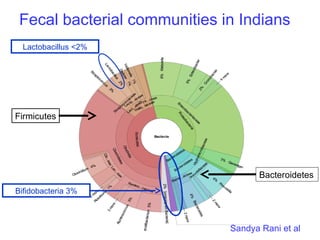
Fecal bacterial communities in Indians
Bacteroidetes
Firmicutes
Sandya Rani et al
Lactobacillus <2%
Bifidobacteria 3%
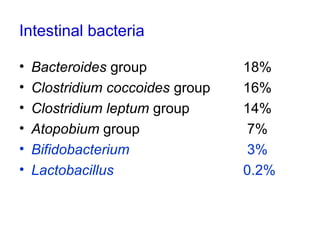
Intestinal bacteria
• Bacteroides group 18%
• Clostridium coccoides group 16%
• Clostridium leptum group 14%
• Atopobium group 7%
• Bifidobacterium 3%
• Lactobacillus 0.2%
ENHANCING SYMBIOSIS
COLONIC HEALTH
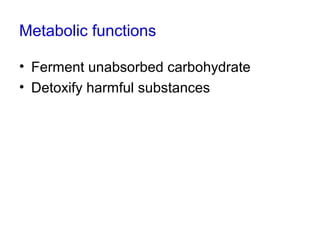
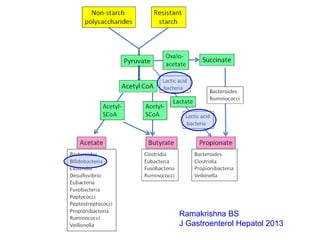
Metabolic functions
• Ferment unabsorbed carbohydrate
• Detoxify harmful substances
Ramakrishna BS
J Gastroenterol Hepatol 2013
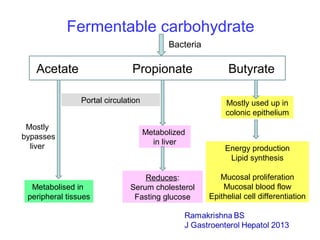
Fermentable carbohydrate
Acetate Propionate Butyrate
Mostly used up in
colonic epithelium
Energy production
Lipid synthesis
Mucosal proliferation
Mucosal blood flow
Epithelial cell differentiation
Portal circulation
Metabolized
in liver
Reduces:
Serum cholesterol
Fasting glucose
Mostly
bypasses
liver
Metabolised in
peripheral tissues
Bacteria
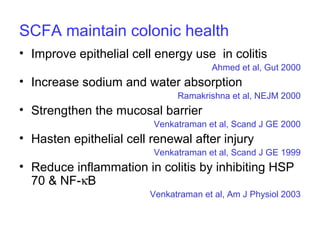
SCFA maintain colonic health
• Improve epithelial cell energy use in colitis
Ahmed et al, Gut 2000
• Increase sodium and water absorption
Ramakrishna et al, NEJM 2000
• Strengthen the mucosal barrier
Venkatraman et al, Scand J GE 2000
• Hasten epithelial cell renewal after injury
Venkatraman et al, Scand J GE 1999
• Reduce inflammation in colitis by inhibiting HSP
70 & NF-κB
Venkatraman et al, Am J Physiol 2003
BODY WEIGHT MAINTENANCE
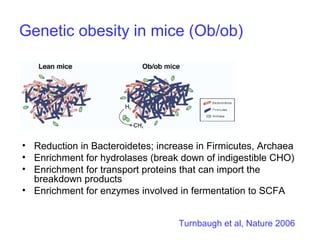
Genetic obesity in mice (Ob/ob)
• Reduction in Bacteroidetes; increase in Firmicutes, Archaea
• Enrichment for hydrolases (break down of indigestible CHO)
• Enrichment for transport proteins that can import the
breakdown products
• Enrichment for enzymes involved in fermentation to SCFA
Turnbaugh et al, Nature 2006
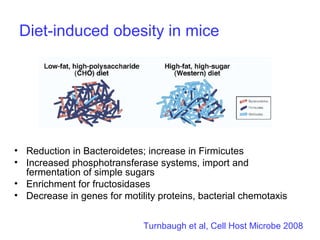
Diet-induced obesity in mice
• Reduction in Bacteroidetes; increase in Firmicutes
• Increased phosphotransferase systems, import and
fermentation of simple sugars
• Enrichment for fructosidases
• Decrease in genes for motility proteins, bacterial chemotaxis
Turnbaugh et al, Cell Host Microbe 2008
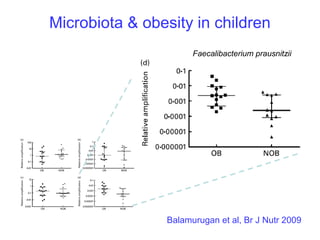
Balamurugan et al, Br J Nutr 2009
Microbiota & obesity in children
Faecalibacterium prausnitzii
Fecal microbiota alterations in obesity vary
in different populations
• Increased Faecalibacterium prausnitzii in obese
children
Balamurugan et al, Br J Nutr 2009
• Increased Lactobacillus and reduced Bacteroidetes in
obese individuals
Armougom et al, PLoS One 2009
• Increased Enterobacteriaceae in obese pre-school
children
Karlsson et al, Obesity 2012
• Increased Bacteroidetes in obese individuals at
phylum level; increased Archaea in obese (5 adults)
Patil et al, J Biosci 2012
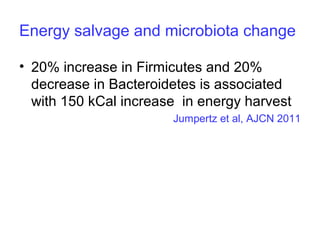
Energy salvage and microbiota change
• 20% increase in Firmicutes and 20%
decrease in Bacteroidetes is associated
with 150 kCal increase in energy harvest
Jumpertz et al, AJCN 2011
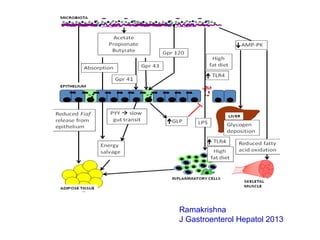
Ramakrishna
J Gastroenterol Hepatol 2013
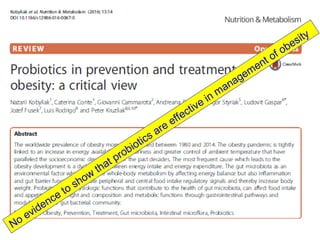
No evidence to show
that probiotics are effective in management of obesity
IRON ABSORPTION
Microbiota and iron absorption
• Iron normally absorbed from duodenum
• Transporters for iron absorption are also
expressed in caecum & ascending colon
• Iron absorption from proximal colon in
experimental animals is enhanced by
fermentable carbohydrate
Levrat et al, J Nutr 1991
Scholz-Ahrens & Schrezenmeier, Br J Nutr 2002
Scholz-Ahrens & Schrezenmeier, J Nutr 2007
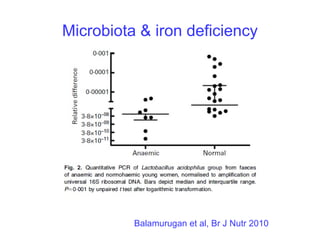
Balamurugan et al, Br J Nutr 2010
Microbiota & iron deficiency
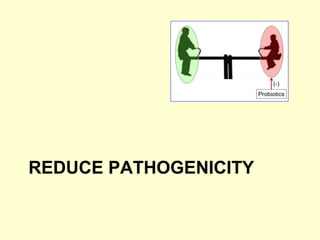
REDUCE PATHOGENICITY
COLON CANCER
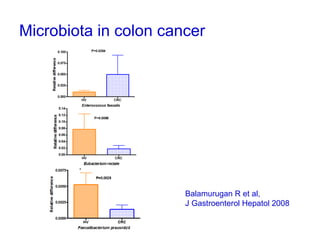
Microbiota in colon cancer
Balamurugan R et al,
J Gastroenterol Hepatol 2008
Experimental evidence for use of probiotics
in colon cancer
• L. acidophilus and Bifidobacterium bifidum reduced
proliferative zone and fecal pH in patients at high risk for
colon cancer
• Consumption of lactobacilli by human volunteers reduced
mutagenicity of urine and feces associated with ingestion of
carcinogens in cooked meat
• Lactobacillus casei Shirota
– anti-tumor and anti-metastatic effect on transplantable tumor
cells
– Induced IFN-γ, TNFα, IL1β which increased survival of tumor-
bearing mice
• Lactobacillus peptidoglycan dose-dependently reduced
growth of CT-26 cancer cells in BALB/c mice via increased
apoptosis
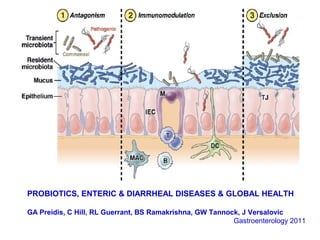
ANTAGONIZE LUMINAL
PATHOGENS
Protect against harmful bacteria
• Displace pathogens
• Compete for nutrients
• Compete for receptors
• Produce antimicrobial substances
including secretory IgA
PROBIOTICS, ENTERIC & DIARRHEAL DISEASES & GLOBAL HEALTH
GA Preidis, C Hill, RL Guerrant, BS Ramakrishna, GW Tannock, J Versalovic
Gastroenterology 2011
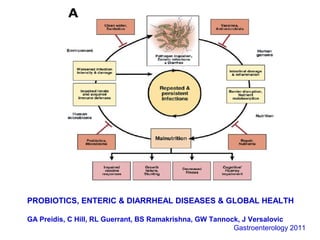
PROBIOTICS, ENTERIC & DIARRHEAL DISEASES & GLOBAL HEALTH
GA Preidis, C Hill, RL Guerrant, BS Ramakrishna, GW Tannock, J Versalovic
Gastroenterology 2011
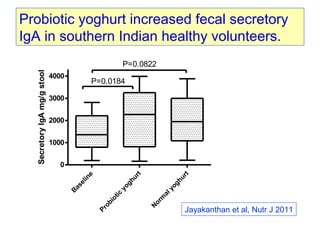
B
aseline
Probiotic
yoghurt
N
orm
alyoghurt
0
1000
2000
3000
4000
P=0.0184
P=0.0822
SecretoryIgAmg/gstool
Probiotic yoghurt increased fecal secretory
IgA in southern Indian healthy volunteers.
Jayakanthan et al, Nutr J 2011
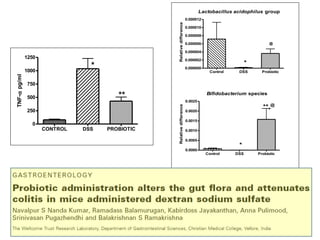
REDUCE INFLAMMATION
Lactobacillus acidophilus group
Control DSS Probiotic
0.000000
0.000002
0.000004
0.000006
0.000008
0.000010
0.000012
*
@
Relativedifference
Bifidobacterium species
Control DSS Probiotic
0.0000
0.0005
0.0010
0.0015
0.0020
0.0025
*
**,@
Relativedifference
CONTROL DSS PROBIOTIC
0
250
500
750
1000
1250
*
**
TNF-αpg/ml
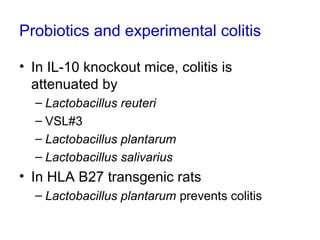
Probiotics and experimental colitis
• In IL-10 knockout mice, colitis is
attenuated by
– Lactobacillus reuteri
– VSL#3
– Lactobacillus plantarum
– Lactobacillus salivarius
• In HLA B27 transgenic rats
– Lactobacillus plantarum prevents colitis
CLINICAL EVIDENCE BASE
FOR PROBIOTIC USE IN IBD
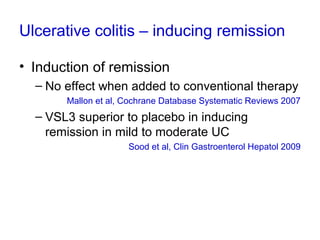
Ulcerative colitis – inducing remission
• Induction of remission
– No effect when added to conventional therapy
Mallon et al, Cochrane Database Systematic Reviews 2007
– VSL3 superior to placebo in inducing
remission in mild to moderate UC
Sood et al, Clin Gastroenterol Hepatol 2009
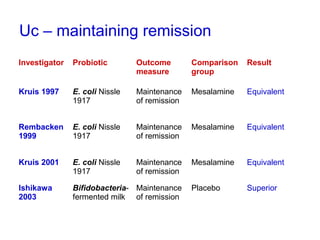
Uc – maintaining remission
Investigator Probiotic Outcome
measure
Comparison
group
Result
Kruis 1997 E. coli Nissle
1917
Maintenance
of remission
Mesalamine Equivalent
Rembacken
1999
E. coli Nissle
1917
Maintenance
of remission
Mesalamine Equivalent
Kruis 2001 E. coli Nissle
1917
Maintenance
of remission
Mesalamine Equivalent
Ishikawa
2003
Bifidobacteria-
fermented milk
Maintenance
of remission
Placebo Superior
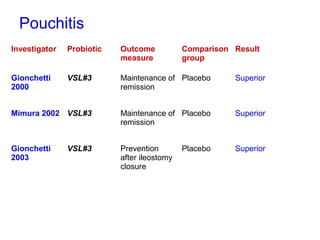
Pouchitis
Investigator Probiotic Outcome
measure
Comparison
group
Result
Gionchetti
2000
VSL#3 Maintenance of
remission
Placebo Superior
Mimura 2002 VSL#3 Maintenance of
remission
Placebo Superior
Gionchetti
2003
VSL#3 Prevention
after ileostomy
closure
Placebo Superior
Crohn’s disease
• Treatment of active disease
– No effect
• Maintenance of remission after medical or
surgical therapy
– 7 small studies with significant heterogeneity
– Probiotics not effective
– Small sample sizes.
Rolfe et al, Cochrane Database Systematic Reviews 2006
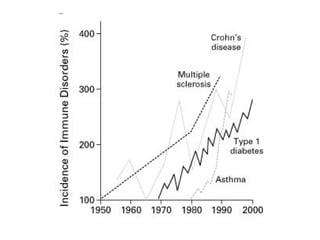
REDUCE EXTRAINTESTINAL
INFLAMMATION
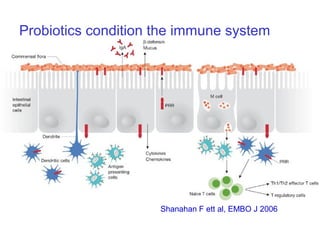
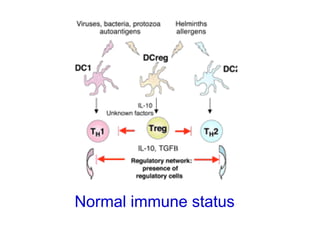
Probiotics condition the immune system
Shanahan F ett al, EMBO J 2006
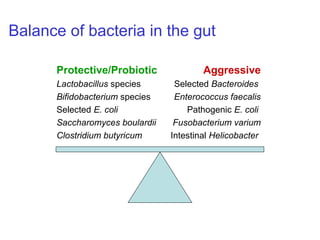
Balance of bacteria in the gut
Protective/Probiotic
Lactobacillus species
Bifidobacterium species
Selected E. coli
Saccharomyces boulardii
Clostridium butyricum
Aggressive
Selected Bacteroides
Enterococcus faecalis
Pathogenic E. coli
Fusobacterium varium
Intestinal Helicobacter
Normal immune status
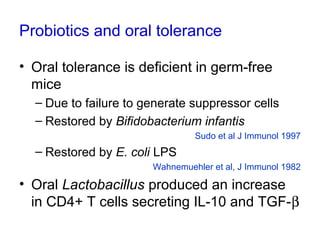
Probiotics and oral tolerance
• Oral tolerance is deficient in germ-free
mice
– Due to failure to generate suppressor cells
– Restored by Bifidobacterium infantis
Sudo et al J Immunol 1997
– Restored by E. coli LPS
Wahnemuehler et al, J Immunol 1982
• Oral Lactobacillus produced an increase
in CD4+ T cells secreting IL-10 and TGF-β
CONCLUSIONS
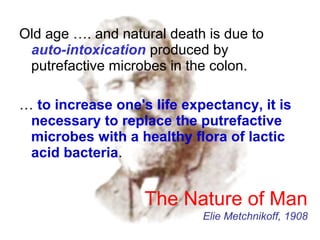
Old age …. and natural death is due to
auto-intoxication produced by
putrefactive microbes in the colon.
… to increase one's life expectancy, it is
necessary to replace the putrefactive
microbes with a healthy flora of lactic
acid bacteria.
The Nature of Man
Elie Metchnikoff, 1908
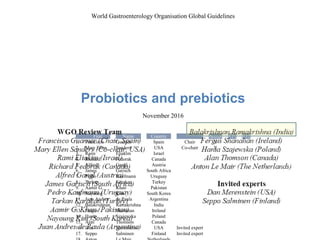
World Gastroenterology Organisation Global Guidelines
Probiotics and prebiotics
November 2016
Review Team
First Name Country Accept RT1 RT2
1. Francisco Guarner Spain Chair Y
2. Mary Ellen Sanders USA Co-chair Y
3. Rami Eliakim Israel
4. Richard Fedorak Canada
5. Alfred Gangl Austria
6. James Garisch South Africa
7. Pedro Kaufmann Uruguay
8. Tarkan Karakan Turkey
9. Aamir G. Khan Pakistan
10. Nayoung Kim South Korea
11. Juan Andres de Paula Argentina
12. Balakrishnan Ramakrishna India
13. Fergus Shanahan Ireland
14. Hania Szajewska Poland
15. Alan Thomson Canada
16. Dan Merenstein USA Invited expert
17. Seppo Salminen Finland Invited expert
ACKNOWLEDGMENTS
VELLORE
V.I. Mathan
Selvi Krishnan
Aparna Venkatraman
S. Venkataraman
N.S. Nanda Kumar
R. Balamurugan
S. Pugazhendhi
S. Srikanth
K. Jayakanthan
K. Madhu Mohan
Sandya Rani
Kalpana P.
NEW HAVEN
Henry Binder
Judy Cho
BOSTON
Joshua Korzenik
PARIS
J-F Desjeux
Philippe Pochart
Antonia Suau
CLERMONT-FERRAND
Isabelle Creveaux
ICMR Broad Medical Research Program
DBT The Wellcome Trust
CSIR Indo-France Science Program
Bill & Melinda Gates Foundation

Ramakrishnan

  • 1.
    Probiotics and intestinalhealth B.S. Ramakrishna Director SIMS Institute of Gastroenterology, Hepatobiliary Science & Transplantation Vadapalani, Chennai
  • 2.
    Gut bacteria-human interaction •Symbiosis • Commensalism • Pathogenicity
  • 3.
  • 4.
    Fecal bacterial communitiesin Indians Bacteroidetes Firmicutes Sandya Rani et al Lactobacillus <2% Bifidobacteria 3%
  • 5.
    Intestinal bacteria • Bacteroidesgroup 18% • Clostridium coccoides group 16% • Clostridium leptum group 14% • Atopobium group 7% • Bifidobacterium 3% • Lactobacillus 0.2%
  • 6.
  • 7.
  • 8.
    Metabolic functions • Fermentunabsorbed carbohydrate • Detoxify harmful substances
  • 9.
  • 10.
    Fermentable carbohydrate Acetate PropionateButyrate Mostly used up in colonic epithelium Energy production Lipid synthesis Mucosal proliferation Mucosal blood flow Epithelial cell differentiation Portal circulation Metabolized in liver Reduces: Serum cholesterol Fasting glucose Mostly bypasses liver Metabolised in peripheral tissues Bacteria
  • 11.
    SCFA maintain colonichealth • Improve epithelial cell energy use in colitis Ahmed et al, Gut 2000 • Increase sodium and water absorption Ramakrishna et al, NEJM 2000 • Strengthen the mucosal barrier Venkatraman et al, Scand J GE 2000 • Hasten epithelial cell renewal after injury Venkatraman et al, Scand J GE 1999 • Reduce inflammation in colitis by inhibiting HSP 70 & NF-κB Venkatraman et al, Am J Physiol 2003
  • 12.
  • 13.
    Genetic obesity inmice (Ob/ob) • Reduction in Bacteroidetes; increase in Firmicutes, Archaea • Enrichment for hydrolases (break down of indigestible CHO) • Enrichment for transport proteins that can import the breakdown products • Enrichment for enzymes involved in fermentation to SCFA Turnbaugh et al, Nature 2006
  • 14.
    Diet-induced obesity inmice • Reduction in Bacteroidetes; increase in Firmicutes • Increased phosphotransferase systems, import and fermentation of simple sugars • Enrichment for fructosidases • Decrease in genes for motility proteins, bacterial chemotaxis Turnbaugh et al, Cell Host Microbe 2008
  • 15.
    Balamurugan et al,Br J Nutr 2009 Microbiota & obesity in children Faecalibacterium prausnitzii
  • 16.
    Fecal microbiota alterationsin obesity vary in different populations • Increased Faecalibacterium prausnitzii in obese children Balamurugan et al, Br J Nutr 2009 • Increased Lactobacillus and reduced Bacteroidetes in obese individuals Armougom et al, PLoS One 2009 • Increased Enterobacteriaceae in obese pre-school children Karlsson et al, Obesity 2012 • Increased Bacteroidetes in obese individuals at phylum level; increased Archaea in obese (5 adults) Patil et al, J Biosci 2012
  • 17.
    Energy salvage andmicrobiota change • 20% increase in Firmicutes and 20% decrease in Bacteroidetes is associated with 150 kCal increase in energy harvest Jumpertz et al, AJCN 2011
  • 18.
  • 19.
    No evidence toshow that probiotics are effective in management of obesity
  • 20.
  • 21.
    Microbiota and ironabsorption • Iron normally absorbed from duodenum • Transporters for iron absorption are also expressed in caecum & ascending colon • Iron absorption from proximal colon in experimental animals is enhanced by fermentable carbohydrate Levrat et al, J Nutr 1991 Scholz-Ahrens & Schrezenmeier, Br J Nutr 2002 Scholz-Ahrens & Schrezenmeier, J Nutr 2007
  • 22.
    Balamurugan et al,Br J Nutr 2010 Microbiota & iron deficiency
  • 23.
  • 24.
  • 25.
    Microbiota in coloncancer Balamurugan R et al, J Gastroenterol Hepatol 2008
  • 26.
    Experimental evidence foruse of probiotics in colon cancer • L. acidophilus and Bifidobacterium bifidum reduced proliferative zone and fecal pH in patients at high risk for colon cancer • Consumption of lactobacilli by human volunteers reduced mutagenicity of urine and feces associated with ingestion of carcinogens in cooked meat • Lactobacillus casei Shirota – anti-tumor and anti-metastatic effect on transplantable tumor cells – Induced IFN-γ, TNFα, IL1β which increased survival of tumor- bearing mice • Lactobacillus peptidoglycan dose-dependently reduced growth of CT-26 cancer cells in BALB/c mice via increased apoptosis
  • 27.
  • 28.
    Protect against harmfulbacteria • Displace pathogens • Compete for nutrients • Compete for receptors • Produce antimicrobial substances including secretory IgA
  • 29.
    PROBIOTICS, ENTERIC &DIARRHEAL DISEASES & GLOBAL HEALTH GA Preidis, C Hill, RL Guerrant, BS Ramakrishna, GW Tannock, J Versalovic Gastroenterology 2011
  • 30.
    PROBIOTICS, ENTERIC &DIARRHEAL DISEASES & GLOBAL HEALTH GA Preidis, C Hill, RL Guerrant, BS Ramakrishna, GW Tannock, J Versalovic Gastroenterology 2011
  • 31.
    B aseline Probiotic yoghurt N orm alyoghurt 0 1000 2000 3000 4000 P=0.0184 P=0.0822 SecretoryIgAmg/gstool Probiotic yoghurt increasedfecal secretory IgA in southern Indian healthy volunteers. Jayakanthan et al, Nutr J 2011
  • 32.
  • 33.
    Lactobacillus acidophilus group ControlDSS Probiotic 0.000000 0.000002 0.000004 0.000006 0.000008 0.000010 0.000012 * @ Relativedifference Bifidobacterium species Control DSS Probiotic 0.0000 0.0005 0.0010 0.0015 0.0020 0.0025 * **,@ Relativedifference CONTROL DSS PROBIOTIC 0 250 500 750 1000 1250 * ** TNF-αpg/ml
  • 34.
    Probiotics and experimentalcolitis • In IL-10 knockout mice, colitis is attenuated by – Lactobacillus reuteri – VSL#3 – Lactobacillus plantarum – Lactobacillus salivarius • In HLA B27 transgenic rats – Lactobacillus plantarum prevents colitis
  • 35.
    CLINICAL EVIDENCE BASE FORPROBIOTIC USE IN IBD
  • 36.
    Ulcerative colitis –inducing remission • Induction of remission – No effect when added to conventional therapy Mallon et al, Cochrane Database Systematic Reviews 2007 – VSL3 superior to placebo in inducing remission in mild to moderate UC Sood et al, Clin Gastroenterol Hepatol 2009
  • 37.
    Uc – maintainingremission Investigator Probiotic Outcome measure Comparison group Result Kruis 1997 E. coli Nissle 1917 Maintenance of remission Mesalamine Equivalent Rembacken 1999 E. coli Nissle 1917 Maintenance of remission Mesalamine Equivalent Kruis 2001 E. coli Nissle 1917 Maintenance of remission Mesalamine Equivalent Ishikawa 2003 Bifidobacteria- fermented milk Maintenance of remission Placebo Superior
  • 38.
    Pouchitis Investigator Probiotic Outcome measure Comparison group Result Gionchetti 2000 VSL#3Maintenance of remission Placebo Superior Mimura 2002 VSL#3 Maintenance of remission Placebo Superior Gionchetti 2003 VSL#3 Prevention after ileostomy closure Placebo Superior
  • 39.
    Crohn’s disease • Treatmentof active disease – No effect • Maintenance of remission after medical or surgical therapy – 7 small studies with significant heterogeneity – Probiotics not effective – Small sample sizes. Rolfe et al, Cochrane Database Systematic Reviews 2006
  • 40.
  • 41.
    Probiotics condition theimmune system Shanahan F ett al, EMBO J 2006
  • 42.
    Balance of bacteriain the gut Protective/Probiotic Lactobacillus species Bifidobacterium species Selected E. coli Saccharomyces boulardii Clostridium butyricum Aggressive Selected Bacteroides Enterococcus faecalis Pathogenic E. coli Fusobacterium varium Intestinal Helicobacter
  • 43.
  • 45.
    Probiotics and oraltolerance • Oral tolerance is deficient in germ-free mice – Due to failure to generate suppressor cells – Restored by Bifidobacterium infantis Sudo et al J Immunol 1997 – Restored by E. coli LPS Wahnemuehler et al, J Immunol 1982 • Oral Lactobacillus produced an increase in CD4+ T cells secreting IL-10 and TGF-β
  • 46.
  • 47.
    Old age ….and natural death is due to auto-intoxication produced by putrefactive microbes in the colon. … to increase one's life expectancy, it is necessary to replace the putrefactive microbes with a healthy flora of lactic acid bacteria. The Nature of Man Elie Metchnikoff, 1908
  • 48.
    World Gastroenterology OrganisationGlobal Guidelines Probiotics and prebiotics November 2016 Review Team First Name Country Accept RT1 RT2 1. Francisco Guarner Spain Chair Y 2. Mary Ellen Sanders USA Co-chair Y 3. Rami Eliakim Israel 4. Richard Fedorak Canada 5. Alfred Gangl Austria 6. James Garisch South Africa 7. Pedro Kaufmann Uruguay 8. Tarkan Karakan Turkey 9. Aamir G. Khan Pakistan 10. Nayoung Kim South Korea 11. Juan Andres de Paula Argentina 12. Balakrishnan Ramakrishna India 13. Fergus Shanahan Ireland 14. Hania Szajewska Poland 15. Alan Thomson Canada 16. Dan Merenstein USA Invited expert 17. Seppo Salminen Finland Invited expert
  • 49.
    ACKNOWLEDGMENTS VELLORE V.I. Mathan Selvi Krishnan AparnaVenkatraman S. Venkataraman N.S. Nanda Kumar R. Balamurugan S. Pugazhendhi S. Srikanth K. Jayakanthan K. Madhu Mohan Sandya Rani Kalpana P. NEW HAVEN Henry Binder Judy Cho BOSTON Joshua Korzenik PARIS J-F Desjeux Philippe Pochart Antonia Suau CLERMONT-FERRAND Isabelle Creveaux ICMR Broad Medical Research Program DBT The Wellcome Trust CSIR Indo-France Science Program Bill & Melinda Gates Foundation