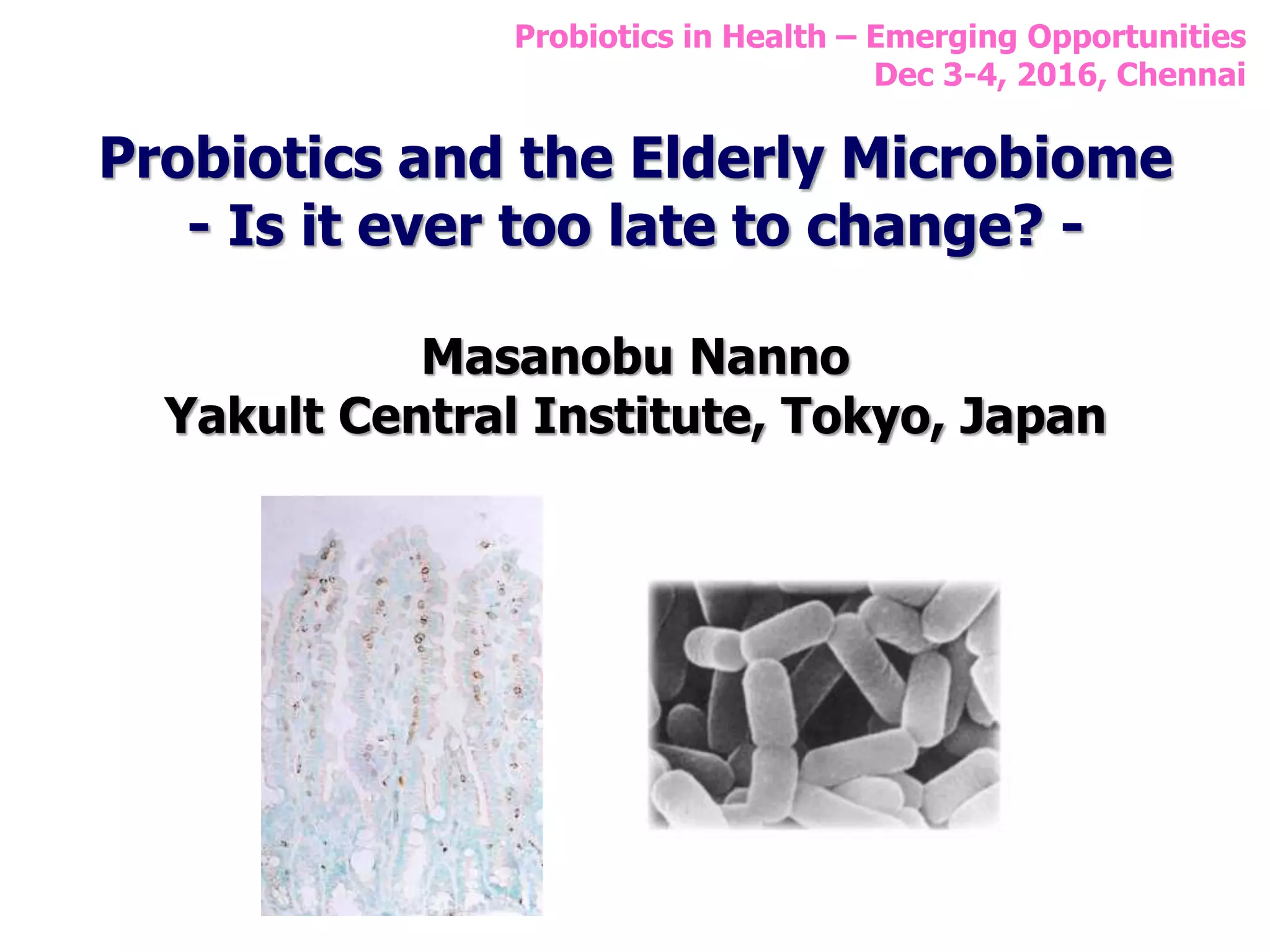
Probiotics in Health – Emerging Opportunities
Dec 3-4, 2016, Chennai
Probiotics and the Elderly Microbiome
- Is it ever too late to change? -
Masanobu Nanno
Yakult Central Institute, Tokyo, Japan
By J.O.
Today’s topics
1. Health problems in the elderly
– Is microbiome related? ー
2. Probiotics are promising agent
to improve the altered gut
microbiome.
3. Probiotics are beneficial for
health management in the
elderly .
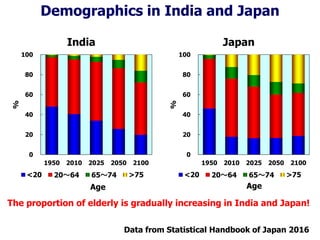
Demographics in India and Japan
0
20
40
60
80
100
1950 2010 2025 2050 2100
%
India
<20 20~64 65~74 >75
0
20
40
60
80
100
1950 2010 2025 2050 2100
%
Japan
<20 20~64 65~74 >75
Data from Statistical Handbook of Japan 2016
The proportion of elderly is gradually increasing in India and Japan!
Age Age
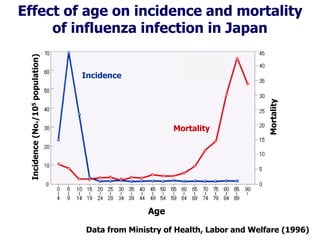
Data from Ministry of Health, Labor and Welfare (1996)
Incidence(No./105population)
Mortality
Incidence
Mortality
Age
Effect of age on incidence and mortality
of influenza infection in Japan
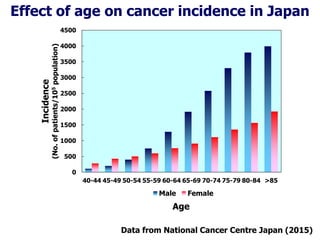
Data from National Cancer Centre Japan (2015)
Effect of age on cancer incidence in Japan
0
500
1000
1500
2000
2500
3000
3500
4000
4500
40-44 45-49 50-54 55-59 60-64 65-69 70-74 75-79 80-84 >85
Incidence
(No.ofpatients/105population)
Male Female
Age
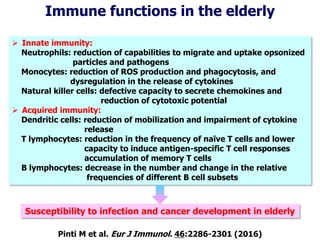
Immune functions in the elderly
 Innate immunity:
Neutrophils: reduction of capabilities to migrate and uptake opsonized
particles and pathogens
Monocytes: reduction of ROS production and phagocytosis, and
dysregulation in the release of cytokines
Natural killer cells: defective capacity to secrete chemokines and
reduction of cytotoxic potential
 Acquired immunity:
Dendritic cells: reduction of mobilization and impairment of cytokine
release
T lymphocytes: reduction in the frequency of naïve T cells and lower
capacity to induce antigen-specific T cell responses
accumulation of memory T cells
B lymphocytes: decrease in the number and change in the relative
frequencies of different B cell subsets
Susceptibility to infection and cancer development in elderly
Pinti M et al. Eur J Immunol. 46:2286-2301 (2016)
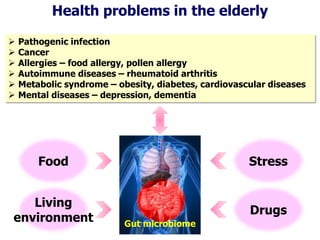
Health problems in the elderly
 Pathogenic infection
 Cancer
 Allergies – food allergy, pollen allergy
 Autoimmune diseases – rheumatoid arthritis
 Metabolic syndrome – obesity, diabetes, cardiovascular diseases
 Mental diseases – depression, dementia
Gut microbiome
Food
Living
environment
Stress
Drugs
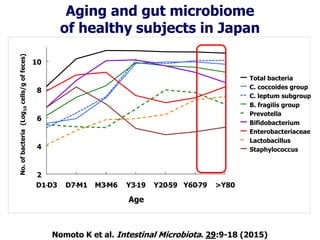
Aging and gut microbiome
of healthy subjects in Japan
2
4
6
8
10
D1-D3 D7-M1 M3-M6 Y3-19 Y20-59 Y60-79 >Y80
No.ofbacteria(Log10cells/goffeces)
Age
Total bacteria
C. coccoides group
C. leptum subgroup
B. fragilis group
Prevotella
Bifidobacterium
Enterobacteriaceae
Lactobacillus
Staphylococcus
Nomoto K et al. Intestinal Microbiota. 29:9-18 (2015)
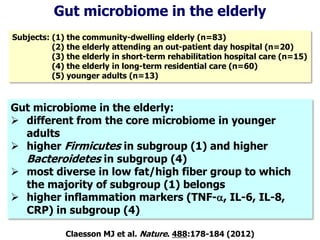
Gut microbiome in the elderly
Claesson MJ et al. Nature. 488:178-184 (2012)
Gut microbiome in the elderly:
 different from the core microbiome in younger
adults
 higher Firmicutes in subgroup (1) and higher
Bacteroidetes in subgroup (4)
 most diverse in low fat/high fiber group to which
the majority of subgroup (1) belongs
 higher inflammation markers (TNF-a, IL-6, IL-8,
CRP) in subgroup (4)
Subjects: (1) the community-dwelling elderly (n=83)
(2) the elderly attending an out-patient day hospital (n=20)
(3) the elderly in short-term rehabilitation hospital care (n=15)
(4) the elderly in long-term residential care (n=60)
(5) younger adults (n=13)
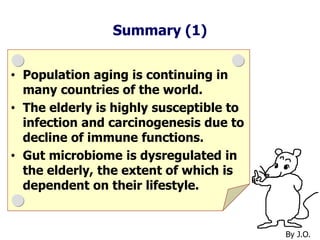
Summary (1)
• Population aging is continuing in
many countries of the world.
• The elderly is highly susceptible to
infection and carcinogenesis due to
decline of immune functions.
• Gut microbiome is dysregulated in
the elderly, the extent of which is
dependent on their lifestyle.
By J.O.
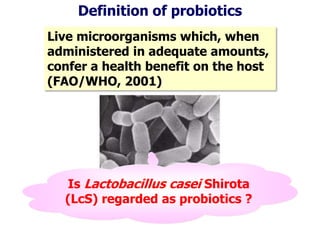
Definition of probiotics
Live microorganisms which, when
administered in adequate amounts,
confer a health benefit on the host
(FAO/WHO, 2001)
Is Lactobacillus casei Shirota
(LcS) regarded as probiotics ?
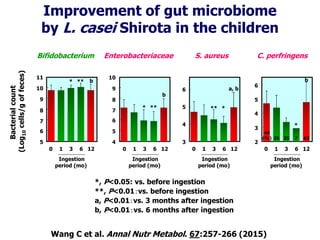
*, P<0.05: vs. before ingestion
**, P<0.01:vs. before ingestion
a, P<0.01:vs. 3 months after ingestion
b, P<0.01:vs. 6 months after ingestion
Wang C et al. Annal Nutr Metabol. 67:257-266 (2015)
Improvement of gut microbiome
by L. casei Shirota in the children
Bacterialcount
(Log10cells/goffeces)
Bifidobacterium Enterobacteriaceae S. aureus C. perfringens
* ** b
Ingestion
period (mo)
0 121 3 6
11
10
9
8
7
6
5
* **
b
10
9
8
7
6
5
4
Ingestion
period (mo)
0 121 3 6
** *
a, b6
5
4
3
Ingestion
period (mo)
0 121 3 6
6
5
4
3
2
Ingestion
period (mo)
0 121 3 6
*
44
(%)
b
35 35 7 63
Improvement of gut microbiome
by L. casei Shirota in the elderly
Bacterialcount(Log10cells/goffeces)
Bifidobacterium L. casei ShirotaLactobacillus
3
4
5
6
7
8
9
10
3
4
5
6
7
8
9
10
11
ND
3
4
5
6
7
8
9
10 * * *** ***
before
after ingestion (mo)
1 3 6
before
after ingestion (mo)
1 3 6
before
after ingestion (mo)
1 3 6
C. perfringens
3
4
5
6
7
8
*
71
(%) 48 60 61
Staphylococcus
10
4
6
8
9
7
5 62
(%) 70 51 65
**
Pseudomonas
8
2
4
6
7
5
3
33 29 16
*
45
(%)
before
after ingestion (mo)
1 3 6
before
after ingestion (mo)
1 3 6
before
after ingestion (mo)
1 3 6
Bian L et al. Int J Prob Preb. 6:123-132 (2011)
*, P<0.05; **,P<0.01; ND, Not detected.
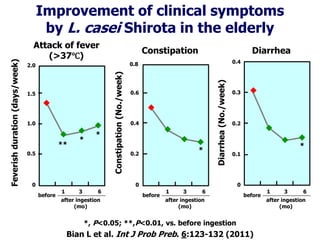
Improvement of clinical symptoms
by L. casei Shirota in the elderly
DiarrheaConstipation
Attack of fever
(>37℃)
Feverishduration(days/week)
0
2.0
0.5
1.0
1.5
**
*
*
before
after ingestion
(mo)
1 3 6
Constipation(No./week)
0
0.2
0.8
0.6
0.4
*
before
after ingestion
(mo)
1 3 6
Diarrhea(No./week)
0
0.1
0.2
0.3
0.4
*
before
after ingestion
(mo)
1 3 6
Bian L et al. Int J Prob Preb. 6:123-132 (2011)
*, P<0.05; **,P<0.01, vs. before ingestion
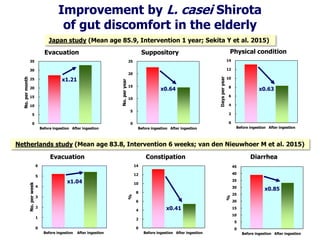
Improvement by L. casei Shirota
of gut discomfort in the elderly
Japan study (Mean age 85.9, Intervention 1 year; Sekita Y et al. 2015)
0
5
10
15
20
25
30
35
Before ingestion After ingestion
No.permonth
Evacuation
0
5
10
15
20
25
Before ingestion After ingestion
No.peryear
Suppository
0
2
4
6
8
10
12
14
Before ingestion After ingestion
Daysperyear
Physical condition
x1.21
x0.64 x0.63
Netherlands study (Mean age 83.8, Intervention 6 weeks; van den Nieuwhoer M et al. 2015)
0
1
2
3
4
5
6
Before ingestion After ingestion
No.perweek
Evacuation
0
2
4
6
8
10
12
14
Before ingestion After ingestion
%
Constipation
0
5
10
15
20
25
30
35
40
45
Before ingestion After ingestion
%
Diarrhea
x1.04
x0.41
x0.85
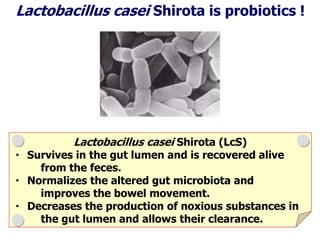
Lactobacillus casei Shirota (LcS)
・ Survives in the gut lumen and is recovered alive
from the feces.
・ Normalizes the altered gut microbiota and
improves the bowel movement.
・ Decreases the production of noxious substances in
the gut lumen and allows their clearance.
Lactobacillus casei Shirota is probiotics !
Van Puyenbroeck K et al.
(2012)
Fujita R et al.
(2013)
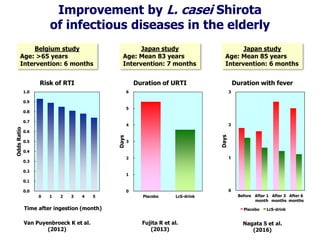
Belgium study
Age: >65 years
Intervention: 6 months
Japan study
Age: Mean 83 years
Intervention: 7 months
Improvement by L. casei Shirota
of infectious diseases in the elderly
0.0
0.1
0.2
0.3
0.4
0.5
0.6
0.7
0.8
0.9
1.0
0 1 2 3 4 5
OddsRatio
Risk of RTI
0
1
2
3
4
5
6
Placebo LcS-drink
Days
Duration of URTI
Japan study
Age: Mean 85 years
Intervention: 6 months
0
1
2
3
Before After 1
month
After 3
months
After 6
months
Days
Duration with fever
Placebo LcS-drink
Nagata S et al.
(2016)
Time after ingestion (month)
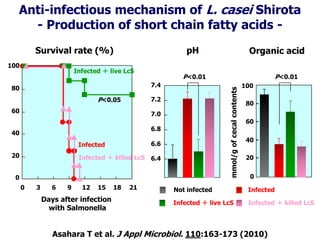
Asahara T et al. J Appl Microbiol. 110:163-173 (2010)
Survival rate (%)
Days after infection
with Salmonella
0
20
40
60
80
100
0 3 15 216 9 12 18
Infected
Infected + killed LcS
Infected + live LcS
P<0.05
pH
6.4
6.6
6.8
7.0
7.4
7.2
P<0.01
Not infected Infected
Infected + live LcS Infected + killed LcS
Organic acid
mmol/gofcecalcontents
0
20
40
60
80
100
P<0.01
Anti-infectious mechanism of L. casei Shirota
- Production of short chain fatty acids -
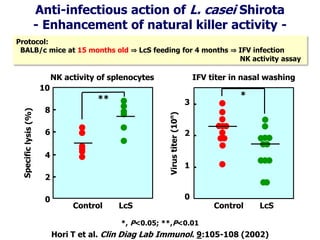
Anti-infectious action of L. casei Shirota
- Enhancement of natural killer activity -
Hori T et al. Clin Diag Lab Immunol. 9:105-108 (2002)
Protocol:
BALB/c mice at 15 months old ⇒ LcS feeding for 4 months ⇒ IFV infection
NK activity assay
0
2
4
6
8
10
Control LcS
**
NK activity of splenocytes
0
1
2
Virustiter(10n
)
*
3
Control LcS
IFV titer in nasal washing
*, P<0.05; **,P<0.01
0
10
20
30
40
Placebo LcS
Incidence(%)
Administration
0.0
0.2
0.4
0.6
0.8
1.0
1.2
<4 times >4 times
Oddsratio
Frequency
0
10
20
30
40
50
None LcS
Incidence(%)
Administration
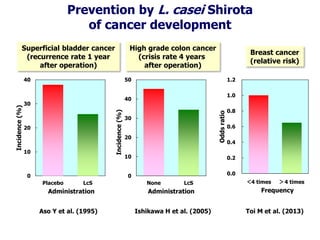
Toi M et al. (2013)Ishikawa H et al. (2005)Aso Y et al. (1995)
Superficial bladder cancer
(recurrence rate 1 year
after operation)
High grade colon cancer
(crisis rate 4 years
after operation)
Breast cancer
(relative risk)
Prevention by L. casei Shirota
of cancer development
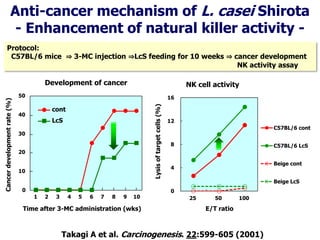
Takagi A et al. Carcinogenesis. 22:599-605 (2001)
Cancerdevelopmentrate(%)
0
10
20
30
40
50
1 2 3 4 5 6 7 8 9 10
Development of cancer
cont
LcS
Time after 3-MC administration (wks)
Anti-cancer mechanism of L. casei Shirota
- Enhancement of natural killer activity -
0
4
8
12
16
25 50 100
Lysisoftargetcells(%)
E/T ratio
NK cell activity
C57BL/6 cont
C57BL/6 LcS
Beige cont
Beige LcS
Protocol:
C57BL/6 mice ⇒ 3-MC injection ⇒LcS feeding for 10 weeks ⇒ cancer development
NK activity assay
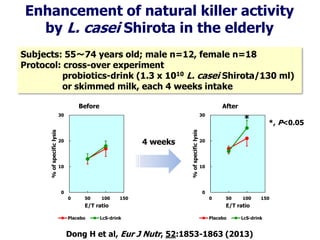
Subjects: 55~74 years old; male n=12, female n=18
Protocol: cross-over experiment
probiotics-drink (1.3 x 10¹⁰ L. casei Shirota/130 ml)
or skimmed milk, each 4 weeks intake
Dong H et al, Eur J Nutr, 52:1853-1863 (2013)
Enhancement of natural killer activity
by L. casei Shirota in the elderly
0
10
20
30
0 50 100 150
%ofspecificlysis
E/T ratio
Before
Placebo LcS-drink
0
10
20
30
0 50 100 150
%ofspecificlysis
E/T ratio
After
Placebo LcS-drink
4 weeks
* *, P<0.05
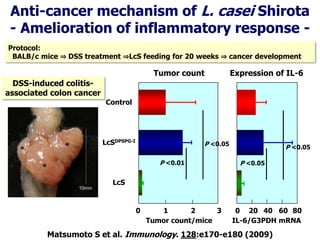
Anti-cancer mechanism of L. casei Shirota
- Amelioration of inflammatory response -
Matsumoto S et al. Immunology. 128:e170-e180 (2009)
LcS
LcSDPSPG-I
Control
0 20 40 60 80
IL-6/G3PDH mRNA
Expression of IL-6
P <0.05
P <0.05
0 1 2 3
Tumor count/mice
Tumor count
P <0.01
P <0.05
DSS-induced colitis-
associated colon cancer
Protocol:
BALB/c mice ⇒ DSS treatment ⇒LcS feeding for 20 weeks ⇒ cancer development
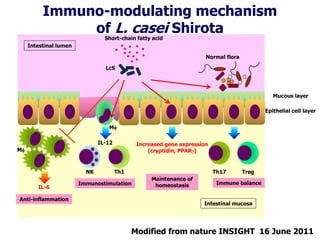
Modified from nature INSIGHT 16 June 2011
Increased gene expression
(cryptidin, PPARg)
IL-12
LcS
Epithelial cell layer
Treg
Mf
Th17Th1NK
IL-6
Intestinal lumen
Intestinal mucosa
Immunostimulation
Mucous layer
Normal flora
Anti-inflammation
Mf
Maintenance of
homeostasis Immune balance
Short-chain fatty acid
Immuno-modulating mechanism
of L. casei Shirota
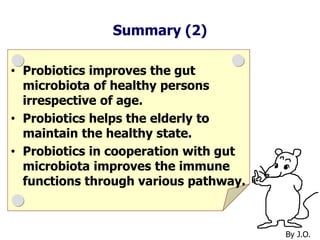
Summary (2)
• Probiotics improves the gut
microbiota of healthy persons
irrespective of age.
• Probiotics helps the elderly to
maintain the healthy state.
• Probiotics in cooperation with gut
microbiota improves the immune
functions through various pathway.
By J.O.
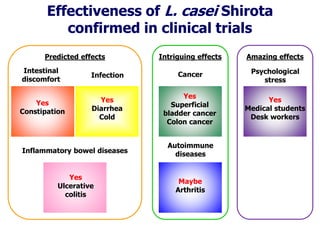
Inflammatory bowel diseases
Yes
Ulcerative
colitis
Infection
Yes
Diarrhea
Cold
Yes
Constipation
Intestinal
discomfort
Predicted effects
Cancer
Yes
Superficial
bladder cancer
Colon cancer
Autoimmune
diseases
Maybe
Arthritis
Intriguing effects
Psychological
stress
Yes
Medical students
Desk workers
Amazing effects
Effectiveness of L. casei Shirota
confirmed in clinical trials
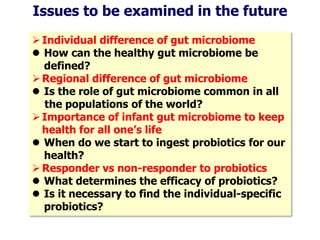
Individual difference of gut microbiome
 How can the healthy gut microbiome be
defined?
Regional difference of gut microbiome
 Is the role of gut microbiome common in all
the populations of the world?
Importance of infant gut microbiome to keep
health for all one’s life
 When do we start to ingest probiotics for our
health?
Responder vs non-responder to probiotics
 What determines the efficacy of probiotics?
 Is it necessary to find the individual-specific
probiotics?
Issues to be examined in the future
Acknowledgments
 Juntendo University:
Satoru Nagata, Yuichiro Yamashiro,
Kazuyoshi Takeda, Ko Okumura
 The University of Tokyo:
Retsu Fujita, Yasuo Ohashi
 Yakult Central Institute:
Hirokazu Tsuji, Takuya Takahashi,
Takashi Asahara, Koji Nomoto,
Akira Kushiro, Akimitsu Takagi, Takeshi Matsuzaki
Kan Shida, Tetsuji Hori, Satoshi Matsumoto
Thank you for
your attention !
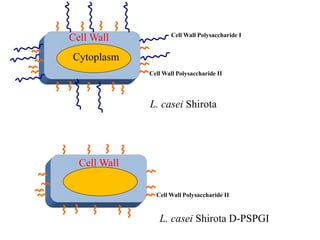
Cell Wall Polysaccharide I
Cell Wall Polysaccharide II
Cell Wall
Cell Wall Polysaccharide II
L. casei Shirota D-PSPGI
L. casei Shirota
Cell Wall
Cytoplasm

The 8th india probiotics symposium (2016) slide revised2

  • 1.
    Probiotics in Health– Emerging Opportunities Dec 3-4, 2016, Chennai Probiotics and the Elderly Microbiome - Is it ever too late to change? - Masanobu Nanno Yakult Central Institute, Tokyo, Japan
  • 2.
    By J.O. Today’s topics 1.Health problems in the elderly – Is microbiome related? ー 2. Probiotics are promising agent to improve the altered gut microbiome. 3. Probiotics are beneficial for health management in the elderly .
  • 3.
    Demographics in Indiaand Japan 0 20 40 60 80 100 1950 2010 2025 2050 2100 % India <20 20~64 65~74 >75 0 20 40 60 80 100 1950 2010 2025 2050 2100 % Japan <20 20~64 65~74 >75 Data from Statistical Handbook of Japan 2016 The proportion of elderly is gradually increasing in India and Japan! Age Age
  • 4.
    Data from Ministryof Health, Labor and Welfare (1996) Incidence(No./105population) Mortality Incidence Mortality Age Effect of age on incidence and mortality of influenza infection in Japan
  • 5.
    Data from NationalCancer Centre Japan (2015) Effect of age on cancer incidence in Japan 0 500 1000 1500 2000 2500 3000 3500 4000 4500 40-44 45-49 50-54 55-59 60-64 65-69 70-74 75-79 80-84 >85 Incidence (No.ofpatients/105population) Male Female Age
  • 6.
    Immune functions inthe elderly  Innate immunity: Neutrophils: reduction of capabilities to migrate and uptake opsonized particles and pathogens Monocytes: reduction of ROS production and phagocytosis, and dysregulation in the release of cytokines Natural killer cells: defective capacity to secrete chemokines and reduction of cytotoxic potential  Acquired immunity: Dendritic cells: reduction of mobilization and impairment of cytokine release T lymphocytes: reduction in the frequency of naïve T cells and lower capacity to induce antigen-specific T cell responses accumulation of memory T cells B lymphocytes: decrease in the number and change in the relative frequencies of different B cell subsets Susceptibility to infection and cancer development in elderly Pinti M et al. Eur J Immunol. 46:2286-2301 (2016)
  • 7.
    Health problems inthe elderly  Pathogenic infection  Cancer  Allergies – food allergy, pollen allergy  Autoimmune diseases – rheumatoid arthritis  Metabolic syndrome – obesity, diabetes, cardiovascular diseases  Mental diseases – depression, dementia Gut microbiome Food Living environment Stress Drugs
  • 8.
    Aging and gutmicrobiome of healthy subjects in Japan 2 4 6 8 10 D1-D3 D7-M1 M3-M6 Y3-19 Y20-59 Y60-79 >Y80 No.ofbacteria(Log10cells/goffeces) Age Total bacteria C. coccoides group C. leptum subgroup B. fragilis group Prevotella Bifidobacterium Enterobacteriaceae Lactobacillus Staphylococcus Nomoto K et al. Intestinal Microbiota. 29:9-18 (2015)
  • 9.
    Gut microbiome inthe elderly Claesson MJ et al. Nature. 488:178-184 (2012) Gut microbiome in the elderly:  different from the core microbiome in younger adults  higher Firmicutes in subgroup (1) and higher Bacteroidetes in subgroup (4)  most diverse in low fat/high fiber group to which the majority of subgroup (1) belongs  higher inflammation markers (TNF-a, IL-6, IL-8, CRP) in subgroup (4) Subjects: (1) the community-dwelling elderly (n=83) (2) the elderly attending an out-patient day hospital (n=20) (3) the elderly in short-term rehabilitation hospital care (n=15) (4) the elderly in long-term residential care (n=60) (5) younger adults (n=13)
  • 10.
    Summary (1) • Populationaging is continuing in many countries of the world. • The elderly is highly susceptible to infection and carcinogenesis due to decline of immune functions. • Gut microbiome is dysregulated in the elderly, the extent of which is dependent on their lifestyle. By J.O.
  • 11.
    Definition of probiotics Livemicroorganisms which, when administered in adequate amounts, confer a health benefit on the host (FAO/WHO, 2001) Is Lactobacillus casei Shirota (LcS) regarded as probiotics ?
  • 12.
    *, P<0.05: vs.before ingestion **, P<0.01:vs. before ingestion a, P<0.01:vs. 3 months after ingestion b, P<0.01:vs. 6 months after ingestion Wang C et al. Annal Nutr Metabol. 67:257-266 (2015) Improvement of gut microbiome by L. casei Shirota in the children Bacterialcount (Log10cells/goffeces) Bifidobacterium Enterobacteriaceae S. aureus C. perfringens * ** b Ingestion period (mo) 0 121 3 6 11 10 9 8 7 6 5 * ** b 10 9 8 7 6 5 4 Ingestion period (mo) 0 121 3 6 ** * a, b6 5 4 3 Ingestion period (mo) 0 121 3 6 6 5 4 3 2 Ingestion period (mo) 0 121 3 6 * 44 (%) b 35 35 7 63
  • 13.
    Improvement of gutmicrobiome by L. casei Shirota in the elderly Bacterialcount(Log10cells/goffeces) Bifidobacterium L. casei ShirotaLactobacillus 3 4 5 6 7 8 9 10 3 4 5 6 7 8 9 10 11 ND 3 4 5 6 7 8 9 10 * * *** *** before after ingestion (mo) 1 3 6 before after ingestion (mo) 1 3 6 before after ingestion (mo) 1 3 6 C. perfringens 3 4 5 6 7 8 * 71 (%) 48 60 61 Staphylococcus 10 4 6 8 9 7 5 62 (%) 70 51 65 ** Pseudomonas 8 2 4 6 7 5 3 33 29 16 * 45 (%) before after ingestion (mo) 1 3 6 before after ingestion (mo) 1 3 6 before after ingestion (mo) 1 3 6 Bian L et al. Int J Prob Preb. 6:123-132 (2011) *, P<0.05; **,P<0.01; ND, Not detected.
  • 14.
    Improvement of clinicalsymptoms by L. casei Shirota in the elderly DiarrheaConstipation Attack of fever (>37℃) Feverishduration(days/week) 0 2.0 0.5 1.0 1.5 ** * * before after ingestion (mo) 1 3 6 Constipation(No./week) 0 0.2 0.8 0.6 0.4 * before after ingestion (mo) 1 3 6 Diarrhea(No./week) 0 0.1 0.2 0.3 0.4 * before after ingestion (mo) 1 3 6 Bian L et al. Int J Prob Preb. 6:123-132 (2011) *, P<0.05; **,P<0.01, vs. before ingestion
  • 15.
    Improvement by L.casei Shirota of gut discomfort in the elderly Japan study (Mean age 85.9, Intervention 1 year; Sekita Y et al. 2015) 0 5 10 15 20 25 30 35 Before ingestion After ingestion No.permonth Evacuation 0 5 10 15 20 25 Before ingestion After ingestion No.peryear Suppository 0 2 4 6 8 10 12 14 Before ingestion After ingestion Daysperyear Physical condition x1.21 x0.64 x0.63 Netherlands study (Mean age 83.8, Intervention 6 weeks; van den Nieuwhoer M et al. 2015) 0 1 2 3 4 5 6 Before ingestion After ingestion No.perweek Evacuation 0 2 4 6 8 10 12 14 Before ingestion After ingestion % Constipation 0 5 10 15 20 25 30 35 40 45 Before ingestion After ingestion % Diarrhea x1.04 x0.41 x0.85
  • 16.
    Lactobacillus casei Shirota(LcS) ・ Survives in the gut lumen and is recovered alive from the feces. ・ Normalizes the altered gut microbiota and improves the bowel movement. ・ Decreases the production of noxious substances in the gut lumen and allows their clearance. Lactobacillus casei Shirota is probiotics !
  • 17.
    Van Puyenbroeck Ket al. (2012) Fujita R et al. (2013) Belgium study Age: >65 years Intervention: 6 months Japan study Age: Mean 83 years Intervention: 7 months Improvement by L. casei Shirota of infectious diseases in the elderly 0.0 0.1 0.2 0.3 0.4 0.5 0.6 0.7 0.8 0.9 1.0 0 1 2 3 4 5 OddsRatio Risk of RTI 0 1 2 3 4 5 6 Placebo LcS-drink Days Duration of URTI Japan study Age: Mean 85 years Intervention: 6 months 0 1 2 3 Before After 1 month After 3 months After 6 months Days Duration with fever Placebo LcS-drink Nagata S et al. (2016) Time after ingestion (month)
  • 18.
    Asahara T etal. J Appl Microbiol. 110:163-173 (2010) Survival rate (%) Days after infection with Salmonella 0 20 40 60 80 100 0 3 15 216 9 12 18 Infected Infected + killed LcS Infected + live LcS P<0.05 pH 6.4 6.6 6.8 7.0 7.4 7.2 P<0.01 Not infected Infected Infected + live LcS Infected + killed LcS Organic acid mmol/gofcecalcontents 0 20 40 60 80 100 P<0.01 Anti-infectious mechanism of L. casei Shirota - Production of short chain fatty acids -
  • 19.
    Anti-infectious action ofL. casei Shirota - Enhancement of natural killer activity - Hori T et al. Clin Diag Lab Immunol. 9:105-108 (2002) Protocol: BALB/c mice at 15 months old ⇒ LcS feeding for 4 months ⇒ IFV infection NK activity assay 0 2 4 6 8 10 Control LcS ** NK activity of splenocytes 0 1 2 Virustiter(10n ) * 3 Control LcS IFV titer in nasal washing *, P<0.05; **,P<0.01
  • 20.
    0 10 20 30 40 Placebo LcS Incidence(%) Administration 0.0 0.2 0.4 0.6 0.8 1.0 1.2 <4 times>4 times Oddsratio Frequency 0 10 20 30 40 50 None LcS Incidence(%) Administration Toi M et al. (2013)Ishikawa H et al. (2005)Aso Y et al. (1995) Superficial bladder cancer (recurrence rate 1 year after operation) High grade colon cancer (crisis rate 4 years after operation) Breast cancer (relative risk) Prevention by L. casei Shirota of cancer development
  • 21.
    Takagi A etal. Carcinogenesis. 22:599-605 (2001) Cancerdevelopmentrate(%) 0 10 20 30 40 50 1 2 3 4 5 6 7 8 9 10 Development of cancer cont LcS Time after 3-MC administration (wks) Anti-cancer mechanism of L. casei Shirota - Enhancement of natural killer activity - 0 4 8 12 16 25 50 100 Lysisoftargetcells(%) E/T ratio NK cell activity C57BL/6 cont C57BL/6 LcS Beige cont Beige LcS Protocol: C57BL/6 mice ⇒ 3-MC injection ⇒LcS feeding for 10 weeks ⇒ cancer development NK activity assay
  • 22.
    Subjects: 55~74 yearsold; male n=12, female n=18 Protocol: cross-over experiment probiotics-drink (1.3 x 10¹⁰ L. casei Shirota/130 ml) or skimmed milk, each 4 weeks intake Dong H et al, Eur J Nutr, 52:1853-1863 (2013) Enhancement of natural killer activity by L. casei Shirota in the elderly 0 10 20 30 0 50 100 150 %ofspecificlysis E/T ratio Before Placebo LcS-drink 0 10 20 30 0 50 100 150 %ofspecificlysis E/T ratio After Placebo LcS-drink 4 weeks * *, P<0.05
  • 23.
    Anti-cancer mechanism ofL. casei Shirota - Amelioration of inflammatory response - Matsumoto S et al. Immunology. 128:e170-e180 (2009) LcS LcSDPSPG-I Control 0 20 40 60 80 IL-6/G3PDH mRNA Expression of IL-6 P <0.05 P <0.05 0 1 2 3 Tumor count/mice Tumor count P <0.01 P <0.05 DSS-induced colitis- associated colon cancer Protocol: BALB/c mice ⇒ DSS treatment ⇒LcS feeding for 20 weeks ⇒ cancer development
  • 24.
    Modified from natureINSIGHT 16 June 2011 Increased gene expression (cryptidin, PPARg) IL-12 LcS Epithelial cell layer Treg Mf Th17Th1NK IL-6 Intestinal lumen Intestinal mucosa Immunostimulation Mucous layer Normal flora Anti-inflammation Mf Maintenance of homeostasis Immune balance Short-chain fatty acid Immuno-modulating mechanism of L. casei Shirota
  • 25.
    Summary (2) • Probioticsimproves the gut microbiota of healthy persons irrespective of age. • Probiotics helps the elderly to maintain the healthy state. • Probiotics in cooperation with gut microbiota improves the immune functions through various pathway. By J.O.
  • 26.
    Inflammatory bowel diseases Yes Ulcerative colitis Infection Yes Diarrhea Cold Yes Constipation Intestinal discomfort Predictedeffects Cancer Yes Superficial bladder cancer Colon cancer Autoimmune diseases Maybe Arthritis Intriguing effects Psychological stress Yes Medical students Desk workers Amazing effects Effectiveness of L. casei Shirota confirmed in clinical trials
  • 27.
    Individual difference ofgut microbiome  How can the healthy gut microbiome be defined? Regional difference of gut microbiome  Is the role of gut microbiome common in all the populations of the world? Importance of infant gut microbiome to keep health for all one’s life  When do we start to ingest probiotics for our health? Responder vs non-responder to probiotics  What determines the efficacy of probiotics?  Is it necessary to find the individual-specific probiotics? Issues to be examined in the future
  • 28.
    Acknowledgments  Juntendo University: SatoruNagata, Yuichiro Yamashiro, Kazuyoshi Takeda, Ko Okumura  The University of Tokyo: Retsu Fujita, Yasuo Ohashi  Yakult Central Institute: Hirokazu Tsuji, Takuya Takahashi, Takashi Asahara, Koji Nomoto, Akira Kushiro, Akimitsu Takagi, Takeshi Matsuzaki Kan Shida, Tetsuji Hori, Satoshi Matsumoto Thank you for your attention !
  • 29.
    Cell Wall PolysaccharideI Cell Wall Polysaccharide II Cell Wall Cell Wall Polysaccharide II L. casei Shirota D-PSPGI L. casei Shirota Cell Wall Cytoplasm