Primary Memory
Types of RAM and ROM
CONTENTS INSIDE:
STATIC, DYNAMIC AND NV-RAM
MASKED ROM, PROM, EPROM, EEPROM
Primary Memory
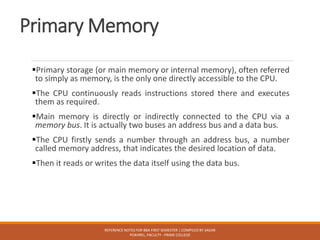
â–ȘPrimary storage (or main memory or internal memory), often referred
to simply as memory, is the only one directly accessible to the CPU.
â–ȘThe CPU continuously reads instructions stored there and executes
them as required.
â–ȘMain memory is directly or indirectly connected to the CPU via a
memory bus. It is actually two buses an address bus and a data bus.
â–ȘThe CPU firstly sends a number through an address bus, a number
called memory address, that indicates the desired location of data.
â–ȘThen it reads or writes the data itself using the data bus.
REFERENCE NOTES FOR BBA FIRST SEMESTER | COMPILED BY SAGAR
POKHREL, FACULTY - PRIME COLLEGE
Primary Memory
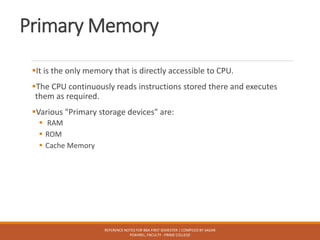
â–ȘIt is the only memory that is directly accessible to CPU.
â–ȘThe CPU continuously reads instructions stored there and executes
them as required.
â–ȘVarious "Primary storage devices" are:
â–Ș RAM
â–Ș ROM
â–Ș Cache Memory
REFERENCE NOTES FOR BBA FIRST SEMESTER | COMPILED BY SAGAR
POKHREL, FACULTY - PRIME COLLEGE
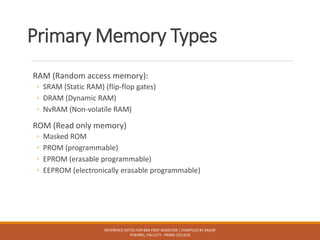
Primary Memory Types
RAM (Random access memory):
◩ SRAM (Static RAM) (flip-flop gates)
◩ DRAM (Dynamic RAM)
◩ NvRAM (Non-volatile RAM)
ROM (Read only memory)
◩ Masked ROM
◩ PROM (programmable)
◩ EPROM (erasable programmable)
◩ EEPROM (electronically erasable programmable)
REFERENCE NOTES FOR BBA FIRST SEMESTER | COMPILED BY SAGAR
POKHREL, FACULTY - PRIME COLLEGE
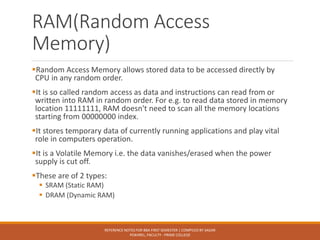
RAM(Random Access
Memory)
â–ȘRandom Access Memory allows stored data to be accessed directly by
CPU in any random order.
â–ȘIt is so called random access as data and instructions can read from or
written into RAM in random order. For e.g. to read data stored in memory
location 11111111, RAM doesn't need to scan all the memory locations
starting from 00000000 index.
â–ȘIt stores temporary data of currently running applications and play vital
role in computers operation.
â–ȘIt is a Volatile Memory i.e. the data vanishes/erased when the power
supply is cut off.
â–ȘThese are of 2 types:
â–Ș SRAM (Static RAM)
â–Ș DRAM (Dynamic RAM)
REFERENCE NOTES FOR BBA FIRST SEMESTER | COMPILED BY SAGAR
POKHREL, FACULTY - PRIME COLLEGE
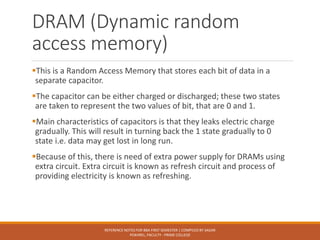
DRAM (Dynamic random
access memory)
â–ȘThis is a Random Access Memory that stores each bit of data in a
separate capacitor.
â–ȘThe capacitor can be either charged or discharged; these two states
are taken to represent the two values of bit, that are 0 and 1.
â–ȘMain characteristics of capacitors is that they leaks electric charge
gradually. This will result in turning back the 1 state gradually to 0
state i.e. data may get lost in long run.
â–ȘBecause of this, there is need of extra power supply for DRAMs using
extra circuit. Extra circuit is known as refresh circuit and process of
providing electricity is known as refreshing.
REFERENCE NOTES FOR BBA FIRST SEMESTER | COMPILED BY SAGAR
POKHREL, FACULTY - PRIME COLLEGE
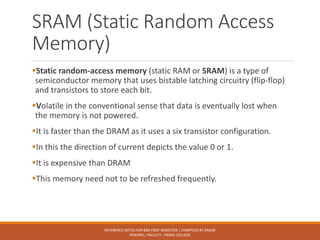
SRAM (Static Random Access
Memory)
â–ȘStatic random-access memory (static RAM or SRAM) is a type of
semiconductor memory that uses bistable latching circuitry (flip-flop)
and transistors to store each bit.
â–ȘVolatile in the conventional sense that data is eventually lost when
the memory is not powered.
â–ȘIt is faster than the DRAM as it uses a six transistor configuration.
â–ȘIn this the direction of current depicts the value 0 or 1.
â–ȘIt is expensive than DRAM
â–ȘThis memory need not to be refreshed frequently.
REFERENCE NOTES FOR BBA FIRST SEMESTER | COMPILED BY SAGAR
POKHREL, FACULTY - PRIME COLLEGE
Non-Volatile RAM
â–ȘOnly RAM that can retain data even after electricity is cut off.
â–ȘIn fact it is volatile RAM equipped with external power supply.
â–ȘIt takes power from system battery at the time when computer is
turned off.
â–ȘCurrently, the best-known forms of both NV-RAM and EEP-
ROM memory are flash memory.
â–ȘFloating gate transistors are commonly used in this category of RAM.
REFERENCE NOTES FOR BBA FIRST SEMESTER | COMPILED BY SAGAR
POKHREL, FACULTY - PRIME COLLEGE
ROM(Read Only Memory)
â–ȘThe DATA stored in Read Only Memory cannot be modified easily i.e.
can be modified only slowly or with difficulty.
â–ȘIt is non-volatile memory i e it does not loose data when the power is
cut off.
â–ȘIts various types are :
â–Ș Masked ROM
â–Ș PROM
â–Ș EPROM
â–Ș EEPROM
REFERENCE NOTES FOR BBA FIRST SEMESTER | COMPILED BY SAGAR
POKHREL, FACULTY - PRIME COLLEGE
ROM(Read Only Memory)
â–ȘMask ROM (MROM) is a type of read-only
memory (ROM) whose contents are programmed by
the integrated circuit manufacturer (rather than by
the user).
â–ȘUser cannot erase content and they are not allowed
to write new contents in masked ROM.
â–ȘAlso known commonly as manufacturer
programmed ROM.
REFERENCE NOTES FOR BBA FIRST SEMESTER | COMPILED BY SAGAR
POKHREL, FACULTY - PRIME COLLEGE
PROM (Programmable Read Only
Memory)
â–ȘOn Programmable Read Only Memory the Data can be written only once.
â–ȘIt is Manufactured as a blank memory and then the data is written on it , also
called as Burning the PROM.
â–ȘOne step up from the masked ROM is the PROM (programmable ROM), which
is purchased in an unprogrammed state.
â–ȘIf you look at the contents of an unprogrammed PROM, the data is made up
entirely of 1’s.
â–ȘThe process of writing your data to the PROM involves a special piece of
equipment called a PROM burner.
â–ȘThe device programmer writes data to the device one word at a time by
applying an electrical charge to the input pins of the chip. Once a PROM has
been programmed in this way, its contents can never be changed.
â–ȘIf the code or data stored in the PROM must be changed, the current device
must be discarded. As a result, PROMs are also known as one-time
programmable (OTP) devices.
REFERENCE NOTES FOR BBA FIRST SEMESTER | COMPILED BY SAGAR
POKHREL, FACULTY - PRIME COLLEGE
EPROM (Erasable Programmable read
Only Memory)
â–ȘAn EPROM (erasable-and-programmable ROM) is
programmed in exactly the same manner as a PROM.
However, EPROMs can be erased and reprogrammed
repeatedly.
â–ȘTo erase an EPROM, you simply expose the device to a strong
source of ultraviolet light. (A window in the top of the device
allows the light to reach the silicon.)
â–ȘBy doing this, you essentially reset the entire chip to its initial-
unprogrammed-state.
â–ȘThough more expensive than PROMs, their ability to be
reprogrammed makes EPROMs an essential part of the
software development and testing process as well rather than
only for startup instructions.
REFERENCE NOTES FOR BBA FIRST SEMESTER | COMPILED BY SAGAR
POKHREL, FACULTY - PRIME COLLEGE
EEPROM (Electrically Erasable
Programmable Read Only Memory)
â–ȘEEPROM is a special type of PROM that can be erased by exposing it to an
electric charge.
â–ȘLike other ROM it retains its memory even if the power is switched off.
â–ȘData is written or erased one byte at a time
â–ȘEEPROMS are electrically-erasable-and-programmable. Internally, they
are similar to EPROMs, but the erase operation is accomplished
electrically, rather than by exposure to ultraviolet light.
â–ȘAny byte within an EEPROM may be erased and rewritten. Once written,
the new data will remain in the device forever-or at least until it is
electrically erased.
â–ȘThe primary tradeoff for this improved functionality is higher cost, though
write cycles are also significantly longer than writes to a RAM. So you
wouldn't want to use an EEPROM for your main system memory.
REFERENCE NOTES FOR BBA FIRST SEMESTER | COMPILED BY SAGAR
POKHREL, FACULTY - PRIME COLLEGE

Ram and rom pp1

  • 1.
    Primary Memory Types ofRAM and ROM CONTENTS INSIDE: STATIC, DYNAMIC AND NV-RAM MASKED ROM, PROM, EPROM, EEPROM
  • 2.
    Primary Memory â–ȘPrimary storage(or main memory or internal memory), often referred to simply as memory, is the only one directly accessible to the CPU. â–ȘThe CPU continuously reads instructions stored there and executes them as required. â–ȘMain memory is directly or indirectly connected to the CPU via a memory bus. It is actually two buses an address bus and a data bus. â–ȘThe CPU firstly sends a number through an address bus, a number called memory address, that indicates the desired location of data. â–ȘThen it reads or writes the data itself using the data bus. REFERENCE NOTES FOR BBA FIRST SEMESTER | COMPILED BY SAGAR POKHREL, FACULTY - PRIME COLLEGE
  • 3.
    Primary Memory â–ȘIt isthe only memory that is directly accessible to CPU. â–ȘThe CPU continuously reads instructions stored there and executes them as required. â–ȘVarious "Primary storage devices" are: â–Ș RAM â–Ș ROM â–Ș Cache Memory REFERENCE NOTES FOR BBA FIRST SEMESTER | COMPILED BY SAGAR POKHREL, FACULTY - PRIME COLLEGE
  • 4.
    Primary Memory Types RAM(Random access memory): ◩ SRAM (Static RAM) (flip-flop gates) ◩ DRAM (Dynamic RAM) ◩ NvRAM (Non-volatile RAM) ROM (Read only memory) ◩ Masked ROM ◩ PROM (programmable) ◩ EPROM (erasable programmable) ◩ EEPROM (electronically erasable programmable) REFERENCE NOTES FOR BBA FIRST SEMESTER | COMPILED BY SAGAR POKHREL, FACULTY - PRIME COLLEGE
  • 5.
    RAM(Random Access Memory) â–ȘRandom AccessMemory allows stored data to be accessed directly by CPU in any random order. â–ȘIt is so called random access as data and instructions can read from or written into RAM in random order. For e.g. to read data stored in memory location 11111111, RAM doesn't need to scan all the memory locations starting from 00000000 index. â–ȘIt stores temporary data of currently running applications and play vital role in computers operation. â–ȘIt is a Volatile Memory i.e. the data vanishes/erased when the power supply is cut off. â–ȘThese are of 2 types: â–Ș SRAM (Static RAM) â–Ș DRAM (Dynamic RAM) REFERENCE NOTES FOR BBA FIRST SEMESTER | COMPILED BY SAGAR POKHREL, FACULTY - PRIME COLLEGE
  • 6.
    DRAM (Dynamic random accessmemory) â–ȘThis is a Random Access Memory that stores each bit of data in a separate capacitor. â–ȘThe capacitor can be either charged or discharged; these two states are taken to represent the two values of bit, that are 0 and 1. â–ȘMain characteristics of capacitors is that they leaks electric charge gradually. This will result in turning back the 1 state gradually to 0 state i.e. data may get lost in long run. â–ȘBecause of this, there is need of extra power supply for DRAMs using extra circuit. Extra circuit is known as refresh circuit and process of providing electricity is known as refreshing. REFERENCE NOTES FOR BBA FIRST SEMESTER | COMPILED BY SAGAR POKHREL, FACULTY - PRIME COLLEGE
  • 7.
    SRAM (Static RandomAccess Memory) â–ȘStatic random-access memory (static RAM or SRAM) is a type of semiconductor memory that uses bistable latching circuitry (flip-flop) and transistors to store each bit. â–ȘVolatile in the conventional sense that data is eventually lost when the memory is not powered. â–ȘIt is faster than the DRAM as it uses a six transistor configuration. â–ȘIn this the direction of current depicts the value 0 or 1. â–ȘIt is expensive than DRAM â–ȘThis memory need not to be refreshed frequently. REFERENCE NOTES FOR BBA FIRST SEMESTER | COMPILED BY SAGAR POKHREL, FACULTY - PRIME COLLEGE
  • 8.
    Non-Volatile RAM â–ȘOnly RAMthat can retain data even after electricity is cut off. â–ȘIn fact it is volatile RAM equipped with external power supply. â–ȘIt takes power from system battery at the time when computer is turned off. â–ȘCurrently, the best-known forms of both NV-RAM and EEP- ROM memory are flash memory. â–ȘFloating gate transistors are commonly used in this category of RAM. REFERENCE NOTES FOR BBA FIRST SEMESTER | COMPILED BY SAGAR POKHREL, FACULTY - PRIME COLLEGE
  • 9.
    ROM(Read Only Memory) â–ȘTheDATA stored in Read Only Memory cannot be modified easily i.e. can be modified only slowly or with difficulty. â–ȘIt is non-volatile memory i e it does not loose data when the power is cut off. â–ȘIts various types are : â–Ș Masked ROM â–Ș PROM â–Ș EPROM â–Ș EEPROM REFERENCE NOTES FOR BBA FIRST SEMESTER | COMPILED BY SAGAR POKHREL, FACULTY - PRIME COLLEGE
  • 10.
    ROM(Read Only Memory) â–ȘMaskROM (MROM) is a type of read-only memory (ROM) whose contents are programmed by the integrated circuit manufacturer (rather than by the user). â–ȘUser cannot erase content and they are not allowed to write new contents in masked ROM. â–ȘAlso known commonly as manufacturer programmed ROM. REFERENCE NOTES FOR BBA FIRST SEMESTER | COMPILED BY SAGAR POKHREL, FACULTY - PRIME COLLEGE
  • 11.
    PROM (Programmable ReadOnly Memory) â–ȘOn Programmable Read Only Memory the Data can be written only once. â–ȘIt is Manufactured as a blank memory and then the data is written on it , also called as Burning the PROM. â–ȘOne step up from the masked ROM is the PROM (programmable ROM), which is purchased in an unprogrammed state. â–ȘIf you look at the contents of an unprogrammed PROM, the data is made up entirely of 1’s. â–ȘThe process of writing your data to the PROM involves a special piece of equipment called a PROM burner. â–ȘThe device programmer writes data to the device one word at a time by applying an electrical charge to the input pins of the chip. Once a PROM has been programmed in this way, its contents can never be changed. â–ȘIf the code or data stored in the PROM must be changed, the current device must be discarded. As a result, PROMs are also known as one-time programmable (OTP) devices. REFERENCE NOTES FOR BBA FIRST SEMESTER | COMPILED BY SAGAR POKHREL, FACULTY - PRIME COLLEGE
  • 12.
    EPROM (Erasable Programmableread Only Memory) â–ȘAn EPROM (erasable-and-programmable ROM) is programmed in exactly the same manner as a PROM. However, EPROMs can be erased and reprogrammed repeatedly. â–ȘTo erase an EPROM, you simply expose the device to a strong source of ultraviolet light. (A window in the top of the device allows the light to reach the silicon.) â–ȘBy doing this, you essentially reset the entire chip to its initial- unprogrammed-state. â–ȘThough more expensive than PROMs, their ability to be reprogrammed makes EPROMs an essential part of the software development and testing process as well rather than only for startup instructions. REFERENCE NOTES FOR BBA FIRST SEMESTER | COMPILED BY SAGAR POKHREL, FACULTY - PRIME COLLEGE
  • 13.
    EEPROM (Electrically Erasable ProgrammableRead Only Memory) â–ȘEEPROM is a special type of PROM that can be erased by exposing it to an electric charge. â–ȘLike other ROM it retains its memory even if the power is switched off. â–ȘData is written or erased one byte at a time â–ȘEEPROMS are electrically-erasable-and-programmable. Internally, they are similar to EPROMs, but the erase operation is accomplished electrically, rather than by exposure to ultraviolet light. â–ȘAny byte within an EEPROM may be erased and rewritten. Once written, the new data will remain in the device forever-or at least until it is electrically erased. â–ȘThe primary tradeoff for this improved functionality is higher cost, though write cycles are also significantly longer than writes to a RAM. So you wouldn't want to use an EEPROM for your main system memory. REFERENCE NOTES FOR BBA FIRST SEMESTER | COMPILED BY SAGAR POKHREL, FACULTY - PRIME COLLEGE