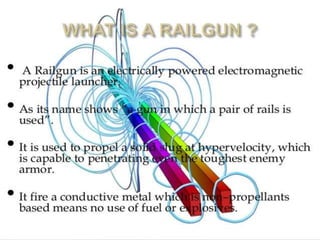
WHAT IS RAILGUN ?
HISTORY OF RAILGUN ?
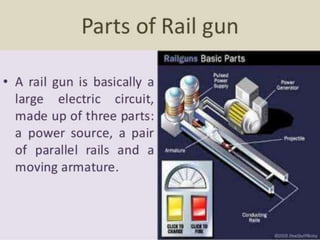
PARTS OF RAILGUN
HOW DOES IT WORKS
CURRENT RESEARCH AND
DEVLOPMENT
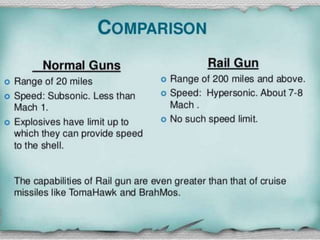
DIFF B/N NORMALGUN AND RAILGUN
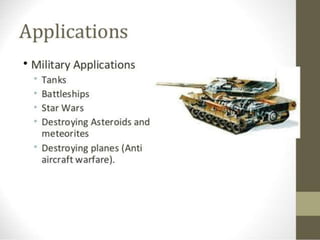
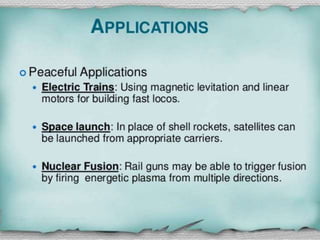
APPLICATION OF RAILGUN
ADVANTAGES AND DISADVANTAGES
FEATURES OF RAILGUN
CONCLUSION
First railgun idea was given by French inventor Louis
octave in 1918 by designed by an electric cannon.
In world war 2, the German commander luftusaffe
issued a specification for a railgun based anti-aircraft
gun.
The first railgun is tested in1970 at the Australian
National University
In 2003, Ian Nab planes to build a system to launch
supply into space using railgun technology
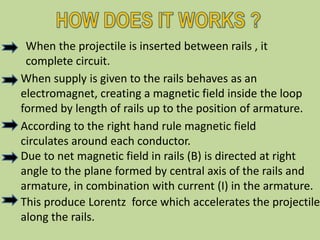
When the projectile is inserted between rails , it
complete circuit.
When supply is given to the rails behaves as an
electromagnet, creating a magnetic field inside the loop
formed by length of rails up to the position of armature.
According to the right hand rule magnetic field
circulates around each conductor.
Due to net magnetic field in rails (B) is directed at right
angle to the plane formed by central axis of the rails and
armature, in combination with current (I) in the armature.
This produce Lorentz force which accelerates the projectile
along the rails.
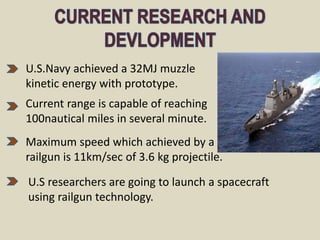
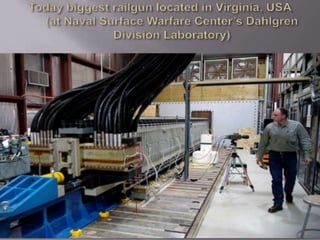
U.S.Navy achieved a 32MJ muzzle
kinetic energy with prototype.
Current range is capable of reaching
100nautical miles in several minute.
Maximum speed which achieved by a
railgun is 11km/sec of 3.6 kg projectile.
U.S researchers are going to launch a spacecraft
using railgun technology.
•
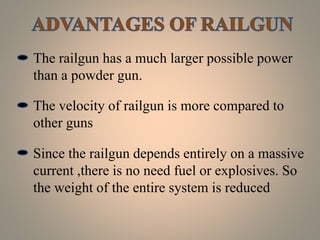
The railgun has a much larger possible power
than a powder gun.
The velocity of railgun is more compared to
other guns
Since the railgun depends entirely on a massive
current ,there is no need fuel or explosives. So
the weight of the entire system is reduced
One of the biggest problems is with maintaining the
structural integrity of the rails as the undergo such
stressful condition.
The thermal management of the entire system, especially
as the rails increase in size needs to improve.
The system is bulky.
Charging time of capacitors is high
 Satellite guided projectiles
Costing up to $25000 per projectile. Making easy to destroy
targets from long distances more accurately.
 Launching cargo into space
Because of the excessive acceleration, In order to
practical for launching cargo into space, Railgun would
need to be able to attain muzzle velocities of 11 km/s with
cargo much heavier than small projectile . In comparison,
effective ballistic missile interception requires muzzle
velocities of approximately 12 km/s.
• In railguns are a very intriguing technology and have
several exciting potential applications.
• While the physics of the electromagnetic phenomena are
fairly simple, implementation of the technology has proven to
be very difficult.
• The future of railgun development depends not only on
continued development of technology, but also on continued
financial support of railgun research.
RAILGUN PPT

RAILGUN PPT

  • 2.
    WHAT IS RAILGUN? HISTORY OF RAILGUN ? PARTS OF RAILGUN HOW DOES IT WORKS CURRENT RESEARCH AND DEVLOPMENT DIFF B/N NORMALGUN AND RAILGUN APPLICATION OF RAILGUN ADVANTAGES AND DISADVANTAGES FEATURES OF RAILGUN CONCLUSION
  • 4.
    First railgun ideawas given by French inventor Louis octave in 1918 by designed by an electric cannon. In world war 2, the German commander luftusaffe issued a specification for a railgun based anti-aircraft gun. The first railgun is tested in1970 at the Australian National University In 2003, Ian Nab planes to build a system to launch supply into space using railgun technology
  • 6.
    When the projectileis inserted between rails , it complete circuit. When supply is given to the rails behaves as an electromagnet, creating a magnetic field inside the loop formed by length of rails up to the position of armature. According to the right hand rule magnetic field circulates around each conductor. Due to net magnetic field in rails (B) is directed at right angle to the plane formed by central axis of the rails and armature, in combination with current (I) in the armature. This produce Lorentz force which accelerates the projectile along the rails.
  • 7.
    U.S.Navy achieved a32MJ muzzle kinetic energy with prototype. Current range is capable of reaching 100nautical miles in several minute. Maximum speed which achieved by a railgun is 11km/sec of 3.6 kg projectile. U.S researchers are going to launch a spacecraft using railgun technology.
  • 10.
  • 12.
    The railgun hasa much larger possible power than a powder gun. The velocity of railgun is more compared to other guns Since the railgun depends entirely on a massive current ,there is no need fuel or explosives. So the weight of the entire system is reduced
  • 13.
    One of thebiggest problems is with maintaining the structural integrity of the rails as the undergo such stressful condition. The thermal management of the entire system, especially as the rails increase in size needs to improve. The system is bulky. Charging time of capacitors is high
  • 14.
     Satellite guidedprojectiles Costing up to $25000 per projectile. Making easy to destroy targets from long distances more accurately.  Launching cargo into space Because of the excessive acceleration, In order to practical for launching cargo into space, Railgun would need to be able to attain muzzle velocities of 11 km/s with cargo much heavier than small projectile . In comparison, effective ballistic missile interception requires muzzle velocities of approximately 12 km/s.
  • 15.
    • In railgunsare a very intriguing technology and have several exciting potential applications. • While the physics of the electromagnetic phenomena are fairly simple, implementation of the technology has proven to be very difficult. • The future of railgun development depends not only on continued development of technology, but also on continued financial support of railgun research.