A Case for Redundant Arrays of Inexpensive
Disk(RAID)
Ankita jadhao
Need of Level 5?
• Achieve parallelism in write operation.
• The check disk is the bottleneck.
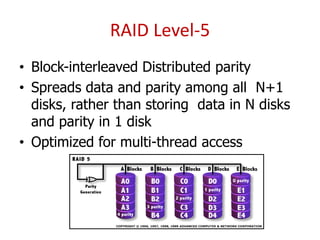
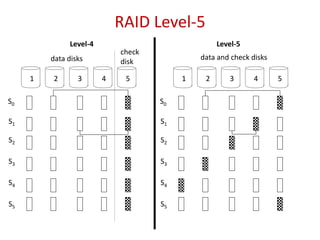
RAID Level-5
• Block-interleaved Distributed parity
• Spreads data and parity among all N+1
disks, rather than storing data in N disks
and parity in 1 disk
• Optimized for multi-thread access
RAID Level-5
Level-4 Level-5
1 2 3 4 5
data disks
check
disk
data and check disks
1 2 3 4 5
S0
S1
S2
S3
S4
S5
S0
S1
S2
S3
S4
S5
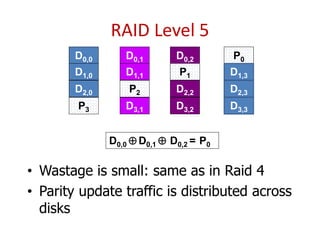
RAID Level 5
• Wastage is small: same as in Raid 4
• Parity update traffic is distributed across
disks
D0,0
D1,0
D2,0
P3
D0,1
D1,1
P2
D3,1
D0,2
P1
D2,2
D3,2
P0
D1,3
D2,3
D3,3
D0,0  D0,1  D0,2 = P0
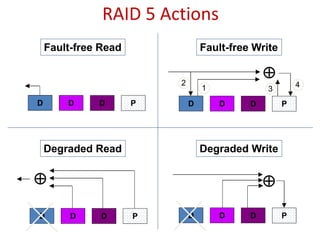
RAID 5 Actions
D D D P
Fault-free Read
D D D P

1
2
3
4
Fault-free Write
D D D P

Degraded Read
D D D P

Degraded Write
7
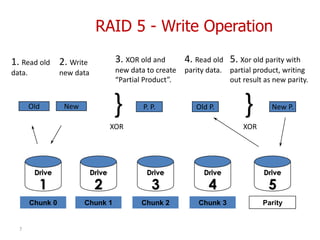
1. Read old
data.
Old New
2. Write
new data
Old P.
3. XOR old and
new data to create
“Partial Product”.
4. Read old
parity data.
5. Xor old parity with
partial product, writing
out result as new parity.
P. P.}
XOR
}
XOR
New P.
Chunk 1 Chunk 2 Chunk 3
Drive
5
Chunk 0 Parity
Drive
4
Drive
3
Drive
2
Drive
1
RAID 5 - Write Operation
Key points of RAID Level-5
• Level-5 stripes file data and check data over
all the disks
– no longer a single check disk
– no more write bottleneck
• Drastically improves the performance of
multiple writes
– they can now be done in parallel
• Slightly improves reads
– one more disk to use for reading
Advantages
• Best cost/ performance for transaction oriented
n/w.
• Very high data protection
• Support multiple reads & writes
• Can also be optimized for large, sequential
request.
• Also processing in limited storage capacity
• Used in supercomputer application & transaction
processing
Disadvantage
• Write performance is slower than RAID 0
or RAID 1
• Most complex controller design
Discussion
 Hardware & software solution??
Software would give the best performance as well as least cost.
 It is not even clear if synchronizing the disk in a group improves
RAID performance
 Each level improving
• Data rate: supercomputer application (sequential data)
(small no of request per sec)
• The I/O rate: transaction processing (random data)
(large no of read modify writes)
• Or usable storage capacity
or possible all three.
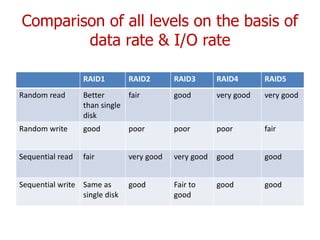
Comparison of all levels on the basis of
data rate & I/O rate
RAID1 RAID2 RAID3 RAID4 RAID5
Random read Better
than single
disk
fair good very good very good
Random write good poor poor poor fair
Sequential read fair very good very good good good
Sequential write Same as
single disk
good Fair to
good
good good
Continue…
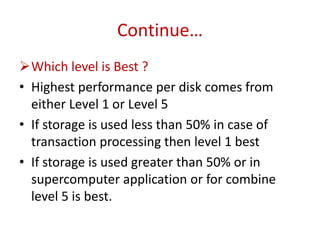
Which level is Best ?
• Highest performance per disk comes from
either Level 1 or Level 5
• If storage is used less than 50% in case of
transaction processing then level 1 best
• If storage is used greater than 50% or in
supercomputer application or for combine
level 5 is best.
Why RAID 5 is used most?
• If a disk gets an error or starts to fail, data is
recreated from this distributed data and parity
block
• It allows many NAS (Network Administrator
Specialist) and server drives to be "hot-
swappable“.
• It's a great solution for fault tolerance.
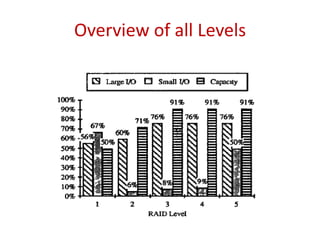
Overview of all Levels

Raid 5

  • 1.
    A Case forRedundant Arrays of Inexpensive Disk(RAID) Ankita jadhao
  • 2.
    Need of Level5? • Achieve parallelism in write operation. • The check disk is the bottleneck.
  • 3.
    RAID Level-5 • Block-interleavedDistributed parity • Spreads data and parity among all N+1 disks, rather than storing data in N disks and parity in 1 disk • Optimized for multi-thread access
  • 4.
    RAID Level-5 Level-4 Level-5 12 3 4 5 data disks check disk data and check disks 1 2 3 4 5 S0 S1 S2 S3 S4 S5 S0 S1 S2 S3 S4 S5
  • 5.
    RAID Level 5 •Wastage is small: same as in Raid 4 • Parity update traffic is distributed across disks D0,0 D1,0 D2,0 P3 D0,1 D1,1 P2 D3,1 D0,2 P1 D2,2 D3,2 P0 D1,3 D2,3 D3,3 D0,0  D0,1  D0,2 = P0
  • 6.
    RAID 5 Actions DD D P Fault-free Read D D D P  1 2 3 4 Fault-free Write D D D P  Degraded Read D D D P  Degraded Write
  • 7.
    7 1. Read old data. OldNew 2. Write new data Old P. 3. XOR old and new data to create “Partial Product”. 4. Read old parity data. 5. Xor old parity with partial product, writing out result as new parity. P. P.} XOR } XOR New P. Chunk 1 Chunk 2 Chunk 3 Drive 5 Chunk 0 Parity Drive 4 Drive 3 Drive 2 Drive 1 RAID 5 - Write Operation
  • 8.
    Key points ofRAID Level-5 • Level-5 stripes file data and check data over all the disks – no longer a single check disk – no more write bottleneck • Drastically improves the performance of multiple writes – they can now be done in parallel • Slightly improves reads – one more disk to use for reading
  • 9.
    Advantages • Best cost/performance for transaction oriented n/w. • Very high data protection • Support multiple reads & writes • Can also be optimized for large, sequential request. • Also processing in limited storage capacity • Used in supercomputer application & transaction processing
  • 10.
    Disadvantage • Write performanceis slower than RAID 0 or RAID 1 • Most complex controller design
  • 11.
    Discussion  Hardware &software solution?? Software would give the best performance as well as least cost.  It is not even clear if synchronizing the disk in a group improves RAID performance  Each level improving • Data rate: supercomputer application (sequential data) (small no of request per sec) • The I/O rate: transaction processing (random data) (large no of read modify writes) • Or usable storage capacity or possible all three.
  • 12.
    Comparison of alllevels on the basis of data rate & I/O rate RAID1 RAID2 RAID3 RAID4 RAID5 Random read Better than single disk fair good very good very good Random write good poor poor poor fair Sequential read fair very good very good good good Sequential write Same as single disk good Fair to good good good
  • 13.
    Continue… Which level isBest ? • Highest performance per disk comes from either Level 1 or Level 5 • If storage is used less than 50% in case of transaction processing then level 1 best • If storage is used greater than 50% or in supercomputer application or for combine level 5 is best.
  • 14.
    Why RAID 5is used most? • If a disk gets an error or starts to fail, data is recreated from this distributed data and parity block • It allows many NAS (Network Administrator Specialist) and server drives to be "hot- swappable“. • It's a great solution for fault tolerance.
  • 15.