Contrast Media
Contrast Media
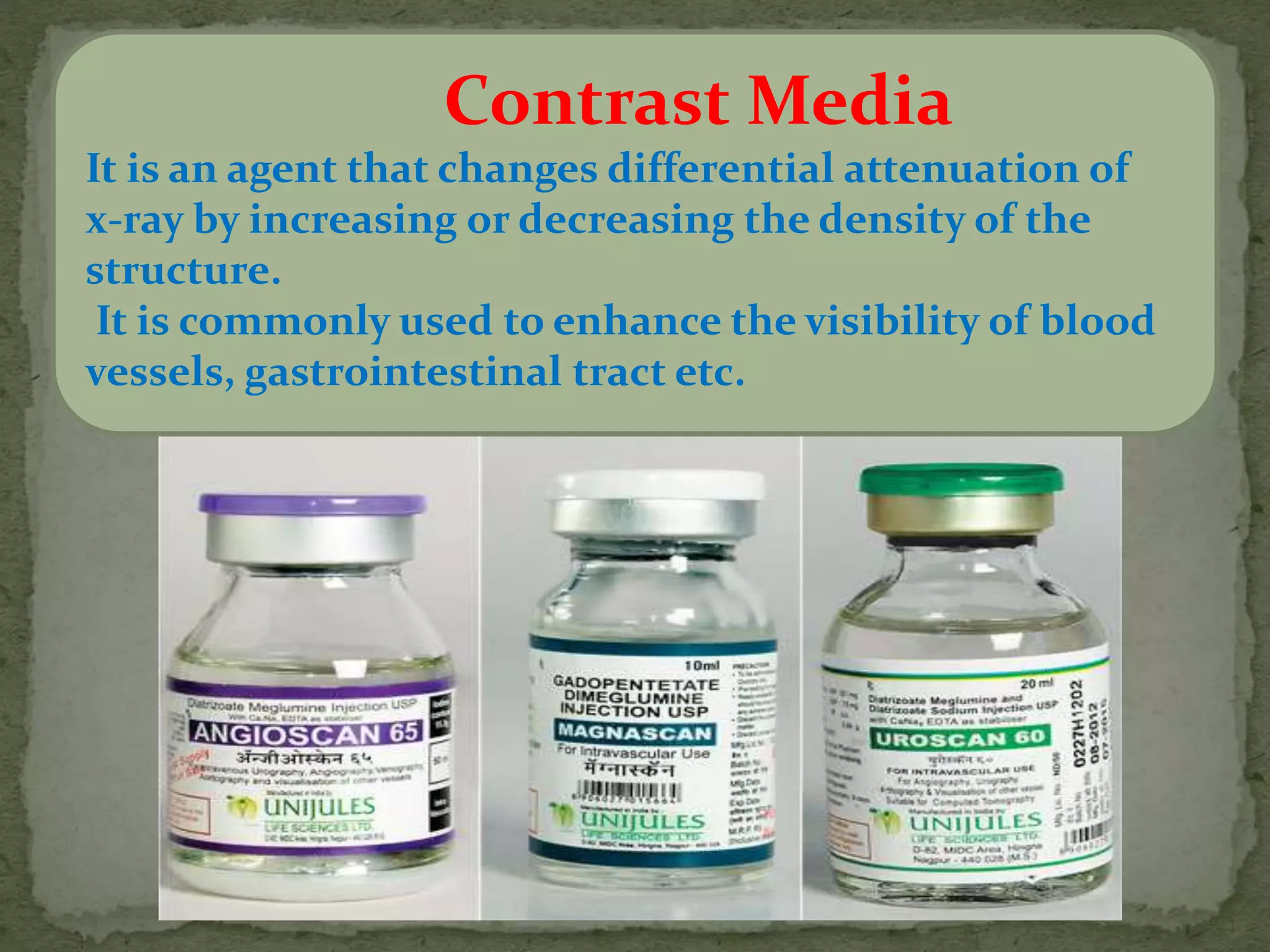
It is an agent that changes differential attenuation of
x-ray by increasing or decreasing the density of the
structure.
It is commonly used to enhance the visibility of blood
vessels, gastrointestinal tract etc.
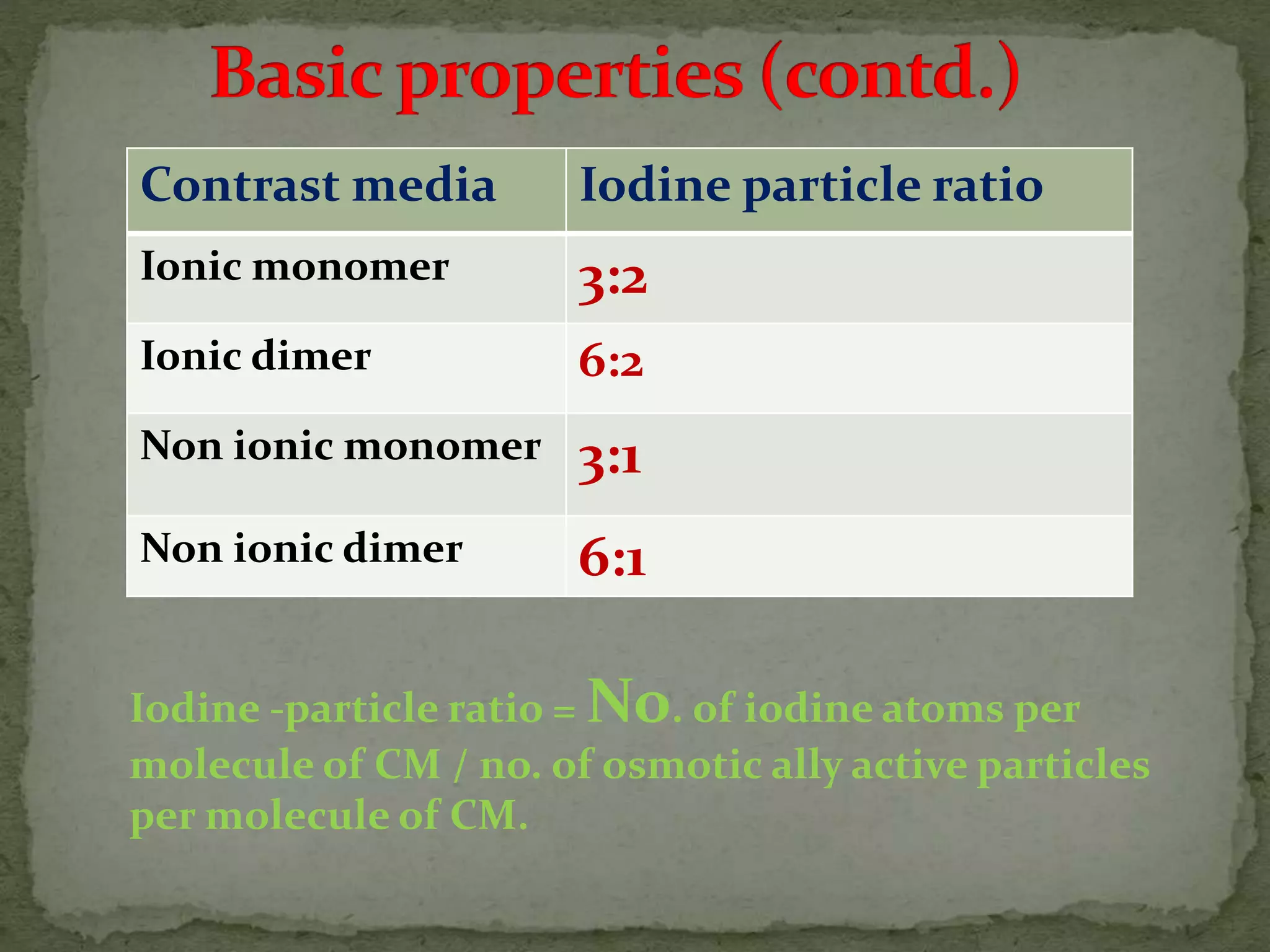
Contrast media Iodine particle ratio
Ionic monomer 3:2
Ionic dimer 6:2
Non ionic monomer 3:1
Non ionic dimer 6:1
Iodine -particle ratio = No. of iodine atoms per
molecule of CM / no. of osmotic ally active particles
per molecule of CM.
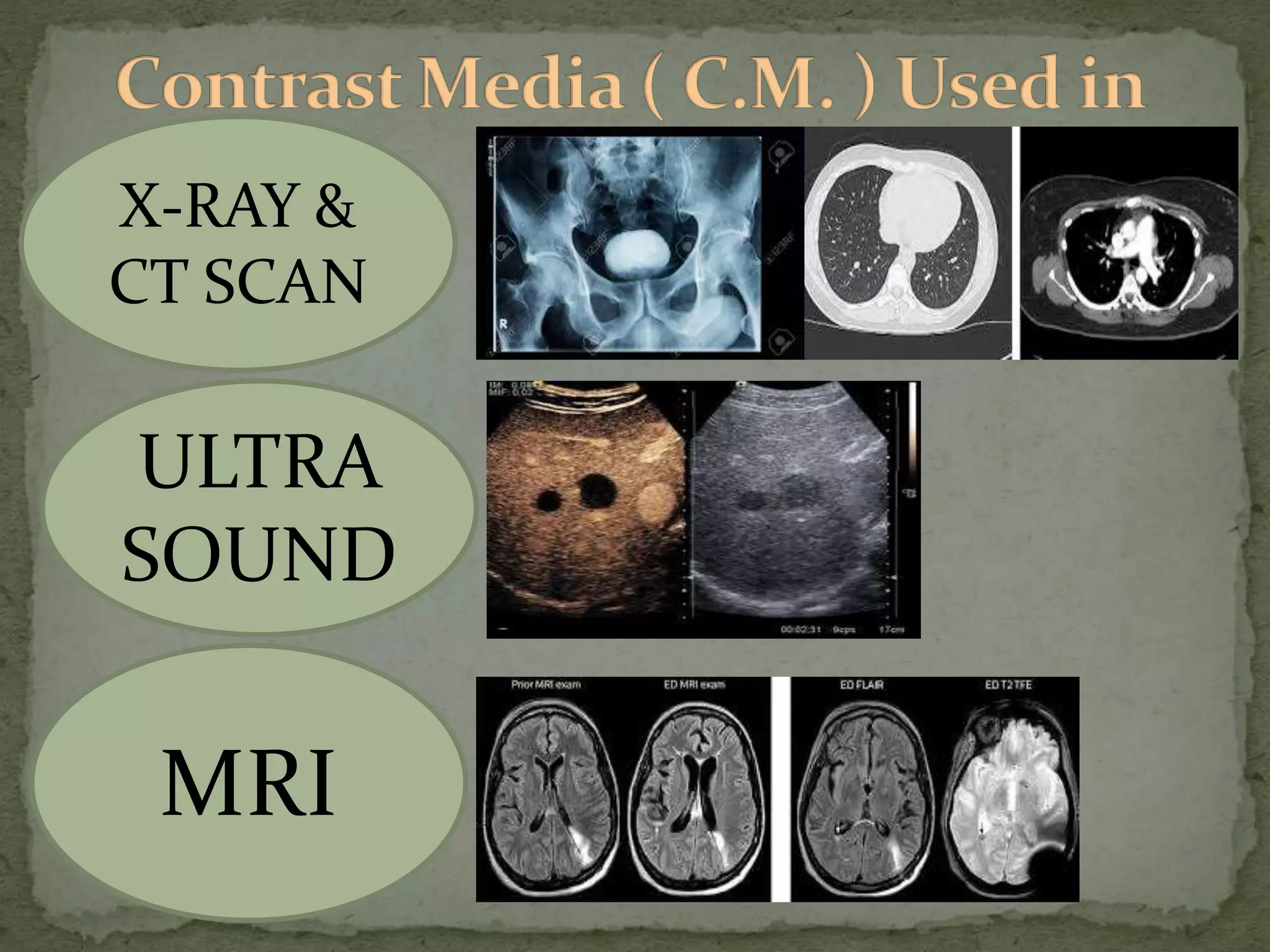
X-RAY &
CT SCAN
MRI
ULTRA
SOUND
Negative C.M. Positive C.M.
Which make image clearly
visible and enhance contrast by
decreasing Atomic No. and
Atomic Weight.
Organs become more
radiolucent.
X-rays penetrate more
easily.
Ex: Air,CO2
Which make image clearly
visible and enhance conteast by
increasing Atomic No. and
Atomic weight.
Substance absorbs x rays
Organ become radiopaque
Most common media I, Ba
Example :
Barium Sulphate ( Ba So4 )
Oily CM
Iodinate CM (Water Soluble )
Image enhanced
with Positive C.M.
Image enhanced
with Negative C.M.
Solubility Less Better
Tolerance Less Better
BBB effect Crosses Not
Vascular effects More Less
Viscosity Low High
Diuretic Less Strong
Opacification Better Less
Bronchospasm No Yes
Parameter Sodium Meglumine
First Generation C.M.
Monomers Dimer
Diatriazoic acid
Iodamic acid
Ioglicic acid
Iothalamic acid
Ioxithalamic acid
Ioxaglic acid
Iocarmic acid
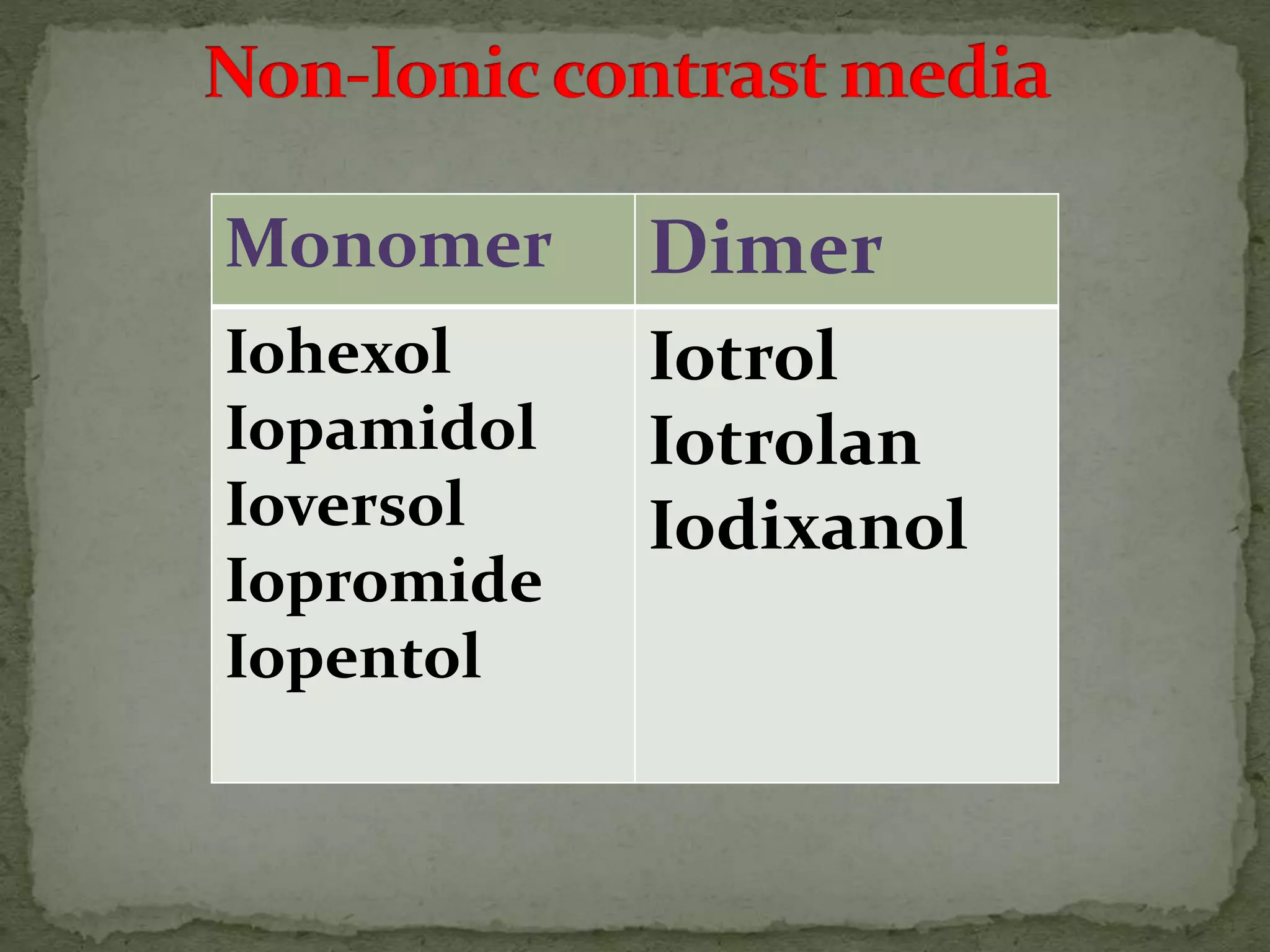
Monomer Dimer
Iohexol
Iopamidol
Ioversol
Iopromide
Iopentol
Iotrol
Iotrolan
Iodixanol
MILD MODERATE SEVERE
Nausea,
Ltd
Urticaria,
Mild pallor,
Limb pain
Severe Vomiting,
Extensive Urticaria
Dyspnoea,
Chest
&
abdominal pain
Unconsciousness,
Pulmonary edema,
Cardiac arrest,
Arrhythmias
Mild Moderate Severe
->O2 10 L/m
by face mask.
->Metered
dose inhaler
(Albuterol 2-3
inhalation )
-> Epinephrine
0.1-0.3 ml SC
->Repeat
for 10-15 min.
->Aminophylline
5mg/kg I.V. Slowly
over 10-20 min.
Epinephrine
I.V.
Mild Severe
->Release any
abdominal
compression
->Elevate legs
->O2 10L/m
->Isotonic I.V.
fluids administered
rapidly
Bradycardia Techycardia
->Atropine
0.6-1 mg I.V.
slowly
->Repeat
after 2-5
min.
->Max dose
3mg.
->Epinephrine
1-3 ml I.V.
->Dopamine
->Max dose
10ml
Mild Severe
-> Turn patient to one side to
avoid aspiration
->Be sure airway should be
open and clean
-> Pure O2 10 L/m
->Diazepam – 5mg I.V. slowly
->Prevent aspiration
-> O2 inhalation 10 L/m
Hypertensive Crisis
-> O2 10L/m
->Tab. Nitroglycerine- 0.4 mg
sub-lingually
If No Response
-> Capsule Nifedipine 10mg Sub-ling.
->Monitor B.P. closely
-> Phentorlamine 5 mg I.V
( Pheochromocytome)
->Furosemide 40 mg I.V.
Radiological procedure CONTRAST MEDIA

Radiological procedure CONTRAST MEDIA

  • 1.
  • 2.
    Contrast Media It isan agent that changes differential attenuation of x-ray by increasing or decreasing the density of the structure. It is commonly used to enhance the visibility of blood vessels, gastrointestinal tract etc.
  • 8.
    Contrast media Iodineparticle ratio Ionic monomer 3:2 Ionic dimer 6:2 Non ionic monomer 3:1 Non ionic dimer 6:1 Iodine -particle ratio = No. of iodine atoms per molecule of CM / no. of osmotic ally active particles per molecule of CM.
  • 9.
  • 10.
    Negative C.M. PositiveC.M. Which make image clearly visible and enhance contrast by decreasing Atomic No. and Atomic Weight. Organs become more radiolucent. X-rays penetrate more easily. Ex: Air,CO2 Which make image clearly visible and enhance conteast by increasing Atomic No. and Atomic weight. Substance absorbs x rays Organ become radiopaque Most common media I, Ba Example : Barium Sulphate ( Ba So4 ) Oily CM Iodinate CM (Water Soluble )
  • 11.
    Image enhanced with PositiveC.M. Image enhanced with Negative C.M.
  • 14.
    Solubility Less Better ToleranceLess Better BBB effect Crosses Not Vascular effects More Less Viscosity Low High Diuretic Less Strong Opacification Better Less Bronchospasm No Yes Parameter Sodium Meglumine
  • 17.
  • 19.
    Monomers Dimer Diatriazoic acid Iodamicacid Ioglicic acid Iothalamic acid Ioxithalamic acid Ioxaglic acid Iocarmic acid
  • 20.
  • 30.
    MILD MODERATE SEVERE Nausea, Ltd Urticaria, Mildpallor, Limb pain Severe Vomiting, Extensive Urticaria Dyspnoea, Chest & abdominal pain Unconsciousness, Pulmonary edema, Cardiac arrest, Arrhythmias
  • 41.
    Mild Moderate Severe ->O210 L/m by face mask. ->Metered dose inhaler (Albuterol 2-3 inhalation ) -> Epinephrine 0.1-0.3 ml SC ->Repeat for 10-15 min. ->Aminophylline 5mg/kg I.V. Slowly over 10-20 min. Epinephrine I.V.
  • 43.
    Mild Severe ->Release any abdominal compression ->Elevatelegs ->O2 10L/m ->Isotonic I.V. fluids administered rapidly Bradycardia Techycardia ->Atropine 0.6-1 mg I.V. slowly ->Repeat after 2-5 min. ->Max dose 3mg. ->Epinephrine 1-3 ml I.V. ->Dopamine ->Max dose 10ml
  • 44.
    Mild Severe -> Turnpatient to one side to avoid aspiration ->Be sure airway should be open and clean -> Pure O2 10 L/m ->Diazepam – 5mg I.V. slowly ->Prevent aspiration -> O2 inhalation 10 L/m Hypertensive Crisis -> O2 10L/m ->Tab. Nitroglycerine- 0.4 mg sub-lingually If No Response -> Capsule Nifedipine 10mg Sub-ling. ->Monitor B.P. closely -> Phentorlamine 5 mg I.V ( Pheochromocytome) ->Furosemide 40 mg I.V.