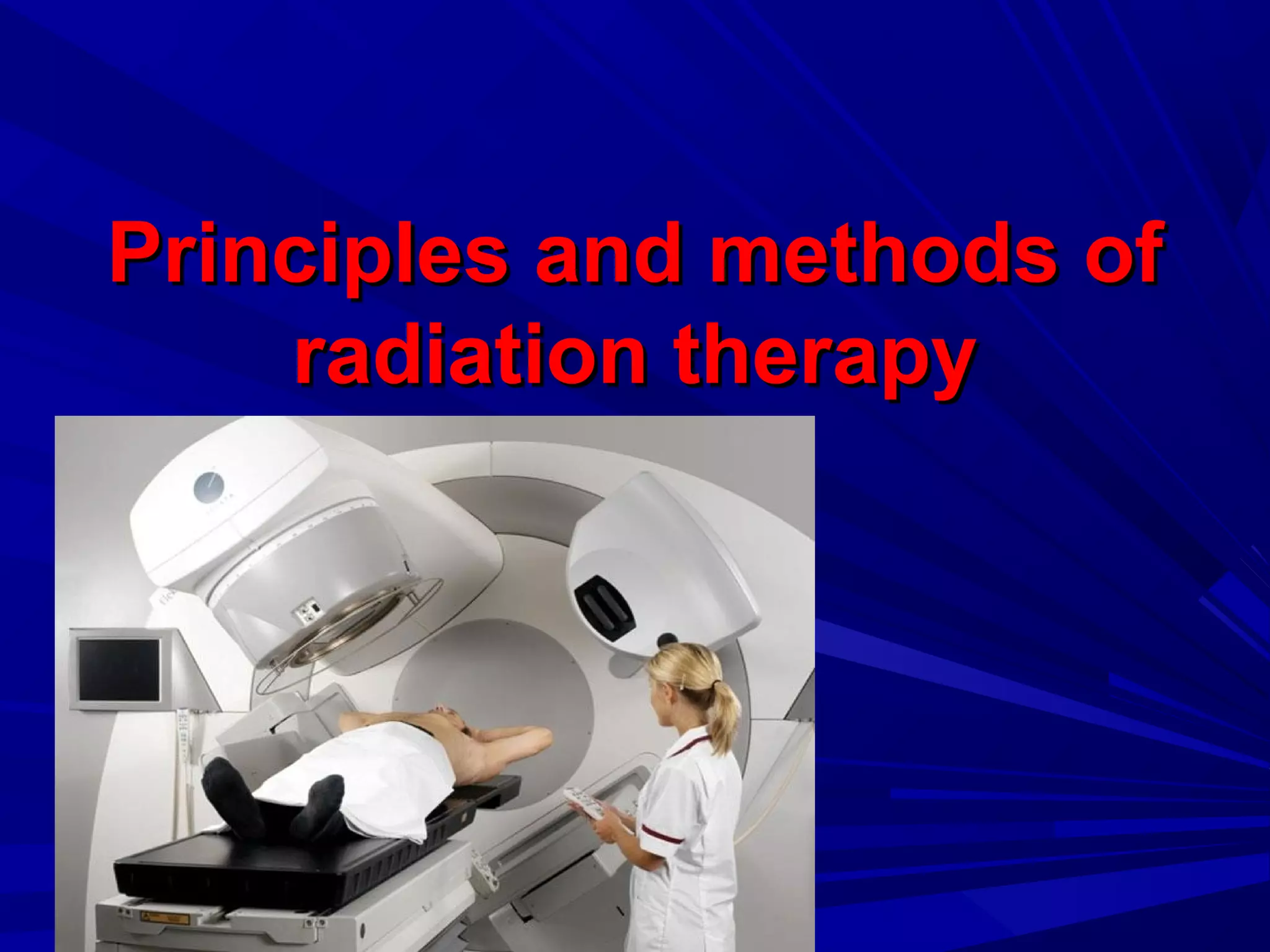
Principles and methods ofPrinciples and methods of
radiation therapyradiation therapy
Radiation therapyRadiation therapy - is one of the sections of medical- is one of the sections of medical
radiology, which is examining the use of ionizingradiology, which is examining the use of ionizing
radiation for the treatment of various human diseases.radiation for the treatment of various human diseases.
International classification of malignant tumors in theInternational classification of malignant tumors in the
system TNM, which is used in oncology reflects the statesystem TNM, which is used in oncology reflects the state
of the primary tumor and its regional and distantof the primary tumor and its regional and distant
metastases (T - tumor, N - nodulus, M - metastasis).metastases (T - tumor, N - nodulus, M - metastasis).
This allows you to choose the tactics of treatment ofThis allows you to choose the tactics of treatment of
cancer patients. In modern oncology main methods ofcancer patients. In modern oncology main methods of
treatment of patients with malignant tumors is surgicaltreatment of patients with malignant tumors is surgical
and radiation, and the combination of these methodsand radiation, and the combination of these methods
greatly improves treatment outcomes. On thegreatly improves treatment outcomes. On the
effectiveness of radiation therapy in the treatment ofeffectiveness of radiation therapy in the treatment of
inoperable cases ranked first place.inoperable cases ranked first place.
The main goal of radiation therapyThe main goal of radiation therapy isis toto
determine the optimal dose of radiation todetermine the optimal dose of radiation to
the pathological focus with minimalthe pathological focus with minimal
damage to normal tissues located in thedamage to normal tissues located in the
area of exposure​​area of exposure​​
The main principles of radiotherapy:The main principles of radiotherapy:
- Radiotherapy appointed strictly on the- Radiotherapy appointed strictly on the
indications;indications;
- The absence of contraindications;- The absence of contraindications;
- Selection of the optimal dose of radiation;- Selection of the optimal dose of radiation;
- Minimal exposure to surrounding normal- Minimal exposure to surrounding normal
tissue;tissue;
- Course of radiotherapy must be the shortest- Course of radiotherapy must be the shortest
and most radical;and most radical;
- Radiotherapy should be accompanied by- Radiotherapy should be accompanied by
therapeutic measures aimed at improving thetherapeutic measures aimed at improving the
body's defense power;body's defense power;
SponsoredSponsored
Medical Lecture Notes –Medical Lecture Notes – All SubjectsAll Subjects
USMLE Exam (America) –USMLE Exam (America) – PracticePractice
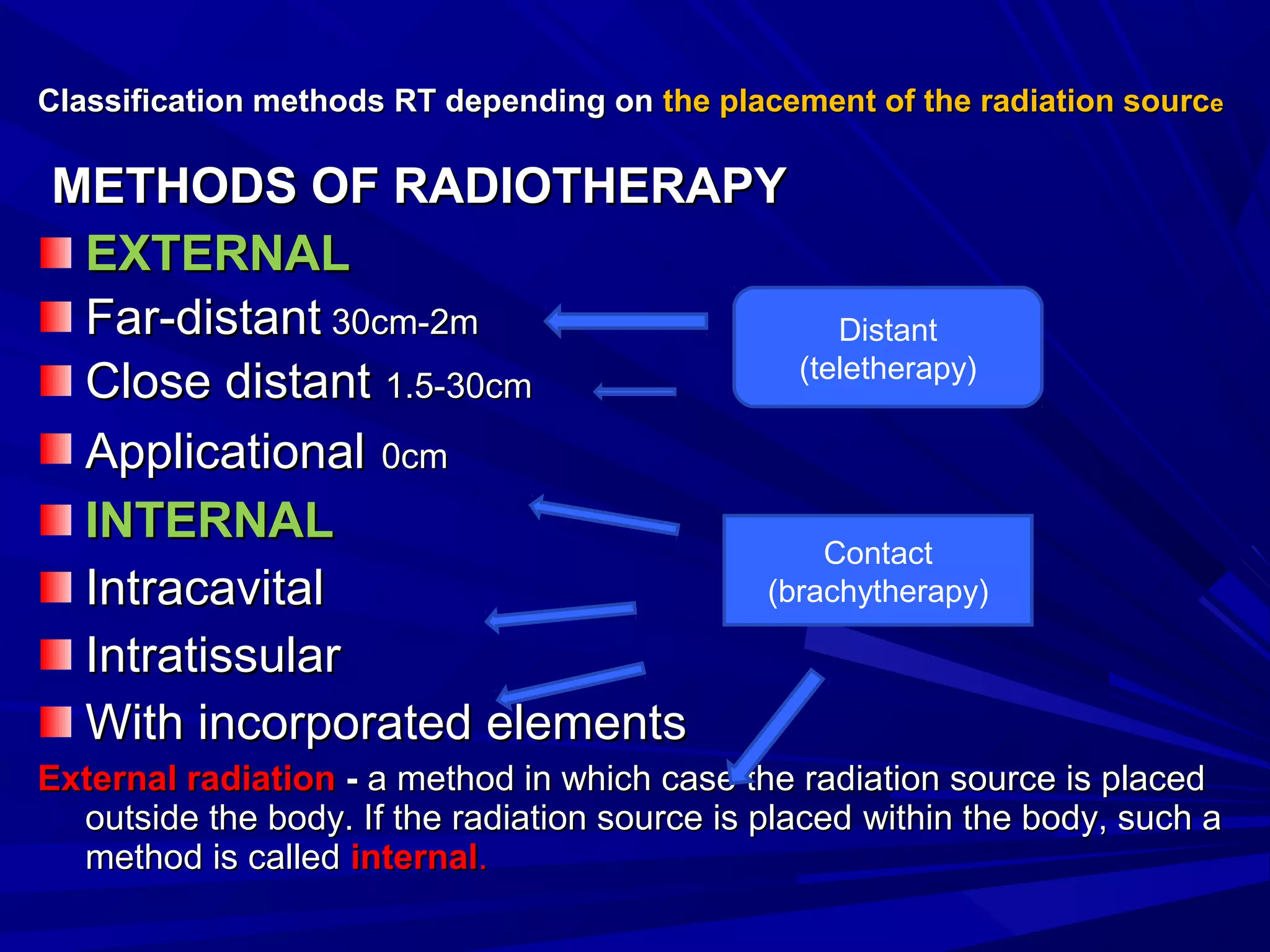
Classification methodsClassification methods RRT depending onT depending on the placement of the radiation sourcthe placement of the radiation sourcee
METHODS OF RADIOTHERAPYMETHODS OF RADIOTHERAPY
EXTERNALEXTERNAL
Far-distantFar-distant 30cm-2m30cm-2m
Close distantClose distant 1.5-30cm1.5-30cm
ApplicationalApplicational 0cm0cm
INTERNALINTERNAL
IntracavitalIntracavital
IntratissularIntratissular
With incorporated elementsWith incorporated elements
External radiationExternal radiation -- a method in which case the radiation source is placeda method in which case the radiation source is placed
outside the body. If the radiation source is placedoutside the body. If the radiation source is placed withwithin the body, such ain the body, such a
method is calledmethod is called internalinternal..
Contact
(brachytherapy)
Distant
(teletherapy)
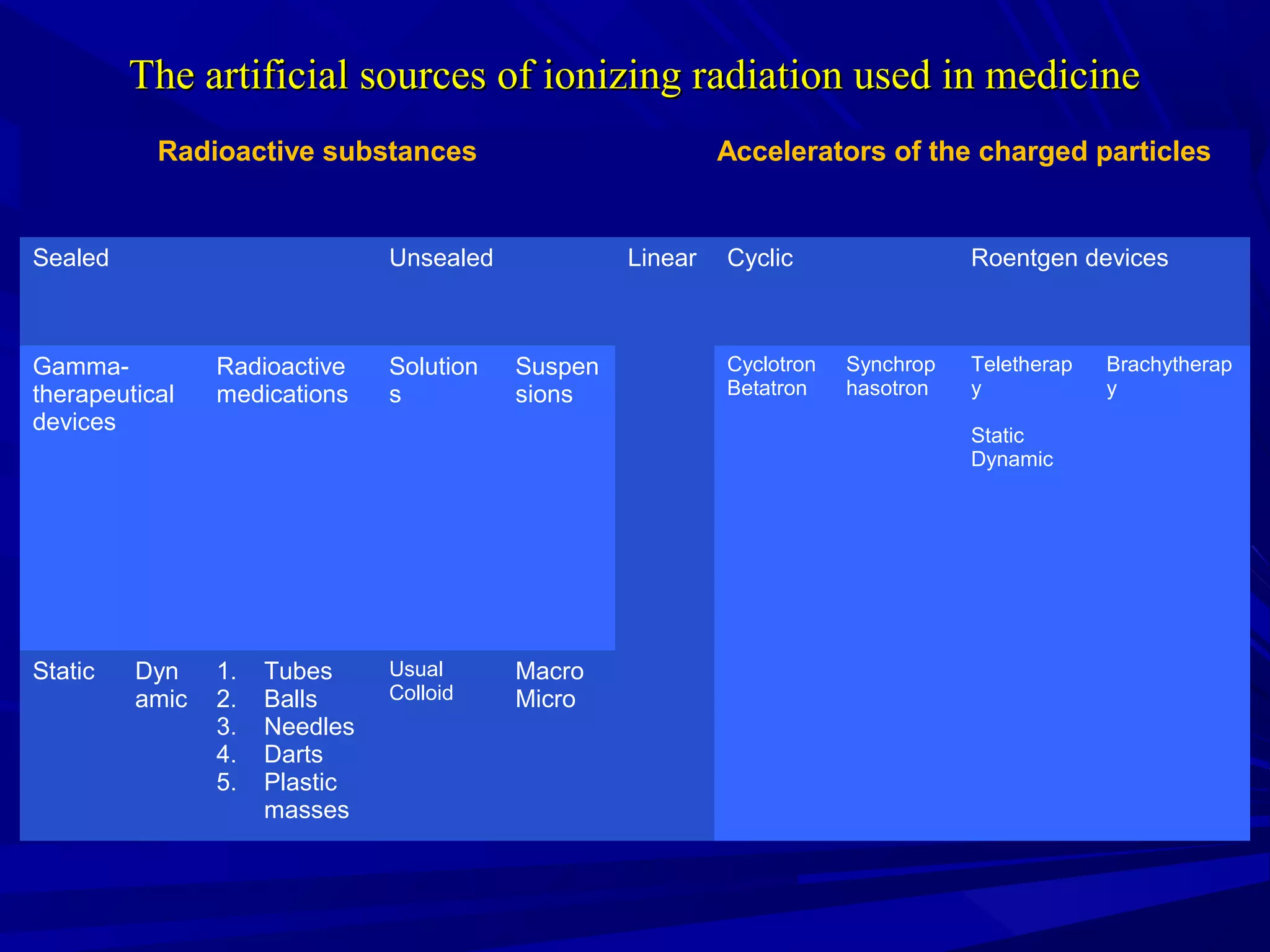
The artificial sources of ionizing radiation used in medicineThe artificial sources of ionizing radiation used in medicine
Radioactive substances Accelerators of the charged particles
Sealed Unsealed Linear Cyclic Roentgen devices
Gamma-
therapeutical
devices
Radioactive
medications
Solution
s
Suspen
sions
Cyclotron
Betatron
Synchrop
hasotron
Teletherap
y
Static
Dynamic
Brachytherap
y
Static Dyn
amic
1. Tubes
2. Balls
3. Needles
4. Darts
5. Plastic
masses
Usual
Colloid
Macro
Micro
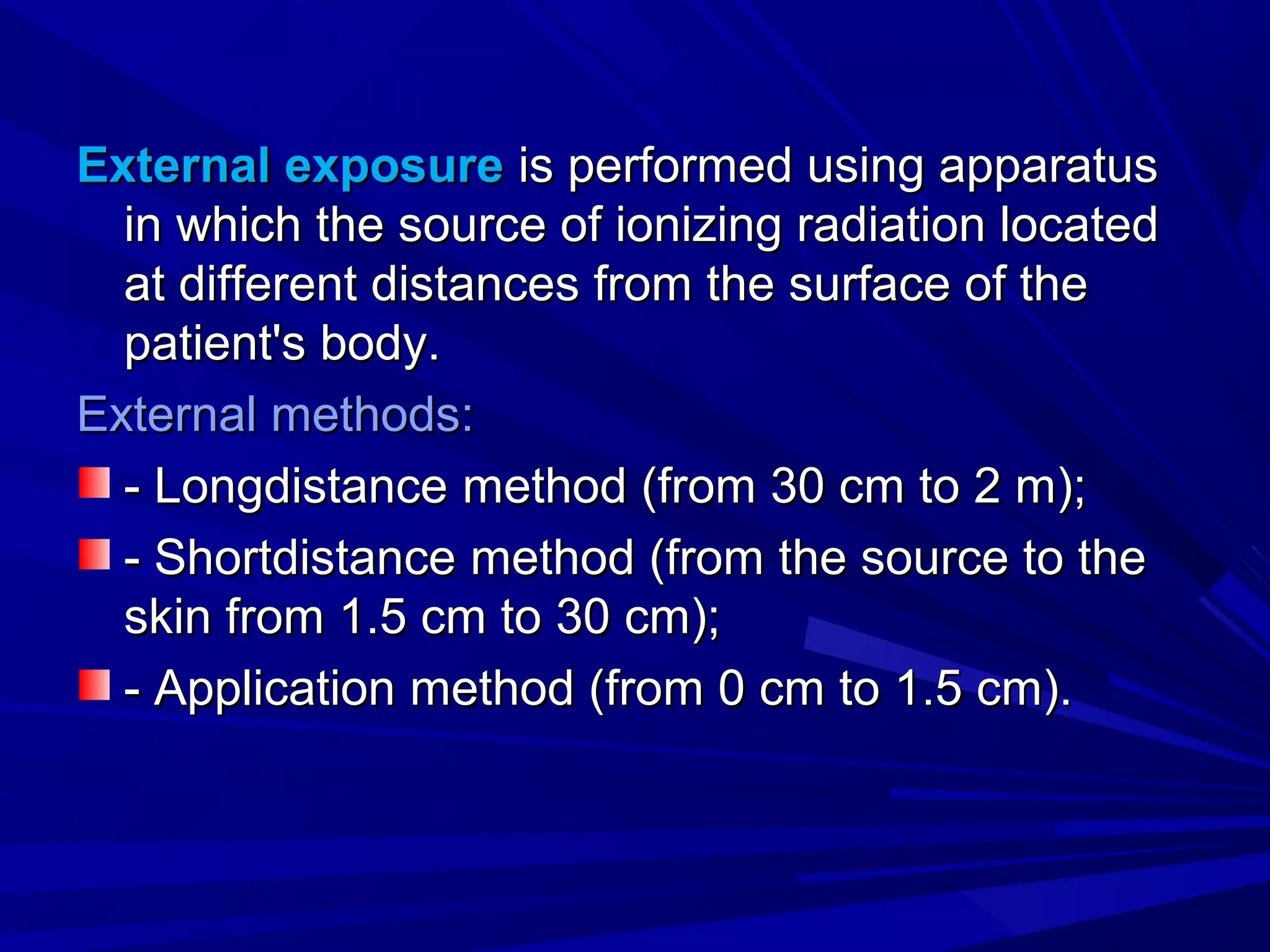
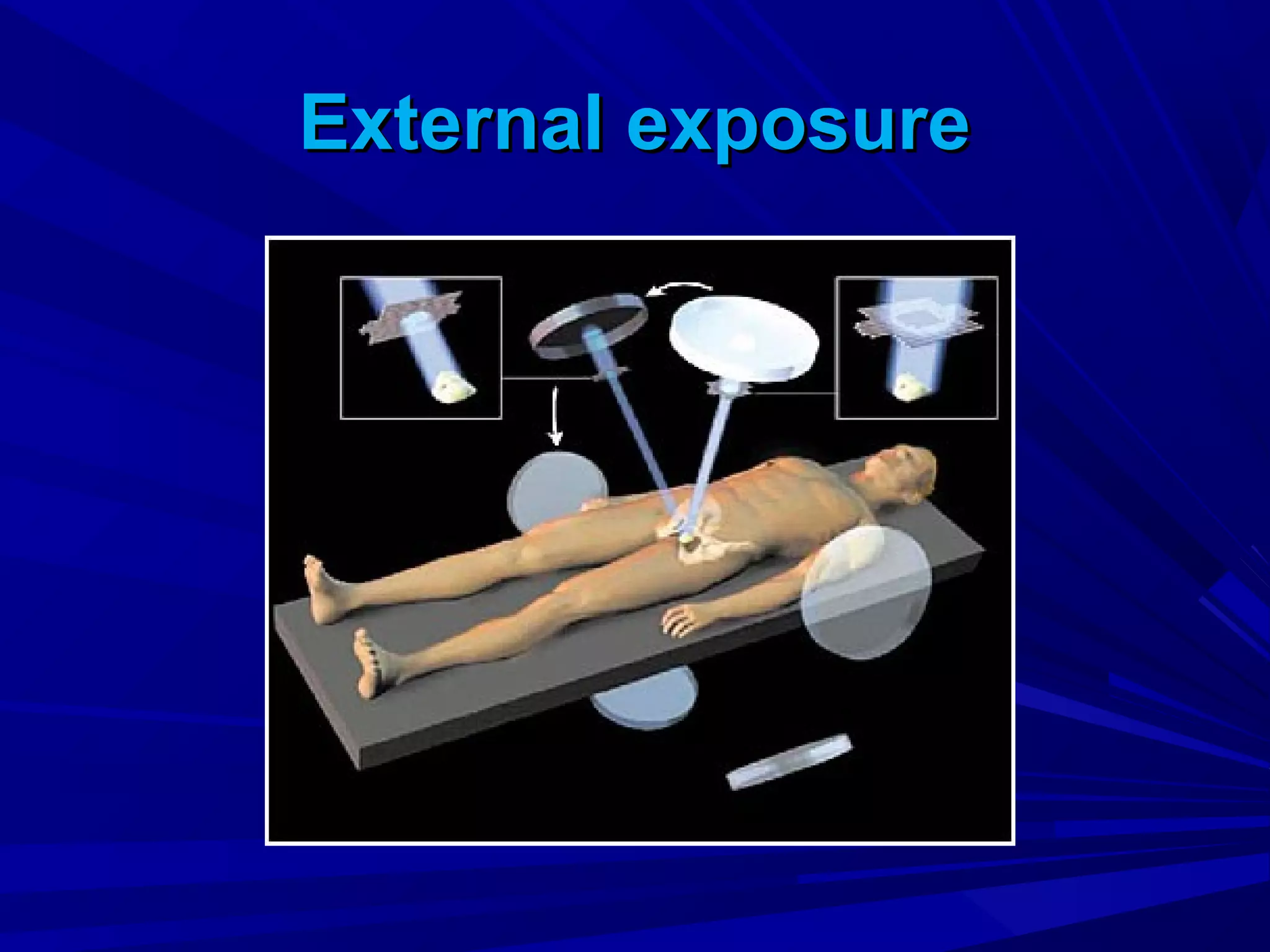
External exposureExternal exposure is performed using apparatusis performed using apparatus
in which the source of ionizing radiation locatedin which the source of ionizing radiation located
at different distances from the surface of theat different distances from the surface of the
patient's body.patient's body.
External methods:External methods:
-- LongdistanceLongdistance method (from 30 cm to 2 m);method (from 30 cm to 2 m);
-- ShortdistanceShortdistance method (from the source to themethod (from the source to the
skin from 1.5 cm to 30 cm);skin from 1.5 cm to 30 cm);
- Application- Application mmethod (from 0 cm to 1.5 cm).ethod (from 0 cm to 1.5 cm).
External exposureExternal exposure
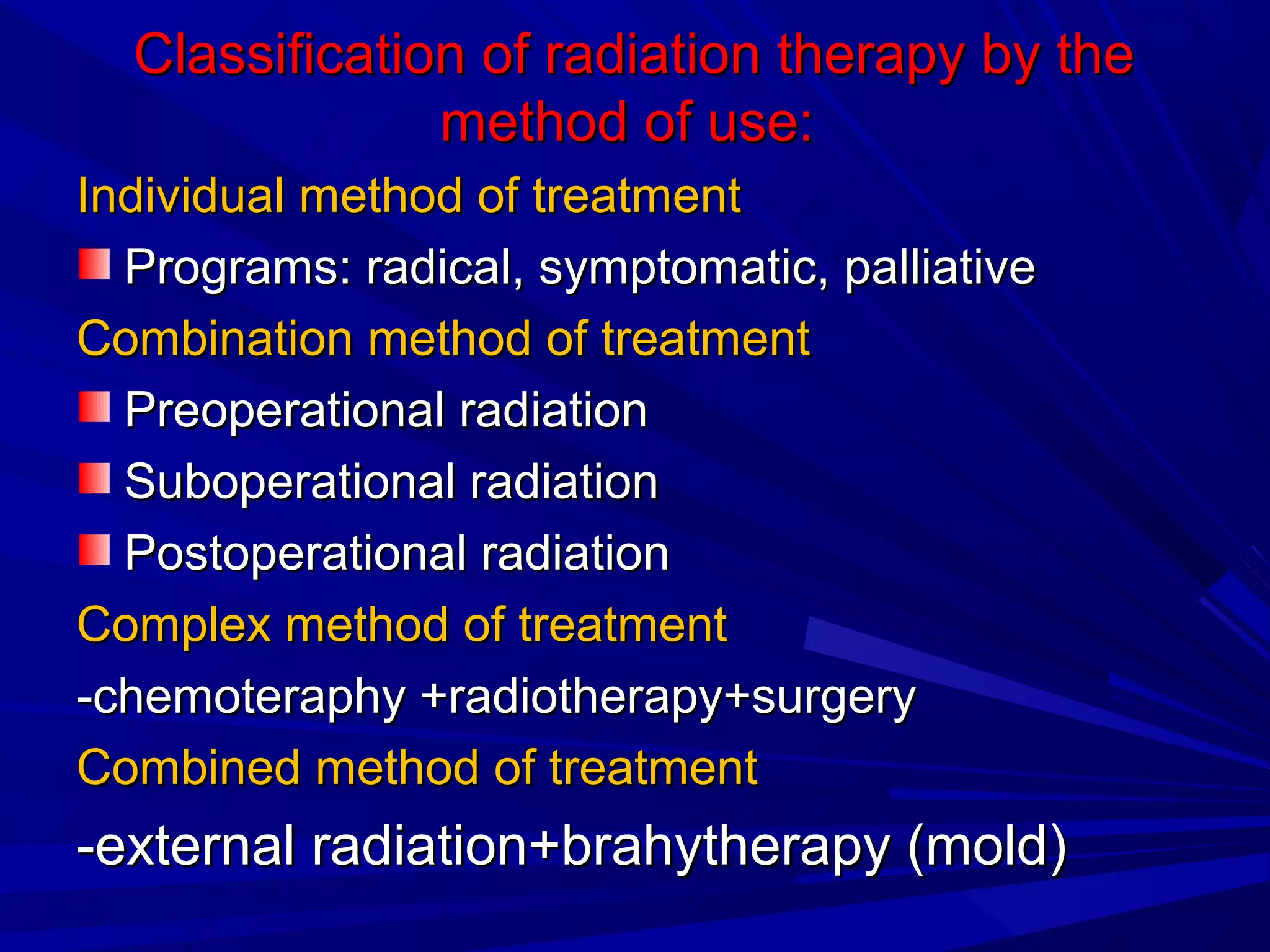
Classification of radiation therapy by theClassification of radiation therapy by the
method of use:method of use:
Individual method of treatmentIndividual method of treatment
Programs: radical, symptomatic, palliativePrograms: radical, symptomatic, palliative
Combination method of treatmentCombination method of treatment
Preoperational radiationPreoperational radiation
Suboperational radiationSuboperational radiation
Postoperational radiationPostoperational radiation
Complex method of treatmentComplex method of treatment
-chemoteraphy +radiotherapy+surgery-chemoteraphy +radiotherapy+surgery
Combined method of treatmentCombined method of treatment
-external radiation+brahytherapy (mold)-external radiation+brahytherapy (mold)
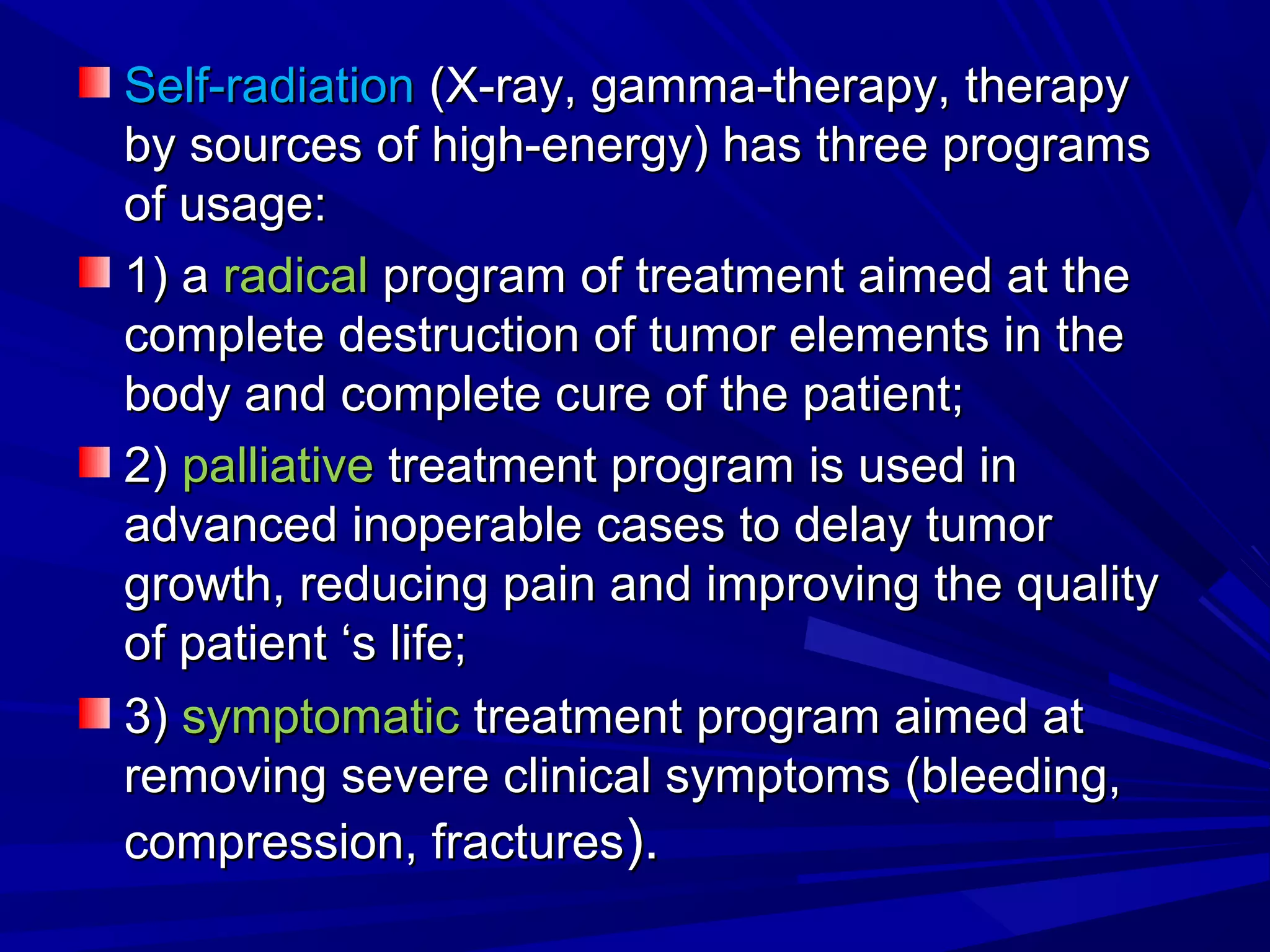
Self-radiationSelf-radiation (X-ray, gamma-therapy, therapy(X-ray, gamma-therapy, therapy
by sources of high-energy) has three programsby sources of high-energy) has three programs
of usage:of usage:
1) a1) a radicalradical program of treatment aimed at theprogram of treatment aimed at the
complete destruction of tumor elements in thecomplete destruction of tumor elements in the
body and complete cure of the patient;body and complete cure of the patient;
2)2) palliativepalliative treatment program is used intreatment program is used in
advanced inoperable cases to delay tumoradvanced inoperable cases to delay tumor
growth, reducing pain and improving the qualitygrowth, reducing pain and improving the quality
of patient ‘s life;of patient ‘s life;
3)3) symptomaticsymptomatic treatment program aimed attreatment program aimed at
removing severe clinical symptoms (bleeding,removing severe clinical symptoms (bleeding,
compression, fracturescompression, fractures).).
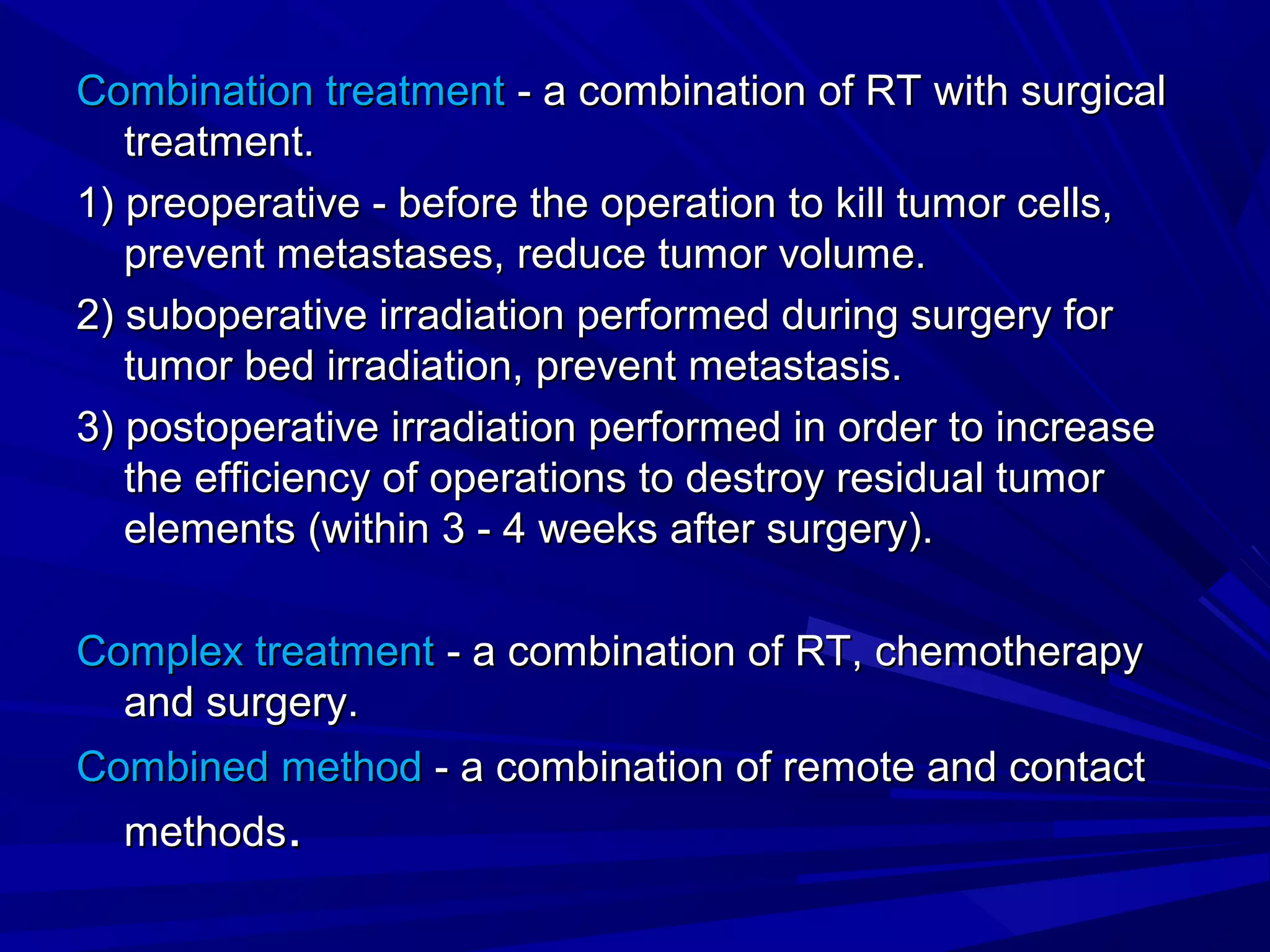
Combination treatmentCombination treatment - a combination of RT with surgical- a combination of RT with surgical
treatment.treatment.
1) preoperative - before the operation to kill tumor cells,1) preoperative - before the operation to kill tumor cells,
prevent metastases, reduce tumor volume.prevent metastases, reduce tumor volume.
2) suboperative irradiation performed during surgery for2) suboperative irradiation performed during surgery for
tumor bed irradiation, prevent metastasis.tumor bed irradiation, prevent metastasis.
3) postoperative irradiation performed in order to increase3) postoperative irradiation performed in order to increase
the efficiency of operations to destroy residual tumorthe efficiency of operations to destroy residual tumor
elements (within 3 - 4 weeks after surgery).elements (within 3 - 4 weeks after surgery).
Complex treatmentComplex treatment - a combination of RT, chemotherapy- a combination of RT, chemotherapy
and surgery.and surgery.
Combined methodCombined method - a combination of remote and contact- a combination of remote and contact
methodsmethods..
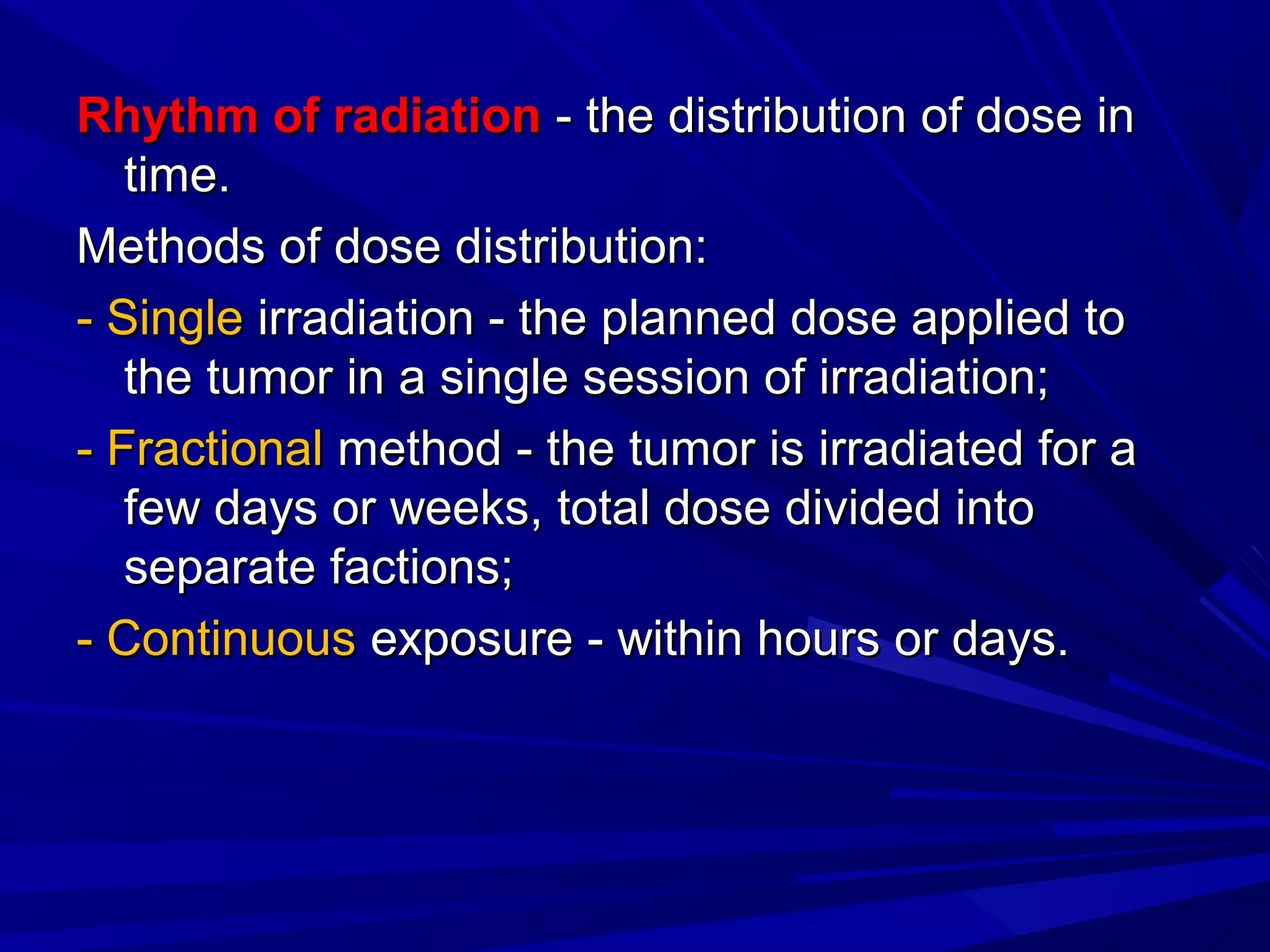
Rhythm of radiationRhythm of radiation - the distribution of dose in- the distribution of dose in
time.time.
Methods of dose distribution:Methods of dose distribution:
- Single- Single irradiation - the planned dose applied toirradiation - the planned dose applied to
the tumor in a single session of irradiation;the tumor in a single session of irradiation;
- Fractional- Fractional method - the tumor is irradiated for amethod - the tumor is irradiated for a
few days or weeks, total dose divided intofew days or weeks, total dose divided into
separate factions;separate factions;
- Continuous- Continuous exposure - within hours or days.exposure - within hours or days.
Basic principles of radiation therapyBasic principles of radiation therapy
of tumor and non-tumor diseasesof tumor and non-tumor diseases
In the treatment of patients receivingIn the treatment of patients receiving
radiation therapy are three periods:radiation therapy are three periods:
preradiation,preradiation,
radiation,radiation,
postradiationpostradiation..
PreradiationPreradiation period include:period include:
-detailed examination of the patient: general clinical,-detailed examination of the patient: general clinical,
laboratory and instrumental (ultrasound, CT, MRI, X-raylaboratory and instrumental (ultrasound, CT, MRI, X-ray
methods, etc.)methods, etc.);;
-verification of diagnosis, cytological and histological-verification of diagnosis, cytological and histological
examination of the tumor (needle biopsy)examination of the tumor (needle biopsy);;
--determination of indications and contraindications todetermination of indications and contraindications to
radiation treatment methodradiation treatment method;;
-assembly of individual patient treatment plan (plan are-assembly of individual patient treatment plan (plan are
made bymade by radiaradiationtion physician, surgeon,physician, surgeon, cchemotheraphemotherapistist));;
-cho-choosingosing method of radiation treatment, radiation fields,method of radiation treatment, radiation fields,
additional therapeutic measuresadditional therapeutic measures;;
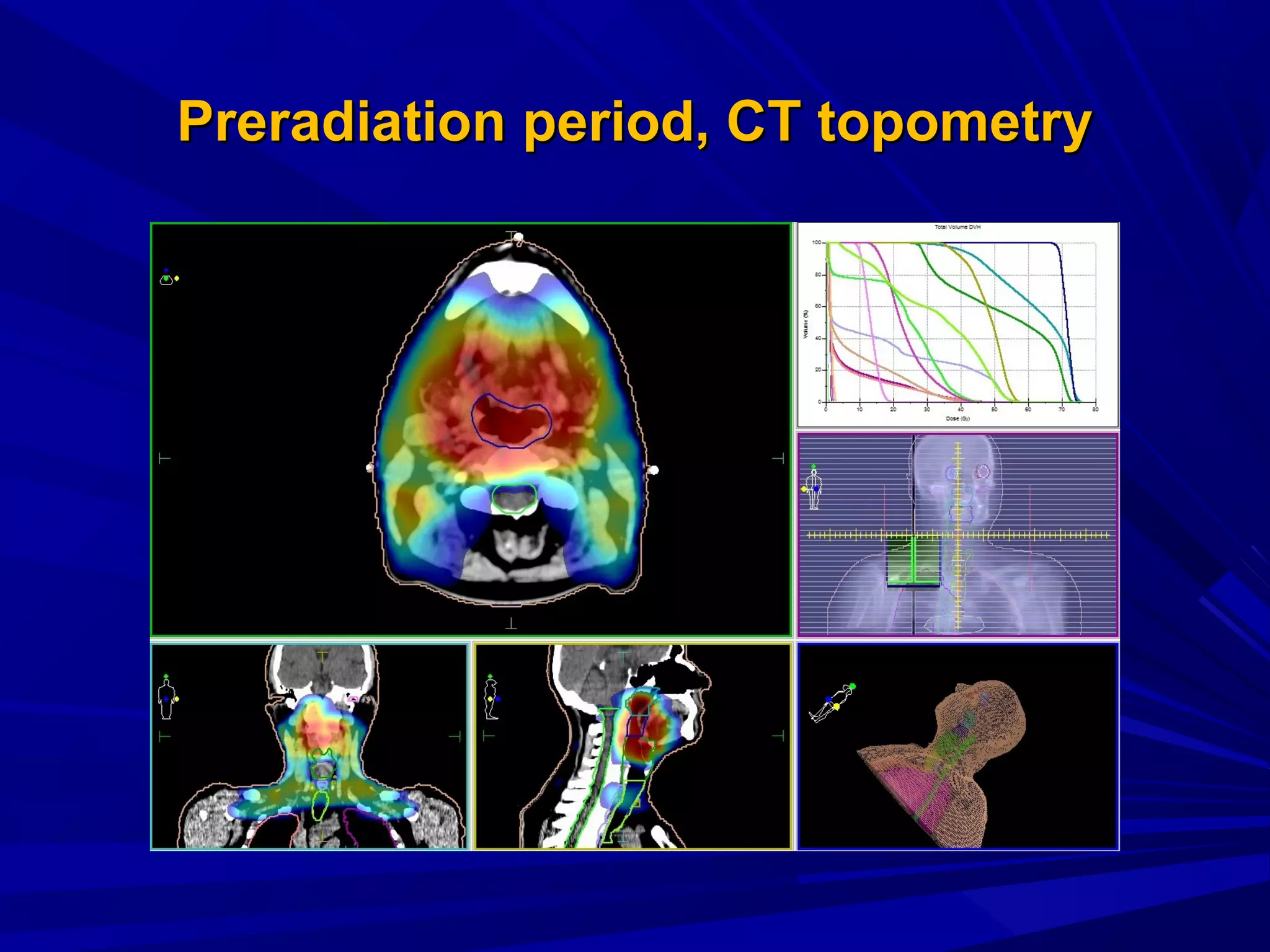
--preradiationpreradiation preparation of the patient (makingpreparation of the patient (making
topographic anatomical cut at the level of the tumor,topographic anatomical cut at the level of the tumor,
depthdepth of localization of tumorof localization of tumor, making projections on the, making projections on the
skin of the patient, the choice of the number and size ofskin of the patient, the choice of the number and size of
radiation fields)radiation fields);;
PreradiationPreradiation periodperiod
Radiation therapist should psychologicallyRadiation therapist should psychologically
prepare the patient for the radiationprepare the patient for the radiation
treatment, exploretreatment, explore skinskin areasareas that will bethat will be
irradiatedirradiated. These areas should not be. These areas should not be
damaged.damaged. PreradiationPreradiation period may lastperiod may last 3 -3 -
14 days.14 days.
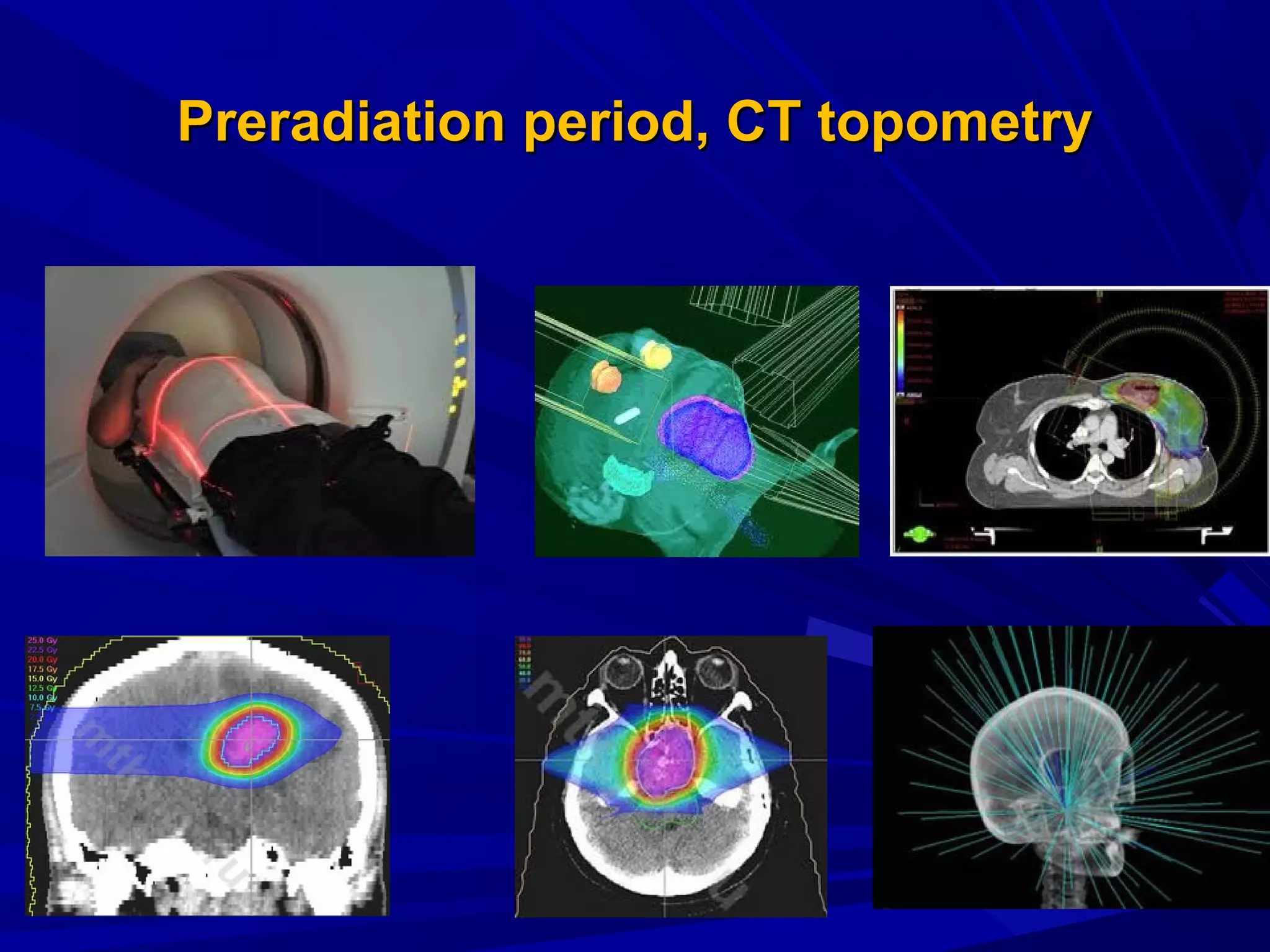
PreradiationPreradiation period, Сperiod, СT topometryT topometry
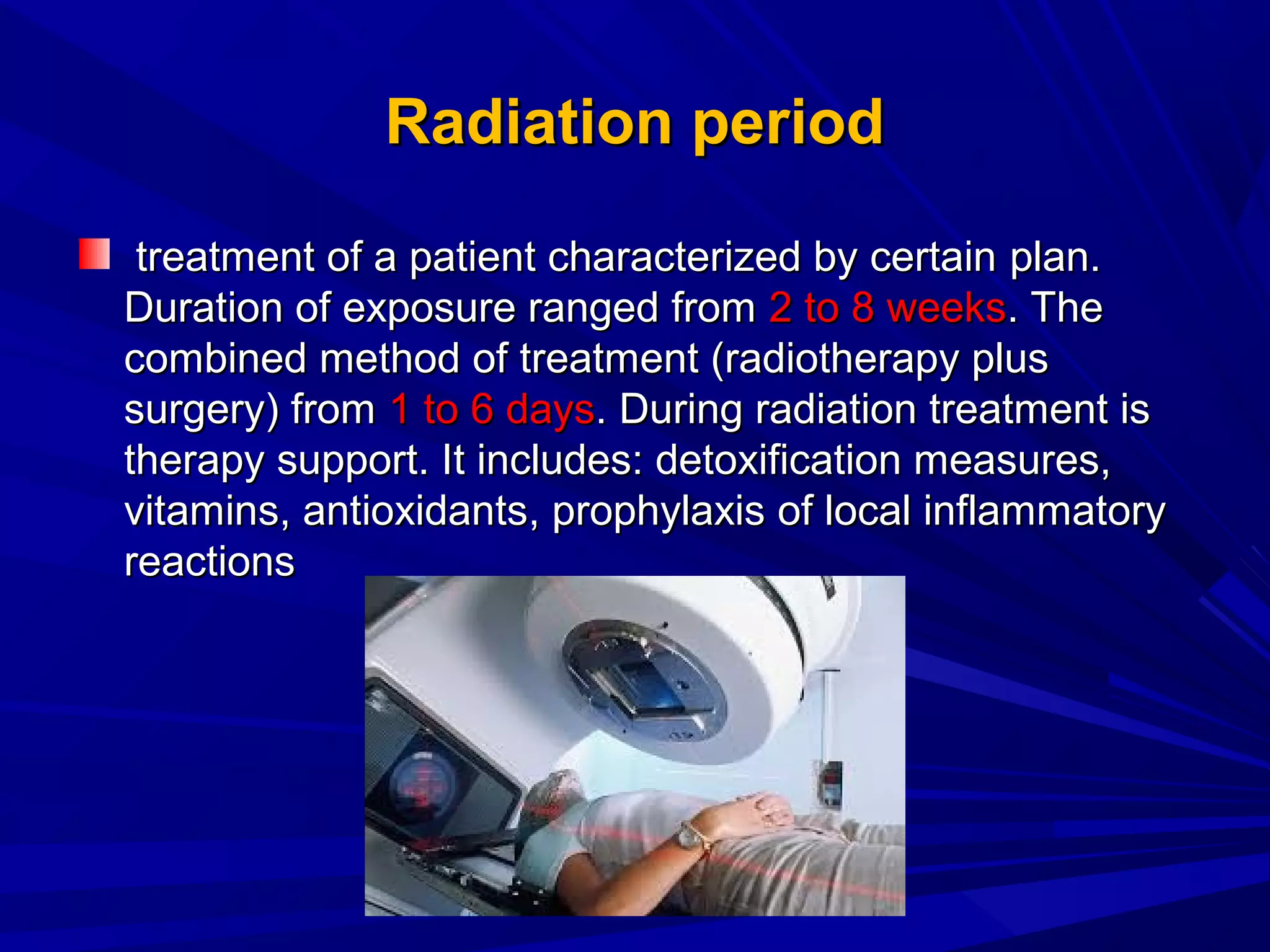
Radiation periodRadiation period
treatment of a patient characterized by certaintreatment of a patient characterized by certain planplan..
Duration of exposure ranged fromDuration of exposure ranged from 2 to 8 weeks2 to 8 weeks. The. The
combined method of treatment (radiotherapy pluscombined method of treatment (radiotherapy plus
surgery) fromsurgery) from 1 to 6 days1 to 6 days. During radiation treatment is. During radiation treatment is
therapy support. It includes: detoxification measures,therapy support. It includes: detoxification measures,
vitaminvitaminss, antioxidants, antioxidants,, prophylaxisprophylaxis ofof local inflammatorylocal inflammatory
reactionsreactions
postradiationpostradiation periodperiod
evaluatevaluatinging the effectiveness of treatmentthe effectiveness of treatment
outcomes (degree of tumor regression),outcomes (degree of tumor regression),
conductconducting ofing of surveillance of the patient,surveillance of the patient,
prevention and treatment of radiationprevention and treatment of radiation
reactions. After radiation therapy clinicalreactions. After radiation therapy clinical
supervision of the patient is heldsupervision of the patient is held 2 times a2 times a

yearyear. After 10 years of observation, if a. After 10 years of observation, if a
person is healthy, it is removed from theperson is healthy, it is removed from the
cancer registry.cancer registry.
About 80% of cancer patients receivingAbout 80% of cancer patients receiving x-x-
ray therapyray therapy.. ItIt can also be used to treatcan also be used to treat
many non malignant diseases that do notmany non malignant diseases that do not
threaten the life of the patient, but causethreaten the life of the patient, but cause
suffering and lead to disability.suffering and lead to disability.
X-rayX-ray therapytherapy - one of the methods of remote- one of the methods of remote
radiotherapy. Depending on the distance of the source ofradiotherapy. Depending on the distance of the source of
radiation to the skin surface is divided into radiotherapyradiation to the skin surface is divided into radiotherapy
short-distanceshort-distance andand long-distancelong-distance. The source of. The source of
radiation in the X-ray therapeutic apparats is an X-rayradiation in the X-ray therapeutic apparats is an X-ray
tube that generates photons with high energy. For low-tube that generates photons with high energy. For low-
energy photons used screening filters. For radiotherapyenergy photons used screening filters. For radiotherapy
applied uniformly high-energy beam of photons.applied uniformly high-energy beam of photons.
Tube serves toTube serves to createcreate fieldfield of radiation and toof radiation and to capturecapture
the desired distance from the source of radiation to thethe desired distance from the source of radiation to the
body.body.
The method of X-rayThe method of X-ray therapytherapy used to treat malignantused to treat malignant
diseases of the skin, subcutaneous fat, mucousdiseases of the skin, subcutaneous fat, mucous
membranes, metastatic tumors in lymph nodes.membranes, metastatic tumors in lymph nodes.
X-rayX-ray therapytherapy - the only method that is used in the- the only method that is used in the
treatment of non-tumorous diseases.treatment of non-tumorous diseases.
IndicationsIndications for use of this method of treatment are suchfor use of this method of treatment are such
groups are not malignant diseasesgroups are not malignant diseases::
1. Inflammatory processes:1. Inflammatory processes: furunclesfuruncles, carbuncles,, carbuncles,
phlegmonsphlegmons, abscesses, paraproctitis,, abscesses, paraproctitis, ostepmyelitisostepmyelitis,,
puerperal mastitis;puerperal mastitis;
2. Postoperative complications: wounds that heal poorly,2. Postoperative complications: wounds that heal poorly,
volesvoles of localisationof localisation;;
3. Diseases of the osteoarticular system: heel spurs,3. Diseases of the osteoarticular system: heel spurs,
osteoporosis, bursitis, tendonitis, deforming arthrosis;osteoporosis, bursitis, tendonitis, deforming arthrosis;
4. Inflammatory diseases of the peripheral nervous4. Inflammatory diseases of the peripheral nervous
system: neuritis, neuralgia, plexitis, sciatica;system: neuritis, neuralgia, plexitis, sciatica;
5. Skin diseases: eczema, atopic dermatitis, fungal nail5. Skin diseases: eczema, atopic dermatitis, fungal nail
and skin infections.and skin infections.
The sharper the processThe sharper the process is - theis - the smaller dosesmaller dose isis andand itit
ranged from 0.15 to 10 Granged from 0.15 to 10 Grayray..
RadiationRadiation isis permorfedpermorfed 1-3 times a week.1-3 times a week.
TheThe mechanism of anti-inflammatorymechanism of anti-inflammatory
effecteffect of ionizing radiationof ionizing radiation
IInn casecase of non-tumorous diseasesof non-tumorous diseases is multi-is multi-faceted.faceted.
Ionizing radiation has the ability to anesthesia. TheIonizing radiation has the ability to anesthesia. The
changes observed in pathological focus during ionizingchanges observed in pathological focus during ionizing
radiation, expressed in acceleratingradiation, expressed in accelerating of theof the phasephase ofof
inflammatory infiltrationinflammatory infiltration,, proliferative and reparativeproliferative and reparative
processes and analgesicprocesses and analgesic effecteffect. Due. Due toto reducreducing ofing of
oedemaoedema organ functionorgan function isis improved, increasedimproved, increased
circulation, increased phagocytic activity of leukocytes.circulation, increased phagocytic activity of leukocytes.
After a short extension arterAfter a short extension arteries areies are narrownarrowing nowing now, in, in
consequence of which decreases redness andconsequence of which decreases redness and oedemaoedema..
Thus, under the influence of small doses of radiationThus, under the influence of small doses of radiation aa
lot oflot of the mechanisms that are responsible forthe mechanisms that are responsible for
maintaining the constancy of the internal environmentmaintaining the constancy of the internal environment
and aimed at normalization of disturbed functionsand aimed at normalization of disturbed functions areare
simultaneouslysimultaneously turning onturning on..
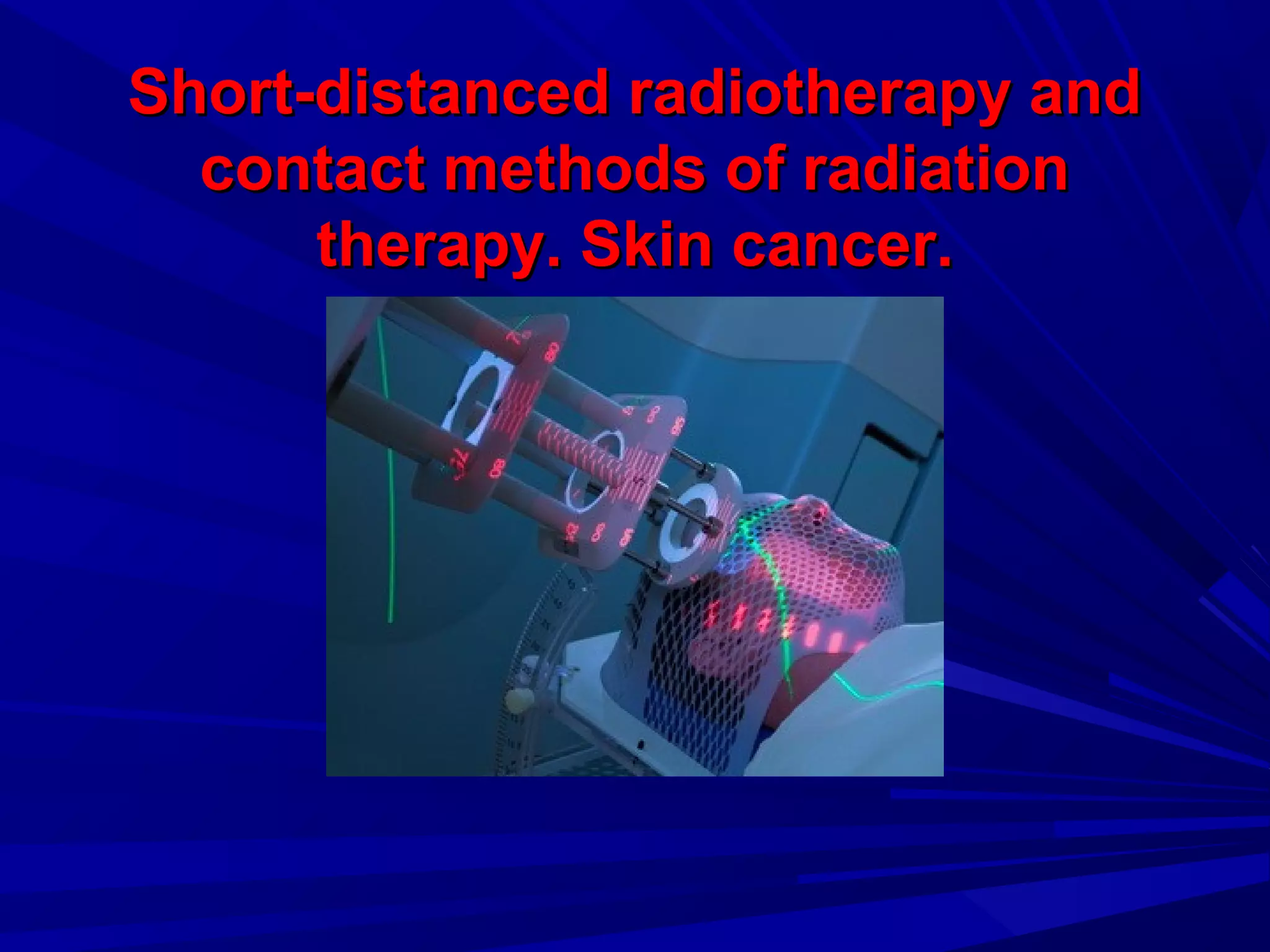
Short-distanced radiotherapy andShort-distanced radiotherapy and
contact methods of radiationcontact methods of radiation
therapy.therapy. Skin cancer.Skin cancer.
WhenWhen short-distancedshort-distanced radiotherapy isradiotherapy is
using, distance from the source of X-rayusing, distance from the source of X-ray
radiation to the skin ranged from 1.5 to 25radiation to the skin ranged from 1.5 to 25
cm. This method is used when placing thecm. This method is used when placing the
pathological focus to a depth of 0.5 - 0.7pathological focus to a depth of 0.5 - 0.7
cm from the skin surface. A type of short-cm from the skin surface. A type of short-
distanced radiotherapy which is ultradistanced radiotherapy which is ultra
radiotherapy. These rays are used whenradiotherapy. These rays are used when
surface inflammation, dermatitis,surface inflammation, dermatitis,
conjunctivitis.conjunctivitis.
Skin cancerSkin cancer
Skin cancer - a malignant tumor thatSkin cancer - a malignant tumor that
develops from the epidermis and isdevelops from the epidermis and is
characterized by relatively benign course,characterized by relatively benign course,
caused by the slow pace of developmentcaused by the slow pace of development
and late metastasis. Localized mainly onand late metastasis. Localized mainly on
the face.the face.
velops from the epidermis and is characterized by relatively benign course, caused by the slow pace of development and late m
There are following treatments methodsThere are following treatments methods: radiation,: radiation,
surgery, combined. If the tumor is located on the face,surgery, combined. If the tumor is located on the face,
neck - use radiation therapy. When placing skin tumorsneck - use radiation therapy. When placing skin tumors
on the trunk and limbs, where cosmetic aspect becomeson the trunk and limbs, where cosmetic aspect becomes
less important, treatment is coming by using surgicalless important, treatment is coming by using surgical
method or by cryodestruction (using liquid nitrogen). Ifmethod or by cryodestruction (using liquid nitrogen). If
skin cancer stage is I or II use short-distancedskin cancer stage is I or II use short-distanced
radiotherapy. The total dose of 50-60 gray, single doze -radiotherapy. The total dose of 50-60 gray, single doze -
4-6 gray. Spread of deeper infiltration of surrounding4-6 gray. Spread of deeper infiltration of surrounding
tissues is regarded as stage 3-4 and requires applicationtissues is regarded as stage 3-4 and requires application
of the method of long-distanced radiotherapy. If theof the method of long-distanced radiotherapy. If the
tumor is localized on the trunk or limbs at stages I-II -tumor is localized on the trunk or limbs at stages I-II -
surgical treatment, III-IV stage - surgical methodsurgical treatment, III-IV stage - surgical method
combined with radiation methods.combined with radiation methods.
Contact methods of radiotherapyContact methods of radiotherapy
Contact radiation therapy combines intracavitary,Contact radiation therapy combines intracavitary,
application, interstitial method and method of tropicapplication, interstitial method and method of tropic
accumulation of radioactive elements. In the case ofaccumulation of radioactive elements. In the case of
using each of these methods, the radiation source isusing each of these methods, the radiation source is
placed on the skin or mucous membrane, it is injectedplaced on the skin or mucous membrane, it is injected
directly into the tumor or into the exposed cavity. Thedirectly into the tumor or into the exposed cavity. The
shape of the radiation source can be: linear (cylinders,shape of the radiation source can be: linear (cylinders,
needles), volume (balls, grains, granules), sutureneedles), volume (balls, grains, granules), suture
material, solutions.material, solutions.
Application methodApplication method is a medical procedureis a medical procedure
in which radioactive drugs placed on thein which radioactive drugs placed on the
skin or mucous membranes usingskin or mucous membranes using
applicators. If thickness not exceed 1-3applicators. If thickness not exceed 1-3
mm - use beta rays. It is used to treatmm - use beta rays. It is used to treat
tumors of the cornea, of conjunctiva,tumors of the cornea, of conjunctiva,
eyelid skin cancer. If the skin depth of theeyelid skin cancer. If the skin depth of the
tumor up to 2 cm - use gammatumor up to 2 cm - use gamma
therapy. Radiotherapy held in a specialtherapy. Radiotherapy held in a special
chamber equipped with protectivechamber equipped with protective
screens, because the patient is the sourcescreens, because the patient is the source
of radiation.of radiation.
Intracavitary methodIntracavitary method is used to supply theis used to supply the
radiation source as close to the tumor as itradiation source as close to the tumor as it
possible. Which is localized in the wall ofpossible. Which is localized in the wall of
any hollow organ. For this method is usedany hollow organ. For this method is used
as gamma and beta radiationas gamma and beta radiation
source. Indications for the use: cancer ofsource. Indications for the use: cancer of
the vagina, cervix and body of the uterus,the vagina, cervix and body of the uterus,
rectum, bladder, esophagus, oral cavityrectum, bladder, esophagus, oral cavity
hich is localized in the wall of any hollow organ. For this method is used as gamma and beta radiation source. Indications for th
Intratissular methodIntratissular method-a method of radiation-a method of radiation
therapy, in which case the radioactivetherapy, in which case the radioactive
drug is injected directly into the tumordrug is injected directly into the tumor
tissue. For gamma therapy using closedtissue. For gamma therapy using closed
radioactive preparations in the form ofradioactive preparations in the form of
needles, granules, grains, sutureneedles, granules, grains, suture
material. For beta therapy use colloidalmaterial. For beta therapy use colloidal
solutions and suspensions ofsolutions and suspensions of
radionuclides Au198, Y90, silicone.radionuclides Au198, Y90, silicone.
Method of tropic accumulation ofMethod of tropic accumulation of
radionuclides -radionuclides - therapy incorporatedtherapy incorporated
elementselements.. This method is based on the ability ofThis method is based on the ability of
certain tissues selectively accumulate radioactivecertain tissues selectively accumulate radioactive
substances.substances.
Selective accumulation of iodine in thyroid tissue servedSelective accumulation of iodine in thyroid tissue served
for use J131 radionuclide for therapeutic purposes.for use J131 radionuclide for therapeutic purposes.
Radioiodine therapy - treatment of hyperthyroidism thatRadioiodine therapy - treatment of hyperthyroidism that
by results can be compared with the operation, but theby results can be compared with the operation, but the
advantage is that it is carried out without bloodshed,advantage is that it is carried out without bloodshed,
without the danger of operating death.without the danger of operating death.
P32 selectively accumulates mainly in bone and acts onP32 selectively accumulates mainly in bone and acts on
tumor cells with beta radiation. This method is used fortumor cells with beta radiation. This method is used for
the treatment of multiple bone metastases in the case ofthe treatment of multiple bone metastases in the case of
breast, prostate, lung.breast, prostate, lung.
Thank you for attantion!Thank you for attantion!

Principles & methods of Radiation Therapy

  • 1.
    Principles and methodsofPrinciples and methods of radiation therapyradiation therapy
  • 2.
    Radiation therapyRadiation therapy- is one of the sections of medical- is one of the sections of medical radiology, which is examining the use of ionizingradiology, which is examining the use of ionizing radiation for the treatment of various human diseases.radiation for the treatment of various human diseases. International classification of malignant tumors in theInternational classification of malignant tumors in the system TNM, which is used in oncology reflects the statesystem TNM, which is used in oncology reflects the state of the primary tumor and its regional and distantof the primary tumor and its regional and distant metastases (T - tumor, N - nodulus, M - metastasis).metastases (T - tumor, N - nodulus, M - metastasis). This allows you to choose the tactics of treatment ofThis allows you to choose the tactics of treatment of cancer patients. In modern oncology main methods ofcancer patients. In modern oncology main methods of treatment of patients with malignant tumors is surgicaltreatment of patients with malignant tumors is surgical and radiation, and the combination of these methodsand radiation, and the combination of these methods greatly improves treatment outcomes. On thegreatly improves treatment outcomes. On the effectiveness of radiation therapy in the treatment ofeffectiveness of radiation therapy in the treatment of inoperable cases ranked first place.inoperable cases ranked first place.
  • 3.
    The main goalof radiation therapyThe main goal of radiation therapy isis toto determine the optimal dose of radiation todetermine the optimal dose of radiation to the pathological focus with minimalthe pathological focus with minimal damage to normal tissues located in thedamage to normal tissues located in the area of exposure​​area of exposure​​
  • 4.
    The main principlesof radiotherapy:The main principles of radiotherapy: - Radiotherapy appointed strictly on the- Radiotherapy appointed strictly on the indications;indications; - The absence of contraindications;- The absence of contraindications; - Selection of the optimal dose of radiation;- Selection of the optimal dose of radiation; - Minimal exposure to surrounding normal- Minimal exposure to surrounding normal tissue;tissue; - Course of radiotherapy must be the shortest- Course of radiotherapy must be the shortest and most radical;and most radical; - Radiotherapy should be accompanied by- Radiotherapy should be accompanied by therapeutic measures aimed at improving thetherapeutic measures aimed at improving the body's defense power;body's defense power;
  • 5.
    SponsoredSponsored Medical Lecture Notes–Medical Lecture Notes – All SubjectsAll Subjects USMLE Exam (America) –USMLE Exam (America) – PracticePractice
  • 6.
    Classification methodsClassification methodsRRT depending onT depending on the placement of the radiation sourcthe placement of the radiation sourcee METHODS OF RADIOTHERAPYMETHODS OF RADIOTHERAPY EXTERNALEXTERNAL Far-distantFar-distant 30cm-2m30cm-2m Close distantClose distant 1.5-30cm1.5-30cm ApplicationalApplicational 0cm0cm INTERNALINTERNAL IntracavitalIntracavital IntratissularIntratissular With incorporated elementsWith incorporated elements External radiationExternal radiation -- a method in which case the radiation source is placeda method in which case the radiation source is placed outside the body. If the radiation source is placedoutside the body. If the radiation source is placed withwithin the body, such ain the body, such a method is calledmethod is called internalinternal.. Contact (brachytherapy) Distant (teletherapy)
  • 7.
    The artificial sourcesof ionizing radiation used in medicineThe artificial sources of ionizing radiation used in medicine Radioactive substances Accelerators of the charged particles Sealed Unsealed Linear Cyclic Roentgen devices Gamma- therapeutical devices Radioactive medications Solution s Suspen sions Cyclotron Betatron Synchrop hasotron Teletherap y Static Dynamic Brachytherap y Static Dyn amic 1. Tubes 2. Balls 3. Needles 4. Darts 5. Plastic masses Usual Colloid Macro Micro
  • 8.
    External exposureExternal exposureis performed using apparatusis performed using apparatus in which the source of ionizing radiation locatedin which the source of ionizing radiation located at different distances from the surface of theat different distances from the surface of the patient's body.patient's body. External methods:External methods: -- LongdistanceLongdistance method (from 30 cm to 2 m);method (from 30 cm to 2 m); -- ShortdistanceShortdistance method (from the source to themethod (from the source to the skin from 1.5 cm to 30 cm);skin from 1.5 cm to 30 cm); - Application- Application mmethod (from 0 cm to 1.5 cm).ethod (from 0 cm to 1.5 cm).
  • 9.
  • 10.
    Classification of radiationtherapy by theClassification of radiation therapy by the method of use:method of use: Individual method of treatmentIndividual method of treatment Programs: radical, symptomatic, palliativePrograms: radical, symptomatic, palliative Combination method of treatmentCombination method of treatment Preoperational radiationPreoperational radiation Suboperational radiationSuboperational radiation Postoperational radiationPostoperational radiation Complex method of treatmentComplex method of treatment -chemoteraphy +radiotherapy+surgery-chemoteraphy +radiotherapy+surgery Combined method of treatmentCombined method of treatment -external radiation+brahytherapy (mold)-external radiation+brahytherapy (mold)
  • 11.
    Self-radiationSelf-radiation (X-ray, gamma-therapy,therapy(X-ray, gamma-therapy, therapy by sources of high-energy) has three programsby sources of high-energy) has three programs of usage:of usage: 1) a1) a radicalradical program of treatment aimed at theprogram of treatment aimed at the complete destruction of tumor elements in thecomplete destruction of tumor elements in the body and complete cure of the patient;body and complete cure of the patient; 2)2) palliativepalliative treatment program is used intreatment program is used in advanced inoperable cases to delay tumoradvanced inoperable cases to delay tumor growth, reducing pain and improving the qualitygrowth, reducing pain and improving the quality of patient ‘s life;of patient ‘s life; 3)3) symptomaticsymptomatic treatment program aimed attreatment program aimed at removing severe clinical symptoms (bleeding,removing severe clinical symptoms (bleeding, compression, fracturescompression, fractures).).
  • 12.
    Combination treatmentCombination treatment- a combination of RT with surgical- a combination of RT with surgical treatment.treatment. 1) preoperative - before the operation to kill tumor cells,1) preoperative - before the operation to kill tumor cells, prevent metastases, reduce tumor volume.prevent metastases, reduce tumor volume. 2) suboperative irradiation performed during surgery for2) suboperative irradiation performed during surgery for tumor bed irradiation, prevent metastasis.tumor bed irradiation, prevent metastasis. 3) postoperative irradiation performed in order to increase3) postoperative irradiation performed in order to increase the efficiency of operations to destroy residual tumorthe efficiency of operations to destroy residual tumor elements (within 3 - 4 weeks after surgery).elements (within 3 - 4 weeks after surgery). Complex treatmentComplex treatment - a combination of RT, chemotherapy- a combination of RT, chemotherapy and surgery.and surgery. Combined methodCombined method - a combination of remote and contact- a combination of remote and contact methodsmethods..
  • 13.
    Rhythm of radiationRhythmof radiation - the distribution of dose in- the distribution of dose in time.time. Methods of dose distribution:Methods of dose distribution: - Single- Single irradiation - the planned dose applied toirradiation - the planned dose applied to the tumor in a single session of irradiation;the tumor in a single session of irradiation; - Fractional- Fractional method - the tumor is irradiated for amethod - the tumor is irradiated for a few days or weeks, total dose divided intofew days or weeks, total dose divided into separate factions;separate factions; - Continuous- Continuous exposure - within hours or days.exposure - within hours or days.
  • 14.
    Basic principles ofradiation therapyBasic principles of radiation therapy of tumor and non-tumor diseasesof tumor and non-tumor diseases In the treatment of patients receivingIn the treatment of patients receiving radiation therapy are three periods:radiation therapy are three periods: preradiation,preradiation, radiation,radiation, postradiationpostradiation..
  • 15.
    PreradiationPreradiation period include:periodinclude: -detailed examination of the patient: general clinical,-detailed examination of the patient: general clinical, laboratory and instrumental (ultrasound, CT, MRI, X-raylaboratory and instrumental (ultrasound, CT, MRI, X-ray methods, etc.)methods, etc.);; -verification of diagnosis, cytological and histological-verification of diagnosis, cytological and histological examination of the tumor (needle biopsy)examination of the tumor (needle biopsy);; --determination of indications and contraindications todetermination of indications and contraindications to radiation treatment methodradiation treatment method;; -assembly of individual patient treatment plan (plan are-assembly of individual patient treatment plan (plan are made bymade by radiaradiationtion physician, surgeon,physician, surgeon, cchemotheraphemotherapistist));; -cho-choosingosing method of radiation treatment, radiation fields,method of radiation treatment, radiation fields, additional therapeutic measuresadditional therapeutic measures;; --preradiationpreradiation preparation of the patient (makingpreparation of the patient (making topographic anatomical cut at the level of the tumor,topographic anatomical cut at the level of the tumor, depthdepth of localization of tumorof localization of tumor, making projections on the, making projections on the skin of the patient, the choice of the number and size ofskin of the patient, the choice of the number and size of radiation fields)radiation fields);;
  • 16.
    PreradiationPreradiation periodperiod Radiation therapistshould psychologicallyRadiation therapist should psychologically prepare the patient for the radiationprepare the patient for the radiation treatment, exploretreatment, explore skinskin areasareas that will bethat will be irradiatedirradiated. These areas should not be. These areas should not be damaged.damaged. PreradiationPreradiation period may lastperiod may last 3 -3 - 14 days.14 days.
  • 17.
  • 18.
  • 19.
    Radiation periodRadiation period treatmentof a patient characterized by certaintreatment of a patient characterized by certain planplan.. Duration of exposure ranged fromDuration of exposure ranged from 2 to 8 weeks2 to 8 weeks. The. The combined method of treatment (radiotherapy pluscombined method of treatment (radiotherapy plus surgery) fromsurgery) from 1 to 6 days1 to 6 days. During radiation treatment is. During radiation treatment is therapy support. It includes: detoxification measures,therapy support. It includes: detoxification measures, vitaminvitaminss, antioxidants, antioxidants,, prophylaxisprophylaxis ofof local inflammatorylocal inflammatory reactionsreactions
  • 20.
    postradiationpostradiation periodperiod evaluatevaluatinging theeffectiveness of treatmentthe effectiveness of treatment outcomes (degree of tumor regression),outcomes (degree of tumor regression), conductconducting ofing of surveillance of the patient,surveillance of the patient, prevention and treatment of radiationprevention and treatment of radiation reactions. After radiation therapy clinicalreactions. After radiation therapy clinical supervision of the patient is heldsupervision of the patient is held 2 times a2 times a yearyear. After 10 years of observation, if a. After 10 years of observation, if a person is healthy, it is removed from theperson is healthy, it is removed from the cancer registry.cancer registry.
  • 21.
    About 80% ofcancer patients receivingAbout 80% of cancer patients receiving x-x- ray therapyray therapy.. ItIt can also be used to treatcan also be used to treat many non malignant diseases that do notmany non malignant diseases that do not threaten the life of the patient, but causethreaten the life of the patient, but cause suffering and lead to disability.suffering and lead to disability.
  • 22.
    X-rayX-ray therapytherapy -one of the methods of remote- one of the methods of remote radiotherapy. Depending on the distance of the source ofradiotherapy. Depending on the distance of the source of radiation to the skin surface is divided into radiotherapyradiation to the skin surface is divided into radiotherapy short-distanceshort-distance andand long-distancelong-distance. The source of. The source of radiation in the X-ray therapeutic apparats is an X-rayradiation in the X-ray therapeutic apparats is an X-ray tube that generates photons with high energy. For low-tube that generates photons with high energy. For low- energy photons used screening filters. For radiotherapyenergy photons used screening filters. For radiotherapy applied uniformly high-energy beam of photons.applied uniformly high-energy beam of photons. Tube serves toTube serves to createcreate fieldfield of radiation and toof radiation and to capturecapture the desired distance from the source of radiation to thethe desired distance from the source of radiation to the body.body. The method of X-rayThe method of X-ray therapytherapy used to treat malignantused to treat malignant diseases of the skin, subcutaneous fat, mucousdiseases of the skin, subcutaneous fat, mucous membranes, metastatic tumors in lymph nodes.membranes, metastatic tumors in lymph nodes. X-rayX-ray therapytherapy - the only method that is used in the- the only method that is used in the treatment of non-tumorous diseases.treatment of non-tumorous diseases.
  • 23.
    IndicationsIndications for useof this method of treatment are suchfor use of this method of treatment are such groups are not malignant diseasesgroups are not malignant diseases:: 1. Inflammatory processes:1. Inflammatory processes: furunclesfuruncles, carbuncles,, carbuncles, phlegmonsphlegmons, abscesses, paraproctitis,, abscesses, paraproctitis, ostepmyelitisostepmyelitis,, puerperal mastitis;puerperal mastitis; 2. Postoperative complications: wounds that heal poorly,2. Postoperative complications: wounds that heal poorly, volesvoles of localisationof localisation;; 3. Diseases of the osteoarticular system: heel spurs,3. Diseases of the osteoarticular system: heel spurs, osteoporosis, bursitis, tendonitis, deforming arthrosis;osteoporosis, bursitis, tendonitis, deforming arthrosis; 4. Inflammatory diseases of the peripheral nervous4. Inflammatory diseases of the peripheral nervous system: neuritis, neuralgia, plexitis, sciatica;system: neuritis, neuralgia, plexitis, sciatica; 5. Skin diseases: eczema, atopic dermatitis, fungal nail5. Skin diseases: eczema, atopic dermatitis, fungal nail and skin infections.and skin infections. The sharper the processThe sharper the process is - theis - the smaller dosesmaller dose isis andand itit ranged from 0.15 to 10 Granged from 0.15 to 10 Grayray.. RadiationRadiation isis permorfedpermorfed 1-3 times a week.1-3 times a week.
  • 24.
    TheThe mechanism ofanti-inflammatorymechanism of anti-inflammatory effecteffect of ionizing radiationof ionizing radiation IInn casecase of non-tumorous diseasesof non-tumorous diseases is multi-is multi-faceted.faceted. Ionizing radiation has the ability to anesthesia. TheIonizing radiation has the ability to anesthesia. The changes observed in pathological focus during ionizingchanges observed in pathological focus during ionizing radiation, expressed in acceleratingradiation, expressed in accelerating of theof the phasephase ofof inflammatory infiltrationinflammatory infiltration,, proliferative and reparativeproliferative and reparative processes and analgesicprocesses and analgesic effecteffect. Due. Due toto reducreducing ofing of oedemaoedema organ functionorgan function isis improved, increasedimproved, increased circulation, increased phagocytic activity of leukocytes.circulation, increased phagocytic activity of leukocytes. After a short extension arterAfter a short extension arteries areies are narrownarrowing nowing now, in, in consequence of which decreases redness andconsequence of which decreases redness and oedemaoedema.. Thus, under the influence of small doses of radiationThus, under the influence of small doses of radiation aa lot oflot of the mechanisms that are responsible forthe mechanisms that are responsible for maintaining the constancy of the internal environmentmaintaining the constancy of the internal environment and aimed at normalization of disturbed functionsand aimed at normalization of disturbed functions areare simultaneouslysimultaneously turning onturning on..
  • 25.
    Short-distanced radiotherapy andShort-distancedradiotherapy and contact methods of radiationcontact methods of radiation therapy.therapy. Skin cancer.Skin cancer.
  • 26.
    WhenWhen short-distancedshort-distanced radiotherapyisradiotherapy is using, distance from the source of X-rayusing, distance from the source of X-ray radiation to the skin ranged from 1.5 to 25radiation to the skin ranged from 1.5 to 25 cm. This method is used when placing thecm. This method is used when placing the pathological focus to a depth of 0.5 - 0.7pathological focus to a depth of 0.5 - 0.7 cm from the skin surface. A type of short-cm from the skin surface. A type of short- distanced radiotherapy which is ultradistanced radiotherapy which is ultra radiotherapy. These rays are used whenradiotherapy. These rays are used when surface inflammation, dermatitis,surface inflammation, dermatitis, conjunctivitis.conjunctivitis.
  • 27.
    Skin cancerSkin cancer Skincancer - a malignant tumor thatSkin cancer - a malignant tumor that develops from the epidermis and isdevelops from the epidermis and is characterized by relatively benign course,characterized by relatively benign course, caused by the slow pace of developmentcaused by the slow pace of development and late metastasis. Localized mainly onand late metastasis. Localized mainly on the face.the face. velops from the epidermis and is characterized by relatively benign course, caused by the slow pace of development and late m
  • 28.
    There are followingtreatments methodsThere are following treatments methods: radiation,: radiation, surgery, combined. If the tumor is located on the face,surgery, combined. If the tumor is located on the face, neck - use radiation therapy. When placing skin tumorsneck - use radiation therapy. When placing skin tumors on the trunk and limbs, where cosmetic aspect becomeson the trunk and limbs, where cosmetic aspect becomes less important, treatment is coming by using surgicalless important, treatment is coming by using surgical method or by cryodestruction (using liquid nitrogen). Ifmethod or by cryodestruction (using liquid nitrogen). If skin cancer stage is I or II use short-distancedskin cancer stage is I or II use short-distanced radiotherapy. The total dose of 50-60 gray, single doze -radiotherapy. The total dose of 50-60 gray, single doze - 4-6 gray. Spread of deeper infiltration of surrounding4-6 gray. Spread of deeper infiltration of surrounding tissues is regarded as stage 3-4 and requires applicationtissues is regarded as stage 3-4 and requires application of the method of long-distanced radiotherapy. If theof the method of long-distanced radiotherapy. If the tumor is localized on the trunk or limbs at stages I-II -tumor is localized on the trunk or limbs at stages I-II - surgical treatment, III-IV stage - surgical methodsurgical treatment, III-IV stage - surgical method combined with radiation methods.combined with radiation methods.
  • 29.
    Contact methods ofradiotherapyContact methods of radiotherapy Contact radiation therapy combines intracavitary,Contact radiation therapy combines intracavitary, application, interstitial method and method of tropicapplication, interstitial method and method of tropic accumulation of radioactive elements. In the case ofaccumulation of radioactive elements. In the case of using each of these methods, the radiation source isusing each of these methods, the radiation source is placed on the skin or mucous membrane, it is injectedplaced on the skin or mucous membrane, it is injected directly into the tumor or into the exposed cavity. Thedirectly into the tumor or into the exposed cavity. The shape of the radiation source can be: linear (cylinders,shape of the radiation source can be: linear (cylinders, needles), volume (balls, grains, granules), sutureneedles), volume (balls, grains, granules), suture material, solutions.material, solutions.
  • 30.
    Application methodApplication methodis a medical procedureis a medical procedure in which radioactive drugs placed on thein which radioactive drugs placed on the skin or mucous membranes usingskin or mucous membranes using applicators. If thickness not exceed 1-3applicators. If thickness not exceed 1-3 mm - use beta rays. It is used to treatmm - use beta rays. It is used to treat tumors of the cornea, of conjunctiva,tumors of the cornea, of conjunctiva, eyelid skin cancer. If the skin depth of theeyelid skin cancer. If the skin depth of the tumor up to 2 cm - use gammatumor up to 2 cm - use gamma therapy. Radiotherapy held in a specialtherapy. Radiotherapy held in a special chamber equipped with protectivechamber equipped with protective screens, because the patient is the sourcescreens, because the patient is the source of radiation.of radiation.
  • 31.
    Intracavitary methodIntracavitary methodis used to supply theis used to supply the radiation source as close to the tumor as itradiation source as close to the tumor as it possible. Which is localized in the wall ofpossible. Which is localized in the wall of any hollow organ. For this method is usedany hollow organ. For this method is used as gamma and beta radiationas gamma and beta radiation source. Indications for the use: cancer ofsource. Indications for the use: cancer of the vagina, cervix and body of the uterus,the vagina, cervix and body of the uterus, rectum, bladder, esophagus, oral cavityrectum, bladder, esophagus, oral cavity hich is localized in the wall of any hollow organ. For this method is used as gamma and beta radiation source. Indications for th
  • 32.
    Intratissular methodIntratissular method-amethod of radiation-a method of radiation therapy, in which case the radioactivetherapy, in which case the radioactive drug is injected directly into the tumordrug is injected directly into the tumor tissue. For gamma therapy using closedtissue. For gamma therapy using closed radioactive preparations in the form ofradioactive preparations in the form of needles, granules, grains, sutureneedles, granules, grains, suture material. For beta therapy use colloidalmaterial. For beta therapy use colloidal solutions and suspensions ofsolutions and suspensions of radionuclides Au198, Y90, silicone.radionuclides Au198, Y90, silicone.
  • 33.
    Method of tropicaccumulation ofMethod of tropic accumulation of radionuclides -radionuclides - therapy incorporatedtherapy incorporated elementselements.. This method is based on the ability ofThis method is based on the ability of certain tissues selectively accumulate radioactivecertain tissues selectively accumulate radioactive substances.substances. Selective accumulation of iodine in thyroid tissue servedSelective accumulation of iodine in thyroid tissue served for use J131 radionuclide for therapeutic purposes.for use J131 radionuclide for therapeutic purposes. Radioiodine therapy - treatment of hyperthyroidism thatRadioiodine therapy - treatment of hyperthyroidism that by results can be compared with the operation, but theby results can be compared with the operation, but the advantage is that it is carried out without bloodshed,advantage is that it is carried out without bloodshed, without the danger of operating death.without the danger of operating death. P32 selectively accumulates mainly in bone and acts onP32 selectively accumulates mainly in bone and acts on tumor cells with beta radiation. This method is used fortumor cells with beta radiation. This method is used for the treatment of multiple bone metastases in the case ofthe treatment of multiple bone metastases in the case of breast, prostate, lung.breast, prostate, lung.
  • 34.
    Thank you forattantion!Thank you for attantion!