Protocol Development Implementation,
and Evaluation in Effective Radiotherapy
Treatment Delivery
Subrata Roy
Senior Radiation Therapist
Hcg-Ics Khubchandani Cancer
Centre ,Mumbai , India
 Introduction
 What is Protocol
 Importance of Protocols in Radiotherapy Department
 Radiation Therapist Role
 Consistency and Standardization
 Protocol Development & Implementation
 Measuring the Impact of Protocol /SOP,s
 Conclusions
 Take Home Message
Flow of Presentation
Introduction
Well-specified and unambiguous treatment protocols are essential both for
current practice and for the future development of radiation therapy. In order
to provide assistance for writing good protocols, irrespective of treatment
intention and complexity, up-to-date guidelines are highly desirable.
Protocol development, implementation, and evaluation in effective
radiotherapy treatment involve creating standardized procedures, ensuring
their consistent application, and assessing outcomes.
This process enhances treatment precision, patient safety, and overall efficacy
by continually refining techniques and incorporating best practices.
What is Protocol
Key Components of a Radiotherapy Protocol
 Patient Selection Criteria: Eligibility and exclusion criteria.
 Treatment Planning: Imaging, dosimetry, and simulation guidelines.
 Delivery Techniques: IMRT, VMAT, SRS, etc.
 Safety Measures: Verification and quality assurance checks.
 Documentation and Reporting: Records of treatment and outcomes.
In the context of Radiotherapy Treatment ,a protocol refers to a set of standardized guidelines and
procedures that dictate how treatment should be planned, delivered, and evaluated.
Protocols ensure consistency, safety, and efficacy in patient care.
Protocols are developed based on clinical evidence, best practices, and expert consensus, and are used to
guide the entire treatment process.
Importance of Protocols in Radiotherapy
Steps and strategies involved in creating and maintaining effective
Radiotherapy Protocols.
Creating and maintaining effective radiotherapy protocols involves a systematic
approach to ensure that they are evidence-based, up-to-date, and relevant to
clinical practice. Here are the key steps and strategies involved:
Steps to Create Radiotherapy Protocols
Multidisciplinary Team
Include Experts: Gather a team of Radiation Oncologists, Medical physicists,
Dosimetrists, Radiation Therapists, RT Nursing and other relevant specialists.
Define Roles: Clearly outline the responsibilities of each team member.
Conduct a Needs Assessment
Review Current Practices: Evaluate existing protocols and identify areas needing
improvement.
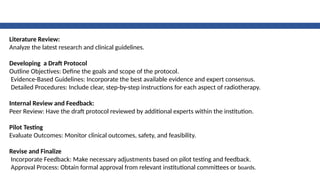
Literature Review:
Analyze the latest research and clinical guidelines.
Developing a Draft Protocol
Outline Objectives: Define the goals and scope of the protocol.
Evidence-Based Guidelines: Incorporate the best available evidence and expert consensus.
Detailed Procedures: Include clear, step-by-step instructions for each aspect of radiotherapy.
Internal Review and Feedback:
Peer Review: Have the draft protocol reviewed by additional experts within the institution.
Pilot Testing
Evaluate Outcomes: Monitor clinical outcomes, safety, and feasibility.
Revise and Finalize
Incorporate Feedback: Make necessary adjustments based on pilot testing and feedback.
Approval Process: Obtain formal approval from relevant institutional committees or boards.
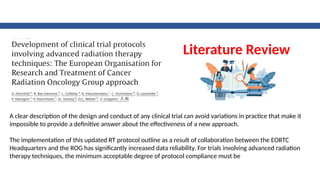
A clear description of the design and conduct of any clinical trial can avoid variations in practice that make it
impossible to provide a definitive answer about the effectiveness of a new approach.
The implementation of this updated RT protocol outline as a result of collaboration between the EORTC
Headquarters and the ROG has significantly increased data reliability. For trials involving advanced radiation
therapy techniques, the minimum acceptable degree of protocol compliance must be
Literature Review
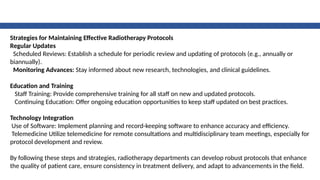
Strategies for Maintaining Effective Radiotherapy Protocols
Regular Updates
Scheduled Reviews: Establish a schedule for periodic review and updating of protocols (e.g., annually or
biannually).
Monitoring Advances: Stay informed about new research, technologies, and clinical guidelines.
Education and Training
Staff Training: Provide comprehensive training for all staff on new and updated protocols.
Continuing Education: Offer ongoing education opportunities to keep staff updated on best practices.
Technology Integration
Use of Software: Implement planning and record-keeping software to enhance accuracy and efficiency.
Telemedicine Utilize telemedicine for remote consultations and multidisciplinary team meetings, especially for
protocol development and review.
By following these steps and strategies, radiotherapy departments can develop robust protocols that enhance
the quality of patient care, ensure consistency in treatment delivery, and adapt to advancements in the field.
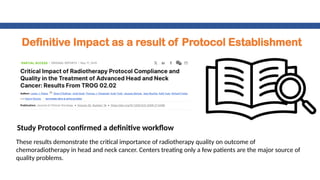
Definitive Impact as a result of Protocol Establishment
These results demonstrate the critical importance of radiotherapy quality on outcome of
chemoradiotherapy in head and neck cancer. Centers treating only a few patients are the major source of
quality problems.
Study Protocol confirmed a definitive workflow
In clinical trials, RT protocol deviations are associated with
increased risks of treatment failure and overall mortality.
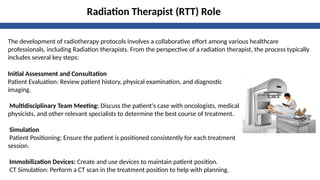
Radiation Therapist (RTT) Role
Initial Assessment and Consultation
Patient Evaluation: Review patient history, physical examination, and diagnostic
imaging.
Multidisciplinary Team Meeting: Discuss the patient's case with oncologists, medical
physicists, and other relevant specialists to determine the best course of treatment.
Simulation
Patient Positioning: Ensure the patient is positioned consistently for each treatment
session.
Immobilization Devices: Create and use devices to maintain patient position.
CT Simulation: Perform a CT scan in the treatment position to help with planning.
The development of radiotherapy protocols involves a collaborative effort among various healthcare
professionals, including Radiation therapists. From the perspective of a radiation therapist, the process typically
includes several key steps:
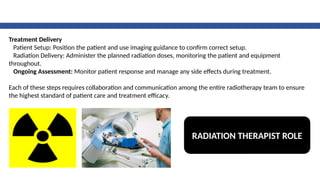
Treatment Delivery
Patient Setup: Position the patient and use imaging guidance to confirm correct setup.
Radiation Delivery: Administer the planned radiation doses, monitoring the patient and equipment
throughout.
Ongoing Assessment: Monitor patient response and manage any side effects during treatment.
Each of these steps requires collaboration and communication among the entire radiotherapy team to ensure
the highest standard of patient care and treatment efficacy.
RADIATION THERAPIST ROLE
Consistency and Standardization
Consistency and standardization in radiotherapy protocol development are crucial for
ensuring optimal patient outcomes and advancing clinical research.
These protocols establish uniform guidelines for treatment planning, dose delivery, and
quality assurance, minimizing variability across different treatment centers. By adhering to
standardized Radiotherapy protocol, Radiation Treatment impact can more accurately
compare and improve the reproducibility of studies.
Consistent protocols also enhance patient safety, as they reduce the risk of errors and
facilitate more effective communication among multidisciplinary teams. Overall,
standardization in radiotherapy protocols is key to delivering high-quality, evidence-based
care and advancing the field of oncology.
Ensures Uniformity in treatment delivery
Safety and Quality: Minimizes risks and enhances treatment efficacy.
Compliance: Meets regulatory and accreditation standards.
Assessment of Needs: Identify gaps and areas for improvement.
Literature Review: Utilize current research and guidelines.
Stakeholder Involvement: Collaborate with oncologists, physicists, therapists,
and nurses.
Drafting Protocols: Create detailed steps and procedures.
Protocol Development & Implementation
Implementation of Protocols
 Training and Education: Comprehensive training for all staff.
 Resource Allocation: Ensure necessary equipment and software.
 Process Integration: Incorporate protocols into daily practice.
 Monitoring and Support: Ongoing supervision and assistance.
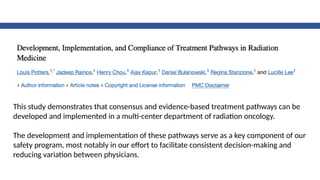
This study demonstrates that consensus and evidence-based treatment pathways can be
developed and implemented in a multi-center department of radiation oncology.
The development and implementation of these pathways serve as a key component of our
safety program, most notably in our effort to facilitate consistent decision-making and
reducing variation between physicians.
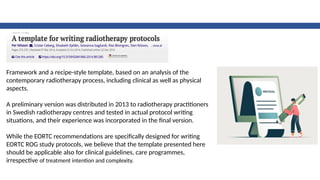
Framework and a recipe-style template, based on an analysis of the
contemporary radiotherapy process, including clinical as well as physical
aspects.
A preliminary version was distributed in 2013 to radiotherapy practitioners
in Swedish radiotherapy centres and tested in actual protocol writing
situations, and their experience was incorporated in the final version.
While the EORTC recommendations are specifically designed for writing
EORTC ROG study protocols, we believe that the template presented here
should be applicable also for clinical guidelines, care programmes,
irrespective of treatment intention and complexity.
Challenges in Protocol Implementation
Resistance to Change: Overcoming staff reluctance.
Resource Limitations: Budget constraints and equipment
availability.
Communication: Ensuring clear and consistent communication among the team.
Continuous Improvement: Adapting to new research and technologies.
Evaluation of Protocols
- Performance Metrics: Track adherence to protocols.
- Outcome Analysis: Assess treatment effectiveness and patient outcomes.
- Feedback Mechanisms: Collect feedback from staff and patients.
- Audit and Review: Regular audits and protocol reviews.
- Adjustments and Updates: Make necessary changes based on evaluation.
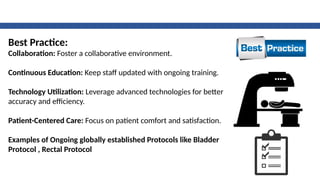
Best Practice:
Collaboration: Foster a collaborative environment.
Continuous Education: Keep staff updated with ongoing training.
Technology Utilization: Leverage advanced technologies for better
accuracy and efficiency.
Patient-Centered Care: Focus on patient comfort and satisfaction.
Examples of Ongoing globally established Protocols like Bladder
Protocol , Rectal Protocol
Measuring the Impact of Protocol /SOP,s
Measuring the impact of radiotherapy protocols is crucial to ensure they achieve desired outcomes, enhance patient safety,
and improve overall treatment efficacy. Here are key methods and metrics to evaluate the impact, By systematically
collecting and analyzing these metrics, radiotherapy departments can continuously improve their protocols, ensure high-
quality patient care, and adapt to advancements in the field.
Conclusions
Effective radiotherapy treatment, protocol development involves creating detailed, standardized procedures
based on the latest research and clinical guidelines. Implementation ensures these protocols are
consistently applied in clinical practice, involving training staff and integrating protocols into routine
workflows.
Evaluation involves monitoring treatment outcomes, patient safety, and overall efficacy through continuous
data collection and analysis. This process allows for the identification of areas needing improvement and the
incorporation of new best practices.
By refining techniques and protocols based on evaluation feedback, the approach aims
to enhance the precision, safety, and effectiveness of radiotherapy treatments for
patients.
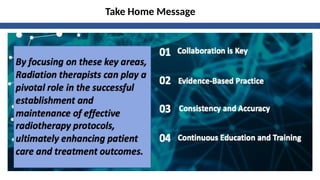
Take Home Message
Subscribe my N E W S L E T T E R by clicking below :
https://www.linkedin.com/build-relation/newsletter-follow?entityUrn=7029392078572826624
RADIOTHERAPY IN
Thank you for your Kind Attention
roysubrata217@gmail.com
“Faith is the bird
that sings when the
dawn is still dark.”
-Rabindranath
Tagore
+91-888-0860166
@iamSubrata_
Subrata Roy R.T.(T)

Protocol Development Implementation, and Evaluation in Effective Radiotherapy Treatment Delivery

  • 1.
    Protocol Development Implementation, andEvaluation in Effective Radiotherapy Treatment Delivery Subrata Roy Senior Radiation Therapist Hcg-Ics Khubchandani Cancer Centre ,Mumbai , India
  • 2.
     Introduction  Whatis Protocol  Importance of Protocols in Radiotherapy Department  Radiation Therapist Role  Consistency and Standardization  Protocol Development & Implementation  Measuring the Impact of Protocol /SOP,s  Conclusions  Take Home Message Flow of Presentation
  • 3.
    Introduction Well-specified and unambiguoustreatment protocols are essential both for current practice and for the future development of radiation therapy. In order to provide assistance for writing good protocols, irrespective of treatment intention and complexity, up-to-date guidelines are highly desirable. Protocol development, implementation, and evaluation in effective radiotherapy treatment involve creating standardized procedures, ensuring their consistent application, and assessing outcomes. This process enhances treatment precision, patient safety, and overall efficacy by continually refining techniques and incorporating best practices.
  • 4.
    What is Protocol KeyComponents of a Radiotherapy Protocol  Patient Selection Criteria: Eligibility and exclusion criteria.  Treatment Planning: Imaging, dosimetry, and simulation guidelines.  Delivery Techniques: IMRT, VMAT, SRS, etc.  Safety Measures: Verification and quality assurance checks.  Documentation and Reporting: Records of treatment and outcomes. In the context of Radiotherapy Treatment ,a protocol refers to a set of standardized guidelines and procedures that dictate how treatment should be planned, delivered, and evaluated. Protocols ensure consistency, safety, and efficacy in patient care. Protocols are developed based on clinical evidence, best practices, and expert consensus, and are used to guide the entire treatment process.
  • 5.
    Importance of Protocolsin Radiotherapy Steps and strategies involved in creating and maintaining effective Radiotherapy Protocols. Creating and maintaining effective radiotherapy protocols involves a systematic approach to ensure that they are evidence-based, up-to-date, and relevant to clinical practice. Here are the key steps and strategies involved: Steps to Create Radiotherapy Protocols Multidisciplinary Team Include Experts: Gather a team of Radiation Oncologists, Medical physicists, Dosimetrists, Radiation Therapists, RT Nursing and other relevant specialists. Define Roles: Clearly outline the responsibilities of each team member. Conduct a Needs Assessment Review Current Practices: Evaluate existing protocols and identify areas needing improvement.
  • 6.
    Literature Review: Analyze thelatest research and clinical guidelines. Developing a Draft Protocol Outline Objectives: Define the goals and scope of the protocol. Evidence-Based Guidelines: Incorporate the best available evidence and expert consensus. Detailed Procedures: Include clear, step-by-step instructions for each aspect of radiotherapy. Internal Review and Feedback: Peer Review: Have the draft protocol reviewed by additional experts within the institution. Pilot Testing Evaluate Outcomes: Monitor clinical outcomes, safety, and feasibility. Revise and Finalize Incorporate Feedback: Make necessary adjustments based on pilot testing and feedback. Approval Process: Obtain formal approval from relevant institutional committees or boards.
  • 7.
    A clear descriptionof the design and conduct of any clinical trial can avoid variations in practice that make it impossible to provide a definitive answer about the effectiveness of a new approach. The implementation of this updated RT protocol outline as a result of collaboration between the EORTC Headquarters and the ROG has significantly increased data reliability. For trials involving advanced radiation therapy techniques, the minimum acceptable degree of protocol compliance must be Literature Review
  • 8.
    Strategies for MaintainingEffective Radiotherapy Protocols Regular Updates Scheduled Reviews: Establish a schedule for periodic review and updating of protocols (e.g., annually or biannually). Monitoring Advances: Stay informed about new research, technologies, and clinical guidelines. Education and Training Staff Training: Provide comprehensive training for all staff on new and updated protocols. Continuing Education: Offer ongoing education opportunities to keep staff updated on best practices. Technology Integration Use of Software: Implement planning and record-keeping software to enhance accuracy and efficiency. Telemedicine Utilize telemedicine for remote consultations and multidisciplinary team meetings, especially for protocol development and review. By following these steps and strategies, radiotherapy departments can develop robust protocols that enhance the quality of patient care, ensure consistency in treatment delivery, and adapt to advancements in the field.
  • 9.
    Definitive Impact asa result of Protocol Establishment These results demonstrate the critical importance of radiotherapy quality on outcome of chemoradiotherapy in head and neck cancer. Centers treating only a few patients are the major source of quality problems. Study Protocol confirmed a definitive workflow
  • 10.
    In clinical trials,RT protocol deviations are associated with increased risks of treatment failure and overall mortality.
  • 11.
    Radiation Therapist (RTT)Role Initial Assessment and Consultation Patient Evaluation: Review patient history, physical examination, and diagnostic imaging. Multidisciplinary Team Meeting: Discuss the patient's case with oncologists, medical physicists, and other relevant specialists to determine the best course of treatment. Simulation Patient Positioning: Ensure the patient is positioned consistently for each treatment session. Immobilization Devices: Create and use devices to maintain patient position. CT Simulation: Perform a CT scan in the treatment position to help with planning. The development of radiotherapy protocols involves a collaborative effort among various healthcare professionals, including Radiation therapists. From the perspective of a radiation therapist, the process typically includes several key steps:
  • 12.
    Treatment Delivery Patient Setup:Position the patient and use imaging guidance to confirm correct setup. Radiation Delivery: Administer the planned radiation doses, monitoring the patient and equipment throughout. Ongoing Assessment: Monitor patient response and manage any side effects during treatment. Each of these steps requires collaboration and communication among the entire radiotherapy team to ensure the highest standard of patient care and treatment efficacy. RADIATION THERAPIST ROLE
  • 13.
    Consistency and Standardization Consistencyand standardization in radiotherapy protocol development are crucial for ensuring optimal patient outcomes and advancing clinical research. These protocols establish uniform guidelines for treatment planning, dose delivery, and quality assurance, minimizing variability across different treatment centers. By adhering to standardized Radiotherapy protocol, Radiation Treatment impact can more accurately compare and improve the reproducibility of studies. Consistent protocols also enhance patient safety, as they reduce the risk of errors and facilitate more effective communication among multidisciplinary teams. Overall, standardization in radiotherapy protocols is key to delivering high-quality, evidence-based care and advancing the field of oncology. Ensures Uniformity in treatment delivery Safety and Quality: Minimizes risks and enhances treatment efficacy. Compliance: Meets regulatory and accreditation standards.
  • 14.
    Assessment of Needs:Identify gaps and areas for improvement. Literature Review: Utilize current research and guidelines. Stakeholder Involvement: Collaborate with oncologists, physicists, therapists, and nurses. Drafting Protocols: Create detailed steps and procedures. Protocol Development & Implementation Implementation of Protocols  Training and Education: Comprehensive training for all staff.  Resource Allocation: Ensure necessary equipment and software.  Process Integration: Incorporate protocols into daily practice.  Monitoring and Support: Ongoing supervision and assistance.
  • 15.
    This study demonstratesthat consensus and evidence-based treatment pathways can be developed and implemented in a multi-center department of radiation oncology. The development and implementation of these pathways serve as a key component of our safety program, most notably in our effort to facilitate consistent decision-making and reducing variation between physicians.
  • 16.
    Framework and arecipe-style template, based on an analysis of the contemporary radiotherapy process, including clinical as well as physical aspects. A preliminary version was distributed in 2013 to radiotherapy practitioners in Swedish radiotherapy centres and tested in actual protocol writing situations, and their experience was incorporated in the final version. While the EORTC recommendations are specifically designed for writing EORTC ROG study protocols, we believe that the template presented here should be applicable also for clinical guidelines, care programmes, irrespective of treatment intention and complexity.
  • 17.
    Challenges in ProtocolImplementation Resistance to Change: Overcoming staff reluctance. Resource Limitations: Budget constraints and equipment availability. Communication: Ensuring clear and consistent communication among the team. Continuous Improvement: Adapting to new research and technologies. Evaluation of Protocols - Performance Metrics: Track adherence to protocols. - Outcome Analysis: Assess treatment effectiveness and patient outcomes. - Feedback Mechanisms: Collect feedback from staff and patients. - Audit and Review: Regular audits and protocol reviews. - Adjustments and Updates: Make necessary changes based on evaluation.
  • 18.
    Best Practice: Collaboration: Fostera collaborative environment. Continuous Education: Keep staff updated with ongoing training. Technology Utilization: Leverage advanced technologies for better accuracy and efficiency. Patient-Centered Care: Focus on patient comfort and satisfaction. Examples of Ongoing globally established Protocols like Bladder Protocol , Rectal Protocol
  • 19.
    Measuring the Impactof Protocol /SOP,s Measuring the impact of radiotherapy protocols is crucial to ensure they achieve desired outcomes, enhance patient safety, and improve overall treatment efficacy. Here are key methods and metrics to evaluate the impact, By systematically collecting and analyzing these metrics, radiotherapy departments can continuously improve their protocols, ensure high- quality patient care, and adapt to advancements in the field.
  • 20.
    Conclusions Effective radiotherapy treatment,protocol development involves creating detailed, standardized procedures based on the latest research and clinical guidelines. Implementation ensures these protocols are consistently applied in clinical practice, involving training staff and integrating protocols into routine workflows. Evaluation involves monitoring treatment outcomes, patient safety, and overall efficacy through continuous data collection and analysis. This process allows for the identification of areas needing improvement and the incorporation of new best practices. By refining techniques and protocols based on evaluation feedback, the approach aims to enhance the precision, safety, and effectiveness of radiotherapy treatments for patients.
  • 21.
  • 22.
    Subscribe my NE W S L E T T E R by clicking below : https://www.linkedin.com/build-relation/newsletter-follow?entityUrn=7029392078572826624 RADIOTHERAPY IN
  • 23.
    Thank you foryour Kind Attention roysubrata217@gmail.com “Faith is the bird that sings when the dawn is still dark.” -Rabindranath Tagore +91-888-0860166 @iamSubrata_ Subrata Roy R.T.(T)

Editor's Notes

  • #23 Thank You! Your support and participation are greatly appreciated. For further inquiries or discussions, please feel free to contact me.