LE
CORBUSIER
 INTRODUCTION
 EARLY LIFE
 PHILOSOPHY & QUOTES
 DESIGN PRINCIPLE
 WORKS
1. VILLA SAVOYE,POISSY,FRANCE 1931
2. UNITE D’ HABITATION
 CHANDIGARH
1.LOCATION AND HISTORY
 THE CAPITOL COMPLEX
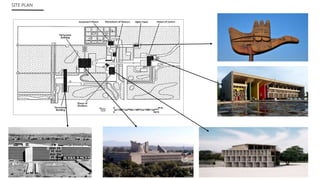
3.SITE PLAN
1.LEGISLATIVE ASSEMBLY
2.SECRETARIAT
3.HIGH COURT
CONTENT
 WORKS
2.PLANNING CONCEPT OF CHANDIGARH CITY
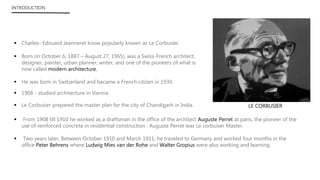
 Charles- Edouard Jeanneret know popularly known as Le Corbusier.
 Born on October 6, 1887 – August 27, 1965), was a Swiss-French architect,
designer, painter, urban planner, writer, and one of the pioneers of what is
now called modern architecture.
 He was born in Switzerland and became a French citizen in 1930.
 Le Corbusier prepared the master plan for the city of Chandigarh in India.
 From 1908 till 1910 he worked as a draftsman in the office of the architect Auguste Perret at paris, the pioneer of the
use of reinforced concrete in residential construction . Auguste Perret was Le corbuiser Master.
 Two years later, Between October 1910 and March 1911, he traveled to Germany and worked four months in the
office Peter Behrens where Ludwig Mies van der Rohe and Walter Gropius were also working and learning.
INTRODUCTION
LE CORBUSIER
 1908 - studied architecture in Vienna.
 Charles-Edouard Jeanneret was born on October 6, 1887 in La Chaux-de- Fonds , a small city in the France. It was an
industrial town, devoted to the manufacture of watches.
 His father was an artisan who enameled boxes and watches, while his mother gave piano lessons. His elder brother
Albert was an amateur violinist.
 Like his contemporaries Frank Lloyd Wright and Mies van der Rohe , Le Corbusier did not have formal academic
training as an architect. He was attracted to the visual arts and at the age of fifteen he entered the municipal art
school .
 Three years later he attended the higher course of decoration, founded by the painter Charles L E plattenier.
LEplattenier taught him painting from nature.
 His architecture teacher in the Art School was the architect Rene Chapallaz, who had a large influence on Le
Corbusier's earliest house designs. However, he reported later that it was the art teacher L Eplattenier who made him
choose architecture.
EARLY LIFE
PHILOSOPHY
MODULAR
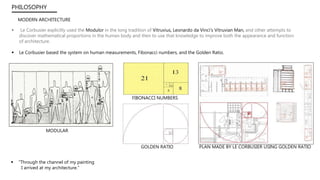
 Le Corbusier explicitly used the Modulor in the long tradition of Vitruvius, Leonardo da Vinci's Vitruvian Man, and other attempts to
discover mathematical proportions in the human body and then to use that knowledge to improve both the appearance and function
of architecture.
 Le Corbusier based the system on human measurements, Fibonacci numbers, and the Golden Ratio.
MODERN ARCHITECTURE
FIBONACCI NUMBERS
GOLDEN RATIO PLAN MADE BY LE CORBUSIER USING GOLDEN RATIO
 “Through the channel of my painting
I arrived at my architecture.”
• 1923: Villa La Roche, Paris
• 1925: Villa Jeanneret, Paris
• 1928: Villa Savoye, Poissy- sur -Seine, France
• 1947–1952: Unité d'Habitation, Marseille, France
• 1949–1952: United Nations headquarters, New York City (Consultant)
• 1950–1954: Chapelle Notre Dame du Haut, Ronchamp, France
• 1951: Buildings in Ahmedabad, India
1951: Sanskar Kendra Museum, Ahmedabad
1951: ATMA House
1951: Villa Sarabhai, Ahmedabad
1951: Villa Shodhan, Ahmedabad
1951: Villa of Chinubhai Chimanlal, Ahmedabad
• 1952–1959: Buildings in Chandigarh, India
1952: Palace of Justice
1952: Museum and Gallery of Art
1953: Secretariat Building
1953: Governor's Palace
1955: Palace of Assembly
1959: Government College of Art (GCA) and the Chandigarh College of Architecture(CCA)
• 1962: Carpenter Center for the Visual Arts at Harvard University, Cambridge, Massachusetts
WORKS
DESIGN IDEOLOGY
 THE PILOTIS
 ROOF GARDEN
 FREE FLOOR PLAN
 ELONGATED WINDOW
 FREE FACADE
DESIGN PRINCIPLE
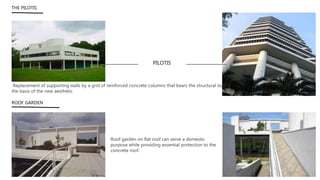
THE PILOTIS
PILOTIS
ROOF GARDEN
Replacement of supporting walls by a grid of reinforced concrete columns that bears the structural load is
the basis of the new aesthetic
Roof garden on flat roof can serve a domestic
purpose while providing essential protection to the
concrete roof.
FREE FLOOR PLAN
The free designing of the ground plan—the absence of supporting walls—means the house is unrestrained in its internal use.
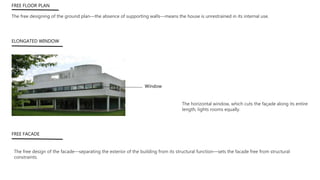
ELONGATED WINDOW
Window
The horizontal window, which cuts the façade along its entire
length, lights rooms equally.
FREE FACADE
The free design of the facade—separating the exterior of the building from its structural function—sets the facade free from structural
constraints.
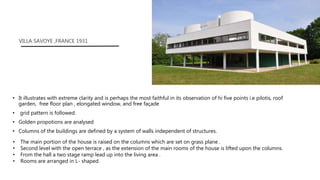
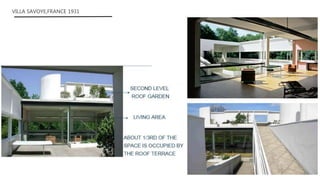
• It illustrates with extreme clarity and is perhaps the most faithful in its observation of hi five points i.e pilotis, roof
garden, free floor plan , elongated window, and free façade
• grid pattern is followed.
• Golden propotions are analysed
• Columns of the buildings are defined by a system of walls independent of structures.
VILLA SAVOYE ,FRANCE 1931
• The main portion of the house is raised on the columns which are set on grass plane .
• Second level with the open terrace , as the extension of the main rooms of the house is lifted upon the columns.
• From the hall a two stage ramp lead up into the living area .
• Rooms are arranged in L- shaped.
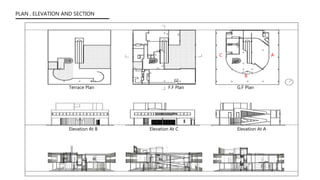
PLAN , ELEVATION AND SECTION
G.F PlanF.F PlanTerrace Plan
A
B
C
Elevation At AElevation At CElevation At B
VILLA SAVOYE,FRANCE 1931
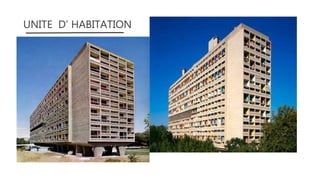
UNITE D’ HABITATION
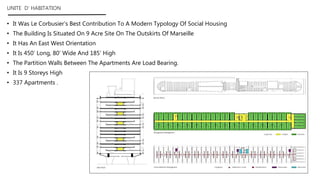
• It Was Le Corbusier’s Best Contribution To A Modern Typology Of Social Housing
• The Building Is Situated On 9 Acre Site On The Outskirts Of Marseille
• It Has An East West Orientation
• It Is 450’ Long, 80’ Wide And 185’ High
• The Partition Walls Between The Apartments Are Load Bearing.
• It Is 9 Storeys High
• 337 Apartments .
UNITE D’ HABITATION
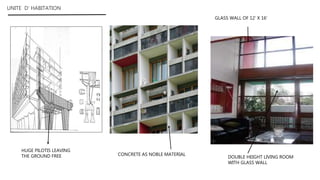
HUGE PILOTIS LEAVING
THE GROUND FREE DOUBLE HEIGHT LIVING ROOM
WITH GLASS WALL
GLASS WALL OF 12’ X 16’
CONCRETE AS NOBLE MATERIAL
UNITE D’ HABITATION
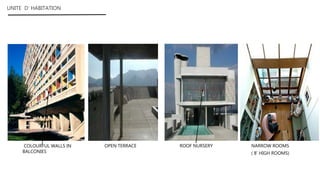
COLOURFUL WALLS IN
BALCONIES
ROOF NURSERY NARROW ROOMS
( 8’ HIGH ROOMS)
OPEN TERRACE
UNITE D’ HABITATION
LE CORBUSIER
CHANDIGARH
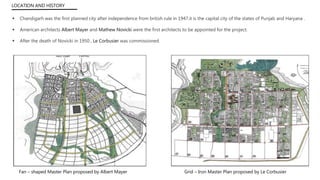
 Chandigarh was the first planned city after independence from british rule in 1947.it is the capital city of the states of Punjab and Haryana .
 American architects Albert Mayer and Mathew Novicki were the first architects to be appointed for the project.
 After the death of Novicki in 1950 , Le Corbusier was commissioned.
Fan – shaped Master Plan proposed by Albert Mayer Grid – Iron Master Plan proposed by Le Corbusier
LOCATION AND HISTORY
PLANNING CONCEPT OF CHANDIGARH CITY
Le Corbusier conceived the master plan of Chandigarh as analogous to human body, with a clearly defined -
 Head – Capitol Complex (sector 1)
 Heart – The City Centre( sector 17)
 Limb – Industrial Area
 Lungs – Leisure Valley , Open Spaces
 Arteries – Network Of Roads
 Intellect ( mind , brain ) - The Cultural And Educational Institutions
The concept of the city based on four major functions :-
• Living( residential sector)
• Working( capitol complex, city centre
educational and industrial area)
• Care of a body and spirit( leisure valley , open spaces )
• Circulation( different types of roads known as 7V)
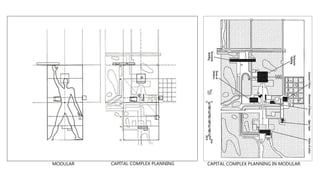
CAPITAL COMPLEX PLANNING CAPITAL COMPLEX PLANNING IN MODULARMODULAR
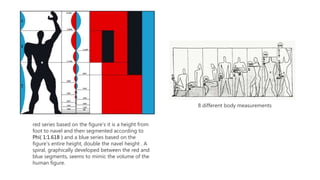
red series based on the figure's it is a height from
foot to navel and then segmented according to
Phi( 1:1.618 ) and a blue series based on the
figure's entire height, double the navel height . A
spiral, graphically developed between the red and
blue segments, seems to mimic the volume of the
human figure.
8 different body measurements
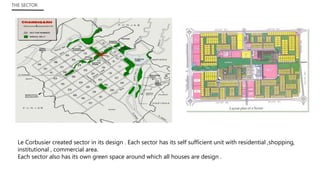
Le Corbusier created sector in its design . Each sector has its self sufficient unit with residential ,shopping,
institutional , commercial area.
Each sector also has its own green space around which all houses are design .
THE SECTOR
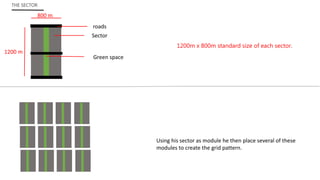
800 m
1200 m
Sector
Green space
1200m x 800m standard size of each sector.
Using his sector as module he then place several of these
modules to create the grid pattern.
roads
THE SECTOR
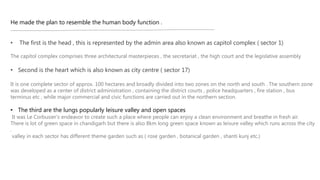
He made the plan to resemble the human body function .
• The first is the head , this is represented by the admin area also known as capitol complex ( sector 1)
The capitol complex comprises three architectural masterpieces , the secretariat , the high court and the legislative assembly
• Second is the heart which is also known as city centre ( sector 17)
It is one complete sector of approx. 100 hectares and broadly divided into two zones on the north and south . The southern zone
was developed as a center of district administration , containing the district courts , police headquarters , fire station , bus
terminus etc , while major commercial and civic functions are carried out in the northern section.
• The third are the lungs popularly leisure valley and open spaces
It was Le Corbusier’s endeavor to create such a place where people can enjoy a clean environment and breathe in fresh air.
There is lot of green space in chandigarh but there is also 8km long green space known as leisure valley which runs across the city
.
valley in each sector has different theme garden such as ( rose garden , botanical garden , shanti kunj etc.)
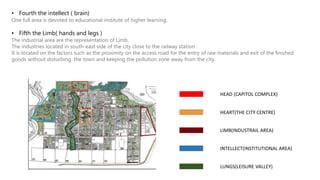
• Fourth the intellect ( brain)
One full area is devoted to educational institute of higher learning.
• Fifth the Limb( hands and legs )
The industrial area are the representation of Limb.
The industries located in south-east side of the city close to the railway station .
It is located on the factors such as the proximity on the access road for the entry of raw materials and exit of the finished
goods without disturbing the town and keeping the pollution zone away from the city.
HEAD (CAPITOL COMPLEX)
HEART(THE CITY CENTRE)
LIMB(INDUSTRAIL AREA)
INTELLECT(INSTITUTIONAL AREA)
LUNGS(LEISURE VALLEY)
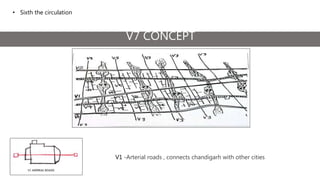
• Sixth the circulation
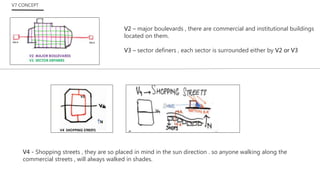
V7 CONCEPT
V1 -Arterial roads , connects chandigarh with other cities
V2 – major boulevards , there are commercial and institutional buildings
located on them.
V3 – sector definers , each sector is surrounded either by V2 or V3
V4 - Shopping streets , they are so placed in mind in the sun direction . so anyone walking along the
commercial streets , will always walked in shades.
V7 CONCEPT
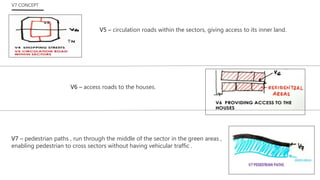
V5 – circulation roads within the sectors, giving access to its inner land.
V6 – access roads to the houses.
V7 – pedestrian paths , run through the middle of the sector in the green areas ,
enabling pedestrian to cross sectors without having vehicular traffic .
V7 CONCEPT
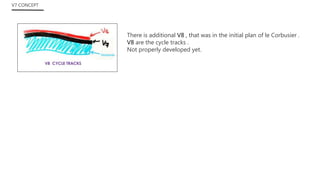
There is additional V8 , that was in the initial plan of le Corbusier .
V8 are the cycle tracks .
Not properly developed yet.
V7 CONCEPT
HOUSING
• The residential buildings were governed by a mechanism known as ‘frame control’ created by the municipal
administration to control their facades.
• They fixed the building line and height and the use of the building materials.
• Standard sizes of doors and windows are specified .
• The idea was to ensure that the view from the street , which belonged to the community , was of same visual
order and discipline to maintain uniformity.
CAPITOL COMPLEX
SITE PLAN
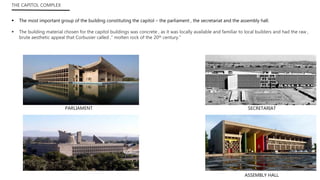
THE CAPITOL COMPLEX
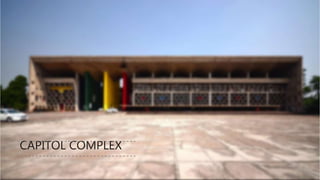
 The most important group of the building constituting the capitol – the parliament , the secretariat and the assembly hall.
 The building material chosen for the capitol buildings was concrete , as it was locally available and familiar to local builders and had the raw ,
brute aesthetic appeal that Corbusier called ,” molten rock of the 20th century.”
ASSEMBLY HALL
SECRETARIATPARLIAMENT
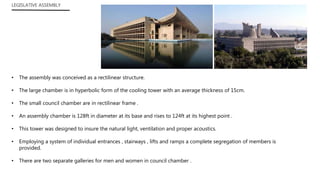
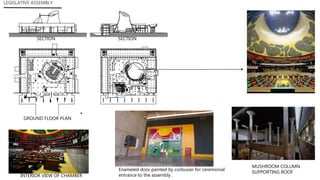
LEGISLATIVE ASSEMBLY
• The assembly was conceived as a rectilinear structure.
• The large chamber is in hyperbolic form of the cooling tower with an average thickness of 15cm.
• The small council chamber are in rectilinear frame .
• An assembly chamber is 128ft in diameter at its base and rises to 124ft at its highest point .
• This tower was designed to insure the natural light, ventilation and proper acoustics.
• Employing a system of individual entrances , stairways , lifts and ramps a complete segregation of members is
provided.
• There are two separate galleries for men and women in council chamber .
SECTION
GROUND FLOOR PLAN
SECTION
MUSHROOM COLUMN
SUPPORTING ROOF
INTERIOR VIEW OF CHAMBER
Enameled door painted by corbusier for ceremonial
entrance to the assembly .
LEGISLATIVE ASSEMBLY
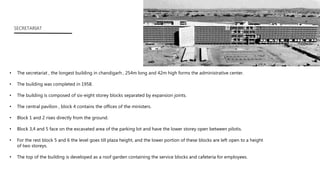
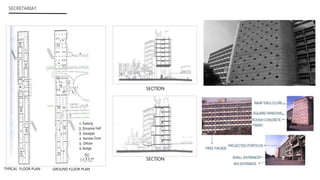
• The secretariat , the longest building in chandigarh , 254m long and 42m high forms the administrative center.
• The building was completed in 1958.
• The building is composed of six-eight storey blocks separated by expansion joints.
• The central pavilion , block 4 contains the offices of the ministers.
• Block 1 and 2 rises directly from the ground.
• Block 3,4 and 5 face on the excavated area of the parking lot and have the lower storey open between pilotis.
• For the rest block 5 and 6 the level goes till plaza height, and the lower portion of these blocks are left open to a height
of two storeys.
• The top of the building is developed as a roof garden containing the service blocks and cafeteria for employees.
SECRETARIAT
GROUND FLOOR PLAN
SECTION
SECTION
TYPICAL FLOOR PLAN
SECRETARIAT
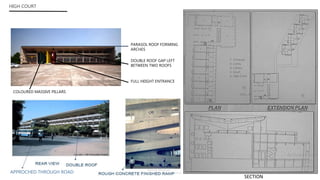
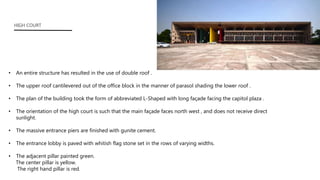
• An entire structure has resulted in the use of double roof .
• The upper roof cantilevered out of the office block in the manner of parasol shading the lower roof .
• The plan of the building took the form of abbreviated L-Shaped with long façade facing the capitol plaza .
• The orientation of the high court is such that the main façade faces north west , and does not receive direct
sunlight.
• The massive entrance piers are finished with gunite cement.
• The entrance lobby is paved with whitish flag stone set in the rows of varying widths.
• The adjacent pillar painted green.
The center pillar is yellow.
The right hand pillar is red.
HIGH COURT
COLOURED MASSIVE PILLARS
DOUBLE ROOF GAP LEFT
BETWEEN TWO ROOFS
PARASOL ROOF FORMING
ARCHES
FULL HEIGHT ENTRANCE
APPROCHED THROUGH ROAD
SECTION
HIGH COURT

Le Corbusier

  • 1.
  • 2.
     INTRODUCTION  EARLYLIFE  PHILOSOPHY & QUOTES  DESIGN PRINCIPLE  WORKS 1. VILLA SAVOYE,POISSY,FRANCE 1931 2. UNITE D’ HABITATION  CHANDIGARH 1.LOCATION AND HISTORY  THE CAPITOL COMPLEX 3.SITE PLAN 1.LEGISLATIVE ASSEMBLY 2.SECRETARIAT 3.HIGH COURT CONTENT  WORKS 2.PLANNING CONCEPT OF CHANDIGARH CITY
  • 3.
     Charles- EdouardJeanneret know popularly known as Le Corbusier.  Born on October 6, 1887 – August 27, 1965), was a Swiss-French architect, designer, painter, urban planner, writer, and one of the pioneers of what is now called modern architecture.  He was born in Switzerland and became a French citizen in 1930.  Le Corbusier prepared the master plan for the city of Chandigarh in India.  From 1908 till 1910 he worked as a draftsman in the office of the architect Auguste Perret at paris, the pioneer of the use of reinforced concrete in residential construction . Auguste Perret was Le corbuiser Master.  Two years later, Between October 1910 and March 1911, he traveled to Germany and worked four months in the office Peter Behrens where Ludwig Mies van der Rohe and Walter Gropius were also working and learning. INTRODUCTION LE CORBUSIER  1908 - studied architecture in Vienna.
  • 4.
     Charles-Edouard Jeanneretwas born on October 6, 1887 in La Chaux-de- Fonds , a small city in the France. It was an industrial town, devoted to the manufacture of watches.  His father was an artisan who enameled boxes and watches, while his mother gave piano lessons. His elder brother Albert was an amateur violinist.  Like his contemporaries Frank Lloyd Wright and Mies van der Rohe , Le Corbusier did not have formal academic training as an architect. He was attracted to the visual arts and at the age of fifteen he entered the municipal art school .  Three years later he attended the higher course of decoration, founded by the painter Charles L E plattenier. LEplattenier taught him painting from nature.  His architecture teacher in the Art School was the architect Rene Chapallaz, who had a large influence on Le Corbusier's earliest house designs. However, he reported later that it was the art teacher L Eplattenier who made him choose architecture. EARLY LIFE
  • 5.
    PHILOSOPHY MODULAR  Le Corbusierexplicitly used the Modulor in the long tradition of Vitruvius, Leonardo da Vinci's Vitruvian Man, and other attempts to discover mathematical proportions in the human body and then to use that knowledge to improve both the appearance and function of architecture.  Le Corbusier based the system on human measurements, Fibonacci numbers, and the Golden Ratio. MODERN ARCHITECTURE FIBONACCI NUMBERS GOLDEN RATIO PLAN MADE BY LE CORBUSIER USING GOLDEN RATIO  “Through the channel of my painting I arrived at my architecture.”
  • 6.
    • 1923: VillaLa Roche, Paris • 1925: Villa Jeanneret, Paris • 1928: Villa Savoye, Poissy- sur -Seine, France • 1947–1952: Unité d'Habitation, Marseille, France • 1949–1952: United Nations headquarters, New York City (Consultant) • 1950–1954: Chapelle Notre Dame du Haut, Ronchamp, France • 1951: Buildings in Ahmedabad, India 1951: Sanskar Kendra Museum, Ahmedabad 1951: ATMA House 1951: Villa Sarabhai, Ahmedabad 1951: Villa Shodhan, Ahmedabad 1951: Villa of Chinubhai Chimanlal, Ahmedabad • 1952–1959: Buildings in Chandigarh, India 1952: Palace of Justice 1952: Museum and Gallery of Art 1953: Secretariat Building 1953: Governor's Palace 1955: Palace of Assembly 1959: Government College of Art (GCA) and the Chandigarh College of Architecture(CCA) • 1962: Carpenter Center for the Visual Arts at Harvard University, Cambridge, Massachusetts WORKS
  • 7.
    DESIGN IDEOLOGY  THEPILOTIS  ROOF GARDEN  FREE FLOOR PLAN  ELONGATED WINDOW  FREE FACADE DESIGN PRINCIPLE
  • 8.
    THE PILOTIS PILOTIS ROOF GARDEN Replacementof supporting walls by a grid of reinforced concrete columns that bears the structural load is the basis of the new aesthetic Roof garden on flat roof can serve a domestic purpose while providing essential protection to the concrete roof.
  • 9.
    FREE FLOOR PLAN Thefree designing of the ground plan—the absence of supporting walls—means the house is unrestrained in its internal use. ELONGATED WINDOW Window The horizontal window, which cuts the façade along its entire length, lights rooms equally. FREE FACADE The free design of the facade—separating the exterior of the building from its structural function—sets the facade free from structural constraints.
  • 10.
    • It illustrateswith extreme clarity and is perhaps the most faithful in its observation of hi five points i.e pilotis, roof garden, free floor plan , elongated window, and free façade • grid pattern is followed. • Golden propotions are analysed • Columns of the buildings are defined by a system of walls independent of structures. VILLA SAVOYE ,FRANCE 1931 • The main portion of the house is raised on the columns which are set on grass plane . • Second level with the open terrace , as the extension of the main rooms of the house is lifted upon the columns. • From the hall a two stage ramp lead up into the living area . • Rooms are arranged in L- shaped.
  • 11.
    PLAN , ELEVATIONAND SECTION G.F PlanF.F PlanTerrace Plan A B C Elevation At AElevation At CElevation At B
  • 12.
  • 13.
  • 14.
    • It WasLe Corbusier’s Best Contribution To A Modern Typology Of Social Housing • The Building Is Situated On 9 Acre Site On The Outskirts Of Marseille • It Has An East West Orientation • It Is 450’ Long, 80’ Wide And 185’ High • The Partition Walls Between The Apartments Are Load Bearing. • It Is 9 Storeys High • 337 Apartments . UNITE D’ HABITATION
  • 15.
    HUGE PILOTIS LEAVING THEGROUND FREE DOUBLE HEIGHT LIVING ROOM WITH GLASS WALL GLASS WALL OF 12’ X 16’ CONCRETE AS NOBLE MATERIAL UNITE D’ HABITATION
  • 16.
    COLOURFUL WALLS IN BALCONIES ROOFNURSERY NARROW ROOMS ( 8’ HIGH ROOMS) OPEN TERRACE UNITE D’ HABITATION
  • 17.
  • 18.
     Chandigarh wasthe first planned city after independence from british rule in 1947.it is the capital city of the states of Punjab and Haryana .  American architects Albert Mayer and Mathew Novicki were the first architects to be appointed for the project.  After the death of Novicki in 1950 , Le Corbusier was commissioned. Fan – shaped Master Plan proposed by Albert Mayer Grid – Iron Master Plan proposed by Le Corbusier LOCATION AND HISTORY
  • 19.
    PLANNING CONCEPT OFCHANDIGARH CITY Le Corbusier conceived the master plan of Chandigarh as analogous to human body, with a clearly defined -  Head – Capitol Complex (sector 1)  Heart – The City Centre( sector 17)  Limb – Industrial Area  Lungs – Leisure Valley , Open Spaces  Arteries – Network Of Roads  Intellect ( mind , brain ) - The Cultural And Educational Institutions The concept of the city based on four major functions :- • Living( residential sector) • Working( capitol complex, city centre educational and industrial area) • Care of a body and spirit( leisure valley , open spaces ) • Circulation( different types of roads known as 7V)
  • 20.
    CAPITAL COMPLEX PLANNINGCAPITAL COMPLEX PLANNING IN MODULARMODULAR
  • 21.
    red series basedon the figure's it is a height from foot to navel and then segmented according to Phi( 1:1.618 ) and a blue series based on the figure's entire height, double the navel height . A spiral, graphically developed between the red and blue segments, seems to mimic the volume of the human figure. 8 different body measurements
  • 22.
    Le Corbusier createdsector in its design . Each sector has its self sufficient unit with residential ,shopping, institutional , commercial area. Each sector also has its own green space around which all houses are design . THE SECTOR
  • 23.
    800 m 1200 m Sector Greenspace 1200m x 800m standard size of each sector. Using his sector as module he then place several of these modules to create the grid pattern. roads THE SECTOR
  • 24.
    He made theplan to resemble the human body function . • The first is the head , this is represented by the admin area also known as capitol complex ( sector 1) The capitol complex comprises three architectural masterpieces , the secretariat , the high court and the legislative assembly • Second is the heart which is also known as city centre ( sector 17) It is one complete sector of approx. 100 hectares and broadly divided into two zones on the north and south . The southern zone was developed as a center of district administration , containing the district courts , police headquarters , fire station , bus terminus etc , while major commercial and civic functions are carried out in the northern section. • The third are the lungs popularly leisure valley and open spaces It was Le Corbusier’s endeavor to create such a place where people can enjoy a clean environment and breathe in fresh air. There is lot of green space in chandigarh but there is also 8km long green space known as leisure valley which runs across the city . valley in each sector has different theme garden such as ( rose garden , botanical garden , shanti kunj etc.)
  • 25.
    • Fourth theintellect ( brain) One full area is devoted to educational institute of higher learning. • Fifth the Limb( hands and legs ) The industrial area are the representation of Limb. The industries located in south-east side of the city close to the railway station . It is located on the factors such as the proximity on the access road for the entry of raw materials and exit of the finished goods without disturbing the town and keeping the pollution zone away from the city. HEAD (CAPITOL COMPLEX) HEART(THE CITY CENTRE) LIMB(INDUSTRAIL AREA) INTELLECT(INSTITUTIONAL AREA) LUNGS(LEISURE VALLEY)
  • 26.
    • Sixth thecirculation V7 CONCEPT V1 -Arterial roads , connects chandigarh with other cities
  • 27.
    V2 – majorboulevards , there are commercial and institutional buildings located on them. V3 – sector definers , each sector is surrounded either by V2 or V3 V4 - Shopping streets , they are so placed in mind in the sun direction . so anyone walking along the commercial streets , will always walked in shades. V7 CONCEPT
  • 28.
    V5 – circulationroads within the sectors, giving access to its inner land. V6 – access roads to the houses. V7 – pedestrian paths , run through the middle of the sector in the green areas , enabling pedestrian to cross sectors without having vehicular traffic . V7 CONCEPT
  • 29.
    There is additionalV8 , that was in the initial plan of le Corbusier . V8 are the cycle tracks . Not properly developed yet. V7 CONCEPT
  • 30.
    HOUSING • The residentialbuildings were governed by a mechanism known as ‘frame control’ created by the municipal administration to control their facades. • They fixed the building line and height and the use of the building materials. • Standard sizes of doors and windows are specified . • The idea was to ensure that the view from the street , which belonged to the community , was of same visual order and discipline to maintain uniformity.
  • 31.
  • 32.
  • 33.
    THE CAPITOL COMPLEX The most important group of the building constituting the capitol – the parliament , the secretariat and the assembly hall.  The building material chosen for the capitol buildings was concrete , as it was locally available and familiar to local builders and had the raw , brute aesthetic appeal that Corbusier called ,” molten rock of the 20th century.” ASSEMBLY HALL SECRETARIATPARLIAMENT
  • 34.
    LEGISLATIVE ASSEMBLY • Theassembly was conceived as a rectilinear structure. • The large chamber is in hyperbolic form of the cooling tower with an average thickness of 15cm. • The small council chamber are in rectilinear frame . • An assembly chamber is 128ft in diameter at its base and rises to 124ft at its highest point . • This tower was designed to insure the natural light, ventilation and proper acoustics. • Employing a system of individual entrances , stairways , lifts and ramps a complete segregation of members is provided. • There are two separate galleries for men and women in council chamber .
  • 35.
    SECTION GROUND FLOOR PLAN SECTION MUSHROOMCOLUMN SUPPORTING ROOF INTERIOR VIEW OF CHAMBER Enameled door painted by corbusier for ceremonial entrance to the assembly . LEGISLATIVE ASSEMBLY
  • 36.
    • The secretariat, the longest building in chandigarh , 254m long and 42m high forms the administrative center. • The building was completed in 1958. • The building is composed of six-eight storey blocks separated by expansion joints. • The central pavilion , block 4 contains the offices of the ministers. • Block 1 and 2 rises directly from the ground. • Block 3,4 and 5 face on the excavated area of the parking lot and have the lower storey open between pilotis. • For the rest block 5 and 6 the level goes till plaza height, and the lower portion of these blocks are left open to a height of two storeys. • The top of the building is developed as a roof garden containing the service blocks and cafeteria for employees. SECRETARIAT
  • 37.
  • 38.
    • An entirestructure has resulted in the use of double roof . • The upper roof cantilevered out of the office block in the manner of parasol shading the lower roof . • The plan of the building took the form of abbreviated L-Shaped with long façade facing the capitol plaza . • The orientation of the high court is such that the main façade faces north west , and does not receive direct sunlight. • The massive entrance piers are finished with gunite cement. • The entrance lobby is paved with whitish flag stone set in the rows of varying widths. • The adjacent pillar painted green. The center pillar is yellow. The right hand pillar is red. HIGH COURT
  • 39.
    COLOURED MASSIVE PILLARS DOUBLEROOF GAP LEFT BETWEEN TWO ROOFS PARASOL ROOF FORMING ARCHES FULL HEIGHT ENTRANCE APPROCHED THROUGH ROAD SECTION HIGH COURT