LE CORBUSIER
ARCHITECT AND HIS WORKS
NABANITA SASMAL
IIESTS,2021APB012
INTRODUCTION
LECORBUSIER, whose real name was Charles-
Édouard Jeanneret-Gris, was a Swiss-French architect,
urban planner, painter, writer, and one of the pioneers of
modern architecture. He was born on October 6, 1887, in
La Chaux-de-Fonds, a city in the Neuchâtel canton of
Switzerland, and he passed away on August 27, 1965, in
Roquebrune-Cap-Martin, France.
• Early Life:
Le Corbusier was born into a family of watch engravers in
Switzerland.
He began studying at the École d'Art at La Chaux-de-
Fonds at the age of 13, where he learned art, decoration,
and enameling. Architectural Education:
•In 1907, he moved to Paris and worked in the office of
Auguste Perret, a pioneer in reinforced concrete
construction.
•Le Corbusier also studied architecture at the École des
Beaux-Arts and later under the architect Peter Behrens in
Germany.
NABANITA SASMAL
FIVE POINTS OF ARCHITECTURE:
PILOTIS:
A grid of slim reinforced concrete pylons that
assume the structural weight of a building
FREE DESIGN OF THE GROUND PLAN:
The absence of load-bearing partition walls affords
greater flexibility in design and use of living spaces
FREE DESIGN OF THE FAÇADE:
Allowing the façade to be unrestrained, lighter,
more open.
HORIZONTAL WINDOW:
Ribboned windows run alongside the façade’s
length, lighting rooms equally, while increasing
sense of space and seclusion
ROOF GARDEN:
Flat roofs with garden terraces serve both harmonic
and domestic utility, providing natural layers of
insulation to the concrete roof and creating space.
This five point of architecture give a new way of
formation of building called international style.
NABANITA SASMAL
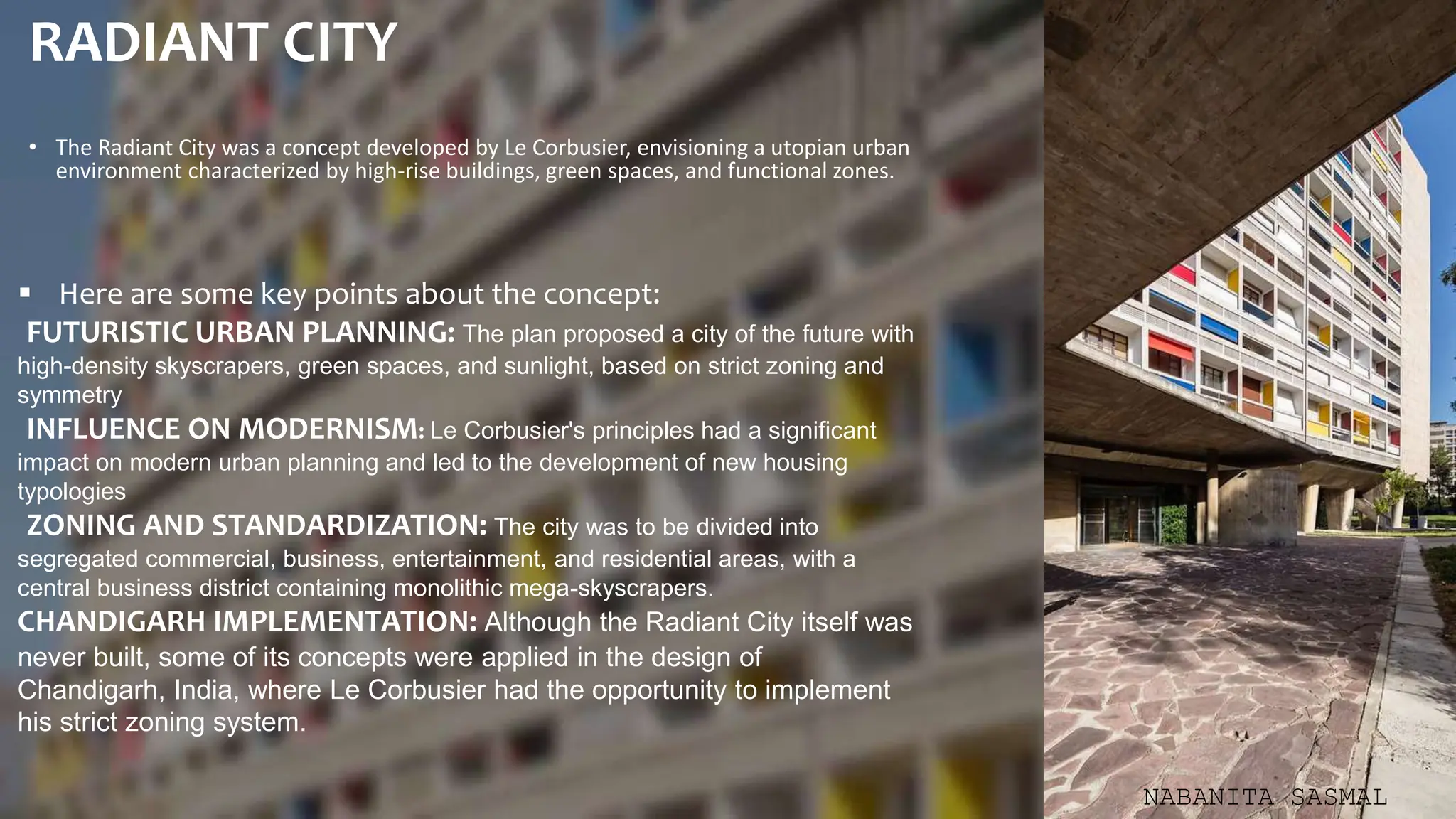
RADIANT CITY
• The Radiant City was a concept developed by Le Corbusier, envisioning a utopian urban
environment characterized by high-rise buildings, green spaces, and functional zones.
 Here are some key points about the concept:
FUTURISTIC URBAN PLANNING: The plan proposed a city of the future with
high-density skyscrapers, green spaces, and sunlight, based on strict zoning and
symmetry
INFLUENCE ON MODERNISM: Le Corbusier's principles had a significant
impact on modern urban planning and led to the development of new housing
typologies
ZONING AND STANDARDIZATION: The city was to be divided into
segregated commercial, business, entertainment, and residential areas, with a
central business district containing monolithic mega-skyscrapers.
CHANDIGARH IMPLEMENTATION: Although the Radiant City itself was
never built, some of its concepts were applied in the design of
Chandigarh, India, where Le Corbusier had the opportunity to implement
his strict zoning system.
NABANITA SASMAL
HIS INDIA’S WORK
Villa Shodhan
Villa Shodhan Ahmedabad 1956
Sanskar Kendra
Museum
Ahmedabad 1956
Palace Of Justice /
High Court
Chandigarh 1959
Museum And Art
Gallery
Chandigarh 1968
Sanskar Kendra
Museum
Palace Of Justice
/ High Court
Museum And Art
Gallery
NABANITA SASMAL
Why I Think He Is The Best Architect For Me:
Le Corbusier's work is highly regarded by architecture students and professionals alike for several reasons that align with the
well-being of human beings:
 Innovative Design: particularly his Five Points of Architecture, introduced new concepts such as pilotis, free façade, and
roof gardens that revolutionized modern architecture.
 Functionality and Efficiency: Le Corbusier emphasized functionality and efficiency in his buildings, which has helped
create more energy-efficient and environmentally friendly structures.
 Human-Centric Approach: His Modular system, based on the human scale, ensures that buildings are comfortable and
accessible for individuals of all sizes.
 Integration with Nature: Le Corbusier emphasized space, light, and greenery, designing buildings to harmonize with their
surroundings and the local climate.
 Cultural Impact: In India, for example, his work brought a new perspective to public buildings, combining minimalism
with vibrant colors and rigorous geometric forms, reflecting a modern India.
Le Corbusier’s principles continue to shape the future of sustainable architecture and urban development, making his work
relevant and beneficial for human beings and the environment.
NABANITA SASMAL
As Architecture Students We Always Think About A Easy To Live A Habitation
Place , Where All People Can Stay In One Building Cause ,Our Work Built-up
Building And Same Time Our Duty To Save Nature And Think About Future
Generation, So That Any One Can Live In This World Easily.
As I Told Before Le Corbusier Keep A Great Balance In His Work As Well As
Environment.
He Successfully Thought About Poor And Middle Class Families After 2nd World
War Like F L Wright Think About Broadacare City As Same He Create Radiant
City .
This City Concept Like Vertical City .. Vertically Stacking House And Create A
Complex Where Present 10 M Wide Way For Vehicular Access . And Some House
Of Disguise . And One Common Balcony . In A Vertical City He Placed All Useful
Place Like School , Bank Etc. And This Also Take So Much Less Place.
NABANITA SASMAL
Modernist Pioneer: Le Corbusier was a key figure in the modernist movement,
advocating for a departure from traditional architectural styles and embracing new
materials, technologies, and functionalist principles
Versatility in Design: Le Corbusier worked on a diverse range of projects, including
residential buildings, public buildings, and urban planning. His versatility showcased his
ability to apply modernist principles to various contexts.
Innovative Use of Materials: He was known for his innovative use of materials, including
the use of reinforced concrete. Le Corbusier explored the aesthetic and structural
possibilities of materials in his designs.
Urban Planning Theories: Le Corbusier developed influential theories on urban
planning, such as the "Radiant City" concept, which aimed to create well-organized,
efficient, and functional urban spaces.
International Influence: His influence extended beyond Europe, with projects and ideas
that impacted architecture globally. Le Corbusier's work inspired architects and urban
planners around the world.
Iconic Furniture Designs: In addition to architecture, Le Corbusier designed iconic
furniture pieces, such as the LC2 and LC3 chairs, contributing to the modernist design
movement.
NABANITA SASMAL
Place Of Assembly In
Villa
Sovaye
Notre Dame du
Haut
Unité d'Habitation of Berlin
NABANITA SASMAL
Conclusion
Le Corbusier was a groundbreaking architect whose
modernist vision, encapsulated in the "Five Points of
Architecture," reshaped the field. His innovative use of
materials, urban planning theories, and iconic furniture
designs left an indelible mark on global architecture, inspiring
generations and sparking discussions on the balance between
form, function, and human well-being. While celebrated for
his contributions, Le Corbusier's work has also faced criticism,
underscoring the complexity of his enduring legacy in the
world of design.
NABANITA SASMAL

LE CORBUSIER and his work ,analysis .ppt

  • 1.
    LE CORBUSIER ARCHITECT ANDHIS WORKS NABANITA SASMAL IIESTS,2021APB012
  • 2.
    INTRODUCTION LECORBUSIER, whose realname was Charles- Édouard Jeanneret-Gris, was a Swiss-French architect, urban planner, painter, writer, and one of the pioneers of modern architecture. He was born on October 6, 1887, in La Chaux-de-Fonds, a city in the Neuchâtel canton of Switzerland, and he passed away on August 27, 1965, in Roquebrune-Cap-Martin, France. • Early Life: Le Corbusier was born into a family of watch engravers in Switzerland. He began studying at the École d'Art at La Chaux-de- Fonds at the age of 13, where he learned art, decoration, and enameling. Architectural Education: •In 1907, he moved to Paris and worked in the office of Auguste Perret, a pioneer in reinforced concrete construction. •Le Corbusier also studied architecture at the École des Beaux-Arts and later under the architect Peter Behrens in Germany. NABANITA SASMAL
  • 3.
    FIVE POINTS OFARCHITECTURE: PILOTIS: A grid of slim reinforced concrete pylons that assume the structural weight of a building FREE DESIGN OF THE GROUND PLAN: The absence of load-bearing partition walls affords greater flexibility in design and use of living spaces FREE DESIGN OF THE FAÇADE: Allowing the façade to be unrestrained, lighter, more open. HORIZONTAL WINDOW: Ribboned windows run alongside the façade’s length, lighting rooms equally, while increasing sense of space and seclusion ROOF GARDEN: Flat roofs with garden terraces serve both harmonic and domestic utility, providing natural layers of insulation to the concrete roof and creating space. This five point of architecture give a new way of formation of building called international style. NABANITA SASMAL
  • 4.
    RADIANT CITY • TheRadiant City was a concept developed by Le Corbusier, envisioning a utopian urban environment characterized by high-rise buildings, green spaces, and functional zones.  Here are some key points about the concept: FUTURISTIC URBAN PLANNING: The plan proposed a city of the future with high-density skyscrapers, green spaces, and sunlight, based on strict zoning and symmetry INFLUENCE ON MODERNISM: Le Corbusier's principles had a significant impact on modern urban planning and led to the development of new housing typologies ZONING AND STANDARDIZATION: The city was to be divided into segregated commercial, business, entertainment, and residential areas, with a central business district containing monolithic mega-skyscrapers. CHANDIGARH IMPLEMENTATION: Although the Radiant City itself was never built, some of its concepts were applied in the design of Chandigarh, India, where Le Corbusier had the opportunity to implement his strict zoning system. NABANITA SASMAL
  • 5.
    HIS INDIA’S WORK VillaShodhan Villa Shodhan Ahmedabad 1956 Sanskar Kendra Museum Ahmedabad 1956 Palace Of Justice / High Court Chandigarh 1959 Museum And Art Gallery Chandigarh 1968 Sanskar Kendra Museum Palace Of Justice / High Court Museum And Art Gallery NABANITA SASMAL
  • 6.
    Why I ThinkHe Is The Best Architect For Me: Le Corbusier's work is highly regarded by architecture students and professionals alike for several reasons that align with the well-being of human beings:  Innovative Design: particularly his Five Points of Architecture, introduced new concepts such as pilotis, free façade, and roof gardens that revolutionized modern architecture.  Functionality and Efficiency: Le Corbusier emphasized functionality and efficiency in his buildings, which has helped create more energy-efficient and environmentally friendly structures.  Human-Centric Approach: His Modular system, based on the human scale, ensures that buildings are comfortable and accessible for individuals of all sizes.  Integration with Nature: Le Corbusier emphasized space, light, and greenery, designing buildings to harmonize with their surroundings and the local climate.  Cultural Impact: In India, for example, his work brought a new perspective to public buildings, combining minimalism with vibrant colors and rigorous geometric forms, reflecting a modern India. Le Corbusier’s principles continue to shape the future of sustainable architecture and urban development, making his work relevant and beneficial for human beings and the environment. NABANITA SASMAL
  • 7.
    As Architecture StudentsWe Always Think About A Easy To Live A Habitation Place , Where All People Can Stay In One Building Cause ,Our Work Built-up Building And Same Time Our Duty To Save Nature And Think About Future Generation, So That Any One Can Live In This World Easily. As I Told Before Le Corbusier Keep A Great Balance In His Work As Well As Environment. He Successfully Thought About Poor And Middle Class Families After 2nd World War Like F L Wright Think About Broadacare City As Same He Create Radiant City . This City Concept Like Vertical City .. Vertically Stacking House And Create A Complex Where Present 10 M Wide Way For Vehicular Access . And Some House Of Disguise . And One Common Balcony . In A Vertical City He Placed All Useful Place Like School , Bank Etc. And This Also Take So Much Less Place. NABANITA SASMAL
  • 8.
    Modernist Pioneer: LeCorbusier was a key figure in the modernist movement, advocating for a departure from traditional architectural styles and embracing new materials, technologies, and functionalist principles Versatility in Design: Le Corbusier worked on a diverse range of projects, including residential buildings, public buildings, and urban planning. His versatility showcased his ability to apply modernist principles to various contexts. Innovative Use of Materials: He was known for his innovative use of materials, including the use of reinforced concrete. Le Corbusier explored the aesthetic and structural possibilities of materials in his designs. Urban Planning Theories: Le Corbusier developed influential theories on urban planning, such as the "Radiant City" concept, which aimed to create well-organized, efficient, and functional urban spaces. International Influence: His influence extended beyond Europe, with projects and ideas that impacted architecture globally. Le Corbusier's work inspired architects and urban planners around the world. Iconic Furniture Designs: In addition to architecture, Le Corbusier designed iconic furniture pieces, such as the LC2 and LC3 chairs, contributing to the modernist design movement. NABANITA SASMAL
  • 9.
    Place Of AssemblyIn Villa Sovaye Notre Dame du Haut Unité d'Habitation of Berlin NABANITA SASMAL
  • 10.
    Conclusion Le Corbusier wasa groundbreaking architect whose modernist vision, encapsulated in the "Five Points of Architecture," reshaped the field. His innovative use of materials, urban planning theories, and iconic furniture designs left an indelible mark on global architecture, inspiring generations and sparking discussions on the balance between form, function, and human well-being. While celebrated for his contributions, Le Corbusier's work has also faced criticism, underscoring the complexity of his enduring legacy in the world of design. NABANITA SASMAL