Professional Development Short Course On:
               Radar Signal Analysis and Processing using MATLAB


                                      Instructor:

                               Dr. Andy Harrison


ATI Course Schedule:               http://www.ATIcourses.com/schedule.htm

                                   http://www.aticourses.com/radar_signal_processing.htm
ATI's Radar Signal Analysis:
www.ATIcourses.com

Boost Your Skills                                             349 Berkshire Drive
                                                              Riva, Maryland 21140
with On-Site Courses                                          Telephone 1-888-501-2100 / (410) 965-8805

Tailored to Your Needs
                                                              Fax (410) 956-5785
                                                              Email: ATI@ATIcourses.com

The Applied Technology Institute specializes in training programs for technical professionals. Our courses keep you
current in the state-of-the-art technology that is essential to keep your company on the cutting edge in today’s highly
competitive marketplace. Since 1984, ATI has earned the trust of training departments nationwide, and has presented
on-site training at the major Navy, Air Force and NASA centers, and for a large number of contractors. Our training
increases effectiveness and productivity. Learn from the proven best.

For a Free On-Site Quote Visit Us At: http://www.ATIcourses.com/free_onsite_quote.asp

For Our Current Public Course Schedule Go To: http://www.ATIcourses.com/schedule.htm
Radar Signal Analysis and Processing with MATLAB ♦ Applied Technology Institute


Global Optimization

 While LMS methods are computationally fast, quantization of the phase will
  result in errors.

 Also, it is necessary to have receiver hardware at each element of the
  phased array as well as an elaborate calibration technique.

 Global search methods can place very deep nulls in the desired directions,
  while maintaining the characteristics of the antenna main beam.

 Since the solution space is predefined by the quantized amplitude and
  phase coefficients of the particular antenna system, these global methods
  do not require continuous amplitude and phase shifts.

 Additionally, these methods deal with the coherent output power of the
  antenna array and therefore do not require receiver hardware at each
  element in the antenna array.


2
Radar Signal Analysis and Processing with MATLAB ♦ Applied Technology Institute


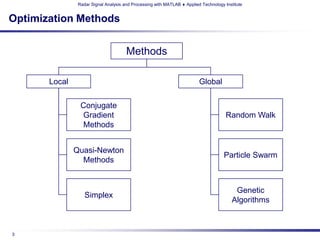
Optimization Methods


                                       Methods

       Local                                                              Global

                 Conjugate
                 Gradient                                                              Random Walk
                 Methods


               Quasi-Newton
                                                                                      Particle Swarm
                 Methods


                                                                                           Genetic
                   Simplex
                                                                                          Algorithms


3
Radar Signal Analysis and Processing with MATLAB ♦ Applied Technology Institute


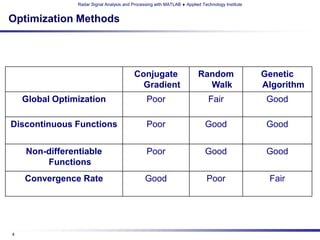
Optimization Methods


                                           Conjugate                     Random                   Genetic
                                             Gradient                      Walk                   Algorithm
    Global Optimization                          Poor                         Fair                 Good

Discontinuous Functions                          Poor                        Good                  Good


    Non-differentiable                           Poor                        Good                  Good
        Functions
    Convergence Rate                            Good                         Poor                  Fair


4
Radar Signal Analysis and Processing with MATLAB ♦ Applied Technology Institute


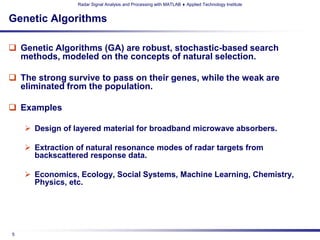
Genetic Algorithms

 Genetic Algorithms (GA) are robust, stochastic-based search
  methods, modeled on the concepts of natural selection.

 The strong survive to pass on their genes, while the weak are
  eliminated from the population.

 Examples

     Design of layered material for broadband microwave absorbers.

     Extraction of natural resonance modes of radar targets from
      backscattered response data.

     Economics, Ecology, Social Systems, Machine Learning, Chemistry,
      Physics, etc.


5
Radar Signal Analysis and Processing with MATLAB ♦ Applied Technology Institute


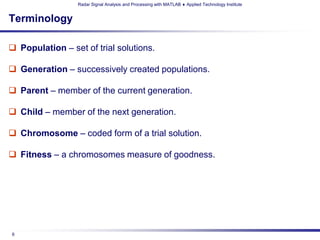
Terminology

 Population – set of trial solutions.

 Generation – successively created populations.

 Parent – member of the current generation.

 Child – member of the next generation.

 Chromosome – coded form of a trial solution.

 Fitness – a chromosomes measure of goodness.


6
Radar Signal Analysis and Processing with MATLAB ♦ Applied Technology Institute


Chromosome Coding

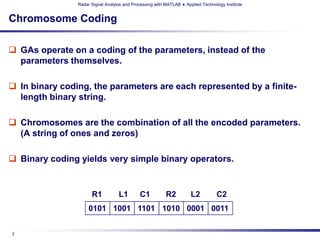
 GAs operate on a coding of the parameters, instead of the
  parameters themselves.

 In binary coding, the parameters are each represented by a finite-
  length binary string.

 Chromosomes are the combination of all the encoded parameters.
  (A string of ones and zeros)

 Binary coding yields very simple binary operators.


                      R1           L1        C1           R2          L2          C2
                     0101 1001 1101 1010 0001 0011


7
Radar Signal Analysis and Processing with MATLAB ♦ Applied Technology Institute


Genetic Algorithm


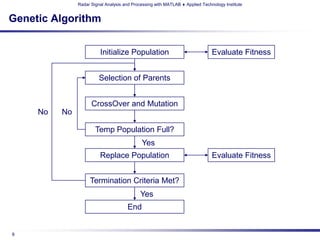
                         Initialize Population                                 Evaluate Fitness


                         Selection of Parents


                     CrossOver and Mutation
     No   No

                       Temp Population Full?
                                             Yes
                         Replace Population                                    Evaluate Fitness


                    Termination Criteria Met?
                                             Yes
                                      End


8
Radar Signal Analysis and Processing with MATLAB ♦ Applied Technology Institute


Initialize Population

 Random Fill – The initial population is created by filling chromosomes
  with random numbers.

 A Priori – Chromosomes in the initial population are created with
  information about the solution.


9
Radar Signal Analysis and Processing with MATLAB ♦ Applied Technology Institute


Parent Selection

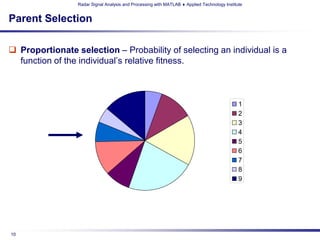
 Proportionate selection – Probability of selecting an individual is a
  function of the individual’s relative fitness.


                                                                                              1
                                                                                              2
                                                                                              3
                                                                                              4
                                                                                              5
                                                                                              6
                                                                                              7
                                                                                              8
                                                                                              9


10
Radar Signal Analysis and Processing with MATLAB ♦ Applied Technology Institute


Parent Selection

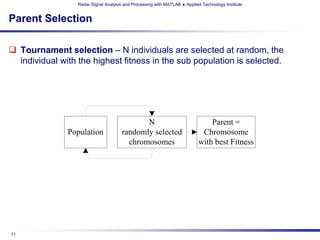
 Tournament selection – N individuals are selected at random, the
  individual with the highest fitness in the sub population is selected.


                                              N                                Parent =
               Population              randomly selected                    Chromosome
                                         chromosomes                       with best Fitness


11
Radar Signal Analysis and Processing with MATLAB ♦ Applied Technology Institute


Crossover and Mutation

 The crossover and mutation operations accept the parent
  chromosomes and generate the children.

 Many variations of crossover have been developed, with single-point
  crossover being the simplest.

 In mutation, an element in the chromosome is randomly selected
  and changed.


12
Radar Signal Analysis and Processing with MATLAB ♦ Applied Technology Institute


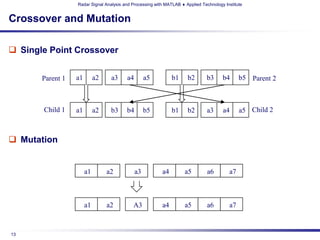
Crossover and Mutation

 Single Point Crossover


       Parent 1   a1        a2    a3     a4        a5          b1     b2        b3     b4      b5 Parent 2


       Child 1    a1        a2    b3     b4        b5          b1     b2        a3     a4      a5 Child 2


 Mutation


                       a1        a2           a3          a4         a5         a6        a7


                       a1        a2         A3            a4         a5         a6        a7


13
Radar Signal Analysis and Processing with MATLAB ♦ Applied Technology Institute


Population Replacement

 Generational – The GA produces an entirely new generation of children,
  which then replaces the parent generation.

 Steady-State – Only a portion of the current generation is replaced by
  children.


14
Radar Signal Analysis and Processing with MATLAB ♦ Applied Technology Institute


Fitness Function

 The only connection between the physical problem and the GA.

 The value returned by the fitness function is proportional to the
  goodness of a trial solution.


15
Radar Signal Analysis and Processing with MATLAB ♦ Applied Technology Institute


GA Optimization Guidelines

 Population Size: Typically 30 – 100
      Large populations enable faster convergence by providing more genetic
       diversity. Smaller populations yield faster execution, especially for
       complicated fitness functions.

 Probability of Crossover: Typically 0.6 – 0.9
      Crossover is the primary way a GA searches for new, better solutions.
       A probability of 0.7 has been found to be optimal for a wide variety of
       problems.

 Probability of Mutation: Typically 0.01 – 0.1
      The probability of mutation should generally be low. Mutation
       introduces new genetic material into the search, but tends to push the
       population’s average fitness away from the optimal value.

 Replacement Strategy: Generational vs. Steady-State
      Steady-state generally converges faster. Lower values of replacement
       percentage usually converge faster.


16
Radar Signal Analysis and Processing with MATLAB ♦ Applied Technology Institute


Particle Swarm

 Originated in studies of bird flocking and fish schooling.

 The potential solutions (Particles) “fly” through the solution space
  subject to both deterministic and stochastic rules.

 Particles are pulled toward the local and global best solution with
  linear attraction forces.


17
Radar Signal Analysis and Processing with MATLAB ♦ Applied Technology Institute


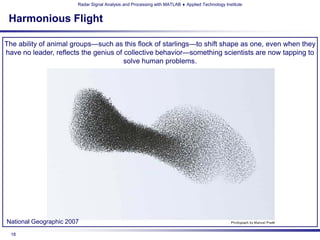
 Harmonious Flight

The ability of animal groups—such as this flock of starlings—to shift shape as one, even when they
have no leader, reflects the genius of collective behavior—something scientists are now tapping to
                                       solve human problems.


National Geographic 2007
 18
Radar Signal Analysis and Processing with MATLAB ♦ Applied Technology Institute


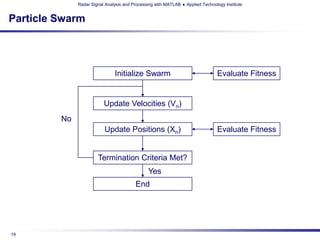
Particle Swarm


                               Initialize Swarm                                 Evaluate Fitness


                          Update Velocities (Vn)
         No
                          Update Positions (Xn)                                 Evaluate Fitness


                       Termination Criteria Met?
                                               Yes
                                         End


19
Radar Signal Analysis and Processing with MATLAB ♦ Applied Technology Institute


Initialize Swarm

 Random Fill – The initial swarm is created by giving each particle a
  random position and random velocity.

 A Priori – Particles in the initial swarm are created with information about
  the solution.


20
Radar Signal Analysis and Processing with MATLAB ♦ Applied Technology Institute


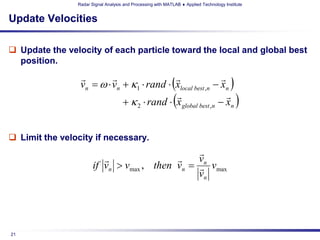
Update Velocities

 Update the velocity of each particle toward the local and global best
  position.

                 vn = ω ⋅ vn + κ1 ⋅ rand ⋅ (xlocal best ,n − xn )
                                                            

                             + κ 2 ⋅ rand ⋅ (x global best ,n − xn )
                                                                


 Limit the velocity if necessary.
                                                
                                              v
                       if vn > vmax , then vn = n vmax
                                                vn


21
Radar Signal Analysis and Processing with MATLAB ♦ Applied Technology Institute


Update Positions

 Update position using unit acceleration.

                                              
                                         xn = xn + vn
 Clip position if necessary.


                if xn ,d > xmax,d , then xn ,d = xmax,d
                if xn ,d < xmin,d , then xn ,d = xmin,d


22
Radar Signal Analysis and Processing with MATLAB ♦ Applied Technology Institute


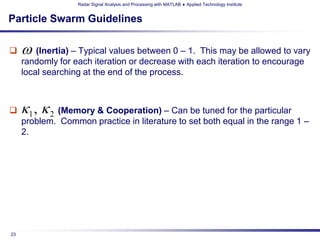
Particle Swarm Guidelines

    ω (Inertia) – Typical values between 0 – 1.   This may be allowed to vary
     randomly for each iteration or decrease with each iteration to encourage
     local searching at the end of the process.


    κ1 , κ 2 (Memory & Cooperation) – Can be tuned for the particular
     problem. Common practice in literature to set both equal in the range 1 –
     2.


23
Radar Signal Analysis and Processing with MATLAB ♦ Applied Technology Institute


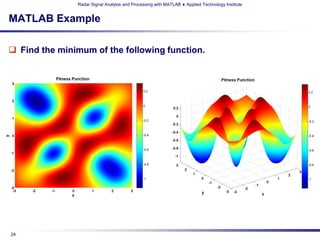
MATLAB Example

 Find the minimum of the following function.


24
Radar Signal Analysis and Processing with MATLAB ♦ Applied Technology Institute


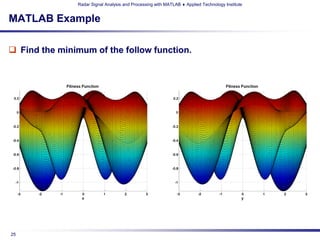
MATLAB Example

 Find the minimum of the follow function.


25
Radar Signal Analysis and Processing with MATLAB ♦ Applied Technology Institute


Antenna Pattern

 Suppose we want to minimize the antenna gain in a particular
  direction due to an interfering source (Adaptive Nulling).

                                                                          N      M
                                            AF (θ , φ ) = ∑∑ I mn e jβ mn e jα mn
                                                                         n =1 m =1


                                            I mn =       Amplitude coefficient for each element

                                            β mn =       Phase shift for each element

                                                         2π
                                           α mn =               [xmn sin θ cos φ + ymn sin θ sin φ ]
                                                          λ


26
Radar Signal Analysis and Processing with MATLAB ♦ Applied Technology Institute


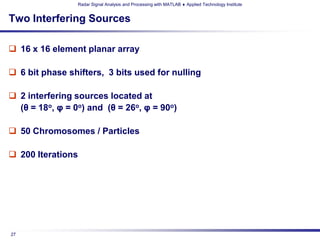
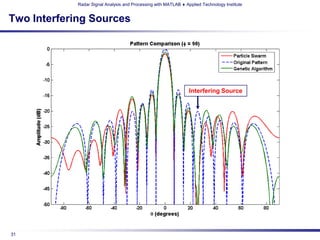
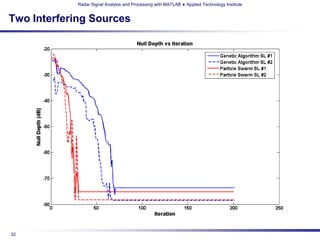
Two Interfering Sources

 16 x 16 element planar array

 6 bit phase shifters, 3 bits used for nulling

 2 interfering sources located at
  (θ = 18o, φ = 0o) and (θ = 26o, φ = 90o)

 50 Chromosomes / Particles

 200 Iterations


27
Radar Signal Analysis and Processing with MATLAB ♦ Applied Technology Institute


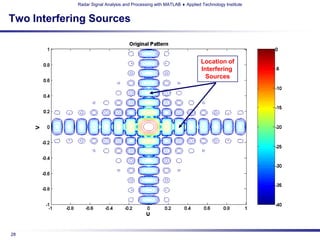
Two Interfering Sources


                                                                        Location of
                                                                        Interfering
                                                                          Sources


28
Radar Signal Analysis and Processing with MATLAB ♦ Applied Technology Institute


Two Interfering Sources

     Genetic Algorithm                                        Particle Swarm


              Nulls Placed in the Antenna Pattern
           in the Direction of the Interfering Sources


29
Radar Signal Analysis and Processing with MATLAB ♦ Applied Technology Institute


Two Interfering Sources


                                                              Interfering Source


30
Radar Signal Analysis and Processing with MATLAB ♦ Applied Technology Institute


Two Interfering Sources


                                                                  Interfering Source


31
Radar Signal Analysis and Processing with MATLAB ♦ Applied Technology Institute


Two Interfering Sources


32
Radar Signal Analysis and Processing with MATLAB ♦ Applied Technology Institute


Two Interfering Sources

      Main Beam Loss
         1.02 dB (Genetic Algorithm)
         1.63 dB (Particle Swarm)

      Beamwidth

                              Original                        GA                          PS
       Φ = 0o

       3 dB                      6.29o                      6.30o                       6.35o

       10 dB                    10.48o                     10.50o                      10.60o


       Φ = 90o

       3 dB                      6.29o                      6.30o                       6.35o
       10 dB                    10.48o                     10.52o                      10.59o

33
To learn more please attend ATI course
   Radar Signal Analysis and Processing using MATLAB


    Please post your comments and questions to our blog:
        http://www.aticourses.com/blog/

     Sign-up for ATI's monthly Course Schedule Updates :
http://www.aticourses.com/email_signup_page.html

ATI's Radar Signal Analysis and Processing using MATLAB Technical Training Short Course Sampler

  • 1.
    Professional Development ShortCourse On: Radar Signal Analysis and Processing using MATLAB Instructor: Dr. Andy Harrison ATI Course Schedule: http://www.ATIcourses.com/schedule.htm http://www.aticourses.com/radar_signal_processing.htm ATI's Radar Signal Analysis:
  • 2.
    www.ATIcourses.com Boost Your Skills 349 Berkshire Drive Riva, Maryland 21140 with On-Site Courses Telephone 1-888-501-2100 / (410) 965-8805 Tailored to Your Needs Fax (410) 956-5785 Email: ATI@ATIcourses.com The Applied Technology Institute specializes in training programs for technical professionals. Our courses keep you current in the state-of-the-art technology that is essential to keep your company on the cutting edge in today’s highly competitive marketplace. Since 1984, ATI has earned the trust of training departments nationwide, and has presented on-site training at the major Navy, Air Force and NASA centers, and for a large number of contractors. Our training increases effectiveness and productivity. Learn from the proven best. For a Free On-Site Quote Visit Us At: http://www.ATIcourses.com/free_onsite_quote.asp For Our Current Public Course Schedule Go To: http://www.ATIcourses.com/schedule.htm
  • 3.
    Radar Signal Analysisand Processing with MATLAB ♦ Applied Technology Institute Global Optimization  While LMS methods are computationally fast, quantization of the phase will result in errors.  Also, it is necessary to have receiver hardware at each element of the phased array as well as an elaborate calibration technique.  Global search methods can place very deep nulls in the desired directions, while maintaining the characteristics of the antenna main beam.  Since the solution space is predefined by the quantized amplitude and phase coefficients of the particular antenna system, these global methods do not require continuous amplitude and phase shifts.  Additionally, these methods deal with the coherent output power of the antenna array and therefore do not require receiver hardware at each element in the antenna array. 2
  • 4.
    Radar Signal Analysisand Processing with MATLAB ♦ Applied Technology Institute Optimization Methods Methods Local Global Conjugate Gradient Random Walk Methods Quasi-Newton Particle Swarm Methods Genetic Simplex Algorithms 3
  • 5.
    Radar Signal Analysisand Processing with MATLAB ♦ Applied Technology Institute Optimization Methods Conjugate Random Genetic Gradient Walk Algorithm Global Optimization Poor Fair Good Discontinuous Functions Poor Good Good Non-differentiable Poor Good Good Functions Convergence Rate Good Poor Fair 4
  • 6.
    Radar Signal Analysisand Processing with MATLAB ♦ Applied Technology Institute Genetic Algorithms  Genetic Algorithms (GA) are robust, stochastic-based search methods, modeled on the concepts of natural selection.  The strong survive to pass on their genes, while the weak are eliminated from the population.  Examples  Design of layered material for broadband microwave absorbers.  Extraction of natural resonance modes of radar targets from backscattered response data.  Economics, Ecology, Social Systems, Machine Learning, Chemistry, Physics, etc. 5
  • 7.
    Radar Signal Analysisand Processing with MATLAB ♦ Applied Technology Institute Terminology  Population – set of trial solutions.  Generation – successively created populations.  Parent – member of the current generation.  Child – member of the next generation.  Chromosome – coded form of a trial solution.  Fitness – a chromosomes measure of goodness. 6
  • 8.
    Radar Signal Analysisand Processing with MATLAB ♦ Applied Technology Institute Chromosome Coding  GAs operate on a coding of the parameters, instead of the parameters themselves.  In binary coding, the parameters are each represented by a finite- length binary string.  Chromosomes are the combination of all the encoded parameters. (A string of ones and zeros)  Binary coding yields very simple binary operators. R1 L1 C1 R2 L2 C2 0101 1001 1101 1010 0001 0011 7
  • 9.
    Radar Signal Analysisand Processing with MATLAB ♦ Applied Technology Institute Genetic Algorithm Initialize Population Evaluate Fitness Selection of Parents CrossOver and Mutation No No Temp Population Full? Yes Replace Population Evaluate Fitness Termination Criteria Met? Yes End 8
  • 10.
    Radar Signal Analysisand Processing with MATLAB ♦ Applied Technology Institute Initialize Population  Random Fill – The initial population is created by filling chromosomes with random numbers.  A Priori – Chromosomes in the initial population are created with information about the solution. 9
  • 11.
    Radar Signal Analysisand Processing with MATLAB ♦ Applied Technology Institute Parent Selection  Proportionate selection – Probability of selecting an individual is a function of the individual’s relative fitness. 1 2 3 4 5 6 7 8 9 10
  • 12.
    Radar Signal Analysisand Processing with MATLAB ♦ Applied Technology Institute Parent Selection  Tournament selection – N individuals are selected at random, the individual with the highest fitness in the sub population is selected. N Parent = Population randomly selected Chromosome chromosomes with best Fitness 11
  • 13.
    Radar Signal Analysisand Processing with MATLAB ♦ Applied Technology Institute Crossover and Mutation  The crossover and mutation operations accept the parent chromosomes and generate the children.  Many variations of crossover have been developed, with single-point crossover being the simplest.  In mutation, an element in the chromosome is randomly selected and changed. 12
  • 14.
    Radar Signal Analysisand Processing with MATLAB ♦ Applied Technology Institute Crossover and Mutation  Single Point Crossover Parent 1 a1 a2 a3 a4 a5 b1 b2 b3 b4 b5 Parent 2 Child 1 a1 a2 b3 b4 b5 b1 b2 a3 a4 a5 Child 2  Mutation a1 a2 a3 a4 a5 a6 a7 a1 a2 A3 a4 a5 a6 a7 13
  • 15.
    Radar Signal Analysisand Processing with MATLAB ♦ Applied Technology Institute Population Replacement  Generational – The GA produces an entirely new generation of children, which then replaces the parent generation.  Steady-State – Only a portion of the current generation is replaced by children. 14
  • 16.
    Radar Signal Analysisand Processing with MATLAB ♦ Applied Technology Institute Fitness Function  The only connection between the physical problem and the GA.  The value returned by the fitness function is proportional to the goodness of a trial solution. 15
  • 17.
    Radar Signal Analysisand Processing with MATLAB ♦ Applied Technology Institute GA Optimization Guidelines  Population Size: Typically 30 – 100  Large populations enable faster convergence by providing more genetic diversity. Smaller populations yield faster execution, especially for complicated fitness functions.  Probability of Crossover: Typically 0.6 – 0.9  Crossover is the primary way a GA searches for new, better solutions. A probability of 0.7 has been found to be optimal for a wide variety of problems.  Probability of Mutation: Typically 0.01 – 0.1  The probability of mutation should generally be low. Mutation introduces new genetic material into the search, but tends to push the population’s average fitness away from the optimal value.  Replacement Strategy: Generational vs. Steady-State  Steady-state generally converges faster. Lower values of replacement percentage usually converge faster. 16
  • 18.
    Radar Signal Analysisand Processing with MATLAB ♦ Applied Technology Institute Particle Swarm  Originated in studies of bird flocking and fish schooling.  The potential solutions (Particles) “fly” through the solution space subject to both deterministic and stochastic rules.  Particles are pulled toward the local and global best solution with linear attraction forces. 17
  • 19.
    Radar Signal Analysisand Processing with MATLAB ♦ Applied Technology Institute Harmonious Flight The ability of animal groups—such as this flock of starlings—to shift shape as one, even when they have no leader, reflects the genius of collective behavior—something scientists are now tapping to solve human problems. National Geographic 2007 18
  • 20.
    Radar Signal Analysisand Processing with MATLAB ♦ Applied Technology Institute Particle Swarm Initialize Swarm Evaluate Fitness Update Velocities (Vn) No Update Positions (Xn) Evaluate Fitness Termination Criteria Met? Yes End 19
  • 21.
    Radar Signal Analysisand Processing with MATLAB ♦ Applied Technology Institute Initialize Swarm  Random Fill – The initial swarm is created by giving each particle a random position and random velocity.  A Priori – Particles in the initial swarm are created with information about the solution. 20
  • 22.
    Radar Signal Analysisand Processing with MATLAB ♦ Applied Technology Institute Update Velocities  Update the velocity of each particle toward the local and global best position. vn = ω ⋅ vn + κ1 ⋅ rand ⋅ (xlocal best ,n − xn )     + κ 2 ⋅ rand ⋅ (x global best ,n − xn )    Limit the velocity if necessary.    v if vn > vmax , then vn = n vmax vn 21
  • 23.
    Radar Signal Analysisand Processing with MATLAB ♦ Applied Technology Institute Update Positions  Update position using unit acceleration.    xn = xn + vn  Clip position if necessary. if xn ,d > xmax,d , then xn ,d = xmax,d if xn ,d < xmin,d , then xn ,d = xmin,d 22
  • 24.
    Radar Signal Analysisand Processing with MATLAB ♦ Applied Technology Institute Particle Swarm Guidelines  ω (Inertia) – Typical values between 0 – 1. This may be allowed to vary randomly for each iteration or decrease with each iteration to encourage local searching at the end of the process.  κ1 , κ 2 (Memory & Cooperation) – Can be tuned for the particular problem. Common practice in literature to set both equal in the range 1 – 2. 23
  • 25.
    Radar Signal Analysisand Processing with MATLAB ♦ Applied Technology Institute MATLAB Example  Find the minimum of the following function. 24
  • 26.
    Radar Signal Analysisand Processing with MATLAB ♦ Applied Technology Institute MATLAB Example  Find the minimum of the follow function. 25
  • 27.
    Radar Signal Analysisand Processing with MATLAB ♦ Applied Technology Institute Antenna Pattern  Suppose we want to minimize the antenna gain in a particular direction due to an interfering source (Adaptive Nulling). N M AF (θ , φ ) = ∑∑ I mn e jβ mn e jα mn n =1 m =1 I mn = Amplitude coefficient for each element β mn = Phase shift for each element 2π α mn = [xmn sin θ cos φ + ymn sin θ sin φ ] λ 26
  • 28.
    Radar Signal Analysisand Processing with MATLAB ♦ Applied Technology Institute Two Interfering Sources  16 x 16 element planar array  6 bit phase shifters, 3 bits used for nulling  2 interfering sources located at (θ = 18o, φ = 0o) and (θ = 26o, φ = 90o)  50 Chromosomes / Particles  200 Iterations 27
  • 29.
    Radar Signal Analysisand Processing with MATLAB ♦ Applied Technology Institute Two Interfering Sources Location of Interfering Sources 28
  • 30.
    Radar Signal Analysisand Processing with MATLAB ♦ Applied Technology Institute Two Interfering Sources Genetic Algorithm Particle Swarm Nulls Placed in the Antenna Pattern in the Direction of the Interfering Sources 29
  • 31.
    Radar Signal Analysisand Processing with MATLAB ♦ Applied Technology Institute Two Interfering Sources Interfering Source 30
  • 32.
    Radar Signal Analysisand Processing with MATLAB ♦ Applied Technology Institute Two Interfering Sources Interfering Source 31
  • 33.
    Radar Signal Analysisand Processing with MATLAB ♦ Applied Technology Institute Two Interfering Sources 32
  • 34.
    Radar Signal Analysisand Processing with MATLAB ♦ Applied Technology Institute Two Interfering Sources  Main Beam Loss  1.02 dB (Genetic Algorithm)  1.63 dB (Particle Swarm)  Beamwidth Original GA PS Φ = 0o 3 dB 6.29o 6.30o 6.35o 10 dB 10.48o 10.50o 10.60o Φ = 90o 3 dB 6.29o 6.30o 6.35o 10 dB 10.48o 10.52o 10.59o 33
  • 35.
    To learn moreplease attend ATI course Radar Signal Analysis and Processing using MATLAB Please post your comments and questions to our blog: http://www.aticourses.com/blog/ Sign-up for ATI's monthly Course Schedule Updates : http://www.aticourses.com/email_signup_page.html