PAIRWISE TESTING
    Sagar V. Hadawale

       14 July, 2011
Agenda

   Introduction to Pairwise Testing

   Methods / Approaches / Algorithms

   Comparison

   Tools
Introduction to Pairwise Testing
   Pairwise testing is a combinatorial technique used to reduce the number
    of test case inputs to a system in situations where exhaustive testing with
    all possible inputs is not possible or prohibitively expensive.
   also known as 2-way testing, All-Pairs testing.
   most basic combinatorial method.
   for each pair of input parameters of a system, every combination of valid
    values of these two parameters be covered by at least one test case.

   Exhaustive Testing Example:
       a manufacturing automation system that has 20 controls, each with 10
        possible settings—a total of 1020 combinations, which is far more than a
        software tester would be able to test in a lifetime.
       Surprisingly, we can check all pairs of these values with only 180 tests if they
        are carefully constructed.
Pairwise Testing
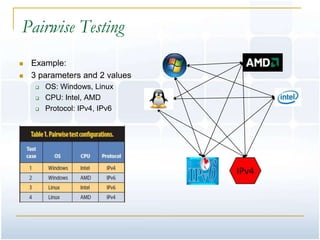
   Example:
   3 parameters and 2 values
       OS: Windows, Linux
       CPU: Intel, AMD
       Protocol: IPv4, IPv6
Methods / Approaches / Algorithms

   Orthogonal Latin Squares / Orthogonal Array Testing

   Automatic Efficient Test Generator (AETG)

   In-Parameter-Order (IPO)

   Variant of In-Parameter-order (VIPO)

   Genetic Algorithm (GA)

   Recently Developed Algorithms
Orthogonal Latin Squares
   Latin Squares:
       Properties:
           no. of rows and columns must be equal
           each entry appears exactly once in each row and column
   A single n x n Latin square can handle three parameters, each of which
    have n possible values.
   To handle more than three parameters, we need a set of orthogonal
    Latin squares.
   If there are k system parameters, then k – 2 orthogonal Latin squares
    are required.
   Orthogonal Latin Squares:
       Suppose we have two matrices [aij] and [bij]. The combined matrix is [cij]
        where the elements are cij= (aij,bij). If cij ≠ crq whenever r ≠ i and q ≠ j, then the
        squares [aij] and [bij] are orthogonal.
Orthogonal Latin Squares
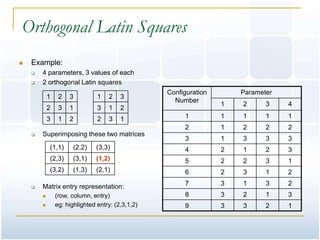
   Example:
       4 parameters, 3 values of each
       2 orthogonal Latin squares
                                                   Configuration       Parameter
            1    2   3          1   2    3
                                                     Number
                                                                   1   2      3    4
            2    3   1          3   1    2
            3    1   2          2   3    1              1          1   1      1    1
                                                        2          1   2      2    2
       Superimposing these two matrices
                                                        3          1   3      3    3
            (1,1)      (2,2)    (3,3)                   4          2   1      2    3
            (2,3)      (3,1)    (1,2)                   5          2   2      3    1
            (3,2)      (1,3)    (2,1)                   6          2   3      1    2

       Matrix entry representation:                    7          3   1      3    2
               (row, column, entry)                    8          3   2      1    3
               eg: highlighted entry: (2,3,1,2)        9          3   3      2    1
Orthogonal Latin Squares

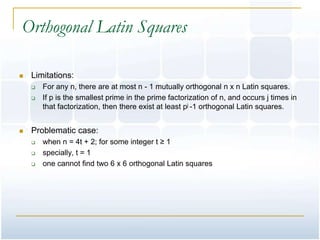
   Limitations:
       For any n, there are at most n - 1 mutually orthogonal n x n Latin squares.
       If p is the smallest prime in the prime factorization of n, and occurs j times in
        that factorization, then there exist at least pj -1 orthogonal Latin squares.


   Problematic case:
       when n = 4t + 2; for some integer t ≥ 1
       specially, t = 1
       one cannot find two 6 x 6 orthogonal Latin squares
Algebraic Strategy
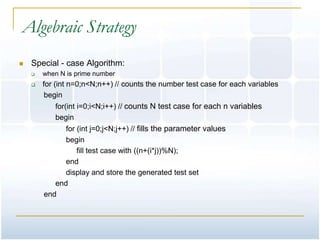
   Special - case Algorithm:
       when N is prime number
       for (int n=0;n<N;n++) // counts the number test case for each variables
         begin
           for(int i=0;i<N;i++) // counts N test case for each n variables
           begin
              for (int j=0;j<N;j++) // fills the parameter values
              begin
                  fill test case with ((n+(i*j))%N);
              end
              display and store the generated test set
           end
        end
Automatic Efficient Test Generator (AETG)
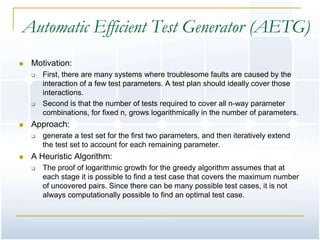
   Motivation:
       First, there are many systems where troublesome faults are caused by the
        interaction of a few test parameters. A test plan should ideally cover those
        interactions.
       Second is that the number of tests required to cover all n-way parameter
        combinations, for fixed n, grows logarithmically in the number of parameters.
   Approach:
       generate a test set for the first two parameters, and then iteratively extend
        the test set to account for each remaining parameter.
   A Heuristic Algorithm:
       The proof of logarithmic growth for the greedy algorithm assumes that at
        each stage it is possible to find a test case that covers the maximum number
        of uncovered pairs. Since there can be many possible test cases, it is not
        always computationally possible to find an optimal test case.
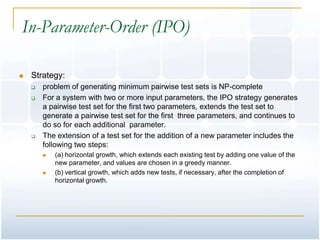
In-Parameter-Order (IPO)

   Strategy:
       problem of generating minimum pairwise test sets is NP-complete
       For a system with two or more input parameters, the IPO strategy generates
        a pairwise test set for the first two parameters, extends the test set to
        generate a pairwise test set for the first three parameters, and continues to
        do so for each additional parameter.
       The extension of a test set for the addition of a new parameter includes the
        following two steps:
           (a) horizontal growth, which extends each existing test by adding one value of the
            new parameter, and values are chosen in a greedy manner.
           (b) vertical growth, which adds new tests, if necessary, after the completion of
            horizontal growth.
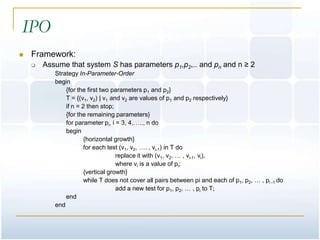
IPO
   Framework:
       Assume that system S has parameters p1,p2,.. and pn and n ≥ 2
           Strategy In-Parameter-Order
           begin
               {for the first two parameters p1 and p2}
               T = {(v1, v2) | v1 and v2 are values of p1 and p2 respectively}
               if n = 2 then stop;
               {for the remaining parameters}
               for parameter pi, i = 3, 4,….., n do
               begin
                       {horizontal growth}
                       for each test (v1, v2, …. , vi-1) in T do
                                    replace it with (v1, v2, … , vi-1, vi),
                                    where vi is a value of pi;
                       {vertical growth}
                       while T does not cover all pairs between pi and each of p1, p2, … , pi -1 do
                                    add a new test for p1, p2, … , pi to T;
               end
           end
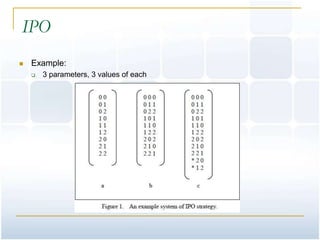
IPO
   Example:
       3 parameters, 3 values of each
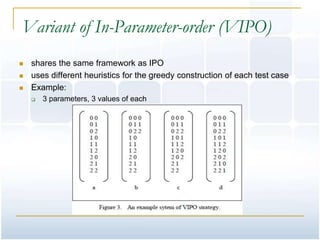
Variant of In-Parameter-order (VIPO)
   shares the same framework as IPO
   uses different heuristics for the greedy construction of each test case
   Example:
       3 parameters, 3 values of each
Genetic Algorithm (GA)

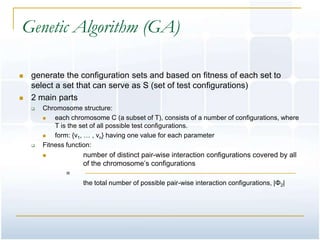
   generate the configuration sets and based on fitness of each set to
    select a set that can serve as S (set of test configurations)
   2 main parts
       Chromosome structure:
           each chromosome C (a subset of T), consists of a number of configurations, where
            T is the set of all possible test configurations.
           form: {v1, … , vn} having one value for each parameter
       Fitness function:
                    number of distinct pair-wise interaction configurations covered by all
                     of the chromosome’s configurations
               =
                     the total number of possible pair-wise interaction configurations, |Φ2|
Genetic Algorithm (GA)
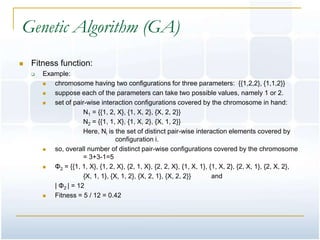
   Fitness function:
       Example:
          chromosome having two configurations for three parameters: {{1,2,2}, {1,1,2}}
          suppose each of the parameters can take two possible values, namely 1 or 2.
          set of pair-wise interaction configurations covered by the chromosome in hand:
                      N1 = {{1, 2, X}, {1, X, 2}, {X, 2, 2}}
                      N2 = {{1, 1, X}, {1, X, 2}, {X, 1, 2}}
                      Here, Ni is the set of distinct pair-wise interaction elements covered by
                                   configuration i.
          so, overall number of distinct pair-wise configurations covered by the chromosome
                      = 3+3-1=5
          Φ2 = {{1, 1, X}, {1, 2, X}, {2, 1, X}, {2, 2, X}, {1, X, 1}, {1, X, 2}, {2, X, 1}, {2, X, 2},
                      {X, 1, 1}, {X, 1, 2}, {X, 2, 1}, {X, 2, 2}}        and
           | Φ2 | = 12
          Fitness = 5 / 12 = 0.42
Recently Developed Algorithms
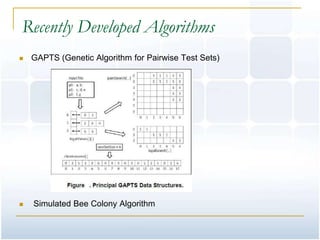
   GAPTS (Genetic Algorithm for Pairwise Test Sets)


   Simulated Bee Colony Algorithm
Test Set Size Results Comparison
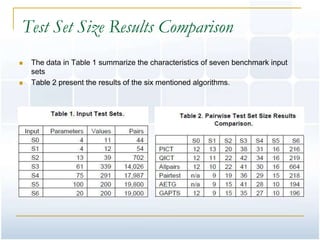
   The data in Table 1 summarize the characteristics of seven benchmark input
    sets
   Table 2 present the results of the six mentioned algorithms.
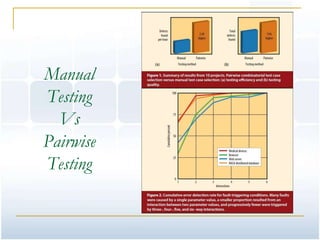
Manual
Testing
  Vs
Pairwise
Testing
Tools
           AETG
           IPO
           Tconfig
           CTS
           Jenny
           TestCover
           DDA
           AllPairs
           PICT
           EXACT
           IPO-s
           Hexawise
References
1)     A. W. Williams, R. L. Probert, "A Practical Strategy for Testing Pair-wise Coverage of Network Interfaces",
       Software Reliability Engineering, 1996. Proceedings., Seventh International Symposium on, 1996 , pp. 246 - 254
2)     D. M. Cohen, S. R. Dalal, M. L. Fredman, G. C. Patton, ―The AETG system: An Approach to Testing Based on
       Combinatorial Design‖, IEEE Transaction on Software Engineering, 23 (7), 1997, pp. 437-443.
3)     J. D. McCaffrey, "An Empirical Study of Pairwise Test Set Generation Using a Genetic Algorithm", ITNG, 2010
       Seventh International Conference on, 2010 , pp. 992 - 997
4)     J. D. McCaffrey, "Generation of Pairwise Test Sets using a Genetic Algorithm", Computer Software and
       Applications Conference, 2009. COMPSAC '09. 33rd Annual IEEE International, 2009, pp. 626 - 631
5)     J. D. McCaffrey, "Generation of Pairwise Test Sets using a Simulated Bee Colony Algorithm", Information Reuse &
       Integration, 2009. IRI '09. IEEE International Conference on, 2009, pp. 115 - 119
6)     M. I. Younis, K. Z. Zamli, N. A. M. Isa, "Algebraic strategy to generate pairwise test set for prime number
       parameters and variables" Information Technology, 2008. ITSim 2008. International Symposium on, Volume: 3,
       2008, pp. 1 - 4
7)     R. Kuhn, R. Kacker, Yu Lei, J. Hunter, "Combinatorial Software Testing", Computer, Volume: 42 , Issue: 8, 2009 ,
       pp. 94 - 96
8)     R. Kuhn, R. Kacker, Yu Lei, "Practical Combinatorial Testing- Beyond Pairwise" IT Professional, Volume: 10 ,
       Issue: 3, 2008 , pp. 19 - 23
9)     S.A. Ghazi and M.A. Ahmed, "Pair-wise Test Coverage Using Genetic Algorithms", Proceedings of the 2003
       Congress on Evolutionary Computation, vol. 2, December 2003, pp. 1420-1424.
10)    Yingxia Cui, Longshu Li, Sheng Yao, "A New Strategy for Pairwise Test Case Generation", Intelligent Information
       Technology Application, 2009. IITA 2009. Third International Symposium on Volume: 3, 2009 , pp. 303 - 306
11)     Yu Lei and K.C. Tai, "In-Parameter-Order: A Test Generation Strategy for Pairwise Testing", Proceedings of Third
       IEEE International High-Assurance Systems Engineering Symposium, Nov. 1998, pp. 254-261.
Other Useful Resources

   http://www.pairwise.org/default.html
   http://www.developsense.com/pairwiseTesting.html
   http://www.softwaretestingstuff.com/2007/10/pairwise-testing.html

   Hexawise Testing:
     website: http://hexawise.com/

     videos:
          http://www.youtube.com/watch?v=hlFh718i0VQ
          Hexawise amazon example: 9 parts
            2nd part link: http://www.youtube.com/watch?v=BFjDqAnMcew
Any Questions?

Pairwise testing sagar_hadawale

  • 1.
    PAIRWISE TESTING Sagar V. Hadawale 14 July, 2011
  • 2.
    Agenda  Introduction to Pairwise Testing  Methods / Approaches / Algorithms  Comparison  Tools
  • 3.
    Introduction to PairwiseTesting  Pairwise testing is a combinatorial technique used to reduce the number of test case inputs to a system in situations where exhaustive testing with all possible inputs is not possible or prohibitively expensive.  also known as 2-way testing, All-Pairs testing.  most basic combinatorial method.  for each pair of input parameters of a system, every combination of valid values of these two parameters be covered by at least one test case.  Exhaustive Testing Example:  a manufacturing automation system that has 20 controls, each with 10 possible settings—a total of 1020 combinations, which is far more than a software tester would be able to test in a lifetime.  Surprisingly, we can check all pairs of these values with only 180 tests if they are carefully constructed.
  • 4.
    Pairwise Testing  Example:  3 parameters and 2 values  OS: Windows, Linux  CPU: Intel, AMD  Protocol: IPv4, IPv6
  • 5.
    Methods / Approaches/ Algorithms  Orthogonal Latin Squares / Orthogonal Array Testing  Automatic Efficient Test Generator (AETG)  In-Parameter-Order (IPO)  Variant of In-Parameter-order (VIPO)  Genetic Algorithm (GA)  Recently Developed Algorithms
  • 6.
    Orthogonal Latin Squares  Latin Squares:  Properties:  no. of rows and columns must be equal  each entry appears exactly once in each row and column  A single n x n Latin square can handle three parameters, each of which have n possible values.  To handle more than three parameters, we need a set of orthogonal Latin squares.  If there are k system parameters, then k – 2 orthogonal Latin squares are required.  Orthogonal Latin Squares:  Suppose we have two matrices [aij] and [bij]. The combined matrix is [cij] where the elements are cij= (aij,bij). If cij ≠ crq whenever r ≠ i and q ≠ j, then the squares [aij] and [bij] are orthogonal.
  • 7.
    Orthogonal Latin Squares  Example:  4 parameters, 3 values of each  2 orthogonal Latin squares Configuration Parameter 1 2 3 1 2 3 Number 1 2 3 4 2 3 1 3 1 2 3 1 2 2 3 1 1 1 1 1 1 2 1 2 2 2  Superimposing these two matrices 3 1 3 3 3 (1,1) (2,2) (3,3) 4 2 1 2 3 (2,3) (3,1) (1,2) 5 2 2 3 1 (3,2) (1,3) (2,1) 6 2 3 1 2  Matrix entry representation: 7 3 1 3 2  (row, column, entry) 8 3 2 1 3  eg: highlighted entry: (2,3,1,2) 9 3 3 2 1
  • 8.
    Orthogonal Latin Squares  Limitations:  For any n, there are at most n - 1 mutually orthogonal n x n Latin squares.  If p is the smallest prime in the prime factorization of n, and occurs j times in that factorization, then there exist at least pj -1 orthogonal Latin squares.  Problematic case:  when n = 4t + 2; for some integer t ≥ 1  specially, t = 1  one cannot find two 6 x 6 orthogonal Latin squares
  • 9.
    Algebraic Strategy  Special - case Algorithm:  when N is prime number  for (int n=0;n<N;n++) // counts the number test case for each variables begin for(int i=0;i<N;i++) // counts N test case for each n variables begin for (int j=0;j<N;j++) // fills the parameter values begin fill test case with ((n+(i*j))%N); end display and store the generated test set end end
  • 10.
    Automatic Efficient TestGenerator (AETG)  Motivation:  First, there are many systems where troublesome faults are caused by the interaction of a few test parameters. A test plan should ideally cover those interactions.  Second is that the number of tests required to cover all n-way parameter combinations, for fixed n, grows logarithmically in the number of parameters.  Approach:  generate a test set for the first two parameters, and then iteratively extend the test set to account for each remaining parameter.  A Heuristic Algorithm:  The proof of logarithmic growth for the greedy algorithm assumes that at each stage it is possible to find a test case that covers the maximum number of uncovered pairs. Since there can be many possible test cases, it is not always computationally possible to find an optimal test case.
  • 11.
    In-Parameter-Order (IPO)  Strategy:  problem of generating minimum pairwise test sets is NP-complete  For a system with two or more input parameters, the IPO strategy generates a pairwise test set for the first two parameters, extends the test set to generate a pairwise test set for the first three parameters, and continues to do so for each additional parameter.  The extension of a test set for the addition of a new parameter includes the following two steps:  (a) horizontal growth, which extends each existing test by adding one value of the new parameter, and values are chosen in a greedy manner.  (b) vertical growth, which adds new tests, if necessary, after the completion of horizontal growth.
  • 12.
    IPO  Framework:  Assume that system S has parameters p1,p2,.. and pn and n ≥ 2 Strategy In-Parameter-Order begin {for the first two parameters p1 and p2} T = {(v1, v2) | v1 and v2 are values of p1 and p2 respectively} if n = 2 then stop; {for the remaining parameters} for parameter pi, i = 3, 4,….., n do begin {horizontal growth} for each test (v1, v2, …. , vi-1) in T do replace it with (v1, v2, … , vi-1, vi), where vi is a value of pi; {vertical growth} while T does not cover all pairs between pi and each of p1, p2, … , pi -1 do add a new test for p1, p2, … , pi to T; end end
  • 13.
    IPO  Example:  3 parameters, 3 values of each
  • 14.
    Variant of In-Parameter-order(VIPO)  shares the same framework as IPO  uses different heuristics for the greedy construction of each test case  Example:  3 parameters, 3 values of each
  • 15.
    Genetic Algorithm (GA)  generate the configuration sets and based on fitness of each set to select a set that can serve as S (set of test configurations)  2 main parts  Chromosome structure:  each chromosome C (a subset of T), consists of a number of configurations, where T is the set of all possible test configurations.  form: {v1, … , vn} having one value for each parameter  Fitness function:  number of distinct pair-wise interaction configurations covered by all of the chromosome’s configurations = the total number of possible pair-wise interaction configurations, |Φ2|
  • 16.
    Genetic Algorithm (GA)  Fitness function:  Example:  chromosome having two configurations for three parameters: {{1,2,2}, {1,1,2}}  suppose each of the parameters can take two possible values, namely 1 or 2.  set of pair-wise interaction configurations covered by the chromosome in hand: N1 = {{1, 2, X}, {1, X, 2}, {X, 2, 2}} N2 = {{1, 1, X}, {1, X, 2}, {X, 1, 2}} Here, Ni is the set of distinct pair-wise interaction elements covered by configuration i.  so, overall number of distinct pair-wise configurations covered by the chromosome = 3+3-1=5  Φ2 = {{1, 1, X}, {1, 2, X}, {2, 1, X}, {2, 2, X}, {1, X, 1}, {1, X, 2}, {2, X, 1}, {2, X, 2}, {X, 1, 1}, {X, 1, 2}, {X, 2, 1}, {X, 2, 2}} and | Φ2 | = 12  Fitness = 5 / 12 = 0.42
  • 17.
    Recently Developed Algorithms  GAPTS (Genetic Algorithm for Pairwise Test Sets)  Simulated Bee Colony Algorithm
  • 18.
    Test Set SizeResults Comparison  The data in Table 1 summarize the characteristics of seven benchmark input sets  Table 2 present the results of the six mentioned algorithms.
  • 19.
  • 20.
    Tools  AETG  IPO  Tconfig  CTS  Jenny  TestCover  DDA  AllPairs  PICT  EXACT  IPO-s  Hexawise
  • 21.
    References 1) A. W. Williams, R. L. Probert, "A Practical Strategy for Testing Pair-wise Coverage of Network Interfaces", Software Reliability Engineering, 1996. Proceedings., Seventh International Symposium on, 1996 , pp. 246 - 254 2) D. M. Cohen, S. R. Dalal, M. L. Fredman, G. C. Patton, ―The AETG system: An Approach to Testing Based on Combinatorial Design‖, IEEE Transaction on Software Engineering, 23 (7), 1997, pp. 437-443. 3) J. D. McCaffrey, "An Empirical Study of Pairwise Test Set Generation Using a Genetic Algorithm", ITNG, 2010 Seventh International Conference on, 2010 , pp. 992 - 997 4) J. D. McCaffrey, "Generation of Pairwise Test Sets using a Genetic Algorithm", Computer Software and Applications Conference, 2009. COMPSAC '09. 33rd Annual IEEE International, 2009, pp. 626 - 631 5) J. D. McCaffrey, "Generation of Pairwise Test Sets using a Simulated Bee Colony Algorithm", Information Reuse & Integration, 2009. IRI '09. IEEE International Conference on, 2009, pp. 115 - 119 6) M. I. Younis, K. Z. Zamli, N. A. M. Isa, "Algebraic strategy to generate pairwise test set for prime number parameters and variables" Information Technology, 2008. ITSim 2008. International Symposium on, Volume: 3, 2008, pp. 1 - 4 7) R. Kuhn, R. Kacker, Yu Lei, J. Hunter, "Combinatorial Software Testing", Computer, Volume: 42 , Issue: 8, 2009 , pp. 94 - 96 8) R. Kuhn, R. Kacker, Yu Lei, "Practical Combinatorial Testing- Beyond Pairwise" IT Professional, Volume: 10 , Issue: 3, 2008 , pp. 19 - 23 9) S.A. Ghazi and M.A. Ahmed, "Pair-wise Test Coverage Using Genetic Algorithms", Proceedings of the 2003 Congress on Evolutionary Computation, vol. 2, December 2003, pp. 1420-1424. 10) Yingxia Cui, Longshu Li, Sheng Yao, "A New Strategy for Pairwise Test Case Generation", Intelligent Information Technology Application, 2009. IITA 2009. Third International Symposium on Volume: 3, 2009 , pp. 303 - 306 11) Yu Lei and K.C. Tai, "In-Parameter-Order: A Test Generation Strategy for Pairwise Testing", Proceedings of Third IEEE International High-Assurance Systems Engineering Symposium, Nov. 1998, pp. 254-261.
  • 22.
    Other Useful Resources  http://www.pairwise.org/default.html  http://www.developsense.com/pairwiseTesting.html  http://www.softwaretestingstuff.com/2007/10/pairwise-testing.html  Hexawise Testing:  website: http://hexawise.com/  videos:  http://www.youtube.com/watch?v=hlFh718i0VQ  Hexawise amazon example: 9 parts  2nd part link: http://www.youtube.com/watch?v=BFjDqAnMcew
  • 23.