
Racism
FSC0504 Introduction to Society
By Dr Rawiri Waretini-Karena
Karakia Timatanga
He honore, he kororia ki te Atua
He maungarongo ki te whenua
He whakaaro pai ki nga tangata katoa
Hanga e te Atua, he ngakau hou
Ki roto ki tena ki tena o matou
Whakatongia to wairua tapu
Hei awhina, hei tohutohu I a matou
Ake Ake amine
Learning Outcomes
• To identify racism
• To examine examples and history of racism
• To discuss examples
Discussion
• What is racism and how is it defined?
Racism definition
• Racism = Discrimination + power to discriminate
• Prejudice = Discrimination – power to discriminate
The Invisible Privilege
• https://www.youtube.com/watch?v=QdmdC2Ud9j0
Discussion
• What are underlying themes behind this video?
Discussion
• How was racism established?
History of Racism
• https://www.youtube.com/watch?v=SzqEaiGR7Xo&list=PL3C2A795C6
A8FCDA2
Discussion
• What were underlying themes behind this video?
Discussion
• Where did these ideas come even before America?
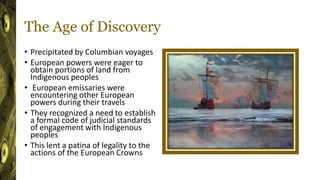
The Age of Discovery
• Precipitated by Columbian voyages
• European powers were eager to
obtain portions of land from
Indigenous peoples
• European emissaries were
encountering other European
powers during their travels
• They recognized a need to establish
a formal code of judicial standards
of engagement with Indigenous
peoples
• This lent a patina of legality to the
actions of the European Crowns
Sanction of the Catholic Church
• In order for any such regulatory code to be considered effectively
binding by all Old World parties, it was vital that it be sanctioned by
the Catholic Church”.
• A series of Papal Bulls begun by Pope Innocent IV during the late 13th
century was used to define the proper [lawful] relationship between
Christians and 'Infidels' in worldly matters such as property rights
(Churchill, 1993,p. 35).
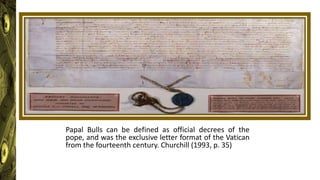
Papal Bulls can be defined as official decrees of the
pope, and was the exclusive letter format of the Vatican
from the fourteenth century. Churchill (1993, p. 35)
This presentation focuses on one
Papal Bull Decree from the
Vatican
Romanus Pontifex 1455
• Romanus Pontifex 1455 called for non-Christian peoples to be
invaded, captured, vanquished, subdued, and reduced to perpetual
slavery and to have their possessions and property seized by Christian
monarchs
(World Church 2012)
• The World Church Council (2012) conveyed that; "in 1493 Pope
Alexander VI called for non-Christian "barbarous nations" to be
subjugated and proselytized for the "propagation of the Christian
empire" (p. 1).
• The World Church Council (2012) also stated that;
• The Doctrine mandated Christian European countries to attack,
enslave and kill the Indigenous Peoples they encountered to acquire
all of their assets. The Doctrine remains the law in various ways in
almost all settler / colonial societies around the world today. The
enormity of this law and the theft of the rights and assets of
Indigenous Peoples have led Indigenous activists to work to educate
the world about this situation and to galvanize opposition to the
Doctrine.
Impact of Doctrine of Discovery on
Indigenous peoples
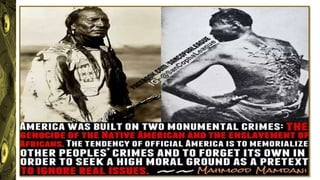
• In 1492 Christopher Columbus enslaves the Arawak People, commits
genocide and their total extinction by 1555
• Christopher Columbus initiates the slave trade in Africa in 1500s
• 500 year war against the First Nations People of America / Canada,
genocide over 100 million Native peoples
• Australia suffered lost generations, and the genocide of 20 Million
through extermination policies
Indigenous Deficit Statistics
• The psychological implications of historical intergenerational trauma
are evident in all Indigenous cultures affected by colonisation
• Deficit statistics in education, employment, poverty, addictions, metal
health, suicide, crime, & prison are comparable across Indigenous
world
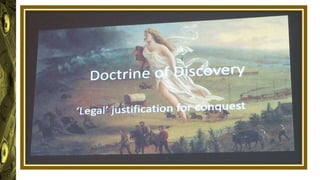
The Doctrine of Discovery is the foundation for all laws in
settler / colonial societies around the world today.
(The World Church Council 2012, p.1)
Discussion
• How are these concepts applied in New Zealand society?
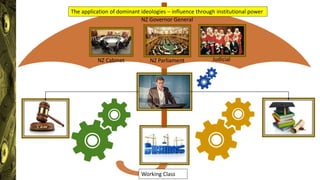
NZ Governor General
NZ Cabinet NZ Parliament Judicial
Working Class
The application of dominant ideologies – influence through institutional power
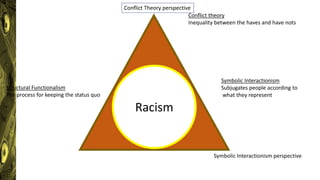
Conflict Theory perspective
Symbolic Interactionism perspective
Conflict theory
Inequality between the haves and have nots
Symbolic Interactionism
Subjugates people according to
what they represent
Structural Functionalism
The process for keeping the status quo
Racism
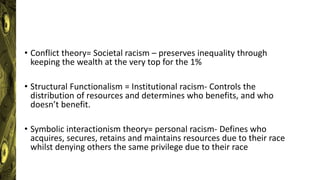
• Conflict theory= Societal racism – preserves inequality through
keeping the wealth at the very top for the 1%
• Structural Functionalism = Institutional racism- Controls the
distribution of resources and determines who benefits, and who
doesn’t benefit.
• Symbolic interactionism theory= personal racism- Defines who
acquires, secures, retains and maintains resources due to their race
whilst denying others the same privilege due to their race
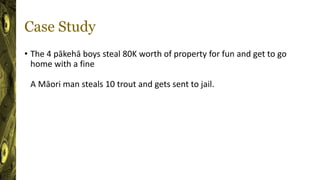
Case Study
• The 4 pākehā boys steal 80K worth of property for fun and get to go
home with a fine
A Māori man steals 10 trout and gets sent to jail.
Discussion
• What theory is being applied to his situation?
Anti-Maori racism
• https://www.youtube.com/watch?v=Kh1nyb7UKRM
Discussion
• What are underlying themes behind this video
Discussion
• What are underlying themes behind racism?
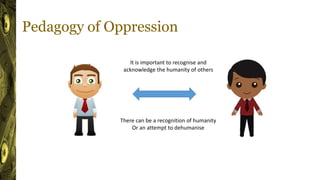
Pedagogy of Oppression
It is important to recognise and
acknowledge the humanity of others
There can be a recognition of humanity
Or an attempt to dehumanise
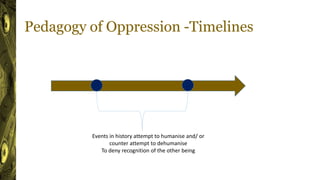
Pedagogy of Oppression -Timelines
Events in history attempt to humanise and/ or
counter attempt to dehumanise
To deny recognition of the other being
Quote:
• The attempt to deny ones humanity through the process of de-
humanisation in effect re-affirms the humanity of the oppressor
Friere, P. 1975
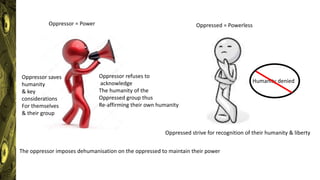
Oppressor = Power Oppressed = Powerless
Oppressor refuses to
acknowledge
The humanity of the
Oppressed group thus
Re-affirming their own humanity
Oppressor saves
humanity
& key
considerations
For themselves
& their group
Humanity denied
Oppressed strive for recognition of their humanity & liberty
The oppressor imposes dehumanisation on the oppressed to maintain their power
Discussion
• What learnings stood out for today?
Karakia Whakamutunga
Kia tau ki a tatou katoa,
te atawhai o to tatou Ariki, o Ihu Karaiti,
me te Aroha o te Atua,
me te whiwhinga tahitanga
ki te wairua tapu,
ake ake ake
Amine.
Reference
Cambell, J.(2010). Pedagogy of the Oppressed part 1. Retrieved May 26 2016 from:
https://www.youtube.com/watch?v=DvHi328_mYI
Cambell, J.(2010). Pedagogy of the Oppressed part 2. Retrieved May 26 2016 from:
https://www.youtube.com/watch?v=YEAATeUAU8Q
The World Church Council.(2012). Doctrine of Discovery. Retrieved May 24 2016 from:
http://www.blackhawkproductions.com/doctrineofdiscovery.htm
Karena, R,W. (2014). Transforming Maori Experiences of Historical Intergenerational Trauma.
Retrieved May 25 from: http://www.slideshare.net/Rawiri/transforming-mori-
experiences-of-historical-intergenerational-trauma-ppt-presentation-may-2014

Racism

  • 1.
    Racism FSC0504 Introduction toSociety By Dr Rawiri Waretini-Karena
  • 2.
    Karakia Timatanga He honore,he kororia ki te Atua He maungarongo ki te whenua He whakaaro pai ki nga tangata katoa Hanga e te Atua, he ngakau hou Ki roto ki tena ki tena o matou Whakatongia to wairua tapu Hei awhina, hei tohutohu I a matou Ake Ake amine
  • 3.
    Learning Outcomes • Toidentify racism • To examine examples and history of racism • To discuss examples
  • 4.
    Discussion • What isracism and how is it defined?
  • 5.
    Racism definition • Racism= Discrimination + power to discriminate • Prejudice = Discrimination – power to discriminate
  • 6.
    The Invisible Privilege •https://www.youtube.com/watch?v=QdmdC2Ud9j0
  • 7.
    Discussion • What areunderlying themes behind this video?
  • 8.
    Discussion • How wasracism established?
  • 9.
    History of Racism •https://www.youtube.com/watch?v=SzqEaiGR7Xo&list=PL3C2A795C6 A8FCDA2
  • 10.
    Discussion • What wereunderlying themes behind this video?
  • 11.
    Discussion • Where didthese ideas come even before America?
  • 13.
    The Age ofDiscovery • Precipitated by Columbian voyages • European powers were eager to obtain portions of land from Indigenous peoples • European emissaries were encountering other European powers during their travels • They recognized a need to establish a formal code of judicial standards of engagement with Indigenous peoples • This lent a patina of legality to the actions of the European Crowns
  • 14.
    Sanction of theCatholic Church • In order for any such regulatory code to be considered effectively binding by all Old World parties, it was vital that it be sanctioned by the Catholic Church”. • A series of Papal Bulls begun by Pope Innocent IV during the late 13th century was used to define the proper [lawful] relationship between Christians and 'Infidels' in worldly matters such as property rights (Churchill, 1993,p. 35).
  • 15.
    Papal Bulls canbe defined as official decrees of the pope, and was the exclusive letter format of the Vatican from the fourteenth century. Churchill (1993, p. 35)
  • 16.
    This presentation focuseson one Papal Bull Decree from the Vatican
  • 17.
    Romanus Pontifex 1455 •Romanus Pontifex 1455 called for non-Christian peoples to be invaded, captured, vanquished, subdued, and reduced to perpetual slavery and to have their possessions and property seized by Christian monarchs (World Church 2012)
  • 18.
    • The WorldChurch Council (2012) conveyed that; "in 1493 Pope Alexander VI called for non-Christian "barbarous nations" to be subjugated and proselytized for the "propagation of the Christian empire" (p. 1).
  • 19.
    • The WorldChurch Council (2012) also stated that; • The Doctrine mandated Christian European countries to attack, enslave and kill the Indigenous Peoples they encountered to acquire all of their assets. The Doctrine remains the law in various ways in almost all settler / colonial societies around the world today. The enormity of this law and the theft of the rights and assets of Indigenous Peoples have led Indigenous activists to work to educate the world about this situation and to galvanize opposition to the Doctrine.
  • 20.
    Impact of Doctrineof Discovery on Indigenous peoples • In 1492 Christopher Columbus enslaves the Arawak People, commits genocide and their total extinction by 1555 • Christopher Columbus initiates the slave trade in Africa in 1500s • 500 year war against the First Nations People of America / Canada, genocide over 100 million Native peoples • Australia suffered lost generations, and the genocide of 20 Million through extermination policies
  • 22.
    Indigenous Deficit Statistics •The psychological implications of historical intergenerational trauma are evident in all Indigenous cultures affected by colonisation • Deficit statistics in education, employment, poverty, addictions, metal health, suicide, crime, & prison are comparable across Indigenous world
  • 23.
    The Doctrine ofDiscovery is the foundation for all laws in settler / colonial societies around the world today. (The World Church Council 2012, p.1)
  • 24.
    Discussion • How arethese concepts applied in New Zealand society?
  • 25.
    NZ Governor General NZCabinet NZ Parliament Judicial Working Class The application of dominant ideologies – influence through institutional power
  • 26.
    Conflict Theory perspective SymbolicInteractionism perspective Conflict theory Inequality between the haves and have nots Symbolic Interactionism Subjugates people according to what they represent Structural Functionalism The process for keeping the status quo Racism
  • 27.
    • Conflict theory=Societal racism – preserves inequality through keeping the wealth at the very top for the 1% • Structural Functionalism = Institutional racism- Controls the distribution of resources and determines who benefits, and who doesn’t benefit. • Symbolic interactionism theory= personal racism- Defines who acquires, secures, retains and maintains resources due to their race whilst denying others the same privilege due to their race
  • 28.
    Case Study • The4 pākehā boys steal 80K worth of property for fun and get to go home with a fine A Māori man steals 10 trout and gets sent to jail.
  • 29.
    Discussion • What theoryis being applied to his situation?
  • 30.
  • 31.
    Discussion • What areunderlying themes behind this video
  • 32.
    Discussion • What areunderlying themes behind racism?
  • 33.
    Pedagogy of Oppression Itis important to recognise and acknowledge the humanity of others There can be a recognition of humanity Or an attempt to dehumanise
  • 34.
    Pedagogy of Oppression-Timelines Events in history attempt to humanise and/ or counter attempt to dehumanise To deny recognition of the other being
  • 35.
    Quote: • The attemptto deny ones humanity through the process of de- humanisation in effect re-affirms the humanity of the oppressor Friere, P. 1975
  • 36.
    Oppressor = PowerOppressed = Powerless Oppressor refuses to acknowledge The humanity of the Oppressed group thus Re-affirming their own humanity Oppressor saves humanity & key considerations For themselves & their group Humanity denied Oppressed strive for recognition of their humanity & liberty The oppressor imposes dehumanisation on the oppressed to maintain their power
  • 37.
    Discussion • What learningsstood out for today?
  • 38.
    Karakia Whakamutunga Kia tauki a tatou katoa, te atawhai o to tatou Ariki, o Ihu Karaiti, me te Aroha o te Atua, me te whiwhinga tahitanga ki te wairua tapu, ake ake ake Amine.
  • 39.
    Reference Cambell, J.(2010). Pedagogyof the Oppressed part 1. Retrieved May 26 2016 from: https://www.youtube.com/watch?v=DvHi328_mYI Cambell, J.(2010). Pedagogy of the Oppressed part 2. Retrieved May 26 2016 from: https://www.youtube.com/watch?v=YEAATeUAU8Q The World Church Council.(2012). Doctrine of Discovery. Retrieved May 24 2016 from: http://www.blackhawkproductions.com/doctrineofdiscovery.htm Karena, R,W. (2014). Transforming Maori Experiences of Historical Intergenerational Trauma. Retrieved May 25 from: http://www.slideshare.net/Rawiri/transforming-mori- experiences-of-historical-intergenerational-trauma-ppt-presentation-may-2014