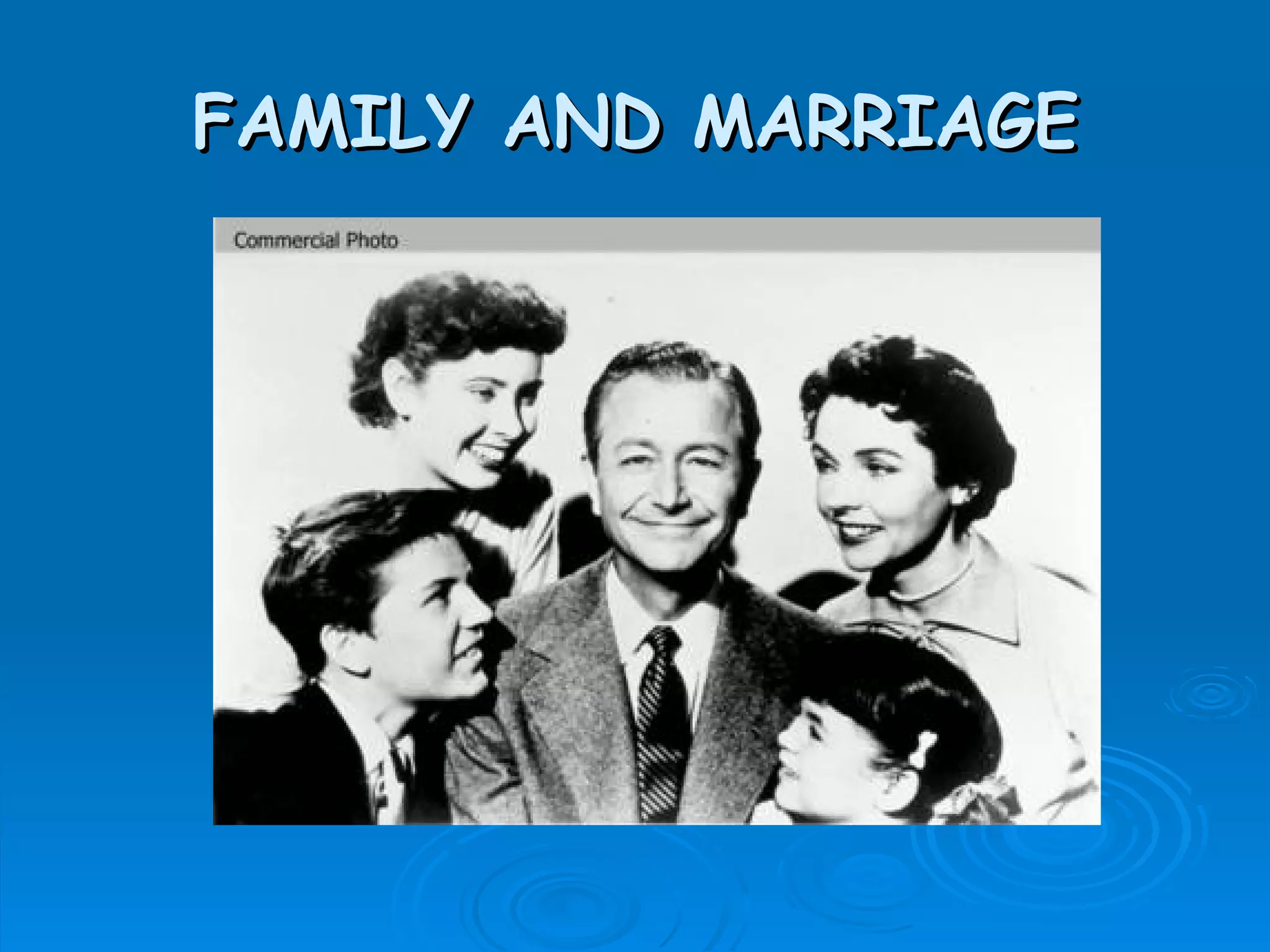
FAMILY AND MARRIAGE
After studying this chapter, you should
       be able to do the following

   Explain the functions of the family.
   Describe the major variations in family structure.
   Define marriage and describe its relationship to
    the phenomenon of romantic love.
   Describe the various rules governing marriage.
   Explain the ways in which mate selection is not
    random.
FAMILY ARRANGEMENTS
 FAMILY – DEF:      A social group
    characterized by common residence,
    economic cooperation, and reproduction.

    TRADITIONAL FAMILY includes adults
    of both sexes, at least two of whom
    maintain a socially approved sexual
    relationship, and one or more children, of
    the sexually cohabiting adults.
Do you agree with this definition?

How would you define a family?
FAMILY STRUCTURES

Nuclear family
 The most basic family form and is made
  up of a married couple and their biological
  or adopted children.

 The nuclear family is found in all societies,
  and it is from this form that all other
  (composite) family forms are derived.
FAMILY STRUCTURES
Polygamous families
   Nuclear families linked together by multiple
    marriage bonds, with one central individual
    married to several spouses.
      - Polygynous when the central person is
    male.
      - Polyandrous when the central person is
    female.

   Common family arrangement around the world
FAMILY STRUCTURES

 Extended families
     Other relations and generations in addition to the
      nuclear family. Along with married parents and their
      offspring, there may be:
         - parents’ parents
         - siblings of the parents
         - siblings’ spouses and children
  
         - in-laws.
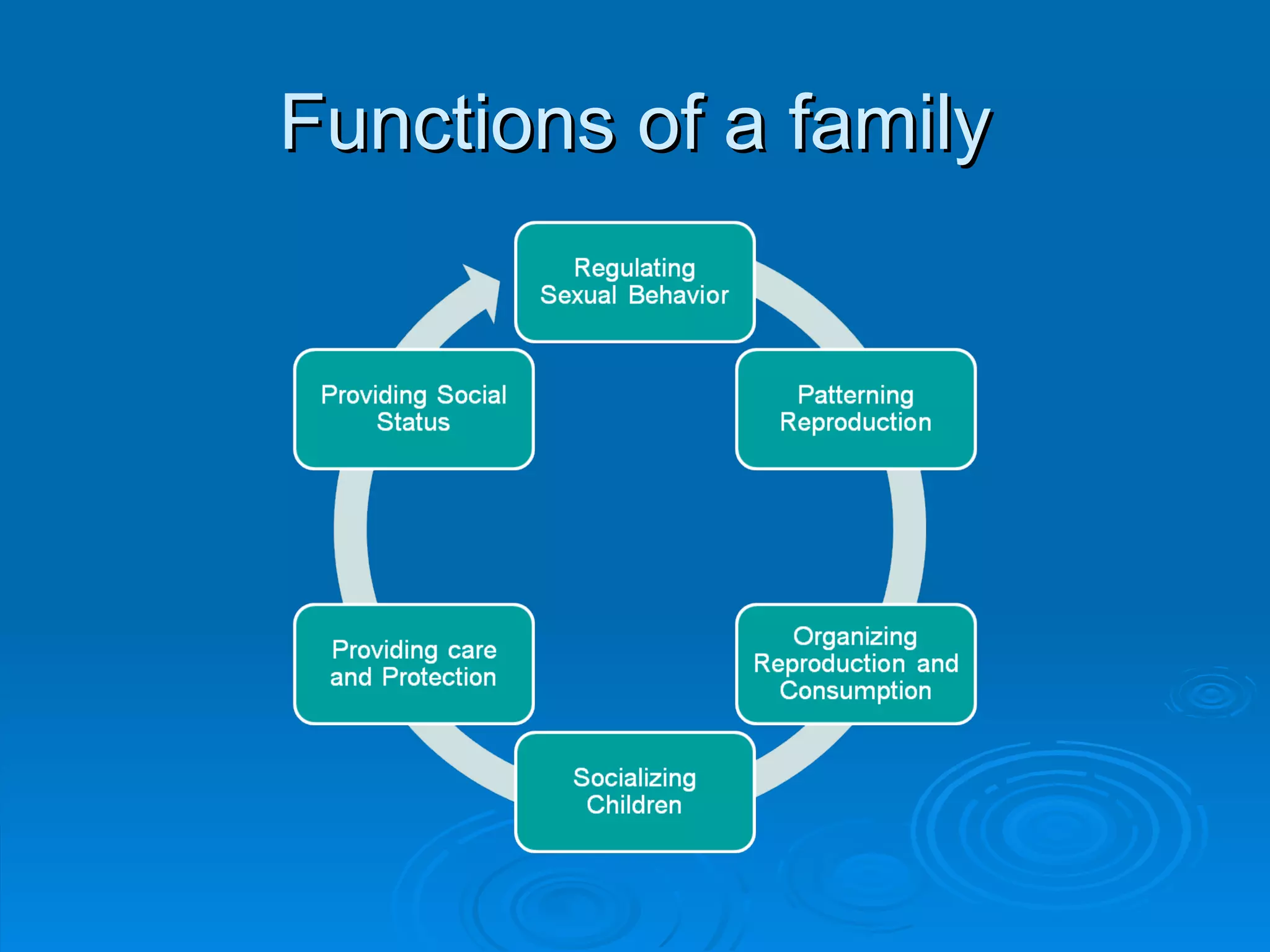
Functions of a family
FAMILY FUNCTIONS
 Family is a universal institution that fulfills
    the functions listed before, the methods
    used will vary by culture

 Not all functions are seen in all societies

GENERATIONAL RELATIONS
Patrilineal system
   Generations are tied together through the males
    of a family; all members trace their kinship
    through the father’s line.
 Matrilineal system
   The generations are tied together through the
    females of a family.
 Bilateral system
       Descent passes through both females and
        males of a family.
FAMILY AUTHORITY
   Patriarchal family
     • Describe situations in which most family affairs are
       dominated by men.


   Matriarchal family
     • Most family affairs are dominated by women, is
       relatively uncommon but does exist.
MARRIAGE
Marriage DEF: An institution found in all
 societies, is the socially recognized,
 legitimized, and supported union of
 individuals of opposite sexes.

Marriage is the binding link that makes the
 institution of family possible.
MARRIAGE

Romantic love as the reason for marriage is
 a value in American Society
  - 81% of U.S. women express that deep
 feelings are more important than money.

Most cultures do not value romance, they
 focus on economic and social relations.
MARRIAGE RULES
   Endogamy
       Limit the social categories from within which one can
        choose a marriage partner.
   Exogamy,
       Require an individual to marry someone outside his or
        her culturally defined group.
   Monogamous
       Each person is allowed only one spouse at a time.
   Polygamy
       an individual may have more than one spouse
MARITAL RESIDENCE
Marital residence rules govern where a couple
 will live after marriage..
 - Patrilocal residence - Calls for the new couple to
  settle down near or within the husband’s father’s
 - Matrilocal residence - Calls for the new couple to
  settle down near or within the wife’s mother’s
 - Bilocal residence - New couples choose whether
  to live with the husband’s or wife’s family of origin.
 - Neolocal residence - The couple may choose to
  live virtually anywhere,
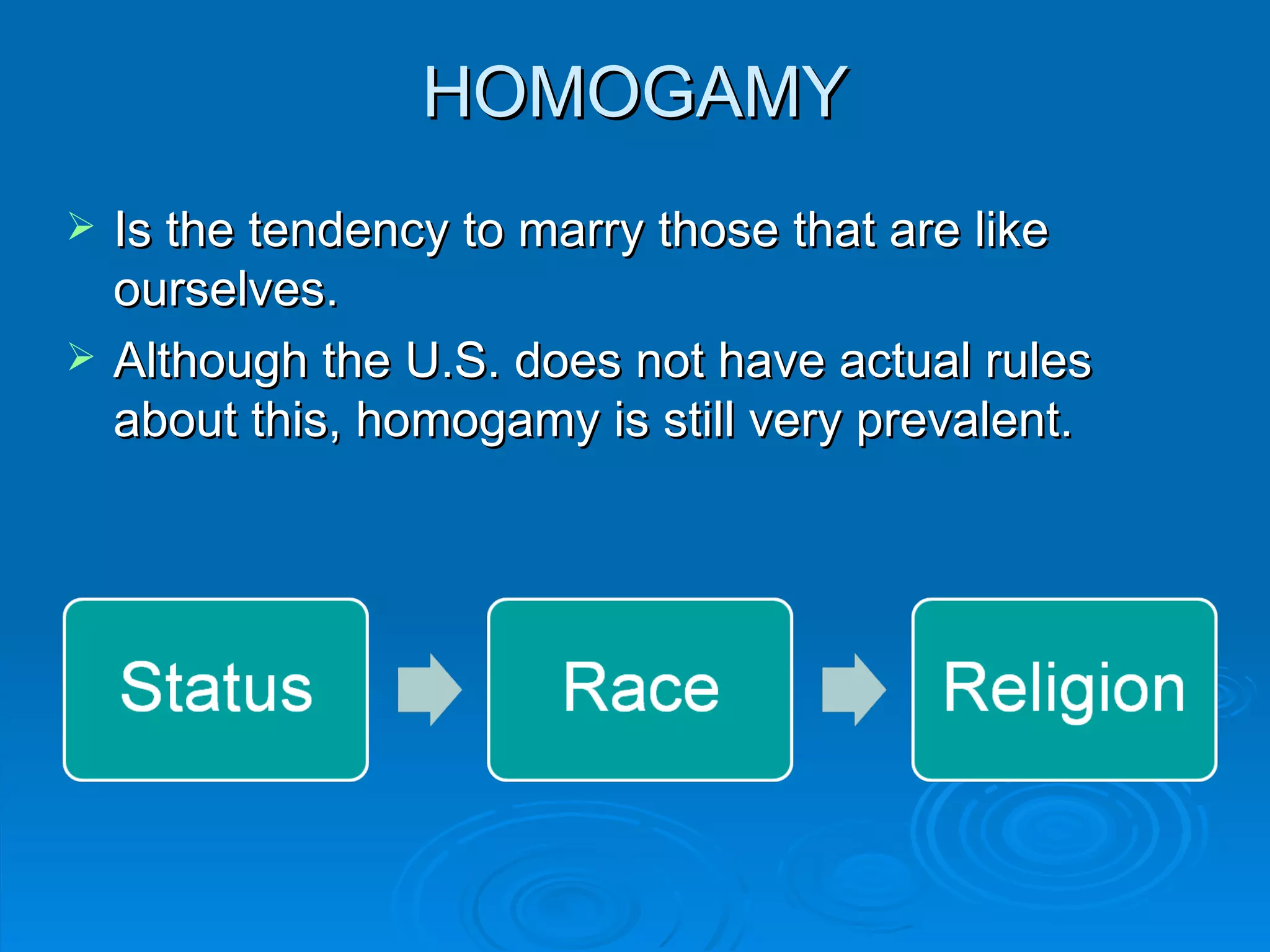
HOMOGAMY
   Is the tendency to marry those that are like
    ourselves.
   Although the U.S. does not have actual rules
    about this, homogamy is still very prevalent.
The Transformation of the
          Family

Families of industrialization faced
         three pressures
FAMILY TRANSFORMATION
 Industrialism demands that workers be
  geographically mobile so that a workforce
  is available wherever new industries
  emerge.
 Industrialism requires a certain degree of
  movement between the social classes.
 The modern nuclear family is more open
  to inheritance and descent through both
  sides of the family, allowing all children
  opportunity to rise in society.
FAMILY TRANSFORMATION
 Decline of the traditional family structure
    can also be attributed to the
    postponement of marriage high divorce
    rates.

 Marriage rate may be down but
  cohabitation is up.
 Cohabitation
   Unmarried couples living together out of wedlock
AMERICAN NUCLEAR FAMILY
 By early 1900s, American Nuclear Family:


    - Child-centered
    - Greater equality for women
    -   Decreased link with extended families
    -   Greater social mobility
    -   Greater geographical mobilit
    -   Marriage based on romantic ideal
    -   Clear separation of work and leisure
NUCLEAR FAMILY CHANGES
 In the modern era there has been a
 transfer of family functions from the family
 to outside institutions (school, courts, etc)

 Childlessness among married couples has
 been increasing in recent years.

 Couples are marrying older and bearing
 children at an older age
NUCLEAR FAMILY CHANGES
 Divorce became easier as most states
 passed laws that allowed “no fault”
 divorces.

 Statistics suggest co-habitation before
  marriage increases divorce rates.
   - or is this due to the demographics of
  those who cohabitate (young, poor, low
  education)
STEPFAMILIES/BLENDED FAMILIES
 Stepfamilies, also known as blended
 families, are transforming basic family
 relationships.

 The largest group of stepfamilies is
 composed of families formed by the
 remarriage of divorced men and women.

 Today 17% of families involve a step-child
SINGLE-PARENT FAMILIES
 The growth in single parent households
    has been influenced by three trends:

   - High divorce rates
   - A increase in the percentage of
  babies born to unwed mothers
   - The rapid growth of cohabitation
GAY AND LESBIAN FAMILIES

 A phenomenon that is not new but one
  that has become more and more visible is
  the household consisting of a gay or
  lesbian couple.
    - In some states these couple have the
  same ability to adopt children as
  “traditional families”
SINGLES
 The proportion of households having one
  person living alone increased from 17% to
  26% between 1970 and 2005.
    - This could reflect a delay in living with
  others or a trend towards single lifestyles
 or it could reflect the aging population.
CONCLUSION

 The traditional family is being replaced, in
  part, by new family arrangements that may
  better suit today’s lifestyles.

 There is little evidence that the family as a
  institution is in decline or weakening. The
  functions it serves are vital to society.
GROUP EXERCISE
 GOING BACK TO THE FUNCTIONS OF
 THE FAMILY, HOW IS THE NUCLEAR
 FAMILY VARIANT YOU’RE GIVEN,
 MORE ABLE, LESS ABLE OR EQUALLY
 ABLE TO PROVIDE EACH OF THESE
 FUNCTIONS?

 EXPLAIN!!

Chapter 12

  • 1.
  • 2.
    After studying thischapter, you should be able to do the following  Explain the functions of the family.  Describe the major variations in family structure.  Define marriage and describe its relationship to the phenomenon of romantic love.  Describe the various rules governing marriage.  Explain the ways in which mate selection is not random.
  • 3.
    FAMILY ARRANGEMENTS  FAMILY– DEF: A social group characterized by common residence, economic cooperation, and reproduction.  TRADITIONAL FAMILY includes adults of both sexes, at least two of whom maintain a socially approved sexual relationship, and one or more children, of the sexually cohabiting adults.
  • 4.
    Do you agreewith this definition? How would you define a family?
  • 5.
    FAMILY STRUCTURES Nuclear family The most basic family form and is made up of a married couple and their biological or adopted children.  The nuclear family is found in all societies, and it is from this form that all other (composite) family forms are derived.
  • 6.
    FAMILY STRUCTURES Polygamous families  Nuclear families linked together by multiple marriage bonds, with one central individual married to several spouses.  - Polygynous when the central person is male.  - Polyandrous when the central person is female.  Common family arrangement around the world
  • 7.
    FAMILY STRUCTURES  Extendedfamilies  Other relations and generations in addition to the nuclear family. Along with married parents and their offspring, there may be:  - parents’ parents  - siblings of the parents  - siblings’ spouses and children  - in-laws.
  • 8.
  • 9.
    FAMILY FUNCTIONS  Familyis a universal institution that fulfills the functions listed before, the methods used will vary by culture  Not all functions are seen in all societies 
  • 10.
    GENERATIONAL RELATIONS Patrilineal system  Generations are tied together through the males of a family; all members trace their kinship through the father’s line.  Matrilineal system  The generations are tied together through the females of a family.  Bilateral system  Descent passes through both females and males of a family.
  • 11.
    FAMILY AUTHORITY  Patriarchal family • Describe situations in which most family affairs are dominated by men.  Matriarchal family • Most family affairs are dominated by women, is relatively uncommon but does exist.
  • 12.
    MARRIAGE Marriage DEF: Aninstitution found in all societies, is the socially recognized, legitimized, and supported union of individuals of opposite sexes. Marriage is the binding link that makes the institution of family possible.
  • 13.
    MARRIAGE Romantic love asthe reason for marriage is a value in American Society - 81% of U.S. women express that deep feelings are more important than money. Most cultures do not value romance, they focus on economic and social relations.
  • 14.
    MARRIAGE RULES  Endogamy  Limit the social categories from within which one can choose a marriage partner.  Exogamy,  Require an individual to marry someone outside his or her culturally defined group.  Monogamous  Each person is allowed only one spouse at a time.  Polygamy  an individual may have more than one spouse
  • 15.
    MARITAL RESIDENCE Marital residencerules govern where a couple will live after marriage.. - Patrilocal residence - Calls for the new couple to settle down near or within the husband’s father’s - Matrilocal residence - Calls for the new couple to settle down near or within the wife’s mother’s - Bilocal residence - New couples choose whether to live with the husband’s or wife’s family of origin. - Neolocal residence - The couple may choose to live virtually anywhere,
  • 16.
    HOMOGAMY  Is the tendency to marry those that are like ourselves.  Although the U.S. does not have actual rules about this, homogamy is still very prevalent.
  • 17.
    The Transformation ofthe Family Families of industrialization faced three pressures
  • 18.
    FAMILY TRANSFORMATION  Industrialismdemands that workers be geographically mobile so that a workforce is available wherever new industries emerge.  Industrialism requires a certain degree of movement between the social classes.  The modern nuclear family is more open to inheritance and descent through both sides of the family, allowing all children opportunity to rise in society.
  • 19.
    FAMILY TRANSFORMATION  Declineof the traditional family structure can also be attributed to the postponement of marriage high divorce rates.  Marriage rate may be down but cohabitation is up.  Cohabitation  Unmarried couples living together out of wedlock
  • 20.
    AMERICAN NUCLEAR FAMILY By early 1900s, American Nuclear Family:  - Child-centered  - Greater equality for women  - Decreased link with extended families  - Greater social mobility  - Greater geographical mobilit  - Marriage based on romantic ideal  - Clear separation of work and leisure
  • 21.
    NUCLEAR FAMILY CHANGES In the modern era there has been a transfer of family functions from the family to outside institutions (school, courts, etc)  Childlessness among married couples has been increasing in recent years.  Couples are marrying older and bearing children at an older age
  • 22.
    NUCLEAR FAMILY CHANGES Divorce became easier as most states passed laws that allowed “no fault” divorces.  Statistics suggest co-habitation before marriage increases divorce rates.  - or is this due to the demographics of those who cohabitate (young, poor, low education)
  • 23.
    STEPFAMILIES/BLENDED FAMILIES  Stepfamilies,also known as blended families, are transforming basic family relationships.  The largest group of stepfamilies is composed of families formed by the remarriage of divorced men and women.  Today 17% of families involve a step-child
  • 24.
    SINGLE-PARENT FAMILIES  Thegrowth in single parent households has been influenced by three trends:  - High divorce rates  - A increase in the percentage of babies born to unwed mothers  - The rapid growth of cohabitation
  • 25.
    GAY AND LESBIANFAMILIES  A phenomenon that is not new but one that has become more and more visible is the household consisting of a gay or lesbian couple.  - In some states these couple have the same ability to adopt children as “traditional families”
  • 26.
    SINGLES  The proportionof households having one person living alone increased from 17% to 26% between 1970 and 2005.  - This could reflect a delay in living with others or a trend towards single lifestyles  or it could reflect the aging population.
  • 27.
    CONCLUSION  The traditionalfamily is being replaced, in part, by new family arrangements that may better suit today’s lifestyles.  There is little evidence that the family as a institution is in decline or weakening. The functions it serves are vital to society.
  • 28.
    GROUP EXERCISE  GOINGBACK TO THE FUNCTIONS OF THE FAMILY, HOW IS THE NUCLEAR FAMILY VARIANT YOU’RE GIVEN, MORE ABLE, LESS ABLE OR EQUALLY ABLE TO PROVIDE EACH OF THESE FUNCTIONS?  EXPLAIN!!

Editor's Notes

  • #7 Bin laden - 3 wives
  • #11 THESE USUALLY AFFECT FAMILY TIES WITH EXTENDED FAMILY
  • #17 STATUS – People marry similar education, occupation level, social cirles RACE Only 5 % of marriages are mixed race RELIGION Some religions sanction, all encourage marrying within.
  • #29 SINGLE PARENT, GAY COUPLE, EXTENDED FAMILY, STEP FAMILY, TWO WORKING PARENTS