
ANTHONY GIDDENS ● MITCHELL DUNEIER ● RICHARD APPELBAUM ● DEBORA CARR
Slides created by Shannon Anderson, Roanoke College
Third Edition
Chapter 10: Ethnicity and Race
1
© 2011 W. W. Norton Co., Inc.
The big issues
• Understanding what we mean by ethnicity and
race.
• The importance of historical context
• Trends in global migration
• Being “ethnic” (non-white) in the U.S.
• How ethnicity and race affect everyone
2
© 2011 W. W. Norton Co., Inc.
Race and ethnicity are
complicated
• Is the child of a biracial couple (black and
white) black or white? Mixed?
• Is Judaism a religion or an ethnicity? Both?
• Race and ethnicity are terms used every day
but rarely explored.
3
© 2011 W. W. Norton Co., Inc.
Defining ethnicity
• Ethnicity refers to the distinct cultural norms
and values of a social group.
• Characteristics of ethnic groups include (to
varying degrees):
– Shared history
– Religion and culture
– Kin or ancestry
– Sense of shared destiny
– Language
4
© 2011 W. W. Norton Co., Inc.
Ethnic options
• Recent research has shown that because of
intergroup marriage, for many whites living in
the United States, ethnicity has become a
choice.
• For many, ethnicity is largely opted out of
altogether.
• For nonwhites, opting out of ethnicity is not a
choice.
5
© 2011 W. W. Norton Co., Inc.
Defining race
• Race refers to an externally imposed system of
social categorization and stratification.
• No true biological races exist; rather, human
groups must be placed on a continuum.
• Typically, race refers to some set of physical
characteristics granted importance by a society.
• Race is socially constructed.
6
© 2011 W. W. Norton Co., Inc.
Racialization
• The actual imposition of some racial schema
on society is called racialization.
• The process involves both formal and informal
inequities, including segregated schools and
businesses, along with differentiated rights.
• These inequalities shape the lives of all those
in the racialized society.
7
© 2011 W. W. Norton Co., Inc.
Racism
• Racism is a form of prejudice and/or
discrimination based on physical
differences.
• There are many layers of racism
– Individual consciousness and behavior
– Ideologies of supremacy
– Institutional racism
8
© 2011 W. W. Norton Co., Inc.
Concepts related to racism
• Prejudice
• Discrimination
• Stereotypes
• Scapegoats
• Minority groups
9
© 2011 W. W. Norton Co., Inc.
Colonialism and racism
• We must consider history when working to
understand racism today.
• Modern racism goes back to the history of
European colonization of much of the world.
• The colonizers had strongly ethnocentric
attitudes of racial supremacy.
10
© 2011 W. W. Norton Co., Inc.
Colonialism and racism
• Those ideologies led to a sometimes
paternalistic form of racism, linked to
developing scientific racism.
• Long-standing cultural narratives of white and
black—good or purity and evil or impurity—
combined with scientific racism helped to
deepen and then perpetuate racialization.
11
© 2011 W. W. Norton Co., Inc.
Models of ethnic coexistence
in the United States
• Assimilation
• Melting pot
• Multiculturalism
• Segregation
• Problems: both segregation and aggressive
assimilation have led to ethnic conflict
12
© 2011 W. W. Norton Co., Inc.
Studying migration
• Trends in global migration today:
– Acceleration
– Diversification
– Globalization
– Feminization
– Transnationalism
• Global diasporas
13
© 2011 W. W. Norton Co., Inc.
14
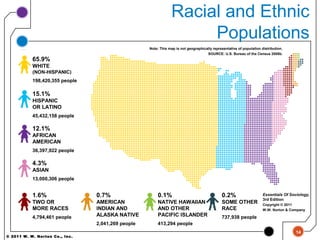
65.9%
WHITE
(NON-HISPANIC)
198,420,355 people
15.1%
HISPANIC
OR LATINO
45,432,158 people
12.1%
AFRICAN
AMERICAN
36,397,922 people
4.3%
ASIAN
13,000,306 people
1.6%
TWO OR
MORE RACES
4,794,461 people
0.7%
AMERICAN
INDIAN AND
ALASKA NATIVE
2,041,269 people
0.1%
NATIVE HAWAIIAN
AND OTHER
PACIFIC ISLANDER
413,294 people
0.2%
SOME OTHER
RACE
737,938 people
Note: This map is not geographically representative of population distribution.
SOURCE: U.S. Bureau of the Census 2008b.
Essentials Of Sociology,
3rd Edition
Copyright © 2011
W.W. Norton & Company
Racial and Ethnic
Populations
© 2011 W. W. Norton Co., Inc.
Race in U.S. history—Slavery
• From early colonization on, racialization has
been part of the story of the United States.
• Africans were brought as slaves in huge
numbers: nearly 4 million by 1780.
• Their responses to slavery varied from
rebellion to passivity to cultural development
to hostility.
• With abolition, life for former slaves did not
change quickly or evenly.
15
© 2011 W. W. Norton Co., Inc.
Race in U.S. history—Immigration
• 1820–1920: over 30 million immigrants came
to the United States voluntarily, mostly from
Europe
• Not all European groups were equally
welcomed, nor were Asian immigrants.
• In 1924 the National Origins Act was passed,
restricting immigration.
• In 1965 that law was rescinded and today’s
immigration patterns began.
16
© 2011 W. W. Norton Co., Inc.
Race in U.S. history—Civil rights
• Until the 1960s, African Americans had few
legal rights or protections.
• 1954: Brown v Board of Education of Topeka,
Kansas
• 1950s: Rosa Parks, Martin Luther King, Jr.
• 1964: President Lyndon Johnson signs the
Civil Rights Act into law
• There remains some question about the
success of the civil rights movement.
17
© 2011 W. W. Norton Co., Inc.
Latinos in the United States
• Latinos, or Hispanics, are not a single, unified
group aside from their shared language.
• The three main groups in the United States all
have very different histories:
– Mexican Americans
– Puerto Ricans
– Cuban Americans
18
© 2011 W. W. Norton Co., Inc.
Latinos in the United States
• Today there are increasing numbers of Central
American immigrants.
• Latinos now make up a larger percentage of
the population than African Americans, with
approximately 15 percent versus 12 percent (as
of 2008).
19
© 2011 W. W. Norton Co., Inc.
Asians in the United States
• Like Latinos, Asians are not comprised of a
single group of people.
• The largest groups in the United States include
Chinese, Japanese, and Filipinos, though there
are sizeable populations of other groups.
20
© 2011 W. W. Norton Co., Inc.
Asians in the United States
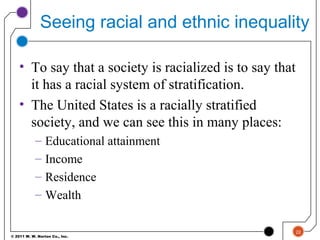
• Asians have a history of extreme
discrimination in U.S. history.
• Even so, as a group they have done very well
and are now often referred to as a “model
minority.”
• Asians currently make up about 4 percent of
the U.S. population.
21
© 2011 W. W. Norton Co., Inc.
Seeing racial and ethnic inequality
• To say that a society is racialized is to say that
it has a racial system of stratification.
• The United States is a racially stratified
society, and we can see this in many places:
– Educational attainment
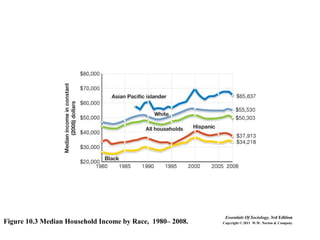
– Income
– Residence
– Wealth
22
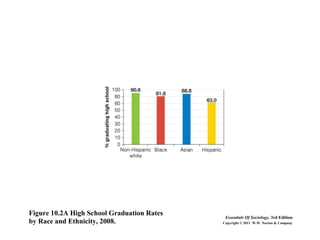
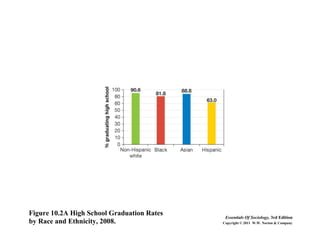
Figure 10.2A High School Graduation Rates
by Race and Ethnicity, 2008.
Essentials Of Sociology, 3rd Edition
Copyright © 2011 W.W. Norton & Company
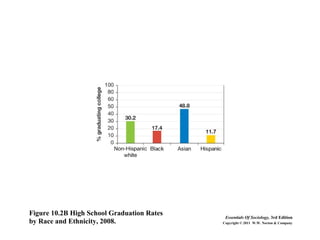
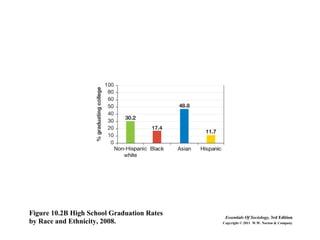
Figure 10.2B High School Graduation Rates
by Race and Ethnicity, 2008.
Essentials Of Sociology, 3rd Edition
Copyright © 2011 W.W. Norton & Company
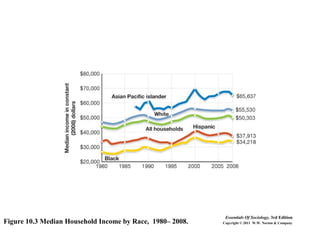
Figure 10.3 Median Household Income by Race, 1980– 2008.
Essentials Of Sociology, 3rd Edition
Copyright © 2011 W.W. Norton & Company
© 2011 W. W. Norton Co., Inc.
Seeing inequality
• We can also see racial inequality in:
– Political representation
– Residential segregation
– Criminal justice system
– Health and wellness
26
© 2011 W. W. Norton Co., Inc.
Getting ahead
• Over time, white ethnics have integrated well.
• Asian Americans have also done quite well
when looked at as a whole.
• Cubans have done very well overall.
• African Americans, Native Americans, and
Puerto Ricans have not fared as well.
27
© 2011 W. W. Norton Co., Inc.
Why are there such
significant gaps?
• There are a variety of factors that help explain
why some groups find more success than
others.
– Voluntary immigration versus forced minority
status
– Type and degree of discrimination faced
– Ability to blend into the “mainstream”
– Affinity of group culture to U.S. culture and values
28
W. W. Norton & Company
Independent and Employee-Owned
This concludes the Lecture
PowerPoint Presentation for
For more learning resources, please visit our online StudySpace at:
http://www.wwnorton.com/college/soc/essentials-of-sociology10/
29
© 2011 W. W. Norton Co., Inc.
Chapter 10: Ethnicity and Race
© 2011 W. W. Norton Co., Inc.
Clicker Questions
1. What is ethnicity?
a. the physical manifestation of racial difference
b. any biologically grounded features of a group of people
c. any group outside the white, English-speaking majority
d. the cultural practices and outlooks of a given community that
have emerged historically and tend to set people apart
30
© 2011 W. W. Norton Co., Inc.
Clicker Questions
2. Racism that is embedded in the very structure and operation of
society is called
a. structural racism.
b. institutional racism.
c. formal racism.
d. modern racism.
31
© 2011 W. W. Norton Co., Inc.
Clicker Questions
3. Which of the following is a characteristic of minority groups?
a. The members speak English as a second language.
b. The members have no sense of group solidarity.
c. The members see themselves as set apart from the majority.
d. The members tend to live and work in mostly white
neighborhoods.
32
© 2011 W. W. Norton Co., Inc.
Clicker Questions
4. What is the difference between the assimilation and melting pot models of
integrating new ethnic groups into the dominant society?
a. The assimilation model refers to the new group adopting the norms and values of the
dominant society, whereas the melting pot model refers to the merging and
blending of dominant and ethnic cultures.
b. The assimilation model refers to members of the new group becoming citizens of the
host nation, whereas the melting pot model refers to members of the new group
remaining guest workers and having only the legal rights afforded to those on work
visas.
c. The assimilation model refers to members of the new group learning the language of
the host nation and dispersing to the suburbs, whereas the melting pot model refers
to members of the new group sticking to their own language and becoming
concentrated in particular urban neighborhoods.
d. The assimilation model refers to the experience of twentieth-century immigrants to
the United States, whereas the melting pot model refers to the experience of
nineteenth-century immigrants.
33
© 2011 W. W. Norton Co., Inc.
Clicker Questions
5. When Ali moved to the United States from Iraq, he changed
his wardrobe by shopping at the local mall, began watching
American movies, and indulged in sweets and fast food like
the rest of the teenagers his age. Ali’s process of abandoning
his original customs and adopting those of the majority is
called
a. pluralism.
b. assimilation.
c. melting pot.
d. multiculturalism.
34
© 2011 W. W. Norton Co., Inc.
Clicker Questions
6. The process by which a society’s understandings of race are
used to classify individuals or groups of people is called
a. racialism.
b. racism.
c. racialization.
d. racial identification.
35
© 2011 W. W. Norton Co., Inc.
Clicker Questions
7. How does the experience of blacks in American cities compare
with that of other minority groups?
a. Blacks have more political representation but less economic
wealth.
b. Segregation and poverty have not been reduced in the way
they have been for other groups.
c. Blacks have more wealth and more likely to live in the suburbs
than other immigrant groups.
d. Blacks have been much less involved in the public sector than
immigrant groups, but they have more wealth than other
immigrant groups.
36
Art Presentation Slides
Chapter 10
Anthony Giddens
Mitchell Duneier
Richard P. Appelbaum
Deborah Carr
Ethnicity and Race
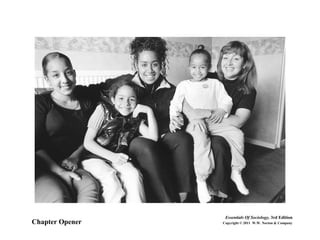
Chapter Opener
Essentials Of Sociology, 3rd Edition
Copyright © 2011 W.W. Norton & Company
Celebrating the Chinese New Year with performances and
decorations is not just a picturesque event every year.
Essentials Of Sociology, 3rd Edition
Copyright © 2011 W.W. Norton & Company
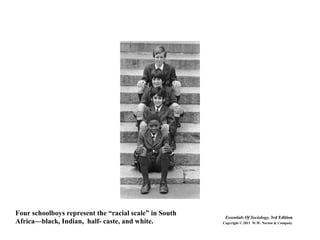
Four schoolboys represent the “racial scale” in South
Africa—black, Indian, half- caste, and white.
Essentials Of Sociology, 3rd Edition
Copyright © 2011 W.W. Norton & Company
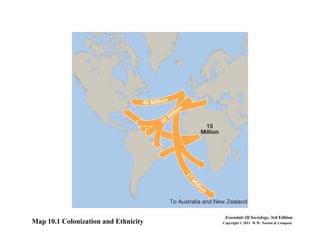
Map 10.1 Colonization and Ethnicity
Essentials Of Sociology, 3rd Edition
Copyright © 2011 W.W. Norton & Company
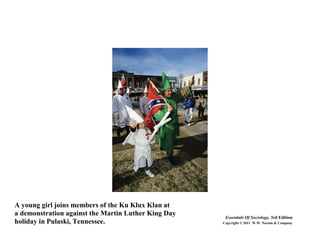
A young girl joins members of the Ku Klux Klan at
a demonstration against the Martin Luther King Day
holiday in Pulaski, Tennessee.
Essentials Of Sociology, 3rd Edition
Copyright © 2011 W.W. Norton & Company
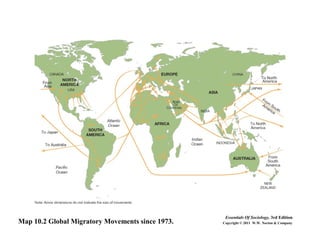
Map 10.2 Global Migratory Movements since 1973.
Essentials Of Sociology, 3rd Edition
Copyright © 2011 W.W. Norton & Company
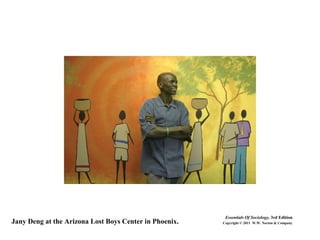
Jany Deng at the Arizona Lost Boys Center in Phoenix.
Essentials Of Sociology, 3rd Edition
Copyright © 2011 W.W. Norton & Company
© 2011 W. W. Norton Co., Inc.
Racial and Ethnic
Populations
45
65.9%
WHITE
(NON-HISPANIC)
198,420,355 people
15.1%
HISPANIC
OR LATINO
45,432,158 people
12.1%
AFRICAN
AMERICAN
36,397,922 people
4.3%
ASIAN
13,000,306 people
1.6%
TWO OR
MORE RACES
4,794,461 people
0.7%
AMERICAN
INDIAN AND
ALASKA NATIVE
2,041,269 people
0.1%
NATIVE HAWAIIAN
AND OTHER
PACIFIC ISLANDER
413,294 people
0.2%
SOME OTHER
RACE
737,938 people
Note: This map is not geographically representative of population distribution.
SOURCE: U.S. Bureau of the Census 2008b.
Essentials Of Sociology,
3rd Edition
Copyright © 2011
W.W. Norton & Company
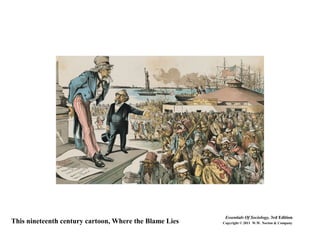
This nineteenth century cartoon, Where the Blame Lies
Essentials Of Sociology, 3rd Edition
Copyright © 2011 W.W. Norton & Company
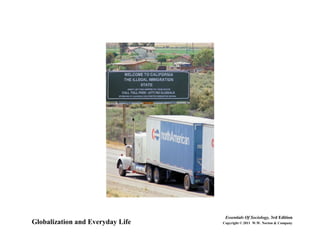
Globalization and Everyday Life
Essentials Of Sociology, 3rd Edition
Copyright © 2011 W.W. Norton & Company
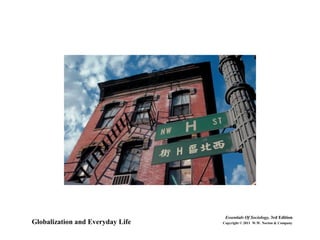
Globalization and Everyday Life
Essentials Of Sociology, 3rd Edition
Copyright © 2011 W.W. Norton & Company
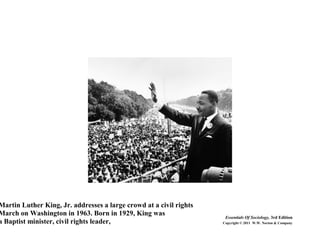
Martin Luther King, Jr. addresses a large crowd at a civil rights
March on Washington in 1963. Born in 1929, King was
a Baptist minister, civil rights leader,
Essentials Of Sociology, 3rd Edition
Copyright © 2011 W.W. Norton & Company
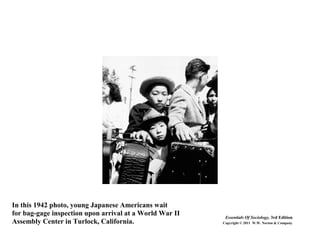
In this 1942 photo, young Japanese Americans wait
for bag-gage inspection upon arrival at a World War II
Assembly Center in Turlock, California.
Essentials Of Sociology, 3rd Edition
Copyright © 2011 W.W. Norton & Company
Figure 10.2A High School Graduation Rates
by Race and Ethnicity, 2008.
Essentials Of Sociology, 3rd Edition
Copyright © 2011 W.W. Norton & Company
Figure 10.2B High School Graduation Rates
by Race and Ethnicity, 2008.
Essentials Of Sociology, 3rd Edition
Copyright © 2011 W.W. Norton & Company
Figure 10.3 Median Household Income by Race, 1980– 2008.
Essentials Of Sociology, 3rd Edition
Copyright © 2011 W.W. Norton & Company
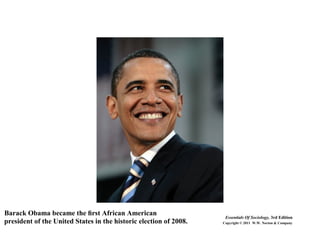
Barack Obama became the first African American
president of the United States in the historic election of 2008.
Essentials Of Sociology, 3rd Edition
Copyright © 2011 W.W. Norton & Company
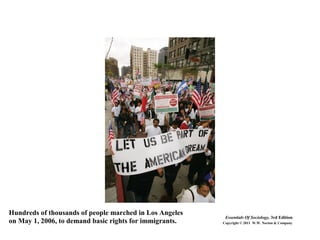
Hundreds of thousands of people marched in Los Angeles
on May 1, 2006, to demand basic rights for immigrants.
Essentials Of Sociology, 3rd Edition
Copyright © 2011 W.W. Norton & Company
W.W. Norton & Company
Independent and Employee-Owned
Essentials Of Sociology
THIRD EDITION
This concludes the Art Presentation Slides
Slide Set for Chapter 10
by
Anthony Giddens
Mitchell Duneier
Richard P. Appelbaum
Deborah Carr

Chapter10

  • 1.
    ANTHONY GIDDENS ●MITCHELL DUNEIER ● RICHARD APPELBAUM ● DEBORA CARR Slides created by Shannon Anderson, Roanoke College Third Edition Chapter 10: Ethnicity and Race 1
  • 2.
    © 2011 W.W. Norton Co., Inc. The big issues • Understanding what we mean by ethnicity and race. • The importance of historical context • Trends in global migration • Being “ethnic” (non-white) in the U.S. • How ethnicity and race affect everyone 2
  • 3.
    © 2011 W.W. Norton Co., Inc. Race and ethnicity are complicated • Is the child of a biracial couple (black and white) black or white? Mixed? • Is Judaism a religion or an ethnicity? Both? • Race and ethnicity are terms used every day but rarely explored. 3
  • 4.
    © 2011 W.W. Norton Co., Inc. Defining ethnicity • Ethnicity refers to the distinct cultural norms and values of a social group. • Characteristics of ethnic groups include (to varying degrees): – Shared history – Religion and culture – Kin or ancestry – Sense of shared destiny – Language 4
  • 5.
    © 2011 W.W. Norton Co., Inc. Ethnic options • Recent research has shown that because of intergroup marriage, for many whites living in the United States, ethnicity has become a choice. • For many, ethnicity is largely opted out of altogether. • For nonwhites, opting out of ethnicity is not a choice. 5
  • 6.
    © 2011 W.W. Norton Co., Inc. Defining race • Race refers to an externally imposed system of social categorization and stratification. • No true biological races exist; rather, human groups must be placed on a continuum. • Typically, race refers to some set of physical characteristics granted importance by a society. • Race is socially constructed. 6
  • 7.
    © 2011 W.W. Norton Co., Inc. Racialization • The actual imposition of some racial schema on society is called racialization. • The process involves both formal and informal inequities, including segregated schools and businesses, along with differentiated rights. • These inequalities shape the lives of all those in the racialized society. 7
  • 8.
    © 2011 W.W. Norton Co., Inc. Racism • Racism is a form of prejudice and/or discrimination based on physical differences. • There are many layers of racism – Individual consciousness and behavior – Ideologies of supremacy – Institutional racism 8
  • 9.
    © 2011 W.W. Norton Co., Inc. Concepts related to racism • Prejudice • Discrimination • Stereotypes • Scapegoats • Minority groups 9
  • 10.
    © 2011 W.W. Norton Co., Inc. Colonialism and racism • We must consider history when working to understand racism today. • Modern racism goes back to the history of European colonization of much of the world. • The colonizers had strongly ethnocentric attitudes of racial supremacy. 10
  • 11.
    © 2011 W.W. Norton Co., Inc. Colonialism and racism • Those ideologies led to a sometimes paternalistic form of racism, linked to developing scientific racism. • Long-standing cultural narratives of white and black—good or purity and evil or impurity— combined with scientific racism helped to deepen and then perpetuate racialization. 11
  • 12.
    © 2011 W.W. Norton Co., Inc. Models of ethnic coexistence in the United States • Assimilation • Melting pot • Multiculturalism • Segregation • Problems: both segregation and aggressive assimilation have led to ethnic conflict 12
  • 13.
    © 2011 W.W. Norton Co., Inc. Studying migration • Trends in global migration today: – Acceleration – Diversification – Globalization – Feminization – Transnationalism • Global diasporas 13
  • 14.
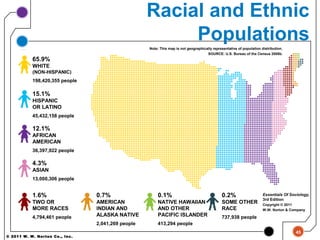
    © 2011 W.W. Norton Co., Inc. 14 65.9% WHITE (NON-HISPANIC) 198,420,355 people 15.1% HISPANIC OR LATINO 45,432,158 people 12.1% AFRICAN AMERICAN 36,397,922 people 4.3% ASIAN 13,000,306 people 1.6% TWO OR MORE RACES 4,794,461 people 0.7% AMERICAN INDIAN AND ALASKA NATIVE 2,041,269 people 0.1% NATIVE HAWAIIAN AND OTHER PACIFIC ISLANDER 413,294 people 0.2% SOME OTHER RACE 737,938 people Note: This map is not geographically representative of population distribution. SOURCE: U.S. Bureau of the Census 2008b. Essentials Of Sociology, 3rd Edition Copyright © 2011 W.W. Norton & Company Racial and Ethnic Populations
  • 15.
    © 2011 W.W. Norton Co., Inc. Race in U.S. history—Slavery • From early colonization on, racialization has been part of the story of the United States. • Africans were brought as slaves in huge numbers: nearly 4 million by 1780. • Their responses to slavery varied from rebellion to passivity to cultural development to hostility. • With abolition, life for former slaves did not change quickly or evenly. 15
  • 16.
    © 2011 W.W. Norton Co., Inc. Race in U.S. history—Immigration • 1820–1920: over 30 million immigrants came to the United States voluntarily, mostly from Europe • Not all European groups were equally welcomed, nor were Asian immigrants. • In 1924 the National Origins Act was passed, restricting immigration. • In 1965 that law was rescinded and today’s immigration patterns began. 16
  • 17.
    © 2011 W.W. Norton Co., Inc. Race in U.S. history—Civil rights • Until the 1960s, African Americans had few legal rights or protections. • 1954: Brown v Board of Education of Topeka, Kansas • 1950s: Rosa Parks, Martin Luther King, Jr. • 1964: President Lyndon Johnson signs the Civil Rights Act into law • There remains some question about the success of the civil rights movement. 17
  • 18.
    © 2011 W.W. Norton Co., Inc. Latinos in the United States • Latinos, or Hispanics, are not a single, unified group aside from their shared language. • The three main groups in the United States all have very different histories: – Mexican Americans – Puerto Ricans – Cuban Americans 18
  • 19.
    © 2011 W.W. Norton Co., Inc. Latinos in the United States • Today there are increasing numbers of Central American immigrants. • Latinos now make up a larger percentage of the population than African Americans, with approximately 15 percent versus 12 percent (as of 2008). 19
  • 20.
    © 2011 W.W. Norton Co., Inc. Asians in the United States • Like Latinos, Asians are not comprised of a single group of people. • The largest groups in the United States include Chinese, Japanese, and Filipinos, though there are sizeable populations of other groups. 20
  • 21.
    © 2011 W.W. Norton Co., Inc. Asians in the United States • Asians have a history of extreme discrimination in U.S. history. • Even so, as a group they have done very well and are now often referred to as a “model minority.” • Asians currently make up about 4 percent of the U.S. population. 21
  • 22.
    © 2011 W.W. Norton Co., Inc. Seeing racial and ethnic inequality • To say that a society is racialized is to say that it has a racial system of stratification. • The United States is a racially stratified society, and we can see this in many places: – Educational attainment – Income – Residence – Wealth 22
  • 23.
    Figure 10.2A HighSchool Graduation Rates by Race and Ethnicity, 2008. Essentials Of Sociology, 3rd Edition Copyright © 2011 W.W. Norton & Company
  • 24.
    Figure 10.2B HighSchool Graduation Rates by Race and Ethnicity, 2008. Essentials Of Sociology, 3rd Edition Copyright © 2011 W.W. Norton & Company
  • 25.
    Figure 10.3 MedianHousehold Income by Race, 1980– 2008. Essentials Of Sociology, 3rd Edition Copyright © 2011 W.W. Norton & Company
  • 26.
    © 2011 W.W. Norton Co., Inc. Seeing inequality • We can also see racial inequality in: – Political representation – Residential segregation – Criminal justice system – Health and wellness 26
  • 27.
    © 2011 W.W. Norton Co., Inc. Getting ahead • Over time, white ethnics have integrated well. • Asian Americans have also done quite well when looked at as a whole. • Cubans have done very well overall. • African Americans, Native Americans, and Puerto Ricans have not fared as well. 27
  • 28.
    © 2011 W.W. Norton Co., Inc. Why are there such significant gaps? • There are a variety of factors that help explain why some groups find more success than others. – Voluntary immigration versus forced minority status – Type and degree of discrimination faced – Ability to blend into the “mainstream” – Affinity of group culture to U.S. culture and values 28
  • 29.
    W. W. Norton& Company Independent and Employee-Owned This concludes the Lecture PowerPoint Presentation for For more learning resources, please visit our online StudySpace at: http://www.wwnorton.com/college/soc/essentials-of-sociology10/ 29 © 2011 W. W. Norton Co., Inc. Chapter 10: Ethnicity and Race
  • 30.
    © 2011 W.W. Norton Co., Inc. Clicker Questions 1. What is ethnicity? a. the physical manifestation of racial difference b. any biologically grounded features of a group of people c. any group outside the white, English-speaking majority d. the cultural practices and outlooks of a given community that have emerged historically and tend to set people apart 30
  • 31.
    © 2011 W.W. Norton Co., Inc. Clicker Questions 2. Racism that is embedded in the very structure and operation of society is called a. structural racism. b. institutional racism. c. formal racism. d. modern racism. 31
  • 32.
    © 2011 W.W. Norton Co., Inc. Clicker Questions 3. Which of the following is a characteristic of minority groups? a. The members speak English as a second language. b. The members have no sense of group solidarity. c. The members see themselves as set apart from the majority. d. The members tend to live and work in mostly white neighborhoods. 32
  • 33.
    © 2011 W.W. Norton Co., Inc. Clicker Questions 4. What is the difference between the assimilation and melting pot models of integrating new ethnic groups into the dominant society? a. The assimilation model refers to the new group adopting the norms and values of the dominant society, whereas the melting pot model refers to the merging and blending of dominant and ethnic cultures. b. The assimilation model refers to members of the new group becoming citizens of the host nation, whereas the melting pot model refers to members of the new group remaining guest workers and having only the legal rights afforded to those on work visas. c. The assimilation model refers to members of the new group learning the language of the host nation and dispersing to the suburbs, whereas the melting pot model refers to members of the new group sticking to their own language and becoming concentrated in particular urban neighborhoods. d. The assimilation model refers to the experience of twentieth-century immigrants to the United States, whereas the melting pot model refers to the experience of nineteenth-century immigrants. 33
  • 34.
    © 2011 W.W. Norton Co., Inc. Clicker Questions 5. When Ali moved to the United States from Iraq, he changed his wardrobe by shopping at the local mall, began watching American movies, and indulged in sweets and fast food like the rest of the teenagers his age. Ali’s process of abandoning his original customs and adopting those of the majority is called a. pluralism. b. assimilation. c. melting pot. d. multiculturalism. 34
  • 35.
    © 2011 W.W. Norton Co., Inc. Clicker Questions 6. The process by which a society’s understandings of race are used to classify individuals or groups of people is called a. racialism. b. racism. c. racialization. d. racial identification. 35
  • 36.
    © 2011 W.W. Norton Co., Inc. Clicker Questions 7. How does the experience of blacks in American cities compare with that of other minority groups? a. Blacks have more political representation but less economic wealth. b. Segregation and poverty have not been reduced in the way they have been for other groups. c. Blacks have more wealth and more likely to live in the suburbs than other immigrant groups. d. Blacks have been much less involved in the public sector than immigrant groups, but they have more wealth than other immigrant groups. 36
  • 37.
    Art Presentation Slides Chapter10 Anthony Giddens Mitchell Duneier Richard P. Appelbaum Deborah Carr Ethnicity and Race
  • 38.
    Chapter Opener Essentials OfSociology, 3rd Edition Copyright © 2011 W.W. Norton & Company
  • 39.
    Celebrating the ChineseNew Year with performances and decorations is not just a picturesque event every year. Essentials Of Sociology, 3rd Edition Copyright © 2011 W.W. Norton & Company
  • 40.
    Four schoolboys representthe “racial scale” in South Africa—black, Indian, half- caste, and white. Essentials Of Sociology, 3rd Edition Copyright © 2011 W.W. Norton & Company
  • 41.
    Map 10.1 Colonizationand Ethnicity Essentials Of Sociology, 3rd Edition Copyright © 2011 W.W. Norton & Company
  • 42.
    A young girljoins members of the Ku Klux Klan at a demonstration against the Martin Luther King Day holiday in Pulaski, Tennessee. Essentials Of Sociology, 3rd Edition Copyright © 2011 W.W. Norton & Company
  • 43.
    Map 10.2 GlobalMigratory Movements since 1973. Essentials Of Sociology, 3rd Edition Copyright © 2011 W.W. Norton & Company
  • 44.
    Jany Deng atthe Arizona Lost Boys Center in Phoenix. Essentials Of Sociology, 3rd Edition Copyright © 2011 W.W. Norton & Company
  • 45.
    © 2011 W.W. Norton Co., Inc. Racial and Ethnic Populations 45 65.9% WHITE (NON-HISPANIC) 198,420,355 people 15.1% HISPANIC OR LATINO 45,432,158 people 12.1% AFRICAN AMERICAN 36,397,922 people 4.3% ASIAN 13,000,306 people 1.6% TWO OR MORE RACES 4,794,461 people 0.7% AMERICAN INDIAN AND ALASKA NATIVE 2,041,269 people 0.1% NATIVE HAWAIIAN AND OTHER PACIFIC ISLANDER 413,294 people 0.2% SOME OTHER RACE 737,938 people Note: This map is not geographically representative of population distribution. SOURCE: U.S. Bureau of the Census 2008b. Essentials Of Sociology, 3rd Edition Copyright © 2011 W.W. Norton & Company
  • 46.
    This nineteenth centurycartoon, Where the Blame Lies Essentials Of Sociology, 3rd Edition Copyright © 2011 W.W. Norton & Company
  • 47.
    Globalization and EverydayLife Essentials Of Sociology, 3rd Edition Copyright © 2011 W.W. Norton & Company
  • 48.
    Globalization and EverydayLife Essentials Of Sociology, 3rd Edition Copyright © 2011 W.W. Norton & Company
  • 49.
    Martin Luther King,Jr. addresses a large crowd at a civil rights March on Washington in 1963. Born in 1929, King was a Baptist minister, civil rights leader, Essentials Of Sociology, 3rd Edition Copyright © 2011 W.W. Norton & Company
  • 50.
    In this 1942photo, young Japanese Americans wait for bag-gage inspection upon arrival at a World War II Assembly Center in Turlock, California. Essentials Of Sociology, 3rd Edition Copyright © 2011 W.W. Norton & Company
  • 51.
    Figure 10.2A HighSchool Graduation Rates by Race and Ethnicity, 2008. Essentials Of Sociology, 3rd Edition Copyright © 2011 W.W. Norton & Company
  • 52.
    Figure 10.2B HighSchool Graduation Rates by Race and Ethnicity, 2008. Essentials Of Sociology, 3rd Edition Copyright © 2011 W.W. Norton & Company
  • 53.
    Figure 10.3 MedianHousehold Income by Race, 1980– 2008. Essentials Of Sociology, 3rd Edition Copyright © 2011 W.W. Norton & Company
  • 54.
    Barack Obama becamethe first African American president of the United States in the historic election of 2008. Essentials Of Sociology, 3rd Edition Copyright © 2011 W.W. Norton & Company
  • 55.
    Hundreds of thousandsof people marched in Los Angeles on May 1, 2006, to demand basic rights for immigrants. Essentials Of Sociology, 3rd Edition Copyright © 2011 W.W. Norton & Company
  • 56.
    W.W. Norton &Company Independent and Employee-Owned Essentials Of Sociology THIRD EDITION This concludes the Art Presentation Slides Slide Set for Chapter 10 by Anthony Giddens Mitchell Duneier Richard P. Appelbaum Deborah Carr

Editor's Notes

  • #2 Many of the broad statements that I’ve made about gender inequality also apply to issues of race and ethnicity—power, privilege and property have been, and continue to be, distributed unequally.   Also, the racial and ethnic categories in which we put so much stock are—like gender—the products of cultural meanings, not biology or even geography.   I think before getting into the topic of race and ethnicity, it’s important to remind you that much, but not all, work done in this subfield of sociology remains under the broader heading of social stratification. In other words, for many sociologists, the study of race (especially) is primarily the study of unequal access to power, prestige, and property based on racial groupings.
  • #3 There are many important issues we could cover in terms of ethnicity and race, but for starters, I’ll focus on these: We need to really know what we mean when we use the words race and ethnicity. The two are certainly connected in many ways, but they are not one and the same. We need to put current issues revolving around race and ethnicity into their historical context. There is no way to get a full picture of what is happening today without knowing what came before. I will introduce you to some of the most important trends in global migration: What is changing? What remains the same? Who is going where? Once we have a sense of these underlying issues, I will talk about what it means to be “ethnic” in the United States today. Mostly this term is (incorrectly) used to refer to those who are not white, and that is the sense in which I will pursue this concern. And finally, we need to recognize that whether we are white, black, Latino, Asian, some combination, or something different, the way our society handles—or doesn’t handle—ethnicity and race affects us all.
  • #4 What are race and ethnicity? What is the relationship between the two? What do we call someone who has parents of different races or ethnicities? What groups count as ethnic groups, as opposed to something different? The words race and ethnicity are part of everyday language, but they are often used without much precision. What I want to do to get us started is to clarify just what sociologists mean when they discuss race and ethnicity.
  • #5 We’ll start with ethnicity. The word ethnicity comes from the Greek ethnos, which means nation. This term was meant to refer to those with a common national ancestry and culture. The term ethnicity itself is relatively new—dating to middle of the twentieth century—and has a somewhat looser definition, but certainly rests on the original Greek. Ethnic groups are those that share a set of distinctive norms and values, and ethnicity is the word we use to describe those groups. What are the main characteristics of ethnic groups? -Shared history -Shared religion and culture -Common kin or ancestry (real or imagined) -Sense of shared future or destiny -Common language Sometimes a connection to a shared homeland (usually not the place where the group currently resides) is also considered one of these characteristics. It is important to recognize that different groups concern themselves more or less with each of these aspects of ethnicity.
  • #6 What this implies, and correctly so, is that not all ethnic groups are structured in some precise, formulaic way. For some groups, religion and culture are the most significant tie; for others, it is a shared history of triumph or tragedy; for others still, it is a shared language that unites people in the face of some other group. Another way of thinking about this is to say that there are ethnic groups based largely on religion, on race, on nationality, on language, or even on shared interests. In the United States, one thing that has happened in the face of our ongoing national conversation about diversity is that we often see ethnicity as only being a factor for non-whites. Sure, some of us claim Irish or Jewish or German or Italian ancestry, but by and large, we treat ethnicity as something reserved for racial minorities. One result of this is that for whites, ethnicity has become, according sociologist Mary Waters, optional. That simply means that whites have the choice to pick up ethnicity when it suits them: for holidays, parades, or for much more meaningful associations. We do not see the ethnicity of the dominant group, only of the non-dominant ones. For non-whites, whose racial identity is worn on their skin, among other places, there is no choice: They are categorized as having a particular racial and ethnic identity, whether they care to adopt it or not. Ethnicity is, in these cases, too frequently used as a tool of discrimination or power wielding.
  • #7 I’ve suggested that, in large part, race is a special case of ethnicity. I believe that is correct, but for now, I also want to talk about race on its own terms. What is race? Race is a form of social categorization, imposed by those with power, based on some physical characteristic that is given meaning by a society. Characteristics like skin color, eye shape, thrust of the jaw, and hair color have all been used to categorize those of certain “racial” groups. In reality, there are no biological races. There is as much variation within so-called racial groups as between them, which tells us that human groups exist on a continuum, not in three or four distinct racial categories. Race, then, is socially constructed. It is imperative to point out here that these categories are not harmless. Rather, racial categories are defined by those with the power to organize societies and are used to construct often rigid systems of stratification. Think about the slave South in the United States, about apartheid in South Africa, or even about racial discrimination, which continues in the world’s most developed societies even today.
  • #8 Racialization is the term we use to describe the process of imposing a racial system on a society. This happens through both formal and informal channels. The formal paths to racialization include passing laws and enacting social policies that differentiate rights and responsibilities based on race. Can you think of some of these? Possible answers include limiting access to stores, seating, and other public spaces; writing anti-miscegenation laws; formal exclusionary policies from social groups, and so on. Informal paths include social prejudice and discrimination via exclusion, violence, and the threat of violence. Can you think of other informal ways racialization is carried out? As you can see, racialization affects the lives of everyone living in the society. For some it means unearned rights and privileges, and for others, undeserved hardship and difficulty, and even danger.
  • #9 Another way of thinking about the effects of racialization is to consider racism. We all have a sense of what racism is, but again, it’s important to map it out as clearly as possible. Racism is a multi-layered phenomenon. There is active racism, which involves acts of discrimination, whereby people are disadvantaged directly as a result of their race by individuals or groups. There are ideologies of supremacy in which members of one racial or ethnic group order their lives in part with the assumption that their group is simply better—superior—to others. This could lead to active racism, or it could simply reside in the consciousness of individuals. Finally, there is institutional racism, which is particularly difficult to identify and remedy. This is a kind of racism that exists in the very structure of society, the assumptions built into corporate and legal policies, and the ways that groups interact. Institutional racism is often less the result of overt, individual racism than an acceptance of the system of racial stratification already in place and of the status quo.
  • #10 In defining racism I’ve used a few terms that need to be better defined. Let me start with prejudice and discrimination. Anyone know the difference between these two terms? Prejudice is holding preconceived ideas about people (individuals or groups) based on some characteristic; it may be positive or negative. Discrimination is actually acting on those ideas in a negative way, such that it disadvantages members of the group. It is possible to be prejudiced but not discriminate, and vice versa. Someone who does both is what we would likely call a racist. Stereotypes are sets of ideas that we believe describe some category of people. These are usually fairly rigid and difficult to change. Scapegoats are groups of people that are blamed for problems. Can you think of any examples of either of these contexts? Think about, for example, the Salem witch trials as an example of scapegoating. Or think of the academic success of Asian students as an example of stereotyping. Finally, let’s define minority groups. Sociologically, when we use the term minority group we are referring to power, not just numbers. In other words, all groups (racial, ethnic, religious, etc.) other than the dominant group (again, think power) are minority groups.
  • #11 Now that you have a better sense of what race and ethnicity are, along with some of the related vocabulary and processes, let’s move on to a bit of history. How did we get where we are regarding race, racialization, and ethnic conflict? To understand racism today, we have to go back at least as far as the colonial era. Beginning in the fifteenth century, the European powers—at that time England, Spain, Portugal, Italy, and France—set out to acquire all the world had to offer. They did this by colonizing much of the globe: the Americas, much of Asia, South Africa, North Africa, Australia. . . . As they settled in these places in an effort to bring glory and riches to their home countries, a relationship of racism and drastic inequality developed. The colonizers had strongly ethnocentric attitudes of racial superiority, sometimes based on quasi-scientific racism, that allowed them to dehumanize and exploit the natives.
  • #12 Undergirding this pragmatic, exploitative relationship were cultural narratives defining white as pure and good and black (or dark) as evil and bad. Such stories, deeply held and supported by romanticism and scientific racism, helped perpetuate racialization in the colonies. The natives were evil and subhuman and needed the strong hand of the colonizers to see the light and to live correctly. It was this guise of helping the natives that is referred to as paternalism. As you might guess, and in fact, as you know at least from American history, the natives were less than appreciative.
  • #13 But not every situation of ethnic/racial coexistence has to be so harsh and unlivable as the colonies once were. In fact, with the colonies now nation-states themselves, they too must figure out how to deal with diversity. What I’m going to do now is quickly go over four modern models of ethnic coexistence that have been or are being tried somewhere in the world. I’ll talk about them in the context of the United States. Broadly speaking, assimilation is a model of coexistence that requires those outside the dominant group to conform to dominant group norms and leave their own group’s culture and practices behind. The melting pot is a model that claims that everyone will continue to change as more and more groups are brought into the mix. Multiculturalism, based in large part on earlier models of cultural pluralism, seeks a society in which all groups are respected and maintained within a unified political and economic framework. Finally, there is segregation, which is, of course, antithetical to coexistence, but has been tried and re-tried in strongly racialized societies. The first three of these approaches have pros and cons, which we can certainly discuss. The big problems can come from overly aggressive versions of assimilation—wherein minority groups feel coerced rather than invited in—and from segregation. Both of these possibilities have led to horrible periods in world history.
  • #14 Part of what leads to ethnic diversity is, of course, global migration. Let’s spend a few minutes, then, thinking about the major trends in migration today, which have shifted dramatically in more recent years. First off, there is more migration now than ever before. Second, immigration flows have diversified such that countries now receive immigrants from more countries than used to be the case. Third, people now enter and leave more countries than in earlier times. Not everyone is headed to the same one or two countries, and ease of movement has opened the door to more globalized migration. Fourth, women now make up a larger proportion of migrants, as they have become an increasingly important component of labor markets. Unfortunately this includes their often-forced participation in global sex trafficking. Finally, there is the shift toward transnationalism, wherein migration flows are not entirely permanent; people, money, and communication allow people to be in more than one place and have a less rigid, more flexible sense of home. Another ongoing topic in the study of migration is that of global diasporas. Diasporas are cases where some ethnic group has been forced to vacate its homeland and its members have scattered around the world. Even so, they have maintained some sense of group identity and feel connected to others, even those who live very far away. The two most frequently discussed diasporas have been the African Diaspora and the Jewish Diaspora.
  • #15 Infographic exercises: What percentage of the U.S. population consists of racial and ethnic minorities (i.e., non-white, non-Hispanic)? How many people classify themselves by two or more races? How many people do not choose to classify themselves using the racial/ethnic categories traditionally provided? Which racial/ethnic group makes up only 4.3 percent of the population? Which racial/ethnic group(s) include more than 15 million people?
  • #16 As you are well aware, race has been, and continues to be a significant part of the American story. In the earliest days of what is now the United States, African slaves were brought here in huge numbers—nearly 4 million by 1780. It was, especially in the southern colonies, and then states, their hard work that supported the growth of the plantation economy. Slaves were separated from their families, sold at open markets, and forced to live and work for owners who thought of them as less than (or at least less) human. This situation provoked a variety of responses among slaves, including outright rebellion and hostility, to passivity, to development of a uniquely African American culture, and occasionally, however counterintuitively, to close ties with owners. After the Civil War, which was fought primarily for economic and political reasons, most blacks expected abolition to utterly change the social structure. While it did in certain ways, the changes were uneven, slow, and in other ways, lacking altogether. Many rights that we take for granted today—like voting, equal opportunity, and equal education—were denied to former slaves, and to all blacks living in the United States, for many years to come.
  • #17 Immigration has also been, and continues to be, a significant part of the American story. Slaves, of course, are different from immigrants as they did not come to this country voluntarily. , But immigrants who did choose to come here, seeking opportunities, freedom, and prosperity, often faced the experience of racism, too. Most immigrants prior to 1880 were from northern and western Europe, and mostly from the colonial powers. The biggest exception here was the large flow of Irish immigrants in the middle of the nineteenth century. After 1880, immigrants from southern and eastern Europe began to arrive, and this was none too pleasing to those already here. The Irish, the Slavs, the Greeks, the Italians, eastern European Jews, the Poles—all of these groups were racialized and seen as inferior to the largely Protestant establishment. It was late in the nineteenth century that the United States also saw a significant influx of, first, Chinese, and then Japanese, immigrants. , These groups came mainly to work as cheap labor out West, and they too were treated with blatant prejudice and hatred. It was, in fact, the very high numbers of these less-than-welcome immigrants just after the turn of the century that led to a highly charged campaign to restrict immigration. This campaign succeeded in 1924 but was reversed more than forty years later, in 1965.
  • #18 Beginning in the 1950s and culminating with the passage of the Civil Rights Act in 1964, the United States waded through a very difficult period of coming to terms—or for some, not coming to terms—with the combination of a racially and ethnically diverse population, laws that discriminated against many groups, a constitution that required equal protection, and a powerful white, Anglo-Saxon, Protestant culture that resisted change. Two national organizations, the National Association for the Advancement of Colored People (NAACP) and the National Urban League, began working toward black civil rights earlier in the century, but the real turning point came with the famous case in 1954 of Brown v. Board of Education of Topeka, Kansas. That was the case that gave us a hallmark phrase still pointed to today, that separate social institutions, in this case schools, are “inherently unequal.” The 1950s also brought us such important civil rights figures as Martin Luther King, Jr., and Rosa Parks. Over time, through boycotts, sit-ins, and marches, including the well-known 1963 march in Washington, D.C., civil rights began to make headway. Though there were many Americans at that time who strongly resisted (and some who still do today), the Civil Rights Act was passed, which legislated against school segregation and discriminatory voting requirements, among other issues. There are those who wonder how successful that period, and that law, have been in promoting racial equality. Surely we continue to have an unequal society, but significant changes have also come to pass. Barack Obama’s presidency illustrates those changes, but does not mean that racism is gone or that the need to continually examine where we are in terms of equality has passed.
  • #19 The studying of Latinos in the United States is an incredibly broad field. Why is this so? In large part it is because we are talking about people from Mexico, seven Central American countries, twelve South American countries, Puerto Rico, Cuba, the Dominican Republic, and Spain. In reality, the primary unifying point for those we often call Hispanic—which literally means those from Spain or with a relationship to Spain—is the use of Spanish language. The idea that people with roots in any of these twenty-four countries are part of one, single ethnic group remains somewhat controversial. There are those who favor it for reasons of creating a large, strong group of people with shared interests and related cultures. There are those who oppose it because it seemingly wipes out the distinctions that exist between the many groups. Time will tell how much Latinos become a unified bloc and whether they come to truly constitute a meaningful ethnicity. The three largest groups of Latinos here in the United States are Mexican Americans, Puerto Ricans, and Cuban Americans.
  • #20 In recent years there have been increasingly large numbers of immigrants from Central America as well. Also, Latino populations are more spread out. It used to be that they were relatively confined to the Southwest and to California and Florida, but today, states like North Carolina and Illinois also have large and growing Hispanic populations. The growth of the Latino population in the United States is most readily seen in the census data that shows that they now outnumber African Americans as a percentage of the total U.S. population.
  • #21 As with Latinos, there has been something of a tendency to lump together all those from Asian countries into one large group that we simply call “Asian.” Like Latinos, this misses the reality of a group of people coming from some more than 15 countries and with different cultures, languages, and reasons for being here. The largest groups in the United States are Chinese, Filipinos, Asian Indian, Japanese, Korean, and Vietnamese.
  • #22 As I’ve already mentioned, many Asians have experienced a great deal of discrimination in American history. The two best-known examples are the dreadful treatment of Chinese workers in the mining and railroad industries at the end of the nineteenth century and the forced internment of Japanese Americans during World War II. Discrimination against Asian Americans certainly still exists, but in large part they are a minority group that has been, in general, quite successful. In a moment we will look at some education and income data that will be more precise, but for now suffice it to say that as a group, Asians outperform even whites in many categories we tend to think of as very important. This has led to their sometimes loved, sometimes loathed, moniker as a “model minority.”
  • #23 After all of this talk about race, ethnicity, racialization, and history, it will be helpful to see what this actually looks like—which is a great deal of inequality. We can see this in many categories, including wealth, place of residence, education, occupation, and income. There are also more subtle indicators of inequality having to do with how people perceive their group’s status in society, whether they see racism as a continuing problem, and whether they believe their interests are taken into account by elected officials. We can see inequality in the kind of everyday racial profiling that, while illegal, happens with police officers, teachers, airport guards, store clerks. We can see it in the unequal distribution of privilege. But let’s go ahead and look at some data that will make some of this situation more clear.
  • #27 Those, of course, aren’t the only places were we can actively see racial inequality. Let’s think for a moment about four more locations: First, consider political representation. Yes, we now have a black president, but that does not make the disproportional representation of minorities across the political spectrum vanish either literally or in importance. African Americans, for example, make up 12 percent of the population but only 2 percent of elected officials. Elected officials have a great deal of power, so this tells us that African Americans have only a limited voice in terms of political power. Second, we can think about what’s called residential segregation. We know that there are ongoing structures of residential segregation that keep us living separately and, per our own Supreme Court, this means unequally. Some of this is by choice, but some happens through the process of steering and other nefarious real estate and mortgage practices. Some happens through what is known as “white flight.” Do you know what white flight is? Other locations for inequality include our criminal justice system and our basic, physical health. Let me just say that minority groups, especially those living disproportionately in poverty, do not fare well in either case. Your textbook deals with both issues.
  • #28 So what kinds of changes have occurred? Certainly white ethnics—those reviled southern and eastern Europeans who arrived at the turn of the twentieth century—have been very successful. Asian Americans have also done very well as a whole, though there are a few smaller groups, for example the Hmong and the Hmien, who are more recent immigrants and who continue to struggle. Cubans have been by far the most successful of the Latino groups here in the United States, becoming quite powerful and influential in South Florida, where they mostly reside. African Americans, Native Americans, and Puerto Ricans, have not had nearly as much success. Getting ahead continues to elude members of these groups as a whole. That certainly does not mean no African Americans are doing well; again, look at our president. But data still show significant gaps between these groups and others, and the question is, why?
  • #29 There are as many explanations why as students in this room, but let’s focus on a few of the factors that social scientists have isolated as among the most important in explaining who gets ahead and who does not. Groups that do well are typically those who came to this country voluntarily. Groups that struggle were either brought here against their will or were incorporated (as in the case of Native Americans, Mexican Americans, and Puerto Ricans) into the United States as a group. Why might this lead to different outcomes? The type and degree of discrimination faced by groups also seems to have something to do with a group’s ability to succeed here. Slavery of African Americans is the most obvious example. No other group has faced anything comparable. There are exceptions, of course. The Chinese and Japanese faced terrible racism and have indeed climbed the ladder, but they have had other factors work in their favor. Groups that could blend in have certainly had a certain kind of advantage. Jews from eastern Europe certainly stood out on arrival, with strange accents and customs. But in time, as their children went to public schools, as Reform Judaism became the largest denomination, and as assimilation took place, their ability to literally look like everyone else—the fact that they were white—was very helpful to them. Finally, but no less significantly, coming from a culture with similar values to “American culture” has really helped certain groups. Having a strong educational or work ethic matches up very nicely with the very American “Protestant work ethic.” Such an affinity certainly plays a role, for example, in the success of Asians and Jews.
  • #30 There is so much more that could be said, but that completes our material on this chapter. Next we will move on to discuss something all of us have: families.
  • #31 Answer: D Ref: What Are Race and Ethnicity?, p. 270
  • #32 Answer: B Ref: What Are Race and Ethnicity?, p. 272
  • #33 Answer: C Ref: What Are Race and Ethnicity?, pp. 273–274
  • #34 Answer: A Ref: How Do Ethnic Groups Coexist and Compete?, p. 277
  • #35 Answer: B Ref: How Do Ethnic Groups Coexist and Compete?, p. 277. Assimilation means that new immigrant groups assume the attitudes and language of the dominant white community.
  • #36 Answer: C Ref: What Are Race and Ethnicity?, p. 271
  • #37 Answer: B Ref: How Do Ethnic Minorities Experience Life in the United States?, p. 288. African Americans have not become assimilated into the wider society in the way in which the successive groups of white immigrants were. They have, for the most part, been unable to break free from the conditions of neighborhood segregation and poverty that other immigrants faced on arrival.
  • #46 Infographic exercises: What percentage of the U.S. population consists of racial and ethnic minorities (i.e., non-white, non-Hispanic)? How many people classify themselves by two or more races? How many people do not choose to classify themselves using the racial/ethnic categories traditionally provided? Which racial/ethnic group makes up only 4.3 percent of the population? Which racial/ethnic group(s) include more than 15 million people?