Race & Ethnicity
 
Structural Inequalities What percentage of population?  Approx 10% Educational disadvantage –African Caribbean,  Bangladeshi, Pakistani Unemployment rates 2 or 3 times that of white group – even when well qualified More likely to live in social housing, and in poor over-crowded conditions.
Race & Ethnicity ‘ Race’: 'socially defined but on the basis of physical criteria.‘ Ethnicity: 'socially defined but on the basis of cultural criteria'   Van den Berghe, 1967: 9 in Goldberg, 1992, 553 ‘ For social boundaries to be actively maintained, they need to be continually validated, and this requires regular interaction with members of out groups’  ( Frederick Barth, 1969,  Ethnic Groups and Social Boundaries )
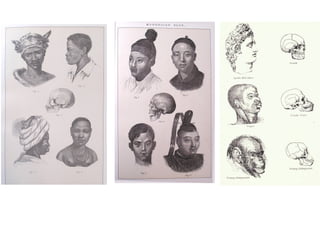
Race – ‘shifting signifier’ Race – said to be a social invention does not have a fixed referent  At different times has been associated with species divide, religious belief, class, nation, citizenship, culture, ethnicity Consider notions of ‘breeding’ and eugenicist views
 
Instrumental or Primordial? Ethnicity as a resource to be used in times of competition. Ethnicity and race as deep-seated and relatively fixed
Marxism  &  Race Marx recognised that racism – the divide and rule of colonialism prevented a united working class opposing the bourgeoisie Race is  not  a primary category of analysis But serves as a convenient tool of capitalism which will wither away when economic reality is recognised,  or a mask which serves to obscure true relations of power in a society, which are, in fact, class-based.
Neo-Weberian   Rational Choice theory –  ‘ race relations’  approach - the work of John Rex and Michael Banton  Complex matrix of factors – class, status, economic and cultural factors, patterns of consumption, stereotypes, forms of representation etc…
Neo-Marxists  1.  Relative Autonomy Model  (Hall, 1980) class and ‘race’ should be examined together. 2.  Autonomy Model  (Gabriel and Ben-Tovim, 1979) racism cannot be reduced to class conflict   3.  Migrant Labour Model  (Miles & Phizacklea “ Race is an idea which should be explicitly and consistently confined to the dustbin of analytically useless terms.”(Miles, 1984:42 in Solomos p8).
Pierre Bourdieu concept of  'habitus', grounded in material conditions and experience struggle for ‘symbolic dominance’  the habitus is a reflexive, generative structure   a useful tool to look at cases of inter-ethnic differences, alienation, and conflict which are in a state of constant adjustment and negotiation.
Black Feminism   Historically profound connection between gender, sexuality and race   Sojourner Truth: “...aint I a woman?” highlights the ‘double burden’ : sexism and racism Feminism recognised processes which are equally applicable to racialised groups: Erasure, Denial, Invisibility, Tokenism critique of White feminism
Postmodernism & Race End of ‘grand narratives’ of history Advent  of Identity politics  Depoliticised, factionalised  Focus on representation rather than ideology Relativism and ‘differences’ rather than universalism and ‘equal’ rights
Genocide and Postmodernism
 
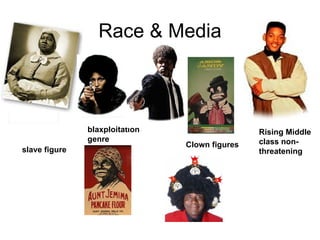
Race & Media slave figure Clown figures Rising Middle class  non-threatening blaxploitation genre
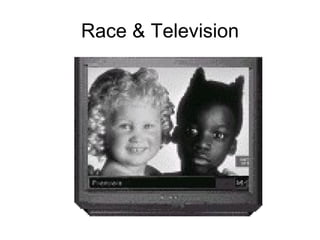
Race & Television
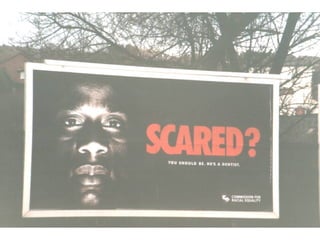
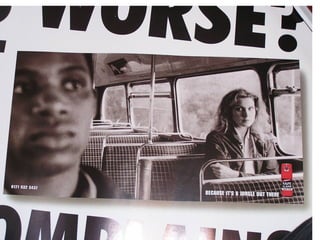
Four Key Themes in Racial Representation exotic  dangerous  humorous  pitied  (Alvarado  et al.  1987: 153)


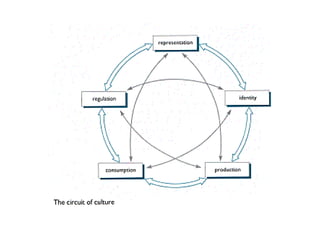
The Circuit of Culture Production   Consumption Identity Regulation Representation
 
 
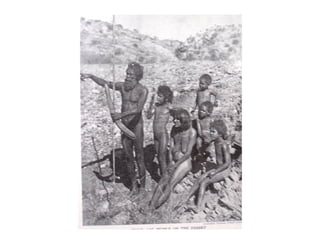
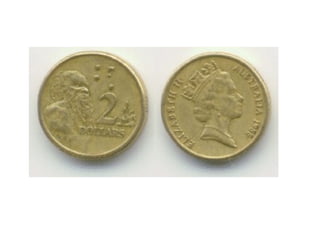
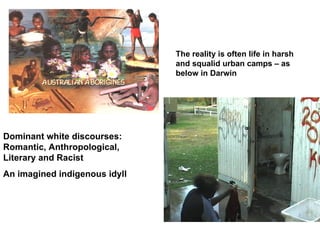
Dominant white discourses: Romantic, Anthropological, Literary and Racist An imagined indigenous idyll The reality is often life in harsh and squalid urban camps – as below in Darwin
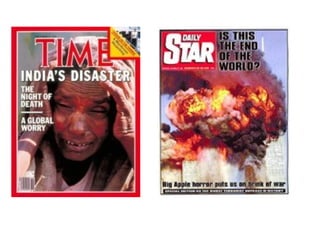
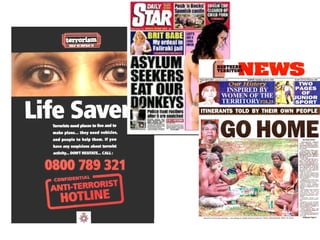
Moral Panics described as a condition, episode, person or group of persons which emerge to become defined as a threat to societal values and interests (Cohen, 1972, p.9).  1970s the image of the black mugger  1980s – image of rioter  1990s –  gangsta, gun crimes etc 2000s – Media focus shifts to Muslims
 
Politics and Race
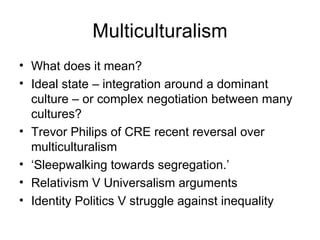
Multiculturalism What does it mean? Ideal state – integration around a dominant culture – or complex negotiation between many cultures? Trevor Philips of CRE recent reversal over multiculturalism ‘ Sleepwalking towards segregation.’ Relativism V Universalism arguments Identity Politics V struggle against inequality
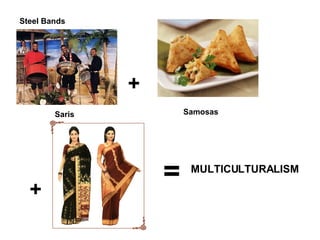
+ + = MULTICULTURALISM Steel Bands   Samosas  Saris
Identity politics Criticised by left-leaning analysts as  capitulation to cultural criticism  in place of analysis of the material roots of oppression factionalizing and depoliticizing  dominance of symbolic over material
Too Diverse? Multicultural Debate Kenan Malik responds: “ the real problem is not a surfeit of strangers in our midst but the abandonment over the past two decades of ideologically based politics for a politics of identity...  The result has been the fragmentation of society as different groups assert their particular identities - and the creation of a well of resentment within white working class communities who feel left out.”
Bibliography Bronowski, J (1973)  The Ascent of Man,  BBC books Goldberg D. T. and Solomos J.(eds)  2002, A Companion to racial and ethnic studies,  Oxford, Blackwell Goldberg D.T. (1993) Racist Culture, Blackwell Goldberg D.T. (Ed) 1994, Multiculturalism, a Critical Reader, Blackwell. Goodhart, David ‘Too diverse’ February 2004 Available online at: http://www.geocities.com/jjrinst/DavidGoodhart-Immigration-Prospect.htm Hall, S (2000) The Multicultural Question, Political Economy Research Centre,  Lecture, transcript available on - http://www.shef.ac.uk/uni/academic/N-Q/perc/lectures/Hall.html)  Hall, S. et al. (1978), Policing the Crisis: Mugging, the State and Law and Order, Macmillan, London.  Jenkins R (1997) Rethinking Ethnicity : arguments and explorations, Sage Loomba A (1998) Colonialism/Postcolonialism, Routledge Malik, K (1996) The Meaning of Race, Macmillan Malik, K (2002)  Race, pluralism and the meaning of difference, ( paper in New Formations, no33 (Spring 1998) Available online at : http://www.kenanmalik.com/papers/new_formations.html Malik, K (2002) Against Multiculturalism first appeared in the New Humanist (Summer 2002). http://www.kenanmalik.com/essays/against_mc.html Malik, K (2004) Too Diverse: A Response to David Goodhart   Muecke, S. (1982) ‘Available Discourses’ in Botsman, P. d (1982) Theoretical Strategies, Sydney, Local Consumption Press.  PARIAH website (People Against Racism In Australian Homelands) managed by Mick Lambe (Better a Pariah than a Liar)  http://www.country-liberal-party.com/pages/incarc_p5.htm Spencer, S (2006)  Race and Ethnicity: Culture, Identity and Representation,  Routledge


Race & Ethnicity Theoretical Overview

  • 1.
  • 2.
  • 3.
    Structural Inequalities Whatpercentage of population? Approx 10% Educational disadvantage –African Caribbean, Bangladeshi, Pakistani Unemployment rates 2 or 3 times that of white group – even when well qualified More likely to live in social housing, and in poor over-crowded conditions.
  • 4.
    Race & Ethnicity‘ Race’: 'socially defined but on the basis of physical criteria.‘ Ethnicity: 'socially defined but on the basis of cultural criteria' Van den Berghe, 1967: 9 in Goldberg, 1992, 553 ‘ For social boundaries to be actively maintained, they need to be continually validated, and this requires regular interaction with members of out groups’ ( Frederick Barth, 1969, Ethnic Groups and Social Boundaries )
  • 5.
    Race – ‘shiftingsignifier’ Race – said to be a social invention does not have a fixed referent At different times has been associated with species divide, religious belief, class, nation, citizenship, culture, ethnicity Consider notions of ‘breeding’ and eugenicist views
  • 6.
  • 7.
    Instrumental or Primordial?Ethnicity as a resource to be used in times of competition. Ethnicity and race as deep-seated and relatively fixed
  • 8.
    Marxism & Race Marx recognised that racism – the divide and rule of colonialism prevented a united working class opposing the bourgeoisie Race is not a primary category of analysis But serves as a convenient tool of capitalism which will wither away when economic reality is recognised, or a mask which serves to obscure true relations of power in a society, which are, in fact, class-based.
  • 9.
    Neo-Weberian Rational Choice theory – ‘ race relations’ approach - the work of John Rex and Michael Banton Complex matrix of factors – class, status, economic and cultural factors, patterns of consumption, stereotypes, forms of representation etc…
  • 10.
    Neo-Marxists 1. Relative Autonomy Model (Hall, 1980) class and ‘race’ should be examined together. 2. Autonomy Model (Gabriel and Ben-Tovim, 1979) racism cannot be reduced to class conflict 3. Migrant Labour Model (Miles & Phizacklea “ Race is an idea which should be explicitly and consistently confined to the dustbin of analytically useless terms.”(Miles, 1984:42 in Solomos p8).
  • 11.
    Pierre Bourdieu conceptof 'habitus', grounded in material conditions and experience struggle for ‘symbolic dominance’ the habitus is a reflexive, generative structure a useful tool to look at cases of inter-ethnic differences, alienation, and conflict which are in a state of constant adjustment and negotiation.
  • 12.
    Black Feminism Historically profound connection between gender, sexuality and race Sojourner Truth: “...aint I a woman?” highlights the ‘double burden’ : sexism and racism Feminism recognised processes which are equally applicable to racialised groups: Erasure, Denial, Invisibility, Tokenism critique of White feminism
  • 13.
    Postmodernism & RaceEnd of ‘grand narratives’ of history Advent of Identity politics Depoliticised, factionalised Focus on representation rather than ideology Relativism and ‘differences’ rather than universalism and ‘equal’ rights
  • 14.
  • 15.
  • 16.
    Race & Mediaslave figure Clown figures Rising Middle class non-threatening blaxploitation genre
  • 17.
  • 18.
    Four Key Themesin Racial Representation exotic dangerous humorous pitied (Alvarado et al. 1987: 153)
  • 19.
  • 20.
  • 21.
  • 22.
    The Circuit ofCulture Production Consumption Identity Regulation Representation
  • 23.
  • 24.
  • 25.
    Dominant white discourses:Romantic, Anthropological, Literary and Racist An imagined indigenous idyll The reality is often life in harsh and squalid urban camps – as below in Darwin
  • 26.
    Moral Panics describedas a condition, episode, person or group of persons which emerge to become defined as a threat to societal values and interests (Cohen, 1972, p.9). 1970s the image of the black mugger 1980s – image of rioter 1990s – gangsta, gun crimes etc 2000s – Media focus shifts to Muslims
  • 27.
  • 28.
  • 29.
    Multiculturalism What doesit mean? Ideal state – integration around a dominant culture – or complex negotiation between many cultures? Trevor Philips of CRE recent reversal over multiculturalism ‘ Sleepwalking towards segregation.’ Relativism V Universalism arguments Identity Politics V struggle against inequality
  • 30.
    + + =MULTICULTURALISM Steel Bands Samosas Saris
  • 31.
    Identity politics Criticisedby left-leaning analysts as capitulation to cultural criticism in place of analysis of the material roots of oppression factionalizing and depoliticizing dominance of symbolic over material
  • 32.
    Too Diverse? MulticulturalDebate Kenan Malik responds: “ the real problem is not a surfeit of strangers in our midst but the abandonment over the past two decades of ideologically based politics for a politics of identity... The result has been the fragmentation of society as different groups assert their particular identities - and the creation of a well of resentment within white working class communities who feel left out.”
  • 33.
    Bibliography Bronowski, J(1973) The Ascent of Man, BBC books Goldberg D. T. and Solomos J.(eds) 2002, A Companion to racial and ethnic studies, Oxford, Blackwell Goldberg D.T. (1993) Racist Culture, Blackwell Goldberg D.T. (Ed) 1994, Multiculturalism, a Critical Reader, Blackwell. Goodhart, David ‘Too diverse’ February 2004 Available online at: http://www.geocities.com/jjrinst/DavidGoodhart-Immigration-Prospect.htm Hall, S (2000) The Multicultural Question, Political Economy Research Centre, Lecture, transcript available on - http://www.shef.ac.uk/uni/academic/N-Q/perc/lectures/Hall.html) Hall, S. et al. (1978), Policing the Crisis: Mugging, the State and Law and Order, Macmillan, London. Jenkins R (1997) Rethinking Ethnicity : arguments and explorations, Sage Loomba A (1998) Colonialism/Postcolonialism, Routledge Malik, K (1996) The Meaning of Race, Macmillan Malik, K (2002) Race, pluralism and the meaning of difference, ( paper in New Formations, no33 (Spring 1998) Available online at : http://www.kenanmalik.com/papers/new_formations.html Malik, K (2002) Against Multiculturalism first appeared in the New Humanist (Summer 2002). http://www.kenanmalik.com/essays/against_mc.html Malik, K (2004) Too Diverse: A Response to David Goodhart   Muecke, S. (1982) ‘Available Discourses’ in Botsman, P. d (1982) Theoretical Strategies, Sydney, Local Consumption Press. PARIAH website (People Against Racism In Australian Homelands) managed by Mick Lambe (Better a Pariah than a Liar) http://www.country-liberal-party.com/pages/incarc_p5.htm Spencer, S (2006) Race and Ethnicity: Culture, Identity and Representation, Routledge
  • 34.
  • 35.
  • 36.