
![Multimedia Aspects
Slide 4
Seamless delivery across heterogeneous
networks.
Delivery Solutions (video-on-demand,
media streaming).
Emerging technologies in multimedia
distribution and content delivery.
Media servers, storage techniques, and
resource consumptions.
Error detection, protection, and recovery.
Audio, video, and image compression
technologies for transmission and storage.
QoS requirements.
Multimedia Delivery Requirements [27-36]
According to 3GPP, ETSI, ITU
CC Lab.
Computer Communications Laboratory
Dept. of Computer Science and Information Communications Engineering, HUFS](https://image.slidesharecdn.com/thesisreviewdefense-copy-170621175003/85/Part-2-Efficient-Multimedia-Delivery-in-Content-Centric-Mobile-Networks-3-320.jpg)
![Slide 5
In ICN, network layer services are provided at application layer.
CCN enables content resolution and content routing in same node.
CCN architecture for Mobile networks is not clearly defined.
Undefined Issues: Routing, caching, content management, transport, and
mobility management.
In Mobile networks, CCN-based routing is very dynamic and
opportunistic.
Content prefix flooding [36][37][38], table driven forwarding [40],
divide and conquer based content lookup [40][41][45] increase
transmission overhead.
H-Routing maps content names to device names, shows significant
improvement in lookup latency and lookup messages.
Motivation of the Thesis
Architecture
Routing
CC Lab.
Computer Communications Laboratory
Dept. of Computer Science and Information Communications Engineering, HUFS](https://image.slidesharecdn.com/thesisreviewdefense-copy-170621175003/85/Part-2-Efficient-Multimedia-Delivery-in-Content-Centric-Mobile-Networks-4-320.jpg)
![Slide 6
Mobile IP [46][47], SCTP [48], DCCP [49], SIP [50], DDNS [51] try to
provide seamless content transfer in the IP-based communication.
CCN provides seamless content transfer by name resolution or by re-
advertising or by expressing a new interest [30][58] [59] [62][63]. Mobility
decision is made based on RSS [11] [27].
Handover issues: transmission rate, error ratio, demands of end user etc.
MANET-aware CCN [74], cooperative caching using CCN [75],
OSPFN [77], and NLSR [78] are proposed to increase the content
availability.
Create spanning tree of the networks and increase control and content
flooding through the networks.
Content distribution and Interest forwarding are also major concerns in
the self-dependent networks.
Motivation of the Thesis (cont.)
Mobility Management
D2D Communication
CC Lab.
Computer Communications Laboratory
Dept. of Computer Science and Information Communications Engineering, HUFS](https://image.slidesharecdn.com/thesisreviewdefense-copy-170621175003/85/Part-2-Efficient-Multimedia-Delivery-in-Content-Centric-Mobile-Networks-5-320.jpg)
![Slide 7
MPTCP [87] is a promising solution over IP.
Many existing CCN researches [85][86][90][91][92][93][96] focused on
achieving the robustness, load sharing, congestion minimization,
resource consumption, and throughput maximization.
None of them considers the Interest shaping and Interest controlling in
the hop-by-hop basis and utilizes the benefit of p2p.
5G networks have been designed by considering promising ideas, e.g.,
SDN [107], CCN [7], Big Data [108], MEC [117], and Cloud-RAN [110].
Limited in wired environment and work based on IP.
CCN integrated with SBS can solve the biggest challenge for global
optimal network, routing and content management to provide real time
access.
Motivation of the Thesis (cont.)
Multi-Source and Multi-Path Transport
Smart Access Network
CC Lab.
Computer Communications Laboratory
Dept. of Computer Science and Information Communications Engineering, HUFS](https://image.slidesharecdn.com/thesisreviewdefense-copy-170621175003/85/Part-2-Efficient-Multimedia-Delivery-in-Content-Centric-Mobile-Networks-6-320.jpg)
![Slide 8
Resolve dependency on DNS.
Content caching.
Routing complexity.
Not clearly defined the real
prototype.
DONA [2]
Strengths of DONA Weaknesses of AODV
State-of-the-art Work
Clean redesign of Internet architecture
Uses hierarchical name resolution.
Uses flat and unique naming.
Overlay of RHs
CC Lab.
Computer Communications Laboratory
Dept. of Computer Science and Information Communications Engineering, HUFS](https://image.slidesharecdn.com/thesisreviewdefense-copy-170621175003/85/Part-2-Efficient-Multimedia-Delivery-in-Content-Centric-Mobile-Networks-7-320.jpg)
![Slide 9
Content Delivery using NRS [3][4]
Strengths Weaknesses
State-of-the-art Work(cont.)
Uses MDHT-based name resolution
MDHTs uses globally unique identifier.
NR provides information regarding the content location and content
attributes.
Resolve dependency on DNS.
Provides addition content layer to
preserve device anonymity.
Creates hierarchical spanning tree.
Decouples name resolution from
content routing.
CC Lab.
Computer Communications Laboratory
Dept. of Computer Science and Information Communications Engineering, HUFS](https://image.slidesharecdn.com/thesisreviewdefense-copy-170621175003/85/Part-2-Efficient-Multimedia-Delivery-in-Content-Centric-Mobile-Networks-8-320.jpg)
![Slide 10
CCN [5]
Strengths Weaknesses
State-of-the-art Work(cont.)
CC Lab.
Computer Communications Laboratory
Dept. of Computer Science and Information Communications Engineering, HUFS
Full-fledged content centric network architecture.
Focuses on the what not the where.
Uses only content name to locate or retrieve content.
Eliminates the dependency on NRS
or DNS.
Provides in-network data delivery.
Internet can not directly be
integrated with CCN.
Routing complexity and control
overhead.](https://image.slidesharecdn.com/thesisreviewdefense-copy-170621175003/85/Part-2-Efficient-Multimedia-Delivery-in-Content-Centric-Mobile-Networks-9-320.jpg)
![Slide 11
Intelligently re-configure content
delivery.
Re-selects content source after re-
location.
Middle-layer increase the
complexity.
Focuses on backward
compatibility.
Mobility Management in JUNO [6]
Strengths of JUNO Weaknesses of JUNO
State-of-the-art Work(cont.)
Achieved consumer and provider mobility using
a middle layer.
Uses DHT-based Content discovery:
Identify content rather than routing.
Uses many overlays of applications.
CC Lab.
Computer Communications Laboratory
Dept. of Computer Science and Information Communications Engineering, HUFS](https://image.slidesharecdn.com/thesisreviewdefense-copy-170621175003/85/Part-2-Efficient-Multimedia-Delivery-in-Content-Centric-Mobile-Networks-10-320.jpg)
![Slide 12
Hierarchical mobility management solution.
Root-node handles all the responsibility like interest tracking, device
tracking, and flow identification.
Support consumer mobility or
provider mobility.
Reduces packets flooding.
Control Overhead.
RSS-based mobility prediction.
Mobility Management in PMC [8], Clustered CCN [9]
Strengths Weaknesses
State-of-the-art Work(cont.)
CC Lab.
Computer Communications Laboratory
Dept. of Computer Science and Information Communications Engineering, HUFS](https://image.slidesharecdn.com/thesisreviewdefense-copy-170621175003/85/Part-2-Efficient-Multimedia-Delivery-in-Content-Centric-Mobile-Networks-11-320.jpg)
![Slide 13
Borrowing the concept of CCN in MANET.
Uses link state information to make routing information:
Prefix advertisements, On-demand transmission.
Simple mechanism.
Provides pervasive content
delivery.
Shortest route is not the best.
Redundant flooding.
Huge energy drain.
OSPFN[13], NLSR[14], and MANET CCN [12]
Strengths Weaknesses
State-of-the-art Work(cont.)
CC Lab.
Computer Communications Laboratory
Dept. of Computer Science and Information Communications Engineering, HUFS](https://image.slidesharecdn.com/thesisreviewdefense-copy-170621175003/85/Part-2-Efficient-Multimedia-Delivery-in-Content-Centric-Mobile-Networks-12-320.jpg)
![Slide 14
CCN [16][17][18][19].
Split content into multiple sources.
Chunk level flow differentiation.
Control the Interest rate.
Reduces packet flooding.
Does not consider resource
optimization.
Can not utilizes the benefit of P2P.
Multi-Source and Multi-Path Transport
Strengths Weaknesses
State-of-the-art Work(cont.)
CC Lab.
Computer Communications Laboratory
Dept. of Computer Science and Information Communications Engineering, HUFS](https://image.slidesharecdn.com/thesisreviewdefense-copy-170621175003/85/Part-2-Efficient-Multimedia-Delivery-in-Content-Centric-Mobile-Networks-13-320.jpg)
![Slide 15
SDN [20], MEC [23].
Provide faster content access.
Network intelligence is distributed.
Greater openness and flexibility.
Real time access
Based on IP.
Limited to wired environment.
Future Edge Network
Strengths Weaknesses
State-of-the-art Work(cont.)
CC Lab.
Computer Communications Laboratory
Dept. of Computer Science and Information Communications Engineering, HUFS](https://image.slidesharecdn.com/thesisreviewdefense-copy-170621175003/85/Part-2-Efficient-Multimedia-Delivery-in-Content-Centric-Mobile-Networks-14-320.jpg)
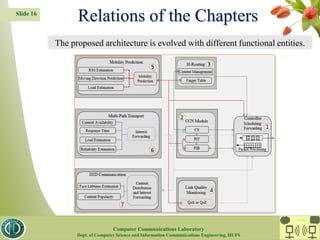
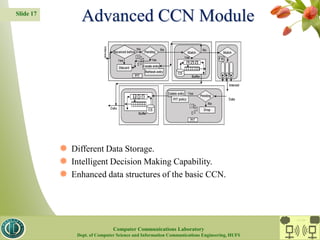
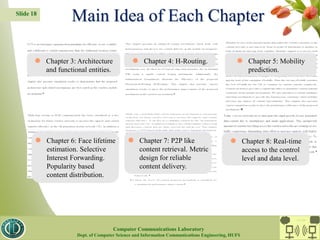

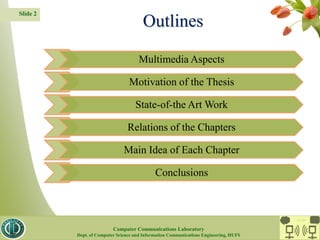
This presentation summarizes research on efficient multimedia delivery in content-centric mobile networks. It discusses motivations like seamless delivery across heterogeneous networks and emerging multimedia technologies. It reviews related work on content-centric networking architectures like CCN, DONA, and JUNO. It also examines state-of-the-art approaches for mobility management, routing, multi-path transport, and edge networks. The presentation outlines the relationships between chapters, which will cover an advanced CCN architecture, H-routing, mobility prediction, selective forwarding, P2P content retrieval, and enabling real-time access.


