Content Distribution Network –
going forward...
Rasiah Senthurchelvan
What is Content Distribution Network?
A content distribution network (CDN) is a system of
distributed servers (network) that deliver webpages
and other Web content to a user based on the
geographic locations of the user.
Issues Encountered at the
Exponential Growth of Internet:
1) Slow response, 40% of customers do not wait more
than 3 seconds for a page to be loaded
2) Difficulty encountered in streaming video/audio,
Internet television (IPTV):
a) High Bandwidth
b) Latency
c) Jitter
3) Spikes in Internet traffic from flash crowds
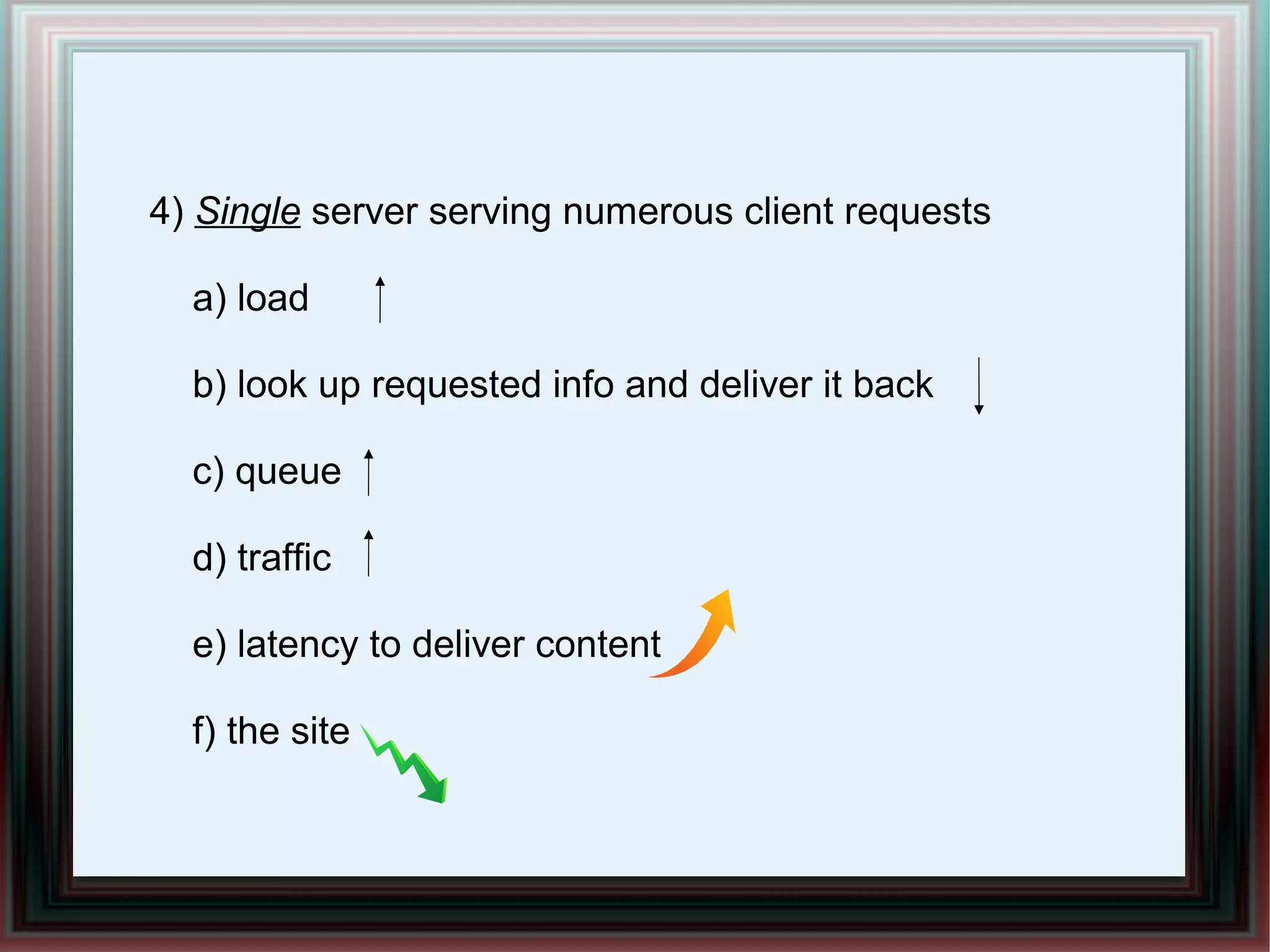
4) Single server serving numerous client requests
a) load
b) look up requested info and deliver it back
c) queue
d) traffic
e) latency to deliver content
f) the site

Servers nearest to the website visitor respond to the request.
•CDN copies the pages of a website to a network of servers
that are dispersed at geographically different locations

The contents of the page are cached
•Upon user request, CDN redirects from the originating server
to the proximate server
•Previously not cached content is cached upon request
for the same is made and delivered
How CDN works
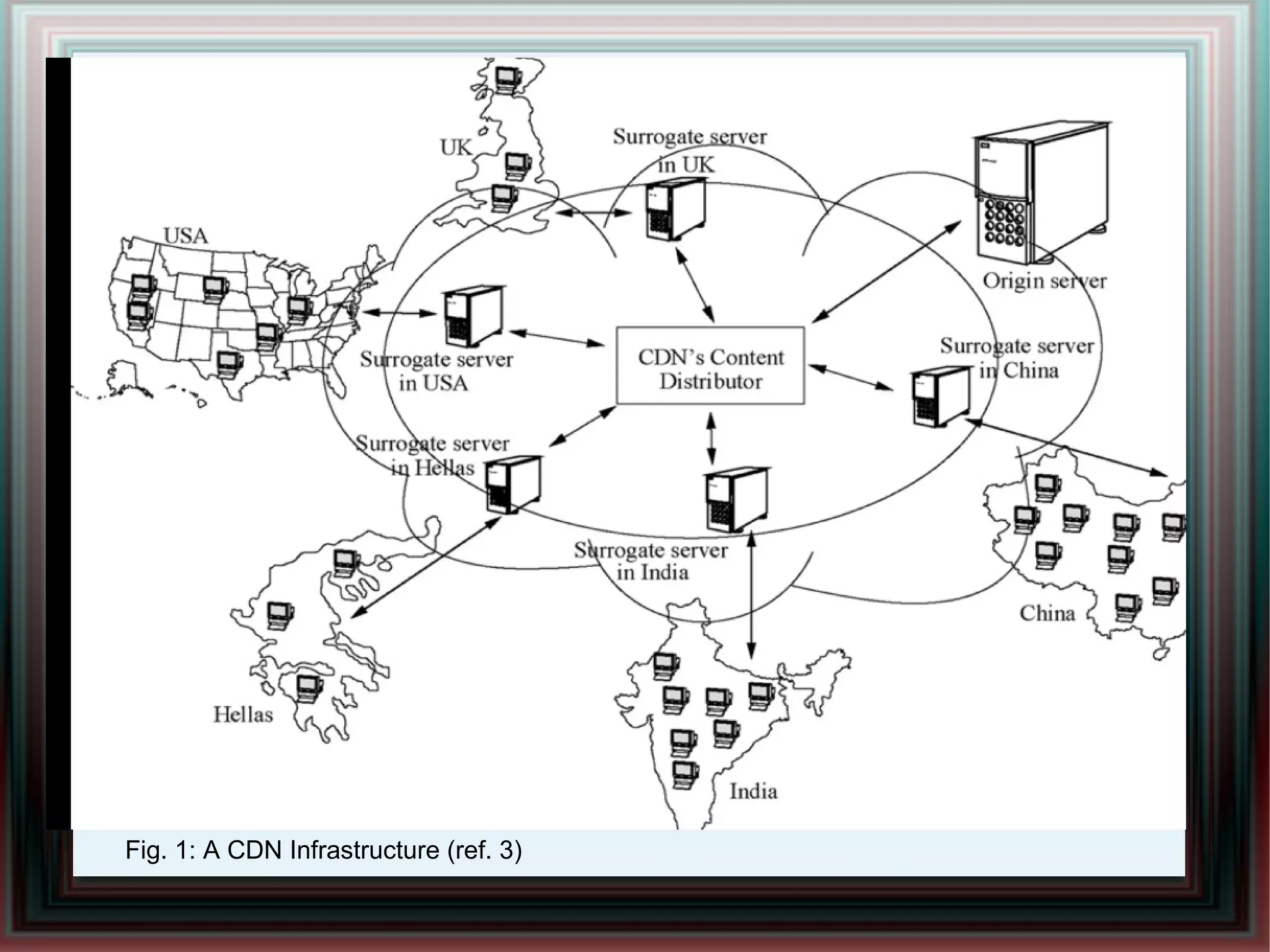
Fig. 1: A CDN Infrastructure (ref. 3)
How is surrogate server selection
performed?
By calling,
1) Nearest function

A server with a lower round-trip time is considered
nearer than one with a higher round-trip time

A server with low packet loss to the client is nearer
than one with high packet loss
2) Available function of load and network bandwidth
A server carrying too much load or a data center
serving near its bandwidth capacity is unavailable to
serve more clients
Types of CDNs

DNS based Request Redirection (RR)

Service-oriented Router (SoR) based RR

NetServ node Architecture
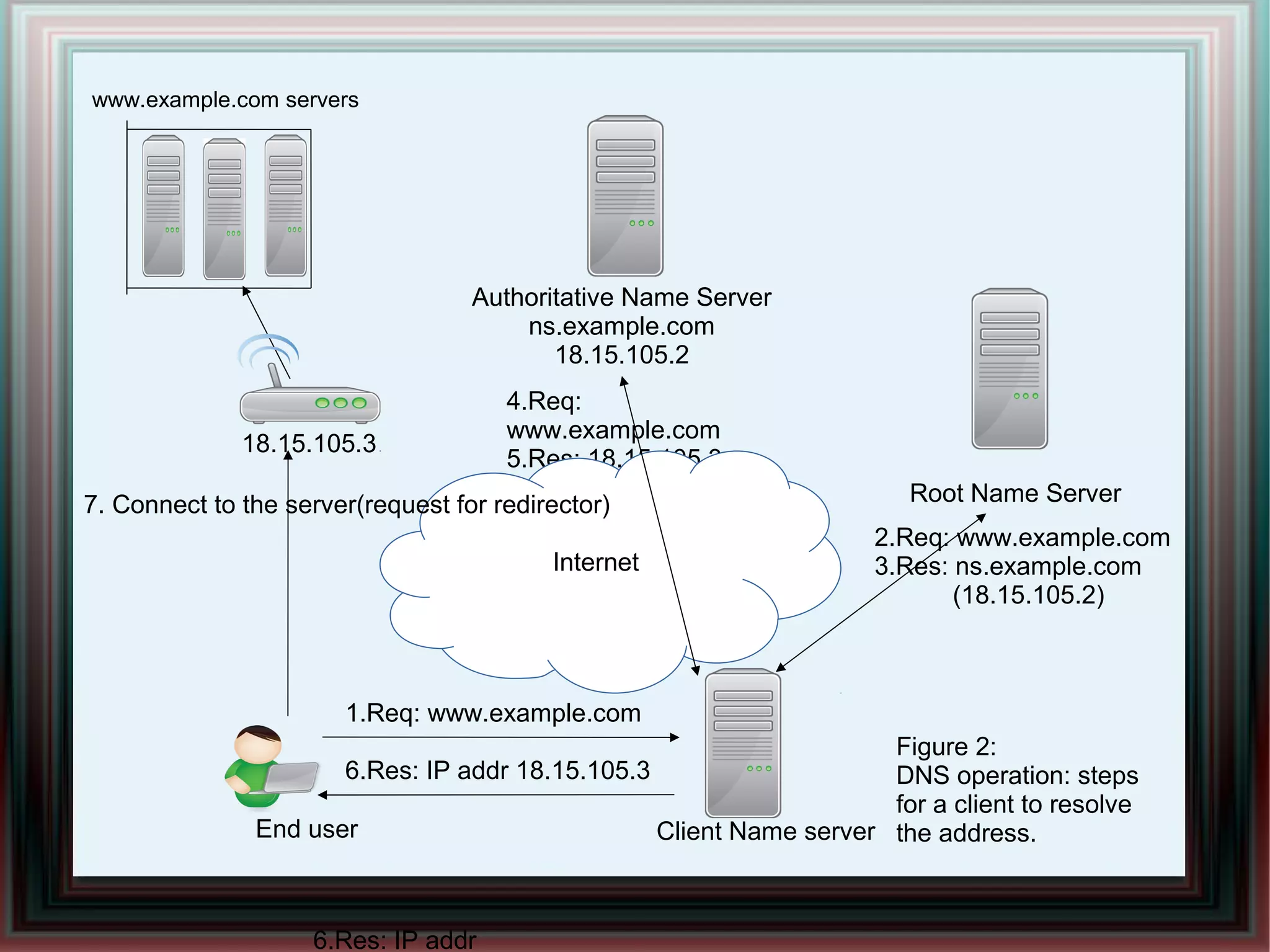
DNS Request
Making a DNS request is a lot like looking up a phone
number in a phone book: the browser gives the domain
name and expects to receive an IP address back.
18.15.105.3
End user
1.Req: www.example.com
6.Res: IP addr 18.15.105.3
Authoritative Name Server
ns.example.com
18.15.105.2
4.Req:
www.example.com
5.Res: 18.15.105.3
Root Name Server
2.Req: www.example.com
3.Res: ns.example.com
(18.15.105.2)
Client Name server
6.Res: IP addr
Internet
7. Connect to the server(request for redirector)
www.example.com servers
Figure 2:
DNS operation: steps
for a client to resolve
the address.
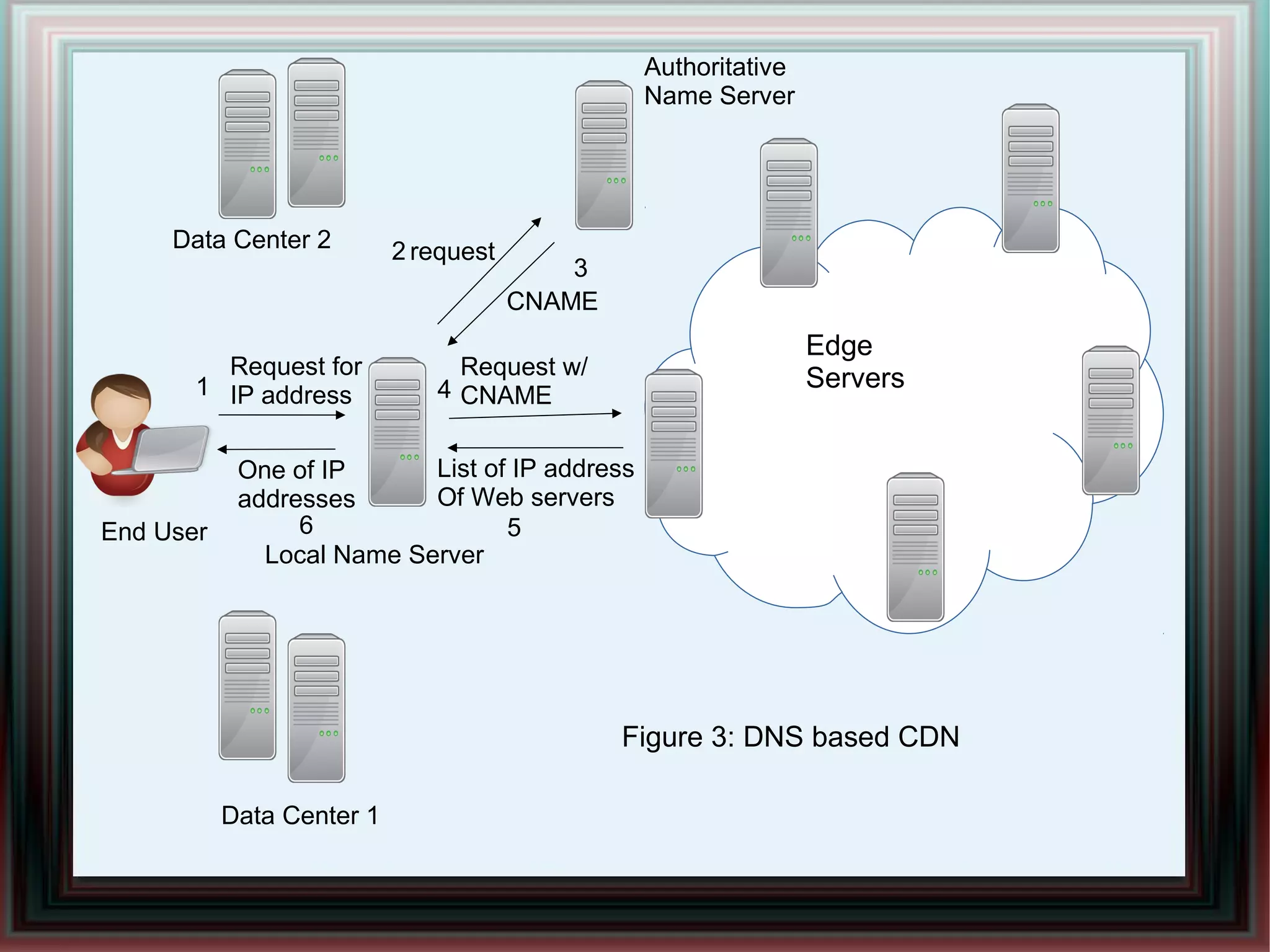
Authoritative
Name Server
Local Name Server
End User
Data Center 2
Data Center 1
Edge
ServersRequest for
IP address
request
CNAME
List of IP address
Of Web servers
One of IP
addresses
Request w/
CNAME1
2
3
4
56
Figure 3: DNS based CDN
What do we know about Domain Name System?

Name resolution phase of Web access uses Domain Name System

Redirecting clients to the nearest server is to perform the server
selection function during name resolution phase
So what's the big appeal of this approach?
The DNS provides a service whose primary function is to map domain
names such as www.example.com to the IP address(es) of
corresponding machine(s)
How could DNS be used for Request Redirection?

its simplicity – it requires no change to existing protocols

its generality – it works across any IP-based application regardless
of the transport-layer protocol being used.
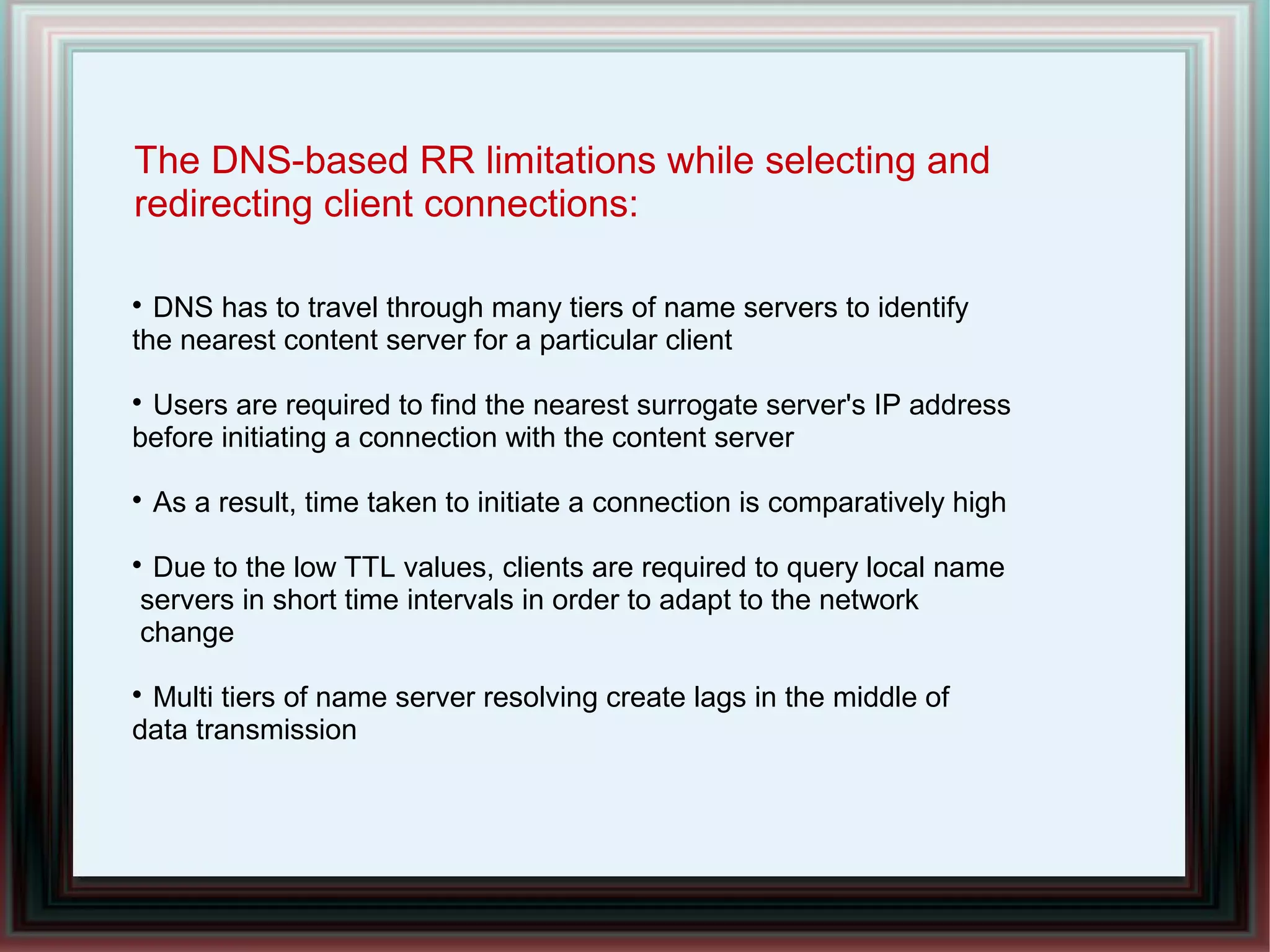
The DNS-based RR limitations while selecting and
redirecting client connections:

DNS has to travel through many tiers of name servers to identify
the nearest content server for a particular client

Users are required to find the nearest surrogate server's IP address
before initiating a connection with the content server

As a result, time taken to initiate a connection is comparatively high

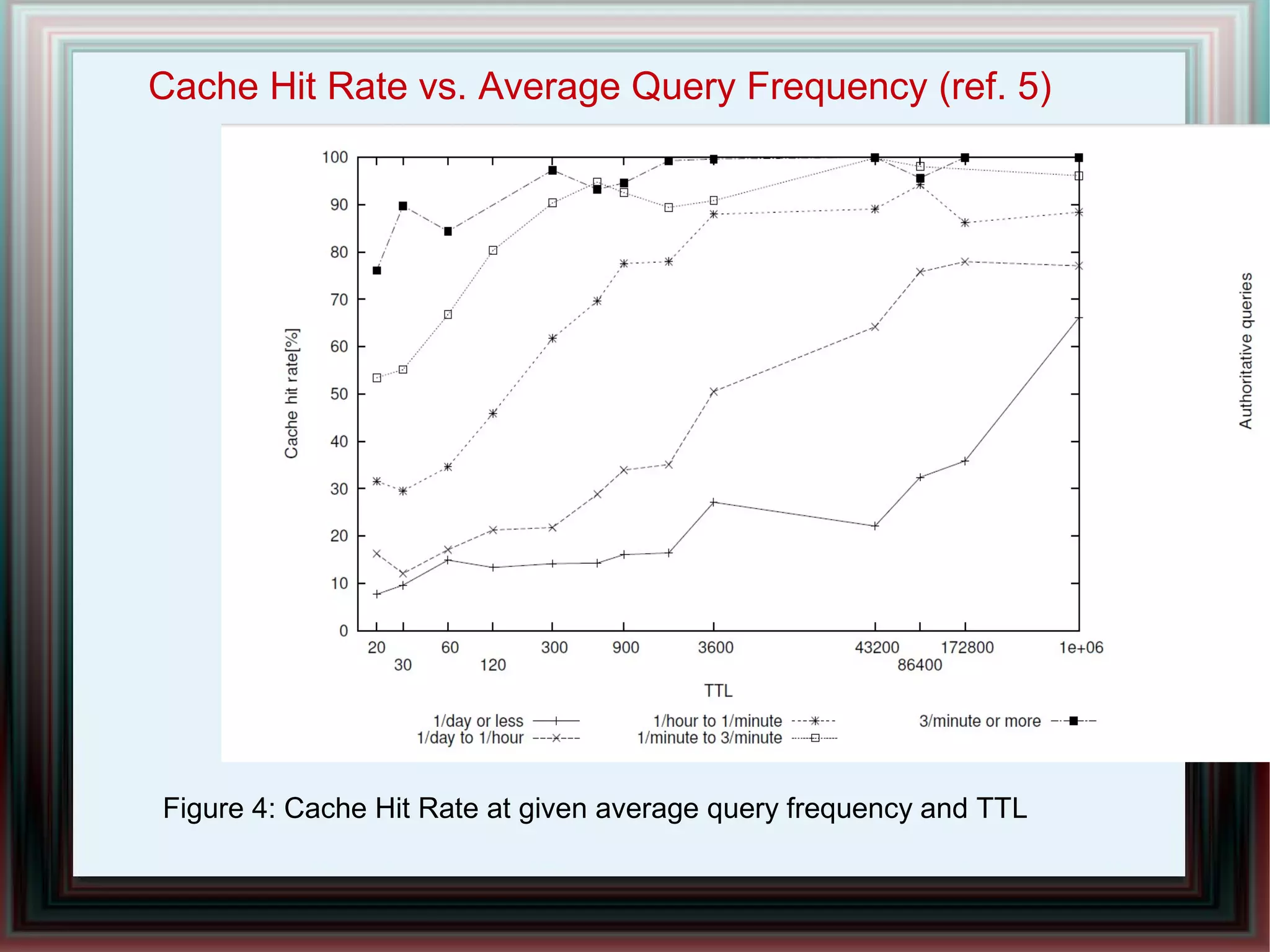
Due to the low TTL values, clients are required to query local name
servers in short time intervals in order to adapt to the network
change

Multi tiers of name server resolving create lags in the middle of
data transmission
Figure 4: Cache Hit Rate at given average query frequency and TTL
Cache Hit Rate vs. Average Query Frequency (ref. 5)
SoR
Server A
Server B
Server C
Server D
client
CDN
CDN
CDN
CDN
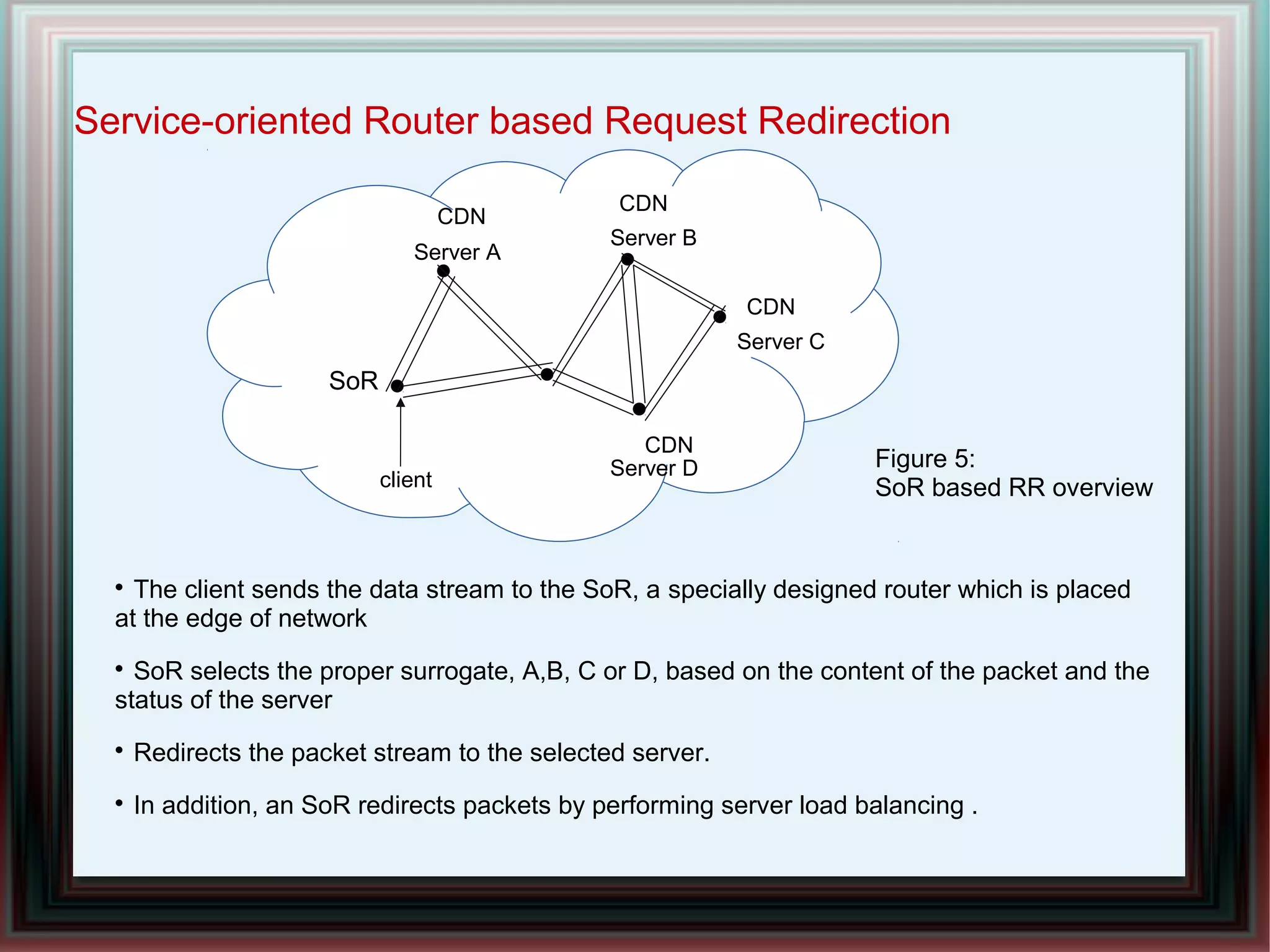
Service-oriented Router based Request Redirection

The client sends the data stream to the SoR, a specially designed router which is placed
at the edge of network

SoR selects the proper surrogate, A,B, C or D, based on the content of the packet and the
status of the server

Redirects the packet stream to the selected server.

In addition, an SoR redirects packets by performing server load balancing .
Figure 5:
SoR based RR overview
Packet
Queue
Packet Headers
and Content Surrogate servers
information for
the given content
Advertisement
details
Advertisement
details
Query Surrogate
servers for a
given content
Packet Headers
and Content
Neighbor information
Data of the packet
Forwarding hop
SoR_Forwarder()
SoR_Receiver()
SoR_Agent_
Receiver()
SoR_Agent_
Forwarder()
Redirection_Decision_
maker()
Incoming
packets
Advertisements
Outgoing
packets
Advertisements
Multi-Map structures
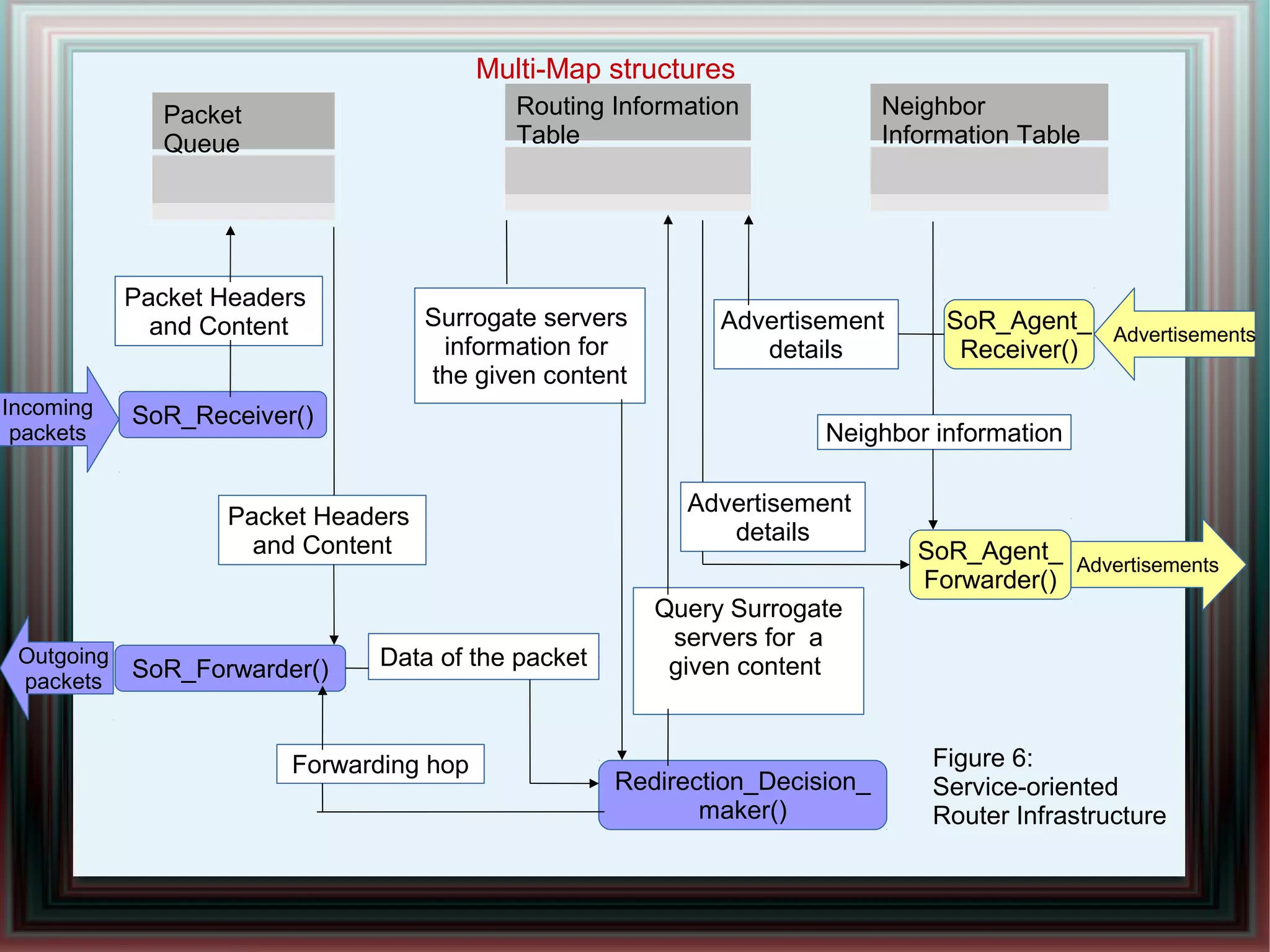
Figure 6:
Service-oriented
Router Infrastructure
Neighbor
Information Table
Routing Information
Table
End user
NetServ
Router
NetServ
Router
Regular
Router Content
provider
(1) User requests http://youtube.com/getvideo?id=foo
(2) You Tube sends video file
(3) You Tube sends on-path signal to deploy MicroCDN module
(4) NetServ routers download the module
(6) Another user requests http://youtube.com/getvideo?id=foo
(7) YouTube redirects user to nearest NetServ node running MicroCDN
(8) User requests http://netserv1.verizon.com/youtube/foo.flv
(5) NetServ routers notify that the module is active
(9) NetServ router relays the video content, while fetching the file and caching it
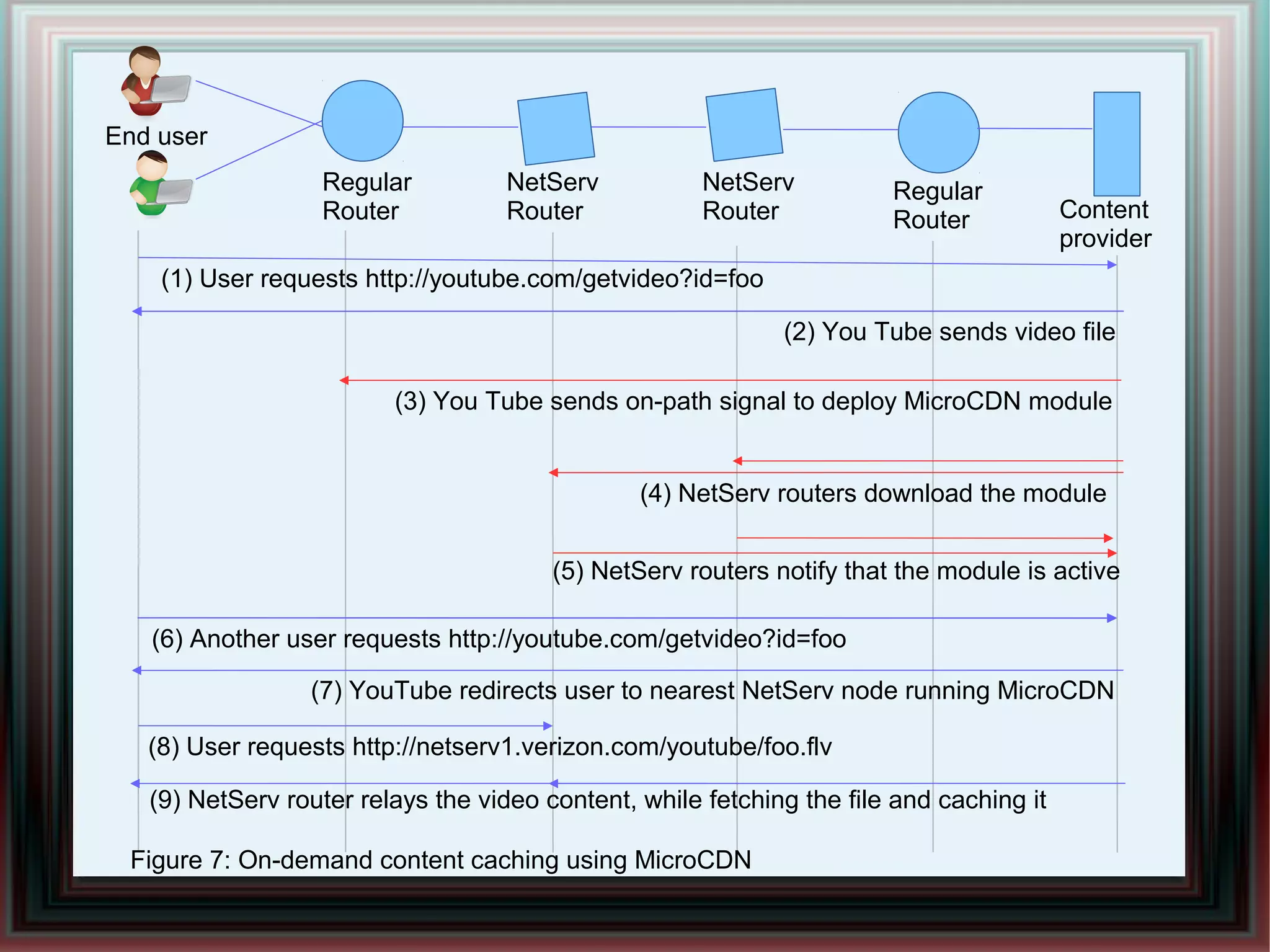
Figure 7: On-demand content caching using MicroCDN
Regular
Router
Reference:
1) Muhammad Jaseemuddin, Arun Nanthakumaran, and Alberto Leon-Garcia,
“TE-Friendly Content Delivery Request Routing in a CDN”,
IEEE ICC 2006 proceedings, pg. 1 – 8
2) Sabato Manfredi , Francesco Oliviero, Simon Pietro Romano,
“Distributed Management for Load Balancing in Content Delivery Networks”,
GLOBECOM Workshops (GC Wkshps), IEEE, 2010, pg. 579 - 583
3) Yun Bai, Bo Jia, Jixiang Zhang, Qiangguo Pu,
“An Efficient Load Balancing Technology in CDN”, 2009 Sixth International
Conference on Fuzzy Systems and Knowledge Discovery, pg. 510 - 514
4) A. Shaikh, R. Tewari, M. Agrawal,
“On the Effectiveness of DNS-based Server Selection”, Infocomm 2001
5) Kazunori Fujiwara, Akira Sato, Kenichi Yoshida, “DNS traffic analysis –
Issues of IPv6 and CDN”, 2012 IEEE/IPSJ 12th International Symposium
on Applications and the Internet, pg. 129 – 137
Ref...
6) Janaka Wijekoon, Erwin Harahap, Hiroaki Nishi, “
SoR based Request Routing for Future CDN”, Nishi Laboratory,
Graduate School of Science and Technology, Keio University, Japan, pg. 1 – 5
7) X. He, S. Dawkins, Y. Zhang, “Routing request redirection for CDN
interconnection draft-he-cdni-routing-request-redirection-“, 2012.
Shinichi Ishida, Hiroaki Nishi, “Distributed Algorithm for Router-based
Management of Replica Server in Next-CDN Infrastructure”, 2013 International
Conference on Cyber-Enabled Distributed Computing and Knowledge
Discovery, pg. 266 – 272
9) S. Srinivasan, J. W. Lee, E. Liu, M. Kester, H. Schulzrinne, V. Hilt,
S. Seetharaman, and A. Khan, “NetServ: Dynamically Deploying In-network
Services,” in ACM ReArch ’09 (CoNEXT workshop), 2009. Pg. 1 – 5.
10) J. W. Lee, R. Francescangeli, J. Janak, S. Srinivasan, S. A. Baset, H.
Schulzrinne, Z. Despotovic, and W. Kellerer,
“Netserv: Active networking 2.0,” in IEEE FutureNet

CDN Project Presentation

  • 1.
    Content Distribution Network– going forward... Rasiah Senthurchelvan
  • 2.
    What is ContentDistribution Network? A content distribution network (CDN) is a system of distributed servers (network) that deliver webpages and other Web content to a user based on the geographic locations of the user.
  • 3.
    Issues Encountered atthe Exponential Growth of Internet: 1) Slow response, 40% of customers do not wait more than 3 seconds for a page to be loaded 2) Difficulty encountered in streaming video/audio, Internet television (IPTV): a) High Bandwidth b) Latency c) Jitter 3) Spikes in Internet traffic from flash crowds
  • 4.
    4) Single serverserving numerous client requests a) load b) look up requested info and deliver it back c) queue d) traffic e) latency to deliver content f) the site
  • 5.
     Servers nearest tothe website visitor respond to the request. •CDN copies the pages of a website to a network of servers that are dispersed at geographically different locations  The contents of the page are cached •Upon user request, CDN redirects from the originating server to the proximate server •Previously not cached content is cached upon request for the same is made and delivered How CDN works
  • 6.
    Fig. 1: ACDN Infrastructure (ref. 3)
  • 7.
    How is surrogateserver selection performed? By calling, 1) Nearest function  A server with a lower round-trip time is considered nearer than one with a higher round-trip time  A server with low packet loss to the client is nearer than one with high packet loss 2) Available function of load and network bandwidth A server carrying too much load or a data center serving near its bandwidth capacity is unavailable to serve more clients
  • 8.
    Types of CDNs  DNSbased Request Redirection (RR)  Service-oriented Router (SoR) based RR  NetServ node Architecture DNS Request Making a DNS request is a lot like looking up a phone number in a phone book: the browser gives the domain name and expects to receive an IP address back.
  • 9.
    18.15.105.3 End user 1.Req: www.example.com 6.Res:IP addr 18.15.105.3 Authoritative Name Server ns.example.com 18.15.105.2 4.Req: www.example.com 5.Res: 18.15.105.3 Root Name Server 2.Req: www.example.com 3.Res: ns.example.com (18.15.105.2) Client Name server 6.Res: IP addr Internet 7. Connect to the server(request for redirector) www.example.com servers Figure 2: DNS operation: steps for a client to resolve the address.
  • 10.
    Authoritative Name Server Local NameServer End User Data Center 2 Data Center 1 Edge ServersRequest for IP address request CNAME List of IP address Of Web servers One of IP addresses Request w/ CNAME1 2 3 4 56 Figure 3: DNS based CDN
  • 11.
    What do weknow about Domain Name System?  Name resolution phase of Web access uses Domain Name System  Redirecting clients to the nearest server is to perform the server selection function during name resolution phase So what's the big appeal of this approach? The DNS provides a service whose primary function is to map domain names such as www.example.com to the IP address(es) of corresponding machine(s) How could DNS be used for Request Redirection?  its simplicity – it requires no change to existing protocols  its generality – it works across any IP-based application regardless of the transport-layer protocol being used.
  • 12.
    The DNS-based RRlimitations while selecting and redirecting client connections:  DNS has to travel through many tiers of name servers to identify the nearest content server for a particular client  Users are required to find the nearest surrogate server's IP address before initiating a connection with the content server  As a result, time taken to initiate a connection is comparatively high  Due to the low TTL values, clients are required to query local name servers in short time intervals in order to adapt to the network change  Multi tiers of name server resolving create lags in the middle of data transmission
  • 13.
    Figure 4: CacheHit Rate at given average query frequency and TTL Cache Hit Rate vs. Average Query Frequency (ref. 5)
  • 14.
    SoR Server A Server B ServerC Server D client CDN CDN CDN CDN Service-oriented Router based Request Redirection  The client sends the data stream to the SoR, a specially designed router which is placed at the edge of network  SoR selects the proper surrogate, A,B, C or D, based on the content of the packet and the status of the server  Redirects the packet stream to the selected server.  In addition, an SoR redirects packets by performing server load balancing . Figure 5: SoR based RR overview
  • 15.
    Packet Queue Packet Headers and ContentSurrogate servers information for the given content Advertisement details Advertisement details Query Surrogate servers for a given content Packet Headers and Content Neighbor information Data of the packet Forwarding hop SoR_Forwarder() SoR_Receiver() SoR_Agent_ Receiver() SoR_Agent_ Forwarder() Redirection_Decision_ maker() Incoming packets Advertisements Outgoing packets Advertisements Multi-Map structures Figure 6: Service-oriented Router Infrastructure Neighbor Information Table Routing Information Table
  • 16.
    End user NetServ Router NetServ Router Regular Router Content provider (1)User requests http://youtube.com/getvideo?id=foo (2) You Tube sends video file (3) You Tube sends on-path signal to deploy MicroCDN module (4) NetServ routers download the module (6) Another user requests http://youtube.com/getvideo?id=foo (7) YouTube redirects user to nearest NetServ node running MicroCDN (8) User requests http://netserv1.verizon.com/youtube/foo.flv (5) NetServ routers notify that the module is active (9) NetServ router relays the video content, while fetching the file and caching it Figure 7: On-demand content caching using MicroCDN Regular Router
  • 17.
    Reference: 1) Muhammad Jaseemuddin,Arun Nanthakumaran, and Alberto Leon-Garcia, “TE-Friendly Content Delivery Request Routing in a CDN”, IEEE ICC 2006 proceedings, pg. 1 – 8 2) Sabato Manfredi , Francesco Oliviero, Simon Pietro Romano, “Distributed Management for Load Balancing in Content Delivery Networks”, GLOBECOM Workshops (GC Wkshps), IEEE, 2010, pg. 579 - 583 3) Yun Bai, Bo Jia, Jixiang Zhang, Qiangguo Pu, “An Efficient Load Balancing Technology in CDN”, 2009 Sixth International Conference on Fuzzy Systems and Knowledge Discovery, pg. 510 - 514 4) A. Shaikh, R. Tewari, M. Agrawal, “On the Effectiveness of DNS-based Server Selection”, Infocomm 2001 5) Kazunori Fujiwara, Akira Sato, Kenichi Yoshida, “DNS traffic analysis – Issues of IPv6 and CDN”, 2012 IEEE/IPSJ 12th International Symposium on Applications and the Internet, pg. 129 – 137
  • 18.
    Ref... 6) Janaka Wijekoon,Erwin Harahap, Hiroaki Nishi, “ SoR based Request Routing for Future CDN”, Nishi Laboratory, Graduate School of Science and Technology, Keio University, Japan, pg. 1 – 5 7) X. He, S. Dawkins, Y. Zhang, “Routing request redirection for CDN interconnection draft-he-cdni-routing-request-redirection-“, 2012. Shinichi Ishida, Hiroaki Nishi, “Distributed Algorithm for Router-based Management of Replica Server in Next-CDN Infrastructure”, 2013 International Conference on Cyber-Enabled Distributed Computing and Knowledge Discovery, pg. 266 – 272 9) S. Srinivasan, J. W. Lee, E. Liu, M. Kester, H. Schulzrinne, V. Hilt, S. Seetharaman, and A. Khan, “NetServ: Dynamically Deploying In-network Services,” in ACM ReArch ’09 (CoNEXT workshop), 2009. Pg. 1 – 5. 10) J. W. Lee, R. Francescangeli, J. Janak, S. Srinivasan, S. A. Baset, H. Schulzrinne, Z. Despotovic, and W. Kellerer, “Netserv: Active networking 2.0,” in IEEE FutureNet