The paper discusses a dynamic hybrid topology design for WDM mesh networks that efficiently supports integrated traffic for both multicast and unicast demands. It focuses on subwavelength sharing to optimize WDM resources and to create a flexible framework that utilizes existing light-trees and light-paths in a practical network scenario. Through simulations, the authors demonstrate that their approach maximizes WDM layer capabilities while accommodating new traffic demands without disrupting existing services.
![M. Youssef, B.-Y. Choi, C. Scoglio, & E. K. Park
International Journal of Computer Networks (IJCN), Volume (2): Issue (2) 116
1. INTRODUCTION
As the Internet traffic continues to grow exponentially and Wavelength Division Multiplexing
(WDM) technology matures, the WDM network, with tera-bits per second bandwidth links, becomes
a dominant backbone for IP networks. Continuously emerging bandwidth-intensive applications in
current and future Internet, however, present the need of efficient and scalable support in an
underlying network. Particularly, it is increasingly important for the WDM layer to facilitate, in an
efficient and scalable manner, high bandwidth one-to-many applications such as web cache
updating, transfer of software upgrade, transfer of video, audio, and text data of a live lecture to a
group of distributed participants, whiteboard and teleconferencing [1], [2].
In-network replication or branching of multicast traffic may be done in either an optical WDM
domain or an electronic IP domain. In IP over WDM networks, mere IP layer multicasting is not
efficient enough without the support of the WDM layer. Enabling multicasting at the WDM layer has
clear advantages. First, with the available optical layer resources (e.g. light splitters, wavelength
converters and wavelengths) we can utilize a more efficient in-network replication via an optical
layer multicast tree than an IP layer multicast tree created without understanding of underlaying
physical network. With the inherent light splitting capability of optical switches, it is more efficient to
do light splitting than copying IP datagrams in an electronic domain. IP multicasting creates copies
of data packets at intermediate routers from an optical into an electronic domain and then converts
them into an optical signal, called O/E/O conversion. On the intermediate non-member nodes, this
process introduces extra-delays and consumes IP resources unnecessarily. Second, performing
multicast in optics is desirable and secure, as it provides consistent support of format and bit-rate
transparencies across both unicast and multicast transmissions without requiring the data format to
be known to the upper layer.
With no WDM layer multicast support, IP multicast sessions can be realized by having an IP router
on a multicast tree make copies of a data packet in an electronic domain and transmit another copy
to the downstream routers. However, this requires O/E/O conversion of every data packet at
intermediate routers on the tree incurs extra-latency and requires the data format to be known to
the upper layer. When IP multicast is supported via light-paths (i.e., WDM multiple unicasts), it
avoids the delay of O/E/O conversion at intermediate nodes. However, this scheme is not scalable
with a large number of multicast members and number of groups in the network. An ideal approach
to supporting multicasting at the WDM layer is to create multicast trees in the optical layer directly.
This can be achieved by light-tree [3], which uses optical light splitting at intermediate nodes as
needed in order to replicate an optical signal to multiple downstream paths. It minimizes the use of
wavelengths and bandwidth as well as O/E/O conversion. The minimal use of physical resources
enables us to support larger sessions as compared to other approaches.
In supporting large multicast groups and members, however, the WDM layer multicast using
wavelengths only may not be feasible, especially due to the limited number of wavelengths. Based
on the observation that a high bandwidth capacity per wavelength is abundant enough to be shared
by multiple traffic demands, [4] exploited existing unicast light-path to build light-trees for the WDM
layer multicast with the subwavelength sharing approach. However it assumed that there was no
multicast session set up initially and only existing unicast light-paths and available physical
wavelength were considered to build light-trees.
In this work, we extend the idea of subwavelength sharing to existing multicast demands. We
provide a more flexible and practical framework where existing light-trees could be shared as well.
A technical challenge in subwavelength sharing of light-trees is that a light-tree is designed for a
specific group and a wavelength is not desirable to be shared by different groups with different set
of members. It is because the sharing of a light-tree for other multicast groups will cause all the
destinations on the tree to receive data packets sent on the tree unnecessarily. We minimize the
excess traffic due to light-tree sharing while optimizing all the resources. We bound the degree of](https://image.slidesharecdn.com/ijcn-45-160225164454/75/Dynamic-Hybrid-Topology-Design-for-Integrated-Traffic-Support-in-WDM-Mesh-Networks-Invited-Paper-2-2048.jpg)
![M. Youssef, B.-Y. Choi, C. Scoglio, & E. K. Park
International Journal of Computer Networks (IJCN), Volume (2): Issue (2) 117
sharing in order to meet the QoS of existing traffic. Our solution is aimed for a dynamic environment
where new traffic demands need to be satisfied without disturbing the service of existing traffic. Our
main contribution is that when new traffic demands, either unicast or/and multicast, arrive, they can
be supported incrementally, taking available resources and existing traffic demands into
consideration. If desirable or physical resources are lacking, we allow the use of existing light-paths
or light-trees in conjunction with a possibly new (partial) light-tree. A challenging issue when light-
trees are shared, is to minimize excess traffic incurred by the different multicast demand from the
existing tree(s). In order to address that, we formulate an optimization problem that includes the
overhead of excess traffic. We find that this hybrid (light-trees and light-paths) virtual topology
design enables us to establish multicast trees when it would otherwise be impossible. Thus, more
traffic demands are supported under practical network condition of limited wavelength constraints.
Furthermore, our solution maximally utilizes the available resources of existing light-paths whose
traffic demand does not reach full wavelength capacity, but has bounded a degree of sharing for
QoS of existing traffic.
The idea of using existing multicast light-trees and/or unicast light-paths gives enormous flexibility
in terms of a dynamically integrated future Internet traffic environment, compared to a pure light-
tree approach. By optimizing the WDM layer multicast as well as resource sharing with existing
mixture of unicast and multicast demands, we truly maximize the WDM layer capability under a
practical environment.
The remainder of this paper is organized as follows. In Section 2 we provide the background of our
study. We summarize related works in Section 3. In Section 4, we formally state the problem and
discuss our approach. The evaluation and validation of our scheme is presented in Section 5. We
conclude the paper in Section 6.
2. Background
In Wavelength Division Multiplexing (WDM) networks, each directional fiber optical link is
partitioned into multiple data channels, each of which operates on a separate wavelength,
permitting high bandwidths. Routers or switches are connected via semi-permanent optical pipes
called ’light-paths’ that may extend over several physical channels via wavelength routing. At
intermediate nodes, incoming channels belonging to in-transit light-paths are transparently coupled
to outgoing channels through a passive wavelength router, avoiding the unnecessary IP layer
interruption with O/E/O conversion. Meanwhile, at a node terminating light-path, the incoming signal
from the channel is converted to the electronic domain so that packets can be extracted and
processed and may be retransmitted on an outgoing light-path(s) after electronic IP routing. The
concept of a light-tree can be extended using optical light splitters, in order to replicate an optical
signal to multiple downstream paths. The light-paths and/or light-trees establish a virtual topology
on top of a physical topology made of optical fibers and switches/routers. A virtual topology
configuration is constrained by a number of physical resource limitations: 1) The establishment of
each light-path requires the reservation of WDM channel on the physical links along the paths and
the number of available the WDM channels are limited on a link. 2) The number of transmitters and
receivers at each node limits the number of light-path initiating and terminating on the node. 3) The
maximum length of a light-path without signal regeneration may be limited by the signal attenuation
along the light-path. Therefore, optimizing the use of WDM network resources is a crucial task in
order to process traffic demand efficiently.
The concept of wavelength sharing has been proposed before in the context of unicast or multicast
individually. The work in [4] was the first that proposed the sub-wavelength resource sharing among
unicast and multicast traffic demands and provided a general solution under practical constraints.
Traffic grooming concerns grouping of small flows into a single wavelength, that can be processed
and routed as one entity. Our work addresses the issue of sub-wavelength sharing with or without
traffic grooming. The future Internet will involve interconnections of large number of devices that are](https://image.slidesharecdn.com/ijcn-45-160225164454/75/Dynamic-Hybrid-Topology-Design-for-Integrated-Traffic-Support-in-WDM-Mesh-Networks-Invited-Paper-3-2048.jpg)
![M. Youssef, B.-Y. Choi, C. Scoglio, & E. K. Park
International Journal of Computer Networks (IJCN), Volume (2): Issue (2) 118
aggregated at access networks. High bandwidth WDM mesh networks at the backbone can be
better utilized with sub-wavelength sharing in the wavelength assignment and routing. Sub-
wavelength sharing can be used in various network business models. Different network business
models can be considered as below [5]:
• Model A: An ISP that owns the network from the ”ground up” (i.e., to the duct) and only
delivers IP-based services.
• Model B: The business owns the layer-one infrastructure and sells services to customers
who may themselves resell to others. It serves as the carriers’ carrier and offers wholesale
services to ISPs
• Model C: An ISP that leases fiber or transport capacity from a third part, and only delivers
IP-based services.
• Model D: The business is a bandwidth broker. It provides ”match-making” by enabling a
variety of ISPs (model 3) to lease bandwidth from a variety of network operators (model 2).
Models B and C are complementary whereas both are integrated in case of model A. Our work can
be considered as the issues of model A, B or D.
3. Related work
In recent years, many studies have been conducted in regards to the problem of designing virtual
(or logical) topology for WDM networks. The problem of multicasting for IP over WDM networks can
be decomposed into two subproblems, namely multicast-tree design, and routing and wavelength
assignment (RWA) for the designed multicast-tree. As to the problem of multicast-tree design, two
classes of approaches have been taken; namely, optimization and heuristics.
The multicast-tree design problem has been modeled often as a linear optimization problem to
minimize the O/E/O conversions, as it is the main bottleneck in utilizing the true potential of optical
networks. Other objectives, such as minimizing the average hop count or average number of
transceivers used in the network [3] and the total link weight of the light tree [6] have also been
used. In [7], the problem of optimal virtual topology design for multicast traffic is studied using light-
paths. The authors aim to minimize the maximum traffic flowing on any light-path in the network
while designing the logical topology for the multicast traffic. In the same work, the authors have
presented several heuristics for topology design such as Tabu search, simulated annealing. Linear
optimization techniques have been also used for the unicast single shortest virtual topology design
[8], RWA [9], [10], restoration and reconfiguration [11], [12], [13] problems in WDM networks.
Several heuristics have been proposed to design the multicast tree in WDM networks. Although a
minimum Steiner tree [14] (which is obtained by solving Integer Linear Programming ILP) is more
desirable, finding one for an arbitrary network topology is an NP-complete problem [15], thus
heuristics are often used to obtain a near-minimum cost multicast tree. Authors in [16] have
presented four heuristic algorithms: namely, Re-route-to-Source & Re-route-to-Any, Member-First,
and Member-Only, for designing a multicast forest for a given multicast group. The minimum
spanning tree (MST) heuristic or the shortest-path tree (SPT) heuristic [14] are also commonly used
for designing the multicast tree. Authors in [17] have also presented two such algorithms, Breadth
First Search (BFS) and a dynamic and incremental tree construction algorithm. Given an existing
multicast tree with a large number of members, new member nodes perform an operation of
join/graft similar to CBT [18] and DVMRP [19]. Once a multicast tree is designed, it can be
implemented with either wavelength-routing [20], [3] or Optical Burst/Label Switching (OBS/OLS)
[21], [22]. In the former case, multicast data will be switched to one or more outgoing wavelengths
according to the incoming wavelength that carries it. That is a wavelength needs to be reserved on
each branch of a multicast tree. In IP over WDM multicast using label switching, multicast label
switched paths are set up first. Afterwards, only the optical labels carried by the bursts need O/E
conversions for electronic processing, whereas the burst payload always remains in the optical
domain at intermediate nodes. The major disadvantage of the wavelength routing approach is that it
may not utilize the bandwidth efficiently in case traffic demand is not up to wavelength capacity. It
also has large setup latency and it is not efficient under bursty traffic conditions. Meanwhile, with
OBS/OLS, a burst dropping (loss) probability may be potentially significant in a highly loaded OBS](https://image.slidesharecdn.com/ijcn-45-160225164454/75/Dynamic-Hybrid-Topology-Design-for-Integrated-Traffic-Support-in-WDM-Mesh-Networks-Invited-Paper-4-2048.jpg)
![M. Youssef, B.-Y. Choi, C. Scoglio, & E. K. Park
International Journal of Computer Networks (IJCN), Volume (2): Issue (2) 119
network which can lead to heavy overheads such as a large number of duplicate retransmissions in
IP layer. In addition, it may take a longer time for an end host to detect and then recover from burst
dropping (loss) [23]. In [24], the authors introduced a light-hierarchy graph renewal and distance
priority light-tree algorithm (GRDP-LT), which was proposed to improve the light-trees quality for
any multicast under light splitting constraints. In a light-hierarchy, cycles are allowed, which is
different from the light-tree where no cycle exists in the structure.
In a closely related work [4], a hybrid multicast topology was first designed given only light-paths
and physical links. The work is to support better utilize the bandwidths of wavelengths for new
multicast traffic; assuming only unicast traffic was supported initially. In this work, we extend the
concept of sub-wavelength sharing to existing light-trees as well, in addition to light-paths, and build
a hybrid virtual topology which exploits both light-trees and light-paths. We optimize WDM
resources for new traffic while keeping the a priori configurations for the existing traffic, so that their
performances are not disturbed.
4. Problem formulation
In this section, we formally state the problem of designing hybrid virtual topology for given set of
multicast demands using available physical, light-path, and light-tree topologies. The network
channel resources are the available wavelengths on the physical links, the available degree of
sharing of light-paths,
v
C and the available degree of sharing of light-trees,
t
C for other traffic
demands. The number of available wavelengths is bounded by the physical resources, and the
degrees of sharing of light-paths and light-trees are bounded for the QoS of existing traffic. Next,
we formulate our objective function and discuss the constraints required for the design problem.
4.1 Objective function
𝑚𝑖𝑛 � � � �𝑤 𝑚,𝑛 𝑀𝑠,𝑚,𝑛 + 𝛼 𝑚,𝑛 𝑌𝑠,𝑚,𝑛 + � 𝛽𝑖 𝑇𝑠,𝑖,𝑚,𝑛
𝑖
�
𝑛𝑚𝑠
(1)
The objective is to minimize the cost of the selected hybrid topology components, namely physical
wavelengths (M), light-paths (Y) and light-trees (T). In the objective function, m and n indicate a
source and a destination of the corresponding link, respectively, and s indicates the corresponding
multicast session. The cost components, M, Y, and T are binary variables and are weighted by
parameters of w , α, and β. New unicast traffic demand can be considered a special type of
multicast where it has only one destination. Thus our objective function adds all the cost of physical
links, light-paths, and light-trees for each link and each session, for satisfying either unicast or
multicast traffic demands. The weights can be assigned depending on the deployment or
operational costs. For example, in our evaluations later, we have used the weights of the physical
links to reflect the preference to a path with minimum hops. That is, all physical links have the same
weights. The weight of a light-path is set to the sum of weights of physical links that were used to
design the light-path. Then the weight of a light-tree is the sum of physical links building the tree.
The objective function with those weights indirectly minimizes the number of non-destination
intermediate nodes between different physical links and light-paths. It also selects light-trees that
have a minimum number of fortuitous nodes [25], where a node in a light-tree is a fortuitous
destination if it is not a member in that session but receives an excess copy of multicast session
packets [26] due to the configuration. Our formulation minimizes the unnecessary excess traffic to
fortuitous nodes, since the cost of a light-tree includes the cost of all individual links.](https://image.slidesharecdn.com/ijcn-45-160225164454/75/Dynamic-Hybrid-Topology-Design-for-Integrated-Traffic-Support-in-WDM-Mesh-Networks-Invited-Paper-5-2048.jpg)

![M. Youssef, B.-Y. Choi, C. Scoglio, & E. K. Park
International Journal of Computer Networks (IJCN), Volume (2): Issue (2) 128
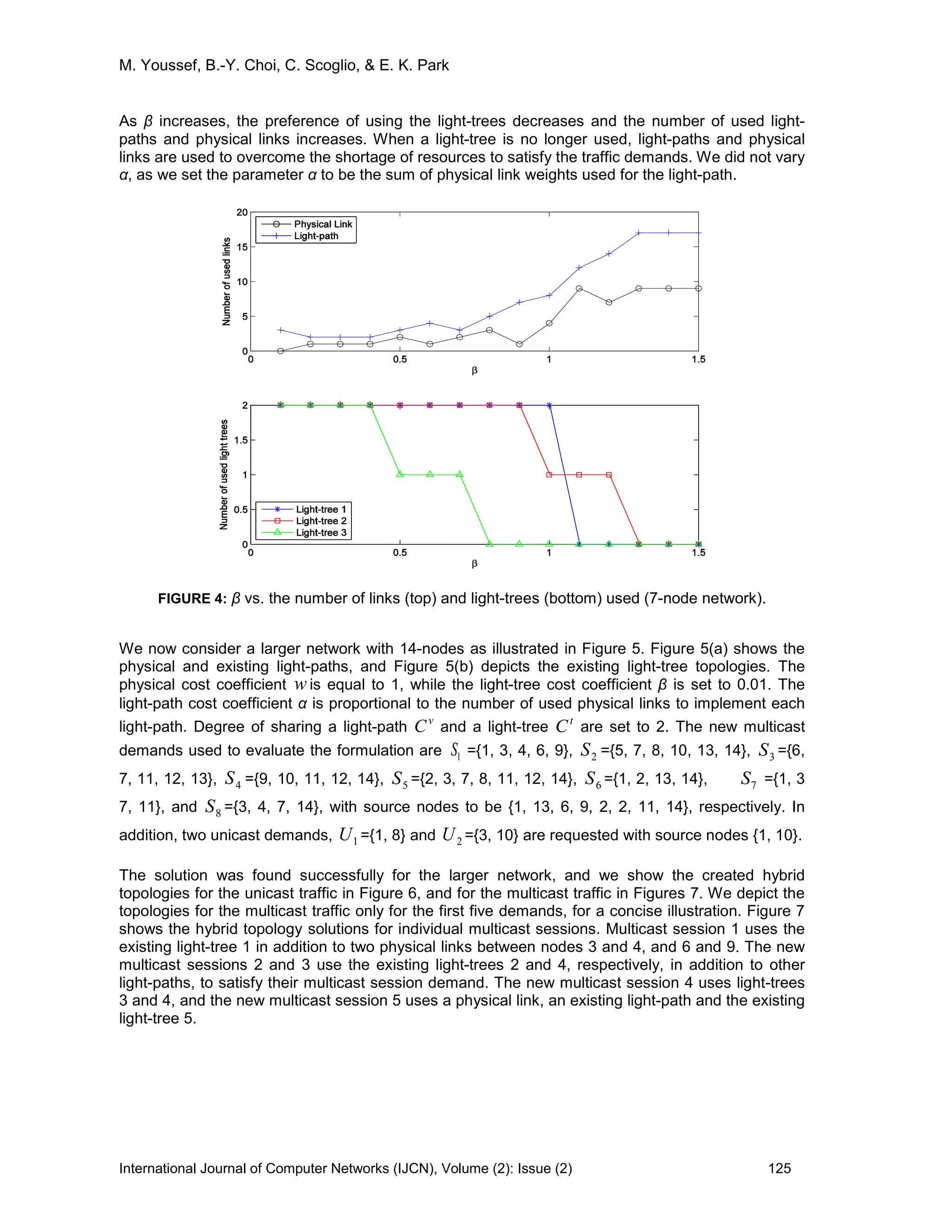
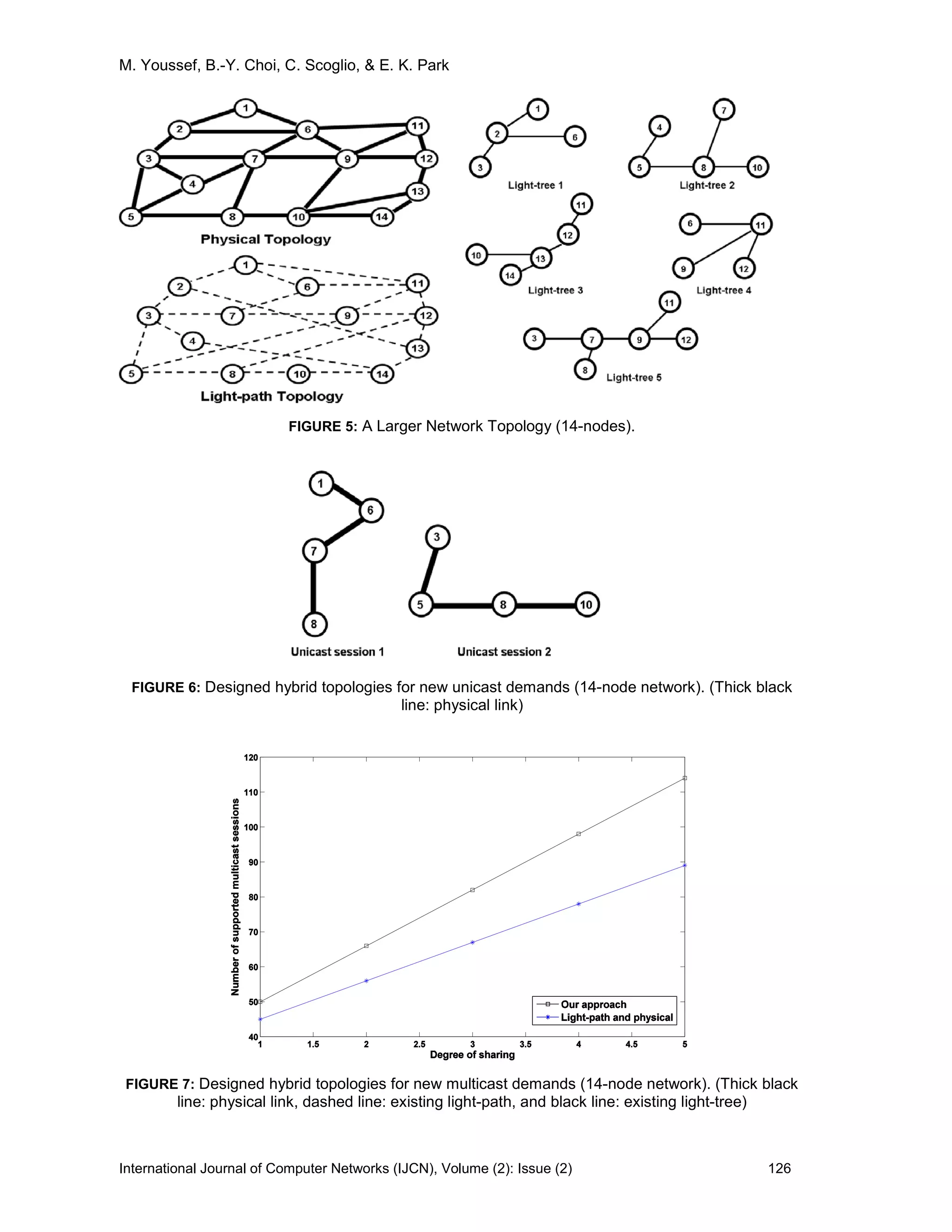
decreasing, because physical links become more expensive to transport the multicast traffic
demand. In addition, both Figures 3 and 8 show a similar structure of the created hybrid multicast
topologies. The figures show that there is a value of w at which the light-trees are no longer used to
create the hybrid topologies. This value depends on the network structure as well as the light-trees
structure. Similarly, Figures 4 and 9 show similar structure of the created hybrid multicast
topologies, and the existence of a value for β at which light-trees are not used to create the hybrid
topologies.
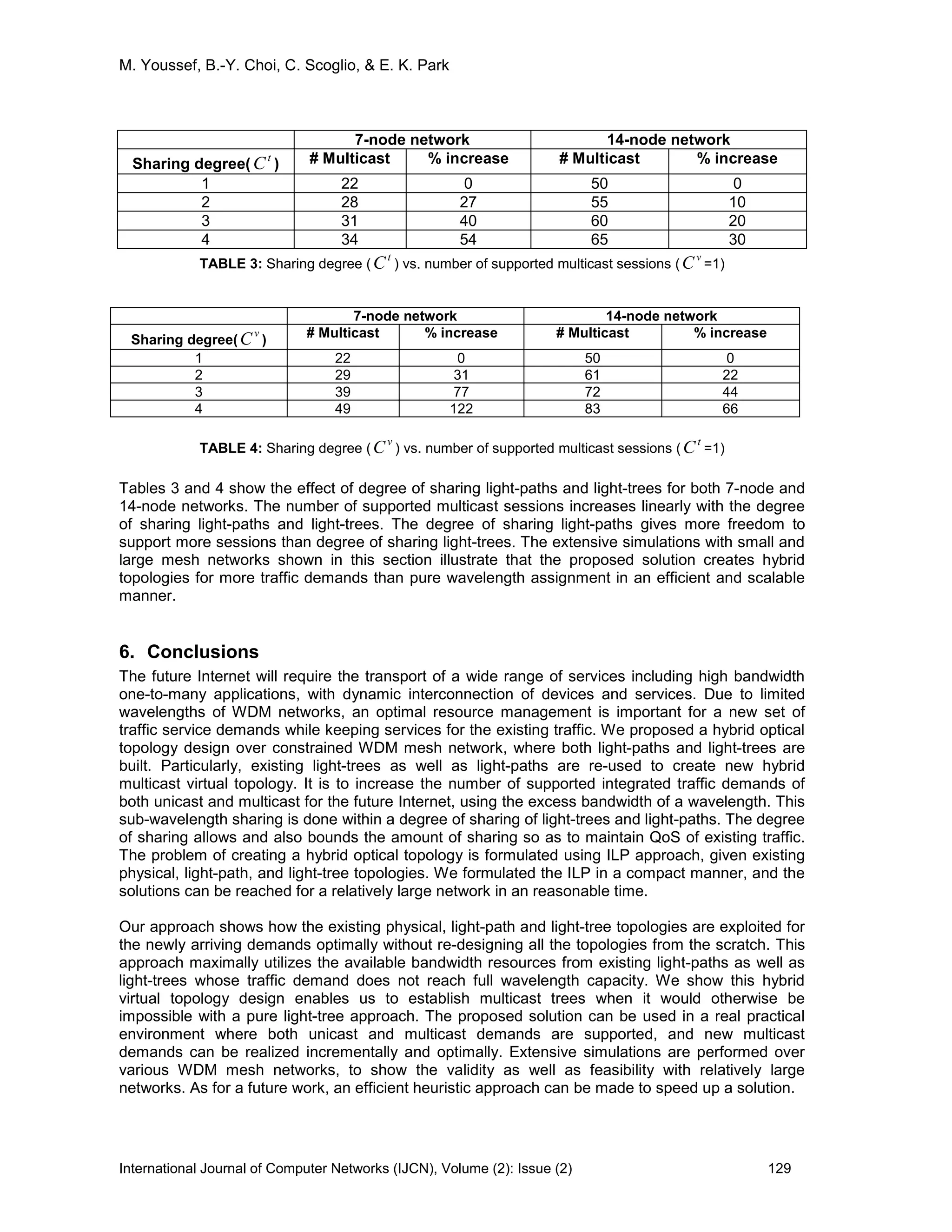
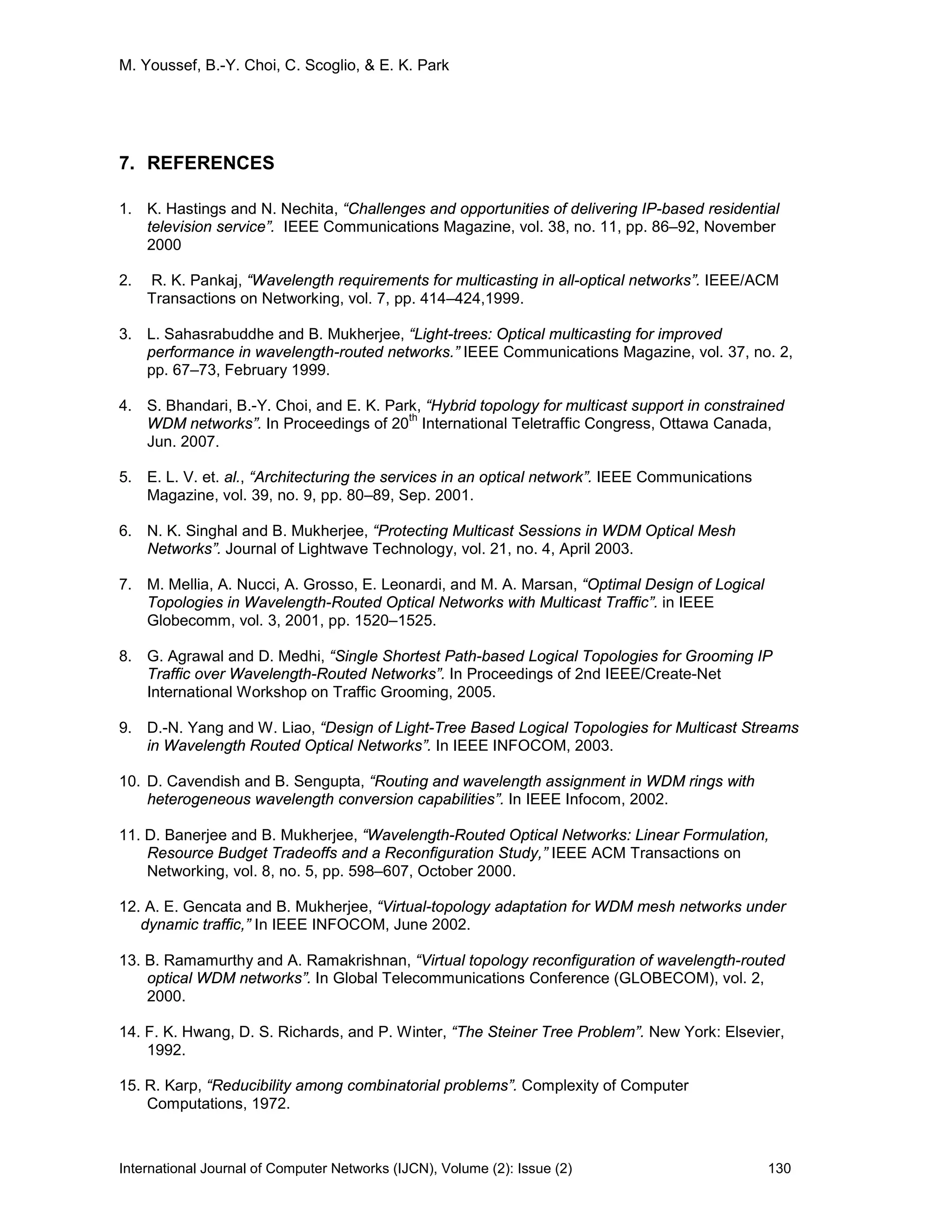
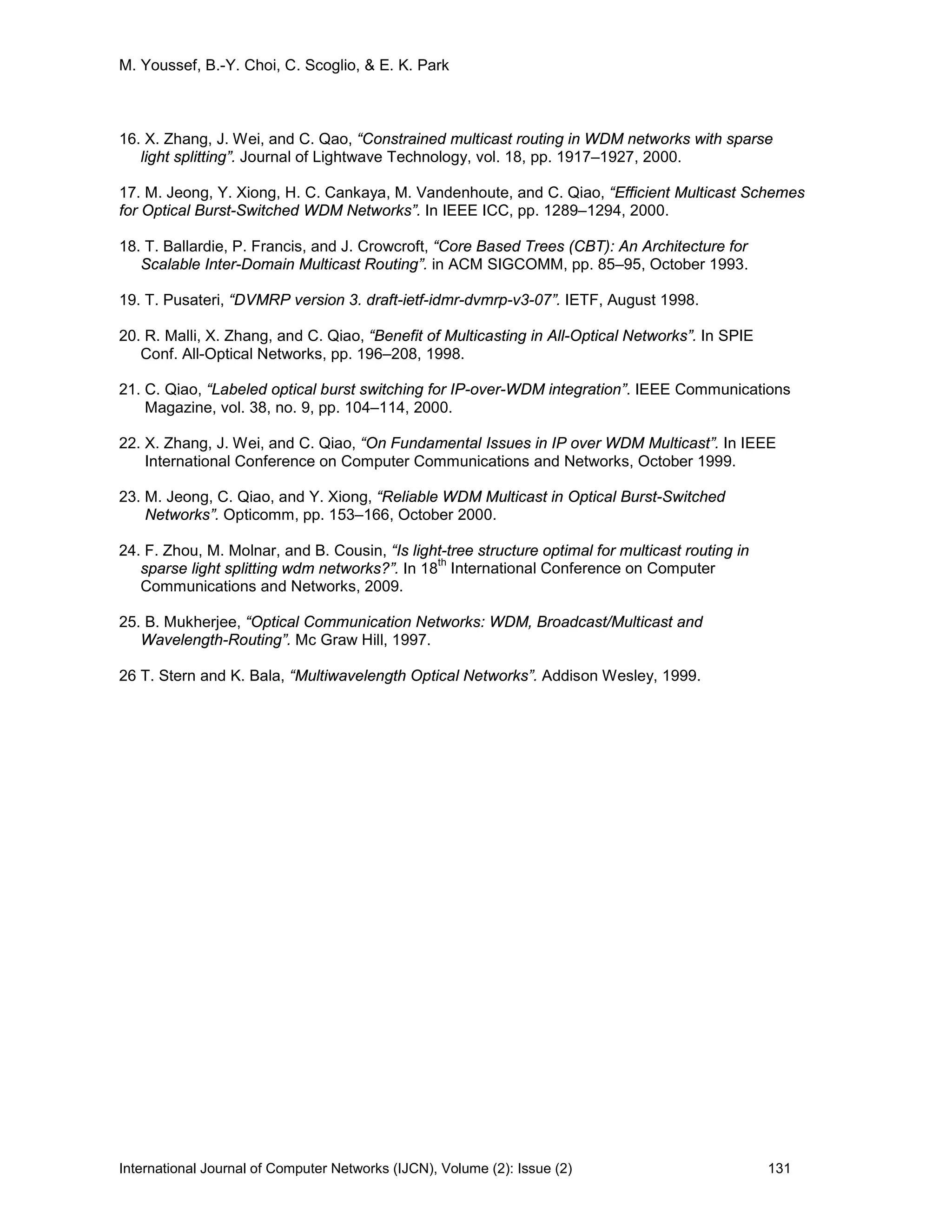
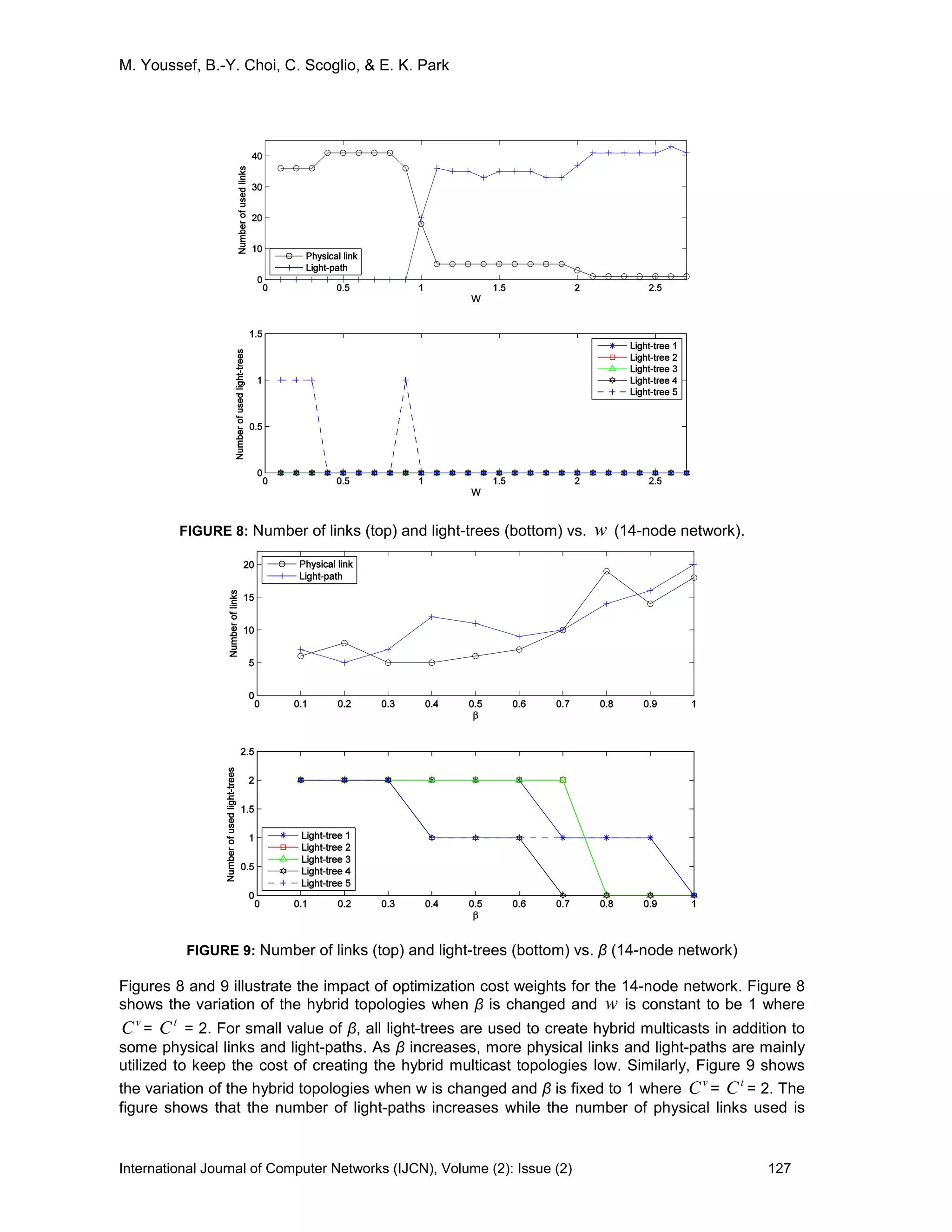
We next evaluate the number of supported multicast sessions while varying the degree of sharing
of light-paths and light-trees, for this large network. We assumed that
v
C and
t
C are the same.
FIGURE 10: The number of supported multicast sessions vs. degree of sharing of the light-paths and
the light-trees (14-node network)
Figure 10 shows that the number of supported multicast sessions increases as the degree of
sharing increases. Results are compared with no hybrid approach that does not use sub-
wavelength sharing. It also compares with the previous work [4], that was the first work that
proposed sub-wavelength sharing with existing light-paths but the sharing of multicast trees were
not allowed. Figure 10 shows that the number of multicast sessions linearly increases as the
degree of sharing increases. The proposed approach clearly satisfies more multicast demands with
the sharing of light-trees as well as light-paths.
TABLE 2: Effect of sharing the wavelengths
Table 2 compares the small 7-node and large 14-node networks to evaluate the impact of the
sharing. It shows the percentage of the increase in the number of supported multicast sessions,
with the degree of sharing. The percentage increase is computed comparing with the case of no
sub-wavelength sharing. Number of supported sessions increases almost linearly with the degree
of sharing for both 7-node and 14-node networks, respectively.
7-node network 14-node network
Sharing degree # Multicast % increase # Multicast % increase
1 22 0 50 0
2 36 63 66 32
3 50 127 82 64
4 61 177 114 128](https://image.slidesharecdn.com/ijcn-45-160225164454/75/Dynamic-Hybrid-Topology-Design-for-Integrated-Traffic-Support-in-WDM-Mesh-Networks-Invited-Paper-14-2048.jpg)