5/3/2020 1
Dr. Reddivari Manjula
Assistant Professor
JNTUACEA
Anantapur.
5/3/2020 2
This OER is developed on
“Non-Verbal Communication” followed by
self assessment .
5/3/2020 3
5/3/2020 4
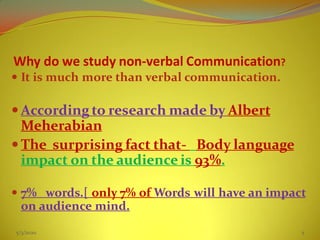
Why do we study non-verbal Communication?
 It is much more than verbal communication.
 According to research made by Albert
Meherabian
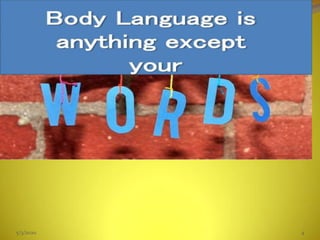
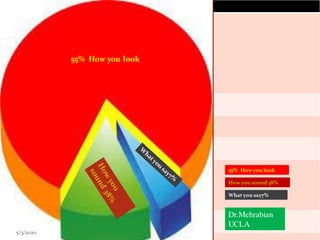
 The surprising fact that- Body language
impact on the audience is 93%.
 7% words.[ only 7% of Words will have an impact
on audience mind.
5/3/2020 5
6
How you sound 38%55% How you look
55% How you look
55% How you look
How you sound 38%
What you say7%
Dr.Mehrabian
UCLA
5/3/2020
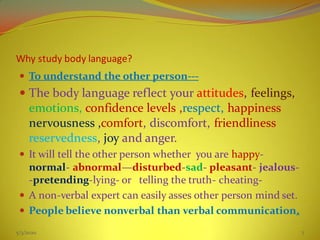
Why study body language?
 To understand the other person---
 The body language reflect your attitudes, feelings,
emotions, confidence levels ,respect, happiness
nervousness ,comfort, discomfort, friendliness
reservedness, joy and anger.
 It will tell the other person whether you are happy-
normal- abnormal—disturbed-sad- pleasant- jealous-
-pretending-lying- or telling the truth- cheating-
 A non-verbal expert can easily asses other person mind set.
 People believe nonverbal than verbal communication.
5/3/2020 7
Even if you lie Your body tells
the Truth
5/3/2020 8
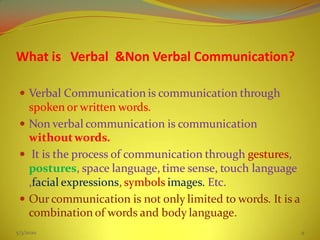
What is Verbal &Non Verbal Communication?
 Verbal Communication is communication through
spoken or written words.
 Non verbal communication is communication
withoutwords.
 It is the process of communication through gestures,
postures, space language, time sense, touch language
,facial expressions, symbols images. Etc.
 Our communication is not only limited to words. It is a
combination of words and body language.
5/3/2020 9
Types of 7 non-verbal Communication
 1.Kinesics------>Study of body movements- Postures-
gestures
 2.Oculesics-------Studyof eye contact
 3.Facial Expressions-Anger-disgust-happiness-
sadness-fear-joy-surprise
 4.Haptics Study of touch
 5.Proxemics-Studyof personal space.
 6.Chronemics- Study of time
 7.Paralanguage----What we call paralanguage or vocalics,
tone, temper, the depth of the voice, the pitch, the
sureness, the rhythm, the speed of talking, Music
5/3/2020 10
Kinesics
 Kinesics: Kinesics refers to the scientific study of gestures and
postures.
 Gestures are movement of hand or head or body to express your
emotion or information.
 Postures refers to the position when you are standing,
sitting or walking.
 Most of the gestures are cultural background. Gestures vary from
culture to culture.
 Indian gestures are different from American gestures .
 Gestures &Postures are closely related to each other.

5/3/2020 11
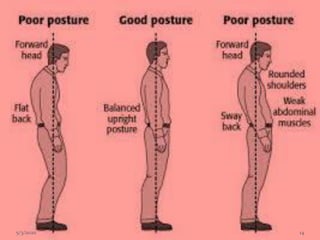
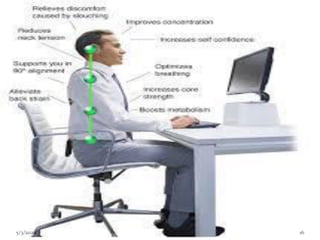
Open Posture & Closed Posture
 It s the right posture
 Standing upright
 Standing with hands to
the side.
 It has great impact on
the audience.
 It is the wrong posture
 Slouching
 Crossing or folding
hands.
 It has negative impact on
the audience.
5/3/2020 12
What is an open posture indicate?
 Openness.-status-interest-
 It indicate friendliness
 It indicate confidence
 It indicates open-mindedness
 It indicatestrong personality
 It indicate healthy personality.
 Eg: Open palm indicateblessing, generosity,
peace. It is an ancient secret.
 Open posture reflects high confidence and
influence the audience.
5/3/2020 13
5/3/2020 14
5/3/2020 15
5/3/2020 16
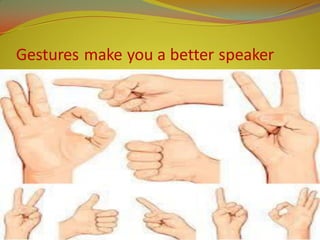
Why gestures are so important?
 Gestures make your presentation more effective.
 Gestures help to emphasize certain points .
 They enhance your communication in personal and
professional scenario.
 Hand gestures make people listen to you.
 Gestures help to connect with the audience.
 Gestures help to understand your topic easily
 Presentation with right gestures has lot of impact on
audience.
 Make sure hand gesture match your message .
5/3/2020 17
Gestures make you a better speaker
5/3/2020 18
Oculesics refers to eye gaze or eye contact.
 Eye contact is a powerful communication.
 Face is the index of mind, eye is the mirror of soul.
 Effectiveeye contact is essential in our daily
interaction with people.
 Eye contact demonstrate your interest on the subject.
5/3/2020 19
Eyes are the windows of the soul
 Without a singleword, eye can express a lot of
expressions like warmth,
 kindness,--- happiness
 trust-- cunning ness
 loyalty-- hope
 Peace– hate
 mercy - wicked ness
 Sadness-- like
 dislike, greediness,, irritation confidence, sincerity
etc.
5/3/2020 20
 Direct eye contact communicates-honesty-transparency-
confidence-interest- friendliness- respect-trust-openness-
sincerity
 Lack of eye contact- shyness-submissive ness- lack of
confidence-lack of interest- lack of trust
 Downcast eyes- submission
 Raised look -dominance
 Stare down others -not good
5/3/2020 21
3.Facial expressions
 The face is the most important channel of non-verbal
communication.
 Face is the index of mind eye is the mirror of soul.

 Facial expressionsindicateindividual intensionsand personal
emotionslike-
 Joy, frustration, happiness , sadness, anger, jealousy, cunning or tricky-
 whatever a person feels deep inside that is reflected on your face without a
single word.
 Facial expressionsareextremelyimportant to make social interaction
effective.
 It also has the influential impact on others. If you are not showing the
face or you are not interestedin the looking at theface of the person
indicate something wrong .
5/3/2020 22
Facial Expressions?
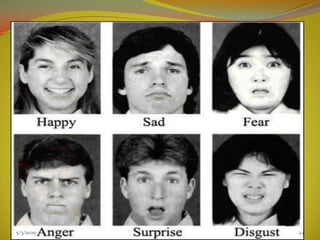
 Universallythere are six basic expressions which
peopleaccept everywhere.
 Anger
 disgust
 Fear
 sad ness
 joy
 surprise

5/3/2020 23
5/3/2020 24
What is Haptics?
 Haptics refers to the studyof communicationby
touch.
 It is a form of non-verbal communication. By which man
communicate with the animals.
 Touch is the first form of communication by infants.
 It gives psychological relief to the children.
 Touch has the power but we should use professionally.
 Haptics rules changes according to different cultures.
 In India touching the feet of an elder is a sign of respect.
But in America it appears to be slavish.

5/3/2020 25
 Indiansgenerallydon't shake hands with or even
touch the membersof opposite sex. They use the
namaste greeting.
 Now a days hand shake has become universally
accepted gesture in termsof professional
communication.
 In terms of professional communication you
should avoid too extremetypes of hand shake.
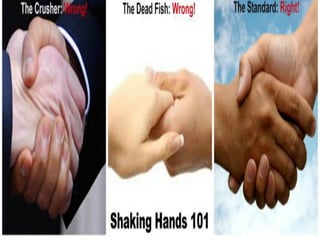
 Neither be the dead fish –nor the knuckle grinder.
5/3/2020 26
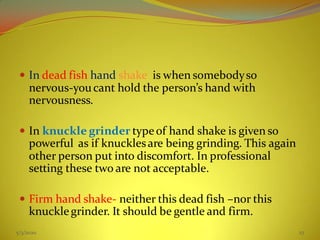
 In dead fish hand shake is when somebodyso
nervous-youcant hold the person’s hand with
nervousness.
 In knuckle grinder typeof hand shake is given so
powerful as if knucklesare being grinding. This again
other person put into discomfort. In professional
setting these two are not acceptable.
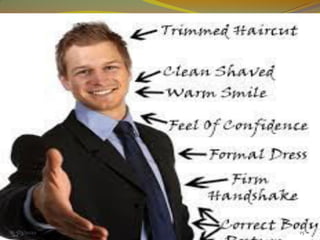
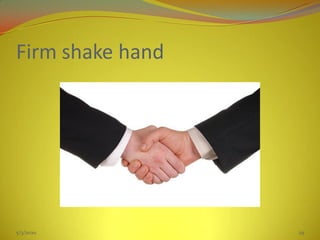
 Firm hand shake- neither this dead fish –nor this
knucklegrinder. It should be gentle and firm.
5/3/2020 27
5/3/2020 28
Firm shake hand
5/3/2020 29
Proxemics-Study of space between persons
 Proxemics refers to the studyof use of space in
human interaction.
 Edward T.Hall, the cultural anthropologist who coined
the term in 1963.
 According to research , the physical distance between
communicators , indicate the type of relation ship they
have.
5/3/2020 30
Maintain personal space
 Most People maintain distance with other people
depending on their relation ship.
 The greater the person, greater the space.
 Closer the person, smaller the distance between them.
 Stranger the person, greater the distance between them.
 There are four kinds of distance in communication.
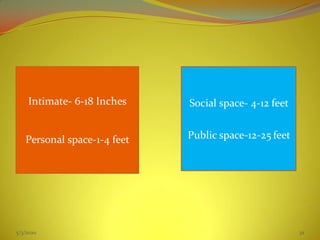
 1.Intimate space– 6-18 inches.
 2. Personal space- 1-4 feet.
 3. Social space---4-12-feet
 4. Public space- 12-25 feet.
5/3/2020 31
5/3/2020 32
Intimate- 6-18 Inches
Personal space-1-4 feet
Social space- 4-12 feet
Public space-12-25 feet
Respect personal space
 When you invade a personal space--
 Feel troubled
 Get defensive
 Aggressive
 Retaliate
 Hence respect personal space.
5/3/2020 33
 Publicspace- Is the space that how close we sit or
stand to some public figure or publicspeaker. We have
to maintain at least –12 feet –25 feet distance
 Eg: teacher – prime minister
 The greater the status the longer the distance.
 Social space–Gettinga little closer 4 feet-12 feet
 Eg: Talking to a customer, colleague , friends-family
 Personal space: It is probablyfrom one foot- 4 feet
away from some one.
5/3/2020 34
Chronemics Use of
Time
5/3/2020 35
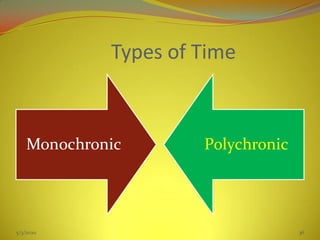
Types of Time
Monochronic Polychronic
5/3/2020 36
Monochronic---- Polychronic
 Time is money[scarce]
 Do one thing at a time
 Task oriented.
 They scheduleall the
activities that start and
end at a certain time."[
 Consider time
c0mmitments
(deadlines,schedules)
objectivesseriously
 Time is flexible
 Do many things
simultaneously.
 Relation ship oriented.
 Change plans often and
easily
 Polychronic culture is
more focused on
relationships, rather
than watching the clock.
5/3/2020 37
Monochronic-- Polychronic
 Are more concerned with
privacy and individual
ownership
 Emphasize prompt time
recognition, regardless of
relationship or
circumstances
 They take time seriously.
 Time is scheduled,
arranged and managed.
 Are more concerned with
community and shared
connections
 Emphasize response based
on nature of relationship
and circumstances
 They take time casually.
 Polychronic cultures like
to do multiple things at the
same time. They love to
work on more than one
thing at a time.
5/3/2020 38
Monochronic----Polychronic
 Plan schedules,
appointments in advance
.
 They are focussed. They
don’t like switching back
and forth from one
activity to another
 They consider time
commitments very
casually.
 Highlydistractible
 Indians & Middleeast
follow polychronic time.
5/3/2020 39
Develop cultural sensitivity.
 Understand
monochronic and
polychronic time
cultures.
 Understand various
cultural attitudes.
 Recognise whether you
are dealing with the
monochronic person or
polychronic person
 Respect different
perceptions of time.
5/3/2020 40
Paralanguage:Metacommunication
 Paralanguage is study of voice . It is not what you
said, it refers how you said.
 It refers to the vocal componentssuch as –
tone/intensity- rate –rhythm—volume-pitch-
speed of the voice – vocal variety-quality etc
have high impact on the audience.
5/3/2020 41
 Monotonous and weak voice nobody likes .
 Nobody likes when speech is more speed than expected .
 No body likes when speech is breaking.( no continuity )
 No body likes when Pronunciation is not clear ----
 If tone sounds like immatured –
 If speech is too fast or too slow
 If your speech is too low pitch/ too high both are not liked by the
audience.
 .
5/3/2020 42
Use your voice effectively.
 When speaking some thin
serious / tragicpitch must be
low
 A speech that is regular, without
variationboretheaudience.
 Increaseyour toneto emphasize
anypoint.
 Don’talways speak loudly/ don’t
alwaysspeak softly
 Changingemphasisalterthe
meaning.
 Speaking joy / surprise/ or
commanding pitch must be
high.
 Don’t shout/ resonate your
voice.
 Command must be in
commanding tone.
 Don’t use thunder tone to
make request.
 Make your voice natural,
expressive.
5/3/2020 43
Silence
 It is a powerful non-verbal communication.
 Silent convey different meanings.
 Silent can be used as a punishment.
5/3/2020 44
Conclusion
 1.Non-Verbal communication is an unspoken element of
communication.
 It helps to understand people mindset.
 Your postures, gestures, facial expressions, eye contact , your use
of personal space , your time culture, sends a certain message to
the other person.
 Positive body language creates positive impression and negative
body language create a negative impression on you.
 Positive body language is essential in work place and corporate
environment.
 Right posture, open gestures, gentle smile, space consciousness,
eye contact, gentle voice, build rapport with other persons.
 Positive body language break the barriers of unfamiliarity.
5/3/2020 45
Self Assessment
 Mark true or false to the followingquestions.
Youranswers will reflect your notions on body
language.
 1. According to Albert Meherabian the impact of body language on
audience is 93% [ ]
 2.Women have natural sensitivity towards body language than men.[ ]
 3. Dishonest person maintain eye contact [ ]
 4. Smoking a cigarette especiallybefore a interview indicates
nervousness [ ]
 5. Showing your thumbs up indicates a success [ ]
5/3/2020 46
 6. Non verbal communication is anything except body language.[ ]
 7.we have to maintain publicspace onlyonefoot distance. [ ]
 8. Closed posturegivespositive impact on theaudience [ ]
 9. Slouching is a close posture.[ ]
 10.Proxemicsreferstothe studyof space [ ]
 11.Theface is the most importantchannel of non –verbal
communication.[ ]
 12.Monochromicpeoplemain punctuality[ ]
 13. Metacommunication plays importantrole in presentation. [ ]
 14. Peoplemaintain less distancewith theircloserone.[ ]
 15. Polychronic cultured people like to do multiplethingsat the same
time.[ ]
5/3/2020 47
 16. Negative non verbal symbols like sadness, anger are more noticeable
than positive ones.[ ]
 17. Thestudy of body movements , gestures and postures falls under the
category of Kinesics.
 18. The term proxemics was coined by an anthropologist Edward Hall in
1960. [ ]
 19. People like monotonous and weak voice [ ]
 20. Looking at the ground during interviews is a good sign.[ ]
 21. Sitting up straight is negative non-verbal symbol.[ ]
5/3/2020 48
Answer the following questions
 1. Write a note on the importance of non-verbal communication.
 2. Explain various types of non-verbal communication
 3.Define kinesics.
 4.Define haptics.
 5.Explain the role of meta communication in presentation ?
 6.What is the role of proxemics in communication?
 7.Define chronemics.
 8.What do you understand from the term Kinesics?
 9.Make a difference between right posture and wrong posture.
 10.Provide examples of negative and positive non-verbal
symbols.
5/3/2020 49
References
 1. Silent messages: Implicit communication of emotions and attitudes, 2nd
ed.Belmont,Calif.,
Wadsworth, 1981
 2. https://en.wikipedia.org/wiki/Body_language.
 3. https://en.wikipedia.org/wiki/posture_(psychology)

 4.https://en.wikipedia.org/wiki/Edward_T._Hall
 5. https://www.frontiersin.org/articles/10.3389/fpsyg.2017.02175/full
5/3/2020 50

R. Manjula --NON-VERBAL COMMUNICATION

  • 1.
  • 2.
    Dr. Reddivari Manjula AssistantProfessor JNTUACEA Anantapur. 5/3/2020 2
  • 3.
    This OER isdeveloped on “Non-Verbal Communication” followed by self assessment . 5/3/2020 3
  • 4.
  • 5.
    Why do westudy non-verbal Communication?  It is much more than verbal communication.  According to research made by Albert Meherabian  The surprising fact that- Body language impact on the audience is 93%.  7% words.[ only 7% of Words will have an impact on audience mind. 5/3/2020 5
  • 6.
    6 How you sound38%55% How you look 55% How you look 55% How you look How you sound 38% What you say7% Dr.Mehrabian UCLA 5/3/2020
  • 7.
    Why study bodylanguage?  To understand the other person---  The body language reflect your attitudes, feelings, emotions, confidence levels ,respect, happiness nervousness ,comfort, discomfort, friendliness reservedness, joy and anger.  It will tell the other person whether you are happy- normal- abnormal—disturbed-sad- pleasant- jealous- -pretending-lying- or telling the truth- cheating-  A non-verbal expert can easily asses other person mind set.  People believe nonverbal than verbal communication. 5/3/2020 7
  • 8.
    Even if youlie Your body tells the Truth 5/3/2020 8
  • 9.
    What is Verbal&Non Verbal Communication?  Verbal Communication is communication through spoken or written words.  Non verbal communication is communication withoutwords.  It is the process of communication through gestures, postures, space language, time sense, touch language ,facial expressions, symbols images. Etc.  Our communication is not only limited to words. It is a combination of words and body language. 5/3/2020 9
  • 10.
    Types of 7non-verbal Communication  1.Kinesics------>Study of body movements- Postures- gestures  2.Oculesics-------Studyof eye contact  3.Facial Expressions-Anger-disgust-happiness- sadness-fear-joy-surprise  4.Haptics Study of touch  5.Proxemics-Studyof personal space.  6.Chronemics- Study of time  7.Paralanguage----What we call paralanguage or vocalics, tone, temper, the depth of the voice, the pitch, the sureness, the rhythm, the speed of talking, Music 5/3/2020 10
  • 11.
    Kinesics  Kinesics: Kinesicsrefers to the scientific study of gestures and postures.  Gestures are movement of hand or head or body to express your emotion or information.  Postures refers to the position when you are standing, sitting or walking.  Most of the gestures are cultural background. Gestures vary from culture to culture.  Indian gestures are different from American gestures .  Gestures &Postures are closely related to each other.  5/3/2020 11
  • 12.
    Open Posture &Closed Posture  It s the right posture  Standing upright  Standing with hands to the side.  It has great impact on the audience.  It is the wrong posture  Slouching  Crossing or folding hands.  It has negative impact on the audience. 5/3/2020 12
  • 13.
    What is anopen posture indicate?  Openness.-status-interest-  It indicate friendliness  It indicate confidence  It indicates open-mindedness  It indicatestrong personality  It indicate healthy personality.  Eg: Open palm indicateblessing, generosity, peace. It is an ancient secret.  Open posture reflects high confidence and influence the audience. 5/3/2020 13
  • 14.
  • 15.
  • 16.
  • 17.
    Why gestures areso important?  Gestures make your presentation more effective.  Gestures help to emphasize certain points .  They enhance your communication in personal and professional scenario.  Hand gestures make people listen to you.  Gestures help to connect with the audience.  Gestures help to understand your topic easily  Presentation with right gestures has lot of impact on audience.  Make sure hand gesture match your message . 5/3/2020 17
  • 18.
    Gestures make youa better speaker 5/3/2020 18
  • 19.
    Oculesics refers toeye gaze or eye contact.  Eye contact is a powerful communication.  Face is the index of mind, eye is the mirror of soul.  Effectiveeye contact is essential in our daily interaction with people.  Eye contact demonstrate your interest on the subject. 5/3/2020 19
  • 20.
    Eyes are thewindows of the soul  Without a singleword, eye can express a lot of expressions like warmth,  kindness,--- happiness  trust-- cunning ness  loyalty-- hope  Peace– hate  mercy - wicked ness  Sadness-- like  dislike, greediness,, irritation confidence, sincerity etc. 5/3/2020 20
  • 21.
     Direct eyecontact communicates-honesty-transparency- confidence-interest- friendliness- respect-trust-openness- sincerity  Lack of eye contact- shyness-submissive ness- lack of confidence-lack of interest- lack of trust  Downcast eyes- submission  Raised look -dominance  Stare down others -not good 5/3/2020 21
  • 22.
    3.Facial expressions  Theface is the most important channel of non-verbal communication.  Face is the index of mind eye is the mirror of soul.   Facial expressionsindicateindividual intensionsand personal emotionslike-  Joy, frustration, happiness , sadness, anger, jealousy, cunning or tricky-  whatever a person feels deep inside that is reflected on your face without a single word.  Facial expressionsareextremelyimportant to make social interaction effective.  It also has the influential impact on others. If you are not showing the face or you are not interestedin the looking at theface of the person indicate something wrong . 5/3/2020 22
  • 23.
    Facial Expressions?  Universallythereare six basic expressions which peopleaccept everywhere.  Anger  disgust  Fear  sad ness  joy  surprise  5/3/2020 23
  • 24.
  • 25.
    What is Haptics? Haptics refers to the studyof communicationby touch.  It is a form of non-verbal communication. By which man communicate with the animals.  Touch is the first form of communication by infants.  It gives psychological relief to the children.  Touch has the power but we should use professionally.  Haptics rules changes according to different cultures.  In India touching the feet of an elder is a sign of respect. But in America it appears to be slavish.  5/3/2020 25
  • 26.
     Indiansgenerallydon't shakehands with or even touch the membersof opposite sex. They use the namaste greeting.  Now a days hand shake has become universally accepted gesture in termsof professional communication.  In terms of professional communication you should avoid too extremetypes of hand shake.  Neither be the dead fish –nor the knuckle grinder. 5/3/2020 26
  • 27.
     In deadfish hand shake is when somebodyso nervous-youcant hold the person’s hand with nervousness.  In knuckle grinder typeof hand shake is given so powerful as if knucklesare being grinding. This again other person put into discomfort. In professional setting these two are not acceptable.  Firm hand shake- neither this dead fish –nor this knucklegrinder. It should be gentle and firm. 5/3/2020 27
  • 28.
  • 29.
  • 30.
    Proxemics-Study of spacebetween persons  Proxemics refers to the studyof use of space in human interaction.  Edward T.Hall, the cultural anthropologist who coined the term in 1963.  According to research , the physical distance between communicators , indicate the type of relation ship they have. 5/3/2020 30
  • 31.
    Maintain personal space Most People maintain distance with other people depending on their relation ship.  The greater the person, greater the space.  Closer the person, smaller the distance between them.  Stranger the person, greater the distance between them.  There are four kinds of distance in communication.  1.Intimate space– 6-18 inches.  2. Personal space- 1-4 feet.  3. Social space---4-12-feet  4. Public space- 12-25 feet. 5/3/2020 31
  • 32.
    5/3/2020 32 Intimate- 6-18Inches Personal space-1-4 feet Social space- 4-12 feet Public space-12-25 feet
  • 33.
    Respect personal space When you invade a personal space--  Feel troubled  Get defensive  Aggressive  Retaliate  Hence respect personal space. 5/3/2020 33
  • 34.
     Publicspace- Isthe space that how close we sit or stand to some public figure or publicspeaker. We have to maintain at least –12 feet –25 feet distance  Eg: teacher – prime minister  The greater the status the longer the distance.  Social space–Gettinga little closer 4 feet-12 feet  Eg: Talking to a customer, colleague , friends-family  Personal space: It is probablyfrom one foot- 4 feet away from some one. 5/3/2020 34
  • 35.
  • 36.
    Types of Time MonochronicPolychronic 5/3/2020 36
  • 37.
    Monochronic---- Polychronic  Timeis money[scarce]  Do one thing at a time  Task oriented.  They scheduleall the activities that start and end at a certain time."[  Consider time c0mmitments (deadlines,schedules) objectivesseriously  Time is flexible  Do many things simultaneously.  Relation ship oriented.  Change plans often and easily  Polychronic culture is more focused on relationships, rather than watching the clock. 5/3/2020 37
  • 38.
    Monochronic-- Polychronic  Aremore concerned with privacy and individual ownership  Emphasize prompt time recognition, regardless of relationship or circumstances  They take time seriously.  Time is scheduled, arranged and managed.  Are more concerned with community and shared connections  Emphasize response based on nature of relationship and circumstances  They take time casually.  Polychronic cultures like to do multiple things at the same time. They love to work on more than one thing at a time. 5/3/2020 38
  • 39.
    Monochronic----Polychronic  Plan schedules, appointmentsin advance .  They are focussed. They don’t like switching back and forth from one activity to another  They consider time commitments very casually.  Highlydistractible  Indians & Middleeast follow polychronic time. 5/3/2020 39
  • 40.
    Develop cultural sensitivity. Understand monochronic and polychronic time cultures.  Understand various cultural attitudes.  Recognise whether you are dealing with the monochronic person or polychronic person  Respect different perceptions of time. 5/3/2020 40
  • 41.
    Paralanguage:Metacommunication  Paralanguage isstudy of voice . It is not what you said, it refers how you said.  It refers to the vocal componentssuch as – tone/intensity- rate –rhythm—volume-pitch- speed of the voice – vocal variety-quality etc have high impact on the audience. 5/3/2020 41
  • 42.
     Monotonous andweak voice nobody likes .  Nobody likes when speech is more speed than expected .  No body likes when speech is breaking.( no continuity )  No body likes when Pronunciation is not clear ----  If tone sounds like immatured –  If speech is too fast or too slow  If your speech is too low pitch/ too high both are not liked by the audience.  . 5/3/2020 42
  • 43.
    Use your voiceeffectively.  When speaking some thin serious / tragicpitch must be low  A speech that is regular, without variationboretheaudience.  Increaseyour toneto emphasize anypoint.  Don’talways speak loudly/ don’t alwaysspeak softly  Changingemphasisalterthe meaning.  Speaking joy / surprise/ or commanding pitch must be high.  Don’t shout/ resonate your voice.  Command must be in commanding tone.  Don’t use thunder tone to make request.  Make your voice natural, expressive. 5/3/2020 43
  • 44.
    Silence  It isa powerful non-verbal communication.  Silent convey different meanings.  Silent can be used as a punishment. 5/3/2020 44
  • 45.
    Conclusion  1.Non-Verbal communicationis an unspoken element of communication.  It helps to understand people mindset.  Your postures, gestures, facial expressions, eye contact , your use of personal space , your time culture, sends a certain message to the other person.  Positive body language creates positive impression and negative body language create a negative impression on you.  Positive body language is essential in work place and corporate environment.  Right posture, open gestures, gentle smile, space consciousness, eye contact, gentle voice, build rapport with other persons.  Positive body language break the barriers of unfamiliarity. 5/3/2020 45
  • 46.
    Self Assessment  Marktrue or false to the followingquestions. Youranswers will reflect your notions on body language.  1. According to Albert Meherabian the impact of body language on audience is 93% [ ]  2.Women have natural sensitivity towards body language than men.[ ]  3. Dishonest person maintain eye contact [ ]  4. Smoking a cigarette especiallybefore a interview indicates nervousness [ ]  5. Showing your thumbs up indicates a success [ ] 5/3/2020 46
  • 47.
     6. Nonverbal communication is anything except body language.[ ]  7.we have to maintain publicspace onlyonefoot distance. [ ]  8. Closed posturegivespositive impact on theaudience [ ]  9. Slouching is a close posture.[ ]  10.Proxemicsreferstothe studyof space [ ]  11.Theface is the most importantchannel of non –verbal communication.[ ]  12.Monochromicpeoplemain punctuality[ ]  13. Metacommunication plays importantrole in presentation. [ ]  14. Peoplemaintain less distancewith theircloserone.[ ]  15. Polychronic cultured people like to do multiplethingsat the same time.[ ] 5/3/2020 47
  • 48.
     16. Negativenon verbal symbols like sadness, anger are more noticeable than positive ones.[ ]  17. Thestudy of body movements , gestures and postures falls under the category of Kinesics.  18. The term proxemics was coined by an anthropologist Edward Hall in 1960. [ ]  19. People like monotonous and weak voice [ ]  20. Looking at the ground during interviews is a good sign.[ ]  21. Sitting up straight is negative non-verbal symbol.[ ] 5/3/2020 48
  • 49.
    Answer the followingquestions  1. Write a note on the importance of non-verbal communication.  2. Explain various types of non-verbal communication  3.Define kinesics.  4.Define haptics.  5.Explain the role of meta communication in presentation ?  6.What is the role of proxemics in communication?  7.Define chronemics.  8.What do you understand from the term Kinesics?  9.Make a difference between right posture and wrong posture.  10.Provide examples of negative and positive non-verbal symbols. 5/3/2020 49
  • 50.
    References  1. Silentmessages: Implicit communication of emotions and attitudes, 2nd ed.Belmont,Calif., Wadsworth, 1981  2. https://en.wikipedia.org/wiki/Body_language.  3. https://en.wikipedia.org/wiki/posture_(psychology)   4.https://en.wikipedia.org/wiki/Edward_T._Hall  5. https://www.frontiersin.org/articles/10.3389/fpsyg.2017.02175/full 5/3/2020 50