QUESTIONNAIRE
DESIGN
Dr. Minakshi Ashok Randive
Professor &H.O.D Kriya Sharir
Tilak Ayurved Mahavidyala Pune
RESEARCH STUDY PROTOCOL
➤ Structure of Research Study includes:
➤ Introduction
➤ Aim and Objectives
➤ Review of Literature
➤ Material and Methods - Study Tools
➤ Results and Discussion
➤ Summary and Conclusion
➤ Recommendations
➤ Limitations
➤ References
OBJECTIVES
➤ Questionnaire Formation
➤ Type of questions asked
➤ Questionnaire Design
➤ Advantages and disadvantages
DEFINITION
➤ It is a set of questions used for obtaining statistically
useful or personal information from individuals.
(Marriam - Webster)
➤ It is a standardised, structured instrument.
➤ It is focused on closed end question.
➤ Administered in a structured way.
➤ It is focused around the aims and objectives of research
studies.
IMPORTANCE
➤ It allows us to collect vast information with a single study
tool.
➤ In some cases it is the only study tool that can be used.
Eg. Quality of Life in patients.
➤ Collects factual data.
IMPORTANCE- CONTINUED
➤ A well designed questionnaire gives accurate and relevant
information to the research question.
➤ It is an easy way to collect information.
➤ It minimises potential sources of bias.
QUALITIES OF A GOOD QUESTIONNAIRE
In order to get a high response rate, and to get information
that is easy to analyse, the questionnaire must have the
following points:
➤ Appearance - Neat and concise.
➤ Simple language.
➤ Relevant to your study.
➤ Logical format.
QUESTIONNAIRE DEVELOPMENT
➤ Make a list of information to be collected.
➤ Identification of target respondent.
➤ Method of communication with target respondent.
➤ Decide on required information and then develop questions
accordingly.
➤ Framing of questions.
➤ Ask questions in sequential order.
➤ Try to make the questionnaire concise (not at the cost of
information.)
➤ Pre-testing and piloting.
➤ Finalising survey form.
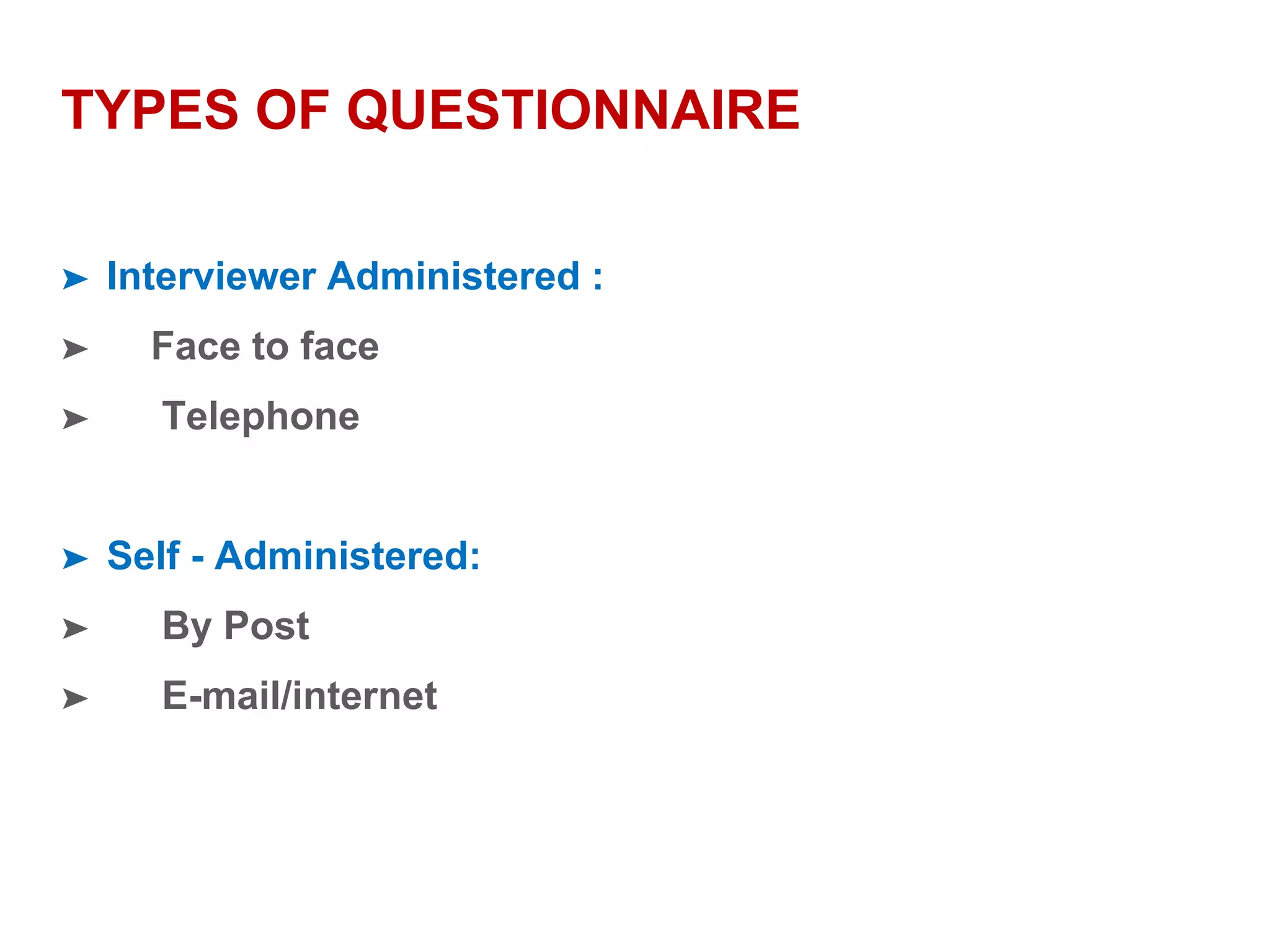
TYPES OF QUESTIONNAIRE
➤ Interviewer Administered :
➤ Face to face
➤ Telephone
➤ Self - Administered:
➤ By Post
➤ E-mail/internet
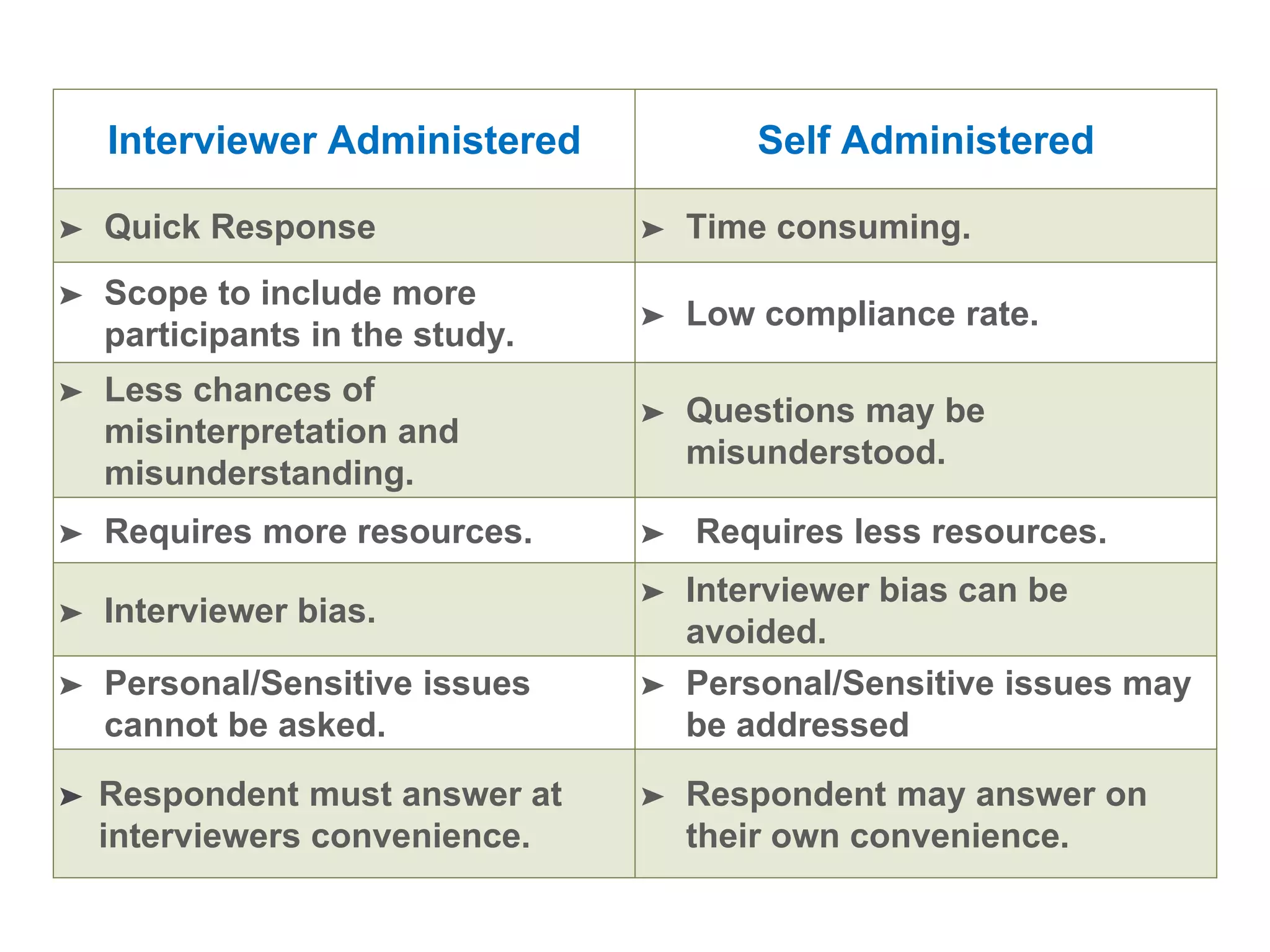
Interviewer Administered Self Administered
➤ Quick Response ➤ Time consuming.
➤ Scope to include more
participants in the study.
➤ Low compliance rate.
➤ Less chances of
misinterpretation and
misunderstanding.
➤ Questions may be
misunderstood.
➤ Requires more resources. ➤ Requires less resources.
➤ Interviewer bias.
➤ Interviewer bias can be
avoided.
➤ Personal/Sensitive issues
cannot be asked.
➤ Personal/Sensitive issues may
be addressed
➤ Respondent must answer at
interviewers convenience.
➤ Respondent may answer on
their own convenience.
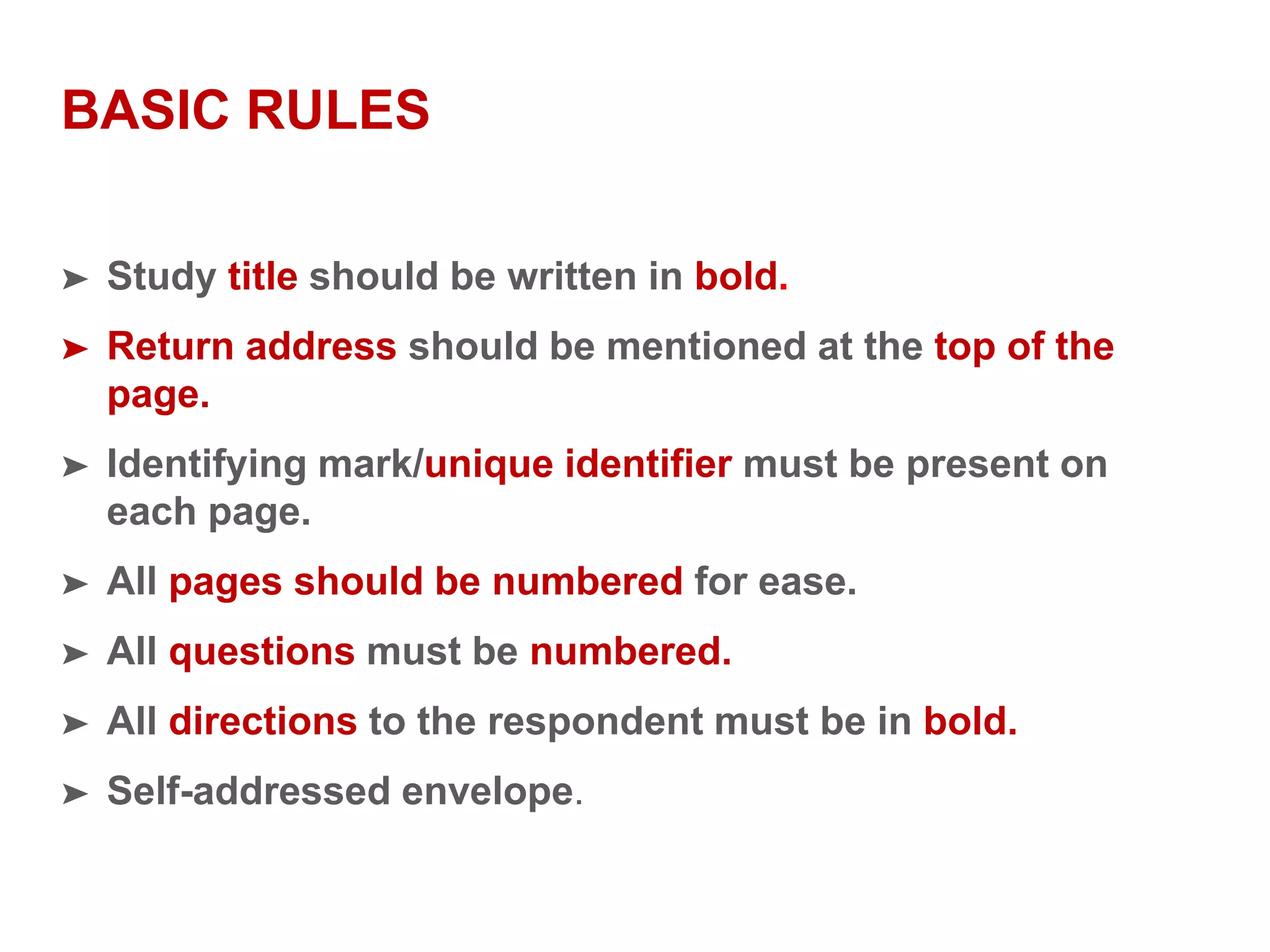
BASIC RULES
➤ Study title should be written in bold.
➤ Return address should be mentioned at the top of the
page.
➤ Identifying mark/unique identifier must be present on
each page.
➤ All pages should be numbered for ease.
➤ All questions must be numbered.
➤ All directions to the respondent must be in bold.
➤ Self-addressed envelope.
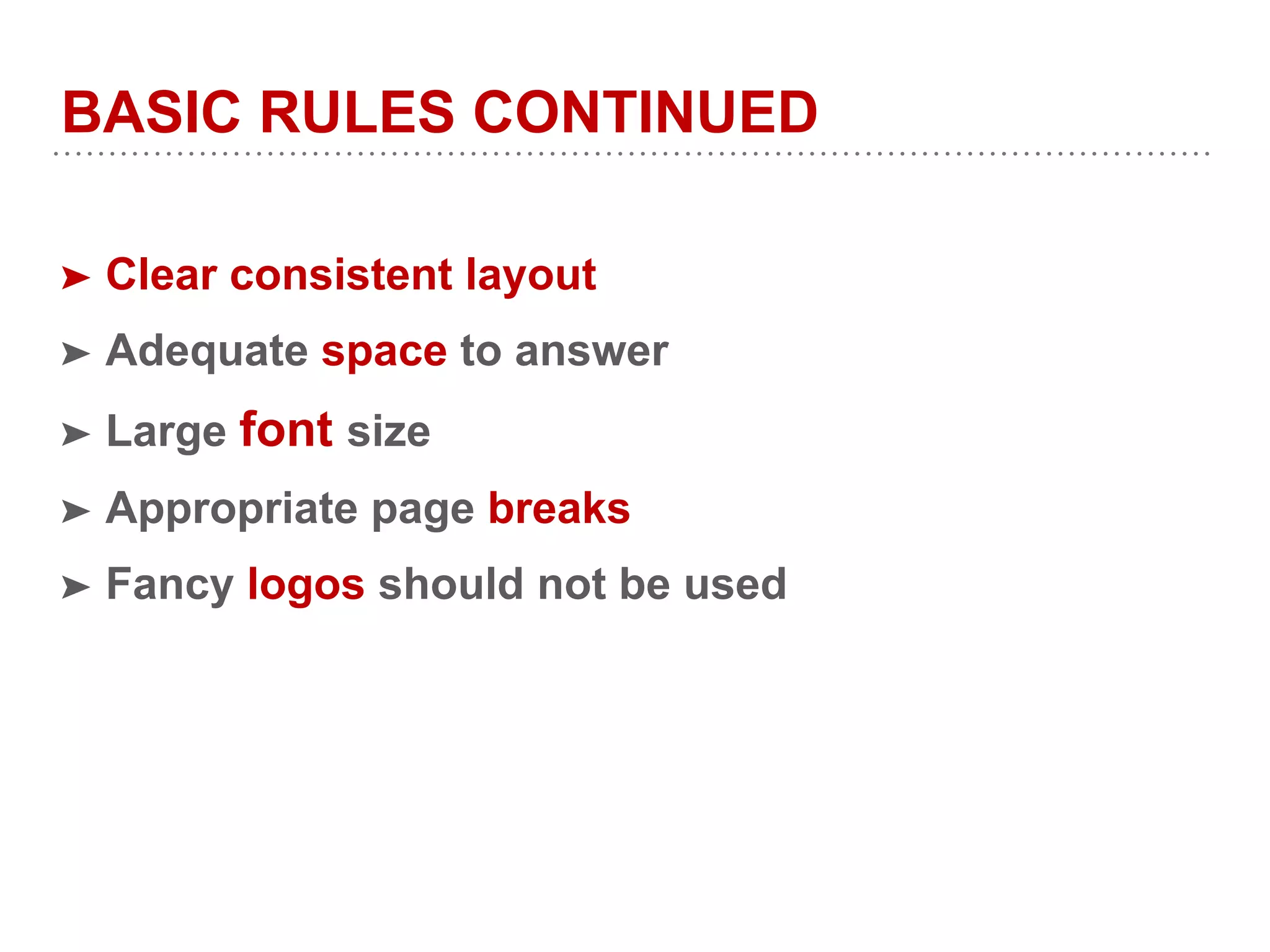
BASIC RULES CONTINUED
➤ Clear consistent layout
➤ Adequate space to answer
➤ Large font size
➤ Appropriate page breaks
➤ Fancy logos should not be used
ADVANTAGES OF QUESTIONNAIRE
➤ It is relatively easy to collect information.
➤ Can collect information from a large group of people with
relative ease and economy.
➤ Easy to analyse information.
DISADVANTAGES
➤ Misunderstanding of questions by the respondent is
possible.
➤ Provides limited insight into the research question, right
questions may not be asked.
➤ All information must be collected at the same time.
➤ Because of these reasons it is extremly important to
design a good questionnaire and collect information.
FORMATION OF QUESTIONS
➤ Focussed on primary objective.
➤ Necessary information should come from answers.
➤ Objective should be reached in a set of question - answer
session.
➤ Respondents level of intelligence should be kept in mind.
➤ Key words should be explained.
➤ Avoid unnecessary information.
➤ Avoid leading questions.
FORMATION OF QUESTIONS
Ask one information at a time to avoid confusion.
➤ All answer options should be included.
➤ Answer options should be kept in vertical order.
➤ Questions should be accurate. e.g.
➤ Do you smoke?
Yes / No . If Yes ,
➤ How many cigarettes do you smoke in a day ?
a. One - Five b. Six - Ten c. More than Ten
ORDER OF QUESTIONS
➤ Start with simple and general questions.
➤ Difficult and personal information related questions
should come in the later part.
➤ Sensitive questions should be placed properly at relevant
places.
➤ Topic related questions should be grouped.
➤ Initial questions should be close ended as they are easy
to answer.
➤ Important questions should be placed in the middle.
QUALITIES OF GOOD QUESTIONS
➤ Appropriate questions:
➤ Have you ever suffered from an infection of Human
Papilloma Virus?
a. Yes
b. No
➤ This question is appropriate for a study in patients with
cervical cancer or history of it.
➤ It is not appropriate for study in patients suffering from
gastric carcinoma, thyroid carcinoma, etc.
QUALITIES OF GOOD QUESTIONS
➤ Be objective:
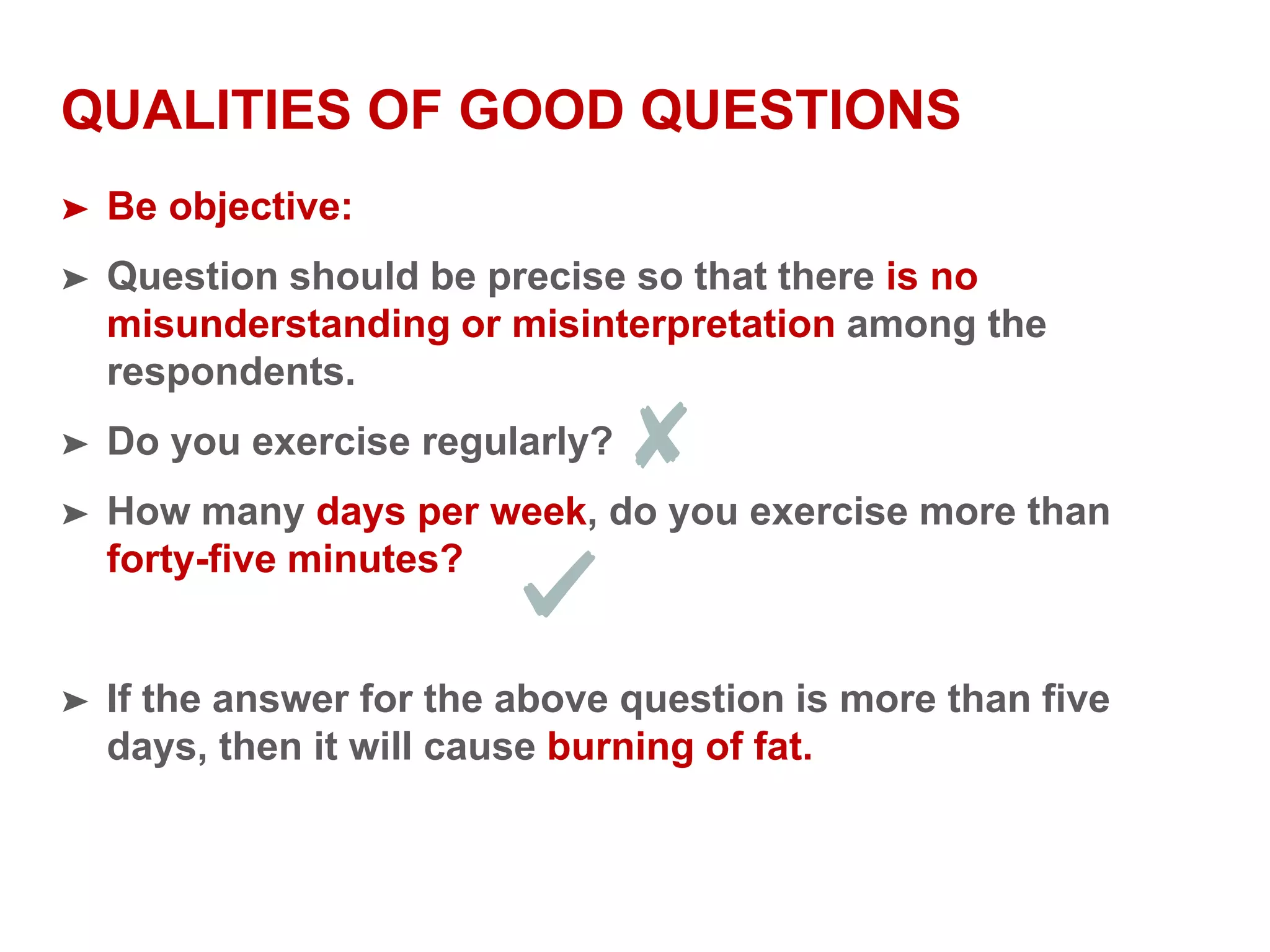
➤ Question should be precise so that there is no
misunderstanding or misinterpretation among the
respondents.
➤ Do you exercise regularly?
➤ How many days per week, do you exercise more than
forty-five minutes?
➤ If the answer for the above question is more than five
days, then it will cause burning of fat.
QUALITIES OF GOOD QUESTIONS
➤ Be simple:
➤ Language used should be simple to understand the
meaning.
➤ Here , one question is asked in two different wordings
without changing its meaning.
➤ When is usually Aedes mosquito active to bite? And
➤ What is the biting time of Aedes mosquito?
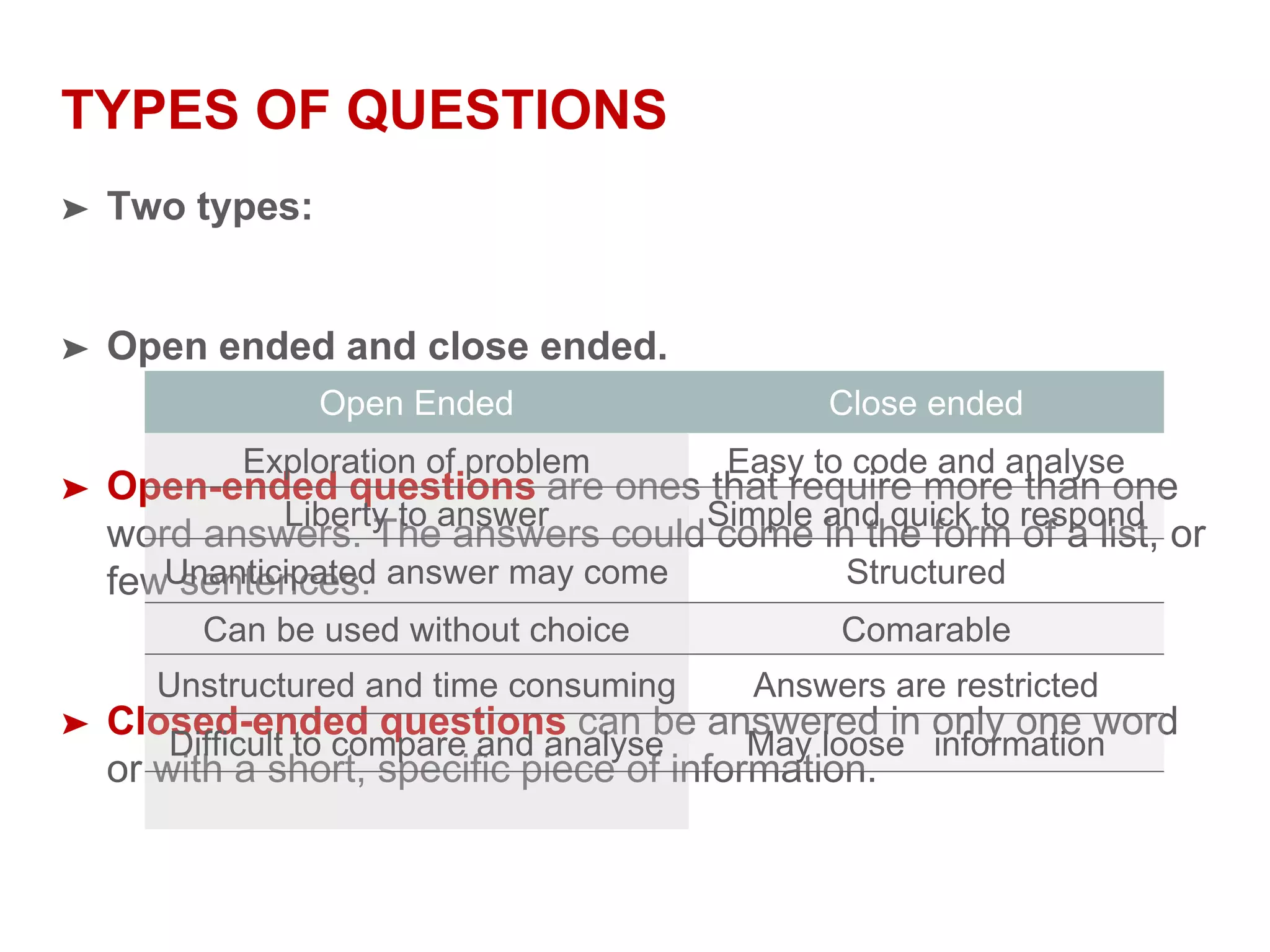
TYPES OF QUESTIONS
➤ Two types:
➤ Open ended and close ended.
➤ Open-ended questions are ones that require more than one
word answers. The answers could come in the form of a list, or
few sentences.
➤ Closed-ended questions can be answered in only one word
or with a short, specific piece of information.
Open Ended Close ended
Exploration of problem Easy to code and analyse
Liberty to answer Simple and quick to respond
Unanticipated answer may come Structured
Can be used without choice Comarable
Unstructured and time consuming Answers are restricted
Difficult to compare and analyse May loose information
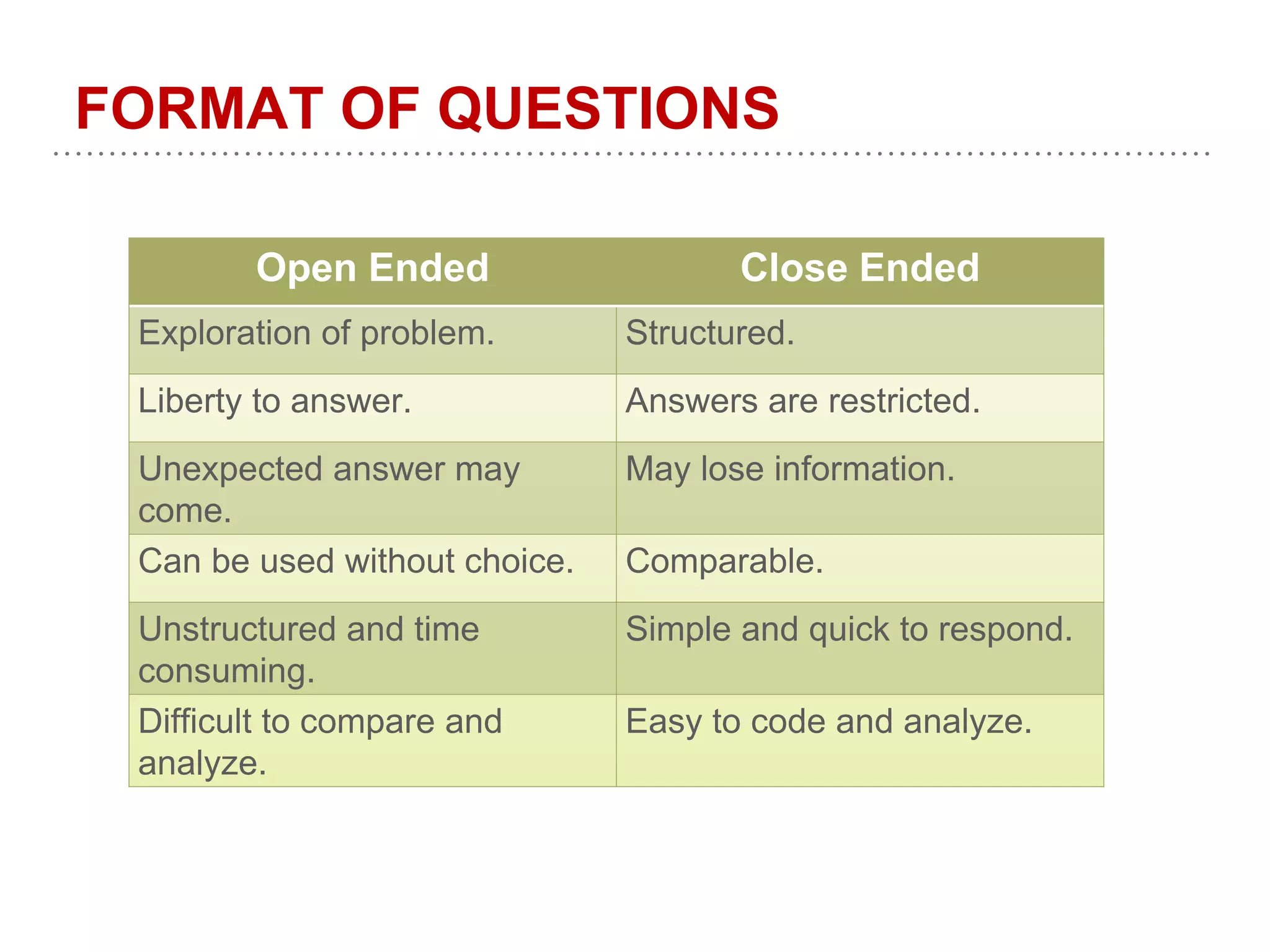
FORMAT OF QUESTIONS
Open Ended Close Ended
Exploration of problem. Structured.
Liberty to answer. Answers are restricted.
Unexpected answer may
come.
May lose information.
Can be used without choice. Comparable.
Unstructured and time
consuming.
Simple and quick to respond.
Difficult to compare and
analyze.
Easy to code and analyze.
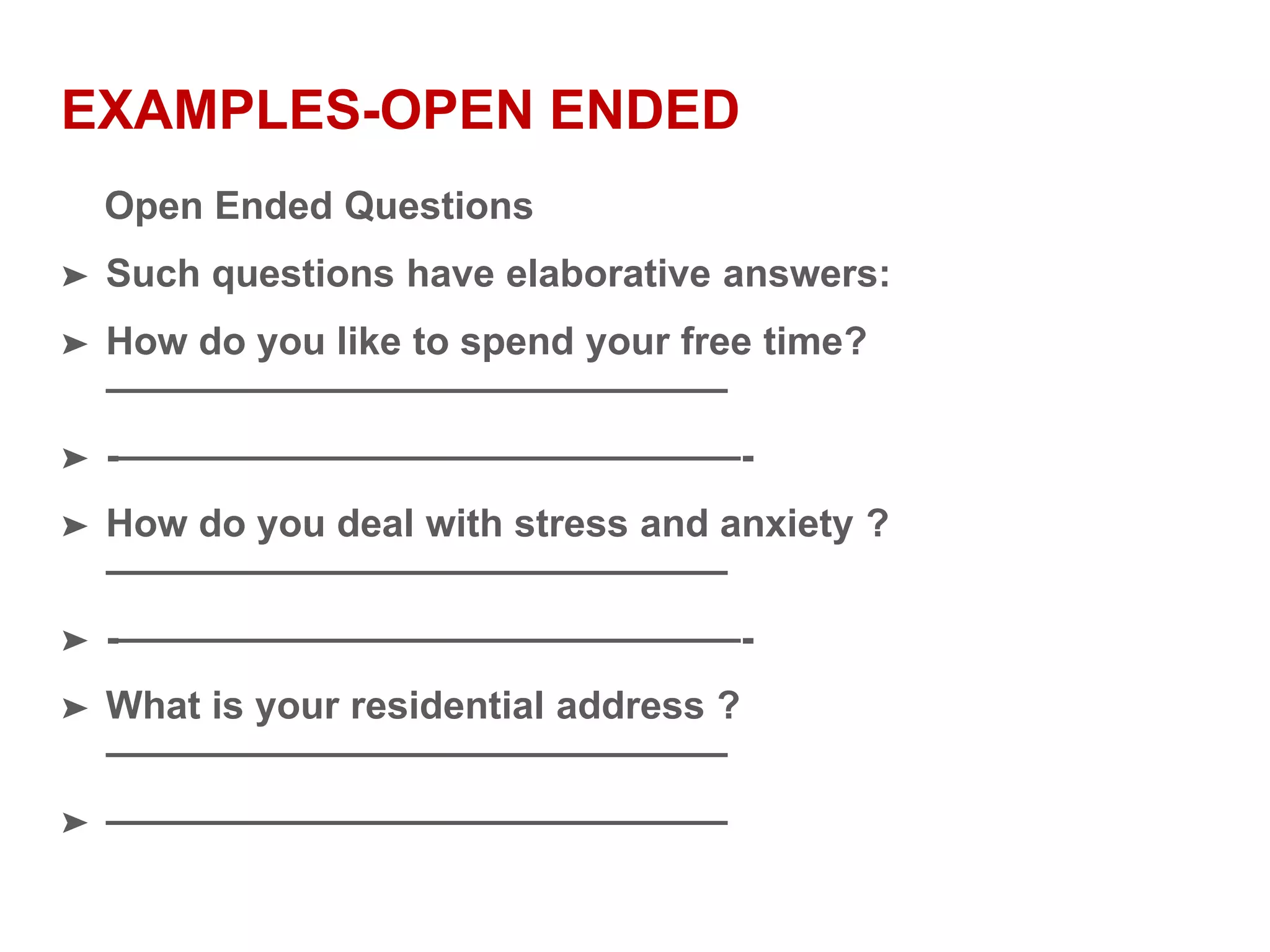
EXAMPLES-OPEN ENDED
Open Ended Questions
➤ Such questions have elaborative answers:
➤ How do you like to spend your free time?
————————————————
➤ -————————————————-
➤ How do you deal with stress and anxiety ?
————————————————
➤ -————————————————-
➤ What is your residential address ?
————————————————
➤ ————————————————
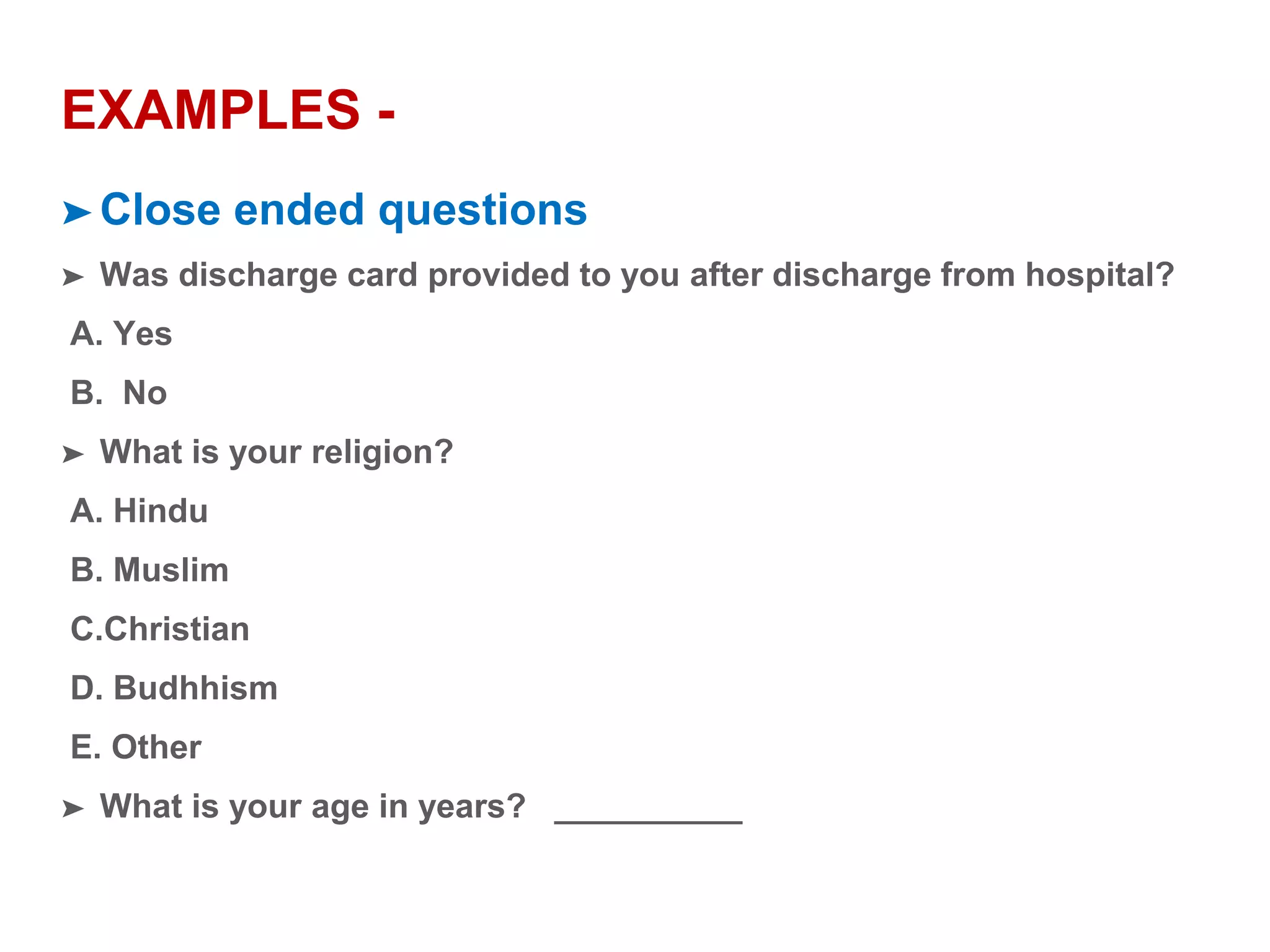
EXAMPLES -
➤ Close ended questions
➤ Was discharge card provided to you after discharge from hospital?
A. Yes
B. No
➤ What is your religion?
A. Hindu
B. Muslim
C.Christian
D. Budhhism
E. Other
➤ What is your age in years? __________
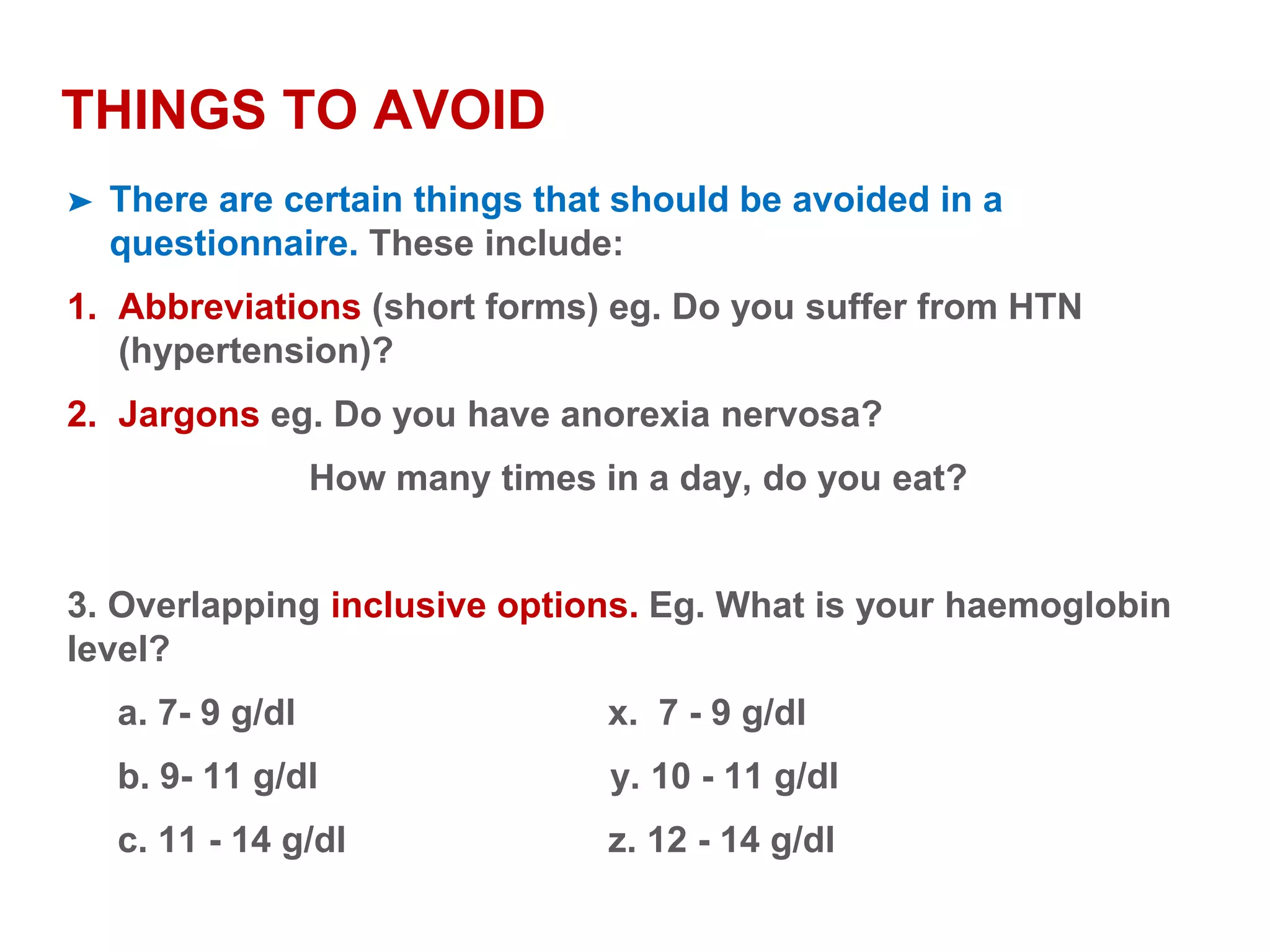
THINGS TO AVOID
➤ There are certain things that should be avoided in a
questionnaire. These include:
1. Abbreviations (short forms) eg. Do you suffer from HTN
(hypertension)?
2. Jargons eg. Do you have anorexia nervosa?
How many times in a day, do you eat?
3. Overlapping inclusive options. Eg. What is your haemoglobin
level?
a. 7- 9 g/dl x. 7 - 9 g/dl
b. 9- 11 g/dl y. 10 - 11 g/dl
c. 11 - 14 g/dl z. 12 - 14 g/dl
THINGS TO AVOID - CONTINUED
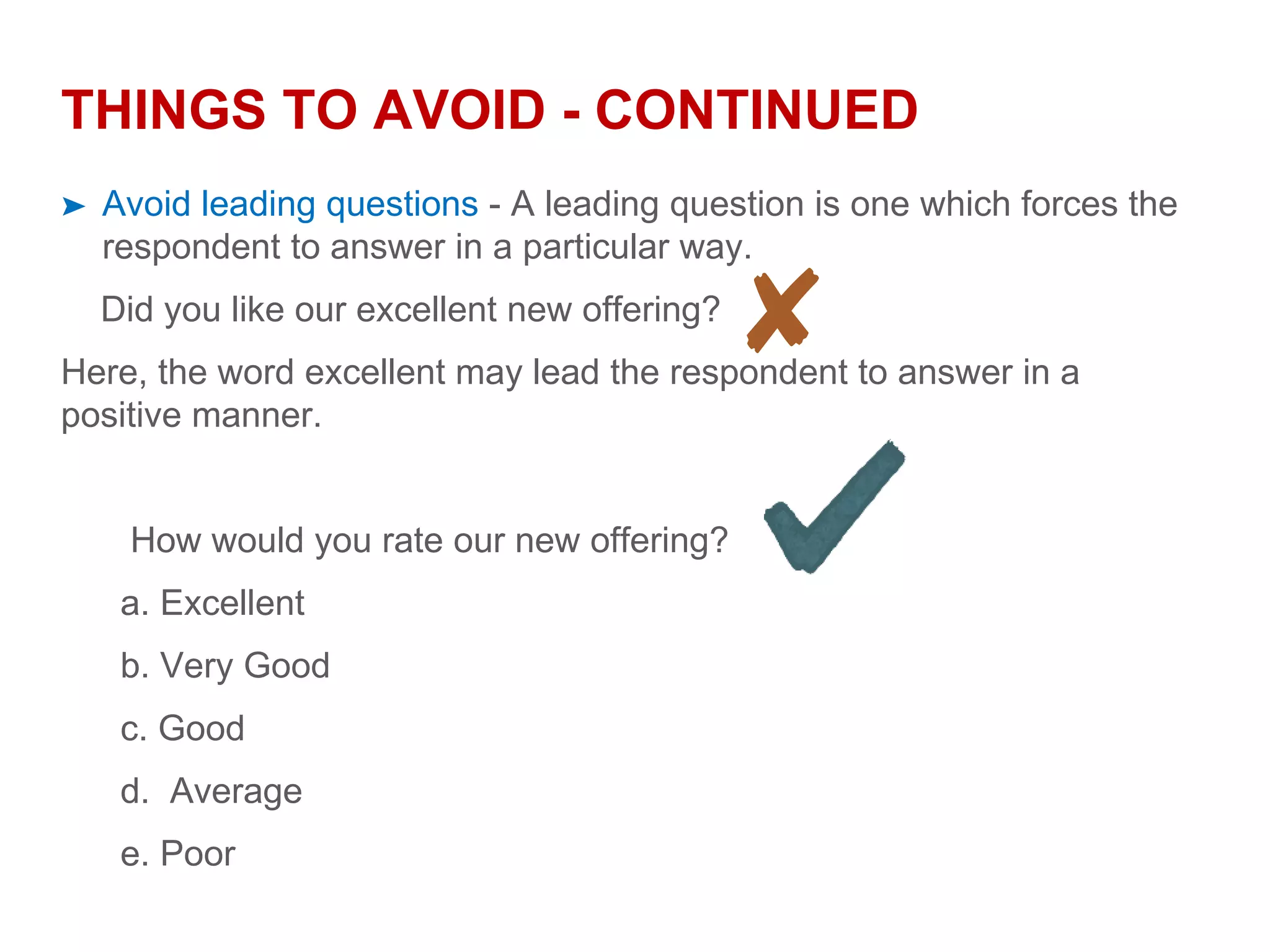
➤ Avoid leading questions - A leading question is one which forces the
respondent to answer in a particular way.
Did you like our excellent new offering?
Here, the word excellent may lead the respondent to answer in a
positive manner.
How would you rate our new offering?
a. Excellent
b. Very Good
c. Good
d. Average
e. Poor
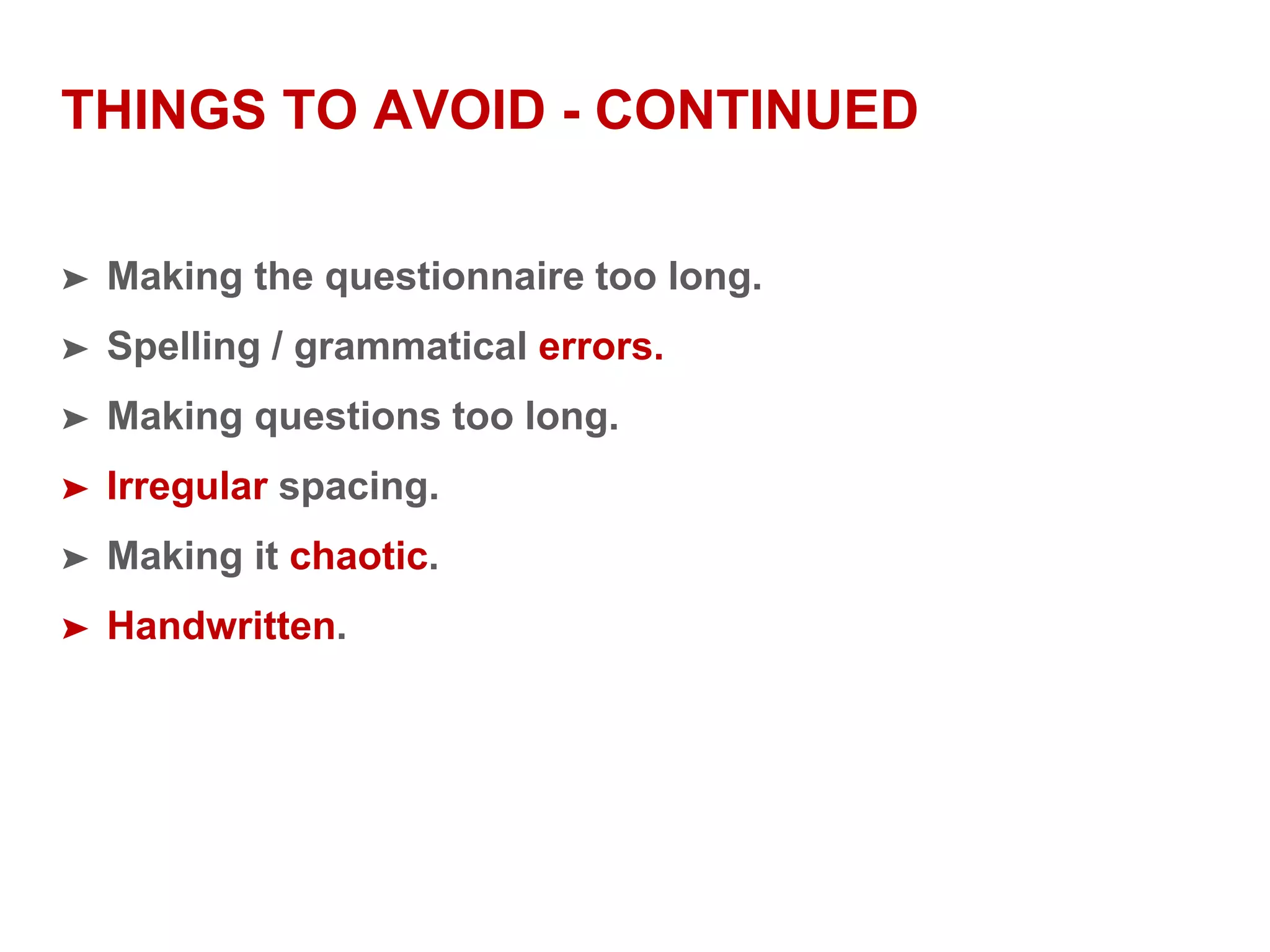
THINGS TO AVOID - CONTINUED
➤ Making the questionnaire too long.
➤ Spelling / grammatical errors.
➤ Making questions too long.
➤ Irregular spacing.
➤ Making it chaotic.
➤ Handwritten.
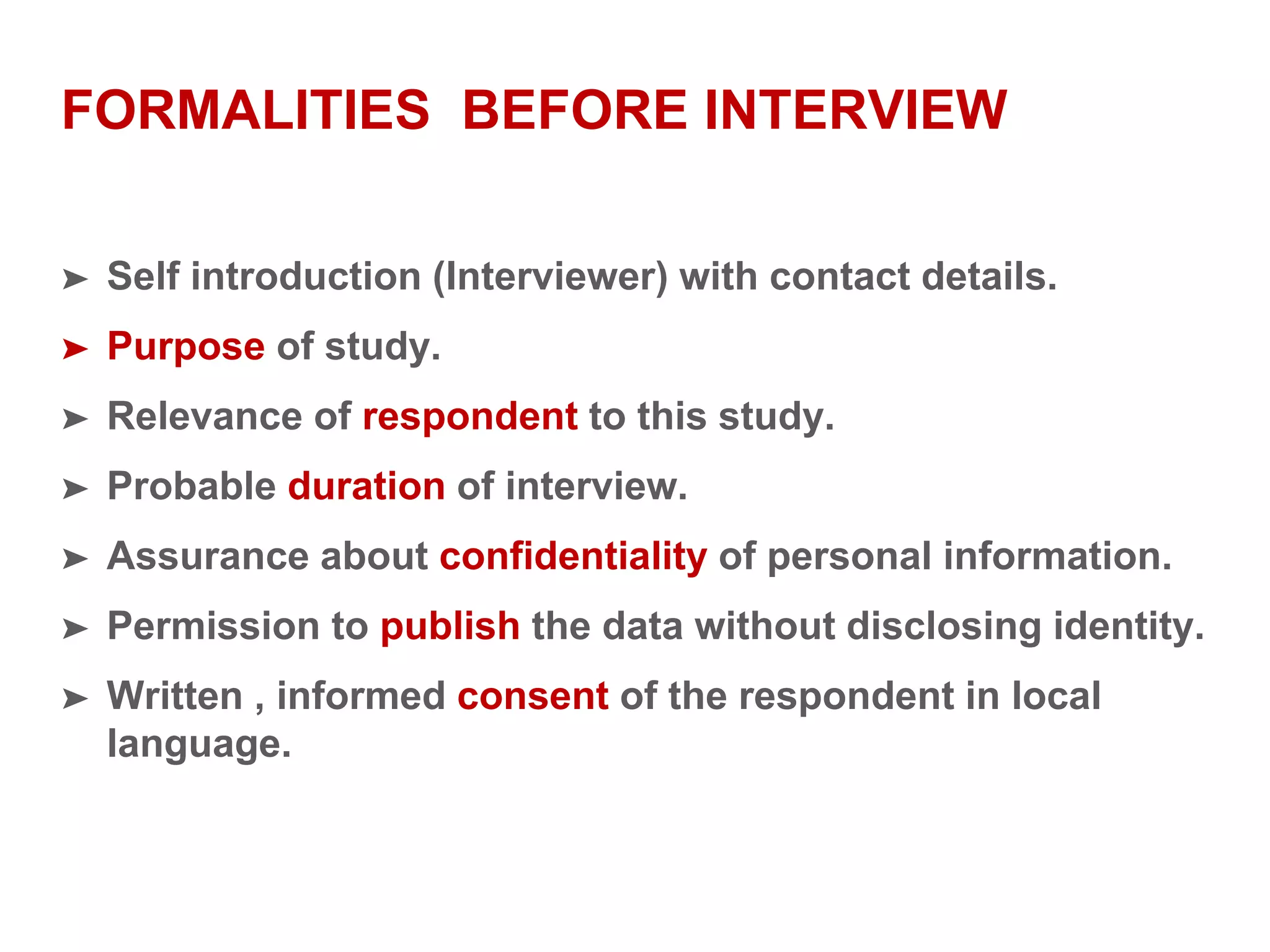
FORMALITIES BEFORE INTERVIEW
➤ Self introduction (Interviewer) with contact details.
➤ Purpose of study.
➤ Relevance of respondent to this study.
➤ Probable duration of interview.
➤ Assurance about confidentiality of personal information.
➤ Permission to publish the data without disclosing identity.
➤ Written , informed consent of the respondent in local
language.
VALIDATION OF QUESTIONNAIRE
➤ As far as possible, try to use available, validated
questionnaires.
➤ If not, it needs to be validated by doing pilot study among
at least 10% of the sample size.
➤ Evaluate and modify on the basis of pilot study.
➤ It is now ready to be used on sample population.
REFERENCES
➤ 1. Park’s Textbook of Preventive and Social Medicine
➤ 2. http://www.preservearticles.com/201107189292/what-are-
the-qualities
➤ 3.https://examples.yourdictionary.com
➤ 4. https://www.slideshare.net/heenapathan1/steps-in-
questionnaire-design
➤ 5. who.org
➤ THANK YOU

Questionaaire design slideshare

  • 1.
    QUESTIONNAIRE DESIGN Dr. Minakshi AshokRandive Professor &H.O.D Kriya Sharir Tilak Ayurved Mahavidyala Pune
  • 2.
    RESEARCH STUDY PROTOCOL ➤Structure of Research Study includes: ➤ Introduction ➤ Aim and Objectives ➤ Review of Literature ➤ Material and Methods - Study Tools ➤ Results and Discussion ➤ Summary and Conclusion ➤ Recommendations ➤ Limitations ➤ References
  • 3.
    OBJECTIVES ➤ Questionnaire Formation ➤Type of questions asked ➤ Questionnaire Design ➤ Advantages and disadvantages
  • 4.
    DEFINITION ➤ It isa set of questions used for obtaining statistically useful or personal information from individuals. (Marriam - Webster) ➤ It is a standardised, structured instrument. ➤ It is focused on closed end question. ➤ Administered in a structured way. ➤ It is focused around the aims and objectives of research studies.
  • 5.
    IMPORTANCE ➤ It allowsus to collect vast information with a single study tool. ➤ In some cases it is the only study tool that can be used. Eg. Quality of Life in patients. ➤ Collects factual data.
  • 6.
    IMPORTANCE- CONTINUED ➤ Awell designed questionnaire gives accurate and relevant information to the research question. ➤ It is an easy way to collect information. ➤ It minimises potential sources of bias.
  • 7.
    QUALITIES OF AGOOD QUESTIONNAIRE In order to get a high response rate, and to get information that is easy to analyse, the questionnaire must have the following points: ➤ Appearance - Neat and concise. ➤ Simple language. ➤ Relevant to your study. ➤ Logical format.
  • 8.
    QUESTIONNAIRE DEVELOPMENT ➤ Makea list of information to be collected. ➤ Identification of target respondent. ➤ Method of communication with target respondent. ➤ Decide on required information and then develop questions accordingly. ➤ Framing of questions. ➤ Ask questions in sequential order. ➤ Try to make the questionnaire concise (not at the cost of information.) ➤ Pre-testing and piloting. ➤ Finalising survey form.
  • 9.
    TYPES OF QUESTIONNAIRE ➤Interviewer Administered : ➤ Face to face ➤ Telephone ➤ Self - Administered: ➤ By Post ➤ E-mail/internet
  • 10.
    Interviewer Administered SelfAdministered ➤ Quick Response ➤ Time consuming. ➤ Scope to include more participants in the study. ➤ Low compliance rate. ➤ Less chances of misinterpretation and misunderstanding. ➤ Questions may be misunderstood. ➤ Requires more resources. ➤ Requires less resources. ➤ Interviewer bias. ➤ Interviewer bias can be avoided. ➤ Personal/Sensitive issues cannot be asked. ➤ Personal/Sensitive issues may be addressed ➤ Respondent must answer at interviewers convenience. ➤ Respondent may answer on their own convenience.
  • 11.
    BASIC RULES ➤ Studytitle should be written in bold. ➤ Return address should be mentioned at the top of the page. ➤ Identifying mark/unique identifier must be present on each page. ➤ All pages should be numbered for ease. ➤ All questions must be numbered. ➤ All directions to the respondent must be in bold. ➤ Self-addressed envelope.
  • 12.
    BASIC RULES CONTINUED ➤Clear consistent layout ➤ Adequate space to answer ➤ Large font size ➤ Appropriate page breaks ➤ Fancy logos should not be used
  • 13.
    ADVANTAGES OF QUESTIONNAIRE ➤It is relatively easy to collect information. ➤ Can collect information from a large group of people with relative ease and economy. ➤ Easy to analyse information.
  • 14.
    DISADVANTAGES ➤ Misunderstanding ofquestions by the respondent is possible. ➤ Provides limited insight into the research question, right questions may not be asked. ➤ All information must be collected at the same time. ➤ Because of these reasons it is extremly important to design a good questionnaire and collect information.
  • 15.
    FORMATION OF QUESTIONS ➤Focussed on primary objective. ➤ Necessary information should come from answers. ➤ Objective should be reached in a set of question - answer session. ➤ Respondents level of intelligence should be kept in mind. ➤ Key words should be explained. ➤ Avoid unnecessary information. ➤ Avoid leading questions.
  • 16.
    FORMATION OF QUESTIONS Askone information at a time to avoid confusion. ➤ All answer options should be included. ➤ Answer options should be kept in vertical order. ➤ Questions should be accurate. e.g. ➤ Do you smoke? Yes / No . If Yes , ➤ How many cigarettes do you smoke in a day ? a. One - Five b. Six - Ten c. More than Ten
  • 17.
    ORDER OF QUESTIONS ➤Start with simple and general questions. ➤ Difficult and personal information related questions should come in the later part. ➤ Sensitive questions should be placed properly at relevant places. ➤ Topic related questions should be grouped. ➤ Initial questions should be close ended as they are easy to answer. ➤ Important questions should be placed in the middle.
  • 18.
    QUALITIES OF GOODQUESTIONS ➤ Appropriate questions: ➤ Have you ever suffered from an infection of Human Papilloma Virus? a. Yes b. No ➤ This question is appropriate for a study in patients with cervical cancer or history of it. ➤ It is not appropriate for study in patients suffering from gastric carcinoma, thyroid carcinoma, etc.
  • 19.
    QUALITIES OF GOODQUESTIONS ➤ Be objective: ➤ Question should be precise so that there is no misunderstanding or misinterpretation among the respondents. ➤ Do you exercise regularly? ➤ How many days per week, do you exercise more than forty-five minutes? ➤ If the answer for the above question is more than five days, then it will cause burning of fat.
  • 20.
    QUALITIES OF GOODQUESTIONS ➤ Be simple: ➤ Language used should be simple to understand the meaning. ➤ Here , one question is asked in two different wordings without changing its meaning. ➤ When is usually Aedes mosquito active to bite? And ➤ What is the biting time of Aedes mosquito?
  • 21.
    TYPES OF QUESTIONS ➤Two types: ➤ Open ended and close ended. ➤ Open-ended questions are ones that require more than one word answers. The answers could come in the form of a list, or few sentences. ➤ Closed-ended questions can be answered in only one word or with a short, specific piece of information. Open Ended Close ended Exploration of problem Easy to code and analyse Liberty to answer Simple and quick to respond Unanticipated answer may come Structured Can be used without choice Comarable Unstructured and time consuming Answers are restricted Difficult to compare and analyse May loose information
  • 22.
    FORMAT OF QUESTIONS OpenEnded Close Ended Exploration of problem. Structured. Liberty to answer. Answers are restricted. Unexpected answer may come. May lose information. Can be used without choice. Comparable. Unstructured and time consuming. Simple and quick to respond. Difficult to compare and analyze. Easy to code and analyze.
  • 23.
    EXAMPLES-OPEN ENDED Open EndedQuestions ➤ Such questions have elaborative answers: ➤ How do you like to spend your free time? ———————————————— ➤ -————————————————- ➤ How do you deal with stress and anxiety ? ———————————————— ➤ -————————————————- ➤ What is your residential address ? ———————————————— ➤ ————————————————
  • 24.
    EXAMPLES - ➤ Closeended questions ➤ Was discharge card provided to you after discharge from hospital? A. Yes B. No ➤ What is your religion? A. Hindu B. Muslim C.Christian D. Budhhism E. Other ➤ What is your age in years? __________
  • 25.
    THINGS TO AVOID ➤There are certain things that should be avoided in a questionnaire. These include: 1. Abbreviations (short forms) eg. Do you suffer from HTN (hypertension)? 2. Jargons eg. Do you have anorexia nervosa? How many times in a day, do you eat? 3. Overlapping inclusive options. Eg. What is your haemoglobin level? a. 7- 9 g/dl x. 7 - 9 g/dl b. 9- 11 g/dl y. 10 - 11 g/dl c. 11 - 14 g/dl z. 12 - 14 g/dl
  • 26.
    THINGS TO AVOID- CONTINUED ➤ Avoid leading questions - A leading question is one which forces the respondent to answer in a particular way. Did you like our excellent new offering? Here, the word excellent may lead the respondent to answer in a positive manner. How would you rate our new offering? a. Excellent b. Very Good c. Good d. Average e. Poor
  • 27.
    THINGS TO AVOID- CONTINUED ➤ Making the questionnaire too long. ➤ Spelling / grammatical errors. ➤ Making questions too long. ➤ Irregular spacing. ➤ Making it chaotic. ➤ Handwritten.
  • 28.
    FORMALITIES BEFORE INTERVIEW ➤Self introduction (Interviewer) with contact details. ➤ Purpose of study. ➤ Relevance of respondent to this study. ➤ Probable duration of interview. ➤ Assurance about confidentiality of personal information. ➤ Permission to publish the data without disclosing identity. ➤ Written , informed consent of the respondent in local language.
  • 29.
    VALIDATION OF QUESTIONNAIRE ➤As far as possible, try to use available, validated questionnaires. ➤ If not, it needs to be validated by doing pilot study among at least 10% of the sample size. ➤ Evaluate and modify on the basis of pilot study. ➤ It is now ready to be used on sample population.
  • 30.
    REFERENCES ➤ 1. Park’sTextbook of Preventive and Social Medicine ➤ 2. http://www.preservearticles.com/201107189292/what-are- the-qualities ➤ 3.https://examples.yourdictionary.com ➤ 4. https://www.slideshare.net/heenapathan1/steps-in- questionnaire-design ➤ 5. who.org
  • 31.

Editor's Notes

  • #23 Without choice of interviewer.