Questionnaire
Shobiya Paramasivam
Department of Fisheries
University of Jaffna
Introduction
 set of predetermined questions for all respondents that
serves as a primary research instrument in survey research.
 Used to collect factual information
 Consist of a form containing a series of questions
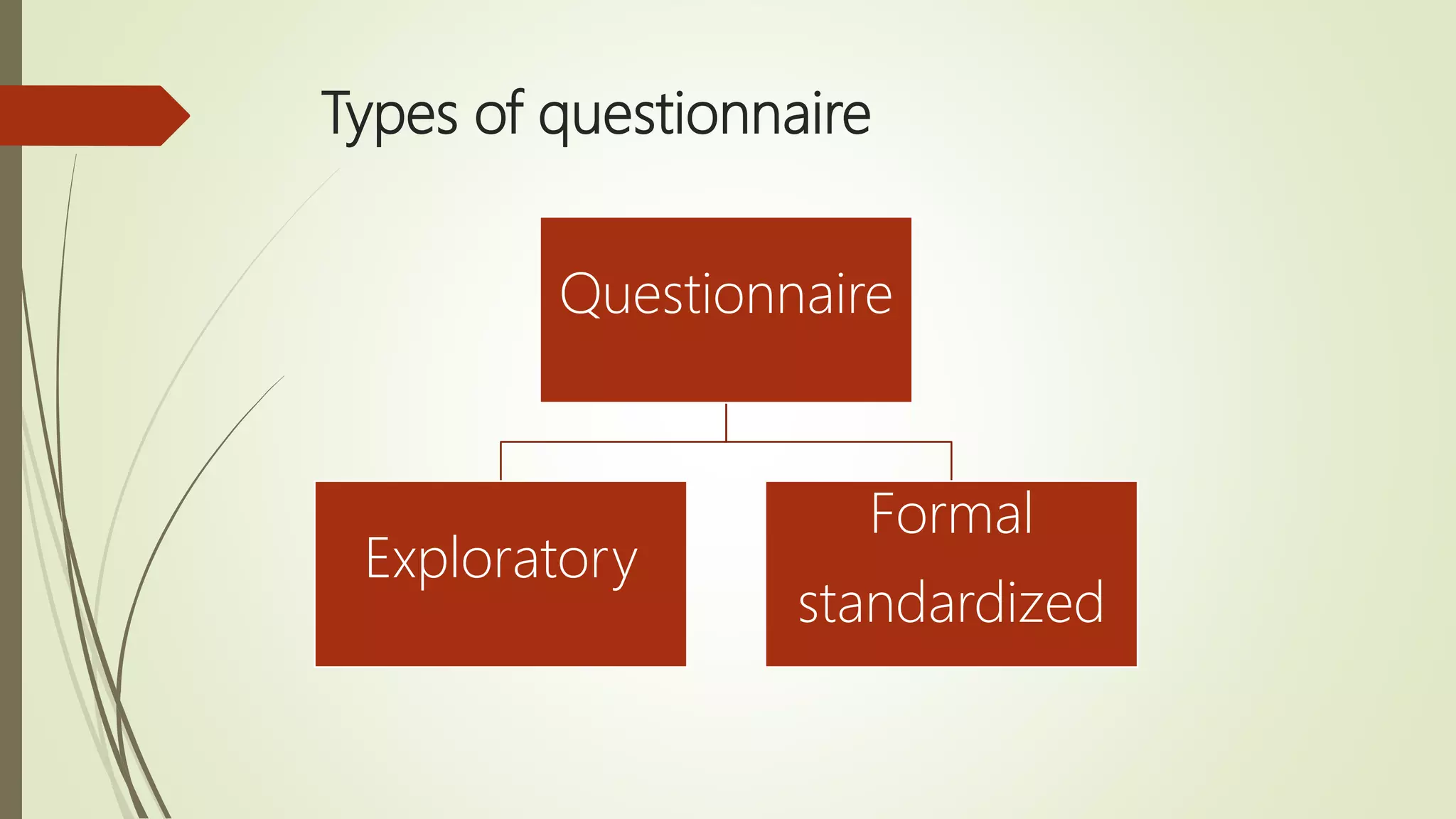
Types of questionnaire
Questionnaire
Exploratory
Formal
standardized
CHARACTERISTICS OF A GOOD
QUESTIONNAIRE
1. Should be concerned with specific and relevant topic
2. Should be short
3. Directions and wording should be simple and clear
4. Questions should be objective
5. Embarrassing questions, presuming questions and
hypothetical questions should be avoided
6. Should be presented in a good order
7. Should be attractive, neatly printed and clearly arranged
Qualities of a good questionnaire
A well-designed questionnaire should meet the research objectives.
It should obtain the most complete and accurate information
possible.
A well-designed questionnaire should make it easy for respondents
to give the necessary information
It would keep the interview brief and to the point and be so
arranged that the respondent(s) remain interested throughout the
interview.
There are nine steps involved in the
development of a questionnaire:
1. Decide the information required.
2. Define the target respondents.
3. Choose the method(s) of reaching your target
respondents.
4. Decide on question content.
5. Develop the question wording.
6. Put questions into a meaningful order and format.
7. Check the length of the questionnaire.
8. Pre-test the questionnaire.
9. Develop the final survey form.
Deciding on the information required
 It should be noted that one does not start by writing
questions. The first step is to decide 'what are the things one
needs to know from the respondent in order to meet the
survey's objectives?'
Define the target respondents
According to the research have to define the
respondents
Choose the method(s) of reaching target
respondents
 Personal interviews
 Group or focus interviews
 Mailed questionnaires
 Telephone interviews.
Decide on question content
 No question should be included unless the data it gives rise to is directly
of use in testing one or more of the hypotheses established during the
research design.
Develop the question wording
 Survey questions can be classified into three forms,
 closed,
 open-ended and
 open response-option questions.
Putting questions into a meaningful order and
format
 Opening questions should be easy to answer and not in any way threatening to
the respondents.
 Questions should flow in some kind of psychological order, so that one leads
easily and naturally to the next.
 Respondents become bored quickly and restless when asked similar questions for
half an hour or so.
 The physical appearance of a questionnaire can have a significant effect upon
both the quantity and quality of marketing data obtained.
Piloting the questionnaires
 it is necessary to pre-test the questionnaire before it is used in a full-scale
survey, to identify any mistakes that need correcting.
 The purpose of pretesting the questionnaire is to determine:
 whether the questions as they are worded will achieve the desired results
 whether the questions have been placed in the best order
 whether the questions are understood by all classes of respondent
 whether additional or specifying questions are needed or whether some
questions should be eliminated
 whether the instructions to interviewers are adequate.
FUNCTIONS OF QUESTIONNAIRE
DESCRIPTION:
 The questionnaire provides description
 about age, sex, marital status, occupation,
 income, political affiliation religious affiliation,
 etc.
MEASUREMENT:
 Measurement of individual and/or group
 variables like attitude, opinion, traits and habits
 of persons.
Thank you

Questionnaire

  • 1.
  • 2.
    Introduction  set ofpredetermined questions for all respondents that serves as a primary research instrument in survey research.  Used to collect factual information  Consist of a form containing a series of questions
  • 3.
  • 4.
    CHARACTERISTICS OF AGOOD QUESTIONNAIRE 1. Should be concerned with specific and relevant topic 2. Should be short 3. Directions and wording should be simple and clear 4. Questions should be objective 5. Embarrassing questions, presuming questions and hypothetical questions should be avoided 6. Should be presented in a good order 7. Should be attractive, neatly printed and clearly arranged
  • 5.
    Qualities of agood questionnaire A well-designed questionnaire should meet the research objectives. It should obtain the most complete and accurate information possible. A well-designed questionnaire should make it easy for respondents to give the necessary information It would keep the interview brief and to the point and be so arranged that the respondent(s) remain interested throughout the interview.
  • 6.
    There are ninesteps involved in the development of a questionnaire: 1. Decide the information required. 2. Define the target respondents. 3. Choose the method(s) of reaching your target respondents. 4. Decide on question content. 5. Develop the question wording. 6. Put questions into a meaningful order and format. 7. Check the length of the questionnaire. 8. Pre-test the questionnaire. 9. Develop the final survey form.
  • 7.
    Deciding on theinformation required  It should be noted that one does not start by writing questions. The first step is to decide 'what are the things one needs to know from the respondent in order to meet the survey's objectives?'
  • 8.
    Define the targetrespondents According to the research have to define the respondents
  • 9.
    Choose the method(s)of reaching target respondents  Personal interviews  Group or focus interviews  Mailed questionnaires  Telephone interviews.
  • 10.
    Decide on questioncontent  No question should be included unless the data it gives rise to is directly of use in testing one or more of the hypotheses established during the research design.
  • 11.
    Develop the questionwording  Survey questions can be classified into three forms,  closed,  open-ended and  open response-option questions.
  • 12.
    Putting questions intoa meaningful order and format  Opening questions should be easy to answer and not in any way threatening to the respondents.  Questions should flow in some kind of psychological order, so that one leads easily and naturally to the next.  Respondents become bored quickly and restless when asked similar questions for half an hour or so.  The physical appearance of a questionnaire can have a significant effect upon both the quantity and quality of marketing data obtained.
  • 13.
    Piloting the questionnaires it is necessary to pre-test the questionnaire before it is used in a full-scale survey, to identify any mistakes that need correcting.  The purpose of pretesting the questionnaire is to determine:  whether the questions as they are worded will achieve the desired results  whether the questions have been placed in the best order  whether the questions are understood by all classes of respondent  whether additional or specifying questions are needed or whether some questions should be eliminated  whether the instructions to interviewers are adequate.
  • 14.
    FUNCTIONS OF QUESTIONNAIRE DESCRIPTION: The questionnaire provides description  about age, sex, marital status, occupation,  income, political affiliation religious affiliation,  etc. MEASUREMENT:  Measurement of individual and/or group  variables like attitude, opinion, traits and habits  of persons.
  • 15.