Questioning Current Thinking and Approaches Curtis & Carter (2008) Introduction Outline Prepared by Dr. Carla Piper
What is the purpose of education? Why do schools exist? To produce compliant workers for economic function? To help children grow into their full potential? Help children become informed, engaged citizens? Help children make a contribution to their communities? Prepare children to be successful in an increasingly more complex world? (Curtis & Carter, 2008, p. 1)
How should we design curriculum  for early childhood programs? To remediate children’s needs and deficits? To focus on children’s inherent competencies, ideas, and questions? To follow strong policies and curriculum mandates to improve learning outcomes? To locate teacher-proof curriculum for conformity and accountability? To prepare children for school readiness? To secure our future as early care and education professionals? (Curtis & Carter, 2008, pp. 1-2)
Why Question Current Thinking? “ Education is an arena of hope and struggle – hope for a better life and struggle over how to understand and enact and achieve a better world.  We come to believe that we can become makers of history, not merely the passive objects of the great human drama”   (Ayers, as cited in Curtis & Carter, 2008, p. 1)
Definitions of Quality are Inadequate The status of early childhood programs in U.S. is a national crisis Policy makers have marginalized our professional knowledge and decision-making power Reform efforts directed at measurable outcomes and high stakes testing. Commercial publishers offer quick-fix curriculum and assessment (Curtis & Carter, 2008, pp. 2-3)
Teachers Need to Define Quality Early care and education organizations need open discussion to answer these questions: What is our purpose? What are our values? What is our philosophy? What theoretical framework should guide our everyday program practice? (Curtis & Carter, 2008, pp. 2-3)
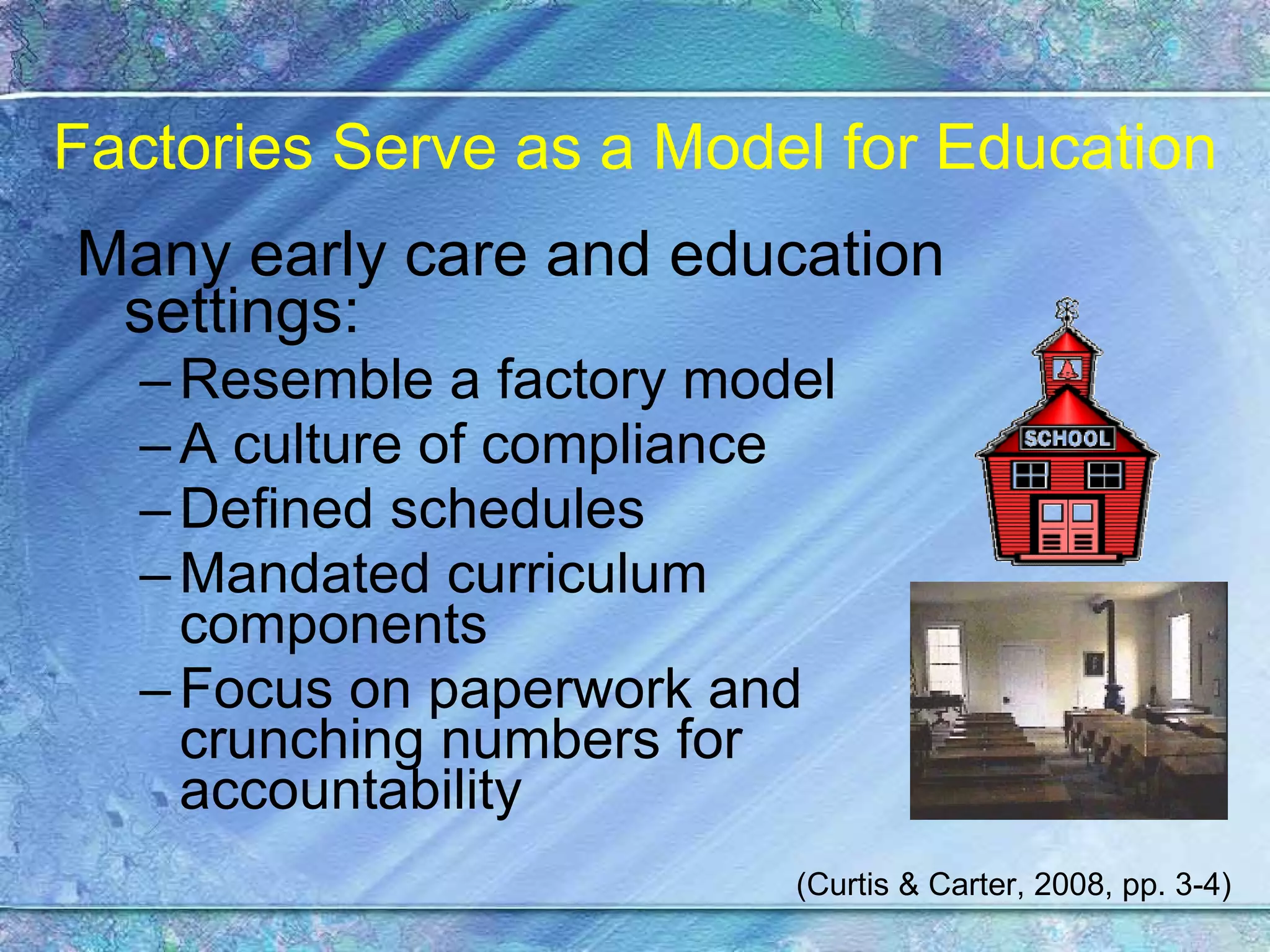
Factories Serve as a Model for Education Many early care and education settings: Resemble a factory model  A culture of compliance Defined schedules Mandated curriculum components Focus on paperwork and crunching numbers for accountability (Curtis & Carter, 2008, pp. 3-4)
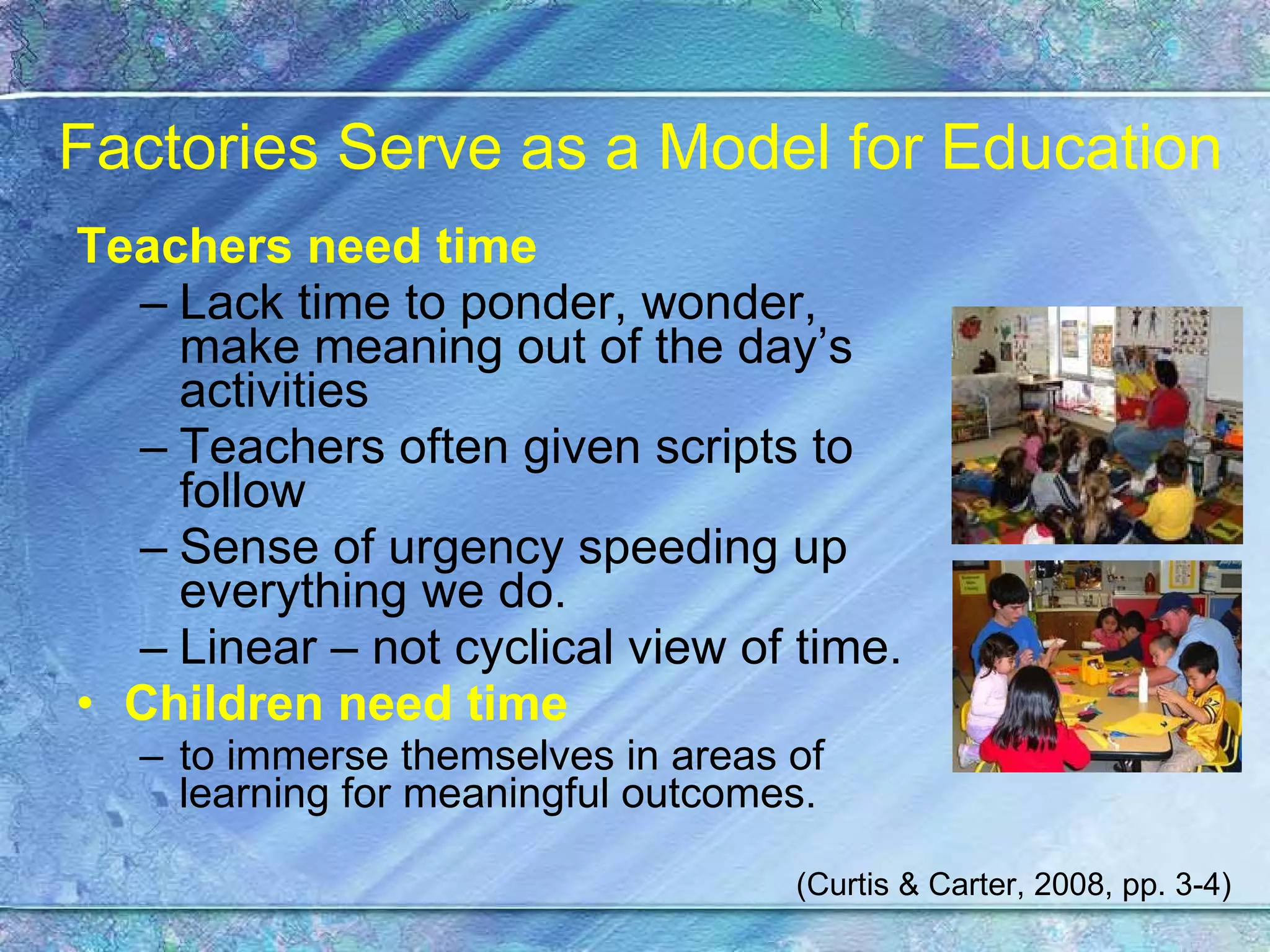
Factories Serve as a Model for Education Teachers need time Lack time to ponder, wonder, make meaning out of the day’s activities Teachers often given scripts to follow Sense of urgency speeding up everything we do. Linear – not cyclical view of time. Children need time   to immerse themselves in areas of learning for meaningful outcomes. (Curtis & Carter, 2008, pp. 3-4)
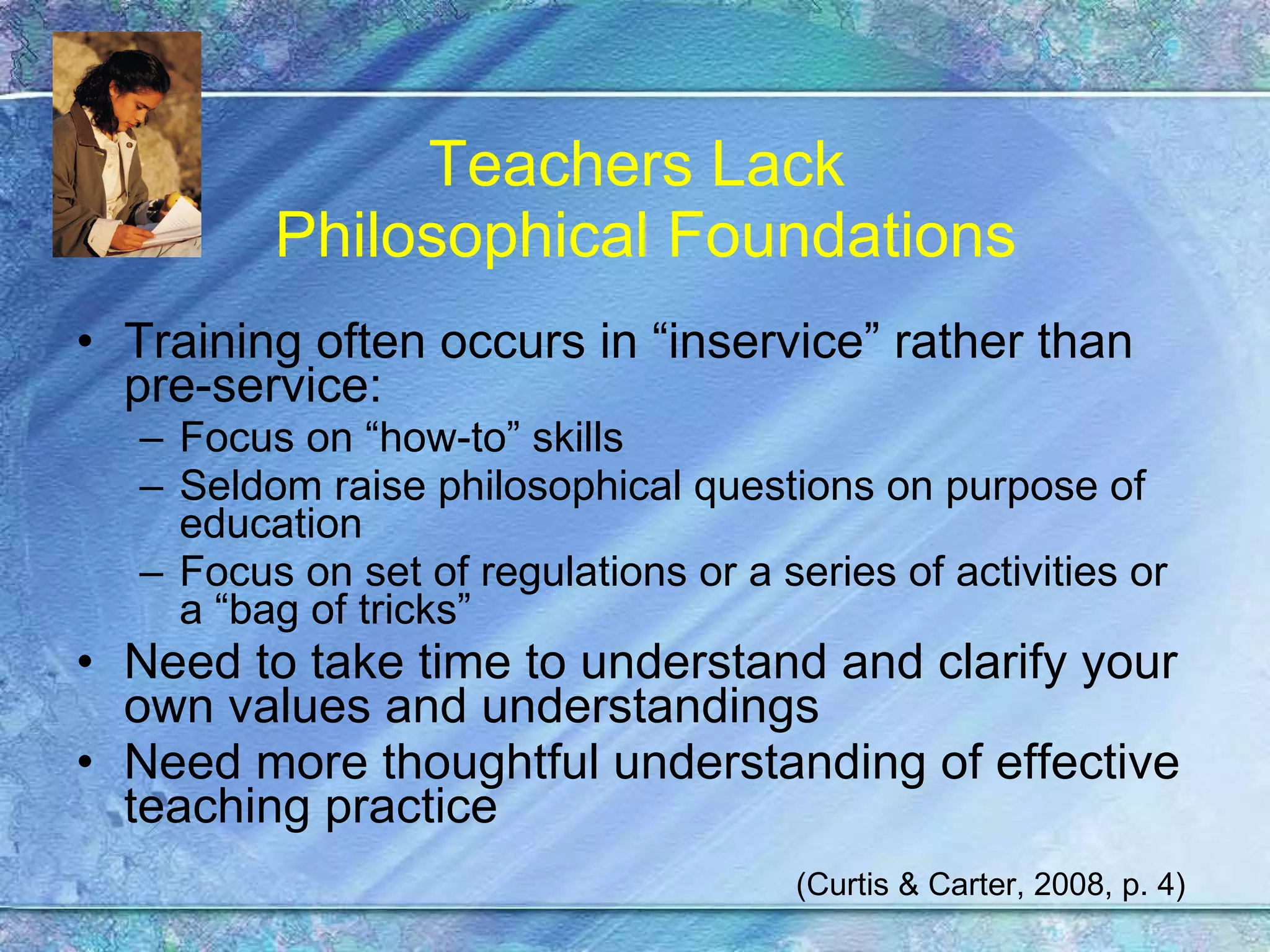
Teachers Lack  Philosophical Foundations Training often occurs in “inservice” rather than pre-service: Focus on “how-to” skills Seldom raise philosophical questions on purpose of education Focus on set of regulations or a series of activities or a “bag of tricks” Need to take time to understand and clarify your own values and understandings Need more thoughtful understanding of effective teaching practice (Curtis & Carter, 2008, p. 4)
Philosophical Foundations Click on each term for online definition: Social constructivism Empowering  or  participatory education Critical pedagogy Multiple intelligences Inquiry-based learning Resources Concept to Classroom PBS Learning and Teaching in Preschool (Curtis & Carter, 2008, pp. 1-2)
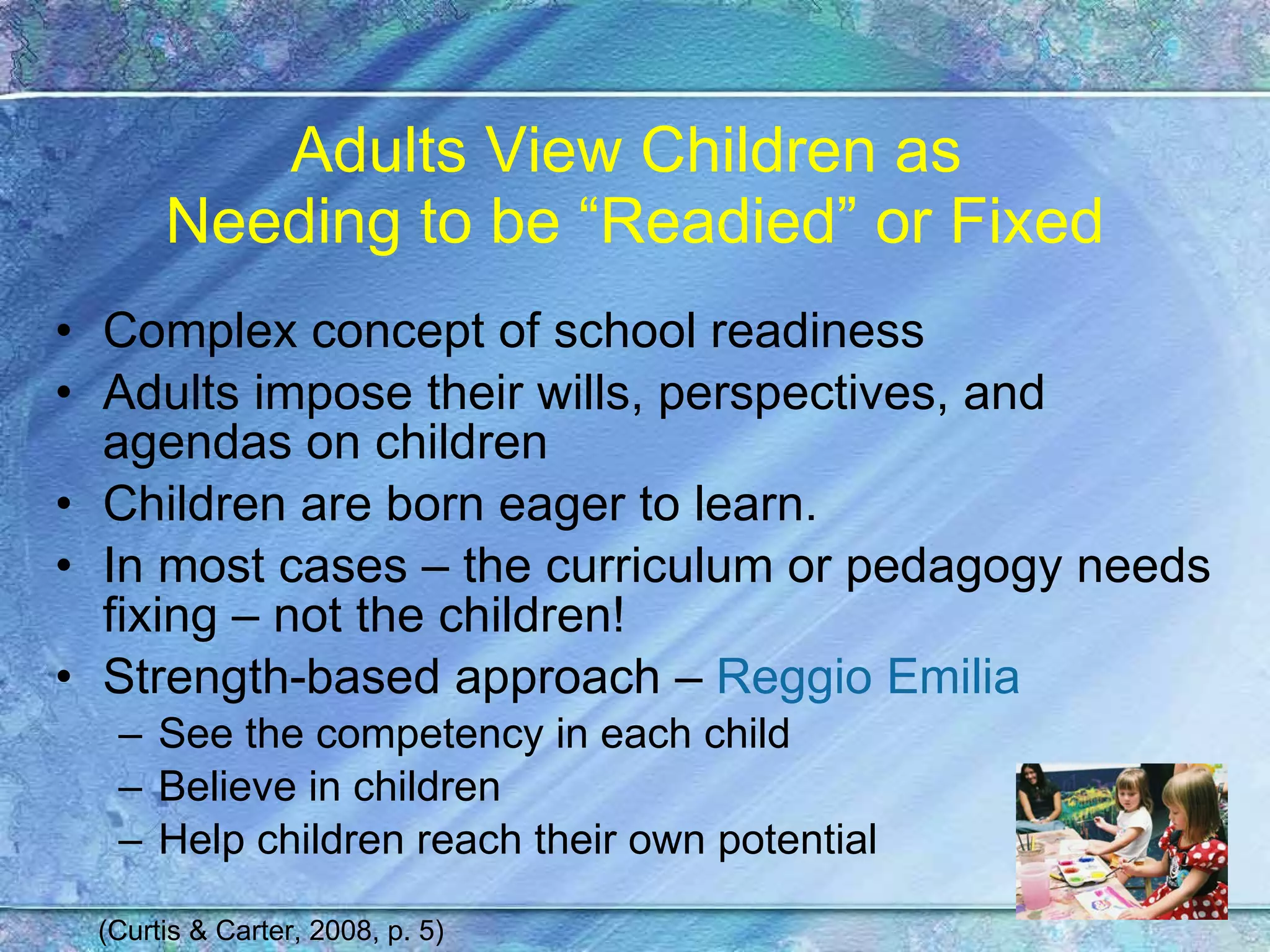
Adults View Children as  Needing to be “Readied” or Fixed Complex concept of school readiness Adults impose their wills, perspectives, and agendas on children Children are born eager to learn. In most cases – the curriculum or pedagogy needs fixing – not the children! Strength-based approach –  Reggio Emilia See the competency in each child Believe in children Help children reach their own potential (Curtis & Carter, 2008, p. 5)
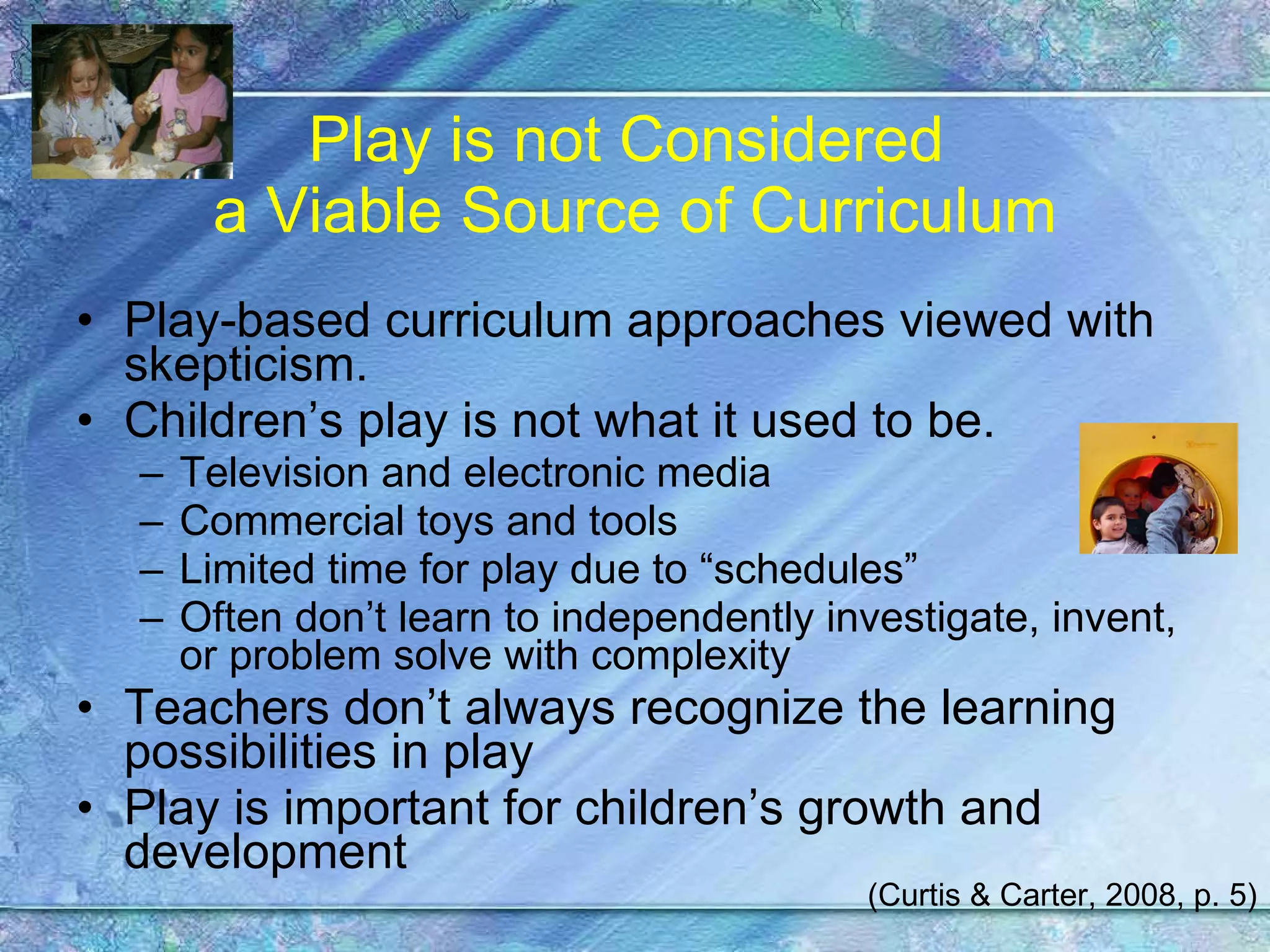
Play is not Considered  a Viable Source of Curriculum Play-based curriculum approaches viewed with skepticism. Children’s play is not what it used to be. Television and electronic media Commercial toys and tools Limited time for play due to “schedules” Often don’t learn to independently investigate, invent, or problem solve with complexity Teachers don’t always recognize the learning possibilities in play Play is important for children’s growth and development (Curtis & Carter, 2008, p. 5)
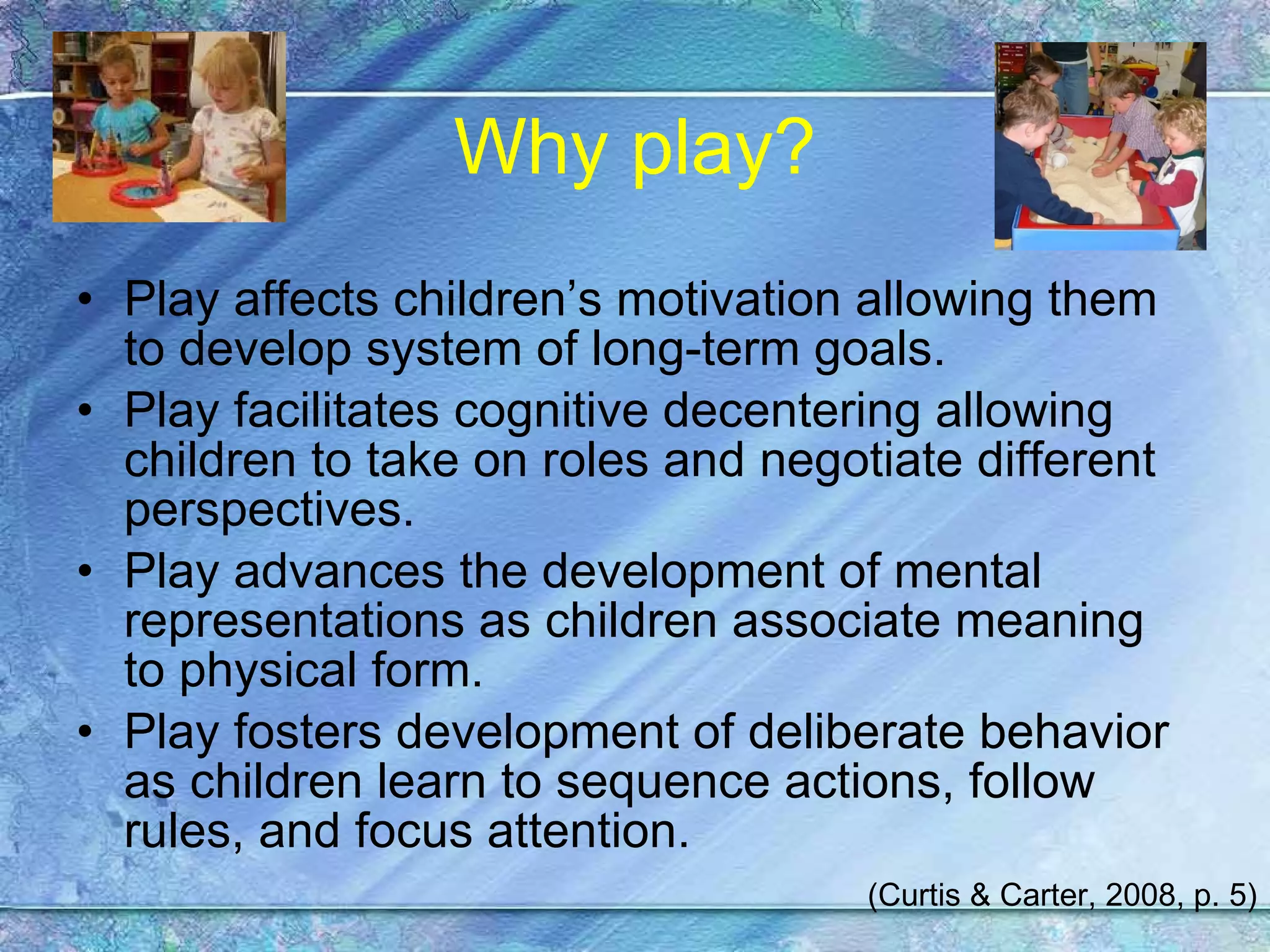
Why play? Play affects children’s motivation allowing them to develop system of long-term goals. Play facilitates cognitive decentering allowing children to take on roles and negotiate different perspectives. Play advances the development of mental representations as children associate meaning to physical form. Play fosters development of deliberate behavior as children learn to sequence actions, follow rules, and focus attention. (Curtis & Carter, 2008, p. 5)
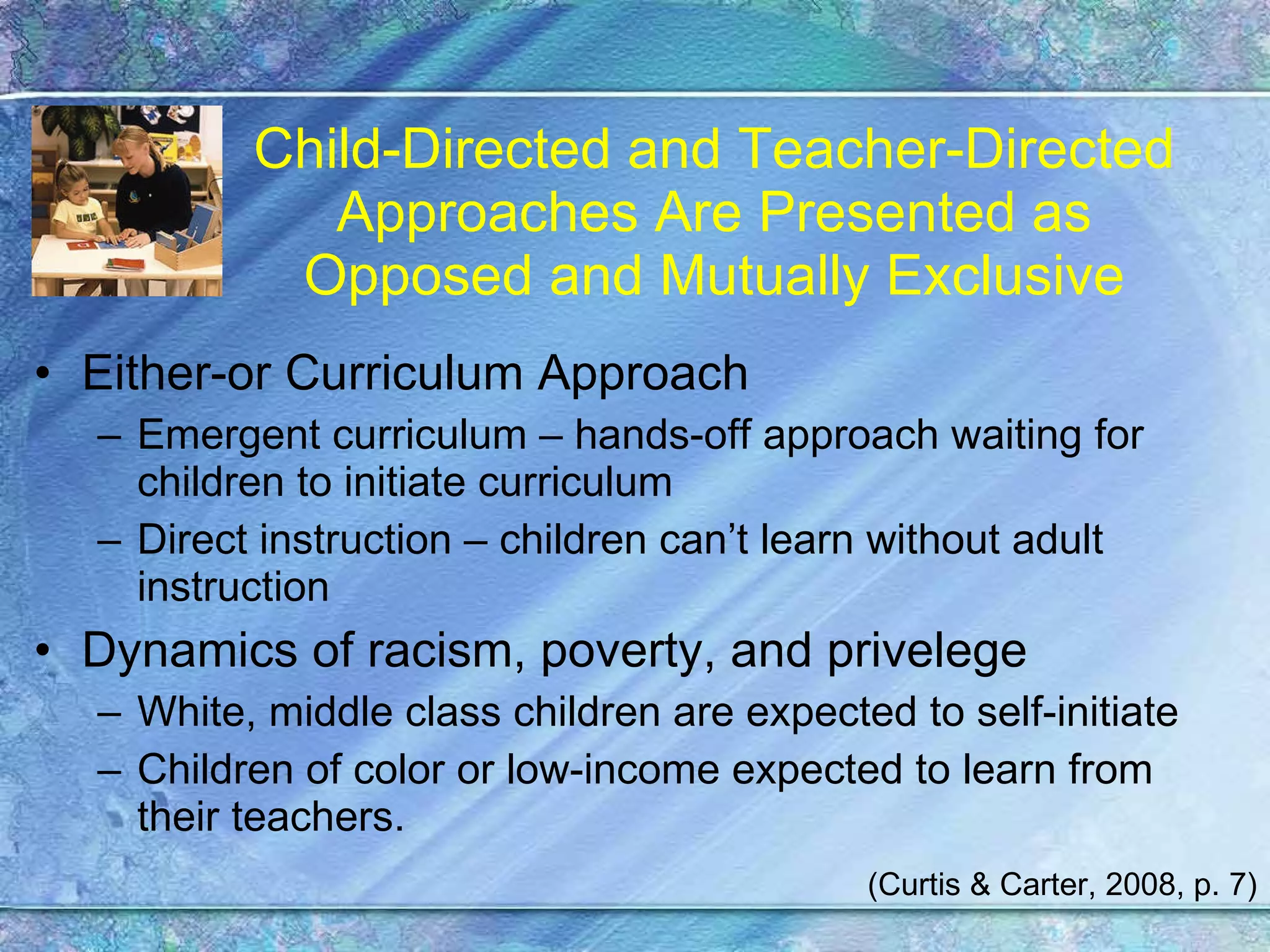
Child-Directed and Teacher-Directed Approaches Are Presented as Opposed and Mutually Exclusive Either-or Curriculum Approach Emergent curriculum – hands-off approach waiting for children to initiate curriculum Direct instruction – children can’t learn without adult instruction Dynamics of racism, poverty, and privelege White, middle class children are expected to self-initiate Children of color or low-income expected to learn from their teachers. (Curtis & Carter, 2008, p. 7)
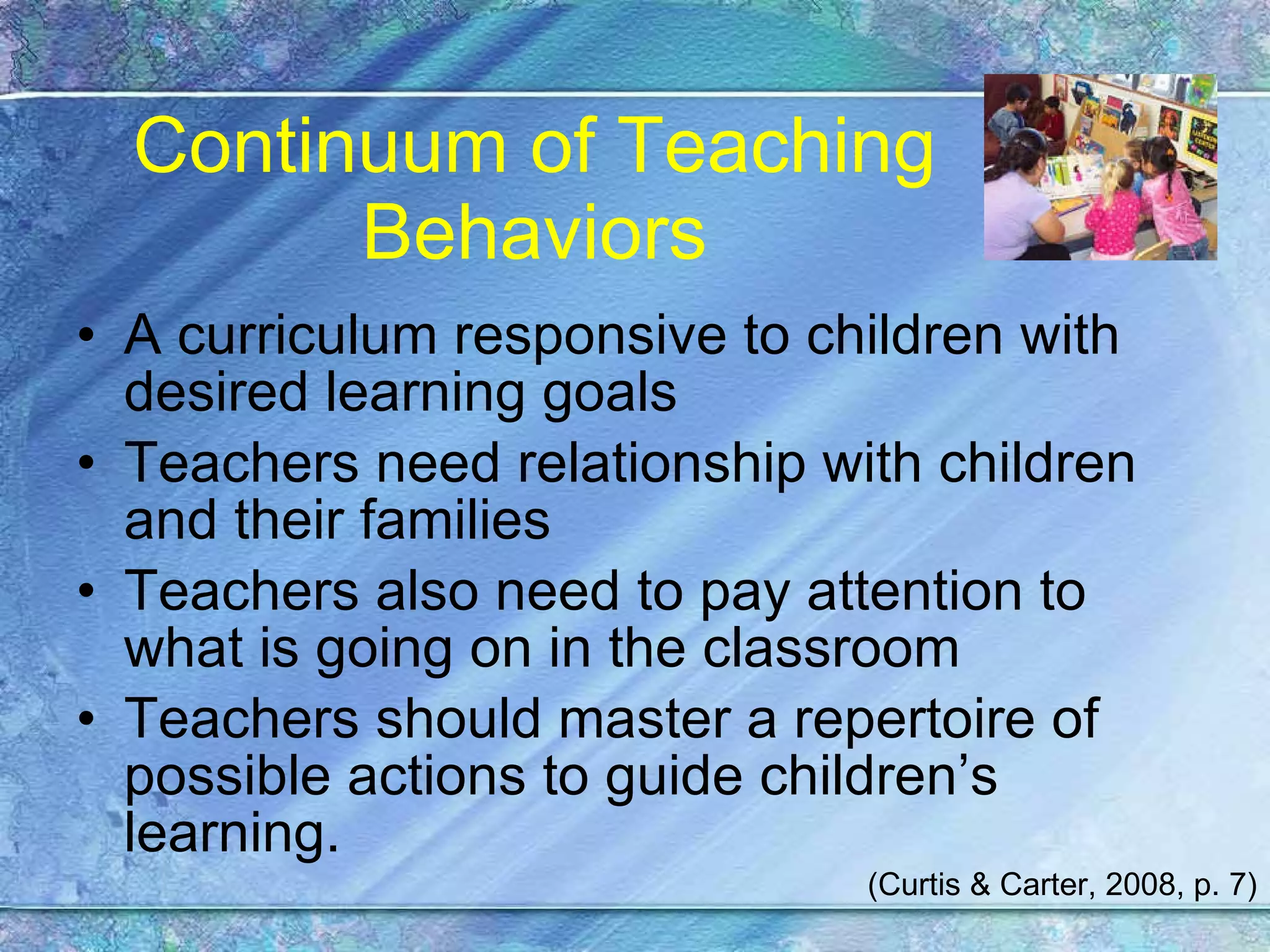
Continuum of Teaching Behaviors A curriculum responsive to children with desired learning goals  Teachers need relationship with children and their families Teachers also need to pay attention to what is going on in the classroom Teachers should master a repertoire of possible actions to guide children’s learning. (Curtis & Carter, 2008, p. 7)
No Program Infrastructures to  Support Teachers’ Reflective Practice Teachers viewed as technicians accountable to standards and curriculum content. Budgets limited to meeting ratios with children Need to examine your organization’s culture Need new approach to professional development Need to support teachers’ efforts with ongoing professional growth, organizational systems, and distribution of resources. (Curtis & Carter, 2008, pp. 7-8)
Teachers and Programs are Required to Adopt Quantifiable  “Research-based” Curricula Mandates require research-based curriculum Need to ask questions –  Who are the researchers? What is their cultural framework? What research methodology and mesurement tools were used? Is there any one research methodology that is reliable for all children? Why would one adopt curriculum that gives the teacher a script to follow? (Curtis & Carter, 2008, pp. 7-8)
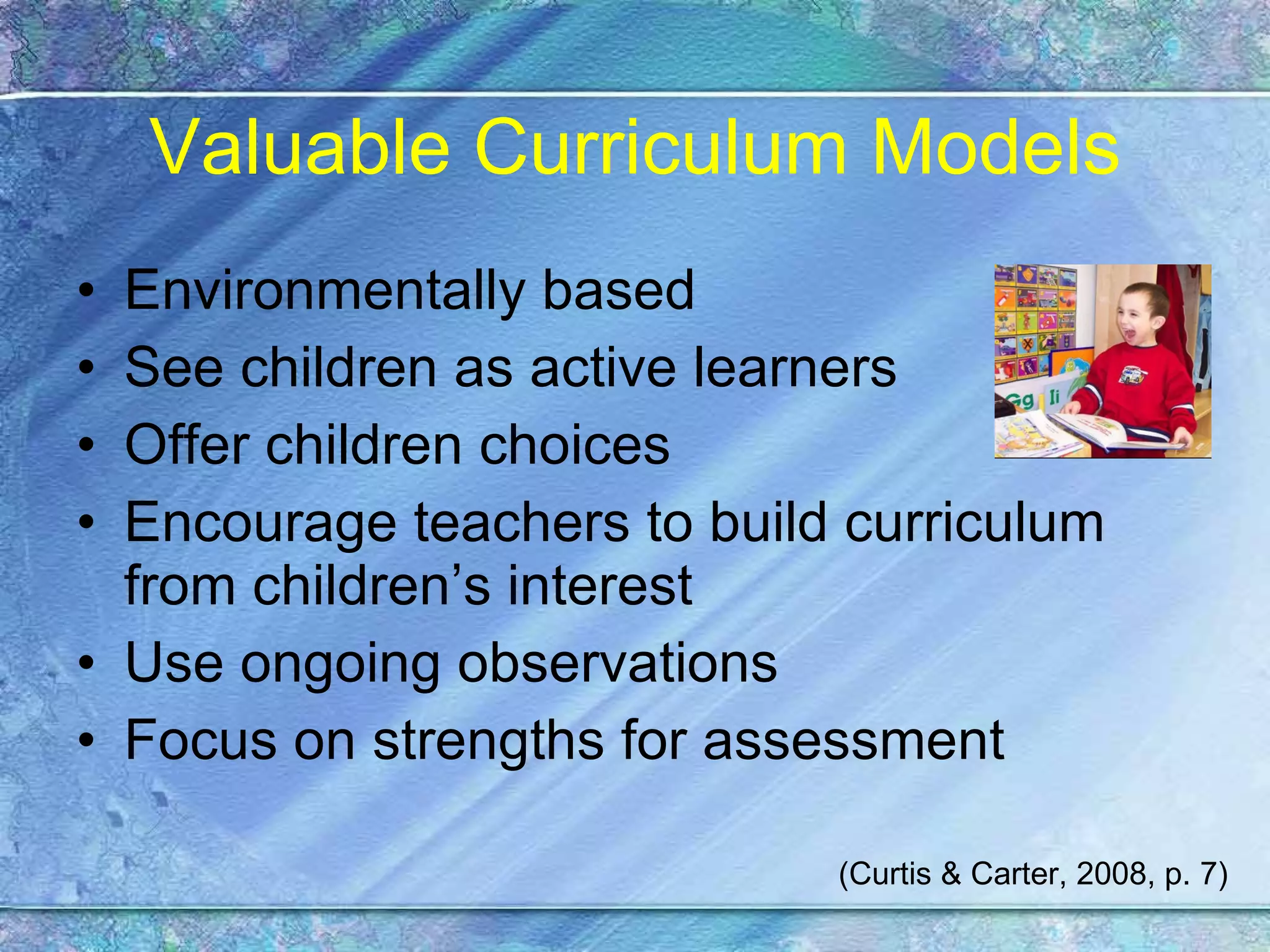
Valuable Curriculum Models Environmentally based See children as active learners Offer children choices Encourage teachers to build curriculum from children’s interest Use ongoing observations Focus on strengths for assessment (Curtis & Carter, 2008, p. 7)
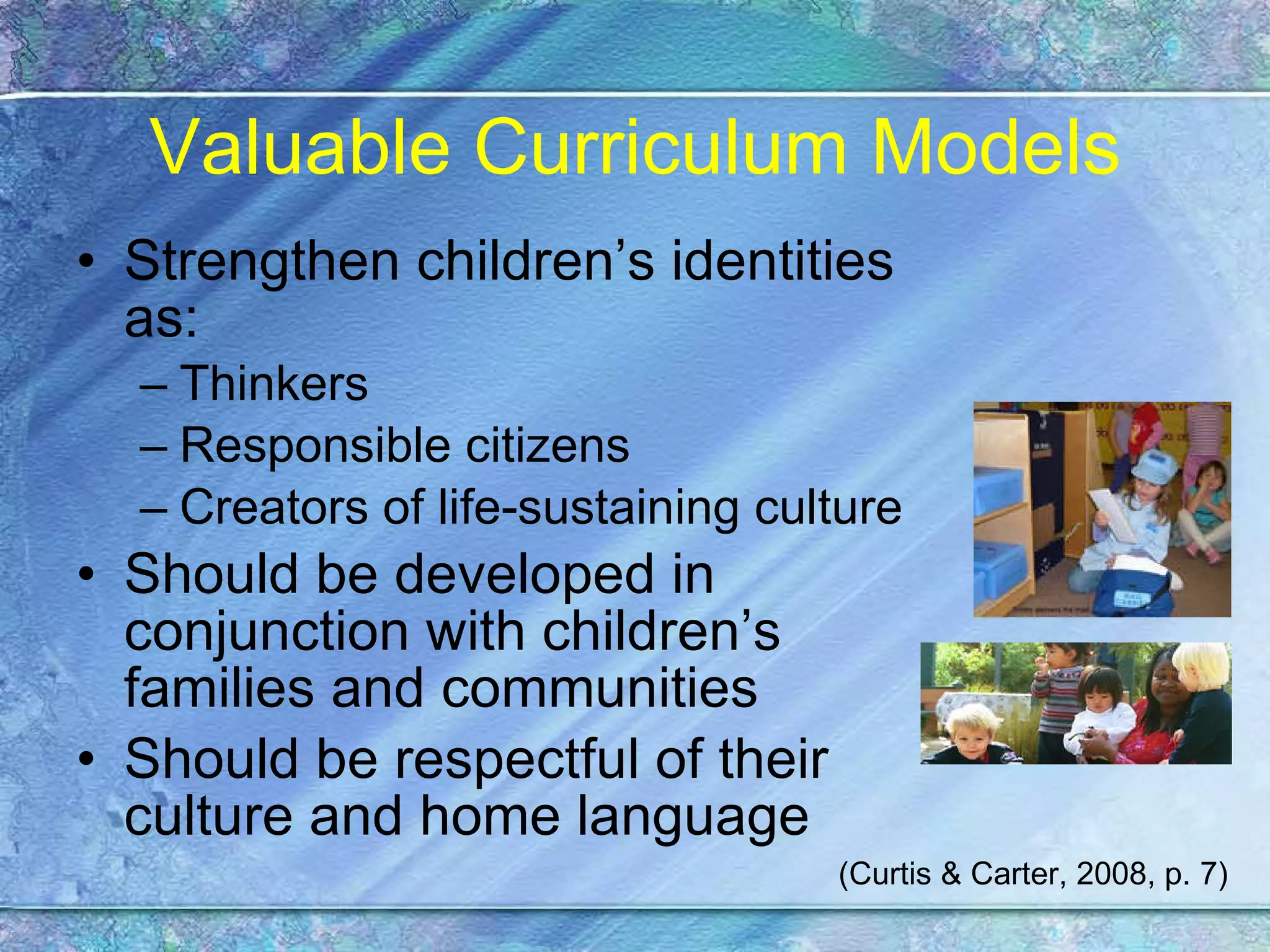
Valuable Curriculum Models Strengthen children’s identities as:  Thinkers Responsible citizens  Creators of life-sustaining culture Should be developed in conjunction with children’s families and communities Should be respectful of their culture and home language (Curtis & Carter, 2008, p. 7)
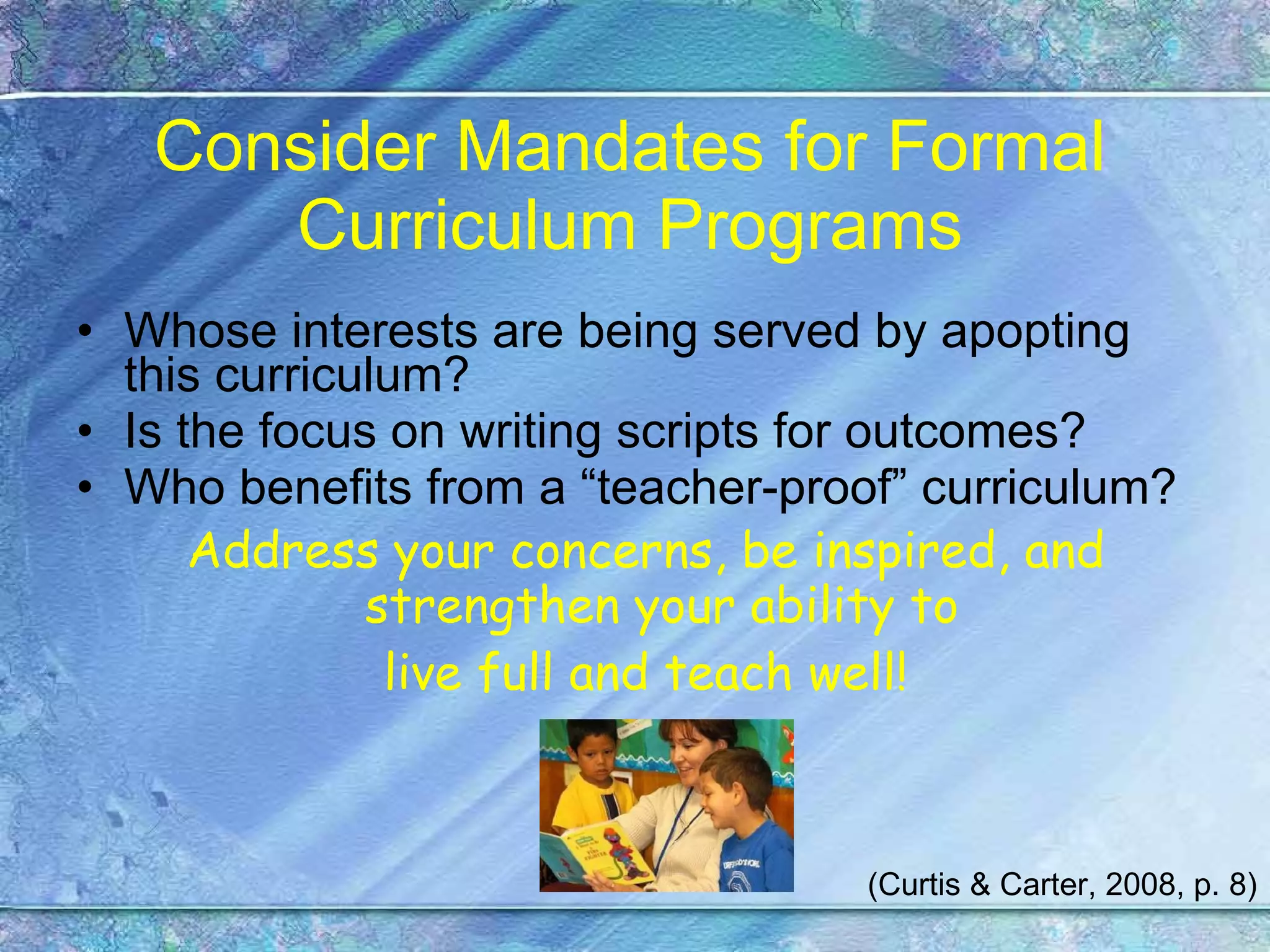
Consider Mandates for Formal Curriculum Programs Whose interests are being served by apopting this curriculum? Is the focus on writing scripts for outcomes? Who benefits from a “teacher-proof” curriculum? Address your concerns, be inspired, and strengthen your ability to  live full and teach well! (Curtis & Carter, 2008, p. 8)
A Learning Organization Read the story of Teresa, a Head Start director (pp. 7-8). Have you been asked to purchase a “lock-step” “teacher-proof” commercial curriculum? What dilemma was Teresa faced with? What is your vision for your early childhood setting? What would you do?

Questioning Current Thinking And Approaches

  • 1.
    Questioning Current Thinkingand Approaches Curtis & Carter (2008) Introduction Outline Prepared by Dr. Carla Piper
  • 2.
    What is thepurpose of education? Why do schools exist? To produce compliant workers for economic function? To help children grow into their full potential? Help children become informed, engaged citizens? Help children make a contribution to their communities? Prepare children to be successful in an increasingly more complex world? (Curtis & Carter, 2008, p. 1)
  • 3.
    How should wedesign curriculum for early childhood programs? To remediate children’s needs and deficits? To focus on children’s inherent competencies, ideas, and questions? To follow strong policies and curriculum mandates to improve learning outcomes? To locate teacher-proof curriculum for conformity and accountability? To prepare children for school readiness? To secure our future as early care and education professionals? (Curtis & Carter, 2008, pp. 1-2)
  • 4.
    Why Question CurrentThinking? “ Education is an arena of hope and struggle – hope for a better life and struggle over how to understand and enact and achieve a better world. We come to believe that we can become makers of history, not merely the passive objects of the great human drama” (Ayers, as cited in Curtis & Carter, 2008, p. 1)
  • 5.
    Definitions of Qualityare Inadequate The status of early childhood programs in U.S. is a national crisis Policy makers have marginalized our professional knowledge and decision-making power Reform efforts directed at measurable outcomes and high stakes testing. Commercial publishers offer quick-fix curriculum and assessment (Curtis & Carter, 2008, pp. 2-3)
  • 6.
    Teachers Need toDefine Quality Early care and education organizations need open discussion to answer these questions: What is our purpose? What are our values? What is our philosophy? What theoretical framework should guide our everyday program practice? (Curtis & Carter, 2008, pp. 2-3)
  • 7.
    Factories Serve asa Model for Education Many early care and education settings: Resemble a factory model A culture of compliance Defined schedules Mandated curriculum components Focus on paperwork and crunching numbers for accountability (Curtis & Carter, 2008, pp. 3-4)
  • 8.
    Factories Serve asa Model for Education Teachers need time Lack time to ponder, wonder, make meaning out of the day’s activities Teachers often given scripts to follow Sense of urgency speeding up everything we do. Linear – not cyclical view of time. Children need time to immerse themselves in areas of learning for meaningful outcomes. (Curtis & Carter, 2008, pp. 3-4)
  • 9.
    Teachers Lack Philosophical Foundations Training often occurs in “inservice” rather than pre-service: Focus on “how-to” skills Seldom raise philosophical questions on purpose of education Focus on set of regulations or a series of activities or a “bag of tricks” Need to take time to understand and clarify your own values and understandings Need more thoughtful understanding of effective teaching practice (Curtis & Carter, 2008, p. 4)
  • 10.
    Philosophical Foundations Clickon each term for online definition: Social constructivism Empowering or participatory education Critical pedagogy Multiple intelligences Inquiry-based learning Resources Concept to Classroom PBS Learning and Teaching in Preschool (Curtis & Carter, 2008, pp. 1-2)
  • 11.
    Adults View Childrenas Needing to be “Readied” or Fixed Complex concept of school readiness Adults impose their wills, perspectives, and agendas on children Children are born eager to learn. In most cases – the curriculum or pedagogy needs fixing – not the children! Strength-based approach – Reggio Emilia See the competency in each child Believe in children Help children reach their own potential (Curtis & Carter, 2008, p. 5)
  • 12.
    Play is notConsidered a Viable Source of Curriculum Play-based curriculum approaches viewed with skepticism. Children’s play is not what it used to be. Television and electronic media Commercial toys and tools Limited time for play due to “schedules” Often don’t learn to independently investigate, invent, or problem solve with complexity Teachers don’t always recognize the learning possibilities in play Play is important for children’s growth and development (Curtis & Carter, 2008, p. 5)
  • 13.
    Why play? Playaffects children’s motivation allowing them to develop system of long-term goals. Play facilitates cognitive decentering allowing children to take on roles and negotiate different perspectives. Play advances the development of mental representations as children associate meaning to physical form. Play fosters development of deliberate behavior as children learn to sequence actions, follow rules, and focus attention. (Curtis & Carter, 2008, p. 5)
  • 14.
    Child-Directed and Teacher-DirectedApproaches Are Presented as Opposed and Mutually Exclusive Either-or Curriculum Approach Emergent curriculum – hands-off approach waiting for children to initiate curriculum Direct instruction – children can’t learn without adult instruction Dynamics of racism, poverty, and privelege White, middle class children are expected to self-initiate Children of color or low-income expected to learn from their teachers. (Curtis & Carter, 2008, p. 7)
  • 15.
    Continuum of TeachingBehaviors A curriculum responsive to children with desired learning goals Teachers need relationship with children and their families Teachers also need to pay attention to what is going on in the classroom Teachers should master a repertoire of possible actions to guide children’s learning. (Curtis & Carter, 2008, p. 7)
  • 16.
    No Program Infrastructuresto Support Teachers’ Reflective Practice Teachers viewed as technicians accountable to standards and curriculum content. Budgets limited to meeting ratios with children Need to examine your organization’s culture Need new approach to professional development Need to support teachers’ efforts with ongoing professional growth, organizational systems, and distribution of resources. (Curtis & Carter, 2008, pp. 7-8)
  • 17.
    Teachers and Programsare Required to Adopt Quantifiable “Research-based” Curricula Mandates require research-based curriculum Need to ask questions – Who are the researchers? What is their cultural framework? What research methodology and mesurement tools were used? Is there any one research methodology that is reliable for all children? Why would one adopt curriculum that gives the teacher a script to follow? (Curtis & Carter, 2008, pp. 7-8)
  • 18.
    Valuable Curriculum ModelsEnvironmentally based See children as active learners Offer children choices Encourage teachers to build curriculum from children’s interest Use ongoing observations Focus on strengths for assessment (Curtis & Carter, 2008, p. 7)
  • 19.
    Valuable Curriculum ModelsStrengthen children’s identities as: Thinkers Responsible citizens Creators of life-sustaining culture Should be developed in conjunction with children’s families and communities Should be respectful of their culture and home language (Curtis & Carter, 2008, p. 7)
  • 20.
    Consider Mandates forFormal Curriculum Programs Whose interests are being served by apopting this curriculum? Is the focus on writing scripts for outcomes? Who benefits from a “teacher-proof” curriculum? Address your concerns, be inspired, and strengthen your ability to live full and teach well! (Curtis & Carter, 2008, p. 8)
  • 21.
    A Learning OrganizationRead the story of Teresa, a Head Start director (pp. 7-8). Have you been asked to purchase a “lock-step” “teacher-proof” commercial curriculum? What dilemma was Teresa faced with? What is your vision for your early childhood setting? What would you do?