Poverty and Effective Teaching:
How Teachers Can Change the World

ANDREA ANGE
Literature Review – Early Intervention
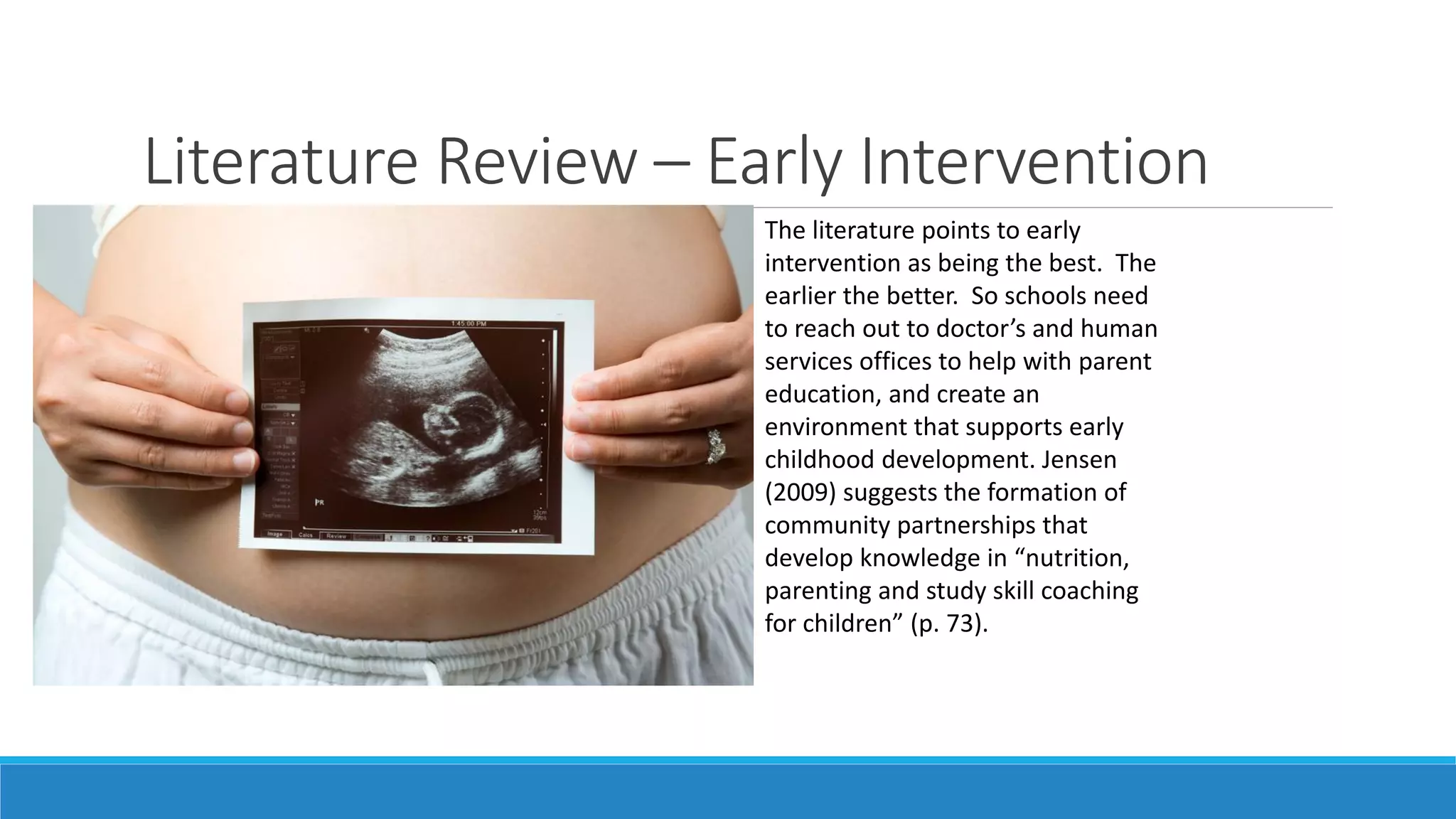
The literature points to early
intervention as being the best. The
earlier the better. So schools need
to reach out to doctor’s and human
services offices to help with parent
education, and create an
environment that supports early
childhood development. Jensen
(2009) suggests the formation of
community partnerships that
develop knowledge in “nutrition,
parenting and study skill coaching
for children” (p. 73).
Literature Review - Culture
Fullan (2001) states that while “moral purpose is job
one, relationships are job two because you can’t get
anywhere without them” (p. 51). School administrators
need to manage the culture of a school. This is best
done by examining cultural competence of both
administration and staff. Understanding the needs of
the community and building on those needs to create a
positive and inclusive learning culture.
Literature Review - Teachers
For schools to close the achievement gap that exists
between students who are white and students who are
ethnically diverse, teachers must have dispositions that
humanize education. Murrell et al (2010) take from Nieto
that teachers should have “a passion for social justice” (p.
149). This “…goes to the heart of the role of the teacher in
society, the responsibility for ensuring equitable learning
opportunities for all students” (Murrell, et al., 2010, p. 11).
Frankly this is why many teachers and administrators work in
public education, we believe in the equity a public education
promotes.
Addressing Children’s Needs
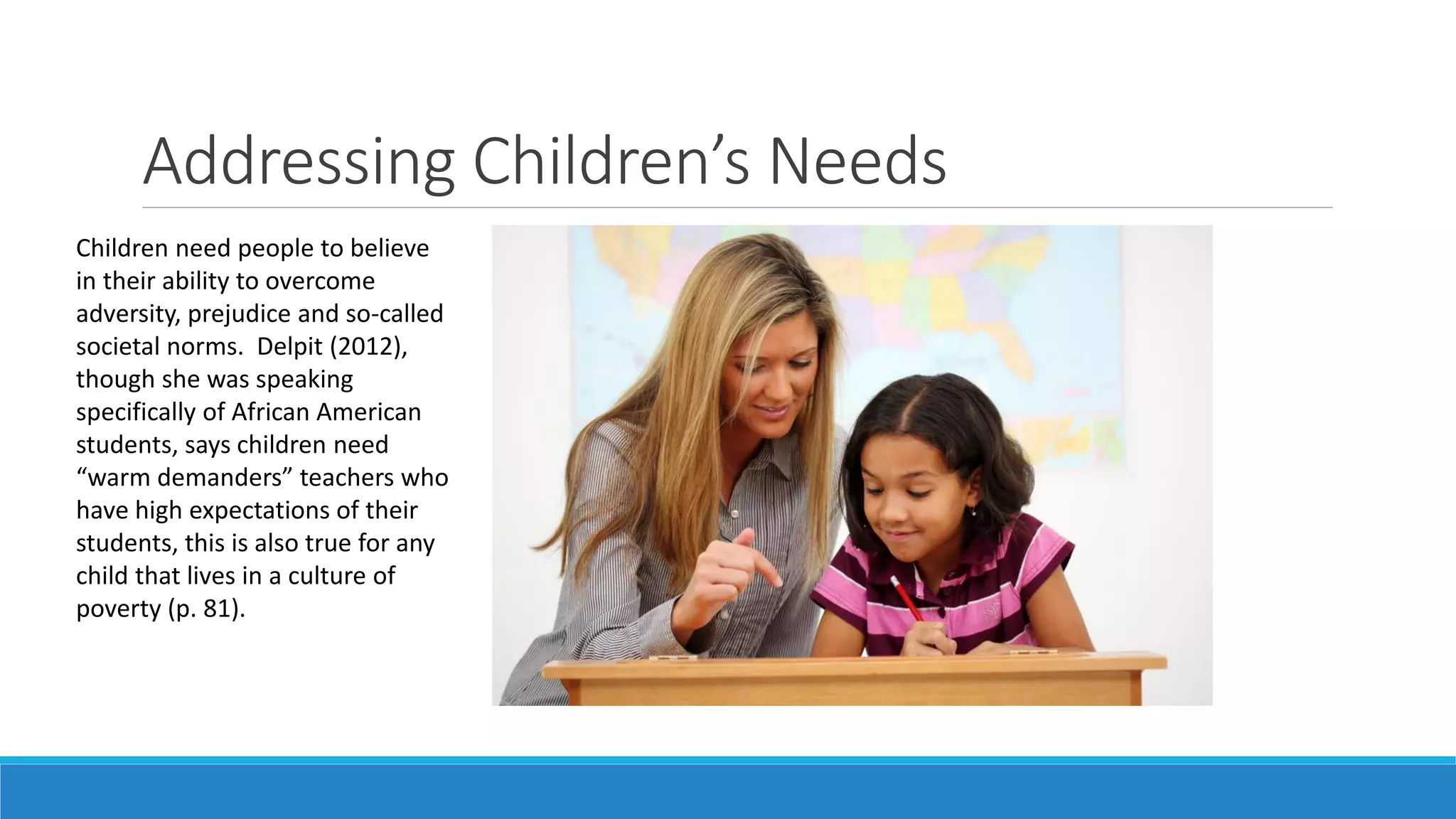
Children need people to believe
in their ability to overcome
adversity, prejudice and so-called
societal norms. Delpit (2012),
though she was speaking
specifically of African American
students, says children need
“warm demanders” teachers who
have high expectations of their
students, this is also true for any
child that lives in a culture of
poverty (p. 81).
Children’s Needs – Breaking the Cycle
Children must be taught that failure is not acceptable.
Children and adolescents need to have content that is
relevant to their interests and relates to their experience.
Boykin and Noguera (2011) stated that: “…incorporating a
child’s particular interests and background experiences in
the problem context should result in a greater focus on
relevant information, which in turn should enhance
performance outcomes”
Children’s Needs – Achievement Gap
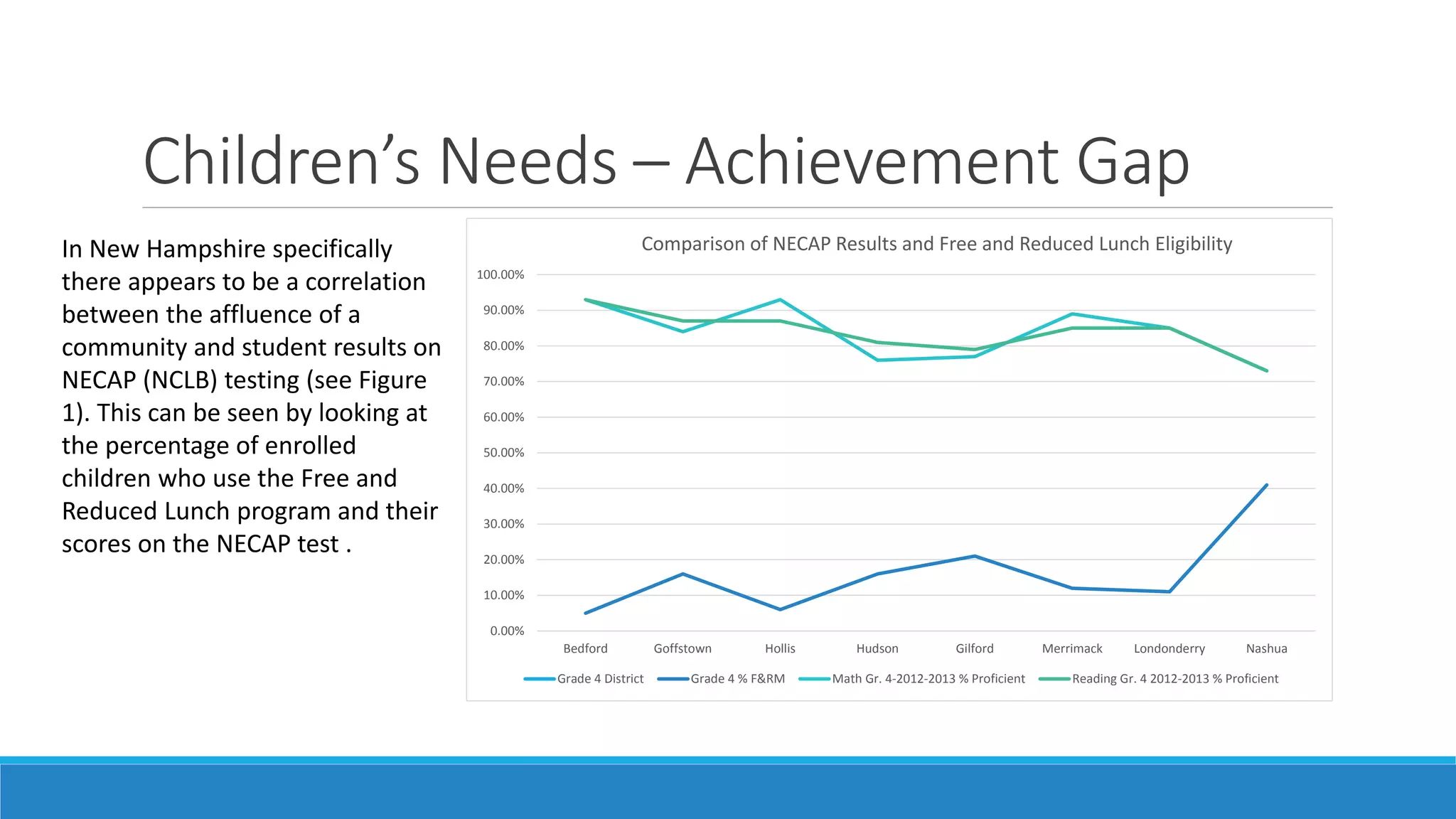
In New Hampshire specifically
there appears to be a correlation
between the affluence of a
community and student results on
NECAP (NCLB) testing (see Figure
1). This can be seen by looking at
the percentage of enrolled
children who use the Free and
Reduced Lunch program and their
scores on the NECAP test .

Comparison of NECAP Results and Free and Reduced Lunch Eligibility
100.00%
90.00%
80.00%
70.00%
60.00%
50.00%
40.00%
30.00%
20.00%
10.00%
0.00%
Bedford
Grade 4 District

Goffstown

Hollis

Grade 4 % F&RM

Hudson

Gilford

Math Gr. 4-2012-2013 % Proficient

Merrimack

Londonderry

Nashua

Reading Gr. 4 2012-2013 % Proficient
Children’s Needs – Cultural Relevance
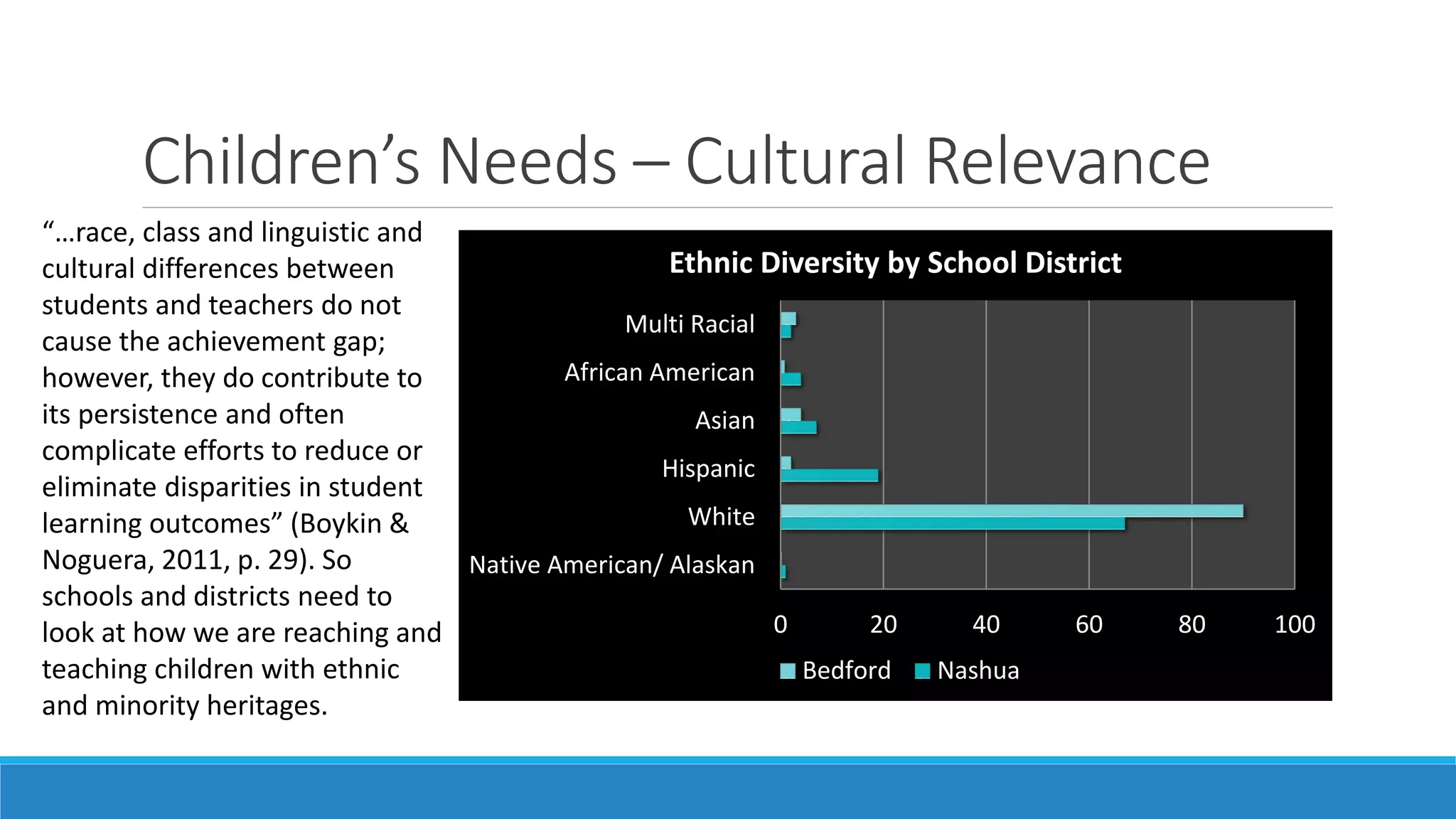
“…race, class and linguistic and
Ethnic Diversity by School District
cultural differences between
students and teachers do not
Multi Racial
cause the achievement gap;
African American
however, they do contribute to
its persistence and often
Asian
complicate efforts to reduce or
Hispanic
eliminate disparities in student
White
learning outcomes” (Boykin &
Noguera, 2011, p. 29). So
Native American/ Alaskan
schools and districts need to
0
20
40
60
look at how we are reaching and
teaching children with ethnic
Bedford
Nashua
and minority heritages.

80

100
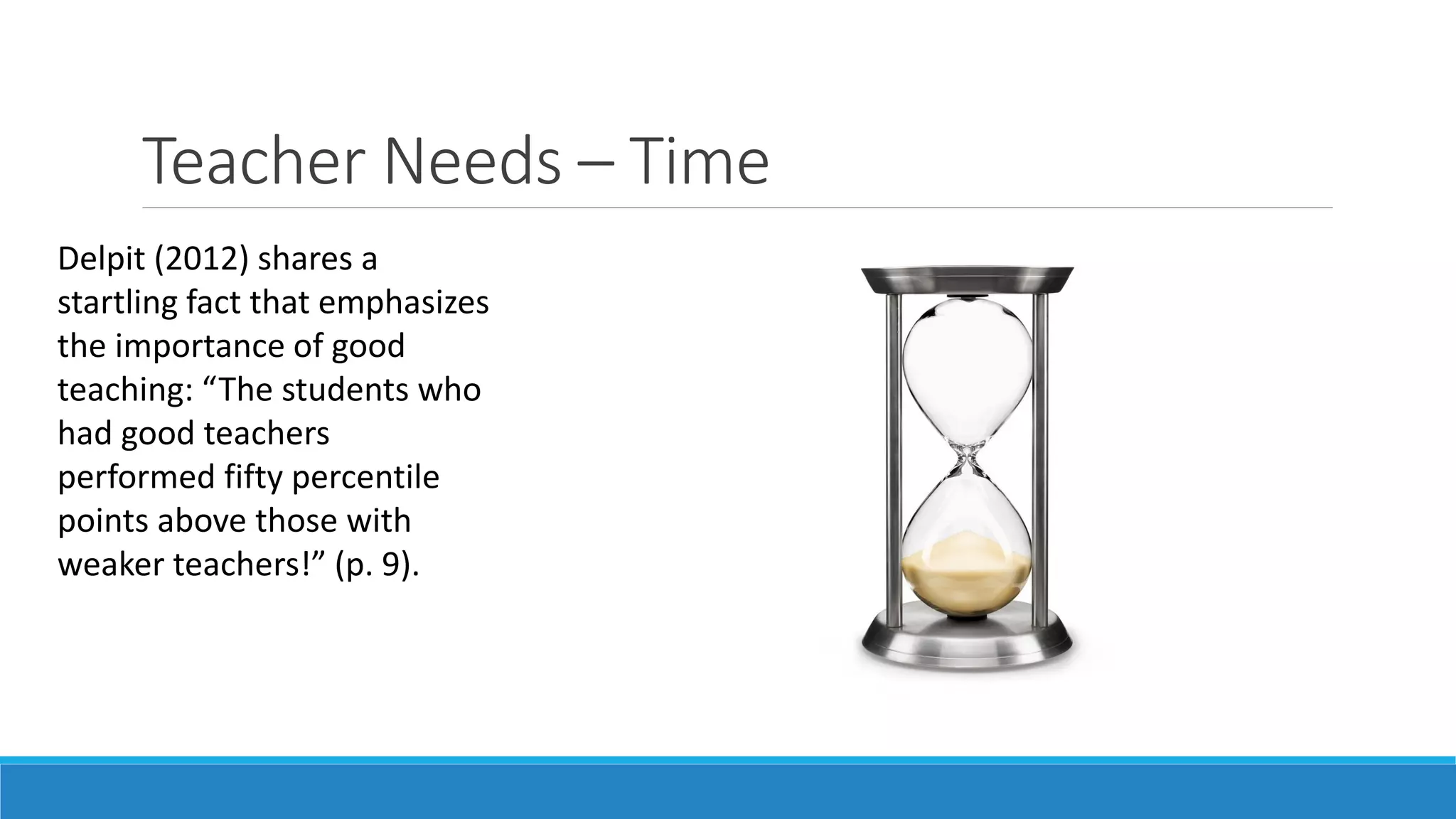
Teacher Needs – Time
Delpit (2012) shares a
startling fact that emphasizes
the importance of good
teaching: “The students who
had good teachers
performed fifty percentile
points above those with
weaker teachers!” (p. 9).
Teacher Needs –
Structured Professional Learning
Sato, et al. (2008) found that there were three areas
that supported long term improvement in teacher
assessment practices, these are: structured
professional development, collegial interactions and
participation in reflective self-study (p. 693).
Structured time that supports teaching and learning is
essential to a successful and harmonious school
program. If you want something to last you need to
build it right.
Teacher Needs –
Collegiality
Penuel, et al. (2007) stated that: “Therefore,
professional development that incorporates time
for instructional planning, discussion, and
consideration of underlying principles of
curriculum may be more effective in supporting
implementation of innovations.” (p. 931).
As part of this structured professional learning,
teacher’s need time to work with their colleagues
and celebrate successes. Teachers who have
opportunities to write lesson plans together, talk
about what works and what doesn’t are the
teachers who are most likely to have good results
with their students.
Teacher Needs - Reflection
Murrell et al. (2010) stated that: “Teacher
educators who attend to the development of
knowledge, skills and dispositions can attest to
the mutual effect each has on the development of
the others” (p. 10). Teachers need time to reflect
on what they are learning, structured
professional learning that gives them
opportunities to stretch and innovate, and time to
look at where they have been and examine their
practice so they can get to where they want to
go!
What Administrators Can Do Explain the Brain Research
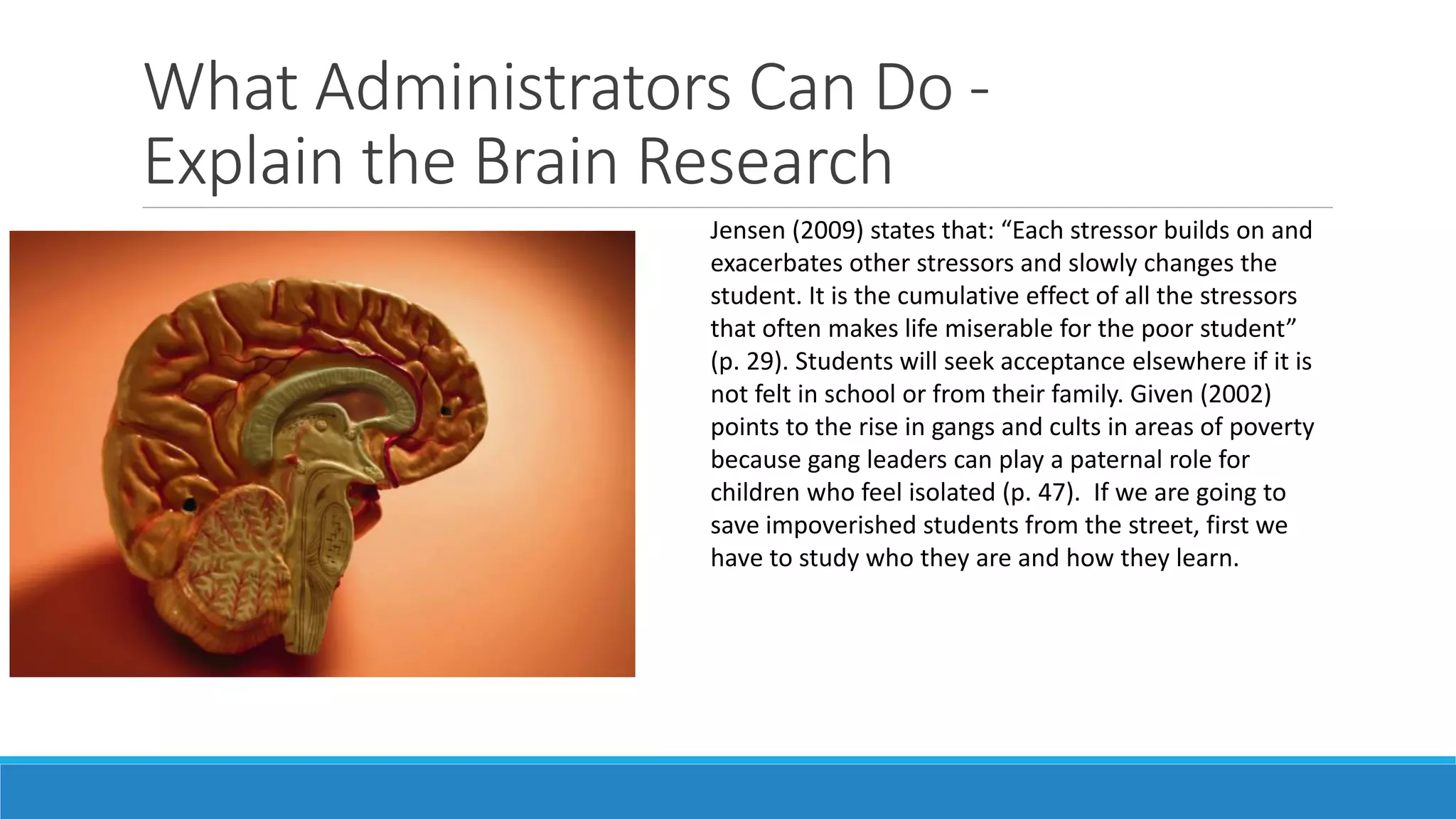
Jensen (2009) states that: “Each stressor builds on and
exacerbates other stressors and slowly changes the
student. It is the cumulative effect of all the stressors
that often makes life miserable for the poor student”
(p. 29). Students will seek acceptance elsewhere if it is
not felt in school or from their family. Given (2002)
points to the rise in gangs and cults in areas of poverty
because gang leaders can play a paternal role for
children who feel isolated (p. 47). If we are going to
save impoverished students from the street, first we
have to study who they are and how they learn.
What Administrators Can Do –
Raise Expectations
Expect teachers to be transparent
when giving assignments, use
formative assessments to see what is
working in a class and what isn’t,
regularly check for understanding,
write often, use clear rubrics for
grading and make sure students
know what to expect regarding
grading (Delpit, 2012, p. 141-142).
And insist that the work is relevant to
student culture and experience.
What Administrators Can Do –
Check For Cultural Competence
Teachers need to have ownership of
their learning. “Development of shared
purposes and the means to achieve
them cannot be mandated externally”
(Murrell et al, 2010, p. 201). Though
administration can give them materials
and point them in a direction to reach
understanding, it is beneficial for
teachers to have time with their
colleagues to figure out the best way
for information and techniques to be
implemented in the classroom.
What Administrators Can DoProvide Structured Professional Learning
Create schedules that allow for
common planning time. Structure that
time to include professional learning
and expect evidence of improved
practice.
References
Andrews, S. P., & Slate, J. R. (2002). Public and private prekindergarten programs: A comparison of student readiness. Educational Research Quarterly, 25(3), 59.
Boykin, A. W., & Noguera, P. (2011). Creating the opportunity to learn: Moving from research to practice to close the achievement gap. Alexandria, VA: ASCD.
Delpit, L. (2012). Multiplication is for white people: Raising expectations for other people's children. New York, NY: the new press.
Fullan, M. (2001). Leading in a culture of change. San Francisco, CA: Jossey-Bass.
Gere, A. R., Buehler, J., Dallavis, C., & Haviland, V. S. (2009). A visibility project: Learning to see how preservice teachers take up culturally responsive pedagogy. American Educational Research
Journal, 46(3), 816-852.
Given, B. K. (2002). Teaching to the brain's natural learning systems. Alexandria, VA: Association for Supervision and Curriculum Development.
Hinde, E. (2004). School culture and change: An examination of the effects of school culture on the process of change. Retrieved November 30, 2013, from
http://usca.edu/essays/vol122004/hinde.pdf
Jensen, E. (2009). Teaching with poverty in mind. Alexandria, VA: ASCD.
Machtinger, H. (2007). What do we know about high poverty schools? Summary of the high poverty schools conference at UNC-chapel hill. High School Journal, 90(3), 1-8.
Magnuson, K. A., Meyers, M. K., Ruhm, C. J., & Waldfogel, J. (2004). Inequality in preschool education and school readiness. American Educational Research Journal, 41(1), 115-157.
Measured Progress. (2013). Assessment and AYP public reporting site. NH Profile Website. Retrieved December 5th, 2013, from http://reporting.measuredprogress.org/NHProfile/default.aspx
Minow, M., Shweder, R. A., & Markus, H. R. (2008). Just schools: Pursuing equality in societies of difference. New York, NY: Russell Sage Foundation.
Murrell, P.C., Diez, M.E., Feiman-Nemser, S., & Schusssler, D.L. (2010). Teaching as a moral practice. Cambridge: Harvard Education Press.
New Hampshire Department of Education. (2013, February 13). Free/Reduced school lunch eligibility rates by school. Attendance and Enrollment Reports. Retrieved December 5, 2013, from
http://www.education.nh.gov/data/attendance.htm
New Hampshire Department of Education. (2013, February 4). Race/Ethnic enrollments. Attendance and Enrollment Reports. Retrieved December 5, 2013, from
http://www.education.nh.gov/data/attendance.htm.
Penuel, W. R., Fishman, B. J., Yamaguchi, R., & Gallagher, L. P. (2007). What makes professional development effective? Strategies that foster curriculum implementation. American Educational
Research Journal, 44(4), 921-958.
Prince, D., Pepper, K., & Brocato, K. (2006). The importance of making the well-being of children in poverty a priority. Early Childhood Education Journal, 34(1), 21-28. doi:10.1007/s10643-0060118-7
Sato, M., Wei, R. C., & Darling-Hammond, L. (2008). Improving teachers' assessment practices through professional development: The case of national board certification. American Educational
Research Journal, 45(3), 669-700.

Poverty and effective teaching how teachers can change the world

  • 1.
    Poverty and EffectiveTeaching: How Teachers Can Change the World ANDREA ANGE
  • 2.
    Literature Review –Early Intervention The literature points to early intervention as being the best. The earlier the better. So schools need to reach out to doctor’s and human services offices to help with parent education, and create an environment that supports early childhood development. Jensen (2009) suggests the formation of community partnerships that develop knowledge in “nutrition, parenting and study skill coaching for children” (p. 73).
  • 3.
    Literature Review -Culture Fullan (2001) states that while “moral purpose is job one, relationships are job two because you can’t get anywhere without them” (p. 51). School administrators need to manage the culture of a school. This is best done by examining cultural competence of both administration and staff. Understanding the needs of the community and building on those needs to create a positive and inclusive learning culture.
  • 4.
    Literature Review -Teachers For schools to close the achievement gap that exists between students who are white and students who are ethnically diverse, teachers must have dispositions that humanize education. Murrell et al (2010) take from Nieto that teachers should have “a passion for social justice” (p. 149). This “…goes to the heart of the role of the teacher in society, the responsibility for ensuring equitable learning opportunities for all students” (Murrell, et al., 2010, p. 11). Frankly this is why many teachers and administrators work in public education, we believe in the equity a public education promotes.
  • 5.
    Addressing Children’s Needs Childrenneed people to believe in their ability to overcome adversity, prejudice and so-called societal norms. Delpit (2012), though she was speaking specifically of African American students, says children need “warm demanders” teachers who have high expectations of their students, this is also true for any child that lives in a culture of poverty (p. 81).
  • 6.
    Children’s Needs –Breaking the Cycle Children must be taught that failure is not acceptable. Children and adolescents need to have content that is relevant to their interests and relates to their experience. Boykin and Noguera (2011) stated that: “…incorporating a child’s particular interests and background experiences in the problem context should result in a greater focus on relevant information, which in turn should enhance performance outcomes”
  • 7.
    Children’s Needs –Achievement Gap In New Hampshire specifically there appears to be a correlation between the affluence of a community and student results on NECAP (NCLB) testing (see Figure 1). This can be seen by looking at the percentage of enrolled children who use the Free and Reduced Lunch program and their scores on the NECAP test . Comparison of NECAP Results and Free and Reduced Lunch Eligibility 100.00% 90.00% 80.00% 70.00% 60.00% 50.00% 40.00% 30.00% 20.00% 10.00% 0.00% Bedford Grade 4 District Goffstown Hollis Grade 4 % F&RM Hudson Gilford Math Gr. 4-2012-2013 % Proficient Merrimack Londonderry Nashua Reading Gr. 4 2012-2013 % Proficient
  • 8.
    Children’s Needs –Cultural Relevance “…race, class and linguistic and Ethnic Diversity by School District cultural differences between students and teachers do not Multi Racial cause the achievement gap; African American however, they do contribute to its persistence and often Asian complicate efforts to reduce or Hispanic eliminate disparities in student White learning outcomes” (Boykin & Noguera, 2011, p. 29). So Native American/ Alaskan schools and districts need to 0 20 40 60 look at how we are reaching and teaching children with ethnic Bedford Nashua and minority heritages. 80 100
  • 9.
    Teacher Needs –Time Delpit (2012) shares a startling fact that emphasizes the importance of good teaching: “The students who had good teachers performed fifty percentile points above those with weaker teachers!” (p. 9).
  • 10.
    Teacher Needs – StructuredProfessional Learning Sato, et al. (2008) found that there were three areas that supported long term improvement in teacher assessment practices, these are: structured professional development, collegial interactions and participation in reflective self-study (p. 693). Structured time that supports teaching and learning is essential to a successful and harmonious school program. If you want something to last you need to build it right.
  • 11.
    Teacher Needs – Collegiality Penuel,et al. (2007) stated that: “Therefore, professional development that incorporates time for instructional planning, discussion, and consideration of underlying principles of curriculum may be more effective in supporting implementation of innovations.” (p. 931). As part of this structured professional learning, teacher’s need time to work with their colleagues and celebrate successes. Teachers who have opportunities to write lesson plans together, talk about what works and what doesn’t are the teachers who are most likely to have good results with their students.
  • 12.
    Teacher Needs -Reflection Murrell et al. (2010) stated that: “Teacher educators who attend to the development of knowledge, skills and dispositions can attest to the mutual effect each has on the development of the others” (p. 10). Teachers need time to reflect on what they are learning, structured professional learning that gives them opportunities to stretch and innovate, and time to look at where they have been and examine their practice so they can get to where they want to go!
  • 13.
    What Administrators CanDo Explain the Brain Research Jensen (2009) states that: “Each stressor builds on and exacerbates other stressors and slowly changes the student. It is the cumulative effect of all the stressors that often makes life miserable for the poor student” (p. 29). Students will seek acceptance elsewhere if it is not felt in school or from their family. Given (2002) points to the rise in gangs and cults in areas of poverty because gang leaders can play a paternal role for children who feel isolated (p. 47). If we are going to save impoverished students from the street, first we have to study who they are and how they learn.
  • 14.
    What Administrators CanDo – Raise Expectations Expect teachers to be transparent when giving assignments, use formative assessments to see what is working in a class and what isn’t, regularly check for understanding, write often, use clear rubrics for grading and make sure students know what to expect regarding grading (Delpit, 2012, p. 141-142). And insist that the work is relevant to student culture and experience.
  • 15.
    What Administrators CanDo – Check For Cultural Competence Teachers need to have ownership of their learning. “Development of shared purposes and the means to achieve them cannot be mandated externally” (Murrell et al, 2010, p. 201). Though administration can give them materials and point them in a direction to reach understanding, it is beneficial for teachers to have time with their colleagues to figure out the best way for information and techniques to be implemented in the classroom.
  • 16.
    What Administrators CanDoProvide Structured Professional Learning Create schedules that allow for common planning time. Structure that time to include professional learning and expect evidence of improved practice.
  • 17.
    References Andrews, S. P.,& Slate, J. R. (2002). Public and private prekindergarten programs: A comparison of student readiness. Educational Research Quarterly, 25(3), 59. Boykin, A. W., & Noguera, P. (2011). Creating the opportunity to learn: Moving from research to practice to close the achievement gap. Alexandria, VA: ASCD. Delpit, L. (2012). Multiplication is for white people: Raising expectations for other people's children. New York, NY: the new press. Fullan, M. (2001). Leading in a culture of change. San Francisco, CA: Jossey-Bass. Gere, A. R., Buehler, J., Dallavis, C., & Haviland, V. S. (2009). A visibility project: Learning to see how preservice teachers take up culturally responsive pedagogy. American Educational Research Journal, 46(3), 816-852. Given, B. K. (2002). Teaching to the brain's natural learning systems. Alexandria, VA: Association for Supervision and Curriculum Development. Hinde, E. (2004). School culture and change: An examination of the effects of school culture on the process of change. Retrieved November 30, 2013, from http://usca.edu/essays/vol122004/hinde.pdf Jensen, E. (2009). Teaching with poverty in mind. Alexandria, VA: ASCD. Machtinger, H. (2007). What do we know about high poverty schools? Summary of the high poverty schools conference at UNC-chapel hill. High School Journal, 90(3), 1-8. Magnuson, K. A., Meyers, M. K., Ruhm, C. J., & Waldfogel, J. (2004). Inequality in preschool education and school readiness. American Educational Research Journal, 41(1), 115-157. Measured Progress. (2013). Assessment and AYP public reporting site. NH Profile Website. Retrieved December 5th, 2013, from http://reporting.measuredprogress.org/NHProfile/default.aspx Minow, M., Shweder, R. A., & Markus, H. R. (2008). Just schools: Pursuing equality in societies of difference. New York, NY: Russell Sage Foundation. Murrell, P.C., Diez, M.E., Feiman-Nemser, S., & Schusssler, D.L. (2010). Teaching as a moral practice. Cambridge: Harvard Education Press. New Hampshire Department of Education. (2013, February 13). Free/Reduced school lunch eligibility rates by school. Attendance and Enrollment Reports. Retrieved December 5, 2013, from http://www.education.nh.gov/data/attendance.htm New Hampshire Department of Education. (2013, February 4). Race/Ethnic enrollments. Attendance and Enrollment Reports. Retrieved December 5, 2013, from http://www.education.nh.gov/data/attendance.htm. Penuel, W. R., Fishman, B. J., Yamaguchi, R., & Gallagher, L. P. (2007). What makes professional development effective? Strategies that foster curriculum implementation. American Educational Research Journal, 44(4), 921-958. Prince, D., Pepper, K., & Brocato, K. (2006). The importance of making the well-being of children in poverty a priority. Early Childhood Education Journal, 34(1), 21-28. doi:10.1007/s10643-0060118-7 Sato, M., Wei, R. C., & Darling-Hammond, L. (2008). Improving teachers' assessment practices through professional development: The case of national board certification. American Educational Research Journal, 45(3), 669-700.