Planning & Building 
The Early Childhood Teacher as Curriculum Constructor 
Lutheran Educator’s Conference 
PSW District LCMS – November 2014 
Drew D. Gerdes
So…You Are A Teacher… 
What does this mean?  
What does this involve? 
Who do you teach?
How Often Have You Heard… 
“What is your 
curriculum?” 
Do they really know 
what this means 
when they ask?
What’s Your Answer?
Curriculum 
Spend a few 
moments with 
neighbors sharing 
what you feel 
“curriculum means”. 
Be prepared to share 
with the whole group!
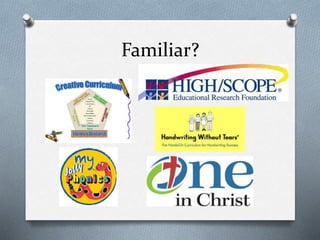
Familiar?
Why? 
If you utilize one of the previous 
curriculum programs…WHY? 
What do you like or dislike? 
Is it the best choice? What would you do 
if it didn’t exist?
Look Into A Mirror… 
YOU are the biggest 
factor in whether a 
“curriculum” is 
effective or useful. 
You make a big 
difference in what 
happens in the 
classroom!!
We Are Smart! 
Sometimes EC folks 
and ELE folks “bonk 
heads” when it comes 
to curriculum. 
Curricular Areas
A System 
“Curriculum” is really a system – a set of 
critical elements: 
Curriculum 
Child Assessment 
Program Evaluation
What Is It? 
Curriculum… 
A complex idea 
containing multiple 
components, such as 
content, pedagogy, 
goals, and 
instructional 
practices. 
Influenced by… 
Society values, 
content standards, 
accountability 
systems, research 
findings, culture and 
language, individual 
children’s 
characteristics.
Comprehensive… 
Social and emotional 
competence 
Positive approaches 
to learning 
Includes cultural and 
linguistic continuity 
Curriculum that is 
goal-oriented and 
incorporates concepts 
based on current 
research fosters 
children’s learning 
and development. 
How is this done?
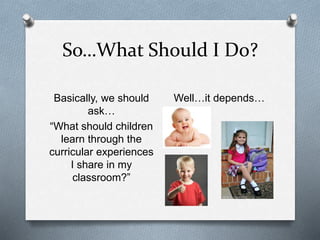
So…What Should I Do? 
Basically, we should 
ask… 
“What should children 
learn through the 
curricular experiences 
I share in my 
classroom?” 
Well…it depends…
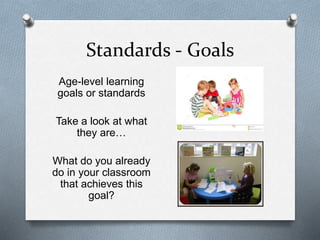
Standards - Goals 
Age-level learning 
goals or standards 
Take a look at what 
they are… 
What do you already 
do in your classroom 
that achieves this 
goal?
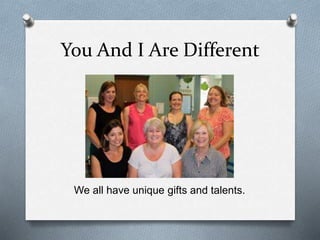
You And I Are Different 
We all have unique gifts and talents.
What Does Webster Say? 
Curriculum is a 
noun…it’s a thing!! 
The subjects 
comprising a course 
of study. 
Something you do!!!
Do you have? 
Files filled with themes you use in the 
classroom 
Books, books, and more books – that you 
read 
Books that you use to find ideas and 
activities 
Things, things, and more things
Do You… 
Open up your file 
each year and do the 
same thing? 
Use your file as a 
guide and determine 
what to use based on 
the needs of your 
students?
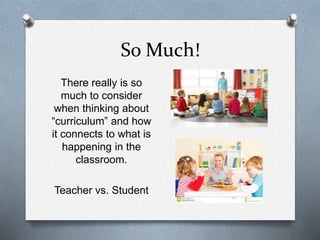
So Much! 
There really is so 
much to consider 
when thinking about 
“curriculum” and how 
it connects to what is 
happening in the 
classroom. 
Teacher vs. Student
Curriculum Guide 
Specifically shares what you intend to teach. 
Allows for accountability. 
Include state standards – and how you will 
follow through with them. 
Don’t forget to include teaching the faith!
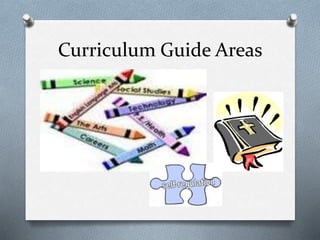
Curriculum Guide Areas
High-Stakes Teaching 
For many children, 
the academic part of 
school is fairly easy 
and will be learned 
over time. 
What is difficult is 
everything else a 
child needs to be 
successful in life. 
Self-Regulation 
Inhibitory Control 
Executive Functioning 
Emotional Intelligence 
Resiliency 
Social Skills
Freedom Within Boundaries 
How the curriculum is 
implemented – the 
exact activities that 
are done in the 
classroom – are really 
up to the teacher! 
Remember the 
mirror?
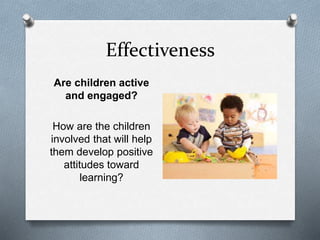
Effectiveness 
Are children active 
and engaged? 
How are the children 
involved that will help 
them develop positive 
attitudes toward 
learning?
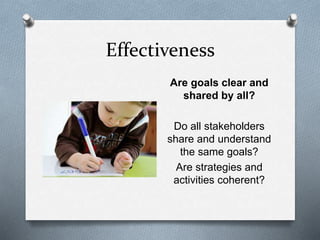
Effectiveness 
Are goals clear and 
shared by all? 
Do all stakeholders 
share and understand 
the same goals? 
Are strategies and 
activities coherent?
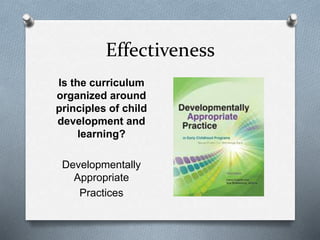
Effectiveness 
Is the curriculum 
organized around 
principles of child 
development and 
learning? 
Developmentally 
Appropriate 
Practices
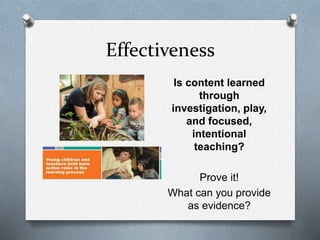
Effectiveness 
Is content learned 
through 
investigation, play, 
and focused, 
intentional 
teaching? 
Prove it! 
What can you provide 
as evidence?
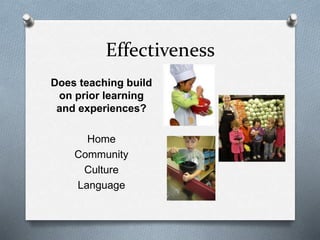
Effectiveness 
Does teaching build 
on prior learning 
and experiences? 
Home 
Community 
Culture 
Language
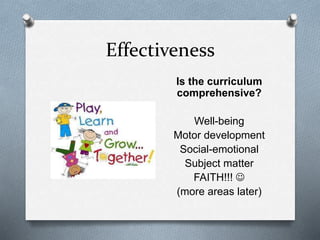
Effectiveness 
Is the curriculum 
comprehensive? 
Well-being 
Motor development 
Social-emotional 
Subject matter 
FAITH!!!  
(more areas later)
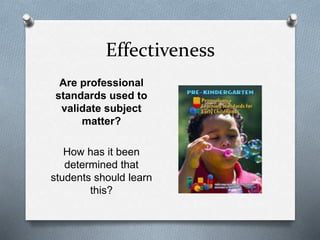
Effectiveness 
Are professional 
standards used to 
validate subject 
matter? 
How has it been 
determined that 
students should learn 
this?
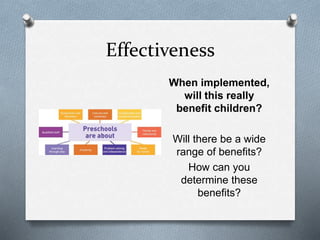
Effectiveness 
When implemented, 
will this really 
benefit children? 
Will there be a wide 
range of benefits? 
How can you 
determine these 
benefits?
Assessment 
A high-quality curriculum also includes 
assessment. 
It’s not just formal testing! 
Observation, documentation of children’s 
work, checklists, rating scales, portfolios, 
etc.
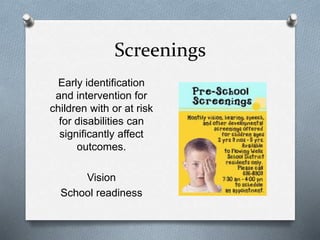
Screenings 
Early identification 
and intervention for 
children with or at risk 
for disabilities can 
significantly affect 
outcomes. 
Vision 
School readiness
What Else? 
Do you ever feel curriculum takes over your 
time, your teaching, and your classroom? 
It is important! 
But…is there anything else that should be 
included in the day-to-day interactions you 
have with children?
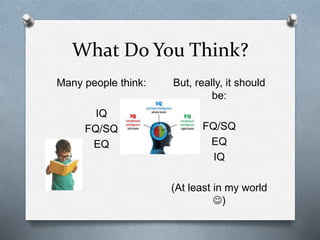
What Do You Think? 
Many people think: 
IQ 
FQ/SQ 
EQ 
But, really, it should 
be: 
FQ/SQ 
EQ 
IQ 
(At least in my world 
)
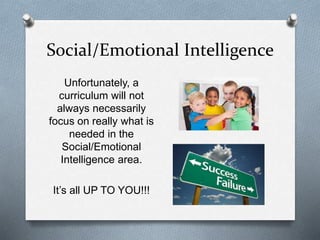
Social/Emotional Intelligence 
Unfortunately, a 
curriculum will not 
always necessarily 
focus on really what is 
needed in the 
Social/Emotional 
Intelligence area. 
It’s all UP TO YOU!!!
Self-Regulation 
Children’s ability to focus their attention, 
manage their thoughts and emotions, and inhibit 
some behaviors in favor of others. 
Kindergarten students who exhibit better self-regulation 
do better in academic subject areas. 
Higher levels of self-regulation are related to 
less deviant behavior.
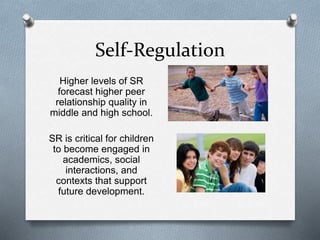
Self-Regulation 
Higher levels of SR 
forecast higher peer 
relationship quality in 
middle and high school. 
SR is critical for children 
to become engaged in 
academics, social 
interactions, and 
contexts that support 
future development.
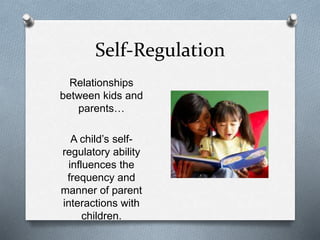
Self-Regulation 
Relationships 
between kids and 
parents… 
A child’s self-regulatory 
ability 
influences the 
frequency and 
manner of parent 
interactions with 
children.
What Can A Teacher Do? 
Organize classroom 
environments as a 
means of managing 
behavior. 
Incorporate 
instructional 
strategies that are 
interesting and 
engaging. 
Cultivate extremely 
strong relationships 
between teacher-child 
and child-peers. 
EFFECTIVE 
INTERACTIONS ARE 
MORE 
INFLUENTIAL!
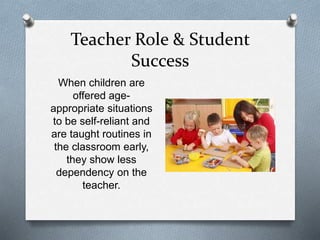
Teacher Role & Student 
Success 
When children are 
offered age-appropriate 
situations 
to be self-reliant and 
are taught routines in 
the classroom early, 
they show less 
dependency on the 
teacher.
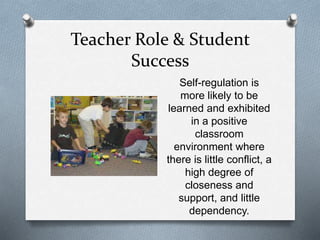
Teacher Role & Student 
Success 
Self-regulation is 
more likely to be 
learned and exhibited 
in a positive 
classroom 
environment where 
there is little conflict, a 
high degree of 
closeness and 
support, and little 
dependency.
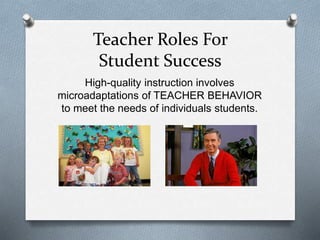
Teacher Roles For 
Student Success 
High-quality instruction involves 
microadaptations of TEACHER BEHAVIOR 
to meet the needs of individuals students.
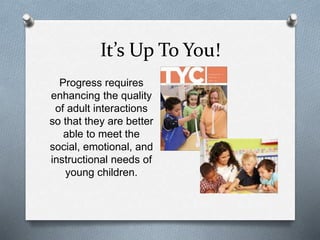
It’s Up To You! 
Progress requires 
enhancing the quality 
of adult interactions 
so that they are better 
able to meet the 
social, emotional, and 
instructional needs of 
young children.
Got A Headache Yet? 
“How will I ever be 
able to do all this?” 
LESS IS MORE!!! 
Remember… 
FQ/SQ 
EQ 
IQ 
Are you “in balance”?
Vygotsky 
The role of the teacher is much more than 
teaching facts and skills – teachers shape a 
child’s development by helping them acquire 
the mental tools needed for their culture and 
environment. 
Child Development + Education = 
AMPLIFICATION
The “NEW” Curriculum 
You likely have a good 
sense of “what” should 
be done in a classroom 
regarding education. 
You likely know about 
child development. 
This all needs to be 
molded together!!!! 
Research is just now 
really telling us what 
the best early learning 
environments look 
like! 
We won’t ever have 
the final answer – 
but’s an adventure-filled 
journey!
Executive Functioning 
Processes of holding 
information in mind 
Inhibiting automatic 
responses to 
stimulation 
Flexibility 
Shifting attention 
between tasks
P…L…A…Y…!!!!!!!! 
Play is one of the most critical and crucial 
components of early childhood education, 
yet it is being taken away and replaced with 
components of education that are too 
advanced for young children.
Play 
Play should the leading 
activity of early 
childhood students. 
Primary grades – 
intentional learning is 
the leading activity. 
Too much “push down”!
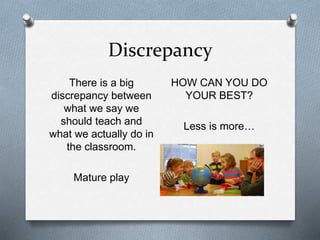
Discrepancy 
There is a big 
discrepancy between 
what we say we 
should teach and 
what we actually do in 
the classroom. 
Mature play 
HOW CAN YOU DO 
YOUR BEST? 
Less is more…
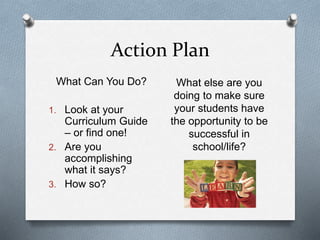
Action Plan 
What Can You Do? 
1. Look at your 
Curriculum Guide 
– or find one! 
2. Are you 
accomplishing 
what it says? 
3. How so? 
What else are you 
doing to make sure 
your students have 
the opportunity to be 
successful in 
school/life?
Contact Me! 
Questions? Insights? Want to share? 
Drew D. Gerdes 
Messiah Lutheran School 
Weldon Spring, Missouri 
dgerdes@messiahnetwork.org 
Twitter: @ddgerdes 
Facebook: EducationEase

Planning & building curriculum constructor

  • 1.
    Planning & Building The Early Childhood Teacher as Curriculum Constructor Lutheran Educator’s Conference PSW District LCMS – November 2014 Drew D. Gerdes
  • 2.
    So…You Are ATeacher… What does this mean?  What does this involve? Who do you teach?
  • 3.
    How Often HaveYou Heard… “What is your curriculum?” Do they really know what this means when they ask?
  • 4.
  • 5.
    Curriculum Spend afew moments with neighbors sharing what you feel “curriculum means”. Be prepared to share with the whole group!
  • 6.
  • 7.
    Why? If youutilize one of the previous curriculum programs…WHY? What do you like or dislike? Is it the best choice? What would you do if it didn’t exist?
  • 8.
    Look Into AMirror… YOU are the biggest factor in whether a “curriculum” is effective or useful. You make a big difference in what happens in the classroom!!
  • 9.
    We Are Smart! Sometimes EC folks and ELE folks “bonk heads” when it comes to curriculum. Curricular Areas
  • 10.
    A System “Curriculum”is really a system – a set of critical elements: Curriculum Child Assessment Program Evaluation
  • 11.
    What Is It? Curriculum… A complex idea containing multiple components, such as content, pedagogy, goals, and instructional practices. Influenced by… Society values, content standards, accountability systems, research findings, culture and language, individual children’s characteristics.
  • 12.
    Comprehensive… Social andemotional competence Positive approaches to learning Includes cultural and linguistic continuity Curriculum that is goal-oriented and incorporates concepts based on current research fosters children’s learning and development. How is this done?
  • 13.
    So…What Should IDo? Basically, we should ask… “What should children learn through the curricular experiences I share in my classroom?” Well…it depends…
  • 14.
    Standards - Goals Age-level learning goals or standards Take a look at what they are… What do you already do in your classroom that achieves this goal?
  • 15.
    You And IAre Different We all have unique gifts and talents.
  • 16.
    What Does WebsterSay? Curriculum is a noun…it’s a thing!! The subjects comprising a course of study. Something you do!!!
  • 17.
    Do you have? Files filled with themes you use in the classroom Books, books, and more books – that you read Books that you use to find ideas and activities Things, things, and more things
  • 18.
    Do You… Openup your file each year and do the same thing? Use your file as a guide and determine what to use based on the needs of your students?
  • 19.
    So Much! Therereally is so much to consider when thinking about “curriculum” and how it connects to what is happening in the classroom. Teacher vs. Student
  • 20.
    Curriculum Guide Specificallyshares what you intend to teach. Allows for accountability. Include state standards – and how you will follow through with them. Don’t forget to include teaching the faith!
  • 21.
  • 22.
    High-Stakes Teaching Formany children, the academic part of school is fairly easy and will be learned over time. What is difficult is everything else a child needs to be successful in life. Self-Regulation Inhibitory Control Executive Functioning Emotional Intelligence Resiliency Social Skills
  • 23.
    Freedom Within Boundaries How the curriculum is implemented – the exact activities that are done in the classroom – are really up to the teacher! Remember the mirror?
  • 24.
    Effectiveness Are childrenactive and engaged? How are the children involved that will help them develop positive attitudes toward learning?
  • 25.
    Effectiveness Are goalsclear and shared by all? Do all stakeholders share and understand the same goals? Are strategies and activities coherent?
  • 26.
    Effectiveness Is thecurriculum organized around principles of child development and learning? Developmentally Appropriate Practices
  • 27.
    Effectiveness Is contentlearned through investigation, play, and focused, intentional teaching? Prove it! What can you provide as evidence?
  • 28.
    Effectiveness Does teachingbuild on prior learning and experiences? Home Community Culture Language
  • 29.
    Effectiveness Is thecurriculum comprehensive? Well-being Motor development Social-emotional Subject matter FAITH!!!  (more areas later)
  • 30.
    Effectiveness Are professional standards used to validate subject matter? How has it been determined that students should learn this?
  • 31.
    Effectiveness When implemented, will this really benefit children? Will there be a wide range of benefits? How can you determine these benefits?
  • 32.
    Assessment A high-qualitycurriculum also includes assessment. It’s not just formal testing! Observation, documentation of children’s work, checklists, rating scales, portfolios, etc.
  • 33.
    Screenings Early identification and intervention for children with or at risk for disabilities can significantly affect outcomes. Vision School readiness
  • 34.
    What Else? Doyou ever feel curriculum takes over your time, your teaching, and your classroom? It is important! But…is there anything else that should be included in the day-to-day interactions you have with children?
  • 35.
    What Do YouThink? Many people think: IQ FQ/SQ EQ But, really, it should be: FQ/SQ EQ IQ (At least in my world )
  • 36.
    Social/Emotional Intelligence Unfortunately,a curriculum will not always necessarily focus on really what is needed in the Social/Emotional Intelligence area. It’s all UP TO YOU!!!
  • 37.
    Self-Regulation Children’s abilityto focus their attention, manage their thoughts and emotions, and inhibit some behaviors in favor of others. Kindergarten students who exhibit better self-regulation do better in academic subject areas. Higher levels of self-regulation are related to less deviant behavior.
  • 38.
    Self-Regulation Higher levelsof SR forecast higher peer relationship quality in middle and high school. SR is critical for children to become engaged in academics, social interactions, and contexts that support future development.
  • 39.
    Self-Regulation Relationships betweenkids and parents… A child’s self-regulatory ability influences the frequency and manner of parent interactions with children.
  • 40.
    What Can ATeacher Do? Organize classroom environments as a means of managing behavior. Incorporate instructional strategies that are interesting and engaging. Cultivate extremely strong relationships between teacher-child and child-peers. EFFECTIVE INTERACTIONS ARE MORE INFLUENTIAL!
  • 41.
    Teacher Role &Student Success When children are offered age-appropriate situations to be self-reliant and are taught routines in the classroom early, they show less dependency on the teacher.
  • 42.
    Teacher Role &Student Success Self-regulation is more likely to be learned and exhibited in a positive classroom environment where there is little conflict, a high degree of closeness and support, and little dependency.
  • 43.
    Teacher Roles For Student Success High-quality instruction involves microadaptations of TEACHER BEHAVIOR to meet the needs of individuals students.
  • 44.
    It’s Up ToYou! Progress requires enhancing the quality of adult interactions so that they are better able to meet the social, emotional, and instructional needs of young children.
  • 45.
    Got A HeadacheYet? “How will I ever be able to do all this?” LESS IS MORE!!! Remember… FQ/SQ EQ IQ Are you “in balance”?
  • 46.
    Vygotsky The roleof the teacher is much more than teaching facts and skills – teachers shape a child’s development by helping them acquire the mental tools needed for their culture and environment. Child Development + Education = AMPLIFICATION
  • 47.
    The “NEW” Curriculum You likely have a good sense of “what” should be done in a classroom regarding education. You likely know about child development. This all needs to be molded together!!!! Research is just now really telling us what the best early learning environments look like! We won’t ever have the final answer – but’s an adventure-filled journey!
  • 48.
    Executive Functioning Processesof holding information in mind Inhibiting automatic responses to stimulation Flexibility Shifting attention between tasks
  • 49.
    P…L…A…Y…!!!!!!!! Play isone of the most critical and crucial components of early childhood education, yet it is being taken away and replaced with components of education that are too advanced for young children.
  • 50.
    Play Play shouldthe leading activity of early childhood students. Primary grades – intentional learning is the leading activity. Too much “push down”!
  • 51.
    Discrepancy There isa big discrepancy between what we say we should teach and what we actually do in the classroom. Mature play HOW CAN YOU DO YOUR BEST? Less is more…
  • 52.
    Action Plan WhatCan You Do? 1. Look at your Curriculum Guide – or find one! 2. Are you accomplishing what it says? 3. How so? What else are you doing to make sure your students have the opportunity to be successful in school/life?
  • 53.
    Contact Me! Questions?Insights? Want to share? Drew D. Gerdes Messiah Lutheran School Weldon Spring, Missouri dgerdes@messiahnetwork.org Twitter: @ddgerdes Facebook: EducationEase