INTRODUCTION
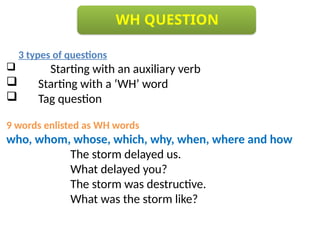
3 types of questions
 Starting with an auxiliary verb
 Starting with a ‘WH’ word
 Tag question
9 words enlisted as WH words
who, whom, whose, which, why, when, where and how
The storm delayed us.
What delayed you?
The storm was destructive.
What was the storm like?
WH QUESTION
 Basing on the importance of subject, object,
reason, time or any other information in the
assertive sentence, a WH question is formulated.
If a part of a sentence is underlined, option
becomes restricted to that part only.
No part of the underlined sentence should be
used in the question, if not absolutely unavoidable.
While framing WH ques, WH word is always
placed at the beginning.
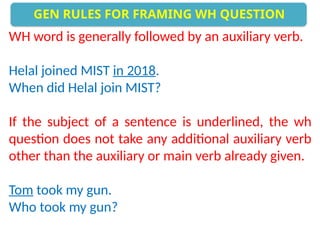
GEN RULES FOR FRAMING WH QUESTION
WH word is generally followed by an auxiliary verb.
Helal joined MIST in 2018.
When did Helal join MIST?
If the subject of a sentence is underlined, the wh
question does not take any additional auxiliary verb
other than the auxiliary or main verb already given.
Tom took my gun.
Who took my gun?
GEN RULES FOR FRAMING WH QUESTION
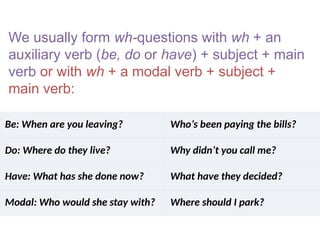
We usually form wh-questions with wh + an
auxiliary verb (be, do or have) + subject + main
verb or with wh + a modal verb + subject +
main verb:
Be: When are you leaving? Who’s been paying the bills?
Do: Where do they live? Why didn’t you call me?
Have: What has she done now? What have they decided?
Modal: Who would she stay with? Where should I park?
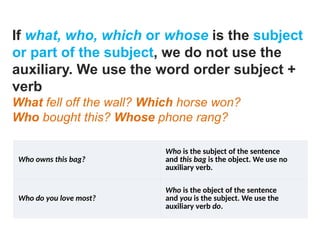
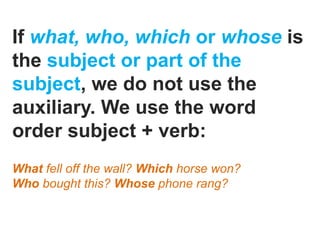
If what, who, which or whose is the subject
or part of the subject, we do not use the
auxiliary. We use the word order subject +
verb
What fell off the wall? Which horse won?
Who bought this? Whose phone rang?
Who owns this bag?
Who is the subject of the sentence
and this bag is the object. We use no
auxiliary verb.
Who do you love most?
Who is the object of the sentence
and you is the subject. We use the
auxiliary verb do.
 Person should be changed according to sense conveyed.
Normally the first person of the statement becomes
second person and vice-versa in the question.
In places where there is a requirement of using ‘whom’,
‘who’ should be preferably used. (Normally ‘whom’ is used
in formal and ‘who’ in informal situations).
 Note of interrogation must be put at the end of the
question.
GEN RULES FOR FRAMING WH QUESTION
Tom took my gun.
Who took my gun?
Zarin likes music and dance.
Who likes music and dance?
The storm delayed us.
What delayed you?
The trees grew greener and greener.
What grew greener and greener?
The news makes me laugh.
What makes you laugh?
The moon gives me pleasure.
What gives you pleasure?
WHEN THE SUBJECT OR NOMINATIVE IS UNDERLINED
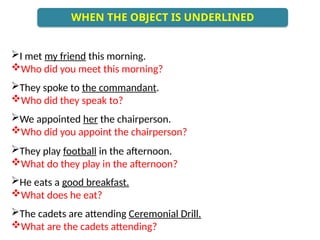
I met my friend this morning.
Who did you meet this morning?
They spoke to the commandant.
Who did they speak to?
We appointed her the chairperson.
Who did you appoint the chairperson?
They play football in the afternoon.
What do they play in the afternoon?
He eats a good breakfast.
What does he eat?
The cadets are attending Ceremonial Drill.
What are the cadets attending?
WHEN THE OBJECT IS UNDERLINED
WHEN POSSESSIVES ARE UNDERLINED
The girl is driving her father’s car.
Whose car is the girl driving?
I took his book.
Whose book did you take?
It is Mr Sham’s shop.
Whose shop is it?
It is mine.
Whose is this?
They are Ann’s.
Whose are these?
He went to market for buying a shirt.
What did he go to market for?
Or, Why did he go to market?
We read books for pleasure.
What do you read books for?
Or, Why do you read books?
Chittagong is famous for shrines.
What is Chittagong famous for?
Or, Why is Chittagong famous?
WHEN SOME WORDS OF REASON/PURPOSE ARE
UNDERLINED
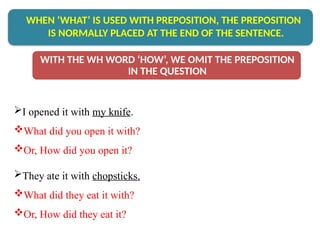
I opened it with my knife.
What did you open it with?
Or, How did you open it?
They ate it with chopsticks.
What did they eat it with?
Or, How did they eat it?
WHEN ‘WHAT’ IS USED WITH PREPOSITION, THE PREPOSITION
IS NORMALLY PLACED AT THE END OF THE SENTENCE.
WITH THE WH WORD ‘HOW’, WE OMIT THE PREPOSITION
IN THE QUESTION
Lispeth is five feet ten in her shoes.
How tall is Lispeth in her shoes?
Or,What is the height of Lispeth in her shoes?
Diana was thirty six.
What was Diana’s age?
Or,How old was Diana?
The road is five kilometers.
What is the length of the road?
Or,How long is the road?
The pole is 50 meters high.
What is the height of the pole?
Or,How high is the pole?
WHEN AGE, DEPTH, HEIGHT, LENGTH, WIDTH ARE
UNDERLINED
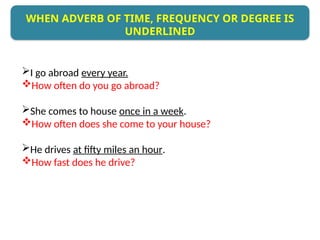
I go abroad every year.
How often do you go abroad?
She comes to house once in a week.
How often does she come to your house?
He drives at fifty miles an hour.
How fast does he drive?
WHEN ADVERB OF TIME, FREQUENCY OR DEGREE IS
UNDERLINED
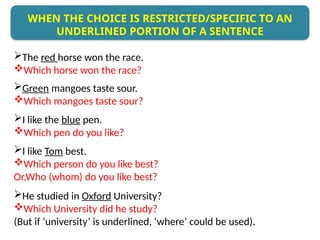
The red horse won the race.
Which horse won the race?
Green mangoes taste sour.
Which mangoes taste sour?
I like the blue pen.
Which pen do you like?
I like Tom best.
Which person do you like best?
Or,Who (whom) do you like best?
He studied in Oxford University?
Which University did he study?
(But if ‘university’ is underlined, ‘where’ could be used).
WHEN THE CHOICE IS RESTRICTED/SPECIFIC TO AN
UNDERLINED PORTION OF A SENTENCE
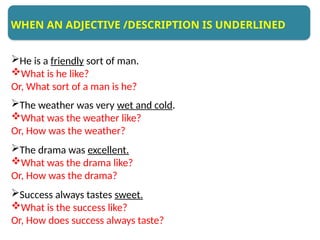
He is a friendly sort of man.
What is he like?
Or, What sort of a man is he?
The weather was very wet and cold.
What was the weather like?
Or, How was the weather?
The drama was excellent.
What was the drama like?
Or, How was the drama?
Success always tastes sweet.
What is the success like?
Or, How does success always taste?
WHEN AN ADJECTIVE /DESCRIPTION IS UNDERLINED
He maintains his family with much hardship.
How does he maintain his family?
He shone in his life by dint of hard work.
How did he shine in his life?
The novel is very interesting.
How interesting is the novel?
The horse can run very fast.
How fast can the horse run?
Anis is extremely tired.
How tired is Anis?
The car costs me five lakh.
How much does the car cost you?
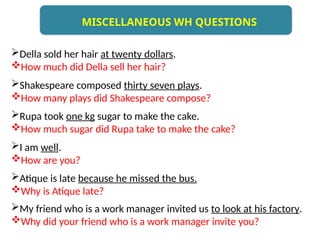
MISCELLANEOUS WH QUESTIONS
Della sold her hair at twenty dollars.
How much did Della sell her hair?
Shakespeare composed thirty seven plays.
How many plays did Shakespeare compose?
Rupa took one kg sugar to make the cake.
How much sugar did Rupa take to make the cake?
I am well.
How are you?
Atique is late because he missed the bus.
Why is Atique late?
My friend who is a work manager invited us to look at his factory.
Why did your friend who is a work manager invite you?
MISCELLANEOUS WH QUESTIONS
Helal joined MIST in 2018.
When did Helal join MIST?
The school begins at 8 O’clock.
When does the school begin?
The castle was built during the 15th
century.
When was the castle built?
The parcel is from Dhaka.
Where is the parcel from?
She goes to market every Friday.
Where does she go every Friday?
MISCELLANEOUS WH QUESTIONS
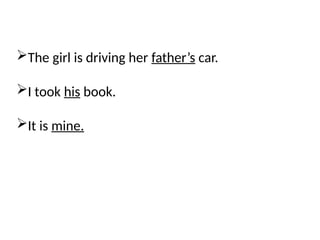
The girl is driving her father’s car.
I took his book.
It is mine.
He shone in his life by dint of hard work.
The novel is very interesting.
The horse can run very fast.
Anis is extremely tired.
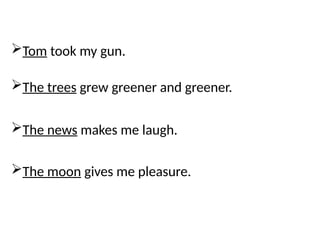
Tom took my gun.
The trees grew greener and greener.
The news makes me laugh.
The moon gives me pleasure.
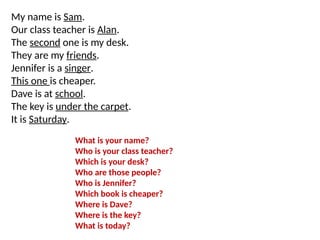
My name is Sam.
Our class teacher is Alan.
The second one is my desk.
They are my friends.
Jennifer is a singer.
This one is cheaper.
Dave is at school.
The key is under the carpet.
It is Saturday.
What is your name?
Who is your class teacher?
Which is your desk?
Who are those people?
Who is Jennifer?
Which book is cheaper?
Where is Dave?
Where is the key?
What is today?
TAG QUESTION or QUESTION TAG
Tag means to affix something. In conversation we
add some questions with our statements to second
our opinion and this are tag questions. As for
example, Fishes swim in water, don’t they? Here the
questioner is looking for vote from the listener.
TAG QUESTIONS
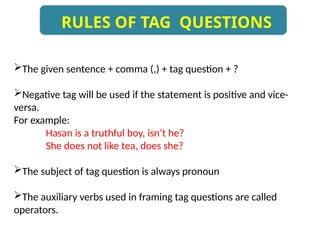
The given sentence + comma (,) + tag question + ?
Negative tag will be used if the statement is positive and vice-
versa.
For example:
Hasan is a truthful boy, isn’t he?
She does not like tea, does she?
The subject of tag question is always pronoun
The auxiliary verbs used in framing tag questions are called
operators.
RULES OF TAG QUESTIONS
TAG FORM OF THE OPERATORS
am not = aren’t is not = isn’t are not = aren’t
was not = wasn’t were not = weren’t will not = won’t
shall not = shan’t cannot = can’t could not = couldn’t
may not = mayn’t might not = mightn’t must not = mustn’t
has not = hasn’t have not = haven’t had not = hadn’t
do not = don’t does not = doesn’t did not = didn’t
ought not = oughtn’t dare not = daren’t need not = needn’t
RULES OF TAG QUESTIONS
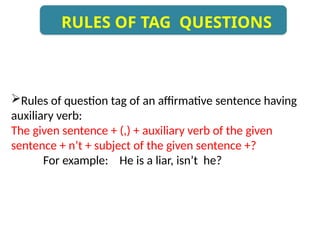
Rules of question tag of an affirmative sentence having
auxiliary verb:
The given sentence + (,) + auxiliary verb of the given
sentence + n’t + subject of the given sentence +?
For example: He is a liar, isn’t he?
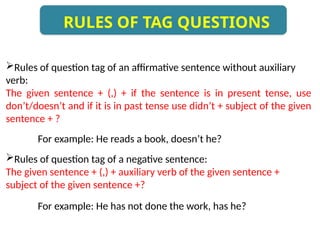
Rules of question tag of an affirmative sentence without auxiliary
verb:
The given sentence + (,) + if the sentence is in present tense, use
don’t/doesn’t and if it is in past tense use didn’t + subject of the given
sentence + ?
For example: He reads a book, doesn’t he?
Rules of question tag of a negative sentence:
The given sentence + (,) + auxiliary verb of the given sentence +
subject of the given sentence +?
For example: He has not done the work, has he?
RULES OF TAG QUESTIONS
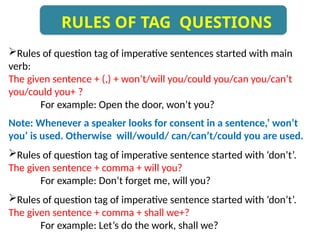
Rules of question tag of imperative sentences started with main
verb:
The given sentence + (,) + won’t/will you/could you/can you/can’t
you/could you+ ?
For example: Open the door, won’t you?
Note: Whenever a speaker looks for consent in a sentence,’ won’t
you’ is used. Otherwise will/would/ can/can’t/could you are used.
Rules of question tag of imperative sentence started with ‘don’t’.
The given sentence + comma + will you?
For example: Don’t forget me, will you?
Rules of question tag of imperative sentence started with ‘don’t’.
The given sentence + comma + shall we+?
For example: Let’s do the work, shall we?
RULES OF TAG QUESTIONS
If any sentence starts with ‘let him/let her/let them’ and express
permission, the tag portion will take ‘will you’.
For example: Let them do their work, will you?
Rules of question tag of exclamatory sentence with ‘be verb’.
The given sentence + comma + isn’t/aren’t + subject of the given
sentence+?
For example: How fine the flower is, isn’t it?
Rules of question tag of exclamatory sentence with ‘main verb’.
The given sentence + comma + don’t/doesn’t/didn’t + subject +?
For example: How sweetly the bird sings, doesn’t it?
RULES OF TAG QUESTIONS
Rules of question tag of sentence started with I as subject.
Here after positive statement ‘aren’t’ is used.
For example: I am happy, aren’t I?
Rules of question tag of assertive sentences in which
nothing/anything/something/everything are used as subjects.
In tag portion ‘it’ will be used as subject.
For example:
Nothing is certain, is it?
Everything was lost, wasn’t it?
Something is better than nothing, isn’t it?
RULES OF TAG QUESTIONS
If everybody/somebody/anybody/everyone/someone/anyone/
nobody/none are used as subject of sentences, ‘they’ will be used as
subject of the tag portion.
For example:
Everybody likes flowers, don’t they?
Somebody came here, didn’t they?
Anybody can do this, can’t they?
Everyone has left the place, haven’t they?
Someone will go there, won’t they?
Anyone may answer, mayn’t they?
Nobody phoned, did they?
None can help you, can they?
RULES OF TAG QUESTIONS
If ‘all of us/some of us/everyone of us/most of us’ are used as
subject of sentences, ‘we’ will be used as subject of the tag portion.
For example:
All of us attended the meeting, didn’t we?
None of us can solve this problem, can we?
If ‘all of them/some of them/everyone of them/most of them are
used as subject of sentences, ‘they’ will be used as subject of the
tag portion.
For example:
All of them are very sincere, aren’t they?
Most of them were absent, weren’t they?
RULES OF TAG QUESTIONS
If what, who, which or whose is
the subject or part of the
subject, we do not use the
auxiliary. We use the word
order subject + verb:
What fell off the wall? Which horse won?
Who bought this? Whose phone rang?
We usually form wh-questions with wh + an
auxiliary verb (be, do or have) + subject + main
verb or with wh + a modal verb + subject +
main verb:
Be: When are you leaving? Who’s been paying the bills?
Do: Where do they live? Why didn’t you call me?
Have: What has she done now? What have they decided?
Modal: Who would she stay with? Where should I park?

Important WH &&&&&&&&& Tag Question.pptx

  • 1.
  • 2.
    3 types ofquestions  Starting with an auxiliary verb  Starting with a ‘WH’ word  Tag question 9 words enlisted as WH words who, whom, whose, which, why, when, where and how The storm delayed us. What delayed you? The storm was destructive. What was the storm like? WH QUESTION
  • 3.
     Basing onthe importance of subject, object, reason, time or any other information in the assertive sentence, a WH question is formulated. If a part of a sentence is underlined, option becomes restricted to that part only. No part of the underlined sentence should be used in the question, if not absolutely unavoidable. While framing WH ques, WH word is always placed at the beginning. GEN RULES FOR FRAMING WH QUESTION
  • 4.
    WH word isgenerally followed by an auxiliary verb. Helal joined MIST in 2018. When did Helal join MIST? If the subject of a sentence is underlined, the wh question does not take any additional auxiliary verb other than the auxiliary or main verb already given. Tom took my gun. Who took my gun? GEN RULES FOR FRAMING WH QUESTION
  • 5.
    We usually formwh-questions with wh + an auxiliary verb (be, do or have) + subject + main verb or with wh + a modal verb + subject + main verb: Be: When are you leaving? Who’s been paying the bills? Do: Where do they live? Why didn’t you call me? Have: What has she done now? What have they decided? Modal: Who would she stay with? Where should I park?
  • 6.
    If what, who,which or whose is the subject or part of the subject, we do not use the auxiliary. We use the word order subject + verb What fell off the wall? Which horse won? Who bought this? Whose phone rang? Who owns this bag? Who is the subject of the sentence and this bag is the object. We use no auxiliary verb. Who do you love most? Who is the object of the sentence and you is the subject. We use the auxiliary verb do.
  • 7.
     Person shouldbe changed according to sense conveyed. Normally the first person of the statement becomes second person and vice-versa in the question. In places where there is a requirement of using ‘whom’, ‘who’ should be preferably used. (Normally ‘whom’ is used in formal and ‘who’ in informal situations).  Note of interrogation must be put at the end of the question. GEN RULES FOR FRAMING WH QUESTION
  • 9.
    Tom took mygun. Who took my gun? Zarin likes music and dance. Who likes music and dance? The storm delayed us. What delayed you? The trees grew greener and greener. What grew greener and greener? The news makes me laugh. What makes you laugh? The moon gives me pleasure. What gives you pleasure? WHEN THE SUBJECT OR NOMINATIVE IS UNDERLINED
  • 10.
    I met myfriend this morning. Who did you meet this morning? They spoke to the commandant. Who did they speak to? We appointed her the chairperson. Who did you appoint the chairperson? They play football in the afternoon. What do they play in the afternoon? He eats a good breakfast. What does he eat? The cadets are attending Ceremonial Drill. What are the cadets attending? WHEN THE OBJECT IS UNDERLINED
  • 11.
    WHEN POSSESSIVES AREUNDERLINED The girl is driving her father’s car. Whose car is the girl driving? I took his book. Whose book did you take? It is Mr Sham’s shop. Whose shop is it? It is mine. Whose is this? They are Ann’s. Whose are these?
  • 12.
    He went tomarket for buying a shirt. What did he go to market for? Or, Why did he go to market? We read books for pleasure. What do you read books for? Or, Why do you read books? Chittagong is famous for shrines. What is Chittagong famous for? Or, Why is Chittagong famous? WHEN SOME WORDS OF REASON/PURPOSE ARE UNDERLINED
  • 13.
    I opened itwith my knife. What did you open it with? Or, How did you open it? They ate it with chopsticks. What did they eat it with? Or, How did they eat it? WHEN ‘WHAT’ IS USED WITH PREPOSITION, THE PREPOSITION IS NORMALLY PLACED AT THE END OF THE SENTENCE. WITH THE WH WORD ‘HOW’, WE OMIT THE PREPOSITION IN THE QUESTION
  • 14.
    Lispeth is fivefeet ten in her shoes. How tall is Lispeth in her shoes? Or,What is the height of Lispeth in her shoes? Diana was thirty six. What was Diana’s age? Or,How old was Diana? The road is five kilometers. What is the length of the road? Or,How long is the road? The pole is 50 meters high. What is the height of the pole? Or,How high is the pole? WHEN AGE, DEPTH, HEIGHT, LENGTH, WIDTH ARE UNDERLINED
  • 15.
    I go abroadevery year. How often do you go abroad? She comes to house once in a week. How often does she come to your house? He drives at fifty miles an hour. How fast does he drive? WHEN ADVERB OF TIME, FREQUENCY OR DEGREE IS UNDERLINED
  • 16.
    The red horsewon the race. Which horse won the race? Green mangoes taste sour. Which mangoes taste sour? I like the blue pen. Which pen do you like? I like Tom best. Which person do you like best? Or,Who (whom) do you like best? He studied in Oxford University? Which University did he study? (But if ‘university’ is underlined, ‘where’ could be used). WHEN THE CHOICE IS RESTRICTED/SPECIFIC TO AN UNDERLINED PORTION OF A SENTENCE
  • 17.
    He is afriendly sort of man. What is he like? Or, What sort of a man is he? The weather was very wet and cold. What was the weather like? Or, How was the weather? The drama was excellent. What was the drama like? Or, How was the drama? Success always tastes sweet. What is the success like? Or, How does success always taste? WHEN AN ADJECTIVE /DESCRIPTION IS UNDERLINED
  • 18.
    He maintains hisfamily with much hardship. How does he maintain his family? He shone in his life by dint of hard work. How did he shine in his life? The novel is very interesting. How interesting is the novel? The horse can run very fast. How fast can the horse run? Anis is extremely tired. How tired is Anis? The car costs me five lakh. How much does the car cost you? MISCELLANEOUS WH QUESTIONS
  • 19.
    Della sold herhair at twenty dollars. How much did Della sell her hair? Shakespeare composed thirty seven plays. How many plays did Shakespeare compose? Rupa took one kg sugar to make the cake. How much sugar did Rupa take to make the cake? I am well. How are you? Atique is late because he missed the bus. Why is Atique late? My friend who is a work manager invited us to look at his factory. Why did your friend who is a work manager invite you? MISCELLANEOUS WH QUESTIONS
  • 20.
    Helal joined MISTin 2018. When did Helal join MIST? The school begins at 8 O’clock. When does the school begin? The castle was built during the 15th century. When was the castle built? The parcel is from Dhaka. Where is the parcel from? She goes to market every Friday. Where does she go every Friday? MISCELLANEOUS WH QUESTIONS
  • 21.
    The girl isdriving her father’s car. I took his book. It is mine.
  • 22.
    He shone inhis life by dint of hard work. The novel is very interesting. The horse can run very fast. Anis is extremely tired.
  • 23.
    Tom took mygun. The trees grew greener and greener. The news makes me laugh. The moon gives me pleasure.
  • 24.
    My name isSam. Our class teacher is Alan. The second one is my desk. They are my friends. Jennifer is a singer. This one is cheaper. Dave is at school. The key is under the carpet. It is Saturday. What is your name? Who is your class teacher? Which is your desk? Who are those people? Who is Jennifer? Which book is cheaper? Where is Dave? Where is the key? What is today?


  • 25.
    TAG QUESTION orQUESTION TAG Tag means to affix something. In conversation we add some questions with our statements to second our opinion and this are tag questions. As for example, Fishes swim in water, don’t they? Here the questioner is looking for vote from the listener. TAG QUESTIONS
  • 26.
    The given sentence+ comma (,) + tag question + ? Negative tag will be used if the statement is positive and vice- versa. For example: Hasan is a truthful boy, isn’t he? She does not like tea, does she? The subject of tag question is always pronoun The auxiliary verbs used in framing tag questions are called operators. RULES OF TAG QUESTIONS
  • 27.
    TAG FORM OFTHE OPERATORS am not = aren’t is not = isn’t are not = aren’t was not = wasn’t were not = weren’t will not = won’t shall not = shan’t cannot = can’t could not = couldn’t may not = mayn’t might not = mightn’t must not = mustn’t has not = hasn’t have not = haven’t had not = hadn’t do not = don’t does not = doesn’t did not = didn’t ought not = oughtn’t dare not = daren’t need not = needn’t RULES OF TAG QUESTIONS
  • 28.
    RULES OF TAGQUESTIONS Rules of question tag of an affirmative sentence having auxiliary verb: The given sentence + (,) + auxiliary verb of the given sentence + n’t + subject of the given sentence +? For example: He is a liar, isn’t he?
  • 29.
    Rules of questiontag of an affirmative sentence without auxiliary verb: The given sentence + (,) + if the sentence is in present tense, use don’t/doesn’t and if it is in past tense use didn’t + subject of the given sentence + ? For example: He reads a book, doesn’t he? Rules of question tag of a negative sentence: The given sentence + (,) + auxiliary verb of the given sentence + subject of the given sentence +? For example: He has not done the work, has he? RULES OF TAG QUESTIONS
  • 30.
    Rules of questiontag of imperative sentences started with main verb: The given sentence + (,) + won’t/will you/could you/can you/can’t you/could you+ ? For example: Open the door, won’t you? Note: Whenever a speaker looks for consent in a sentence,’ won’t you’ is used. Otherwise will/would/ can/can’t/could you are used. Rules of question tag of imperative sentence started with ‘don’t’. The given sentence + comma + will you? For example: Don’t forget me, will you? Rules of question tag of imperative sentence started with ‘don’t’. The given sentence + comma + shall we+? For example: Let’s do the work, shall we? RULES OF TAG QUESTIONS
  • 31.
    If any sentencestarts with ‘let him/let her/let them’ and express permission, the tag portion will take ‘will you’. For example: Let them do their work, will you? Rules of question tag of exclamatory sentence with ‘be verb’. The given sentence + comma + isn’t/aren’t + subject of the given sentence+? For example: How fine the flower is, isn’t it? Rules of question tag of exclamatory sentence with ‘main verb’. The given sentence + comma + don’t/doesn’t/didn’t + subject +? For example: How sweetly the bird sings, doesn’t it? RULES OF TAG QUESTIONS
  • 32.
    Rules of questiontag of sentence started with I as subject. Here after positive statement ‘aren’t’ is used. For example: I am happy, aren’t I? Rules of question tag of assertive sentences in which nothing/anything/something/everything are used as subjects. In tag portion ‘it’ will be used as subject. For example: Nothing is certain, is it? Everything was lost, wasn’t it? Something is better than nothing, isn’t it? RULES OF TAG QUESTIONS
  • 33.
    If everybody/somebody/anybody/everyone/someone/anyone/ nobody/none areused as subject of sentences, ‘they’ will be used as subject of the tag portion. For example: Everybody likes flowers, don’t they? Somebody came here, didn’t they? Anybody can do this, can’t they? Everyone has left the place, haven’t they? Someone will go there, won’t they? Anyone may answer, mayn’t they? Nobody phoned, did they? None can help you, can they? RULES OF TAG QUESTIONS
  • 34.
    If ‘all ofus/some of us/everyone of us/most of us’ are used as subject of sentences, ‘we’ will be used as subject of the tag portion. For example: All of us attended the meeting, didn’t we? None of us can solve this problem, can we? If ‘all of them/some of them/everyone of them/most of them are used as subject of sentences, ‘they’ will be used as subject of the tag portion. For example: All of them are very sincere, aren’t they? Most of them were absent, weren’t they? RULES OF TAG QUESTIONS
  • 40.
    If what, who,which or whose is the subject or part of the subject, we do not use the auxiliary. We use the word order subject + verb: What fell off the wall? Which horse won? Who bought this? Whose phone rang?
  • 41.
    We usually formwh-questions with wh + an auxiliary verb (be, do or have) + subject + main verb or with wh + a modal verb + subject + main verb: Be: When are you leaving? Who’s been paying the bills? Do: Where do they live? Why didn’t you call me? Have: What has she done now? What have they decided? Modal: Who would she stay with? Where should I park?