. M O N T S E . J E S S . L O R E . T E F F Y . G I B R A N .
ADVERBS
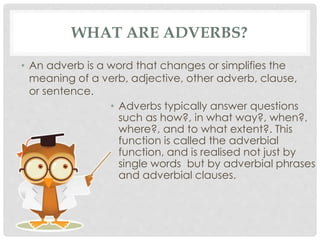
WHAT ARE ADVERBS?
• An adverb is a word that changes or simplifies the
meaning of a verb, adjective, other adverb, clause,
or sentence.
• Adverbs typically answer questions
such as how?, in what way?, when?,
where?, and to what extent?. This
function is called the adverbial
function, and is realised not just by
single words but by adverbial phrases
and adverbial clauses.
ADVERBS OF MANNER
Describe how something happens. Where there are
two or more verbs in a sentence, adverb placement
affects the meaning.
• Carefully
• Correctly
• Eagerly
• Easily
• Loudly
• Patiently
• Quickly
• Quietly
Example:
• She decided to write her paper. (no
adverbs)
•She quickly decided to write her
paper. (her decision was quick)
•She decided to write her paper
quickly. (her writing was quick)
ADVERBS OF PLACE
Describe where something happens. Most adverbs of
place are also used as prepositions.
• Abroad
• Anywhere
• Downstairs
• Here
• Home
• In
• Nowhere
• Out
• Outside
• Somewhere
• There
• Underground
• Upstairs.
Example:
•I wanted to go upstairs.
•She has lived in the city since June. (in
the city prepositional phrase)
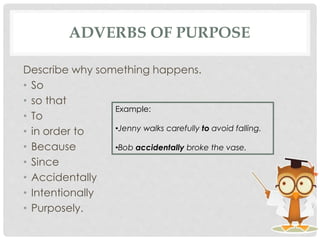
ADVERBS OF PURPOSE
Describe why something happens.
• So
• so that
• To
• in order to
• Because
• Since
• Accidentally
• Intentionally
• Purposely.
Example:
•Jenny walks carefully to avoid falling.
•Bob accidentally broke the vase.
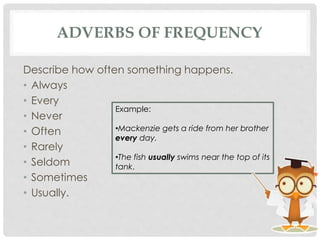
ADVERBS OF FREQUENCY
Describe how often something happens.
• Always
• Every
• Never
• Often
• Rarely
• Seldom
• Sometimes
• Usually.
Example:
•Mackenzie gets a ride from her brother
every day.
•The fish usually swims near the top of its
tank.
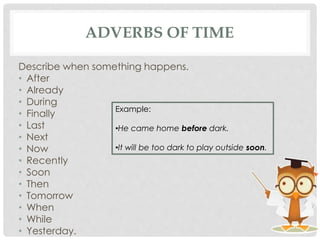
ADVERBS OF TIME
Describe when something happens.
• After
• Already
• During
• Finally
• Last
• Next
• Now
• Recently
• Soon
• Then
• Tomorrow
• When
• While
• Yesterday.
Example:
•He came home before dark.
•It will be too dark to play outside soon.
WARNING!
The adverbs never go between the verb and the
object.
Ejemplos:
• You speak English perfectly.
• You speak perfectly English
*********************************************
THANKS!!

Adverbs

  • 1.
    . M ON T S E . J E S S . L O R E . T E F F Y . G I B R A N . ADVERBS
  • 2.
    WHAT ARE ADVERBS? •An adverb is a word that changes or simplifies the meaning of a verb, adjective, other adverb, clause, or sentence. • Adverbs typically answer questions such as how?, in what way?, when?, where?, and to what extent?. This function is called the adverbial function, and is realised not just by single words but by adverbial phrases and adverbial clauses.
  • 3.
    ADVERBS OF MANNER Describehow something happens. Where there are two or more verbs in a sentence, adverb placement affects the meaning. • Carefully • Correctly • Eagerly • Easily • Loudly • Patiently • Quickly • Quietly Example: • She decided to write her paper. (no adverbs) •She quickly decided to write her paper. (her decision was quick) •She decided to write her paper quickly. (her writing was quick)
  • 4.
    ADVERBS OF PLACE Describewhere something happens. Most adverbs of place are also used as prepositions. • Abroad • Anywhere • Downstairs • Here • Home • In • Nowhere • Out • Outside • Somewhere • There • Underground • Upstairs. Example: •I wanted to go upstairs. •She has lived in the city since June. (in the city prepositional phrase)
  • 5.
    ADVERBS OF PURPOSE Describewhy something happens. • So • so that • To • in order to • Because • Since • Accidentally • Intentionally • Purposely. Example: •Jenny walks carefully to avoid falling. •Bob accidentally broke the vase.
  • 6.
    ADVERBS OF FREQUENCY Describehow often something happens. • Always • Every • Never • Often • Rarely • Seldom • Sometimes • Usually. Example: •Mackenzie gets a ride from her brother every day. •The fish usually swims near the top of its tank.
  • 7.
    ADVERBS OF TIME Describewhen something happens. • After • Already • During • Finally • Last • Next • Now • Recently • Soon • Then • Tomorrow • When • While • Yesterday. Example: •He came home before dark. •It will be too dark to play outside soon.
  • 8.
    WARNING! The adverbs nevergo between the verb and the object. Ejemplos: • You speak English perfectly. • You speak perfectly English
  • 9.