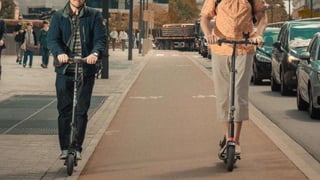
Can scooters improve quality of city life?
Shared micromobility regulation in Brussels, Belgium
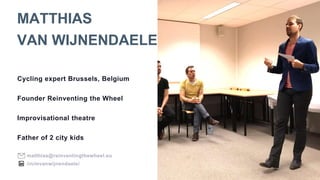
MATTHIAS
VAN WIJNENDAELE
Cycling expert Brussels, Belgium
Founder Reinventing the Wheel
Improvisational theatre
Father of 2 city kids
matthias@reinventingthewheel.eu
/in/mvanwijnendaele/
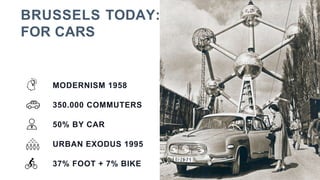
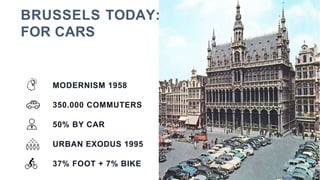
MODERNISM 1958
350.000 COMMUTERS
50% BY CAR
URBAN EXODUS 1995
37% FOOT + 7% BIKE
BRUSSELS TODAY:
FOR CARS
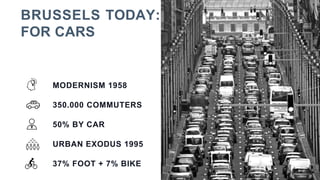
MODERNISM 1958
350.000 COMMUTERS
50% BY CAR
URBAN EXODUS 1995
37% FOOT + 7% BIKE
BRUSSELS TODAY:
FOR CARS
MODERNISM 1958
350.000 COMMUTERS
50% BY CAR
URBAN EXODUS 1995
37% FOOT + 7% BIKE
BRUSSELS TODAY:
FOR CARS
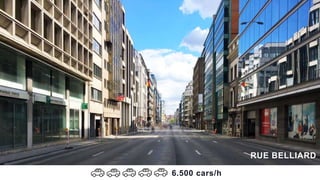
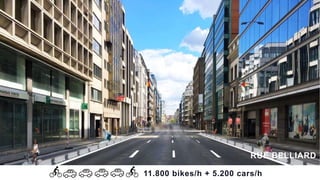
6.500 cars/h
RUE BELLIARD
5.200 cars/h
11.800 bikes/h
+ 3.900 cars/h
BRUSSELS TODAY:
FOR CARS
11.800 bikes/h + 5.200 cars/h
RUE BELLIARD
#BRUSSELSFORPEO
PLE
REYER
S
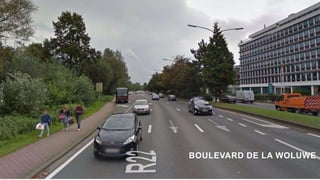
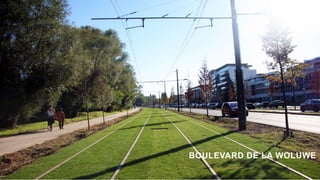
BOULEVARD DE LA WOLUWE
#BRUSSELSFORPEO
PLE
REYER
S
BOULEVARD DE LA WOLUWE
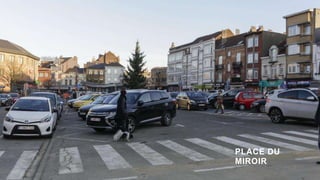
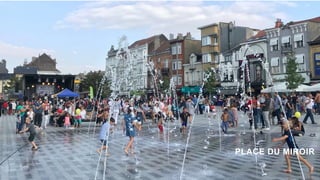
PLACE DU
MIROIR
PLACE DU MIROIR
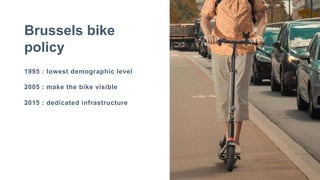
1995 : lowest demographic level
2005 : make the bike visible
2015 : dedicated infrastructure
Brussels bike
policy
1995 : lowest demographic level
2005 : make the bike visible
2015 : dedicated infrastructure
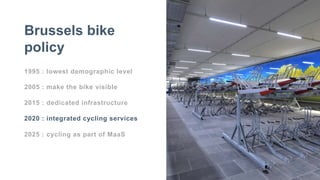
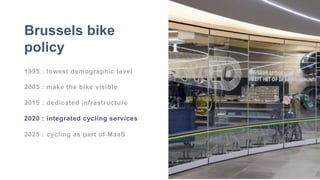
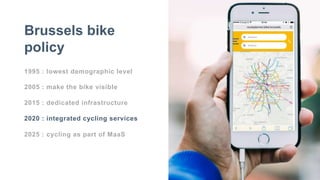
2020 : integrated cycling services
2025 : cycling as part of MaaS
Brussels bike
policy
1995 : lowest demographic level
2005 : make the bike visible
2015 : dedicated infrastructure
2020 : integrated cycling services
2025 : cycling as part of MaaS
Brussels bike
policy
1995 : lowest demographic level
2005 : make the bike visible
2015 : dedicated infrastructure
2020 : integrated cycling services
2025 : cycling as part of MaaS
Brussels bike
policy
1995 : lowest demographic level
2005 : make the bike visible
2015 : dedicated infrastructure
2020 : integrated cycling services
2025 : cycling as part of MaaS
Brussels bike
policy
1995 : lowest demographic level
2005 : make the bike visible
2015 : dedicated infrastructure
2020 : integrated cycling services
2025 : cycling as part of MaaS
Brussels bike
policy
Business interest : #trips, Oakland, 2018
Make cycling easy
Reclaim public space
Guarantee inclusion
Tackle air pollution
Public interest
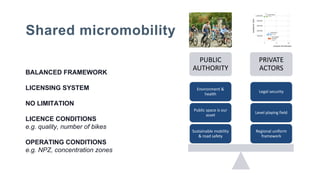
Shared micromobility
BALANCED FRAMEWORK
LICENSING SYSTEM
NO LIMITATION
LICENCE CONDITIONS
e.g. quality, number of bikes
OPERATING CONDITIONS
e.g. NPZ, concentration zones
PUBLIC
AUTHORITY
PRIVATE
ACTORS
Regional uniform
framework
Level playing field
Legal security
Sustainable mobility
& road safety
Public space is our
asset
Environment &
health
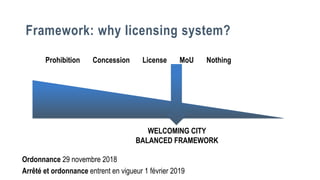
Prohibition Concession License MoU Nothing
WELCOMING CITY
BALANCED FRAMEWORK
Ordonnance 29 novembre 2018
Arrêté et ordonnance entrent en vigueur 1 février 2019
Framework: why licensing system?
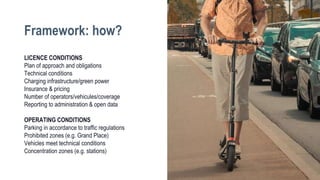
LICENCE CONDITIONS
Plan of approach and obligations
Technical conditions
Charging infrastructure/green power
Insurance & pricing
Number of operators/vehicules/coverage
Reporting to administration & open data
OPERATING CONDITIONS
Parking in accordance to traffic regulations
Prohibited zones (e.g. Grand Place)
Vehicles meet technical conditions
Concentration zones (e.g. stations)
Framework: how?
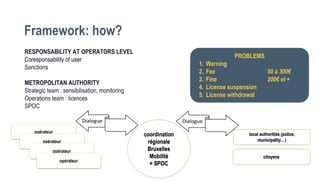
RESPONSABILITY AT OPERATORS LEVEL
Coresponsability of user
Sanctions
METROPOLITAN AUTHORITY
Strategic team : sensibilisation, monitoring
Operations team : licences
SPOC
coordination
régionale
Bruxelles
Mobilité
= SPOC
citoyens
local authorities (police,
municipality…)
opérateur
opérateur
opérateur
opérateur
PROBLEMS
1. Warning
2. Fee 50 à 300€
3. Fine 200€ et +
4. License suspension
5. License withdrawal
Dialogue Dialogue
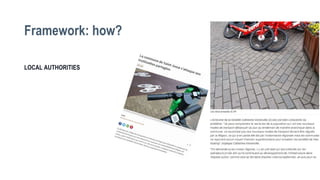
Framework: how?
LOCAL AUTHORITIES
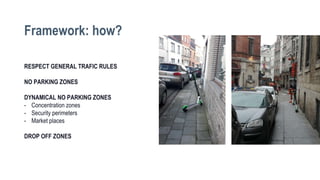
Framework: how?
RESPECT GENERAL TRAFIC RULES
NO PARKING ZONES
DYNAMICAL NO PARKING ZONES
- Concentration zones
- Security perimeters
- Market places
DROP OFF ZONES
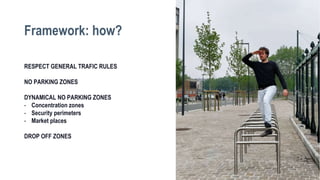
Framework: how?
RESPECT GENERAL TRAFIC RULES
NO PARKING ZONES
DYNAMICAL NO PARKING ZONES
- Concentration zones
- Security perimeters
- Market places
DROP OFF ZONES
Framework: how?
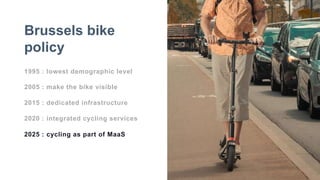
1995 : lowest demographic level
2005 : make the bike visible
2015 : dedicated infrastructure
2020 : integrated cycling services
2025 : cycling as part of MaaS
Brussels bike
policy
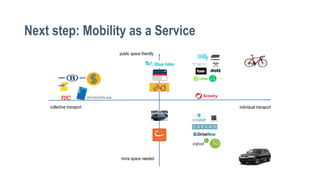
collective transport individual transport
more space needed
public space friendly
Next step: Mobility as a Service
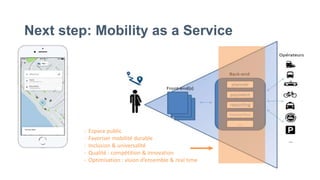
- Espace public
- Favoriser mobilité durable
- Inclusion & universalité
- Qualité : compétition & innovation
- Optimisation : vision d’ensemble & real time
Next step: Mobility as a Service
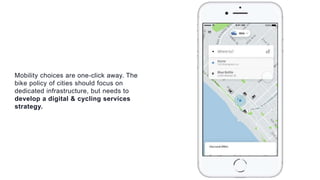
Mobility choices are one-click away. The
bike policy of cities should focus on
dedicated infrastructure, but needs to
develop a digital & cycling services
strategy.
Public authorities & cities need to organise
themselves. We need data standards,
exchange of cities best practices and EU
consumer protection.
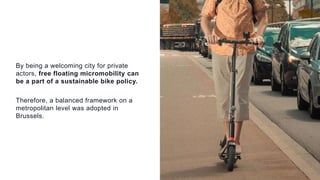
By being a welcoming city for private
actors, free floating micromobility can
be a part of a sustainable bike policy.
Therefore, a balanced framework on a
metropolitan level was adopted in
Brussels.
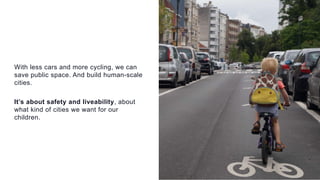
With less cars and more cycling, we can
save public space. And build human-scale
cities.
It’s about safety and liveability, about
what kind of cities we want for our
children.
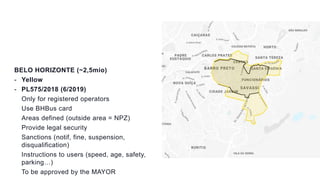
BELO HORIZONTE (~2,5mio)
- Yellow
- PL575/2018 (6/2019)
Only for registered operators
Use BHBus card
Areas defined (outside area = NPZ)
Provide legal security
Sanctions (notif, fine, suspension,
disqualification)
Instructions to users (speed, age, safety,
parking…)
To be approved by the MAYOR
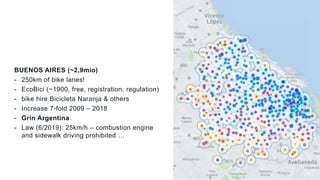
BUENOS AIRES (~2,9mio)
- 250km of bike lanes!
- EcoBici (~1900, free, registration, regulation)
- bike hire Bicicleta Naranja & others
- Increase 7-fold 2009 – 2018
- Grin Argentina
- Law (6/2019): 25km/h – combustion engine
and sidewalk driving prohibited …
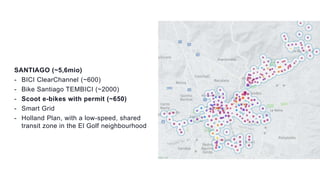
SANTIAGO (~5,6mio)
- BICI ClearChannel (~600)
- Bike Santiago TEMBICI (~2000)
- Scoot e-bikes with permit (~650)
- Smart Grid
- Holland Plan, with a low-speed, shared
transit zone in the El Golf neighbourhood

Are e-scooters a problem or the solution for cities?

  • 1.
    Can scooters improvequality of city life? Shared micromobility regulation in Brussels, Belgium
  • 2.
    MATTHIAS VAN WIJNENDAELE Cycling expertBrussels, Belgium Founder Reinventing the Wheel Improvisational theatre Father of 2 city kids matthias@reinventingthewheel.eu /in/mvanwijnendaele/
  • 3.
    MODERNISM 1958 350.000 COMMUTERS 50%BY CAR URBAN EXODUS 1995 37% FOOT + 7% BIKE BRUSSELS TODAY: FOR CARS
  • 4.
    MODERNISM 1958 350.000 COMMUTERS 50%BY CAR URBAN EXODUS 1995 37% FOOT + 7% BIKE BRUSSELS TODAY: FOR CARS
  • 5.
    MODERNISM 1958 350.000 COMMUTERS 50%BY CAR URBAN EXODUS 1995 37% FOOT + 7% BIKE BRUSSELS TODAY: FOR CARS
  • 7.
  • 8.
    5.200 cars/h 11.800 bikes/h +3.900 cars/h BRUSSELS TODAY: FOR CARS 11.800 bikes/h + 5.200 cars/h RUE BELLIARD
  • 9.
  • 10.
  • 11.
  • 12.
  • 13.
    1995 : lowestdemographic level 2005 : make the bike visible 2015 : dedicated infrastructure Brussels bike policy
  • 17.
    1995 : lowestdemographic level 2005 : make the bike visible 2015 : dedicated infrastructure 2020 : integrated cycling services 2025 : cycling as part of MaaS Brussels bike policy
  • 18.
    1995 : lowestdemographic level 2005 : make the bike visible 2015 : dedicated infrastructure 2020 : integrated cycling services 2025 : cycling as part of MaaS Brussels bike policy
  • 19.
    1995 : lowestdemographic level 2005 : make the bike visible 2015 : dedicated infrastructure 2020 : integrated cycling services 2025 : cycling as part of MaaS Brussels bike policy
  • 20.
    1995 : lowestdemographic level 2005 : make the bike visible 2015 : dedicated infrastructure 2020 : integrated cycling services 2025 : cycling as part of MaaS Brussels bike policy
  • 21.
    1995 : lowestdemographic level 2005 : make the bike visible 2015 : dedicated infrastructure 2020 : integrated cycling services 2025 : cycling as part of MaaS Brussels bike policy
  • 22.
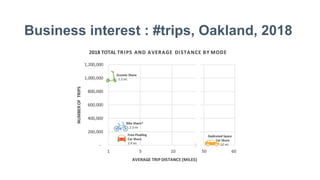
    Business interest :#trips, Oakland, 2018
  • 23.
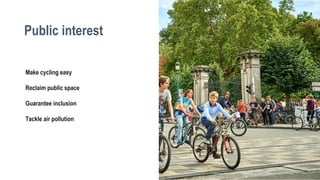
    Make cycling easy Reclaimpublic space Guarantee inclusion Tackle air pollution Public interest
  • 24.
    Shared micromobility BALANCED FRAMEWORK LICENSINGSYSTEM NO LIMITATION LICENCE CONDITIONS e.g. quality, number of bikes OPERATING CONDITIONS e.g. NPZ, concentration zones PUBLIC AUTHORITY PRIVATE ACTORS Regional uniform framework Level playing field Legal security Sustainable mobility & road safety Public space is our asset Environment & health
  • 25.
    Prohibition Concession LicenseMoU Nothing WELCOMING CITY BALANCED FRAMEWORK Ordonnance 29 novembre 2018 Arrêté et ordonnance entrent en vigueur 1 février 2019 Framework: why licensing system?
  • 26.
    LICENCE CONDITIONS Plan ofapproach and obligations Technical conditions Charging infrastructure/green power Insurance & pricing Number of operators/vehicules/coverage Reporting to administration & open data OPERATING CONDITIONS Parking in accordance to traffic regulations Prohibited zones (e.g. Grand Place) Vehicles meet technical conditions Concentration zones (e.g. stations) Framework: how?
  • 27.
    RESPONSABILITY AT OPERATORSLEVEL Coresponsability of user Sanctions METROPOLITAN AUTHORITY Strategic team : sensibilisation, monitoring Operations team : licences SPOC coordination régionale Bruxelles Mobilité = SPOC citoyens local authorities (police, municipality…) opérateur opérateur opérateur opérateur PROBLEMS 1. Warning 2. Fee 50 à 300€ 3. Fine 200€ et + 4. License suspension 5. License withdrawal Dialogue Dialogue Framework: how?
  • 28.
  • 29.
    RESPECT GENERAL TRAFICRULES NO PARKING ZONES DYNAMICAL NO PARKING ZONES - Concentration zones - Security perimeters - Market places DROP OFF ZONES Framework: how?
  • 30.
    RESPECT GENERAL TRAFICRULES NO PARKING ZONES DYNAMICAL NO PARKING ZONES - Concentration zones - Security perimeters - Market places DROP OFF ZONES Framework: how?
  • 31.
    1995 : lowestdemographic level 2005 : make the bike visible 2015 : dedicated infrastructure 2020 : integrated cycling services 2025 : cycling as part of MaaS Brussels bike policy
  • 32.
    collective transport individualtransport more space needed public space friendly Next step: Mobility as a Service
  • 33.
    - Espace public -Favoriser mobilité durable - Inclusion & universalité - Qualité : compétition & innovation - Optimisation : vision d’ensemble & real time Next step: Mobility as a Service
  • 34.
    Mobility choices areone-click away. The bike policy of cities should focus on dedicated infrastructure, but needs to develop a digital & cycling services strategy.
  • 35.
    Public authorities &cities need to organise themselves. We need data standards, exchange of cities best practices and EU consumer protection.
  • 36.
    By being awelcoming city for private actors, free floating micromobility can be a part of a sustainable bike policy. Therefore, a balanced framework on a metropolitan level was adopted in Brussels.
  • 37.
    With less carsand more cycling, we can save public space. And build human-scale cities. It’s about safety and liveability, about what kind of cities we want for our children.
  • 39.
    BELO HORIZONTE (~2,5mio) -Yellow - PL575/2018 (6/2019) Only for registered operators Use BHBus card Areas defined (outside area = NPZ) Provide legal security Sanctions (notif, fine, suspension, disqualification) Instructions to users (speed, age, safety, parking…) To be approved by the MAYOR
  • 40.
    BUENOS AIRES (~2,9mio) -250km of bike lanes! - EcoBici (~1900, free, registration, regulation) - bike hire Bicicleta Naranja & others - Increase 7-fold 2009 – 2018 - Grin Argentina - Law (6/2019): 25km/h – combustion engine and sidewalk driving prohibited …
  • 41.
    SANTIAGO (~5,6mio) - BICIClearChannel (~600) - Bike Santiago TEMBICI (~2000) - Scoot e-bikes with permit (~650) - Smart Grid - Holland Plan, with a low-speed, shared transit zone in the El Golf neighbourhood

Editor's Notes

  • #13 Mobility is not a goal. Quality of life is our goal. Therefore, public space shouldn’t be limited to a mobility function, but extended to a meeting function. Therefore, we should promote cycling.
  • #22 Vertical integration Towards monthly/yearly subscription Next generation vehicles New operators Integrating high-quality cycling services
  • #32 Vertical integration Towards monthly/yearly subscription Next generation vehicles New operators Integrating high-quality cycling services
  • #35 From disruption to resilience From car to cycle oriented Towards a distributed open mobility model
  • #37 From disruption to resilience From car to cycle oriented Towards a distributed open mobility model
  • #38 From disruption to resilience From car to cycle oriented Towards a distributed open mobility model
  • #40 From disruption to resilience From car to cycle oriented Towards a distributed open mobility model
  • #41 From disruption to resilience From car to cycle oriented Towards a distributed open mobility model
  • #42 From disruption to resilience From car to cycle oriented Towards a distributed open mobility model