Basic Moodle for
teachers
Because change and
innovation make us
grow everyday
Course General Objective
Identifying and using tools offered by
the virtual platform Moodle for
designing, publishing and managing
online courses and materials.
Basic Moodle for teachers
Methodology
• Total of hours: 20
F2F 5 two-hour meetings
ONLINE
Teachers will work a minimum of
10 hours on their own.
What is Moodle?
• M odular
• O bject
• O riented
• D ynamic
• L earning
• E nviroment
• Entorno de
• Aprendizaje
• Dinámico
• Modular
• Orientado a
• Objetos
Moodle
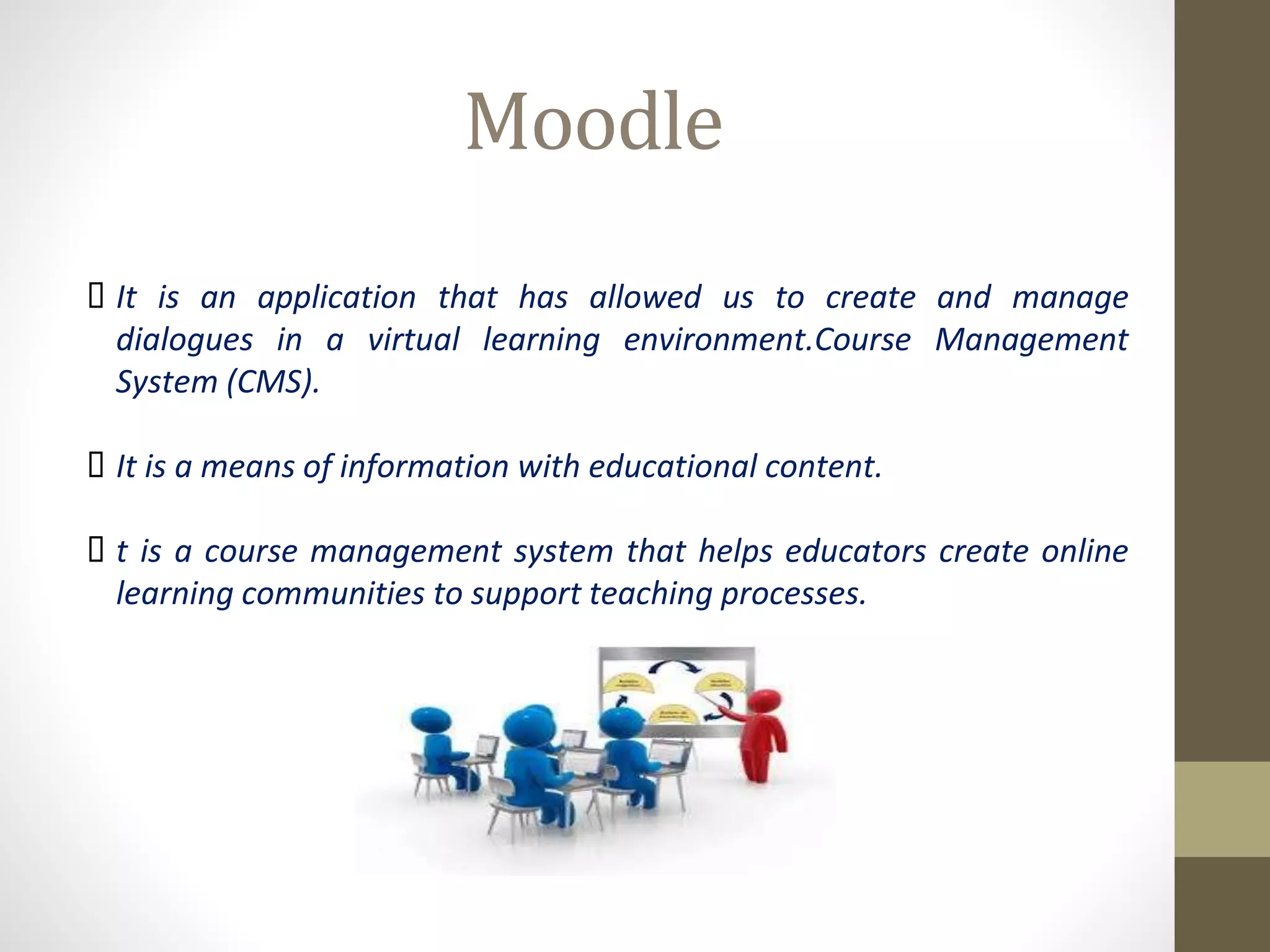
 It is an application that has allowed us to create and manage
dialogues in a virtual learning environment.Course Management
System (CMS).
 It is a means of information with educational content.
 t is a course management system that helps educators create online
learning communities to support teaching processes.
Moodle
Moodle is a highly flexible,
free software, open source
learning platform.
The Oxford School:
• must pay a technological
infrastructure to support the
platform.
• must have a staff to constantly
update the platform and
develop new tools according to
the needs of the teachers.
Moodle Strengths
 Open source, easy to use and friendly Platform.
Flexible and oriented towards collaborative
learning and adaptive to other methods.
Software in constant growing and development
thanks to millions of users and collaborators.
Welcome to…
What is Moodle?
(Click on the links to watch videos)
What is Moodle?
Qué es Moodle?
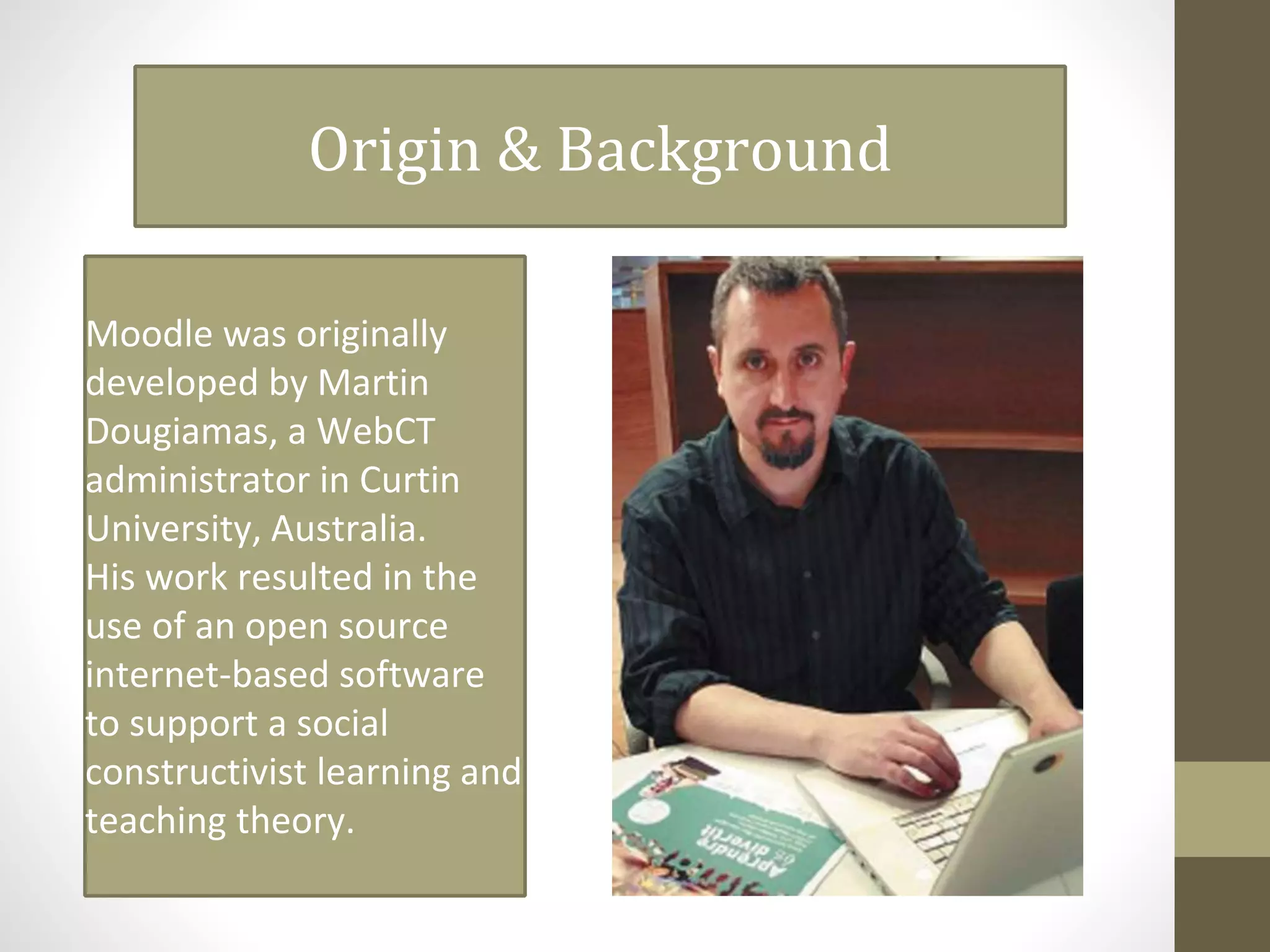
Origin & Background
Moodle was originally
developed by Martin
Dougiamas, a WebCT
administrator in Curtin
University, Australia.
His work resulted in the
use of an open source
internet-based software
to support a social
constructivist learning and
teaching theory.
Moodle promotes a social constructionist pedagogy through collaboration,
different activities, critical reflection, etc.
Its structure and tools are suitable for online classes and also to supplement
classroom learning (F2F).
It has a simple interface and compatible technology.
General Characteristics
The creation of an institutional repository emerged as a necessity to store in
one open place all the material generated in the Faculty, materials that
deserve to be widely accessible in a comprehensive manner.
Therefore, Moodle creators began to implement a repository using DSpace,
an open source application that provides extensive functionality to manage
resources .
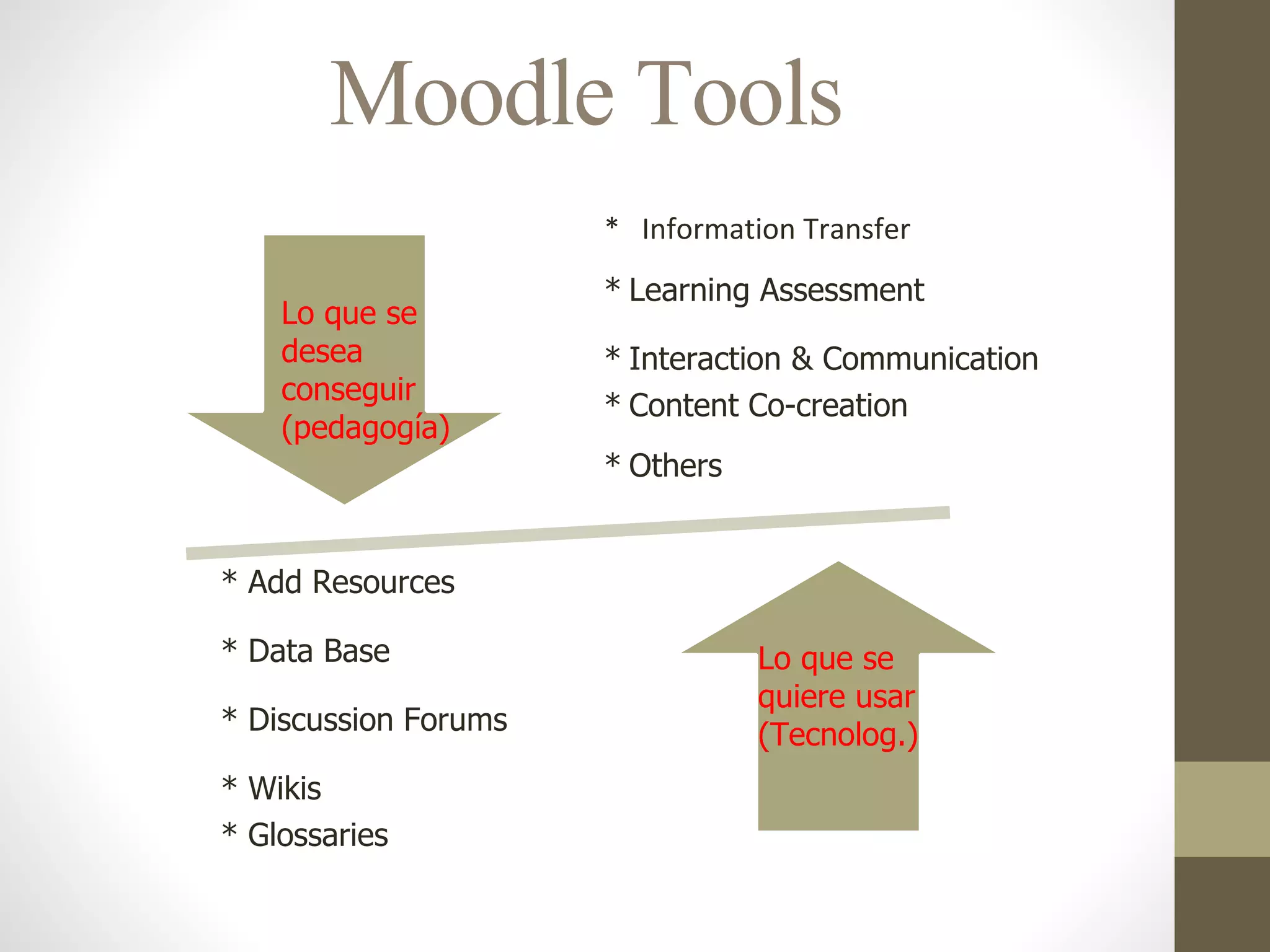
Moodle Tools
* Information Transfer
* Learning Assessment
* Interaction & Communication
* Content Co-creation
* Others
* Add Resources
* Data Base
* Discussion Forums
* Wikis
* Glossaries
Lo que se
desea
conseguir
(pedagogía)
Lo que se
quiere usar
(Tecnolog.)
Counts with:
• + than
50.882 websites
that host courses
in Moodle.
Language:
• Installed in + 208
countries
• + than 100
languages.
• 50.882 w
Environments:
• Institutions
• Universities
• Schools
Moodle Coverage
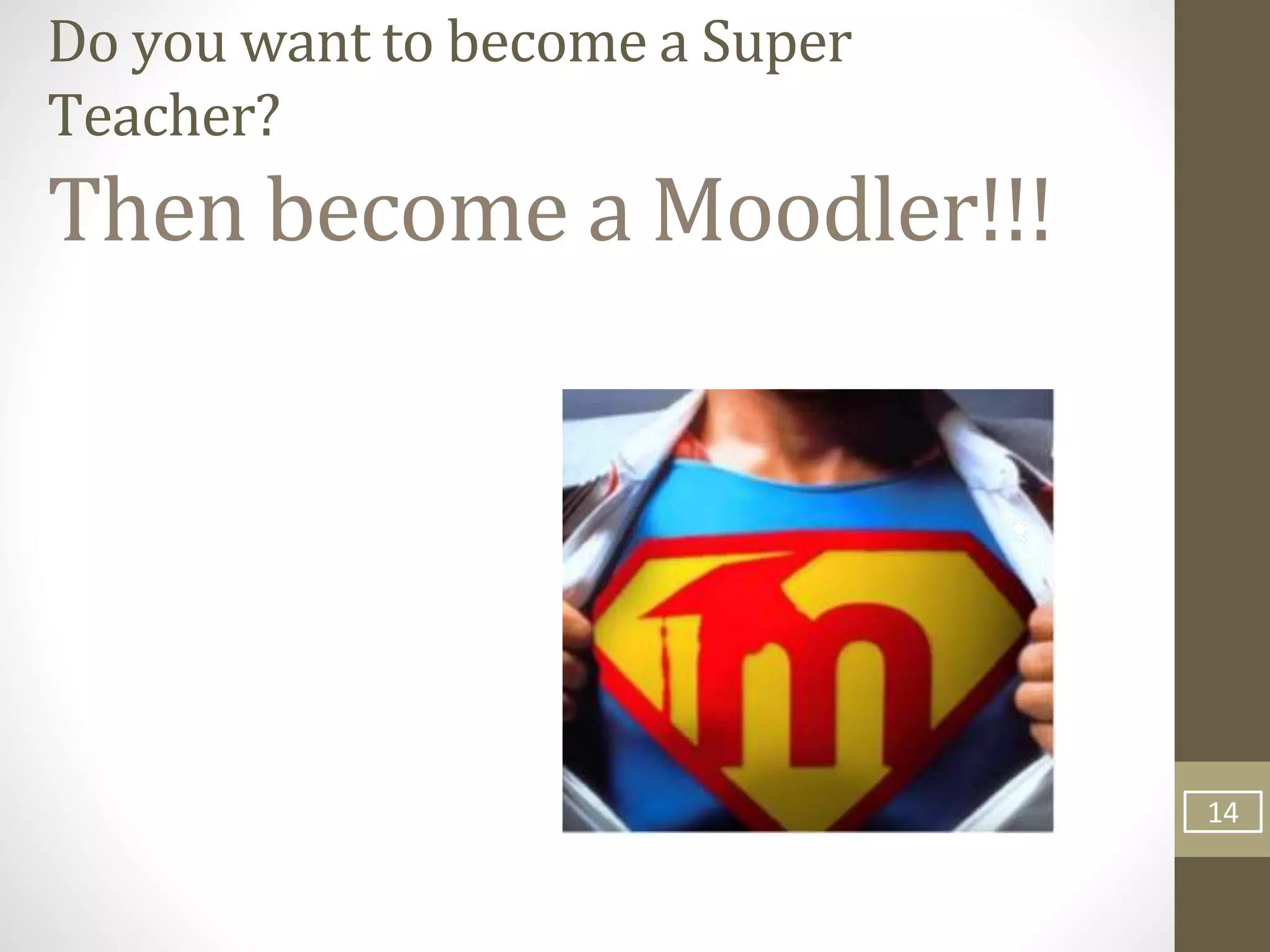
Do you want to become a Super
Teacher?
Then become a Moodler!!!
14

Que es moodle 2015 capa1 fv_eng_le

  • 1.
    Basic Moodle for teachers Becausechange and innovation make us grow everyday
  • 2.
    Course General Objective Identifyingand using tools offered by the virtual platform Moodle for designing, publishing and managing online courses and materials.
  • 3.
    Basic Moodle forteachers Methodology • Total of hours: 20 F2F 5 two-hour meetings ONLINE Teachers will work a minimum of 10 hours on their own.
  • 4.
    What is Moodle? •M odular • O bject • O riented • D ynamic • L earning • E nviroment • Entorno de • Aprendizaje • Dinámico • Modular • Orientado a • Objetos
  • 5.
    Moodle  It isan application that has allowed us to create and manage dialogues in a virtual learning environment.Course Management System (CMS).  It is a means of information with educational content.  t is a course management system that helps educators create online learning communities to support teaching processes.
  • 6.
    Moodle Moodle is ahighly flexible, free software, open source learning platform. The Oxford School: • must pay a technological infrastructure to support the platform. • must have a staff to constantly update the platform and develop new tools according to the needs of the teachers.
  • 7.
    Moodle Strengths  Opensource, easy to use and friendly Platform. Flexible and oriented towards collaborative learning and adaptive to other methods. Software in constant growing and development thanks to millions of users and collaborators.
  • 8.
  • 9.
    What is Moodle? (Clickon the links to watch videos) What is Moodle? Qué es Moodle?
  • 10.
    Origin & Background Moodlewas originally developed by Martin Dougiamas, a WebCT administrator in Curtin University, Australia. His work resulted in the use of an open source internet-based software to support a social constructivist learning and teaching theory.
  • 11.
    Moodle promotes asocial constructionist pedagogy through collaboration, different activities, critical reflection, etc. Its structure and tools are suitable for online classes and also to supplement classroom learning (F2F). It has a simple interface and compatible technology. General Characteristics The creation of an institutional repository emerged as a necessity to store in one open place all the material generated in the Faculty, materials that deserve to be widely accessible in a comprehensive manner. Therefore, Moodle creators began to implement a repository using DSpace, an open source application that provides extensive functionality to manage resources .
  • 12.
    Moodle Tools * InformationTransfer * Learning Assessment * Interaction & Communication * Content Co-creation * Others * Add Resources * Data Base * Discussion Forums * Wikis * Glossaries Lo que se desea conseguir (pedagogía) Lo que se quiere usar (Tecnolog.)
  • 13.
    Counts with: • +than 50.882 websites that host courses in Moodle. Language: • Installed in + 208 countries • + than 100 languages. • 50.882 w Environments: • Institutions • Universities • Schools Moodle Coverage
  • 14.
    Do you wantto become a Super Teacher? Then become a Moodler!!! 14