An Open Source Learning Management SystemAn Open Source Learning Management System
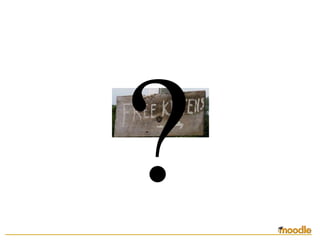
It’s Free! (Like Free Kittens)It’s Free! (Like Free Kittens)
Ken RonkowitzKen Ronkowitz
Moodle was designed to help
foster online learning
communities. It has an active
development and support group
(very important for open-source
projects) and has users in over
150 countries.
Moodle was built following social
constructionist pedagogy as a
virtual learning environment.
150,000 registered users on moodle.org
moodle.org/stats/
Humboldt State Moodle has 12,288
courses and 42,121 users.
The Open University (OU) in
the UK has converted their
courses to MOODLE for their
250,000 students.
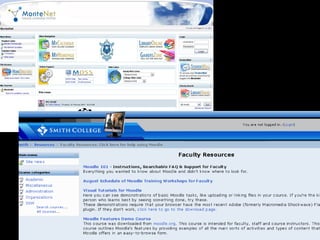
UCLA, UC-San Diego & Smith
College are now using Moodle,
and many are piloting it (Lafayette,
Bennington...) SEE MY BLOG
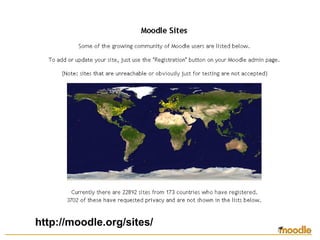
http://moodle.org/sites/
Moodle?
verb - the process of lazily meandering through
something; doing things as it occurs to you to do
them; an enjoyable tinkering that often leads to
insight and creativity.
If you’re writing a proposal, say it means:
Modular Object-Oriented Dynamic Learning
Environment
Either applies to both to the way Moodle was
developed, and to the constructivist pedagogy
that guided the original users group.
Anyone who uses Moodle is a Moodler.
What is Social Constructivism?What is Social Constructivism? Briefly...Briefly...
People actively construct new knowledge as they interact
with their environment.
Everything you read, see, hear, feel, and touch is tested
against your prior knowledge
Knowledge is strengthened if you can use it successfully in
your wider environment.
You are not just a memory bank passively absorbing
information, nor can knowledge be "transmitted" to you just by
reading something or listening to someone.
Learning is particularly effective when constructing something
for others to experience
Social Constructivism extends the above ideas into a social
group constructing things for one another, collaboratively
creating a small culture of shared artifacts with shared
meanings.
More at http://docs.moodle.org/en/Philosophy
Moodle is provided freely as Open Source
software (under the GNU Public License).
Basically this means Moodle is copyrighted, but
that you are allowed to copy, use and modify
Moodle provided that you agree to:
provide the source to others;
not modify or remove the original license and
copyrights,
and apply this same license to any derivative
work.
?
Welcome to Moodle Support
Planning
2 full semesters prior to launch
Transfer of current CMS courses
Moodle accepts IMS course packages with some
caveats
System Admin
minimum 2X current admin
User Training (3 semesters)
creation of training materials (including courses)
simultaneous with initial course transfer
faculty training during two semesters prior to
launch and ongoing during subsequent
semesters.
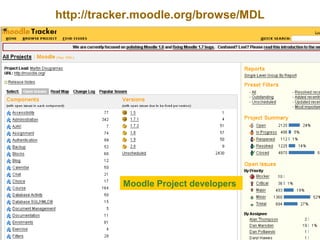
http://tracker.moodle.org/browse/MDL
Moodle Project developers
Commercial Support
moodlerooms.commoodlerooms.com
support
hosting
customization
instruction
training for a single class, school or university.
Is there some system administrator in you?
Moodle runs without modification on Unix, Linux,
Windows, Mac OS X, Netware and any other system
that supports PHP 4.3.0+
Designed in a modular way - allows flexibility to
add/remove functionality at many levels.
Upgrades easily - has an internal system to upgrade its
own databases and repair itself over time.
Requires only one database, generally SQL, and can
share it with other applications if necessary. (MySQL
4.1.16+).
Includes comprehensive database abstraction that
supports many major brands of database.
Emphasis on security - forms are all checked, data
validated, cookies encrypted etc.
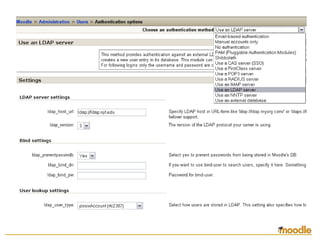
Log InLog In authentication using LDAPauthentication using LDAP
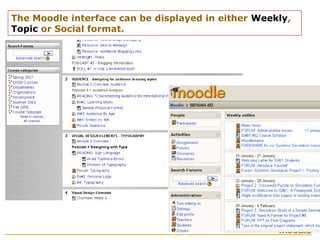
The Moodle interface can be displayed in either Weekly,
Topic or Social format.
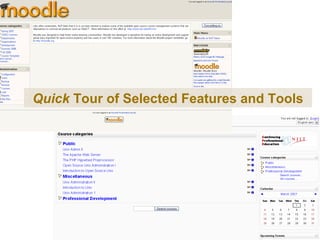
Quick Tour of Selected Features and Tools
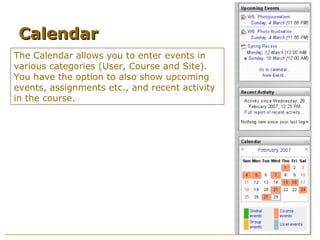
The Calendar allows you to enter events in
various categories (User, Course and Site).
You have the option to also show upcoming
events, assignments etc., and recent activity
in the course.
CalendarCalendar
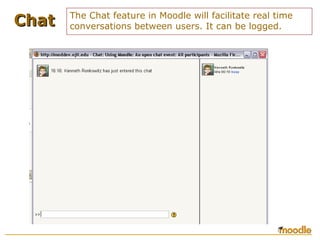
The Chat feature in Moodle will facilitate real time
conversations between users. It can be logged.ChatChat
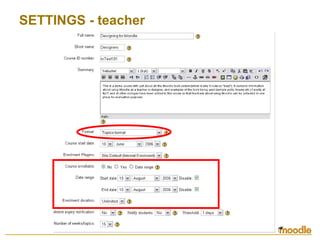
SETTINGS - teacher
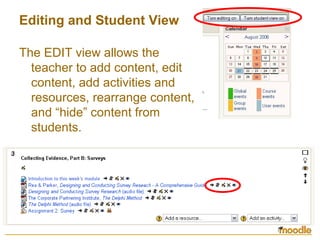
Editing and Student View
The EDIT view allows the
teacher to add content, edit
content, add activities and
resources, rearrange content,
and “hide” content from
students.
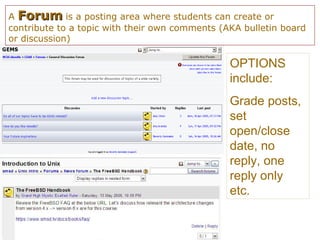
A ForumForum is a posting area where students can create or
contribute to a topic with their own comments (AKA bulletin board
or discussion)
OPTIONS
include:
Grade posts,
set
open/close
date, no
reply, one
reply only
etc.
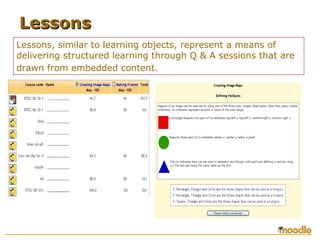
Lessons, similar to learning objects, represent a means of
delivering structured learning through Q & A sessions that are
drawn from embedded content.
LessonsLessons
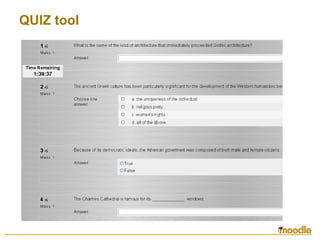
QUIZ tool
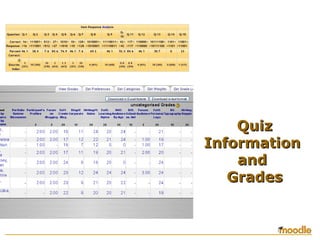
QuizQuiz
InformationInformation
andand
GradesGrades
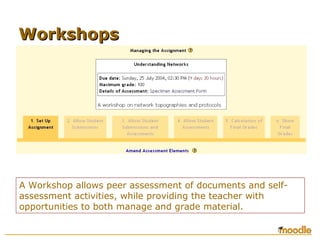
A Workshop allows peer assessment of documents and self-
assessment activities, while providing the teacher with
opportunities to both manage and grade material.
WorkshopsWorkshops
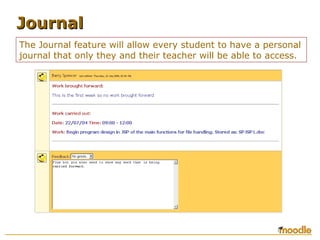
The Journal feature will allow every student to have a personal
journal that only they and their teacher will be able to access.
JournalJournal
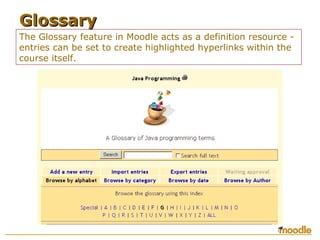
The Glossary feature in Moodle acts as a definition resource -
entries can be set to create highlighted hyperlinks within the
course itself.
GlossaryGlossary
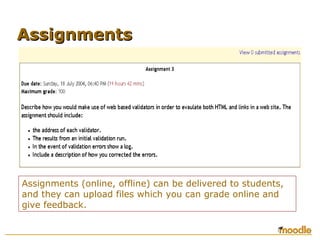
Assignments (online, offline) can be delivered to students,
and they can upload files which you can grade online and
give feedback.
AssignmentsAssignments
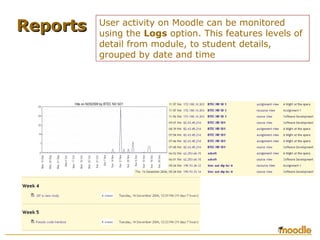
ReportsReports User activity on Moodle can be monitored
using the Logs option. This features levels of
detail from module, to student details,
grouped by date and time
Activities (tools)
 Blogs
 Wikis
 Quizzes with different
kinds of questions
 Database activities
 Surveys (not fully featured now)
 Chat
 Glossaries
 Activities
 Data field types (for the
database activity)
 Peer assessment
 Multi-language support
(over 60 languages are
supported for the
interface [2])
 Moodle is modular, can
be extended by creating
plugins for specific new
functionality.
 Graphical themes
 Authentication methods
 Enrollment methods
 Content Filters
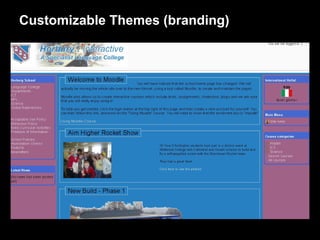
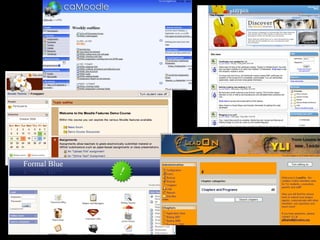
Customizable Themes (branding)
Moodle Community Discussion
http://moodle.org/course/
Using Moodle by Jason Cole
Moodle: Learning Course Development
by William Rice IV
Ken Ronkowitz ronkowitz@njit.edu
Manager of Media & Instructional Technology
University Web Services, NJIT
Check my March 22 Serendipity35 blog entry for this session to
find the links mentioned today and more information.
http://devel2.njit.edu/serendipity/
NJIT Moodle Pilot http://www.njit.edu/tlt/cms/

Moodle Slide Share

  • 1.
    An Open SourceLearning Management SystemAn Open Source Learning Management System It’s Free! (Like Free Kittens)It’s Free! (Like Free Kittens) Ken RonkowitzKen Ronkowitz
  • 2.
    Moodle was designedto help foster online learning communities. It has an active development and support group (very important for open-source projects) and has users in over 150 countries. Moodle was built following social constructionist pedagogy as a virtual learning environment. 150,000 registered users on moodle.org moodle.org/stats/ Humboldt State Moodle has 12,288 courses and 42,121 users. The Open University (OU) in the UK has converted their courses to MOODLE for their 250,000 students. UCLA, UC-San Diego & Smith College are now using Moodle, and many are piloting it (Lafayette, Bennington...) SEE MY BLOG
  • 3.
  • 4.
    Moodle? verb - theprocess of lazily meandering through something; doing things as it occurs to you to do them; an enjoyable tinkering that often leads to insight and creativity. If you’re writing a proposal, say it means: Modular Object-Oriented Dynamic Learning Environment Either applies to both to the way Moodle was developed, and to the constructivist pedagogy that guided the original users group. Anyone who uses Moodle is a Moodler.
  • 5.
    What is SocialConstructivism?What is Social Constructivism? Briefly...Briefly... People actively construct new knowledge as they interact with their environment. Everything you read, see, hear, feel, and touch is tested against your prior knowledge Knowledge is strengthened if you can use it successfully in your wider environment. You are not just a memory bank passively absorbing information, nor can knowledge be "transmitted" to you just by reading something or listening to someone. Learning is particularly effective when constructing something for others to experience Social Constructivism extends the above ideas into a social group constructing things for one another, collaboratively creating a small culture of shared artifacts with shared meanings. More at http://docs.moodle.org/en/Philosophy
  • 6.
    Moodle is providedfreely as Open Source software (under the GNU Public License). Basically this means Moodle is copyrighted, but that you are allowed to copy, use and modify Moodle provided that you agree to: provide the source to others; not modify or remove the original license and copyrights, and apply this same license to any derivative work.
  • 7.
  • 8.
    Welcome to MoodleSupport Planning 2 full semesters prior to launch Transfer of current CMS courses Moodle accepts IMS course packages with some caveats System Admin minimum 2X current admin User Training (3 semesters) creation of training materials (including courses) simultaneous with initial course transfer faculty training during two semesters prior to launch and ongoing during subsequent semesters.
  • 9.
  • 10.
  • 11.
    Is there somesystem administrator in you? Moodle runs without modification on Unix, Linux, Windows, Mac OS X, Netware and any other system that supports PHP 4.3.0+ Designed in a modular way - allows flexibility to add/remove functionality at many levels. Upgrades easily - has an internal system to upgrade its own databases and repair itself over time. Requires only one database, generally SQL, and can share it with other applications if necessary. (MySQL 4.1.16+). Includes comprehensive database abstraction that supports many major brands of database. Emphasis on security - forms are all checked, data validated, cookies encrypted etc.
  • 12.
    Log InLog Inauthentication using LDAPauthentication using LDAP
  • 13.
    The Moodle interfacecan be displayed in either Weekly, Topic or Social format.
  • 14.
    Quick Tour ofSelected Features and Tools
  • 15.
    The Calendar allowsyou to enter events in various categories (User, Course and Site). You have the option to also show upcoming events, assignments etc., and recent activity in the course. CalendarCalendar
  • 16.
    The Chat featurein Moodle will facilitate real time conversations between users. It can be logged.ChatChat
  • 17.
  • 18.
    Editing and StudentView The EDIT view allows the teacher to add content, edit content, add activities and resources, rearrange content, and “hide” content from students.
  • 19.
    A ForumForum isa posting area where students can create or contribute to a topic with their own comments (AKA bulletin board or discussion) OPTIONS include: Grade posts, set open/close date, no reply, one reply only etc.
  • 20.
    Lessons, similar tolearning objects, represent a means of delivering structured learning through Q & A sessions that are drawn from embedded content. LessonsLessons
  • 21.
  • 22.
  • 23.
    A Workshop allowspeer assessment of documents and self- assessment activities, while providing the teacher with opportunities to both manage and grade material. WorkshopsWorkshops
  • 24.
    The Journal featurewill allow every student to have a personal journal that only they and their teacher will be able to access. JournalJournal
  • 25.
    The Glossary featurein Moodle acts as a definition resource - entries can be set to create highlighted hyperlinks within the course itself. GlossaryGlossary
  • 26.
    Assignments (online, offline)can be delivered to students, and they can upload files which you can grade online and give feedback. AssignmentsAssignments
  • 27.
    ReportsReports User activityon Moodle can be monitored using the Logs option. This features levels of detail from module, to student details, grouped by date and time
  • 28.
    Activities (tools)  Blogs Wikis  Quizzes with different kinds of questions  Database activities  Surveys (not fully featured now)  Chat  Glossaries  Activities  Data field types (for the database activity)  Peer assessment  Multi-language support (over 60 languages are supported for the interface [2])  Moodle is modular, can be extended by creating plugins for specific new functionality.  Graphical themes  Authentication methods  Enrollment methods  Content Filters
  • 29.
  • 32.
    Moodle Community Discussion http://moodle.org/course/ UsingMoodle by Jason Cole Moodle: Learning Course Development by William Rice IV
  • 33.
    Ken Ronkowitz ronkowitz@njit.edu Managerof Media & Instructional Technology University Web Services, NJIT Check my March 22 Serendipity35 blog entry for this session to find the links mentioned today and more information. http://devel2.njit.edu/serendipity/ NJIT Moodle Pilot http://www.njit.edu/tlt/cms/