Experiments
Begin witha Hypothesis
Modify Something in a Situation
Compare Outcomes
Cases or People are Termed “Subjects”
3.
Random Assignment
Probabilityof Equal Selection
Allows Accurate Prediction
An Alternative to Random
Assignment is Matching
4.
Parts of theClassic Experiment
Treatment or Independent Variable
Dependent Variable
Pretest
Posttest
Experimental Group
Control Group
Random Assignment
5.
Variations on ExperimentalDesign
Pre-experimental Design
One-shot Case Study
One-group Pretest-Posttest Design
Static Group Comparison
Quasi-Experimental and Special Designs
6.
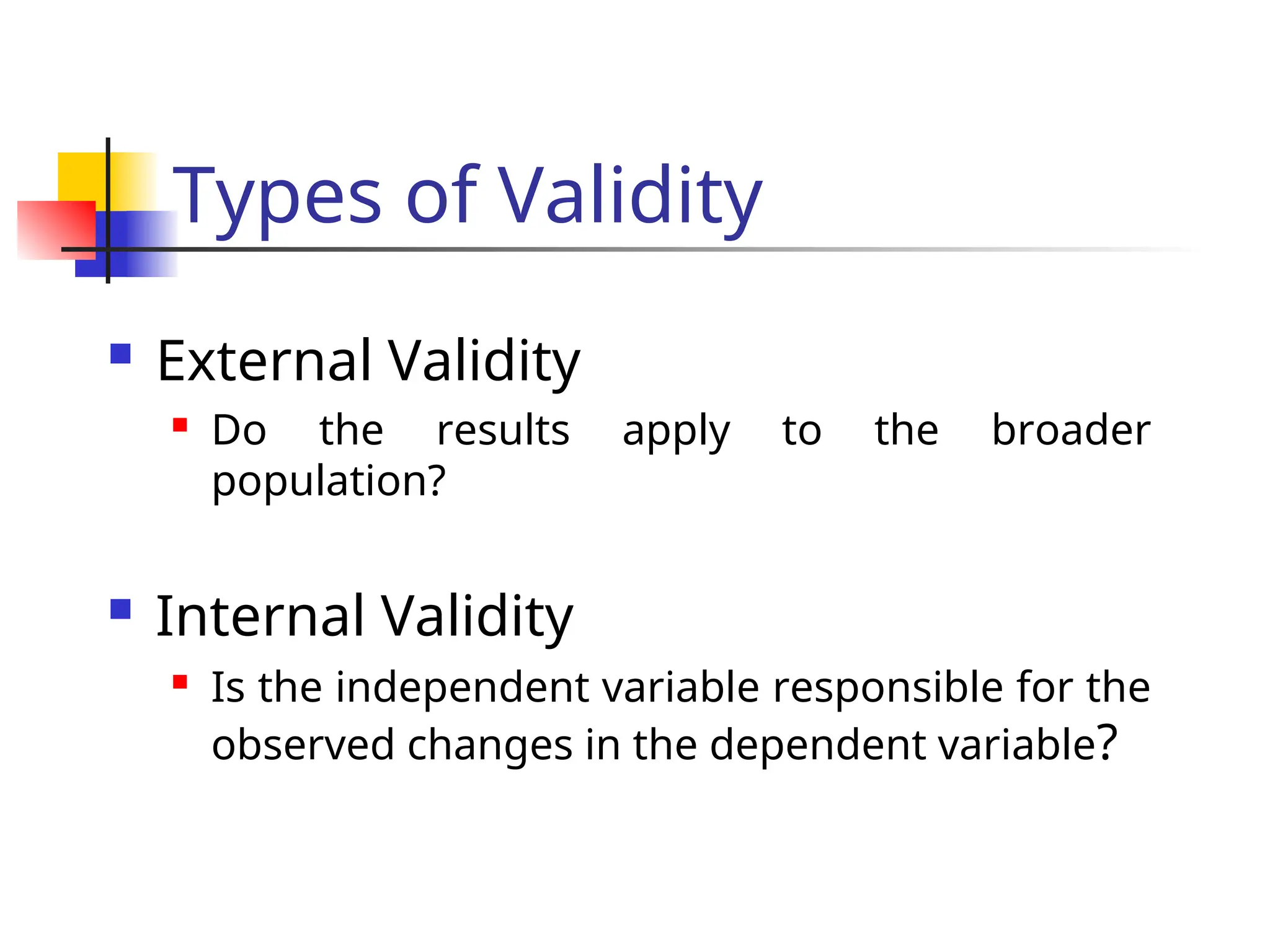
Types of Validity
External Validity
Do the results apply to the broader
population?
Internal Validity
Is the independent variable responsible for the
observed changes in the dependent variable?
7.
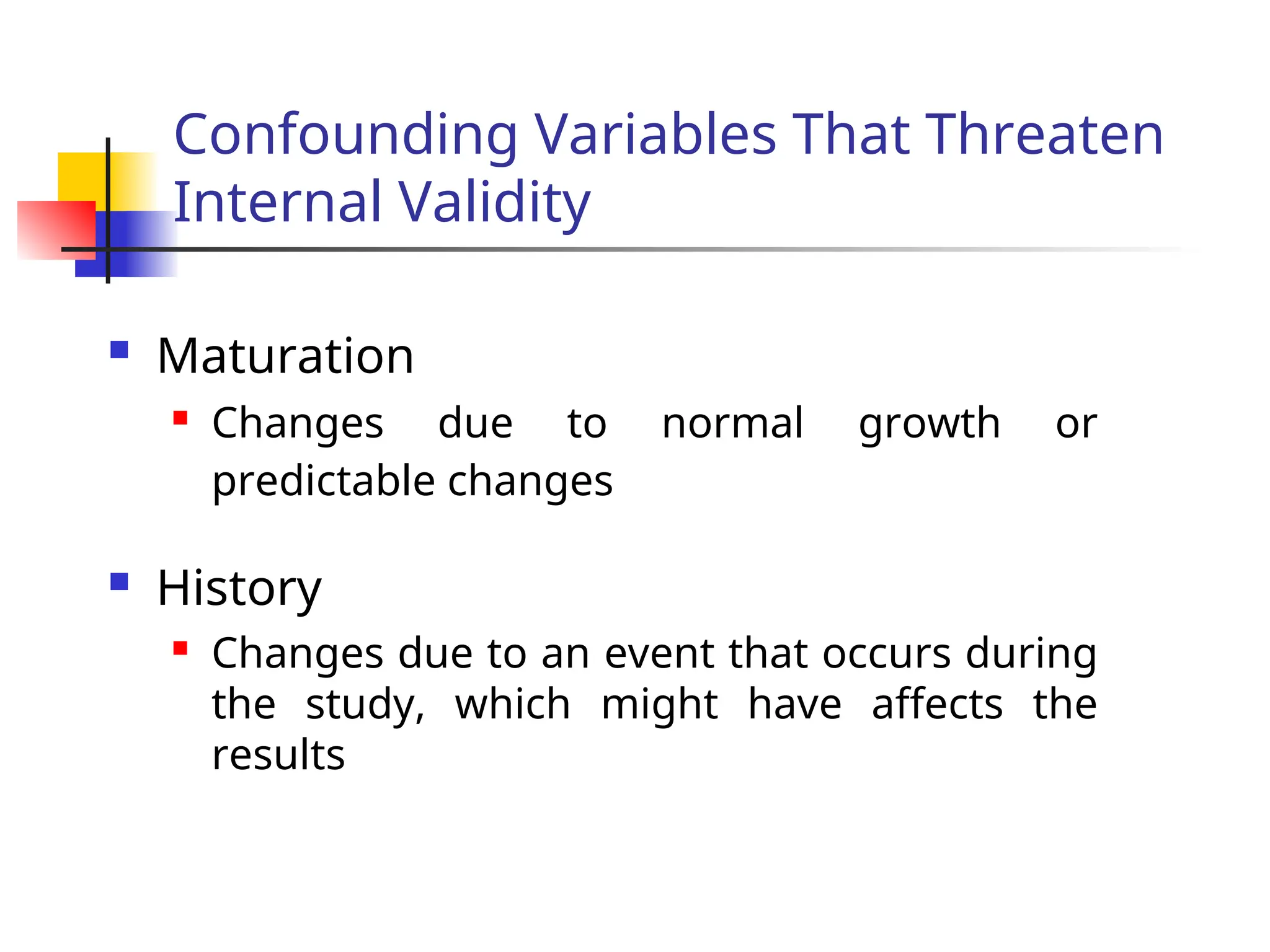
Confounding Variables ThatThreaten
Internal Validity
Maturation
Changes due to normal growth or
predictable changes
History
Changes due to an event that occurs during
the study, which might have affects the
results
8.
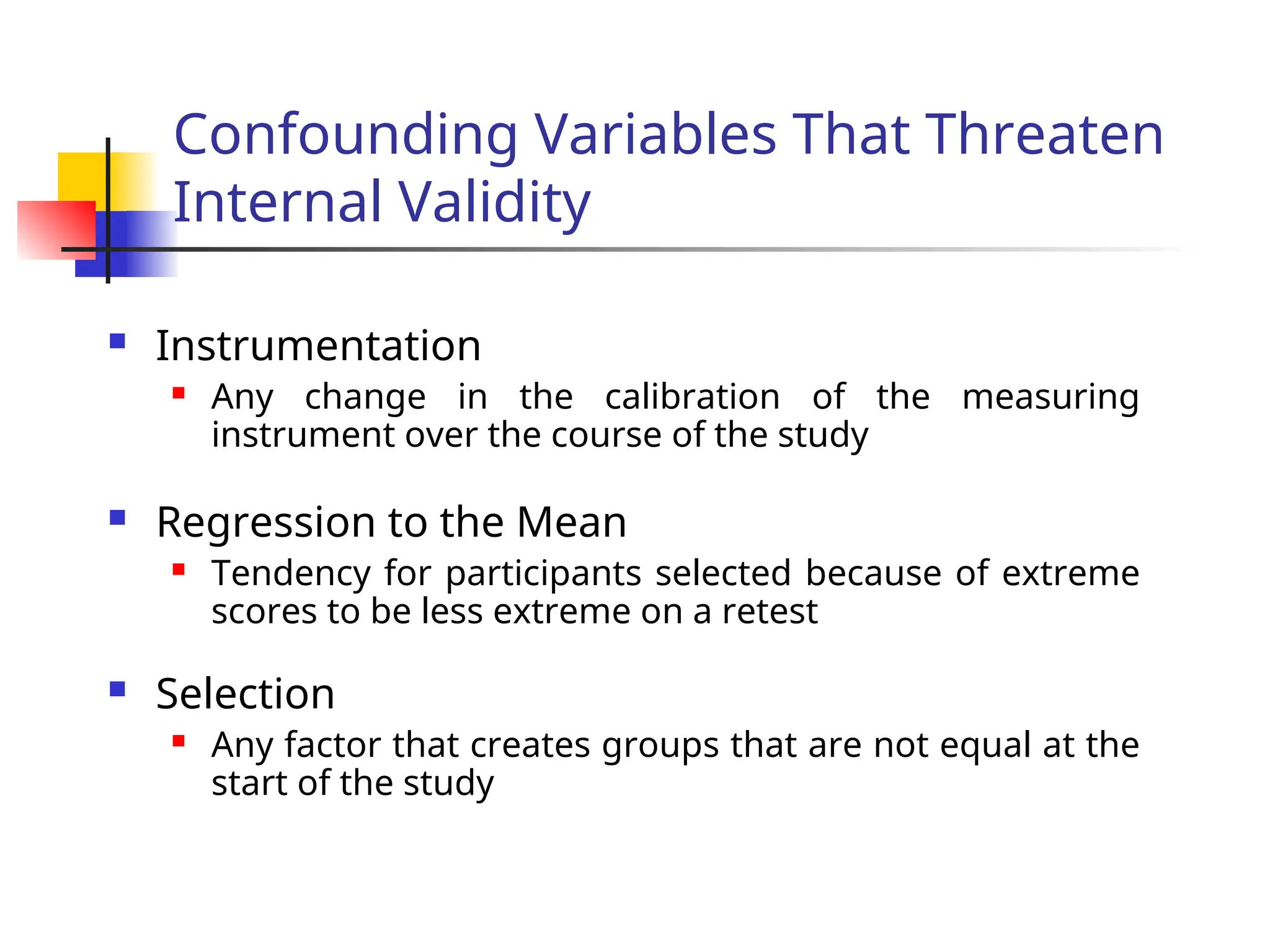
Confounding Variables ThatThreaten
Internal Validity
Instrumentation
Any change in the calibration of the measuring
instrument over the course of the study
Regression to the Mean
Tendency for participants selected because of extreme
scores to be less extreme on a retest
Selection
Any factor that creates groups that are not equal at the
start of the study
9.
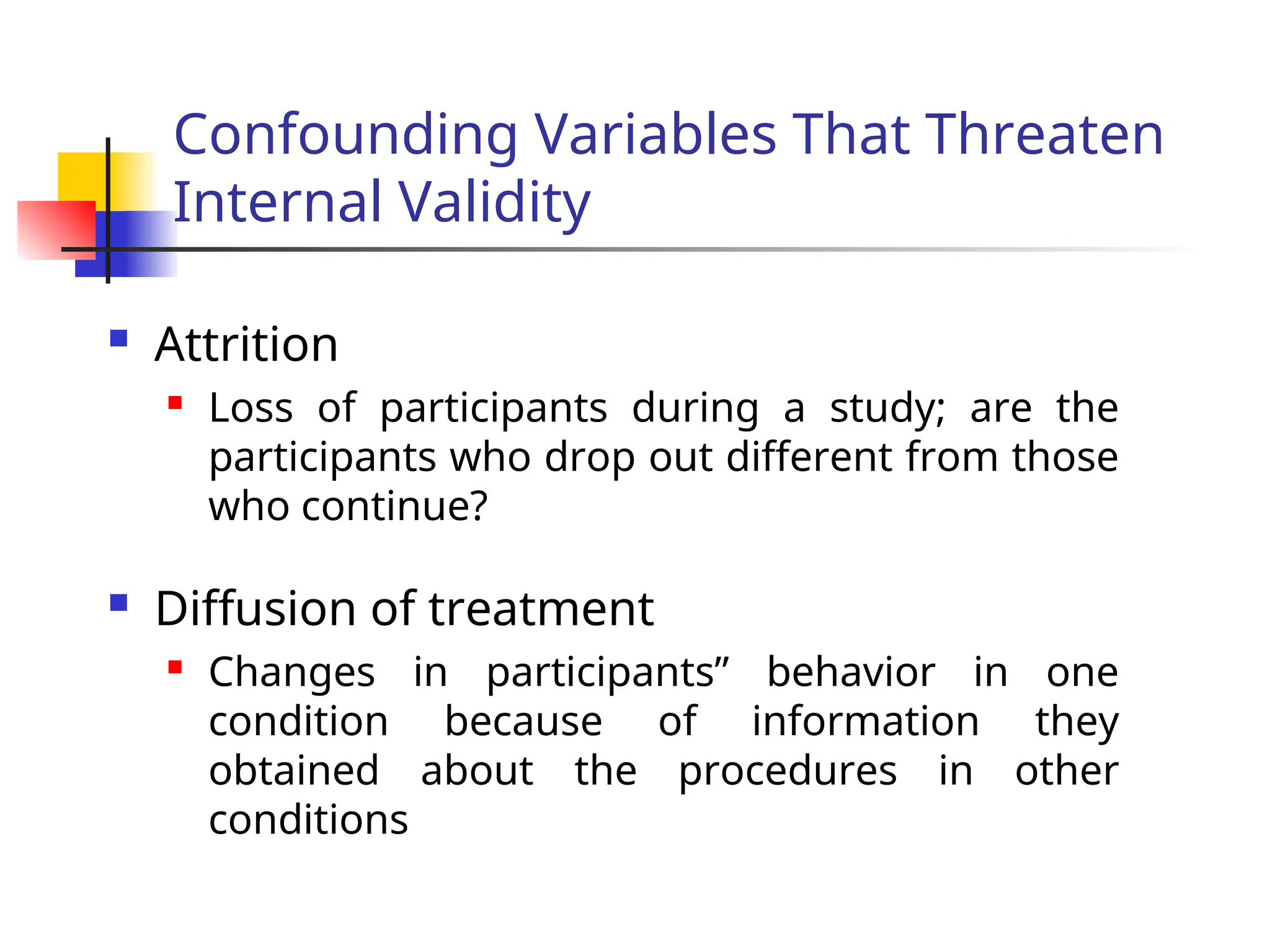
Confounding Variables ThatThreaten
Internal Validity
Attrition
Loss of participants during a study; are the
participants who drop out different from those
who continue?
Diffusion of treatment
Changes in participants” behavior in one
condition because of information they
obtained about the procedures in other
conditions
10.
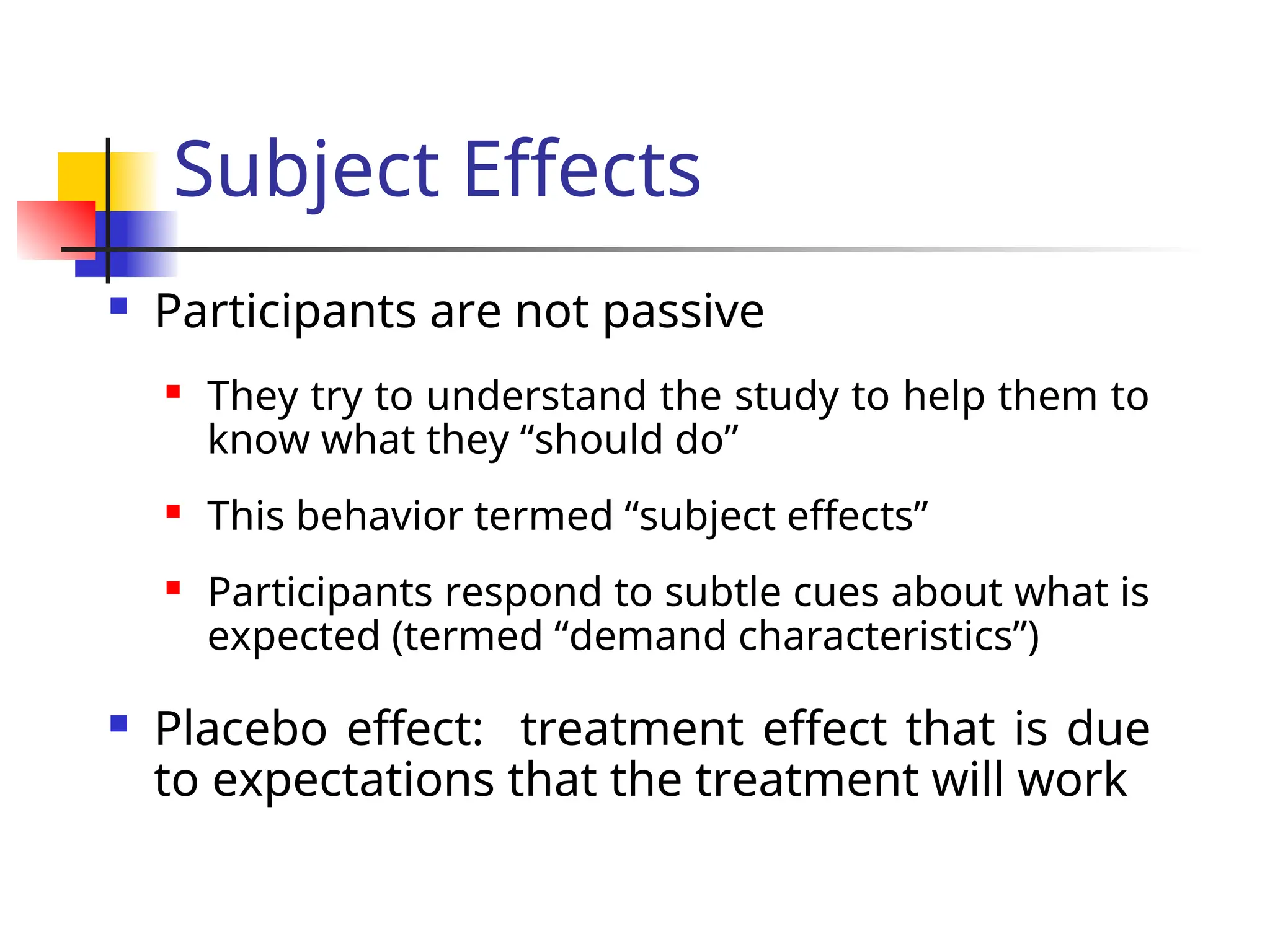
Subject Effects
Participantsare not passive
They try to understand the study to help them to
know what they “should do”
This behavior termed “subject effects”
Participants respond to subtle cues about what is
expected (termed “demand characteristics”)
Placebo effect: treatment effect that is due
to expectations that the treatment will work
11.
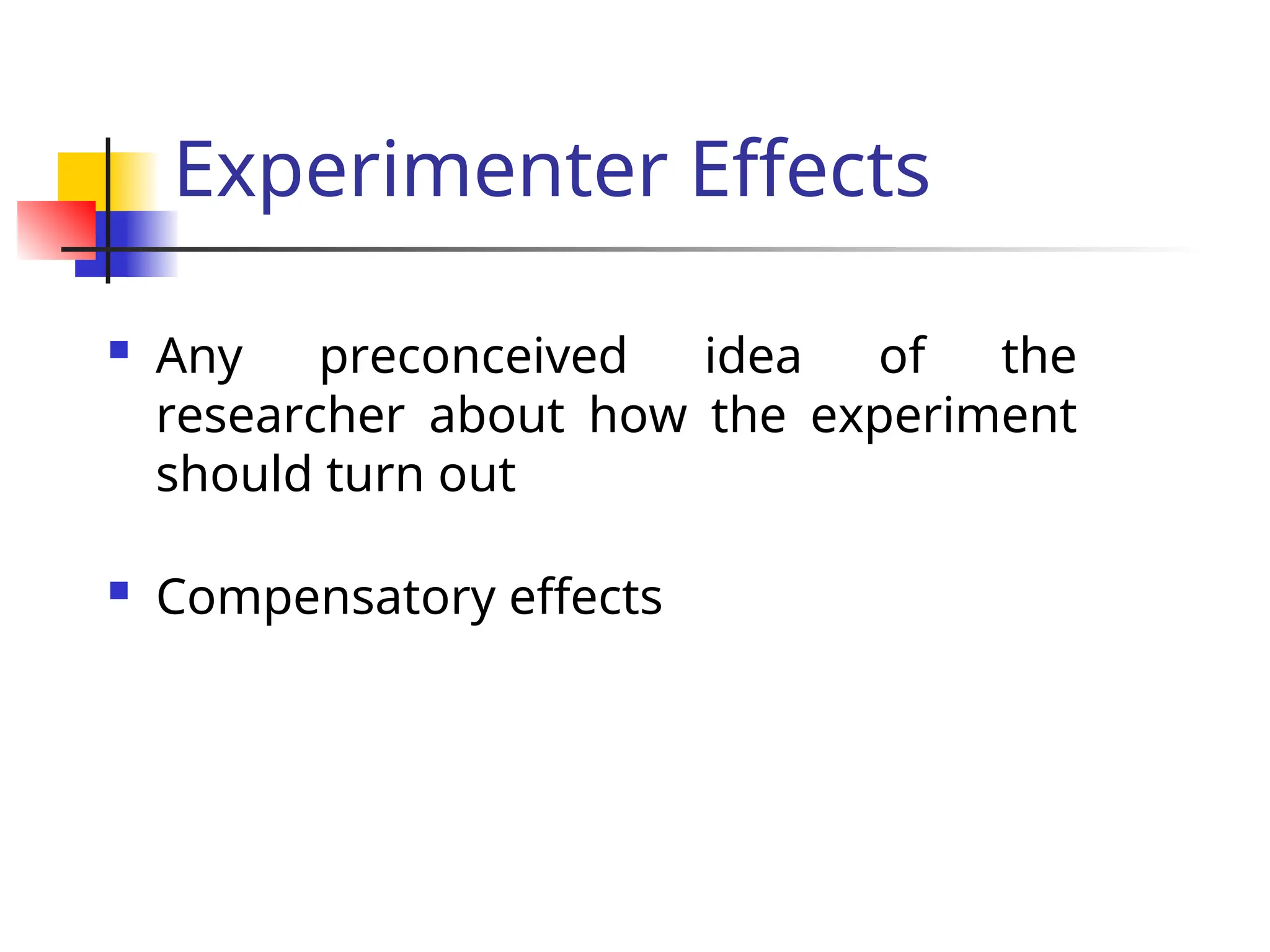
Experimenter Effects
Anypreconceived idea of the
researcher about how the experiment
should turn out
Compensatory effects
12.
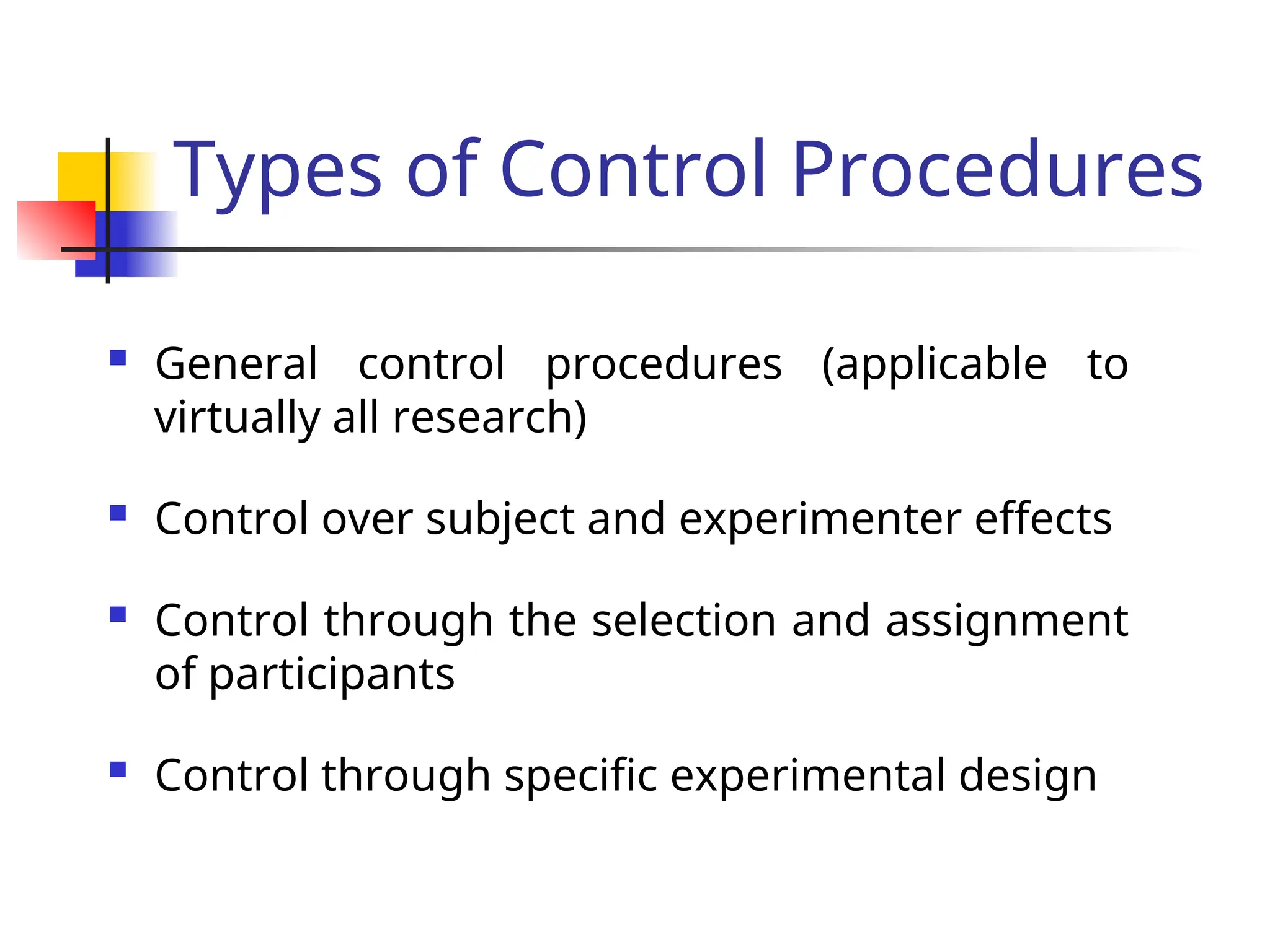
Types of ControlProcedures
General control procedures (applicable to
virtually all research)
Control over subject and experimenter effects
Control through the selection and assignment
of participants
Control through specific experimental design
13.
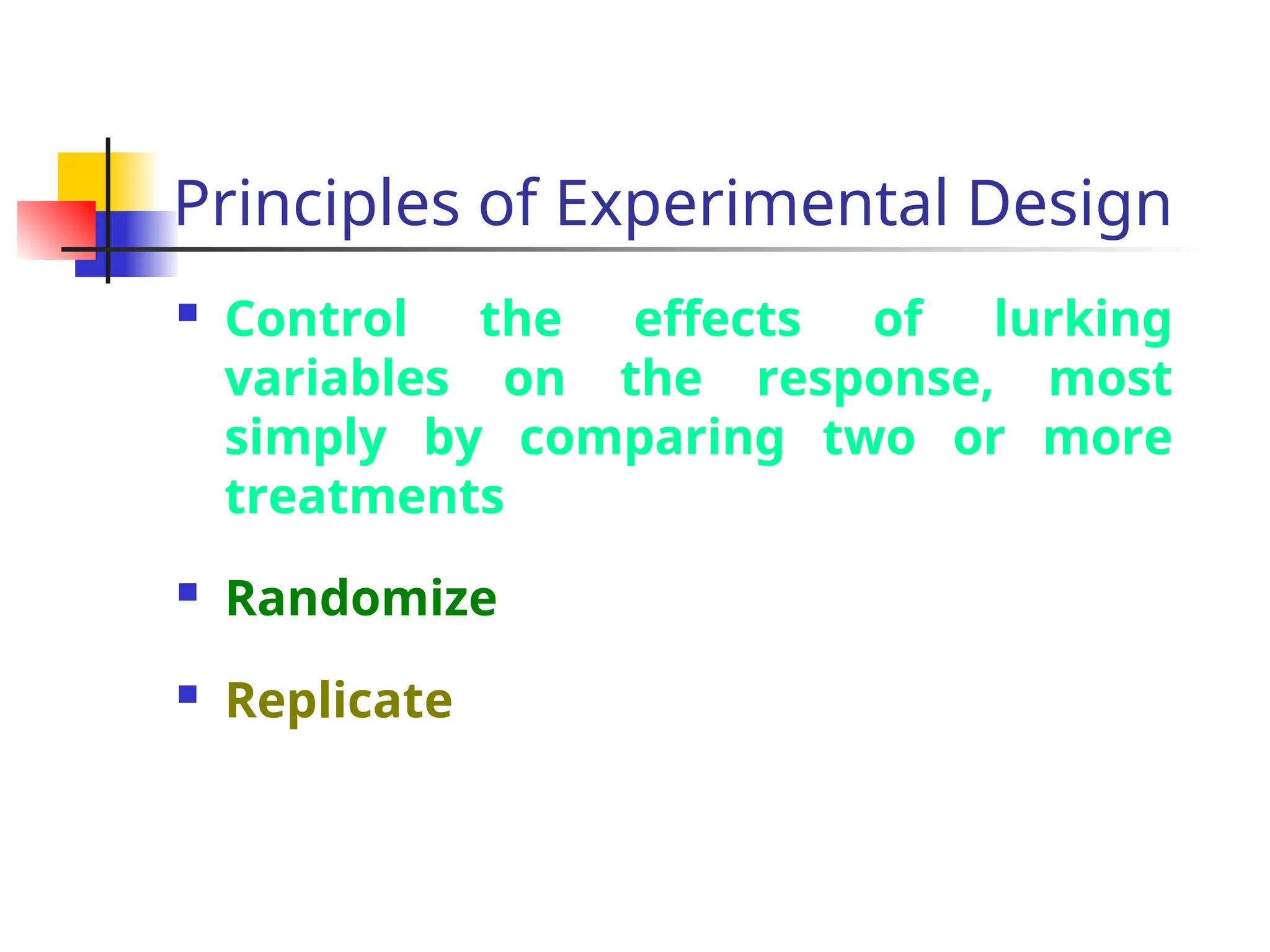
Principles of ExperimentalDesign
Control the effects of lurking
variables on the response, most
simply by comparing two or more
treatments
Randomize
Replicate
14.
Randomization
The useof chance to divide experimental
units into groups is called randomization.
Comparison of effects of several treatments
is valid only when all treatments are applied
to similar groups of experimental units.
15.
How to randomize?
Howto randomize?
Flip a coin or draw numbers out of a hat
Use a random number table
Use a statistical software package or
program
Minitab
www.whfreeman.com/ips
16.
Statistical Significance
Anobserved effect so large that it
would rarely occur by chance is called
statistically significant.
17.
A few morethings…
A few more things…
Double-blind: neither the subjects nor the
person administering the treatment knew
which treatment any subject had received
Lack of realism is a major weakness of
experiments. Is it possible to duplicate the
conditions that we want?



![[DSC Europe 25] Dragan Vucic - Building the Learning Organization - How AI Tr...](https://cdn.slidesharecdn.com/ss_thumbnails/8brigo2sbu6qur6gxrra-7-251205085715-6ae07d24-thumbnail.jpg?width=640&height=640&fit=bounds)

![[DSC Europe 25] Vid Stimac - Policy Parsimony: Between Oversimplifying and Ov...](https://cdn.slidesharecdn.com/ss_thumbnails/eqlepagzqp2rhg3gbluh-dsc-stimac-251120-251205090438-059e7f54-thumbnail.jpg?width=640&height=640&fit=bounds)


![[DSC Europe 25] Dragana Ilic - AI for Big Data in Astronomy.pptx](https://cdn.slidesharecdn.com/ss_thumbnails/8palya86qaatvjhva1ms-2-dragana-ilic-ai-ilic-251208151906-652b819c-thumbnail.jpg?width=640&height=640&fit=bounds)

![[DSC Europe 25] Marija Vlajkovic & Andrea Radonjanin - Integration of AI tool...](https://cdn.slidesharecdn.com/ss_thumbnails/qf1jrglttoc3bm8s3aop-final-integration-of-ai-tools-251208151905-394f3a6a-thumbnail.jpg?width=640&height=640&fit=bounds)


![[DSC Europe 25] Boris Perkovic - Lost in performance.pptx](https://cdn.slidesharecdn.com/ss_thumbnails/uq5hrp7vsuahqkxzifux-1-251204082258-fd2ee09d-thumbnail.jpg?width=640&height=640&fit=bounds)


![[DSC Europe 25] Dusan Jovicic - AI Story: From on-prem to cloud and back agai...](https://cdn.slidesharecdn.com/ss_thumbnails/8kp49m6uq22ifnbwhfnk-2-251205085715-964d11a6-thumbnail.jpg?width=640&height=640&fit=bounds)