PERMUTATIONS AND COMBINATIONS
•NAME- AURGHYA SAHA
•STUDENT CODE: BWU/BTA/21/109
•Subject : DISCRETE MATHEMATICS
•Course Code : PCC-CSM405
OBJECTIVES
 apply fundamental counting principle
 compute permutations
 compute combinations
 distinguish permutations vs combinations
OVERVIEW
The study of permutations and combinations is concerned with
determining the number of different ways of arranging and selecting
objects out of a given number of objects without actually listing them.
There are some basic counting techniques which will be useful in
determining the number of different ways of arranging or selecting
objects.
FUNDAMENTAL COUNTING PRINCIPLE
 The rule for finding the number of possible outcomes.
States that if an event has “m” possible outcomes and another
independent even has“n” possible outcomes, then there are Mn (m times n)
possible outcomes of the two events together.
FUNDAMENTAL COUNTING
PRINCIPLE
Lets start with a simple example.
A student is to flip a coin 6 times. How
many possible outcomes will there be?
1H 2H 3H 4H 5H 6H
1T 2T 3T 4T 5T 6T
6 times*2 possibilities = 12 outcomes
12 outcomes
FUNDAMENTAL COUNTING
PRINCIPLE
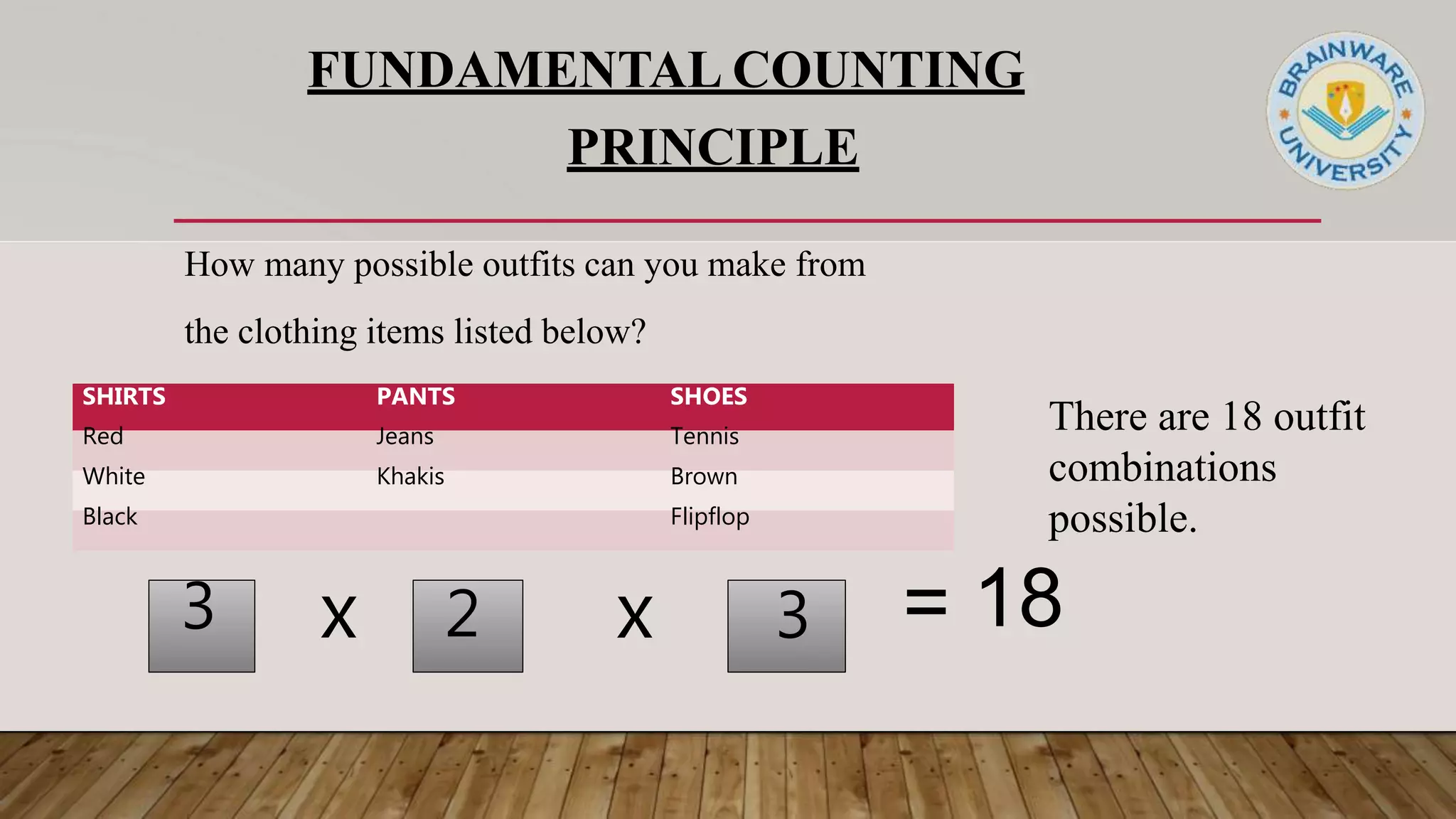
SHIRTS PANTS SHOES
Red Jeans Tennis
White Khakis Brown
Black Flipflop
3 2 3
x x
How many possible outfits can you make from
the clothing items listed below?
There are 18 outfit
combinations
possible.
= 18
PERMUTATIONS
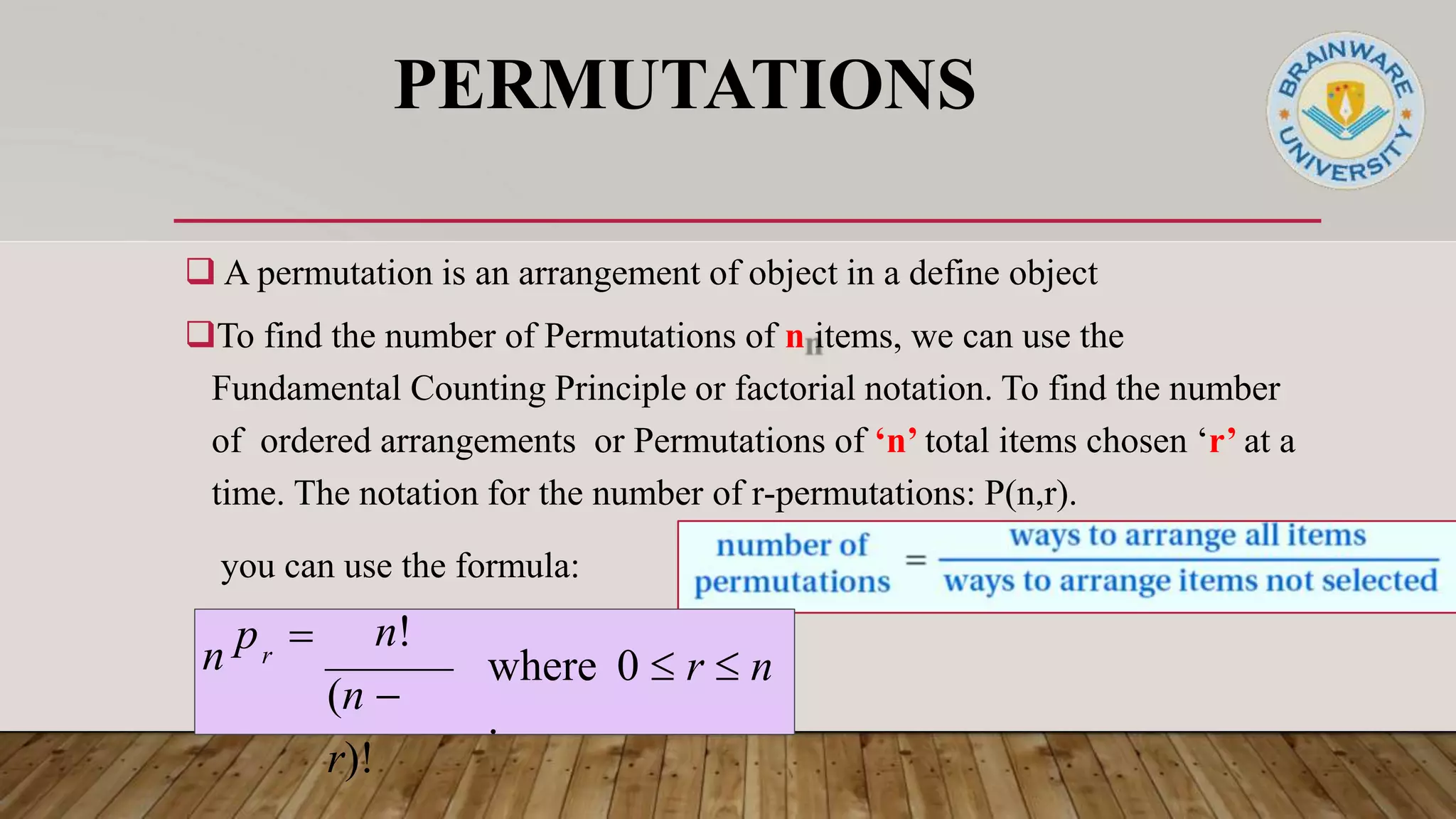
 A permutation is an arrangement of object in a define object
To find the number of Permutations of n items, we can use the
Fundamental Counting Principle or factorial notation. To find the number
of ordered arrangements or Permutations of ‘n’ total items chosen ‘r’ at a
time. The notation for the number of r-permutations: P(n,r).
you can use the formula:
where 0  r  n
.
n!
(n 
r)!
n p 
r
COMBINATIONS
On many occasions we are not interested in arranging but
only in selecting r objects from given n objects. A
combination is a selection of some or all of a number of
different objects where the order of selection is
immaterial. The number of selections of r objects from
the given n objects is denoted by nCr ,and is given by
nCr =n!/ r! (n-r)!
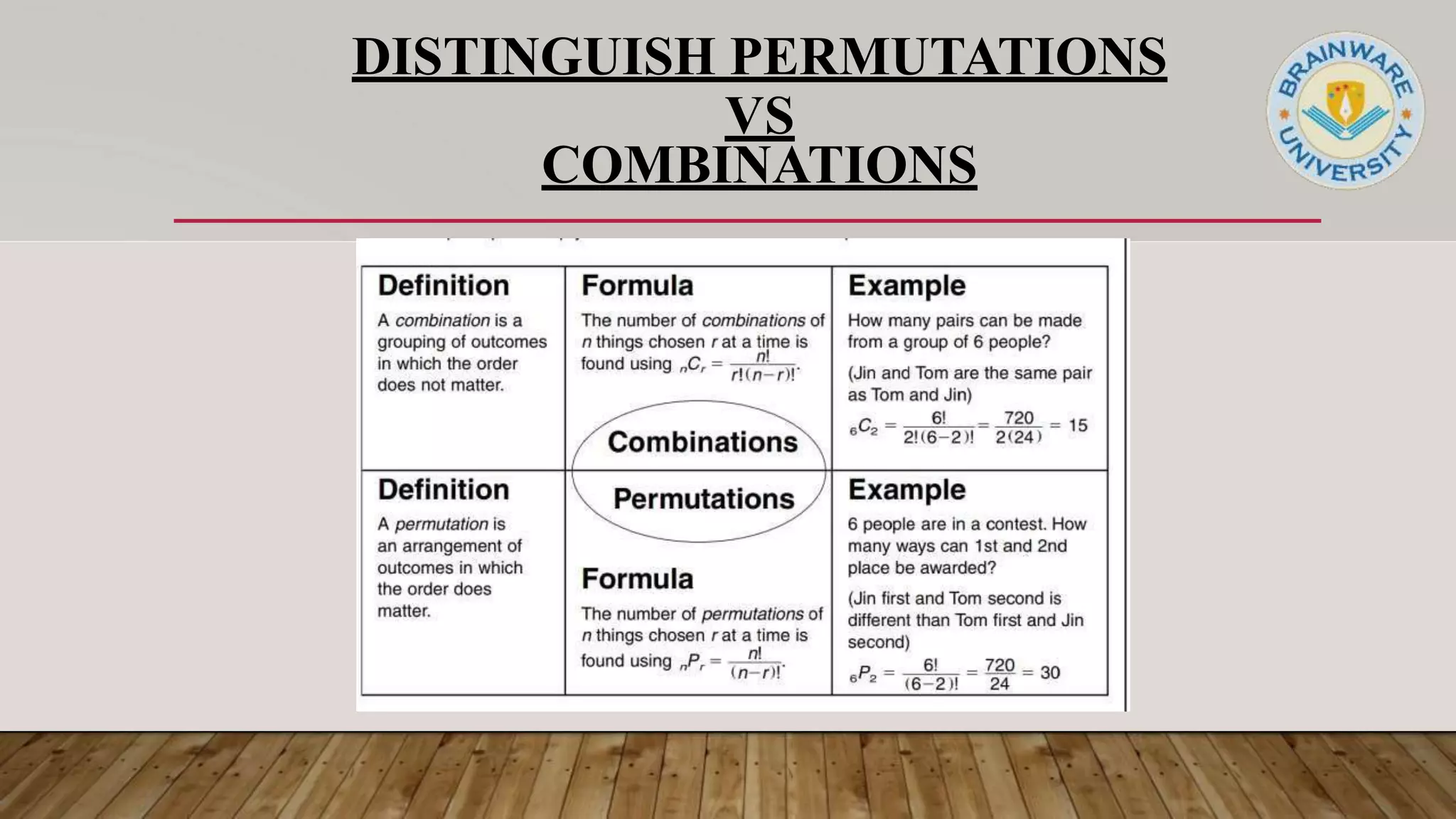
DISTINGUISH PERMUTATIONS
VS
COMBINATIONS
PERMUTATIONS
Arranging people,
digits, numbers,
alphabets, letters,
colours.
Keywords:
Arrangements,
arrange,…
COMBINATIONS
Selection of menu,
food,
clothes, subjects,
teams.
Keywords: Select,
choice,…
DISTINGUISH PERMUTATIONS
VS
COMBINATIONS
Thank You

bRAINWARE UNI

  • 1.
    PERMUTATIONS AND COMBINATIONS •NAME-AURGHYA SAHA •STUDENT CODE: BWU/BTA/21/109 •Subject : DISCRETE MATHEMATICS •Course Code : PCC-CSM405
  • 2.
    OBJECTIVES  apply fundamentalcounting principle  compute permutations  compute combinations  distinguish permutations vs combinations
  • 3.
    OVERVIEW The study ofpermutations and combinations is concerned with determining the number of different ways of arranging and selecting objects out of a given number of objects without actually listing them. There are some basic counting techniques which will be useful in determining the number of different ways of arranging or selecting objects.
  • 4.
    FUNDAMENTAL COUNTING PRINCIPLE The rule for finding the number of possible outcomes. States that if an event has “m” possible outcomes and another independent even has“n” possible outcomes, then there are Mn (m times n) possible outcomes of the two events together.
  • 5.
    FUNDAMENTAL COUNTING PRINCIPLE Lets startwith a simple example. A student is to flip a coin 6 times. How many possible outcomes will there be? 1H 2H 3H 4H 5H 6H 1T 2T 3T 4T 5T 6T 6 times*2 possibilities = 12 outcomes 12 outcomes
  • 6.
    FUNDAMENTAL COUNTING PRINCIPLE SHIRTS PANTSSHOES Red Jeans Tennis White Khakis Brown Black Flipflop 3 2 3 x x How many possible outfits can you make from the clothing items listed below? There are 18 outfit combinations possible. = 18
  • 7.
    PERMUTATIONS  A permutationis an arrangement of object in a define object To find the number of Permutations of n items, we can use the Fundamental Counting Principle or factorial notation. To find the number of ordered arrangements or Permutations of ‘n’ total items chosen ‘r’ at a time. The notation for the number of r-permutations: P(n,r). you can use the formula: where 0  r  n . n! (n  r)! n p  r
  • 8.
    COMBINATIONS On many occasionswe are not interested in arranging but only in selecting r objects from given n objects. A combination is a selection of some or all of a number of different objects where the order of selection is immaterial. The number of selections of r objects from the given n objects is denoted by nCr ,and is given by nCr =n!/ r! (n-r)!
  • 9.
    DISTINGUISH PERMUTATIONS VS COMBINATIONS PERMUTATIONS Arranging people, digits,numbers, alphabets, letters, colours. Keywords: Arrangements, arrange,… COMBINATIONS Selection of menu, food, clothes, subjects, teams. Keywords: Select, choice,…
  • 10.
  • 11.