Learning Objectives
At theend of the lesson, you are expected to:
1. Apply listing method and tree diagram in some counting
situations
2. State the fundamental principle of counting (FPC) and
alternative counting principle (APC)
3. Apply the FPC and APC in predicting outcomes
COUNTING
TECHNIQUES
If activity Acan be done in N1 ways, activity B in
N2 ways, activity C in N3 ways, and so on, then
activities A, B and C can be done simultaneously
in N1.N2.N3….Nn ways.
Fundamental Counting
Principle (FCP)
6.
COUNTING
TECHNIQUES
Determine the numberof all possible outcomes in each
event:
Fundamental Counting
Principle (FCP)
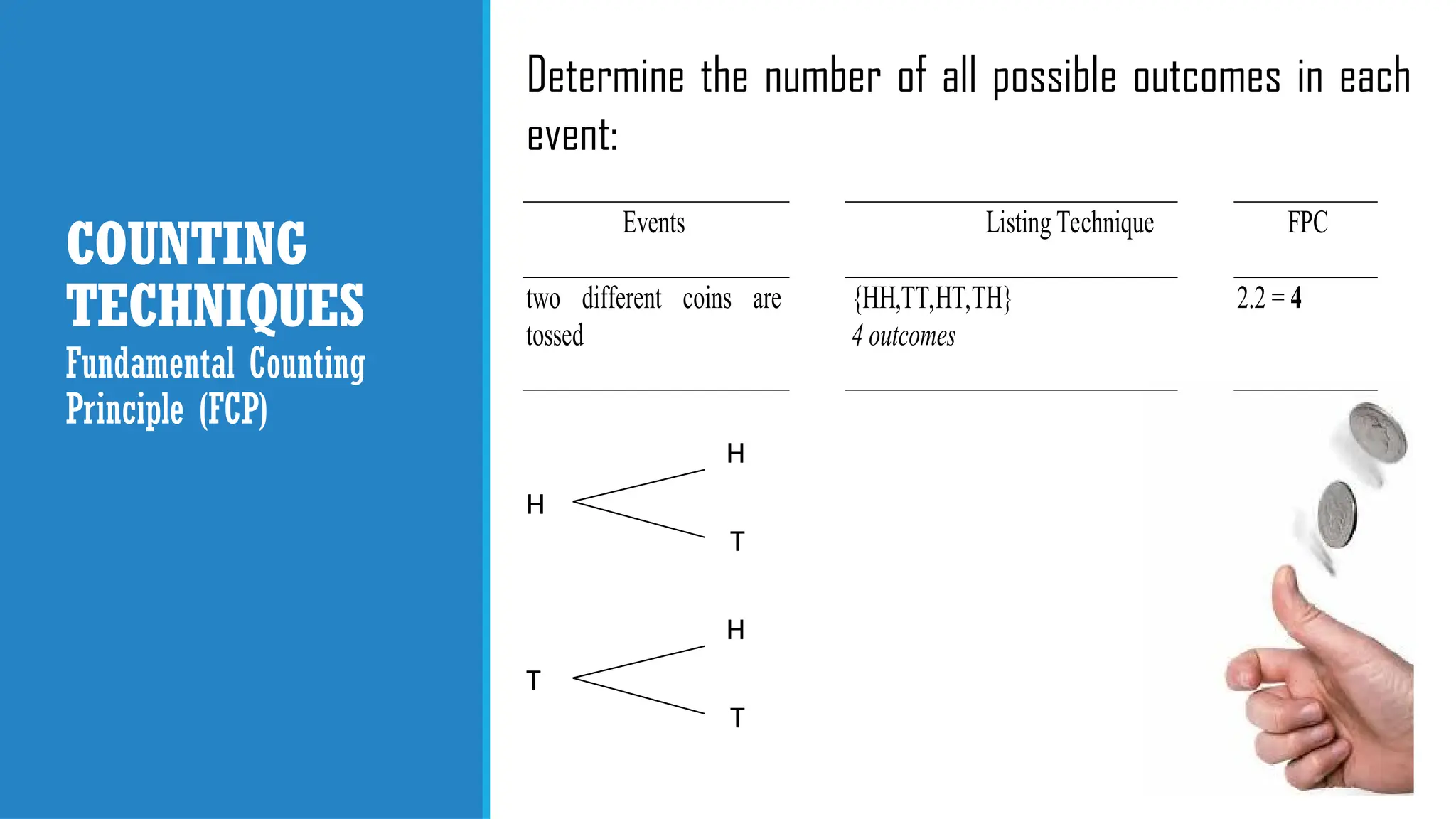
Events
two different coins are
tossed
H
H
T
Listing Technique
{HH,TT,HT,TH}
4 outcomes
FPC
2.2 = 4
T
H
T
7.
COUNTING
TECHNIQUES
Determine the numberof all possible outcomes in each
event:
Fundamental Counting
Principle (FCP)
H
H
T
T
H
T
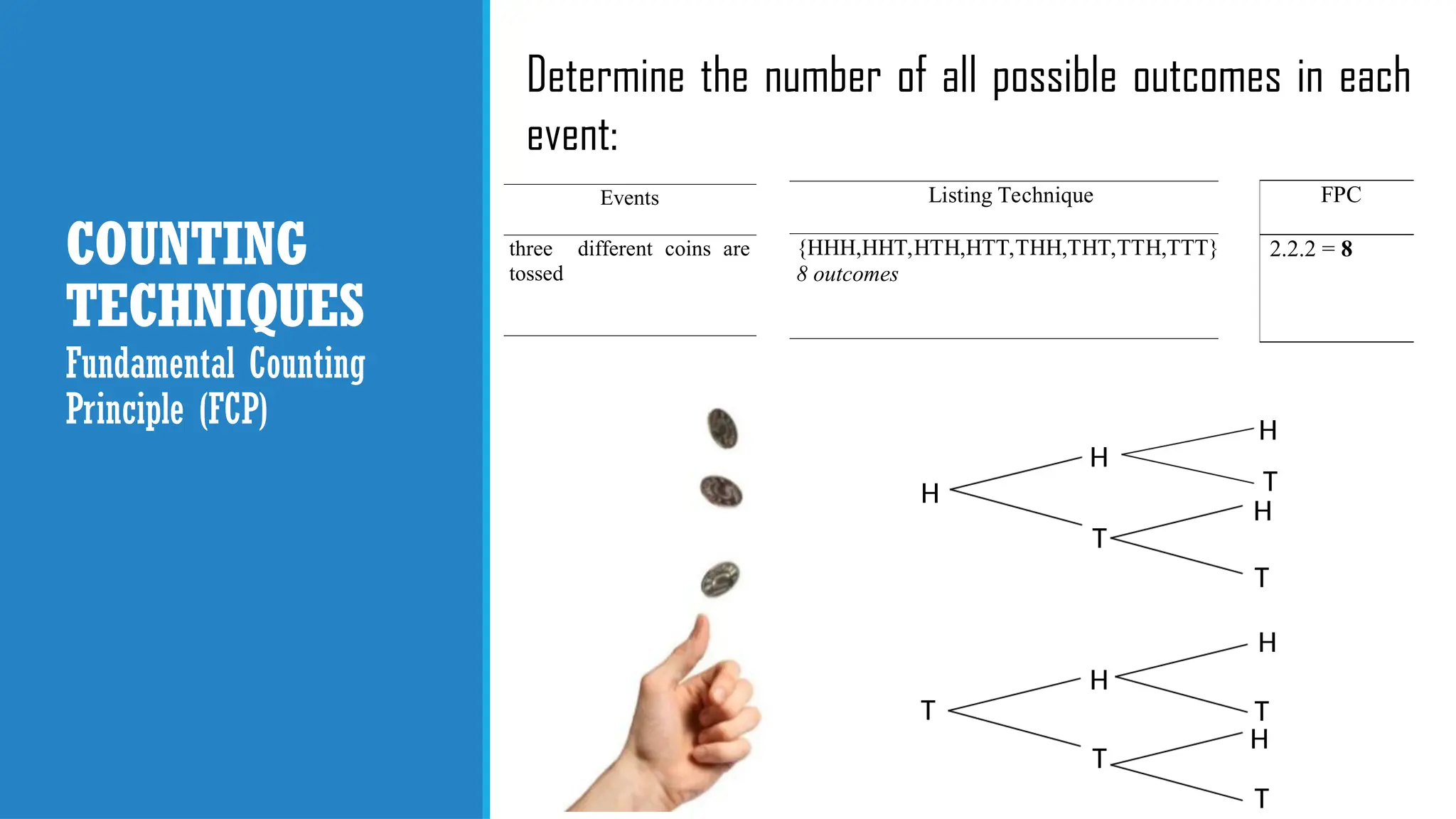
Events
three different coins are
tossed
Listing Technique
{HHH,HHT,HTH,HTT,THH,THT,TTH,TTT}
8 outcomes
FPC
2.2.2 = 8
H
T
H
H
H
T
T
T
8.
COUNTING
TECHNIQUES
Fundamental Counting
Principle (FCP)
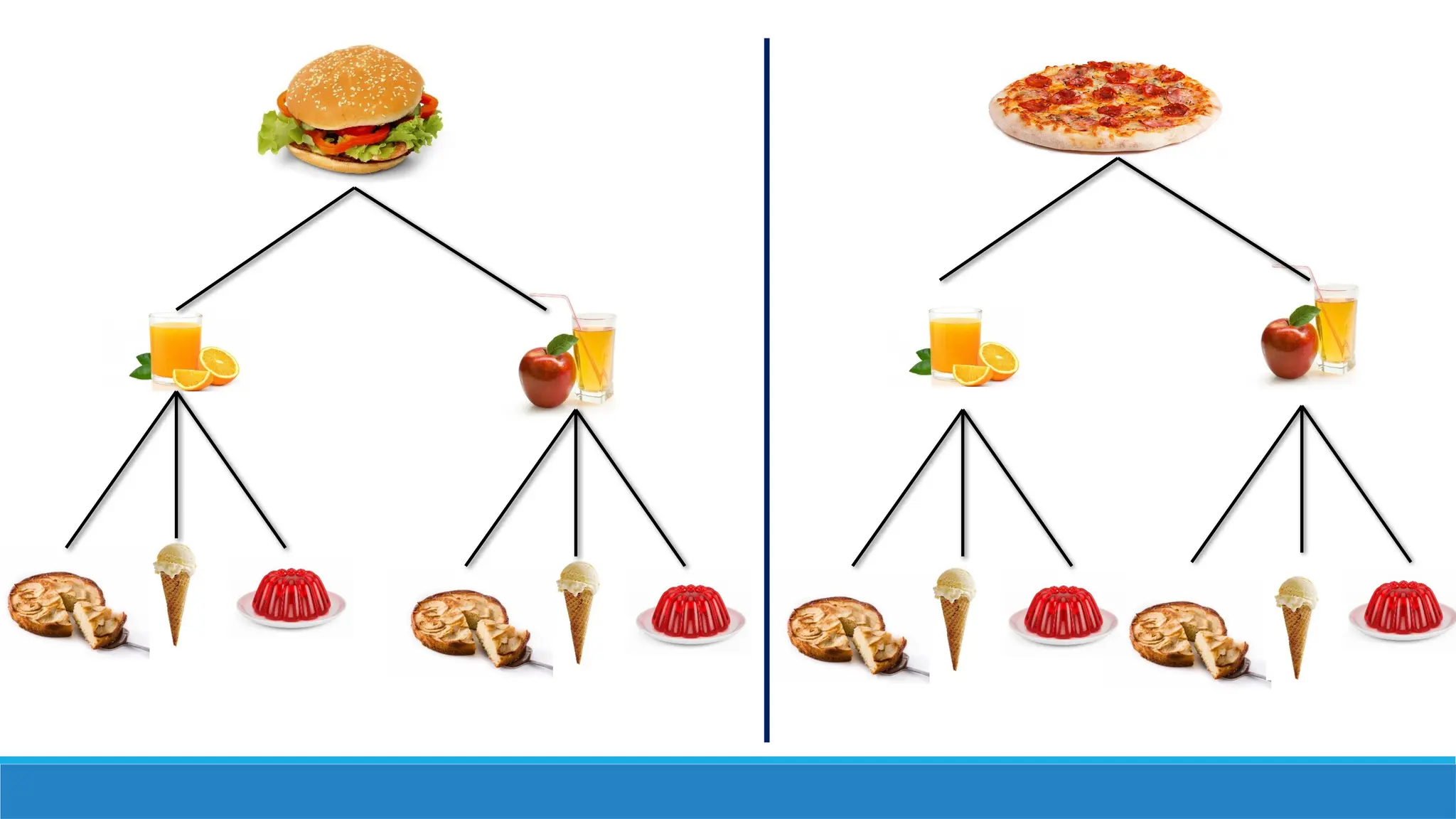
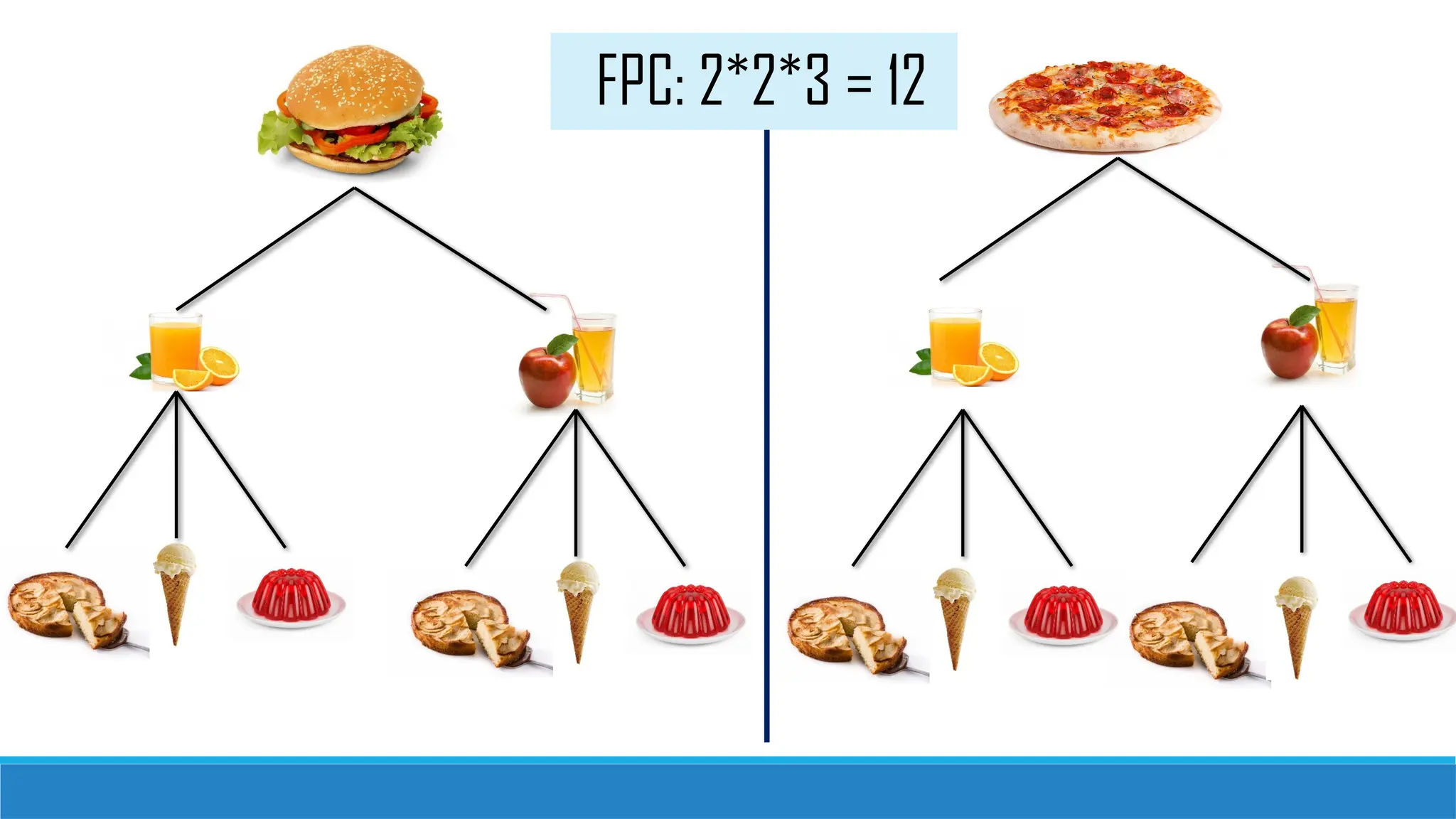
Youare at your school cafeteria that allows you to choose a
lunch meal from a set menu. You have two choices for the
main course (hamburger, pizza), two choices of a drink
(orange juice, apple juice) and three choices of dessert (pie,
ice cream, jello). How many different meal combos can you
select?
COUNTING
TECHNIQUES
Determine the numberof all possible outcomes in each
event:
Fundamental Counting
Principle (FCP)
Events Listing Technique FPC
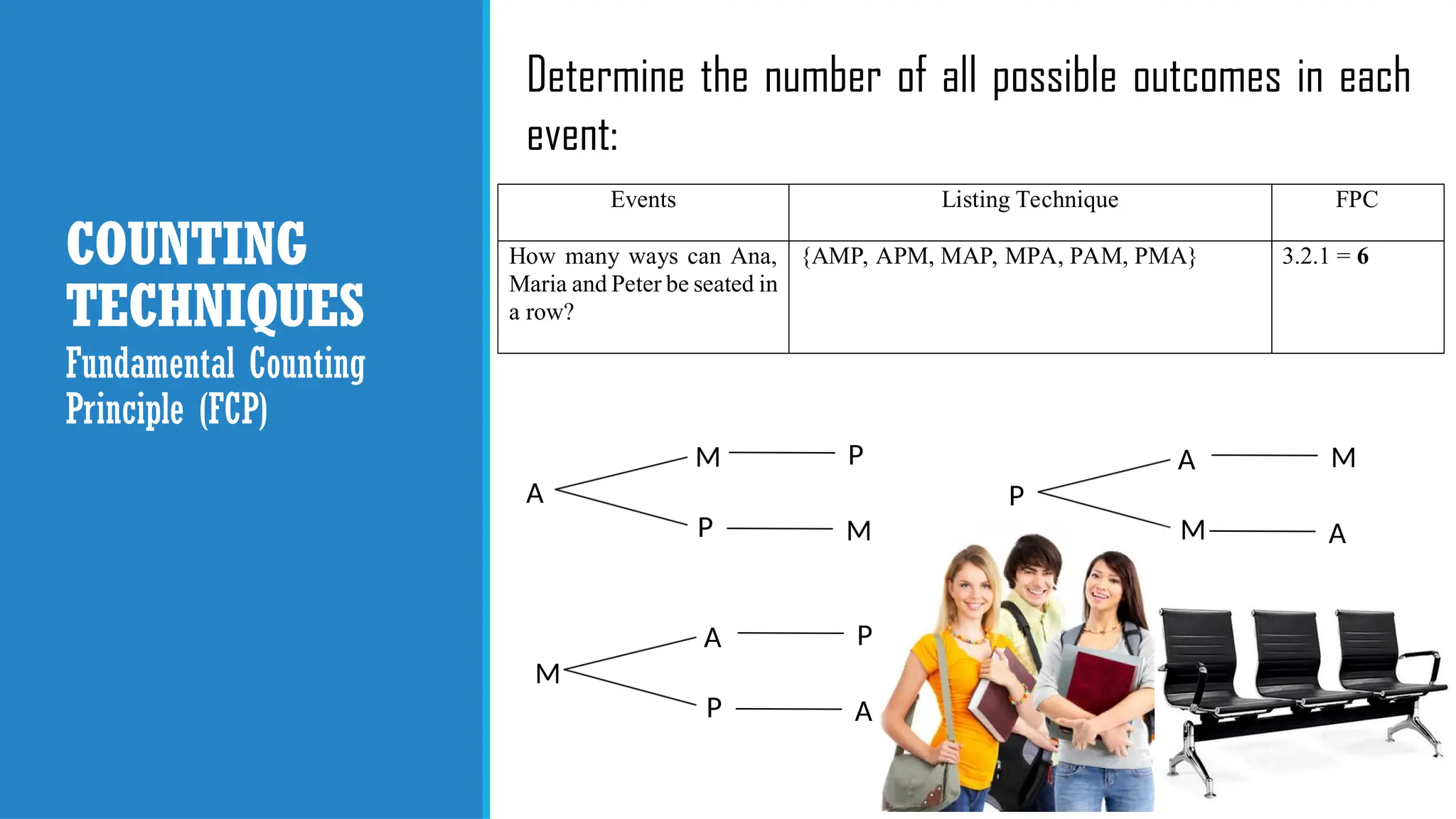
How many ways can Ana,
Maria and Peter be seated in
a row?
{AMP, APM, MAP, MPA, PAM, PMA} 3.2.1 = 6
A
M
P
P
M
M
A
P
P
A
P
A
M
M
A
12.
COUNTING
TECHNIQUES
Determine the numberof all possible outcomes in each
event:
Fundamental Counting
Principle (FCP)
1
Events Listing Technique FPC
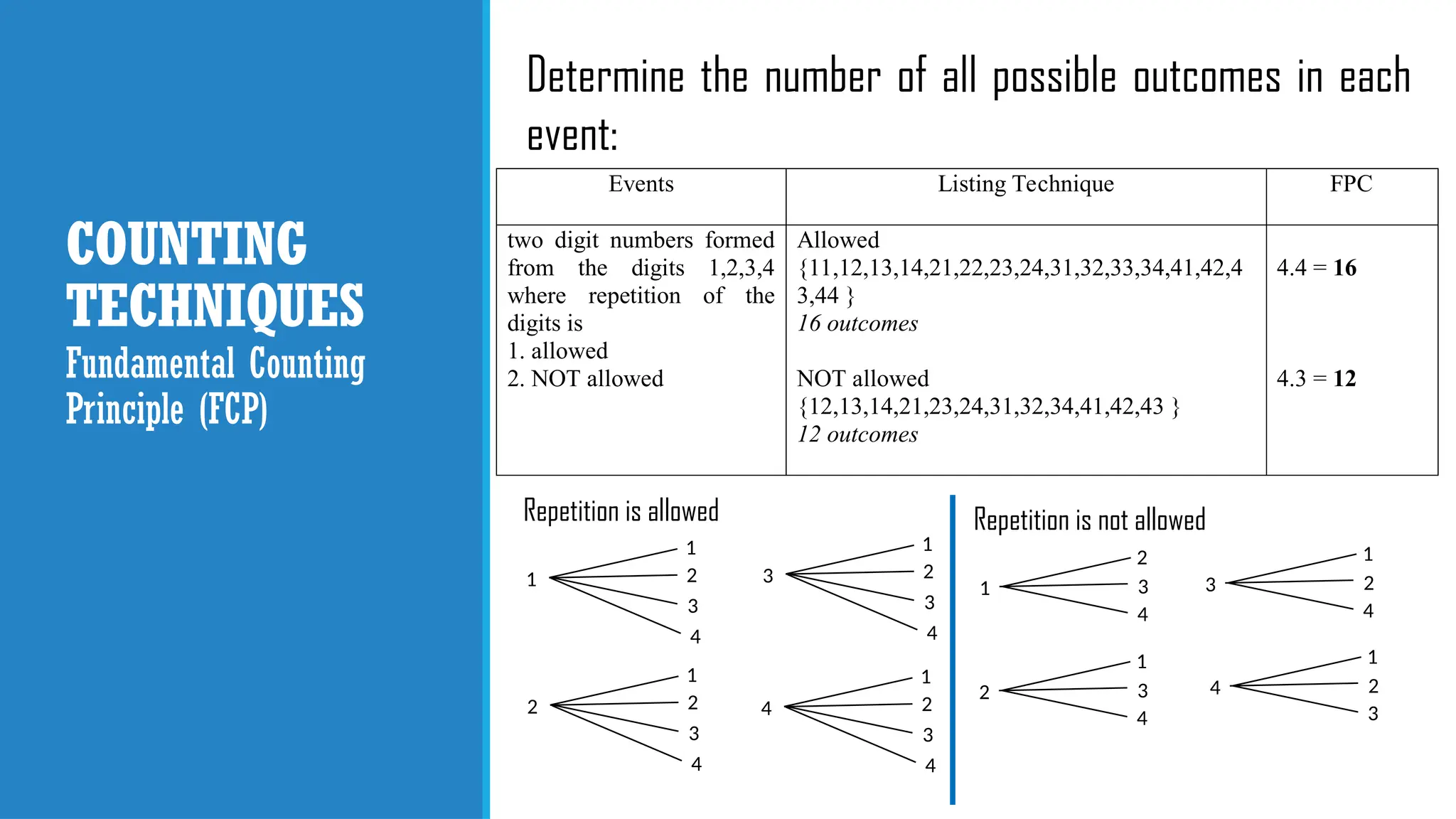
two digit numbers formed
from the digits 1,2,3,4
where repetition of the
digits is
1. allowed
2. NOT allowed
Allowed
{11,12,13,14,21,22,23,24,31,32,33,34,41,42,4
3,44 }
16 outcomes
NOT allowed
{12,13,14,21,23,24,31,32,34,41,42,43 }
12 outcomes
4.4 = 16
4.3 = 12
Repetition is allowed
1
2
3
4
2
1
2
3
4
3
1
2
3
4
4
1
2
3
4
1
Repetition is not allowed
2
3
4
2
1
3
4
3
1
2
4
4
1
2
3
13.
COUNTING
TECHNIQUES
Determine the numberof all possible outcomes in each
event:
Fundamental Counting
Principle (FCP)
Repetition is allowed
Events Listing Technique FPC
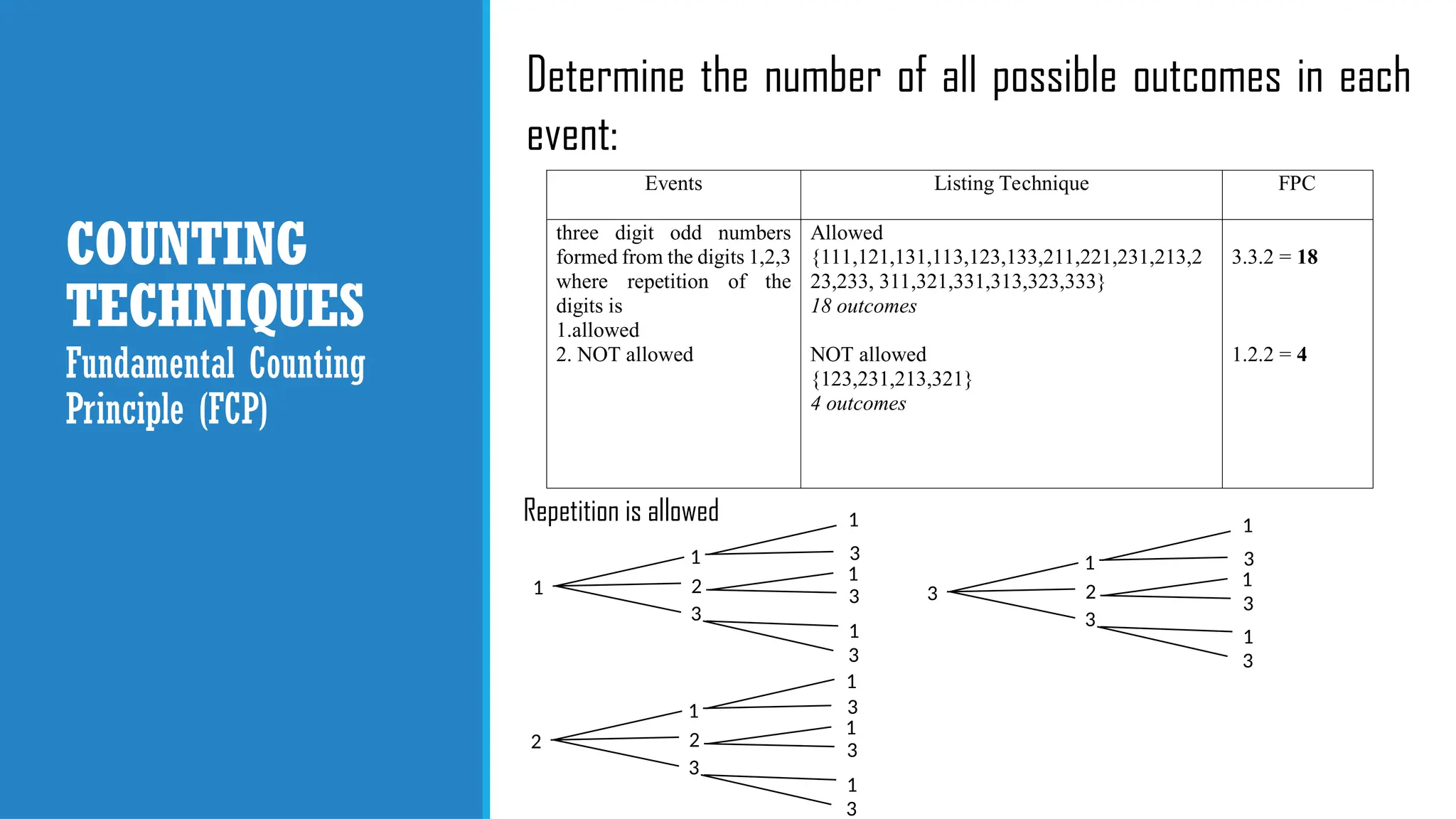
three digit odd numbers
formed from the digits 1,2,3
where repetition of the
digits is
1.allowed
2. NOT allowed
Allowed
{111,121,131,113,123,133,211,221,231,213,2
23,233, 311,321,331,313,323,333}
18 outcomes
NOT allowed
{123,231,213,321}
4 outcomes
3.3.2 = 18
1.2.2 = 4
1
1
2
3
1
3
1
3
1
3
2
1
2
3
1
3
1
3
1
3
3
1
2
3
1
3
1
3
1
3
14.
COUNTING
TECHNIQUES
Determine the numberof all possible outcomes in each
event:
Fundamental Counting
Principle (FCP)
Repetition is not allowed
Events Listing Technique FPC
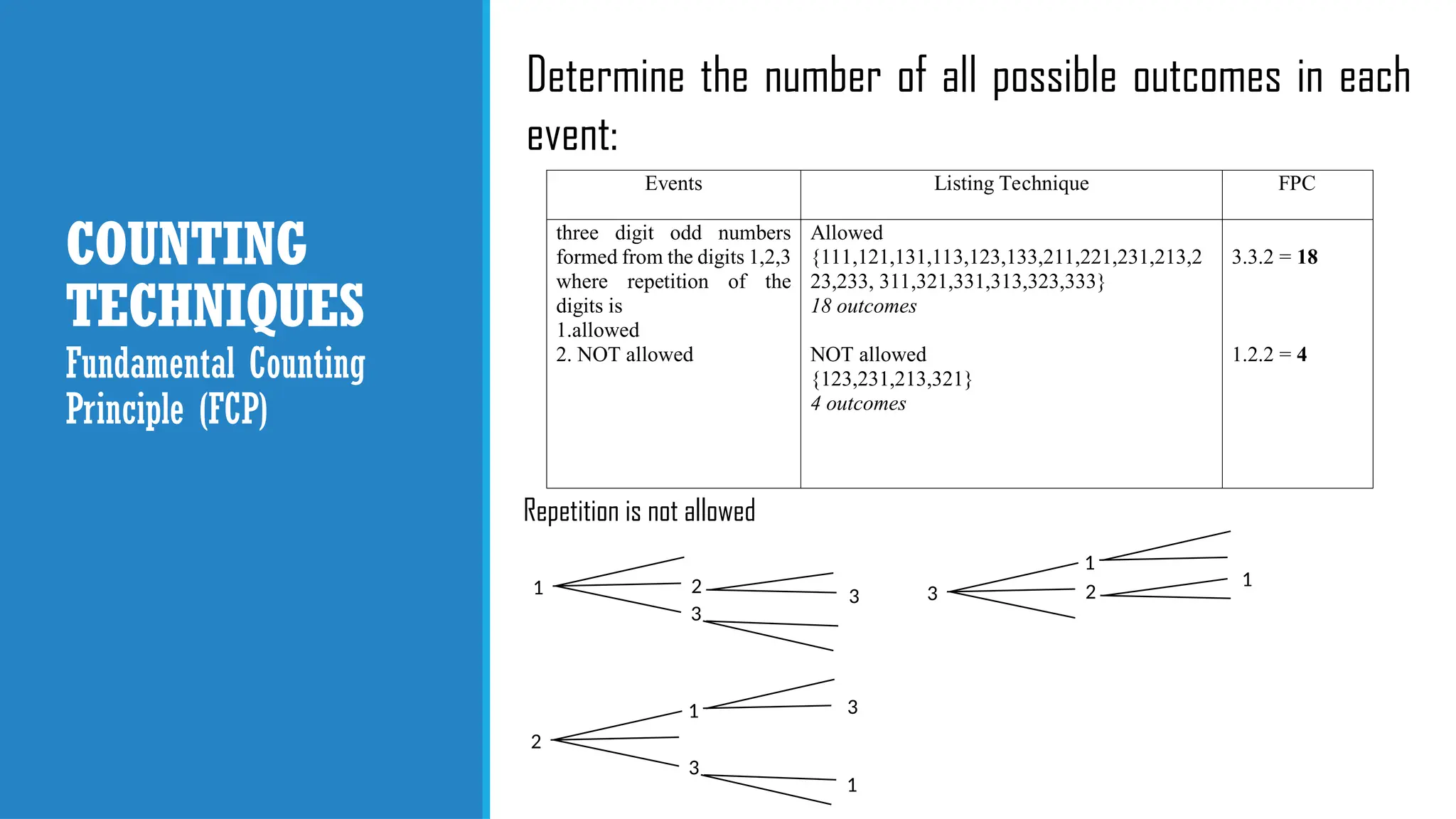
three digit odd numbers
formed from the digits 1,2,3
where repetition of the
digits is
1.allowed
2. NOT allowed
Allowed
{111,121,131,113,123,133,211,221,231,213,2
23,233, 311,321,331,313,323,333}
18 outcomes
NOT allowed
{123,231,213,321}
4 outcomes
3.3.2 = 18
1.2.2 = 4
1 2
3
3
2
1
3
3
1
3
1
2
1
15.
COUNTING
TECHNIQUES
Determine the numberof all possible outcomes in each
event:
Fundamental Counting
Principle (FCP)
Events Listing Technique FPC
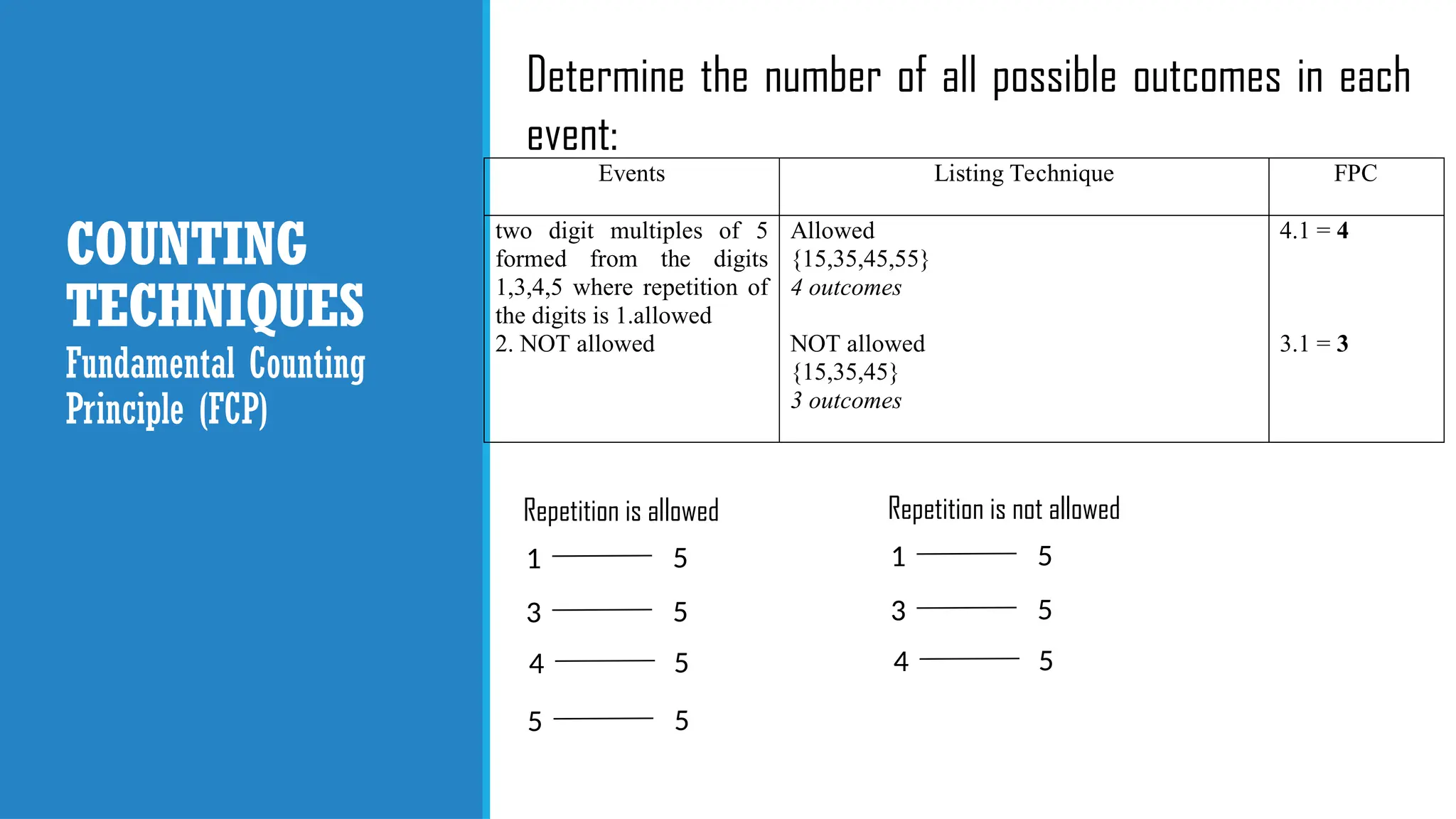
two digit multiples of 5
formed from the digits
1,3,4,5 where repetition of
the digits is 1.allowed
2. NOT allowed
Allowed
{15,35,45,55}
4 outcomes
NOT allowed
{15,35,45}
3 outcomes
4.1 = 4
3.1 = 3
1 5
3 5
4 5
5 5
Repetition is allowed
1 5
3 5
4 5
Repetition is not allowed
16.
COUNTING
TECHNIQUES
Determine the numberof all possible outcomes in each
event:
Fundamental Counting
Principle (FCP)
a
Events Listing Technique FPC
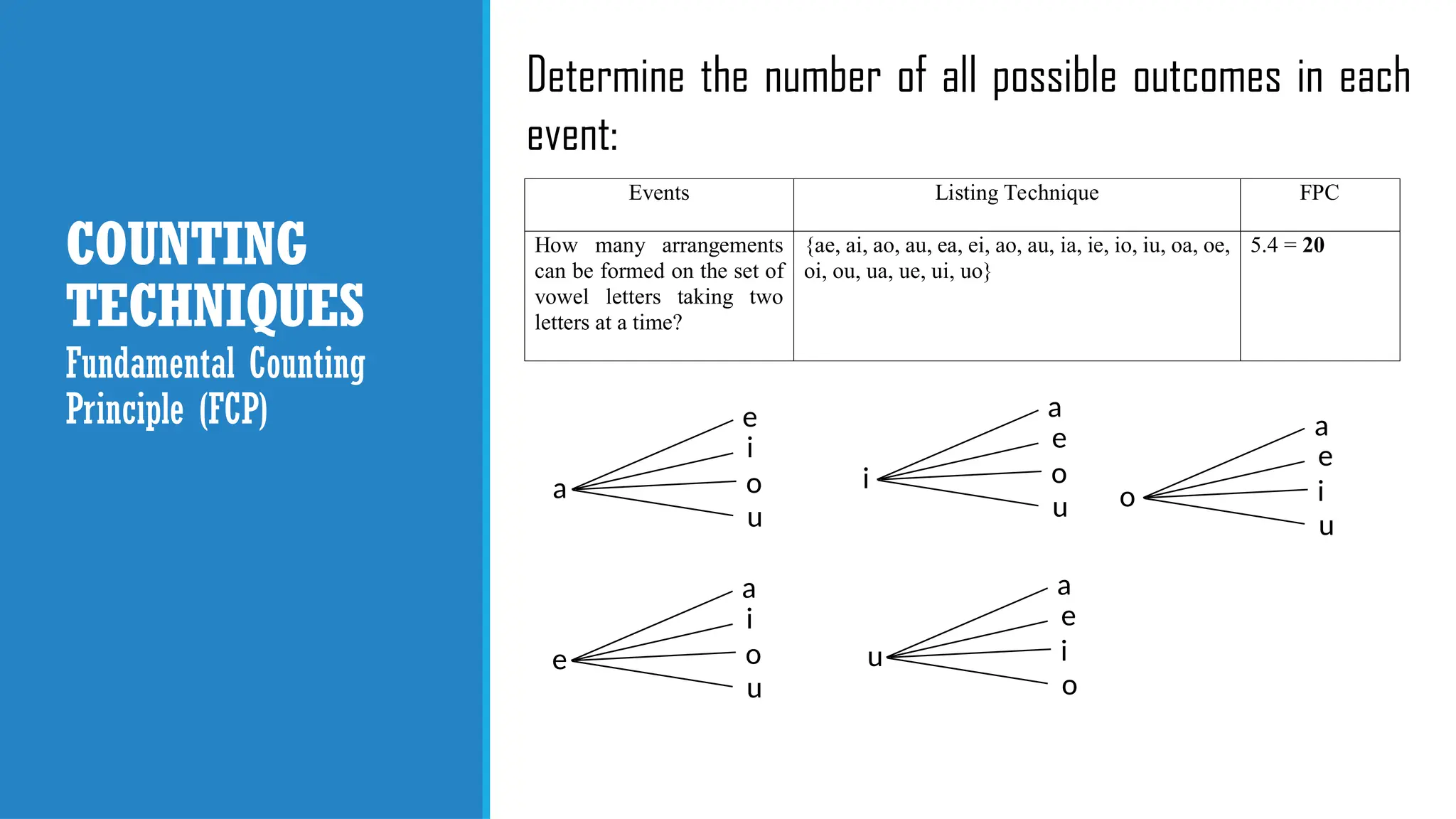
How many arrangements
can be formed on the set of
vowel letters taking two
letters at a time?
{ae, ai, ao, au, ea, ei, ao, au, ia, ie, io, iu, oa, oe,
oi, ou, ua, ue, ui, uo}
5.4 = 20
e
i
o
u
e
a
i
o
u
i
a
e
o
u
u
a
e
i
o
o
e
i
u
a
17.
COUNTING
TECHNIQUES
Determine the numberof all possible outcomes in each
event:
Fundamental Counting
Principle (FCP)
H
2
3
1
5
Events Listing Technique FPC
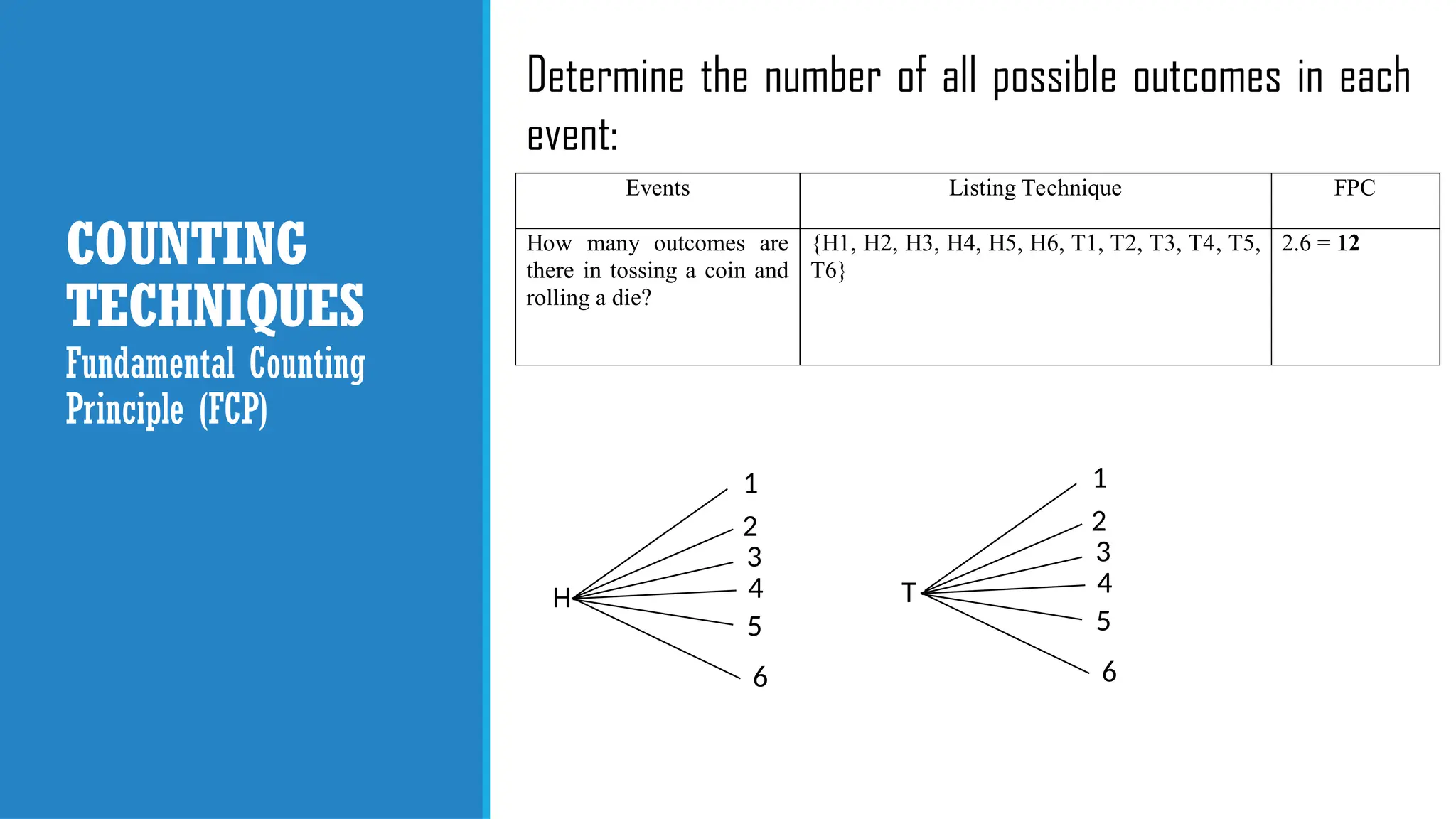
How many outcomes are
there in tossing a coin and
rolling a die?
{H1, H2, H3, H4, H5, H6, T1, T2, T3, T4, T5,
T6}
2.6 = 12
4
6
T
2
3
1
5
4
6
18.
COUNTING
TECHNIQUES
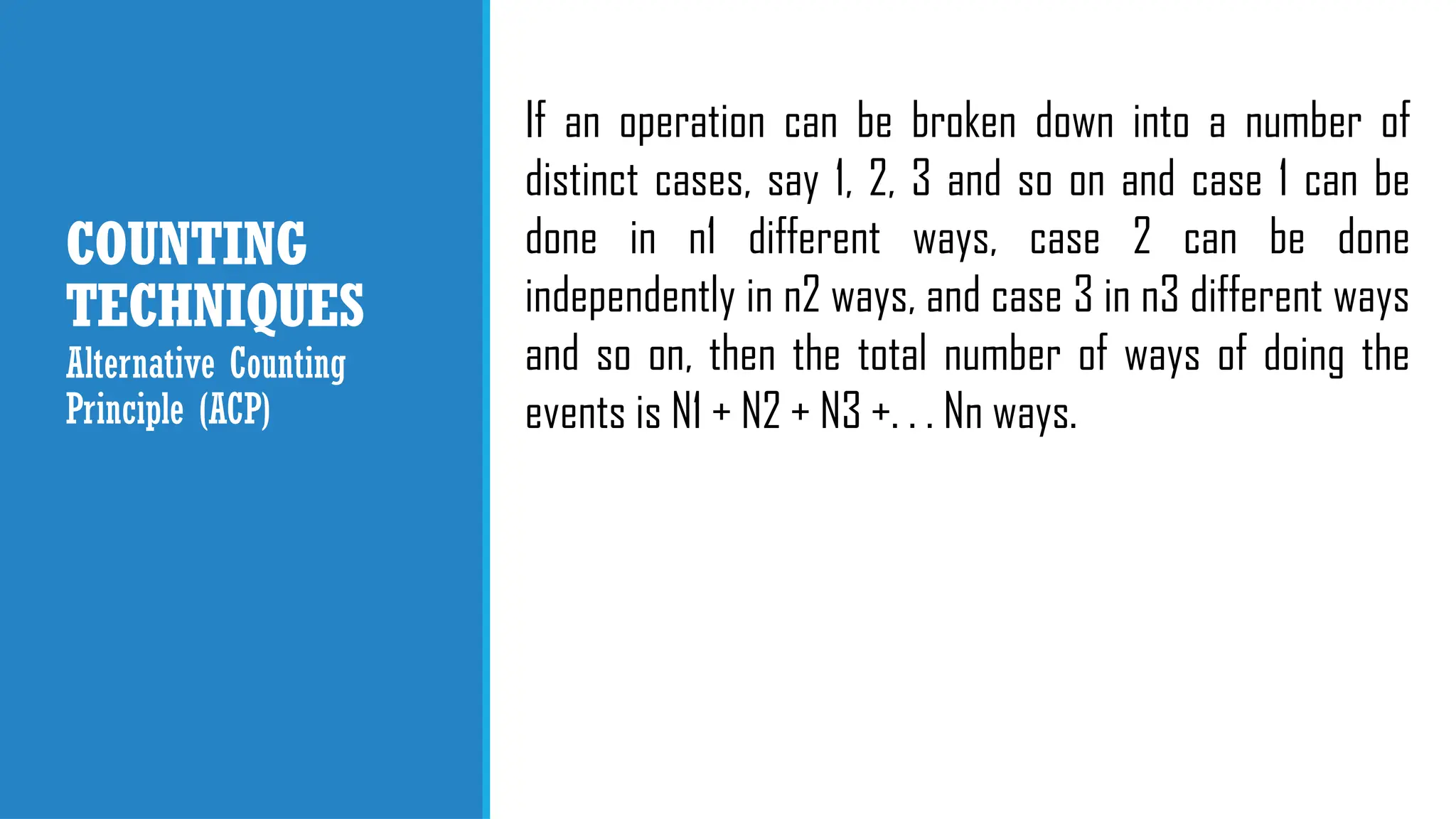
If an operationcan be broken down into a number of
distinct cases, say 1, 2, 3 and so on and case 1 can be
done in n1 different ways, case 2 can be done
independently in n2 ways, and case 3 in n3 different ways
and so on, then the total number of ways of doing the
events is N1 + N2 + N3 +. . . Nn ways.
Alternative Counting
Principle (ACP)
19.
COUNTING
TECHNIQUES
Alternative Counting
Principle (ACP)
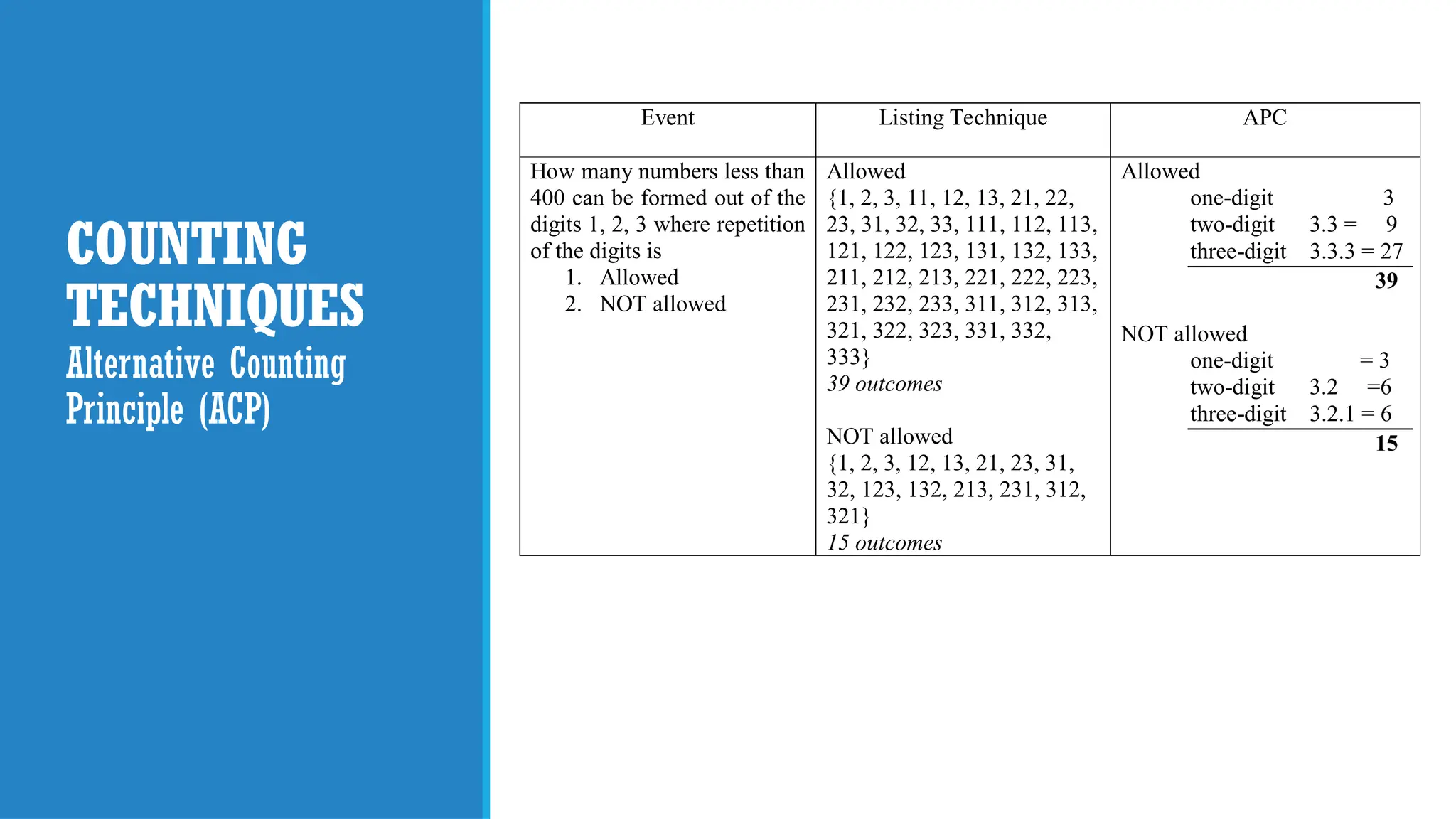
EventListing Technique APC
How many numbers less than
400 can be formed out of the
digits 1, 2, 3 where repetition
of the digits is
1. Allowed
2. NOT allowed
Allowed
{1, 2, 3, 11, 12, 13, 21, 22,
23, 31, 32, 33, 111, 112, 113,
121, 122, 123, 131, 132, 133,
211, 212, 213, 221, 222, 223,
231, 232, 233, 311, 312, 313,
321, 322, 323, 331, 332,
333}
39 outcomes
NOT allowed
{1, 2, 3, 12, 13, 21, 23, 31,
32, 123, 132, 213, 231, 312,
321}
15 outcomes
Allowed
one-digit 3
two-digit 3.3 = 9
three-digit 3.3.3 = 27
39
NOT allowed
one-digit = 3
two-digit 3.2 =6
three-digit 3.2.1 = 6
15
20.
COUNTING
TECHNIQUES
Alternative Counting
Principle (ACP)
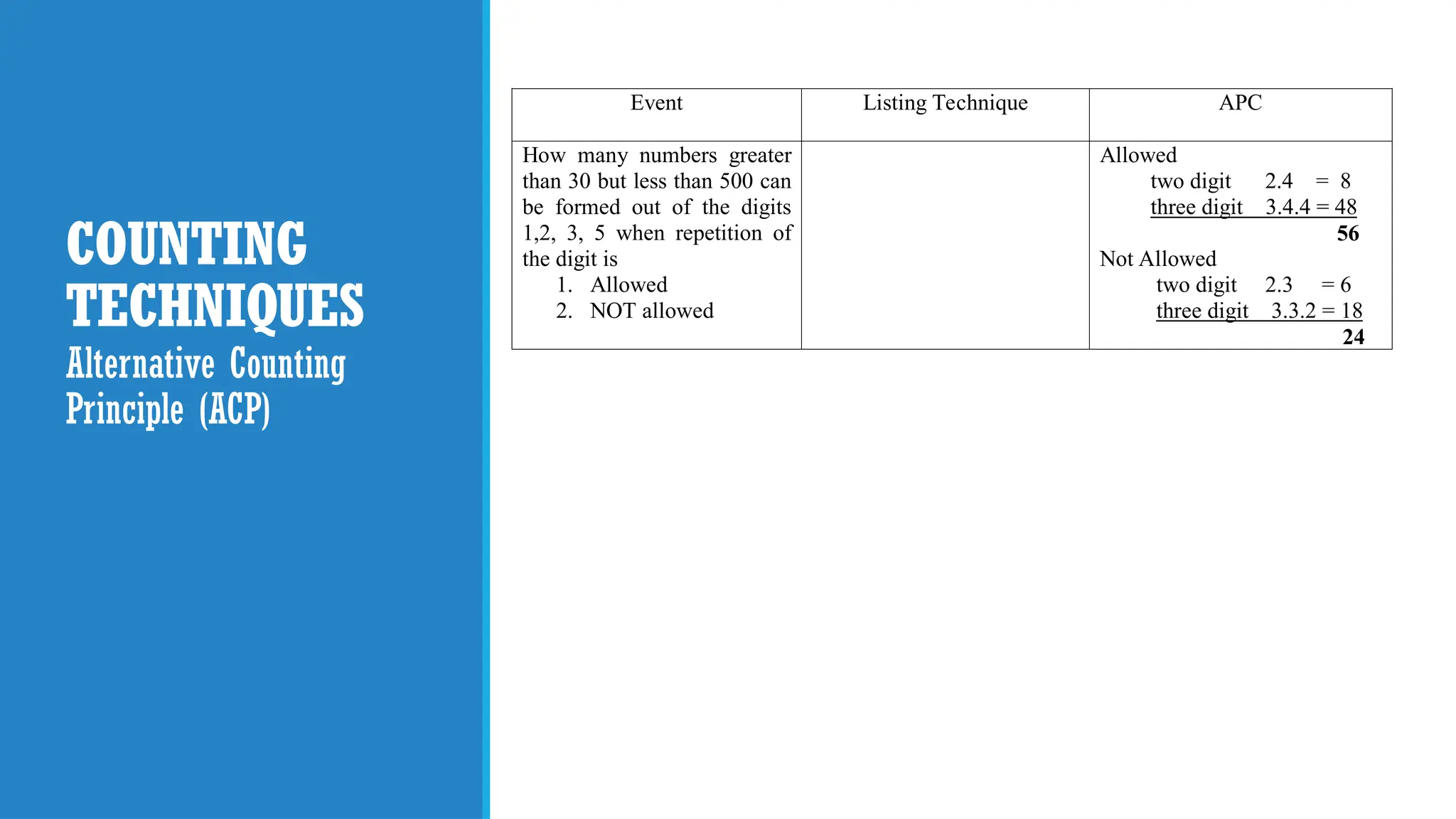
EventListing Technique APC
How many numbers greater
than 30 but less than 500 can
be formed out of the digits
1,2, 3, 5 when repetition of
the digit is
1. Allowed
2. NOT allowed
Allowed
two digit 2.4 = 8
three digit 3.4.4 = 48
56
Not Allowed
two digit 2.3 = 6
three digit 3.3.2 = 18
24