The Geometry of Information Retrieval
Quantum Probabilities and Quantum-inspired IR Models


                  Ingo Frommholz

                 University of Bedfordshire
                        Luton, UK
               ingo.frommholz@beds.ac.uk


         Herbstschule Information Retrieval
                 Schloss Dagstuhl
Table of Contents


   1   Introduction

   2   Introduction to Quantum Probabilities

   3   Quantum-inspired IR Models

   4   Further Models and Conclusion


                                               2 / 145
Acknowledgements

     Some parts (in particular the quantum probability one) are based
     on the ECIR 2012 “Quantum Information Access and Retrieval”
     tutorial given by Benjamin Piwowarski and Massimo Melucci
     This tutorial is worth checking out
            It covers some aspect more thoroughly
            It discusses some further quantum-based IR models
     See also
     http://www.bpiwowar.net/2012/04/

     slides-from-the-ecir12-quantum-information-access-and-retrieval-tutorial/

     Direct download:
     http://www.bpiwowar.net/wp-content/uploads/2012/04/tutorial-handout.pdf

     I’d like to thank Guido Zuccon for providing material about qPRP

                                                                                 3 / 145
Introduction


   IR and Geometry
Introduction
   IR and Geometry


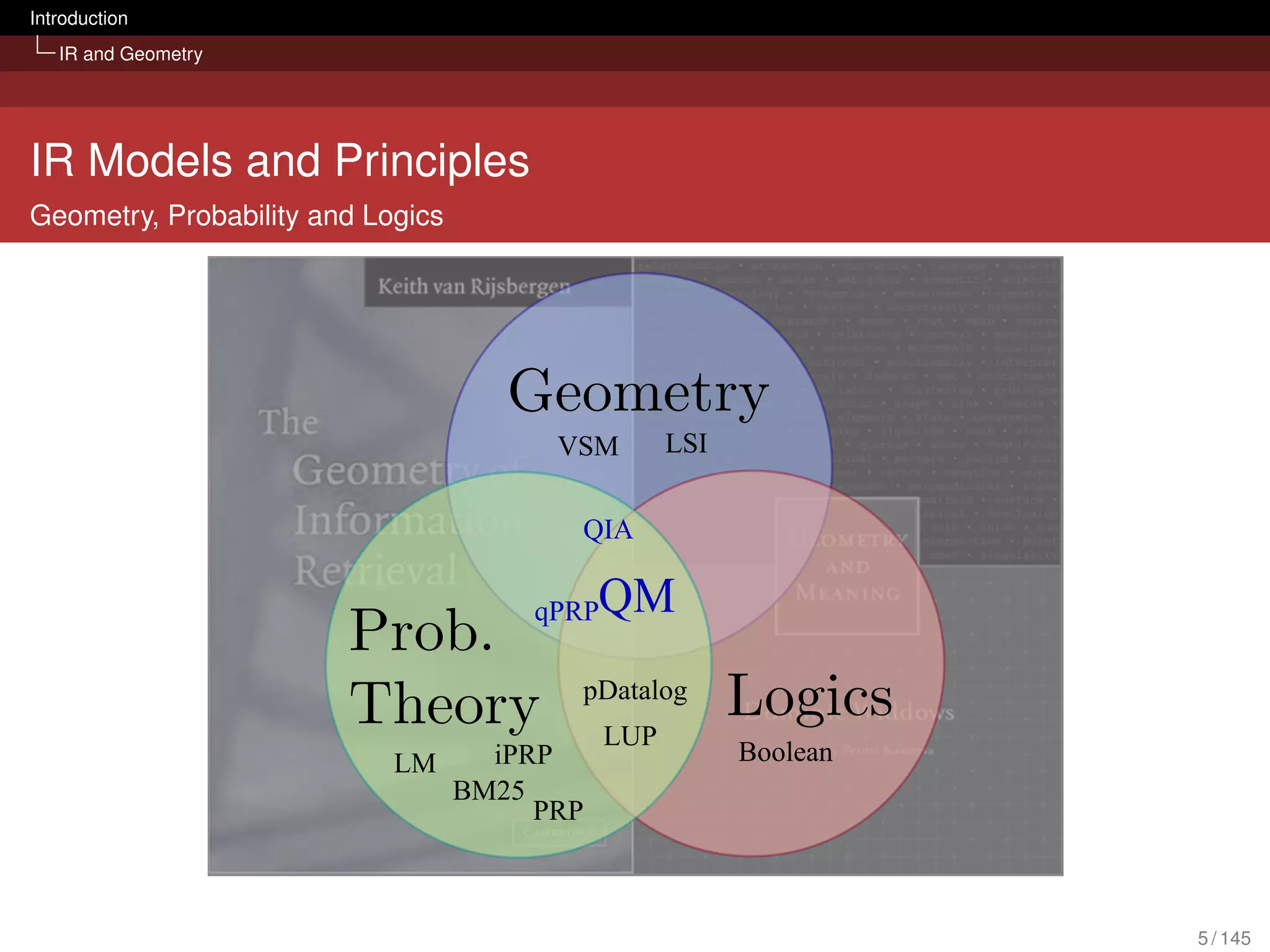
IR Models and Principles
Geometry, Probability and Logics


                                         VSM        LSI


                                          QIA

                                       qPRP   QM
                                          pDatalog
                                              LUP
                            LM       iPRP                 Boolean
                                   BM25
                                        PRP


                                                                    5 / 145
Introduction
   IR and Geometry


A Language for IR


               The geometry and mathematics behind quantum mechanics can
               be seen as a ’language’ for expressing the different IR models
               [van Rijsbergen, 2004].
               Combination of geometry, probability and logics
               Leading to non-classical probability theory and logics
               Potential unified framework for IR models
               Applications in areas outside physics emerging
                     Quantum Interaction symposia (e.g. [Song et al., 2011])


                                                                                6 / 145
Introduction
   IR and Geometry


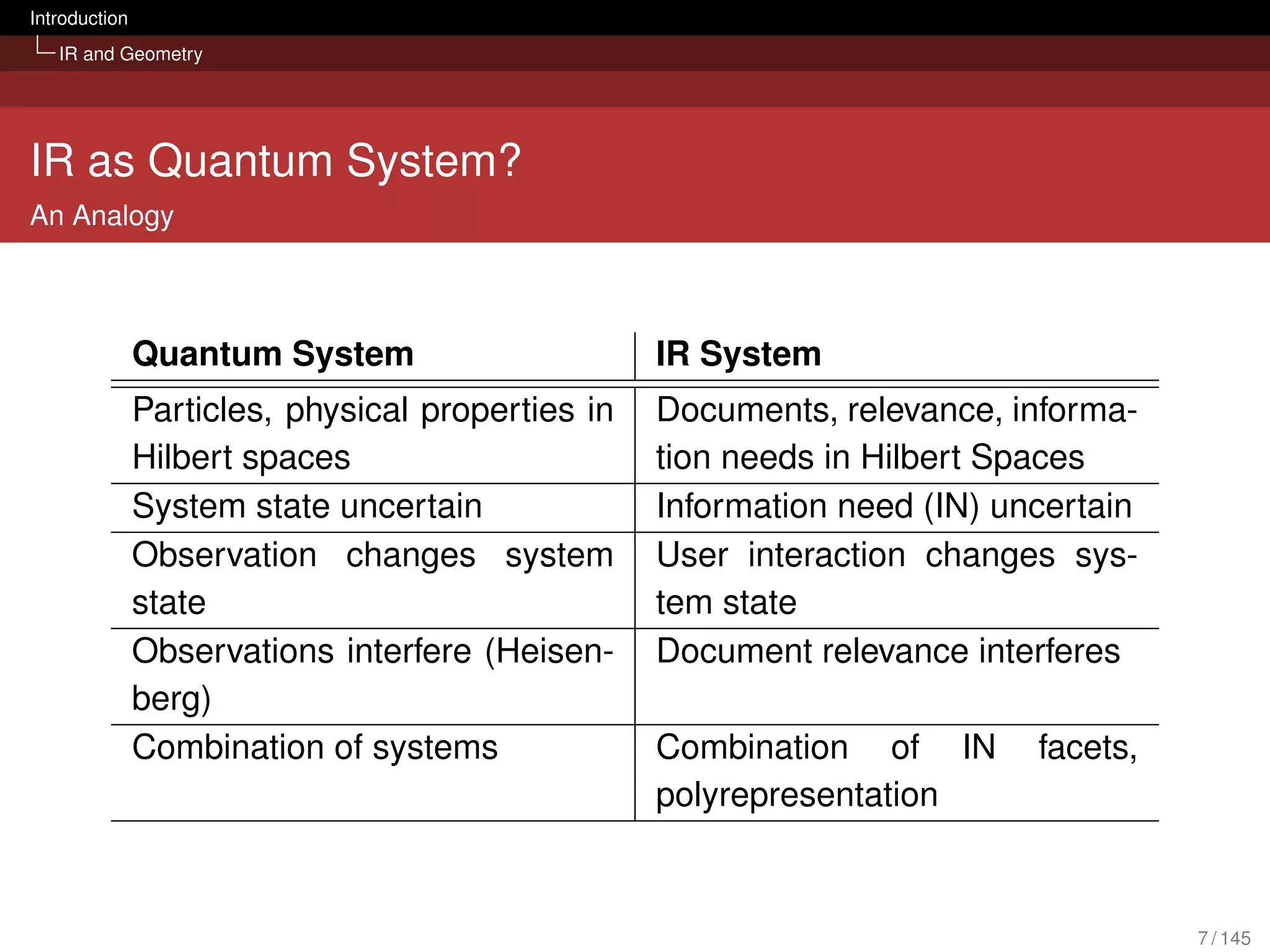
IR as Quantum System?
An Analogy


               Quantum System                      IR System
               Particles, physical properties in   Documents, relevance, informa-
               Hilbert spaces                      tion needs in Hilbert Spaces
               System state uncertain              Information need (IN) uncertain
               Observation changes system          User interaction changes sys-
               state                               tem state
               Observations interfere (Heisen-     Document relevance interferes
               berg)
               Combination of systems              Combination of IN       facets,
                                                   polyrepresentation


                                                                                     7 / 145
Introduction
   IR and Geometry


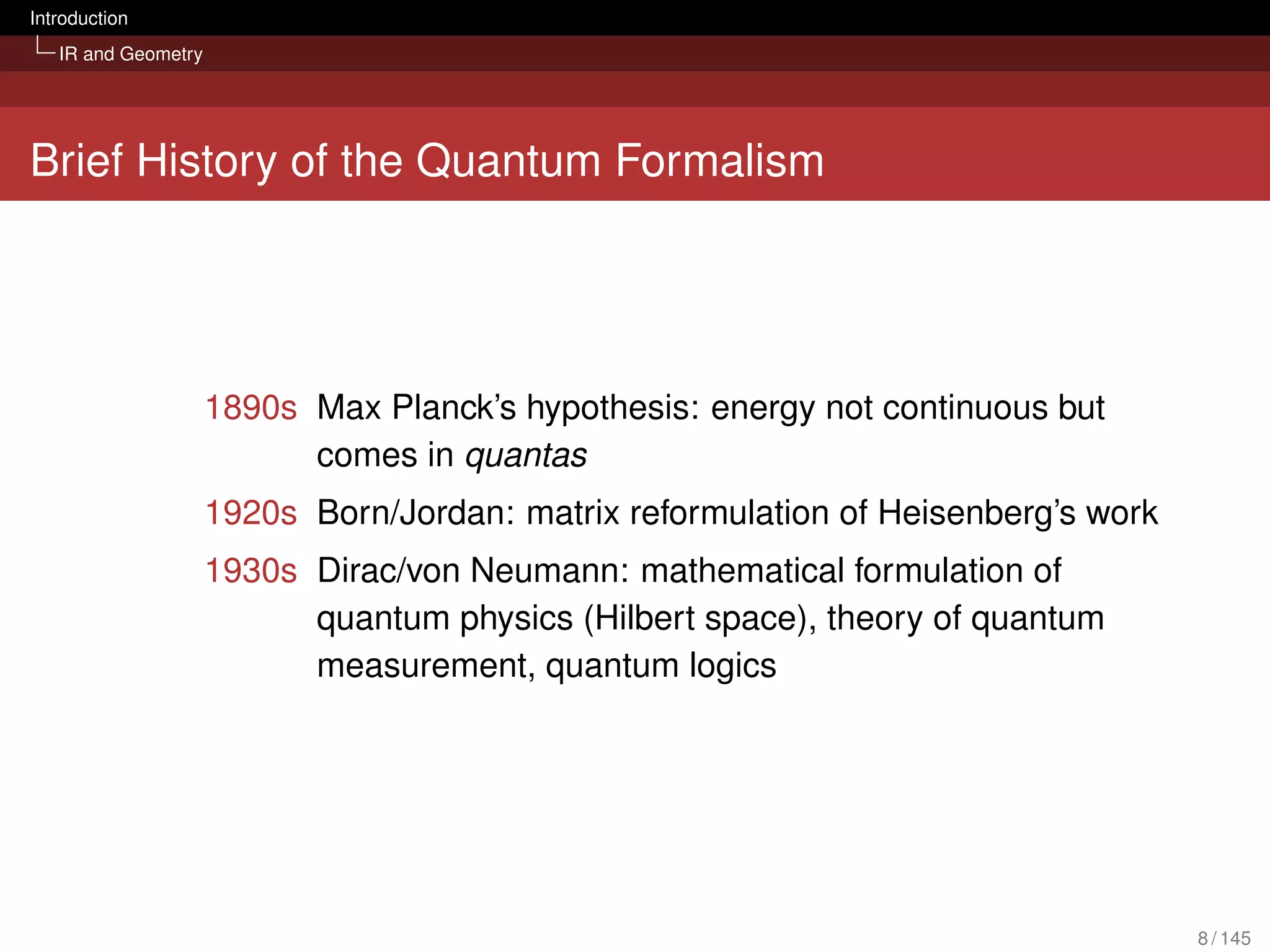
Brief History of the Quantum Formalism


                     1890s Max Planck’s hypothesis: energy not continuous but
                           comes in quantas
                     1920s Born/Jordan: matrix reformulation of Heisenberg’s work
                     1930s Dirac/von Neumann: mathematical formulation of
                           quantum physics (Hilbert space), theory of quantum
                           measurement, quantum logics


                                                                                    8 / 145
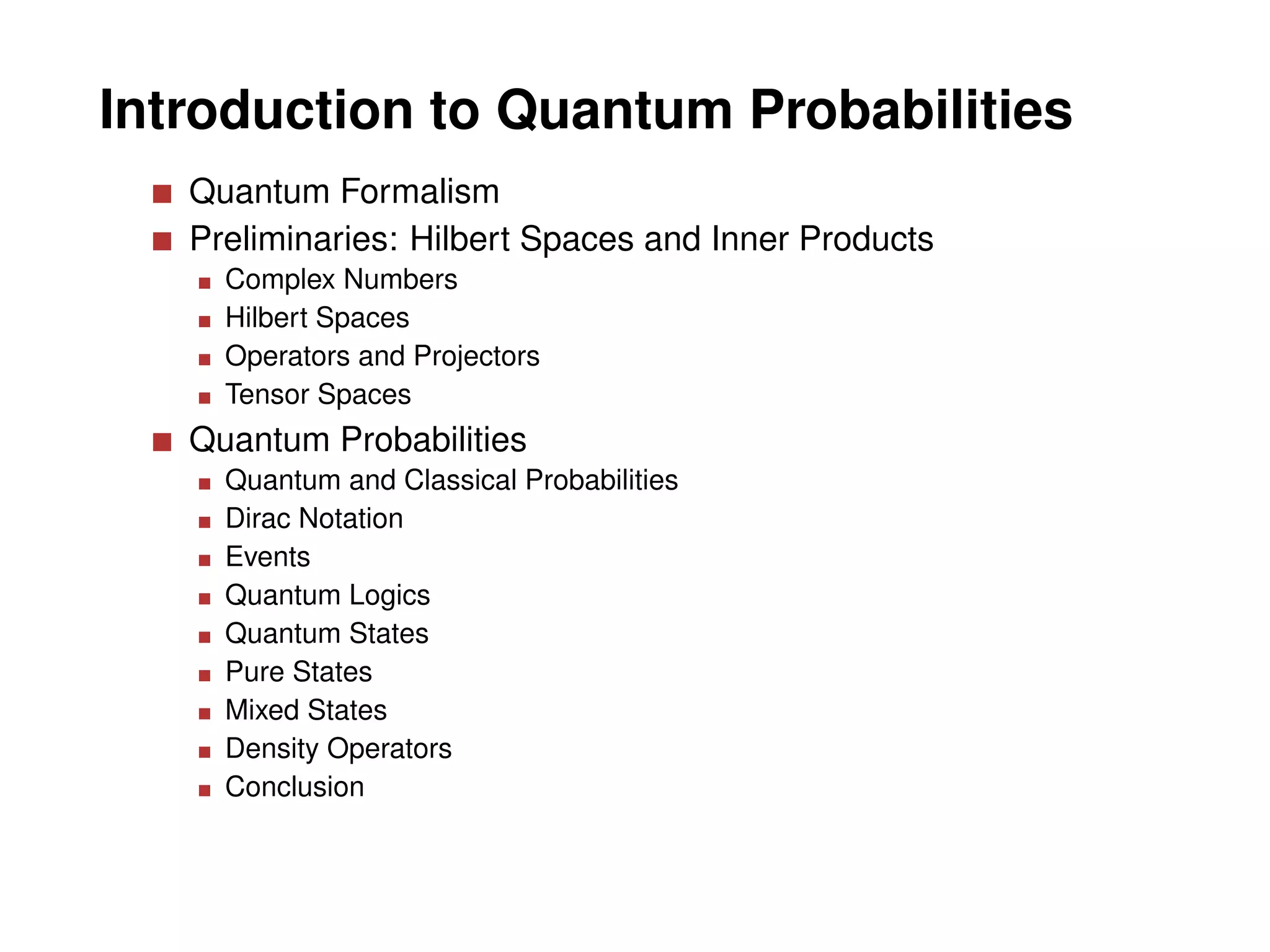
Introduction to Quantum Probabilities
   Quantum Formalism
   Preliminaries: Hilbert Spaces and Inner Products
     Complex Numbers
     Hilbert Spaces
     Operators and Projectors
     Tensor Spaces
   Quantum Probabilities
     Quantum and Classical Probabilities
     Dirac Notation
     Events
     Quantum Logics
     Quantum States
     Pure States
     Mixed States
     Density Operators
     Conclusion
Quantum Probabilities Introduction
   Quantum Formalism


Quantum Formalism


                 The quantum formalism is build on top of Hilbert spaces
                 Each finite-dimensional vector space with an inner product is a
                 Hilbert space [Halmos, 1958]
                          We focus on finite-dimensional spaces here
                 A vector space is defined over a field K, e.g R or C


                                                                                  10 / 145
Quantum Probabilities Introduction
   Preliminaries: Hilbert Spaces and Inner Products
      Complex Numbers


Complex Numbers

                                                      Complex number z ∈ C
                                                      z = a + ib, a, b ∈ R, i2 = −1
                                                      Polar form: z =
                                                      r (cos(φ) + i sin(φ)) = reiφ
                                                      with r ∈ R+ , φ ∈ [0, 2π]
                                                      Addition/Multiplication:
                                                      z1 = a1 + ib1 = r1 eiφ1 ,
                                                      z2 = a2 + ib2 = r2 eiφ2 :
                                                      z1 + z2 = (a1 + a2 )+ i (b1 + b2 )
                                                      z1 · z2 = r1 r2 ei(φ1 +φ2 )


                                                                                      11 / 145
Quantum Probabilities Introduction
   Preliminaries: Hilbert Spaces and Inner Products
      Complex Numbers


Complex Numbers

                                                      Complex number z ∈ C
                                                      z = a + ib, a, b ∈ R, i2 = −1
                                                      Polar form: z =
                                                      r (cos(φ) + i sin(φ)) = reiφ
                                                      with r ∈ R+ , φ ∈ [0, 2π]
                                                      Complex conjugate
                                                      z = a − ib = re −iφ
                                                      b = 0 ⇔z ∈ R ⇔z = z
                                                      Absolute value
                                                      | z | = a2 + b 2 = r =   zz
                                                      |z |2 = zz


                                                                                      12 / 145
Quantum Probabilities Introduction
   Preliminaries: Hilbert Spaces and Inner Products
      Hilbert Spaces


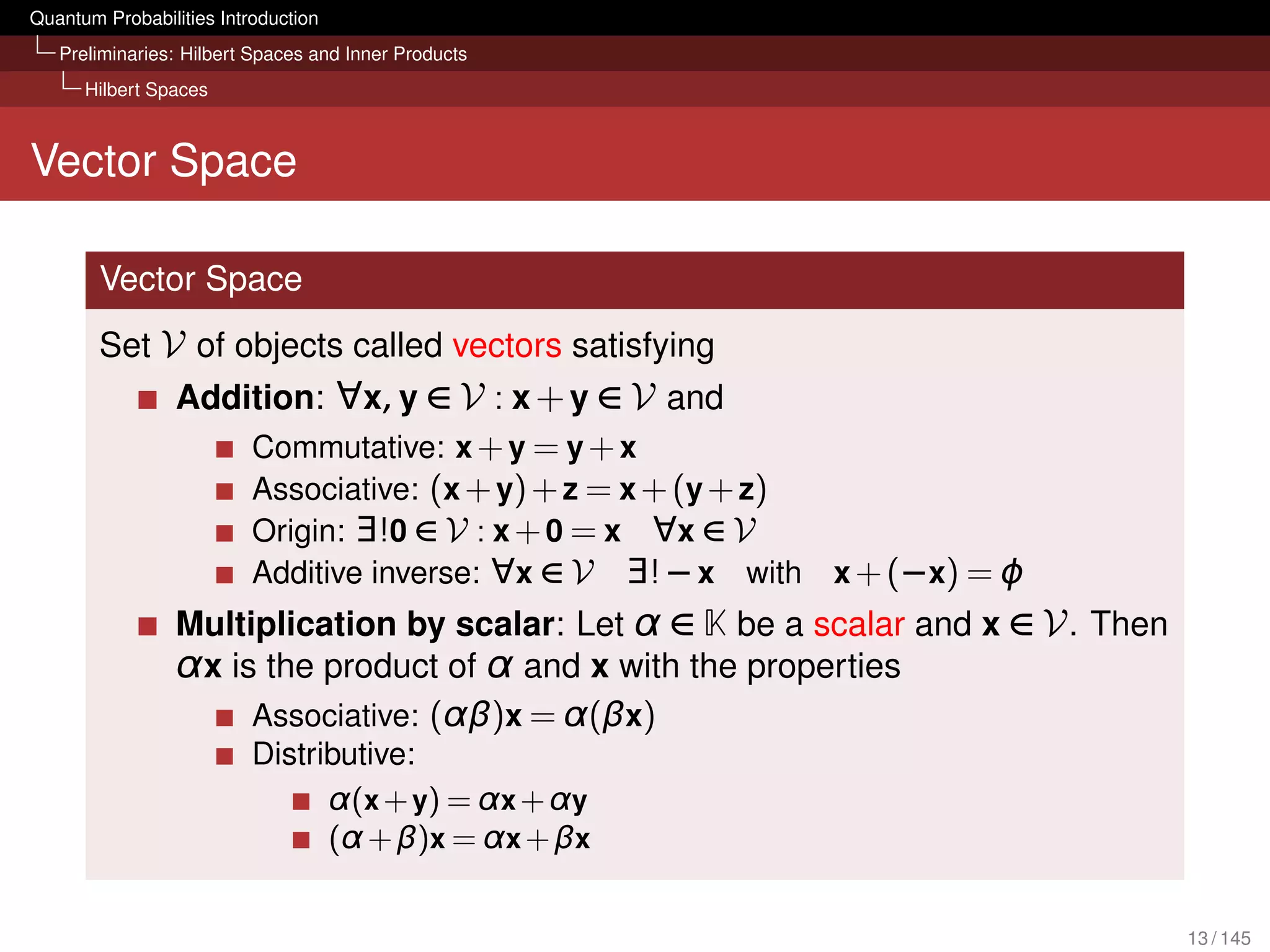
Vector Space

        Vector Space
        Set V of objects called vectors satisfying
                 Addition: ∀x, y ∈ V : x + y ∈ V and
                     Commutative: x + y = y + x
                     Associative: (x + y) + z = x + (y + z)
                     Origin: ∃!0 ∈ V : x + 0 = x ∀x ∈ V
                     Additive inverse: ∀x ∈ V ∃! − x with x + (−x) = ϕ
                 Multiplication by scalar: Let α ∈ K be a scalar and x ∈ V . Then
                 α x is the product of α and x with the properties
                       Associative: (αβ)x = α(βx)
                          Distributive:
                                α(x + y) = α x + α y
                                (α + β)x = α x + βx


                                                                                    13 / 145
Quantum Probabilities Introduction
   Preliminaries: Hilbert Spaces and Inner Products
      Hilbert Spaces


Vector Space
Example


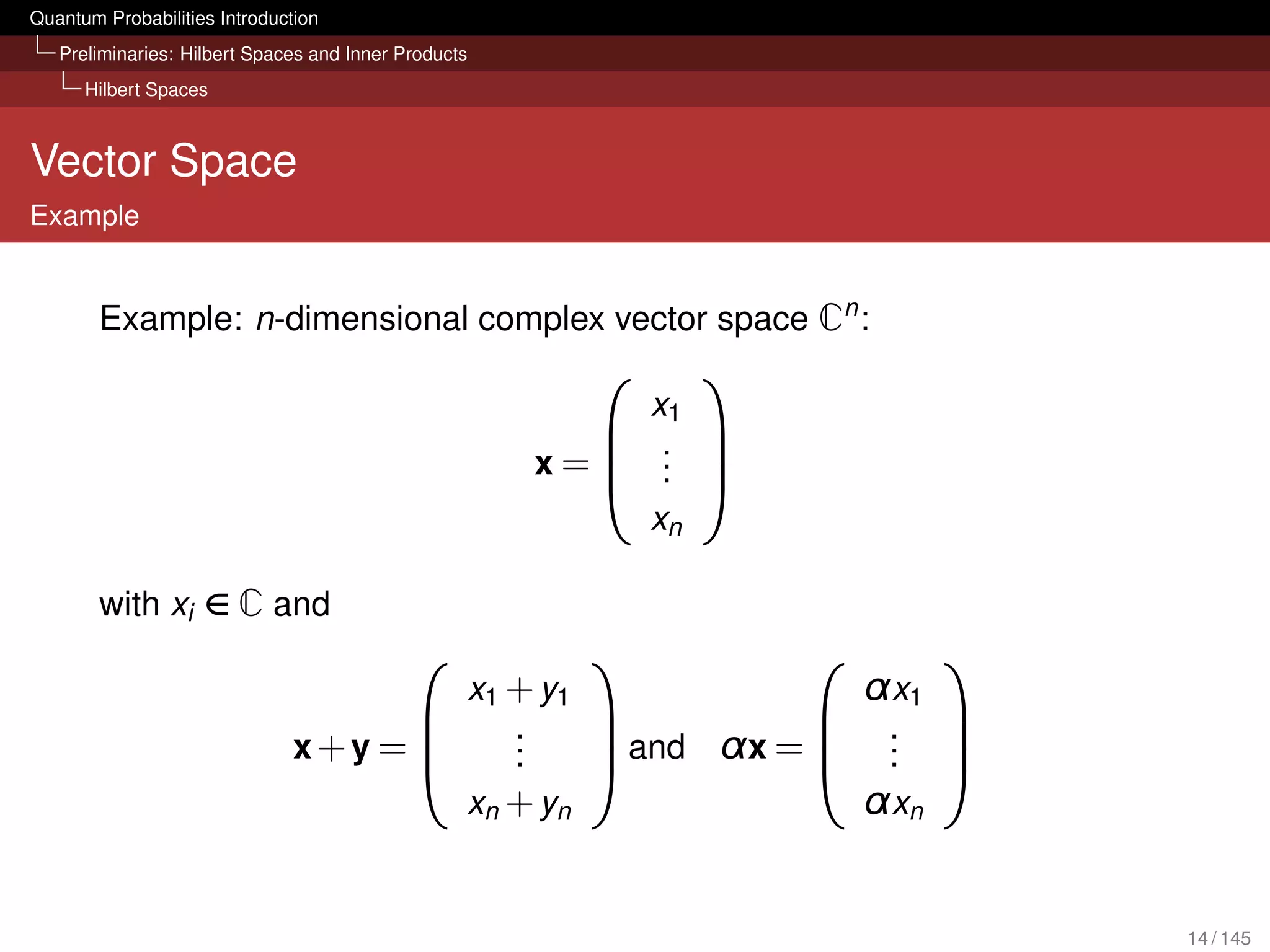
        Example: n-dimensional complex vector space Cn :
                                                           
                                                          x
                                                         .1 
                                                      x= . 
                                                         . 
                                                          xn

        with xi ∈ C and
                                                                          
                                      x +y                            α x1
                                     1 . 1                           . 
                                         .                             . 
                                                                  
                              x+y = 
                                    
                                         .
                                               and
                                                            αx = 
                                                                      . 
                                      xn + yn                         α xn


                                                                                 14 / 145
Quantum Probabilities Introduction
   Preliminaries: Hilbert Spaces and Inner Products
      Hilbert Spaces


Vector Space
Linear Combinations


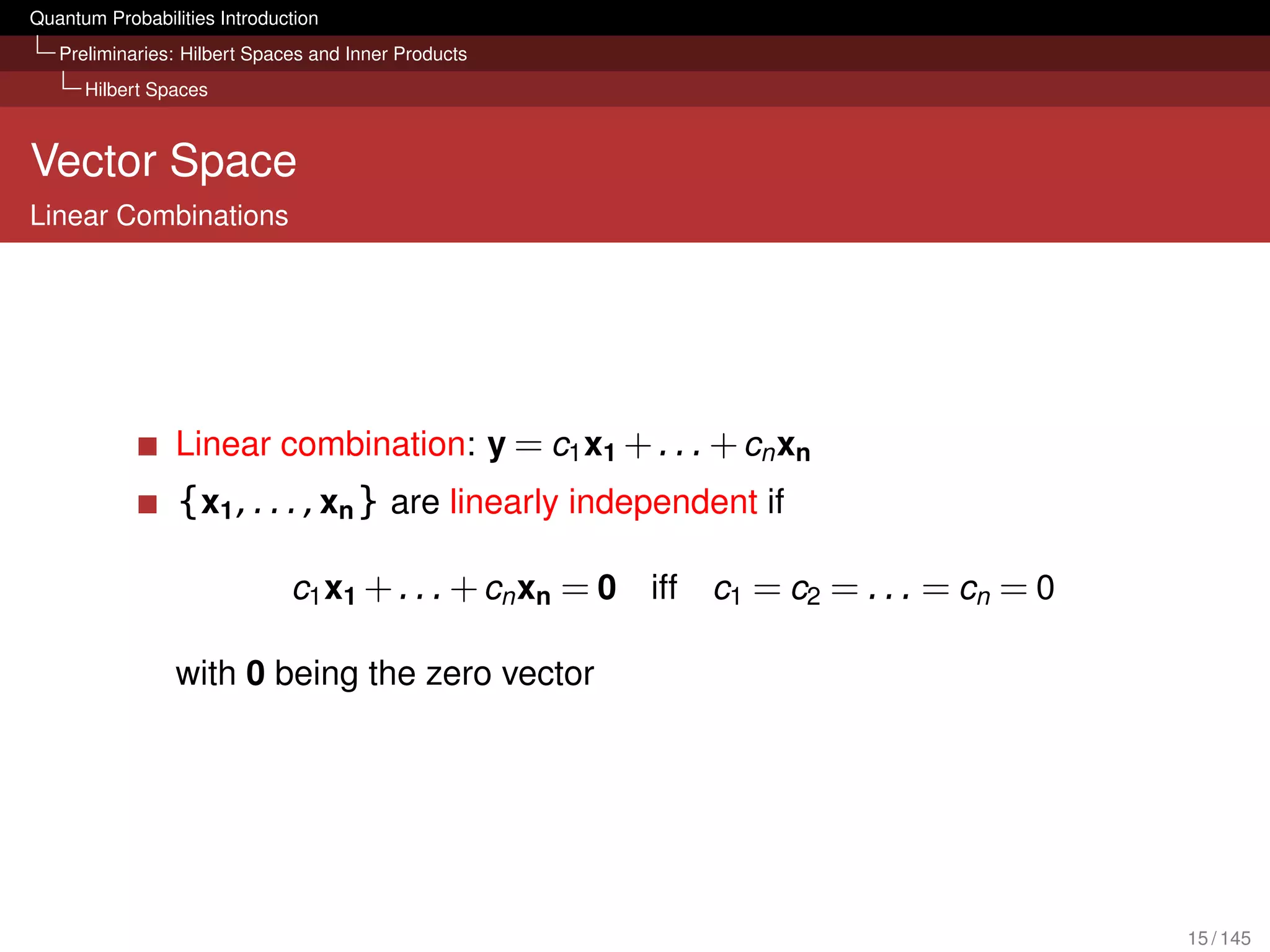
                 Linear combination: y = c1 x1 + . . . + cn xn
                 {x1 , . . . , xn } are linearly independent if

                              c1 x1 + . . . + cn xn = 0   iff   c1 = c2 = . . . = cn = 0

                 with 0 being the zero vector


                                                                                           15 / 145
Quantum Probabilities Introduction
   Preliminaries: Hilbert Spaces and Inner Products
      Hilbert Spaces


Vector Space
Basis

        (Finite) Basis
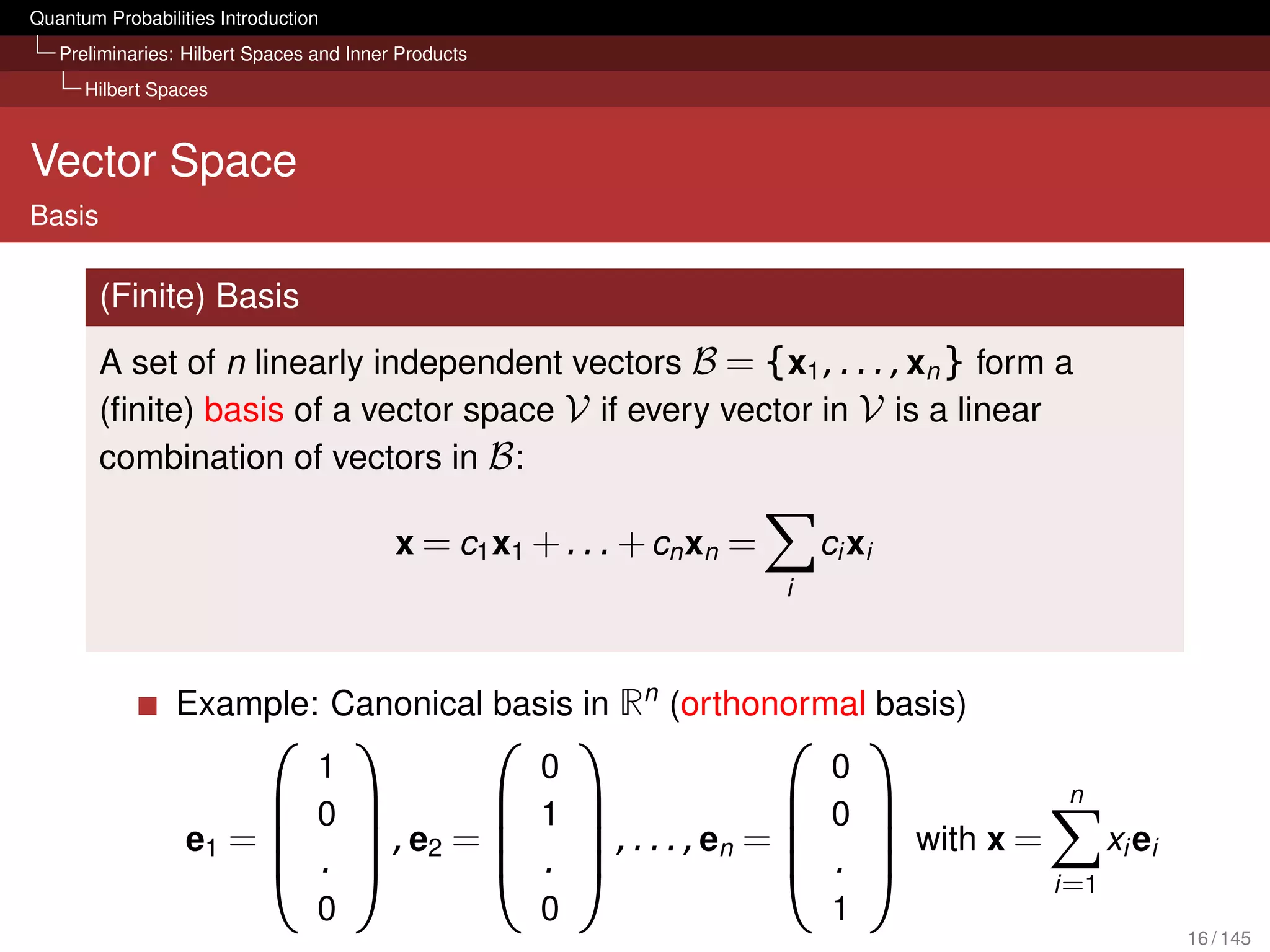
        A set of n linearly independent vectors B = {x1 , . . . , xn } form a
        (finite) basis of a vector space V if every vector in V is a linear
        combination of vectors in B :

                                          x = c1 x1 + . . . + cn xn =       ci xi
                                                                        i


                 Example: Canonical basis in Rn (orthonormal basis)
                                                                            
                             1                          0                 0
                                                                                     n
                            0                        1               0 
                                                                     
                  e1 =         , e2 =   , . . . , en =   with x =      x i ei
                            .          .                .         i =1
                                 0                        0                  1
                                                                                         16 / 145
Quantum Probabilities Introduction
   Preliminaries: Hilbert Spaces and Inner Products
      Hilbert Spaces


Vector Space
Subspace


        Subspace
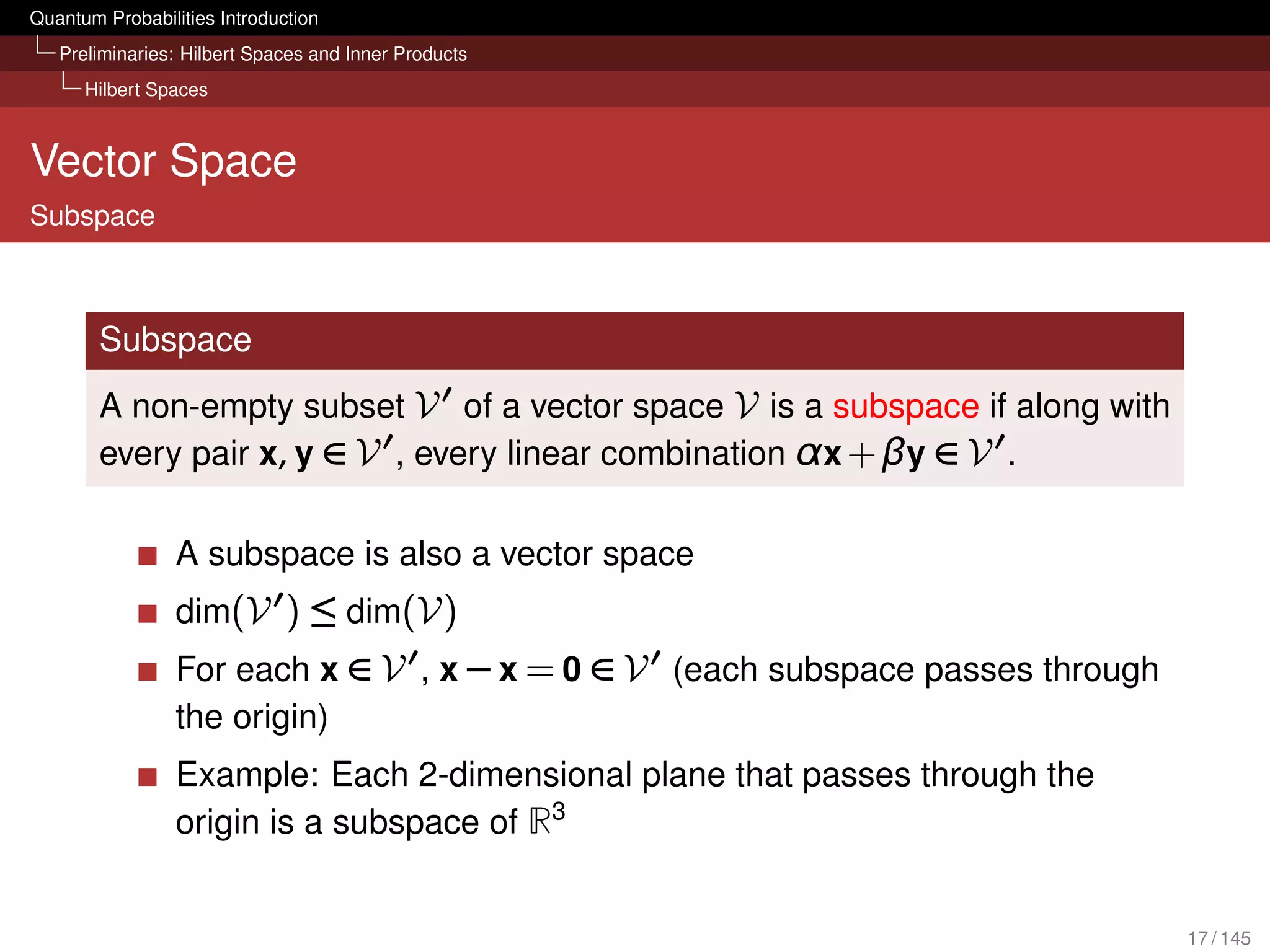
        A non-empty subset V of a vector space V is a subspace if along with
        every pair x, y ∈ V , every linear combination α x + βy ∈ V .

                 A subspace is also a vector space
                 dim(V ) ≤ dim(V)
                 For each x ∈ V , x − x = 0 ∈ V (each subspace passes through
                 the origin)
                 Example: Each 2-dimensional plane that passes through the
                 origin is a subspace of R3


                                                                                17 / 145
Quantum Probabilities Introduction
   Preliminaries: Hilbert Spaces and Inner Products
      Hilbert Spaces


Hilbert Space
Inner product/1


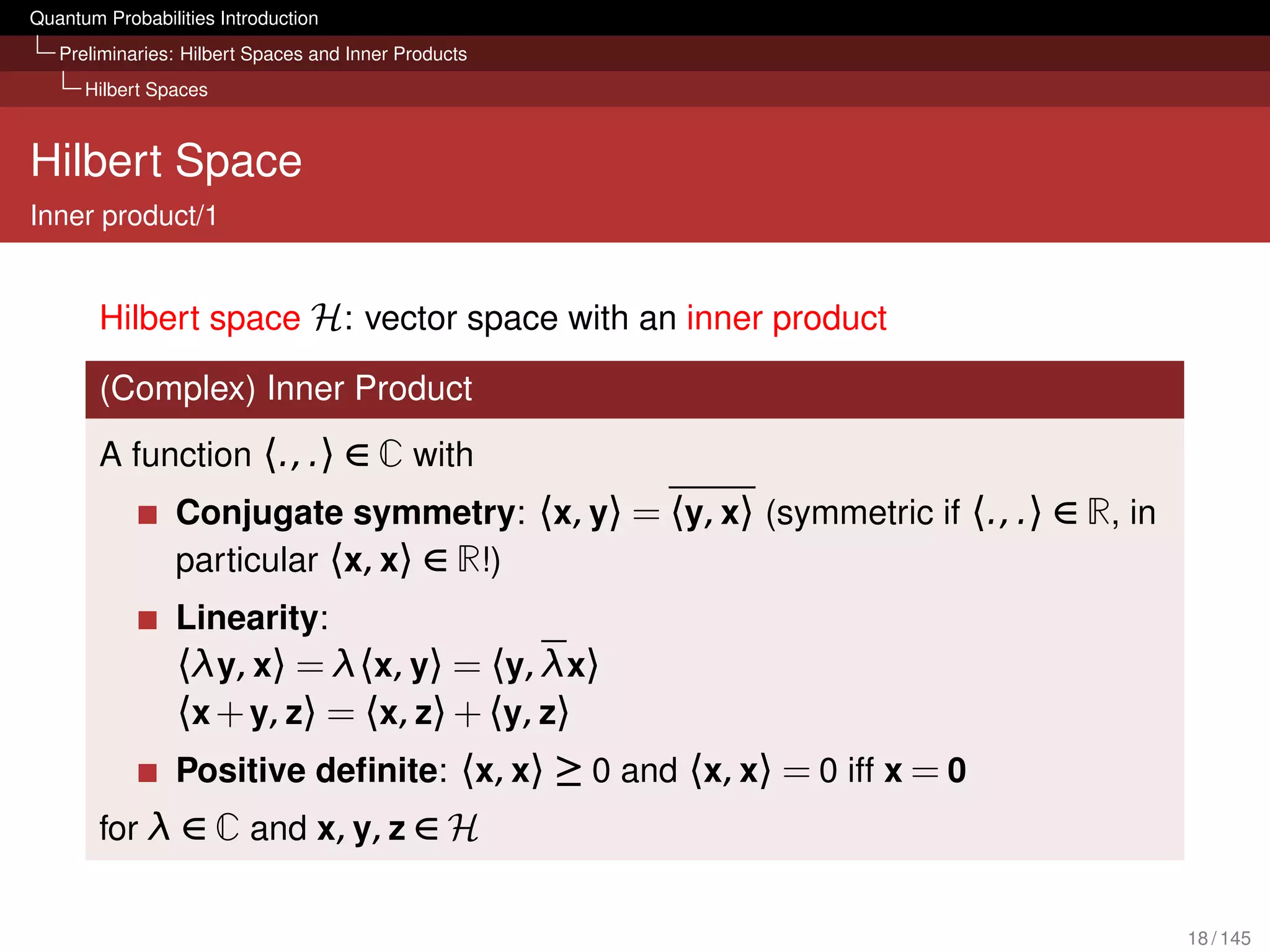
        Hilbert space H: vector space with an inner product

        (Complex) Inner Product
        A function 〈., .〉 ∈ C with
                 Conjugate symmetry: 〈x, y〉 = 〈y, x〉 (symmetric if 〈., .〉 ∈ R, in
                 particular 〈x, x〉 ∈ R!)
                 Linearity:
                 〈λy, x〉 = λ〈x, y〉 = 〈y, λx〉
                 〈x + y, z〉 = 〈x, z〉 + 〈y, z〉
                 Positive definite: 〈x, x〉 ≥ 0 and 〈x, x〉 = 0 iff x = 0
        for λ ∈ C and x, y, z ∈ H


                                                                                    18 / 145
Quantum Probabilities Introduction
   Preliminaries: Hilbert Spaces and Inner Products
      Hilbert Spaces


Hilbert Space
Inner product/2


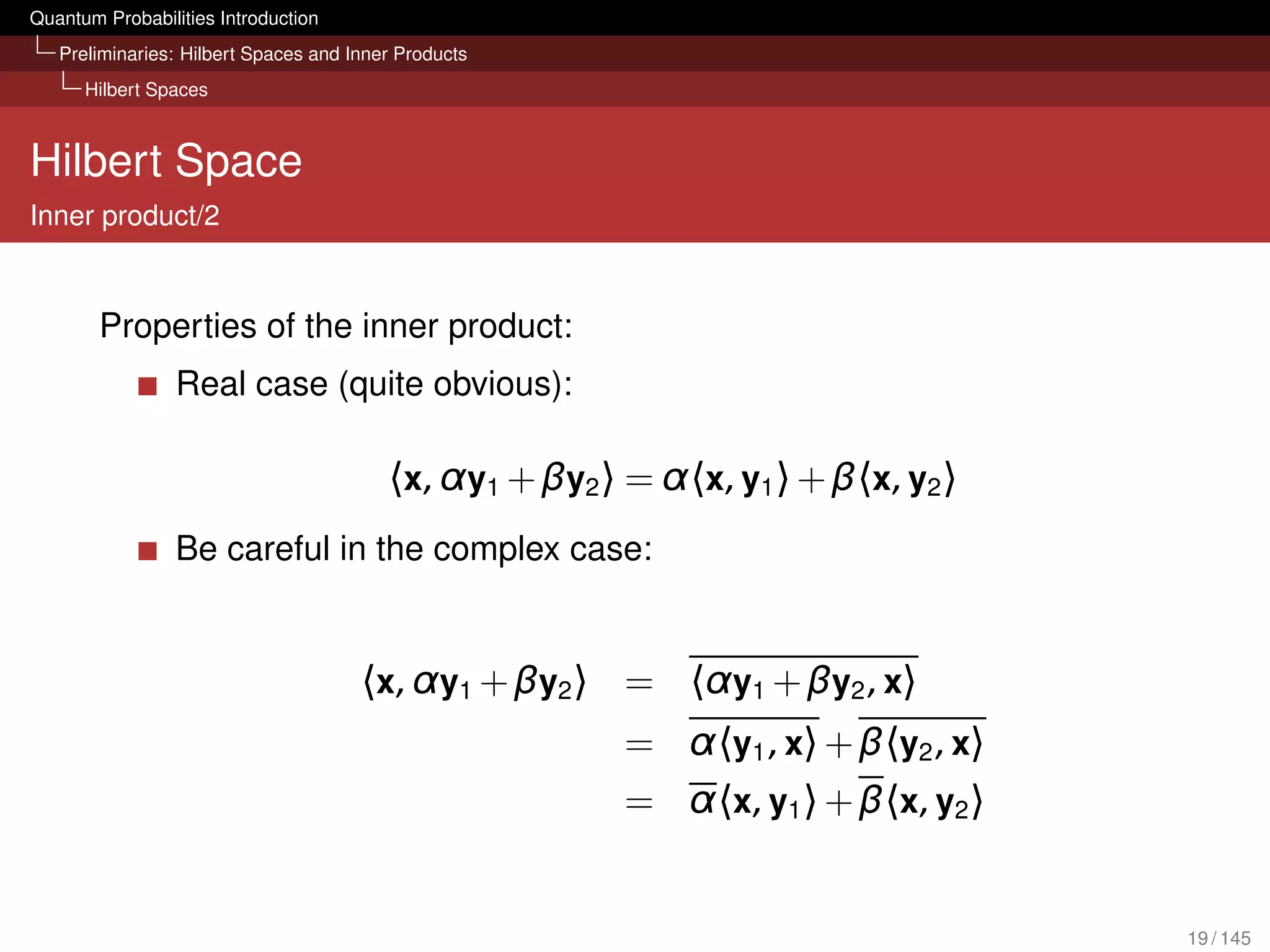
        Properties of the inner product:
                 Real case (quite obvious):

                                         〈x, α y1 + βy2 〉 = α〈x, y1 〉 + β〈x, y2 〉
                 Be careful in the complex case:


                                      〈x, α y1 + βy2 〉 = 〈α y1 + βy2 , x〉
                                                         = α〈y1 , x〉 + β〈y2 , x〉
                                                         = α〈x, y1 〉 + β〈x, y2 〉


                                                                                    19 / 145
Quantum Probabilities Introduction
   Preliminaries: Hilbert Spaces and Inner Products
      Hilbert Spaces


Hilbert Space
Inner product/3


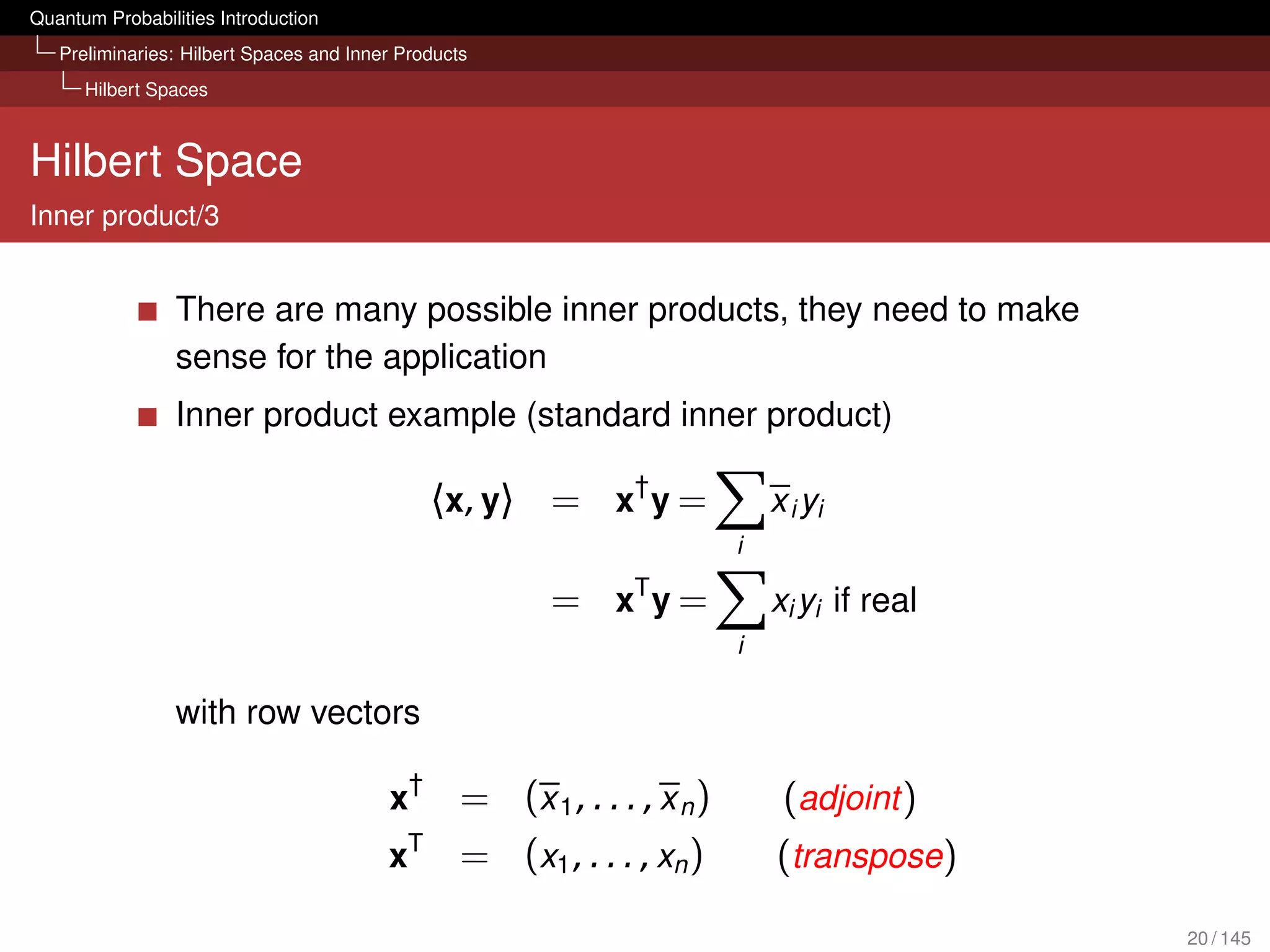
                 There are many possible inner products, they need to make
                 sense for the application
                 Inner product example (standard inner product)

                                                〈 x , y 〉 = x† y =             x i yi
                                                                           i

                                                         = xT y =              xi yi if real
                                                                           i

                 with row vectors

                                         x†       = (x 1 , . . . , x n )        (adjoint )
                                            T
                                         x        = (x1 , . . . , xn )         (transpose)

                                                                                               20 / 145
Quantum Probabilities Introduction
   Preliminaries: Hilbert Spaces and Inner Products
      Hilbert Spaces


Hilbert Space
Norm

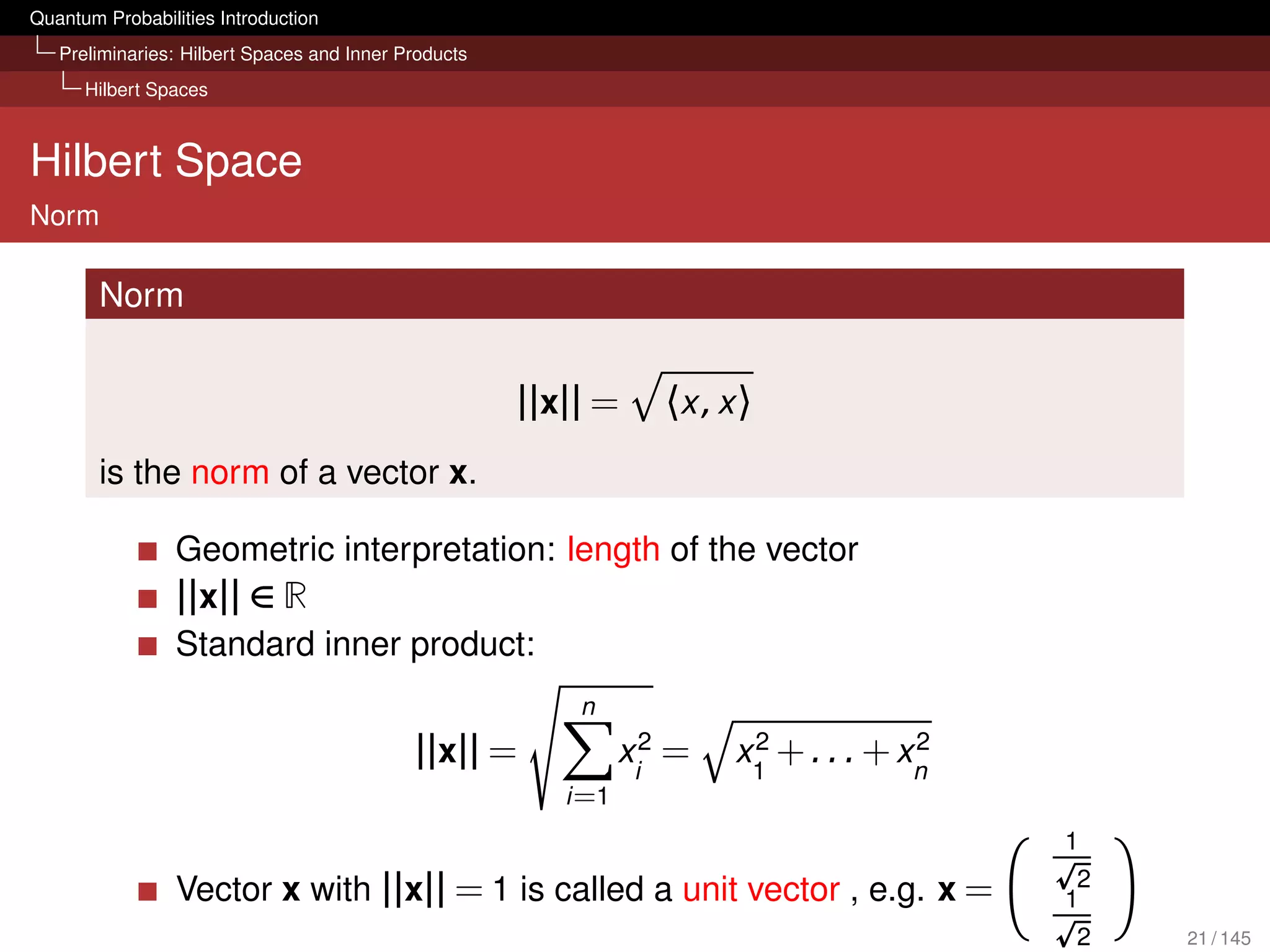
        Norm


                                                      ||x|| =      〈x , x 〉
        is the norm of a vector x.

                 Geometric interpretation: length of the vector
                 ||x|| ∈ R
                 Standard inner product:
                                                          n
                                            ||x|| =             xi2 =     2            2
                                                                         x1 + . . . + xn
                                                         i =1
                                                                                           1
                                                                                            2
                 Vector x with ||x|| = 1 is called a unit vector , e.g. x =                1
                                                                                           2    21 / 145
Quantum Probabilities Introduction
   Preliminaries: Hilbert Spaces and Inner Products
      Hilbert Spaces


Hilbert Space
Orthogonality


        Orthogonality
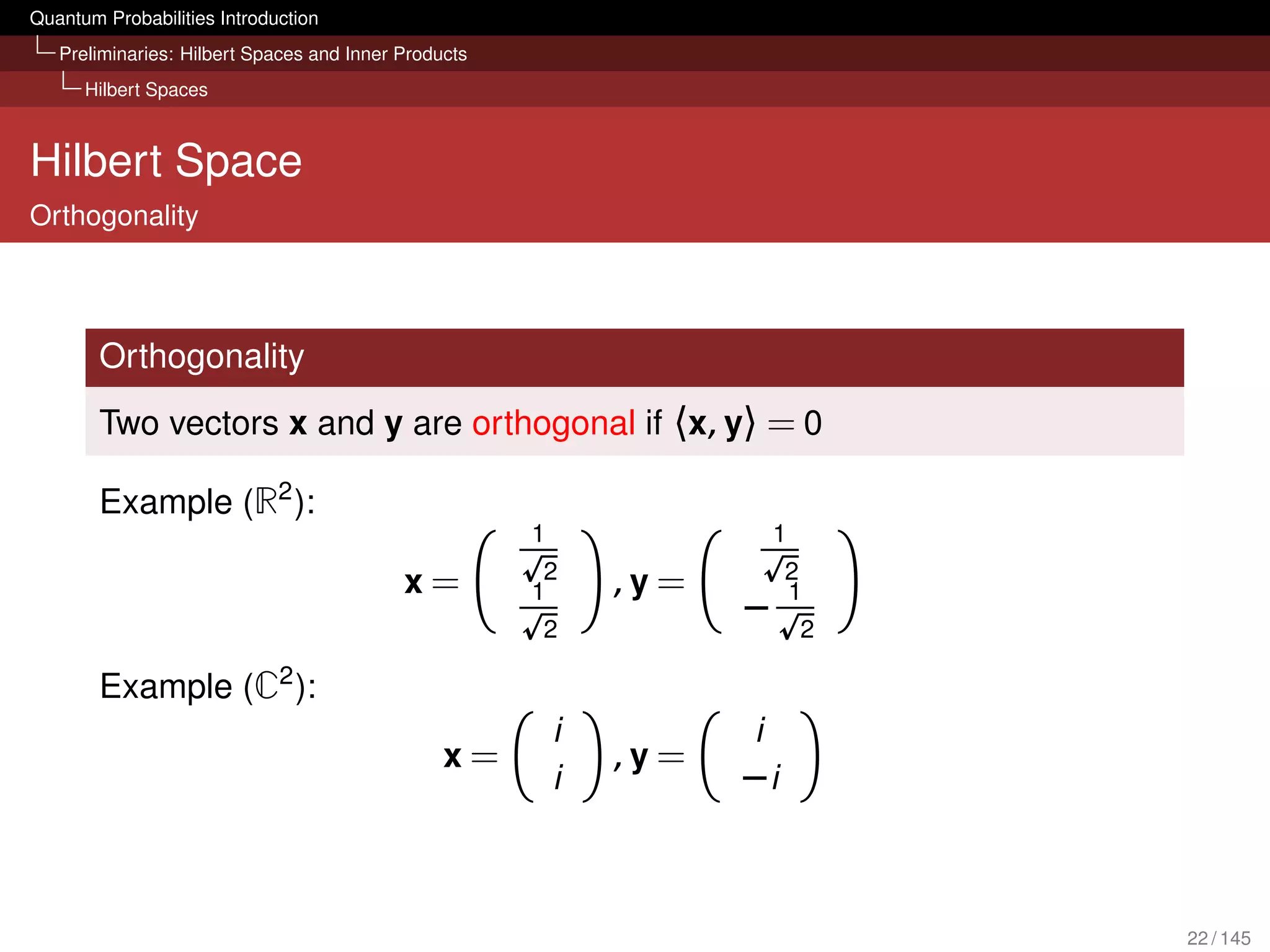
        Two vectors x and y are orthogonal if 〈x, y〉 = 0

        Example (R2 ):
                                                      1                  1
                                                       2                  2
                                           x=         1       ,y =        1
                                                      2
                                                                     −       2
                             2
        Example (C ):
                                                          i          i
                                                x=            ,y =
                                                          i          −i


                                                                                 22 / 145
Quantum Probabilities Introduction
   Preliminaries: Hilbert Spaces and Inner Products
      Operators and Projectors


Towards Projectors


                 One of the most important operations for quantum probabilities
                 are projectors
                 We need to learn about linear operators and their matrix
                 representation first (see also [van Rijsbergen, 2004, Chapter 4])


                                                                                    23 / 145
Quantum Probabilities Introduction
   Preliminaries: Hilbert Spaces and Inner Products
      Operators and Projectors


Linear Operator

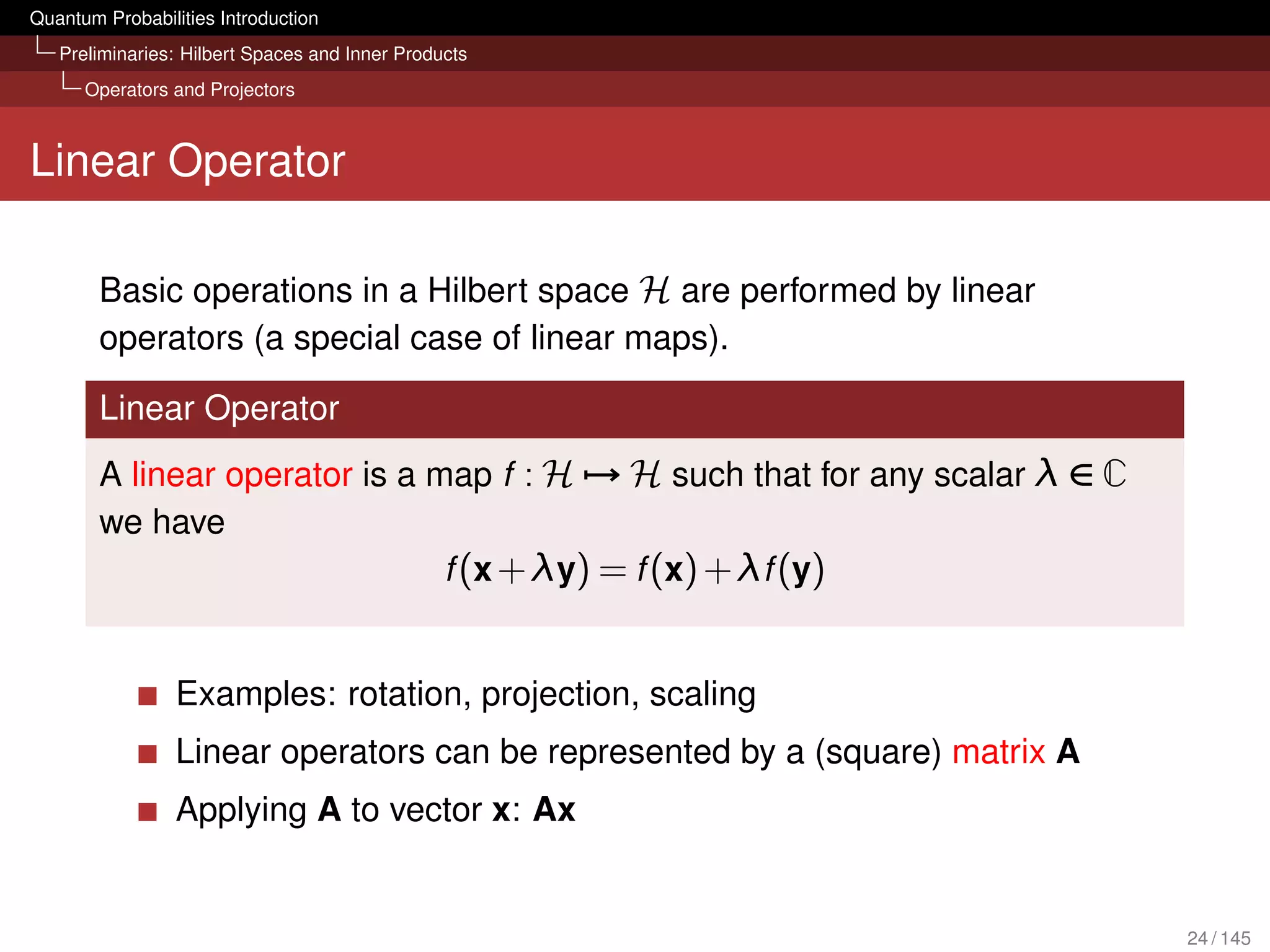
        Basic operations in a Hilbert space H are performed by linear
        operators (a special case of linear maps).

        Linear Operator
        A linear operator is a map f : H → H such that for any scalar λ ∈ C
        we have
                                f (x + λy) = f (x) + λf (y)


                 Examples: rotation, projection, scaling
                 Linear operators can be represented by a (square) matrix A
                 Applying A to vector x: Ax


                                                                              24 / 145
Quantum Probabilities Introduction
   Preliminaries: Hilbert Spaces and Inner Products
      Operators and Projectors


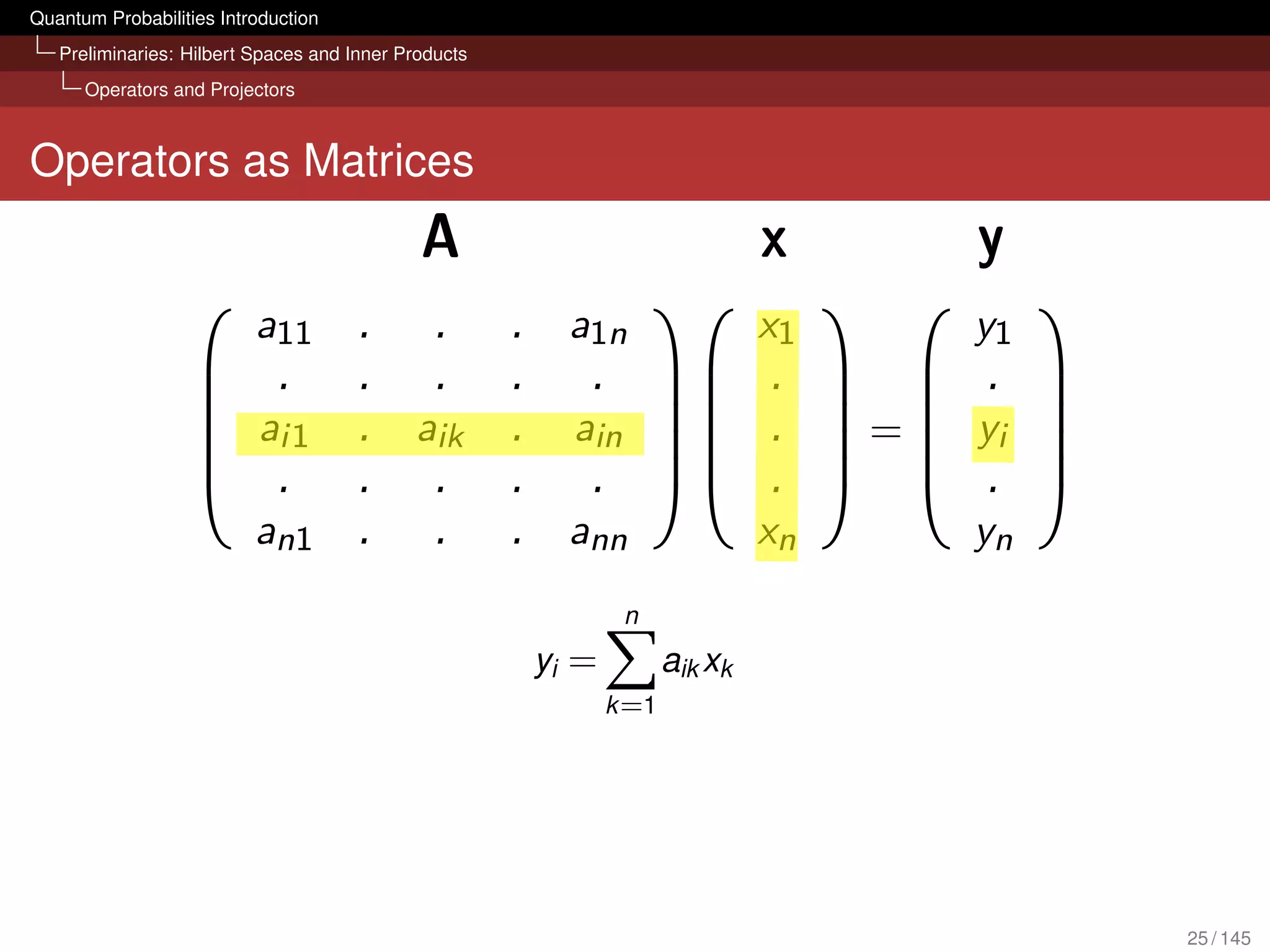
Operators as Matrices


                                                              n
                                                      yi =          aik xk
                                                             k =1


                                                                             25 / 145
Quantum Probabilities Introduction
   Preliminaries: Hilbert Spaces and Inner Products
      Operators and Projectors


Product of Transformations
Commutativity


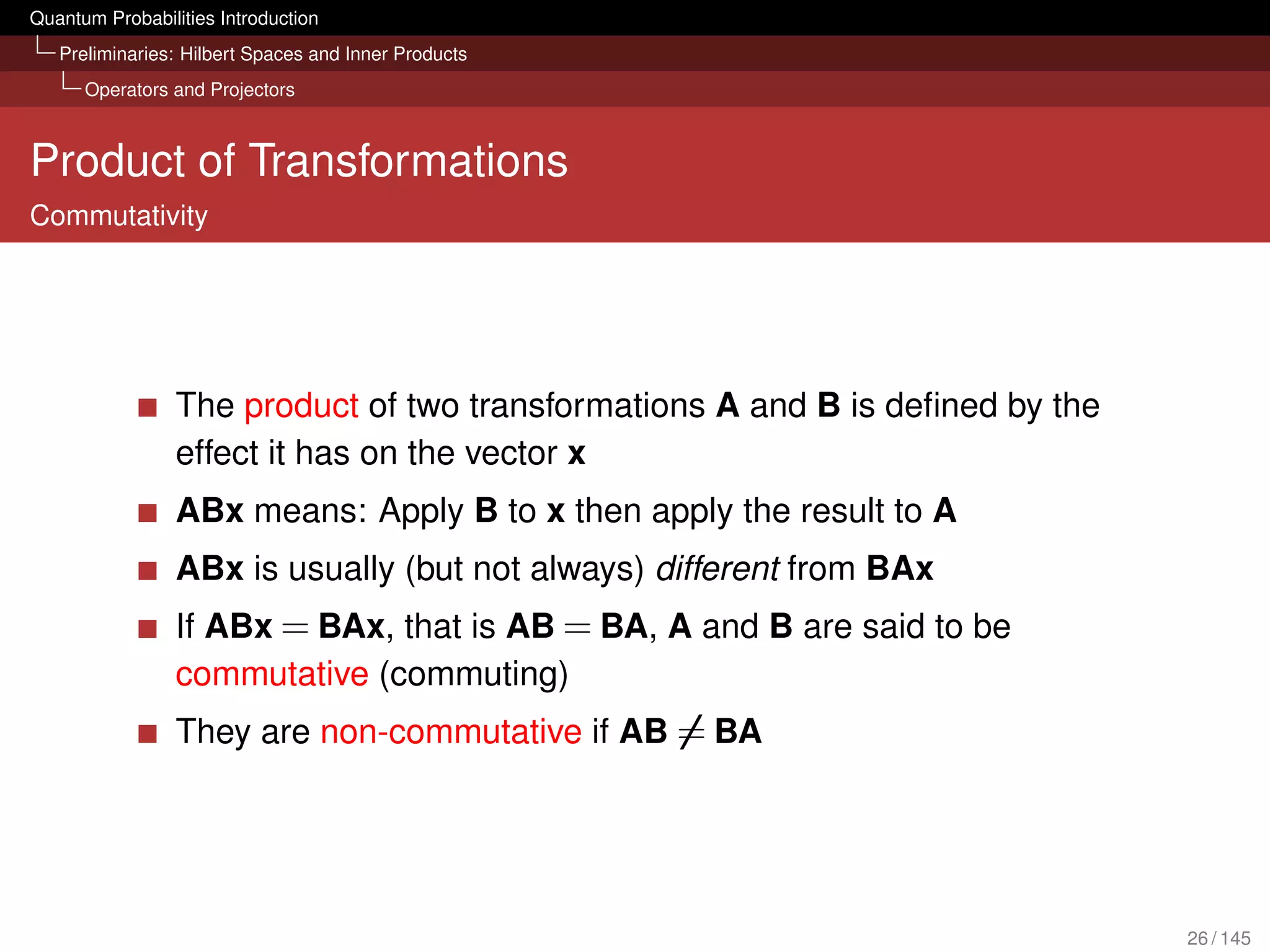
                 The product of two transformations A and B is defined by the
                 effect it has on the vector x
                 ABx means: Apply B to x then apply the result to A
                 ABx is usually (but not always) different from BAx
                 If ABx = BAx, that is AB = BA, A and B are said to be
                 commutative (commuting)
                 They are non-commutative if AB = BA


                                                                               26 / 145
Quantum Probabilities Introduction
   Preliminaries: Hilbert Spaces and Inner Products
      Operators and Projectors


Product of Transformations
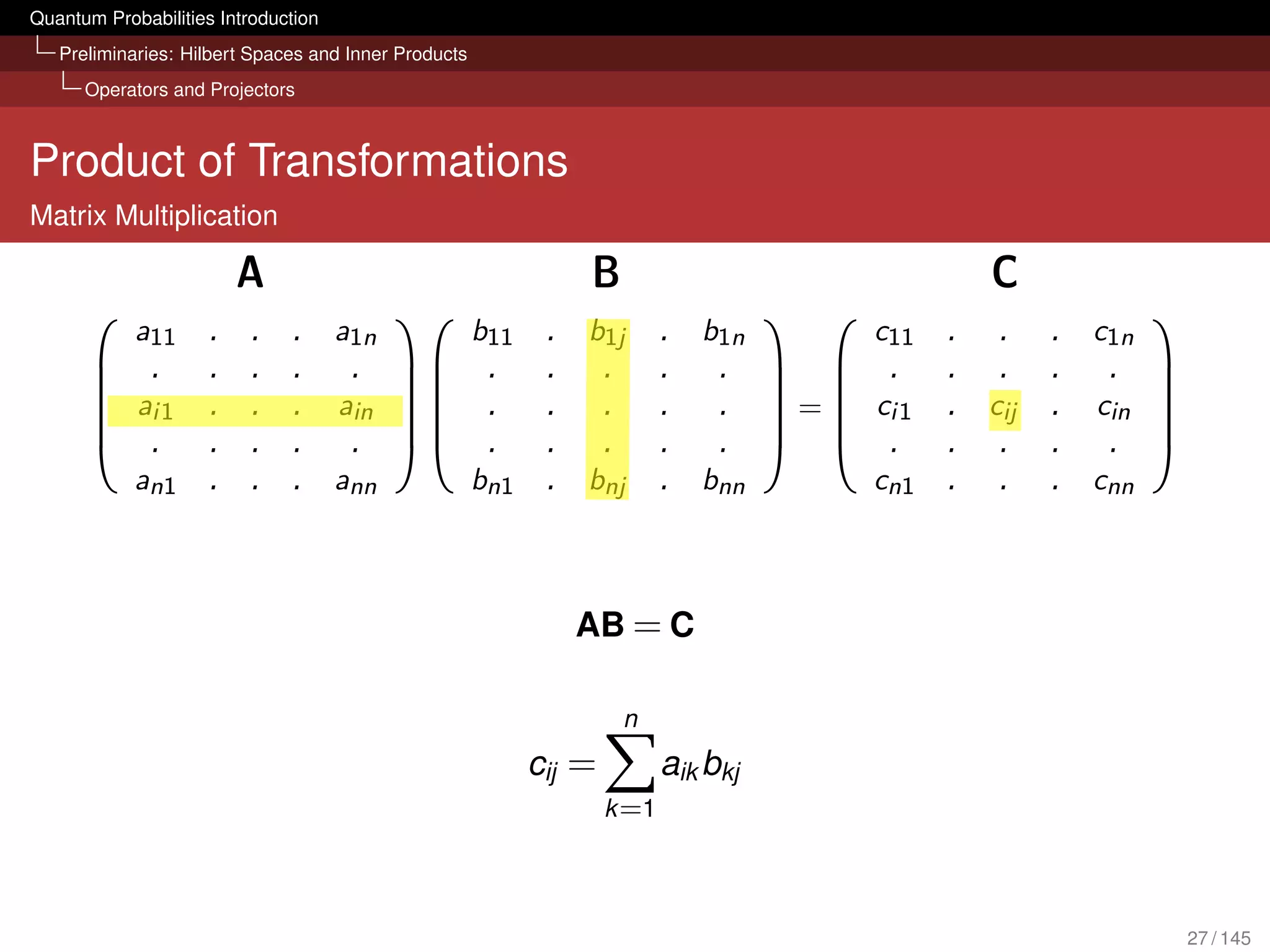
Matrix Multiplication


                                                         AB = C

                                                               n
                                                      cij =          aik bkj
                                                              k =1


                                                                               27 / 145
Quantum Probabilities Introduction
   Preliminaries: Hilbert Spaces and Inner Products
      Operators and Projectors


Product of Transformations
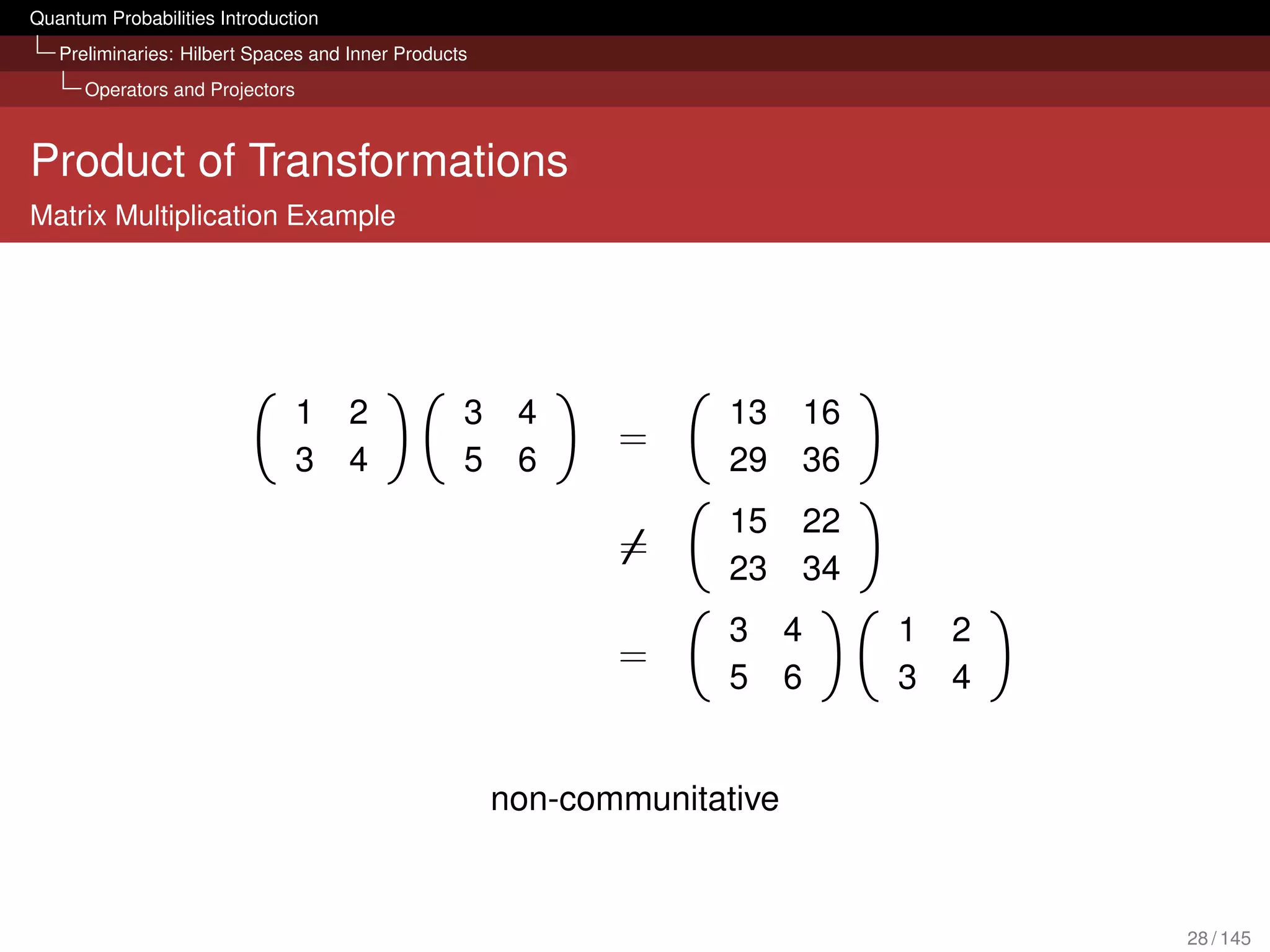
Matrix Multiplication Example


                                 1   2            3    4            13     16
                                                             =
                                 3   4            5    6            29     36
                                                                    15     22
                                                             =
                                                                    23     34
                                                                    3     4     1   2
                                                             =
                                                                    5     6     3   4


                                                      non-communitative


                                                                                        28 / 145
Quantum Probabilities Introduction
   Preliminaries: Hilbert Spaces and Inner Products
      Operators and Projectors


Adjoints


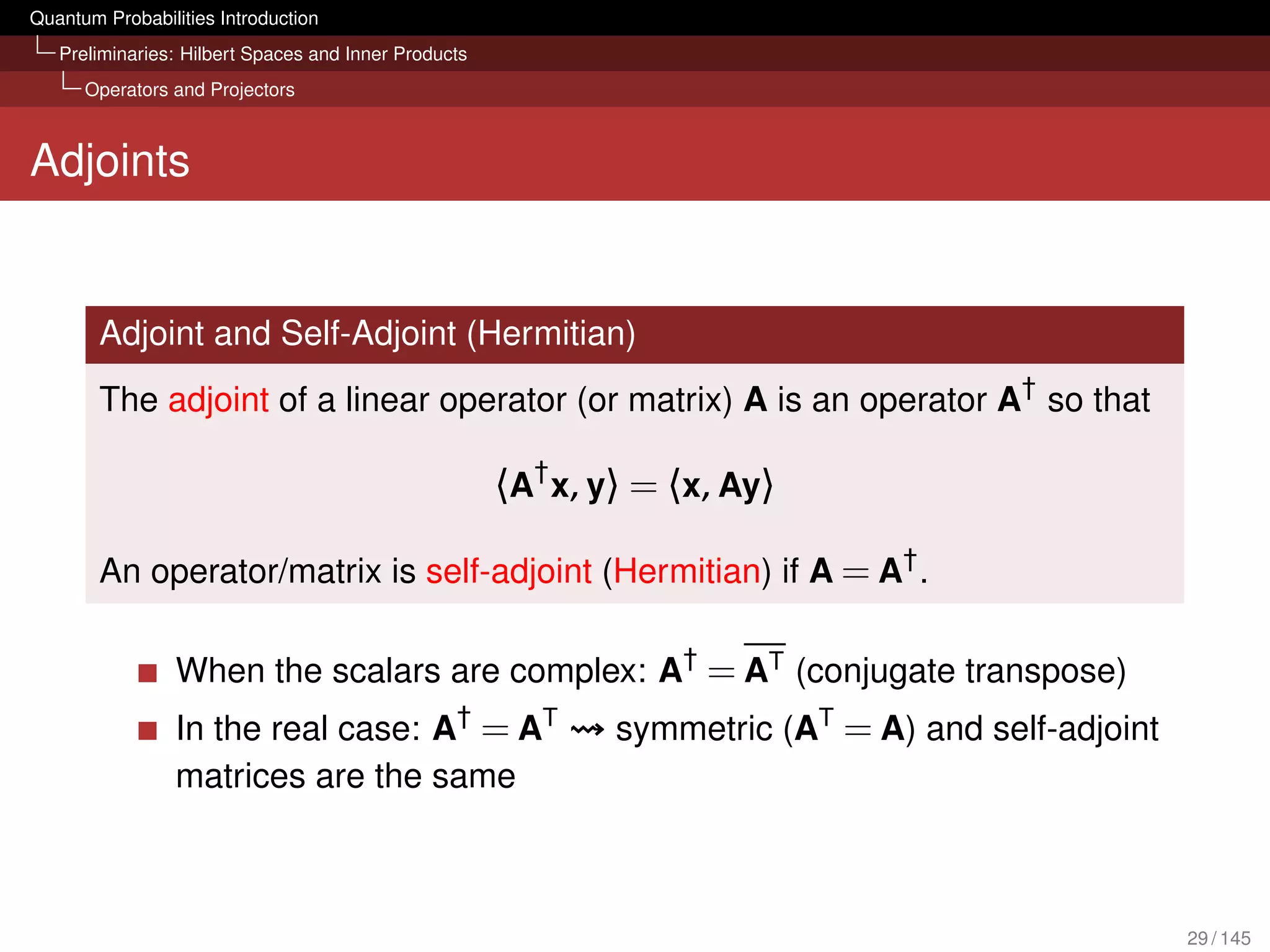
        Adjoint and Self-Adjoint (Hermitian)
        The adjoint of a linear operator (or matrix) A is an operator A† so that

                                                      〈A† x, y〉 = 〈x, Ay〉

        An operator/matrix is self-adjoint (Hermitian) if A = A† .

                 When the scalars are complex: A† = AT (conjugate transpose)
                 In the real case: A† = AT                    symmetric (AT = A) and self-adjoint
                 matrices are the same


                                                                                                    29 / 145
Quantum Probabilities Introduction
   Preliminaries: Hilbert Spaces and Inner Products
      Operators and Projectors


Adjoints
Example


                 Real case:
                                                               †
                                                      a   x            a   u
                                                                   =
                                                      u   c            x   c
                 Complex case:

                                                               †
                                         a + ib       x − iy           a − ib   u + iv
                                                                   =
                                         u − iv       c + id           x + iy   c − id

                                                                           [van Rijsbergen, 2004, p. 55]


                                                                                                           30 / 145
Quantum Probabilities Introduction
   Preliminaries: Hilbert Spaces and Inner Products
      Operators and Projectors


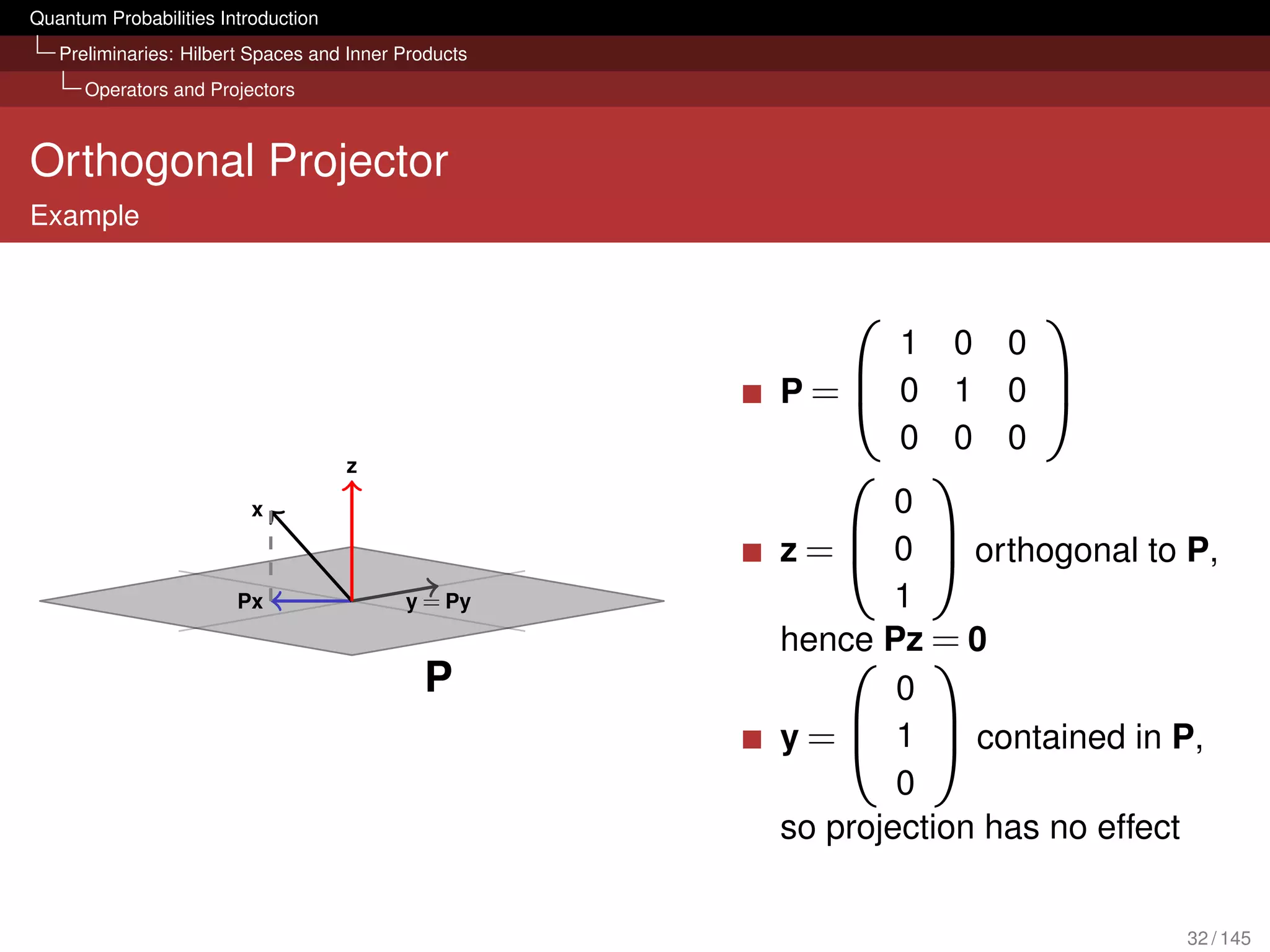
Orthogonal Projector


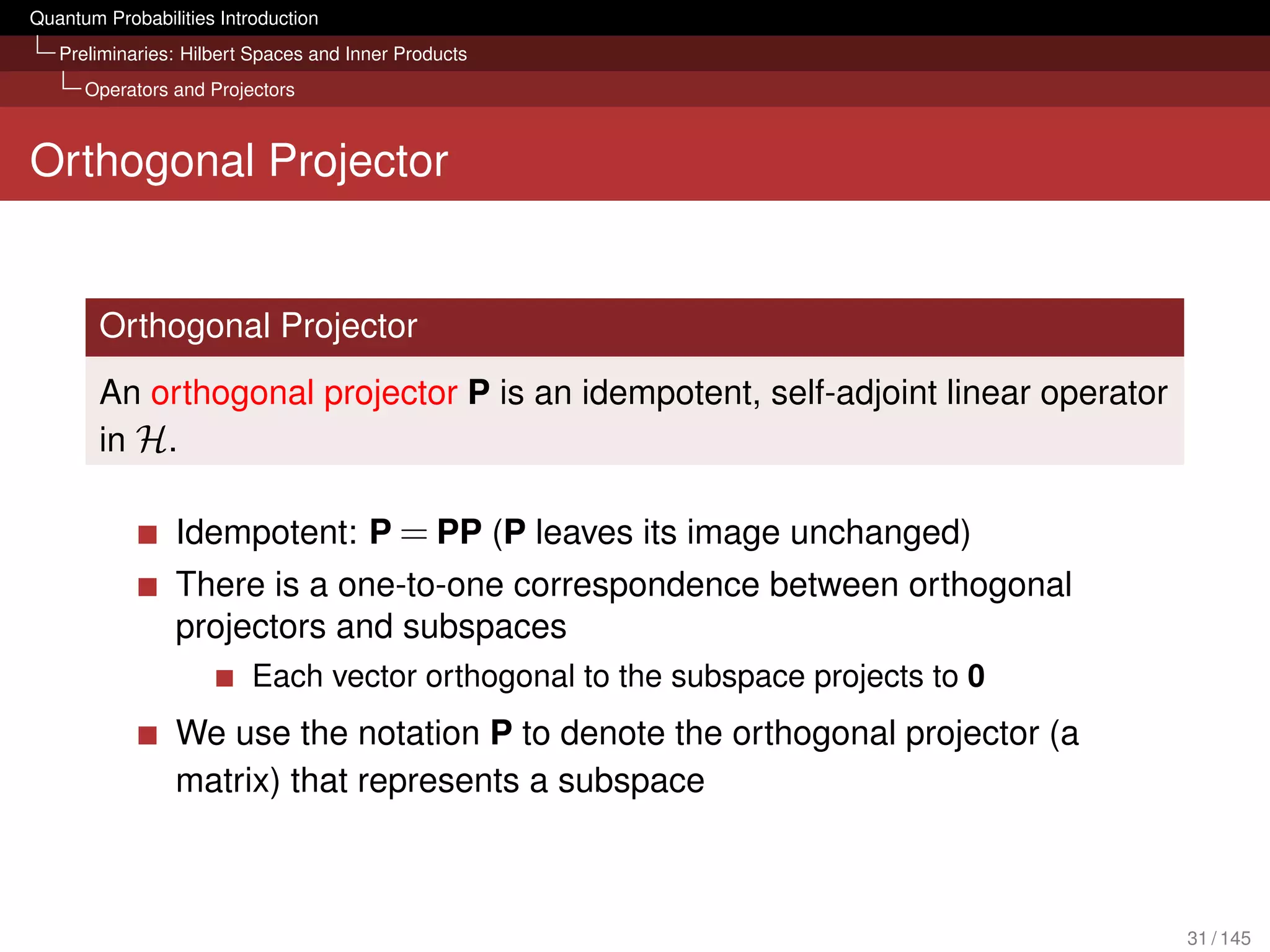
        Orthogonal Projector
        An orthogonal projector P is an idempotent, self-adjoint linear operator
        in H.

                 Idempotent: P = PP (P leaves its image unchanged)
                 There is a one-to-one correspondence between orthogonal
                 projectors and subspaces
                          Each vector orthogonal to the subspace projects to 0
                 We use the notation P to denote the orthogonal projector (a
                 matrix) that represents a subspace


                                                                                   31 / 145
Quantum Probabilities Introduction
   Preliminaries: Hilbert Spaces and Inner Products
      Operators and Projectors


Orthogonal Projector
Example


                                                                     
                                                          1     0   0
                                                      P= 0     1   0 
                                                                     
                                                          0     0   0
                                     z                        
                          x                                   0
                                                      z =  0  orthogonal to P,
                                                           
                        Px                 y = Py             1
                                                      hence Pz = 0
                                             P
                                                           
                                                              0
                                                      y =  1  contained in P,
                                                           
                                                              0
                                                      so projection has no effect


                                                                               32 / 145
Quantum Probabilities Introduction
   Preliminaries: Hilbert Spaces and Inner Products
      Operators and Projectors


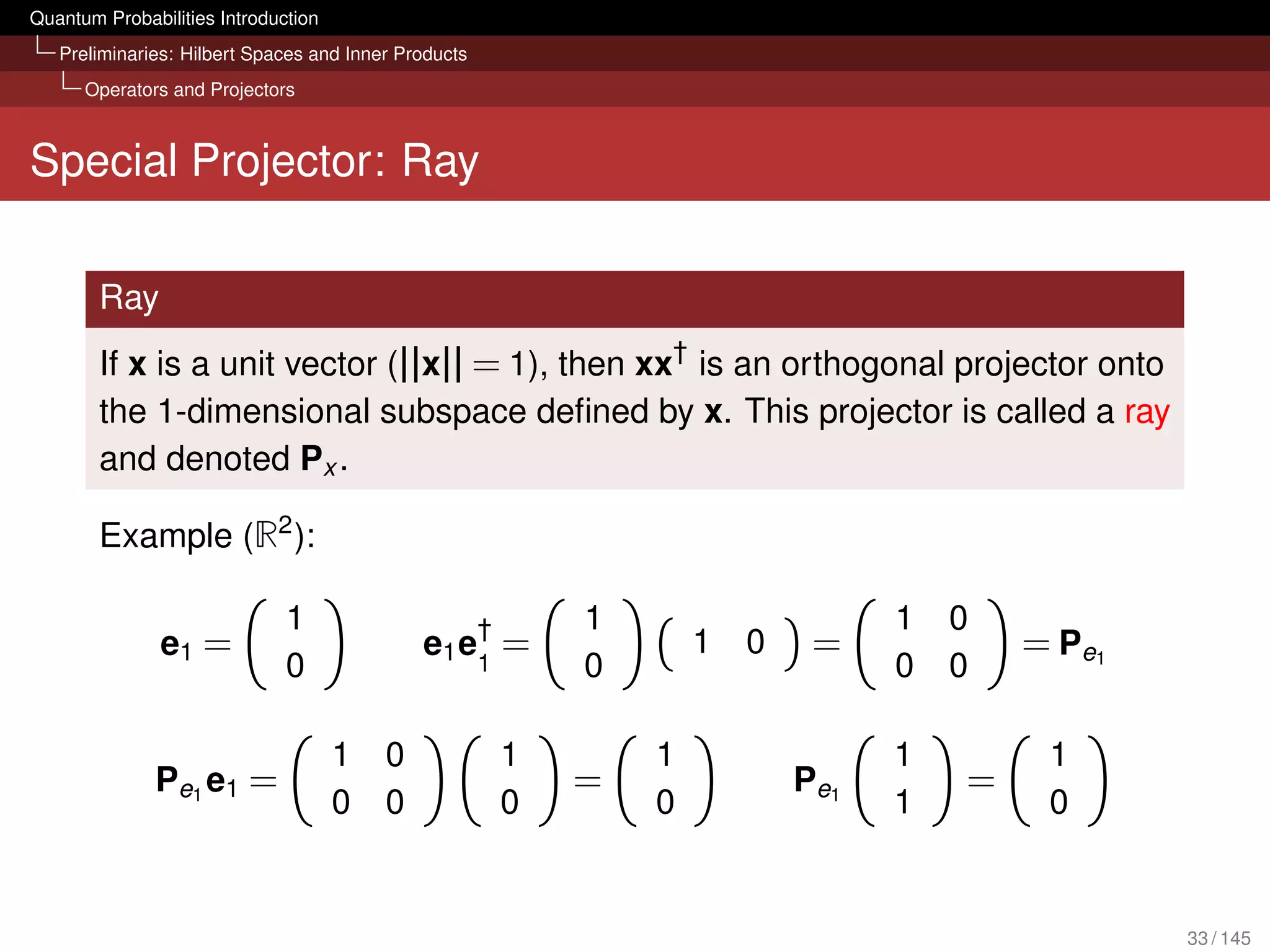
Special Projector: Ray

        Ray
        If x is a unit vector (||x|| = 1), then xx† is an orthogonal projector onto
        the 1-dimensional subspace defined by x. This projector is called a ray
        and denoted Px .

        Example (R2 ):

                              1                  †        1                     1   0
               e1 =                          e1 e1 =              1   0    =            = Pe1
                              0                           0                     0   0

                                     1   0            1       1                 1        1
              Pe1 e1 =                                    =               Pe1       =
                                     0   0            0       0                 1        0


                                                                                                33 / 145
Quantum Probabilities Introduction
   Preliminaries: Hilbert Spaces and Inner Products
      Operators and Projectors


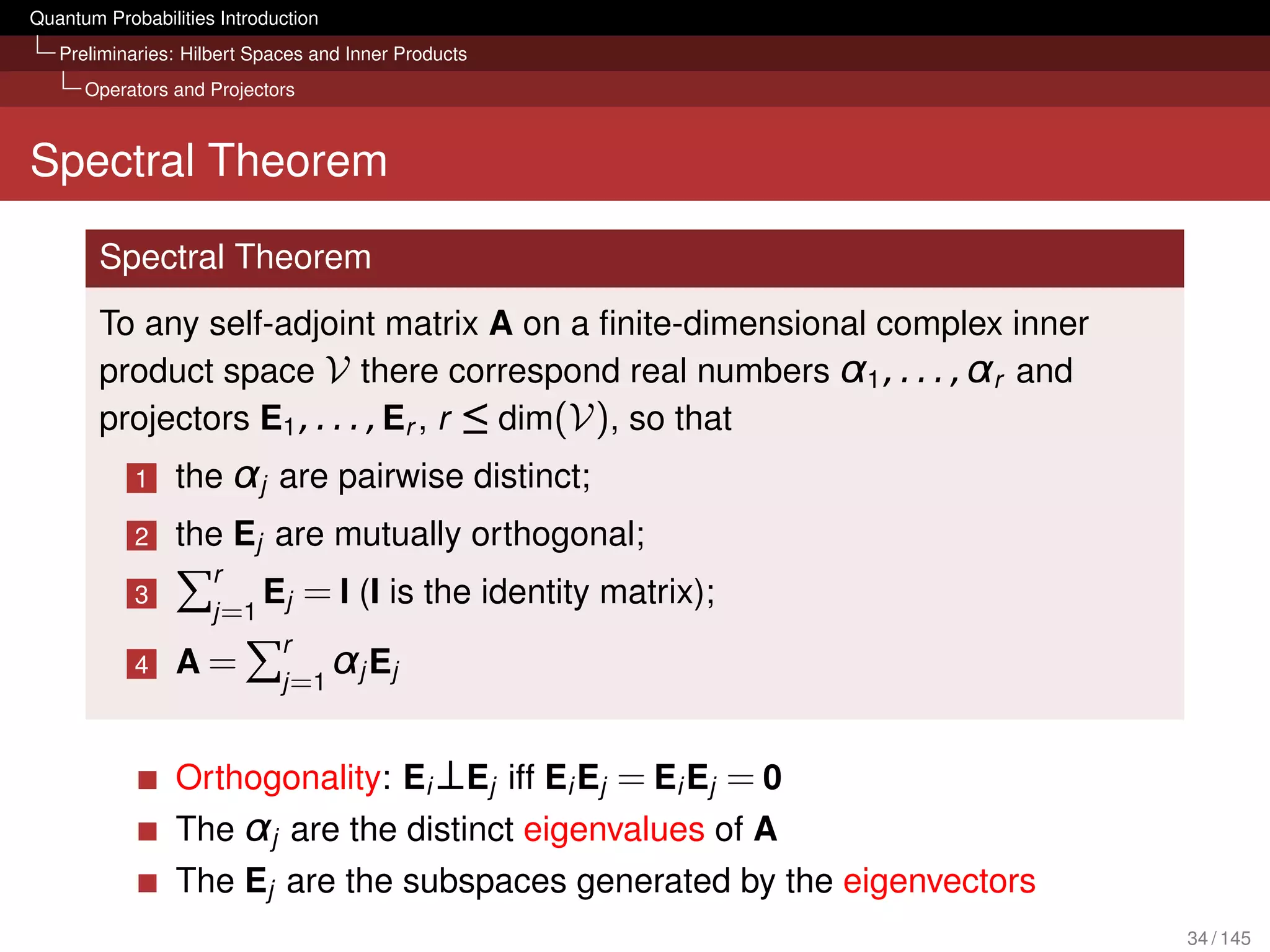
Spectral Theorem

        Spectral Theorem
        To any self-adjoint matrix A on a finite-dimensional complex inner
        product space V there correspond real numbers α1 , . . . , αr and
        projectors E1 , . . . , Er , r ≤ dim(V), so that
            1    the αj are pairwise distinct;
            2    the Ej are mutually orthogonal;
                   r
            3          E = I (I is
                   j =1 j
                                             the identity matrix);
                        r
            4    A = j =1 αj Ej


                 Orthogonality: Ei ⊥Ej iff Ei Ej = Ei Ej = 0
                 The αj are the distinct eigenvalues of A
                 The Ej are the subspaces generated by the eigenvectors
                                                                            34 / 145
Quantum Probabilities Introduction
   Preliminaries: Hilbert Spaces and Inner Products
      Operators and Projectors


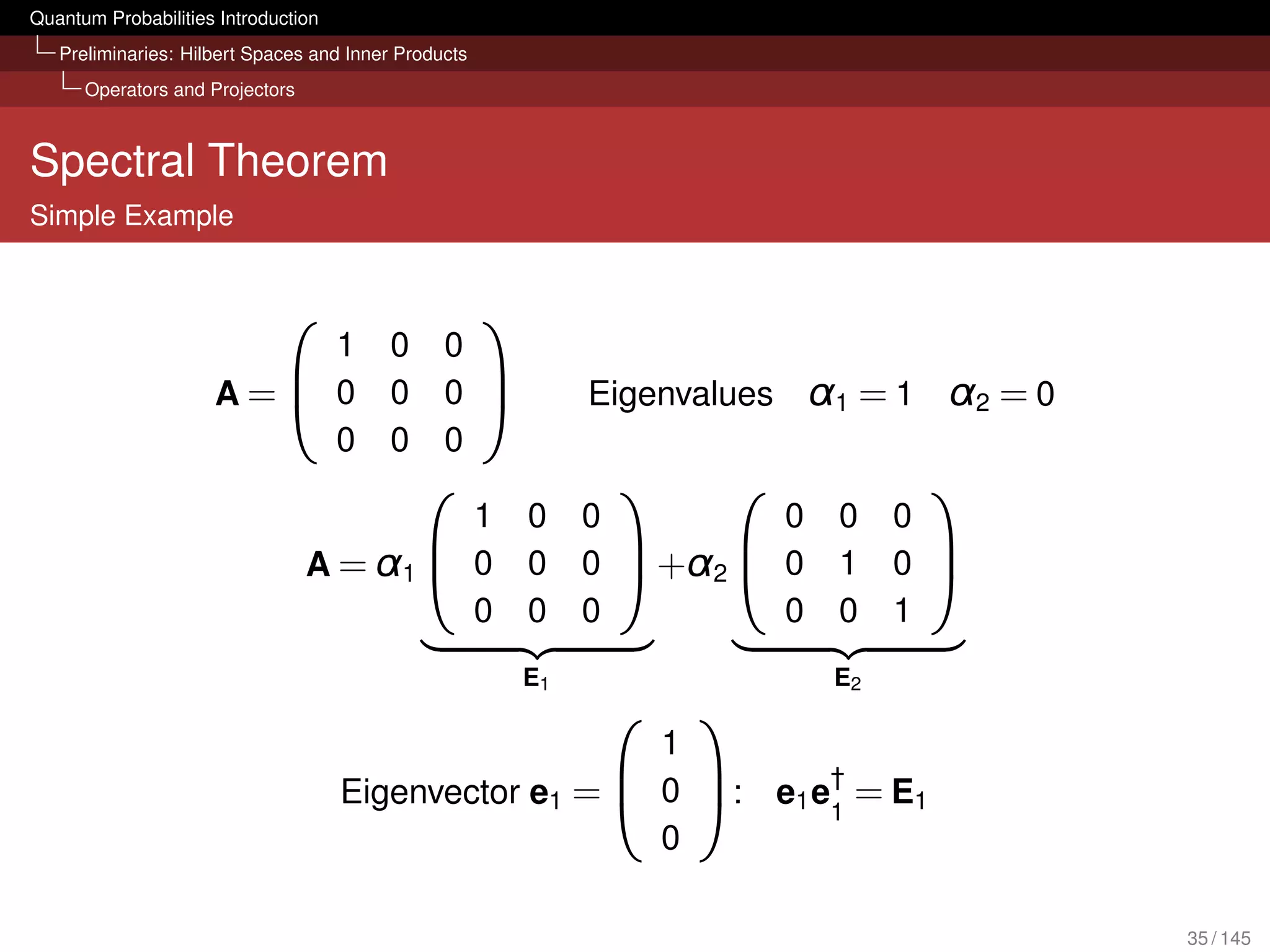
Spectral Theorem
Simple Example


                                                     
                         1               0      0
                     A= 0               0      0             Eigenvalues      α1 = 1 α2 = 0
                                                 
                         0               0      0
                                                                                    
                                          1               0    0         0       0    0
                                 A = α1  0               0    0  +α2  0       1    0 
                                                                                     
                                          0               0    0         0       0    1
                                                          E1                     E2
                                                                       
                                                                    1
                                                                 †
                                     Eigenvector e1 =  0 : e1 e1 = E1
                                                       
                                                                    0

                                                                                                35 / 145
Quantum Probabilities Introduction
   Preliminaries: Hilbert Spaces and Inner Products
      Tensor Spaces


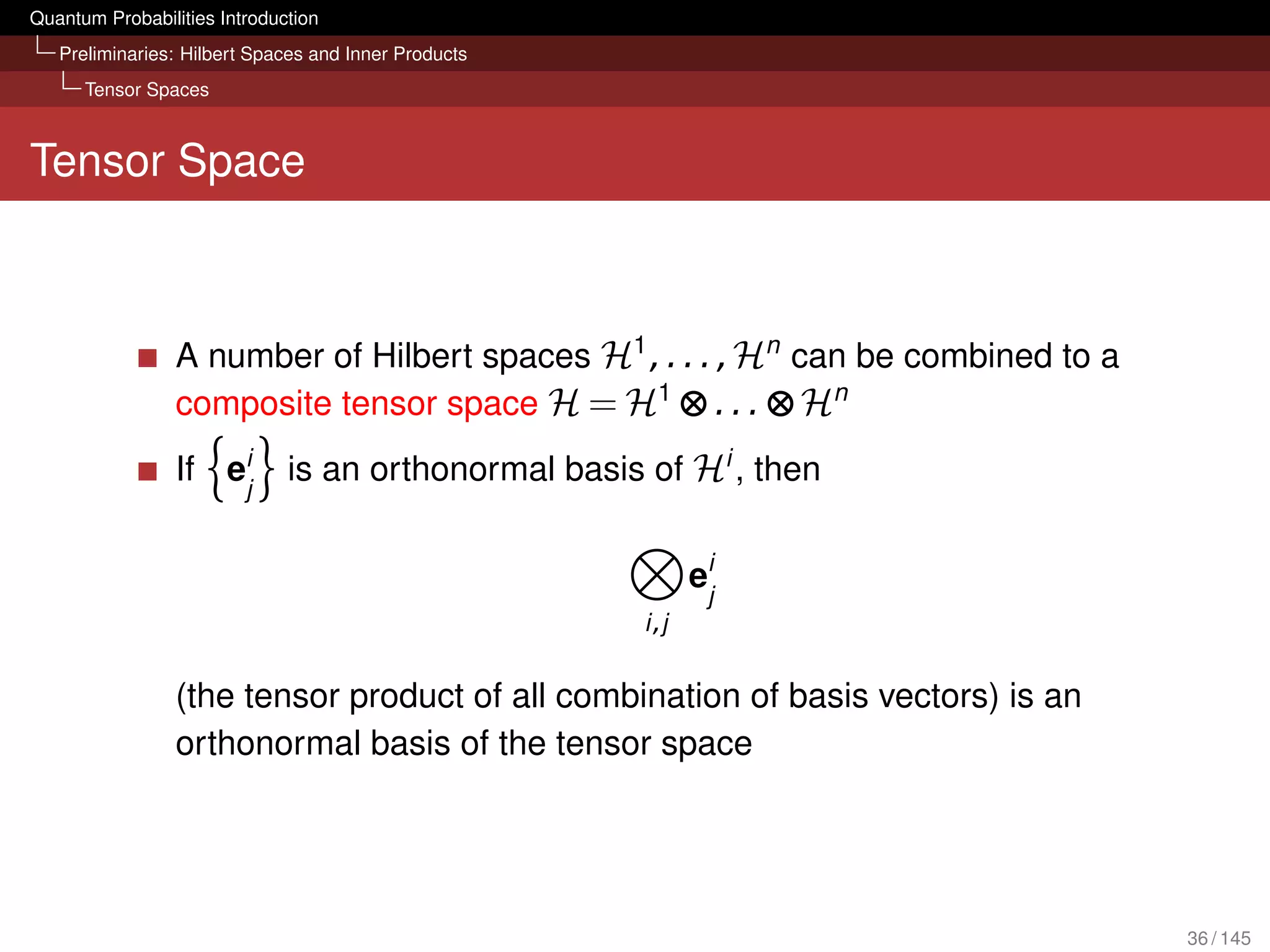
Tensor Space


                 A number of Hilbert spaces H1 , . . . , Hn can be combined to a
                 composite tensor space H = H1 ⊗ . . . ⊗ Hn
                 If eij       is an orthonormal basis of Hi , then


                                                             eij
                                                      i ,j


                 (the tensor product of all combination of basis vectors) is an
                 orthonormal basis of the tensor space


                                                                                   36 / 145
Quantum Probabilities Introduction
   Preliminaries: Hilbert Spaces and Inner Products
      Tensor Spaces


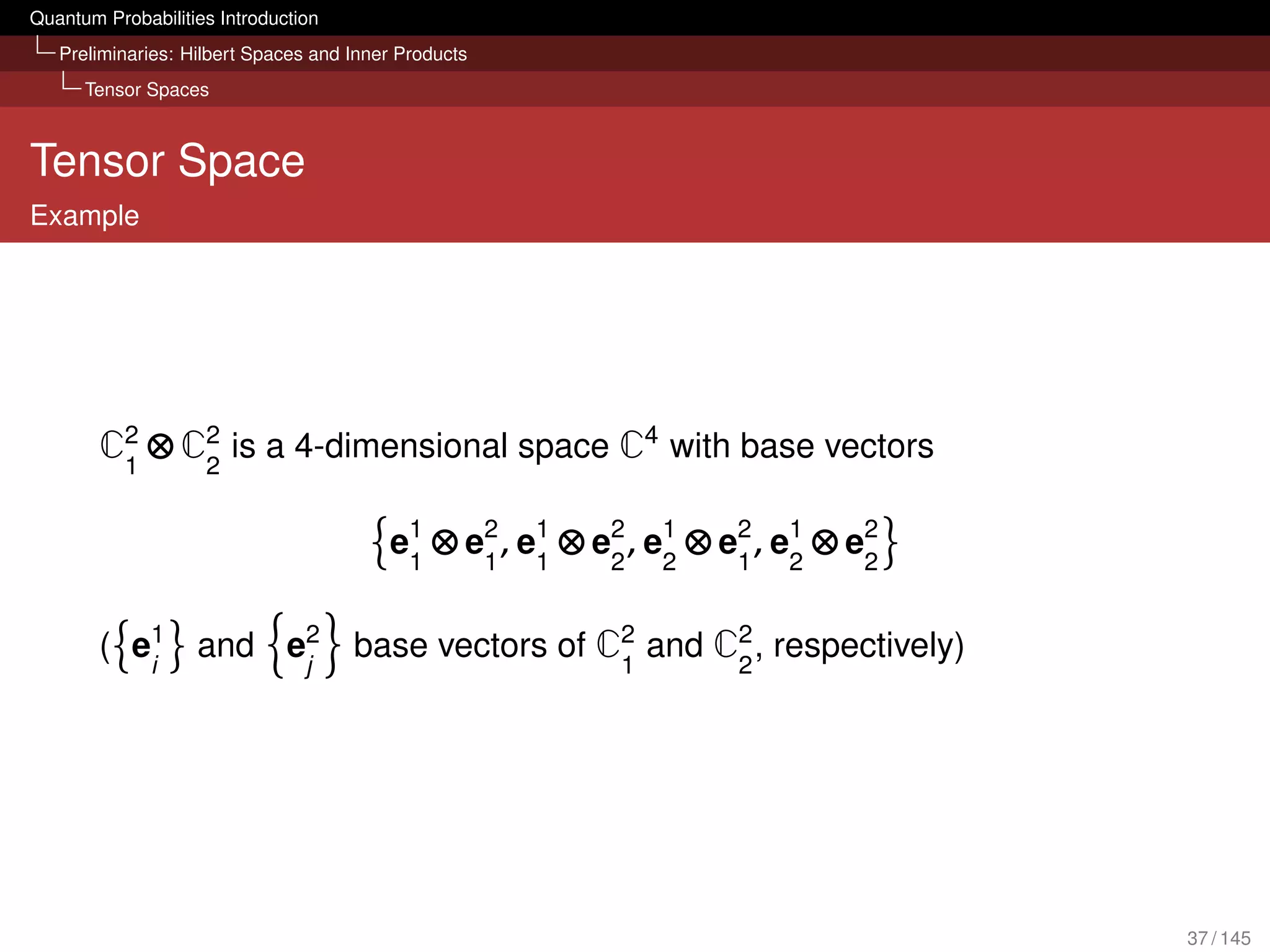
Tensor Space
Example


        C2 ⊗ C2 is a 4-dimensional space C4 with base vectors
         1    2


                                         e1 ⊗ e2 , e1 ⊗ e2 , e1 ⊗ e2 , e1 ⊗ e2
                                          1    1 1       2 2       1 2       2


        ( e1 and e2 base vectors of C2 and C2 , respectively)
           i      j                  1      2


                                                                                 37 / 145
Quantum Probabilities Introduction
   Preliminaries: Hilbert Spaces and Inner Products
      Tensor Spaces


Tensor Space
Product Operators


                 If A is an operator in H1 and B is an operator in H2 , then A ⊗ B is
                 an operator in H1 ⊗ H2 and it is

                                                      (A ⊗ B)(a ⊗ b) = Aa ⊗ Bb

                 for a ∈ H1 , b ∈ H2 and a ⊗ b ∈ H1 ⊗ H2 .
                 A matrix representation for the tensor product is given by the
                 Kronecker product (see also [Nielsen and Chuang, 2000, p. 74])


                                                                                        38 / 145
Quantum Probabilities Introduction
   Quantum Probabilities


Quantum Probabilities


                                     39 / 145
Quantum Probabilities Introduction
   Quantum Probabilities


Quantum Probabilities


                                     40 / 145
Quantum Probabilities Introduction
   Quantum Probabilities
      Quantum and Classical Probabilities


Quantum and Classical Probabilities


                 Quantum probabilities are used in quantum theory to describe the
                 behaviour of matter at atomic and subatomic scales
                 Quantum probabilities are a generalisation of classical probability
                 theory


                                                                                       41 / 145
Quantum Probabilities Introduction
   Quantum Probabilities
      Quantum and Classical Probabilities


Quantum and Classical Probabilities
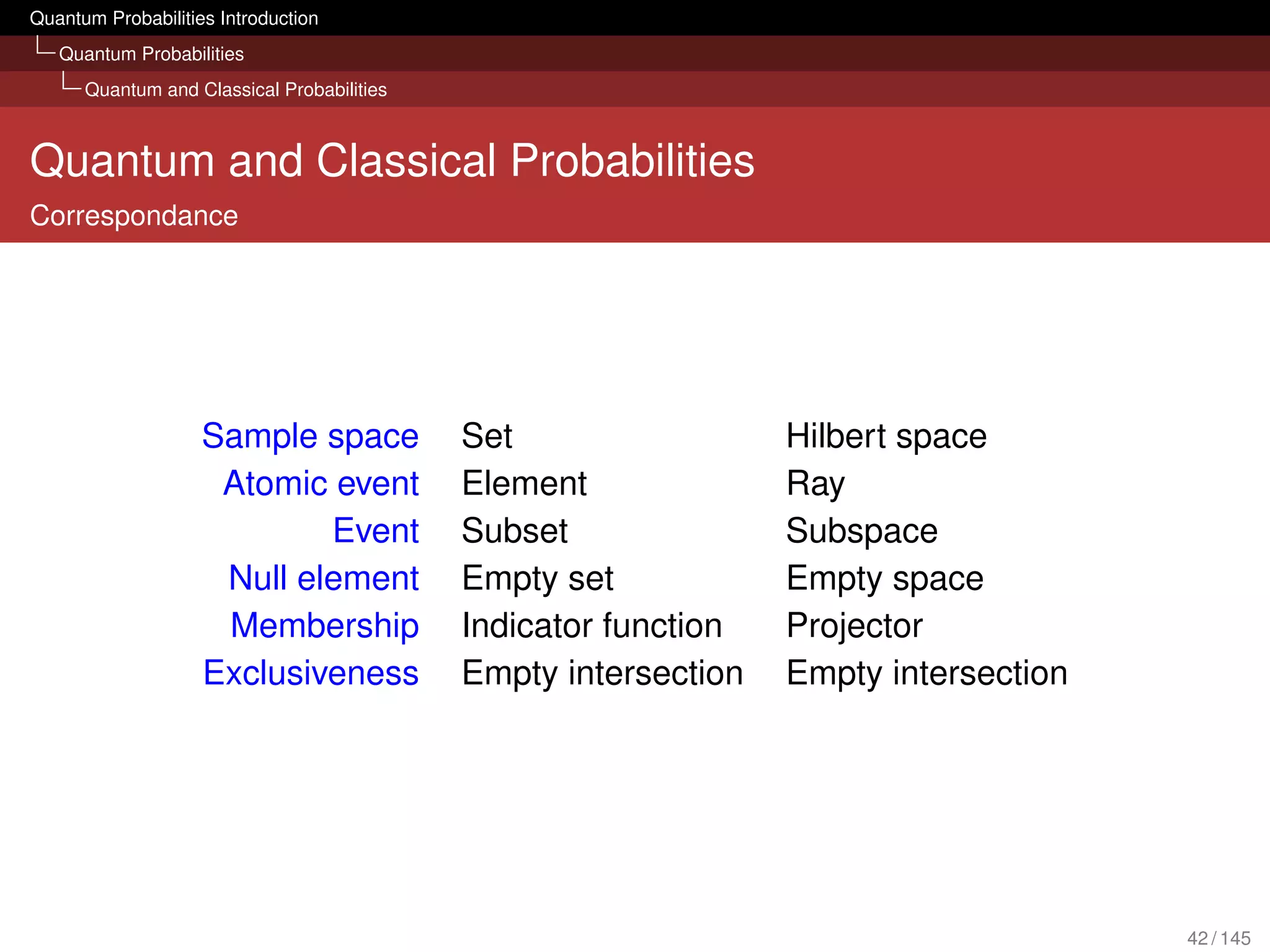
Correspondance


                    Sample space            Set                  Hilbert space
                     Atomic event           Element              Ray
                            Event           Subset               Subspace
                     Null element           Empty set            Empty space
                     Membership             Indicator function   Projector
                    Exclusiveness           Empty intersection   Empty intersection


                                                                                      42 / 145
Quantum Probabilities Introduction
   Quantum Probabilities
      Dirac Notation


Dirac Notation

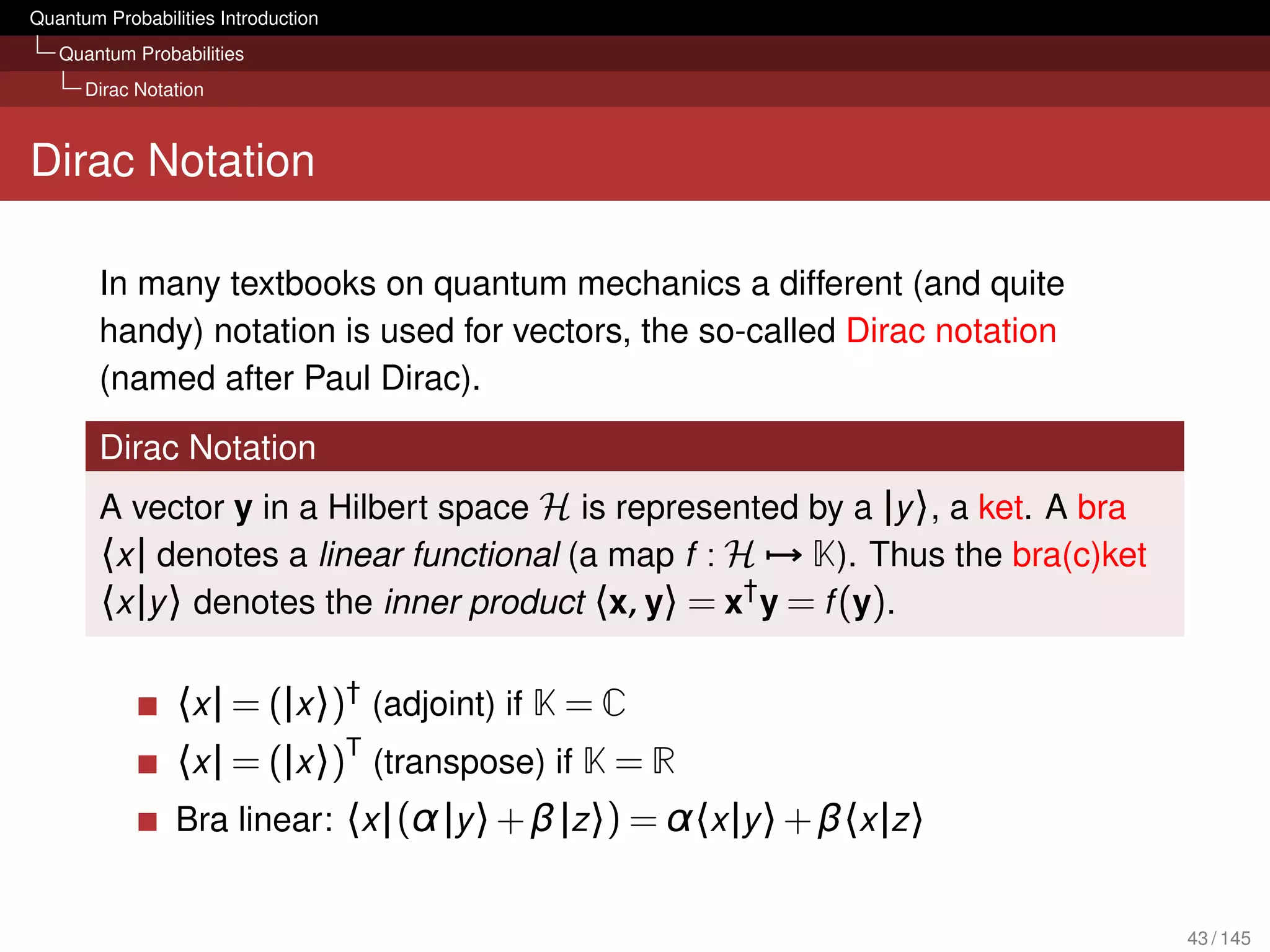
        In many textbooks on quantum mechanics a different (and quite
        handy) notation is used for vectors, the so-called Dirac notation
        (named after Paul Dirac).

        Dirac Notation
        A vector y in a Hilbert space H is represented by a |y 〉, a ket. A bra
        〈x | denotes a linear functional (a map f : H → K). Thus the bra(c)ket
        〈x |y 〉 denotes the inner product 〈x, y〉 = x† y = f (y).

                 〈x | = (|x 〉)† (adjoint) if K = C
                 〈x | = (|x 〉)T (transpose) if K = R
                 Bra linear: 〈x | (α |y 〉 + β |z 〉) = α〈x |y 〉 + β〈x |z 〉


                                                                                 43 / 145
Quantum Probabilities Introduction
   Quantum Probabilities
      Dirac Notation


Dyads


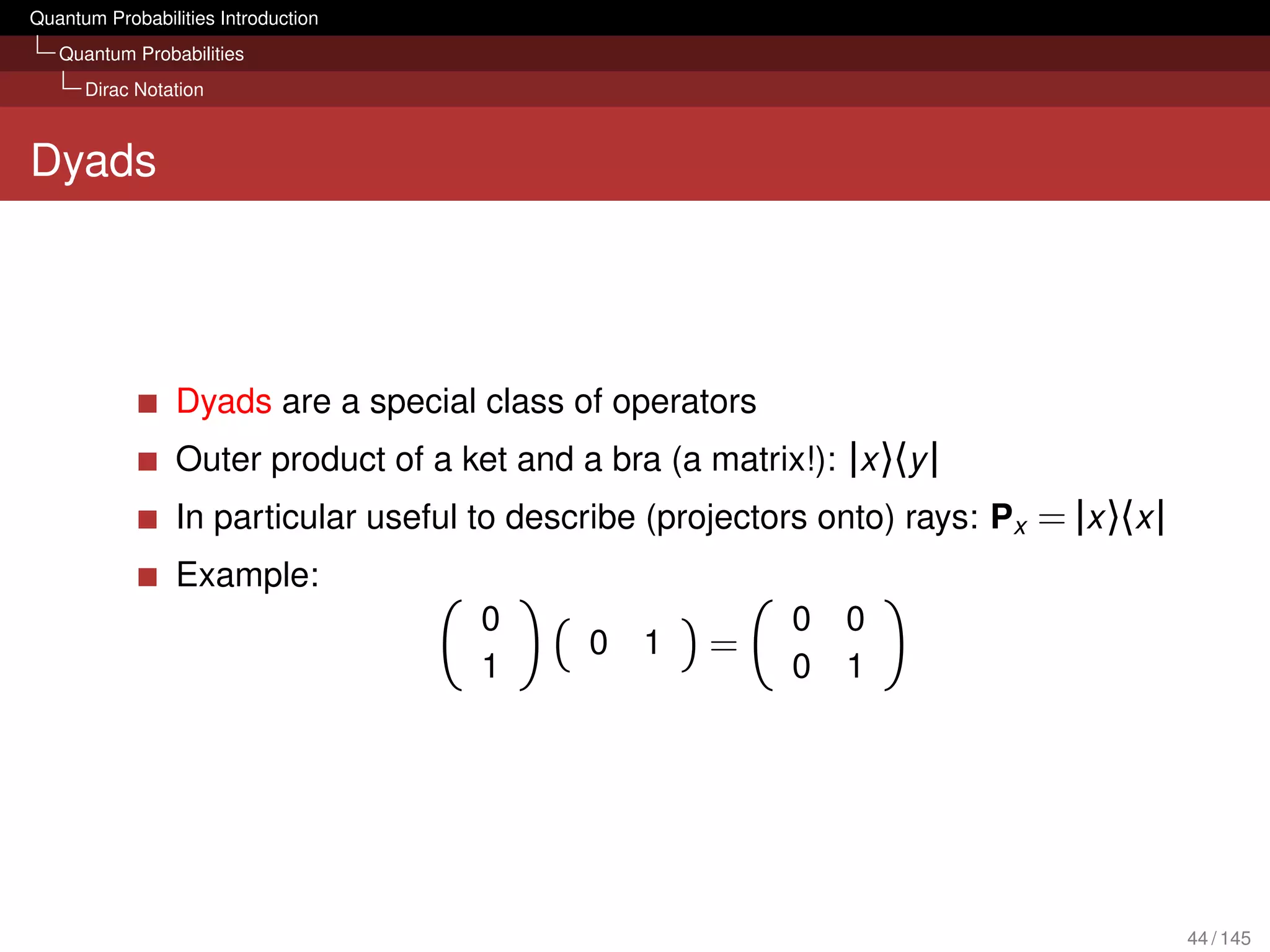
                 Dyads are a special class of operators
                 Outer product of a ket and a bra (a matrix!): |x 〉〈y |
                 In particular useful to describe (projectors onto) rays: Px = |x 〉〈x |
                 Example:
                                      0                     0   0
                                              0   1   =
                                      1                     0   1


                                                                                          44 / 145
Quantum Probabilities Introduction
   Quantum Probabilities
      Dirac Notation


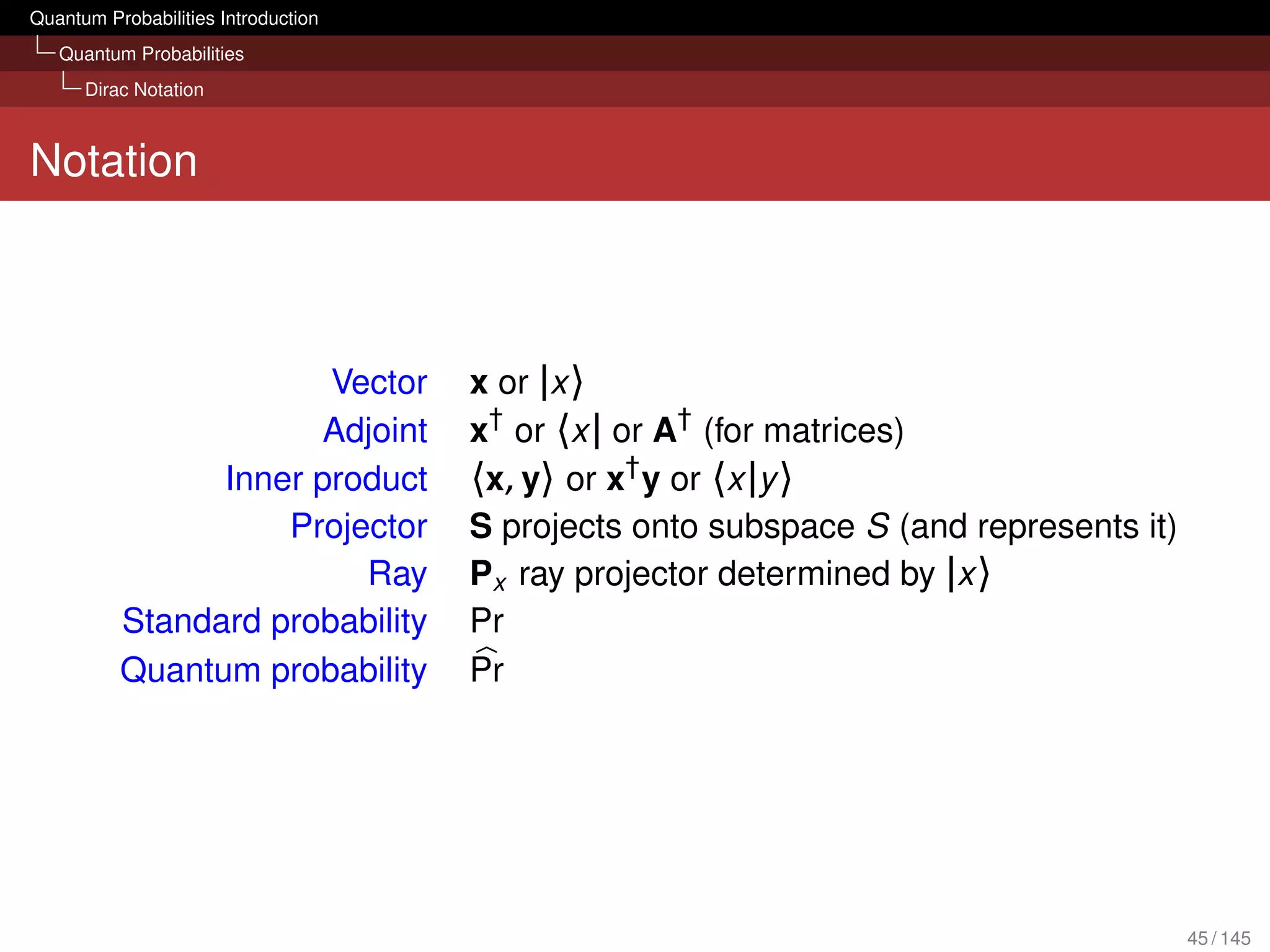
Notation


                       Vector        x or |x 〉
                      Adjoint        x† or 〈x | or A† (for matrices)
                Inner product        〈x, y〉 or x† y or 〈x |y 〉
                    Projector        S projects onto subspace S (and represents it)
                         Ray         Px ray projector determined by |x 〉
          Standard probability       Pr
          Quantum probability        Pr


                                                                                      45 / 145
Quantum Probabilities Introduction
   Quantum Probabilities
      Events


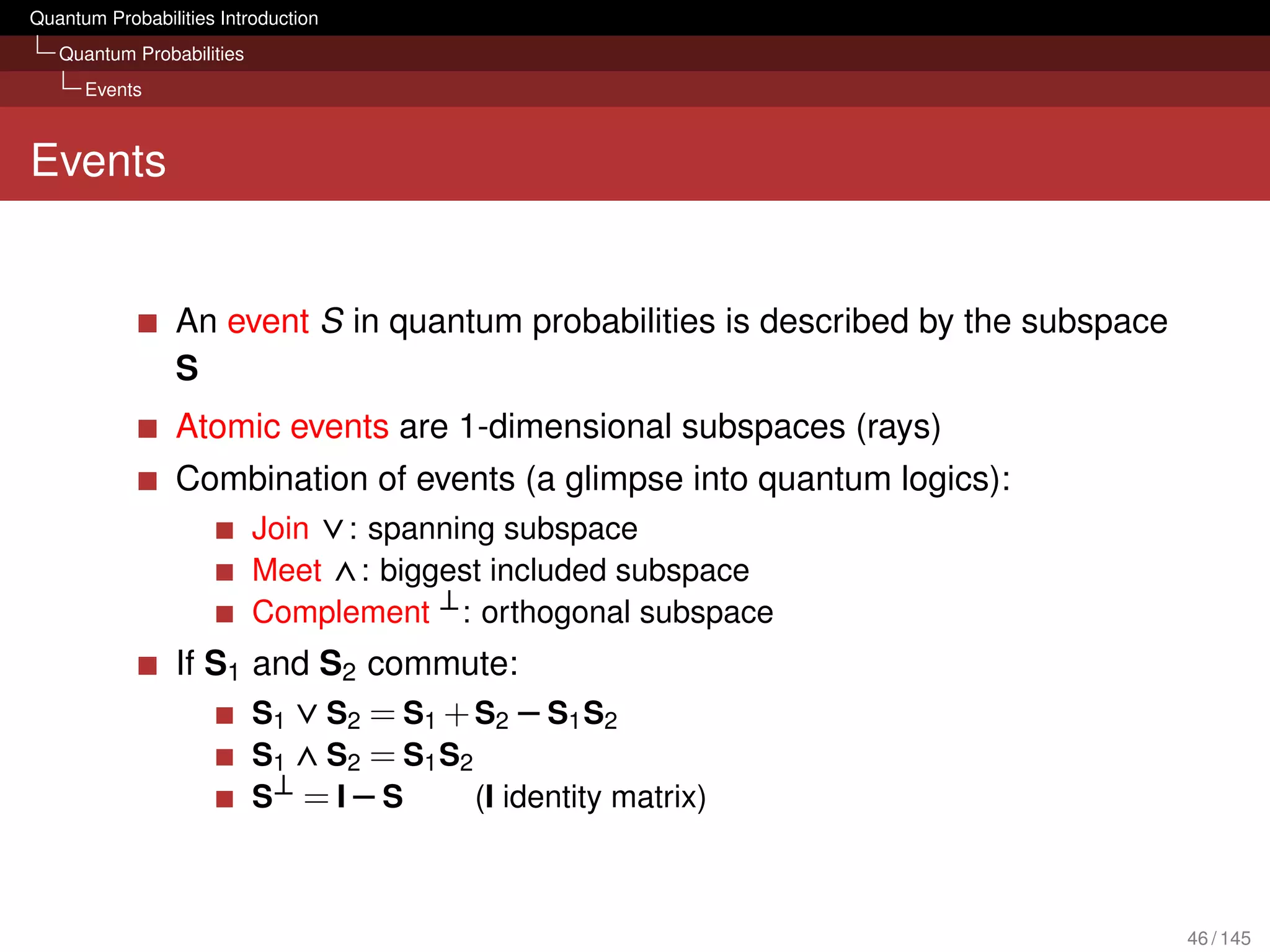
Events


                 An event S in quantum probabilities is described by the subspace
                 S
                 Atomic events are 1-dimensional subspaces (rays)
                 Combination of events (a glimpse into quantum logics):
                    Join ∨: spanning subspace
                    Meet ∧: biggest included subspace
                           Complement ⊥ : orthogonal subspace
                 If S1 and S2 commute:
                       S1 ∨ S2 = S1 + S2 − S1 S2
                       S1 ∧ S2 = S1 S2
                       S⊥ = I − S      (I identity matrix)


                                                                                    46 / 145
Quantum Probabilities Introduction
   Quantum Probabilities
      Quantum Logics


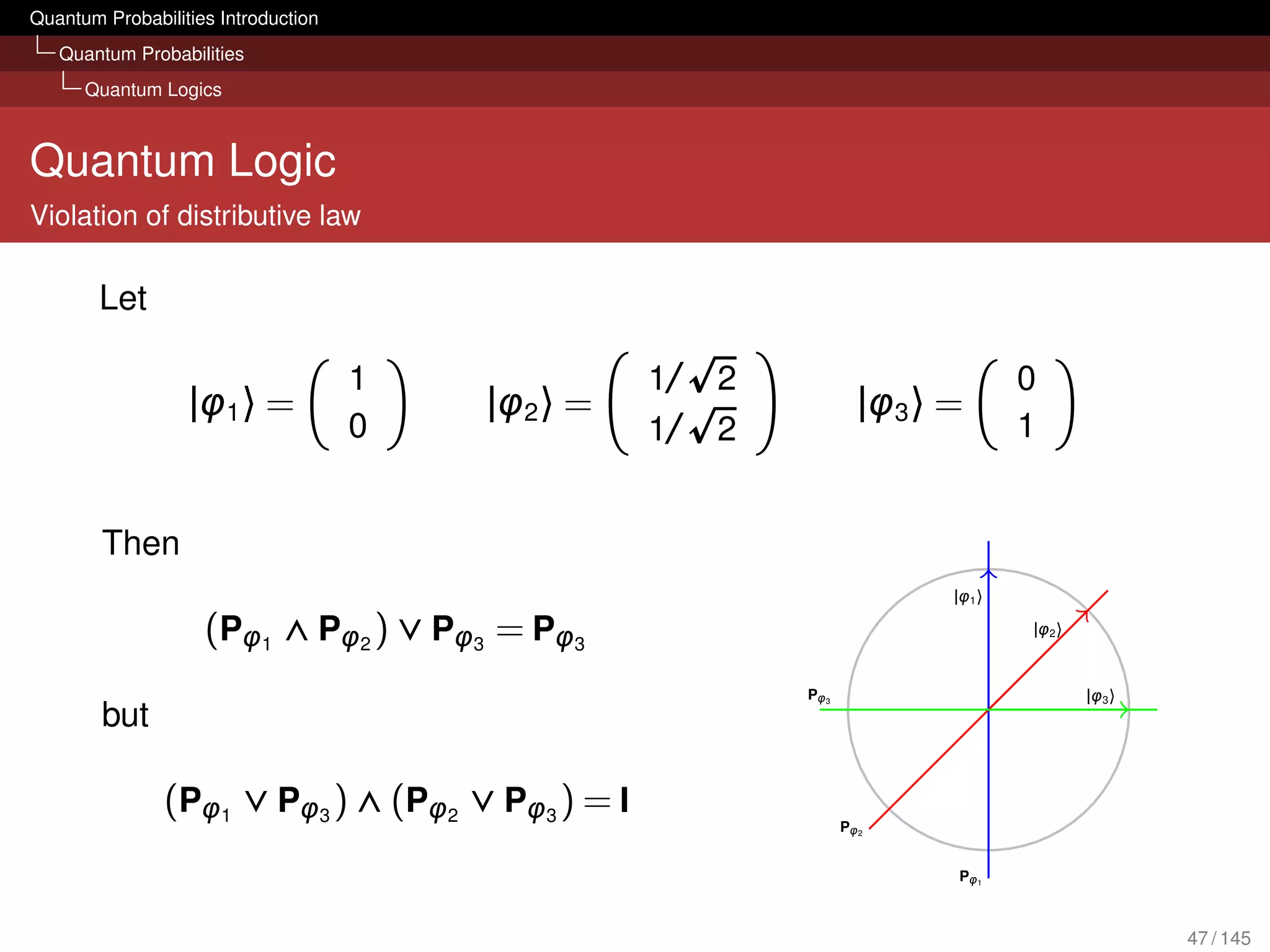
Quantum Logic
Violation of distributive law

        Let

                                     1             1/   2                         0
                  |φ1 〉 =                |φ2 〉 =                    |φ3 〉 =
                                     0             1/   2                         1


        Then
                                                                          |φ1 〉

                    (Pφ1 ∧ Pφ2 ) ∨ Pφ3 = Pφ3                                      |φ2 〉


                                                            Pφ3                           |φ3 〉
        but

               (Pφ1 ∨ Pφ3 ) ∧ (Pφ2 ∨ Pφ3 ) = I
                                                                  Pφ2


                                                                          Pφ1


                                                                                                  47 / 145
Quantum Probabilities Introduction
   Quantum Probabilities
      Quantum Logics


The Classical Case


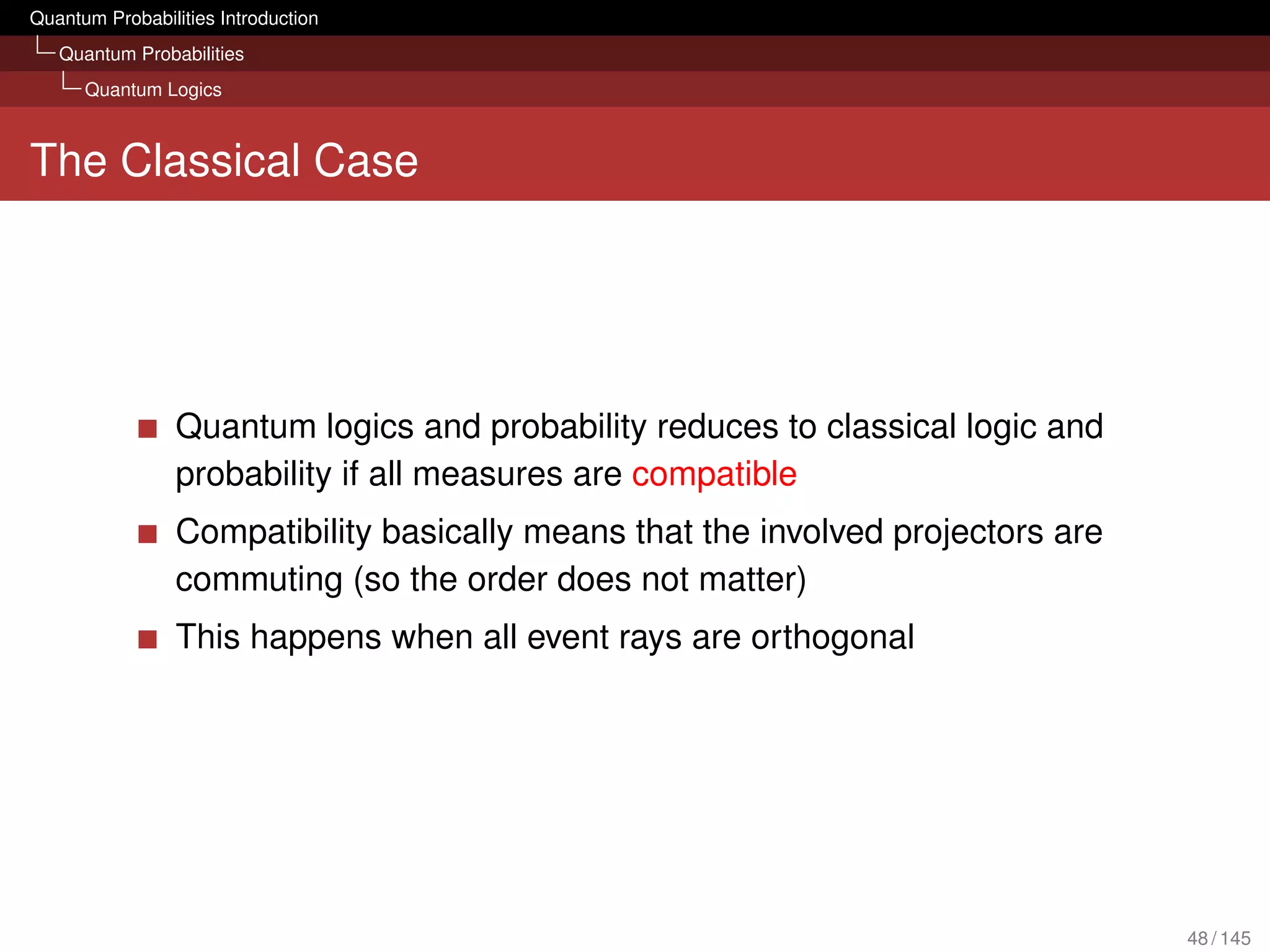
                 Quantum logics and probability reduces to classical logic and
                 probability if all measures are compatible
                 Compatibility basically means that the involved projectors are
                 commuting (so the order does not matter)
                 This happens when all event rays are orthogonal


                                                                                  48 / 145
Quantum Probabilities Introduction
   Quantum Probabilities
      Quantum States


Quantum states


                 Quantum probabilities are induced by quantum states
                 A pure quantum state (or pure state) is represented by a unit
                 vector |φ〉 (the state vector) in the Hilbert space H
                 A mixed (quantum) state is a probabilistic mixture of pure states
                 Both kinds of states can be described by probability densities (a
                 matrix with trace 1)


                                                                                     49 / 145
Quantum Probabilities Introduction
   Quantum Probabilities
      Pure States


Quantum Probabilities: Pure state
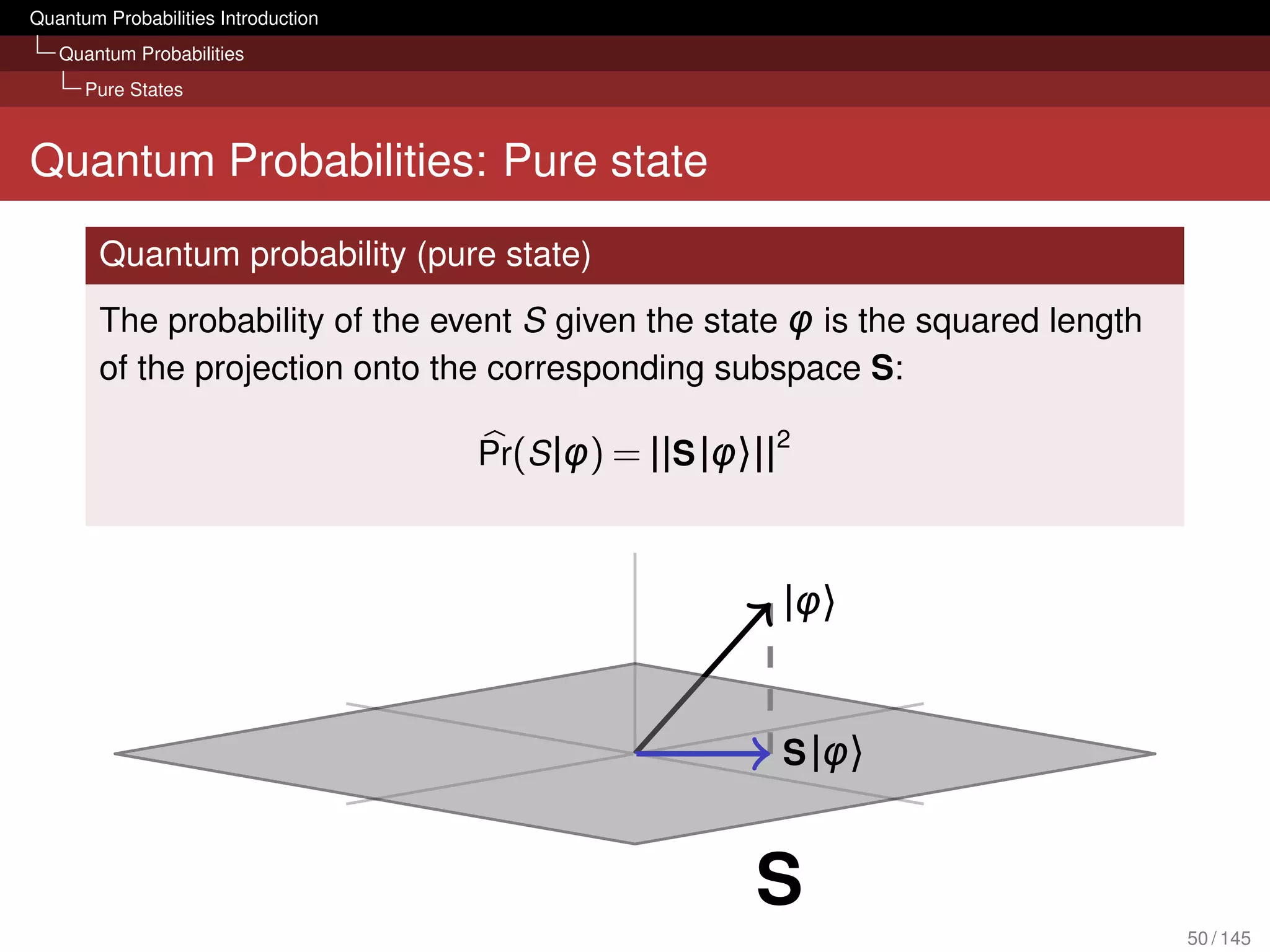
        Quantum probability (pure state)
        The probability of the event S given the state φ is the squared length
        of the projection onto the corresponding subspace S:
                                                            2
                                     Pr(S |φ) = ||S |φ〉||


                                                            |φ〉


                                                            S |φ〉


                                                       S
                                                                                 50 / 145
Quantum Probabilities Introduction
   Quantum Probabilities
      Pure States


Vector Space Model
An example “quantum” system


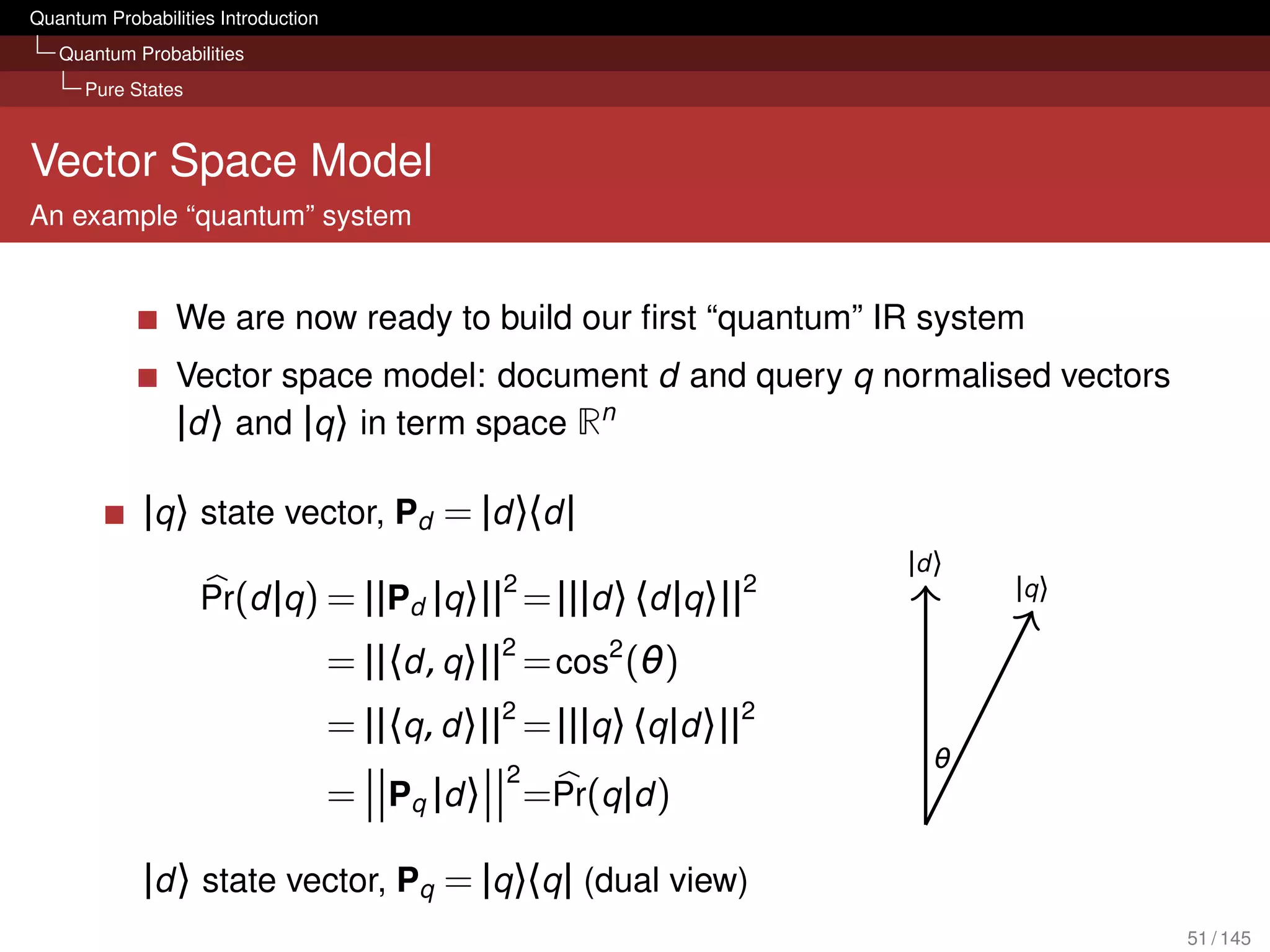
                 We are now ready to build our first “quantum” IR system
                 Vector space model: document d and query q normalised vectors
                 |d 〉 and |q 〉 in term space Rn

             |q 〉 state vector, Pd = |d 〉〈d |
                                                                           |d 〉
                                                   2                  2           |q 〉
                    Pr(d |q ) = ||Pd |q 〉|| = |||d 〉 〈d |q 〉||
                                     = ||〈d , q 〉||2 = cos2 (θ)
                                     = ||〈q , d 〉||2 = |||q 〉 〈q |d 〉||2
                                                                             θ
                                                   2
                                     = Pq | d 〉        =Pr(q |d )

             |d 〉 state vector, Pq = |q 〉〈q | (dual view)
                                                                                         51 / 145
Quantum Probabilities Introduction
   Quantum Probabilities
      Pure States


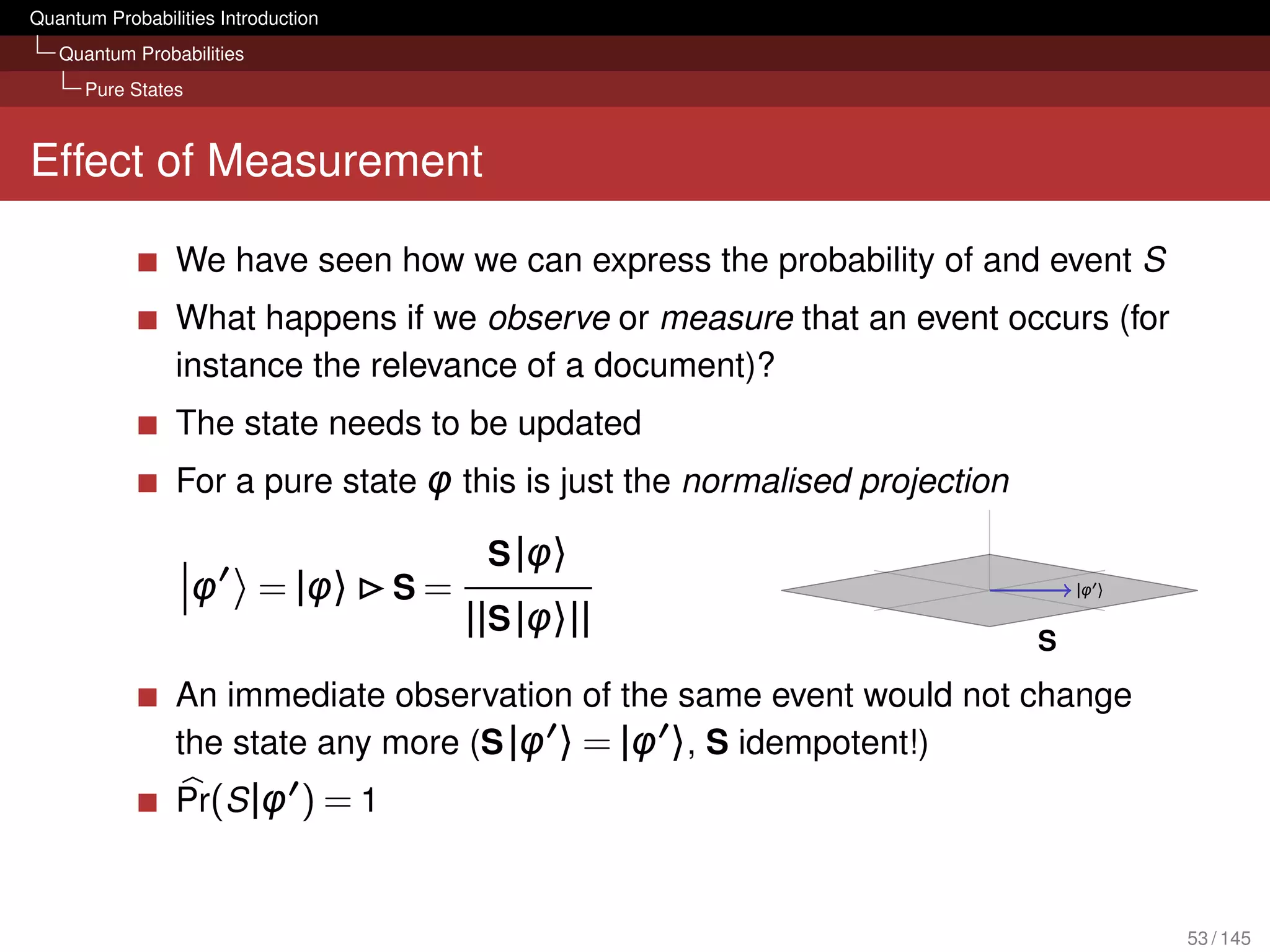
Effect of Measurement

                 We have seen how we can express the probability of and event S
                 What happens if we observe or measure that an event occurs (for
                 instance the relevance of a document)?
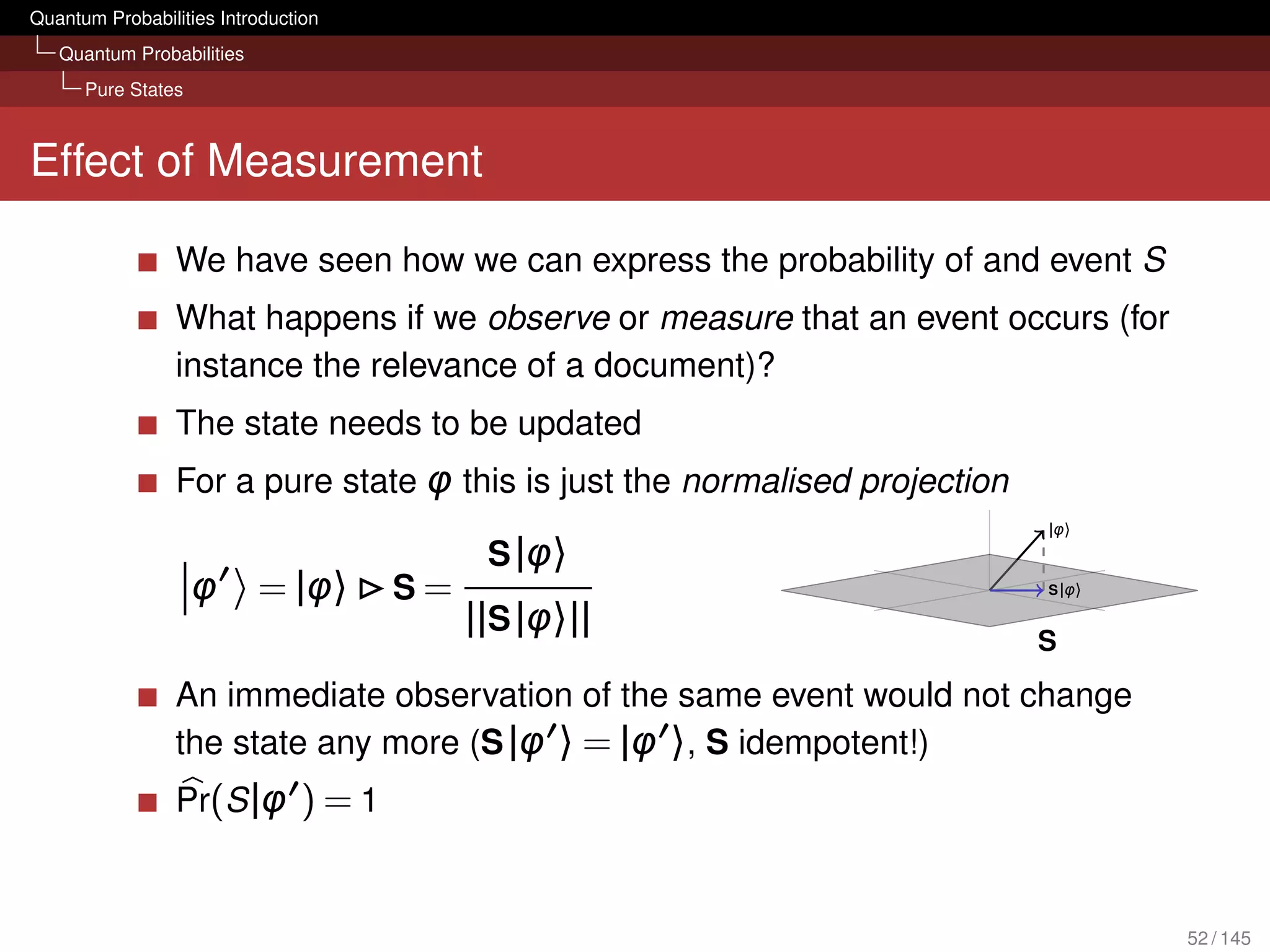
                 The state needs to be updated
                 For a pure state φ this is just the normalised projection
                                                                             |φ〉
                                           S |φ〉
                    φ      = |φ〉     S=                                      S |φ〉

                                          ||S |φ〉||
                                                                             S
                 An immediate observation of the same event would not change
                 the state any more (S |φ 〉 = |φ 〉, S idempotent!)
                 Pr(S |φ ) = 1


                                                                                     52 / 145
Quantum Probabilities Introduction
   Quantum Probabilities
      Pure States


Effect of Measurement

                 We have seen how we can express the probability of and event S
                 What happens if we observe or measure that an event occurs (for
                 instance the relevance of a document)?
                 The state needs to be updated
                 For a pure state φ this is just the normalised projection

                                           S |φ〉
                    φ      = |φ〉     S=                                          |φ 〉

                                          ||S |φ〉||
                                                                             S
                 An immediate observation of the same event would not change
                 the state any more (S |φ 〉 = |φ 〉, S idempotent!)
                 Pr(S |φ ) = 1


                                                                                        53 / 145
Quantum Probabilities Introduction
   Quantum Probabilities
      Pure States


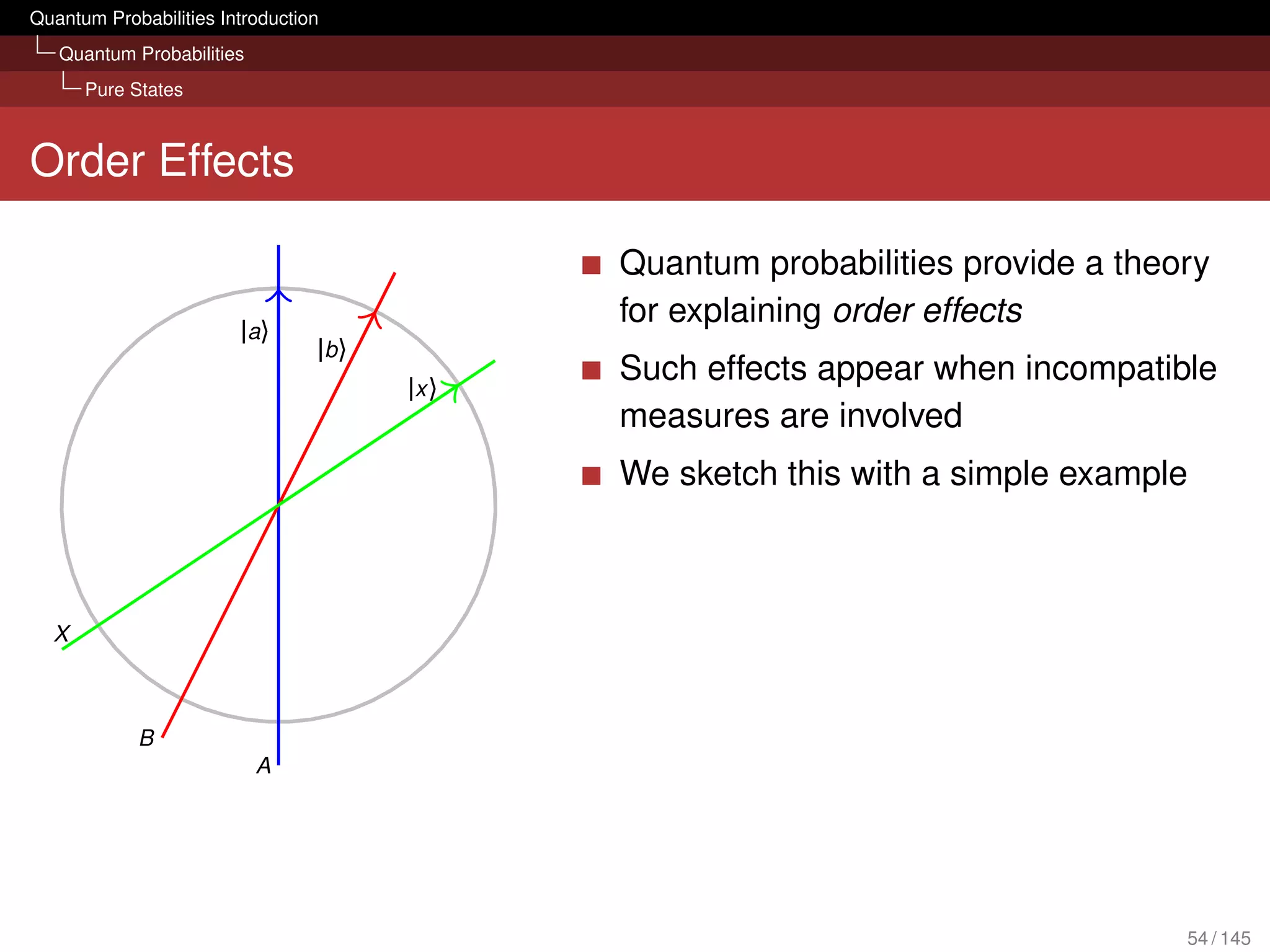
Order Effects

                                               Quantum probabilities provide a theory
                        |a〉
                                               for explaining order effects
                                 |b 〉
                                        |x 〉
                                               Such effects appear when incompatible
                                               measures are involved
                                               We sketch this with a simple example


  X


            B
                           A


                                                                                   54 / 145
Quantum Probabilities Introduction
   Quantum Probabilities
      Pure States


Order Effects

                                               3 Events A,B,X
                                               A = |a〉〈a|
                        |a〉
                                 |b 〉          B = |b 〉〈b |
                                        |x 〉
                                               X = |x 〉〈x |
                                               All non-commutative!
                                               Pr(X |AB ) = Pr(X |BA)
                                               The probability that we observe X is
                                               different if we observed A then B or if we
  X
                                               observed B then A
                                                    [van Rijsbergen, 2004]: Determining
            B                                       relevance then aboutness is not the
                           A
                                                    same as determining aboutness then
                                                    relevance


                                                                                     55 / 145
Quantum Probabilities Introduction
   Quantum Probabilities
      Pure States


Interference
The Double Slit Experiment

    (Taken from [Feynman, 1951])
                                     Physical experiment that
                                     motivates interference
                                          Some works (e.g.
                                          [Zuccon et al., 2009,
                                          Melucci, 2010b]) use this
                                          analogy for IR
                                     Particle either passes slit 1 or
                                     slit 2 before it appears
                                     somewhere on the screen
                                     Probability Pr(x ) that it
                                     appears at position x?


                                                                      56 / 145
Quantum Probabilities Introduction
   Quantum Probabilities
      Pure States


Interference
The Double Slit Experiment

    (Taken from [Feynman, 1951])
                                     Classical Kolmogorovian
                                     probabilities:

                                     Pr12 (x ) = Pr(x |slit 1 or slit 2)
                                              = Pr(x |slit 1) + Pr(x |slit 2)
                                              = Pr1 (x ) + Pr2 (x )

                                     But this is not what we observe!


                                                                           57 / 145
Quantum Probabilities Introduction
   Quantum Probabilities
      Pure States


Interference
The Double Slit Experiment

    (Taken from [Feynman, 1951])
                                     Quantum Probabilities: Use
                                     probability amplitudes!
                                         An amplitude ϕ is a complex
                                         number
                                         Refer to qubit example: ϕ
                                         could be an inner product
                                         Pr(x ) = |ϕ(x )|2


                                       ϕ12 = ϕ(x |slit 1 or slit 2)
                                           = ϕ(x |slit 1) + ϕ(x |slit 2)
                                           = ϕ1 + ϕ2

                                                                           58 / 145
Quantum Probabilities Introduction
   Quantum Probabilities
      Pure States


Interference
The Double Slit Experiment

    (Taken from [Feynman, 1951])
                                     Following [Zuccon, 2012, p. 80]

                                     Pr12 (x ) = |ϕ12 |2 = |ϕ1 + ϕ2 |2
                                              = |ϕ1 |2 + |ϕ2 |2 +
                                                  ϕ1 ϕ2 + ϕ2 ϕ1
                                              = Pr1 (x ) + Pr2 (x )+

                                                  2·    Pr1 (x )    Pr2 (x )·
                                                  cos(θ1 − θ2 )
                                              = Pr1 (x ) + Pr2 (x ) + I12

                                     with ϕ1 = r1 eiθ1 and ϕ2 = r2 eiθ2

                                                                            59 / 145
Quantum Probabilities Introduction
   Quantum Probabilities
      Pure States


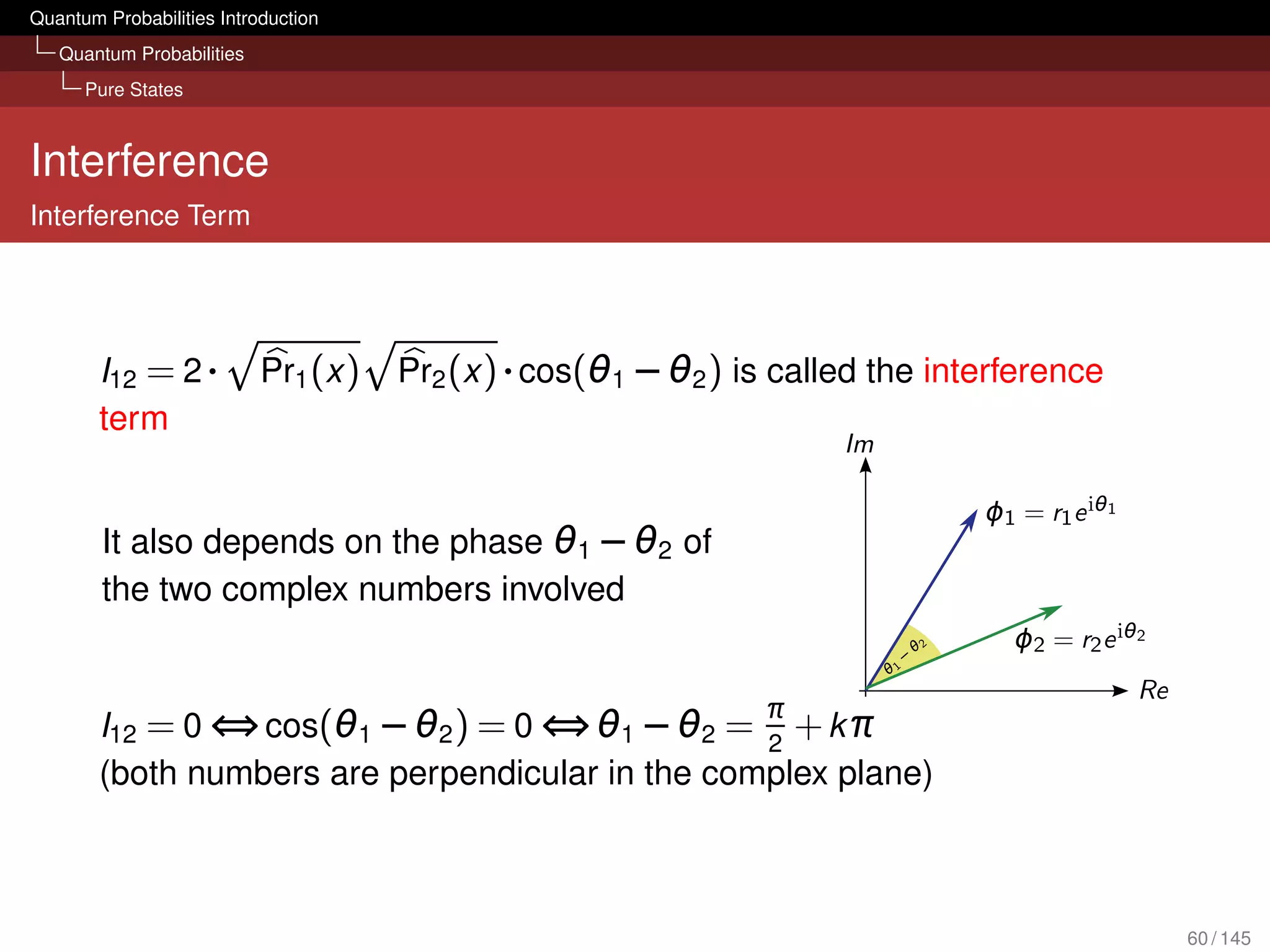
Interference
Interference Term


        I12 = 2 ·          Pr1 (x )   Pr2 (x ) · cos(θ1 − θ2 ) is called the interference
        term


        It also depends on the phase θ1 − θ2 of
        the two complex numbers involved


                                                                π
        I12 = 0 ⇔ cos(θ1 − θ2 ) = 0 ⇔ θ1 − θ2 = 2 + k π
        (both numbers are perpendicular in the complex plane)


                                                                                            60 / 145
Quantum Probabilities Introduction
   Quantum Probabilities
      Pure States


Composite Systems
Tensor Spaces


                 Quantum systems (Hilbert spaces) can be combined using the
                 tensor product (see also [Griffiths, 2002])
                 If |φi 〉 ∈ Hi is the state of system i then

                                                              |φi 〉
                                                         i


                 is the state in the composite system                 i   Hi (product state)
                 Let Si be a subspace (event) in Hi . Then


                                     Pr       Si |       φi      =         Pr(Si |φi )         (1)
                                          i          i                i


                                                                                                     61 / 145
Quantum Probabilities Introduction
   Quantum Probabilities
      Pure States


Composite Systems
2 Qubit Example, Separable State


      |1〉                            |1〉                        Combining two qubits with
                |φ1 〉

                                           |φ2 〉
                                                                |φ1 〉 = a1 |0〉 + a2 |1〉
                                                                |φ2 〉 = b1 |0〉 + b2 |1〉
                           |0〉                     |0〉


                 State of composite system is the product state
                        |φ1 〉 ⊗ |φ2 〉 = a1 b1 |00〉 + a1 b2 |01〉 + a2 b1 |10〉 + a2 b2 |11〉
                 (with, e.g., |01〉 = |0〉 ⊗ |1〉)
                 If composite state is a product state, it is said to be separable
                 Both systems are independent – if we measure, say, |1〉in the first
                 qubit1 , we can still measure either |0〉 or |1〉 in the second one!
                 Bivariate distribution with ai , bi as marginals [Busemeyer, 2012]
            1
                Expressed by the subspace |10〉〈10| + |11〉〈11|
                                                                                            62 / 145
Quantum Probabilities Introduction
   Quantum Probabilities
      Pure States


Composite Systems
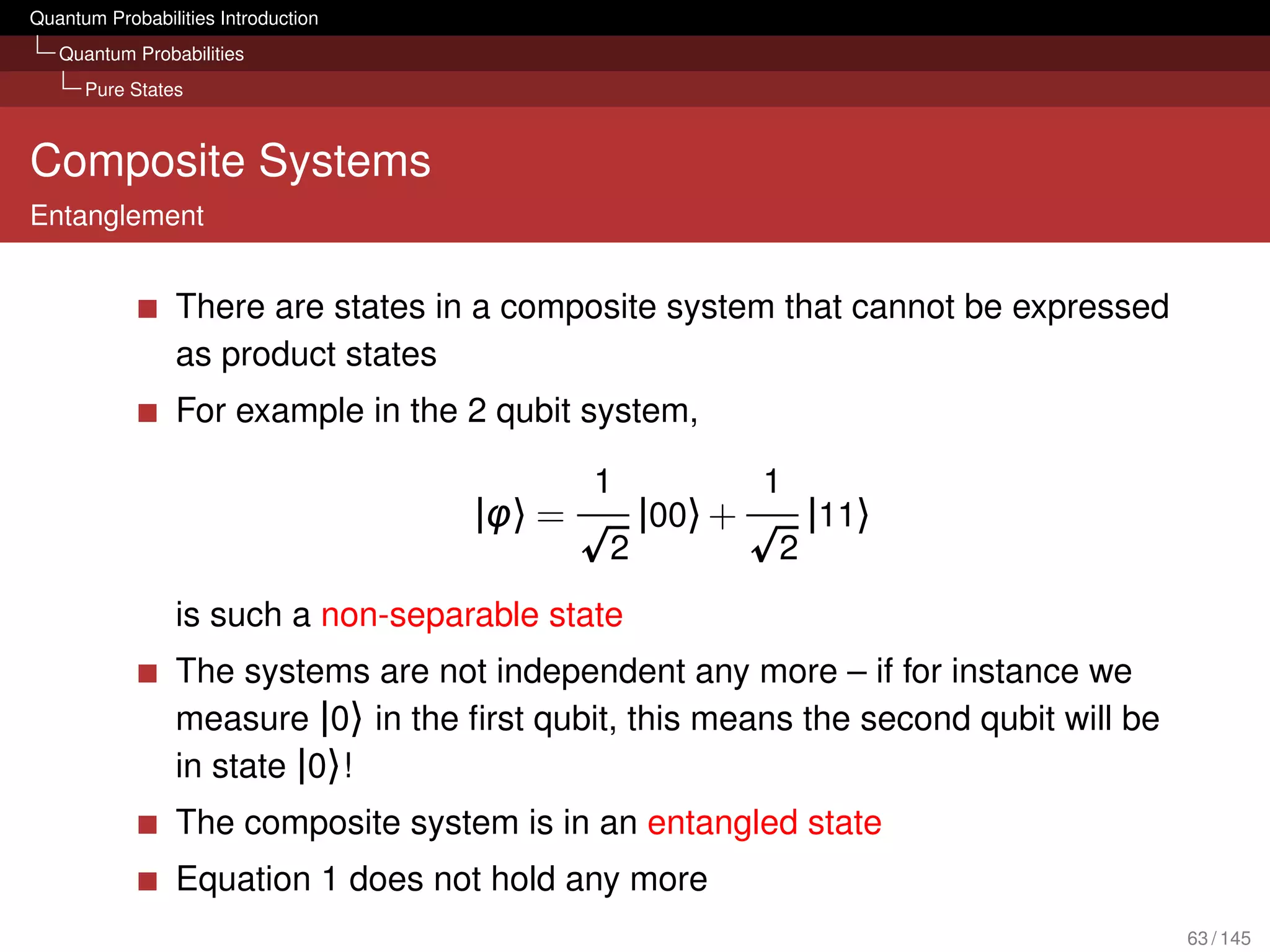
Entanglement


                 There are states in a composite system that cannot be expressed
                 as product states
                 For example in the 2 qubit system,

                                             1             1
                                     |φ〉 =        |00〉 +       |11〉
                                              2            2
                 is such a non-separable state
                 The systems are not independent any more – if for instance we
                 measure |0〉 in the first qubit, this means the second qubit will be
                 in state |0〉!
                 The composite system is in an entangled state
                 Equation 1 does not hold any more
                                                                                      63 / 145
Quantum Probabilities Introduction
   Quantum Probabilities
      Mixed States


Mixed State

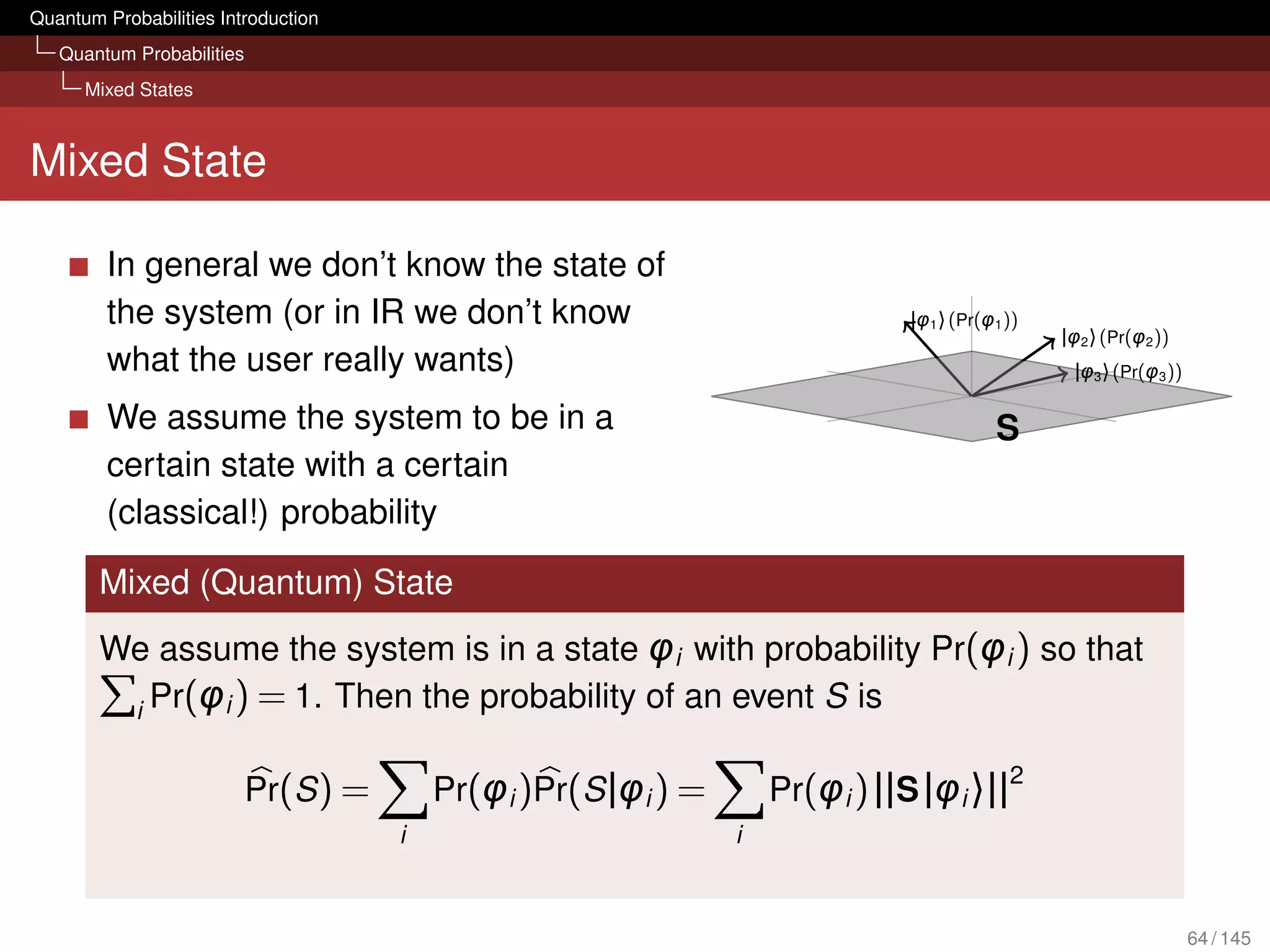
         In general we don’t know the state of
         the system (or in IR we don’t know                                    |φ1 〉 (Pr(φ1 ))
                                                                                                 |φ2 〉 (Pr(φ2 ))
         what the user really wants)                                                              |φ3 〉 (Pr(φ3 ))

         We assume the system to be in a                                                  S
         certain state with a certain
         (classical!) probability

        Mixed (Quantum) State
        We assume the system is in a state φi with probability Pr(φi ) so that
         i Pr(φi ) = 1. Then the probability of an event S is

                                                                                            2
                           Pr(S ) =       Pr(φi )Pr(S |φi ) =       Pr(φi ) ||S |φi 〉||
                                      i                         i


                                                                                                                    64 / 145
Quantum Probabilities Introduction
   Quantum Probabilities
      Mixed States


The Effect of Measurement
Mixed State


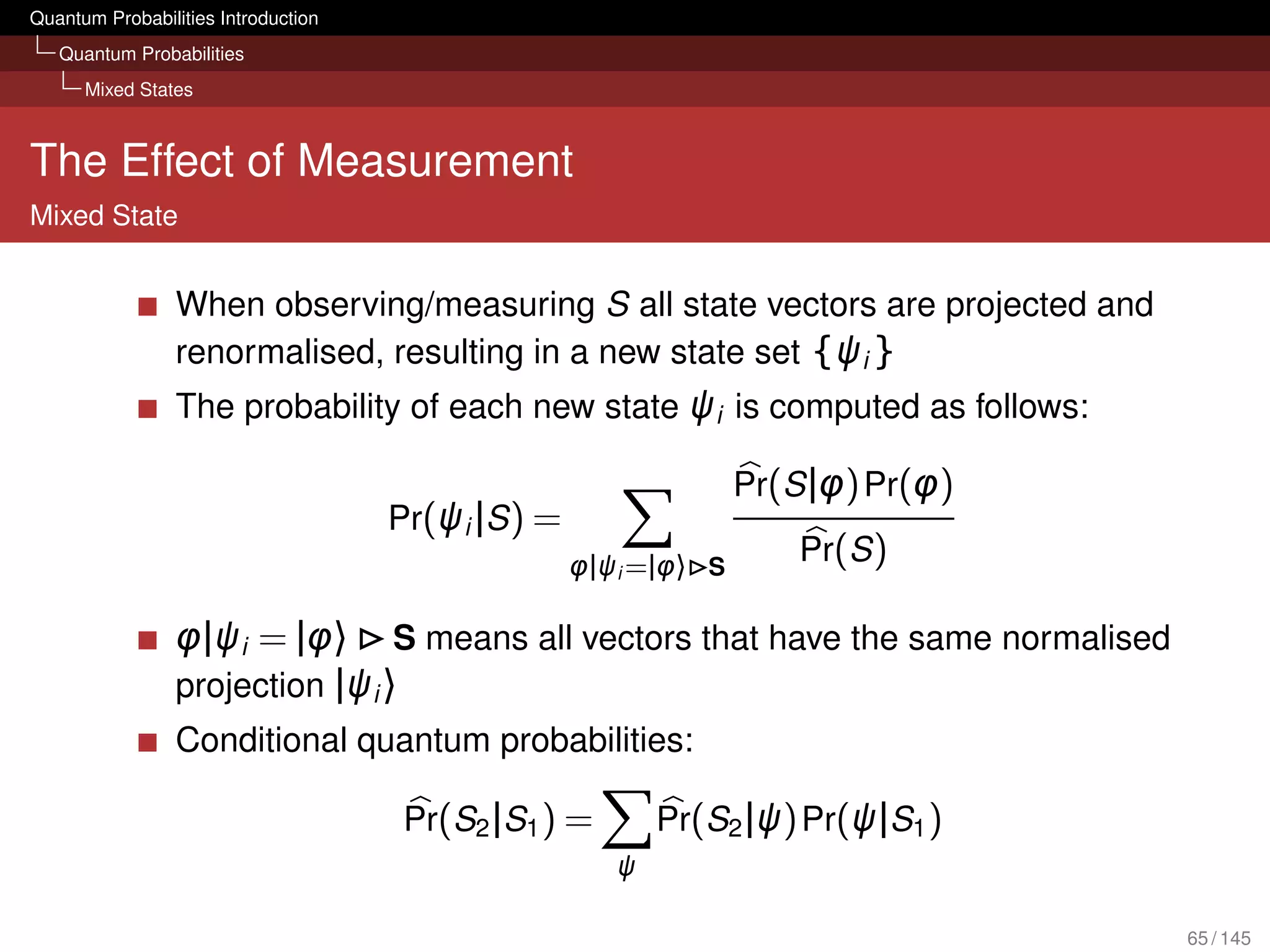
                 When observing/measuring S all state vectors are projected and
                 renormalised, resulting in a new state set {ψi }
                 The probability of each new state ψi is computed as follows:

                                                                  Pr(S |φ) Pr(φ)
                                     Pr(ψi |S ) =
                                                    φ|ψi =|φ〉 S
                                                                      Pr(S )

                 φ|ψi = |φ〉 S means all vectors that have the same normalised
                 projection |ψi 〉
                 Conditional quantum probabilities:

                                      Pr(S2 |S1 ) =        Pr(S2 |ψ) Pr(ψ|S1 )
                                                       ψ

                                                                                   65 / 145
Quantum Probabilities Introduction
   Quantum Probabilities
      Density Operators


Preliminaries: Trace

        Trace

                                                 n
                                      tr(T) =          〈ei | T |ei 〉
                                                i =1

        is known as the trace of T with {|ei 〉} as an orthonormal basis. It is
        equal to the sum of the diagonal elements of T.

        Some important properties (see [van Rijsbergen, 2004, p. 79]):
                 Linearity: tr(α T1 + βT2 ) = α tr(T1 ) + βtr(T2 )
                 Cyclic permutation: e.g. tr(T1 T2 ) = tr(T2 T1 )
                 trT† = tr(T)
                 tr(T) ≥ 0 if T is positive definite
                 An operator T is of trace class if T is positive and its trace is finite
                                                                                           66 / 145
Quantum Probabilities Introduction
   Quantum Probabilities
      Density Operators


Trace and Probability
Density Operator


                                                     2
        Pr(S ) =               Pr(φi ) ||S |φi 〉||
                           i

                   =           Pr(φi )〈Sφi |Sφi 〉                                     Def. norm
                           i

                   =           Pr(φi ) 〈φi | S |φi 〉                   S self-adjoint, idempotent
                           i

                   =           Pr(φi ) tr(S |φi 〉〈φi |)        [Nielsen and Chuang, 2000, p. 76]
                           i
                                                         
                                                          
                                                          
                   = tr S
                                        Pr(φi ) |φi 〉〈φi |
                                                                                 Trace linearity
                                    i                     
                                             =ρ                                                 67 / 145
Quantum Probabilities Introduction
   Quantum Probabilities
      Density Operators


Density Operator

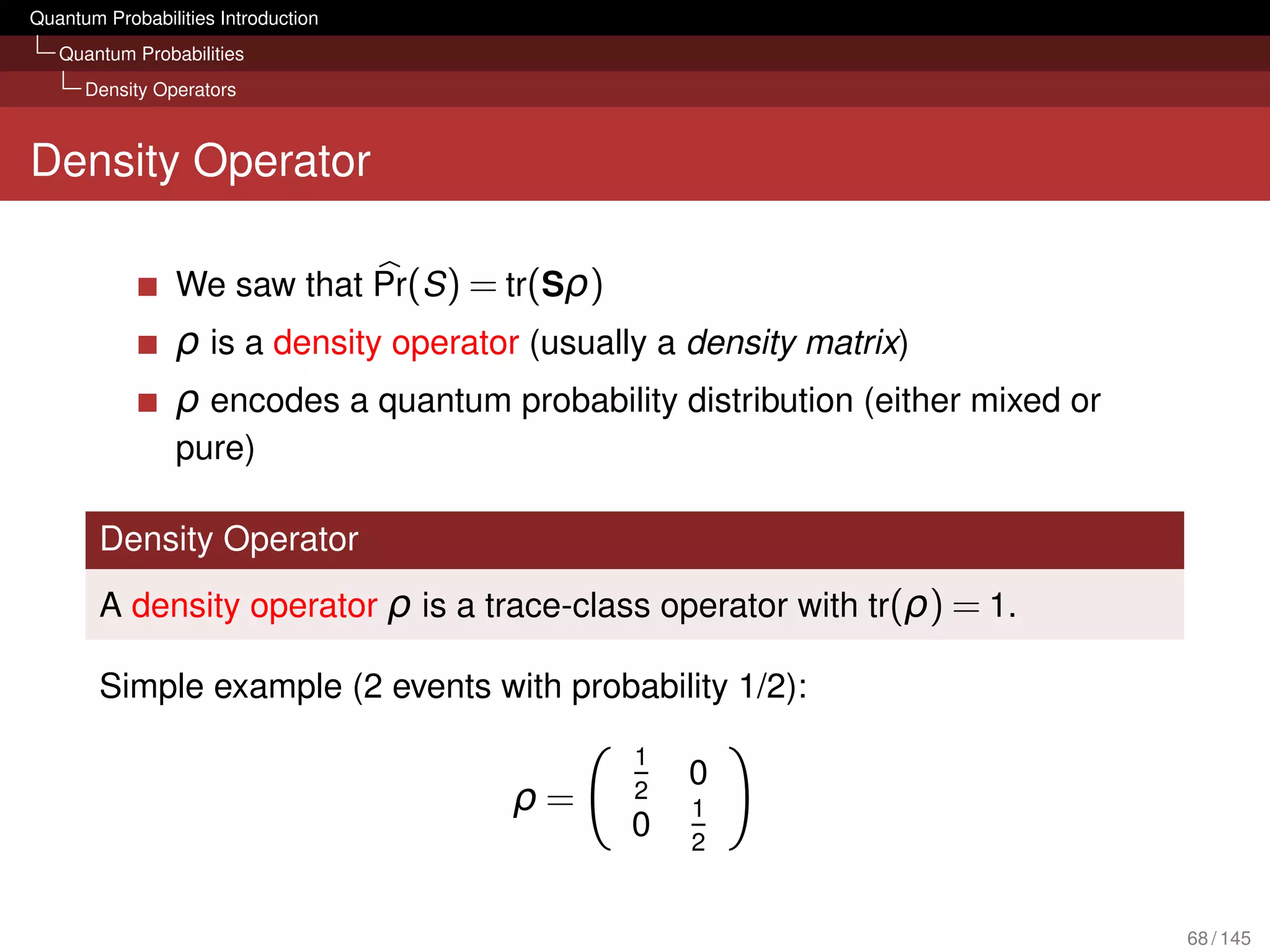
                 We saw that Pr(S ) = tr(Sρ)
                 ρ is a density operator (usually a density matrix)
                 ρ encodes a quantum probability distribution (either mixed or
                 pure)

        Density Operator
        A density operator ρ is a trace-class operator with tr(ρ) = 1.

        Simple example (2 events with probability 1/2):
                                                1
                                                    0
                                       ρ=       2
                                                    1
                                                0   2


                                                                                 68 / 145
Quantum Probabilities Introduction
   Quantum Probabilities
      Density Operators


Gleason’s Theorem


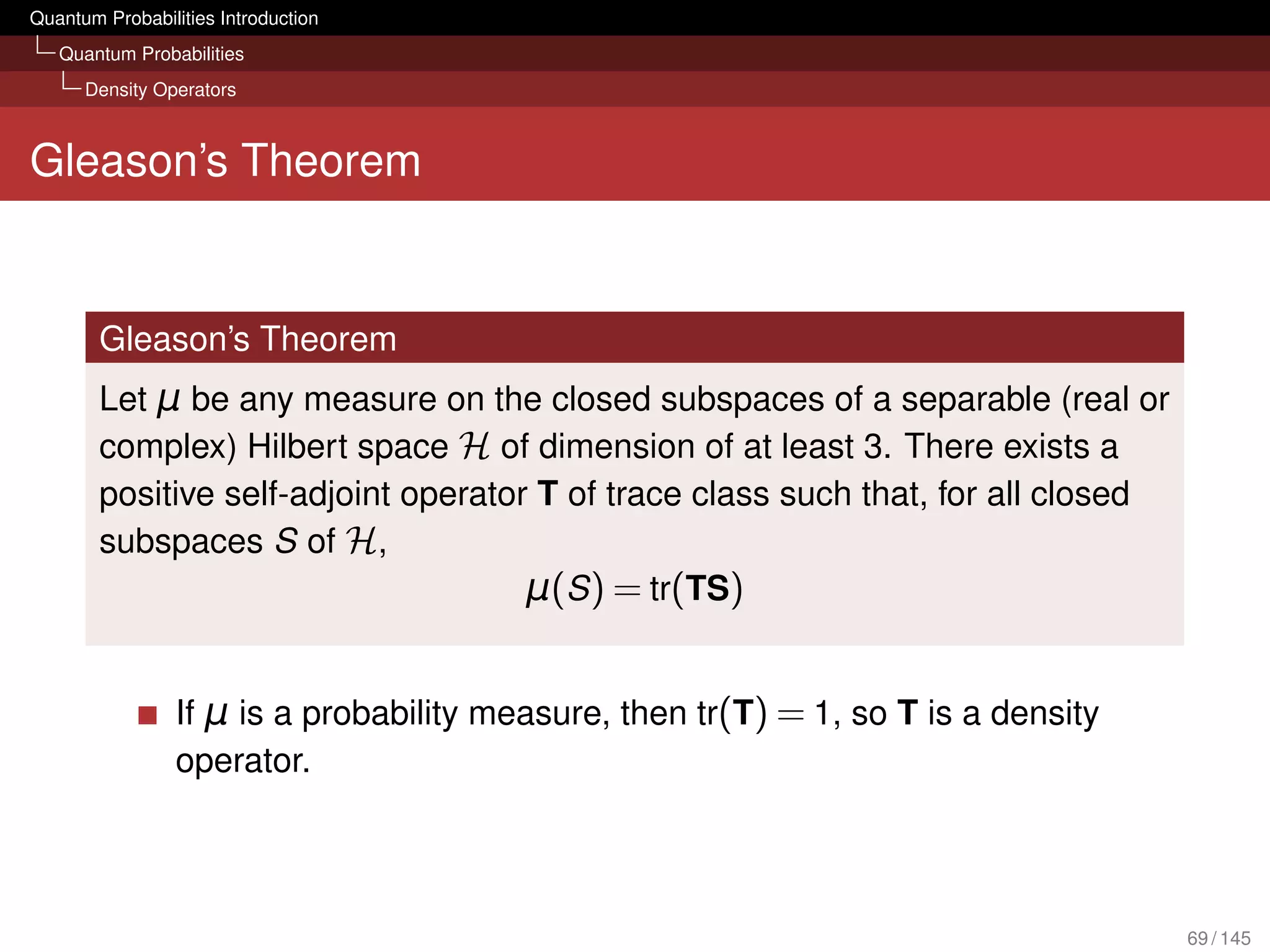
        Gleason’s Theorem
        Let μ be any measure on the closed subspaces of a separable (real or
        complex) Hilbert space H of dimension of at least 3. There exists a
        positive self-adjoint operator T of trace class such that, for all closed
        subspaces S of H,
                                      μ(S ) = tr(TS)


                 If μ is a probability measure, then tr(T) = 1, so T is a density
                 operator.


                                                                                    69 / 145
Quantum Probabilities Introduction
   Quantum Probabilities
      Density Operators


Gleason’s Theorem
In other words...

        Following the Piwowarski/Melucci tutorial:
        Distribution over a Hilbert Space
        A distribution over a Hilbert space H is any function
        Pr : S ⊆ H → [0, 1] such that:
                 Pr(∅) = 0 and Pr(Pφ ) ≥ 0          ∀φ ∈ H
                     i   Pr(Pei ) = 1 for any basis {ei }

        Gleason’s Theorem
        To every probability distribution over a Hilbert space H (dimension
        ≥ 3), there exists a unique density matrix ρ such that for any S ⊆ H

                                             Pr(S ) = tr(ρS)
                                                                               70 / 145
Quantum Probabilities Introduction
   Quantum Probabilities
      Density Operators


What does this mean?


                 Gleason’s theorem provides a 1-to-1 relationship between
                 quantum probability distributions and density operators
                 We can approximate density operators using spectral techniques,
                 decompositions etc.


                                                                                   71 / 145
Quantum Probabilities Introduction
   Quantum Probabilities
      Density Operators


Some Observations

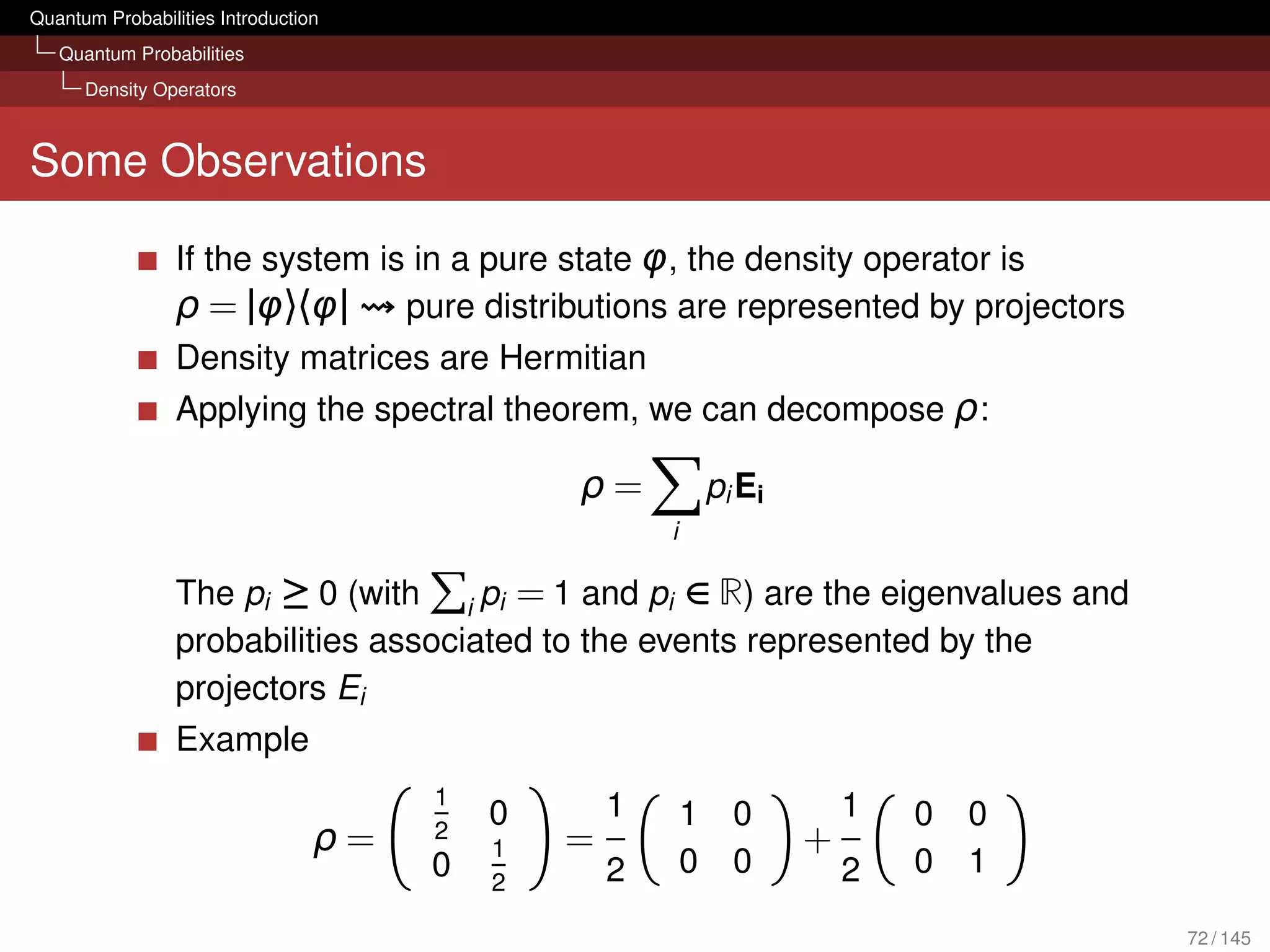
                 If the system is in a pure state φ, the density operator is
                 ρ = |φ〉〈φ| pure distributions are represented by projectors
                 Density matrices are Hermitian
                 Applying the spectral theorem, we can decompose ρ:

                                              ρ=              pi Ei
                                                      i

                 The pi ≥ 0 (with i pi = 1 and pi ∈ R) are the eigenvalues and
                 probabilities associated to the events represented by the
                 projectors Ei
                 Example
                                      1           1                       1
                                          0               1     0             0   0
                                 ρ=   2
                                          1   =                       +
                                      0           2       0     0         2   0   1
                                          2

                                                                                      72 / 145
Quantum Probabilities Introduction
   Quantum Probabilities
      Density Operators


Measurement and Conditional Probabilities


                 Update of density matrix after measuring/observing S1 :

                                             S1 ρ S1         S1 ρ S1
                                     ρ =                 =
                                           tr(S1 ρS1 )       tr(ρS1 )


                 Lüders’ Rule for conditional probabilities:

                                                     tr(S1 ρS1 S2 )
                                     Pr(S2 |S1 ) =
                                                         tr(ρS1 )

                 If S1 and S2 are compatible, this reduces to classical
                 conditionalisation (see [Hughes, 1992, p. 224])


                                                                           73 / 145
Quantum Probabilities Introduction
   Quantum Probabilities
      Density Operators


Tensor product


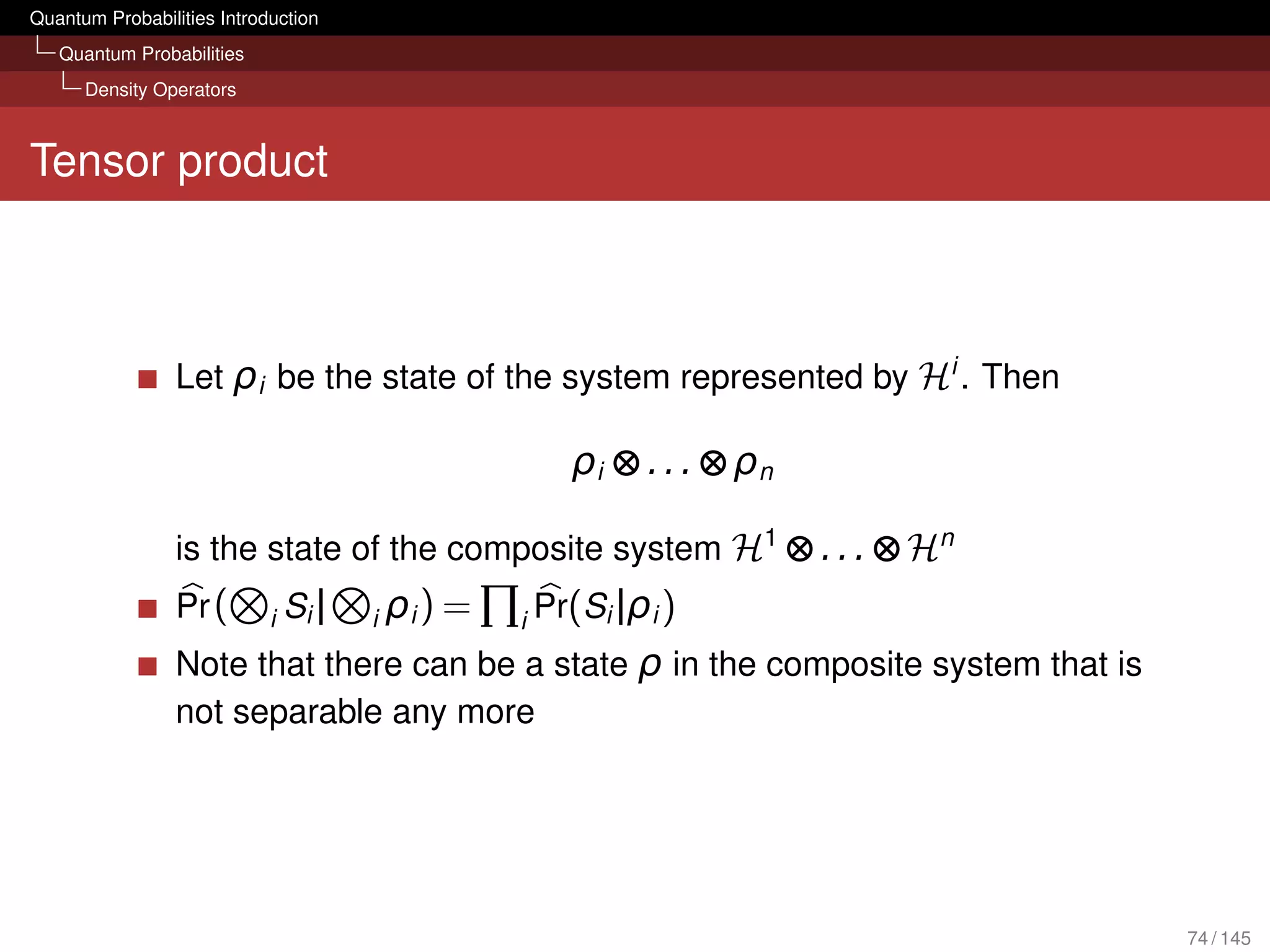
                 Let ρi be the state of the system represented by Hi . Then

                                                          ρi ⊗ . . . ⊗ ρn

                 is the state of the composite system H1 ⊗ . . . ⊗ Hn
                 Pr (       i   Si |   i   ρi ) =   i   Pr(Si |ρi )
                 Note that there can be a state ρ in the composite system that is
                 not separable any more


                                                                                    74 / 145
Quantum Probabilities Introduction
   Quantum Probabilities
      Conclusion


Quantum Probabilities
Conclusion


                 Introduced quantum probabilities based on Hilbert Spaces
                 Some salient features: pure and mixed states, densities,
                 measurement/observation, order effects, interference, composite
                 systems, entanglement
                 Quantum probabilities as a generalisation of classical
                 probabilities
        Now: How can we use this for information retrieval?


                                                                                   75 / 145
Quantum-inspired IR Models

   The QIA Model
     Quantum Information Access
     Polyprepresentation
   Quantum Probability Ranking Principle
Quantum Information Access (QIA)
Quantum-inspired IR Models
   The QIA Model


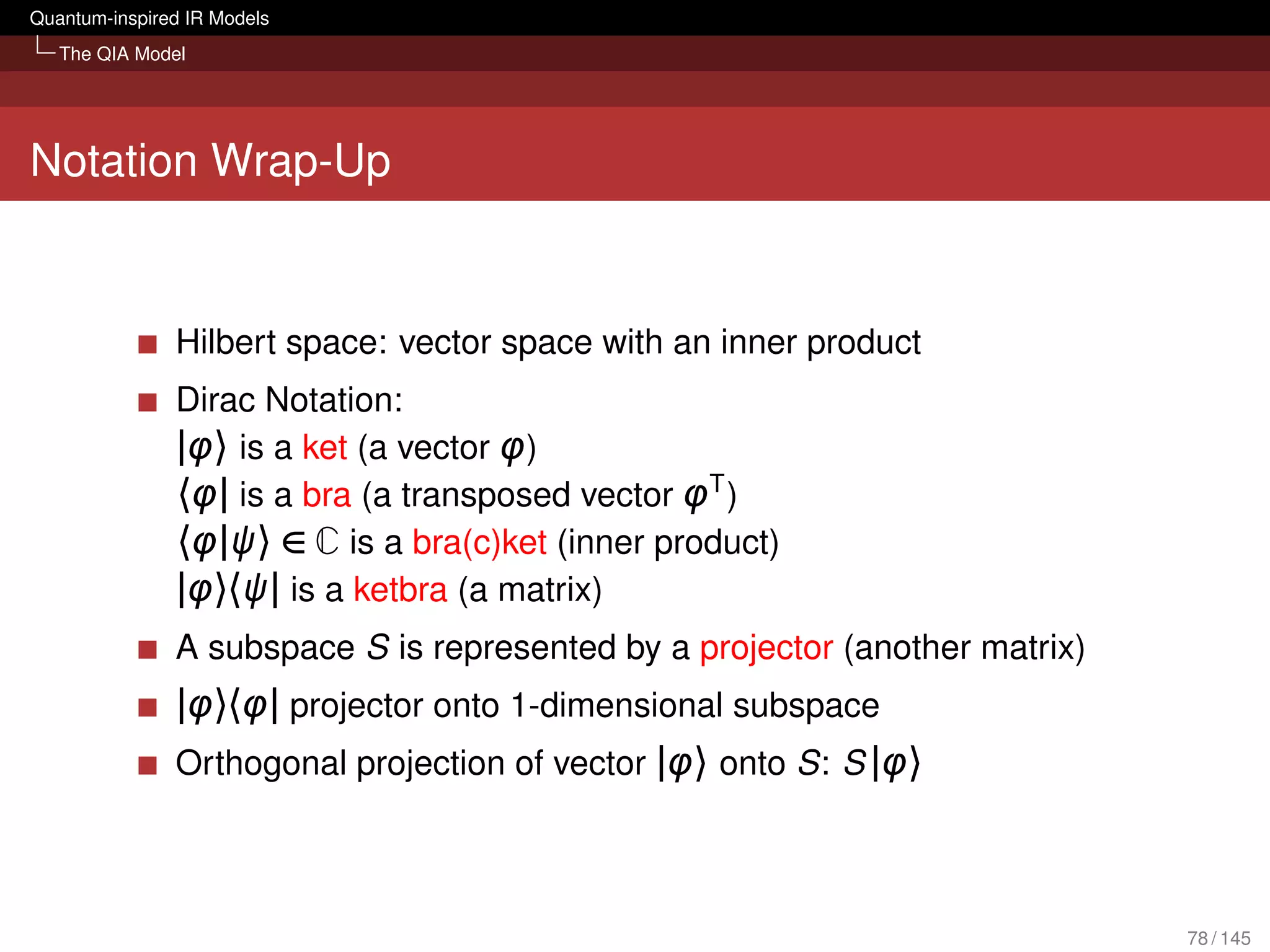
Notation Wrap-Up


               Hilbert space: vector space with an inner product
               Dirac Notation:
               |φ〉 is a ket (a vector φ)
               〈φ| is a bra (a transposed vector φT )
               〈φ|ψ〉 ∈ C is a bra(c)ket (inner product)
               |φ〉〈ψ| is a ketbra (a matrix)
               A subspace S is represented by a projector (another matrix)
               |φ〉〈φ| projector onto 1-dimensional subspace
               Orthogonal projection of vector |φ〉 onto S: S |φ〉


                                                                             78 / 145
Quantum-inspired IR Models
   The QIA Model
     Quantum Information Access


Assumptions underlying QIA


               IR system uncertain about user’s information need (IN)
                        System view of the user’s IN becomes more and more specific
                        through interaction
               The IN may change from the user’s point of view
               There is an IN Space, a Hilbert space


                                                                                     79 / 145
Quantum-inspired IR Models
   The QIA Model
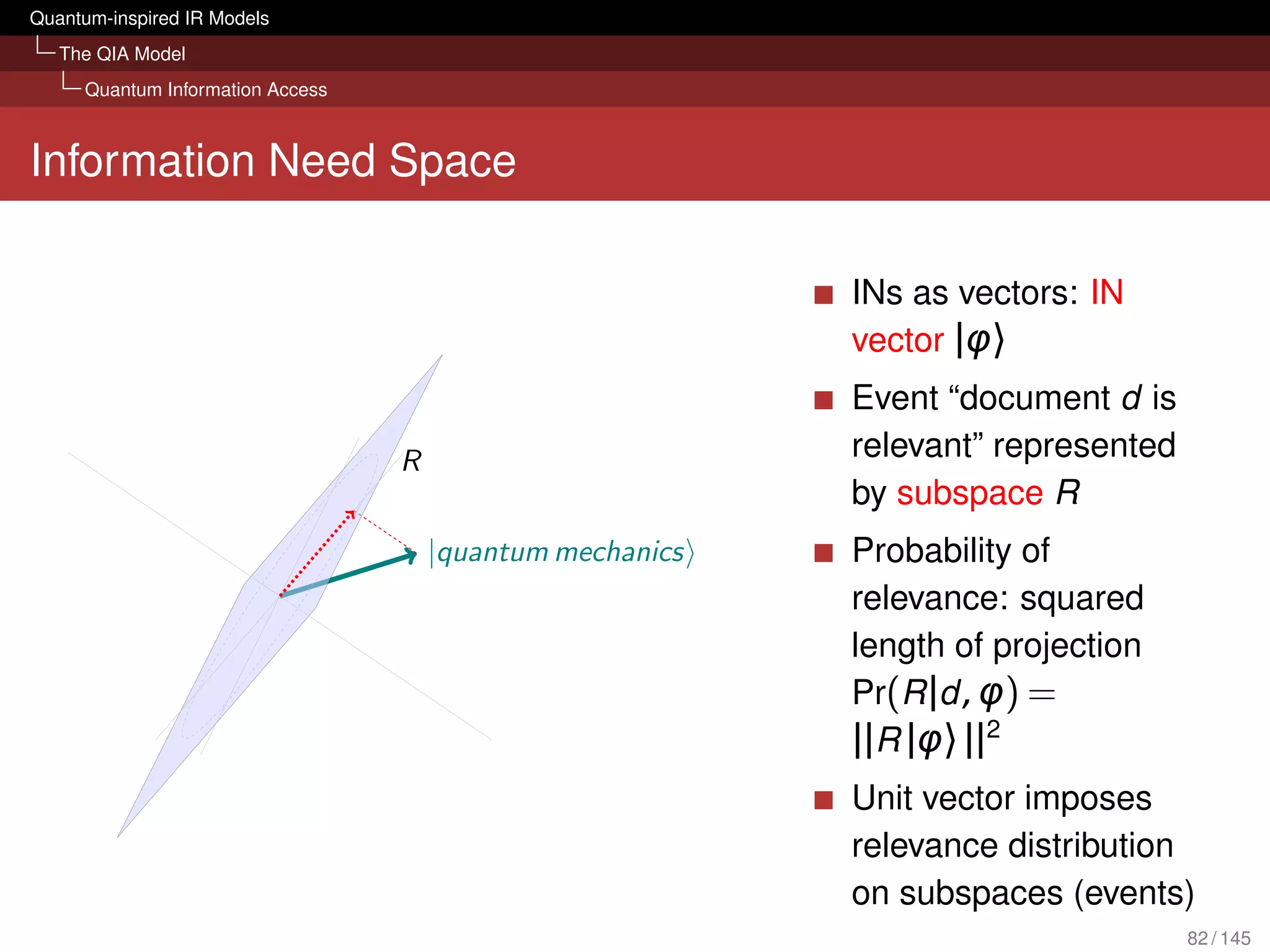
     Quantum Information Access


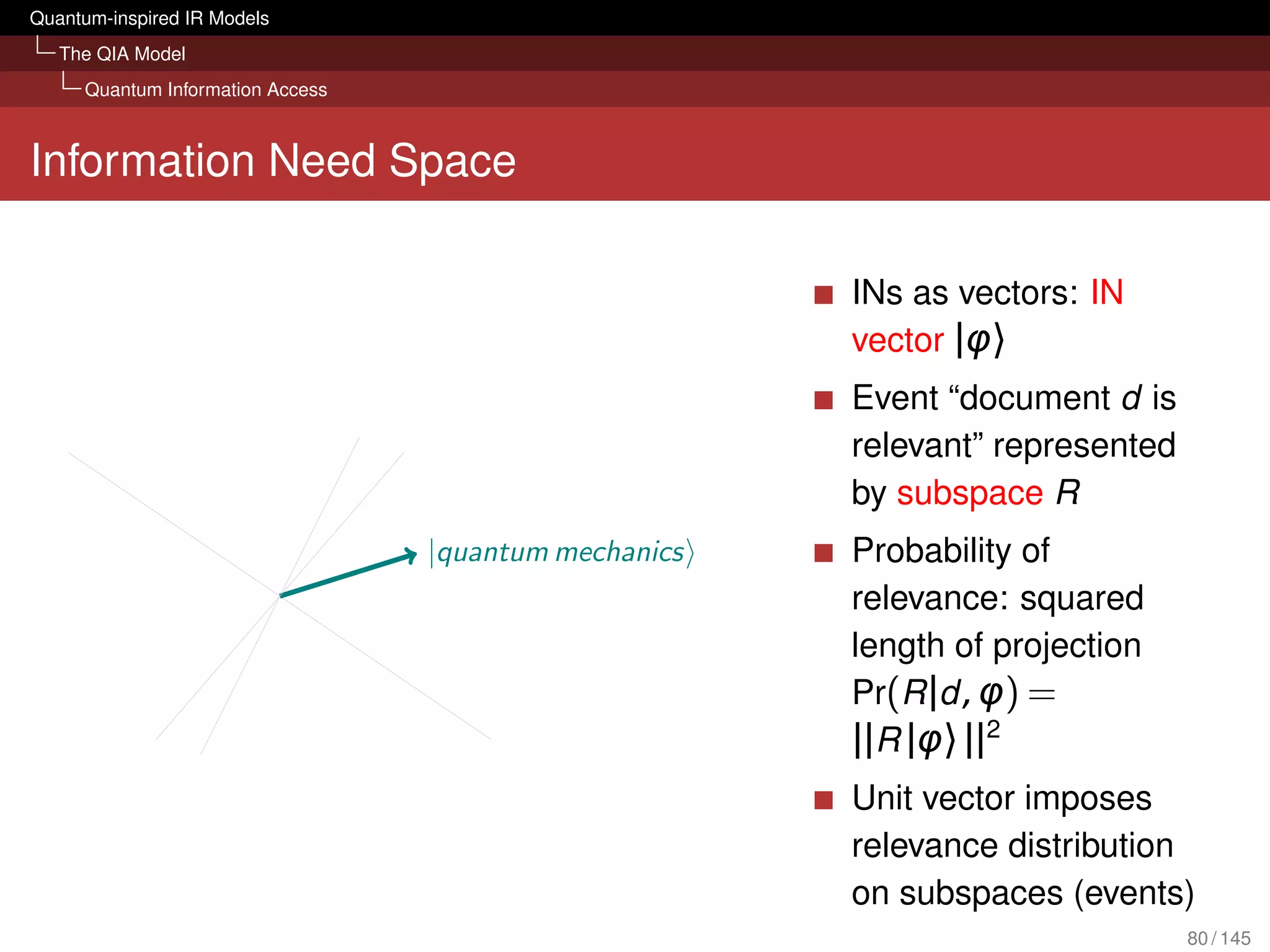
Information Need Space

                                                       INs as vectors: IN
                                                       vector |φ〉
                                                       Event “document d is
                                                       relevant” represented
                                                       by subspace R
                                  |quantum mechanics   Probability of
                                                       relevance: squared
                                                       length of projection
                                                       Pr(R |d , φ) =
                                                       ||R |φ〉 ||2
                                                       Unit vector imposes
                                                       relevance distribution
                                                       on subspaces (events)
                                                                               80 / 145
Quantum-inspired IR Models
   The QIA Model
     Quantum Information Access


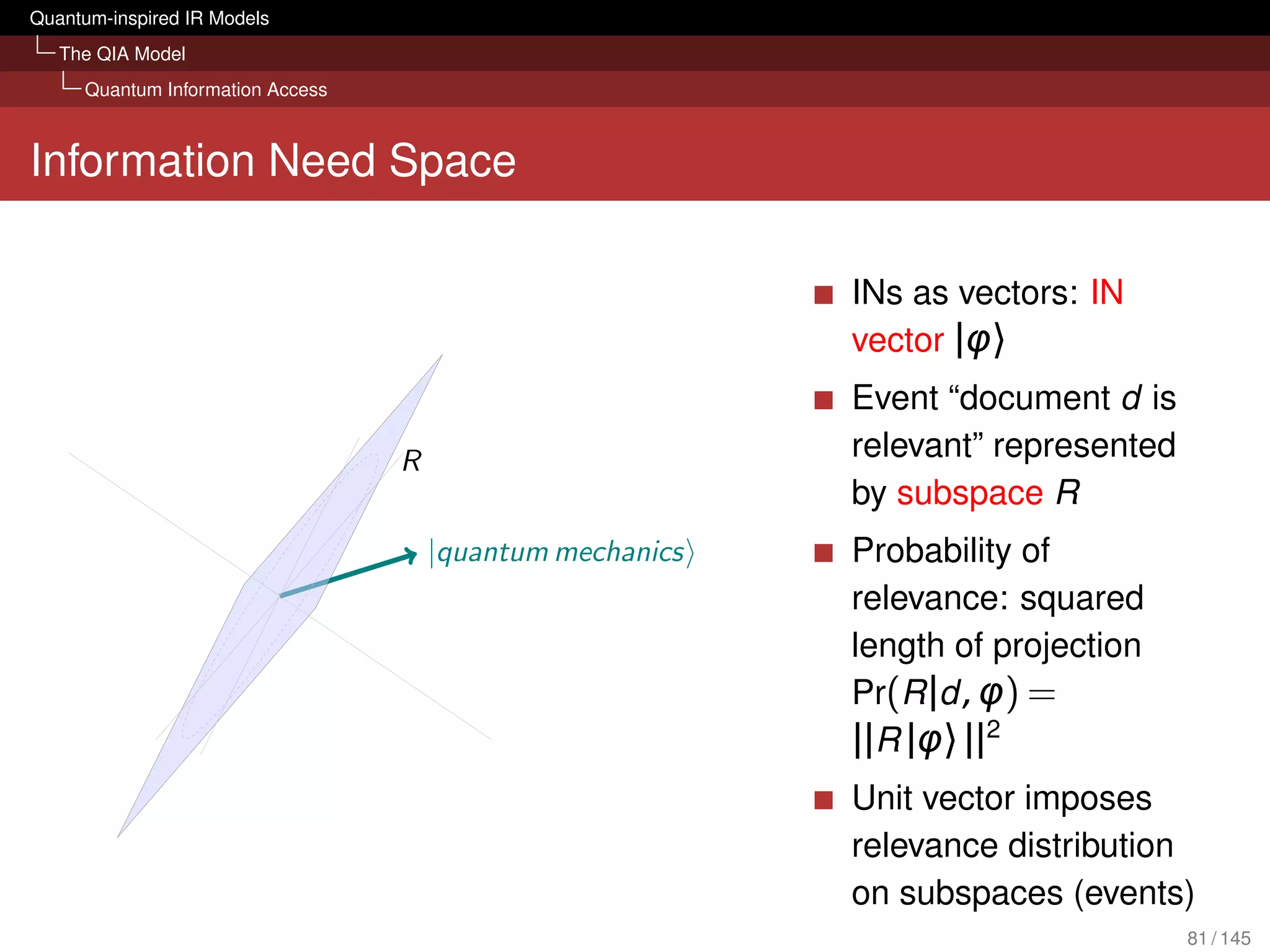
Information Need Space

                                                           INs as vectors: IN
                                                           vector |φ〉
                                                           Event “document d is
                                  R                        relevant” represented
                                                           by subspace R
                                      |quantum mechanics   Probability of
                                                           relevance: squared
                                                           length of projection
                                                           Pr(R |d , φ) =
                                                           ||R |φ〉 ||2
                                                           Unit vector imposes
                                                           relevance distribution
                                                           on subspaces (events)
                                                                                   81 / 145
Quantum-inspired IR Models
   The QIA Model
     Quantum Information Access


Information Need Space

                                                           INs as vectors: IN
                                                           vector |φ〉
                                                           Event “document d is
                                  R                        relevant” represented
                                                           by subspace R
                                      |quantum mechanics   Probability of
                                                           relevance: squared
                                                           length of projection
                                                           Pr(R |d , φ) =
                                                           ||R |φ〉 ||2
                                                           Unit vector imposes
                                                           relevance distribution
                                                           on subspaces (events)
                                                                                   82 / 145
Quantum-inspired IR Models
   The QIA Model
     Quantum Information Access


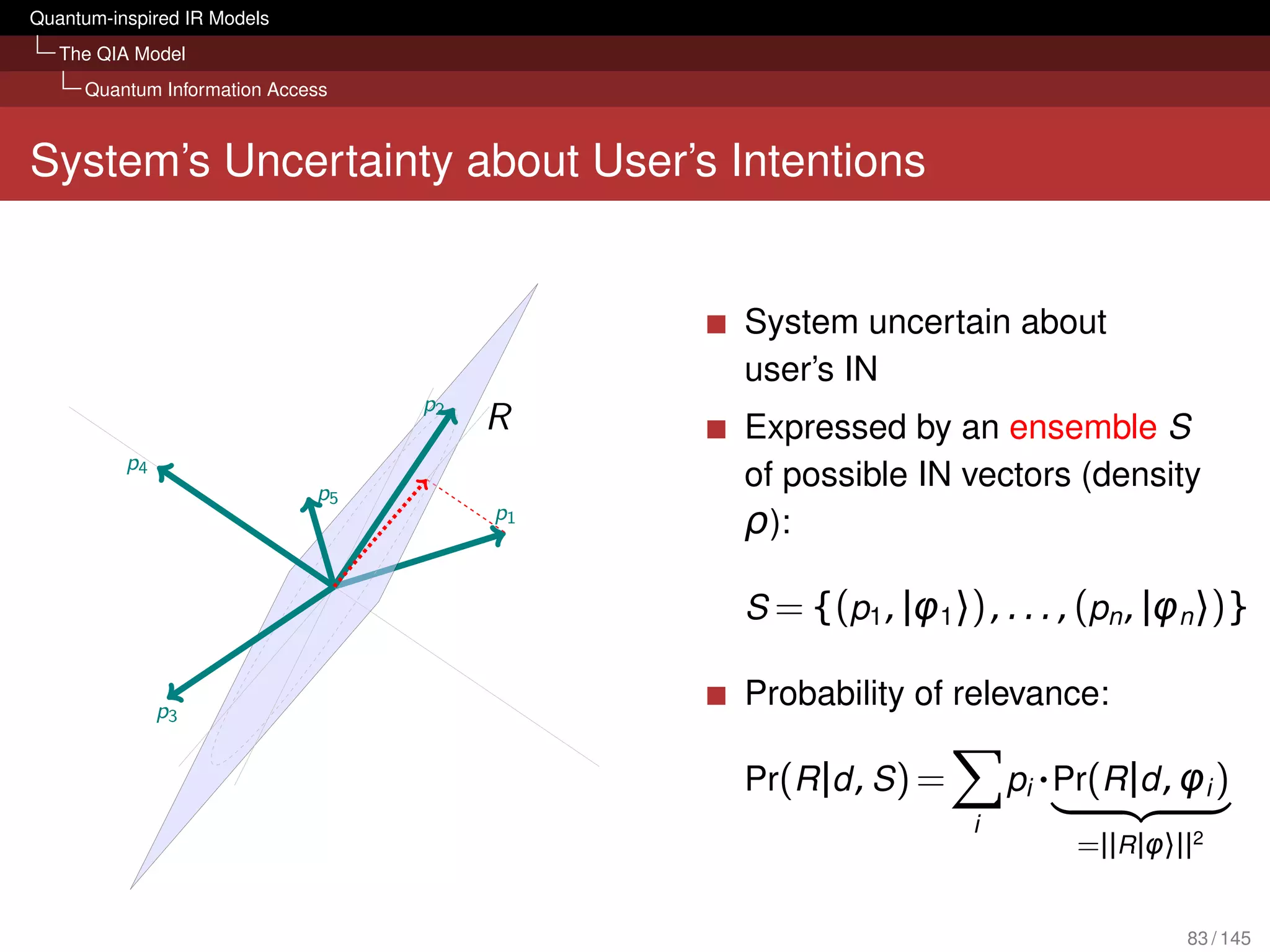
System’s Uncertainty about User’s Intentions


                                            System uncertain about
                                            user’s IN
                                  p2
                                       R    Expressed by an ensemble S
          p4
                             p5
                                            of possible IN vectors (density
                                       p1
                                            ρ):

                                            S = {(p1 , |φ1 〉) , . . . , (pn , |φn 〉)}

               p3
                                            Probability of relevance:

                                            Pr(R |d , S ) =       pi · Pr(R |d , φi )
                                                              i
                                                                       =||R |φ〉||2


                                                                                 83 / 145
Quantum-inspired IR Models
   The QIA Model
     Quantum Information Access


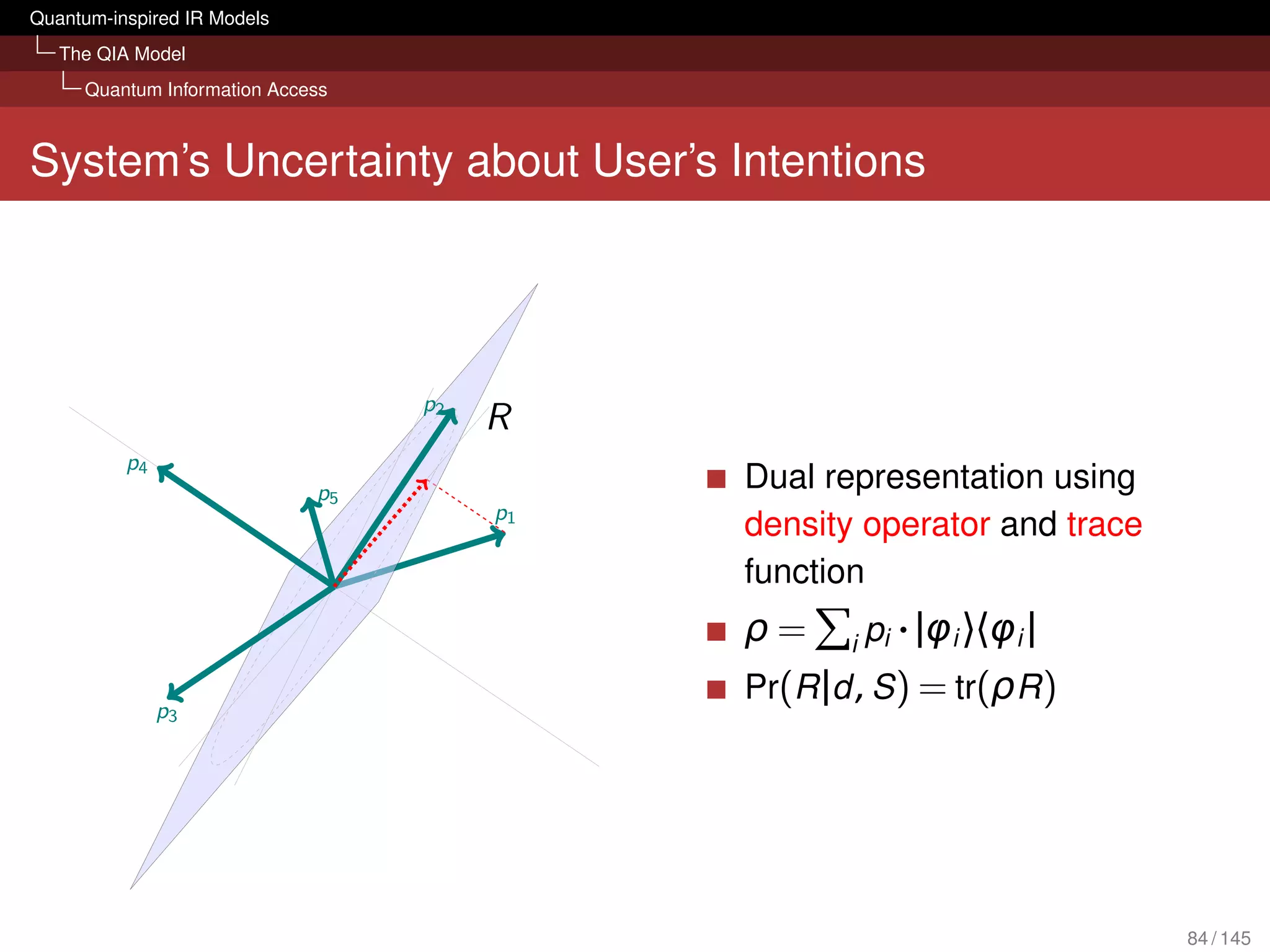
System’s Uncertainty about User’s Intentions


                                  p2
                                       R
          p4
                             p5             Dual representation using
                                       p1
                                            density operator and trace
                                            function
                                            ρ=     i   pi · |φi 〉〈φi |
                                            Pr(R |d , S ) = tr(ρR )
               p3


                                                                         84 / 145
Quantum-inspired IR Models
   The QIA Model
     Quantum Information Access


User Interaction and Feedback

                                           Outcome of feedback: Query
                                           and query reformulation, (click
                                   |ϕ2
                                           on) relevant document, ...
                                      R∗
                                    |ϕ1    Expressed as subspace
                             |ϕ3
                                           Project IN vectors onto
                                           document subspace
                                           Document now gets
                                           probability 1
                                           System’s uncertainty
           |ϕ5
                                           decreases
                                           Also reflects changes in
                                           information needs
                                                                        85 / 145
Quantum-inspired IR Models
   The QIA Model
     Quantum Information Access


User Interaction and Feedback

                                                Outcome of feedback: Query
                                                and query reformulation, (click
                                   |ϕ2
                                                on) relevant document, ...
          |ϕ4                            R∗
                             |ϕ5                Expressed as subspace
                                                Project IN vectors onto
                                          |ϕ1
                                                document subspace
                                                Document now gets
                                                probability 1
      |ϕ3
                                                System’s uncertainty
                                                decreases
                                                Also reflects changes in
                                                information needs
                                                                             86 / 145
Quantum-inspired IR Models
   The QIA Model
     Quantum Information Access


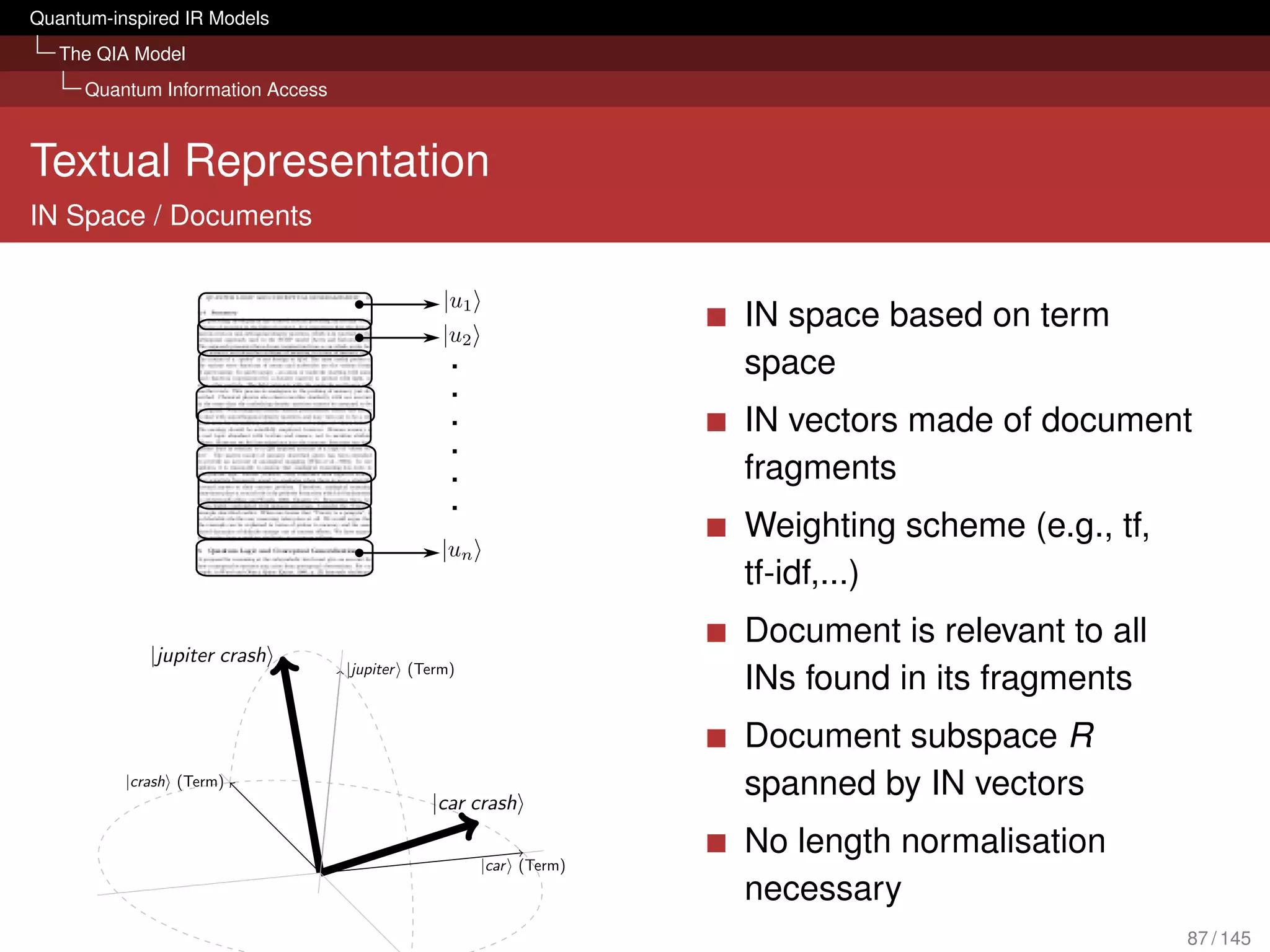
Textual Representation
IN Space / Documents


                                                                  IN space based on term
                                                                  space
                                                                  IN vectors made of document
                                                                  fragments
                                                                  Weighting scheme (e.g., tf,
                                                                  tf-idf,...)
                                                                  Document is relevant to all
             |jupiter crash
                                  |jupiter (Term)
                                                                  INs found in its fragments
                                                                  Document subspace R
          |crash (Term)
                                             |car crash
                                                                  spanned by IN vectors
                                                                  No length normalisation
                                                    |car (Term)
                                                                  necessary
                   |ϕ
                                                                                                87 / 145
Quantum-inspired IR Models
   The QIA Model
     Quantum Information Access


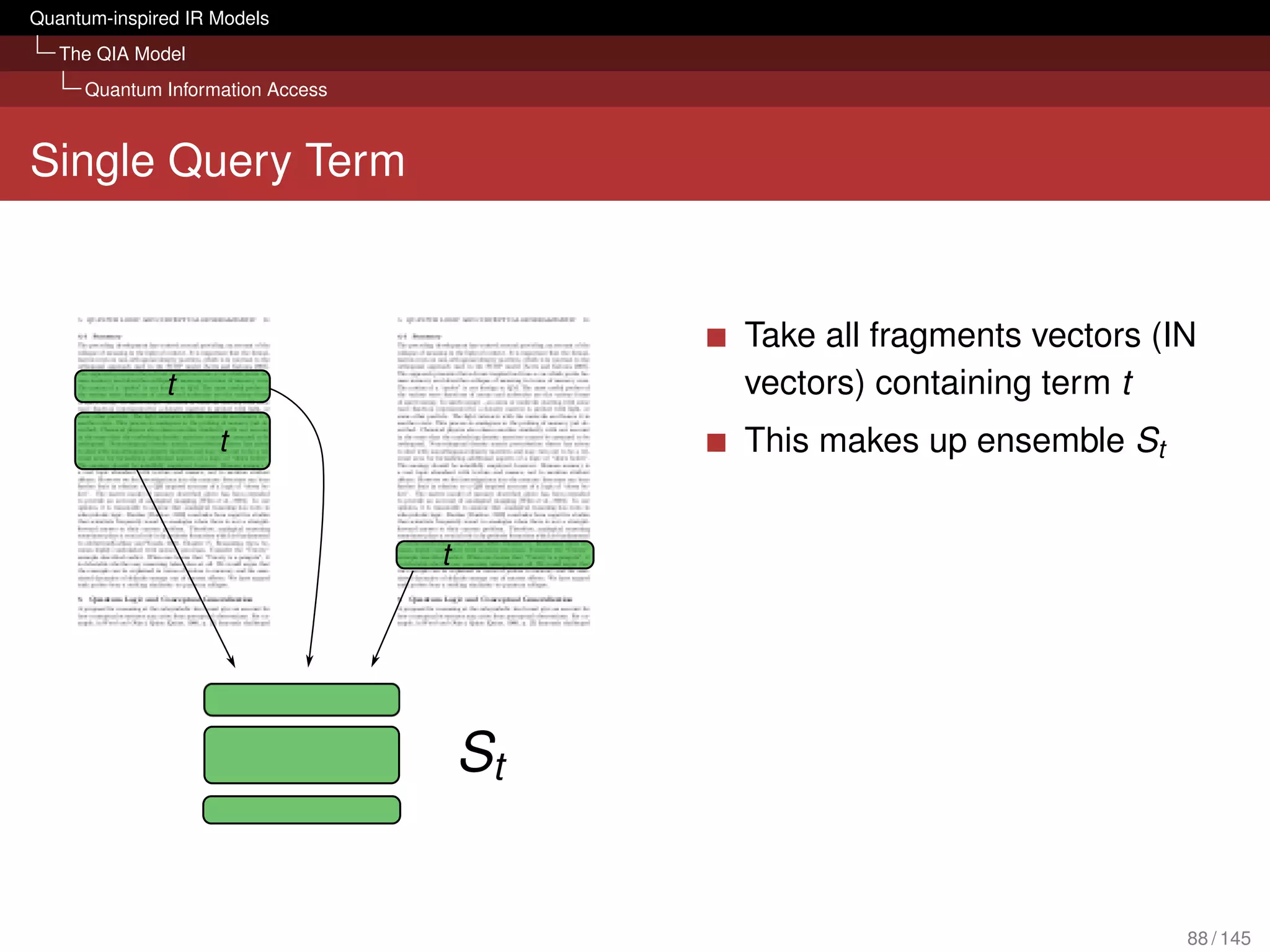
Single Query Term


                                  Take all fragments vectors (IN
                                  vectors) containing term t
                                  This makes up ensemble St


                                                               88 / 145
Quantum-inspired IR Models
   The QIA Model
     Quantum Information Access


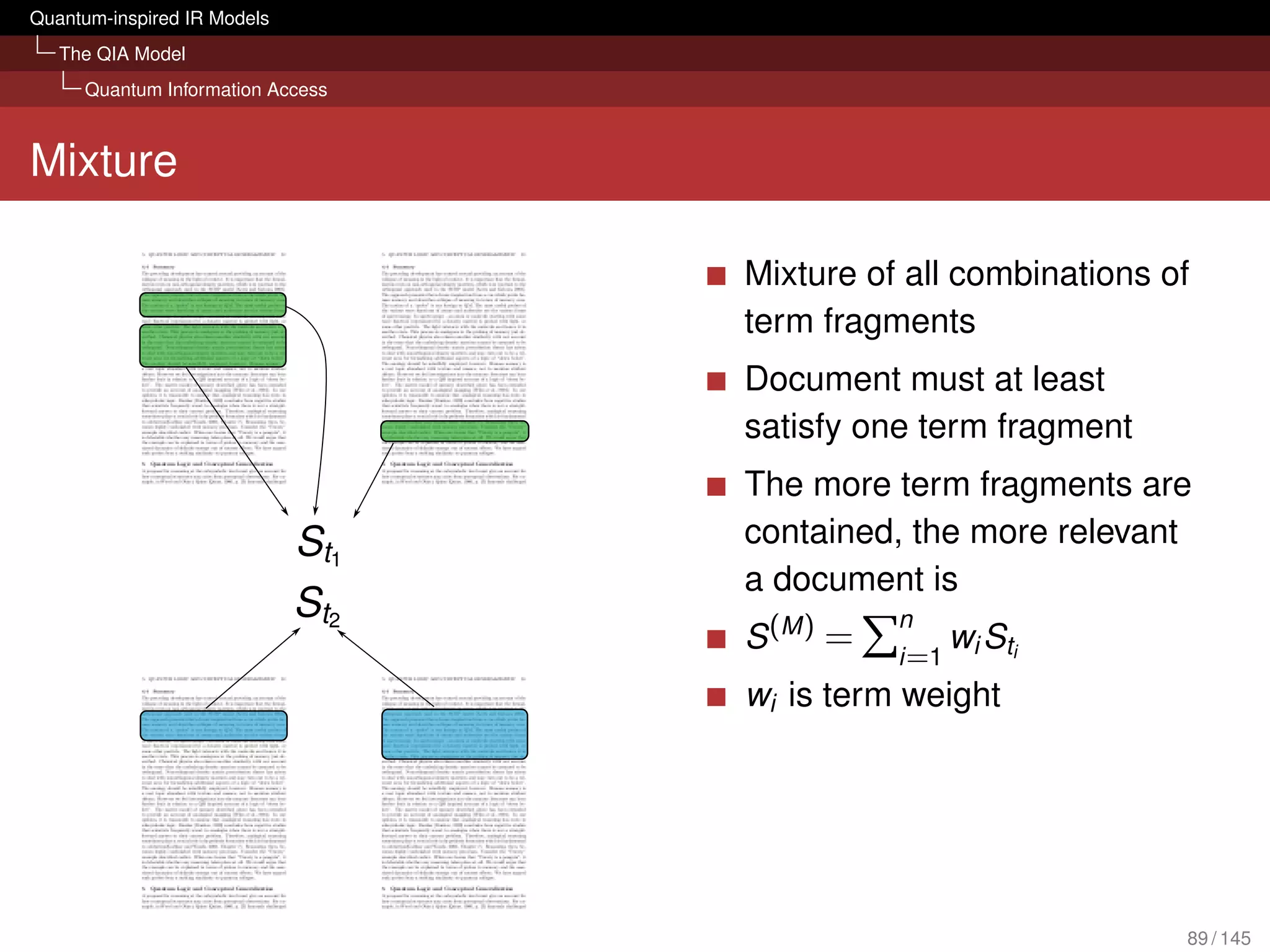
Mixture

                                  Mixture of all combinations of
                                  term fragments
                                  Document must at least
                                  satisfy one term fragment
                                  The more term fragments are
                                  contained, the more relevant
                                  a document is
                                             n
                                  S (M ) =       wS
                                             i =1 i ti
                                  wi is term weight


                                                               89 / 145
Quantum-inspired IR Models
   The QIA Model
     Quantum Information Access


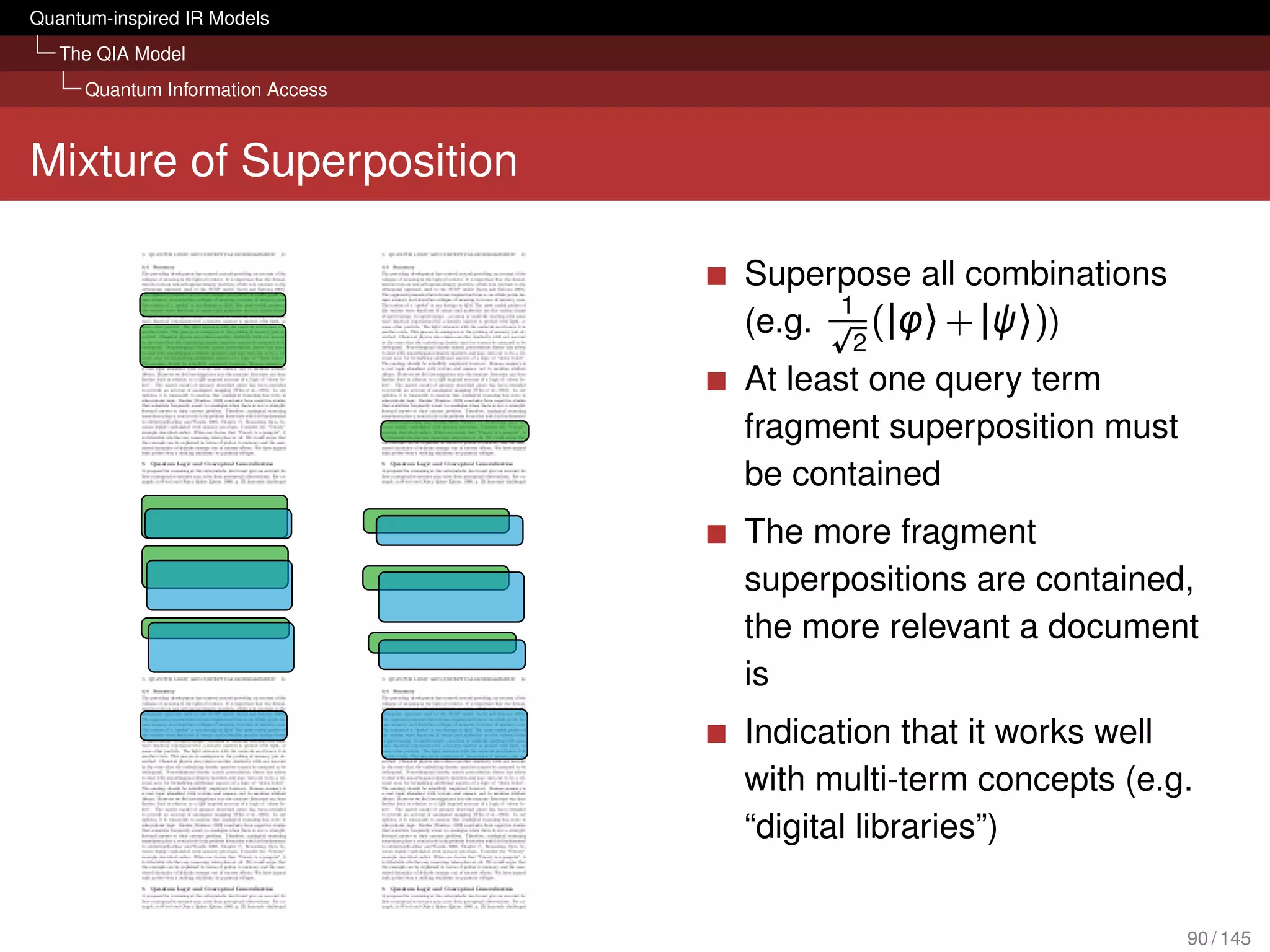
Mixture of Superposition

                                  Superpose all combinations
                                        1
                                  (e.g.
                                         2
                                          (|φ〉 + |ψ〉))
                                  At least one query term
                                  fragment superposition must
                                  be contained
                                  The more fragment
                                  superpositions are contained,
                                  the more relevant a document
                                  is
                                  Indication that it works well
                                  with multi-term concepts (e.g.
                                  “digital libraries”)


                                                                90 / 145
Quantum-inspired IR Models
   The QIA Model
     Quantum Information Access


Tensor product

                                  Assumption: each term
                                  covers an IN aspect
                                  Tensor product of all fragment
                                  vectors   combination of IN
                                  aspects
                                  Document must satisfy all IN
                                  aspects
                                  The more tensor products are
                                  satisfied, the more relevant is
                                  the document


                                                                 91 / 145
Quantum-inspired IR Models
   The QIA Model
     Quantum Information Access


What can it bring to IR?


               Evaluation with several TREC collections
               [Piwowarski et al., 2010]
               Tensor representation of query could compete with BM25
               We don’t lose retrieval effectiveness in an ad hoc scenario
               Framework is open for possible extension:
                        Different forms of interactions (query reformulations, relevance
                        judgements)      sessions
                        Diversity and novelty
                        Structured queries (Boolean; based on mixture, superposition and
                        tensor)
                        Polyrepresentation [Frommholz et al., 2010]


                                                                                           92 / 145
Quantum-inspired IR Models
   The QIA Model
     Polyprepresentation


Book Store Example


                             93 / 145
Quantum-inspired IR Models
   The QIA Model
     Polyprepresentation


Book Store Example


                             94 / 145
Quantum-inspired IR Models
   The QIA Model
     Polyprepresentation


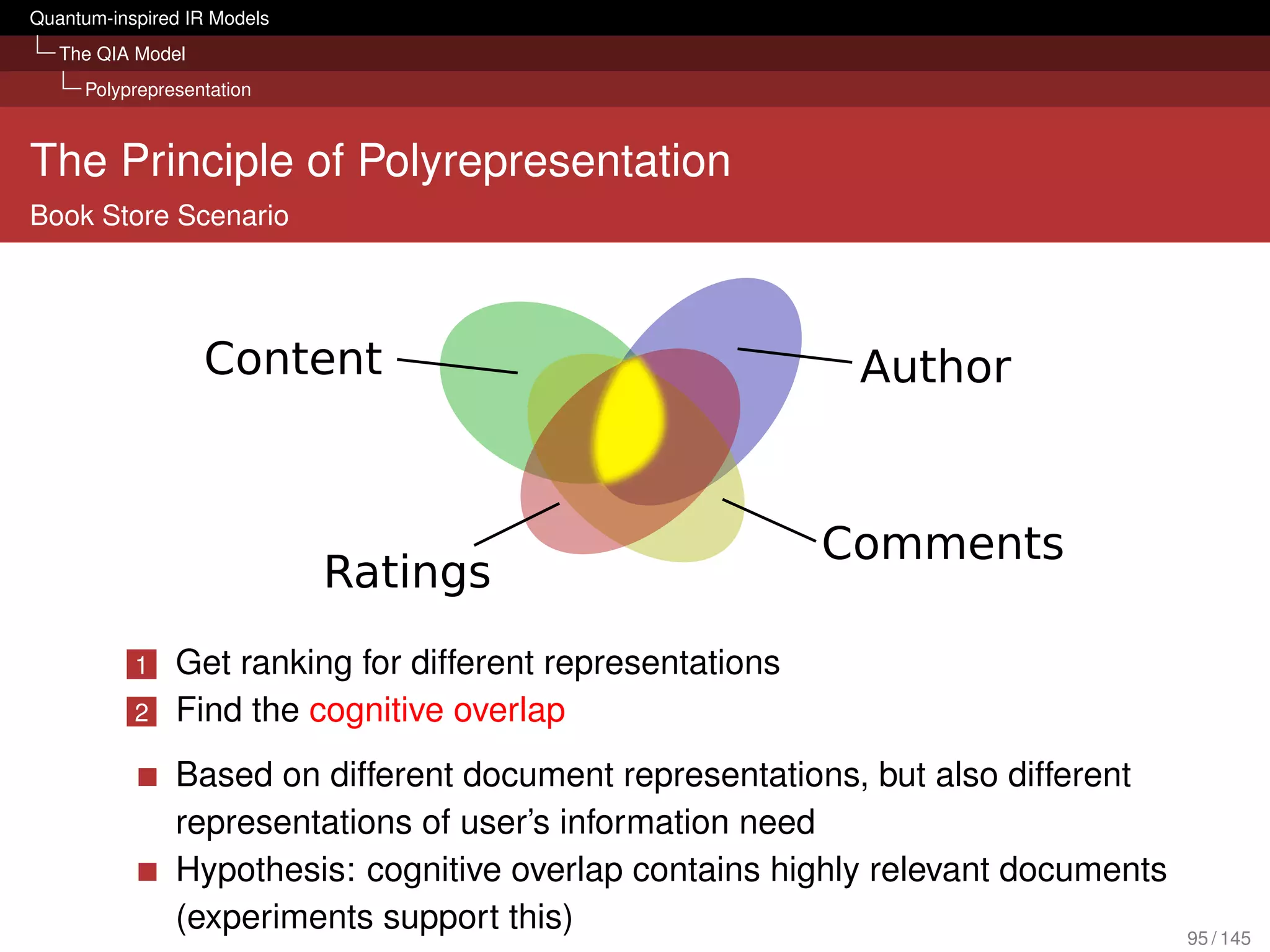
The Principle of Polyrepresentation
Book Store Scenario


                   Content                                  Author


                                                           Comments
                             Ratings
           1   Get ranking for different representations
           2   Find the cognitive overlap
               Based on different document representations, but also different
               representations of user’s information need
               Hypothesis: cognitive overlap contains highly relevant documents
               (experiments support this)                                         95 / 145
Quantum-inspired IR Models
   The QIA Model
     Polyprepresentation


How can we apply this in QIA?


               Model single representations in a vector space (by example)
                           Authors
                           Ratings
               Combine the representations


                                                                             96 / 145
Quantum-inspired IR Models
   The QIA Model
     Polyprepresentation


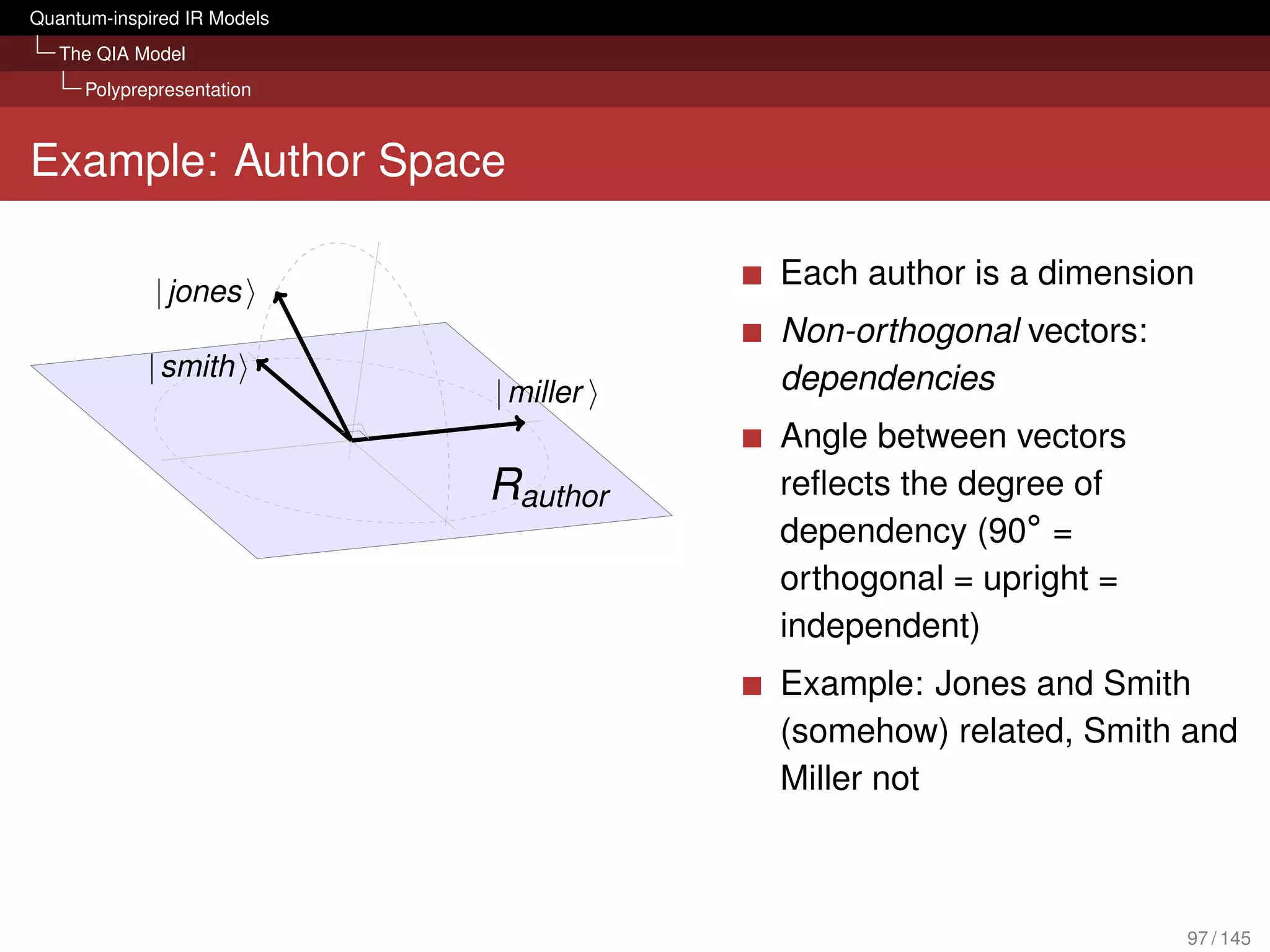
Example: Author Space

                             Each author is a dimension
                             Non-orthogonal vectors:
                             dependencies
                             Angle between vectors
                             reflects the degree of
                             dependency (90◦ =
                             orthogonal = upright =
                             independent)
                             Example: Jones and Smith
                             (somehow) related, Smith and
                             Miller not


                                                       97 / 145
Quantum-inspired IR Models
   The QIA Model
     Polyprepresentation


Example: Author Space

                             Document by Smith and Miller
                             User seeks for documents by
                             Jones
                             Document retrieved due to
                             relationship between Jones
                             and Smith


                                                      98 / 145
Quantum-inspired IR Models
   The QIA Model
     Polyprepresentation


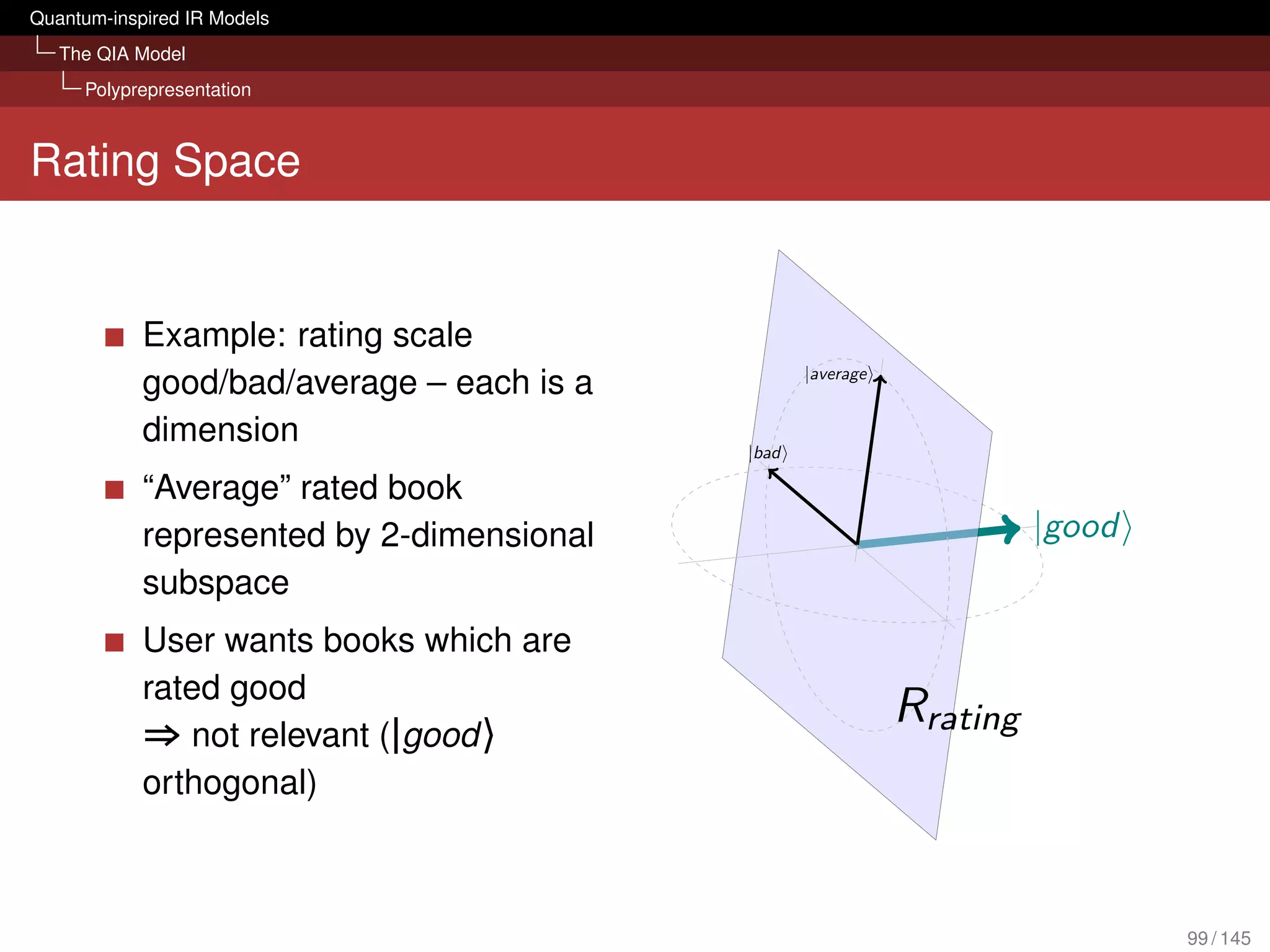
Rating Space


            Example: rating scale
            good/bad/average – each is a          |average


            dimension
                                           |bad

            “Average” rated book
            represented by 2-dimensional                               |good
            subspace
            User wants books which are
            rated good
            ⇒ not relevant (|good 〉
                                                             Rrating
            orthogonal)


                                                                               99 / 145
Quantum-inspired IR Models
   The QIA Model
     Polyprepresentation


Combining the Evidence
Total Cognitive Overlap and Tensors


               Modelled different representations in vector space
               Probabilities w.r.t. single representations
               How do we express user’s IN w.r.t. all representations?
               How do we get a cognitive overlap?


                                                                         100 / 145
Quantum-inspired IR Models
   The QIA Model
     Polyprepresentation


Combining the Evidence
Total Cognitive Overlap and Tensors


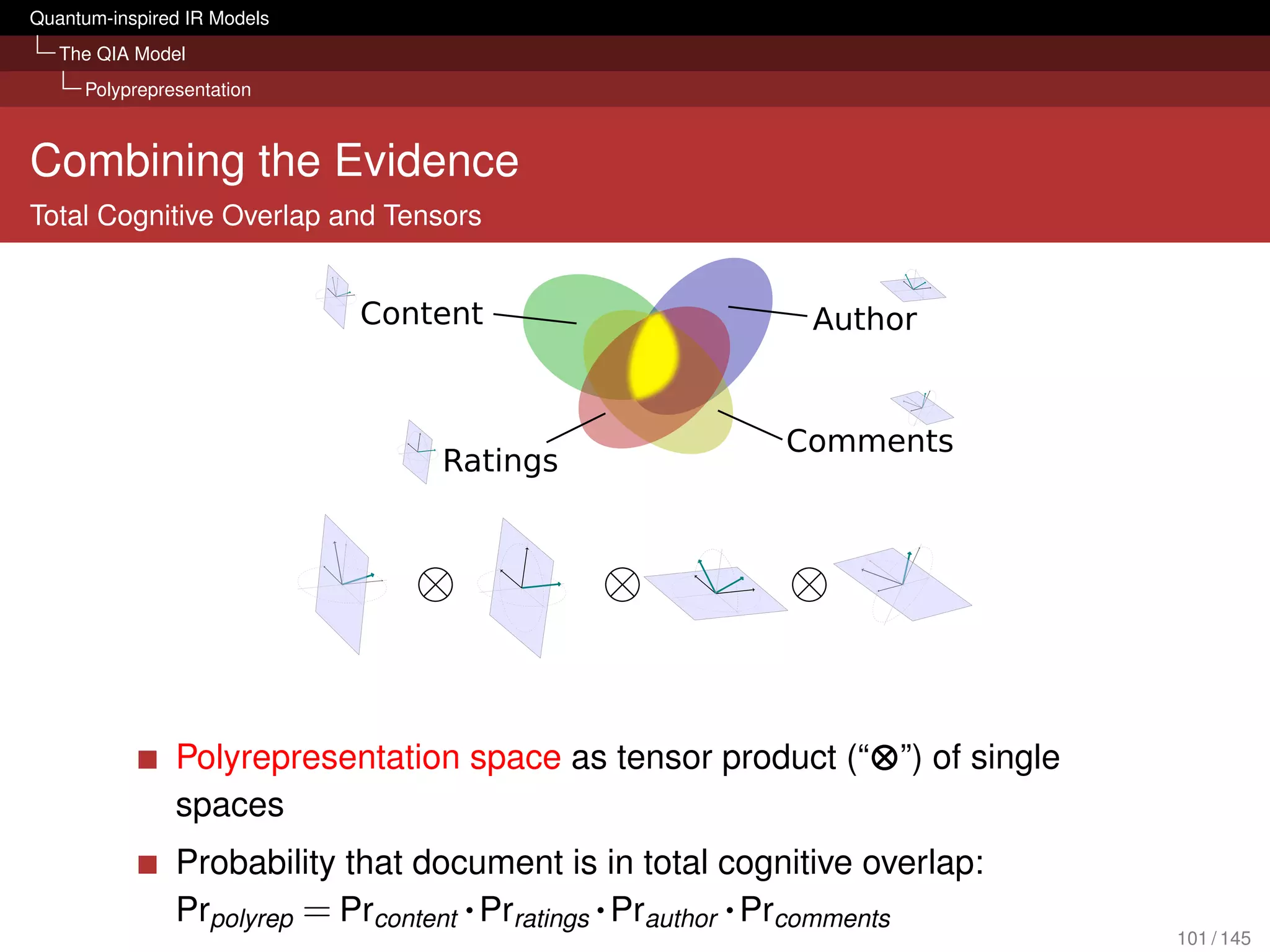
                             Content                       Author


                                                          Comments
                                 Ratings


               Polyrepresentation space as tensor product (“⊗”) of single
               spaces
               Probability that document is in total cognitive overlap:
               Prpolyrep = Prcontent · Prratings · Prauthor · Prcomments
                                                                            101 / 145
Quantum-inspired IR Models
   The QIA Model
     Polyprepresentation


Wishlist


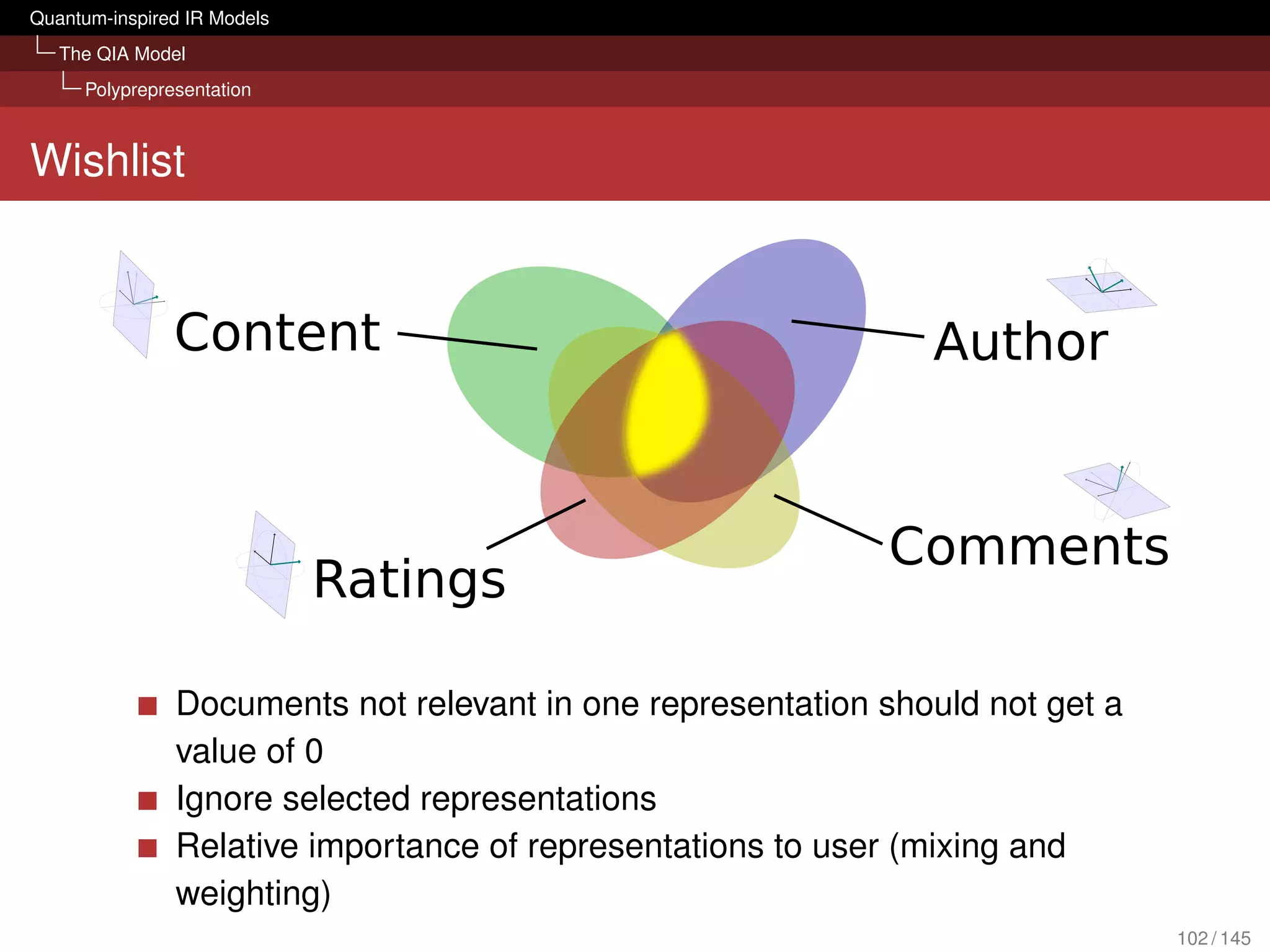
               Content                                         Author


                                                            Comments
                             Ratings

               Documents not relevant in one representation should not get a
               value of 0
               Ignore selected representations
               Relative importance of representations to user (mixing and
               weighting)
                                                                               102 / 145
Quantum-inspired IR Models
   The QIA Model
     Polyprepresentation


“Don’t care” dimension

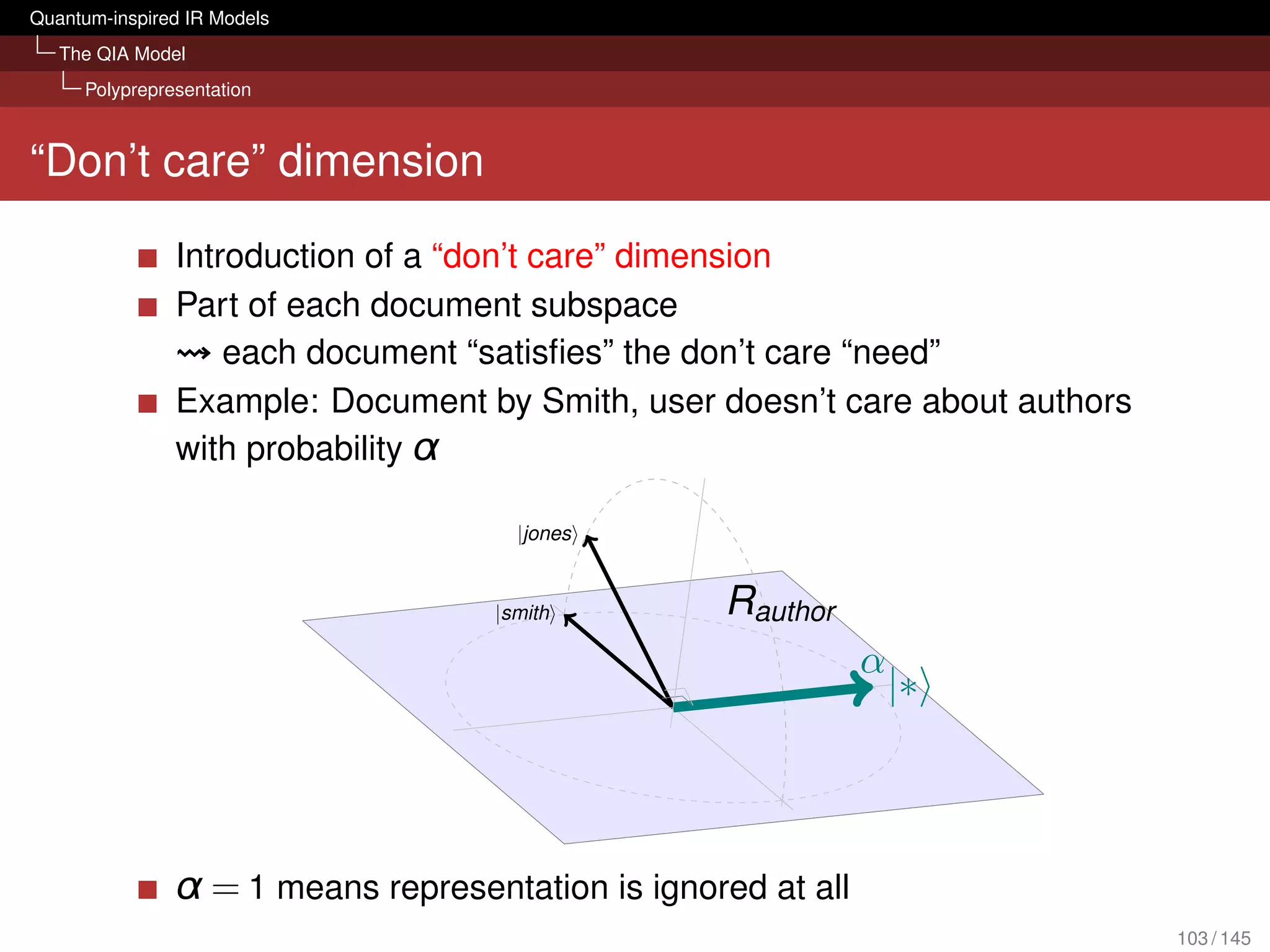
               Introduction of a “don’t care” dimension
               Part of each document subspace
                   each document “satisfies” the don’t care “need”
               Example: Document by Smith, user doesn’t care about authors
               with probability α

                                     |jones


                                   |smith         Rauthor
                                                              α
                                                                  |∗


               α = 1 means representation is ignored at all
                                                                             103 / 145
Quantum-inspired IR Models
   The QIA Model
     Polyprepresentation


Example

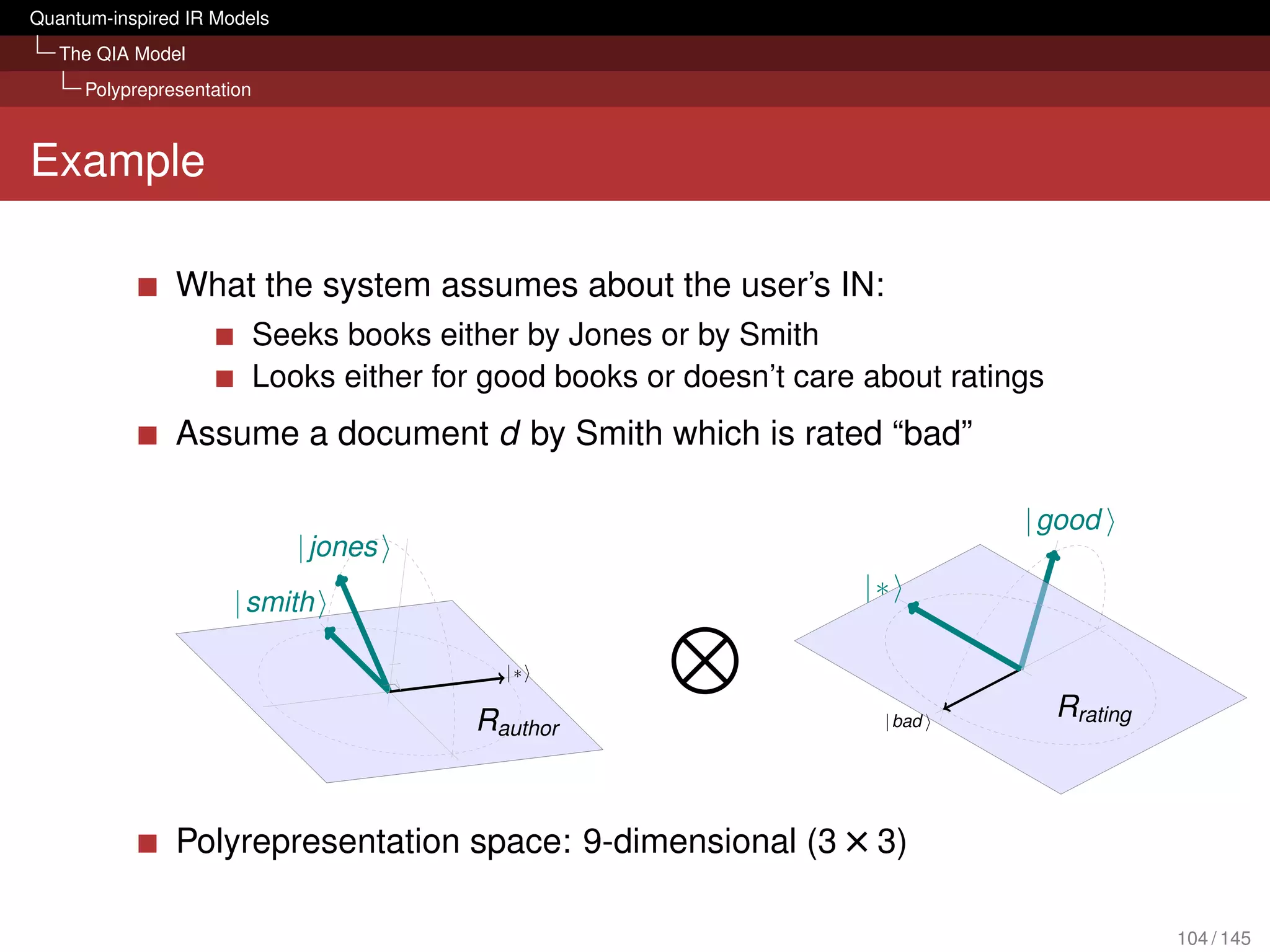
               What the system assumes about the user’s IN:
                           Seeks books either by Jones or by Smith
                           Looks either for good books or doesn’t care about ratings
               Assume a document d by Smith which is rated “bad”


               Polyrepresentation space: 9-dimensional (3 × 3)

                                                                                       104 / 145
Quantum-inspired IR Models
   The QIA Model
     Polyprepresentation


IN Vectors in Polyrepresentation Space
How do they look like and what do they mean?


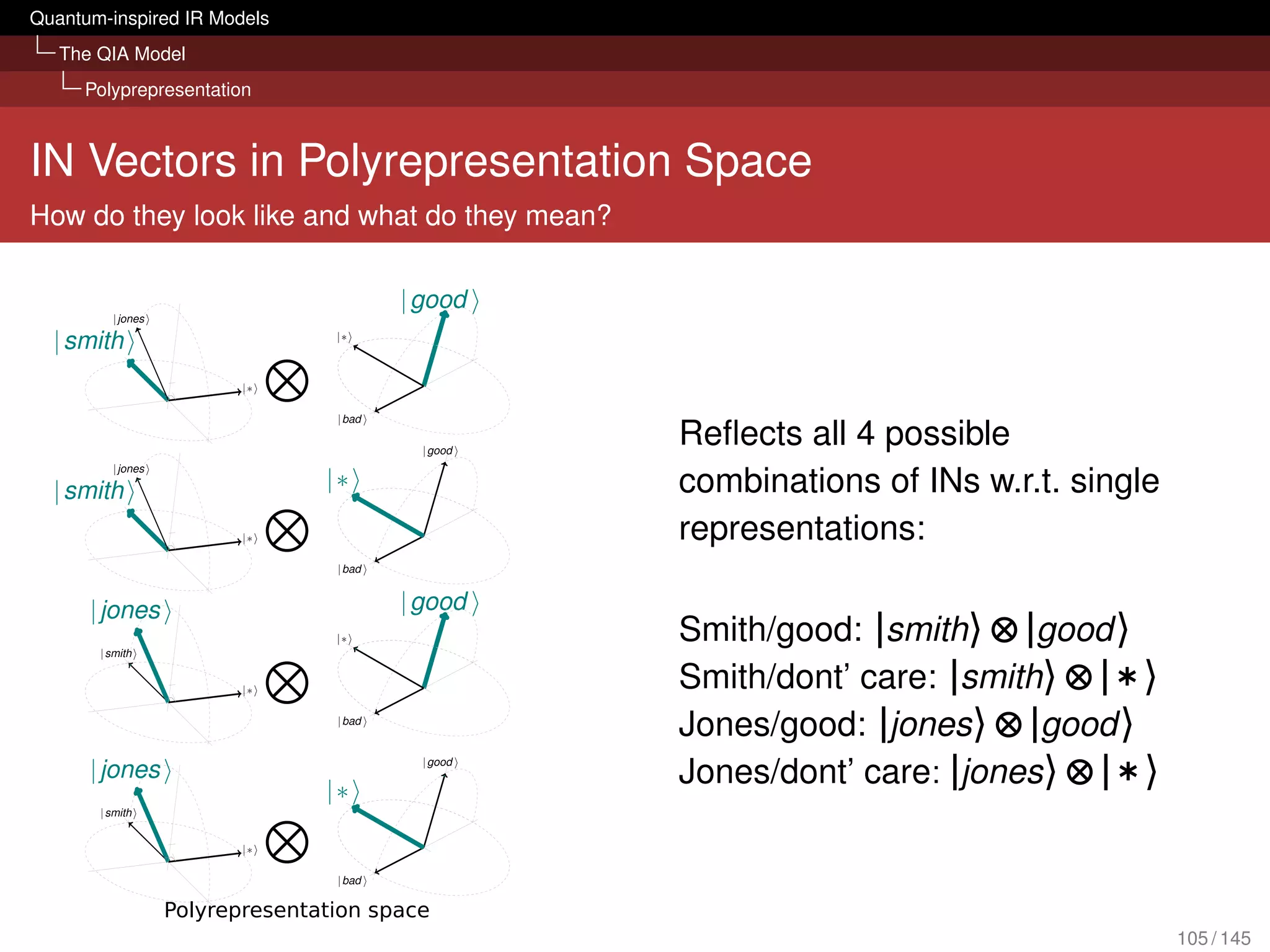
                                               Reflects all 4 possible
                                               combinations of INs w.r.t. single
                                               representations:

                                               Smith/good: |smith 〉 ⊗ |good 〉
                                               Smith/dont’ care: |smith 〉 ⊗ |∗〉
                                               Jones/good: |jones 〉 ⊗ |good 〉
                                               Jones/dont’ care: |jones 〉 ⊗ |∗〉


              Polyrepresentation space
                                                                                   105 / 145
Quantum-inspired IR Models
   The QIA Model
     Polyprepresentation


Documents in Polyrepresentation Space


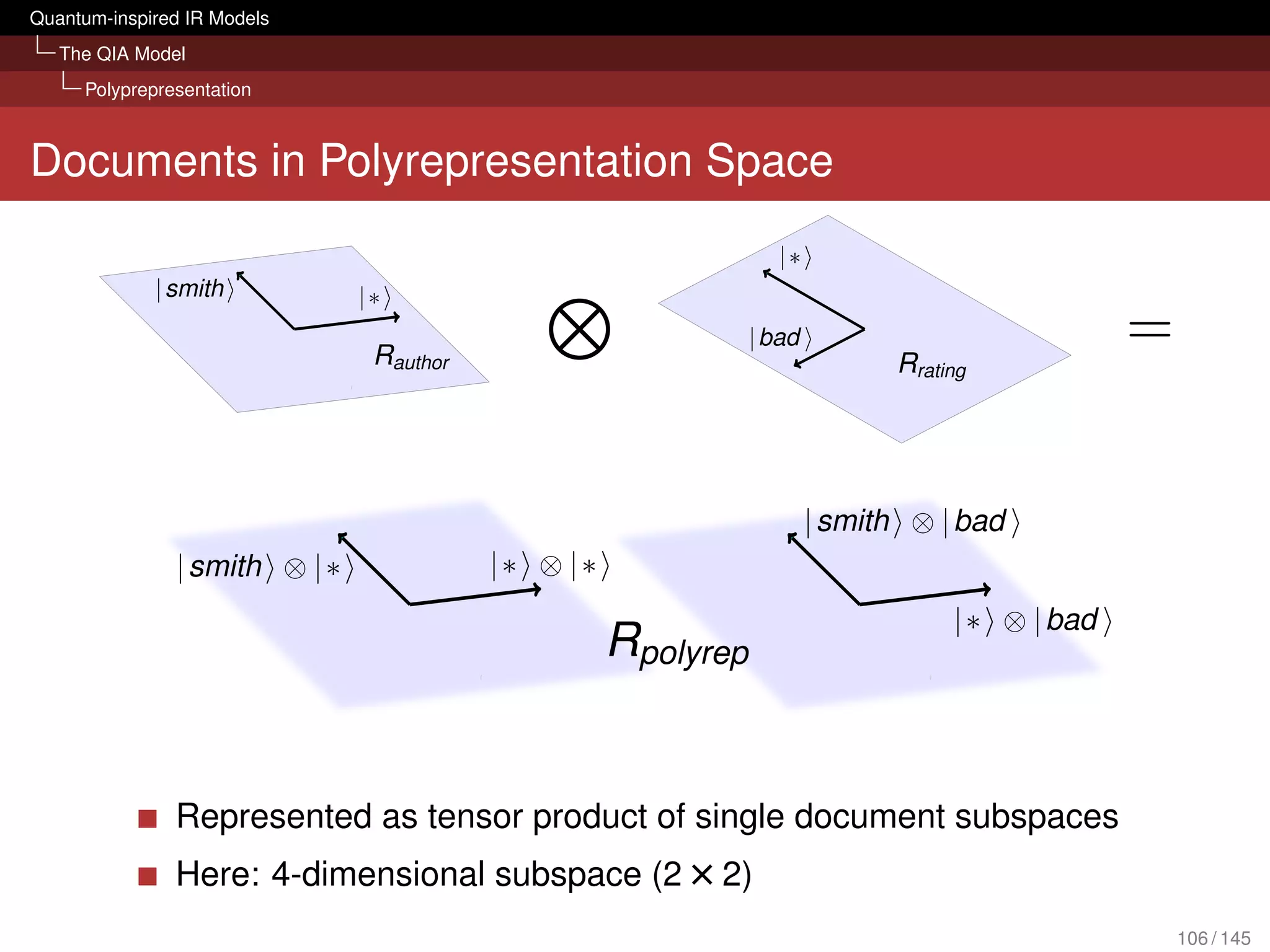
               Represented as tensor product of single document subspaces
               Here: 4-dimensional subspace (2 × 2)
                                                                            106 / 145
Quantum-inspired IR Models
   The QIA Model
     Polyprepresentation


Determining the Retrieval Weight


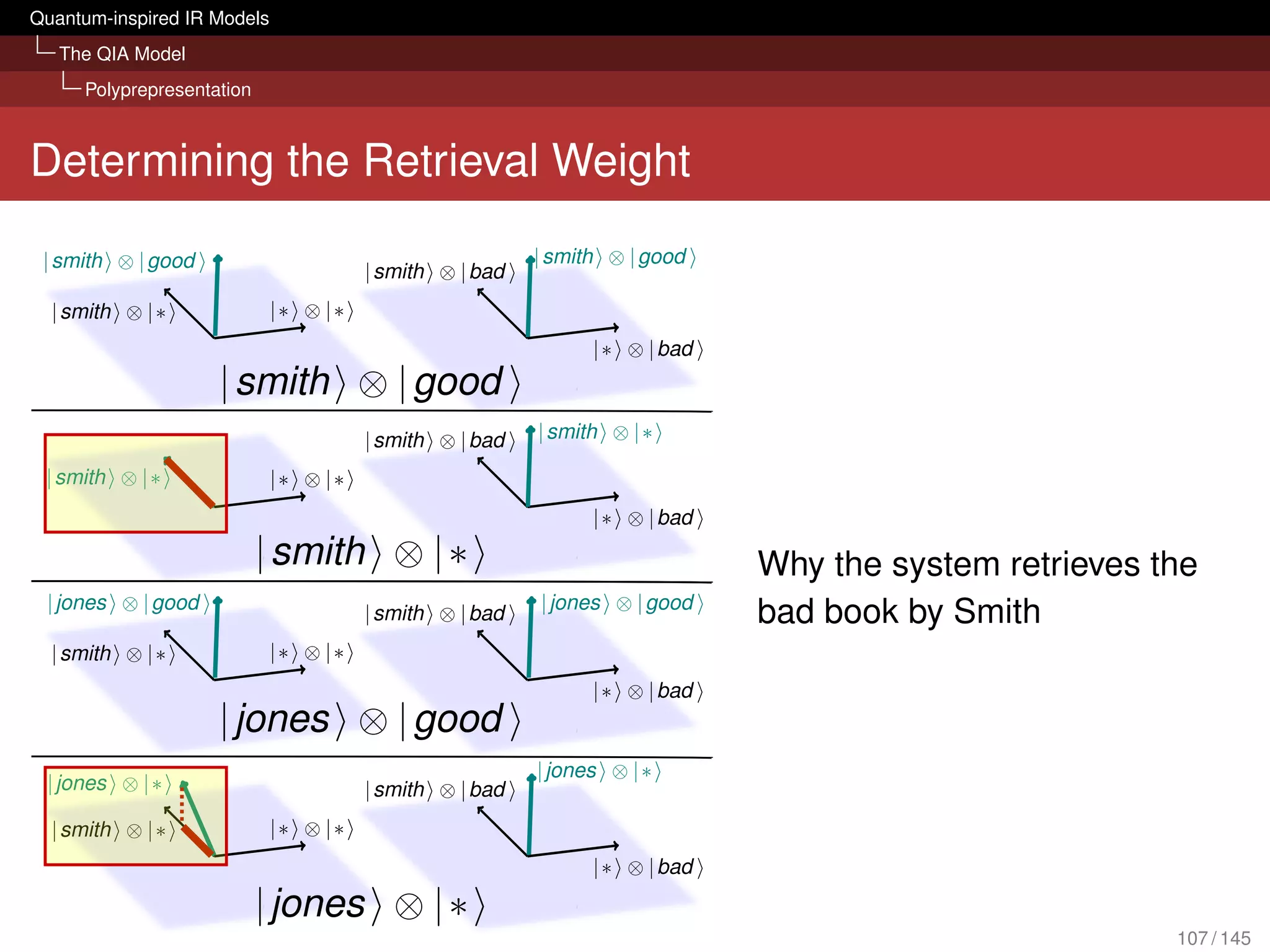
                                   Why the system retrieves the
                                   bad book by Smith


                                                             107 / 145
Quantum-inspired IR Models
   The QIA Model
     Polyprepresentation


Something left on the Wishlist
Relationships between Representations

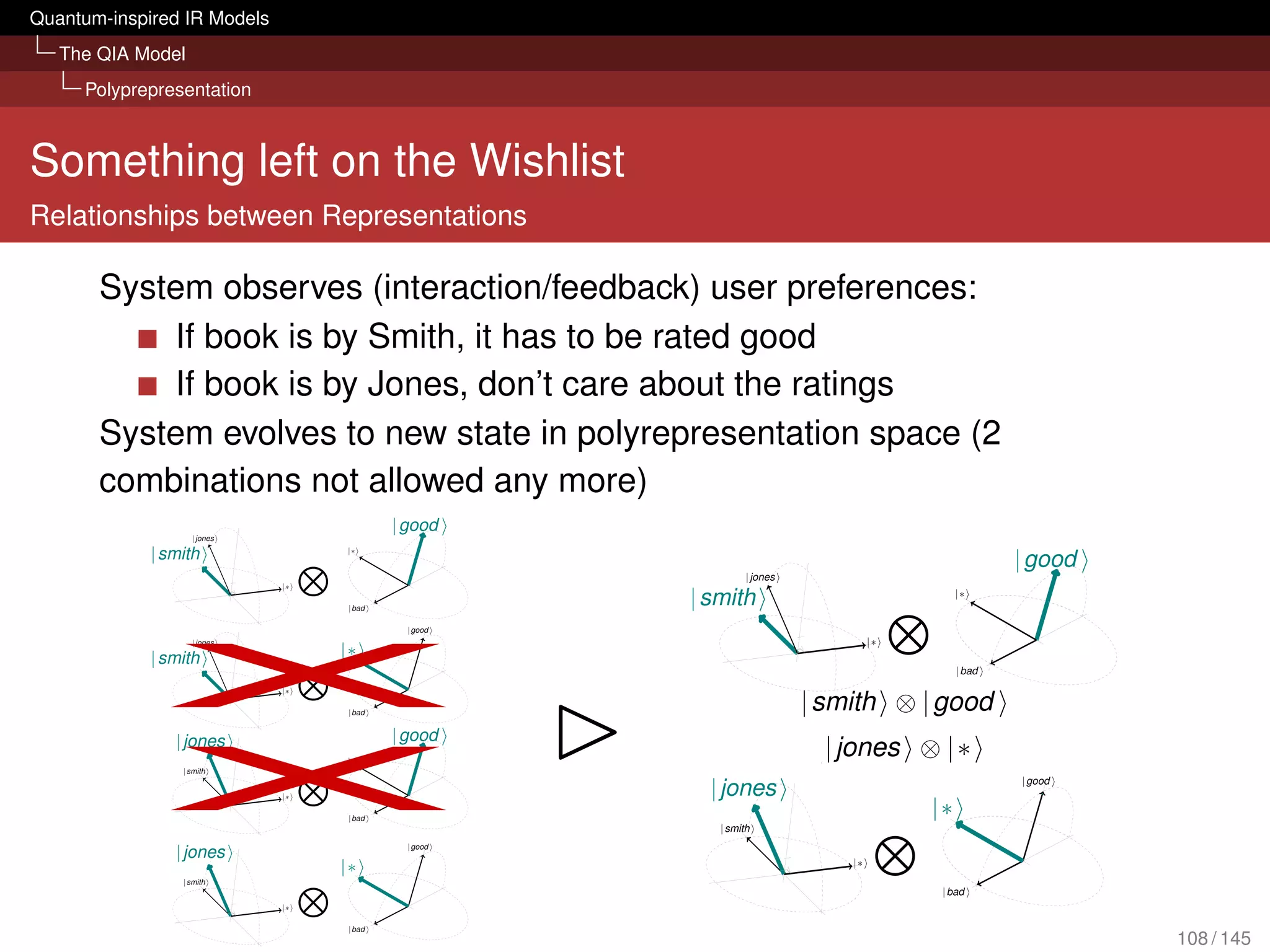
       System observes (interaction/feedback) user preferences:
           If book is by Smith, it has to be rated good
           If book is by Jones, don’t care about the ratings
       System evolves to new state in polyrepresentation space (2
       combinations not allowed any more)


             X
             X
                                                                    108 / 145
Quantum-inspired IR Models
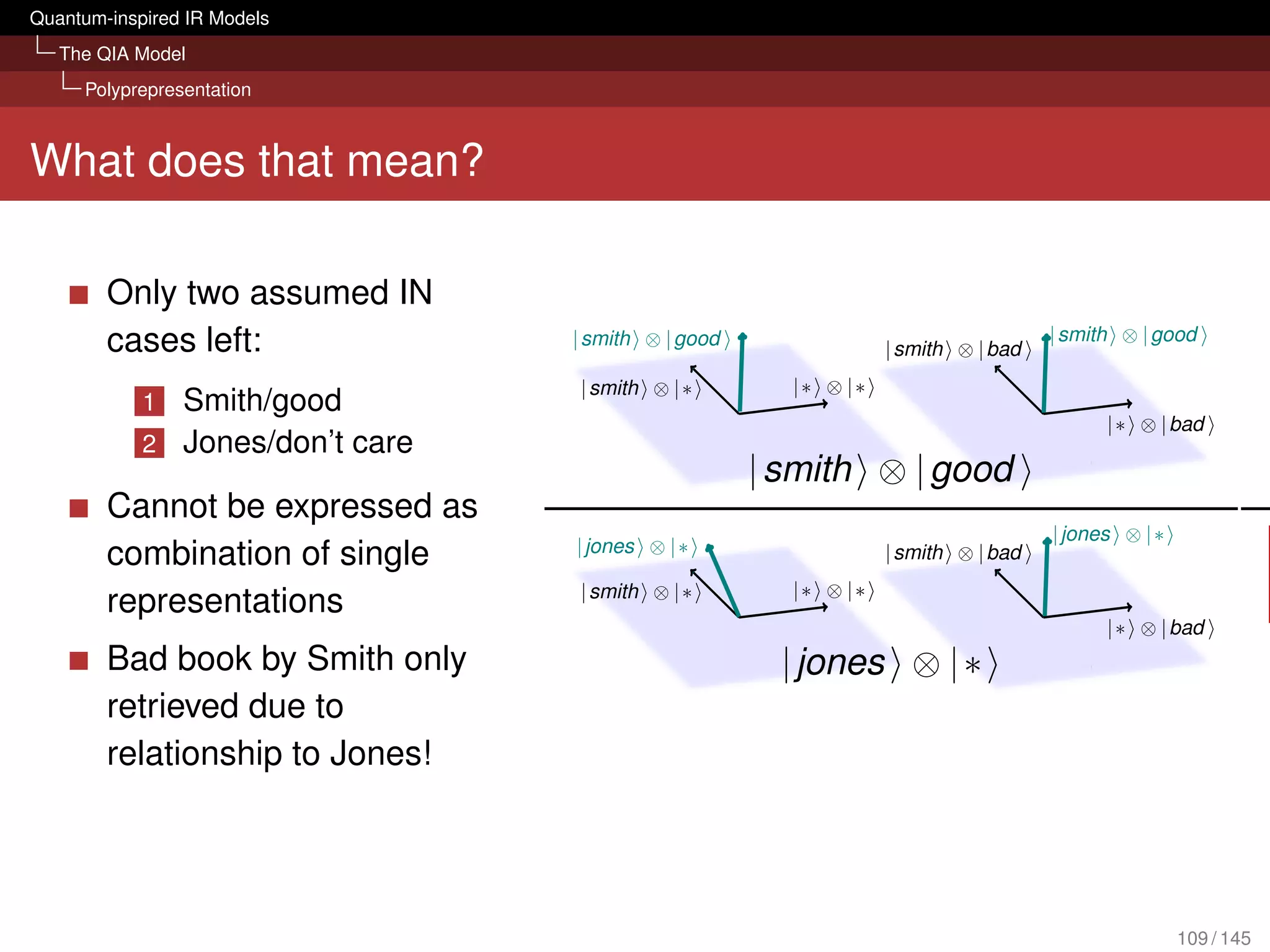
   The QIA Model
     Polyprepresentation


What does that mean?

        Only two assumed IN
        cases left:
            1   Smith/good
            2   Jones/don’t care

        Cannot be expressed as
        combination of single
        representations
        Bad book by Smith only
        retrieved due to
        relationship to Jones!


                                   109 / 145
Quantum-inspired IR Models
   The QIA Model
     Polyprepresentation


QIA Summary


       We showed how we can express polyrepresentation in a mathematical
       framework inspired by quantum mechanics:
               Presented IN space
               Modelled different example representations
               Combined representations in polyrepresentation space


                                                                           110 / 145
Quantum-inspired IR Models
   The QIA Model
     Polyprepresentation


QIA Conclusion


               QIA framework
                           User’s IN as ensemble of vectors
                           Documents as subspaces
                           User interaction and feedback
                           Term space, query construction
                           Can compete in an ad hoc scenario
               Polyrepresentation
                           Different non-topical representations as subspaces
                           Polyrepresentation space as tensor space to calculate cognitive
                           overlap
                           “Don’t care” dimension for weighting of representations
                           Non-separate states reflect interdependencies


                                                                                             111 / 145
Quantum-inspired IR Models
   The QIA Model
     Polyprepresentation


QIA Extensions


               Queries in sessions [Frommholz et al., 2011]
                           Use geometry and projections to determine type of and handle
                           follow-up query (generalisation, information need drift,
                           specialisation)
               Summarisation [Piwowarski et al., 2012]
                           QIA interpretation of LSA-based methods
               Query algebra for the QIA framework [Caputo et al., 2011]


                                                                                          112 / 145
The Quantum Probability Ranking Principle (qPRP) [Zuccon, 2012]
Quantum-inspired IR Models
   Quantum Probability Ranking Principle


Quantum Interference (again)


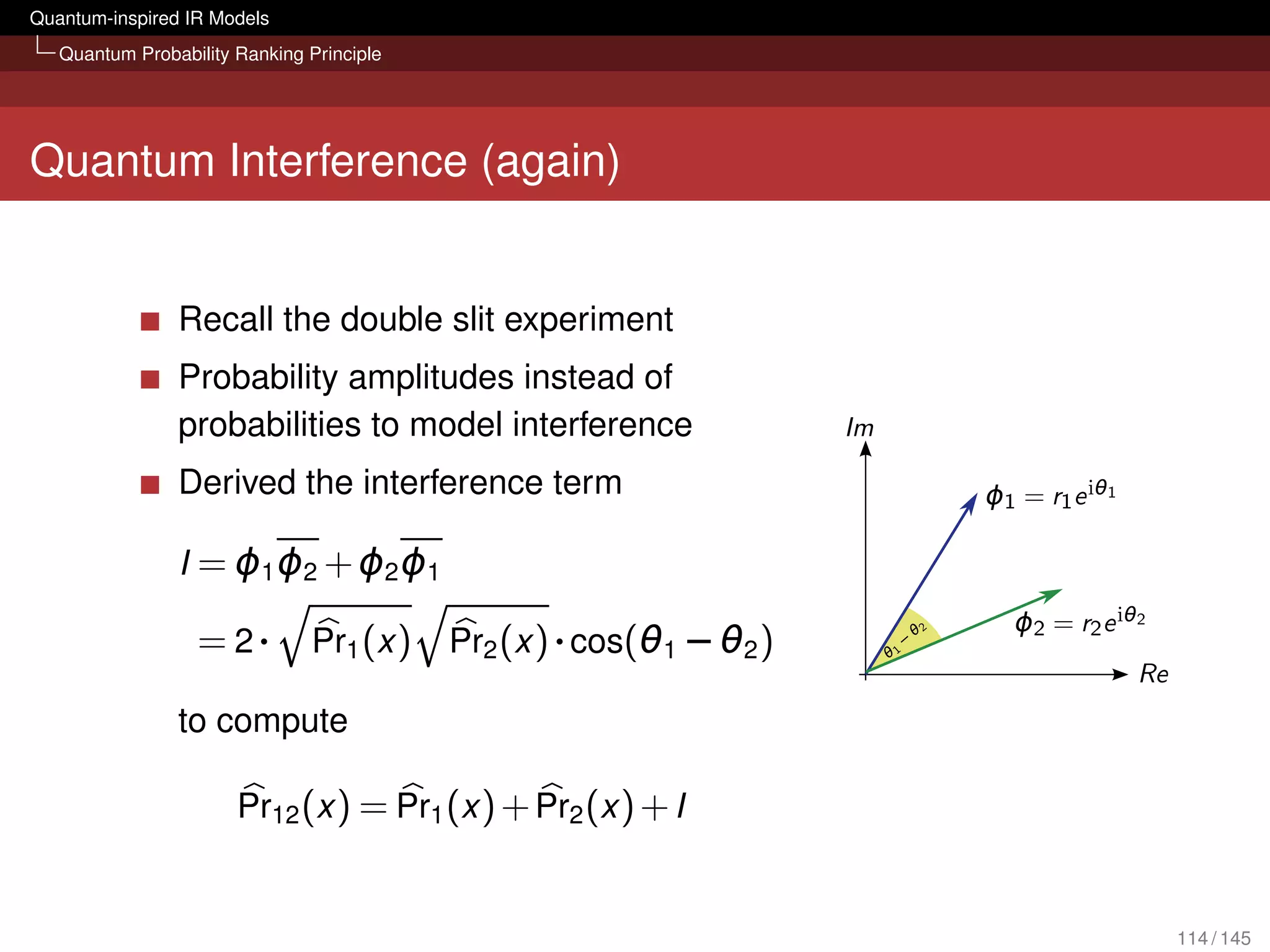
                Recall the double slit experiment
                Probability amplitudes instead of
                probabilities to model interference
                Derived the interference term

                I = ϕ1 ϕ2 + ϕ2 ϕ1

                  = 2·         Pr1 (x )    Pr2 (x ) · cos(θ1 − θ2 )

                to compute

                       Pr12 (x ) = Pr1 (x ) + Pr2 (x ) + I


                                                                      114 / 145
Quantum-inspired IR Models
   Quantum Probability Ranking Principle


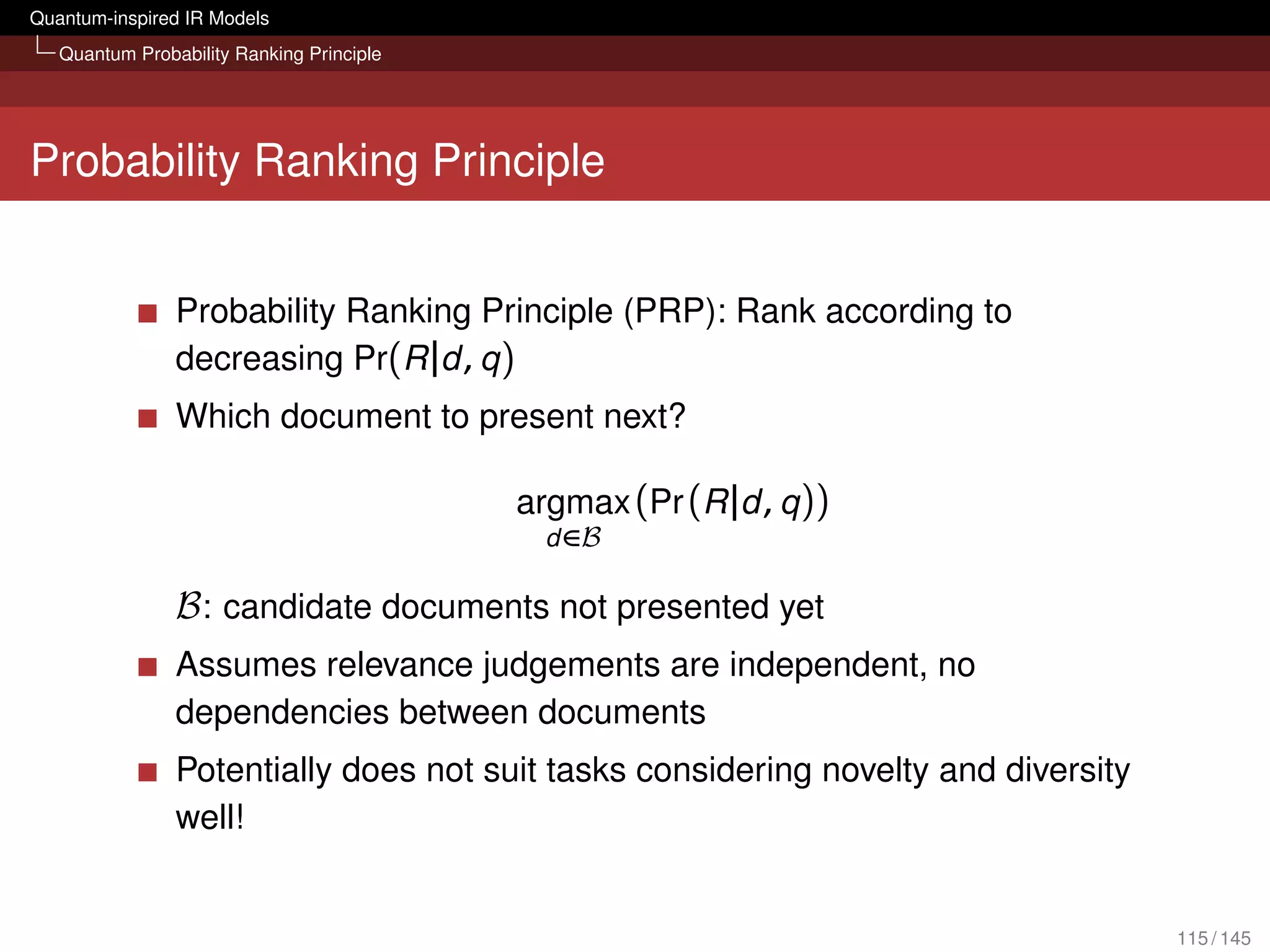
Probability Ranking Principle


                Probability Ranking Principle (PRP): Rank according to
                decreasing Pr(R |d , q )
                Which document to present next?

                                           argmax (Pr (R |d , q ))
                                             d ∈B

                B : candidate documents not presented yet
                Assumes relevance judgements are independent, no
                dependencies between documents
                Potentially does not suit tasks considering novelty and diversity
                well!


                                                                                    115 / 145
Quantum-inspired IR Models
   Quantum Probability Ranking Principle


Quantum Probability Ranking Principle
Double Slit Analogy
                                                                                           4.4 Ranking Documents within the Analogy


            IR analogy to double slit experiment
                     User is “particle”                                                      dA                   dA
                     Each slit corresponds to a
                                                                                                                               pd A d B
                     document
                     Event that particle passes through                                      d B?                dB
                     slit: user analyses document
                     Screen measures user satisfaction                    B

                     (proportional to Pr(R |d , q ))                      d B1       ...     d Bi      ...    d Bn   1


            Which document to present next
            (after user saw dA )?                               Figure 4.6: The IR analogous of the situation pictured in Figure 4.5.
                                                                                                    (taken from [Zuccon, 2012])
                                                          pdA dB : there is no reason for which to expect that pdA dBi = pdA dBj , 8dBi , dBj 2 B.

                   argmax Pr (R |dB , q ) + IdA dB
                                                          A question now arises: which document (slit) dB 2 B should be selected such
                                                          that, once coupled with document (slit) dA , the probability pdA dB is maximised?
                     dB ∈B                                Answering this question corresponds to define a criteria for selecting documents
                                                          such that, once coupled with the already ranked document, the likelihood of de-
                                                          livering maximum satisfaction to the user is maximised. In terms of the physical
                                                          experiment, this would correspond to selecting slits among the set116 / 145
                                                                                                                             of available
Quantum-inspired IR Models
   Quantum Probability Ranking Principle


Quantum Probability Ranking Principle
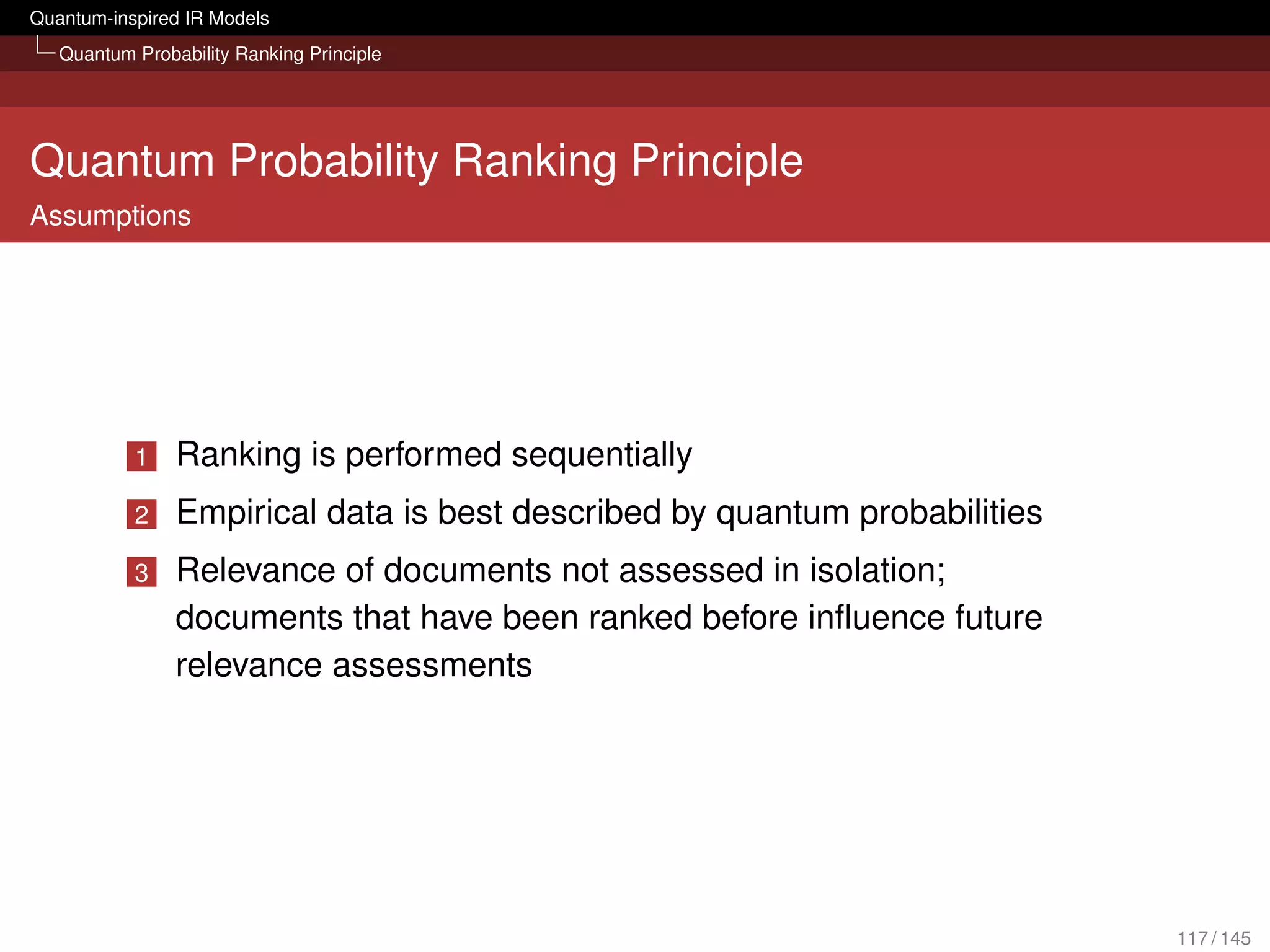
Assumptions


           1    Ranking is performed sequentially
           2    Empirical data is best described by quantum probabilities
           3    Relevance of documents not assessed in isolation;
                documents that have been ranked before influence future
                relevance assessments


                                                                            117 / 145
Quantum-inspired IR Models
   Quantum Probability Ranking Principle


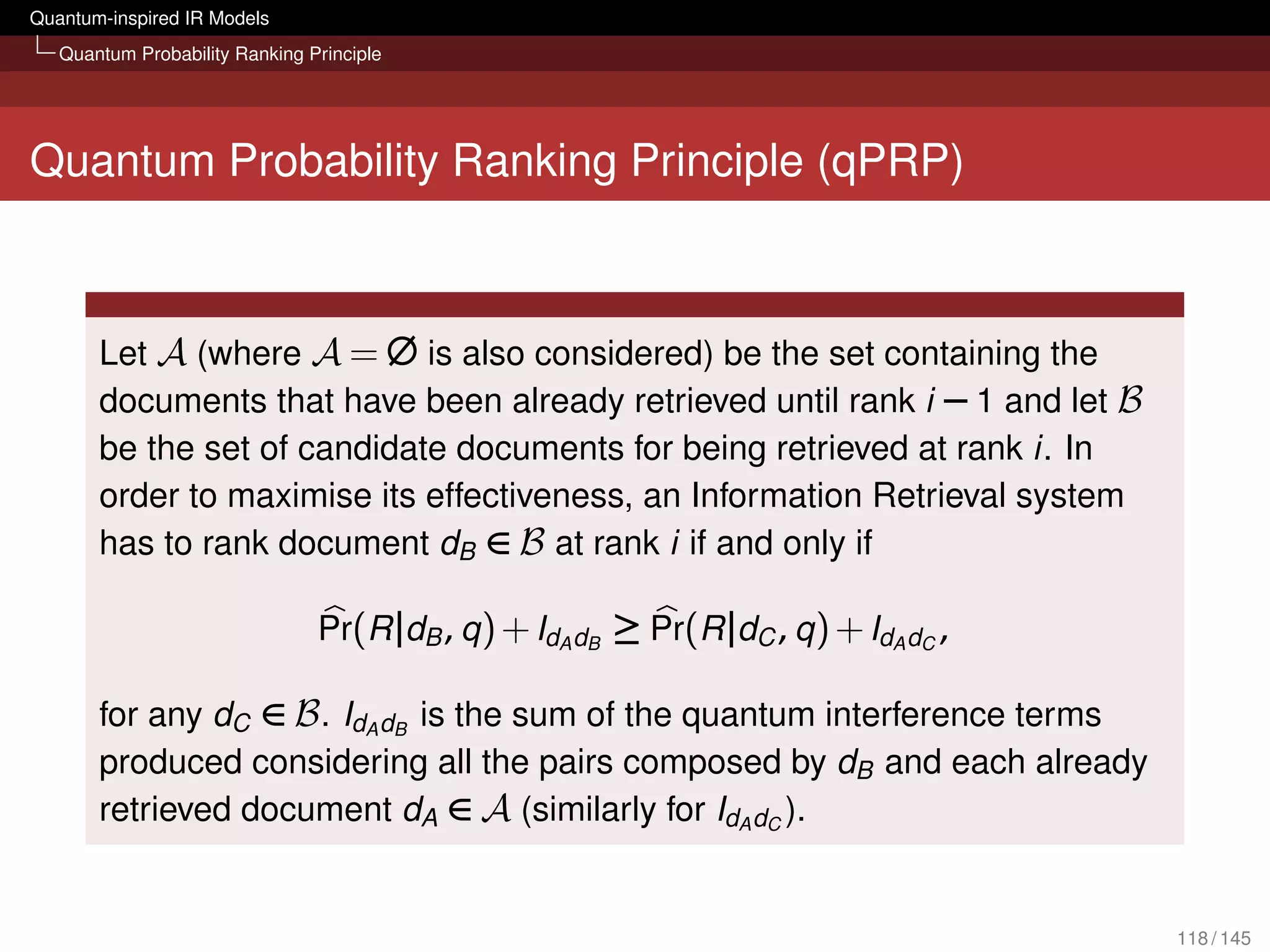
Quantum Probability Ranking Principle (qPRP)


       Let A (where A = ∅ is also considered) be the set containing the
       documents that have been already retrieved until rank i − 1 and let B
       be the set of candidate documents for being retrieved at rank i. In
       order to maximise its effectiveness, an Information Retrieval system
       has to rank document dB ∈ B at rank i if and only if

                                Pr(R |dB , q ) + IdA dB ≥ Pr(R |dC , q ) + IdA dC ,

       for any dC ∈ B . IdA dB is the sum of the quantum interference terms
       produced considering all the pairs composed by dB and each already
       retrieved document dA ∈ A (similarly for IdA dC ).


                                                                                      118 / 145
Quantum-inspired IR Models
   Quantum Probability Ranking Principle


Quantum Probability Ranking Principle


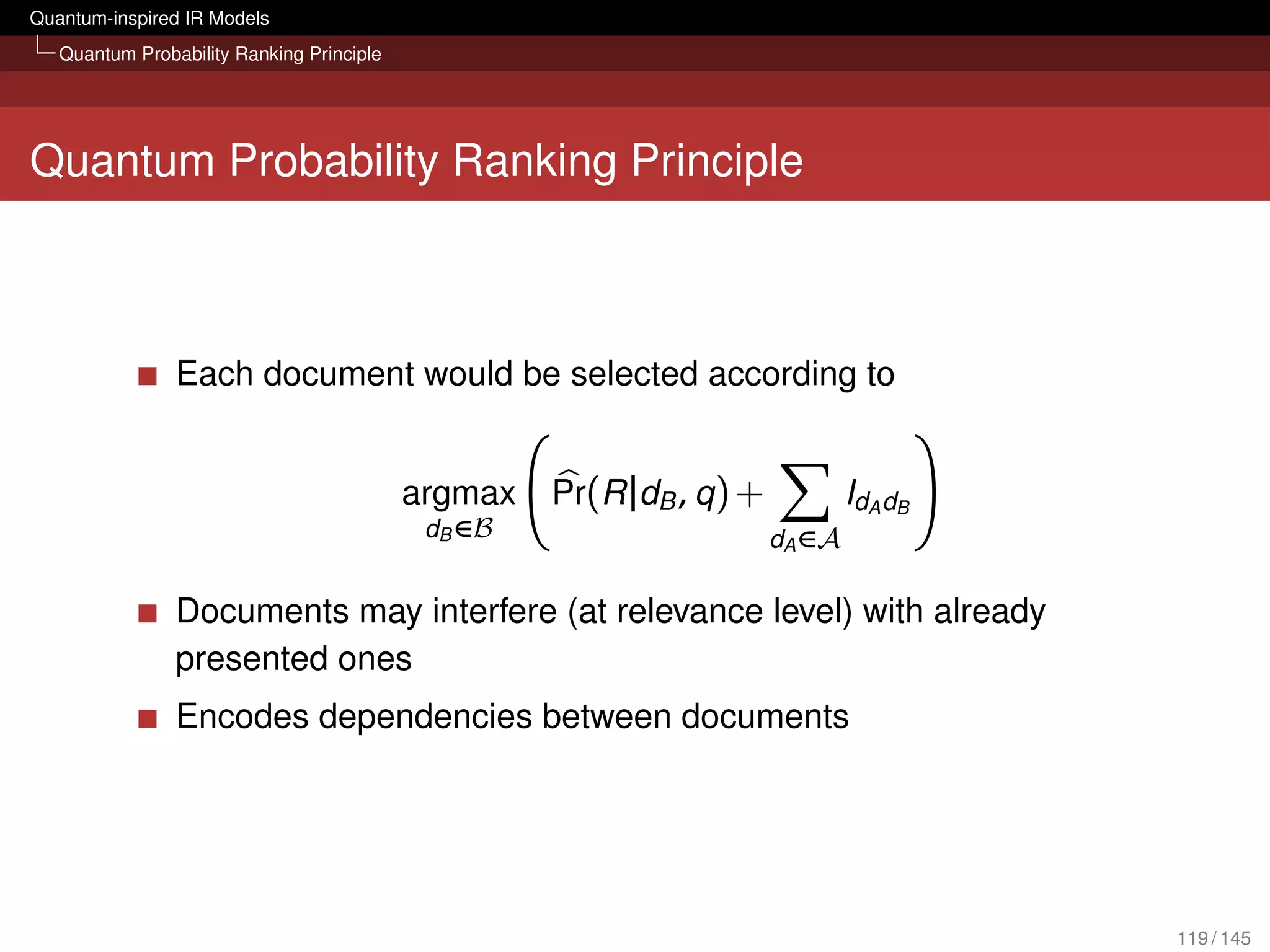
                Each document would be selected according to


                                           argmax   Pr(R |dB , q ) +           IdA dB
                                            dB ∈B                      dA ∈A

                Documents may interfere (at relevance level) with already
                presented ones
                Encodes dependencies between documents


                                                                                        119 / 145
Quantum-inspired IR Models
   Quantum Probability Ranking Principle


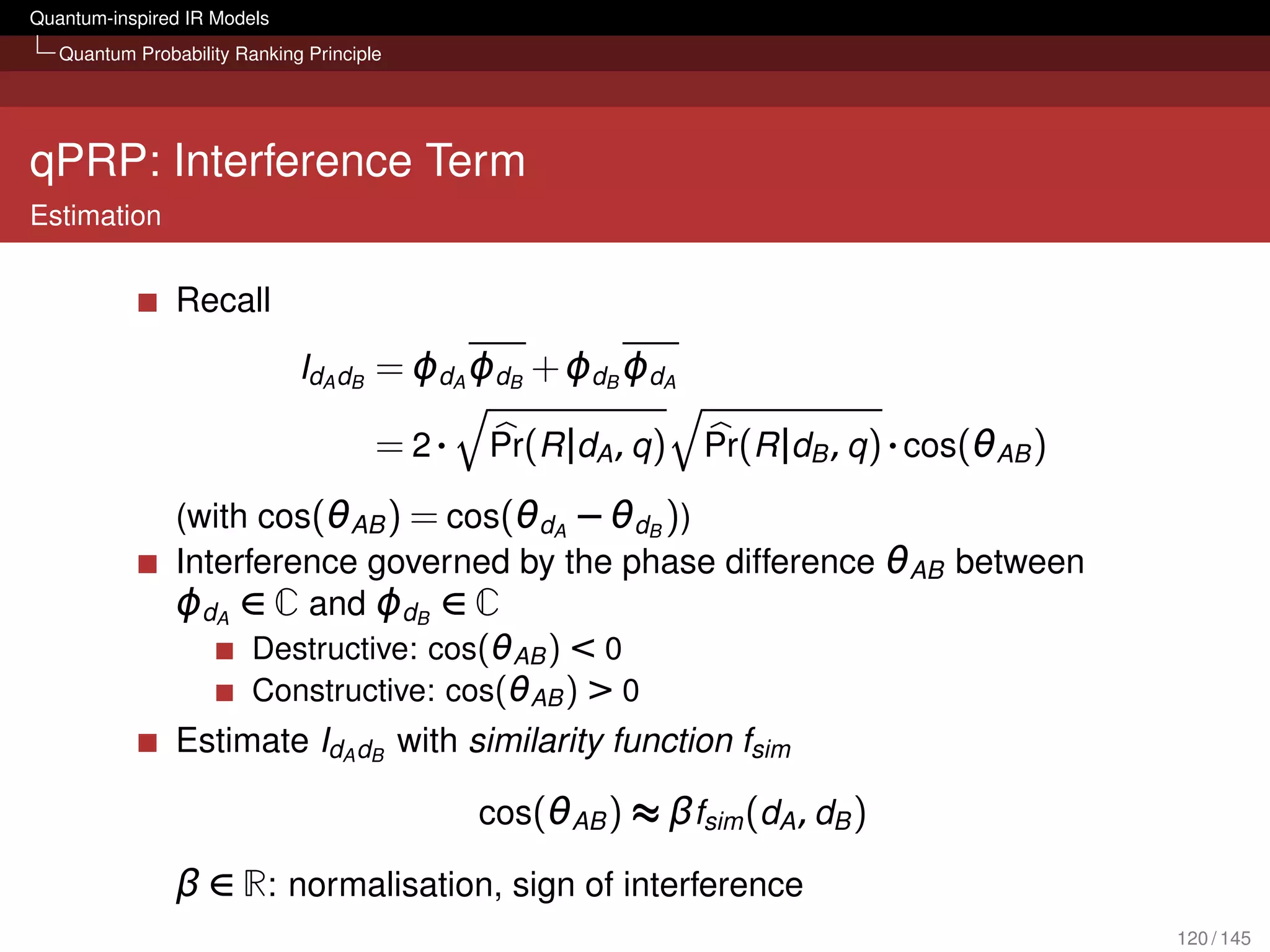
qPRP: Interference Term
Estimation


                Recall
                              IdA dB = ϕdA ϕdB + ϕdB ϕdA

                                       = 2·   Pr(R |dA , q )   Pr(R |dB , q ) · cos(θAB )

                (with cos(θAB ) = cos(θdA − θdB ))
                Interference governed by the phase difference θAB between
                ϕdA ∈ C and ϕdB ∈ C
                      Destructive: cos(θAB ) < 0
                      Constructive: cos(θAB ) > 0
                Estimate IdA dB with similarity function fsim

                                              cos(θAB ) ≈ βfsim (dA , dB )

                β ∈ R: normalisation, sign of interference
                                                                                            120 / 145
Quantum-inspired IR Models
   Quantum Probability Ranking Principle


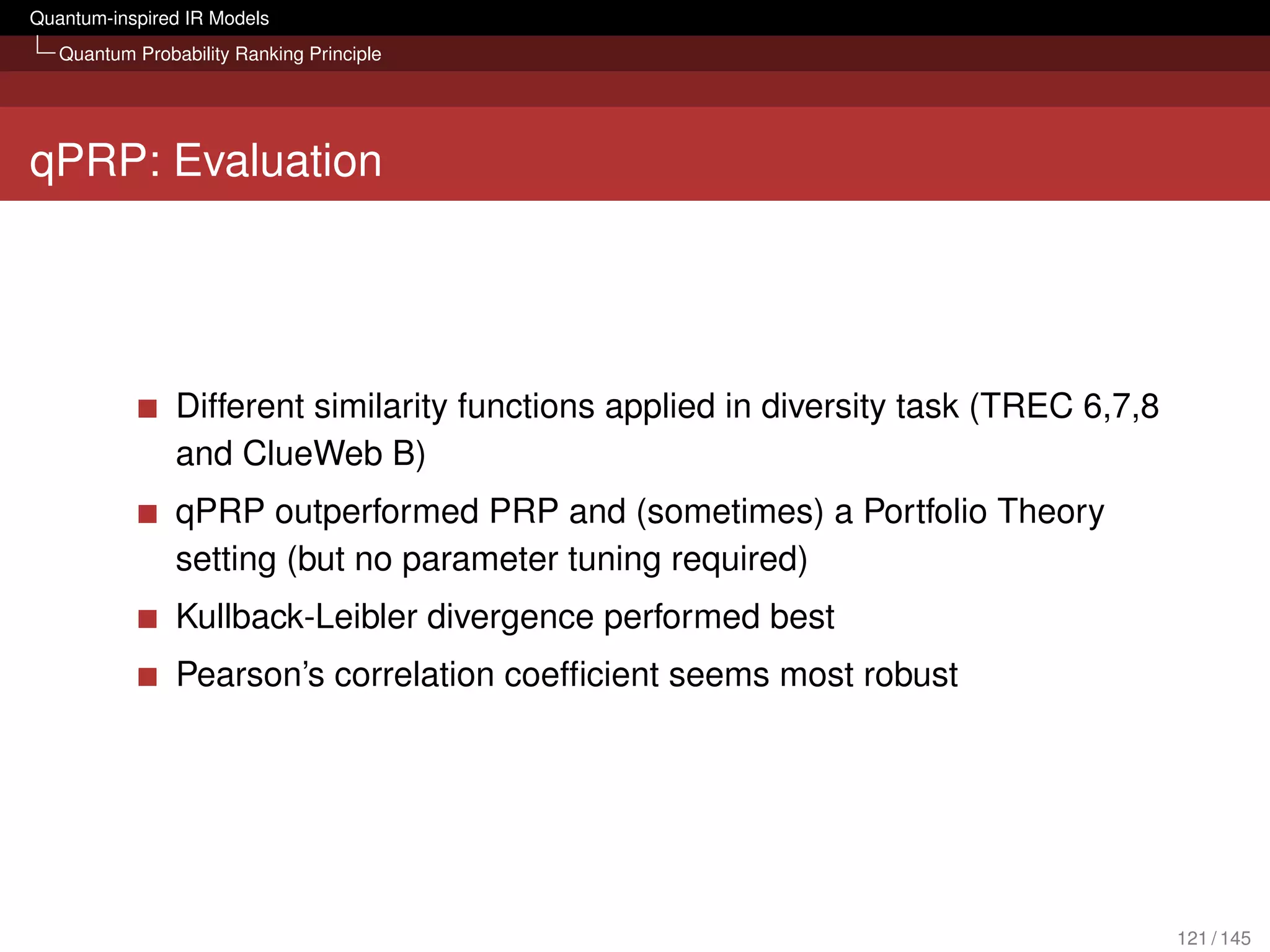
qPRP: Evaluation


                Different similarity functions applied in diversity task (TREC 6,7,8
                and ClueWeb B)
                qPRP outperformed PRP and (sometimes) a Portfolio Theory
                setting (but no parameter tuning required)
                Kullback-Leibler divergence performed best
                Pearson’s correlation coefficient seems most robust


                                                                                       121 / 145
Quantum-inspired IR Models
   Quantum Probability Ranking Principle


qPRP: Evaluation
Further Experiments


                Comparison with PRP, Maximal Marginal relevance (MMR),
                Portfolio Theory (PT) and interactive PRP (iPRP)
                Ad hoc task
                         PRP best performing ranking approach when independence
                         assumption hold
                Diversity task
                         PRP often outperformed by PT, iPRP and qPRP


                                                                                  122 / 145
Quantum-inspired IR Models
   Quantum Probability Ranking Principle


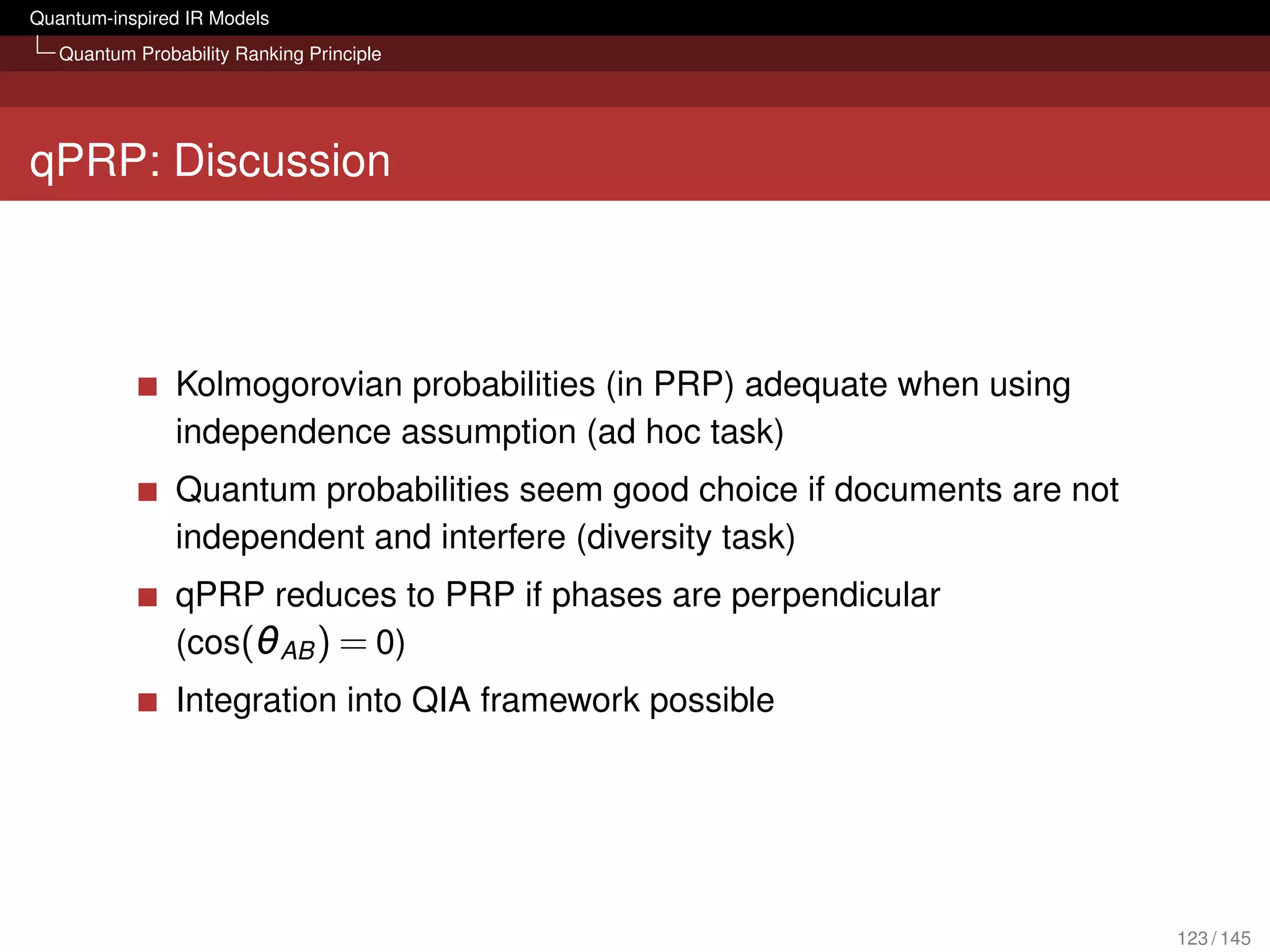
qPRP: Discussion


                Kolmogorovian probabilities (in PRP) adequate when using
                independence assumption (ad hoc task)
                Quantum probabilities seem good choice if documents are not
                independent and interfere (diversity task)
                qPRP reduces to PRP if phases are perpendicular
                (cos(θAB ) = 0)
                Integration into QIA framework possible


                                                                              123 / 145
Further Models and Conclusion

   Further Work and Software
   Discussion and Conclusion
Further Models and Conclusion
   Further Work and Software


Further Selected Works

                Quantum probability in context [Melucci, 2008]
                Effective query expansion with quantum interference
                [Melucci, 2010b]
                Semantics and meaning [Widdows, 2004]
                Entanglement and word meaning
                [Bruza et al., 2009b, Bruza et al., 2009a]
                Lattice structures and documents [Huertas-Rosero et al., 2009]
                Quantum theory and search [Arafat, 2007]
                Query expansion and query drift [Zhang et al., 2011]
                Document re-ranking [Zhao et al., 2011]
                Complex numbers in IR [Zuccon et al., 2011]
                DB+IR: Commutative Quantum Query Language [Schmitt, 2008]
                Further overview [Song et al., 2010]
                                                                                 125 / 145
Further Models and Conclusion
   Further Work and Software


Software


       Kernel Quantum Probability API by Benjamin Piwowarski
       http://kqp.bpiwowar.net/


                                                               126 / 145
Further Models and Conclusion
   Further Work and Software


Other Resources


                http://www.quantuminteraction.org/home
                A collection of useful links and resources in the context of the
                Quantum Interaction series
                http://www.mendeley.com/groups/496611/
                quantum-and-geometry-ir/
                Aiming at providing an updated list of quantum and geometry IR
                research papers
                You may also follow me on Twitter: @iFromm


                                                                                   127 / 145
Further Models and Conclusion
   Discussion and Conclusion


Discussion
Quantum Theory and IR


       The quantum formalism is a powerful ’language’ for IR – isn’t it?
                We’ve seen some examples of quantum-inspired models (QIA,
                qPRP)
                Quantum probabilities may give us a hint of what is wrong with
                existing approaches (but not always!) [Piwowarski et al., 2012]
                But there is criticism: “Ornamental but not useful” (Kantor, who
                hopes to be proven wrong) [Kantor, 2007]


                                                                                   128 / 145
Further Models and Conclusion
   Discussion and Conclusion


Conclusion


                Quantum probabilities
                2 quantum-inspired approaches: QIA and qPRP
                Further approaches


                                                              129 / 145
Questions?
Bibliography


Bibliography I


               Aerts, D. and Gabora, L. (2005).
               A theory of concepts and their combinations II: A Hilbert space
               representation.
               Kybernetes, 34(1/2):192–221.
               Arafat, S. (2007).
               Foundations Research in Information Retrieval Inspired by
               Quantum Theory.
               Phd thesis, University of Glasgow.


                                                                                 131 / 145
Bibliography


Bibliography II


               Bruza, P., Kitto, K., Nelson, D., and McEvoy, C. (2009a).
               Extracting Spooky-Activation-at-a-Distance from Considerations
               of Entanglement.
               In Proc. of the Third Quantum Interaction Symposium (QI 2009),
               volume 5494 of Lecture Notes in Computer Science, pages
               71–83, Berlin, Heidelberg. Springer Berlin Heidelberg.
               Bruza, P., Kitto, K., Nelson, D., and McEvoy, C. (2009b).
               Is there something quantum-like about the human mental lexicon?

               Journal of mathematical psychology, 53(5):363–377.


                                                                                 132 / 145
Bibliography


Bibliography III


               Busemeyer, J. R. (2012).
               Introduction to Quantum Probability for Social and Behavioral
               Scientists.
               In Rudolph, L. and Valsiner, J., editors, Qualitative Mathematics
               for Social Sciences - Mathematical Models for Research on
               Cultural Dynamics. Routledge.
               Caputo, A., Piwowarski, B., and Lalmas, M. (2011).
               A Query Algebra for Quantum Information Retrieval.
               In Proceedings of the 2nd Italian Information Retrieval Workshop
               2011.


                                                                                   133 / 145
Bibliography


Bibliography IV


               Di Buccio, E., Melucci, M., and Song, D. (2011).
               Towards Predicting Relevance Using a Quantum-Like Framework.
               In Clough, P., Foley, C., Gurrin, C., Jones, G. J. F., Kraaij, W., Lee,
               H., and Mudoch, V., editors, Proceedings ECIR 2011, volume
               6611 of Lecture Notes in Computer Science, pages 755–758.
               Springer.
               Feynman, R. P. (1951).
               The Concept of Probability in Quantum Mechanics.
               In Proc. Second Berkeley Symp. on Math. Statist. and Prob. (Univ.
               of Calif. Press, 1951), pages 533–541.


                                                                                         134 / 145
Bibliography


Bibliography V

               Frommholz, I., Larsen, B., Piwowarski, B., Lalmas, M., Ingwersen,
               P., and van Rijsbergen, K. (2010).
               Supporting Polyrepresentation in a Quantum-inspired Geometrical
               Retrieval Framework.
               In Proceedings of the 2010 Information Interaction in Context
               Symposium, pages 115–124, New Brunswick. ACM.
               Frommholz, I., Piwowarski, B., Lalmas, M., and van Rijsbergen, K.
               (2011).
               Processing Queries in Session in a Quantum-Inspired IR
               Framework.
               In Clough, P., Foley, C., Gurrin, C., Jones, G. J. F., Kraaij, W., Lee,
               H., and Mudoch, V., editors, Proceedings ECIR 2011, volume

                                                                                         135 / 145
Bibliography


Bibliography VI

               6611 of Lecture Notes in Computer Science, pages 751–754.
               Springer.
               Griffiths, R. B. (2002).
               Consistent quantum theory.
               Cambridge University Press, Cambridge; New York.
               Halmos, P. R. (1958).
               Finite-Dimensional Vector Spaces.
               Springer-Verlag New York Heidelberg Berlin.
               Huertas-Rosero, A., Azzopardi, L., and van Rijsbergen, C. J.
               (2009).
               Eraser Lattices and Semantic Contents.
               In Proceedings Quantum Interaction 2009, pages 266–275.

                                                                              136 / 145
Bibliography


Bibliography VII


               Hughes, R. (1992).
               The Structure and Interpretation of Quantum Mechanics.
               Harvard University Press.
               Kantor, P. B. (2007).
               Keith van Rijsbergen, The Geometry of Information Retrieval.
               Information Retrieval, 10(4-5):485–489.
               Melucci, M. (2008).
               A basis for information retrieval in context.
               ACM Transactions on Information Systems (TOIS), 26(3).


                                                                              137 / 145
Bibliography


Bibliography VIII


               Melucci, M. (2010a).
               An Investigation of Quantum Interference in Information Retrieval.
               In Cunningham, H., Hanbury, A., and Rüger, S., editors,
               Proceedings of the First Information Retrieval Facility Conference
               (IRFC 2010), pages 136–151. Springer.
               Melucci, M. (2010b).
               An Investigation of Quantum Interference in Information Retrieval.
               In Cunningham, H., Hanbury, A., and Rüger, S., editors,
               Proceedings of the First Information Retrieval Facility Conference
               (IRFC 2010), pages 136–151. Springer.


                                                                                    138 / 145
Bibliography


Bibliography IX


               Melucci, M. and Rijsbergen, K. V. (2011).
               Quantum Mechanics and Information Retrieval.
               In Melucci, M. and Baeza-Yates, R., editors, Advanced Topics in
               Information Retrieval, volume 33 of The Information Retrieval
               Series, chapter 6, pages 125–154. Springer Berlin Heidelberg,
               Berlin, Heidelberg.
               Nielsen, M. A. and Chuang, I. L. (2000).
               Quantum Computation and Quantum Interaction.
               Cambridge University Press, Cambridge, UK.


                                                                                 139 / 145
Bibliography


Bibliography X


               Piwowarski, B., Amini, M.-R., and Lalmas, M. (2012).
               On using a Quantum Physics formalism for Multi-document
               Summarisation.
               Journal of the American Society for Information Science and
               Technology (JASIST).
               Piwowarski, B., Frommholz, I., Lalmas, M., and Van Rijsbergen, K.
               (2010).
               What can Quantum Theory Bring to Information Retrieval?
               In Proc. 19th International Conference on Information and
               Knowledge Management, pages 59–68. Springer.


                                                                                   140 / 145
Bibliography


Bibliography XI

               Piwowarski, B. and Lalmas, M. (2009).
               A Quantum-based Model for Interactive Information Retrieval.
               In Proceedings of the 2nd International Conference on the Theory
               of Information Retrieval (ICTIR 2009), Cambridge, UK.
               Schmitt, I. (2008).
               QQL : A DB&IR Query Language.
               The VLDB Journal, 17(1):39–56.
               Song, D., Lalmas, M., van Rijsbergen, K., Frommholz, I.,
               Piwowarski, B., Wang, J., Zhang, P., Zuccon, G., Bruza, P., Arafat,
               S., Azzopardi, L., Huertas-Rosero, A., Hou, Y., Melucci, M., and
               Rüger, S. (2010).
               How Quantum Theory is Developing the Field of Information
               Retrieval.
                                                                                     141 / 145
Bibliography


Bibliography XII
               In Proceedings Quantum Interaction 2010.
               Song, D., Melucci, M., Frommholz, I., Zhang, P., Wang, L., and
               Arafat, S., editors (2011).
               Quantum Interaction: 5th International Symposium, QI 2011,
               Aberdeen, UK, Revised Selected Papers.
               Springer Berlin Heidelberg, lecture no edition.
               van Rijsbergen, C. J. (2004).
               The Geometry of Information Retrieval.
               Cambridge University Press, New York, NY, USA.
               Widdows, D. (2004).
               Geometry and Meaning.
               Center for the Study of Language and Information, Stanford
               University.
                                                                                142 / 145
Bibliography


Bibliography XIII

               Zhang, P., Song, D., Zhao, X., and Hou, Y. (2011).
               Investigating Query-Drift Problem from a Novel Perspective of
               Photon Polarization.
               In Amati, G. and Crestani, F., editors, Advances in Information
               Retrieval Theory - Proc. of ICTIR 2011, pages 332–336. Springer.
               Zhao, X., Zhang, P., Song, D., and Hou, Y. (2011).
               A Novel Re-ranking Approach Inspired by Quantum
               Measurement.
               In Clough, P., Foley, C., Gurrin, C., Jones, G. J. F., Kraaij, W., Lee,
               H., and Mudoch, V., editors, Proceedings ECIR 2011, volume
               6611 of Lecture Notes in Computer Science, pages 721–724.
               Springer.

                                                                                         143 / 145
Bibliography


Bibliography XIV


               Zuccon, G. (2012).
               Document Ranking with Quantum Probabilities.
               Phd thesis, University of Glasgow.
               Zuccon, G., Azzopardi, L., and van Rijsbergen, K. (2009).
               The Quantum Probability Ranking Principle for Information
               Retrieval.
               In Advances in Information Retrieval Theory - Proc. of ICTIR
               2009, volume 5766 of Lecture Notes in Computer Science, pages
               232–240, Berlin, Heidelberg. Springer Berlin Heidelberg.


                                                                               144 / 145
Bibliography


Bibliography XV


               Zuccon, G., Piwowarski, B., and Azzopardi, L. (2011).
               On the use of Complex Numbers in Quantum Models for
               Information Retrieval.
               In Amati, G. and Crestani, F., editors, Advances in Information
               Retrieval Theory - Proc. of ICTIR 2011, pages 346–350. Springer.


                                                                                  145 / 145

Quantum Probabilities and Quantum-inspired Information Retrieval

  • 1.
    The Geometry ofInformation Retrieval Quantum Probabilities and Quantum-inspired IR Models Ingo Frommholz University of Bedfordshire Luton, UK ingo.frommholz@beds.ac.uk Herbstschule Information Retrieval Schloss Dagstuhl
  • 2.
    Table of Contents 1 Introduction 2 Introduction to Quantum Probabilities 3 Quantum-inspired IR Models 4 Further Models and Conclusion 2 / 145
  • 3.
    Acknowledgements Some parts (in particular the quantum probability one) are based on the ECIR 2012 “Quantum Information Access and Retrieval” tutorial given by Benjamin Piwowarski and Massimo Melucci This tutorial is worth checking out It covers some aspect more thoroughly It discusses some further quantum-based IR models See also http://www.bpiwowar.net/2012/04/ slides-from-the-ecir12-quantum-information-access-and-retrieval-tutorial/ Direct download: http://www.bpiwowar.net/wp-content/uploads/2012/04/tutorial-handout.pdf I’d like to thank Guido Zuccon for providing material about qPRP 3 / 145
  • 4.
    Introduction IR and Geometry
  • 5.
    Introduction IR and Geometry IR Models and Principles Geometry, Probability and Logics VSM LSI QIA qPRP QM pDatalog LUP LM iPRP Boolean BM25 PRP 5 / 145
  • 6.
    Introduction IR and Geometry A Language for IR The geometry and mathematics behind quantum mechanics can be seen as a ’language’ for expressing the different IR models [van Rijsbergen, 2004]. Combination of geometry, probability and logics Leading to non-classical probability theory and logics Potential unified framework for IR models Applications in areas outside physics emerging Quantum Interaction symposia (e.g. [Song et al., 2011]) 6 / 145
  • 7.
    Introduction IR and Geometry IR as Quantum System? An Analogy Quantum System IR System Particles, physical properties in Documents, relevance, informa- Hilbert spaces tion needs in Hilbert Spaces System state uncertain Information need (IN) uncertain Observation changes system User interaction changes sys- state tem state Observations interfere (Heisen- Document relevance interferes berg) Combination of systems Combination of IN facets, polyrepresentation 7 / 145
  • 8.
    Introduction IR and Geometry Brief History of the Quantum Formalism 1890s Max Planck’s hypothesis: energy not continuous but comes in quantas 1920s Born/Jordan: matrix reformulation of Heisenberg’s work 1930s Dirac/von Neumann: mathematical formulation of quantum physics (Hilbert space), theory of quantum measurement, quantum logics 8 / 145
  • 9.
    Introduction to QuantumProbabilities Quantum Formalism Preliminaries: Hilbert Spaces and Inner Products Complex Numbers Hilbert Spaces Operators and Projectors Tensor Spaces Quantum Probabilities Quantum and Classical Probabilities Dirac Notation Events Quantum Logics Quantum States Pure States Mixed States Density Operators Conclusion
  • 10.
    Quantum Probabilities Introduction Quantum Formalism Quantum Formalism The quantum formalism is build on top of Hilbert spaces Each finite-dimensional vector space with an inner product is a Hilbert space [Halmos, 1958] We focus on finite-dimensional spaces here A vector space is defined over a field K, e.g R or C 10 / 145
  • 11.
    Quantum Probabilities Introduction Preliminaries: Hilbert Spaces and Inner Products Complex Numbers Complex Numbers Complex number z ∈ C z = a + ib, a, b ∈ R, i2 = −1 Polar form: z = r (cos(φ) + i sin(φ)) = reiφ with r ∈ R+ , φ ∈ [0, 2π] Addition/Multiplication: z1 = a1 + ib1 = r1 eiφ1 , z2 = a2 + ib2 = r2 eiφ2 : z1 + z2 = (a1 + a2 )+ i (b1 + b2 ) z1 · z2 = r1 r2 ei(φ1 +φ2 ) 11 / 145
  • 12.
    Quantum Probabilities Introduction Preliminaries: Hilbert Spaces and Inner Products Complex Numbers Complex Numbers Complex number z ∈ C z = a + ib, a, b ∈ R, i2 = −1 Polar form: z = r (cos(φ) + i sin(φ)) = reiφ with r ∈ R+ , φ ∈ [0, 2π] Complex conjugate z = a − ib = re −iφ b = 0 ⇔z ∈ R ⇔z = z Absolute value | z | = a2 + b 2 = r = zz |z |2 = zz 12 / 145
  • 13.
    Quantum Probabilities Introduction Preliminaries: Hilbert Spaces and Inner Products Hilbert Spaces Vector Space Vector Space Set V of objects called vectors satisfying Addition: ∀x, y ∈ V : x + y ∈ V and Commutative: x + y = y + x Associative: (x + y) + z = x + (y + z) Origin: ∃!0 ∈ V : x + 0 = x ∀x ∈ V Additive inverse: ∀x ∈ V ∃! − x with x + (−x) = ϕ Multiplication by scalar: Let α ∈ K be a scalar and x ∈ V . Then α x is the product of α and x with the properties Associative: (αβ)x = α(βx) Distributive: α(x + y) = α x + α y (α + β)x = α x + βx 13 / 145
  • 14.
    Quantum Probabilities Introduction Preliminaries: Hilbert Spaces and Inner Products Hilbert Spaces Vector Space Example Example: n-dimensional complex vector space Cn :   x  .1  x= .   .  xn with xi ∈ C and     x +y α x1  1 . 1  .  . .   x+y =   .  and  αx =   .  xn + yn α xn 14 / 145
  • 15.
    Quantum Probabilities Introduction Preliminaries: Hilbert Spaces and Inner Products Hilbert Spaces Vector Space Linear Combinations Linear combination: y = c1 x1 + . . . + cn xn {x1 , . . . , xn } are linearly independent if c1 x1 + . . . + cn xn = 0 iff c1 = c2 = . . . = cn = 0 with 0 being the zero vector 15 / 145
  • 16.
    Quantum Probabilities Introduction Preliminaries: Hilbert Spaces and Inner Products Hilbert Spaces Vector Space Basis (Finite) Basis A set of n linearly independent vectors B = {x1 , . . . , xn } form a (finite) basis of a vector space V if every vector in V is a linear combination of vectors in B : x = c1 x1 + . . . + cn xn = ci xi i Example: Canonical basis in Rn (orthonormal basis)       1 0 0 n  0   1   0        e1 =   , e2 =   , . . . , en =   with x = x i ei  .   .   .  i =1 0 0 1 16 / 145
  • 17.
    Quantum Probabilities Introduction Preliminaries: Hilbert Spaces and Inner Products Hilbert Spaces Vector Space Subspace Subspace A non-empty subset V of a vector space V is a subspace if along with every pair x, y ∈ V , every linear combination α x + βy ∈ V . A subspace is also a vector space dim(V ) ≤ dim(V) For each x ∈ V , x − x = 0 ∈ V (each subspace passes through the origin) Example: Each 2-dimensional plane that passes through the origin is a subspace of R3 17 / 145
  • 18.
    Quantum Probabilities Introduction Preliminaries: Hilbert Spaces and Inner Products Hilbert Spaces Hilbert Space Inner product/1 Hilbert space H: vector space with an inner product (Complex) Inner Product A function 〈., .〉 ∈ C with Conjugate symmetry: 〈x, y〉 = 〈y, x〉 (symmetric if 〈., .〉 ∈ R, in particular 〈x, x〉 ∈ R!) Linearity: 〈λy, x〉 = λ〈x, y〉 = 〈y, λx〉 〈x + y, z〉 = 〈x, z〉 + 〈y, z〉 Positive definite: 〈x, x〉 ≥ 0 and 〈x, x〉 = 0 iff x = 0 for λ ∈ C and x, y, z ∈ H 18 / 145
  • 19.
    Quantum Probabilities Introduction Preliminaries: Hilbert Spaces and Inner Products Hilbert Spaces Hilbert Space Inner product/2 Properties of the inner product: Real case (quite obvious): 〈x, α y1 + βy2 〉 = α〈x, y1 〉 + β〈x, y2 〉 Be careful in the complex case: 〈x, α y1 + βy2 〉 = 〈α y1 + βy2 , x〉 = α〈y1 , x〉 + β〈y2 , x〉 = α〈x, y1 〉 + β〈x, y2 〉 19 / 145
  • 20.
    Quantum Probabilities Introduction Preliminaries: Hilbert Spaces and Inner Products Hilbert Spaces Hilbert Space Inner product/3 There are many possible inner products, they need to make sense for the application Inner product example (standard inner product) 〈 x , y 〉 = x† y = x i yi i = xT y = xi yi if real i with row vectors x† = (x 1 , . . . , x n ) (adjoint ) T x = (x1 , . . . , xn ) (transpose) 20 / 145
  • 21.
    Quantum Probabilities Introduction Preliminaries: Hilbert Spaces and Inner Products Hilbert Spaces Hilbert Space Norm Norm ||x|| = 〈x , x 〉 is the norm of a vector x. Geometric interpretation: length of the vector ||x|| ∈ R Standard inner product: n ||x|| = xi2 = 2 2 x1 + . . . + xn i =1 1 2 Vector x with ||x|| = 1 is called a unit vector , e.g. x = 1 2 21 / 145
  • 22.
    Quantum Probabilities Introduction Preliminaries: Hilbert Spaces and Inner Products Hilbert Spaces Hilbert Space Orthogonality Orthogonality Two vectors x and y are orthogonal if 〈x, y〉 = 0 Example (R2 ): 1 1 2 2 x= 1 ,y = 1 2 − 2 2 Example (C ): i i x= ,y = i −i 22 / 145
  • 23.
    Quantum Probabilities Introduction Preliminaries: Hilbert Spaces and Inner Products Operators and Projectors Towards Projectors One of the most important operations for quantum probabilities are projectors We need to learn about linear operators and their matrix representation first (see also [van Rijsbergen, 2004, Chapter 4]) 23 / 145
  • 24.
    Quantum Probabilities Introduction Preliminaries: Hilbert Spaces and Inner Products Operators and Projectors Linear Operator Basic operations in a Hilbert space H are performed by linear operators (a special case of linear maps). Linear Operator A linear operator is a map f : H → H such that for any scalar λ ∈ C we have f (x + λy) = f (x) + λf (y) Examples: rotation, projection, scaling Linear operators can be represented by a (square) matrix A Applying A to vector x: Ax 24 / 145
  • 25.
    Quantum Probabilities Introduction Preliminaries: Hilbert Spaces and Inner Products Operators and Projectors Operators as Matrices n yi = aik xk k =1 25 / 145
  • 26.
    Quantum Probabilities Introduction Preliminaries: Hilbert Spaces and Inner Products Operators and Projectors Product of Transformations Commutativity The product of two transformations A and B is defined by the effect it has on the vector x ABx means: Apply B to x then apply the result to A ABx is usually (but not always) different from BAx If ABx = BAx, that is AB = BA, A and B are said to be commutative (commuting) They are non-commutative if AB = BA 26 / 145
  • 27.
    Quantum Probabilities Introduction Preliminaries: Hilbert Spaces and Inner Products Operators and Projectors Product of Transformations Matrix Multiplication AB = C n cij = aik bkj k =1 27 / 145
  • 28.
    Quantum Probabilities Introduction Preliminaries: Hilbert Spaces and Inner Products Operators and Projectors Product of Transformations Matrix Multiplication Example 1 2 3 4 13 16 = 3 4 5 6 29 36 15 22 = 23 34 3 4 1 2 = 5 6 3 4 non-communitative 28 / 145
  • 29.
    Quantum Probabilities Introduction Preliminaries: Hilbert Spaces and Inner Products Operators and Projectors Adjoints Adjoint and Self-Adjoint (Hermitian) The adjoint of a linear operator (or matrix) A is an operator A† so that 〈A† x, y〉 = 〈x, Ay〉 An operator/matrix is self-adjoint (Hermitian) if A = A† . When the scalars are complex: A† = AT (conjugate transpose) In the real case: A† = AT symmetric (AT = A) and self-adjoint matrices are the same 29 / 145
  • 30.
    Quantum Probabilities Introduction Preliminaries: Hilbert Spaces and Inner Products Operators and Projectors Adjoints Example Real case: † a x a u = u c x c Complex case: † a + ib x − iy a − ib u + iv = u − iv c + id x + iy c − id [van Rijsbergen, 2004, p. 55] 30 / 145
  • 31.
    Quantum Probabilities Introduction Preliminaries: Hilbert Spaces and Inner Products Operators and Projectors Orthogonal Projector Orthogonal Projector An orthogonal projector P is an idempotent, self-adjoint linear operator in H. Idempotent: P = PP (P leaves its image unchanged) There is a one-to-one correspondence between orthogonal projectors and subspaces Each vector orthogonal to the subspace projects to 0 We use the notation P to denote the orthogonal projector (a matrix) that represents a subspace 31 / 145
  • 32.
    Quantum Probabilities Introduction Preliminaries: Hilbert Spaces and Inner Products Operators and Projectors Orthogonal Projector Example   1 0 0 P= 0 1 0    0 0 0 z   x 0 z =  0  orthogonal to P,   Px y = Py 1 hence Pz = 0 P   0 y =  1  contained in P,   0 so projection has no effect 32 / 145
  • 33.
    Quantum Probabilities Introduction Preliminaries: Hilbert Spaces and Inner Products Operators and Projectors Special Projector: Ray Ray If x is a unit vector (||x|| = 1), then xx† is an orthogonal projector onto the 1-dimensional subspace defined by x. This projector is called a ray and denoted Px . Example (R2 ): 1 † 1 1 0 e1 = e1 e1 = 1 0 = = Pe1 0 0 0 0 1 0 1 1 1 1 Pe1 e1 = = Pe1 = 0 0 0 0 1 0 33 / 145
  • 34.
    Quantum Probabilities Introduction Preliminaries: Hilbert Spaces and Inner Products Operators and Projectors Spectral Theorem Spectral Theorem To any self-adjoint matrix A on a finite-dimensional complex inner product space V there correspond real numbers α1 , . . . , αr and projectors E1 , . . . , Er , r ≤ dim(V), so that 1 the αj are pairwise distinct; 2 the Ej are mutually orthogonal; r 3 E = I (I is j =1 j the identity matrix); r 4 A = j =1 αj Ej Orthogonality: Ei ⊥Ej iff Ei Ej = Ei Ej = 0 The αj are the distinct eigenvalues of A The Ej are the subspaces generated by the eigenvectors 34 / 145
  • 35.
    Quantum Probabilities Introduction Preliminaries: Hilbert Spaces and Inner Products Operators and Projectors Spectral Theorem Simple Example   1 0 0 A= 0 0 0  Eigenvalues α1 = 1 α2 = 0   0 0 0     1 0 0 0 0 0 A = α1  0 0 0  +α2  0 1 0      0 0 0 0 0 1 E1 E2   1 † Eigenvector e1 =  0 : e1 e1 = E1   0 35 / 145
  • 36.
    Quantum Probabilities Introduction Preliminaries: Hilbert Spaces and Inner Products Tensor Spaces Tensor Space A number of Hilbert spaces H1 , . . . , Hn can be combined to a composite tensor space H = H1 ⊗ . . . ⊗ Hn If eij is an orthonormal basis of Hi , then eij i ,j (the tensor product of all combination of basis vectors) is an orthonormal basis of the tensor space 36 / 145
  • 37.
    Quantum Probabilities Introduction Preliminaries: Hilbert Spaces and Inner Products Tensor Spaces Tensor Space Example C2 ⊗ C2 is a 4-dimensional space C4 with base vectors 1 2 e1 ⊗ e2 , e1 ⊗ e2 , e1 ⊗ e2 , e1 ⊗ e2 1 1 1 2 2 1 2 2 ( e1 and e2 base vectors of C2 and C2 , respectively) i j 1 2 37 / 145
  • 38.
    Quantum Probabilities Introduction Preliminaries: Hilbert Spaces and Inner Products Tensor Spaces Tensor Space Product Operators If A is an operator in H1 and B is an operator in H2 , then A ⊗ B is an operator in H1 ⊗ H2 and it is (A ⊗ B)(a ⊗ b) = Aa ⊗ Bb for a ∈ H1 , b ∈ H2 and a ⊗ b ∈ H1 ⊗ H2 . A matrix representation for the tensor product is given by the Kronecker product (see also [Nielsen and Chuang, 2000, p. 74]) 38 / 145
  • 39.
    Quantum Probabilities Introduction Quantum Probabilities Quantum Probabilities 39 / 145
  • 40.
    Quantum Probabilities Introduction Quantum Probabilities Quantum Probabilities 40 / 145
  • 41.
    Quantum Probabilities Introduction Quantum Probabilities Quantum and Classical Probabilities Quantum and Classical Probabilities Quantum probabilities are used in quantum theory to describe the behaviour of matter at atomic and subatomic scales Quantum probabilities are a generalisation of classical probability theory 41 / 145
  • 42.
    Quantum Probabilities Introduction Quantum Probabilities Quantum and Classical Probabilities Quantum and Classical Probabilities Correspondance Sample space Set Hilbert space Atomic event Element Ray Event Subset Subspace Null element Empty set Empty space Membership Indicator function Projector Exclusiveness Empty intersection Empty intersection 42 / 145
  • 43.
    Quantum Probabilities Introduction Quantum Probabilities Dirac Notation Dirac Notation In many textbooks on quantum mechanics a different (and quite handy) notation is used for vectors, the so-called Dirac notation (named after Paul Dirac). Dirac Notation A vector y in a Hilbert space H is represented by a |y 〉, a ket. A bra 〈x | denotes a linear functional (a map f : H → K). Thus the bra(c)ket 〈x |y 〉 denotes the inner product 〈x, y〉 = x† y = f (y). 〈x | = (|x 〉)† (adjoint) if K = C 〈x | = (|x 〉)T (transpose) if K = R Bra linear: 〈x | (α |y 〉 + β |z 〉) = α〈x |y 〉 + β〈x |z 〉 43 / 145
  • 44.
    Quantum Probabilities Introduction Quantum Probabilities Dirac Notation Dyads Dyads are a special class of operators Outer product of a ket and a bra (a matrix!): |x 〉〈y | In particular useful to describe (projectors onto) rays: Px = |x 〉〈x | Example: 0 0 0 0 1 = 1 0 1 44 / 145
  • 45.
    Quantum Probabilities Introduction Quantum Probabilities Dirac Notation Notation Vector x or |x 〉 Adjoint x† or 〈x | or A† (for matrices) Inner product 〈x, y〉 or x† y or 〈x |y 〉 Projector S projects onto subspace S (and represents it) Ray Px ray projector determined by |x 〉 Standard probability Pr Quantum probability Pr 45 / 145
  • 46.
    Quantum Probabilities Introduction Quantum Probabilities Events Events An event S in quantum probabilities is described by the subspace S Atomic events are 1-dimensional subspaces (rays) Combination of events (a glimpse into quantum logics): Join ∨: spanning subspace Meet ∧: biggest included subspace Complement ⊥ : orthogonal subspace If S1 and S2 commute: S1 ∨ S2 = S1 + S2 − S1 S2 S1 ∧ S2 = S1 S2 S⊥ = I − S (I identity matrix) 46 / 145
  • 47.
    Quantum Probabilities Introduction Quantum Probabilities Quantum Logics Quantum Logic Violation of distributive law Let 1 1/ 2 0 |φ1 〉 = |φ2 〉 = |φ3 〉 = 0 1/ 2 1 Then |φ1 〉 (Pφ1 ∧ Pφ2 ) ∨ Pφ3 = Pφ3 |φ2 〉 Pφ3 |φ3 〉 but (Pφ1 ∨ Pφ3 ) ∧ (Pφ2 ∨ Pφ3 ) = I Pφ2 Pφ1 47 / 145
  • 48.
    Quantum Probabilities Introduction Quantum Probabilities Quantum Logics The Classical Case Quantum logics and probability reduces to classical logic and probability if all measures are compatible Compatibility basically means that the involved projectors are commuting (so the order does not matter) This happens when all event rays are orthogonal 48 / 145
  • 49.
    Quantum Probabilities Introduction Quantum Probabilities Quantum States Quantum states Quantum probabilities are induced by quantum states A pure quantum state (or pure state) is represented by a unit vector |φ〉 (the state vector) in the Hilbert space H A mixed (quantum) state is a probabilistic mixture of pure states Both kinds of states can be described by probability densities (a matrix with trace 1) 49 / 145
  • 50.
    Quantum Probabilities Introduction Quantum Probabilities Pure States Quantum Probabilities: Pure state Quantum probability (pure state) The probability of the event S given the state φ is the squared length of the projection onto the corresponding subspace S: 2 Pr(S |φ) = ||S |φ〉|| |φ〉 S |φ〉 S 50 / 145
  • 51.
    Quantum Probabilities Introduction Quantum Probabilities Pure States Vector Space Model An example “quantum” system We are now ready to build our first “quantum” IR system Vector space model: document d and query q normalised vectors |d 〉 and |q 〉 in term space Rn |q 〉 state vector, Pd = |d 〉〈d | |d 〉 2 2 |q 〉 Pr(d |q ) = ||Pd |q 〉|| = |||d 〉 〈d |q 〉|| = ||〈d , q 〉||2 = cos2 (θ) = ||〈q , d 〉||2 = |||q 〉 〈q |d 〉||2 θ 2 = Pq | d 〉 =Pr(q |d ) |d 〉 state vector, Pq = |q 〉〈q | (dual view) 51 / 145
  • 52.
    Quantum Probabilities Introduction Quantum Probabilities Pure States Effect of Measurement We have seen how we can express the probability of and event S What happens if we observe or measure that an event occurs (for instance the relevance of a document)? The state needs to be updated For a pure state φ this is just the normalised projection |φ〉 S |φ〉 φ = |φ〉 S= S |φ〉 ||S |φ〉|| S An immediate observation of the same event would not change the state any more (S |φ 〉 = |φ 〉, S idempotent!) Pr(S |φ ) = 1 52 / 145
  • 53.
    Quantum Probabilities Introduction Quantum Probabilities Pure States Effect of Measurement We have seen how we can express the probability of and event S What happens if we observe or measure that an event occurs (for instance the relevance of a document)? The state needs to be updated For a pure state φ this is just the normalised projection S |φ〉 φ = |φ〉 S= |φ 〉 ||S |φ〉|| S An immediate observation of the same event would not change the state any more (S |φ 〉 = |φ 〉, S idempotent!) Pr(S |φ ) = 1 53 / 145
  • 54.
    Quantum Probabilities Introduction Quantum Probabilities Pure States Order Effects Quantum probabilities provide a theory |a〉 for explaining order effects |b 〉 |x 〉 Such effects appear when incompatible measures are involved We sketch this with a simple example X B A 54 / 145
  • 55.
    Quantum Probabilities Introduction Quantum Probabilities Pure States Order Effects 3 Events A,B,X A = |a〉〈a| |a〉 |b 〉 B = |b 〉〈b | |x 〉 X = |x 〉〈x | All non-commutative! Pr(X |AB ) = Pr(X |BA) The probability that we observe X is different if we observed A then B or if we X observed B then A [van Rijsbergen, 2004]: Determining B relevance then aboutness is not the A same as determining aboutness then relevance 55 / 145
  • 56.
    Quantum Probabilities Introduction Quantum Probabilities Pure States Interference The Double Slit Experiment (Taken from [Feynman, 1951]) Physical experiment that motivates interference Some works (e.g. [Zuccon et al., 2009, Melucci, 2010b]) use this analogy for IR Particle either passes slit 1 or slit 2 before it appears somewhere on the screen Probability Pr(x ) that it appears at position x? 56 / 145
  • 57.
    Quantum Probabilities Introduction Quantum Probabilities Pure States Interference The Double Slit Experiment (Taken from [Feynman, 1951]) Classical Kolmogorovian probabilities: Pr12 (x ) = Pr(x |slit 1 or slit 2) = Pr(x |slit 1) + Pr(x |slit 2) = Pr1 (x ) + Pr2 (x ) But this is not what we observe! 57 / 145
  • 58.
    Quantum Probabilities Introduction Quantum Probabilities Pure States Interference The Double Slit Experiment (Taken from [Feynman, 1951]) Quantum Probabilities: Use probability amplitudes! An amplitude ϕ is a complex number Refer to qubit example: ϕ could be an inner product Pr(x ) = |ϕ(x )|2 ϕ12 = ϕ(x |slit 1 or slit 2) = ϕ(x |slit 1) + ϕ(x |slit 2) = ϕ1 + ϕ2 58 / 145
  • 59.
    Quantum Probabilities Introduction Quantum Probabilities Pure States Interference The Double Slit Experiment (Taken from [Feynman, 1951]) Following [Zuccon, 2012, p. 80] Pr12 (x ) = |ϕ12 |2 = |ϕ1 + ϕ2 |2 = |ϕ1 |2 + |ϕ2 |2 + ϕ1 ϕ2 + ϕ2 ϕ1 = Pr1 (x ) + Pr2 (x )+ 2· Pr1 (x ) Pr2 (x )· cos(θ1 − θ2 ) = Pr1 (x ) + Pr2 (x ) + I12 with ϕ1 = r1 eiθ1 and ϕ2 = r2 eiθ2 59 / 145
  • 60.
    Quantum Probabilities Introduction Quantum Probabilities Pure States Interference Interference Term I12 = 2 · Pr1 (x ) Pr2 (x ) · cos(θ1 − θ2 ) is called the interference term It also depends on the phase θ1 − θ2 of the two complex numbers involved π I12 = 0 ⇔ cos(θ1 − θ2 ) = 0 ⇔ θ1 − θ2 = 2 + k π (both numbers are perpendicular in the complex plane) 60 / 145
  • 61.
    Quantum Probabilities Introduction Quantum Probabilities Pure States Composite Systems Tensor Spaces Quantum systems (Hilbert spaces) can be combined using the tensor product (see also [Griffiths, 2002]) If |φi 〉 ∈ Hi is the state of system i then |φi 〉 i is the state in the composite system i Hi (product state) Let Si be a subspace (event) in Hi . Then Pr Si | φi = Pr(Si |φi ) (1) i i i 61 / 145
  • 62.
    Quantum Probabilities Introduction Quantum Probabilities Pure States Composite Systems 2 Qubit Example, Separable State |1〉 |1〉 Combining two qubits with |φ1 〉 |φ2 〉 |φ1 〉 = a1 |0〉 + a2 |1〉 |φ2 〉 = b1 |0〉 + b2 |1〉 |0〉 |0〉 State of composite system is the product state |φ1 〉 ⊗ |φ2 〉 = a1 b1 |00〉 + a1 b2 |01〉 + a2 b1 |10〉 + a2 b2 |11〉 (with, e.g., |01〉 = |0〉 ⊗ |1〉) If composite state is a product state, it is said to be separable Both systems are independent – if we measure, say, |1〉in the first qubit1 , we can still measure either |0〉 or |1〉 in the second one! Bivariate distribution with ai , bi as marginals [Busemeyer, 2012] 1 Expressed by the subspace |10〉〈10| + |11〉〈11| 62 / 145
  • 63.
    Quantum Probabilities Introduction Quantum Probabilities Pure States Composite Systems Entanglement There are states in a composite system that cannot be expressed as product states For example in the 2 qubit system, 1 1 |φ〉 = |00〉 + |11〉 2 2 is such a non-separable state The systems are not independent any more – if for instance we measure |0〉 in the first qubit, this means the second qubit will be in state |0〉! The composite system is in an entangled state Equation 1 does not hold any more 63 / 145
  • 64.
    Quantum Probabilities Introduction Quantum Probabilities Mixed States Mixed State In general we don’t know the state of the system (or in IR we don’t know |φ1 〉 (Pr(φ1 )) |φ2 〉 (Pr(φ2 )) what the user really wants) |φ3 〉 (Pr(φ3 )) We assume the system to be in a S certain state with a certain (classical!) probability Mixed (Quantum) State We assume the system is in a state φi with probability Pr(φi ) so that i Pr(φi ) = 1. Then the probability of an event S is 2 Pr(S ) = Pr(φi )Pr(S |φi ) = Pr(φi ) ||S |φi 〉|| i i 64 / 145
  • 65.
    Quantum Probabilities Introduction Quantum Probabilities Mixed States The Effect of Measurement Mixed State When observing/measuring S all state vectors are projected and renormalised, resulting in a new state set {ψi } The probability of each new state ψi is computed as follows: Pr(S |φ) Pr(φ) Pr(ψi |S ) = φ|ψi =|φ〉 S Pr(S ) φ|ψi = |φ〉 S means all vectors that have the same normalised projection |ψi 〉 Conditional quantum probabilities: Pr(S2 |S1 ) = Pr(S2 |ψ) Pr(ψ|S1 ) ψ 65 / 145
  • 66.
    Quantum Probabilities Introduction Quantum Probabilities Density Operators Preliminaries: Trace Trace n tr(T) = 〈ei | T |ei 〉 i =1 is known as the trace of T with {|ei 〉} as an orthonormal basis. It is equal to the sum of the diagonal elements of T. Some important properties (see [van Rijsbergen, 2004, p. 79]): Linearity: tr(α T1 + βT2 ) = α tr(T1 ) + βtr(T2 ) Cyclic permutation: e.g. tr(T1 T2 ) = tr(T2 T1 ) trT† = tr(T) tr(T) ≥ 0 if T is positive definite An operator T is of trace class if T is positive and its trace is finite 66 / 145
  • 67.
    Quantum Probabilities Introduction Quantum Probabilities Density Operators Trace and Probability Density Operator 2 Pr(S ) = Pr(φi ) ||S |φi 〉|| i = Pr(φi )〈Sφi |Sφi 〉 Def. norm i = Pr(φi ) 〈φi | S |φi 〉 S self-adjoint, idempotent i = Pr(φi ) tr(S |φi 〉〈φi |) [Nielsen and Chuang, 2000, p. 76] i       = tr S  Pr(φi ) |φi 〉〈φi |  Trace linearity  i  =ρ 67 / 145
  • 68.
    Quantum Probabilities Introduction Quantum Probabilities Density Operators Density Operator We saw that Pr(S ) = tr(Sρ) ρ is a density operator (usually a density matrix) ρ encodes a quantum probability distribution (either mixed or pure) Density Operator A density operator ρ is a trace-class operator with tr(ρ) = 1. Simple example (2 events with probability 1/2): 1 0 ρ= 2 1 0 2 68 / 145
  • 69.
    Quantum Probabilities Introduction Quantum Probabilities Density Operators Gleason’s Theorem Gleason’s Theorem Let μ be any measure on the closed subspaces of a separable (real or complex) Hilbert space H of dimension of at least 3. There exists a positive self-adjoint operator T of trace class such that, for all closed subspaces S of H, μ(S ) = tr(TS) If μ is a probability measure, then tr(T) = 1, so T is a density operator. 69 / 145
  • 70.
    Quantum Probabilities Introduction Quantum Probabilities Density Operators Gleason’s Theorem In other words... Following the Piwowarski/Melucci tutorial: Distribution over a Hilbert Space A distribution over a Hilbert space H is any function Pr : S ⊆ H → [0, 1] such that: Pr(∅) = 0 and Pr(Pφ ) ≥ 0 ∀φ ∈ H i Pr(Pei ) = 1 for any basis {ei } Gleason’s Theorem To every probability distribution over a Hilbert space H (dimension ≥ 3), there exists a unique density matrix ρ such that for any S ⊆ H Pr(S ) = tr(ρS) 70 / 145
  • 71.
    Quantum Probabilities Introduction Quantum Probabilities Density Operators What does this mean? Gleason’s theorem provides a 1-to-1 relationship between quantum probability distributions and density operators We can approximate density operators using spectral techniques, decompositions etc. 71 / 145
  • 72.
    Quantum Probabilities Introduction Quantum Probabilities Density Operators Some Observations If the system is in a pure state φ, the density operator is ρ = |φ〉〈φ| pure distributions are represented by projectors Density matrices are Hermitian Applying the spectral theorem, we can decompose ρ: ρ= pi Ei i The pi ≥ 0 (with i pi = 1 and pi ∈ R) are the eigenvalues and probabilities associated to the events represented by the projectors Ei Example 1 1 1 0 1 0 0 0 ρ= 2 1 = + 0 2 0 0 2 0 1 2 72 / 145
  • 73.
    Quantum Probabilities Introduction Quantum Probabilities Density Operators Measurement and Conditional Probabilities Update of density matrix after measuring/observing S1 : S1 ρ S1 S1 ρ S1 ρ = = tr(S1 ρS1 ) tr(ρS1 ) Lüders’ Rule for conditional probabilities: tr(S1 ρS1 S2 ) Pr(S2 |S1 ) = tr(ρS1 ) If S1 and S2 are compatible, this reduces to classical conditionalisation (see [Hughes, 1992, p. 224]) 73 / 145
  • 74.
    Quantum Probabilities Introduction Quantum Probabilities Density Operators Tensor product Let ρi be the state of the system represented by Hi . Then ρi ⊗ . . . ⊗ ρn is the state of the composite system H1 ⊗ . . . ⊗ Hn Pr ( i Si | i ρi ) = i Pr(Si |ρi ) Note that there can be a state ρ in the composite system that is not separable any more 74 / 145
  • 75.
    Quantum Probabilities Introduction Quantum Probabilities Conclusion Quantum Probabilities Conclusion Introduced quantum probabilities based on Hilbert Spaces Some salient features: pure and mixed states, densities, measurement/observation, order effects, interference, composite systems, entanglement Quantum probabilities as a generalisation of classical probabilities Now: How can we use this for information retrieval? 75 / 145
  • 76.
    Quantum-inspired IR Models The QIA Model Quantum Information Access Polyprepresentation Quantum Probability Ranking Principle
  • 77.
  • 78.
    Quantum-inspired IR Models The QIA Model Notation Wrap-Up Hilbert space: vector space with an inner product Dirac Notation: |φ〉 is a ket (a vector φ) 〈φ| is a bra (a transposed vector φT ) 〈φ|ψ〉 ∈ C is a bra(c)ket (inner product) |φ〉〈ψ| is a ketbra (a matrix) A subspace S is represented by a projector (another matrix) |φ〉〈φ| projector onto 1-dimensional subspace Orthogonal projection of vector |φ〉 onto S: S |φ〉 78 / 145
  • 79.
    Quantum-inspired IR Models The QIA Model Quantum Information Access Assumptions underlying QIA IR system uncertain about user’s information need (IN) System view of the user’s IN becomes more and more specific through interaction The IN may change from the user’s point of view There is an IN Space, a Hilbert space 79 / 145
  • 80.
    Quantum-inspired IR Models The QIA Model Quantum Information Access Information Need Space INs as vectors: IN vector |φ〉 Event “document d is relevant” represented by subspace R |quantum mechanics Probability of relevance: squared length of projection Pr(R |d , φ) = ||R |φ〉 ||2 Unit vector imposes relevance distribution on subspaces (events) 80 / 145
  • 81.
    Quantum-inspired IR Models The QIA Model Quantum Information Access Information Need Space INs as vectors: IN vector |φ〉 Event “document d is R relevant” represented by subspace R |quantum mechanics Probability of relevance: squared length of projection Pr(R |d , φ) = ||R |φ〉 ||2 Unit vector imposes relevance distribution on subspaces (events) 81 / 145
  • 82.
    Quantum-inspired IR Models The QIA Model Quantum Information Access Information Need Space INs as vectors: IN vector |φ〉 Event “document d is R relevant” represented by subspace R |quantum mechanics Probability of relevance: squared length of projection Pr(R |d , φ) = ||R |φ〉 ||2 Unit vector imposes relevance distribution on subspaces (events) 82 / 145
  • 83.
    Quantum-inspired IR Models The QIA Model Quantum Information Access System’s Uncertainty about User’s Intentions System uncertain about user’s IN p2 R Expressed by an ensemble S p4 p5 of possible IN vectors (density p1 ρ): S = {(p1 , |φ1 〉) , . . . , (pn , |φn 〉)} p3 Probability of relevance: Pr(R |d , S ) = pi · Pr(R |d , φi ) i =||R |φ〉||2 83 / 145
  • 84.
    Quantum-inspired IR Models The QIA Model Quantum Information Access System’s Uncertainty about User’s Intentions p2 R p4 p5 Dual representation using p1 density operator and trace function ρ= i pi · |φi 〉〈φi | Pr(R |d , S ) = tr(ρR ) p3 84 / 145
  • 85.
    Quantum-inspired IR Models The QIA Model Quantum Information Access User Interaction and Feedback Outcome of feedback: Query and query reformulation, (click |ϕ2 on) relevant document, ... R∗ |ϕ1 Expressed as subspace |ϕ3 Project IN vectors onto document subspace Document now gets probability 1 System’s uncertainty |ϕ5 decreases Also reflects changes in information needs 85 / 145
  • 86.
    Quantum-inspired IR Models The QIA Model Quantum Information Access User Interaction and Feedback Outcome of feedback: Query and query reformulation, (click |ϕ2 on) relevant document, ... |ϕ4 R∗ |ϕ5 Expressed as subspace Project IN vectors onto |ϕ1 document subspace Document now gets probability 1 |ϕ3 System’s uncertainty decreases Also reflects changes in information needs 86 / 145
  • 87.
    Quantum-inspired IR Models The QIA Model Quantum Information Access Textual Representation IN Space / Documents IN space based on term space IN vectors made of document fragments Weighting scheme (e.g., tf, tf-idf,...) Document is relevant to all |jupiter crash |jupiter (Term) INs found in its fragments Document subspace R |crash (Term) |car crash spanned by IN vectors No length normalisation |car (Term) necessary |ϕ 87 / 145
  • 88.
    Quantum-inspired IR Models The QIA Model Quantum Information Access Single Query Term Take all fragments vectors (IN vectors) containing term t This makes up ensemble St 88 / 145
  • 89.
    Quantum-inspired IR Models The QIA Model Quantum Information Access Mixture Mixture of all combinations of term fragments Document must at least satisfy one term fragment The more term fragments are contained, the more relevant a document is n S (M ) = wS i =1 i ti wi is term weight 89 / 145
  • 90.
    Quantum-inspired IR Models The QIA Model Quantum Information Access Mixture of Superposition Superpose all combinations 1 (e.g. 2 (|φ〉 + |ψ〉)) At least one query term fragment superposition must be contained The more fragment superpositions are contained, the more relevant a document is Indication that it works well with multi-term concepts (e.g. “digital libraries”) 90 / 145
  • 91.
    Quantum-inspired IR Models The QIA Model Quantum Information Access Tensor product Assumption: each term covers an IN aspect Tensor product of all fragment vectors combination of IN aspects Document must satisfy all IN aspects The more tensor products are satisfied, the more relevant is the document 91 / 145
  • 92.
    Quantum-inspired IR Models The QIA Model Quantum Information Access What can it bring to IR? Evaluation with several TREC collections [Piwowarski et al., 2010] Tensor representation of query could compete with BM25 We don’t lose retrieval effectiveness in an ad hoc scenario Framework is open for possible extension: Different forms of interactions (query reformulations, relevance judgements) sessions Diversity and novelty Structured queries (Boolean; based on mixture, superposition and tensor) Polyrepresentation [Frommholz et al., 2010] 92 / 145
  • 93.
    Quantum-inspired IR Models The QIA Model Polyprepresentation Book Store Example 93 / 145
  • 94.
    Quantum-inspired IR Models The QIA Model Polyprepresentation Book Store Example 94 / 145
  • 95.
    Quantum-inspired IR Models The QIA Model Polyprepresentation The Principle of Polyrepresentation Book Store Scenario Content Author Comments Ratings 1 Get ranking for different representations 2 Find the cognitive overlap Based on different document representations, but also different representations of user’s information need Hypothesis: cognitive overlap contains highly relevant documents (experiments support this) 95 / 145
  • 96.
    Quantum-inspired IR Models The QIA Model Polyprepresentation How can we apply this in QIA? Model single representations in a vector space (by example) Authors Ratings Combine the representations 96 / 145
  • 97.
    Quantum-inspired IR Models The QIA Model Polyprepresentation Example: Author Space Each author is a dimension Non-orthogonal vectors: dependencies Angle between vectors reflects the degree of dependency (90◦ = orthogonal = upright = independent) Example: Jones and Smith (somehow) related, Smith and Miller not 97 / 145
  • 98.
    Quantum-inspired IR Models The QIA Model Polyprepresentation Example: Author Space Document by Smith and Miller User seeks for documents by Jones Document retrieved due to relationship between Jones and Smith 98 / 145
  • 99.
    Quantum-inspired IR Models The QIA Model Polyprepresentation Rating Space Example: rating scale good/bad/average – each is a |average dimension |bad “Average” rated book represented by 2-dimensional |good subspace User wants books which are rated good ⇒ not relevant (|good 〉 Rrating orthogonal) 99 / 145
  • 100.
    Quantum-inspired IR Models The QIA Model Polyprepresentation Combining the Evidence Total Cognitive Overlap and Tensors Modelled different representations in vector space Probabilities w.r.t. single representations How do we express user’s IN w.r.t. all representations? How do we get a cognitive overlap? 100 / 145
  • 101.
    Quantum-inspired IR Models The QIA Model Polyprepresentation Combining the Evidence Total Cognitive Overlap and Tensors Content Author Comments Ratings Polyrepresentation space as tensor product (“⊗”) of single spaces Probability that document is in total cognitive overlap: Prpolyrep = Prcontent · Prratings · Prauthor · Prcomments 101 / 145
  • 102.
    Quantum-inspired IR Models The QIA Model Polyprepresentation Wishlist Content Author Comments Ratings Documents not relevant in one representation should not get a value of 0 Ignore selected representations Relative importance of representations to user (mixing and weighting) 102 / 145
  • 103.
    Quantum-inspired IR Models The QIA Model Polyprepresentation “Don’t care” dimension Introduction of a “don’t care” dimension Part of each document subspace each document “satisfies” the don’t care “need” Example: Document by Smith, user doesn’t care about authors with probability α |jones |smith Rauthor α |∗ α = 1 means representation is ignored at all 103 / 145
  • 104.
    Quantum-inspired IR Models The QIA Model Polyprepresentation Example What the system assumes about the user’s IN: Seeks books either by Jones or by Smith Looks either for good books or doesn’t care about ratings Assume a document d by Smith which is rated “bad” Polyrepresentation space: 9-dimensional (3 × 3) 104 / 145
  • 105.
    Quantum-inspired IR Models The QIA Model Polyprepresentation IN Vectors in Polyrepresentation Space How do they look like and what do they mean? Reflects all 4 possible combinations of INs w.r.t. single representations: Smith/good: |smith 〉 ⊗ |good 〉 Smith/dont’ care: |smith 〉 ⊗ |∗〉 Jones/good: |jones 〉 ⊗ |good 〉 Jones/dont’ care: |jones 〉 ⊗ |∗〉 Polyrepresentation space 105 / 145
  • 106.
    Quantum-inspired IR Models The QIA Model Polyprepresentation Documents in Polyrepresentation Space Represented as tensor product of single document subspaces Here: 4-dimensional subspace (2 × 2) 106 / 145
  • 107.
    Quantum-inspired IR Models The QIA Model Polyprepresentation Determining the Retrieval Weight Why the system retrieves the bad book by Smith 107 / 145
  • 108.
    Quantum-inspired IR Models The QIA Model Polyprepresentation Something left on the Wishlist Relationships between Representations System observes (interaction/feedback) user preferences: If book is by Smith, it has to be rated good If book is by Jones, don’t care about the ratings System evolves to new state in polyrepresentation space (2 combinations not allowed any more) X X 108 / 145
  • 109.
    Quantum-inspired IR Models The QIA Model Polyprepresentation What does that mean? Only two assumed IN cases left: 1 Smith/good 2 Jones/don’t care Cannot be expressed as combination of single representations Bad book by Smith only retrieved due to relationship to Jones! 109 / 145
  • 110.
    Quantum-inspired IR Models The QIA Model Polyprepresentation QIA Summary We showed how we can express polyrepresentation in a mathematical framework inspired by quantum mechanics: Presented IN space Modelled different example representations Combined representations in polyrepresentation space 110 / 145
  • 111.
    Quantum-inspired IR Models The QIA Model Polyprepresentation QIA Conclusion QIA framework User’s IN as ensemble of vectors Documents as subspaces User interaction and feedback Term space, query construction Can compete in an ad hoc scenario Polyrepresentation Different non-topical representations as subspaces Polyrepresentation space as tensor space to calculate cognitive overlap “Don’t care” dimension for weighting of representations Non-separate states reflect interdependencies 111 / 145
  • 112.
    Quantum-inspired IR Models The QIA Model Polyprepresentation QIA Extensions Queries in sessions [Frommholz et al., 2011] Use geometry and projections to determine type of and handle follow-up query (generalisation, information need drift, specialisation) Summarisation [Piwowarski et al., 2012] QIA interpretation of LSA-based methods Query algebra for the QIA framework [Caputo et al., 2011] 112 / 145
  • 113.
    The Quantum ProbabilityRanking Principle (qPRP) [Zuccon, 2012]
  • 114.
    Quantum-inspired IR Models Quantum Probability Ranking Principle Quantum Interference (again) Recall the double slit experiment Probability amplitudes instead of probabilities to model interference Derived the interference term I = ϕ1 ϕ2 + ϕ2 ϕ1 = 2· Pr1 (x ) Pr2 (x ) · cos(θ1 − θ2 ) to compute Pr12 (x ) = Pr1 (x ) + Pr2 (x ) + I 114 / 145
  • 115.
    Quantum-inspired IR Models Quantum Probability Ranking Principle Probability Ranking Principle Probability Ranking Principle (PRP): Rank according to decreasing Pr(R |d , q ) Which document to present next? argmax (Pr (R |d , q )) d ∈B B : candidate documents not presented yet Assumes relevance judgements are independent, no dependencies between documents Potentially does not suit tasks considering novelty and diversity well! 115 / 145
  • 116.
    Quantum-inspired IR Models Quantum Probability Ranking Principle Quantum Probability Ranking Principle Double Slit Analogy 4.4 Ranking Documents within the Analogy IR analogy to double slit experiment User is “particle” dA dA Each slit corresponds to a pd A d B document Event that particle passes through d B? dB slit: user analyses document Screen measures user satisfaction B (proportional to Pr(R |d , q )) d B1 ... d Bi ... d Bn 1 Which document to present next (after user saw dA )? Figure 4.6: The IR analogous of the situation pictured in Figure 4.5. (taken from [Zuccon, 2012]) pdA dB : there is no reason for which to expect that pdA dBi = pdA dBj , 8dBi , dBj 2 B. argmax Pr (R |dB , q ) + IdA dB A question now arises: which document (slit) dB 2 B should be selected such that, once coupled with document (slit) dA , the probability pdA dB is maximised? dB ∈B Answering this question corresponds to define a criteria for selecting documents such that, once coupled with the already ranked document, the likelihood of de- livering maximum satisfaction to the user is maximised. In terms of the physical experiment, this would correspond to selecting slits among the set116 / 145 of available
  • 117.
    Quantum-inspired IR Models Quantum Probability Ranking Principle Quantum Probability Ranking Principle Assumptions 1 Ranking is performed sequentially 2 Empirical data is best described by quantum probabilities 3 Relevance of documents not assessed in isolation; documents that have been ranked before influence future relevance assessments 117 / 145
  • 118.
    Quantum-inspired IR Models Quantum Probability Ranking Principle Quantum Probability Ranking Principle (qPRP) Let A (where A = ∅ is also considered) be the set containing the documents that have been already retrieved until rank i − 1 and let B be the set of candidate documents for being retrieved at rank i. In order to maximise its effectiveness, an Information Retrieval system has to rank document dB ∈ B at rank i if and only if Pr(R |dB , q ) + IdA dB ≥ Pr(R |dC , q ) + IdA dC , for any dC ∈ B . IdA dB is the sum of the quantum interference terms produced considering all the pairs composed by dB and each already retrieved document dA ∈ A (similarly for IdA dC ). 118 / 145
  • 119.
    Quantum-inspired IR Models Quantum Probability Ranking Principle Quantum Probability Ranking Principle Each document would be selected according to argmax Pr(R |dB , q ) + IdA dB dB ∈B dA ∈A Documents may interfere (at relevance level) with already presented ones Encodes dependencies between documents 119 / 145
  • 120.
    Quantum-inspired IR Models Quantum Probability Ranking Principle qPRP: Interference Term Estimation Recall IdA dB = ϕdA ϕdB + ϕdB ϕdA = 2· Pr(R |dA , q ) Pr(R |dB , q ) · cos(θAB ) (with cos(θAB ) = cos(θdA − θdB )) Interference governed by the phase difference θAB between ϕdA ∈ C and ϕdB ∈ C Destructive: cos(θAB ) < 0 Constructive: cos(θAB ) > 0 Estimate IdA dB with similarity function fsim cos(θAB ) ≈ βfsim (dA , dB ) β ∈ R: normalisation, sign of interference 120 / 145
  • 121.
    Quantum-inspired IR Models Quantum Probability Ranking Principle qPRP: Evaluation Different similarity functions applied in diversity task (TREC 6,7,8 and ClueWeb B) qPRP outperformed PRP and (sometimes) a Portfolio Theory setting (but no parameter tuning required) Kullback-Leibler divergence performed best Pearson’s correlation coefficient seems most robust 121 / 145
  • 122.
    Quantum-inspired IR Models Quantum Probability Ranking Principle qPRP: Evaluation Further Experiments Comparison with PRP, Maximal Marginal relevance (MMR), Portfolio Theory (PT) and interactive PRP (iPRP) Ad hoc task PRP best performing ranking approach when independence assumption hold Diversity task PRP often outperformed by PT, iPRP and qPRP 122 / 145
  • 123.
    Quantum-inspired IR Models Quantum Probability Ranking Principle qPRP: Discussion Kolmogorovian probabilities (in PRP) adequate when using independence assumption (ad hoc task) Quantum probabilities seem good choice if documents are not independent and interfere (diversity task) qPRP reduces to PRP if phases are perpendicular (cos(θAB ) = 0) Integration into QIA framework possible 123 / 145
  • 124.
    Further Models andConclusion Further Work and Software Discussion and Conclusion
  • 125.
    Further Models andConclusion Further Work and Software Further Selected Works Quantum probability in context [Melucci, 2008] Effective query expansion with quantum interference [Melucci, 2010b] Semantics and meaning [Widdows, 2004] Entanglement and word meaning [Bruza et al., 2009b, Bruza et al., 2009a] Lattice structures and documents [Huertas-Rosero et al., 2009] Quantum theory and search [Arafat, 2007] Query expansion and query drift [Zhang et al., 2011] Document re-ranking [Zhao et al., 2011] Complex numbers in IR [Zuccon et al., 2011] DB+IR: Commutative Quantum Query Language [Schmitt, 2008] Further overview [Song et al., 2010] 125 / 145
  • 126.
    Further Models andConclusion Further Work and Software Software Kernel Quantum Probability API by Benjamin Piwowarski http://kqp.bpiwowar.net/ 126 / 145
  • 127.
    Further Models andConclusion Further Work and Software Other Resources http://www.quantuminteraction.org/home A collection of useful links and resources in the context of the Quantum Interaction series http://www.mendeley.com/groups/496611/ quantum-and-geometry-ir/ Aiming at providing an updated list of quantum and geometry IR research papers You may also follow me on Twitter: @iFromm 127 / 145
  • 128.
    Further Models andConclusion Discussion and Conclusion Discussion Quantum Theory and IR The quantum formalism is a powerful ’language’ for IR – isn’t it? We’ve seen some examples of quantum-inspired models (QIA, qPRP) Quantum probabilities may give us a hint of what is wrong with existing approaches (but not always!) [Piwowarski et al., 2012] But there is criticism: “Ornamental but not useful” (Kantor, who hopes to be proven wrong) [Kantor, 2007] 128 / 145
  • 129.
    Further Models andConclusion Discussion and Conclusion Conclusion Quantum probabilities 2 quantum-inspired approaches: QIA and qPRP Further approaches 129 / 145
  • 130.
  • 131.
    Bibliography Bibliography I Aerts, D. and Gabora, L. (2005). A theory of concepts and their combinations II: A Hilbert space representation. Kybernetes, 34(1/2):192–221. Arafat, S. (2007). Foundations Research in Information Retrieval Inspired by Quantum Theory. Phd thesis, University of Glasgow. 131 / 145
  • 132.
    Bibliography Bibliography II Bruza, P., Kitto, K., Nelson, D., and McEvoy, C. (2009a). Extracting Spooky-Activation-at-a-Distance from Considerations of Entanglement. In Proc. of the Third Quantum Interaction Symposium (QI 2009), volume 5494 of Lecture Notes in Computer Science, pages 71–83, Berlin, Heidelberg. Springer Berlin Heidelberg. Bruza, P., Kitto, K., Nelson, D., and McEvoy, C. (2009b). Is there something quantum-like about the human mental lexicon? Journal of mathematical psychology, 53(5):363–377. 132 / 145
  • 133.
    Bibliography Bibliography III Busemeyer, J. R. (2012). Introduction to Quantum Probability for Social and Behavioral Scientists. In Rudolph, L. and Valsiner, J., editors, Qualitative Mathematics for Social Sciences - Mathematical Models for Research on Cultural Dynamics. Routledge. Caputo, A., Piwowarski, B., and Lalmas, M. (2011). A Query Algebra for Quantum Information Retrieval. In Proceedings of the 2nd Italian Information Retrieval Workshop 2011. 133 / 145
  • 134.
    Bibliography Bibliography IV Di Buccio, E., Melucci, M., and Song, D. (2011). Towards Predicting Relevance Using a Quantum-Like Framework. In Clough, P., Foley, C., Gurrin, C., Jones, G. J. F., Kraaij, W., Lee, H., and Mudoch, V., editors, Proceedings ECIR 2011, volume 6611 of Lecture Notes in Computer Science, pages 755–758. Springer. Feynman, R. P. (1951). The Concept of Probability in Quantum Mechanics. In Proc. Second Berkeley Symp. on Math. Statist. and Prob. (Univ. of Calif. Press, 1951), pages 533–541. 134 / 145
  • 135.
    Bibliography Bibliography V Frommholz, I., Larsen, B., Piwowarski, B., Lalmas, M., Ingwersen, P., and van Rijsbergen, K. (2010). Supporting Polyrepresentation in a Quantum-inspired Geometrical Retrieval Framework. In Proceedings of the 2010 Information Interaction in Context Symposium, pages 115–124, New Brunswick. ACM. Frommholz, I., Piwowarski, B., Lalmas, M., and van Rijsbergen, K. (2011). Processing Queries in Session in a Quantum-Inspired IR Framework. In Clough, P., Foley, C., Gurrin, C., Jones, G. J. F., Kraaij, W., Lee, H., and Mudoch, V., editors, Proceedings ECIR 2011, volume 135 / 145
  • 136.
    Bibliography Bibliography VI 6611 of Lecture Notes in Computer Science, pages 751–754. Springer. Griffiths, R. B. (2002). Consistent quantum theory. Cambridge University Press, Cambridge; New York. Halmos, P. R. (1958). Finite-Dimensional Vector Spaces. Springer-Verlag New York Heidelberg Berlin. Huertas-Rosero, A., Azzopardi, L., and van Rijsbergen, C. J. (2009). Eraser Lattices and Semantic Contents. In Proceedings Quantum Interaction 2009, pages 266–275. 136 / 145
  • 137.
    Bibliography Bibliography VII Hughes, R. (1992). The Structure and Interpretation of Quantum Mechanics. Harvard University Press. Kantor, P. B. (2007). Keith van Rijsbergen, The Geometry of Information Retrieval. Information Retrieval, 10(4-5):485–489. Melucci, M. (2008). A basis for information retrieval in context. ACM Transactions on Information Systems (TOIS), 26(3). 137 / 145
  • 138.
    Bibliography Bibliography VIII Melucci, M. (2010a). An Investigation of Quantum Interference in Information Retrieval. In Cunningham, H., Hanbury, A., and Rüger, S., editors, Proceedings of the First Information Retrieval Facility Conference (IRFC 2010), pages 136–151. Springer. Melucci, M. (2010b). An Investigation of Quantum Interference in Information Retrieval. In Cunningham, H., Hanbury, A., and Rüger, S., editors, Proceedings of the First Information Retrieval Facility Conference (IRFC 2010), pages 136–151. Springer. 138 / 145
  • 139.
    Bibliography Bibliography IX Melucci, M. and Rijsbergen, K. V. (2011). Quantum Mechanics and Information Retrieval. In Melucci, M. and Baeza-Yates, R., editors, Advanced Topics in Information Retrieval, volume 33 of The Information Retrieval Series, chapter 6, pages 125–154. Springer Berlin Heidelberg, Berlin, Heidelberg. Nielsen, M. A. and Chuang, I. L. (2000). Quantum Computation and Quantum Interaction. Cambridge University Press, Cambridge, UK. 139 / 145
  • 140.
    Bibliography Bibliography X Piwowarski, B., Amini, M.-R., and Lalmas, M. (2012). On using a Quantum Physics formalism for Multi-document Summarisation. Journal of the American Society for Information Science and Technology (JASIST). Piwowarski, B., Frommholz, I., Lalmas, M., and Van Rijsbergen, K. (2010). What can Quantum Theory Bring to Information Retrieval? In Proc. 19th International Conference on Information and Knowledge Management, pages 59–68. Springer. 140 / 145
  • 141.
    Bibliography Bibliography XI Piwowarski, B. and Lalmas, M. (2009). A Quantum-based Model for Interactive Information Retrieval. In Proceedings of the 2nd International Conference on the Theory of Information Retrieval (ICTIR 2009), Cambridge, UK. Schmitt, I. (2008). QQL : A DB&IR Query Language. The VLDB Journal, 17(1):39–56. Song, D., Lalmas, M., van Rijsbergen, K., Frommholz, I., Piwowarski, B., Wang, J., Zhang, P., Zuccon, G., Bruza, P., Arafat, S., Azzopardi, L., Huertas-Rosero, A., Hou, Y., Melucci, M., and Rüger, S. (2010). How Quantum Theory is Developing the Field of Information Retrieval. 141 / 145
  • 142.
    Bibliography Bibliography XII In Proceedings Quantum Interaction 2010. Song, D., Melucci, M., Frommholz, I., Zhang, P., Wang, L., and Arafat, S., editors (2011). Quantum Interaction: 5th International Symposium, QI 2011, Aberdeen, UK, Revised Selected Papers. Springer Berlin Heidelberg, lecture no edition. van Rijsbergen, C. J. (2004). The Geometry of Information Retrieval. Cambridge University Press, New York, NY, USA. Widdows, D. (2004). Geometry and Meaning. Center for the Study of Language and Information, Stanford University. 142 / 145
  • 143.
    Bibliography Bibliography XIII Zhang, P., Song, D., Zhao, X., and Hou, Y. (2011). Investigating Query-Drift Problem from a Novel Perspective of Photon Polarization. In Amati, G. and Crestani, F., editors, Advances in Information Retrieval Theory - Proc. of ICTIR 2011, pages 332–336. Springer. Zhao, X., Zhang, P., Song, D., and Hou, Y. (2011). A Novel Re-ranking Approach Inspired by Quantum Measurement. In Clough, P., Foley, C., Gurrin, C., Jones, G. J. F., Kraaij, W., Lee, H., and Mudoch, V., editors, Proceedings ECIR 2011, volume 6611 of Lecture Notes in Computer Science, pages 721–724. Springer. 143 / 145
  • 144.
    Bibliography Bibliography XIV Zuccon, G. (2012). Document Ranking with Quantum Probabilities. Phd thesis, University of Glasgow. Zuccon, G., Azzopardi, L., and van Rijsbergen, K. (2009). The Quantum Probability Ranking Principle for Information Retrieval. In Advances in Information Retrieval Theory - Proc. of ICTIR 2009, volume 5766 of Lecture Notes in Computer Science, pages 232–240, Berlin, Heidelberg. Springer Berlin Heidelberg. 144 / 145
  • 145.
    Bibliography Bibliography XV Zuccon, G., Piwowarski, B., and Azzopardi, L. (2011). On the use of Complex Numbers in Quantum Models for Information Retrieval. In Amati, G. and Crestani, F., editors, Advances in Information Retrieval Theory - Proc. of ICTIR 2011, pages 346–350. Springer. 145 / 145