Basic Quantitative Techniques ABS-Bangalore Basic Quantitative Techniques - RVMReddy - ABS July 14, 2010
Dr. R. Venkatamuni Reddy Associate Professor Contact: 09632326277, 080-30938181 [email_address] [email_address] Basic Quantitative Techniques - RVMReddy - ABS July 14, 2010
Permutations  and  Combinations July 14, 2010 Basic Quantitative Techniques - RVMReddy - ABS
Permutations Permutations refers to the different ways in which a number of a number of objects can be arranged in a different order Example: Suppose there are two things x and y, they can be arranged in to two different ways i.e,. xy and yx . These two arrangements is called permutation Similarly x, y and z xyz, xzy, yxz, yzx, zxy, zyx  is 6 arrange permutation (if we want to have two things only from x,y,z then xy,xz,yz,yx,zx,yz only in this case) July 14, 2010 Basic Quantitative Techniques - RVMReddy - ABS
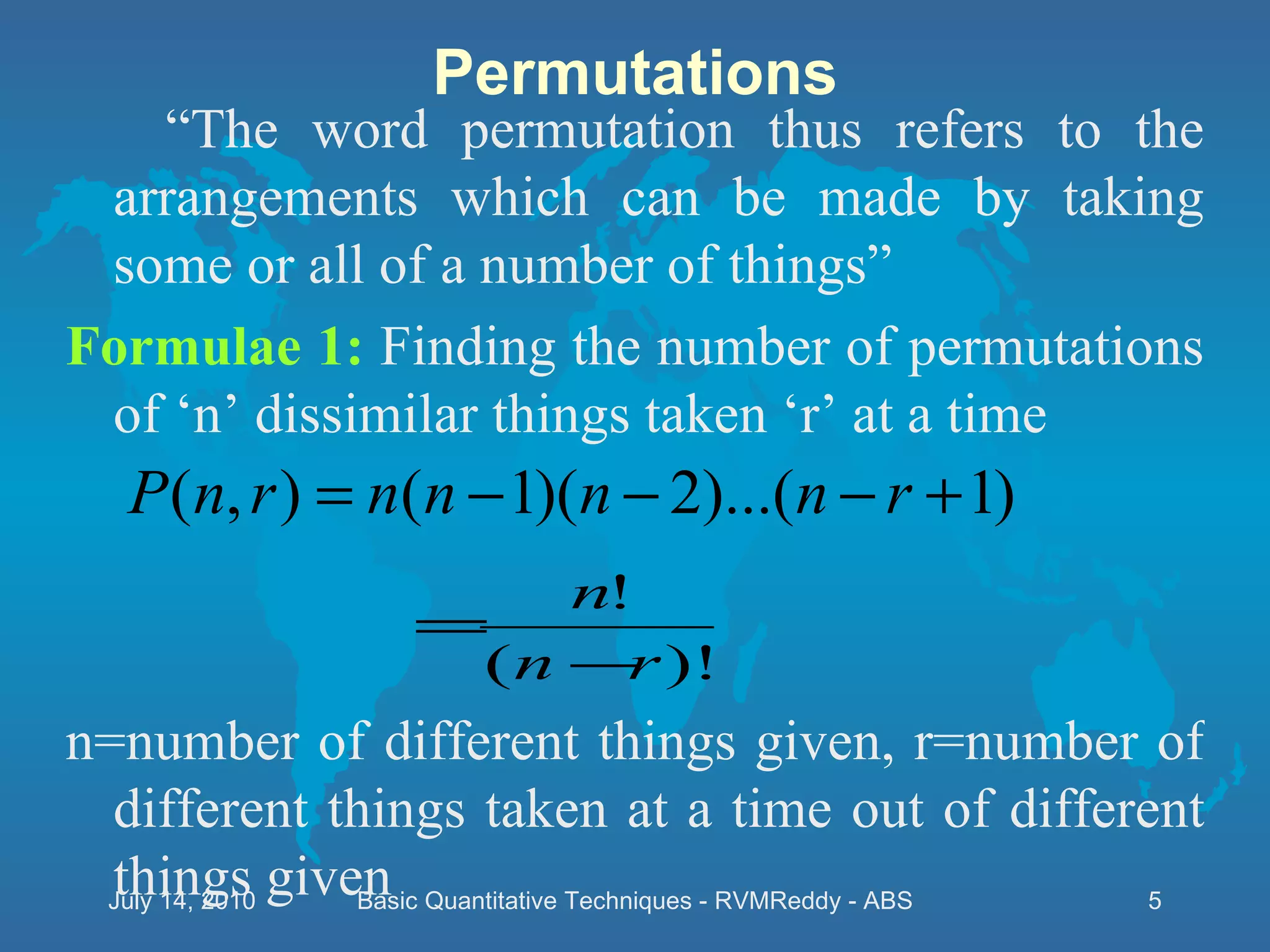
“ The word permutation thus refers to the arrangements which can be made by taking some or all of a number of things” Formulae 1:  Finding the number of permutations of ‘n’ dissimilar things taken ‘r’ at a time n=number of different things given, r=number of different things taken at a time out of different things given Permutations July 14, 2010 Basic Quantitative Techniques - RVMReddy - ABS
Example 1: There are six boxes and three balls. In how many ways can these three balls be discretely put into these six boxes. Solution: Example 2: How many four-letter words can be made using the letters of the word ‘BANGALORE’ and ‘ALLIANCE’  Solution: n=9, r=4  and n=8, r=4  Permutations July 14, 2010 Basic Quantitative Techniques - RVMReddy - ABS
Example 3: How many arrangements are possible of the letters of the words ‘JAIPUR’, ‘BANGALORE’ and ‘ALLIANCE’  Hint: n=6, r=6 and n=9, r=9 and n=8,r=8 Permutations July 14, 2010 Basic Quantitative Techniques - RVMReddy - ABS
Formulae 2:  Finding the number of permutations of ‘n’ things taken ‘r’ at a time, given that each of the elements can be repeated once, twice….up to ‘r’ times Or  ‘ n’ things taken all at a time of which ‘p’ are alike, ‘q’ others are alike and ‘r’ others alike  Example 1:  How many permutations are possible of the letters of the word PROBABILITY when taken all at a time?  Permutations July 14, 2010 Basic Quantitative Techniques - RVMReddy - ABS
Solution: n=11, p=2 ( as letter B is occurring twice in the given word) , and q=2 ( as letter I is occurring twice in the given word) And all other letters in the given word are different. The required number of permutations is (r is not valid in this) Example 2:  You are given a word  “MANAGEMENT” and asked to compute the number of  permutations that you can form taking all the letters from this word? Permutations July 14, 2010 Basic Quantitative Techniques - RVMReddy - ABS
Permutations Basic Quantitative Techniques - RVMReddy - ABS
Permutation formula proof There are  n  ways to choose the first element n -1 ways to choose the second n -2 ways to choose the third … n - r +1 ways to choose the  r th  element By the product rule, that gives us: P ( n , r ) =  n ( n -1)( n -2)…( n - r +1) July 14, 2010 Basic Quantitative Techniques - RVMReddy - ABS
Combinations refers to the number of arrangements which can be made from a group of things irrespective of the order Combinations differ from permutations in that one  combination such as xyz  may be stated in the form of several  permutations just by rearranging the orders as : xyz, xzy, yxz, yzx, zxy, zyx  Note: All of these are  one combination  but  they are six permutations  IMP Note:  The number of permutations is always greater than the number of combinations in any given situation since a combination of n different things can be generate n factorial permutations Combinations July 14, 2010 Basic Quantitative Techniques - RVMReddy - ABS
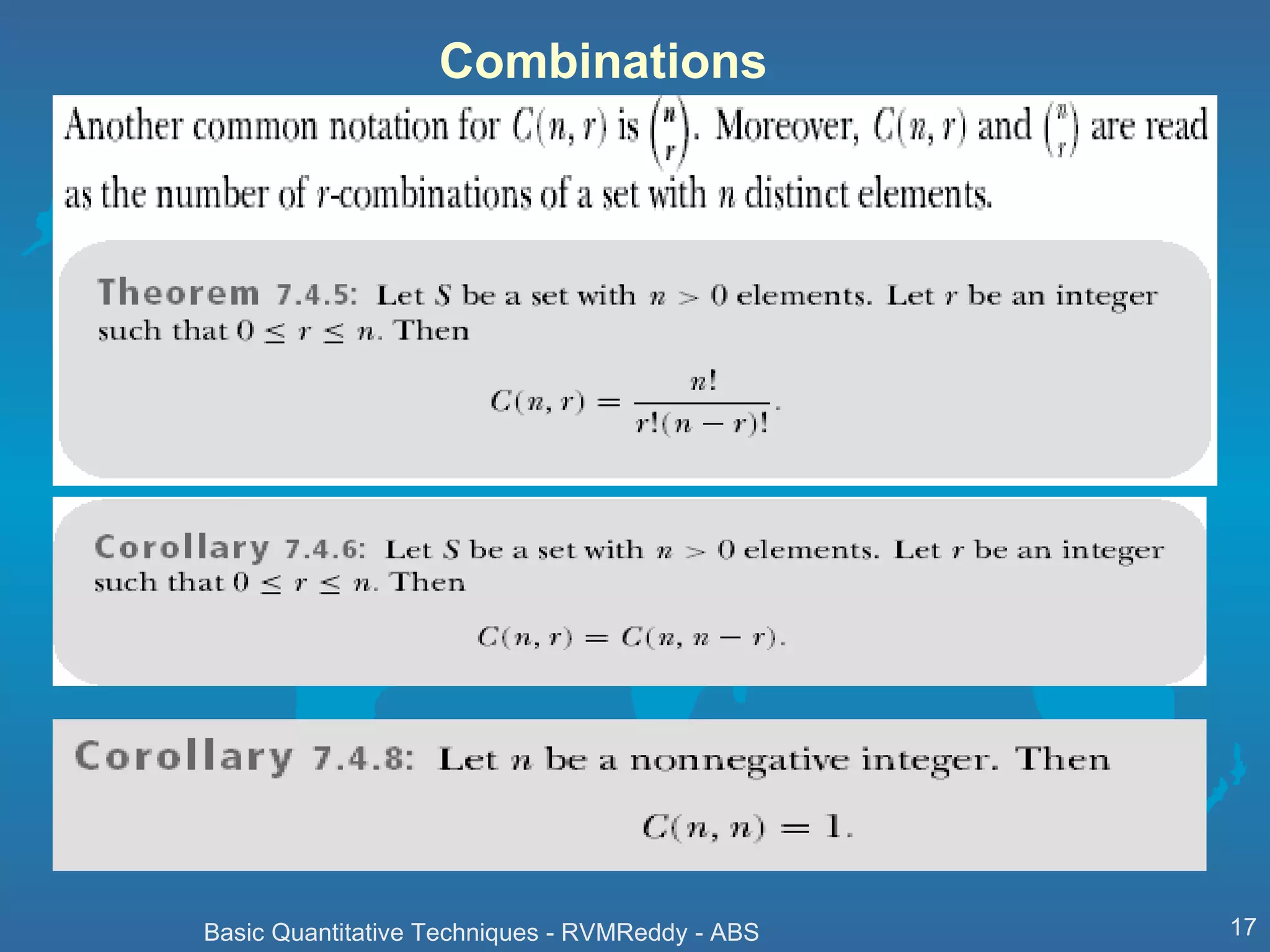
Formulae 1:  The number of  r -combinations of a set with  n  elements, where  n  is non-negative and 0≤ r ≤ n  is: n= number of different things given r= number of different things taken at a time out of different things given Combinations July 14, 2010 Basic Quantitative Techniques - RVMReddy - ABS
Example 1: in how many ways can four persons be chosen out of seven? n=7, r=4 Example 2: Find the number of combinations of 50 things taking 46 at a time. ANS: 230300 Combinations July 14, 2010 Basic Quantitative Techniques - RVMReddy - ABS
Formulae 2: The number of ways in which x+y+z things can be divided into three groups contain x, y, and z things respectively is  Example: In how many ways can 10 books be put to three shelves which can contain 2, 3 and 5 books respectively? Combinations July 14, 2010 Basic Quantitative Techniques - RVMReddy - ABS
Combinations Basic Quantitative Techniques - RVMReddy - ABS
Combinations How many different poker hands are there (5 cards)? How many different (initial) blackjack hands are there? July 14, 2010 Basic Quantitative Techniques - RVMReddy - ABS
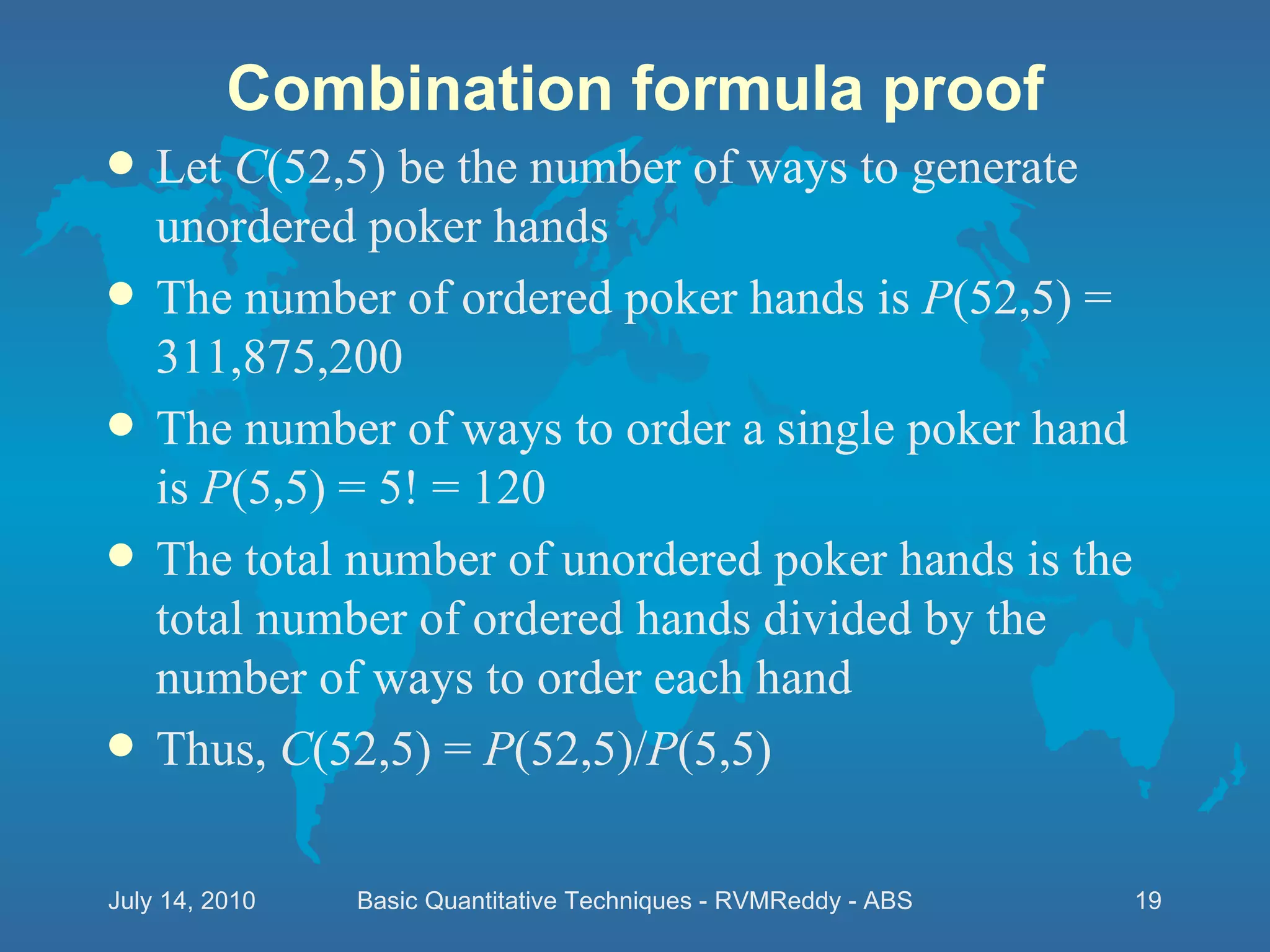
Combination formula proof Let  C (52,5) be the number of ways to generate unordered poker hands The number of ordered poker hands is  P (52,5) = 311,875,200 The number of ways to order a single poker hand is  P (5,5) = 5! = 120 The total number of unordered poker hands is the total number of ordered hands divided by the number of ways to order each hand Thus,  C (52,5) =  P (52,5)/ P (5,5) July 14, 2010 Basic Quantitative Techniques - RVMReddy - ABS
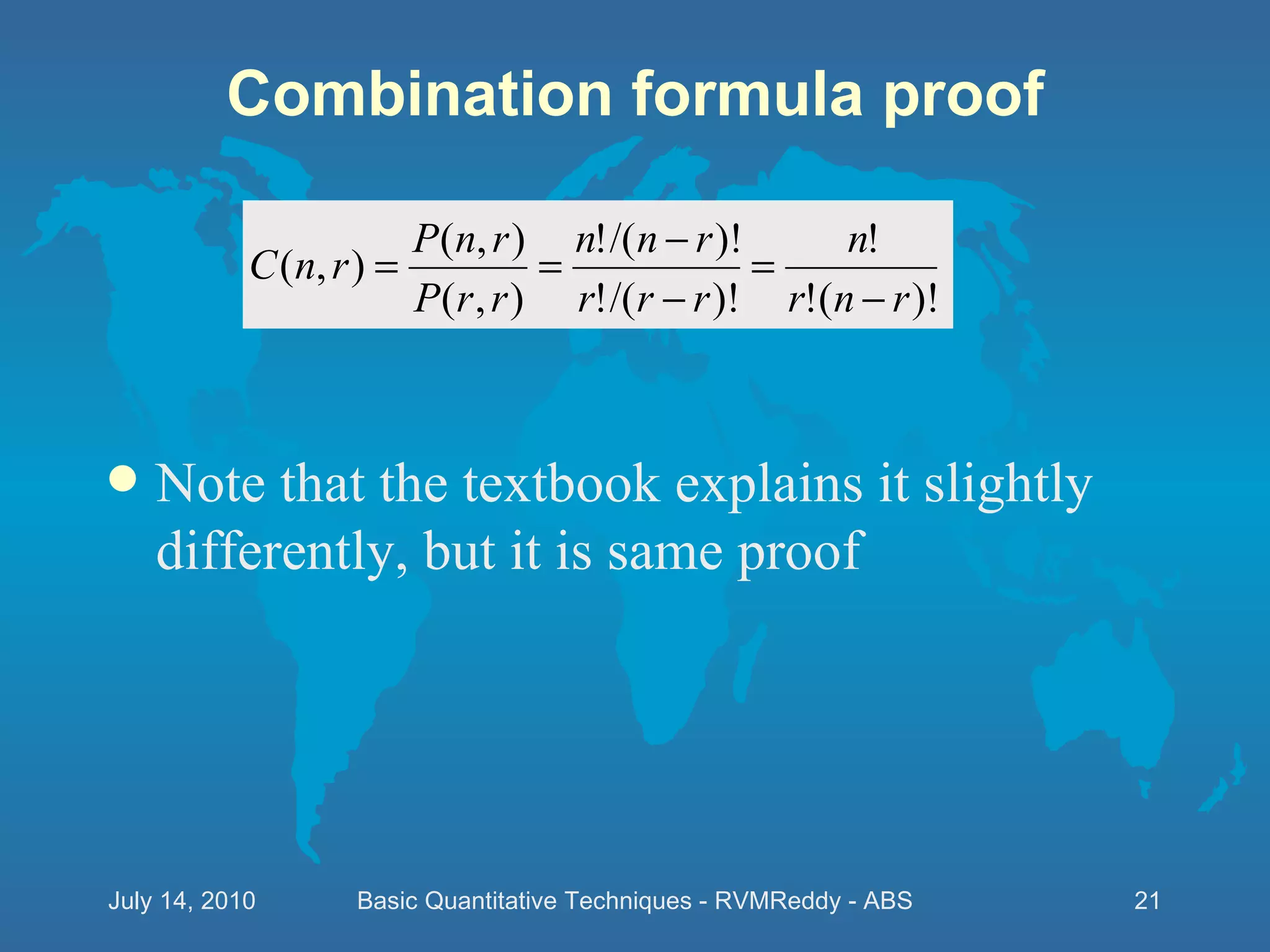
Combination formula proof Let  C ( n , r ) be the number of ways to generate unordered combinations The number of ordered combinations (i.e.  r -permutations) is  P ( n , r ) The number of ways to order a single one of those  r -permutations  P ( r,r )  The total number of unordered combinations is the total number of ordered combinations (i.e.  r -permutations) divided by the number of ways to order each combination Thus,  C ( n,r ) =  P ( n,r )/ P ( r,r ) July 14, 2010 Basic Quantitative Techniques - RVMReddy - ABS
Combination formula proof Note that the textbook explains it slightly differently, but it is same proof July 14, 2010 Basic Quantitative Techniques - RVMReddy - ABS
Let  n  and  r  be non-negative integers with  r  ≤  n .  Then  C ( n , r ) =  C ( n , n-r ) Proof: Combination formula proof July 14, 2010 Basic Quantitative Techniques - RVMReddy - ABS
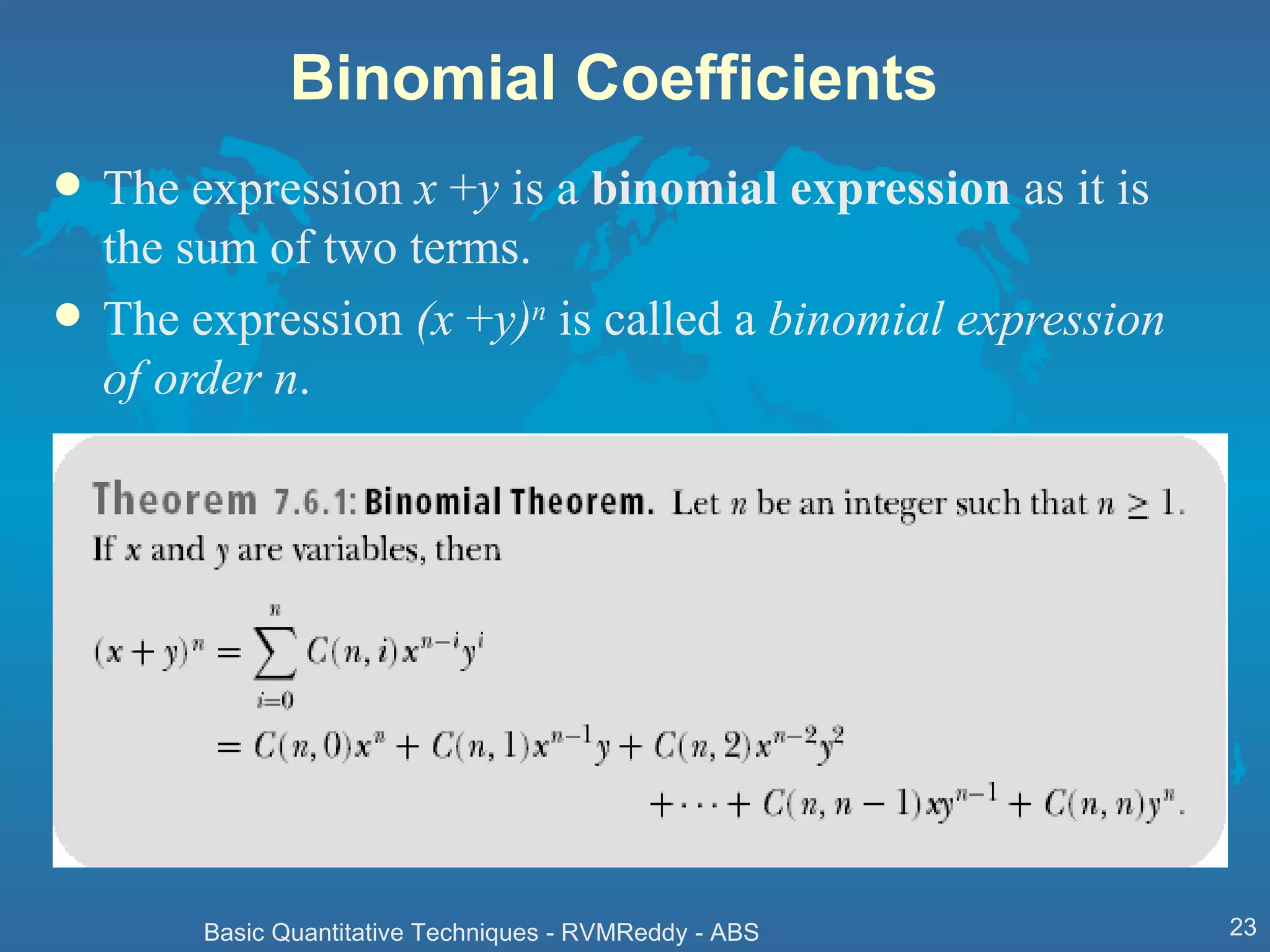
Binomial Coefficients The expression  x  + y  is   a  binomial expression  as it is the sum of two terms.  The expression  (x  + y) n   is called a  binomial expression of order n . Basic Quantitative Techniques - RVMReddy - ABS
Binomial Coefficients Basic Quantitative Techniques - RVMReddy - ABS
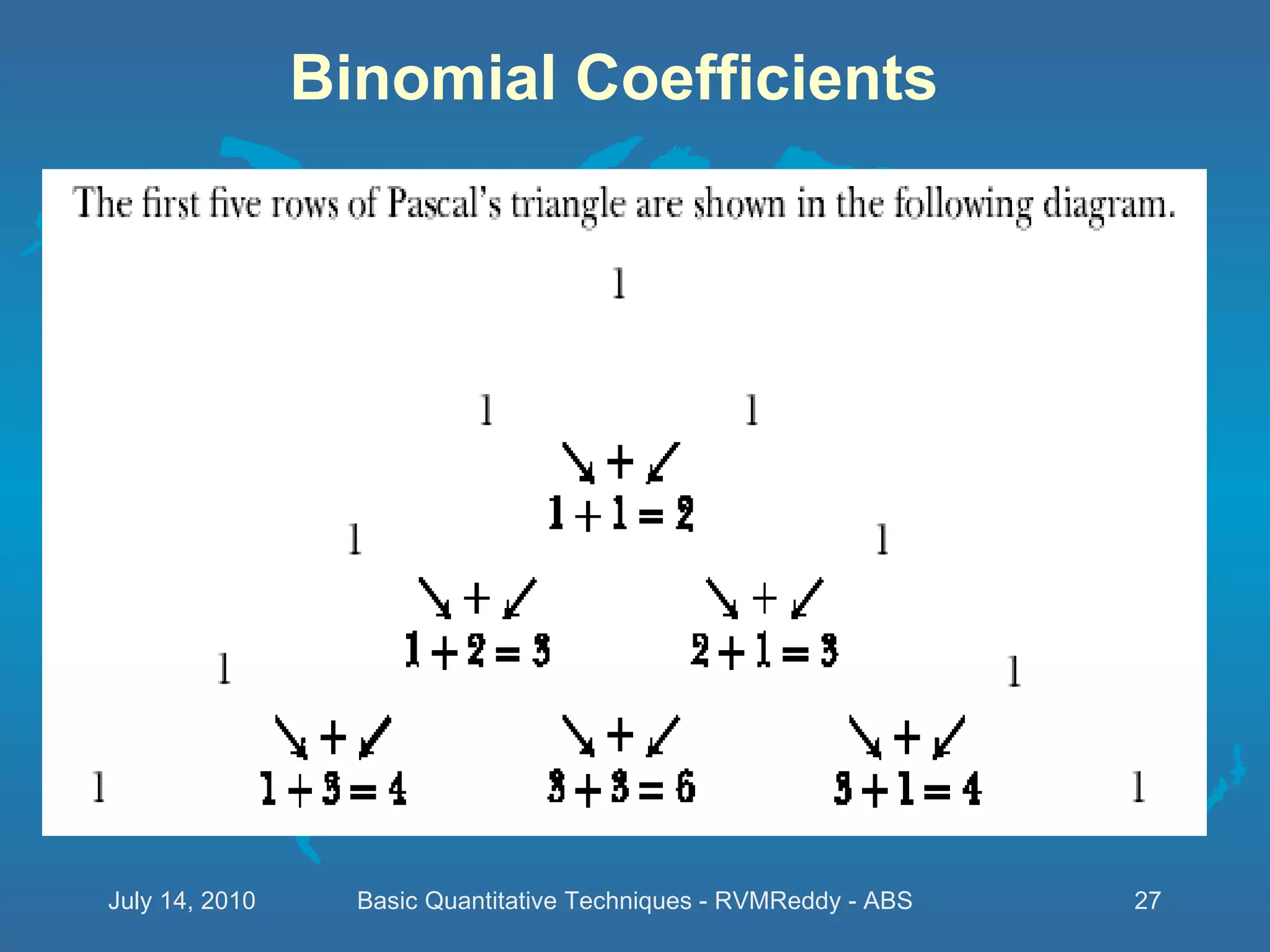
Binomial Coefficients Pascal’s Triangle  The number  C(n ,  r)  can be obtained   by constructing a triangular array. The row 0, i.e., the first row of the triangle, contains the single entry 1 .  The row 1, i.e., the second row, contains a pair of entries each equal to 1 . Calculate the  n t h  row of the triangle from the preceding row by the following rules: Basic Quantitative Techniques - RVMReddy - ABS
Binomial Coefficients July 14, 2010 Basic Quantitative Techniques - RVMReddy - ABS
Basic Quantitative Techniques - RVMReddy - ABS
Binomial Coefficients The technique known as  divide and conquer  can be used   to compute  C(n ,  r ).  In the divide-and-conquer technique, a problem is divided into a fixed number, say  k , of smaller problems of the same kind. Typically,  k  = 2 .  Each of the smaller problems is then divided into  k  smaller problems of the same kind, and so on, until the smaller problem is reduced to a case in which the solution is easily obtained. The solutions of the smaller problems are then put together to obtain the solution of the original problem. July 14, 2010 Basic Quantitative Techniques - RVMReddy - ABS
Thank You Basic Quantitative Techniques - RVMReddy - ABS July 14, 2010

Quantitative techniques basics of mathematics permutations and combinations_part ii_30 pages

  • 1.
    Basic Quantitative TechniquesABS-Bangalore Basic Quantitative Techniques - RVMReddy - ABS July 14, 2010
  • 2.
    Dr. R. VenkatamuniReddy Associate Professor Contact: 09632326277, 080-30938181 [email_address] [email_address] Basic Quantitative Techniques - RVMReddy - ABS July 14, 2010
  • 3.
    Permutations and Combinations July 14, 2010 Basic Quantitative Techniques - RVMReddy - ABS
  • 4.
    Permutations Permutations refersto the different ways in which a number of a number of objects can be arranged in a different order Example: Suppose there are two things x and y, they can be arranged in to two different ways i.e,. xy and yx . These two arrangements is called permutation Similarly x, y and z xyz, xzy, yxz, yzx, zxy, zyx is 6 arrange permutation (if we want to have two things only from x,y,z then xy,xz,yz,yx,zx,yz only in this case) July 14, 2010 Basic Quantitative Techniques - RVMReddy - ABS
  • 5.
    “ The wordpermutation thus refers to the arrangements which can be made by taking some or all of a number of things” Formulae 1: Finding the number of permutations of ‘n’ dissimilar things taken ‘r’ at a time n=number of different things given, r=number of different things taken at a time out of different things given Permutations July 14, 2010 Basic Quantitative Techniques - RVMReddy - ABS
  • 6.
    Example 1: Thereare six boxes and three balls. In how many ways can these three balls be discretely put into these six boxes. Solution: Example 2: How many four-letter words can be made using the letters of the word ‘BANGALORE’ and ‘ALLIANCE’ Solution: n=9, r=4 and n=8, r=4 Permutations July 14, 2010 Basic Quantitative Techniques - RVMReddy - ABS
  • 7.
    Example 3: Howmany arrangements are possible of the letters of the words ‘JAIPUR’, ‘BANGALORE’ and ‘ALLIANCE’ Hint: n=6, r=6 and n=9, r=9 and n=8,r=8 Permutations July 14, 2010 Basic Quantitative Techniques - RVMReddy - ABS
  • 8.
    Formulae 2: Finding the number of permutations of ‘n’ things taken ‘r’ at a time, given that each of the elements can be repeated once, twice….up to ‘r’ times Or ‘ n’ things taken all at a time of which ‘p’ are alike, ‘q’ others are alike and ‘r’ others alike Example 1: How many permutations are possible of the letters of the word PROBABILITY when taken all at a time? Permutations July 14, 2010 Basic Quantitative Techniques - RVMReddy - ABS
  • 9.
    Solution: n=11, p=2( as letter B is occurring twice in the given word) , and q=2 ( as letter I is occurring twice in the given word) And all other letters in the given word are different. The required number of permutations is (r is not valid in this) Example 2: You are given a word “MANAGEMENT” and asked to compute the number of permutations that you can form taking all the letters from this word? Permutations July 14, 2010 Basic Quantitative Techniques - RVMReddy - ABS
  • 10.
    Permutations Basic QuantitativeTechniques - RVMReddy - ABS
  • 11.
    Permutation formula proofThere are n ways to choose the first element n -1 ways to choose the second n -2 ways to choose the third … n - r +1 ways to choose the r th element By the product rule, that gives us: P ( n , r ) = n ( n -1)( n -2)…( n - r +1) July 14, 2010 Basic Quantitative Techniques - RVMReddy - ABS
  • 12.
    Combinations refers tothe number of arrangements which can be made from a group of things irrespective of the order Combinations differ from permutations in that one combination such as xyz may be stated in the form of several permutations just by rearranging the orders as : xyz, xzy, yxz, yzx, zxy, zyx Note: All of these are one combination but they are six permutations IMP Note: The number of permutations is always greater than the number of combinations in any given situation since a combination of n different things can be generate n factorial permutations Combinations July 14, 2010 Basic Quantitative Techniques - RVMReddy - ABS
  • 13.
    Formulae 1: The number of r -combinations of a set with n elements, where n is non-negative and 0≤ r ≤ n is: n= number of different things given r= number of different things taken at a time out of different things given Combinations July 14, 2010 Basic Quantitative Techniques - RVMReddy - ABS
  • 14.
    Example 1: inhow many ways can four persons be chosen out of seven? n=7, r=4 Example 2: Find the number of combinations of 50 things taking 46 at a time. ANS: 230300 Combinations July 14, 2010 Basic Quantitative Techniques - RVMReddy - ABS
  • 15.
    Formulae 2: Thenumber of ways in which x+y+z things can be divided into three groups contain x, y, and z things respectively is Example: In how many ways can 10 books be put to three shelves which can contain 2, 3 and 5 books respectively? Combinations July 14, 2010 Basic Quantitative Techniques - RVMReddy - ABS
  • 16.
    Combinations Basic QuantitativeTechniques - RVMReddy - ABS
  • 17.
    Combinations Basic QuantitativeTechniques - RVMReddy - ABS
  • 18.
    Combinations How manydifferent poker hands are there (5 cards)? How many different (initial) blackjack hands are there? July 14, 2010 Basic Quantitative Techniques - RVMReddy - ABS
  • 19.
    Combination formula proofLet C (52,5) be the number of ways to generate unordered poker hands The number of ordered poker hands is P (52,5) = 311,875,200 The number of ways to order a single poker hand is P (5,5) = 5! = 120 The total number of unordered poker hands is the total number of ordered hands divided by the number of ways to order each hand Thus, C (52,5) = P (52,5)/ P (5,5) July 14, 2010 Basic Quantitative Techniques - RVMReddy - ABS
  • 20.
    Combination formula proofLet C ( n , r ) be the number of ways to generate unordered combinations The number of ordered combinations (i.e. r -permutations) is P ( n , r ) The number of ways to order a single one of those r -permutations P ( r,r ) The total number of unordered combinations is the total number of ordered combinations (i.e. r -permutations) divided by the number of ways to order each combination Thus, C ( n,r ) = P ( n,r )/ P ( r,r ) July 14, 2010 Basic Quantitative Techniques - RVMReddy - ABS
  • 21.
    Combination formula proofNote that the textbook explains it slightly differently, but it is same proof July 14, 2010 Basic Quantitative Techniques - RVMReddy - ABS
  • 22.
    Let n and r be non-negative integers with r ≤ n . Then C ( n , r ) = C ( n , n-r ) Proof: Combination formula proof July 14, 2010 Basic Quantitative Techniques - RVMReddy - ABS
  • 23.
    Binomial Coefficients Theexpression x + y is a binomial expression as it is the sum of two terms. The expression (x + y) n is called a binomial expression of order n . Basic Quantitative Techniques - RVMReddy - ABS
  • 24.
    Binomial Coefficients BasicQuantitative Techniques - RVMReddy - ABS
  • 25.
    Binomial Coefficients BasicQuantitative Techniques - RVMReddy - ABS
  • 26.
    Binomial Coefficients Pascal’sTriangle The number C(n , r) can be obtained by constructing a triangular array. The row 0, i.e., the first row of the triangle, contains the single entry 1 . The row 1, i.e., the second row, contains a pair of entries each equal to 1 . Calculate the n t h row of the triangle from the preceding row by the following rules: Basic Quantitative Techniques - RVMReddy - ABS
  • 27.
    Binomial Coefficients July14, 2010 Basic Quantitative Techniques - RVMReddy - ABS
  • 28.
  • 29.
    Binomial Coefficients Thetechnique known as divide and conquer can be used to compute C(n , r ). In the divide-and-conquer technique, a problem is divided into a fixed number, say k , of smaller problems of the same kind. Typically, k = 2 . Each of the smaller problems is then divided into k smaller problems of the same kind, and so on, until the smaller problem is reduced to a case in which the solution is easily obtained. The solutions of the smaller problems are then put together to obtain the solution of the original problem. July 14, 2010 Basic Quantitative Techniques - RVMReddy - ABS
  • 30.
    Thank You BasicQuantitative Techniques - RVMReddy - ABS July 14, 2010