J. K. Sharma
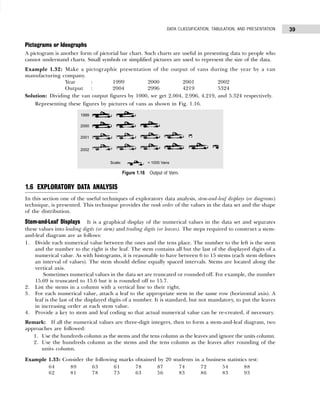
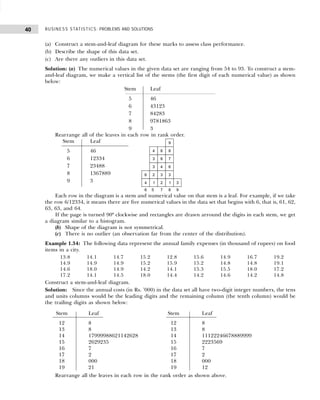
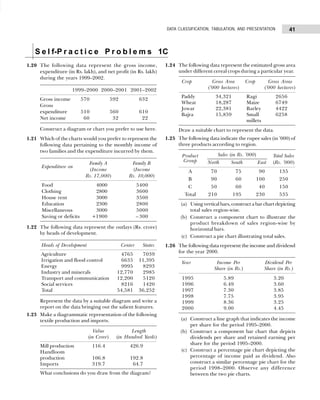
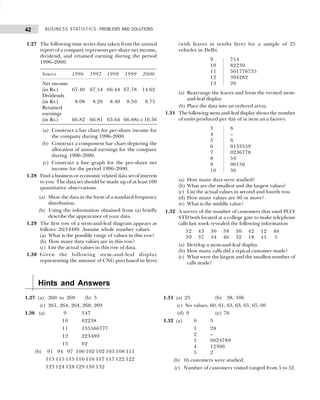
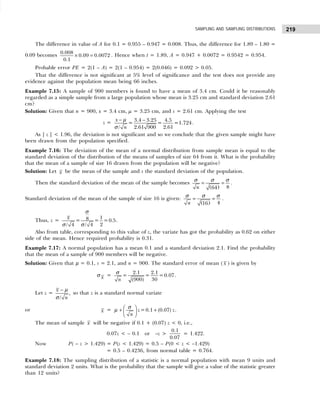
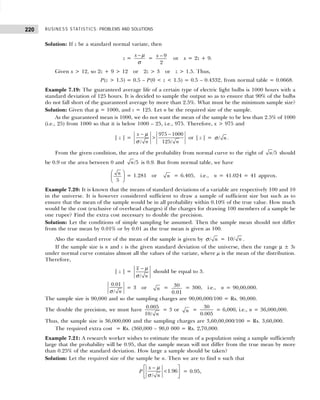
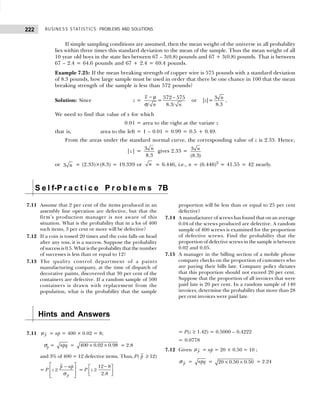
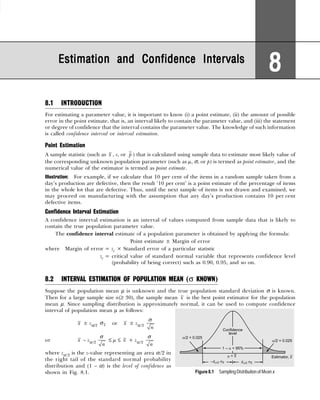
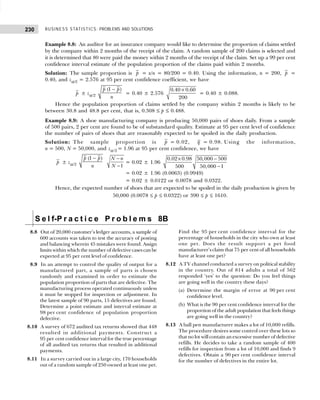
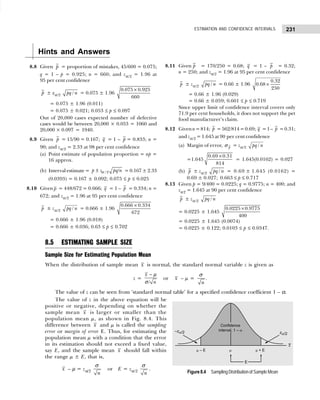
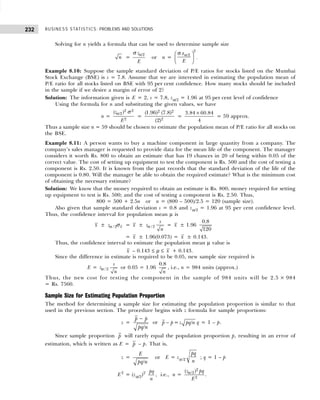
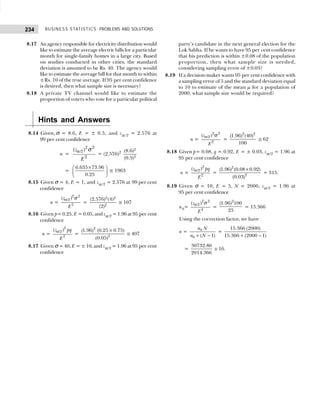
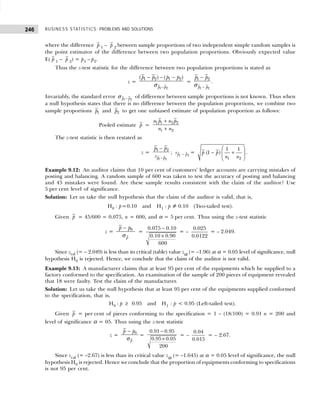
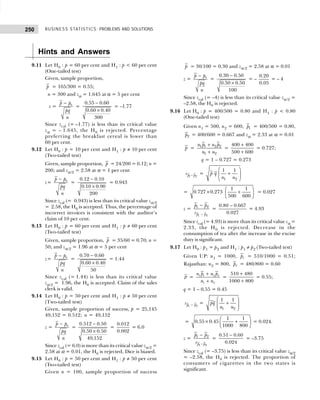
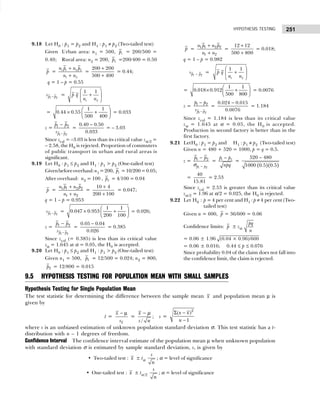
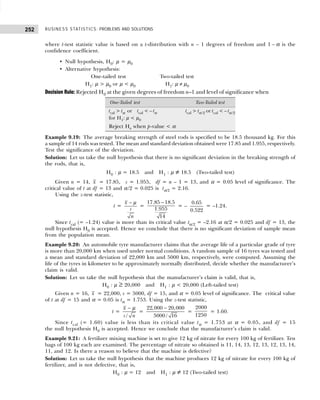
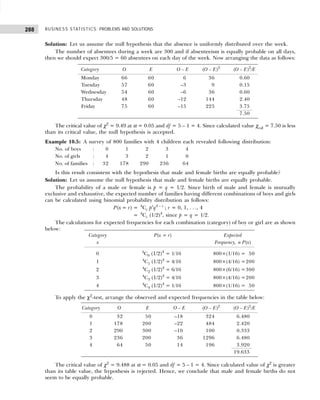
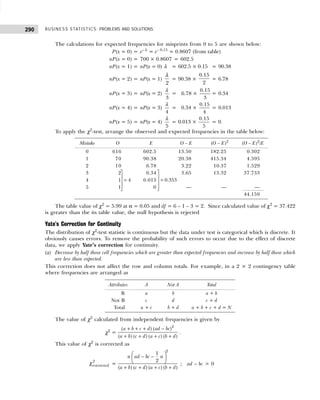
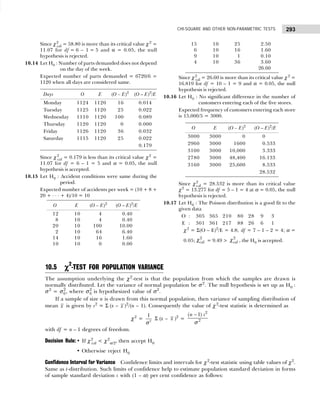
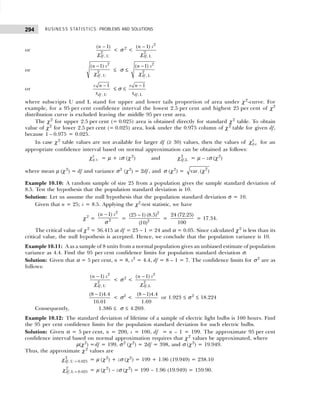
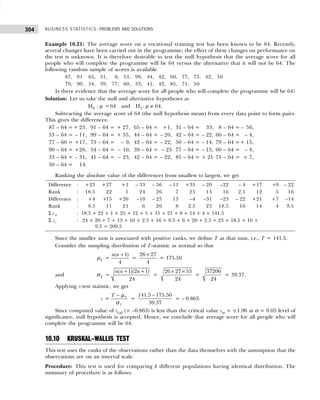
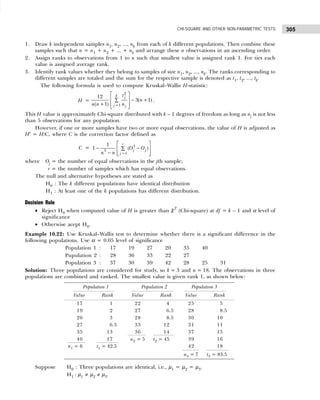
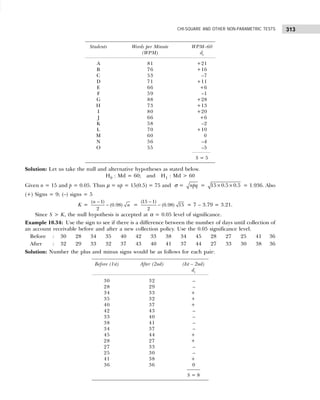
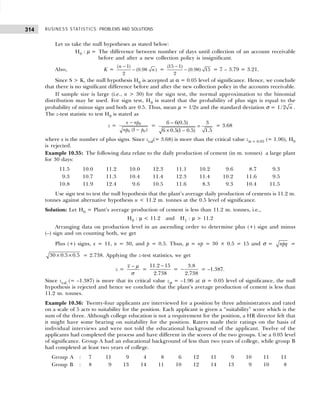
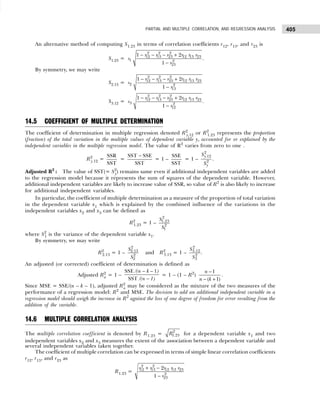
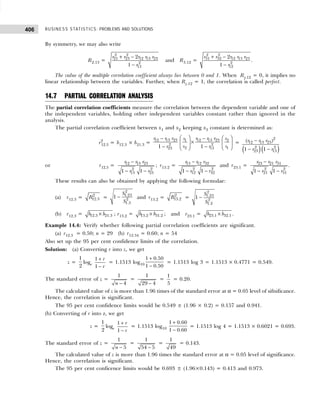
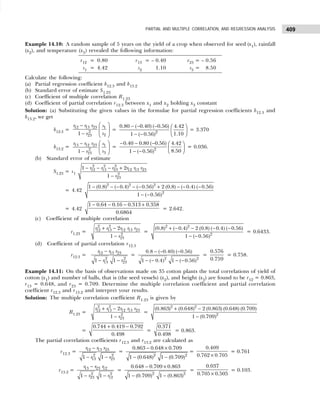
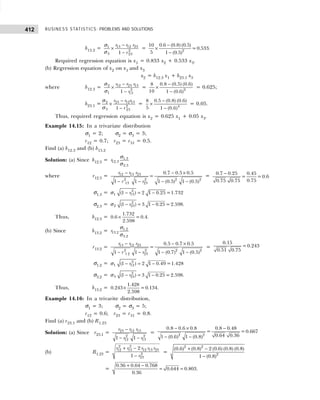
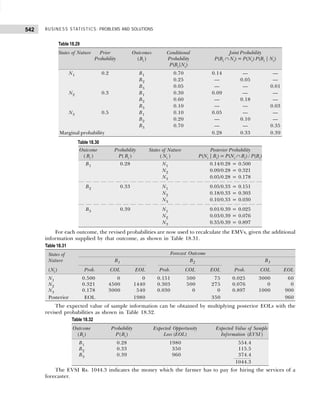
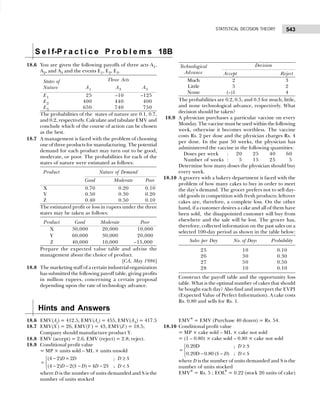
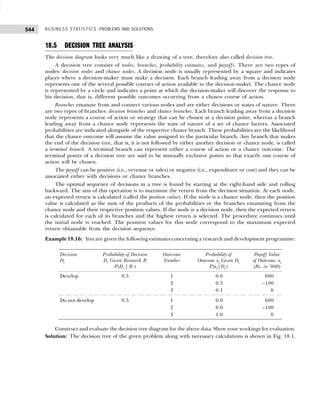
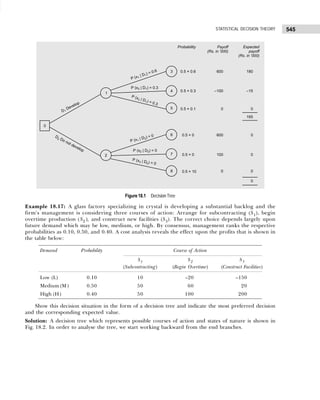
Formerly Professor
Faculty of Management Studies
University of Delhi, Delhi
BUSINESS STATISTICS
Problems and Solutions
Delhi • Chennai • Chandigarh
Assistant Acquisitions Editor: Dhiraj Pandey
Associate Production Editor: Ruchi Sachdev
Composition: Sara Assignments
Printer:
Copyright © 2010 Dorling Kindersley (India) Pvt. Ltd.
This book is sold subject to the condition that it shall not, by way of trade or otherwise,
be lent, resold, hired out, or otherwise circulated without the publisher’s prior written
consent in any form of binding or cover other than that in which it is published and
without a similar condition including this condition being imposed on the subsequent
purchaser and without limiting the rights under copyright reserved above, no part of this
publication may be reproduced, stored in or introduced into a retrieval system, or
transmitted in any form or by any means (electronic, mechanical, photocopying,
recording or otherwise), without the prior written permission of both the copyright owner
and the publisher of this book.
Published by Dorling Kindersley (India) Pvt. Ltd., licensees of Pearson Education in
South Asia.
ISBN: 978-81-317-3403-2
10 9 8 7 6 5 4 3 2 1
Head Office: 7th Floor, Knowledge Boulevard, A-8(A), Sector-62, Noida-201309, India
Registered Office: 11 Community Centre, Panchsheel Park, New Delhi 110 017, India
Contents
Contents
Contents
Contents
Contents
Preface xi
CHAPTER 1 DATA CLASSIFICATION, TABULATION, AND PRESENTATION 1–42
1.1 Classification of Data 1
1.2 Organizing Data Using Data Array 2
Self-Practice Problems 1A 15
Hints and Answers 16
1.3 Tabulation of Data 17
Self-Practice Problems 1B 23
Hints and Answers 24
1.4 Graphical Presentation of Data 25
1.5 Types of Diagrams 26
1.6 Exploratory Data Analysis 39
Self-Practice Problems 1C 41
Hints and Answers 42
CHAPTER 2 MEASURES OF CENTRAL TENDENCY 43–77
2.1 Introduction 43
2.2 Measures of Central Tendency 43
2.3 Mathematical Averages 43
Self-Practice Problems 2A 58
Hints and Answers 59
2.4 Geometric Mean 59
Self-Practice Problems 2B 62
Hints and Answers 63
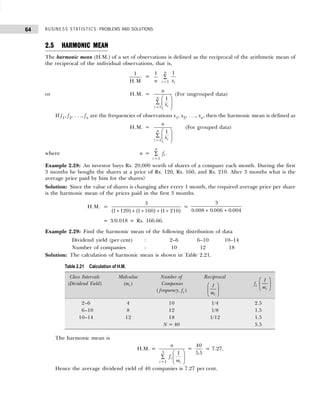
2.5 Harmonic Mean 64
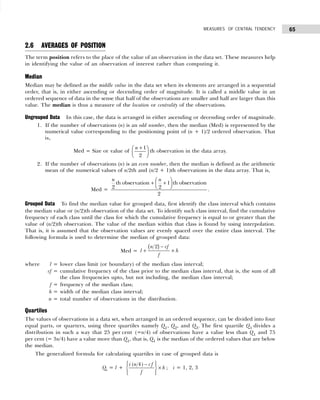
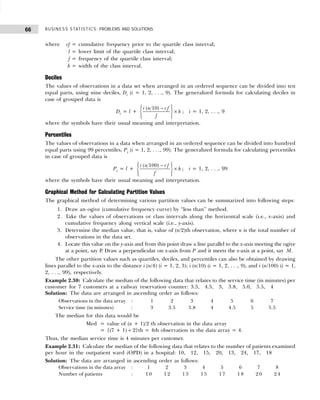
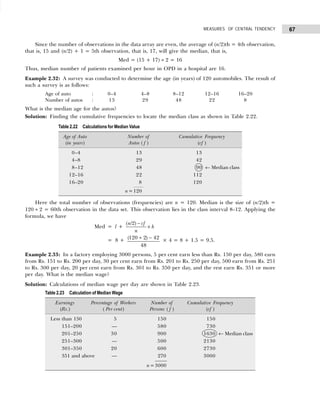
2.6 Averages of Position 65
Self-Practice Problems 2C 71
Hints and Answers 72
2.7 Mode 72
2.8 Relationship Between Mean, Median, and Mode 74
Self-Practice Problems 2D 75
Hints and Answers 77
CHAPTER 3 MEASURES OF DISPERSION 78–100
3.1 Introduction 78
About the Author xiii
CONTENTS
iv
3.2 Classification of Measures of Dispersion 78
3.3 Distance Measures 79
Self-Practice Problems 3A 81
Hints and Answers 82
3.4 Average Deviation Measures 83
Self-Practice Problems 3B 97
Hints and Answers 99
CHAPTER 4 SKEWNESS, MOMENTS, AND KURTOSIS 101–130
4.1 Introduction 101
4.2 Measures of Skewness 101
Self-Practice Problems 4A 107
Hints and Answers 108
4.3 Moments 110
4.4 Kurtosis 114
4.5 Miscellaneous Solved Examples 118
Self-Practice Problems 4B 129
Hints and Answers 130
CHAPTER 5 FUNDAMENTALS OF PROBABILITY 131–169
5.1 Introduction 131
5.2 Event Types 131
5.3 Definition of Probability 132
5.4 Fundamental Rules of Probability 133
5.5 Counting Rules for Determining the Number of Outcomes 133
Self-Practice Problems 5A 135
Hints and Answers 135
5.6 Rules of Probability and Algebra of Events 136
Self-Practice Problems 5B 146
Hints and Answers 148
5.7 Bayes’ Theorem 150
Self-Practice Problems 5C 168
Hints and Answers 169
CHAPTER 6 PROBABILITY DISTRIBUTIONS 170–203
6.1 Introduction 170
6.2 Probability Distribution Function 170
6.3 Cumulative Probability Distribution Function 171
6.4 Expected Value and Variance of a Random Variable 172
Self-Practice Problems 6A 176
Hints and Answers 177
6.5 Discrete Probability Distributions 177
Self-Practice Problems 6B 181
Hints and Answers 182
v
CONTENTS
6.6 Poisson Probability Distribution 183
Self-Practice Problems 6C 188
Hints and Answers 189
6.7 Continuous Probability Distributions 191
6.8 Miscellaneous Solved Examples 196
Self-Practice Problems 6D 201
Hints and Answers 202
CHAPTER 7 SAMPLING AND SAMPLING DISTRIBUTIONS 204–223
7.1 Population Parameters and Sample Statistics 204
7.2 Sampling Methods 204
7.3 Sampling Distributions 206
7.4 Sampling Distribution of Sample Mean 207
Self-Practice Problems 7A 213
Hints and Answers 213
7.5 Sampling Distribution of Sample Proportion 215
7.6 Miscellaneous Solved Examples 217
Self-Practice Problems 7B 222
Hints and Answers 222
CHAPTER 8 ESTIMATION AND CONFIDENCE INTERVALS 224–234
8.1 Introduction 224
8.2 Interval Estimation of Population Mean (σ Known) 224
8.3 Interval Estimation of Population Mean (σ Unknown) 226
Self-Practice Problems 8A 228
Hints and Answers 228
8.4 Interval Estimation for Population Proportion 229
Self-Practice Problems 8B 230
Hints and Answers 231
8.5 Estimating Sample Size 231
Self-Practice Problems 8C 233
Hints and Answers 234
CHAPTER 9 HYPOTHESIS TESTING 235–279
9.1 Hypothesis and Hypothesis Testing 235
9.2 Hypothesis Testing for Population Parameters with Large Samples 237
Self-Practice Problems 9A 243
Hints and Answers 243
9.3 Hypothesis Testing for Single Population Proportion 245
9.4 Hypothesis Testing for a Binomial Proportion 248
Self-Practice Problems 9B 249
Hints and Answers 250
9.5 Hypothesis Testing for Population Mean with Small Samples 251
Self-Practice Problems 9C 260
Hints and Answers 261
CONTENTS
vi
9.6 Hypothesis Testing Based on F-Distribution 263
9.7 Miscellaneous Solved Examples 265
Self-Practice Problems 9D 278
Hints and Answers 278
CHAPTER 10 CHI-SQUARE AND OTHER NON-PARAMETRIC TEST 280–318
10.1 Introduction 280
10.2 The Chi-Square Distribution 280
10.3 Applications of χ2
Test 281
Self-Practice Problems 10A 285
Hints and Answers 286
10.4 Chi-square Test for Goodness-of-Fit 287
Self-Practice Problems 10B 292
Hints and Answers 292
10.5 χ2
-Test for Population Variance 293
10.6 The Sign Test for Paired Data 297
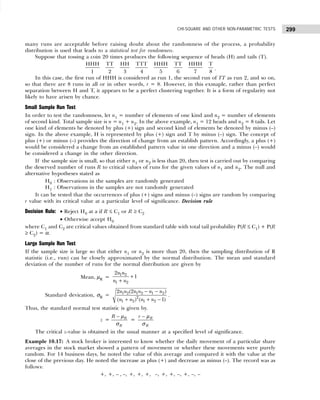
10.7 Runs Test for Randomness 298
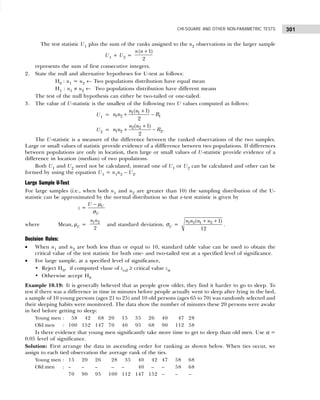
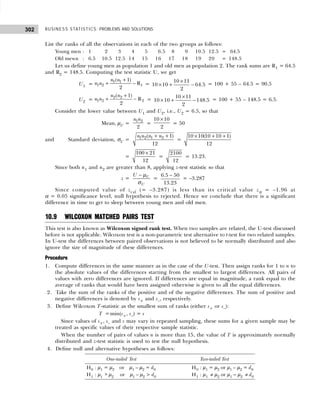
10.8 Mann-Whitney U-Test 300
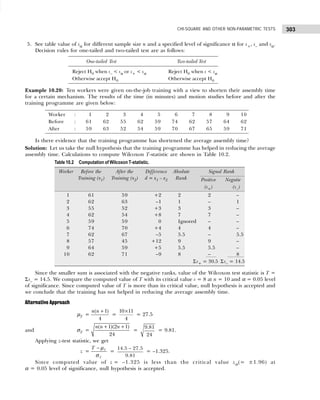
10.9 Wilcoxon Matched Pairs Test 302
10.10 Kruskal-Wallis Test 304
10.11 Miscellaneous Solved Examples 306
Self-Practice Problems 10C 316
Hints and Answers 317
CHAPTER 11 ANALYSIS OF VARIANCE 319–337
11.1 Introduction 319
11.2 Testing Equality of Population (Treatment) Means: One-Way Classification 319
11.3 Inferences About Population (Treatment) Means 326
Self-Practice Problems 11A 326
Hints and Answers 327
11.4 Testing Equality of Population (Treatment) Means: Two-Way Classification 328
Self-Practice Problems 11B 334
Hints and Answers 335
CHAPTER 12 CORRELATION ANALYSIS 338–370
12.1 Introduction 338
12.2 Types of Correlations 338
Self-Practice Problems 12A 347
Hints and Answers 348
12.3 Spearman’s Rank Correlation Coefficient 348
Self-Practice Problems 12B 356
Hints and Answers 357
12.4 Hypothesis Testing for Correlation Coefficient 357
vii
CONTENTS
12.5 Miscellaneous Solved Examples 361
Self-Practice Problems 12C 369
Hints and Answers 369
CHAPTER 13 REGRESSION ANALYSIS 371–395
13.1 Introduction 371
13.2 Methods to Determine Regression Coefficients 372
13.3 Standard Error of Estimate and Prediction Intervals 382
Self-Practice Problems 13A 391
Hints and Answers 393
CHAPTER 14 PARTIAL AND MULTIPLE CORRELATION, AND REGRESSION ANALYSIS 396–413
14.1 Introduction 396
14.2 Assumptions in Multiple Linear Regression 396
14.3 Estimating Parameters of Multiple Regression Model 396
Self-Practice Problems 14A 402
Hints and Answers 403
14.4 Standard Error of Estimate for Multiple Regression 404
14.5 Coefficient of Multiple Determination 405
14.6 Multiple Correlation Analysis 405
14.7 Partial Correlation Analysis 406
14.8 Miscellaneous Solved Examples 410
Self-Practice Problems 14B 416
Hints and Answers 416
CHAPTER 15 FORECASTING AND TIME SERIES ANALYSIS 418–455
15.1 Introduction 418
15.2 Time Series Analysis 418
15.3 Time Series Decomposition Models 419
15.4 Quantitative Forecasting Methods 419
Self-Practice Problems 15A 427
Hints and Answers 429
15.5 Trend Projection Methods 431
Self-Practice Problems 15B 436
Hints and Answers 437
15.6 Measurement of Seasonal Effects 438
Self-Practice Problems 15C 454
Hints and Answers 454
CHAPTER 16 INDEX NUMBERS 456–491
16.1 Introduction 456
16.2 Types of Index Numbers 456
16.3 Unweighted Price Indexes 457
Self-Practice Problems 16A 459
Hints and Answers 460
16.4 Weighted Price Indexes 462
CONTENTS
viii
16.5 Quantity or Volume Indexes 467
16.6 Value Indexes 470
Self-Practice Problems 16B 470
Hints and Answers 471
16.7 Tests of Adequacy of Indexes 473
16.8 Chain Indexes 474
Self-Practice Problems 16C 481
Hints and Answers 482
16.9 Consumer Price Indexes 484
16.10 Miscellaneous Solved Examples 487
CHAPTER 17 STATISTICAL QUALITY CONTROL 492–520
17.1 Quality and Quality Control 492
17.2 Costs of Quality Control 492
17.3 Statistical Quality Control 493
17.4 Techniques of Statistical Quality Control 493
17.5 In-Process Quality Control Techniques 493
17.6 Control Charts for Variables 495
Self-Practice Problems 17A 501
Hints and Answers 501
17.7 Control Charts for Attributes 502
17.8 Specifying an Acceptance Sampling Plan 505
17.9 Determining Error and OC Curve 507
17.10 Miscellaneous Solved Examples 510
Self-Practice Problems 17B 519
Hints and Answers 519
CHAPTER 18 STATISTICAL DECISION THEORY 521–552
18.1 Introduction 521
18.2 Decision-Making Under Uncertainty 522
Self-Practice Problems 18A 526
Hints and Answers 527
18.3 Decision-Making Under Risk 527
18.4 Posterior Probabilities and Bayesian Analysis 538
Self-Practice Problems 18B 543
Hints and Answers 543
18.5 Decision Tree Analysis 544
Self-Practice Problems 18C 551
Hints and Answers 552
CHAPTER 19 INTERPOLATION AND EXTRAPOLATION 553–571
19.1 Introduction 553
19.2 Methods of Interpolation 553
19.3 Inverse Interpolation 563
19.4 Extrapolation 564
Self-Practice Problems 19A 570
ix
CONTENTS
CHAPTER 20 ASSOCIATIONS OF ATTRIBUTES 572–585
20.1 Consistency of Data 572
20.2 Association and Disassociation 572
20.3 Methods of Studying Association 573
Self-Practice Problems 585
This page intentionally left blank
Preface
Preface
Preface
Preface
Preface
The purpose of this book is to present the concepts and methods of Business Statistics clearly. This book has been
written particularly for those whose primary interests are the applications of the statistical techniques.
This book is divided into chapters, each chapter explains the important concepts and definitions in detail.
The guidelines and procedures for solving problems are then clearly outlined. Verbal explanations have been
minimized and emphasis laid on concrete examples.
This book serves as a supplement to textbooks on Business Statistics and contributes in upgrading student’s
knowledge and skills in the subject. It contains numerous and varied solved examples to provide an integrated
view of theory and applications. This will give students an ample opportunity to concentrate on concept building
and motivation in learning techniques of statistics. Self-practice unsolved problems at the end of each chapter
include sufficient hints and answers to enable students to learn at their own pace. Most of the questions conform
to the trend of questions appearing in the university and professional examinations.
I gratefully acknowledge the inspiration, encouragement and valuable suggestions received from well wishers
during the preparation of the book. I would like to thank the editorial and production team at Pearson Education
for their assistance.
I have made full efforts in order to make this book error free. If you have any suggestions or material requiring
clarification or found potential errors, please mail me at jks_sharma@yahoo.com. Your suggestions and comments
for the improvement for this book will be thankfully received and duly incorporated in the subsequent editions.
J. K. SHARMA
20
This page intentionally left blank
About the Author
About the Author
About the Author
About the Author
About the Author
J. K. Sharma, formerly a professor at the Faculty of Management Studies, University of Delhi, has more than 30
years of teaching experience in Operations Research, Business Statistics, Mathematics and Supply Chain
Management. He has authored 19 books, which have been widely appreciated by undergraduate and postgraduate
students of all the Indian university/management institutes. He has also written more than 100 research papers
and case studies. He is actively involved in guiding doctoral students, and involved in conducting management
development programs for both the public and private sectors. His research interest is in the application of
operation research in the functional areas of management and hospital administration. He has also been a visiting
professor at Group ESSEC (a graduate school of management) in France during 1992–93.
1
1
1
1
1
Data Classification,
Tabulation, and Presentation
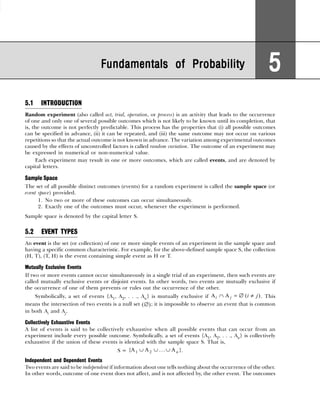
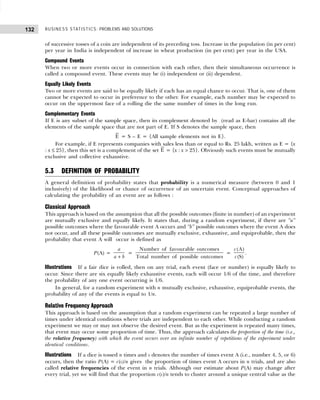
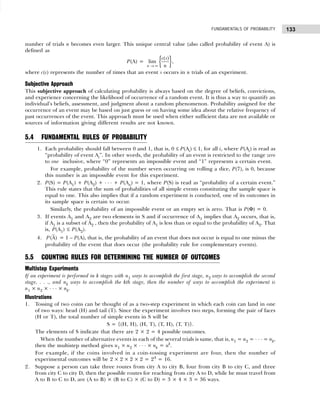
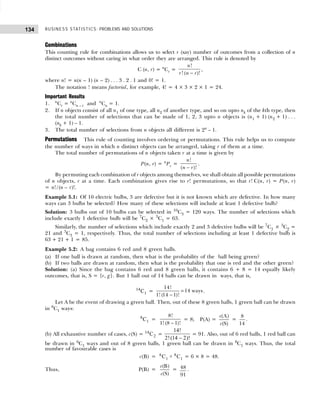
1.1 CLASSIFICATION OF DATA
Classification of data is the process of arranging data in groups/classes on the basis of certain properties.
Classification of statistical data serves the following purposes:
1. It condenses the raw data into a form suitable for statistical analysis.
2. It removes complexities and highlights the features of the data.
3. It facilitates comparisons and drawing inferences from the data. For example, if university students
in a particular course are divided according to sex, their results can be compared.
4. It provides information about the mutual relationships among elements of a data set. For example,
based on literacy and criminal tendency of a group of people, it can be established whether
literacy has any impact on criminal tendency or not.
5. It helps in statistical analysis by separating elements of the data set into homogeneous groups and
hence brings out the points of similarity and dissimilarity.
Basis of Classification
Generally, data are classified on the basis of the following four bases:
Geographical Classification In geographical classification, data are classified on the basis of geographical
or locational differences — such as cities, districts, or villages — between various elements of the data set.
The following is an example of a geographical distribution.
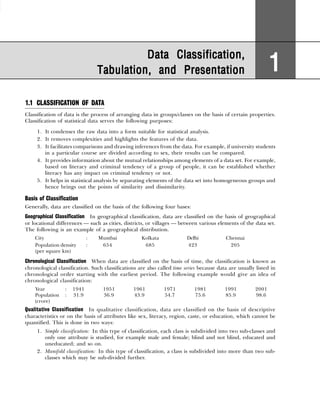
City : Mumbai Kolkata Delhi Chennai
Population density : 654 685 423 205
(per square km)
Chronological Classification When data are classified on the basis of time, the classification is known as
chronological classification. Such classifications are also called time series because data are usually listed in
chronological order starting with the earliest period. The following example would give an idea of
chronological classification:
Year : 1941 1951 1961 1971 1981 1991 2001
Population : 31.9 36.9 43.9 54.7 75.6 85.9 98.6
(crore)
Qualitative Classification In qualitative classification, data are classified on the basis of descriptive
characteristics or on the basis of attributes like sex, literacy, region, caste, or education, which cannot be
quantified. This is done in two ways:
1. Simple classification: In this type of classification, each class is subdivided into two sub-classes and
only one attribute is studied, for example male and female; blind and not blind, educated and
uneducated; and so on.
2. Manifold classification: In this type of classification, a class is subdivided into more than two sub-
classes which may be sub-divided further.
BUSINESS STATISTICS: PROBLEMS AND SOLUTIONS
2
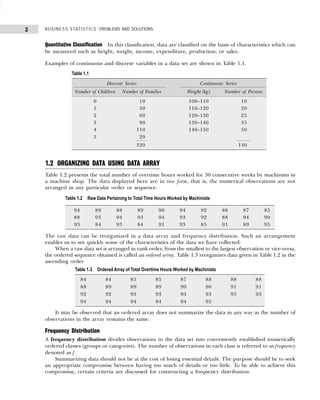
Table 1.3 Ordered Array of Total Overtime Hours Worked by Machinists
84 84 85 85 87 88 88 88
88 89 89 89 90 90 91 91
92 92 93 93 93 93 93 93
94 94 94 94 94 95
Quantitative Classification In this classification, data are classified on the basis of characteristics which can
be measured such as height, weight, income, expenditure, production, or sales.
Examples of continuous and discrete variables in a data set are shown in Table 1.1.
1.2 ORGANIZING DATA USING DATA ARRAY
Table 1.2 presents the total number of overtime hours worked for 30 consecutive weeks by machinists in
a machine shop. The data displayed here are in raw form, that is, the numerical observations are not
arranged in any particular order or sequence.
The raw data can be reorganized in a data array and frequency distribution. Such an arrangement
enables us to see quickly some of the characteristics of the data we have collected.
When a raw data set is arranged in rank order, from the smallest to the largest observation or vice-versa,
the ordered sequence obtained is called an ordered array. Table 1.3 reorganizes data given in Table 1.2 in the
ascending order
It may be observed that an ordered array does not summarize the data in any way as the number of
observations in the array remains the same.
Frequency Distribution
A frequency distribution divides observations in the data set into conveniently established numerically
ordered classes (groups or categories). The number of observations in each class is referred to as frequency
denoted as f.
Summarizing data should not be at the cost of losing essential details. The purpose should be to seek
an appropriate compromise between having too much of details or too little. To be able to achieve this
compromise, certain criteria are discussed for constructing a frequency distribution.
Table 1.1
Discrete Series Continuous Series
Number of Children Number of Families Weight (kg) Number of Persons
0 10 100–110 10
1 30 110–120 20
2 60 120–130 25
3 90 130–140 35
4 110 140–150 50
5 20
320 140
Table 1.2 Raw Data Pertaining to Total Time Hours Worked by Machinists
94 89 88 89 90 94 92 88 87 85
88 93 94 93 94 93 92 88 94 90
93 84 93 84 91 93 85 91 89 95
3
DATA CLASSIFICATION, TABULATION, AND PRESENTATION
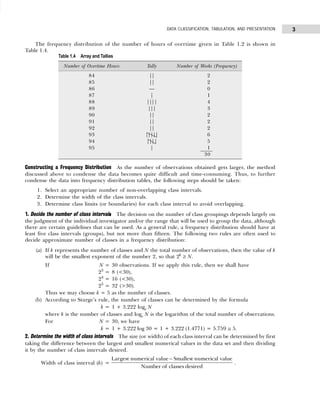
The frequency distribution of the number of hours of overtime given in Table 1.2 is shown in
Table 1.4.
Constructing a Frequency Distribution As the number of observations obtained gets larger, the method
discussed above to condense the data becomes quite difficult and time-consuming. Thus, to further
condense the data into frequency distribution tables, the following steps should be taken:
1. Select an appropriate number of non-overlapping class intervals.
2. Determine the width of the class intervals.
3. Determine class limits (or boundaries) for each class interval to avoid overlapping.
1. Decide the number of class intervals
s
s
s
s The decision on the number of class groupings depends largely on
the judgment of the individual investigator and/or the range that will be used to group the data, although
there are certain guidelines that can be used. As a general rule, a frequency distribution should have at
least five class intervals (groups), but not more than fifteen. The following two rules are often used to
decide approximate number of classes in a frequency distribution:
(a) If k represents the number of classes and N the total number of observations, then the value of k
will be the smallest exponent of the number 2, so that 2k
≥ N.
If N = 30 observations. If we apply this rule, then we shall have
23
= 8 (<30),
24
= 16 (<30),
25
= 32 (>30).
Thus we may choose k = 5 as the number of classes.
(b) According to Sturge’s rule, the number of classes can be determined by the formula
k = 1 + 3.222 loge N
where k is the number of classes and loge N is the logarithm of the total number of observations.
For N = 30, we have
k = 1 + 3.222 log 30 = 1 + 3.222 (1.4771) = 5.759 ≅ 5.
2. Determine the width of class intervals The size (or width) of each class interval can be determined by first
taking the difference between the largest and smallest numerical values in the data set and then dividing
it by the number of class intervals desired.
Width of class interval (h) =
−
Largest numerical value Smallest numerical value
Number of classes desired
.
Table 1.4 Array and Tallies
Number of Overtime Hours Tally Number of Weeks (Frequency)
84 || 2
85 || 2
86 — 0
87 | 1
88 |||| 4
89 ||| 3
90 || 2
91 || 2
92 || 2
93 ||||| 6
94 |||| 5
95 | 1
30
BUSINESS STATISTICS: PROBLEMS AND SOLUTIONS
4
The value obtained from this formula can be rounded off to a more convenient value based on the
investigator's preference.
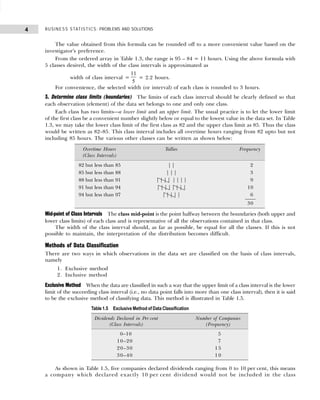
From the ordered array in Table 1.3, the range is 95 – 84 = 11 hours. Using the above formula with
5 classes desired, the width of the class intervals is approximated as
width of class interval =
11
5
= 2.2 hours.
For convenience, the selected width (or interval) of each class is rounded to 3 hours.
3. Determine class limits (boundaries) The limits of each class interval should be clearly defined so that
each observation (element) of the data set belongs to one and only one class.
Each class has two limits—a lower limit and an upper limit. The usual practice is to let the lower limit
of the first class be a convenient number slightly below or equal to the lowest value in the data set. In Table
1.3, we may take the lower class limit of the first class as 82 and the upper class limit as 85. Thus the class
would be written as 82–85. This class interval includes all overtime hours ranging from 82 upto but not
including 85 hours. The various other classes can be written as shown below:
Mid-point of Class Intervals The class mid-point is the point halfway between the boundaries (both upper and
lower class limits) of each class and is representative of all the observations contained in that class.
The width of the class interval should, as far as possible, be equal for all the classes. If this is not
possible to maintain, the interpretation of the distribution becomes difficult.
Methods of Data Classification
There are two ways in which observations in the data set are classified on the basis of class intervals,
namely
1. Exclusive method
2. Inclusive method
Exclusive Method When the data are classified in such a way that the upper limit of a class interval is the lower
limit of the succeeding class interval (i.e., no data point falls into more than one class interval), then it is said
to be the exclusive method of classifying data. This method is illustrated in Table 1.5.
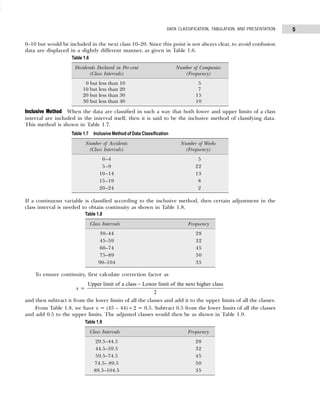
As shown in Table 1.5, five companies declared dividends ranging from 0 to 10 per cent, this means
a company which declared exactly 10 per cent dividend would not be included in the class
Overtime Hours Tallies Frequency
(Class Intervals)
82 but less than 85 | | 2
85 but less than 88 | | | 3
88 but less than 91 | | | | | | | | 9
91 but less than 94 | | | | | | | | 10
94 but less than 97 | | | | | 6
30
Table 1.5 Exclusive Method of Data Classification
Dividends Declared in Per cent Number of Companies
(Class Intervals) (Frequency)
0–10 5
10–20 7
20–30 1 5
30–40 1 0
5
DATA CLASSIFICATION, TABULATION, AND PRESENTATION
0–10 but would be included in the next class 10–20. Since this point is not always clear, to avoid confusion
data are displayed in a slightly different manner, as given in Table 1.6.
Inclusive Method When the data are classified in such a way that both lower and upper limits of a class
interval are included in the interval itself, then it is said to be the inclusive method of classifying data.
This method is shown in Table 1.7.
If a continuous variable is classified according to the inclusive method, then certain adjustment in the
class interval is needed to obtain continuity as shown in Table 1.8.
To ensure continuity, first calculate correction factor as
x =
Upper limit of a class Lower limit of the next higher class
2
−
and then subtract it from the lower limits of all the classes and add it to the upper limits of all the classes.
From Table 1.8, we have x = (45 – 44) ÷ 2 = 0.5. Subtract 0.5 from the lower limits of all the classes
and add 0.5 to the upper limits. The adjusted classes would then be as shown in Table 1.9.
Table 1.6
Dividends Declared in Per cent Number of Companies
(Class Intervals) (Frequency)
0 but less than 10 5
10 but less than 20 7
20 but less than 30 15
30 but less than 40 10
Table 1.7 Inclusive Method of Data Classification
Number of Accidents Number of Weeks
(Class Intervals) (Frequency)
0–4 5
5–9 22
10–14 13
15–19 8
20–24 2
Table 1.8
Class Intervals Frequency
30–44 28
45–59 32
60–74 45
75–89 50
90–104 35
Table 1.9
Class Intervals Frequency
29.5–44.5 28
44.5–59.5 32
59.5–74.5 45
74.5– 89.5 50
89.5–104.5 35
BUSINESS STATISTICS: PROBLEMS AND SOLUTIONS
6
Table 1.11 Guide to Determine the Number of Classes to Use
Number of Observations (N) Suggested Number of Classes
20 5
50 7
100 8
200 9
500 10
1000 11
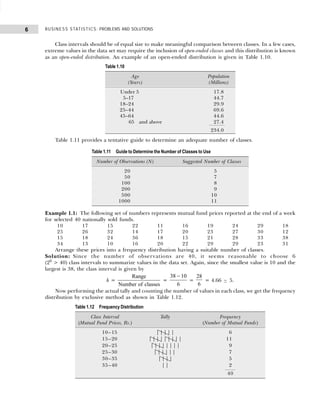
Class intervals should be of equal size to make meaningful comparison between classes. In a few cases,
extreme values in the data set may require the inclusion of open-ended classes and this distribution is known
as an open-ended distribution. An example of an open-ended distribution is given in Table 1.10.
Table 1.11 provides a tentative guide to determine an adequate number of classes.
Example 1.1: The following set of numbers represents mutual fund prices reported at the end of a week
for selected 40 nationally sold funds.
10 17 15 22 11 16 19 24 29 18
25 26 32 14 17 20 23 27 30 12
15 18 24 36 18 15 21 28 33 38
34 13 10 16 20 22 29 29 23 31
Arrange these prices into a frequency distribution having a suitable number of classes.
Solution: Since the number of observations are 40, it seems reasonable to choose 6
(26
> 40) class intervals to summarize values in the data set. Again, since the smallest value is 10 and the
largest is 38, the class interval is given by
h =
Range
Number of classes
=
38 10
6
−
=
28
6
= 4.66 _
~ 5.
Now performing the actual tally and counting the number of values in each class, we get the frequency
distribution by exclusive method as shown in Table 1.12.
Table 1.10
Age Population
(Years) (Millions)
Under 5 17.8
5–17 44.7
18–24 29.9
25–44 69.6
45–64 44.6
65 and above 27.4
234.0
Table 1.12 Frequency Distribution
Class Interval Tally Frequency
(Mutual Fund Prices, Rs.) (Number of Mutual Funds)
10–15 | | | | | 6
15–20 | | | | | | | | | 11
20–25 | | | | | | | | 9
25–30 | | | | | | 7
30–35 | | | | 5
35–40 | | 2
40
7
DATA CLASSIFICATION, TABULATION, AND PRESENTATION
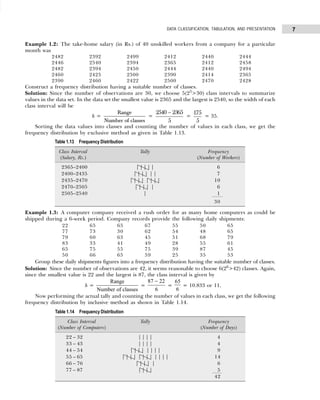
Example 1.2: The take-home salary (in Rs.) of 40 unskilled workers from a company for a particular
month was
2482 2392 2499 2412 2440 2444
2446 2540 2394 2365 2412 2458
2482 2394 2450 2444 2440 2494
2460 2425 2500 2390 2414 2365
2390 2460 2422 2500 2470 2428
Construct a frequency distribution having a suitable number of classes.
Solution: Since the number of observations are 30, we choose 5(25
>30) class intervals to summarize
values in the data set. In the data set the smallest value is 2365 and the largest is 2540, so the width of each
class interval will be
h =
Range
Number of classes
=
2540 – 2365
5
=
175
5
= 35.
Sorting the data values into classes and counting the number of values in each class, we get the
frequency distribution by exclusive method as given in Table 1.13.
Example 1.3: A computer company received a rush order for as many home computers as could be
shipped during a 6-week period. Company records provide the following daily shipments:
22 65 65 67 55 50 65
77 73 30 62 54 48 65
79 60 63 45 51 68 79
83 33 41 49 28 55 61
65 75 55 75 39 87 45
50 66 65 59 25 35 53
Group these daily shipments figures into a frequency distribution having the suitable number of classes.
Solution: Since the number of observations are 42, it seems reasonable to choose 6(26
>42) classes. Again,
since the smallest value is 22 and the largest is 87, the class interval is given by
h =
Range
Number of classes
=
87 22
6
−
=
65
6
= 10.833 or 11.
Now performing the actual tally and counting the number of values in each class, we get the following
frequency distribution by inclusive method as shown in Table 1.14.
Table 1.13 Frequency Distribution
Class Interval Tally Frequency
(Salary, Rs.) (Number of Workers)
2365–2400 | | | | | 6
2400–2435 | | | | | | 7
2435–2470 | | | | | | | | 10
2470–2505 | | | | | 6
2505–2540 | 1
30
Table 1.14 Frequency Distribution
Class Interval Tally Frequency
(Number of Computers) (Number of Days)
22 – 32 | | | | 4
33 – 43 | | | | 4
44 – 54 | | | | | | | | 9
55 – 65 | | | | | | | | | | | | 14
66 – 76 | | | | | 6
77 – 87 | | | | 5
42
BUSINESS STATISTICS: PROBLEMS AND SOLUTIONS
8
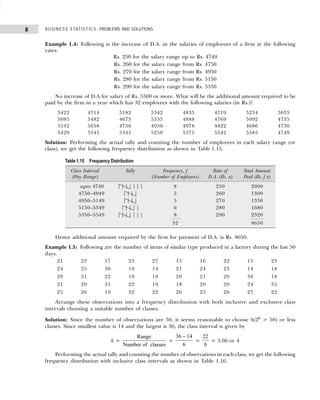
Example 1.4: Following is the increase of D.A. in the salaries of employees of a firm at the following
rates.
Rs. 250 for the salary range up to Rs. 4749
Rs. 260 for the salary range from Rs. 4750
Rs. 270 for the salary range from Rs. 4950
Rs. 280 for the salary range from Rs. 5150
Rs. 290 for the salary range from Rs. 5350
No increase of D.A for salary of Rs. 5500 or more. What will be the additional amount required to be
paid by the firm in a year which has 32 employees with the following salaries (in Rs.)?
5422 4714 5182 5342 4835 4719 5234 5035
5085 5482 4673 5335 4888 4769 5092 4735
5542 5058 4730 4930 4978 4822 4686 4730
5429 5545 5345 5250 5375 5542 5585 4749
Solution: Performing the actual tally and counting the number of employees in each salary range (or
class), we get the following frequency distribution as shown in Table 1.15.
Hence additional amount required by the firm for payment of D.A. is Rs. 8650.
Example 1.5: Following are the number of items of similar type produced in a factory during the last 50
days.
21 22 17 23 27 15 16 22 15 23
24 25 36 19 14 21 24 25 14 18
20 31 22 19 18 20 21 20 36 18
21 20 31 22 19 18 20 20 24 35
25 26 19 32 22 26 25 26 27 22
Arrange these observations into a frequency distribution with both inclusive and exclusive class
intervals choosing a suitable number of classes.
Solution: Since the number of observations are 50, it seems reasonable to choose 6(26
> 50) or less
classes. Since smallest value is 14 and the largest is 36, the class interval is given by
h =
Range
Number of classes
=
36 14
6
−
=
22
6
= 3.66 or 4
Performing the actual tally and counting the number of observations in each class, we get the following
frequency distribution with inclusive class intervals as shown in Table 1.16.
Table 1.15 Frequency Distribution
Class Interval Tally Frequency, f Rate of Total Amount
(Pay Range) (Number of Employees) D.A. (Rs. x) Paid (Rs. f x)
upto 4749 | | | | | | | 8 250 2000
4750–4949 | | | | 5 260 1300
4950–5149 | | | | 5 270 1350
5150–5349 | | | | | 6 280 1680
5350–5549 | | | | | | | 8 290 2320
32 8650
9
DATA CLASSIFICATION, TABULATION, AND PRESENTATION
Converting the class intervals shown in Table 1.16 into exclusive class intervals is shown in Table 1.17.
Example 1.6: Classify the following data by taking class such that their mid-values are 17, 22, 27, 32, and
so on.
30 42 30 54 40 48 15 17 51 42 25 41
30 27 42 36 28 26 37 54 44 31 36 40
36 22 30 31 19 48 16 42 32 21 22 46
33 41 21
[Madurai-Kamaraj Univ., B.Com., 2005]
Solution: Since we have to classify the data in such a manner that the mid-values are 17, 22, 27, etc., the
first class should be 15–19 (mid-value = (15 + 19)/2 = 17), second class should be 20–24, etc. Performing
the actual tally and counting the number of observations in each class we get the frequency distribution as
shown in Table 1.18.
Table 1.18 Frequency Distribution with Inclusive Class Intervals
Marks Tallies Frequency
15–19 |||| 4
20–24 |||| 4
25–29 |||| 4
30–34 |||| ||| 8
35–39 |||| 4
40–44 |||| |||| 9
45–49 ||| 3
50–54 ||| 3
39
Table 1.16 Frequency Distribution with Inclusive Class Intervals
Class Intervals Tally Frequency
(Number of Items Produced)
14–17 | | | | | 6
18–21 | | | | | | | | | | | | | | | 18
22–25 | | | | | | | | | | | | 15
26–29 | | | | 5
30–33 | | | 3
34–33 | | | 3
50
Table 1.17 Frequency Distribution with Exclusive Class Intervals
Class Intervals Mid-Value of Frequency
Class Intervals (Number of Items Produced)
13.5–17.5 15.5 6
17.5–21.5 19.5 18
21.5–25.5 23.5 15
25.5–29.5 27.5 5
29.5–33.5 31.5 3
33.5–37.5 34.5 3
BUSINESS STATISTICS: PROBLEMS AND SOLUTIONS
10
Example 1.7: Marks obtained by 50 students are given below:
31 13 46 31 30 45 38 42 30 9
30 30 46 36 2 41 44 18 29 63
44 30 19 5 44 15 7 25 12 30
6 22 24 37 15 6 39 32 21 20
42 31 19 14 23 28 17 53 22 21
Construct a grouped frequency distribution. [Calicut Univ., M.Com., 2006]
Solution: Since the number of observations are 50, we may choose 6(26
>50) or less classes.
The lowest value is 2 and largest 63, the class intervals shall be
h =
Range
Number of Classes
= ≈
63 – 2 61
= =10.1 11
6 6
.
The frequency distribution is shown in Table 1.19.
Table 1.19 Frequency Distribution
Marks Tallies Frequency
(Number of Students)
2–12 |||| || 7
13–23 |||| |||| |||| 14
24–34 |||| |||| |||| 14
35–45 |||| |||| |||| 13
45–56 | 1
57–67 1 1
50
Example 1.8: Point out the mistakes in the following table to show the distribution of population according
to sex, age, and literacy.
Sex 0–25 25–25 50–75 75–100
Males
Females
[Bombay Univ., M.Com., 1995]
Solution: All the characteristics are not revealed in the given table. The characteristic of literacy are
complete and hence table needs to be re-arranged as shown in Table 1.20.
Table 1.20 Distribution of Population According to Age, Sex, and Literacy
Age Groups Literates Illiterates Total
M F Total M F Total M F Total
0–25 — — — — — — — — —
25–50 — — — — — — — — —
50–75 — — — — — — — — —
75–100 — — — — — — — — —
Total — — — — — — — — —
Example 1.9: (a) Present the following data of the percentage marks of 60 students in the form of a
frequency table with 10 classes of equal width, one class being 50–59.
41 17 33 63 54 92 60 58 70 06 67 82
33 44 57 49 34 73 54 63 36 52 32 75
60 33 09 79 28 30 42 93 43 80 03 32
57 67 24 64 63 11 35 82 10 23 00 41
60 32 72 53 92 88 62 55 60 33 40 57
[CSI, Foundation, 2007]
11
DATA CLASSIFICATION, TABULATION, AND PRESENTATION
(b) A sample consists of 34 observations recorded correct to the nearest integer, ranging in value from
201 to 337. If it is decided to use seven classes of width 20 integers and to begin in the first class at 199.5,
find the class marks of the seven classes. [Calicut Univ., B.Sc., 2004]
Solution: (a) Since the number of observations are 60, we may choose 6(26
> 60) or less class intervals.
The class interval is given by
h =
Range
Number of class
=
93 – 0
6
= 15 (approx.)
The frequency distribution with inclusive intervals is shown in Table 1.21.
Table 1.21 Frequency Distribution
Marks Tallies Frequency
0–15 ||||| 6
16–31 |||| 5
32–47 |||| |||| |||| | 16
48–63 |||| |||| |||| ||| 18
64–79 |||| ||| 8
80–95 |||| || 7
60
(b) Since it is decided to begin with 199.5 and takes a classes interval of 20, the first class will be
199.5–219.5, the second would be 219.5–239.5, and so on. The class mark shall be obtained by adding
the lower and upper limits and dividing it by 2. Thus, for the first class, the marks shall be (199.5) +
(219.5)/2 = 209.5. Since class interval is equal the other class marks can be obtained by adding 20 to
the preceding class mark. Table 1.22 gives the class limits and class marks of the seven classes.
Table 1.22
Class Limits Class Marks
199.5–219.5 206.5
219.5–239.5 229.5
239.5–259.5 249.5
259.5–279.5 269.5
279.5–299.5 289.5
299.5–319.5 309.5
319.5–339.5 329.5
Bivariate Frequency Distribution
The frequency distributions discussed so far involved only one variable and are therefore called univariate
frequency distributions. In case the data involve two variables (such as profit and expenditure on advertisements
of a group of companies, income and expenditure of a group of individuals, supply and demand of a
commodity, etc.), then frequency distribution so obtained as a result of cross classification is called bivariate
frequency distribution. It can be summarized in the form of a two-way (bivariate) frequency table and the values
of each variable are grouped into various classes (not necessarily same for each variable) in the same way
as for univariate distributions.
Frequency distribution of variable x for a given value of y is obtained by the values of x and vice versa.
Such frequencies in each cell are called conditional frequencies. The frequencies of the values of variables x
and y together with their frequency totals are called the marginal frequencies.
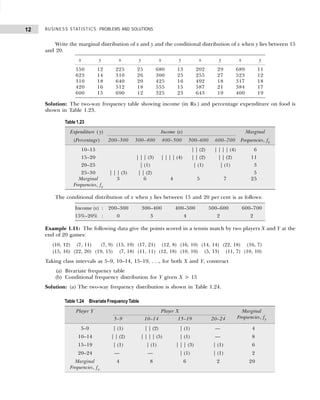
Example 1.10: The following figures indicate income (x) and percentage expenditure on food (y) of 25
families. Construct a bivariate frequency table classifying x into intervals 200–300, 300–400, . . ., and y
into 10–15, 15–20, . . .
BUSINESS STATISTICS: PROBLEMS AND SOLUTIONS
12
Write the marginal distribution of x and y and the conditional distribution of x when y lies between 15
and 20.
Solution: The two-way frequency table showing income (in Rs.) and percentage expenditure on food is
shown in Table 1.23.
The conditional distribution of x when y lies between 15 and 20 per cent is as follows:
Example 1.11: The following data give the points scored in a tennis match by two players X and Y at the
end of 20 games:
(10, 12) (7, 11) (7, 9) (15, 19) (17, 21) (12, 8) (16, 10) (14, 14) (22, 18) (16, 7)
(15, 16) (22, 20) (19, 15) (7, 18) (11, 11) (12, 18) (10, 10) (5, 13) (11, 7) (10, 10)
Taking class intervals as 5–9, 10–14, 15–19, . . ., for both X and Y, construct
(a) Bivariate frequency table
(b) Conditional frequency distribution for Y given X > 15
Solution: (a) The two-way frequency distribution is shown in Table 1.24.
x y x y x y x y x y
550 12 225 25 680 13 202 29 689 11
623 14 310 26 300 25 255 27 523 12
310 18 640 20 425 16 492 18 317 18
420 16 512 18 555 15 587 21 384 17
600 15 690 12 325 23 643 19 400 19
Table 1.23
Expenditure ( y) Income (x) Marginal
(Percentage) 200–300 300–400 400–500 500–600 600–700 Frequencies, fy
10–15 | | (2) | | | | (4) 6
15–20 | | | (3) | | | | (4) | | (2) | | (2) 11
20–25 | (1) | (1) | (1) 3
25–30 | | | (3) | | (2) 5
Marginal 3 6 4 5 7 25
Frequencies, fx
Income (x) : 200–300 300–400 400–500 500–600 600–700
15%–20% : 0 3 4 2 2
Table 1.24 Bivariate Frequency Table
Player Y Player X Marginal
5–9 10–14 15–19 20–24 Frequencies, fy
5–9 | (1) | | (2) | (1) — 4
10–14 | | (2) | | | | (5) | (1) — 8
15–19 | (1) | (1) | | | (3) | (1) 6
20–24 — — | (1) | (1) 2
Marginal 4 8 6 2 20
Frequencies, fx
13
DATA CLASSIFICATION, TABULATION, AND PRESENTATION
(ii) Conditional frequency distribution for Y given X>15.
Example 1.12: 30 pairs of values of two variables X and Y are given below. From a two-way table,
X 14 20 33 25 41 18 24 29 38 45
Y 148 242 296 312 518 196 214 340 492 568
X 23 32 37 19 28 34 38 29 44 40
Y 282 400 288 292 431 440 500 512 415 514
X 22 39 43 44 12 27 39 38 17 26
Y 282 481 516 598 122 200 451 387 245 413
Take class intervals of X as 10–20, 20–30, etc., and that of Y as 100–200, 200–300. etc.
[Osmania Univ., B.Com., 2006]
Solution: The two-way frequency distribution is shown in Table 1.25.
Table 1.25 Bivariable Frequency Table
Y↓ X→ 10–20 20–30 30–40 40–50 Total
100–200 ||| (3) — — — 3
200–300 || (2) |||| (5) || (2) — 9
300–400 — || (2) | (1) — 3
400–500 — || (2) |||| (5) | (1) 8
500–600 — | (1) | (1) |||| (5) 7
Total 5 10 9 6 30
Types of Frequency Distributions
Cumulative Frequency Distribution Sometimes it is preferable to present data in a cumulative frequency (cf )
distribution. A cumulative frequency distribution is of two types: (i) more than type and (ii) less than type.
In a less than cumulative frequency distribution, the frequencies of each class interval are added
successively from top to bottom and represent the cumulative number of observations less than or equal
to the class frequency to which it relates. But in the more than cumulative frequency distribution, the
frequencies of each class interval are added successively from bottom to top and represent the cumulative
number of observations greater than or equal to the class frequency to which it relates.
The frequency distribution given in Table 1.26 illustrates the concept of cumulative frequency
distribution.
Player Y Player X
15–19 20–24
5–9 1 —
10–14 1 —
15–19 3 1
20–24 1 1
6 2
Table 1.26 Cumulative Frequency Distribution
Number of Accidents Number of Weeks Cumulative Frequency Cumulative Frequency
(Frequency) (less than) (more than)
0–4 5 5 45 + 5 = 50
5–9 22 5 + 22 = 27 23 + 22 = 45
10–14 13 27 + 13 = 40 10 + 13 = 23
15–19 8 40 + 8 = 48 2 + 8 = 10
20–24 2 48 + 2 = 50 2
BUSINESS STATISTICS: PROBLEMS AND SOLUTIONS
14
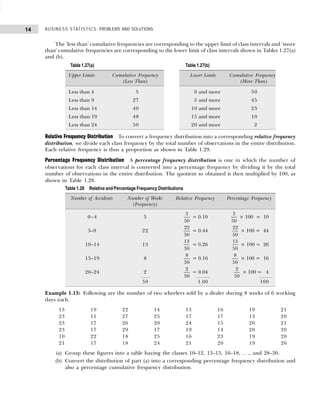
The ‘less than’ cumulative frequencies are corresponding to the upper limit of class intervals and ‘more
than’ cumulative frequencies are corresponding to the lower limit of class intervals shown in Tables 1.27(a)
and (b).
Relative Frequency Distribution To convert a frequency distribution into a corresponding relative frequency
distribution, we divide each class frequency by the total number of observations in the entire distribution.
Each relative frequency is thus a proportion as shown in Table 1.29.
Percentage Frequency Distribution A percentage frequency distribution is one in which the number of
observations for each class interval is converted into a percentage frequency by dividing it by the total
number of observations in the entire distribution. The quotient so obtained is then multiplied by 100, as
shown in Table 1.28.
Example 1.13: Following are the number of two wheelers sold by a dealer during 8 weeks of 6 working
days each.
13 19 22 14 13 16 19 21
23 11 27 25 17 17 13 20
23 17 26 20 24 15 20 21
23 17 29 17 19 14 20 20
10 22 18 25 16 23 19 20
21 17 18 24 21 20 19 26
(a) Group these figures into a table having the classes 10–12, 13–15, 16–18, . . ., and 28–30.
(b) Convert the distribution of part (a) into a corresponding percentage frequency distribution and
also a percentage cumulative frequency distribution.
Table 1.27(a) Table 1.27(b)
Upper Limits Cumulative Frequency Lower Limits Cumulative Frequency
(Less Than) (More Than)
Less than 4 5 0 and more 50
Less than 9 27 5 and more 45
Less than 14 40 10 and more 23
Less than 19 48 15 and more 10
Less than 24 50 20 and more 2
Table 1.28 Relative and Percentage Frequency Distributions
Number of Accidents Number of Weeks Relative Frequency Percentage Frequency
(Frequency)
0–4 5
5
50
= 0.10
5
50
× 100 = 10
5–9 22
22
50
= 0.44
22
50
× 100 = 44
10–14 13
13
50
= 0.26
13
50
× 100 = 26
15–19 8
8
50
= 0.16
8
50
× 100 = 16
20–24 2
2
50
= 0.04
2
50
× 100 = 4
50 1.00 100
15
DATA CLASSIFICATION, TABULATION, AND PRESENTATION
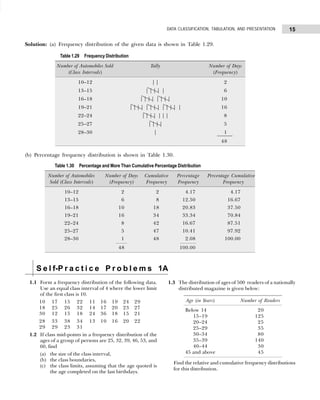
Solution: (a) Frequency distribution of the given data is shown in Table 1.29.
(b) Percentage frequency distribution is shown in Table 1.30.
Table 1.29 Frequency Distribution
Number of Automobiles Sold Tally Number of Days
(Class Intervals) (Frequency)
10–12 | | 2
13–15 | | | | | 6
16–18 | | | | | | | | 10
19–21 | | | | | | | | | | | | | 16
22–24 | | | | | | | 8
25–27 | | | | 5
28–30 | 1
48
Table 1.30 Percentage and More Than Cumulative Percentage Distribution
Number of Automobiles Number of Days Cumulative Percentage Percentage Cumulative
Sold (Class Intervals) (Frequency) Frequency Frequency Frequency
10–12 2 2 4.17 4.17
13–15 6 8 12.50 16.67
16–18 10 18 20.83 37.50
19–21 16 34 33.34 70.84
22–24 8 42 16.67 87.51
25–27 5 47 10.41 97.92
28–30 1 48 2.08 100.00
48 100.00
S e l f-P r a c t i c e P r o b l e m s 1A
1.1 Form a frequency distribution of the following data.
Use an equal class interval of 4 where the lower limit
of the first class is 10.
10 17 15 22 11 16 19 24 29
18 25 26 32 14 17 20 23 27
30 12 15 18 24 36 18 15 21
28 33 38 34 13 10 16 20 22
29 29 23 31
1.2 If class mid-points in a frequency distribution of the
ages of a group of persons are 25, 32, 39, 46, 53, and
60, find
(a) the size of the class interval,
(b) the class boundaries,
(c) the class limits, assuming that the age quoted is
the age completed on the last birthdays.
1.3 The distribution of ages of 500 readers of a nationally
distributed magazine is given below:
Age (in Years) Number of Readers
Below 14 20
15–19 125
20–24 25
25–29 35
30–34 80
35–39 140
40–44 30
45 and above 45
Find the relative and cumulative frequency distributions
for this distribution.
BUSINESS STATISTICS: PROBLEMS AND SOLUTIONS
16
1.4 The distribution of inventory to sales ratio of 200 retail
outlets is given below:
Inventory to Sales Ratio Number of Retail Outlets
1.0–1.2 20
1.2–1.4 30
1.4–1.6 60
1.6–1.8 40
1.8–2.0 30
2.0–2.2 15
2.2–2.4 5
Find the relative and cumulative frequency
distributions for this distribution.
1.5 A wholesaler’s daily shipments of a particular item
varied from 1,152 to 9,888 units per day. Indicate the
limits of nine classes into which these shipments might
be grouped.
1.6 A college book store groups the monetary value of its
sales into a frequency distribution with the classes,
Rs. 400–500, Rs. 501–600, and Rs. 601 and over. Is it
possible to determine from this distribution the
amount of sales
(a) less than Rs. 601 (b) less than Rs. 501
(c) Rs. 501 or more?
1.7 Theclassmarksofdistributionofthenumberofelectric
lightbulbsreplaceddailyinanofficebuildingare5,10,
15, and 20. Find (a) the class boundaries and (b) class
limits.
1.8 The marks obtained by 25 students in Statistics and
Economics are given below. The first figure in the
bracket indicates the marks in Statistics and the second
in Economics.
(14, 12) (0, 2) (1, 5) (7, 3) (15, 9)
(2, 8) (12, 18) (9, 11) (5, 3) (17, 13)
(19, 18) (11, 7) (10, 13) (13, 16) (16, 14)
(6, 10) (4, 1) (9, 15) (11, 14) (8, 3)
(13, 11) (14, 17) (10, 10) (11, 7) (15, 15)
Prepare a two-way frequency table taking the width of
each class interval as 4 marks, the first being less than 4.
1.9 Prepare a bivariate frequency distribution for the
following data for 20 students:
Marks in Law: 10 11 10 11 11
14 12 12 13 10
Marks in Statistics: 20 21 22 21 23
23 22 21 24 23
Marks in Law: 13 12 11 12 10
14 14 12 13 10
Marks in Statistics: 24 23 22 23 22
22 24 20 24 23
Also prepare
(a) a marginal frequency table for marks in Law and
Statistics
(b) a conditional frequency distribution for marks in
Law when the marks in Statistics are more than 22.
1.10 Classify the following data by taking class intervals
such that their mid-values are 17, 22, 27, 32, and so
on:
30 42 30 54 40 48 15 17 51
42 25 41 30 27 42 36 28 26
37 54 44 31 36 40 36 22 30
31 19 48 16 42 32 21 22 46
33 41 21
[Madurai-Kamraj Univ., B.Com., 1995]
1.11 In degree colleges of a city, no teacher is less than 30
years or more than 60 years in age. Their cumulative
frequencies are as follows:
Less than : 60 55 50 45
40 35 30 25
Total frequency : 980 925 810 675
535 380 220 75
Find the frequencies in the class intervals 25–30,
30–35, . . .
H i n t s a n d A n s w e r s
1.1 The classes for preparing frequency distribution by
inclusive method will be
10–13, 14–17, 18–21, . . ., 34–37, 38–41
1.2 (a) Size of the class interval = Difference between the
mid-values of any two consecutive classes = 7
(b) The class boundaries for different classes are
obtained by adding (for upper class boundaries
or limits) and subtracting (for lower class
boundaries or limits) half the magnitude of the
class interval, that is, 7 ÷ 2 = 3.5 from the mid-
values.
Class Intervals:
21.5–28.5 28.5–35.5 35.5–42.5
Mid-Values: 25 32 39
Class Intervals:
42.5–49.5 49.5–56.5 56.5–63.5
Mid-Values: 46 53 60
(c) The distribution can be expressed in inclusive
class intervals with width of 7 as 22–28, 29–35,
. . ., 56–63.
1.5 One possibility is 1000–1999, 2000–2999,
3000–3999, . . ., 9000–9999 units of the item.
17
DATA CLASSIFICATION, TABULATION, AND PRESENTATION
1.11
Age (year) Cumulative
Frequency Age Frequency
Less than 25 275 20–25 75
Less than 30 220 25–30 220 – 75 = 145
Less than 35 380 30–35 380 – 220 = 160
Less than 40 535 35–40 535 – 380 = 155
1.3 TABULATION OF DATA
Tabulation is another way of summarizing and presenting the given data in a systematic form in rows and
columns. Such presentation facilitates comparisons by bringing related information close to each other
and helps in further statistical analysis and interpretation.
Parts of a Table
1. Table number: A table should be numbered for easy identification and reference in future. The table
number may be given either in the centre or side of the table but above the top of the title of the table.
If the number of columns in a table is large, then these can also be numbered so that easy reference to
these is possible.
2. Title of the table: Each table must have a brief, self-explanatory, and complete title which can
(a) indicate the nature of data contained.
(b) explain the locality (i.e., geographical or physical) of data covered.
(c) indicate the time (or period) of data obtained.
(d) contain the source of the data to indicate the authority for the data, as a means of verification and as
a reference. The source is always placed below the table.
3. Caption and stubs: The headings for columns and rows are called caption and stub, respectively.
They must be clear and concise.
4. Body: The body of the table should contain the numerical information. The numerical information is
arranged according to the descriptions given for each column and row.
5. Prefactory or head note: If needed, a prefactory note is given just below the title for its further
description in a prominent type. It is usually enclosed in brackets and is about the unit of measurement.
6. Footnotes: Anything written below the table is called a footnote. It is written to further clarify either
the title captions or stubs. For example, if the data described in the table pertain to profits earned by
a company, then the footnote may define whether it is profit before tax or after tax. There are various
ways of identifying footnotes:
(a) Numbering footnotes consecutively with small number 1, 2, 3, ..., or letters a, b, c, ..., or star *,
**, . . .
(b) Sometimes symbols like @ or $ are also used to identify footnotes.
A blank model table is given below:
Age (year) Cumulative
Frequency Age Frequency
Less than 45 675 40–45 675 – 535 = 140
Less than 50 810 45–50 810 – 675 = 135
Less than 55 925 50–55 925 – 810 = 115
Less than 60 980 55–60 980 – 925 = 55
Table Number and Title [Head or Prefactory Note (if any)]
Stub Heading Caption Total (Rows)
Subhead Subhead
Column-head Column-head Column-head Column-head
Stub Entries
Total (Columns)
Footnote :
Source Note :
BUSINESS STATISTICS: PROBLEMS AND SOLUTIONS
18
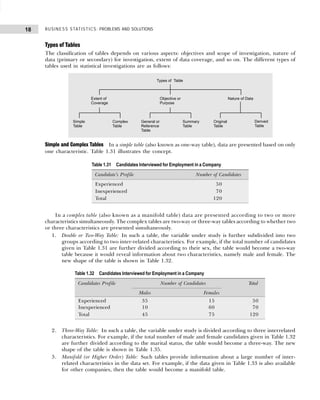
Types of Tables
The classification of tables depends on various aspects: objectives and scope of investigation, nature of
data (primary or secondary) for investigation, extent of data coverage, and so on. The different types of
tables used in statistical investigations are as follows:
Simple and Complex Tables In a simple table (also known as one-way table), data are presented based on only
one characteristic. Table 1.31 illustrates the concept.
In a complex table (also known as a manifold table) data are presented according to two or more
characteristics simultaneously. The complex tables are two-way or three-way tables according to whether two
or three characteristics are presented simultaneously.
1. Double or Two-Way Table: In such a table, the variable under study is further subdivided into two
groups according to two inter-related characteristics. For example, if the total number of candidates
given in Table 1.31 are further divided according to their sex, the table would become a two-way
table because it would reveal information about two characteristics, namely male and female. The
new shape of the table is shown in Table 1.32.
2. Three-Way Table: In such a table, the variable under study is divided according to three interrelated
characteristics. For example, if the total number of male and female candidates given in Table 1.32
are further divided according to the marital status, the table would become a three-way. The new
shape of the table is shown in Table 1.35.
3. Manifold (or Higher Order) Table: Such tables provide information about a large number of inter-
related characteristics in the data set. For example, if the data given in Table 1.33 is also available
for other companies, then the table would become a manifold table.
Table 1.31 Candidates Interviewed for Employment in a Company
Candidate’s Profile Number of Candidates
Experienced 50
Inexperienced 70
Total 120
Table 1.32 Candidates Interviewed for Employment in a Company
Candidates Profile Number of Candidates Total
Males Females
Experienced 35 15 50
Inexperienced 10 60 70
Total 45 75 120
19
DATA CLASSIFICATION, TABULATION, AND PRESENTATION
Original and Derived Tables Original tables are also called classification tables. Such a table contains data
collected from a primary source. But if the information given in a table has been derived from a general
table, then such a table is called a derived table.
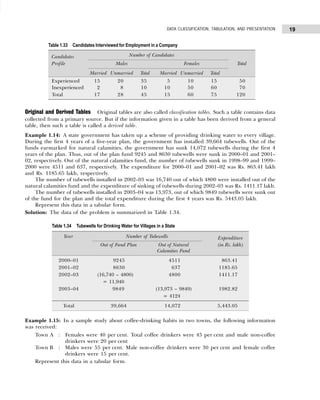
Example 1.14: A state government has taken up a scheme of providing drinking water to every village.
During the first 4 years of a five-year plan, the government has installed 39,664 tubewells. Out of the
funds earmarked for natural calamities, the government has sunk 14,072 tubewells during the first 4
years of the plan. Thus, out of the plan fund 9245 and 8630 tubewells were sunk in 2000–01 and 2001–
02, respectively. Out of the natural calamities fund, the number of tubewells sunk in 1998–99 and 1999–
2000 were 4511 and 637, respectively. The expenditure for 2000–01 and 2001–02 was Rs. 863.41 lakh
and Rs. 1185.65 lakh, respectively.
The number of tubewells installed in 2002–03 was 16,740 out of which 4800 were installed out of the
natural calamities fund and the expenditure of sinking of tubewells during 2002–03 was Rs. 1411.17 lakh.
The number of tubewells installed in 2003–04 was 13,973, out of which 9849 tubewells were sunk out
of the fund for the plan and the total expenditure during the first 4 years was Rs. 5443.05 lakh.
Represent this data in a tabular form.
Solution: The data of the problem is summarized in Table 1.34.
Example 1.15: In a sample study about coffee-drinking habits in two towns, the following information
was received:
Town A : Females were 40 per cent. Total coffee drinkers were 45 per cent and male non-coffee
drinkers were 20 per cent
Town B : Males were 55 per cent. Male non-coffee drinkers were 30 per cent and female coffee
drinkers were 15 per cent.
Represent this data in a tabular form.
Table 1.33 Candidates Interviewed for Employment in a Company
Candidates Number of Candidates
Profile Males Females Total
Married Unmarried Total Married Unmarried Total
Experienced 15 20 35 5 10 15 50
Inexperienced 2 8 10 10 50 60 70
Total 17 28 45 15 60 75 120
Table 1.34 Tubewells for Drinking Water for Villages in a State
Year Number of Tubewells Expenditure
Out of Fund Plan Out of Natural (in Rs. lakh)
Calamities Fund
2000–01 9245 4511 863.41
2001–02 8630 637 1185.65
2002–03 (16,740 – 4800) 4800 1411.17
= 11,940
2003–04 9849 (13,973 – 9849) 1982.82
= 4124
Total 39,664 14,072 5,443.05
BUSINESS STATISTICS: PROBLEMS AND SOLUTIONS
20
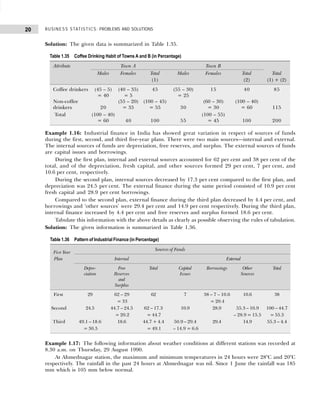
Solution: The given data is summarized in Table 1.35.
Example 1.16: Industrial finance in India has showed great variation in respect of sources of funds
during the first, second, and third five-year plans. There were two main sources—internal and external.
The internal sources of funds are depreciation, free reserves, and surplus. The external sources of funds
are capital issues and borrowings.
During the first plan, internal and external sources accounted for 62 per cent and 38 per cent of the
total, and of the depreciation, fresh capital, and other sources formed 29 per cent, 7 per cent, and
10.6 per cent, respectively.
During the second plan, internal sources decreased by 17.3 per cent compared to the first plan, and
depreciation was 24.5 per cent. The external finance during the same period consisted of 10.9 per cent
fresh capital and 28.9 per cent borrowings.
Compared to the second plan, external finance during the third plan decreased by 4.4 per cent, and
borrowings and ‘other sources’ were 29.4 per cent and 14.9 per cent respectively. During the third plan,
internal finance increased by 4.4 per cent and free reserves and surplus formed 18.6 per cent.
Tabulate this information with the above details as clearly as possible observing the rules of tabulation.
Solution: The given information is summarized in Table 1.36.
Example 1.17: The following information about weather conditions at different stations was recorded at
8.30 a.m. on Thursday, 29 August 1990.
At Ahmednagar station, the maximum and minimum temperatures in 24 hours were 28°C and 20°C
respectively. The rainfall in the past 24 hours at Ahmednagar was nil. Since 1 June the rainfall was 185
mm which is 105 mm below normal.
Table 1.36 Pattern of Industrial Finance (in Percentage)
Five Year
Sources of Funds
Plan Internal External
Depre- Free Total Capital Borrowings Other Total
ciation Reserves Issues Sources
and
Surplus
First 29 62 – 29 62 7 38 – 7 – 10.6 10.6 38
= 33 = 20.4
Second 24.5 44.7 – 24.5 62 – 17.3 10.9 28.9 55.3 – 10.9 100 – 44.7
= 20.2 = 44.7 – 28.9 = 15.5 = 55.3
Third 49.1 – 18.6 18.6 44.7 + 4.4 50.9 – 29.4 29.4 14.9 55.3 – 4.4
= 30.5 = 49.1 – 14.9 = 6.6
Table 1.35 Coffee Drinking Habit of Towns A and B (in Percentage)
Attribute Town A Town B
Males Females Total Males Females Total Total
(1) (2) (1) + (2)
Coffee drinkers (45 – 5) (40 – 35) 45 (55 – 30) 15 40 85
= 40 = 5 = 25
Non-coffee (55 – 20) (100 – 45) (60 – 30) (100 – 40)
drinkers 20 = 35 = 55 30 = 30 = 60 115
Total (100 – 40) (100 – 55)
= 60 40 100 55 = 45 100 200
21
DATA CLASSIFICATION, TABULATION, AND PRESENTATION
Bangalore’s minimum and maximum temperatures in 24 hours for the day were 19°C and 23°C
respectively. It had no rainfall in the past 24 hrs and since 1 June the rainfall was 252 mm which is 54 mm
below normal.
The minimum temperature at Udaipur was 21°C and the rainfall in the past 24 hours was nil. Since
1 June it experienced 434 mm of rainfall which is 24 mm below normal.
Panagarh’s maximum temperature in 24 hours was 28°C. It had 4 mm of rain in the past 24 hours
and since 1 June it had 955 mm of rain.
Kolkata’s maximum and minimum day temperatures were 30°C and 26°C respectively. It had 3 mm of
rainfall in the past 24 hours. Since 1 June it experienced a rainfall of 1079 mm which is 154 mm above
normal.
Present the above data in a tabular form.
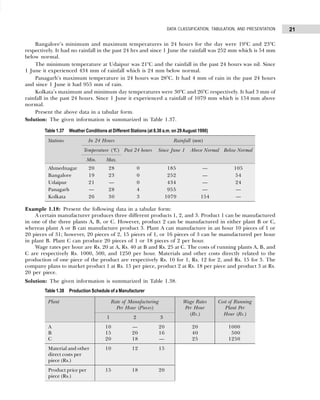
Solution: The given information is summarized in Table 1.37.
Example 1.18: Present the following data in a tabular form:
A certain manufacturer produces three different products 1, 2, and 3. Product 1 can be manufactured
in one of the three plants A, B, or C. However, product 2 can be manufactured in either plant B or C,
whereas plant A or B can manufacture product 3. Plant A can manufacture in an hour 10 pieces of 1 or
20 pieces of 31; however, 20 pieces of 2, 15 pieces of 1, or 16 pieces of 3 can be manufactured per hour
in plant B. Plant C can produce 20 pieces of 1 or 18 pieces of 2 per hour.
Wage rates per hour are Rs. 20 at A, Rs. 40 at B and Rs. 25 at C. The costs of running plants A, B, and
C are respectively Rs. 1000, 500, and 1250 per hour. Materials and other costs directly related to the
production of one piece of the product are respectively Rs. 10 for 1, Rs. 12 for 2, and Rs. 15 for 3. The
company plans to market product 1 at Rs. 15 per piece, product 2 at Rs. 18 per piece and product 3 at Rs.
20 per piece.
Solution: The given information is summarized in Table 1.38.
Table 1.37 Weather Conditions at Different Stations (at 8.30 a.m. on 29August 1990)
Stations In 24 Hours Rainfall (mm)
Temperature (ºC) Past 24 hours Since June 1 Above Normal Below Normal
Min. Max.
Ahmednagar 20 28 0 185 — 105
Bangalore 19 23 0 252 — 54
Udaipur 21 — 0 434 — 24
Panagarh — 28 4 955 — —
Kolkata 26 30 3 1079 154 —
Table 1.38 Production Schedule of a Manufacturer
Plant Rate of Manufacturing Wage Rates Cost of Running
Per Hour (Pieces) Per Hour Plant Per
1 2 3
(Rs.) Hour (Rs.)
A 10 — 20 20 1000
B 15 20 16 40 500
C 20 18 — 25 1250
Material and other 10 12 15
direct costs per
piece (Rs.)
Product price per 15 18 20
piece (Rs.)
BUSINESS STATISTICS: PROBLEMS AND SOLUTIONS
22
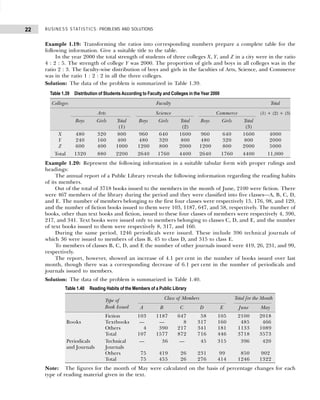
Example 1.19: Transforming the ratios into corresponding numbers prepare a complete table for the
following information. Give a suitable title to the table.
In the year 2000 the total strength of students of three colleges X, Y, and Z in a city were in the ratio
4 : 2 : 5. The strength of college Y was 2000. The proportion of girls and boys in all colleges was in the
ratio 2 : 3. The faculty-wise distribution of boys and girls in the faculties of Arts, Science, and Commerce
was in the ratio 1 : 2 : 2 in all the three colleges.
Solution: The data of the problem is summarized in Table 1.39.
Example 1.20: Represent the following information in a suitable tabular form with proper rulings and
headings:
The annual report of a Public Library reveals the following information regarding the reading habits
of its members.
Out of the total of 3718 books issued to the members in the month of June, 2100 were fiction. There
were 467 members of the library during the period and they were classified into five classes—A, B, C, D,
and E. The number of members belonging to the first four classes were respectively 15, 176, 98, and 129,
and the number of fiction books issued to them were 103, 1187, 647, and 58, respectively. The number of
books, other than text books and fiction, issued to these four classes of members were respectively 4, 390,
217, and 341. Text books were issued only to members belonging to classes C, D, and E, and the number
of text books issued to them were respectively 8, 317, and 160.
During the same period, 1246 periodicals were issued. These include 396 technical journals of
which 36 were issued to members of class B, 45 to class D, and 315 to class E.
To members of classes B, C, D, and E the number of other journals issued were 419, 26, 231, and 99,
respectively.
The report, however, showed an increase of 4.1 per cent in the number of books issued over last
month, though there was a corresponding decrease of 6.1 per cent in the number of periodicals and
journals issued to members.
Solution: The data of the problem is summarized in Table 1.40.
Note: The figures for the month of May were calculated on the basis of percentage changes for each
type of reading material given in the text.
Table 1.40 Reading Habits of the Members of a Public Library
Type of Class of Members Total for the Month
Book Issued A B C D E June May
Fiction 103 1187 647 358 105 2100 2018
Books Textbooks — — 218 317 160 2485 2466
Others 104 1390 217 341 181 1133 1089
Total 107 1577 872 716 446 3718 3573
Periodicals Technical — 1536 — 345 315 2396 2420
and Journals Journals
Others 175 1419 126 231 99 2850 902
Total 175 1455 126 276 414 1246 1322
Table 1.39 Distribution of Students According to Faculty and Colleges in the Year 2000
Colleges Faculty Total
Arts Science Commerce (1) + (2) + (3)
Boys Girls Total Boys Girls Total Boys Girls Total
(1) (2) (3)
X 480 320 800 960 640 1600 960 640 1600 4000
Y 240 160 400 480 320 800 480 320 800 2000
Z 600 400 1000 1200 800 2000 1200 800 2000 5000
Total 1320 880 2200 2640 1760 4400 2640 1760 4400 11,000
23
DATA CLASSIFICATION, TABULATION, AND PRESENTATION
1.12 Draw a blank table to show the number of candidates
sex-wise appearing in the pre-university, first year,
second year, and third year examinations of a
university in the faculties of Arts, Science, and
Commerce in a certain year.
1.13 Let the national income of a country for the years
2000–01 and 2001–02 at current prices be 80,650,
90,010, and 90,530 crore of rupees respectively, and
per capita income for these years be 1050, 1056, and
1067 rupees. The corresponding figures of national
income and per capita income at 1999–2000 prices
for the above years were 80,650, 80,820, and 80,850
crore of rupees and 1050, 1051, and 1048 respectively.
Present this data in a table.
1.14 Present the following information in a suitable form
supplying the figure not directly given. In 2004, out of
a total of 4000 workers in a factory, 3300 were
members of a trade union. The number of women
workers employed was 500 out of which 400 did not
belong to any union.
In 2003, the number of workers in the union was
3450 of which 3200 were men. The number of non-
union workers was 760 of which 330 were women.
1.15 Of the 1125 students studying in a college during a
year, 720 were SC/ST, 628 were boys, and 440 were
science students; the number of SC/ST boys was 392,
that of boys studying science 205, and that of SC/ST
students studying science 262; finally the number of
science students among the SC/ST boys was 148. Enter
these frequencies in a three-way table and complete
the table by obtaining the frequencies of the remaining
cells.
1.16 A survey of 370 students from the Commerce Faculty
and 130 students from the Science Faculty revealed
that 180 students were studying for only C.A.
Examinations, 140 for only Costing Examinations,
and 80 for both C.A. and Costing Examinations. The
rest had opted for part-time management courses. Of
those studying for Costing only, 13 were girls and 90
boys belonged to the Commerce Faculty. Out of the
80 studying for both C.A. and Costing, 72 were from
the Commerce Faculty amongst whom 70 were boys.
Amongst those who opted for part-time management
courses, 50 boys were from the Science Faculty and 30
boys and 10 girls from the Commerce Faculty. In all,
there were 110 boys in the Science Faculty.
Present this information in a tabular form. Find the
number of students from the Science Faculty studying
for part-time management courses.
S e l f-P r a c t i c e P r o b l e m s 1B
1.17 An Aluminium Company is in possession of certain
scrap materials with known chemical composition.
Scrap 1 contains 65 per cent aluminium, 20 per cent
iron, 2 per cent copper, 2 per cent manganese, 3
per cent magnesium and 8 per cent silicon. The
aluminium content of scrap 2, scrap 3, and scrap 4 are
70 per cent, 80 per cent and 75 per cent respectively.
Scrap 2 contains 15 per cent, iron, 3 per cent copper, 2
per cent manganese, 4 per cent magnesium, and the
rest silicon. Scrap 3 contains 5 per cent iron. The iron
content of Scrap 4 is the same as that of scrap 3, scrap
4 contains twice as much percentage of copper as
scrap 3. scrap 3 contains 1 per cent copper. Scrap 3
contains manganese which is 3 times as much as copper
it contains. The percentage of magnesium and silicon
in scrap 3 are 3 per cent and 8 per cent respectively.
The magnesium and silicon contents of scrap 4 are
respectively 2 times and 3 times its manganese
contents. The company also purchases some
aluminium and silicon as needed. The aluminium
purchased contains 96 per cent pure aluminium, 2
per cent iron, 1 per cent copper and 1 per cent silicon
respectively, whereas the purchased silicon contains
98 per cent silicon and 2 per cent iron respectively.
Present the above data in a table.
1.18 The ‘Financial Highlights’ of a public limited company
in recent years were as follows:
In the year ending on 31 March 1998 the turnover of
the company, including other income, was Rs. 157
million. The profit of the company in the same year
before tax, investment allowance, reserve, and prior
year’s adjustment was Rs. 19 million, and the profit
after tax, investment allowance, reserve, and prior
year’s adjustment was Rs. 8 million. The dividend
declared by the company in the same year was 20
per cent. The turnover, including other income, for the
years ending on 31 March 1999, 2000, and 2001 were
Rs. 169, 191, and 197 million respectively. For the year
ending on 31 March 1999 the profit before tax,
investment allowance, reserve, and prior year’s
adjustment was Rs. 192 million and the profit after tax,
and so on Rs. 7.5 million, while the dividend declared
for the same year was 17 per cent. For the year ending
on 31 March 2000, 2001, and 2002 the profits before
tax, investment allowance, reserve, and prior year’s
adjustment were Rs. 21, 12, 13 million respectively,
while the profits after tax, and so on, of the above three
years were Rs. 9.5, 4, and 9 million respectively. The
turnover, including other income, for the year ending
on 31 March 2002 was Rs. 243 million. The dividend
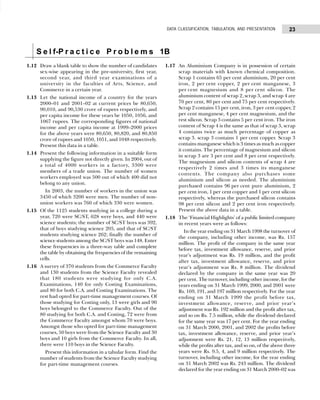
declared for the year ending on 31 March 2000–02 was
BUSINESS STATISTICS: PROBLEMS AND SOLUTIONS
24
17 per cent, 10 per cent, and 20 per cent respectively.
Present the above data in a table.
1.19 Present the following information in a suitable form:
In 1994, out of a total of 1950 workers of a factory,
1400 were members of a trade union.
The number of women employed was 400 of which
275 did not belong to a trade union. In 1999, the
number of union workers increased to 1780 of which
1490 were men. On the other hand, the number of
non-union workers fell to 408 of which 280 were men.
In the year 2004, there were 2000 employees who
belonged to a trade union and 250 did not belong to a
trade union. Of all the employees in 2000, 500 were
women of whom only 208 did not belong to a trade
union.
H i n t s a n d A n s w e r s
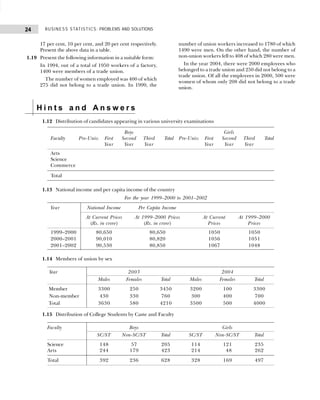
1.12 Distribution of candidates appearing in various university examinations
Boys Girls
Faculty Pre-Univ. First Second Third Total Pre-Univ. First Second Third Total
Year Year Year Year Year Year
Arts
Science
Commerce
Total
1.13 National income and per capita income of the country
For the year 1999–2000 to 2001–2002
Year National Income Per Capita Income
At Current Prices At 1999–2000 Prices At Current At 1999–2000
(Rs. in crore) (Rs. in crore) Prices Prices
1999–2000 80,650 80,650 1050 1050
2000–2001 90,010 80,820 1056 1051
2001–2002 90,530 80,850 1067 1048
1.14 Members of union by sex
Year 2003 2004
Males Females Total Males Females Total
Member 3300 250 3450 3200 100 3300
Non-member 430 330 760 300 400 700
Total 3630 580 4210 3500 500 4000
1.15 Distribution of College Students by Caste and Faculty
Faculty Boys Girls
SC/ST Non-SC/ST Total SC/ST Non-SC/ST Total
Science 148 57 205 114 121 235
Arts 244 179 423 214 48 262
Total 392 236 628 328 169 497
25
DATA CLASSIFICATION, TABULATION, AND PRESENTATION
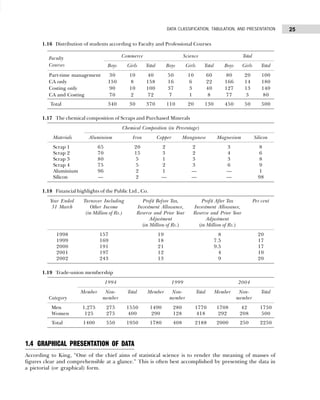
1.16 Distribution of students according to Faculty and Professional Courses
Faculty Commerce Science Total
Courses Boys Girls Total Boys Girls Total Boys Girls Total
Part-time management 30 10 40 50 10 60 80 20 100
CA only 150 8 158 16 6 22 166 14 180
Costing only 90 10 100 37 3 40 127 13 140
CA and Costing 70 2 72 7 1 8 77 3 80
Total 340 30 370 110 20 130 450 50 500
1.17 The chemical composition of Scraps and Purchased Minerals
Chemical Composition (in Percentage)
Materials Aluminium Iron Copper Manganese Magnesium Silicon
Scrap 1 65 20 2 2 3 8
Scrap 2 70 15 3 2 4 6
Scrap 3 80 5 1 3 3 8
Scrap 4 75 5 2 3 6 9
Aluminium 96 2 1 — — 1
Silicon — 2 — — — 98
1.18 Financial highlights of the Public Ltd., Co.
Year Ended Turnover Including Profit Before Tax, Profit After Tax Per cent
31 March Other Income Investment Allowance, Investment Allowance,
(in Million of Rs.) Reserve and Prior Year Reserve and Prior Year
Adjustment Adjustment
(in Million of Rs.) (in Million of Rs.)
1998 157 19 7.8 20
1999 169 18 7.5 17
2000 191 21 9.5 17
2001 197 12 7.4 10
2002 243 13 7.9 20
1.19 Trade-union membership
1994 1999 2004
Member Non- Total Member Non- Total Member Non- Total
Category member member member
Men 1,275 275 1550 1490 280 1770 1708 42 1750
Women 125 275 400 290 128 418 292 208 500
Total 1400 550 1950 1780 408 2188 2000 250 2250
1.4 GRAPHICAL PRESENTATION OF DATA
According to King, “One of the chief aims of statistical science is to render the meaning of masses of
figures clear and comprehensible at a glance.” This is often best accomplished by presenting the data in
a pictorial (or graphical) form.
BUSINESS STATISTICS: PROBLEMS AND SOLUTIONS
26
Functions of a Graph
The shape of the graph gives an exact idea of the variations of the distribution trends. Graphic presentation,
therefore, serves as an easy technique for quick and effective comparison between two or more frequency
distributions. When the graph of one frequency distribution is superimposed on the other, the points of
contrast regarding the type of distribution and the pattern of variation become quite obvious. All these
advantages necessitate a clear understanding of the various forms of graphic representation of a frequency
distribution.
General Rules for Drawing Diagrams
The following general guidelines are taken into consideration while preparing diagrams:
Title: Each diagram should have a suitable title. It may be given either at the top of the diagram or below
it. The title must convey the main theme which the diagram intends to portray.
Size: The size and portion of each component of a diagram should be such that all the relevant
characteristics of the data are properly displayed and can be easily understood.
Proportion of length and breadth: An appropriate proportion between the length and breadth of the
diagram should be maintained. As such there are no fixed rules about the ratio of length to width.
However, a ratio of 2 : 1 or 1.414 (long side) : 1 (short side) suggested by Lutz in his book Graphic
Presentation may be adopted as a general rule.
Proper scale: There are again no fixed rules for selection of scale. The diagram should neither be too
small nor too large. The scale for the diagram should be decided after taking into consideration the
magnitude of data and the size of the paper on which it is to be drawn. The scale showing the values as far
as possible should be in even numbers or in multiples of 5, 10, 20, and so on. The scale should specify the
size of the unit and the nature of data it represents, for example, ‘millions of tonnes’, in Rs. thousand,
and the like. The scale adopted should be indicated on both vertical and horizontal axes if different scales
are used. Otherwise, it can be indicated at some suitable place on the graph paper.
Footnotes and source note: To clarify or elucidate any points which need further explanation but
cannot be shown in the graph, footnotes are given at the bottom of the diagrams.
Index: A brief index explaining the different types of lines, shades, designs, or colours used in the
construction of the diagram should be given to understand its contents.
Simplicity: Diagrams should be prepared in such a way that they can be understood easily. To keep it
simple, too much information should not be loaded in a single diagram as it may create confusion. Thus
if the data are large, then it is advisible to prepare more than one diagram, each depicting some identified
characteristic of the same data.
1.5 TYPES OF DIAGRAMS
One-Dimensional Diagrams
These diagrams provide a useful and quick understanding of the shape of the distribution and its
characteristics.
These diagrams are called one-dimensional diagrams because only the length (height) of the bar (not
the width) is taken into consideration. Of course, width or thickness of the bar has no effect on the
diagram, even then the thickness should not be too much otherwise the diagram would appear like a two-
dimensional diagram.
The one-dimensional diagrams (charts) used for graphical presentation of data sets are as follows:
27
DATA CLASSIFICATION, TABULATION, AND PRESENTATION
• Histograms • Frequency polygons
• Frequency curves • Cumulative frequency distributions (Ogive)
• Pie diagrams
(Bar Diagrams) Histograms These diagrams are used to graph both ungrouped and grouped data. In the case
of an ungrouped data, values of the variable (the characteristic to be measured) are scaled along the
horizontal axis and the number of observations (or frequencies) along the vertical axis of the graph. The
plotted points are then connected by straight lines to enhance the shape of the distribution. The height of
such boxes (rectangles) measures the number of observations in each of the classes (Fig. 1.1).
Remarks: Bar diagrams are not suitable to represent long period time series.
Figure 1.1 Histogram for Mutual Funds
Simple Bar Charts The graphic techniques described earlier are used for group frequency distributions.
The graphic techniques presented in this section can also be used for displaying values of categorical
variables. Such data are first tallied into summary tables and then graphically displayed as either bar charts
or pie charts.
Bar charts are used to represent only one characteristic of data and there will be as many bars as
number of observations. For example, the data obtained on the production of oil seeds in a particular
year can be represented by such bars. Each bar would represent the yield of a particular oil seed in that
year. Since the bars are of the same width and only the length varies, the relationship among them can be
easily established.
Sometimes only lines are drawn for comparison of given variable values. Such lines are not thick and
their number is sufficiently large. The different measurements to be shown should not have too much
difference, so that the lines may not show too much dissimilarity in their heights.
Example 1.21: The data on the production of oil seeds in a particular year are presented in Table 1.41.
Represent this data by a suitable bar chart.
Table 1.41
Oil Seed Yield Percentage Production
(Million tonnes) (Million tonnes)
Ground nut 5.80 43.03
Rapeseed 3.30 24.48
Coconut 1.18 8.75
Cotton 2.20 16.32
Soyabean 1.00 7.42
13.48 100.00
BUSINESS STATISTICS: PROBLEMS AND SOLUTIONS
28
Solution: The information provided in Table 1.43 is expressed graphically as a frequency bar chart as
shown in Fig. 1.2. In this figure, each type of seed is depicted by a bar, the length of which represents the
frequency (or percentage) of observations falling into that category.
Figure 1.2 Bar Chart Pertaining to Production of Oil Seeds
Remark: The bars should be constructed vertically (as shown in Fig. 1.2) when categorized observations
are the outcome of a numerical variable. But if observations are the outcome of a categorical variable, then
the bars should be constructed horizontally.
Example 1.22: An advertising company kept an account of response letters received each day over a
period of 50 days. The observations were as follows:
Construct a frequency table and draw a line chart (or diagram) to present the data.
Solution: Figure 1.3 depicts a frequency bar chart for the number of letters received during a period of
50 days presented in Table 1.42.
0 2 1 1 1 2 0 0 1 0 1 0 0 1 0 1 1 0
2 0 0 2 0 1 0 1 0 1 0 3 1 0 1 0 1 0
2 5 1 2 0 0 0 0 5 0 1 1 2 0
Table 1.42 Frequency Distribution of Letters Received
Number of Letters Tally Number of Days
Received (Frequency)
0 | | | | | | | | | | | | | | | | | | | 23
1 | | | | | | | | | | | | | | 17
2 | | | | | | 7
3 | | 2
4 — 0
5 | 1
50
29
DATA CLASSIFICATION, TABULATION, AND PRESENTATION
Figure 1.3 Number of Letters Received
Multiple Bar Charts A multiple bar chart is also known as grouped (or compound) bar chart. Such charts are
useful for direct comparison between two or more sets of data. The technique of drawing such a chart is
same as that of a single bar chart with a difference that each set of data is represented in different shades or
colours on the same scale. An index explaining shades or colours must be given.
Example 1.23: The data on fund flow (in Rs. crore) of an International Airport Authority during financial
years 2001–02 to 2003–04 are given below:
Represent this data by a suitable bar chart.
Solution: The multiple bar chart of the given data is shown in Fig. 1.4.
Figure 1.4 Multiple Bar Chart Pertaining to Performance of an International Airport Authority
2001–02 2002–03 2003–04
Non-traffic revenue 40.00 50.75 70.25
Traffic revenue 70.25 80.75 110.00
Profit before tax 40.15 50.50 80.25
BUSINESS STATISTICS: PROBLEMS AND SOLUTIONS
30
Deviation Bar Charts Deviation bar charts are suitable for presentation of net quantities in excess or deficit
such as profit, loss, import, or exports. The excess (or positive) values and deficit (or negative) values are
shown above and below the base line.
Example 1.24: The following are the figures of sales and net profits of a company over the last
3 years.
Present this data by a suitable bar chart.
Solution: Fig. 1.5 depicts deviation bar charts for sales and per cent change in sales over previous year’s
data.
Figure 1.5 Deviation Bar Chart Pertaining to Sales and Profits
Subdivided Bar Charts Subdivided bar charts are suitable for expressing information in terms of ratios or
percentages. While constructing these charts the various components in each bar should be in the same
order to avoid confusion. Different shades must be used to represent various ratio values but the shade of
each component should remain the same in all the other bars. An index of the shades should be given
with the diagram.
Example 1.25: The data on sales (Rs. in million) of a company are given below:
(Per cent change over previous year)
Year Sales Growth Net Profit
2002–03 15 – 30
2003–04 12 – 53
2004–05 18 –72
Particulars 2002 2003 2004
Export 1.4 1.8 1.29
Home 1.6 2.7 2.9
Total 3.0 4.5 5.18
31
DATA CLASSIFICATION, TABULATION, AND PRESENTATION
Solution: Fig. 1.6 depicts a subdivided bar chart for the given data.
Figure 1.6 Subdivided Bar Chart Pertaining to Sales
Percentage Bar Charts When the relative proportions of components of a bar are more important than
their absolute values, then each bar can be constructed with same size to represent 100%. The component
values are then expressed in terms of percentage of the total to obtain the necessary length for each of
these in the full length of the bars. The other rules regarding the shades, index, and thickness are the
same as mentioned earlier.
Example 1.26: The following table shows the data on cost, profit, or loss per unit of a good produced by
a company during the year 2003–04.
Represent diagrammatically the data given above on percentage basis.
Particulars 2003 2004
Amount (Rs.) Percentage Cumulative Amount (Rs.) Percentage Cumulative
Percentage Percentage
Cost per unit
(a) Labour 25 41.67 41.67 34 40.00 40.00
(b) Material 20 33.33 75.00 30 35.30 75.30
(c) Miscellaneous 15 25.00 100.00 21 24.70 100.00
Total cost 60 100 85 100
Sales proceeds per unit 80 110 80 88
Profit (+) or loss
(–) per item +20 +10 –5 –12
BUSINESS STATISTICS: PROBLEMS AND SOLUTIONS
32
Solution: The cost, sales, and profit/loss data expressed in terms of percentages have been represented in
the bar chart as shown in Fig. 1.7.
Figure 1.7 Percentage Bar Chart Pertaining to Cost, Sales, and Profit/Loss Heights of the Polygon at each Mid-point
Frequency Polygons A frequency polygon is formed by marking the mid-point at the top of horizontal bars
and then joining these dots by a series of straight lines. The frequency polygons are formed as a closed
figure with the horizontal axis, therefore a series of straight lines are drawn from the mid-point of the top
base of the first and the last rectangles to the mid-point falling on the horizontal axis of the next outlaying
interval with zero frequency.
A frequency polygon can also be converted back into a histogram by drawing vertical lines from the
bounds of the classes shown on the horizontal axis, and then connecting them with horizontal lines at the
hieghts of the polygon at each mid-point.
Fig. 1.8 shows the frequency polygon for the frequency distribution presented by histogram in
Fig. 1.1.
Figure 1.8 Frequency Polygon for Mutual Fund
Frequency Curve It is described as a smooth frequency polygon as shown in Fig. 1.9. A frequency curve is
described in terms of its (i) symmetry (skewness) and (ii) degree of peakedness (kurtosis).
33
DATA CLASSIFICATION, TABULATION, AND PRESENTATION
Figure 1.9 Frequency Curve
Two frequency distributions can also be compared by superimposing two or more frequency curves
provided the width of their class intervals and the total number of frequencies are equal for the given
distributions. Even if the distributions to be compared differ in terms of total frequencies, they still can be
compared by drawing per cent frequency curves where the vertical axis measures the per cent class
frequencies and not the absolute frequencies.
Cumulative Frequency Distribution (Ogive) It enables us to see how many observations lie above or below
certain values rather than merely recording the number of observations within intervals (see Table 1.43
and Fig. 1.10).
Figure 1.10 Ogive for Mutual Funds Prices
Table 1.43 Calculation of Cumulative Frequencies
Mutual Funds Upper Class Number of Funds
Cumulative Frequency
Price (Rs.) Boundary ( f ) Less than More than
10–15 15 6 6 40
15–20 20 11 6 + 11 = 17 40 – 6 = 34
20–25 25 9 17 + 9 = 26 34 – 11= 23
25–30 30 7 26 + 7 = 33 23 – 9 = 14
30–35 35 5 33 + 5 = 38 14 – 7 = 7
35–40 40 2 38 + 2 = 40 7 – 5 = 2
BUSINESS STATISTICS: PROBLEMS AND SOLUTIONS
34
Pie Diagrams These diagrams are normally used to show the total number of observations of different
types in the data set on a percentage basis rather than on an absolute basis through a circle. Usually the
largest percentage portion of data in a pie diagram is shown first at 12 o'clock position on the circle,
whereas the other observations (in per cent) are shown in clockwise succession in descending order of
magnitude. The steps to draw a pie diagram are summarized below:
1. Convert the various observations (in per cent) in the data set into corresponding degrees in the
circle by multiplying each by 3.6 (360÷100).
2. Draw a circle of appropriate size with a compass.
3. Draw points on the circle according to the size of each portion of the data with the help of a
protractor and join each of these points to the center of the circle.
Example 1.27: The data show market share (in per cent) by revenue of the following companies in a
particular year:
Batata–BPL 30 Escorts-First Pacific 5
Hutchison–Essar 26 Reliance 3
Bharti–Sing Tel 19 RPG 2
Modi Dista Com 12 Srinivas 2
Shyam 1
Draw a pie diagram for the above data.
Solution: Converting percentage figures into angle outlay by multiplying each of them by 3.6 as shown in
Table 1.44.
Using the data given in Table 1.44 construct a pie chart as shown in Fig. 1.11 by dividing the circle
into 9 parts according to degrees of angle at the centre.
Figure 1.11 Percentage Pie Chart
Table 1.44
Company Market Share (Per cent) Angle Outlay (Degree)
Batata–BPL 30 108.0
Hutchison–Essar 26 93.6
Bharti–Sing Tel 19 68.4
Modi Dista Com 12 43.2
Escorts First Pacific 5 18.0
Reliance 3 10.8
RPG 2 7.2
Srinivas 2 7.2
Shyam 1 3.6
Total 100 360.0
35
DATA CLASSIFICATION, TABULATION, AND PRESENTATION
Example 1.28: The following data relate to area in millions of square kilometer of oceans of the world.
Solution: Converting given areas into angle outlay as shown in Table 1.45.
Pie diagram is shown in Fig. 1.12.
Figure 1.12 Per cent Pie Diagram
Two-Dimensional Diagrams
In one-dimensional diagrams or charts, only the length of the bar is taken into consideration. But in two-
dimensional diagrams, both its height and width are taken into account for presenting the data. These
diagrams, also known as surface diagrams or area diagrams, are categorized as following:
Ocean Area
(Million sq km)
Pacific 70.8
Atlantic 41.2
Indian 28.5
Antarctic 7.6
Arctic 4.8
Table 1.45
Ocean Area (Million sq. km.) Angle Outlay (Degrees)
Pacific 70.8
70.8
152.9
× 360 = 166.70
Atlantic 41.2
41.2
152.9
× 360 = 97.00
Indian 28.5 67.10
Antarctic 7.6 17.89
Arctic 4.8 11.31
Total 152.9 360.00
BUSINESS STATISTICS: PROBLEMS AND SOLUTIONS
36
Rectangles Since area of a rectangle is equal to the product of its length and width, while making such
type of diagrams both length and width are considered.
Rectangles are suitable for use in cases where two or more quantities are to be compared and each
quantity is sub-divided into several components.
Example 1.29: The following data represent the income of two families A and B. Construct a rectangular
diagram.
Solution: Converting individual values into percentages taking total income as equal to 100 as shown in
Table 1.46.
The height of the rectangles shown in Fig. 1.13 is equal to 100. The difference in the total income is
represented by the difference on the base line which is in the ratio of 3 : 4.
Squares To construct a square diagram, first the square-root of the values of various figures to be
represented is taken and then these values are divided either by the lowest figure or by some other
common figure to obtain proportions of the sides of the squares. The squares constructed on these
proportionate lengths must have either the base or the center on a straight line. The scale is attached with
the diagram to show the variable value represented by one square unit area of the squares.
Table 1.46 Percentage Summary Table Pertaining to Expenses Incurred by Two Families
Item of Family A (Monthly Income Rs. 3000) Family B (Monthly Income Rs. 4000)
Expenditure Actual Percentage Cumulative Actual Percentage Cumulative
Expenses of Expenses Percentage Expenses of Expenses Percentage
Food 5550 18.50 18.50 7280 18.20 18.20
Clothing 5100 17.00 35.50 6880 17.20 35.40
House rent 4800 16.00 51.50 6480 16.20 51.60
Fuel and light 4740 15.80 6.78 6320 15.80 67.40
Education 4950 16.50 83.80 6640 16.60 84.00
Miscellaneous 4860 16.20 100.00 6400 16.00 100.00
Total 30,000 100.00 40,000 100.00
Item of Expenditure Family A Family B
(Monthly Income Rs. 30,000) (Monthly Income Rs. 40,000)
Food 5550 7280
Clothing 5100 6880
House rent 4800 6480
Fuel and light 4740 6320
Education 4950 6640
Miscellaneous 4860 6400
Total 30,000 40,000
37
DATA CLASSIFICATION, TABULATION, AND PRESENTATION
Figure 1.13 Percentage of Expenditure by Two Families
Example 1.30: The following data represent the production (in million tonnes) of coal by different
countries in a particular year.
Represent the data graphically by constructing a suitable diagram.
Solution: The given data can be represented graphically by square diagrams. For constructing the sides
of the squares, the necessary calculations are shown in Table 1.47.
The squares representing the amount of coal production by various countries are shown in Fig. 1.14.
Table 1.47 Side of a Square Pertaining to Production of Coal
Country Production Square Root of Side of a Square
(Million Tonnes) Production Amount (One Square Inch)
USA 130.1 11.406 1.267
USSR 44.0 6.633 0.737
UK 16.4 4.049 0.449
India 3.3 1.816 0.201
Country Production
USA 130.1
USSR 44.0
UK 16.4
India 3.3
BUSINESS STATISTICS: PROBLEMS AND SOLUTIONS
38
Figure 1.14 Coal Production in Different Countries
Circles Circles are alternatives to squares to represent data graphically. The circles are also drawn such
that their areas are in proportion to the figures represented by them. The circles are constructed in such
a way that their centers lie on the same horizontal line and the distance between the circles is equal.
Since the area of a circle is directly proportional to the square of its radius, the radii of the circles are
obtained in proportion to the square root of the figures under representation. Thus, the lengths that
were used as the sides of the square can also be used as the radii of circles.
Example 1.31: The following data represent the land area in different countries. Represent this data
graphically using suitable diagram.
Solution: The data can be represented graphically using circles. The calculations for constructing radii
of circles are shown in Table 1.48.
The various circles representing the land area of respective countries are shown in Fig. 1.15.
Figure 1.15 Land Area of Different Countries
Table 1.48 Radii of Circles Pertaining to Land Area of Countries
Country Land Area (Crore Acres) Square Root of Land Area Radius of Circles (Inches)
USSR 590.4 24.3 0.81
China 320.5 17.9 0.60
USA 190.5 13.8 0.46
India 81.3 9.0 0.30
Country Land Area
(crore acres)
USSR 590.4
China 320.5
USA 190.5
India 81.3
39
DATA CLASSIFICATION, TABULATION, AND PRESENTATION
Pictograms or Ideographs
A pictogram is another form of pictorial bar chart. Such charts are useful in presenting data to people who
cannot understand charts. Small symbols or simplified pictures are used to represent the size of the data.
Example 1.32: Make a pictographic presentation of the output of vans during the year by a van
manufacturing company.
Year : 1999 2000 2001 2002
Output : 2004 2996 4219 5324
Solution: Dividing the van output figures by 1000, we get 2.004, 2.996, 4.219, and 5.324 respectively.
Representing these figures by pictures of vans as shown in Fig. 1.16.
Figure 1.16 Output of Vans
1.6 EXPLORATORY DATA ANALYSIS
In this section one of the useful techniques of exploratory data analysis, stem-and-leaf displays (or diagrams)
technique, is presented. This technique provides the rank order of the values in the data set and the shape
of the distribution.
Stem-and-Leaf Displays It is a graphical display of the numerical values in the data set and separates
these values into leading digits (or stem) and trailing digits (or leaves). The steps required to construct a stem-
and-leaf diagram are as follows:
1. Divide each numerical value between the ones and the tens place. The number to the left is the stem
and the number to the right is the leaf. The stem contains all but the last of the displayed digits of a
numerical value. As with histograms, it is reasonable to have between 6 to 15 stems (each stem defines
an interval of values). The stem should define equally spaced intervals. Stems are located along the
vertical axis.
Sometimes numerical values in the data set are truncated or rounded off. For example, the number
15.69 is truncated to 15.6 but it is rounded off to 15.7.
2. List the stems in a column with a vertical line to their right.
3. For each numerical value, attach a leaf to the appropriate stem in the same row (horizontal axis). A
leaf is the last of the displayed digits of a number. It is standard, but not mandatory, to put the leaves
in increasing order at each stem value.
4. Provide a key to stem and leaf coding so that actual numerical value can be re-created, if necessary.
Remark: If all the numerical values are three-digit integers, then to form a stem-and-leaf diagram, two
approaches are followed:
1. Use the hundreds column as the stems and the tens column as the leaves and ignore the units column.
2. Use the hundreds column as the stems and the tens column as the leaves after rounding of the
units column.
Example 1.33: Consider the following marks obtained by 20 students in a business statistics test:
64 89 63 61 78 87 74 72 54 88
62 81 78 73 63 56 83 86 83 93
BUSINESS STATISTICS: PROBLEMS AND SOLUTIONS
40
(a) Construct a stem-and-leaf diagram for these marks to assess class performance.
(b) Describe the shape of this data set.
(c) Are there any outliers in this data set.
Solution: (a) The numerical values in the given data set are ranging from 54 to 93. To construct a stem-
and-leaf diagram, we make a vertical list of the stems (the first digit of each numerical value) as shown
below:
Stem Leaf
5 46
6 43123
7 84283
8 9781863
9 3
Rearrange all of the leaves in each row in rank order.
Stem Leaf
5 46
6 12334
7 23488
8 1367889
9 3
Each row in the diagram is a stem and numerical value on that stem is a leaf. For example, if we take
the row 6/12334, it means there are five numerical values in the data set that begins with 6, that is, 61, 62,
63, 63, and 64.
If the page is turned 90º clockwise and rectangles are drawn arround the digits in each stem, we get
a diagram similar to a histogram.
(b) Shape of the diagram is not symmetrical.
(c) There is no outlier (an observation far from the center of the distribution).
Example 1.34: The following data represent the annual family expenses (in thousand of rupees) on food
items in a city.
13.8 14.1 14.7 15.2 12.8 15.6 14.9 16.7 19.2
14.9 14.9 14.9 15.2 15.9 15.2 14.8 14.8 19.1
14.6 18.0 14.9 14.2 14.1 15.3 15.5 18.0 17.2
17.2 14.1 14.5 18.0 14.4 14.2 14.6 14.2 14.8
Construct a stem-and-leaf diagram.
Solution: Since the annual costs (in Rs. ’000) in the data set all have two-digit integer numbers, the tens
and units columns would be the leading digits and the remaining column (the tenth column) would be
the trailing digits as shown below:
Stem Leaf Stem Leaf
12 8 12 8
13 8 13 8
14 17999988621142628 14 11122246678889999
15 2629235 15 2223569
16 7 16 7
17 2 17 2
18 000 18 000
19 21 19 12
Rearrange all the leaves in each row in the rank order as shown above.
4
3
3
8
8
4
8
7
6
9
2
1
6
3
2
7
3
1
8
3
9
6
4
5
41
DATA CLASSIFICATION, TABULATION, AND PRESENTATION
1.20 The following data represent the gross income,
expenditure (in Rs. lakh), and net profit (in Rs. lakh)
during the years 1999–2002.
1999–2000 2000–2001 2001–2002
Gross income 570 592 632
Gross
expenditure 510 560 610
Net income 560 532 522
Construct a diagram or chart you prefer to use here.
1.21 Which of the charts would you prefer to represent the
following data pertaining to the monthly income of
two families and the expenditure incurred by them.
Expenditure on
Family A Family B
(Income (Income
Rs. 17,000) Rs. 10,000)
Food + 4000 5400
Clothing + 2800 3600
House rent + 3000 3500
Education + 2300 2800
Miscellaneous + 3000 5000
Saving or deficits +1900 – 300
1.22 The following data represent the outlays (Rs. crore)
by heads of development.
Heads of Development Center States
Agriculture 4765 7039
Irrigation and flood control 6635 11,395
Energy 9995 8293
Industry and minerals 12,770 2985
Transport and communication 12,200 5120
Social services 8216 1420
Total 54,581 36,252
Represent the data by a suitable diagram and write a
report on the data bringing out the salient features.
1.23 Make a diagrammatic representation of the following
textile production and imports.
Value Length
(in Crore) (in Hundred Yards)
Mill production 116.4 426.9
Handloom
production 106.8 192.8
Imports 319.7 64.7
What conclusions do you draw from the diagram?
S e l f-P r a c t i c e P r o b l e m s 1C
1.24 The following data represent the estimated gross area
under different cereal crops during a particular year.
Crop Gross Area Crop Gross Areas
(’000 hectares) (’000 hectares)
Paddy 34,321 Ragi 2656
Wheat 18,287 Maize 6749
Jowar 22,381 Barley 4422
Bajra 15,859 Small 6258
millets
Draw a suitable chart to represent the data.
1.25 The following data indicate the rupee sales (in ’000) of
three products according to region.
Product Sales (in Rs. ’000) Total Sales
Group North South East (Rs. ’000)
A 70 175 90 135
B 90 160 100 250
C 50 160 40 150
Total 210 195 230 535
(a) Using vertical bars, construct a bar chart depicting
total sales region-wise.
(b) Construct a component chart to illustrate the
product breakdown of sales region-wise by
horizontal bars.
(c) Construct a pie chart illustrating total sales.
1.26 The following data represent the income and dividend
for the year 2000.
Year Income Per Dividend Per
Share (in Rs.) Share (in Rs.)
1995 5.89 3.20
1996 6.49 3.60
1997 7.30 3.85
1998 7.75 3.95
1999 8.36 3.25
2000 9.00 4.45
(a) Construct a line graph that indicates the income
per share for the period 1995–2000.
(b) Construct a component bar chart that depicts
dividends per share and retained earning per
share for the period 1995–2000.
(c) Construct a percentage pie chart depicting the
percentage of income paid as dividend. Also
construct a similar percentage pie chart for the
period 1998–2000. Observe any difference
between the two pie charts.
BUSINESS STATISTICS: PROBLEMS AND SOLUTIONS
42
1.27 The following time series data taken from the annual
report of a company represents per-share net income,
dividend, and retained earning during the period
1996–2000.
Source 1996 1997 1998 1999 2000
Net income
(in Rs.) 67.40 67.54 66.44 67.78 14.62
Dividends
(in Rs.) 8.08 8.28 8.40 8.50 8.75
Retained
earnings
(in Rs.) 66.82 66.81 65.64 66.88(–) 10.56
(a) Construct a bar chart for per-share income for
the company during 1996–2000.
(b) Construct a component bar chart depicting the
allocation of annual earnings for the company
during 1996–2000.
(c) Construct a line graph for the per-share net
income for the period 1996–2000.
1.28 Find a business or economic related data set of interest
to you. The data set should be made up of at least 100
quantitative observations.
(a) Show the data in the form of a standard frequency
distribution.
(b) Using the information obtained from (a) briefly
describe the appearance of your data.
1.29 The first row of a stem-and-leaf diagram appears as
follows: 26/14489. Assume whole number values.
(a) What is the possible range of values in this row?
(b) How many data values are in this row?
(c) List the actual values in this row of data.
1.30 Given the following stem-and-leaf display
representing the amount of CNG purchased in litres
(with leaves in tenths litre) for a sample of 25
vehicles in Delhi.
9 714
10 82230
11 561776735
12 394282
13 20
(a) Rearrange the leaves and form the revised stem-
and-leaf display.
(b) Place the data into an ordered array.
1.31 The following stem-and-leaf display shows the number
of units produced per day of in item an a factory.
3 8
4 –
5 6
6 0133559
7 0236778
8 59
9 00156
10 36
(a) How many days were studied?
(b) What are the smallest and the largest values?
(c) List the actual values in second and fourth row.
(d) How many values are 80 or more?
(e) What is the middle value?
1.32 A survey of the number of customers that used PCO/
STD both located at a college gate to make telephone
calls last week revealed the following information
52 43 30 38 30 42 12 46
39 37 34 46 32 18 41 5
(a) Develop a stem-and-leaf display.
(b) How many calls did a typical customer made?
(c) What were the largest and the smallest number of
calls made?
Hints and Answers
1.27 (a) 260 to 269 (b) 5
(c) 261, 264, 264, 268, 269
1.30 (a) 9 147
10 02238
11 135566777
12 223489
13 02
(b) 91 94 97 100 102 102 103 108 111
113 115 115 116 116 117 117 122 122
123 124 128 129 130 132
1.31 (a) 25 (b) 38, 106
1.41. (c) No values, 60, 61, 63, 63, 65, 65, 69
1.41. (d) 9 (e) 76
1.32 (a) 0 5
1 28
2 –
3 0024789
4 12366
5 2
(b) 16 customers were studied.
(c) Number of customers visited ranged from 5 to 52.
2.1 INTRODUCTION
Frequency distributions and corresponding graphical representations make raw data more meaningful,
yet they fail to identify three major properties that describe a set of quantitative data. These three
major properties are as follows:
1. The numerical value of an observation (also called central value) around which most numerical
values of other observations in the data set show a tendency to cluster or group, which is called
the central tendency.
2. The extent to which numerical values are dispersed around the central value, which is called
variation.
3. The extent of departure of numerical values from symmetrical (normal) distribution around the
central value, which is called skewness.
The term central tendency was coined because observations (numerical values) in most data sets
show a distinct tendency to group or cluster around a value of an observation located somewhere in
the middle of all observations. It is necessary to identify or calculate this typical central value (also
called average) to describe or project the characteristic of the entire data set. This descriptive value is
the measure of the central tendency or location and methods of computing this central value are called
measures of central tendency.
2.2 MEASURES OF CENTRAL TENDENCY
1. Mathematical Averages
(a) Arithmetic Mean commonly called the mean or average as
• Simple Mean
• Weighted Mean
(b) Geometric Mean (c) Harmonic Mean
2. Averages of Position
(a) Median (b) Quartiles
(c) Deciles (d) Percentiles
(e) Mode
2.3 MATHEMATICAL AVERAGES
Various methods of calculating mathematical averages of a data set are classified in accordance of the
nature of data available, that is, ungrouped (unclassified or raw) or grouped (classified) data.
Arithmetic Mean of Ungrouped (or Raw) Data
There are two methods for calculating arithmetic mean (A.M.) of ungrouped or unclassified data:
1. Direct method
2. Indirect or Short-cut method
Direct Method If x1, x2, . . ., xN represent the values of N observations, then A.M. for a population of N
observations is
Measures of Central Tendency
Measures of Central Tendency 2
2
2
2
2
BUSINESS STATISTICS: PROBLEMS AND SOLUTIONS
44
Population mean, µ =
+ + +
1 2 . . . N
x x x
N
=
1
N 1
N
i
i
x
=
∑ .
Alternative Formula In general, when observations xi (i = 1, 2, . . ., n) are grouped as a frequency
distribution, then A.M. formula should be modified as
x =
1
n 1
n
i i
i
f x
=
∑ ,
where fi represents the frequency (number of observations) with which variable xi occurs in the given data
set, that is, n =
1
n
i
i
f
=
∑ .
However, for a sample containing n observations x1, x2, . . ., xn, the sample A.M. can be written as
sample mean, x =
x x x
n
n
1 + + +
2 ...
=
1
1 n
i
i
x
n =
∑ .
The denominator of above two formulae is different because in statistical analysis the uppercase letter
N is used to indicate the number of observations in the population, while the lower case letter n is used to
indicate the number of observations in the sample.
Short-Cut Method (Ungrouped Data) Let A be the arbitrary assumed A.M. and let
di = xi – A or xi = A + di.
Substituting the value of xi in the formula, we have
x =
1
n 1
n
i
i
x
=
∑ =
1
1
(A )
n
i
i
d
n =
+
∑ = A +
1
n 1
n
i
i
d
=
∑ .
If frequencies of the numerical values are also taken into consideration, then the formula becomes:
x = A +
1
n =
∑
1
n
i i
i
f d ,
where n = fi
i
n
=
∑
1
= total number of observations in the sample.
Example 2.1: In a survey of 5 cement companies, the profit (in Rs. lakh) earned during a year was 15,
20, 10, 35, and 32. Find the arithmetic mean of the profit earned.
Solution: Applying the formula for mean value, we have
x =
5
1
1
i
i
x
n =
∑ =
1
5
(15 + 20 + 10 + 35 + 32) = 22.4.
Thus, the arithmetic mean of the profit earned by these companies during a year was Rs. 22.4 lakh.
Example 2.2: If A, B, C, and D are four chemicals costing Rs. 15, Rs. 12, Rs. 8, and Rs. 5 per 100 g,
respectively, and are contained in a given compound in the ratio of 1, 2, 3, and 4 parts, respectively, then
what should be the price of the resultant compound.
Solution: Using the formula for mean value, the sample arithmetic mean is
x =
4
1
1
i i
i
f x
n =
∑ =
1 15 2 12 3 8 4 5
1 2 3 4
× + × + × + ×
+ + +
= Rs. 8.30.
Thus, the average price of the resultant compound should be Rs. 8.30 per 100 g.
Example 2.3: The number of new orders received by a company over the last 25 working days were
recorded as follows: 3, 0, 1, 4, 4, 4, 2, 5, 3, 6, 4, 5, 1, 4, 2, 3, 0, 2, 0, 5, 4, 2, 3, 3, 1. Calculate the
arithmetic mean for the number of orders received over all similar working days.
45
MEASURES OF CENTRAL TENDENCY
Solution: Applying the formula, the arithmetic mean is
x =
=
∑
25
1
1
i
i
x
n
=
25
1
(3 + 0 + 1 + 4 + 4 + 4 + 2 + 5 + 3 + 6 + 4
+ 5 + 1 + 4 + 2 + 3 + 0 + 2 + 0 + 5 + 4 + 2 + 3 + 3 + 1)
=
25
1
(71) = 2.84 ≅ 3 orders (approx.)
Alternative approach: Use of the formula (see Table 2.1).
Arithmetic mean, x =
1
i i
f x
n
∑ =
25
71
= 2.8 ≅ 3 orders (approx.)
Example 2.4: From the following information on the number of defective components in 1000 boxes
Number of defective components : 0 1 2 3 4 5 6
Number of boxes : 25 306 402 200 51 10 6
calculate the arithmetic mean of defective components for the whole of the production line.
Solution: The calculations of mean defective components for the whole production line are shown in
Table 2.2
Applying the formula, the arithmetic mean is
x = ∑
=
6
0
1
i
i
ix
f
n
=
1000
1
(2000) = 2 defective components.
Example 2.5: The daily earnings (in Rs.) of employees working on a daily basis in a firm are
Daily earnings (Rs.) : 100 120 140 160 180 200 220
Number of employees : 3 6 10 15 24 42 75
Calculate the average daily earnings for all employees.
Table 2.2 Calculations of x for Ungrouped Data
Number of Defective Number of fi xi
Components (xi) Boxes ( fi )
0 25 0
1 306 306
2 402 804
3 200 600
4 51 204
5 10 50
6 6 36
1000 2000
Table 2.1 Calculations of Mean (x
–) Value
Number of Orders (xi) Frequency (fi) fi xi
0 13 10
1 13 13
2 14 18
3 15 15
4 16 24
5 13 15
6 1
25
6
71
BUSINESS STATISTICS: PROBLEMS AND SOLUTIONS
46
Solution: The calculations of average daily earnings for employees are shown in Table 2.3.
Here A = 160 is taken as assumed mean. The required A.M. is given by
x = A +
1
n
7
1
i i
i
f d
=
∑ = 160 +
6040
175
= Rs. 194.51.
Example 2.6: The human resource manager at a city hospital began a study of the overtime hours of the
registered nurses. Fifteen nurses were selected at random, and following overtime hours during a month
were recorded:
13 13 12 15 7 15 5 12 6 7 12 10 9 13 12
5 9 6 10 5 6 9 6 9 12
Calculate the arithmetic mean of overtime hours during the month.
Solution: Calculations of arithmetic mean of overtime hours are shown in Table 2.4
Here A = 10 is taken as assumed mean. The required arithmetic mean of overtime using the formula
is as follows:
x = A +
=
∑
25
1
1
i i
i
f d
n
= 10 –
12
25
= 9.52 hours.
Arithmetic Mean of Grouped (or Classified) Data
Arithmetic mean of grouped data can also be calculated by applying any of the following methods:
1. Direct method
2. Indirect or Step-deviation method
Table 2.3 Calculations of x for Ungrouped Data
Daily Earnings Number of di = xi – A fi di
(in Rs.) Employees = xi – 160
(xi) ( fi )
100 3 –60 –180
120 6 –40 –240
140 10 –20 –200
160 ← A 15 0 0
180 24 20 480
200 42 40 1680
220 75 60 4500
175 6040
Table 2.4 Calculations of x for Ungrouped Data
Overtime Hours Number of di = xi – A fi di
(xi) Employees (fi) = xi – 10
5 3 – 5 –15
6 4 – 4 –16
7 2 – 3 –6
9 4 – 1 –4
10 ← A 2 0 0
12 5 2 10
13 3 3 9
15 2 5 10
25 –12
47
MEASURES OF CENTRAL TENDENCY
For calculating arithmetic mean for a grouped data set, the following assumptions are made:
1. The class intervals must be closed.
2. The width of each class interval should be equal.
3. The values of the observations in each class interval must be uniformly distributed between its
lower and upper limits.
4. The mid-value of each class interval must represent the average of all values in that class, that is,
it is assumed that all values of observations are evenly distributed between the lower and upper
class limits.
Direct Method
x =
=
∑
1
1
,
n
i i
i
f m
n
where mi = midvalue of ith class interval,
fi = frequency of ith class interval,
n = Σfi, sum of all frequencies.
Step-Deviation Method This improved formula is also known as the step-deviation method:
x = A +
∑
×
i i
f d
h
n
,
where A = assumed value for the A.M.,
n = Σ fi, sum of all frequencies,
h = width of the class intervals,
mi = midvalue of ith class interval,
di =
− A
i
m
h
, deviation from the assumed mean.
Example 2.7: A company is planning to improve plant safety. For this, accident data for the last 50 weeks
was compiled. These data were grouped into the frequency distribution as shown below. Calculate the
A.M. of the number of accidents per week.
Number of accidents : 0–4 5–9 10–14 15–19 20–24
Number of weeks : 5 22 13 8 2
Solution: The calculations of A.M. are shown in Table 2.5 using the formula.
The A.M. of the number of accidents per week is
x =
5
1
1
i i
i
f m
n =
∑ =
500
50
= 10 accidents per week.
Example 2.8: Calculate the arithmetic mean of accidents per week by the short cut method using the data
of Example 2.7.
Solution: The calculations of the average number of accidents are shown in the Table 2.6.
Table 2.5 Arithmetic Mean ofAccidents
Number of Midvalue Number of fi mi
Accidents (mi ) Weeks ( fi )
0–4 2 5 10
5–9 7 22 154
10–14 12 13 156
15–19 17 8 136
20–24 22 2 44
50 500
BUSINESS STATISTICS: PROBLEMS AND SOLUTIONS
48
The arithmetic mean x = A + { }
1
i i
f d
n
∑ h
= 12 + { }
1
( 20)
50
− 5 = 10 accidents per week.
Example 2.9: The following distribution gives the pattern of overtime work done by 100 employees of a
company. Calculate the average overtime work done per employee.
Overtime hours : 10–15 15–20 20–25 25–30 30–35 35–40
Number of
employees : 11 20 35 20 8 6
Solution: The calculations of the average overtime work done per employee with assumed mean,
A = 22.5 and h = 5 are given in Table 2.7.
The required A.M. is x = A + i i
f d
h
n
∑
× = 22.5 +
12
100
5
× = 23.1 hours.
Example 2.10: The following is the age distribution of 1000 persons working in an organization
Table 2.6 Arithmetic Mean ofAccidents
Number of Midvalue di = (mi – A)/h Number of fi di
Accidents (mi ) = (mi – 12)/5 Weeks ( fi )
0–14 2 –2 5 –10
5–19 7 –1 22 –22
10–14 12 ← A 0 13 0
15–19 17 1 8 8
20–24 22 2 2 4
50 –20
Table 2.7 Calculations of Average Overtime
Overtime (hrs) Number of Midvalue di = (mi – 22.5)/5 fi di
xi Employees, fi (mi )
10–15 11 12.5 –2 –22
15–20 20 17.5 –1 –20
20–25 35 22.5 ← A 0 0
25–30 20 27.5 1 20
30–35 8 32.5 2 16
35–40 6 37.5 3 18
100 12
Age Group Number of Age Group Number of
Persons Persons
20–25 30 45–50 105
25–30 160 50–55 70
30–35 210 55–60 60
35–40 180 60–65 40
40–45 145
49
MEASURES OF CENTRAL TENDENCY
Due to continuous losses, it is desired to bring down the manpower strength to 30 per cent of the
present number according to the following scheme:
(a) Retrench the first 15 per cent from the lower age group.
(b) Absorb the next 45 per cent in other branches.
(c) Make 10 per cent from the highest age group retire permanently, if necessary.
Calculate the age limits of the persons retained and those to be transferred to other departments. Also
find the average age of those retained. [Delhi Univ., MBA, 2003]
Solution: (a) The first 15 per cent persons to be retrenched from the lower age groups are (15/100)×1000
= 150. But the lowest age group 20–25 has only 30 persons and therefore the remaining 150 – 30 = 120
will be taken from next higher age group, that is, 25–30, which has 160 persons.
(b) The next 45 per cent, that is, (45/100)×1000 = 450 persons who are to be absorbed in other
branches, belong to the following age groups:
(c) Those who are likely to be retired are 10 per cent, that is, (10/100) × 1000 = 100 persons and
belong to the following highest age groups:
Hence, the calculations of the average age of those retained and/or to be transferred to other departments
are shown in Table 2.8.
The required average age is x = A +
d f
n
h
i i
∑
× = 47.5 –
55
5
300
× = 46.58 = 47 years (approx.).
Some Special Types of Problems and Their Solutions
Case 1: Frequencies are Given in Cumulative Form, that is, Either “More Than Type” or “Less Than
Type”
That the “more than type” cumulative frequencies are calculated by adding frequencies from bottom to
top, so that the first class interval has the highest cumulative frequency and it goes on decreasing in
subsequent classes. But in case of “less than cumulative frequencies,” the cumulation is done downward
so that the first class interval has the lowest cumulative frequency and it goes on increasing in the subsequent
classes.
Age Groups Number of Persons
25–30 (160 – 120) = 40
30–35 210
35–40 180
40–45 (450 – 40 – 210 – 180) = 20
Age Group Number of Persons
55–60 (100 – 40) = 60
60–65 40
Table 2.8 Calculations of Average Age
Age Group Midvalue, Number of di = (xi – 47.5)/5 fi di
(xi) ( mi ) Persons ( fi )
40–45 42.5 145 – 20 = 125 –1 –125
45–50 47.5 ← A 105 0 0
50–55 52.5 70 1 70
300 –55
BUSINESS STATISTICS: PROBLEMS AND SOLUTIONS
50
Example 2.11: Following is the cumulative frequency distribution of the preferred length of kitchen
slabs obtained from the preference study on housewives:
Length (in metres) more than : 1.0 1.5 2.0 2.5 3.0 3.5
Preference of housewives : 50 48 42 40 10 5
A manufacturer has to take a decision on what length of slabs to manufacture. What length would you
recommend and why?
Solution: The given data are converted into exclusive class intervals as shown in Table 2.9. The frequency
of each class is found out by deducting the given cumulative frequency from the cumulative frequency of
the previous class:
The calculations for mean length of slab are shown in Table 2.10.
The mean length of the slab is x = A +
f d
n
h
i i
∑
× = 2.25 +
30
45
× 0.5 = 2.58 metres.
Example 2.12: In an examination of 675 candidates, the examiner supplied the following information:
Calculate the mean percentage of marks obtained.
Table 2.9 Conversion into Exclusive Class Intervals
Length (in metres) Preference of Housewives Class Interval Frequency
(more than)
1.0 50 1.0–1.5 (50 – 48) = 32
1.5 48 1.5–2.0 (48 – 42) = 36
2.0 42 2.0–2.5 (42 – 40) = 32
2.5 40 2.5–3.0 (40 – 10) = 30
3.0 10 3.0–3.5 (10 – 5) = 35
3.5 5
Table 2.10 Calculations of Mean Length of Slab
Class Interval Midvalue Preference of
di =
m 2.25
0.5
i − fi di
(mi ) Housewives ( fi )
1.0–1.5 1.25 2 –2 –4
1.5–2.0 1.75 6 –1 –6
2.0–2.5 2.25 ← A 2 0 0
2.5–3.0 2.75 30 1 30
3.0–3.5 3.25 5 2 10
45 30
Marks Obtained Number of Marks Obtained Number of
(Percentage) Candidates (Percentage) Candidates
Less than 10 7 Less than 50 381
Less than 20 39 Less than 60 545
Less than 30 95 Less than 70 631
Less than 40 201 Less than 80 675
51
MEASURES OF CENTRAL TENDENCY
Solution: Arranging the given data into inclusive class intervals as shown in Table 2.11:
The calculations for mean percentage of marks obtained by the candidates are shown in Table 2.12.
The mean percentage of marks obtained is
x = A +
f d
n
i i
∑
× h = 35 +
801
675
10
× = 46.86 marks.
Case 2: Frequencies are not Given but Have to be Calculated From the Given Data
Example 2.13: 168 handloom factories have the following distribution of average number of workers in
various income groups:
Income groups : 800–1000 1000–1200 1200–1400 1400–1600 1600–1800
Number of firms : 40 32 26 28 42
Average number
of workers : 8 12 8 8 4
Find the mean salary paid to the workers.
Solution: Since the total number of workers (i.e., frequencies) working in different income groups are
not given, these have to be determined as shown in Table 2.13:
Table 2.11 Calculations of Mean Percentage of Marks
Marks Obtained Cumulative Class Intervals Frequency
(Percentage) Frequency
Less than 10 7 0–10 7
Less than 20 39 10–20 (39 – 7) = 32
Less than 30 95 20–30 (95 – 39) = 56
Less than 40 201 30–40 (201 – 95) =106
Less than 50 381 40–50 (381 – 201) =180
Less than 60 545 50–60 (545 – 381) =164
Less than 70 631 60–70 (631 – 545) = 86
Less than 80 675 70–80 (675 – 631) = 44
Table 2.12 Calculations of Mean Percentage of Marks
Class Intervals Midvalue Number of
di =
35
10
i
m − fi di
(mi) Candidates ( fi )
0–10 5 7 –3 –21
10–20 15 32 –2 –64
20–30 25 56 –1 –56
30–40 35 ← A 106 0 0
40–50 45 180 1 180
50–60 55 164 2 328
60–70 65 86 3 258
70–80 75 44 4 176
675 801
BUSINESS STATISTICS: PROBLEMS AND SOLUTIONS
52
Table 2.13
Income Group Midvalues di =
−
i
m A
h
Number of Average Number Frequencies ( fi) mi fi
(xi) (mi) =
1300
200
i
m −
Firms of Workers (5) = (3) × (4)
(1) (2) (3) (4)
800–1000 900 –2 40 8 320 –640
1000–1200 1100 –1 32 12 384 –384
1200–1400 1300 ← A 0 26 8 208 0
1400–1600 1500 1 28 8 224 224
1600–1800 1700 2 42 4 168 336
168 40 1304 –464
The required A.M. is given by
x = A +
m f
n
i i
∑
× h = 1300 –
464
1304
× 200 = 1228.84.
Example 2.14: Find the missing frequencies in the following frequency distribution. The A.M. of the
given data is 11.09.
Solution: The calculations for A.M. are shown in Table 2.14.
where the assumed mean is A = 11. Applying the formula
x = A +
f d
n
h
i i
∑
×
we get 11.09 = 11.0 +
23
60
0 5
3
−
×
f
.
Class Interval Frequency Class Frequency
9.3–9.7 2 11.3–11.7 14
9.8–10.2 5 11.8–12.2 6
10.3–10.7 f3 12.3–12.7 3
10.8–11.2 f4 12.8–13.2 1
60
Table 2.14
Class Frequency Midvalue
di =
11.0
0.5
i
m − fi di
Interval ( fi ) (mi)
9.3–9.7 2 9.5 –3 –6
9.8–10.2 5 10.0 –2 –10
10.3–10.7 f3 10.5 –1 – f3
10.8–11.2 f4 11.0 ← A 0 0
11.3–11.7 14 11.5 1 14
11.8–12.2 6 12.0 2 12
12.3–12.7 3 12.5 3 9
12.8–13.2 1 13.0 4 4
60 23 – f3
53
MEASURES OF CENTRAL TENDENCY
or 0.09 =
23
120
3
− f
or f3 = 23 – 0.09 × 120 = 12.2.
Since the total of the frequencies is 60 and f3 = 12.2,
f4 = 60 – (2 + 5 + 12.2 + 14 + 6 + 3 + 1) = 16.8.
Case 3: Complete Data are Not Given
Example 2.15: The pass result of 50 students who took a class test is given below:
Marks : 40 50 60 70 80 90
Number of students : 8 10 9 6 4 3
If the mean marks for all the students was 51.6, find out the mean marks of the students who failed.
Solution: The marks obtained by 40 students who passed are given in Table 2.15
Total marks of all the students = 50 × 51.6 = 2580
Total marks of 40 students who passed = f x
i i
∑ = 2370
Thus, marks of the remaining 10 students = 2580 – 2370 = 210
Hence, the average marks of 10 students who failed are 210/10 = 21 marks
Case 4: Incorrect Values Have been Used for the Calculation of Arithmetic Mean
Example 2.16: (a) The average dividend declared by a group of 10 chemical companies was 18 per cent.
Later on, it was discovered that one correct figure, 12, was misread as 22. Find the correct average
dividend.
(b) The mean of 200 observations was 50. Later on, it was found that two observations were misread as 92
and 8 instead of 192 and 88. Find the correct mean.
Solution: (a) Given n = 10 and x = 18 per cent. We know that
x =
Σ x
n
or Σ x = n x = 10 × 18 = 180.
Since one numerical value 12 was misread as 22, after subtracting the incorrect value and then
adding the correct value in the total n x , we have 180 – 22 + 12 = 170. Hence, correct mean is x = Σ x/
n = 170/10 = 17 per cent.
(b) Given that n = 200, x = 50. We know that
x =
Σ x
n
or Σ x = n x = 200 × 50 = 10,000.
Since two observations were misread, the correct total Σ x = n x can be obtained as
Σ x =10,000 – (92 + 8) + (192 + 88) = 10,180.
Hence, correct mean is
x =
Σ x
n
=
10,180
200
= 50.9.
Table 2.15
Marks Frequency ( fi ) fi xi
40 8 320
50 10 500
60 9 540
70 6 420
80 4 320
90 3 270
40 2370
BUSINESS STATISTICS: PROBLEMS AND SOLUTIONS
54
Case 5: Frequency Distributions Have Open-Ended Class Intervals
Example 2.17: The annual salaries (in rupees thousands) of employees in an organization are given
below. The total salary of 10 employees in the class over Rs. 40,000 is Rs. 9,00,000. Compute the mean
salary. Every employee belonging to the top 25 per cent of earners has to pay 5 per cent of his salary to the
workers’ relief fund. Estimate the contribution to this fund.
Solution: Since class intervals are uniform, we can take some width for open-end class intervals also.
Calculations of mean are shown in Table 2.16.
where midvalue 25 is considered as the assumed mean. Applying the formula, we get
x = A + i i
f d
h
n
∑
× = 25 +
26
50
10
× = Rs. 30.2.
The number of employees belonging to the top 25 per cent of the earners are 0.25 × 50 = 13
employees and the distribution of these top earners would be as follows:
This calculation implies that 3 employees have been selected from the salary range 30–40. Under the
assumption that frequencies are equally distributed between lower and upper limits of a class interval, the
calculations would be as follows:
Since 20 employees have salary in the range 30–40 = 10 or Rs. 10,000, 3 employees will have income
in the range (10/20) × 3 = 1.5 or Rs. 1,500. But we are interested in the top 3 earners in the range
30–40, their salaries will range from (40 – 1.5) to 40, that is, 38.5 to 40. Thus, the distribution of salaries
of the top 25 persons is as follows:
Salary (Rs. ’000) Number of Employees
below 10 4
10–20 6
20–30 10
30–40 20
40 and above 10
Table 2.16
Salary Midvalue Number of
di =
m 25
i
10
− fi di
(Rs. ’000) (mi ) Employees ( fi )
0–10 5 4 –2 –8
10–20 15 6 –1 –6
20–30 25 ← A 10 0 0
30–40 35 20 1 20
40 and above 45 (given) 10 2 20
50 26
Salary (Rs. ’000) Number of Employees
40 and above 10
30–40 3
Salary Midvalue Number of Total Salary
(Rs. ’000) (mi ) Employees ( fi ) (mi fi)
40 and above — 10 9,00,000 (given)
30–40 35 3 1,05,000
13 10,05,000
55
MEASURES OF CENTRAL TENDENCY
This shows that the total income of the top 25 per cent of earners is Rs. 10,05,000. Hence, 5 per cent
contribution to the fund is 0.05 × 10,05,000 = Rs. 50,250.
Remark: If the width of class intervals is not same, then in accordance with the magnitude of change in
the width, fix the width of last class interval.
Example 2.18: The mean salary paid to 1500 employees of an organization was found to be Rs. 12,500.
Later on, after disbursement of salary, it was discovered that the salary of two employees was wrongly
entered as Rs. 15,760 and 9590. Their correct salaries were Rs. 17,760 and 8590. Calculate correct mean.
Solution: Let xi (i = 1, 2, . . ., 1500) be the salary of ith employee. Then we are given that
x =
1
1500
1500
1
i
i
x
=
∑ = 12,500
or
1500
1
i
i
x
=
∑ =12,500 × 1500 = Rs. 1,87,50,000.
This gives the total salary disbursed to all 1500 employees. Now after adding the correct salary
figures of two employees and subtracting the wrong salary figures posted against two employees, we have
i
x
∑ = 1,87,50,000 + (Sum of correct salaries figures) – (Sum of wrong salaries figures)
= 18,75,000 + (17,760 + 8590) – (15,760 + 9590)
= 1,87,50,000 + 26,350 – 25,350 = 1,88,01,700.
Thus the correct mean salary is given by
x = 1,88,01,700 ÷ 1500 = Rs. 12,534.46.
Example 2.19: There are two units of an automobile company in two different cities employing 760 and
800 persons, respectively. The arithmetic means of monthly salaries paid to persons in these two units are
Rs. 18,750 and Rs. 16,950, respectively. Find the combined arithmetic mean of salaries of the employees
in both the units.
Solution: Let n1 and n2 be the number of persons working in unit 1 and 2, respectively, and 1
x and 2
x
be the arithmetic mean of salaries paid to these persons respectively. We are given that
Unit 1: n1 = 760 ; 1
x = Rs. 18,750
Unit 2: n2 = 800 ; 2
x = Rs. 16,950
Thus the combined mean of salaries paid by the company is
12
x =
n x n x
n n
1 1 2
+
+
2
1 2
=
760 18750 800 16950
760 800
× + ×
+
= Rs. 17,826.92 per month.
Example 2.20: The mean yearly salary paid to all employees in a company was Rs. 24,00,000. The mean
yearly salaries paid to male and female employees were Rs. 25,00,000 and Rs. 19,00,000, respectively.
Find out the percentage of male to female employees in the company.
Solution: Let n1 and n2 be the number of employees as male and female, respectively. We are given that
Characteristics Groups Combined Group
Male Female (Total Employees)
Number of n1 = ? n2 = ? n = n1 + n2
employees
Mean salary (Rs.) x1 = 25,00,000 x2
= 19,00,000 x12 = 24,00,000
BUSINESS STATISTICS: PROBLEMS AND SOLUTIONS
56
Applying the formula for mean of combined group
x12 =
n x n x
n n
1 1 2 2
1 2
+
+
or (n1 + n2) x12 = n1 x1 + n2 x2
(n1 + n2 ) 24,00,000 = 25,00,000 n1 + 19,00,000 n2
1000 n1 = 5000 n2
n
n
1
2
=
5000
1000
=
5
1
n1 : n2 = 5 : 1.
Hence, male employees in the company are {5 ÷ (5 + 1)} × 100 = 83.33 per cent and female employees
are {1 ÷ (5 + 1)} × 100 = 16.67 per cent.
Weighted Arithmetic Mean
The arithmetic mean gives equal importance (or weight) to each observation in the data set. However,
there are situations in which values of individual observations in the data set are not of equal importance.
If values occur with different frequencies, then computing A.M. of values (as opposed to the A.M. of
observations) may not be a true representative of the data set characteristic and thus may be misleading.
Under these circumstances, we may attach to each observation value a “weight” w1, w2, . . ., wN as an
indicator of their importance perhaps because of size or importance and compute a weighted mean or
average denoted by xw as
µw or xw = i i
i
x w
w
∑
∑
.
Example 2.21: An examination was held to decide the awarding of a scholarship. The weights of various
subjects were different. The marks obtained by 3 candidates (out of 100 in each subject) are given below.
Calculate the weighted A.M. to award the scholarship.
Solution: The calculations of the weighted arithmetic mean are shown in Table 2.17.
Subject Weight Students
A B C
Mathematics 4 60 57 62
Physics 3 62 61 67
Chemistry 2 55 53 60
English 1 67 77 49
Table 2.17 Calculations of WeightedArithmetic Mean
Subject Weight Students
(wi ) Student A Student B Student C
Marks xi wi Marks xi wi Marks xi wi
(xi ) (xi ) (xi )
Mathematics 4 60 240 57 228 62 248
Physics 3 62 186 61 183 67 201
Chemistry 2 55 110 53 106 60 120
English 1 67 67 77 77 49 49
10 244 603 248 594 238 618
57
MEASURES OF CENTRAL TENDENCY
Applying the formula for weighted mean, we get
xwA =
603
10
= 60.3 ; xA =
244
4
= 61
xwB =
594
10
= 59.4 ; xB =
248
4
= 62
xwC =
618
10
= 61.8 ; xc = xc = 59.5.
From the above calculations it may be noted that student B should get the scholarship as per simple
A.M. values, but according to weighted A.M., student C should get the scholarship because all the
subjects of examination are not of equal importance.
Example 2.22: The owner of a general store was interested in knowing the mean contribution (sales
price minus variable cost) of his stock of 5 items. The data is given below:
Solution: If the owner ignores the values of the individual products and gives equal importance to each
product, then the mean contribution per unit sold will be
x = (1 ÷ 5) {6 + 11 + 8 + 4 + 14} = Rs. 8.6.
This value, Rs. 8.60, may not necessarily be the mean contribution per unit of different quantities of
the products sold. In this case, the owner has to take into consideration the number of units of each
product sold as different weights. Computing weighted A.M. by multiplying units sold (w) of a product
by its contribution (x). That is,
xw =
6 160 11 60 8 260 4 460 14 110
160 60 260 460 110
( ) ( ) ( ) ( ) ( )
+ + + +
+ + + +
=
7 080
1050
,
,
= Rs. 6.74.
This value, Rs. 6.74, is different from the earlier value, Rs. 8.60. The owner must use the value Rs. 6.74
for decision-making purpose.
Example 2.23: A management consulting firm has four types of professionals on its staff: managing
consultants, senior associates, field staff, and office staff. Average rates charged to consulting clients for
the work of each of these professional categories are Rs. 3150/hour, Rs. 1680/hour, Rs. 1260/hour, and
630/hour, respectively. Office records indicate the following number of hours billed last year in each
category: 8000, 14,000, 24,000, and 35,000, respectively. If the firm is trying to come up with an average
billing rate for estimating client charges for next year, what would you suggest they do and what do you
think is an appropriate rate?
Solution: The data given in the problem are as follows:
Product Contribution per Unit Quantity Sold
1 6 160
2 11 60
3 8 260
4 4 460
5 14 110
Staff Consulting Charges Hours Billed
(Rs. per hour)
xi wi
Managing consultants 3150 8000
Senior associates 1680 14,000
Field staff 1260 24,000
Office staff 630 35,000
BUSINESS STATISTICS: PROBLEMS AND SOLUTIONS
58
Applying the formula for weighted mean, we get
w
x =
Σ
Σ
i i
i
x w
w
=
+ + +
+ + +
3150(8000) 1680 (14,000) 1260 (24,000) 630 (35,000)
8000 14,000 24,000 35,000
=
+ + +
2,52,00,000 2,35,20,000 3,02,40,000 2,20,50,000
81,000
= Rs. 1247.037 per hour.
However, the firm should cite this as an average rate for clients who use the four professional categories
for approximately 10 per cent, 17 per cent, 30 per cent and 43 per cent of the total hours billed.
S e l f-P r a c t i c e P r o b l e m s 2 A
2.1 An investor buys Rs. 12,000 worth of shares of a
company each month. During the first 5 months he
bought the shares at a price of Rs. 100, Rs. 120, Rs.
150, Rs. 200, and Rs. 240 per share respectively. After
5 months what is the average price paid for the shares
by him?
2.2 A company wants to pay bonus to members of the
staff. The bonus is to be paid as under:
Monthly Salary (in Rs.) Bonus
3000–4000 1000
4000–5000 1200
5000–6000 1400
6000–7000 1600
7000–8000 1800
8000–9000 2200
9000–10,000 2200
10,000–11,000 2400
Actual amount of salary drawn by the employees is
given below:
3250 3780 4200 4550 6200 6600
6800 7250 3630 8320 9420 9520
8000 10,020 10,280 11,000 6100 6250
7630 3820 5400 4630 5780 7230
6900
How much would the company need to pay by way of
bonus? What shall be the average bonus paid per
member of the staff?
2.3 Calculate the simple and weighted arithmetic mean
price per tonne of coal purchased by a company for
the half year. Account for difference between the two:
Month Price/ Tonnes Month Price/ Tonnes
Tonne Purchased Tonne Purchased
January 4205 25 April 5200 52
February 5125 30 May 4425 10
March 5000 40 June 5400 45
2.4 Salary paid by a company to its employees is as follows:
Designation Monthly Salary Number of
(in Rs.) Persons
Senior Manager 35,000 1
Manager 30,000 20
Executives 25,000 70
Jr Executives 20,000 10
Supervisors 15,000 150
Calculate the simple and weighted arithmetic mean of
the salary paid.
2.5 The mean monthly salary paid to all employees in a
company is Rs. 16,000. The mean monthly salaries
paid to technical and non-technical employees are Rs.
18,000 and Rs. 12,000 respectively. Determine the
percentage of technical and non-technical employees
in the company.
2.6 The mean marks in statistics of 100 students in a class
was 72 per cent. The mean marks of boys was 75
per cent, while their number was 70 per cent. Find out
the mean marks of girls in the class.
2.7 The arithmetic mean height of 50 students of a college
is 5'8". The height of 30 of these is given in the
frequency distribution below. Find the arithmetic
mean height of the remaining 20 students.
Height in inches : 5'4" 5'6" 5'8" 5'10" 6'0"
Frequency : 4 12 4 8 2
2.8 The following table gives salary per month of 450
employees in a factory:
Salary No. of Employees
Less than 5000 80
5000–10,000 120
10,000–15,000 100
15,000–20,000 60
20,000–25,000 50
25,000–30,000 40
59
MEASURES OF CENTRAL TENDENCY
The total income of 6 persons in the group 25,000–
30,000 is Rs. 1,65,000. Due to a rise in prices, the
factory owner decided to give adhoc increase of 25
per cent of the average pay to the 25 per cent of the
lowest paid employees, 10 per cent of the average
pay to the 10 per cent highest paid employees and
15 per cent to the remaining employees.
Find out the additional amount required for the
adhoc increase and after the increase, find out the
average pay of an employee in the factory.
2.9 A professor of management has decided to use
weighted average to find the internal assessment
grades of his students on the basis of following
parameters: Quizzes—30 per cent, Term Paper—25
per cent, Mid-term test—30 per cent and Class
attendance—15 per cent. From the data below,
compute the final average in the internal assessment
Student Quizzes Term Paper Mid-Term Attendance
1 55 59 64 20
2 48 54 58 22
3 64 58 63 19
4 52 49 58 23
5 65 60 62 18
2.10 An appliances manufacturing company is forecasting
regional sales for next year. The Delhi Branch, with
current yearly sales of Rs. 387.6 million, is expected to
achieve a sales growth of 7.25 per cent; the Kolkata
branch, with current sales of Rs. 158.6 million, is
expected to grow by 8.20 per cent; and the Mumbai
branch with a sales of Rs. 115 million, is expected to
increase sales by 7.15 per cent. What is the average
rate of growth forecasted for next year?
Hints and Answers
2.1 x = Rs. 146.30
2.2 Rs. 42,000 to pay bonus; average bonus paid per
member = 42,000/25 = Rs. 1,680
2.3 x = Rs. 4892.5 tonne; xw = 5032.30
2.4 x = Rs. 25,000; xw = Rs. 19,262.94
2.5 Percentage of technical personnal = 66.67 per cent ;
non-technical = 32.33 per cent
2.6 Mean marks of grils, x2
= 65 per cent
2.7 x1 (mean height of n1 = 30 students) = 5'6".
Given n2 = 50 – 30 = 20, x (mean height of 50
students) = 68". Thus,
x =
n x n x
n n
1 1 2 2
1 2
+
+ = 5' 9"
2.8 x (average wage) = Rs. 17,870;
Given n1 = 25% lowest paid employee 500/4 = 125
x1 = Average salary to these 25 per cent
employees =
Rs. 17,870 + 17,870/4
= Rs. 22,337.50
n2 = 20% highest paid employees
= 500/10 = 50
x2
= Average salary of these 20% employees
= 17,870 + 17,870/10 = Rs. 19,657.00
n3 = 500 – (125 + 50) = 325
x3 = Average salary to these employees
= 17,870 + (15 × 17,870)/100
= Rs. 20,550.50
∴ x123 = Rs. 2,090.90.
2.9 Student 1: 0.30 × 55 + 0.15 × 59 + 0.30 × 64 + 0.15
× 20 = 16.5 + 8.85 + 19.2 + 3.0 = 47.55
2 : 0.20 × 48 + 0.15 × 54 + 0.30 × 58 + 0.15
× 22 = 14.4 + 8.10 + 17.4 + 3.3 = 43.20
3: 0.30 × 64 + 0.15 × 58 + 0.30 × 63 + 0.15
× 19 = 19.2 + 8.7 + 18.9 + 2.85 = 49.65
4: 0.30 × 52 + 0.15 × 49 + 0.30 × 58 + 0.15
× 23 = 15.6 + 7.35 + 17.4 + 3.45 = 43.80
5: 0.30 × 65 + 0.15 × 60 + 0.30 × 62 + 0.15
× 18 = 19.5 + 9.0 + 18.6 + 2.7 = 49.8
2.10 w
x =
Σ
Σ
i i
i
x w
w
=
387.6 7.25 158.6 8.20 115 7.15
387.6 158.6 115
× + × + ×
+ +
=
2810.10 1300.52 822.25
661.20
+ +
=
4932.87
661.20
= 7.46 per cent
2.4 GEOMETRIC MEAN
In many business and economics problems, we deal with quantities (variables) that change over a
period of time. In such cases the aim is to know an average percentage change rather than simple
average value to represent the average growth or declining rate in the variable value over a period of
time. Thus we need to calculate another measure of central tendency called geometric mean (G.M.). The
specific application of G.M. is to show multiplicative effects over time in compound interest and
inflation calculations.
BUSINESS STATISTICS: PROBLEMS AND SOLUTIONS
60
To find the correct growth rate, we apply the formula of geometic mean:
G.M. = Product of all the values
n
n
= 1 2 ...
n n
x x x
⋅ ⋅ ⋅ =
1
1 2
( . . . )n
n
x x x
⋅ ⋅ ⋅
In other words, G.M. of a set of n observations is the nth root of their product.
Calculation of Geometric Mean
When the number of observations are more than three, the G.M. can be calculated by taking logarithm
on both sides of the equation. The formula for G.M. for ungrouped data can be expressed in terms of
logarithm as shown below:
Log (G.M.) =
1
n
log (x1 ⋅ x2 . . . ⋅ xn)
=
1
n
{log x1 + log x2 + · · · + log xn} =
1
n 1
log
n
i
i
x
=
∑
and therefore G.M. = antilog{ }
1
log i
x
n
∑ .
If the observations x1, x2, . . ., xn occur with frequencies f1, f2, . . ., fn, respectively, and the total of
frequencies is n = fi
∑ , then the G.M. for such data is given by
G.M. = x x x
f f
n
f
n
n
1 2
1
1 2
⋅ ⋅ ⋅
. . .
/
e j
or log (G.M.) =
1
n
{ f1 log x1 + f2 log x2 + · · · + fn log xn}
=
1
n 1
log
n
i i
i
f x
=
∑
or G.M. =antilog { }
1
log
i i
f x
n
∑
Combined Geometric Mean
The combined geometric mean of observations formed by pooling the geometric means of different sets of
data is defined as
log G.M. =
1
1
log G
n
i i
i
n
i
i
n
n
=
=
∑
∑
where Gi is the geometric mean of the ith data set having ni number of observations.
Weighted Geometric Mean
If different observations xi (i = 1, 2, . . ., n) are given different weights (importance), say wi (i = 1, 2, . . .,
n) respectively, then their weighted geometric mean is defined as
G.M. (w) = antilog
1
log
w x
n
 
 
∑
 
 
 
 
= antilog
1
log
w x
w
 
 
∑
 
 
∑
 
 
 
.
Example 2.24: The rate of increase in population of a country during the last three decades is 5 per cent,
8 per cent, and 12 per cent. Find the average rate of growth during the last three decades.
Solution: Since the data is given in terms of percentage, geometric mean is a more appropriate measure.
The calculations of geometric mean are shown in Table 2.18.
61
MEASURES OF CENTRAL TENDENCY
Using the formula, we have
G.M. = antilog { }
1
log x
n
∑ = antilog
1
3
61038
( . )
R
S
T
U
V
W
= antilog (2.0346) = 108.2.
Hence the average rate of increase in population over the last three decades is 108.2 – 100 = 8.2
per cent.
Example 2.25: A given machine is assumed to depreciate 40 per cent in value in the first year, 25
per cent in the second year, and 10 per cent per year for the next three years, each percentage being
calculated on the diminishing value. What is the average depreciation recorded on the diminishing value
for the period of five years?
Solution: The calculation of geometric mean is shown in Table 2.19.
Using the formula, we have
G.M. = antilog { }
1
log
f x
n
∑ = antilog
1
5
6 0000
( . )
R
S
T
U
V
W
= antilog (1.2) = 15.85.
Hence, the average rate of depreciation for first five years is 15.85 per cent.
Example 2.26: Three sets of data contain 8, 7, and 5 observations and their geometric means are 8.52,
10.12, and 7.75, respectively. Find the combined geometric mean of 20 observations.
Solution: Applying the formula the combined geometric mean can be obtained as follows:
G.M. = antilog 1 1 2 2 3 3
1 2 3
log log log
n G n G n G
n n n
+ +
 
 
+ +
 
= antilog
8 8 52 7 1012 5 7 75
8 7 5
log ( . ) log ( . ) log ( . )
+ +
+ +
L
NM O
QP
= antilog
( . ) ( . ) ( . )
8 0 9304 7 10051 5 0 8893
20
× + × + ×
L
NM O
QP
= antilog
18 9254
20
.
F
HG I
KJ = antilog (0.94627) = 8.835.
Hence, the combined G.M. of 20 observations is 8.835.
Table 2.18 Calculations of G.M.
Decade Rate of Increase Population at the End of log10 x
in Population (per cent) Decade (x) Taking Preceding
Decade as 100
1 5 105 2.0212
2 8 108 2.0334
3 12 112 2.0492
Table 2.19 Calculation of G.M.
Rate of Depreciation (xi ) Number of log10 xi fi log10 xi
(in percentage) Years ( fi )
40 1 1.6021 1.6021
25 1 1.3979 1.3979
10 3 1.0000 3.0000
6.0000
BUSINESS STATISTICS: PROBLEMS AND SOLUTIONS
62
Example 2.27: The weighted geometric mean of four numbers 8, 25, 17, and 30 is 15.3. If the weights of
the first three numbers are 5, 3, and 4, respectively, find the weight of the fourth number.
Solution: Let weight of the fourth number be w. Then the weighted geometric mean of four numbers can
be calculated as shown in Table 2.20.
Thus the weighted G.M. is
log {G.M. (w)} =
1
log
w x
w
 
 
∑
 
 
∑
 
 
 
or log (15.3) =
1
12
136308 14771
+
F
HG
I
KJ +
L
N
MM
O
Q
PP
w
w
( . . )
(1.1847) (12 + w) = 13.6308 + 1.4771w
14.2164 + 1.1847w = 13.6308 + 1.4771w
0.5856 = 0.2924 w or w =
0 5856
0 2924
.
.
= 2 (approx.)
Thus the weight of the fourth number is 2.
Table 2.20 Calculations of Weighted G.M.
Numbers Weight of Each log10 x w log10 x
(x) Number (w)
8 5 0.9031 4.5155
25 3 1.3979 4.1937
17 4 1.2304 4.9216
30 w 1.4771 1.4771w
12 + w 13.6308 + 1.4771w
S e l f-P r a c t i c e P r o b l e m s 2 B
2.11 Find the geometric mean of the following distribution
of data:
Dividend
declared
(%) : 0–10 10–20 20–30 30–40 40–45
Number of
companies : 5 7 15 25 8
2.12 The population of a country was 300 million in 1985.
It became 520 million in 1995. Calculate the percentage
compounded rate of growth per year.
2.13 Compared to the previous year, the overhead expenses
went up by 32 per cent in 1994, increased by 40 per cent
in the next year, and by 50 per cent in the following
year. Calculate the average rate of increase in overhead
expenses over the three years.
2.14 The rise in the price of a certain commodity was 5
per cent in 1995, 8 per cent in 1996, and 77 per cent
in 1997. It is said that the average price rise between
1995 and 1997 was 26 per cent and not 30 per cent.
Justify the statement and show how you would explain
it before a layman.
2.15 The weighted geometric mean of the four numbers
20, 18, 12, and 4 is 11.75. If the weights of the first
three numbers are 1, 3, and 4, respectively, find the
weight of the fourth number.
2.16 A machinery is assumed to depreciate 44 per cent in
value in the first year, 15 per cent in the second year,
and 10 per cent per year for the next three years, each
percentage being calculated on diminishing value.
What is the average percentage of depreciation for
the entire period?
Year : 1995 1996 1997 1998 1999 2000
Per cent
increase : –2 3 7 4 5 –3
Calculate the average percentage increase using data
from 1996–99 as well as using data for all 6 years.
63
MEASURES OF CENTRAL TENDENCY
2.17 A manufacturer of electrical circuit board has
manufactured the following number of units over the
past 5 years:
2000 2001 2002 2003 2004
14,300 15,150 16,110 17,540 19,430
Calculate the average percentage increase in units
produced over this time period, and use this to estimate
production for 2006.
2.18 The owner of a warehouse is calculating the average
growth factor for his warehouse over the last 6 years.
Using a geometric mean, he comes up with an answer
of 1.42. Individual growth factors for the first 5 years
were 1.91, 1.53, 1.32, 1.91, and 1.40, but he lost the
records for the sixth year after he calculated the mean.
What was it?
2.19 Industrial Gas Supplier keeps records on the cost of
processing a purchase order. Over the last 5 years, this
cost has been Rs. 355, 358, 361, 365, and 366. What
has supplier’s average percentage increase been over
this period? If this average rate stays the same for 3
more years, what will cost supplier to process a
purchase order at that time?
2.20 A sociologist has been studying the yearly changes in
the number of convicts assigned to the largest
correctional facility in the state. His data are expressed
in terms of the percentage increase in the number of
prisoners (a negative number indicates a percentage
decrease). The sociologist’s most recent data are as
follows:
1999 2000 2001 2002 2003 2004
5% 6% 9% 4% 7% 6%
(a) Calculate the average percentage increase using
only the 1999–2002 data.
(b) A new penal code was passed in 1998. Previously,
the prison population grew at a rate of about 2
percent per year. What seems to be the effect of
the new penal code?
Hints and Answers
2.11 G.M. = 25.64 per cent.
2.12 Apply the formula: Pn = P0 (1 + r)n
; r is the rate of
growth in population. Since P1995 = 520 and P1985
= 300 and n = 10, 520 = 300 (1 + r)10
or r = 2.2
per cent.
2.13 Apply the formula Pn = P0 (1 + r)3
= P0 (1 + 0.32)
(1 + 0.40) (1 + 0.50) ; P0 = Overhead expenses in
1994: (1 + r)3
= 1.32 × 1.40 × 1.50. Taking log and
simplified, we get r = 40.5 per cent.
2.14 Average price rise = 26 per cent (G.M.). If we use A.M.
and take the price in the base year as 100, then (105 +
108 + 177)/3 = 130 or 30 per cent is the average
change per year. Then the price in 1995 would be
130, price in 1996 would be 130 + 30 per cent increase
on 130 = 169, and in the year 1997 it would be 169
+ 30 per cent increase on 130 = 219.7
2.15 Apply log G.M. =
w w
w
log
∑
∑
or log 11.75
=
9 4974 0 6021
8
4
4
. .
+
+
w
w
or w4 = 0.850 (approx.).
2.16 Depreciation rate : 44 15 10 10 10
Diminishing value
taking 100 as base (x) : 56 85 90 90 90
Log x: 1.7582 1.9294 1.9542 1.9542 1.9542
= 9.5502
G.M. = antilog (Σ log x/N) = antilog (9.5502/5)
= antilog (1.91004) = 81.28
The diminishing value is Rs. 81.28 and average
depreciation is 18.72 per cent.
2.17 G.M.: 4 19430/14300 = 4
1.3587 = 1.07964. So the
average increase is 7.96 per cent per year. In 2006, the
estimated production will be 19430 (1.0796)2
= 22,646 units (approx.)
2.18 Since G.M.
1.42 = x × 6 1.91 1.53 1.32 1.91 1.40
× × × ×
x = (1.42)6
/(1.91 × 1.53 × 1.32 × 1.91 × 1.40)
= 8.195/10.988 = 0.7458
2.19 G.M. = 4 366/355 = 4
1.0309 = 1.00765. So the
average increase is 0.765 per cent per year. In three
more years the estimated cost will be 366 (1.00765)3
= Rs. 757.600
2.20 (a) G.M: 4 0.95 1.06 1.09 1.04
× × × = 4 2.5132
= 1.03364. So the average rate of increase from
1999–2002 was 3.364 per cent per year.
(b) G.M.: 6 0.95 1.06 1.09 1.04 1.07 0.94
× × × × ×
= 6
1.148156 = 1.01741. So the new code
appears to have slight effect on the rate of growth
of convicts, which has decrease from 2 per cent to
1.741 per cent per year.
BUSINESS STATISTICS: PROBLEMS AND SOLUTIONS
64
2.5 HARMONIC MEAN
The harmonic mean (H.M.) of a set of observations is defined as the reciprocal of the arithmetic mean of
the reciprocal of the individual observations, that is,
1
H.M
=
1
n 1
1
n
i i
x
=
∑
or H.M. =
1
1
n
i
i
n
x
=
 
∑  
 
(For ungrouped data)
If f1, f2, . . ., fn are the frequencies of observations x1, x2, . . ., xn, then the harmonic mean is defined as
H.M. =
1
1
n
i
i
n
x
=
 
∑  
 
(For grouped data)
where n =
=1
.
n
i
i
f
∑
Example 2.28: An investor buys Rs. 20,000 worth of shares of a company each month. During the first
3 months he bought the shares at a price of Rs. 120, Rs. 160, and Rs. 210. After 3 months what is the
average price paid by him for the shares?
Solution: Since the value of shares is changing after every 1 month, the required average price per share
is the harmonic mean of the prices paid in the first 3 months.
H.M. =
3
1 120 1 160 1 210
÷ + ÷ + ÷
a f a f a f =
3
0 008 0 006 0 004
. . .
+ +
= 3/0.018 = Rs. 166.66.
Example 2.29: Find the harmonic mean of the following distribution of data
Dividend yield (per cent) : 2–6 6–10 10–14
Number of companies : 10 12 18
Solution: The calculation of harmonic mean is shown in Table 2.21.
The harmonic mean is
H.M. =
3
=1
1
i
i i
n
f
m
 
∑  
 
=
40
5 5
.
= 7.27.
Hence the average dividend yield of 40 companies is 7.27 per cent.
i
1
m
 
 
 
i
1
m
 
 
 
Table 2.21 Calculation of H.M.
Class Intervals Midvalue Number of Reciprocal
(Dividend Yield) (mi ) Companies fi
( frequency, fi )
2–6 4 10 1/4 2.5
6–10 8 12 1/8 1.5
10–14 12 18 1/12 1.5
N = 40 5.5
65
MEASURES OF CENTRAL TENDENCY
2.6 AVERAGES OF POSITION
The term position refers to the place of the value of an observation in the data set. These measures help
in identifying the value of an observation of interest rather than computing it.
Median
Median may be defined as the middle value in the data set when its elements are arranged in a sequential
order, that is, in either ascending or decending order of magnitude. It is called a middle value in an
ordered sequence of data in the sense that half of the observations are smaller and half are larger than this
value. The median is thus a measure of the location or centrality of the observations.
Ungrouped Data In this case, the data is arranged in either ascending or decending order of magnitude.
1. If the number of observations (n) is an odd number, then the median (Med) is represented by the
numerical value corresponding to the positioning point of (n + 1)/2 ordered observation. That
is,
Med = Size or value of
n +
F
HG I
KJ
1
2
th observation in the data array.
2. If the number of observations (n) is an even number, then the median is defined as the arithmetic
mean of the numerical values of n/2th and (n/2 + 1)th observations in the data array. That is,
Med =
 
+ +
 
 
th observation 1 th observation
2 2
2
n n
.
Grouped Data To find the median value for grouped data, first identify the class interval which contains
the median value or (n/2)th observation of the data set. To identify such class interval, find the cumulative
frequency of each class until the class for which the cumulative frequency is equal to or greater than the
value of (n/2)th observation. The value of the median within that class is found by using interpolation.
That is, it is assumed that the observation values are evenly spaced over the entire class interval. The
following formula is used to determine the median of grouped data:
Med = l
n cf
f
h
+
−
×
2
b g
where l = lower class limit (or boundary) of the median class interval;
cf = cumulative frequency of the class prior to the median class interval, that is, the sum of all
the class frequencies upto, but not including, the median class interval;
f = frequency of the median class;
h = width of the median class interval;
n = total number of observations in the distribution.
Quartiles
The values of observations in a data set, when arranged in an ordered sequence, can be divided into four
equal parts, or quarters, using three quartiles namely Q1, Q2, and Q3. The first quartile Q1 divides a
distribution in such a way that 25 per cent (=n/4) of observations have a value less than Q1 and 75
per cent (= 3n/4) have a value more than Q1, that is, Q1 is the median of the ordered values that are below
the median.
The generalized formula for calculating quartiles in case of grouped data is
Qi = l +
( 4)
i n cf
h
f
 
−
 
×
 
 
 
; i = 1, 2, 3
BUSINESS STATISTICS: PROBLEMS AND SOLUTIONS
66
where cf = cumulative frequency prior to the quartile class interval;
l = lower limit of the quartile class interval;
f = frequency of the quartile class interval;
h = width of the class interval.
Deciles
The values of observations in a data set when arranged in an ordered sequence can be divided into ten
equal parts, using nine deciles, Di (i = 1, 2, . . ., 9). The generalized formula for calculating deciles in
case of grouped data is
Di = l +
( 10)
i n cf
h
f
 
−
 
×
 
 
 
; i = 1, 2, . . ., 9
where the symbols have their usual meaning and interpretation.
Percentiles
The values of observations in a data when arranged in an ordered sequence can be divided into hundred
equal parts using 99 percentiles, Pi (i = 1, 2, . . ., 99). The generalized formula for calculating percentiles
in case of grouped data is
Pi = l +
( 100)
i n cf
h
f
 
−
 
×
 
 
 
; i = 1, 2, . . ., 99
where the symbols have their usual meaning and interpretation.
Graphical Method for Calculating Partition Values
The graphical method of determining various partition values can be summarized into following steps:
1. Draw an ogive (cumulative frequency curve) by “less than” method.
2. Take the values of observations or class intervals along the horizontal scale (i.e., x-axis) and
cumulative frequency along vertical scale (i.e., y-axis).
3. Determine the median value, that is, value of (n/2)th observation, where n is the total number of
observations in the data set.
4. Locate this value on the y-axis and from this point draw a line parallel to the x-axis meeting the ogive
at a point, say P
. Draw a perpendicular on x-axis from P and it meets the x-axis at a point, say M.
The other partition values such as quartiles, deciles, and percentiles can also be obtained by drawing
lines parallel to the x-axis to the distance i (n/4) (i = 1, 2, 3); i (n/10) (i = 1, 2, . . ., 9), and i (n/100) (i = 1,
2, . . ., 99), respectively.
Example 2.30: Calculate the median of the following data that relates to the service time (in minutes) per
customer for 7 customers at a railway reservation counter: 3.5, 4.5, 3, 3.8, 5.0, 5.5, 4
Solution: The data are arranged in ascending order as follows:
Observations in the data array : 1 2 3 4 5 6 7
Service time (in minutes) : 3 3.5 3.8 4 4.5 5 5.5
The median for this data would be
Med = value of (n + 1)/2 th observation in the data array
= {(7 + 1) ÷ 2}th = 4th observation in the data array = 4.
Thus, the median service time is 4 minutes per customer.
Example 2.31: Calculate the median of the following data that relates to the number of patients examined
per hour in the outpatient ward (OPD) in a hospital: 10, 12, 15, 20, 13, 24, 17, 18
Solution: The data are arranged in ascending order as follows:
Observations in the data array : 1 2 3 4 5 6 7 8
Number of patients : 1 0 1 2 1 3 1 5 1 7 1 8 2 0 2 4
67
MEASURES OF CENTRAL TENDENCY
Since the number of observations in the data array are even, the average of (n/2)th = 4th observation,
that is, 15 and (n/2) + 1 = 5th observation, that is, 17, will give the median, that is,
Med = (15 + 17) ÷ 2 = 16
Thus, median number of patients examined per hour in OPD in a hospital are 16.
Example 2.32: A survey was conducted to determine the age (in years) of 120 automobiles. The result of
such a survey is as follows:
Age of auto : 0–4 4–8 8–12 12–16 16–20
Number of autos : 13 29 48 22 8
What is the median age for the autos?
Solution: Finding the cumulative frequencies to locate the median class as shown in Table 2.22.
Here the total number of observations (frequencies) are n = 120. Median is the size of (n/2)th =
120 ÷ 2 = 60th observation in the data set. This observation lies in the class interval 8–12. Applying the
formula, we have
Med = l +
−
×
( /2)
n cf
h
n
= 8 + ( )
120 2 42
48
÷ − × 4 = 8 + 1.5 = 9.5.
Example 2.33: In a factory employing 3000 persons, 5 per cent earn less than Rs. 150 per day, 580 earn
from Rs. 151 to Rs. 200 per day, 30 per cent earn from Rs. 201 to Rs. 250 per day, 500 earn from Rs. 251
to Rs. 300 per day, 20 per cent earn from Rs. 301 to Rs. 350 per day, and the rest earn Rs. 351 or more
per day. What is the median wage?
Solution: Calculations of median wage per day are shown in Table 2.23.
Table 2.23 Calculation of Median Wage
Earnings Percentage of Workers Number of Cumulative Frequency
(Rs.) ( Per cent) Persons ( f ) (cf )
Less than 150 5 150 150
151–200 — 580 730
201–250 30 900 1630 ← Median class
251–300 — 500 2130
301–350 20 600 2730
351 and above — 270 3000
n=3000
Table 2.22 Calculations for Median Value
Age of Auto Number of Cumulative Frequency
(in years) Autos ( f ) (cf )
0–4 13 13
4–8 29 42
8–12 48 90 ← Median class
12–16 22 112
16–20 8 120
n=120
BUSINESS STATISTICS: PROBLEMS AND SOLUTIONS
68
Median observation = (n/2)th = (3000) ÷ 2 = 1500th observation. This observation lies in the class
interval 201–250.
Now applying the formula, we have
Med = l +
( )
n cf
f
h
2 −
×
= 201 +
1500 730
900
50
−
× = 201 + 42.77 = Rs. 243.77.
Hence, the median wage is Rs. 243.77 per day.
Example 2.34: The following is the distribution of weekly wages of 600 workers in a factory:
(a) Draw an ogive for the above data and hence obtain the median value. Check it against the calculated
value.
(b) Obtain the limits of weekly wages of central 50 per cent of the workers.
(c) Estimate graphically the percentage of workers who earned weekly wages between 950 and 1250.
[Delhi Univ., MBA, 1996]
Solution: (a) The calculations of median value are shown in Table 2.24.
Since a median observation in the data set is the (n/2)th observation = (600 ÷ 2)th observation, that is,
300th observation. This observation lies in the class interval 950–1025. Applying the formula to calculate
median wage value, we have
Med = l +
( / )
n cf
f
h
2 −
×
= 950 +
300 236
207
75
−
× = 950 + 23.2 = Rs. 973.2 per week.
The median wage value can also be obtained by applying the graphical method as shown in Fig. 2.1.
Weekly Wages Number of Weekly Wages Number of
(in Rs.) Workers (in Rs.) Workers
Below 875 69 1100–1175 58
875–950 167 1175–1250 24
950–1025 207 1250–1325 10
1025–1100 65 600
Table 2.24 Calculations of Median Value
Weekly Wages Number of Cumulative Frequency Percent Cumulative
(in Rs.) Workers ( f ) (Less than type) Frequency
Less than 875 69 69 11.50
Less than 950 167 236 ← Q1 class 39.33
Less than 1025 207 443 ← Median class 73.83
Less than 1100 65 508 ← Q3 class 84.66
Less than 1175 58 566 94.33
Less than 1250 24 590 98.33
Less than 1325 10 600 100.00
69
MEASURES OF CENTRAL TENDENCY
Figure 2.1 Cumulative Frequency Curve
Q1 = value of (n/4)th observation
= value of (600/4)th = 150th observation.
(b) The limits of weekly wages of central 50 per cent of the workers can be calculated by taking the
difference of Q1 and Q3. This implies that Q1 lies in the class interval 875–950. Thus,
Q1 = l +
( / )
n cf
f
h
4 −
×
= 875 +
150 69
167
75
−
× = 875 + 36.38 = Rs. 911.38 per week.
Similarly, Q3 = Value of (3n/4)th observation
= Value of (3×600/4)th = 450th observation.
This value of Q3 lies in the class interval 1025–1100. Thus,
Q3 = l +
( / )
3 4
n cf
f
h
−
×
= 1025 +
450 443
65
75
−
× = 1025 + 8.08 = Rs. 1033.08 per week.
Hence the limits of weekly wages of central 50 per cent workers are Rs. 411.38 and Rs. 533.08.
(c) The percentage of workers who earned weekly wages less than or equal to Rs. 950 is 39.33 and who
earned weekly wages less than or equal to Rs. 1250 is 98.33. Thus, the percentage of workers who earned
weekly wages between Rs. 950 and Rs. 1250 is (98.33–39.33) = 59.
Example 2.35: You are working for the transport manager of a “call centre” which hires cars for the staff.
You are interested in the weekly distances covered by these cars. Kilometers recorded for a sample of hired
cars during a given week yielded the following data:
Kilometers Covered Number of Kilometers Number of
Cars Covered Cars
100–110 4 150–160 8
110–120 0 160–170 5
120–130 3 170–180 0
130–140 7 180–190 2
140–150 11 40
BUSINESS STATISTICS: PROBLEMS AND SOLUTIONS
70
(a) Form a cumulative frequency distribution and draw a cumulative frequency ogive.
(b) Estimate graphically the number of cars which covered less than 165 km in the week.
(c) Calculate Q1, Q2, Q3, and P75
.
Solution: (a) The calculations to obtain a cumulative frequency distribution and to draw ogive are shown
in Table 2.25.
Plotting cumulative frequency values on the graph paper, frequency polygon is as shown in Fig. 2.2.
Figure 2.2 Cumulative Frequency Curve
(b) The number of cars which covered less than 165 km in the week are 35 as shown in Fig. 2.2.
(c) Since there are 40 observations in the data set, we can take 10th, 20th, and 30th cumulative values
to corresponds to Q1, Q2, and Q3, respectively. These values from the graph give Q1 = 134, Q2 = 146, and
Q3 = 156.
P75 =
(75 /100)
n c f
h
f
−
× = 150 +
30 25
8
−
×10 = 156.25.
This implies that 75 per cent of cars covered less than or equal to 156.25 kilometers.
Table 2.25
Kilometers Number of Cumulative Percent Cumulative
Covered (Less than) Cars Frequency Frequency
110 4 4 10.0
120 0 4 10.0
130 3 7 17.5
140 7 14 ← Q1 35.0
150 11 25 ← Me = Q2 62.5
160 8 33 ← Q3 82.5 ← P75
170 5 38 95.0
180 0 38 95.0
190 2 40 100.0
71
MEASURES OF CENTRAL TENDENCY
Example 2.36: The following distribution gives the pattern of overtime work per week done by 100
employees of a company. Calculate median, first quartile, and seventh decile.
Overtime hours : 10–15 15–20 20–25 25–30 30–35 35–40
No. of employees : 11 20 35 20 8 6
[Kurukshetra Univ., MBA, 1997]
Calculate Q1, D7, and P60.
Solution: The calculations of median, first quartile (Q1), and seventh decile (D7) are shown in Table 2.26.
Since the number of observations in this data set are 100, the median value is (n/2)th = (100 ÷ 2)th
= 50th observation. This observation lies in the class interval 20–25. Applying the formula to get median
overtime hours value, we have
Med = l +
( / )
n cf
f
h
2 −
×
= 20 +
50 31
35
5
−
× = 20 + 2.714 = 22.714 hours.
Q1 = value of (n/4) th observation = value of (100/4)th = 25th observation.
Thus, Q1 = l +
( / )
n cf
f
h
4 −
× = 15 +
25 11
20
5
−
× = 15 + 3.5 = 18.5 hours
D7 = value of (7n/10)th observation = value of (7 × 100)/10 = 70th observation.
Thus, D7 = l +
( / )
7 10
n cf
f
h
−
× = 25 +
70 66
20
5
−
× = 25 + 1 = 26 hours
P60 = Value of (60n/100) th observation = 60×(100/100) = 60th observation.
Thus, P60 = l +
(60 /100)
n cf
f
× −
× h = 20 +
60 31
35
−
× 5 = 24.14 hours.
Table 2.26
Overtime Hours Number of Cumulative Frequency
Employees (Less than type)
10–15 11 11
15–20 20 31 ← Q1 class
20–25 35 66 ← Median and P60 class
25–30 20 86 ← D7 class
30–35 8 94
35–40 6 100
100
S e l f-P r a c t i c e P r o b l e m s 2 C
2.21 The following are the profit figures earned by 50
companies in the country
Profit (in Rs. lakh) Number of Companies
10 or less 14
20 or less 10
30 or less 30
40 or less 40
50 or less 47
60 or less 50
Calculate
(a) the median
(b) the range of profit earned by the middle 80
per cent of the companies. Also verify your results
by graphical method.
2.22 A number of particular items have been classified
according to their weights. After drying for two weeks
the same items have again been weighted and similarly
classified. It is known that the median weight in the
BUSINESS STATISTICS: PROBLEMS AND SOLUTIONS
72
first weighing was 20.83 g, while in the second
weighing it was 17.35 g. Some frequencies, a and b, in
the first weighing and x and y in the second weighing
are missing. It is known that a = x/3 and b = y/2. Find
out the values of the missing frequencies.
Class Frequencies Class Frequencies
I II I II
0–5 a x 15–20 52 50
5–10 b y 20–25 75 30
10–15 11 40 25–30 22 28
2.23 The length of time taken by each of 18 workers to
complete a specific job was observed to be the
following:
Time (in min) : 5–9 10–14 15–19 20–24 25–29
Number of workers : 3 8 4 2 1
(a) Calculate the median time
(b) Calculate Q1 and Q3
2.24 The following distribution is with regard to weight (in
g) of mangoes of a given variety. If mangoes less than
443 g in weight be considered unsuitable for the
foreign market, what is the percentage of total yield
suitable for it? Assume the given frequency
distribution to be typical of the variety.
Weight Number of Weight Number of
(in g) Mangoes (in g) Mangoes
410–419 10 450–459 45
420–429 20 460–469 18
430–439 42 470–479 17
440–449 54
Draw an ogive of “more than” type of the above data
and deduce how many mangoes will be more than
443 g.
2.25 Gupta Machine Company has a contract with its
customers to supply machined pump gears. One
requirement is that the diameter of gears be within
specific limits. Here are the diameters (in inches) of a
sample of 20 gears:
4.01 4.00 4.02 4.02 4.03 4.00
3.98 3.99 3.99 4.01 3.99 3.98
3.97 4.00 4.02 4.01 4.02 4.00
4.01 3.99
What can Gupta say to his customers about the
diameters of 95 per cent of the gears they are receiving?
[Delhi Univ., MBA, 1998]
Hints and Answers
2.21 Med = 27.5; P90 – P10 = 47.14 – 11.67 = 35.47
2.22 a = 3, b = 6; x = 9, y = 12
2.23 (a) 13.25 (b) Q3 = 17.6, Q1 = 10.4
2.24 52.25%; 103
2.25 Diameter
size : 3.973.98 3.994.00 4.014.02 4.03
Frequency : 1 2 4 4 4 4 1
x =
x
n
∑
=
80.04
20
= 4.002 inches;
s =
Σ (x x
n
−
−
)2
1
=
2 2
1
{ ( ) }
1
x n x
n
−
∑
−
=
2
1
{(320.32 20 (4.002) }
19
−
= 0.016 inches 95% of the gears will have diameter
in the interval : x ± 2s = (4.002 ± 0.016)
2.7 MODE
The mode is that value of an observation which occurs most frequently in the data set, that is, the point (or
class mark) with the highest frequency.
In the case of grouped data, the following formula is used for calculating mode:
Mode =
1
1 1
2
m m
m m m
f f
l h
f f f
−
− +
−
+ ×
− −
where l = lower limit of the model class interval;
fm – 1 = frequency of the class preceding the mode class interval;
fm+1 = frequency of the class following the mode class interval;
h = width of the mode class interval.
73
MEASURES OF CENTRAL TENDENCY
Graphical Method for Calculating Mode Value
The procedure of calculating mode using the graphical method is summarized below (Fig. 2.3):
1. Draw a histogram of the data, the tallest rectangle will represent the modal class.
2. Draw two diagonal lines from the top right corner and left corner of the tallest rectangle to the
top right corner and left corner of the adjacent rectangles.
3. Draw a perpendicular line from the point of intersection of the two diagonal lines on the x-axis.
The value on the x-axis marked by the line will represent the modal value.
Figure2.3 FrequencyDistribution
Table 2.27 Frequency Distribution of Sales Per Day
Sales Volume
(Class-interval) : 53–56 57–60 61–64 65–68 69–72 72 and above
Number of Days
(Frequency) : 2 4 5 4 4 1
Example 2.37: Using the data of Table 2.27, calculate the mode of sales distribution of the units of item
during the 20 days period.
Solution: Since the largest frequency corresponds to the class interval 61–64, it is the mode class. Then
we have l = 61, fm = 5, fm – 1 = 4, fm + 1 = 4, and h = 3. Thus,
M0 = l +
1
1 1
2
m m
m m m
f f
f f f
−
− +
−
− −
× h
= 61 +
5 4
10 4 4
3
−
− −
× = 61 + 1.5 = 62.5.
Hence, the modal sale is of 62.5 units.
Example 2.38: In 500 small-scale industrial units, the return on investment ranged from 0 to 30 per cent;
no unit sustaining loss. 5 per cent of the units had returns ranging from 0 per cent to (and including) 5
per cent, and 15 per cent of the units earned returns exceeding 5 per cent but not exceeding 10 per cent.
The median rate of return was 15 per cent and the upper quartile 2 per cent. The uppermost layer of
returns exceeding 25 per cent was earned by 50 units.
(a) Present the information in the form of a frequency table as follows:
Exceeding 0 per cent but not exceeding 5 per cent
Exceeding 5 per cent but not exceeding 10 per cent
Exceeding 10 per cent but not exceeding 15 per cent
and so on.
(b) Find the rate of return around which there is maximum concentration of units.
BUSINESS STATISTICS: PROBLEMS AND SOLUTIONS
74
Solution: (a) The given information is summarized in the form of a frequency distribution as shown in
Table 2.28.
(b) Calculating mode to find out the rate of return around which there is maximum concentration of
the units. The mode lies in the class interval 10–15. Thus,
Mo =
1
1 1
2
m m
m m m
f f
l
f f f
−
− +
−
+
− −
= 10 +
150 75
2 150 75 125
5
−
× − −
× = 10 + 3.75 = 13.75 per cent
Example 2.39: Calculate the mode using the graphical method for the following distribution of data:
Sales (in units) : 53–56 57–60 61–64 65–68 69–72 73–76
Number of days : 2 4 5 4 4 1
Solution: Construct a histogram of the data shown in Fig. 2.4 and draw other lines for the calculation of
mode value.
The mode value from Fig. 2.4 is 62.5 which is same as calculated in Example 2.37.
Figure 2.4 Graph for Modal Value
2.8 RELATIONSHIP BETWEEN MEAN, MEDIAN, AND MODE
A distribution that is not symmetrical, but rather has most of its values either to the right or to the left of
the mode, is said to be skewed. For such asymmetrical distribution, Karl Pearson has suggested a relationship
between these three measures of central tendency as
Table 2.28
Rate of Return Industrial Units
Exceeding 0 per cent but not exceeding 5 per cent 500 ×
5
100
= 25
Exceeding 5 per cent but not exceeding 10 per cent 500 ×
15
100
= 75
Exceeding 10 per cent but not exceeding 15 per cent 250 – 100 = 150
Exceeding 15 per cent but not exceeding 20 per cent 375 – 250 = 125
Exceeding 20 per cent but not exceeding 25 per cent 500 – 375 – 50 = 75
Exceeding 25 per cent but not exceeding 30 per cent 50
75
MEASURES OF CENTRAL TENDENCY
Mean – Mode = 3 (Mean – Median)
or Mode = 3 Median – 2 Mean.
This implies that the value of any of these three measures can be calculated provided we know any two
values out of three.
If most of the values of observations in a distribution fall to the right of the mode then it is said to be
skewed to the right or positively skewed. Distributions that are skewed right contain a few unusually large
values of observations. In this case, mode remains under the peak (i.e., representing highest frequency)
but the median (value that depends on the number of observations) and mean move to the right (value
that is affected by extreme values). The order of magnitude of these measures will be
Mean > Median > Mode.
But if the distribution is skewed to the left or negatively skewed (i.e., values of lower magnitude are
concentrated more to the left of the mode) then mode is again under the peak whereas median and mean
move to the left of mode. The order of magnitude of these measures will be
Mean < Median < Mode.
In both these cases, the difference between mean and mode is 3 times the difference between mean
and median.
S e l f-P r a c t i c e P r o b l e m s 2 D
2.26 Given below is the distribution of profits (in ’000
rupees) earned by 94 per cent of the retail grocery
shops in a city.
Profits Number of Shops Profit Number of Shops
10–10 0 50–60 68
10–20 5 60–70 83
20–30 14 70–80 91
30–40 27 80–90 94
40–50 48
Calculate the modal value.
2.27 Compute mode value from the following data relating
to dividend paid by companies in a particular financial
year.
Dividend Number of Dividend Number of
Value Companies of the Share Companies
(in per cent) (in per cent) of the Share Value
5.0–7.5 182 15.0–17.5 280
17.5–10.0 75 17.5–20.0 236
10.0–12.5 59 20.0–22.5 378
12.5–15.0 127 22.5–25.0 331
2.28 Following is the cumulative frequency distribution of
the preferred length of kitchen slabs obtained from
the preference study on 50 housewives:
Length (metres) Number of
more than Housewives
1.0 50
1.5 46
2.0 40
2.5 42
2.0 10
3.5 03
A manufacturer has to take a decision on what length
of slabs to manufacture. What length would you
recommend and why?
2.29 The management of Doordarshan holds a preview of
a new programme and asks viewers for their reaction.
The following results by age groups were obtained.
Age group Under 20 20–39 40–59 60 and above
Liked the
program : 140 75 50 40
Disliked the
program : 060 50 50 20
Using a suitable measure of central tendency suggest
that toward which age group the management should
aim its advertising campaign.
2.30 A sample of 100 households in a given city revealed
the following number of persons per household:
BUSINESS STATISTICS: PROBLEMS AND SOLUTIONS
76
Number of Persons No. of Households
1 16
2 28
3–4 37
5–6 12
7–11 07
(a) What is the modal category for the 100 households
observed?
(b) What proportion of the households have more
than four persons.
2.31 The number of solar heating systems available to the
public is quite large, and their heat storage capacities
are quite varied. Here is a distribution of heat storage
capacity (in days) of 28 systems that were tested recently
by a testing agency.
Days Frequency Days Frequency
0–0.99 2 4–4.99 5
1–1.99 4 5–5.99 3
2–2.99 6 6–6.99 1
3–3.99 7
The agency knows that its report on the tests will be
widely circulated and used as the basis for solar heat
allowances.
(a) Compute the mean, median, and mode of these
data.
(b) Select the answer from part (a) which best reflects
the central tendency of the test data and justify
your choice.
2.32 Mr Pandey does statistical analysis for an automobile
racing team. The data on fuel consumption (in km per
liter) for the team’s cars in recent races are as follows:
14.77 16.11 16.11 15.05 15.99 14.91
15.27 16.01 15.75 14.89 16.05 15.22
16.02 15.24 16.11 15.02
(a) Calculate the mean and median fuel consumption.
(b) Group the data into five equally sized classes. What
is the fuel consumption value of the modal class?
(c) Which of the three measures of central tendency
is best to use? Explain.
2.33 An agriculture farm sells grab bags of flower bulbs.
The bags are sold by weight; thus the number of bulbs
in each bag can vary depending on the varieties
included. Below are the number of bulbs in each of
the 20 bags sampled:
21 33 37 56 47 25 33 32 47 34
36 23 26 33 37 26 37 37 43 45
(a) What are the mean and median number of bulbs
per bag?
(b) Based on your answer, what can you conclude
about the shape of the distribution of number of
bulbs per bag?
2.34 The table below is the frequency distribution of ages
to the nearest birthday for a random sample of 50
employees in a large company
Age to nearest
birthday : 20–29 30–39 40–49 50–59 60–69
Number of
employees : 5 12 13 8 12
Compute the mean, median, and mode for these data.
2.35 A track coach is in the process of selecting one of the
two sprinters for the 200 meter race at the upcoming
games. He has the following data of the results of five
races (time in seconds) of the two sprinters run with
15 minutes rest intervals in between.
Athlete Races
1 2 3 4 5
Vibhor 24.2 24.1 24.1 28.9 24.2
Prasant 24.4 24.5 24.5 24.6 24.5
Based on these data, which of the two sprinters should
the coach select? Why?
2.36 The following data are the yields (in per cent) in the
money market of 10 companies listed at the Bombay
Stock Exchange (BSE) as on 18 October 2001, the
day before the BSE index average passed the 3000
mark.
Company Money Market Yield
(Per cent)
Tata Power 10.0
HCL Infosys 7.5
ITC 5.7
NIIT 5.4
Cipla 4.6
Reliance Petro 4.1
Reliance 4.0
Dr. Reddy’s Lab 3.9
Digital Glob 3.0
ICICI 2.9
(a) Compute the mean, median, mode, quartile, and
decile deviation for these yields.
(b) What other information would you want to know
if you were deciding to buy shares of one of these
companies? Prepare a list of questions that you
would like to ask a broker.
2.37 In order to estimate how much water will need to be
supplied to a locality in East Delhi area during the
summer of 2002, the minister asked the General
77
MEASURES OF CENTRAL TENDENCY
Manager of the water supply department to find out
how much water a sample of families currently uses.
The sample of 20 families used the following number
of gallons (in thousands) in the past years.
9.3 19.6 14.5 17.8 14.7 15.0 13.9 12.7
10.0 13.0 25.0 16.3 11.2 20.2 15.4 11.6
16.5 11.0 12.2 10.9
(a) What is the mean and median amount of water
used per family?
(b) Suppose that 10 years from now the government
expects that there will be 1800 families living in
that colony. How many gallons of water will be
needed annually, if rate of consumption per family
remains the same?
(c) In what ways would the information provided in
(a) and (b) be useful to the government? Discuss.
(d) Why might the government have used the data
from a survey rather than just measuring the total
consumption in Delhi?
Hints and Answers
2.26 M0 = 3 Med – 2x = Rs. 50.04 thousand
2.27 M0 = 21.87 (per cent of the share value)
2.30 (a) Persons between 3–4
(b) 19 per cent house holds
3.1 INTRODUCTION
Measures of central tendency do not reveal how values in the date set are dispersed (spread or scattered)
on each side of the central value. The dispersion of values is indicated by the extent to which these values
tend to spread over an interval rather than cluster closely around an average.
The statistical techniques to measure such dispersion are of two types:
1. Techniques that are used to measure the extent of variation or the deviation (also called degree of
variation) of each value in the data set from a measure of central tendency, usually the mean or
median. Such statistical techniques are called measures of dispersion (or variation).
2. Techniques that are used to measure the direction (away from uniformity or symmetry) of variation
in the distribution of values in the data set. Such statistical techniques are called measures of
skewness.
3.2 CLASSIFICATION OF MEASURES OF DISPERSION
The various measures of dispersion (variation) can be classified into two categories:
1. Absolute measures
2. Relative measures
1. Absolute measures are described by a number or value to represent the amount of variation or
differences among values in a data set. Such a number or value is expressed in the same unit of
measurement as the set of values in the data such as rupees, inches, feet, kilograms, or tonnes.
Such measures help in comparing two or more sets of data in terms of absolute magnitude of
variation, provided the variable values are expressed in the same unit of measurement and have
almost the same average value.
2. The relative measures are described as the ratio of a measure of absolute variation to an average
and is termed as coefficient of variation. The word coefficient means a number that is independent
of any unit of measurement. While computing the relative variation, the average value used as
base should be the same from which the absolute deviations were calculated.
Another classification of the measures of variation is based on the method employed for their
calculations:
Measures of Dispersion
Measures of Dispersion 3
3
3
3
3
79
MEASURES OF DISPERSION
1. Distance measures
2. Average deviation measures
The distance measures describe the spread or dispersion of values of a variable in terms of difference among
values in the data set. The average deviation measures describe the average deviation for a given measure of
central tendency.
3.3 DISTANCE MEASURES
Range
The range is the most simple measure of dispersion and is based on the location of the largest and the
smallest values in the data. Thus, the range is defined to be the difference between the largest and lowest observed
values in a data set.
Range (R) = Highest value of an observation – Lowest value of an observation
= H – L.
For grouped frequency distributions of values in the data set, the range is the difference between the
upper class limit of the last class and the lower class limit of first class. In this case, the range obtained
may be higher than as compared to ungrouped data because of the fact that the class limits are extended
slightly beyond the extreme values in the data set.
Coefficient of Range The relative measure of range, called the coefficient of range, is obtained by applying
the following formula:
Coefficient of range =
H L
H L
−
+
.
Example 3.1: The following are the sales figures of a firm for the last 12 months
Months : 1 2 3 4 5 6 7 8 9 10 11 12
Sales
(Rs. ’000) : 80 82 82 84 84 86 86 88 88 90 90 92
Calculate the range and coefficient of range for sales.
Solution: Given that H = 92 and L = 80. Therefore,
range = H – L = 92 – 80 = 12
and coefficient of range =
−
H L
H+L
=
92 80
92 80
−
+
=
12
172
= 0.069.
Example 3.2: The following data show the waiting time (to the nearest 100th of a minute) of telephone
calls to be matured:
Calculate the range and coefficient of range.
Solution: Given that H = 1.39 and L = 0.10. Therefore,
range = H – L = 1.39 – 0.10 = 1.29 minutes
and coefficient of range =
−
H L
H+L
=
139 010
139 010
. .
. .
−
+
=
129
149
.
.
= 0.865.
Waiting Time Frequency Waiting Time Frequency
(min) (min)
0.10–0.35 06 0.88–1.13 8
0.36–0.61 10 1.14–1.39 4
0.62–0.87 08
BUSINESS STATISTICS: PROBLEMS AND SOLUTIONS
80
Interquartile Range or Deviation
The interquartile range is a measure of dispersion or spread of values in the data set between the third quartile, Q3,
and the first quartile, Q1.
Interquartile range (IQR) = Q3 – Q1.
Half the distance between Q1 and Q3 is called the semi-interquartile range or the quartile deviation (QD).
Quartile deviation (QD) = 3 1
2
Q Q
−
.
In a non-symmetrical distribution, the two quartiles Q1 and Q3 are at equal distance from the median,
that is, Median – Q1 = Q3 – Median. Thus, Median ± Quartile Deviation covers exactly 50 per cent of the
observed values in the data set.
Coefficient of Quartile Deviation Since quartile deviation is an absolute measure of variation, its value gets
affected by the size and number of observed values in the data set. Thus, to compare the degree of
variation in different sets of data, we compute the relative measure corresponding to QD, called the
coefficient of QD, and it is calculated as follows:
Coefficient of QD =
3 1
3 1
Q Q
Q Q
−
+
.
Example 3.3: Following are the responses from 55 students to the question about how much money they
spent every day.
055 060 080 080 080 085 085 085 090 090 090
090 092 094 095 095 095 095 100 100 100 100
100 100 105 105 105 105 109 110 110 110 110
112 115 115 115 115 115 120 120 120 120 120
124 125 125 125 130 130 140 140 140 145 150
Calculate the range and interquartile range and interpret your result.
Solution: The median of the given values in the data set is the (55+1)/2 = 28th value which is 105. From
this middle value of 105, there are 27 values at or below 105 and another 27 at or above 105.
The lower quartile Q1 = (27+1)/2 = 14th value from bottom of the data, that is, Q1 = 94, and upper
quartile is the 14th value from the top, that is, Q3 = 120. The 55 values have been partitioned as follows:
The interquartile range IQR = 120 – 94 = 26 while the range is R = 150 – 55 = 95. The middle 50%
of the data fall in relatively narrow range of only Rs. 26. This means responses are more densely clustered
near the center of the data and more spread out toward the extremes. For instance, lowest 25% of the
students had responses ranging over 55 to 94, that is, Rs. 39, while the next 25% had responses ranging
over 94 to 105, that is, only Rs. 11. Similarly, the third quarter had responses from 105 to 110, that is,
only Rs. 5, while the top 25% had responses in the interval (120 to 150), that is, Rs. 30.
The median and quartiles divide the data into equal number of values but not necessarily divide the
data into equally wide intervals.
Example 3.4: Use an appropriate measure to evaluate the variation in the following data:
Farm Size (acre) No. of Farms Farm Size (acre) No. of Farms
below 40 394 161–200 169
41–80 461 201–240 113
81–120 391 241 and above 148
121–160 334
81
MEASURES OF DISPERSION
Solution: Since the frequency distribution has open-end class intervals on the two extreme sides, QD
would be an appropriate measure of variation. The computation of QD is shown in Table 3.1.
Q1 = Value of (n/4)th observation = 2010 ÷ 4 or 502.5th observation.
This observation lies in the class 41–80. Therefore,
Q1 = l +
(n cf
f
h
/ )
4 −
× = 41
502 5 394
461
40
+
−
×
.
= 41 + 9.41 = 50.41 acres
Q3 = Value of (3n/4)th observation = (3 × 2010) ÷ 4 or 1507.5th observation.
This observation lies in the class 121–160. Therefore,
Q3 = l +
(3n cf
f
h
/4) −
× = 121 +
1507 5 1246
334
. −
× 40 = 121 + 31.31 = 152.31 acres.
Thus, the quartile deviation is given by
QD = 3 1
2
Q Q
−
=
152 31 50 41
2
. .
−
= 50.95 acres
and coefficient of QD =
3 1
3 1
Q Q
Q Q
−
+
=
50 95
20272
.
.
= 0.251.
Table 3.1 Calculations of Quartile Deviation
Farm Size (acre) No. of Farms Cumulative Frequency (cf)
(less than)
below 40 394 394
41–80 461 855 ← Q1 class
81–120 391 1246
121–160 334 1580 ← Q3 class
161–200 169 1749
201–240 113 1862
241 and above 148 2010
2010
S e l f-P r a c t i c e P r o b l e m s 3A
3.1 The following are the prices of shares of a company
from Monday to Saturday:
Days Price (Rs.) Days Price (Rs.)
Monday 200 Thursday 160
Tuesday 210 Friday 220
Wednesday 208 Saturday 250
Calculate the range and its coefficient.
3.2 The day’s sales figures (in Rs.) for the last 15 days at
Nirula’sice-creamcounter,arrangedinascendingorder
of magnitude, are recorded as follows: 2000, 2000,
2500, 2500, 2500, 3500, 4000, 5300, 9000, 12,500,
13,500, 24,500, 27,100, 30,900, and 41,000.
Determinetherangeandmiddle50per centrangefor
this sample data.
3.3 The following distribution shows the sales of the 50
largest companies for a recent year:
Sales Number of
(million of rupees) Companies
0–9 18
10–19 19
20–29 06
30–39 02
40–49 05
Calculate the coefficient of range.
3.4 You are given the frequency distribution of 292
workers of a factory according to their average weekly
income.
BUSINESS STATISTICS: PROBLEMS AND SOLUTIONS
82
Weekly Income No. of Weekly Income No. of
(Rs.) Workers (Rs.) Workers
Below 1350 08 1450–1470 22
1350–1370 16 1470–1490 15
1370–1390 39 1490–1510 15
1390–1410 58 1510–1530 9
1410–1430 60 1530 and above 10
1430–1450 40
Calculate the quartile deviation and its coefficient from
the above mentioned data.
[Kurukshetra Univ., MBA, 1998]
3.5 You are given the data pertaining to kilowatt hours of
electricity consumed by 100 persons in a city.
Consumption No. of Users
(kilowatt hour)
10–10 06
10–20 25
20–30 36
30–40 20
40–50 13
Calculate the range within which the middle
50 per cent of the consumers fall.
3.6 The following sample shows the weekly number of
road accidents in a city during a two-year period:
Number of Frequency Number of Frequency
Accidents Accidents
1 0–4 05 25–29 9
1 5–9 12 30–34 4
10–14 32 35–39 3
15–19 27 40–44 1
20–24 11
Find the interquartile range and coefficient of quartile
deviation.
3.7 A City Development Authority subdivided the available
land for housing into the following building lot sizes:
Lot Size Frequency
(square meters)
Below 69.44 19
69.44–104.15 25
104.16–208.32 42
208.33–312.49 12
312.50–416.65 5
416.66 and above 17
Find the interquartile range and quartile deviation.
3.8 The cholera cases reported in different hospitals of a
city in a rainy season are given below:
Calculate the quartile deviation for the given
distribution and comment upon the meaning of your
result.
Age Group Frequency Age Group Frequency
(years) (years)
Less than 1 15 25–35 132
1–5 113 35–45 65
5–10 122 45–65 46
10–15 91 65 and above 15
15–25 229
Hints and Answers
3.1 Range = Rs. 90; coefficient of range = 0.219
3.2 Range = Rs. 39,000;
Middle 50%, R = P75 – P25
= x(75n/100) + (1/2)–x(25n/100) + (1/2)
= x(11.25 + 0.50) – x(3.75 + 0.50)
= x11.75 – x4.25
= (13,500 + 8250) – (2500 + 00)
= 19,250
Here x11.75 is the interpolated value for the 75% of the
distance between 11th and 12th ordered sales amount.
Similarly, x4.25 is the interpolated value for the 25% of
the distance between 4th and 5th order sales amount.
3.3 Coefficient of range = 1
3.4 Quartile deviation = 27.76; Coeff. of QD = 0.020;
Q1 = 1393.48; Q3 = 1449
3.5 Q3 – Q1 = 34 – 17.6 = 16.4
3.6 Q3 – Q1 = 30.06; coefficient of QD = 0.561
3.7 Q3 – Q1 = 540.26; QD = 270.13
3.8 QD = 10 years
83
MEASURES OF DISPERSION
3.4 AVERAGE DEVIATION MEASURES
The range and quartile deviation indicate overall variation in a data set, but do not indicate spread or
scatteredness around the centrilier (i.e., mean, median, or mode). However, to understand the nature of
distribution of values in the data set, we need to measure the “spread” of values around the mean to
indicate how representative the mean is.
Mean Absolute Deviation
The mean of deviations of individual values in the data set from their actual mean is always zero so such
a measure (zero) would be useless as an indicator of variation. This problem can be solved in two ways:
1. Ignore the signs of the deviations by taking their absolute value, or
2. Square the deviations because the square of a negative number is positive.
Taking the average of these deviations from the A.M., we get a measure of variation called the mean
absolute deviation (MAD). In general, the mean absolute deviation is given by
MAD =
1
1
| |
N
N
i
x µ
=
−
∑ , for a population
MAD =
1
1
| |
n
i
x x
n =
−
∑ , for a sample
where | | indicates the absolute value. That is, the signs of deviations from the mean are disregarded.
For a grouped frequency distribution, MAD is given by
MAD =
1
| |
n
i i
i
i
f x x
f
=
−
∑
∑
While calculating the mean absolute deviation, the median is also considered for computing because the
sum of the absolute values of the deviations from the median is smaller than that from any other value.
Coefficient of MAD Coefficient of MAD =
Mean absolute deviation
or Me
x
.
If the value of relative measure is desired in percentage, then
Coefficient of MAD =
MAD
or Me
x
× 100.
Example 3.5: The number of patients seen in the emergency ward of a hospital for a sample of 5 days in
the last month were 153, 147, 151, 156, and 153. Determine the mean deviation and interpret.
Solution: The mean number of patients is, x = (153 + 147 + 151 + 156 + 153)/5 = 152. Below are the
details of the calculations of MAD using the formula
Numer of Absolute Deviation
Patients (x) x – x |x – x |
153 153 – 152 = 1 1
147 147 – 152 = – 5 5
151 151 – 152 = –1 1
156 156 – 152 = 4 4
153 153 – 152 = 1 1
12
BUSINESS STATISTICS: PROBLEMS AND SOLUTIONS
84
MAD = −
∑
1
x x
n
=
12
5
= 2.4 ≅ 3 patients (approx).
The mean absolute deviation is 3 patients per day. The number of patients deviate on the average by 3
patients from the mean of 152 patients per day.
Example 3.6: Calculate the mean absolute deviation and its coefficient from median for the following
data
Solution: The median sales (Me) of the two products A and B is Me = 38 and Me = 36, respectively. The
calculations of MAD in both the cases are shown in Table 3.2.
Product A: MAD =
1
n
x
| |
−
∑ Me =
42
5
= 8.4
Coefficient of MAD =
MAD
Me
=
8 4
38
.
= 0.221.
Product B: MAD =
1
n
x
| |
−
∑ Me =
19
5
= 3.8
Coefficient of MAD =
MAD
Me
=
3 8
36
.
= 0.106.
Example 3.7: Find the mean absolute deviation from mean for the following frequency distribution of
sales (Rs. in thousand) in a cooperative store.
Sales : 50–100 100–150 150–200 200–250 250–300 300–350
Number of days : 11 23 44 19 8 7
Solution: The mean absolute deviation can be calculated by using the formula for mean. The calculations
for MAD are shown in Table 3.3. Let the assumed mean be A = 175.
x = A +
fd
f
h
∑
∑
× = 175 +
11
112
50
× = Rs. 179.91 per day
MAD =
f x x
f
| |
−
∑
∑
=
5266 04
112
.
= Rs. 47.01.
Year Sales (Rs. thousand)
Product A Product B
1996 23 36
1997 41 39
1998 29 36
1999 53 31
2000 38 47
Table 3.2 Calculations of MAD
Product A Product B
Sales (x) |x – Me| = |x – 38| Sales (x) |x – Me| = |x – 36|
23 15 31 05
29 09 36 00
38 00 36 00
41 03 39 03
53 15 47 11
n = 5 | |
x −
∑ Me = 42 n = 5 | |
x −
∑ Me = 19
85
MEASURES OF DISPERSION
Thus, the average sales is Rs. 179.91 thousand per day and the mean absolute deviation of sales is
Rs. 47.01 thousand per day.
Example 3.8: A welfare organization introduced an education scholarship scheme for school going
children of a backward village. The rates of scholarship were fixed as given below:
The ages of 30 school children are noted as 11, 8, 10, 5, 7, 12, 7, 17, 5, 13, 9, 8, 10, 15, 7, 12, 6, 7,
8, 11, 14, 18, 6, 13, 9, 10, 6, 15, 3, 5 years, respectively. Calculate mean and standard deviation of monthly
scholarship. Find out the total monthly scholarship amount being paid to the students. [IGNOU, MBA, 2002]
Solution: The number of students in the age group from 5–7 to 17–19 are calculated as shown in Table 3.4:
The calculations for mean and standard deviation are shown in Table 3.5.
Table 3.3 Calculations for MAD
Sales Mid-value Frequency (m – 175)/50 fd |x – x | f |x – x |
(Rs.) (m) ( f ) (= d ) = |x – x |
50–100 75 11 –2 –22 104.91 1154.01
100–150 125 23 –1 –23 54.91 1262.93
150–200 175 ← A 44 0 0 4.91 216.04
200–250 225 19 1 19 45.09 856.71
250–300 275 8 2 16 95.09 760.72
300–350 325 7 3 21 145.09 1015.63
112 11 5266.04
Age Group (years) Amount of Scholarship
per Month (Rs.)
5–7 300
8–10 400
11–13 500
14–16 600
17–19 700
Table 3.4
Age Group (years) Tally Bars Number of Students
5–7 | | | | | | | | 10
8–10 | | | | | | | 8
11–13 | | | | | | 7
14–16 | | | 3
17–19 | | 2
30
Table 3.5 Calculations for Mean and Standard Deviation
Age Group Number of Mid-value d =
−
m A
h
fd fd2
(years) Students (f) (m)
5–7 10 6 –2 –20 40
08–10 8 9 –1 –8 8
11–13 7 A → 12 0 0 0
14–16 3 15 1 3 3
17–19 2 18 2 4 8
30 –21 59
=
− 12
3
m
BUSINESS STATISTICS: PROBLEMS AND SOLUTIONS
86
Mean, x = A +
Σ
Σ
fd
f
× h = 12 –
21
30
× 3 = 12 – 2.1 = 9.9.
Standard deviation, σ =
2
2
fd fd
N N
Σ Σ
 
−  
 
× h =
−
 
−  
 
2
59 21
30 30
× 3
= −
1.967 0.49 × 3 = 1.2153 × 3 = 3.6459.
Calculations for monthly scholarship paid to 30 students are shown in Table 3.6.
Variance and Standard Deviation
Instead of computing the absolute value of each deviation from mean, we square the deviations from
mean. Then the sum of all such squared deviations is divided by the number of observations in the data
set. This value is a measure called population variance and is denoted by σ 2
(a lower-case Greek letter
sigma). Symbolically, it is written as
Population variance σ 2
=
2
1
1
( )
N
i
i
x
N
µ
=
−
∑ =
2
1
1 N
i
i
x
N =
∑ – (µ)2
=
2
2
d d
N N
Σ Σ
 
−  
 
(Deviation is taken from assumed A.M.)
where d = x – A and A is any constant (also called assumed A.M.)
Since σ 2
is the average or mean of squared deviations from arithmetic mean, it is also called the mean
square average.
Sample variance s2
=
2
( )
1
x x
n
−
∑
−
=
2 2
1 1
x n x
n n
∑
−
− −
=
( )2
2
1 ( 1)
x x
n n n
∑ ∑
−
− −
.
Standard Deviation The standard deviation of population and sample is denoted by s and s, respectively.
We can think of the standard deviation as roughly the average distance values fall from the mean.
(a) Ungrouped Data
Population standard deviation σ =
2
σ = 2
1
( )
x
N
µ
−
∑ = 2 2
1
( )
x
N
µ
−
∑ =
2
2
d d
N N
∑ ∑
 
−  
 
.
Sample standard deviation, s =
2
2
1 1
n x
x
n n
∑
−
− −
; where n = sample size.
(b) Grouped Data
Population standard deviation σ =
2
2
fd fd
h
N N
∑ ∑
 
− ×
 
 
Table 3.6 Calculations for Monthly Scholarship
Number of Amount of Total Monthly
Students Scholarship per Month (Rs.) Scholarship (Rs.)
10 300 3000
8 400 3200
7 500 3500
3 600 1800
2 700 1400
12,900
87
MEASURES OF DISPERSION
where f = frequency of each class interval;
N = f
∑ = total number of observations (or elements) in the population;
h = width of class interval;
m = mid-value of each class interval;
d =
m
h
− A
, where A is any constant (also called assumed A.M.).
Sample standard deviation s = s2 =
f x x
n
( )
−
−
∑ 2
1
=
fx
n
fx
n n
2 2
1 1
∑ ∑
−
−
−
( )
( )
.
Coefficient of Variation A relative measure of standard deviation, called the coefficient of variation
(CV), is used for (i) comparing two or more data sets expressed in different units of measurement and (ii)
comparing data sets that are in same unit of measurement but the mean values of data sets in a comparable
field are widely dissimilar.
The CV indicates how large the standard deviation is in relation to the mean and is computed as
follows:
Coefficient of variation (CV) =
Standard deviation
Mean
× 100 =
x
σ
× 100.
Multiplying by 100 converts the decimal to a per cent.
The set of data for which the coefficient of variation is low is said to be more uniform (consistent) or
more homogeneous (stable).
Mathematical Properties of Standard Deviation
1. Combined standard deviation: The combined standard deviation of two sets of data containing n1 and n2
observations with means x1 and x2 and standard deviations σ1 and σ2 respectively is given by
σ12 =
( ) ( )
2 2 2 2
1 1 1 2 2 2
1 2
n d n d
n n
σ σ
+ + +
+
where σ12 = combined standard deviation
d1 = x x
12 1
− ; d2 = x x
12 2
−
and x12 =
n x n x
n n
1 1 2 2
1 2
+
+
(combined arithmetic mean).
This formula for combined standard deviation of two sets of data can be extended to compute the
standard deviation of more than two sets of data on the same lines.
2. Standard deviation of natural numbers: The standard deviation of the first n natural numbers is
given by
σ =
1
12
1
2
( )
n − .
3. Standard deviation is independent of change of origin but not of scale.
Example 3.9: The wholesale prices of a commodity for seven consecutive days in a month is as follows:
Days : 1 2 3 4 5 6 7
Commodity price/quintal : 240 260 270 245 255 286 264
Calculate the variance and standard deviation.
BUSINESS STATISTICS: PROBLEMS AND SOLUTIONS
88
Solution: The computations for variance and standard deviation are shown in Table 3.7.
x =
x
N
∑
=
1820
7
= 260
Variance, σ 2
=
( )
x x
N
−
∑
=
1442
7
= 206
Standard deviation, σ =
2
σ = 206 = 14.352.
In this question, if we take deviation from an assumed A.M. = 255 instead of actual A.M. = 260. The
calculations then for standard deviation will be as shown in Table 3.8.
Standard deviation, σ =
2
2
d d
N N
∑ ∑
 
−  
 
=
1617
7
35
7
2
−
F
HG I
KJ
= 231 25
− = 206 = 14.352.
This result is same as obtained earlier in Table 3.7.
Remark: When actual A.M. is not a whole number, assumed A.M. method should be used to reduce the
computation time.
Example 3.10: A study of 100 engineering companies gives the following information:
Profit (Rs. in crore) : 0–10 10–20 20–30 30–40 40–50 50–60
Number of companies : 8 12 20 30 20 10
Calculate the standard deviation of the profit earned.
Table 3.7 Computations of Variance and Standard Deviation by Actual Mean Method
Observation (x) x – x = x – 260 ( )
x x
− 2
240 –20 400
260 0 0
270 10 100
245 –15 225
255 –5 25
286 26 676
264 4 16
1820 1442
Table 3.8 Computation of Standard Deviation by Assumed Mean Method
Observation (x) d = x – A = x – 255 d2
240 –15 225
260 5 25
270 15 225
245 –10 100
255 ← A 0 0
286 31 961
264 9 81
35 1617
89
MEASURES OF DISPERSION
Solution: Let assumed mean A be 35 and the value of h be 10. Calculations for standard deviation are
shown in Table 3.9.
Standard deviation σ =
2
2
fd fd
h
N N
∑ ∑
 
− ×
 
 
=
200
100
28
100
10
2
−
−
F
HG I
KJ × = 2 0 078 10
− ×
. = 13.863.
Example 3.11: Mr. Gupta, a retired government servant, is considering investing his money in two
proposals. He wants to choose the one that has higher average net present value and lower standard
deviation. The relevant data are given below. Can you help him in choosing the proposal?
Solution: To suggest to Mr. Gupta a proposal for high average net present value first calculate the
expected (average) net present value for both the proposals.
Proposal A: Expected NPV = 1559 × 0.30 + 5662 × 0.40 + 9175 × 0.30
= 467.7 + 2264.8 + 2752.5 = Rs. 5485.
Proposal B: Expected NPV = –10,050 × 0.30 + 5812 × 0.40 + 20,584 × 0.30
= – 3015 + 2324.8 + 6175.2 = Rs. 5485.
Since the expected NPV in both the cases is same, he would like to choose the less risky proposal. For
this we have to calculate the standard deviation in both the cases.
Table 3.9 Calculations of Standard Deviation
Profit Mid-value d =
m A
h
−
=
m – 35
10
f f d fd2
(Rs. in crore) (m)
0–10 5 –3 8 –24 72
10–20 15 –2 12 –24 48
20–30 25 –1 20 –20 20
30–40 35 ← A 0 30 0 0
40–50 45 1 20 20 20
50–60 55 2 10 20 40
– 28 200
Proposal A: Net Present Chance of the Possible
Value (NPV) Outcome of NPV
1559 0.30
5662 0.40
9175 0.30
Proposal B: Net Present Chance of the Possible
Value (NPV) Outcome of NPV
–10,050 0.30
5,812 0.40
20,584 0.30
BUSINESS STATISTICS: PROBLEMS AND SOLUTIONS
90
Standard deviation for proposal A:
sA =
f x x
f
( )
−
∑
∑
2
= 87,21,404.4 = Rs. 2953.20.
Standard deviation for proposal B:
sB =
f x x
f
( )
−
∑
∑
2
= 14 08 37 579
, , , = Rs. 11,867.50.
The sA < sB indicates uniform net profit for proposal A. Thus, proposal A may be chosen.
Example 3.12: For a group of 50 male workers, the mean and standard deviation of their monthly wages
are Rs. 6300 and Rs. 900 respectively. For a group of 40 female workers, these are Rs. 5400 and Rs. 600
respectively. Find the standard deviation of monthly wages for the combined group of workers.
[Delhi Univ., MBA, 2002]
Solution: Given that n1 = 50, x1 = 6300, σ1 = 900
n2 = 40, x2 = 5400, σ2 = 600
Then, combined mean x12 =
n x n x
n n
1 1 2 2
1 2
+
+
=
50 6300 40 5400
50 40
× + ×
+
= 5,900
and combined standard deviation
σ12 =
( ) ( )
2 2 2 2
1 1 1 2 2 2
1 2
n d n d
n n
σ σ
+ + +
+
=
50(8,10,000 1,60,000) 40(3,60,000 2,50,000)
50 40
+ + +
+
= Rs. 900
where d1 = x x
12 1
− = 5900 – 6300 = – 400;
d2 = x x
12 2
− = 5900 – 5400 = 500.
Example 3.13: A study of the age of 100 persons grouped into intervals 20–22, 22–24, 24–26,..., revealed
the mean age and standard deviation to be 32.02 and 13.18 respectively. While checking it was discovered
that the observation 57 was misread as 27. Calculate the correct mean age and standard deviation.
[Delhi Univ., MBA, 1997]
Solution: From the data given in the problem, we have x = 32.02, σ = 13.18, and N = 100.
We know that
NPV(xi) Expected NPV ( x ) x – x f f (x – x )2
1559 5485 –3926 0.30 46,24,042.8
5662 5485 177 0.40 12,531.6
9175 5485 3690 0.30 40,84,830.0
1.00 87,21,404.4
NPV (xi ) Expected NPV ( x ) x – x f f (x – x )2
–10,050 5485 –15,535 0.30 7,24,00,867.5
5812 5485 327 0.40 42,771.6
20,584 5485 15,099 0.30 6,83,93,940
1.00 14,08,37,579
91
MEASURES OF DISPERSION
x =
N
f x
∑
or Σ f x = N× x = 100× 32.02 = 3202
and σ 2
=
2
2
( )
f x
x
N
∑
− or Σ fx2
= N[σ 2
+ ( x )2
] = 100[(13.18)2
+ (32.02)2
]
= 100(173.71 + 1025.28) = 100×1198.99 = 1,19,899.
On replacing the correct observation, we get
Σ fx = 3202 – 27 + 57 = 3232.
Also, Σ fx2
= 1,19,899 – (27)2
+ (57)2
= 1,19,899 – 729 + 3248 = 1,22,419.
Thus, correct A.M. is
x =
fx
N
∑
=
3232
100
= 32.32.
and correct variance is
σ 2
=
2
2
( )
fx
x
N
∑
− =
1,22,419
100
– (32.32)2
= 1224.19 – 1044.58 = 179.61
or correct standard deviation
σ = 2
σ = 179.61 = 13.402.
Example 3.14: The mean of 5 observations is 15 and the variance is 9. If two more observations having
values – 3 and 10 are combined with these 5 observations, what will be the new mean and variance of 7
observations.
Solution: From the data of the problem, we have x = 15, s2
= 9, and n = 5. We know that
x =
x
n
∑
or x
∑ = n × x = 5 × 15 = 75.
If two more observations having values –3 and 10 are added to the existing 5 observations, then after
adding these 6th and 7th observations, we get
x
∑ =75 – 3 + 10 = 82.
Thus, the new A.M. is x =
x
n
∑
=
82
7
= 11.71
Variance s2
=
x
n
x
2
2
∑
− ( )
9 =
x
n
2
2
15
∑
− ( ) or x2
∑ = 1170.
On adding two more observations, that is, –3 and 10, we get
x2
∑ =1170 + (– 3)2
+ (10)2
= 1279
Variance s2
=
x
n
x
2
2
∑
− ( ) =
1279
7
– (11.71)2
= 45.59.
Hence, the new mean and variance of 7 observations is 11.71 and 45.59, respectively.
Chebyshev’s Theorem
For any set of data (population or sample) and any constant z greater than 1 (but need not be an integer), the proportion of the
values that lie within z standard deviations on either side of the mean is at least {1 – (1/z2
)}. That is,
RF (|x – µ| ≤ z σ) ≥ 1 –
1
2
z
BUSINESS STATISTICS: PROBLEMS AND SOLUTIONS
92
where RF = relative frequency of a distribution.
z =
x µ
σ
−
← population standardized score for an observation x from
the population, that is, number of standard deviations a value x is away
from the mean µ (sample or population)
=
x x
s
−
← sample standard score.
The relationships involving the mean, standard deviation and the set of observations are called the
empirical rule, or normal rule.
Figure 3.1 Chebyshev’s Theoremthe Empirical Rule or Normal Rule
Relationship between Different Measures of Variation
1. Quartile deviation (QD) =
2
3
σ; Mean absolute deviation (MAD) =
4
5
σ.
2. Quartile deviation =
5
6
MAD; Standard deviation =
5
4
MAD or
3
2
QD
3. Mean absolute deviation =
6
5
QD
These relationships are applicable only to symmetrical distributions.
Example 3.15: Suppose you are in charge of rationing in a state affected by food shortage. The following
reports arrive from a local investigator:
Daily caloric value of food available per adult during current period:
The estimated requirement of an adult is taken as 2800 calories daily and the absolute minimum is
1350. Comment on the reported figures and determine which area in your opinion needs more urgent
attention.
Solution: Taking into consideration the entire population of the two areas, we have
Area A: µ + 3σ = 2500 + 3 × 400 = 3700 calories
µ – 3σ = 2500 – 3 × 400 = 1300 calories.
This shows that there are adults who are taking even less amount of calories, that is, 1300 calories as
compared to the absolute minimum requirement of 1350 calories.
Area Mean Standard Deviation
A 2500 400
B 2000 200
93
MEASURES OF DISPERSION
Area B: µ + 3σ = 2000 + 3 × 200 = 2600 calories
µ – 3σ = 2000 – 3 × 200 = 1400 calories.
These figures are statisfying the requirement of daily calorific need. Hence, area A needs more
urgent attention.
Example 3.16: The following data give the number of passengers travelling by airplane from one city to
another in one week.
115 122 129 113 119 124 132 120 110 116
Calculate the mean and standard deviation and determine the percentage of class that lie between
(i) µ ± σ, (ii) µ ± 2σ, and (iii) µ ± 3σ. What percentage of cases lie outside these limits?
Solution: The calculations for mean and standard deviation are shown in Table 3.10.
µ =
x
N
∑
=
1200
10
= 120 and σ2
=
2
( )
x x
N
−
∑
=
436
10
= 43.6.
Therefore, σ = 2
σ = 436
. = 6.60.
The percentage of cases that lie between a given limit are as follows:
Example 3.17: A collar manufacturer is considering the production of a new collar to attract young
men. Thus following statistics of neck circumference are available based on measurement of a typical
group of the college students:
Compute the standard deviation and use the criterion x ± 3σ, where σ is the standard deviation and
x is the arithmetic mean to determine the largest and smallest size of the collar he should make in order
Mid-value (in inches) : 12.0 12.5 13.0 13.5 14.0 14.5 15.0 15.5 16.0
Number of students : 2 16 36 60 76 37 18 3 2
Table 3.10 Calculations of Mean and Standard Deviation
x x – x (x – x )2
115 –5 25
122 2 4
129 9 81
113 –7 49
119 –1 1
124 4 16
132 12 144
120 0 0
110 –10 100
116 –4 16
1200 0 436
Interval Values within Percentage of Percentage Falling
Interval Population Outside
µ ± σ = 120 ± 6.60 113, 115, 116, 119 70% 30%
= 113.4 and 126.6 120, 122, 124
µ ± 2σ = 120 ± 2(6.60) 110, 113, 115, 116, 119 100% nil
= 106.80 and 133.20 120, 122, 124, 129, 132
BUSINESS STATISTICS: PROBLEMS AND SOLUTIONS
94
to meet the needs of practically all the customers bearing in mind that collar are worn on average half
inch longer than neck size.
Solution: Calculations for mean and standard deviation in order to determine the range of collar size to
meet the needs of customers are shown in Table 3.11.
Mean, x = A +
fd
h
N
∑
× = 14.0 –
98
250
× 0.5 = 14.0 – 0.195 = 13.805.
Standard deviation, σ =
2
2
fd fd
N N
∑ ∑
 
−  
 
× h =
2
548 98
250 250
−
 
−  
 
× 0.5
= 2.192 – 0.153 × 0.5 = 1.427 × 0.5 = 0.7135.
Largest and smallest neck size = x ± 3σ = 13.805 ± 3 × 0.173
= 11.666 and 15.944.
Since all the customers are to wear collar half inch longer than their neck size, 0.5 is to be added to
the neck size range given above. The new range then becomes
(11.666 + 0.5) and (15.944 + 0.5) or 12.165 and 16.444, that is, 12.2 and 16.4 inches.
Example 3.18: The breaking strength of 80 “test pieces” of a certain alloy is given in the following table,
the unit being given to the nearest thousand grams per square inch:
Calculate the average breaking strength of the alloy and the standard deviation. Calculate the percentage
of observations lying between x ± 2σ. [Vikram Univ., MBA, 2000]
Table 3.11 Calculations for Mean and Standard Deviation
Mid-value Number of
14
0.5
x A x
h
− −
= fd fd2
(in inches) Students
12.0 2 –4 –8 32
12.5 16 –3 –48 144
13.0 36 –2 –72 144
13.5 60 –1 –60 60
14.0 ← A 76 0 0 0
14.5 37 1 37 37
15.0 18 2 36 72
15.5 3 3 9 27
16.0 2 4 8 32
N = 250 –98 548
Breaking Strength Number of Pieces
44–46 3
46–48 24
48–50 27
50–52 21
52–54 5
95
MEASURES OF DISPERSION
Solution: The calculations for mean and standard deviation are shown in Table 3.12.
Mean, x = A +
fd
h
N
∑
× = 49 +
1
80
× 2 = 49.025.
Standard deviation, σ =
2
2
fd fd
h
N N
∑ ∑
 
− ×
 
 
=
2
77 1
2
80 80
 
− ×
 
 
= 0.9625 0.000 2
− × = 0.9810 × 2 = 1.962.
Breaking strength of pieces in the range x ± 2σ is
x ± 2σ = 49.025 ± 2 × 1.962
= 45.103 and 52.949 = 45 and 53 (approx.).
To calculate the percentage of observations lying between x ± 2σ, we assume that the number of
observations (pieces) are equally spread within lower and upper boundary of each class interval (breaking
strength). Since 45 is the mid-point of the class interval 44–46 with the frequency 3, there are 1.5 frequencies
at 45. Similarly, at 53 the frequency would be 2.5. Hence, the total number of observations (frequencies)
between 45 and 53 are 1.5 + 24 + 27 + 21 + 2.5 = 76. So the percentage of observations lying within x
± 2σ would be (76/80) × 100 = 95 per cent.
Example 3.19: The weekly sales of two products A and B were recorded as given below:
Product A : 59 75 27 63 27 28 56
Product B : 150 200 125 310 330 250 225
Find out which of the two shows greater fluctuation in sales.
Solution: For comparing the fluctuation in sales of two products, we will prefer to calculate coefficient of
variation for both the products.
Product A: Let A = 56 be the assumed mean of sales for product A (Table 3.13).
Table 3.12 Calculations for Mean and Standard Deviation
Breaking Number of Mid-value d = (m – A)/h fd fd2
Strength Pieces(f) (m) = (m – 49/2
44–46 3 45 –2 –6 12
46–48 24 47 –1 –24 24
48–50 27 A → 49 0 0 0
50–52 21 51 1 21 21
52–54 5 53 2 10 20
80 1 77
Table 3.13 Calculations of the Mean and Standard Deviation
Sales (x) Frequency ( f ) d = x – A f d f d2
27 2 –29 –58 1682
28 1 –28 –28 784
56 ← A 1 0 0 0
59 1 3 3 9
63 1 7 7 49
75 1 19 19 361
7 –57 2885
BUSINESS STATISTICS: PROBLEMS AND SOLUTIONS
96
x = A +
fd
f
∑
∑
= 56 –
57
7
= 47.86
sA
2
=
fd
f
2
∑
∑
–
fd
f
∑
∑
F
HG
I
KJ
2
=
2885
7
– −
F
HG I
KJ
57
7
2
= 412.14 – 66.30 = 345.84
sA = 345 84
. = 18.59.
Then CV (A) =
s
x
A × 100 =
18 59
47 86
.
.
× 100 = 38.84 per cent.
Product B: Let A = 225 be the assumed mean of sales for product B (Table 3.14).
x = A +
fd
f
∑
∑
= 225 +
15
7
= 227.14
sB
2 =
fd
f
fd
f
2 2
∑
∑
∑
∑
−
F
HG
I
KJ =
35125
7
,
–
15
7
2
F
HG I
KJ
= 5017.85 – 4.59 = 5013.26
or sB = 5013 26
. = 70.80
Then CV(B) =
s
x
B
× 100 =
70 80
22714
100
.
.
× = 31.17 per cent.
Since the coefficient variation for product A is more than that of product B, the sales fluctuation in
case of product A is higher.
Example 3.20: From the analysis of monthly wages paid to employees in two service organizations X and
Y, the following results were obtained:
(a) Which organization pays a larger amount as monthly wages?
(b) In which organization is there greater variability in individual wages of all the wage earners
taken together?
Solution: (a) For finding out which organization X or Y pays larger amount of monthly wages, we have to
compare the total wages:
Table 3.14 Calculations of Mean and Standard Deviation
Sales (x) Frequency ( f ) d = x – A f d f d2
125 1 –100 –100 10,000
150 1 –75 –75 5625
200 1 –25 –25 625
225 1 0 0 0
250 1 25 25 625
310 1 85 85 7225
330 1 105 105 11,025
7 15 35,125
Organization X Organization Y
Number of wage-earners 550 650
Average monthly wages 5000 4500
Variance of the distribution of wages 900 1600
97
MEASURES OF DISPERSION
Total wage bill paid monthly by X and Y is
X : n1 × x1 = 550 × 5000 = Rs. 27,50,000
Y : n2 × x2 = 650 × 4500 = Rs. 29,25,000
Organization Y pays a larger amount as monthly wages as compared to organization X.
(b) For calculating the combined variation, we will first calculate the combined mean as follows:
x12 =
n x n x
n n
1 1 2 2
1 2
+
+
=
27 50 000 29 25 000
1200
, , , ,
+
= Rs. 4729.166.
σ12 =
( ) ( )
2 2 2 2
1 1 1 2 2 1
1 2
n d n d
n n
σ σ
+ + +
+
=
550 900 73 35105 650 1600 52 517 05
550 650
( , . ) ( , . )
+ + +
+
=
4 08 38 080 55 35176 082 50
1200
, , , . , , , .
+
= 6334513
. = 251.68,
where d1 = x x
12 1
− = 4729.166 – 5000 = – 270.834 and
d2 = x x
12 2
− = 4729.166 – 4500 = 229.166.
S e l f-P r a c t i c e P r o b l e m s 3B
3.9 Find the average deviation from mean for the following
distribution:
Quantity demanded (in units) :
60 61 62 63 64 65 66 67 68
Frequency :
62 60 15 29 25 12 10 64 63
3.10 Find the average deviation from mean for the following
distribution:
Dividend yield :
0–3 3–6 6–9 9–12 12–15 15–18 18–21
Number of companies:
2 7 10 12 9 6 4
3.11 Find the average deviation from median for the
following distribution:
Sales (Rs. ’000) :
1–3 3–5 5–7 7–9 9–1111–1313–1515–17
Number of shops :
6 53 85 56 21 26 4 4
3.12 A manufacturer of T-shirts approaches you with the
following information
Length of shoulder (in inches) :
12.0 12.5 13.0 13.5 14 14.5 15 15.5 16
Frequency:
506 20.5 30. 43.5 60 56.5 37 16.5 36
Calculate the standard deviation and advice the
manufacturer as to the largest and the smallest
shoulder size T-shirts he should make in order to meet
the needs of his customers.
3.13 A charitable organization decided to give old-age
pension to people over 60 years of age. The scales of
pension were fixed as follows:
Age Group Pension/month (Rs.)
60–65 200
65–70 250
70–75 300
75–80 350
80–85 400
The ages of 25 persons who secured the pension are
as given below:
74 62 84 72 61 83 72 81 64 71 63
61 60 67 74 64 79 73 75 76 69 68
78 66 67
Calculate the monthly average pension payable per
person and the standard deviation.
3.14 Two automatic filling machines A and B are used to fill
tea in 500 g cartons. A random sample of 100 cartons
on each machine showed the following:
BUSINESS STATISTICS: PROBLEMS AND SOLUTIONS
98
Tea Contents Machine A Machine B
(g)
485–490 12 10
490–495 18 15
495–500 20 24
500–505 22 20
505–510 24 18
510–515 04 13
Comment on the performance of the two machines
on the basis of average filling and dispersion.
3.15 An analysis of production rejects resulted in the
following observations
No. of Rejects No. of No. of Rejects No. of
per Operator Operators per Operator Operators
21–25 05 41–45 15
26–30 15 46–50 12
31–35 28 51–55 03
36–40 42
Calculate the mean and standard deviation.
[Delhi Univ., MBA, 2000]
3.16 Blood serum cholestrerol levels of 10 persons are as
under:
240 260 290 245 255 288 272 263 277 250
Calculate the standard deviation with the help of
assumed mean
3.17 32 trials of a process to finish a certain job revealed the
following information:
Mean time taken to complete the job = 80 minutes
Standard deviation = 16 minutes
Another set of 8 trials gave mean time as 100 minutes
and standard deviation equalled to 25 minutes.
Find the combined mean and standard deviation.
3.18 From the analysis of monthly wages paid to workers
in two organizations X and Y, the following results
were obtained:
X Y
Number of wage-earners : 0550 600.
Average monthly wages (Rs.): 1260 1348.5
Variance of distribution of
wages (Rs.) : 0100 841.
Obtain the average wages and the variability in
individual wages of all the workers in the two
organizations taken together.
3.19 An analysis of the results of a budget survey of 150
families showed an average monthly expenditure of
Rs. 120 on food items with a standard deviation of
Rs. 15. After the analysis was completed it was noted
that the figure recorded for one household was wrongly
taken as Rs. 15 instead of Rs. 105. Determine the
correct value of the average expenditure and its
standard deviation.
3.20 The standard deviation of a distribution of 100 values
was Rs. 2. If the sum of the squares of the actual
values was Rs. 3,600, what was the mean of this
distribution?
3.21 An air-charter company has been requested to quote
a realistic turn-round time for a contract to handle
certain imports and exports of a fragile nature.
The contract manager has provided the
management accountant with the following analysis
of turn-round times for similar goods over a given
period of 12 months.
Turn-round Time Frequency
(hours)
Less than 2 25
2 and < 14 36
4 and < 16 66
6 and < 18 47
8 and < 10 26
10 and < 12 18
12 and < 14 02
(a) Calculate mean and standard deviation.
(b) Advise the contract manager about the turn-round
time to be quoted using
(i) mean plus one standard deviation;
(ii) mean plus two standard deviations.
3.22 The hourly output of a new machine is four times that
of the old machine. If the variance of the hourly output
of the old machine in a period of n hours is 16, what is
the variance of the hourly output of the new machine
in the same period of n hours.
3.23 The number of cheques cashed each day at the five
branches of a bank during the past month has the
following frequency distribution:
Number of Cheques Frequency
200–199 10
200–399 13
400–599 17
600–799 42
800–999 18
The General Manager, Operations, for the bank,
knows that a standard deviation in cheque cashing
of more than 200 checks per day creates staffing
problem at the branches because of the uneven
workload. Should the manager worry about staff-
ing next month?
3.24 Mr. Gupta, owner of a bakery, said that the average
weekly production level of his company was 11,398
99
MEASURES OF DISPERSION
loaves and the variance was 49,729. If data used to
compute the results were collected for 32 weeks,
during how many weeks was the production level
below 11,175 and above 11,844?
3.25 Suppose that samples of polythene bags from two
manufacturers A and B are tested by a buyer for
bursting pressure, giving the following results:
Bursting Number of Bags
Pressure A B
5.0–9.9 2 09
10.0–14.9 9 11
15.0–19.9 29 18
20.0–24.9 54 32
25.0–29.9 11 27
30.0–34.9 5 13
(a) Which set of bags has the highest bursting
pressure?
(b) Which has more uniform pressure? If prices are
the same, which manufacturer’s bags would be
preferred by the buyer? Why?
[Delhi Univ., MBA, 1997]
3.26 The number of employees, average daily wages per
employee, and the variance of daily wages per
employee for two factories are given below:
Factory A Factory B
Number of employees : 050 100
Average daily wages (Rs.) : 120 085
Variance of daily wages (Rs.) : 009 016
(a) In which factory is there greater variation in the
distribution of daily wages per employee?
(b) Suppose in Factory B the wages of an employee
were wrongly noted as Rs. 120 instead of
Rs. 100. What would be the correct variance for
Factory B?
3.27 The share prices of a company in Mumbai and Kolkata
markets during the last 10 months are recorded
below:
Month Mumbai Kolkata
January 105 108
February 120 117
March 115 120
April 118 130
May 130 100
June 127 125
July 109 125
August 110 120
September 104 110
October 112 135
Determine the arithmetic mean and standard deviation
of prices of shares. In which market are the share
prices more stable? [HP Univ., MBA, 2002]
3.28 A person owns two petrol filling stations A and B. At
station A, a representative sample of 200 consumers
who purchase petrol was taken. The results were as
follows:
Number of Litres of Number of
Petrol Purchased Consumers
00 0and < 2 15
02 0and < 4 40
04 0and < 6 65
06 0and < 8 40
008 and < 10 30
10 and over 10
A similar sample at station B users showed a mean of
4 litres with a standard deviation of 2.2 litres. At which
station is the purchase of petrol relatively more
variable?
Hints and Answers
3.9 MAD = 1.239; x = 63.89
3.10 x = 10.68; MAD = 3.823
3.11 Med = 6.612; MAD = 2.252
3.12 x = 13.013 inches; σ = 0.8706 inches; x + 3σ =
14.884 (largest size); x – 3σ = 13.142 (smallest size)
3.13 x = Rs. 280.2; σ = Rs. 60.765
3.14 Machine A: x1 = 499.5; σ1 = 7.14; Machine B :
x2 = 500.5; σ2 = 7.40
3.15 x = 36.96; σ = 6.375
3.16 σ = 16.48
3.17 x12 = 84 minutes; σ12 = 19.84
3.18 x12 = Rs. 1306; σ12 = Rs. 53.14
3.19 Corrected x = Rs. 120.6 and corrected σ = Rs. 12.4
3.20 x = 5.66
3.21 (a) (i) x = 5.68 ; (ii) σ = 2.88
(b) (i) x + σ = 5.68 + 2.88 = 8.56 hours
The chance of this turn-round time cover
approx. 84%
(ii) x + 2σ = 5.68 + 2 (2.88) = 11.44 hours
BUSINESS STATISTICS: PROBLEMS AND SOLUTIONS
100
The chance of this turn-round time cover
approx. 97.7%
3.22 Variance (new machine) = 256 hours
3.23 Mean µ =
fx
N
∑
=
59,000
100
= 590 cheques per day
Standard deviation σ =
2
( )
f x
N
µ
−
∑
=
58,70,000
100
= 242.48 cheques per day
Since standard deviation σ value is more than
200, the manager should worry.
3.24 The standard deviation for the distribution is σ =
2
σ = 49,729 = 223. A production of 11,175
loaves is one standard deviation below the mean
(11,398 – 11,175) = 223. Assuming that the dis-
tribution is symmetrical, we know that within µ ±
σ per cent about 68% of all observations fall. The
interval from the mean to one standard deviation
below the mean would contain about 34 per cent
(68 per cent ÷ 2) of the data. Therefore, (50 – 34)
= 16 per cent (or approx 5 weeks) of the data
would be below 11,175 loaves.
3.25 Manufacture A: x1 = 21, σ1 = 4.875, and CV
= 23.32%
Manufacturer B : x2 = 21.81, σ2 = 7.074, and CV =
32.44%; (a) bags of manufacturer B have higher
bursting pressure; (b) bags of manufacturer A have
more uniform pressure; (c) bags of manufacturer A
should be preferred by buyer as they have uniform
pressure.
3.26 (a) CV(A) = 2.5 ;
CV(B) = 4.7. Variation in the distribution of daily
wages per employee in factory B is more.
(b) Correct Σ x = 100 × 85 – 120 + 100 = 8,480
Correct mean x = 8480/100 = 84.8
Since σ 2
= (Σx2
/N) – ( x )2
or 16 = (Σ x2
/100) – (85)2
= Σx2
– 7,22,500
or Σ x2
= 7,24,100
Correct Σx2
= 7,24,100 – (120)2
+ (100)2
= 7,19,700
Correct σ 2
= (7,19,700/100) – (84.8)2
= 5.96
3.27 CV(Mumbai) = 7.24% ; CV (Kolkata) = 8.48%. This
shows more stability in Mumbai stock market.
3.28 CV(A) = 46.02% ; CV(B) = 55%. The purchase of
petrol is relatively more variable at station B.
4.1 INTRODUCTION
A frequency distribution of the set of values that is not “symmetrical (normal)” is called asymmetrical or
skewed. In a skewed distribution, extreme values in a data set move toward one side or tail of a distribution,
thereby lengthening that tail. When extreme values move toward the upper or right tail, the distribution
is positively skewed. When such values move toward the lower or left tail, the distribution is negatively
skewed. Symmetrical and skewed distributions are shown in Fig. 4.1.
For a positively skewed distribution A.M. > Median > Mode, while for a negatively skewed distribution
A.M. < Median < Mode. The relationship between these measures of central tendency is used to develop
a measure of skewness called the coefficient of skewness to understand the degree to which these three
measures differ.
Figure 4.1 Comparison of Three Data Sets Differing in Shape
4.2 MEASURES OF SKEWNESS
In an asymmetrical distribution, the distance between mean and mode may be used to measure the degree
of skewness because the mean is equal to mode in a symmetrical distribution. Thus,
Absolute Sk = Mean – Mode = Q3 + Q1 – 2 Median (if measured in terms of quartiles).
For a positively skewed distribution, Mean > Mode and therefore Sk is a positive value, otherwise it is
a negative value. This difference is taken to measure the degree of skewness. Larger the difference between
mean and mode, whether positive or negative, more is the asymmetrical distribution or skewness.
Relative Measures of Skewness
Karl Pearson’s Coefficient of Skewness The measure suggested by Karl Pearson for measuring coefficient
of skewness is given by
Skewness, Moments, and Kurtosis
Skewness, Moments, and Kurtosis 4
4
4
4
4
BUSINESS STATISTICS: PROBLEMS AND SOLUTIONS
102
Skp =
Mean Mode
Standard deviation
−
=
x − Mo
σ
(4-1)
where Skp = Karl Pearson’s coefficient of skewness.
Since a mode does not always exist uniquely in a distribution, it is convenient to define this measure
using median. For a moderately skewed distribution the following relationship holds:
Mean – Mode = 3(Mean – Median) or Mode = 3 Median – 2 Mean.
When this value of mode is substituted in Eq. (4-1) we get
Skp =
3( Med)
x
σ
−
. (4-2)
Theoretically, the value of Skp varies between ±3. But for a moderately skewed distribution, value of
Skp = ±1.
Bowley’s Coefficient of Skewness If a distribution is symmetrical, then Q1 and Q3 would be at equal
distances from the value of the median, that is,
Median – Q1 = Q3 – Median
or Q3 + Q1 – 2 Median = 0 or Median = 3 1
2
Q Q
+
.
The absolute measure of skewness is converted into a relative measure for comparing distributions
expressed in different units of measurement. For this, absolute measure is divided by the inter-quartile
range, that is,
Relative Skb = 3 1
3 1
2Med
Q Q
Q Q
+ −
−
= 3 1
3 1
( Med) (Med )
( Med) (Med )
Q Q
Q Q
− − −
− + −
. (4-3)
In a distribution, if Med = Q1, then Skb = ±1, but if Med = Q3 then Skb = –1. This shows that the
value of Skb varies between ±1 for moderately skewed distribution.
Kelly’s Coefficient of Skewness The relative measure of skewness is based on percentiles and deciles:
Skk = 10 90 50
90 10
2
P P P
P P
+ −
−
or 1 9 5
9 1
2
D D D
D D
+ −
−
. (4-4)
Example 4.1: Data of rejected items during a production process are as follows:
No of rejects : 21–25 26–30 31–35 36–40 41–45 46–50 51–55
(per operator)
No. of operaters : 5 15 28 42 15 12 3
Calculate the mean, standard deviation, and coefficient of skewness and comment on the results.
Solution: The calculations for mean, mode, and standard deviation are shown in Table 4.1
Table 4.1 Calculations for Mean, Mode and Standard Deviation
Class Mid-value Frequency d=
m
h
− A
=
m − 38
5
f d f d2
(m) ( f )
21–25 23 5 –3 –15 45
26–30 28 15 –2 –30 60
31–35 33 28 ← fm – 1 –1 –28 28
36–40 38 42 ← fm 0 0 0
41–45 43 15 ← fm + 1 1 15 15
46–50 48 12 2 24 48
51–55 53 3 3 9 27
N = 120 –25 223
103
SKEWNESS, MOMENTS, AND KURTOSIS
Let assumed mean A = 38. Then
x = A +
fd
h
N
∑
× = 38 –
25
120
5
× = 36.96 rejects per operator,
σ =
2
2
fd fd
N N
∑ ∑
 
−  
 
× h
=
223
120
25
120
5
2
−
−
F
HG I
KJ × = 6.736 rejects per operator.
By inspection, mode lies in the class 36–40. Thus,
Mode = l +
f f
f f f
m m
m m m
−
− −
−
− +
1
1 1
2
× h
= 36 +
42 28
2 42 28 15
−
× − −
= 36
16
41
5
+ × = 37.70.
Skp =
Mean Mode
Standard deviation
−
=
Mo
x
σ
−
=
36 96 37 70
6 73
. .
.
−
=
− 0 74
6 736
.
.
= –0.109.
Since the coefficient of skewness Sk is –0.109, the distribution is skewed to the left (negatively skewed).
Thus, the concentration of the rejects per operator is more on the lower values of the distribution to the
extent of 10.9 per cent.
Example 4.2: The following is the information about the settlement of an industrial dispute in a factory.
Comment on the gains and losses from the point of view of workers and that of management:
Solution: The comments on gains and losses from both worker’s and management’s point of view are as
follows:
Total Wages Bill
Before After
3000 × 2200 = 66,00,000 2900 × 2300 = 66,70,000
The total wage bill has increased after the settlement of dispute, workers retained after the settlement are
50 workers less than the previous number.
After the settlement of dispute, the workers as a group are better off in terms of monetary gain. If the
workers’ efficiency remain same, then it is against the interest of management. But if the workers feel
motivated, resulting in increased efficiency, then management can achieve higher productivity. This
would be an indirect gain to management also.
Since workers retained after the settlement of dispute are less than the number employed before, it is
against the interest of the workers.
Median Wages
The median wage after the settlement of dispute has come down from Rs. 2500 to
Rs. 2400. This indicates that before the settlement 50 per cent of the workers were getting wages above
Rs. 2500 but after the settlement they will be getting only Rs. 2400. It has certainly gone against the
interest of the workers.
Before After
No. of workers 3000 2900
Mean wages (Rs.) 2200 2300
Median wages (Rs.) 2500 2400
Standard deviation 300 260
BUSINESS STATISTICS: PROBLEMS AND SOLUTIONS
104
Uniformity in the Wage Structure
The extent of relative uniformity in the wage structure before and after the settlement can be determined
by comparing the coefficient of variation as follows:
Before After
Coefficient of variation (CV)
300
2200
100
× = 13.63
260
2300
100
× = 11.30
Since CV has decreased after the settlement from 13.63 to 11.30, the distribution of wages is more
uniform after the settlement, that is, there is now comparatively less disparity in the wages received by the
workers. Such a position is good for both the workers and the management in maintaining a cordial work
environment.
Pattern of the Wage Structure
The nature and pattern of the wage structure before and after the settlement can be determined by
comparing the coefficients of skewness.
Before After
Coefficient of skewness (Skp)
3 2200 2500
300
( )
−
= – 3 3 2300 2400
260
( )
− = – 1.15
Since coefficient of skewness is negative and has increased after the settlement, it suggests that number
of workers getting low wages has increased and that of workers getting high wages has decreased after the
settlement.
Example 4.3: From the following data on age of employees, calculate the coefficient of skewness and
comment on the result
Age below (years) : 25 30 35 40 45 50 55
Number of employees : 8 20 40 65 80 92 100
[Delhi Univ., MBA, 1997]
Solution: The data are given in a cumulative frequency distribution form. So to calculate the coefficient
of skewness, convert this data into a simple frequency distribution as shown in Table 4.2.
Mean, x = A +
fd
N
∑
× h = 37.5 –
5
100
5
× = 37.25.
Mode value lies in the class interval 35–40. Thus,
Mo = l +
f f
f f f
h
m m
m m m
−
− −
×
−
− +
1
1 1
2
= 35 +
25 20
2 25 20 15
5
−
× − −
× = 35 +
5
15
5
× = 36.67.
Table 4.2 Calculations for Coefficient of Skewness
Age Mid-value Number of d = (m – A)/h f d f d2
( years) (m) Employees ( f ) = (m – 37.5)
20–25 22.5 8 –3 –24 72
25–30 27.5 12 –2 –24 48
30–35 32.5 20 ← fm – 1 –1 –20 20
35–40 37.5 25 ← fm 0 0 0
40–45 42.5 1 ← fm + 1 1 15 15
45–50 47.5 12 2 24 48
50–55 52.5 8 3 24 72
N = 100 –5 275
105
SKEWNESS, MOMENTS, AND KURTOSIS
Standard deviation, σ =
2
2
fd fd
h
N N
∑ ∑
 
− ×
 
 
= 275
100
5
100
5
2
−
−
F
HG I
KJ × = 275 0 0025
. .
− × 5 = 8.29.
Karl Pearson’s coefficient of skewness:
Skp =
Mean Mode
σ
−
=
37 25 36 67
8 29
. .
.
−
=
0 58
8 29
.
.
= 0.07.
The positive value of Skp indicates that the distribution is slightly positively skewed.
Example 4.4: (a) The sum of 50 observations is 500, its sum of squares is 6000, and median is 12. Find
the coefficient of variation and coefficient of skewness.
(b) For a moderately skewed distribution, the arithmetic mean is 100, coefficient of variation is 35,
and Pearson’s coefficient of skewness is 0.2. Find the mode and the median.
Solution: (a) Given that N = 50, Σ x = 500, Σ x2
= 6000, and Me = 12.
Mean, x =
x
N
Σ
=
500
50
= 10
Standard deviation, σ =
2
2
( )
N
x
x
Σ
− =
2
600
(10)
50
− = 120 100
− = 4.472
Coefficient of variation, CV = 100
x
σ
× =
4.472
100
10
× = 44.7 per cent
Mode = 3 Median – 2 Mean = 3 × 12 – 2 × 10 = 16
Coefficient of skewness, Skp =
Mo
x
σ
−
=
10 16
4.472
−
= –1.341
(b) Given that x = 100, CV = 35, Skp = 0.2.
(b) Given tha CV =
x
σ
× 100 or 35 = 100
100
σ
× or σ = 35
Also, Skp =
Mo
x
σ
−
or 0.2 =
−
100 Mo
35
or Mo = 93
Mode = 3Med – 2 x or 93 = 3Med – 2 × 100 or Med = 97.7
Hence, mode is 93 and median is 97.7.
Example 4.5: The data on the profits (in Rs. lakh) earned by 60 companies is as follows:
Profits : Below 10 10–20 20–30 30–40 40–50 50 and above
No. of companies : 5 12 20 16 5 2
(a) Obtain the limits of profits of the central 50 per cent companies.
(b) Calculate Bowley’s coefficient of skewness.
Solution: (a) Calculations for different quartiles are shown in Table 4.3.
Table 4.3 Computation of Quartiles
Profits Frequency Cumulative Frequency
(Rs. lakh) ( f ) (cf)
Below 10 5 5
10–20 12 17 ← Q1Class
20–30 20 37
30–40 16 53 ← Q3Class
40–50 5 58
50 and above 2 60
N = 60
BUSINESS STATISTICS: PROBLEMS AND SOLUTIONS
106
Q1 = size of (N/4)th observation = (60 ÷ 4)th = 15th observation. Thus, Q1 lies in the class 10–20,
and
Q1 = l +
( /4)
N cf
h
f
 
−
×
 
 
= 10 +
15 5
12
10
−
R
S
T
U
V
W× = 10 + 8.33 = 18.33 lakh
Q3 = size of (3N/4)th observation = 45th observation. Thus, Q3 lies in the class 30–40, and
Q3 = l +
(3 /4)
N cf
h
f
 
−
×
 
 
= 30 +
45 37
16
10
−
R
S
T
U
V
W× = 30 + 5 = 35 lakh
Hence, the profit of central 50 per cent companies lies between Rs. 35 lakhs and Rs. 10.83 lakh.
Coefficient of quartile deviation, QD =
Q Q
Q Q
3 1
3 1
−
+
=
35 18 33
35 18 33
−
+
.
.
= 0.313.
(b) Median = size of (N/2)th observation = 30th observation. Thus, median lies in the class 20–30,
and
Median = l +
( /2)
N cf
h
f
 
−
×
 
 
= 20 +
30 17
20
10
−
R
S
T
U
V
W× = 20 + 6.5 = 26.5 lakh
Coefficient of skewness, Skb = 3 1
3 1
2Med
Q Q
Q Q
+ −
−
=
35 18 33 2 26 5
18 33
+ −
−
. ( . )
.
35
= 0.02.
The positive value of Skb indicates that the distribution is positively skewed, and therefore, there is a
concentration of larger values on the right side of the distribution.
Example 4.6: Apply an appropriate measure of skewness to describe the following frequency distribution.
[Bharthidasan Univ., MBA, 2001]
Solution: Since given frequency distribution is an open-ended distribution, Bowley’s method of calculating
skewness should be more appropriate. Calculations are shown in Table 4.4.
Q1 = size of (N/4)th observation = (420/4) = 105th observation. Thus, Q1 lies in the class 30–35 and
Age Number of Age Number of
(years) Employees (years) Employees
Below 20 13 35–40 112
20–25 29 40–45 94
25–30 46 45–50 45
30–35 60 50 and above 21
Table 4.4 Calculations for Bowley’s Coefficient of Skewness
Age (years) Number of Employees (f) Cumulative Frequency (cf)
Below 20 13 13
20–25 29 42
25–30 46 88
30–35 60 148 ← Q1 class
35–40 112 260
40–45 94 354 ← Q3 class
45–50 45 399
50 and above 21 420
N = 420
107
SKEWNESS, MOMENTS, AND KURTOSIS
Q1 = l +
( /4)
N cf
f
−
× h = 30 +
105 88
60
−
× 5 = 30 + 1.42 = 31.42 years
Q3 = size of (3N/4)th observation = (3 × 420/4) = 315th observation. Thus, Q3 lies in the class
40–45, and
Q3 = l +
(3 /4)
N cf
h
f
−
× = 40 +
315 260
5
94
−
× = 40 + 2.93 = 42.93 years
Median = size of (N/2)th = (420/2) = 210th observation. Thus, median lies in the class 35–40 and
Median =
( /2)
N cf
l h
f
−
+ × = 35 +
210 148
5
112
−
× = 35 + 2.77 = 37.77 years
Coefficient of skewness, Skb = 3 1
3 1
2Med
Q Q
Q Q
+ −
−
=
42.93 31.42 2 37.77
42.93 31.42
+ − ×
−
= –
1.19
11.51
= –0.103.
The negative value of Skb indicates that the distribution is negatively skewed.
S e l f-P r a c t i c e P r o b l e m s 4A
4.1 The following data relate to the profits (in Rs. ’000) of
1,000 companies:
Profits : 100–120 120–140 140–160 160–180
180–200 200–220 220–240
No. of 17 53 199 194
companies : 327 208 2
Calculate the coefficient of skewness and comment on
its value. [MD Univ., MBA, 2001]
4.2 A survey was conducted by a manufacturing company
to find out the maximum price at which people would
be willing to buy its product. The following table gives
the stated price (in rupees) by 100 persons:
Price : 2.80–2.90 2.90–3.00 3.00–3.10
3.10–3.20 3.20–3.30
No. of 11 29 18
persons: 27 15
Calculate the coefficient of skewness and interpret its
value.
4.3 Calculate coefficient of variation and Karl Pearson’s
coefficient of skewness from the data given below:
Marks (less than) : 20 40 60 80 100
No. of students : 18 40 70 90 100
4.4 The following table gives the length of the life (in
hours) of 400 TV picture tubes:
Length of Life No. of Length of Life No. of
(hours) Picture Tubes (hours) Picture Tubes
4000–4199 12 5000–5199 55
4200–4399 30 5200–5399 36
4400–4599 65 5400–5599 25
4600–4799 78 5600–5799 9
4800–4999 90
Compute the mean, standard deviation, and coefficient
of skewness.
4.5 Calculate Karl Pearson’s coefficient of skewness from
the following data:
Profit (in Rs. lakh) :Below 20 40 60 80100
No. of companies : 8 20 50 64 70
4.6 From the following information, calculate Karl
Pearson’s coefficient of skewness.
Measure Place A Place B
Mean 256.5 240.8
Median 201.0 201.6
S.D. 215.0 181.0
4.7 From the following data, calculate Karl Pearson’s
coefficient of skewness:
Marks (more than) :
0 10 20 30 40 50 60 70 80
No. of students :
150 140 100 80 80 70 30 14 0
4.8 The following information was collected before and
after an industrial dispute:
Before After
No. of workers employed 515 509
Mean wages (Rs.) 4900 5200
Median wages (Rs.) 5280 5000
Variance of wages (Rs.) 121 144
Comment on the gains or losses from the point of
view of workers and that of the management.
BUSINESS STATISTICS: PROBLEMS AND SOLUTIONS
108
4.9 Calculate Bowley’s coefficient of skewness from the
following data
Sales (in Rs. lakh) : Below 50 60 70 80 90
No. of companies : 8 20 40 65 80
[Delhi Univ., MBA, 1998, 2003]
4.10 The following table gives the distribution of weekly
wages of 500 workers in a factory:
Weekly Wages (Rs.) No. of Workers
Below 200 10
200–250 25
250–300 145
300–350 220
350–400 70
400 and above 30
(a) Obtain the limits of income of the central
50 per cent of the observed workers.
(b) Calculate Bowley’s coefficient of skewness.
4.11 Find Bowley’s coefficient of skewness for the following
frequency distribution
No. of children 0 1 2 3 4
per family :
No. of families : 7 10 16 25 18
4.12 In a frequency distribution, the coefficient of skewness
based on quartiles is 0.6. If the sum of the upper and
the lower quartiles is 100 and the median is 38, find
the value of the upper quartile.
4.13 Calculate Bowley’s measure of skewness from the
following data:
Payment of No. of Payment of No. of
Commission Salesmen Commission Salesmen
100–120 4 200–220 80
120–140 10 220–240 32
140–160 16 240–260 23
160–180 29 260–280 17
180–200 52 280–300 7
4.14 Compute the quartiles, median, and Bowley’s
coefficient of skewness:
Income (Rs.) No. of families
Below 200 25
200–400 40
400–600 80
600–800 75
800–1000 20
1000 and above 16
Hints and Answers
4.1 x = A +
fd
∑
N
× h = 170 +
393
1000
20
× = 177.86
Mode =
−
− +
−
− −
1
1 1
2
m m
m m m
f f
f f f
× h
= 180 +
233
252
× 20 = 190.55
σ = h
fd fd
2 2
∑ ∑
−
F
HG I
KJ
N N
= 20
1741
1000
393
1000
2
−
F
HG I
KJ = 25.2
Skp =
Mo
x
σ
−
=
177 86 190 55
25 2
. .
.
−
= – 0.5035
4.2 x = A +
∑
N
fd
× h = 3.05 +
6
100
× 0.1 = 3.056
Mode =
1
1 1
2
m m
m m m
f f
l h
f f f
−
− +
−
+ ×
− −
=
−
+ ×
× − −
29 11
2.9 0.1
2 29 11 18
= 2.962
σ =
2
2
N N
fd fd
h
 
−  
 
∑ ∑ =
 
−  
 
2
160 6
0.1
100 100
= 0.1264
Skp =
Mo
x
σ
−
=
−
3.056 2.962
0.1264
= 0.744
4.3 x = A +
fd
h
∑
×
N
= 50 –
18
100
20
× = 46.4
σ = h
fd fd
2 2
∑ ∑
−
F
HG I
KJ
N N
= 20
154
100
18
100
2
−
−
F
HG I
KJ = 24.56
CV =
x
σ
× 100 =
24 56
46 4
100
.
.
× = 52.93
109
SKEWNESS, MOMENTS, AND KURTOSIS
Mod =
−
− +
−
+ ×
− −
1
1 1
2
m m
m m m
f f
l h
f f f
= 39.52 ;
Skp = 0.280
4.4 x = A +
fd
∑
N
× h = 4899.5 –
108
400
200
× = 4845.5
σ = h
fd fd
2 2
∑ ∑
−
F
HG I
KJ
N N
= 200
1368
400
108
400
2
−
−
F
HG I
KJ = 365.9
Mode = Mode lies in the class 4800–4999 ; but real
class interval is 4799.5–4999.5
=
−
− +
−
+ ×
− −
1
1 1
2
m m
m m m
f f
l h
f f f
= 4799.5 +
12
180 78 55
200
– –
× = 4850.56;
Skp = – 0.014
4.5 x = A +
fd
∑
N
× h = 50 –
2
70
20
× = 49.43
Mode = l
f f
f f f
h
m m
m m m
+
−
− −
−
− +
1
1 1
2
×
= 40 +
14
12 14
20
+
× = 50.76
σ = h
fd fd
2 2
∑ ∑
−
F
HG I
KJ
N N
= 20
80
70
2
70
2
−
−
F
HG I
KJ
= 21.64; Skp = – 0.061
4.6 a ≅ x and z ≅ Mode;
Place A : Mode = 3Med – 2 x = 90;
Skp =
266 5 90
215
. −
= 0.823
Place B : Mode = 3Med – 2 x = 123.2;
Skp =
240 8 123 2
181
. .
−
= 0.649
4.7 Marks No. of Students
0–10 10
10–20 40
20–30 20
30–40 20
40–50 10
50–60 40
60–70 16
70–80 14
x = 39.27; σ = 22.81;
Skp =
3( Med)
x
σ
−
=
3 39 27 45
22 81
( . )
.
−
= – 0.754.
4.9 Q1 lies in the class 50–60; Q1 = 60; Q3 lies in the class
70–80; Q3 = 78
Median (= Q2) lies in the class 60–70; Med = 70
Bowley’s coeff. of Skb = 3 1
3 1
2Med
Q Q
Q Q
+ −
−
= – 0.111
4.10 Q1 = (80/4) = 20th observation lies in the class 250–
300; Q1 = 281.03; Q3 = (3×80)/4 = 60th observation
lies in the class 300–350; Q3 = 344.32
Median lies in the class 300–350, Me = 315.9
Bowley’s coeff. of Skb = – 0.111 (negatively skewed
distribution)
4.11 Q1 = size of
n +
F
HG I
KJ
1
4
th observation = 24th observation
= 2
Q3 = size of
3 1
4
( )
n +
th observation = 72th
observation = 4
Median = size of
n +
F
HG I
KJ
1
2
th observation = 48th
observation; Skb =
4 2 2 3
4 2
+ −
−
( )
= 0
4.12 Given Skb = 0.6; Q1 + Q3 = 100; Me = 38; Q3 = ?
Skb =
3 1
3 1
2Me
Q Q
Q Q
+ −
−
or 0.6 =
3 3
100 2(38)
(100 )
Q Q
−
− −
or Q3 = 70
4.13 Q1 = (n/4)th observation = 67.5th observation lies in
class 180–200; Q1 = 183.26
Q3 =
3
4
n
F
HG I
KJth observation = 202.5th observation lies
in class 220–240; Q3 = 227.187
Me = (n/2)th observation = 135th observation lies in
class 200–220; Me = 206
Skb =
3 1
3 1
2Me
Q Q
Q Q
+ −
−
= – 0.035
BUSINESS STATISTICS: PROBLEMS AND SOLUTIONS
110
4.3 MOMENTS
According to R. A. Fisher, “A quantity of data which by its mere bulk may be incapable of entering the mind is to
be replaced by relatively few quantities which shall adequately represent the whole, or which, in other words, shall
contain as much as possible, ideally the whole, of the relevant information contained in the original data.”
Among these ‘relatively few quantities’ are those which are known as moments. Two of them, the mean
and the variance, have already been discussed and two other higher moments are in common use. The
higher moments are basically used to describe the characteristic of populations rather than samples.
The measures of central tendency, variability, and skewness which have been discussed to describe a
frequency distribution, may be classified into two groups:
1. Percentile system
2. Moment system
The percentile system includes measures like median, quartiles, deciles, percentiles, and so on. The
value of these measures represents a given proportion of frequency distribution.
The moment system includes measures like mean, average deviation, standard deviation, and so on.
The value of these measures is obtained by taking the deviation of individual observations from a given
origin. The term moment is used in physics and refers to the measure of a force which may generate
rotation.
Moments about Mean
Let x1, x2, . . ., xn be the n observations in a data set with mean x. Then the rth moment about the actual
mean of a variable both for ungrouped and grouped data is given by
For ungrouped data:µr = −
∑
1
( )r
x x
n
; r = 1, 2, 3, 4.
For grouped data: µr = −
∑
1
( )r
f x x
n
; r = 1, 2, 3, 4; N = ∑ i
f .
For different values of r = 1, 2, 3, 4, different moments can be obtained as shown below:
Ungrouped data: µ1 = −
∑
1
( )
x x
n
= 0; µ2 = −
∑ 2
1
( )
x x
n
= σ2
(variance)
µ3 = −
∑ 3
1
( )
x x
n
; µ4 = −
∑ 4
1
( )
x x
n
For grouped data: µ1 =
1
n
−
∑ ( )
f x x ; µ2 =
1
n
−
∑ 2
( )
f x x
µ3 =
1
n
−
∑ 3
( )
f x x ; µ4 =
1
n
−
∑ 4
( )
f x x .
The first moment, µ1, about origin gives the mean and is a measure of central tendency.
µ1 = −
∑
1
( 0)
x
n
= ∑
1
x
n
← A.M.
The second moment, µ2, about the mean is known as variance and is a measure of dispersion.
µ2 = 2
1
( )
x x
n
−
∑ ← Variance
The third moment, µ3, about the mean indicates the symmetry or asymmetry of the distribution; its
value is zero for symmetrical distribution.
µ3 = −
∑
3
1
( )
x x
n
The fourth moment, µ4, about the mean is a measure of Kurtosis (or flatness) of the frequency curve.
µ4 = −
∑
4
1
( )
x x
n
← Kurtosis
111
SKEWNESS, MOMENTS, AND KURTOSIS
Moments about Arbitrary Point
When actual mean is in fractions, moments are first calculated about an assumed mean, say A, and then
are converted about the actual mean, as shown below:
For grouped data: ′
r
µ = −
∑
1
( A)r
f x
n
; r = 1, 2, 3, 4
=
Σ
×
r
r
fd
h
n
, where d =
A
x
h
−
or dh = x – A
For ungrouped data: ′
r
µ = −
∑
1
( A)r
x
n
; r = 1, 2, 3, 4
For r = 1, we have ′
1
µ = −
∑
1
( A)
x
n
= −
∑
1
A
x
n
= x – A
Moments about Zero or Origin
The moments about zero or origin are obtained as follows:
νr = ∑
1
;
r
f x
n
r = 1, 2, 3, 4
The relationship among moments about zero and other moments is as follows:
ν1 = A + ′
1
µ , ν2 = µ2 + (ν1)2
,
ν2 = µ3 + 3ν1ν2 – 2ν1
3
, ν4 = µ4 + 4ν1ν3 – 6ν1
2
ν2 + 3ν1
4
.
Relationship Between Central Moments and Moments about any Arbitrary Point
µr = −
∑
1
( )r
x x
n
= − − −
∑
1
{ A ( A)}r
x x
n
= ′
− −
∑ 1
1
( A )r
x
n
µ ; µ1 = x – A
= − −
 ′ ′
− − − + − +
∑ ∑ ∑

2
1 2
1 1 2 1
1
( A) C ( A) C ( ) ( A) . ..
r r r
r r
x x x
n
µ µ 
′
+ − 
1
( 1) ( )
r r
µ
= − −
′ ′ ′ ′ ′ ′
− + + + −
2
1 1 1 2 1 2 1
C C ( ) . .. ( 1) ( )
r r r r
r r r
µ µ µ µ µ µ . (4-5)
From Eqn. (4-5) for various values of r, we have
µ1 = ′
1
µ , r = 1; µ2 = ′
2
µ – ′ 2
1
( )
µ , r = 2;
µ3 = ′
3
µ – 3 ′
1
µ ′
2
µ + 2 ( ′
1
µ )3
, r = 3;
µ4 = ′ ′ ′ ′ ′ ′
− + − =
2 3
4 1 3 2 1 1
4 6 ( ) 3( ) , 4
r
µ µ µ µ µ µ
Moments in Standard Units
When expressed in standard units, moments about the mean of the population are usually denoted by the
Greek letter α (alpha). Thus,
αr = ∑
1 r
f z
n
= { }
− µ
∑
1
r
x
f
n σ
by definite of z =
−
x µ
σ
= −
∑
1 1
( )r
r
f x
n
µ
σ
= 2
r
µ
σ
.
Hence, α1 = 0, α2 = 1, α3 = 3
3
µ
σ
, and α4 = 4
4
µ
σ
, for r = 1, 2, 3, and 4 respectively.
BUSINESS STATISTICS: PROBLEMS AND SOLUTIONS
112
In the notations used by Karl Pearson, we have
(i) β1 (Beta one) = 2
3
α =
2
3
3
2
µ
µ
(ii) β2 (Beta two) = α4 = 4
2
2
µ
µ
In the notations used by R. A. Fisher, we have
(i) γ1 (Gamma one) = α3 = 1
β = 3
3/2
2
µ
µ
= 3
3
µ
σ
(ii) γ2 (Gamma two) = α4 – 3 or β2 – 3 = −
4
2
2
3
µ
µ
=
−
4 2
2
2
2
3
µ µ
µ
All these coefficients are pure numbers and are independent of whatever unit the variable x may be
expressed in. The values of α3 and α4 depend on the shape of the frequency curve and, therefore, can be
used to distinguish between different shapes. Thus, α3 or β1 is a measure of asymmetry about the mean or
skewness and β1 = 0 for a symmetrical distribution. A curve with α3 > 0 is said to have positive skewness and
one with α3 < 0, negative skewness. For most distributions, α3 lies between –3 and 3.
The coefficient of skewness in terms of moments is given by
Sk =
+
− −
2 1
2 1
( 3)
2(5 6 9)
β β
β β
.
If β1 = 0 or β2 = –3, then skewness is zero. But β2 = 4
2
2
µ
µ
cannot be zero and hence the only condition
for skewness to be zero is β1 = 0 and the coefficient has no sign.
Sheppard’s Corrections for Moments
While calculating higher moments of grouped frequency distributions, it is assumed that frequencies are
concentrated at the mid-values of class intervals. However, it causes certain errors while calculating
moments. W. E. Sheppard proved that if
1. the frequency curve of the distribution is continuous,
2. the frequency tapers off to zero at both ends, and
3. the member of classes are not too large,
then the above assumption that frequencies are concentrated at the mid-value of the class intervals is
corrected using Sheppard’s corrections as follows:
µ2 (corrected) = µ2 –
h2
12
,
µ4 (corrected) = µ4 –
1
2
h2
µ2 +
7
240
h4,
where h is the width of the class interval, µ1 and µ3 need no correction.
Example 4.7: The first four moments of a distribution about the origin are 1, 4, 10, and 46, respectively.
Obtain the various characteristics of the distribution on the basis of the information given. Comment
upon the nature of the distribution.
Solution: In the usual notations, we have
A = 0, ′
1
µ = 1, ′
2
µ = 4, ′
3
µ = 10, and ′
4
µ = 46.
113
SKEWNESS, MOMENTS, AND KURTOSIS
x = first moment about origin = ′
1
µ = 1
Variance (σ2
) = µ2 = ′ ′
− 2
2 1
( )
µ µ = 4 – 1 = 3
SD (σ) = 2
σ = 3 = 1.732
µ3 = ′ ′ ′ ′
− + 3
3 2 1 1
3 2( )
µ µ µ µ = 10 – 3(4)(1) + 2(1)3
= 0.
Karl Pearson’s coefficient of skewness
β1 =
2
3
3
2
µ
µ
or γ1 = 1
β = 3
3/2
2
µ
µ
=
3
3
µ
σ
.
Substituting values in the above formula, we get γ1 = 0 (β1 = 0). This shows that the given distribution
is symmetrical, and hence Mean = Median = Mode for the given distribution.
Example 4.8: The first three moments of a distribution about the value 1 of the variable are 2, 25, and
80. Find the mean, standard deviation, and the moment-measure of skewness.
Solution: From the data of the problem, we have
′1
µ =2, ′2
µ = 25, ′3
µ = 80, and A = 1.
The moments about the arbitrary point A = 1 are calculated as follows:
Mean, x = ′1
µ + A = 2 + 1 = 3
Variance, µ2 = ( )
′ − ′
2
2 1
µ µ = 25 – (2)2
= 21
µ3 = ( )
′ − ′ ′ + ′
3
3 1 2 1
3 2
µ µ µ µ = 80 – 3(2) (25) + 2(2)2
= – 54
Standard deviation, σ = 2
µ = 21 = 4.58
Moment-measure of skewness, γ1 = 1
β = 3
3/2
2
µ
µ
= 3/2
54
(21)
−
=
54
96.234
−
= – 0.561.
Example 4.9: Following is the data on daily earnings (in Rs.) of employees in a company:
Earnings : 50–70 70–90 90–110 110–130 130–150 150–170 170–190
No. of workers : 4 8 12 20 6 7 3
Calculate the first four moments about the point 120. Convert the results into moments about the
mean. Compute the value of γ1 and γ2 and comment on the result. [Delhi Univ., MBA, 1990, 2002]
Solution: Calculations for first four moments are shown in Table 4.5.
Table 4.5 Computation of First Four Moments
Class Mid-value Frequency d =
m 120
20
−
fd fd2
fd3
fd4
50–70 60 4 –3 –12 36 –108 324
70–90 80 8 –2 –16 32 –64 128
90–110 100 12 –1 –12 12 –12 12
110–130 120 20 0 0 0 0 0
130–150 140 6 1 6 6 6 6
150–170 160 7 2 14 28 56 112
170–190 180 3 3 9 27 81 243
60 –11 141 –41 825
BUSINESS STATISTICS: PROBLEMS AND SOLUTIONS
114
The moments about some arbitrary origin or point (A = 120) is given by
′
r
µ =
1
n
f x r
F
HG I
KJ −
∑ ( )
A (for grouped data)
=
1
n
fd h
r r
∑
e j ; d =
m
h
− A
or m – A = hd.
For A = 120 and x = m, we get
′
1
µ = ×
∑
1
fd h
n
=
1
60
(–11) × 20 = – 3.66,
′
2
µ = ×
∑
2 2
1
fd h
n
=
1
60
(141) × (20)2
= 940,
′
3
µ = ×
∑
3 3
1
fd h
n
=
1
60
(–41) (20)3
= – 5,466.66,
′
4
µ = ×
∑
4 4
1
fd h
n
=
1
60
(825) (20)4
= 22,00,000.
The moments about actual mean ( ′
2
µ = 940) is given by
µ1 = 0,
µ2 = ′
2
µ – ( ′
1
µ )2
= 940 – (– 3.66)2
= 926.55,
µ3 = ′
3
µ – 3 ′
2
µ ′
1
µ + 2( ′
1
µ )3
= – 5,466.66 – 3(940) (– 3.66) + 2(– 3.66)3
= – 5,466.66 + 10,340.094 – 98.59 = 4,774.83,
µ4 = ′
4
µ – 4 ′
3
µ ′
1
µ + 6 ′
2
µ ( ′
1
µ )2
– 3 ′ 4
1
( )
µ
= 22,00,000 – 4 (– 5,466.66) (– 3.66) + 6 (940) (– 3.66)2
– 3(– 3.66)4
= 22,00,000 – 80,178.50 + 7,582.03 – 542.27 = 21,95,107.20.
Since µ3 is positive, the given distribution is positively skewed. The relative measure of skewness is
given by
γ1 = 3
3/2
2
µ
µ
= 3
2 2
µ
µ µ
=
4774.83
926.55 926.55
= 0.169.
Thus, β1 = γ1
2
= 0.0285. This implies that distribution is positively skewed to the right.
β2 = 4
2
2
µ
µ
= 2
21,95,107.20
(926.56)
= 2.56,
γ2 = β2 – 3 = 2.56 – 3 = – 0.44.
Since γ2 is negative, the distribution is platykurtic.
4.4 KURTOSIS
The measure of kurtosis describes the degree of concentration of frequencies (observations) in a given
distribution. That is, whether the observed values are concentrated more around the mode (a peaked
curve) or away from the mode toward both tails of the frequency curve.
Two or more distributions may have identical average, variation, and skewness, but they may show
different degrees of concentration of values of observations around the mode, and hence may show
different degrees of peakedness of the hump of the distributions as shown in Fig. 4.2.
115
SKEWNESS, MOMENTS, AND KURTOSIS
Figure 4.2 Shapes of Three Different Curves Introduced by Karl Pearson
Measures of Kurtosis
The fourth standardized moment α4 (or β2) is a measure of flatness or peakedness of a single humped distribution
(also called Kurtosis). For a normal distribution, α4 = β2 = 3 so that γ2 = 0 and hence any distribution
having β2 > 3 will be peaked more sharply than the normal curve known as leptokurtic (narrow) while if
β2 < 3, the distribution is termed as platykurtic (broad).
The value of β2 is helpful in selecting an appropriate measure of central tendency and variation to
describe a frequency distribution. For example, if β2 = 3, mean is preferred; if β2 > 3 (leptokurtic
distribution), median is preferred; while for β2 < 3 (platykurtic distribution), quartile range is suitable.
Example 4.10: The first four moments of a distribution about the value 5 of the variable are 2, 20, 40,
and 50. Show that the mean is 7. Also find the other moments, β1 and β2, and comment upon the nature
of the distribution.
Solution: From the data of the problem, we have
′
1
µ = 2, ′
2
µ = 20, ′
3
µ = 40, ′
4
µ = 40, and A = 5
Now the moments about the arbitrary point 5 are calculated as follows:
Mean, x = ′
1
µ + A = 2 + 5 = 7
Variance, µ2 = ′
2
µ – ( ′
1
µ )2
= 20 – (2)2
= 16
µ3 = ′
3
µ – 3 ′
1
µ ′
2
µ + 2 ( ′
1
µ )3
= 40 – 3 (2) (20) + 2 (2)3
= – 64
µ4 = ′
4
µ – 4 ′
1
µ ′
3
µ + 6 ′
2
µ ( ′
1
µ )2
– 3 ( ′
1
µ )4
= 50 – 4 (2) (40) + 6 (20) (2)2
– 3 (2)4
= 162.
The two constants, β1 and β2, calculated from central moments are as follows:
β1 =
2
3
3
2
µ
µ
=
2
3
( 64)
(16)
−
=
4096
4096
= 1
β2 = 4
2
2
µ
µ
= 2
162
(16)
=
162
256
= 0.63
γ1 = 3
3/2
2
µ
µ
= 3/ 2
64
(16)
−
= –1 (< 0), distribution is negatively skewed.
γ2 = β2 – 3 = 0.63 – 3 = –2.37 (< 0), distribution is platykurtic.
Example 4.11: Find the standard deviation and kurtosis of the following set of data pertaining to kilowatt
hours (kwh) of electricity consumed by 100 persons in a city.
Consumption
(in kwh) : 0–10 10–20 20–30 30–40 40–50
Number of users : 10 20 40 20 10
BUSINESS STATISTICS: PROBLEMS AND SOLUTIONS
116
Solution: The calculations for standard deviation and kurtosis are shown in Table 4.6.
x = A +
fd
h
N
×
∑
= 25 +
0
100
× 10 = 25.
Since x = 25 is an integer value, we may calculate moments about the actual mean
µr =
1
( )r
f x x
n
−
∑ =
1
( )r
f m x
n
−
∑ .
Let d =
m x
h
−
or (m – x ) = hd. Therefore
µr = hr 1 r
fd
n
∑ ; h = width of class intervals.
The calculations for moments are shown in Table 4.7.
Moments about the origin A = 25 are
µ1 = h ∑
1
fd
N
= 10 ×
1
100
= 0,
µ2 = h2 ∑ 2
1
fd
N = (10)2 1
120
100
× = 120,
µ3 = h3
∑ 3
1
f d
N
= (10)3 1
0
100
× = 0,
µ4 = h4
∑ 4
1
f d
N
= (10)4 1
360
100
× = 36,000,
S.D. (σ) = 2
µ = 120 = 10.95.
Karl Pearson’s measure of kurtosis is given by
β2 = 4
2
2
µ
µ
= 2
36,000
(120)
= 2.5
and therefore γ2 = β2 – 3 = 2.5 – 3 = – 0.50.
Since β2 < 3 (or γ2 < 0), distribution curve is platykurtic.
Table 4.6 Calculations of Standard Deviation and Kurtosis
Consumption Number of Users Mid-Value d = (m – A)/10 – fd fd2
(kwh) ( f ) (m) = (m – 25)/10
0–10 10 5 –2 –20 40
10–20 20 15 –1 –20 20
20–30 40 25 ← A 0 0 0
30–40 20 35 1 20 20
40–50 10 45 2 20 40
100 0 120
Table 4.7 Calculations for Moments
Mid-value Frequency d =
m − 25
10
fd fd 2
fd3
fd4
(m) ( f )
5 10 – 2 – 20 40 – 80 160
15 20 – 1 – 20 20 – 20 20
25 ← A 40 0 0 0 0 0
35 20 1 20 20 20 20
45 10 2 20 40 80 160
100 0 120 0 360
117
SKEWNESS, MOMENTS, AND KURTOSIS
Example 4.12: Calculate the value of γ1 and γ2 from the following data and interpret them.
Profit (Rs. in lakh) : 10–20 20–30 30–40 40–50 50–60
Number of companies : 18 20 30 22 10
Comment on the skewness and kurtosis of the distribution. [Kumaon Univ., MBA, 1999]
Solution: Calculations for moments about an arbitrary constant value are shown in Table 4.8.
′
1
µ =
N
fd
h
×
∑
=
14
100
−
× 10 = – 1.4;
′
2
µ =
2
N
fd
∑
× h2
=
154
100
× 100 = 154;
′
3
µ =
2
N
fd
∑
× h3
=
62
100
−
× 1000 = – 620;
′
4
µ =
4
N
fd
∑
× h4
=
490
100
× 10,000 = 49,000.
The central moments are as follows:
µ2 = ′
2
µ – ( ′
1
µ )2
= 154 – (– 1.4)2
= 152.04;
µ3 = ′
3
µ – 3 ′
1
µ ′
2
µ + 2 ( ′
1
µ )3
= – 620 – 3 (– 1.4) (154) + 2 (– 1.4)3
= 21.312;
µ4 = ′
4
µ – 4 ′
1
µ ′
3
µ + 6 ′
2
µ ( ′
1
µ )2
– 3 ( ′
1
µ )3
=49,000 – 4 (– 1.4) (– 620) + 6 (154) (– 1.4)2
– 3 (– 1.4)3
= 47,327.51.
Karl Pearson’s relative measure of skewness and kurtosis are as follows:
Measure of skewness, γ1 =
σ
3
3
µ
= 3
3/2
2
µ
µ
= 3/ 2
21.312
(152.04)
=
21.312
1874.714
= 0.0114
Measure of kurtosis, β2 = 4
2
2
µ
µ
= 2
47,327.51
(152.04)
= 2.047
γ2 = β2 – 3 = 2.047 – 3 = – 0.953.
The value of γ1 = 0.0114 suggests that the distribution is almost symmetrical and γ2 = –0.953 (< 0)
indicates a platykurtic frequency curve.
Table 4.8 Calculations of Moments
Profit Mid-value Number of d = (m – 35)/10 f d f d2
f d3
f d4
(Rs. lakh) (m) Companies ( f )
10–20 15 18 – 2 – 36 72 – 144 288
20–30 25 20 – 1 – 20 20 – 20 20
30–40 35 ← A 30 0 0 0 0 0
40–50 45 22 1 22 22 22 22
50–60 55 10 2 20 40 80 160
100 – 14 154 – 62 490
BUSINESS STATISTICS: PROBLEMS AND SOLUTIONS
118
4.5 MISCELLANEOUS SOLVED EXAMPLES
Example 4.13: Calculate first four moments about the mean and also the value of β1 and β2 from the
following data:
Marks : 0–10 10–20 20–30 30–40 40–50 50–60 60–70
No. of
students : 8 12 20 30 15 10 5
[Kumaon Univ., MBA, 2001]
Solution: Calculations of first four moments and β1 and β2 are shown below in the table.
Marks Mid-point No. of d = (m – 35)/10 fd fd2
fd3
fd4
(m) Students
0–10 5 8 –3 –24 72 –216 648
10–20 15 12 –2 –24 48 –96 192
20–30 25 20 –1 –20 20 –20 20
30–40 35 30 0 0 0 0 0
40–50 45 15 +1 +15 15 +15 15
50–60 55 10 +2 +20 40 +80 160
60–70 65 5 +3 +15 45 +135 405
100 –18 240 –102 1440
Moments about arbitrary point A = 35 are origin (or point)
µ1
′ =
Σ −
× × −
18
= 10 = 1.8
100
fd
h
N
; µ2′=
Σ
× ×
2
2 240
= 100 = 240
100
fd
h
N
;
µ3′=
Σ −
× × −
3
3 102
= 1000= 1020
100
fd
h
N
; µ4′ =
Σ
× ×
4
4 1440
= 10000=144000
100
fd
h
N
.
Converting moments about arbitrary origin to moments about mean as follows:
µ2 = µ4′ – (µ1′)2
= 240 – (– 1.8)2
= 240 – 3.24 = 236.76,
µ3 = µ3′ – 3µ1′µ2′ + 2µ1′3
= – 1020 – 3 (1.8) (240) + 2 (– 1.8)3
= – 1020 + 1296 – 11.664 = 264.336,
µ4 = µ4′ – 4µ4′ µ3′ + 6(µ1′)2
µ2′ – µ1′4
= 144000 – 4 (– 1.8) (– 1020) + 6 (– 1.8)2
(240) – 3 (– 1.8)4
= 144000 – 7344 + 4665.6 – 31.4928 = 141290.11,
β1 =
2 2
3
3 3
2
(264.336)
= =0.005;
(236.76)
µ
µ
β2 = 4
2 2
2
141290.11
= = 2.521.
(236.76)
µ
µ
Example 4.14: From the following data calculate moments about
(i) assumed mean 25, (ii) actual mean, (iii) moments about zero.
Variable : 0–10 10–20 20–30 30–40
Frequency : 1 3 4 2 [M.G. Univ., B.Com., 1997]
119
SKEWNESS, MOMENTS, AND KURTOSIS
Solution: Calculations of first four moments about arbitrary origin are shown in the table below:
Variable Mid-point Frequency d = (m – 25)/10 fd fd2
fd3
fd4
(m)
0–10 5 1 –2 –2 4 –8 16
10–20 15 3 –1 –3 3 –3 3
20–30 25 ← A 4 0 0 0 0 0
30–40 35 2 1 2 2 2 2
10 –3 9 –9 21
µ1
′ =
Σ −
× × −
3
= 10 = 3
10
fd
h
N
; µ2′ =
Σ
× × ×
2
2 2
9 9
= (10) = 100 =90
10 10
fd
h
N
;
µ3′=
Σ −
× × −
3
3 9
= 1,000 = 900
10
fd
h
N
; µ4′ =
Σ
× ×
4
4 21
= 10,000 = 21,000
10
fd
h
N
.
Moments about Mean
µ1 = 0,
µ2 = µ2′ – (µ1′)2
= 90 – (– 3)2
= 81,
µ3 = µ3′ – 3µ1′µ2′ + 2µ1′3
= – 900 – 3 [(–3) (90)] + 3 (–3)3
= – 900 + 810 – 54 = – 144,
µ4 = µ4′ – 4µ4′ µ3′ + 6(µ1′)2
µ2′ – 3µ1′4
= 21,000 – 4 (– 3) (–900) + 6 (– 3)2
90 – 3 (–3)4
= 21,000 – 10,800 + 4,860 – 243 = 14,817.
Moments about Zero
ν1 = A + µ1′ = 25 – 3 = 22,
ν2 = µ2 – (ν1)2
= 81 + (22)2
= 565,
ν3 = ν3 – 3ν1ν2 – 2ν1
3
= – 144 + 3 (22) (565) – 2 (22)3
= – 144 + 37,290 – 21,296 = 15,850,
ν4 = µ4′ – 4ν4ν3 + 6ν1
2
ν2 + 3ν1
4
= 14817 + 4 (22) (15850) – 6 (22)2
(565)2
+ 3 (22)4
= 14817 + 1394800 – 1640760 + 702768 = 471625.
Example 4.15: Compute the coefficient of skewness and kurtosis based on the following data:
Variable (x) : 4.5 14.5 24.5 34.5 44.5 54.5 64.5 74.5 84.5 94.5
Frequency ( f ) : 1 5 12 22 17 9 4 3 1 1
[Punjab Univ., M.A., 2005]
Solution: Calculations of skewness and kurtosis are shown below:
Variable (x) Frequency (f) d = (x – 44.5)/10 fd fd2
fd3
fd4
4.5 1 –4 –4 16 –64 256
14.5 2 –3 –15 45 –135 405
24.5 12 –2 –24 48 –96 192
34.5 22 –1 –22 22 –22 22
44.5 ← A 17 0 0 0 0 0
54.5 9 1 9 9 9 9
64.5 4 2 8 16 32 64
74.5 3 3 9 37 81 243
84.5 1 4 4 16 64 256
94.5 1 5 5 25 125 625
75 –30 224 –6 2,072
BUSINESS STATISTICS: PROBLEMS AND SOLUTIONS
120
µ1′ =
–30
= = 0.4;
75
fd
N
Σ
− µ2′ =
Σ
−
2
224
= = 2.99
75
fd
N
;
µ3′ =
3
–6
= = 0.08;
75
fd
N
Σ
− µ4′ =
Σ
−
4
2,072
= = 27.63
75
fd
N
.
µ2 = µ2′ – (µ1′)2
= 2.99 – (– 0.4)2
= 2.99 – 0.16 = 2.83,
µ3 = µ3′ – 3µ1′µ2′ + 2(µ1′)3
= – 0.08 – 3 (–0.4) (2.99) + 2 (– 0.4)3
= 0.08 + 3.588 – 0.128 = 3.38,
µ4 = µ4′ – 4µ4′ µ3′ + 6µ1′2
µ2′ – 3(µ1′)4
= 27.63 – 4(– 0.4) (– 0.08) + 6 (– 0.4) (2.99) + 3 (– 0.4)4
= 27.63 – 0.128 + 2.87 – 0.077 = 30.295.
Skewness, β1 =
2 2
3
3 3
2
(3.38) 11.424
= = =0.504.
22.665
(2.8)
µ
µ
Kurtosis, β2 = 4
2 2
2
30.295 30.295
= = = 3.782.
8.01
(2.83)
µ
µ
Example 4.16: The first four central moments of distribution are 0, 2.5, 0.7, and 18.75. Comment on the
skewness and kurtosis of the distribution. 0[DelhiUniv.,B.Com.,(II),1990;KanpurUniv.,M.Com.,1993]
Solution: Given that µ1 = 0, µ2 = 2.5, µ3 = 0.7 and µ4 = 18.75. Thus, we get
Skewness, β =
2
3
3
2
µ
µ
=
2
3
(0.7)
=0.031
(2.5)
.
Since β1 = 0.031, the distribution is slightly skewed, that is, it is not perfectly symmetrical.
Testing Kurtosis
Kurtosis, β2 = 4
2
2
µ
µ
= 2
18.75 18.75
= = 3
6.25
(2.5)
.
Since β2 is exactly three, the distribution is mesokurtic (normal or symmetrical)
Example 4.17: Find the coefficient of skewness from the following information :
Different to two quartiles = 8; Mode = 11;
Sum of two quartiles = 22; Mean = 8. [Delhi Univ., B.Com.(H), 1997]
Solution: Using the Bowley’s coefficient of skew formula:
Skb =
+ −
−
3 1
3 1
2 Median
Q Q
Q Q
.
From the given information we get
Mode = 3 Median – 2 Mean
11 = 3 Median – 2 (8)
3 Median = 11 + 16 or Median = 9
Q3 + Q1 = 22, Q3 – Q1 = 8, Median = 9.
Hence, Skb =
22 2 (9)
= 0.5.
8
−
Example 4.18: From the data given below calculate the coefficient of variation :
Karl Pearson’s coefficient of skewness = 8; Arithmetic Mean = 86;
Median = 80. [Osmania Univ., B.Com., 1998]
Solution: Calculating first the value of standard deviation by using Karl Parson coefficient of skewness as
follows:
121
SKEWNESS, MOMENTS, AND KURTOSIS
Skp =
− Mode
X
σ
Mode = 3 Median – 2 X = 3 (80) – 2 (86) = 240 – 172 = 68
Skp = 42, X = 86, and Mo = 68.
Thus, Skp =
− Mode
X
σ
42 =
−
86 68
σ
or σ = 42.86
and hence CV = × = ×
42.86
100 100= 49.84
86
X
σ
per cent.
Example 4.19: Calculate the coefficient of skewness from the following data :
Mid-point : 15 20 25 30 35 40
Frequency : 12 18 25 24 20 21
[Jodhpur Univ., B.Com., 1997]
Solution: The calculation for mean, mode standard deviation are shown in Table 4.9.
Table 4.9 Calculations of Coefficient of Skewness
Mid-point Frequency d = (m – 25)/5 fd fd2
(m) f
15 12 –2 –24 48
20 18 –1 –18 18
25 ← A 25 0 0 0
30 24 1 24 24
35 20 2 40 80
40 21 3 63 189
120 85 359
Assuming A = 25. Then
X =
85
= 25 5= 25 3.542= 28.542
120
fd
A h
N
Σ
+ × + × +
σ =
2 2
359 85
5
120 120
fd fd
h
N N
Σ Σ
   
− × = − ×
 
 
 
 
= 2.992 .502 5=1.578 5=7.89
− × ×
Since highest frequency is 25, mode lies corresponding to mid-point 25, that is, in the class 22.5–27.5.
Mode = 1
1 1
2
m m
m m m
f f
l h
f f f
−
− +
−
+ ×
− −
L = 22.5, ∆1 = 25 – 18 = 7, ∆2 = 25 – 24 = 1, i = 5
Mo =
25 18
22.5 5
2 25 18 24
−
+ ×
× − −
=
7
22.5 5
8
+ ×
= 22.5 + 4.375 = 26.87
=
−
Mean Mode
σ
Skp =
28.542 26.875 1.667
= =0.211.
7.89 7.89
−
BUSINESS STATISTICS: PROBLEMS AND SOLUTIONS
122
Example 4.20: (a) The standard deviation of symmetrical distribution is 3. What must be the value of the
fourth moment about the mean in order that the distribution be mesokurtic? (b) If the first four moments
of distribution about the values 45 are equal to –4, 22, –117, and 560, determine the corresponding
moments (i) about the mean and (ii) about zero. [M.D. Univ., M.Com., 1999]
Solution: (a) For a mesokurtic distribution, β1 =
2
3
2
2
µ
µ
= 3; β2 = 4
2
2
µ
µ
.
Given that σ = 3, µ2 = σ2 = (3)2 = 9, β2 = 3, µ2 = 9. Hence,
β2(=3) = 4
2
(9)
µ
or µ4 = 243.
Thus, the fourth moment about mean is µ4 = 243, in order that distribution be mesokurtic.
(b) Given moments about an arbitrary origin 5 are µ1
′ = – 4, µ2′ = 22, µ3′ = – 117, µ4′ = 560.
Moments about Mean:
µ2 = µ2′ – (µ1′)2
= 22 – (– 4)2
= 22 – 16 = 6,
µ3 = µ3′ – 3µ1′µ2′ + 2(µ1′)3
= – 117 – 3 (– 4) (22) + 2 (–4)3
= – 117 + 264 – 128 = 19,
µ4 = µ4′ – 4µ1′µ3′ + 6µ2′(µ1′)2
– 3(µ1′)4
= 560 – 4 (– 4) (117) + (22) (– 4)2
– 3 (– 4)4
= 560 – 1872 + 2112 – 768 = 32.
Moments about Zero:
ν1 = 4 + µ1 = 4 = 6 + (1)2
= 7,
ν2 = µ1 + (ν1)2
= 19 + 3 (1) (7) – 2 (1)2
= 19 + 21 – 2 = 38,
ν3 = µ2 + 3ν1ν2 – 2ν1
2
= 32 + 4 (1) (38) – 6 (1)2
(7) + 3(1)4
,
ν4 = µ4 + 4ν1ν2 – 6(ν1)2
ν2 + 3ν1
4
= 32 + 152 – 42 + 3 = 145.
Example 4.21: The following data given are to an economist for the purpose of economic analysis. The
data refer to the length of a certain type of batteries.
n = 100, Σfd = 50, Σfd2
= 1970, Σfd3
= 2948, and Σfd4
= 86.752, in which d = (x – 48).
do you think that the distribution is platykurtic? [Delhi Univ., B.Com.(H), 1998]
Solution: For finding out whether the distribution is platykurtic or not, we need to calculate value of
Kurtosis, β2. For this, moments about origin are calculated as follows:
µ1′ =
50
= = 0.5
100
fd
N
Σ
; µ2′ =
2
1970
= =19.7
100
fd
N
Σ
;
µ3′ =
3
2948
= = 29.48
100
fd
N
Σ
; µ4′ =
4
86752
= =867.52
100
fd
N
Σ
.
µ2 = µ2′ – (µ1′)2
= 19.7 – (.5)2
= 19.45
µ3 = µ3′ – 3µ1′µ2
′ = 2 (µ1′)3 = 29.48 – 3(.5) (19.7) + 2(.5)3
= 29.48 – 29.55 + 0.25 = 0.18,
µ4 = µ4′ – 4µ1′µ3′ + 6µ1′2
– 3 (µ1′)4
= 867.82 – 4 (.5) (29.48) + 6 (19.7) (.5)2
– 3(.5)4
= 867.52 – 58.96 + 29.25 – 0.1875 = 837.6225.
Kurtosis, β2 = 4
2
2
µ
µ
= β2 = 2
837.6225 837.6225
= = 2.214( 3)
378.3025
(19.45)
< .
Since the value of β2 is less than 3, the distribution is platykurtic.
123
SKEWNESS, MOMENTS, AND KURTOSIS
Example 4.22: The first four moments of a distribution about arbitrary point x = 4 are 1, 4, 10, and 45.
Obtain the various characteristics of the distribution on the basis of the information given. Comment
upon the nature of the distribution. [B.A. (H) Eco., D.U., 1995]
Solution: Moments about arbitrary point x = 4 are µ3′ = 1, µ2′ = 4, µ3
′ = 10, µ4′ = 45, and A = 0. On the
basis of this information, the moments about mean and the values of arithmetic mean, standard deviation,
skewness, and kurtosis are determined as follows:
Moments about Mean:
µ1 = 1,
µ2 = µ2′ – (µ1′)2
= 4 – (1)2
= 3,
µ3 = µ3′ – 3µ1′µ2′ + 2(µ1′)3
= 10 – 3 (1) (4) + 2 (1)3
= 10 – 12 + 2 = 0,
µ4 = µ4′ – 4µ1′µ3′ + 6µ2′2
(µ2′)2
– 3 (µ1′)4
= 45 – 4 (1) (10) + 6 (4) (1)2
– 3 (1)4
= 45 – 40 + 24 – 3 = 26.
Mean, x = µ1′ = 1
Standard Deviation, σ = 2 = 3 =1.732
µ
Skewnesses, β1 =
2 2
3
2 2
2
(0)
= =0
(3)
µ
µ
Since β1 is zero, the distribution is symmetrical
Kurtosis, β2 = 4
2 2
2
26 26
= = = 2.89
9
(3)
µ
µ
.
Since β2 is less than 3, the distribution is platykurtic.
Example 4.23: Given Q1 = 18, Q3 = 25, Mode = 21, Mean = 18, find the coefficient of skewness.
[Kurukshetra Univ., M.A.(Eco.), 1997]
Solution: We are given Q1, Q2, and mode. But we need median for calculating skewness. The value of
median can be determined as follows:
Mode = 3 Median – 2X
21 = 3 Median – 2 × 18
3 Median = 57 or Median = 19.
Hence, Bowley’s coefficient of skewness is
Skb = 3 1
3 1
2 Med
Q Q
Q Q
+ −
−
=
25 18 2 (19) 43 38
= = 0.714.
254 18 7
+ − −
+
−
Example 4.24: Calculate coefficient of skewness by Karl Pearson’s method the value of β1 and β2 for the
following data:
Profits (Rs. Lakhs) : 10 – 20 20 – 30 30 – 40 40 – 50 50 – 60
No. of Companies : 18 20 30 22 10
[M.D. Univ., M.Com., 1998; Kumaun Univ., MBA, 2004]
Solution: Calculations for Karl Pearson’s coefficient of skewness are shown below:
Profit Mid-point Number of d = (m – 35)/10 fd fd2
fd3
fd4
(m) Companies
(f)
10–20 15 18 –2 –36 72 –144 288
20–30 25 20 –1 –20 20 –20 20
30–40 35 ← A 30 ← fm 0 0 0 0 0
40–50 45 22 1 22 22 22 22
50–60 55 10 2 20 40 80 160
100 –145 154 –62 490
BUSINESS STATISTICS: PROBLEMS AND SOLUTIONS
124
Mean, x =
fd
A h
N
Σ
+ × = 35 – ×
14
10
100
= 35 – 1.4 = 33.6.
Mode, Mo = 1
1 1
2
m m
m m m
f f
l h
f f f
−
− +
−
+ ×
− −
=
30 20
30 10
60 20 22
−
+ ×
− −
= 30 + 5.56 = 35.56.
Standard deviation, σ =
2
2
fd fd
h
N N
Σ Σ
 
− ×
 
 
=
−
 
− ×
 
 
2
154 14
10
100 100
= − ×
1.54 0.0196 10 = 1.233 × 10 = 12.33
SkP =
Mean – Mode
Standard Deviation
=
−
33.6 35.56
12.33
=
−1.96
12.33
= –0.159.
Moments, µ1′ =
Σfd
N
=
−14
100
= –0.14; µ2′ =
Σ 2
fd
N
=
154
100
= 1.54;
µ3′ =
Σ 3
fd
N
=
−62
100
= –0.62; µ4′ =
Σ 4
fd
N
=
490
100
= 4.9.
µ2 = ′ ′
− − − −
2 2
2 1
( ) =1.54 ( 0.14) =1.54 0.0196=1.5204
µ µ ,
µ3 = ′ ′ ′ ′
− + − + −
3
3 1 2 1
3 2 = 0.62 0.6468 0.005=0.0213
µ µ µ µ ,
µ4 = ′ ′ ′ ′ ′ ′
− + −
2 4
4 1 3 1 2 1
4 6 3
µ µ µ µ µ µ
= 4.9 – 4(–.14) (– .62) + 6(–0.14)2
(1.54) – 3 (–.14)4
= 4.9 – 0.3472 + 0.1811 + 0.0012 = 4.735,
1
β = =
3
3 2
2
0.0213 0.0213
= =0.0114.
1.8747
(1.5204)
µ
µ
β2 = 4
2 2
2
4.735 4.735
= = =2.048.
2.312
(1.5204)
µ
µ
Example 4.25: By using the quartiles find a measure of skewness for the following distribution.
Annual Sales (Rs. ’000) Number of Firms
Less than 20 30
Less than 30 255
Less than 40 465
Less than 50 580
Less than 60 634
Less than 70 644
Less than 80 650
Less than 90 665
Less than 100 680
[Bangalore Univ., B. Com., 1998]
125
SKEWNESS, MOMENTS, AND KURTOSIS
Solution: Determining simple frequencies with the given emulative frequencies as shown Table 4.10.
Table 4.10 Calculation of Q1, Q3, and Median
Annual Number of Cumulative
Sales Firms (f) Frequency
10 – 20 30 30
20 – 30 195 255
30 – 40 240 465
40 – 50 115 580
50 – 60 54 634
60 – 70 10 644
70 – 80 6 650
80 – 90 15 665
90 – 100 15 680
Q1 = Size of = =
680
th item 170th item
4 4
N
Q1 lies in the class 20 – 30, Q1 =
/ 4
N cf
l h
f
−
+ × = 20 +
−
×
170 30
10
195
= 20 + 7.18 = 27.18
Q3 = Size of
×
= =
3 680
3
th item 510th item
4 4
N
Q3 lies in the class 40 – 50, Q3 =
3 /4
N cf
l h
f
−
+ × = 40 +
−
510 465
115
× 10 = 40 + 3.9 = 43.9
Median = Size of
2
N
th item =
680
2
= 30th item
Median lies in the class 30–40
Med. = l +
/2
N cf
h
f
−
× = 30 +
−
340 225
240
× 10 = 30 + 4.79 = 34.79.
Hence, Skb = 3 1
3 1
2
Q Q Me
Q Q
+ −
−
=
+ −
−
340 27.18 2(34.79)
43.9 27.18
=
−
71.08 69.58 1.5
= = 0.09
16.72 16.72
.
Example 4.26: Calculate β1 and β2 from the following distribution and interpret the results.
Age Frequency Age Frequency
25–30 2 45–50 25
30–35 8 50–55 16
35–40 18 55–60 7
40–45 27 60–65 2
[M.D. Univ., M.Com., 1998; Kumaon Univ., MBA, 2000]
Solution: Calculations β1 and β2 are shown below:
Age Mid-point Frequency d = (m – 42.5)/5 fd fd2 fd3 fd4
(m) (f)
25–30 27.5 2 –3 –6 18 –54 162
30–35 32.5 8 –2 –16 32 –64 128
35–40 37.5 18 –1 –18 18 –18 18
40–45 42.5 ← A 27 0 0 0 0 0
45–50 47.5 25 1 25 25 25 25
50–55 52/5 7 3 21 63 189 567
60–65 62.5 2 4 8 32 128 512
105 46 252 334 1668
BUSINESS STATISTICS: PROBLEMS AND SOLUTIONS
126
Moments about arbitrary point A = 42.5
µ1′ =
Σ 46
=
105
fd
N
= 0.438; µ2′ =
Σ 2
252
=
105
fd
N
= 2.4;
µ3′ =
Σ 2
334
=
105
fd
N
= 3.181; µ4′ =
Σ 4
1668
=
105
fd
N
= 15.886.
Moments about mean
µ2 = µ2′ – (µ1′) = 2.4 – (0.438)2
= 2.4 – 0.192 = 2.208,
µ3 = µ3 – 3µ3′µ2′ + 2(µ1′)3
= 3.181 – 3(0.438) (2.4) – 2(0.438)3
= 3.181 – 3.1536 + 0.1681 = 0.1955,
µ4 = µ4′ – 4µ1′µ3 + 3(µ1′)4
= 15.886 – 4(0.438) (3.181) + 6(0.438)2
(2.4) – 3(0.438)4
= 15.886 – 5.573 + 2.763 – 0.111 = 12.965,
β1 =
2 3
3
3 2
2
(.1055)
=
(2.208)
µ
µ
= 0.0007; β2 =
4
2 2
2
12.965
= =2.66
(2.208)
µ
µ
.
Example 4.27: For a distribution Bowley’s coefficient of skewness is –0.56, Q1 is 16.4, and median
24.2. What is the coefficient of quartile deviation? [Delhi Univ., B.Com.(H), 1998]
Solution: Given Skb = –0.56, Q1 = 16.4, Med. = 24.2. Since
Skb =
+ −
−
3 1
3 1
2 Med.
Q Q
Q Q
,
–0.56 (Q3 – 16.4) = Q3 + 16.4 – 2(24.2)
–0.56Q3 + 9.184 = Q3 + 16.4 – 48.4
–1.56Q3 – Q3 = 16.4 – 48.4 – 9.184
–1.56Q3 = 41.184 or Q3 = 26.4.
Thus, QD =
− −
3 1 26.4 16.4
= =5
2 2
Q Q
.
Example 4.28: First three moments of a variable measured by point ‘2’ are gradually 1, 16, and –40.
Prove that mean is 3, variance is 15, and µ4 is –86 [Saurashtra Univ., B.Com., 2005]
Solution: The moments about arbitrary origin 2 are given as µ1′ = 1, µ2′ = 16, and µ3′ = –40. Hence,
Mean, x = A + µ1′ = 2 + 1 = 3
Variance, µ2 = µ2′ – µ1′2
= 16 –(1)3
= 15
µ3 = µ3′ – 3µ1′ µ2′ + 2µ1′3
= – 40 – 3(1) (16) + 2(1)3
= – 40 – 48 + 2 = – 86.
Example 4.29: The daily expenditure of the 100 families is given below:
Daily Expenditure : 0–20 20–40 40–60 60–80 80–100
No. of families : 13 ? 27 ? 16
Calculate the Karl Pearson’s coefficient of skewness.
Solution: Let the missing frequency for the class 20–40 be x. Then frequency for the class 60–80 shall be 100 – (x
+ 56) = 44 – x. Data are summarized as
127
SKEWNESS, MOMENTS, AND KURTOSIS
Expenditure Frequency Cumulative
(f) Frequency (cf)
0–20 13 13
20–40 x 13 + x
40–60 27 40 + x
60–80 (44 – x) 84
80–100 16 100
The mode value is calculated by using the formula
Mo = 1
1 1
2
m m
m m m
f f
l
f f f
−
− +
−
+
− −
,
where Mo = 44, which lies in the class 40–60. Hence,
44 =
27
40 20
27 17
x
x x
−
+ ×
− + −
4 = 2
27
20=(27 )
10
x
x
−
× −
or 27 – x = 2 or x = 25.
Thus the frequency for the class 20–40 is x = 25 and the frequency of the class 60–80 is 44–25 = 19. The
completed frequency distribution becomes
0–20 20–40 40–60 60–80 80–10
13 25 27 19 16
Calculation of Coefficient of Skewness
Daily Mid-point f d = (m – 50)/20 fd fd2
Expenditure (m)
0–20 10 13 –2 –26 52
20–40 30 25 –1 –25 25
40–60 50 27 0 0 0
60–80 70 19 1 19 19
80–100 90 16 2 32 64
100 0 160
Coeff. of Sk =
Mode
x −
σ
=
−
50 44 6
= = 0.237
25.3 25.3
,
where x =
0
=50 20=50
100
fd
A h
N
Σ
+ × + × ,
σ =
2 2
2
160 0
= 20= 25.3
100 100
fd fd
h
N N
Σ Σ
   
− × − ×
 
 
 
 
.
Example 4.30: Pearson’s coefficient of skewness for a distribution is 0.4 and coefficient of variance is 30%. Its
mode is 88. Find the mean and the median. [Delhi Univ., B.Com.(H), 1997]
Solution: Given that Skp = 0.4, Mode = 88, and Coeff. of variance (CV) is 30%. Calculations for mean and median
are as follows:
CV = =0.3 or =0.3 , and
x
x
σ
σ
BUSINESS STATISTICS: PROBLEMS AND SOLUTIONS
128
Skp =
− −
Mode 1 (Mo / )
=
/
x x
x
σ σ
0.4 =
1 (88/ ) 1 88
= 1
0.3 / 0.3
x
x x x
−  
−
 
 
0.4 × 0.3 =
88
1
x
−
88
Mean
= 1 – .12 = .88
0.88 mean = 88 or mean =
88
=100
0.88
Mode = 3 Median – 2x
88 = 3 Median –2(100) or 3 Median = 288 or median = 96.
Hence mean and median are 100 and 96, respectively.
Example 4.31: A frequency distribution gives the following results:
(a) Coefficient of variation = 5;
(b) Standard deviation = 2;
(c) Karl Pearson’s coefficient of skewness = 0.5.
Find the mean and mode of the distribution. [Gulbarga Univ., B.Com., 1997]
Solution: Given CV = 5, σ = 2, and Karl Pearson’s coeff. of Sk = 0.5. Thus to find mean and mode use
the formula
CV = ×100
x
σ
5 =
2
100
x
× or 5 200
x = or x = 40.
Coeff. of Sk =
− Mode
x
σ
0.5 =
−
40 Mode
2
40 – Mode = 1 or Mode = 39.
Hence, mean of the distribution is 40 and mode is 39.
Example 4.32: Calculate Karl Pearson’s coefficient of skewness from the following data:
Marks more than : 5 15 25 35 45 55 65 75 85
No. of students : 120 105 96 85 72 58 42 12 0
[Kurukshetra Univ., MBA, 2004]
Solution: Based on the data, frequency table to calculate Karl Pearson coefficient of skewness is given
below:
Marks Mid-point Frequency d = (m – 50)/10 fd fd2
Cumulative
(m) (f.) Frequency (cf)
5–15 10 15 –4 –60 240 15
15–25 20 9 –3 –27 81 24
25–35 30 11 –2 –22 44 35
35–45 40 13 –1 –13 13 48
45–55 50 14 0 0 0 62
55–65 60 16 +1 +16 16 78
65–75 70 30 +2 +60 120 108
75–85 80 12 +3 +36 108 120
120 –10 622
129
SKEWNESS, MOMENTS, AND KURTOSIS
Since the distribution is lightly skewed and the value of mode is undefined, applying following
formula of coefficient of skewness:
Sk =
3( Med.)
x −
σ
where, Mean, x =
fd
A h
N
Σ
+ × =
10
50 10 = 50 0.83= 49.17
20
− × −
Median = Size of
2
N
th item = 60th item
Median lies in the class 45–55. Thus,
Median =
/2
N cf
l h
f
−
+ ×
Median =
−
+ × +
60 48
45 10= 45 8.57=53.57
14
s =
2 2
2
622 10
= 10
120 120
fd fd
h
N N
Σ Σ −
   
− × − ×
   
   
= − × ×
5.183 .007 10= 2.275 10= 22.75
Sk
=
−
− −
3(49.17 53.57) 13.2
= = 0.58
22.75 22.75
.
S e l f-P r a c t i c e P r o b l e m s 4B
4.15 The first two moments of a distribution about the
value 5 of the variable are 2 and 20. Find the mean
and the variance.
4.16 In a certain distribution the first four moments about
the point 4 are 15, 17, – 30, and 108 respectively. Find
the kurtosis of the frequency curve and comment on
its shape.
4.17 Find the first four moments about the mean for the
set of numbers 2, 4, 6, and 8.
4.18 Explain whether the following results of a piece of
computation for obtaining the second central moment
are consistent or not; n = 120, Σf x = –125,
Σ f x2
= 128.
4.19 The first four central moments are 0, 4, 8, and 144.
Examine the skewness and kurtosis.
4.20 The central moments of a distribution are given by
µ2 = 140, µ3 = 148, µ4 = 6030. Calculate the
moment measures of skewness and kurtosis and
comment on the shape of the distribution.
4.21 Calculate β1 and β2 (measure of skewness and kurtosis)
for the following frequency distribution and hence
comment on the type of the frequency distribution:
x : 2 3 4 5 6
f : 1 3 7 2 1
4.22 Compute the first four moments about the mean from
the following data:
Mid-value of variate : 5 10 15 20 25 30 35
Frequency : 8 15 20 32 23 17 5
Comment upon the nature of the distribution.
4.23 A record was kept over a period of 6 months by a sales
manager to determine the average number of calls
made per day by his six salesmen. The results are
shown below:
Salesmen : A B C D E F
Average number of
calls per day : 8 10 12 15 7 5
(a) Compute a measure of skewness. Is the distribution
symmetrical?
(b) Compute a measure of kurtosis. What does this
measure mean?
4.24 Find the second, third, and fourth central moments of
the frequency distribution given below. Hence find
the measure of skewness and a measure of kurtosis of
the following distribution:
Class limits Frequency
100–104.9 17
105–109.9 13
110–114.9 25
115–119.9 25
120–124.9 30
BUSINESS STATISTICS: PROBLEMS AND SOLUTIONS
130
4.25 Find the first four moments about the mean for the
following distribution:
Class Interval : 60–62 63–65 66–68 69–71 72–74
Frequency : 5 18 42 27 8
4.26 Find the variance, skewness, and kurtosis of the
following frequency distribution by the method of
moments:
Class interval : 0–10 10–20 20–30 30–40
Frequency : 1 4 3 2
4.27 Find the kurtosis for the following distribution:
Class interval : 0–10 10–20 20–30 30–40
Frequency : 1 3 4 2
Comment on the nature of the distribution.
Hints and Answers
4.15 Given ′
1
µ = 2, ′
2
µ = 20, A = 5; x = ′
1
µ + A = 7; µ2
(= σ2
) = ′
2
µ – ( ′
1
µ )2
= 16
4.16 ′
1
µ = 1.5, ′
2
µ = 17, ′
3
µ = – 30 and ′
4
µ = 108
β2 = 4
2
2
µ
µ
=
′ ′ ′ ′ ′ ′
− + −
′ ′
−
2 4
4 3 1 2 1 1
2 2
2 1
4 6 ( ) 3( )
{ ( ) }
µ µ µ µ µ µ
µ µ
= 2.308;
distribution is platykurtic.
4.17 µ1 = 0, µ2 = 5, µ3 = 0, and µ4 = 41
4.18 µ2 = 2 / N
fx
∑ – ( )2
/ N
fx
∑ = 128/120 – (– 125/120)2
= – 0.0146
since σ2
cannot be negative, the data is inconsistent.
4.19 β1 = 2 3
3 2
/
µ µ = 2/(4)3
= 1; γ1 = + 1
β = 1
β2 = µ4/ 2
2
µ = 144/(4)2
= 9; γ2 = β2 – 3 = 6
4.20 β1 = 2 3
3 2
/
µ µ = (148)2
/(140)3
;
γ1 = + 1
β = 0.089
(Approximately symmetrical and platykurtic)
β2 = µ4/ 2
2
µ = 6030/(140)2
= 0.3076
4.21 Let A = 4; ′
1
µ = /
fd f
∑ ∑ = – 0.07
′
2
µ = 2 /
fd f
∑ ∑ = 0.92;
′
3
µ = 3 /
fd f
∑ ∑ = – 0.07;
′
4
µ = 4 /
fd f
∑ ∑ = 2.64
µ2 = ′
2
µ – ′ 2
1
( )
µ = 0.924;
µ3 = ′ ′ ′ ′
− + 3
3 2 1 1
2 2
µ µ µ µ = 0.123
′
4
µ = ′
4
µ – ′ ′ ′ ′
+ −
2 4
3 1 2 1 1
4 3
µ µ µ µ µ = 2.691
β1 = 2 3
3 2
/
µ µ = 0.019;
β2 = 2
4 2
/
µ µ = 3 (approx.)
The distribution is approximately normal.
4.23 β1 = 0.11; β2 = 1.97
4.24 µ2 = 54; µ3 = 100.5, µ4 = 7827;
γ1 = + 1
β = 0.2533; γ2 = β2 – 3 = – 0.3158
4.25 µ1 = 0, µ2 = 8.527, µ3 = – 2.693,
µ4 = 199.375
4.26 σ2
= µ2 = 84, γ1 = + 1
β = 0.0935;
β2 = 2.102
4.27 µ2 = 81, µ2 = 14817; β2 = µ4/ 2
2
µ = 2.26
5.1 INTRODUCTION
Random experiment (also called act, trial, operation, or process) is an activity that leads to the occurrence
of one and only one of several possible outcomes which is not likely to be known until its completion, that
is, the outcome is not perfectly predictable. This process has the properties that (i) all possible outcomes
can be specified in advance, (ii) it can be repeated, and (iii) the same outcome may not occur on various
repetitions so that the actual outcome is not known in advance. The variation among experimental outcomes
caused by the effects of uncontrolled factors is called random variation. The outcome of an experiment may
be expressed in numerical or non-numerical value.
Each experiment may result in one or more outcomes, which are called events, and are denoted by
capital letters.
Sample Space
The set of all possible distinct outcomes (events) for a random experiment is called the sample space (or
event space) provided.
1. No two or more of these outcomes can occur simultaneously.
2. Exactly one of the outcomes must occur, whenever the experiment is performed.
Sample space is denoted by the capital letter S.
5.2 EVENT TYPES
An event is the set (or collection) of one or more simple events of an experiment in the sample space and
having a specific common characteristic. For example, for the above-defined sample space S, the collection
(H, T), (T, H) is the event containing simple event as H or T.
Mutually Exclusive Events
If two or more events cannot occur simultaneously in a single trial of an experiment, then such events are
called mutually exclusive events or disjoint events. In other words, two events are mutually exclusive if
the occurrence of one of them prevents or rules out the occurrence of the other.
Symbolically, a set of events {A1, A2, . . ., An} is mutually exclusive if A A
i j i j
∩ = ∅ ≠
( ). This
means the intersection of two events is a null set ( )
∅ ; it is impossible to observe an event that is common
in both Ai and Aj.
Collectively Exhaustive Events
A list of events is said to be collectively exhaustive when all possible events that can occur from an
experiment include every possible outcome. Symbolically, a set of events {A1, A2, . . ., An} is collectively
exhaustive if the union of these events is identical with the sample space S. That is,
S = { ... }
A A A
1 2
∪ ∪ ∪ n .
Independent and Dependent Events
Two events are said to be independent if information about one tells nothing about the occurrence of the other.
In other words, outcome of one event does not affect, and is not affected by, the other event. The outcomes
Fundamentals of Probability
Fundamentals of Probability 5
5
5
5
5
BUSINESS STATISTICS: PROBLEMS AND SOLUTIONS
132
of successive tosses of a coin are independent of its preceding toss. Increase in the population (in per cent)
per year in India is independent of increase in wheat production (in per cent) per year in the USA.
Compound Events
When two or more events occur in connection with each other, then their simultaneous occurrence is
called a compound event. These events may be (i) independent or (ii) dependent.
Equally Likely Events
Two or more events are said to be equally likely if each has an equal chance to occur. That is, one of them
cannot be expected to occur in preference to the other. For example, each number may be expected to
occur on the uppermost face of a rolling die the same number of times in the long run.
Complementary Events
If E is any subset of the sample space, then its complement denoted by (read as E-bar) contains all the
elements of the sample space that are not part of E. If S denotes the sample space, then
E = S – E = {All sample elements not in E}.
For example, if E represents companies with sales less than or equal to Rs. 25 lakh, written as E = {x
: x ≤ 25}, then this set is a complement of the set E = {x : x > 25}. Obviously such events must be mutually
exclusive and collective exhaustive.
5.3 DEFINITION OF PROBABILITY
A general definition of probability states that probability is a numerical measure (between 0 and 1
inclusively) of the likelihood or chance of occurrence of an uncertain event. Conceptual approaches of
calculating the probability of an event are as follows :
Classical Approach
This approach is based on the assumption that all the possible outcomes (finite in number) of an experiment
are mutually exclusive and equally likely. It states that, during a random experiment, if there are “a”
possible outcomes where the favourable event A occurs and “b” possible outcomes where the event A does
not occur, and all these possible outcomes are mutually exclusive, exhaustive, and equiprobable, then the
probability that event A will occur is defined as
P(A) =
a
a b
+
=
Number of favourable outcomes
Total number of possible outcomes
=
(A)
(S)
c
c
.
Illustrations If a fair dice is rolled, then on any trial, each event (face or number) is equally likely to
occur. Since there are six equally likely exhaustive events, each will occur 1/6 of the time, and therefore
the probability of any one event occurring is 1/6.
In general, for a random experiment with n mutually exclusive, exhaustive, equiprobable events, the
probability of any of the events is equal to 1/n.
Relative Frequency Approach
This approach is based on the assumption that a random experiment can be repeated a large number of
times under identical conditions where trials are independent to each other. While conducting a random
experiment we may or may not observe the desired event. But as the experiment is repeated many times,
that event may occur some proportion of time. Thus, the approach calculates the proportion of the time (i.e.,
the relative frequency) with which the event occurs over an infinite number of repetitions of the experiment under
identical conditions.
Illustrations If a dice is tossed n times and s denotes the number of times event A (i.e., number 4, 5, or 6)
occurs, then the ratio P(A) = c(s)/n gives the proportion of times event A occurs in n trials, and are also
called relative frequencies of the event in n trials. Although our estimate about P(A) may change after
every trial, yet we will find that the proportion c(s)/n tends to cluster around a unique central value as the
133
FUNDAMENTALS OF PROBABILITY
number of trials n becomes even larger. This unique central value (also called probability of event A) is
defined as
P(A) = { }
( )
lim
n
c s
n
→ ∞
,
where c(s) represents the number of times that an event s occurs in n trials of an experiment.
Subjective Approach
This subjective approach of calculating probability is always based on the degree of beliefs, convictions,
and experience concerning the likelihood of occurrence of a random event. It is thus a way to quantify an
individual’s beliefs, assessment, and judgment about a random phenomenon. Probability assigned for the
occurrence of an event may be based on just guess or on having some idea about the relative frequency of
past occurrences of the event. This approach must be used when either sufficient data are not available or
sources of information giving different results are not known.
5.4 FUNDAMENTAL RULES OF PROBABILITY
1. Each probability should fall between 0 and 1, that is, 0 ≤ P(Ai) ≤ 1, for all i, where P(Ai) is read as
“probability of event Ai”. In other words, the probability of an event is restricted to the range zero
to one inclusive, where “0” represents an impossible event and “1” represents a certain event.
For example, probability of the number seven occurring on rolling a dice, P(7), is 0, because
this number is an impossible event for this experiment.
2. P(S) = P(A1) + P(A2) + . . . + P(An) = 1, where P(S) is read as “probability of a certain event.”
This rule states that the sum of probabilities of all simple events constituting the sample space is
equal to one. This also implies that if a random experiment is conducted, one of its outcomes in
its sample space is certain to occur.
Similarly, the probability of an impossible event or an empty set is zero. That is P(Φ) = 0.
3. If events A1 and A2 are two elements in S and if occurrence of A1 implies that A2 occurs, that is,
if A1 is a subset of A2 , then the probability of A1 is less than or equal to the probability of A2. That
is, P(A1) ≤ P(A2).
4. (A)
P = 1 – P(A), that is, the probability of an event that does not occur is equal to one minus the
probability of the event that does occur (the probability rule for complementary events).
5.5 COUNTING RULES FOR DETERMINING THE NUMBER OF OUTCOMES
Multistep Experiments
If an experiment is performed in k stages with n1 ways to accomplish the first stage, n2 ways to accomplish the second
stage, . . ., and nk ways to accomplish the kth stage, then the number of ways to accomplish the experiment is
n1 × n2 × . . . × nk.
Illustrations
1. Tossing of two coins can be thought of as a two-step experiment in which each coin can land in one
of two ways: head (H) and tail (T). Since the experiment involves two steps, forming the pair of faces
(H or T), the total number of simple events in S will be
S = {(H, H), (H, T), (T, H), (T, T)}.
The elements of S indicate that there are 2 × 2 = 4 possible outcomes.
When the number of alternative events in each of the several trials is same, that is, n1 = n2 = . . . = nk,
then the multistep method gives n1 × n2 × . . . × nk = nk
.
For example, if the coins involved in a coin-tossing experiment are four, then the number of
experimental outcomes will be 2 × 2 × 2 × 2 = 24
= 16.
2. Suppose a person can take three routes from city A to city B, four from city B to city C, and three
from city C to city D, then the possible routes for reaching from city A to D, while he must travel from
A to B to C to D, are (A to B) × (B to C) × (C to D) = 3 × 4 × 3 = 36 ways.
BUSINESS STATISTICS: PROBLEMS AND SOLUTIONS
134
Combinations
This counting rule for combinations allows us to select r (say) number of outcomes from a collection of n
distinct outcomes without caring in what order they are arranged. This rule is denoted by
C (n, r) = n
Cr =
!
! ( )!
n
r n r
−
,
where n! = n(n – 1) (n – 2) . . . 3 . 2 . 1 and 0! = 1.
The notation ! means factorial, for example, 4! = 4 × 3 × 2 × 1 = 24.
Important Results
1. n
Cr = n
Cn – r and n
Cn = 1.
2. If n objects consist of all n1 of one type, all n2 of another type, and so on upto nk of the kth type, then
the total number of selections that can be made of 1, 2, 3 upto n objects is (n1 + 1) (n2 + 1) . . .
(nk + 1) – 1.
3. The total number of selections from n objects all different is 2n
– 1.
Permutations This rule of counting involves ordering or permutations. This rule helps us to compute
the number of ways in which n distinct objects can be arranged, taking r of them at a time.
The total number of permutations of n objects taken r at a time is given by
P(n, r) = n
Pr =
!
( )!
n
n r
−
.
By permuting each combination of r objects among themselves, we shall obtain all possible permutations
of n objects, r at a time. Each combination gives rise to r! permutations, so that r! C(n, r) = P(n, r)
= n!/(n – r)!.
Example 5.1: Of 10 electric bulbs, 3 are defective but it is not known which are defective. In how many
ways can 3 bulbs be selected? How many of these selections will include at least 1 defective bulb?
Solution: 3 bulbs out of 10 bulbs can be selected in 10
C3 = 120 ways. The number of selections which
include exactly 1 defective bulb will be 7
C2 × 3
C1 = 63.
Similarly, the number of selections which include exactly 2 and 3 defective bulbs will be 7
C1 × 3
C2 =
21 and 3
C3 = 1, respectively. Thus, the total number of selections including at least 1 defective bulb is
63 + 21 + 1 = 85.
Example 5.2: A bag contains 6 red and 8 green balls.
(a) If one ball is drawn at random, then what is the probability of the ball being green?
(b) If two balls are drawn at random, then what is the probability that one is red and the other green?
Solution: (a) Since the bag contains 6 red and 8 green balls, it contains 6 + 8 = 14 equally likely
outcomes, that is, S = {r, g}. But 1 ball out of 14 balls can be drawn in ways, that is,
14
1
C =
14!
14 ways
1! (14 1)!
=
−
.
Let A be the event of drawing a green ball. Then, out of these 8 green balls, 1 green ball can be drawn
in 8
C1 ways:
8
1
C =
8!
1! (8 1)!
−
= 8; P(A) =
(A)
(S)
c
c
=
8
14
.
(b) All exhaustive number of cases, c(S) = 14
2
C =
14
2 14 2
!
!( )!
−
= 91. Also, out of 6 red balls, 1 red ball can
be drawn in 6
C1 ways and out of 8 green balls, 1 green ball can be drawn in 8
C1 ways. Thus, the total
number of favourable cases is
c(B) = 6
1
8
1
C C
× = 6 × 8 = 48.
Thus, P(B) =
(B)
(S)
c
c
= 48
91
.
135
FUNDAMENTALS OF PROBABILITY
Example 5.3: Tickets are numbered from 1 to 100. They are well shuffled and a ticket is drawn at
random. What is the probability that the drawn ticket has
(a) an even number? (b) the number 5 or a multiple of 5?
(c) a number which is greater than 75? (d) a number which is a square?
Solution: Since any of the 100 tickets can be drawn, exhaustive number of cases are c(S) = 100.
(a) Let A be the event of getting an even numbered tickets. Then, c(A) = 50, and hence
P(A) = 50/100 = 1/2.
(b) Let B be the event of getting a ticket bearing the number 5 or a multiple of 5, that is,
B = (5, 10, 15, 20, . . ., 95, 100),
which are 20 in number, c(B) = 20. Thus, P(B) = 20/100 = 1/5.
(c) Let C be the event of getting a ticket bearing a number greater than 75, that is,
C = {76, 77, . . ., 100},
which are 25 in number, c(C) = 25. Thus, P(C) = 25/100 = 1/4.
(d) Let D be the event of getting a ticket bearing a number which is a square, that is,
D = {1, 4, 9, 16, 25, 36, 49, 64, 81, 100},
which are 10 in number, c(D) = 10. Thus, P(D) = 10/100 = 1/10.
S e l f-P r a c t i c e P r o b l e m s 5A
5.1 Three unbiased coins are tossed. What is the probability
of obtaining
(a) all heads (b) two heads
(c) one head (d) at least one head
(e) at least two heads (f) all tails
5.2 A card is drawn from a well-shuffled deck of 52 cards.
Find the probability of drawing a card which is neither
a heart nor a king.
5.3 In a single throw of two dice, find the probability of
getting (a) a total of 11, (b) a total of 8 or 11, and (c)
same number on both the dice.
5.4 Five men in a company of 20 are graduates. If 3 men
are picked out of the 20 at random, what is the
probability that they are all graduates? What is the
probability of at least one graduate?
5.5 A bag contains 25 balls numbered 1 through 25.
Suppose an odd number is considered a “success”.
Two balls are drawn from the bag with replacement.
Find the probability of getting
(a) two successes (b) exactly one success
(c) at least one success (d) no successes
5.6 A bag contains 5 white and 8 red balls. Two drawings of
3 balls are made such that (a) the balls are replaced
before the second trial and (b) the balls are not replaced
before the second trial. Find the probability that the
first drawing will give 3 white and the second will give 3
red balls in each case.
[MD Univ., B.Com.; GND Univ., M.A., 1995;
Kerala Univ., M.Com., 1998]
5.7 Three groups of workers contain 3 men and one
woman, 2 men and 2 women, and 1 man and 3 women
respectively. One worker is selected at random from
each group. What is the probability that the group
selected consists of 1 man and 2 women?
[Nagpur Univ., M.Com., 1997;
Chennai Univ., M.Com., 2004]
5.8 What is the probability that a leap year, selected at
random, will contain 53 Sundays?
[Agra Univ., M.Com.; Kurukshetra Univ.,
M.Com., 1996; MD Univ., M.Com., 1998]
5.9 A university has to select an examiner from a list of 50
persons, 20 of them women and 30 men, 10 of them
knowing Hindi and 40 not, 15 of them being teachers
and the remaining 35 not. What is the probability of
the university selecting a Hindi-knowing woman
teacher? [Jammu Univ., M.Com., 1997]
Hints and Answers
5.1 (a) P(all heads) = 1/8
(b) P(two heads) = 3/8
(c) P(one head) = 3/8
(d) P(at least one head) = 7/8
(e) P(at least two heads) = 4/8 = 1/2
(f) P(all tails) = 1/8.
5.2 P(neither a heart nor a king) =
36
1
52
1
C
C
=
36
52
5.3 c(S) = 36; P(total of 11)
= 2/36 P(total of 9 or 11) = 7/36
BUSINESS STATISTICS: PROBLEMS AND SOLUTIONS
136
5.4 P(all graduate) =
5 15
3 0
20
3
C C
C
×
=
10 1
1140
×
=
1
114
P(no graduate) =
15 5
3 0
20
2
C C
C
×
=
455 1
1140
×
=
91
28
P(at least one graduate) =
91
1
228
− =
137
228
5.5 (a) P(two successes) =
13 13
25 25
× =
169
625
(b) P(exactly one success)
=
13 12 13 12
25 25 25 25
× + × =
312
625
(c) P(at least one success) = P(exactly one success) +
P(two successes)
=
312 169
625 625
+ =
481
625
(d) P(no successes) =
12 12
25 25
× =
144
625
5.6 (a) When balls are replaced:
Total number of balls in the bag = 5 + 8 = 13.
3 balls can be drawn from 13 in 13
C3 ways;
3 white balls can be drawn from 5 in 5
C3 ways;
3 red balls can be drawn from 8 in 8
C3 ways.
The probability of 3 red balls in the second trial
=
5
3
13
3
C
C
=
5
143
Probability of 3 red balls in the second trial
=
4
2
12
2
C
C
=
28
143
The probability of the compound event
5 28
143 143
× =
140
20449
= 0.007
(b) When balls are not replaced:
At the first trial, 3 white balls can be drawn in 5
C3
ways.
The probability of drawing 3 white balls at the
first trial =
5
3
13
3
C
C
=
5
143
When the white balls have been drawn and not
replaced, the bag contains 2 white and 8 red balls.
Therefore, at the second trial, 3 balls can be drawn
from 10 in 10
C3 ways and 3 red balls can be drawn
from 8 in 8
C3 ways.
The probability of 3 red balls in the second trial
=
8
3
10
3
C
C
=
7
15
The probability of the compound event
=
5 7
142 15
× =
7
429
= 0.016.
5.7 There are three possibilities in this case:
(a) man is selected from the 1st group and women
from 2nd and 3rd groups; or
(b) man is selected from the 2nd group and women
from the 1st and 3rd groups; or
(c) man is selected from the 3rd group and women
from 1st and 2nd groups.
The probability of selecting a group of 1 man and
2 women is
3 2 3 2 1 3 1 1 2
4 4 4 4 4 4 4 4 4
     
× × + × × + × ×
     
     
=
9 3 1
32 32 32
+ + =
13
32
.
5.8 A leap year consists of 366 days, therefore it contains
52 complete weeks and 2 extra days. These 2 days
may make the following 7 combinations:
(a) Monday and Tuesday
(b) Tuesday and Wednesday
(c) Wednesday and Thursday
(d) Thursday and Friday
(e) Friday and Saturday
(f) Saturday and Sunday
(g) Sunday and Monday
Of these seven equally likely cases, only the last two
are favourable. Hence the required probability is 2/7.
5.9 Probability of selecting a woman = 20/50;
Probability of selecting a teacher = 15/50
Probability of selecting a Hindi-knowing candidate
= 10/50
Since the events are independent, the probability of
the university selecting a Hindi-knowing woman
teacher = (20/50) × (15/50) × (10/50) = 3/125.
Figure 5.1 Union of Two Events
5.6 RULES OF PROBABILITY AND ALGEBRA OF EVENTS
Rules of Addition
(a) Mutually Exclusive Events If two events A and B are mutually exclusive,
exhaustive, and equiprobable, then the probability of either event A
or B or both occurring is equal to the sum of their individual
probabilities (Fig. 5.1).
137
FUNDAMENTALS OF PROBABILITY
This rule is expressed in the following formula
P(A or B) =
(A B) (A) (B)
(A B)
(S) (S)
n n n
P
n n
∪ +
∪ = =
=
(A) (B)
P(A) P(B)
(S) (S)
n n
n n
+ = + .
Let A be any event and A be the complement of A. Obviously A and A are mutually exclusive and
exhaustive events. Thus, either A occurs or it does not, is given by
P(A or A ) = P(A) + P(A ) = P(A) + {1 – P(A)} = 1
or P(A) = 1 – P(A ).
For example, if a dice is rolled, then the probability whether an odd number of spots occurs or does not.
(b) Partially Overlapping (or Joint) Events If events A and B are not mutually exclusive, it is possible for both
events to occur simultaneously. This means these events have some sample points in common. Such events
are also called joint (or overlapping) events as shown in Fig. 5.2.
This rule is expressed in the following formula:
P(A or B) = P(A) + P(B) – P(A and B)
or P(A ∪ B) = P(A) + P(B) – P(A ∩ B)
Figure 5.2 Partially Overlapping Events
Example 5.4: What is the probability that a randomly chosen card from a deck of cards will be either a
king or a heart.
Solution: Let event A and B be the king and heart in a deck of 52 cards, respectively. Then, it is given
that
Using the formula, we get
P(A or B) = P(A) + P(B) – P(A and B) =
4 13 1
52 52 52
+ − =
16
52
= 0.3077.
Example 5.5: Of 1000 assembled components, 10 have a working defect and 20 have a structural defect.
There is a good reason to assume that no component has both defects. What is the probability that
randomly chosen component will have either type of defect? [Delhi Univ., MBA, 2003]
Solution: Let events A and B be the component which has working defect and has structural defect,
respectively. Then it is given that
P(A) = 10/1000 = 0.01, P(B) = 20/1000 = 0.02 and P(A and B) = 0.
The probability that a randomly chosen component will have either type of defect is given by
P(A or B) = P(A) + P(B) – P(A and B) = 0.01 + 0.02 – 0.0 = 0.03.
Card Probability Reason
King P(A) = 4/52 4 kings in a deck of 52 cards
Heart P(B) = 13/52 13 hearts in a deck of 52 cards
King of heart P(A and (B) = 1/52 1 King of heart in a deck of 52 cards
BUSINESS STATISTICS: PROBLEMS AND SOLUTIONS
138
Example 5.6: A survey of 200 retail grocery shops revealed following monthly income pattern:
(a) What is the probability that a particular shop has monthly income under Rs. 20,000?
(b) What is the probability that a shop selected at random has either an income between Rs. 20,000 and
Rs. 30,000 or an income of Rs. 30,000 and more?
Solution: Let events A, B, and C represent the income under three categories, respectively.
(a) Probability that a particular shop has monthly income under Rs. 20,000 is P(A)=102/200=0.51.
(b) Probability that shop selected at random has income between Rs. 20,000 and Rs. 30,000 or Rs. 30,000
and more is given by
P(A or B) = P(A) + P(B) =
61 37
200 200
+ = 0.305 + 0.185 = 0.49.
Example 5.7: From a sales force of 150 persons, 1 will be selected to attend a special sales meeting. If 52
of them are unmarried, 72 are college graduates, and 3/4 of the 52 that are unmarried are college
graduates, find the probability that the sales person selected at random will be neither single nor a college
graduate.
Solution: Let A and B be the events that a salesperson selected is married and that he is a college
graduate, respectively. Given that P(A) = 52/150, P(B) = 72/150; P(A and B) = (3/4) (52/150)
= 39/150
The probability that a salesperson selected at random will be neither single nor a college graduate is
P( A ∩ B ) = 1 – P(A ∪ B) = 1 – {P(A) + P(B) – P(A ∩ B)}
= 1 –
52 72 39 13
150 150 150 30
 
+ − =
 
 
.
Example 5.8: From a computer tally based on employer records, the personnel manager of a large
manufacturing firm finds that 15 per cent of the firm’s employees are supervisors and 25 per cent of the
firm’s employees are college graduates. He also discovers that 5 per cent are both supervisors and college
graduates. Suppose an employee is selected at random from the firm’s personnel records, what is the
probability of
(a) selecting a person who is both a college graduate and a supervisor?
(b) selecting a person who is neither a supervisor nor a college graduate?
Solution: Let A and B be the events that the person selected is a supervisor and that he is a college
graduate, respectively. Given that P(A) = 15/100; P(B) = 25/100; P(A and B) = 5/100.
(a) Probability of selecting a person who is both a college graduate and a supervisor is
P (A and B) = 5/100 = 0.05.
(b) Probability of selecting a person who is neither a supervisor nor a college graduate is
P ( A and B ) =1 – P(A or B) = 1 – [P(A) + P(B) – P(A and B)]
=1 –
15 25 5
100 100 100
 
+ −
 
 
=
65
100
= 0.65.
Example 5.9: The probability that a contractor will get a plumbing contract is 2/3 and the probability
that he will not get an electrical contract is 5/9. If the probability of getting at least one contract is 4/5,
what is the probability that he will get both?
Solution: Let A and B denote the events that the contractor will get a plumbing and electrical contract,
respectively. Given that P(A) = 2/3; P(B) = 1 – (5/9) = 4/9; P(A ∪ B) = 4/5
Monthly Income (Rs.) Number of Shops
Under Rs. 20,000 102
20,000 to 30,000 061
30,000 and above 037
139
FUNDAMENTALS OF PROBABILITY
P(A ∩ B) = P(A) + P(B) – P(A ∪ B) =
2 4 4
3 9 5
+ − =
14
45
= 0.31.
Thus, the probability that the contractor will get both the contracts is 0.31.
Example 5.10: An MBA applies for a job in two firms X and Y. The probability of his being selected in
firm X is 0.7 and being rejected at Y is 0.5. The probability of at least one of his applications being
rejected is 0.6. What is the probability that he will be selected by one of the firms?
Solution: Let A and B denote the event that an MBA will be selected in firm X and will be rejected in firm
Y, respectively. Then, given that P(A) = 0.7, P( A ) = 1 – 0.7 = 0.3; P(B) = 0.5, P(B ) = 1 – 0.5 =
0.5, P( A ∪B ) = 0.6.
Since P(A ∩ B) = 1 – P( A ∪B ) = 1 – 0.6 = 0.4,
probability that he will be selected by one of the firms is given by
P(A ∪ B) = P(A) + P(B) – P(A ∩ B) = 0.7 + 0.5 – 0.4 = 0.8.
Thus, the probability of an MBA being selected by one of the firms is 0.8.
Rules of Multiplication
Statistically Independent Events When the occurrence of an event does not affect and is not affected by the
probability of occurrence of any other event, the event is said to be a statistically independent event. There
are three types of probabilities under statistical independence: marginal, joint, and conditional.
• Marginal Probability: A marginal or unconditional probability is the simple probability of the
occurrence of an event. For example, in a fair coin toss, the outcome of each toss is an event that
is statistically independent of the outcomes of every other toss of the coin.
• Joint Probability: The probability of two or more independent events occurring together or in
succession is called the joint probability. The joint probability of two or more independent events
is equal to the product of their marginal probabilities. In particular, if A and B are independent
events, the probability that both A and B will occur is given by
P(AB) = P(A ∩ B) = P(A) × P(B).
Illustration Suppose we toss a coin twice. The probability that in both the cases the coin will
turn up head is given by
P(H1H2) = P(H1) × P(H2) =
1
2
×
1
2
=
1
4
.
• Conditional Probability: It is the probability of a particular event occuring, given that another
event has occurred. The conditional probability of event A, given that event B has already occurred,
is written as P (A|B). Two events A and B are said to be independent if and only P(A|B) = P(A)
or P(B|A) = P(B). Otherwise, events are said to be dependent.
Statistically Dependent Events When the probability of an event is dependent upon or affected by the occurrence
of any other event, the events are said to be statistically dependent.
• Joint Probability: If A and B are dependent events, then the joint probability as discussed under
statistical dependence case is no longer equal to the product of their respective probabilites. That
is, for dependent events
P(A and B) = P(A ∩ B) ≠ P(A) × P(B).
Accordingly, P(A) ≠ P(A|B) and P(B) ≠ P(B|A).
The joint probability of events A and B occurring together or in succession under statistical
dependences is given by
P(A ∩ B) = P(A) × P(B|A)
or P(A ∩ B) = P(B) × P(A|B).
BUSINESS STATISTICS: PROBLEMS AND SOLUTIONS
140
• Conditional Probability: Under statistical dependence, the conditional probability of event B,
given that event A has already occurred, is given by
P(B|A) =
P(A B)
P(A)
∩
.
Similarly, the conditional probability of A, given that event B has occurred, is
P(A|B) =
(A B)
(B)
P
P
∩
.
• Marginal Probability: The marginal probability of an event under statistical dependence is the
same as the marginal probability of an event under statistical independence. The marginal
probability of events A and B can be written as
P(A) = P(A ∩ B) + P(A ∩ B )
and P(B) = P(A ∩ B) + P( A ∩ B).
Example 5.11: The odds against student X solving a Business Statistics problem are 8 to 6 and odds in
favour of student Y solving the problem are 14 to 16.
(a) What is the chance that the problem will be solved if they both try independently of each other?
(b) What is the probability that none of them is able to solve the problem? [Delhi Univ., MBA, 1998]
Solution: Let A = The event that the first student solves the problem,
B =The event that the second student solves the problem.
P(A) =
6
8 6
+
=
6
14
and P(B) =
14
14 16
+
=
14
30
.
(a) Probability that the problem will be solved
= P (at least one of them solves the problem)
= P (A or B) = P(A) + P(B) – P(A and B)
= P(A) + P(B) – P(A) × P(B) [because the events are independent]
=
6 14 6 14
14 30 14 30
+ − × =
73
105
= 0.695.
(b) Probability that neither A nor B solves the problem
P (A and B) = P (A) × P (B) = [1 – P(A)] × [1 – P(B)] =
8 16
14 30
× =
32
105
= 0.305.
Example 5.12: The probability that a new marketing approach will be successful is 0.6. The probability
that the expenditure for developing the approach can be kept within the original budget is 0.50. The
probability that both of these objectives will be achieved is 0.30. What is the probability that at least one of
these objectives will be achieved. For the two events described above, determine whether the events are
independent or dependent.
Solution: Let A = The event that the new marketing approach will be successful
B = The event that the expenditure for developing the approach can be kept
within the original budget.
Given that P(A) = 0.60, P(B) = 0.50, and P(A ∩ B) = 0.30.
Probability that both events A and B will be achieved is given by
P(A ∪ B) = P(A) + P(B) – P(A ∩ B) = 0.60 + 0.50 – 0.30 = 0.80.
If events A and B are independent, then their joint probability is given by
P(A ∩ B) = P(A) × P(B) = 0.60 × 0.50 = 0.30.
Since this value is same as given in the problem, events are independent.
141
FUNDAMENTALS OF PROBABILITY
Example 5.13: A piece of equipment will function only when the three components A, B, and C are
working. The probability of A failing during one year is 0.15, that of B failing is 0.05, and that of C failing
is 0.10. What is the probability that the equipment will fail before the end of the year?
Solution: Given that
P(A failing) = 0.15; P(A not failing) = 1 – P(A)= 0.85;
P(B failing) = 0.05; P(B not failing) = 1 – P(B)= 0.95;
P(C failing) = 0.10; P(C not failing) = 1 – P(C)= 0.90;
Since all the three events are independent, the probability that the equipment will work is given
by
P( A ∩ B ∩ B ) = P( A ) × P(B ) × P( C ) = 0.85 × 0.95 × 0.90 = 0.726.
Probability that the equipment will fail before the end of the year is given by
P(A ∪ B ∪ C) = 1 – P( A ∩ B ∩ C ) = 1 – P( A ). P( B ). P( C )
= 1 – {0.85 × 0.95 × 0.90} = 1 – 0.726 = 0.274.
Example 5.14: A market research firm is interested in surveying certain attitudes in a small community.
There are 125 households broken down according to income, ownership of a telephone, and ownership
of a TV.
(a) What is the probability of getting a TV owner in a random draw?
(b) If a household has an income of over Rs. 8000 and is a telephone subscriber, what is the probability
that he owns a TV?
(c) What is the conditional probability of drawing a household that owns a TV, given that the household
is a telephone subscriber?
(d) Are the events ‘ownership of a TV’ and ‘telephone subscriber’ statistically independent? Comment.
[Himachal Univ., MBA, 1998]
Solution: (a) Probability of drawing a TV owner at random, P(TV owner) = 75/125 = 0.6
(b) There are 30(18 + 12) persons whose household income is above Rs. 8000 and are also telephone
subscribers. Out of these, 18 own TV sets. Hence, the probability of this group of persons having a
TV set is 18/30 = 0.6.
(c) Out of 75 ( 27 + 18 + 18 + 12) households who are telephone subscribers, 45 (27 + 18) households have
TV sets. Hence, the conditional probability of drawing a household that owns a TV given that the
household is a telephone subscriber is 45/75 = 0.6.
(d) Let A and B be the events representing TV owners and telephone subscribers respectively. The
probability of a person owning a TV, P(A)= 75/125. The probability of a person being a telephone
subscriber, P(B) = 75/125.
The probability of a person being a telephone subscriber as well as a TV owner is
P(A and B) = 45/125 = 9/25.
But P(A) × P(B) = (75/125) (75/125) = 9/25.
Since P(AB) = P(A) × P(B), we conclude that the events ‘ownership of a TV’ and ‘telephone subscriber’
are statistically independent.
Households with Annual Households with Annual Total
Income of Rs. 8000 or Less Income Above Rs. 8000
Telephone No Telephone No
Subscriber Telephone Subscriber Telephone
Own TV set 27 20 18 10 75
No TV set 18 10 12 10 50
Total 45 30 30 20 125
BUSINESS STATISTICS: PROBLEMS AND SOLUTIONS
142
Example 5.15: A company has two plants to manufacture scooters. Plant I manufactures 80 per cent of
the scooters and Plant II manufactures 20 per cent. In plant I, only 85 out of 100 scooters are considered
to be of standard quality. In plant II, only 65 out of 100 scooters are considered to be of standard quality.
What is the probability that a scooter selected at random came from plant I, if it is known that it is of
standard quality? [Madras Univ., M.Com, 1996]
Solution: Let A = The scooter purchased is of standard quality;
B = The scooter is of standard quality and came from plant I;
C = The scooter is of standard quality and came from plant II;
D = The scooter came from plant I.
The percentage of scooters manufactured in plant I that are of standard quality is 85 per cent of 80
per cent, that is, 0.85 × (80 ÷ 100) = 68 per cent or P(B) = 0.68.
The percentage of scooters manufactured in plant II that are of standard quality is 65 per cent of 20
per cent, that is, 0.65 × (20 ÷ 100) = 13 per cent or P(C) = 0.13.
The probability that a customer obtains a standard quality scooter from the company is 0.68 + 0.13
= 0.81.
The probability that the scooters selected at random came from plant I, if it is known that it is of
standard quality, is given by
P(D|A) =
( )
D and A
(A)
P
P
=
0.68
0.81
= 0.84.
Example 5.16: A husband and wife appear in an interview for two vacancies in the same post. The
probability of husband’s selection is 1/7 and that of wife’s selection is 1/5. What is the probability that
(a) both of them will be selected,
(b) only one of them will be selected, and
(c) none of them will be selected.
Solution: Let A and B be the events of the husband’s and wife’s selection, respectively. Given that P(A)
= 1/7 and P(B) = 1/5.
(a) The probability that both of them will be selected is
P(A and B) = P(A) P(B) = (1/7) × (1/5) = 1/35 = 0.029.
(b) The probability that only one of them will be selected is
P[(A and B ) or (B and A )] = P(A and B ) + P(B and A ) = P(A) P(B ) + P(B) P( A )
= P(A) [1 – P(B)] + P(B) [1 – P(A)]
=
1 1 1 1
1 1
7 5 5 7
   
− + −
   
   
=
1 4 1 6
7 5 5 7
   
× + ×
   
   
=
10
35
= 0.286.
(c) The probability that none of them will be selected is
P( A ) × P(B ) = (6/7)×(4/5) = 24/35 = 0.686.
Example 5.17: The odds that A speaks the truth is 3 : 2 and the odds that B speaks the truth is 5 : 3. In
what percentage of cases are they likely to contradict each other on an identical point?
[Delhi Univ., MBA, 1999]
Solution: Let X and Y denote the events that A and B speak truth, respectively. Given that
P(X) = 3/5; P( X ) = 2/5; P(Y) = 5/8; P( Y ) = 3/8.
The probability that A speaks the truth and B speaks a lie is (3/5) (3/8) = 9/40.
The probability that B speaks the truth and A speaks a lie is (5/8) (2/5) = 10/40.
So the compound probability is
9 10
40 40
+ =
19
40
.
Hence, percentage of cases in which they contradict each other is (19/40) × 100 = 47.5 per cent.
143
FUNDAMENTALS OF PROBABILITY
Example 5.18: The data for the promotion and academic qualification of a company is given below:
(a) Calculate the conditional probability of promotion after an MBA has been identified.
(b) Calculate the conditional probability that it is an MBA when a promoted employee has been chosen.
(c) Find the probability that a promoted employee was an MBA.
Solution: It is given that P(A) = 0.35, P = 0.65, P(B) = 0.40, P = 0.60, and P(A ∩ B) = 0.14.
(a) The probability of being “promoted” after an MBA employee has been identified is
P(B | A) =
(A B)
(A)
P
P
∩
=
0.12
0.35
= 0.34.
(b) If a promoted employee has been chosen, then the probability that the person is an MBA is
P(A | B) =
(A B)
(B)
P
P
∩
=
0.12
0.40
= 0.30.
(c) The probability that a promoted employee was an MBA is
P(A ∩ B) = P(A) × P(B | A) = 0.35 × 0.34 = 0.12
P(A ∩ B) = P(B) × P(A | B) = 0.40 × 0.30 = 0.12.
Example 5.19: The probability that a trainee will remain with a company is 0.6. The probability that an
employee earns more than Rs. 10,000 per month is 0.5. The probability that an employee who is a trainee
remained with the company or who earns more than Rs. 10,000 per month is 0.7. What is the probability
that an employee earns more than Rs. 10,000 per month given that he is a trainee who stayed with the
company?
Solution: Let A and B be the events that a trainee who remained with the company and the event that an
employee earns more than Rs. 10,000, respectively. Given that
P(A) = 0.6, P(B) = 0.5. and P(A or B) = P(A ∪ B) = 0.7.
The probability that an employee earns more than Rs. 10,000, given that he is trainee who remained
with the company, is given by
P(B|A) =
(A and B)
(A)
P
P
=
(A B)
(A)
P
P
∩
.
We know that P(A ∪ B) = P(A) + P(B) – P(A ∩ B),
or P(A ∩ B) = P(A) + P(B) – P(A ∪ B) = 0.6 + 0.5 – 0.7 = 0.4.
Hence the required probability is
P(B|A) =
( )
A B
(A)
P
∩
=
0.4
0.6
= 0.667.
Example 5.20: Two computers A and B are to be marketed. A salesman who is assigned the job of finding
customers for them has 60 per cent and 40 per cent chances of succeeding for computers A and B,
respectively. The two computers can be sold independently. Given that he was able to sell at least one
computer, what is the probability that computer A has been sold?
Solution: Let us define the events
E1 = Computer A is marketed and E2 = Computer B is marketed.
It is given that P(E1) = 0.60, P(E2) = 0.40
Promotional Status Academic Qualification
MBA(A) Non-MBA Total
Promoted (B) 0.14 0.26 0.40
Non-promoted 0.21 0.39 0.60
Total 0.35 0.65 1.00
BUSINESS STATISTICS: PROBLEMS AND SOLUTIONS
144
P(E1 and E2) or P(E1∩E2) = P(E1). P(E2) = 0.60 × 0.40 = 0.24.
Hence, the probability that computer A has been sold given that the salesman was able to sell at least
one computer is given by
P(E1|E1∪ E2) = 1 1 2
1 2
{E (E E )}
(E E )
P
P
∩ ∪
∪
= 1
1 2
(E )
(E E )
P
P ∪
= 1
1 2 1 2
(E )
(E )+ (E ) – (E E )
P
P P P ∩
=
0.60
0.60 0.40 0.24
+ −
= 0.789.
Example 5.21: A study of job satisfaction was conducted for four occupations: Cabin maker, lawyer,
doctor, and systems analyst. Job satisfaction was measured on a scale of 0–100. The data obtained are
summarized in the following table:
(a) Develop a joint probability table.
(b) What is the probability of one of the participants studied had a satisfaction score in 80’s?
(c) What is the probability of a satisfaction score in the 80’s, given the study participant was a doctor?
(d) What is the probability of one of the participants studied was a lawyer?
(e) What is the probability of one of the participants was a lawyer and received a score under 50?
(f) What is the probability of a satisfaction score under 50 given a person is a lawyer?
(g) What is the probability of a satisfaction score of 70 or higher? [Delhi Univ., MBA, 2003]
Solution: (a) Joint probability table is given below
(b) P(Satisfaction score in the 80’s) = 3/40.
(c) P(Satisfaction score in 80’s, given participant was a doctor) =
2/40
10/40
=
1
5
.
(d) P(Participant was doctor) = 10/40.
(e) P(Lawyer and score under 50) =
(Lawyer Score under 50)
(Score under 50)
P
P
∩
=
6
40
.
(f) P(Score under 50, Lawyer) =
(Score under 50 Lawyer)
(Lawyer)
P
P
∩
=
6/40
10/40
=
6
10
.
(g) P(Satisfaction score of 70 or higher) = P(Score of 70 and above) + P(Score of 80 and above)
=
8 3
40 40
+ =
11
40
.
Occupation Under 50 50–59 60–69 70–79 80–89
Cabin maker 0.000 0.050 0.100 0.075 0.250
Lawyer 0.150 0.050 0.025 0.025 0.250
Doctor 0.000 0.125 0.050 0.025 0.250
System analyst 0.050 0.025 0.100 0.075 0.250
Occupation Under 50 50–59 60–69 70–79 80–89 Total
Cabin maker 0 2 4 3 1 10
Lawyer 6 2 1 1 0 10
Doctor 0 5 2 1 2 10
Systems analyst 2 1 4 3 0 10
8 10 11 8 3 40
145
FUNDAMENTALS OF PROBABILITY
Example 5.22: A market survey was conducted in four cities to find out the preference for brand A soap.
The responses are shown below:
(a) What is the probability that a consumer selected at random preferred brand A?
(b) What is the probability that a consumer preferred brand A and was from Chennai?
(c) What is the probability that a consumer preferred brand A, given that he was from Chennai?
(d) Given that a consumer preferred brand A, what is the probability that he was from Mumbai?
[Delhi Univ., MBA, 2002; Kumaon Univ., MBA, 1999]
Solution: The information from responses during market survey is as follows:
Let X denote the event that a consumer selected at random preferred brand A. Then
(a) The probability that a consumer selected at random preferred brand A is
P(X) = 210/390 = 0.5398.
(b) The probability that a consumer preferred brand A and was from Chennai (C) is
P(X ∩ C) = 60/390 = 0.1538.
(c) The probability that a consumer preferred brand A, given that he was from Chennai is
P(X|C) =
(A C)
(C)
P
P
∩
=
60 / 390
100 / 390
=
0.153
0.256
= 0.597.
(d) The probability that the consumer belongs to Mumbai, given that he preferred brand A is
P(M|X) =
(M X)
(X)
P
P
∩
=
50 / 390
210 / 390
=
0.128
0.538
= 0.237.
Example 5.23: The personnel department of a company has records which show the following analysis
of its 200 engineers.
If one engineer is selected at random from the company, find
(a) the probability that he has only a bachelor’s degree;
(b) the probability that he has a master’s degree, given that he is over 40; and
(c) the probability that he is under 30, given that he has only a bachelor’s degree.
[Kumaon Univ., MBA, 1998]
Solution: Let A, B, C, and D denote the events that an engineer is under 30 years of age, 40 year of age,
has bachelor’s degree only, and has a master’s degree, respectively. Therefore,
(a) The probability of an engineer who has only a bachelor’s degree is
P(C) = 150/200 = 0.75.
Delhi Kolkata Chennai Mumbai Total
Yes 45 55 60 50 210
No 35 45 35 45 160
No opinion 5 5 5 5 20
Total 85 105 100 100 390
Delhi Kolkata Chennai Mumbai
Yes 45 55 60 50
No 35 45 35 45
No opinion 5 5 5 5
Age Bachelor’s Degree Only Master’s Degree Total
Under 30 90 10 100
30 to 40 20 30 50
Over 40 40 10 50
Total 150 50 200
BUSINESS STATISTICS: PROBLEMS AND SOLUTIONS
146
(b) The probability of an engineer who has a master’s degree, given that he is over 40 years, is
P(D|B) =
(D B)
(B)
P
P
∩
=
10 / 200
50 / 200
=
10
50
= 0.20.
(c) The probability of an engineer who is under 30 years, given that he has only bachelor’s degree, is
P(A|C) =
(A C)
(C)
P
P
∩
=
90 / 200
150 / 200
=
90
150
= 0.60.
S e l f-P r a c t i c e P r o b l e m s 5B
5.10 Mr. X has 2 shares in a lottery in which there are 2
prizes and 5 blanks. Mr. Y has 1 share in a lottery in
which there is 1 prize and 2 blanks. Show that the
chance of Mr. X’s success to that of Mr. Y’s is 15 : 7.
5.11 Explain whether or not each of the following claims
could be correct:
(a) A businessman claims that the probability that he
will get contract A is 0.15 and that he will get
contract B is 0.20. Furthermore, he claims that
the probability of getting A or B is 0.50.
(b) A market analyst claims that the probability of
selling ten million rupees of plastic A or five million
rupees of plastic B is 0.60. He also claims that the
probability of selling ten million rupees of A and
five million rupees of B is 0.45.
5.12 The probability that an applicant for a Management
Accountant’s job has a postgraduate degree is 0.3, he
has had some work experience as a Chief Financial
Accountant is 0.7, and that he has both is 0.2. Out of
300 applicants, approximately, what number would
have either a postgraduate degree or some
professional work experience?
5.13 A can hit a target 3 times in 5 shots; B, can do it 2 times
in 5 shots; C can do the same 3 times in 4 shots. They
fire a volley. What is the probability that 2 shots hit?
5.14 A problem in business statistics is given to five students,
A, B, C, D, and E. Their chances of solving it are 1/2, 1/
3, 1/4, 1/5, and 1/6 respectively. What is the probability
that the problem will be solved?
[Madras Univ., B.Com., 1996;
Kumaon Univ., MBA, 2000]
5.15 A husband and wife appear in an interview for two
vacancies for the same post. The probability of
husband’s selection is 1/7 and that of wife’s selection is
1/5. What is the probability that
(a) only one of them will be selected?
(b) both of them will be selected?
(c) none of them will be selected?
5.16 Three persons A, B, and C are being considered for
appointment as Vice-Chancellor of a university, and
whose chances of being selected for the post are in the
proportion 14 : 2 : 3 respectively. The probability that
A if selected, will introduce democratization in the
university structure is 0.3, and the corresponding
probabilities for B and C doing the same are
respectively 0.5 and 0.8. What is the probability that
democratization would be introduced in the university?
5.17 There are three brands, say X, Y, and Z, of an item
available in the market. A consumer chooses exactly
one of them for his use. He never buys two or more
brands simultaneously. The probabilities that he buys
brands X, Y, and Z are 0.20, 0.16, and 0.45, respectively.
(a) What is the probability that he does not buy any
of the brands?
(b) Given that a customer buys some brand, what is
the probability that he buys brand X?
5.18 There is 50-50 chance that a contractor’s firm, A, will
bid for the construction of a multistoreyed building.
Another firm, B, submits a bid and the probability is 3/
5 that it will get the job, provided that firm A does not
submit a bid. If firm A submits a bid, the probability
that firm B will get the job is only 2/3. What is the
probability that firm B will get the job?
5.19 Plant I of XYZ manufacturing organization employs 5
production and 3 maintenance foremen, plant II of
the same organization employs 4 production and 5
maintenance foremen. From any one of these plants,
a single selection of two foremen is made. Find the
probability that one of them would be a production
and the other a maintenance foreman.
[Bombay Univ., MMS, 1997]
5.20 If a machine is correctly set up, it will produce
90 per cent acceptable items. If it is incorrectly set up,
it will produce 40 per cent acceptable items. Past
experience shows that 80 per cent of the setups are
correctly done. If after a certain setup, the machine
produces 2 acceptable items as the first 2 pieces, find
the probability that the machine is correctly set up.
[Delhi Univ., B.Com., (H), 1998]
5.21 A firm plans to bid Rs. 300 per tonne for a contract to
supply 1,000 tonnes of a metal. It has two competitors
A and B. It assumes the probability of A bidding less
than Rs. 300 per tonne to be 0.3 and B’s bid to be less
than Rs. 300 per tonne to be 0.7. If the lowest bidder
gets all the business and the firms bid independently,
what is the expected value of the contract to the firm?
147
FUNDAMENTALS OF PROBABILITY
5.22 An investment consultant predicts that the odds against
the price of a certain stock going up during the next
week are 2 : 1 and odds in favour of the price remaining
the same are 1 : 3. What is the probability that the
price of the stock will go down during the next week?
5.23 An article manufactured by a company consists of two
parts A and B. In the process of manufacture of part
A, 9 out of 100 are likely to be defective. Similarly, 5
out of 100 are likely to be defective in the manufacture
of part B. Calculate the probability that the assembled
part will not be defective.
5.24 A product is assembled from three components X, Y,
and Z, the probability of these components being
defective is 0.01, 0.02, and 0.05, respectively. What is
the probability that the assembled product will not be
defective?
5.25 The daily production of a machine producing a very
complicated item gives the following probabilities for
the number of items produced: P(1) = 0.20, P(2) =
0.35, and P(3) = 0.45. Furthermore, the probability
of defective items being produced is 0.02. Defective
items are assumed to occur independently. Determine
the probability of no defectives during a day’s
production.
5.26 The personnel department of a company has records
which show the following analysis of its 200 engineers:
Age (Years) Bachelor’s Master’s Total
Degree only Degree
Under 30 90 10 100
30 to 40 20 30 50
Over 40 40 10 50
Total 150 50 200
If one engineer is selected at random from the
company, find
(a) the probability that he has only a bachelor’s
degree;
(b) the probability that he has a master’s degree given
that he is over 40;
(c) the probability that he is under 30, given that he
has only a bachelor’s degree.
[HP Univ., MBA; Kumaon Univ., MBA, 1998]
5.27 In a certain town, males and females form 50 per cent
of the population. It is known that 20 per cent of the
males and 5 per cent of the females are unemployed.
A research student studying the employment situation
selects unemployed persons at random. What is the
probability that the person selected is (a) male, (b)
female? [Delhi Univ. M. Com., 1999;
Kumaon Univ., MBA, 1990]
5.28 You note that your officer is happy in 60 per cent cases
of your calls. You have also noticed that if he is happy,
he accedes to your requests with a probability of 0.4,
whereas if he is not happy, he accedes to your requests
with a probability of 0.1. You call on him one day and
he accedes to your request. What is the probability of
his being happy? [HP
, Univ., MBA, 1996]
5.29 In a telephone survey of 1000 adults, respondents
were asked about the expenses on a management
education and the relative necessity of some form of
financial assitance. The respondents were classified
according to whether they currently had a child
studying in a school of management and whether they
thought that the loan burden for most management
students is too high, right amount, or too little. The
proportions responding in each category are given
below.
Too High Right Amount Too Little
(A) (B) (C)
Child studying
management (D) : 0.35 0.08 0.01
No child studying
management (E) : 0.25 0.20 0.11
Suppose one respondent is chosen at random from
this group. Then
(a) What is the probability that the respondent has a
child studying management?
(b) Given that the respondent has a child studying
management, what is the probability that he/she
ranks the loan burden as “too high”?
(c) Are events D and A independent? Explain.
5.30 In a colour preference experiment, eight toys are
placed in a container. The toys are identical except for
colour—two are red, and six are green. A child is asked
to choose two toys at random. What is the probability
that the child chooses the two red toys?
5.31 A survey of executives dealt with their loyalty to the
company. One of the questions was, “If you were given
an offer by another company equal to or slightly better
than your present position, would you remain with
the company?” The responses of 200 executives in
the survey cross-classified with their length of service
with the company are shown below:
Length of Service
Less than 1–5 6–10 More than Total
Loyalty 1 Year Years Years 10 Years
Would
remain : 10 30 05 75 120
Would
not remain : 25 15 10 30 080
What is the probability of randomly selecting an
executive who is loyal to the company (would remain)
and who has more than 10 years of service.
BUSINESS STATISTICS: PROBLEMS AND SOLUTIONS
148
Hints and Answers
5.10 Considering Mr. X’s chances of success.
A = event that 1 share brings a prize and 1 share goes
blank.
B = event that both the shares bring prizes.
C = event that X succeeds in getting atleast one prize
C = A ∪ B.
Since A and B are mutually exclusive,
P(C) = P(A ∪ B) = P(A) + P(B)
=
2 5
2 5
2 0
1 1
7 7
2 2
C C
C C
C C
×
×
+ .
Similarly, if D denotes the event that Y succeeds in
getting a prize, then we have
P(D) =
1
1
3
1
C
C
=
1
3
X’s chance of success: Y’s chance of success
=
15
21
:
1
3
= 15 : 7.
5.11 (a) P(A ∩ B) = – 0.15
(b) P(A) + P(B) = 1.05
5.12 Let A = Applicant has P.G degree;
B = Applicant has work experience;
Given P(A) = 0.3, P(B) = 0.7, and P(A ∩ B)
= 0.2. Therefore,
300 × P(A ∪ B) = 300[P(A) + P(B) – P(A ∩ B)] = 240
5.13 The required event that two shots may hit the target
can happen in the following mutually exclusive cases:
(a) A and B hit and C fails to hit the target
(b) A and C hit and B fails to hit the target
(c) B and C hit and A fails to hit the target
Hence, the required probability that any two shots hit
is given by P = P(i) + P(ii) + P(iii).
Let E1, E2, and E3 be the event of hitting the target by
A, B, and C respectively. Therefore,
P(i) = 1 2 3
(E E E )
P ∩ ∩
= P(E1) ⋅ P(E2) ⋅ 3
(E )
P
=
3 2 3
1
5 5 4
     
⋅ ⋅ −
     
     
=
6
100
P(ii) = 1 2 3
(E E E )
P ∩ ∩
=
3 2 3
1
5 5 4
     
−
     
     
=
27
100
P(iii) = 1 2 3
(E E E )
P ∩ ∩ =
3 2 3
1
5 5 4
     
−
     
     
=
12
100
Since all the three events are mutually exclusive
events, the required probability is given by
P(i) + P(ii) + P(iii) =
6 27 12
100 100 100
+ + =
9
20
5.14 P(problem will be solved)
= 1 – P(problem is not solved)
= 1 – P(all students fail to solve the problem)
= 1 (A B C D E)
P
− ∩ ∩ ∩ ∩
= 1 (A) (B) (C) (D) (E)
P P P P P
−
=
1 1 1 1 1
1 1 1 1 1 1
2 3 4 5 6
         
− − − − − −
         
         
=
1
1
6
− =
5
6
5.15 P(only one of them will be selected)
= (H W) (H W)
P ∩ ∪ ∩
= (H W) (H W)
P ∩ + ∩
= (H) (W) (H) (W)
P P P P
+
=
1 1 1 1
1 1
7 5 7 5
   
− + −
   
   
=
2
7
(b) P(both of them will be selected)
P(H ∩ W) = P(H) ⋅ P(W) =
1
35
(c) P(none of them will be selected)
(H W)
P ∩ = (H) P(W)
P ⋅ =
24
35
5.16 P(D) = Prob. of the event that democratization would
be introduced
= P[(A ∩ D) ∪ [(B ∩ D) ∪ (C ∩ D)]
= P[(A ∩ D) + P(B ∩ D) + P(C ∩ D)
= P(A) ⋅ P(D | A) + P(B) ⋅ P(D | B)
+ P(C)⋅P(D | C)
=
4 2 3
0.3 0.5 0.8
9 9 9
     
+ +
     
     
= 0.51
5.17 (a) P(customer does not buy any brand)
= [X Y Z]
P ∩ ∩ = 1 – P[(X ∪ Y ∪ Z]
= 1 – [P(X) + P(Y) + P(Z)]
= 1 – (0.20 + 0.16 + 0.45) = 0.19
(b) P(customer buys brand X) = P[X | (X ∪ Y ∪ Z)]
=
[X (X Y Z)]
(X Y Z)
P
P
∩ ∪ ∪
∪ ∪
149
FUNDAMENTALS OF PROBABILITY
=
(X)
(X) (Y)+ (Z) (X Y) (Y Z)
(X Z)+ (X Y Z)
P
P P P P P
P P
+ − ∩ − ∩
− ∩ ∩ ∩
=
0.2
0.2 0.16 0.45 0 0 0 0
+ + − − − −
= 0.247
5.18 P(A) = 1/2, P(B | A) = 2/3,
and ( B|A )
P = 3/5.
P(B) = (A B) ( A B)
P P
∩ + ∩
= P(A) ⋅ P(B|A) + (A) ( B|A )
P P
⋅
=
1 2 1 3
2 3 2 5
⋅ + ⋅ =
19
30
.
5.19 Let E1 and E2 be the events that Plant I and II is selected
respectively. Then, the probability of the event E that
in a batch of 2, one is the production and the other is
the maintenance man is
P(E) = P(E1 ∩ E) + P(E2 ∩ E)
= P(E1) ⋅ P(E|E1) + P(E2) ⋅ P(E|E2)
=
5 3 4 5
1 1 1 1
8 9
2 2
C C C C
1 1
2 C 2 C
⋅ ⋅
⋅ + ⋅
=
1 15 1 5
2 28 2 9
⋅ + ⋅ =
275
504
5.20 Let A = event that the item is acceptable;
B1 and B2 = events that machine is correctly and
incorrectly set up, respectively.
Given P(A|B1 ) = 0.9; P(A | B2) = 0.4 ; P(B1 ) = 0.8;
and P(B2 ) = 0.2. Then P(B1 | A) = 0.9.
5.21 There are two competitors A and B and the lowest
bidder gets the contract.
Value of plan = 300 × 1,000 = 3,00,000
Contractor A : P(Bid < 300) = 0.3;
P(Bid ≥ 300) = 0.7
Contractor B: P(Bid < 300) = 0.7;
P(Bid ≥ 300) = 0.3
(a) If both bids are less than Rs. 300, probability is
0.3 × 0.7 = 0.21. Therefore plan value is
0.3 × 0.7 = 3,00,000 × 0.21 = 63,000.
(b) If A bids less than 300 and B bids more than 300,
probability is 0.3 × 0.3 = 0.9. Therefore, plan
value is 3,00,000 × 0.09 = 27,000.
(c) B bids less than 300 while A bids more than 300,
probability is 0.7 × 0.7 = 0.49. Therefore, plan
value is 3,00,000 × 0.49 = 1,47,000.
Therefore, expected value of plan is
63,000 + 27,000 + 1,47,000 = 2,37,000.
5.22 P(price of a certain stock not going up) = 2/3
P(price of a certain stock remaining same) = 1/4
The probability that the price of the stock will go down
during the next week
= P(price of the stock not going up and not
remaining same)
= P(price of the stock not going up × P(price of
the stock not remaining same)
=
2 1
1
3 4
   
× −
   
   
=
2 3
3 4
   
×
   
   
=
1
2
= 0.5
5.23 The assembled part will be defective if any of the parts
is defective.
The probability of the assembled part being defective:
= P(Any of the part is defective)
= P(A ∪ B) = P(A) + P(B) – P(AB)
=
9 5 9 5
100 100 100 100
   
+ − ×
   
   
= 0.1355
The probability that assembled part is not defective
= 1 – 0.1355 = 0.8645.
5.24 Let A, B, and C denote the respective probabilities of
components X, Y, and Z being defective.
P(A) = 0.01, P(B) = 0.02, P(C) = 0.05
P(A or B or C) = P(A) + P(B) + P(C) – P(AB) –
P(BC) – P(AC) + P(ABC)
= 0.01 + 0.02 + 0.05 – 0.0002 – 0.0010 – 0.0005 +
0.00001 = 0.0784.
Hence the probability that the assembled product will
not be defective = 1 – 0.0784 or 0.9216.
5.25 Let A be the event that no defective item is produced
during a day. Then
P(A) = P(I) ⋅P(A|I) + P(2) ⋅ P(A|2) + P(3) ⋅ P(A|3)
The probability that a defective item is produced
= 0.02. Probability that a non-defective item is
produced = 1 – 0.02 = 0.98. Also defectives are
assumed to occur independently, therefore
P(A | I) = 0.98, P(A | 2) = (0.98) (0.98) and
P(A | 3) = (0.98) (0.98) (0.98)
P(A)= (0.20) (0.98) + (0.35) (0.98)2
+ (0.45) (0.98)3
= 0.1960 + 0.3361 + 0.4322 = 0.9643
Hence the probability of no defectives during a day’s
production is 0.9643.
5.26 A: an engineer has a bachelor’s degree only
B: an engineer has a master’s degree
C: an engineer is under 30 years of age
D: an engineer is over 40 years of age
(a) P(A) = 150/200 = 0.75
(b) P(B|D) =
(B D)
(D)
P
P
∩
=
10 / 200
50 / 200
= 0.20
(c) P(C|A) =
(C A)
(A)
P
P
∩
=
90 / 200
150 / 200
= 0.60
BUSINESS STATISTICS: PROBLEMS AND SOLUTIONS
150
5.27 Given that
Employed Unemployed Total
Males 0.40 0.10 0.50
Females 0.475 0.025 0.50
Total 0.875 0.125 1.00
Let M and F be the male and female chosen,
respectively.
U = Male, female chosen is unemployed
(a) P(M|U) =
(M U)
(U)
P
P
∩
=
0.10
0.125
= 0.80
(b) P(F|U) =
(F U)
(U)
P
P
∩
= 0.20
5.28 The probability that the officer is happy and accedes
to requests = 0.6 × 0.4.
The probability that the officer is unhappy and accedes
to requests = 0.4 × 0.1 = 0.04.
Total probability of acceding to requests
= 0.24 + 0.04 = 0.28.
The probability of his being happy if he accedes to
requests = 0.24/0.28 = 0.875.
5.29 (a) P(D) = P(A) + P(B) + P(C)
= 0.35 + 0.08 + 0.01 = 0.44
(b) P(A|D) =
(A D)
(D)
P
P
∩
=
0.35
0.44
= 0.80
(c) Since P(A|D) = 0.80 and P(A) = 0.35 + 0.25 =
0.80, events A and D must be independent.
5.30 Let R = Red toy is chosen and G = Green toy is chosen.
P(Both toys are R) = P(R on first choice ∩ R on
second choice)
= P(R on first choice) · P(R on
second choice | R on first
choice)
= (2/8) (1/7) = 1/28.
5.31 Let A : Executive who would remain with the
company despite an equal or slightly better
offer
B : Executive who has more than 10 years of
service with the company
P(A and B)=P(A) P(B|A)=(120/200) (75/120) = 0.375
5.7 BAYES’ THEOREM
The Bayes’ theorem is useful in revising the original probability estimates of known outcomes as we gain
additional information about these outcomes. The prior probabilities, when changed in the light of new
information, are called revised or posterior probabilities.
Suppose A1, A2, . . ., An represent n mutually exclusive and collectively exhaustive events with prior
marginal probabilities P(A1), P(A2), . . ., P(An). Let B be an arbitrary event with P(B) ≠ 0 for which
conditional probabilities P(B|A1), P(B|A2), . . ., P(B|An) are also known. Given the information that
outcome B has occured, the revised (or posterior) probabilities P(Ai|B) are determined with the help of
Bayes’ theorem using the formula
P(Ai|B) =
(A B)
(B)
i
P
P
∩
,
where the posterior probability of events Ai given event B is the conditional probability P(Ai|B).
Since events A1, A2, . . ., An are mutually exclusive and collectively exhaustive, event B is bound to
occur with either A1, A2, . . ., An. That is,
B = (A1∩B) ∪ (A2∩B) ∪ . . . ∪ (An∩B),
where the posterior probability of Ai given B is the conditonal probability P(Ai|B).
Since (A1∩B), (A2∩B), . . ., (An∩B) are mutually exclusive, we get
P(B) = P(A1∩B) + P(A2 ∩ B) + . . . + P(An∩B) =
1
(A B)
n
i
i
P
=
∩
∑
= P(A1) P(B|A1) + P(A2) P(B|A 2) + . . . + P(An) P(B|An) =
1
(A ) (B|A )
n
i i
i
P P
=
∑ .
From the formula for a fixed i, we have
P(Ai | B) =
(A B)
(B)
i
P
P
∩
=
(B|A ) · (A )
(B)
i i
P P
P
=
1 1 2 2
(B|A ) · (A )
(A ). (B|A ) (A ) (B|A ) ... (A ) (B|A )
i i
n n
P P
P P P P P P
+ + +
.
151
FUNDAMENTALS OF PROBABILITY
Example 5.24: Suppose an item is manufactured by three machines X, Y, and Z. All the three machines
have equal capacity and are operated at the same rate. It is known that the percentages of defective items
produced by X, Y, and Z are 2, 7, and 12 per cent, respectively. All the items produced by X, Y, and Z are
put into one bin. From this bin, one item is drawn at random and is found to be defective. What is the
probability that this item was produced on Y?
Solution: Let A be the defective item. We know the prior probability of defective items produced on X, Y,
and Z, that is, P(X) = 1/3; P(Y) = 1/3; and P(Z) = 1/3. We also know that
P(A|X) = 0.02, P(A|Y) = 0.07, P(A|Z) = 0.12.
Now, having known that the item drawn is defective, we want to know the probability that it was
produced by Y. That is,
P(Y|A) =
(A|Y) (Y)
(X) (A|X)+ (Y) (A|Y)+ (Z) . (A|Z)
P P
P P P P P P
=
(0.07) · (1/ 3)
(1/ 3) (0.02) (1/ 3) (0.07) (1/ 3) (0.12)
+ +
= 0.33.
Example 5.25: Assume that a factory has two machines. Past records show that machine 1 produces
30 per cent of the items of output and machine 2 produces 70 per cent of the items. Further, 5 per cent of
the items produced by machine 1 were defective and only 1 per cent produced by machine 2 were defective.
If a defective item is drawn at random, what is the probability that the defective item was produced by
machine 1 or machine 2? [Kashmir Univ., M.Com., 2003]
Solution: Let A1 = Event of drawing an item produced by machine 1,
A2 = Event of drawing an item produced by machine 2,
and D = Event of drawing a defective item produced either by machine 1 or machine 2.
From the data in the problem we know that
P(A1) = 0.30, P(A2) = 0.70; P(D | A1) = 0.05, P(D | A2) = 0.1.
The data of the problem can now be summarized as under:
Here P(D) =
2
1
(D|A ) (A )
i i
i
P P
=
∑ = 0.05 × 0.30 + 0.01 × 0.70 = 0.22.
From the table above, the probability that the defective item was produced by machine 1 is 0.682 or
68.2 per cent and that by machine 2 is only 0.318 or 31.8 per cent. We may now say that the defective item
is more likely drawn from the output produced by machine 1.
Example 5.26: In a bolt factory, machines A, B, and C manufacture 25 per cent, 35 per cent and 40 per
cent of the total output, respectively. Of the total of their output, 5, 4, and 2 per cent are defective bolts.
A bolt is drawn at random and is found to be defective. What is the probability that it was manufactured
by machines A, B, or C? [Punjab Univ., M.Com.; Madurai Univ., M.Com., 1998]
Solution: Let, Ai (i = 1, 2, 3) be the event of drawing a bolt produced by machine A, B, and C, respectively.
From the data we know that
P(A1) = 0.25; P(A2) = 0.35; and P(A3) = 0.40
Event Prior Conditional Joint Probability Posterior (revised)
Probability Probability Event Probability
P(Ai ) P(D|Ai) P(Ai and D) P(Ai|D) P(Ai and D)
(1) (2) (3) (2) × (3)
A1 0.30 0.05 0.015 0.015/0.022 = 0.682
A2 0.70 0.01 0.007 0.007/0.022 = 0.318
BUSINESS STATISTICS: PROBLEMS AND SOLUTIONS
152
From the additional information we know that
B = the event of drawing a defective bolt.
Thus, P(B|A1) = 0.05; P(B|A 2) = 0.04; and P(B|A3) = 0.02.
The table of posterior probabilities can be prepared as under:
The above table shows the probability that the item was defective and produced by machine A is
0.362, by machine B is 0.406, and by machine C is 0.232.
Example 5.27: One card is drawn from a standard pack of 52. What is the probability that it is either a
king or a queen ? [Punjab Univ., B.Com., 1996; Chennai Univ., B.Com., 2006]
Solution: There are 4 kings and 4 queens in a pack of 52 cards. Therefore,
Probability that the card drawn is a king = 4/52
and Probability that the card drawn is a queen = 4/52.
Since the events are mutually exclusive, probability that the card drawn is either a king or a queen is
given by
P(king U Queen) =
4 4 8 2
= =
52 52 52 13
+ .
Example 5.28: Calculate the probability of picking a card that was a heart or a spade. Comment on your
answer. [Chennai Univ., B.Com., 2006]
Solution: The probability that a card will be both a heart and a spade is zero because each individual
card can be of one and only one of that type. Thus, intersection contains no outcomes since heart and
spade cannot simultaneously come in the same draw. Using the addition rule, we get
P (Heart or Spade) = P (heart) + P (spade) – P (heart and spade)
=
13 13 0 26 1
= =
52 52 52 52 2
+ − .
Example 5.29: A man wants to marry a girl having qualities: white complexion–the probability of getting
such a girl is one is twenty; handsome dowry–the probability of getting this is one in fifty; westernised
manners and etiquettes–the probability here is one in hundred. Find out the probability of his getting
married to such a girl when the possession of these three attributes is independent.
[Punjab Univ., B. Com., 1997; Kashmir Univ., M.Com., 2002]
Solution: Probability of a girl with white complexion 1/20 = 0.5;
Probability of a girl with handsome dowry 1/50 = 0.02;
Probability of a girl with westernised manners 1/100 = 0.01.
Since the events are independent, the probability of simultaneous occurrence of all these qualities
P(WC ∩ HD ∩ WM) = P(WC) × P(HD) × P(WM) =
1 1 1
=0.05 0.02 0.01=0.0001.
20 50 100
× × × ×
Event Prior Conditional Joint Probability Posterior Probability
Probability Probability
P(Ai) P(B|Ai) (2) × (3)
(1) (2) (3) (4) (5)
A1 0.25 0.05 0.0125 0.0125 ÷ 0.0345 = 0.362
A2 0.35 0.04 0.0140 0.014 ÷ 0.0345 = 0.406
A3 0.40 0.02 0.0080 0.008 ÷ 0.0345 = 0.232
Total 1.00 0.0345 1.000
153
FUNDAMENTALS OF PROBABILITY
Example 5.30: A bag contains 5 white and 3 black balls. Two balls are drawn at random one after the
other after the other without replacement. Find the probability that both balls drawn are black.
[Bhartidasan Univ., 2000]
Solution: Probability of drawing a black ball in the first attempt is
P(A) =
3 3
=
5 3 8
+
.
Probability of drawing the second ball given that the first ball drawn is black
P(B|A) =
2 2
=
5 2 7
+
.
The probability that both balls drawn are black is given by
P(A|B) = P (A) × P(B|A) =
3 2 3
= .
8 7 28
×
Example 5.31: A petrol pump proprietor sells on an average Rs. 80,000 worth of petrol on rainy days
and an average of Rs. 95,000 on clear days. Statistics from the Metrological Department show that the
probability is 0.76 for clear weather and 0.24 for rainy weather on coming Monday. Find the expected
value of petrol sale on coming Monday. [Karnataka Univ., B.Com., 1997]
Solution: The expected value of petrol sale on coming monday is given by
Expected sale = p1x1 + p2x2
= 0.24 (80,000) + 0.76 (95,000)
= 19,200 + 72,200 = Rs. 91,400.
Example 5.32: A bag contains 6 white, 4 red, and 10 black balls. Two balls are drawn at random. Find
the probability that they will both be black. [Chennai Univ., B.Com., 2006]
Solution: Total number of balls in the bag are 6 + 4 + 10 = 20.
Two balls can be drawn from 20 ball in 20
C2 =
20! 20 19
=
2!18! 2
×
.
Two balls can be drawn from 10 black balls in 10
C2 or =
20! 20 19
= = 45 days
2!18! 2
×
.
Thus, the probability that the two balls drawn at random are black is 45/190 = 0.237.
Example 5.33: A bag contains 8 white and 4 red balls. Five balls are drawn at random. What is the
probability that 2 of them are red and 3 white? [Chennai Univ., B.Com., 2006]
Solution: Total number of balls in the bag are 8 + 4 = 12.
Thus, 5 balls can be drawn from 12 balls in 12
C5 ways, 2 red balls can be drawn from 4 red in 4
C2
ways, and 3 white balls can be drawn from 8 white balls in 8
C3 ways.
• The number of favourable cases to draw red and white balls are 4
C2 × 8
C3 Hence, the required
probability is
P(2R and 3W) =
4 8
2 3
12
5
C C
C
×
=
14
= 0.424.
33
Example 5.34: One bag contains 4 white and 2 black balls. Another contains 3 white and 5 black balls. If
1 ball is drawn from each bag, find the probability that (a) both are white, (b) both are black, and (c) one
is white and one is black. [Madras Univ., B.Com., 2005]
Solution: (a) Probability of drawing a white ball from the first bag, P(W1) = 4/6.
Probability of drawing a white ball from the second bag, P(W2) = 3/8.
Since the events are independent, the probability that both the balls are white,
P(W1 and W2) =
4 3 1
= .
6 5 4
×
BUSINESS STATISTICS: PROBLEMS AND SOLUTIONS
154
(b) Probability of drawing a black ball from the first bag, P(B1) = 2/6.
Probability of drawing a black ball from the second bag, P(B2) = 5/8.
Probability that both are black, P(B1 and B2) =
2 5 5
= .
6 8 24
×
(c) That event ‘one is white one is black’ is the same as saying that ‘either first ball is white and second is
black or first ball is black the second is white.’ Hence,
Probability that one is white and one is black
P(W and B) = (W) × (B) + (W) (B)
P P P P =
4 5 2 3
6 8 6 8
     
+
     
     
=
13
.
24
Example 5.35: An article manufactured by a company consists of two parts A and B. In the process of
manufacture of part A, 9 out of 100 are likely to be defective. Similarly, 5 out of 100 are likely to be
defective in the manufacture of part B. Calculate the probability that the assembled part will not be
defective. [Kumaon Univ., MBA, 2002]
Solution: Since assembled part will be defective if any of the part is defective, probability of the assembled
part being defective.
= P Any of the part is defective] = P (A ∪ B)
= P (A) + P (B) – P (A ∩ B) =
9 5 9 5
100 100 100 100
+ − ×
= 0.09 + 0.05 – 0.0045 = 0.1355.
Hence, the probability that assembled part is not defective = 1 – 0.1355 = 0.8645.
Example 5.36: (a) Given that four airlines provide service between Delhi and Mumbai. In how many
distinct ways can a person select airlines for a trip from Delhi to Mumbai and back, if (i) he must travel
both the ways by the same airline and (ii) he travel from Delhi to Mumbai by one airline and returns by
another?
(b) 6 coins are tossed simultaneously. What is the probability that they will fall with 4 heads and 2 tails up?
(c) If A is the event of getting a prize on the first punch and B the event of getting the prize on the second
punch, calculate the probability of getting two prizes taking two punches on a punch board which
contains 20 blanks and five prizes?
(d) In how many ways can the word ‘PROBABILITY’ be arranged?
(e) What is the probability of getting a number greater than two with an ordinary dice?
[Rajasthan Univ., M.Com., 2005]
Solution: (a) (i) Since the person travels from Delhi to Mumbai and back by the same airline, he can select
any one airline out of the four airlines. Hence, the number of ways of selecting an airline is
4
C1 = 4.
(ii) Since the person travels from Delhi to Mumbai by one airline and returns by another so there are
four ways of selecting one airline from Delhi to Mumbai. Now there are three airlines only by which he
has to return. The number of ways of selecting an airline for returns is 3
C1 = 3.
Hence, the number of ways of selecting airlines for a trip from Delhi to Mumbai such that both ways
travels in different airlines 4 × 3 = 12.
(b) The probability of a head P(H) = 1/2 and P(Tail, T) = 1/2.
Since out of 6 coins any 4 coins will show head and the remaining 2 will show tail, the required
probability
P(H = 4) =
4 2
6
4
1 1 15
=
2 2 64
C    
   
   
.
(c) First prizes can be won in 5 ways. Then from remaining 4 prizes, the second prize can be won in 4
ways. Thus, there are 5 × 4 = 20 ways of winning two prizes.
155
FUNDAMENTALS OF PROBABILITY
Since there are 25 punches on the punch board, there are 25 ways of selecting first punch. Also there
are 24 ways of selecting the second punch. Thus, there are 25 × 24 = 600 ways of selecting two punches.
Hence, probability of winning two prizes is 20/600 = 1/30
(d) There are 11 letters in which ‘B’ comes twice and also ‘l’ comes twice. If all the words were different,
then there was 11! ways of arranging them. Since 2 B’s are coming, these can be arranged in 2 ! × 2 !
ways.
Hence the total number of ways of arranging the word “probability” are
11!
= 9979200.
2 ! 2!
×
(e) In an ordinary dice 3, 4, 5, and 6 means the number greater than 2. Hence, the probability of getting
a number greater than 2 is 4/5 = 2/3.
Example 5.37: A can solve 90 per cent of the problems given in a book and B can solve 70 per cent. What
is the porbability that at least one of them will solve a problem selected at random?
[Kurukshetra, Univ., B.Com., 2000; M.D. Univ., M.Com., 2004]
Solution: Probability that A will not be able to solve the problem
(A)
P =
9 1
1
10 10
− = .
Probability that B will not be able to solve the problem
(B)
P =
7 3
1
10 10
− = .
Probability that none of them will be able to solve the problem
(A and B) = (A B)
P P ∩ =
1 3 3
=
10 10 100
× .
Hence the probability that at least one of them will solve the problem
P(A or B) = P(A ∪ B) =
3 97
1 =
100 100
− .
Example 5.38: A fair dice is tossed twice. Find the probability of getting a 4, 5, or 6 on the first toss and
a 1, 2, 3, or 4 on the second toss. [Chennai Univ., B.Com., 2006]
Solution: On the First Toss:
The probability of getting 4, 5, or 6 = 30(1/6) = 3/6 = 1/2.
Since the events are mutually exclusive and hence each probability of 1/6 may be added.
On the Second Toss:
With the same rule as in the first toss, the probability of getting a 1, 2, 3, or 4 = 4(1/6) = 4/6 = 2/3.
Example 5.39: A manufacturing firm produces steel pipes in three plants with daily production volumes
of 500, 1000, and 2000 units respectively. According to past experience, it is known that the fractions of
defective output produced by the three plants are respectively .005, .008, and .010. If a pipe is selected
from a day’s total production and found to be defective, find out
(a) from which plant the pipe comes?
(b) What is the probability that it came from the first plant?
[Hyderabad Univ., MBA, 2005; Delhi Univ., MBA, 2006]
Solution: (a) Given that
A1 : production volume of first plant = 500 units;
A2 : production volume of second plant = 1,000 units;
A3 : production volume of third plant = 2,000 units;
E : a defective item.
P (Ai |E) is the probability that the item is produced by the plant, given that the item is defective.
P ( )
i
A E
∩ is the probability that the items are produced by the ith plant are defective.
BUSINESS STATISTICS: PROBLEMS AND SOLUTIONS
156
Prior Probabilities
P (A1) =
500 1
=
500 1000 2000 7
+ +
; P (A2) =
1000 2
=
3500 7
; P (A3) =
2000 4
=
3500 7
P (E|A1) = 0.005; P (E|A2) = 0.008; P (E|A3) = 0.010.
Joint Probabilities
1
( )
P A E
∩ = 1 1
1
( ) ( | )= (0.005)=0.005/7
7
P A P E A  
 
 
2
( )
P A E
∩ = 2 2
2
( ) ( | )= (0.008)=0.016 /7
7
P A P E A  
 
 
3
( )
P A E
∩ = 3 3
4
( ) ( | )= (0.10)=0.040 /7
7
P A P E A  
 
 
P (E) = Σ P (Ai) P (E|Ai) = 0.061/7.
Posterior Probabilities
P (A1|E) =
1 1
( ) 0.005/7 5
= =
( ) 0.061/7 61
P A E
P E
∩
P (A2|E)=
2 1
( ) 0.016 /7 16
= =
( ) 0.061/7 61
P A E
P E
∩
P (A3|E) =
3 1
( ) 0.040 /7 40
= =
( ) 0.061/7 61
P A E
P E
∩
.
Since value of P (A3|E) is more amongst posterior probabilities, it is then probable that the defective
item has been drawn from the output of the third plant.
Example 5.40: (a) A problem of statistics is given to two students A and B. The odds in favour of A
solving the problem are 6 to 9 and against B solving the problem 12 to 10. If A and B attempt, find the
probability of the problem being solved. [Delhi Univ., B.Com.(H), 2000]
Solution: Let A = problem can be solved by A;
B = problem can be solved by B.
Then based on the data given in the problem we can find following probabilities :
P(A) = 6 6
=
6 9 15
+
; (A)
P =
6 9
1 =
15 15
− ;
P(B) =
12 5
1 =
12 10 11
−
+
; (B)
P =
5 6
1 =
11 11
− .
(A and B)
P = (A) × (B)
P =
9 6 18
=
15 11 55
×
P(A or B) =
18 37
1 = =0.673
55 55
− .
Example 5.41: A committee of 4 people is to be appointed from 3 officers of the production department,
4 officers of the purchase department, 2 officers of the sales department, and 1 chartered accountant.
Find the probability of forming the committee in the following manner :
(a) There must be one from each category.
(b) It should have at least one from the purchase department.
(c) The chartered accountant must be on the committee.
[Kumaon Univ., M.Com., 1998; Madras Univ. B.Com., 2006)
Solution: Total number of officers = 3 + 4 + 2 + 1 = 10.
157
FUNDAMENTALS OF PROBABILITY
4 persons can be chosen from 10 in 10
C4 =
10! 10 9 8 7
= =210 ways
4! 6! 4 3 2 1
× × ×
× × ×
.
(a) One person can be chosen from each category in 4
C1 = 4, 3
C1 = 3, 2
C1 = 2, 1
C1 = 1 ways.
Then the probability of forming a committee having one officer from each category
=
4 3 2 1 24
= = 0.114.
210 210
× × ×
(b) Let P (A) be the probability of selecting at least one purchase officer. Then remaining four persons are
to be selected from six persons not belonging to the purchase department. This can be done in 6
C4 = 6
C2
= 6 × 5/(2 × 1) = 15 ways. Thus,
∴ P ( A ) =
15 1
=
210 14
and P (A) =
1 13
1 (A)=1 = .
14 14
P
− −
(c) If a chartered accountant is to be included in the committee, selecting of any 3 persons out of 9
persons can be done
9
C3=
9 8 7
=84 ways
3 2 1
× ×
× ×
.
Hence, the probability of a chartered accountant being on the committee is
84
=
210 5
2
.
Example 5.42: In a certain town, males and females form 50 per cent of the population. It is known that
20 per cent of the males and 5 per cent of the females are unemployed. A research student is studying the
employment person at random. What is the probability that the person selected is (a) male (b) female?
[Delhi Univ., M.Com., 2000; Kumaon Univ., MBA, 2005]
Solution: The data of the problem according to the sex and employment status is summarized as follows:
Employed Unemployed Total
Males 0.40 0.10 0.50
Females 0.475 0.025 0.50
Total 0.875 0.125 1.00
Let M and F denote a male and a female chosen for study, respectively. U denote male and female
chosen is unemployed.
(a) P (M|U) =
( ) 0.10
= = 0.80
( ) 0.125
P M U
P U
∩
.
(b) P (F|U) =
( ) 0.025
= =0.20
( ) 0.125
P F U
P U
∩
.
Example 5.43: You note that your officer is happy in 60 per cent cases of your calls. You have also
noticed that if he is happy, he accedes to your requests with a probability of 0.4, whereas if he is not
happy, he accedes to your requests with a probability of 0.1. You call on him one day and he accedes to
your request. What is the probability of his being happy?
Solution: Let A and B officer is happy and accedes to request, respectively.
Then probability of officer being happy and accedes to request P(A and B) = P(A) × P(B) = 0.60.4 = 0.24.
Probability of officer not being happy and acceding to request (A and B) = (A) × (B) = 0.4 × 0.1 = 0.04
P P P .
Probability that he is unhappy and accedes to your requests = .4 × .1 = .04.
Thus, probability of the officer acceding to request becomes 0.24 + 0.04 = 0.28.
The probability of his being happy if he accedes to request = 0.24/0.28 = 0.857.
BUSINESS STATISTICS: PROBLEMS AND SOLUTIONS
158
Example 5.44: A certain production process produces items that are 10 per cent defective. Each item is
inspected before supplying to customers but the inspector incorrectly classifies an item 10 per cent of the
time. Only items classified as good are supplied. If 820 items have been supplied in all, how many of them
are expected to be defective?
Solution: Given that
P(D) = 10/100 = 0.1
Also, P(G|D) = 10/100 = 0.1
Hence, P(G) = 1 – P(D) = 1 – 0.1 = 0.9 and P(G|G) = 1 – P (G|D) = 1 – 0.1 = 0.9.
Hence,
P(D|G) =
(D). (G|D)
(D). (D|D)+ (G). (G|G)
P P
P P P P
=
0.1 0.1 0.001 1
= = = 0.012.
0.1 0.1 0.9 0.9 0.82 82
×
× + ×
Example 5.45: A manufacturing firm produces pipes in two plants I and II with daily production 1500
and 2000 pipes respectively. The fraction of defective pipes produced by two plants I and II are 0.006
and 0.008 respectively. If a pipe selected at random from that day’s production is found to be defective,
what is the chance that it has come from plant I or plant II? [Univ. of Kashmir, M.Com., 2006]
Solution: A1 and A2 pipe manufactured at plant I and II, respectively, then E = a defective pipe.
P (A1) = Probability that a pipe is manufactured in plant I
=
1,500 3
=
1,500 2,000 7
+
.
P (A2) = Probability that a pipe is manufactured in plant II
=
2,000 4
=
1,500 2,000 7
+
.
Then P(E|A1) = 0.006 and P(E|A2) = 0.008
P(E|A1) = 1
1
(E A )
(A )
P
P
∩
or P(E ∩ A1) = P(A1) × P(E|A1) = (3/7)10.006 = 0.01817
P(E|A2) = 2
2
(E A )
(A )
P
P
∩
or P(E ∩ A2) = P(A2) × P(E|A2) = (4/7)10,0081 = 0.032/7.
Probability that the defective pipe has come from plant I or plant II is given by
P(A1|E) = 1 1 1
i i
(A E) (A ) (E|A ) 0.018/7
= =
(E) SP(A ) (E|A ) 0.018/7+0.032/7
P P P
P P
∩
= 0.018/10.018 + 0.032) = 0.36
P(A2|E) = 2 2 2
i i
(A E) (A ) (E|A ) 0.032
= = = 0.64
(E) (A ) (E|A ) 0.050
P P P
P P P
∩
Σ
The calculations prove that the pipe probability has come from plant II.
Example 5.46: A box contains 4 white and 6 black balls. Two balls are drawn out together. What is the
probability that both are black?
Solution: Total number of balls in the box = 4 + 6 = 10.
The number of ways (combinations) in which two balls can be drawn together out of 10 balls:
n(S) = 10
C2 = ×
×
10 9
2 1
= 45 ways.
159
FUNDAMENTALS OF PROBABILITY
The number of ways in which two black balls can be drawn out of six black balls
n(B) = 6
C2 = 6 5
2 1
×
×
= 15 ways.
Thus, required probability, P(B) =
( ) 15 1
= =
( ) 45 3
n B
n S
.
Example 5.47: A bag contains 5 red, 3 white, and 6 green balls. Three balls are drawn at random. What
is the probability that a red, a white and a green ball is drawn ?
Solution: Total number of balls in the bag are 5 + 4 + 6 = 15. Thus, the number of ways in which three
balls are drawn together at random out of these 15 balls
n(S) = 15
C2 = 15 14 13
3 2 1
× ×
× ×
= 5 × 7 × 13.
Also, the number of ways in which one red ball can be drawn out of 5 red balls, 1 white ball out of 4
white balls, and 1 green ball out of 6 green balls.
n(E) = 5
C1 × 4
C1 × 6
C1 = 5 × 4 × 6.
Thus, the required probability, P(E) =
5 4 6 24
.
5 7 13 91
× ×
=
× ×
Example 5.48: From 10,000 lottery tickets numbered from 1 to 10,000 one ticket is drawn at random.
What is the probability that number marked on the drawn ticket is divisible by 20 ?
Solution: Since the total number of drawn tickets is 10,000, the number of elements in the sample space
n(S) = 10,000.
Let E be the event that the number marked on the drawn ticket is divisible by 20. Then the number
of elements in E are the number of those drawn tickets, the number marked on which are divisible by 20
= 500, obtained on dividing 10,000 by 20
The required probability, P(E) =
( ) 500 1
( ) 10,000 20
n E
n S
= = = 0.05.
Example 5.49: A party of m ladies sit at a round table. Find odds against two specific ladies sitting next
to each other.
Solution: Treating the two specific ladies together that is, sitting next to each other, the number of ladies
excluding these two are m – 2. Then the number of elements in the sample space S are (m – 2) + 1 = (m – 1).
Also the number of favourable cases are 2. If A be the event of seating the two specific ladies next to
each other, then the odds against the event A are
number of unfavourable cases
number of favourable cases
=
( 1) 2
,
2
m − −
= (m – 3)/2.
Example 5.50: If two dice are thrown, what is the probability that the sum is neither 7 nor 11.
Solution: There are six numbers which can appear on each dice and the appearance of each is equally
likely. Hence combining the outcomes of both the dice, the total number of outcomes: 6 × 6 = 36 and so
n(S) = 36, where S is the sample space of this experiment.
Now let E1 be the event that sum of numbers on the dice is 7, then E1 = {(1, 6), (2, 5), (3, 4), (4, 3),
(5, 2), (6, 1)}, where (2, 5) means 2 appearing on first dice and 5 appearing on second dice. Thus,
n(E1) = 6 and so P(E1) = 1
( ) 6 1
.
( ) 36 6
n E
n S
= =
Since E1 and E2 are mutually exclusive, we have
BUSINESS STATISTICS: PROBLEMS AND SOLUTIONS
160
P(E1 ∪ E2) = P(E1) + P(E2) =
1 1 2
.
6 18 9
+ =
Hence, required probability = Probability of non-occurrence of both E1 and E2
= 1 – P(E1 ∪ E2) = 1 –
2 7
9 9
= .
Example 5.51: From a pack of caro one card is selected at random. What is the probability that the card
is a spade, a court, or a deuce?
Solution: We know that in a pack there are 52 cards out of which 13 are spades, 12 are court, and 4 are
deuce.
Let A1, A2, and A3 be the events of drawing a spade, a court, and a deuce card respectively. If S be the
sample space, then obviously n(S) = 52.
Also n(A1) = 13, n(A2) = 12, and n(A3) = 4. Here the events A2 and A3 are mutually exclusive, but the
events A1 and A2 or A1 and A2 are not. Thus,
A2 ∩ A3 = φ, [because A2, A3 are mutually exclusive]
or n(A2 ∩ A3) = 0
and n(A1 ∩ A2) = number of elements common in A1 and A2
= 3, [there are three court cards in spade]
n(A1 ∩ A3) = number of elements common to A1 and A3
= 1 [there is only one deuce of spade]
and n(A1 ∩ A2 ∩ A3) = number of elements common to A1, A2, A3
= 0 [there is no element common to all].
Hence, required probability = Probability that either A1 or A2 or A3 happens
= P(A1 ∪ A2 ∪ A2)
= P(A1) + P(A2) + P(A2) – P(A1 ∩ A2) – P(A1 ∩ A2) – P(A2 ∩ A3) +
P(A1 ∩ A2 ∩ A3)
= – 1 2 2 3 1 2 2
( ) ( ) ( )
( ) ( ) ( )
n A A n A A n A A A
n S n S n S
∩ ∩ ∩ ∩
− +
=
13 12 4 3 1 0 0
52 52 52 52 52 52 52
+ + − − − + =
25
52
.
Example 5.52: Two dice are thrown at a time. Let E1 be the event of getting 6 on the first dice and E2 that
of getting 1 on the second dice. Are the events E1 and E2 independent?
Solution: Any one of the numbers 1, 2, 3, 4, 5, 6 can appear on each dice. Thus combining the numbers
appearing on one dice with those appearing on the other, we get 6 × 6 = 36 outcomes. For example (3,
4) is one of these 6 outcomes which shows that 3 is appearing on the first dice and 4 on the second.
Thus, for this experiment n(S) = 36, where S is the sample space and
E1 = event of getting 6 on the first die
= {(6, 1), (6, 2), (6, 3), (6, 4), (6, 1), (6, 6)}
E2 = event of getting 1 on the second die
= {(1, 1), (2, 1), (3, 1), (4, 1), (5, 1), (6, 1)}.
Also, n(E1) = 6, n(E2) = 6 and E1 ∩ E2 = {(6, 1)} which gives n(E1 ∩ E2) = 1.
Now P(E1) = 1
( ) 6 1
;
( ) 36 6
n E
n S
= = P(E2) = 2
( ) 6 1
( ) 36 6
n E
n S
= =
and P(E1 ∩ E2) = 1 2
( ) 1
( ) 36
n E E
n S
∩
= .
Evidently P(E1 ∩ E2) = (1/36) = (1/6) × (1/6) = P(E1) P(E2). Hence, events E1 and E2 are independent.
161
FUNDAMENTALS OF PROBABILITY
Example 5.53: The probability of A living for next 10 years is 1/4 and that of B living for next 10 years
is 1/2. Find the probability that (a) both be living for next 10 years and (b) at least one of them will be
living for next 10 years.
Solution: Let E1 and E2 be the events of A and B living for next 10 years, respectively. Then according to
the problem we have
P(E1) = 1/4 and P(E2) = 1/2.
(a) Since the two events are independent, the probability of both A and B living for next 10 years
= P(E1 and E2) = P(E1 ∩ E2) = P(E1). P(E2) = 1 1 1
. .
4 3 12
=
(b) The probability of one of them living for next 10 years
= P(E1 or E2) = P(E1 ∪ E2).
= P(E1) + P(E2) – P(E1 ∩ E2) =
1 1 1 6 1
.
4 3 12 12 2
+ − = =
Example 5.54: A can hit target 4 times in 5 shots, B can hit 3 times in 4 shots, and C can hit twice in 3
shots. They fire a volley. What is the probability that two shots hit?
Solution: Fire a volley means that all three, viz., A, B, and C fire once simultaneously to hit the target. If
two shots hit the target, then any one of the following events may happen:
(a) The event E1 of A and B hitting the target and C failing to hit
(b) The event E2 of B and C hitting the target and A failing to hit
(c) The event E3 of C and A hitting the target and B failing to hit
Now the chance of hitting by A = (4/5), by B = (3/4), and by C = (2/3). Therefore, the chance of not
hitting by A = 1 – (4/5) = (1/5); by B = 1 – (3/4) = (1/4); and by C = 1 – (2/3) = (1/3).
Hence, P(E1) = probability of A and B hitting and C not hitting
= (4/5).(3/4).(1/3) = (1/5).
Similarly, P(E2) = (3/4).(2/3).(1/5) = (1/10) and
P(E3) = (2/3).(4/5).(1/4) = (2/15).
Since E1, E2, and E3 are mutually exclusive events, required probability that two shots hit, that is, any
one of E1, E2, E3 may happen
= P(E1) + P(E2) + P(E2) = (1/5) + (1/10) + (2/15) = (13/30).
Example 5.55: The odds against a certain event are 5 to 3 and the odds in favour of another event,
independent of the former, are 7 to 5. Find the chance that at least one of the events will happen.
Solution: Let E1 and E2 be the events of happening of first and second events, respectively. Then according
to the problem we have
P(E1) = 3 3
5 3 8
=
+
and P(E2) = 7 7
7 5 12
=
+
.
The probability of not happening of these events are 1 – P(E1) 2 – (3/8) = 5/8 and 1 – P(E2) 1 – (7/12)
= 5/12, respectively.
The probability that none of these events will happen :
5 5 25
.
8 12 96
× =
The required probability of at least one of these events happening = 1 –
25 71
96 96
= .
Example 5.56: Three groups of children contain respectively 3 girls and 1 boy, 2 girls and 2 boys, and
1 girl and 3 boys. One child is selected at random from each group. Show that the chance that the three
selected consist of 1 girl and 2 boys is 13/32.
Solution: One child is selected at random from each group. These children (one girl and two boys) can
be selected in following three ways:
BUSINESS STATISTICS: PROBLEMS AND SOLUTIONS
162
(a) girl, boy, boy, (b) boy, girl, boy, and (c) boy, boy, girl, where in (a) way the girl is chosen from first
group and one boy each from second and third groups of children.
Let E1, E2, and E3 be the events selecting the children as given in the ways (a), (b) and (c) respectively.
Then
P(E1) = probability of choosing one girl from first group, one boy from
second group, and one boy from third group
= ( ) ( )
3 2 3 3 1 3 9
× × = × × =
3+1 2+1 1+3 4 2 4 3
 
 
 
.
Similarly, P(E2) = probability of choosing one boy from first group, one girl from
second group, and one boy from third group
= ( ) ( )
1 2 3 1 1 3
3 1 2 1 1 3 4 2 4
 
× × = × ×
 
+ + +
 
=
3
.
32
P(E3) = probability of choosing one body from first group, one boy from
second group, and one girl from third group
= ( ) ( )
1 2 1 1 1 3
.
3 1 2 1 1 3 4 2 32
 
× × = × =
 
+ + +
 
Since these events E1, E2, and E3 are mutually exclusive, the required probability of one of these
events to happen:
P(E1) + P(E2) + P(E2) = 9 3 1 13
.
32 32 32 32
+ + =
Example 5.57: Ten coins are thrown simultaneously. Find the probability of getting at least 7 heads.
Solution: If p and q be the chances respectively of getting and not getting a head in the throw of a coin,
then p = 1
2
and q = 1
2
.
The required probability of getting at least seven heads = sum of the probabilities of getting 7, 8, 9,
and 10 heads:
=
10 10
10
7
1 1
2 2
r r
r
r
C
−
=
   
   
   
∑
=
10 10
10
10 10
7 7
1 1
2 2
r
r r
r r
C C
= =
   
=
   
   
∑ ∑
=
10
10 10 10 10
7 3 9 10
1
2
C C C C
   
+ + +
   
 
=
10
10 10 10 10
2 8 1 9
1
,
2
C C C C
   
+ + +
   
 
[n
Cr = n
Cn– 1]
=
10 9 8 10 9
1 10
1
32 32 3 2 1 2 1 1
× × ×
 
+ + +
 
× × × ×
 
= 1 176 11
[120 45 10 1]
32 32 32 32 64
+ + + = =
× ×
.
Example 5.58: Six dice are thrown 729 times. How many times do you expect at least 3 dice to show 5 or
6?
Solution: The probability of throwing 5 or 6 by a dice: 1/6 + 1/6 = 1/3.
Probability of showing 5 or 6 by at least 3 dice
= sum of the probabilities of showing 5 or 6 by 3, 4, 5, and 6 dice
163
FUNDAMENTALS OF PROBABILITY
=
−
=
   
−
∑    
   
6
6
8
1 1 1
,
3 3 3
r r
n
r
r
C =
−
=
   
∑    
   
6
6
6
9
1 2
3 3
r r
r
r
C
=
3 3 4 2 4 1 6
6 6 6 6
3 5 6
1 2 1 2 1 2 1
3 3 3 3 3 3 3
r
C C C C
             
+ + +
             
             
=
6
6 3 6 2 6 6
2 1 6
1
[ (2) (2) (2) ],
3
C C C C
  + + +
 
 
[n
Cr = n
Cn–r]
= [ ]
1 233 233
160 60 12 1
27 27 27 27 729
+ + + = =
× ×
.
Expected number out of 729 throws: 729 × 233
729
= 233.
Example 5.59: In a hand at whist (a game at cards played by four persons) what is the probability that
four kings are held by a specified player?
Solution: Each player gets 13 cards out of 52 cards in the pack. In this case the specified player is to get
4 kings and the remaining 9 cards in two hand are to be out of the remaining 48 cards of the pack.
The four kings can be selected in two ways and the remaining 9 cards in 48
c9 ways.
Also the total number of ways in which the specified player can get 13 cards out of 52 = 52
c13.
The required probability =
×
=
4 48 48
4 9 9
52 52
13 13
c c c
c c
.
Example 5.60: A and B throw alternately with a pair of ordinary dice. A wins if he throws six before B
throws seven and B wins if we throws seven before A throws six. If A begins, find his chance of winning.
Solution: There are five ways of throwing a total of six with a pair of ordinary dice and these are (1, 5),
(2, 4), (3, 3), (1, 2), and (5, 1) where (2, 4) means 2 shown by one dice and 4 by the other. Also the possible
number of throws with two dice is 6 × 6, that is, 36.
The probability of throwing a total of six with a pair of dice = ( )
5
36
and the probability not throwing a six = 1 – ( )
5 31
=
36 36
.
Similarly, there are six ways of throwing a total of seven with a pair of dice and these are (1, 6), (2, 5),
(3, 4), (4, 3), (5, 2), and (6, 1) as before. Thus, the probability of throwing a total of seven with a pair of
dice: ( ) ( )
6 1
36 6
= and not throwing a seven: 1 – ( )
1 5
=
6 6
.
Now A begins to throw the dice and the probability of his winning in the first throw is 5
36
and that
of not winning is 31
36
.
If A fails to throw a six, B gets a chance to throw and the probability of his winning in his first chance
(after A fails to win) is 31 1
=
36 6
.
If B fails to win in his first throw (i.e., both A and B fail to win in their first chance), then A gets the
second chance to throw. Now the probability that both A and B fail to win in their first chance:
31 5 5
36 6 36
× × .
Also, if A fails in second chance also, then the probability of B winning in the second chance:
( ) ( ) ( ) ( )
31 5 31 1
.
36 6 36 6
× × × [A and B have both failed in first chance and A in second chance too].
BUSINESS STATISTICS: PROBLEMS AND SOLUTIONS
164
The respective probabilities of winning of A and B are as follows :
Chance A’s Probability B’s Probability
1st
5
36
31 1
36 6
×
2nd
31 5 5
36 6 36
× × 31 5 31 1
36 6 36 6
× × ×
3rd
31 5 31 5 31 5
36 6 36 6 36 6
× × × × ×
31 5 31 1
36 6 36 6
× × ×
This process would go on indefinitely and thus we would have an infinite series in each column.
The required probabilities of winning by A.
= sum of all probabilities in the column of A’s probability.
= ( ) ( ) ( )
5 31 5 5 31 5 31 5 5 ...
36 36 6 36 36 6 36 6 36
+ × × + × × × × +
= ( ) ( )
2
5 31 5 31 5 ...
1 ,
36 36 6 36 6
 
+ × + × +
 
 
which is a G.P.
=
( ) ( )
5 1 5 36 6 30
31 5
36 36 216 155 61
1
36 6
×
   
= =
   
−
 
− ×
 
 
.
Example 5.61: A, B, and C in this order toss a coin. The first one to throw a head wins. What are their
respective chances of winning that the game may continue indefinitely?
Solution: The probability of getting a head is 1/2 and not getting a head is: 1 – 1/2, that is, 1/2.
Now A begins to toss the coin and the probability of his winning (that is, getting a head) = 1/2 and
not winning is also 1/2.
If A fails to win in the first chance, then B gets a chance to toss and the probability of his winning in
his first chance: 1/2 × 1/2, that is, (1/2)2
.
Now if B fails to win in the first chance, the probability of which is also 1/2 × 1/2, that is, (1/2)2
, then
C gets a chance to toss and the probability of his winning: (1/2)2
× (1/2) = (1/2)3
.
If C fails in first chance, that is, all the three A, B, and C fail in first chance, the probability of which
is also (1/2)2
× 1/2, that is, (1/2)3
, then A gets the second chance to toss and the probability of his winning
= (1/2)3
× 1/2 = (1/2)4
and we can proceed in this way.
The respective probabilities of winning of A, B, and C are as follows :
Chance A’s Probability B’s Probability C’s Probability
1st
1
2
2
1
2
 
 
 
3
1
2
 
 
 
2nd
4
1
2
 
 
 
5
1
2
 
 
 
6
1
2
 
 
 
3rd
7
1
2
 
 
 
8
1
2
 
 
 
9
1
2
 
 
 
165
FUNDAMENTALS OF PROBABILITY
This process would go on indefinitely till one wins.
Hence, Chance of A winning = sum of all probabilities in column of A’s probability.
=
4 7
1 1 1 ...
2 2 2
   
+ + +
   
   
=
3 6
1 1 1 ...
1 ,
2 2 2
 
   
+ + +
 
   
   
 
which is a G.P.
= 3
1 1 1 1 1 8 4
1
2 2 2 7 7
1 1
1
8
2
         
= = × =
     
   
   
     
−
−
   
 
 
 
   
 
Similarly, the chance of B winning =
3 5
1 1 ...
2 2
   
+ +
   
   
=
2 3 6
3
1 1 1 1 1
...
+ 1+ + + = ,
2 2 2 4 1
1 -
2
 
       
 
       
     
   
 
 
 
 
= 1 8 2
× =
4 7 7
.
Similarly, chance of C winning =
6 6 9
1 1 1 ...
2 2 2
     
+ + +
     
     
=
3 3 6
3
1 1 1 1 4 1
...
1+ + + = =
2 2 2 8 7
1
1 –
2
 
       
 
       
     
   
 
 
 
 
.
Example 5.62: There are two bags, one of which contains 5 red and 7 white balls and the other 3 red and
12 white balls. One ball is to be drawn from one or other of the two bags. Find the chance of drawing a
red ball.
Solution: Let E be the event of taking out a white ball and A1, A2 be the events of choosing first or second
urns. Thus,
The P(A1) = probability of choosing first urn out of the two urns = 1/2.
P(A2) = 1/2 also.
Also P(E|A1) = probability of drawing a white ball from first urn, having chosen it
= 5 5
5 7 12
=
+
.
Similarly, P(E|A2) = 3 1
3 12 5
=
+
.
Again P(E) =
=
∑
2
1
( ) ( | )
i i
i
P A P E A = 1 1 3 2
( ). ( | ) ( ). ( | )
P A P E A P A P E A
+
=
1 5 1 1 37
. + . =
2 12 2 5 120
.
Example 5.63: There are three identical boxes containing respectively 1 white and 3 red balls, 2 white
and 1 red ball, 4 white and 3 red balls. One ball is chosen at random and two balls are drawn from it, if
the balls are white and red, what is the probability that they come from the second box?
Solution: Let E be the event of drawing two balls one of which is white and the other red. Let the events
of choosing 1st, 2nd, and 3rd boxes be A1, A2, A3, respectively. Then
P(A1) = probability of choosing 1st box out of three boxes =
1
3
P(A2) = P(A3) =
1
3
.
BUSINESS STATISTICS: PROBLEMS AND SOLUTIONS
166
Also P(E|A1) = probability of drawing one white and the other red ball from the first box, when it
has already been chosen
=
1 3 3 1 1
× + × =
4 3 4 3 2
.
[Probability of drawing 1st ball white and 2nd ball red from 1st box which contains 4 balls in all = 1/
4 × 3/4 and that of 1st ball red and 2nd ball white from the same box = 3/4 × 1/3].
Similarly, P(E|A2) =
2 1 1 2 2
× + × =
3 2 3 2 3
and P(E|A2) =
4 3 3 4 4
× + + =
7 6 7 6 7
.
Hence, required probability = P(A2|E)
=
2 2 2 2
3
1
( ). ( | ) ( ). ( | )
=
( ) ( ) ( | )
t i
i
P A P E A P A P E A
P E A A P E A
=
∑
= 2 2
1 1 2 2 3 1
( ) ( | )
( ) ( | ) ( ) | ) ( ) ( | )
P A P E A
P A P E A P A P E A P A P E A
+ +
=
(1/3)(2/2) (2/3) (2/3) 28
= = =
1 1 1 2 1 4 1 2 4 7 3 73
× + × + × + +
3 2 3 2 3 7 2 2 7 4 8
Example 5.64: There are three coins, identical in appearance, one of which is ideal and the other two
biased with probabilities 1/3 and 2/3 respectively for a head. One coin is taken at random and tossed
twice; if a head appears both times, what is the probability that the ideal coin was chosen?
Solution: Let A1 be the event of choosing the 1st coin which is ideal, that is, with probability 1/2 for a
head turning up, A2 be the event of choosing the coin with probability 1/3 for a head turning up, and A3
that of choosing the third coin with probability 2/3 for a head turning up. Let E be the event of head
appearing when the selected coin is tossed w times. Then we have
P(A1) = choosing 1st coin out of three coins
= 1
3
= P(A2) = P(A3).
Also, P(E|A1) = probability of head of appearing in each of the two tosses when
1st coin is selected
=
1 1 1
2 2 4
× = .
Similarly, P(E|A2) =
1 1 1
3 2 9
× = and P(E|A2) = 2 2 4
3 3 9
× = .
The required probability P(A1|E) =
1 1 1 1
3
1
.( ) ( | ) ( ) ( | )
=
( ) ( ) ( | )
i i
i
P A P E A P A P E A
P E P A P E A
=
∑
,
=
1 1
1 2 2 2 2
( ) ( | )
( ) ( | ) ( ) ( | ) ( ) ( | )
P A P E A
P A P E A P A P E A P A P E A
+ +
=
( ) ( ) ( )
1 1 1
1 36 9
3 4 4
1 1 4
1 1 1 1 1 4 4 29 29
4 9 9
3 4 3 9 3 0
×
= = × =
+ +
× + × + ×
.
167
FUNDAMENTALS OF PROBABILITY
Example 5.65: A bag contains 6 balls of different colours and 8 ball is drawn from it. There are two
persons A and B, out of them A speaks truth twice out of 3 times and B speaks truth 4 times out of 5. If
both A and B say that a red ball has been drawn, find the probability of their joint statement belong true.
Solution: Since the balls are of different colours, the probability of drawing a red ball = 1/6 = P1 (say)
and not drawing the red ball = 1 – 1/6 = 5/6 = P2 (say) ...(i)
Probability of A speaking truth = 2
3
and A telling a lie = 1
3
Probability of B speaking truth =
4
5
and B telling a lie =
1
5
Probability of both A and B telling truth.
=
2 4 8
× =
3 5 15
and the probability of both A and B telling a lie: 1 1 1
× ×
3 5 25
. Since the probability that both select a ball of
the same other colour (not red) while it is not drawn is
1 1
×
5 5
, where the chance of selecting a ball of such
a colour (not red) out of remaining five colours by one person is
1
5
.
If their joint statement is true, then either both are speaking truth or both are telling a lie and the
odds in favour of these two events are
1 8 5 1 1 1 4 1
to , i.e., to or 4 to1
6 15 6 3 5 25 45 450
× × × ×
Hence, required probability = 40 40
40 1 41
=
+
.
Example 5.66: A and B take turns in throwing two dice, the first to throw a total of 9 being awarded the
prize. Show that if A has first thrown, chances of winning are in the ratio 9 : 8.
Solution: Since two dice are thrown, the exchaustive number of cases = 6 × 6, i.e., n(S) = 36.
Now a total of 9 can be achieved in 4 ways, viz., (3, 6), (4, 5), (5, 4), and (6, 3), where (3, 6) means 3
appearing on first dice and 6 on second.
Chance of throwing a total of 9 = 4 1
36 9
p
= = (say) and then chance of not throwing a total of
(9 = q =1 – p) = 1 –
1 8
.
9 9
=
Now if A is to win he has to throw a total of 9 in 1st, 3rd, 5th, 7th, ..., throws. Hence A’s chance of
winning
= p + q2
p + q4
p + q8
p + ... = ( ) ( )
8 4
1 8 1 8 1
. . ...
9 9 9 9 9
+ + +
= ( ) ( )
2 2
2
1 8 8 1/9
1 ... =
9 9 9 1 (8/9)
 
+ + + −
 
−
 
=
1 81 9
=
9 (81 64) 17
×
−
.
Also if B is to win he has to throw a total of 9 in 2nd, 4th, 6th, ..., throws, hence B’s chance of winning
= qp + q3
p + q5
p + q7
p + ... = qp (1 + q2
+ q4
+ q6
+ ... )
= ( ) ( ) ( )
2 4 4
8 1 8 8 8
. 1 ...
9 9 9 9 9
 
+ + + +
 
 
BUSINESS STATISTICS: PROBLEMS AND SOLUTIONS
168
= 2
8 1
,
81 1 8/9
 
 
−
 
summing the infinite G.P.
=
8 81 8
=
81 (81 64) 17
×
−
Hence, required ratio = 9 8
:
17 17
= 9 : 8.
S e l f-P r a c t i c e P r o b l e m s 5C
5.32 A manufacturing firm produces steel pipes in three
plants with daily production volumes of 500, 1000, and
2000 units respectively. According to past experience, it
is known that the fractions of defective output
produced by the three plants are respectively 0.005,
0.008, and 0.010. If a pipe is selected from a day’s total
production and found to be defective, find out (a) from
which plant the pipe comes, (b) what is the probability
that it come from the first plant.
5.33 In a post office, three clerks are assigned to process
incoming mail. The first clerk, A, processes 40 per cent;
the second clerk, B, processes 35 per cent; and the
third clerk, C, processes 25 per cent of the mail. The
first clerk has an error rate of 0.04, the second has an
error rate of 0.06, and the third has an error rate of
0.03. A mail selected at random from a day’s output is
found to have an error. The postmaster wishes to know
the probability that it was processed by clerk A or clerk
B or clerk C.
5.34 A certain production process produces items 10 per
cent of which defective. Each item is inspected before
supplying to customers but 10 per cent of the time the
inspector incorrectly classifies an item. Only items
classified as good are supplied. If 820 items have been
supplied in all, how many of them are expected to be
defective?
5.35 A factory produces certain types of output by three
machines. The respective daily production figures are:
Machine A = 3000 units; Machine B = 2500 units;
and Machine C = 4500 units. Past experience shows
that 1 per cent of the output produced by machine A
is defective. The corresponding fractions of defectives
for the other two machines are 1.2 and 2 per cent
respectively. An item is drawn at random from the
day’s production and is found to be defective. What is
the probability that it comes from the output of (a)
Machine A; (b) Machine B; (c) Machine C?
5.36 In a bolt factory, machines A, B, and C manufacture
25 per cent, 30 per cent and 40 per cent of the total
output respectively. Of the total of their output 5, 4,
and 2 per cent are defective bolts. A bolt is drawn at
random from the lot and is found to be defective.
What are the probabilities that it was manufactured
by machines A, B, or C?
5.37 In a factory manufacturing pens, machines X, Y, and Z
manufacture 30, 30, and 40 per cent of the total
production of pens, respectively. Of their output, 4, 5,
and 10 per cent of the pens are defective. If one pen is
selected at random, and it is found to be defective, what
is the probability that it is manufactured by machine Z?
5.38 A worker-operated machine produces a defective item
with probability 0.01, if the worker follows the
machine’s operating instruction exactly and if he does
not follow the instruction the probability is 0.03. If the
worker follows the instructions 90 per cent of the time,
what proportion of all items produced by the machine
will be defective?
5.39 Medical case histories indicate that different illnesses
may produce identical symptoms. Suppose a particular
set of symptoms, “H” occurs only when one of three
illnesses: A, B, or C occurs, with probabilities 0.01,
0.005, and 0.02, respectively. The probability of
developing the symptoms H, given illness A, B, and C
are 0.90, 0.95, and 0.75, respectively. Assuming that
an ill person shows the symptoms H, what is the
probability that a person has illness A?
169
FUNDAMENTALS OF PROBABILITY
5.32 Let A1, A2, and A3 = production volume of plant I, II,
and III, respectively.
E = defective steel pipe
P(A1) = 500/3500 = 0.1428;
P(A2) = 1000/3500 = 0.2857;
P(A3) = 2000/3500 = 0.5714
P(E | A1) = 0.005, P(E | A2) = 0.008,
and P(E | A3) = 0.010.
P(A1 ∩ E) = P(A1) P(E | A1)
= 0.1428 × 0.005 = 0.0007;
P(A2 ∩ E) = P(A2) P(E | A2)
= 0.2857 × 0.008 = 0.0022
P(A3 ∩ E) = P(A3) P(E | A3)
= 0.5714 × 0.010 = 0.057
P(E) = P(A1 ∩ E) + P(A2 ∩ E) + P(A3 ∩ E)
= 0.0007 + 0.0022 + 0.057 = 0.0599
(a) P(A1|E) = 1
(A E)
(E)
P
P
∩
=
0.0007
0.0599
= 0.0116
P(A2|E) = 2
(A E)
(E)
P
P
∩
=
0.0022
0.0599
= 0.0367;
P(A3|E) = 3
(A E)
(E)
P
P
∩
=
0.057
0.0599
= 0.951
Since P(A3 | E) is highest, the defective steel pipe has
most likely come from the third plant
(b) P(A1|E) = 1
(A E)
(E)
P
P
∩
= 1 1
(A ) (E|A )
(E)
P P
P
=
(500 / 3500) 0.005
0.0599
×
= 0.0119
5.33 Let A, B, and C = mail processed by first, second, and
third clerk, respectively
E = mail containing error
Given P(A) = 0.40,
P(B) = 0.35, and P(C) = 0.25
P(E | A) = 0.04, P(E | B) = 0.06,
and P(E | C) = 0.03
∴ P(A | E) =
(A) (E|A)
(E)
P P
P
=
(A) (E|A)
(A) (E|A)+ (B) (E|B)+ (C) (E|C)
P P
P P P P P P
=
0.40× 0.04
0.40 (0.04)+ 0.35 (0.06)+ 0.25 (0.03)
= 0.36
Similarly, P(B|E) = [P(B) P(E|B)]/P(E) = 0.47
P(C|E) = [P(C) P(E|C)]/P(E) = 0.17
5.34 P(D) = Probability of defective item = 0.1; P(classified
as good | defective) = 0.1
∴ P(G) = Probability of good item
= 1 – P(D) = 1 – 0.1 = 0.9
P(classified as good | good)
= 1 – P(classified as good | defective)
= 1 – 0.1 = 0.9
∴ P(defective | classified as good)
=
(D) (classified as good|defective)
[ (D) (classified as good|D)
+ (G) (classified as good|G)]
P P
P P
P P
⋅
⋅
=
0.1 0.1
0.1 0.1 0.9 0.9
×
× + ×
=
0.01
0.82
= 0.012.
5.35 (a) 0.20 (b) 0.20 (c) 0.60
5.36 P(A) = 0.37, P(B) = 0.40, P(C) = 0.23
5.37 P(Z) = 0.6639
5.38 P(A) = 0.012
5.39 P(A | H) = 0.3130
Hints and Answers
6.1 INTRODUCTION
A listing of all the possible outcomes of a random variable with each outcome’s associated probability of
occurrence is called probability distribution. The numerical value of a random variable depends upon the
outcome of an experiment and may be different for different trials of the same experiment. The set of all
such values so obtained is called the range space of the random variable.
Illustration: If a coin is tossed twice, then the sample space of events, for this random experiment, is
S = {H H, T H, H T, T T}.
In this case, if the decision-maker is interested to know the probability distribution for the number of
heads on two tosses of the coin, then a random variable (x) may be defined as
x = number of H’s occurred.
The values of x will depend on chance and may take the values H H = 2, H T = 1, T H = 1,
T T = 0. Thus the range space of x is {0, 1, 2}.
6.2 PROBABILITY DISTRIBUTION FUNCTION
If the random variable x is discrete, its probability distribution called probability mass function ( pmf ) must
satisfy following two conditions:
1. The probability of any specific outcome for a discrete random variable must be between 0 and
1. Stated mathematically, 0 ≤ f (x=k) ≤ 1, for all values of k.
2. The sum of the probabilities over all possible values of a discrete random variable must equal 1.
Stated mathematically,
all
( )
k
f x k
=
∑ = 1.
If the random variable x is continuous, then its probability density function (pdf) must satisfy following
two conditions:
1. P(x) ≥ 0 ; –∞ < x < ∞ (non-negativity condition).
2.
∞
−∞
∫ ( )
P x dx = 1 (Area under the continuous curve must total 1).
Continuous probability distribution functions are used to find probabilities associated with random
variable values x1, x2, ..., xn in a given interval or range, say (a, b). In other words, these probabilities are
determined by finding the area under the pdf between the values a and b. Mathematically, the area under
pdf between a and b is given by
f (a ≤ x ≤ b) = f (b) – f (a) = ( )
b
a
f x dx
∫ .
We can express f (a ≤ x ≤ b) in terms of a distribution function, f (x), provided it is differentiable. That is,
d
dx
{ f (x)} = ( )
b
a
d
f x dx
dx
 
 
 
 
 
∫ .
Probability Distributions
Probability Distributions 6
6
6
6
6
171
PROBABILITY DISTRIBUTIONS
Illustration: Consider the function, f (x) =
0 5
0 otherwise
a x
≤ ≤



For f (x) to be a pdf, the condition
∞
−∞
∫ ( ) = 1
f x dx must be
satisfied, which is true if
5
0
a dx
∫ = 1, i.e., a =
1
5
.
Since a > 0, the function f (x) ≥ 0. Thus, f (x) satisfies both the conditions for a pdf. Figure 6.1 illustrates
the function graphically.
6.3 CUMULATIVE PROBABILITY DISTRIBUTION FUNCTION
The cumulative probability distribution function (cdf) for the continuous random variable x (–∞ < x < ∞) is a
rule that provides the probabilities P(x ≤ k) for any real number k. Generally, the term cumulative
probability refers to the probability that x is less than or equal to a particular value. For example, if we
have three values of a random variable x as a < b < c, then
( ) ( )
c b
a a
f x f x
≥
∫ ∫
This condition shows that cdf increases from left to right as
shown in Fig. 6.2. Thus the probability that the value of the
random variable x is less than any real number a, is given by
F(a) = P(x ≤ a) =
−∞
∫ ( )
a
f x dx
where the function F(a), also called the cumulative distribution
(or function), represents the probability that x does not exceed
a specified value ‘a’, and the area under the f (x) curve to the
left of the value a. That is, the probability of the random
variable x lies at or below some specific value, a. The cdf has
the following properties:
1. F(a) is a non-decreasing function.
2. F(–∞) = 0 and F(∞) = 1.
In general, given two real numbers a and b such that a < b, the probability that the value of x lies in
any specified range, say between a and b, is
P(a ≤ x ≤ b) = ( )
b
a
f x dx
∫ =
−∞ −∞
−
∫ ∫
( ) ( )
b a
f x dx f x dx = F(b) – F(a).
A typical cdf is illustrated in Fig. 6.2. However, if P(x = a) and P(x = b), then both of these have zero
value in a continuous distribution. That is,
P(x = a) = ( )
a
a
f x
∫ = 0.
This result does not mean that the value of the random variable cannot be exactly equal to a. There is an
infinitely large number of possible values and the probability associated with any one of them is zero.
Thus, cdf has the following properties:
Figure6.1 ProbabilityDistributionFunction
Figure6.2 CumulativeProbabilityDistributionFunction
BUSINESS STATISTICS: PROBLEMS AND SOLUTIONS
172
lim
a
a
→∞
F( ) =
→∞
−∞
∫
lim ( )
a
a
f x dx = 1
lim
a
a
→ − ∞
F( ) =
→ −∞
−∞
∫
lim ( )
a
a
f x dx = 0
From this relationship it follows that
f (x) =
d
dx
F(x).
Illustration: For the continuous pdf is defined as
f (x) =
1/5, 0 5
0, otherwise
x
≤ ≤



the cdf in the range 0 ≤ x ≤ 5 is given by
F(x) =
0
( )
x
f x dx
∫ =
0
1
5 5
x
x
dx =
∫ .
The cdf is illustrated in Fig 6.3.
For a given pdf, suppose we want to calculate P(1 ≤ x ≤ 3). Then
P(1 ≤ x ≤ 3) = F(3) – F(1) =
3
5
–
1
5
=
2
5
.
This may be seen from Fig. 6.3.
The cumulative probability distribution function of a discrete variable also specifies the probability
that an observed value of discrete random variable x will be no greater than a value, say k. In other words,
if F(k) is a cdf and f (k) is a pmf, then
F(k) = P(x ≤ k) = f (x ≤ k).
6.4 EXPECTED VALUE AND VARIANCE OF A RANDOM VARIABLE
Expected Value
The mean (also referred as expected value) of a random variable is a typical value used to summarize a
probability distribution. If x is a random variable with possible values x1, x2, ... , xn occuring with
probabilities P(x1), P(x2), ... , P(xn), then the expected value of x is given by
E(x) =
1
( ),
n
j j
j
x P x
=
∑ provided
1
( )
n
j
j
P x
=
∑ = 1.
Similarly, for the continuous random variable, the expected value is given by
E(x) =
∞
−∞
∫ ( )
x f x dx
where f(x) is the probability distribution function.
Illustration: If E(x) is calculated in terms of rupees, then it is known as expected monetary value (EMV). For
example, consider the price range of an item along with the probabilities as below:
Thus the expected monetary value of the item is given by
EMV(x) =
=
∑
1
( )
n
j j
j
x P x = 50×0.2+60× 0.5+70× 0.2+80× 0.1 = Rs. 62.
Figure6.3 CumulativeProbabilityDistributionFunction
Price, x : 50 60 70 80
Probability, P(x) : 0.2 0.5 0.2 0.1
173
PROBABILITY DISTRIBUTIONS
Variance and Standard Deviation
The expected value measures the central tendency of a probability distribution, while variance determines
the dispersion or variability to which the possible random values differ among themselves.
The variance, denoted by Var(x) or σ 2
, of a random variable x is the squared deviation of the individual
values from their expected value or mean. That is,
Var(x) = E[(x – µ)2
] = E(xj – µ)2
P(xj), for all j.
= E[(x2
– 2x µ + µ2
)] = E(x2
) – 2 µ E(x) + µ2
= E(x2
) – µ2
where E(x2
) = 2
1
( )
n
j
j
j
x P x
=
∑ and µ =
1
( )
n
j j
j
x P x
=
∑
Standard deviation (σx) = Var( )
x = 2
1
( ) ( )
n
j j
j
x P x
=
−
∑ µ .
Example 6.1: A doctor recommends a patient to take a particular diet for 2 weeks and there is equal
chance for the patient to lose weight between 2 kgs and 4 kgs. What is the average amount the patient is
expected to lose on this diet?
Solution: If x is the random variable, then probability density function is defined as
f (x) =
1
, 2 4
2
0, otherwise
x

< <




The amount the patient is expected to lose on the diet is
E(x) =
4
4 2
2
2
1
2 4
x
x dx
 
=  
 
∫ = 2 2
1
(4) (2)
4
 
−
  = 3 kg.
Example 6.2: From a bag containing 3 red balls and 2 white balls, a man is to draw two balls at random
without replacement. He gains Rs. 20 for each red ball and Rs. 10 for each white one. What is the
expectation of his draw.
Solution: Let x be the random variable denoting the number of red and white balls in a draw. Then x can
take up the following values.
P(x = 2 red balls) =
3
2
5
2
C
C
=
3
10
P(x = 1 red and 1 white ball) =
3 2
1 1
5
2
C C
C
×
=
3
5
P(x = 2 white balls) =
2
2
5
2
C
C
=
1
10
.
Thus, the probability distribution of x is
Hence, expected gain is E(x) = 40×(3/10) + 30×(3/5) + 20×(1/10) = Rs. 32.
Variable : 2R 1R and 1W 2W
Gain, x : 40 30 20
Probability, P(x): 3/10 3/5 1/10
BUSINESS STATISTICS: PROBLEMS AND SOLUTIONS
174
Example 6.3: Under an employment promotion programme, it is proposed to allow sale of newspapers
inside buses during off-peak hours. The vendor can purchase newspapers at a special concessional rate of
Rs 1.25 per copy against the selling price of Rs. 1.50. Any unsold copies are, however, a dead loss. A
vendor has estimated the following probability distribution for the number of copies demanded.
How many copies should be ordered so that his expected profit will be maximum?
Solution: Profit per copy = Selling price – Purchasing price = 1.50 – 1.25 = Rs. 0.25. Thus,
Expected profit = Number of copies × Probability × Profit per copy.
The calculations of expected profit are shown in Table 6.1.
Maximum profit of Rs. 140 is obtained when he stocks 17 copies of the newspaper.
Example 6.4: In a cricket match played to benefit an ex-player, 10,000 tickets are to be sold at Rs. 500.
The prize is a Rs. 12,000 fridge by lottery. If a person purchases two tickets, what is his expected gain?
Solution: The gain, say x, may take one of two values: he will either lose Rs. 1,000 (i.e., gain will be
–Rs. 1,000) or win Rs. (12,000–1,000) = Rs. 11,000, with probabilities 9,998/10,000 and 2/10,000,
respectively. The probability distribution for the gain x is given below:
The expected gain will be
µ = E(x) = Σx P(x) = –1000×(9,998/10,000)+11000×(2/10,000) = –Rs. 997.6.
The result implies that if the lottery were repeated an infinitely large number of times, average or expected
loss will be Rs. 997.6.
Example 6.5: A market researcher at a major automobile company classified households by car ownership.
The relative frequencies of households for each category of ownership are shown below:
Calculate the expected value and standard deviation of the random variable and interpret the result.
[Delhi Univ., MBA, 2003]
Number of copies : 15 16 17 18 19 20
Probability : 0.04 0.19 0.33 0.26 0.11 0.07
Table 6.1 Calculations of Expected Profit
Number of Probability Profit per Expected Profit
Copies Demanded Copy (Rs.) (Rs.)
(1) (2) (3) (4) = (1) × (2) × (3)
15 0.04 0.25 15
16 0.19 0.25 76
17 0.33 0.25 140
18 0.26 0.25 117
19 0.11 0.25 52
20 0.07 0.25 35
x P(x)
– Rs. 1000 9,998/10,000
Rs. 11000 2/10,000
Number of cars Relative
Per Household Frequency
0 0.10
1 0.30
2 0.40
3 0.12
4 0.06
5 0.02
175
PROBABILITY DISTRIBUTIONS
Solution: The necessary calculations required to calculate expected and standard deviation of a random
variable, say x, are shown in Table 6.2.
Expected value, µ = E(x) = ∑ x P(x) = 1.80. This value indicates that there are on an average 1.8 cars
per household.
Variance, σ 2
= ∑ x2
P(x) – [E(x)]2
= 4.44 – (1.80)2
= 4.44 – 3.24 = 1.20
Standard deviation, σ = 2
σ = 1.20 = 1.095 cars.
Example 6.6: The owner of a ‘Pizza Hut’ has experienced that he always sells between 12 and 15 of his
famous brand ‘Extra Large’ pizzas per day. He prepares all of them in advance and stores them in the
refrigerator. Since the ingredients go bad within one day, unsold pizzas are thrown out at the end of each
day. The cost of preparing each pizza is Rs. 120 and he sells each one for Rs. 170. In addition to the usual
cost, it costs him Rs. 50 per pizza that is ordered but cannot be delivered due to insufficient stock. If
following is the probability distribution of the number of pizzas ordered each day, then how many ‘Extra
Large’ pizza should he stock each day in order to minimize expected loss.
Solution: The loss matrix for the given question is shown in Table 6.3.
Since expected loss of Rs. 88 is minimum corresponding to a stock level of 13 pizza, the owner
should stock 13 ‘Extra Large’ pizzas each day.
Example 6.7: A company introduces a new product in the market and expects to make a profit of Rs. 2.5
lakh during the first year if the demand is ‘good’; Rs. 1.5 lakh if the demand is ‘moderate’; and a loss of
Rs. 1 lakh if the demand is ‘poor.’ Market research studies indicate that the probabilities for the demand
to be good and moderate are 0.2 and 0.5, respectively. Find the company’s expected profit and the
standard deviation.
Solution: Let x be the random variable representing profit in three types of demand. Thus, x may assume
the values
Table 6.2 Calculations of Expected Value and Standard Deviation
Number of Cars Relative x × P(x) x2
× P(x)
Per Household x Frequency, P(x)
0 0.10 0.10 0.00
1 0.30 0.30 0.30
2 0.40 0.80 1.60
3 0.12 0.36 1.08
4 0.06 0.24 0.96
5 0.02 0.10 0.50
1.80 4.44
Number of pizza demanded : 12 13 14 15
Probability : 0.40 0.30 0.20 0.10
Table 6.3 Pizza Ordered
Pizza Ordered
12 13 14 15
Probability → 0.40 0.30 0.20 0.10 Expected Loss
Pizza Stocked ↓
12 – 100 200 300 100
13 120 – 100 200 88
14 240 120 – 100 142
15 360 240 120 – 240
BUSINESS STATISTICS: PROBLEMS AND SOLUTIONS
176
x1 = Rs. 2.5 lakh when demand is good,
x2 = Rs. 1.5 lakh when demand is moderate, and
x3 = Rs. 1 lakh when demand is poor.
Since these events (demand pattern) are mutually exclusive and exhaustive,
P(x1)+P(x2)+P(x3) = 1 or 0.2 + 0.5 + P(x3) = 1 or P(x3) = 0.3.
Hence, the expected profit is given by
E(x) = 2.5 × 0.2 + 1.5 × 0.5 + (– 1) × 0.3 = Rs. 0.95 lakh.
Also, E(x2
) = x P x x P x x P x
1
2
1 2
2
2 3
2
3
( ) ( ) ( )
+ +
= (2.5)2
× 0.2 + (1.5)2
× 0.5 + (– 1)2
× 0.3 = Rs. 2.675 lakh.
Thus, S.D.(x) = Var( )
x = 2 2
E( ) [E( )]
x x
− = 2
2.675 (0.95)
− = Rs. 1.331 lakh.
S e l f-P r a c t i c e P r o b l e m s 6A
6.1 Anil company estimates the net profit on a new product
it is launching to be Rs. 30,00,000 during the first year
if it is ‘successful’; Rs. 10,00,000 if it is ‘moderately
successful’; and a loss of Rs. 10,00,000 if it is
‘unsuccessful’. The firm assigns the following
probabilities to its first year prospects for the product:
Successful: 0.15, moderately successful: 0.25. What
are the expected value and standard deviation of first
year net profit for this product?
[Delhi Univ., MBA, 2003]
6.2 A box contains 12 items of which 3 are defective. A
sample of 3 items is selected at random from this box.
If x represents the number of defective items of 3
selected items, describe the random variable x
completely and obtain its expectation.
6.3 Fifty per cent of all automobile accidents lead to
property damage of Rs. 100, forty per cent lead to
damage of Rs. 500, and ten per cent lead to total loss,
that is, damage of Rs. 1800. If a car has a 5 per cent
chance of being in an accident in a year, what is the
expected value of the property damage due to that
possible accident?
6.4 The probability that there is atleast one error in an
account statement prepared by A is 0.2 and for B and
C it is 0.25 and 0.4, respectively. A, B, and C prepared
10, 16, and 20 statements, respectively. Find the
expected number of correct statements in all.
6.5 A lottery sells 10,000 tickets at Rs. 1 per ticket, and the
prize of Rs. 5000 will be given to the winner of the first
draw. Suppose you have bought a ticket, how much
should you expect to win?
6.6 The monthly demand for transistors is known to have
the following probability distribution.
Demand (n) : 1 2 3 4 5 6
Probability (P) : 0.10 0.15 0.20 0.25 0.18 0.12
Determine the expected demand for transistors. Also
obtain the variance. Suppose the cost (C) of producing
‘n’ transistors is given by the relationship C = 10,000
+ 500n. Determine the expected cost.
6.7 A consignment of machine parts is offered to two firms,
A and B, for Rs. 75,000. The following table shows
the probabilities at which firms A and B will be able to
sell the consignment at different prices.
Probability Price (in Rs.) at which the Consignment
can be sold
60,000 70,000 80,000 90,000
A 0.40 0.30 0.20 0.10
B 0.10 0.20 0.50 0.20
Which firm, A or B, will be more inclined towards this
offer?
6.8 A survey conducted over the last 25 years indicated
that in 10 years the winter was mild, in 8 years it was
cold, and in the remaining 7 it was very cold. A
company sells 1000 woollen coats in a mild year, 1300
in a cold year, and 2000 in a very cold year. You are
required to find the yearly expected profit of the
company if a woollen coat costs Rs. 173 and it is sold
to stores for Rs. 248.
177
PROBABILITY DISTRIBUTIONS
Hints and Answers
6.1 x : 3 1 – 1
P(x) : 0.15 0.25 1 – 0.15 – 0.25 = 0.60
E(x) = Rs. 0.10 million, Var (x) = Rs. 2.19 million, and
σx = Rs. 1.48 million.
6.2 x : 0 1 2 3
P(x) : 27/64 27/64 9/64 1/64;
E(x) = 0.75
6.3 x : 100 500 1,800
P(x) : 0.50 0.40 0.10
E(x) = Rs. 430; 0.5 E(x) = Rs. 215
6.4 P(A) = 0.2; P(B) = 0.25; P(C) = 0.4; and (A)
P =
0.8; (B)
P = 0.75; (C)
P = 0.6
E (x) = 1 2 3
(A) + (B)+ (C)
x P x P x P = 32
6.5 P(Win) =
9999
10,000
and
1
1000
E(x) = – 1 ×
9999
10,000
+ 4999 ×
1
1000
= Rs. 3.9991
6.6 Expected demand for transistors,
E(n) = Σ np = 3.62
E (C) = (10,000 + 500n) = 10,000 + 50 E(n)
= Rs. 11,810.
6.7 EMV (A) = 6 × 0.4 + 7 × 0.3 + 8 × 0.2 + 9 × 0.1
= Rs. 70,000.
EMV (B) = 6 × 0.1 + 7 × 0.2 + 8 × 0.5 + 9 × 0.2
= Rs. 78,000.
Firm B will be more inclined towards the offer.
6.8 State of Nature Mild Cold Very Cold
Probability 0.40 0.32 0.28
P(x) of coat sale 1000 1300 2000
Profit, x 1000× 1300× 2000×
(248 – 173) (248 – 173) (248 – 173)
E(Profit) = Rs. 1,03,200
6.5 DISCRETE PROBABILITY DISTRIBUTIONS
Binomial Probability Distribution
Binomial probability distribution is a widely used probability distribution for a discrete random variable.
For each trial of an experiment, there are only two possible complementary (mutually exclusive) outcomes such
as defective or good, head or tail, zero or one, boy or girl. In such cases the outcome of interest is
referred to as a ‘success’ and the other as a ‘failure’.
Bernoulli process: It is a process wherein an experiment is performed repeatedly, yielding either a success or a
failure in each trial and where there is absolutely no pattern in the occurrence of successes and failures. That is,
the occurrence of a success or a failure in a particular trial does not affect, and is not affected by, the outcomes in
any previous or subsequent trials. The trials are independent.
Illustration: Consider the coin tossing problem where 3 coins are tossed. Suppose we are interested to
know the probability of two heads. The possible sequence of outcomes involving two heads can be obtained
in the following three ways: HHT, HTH, THH.
Let the probability of a head be p and the probability of tail be q. The probability of each sequence can
be written as ppq pqp qpp. Each of these probabilities can be written as p2
q, they are all equal.
Since three sequences correspond to the same event ‘2 heads’, the probability of 2 heads in 3 tosses is
obtained by using the addition rule of probabilities for mutually exclusive events. Since the probability of
each sequence is same, we can multiply p2
q (probability of one sequence) by 3 (number of possible sequences
or orderings of 2 heads). Hence,
P(2 heads) = 3p2
q = 3
C2 p2
q.
Since events H and T are equally likely and mutually exclusive, p = 0.5 and q = 0.5 for a toss of the
coin. Thus, the probability of 2 heads in 3 tosses is
P(x = 2 heads) = 3
C2 (0.5)2
(0.5) = 3 (0.25) (0.5) = 0.375.
Binomial Probability Function In general, for a binomial random variable. x the probability of success
(occurrence of desired outcome) r number of times in n independent trials, regardless of their order of
occurrence, is given by the formula:
BUSINESS STATISTICS: PROBLEMS AND SOLUTIONS
178
P (x = r successes) = C n r
n r
r p q − =
!
! ( )!
n
r n r
−
pr
qn – r
, r = 0, 1, 2, ..., n
where n = number of trials (specified in advance) or sample size,
p = probability of success,
q = (1 – p), probability of failure,
x = discrete binomial random variable, and
r = number of successes in n trials.
Characteristics of the Bionomial Distribution The mean and standard deviation of a binomial distribution are
computed in a shortcut manner as follows:
Mean, µ = np,
Standard deviation, σ = n p q .
Knowing the values of first two central moments µ0 = 1 and µ1 = 1, other central moments are given by
Second moment, µ2 = npq
Third moment, µ3 = npq (q – p)
Fourth moment, µ4 = 3n2
p2
q2
+ npq (1 – 6pq)
so that Moment coefficient of skewness, γ1 = 1
β = 3
3/2
2
µ
µ
=
q p
npq
−
, where β1 =
( )2
2 2 2
3 3 3
n p q q p
n p q
−
and Moment coefficient of kurtosis, γ2 = 2 3
−
β = 4
2
2
1 6
3
pq
npq
−
− =
µ
µ
, where β2=
2 2 2
2 2 2
3 (1 6 )
n p q npq pq
n p q
+ −
.
Fitting a Binomial Distribution The following recurrence relation can be used for fitting of a binomial
distribution:
f (r) = n
Cr pr
qn – r
f (r + 1) = n
Cr + 1 pr + 1
qn – r – 1
∴
( 1)
( )
f r
f r
+
=
1
p n r
q r
−
+
or f (r + 1) =
1
p n r
q r
−
+
f (r).
For r = 0, f (1) =
p
q
n f (0)
For r = 1, f (2) =
p
q
1
2
n −
f (1) =
2
( 1)
2!
p n n
q
  −
 
 
f (0)
For r = 2, f (3) =
2
3
p n
q
−
f (2) =
3
( 1) ( 2)
3!
p n n n
q
  − −
 
 
f (0)
and so on.
Example 6.8: A brokerage survey reports that 30 per cent of individual investors have used a discount
broker, that is, one which does not charge the full commission. In a random sample of 9 individuals, what
is the probability that
1. exactly two of the sampled individuals have used a discount broker,
2. not more than three have used a discount broker,
3. at least three of them have used a discount broker.
Solution: The probability that individual investors have used a discount broker is p = 0.30, and therefore
q = 1 – p = 0.70.
179
PROBABILITY DISTRIBUTIONS
(a) Probability that exactly 2 of the 9 individuals have used a discount broker is given by
P(x = 2) = 9
2
C (0.30)2
(0.70)7
=
9!
(9 2)! 2!
−
(0.30)2
(0.70)7
=
9 8
2
×
× 0.09 × 0.082 = 0.2656.
(b) Probability that out of 9 randomly selected individuals not more than 3 have used a discount
broker is given by
P(x ≤ 3) = P(x =0) + P(x =1) + P(x=2) + P(x=3)
= 9
0
C (0.30)0
(0.70)9
+ 9
1
C (0.30) (0.70)8
+ 9
2
C (0.30)2
(0.70)7
+ 9
3
C (0.30)3
(0.70)6
= 0.040 + 9× 0.30×0.058 + 36×0.09×0.082 + 84×0.027×0.118
= 0.040 + 0.157 + 0.266 + 0.268 = 0.731.
(c) Probability that out of 9 randomly selected individuals, at least 3 have used a discount broker is
given by
P(x ≥ 3) = 1 – P(x < 3) = 1 – [P(x=0) + P(x=1) + P(x= 2)]
= 1 – [0.040 + 0.157 + 0.266] = 0.537.
Example 6.9: Mr Gupta applies for a personal loan of Rs. 1,50,000 from a nationalised bank to repair
his house. The loan offer informed him that over the years, bank has received about 2920 loan applications
per year and that the probability of approval was, on average, above 0.85.
(a) Mr Gupta wants to know the average and standard deviation of the number of loans approved per
year.
(b) Suppose bank actually received 2654 loan applications per year with an approval probability of 0.82.
What are the mean and standard deviation now?
Solution: (a) Assuming that approvals are independent from loan to loan, and that all loans have the
same 0.85 probability of approval. Then
Mean, µ = np = 2920 × 0.85 = 2482
Standard deviation, σ = npq = 2920 0.85 0.15
× × = 19.295.
(b) Mean, µ = np = 2654 × 0.82 = 2176.28
Standard deviation, σ = npq = 2654 0.82 0.18
× × = 19.792.
Example 6.10: Suppose 10 per cent of new scooters will require warranty service within the first months
of its sale. A scooter manufacturing company sells 1000 scooters in a month,
(a) Find the mean and standard deviation of scooters that require warranty service.
(b) Calculate the moment coefficient of skewness and kurtosis of the distribution.
Solution: Given that p = 0.10, q = 1 – p = 0.90, and n = 1000
(a) Mean, µ = np = 1000 × 0.10 = 100 scooters
Standard deviation, σ = npq = 1000 0.10 0.90
× × = 10 scootors (approx.).
(b) Moment coefficient of skewness
γ1 = 1
β =
q p
npq
−
=
0.90 – 0.10
9.48
= 0.084.
Since γ1 is more than zero, the distribution is positively skewed.
Moment coefficient of kurtosis, γ2 = β2 – 3
=
1 6 pq
npq
−
=
1 6(0.10)(0.90)
90
−
=
0.46
90
= 0.0051.
Since γ2 is positive, the distribution is platykurtic.
BUSINESS STATISTICS: PROBLEMS AND SOLUTIONS
180
Example 6.11: The incidence of occupational disease in an industry is such that the workers have
20 per cent chance of suffering from it. What is the probability that out of 6 workers 4 or more will come
in contact of the disease? [Lucknow Univ., MBA, 1998; Delhi Univ., MBA, 2002]
Solution: The probability of a worker suffering from the disease is p = 20/100 = 1/5. Therefore q = 1 –
p = 1 – (1/5) = 4/5.
The probability of 4 or more, that is, 4, 5, or 6 coming in contact of the disease is given by
P (x ≥ 4) = P (x = 4) + P (x = 5) + P (x = 6)
= 6
4
6
5
6
4
C C C
1
5
4
5
1
5
4
5
1
5
4 2 5 6
F
HG I
KJ F
HG I
KJ +
F
HG I
KJ F
HG I
KJ +
F
HG I
KJ
=
15 16
15625
6 4
15625
1
15625
×
+
×
+ =
1
15625
(240 + 24 + 1)
=
265
15625
= 0.01695.
Hence the probability that out of 6 workers 4 or more will come in contact of the disease is 0.01695.
Example 6.12: A multiple-choice test contains 8 questions with 3 answers to each question (of which only
one is correct). A student answers each question by rolling a balanced dice and checking the first answer
if he gets 1 or 2, the second answer if he gets 3 or 4, and the third answer if he gets 5 or 6. To get a
distinction, the student must secure at least 75 per cent correct answers. If there is no negative marking,
what is the probability that the student secures a distinction?
Solution: Probability of a correct answer, p, is one in three so that p=1/3 and probability of wrong
answer is q = 2/3.
The required probability of securing a distinction (i.e., of getting the correct answer of at least 6 of
the 8 questions) is given by
P(x ≥ 6) = P(x = 6) + P(x = 7) + P(x = 8)
=
         
+ +
         
         
6 2 7 8
8 8 8
6 7 8
1 2 1 2 1
C C C
3 3 3 3 3
=
6 2 2
8 8 8
6 8
7
1 2 1 2 1
3 3 3 3 3
C C C
 
        
+ +
 
        
        
 
 
=
 
× + × +
 
 
1 4 2 1
28 8
729 9 9 9
=
1
729
(12.45 + 0.178 + 0.12) = 0.0196.
Example 6.13: The screws produced by a certain machine were checked by examining the number of
defectives in a sample of 12. The following table shows the distribution of 128 samples according to the
number of defective items they contained:
(a) Fit a binomial distribution and find the expected frequencies if the chance of machine being defective
is 0.5.
(b) Find the mean and standard deviation of the fitted distribution. [Delhi Univ., MBA, 2003]
Solution: (a) The probability of a defective screw is p = 1/2, and therefore q = 1 – p = 1/2; N = 128.
Since there are 8 terms, n = 7. Thus, the probability that the defective items are 0, 1, 2, . . ., 7 is given
by
( p + q)n
= pn
+ n
C1 pn – 1
q + n
C2 pn – 2
q2
+ ⋅⋅⋅ + n
C7 pn – 7
q7
or
7
1 1
2 2
 
+
 
 
=
           
+ + + ⋅⋅⋅ +
           
           
7 6 5 2 7
7 7 7
1 2 7
1 1 1 1 1 1
C C C
2 2 2 2 2 2
No. of defectives
in a sample of 12 : 0 1 2 3 4 5 6 7
No. of samples : 7 6 19 35 30 23 7 1 = 128
181
PROBABILITY DISTRIBUTIONS
=
7
1
2
 
 
 
(1 + 7 + 21 + 35 + 35 + 21 + 7 + 1).
For obtaining the expected frequencies, multiply each term by N = 128. That is,
128
7
1 1
2 2
 
+
 
 
= 128 ×
1
128
(1 + 7 + 21 + 35 + 35 + 21 + 7 + 1).
Thus, the expected frequencies are
x : 0 1 2 3 4 5 6 7
f : 1 7 21 35 35 21 7 1
(b) The mean of binomial distribution is given by np and standard deviation by npq . Given that
n = 7, p = q = 1/2. Thus,
Mean= np = 7×(1/2) = 3.5,
Standard deviation = npq = × ×
7 (1/ 2) (1/ 2) = 1.75 = 1.32.
S e l f-P r a c t i c e P r o b l e m s 6B
6.9 The normal rate of infection of a certain disease in
animals is known to be 25 per cent. In an experiment
with 6 animals injected with a new vaccine it was
observed that none of the animals caught the infection.
Calculate the probability of the observed result.
6.10 Out of 320 families with 5 children each, what
percentage would be expected to have (a) 2 boys and
3 girls, (b) at least one boy? Assume equal probability
for boys and girls.
6.11 The incidence of a certain disease is such that on an
average 20 per cent of workers suffer from it. If 10
workers are selected at random, find the probability
that (a) exactly 2 workers suffer from the disease,
(b) not more than 2 workers suffer from the disease.
Calculate the probability upto fourth decimal place.
[MD Univ., M.Com., 1998]
6.12 The mean of a binomial distribution is 40 and standard
deviation 6. Calculate n, p, and q.
[Delhi Univ., MBA, 1998]
6.13 A student obtained answers with mean µ = 2.4 and
variance σ2
= 3.2 for a certain problem given to him
using binomial distribution. Comment on the result.
6.14 The probability that an evening college student will
graduate is 0.4. Determine the probability that out of
5 students (a) none, (b) one, and (c) at least one will
graduate. [Madras Univ., M.Com., 1997]
6.15 The normal rate of infection of a certain disease in
animals is known to be 25 per cent. In an experiment
with 6 animals injected with a new vaccine it was
observed that none of the animals caught infection.
Calculate the probability of the observed result.
6.16 Is there any inconsistency in the statement that the
mean of a binomial distribution is 20 and its standard
deviation is 4? If no inconsistency is found what shall
be the values of p, q, and n.
6.17 A multi-choice test consists of 8 questions with 3
answers to each question (of which only one is correct).
A student answers each question by rolling a balanced
dice and selects the first answer if he gets 1 or 2, the
second if he gets 3 or 4, and the third answer if he gets
5 or 6. To get a distribution, the student must secure
at least 75 per cent correct answers. If there is no
negative marking, what is the probability that the
student secures a distinction?
6.18 Find the probability that in a family of 5 children there
will be (a) at least one boy (b) at least one boy and one
girl (assume that the probability of a female birth is 0.5).
6.19 A famous advertising slogan claims that 4 out of 5
housewives cannot distinguish between two particular
brands of butter. If this claim is valid and 5000
housewives are tested in groups of 5, how many of
these groups will contain 0, 1, 2, 3, 4, and 5 housewives
who do not distinguish between the two products?
Assume that the capacity to distinguish between the
two brands is randomly distributed so that Bernoulli
trial conditions are satisfied.
6.20 A supposed coffee connoisseur claims that he can
distinguish between a cup of instant coffee and a cup
of percolator coffee 75 per cent of the time. It is agreed
that his claim will be accepted if he correctly identifies
at least 5 out of 6 cups. Find (a) his chance of having
the claim accepted if he is in fact only guessing and (b)
his chance of having the claim rejected when he does
have the ability he claims.
BUSINESS STATISTICS: PROBLEMS AND SOLUTIONS
182
Hints and Answers
6.9 Let P denote infection of the disease. Then
p = 25/100 = 1/4 and q = 3/4.
P(x = 0) = 6
C0
0 6
1 3
4 4
   
   
   
=
729
4096
6.10 (a) Given p = q = 1/2
P(boy = 2) = 5
C2 p2
q3
= 5
C2
2 3
1 1
2 2
   
   
   
=
5
16
or 31.25%
(b) P(boy ≥ 1) = 1 – 5
C0 q5
= 1 –
1
32
=
31
32
or 97 per cent.
6.11 Probability that a worker suffers from a disease, p = 1/
5 and q = 4/5.
P(x = r) = n
Cr qn – r
pr
= 10
Cr
10
1 4
5 5
r r
−
   
   
   
= 10
Cr
10
10
4
5
r
−
; r = 0, 1, 2, . . ., 10
(a) P(x = 2) = 10
C2
10 2
10
4
5
−
= 0.302
(b) P(x = 0) + P(x = 1) + P(x = 2)
=
10
1
5
( 10
C0 410
+ 10
C1 49
+ 10
C2 48
) = 0.678.
6.12 Given µ = np = 40 and σ = npq = 6. Squaring σ, we
get npq = 36 or 40q = 36 or q = 0.9. Then
p = 1 – q = 0.28.
Since np = 40 or n = 40/p = 40/0.1 = 400.
6.13 Given σ2
= npq = 3.2 and µ = np = 2.4. Then 2.4q =
3.2 or q =3.2/2.4 = 1.33 (inconsistent result)
6.14 Given p = 0.4 and q = 0.6
(a) P(x=no graduate) = 5
C0 (0.4) (0.6)5
= 1 × 1 × 0.0777 = 0.0777
(b) P(x = 1) = 5
C1 (0.4)1
(0.6)4
= 0.2592
(c) P(x ≥ 1) = 1 – P(x = 0) = 1 – 0.0777 = 0.9223
6.15 Probability of infection of disease = 25/100
= 0.25; q = 1 – p = 0.75.
The first term in the expansion of (q + p)n
=
6
3 1
4 4
 
+
 
 
is 6
C0
6
3
4
 
 
 
= 0.177, which is also the
required probability.
6.16 Given µ = np = 20 and σ = npq = 4 or npq
= 16 or 20q = 16 or q = 16/20 = 0.80 and then p = 1
– q = 0.20. Hence npq = 16 gives n = 16/pq = 16/(0.20
× 0.80) = 100.
6.17 Probability of correct answer, p = 1/3 and wrong
answer, q = 2/3.
Probability of securing distinction (i.e., answering at
least 6 of 8 questions correctly). That is,
P(x ≥ 6)= P(x = 6) + P(x = 7) + P(x = 8)
= 8
C6
6 2
1 2
3 3
   
   
   
+ 8
C7
7
1 2
3 3
   
   
   
+ 8
C8
8
1
3
 
 
 
=
6
1 4 1 2 1
28 8
3 9 3 3 9
   
× + × × +
   
   
=
1 129
729 9
×
= 0.019
6.18 Since p = q = 0.5,
(a) P(boy = 0) = 5
C0 (0.5)0
(0.5)5
= 0.031
P(at least one boy) = 1 – 0.031 = 0.969
(b) P(at least 1B and 1G) = 5
C1 (0.5)1
(0.5)4
+ 5
C2 (0.5)2
(0.5)3
+5
C3 (0.5)3
(0.5)2
+ 5
C4 (0.5)4
(0.5)
=
5 10 10 5
32 32 32 32
+ + + =
30
32
6.19 p = probability that 4 out of 5 cannot distinguish
between two brands = 4/5 = 0.8
so that q = 1 – p = 1/5 = 0.2
Expected distribution containing 0, 1, . . ., 5 housewives
who do not distinguish between two brands
= 5
C0 (0.2)5
+ 5
C1 (0.8) (0.2)4
+ 5
C2 (0.8)2
(0.2)3
+ 5
C3 (0.8)3
(0.2)2
+ 5
C4 (0.8)4
(0.2)1
+ 5
C5 (0.8)5
Thus, required number in each group would be
5000 (0.2)5
; 5000 5
C1 (0.8) (0.2)4
;
5000 5
C2 (0.8)2
(0.2)3
; 5000 5
C3 (0.8)3
(0.2)2
;
5000 5
C4 (0.8)4
(0.2); 5000 (0.8)5
6.20 Given p = probability that he is capable of making
a distinction = 0.75; q = 1 – p = 0.25
(a) P(x < 5) = 1 – P(x ≥ 5)
= 1 – [6
C5 (0.75)5
(0.25) + 6
C6 (0.75)6
]
= 1 – 0.534 = 0.466
(b) P(x ≥ 5) = 0.534
183
PROBABILITY DISTRIBUTIONS
6.6 POISSON PROBABILITY DISTRIBUTION
The Poisson process measures the number of occurrences of a particular outcome of a discrete random variable
in a predetermined time interval, space, or volume, for which an average number of occurrences of the outcome are
known or can be determined. In the Poisson process, the random variable values need counting.
The Poisson probability distribution provides a simple, easy-to-compute and accurate approximation
to a binomial distribution when the probability of success, p, is very small and n is large, so that µ = np is
small, preferably np > 7. It is often called the law of improbable events meaning that the probability, p, of
a particular event’s happening is very small.
Poisson probability function If the probability, p, of occurrence of an outcome of interest (i.e., success) in
each trial is very small, but the number of independent trials n is sufficiently large, then the average
number of times that an event occurs in a certain period of time or space, λ = np, is also small. Under
these conditions the binomial probability function
P(x = r) = n
Cr pr
qn – r
=
( 1)( 2) . . . ( 1)
!
n n n n r
r
− − − +
pr
qn – r
=
1 2 1
1 1 . . . 1 1 ;
!
n r
r
r
n n n r n
−
−
      
− − − −
      
      
λ λ
np = λ or p = λ/n
tends to
!
r
e
r
−λ
λ
for a fixed r. Thus, the Poisson probability distribution that approximates the binomial
distribution is defined by the following probability function:
P(x = r) =
!
r e
r
− λ
λ
, r = 0, 1, 2, . . .
where e = 2.7183.
Characteristics of Poisson Distribution
• The arithmetic mean, µ = E (x), of Poisson distribution is given by
µ = P( ) ,
!
x
e
x x x
x
−
=
∑ ∑
λλ
x = 1, 2, 3, . . . and x P(x) = 0 for x = 0
=
3
2 . . . . . .
2! ( 1)!
r
e e
e e
x
− −
− −
+ + + + +
−
λ λ
λ λ λ λ
λ λ
=
2 1
. ..
. ..
1
2! ( 1)!
r
e
x
−
−λ
 
+ + + + +
 
−
 
λ λ
λ λ = e e
−λ λ
λ = λ.
Thus, the mean of the distribution is µ = λ = np.
• The variance σ 2
of Poisson distribution is given by
σ2
= E(x2
) – [E(x)]2
= E(x2
) – λ2
= 2 2
!
x
e
x
x
−
−
∑
λλ
λ = 2
( 1)
!
x
x x x
e
x
− − +
−
∑
λ λ λ
=
2 1
2 2
( 2)! ( 1)!
x x
e e
x x
− −
− −
+ −
− −
∑ ∑
λ λ
λ λ
λ λ λ
= λ2
e–λ
eλ
+ λ e–λ
eλ
– λ2
= λ2
+ λ – λ2
= λ.
Thus, the variance of the distribution is σ 2
= λ = np.
µ2 = µ3 = λ and µ4 = λ + 3λ2
BUSINESS STATISTICS: PROBLEMS AND SOLUTIONS
184
so that moment coefficient of skewness, γ1 = 1
β =
1
λ
and moment coefficient of kurtosis, γ2 = β2 – 3 =
1
λ
.
Fitting a Poisson Distribution A Poisson distribution can be fitted to the observed values in the data set by
simply obtaining values of λ and calculating the probability of zero occurrence. Other probabilities can
be calculated by the recurrence relation as follows:
f (r) =
!
r
e
r
− λ λ
f (r + 1) =
1
( 1) !
r
e
r
− +
+
λ λ
or
( 1)
( )
f x
f r
+
=
1
r +
λ
or f (r + 1) =
( 1)
r +
λ
f (r) ; r = 0, 1, 2, ...
Thus, for r = 0, f (1) = λ f (0),
for r = 1, f (2) =
2
λ
f (1) =
2
2
λ
f (0)
and so on, where f (0) = e–λ
.
After obtaining the probability for each of the random variable values, multiply each of them by N
(total frequency) to get the expected frequency for the respective values.
Example 6.14: What probability model is appropriate to describe a situation where 100 misprints are
distributed randomly throughout the 100 pages of a book? For this model, what is the probability that a
page observed at random will contain at least 3 misprints?
Solution: Since 100 misprints are distributed randomly throughout the 100 pages of a book, on an
average there is only one mistake on a page. This means, the probability of there being a misprint, p =
1/100, is very small and the number of words, n, in 100 pages are very large. Hence, Poisson distribution
is best suited in this case.
Average number of misprints in one page, λ = np = 100×(1/100) = 1. Therefore, e–λ
= e–1
= 0.3679.
Probability of at least 3 misprints in a page is
P(x ≥ 3) = 1 – P (x < 3) = 1 – {P (x = 0)+P (x = 1)+P (x = 2)}
= 1 – [e–λ
+ λ e–λ
+
1
2!
λ2
e–λ
] = 1 –
1
1 1
2!
e
e e
−
− −
 
 
+ +
 
 
 
= 1 – 2.5 e –1
= 1 – 2.5 (0.3679) = 0.0802.
Example 6.15: A new automated production process has had an average of 1.5 breakdowns per day.
Because of the cost associated with a breakdown, management is concerned about the possibility of having
three or more breakdowns during a day. Assume that breakdowns occur randomly, that the probability of
a breakdown is the same for any two time intervals of equal length, and that breakdowns in one period are
independent of breakdowns in other periods. What is the probability of having three or more breakdowns
during a day? [HP Univ., MBA, 1995; Kumaon Univ., 1998]
Solution: Given that λ = np = 1.5 breakdowns per day. Thus, probability of having three or more
breakdowns during a day is given by
P(x ≥
≥
≥
≥
≥ 3) = 1 – P(x < 3) = 1 – [P(x= 0) + P(x=1) + P(x=2)]
= 1 –
2
0 –
0! 1! 2!
e e
e − −
 
+ +
 
 
λ λ
λ λ λ
λ
185
PROBABILITY DISTRIBUTIONS
= 1 – e–λ 2
1
1
2
 
+ +
 
 
λ λ = 1 – 0.2231 2
1
1 1.5 (1.5)
2
 
+ +
 
 
= 1 – 0.2231 (3.625) = 1 – 0.8088 = 0.1912.
Example 6.16: Suppose a life insurance company insures the lives of 5000 persons aged 42. If studies
show the probability that any 42-year old person will die in a given year to be 0.001, find the probability
that the company will have to pay at least two claims during a given year.
Solution: Given that n = 5000, p = 0.001, so λ = np = 5000×0.001 = 5. Thus, the probability that the
company will have to pay at least 2 claims during a given year is given by
P(x ≥
≥
≥
≥
≥ 2) = 1 – P(x < 2) = 1 – [P(x = 0) + P(x = 1)]
= 1 – [e–λ
+ λe–λ
] = 1 – [e–5
+ 5e–5
] = 1 – 6e–5
= 1 – 6×0.0067 = 0.9598.
Example 6.17: A manufacturer who produces medicine bottles finds that 0.1 per cent of the bottles are
defective. The bottles are packed in boxes containing 500 bottles. A drug manufacturer buys 100 boxes
from the producer of bottles. Using Poisson distribution, find how many boxes will contain
(a) no defectives and (b) at least two defectives [Delhi Univ., MBA, 1996, 2001]
Solution: Given that p = 1 per cent = 0.001, n = 500, λ = np = 500×0.001 = 0.5.
(a) P[x = 0] = e– λ
= e– 0.5
= 0.6065.
Therefore, the required number of boxes are 0.6065×100 = 61 (approx.)
(b) P(x > 2) = 1 – P(x ≤ 1) = 1 – [P(x = 0) + P(x = 1)]
= 1 – [eλ
+ λ e– λ
] = 1 – [0.6065 + 0.5(0.6065)]
= 1 – 0.6065 (1.5) = 1 – 0.90975 = 0.09025.
Therefore, the required number of boxes are 100×0.09025 = 10 (approx.)
Example 6.18: The following table gives the number of days in a 50-day period during which automobile
accidents occurred in a city:
No. of accidents : 0 1 2 3 4
No. of days : 21 18 7 3 1
Fit a Poisson distribution to the data. [Sukhadia Univ., MBA,1992; Kumaon Univ., MBA, 2000]
Solution: Calculations for fitting of Poisson distribution are shown in Table 6.4.
Thus, (or )
x λ =
f x
n
Σ
=
45
50
= 0.9
and P(x=0) = e–λ
= e–0.9
= 0.4066
P(x=1) = λ P(x=0)= 0.9(0.4066)=0.3659
P(x=2) =
2
λ
P(x=1)=
0.9
2
(0.3659)=0.1647
Table 6.4 Calculations for Poisson Distribution
Number of Accidents (x) Number of Days ( f) f x
0 21 0
1 18 18
2 7 14
3 3 09
4 1 04
n = 50 Σ fx = 45
BUSINESS STATISTICS: PROBLEMS AND SOLUTIONS
186
P(x=3) =
3
λ
P(x=2)=
0.9
3
(0.1647)=0.0494
P(x=4) =
4
λ
P(x=3)=
0.9
4
(0.0494)=0.0111.
In order to fit a Poisson distribution, we shall multiply each of these values by N = 50 (total frequencies).
Hence the expected frequencies are
x : 0 1 2 3 4
f : 0.4066 × 50=20.33 0.3659 × 50=18.30 0.1647 × 50=8.23 0.0494 × 50=2.47 0.0111 × 50=0.56
Negative Binomial Probability Distribution
The probability distribution function of the negative binomial distribution is obtained by considering an
infinite series of Bernoulli trials with probability of success p of an event on an individual trial. If trials
are repeated r times until an event of interest occurs, then the probability that at least m trials will be
required to get the event r times (successes) is given by
P(m, r, p) = Probability that an event occurs (r – 1) times in the first m – 1 trials × Probability that the
event of interest occurs in the mth trial
= m – 1
Cr – 1 pr – 1
qm – r
× p = m – 1
Cr – 1 pr
qm – r
, m = r, r + 1, . . .
where r ≥ 1 is a fixed integer.
The mean and variance of this distribution are given by
Mean, µ =
r
p
, Variance, σ 2
=
rq
p2
.
Example 6.19: A market research agency that conducts interviews by telephone has found from past
experience that there is a 0.40 probability that a call made between 2.30 PM and 5.30 PM will be answered.
Assuming a Bernoullian process,
(a) calculate the probability that an interviewer’s 10th answer comes on his 20th call and that he will
receive the first answer on his 3rd call,
(b) what is the expected number of calls necessary to obtain seven answers.
Solution: Let answer to a call be considered ‘success’. Then p = 0.40
(a) P(10th answer comes on 20th call)
= m – 1
Cr – 1 pr
qm – r
, m = r, r + 1, . . .
= 19
C9 (0.4)10
(0.6)10
, m = 20 and r = 10 = 0.058
P(First answer on 3rd call) = 2
C0 (0.4)1
(0.6)2
= 0.144.
(b) Expected number of calls for 7 answers, µ = r/p = 7/0.4 = 17.5 ≅ 18 calls.
Multinomial Probability Distribution
Suppose a single trial of an experiment results in only one of the k possible outcomes O1, O2, . . ., Ok with
respective probabilities p1, p2, . . ., pk , and the experiment is repeated n times independently. The probability
that out of these n trials outcome O1 occurs x1 times, O2 occurs x2 times, and so on is given by the
following discrete density function:
P(x1, x2, . . ., xk ) =  
 
2
1
1 2
1 2
!
. . .
! ! . . . !
k
x
x x
k
k
n
p p p
x x x
where x1 + x2 + . . . + xk = n.
This distribution is the generalization of binomial distribution because the general form in the multinomial
expansion is (p1 + p2 + . . . + pk)
187
PROBABILITY DISTRIBUTIONS
Example 6.20: In a factory producing certain items, 30 per cent of the items produced have no defect,
40 per cent have one defect, and 30 per cent have two defects. A random sample of 8 items is taken from
a day’s output. Find the probability that it will contain 2 items with no defect, 3 items with one defect, and
3 items with two defects.
Solution: We know from the data that n = 8, p1 = 0.30, p2 = 0.40, and p3 = 0.30; x1 = 2, x2 = 3, and
x3 = 3. Thus, the required probability is given by
P(x1=2, x2=3, x3=3) =
8!
2! 3! 3!
[(0.30)2
(0.40)2
(0.30)3
] = 0.0871.
Hypergeometric Probability Distribution
Hypergeometric probability distribution is similar to binomial distribution where probability of success
may be different from trial to trial. When sampling is done without replacement from a finite population,
the Bernoulli process does not apply because there is a systematic change in the probability of success in
the reduced size of population.
Let N be the size of population and out of N, m be the total number of elements having a certain
characteristic (called success) and the remaining N – m do not have it, such that p + q = 1. Suppose a
sample of size n is drawn at random without replacement. Then in a random sample of size n, the
probability of exactly r sucesses when values of r depend on N, p, and n is given by
P(x = r) = N
C C
C
N m
m
r n r
n
−
−
; r = 0, 1, 2, . . ., n ; and 0 ≤ r ≤ m.
This probability mass function is called hypergeometric probability distribution.
The mean and variance of a hypergoemetric distribution are
Mean = n
m
N
 
 
 
and Variance =
1
m N m N n
n
N N N
− −
   
   
−
   
.
Example 6.21: Suppose the HRD manager randomly selects 3 individuals from a group of 10 employees
for a special assignment. Assuming that 4 of the employees were assigned to a similar assignment previously,
determine the probability that exactly two of the three employees have had previous experience.
Solution: We know from the data that N = 10, n = 3, r = 2, m = 4, and N – m = 6. Thus the required
probability is given by
P(x = r | N, m, N – m) =
N
N
C C
C
m
m
r n r
n
−
−
=
4
2 3
3
C C
C
10 4
2
10
−
−
=
4 6
2 1
10
3
C C
C
=
   
   
   
 
 
 
4! 6!
2! 2! 1!5!
10!
3!7!
=
36
120
= 0.30.
Example 6.22: Suppose a particular industrial product is shipped in lots of 20. To determine whether
an item is defective a sample of 5 items from each lot is drawn. A lot is rejected if more than one defective
item is observed. (If the lot is rejected, each item in the lot is then tested). If a lot contains four defectives,
what is the probability that it will be accepted?
Solution: Let r be the number of defectives in the sample size n = 5. Given that N = 20, m = 4, and
N – m = 16. Then
P(accept the lot) = P(x ≤ 1) = P(x = 0) + P(x = 1)
=
4 16 4 16
0 5 1 4
20 20
5 5
C C C C
C C
× ×
+ =
4! 16!
4! 16!
1!3! 4!12!
0!4! 5!11!
20! 20!
5!15! 5!15!
×
×
+
=
91 455
323 969
+ = 0.2817 + 0.4696 = 0.7513.
BUSINESS STATISTICS: PROBLEMS AND SOLUTIONS
188
S e l f-P r a c t i c e P r o b l e m s 6C
6.21 The following table shows the number of customers
returning the products in a marketing territory. The
data are for 100 stores:
No. of returns : 0 1 2 3 4 5 6
No. of stores : 4 14 23 23 18 9 9
Fit a Poisson distribution. [Lucknow Univ., MBA, 1997]
6.22 In a certain factory manufacturing razor blades, there
is a small chance of 1/150 for any blade to be defective.
The blades are placed in packets, each containing 10
blades. Using the Poisson distribution, calculate the
approximate number of packets containing not more
than 2 defective blades in a consignment of 10,000
packets.
6.23 In a town 10 accidents took place in a span of 50 days.
Assuming that the number of accidents per day follows
the Poisson distribution, find the probability that there
will be three or more accidents in a day.
[Coimbatore Univ., MBA, 1997]
6.24 The distribution of typing mistakes committed by a
typist is given below. Assuming a Poisson distribution,
find out the expected frequencies:
No. of mistakes
per page : 0 1 2 3 4 5
No. of pages : 142 156 69 27 5 1
[Rohilkhand Univ., MBA, 1998]
6.25 Find the probability that at most 5 defective bolts will
be found in a box of 200 bolts if it is known that 2 per
cent of such bolts are expected to be defective [you
may take the distribution to be Poisson; e–4 = 0.0183].
6.26 It is given that 30 per cent of electric bulbs
manufactured by a company are defective. Find the
probability that a sample of 100 bulbs will contain
(a) no defective and (b) exactly one defective.
6.27 One-fifth per cent of the blades produced by a blade
manufacturing factory turn out to be defective. The
blades are supplied in packets of 10. Use Poisson
distribution to calculate the approximate number of
packets containing no defective, one defective, and
two defective blades respectively in a consignment of
1,00,000 packets. [Delhi Univ., MBA, 1999, 2003]
6.28 A factory produces blades in packets of 10. The
probability of a blade to be defective is 0.2 per cent.
Find the number of packets having two defective blades
in a consignment of 10,000 packets.
6.29 When a first proof of 200 pages of an encyclopaedia
of 5000 pages was read, the distribution of printing
mistakes was found to be as shown in the first and
second columns of the table below. Fit a Poisson
distribution to the frequency distribution of printing
mistakes. Estimate the total cost of correcting the
whole encyclopaedia by using the information given
in the first and third columns of the table below:
Misprints Frequency Cost of Detection and
on a Page Correction Per Page (Rs.)
0 113 1.00
1 162 2.50
2 120 1.50
3 113 3.00
4 111 3.50
5 111 4.00
[MD Univ., MBA, 1998]
6.30 In a certain factory manufacturing razor blades, there
is small chance 1/50 for any blade to be defective. The
blades are placed in packets, each containing 10 blades.
Using an appropriate probability distribution, calculate
the approximate number of packets containing not
more than 2 defective blades in a consignment of
10,000 packets.
6.31 Suppose that a manufactured product has 2 defects
per unit of product inspected. Using Poisson
distribution, calculate the probabilities of finding a
product without any defect, 3 defects, and 4 defects.
(Given e–2
= 0.135) [Madurai Univ., M.Com., 1999]
6.32 A distributor received a shipment of 12 TV sets.
Shortly after this shipment was received, the
manufacturer informed that he had inadvertently
shipped 3 defective sets. The distributor decided to
test 4 sets randomly selected out of 12 sets received.
(a) What is the probability that neither of the 4
sets tested was defective?
(b) What is the mean and variance of defective sets.
6.33 Suppose a population contains 10 elements, 6 of which
are defective. A sample of 3 elements is selected. What
is the probability that exactly 2 are defective?
6.34 A transport company has a fleet of 15 trucks, used
mainly to deliver fruits to wholesale market. Suppose
6 of the 15 trucks have brake problems. Five trucks
were selected at random to be tested. What is the
probability that 2 of those tested trucks have defective
brakes?
6.35 A company has five applicants for two positions:
two women and three men. Suppose that the five
applicants are equally qualified and that no preference
is given for choosing either gender. If r equal the
number of women chosen to fill the two positions,
then what is the probability distribution of r. Also,
determine the mean and variance of this distribution.
189
PROBABILITY DISTRIBUTIONS
Hints and Answers
6.21 Fitting of Poisson distribution
x : 0 01 02 03 04 05 06
f : 4 1 4 2 3 2 3 1 8 09 09 = 100
fx : 0 1 4 4 6 6 9 7 2 4 5 5 4 = 300
∴ λ = 300/100 = 3. Then
NP(x = 0) = 100 e– λ
= 100(2.7183)– 3
= 5;
P(x = 1) = λ NP(0) = 15
P(x = 2) = NP(x = 1)
2
λ
= 22.5;
P(x = 3) = NP(x = 2)
3
λ
= 22.5
P(x = 4) = NP(x = 3)
4
λ
= 16.9;
P(x = 5) = NP(x = 4)
5
λ
= 10.1
P(x = 6) = NP(x = 5)
6
λ
= 5.1
6.22 Given that N = 10,000, p = 1/50, n = 10, λ = np
= 10 × (1/50) = 0.2
P(x = 0) = e– λ
= e– 0.2
= 0.8187 (from the table)
NP(x = 0) = 0.8187 × 10,000 = 8187
NP(x = 1) = NP(x = 0) × λ = 8187 × 0.2 = 1637.4
NP(x = 2) = NP(x = 1) × λ/2
= 1637.4 × (0.2/2) = 163.74
The approximate number of packets containing not
more than 2 defective blades in a consignment of
10,000 packets is 10,000 – (8187+163.74+163.74)
= (10,000 – 9988.14) = 11.86 or 12.
6.23 The average number of accidents per day
= 10/50 = 0.2
P(x ≥ 3 accidents) = 1 – P(2 or less accidents)
= 1 – [P(0) + P(1) + P(2)]
= –
2
2 2 0.2 0.2
2
2
e
e e
−
− −
 
× ×
+ +
 
 
= 1 – e– 2
[1 + 0.2 + 0.02] = 1 – 0.8187× 1.22
(From table of e– λ
)
= 1 – 0.998 = 0.002
6.24 λ = Σ fx / N = 400/400 = 1,
P(x = 0) = e–λ
= 0.3679
NP(x = 0) = 147.16
NP(x = 1) = NP(x = 0)λ = 147.16
NP(x = 2)= NP (x = 1)
2
λ
= 73.58
NP(x = 3)= NP(x = 2)
3
λ
= 24.53
NP(x = 4)= NP(x = 3)
4
λ
= 6.13
NP(x = 5)= NP (x = 4)
5
λ
= 1.23
Expected frequencies as per the distribution are
No. of mistakes
per page : 0 1 2 3 4 5
No. of pages : 147 147 74 25 6 1
6.25 p(defective bolt) = 2% = 0.02. Given n = 200, so
λ = np = 200 × 0.02 = 4
P(0) =
0
0!
e− λ
λ
= e– 4
= 0.0183
P(x ≤ 5) = P(x = 0) + P(x = 1) + P(x = 2)
+ P(x = 3) + P(x = 4) + P(x = 5)
= e−
+ + + + +
F
HG
I
KJ
4
2 3 4 5
1 4
4
2
4
3
4
4
5
5
! ! ! !
= 0.0183 × (643/15) = 0.7844.
6.26 λ = np = 100 × 0.30 = 3
P(x = 0)= e–λ
= e–3
= 0.05;
P(x = 1) = λP(x = 0) = 3 × 0.03= 0.15
6.27 Given n = 10, p = 1/500, λ = np = 10/500
= 0.02
(i) P(x = 0) = e–λ
= e–0.02
= 0.9802
NP(x = 0) = 1,00,000 × 0.9802
= 98020 packets
(ii) P(x = 1) = λP(x = 0)
= λ e–λ
= 0.02 × 0.9802
= 0.019604
NP(x = 1) = 1,00,000 × 0.019604
= 1960 packets
(iii) P(x = 2) =
2
2
λ
P(x = 0)
=
( )2
0.02
2
× 0.9802
= 0.00019604
NP(x = 2) = 1,00,000 × 0.00019604
= 19.60 ≅ 20 packets
6.28 Given n = 10, p = 0.002, λ = np = 10 × 0.002 = 0.02.
P(x = 2) =
2
2!
e−λ λ
=
0.02 2
(0.02)
2!
e−
= 0.000196
BUSINESS STATISTICS: PROBLEMS AND SOLUTIONS
190
The required number of packets having two defective
blades each in a consignment of 10,000 packets =
10,000× 0.000196 ≅ 2.
6.29 No. of misprints
x : 0 1 2 3 4 5
Frequency
( f ) : 113 62 20 3 1 1= 200 (=N)
fx : 0 62 40 09 04 05 = 120
∴ x = Σ fx/N = 120/200 = 0.6 (= λ)
For fitting of Poisson distribution, calculating
NP(x = 0) = 200
0
0!
e−λ
 
λ
 
 
= 200 e–0.6
= 200 (0.5488) = 109.76
NP(x = 1) = 200 P0 × λ
= 200 × 109.76 × 0.6 = 65.856
NP(x = 2) = 200P1 ×
2
λ
= 65.856 ×
0.6
2
= 19.756
NP(x = 3) = 200 P2 ×
3
λ
= 19.756 ×
0.6
3
= 3.951
NP(x = 4) = 200 P3 ×
4
λ
= 3.951 ×
0.6
4
= 0.5927
NP(x = 5) = 200 P4 ×
5
λ
= 0.5927 ×
0.6
5
= 0.0711
The total cost of correcting the first proof of the whole
encyclopaedia will be
No. of Rate/Page No. of Total Cost of
Misprints/Page (x) Pages ( f ) Correcting Proof ( f x)
0 1.00 109.760 109.760
1 1.50 65.856 98.784
2 2.50 19.756 49.390
3 3.00 3.951 11.853
4 3.50 0.592 2.074
5 4.00 0.071 0.284
Rs. 272.145
6.30 Given N = 10,000, p = 1/50 and n = 10.
Thus λ = np = 0.20 and
NP (x = 0) = 10,000 e–λ
= 10,000 e– 0.20
= 8187;
P(x = 1) = NP(x = 0) × λ = 8187 × 0.2 = 637.4.
NP(x = 2) = NP(x = 1) ×
2
λ
= 1637.4 ×
0.2
2
= 163.74
The approximate number of packets containing not
more than 2 defective blades in a consignment of
10,000 packets will be 10,000 – (8187 + 1637.40 +
163.74)
= 12 approx.
6.31 Given average number of defects, λ = 2.
P(x = 0) = e–λ
= e–2
= 0.135;
P(x = 1) = P(x = 0)×λ = 0.135 × 2 = 0.27
P(x = 2) = P(x = 1) ×
2
λ
= 0.27 ×
2
2
= 0.27
P(x = 3) = P(x = 2) ×
3
λ
= 0.27 ×
2
3
= 0.18
P(x = 4) = P (x = 3) ×
4
λ
= 0.18 ×
2
4
= 0.09
6.32 Given N = 12, n = 4, m = 3 and N – m = 9.
(a) P(x = 0) =
3 9
0 4
12
4
C C
C
×
=
3! 9!
0!3! 4!5!
12!
4!8!
×
=
1 126
495
×
=
14
55
(b) Mean, µ = n
m
N
 
 
 
= 4
3
12
 
 
 
= 1
Variance, σ 2
= n
1
m N m N n
N N N
− −
   
   
−
   
= 4
3 9 8
12 12 11
   
   
   
= 0.5455
6.33 P(x = 2) =
6 4
2 1
10
3
C C
C
×
=
15 4
120
×
= 0.50
6.34 P(x = 2) =
9 6
3 2
15
5
C C
C
×
=
84 15
3003
×
= 0.4196
6.35 Given N = 5, n = 2, m = 2, N – m = 3
P(x = r) =
× N–
–
N
m
m
r n r
n
C C
C
=
×
2 3
2–
5
2
r r
C C
C
; r = 0, 1, 2
Mean, µ = 2
2
5
 
 
 
= 0.8;
Variance = 2
2 3 3
5 5 4
   
   
   
= 0.6
191
PROBABILITY DISTRIBUTIONS
6.7 CONTINUOUS PROBABILITY DISTRIBUTIONS
Nature seems to follows a predictable pattern for many kinds of measurments. Most numerical values of
a random variable are spread arround the centre, and greater the distance a numerical value has from the
centre, the fewer numerical values have that specific value. A frequency distribution of values of random
variable observed in nature which follows this pattern is approximately bell shaped. A special case of
distribution of measurements is called a normal curve (or distribution).
Normal Probability Distribution Function
The formula that generates normal probability distribution is as follows:
f (x) =
2
( 1/ 2)[( )/ ]
1
2
x
e − −
π
µ σ
σ
, –∞ < x < ∞
where π = constant 3.1416,
e = constant 2.7183,
µ = mean of the normal distribution,
σ = standard of normal distribution.
The f (x) values represent the relative frequencies (height of the curve) within which values of random
variable x occur. The distribution is symmetric about its mean µ that locates at the centre.
Since the total area under the normal probability distribution is equal to 1, the symmetry implies that the
area on either side of µ is 50 per cent or 0.5. The shape of the distribution is determined by µ and σ values.
Characteristics of the Normal Probability Distribution There is a family of normal distributions. Each normal
distribution may have a different mean µ or standard deviation σ. A unique normal distribution may be
defined by assigning specific values to the mean µ and standard deviation σ in the normal probability
density function. Large value of σ reduce the height of the curve and increase the spread; small values of
σ increase the height of the curve and reduce the spread.
When the normal random variable x is expressed in terms of standard units, that is, z = (x – µ)/r, the
normal probability density function is expressed as
f(x) =
2
1/2
1
2
z
e−
π
.
Standard Normal Probability Distribution: The standardized normal random variable, z (also called z–statistic, z–
score or normal variate), is defined as
z =
x − µ
σ
or x = µ + zσ.
A z–score measures the number of standard deviations that a value of the random variable x fall from
the mean.
Figure6.4 StandardNormalDistribution
BUSINESS STATISTICS: PROBLEMS AND SOLUTIONS
192
Any normal probability distribution with a set of µ and σ value with random variable can be converted
into a distribution called standard normal probability distribution z, as shown in Fig. 6.4, with mean
µz = 0 and standard deviation σz = 1 with the help of the formula.
Area Under the Normal Curve The area under the standard normal distribution between the mean z = 0
and a specified positive value of z, say z0, is the probability P(0 ≤ z ≤ z0) and can be read off directly from
standard normal (z) tables.
Example 6.23: 1000 light bulbs with a mean life of 120 days are installed in a new factory and their
length of life is normally distributed with standard deviation of 20 days.
(a) How many bulbs will expire in less than 90 days?
(b) If it is decided to replace all the bulbs together, what interval should be allowed between
replacements if not more than 10% should expire before replacement?
Solution: (a) Given µ = 120, σ = 20, and x = 90. Then
z =
x − µ
σ
=
90 120
20
−
= –1.5.
The area under the normal curve between z = 0 and z = –1.5 is
0.4332. Therefore, area to the left of –1.5 is 0.5 – 0.4332 = 0.0668.
Thus the expected number of bulbs to expire in less than 90 days
will be 0.0668 × 1000 = 67 (approx.).
(b) The value of z corresponding to an area 0.4 (0.5 – 0.10). Under
the normal curve is 1.28. Therefore,
z =
x − µ
σ
or – 1.28 =
120
20
x −
or x = 120 – 20(– 1.28) = 94.
Hence, the bulbs will have to be replaced after 94 days.
Example 6.24: The lifetimes of certain kinds of electronic devices
have a mean of 300 hours and standard deviation of 25 hours.
Assuming that the distribution of these lifetimes, which are measured
to the nearest hour, can be approximated closely with a normal
curve
(a) Find the probability that any one of these electronic devices
will have a lifetime of more than 350 hours.
(b) What percentage will have lifetimes of 300 hours or less?
(c) What percentage will have lifetimes from 220 or 260 hours?
Solution: (a) Given µ = 300, σ = 25, and x = 350. Then
z =
x − µ
σ
=
350 300
25
−
= 2.
The area under the normal curve between z = 0 and z = 2 is
0.9772. Thus the required probability is 1 – 0.9772 = 0.0228.
(b) z=
x − µ
σ
=
300 300
25
−
= 0.
Therefore, the required percentage is 0.5000 × 100 = 50%.
(c) Given x1= 220, x2 = 260, µ = 300, and σ = 25. Thus,
z1 =
220 300
25
−
= –3.2 and z2 =
260 300
25
−
= –1.6.
From the normal table, we have
P(z = – 1.6) = 0.4452 and P(z = –3.2) = 0.4903.
193
PROBABILITY DISTRIBUTIONS
Thus the required probability is
P(z = –3.2) – P(z = –1.6) = 0.4903 – 0.4452 = 0.0541.
Hence the required percentage = 0.0541 × 100 = 5.41 per cent.
Example 6.25: In a certain examination, the percentage of passes and distinctions were 46 and 9
respectively. Estimate the average marks obtained by the candidates, the minimum pass and distinction
marks being 40 and 75 respectively (assume the distribution of marks to be normal).
Also determine what would have been the minimum qualifying marks for admission to a re-examination
of the failed candidates, had it been desired that the best 25 per cent of them should be given another
opportunity of being examined.
Solution: (a) Let µ be the mean and σ be the standard deviation of the normal distribution. The area to
the right of the ordinate at x = 40 is 0.46 and hence the area between the mean and the ordinate at x =
40 is 0.04.
Now from the normal table, corresponding to 0.04, the standard normal variate,
z = 0.1. Therefore, we have
40 − µ
σ
= 0.1 or 40 – µ = 0.1σ.
Similarly,
75 − µ
σ
= 1.34 or 75 – µ = 1.34 σ.
Solving these equations, we get σ = 28.23 and µ = 37.18 or 37.
(b) Let us assume that x1 is the minimum qualifying marks for re-examination of the failed candidates.
The area to the right of x = 40 is 46 per cent. Thus the percentage
of students failing = 54 and this is the area to the left of 40. We want
that the best 25 per cent of these failed candidates should be given a
chance to reappear. Suppose this area is equal to the shaded area in
the diagram. This area is 25 per cent of 54 = 13.5 per cent = 0.1350.
The area between mean and ordinate at x1 = – (0.1350 – 0.04)
= –0.0950 (negative sign is included because the area lies to the left
of the mean ordinates).
Corresponding to this area, the standard normal variate z = –0.0378. Thus, we write
1
x − µ
σ
= – 0.0378
x1 = µ – 0.0378 σ = 37.2 – (0.0378 × 28.23)
= 37.2 – 1.067 = 36.133 or 36 (approx.)
Example 6.26: In a normal distribution, 31 per cent of the items
are under 45 and 8 per cent are over 64. Find the mean and standard
deviation of the distribution. [Delhi Univ., MBA, 1999]
Solution: Since 31 per cent of the items are under 45, the left of the
ordinate at x = 45 is 0.31, and obviously the area to the right of the
ordinate up to the mean is (0.5 – 0.31) = 0.19. The value of z
corresponding to this area is 0.5. Hence,
BUSINESS STATISTICS: PROBLEMS AND SOLUTIONS
194
z =
45 − µ
σ
= – 0.5 or – µ + 0.5σ = –45.
As 8 per cent of the items are above 64, area to the right of the ordinate at 64 is 0.08. Area to the left
of the ordinate at x = 64 up to mean ordinate is (0.5 – 0.08) = 0.42 and the value of z corresponding to
this area is 1.4. Hence
z =
64 − µ
σ
= 1.4 or – µ – 1.4σ = –64.
From these two equations, we get 1.9 σ = 19 or σ = 10. Putting σ = 10 in the first equation, we get
µ – 0.5 × 10 = 45 or µ = 50.
Thus, mean of the distribution is 50 and standard deviation is 10.
Example 6.27: The income of a group of 10,000 persons was found
to be normally distributed with mean Rs. 1750 per month and
standard deviation Rs. 50. Show that of this group 95% had income
exceeding Rs. 1668 and only 5 per cent had income exceeding
Rs. 1832. What was the lowest income among the richest 100?
[Delhi Univ., MBA, 1997]
Solution: (a) Given that x = 1668, µ = 1750, and σ = 50. Therefore,
the standard normal variate corresponding to x = 1668 is
z =
x − µ
σ
=
1668 1750
50
−
= –1.64.
The area to the right of the ordinate at z = –1.64 (or x = 1668)
is (0.4495 + 0.5000) = 0.9495 (because z = –1.64 to its right covers
95 per cent area).
The expected number of persons getting above Rs. 1668 are
10,000 × 0.9495 = 9495. This is about 95 per cent of the total of
10,000 persons.
(b) The standard normal variate corresponding to x = 1832 is
z =
1832 1750
50
−
= 1.64.
The area to the right of ordinate at z = 1.64 is 0.5000 – 0.4495
= 0.0505.
The expected number of persons getting above Rs. 1832 is 10,000 × 0.0505 = 505. This is about
5 per cent of the total of 10,000 persons. Thus, probability of getting richest 100 out of 10,000 is 100/
10,000 = 0.01.
The standard normal variate having 0.01 area to its right is z = 2.33. Hence
2.33 =
1750
50
x −
x = 2.33 × 50 + 1750 = Rs. 1866 approx.
This implies that the lowest among the richest 100 is getting Rs. 1866 per month.
Example 6.28: A wholesale distributor of fertilizer products finds
that the annual demand for one type of fertilizer is normally
distributed with a mean of 120 tonnes and standard deviation of 16
tonnes. If he orders only once a year, what quantity should be ordered
to ensure that there is only a 5 per cent chance of running short?
[Delhi Univ., MBA, 1998, 2000]
Solution: Let x be the annual demand (in tonnes) for one type of
fertilizer. Therefore,
195
PROBABILITY DISTRIBUTIONS
z =
120
16
x −
.
The desired area of 5 per cent is shown in the figure. Since the area between the mean and the given
value of x is 0.45, from the normal table this area of 0.45 corresponds to z = 1.64.
Substituting this value of z = 1.64 in standard normal variate, we get
1.64 =
120
16
x −
or x = 120 + (1.64) (16) = 146.24 tonnes.
If it is necessary to order in whole units, then the wholesale distributor should order 147 tonnes.
Example 6.29: Assume that the test scores from a college admissions test are normally distributed with a
mean of 450 and a standard deviation of 100.
(a) What percentage of people taking the test score are between 400 and 500?
(b) Suppose someone received a score of 630. What percentage of the people taking the test score better?
What percentage score worse?
(c) If a particular university will not admit any one scoring below
480, what percentage of the persons taking the test would be
acceptable to the university? [Delhi Univ. MBA, 2003]
Solution: (a) Given µ = 450 and σ = 100. Let x be the test score.
Then
z1 =
x − µ
σ
=
500 – 450
100
= 0.5
and z2 =
x − µ
σ
=
400 – 450
100
= – 0.5.
The area under the normal curve between z = 0 and z = 0.5 is 0.1915.
The required probability that the score falls between 400 and 500 is
P(400 ≤ x ≤ 500) = P(–0.5 ≤ z ≤ 0.5) = 0.1915 + 0.1915 = 0.3830.
So the percentage of the people taking the test score between 400 and 500 is 38.30 per cent.
(b) Given x = 630, µ = 450, and σ = 100. Thus,
z =
x − µ
σ
=
630 – 450
100
= 1.8.
The area under the normal curve between z = 0 and z = 1.8 is
0.4641.
The probability that people taking the test score better is given
by
P(x ≥ 630) = P(z ≥ 1.8) = 0.5000 + 0.4641 = 0.9640.
That is, 96.40 per cent people score better.
The probability that people taking the test score worse is given
by
P(x ≤ 630) = P(z ≤ 1.8) = 0.5000 – 0.4641 = 0.0.0359.
That is, 3.59 per cent people score worse.
(c) Given x = 480, µ = 450, and σ = 100. Thus
z =
x − µ
σ
=
480 – 450
100
= 0.30.
BUSINESS STATISTICS: PROBLEMS AND SOLUTIONS
196
The area under the normal curve between z= 0 and z =0.30 is 0.1179. So
P(x ≥ 480) = P(z ≥ 0.30) = 0.5000 + 0.1179 = 0.6179.
The percentage of people who score more than 480 and are acceptable to the university is 61.79 per cent.
Example 6.30: The results of a particular examination are given below in a summary form:
It is known that a candidate fails in the examination if he obtains less than 40 marks (out of 100) while he
must obtain at least 75 marks in order to pass with distinction. Determine the mean and standard deviation
of the distribution of marks, assuming this to be normal.
Solution: The given data are illustrated in the figure
Since 30 per cent candidates who obtained less than 40 marks (out of 100) failed in the examination,
from the figure we have
z =
x − µ
σ
or – 0.524 =
40 − µ
σ
or µ – 0.524σ = 40.
(Table value of z corresponding to 20 per cent area under the normal
curve is 0.524).
Also 10 per cent condidates who obtained more than 75 marks
passed with distinction, from the figure we have
z =
x − µ
σ
or 1.28 =
75 − µ
σ
or µ + 1.28σ = 75.
(Table value of z corresponding to 40 per cent area under normal
curve is 1.28.)
Solving these equations, we get mean µ = 50.17 and standard deviation σ = 19.4.
6.8 MISCELLANEOUS SOLVED EXAMPLES
Example 6.31: How would you use the normal distribution to find approximately frequency of exactly
5 successes in 100 trials, the probability of success, in each trial being p = 0.1.
Solution: Let n = number of trials, p = probability of success, and q = the probability of failure. Given n =
100, p = 0.1, and q = 0.9. For binomial distribution: x = np and σ = npq . Hence x = np = 100×0.1 =
10, and σ = × ×
100 0.1 0.9 = 3.
We know that when number of trials is large, binomial distribution tends to normal distribution.
Frequency of exactly 5 trials of binomial will correspond to the frequency of class interval 4.5 to 5.5 and
standard deviation of binomial distribution will correspond to mean and standard deviation of normal
distribution;
z = –
4.5 4.5 – 10
= = 1.83
3
np
npq
−
−
σ
.
Standard normal variate correspondent to 5.5 is
z =
x − µ
σ
=
−
−
5.5 5.5 -10
= = 1.50
3
np
npq
.
The area between the two z = –1.83 and z = –1.50 is 0.668 – 0.336 = 0.0332. Hence, approximate
frequency of exactly 5 successes in 100 trials is 0.0332×100 = 3.32.
Result Per cent of Candidates
Passed with distinction 10
Passed without distinction 60
Failed 30
197
PROBABILITY DISTRIBUTIONS
Example 6.32: If on an average 8 ships out of 10 arrive safely at a port, find the mean and standard
deviation of the number of ships arriving safely out of a total of 1600 ships.
[Kurukshetra Univ., MBA, 2004]
Solution: Probability of safe arrival, p = 8/10 = 0.8 and q= 1 – p =1 – 0.8 =0.2.
Mean number of ships returning safely: m(= np) = 1600 ×0.8 = 1280.
Standard deviation, σ = npq = × ×
1600 0.8 0.2 =16.
Hence the mean and standard deviation of ships returning safely is respectively 1280 and 16.
Example 6.33: The following table shows the number of customers returning the products in a marketing
territory. The data is for 100 stores;
No. of returns : 0 1 2 3 4 5 6
Frequency : 4 14 23 23 18 9 9
Fit a Poission distribution. [Lucknow Univ., MBA, 2006]
Solution: Calculations required to fit a Poisson distribution are shown below:
x f f x
0 4 0
1 14 14
2 23 46
3 23 69
4 18 72
5 9 45
6 9 54
N = 100 300
x =
Σ 300
= = 3
100
f x
n
.
Hence, the mean of Poisson distribution, that is, m = 3.
P(x=0)= e–m
= (2.7183)–3
= 0.0498
n P (x=0)= 10×0.0498 = 0.498
n P(x=1)= n P(x = 0) × m = 10×0.498 × 3 = 14.94
n P(x=2)= = × ×
3
( 1) =14.94 = 22.41
2 2
m
n P x
n P(x=3)= = × ×
3
( 2) = 22.41 = 22.41
3 3
m
n P x
n P(x=4)= = × ×
3
( 3) = 22.41 =16.80
4 4
m
n P x
n P(x=5)= = × ×
3
( 4) =16.80 =10.08
5 5
m
n P x
n P(x=6)= = × ×
3
( 5) =10.08 =5.04.
6 6
m
n P x
Example 6.34: A multiple-choice test consists of 8 questions with 3 answers to each question (of which
only one is correct). A student answers each question by rolling a balanced dice and checking the first
answer if he gets 1 or 2, the second answer if he gets 3 or 4, and the third answer if he gets 5 or 6. To get
a distinction, the student msut secure at least 75% correct answers. If there is no negative marking, what
is the probability that the student secures a distinction? [Delhi Univ., B.A.(Eco. H), 2002]
Solution: Probability of getting a correct answer to a question: p =1/3 and therefore q =2/3.
BUSINESS STATISTICS: PROBLEMS AND SOLUTIONS
198
Now the probability of getting correctly r answers in 8 questions test is given by
P (x=r) = 8
C1 pr
q8– r
; r = 0, 1, 2,...8.
The required probability ‘p’ of securing a distinction (i.e., of getting correct answers of at least 6 of the 8
questions) is given by
P(x = r) = P(6) + P(7) + P(8)
=
1
         
+ +
         
         
6 2 7 8
8 8 8
6 7 8
1 2 1 2
3 3 3 3 3
C C C
=
 
   
× + × × +
   
 
   
 
1 4 1 2 1
27 8
36 9 3 3 9
= + +
1
(12 0.1778 0.111)
729
= =
13.889
0.019
729
Example 6.35: In a town, 10 accidents took place in a span of 50 days. Assuming that the number of
accidents per day follows the Possion distribution, find the probability that there will be three or more
accidents in a day. [Coimbatore Univ., MBA, 2005]
Solution: The average number of accidents per day are 10/50=0.2. Thus,
P (3 or more accidents) = 1 – P (2 or less accidents)
= 1 – [P(0) + P(1) + P(2)]
=
−
− −
 
×
− + × +
 
 
2 2
2 2 (0.2)
1 0.2
2!
e
e e
= 1 – e–2
[1 + 0.2 + 0.02] = 1 – e–2
×1.22
= 1 – 0.8187× 1.22 = 1–0.999= 0.001.
Example 6.36: When the first proof of 200 pages of an encyclopedia of 5000 pages was read, the distribution
of printing mistakes was found to be as shown in the first and second columns of the table below. Fit a
Poisson distribution to the frequency distribution of printing mistakes. Estimate the total cost of correcting
the whole encyclopaedia by using the information given in the first and third columns of the table below:
No. of Misprints Frequency Cost of Detection and
per page Correction per Page (Rs.)
0 113 1.00
1 62 2.50
2 20 1.50
3 3 3.00
4 1 3.50
5 1 4.00
[MD Univ., MBA, 2005]
Solution: Fitting Poisson distribution as follows:
No. of Mistakes Frequency
per page (x) (f) f x
0 113 0
1 62 62
2 20 40
3 3 9
4 1 4
5 1 5
200 120
199
PROBABILITY DISTRIBUTIONS
x (=m) =
Σ 120
= =0.6
200
f x
N
N P(x = 0) = e–m
= 0.5488 = 200×0.5488 = 109.76
NP(x = 1) = N P(x = 0) × m = 109.76 × 0.6 = 65.856
NP(x = 2) = = × ×
0.6
( 0) = 65.856 =19.756
2 2
m
N P x
NP(x = 3) = = × ×
0.6
( 1) =19.757 = 3.951
3 3
m
N P x
NP(x = 4) = = × ×
0.6
( 3) = 3.951 =0.5927
4 4
m
N P x
NP(x = 5) = = × ×
0.6
( 4) = 0.5927 = 0.0711
5 5
m
N P x .
The expected frequencies of the Poisson distribution are
Mistakes : 0 1 2 3 4 5
Frequency : 109.8 65.9 19.8 4.0 0.6 0.07
The total cost of correcting the first proof of the whole encyclopaedia will be given by
No. of Misprints Rate per Page No. of Pages
per page (x) (f) fx
0 1.00 109.80 109.80
1 1.50 65.90 98.85
2 2.50 19.80 49.50
3 3.00 4.00 12.00
4 3.50 0.60 2.10
5 4.00 0.07 0.28
272.53
Hence the total cost shall be Rs. 272.53.
Example 6.37: Find the probability that the value of an item drawn at random from a normal distribution
with mean 20 and standard deviation 10 will be between (a) 10 and 15 and (b) –5 and 10. The relevant
extract of the Area Table (under the normal curve) is given below:
0.5 1.0 1.5 2.0 2.5
0.1915 0.3413 0.4332 0.4772 0.4938
[Delhi Univ., B.Com., (H), 1998]
Solution: Given that x (= µ) = 20 and σ = 10. Thus,
(a) For x = 10, z1 =
10 20
= = 1
10
x − −
−
µ
σ
For x = 15, z2 =
15 20
= = 0.5
10
x − −
−
µ
σ
∴ P = (10 Zx < 15) = 0.3413 – 0.1915 = 0.1498.
(b) For x = –5, z1 =
5 20
= = 2.5
10
x − − −
−
µ
σ
For x = 10, z2 =
10 20
= = 1
10
x − −
−
µ
σ
∴ P (–5 < x < 10) = 0.4938 – 0.3413 = 0.1525.
BUSINESS STATISTICS: PROBLEMS AND SOLUTIONS
200
Example 6.38: An aptitude test for selecting officers in a bank was conducted on 1,000 candidates, the
average score is 42 and the standard deviation of scores is 24. Assuming normal distribution for the
scores, find (a) number of candidates for the scores and (b) number of candidates whose scores lie
between 30 and 66. [Karnataka Univ., B.Com., 2004]
Solution: (a) Number of candidates whose score exceeds 58:
z =
58 42
= =0.667
24
x − −
µ
σ
.
Area under normal curve to the right of 0.667 is (0.5 – 0.2476) = 0.2524. Thus the number of
candidates whose score exceeds 60 is 1000 × 0.2524 = 252.4 or 252.
(b) Number of candidates whose score lies between 30 and 66. Standard normal variate corresponding to 30
z1 =
x − µ
σ
=
−
−
30 42
= 0.5
24
.
Standard normal variate corresponding to 66
z2 =
x − µ
σ
=
−
66 42
=1
24
.
Area between z1 = –0.5 and z2 = 1 is 1915 + 0.3413 = 0.5328. Hence, the number of candidates whose
score lie between 30 and 66 is 1000× 0.5328 = 532.8 or 533.
Example 6.39: There are 60 business students in the post-graduate department of a university, and the
probability for any student to need a copy of particular textbook from the university library on any day is
0.05. How many copies of the book should be kept in the university library so that the probability may be
greater than 0.90 that none of the students needing a copy from the library has to come back disappointed.
(Use normal approximation to the binomial probability law). [Kurukshetra Univ., M.Com., 1998]
Solution: Let n be the number of students and p be the probability for any student to need a copy of a
particular textbook from the university library. Then
Mean µ = np = 600×.05 = 30 and standard deviation (σ) = npq = × ×
600 0.05 0.95 =5.34.
Let x1 be the number of copies of a textbook required on any day. Then
P (x1) ≥ 90% = 0.9, i.e., 1 1 30
= = =
5.34
x x
P z P z
− −
   
   
 
 
µ
σ
≥ 1.28
x1 – 30 > 7.784 i.e., x1 > 36.784 = 37.
[Since z1 ≥ 0.90 = 1.28 Area under normal curve.]
Hence, the library should keep at least 37 copies of the book to ensure that the probability is more
than 90% that none of the students requiring a copy from the library has to come back disappointed.
Example 6.40: Of a large group of men, 4 per cent are under 60 inches in height and 40 per cent are
between 60 and 45 inches. Assuming a normal distribution, find the mean height and standard deviation.
[Allahabad Univ., M.Com., 2006]
Solution: Let the random variable x be the height of men and µ be the the mean and σ be the standard
deviation of the normal distribution. Then
P(x ≤ 60) = P
− µ −
 
≤ − =
 
σ σ
 
1
60
= =0.50 0.04 0.46
x x
z .
The area under normal curve for z1 ≤ 0.46 is 1.645. Hence
P(x ≤ 60) = P 1
60
z
−
 
≤
 
 
µ
σ
= – 1.645. (i)
The height of 40 per cent between 60 and 65 inches is equivalent to the area between x = 60 and x = 65
is 0.4 or the area to the left of the ordinate at x = 65. That is,
201
PROBABILITY DISTRIBUTIONS
P(x ≤ 65) = P 2
65
z
−
 
≤
 
 
µ
σ
= 0.50 – 0.05 = 0.05.
The value of z2 corresponding to this area is 0.13. So that
P
65
z
−
 
=
 
 
µ
σ
= –0.13. (ii)
Dividing Eqn. (i) by (ii), we get
60 1.645
=
65 0.13
−
−
µ
µ
or µ = 12.65.
Putting the value of x in Eq. (i), we get σ =
−
−
60 65.42
1.645
= 3.29. Hence x = 65.42 and σ = 3.29.
Example 6.41: The customer accounts at a certain departmental store have an average balance of Rs. 480
and a standard deviation of Rs. 160. Assuming that the account balances are normally distributed.
(a) What proportion of the accounts is over Rs. 600?
(b) What proportion of the accounts is between Rs. 240 and Rs. 360? [Madras Univ., M.Com., 1999]
Solution: Let the random variable x be the balance of the customer accounts. Variable x is normally
distributed with µ = 480 and σ = 160. The standard normal variable z is
z =
480
=
100
x x
− −
µ
σ
.
(a) If x = 600, z =
600 480
= 0.75
160
−
. Thus,
P (x > 600) =P (z > 0.75) = 0.5000 – 0.2734 = 0.2266.
Hence 22.66% of the accounts have a balance in excees of Rs. 600.
(b) Probability that the accounts lie between Rs. 400 and Rs. 600 is given by P (400 ≤ x ≤ 600).
If x = 400, then z =
400 480
= 0.5
160
−
−
If x = 600, then Z =
600 480
0.75
160
−
= −
So P (400 < x < 600) = P (– 0.5 < x < 0.75)
= P (– 0.5 ≤ z ≤ 0) + P (0 ≤ z ≤ 0.75) = 0.1915 + 0.2734 = 0.4649.
Hence 46.69% of the accounts have an average balance between Rs. 400 and Rs. 600.
S e l f-P r a c t i c e P r o b l e m s 6D
6.36 A cigarette company wants to promote the sales of X’s
cigarettes (brand) with a special advertising campaign.
Fifty out of every thousand cigarettes are rolled up in
gold foil and randomly mixed with the regular (special
king-sized, mentholated) cigarettes. The company
offers to trade a new pack of cigarettes for each gold
cigarette a smoker finds in a pack of brand X. What is
the probability that buyers of brand X will find X = 0,
1, 2, 3, . . ., gold cigarettes in a single pack of 10?
6.37 You are in charge of rationing in a State affected by
food shortage. The following reports were received
from investigators:
Daily calories of food available per adult during
current period
Area Mean S.D.
A 2000 350
B 1750 100
The estimated daily requirement of an adult is taken
as 2500 calories and the absolute minimum is 1000.
Comment on the reported figures and determine
which area in your opinion needs more urgent
attention.
6.38 Assume the mean height of soldiers to be 68.22 inches
with a variance of 10.8 inches. How many soldiers in a
regiment of 1000 would you expect to be over 6 feet
tall?
6.39 The income of a group of 10,000 persons was found to
be normally distributed with mean = Rs. 750 per
BUSINESS STATISTICS: PROBLEMS AND SOLUTIONS
202
month and standard deviation = Rs. 50. Show that in
this group about 95 per cent had income exceeding
Rs. 668 and only 5 per cent had income exceeding Rs.
832. What was the lowest income among the richest
100? [Delhi Univ., MBA, 1995]
6.40 In an intelligence test administered to 1000 students,
the average score was 42 and standard deviation was
24. Find (a) the number of students exceeding a score
of 50, (b) the number of students lying between 30
and 54, and (c) the value of the score exceeded by the
top 100 students.
6.41 An aptitude test for selecting officers in a bank was
conducted on 1000 candidates. The average score is
42 and the standard deviation of scores is 24. Assuming
normal distribution for the scores, find
(a) the number of candidates whose scores exceeds 58.
(b) the number of candidates whose scores lie between
30 and 66.
6.42 There are 600 business students in the postgraduate
department of a university and the probability for
any student to need a copy of a particular textbook
from the university library on any day is 0.05. How
many copies of the book should be kept in the
university library so that the probability may be greater
than 0.90 that none of the students needing a copy
from the library has to come back disappointed.
(Use normal approximation to the binomial
probability law.) [Kurukshetra Univ., M.Com., 1998]
6.43 A workshop produces 2000 units of an item per day.
The average weight of units is 130 kg with a standard
deviation of 10 kg. Assuming normal distribution, how
many units are expected to weigh less than 142 kg?
[Delhi Univ., MBA, 1996]
6.44 Suppose a tire manufacturer wants to set a minimum
kilometer guarantee on its new AT 100 tire. Tests
reveal the mean kilometer is 47,900 with a standard
deviation of 2050 kms and the distribution is a normal
distribution. The manufacturer wants to set the
minimum guaranteed kilometer so that no more than
4 per cent of the tires will have to be replaced. What
minimum guaranteed kilometer should the
manufacturer announce?
6.45 The annual commissions per salesperson employed
by a pharmaceutical company, which is a manufacturer
of cough syrup, averaged Rs. 40,000, with a standard
deviation of Rs. 5000. What per cent of the
salespersons earn between Rs. 32,000 and Rs. 42,000?
6.46 Management of a company is considering adopting a
bonus system to increases production. One suggestion
is to pay a bonus on the highest 5 per cent of production
based on past experience. Past records indicate that,
on the average, 4000 units of a small assembly are
produced during a week. The distribution of the
weekly production is approximately normal with a
standard deviation of 60 units. If the bonus is paid on
the upper 5 per cent of production, the bonus will be
paid on how many units or more?
Hints and Answers
6.36 An experiment, with n = 10 trials, probability of finding
a golden cigarette (a success) is p = 50/100
= 0.05. The expected number of golden cigarettes
per pack is λ = np = 10(0.05).
Number of Golden Probability
Cigarettes per Pack
0 0.6065
1 0.3033
2 0.0758
3 0.0126
4 0.0016
6.37 Area A Area B
Mean ± 3σ Mean ± 3σ
= 2,000± (3 × 350) = 1,750± (3 × 100)
or 950 and 3,050 calories 1,450 and 2,050 calories
Since the estimated requirement is minimum of 1,000
calories, area A needs more urgent attention.
6.38 Assuming that the distribution of height is normal.
Given that x = 72 inches, µ = 68.22, and σ = 10.8 =
3.286. Therefore,
z =
x − µ
σ
=
72 68.22
3.286
−
= 1.15.
Area to the right of z = 1.15 from the normal table is
(0.5000 – 0.3749) = 0.1251. Probability of getting
soldiers above six feet is 0.1251 and their expected
number is 0.1251 × 1000 = 125.
203
PROBABILITY DISTRIBUTIONS
6.39 Given, x = 668, µ = 750, σ = 50. Therefore,
z =
x − µ
σ
=
668 750
50
−
= –1.64
Area to the right of z = –1.64 is (0.4495 + 0.5000) =
0.9495.
Expected number of persons getting above
Rs. 668 = 10,000 × 0.9495 = 9495, which is about
95 per cent of the total, that is, 10,000. Also,
z =
832 750
50
−
= 1.64
Area to the right of z=1.64 is 0.5000–0.4495 = 0.0505
Expected number of persons getting above Rs. 832 =
10,000 × 0.0505 = 505, which is approximately 5%.
Probability of getting richest 100
= 10/1000 = 0.01.
Value of standard normal variate for z = 0.01, to its
right = 2.33
2.33 =
750
50
x −
x = (2.33 × 50) + 750 = Rs. 866.5
Hence the lowest income of the richest 100 persons is
Rs. 866.50.
6.40 (a) Given µ = 42, x = 50, σ = 24. Thus
z =
x − µ
σ
=
50 42
24
−
= 0.333
Area to the right of z = 0.333 under the normal
curve is 0.5 – 0.1304 = 0.3696
Expected number of children exceeding a score of
50 are 0.3696 × 1,000 = 370.
(b) Standard normal variate for score 30
z =
x − µ
σ
=
30 42
24
−
= – 0.5
Standard normal variate for score 54
z =
x − µ
σ
=
54 42
24
−
= 0.5
Area between z = 0 to z = 0.5 = 0.1915
Area between z = – 0.5 to z = 0 is 0.1915
Area between z = – 0.5 to z = 0.5 is
0.1915 + 0.1915 = 0.3830
6.41 (a) Number of candidates whose score exceeds 58.
z =
x − µ
σ
=
60 42
24
−
= 0.667
Area to the right of z = 0.667 under the normal
curve is (0.5 – 0.2476) = 0.2524
Number of candidates whose score exceeds
60 is 100 × 0.2524 = 252.4 or 252
(b) Number of candidates whose score lies between
30 and 66.
Standard normal variate corresponding to 30,
z =
30 42
24
−
= – 0.5
Standard normal variate corresponding to 66,
z =
66 42
24
−
= 1
Area between z = – 0.5 and z = 1 is
0.1915 + 0.3413 = 0.5328
Number of candidates whose score lie between 30
and 66: 1000 × 0.5328 = 532.8 or 533
6.42 Let nbethenumberofstudentsandpbetheprobability
for an student to need a copy of a particular textbook
from the university library. Given that µ = np = 600 ×
0.05 = 30, σ = npq = × ×
600 0.05 0.95 = 5.34.
Let x = number of copies of a textbook required on
any day. Thus,
z =
30
5.34
x −
> 1.28 (95 per cent probability for x)
x – 30 > 6.835, i.e., x > 36.835 ≅ 37 (approx.)
Hence the library should keep at least 37 copies of the
book to ensure that the probability is more than
90 per cent that none of the students needing a copy
from the library has to come back disappointed.
6.43 Given N = 2000, µ = 130, σ = 10, and x = 142,
z=
x − µ
σ
=
142 –130
10
= 1.2 ≅ 0.3849
P(x ≤ 142) = 0.5 + 0.3849 = 0.8849
Expected number of units weighing less than 142 kg
is 2000 × 0.8849 = 1,770 approx.
6.44 Given µ = 47,900, σ = 2050
P(x ≤ 0.04) = P
47,900
2050
x
z
−
 
≤
 
 
or –1.75 =
47,900
2050
x −
or x = 44,312
The area under the normal curve to the left of µ is
0.5. So the area between x and µ is 0.5 – 0.04 = 0.46
≅ 0.4599. This area corresponds to z = –1.75.
6.45 Given µ = 40, σ = 5. Thus, P(3200 ≤ x ≤ 42,000) =
P
42 – 40 32 – 40
5 5
z
 
≤ ≤
 
 
= P[0.40 ≤ z ≤ –1.60] =
0.1554 + 0.4452 = 0.6006, i.e., 60% approx.
6.46 z =
–
x µ
σ
or 1.65 =
– 4000
60
x
or x = 4099 units.
Sampling and Sampling Distributions
7
7
7
7
7
7.1 POPULATION PARAMETERS AND SAMPLE STATISTICS
The process of selecting a sample from a population is called sampling. In sampling, a representative
sample (or portion) of elements of a population (or process) is selected and then analysed. On the basis of
sample results, called sample statistics, statistical inferences are made about the population characteristic.
An exact, but generally unknown, measure (or value) which describes the entire population or process
characteristics is called a parameter. For example, quantities such as mean µ, variance σ2
, standard deviation
σ, median, mode, and proportion p computed from a data set (also called population) are called parameters.
A parameter is usually denoted with letters of the lower case Greek alphabet, such as mean µ and standard
deviation σ.
A measure (or value) found from analysing sample data is called a sample statistic or simply a statistic.
Inferential statistical methods attempt to estimate population parameters using sample statistics. Sample
statistics are usually denoted by Roman letters such as mean x , standard deviation s, variance s2
, and
proportion p .
7.2 SAMPLING METHODS
Sampling methods compared to census provide an attractive means of learning about a population or
process in terms of reduced cost, time, and greater accuracy. The representation basis and the selection
techniques from the given population classify several sampling methods into two categories.
Simple Random (Unrestricted) Sampling
In this method, every member (or element) of the population has an equal and independent chance of
being selected again and again when a sample is drawn from the population. To draw a random sample,
we need a complete the list of all elements in the population of interest so that each element can be
identified by a distinct number. Such a list is called frame for experiment. The frame for experiment allows
us to draw elements from the population by randomly generating the numbers of the elements to be
included in the sample.
Illustration: In drawing the random sample of 50 students from a population of 3500 students in a college
we make a list of all 3500 students and assign each student an identification number. This gives us a list
of 3500 numbers, called frame for experiment. Then we generate by computer or by other means a set of
50 random numbers in the range of values from 1 and 3500. The procedure gives every set of 50 students
in the population an equal chance of being included in the sample. Selecting a random sample is analogous
to using a gambling device to generate numbers from this list.
Stratified Sampling
This method is useful when the population consists of a number of heterogeneous subpopulations and
the elements within a given subpopulation are relatively homogeneous compared to the population as a
whole. Thus, population is divided into mutually exclusive groups called strata that are relevent, appropriate,
and meaningful in the context of the study. A simple random sample, called a sub-sample, is then drawn
from each strata or group, in proportion or a non-proportion to its size. As the name implies, a proportional
sampling procedure requires that the number of elements in each stratum be in the same proportion as
in the population. In non-proportional procedure, the number of elements in each stratum are
205
SAMPLING AND SAMPLING DISTRIBUTIONS
disproportionate to the respective numbers in the population. The basis for forming the strata, such as
location, age, industry type, gross sales, or number of employees, is at the discretion of the investigator.
Individual stratum samples are combined into one to obtain an overall sample for analysis.
Disproportionate sampling decisions are made either when strata are either too small, too large, or
when there is more variability suspected within a particular stratum. For example, the educational levels
in a particular strata might be expected to influence perceptions, so more people will be sampled at this
level. Disproportionate sampling is done when it is easier and less expensive to collect data from one or
more strata than from others.
Cluster Sampling
This method, sometimes known as area sampling method, has been devised to meet the problem of costs or
inadequate sampling frames (a complete listing of all elements in the population so that each member can
be identified by a distinct number). The entire population to be analysed is divided into smaller groups
or chunks of elements and a sample of the desired number of areas is selected by a simple random
sampling method. Such groups are termed as clusters. The elements of a cluster are called elementary units.
These clusters do not have much heterogeneity among the elements. A household where individuals live
together is an example of a cluster.
If several groups with intragroup heterogeneity and intergroup homogeneity are found, then a
random sampling of the clusters or groups can be done with information gathered from each of the
elements in the randomly chosen clusters. Cluster samples offer more heterogeneity within groups and
more homogeneity among groups—the reverse of what we find in stratified random sampling, where
there is homogeneity within each group and heterogeneity across groups.
Illustration: Committees formed from various departments in an organization to offer inputs to make
decisions on product development, budget allocations, marketing strategies, etc., are examples of different
clusters. Each of these clusters or groups contains a heterogeneous collection of members with different
interests, orientations, values, philosophy, and vested interests. Based on individual and combined
perceptions, it is possible to make final decision on strategic moves for the organization.
Multi-stage Sampling
This method of sampling is useful when the population is very widely spread and random sampling is not
possible. The researcher might stratify the population in different regions of the country, then stratify by
urban and rural, and then choose a random sample of communities within these strata. These communities
are then divided into city areas as clusters and randomly consider some of these for study. Each element
in the selected cluster may be contacted for desired information.
Illustration: For the purpose of a national pre-election opinion poll, the first stage would be to choose as a
sample a specific state (region). The size of the sample, that is the number of interviews, from each region
would be determined by the relative populations in each region. In the second stage, a limited number of
towns/cities in each of the regions would be selected, and then in the third stage, within the selected towns/
cities, a sample of respondents could be drawn from the electoral roll of the town/city selected at the
second stage.
Systematic Sampling
This procedure is useful when elements of the population are already physically arranged in some order,
such as an alphabetized list of people with driving licenses, list of bank customers by account numbers. In
these cases one element is chosen at random from first k element and then every kth element (member) is
included in the sample. The value k is called the sampling interval.
Illustration: Suppose a sample size of 50 is desired from a population consisting of 100 accounts receivable.
The sampling interval is k = N/n = 1000/50 = 20. Thus, a sample of 50 accounts is identified by moving
systematically through the population and identifying every 20th account after the first randomly selected
account number.
BUSINESS STATISTICS: PROBLEMS AND SOLUTIONS
206
Convenience Sampling
In this procedure, units to be included in the sample are selected at the convenience of the investigator
rather than by any prespecified or known probabilities of being selected.
Illustration: A student for his project on ‘food habits among adults’ may use his own friends in the college
to constitute a sample simply because they are readily available and will participate for little or no cost.
Other examples are public opinion surveys conducted by any TV channel near the railway station, bus
stop, or in a market.
Purposive Sampling
Instead of obtaining information from those who are most conveniently available, it sometimes becomes
necessary to obtain information from specific targets—respondents who will be able to provide the desired
information either because they are the only ones who can give the desired information or because they
satisfy to some criteria set by researcher.
Judgment Sampling
Judgment sampling involves the selection of respondents who are in the best position to provide the
desired information. The judgment sampling is used when a limited number of respondents have the
information that is needed. In such cases, any type of probability sampling across a cross section of
respondents is purposeless and not useful. This sampling method may curtail the generalizability of the
findings due to the fact that we are using a sample of respondents who are conveniently available to us. It
is the only viable sampling method for obtaining the type of information that is required from very
specific section of respondents who possess the knowledge and can give the desired information.
Quota Sampling
Quota Sampling is a form of proportionate stratified sampling in which a predetermined proportion of
elements are sampled from different groups in the population, but on convenience basis. In other words,
in quota sampling the selection of respondents lies with the investigator, although in making such selection
he/she must ensure that each respondent satisfies certain criteria which is essential for the study.
Illustration: Investigator may choose to interview 10 men and 10 women in such a way that 2 of them have
annual income of more than 2 lakh rupees 5 of them have annual income between 1 and 2 lakh rupees,
and 13 whose annual income is below 1 lakh rupees. Furthermore, some of them should be between 25
and 35 years of age, others between 36 and 45 years of age, and the balance over 45 years. This means that
the investigator’s choice of respondent is partly dictated by these ‘controls’.
7.3 SAMPLING DISTRIBUTIONS
Samples of a given size are drawn repeatedly from the population and a particular ‘statistic’ is computed
for each sample. The computed value of a particular statistic will differ from sample to sample. Thus,
theoretically it would be possible to construct a frequency table showing the values assumed by the statistic
and the frequency of their occurrence. This distribution of values of a statistic is called a sampling distribution,
because the values are the outcome of a process of sampling. This distribution would have its mean
denoted by µ x and standard deviation is denoted by σ x (also called standard error).
The standard deviation x
σ is called the standard error to distinguish it from the standard deviation σ
of a population. The knowledge enables us to determine the probability of sampling error of the given
magnitude. Consequently standard deviation of sampling distribution of a sample statistic measures
sampling error and is also known as standard error of statistic.
A sample of size n ≥ 30 is generally considered to be a large sample for statistical analysis whereas a
sample of size n < 30 is considered to be a small sample. It may be noted from the formula of σ x that its
value tends to be smaller as the size of sample n increases and vice versa.
When standard deviation σ of population is not known, the standard deviation s of the sample, which
closely approximates σ value, is used to compute standard error, that is, x
σ = s n .
207
SAMPLING AND SAMPLING DISTRIBUTIONS
7.4 SAMPLING DISTRIBUTION OF SAMPLE MEAN
Sampling Distribution of Mean When Population Has Non-Normal Distribution
If population is not normally distributed, the central limit theorem is used to describe the random
nature of the sample mean for large samples without knowledge of the population distribution. The
Central Limit Theorem states that
• When the random samples of observations are drawn from a non-normal population with finite
mean µ and standard deviation σ, and as the sample size n is increased, the sampling distribution
of sample mean x is approximately normally distributed, with mean and standard deviation as
x
µ = µ and x
σ =
x
σ
.
Sampling Distribution of Mean When Population Has Normal Distribution and Standard Deviation σ is
Known
Given sample of size n taken from a population with mean µ and standard deviation σ, the sampling
distribution of a sample statistic such as mean and standard deviation are defined respectively by
1. Mean of the distribution of sample means x
µ or E( x ) = µ
or expected value of the mean
2. Standard deviation (or error) of the distribution of x
σ =
n
σ
sample means or standard error of the mean
If the sampling distribution of x is normal, the standard error of the mean x
σ can be used in
conjunction with normal distribution to determine the probabilities of various values of sample mean. For
this purpose, the value of sample mean x is first converted into a value z on the standard normal distribution
to know how any single mean value deviates from the mean x of sample mean values, by using the formula
z = x
x
x − µ
σ
=
/
x
n
− µ
σ
.
Since x
σ measures the dispersion (standard deviation) of values of sample means in the sampling
distribution of the means, it can be said that
1. x ± x
σ covers about the middle 68 per cent of the total possible sample means
2. x ± 1.96 x
σ covers about the middle 95 per cent of the total possible sample means
The procedure for making statistical inference using sampling distribution about the population
mean µ based on mean x of sample means is summarized as follows:
1. If the population standard deviation σ value is known and either
(a) population distribution is normal or
(b) population distribution is not normal, but the sample size n is large (n ≥ 30),
then the sampling distribution of mean x
µ = µ and standard deviation x
σ = / n
σ is very
close to the standard normal distribution given by
z = x
x
x − µ
σ
=
/
x
n
− µ
σ
.
2. If the population is finite with N elements whose mean is µ and variance is σ 2
and the samples of
fixed size n are drawn without replacement, then the standard deviation (also called standard
error) of sampling distribution of mean x can be modified to adjust the continued change in the
size of the population N due to the several draws of samples of size n as follows:
x
σ =
1
N n
N
n
−
−
σ
.
The term − −
( )/( 1)
N n N is called the finite population multiplier or finite correction factor.
BUSINESS STATISTICS: PROBLEMS AND SOLUTIONS
208
If σ is not known, the value of the normal variate z cannot be calculated for a specific sample. In such
a case, the standard deviation of population σ must be estimated using the sample standard deviation σ.
Thus, the standard error of the sampling distribution of mean x becomes
x
σ =
s
n
.
Since the value of x
σ varies according to each sample standard deviation, instead of using the
conversion formula
z =
/
x
n
− µ
σ
we use following formula, called ‘Student’s t-distribution’,
t =
/
x
s n
− µ
where s = Σ − −
2
( ) /( 1)
x x n .
Example 7.1: The mean length of life of a certain cutting tool is 41.5 hours with a standard deviation of
2.5 hours. What is the probability that a simple random sample of size 50 drawn from this population will
have a mean between 40.5 hours and 42 hours? [Delhi Univ., MBA, 2003]
Solution: We are given the following information, µ = 41.5 hours, σ = 2.5 hours, and n = 50.
It is required to find the probability that the mean length of life, x , of the cutting tool lies between 40.5
hours and 42 hours, that is, P(40.5 ≤ x ≤ 42).
Based upon the given information, the statistics of the sampling distribution are computed as
x
µ = µ = 41.5 and x
σ =
n
σ
=
2.5
50
=
2.5
7.0711
= 0.3536.
The population distribution is unknown, but sample size n = 50 is large enough to apply the central
limit theorem. Hence, the normal distribution can be used to find the required probability as shown by
the shaded area in Fig. 7.1.
P(40.5 ≤ x ≤ 42)= P 2
1
x x
x
x
z
 
−
−
≤ ≤
 
 
µ
µ
σ σ
= P
40.5 41.5 42 41.5
0.3536 0.3536
z
− −
 
≤ ≤
 
 
= P[– 2.8281 ≤ z ≤ 1.4140]
= P[z ≥ – 2.8281] + P[z ≤ 1.4140]
= 0.4977 + 0.4207 = 0.9184.
Thus, 0.9184 is the probability of the tool of
having a mean life between the required hours.
Example 7.2: A continuous manufacturing process
produces items whose weights are normally
distributed with a mean weight of 800 g and a
standard deviation of 300 g. A random sample of 16
items is to be drawn from the process.
(a) What is the probability that the arithmetic mean
of the sample exceeds 900 g? Interpret the
results.
(b) Find the values of the sample arithmetic mean
within which the middle 95 per cent of all
sample means will fall.
Figure 7.1 Normal Curve
Figure 7.2 Normal Curve
209
SAMPLING AND SAMPLING DISTRIBUTIONS
Solution: (a) We are given the following
information, µ = 800 g, σ = 300 g, and n = 16
Since population is normally distributed, the
distribution of sample mean is normal with mean
and standard deviation equal to
x
µ = µ = 800 and
x
σ =
n
σ
=
300
16
=
300
4
= 75.
The required probability, P( x > 900), is
represented by the shaded area in Fig. 7.2 of a
normal curve. Hence,
P( x > 900) = P
900 800
75
x
x
z
 
− −
> =
 
 
µ
σ
= P[z > 1.33]
= 0.5000 – 0.4082 = 0.0918.
Hence, 9.18 per cent of all possible samples of size n = 16 will have a sample mean value greater than
900 g.
(b) Since z = 1.96 for the middle 95 per cent area under the normal curve as shown in Fig. 7.3, using the
formula for z to solve for the values of x in terms of the known values are as follows:
x1 = x
µ – z x
σ = 800 – 1.96(75) = 653 g
and x2 = x
µ + z x
σ = 800 + 1.96(75) = 947 g.
Example 7.3: An oil refinary has backup monitors to keep track of the refinery flows continuously and
to prevent machine malfunctions from disrupting the process. One particular monitor has an average life
of 4300 hours and a standard deviation of 730 hours. In addition to the primary monitor, the refinery
has set up two standby units, which are duplicates of the primary one. In the case of malfunction of one
of the monitors, another will automatically take over in its place. The operating life of each monitor is
independent of the other.
(a) What is the probability that a given set of monitors will last at least 13,000 hours?
(b) At most 12,630 hours?
Solution: Given µ = 4300 hours, σ = 730 hours, n = 3. Based upon the given information, the statistics
of the sampling distribution are computed as
Mean, x
µ = µ = 4300 and x
σ =
x
σ
=
730
3
=
730
1.732
= 421.48.
(a) For a set of monitors to last 13,000 hours, they must each last 13,000/3 = 4333.33 hours on average.
The required probability is caluculated as follows:
P( x ≥ 4.333.33) = P
4333.33 4300
421.48
x
x
 
− −
≥
 
 
µ
σ
= P [ z ≥ 0.08] = 0.5 – 0.0319 = 0.4681.
(b) For the set to last at most 12,630 hours, the average life can not exceed 12,630/3 = 4210 hours.
The required probability is calculated as follows:
P( x ≤ 4210) = P
4210 4300
421.48
x
x
 
− −
≤
 
 
µ
σ
= P [ z ≤ – 0.213] = 0.5 – 0.0832 = 0.4168.
Figure 7.3 Normal Curve
BUSINESS STATISTICS: PROBLEMS AND SOLUTIONS
210
Example 7.4: Big Bazar, a chain of 130 shoping malls, has been bought out by another larger nationwide
supermarket chain. Before the deal is finalized, the larger chain wants to have some assurance that Big
Bazar will be a consistent money maker. The larger chain has decided to look at the financial records of
25 of the Big Bazar outlets. Big Bazar claims that each outlet’s profits have an apporximately normal
distribution with the same mean and a standard deviation of Rs. 40 million. If the Big Bazar management
is correct, then what is the probability that the sample mean for 25 outlets will fall within Rs. 30 million
of the actual mean?
Solution: Given N = 130, n = 25, σ = 40. Based upon the given information the statistics of the sampling
distribution are computed as
x
σ =
1
N n
N
n
−
−
σ
=
−
−
40 130 25
130 1
25
=
40 105
5 129
= 8 × 0.902 = 13.72.
The probability that the sample mean for 25 stores will fall within Rs. 30 million is given by
P(µ – 30 ≤ x ≤ µ + 30) = P
– 30 30
13.72 13.72
x
x
 
−
≤ ≤
 
 
µ
σ
= P(–2.18 ≤ z ≤ 2.18)
= 0.4854 + 0.4854 = 0.9708.
Example 7.5: Chief Executive officer (CEO) of a life insurance company wants to undertake a survey of
the huge number of insurance policies that the company has underwritten. The company makes an yearly
profit on each policy that is distributed with mean Rs. 8000 and standard deviation Rs. 300. It is desired
that the survey must be large enough to reduce the standard error to no more than 1.5 per cent of the
population mean. How large should the sample be?
Solution: Given µ = Rs. 8000 and σ = Rs. 300. The aim is to find sample size n be large enough so that
Standard error of estimate, x
σ =
n
σ
≤ 1.5 per cent of Rs. 8000
or
300
x
≤ 0.015 × 8000 = 120
300 ≤ 120 n or n ≥ 25 or n ≥ 625.
Thus, a sample size of at least 625 insurance policies is needed.
Example 7.6: Safal, a tea manufacturing company, is interested in determining the consumption rate of
tea per household in Delhi. The management believes that yearly consumption per household is normally
distributed with an unknown mean µ and standard deviation of 1.50 kg.
(a) If a sample of 25 household is taken to record their consumption of tea for one year, what is the
probability that the sample mean is within 500 g of the population mean?
(b) How large a sample must be in order to be 98 per cent certain that the sample mean is within 500 g
of the population mean?
Solution: Given µ = 500 gms, n = 25, and x
σ = σ/ n = 1.5/ 25 = 0.25 kg.
(a) Probability that the sample mean is within 500 g or 0.5 kg of the population mean is calculated as
follows:
P (µ – 0.5 ≤ x ≤ µ +0.5) = P
0.5 0.5
/ /
z
n n
 
−
≤ ≤
 
 
σ σ
= P
−
 
≤ ≤
 
 
0.5 0.5
0.25 0.25
z
= P [– 2 ≤ z ≤ 2] = 0.4772 + 0.4772 = 0.9544.
(b) For 98 per cent confidence, the sample size is calculated as follows:
P (µ – 0.5 ≤ x ≤ µ +0.5) = P
 
−
≤ ≤
 
 
0.5 0.5
1.5/ 1.5/
z
n n
.
211
SAMPLING AND SAMPLING DISTRIBUTIONS
Since z = 2.33 for 98 per cent area under normal curve,
2.33 =
0.5
1.5/ n
or 2.33 = 0.33 n
n = (2.33/0.33)2
= 49.84.
Hence, the management of the company should sample at least 50 households.
Example 7.7: A motorcycle manufacturing company claims that its particular brand of motorcycle gave
an average highway km per litre rating of 90. An independent agency tested it to verify the claim. Under
controlled conditions, the motorcycle was driven for a distance of 100 km on each of 25 different occasions.
The actual kms per litre achieved during the trip were recorded on each occasion. Over the 25 trials, the
average and standard deviation turned out to be 87 and 5 kms per litre, respectively. It is believed that the
distribution of the actual highway km per litre for this motorcycle is close to a normal distribution.
If the rating of 90 km per litre of the agency is correct, find the probability that the average kms per
litre over a random sample of 25 trials would be 87 or less.
Solution: Since the population standard deviation σ is unknown, t-Student’s test will be applicable to
calculate the desired probability P( x ≤ 87) as follows:
P( x ≤ 87) = P
/
x
t
s n
 
−
≤
 
 
µ
= P
 
−
≤
 
 
87 90
5/ 25
t = P[t ≤ –3]
with degrees of freedom (n – 1) = (25 – 1) = 24.
The desired probability of t ≤ –3.00 with df = 24 from t-distribution table is 0.0031. Hence, the
probability that the average km per litre is less than or equal to 87 is very small.
Sampling Distribution of Difference Between Two Sample Means
Let x1 and x2 be the mean of sampling distribution of mean of two populations, respectively. Then the
difference between their mean values µ1 and µ2 can be estimated by generalizing the formula of standard
normal variable as follows:
z = 1 2
1 2
1 2
( ) ( )
x x
x x
x x
−
− − −
µ µ
σ
=
1 2
1 2 1 2
( ) ( )
x x
x x
−
− − −
µ µ
σ
where 1 2
x x
−
µ = 1 2
x x
−
µ µ = µ1 – µ2 (mean of sampling distribution of difference of two means)
1 2
x x
−
σ =
1 2
2 2
x x
+
σ σ =
2
2
2
1
1 2
n n
+
σ
σ
(Standard error of sampling
distribution of two means)
n1, n2 = independent random samples drawn from first and second population,
respectively.
Since random samples are drawn independently from two populations with replacement, the sampling
distribution of the difference of two means 1 2
x x
− will be normal provided sample size is sufficiently large.
Example 7.8: Car stereos of manufacturer A have a mean lifetime of 1400 hours with a standard deviation
of 200 hours, while those of manufacturer B have a mean lifetime of 1200 hours with a standard deviation
of 100 hours. If a random sample of 125 stereos of each manufacturer are tested, what is the probability
that manufacturer A’s stereos will have a mean lifetime which is at least (a) 160 hours more than
manufacturer B’s stereos and (b) 250 hours more than the manufacturer B’s stereos?
[Delhi Univ., MBA, 1999]
Solution: We are given the following information
Manufacturer A: µ1 = 1400 hours, σ1 = 200 hours, n1 = 125
Manufacturer B: µ2 = 1200 hours, σ2 = 100 hours, n2 = 125
Thus, 1 2
x x
−
µ = 1 2
x x
−
µ µ = µ1 – µ2 = 1400 – 1200 = 200
1 2
x x
−
σ =
2
2
2
1
1 2
n n
+
σ
σ
=
2 2
(200) (100)
125 125
+ = 80 320
+ = 400 = 20.
BUSINESS STATISTICS: PROBLEMS AND SOLUTIONS
212
(a) Let 1
x – 2
x be the difference in mean lifetime
of stereo manufactured by the two manufacturers.
Then we are required to find the probability that this
difference is more than or equal to 160 hours, as
shown in Fig. 7.4. That is,
P[( 1
x – 2
x ) ≥ 160] = P
1 2
1 2 1 2
( ) ( )
x x
x x
z
−
 
− − µ − µ
≥
 
σ
 
 
= P
160 200
20
z
−
 
≥
 
 
= P[z ≥ – 2]
= 0.5000 + 0.4772
= 0.9772 (Area under normal curve).
Hence, the probability is very high that the mean
lifetime of the stereos of A is 160 hours more than
that of B.
(b) Proceeding in the same manner as in part (a) as
follows:
P[( 1
x – 2
x ) ≥ 250] = P
1 2
1 2 1 2
( ) ( )
x x
x x
z
−
 
− − −
≥
 
 
 
µ µ
σ
= P
250 200
20
z
−
 
≥
 
 
= P[z ≥ 2.5]
= 0.500 – 0.4938 = 0.0062.
Hence, the probability is very less that the mean lifetime of the stereos of A is 250 hours more than
that of B, as shown in Fig. 7.5.
Example 7.9: A particular brand of ball bearings weighs 0.5 kg with a standard deviation of 0.02 kg.
What is the probability that two lots of 1000 ball bearings each will differ in weight by more than 2 g.
Solution: We are given the following information
Lot 1: 1
x
µ = 1
µ = 0.50kg; σ1 = 0.02 kg; and n1 = 100
Lot 2: 2
x
µ = 2
µ = 0.50kg; σ2 = 0.02 kg; and n1 = 100
Thus, 1 2
x x
−
µ = 1 2
x x
−
µ µ = 1
µ – µ2 = 0
1 2
x x
−
σ =
2
2
2
1
1 2
n n
+
σ
σ
=
2 2
(0.02) (0.02)
1000 1000
+ = 0.000895.
A difference of 2 g in two lots is equivalent to a
difference of 2/100 = 0.002 kg in mean weights. It is
possible if 1 2
x x
− ≤ 0.002 or 1 2
x x
− ≥ – 0.002. Then the
required probability that each ball bearing will differ by
more than 2 g is calculated as follows and is shown in
Fig. 7.6.
P − ≤ − ≤
 
 
1 2
0.002 0.002
x x
= P
( ) ( ) ( ) ( )
1 2 1 2
1 2 1 2 1 2 1 2
x x x x
x x x x
z
− −
 
− − − − − −
≤ ≤
 
 
 
µ µ µ µ
σ σ
= P
−
 
≤ ≤
 
 
0.002 0.002
0.000895 0.000895
z = P [– 2.33 ≤ z ≤ 2.33]
= 2 [0.5000 – 0.4871] = 0.0258.
Figure 7.4 Normal Curve
Figure 7.5 Normal Curve
Figure 7.6 Normal Curve
213
SAMPLING AND SAMPLING DISTRIBUTIONS
7.1 A diameter of a component produced on a semi-
automatic machine is known to be distributed normally
with a mean of 10 mm and a standard deviation of 0.1
mm. If a random sample of size 5 is picked up, what is
the probability that the sample mean will be between
9.95 mm and 10.05 mm? [Delhi Univ., MBA, 1997]
7.2 The time between two arrivals at a queuing system is
normally distributed with a mean of 2 minutes and
standard deviation 0.25 minute. If a random sample
of 36 is drawn, what is the probability that the sample
mean will be greater than 2.1 minutes?
7.3 The strength of the wire produced by company A has
a mean of 4500 kg and a standard deviation of 200
kg. Company B has a mean of 4000 kg and a standard
deviation of 300 kg. If 50 wires of company A and
100 wires of company B are selected at random and
tested for strength, what is the probability that the
sample mean strength of A will be atleast 600 kg more
than that of B? [Delhi Univ., MBA, 2000]
7.4 For a certain aptitude test, it is known from past
experience that the average score is 1000 and the
standard deviation is 125. If the test is administered to
100 randomly selected individuals, what is the
probability that the value of the average score for this
sample will lie in the interval 970 and 1030? Assume
that the population distribution is normal.
7.5 A manufacturing process produces ball bearings with
mean 5 cm and standard deviation 0.005 cm. A
random sample of 9 bearings is selected to measure
their average diameter and find it to be 5.004 cm.
What is the probability that the average diameter of 9
randomly selected bearings would be at least 5.004 cm?
7.6 A population of items has an unknown distribution
but a known mean and standard deviation of 50 and
100, respectively. Based upon a randomly drawn
sample of 81 items drawn from the population, what
is the probability that the sample arithmetic mean does
not exceed 40?
7.7 A marketing research team has determined the
standard error of sampling distribution of mean for a
proposed market research sample size of 100
consumers. However, this standard error is twice the
level that the management of the organization
considers acceptable. What can be done to achieve an
acceptable standard error for mean?
7.8 Assume that the height of 300 soldiers in an army
batallion are normally distributed with mean 68 inches
and standard deviation 3 inches. If 80 samples
consisting of 25 soldiers each are taken, what would
be the expected mean and standard deviation of the
resulting sampling distribution of means if the
sampling is done (a) with replacement and (b) without
replacement?
7.9 How well have equity mutual funds performed in the
past compared with BSE Stock Index? A random
sample of 36 funds averages a 16.9 per cent annual
investment return for 2001–02 with a standard
deviation of 3.6 per cent annual return. The BSE Stock
Index grew at an annual average rate of 16.3 per cent
over the same period. Do these data show that, on the
average, the mutual funds out-performed the BSE
Stock Index during this period?
7.10 The average annual starting salary for an MBA is
Rs. 3,42,000. Assume that for the population of MBA
(Marketing majors), the average annual starting salary
is µ = 3,40,000 and the standard deviation is σ =
20,000. What is the probability that a simple random
sample of MBA (Marketing majors) will have a sample
mean within ± Rs. 2,500 of the population mean for
each sample sizes: 50,100, and 200? What is your
conclusion? [Delhi Univ., MBA, 2003]
7.1 Given x
µ = µ = 10, σ = 0.1, and n = 10. Thus,
x
σ = / n
σ = 0.1/ 5 = 0.047
P[9.95 ≤ x ≤ 10.05]
= P
1 2
2
1
x x
x
x
z
 
−
−
≤ ≤
 
 
 
µ
µ
σ σ
= P
− −
 
≤ ≤
 
 
9.95 10 10.05 10
0.047 0.047
z
= P[–1.12 ≤ z ≤ 1.12]
= P[z ≥ – 1.12] + P[z ≤ 1.12]
= 0.3686 + 0.3686 = 0.7372
S e l f-P r a c t i c e P r o b l e m s 7A
Hints and Answers
BUSINESS STATISTICS: PROBLEMS AND SOLUTIONS
214
7.2 Given x
µ = µ = 2, σ = 0.25, and n = 36. Thus,
x
σ =
3,37,000 3,40,000
/
20,000 / 50
n
−
σ
= 0.25/ 36 = 0.042
P[ x ≥ 2.1] = P
x
x
z
 
−
≥
 
 
µ
σ
= P
−
 
≥
 
 
2.1 2
0.042
z
= P[z ≥ 2.38] = 0.5000 – 0.4913
= 0.0087
7.3 Given µ1 = 4500, σ1 = 200, and n1 = 50 ; µ2 = 4000,
σ2 = 300, and n2 = 100. Then
1 2
x x
−
µ = µ1 – µ2 = 4500 – 4000 = 500
1 2
x x
−
σ =
2
2
2
1
1 2
n n
+
σ
σ
= +
40,000 90,000
50 100
= 41.23
P[( −
1 2
x x ) ≥ 600] = P
1 2
1 2 1 2
( ) ( )
x x
x x
z
−
 
− − −
≥
 
 
 
µ µ
σ
= P
−
 
≥
 
 
600 500
41.23
z = P(z ≥ 2.43)
= 0.5000 – 0.4925 = 0.0075
7.4 Given x
µ = µ = 1000, σ = 125, and n = 100. Thus,
x
σ = / n
σ = 125/ 100 = 12.5
P(970 ≤ x ≤ 1030) = P 2
1
x x
x
x
z
 
−
−
≤ ≤
 
 
µ
µ
σ σ
= P
− −
 
≤ ≤
 
 
970 1000 1030 1000
12.5 12.5
z
= P(–2.4 ≤ z ≤ 2.4) = P(z ≤ 2.4) + P(z ≥ – 2.4)
= 0.4918 + 0.4918 = 0.9836
7.5 Given x
µ = µ = 5, σ = 0.005, and n = 9. Thus,
x
σ = / n
σ = 0.005/ 9 = 0.0017
P( x ≥ 5.004) = P
 
− µ
≥
 
σ
 
x
x
z
=
−
 
≥
 
 
5.004 5.000
0.0017
P z
= P(z ≥ 2.4) = 1 – P(z ≤ 2.4)
= 1 – 0.9918 = 0.0082
7.6 Given x
µ = µ = 50, σ = 100, and n = 81. Thus,
x
σ = / n
σ = 100/ 81 = 11.1
P( x ≤ 40) = P
x
x
z
 
−
≥
 
 
µ
σ
=
−
 
≤
 
 
40 50
11.1
P z
= P(z ≤ – 0.90) = 0.5000 – 0.3159
= 0.1841
7.7 Since standard error is inversely proportional to the
square root of the sample size, to reduce the standard
error determined by the market research team, the
sample size should be increased to n = 400 (four times
of n = 100).
7.8 The number of possible samples of size 25 each from
a group of 3000 soldiers with and without replacement
are (3000)25
and 300
C25, respectively. These numbers
are much larger than 80—actually drawn samples.
Thus we will get only an experimental sampling
distribution of means rather than true sampling
distribution. Hence mean and standard deviation
would be close to those of the theoretical distribution.
That is,
(a) x
µ = µ = 68 and
x
σ = / n
σ = 3/ 25 = 0.60
(b) x
µ = µ = 68 and x
σ =
1
N n
N
n
−
−
σ
=
−
−
3000 25
3
3000 1
25
= 1.19
7.9 Given x
µ = µ = 16.9, σ = 3.6, and n = 36. Thus,
x
σ = / n
σ = 3. 6 / 36 = 0.60
P( x ≥ 16.3) = P
x
x
z
 
−
≥
 
 
µ
σ
= P
−
 
≥
 
 
16.3 16.9
0.60
z
= P[z ≥ – 1] = 0.5000 + 0.1587 = 0.6587
7.10 Given µ = 3,40,000, σ = 20,000, n1 = 50, n2 = 100,
and n3 = 200
For n1 = 50,
z1 =
x
x − µ
σ
=
−
3,42,000 3,40,000
20,000 / 50
= 0.88
z2 =
−
3,37,000 3,40,000
20,000 / 50
= – 0.88
P(– 0.88 ≤ z ≤ 0.88) = 0.3106 × 2 = 0.6212
Similar calculations for n2 = 100 and n2 = 200
give
P(–1.25 ≤ z ≤ 1.25) = 0.3944 × 2 = 0.7888
P(–1.76 ≤ z ≤ 1.76) = 0.4616 × 2 = 0.9282.
215
SAMPLING AND SAMPLING DISTRIBUTIONS
7.5 SAMPLING DISTRIBUTION OF SAMPLE PROPORTION
If a random sample of n elements is selected from the binomial population and x of these possess the
specified characteristic, then the sample proportion p is the best statistic to use for statistical inferences
about the population proportion parameter p. The sample proportion can be defined as
p =
Elements of sample having characteristic,
Sample size,
x
n
.
With the same logic of sampling distribution of mean, the sampling distribution of sample proportions
with mean p
µ and standard deviation (also called standard error) p
σ is given by
p
µ = p and p
σ =
pq
n
=
(1 )
p p
n
−
.
If the sample size n is large (n ≥ 30), the sampling distribution of p can be approximated by a normal
distribution. The approximation will be adequate if np ≥ 5 and n(1 – p) ≥ 5.
The mean and standard deviation (error) of the sampling distribution of proportion are valid for a
finite population in which sampling is with replacement. However, for finite population in which sampling
is done without replacement, we have
p
µ = p and p
σ =
−
−1
pq N n
n N
.
Under the same guidelines as mentioned in previous sections, for a large sample size n (≥ 30), the
sampling distribution of proportion is closely approximated by a normal distribution with mean and
standard deviation as stated above. Hence, to standardize sample proportion p, the standard normal variable
z =
p
p
p − µ
σ
=
(1 )/
p p
p p n
−
−
is approximately the standard normal distribution.
Sampling Distribution of the Difference of Two Proportions
Suppose two populations of size N1 and N2 are given. For each sample of size n1 from first population,
compute sample proportion 1
p and standard deviation 1
p
σ . Similarly, for each sample of size n2 from
second population, compute sample proportion 2
p and standard deviation 2
p
σ .
For all combinations of these samples from these populations, we can obtain a sampling distribution
of the difference 1
p – 2
p of sample proportions. Such a distribution is called sampling distribution of
difference of two proportions. The mean and standard deviation of this distribution are given by
1 2
p p
−
µ = 1 2
p p
−
µ µ = p1 – p2
and 1 2
p p
−
σ =
1 2
2 2
p p
+
σ σ =
2 2
1 1
1 2
(1 )
(1 ) p p
p p
n n
−
−
+ .
If sample size n1 and n2 are large, that is, n1 ≥ 30 and n2 ≥ 30, then the sampling distribution of
difference of proportions is closely approximated by a normal distribution.
Example 7.10: A manufacturer of watches has determined from experience that 3 per cent of the watches
he produces are defective. If a random sample of 300 watches is examined, what is the probability that the
proportion defective is between 0.02 and 0.035? [Delhi Univ., MBA, 1990]
Solution: We are given the following information
p
µ = p = 0.03, 1
p = 0.02, 2
p = 0.035, and n = 300.
BUSINESS STATISTICS: PROBLEMS AND SOLUTIONS
216
Thus, standard error of proportion is given by
p
σ =
(1 )
p p
n
−
=
0.03 0.97
300
×
= 0.000097 = 0.0098.
For calculating the desired probability, we apply the following formula
Figure 7.7 Normal Curve
P[0.02 ≤ p ≤ 0.035] = P
 
−
−
 
≤ ≤
σ σ
 
 
2
1
p p
p p
p p
z = P
− −
 
≤ ≤
 
 
0.02 0.03 0.035 0.03
0.0098 0.0098
z
= P[–1.02 ≤ z ≤ 0.51] = P(z ≥ – 1.02) + P(z ≤ 0.51) = 0.3461 + 0.1950 = 0.5411.
Hence the probability that the proportion of defectives will lie between 0.02 and 0.035 is 0.5411
(Fig. 7.7).
Example 7.11: Few years back, a policy was introduced to give loan to unemployed engineers to start
their own business. Out of 1,00,000 unemployed engineers, 60,000 accepted the policy and got the loan.
A sample of 100 unemployed engineers is taken at the time of allotment of loan. What is the probability
that sample proportion would have exceeded 50 per cent acceptance?
Solution: We are given the following information
p
µ = p = 0.60, N = 1,00,000, and n = 100.
Thus, the standard error of proportion in a finite population of size 1,00,000 is given by
p
σ =
( )
1 N
N 1
p p n
n
− −
−
=
× −
−
0.60 0.40 1,00,000 100
100 1,00,000 1
= 0.0024 0.9990 = 0.0489 × 0.9995 = 0.0488.
The probability that sample proportion would have exceeded 50 per cent acceptance is given by
P(x ≥ 0.50) = P
 
−
 
≥
σ
 
 
p
p p
z = P
−
 
≥
 
 
0.50 0.60
0.0489
z = P[z ≥ – 2.04] = 0.5000 + 0.4793 = 0.9793.
Example 7.12: Ten per cent of machines produced by company A are defective and five per cent of those
produced by company B are defective. A random sample of 250 machines is taken from company A and
a random sample of 300 machines from company B. What is the probability that the difference in sample
proportion is less than or equal to 0.02? [South Gujrat Univ., MBA; Delhi Univ., MBA, 1999]
Solution: We are given the following information
1 2
p p
−
µ = 1 2
p p
−
µ µ = p1 – p2 = 0.10 – 0.05 = 0.05; n1 = 250; and n2 = 300
Thus, standard error of the difference in a sample proportion is given by
1 2
p p
−
µ =
2 2
1 1
1 2
(1 )
(1 ) p p
p p
n n
−
−
+ =
0.10 0.90 0.05 0.95
250 300
× ×
+
217
SAMPLING AND SAMPLING DISTRIBUTIONS
=
0.90 0.0475
250 300
+ = 0.00052 = 0.0228.
The desired probability of difference in sample proportions is given by
Figure 7.8 Normal Curve
P[( 1
p – 2
p ) ≤ 0.02] = P
1 2
1 2 1 2
( ) ( )
p p
p p p p
z
−
 
− − −
≤
 
 
 
σ
= P
0.02 0.05
0.0228
z
−
 
≤
 
 
= P[z ≤ – 1.32]
= 0.5000 – 0.4066 = 0.0934.
Hence, the desired probability for the difference in sample proportions is 0.0934 (Fig. 7.8).
7.6 MISCELLANEOUS SOLVED EXAMPLES
Example 7.13: The nine items of a sample had the following values: 45, 47, 50, 52, 48, 47, 49, 53, 51,
does the mean of the nine items differ significantly from the assumed population mean 47.5?
Given that when degree of freedom (df)8; A = 0.945 for t = 1.8, A = 0.953 for t = 1.9,
where A is the area to the left of the ordinate at t.
Solution: Since sample size is small, applying t test as t =
/
x
s n
− µ
...(i)
The values of x and σ are calculated as given below:
x d = x – A d2
45 –3 9
47 –1 1
50 2 4
52 4 16
48 ← A 0 0
47 –1 1
49 1 1
53 5 25
51 3 9
Total 10 66
If A = 48 is the assumed mean, then
Mean, x =
10
48 48 1.111 49.111
9
d
A
n
∑
+ = + = + =
Variance, σ2
=
2 2
2 ( ) (10)
1 1
66
1 8 9
d
d
n n
   
∑
∑ − = −
   
−    
BUSINESS STATISTICS: PROBLEMS AND SOLUTIONS
218
=
1
8
[66 – 11.111] =
1
8
[54.889] = 6.861
SD, σ = (6.861) = 2.619.
Thus, t =
3(1.611)
49.111 47.5
= =
2.619
/ 2.619/ 9
x
s n
− −
µ
= 1.845 = 1.85.
The difference in the value of A for 0.1 = 0.953 – 0.945 at 8 df = 0.008
and difference in the value of A for 1.85 – 1.80 = 0.05
=
0.008
0.05
0.1
× = 0.004.
Hence, when t = 1.85, A = 0.945+0.004 = 0.949
Probable error PE = 2 (1 – As) = 2 (1 – 0.949) = 2(0.051) = 0.102 > 0.05.
Therefore, the value of t is not significant at 5% level of significance and so the test provides no
evidence against the population mean being 47.5.
Example 7.14: Ten individuals are chosen at random from a population and their heights are found to
be in inches : 63, 63, 66, 67, 68, 69, 71, 70, 71, 70.
In the light of these data, discuss the suggestion that the mean height in the population in 66 inches
having given that for t = 1.8, A = 0.947, and for t = 1.9, A = 0.955, where A is the area to the left of the
ordinate at t.
Solution: Since sample size is small, applying t-test as t =
/
x
s n
− µ
The values of x and s are calculated as given below:
x d = x – A = x – 67 d2
63 –4 16
63 –4 16
66 –1 1
67 ← A 0 0
68 1 1
69 2 4
71 4 16
70 3 9
71 4 16
70 3 9
Total 8 88
If A = 67 is the assumed mean, then
x = 8
67 67.8 inches
10
d
A
n
∑
+ = + =
Variance, s2
=
2 2
2 ( ) (8)
1 1
88
1 10 1 10
d
d
n n
   
∑
∑ − = −
   
− −
   
= [ ] [ ]
1 1
88 6.4 81.6 9.066
9 9
− = =
SD, s = (9.066) 3.011
= .
Thus, t = 67.8 66
=
/ 3.011 10
x
s n
− −
µ
= 5.692
=1.89
3.011
.
219
SAMPLING AND SAMPLING DISTRIBUTIONS
The difference in value of A for 0.1 = 0.955 – 0.947 = 0.008. Thus, the difference for 1.89 – 1.80 =
0.09 becomes 0.008
0.09 0.0072
0.1
× = . Hence when t = 1.89, A = 0.947 + 0.0072 = 0.9542 = 0.954.
Probable error PE = 2(1 – A) = 2(1 – 0.954) = 2(0.046) = 0.092 > 0.05.
That the difference is not significant at 5% level of significance and the test does not provide any
evidence against the population mean being 66 inches.
Example 7.15: A sample of 900 members is found to have a mean of 3.4 cm. Could it be reasonably
regarded as a simple sample from a large population whose mean is 3.25 cm and standard deviation 2.61
cm?
Solution: Given that n = 900, x = 3.4 cm, µ = 3.25 cm, and s = 2.61 cm. Applying the test
z = 3.4 3.25 4.5
= = =1.724
2.61
/ 2.61 900
x
n
− −
µ
σ
.
As | z | < 1.96, the deviation is not significant and so we conclude that the given sample might have
been drawn from the population specified.
Example 7.16: The deviation of the mean of a normal distribution from sample mean is equal to the
standard deviation of the distribution of the means of samples of size 64 from it. What is the probability
that the mean of a sample of size 16 drawn from the population will be negative?
Solution: Let x be the mean of the sample and s the standard deviation of the population.
Then the standard deviation of the mean of the sample becomes
( ) 8
64
n
= =
σ σ σ .
Standard deviation of the mean of the sample of size 16 is given:
( ) 4
16
n
= =
σ σ σ .
Thus, z =
1
8
= = =0.5
2
/ 4 / 4
x
σ
σ σ
.
Also from table, corresponding to this value of z, the variate has got the probability as 0.62 on either
side of the mean. Hence required probability is 0.31.
Example 7.17: A normal population has a mean 0.1 and a standard deviation 2.1. Find the probability
that the mean of a sample of 900 members will be negative.
Solution: Given that µ = 0.1, s = 2.1, and n = 900. The standard error of mean ( x ) is given by
σ x =
2.1 2.1
= = =0.07
30
(900)
n
σ
.
Let z =
–
,
/
x
n
µ
σ
so that z is a standard normal variate
or x = =0.1 (0.07)
z z
n
 
+ +
 
 
σ
µ .
The mean of sample x will be negative if 0.1 + (0.07) z < 0, i.e.,
0.07z < – 0.1 or –z >
0.1
0.07
= 1.422.
Now P( – z > 1.429) = P(z < 1.429) = 0.5 – P(0 < z < –1.429)
= 0.5 – 0.4236, from normal table = 0.764.
Example 7.18: The sampling distribution of a statistic is a normal population with mean 9 units and
standard deviation 2 units. What is the probability that the sample will give a value of the statistic greater
than 12 units?
BUSINESS STATISTICS: PROBLEMS AND SOLUTIONS
220
Solution: If z be a standard normal variate, then
z =
x − µ
σ
= − 9
2
x or x = 2z + 9.
Given x > 12, so 2z + 9 > 12 or 2z > 3 or z > 1.5. Thus,
P(z > 1.5) = 0.5 – P(0 < z < 1.5) = 0.5 – 0.4332, from normal table = 0.0668.
Example 7.19: The guaranteed average life of a certain type of electric light bulbs is 1000 hours with a
standard deviation of 125 hours. It is decided to sample the output so as to ensure that 90% of the bulbs
do not fall short of the guaranteed average by more than 2.5%. What must be the minimum sample size?
Solution: Given that µ = 1000, and s = 125. Let n be the required size of the sample.
As the guaranteed mean is 1000, we do not want the mean of the sample to be less than 2.5% of 1000
(i.e., 25) from 1000 so that it is below 1000 – 25, i.e., 975. Therefore, x > 975 and
| z | =
975 1000
/ 125/
x
n n
− −
>
µ
σ
or | z | = / n
σ .
From the given condition, the area of the probability from normal curve to the right of /5
n should
be 0.9 or the area between 0 and /5
n is 0.9. But from normal table, we have
5
n
 
 
 
= 1.281 or n = 6.405, i.e., n = 41.024 = 41 approx.
Example 7.20: It is known that the means of standard deviations of a variable are respectively 100 and 10
in the universe. It is however considered sufficient to draw a sample of sufficient size but such as to
ensure that the mean of the sample would be in all probability within 0.10% of the true value. How much
would be the cost (exclusive of overhead charges) if the charges for drawing 100 members of a sample be
one rupee? Find the extra cost necessary to double the precision.
Solution: Let the conditions of simple sampling be assumed. Then the sample mean should not differ
from the true mean by 0.01% or by 0.01 as the true mean is given as 100.
Also the standard error of the mean of the sample is given by / n
σ = 10/ n .
If the sample size is n and s is the given standard deviation of the universe, then the range µ ± 3s
under normal curve contains almost all the values of the variate, where µ is the mean of the distribution.
Therefore,
| z | =
/
x
n
− µ
σ
should be equal to 3.
0.01
/ n
σ
= 3 or n = 30
0.01
= 300, i.e., n = 90,00,000.
The sample size is 90,000 and so the sampling charges are 90,00,000/100 = Rs. 90,000.
The double the precision, we must have
0.005
10/ n
= 3 or n =
30
0.005
= 6,000, i.e., n = 36,000,000.
Thus, the sample size is 36,000,000 and the sampling charges are 3,60,00,000/100 = Rs. 3,60,000.
The required extra cost = Rs. (360,000 – 90,0 000 = Rs. 2,70,000.
Example 7.21: A research worker wishes to estimate the mean of a population using a sample sufficiently
large that the probability will be 0.95, that the sample mean will not differ from the true mean by more
than 0.25% of the standard deviation. How large a sample should be taken?
Solution: Let the required size of the sample be n. Then we are to find n such that
P 1.96
/
x
n
−
 
<
 
 
µ
σ
= 0.95,
221
SAMPLING AND SAMPLING DISTRIBUTIONS
where x is the mean of the sample of size n; µ and σ are the mean and standard deviations of the
population from which the sample is drawn.
Also it is given that | x – µ | ≤ 1
4
σ or
1.96
n
σ
≤
4
σ
or = 4(1.96)
n , i.e. n = 61.465.
Hence, n = 62 is the required minimum size of the sample.
Example 7.22: Suppose that the standard deviation of stature in men is 2.48 inches. One hundred male
students in a large university are measured and their average height is found to be 68.52 inches. Determine
the 98% confidence limits for the mean height of the mean of the university.
Solution: Given that s = 2.48, n = 100, and x = 68.52. Therefore standard error of the mean height of
100 male students becomes
2.48
= =0.248 inches.
(100)
n
σ
At 98% confidence limits for the mean height of the mean of the university implies that 49% of the
total area under the normal curve lies on each side of the mean. Thus, 0.5 + 0.49 = 0.99, area under the
standard normal curve lies to the left of the critical value of the variate z or the area under the standard
normal curve from the mean zero to the ordinate under consideration is 0.49. And from the table we find
that this critical value of z is 2.32.
For the required limits, we have
68.52
0.248
n
−
< 2.32
68.52 – 2.32 (0.248) < µ < 68.52 + 2.32 (0.248)
68.52 – 0.575 < µ < 68.52 + 0.575
67.945 > µ < 69.095.
Hence, the required 98% confidence limits for the mean height of the men of university are 67.945
inches and 69.095 inches.
Example 7.23: The standard deviation of a population is 2.70 inches. Find the probability that in samples
of size 66, the sample mean will differ from population mean by 0.75 inch or more. Given that the value
of the normal probability integral from 0 to 2.25 is 0.4877.
Solution: According to the questions we need to have
0.75]
P x µ
− ≥ = 1 [ 0.75]
P x
− − ≤
µ = 1 / 0.75
P n z
 
− <
 
σ
=
0.75
1
n
P z
 
− <
 
σ
 
=
 
− <
 
 
0.75 (66)
1 2
2.70
P z
=
 
− <
 
 
0.75 (8.12)
1 2
2.70
P z =
6.90
1 2
2.70
P z
 
− <
 
 
= [ ]
1 2 2.25
P z
− <
= 1 – 2(0.4877) = 1 – 0.9754 = 0.0246.
Example 7.24: To know the mean weight of all 10 year old boys in the state of Rajasthan a sample of 225
is taken. The mean weight of this sample is found to be 67 pounds with a standard deviation of 12
pounds. Can any inference be drawn from it about the mean weight of the universe?
Solution: Given standard deviation of the sample is 12 pounds, which can be taken to be the standard
deviation of the universe as it is not known. Thus,
Standard error of the mean =
12 12
15
(225)
n
= =
σ = 0.8 pound.
BUSINESS STATISTICS: PROBLEMS AND SOLUTIONS
222
If simple sampling conditions are assumed, then the mean weight of the universe in all probability
lies within three times this standard deviation to the mean of the sample. Thus the mean weight of all
10 year old boys in the state lies between 67 – 3(0.8) pounds and 67 + 3(0.8) pounds. That is between
67 – 2.4 = 64.6 pounds and 67 + 2.4 = 69.4 pounds.
Example 7.25: If the mean breaking strength of copper wire is 575 pounds with a standard deviation
of 8.3 pounds, how large sample must be used in order that there be one chance in 100 that the mean
breaking strength of the sample is less than 572 pounds?
Solution: Since z =
− µ −
σ
572 575 3
= or | |=
8.3
/ 8.3/
x n
z
n n
,
We need to find that value of x for which
0.01 = area to the right at the variate z
that is, area to the left = 1 – 0.01 = 0.99 = 0.5 + 0.49.
From the areas under the standard normal curve, the corresponding value of z is 2.33. Hence,
|z| = 3
8.3
n gives 2.33 = 3
(8.3)
n
or 3 n = (2.33)×(8.3) = 19.339 or n = 6.446, i.e., n = (6.446)2
= 41.55 = 42 nearly.
S e l f-P r a c t i c e P r o b l e m s 7B
7.11 Assume that 2 per cent of the items produced in an
assembly line operation are defective, but that the
firm’s production manager is not aware of this
situation. What is the probability that in a lot of 400
such items, 3 per cent or more will be defective?
7.12 If a coin is tossed 20 times and the coin falls on head
after any toss, it is a success. Suppose the probability
of success is 0.5. What is the probability that the number
of successes is less than or equal to 12?
7.13 The quality control department of a paints
manufacturing company, at the time of dispatch of
decorative paints, discovered that 30 per cent of the
containers are defective. If a random sample of 500
containers is drawn with replacement from the
population, what is the probability that the sample
proportion will be less than or equal to 25 per cent
defective?
7.14 A manufacturer of screws has found that on an average
0.04 of the screws produced are defective. A random
sample of 400 screws is examined for the proportion
of defective screws. Find the probability that the
proportion of defective screws in the sample is between
0.02 and 0.05.
7.15 A manager in the billing section of a mobile phone
company checks on the proportion of customers who
are paying their bills late. Company policy dictates
that this proportion should not exceed 20 per cent.
Suppose that the proportion of all invoices that were
paid late is 20 per cent. In a random sample of 140
invoices, determine the probability that more than 28
per cent invoices were paid late.
Hints and Answers
7.11 p
µ = np = 400 × 0.02 = 8;
σp = npq = × ×
400 0.02 0.98 = 2.8
and 3% of 400 = 12 defective items. Thus, P( p ≥ 12)
= P
p
p np
z
 
−
≥
 
 
 
σ
= P
−
 
≥
 
 
12 8
2.8
z
= P(z ≥ 1.42) = 0.5000 – 0.4222
= 0.0778
7.12 Given p
µ = np = 20 × 0.50 = 10 ;
p
σ = npq = × ×
20 0.50 0.50 = 2.24
223
SAMPLING AND SAMPLING DISTRIBUTIONS
P( p ≤ 12)= P
p
p np
z
 
−
≤
 
 
 
σ
= P
−
 
≤
 
 
12 10
2.24
z
= P(z ≤ 0.89) = 0.8133
7.13 Given p
µ = p = 0.30, n = 500;
p
σ =
−
(1 )
p p
n
=
×
0.30 0.70
500
= 0.0205.
P( p ≤ 0.25) = P
p
p p
z
 
−
≤
 
 
 
σ
=
−
 
≤
 
 
0.25 0.30
0.0205
z
=P[z ≤ – 2.43] = 0.5000 – 0.4927 = 0.0083
7.14 Given p
µ = p = 0.04, n = 400;
p
σ =
−
(1 )
p p
n
=
×
0.04 0.96
400
= 0.009
P[0.02 ≤ p ≤ 0.05] = P
 
−
−
 
≤ ≤
σ σ
 
 
2
1
p p
p p
p p
z
= P
− −
 
≤ ≤
 
 
0.02 0.04 0.05 0.04
0.009 0.009
z
= P[– 2.22 ≤ z ≤ 2.22]
=P[z ≥ – 2.22] + P[z ≤ 2.22]
= 0.4861 + 0.4861 = 0.9722
7.15 Given p
µ = p = 0.20, n = 140;
p
σ =
−
(1 )
p p
n
=
×
0.20 0.80
140
= 0.033
P[ p ≥ 0.28] = P
p
p p
z
 
−
≥
 
 
 
σ
= P
−
 
≥
 
 
0.28 0.20
0.033
z = P[z ≥ 2.42]
=0.5000 – 0.4918 = 0.0082
Estimation and Confidence Intervals
8
8
8
8
8
8.1 INTRODUCTION
For estimating a parameter value, it is important to know (i) a point estimate, (ii) the amount of possible
error in the point estimate, that is, an interval likely to contain the parameter value, and (iii) the statement
or degree of confidence that the interval contains the parameter value. The knowledge of such information
is called confidence interval or interval estimation.
Point Estimation
A sample statistic (such as x , s, or p ) that is calculated using sample data to estimate most likely value of
the corresponding unknown population parameter (such as µ, σ, or p) is termed as point estimator, and the
numerical value of the estimator is termed as point estimate.
Illustration: For example, if we calculate that 10 per cent of the items in a random sample taken from a
day’s production are defective, then the result ‘10 per cent’ is a point estimate of the percentage of items
in the whole lot that are defective. Thus, until the next sample of items is not drawn and examined, we
may proceed on manufacturing with the assumption that any day’s production contains 10 per cent
defective items.
Confidence Interval Estimation
A confidence interval estimation is an interval of values computed from sample data that is likely to
contain the true population parameter value.
The confidence interval estimate of a population parameter is obtained by applying the formula:
Point estimate ± Margin of error
where Margin of error = zc × Standard error of a particular statistic
zc = critical value of standard normal variable that represents confidence level
(probability of being correct) such as 0.90, 0.95, and so on.
8.2 INTERVAL ESTIMATION OF POPULATION MEAN (σ KNOWN)
Suppose the population mean µ is unknown and the true population standard deviation σ is known.
Then for a large sample size n(≥ 30), the sample mean x is the best point estimator for the population
mean µ. Since sampling distribution is approximately normal, it can be used to compute confidence
interval of population mean µ as follows:
x ± zα/2 x
σ or x ± zα/2
n
σ
or x – zα/2
n
σ
≤ µ ≤ x + zα/2
n
σ
where zα/2 is the z-value representing an area α/2 in
the right tail of the standard normal probability
distribution and (1 – α) is the level of confidence as
shown in Fig. 8.1. Figure 8.1 Sampling Distribution of Mean x
225
ESTIMATION AND CONFIDENCE INTERVALS
Illustration 1: For example, if a 95 per cent level of confidence is desired to estimate the mean, then
95 per cent of the area under the normal curve would be divided equally, leaving an area equal to
47.5 per cent between each limit and population mean µ as shown in Fig. 8.2.
Figure 8.2 Sampling Distribution of Mean x
Illustration 2: If n = 100 and σ = 25, then σx = / n
σ = 25 100 = 2.5. Using a table of areas for the
standard normal probability distribution, 95 per cent of the values of a normally distributed population
are within ± 1.96σx or 1.96 (2.5) = ± 4.90 range. Hence 95 per cent of the sample means will be within
± 4.90 of the population mean µ. In other words, there is a 0.95 probability that the sample mean will
provide a sampling error equal to | x – µ | = 4.90 or less. The value 4.90 also provides an upper limit
on the sampling error, also called margin of error. The value 0.95 is called confidence coefficient and the
interval estimate x ± 4.90 is called a 95 per cent confidence interval.
Example 8.1: The average monthly electricity consumption for a sample of 100 families is 1250 units.
Assuming the standard deviation of electric consumption of all families is 150 units, construct a 95 per cent
confidence interval estimate of the actual mean electric consumption.
Solution: The information given is x =1250, σ=150, n=100, and confidence level
(1 – α) = 95 per cent. Using the ‘Standard Normal Curve’ we find that the half of 0.95 yields a confidence
coefficient zα/2 = 1.96. Thus confidence limits with zα/2 = ±1.96 for 95 per cent confidence are given by
x ± zα/2
n
σ
= 1250 ± 1.96
150
100
= 1250 ± 29.40 units.
Thus, for 95 per cent level of confidence, the population mean µ is likely to fall between 1220.60 units
and 1274.40 units, that is, 1220.60 ≤ µ ≤ 1274.40.
Example 8.2: A survey conducted by a shopping mall group showed that a family in a metro-city spends
an average of Rs. 500 on clothes every month. Suppose a sample of 81 families resulted in a sample mean
of Rs. 540 per month and a sample standard deviation of Rs. 150, develop a 95 per cent confidence
interval estimator of the mean amount spent per month by a family
Solution: The information given is x = 540, σ = 150, n = 81, and zα/2 = 1.96 for 95 per cent confidence
level. Thus, confidence limits with zα/2 = ± 1.96 are given by
x ± zα/2 σ
x
= x ± zα/2
n
σ
= 540 ± 1.96
150
81
= 540 ± 40.67 or Rs. 499.33 and Rs. 580.67.
Hence for 95 per cent level of confidence, the population mean µ is likely to fall between Rs. 499.33 and
Rs. 580.67, that is, 499.33 ≤ µ ≤ 580.67.
Example 8.3: The quality control manager at a factory manufacturing light bulbs is interested to estimate
the average life of a large shipment of light bulbs. The standard deviation is known to be 100 hours. A
random sample of 50 light bulbs gave a sample average life of 350 hours.
(a) Set up a 95 per cent confidence interval estimate of the true average life of light bulbs in the shipment.
(b) Does the population of light bulb life have to be normally distributed? Explain.
BUSINESS STATISTICS: PROBLEMS AND SOLUTIONS
226
Solution: The following information is given:
x = 350, σ = 100, n = 50, and confidence level (1 – α) = 95 per cent
(a) Using the ‘Standard Normal Curve’, we have zα/2 = ±1.96 for 95 per cent confidence level. Thus
confidence limits are given by
x ± zα/2
n
σ
= 350 ± 1.96
100
50
= 350 ± 27.72.
Hence for 95 per cent level of confidence the population mean µ is likely to fall between 322.28 hours to
377.72 hours, that is, 322.28 ≤ µ ≤ 377.72.
(b) No, since σ is known and n = 50, from the central limit theorem we may assume that x is normally
distributed.
Interval Estimation for Difference of Two Means
If all possible samples of large size n1 and n2 are drawn from two different populations, then sampling
distribution of the difference between two means 1 2
and
x x is approximately normal with mean
(µ1 – µ2) and standard deviation
1 2
x x
−
σ =
2
2
2
1
1 2
n n
+
σ
σ
.
For a desired confidence level, the confidence interval limits for the population mean (µ1 – µ2) are
given by
( −
1 2
x x ) ± zα/2 1 2
x x
−
σ .
Example 8.4: The strength of the wire produced by company A has a mean of 4500 kg and a standard
deviation of 200 kg. Company B has a mean of 4000 kg and a standard deviation of 300 kg. A sample of
50 wires of company A and 100 wires of company B are selected at random for testing the strength. Find
99 per cent confidence limits on the difference in the average strength of the populations of wires produced
by the two companies.
Solution: The following information is given:
Company A: 1
x = 4500, σ1 = 200, n1 = 50
Company B: 2
x = 4000, σ2 = 300, n2 = 100
Therefore, −
1 2
x x = 4500 – 4000 = 500 and zα/2 = 2.576 and
1 2
x x
−
σ =
2
2
2
1
1 2
n n
+
σ
σ
= +
40,000 90,000
50 100
= 41.23.
The required 99 per cent confidence interval limits are given by
( −
1 2
x x ) ± zα/2 −
σ 1 2
x x = 500 ± 2.576 (41.23) = 500 ± 106.20.
Hence, the 99 per cent confidence limits on the difference in the average strength of wires produced
by the two companies are likely to fall in the interval 393.80 ≤ µ ≤ 606.20.
8.3 INTERVAL ESTIMATION OF POPULATION MEAN (σ UNKNOWN)
If the standard deviation σ of a population is not known, then it can be approximated by the sample
standard deviation s when the sample size n (≥ 30) is large. So, the interval estimator of a population mean
µ for a large sample n(≥ 30) with confidence coefficient 1 – α is given by
x ± zα /2 x
s = x ± zα/2
s
n
.
227
ESTIMATION AND CONFIDENCE INTERVALS
When the population standard deviation is not known and the sample size is small, the procedure of
interval estimation of population mean is based on a probability distribution known as the t-distribution.
The t-distribution depends on a parameter known as degrees of freedom. As the number of degrees of
freedom increases, t-distribution gradually approaches the normal distribution, and the sample standard
deviation s becomes a better estimate of population standard deviation σ.
The interval estimate of a population mean when the sample size is small (n ≤ 30) with confidence
coefficient (1 – α) is given by
x ± tα/2
s
n
or x – tα /2
s
n
≤ µ ≤ x + tα/2
s
n
where tα /2 is the critical value of t-test statistic providing an area α/2 in the right tail of the t-distribution
with n – 1 degrees of freedom and
s =
Σ −
−
2
( )
1
i
x x
n
.
The critical values of t for the given degrees of freedom can be obtained from the table of t-distribution
Example 8.5: A random sample of 50 sales invoices was taken from a large population of sales invoices.
The average value was found to be Rs. 2000 with a standard deviation of Rs. 540. Find a 90 per cent
confidence interval for the true mean value of all the sales.
Solution: The information given is 1
x = 2000, s = 540, n = 64, and α = 10 per cent. Therefore,
x
s =
s
n
=
540
64
= 67.50 and zα /2 = 1.64 (from Normal table).
The required confidence interval of population mean µ is given by
x ± zα /2
s
n
= 2000 ± 1.64 (67.50) = 2000 ± 110.70.
Thus, the mean of the sales invoices for the whole population is likely to fall between Rs. 1889.30 and
Rs. 2110.70, that is, 1889.30 ≤ µ ≤ 2110.70.
Example 8.6: The personnel department of an organization would like to estimate the family dental
expenses of its employees to determine the feasibility of providing a dental insurance plan. A random
sample of 10 employees reveals the following family dental expenses (in thousand Rs.) in the previous
year: 11, 37, 25, 62, 51, 21, 18, 43, 32, 20.
Set up a 99 per cent confidence interval of the average family dental expenses for the employees of
this organization.
Solution: The calculations for sample mean x and standard deviation are shown in Table 8.1.
Table 8.1 Calculation for x and s
Variable, x (x – x ) = (x – 32) (x – x )2
11 –21 441
37 05 25
25 –07 49
62 30 900
51 19 361
21 –11 121
18 –14 196
43 11 121
32 00 00
20 –12 144
320 0 2358
BUSINESS STATISTICS: PROBLEMS AND SOLUTIONS
228
From the data in Table 8.1, the sample mean x = Σx/n = 320/10 = Rs. 32 and the sample standard
deviation s= Σ − −
2
( ) / 1
x x n = 2358/9 =Rs. 5.11. Using this information and tα/2 = 1.833 at df=9, we
have
x ± tα/2
s
n
= 32 ± 1.833
5.11
10
= 32 ± 2.962.
Hence the mean expenses per family are likely to fall between Rs. 29.038 and Rs. 34.962, that is,
29.038 ≤ µ ≤ 34.962.
S e l f-P r a c t i c e P r o b l e m s 8A
8.1 In an effort to estimate the mean amount spent per
customer for dinner at a city hotel, data were collected
for a sample of 49 customers. Assume a population
standard deviation of Rs. 25.
(a) At 95 per cent confidence, what is the margin of
error?
(b) If the sample mean is Rs. 124, what is the
95 per cent confidence interval for the population
mean?
8.2 The following data have been collected for a sample
from a normal population: 5, 10, 8, 11, 12, 6, 15, 13.
(a) What is the point estimate of population mean
and standard deviation?
(b) What is the confidence interval for population
mean at 95 per cent confidence interval?
8.3 The quality control department of a wire
manufacturing company periodically selects a sample
of wire specimens in order to test for breaking
strengths. Past experience has shown that the breaking
strengths of a certain type of wire are normally
distributed with standard deviation of 200 kg. A
random sample of 64 specimens gave a mean of 6200
kg. Determine a 95 per cent confidence interval for
the mean breaking strength of the population to
suggest to the quality control supervisor.
8.4 A machine is producing ball bearings with a diameter
of 0.5 inches. It is known that the standard deviation
of the ball bearings is 0.005 inch. A sample of 100 ball
bearings is selected and their average diameter is found
to be 0.48 inch. Determine the 99 per cent confidence
interval.
8.5 Suppose a wholesaler of paints wants to estimate the
actual amount of paint contained in 10 kg cans
purchased from a paint manufacturing company. It is
known from the manufacturer’s specifications that the
standard deviation of the amount of paint is equal to
0.02 kg. A random sample of 50 cans is selected and
the average amount of paint per 10 kg can is 0.995 kg
(a) Set up a 99 per cent confidence interval estimate
of the true population average amount of paint
included in a 10 kg can.
(b) Based on your results, do you think that the
wholesaler has a right to complain to the
manufacturer? Why?
8.6 Repeated tests on the determination of human blood
composition during a laboratory analysis are known
to be normally distributed. Ten tests on a given sample
of blood yielded the values
1.002, 0.958, 1.014, 1.009, 1.041, 1.058, 1.024, 1.019,
1.020, 0.962
Find a 99 per cent confidence interval for true
composition of the blood in repeated tests of the
sample.
8.7 The HRD department of a company developed an
aptitude test for screening potential employees. The
person who devised the test asserted that the mean
mark attained would be 100. The following results
were obtained with a random sample of applicants: x
= 96, s = 5.2, and n = 13. Calculate a 95 per cent
confidence interval for the mean mark for all candidates
and use it to see if the mean rank could be 100.
Hints and Answers
8.1 Given x = 124, n = 49, σ = 250, zα/2 = 1.96 at
95 per cent confidence coefficient
(a) Margin of error = zα/2
n
σ
= 1.96
25
49
= 6.99
(b) x ± zα/2
n
σ
= 124 ± 6.99
or 117.01 ≤ µ ≤ 130.99
8.2 (a) x = Σx/n = 80/8 = 10
(b) s =
Σ −
−
2
( )
( 1)
x x
n
=
−
84
(8 1)
= 3.46
(c) Sincesamplesizen=8issmall,degreesoffreedom
n –1=7.At7degreesoffreedomand95 per cent
confidence coefficient, t = 2.365, we have
229
ESTIMATION AND CONFIDENCE INTERVALS
x ± tα/2
s
n
= 10 ± 2.365
3.46
8
= 10 ± 2.90; 7.10 ≤ µ ≤ 12.90
8.3 Given x = 6200, σ = 200, n = 64, and zα /2 = 1.96 at
95 per cent confidence coefficient
x ± zα/2
n
σ
= 6200 ± 1.96
200
64
= 6200 ± 49; 6151 ≤ µ ≤ 6249
8.4 Given x = 0.498, σ = 0.005, n = 100, zα/2 = 2.58 at
99 per cent confidence coefficient
x ± zα/2
n
σ
= 0.498 ± 2.58
0.005
100
= 0.498 ± 0.0129; 0.4967 ≤ µ ≤ 0.4993
8.5 Given x = 0.995, σ = 0.02, n = 50, and zα/2 = 2.58 at
99 per cent confidence coefficient
(a) x ± zα/2
n
σ
= 0.995 ± 2.58
0.02
100
= 0.995 ± 0.0072; 0.9878 ≤ µ ≤ 1.0022
(b) Since the value 1.0 is included in the interval, there
is no need to believe that the average is below 1.0.
8.6 x =
∑ x
n
=
10.107
10
= 1.010,
s =
Σ −
−
2
( )
( 1)
x x
n
= 0.025; n = 10
tα/2 = 3.250 at df = 9 and 99 per cent confidence
coefficient
x ± tα /2
s
n
= 1.010 ± 3.250
0.025
100
= 1.010 ± 0.025; 0.985 ≤ µ ≤ 1.035
8.7 Given x = 96, s = 5.2, n = 13, zα/2 = 1.96 at
95 per cent confidence coefficient
x ± zα /2
s
n
= 96 ± 1.96
5.2
13
= 96 ± 2.83; 93.17 ≤ µ ≤ 98.83.
8.4 INTERVAL ESTIMATION FOR POPULATION PROPORTION
When np ≥ 5 and nq = n(1 – p) ≥ 5, the central limit theorem for sample proportions gives us the formula
z =
−
/
p p
pq n
When the sample size is large, the sample proportion
p = x/n is the best point estimator for the population
proportion p (Fig. 8.3). Since the sampling
distribution of sample proportion p is approximately
normal with mean p
µ and standard error /
pq n ,
the confidence interval for a population proportion
at 1 – α confidence coefficient is given by
p ± zα/2 p
µ = p ± zα/2 /
pq n
or p – zα/2 p
σ ≤ p ≤ p + zα/2 p
σ .
Since p and q are unknown, they are estimated
using the point estimator: p and q . Thus for a sample proportion, the standard error denoted by SE ( p )
or p
σ is given by
p
σ = /
p q n = −
(1 ) /
p p n .
Example 8.7: Suppose in a town we want to estimate the proportion of families that have two or more
children. A random sample of 144 families shows that 48 families have two or more children. Set up a
95 per cent confidence interval estimate of the population proportion of families having two or more
children. [HP Univ., MBA, 1999]
Solution: The sample proportion is p = x/n = 48/144 = 1/3. Using the information,
n = 144, p = 1/3, and zα/2 = 1.96 at 95 per cent confidence coefficient, we have
p ± zα/2
(1 )
p p
n
−
=
1
3
± 1.96
( )( )
1/ 3 2/ 3
144
= 0.333 ± 0.077.
Hence the population proportion of families who have two or more children is likely to be between
25.6 to 41 per cent, that is, 0.256 ≤ p ≤ 0.410.
Figure8.3 SamplingDistributionofProportion p
BUSINESS STATISTICS: PROBLEMS AND SOLUTIONS
230
Example 8.8: An auditor for an insurance company would like to determine the proportion of claims settled
by the company within 2 months of the receipt of the claim. A random sample of 200 claims is selected and
it is determined that 80 were paid the money within 2 months of the receipt of the claim. Set up a 99 per cent
confidence interval estimate of the population proportion of the claims paid within 2 months.
Solution: The sample proportion is p = x/n = 80/200 = 0.40. Using the information, n = 200, p =
0.40, and zα/2 = 2.576 at 95 per cent confidence coefficient, we have
p ± zα/2
(1 )
p p
n
−
= 0.40 ± 2.576
0.40 0.60
200
×
= 0.40 ± 0.088.
Hence the population proportion of claims settled by the company within 2 months is likely to be
between 30.8 and 48.8 per cent, that is, 0.308 ≤ p ≤ 0.488.
Example 8.9: A shoe manufacturing company is producing 50,000 pairs of shoes daily. From a sample
of 500 pairs, 2 per cent are found to be of substandard quality. Estimate at 95 per cent level of confidence
the number of pairs of shoes that are reasonably expected to be spoiled in the daily production.
Solution: The sample proportion is p = 0.02, q = 0.98. Using the information,
n = 500, N = 50,000, and zα/2 = 1.96 at 95 per cent confidence, we have
p ± zα/2
(1 )
p p
n
− −
−1
N n
N
= 0.02 ± 1.96
0.02 0.98 50,000 500
500 50,000 1
× −
−
= 0.02 ± 1.96 (0.0063) (0.9949)
= 0.02 ± 0.0122 or 0.0078 and 0.0322.
Hence, the expected number of shoes that are expected to be spoiled in the daily production is given by
50,000 (0.0078 ≤ p ≤ 0.0322) or 390 ≤ p ≤ 1610.
S e l f-P r a c t i c e P r o b l e m s 8B
8.8 Out of 20,000 customer’s ledger accounts, a sample of
600 accounts was taken to test the accuracy of posting
and balancing wherein 45 mistakes were found. Assign
limits within which the number of defective cases can be
expected at 95 per cent level of confidence.
8.9 In an attempt to control the quality of output for a
manufactured part, a sample of parts is chosen
randomly and examined in order to estimate the
population proportion of parts that are defective. The
manufacturing process operated continuously unless
it must be stopped for inspection or adjustment. In
the latest sample of 90 parts, 15 defectives are found.
Determine a point estimate and interval estimate at
98 per cent confidence of population proportion
defective.
8.10 A survey of 672 audited tax returns showed that 448
resulted in additional payments. Construct a
95 per cent confidence interval for the true percentage
of all audited tax returns that resulted in additional
payments.
8.11 In a survey carried out in a large city, 170 households
out of a random sample of 250 owned at least one pet.
Find the 95 per cent confidence interval for the
percentage of households in the city who own at least
one pet. Does the result support a pet food
manufacturer’s claim that 75 per cent of all households
have at least one pet?
8.12 A TV channel conducted a survey on political stability
in the country. Out of 814 adults a total of 562
responded ‘yes’ to the question: Do you feel things
are going well in the country these days?
(a) Determine the margin of error at 90 per cent
confidence level.
(b) What is the 90 per cent confidence interval for the
proportion of the adult population that feels things
are going well in the country?
8.13 A ball pen manufacturer makes a lot of 10,000 refills.
The procedure desires some control over these lots so
that no lot will contain an excessive number of defective
refills. He decides to take a random sample of 400
refills for inspection from a lot of 10,000 and finds 9
defectives. Obtain a 90 per cent confidence interval
for the number of defectives in the entire lot.
231
ESTIMATION AND CONFIDENCE INTERVALS
Hints and Answers
8.8 Given p = proportion of mistakes, 45/600 = 0.075;
q = 1 – p = 0.925; n = 660; and zα/2 = 1.96 at
95 per cent confidence
p ± zα/2 /
pq n = 0.075 ± 1.96
0.075 0.925
660
×
= 0.075 ± 1.96 (0.011)
= 0.075 ± 0.021; 0.053 ≤ p ≤ 0.097
Out of 20,000 cases expected number of defective
cases would be between 20,000 × 0.053 = 1060 and
20,000 × 0.097 = 1940.
8.9 Given p = 15/90 = 0.167; q = 1 – p = 0.833; n =
90; and zα/2 = 2.33 at 98 per cent confidence
(a) Point estimate of population proportion = np =
16 approx.
(b) Interval estimate = / 2 /
p z pq n
± α = 0.167 ± 2.33
(0.0393) = 0.167 ± 0.092; 0.075 ≤ p ≤ 0.025
8.10 Given p = 448/672 = 0.666; q = 1 – p = 0.334; n =
672; and zα/2 = 1.96 at 95 per cent confidence
p ± zα/2 /
pq n = 0.666 ± 1.96
0.666 0.334
672
×
= 0.666 ± 1.96 (0.018)
= 0.666 ± 0.036; 0.63 ≤ p ≤ 0.702
8.11 Given p = 170/250 = 0.68; q = 1 – p = 0.32;
n = 250; and zα/2 = 1.96 at 95 per cent confidence
p ± zα/2 /
pq n = 0.66 ± 1.96
0.32
0.68
250
×
= 0.66 ± 1.96 (0.029)
= 0.66 ± 0.059; 0.601 ≤ p ≤ 0.719
Since upper limit of confidence interval covers only
71.9 per cent households, it does not support the pet
food manufacturer’s claim.
8.12 Givenn=814; p =562/814=0.69; q =1– p =0.31;
and zα/2 = 1.645 at 90 per cent confidence
(a) Margin of error, p
σ = zα/2 /
pq n
=1.645
×
0.69 0.31
814
= 1.645(0.0162) = 0.027
(b) p ± zα/2 /
pq n = 0.69 ± 1.645 (0.0162) =
0.69 ± 0.027; 0.663 ≤ p ≤ 0.717
8.13 Given p = 9/400 = 0.0225; q = 0.9775; n = 400; and
zα2 = 1.645 at 90 per cent confidence
p ± zα/2 /
pq n
= 0.0225 ± 1.645
×
0.0225 0.9775
400
= 0.0225 ± 1.645 (0.0074)
= 0.0225 ± 0.122; 0.0103 ≤ p ≤ 0.0347.
8.5 ESTIMATING SAMPLE SIZE
Sample Size for Estimating Population Mean
When the distribution of sample mean x is normal, the standard normal variable z is given as
z =
/
x
n
− µ
σ
or x – µ =
n
σ
.
The value of z can be seen from ‘standard normal table’ for a specified confidence coefficient 1 – α.
The value of z in the above equation will be
positive or negative, depending on whether the
sample mean x is larger or smaller than the
population mean µ, as shown in Fig. 8.4. This
difference between x and µ is called the sampling
error or margin of error E. Thus, for estimating the
population mean µ with a condition that the error
in its estimation should not exceed a fixed value,
say E, and the sample mean x should fall within
the range µ ± E, that is,
x – µ = zα/2
n
σ
or E = zα/2
n
σ
.
Figure8.4 Sampling Distribution of Sample Mean
BUSINESS STATISTICS: PROBLEMS AND SOLUTIONS
232
Solving for n yields a formula that can be used to determine sample size
n =
/2
z
E
α
σ
or n =
α
σ
 
 
 
2
/2
z
E
.
Example 8.10: Suppose the sample standard deviation of P/E ratios for stocks listed on the Mumbai
Stock Exchange (BSE) is s = 7.8. Assume that we are interested in estimating the population mean of
P/E ratio for all stocks listed on BSE with 95 per cent confidence. How many stocks should be included
in the sample if we desire a margin of error of 2?
Solution: The information given is E = 2, s = 7.8, zα/2 = 1.96 at 95 per cent level of confidence
Using the formula for n and substituting the given values, we have
n =
2 2
/2
2
( )
z
E
α σ
=
2 2
2
(1.96) (7.8)
(2)
=
3.84 60.84
4
×
= 59 approx.
Thus a sample size n = 59 should be chosen to estimate the population mean of P/E ratio for all stocks on
the BSE.
Example 8.11: A person wants to buy a machine component in large quantity from a company. The
company’s sales manager is requested to provide data for the mean life of the component. The manager
considers it worth Rs. 800 to obtain an estimate that has 19 chances in 20 of being within 0.05 of the
correct value. The cost of setting up equipment to test the component is Rs. 500 and the cost of testing a
component is Rs. 2.50. It is known from the past records that the standard deviation of the life of the
component is 0.80. Will the manager be able to obtain the required estimate? What is the minimum cost
of obtaining the necessary estimate?
Solution: We know that the money required to obtain an estimate is Rs. 800; money required for setting
up equipment to test is Rs. 500; and the cost of testing a component is Rs. 2.50. Thus,
800 = 500 + 2.5n or n = (800 – 500)/2.5 = 120 (sample size).
Also given that sample standard deviation s = 0.8 and zα/2 = 1.96 at 95 per cent confidence level.
Thus, the confidence interval for population mean µ is
x ± / 2 x
zα σ = x ± /2
s
z
n
α = x ± 1.96
0.8
120
= x ± 1.96(0.073) = x ± 0.143.
Thus, the confidence interval to estimate the population mean µ value is
x – 0.143 ≤ µ ≤ x + 0.143.
Since the difference in estimate is required to be 0.05, new sample size required is
E = /2
s
z
n
α or 0.05 = 1.96
0.8
n
, i.e., n = 984 units (approx.)
Thus, the new cost for testing the component in the sample of 984 units will be 2.5 × 984
= Rs. 7560.
Sample Size for Estimating Population Proportion
The method for determining a sample size for estimating the population proportion is similar to that
used in the previous section. The procedure begins with z formula for sample proportions:
z =
−
/
p p
pq n
or − = /
p p z pq n q = 1 – p.
Since sample proportion p will rarely equal the population proportion p, resulting in an error of
estimation, which is written as E = p – p. That is,
z =
/
E
pq n
or E = zα/2
pq
n
; q = 1 – p
E2
= (zα/2)2 pq
n
, i.e., n =
2
/2
2
( )
z pq
E
α
.
233
ESTIMATION AND CONFIDENCE INTERVALS
Example 8.12: A car manufacturing company received a shipment of petrol filters. These filters are to be
sampled to estimate the proportion that is unusable. From past experience, the proportion of unusable
filter is estimated to be 10 per cent. How large a random sample should be taken to estimate the true
proportion of unusable filters to within 0.07 with 99 per cent confidence.
Solution: The information given is E=0.07, p=0.10, and zα/2 = 2.576 at 99 per cent confidence level.
Using the formula for n and substituting the given values, we have
n =
2
/2
2
( )
z pq
E
α
=
2
2
(2.576) (0.10 0.90)
(0.07)
×
= 121.88.
Therefore, a slightly larger sample size of n=122 filters should be taken.
Sample Size Determination for Finite Population
This uses finite population correction factor when samples are drawn without replacement from a finite
population of size N reduces the standard error by a value equal to − −
( )/( 1)
N n N . For example, for
deciding sample size n for estimating the population mean µ, the desired margin of error is given by
E = /2
1
z N n
N
n
−
−
α σ
.
Similarly, when estimating the proportion, the desired margin of error is given by
p
σ or E = zα/2
−
−1
pq N n
n N
.
Let n0 be the size for estimating population mean without using correction factor. Then
n0 =
2 2
/2
2
( )
z
E
α σ
.
The revised sample size, taking into consideration the size of the population, is given by
n =
+ −
0
0 ( 1)
n N
n N
.
Example 8.13: For a population of 1000, what should be the sampling size necessary to estimate the
population mean at 95 per cent confidence with a sampling error of 5 and the standard deviation equal to 20?
Solution: We have E = 5, σ = 20, zα/2 = 1.96 at 95 per cent confidence level, and N = 1000. Thus,
n =
2 2
/2
2
( )
z
E
α σ
=
2 2
2
(1.96) (20)
(5)
= 61.456.
Since the population size is finite, the revised sample size obtained by using the correction factor
n =
+ −
0
0 ( 1)
n N
n N
=
(61.456) (1000)
61.456 (1000 1)
+ −
=
61456
1060.456
= 57.952.
Thus, a slightly larger sample size of n = 58 should be taken.
S e l f-P r a c t i c e P r o b l e m s 8C
8.14 Given a population with a standard deviation of 8.6.
What sample size is needed to estimate the mean of
population within ±0.5 with 99 per cent confidence?
[Delhi Univ., M.Com., 1999]
8.15 A cigarette manufacturer wishes to use random
sampling to estimate the average nicotine content. The
sampling error should not be more than one milligram
above or below the true mean with a 99 per cent
confidence coefficient. The population standard
deviation is 4 milligrams. What sample size should the
company use in order to satisfy these requirements?
8.16 A firm wishes to estimate with a maximum allowable
error of 0.05 and a 95 per cent level of confidence, the
proportion of consumers who prefer its product. How
large a sample will be required in order to make such
an estimate if the preliminary sales reports indicate
that 25 per cent of all consumers prefer the firm’s
product?
BUSINESS STATISTICS: PROBLEMS AND SOLUTIONS
234
8.17 An agency responsible for electricity distribution would
like to estimate the average electric bills for a particular
month for single-family homes in a large city. Based
on studies conducted in other cities, the standard
deviation is assumed to be Rs. 40. The agency would
like to estimate the average bill for that month to within
±Rs. 10 of the true average. If 95 per cent confidence
is desired, then what sample size is necessary?
8.18 A private TV channel would like to estimate the
proportion of voters who vote for a particular political
party’s candidate in the next general election for the
Lok Sabha. If he wants to have 95 per cent confidence
that his prediction is within ±0.08 of the population
proportion, then what sample size is needed,
considering sampling error of ±0.03?
8.19 If a decision-maker wants 95 per cent confidence with
a sampling error of 5 and the standard deviation equal
to 10 to estimate of the mean µ for a population of
2000, what sample size would be required?
Hints and Answers
8.14 Given, σ = 8.6, E = ± 0.5, and zα /2 = 2.576 at
99 per cent confidence
n =
2 2
/2
2
( )
z
E
α σ
= (2.576)2
2
2
(8.6)
(0.5)
=
6.635 73.96
0.25
×
 
 
 
≅ 1963
8.15 Given σ = 4, E = 1, and zα /2 = 2.576 at 99 per cent
confidence
n =
2 2
/2
2
( )
z
E
α σ
=
2 2
2
(2.576) (4)
(2)
≅ 107
8.16 Given p= 0.25, E = 0.05, and zα/2 = 1.96 at 95 per cent
confidence
n =
2
/2
2
( )
z pq
E
α
=
×
2
2
(1.96) (0.25 0.75)
(0.05)
≅ 407
8.17 Given σ = 40, E = ± 10, and zα/2 = 1.96 at 95 per cent
confidence
n =
2 2
/2
2
( )
z
E
α σ
=
2 2
(1.96) (40)
100
≅ 62
8.18 Given p= 0.08, q = 0.92, E = ± 0.03, zα/2 = 1.96 at
95 per cent confidence
n =
2
/2
2
( )
z pq
E
α
=
×
2
2
(1.96) (0.08 0.92)
(0.03)
= 315.
8.19 Given σ = 10, E = 5, N = 2000, zα/2 = 1.96 at
95 per cent confidence
n0=
2 2
/2
2
( )
z
E
α σ
=
2
(1.96) 100
25
= 15.366
Using the correction factor, we have
n =
+ −
0
0 ( 1)
n N
n N
=
15.366 (2000)
15.366 (2000 1)
+ −
=
30732.80
2014.366
≅ 16.
Hypothesis Testing
Hypothesis Testing
Hypothesis Testing
Hypothesis Testing
Hypothesis Testing
9
9
9
9
9
9.1 HYPOTHESIS AND HYPOTHESIS TESTING
A statistical hypothesis is a claim (assertion, statement, belief, or assumption) about an unknown population
parameter value. The process that enables a decision maker to test the validity (or significance) of his claim by
analysing the difference between the value of sample statistic and the corresponding hypothesized population parameter
value is called hypothesis testing.
Step 1: State the Null Hypothesis (H0) and Alternative Hypothesis (H1)
Hypothesis testing requires that the null hypothesis be considered true (status quo or no difference) until it is
proved false on the basis of results observed from the sample data. The null hypothesis is always expressed in
the form of mathematical statement which includes the sign (≤, =, ≥) making a claim regarding the specific
value of the population parameter. That is,
H0 : µ (≤, =, ≥) µ0,
where µ is population mean and µ0 represents a hypothesized value of µ.
An alternative hypothesis, H1, states that specific population parameter value is not equal to the
value stated in the null hypothesis and is written as
H1: µ ≠ µ0
Consequently, H1: µ < µ0 or H1: µ > µ0
Step 2: State the Level of Significance, α
α
α
α
α (alpha)
The level of significance, usually denoted by α (alpha), defines the likelihood of rejecting a null hypothesis
when it is true, that is, it is the risk a decision maker takes of rejecting the null hypothesis when it is really true. The
guide provided by the staistical theory is that this probability must be ‘small’.
Step 3: Establish Critical or Rejection Region
The acceptance region shown in Fig. 9.1 is a range of values of the sample statistic spread around the null
hypothesized population parameter. If values of the sample statistic fall within the limits of acceptance region,
the null hypothesis is accepted, otherwise it is rejected.
Figure9.1 Areas of Acceptance and Rejection of H0 (Two-TailedTest)
BUSINESS STATISTICS: PROBLEMS AND SOLUTIONS
236
The size of the rejection region is directly related to the level of precision to make decisions about a
population parameter. Decision rules concerning null hypothesis are as follows:
• If prob (H0 is true) ≤ α, then reject H0
• If prob (H0 is true) > α, then accept H0
Step 4: Select the Suitable Test of Significance or Test Statistic
The tests of significance or test statistic are classified into two categories: parametric and nonparametric tests.
Parametric tests are more powerful because their data are derived from interval and ratio measurements.
Nonparametric tests are used to test hypotheses with nominal and ordinal data.
The value of test statistic is calculated from the distribution of sample statistic by using the following
formula
Test statistic =
Value of sample statistic Value of hypothesized population parameter
Standard error of the sample statistic
−
.
Step 5: Formulate a Decision Rule to Accept Null Hypothesis
Compare the calculated value of the test statistic with the critical value (also called standard table value of
test statistic). The decision rules for null hypothesis are as follows:
• Accept H0 if the test statistic value falls within the area of acceptance.
• Reject otherwise.
Figures 9.1, 9.2(a) and (b) illustrate the acceptance region and rejection region about a null hypothesized
population mean, µ, value for three different ways of formulating the null hypothesis..
1. Null hypothesis and alternative hypothesis stated as
H0 : µ = µ0 and H1 : µ ≠ µ0
imply that the sample statistic values which are either significantly smaller than or greater than
the null hypothesized population mean, µ0, value will lead to rejection of the null hypothesis.
Hence, it is necessary to keep the rejection region at ‘both tails’ of the sampling distribution of
the sample statistic. This type of test is called two-tailed test, as shown in Fig. 9.1. If the significance
level for the test is α per cent, then rejection region equal to α/2 per cent is kept in each tail of
the sampling distribution.
2. Null hypothesis and alternative hypothesis stated as
H0 : µ ≤ µ0 and H1 : µ > µ0 (Right-tailed test)
or H0 : µ ≥ µ0 and H1 : µ < µ0 (Left-tailed test)
imply that the value of sample statistic is either ‘higher than (or above)’ or ‘lower than (or below)’
than the hypothesized population mean, µ0, value. This leads to the rejection of null hypothesis
for significant deviation from the specified value µ0 in one direction (or tail) of the sampling
distribution. Thus, the entire rejection region corresponding to the level of significance, α
per cent, lies only in one tail of the sampling distribution of the sample statistic, as shown in
Fig. 9.2(a) and (b). This type of test is called one-tailed test.
Errors in Hypothesis Testing
Type I Error This is the probability of rejecting the null hypothesis when it is true and some alternative hypothesis
is wrong. The probability of making a Type I error is denoted by the symbol α.
The probability of making a Type I error is referred to as the level of significance.
Type II Error This is the probability of accepting the null hypothesis when it is false and some alternative
hypothesis is true. The probability of making a Type II is denoted by the symbol β.
237
HYPOTHESIS TESTING
Figure 9.2 (a) H0 : µ ≥ µ0; H1 : µ < µ0 , Left-Tailed Test. (b) H0 : µ ≤ µ0; H1 : µ > µ0, Right-Tailed Test.
9.2 HYPOTHESIS TESTING FOR POPULATION PARAMETERS WITH LARGE SAMPLES
Hypothesis Testing for Single Population Mean
Two-Tailed Test Let µ0 be the hypothesized value of the population mean to be tested. For this the null and
alternative hypotheses for two-tailed test are defined as
H0 : µ = µ0 or µ – µ0 = 0
and H1 : µ ≠ µ0.
If standard deviation σ of the population is known, then based on the central limit theorem, the sampling
distribution of mean x would follow the standard normal distribution for a large sample size. The z-test
statistic is given by
Test-statistic: z =
x
x − µ
σ = /
x
n
− µ
σ .
If the population standard deviation σ is not known, then a sample standard deviation s is used to estimate
σ. The value of the z-test statistic is given by
z =
/
x
s n
− µ
.
The decision rule based on sample mean for the two-tailed test takes the form:
• Reject H0 if zcal ≤ – zα /2 or zcal ≥ zα/2
• Accept H0 if – zα/2 < z < zα/2
where zα/2 is the table value (also called CV, critical value) of z at a chosen level of significance α.
Left-Tailed Test Large sample (n > 30) hypothesis testing about a population mean for a left-tailed test is of
the form
H0 : µ ≥ µ0 and H1 : µ < µ0
Test statistic: z =
x
x − µ
σ
=
/
x
n
− µ
σ
Decision rule: • Reject H0 if zcal ≤ – zα (Table value of z at α)
• Accept H0 if zα/2 z > –zα
Right-Tailed Test Large sample (n > 30) hypothesis testing about a population mean for a right-tailed test
is of the form
H0 : µ ≤ µ0 and H1 : µ > µ0 (Right-tailed test)
Test statistic: z =
x
x − µ
σ
=
/
x
n
− µ
σ
Decision rule: • Reject H0 if zcal ≥ zα (Table value of z at α)
• Accept H0 if zcal < zα
BUSINESS STATISTICS: PROBLEMS AND SOLUTIONS
238
Example 9.1: Individual filing of income tax returns prior to 30 June had an average refund of
Rs. 1200. Consider the population of ‘last minute’ filers who file their returns during the last week of
June. For a random sample of 400 individuals who filed a return between 25 and 30 June, the sample
mean refund was Rs. 1054 and the sample standard deviation was Rs. 1600. Using 5 per cent level of
significance, test the belief that the individuals who wait until the last week of June to file their returns to
get a higher refund than the early filers.
Solution: Since population standard deviation is not given, the standard error must be estimated with
x
s . Let us take the null hypothesis H0 that the individuals who wait until the last week of June to file their
returns get a higher return than the early filers, that is,
H0 : µ ≥ 1200 and H1 : µ < 1200 (Left-tailed test)
Given n = 400, s = 1600, x = 1054, α = 5%. Thus using the z-test statistic
z =
/
x
s n
− µ
=
1054 1200
1600/ 400
−
= –
146
80
= –1.825.
Since the calculated value zcal = –1.825 is less than its critical value zα = –1.645 at α = 0.05 level of
significance, the null hypothesis, H0, is rejected. Hence, we conclude that individuals who wait until the
last week of June are likely to receive a refund of less than Rs. 1200.
Example 9.2: A packaging device is set to fill detergent powder packets with a mean weight of 5 kg, with
a standard deviation of 0.21 kg. The weight of packets can be assumed to be normally distributed. The
weight of packets is known to drift upwards over a period of time due to machine fault, which is not
tolerable. A random sample of 100 packets is taken and weighed. This sample has a mean weight of 5.03
kg. Can we conclude that the mean weight produced by the machine has increased? Use a 5 per cent level
of significance.
Solution: Let us take the null hypothesis H0 that mean weight has increased, that is,
H0 : µ ≥ 5 and H1 : µ < 5
Given n=100, x =5.03 kg, σ =0.21 kg, and α=5 per cent. Thus, using the z-test statistic
z =
/
x
n
− µ
σ
=
5.03 5
0.21 100
−
=
0.03
0.021
= 1.428.
Since calculated value zcal = 1.428 is less than its critical value zα = 1.645 at α = 0.05, the null
hypothes, H0, is accepted. Hence, we conclude that mean weight is likely to be more than 5 kg.
Example 9.3: The mean lifetime of a sample of 400 fluorescent light bulbs produced by a company is
found to be 1600 hours with a standard deviation of 150 hours. Test the hypothesis that the mean life
time of the bulbs produced in general is higher than the mean life of 1570 hours at α = 0.01 level of
significance.
Solution: Let us take the null hypothesis that mean lifetime of bulbs is not more than 1570 hours, that is,
H0 : µ ≤ 1570 and H1 : µ > 1570 (Right-tailed test)
Given n = 400, x =1600 hours, s = 150 hours, and α = 0.01. Thus, using the z-test statistic
z =
x
x − µ
σ
=
/
x
s n
− µ
=
1600 1570
150/ 400
−
=
30
7 5
.
= 4.
Since the calculated value zcal = 4 is more than its critical value zα = ±2.33, the H0 is rejected.
Hence, we conclude that the mean lifetime of bulbs produced by the company may be higher than
1570 hours.
239
HYPOTHESIS TESTING
Example 9.4: A continuous manufacturing process of steel rods is said to be in ‘state of control’ and
produces acceptable rods if the mean diameter of all rods procuced is 2 inches. Although the process
standard deviation exhibits stability over time with standard deviation, σ = 0.01 inch. The process mean
may vary due to operator error or problems of process adjustment. Periodically, random samples of 100
rods are selected to determine whether the process is producing acceptable rods. If the result of a test
indicates that the process is out of control, it is stopped and the source of trouble is sought. Otherwise, it
is allowed to continue operating. A random sample of 100 rods is selected resulting in a mean of 2.1
inches. Test the hypothesis to determine whether the process be continued.
Solution: Since rods that are either too narrow or too wide are unacceptable, the low values and high
values of the sample mean lead to the rejection of the null hypothesis. Consider the null hypothesis H0,
that the process may be allowed to continue when diameter is 2 inches. Consequencly, rejection region is
on both tails of the sampling distribution. The null and alternative hypotheses are stated as follows:
H0 : µ = 2 inches, (continue process)
H1 : µ ≠ 2 inches, (stop the process)
Given n = 100, x = 2.1, σ = 0.01, α = 0.01. Using the z-test statistic
z =
x
x − µ
σ
=
/
x
n
− µ
σ
=
2.1 2
0.01/ 100
−
=
0.1
0.001
= 100.
Since zcal=100 value is more than its critical value zα/2 = 2.58 at α = 0.01, the null hypothesis, H0, is
rejected. Thus stop the process in order to determine the source of trouble.
Example 9.5: An ambulance service claims that it takes, on the average, 8.9 minutes to reach its destination
in emergency calls. To check on this claim, the agency which licenses ambulance services has then timed
on 50 emergency calls, getting a mean of 9.3 minutes with a standard deviation of 1.8 minutes. Does this
constitute evidence that the figure claimed is too low at the 1 per cent significance level?
Solution: Let us consider the null hypothesis H0 that ‘the claim is same as observed’ and alternative
hypothesis is ‘claim is different than observed’. These two hypotheses are written as
H0 : µ = 8.9 and H1 : µ ≠ 8.9
Given n = 50, x = 9.3, and s = 1.8. Using the z-test statistic, we get
z =
x
x
s
− µ
=
/
x
s n
− µ
=
9.3 8.9
1.8 / 50
−
=
0.4
0.254
= 1.574.
Since zcal = 1.574 in less than its critical value zα/2 = ±2.58, at α = 0.01, the null hypothesis is
accepted. Thus, there is no difference between the average time observed and claimed.
Example 9.6: An auto company decided to introduce a new six cylinder car whose mean petrol
consumption is claimed to be lower than that of the existing auto engine. It was found that the mean
petrol consumption for 50 cars was 10 km per litre with a standard deviation of 3.5 km per litre. Test for
the company, at 5 per cent level of significance, the claim that in the new car petrol consumption is 9.5
km per litre on the average. [HP Univ., MBA, 1989]
Solution: Let us assume the null hypothesis H0 that there is no significant difference between the company’s
claim and the sample average value, that is,
H0 : µ = 9.5 km/litre and H1 : µ ≠ 9.5 km/litre
Given x = 10, n = 50, s = 3.5, and zα/2 = 1.96 at α = 0.05 level of significance. Thus, using the
z-test statistic
z =
x
x − µ
σ
=
/
x
s n
− µ
=
10 9.5
3.5/ 50
−
= 1.010.
Since zcal = 1.010 is less than its critical value zα/2 = 1.96 at α = 0.05 level of significance, the null
hypothesis is accepted. Hence we can conclude that the new car’s petrol consumption is 9.5 km/litre.
BUSINESS STATISTICS: PROBLEMS AND SOLUTIONS
240
Hypothesis Testing for Difference between Two Population Means
Let two independent random samples of large size n1 and n2 be drawn from the first and second population,
respectively. Let the sample means so calculated be 1
x and 2
x . The z-test statistic used to determine the
difference between the population means (µ1 – µ2) is based on the difference between the sample means
( 1
x – 2
x ) because sampling distribution of 1
x – 2
x has the property E( 1
x – 2
x ) = (µ1 – µ2). This test statistic
will follow the standard normal distribution for a large sample due to the central limit theorem. The z-test
statistic is
Test statistic: z =
1 2
1 2 1 2
( ) ( )
x x
x x
−
− − −
µ µ
σ
= 1 2 1 2
2
2
2
1
1 2
( ) ( )
x x
n n
− − −
+
µ µ
σ
σ
,
where 1 2
x x
−
σ = standard error of the statistic ( 1 2
x x
− );
1 2
x x
− = difference between two sample means, that is, sample statistic;
µ1 – µ2 = difference between population means, that is, hypothesized population parameter.
If σ2
1 = σ2
2, the above formula algebrically reduces to
z =
( ) ( )
1 2 1 2
1 2
1 1
x x
n n
− − −
+
µ µ
σ
.
If the standard deviations σ1 and σ2 of each of the populations are not known, then we may estimate
the standard error of sampling distribution of the sample statistic 1 2
x x
− by substituting the sample
standard deviations s1 and s2 as estimates of the population standard deviations. Under this condition, the
standard error of 1 2
x x
− is estimated as
sx x
1 2
− =
2
2
2
1
1 2
s
s
n n
+ .
The standard error of the difference between standard deviation of sampling distribution is given by
1 2
−
σ σ
σ =
2
2
2
1
1 2
2 2
n n
+
σ
σ
.
The null and alternative hypothesis are stated as
Null hypothesis : H0 : µ1 – µ2 = d0
Alternative hypothesis :
where d0 is some specified difference that is desired to be tested. If there is no difference between µ1 and
µ2, that is, µ1 = µ2, then d0 = 0.
Example 9.7: A firm believes that the tyres produced by process A on an average last longer than tyres
produced by process B. To test this belief, random samples of tyres produced by the two processes were
tested and the results are
Is there evidence at a 5 per cent level of significance that the firm is correct in its belief ?
Solution: Let us take the null hypothesis that there is no significant difference in the average life of tyres
produced by processes A and B, that is,
One-tailed Test Two-tailed Test
H1 : (µ1 – µ2) > d0 H1 : (µ1 – µ2) ≠ d0
H1 : (µ1 – µ2) < d0
Process Sample Size Average Lifetime Standard Deviation
(in km) (in km)
A 50 22,400 1000
B 50 21,800 1000
241
HYPOTHESIS TESTING
H0 : µ1 = µ2 or µ1 – µ2 = 0 and H1 : µ1 ≠ µ2.
Given 1
x =22,400 km, 2
x = 21,800 km, σ1 = σ2 = 1000 km, and n1 = n2 = 50. Thus, using the z-test
statistic
z =
1 2
1 2 1 2
( ) ( )
x x
x x
−
− − −
µ µ
σ
=
1 2
1 2
x x
x x
−
−
σ
= 1 2
2
2
2
1
1 2
x x
n n
−
+
σ
σ
=
2 2
22,400 21,800
(1000) (1000)
50 50
−
+
=
600
20,000 20,000
+
=
600
200
= 3.
Since the calculated value zcal =3 is more than its critical value zα /2 = ±1.645 at
α = 0.05 level of significance, H0 is rejected. Hence we can conclude that the tyres produced by process
A last longer than those produced by process B.
Example 9.8: An experiment was conducted to compare the mean time in days required to recover from
a common cold for person who are given daily dose of 4 mg of vitamin C versus those who were not given
a vitamin supplement. Suppose that 35 adults were randomly selected for each treatment category and
that the mean recovery times and standard deviations for the two groups were as follows:
Test the hypothesis that the use of vitamin C reduces the mean time required to recover from a common
cold and its complications, at the level of significance α = 0.05.
Solution: Let us take the null hypothesis that the use of vitamin C reduces the mean time required to
recover from the common cold, that is,
H0 : (µ1 – µ2) ≤ 0 and H1 : (µ1 – µ2) > 0
Given n1 = 35, 1
x = 5.8, s1 = 1.2 and n2 = 35, 2
x = 6.9, s2 = 2.9. The level of significance, α = 0.05.
Substituting these values into the formula for z-test statistic, we get
z =
( ) ( )
1 2
1 2 1 2
x x
x x
−
− − −
µ µ
σ
= 1 2
2
2
2
1
1 2
x x
s
s
n n
−
+
=
2 2
5.8 6.9
(1.2) (2.9)
35 35
−
+
=
1.1
0.041 0.240
−
+
=
1.1
0.530
− = –2.605
Using a one-tailed test with significance level α = 0.05, the critical value is zα = 1.645. Since zcal < zα
(= 1.645), the null hypothesis H0 is rejected. Hence we can conclude that the use of vitamic C does not
reduce the mean time required to recover from the common cold.
Example 9.9: The Educational Testing Service conduced a study to investigate difference between the
scores of female and male students on the Mathematics Aptitude Test. The study identified a random
sample of 562 female and 852 male students who had achieved the same high score on the mathematics
portion of the test. That is, the female and male students viewed as having similar high ability in mathematics.
The verbal scores for the two samples are given below:
Vitamin C No Vitamin Supplement
Sample size 35 35
Sample mean 5.8 6.9
Sample standard
deviation 1.2 2.9
Female Male
Sample mean 547 525
Sample stundard
deviation 83 78
BUSINESS STATISTICS: PROBLEMS AND SOLUTIONS
242
Do the data support the conclusion that given populations of female and male students with similar
high ability in mathematics, the female students will have a significantly high verbal ability? Test at
α = 0.05 significance level. What is your conclusion? [Delhi Univ., MBA, 2003]
Solution: Let us take the null hypothesis that the female students have high level verbal ability, that is,
H0 : (µ1 – µ2) ≥ 0 and H1 : (µ1 – µ2) < 0
Given for female students: n1 = 562, 1
x = 547, s1 = 83; for male students: n2 = 852, 2
x = 525,
s2 = 78, and α = 0.05.
Substituting these values into the z-test statistic, we get
z =
( ) ( )
1 2 1 2
2
2
2
1
1 2
x x
s
s
n n
− − −
+
µ µ
=
( ) ( )2
2
547 525
78
83
562 852
−
+
=
22
12.258 7.140
+
=
22
19.398
=
22
4.404
= 4.995.
Using a one-tailed test with α = 0.05 significance level, the critical value of z-test statistic is zα =
± 1.645. Since zcal = 4.995 is more than the critical value zα = 1.645, null hypothesis H0 is rejected.
Hence, we conclude that there is no sufficient evidence to declare that difference between verbal ability of
female and male students is significant.
Example 9.10: In a sample of 1000, the mean is 17.5 and the standard deviation is 2.5. In another
sample of 800, the mean is 18 and the standard deviation is 2.7. Assuming that the samples are independent,
discuss whether the two samples could have come from a population which have the same standard
deviation. [Saurashtra Univ., B.Com., 1997]
Solution: Let us take the hypothesis that there is no significant difference in the standard deviations of
the two samples, that is, H0 : σ1 = σ2 and H1 : σ1 ≠ σ2.
Given σ1 = 2.5, n1 = 1000, and σ2 = 2.7, n2 = 800. Thus, we have
Standard error, 1 2
−
σ σ
σ =
2
2
2
1
1 1
2 2
n n
+
σ
σ
=
2 2
(2.5) (2.7)
2000 1600
+ =
6.25 7.29
2000 1600
+ = 0.0876.
Applying the z-test statistic, we have
z =
1 2
1 2
−
−
σ σ
σ σ
σ
=
2.7 2.5
0.0876
−
=
0.2
0.0876
= 2.283.
Since the zcal = 2.283 is more than its critical value z = 1.96 at α = 5 per cent, the null hypothesis H0
is rejected. Hence we conclude that the two samples have not come from a population which has the same
standard deviation.
Example 9.11: The mean production of wheat from a sample of 100 fields is 200 lbs per acre with a
standard deviation of 10 lbs. Another sample of 150 fields gives the mean at 220 lbs per acre with a
standard deviation of 12 lbs. Assuming the standard deviation of the universe as 11 lbs, find at 1 per cent
level of significance, whether the two results are consistent. [Punjab Univ., M.Com., Mangalore, MBA, 1996]
Solution: Let us take the hypothesis that the two results are consistent, that is,
H0 : σ1 = σ2 and H1 : σ1 ≠ σ2.
Given σ1 = σ2 = 11, n1=100, n2=150. Thus,
σσ
1
– σ
2
=
2
1 2
1 1
2 n n
 
+
 
 
σ
=
2
(11) 1 1
2 100 150
 
+
 
 
= 1.004.
Applying the z-test statistic we have
z =
1 2
1 2
−
−
σ σ
σ σ
σ
=
10 12
1.004
−
= –
2
1.004
= –1.992.
Since the zcal = –1.992 is more than its critical value z = – 2.58 at α = 0.01, the null hypothesis is
accepted. Hence we conclude that the two results are likely to be consistent.
243
HYPOTHESIS TESTING
S e l f-P r a c t i c e P r o b l e m s 9A
9.1 The mean breaking strength of the cables supplied
by a manufacturer is 1800 with a standard deviation
of 100. By a new technique in the manufacturing
process it is claimed that the breaking strength of the
cables has increased. In order to test this claim a sample
of 50 cables is tested. It is found that the mean breaking
strength is 1850. Can we support the claim at a 0.01
level of significance?
9.2 A sample of 100 households in a village was taken
and the average income was found to be Rs. 628 per
month with a standard deviation of Rs. 60 per month.
Find the standard error of mean and determine
99 per cent confidence limits within which the income
of all the people in this village are expected to lie. Also
test the claim that the average income was Rs. 640 per
month.
9.3 A random sample of boots worn by 40 combat soldiers
in a desert region showed an average life of 1.08 years
with a standard deviation of 0.05. Under the standard
conditions, the boots are known to have an average
life of 1.28 years. Is there reason to assert at a level of
significance of 0.05 that use in the desert causes the
mean life of such boots to decrease?
9.4 An ambulance service claims that it takes, on an
average, 8.9 minutes to reach its destination in
emergency calls. To check on this claim, the agency
which licenses ambulance services had them timed on
50 emergency calls, getting a mean of 9.3 minutes
with a standard deviation of 1.8 minutes. At the level
of significance of 0.05, does this constitute evidence
that the figure claimed is too low?
9.5 A sample of 100 tyres is taken from a lot. The mean
life of the tyres is found to be 39,350 km with a
standard deviation of 3260 km. Could the sample
come from a population with mean life of 40,000 km?
Establish 99 per cent confidence limits within which
the mean life of the tyres is expected to lie.
[Delhi Univ., B.A.(H) Eco., 1996]
9.6 A simple sample of the heights of 6400 Englishmen
has a mean of 67.85 inches and a standard deviation
of 2.56 inches, while a simple sample of heights of
1600 Austrians has a mean of 68.55 inches and a
standard deviation of 2.52 inches. Do the data indicate
that the Austrians are on the average taller than the
Englishmen? Give reasons for your answer.
[MD Univ., M.Com., 1998;
Kumaon Univ., MBA, 1999]
9.7 A man buys 50 electric bulbs of ‘Philips’ and 50 electric
bulbs of ‘HMT’. He finds that ‘Philips’ bulbs gave an
average life of 1500 hours with a standard deviation
of 60 hours and ‘HMT’ bulbs gave an average life of
1512 hours with a standard deviation of 80 hours. Is
there a significant difference in the mean life of the
two makes of bulbs?
[MD Univ., M.Com., 1998;
Kumaon Univ., MBA, 1999]
9.8 Consider the following hypothesis:
H0 : µ = 15 and H1 : µ ≠ 15
A sample of 50 provided a sample mean of 14.2 and
standard deviation of 5. Compute the p-value, and
conclude about H0 at the level of significance 0.02.
9.9 A product is manufactured in two ways. A pilot test on
64 items from each method indicates that the products
of method 1 have a sample mean tensile strength of
106 lbs and a standard deviation of 12 lbs, whereas in
method 2 the corresponding values of mean and
standard deviation are 100 lbs and 10 lbs, respectively.
Greater tensile strength in the product is preferable.
Use an appropriate large sample test of 5 per cent level
of significance to test whether or not method 1 is better
for processing the product. State clearly the null
hypothesis. [Delhi Univ., MBA, 2003]
9.10 Two types of new cars produced in India are tested
for petrol mileage. One group consisting of 36 cars
averaged 14 kms per litre. While the other group
consisting of 72 cars averaged 12.5 kms per litre.
(a) What test-statistic is appropriate if σ1
2
= 1.5 and
σ2
2
= 2.0?
(b) Test whether there exists a significant difference
in the petrol consumption of these two types of
cars. (use α = 0.01) [Roorkee Univ., MBA, 2000]
Hints and Answers
9.1 Let H0 : µ = 1800 and H1 : µ ≠ 1800 (Two-tailed test)
Given x = 1850, n = 50, σ = 100, zα = ± 2.58 at α =
0.01 level of significance
z =
/
x
n
− µ
σ
=
1850 1800
100 / 50
−
= 3.54
Since zcal (= 3.54) > zα (= 2.58), reject H0. The
breaking strength of the cables of 1800 does not
support the claim.
BUSINESS STATISTICS: PROBLEMS AND SOLUTIONS
244
9.2 Given n = 100, σ = 50; x
σ =
n
σ
=
50
100
= 5.
Confidence interval at 99% is x ± zα x
σ = 628 ±
2.58 (5) = 628 ± 12.9; 615.1 ≤ µ ≤ 640.9
Since hypothesized population mean µ = 640 lies in
this interval, H0 is accepted.
9.3 Let H0 : µ = 1.28 and H1 : µ < 1.28 (One-tailed
test)
Given n = 40, x = 1.08, s = 0.05, zα = ± 1.645 at α =
0.05 level of significance
z =
x
s n
− µ
=
1.08 1.28
0.05 / 40
−
= – 28.57
Since zcal (= – 28.57) < zα/2 = – 1.64, H0 is rejected.
Mean life of the boots is less than 1.28 and affected by
use in the desert.
9.4 Let H0 : µ = 8.9 and H1 : µ ≠ 8.9 (Two-tail test)
Given n = 50, x = 9.3, s = 1.8, zα/2 = ±1.96 at α =
0.05 level of significance
z =
/
x
s n
− µ
=
9.3 8.9
1.8 / 50
−
= 1.574
Since zcal (= 1.574) < zα/2 (= 1.96) , H0 is accepted,
that is, claim is valid.
9.5 Let H0 : µ = 40,000 and H1 : µ ≠ 40,000 (Two-tail
test)
Given n = 100, x = 39,350, s = 3,260, and zα/2 =
± 2.58 at α = 0.01 level of significance
z =
/
x
s n
− µ
=
39,350 40,000
3260 / 100
−
= –1.994
Since zcal (= –1.994) > zα/2 (= – 2.58), H0 is accepted.
Thus the difference in the mean life of the tyres could
be due to sampling error.
9.6 Let H0 : µ1 = µ2 and H1 : µ1 > µ2; µ1 and µ2 = mean
height of Austrians and Englishmen, respectively.
Given Austrian: n1 = 1600, 1
x = 68.55, s1 = 2.52 and
Englishmen: n2 = 6400, 2
x = 67.85, s2 = 2.56
z =
1 2
1 2
x x
x x
−
−
σ
=
−
+
1 2
2
2
2
1
1 2
x x
s
s
n n
=
−
+
2 2
68.55 67.85
(2.52) (2.56)
1600 6400
= 9.9
Since zcal = 9.9 > zα (= 2.58) for right tail test, H0 is
rejected. Austrian’s are on the average taller than the
Englishmen.
9.7 Let H0 : µ1 = µ2 and H1 : µ1 ≠ µ2; µ1 and µ2 = mean
life of Philips and HMT electric bulbs, respectively.
Given Philips: n1 = 50, 1
x = 1500, s1 = 60 and HMT:
n2 = 50, 2
x = 1512, s2 = 80
z =
−
+
1 2
2
2
2
1
1 2
x x
s
s
n n
=
−
+
2 2
1500 1512
(60) (80)
50 50
= –
12
14.14
= – 0.848
Since zcal (= –0.848) > zα/2 (= – 2.58) at α = 0.01 level
of significance, H0 is accepted. Mean life of the two
makes it almost the same, difference (if any) is due to
sampling error.
9.8 Given n = 50, x = 14.2, s = 5, and α = 0.02
z =
/
x
s n
− µ
=
14.2 15
5 / 50
−
= –1.13
Table value of z = 1.13 is 0.3708. Thus p-value =
2 (0.5000 – 0.3708) = 0.2584. Since p-value > α, H0
is accepted.
9.9 Let H0 : µ1 = µ2 and H1 : µ1 > µ2 ; µ1 and µ2 = mean
life of items produced by Method 1 and 2, respectively.
Given Method 1: n1 = 64, 1
x = 106, s1 = 12 ; Method
2: n2 = 64, 2
x = 100, s2 = 10
z = 1 2
2
2
2
1
1 2
x x
s
s
n n
−
+
=
−
+
2 2
106 100
(12) (10)
64 64
= 3.07
Since zcal (= 3.07) > zα (= 1.645) for a right-tailed
test, H0 is rejected. Method 1 is better than Method 2.
9.10 Let H0 : µ1 = µ2 and H1 : µ1 ≠ µ2 ; µ1 and µ2 = mean
petrol mileage of two types of new cars, respectively.
Given n1 = 36, x1 = 14, σ2
1 = 1.5 and n2 = 72, x2 =
12.5, σ2
2 = 2.0
z = 1 2
2
2
2
1
1 2
x x
n n
−
+
σ
σ
=
−
+
14 12.5
1.5 2
36 72
=
1.5
0.2623
= 5.703
Since zcal (= 5.703) > zα/2 (= 2.58) at α = 0.01 level of
significance, H0 is rejected. There is a significant
difference in petrol consumption of the two types of
new cars.
245
HYPOTHESIS TESTING
9.3 HYPOTHESIS TESTING FOR SINGLE POPULATION PROPORTION
Sometimes instead of testing a hypothesis pertaining to a population mean, a population proportion (a
fraction, ratio, or percentage) p of values that indicates the part of the population or sample having a
particular attribute of interest is considered. For this, a random sample of size n is selected to compute
the proportion of elements having a particular attribute of interest (also called success) in it as follows:
p =
Number of successes in the sample
Sample size
=
x
n
.
The value of this statistic is compared with a hypothesized population proportion p0 so as to arrive at
a conclusion about the hypothesis.
The three forms of null hypothesis and alternative hypothesis pertaining to the hypothesized population
proportion p are as follows:
To conduct a test of a hypothesis, it is assumed that the sampling distribution of a proportion follows
a standardized normal distribution. Then, using the value of the sample proportion p and its standard
deviation p
σ , we compute a value for the z-test statistic as follows:
Test statistic z = 0
p
p p
−
σ
= 0
0 0
(1 )
p p
p p
n
−
−
.
Decision rule: Reject H0 when
Hypothesis Testing for Difference Between Two Population Porportions
Let two independent populations each having proportion and standard deviation of an attribute be as
follows:
Population Proportion Standard Deviation
1 p1 σp1
2 p2 σp2
The hypothesis testing concepts developed in the previous section can be extended to test whether
there is any difference between the proportions of these populations. The null hypothesis that there is no
difference between two population proportions is stated as
H0 : p1 = p2 or p1 – p2 = 0 and H1 : p1 ≠ p2.
The sampling distribution of difference in sample proportions p – p 2 is based on the assumption that
the difference between two population proportions, p1 – p2, is normally distributed. The standard deviation
(or error) of sampling distribution of p1 – p2 is given by
1 2
p p
−
σ = 2 2
1 1
1 2
(1 )
(1 ) p p
p p
n n
−
−
+ ; q1 = 1 – p1 and q2 = 1 – p2
Null Hypothesis Alternative Hypothesis
H0 : p = p0 H1 : p ≠ p0 (Two-tailed test)
H0 : p ≥ p0 H1 : p < p0 (Left-tailed test)
H0 : p ≤ p0 H1 : p > p0 (Right-tailed test)
One-Tailed test Two-Tailed test
zcal > zα or zcal < –zα • zcal > zα/2 or zcal < –zα/2
when H1 : p < p0
p-value < α
BUSINESS STATISTICS: PROBLEMS AND SOLUTIONS
246
where the difference p 1 – p 2 between sample proportions of two independent simple random samples is
the point estimator of the difference between two population proportions. Obviously expected value
E( p 1 – p 2) = p1 – p2.
Thus the z-test statistic for the difference between two population proportions is stated as
z =
1 2
1 2 1 2
( ) ( )
p p
p p p p
−
− − −
σ
=
1 2
1 2
p p
p p
−
−
σ
.
Invariably, the standard error 1 2
p p
−
σ of difference between sample proportions is not known. Thus when
a null hypothesis states that there is no difference between the population proportions, we combine two
sample proportions 1
p and 2
p to get one unbiased estimate of population proportion as follows:
Pooled estimate p =
1 1 2 2
1 2
n p n p
n n
+
+
The z-test statistic is then restated as
z =
1 2
1 2
p p
p p
s −
−
; 1 2
p p
s − =
1 2
1 1
(1 )
p p
n n
 
− +
 
 
.
Example 9.12: An auditor claims that 10 per cent of customers’ ledger accounts are carrying mistakes of
posting and balancing. A random sample of 600 was taken to test the accuracy of posting and balancing
and 45 mistakes were found. Are these sample results consistent with the claim of the auditor? Use
5 per cent level of significance.
Solution: Let us take the null hypothesis that the claim of the auditor is valid, that is,
H0 : p=0.10 and H1 : p ≠ 0.10 (Two-tailed test).
Given p = 45/600 = 0.075, n = 600, and α = 5 per cent. Thus using the z-test statistic
z = 0
p
p p
−
σ
=
0.075 0.10
0.10 0.90
600
−
×
= –
0.025
0.0122
= – 2.049.
Since zcal (= – 2.049) is less than its critical (table) value zα (= –1.96) at α = 0.05 level of significance, null
hypothesis H0 is rejected. Hence, we conclude that the claim of the auditor is not valid.
Example 9.13: A manufacturer claims that at least 95 per cent of the equipments which he supplied to a
factory conformed to the specification. An examination of the sample of 200 pieces of equipment revealed
that 18 were faulty. Test the claim of the manufacturer.
Solution: Let us take the null hypothesis that at least 95 per cent of the equipments supplied conformed
to the specification, that is,
H0 : p ≥ 0.95 and H1 : p < 0.95 (Left-tailed test).
Given p = per cent of pieces conforming to the specification = 1 – (18/100) = 0.91 n = 200 and
level of significance α = 05. Thus using the z-test statistic
z = 0
p
p p
−
σ
=
0.91 0.95
0.95 0.05
200
−
×
= –
0.04
0.015
= – 2.67.
Since zcal (= –2.67) is less than its critical value zα (= –1.645) at α = 0.05 level of significance, the null
hypothesis H0 is rejected. Hence we conclude that the proportion of equipments conforming to specifications
is not 95 per cent.
247
HYPOTHESIS TESTING
Example 9.14: A company is considering two different television advertisements for promotion of a new
product. Management believes that advertisement A is more effective than advertisement B. Two test
market areas with virtually identical consumer characteristics are selected: advertisement A is used in one
area and advertisement B in the other area. In a random sample of 60 customers who saw advertisement
A, 18 had tried the product. In a random sample of 100 customers who saw advertisement B, 22 had tried
the product. Does this indicate that advertisement A is more effective than advertisement B, if a 5 per cent
level of significance is used? [Delhi Univ., MFC, 1996; MBA, 2000]
Solution: Let us take the null hypothesis that both advertisements are equally effective, that is,
H0 : p1 = p2 and H1 : p1 > p2 (Right-tailed test)
where p1 and p2 = proportion of customers who saw advertisement A and advertisement B respectively.
Given n1 = 60, 1
p = 18/60 = 0.30; n2 = 100, 2
p = 22/100 = 0.22 and level of significance α = 0.05.
Thus using the z-test statistic.
z =
1 2
1 2 1 2
( ) ( )
p p
p p p p
s −
− − −
=
1 2
1 2
p p
p p
s −
−
; p1 = p2
where sp p
1 2
− =
1 2
1 1
(1 )
p p
n n
 
− +
 
 
; q = 1 – p
=
1 1
0.25 0.75
60 100
 
× +
 
 
=
160
0.1875
600
 
 
 
= 0.0707;
p =
1 1 2 2
1 2
n p n p
n n
+
+
=
( ) ( )
60 18 /60 100 22/100
60 100
+
+
=
18 22
160
+
=
40
160
= 0.25.
Substituting values in z-test statistic, we have
z =
0.30 0.22
0.0707
−
=
0.08
0.0707
= 1.131
Since zcal =1.131 is less than its critical value zα = 1.645 at α = 0.05 level of significance, the null
hypothesis, H0, is accepted. Hence we conclude that there is no significant difference in the effectiveness
of the two advertisements.
Example 9.15: In a simple random sample of 600 men taken from a big city, 400 are found to be
smokers. In another simple random sample of 900 men taken from another city 450 are smokers. Do the
data indicate that there is a significant difference in the habit of smoking in the two cities?
[Raj Univ., M.Com., 1998; Punjab Univ., M.Com., 1996]
Solution: Let us take the null hypothesis that there is no significant difference in the habit of smoking in
the two cities, that is,
H0 : p1 = p2 and H1 : p1 ≠ p2 (Two-tailed test)
where p1 and p2 = proportion of men found to be smokers in the two cities.
Given n1 = 600, 1
p = 400/600 = 0.667; n2 = 900, 2
p = 450/900 = 0.50 and level of significance α
= 0.05. Thus, using the z-test statistic
z =
1 2
1 2 1 2
( ) ( )
p p
p p p p
s −
− − −
=
1 2
1 2
p p
p p
s −
−
; p1 = p2
where 1 2
p p
s − =
1 2
1 1
(1 )
p p
n n
 
− +
 
 
; q = 1 – p
=
1 1
0.567 0.433
600 900
 
× +
 
 
= 0.245 (0.002) = 0.026;
BUSINESS STATISTICS: PROBLEMS AND SOLUTIONS
248
p = 1 1 2 2
1 2
n p n p
n n
+
+
=
600 (400/600) 900 (450/900)
600 900
+
+
=
400 450
1500
+
=
850
1500
= 0.567.
Substituting values in z-test statistic, we have
z =
0.667 0.500
0.026
−
=
0 167
0 026
.
.
= 6.423.
Since zcal = 6.423 is greater than its critical value zα/2 = 2.58, at α/2 = 0.025 level of significance, the
null hypothesis, H0, is rejected. Hence we conclude that there is a significant difference in the habit of
smoking in two cities.
9.4 HYPOTHESIS TESTING FOR A BINOMIAL PROPORTION
The z-test statistic for determining the magnitude of the difference between the number of successes in a
sample and the hypothesized (expected) number of successes in the population is given by
z =
Sample estimate – Expected value
Standard error of estimate
=
x np
npq
−
.
Recalling from previous discussion that although sampling distribution of the number of successes in
the sample follows a binomial distribution having its mean µ = np and standard deviation npq , the normal
distribution provides a good approximation to the binomial distribution provided the sample size is large,
that is, both np ≥ 5 and n (1 – p) ≥ 5.
Example 9.16: Suppose the production manager implements a newly developed sealing system for boxes.
He takes a random sample of 200 boxes from the daily output and finds that 12 need rework. He is
interested to determine whether the new sealing system has increased defective packages below 10 per cent.
Use 1 per cent level of significance.
Solution: Let us state the null and alternative hypotheses as follows:
H0 : p ≥ 0.10 and H1 : p < 0.10 (Left-tailed test)
Given n = 200, p = 0.10, and level of significance α = 0.01. Applying the z-test statistic
z =
x np
npq
−
=
12 200 (0.10)
200 (0.10) (0.90)
−
=
12 20
18
−
= –1.885.
Since zcal (–1.885) is more than its critical value zα = – 2.33 for one-tailed test at α = 0.01 level of
significance, the null hypothesis, H0, is accepted. Hence we conclude that the proportion of defective
packages with the new sealing system is more than 10 per cent.
Example 9.17: In 324 throws of a six-faced dice, odd points appeared 180 times. Would you say that the
dice is fair at 5 per cent level of significance? [MD Univ., M.Com., 1997]
Solution: Let us take the hypothesis that the dice is fair, that is,
H0 : p = 162/324 = 0.5 and H1 : p ≠ 0.5 (Two-tailed test)
Given n = 324, p = q = 0.5 (i.e., 162 odd or even points out of 324 throws). Applying the z-test statistic:
z =
x np
npq
−
=
180 162
324 0.5 0.5
−
× ×
=
18
9
= 2.
Since zcal = 2 is more than its critical value zα/2 = 1.96 at α/2 = 0.025 significance level, the null
hypothesis H0 is rejected. Hence we conclude that the dice is not fair.
249
HYPOTHESIS TESTING
Example 9.18: Of those women who are diagnosed to have early-stage breast cancer, one-third eventually
die of the disease. Suppose an NGO launches a screening programme to provide for the early detection
of breast cancer and to increase the survival rate of those diagnosed to have the disease. A random sample
of 200 women was selected from among those who were periodically screened and who were diagnosed to
have the disease. If 164 women in the sample of 200 survive the disease, can screening programme be
considered effective? Test using α=0.01 level of significance and explain the conclusions from your test.
Solution: Let us take the null hypothesis that the screening programme was effective, that is,
H0: p = 1 – (1/3) = 2/3 and H1: p > 2/3.
Given n = 200, p = 2/3, q = 1/3 and α = 0.05. Applying the z-test statistic,
z =
x np
npq
−
=
164 200 (2/ 3)
200 (2/ 3)(1/ 3)
− ×
×
=
164 133.34
44.45
−
=
30.66
6.66
= 4.60.
Since zcal = 4.60 is greater than its critical value zα = 2.33 at α = 0.01 significance level, the null
hypothesis H0 is rejected. Hence we conclude that the screening programme was not effective.
S e l f-P r a c t i c e P r o b l e m s 9B
9.11 A company manufacturing a certain type of breakfast
cereal claims that 60 per cent of all housewives prefer
that type to any other. A random sample of 300
housewives contains 165 who do prefer that type. At
5 per cent level of significance, test the claim of the
company.
9.12 An auditor claims that 10 per cent of a company’s
invoices are incorrect. To test this claim a random
sample of 200 invoices is checked and 24 are found to
be incorrect. At 1 per cent significance level, test
whether the auditor’s claim is supported by the sample
evidence.
9.13 A sales clerk in the department store claims that
60 per cent of the shoppers entering the store leave
without making a purchase. A random sample of 50
shoppers showed that 35 of them left without buying
anything. Are these sample results consistent with the
claim of the sales clerk? Use a significance level of
0.05. [Delhi Univ., MBA, 1998, 2001]
9.14 A dice is thrown 49,152 times and of these 25,145
yielded either 4, 5, or 6. Is this consistent with the
hypothesis that the dice must be unbiased?
9.15 A coin is tossed 100 times under identical conditions
independently yielding 30 heads and 70 tails. Test at
1 per cent level of significance whether or not the coin
is unbiased. State clearly the null hypothesis and the
alternative hypothesis.
9.16 Before an increase in excise duty on tea, 400 people
out of a sample of 500 persons were found to be tea
drinkers. After an increase in the duty, 400 persons
were known to be tea drinkers in a sample of 600
people. Do you think that there has been a significant
decrease in the consumption of tea after the increase
in the excise duty?
[Delhi Univ., M.Com., 1998; MBA, 2000]
9.17 In a random sample of 1000 persons from UP 510
were found to be consumers of cigarattes. In another
sample of 800 persons from Rajasthan, 480 were
found to be consumers of cigarattes. Do the data reveal
a significant difference between UP and Rajasthan so
far as the proportion of consumers of cigarattes is
concerned? [MC Univ., M.Com., 1996]
9.18 In a random sample of 500 persons belonging to
urban areas, 200 are found to be using public
transport. In another sample of 400 persons belonging
to rural area 200 are found to be using public transport.
Do the data reveal a significant difference between
urban and rural areas so far as the proportion of
commuters of public transport is concerned (use
1 per cent level of significance).
[Bharathidasan Univ., M.Com., 1998]
9.19 A machine puts out 10 defective units in a sample of
200 units. After the machine is overhauled it puts out
4 defective units in a sample of 100 units. Has the
machine been improved?
[Madras Univ., M.Com., 1996]
9.20 500 units from a factory are inspected and 12 are
found to be defective, 800 units from another factory
are inspected and 12 are found to be defective. Can it
be concluded that at 5 per cent level of significance
production at the second factory is better than in first
factory? [Kurukshetra Univ., MBA, 1996;
Delhi Univ., MBA, 2002]
9.21 In a hospital 480 female and 520 male babies were
born in a week. Do these figures confirm the hypothesis
that females and males are born in equal number?
[Madras Univ., M.Com., 1997]
9.22 A wholesaler of eggs claims that only 4 per cent of the
eggs supplied by him are defective. A random sample
of 600 eggs contained 36 defectives. Test the claim of
the wholesaler. [IGNOU, 1997]
BUSINESS STATISTICS: PROBLEMS AND SOLUTIONS
250
Hints and Answers
9.11 Let H0 : p = 60 per cent and H1 : p < 60 per cent
(One-tailed test)
Given, sample proportion,
p = 165/300 = 0.55;
n = 300 and zα = 1.645 at α = 5 per cent
z = 0
p p
pq
n
−
=
0.55 0.60
0.60 0.40
300
−
×
= –1.77
Since zcal (= –1.77) is less than its critical value
zα = – 1.645, the H0 is rejected. Percentage
preferring the breakfast cereal is lower than
60 per cent.
9.12 Let H0 : p = 10 per cent and H1 : p ≠ 10 per cent
(Two-tailed test)
Given, sample proportion, p = 24/200 = 0.12; n =
200; and zα/2 = 2.58 at α = 1 per cent
z= 0
p p
pq
n
−
=
0.12 0.10
0.10 0.90
200
−
×
= 0.943
Since zcal (= 0.943) is less than its critical value zα/2
= 2.58, the H0 is accepted. Thus, the percentage of
incorrect invoices is consistent with the auditor’s
claim of 10 per cent.
9.13 Let H0 : p = 60 per cent and H1 : p ≠ 60 per cent
(Two-tailed test)
Given, sample proportion, p = 35/60 = 0.70; n =
50; and zα/2 = 1.96 at α = 5 per cent
z= 0
p p
pq
n
−
=
0.70 0.60
0.60 0.40
50
−
×
= 1.44
Since zcal (= 1.44) is less than its critical value
zα/2 = 1.96, the H0 is accepted. Claim of the sales
clerk is valid.
9.14 Let H0 : p = 50 per cent and H1 : p ≠ 50 per cent
(Two-tailed test)
Given, sample proportion of success, p = 25,145
49,152 = 0.512; n = 49,152
z = 0
p p
pq
n
−
=
0.512 0.50
0.50 0.50
49,152
−
×
=
0.012
0.002
= 6.0
Since zcal (= 6.0) is more than its critical value zα/2 =
2.58 at α = 0.01, the H0 is rejected, Dice is biased.
9.15 Let H0 : p = 50 per cent and H1 : p ≠ 50 per cent
(Two-tailed test)
Given n = 100, sample proportion of success
p = 30/100 = 0.30 and zα/2 = 2.58 at α = 0.01
z = 0
p p
pq
n
−
=
0.30 0.50
0.50 0.50
100
−
×
= –
0.20
0.05
= – 4
Since zcal (= –4) is less than its critical value zα/2 =
–2.58, the H0 is rejected.
9.16 Let H0 : p = 400/500 = 0.80 and H1 : p < 0.80
(One-tailed test)
Given n1 = 500, n2 = 600, 1
p = 400/500 = 0.80,
2
p = 400/600 = 0.667 and zα = 2.33 at α = 0.01
p = 1 1 2 2
1 2
n p n p
n n
+
+
=
400 400
500 600
+
+
= 0.727;
q = 1 – 0.727 = 0.273
1 2
p p
s − =
1 2
1 1
p q
n n
 
+
 
 
 
=
1 1
0.727 0.273
500 600
 
× +
 
 
= 0.027
z =
1 2
1 2
p p
p p
s −
−
=
0.80 0.667
0.027
−
= 4.93
Since zcal (= 4.93) is more than its critical value zα =
2.33, the H0 is rejected. Decrease in the
consumption of tea after the increase in the excise
duty is significant.
9.17 Let H0 : p1 = p2 and H1 : p1 ≠ p2 (Two-tailed test)
Given UP: n1 = 1000, 1
p = 510/1000 = 0.51;
Rajasthan: n2 = 800, 2
p = 480/800 = 0.60
p = 1 1 2 2
1 2
n p n p
n n
+
+
=
510 480
1000 800
+
+
= 0.55;
q = 1 – 0.55 = 0.45
1 2
p p
s − =
1 2
1 1
pq
n n
 
+
 
 
 
=
1 1
0.55 0.45
1000 800
 
× +
 
 
= 0.024.
z =
1 2
1 2
p p
p p
s −
−
=
0.51 0.60
0.024
−
= –3.75
Since zcal (= –3.75) is less than its critical value zα/2
= –2.58, the H0 is rejected. The proportion of
consumers of cigarettes in the two states is
significant.
251
HYPOTHESIS TESTING
9.18 Let H0 : p1 = p2 and H1 : p1 ≠ p2 (Two-tailed test)
Given Urban area: n1 = 500, 1
p = 200/500 =
0.40; Rural area: n2 = 200, 2
p =200/400 = 0.50
p = 1 1 2 2
1 2
n p n p
n n
+
+
=
200 200
500 400
+
+
= 0.44;
q = 1 – p = 0.55
1 2
p p
s − =
1 2
1 1
p q
n n
 
+
 
 
=
1 1
0.44 0.55
500 400
 
× +
 
 
= 0.033
z =
1 2
1 2
p p
p p
s −
−
=
0.40 0.50
0.033
−
= – 3.03
Since zcal = –3.03 is less than its critical value zα/2 =
– 2.58, the H0 is rejected. Proportion of commuters
of public transport in urban and rural areas is
significant.
9.19 Let H0 : p1 ≤ p2 and H1 : p1 > p2 (One-tailed test)
Givenbeforeoverhaul:n1 =200, 1
p =10/200=0.05;
After overhaul: n2 = 100 , 2
p = 4/100 = 0.04
p = 1 1 2 2
1 2
n p n p
n n
+
+
=
10 4
200 100
+
+
= 0.047;
q = 1 – p = 0.953
1 2
p p
s − =
1 1
0.047 0.953
200 100
 
× +
 
 
= 0.026;
z =
1 2
1 2
p p
p p
s −
−
=
0.05 0.04
0.026
−
= 0.385
Since zcal (= 0.385) is less than its critical value
zα = 1.645 at α = 0.05, the H0 is accepted.
9.20 Let H0 : p1 ≤ p2 and H1 : p1 > p2 (One-tailed test)
Given n1 = 500, 1
p = 12/500 = 0.024; n2 = 800,
2
p = 12/800 = 0.015
p = 1 1 2 2
1 2
n p n p
n n
+
+
=
12 12
500 800
+
+
= 0.018;
q = 1 – p = 0.982
1 2
p p
s − =
1 2
1 1
p q
n n
 
+
 
 
=
1 1
0.018 0.912
500 800
 
× +
 
 
= 0.0076
z =
1 2
1 2
p p
p p
s −
−
=
0.024 0.015
0.0076
−
= 1.184
Since zcal = 1.184 is less than its critical value
zα = 1.645 at α = 0.05, the H0 is accepted.
Production in second factory is better than in the
first factory.
9.21 LetH0 : p1 = p2 and H1 : p1 ≠ p2 (Two-tailed test)
Given n = 480 + 520 = 1000, p = q = 0.5.
z =
1 2
1 2
p p
p p
−
−
σ
= 1 2
p p
npq
−
=
( )( )
520 480
1000 0.5 0.5
−
z =
40
15.81
= 2.53
Since zcal = 2.53 is greater than its critical value
zα/2 = 1.96 at α/2 = 0.025, the H0 is rejected.
9.22 Let H0 : p = 4 per cent and H1 : p ≠ 4 per cent (Two-
tailed test)
Given n = 600, p = 36/600 = 0.06
Confidence limits: p ± zα
pq
n
= 0.06 ± 1.96 (0.04 × 0.96)/600
= 0.06 ± 0.016; 0.44 ≤ p ≤ 0.076
Since probability 0.04 of the claim does not fall into
the confidence limit, the claim is rejected.
9.5 HYPOTHESIS TESTING FOR POPULATION MEAN WITH SMALL SAMPLES
Hypothesis Testing for Single Population Mean
The test statistic for determining the difference between the sample mean x and population mean µ is
given by
t =
x
x
s
− µ
=
/
x
s n
− µ
; s =
2
( )
1
x x
n
Σ −
−
where s is an unbiased estimation of unknown population standard deviation σ. This test statistic has a t-
distribution with n – 1 degrees of freedom.
Confidence Interval The confidence interval estimate of the population mean µ when unknown population
with standard deviation σ is estimated by sample standard deviation, s, is given by
• Two-tailed test : x ± tα
s
n
; α = level of significance
• One-tailed test : x ± tα/2
s
n
; α = level of significance
BUSINESS STATISTICS: PROBLEMS AND SOLUTIONS
252
where t-test statistic value is based on a t-distribution with n – 1 degrees of freedom and 1 – α is the
confidence coefficient.
• Null hypothesis, H0: µ = µ0
• Alternative hypothesis:
One-tailed test Two-tailed test
H1: µ > µ0 or µ < µ0 H1: µ ≠ µ0
Decision Rule: Rejected H0 at the given degrees of freedom n–1 and level of significance when
One-Tailed test Two-Tailed test
tcal > tα or tcal < – tα tcal > tα/2 or tcal < – tα/2
for H1: µ < µ0
Reject H0
when p-value < α
Example 9.19: The average breaking strength of steel rods is specified to be 18.5 thousand kg. For this
a sample of 14 rods was tested. The mean and standard deviation obtained were 17.85 and 1.955, respectively.
Test the significance of the deviation.
Solution: Let us take the null hypothesis that there is no significant deviation in the breaking strength of
the rods, that is,
H0 : µ = 18.5 and H1 : µ ≠ 18.5 (Two-tailed test)
Given n = 14, x = 17.85, s = 1.955, df = n – 1 = 13, and α = 0.05 level of significance. The
critical value of t at df = 13 and α/2 = 0.025 is tα/2 = 2.16.
Using the z-test statistic,
t =
x
s
n
− µ
=
17.85 18.5
1.955
14
−
= –
0.65
0.522
= –1.24.
Since tcal (= –1.24) value is more than its critical value tα/2 = –2.16 at α/2 = 0.025 and df = 13, the
null hypothesis H0 is accepted. Hence we conclude that there is no significant deviation of sample mean
from the population mean.
Example 9.20: An automobile tyre manufacturer claims that the average life of a particular grade of tyre
is more than 20,000 km when used under normal conditions. A random sample of 16 tyres was tested and
a mean and standard deviation of 22,000 km and 5000 km, respectively, were computed. Assuming the
life of the tyres in kilometer to be approximately normally distributed, decide whether the manufacturer’s
claim is valid.
Solution: Let us take the null hypothesis that the manufacturer’s claim is valid, that is,
H0 : µ ≥ 20,000 and H1 : µ < 20,000 (Left-tailed test)
Given n = 16, x = 22,000, s = 5000, df = 15, and α = 0.05 level of significance. The critical value
of t at df = 15 and α = 0.05 is tα = 1.753. Using the z-test statistic,
t =
/
x
s n
− µ
=
22,000 20,000
5000 / 16
−
=
2000
1250
= 1.60.
Since tcal (= 1.60) value is less than its critical value tα = 1.753 at α = 0.05, and df = 15
the null hypothesis H0 is accepted. Hence we conclude that the manufacturer’s claim is valid.
Example 9.21: A fertilizer mixing machine is set to give 12 kg of nitrate for every 100 kg of fertilizer. Ten
bags of 100 kg each are examined. The percentage of nitrate so obtained is 11, 14, 13, 12, 13, 12, 13, 14,
11, and 12. Is there a reason to believe that the machine is defective?
Solution: Let us take the null hypothesis that the machine produces 12 kg of nitrate for every 100 kg of
fertilizer, and is not defective, that is,
H0 : µ = 12 and H1 : µ ≠ 12 (Two-tailed test)
253
HYPOTHESIS TESTING
Given n = 10, df = 9, and α = 0.05, critical value tα/2 = 2.262 at df = 9 and α/2 = 0.025.
Assuming that the weight of nitrate in bags is normally distributed and its standard deviation is
unknown. The sample mean x and standard deviation s values are calculated as shown in Table 9.1.
x =
x
n
Σ
=
125
10
= 12.5 and s =
2
( )
1
x x
n
Σ −
−
=
2 2
( )
1 ( 1)
d d
n n n
Σ Σ
−
− −
=
2
13 (5)
9 10 (9)
− = 1.08.
Using the z-test statistic, we have
t =
x
s
n
− µ
=
12.5 12
1.08
10
−
=
0.50
0.341
= 1.466.
Since tcal (= 1.466) value is less than its critical value tα/2 = 2.262, at α/2 = 0.025 and df = 9, the null
hypothesis H0 is accepted. Hence we conclude that the manufacturer’s claim is valid, that is, the machine
is not defective.
Example 9.22: A random sample of size 16 has the sample mean 53. The sum of the squares of deviation
taken from the mean value is 150. Can this sample be regarded as taken from the population having 56 as
its mean? Obtain 95 per cent and 99 per cent confidence limits of the sample mean.
Solution: Let us take the null hypothesis that the population mean is 56, that is,
H0 : µ = 56 and H1 : µ ≠ 56 (Two-tailed test)
Given n = 16, df = n – 1 = 15, x = 53; s =
2
( )
( 1)
x x
n
Σ −
−
=
150
15
= 3.162
• 95 per cent confidence limit
x ± t0.05
s
n
= 53 ± 2.13
3.162
16
= 53 ± 2.13 (0.790) = 53 ± 1.683.
• 99 per cent confidence limit
x ± t0.01
s
n
= 53 ± 2.95
3.162
16
= 53 ± 2.33.
Hypothesis Testing for Difference of Two Population Means (Independent Samples)
For comparing the mean values of two normally distributed populations, we draw independent random
samples of sizes n1 and n2 from the two populations. If µ1 and µ2 are the mean values of two populations,
then our aim is to estimate the value of the difference µ1 – µ2 between mean values of the two populations.
Table 9.1 Calculations of Sample Mean x and Standard Deviation s
Variable Deviation, d2
x d = x – 12
11 – 1 1
14 2 4
13 1 1
12 0 0
13 1 1
12 0 0
13 1 1
14 2 4
11 – 1 1
12 0 0
125 5 13
BUSINESS STATISTICS: PROBLEMS AND SOLUTIONS
254
Since sample mean 1
x and 2
x are the best point estimators to draw inferences regarding µ1 and µ2,
respectively, the difference between the sample means of the two independent simple random samples,
1 2
x x
− , is the best point estimator of the difference µ1 – µ2.
The sampling distribution of 1 2
x x
− has the following properties:
• Expected value : E( 1 2
x x
− ) = E( 1
x ) – E( 2
x ) = µ1 – µ2.
This implies that the sample statistic ( 1 2
x x
− ) is an unbiased point estimator of µ1 – µ2.
• Variance : Var ( 1 2
x x
− ) = Var ( 1
x ) + Var ( 2
x ) =
2
2
2
1
1 2
n n
+
σ
σ
.
Population Variances Are Unknown But Equal
If population variances σ1
2
and σ2
2
are unknown but equal, that is, both populations have exactly the same
shape and σ1
2
= σ2
2
= σ2
, then standard error of the difference in two sample means 1 2
x x
− can be written
as
1 2
x x
−
σ =
2
2
2
1
1 2
n n
+
σ
σ
= 2
1 2
1 1
n n
 
+
 
 
σ = σ
1 2
1 1
n n
+ .
In such a case we need not estimate σ1
2
and σ2
2
separately and therefore data from two samples can be
combined to get a pooled, single estimate of σ2
. If we use the sample estimate s2
for the population
varriance σ2
, then the pooled variance estimator of σ 2
is given by
s2
=
2 2
1 1 2 2
1 2
( 1) ( 1)
( 1) ( 1)
n s n s
n n
− + −
− + −
=
2 2
1 1 2 2
1 2
( 1) ( 1)
2
n s n s
n n
− + −
+ −
.
This single variance estimator s2
is a weighted average of the values of s1
2
and s2
2
in which weights are
based on the degrees of freedom n1 – 1 and n2 – 1. Thus the point estimate of 1 2
x x
−
σ when σ1
2
= σ2
2
= σ 2
is given by
1 2
x x
s − = 2
1 2
1 1
s
n n
 
+
 
 
= s
1 2
1 1
n n
+ .
Since s1 =
2
1 1
1
( )
( 1)
x x
n
Σ −
−
and s2 =
2
2 2
2
( )
( 1)
x x
n
Σ −
−
, the pooled variance s2
can also be calculated as
s2
=
2 2
1 1 2 2
1 2
( ) ( )
2
x x x x
n n
Σ − + Σ −
+ −
.
Following the same logic as discussed earlier, the t-test statistic is defined as
t =
1 2
1 2 1 2
( ) ( )
x x
x x
s −
− − −
µ µ
=
−
+
1 2 1 2
1 2
x x n n
s n n
.
The sampling distribution of this t-statistic is approximated by the t-distribution with
n1 + n2 – 2 degrees of freedom.
Decision Rule: Rejected H0 at df = n1 + n2 – 2 and at specified level of significance α when
One-tailed test Two-tailed test
tcal > tα or tcal < – tα t > tα/2 or tcal < – tα/2
for H1: (µ1 – µ2) < d0
Null hypothesis: H0 : µ1 – µ2 = d0
Alternative hypothesis:
One-tailed Test Two-tailed Test
H1: (µ1 – µ2) > d0 or (µ1 – µ2) < d0 H1 : µ1 – µ2 ≠ d0
255
HYPOTHESIS TESTING
Confidence Interval: The confidence interval estimate of the difference between populations means for
small samples of size n1 < 30 and/or n2 < 30 with unknown σ1 and σ2 estimated by s1 and s2 is given by
( 1 2
x x
− ) ± tα/2 1 2
x x
s −
where tα /2 is the critical value of t. The value of tα /2 depends on the t-distribution with
n1 + n2 – 2 degrees of freedom and confidence coefficient 1 – α.
Population Variances Are Unknown and Unequal
When two population variances are not equal, we may estimate the standard error 1 2
x x
−
σ of the statistic
( 1 2
x x
− ) by sample variances s1
2
and s2
2
in place of σ1
2
and σ2
2
. Thus an estimate of standard error of 1 2
x x
−
is given by
−
1 2
x x
s =
2
2
2
1
1 2
s
s
n n
+ .
The sampling distribution of a t-test statistic t =
1 2
1 2 1 2
( ) ( )
x x
x x
s −
− − −
µ µ
=
1 2
1 2
x x
x x
s −
−
is approximated by t-distribution with degrees of freedom given by
Degrees of freedom (df) =
2 2 2
1 1 2 2
2 2
2 2
2 2
1 1
1 2
[ / / ]
( / )
( / )
1 1
s n s n
s n
s n
n n
+
+
− −
.
The number of degrees of freedom in this case is less than that obtained in Case 1 above.
Example 9.23: In a test given to two groups of students, the marks obtained are as follows:
First group : 18 20 36 50 49 36 34 49 41
Second group : 29 28 26 35 30 44 46
Examine the significance of the difference between the arithmetic mean of the marks secured by the
students of the above two groups. [Madras Univ., M.Com., 1997; MD Univ., M.Com., 1998]
Solution: Let us take the null hypothesis that there is no significant difference in arithmetic mean of the
marks secured by students of the two groups, that is,
H0 : µ1 – µ2 = 0 or µ1 = µ2 and H1 : µ1 ≠ µ2 (Two-tailed test).
Since sample size in both the cases is small and sample variances are not known, apply t-test statistic
to test the null hypothesis
t =
1 2 1 2
1 2
x x n n
s n n
−
+
.
Calculations of sample means 1
x , 2
x and pooled sample standard deviations are shown in Table 9.2.
Table 9.2 Calculation for x1 , x2 and s
First Group x1 – 1
x (x1 – 1
x )2
Second Group x2 – 2
x (x2 – 2
x )2
x1 = x1 – 37 x2 = x2 – 34
18 –19 361 29 –5 25
20 –17 389 28 –6 36
36 –1 1 26 –8 64
50 13 169 35 1 1
49 12 144 30 –4 16
36 –1 1 44 10 100
34 –3 9 46 12 144
49 12 144
41 4 16
333 0 1,234 238 0 386
BUSINESS STATISTICS: PROBLEMS AND SOLUTIONS
256
1
x = 1
1
x
n
Σ
=
333
9
= 37 and 2
x =
2
2
x
n
Σ
=
238
7
= 34
s =
2 2
1 1 2 2
1 2
( ) ( )
2
x x x x
n n
Σ − + Σ −
+ −
=
1234 386
9 7 2
+
+ −
= 9.76
Substituting values in the t-test statistic, we get
t = 1 2 1 2
1 2
x x n n
s n n
−
+
=
37 34 9 7
10.76 9 7
− ×
+
=
3
10.46
×1.984 = 0.551.
Degrees of freedom, df = n1 + n2 – 2 = 9 + 7 – 2 = 14.
Since at α = 0.05 and df = 14, the calculated value tcal (= 0.551) is less than its critical value tα/2 =
2.14, the null hypothesis H0 is accepted. Hence we conclude that the mean marks obtained by the students
of two groups do not differ significantly.
Example 9.24: The mean life of a sample of 10 electric light bulbs was found to be 1456 hours with
standard deviation of 423 hours. A second sample of 17 bulbs chosen from a different batch showed a
mean life of 1280 hours with standard deviation of 398 hours. Is there a significant difference between
the means of the two batches. [Delhi Univ., M.Com., 1997]
Solution: Let us take the null hypothesis that there is no significant difference between the mean life of
electric bulbs of two batches, that is,
H0 : µ1 = µ2 and H1 : µ1 ≠ µ2 (Two-tailed test)
Given n1 = 10, 1
x = 1456, s1 = 423; n2 = 17, 2
x = 1280, s2 = 398 and α = 0.05. Thus,
Pooled standard deviation, s =
2 2
1 1 2 2
1 2
( 1) ( 1)
2
n s n s
n n
− + −
+ −
=
2 2
9 (423) 16 (398)
10 17 2
+
+ −
=
16,10,361 25,34,464
25
+
= 1,65,793 = 407.18.
Applying the t-test, we have
t = 1 2 1 2
1 2
x x n n
s n n
−
+
=
1456 1280 10 17
407.18 10 17
− ×
+
=
176
407.18
×2.51 = 1.085.
Since the calculated value tcal = 1.085 is less than its critical value tα/2 = 2.06 at df = 25 and α = 0.05 level
of significance, the null hypothesis is accepted. Hence we conclude that the mean life of electric bulbs of two
batches does not differ significantly.
Example 9.25: The manager of a courier service believes that packets delivered at the end of the month
are heavier than those delivered early in the month. As an experiment, he weighed a random sample of
20 packets at the beginning of the month. He found that the mean weight was 5.25 kgs with a standard
deviation of 1.20 kgs. Ten packets randomly selected at the end of the month had a mean weight of 4.96
kgs and a standard deviation of 1.15 kgs. At the 0.05 significance level, can it be concluded that the
packets delivered at the end of the month weigh more?
Solution: Let us take the null hypothesis that the mean weight of packets delivered at the end of the
month is more than the mean weight of packets delivered at the beginning of the month, that is,
H0 : µE ≥ µB and H1 : µE < µB
Given n1 = 20, 1
x = 5.25, s1 = 1.20 and n2 = 10, 2
x = 4.96, s2 = 1.15. Thus,
Pooled standard deviation, s =
( ) ( )
2 2
1 1 2 2
1 2
1 1
2
n s n s
n n
− + −
+ −
=
( ) ( )
2 2
19 5.25 9 4.96
20 10 2
× +
+ −
=
19 27.56 9 24.60
28
× + ×
= 26.60 = 5.16.
257
HYPOTHESIS TESTING
Applying the t-test, we have
t = 1 2 1 2
1 2
x x n n
s n n
−
+
=
5.25 4.96 20 10
5.16 20 10
− ×
+
=
0.29 200
5.16 30
= 0.056×2.58 = 0.145.
Since at α = 0.01 and df = 28, the calculated value tcal (= 0.145) is less than its critical value
zα = 1.701, the null hypothesis is accepted. Hence, packets delivered at the end of the month weigh more
on an average.
Hypothesis Testing for Difference of Two Population Means (Dependent Samples)
Let µd be the mean of the difference values for the population. Then this mean value µd is compared to
zero or some hypothesized value using the t-test for a single sample. The t-test statistic is used because the
standard deviation of the population of differences is unknown, and thus the statistical inference about µd
based on the average of the sample differences d would involve the t-distribution rather than the standard
normal distribution. The t-test, also called paired t-test, becomes
t =
/
d
d
d
s n
− µ
where n = number of paired observations;
df = n – 1, degrees of freedom;
d = mean of the difference between paired (or related) observeations;
n = number of pairs of differences;
sd = sample standard deviation of the distribution of the difference between the paired (or related
observations).
=
2
( )
1
d d
n
Σ −
−
=
2 2
( )
1 ( 1)
d d
n n n
Σ Σ
−
− −
.
The null and alternative hypotheses are stated as
H0 : µd = 0 or c (Any hypothesized value)
H1 : µd > 0 or (µd < 0) (One-tailed Test)
µd ≠ 0 (Two-tailed Test)
Decision Rule: If the calculated value tcal is less than its critical value td at a specified level of significance
and known degrees of freedom, then null hypothesis H0 is accepted. Otherwise H0 is rejected.
Confidence Interval: The confidence interval estimate of the difference between two population means is
given by
d ± tα/2
d
s
n
where tα/2 = critical value of t-test statistic at n – 1 degrees of freedom and α level of significance.
If the claimed value of null hypothesis H0 lies within the confidence interval, then H0 is accepted,
otherwise rejected.
Example 9.26: The HRD manager wishes to see if there has been any change in the ability of trainees
after a specific training programme. The trainees take an aptitude test before the start of the programme
and an equivalent one after they have completed it. The scores recorded are given below. Has any change
taken place at 5 per cent significance level?
Trainee : A B C D E F G H I
Score before training : 75 70 46 68 68 43 55 68 77
Score after training : 70 77 57 60 79 64 55 77 76
BUSINESS STATISTICS: PROBLEMS AND SOLUTIONS
258
Solution: Let us take the null hypothesis that there is no change that has taken place after the training,
that is,
H0 : µd = 0 and H1 : µd ≠ 0 (Two-tailed test)
The ‘changes’ are computed as shown in Table 9.3 and then a t-test is carried out on these differences
as shown below.
d =
Σ d
n
=
−45
9
= –5 and
sd =
2 2
( )
1 ( 1)
d d
n n n
Σ Σ
−
− −
=
2
( 45)
903
8 9 8
−
−
×
= 112.87 28.13
− = 9.21.
Applying the t-test statistic, we have
t =
/
d
d
d
s n
− µ
=
5 0
9.21/ 9
− −
= –
5
3.07
= –1.63.
Since the calculated value tcal = –1.63 is more than its critical value tα/2 = – 2.31, at df = 8 and α/2 =
0.025, the null hypothesis is accepted. Hence, we conclude that there is no change in the ability of
trainees after the training.
Example 9.27: 12 students were given intensive coaching and 5 tests were conducted in a month. The
scores of tests 1 and 5 are given below.
No. of students : 51 52 53 54 55 56 57 58 59 10 11 12
Marks in 1st test : 50 42 51 26 35 42 60 41 70 55 62 38
Marks in 5th test : 62 40 61 35 30 52 68 51 84 63 72 50
Do the data indicate any improvement in the scores obtained in tests 1 and 5?
[Punjab Univ., M.Com., 1999]
Solution: Let us take the hypothesis that there is no improvement in the scores obtained in the first and
fifth tests, that is,
H0 : µd = 0 and H1 : µd ≠ 0 (Two-tailed test).
The ‘changes’ are calculated as shown in Table 9.4 and then t-test is carried out on these differences
as shown below:
d =
d
n
Σ
=
96
12
= 8 and sd =
2 2
( )
1 ( 1)
d d
n n n
Σ Σ
−
− −
=
2
1122 (96)
11 12 11
−
×
= 5.673.
Table 9.3 Calculations of ‘Changes’
Trainee Before After Difference d2
Training Training in Scores, d
A 75 70 5 25
B 70 77 7 49
C 46 57 –11 121
D 68 60 8 64
E 68 79 –11 121
F 43 64 –21 441
G 55 55 0 0
H 68 77 –9 81
I 77 76 1 1
–45 903
259
HYPOTHESIS TESTING
Applying the t-test statistic, we have
t =
/
d
d
d
s n
− µ
=
8
5.673/ 12
= 4.885.
Since the calculated value tcal = 4.885 is more than its critical value tα/2 = 2.20 at
df = 11 and α/2 = 0.025, the null hypothesis is rejected. Hence we conclude that there is an improvement
in the scores obtained in two tests.
Example 9.28: To test the desirability of a certain modification in typist’s desks, 9 typists were given two
tests of almost same nature, one on the desk in use and the other on the new type. The following difference
in the number of words typed per minute were recorded:
Typists : A B C D E F G H I
Increase in number of words : 2 4 0 3 –1 4 –3 2 5
Do the data indicate that the modification in desk increases typing speed?
Solution: Let us take the hypothesis that there is no change in typing speed with the modification in the
typing desk, that is,
H0 : µd = 0 and H1 : µd > 0 (One-tailed test)
The calculations for ‘changes’ applying to the t-test are shown in Table 9.5.
d =
d
n
Σ
=
16
9
= 1.778 and sd =
2 2
( )
1 ( 1)
d d
n n n
Σ Σ
−
− −
=
2
84 (16)
8 9 8
−
×
= 2.635.
Table 9.4 Calculations of ‘Changes’
No. of Marks in Marks In Difference in Marks
Students 1st Test 5th Test d d2
1 50 62 12 144
2 42 40 –2 4
3 51 61 10 100
4 26 35 9 81
5 35 30 –5 25
6 42 52 10 100
7 60 68 8 64
8 41 51 10 100
9 70 84 14 196
10 55 63 8 64
11 62 72 10 100
12 38 50 12 144
96 1122
Table 9.5 Calculations of ‘Changes’
Typist Increase in d2
Number of Words
d
A 2 4
B 4 16
C 0 0
D 3 9
E –1 1
F 4 16
G –3 9
H 2 4
I 5 25
16 84
BUSINESS STATISTICS: PROBLEMS AND SOLUTIONS
260
Applying the t-test statistic, we have
t =
/
d
d
d
s n
− µ
=
1.778
2.625/ 9
= 2.025.
Since the calculated value tcal = 2.025 is less then its critical value tα = 2.306 at df = 8 and α = 0.05
significance level, the null hypothesis is accepted. Hence we conclude that there is no change in typing
speed with the modification in the desk.
S e l f-P r a c t i c e P r o b l e m s 9C
9.23 Ten oil tins are taken at random from an automatic
filling machine. The mean weight of the tins is 15.8 kg
and the standard deviation is 0.50 kg. Does the sample
mean differ significantly from the intended weight of
16 kg? [Delhi Univ., MBA,1998]
9.24 Nine items of a sample had the following values: 45,
47, 50, 52, 48 47, 49, 53, and 50. The mean is 49 and
the sum of the square of the deviation from mean is
52. Can this sample be regarded as taken from the
population having 47 as mean? Also obtain 95 per cent
and 99 per cent confidence limits of the population
mean. [Delhi Univ., MBA,1996]
9.25 The electric bulbs of 10 random samples from a large
consignment gave the following data:
Item Life in ’000 hours
1 4.2
2 4.6
3 3.9
4 4.1
5 5.2
6 3.8
7 3.9
8 4.3
9 4.4
10 5.6
Can we accept the hypothesis that the average lifeime
of the bulbs is 4000 hours.
[Madras Univ., M.Com.,1998]
9.26 A random sample of size 16 has 53 as mean. The sum
of the squares of the deviations taken from mean is
135. Can this sample be regarded as taken from the
population having 56 as mean? Obtain 95 per cent
and 99 per cent confidence limits of the mean of the
population. [Madras Univ., M.Com.,1998]
9.27 A drug manufacturer has installed a machine which
automatically fills 5 g of drug in each phial. A random
sample of fills was taken and it was found to contain
5.02 g on an average in a phial. The standard deviation
of the sample was 0.002 g. Test at 5% level of
significance if the adjustment in the machine is in
order. [Delhi Univ., MBA,1999]
9.28 Two salesmen A and B are working in a certain district.
From a sample survey conducted by the Head Office,
the following results were obtained. State whether
there is any significant difference in the average sales
between the two salesmen.
Salesman
A B
No. of samples : 20 18
Average sales (Rs. in thousand) : 170 205
Standard deviation (Rs. in thousand) : 20 25
[Delhi Univ., MBA, 1994;
Kumaon Univ., MBA, 2000]
9.29 The means of two random samples of sizes 9 and 7
are 196.42 and 198.82, respectively. The sum of the
squares of the deviations from the mean are 26.94
and 18.73, respectively. Can the sample be considered
to have been drawn from the same normal population?
[Delhi Univ., M.Com., 1996]
9.30 Strength tests carried out on samples of two yarns
spurn to the same count gave the following results:
Sample Sample Sample
Size Mean Variance
Yarn A 4 52 42
Yarn B 9 42 56
The strength is expressed in kg. Is the difference in
mean strengths significant of the real difference in the
mean strengths of the sources from which the samples
are drawn? [Delhi Univ., MBA, 2000]
9.31 A random sample of 12 families in one city showed an
average monthly food expenditure of Rs. 1380 with a
standard deviation of Rs. 100 and a random sample of
15 families in another city showed an average monthly
food expenditure of Rs. 1320 with a standard deviation
of Rs. 120. Test whether the difference between the
two means is significant at α = 0.01 level of significance
of α = 0.01. [AIMA Diploma in Mgmt., 1987;
Delhi Univ., MBA, 1991]
261
HYPOTHESIS TESTING
9.32 You are given the following data about the life of two
brands of bulbs:
Mean Life Standard Sample
Deviation Size
Brand A 2000 hours 250 hours 12
Brand B 2230 hours 300 hours 15
Do you think there is a significant difference in the
quality of the two brands of bulbs?
[Delhi Univ., MBA, 1996]
9.33 Eight students were given a test in statistics, and after
one month’s coaching, they were given another test
of the similar nature. The following table gives the
increase in their marks in the second test over the
first:
Roll No. Increase in Marks
1 2
2 –2
3 6
4 –8
5 12
6 5
7 –7
8 2
Do the marks indicate that the students have gained
from the coaching?
9.34 An IQ test was administered to 5 persons before and
after they were trained. The results are given below:
Candidate I II III IV V
IQ before training : 110 120 123 132 125
IQ after training : 120 118 .25 136 121
Test whether there is any change in IQ level after the
training programme. [Delhi Univ., M.Com., 1998]
9.35 Eleven sales executive trainees are assigned selling
jobs right after their recruitment. After a fortnight
they are withdrawn from their field duties and given a
month’s training for executive sales. Sales executed
by them in thousands of rupees before and after the
training, in the same period, are listed below:
Sales Before Training Sales After Training
23 24
20 19
19 21
21 18
18 20
20 22
18 20
17 20
23 23
16 20
19 27
Do these data indicate that the training has contributed
to their performance? [Delhi Univ., M.Com., 1999]
Hints and Answers
9.23 Let H0 : µ = 16 and H1 : µ ≠ 16 (Two-tailed test)
Given n = 10, x = 15.8, s = 0.50. Using t-test
t =
/
x
s n
− µ
=
15.8 16
0.50/ 10
−
= – 1.25
Since tcal = –1.25 > critical value tα/2 = – 2.262, at df
= 9 and α/2 = 0.025, the null hypothesis is accepted.
9.24 Let H0 : µ = 27 and H1 : µ ≠ 47 (Two-tailed test)
Given x = 49, Σ(x – x )2
= 52, n = 9, and
s =
2
( )
( 1)
x x
n
Σ −
−
=
52
8
= 2.55.
t =
/
x
s n
− µ
=
49 47
2.55/ 9
−
= 2.35
Since tcal = 2.35 > critical value tα/2 = 2.31 at α/2 =
0.025, df = 8, the null hypothesis is rejected.
9.25 Let H0 : µ = 4,000 and H1 : µ ≠ 4000 (Two-tailed test)
s =
2
( )
( 1)
x x
n
Σ −
−
=
3.12
9
= 0.589 and
x = /
x n
∑ = 44/10 = 4.4 (in Rs. 000’s).
t =
/
x
s n
− µ
=
4.4 4
0.589 / 10
−
=
0.4
0.186
= 2.150
Since tcal = 2.150 < critical value tα/2 = 2.62 at
α/2 = 0.025 and df = n – 1 = 9, the null hypothesis is
accepted.
9.26 Let H0 : µ = 56 and H1 : µ ≠ 46 (Two-tailed test)
Given n = 16, x = 53, and Σ(x – x )2
= 135. Thus,
s =
2
( )
( 1)
x x
n
Σ −
−
=
135
15
= 3
Applying t-test, t =
/
x
s n
− µ
=
53 56
3/ 16
−
= –4
Since tcal = –4 < critical value tα/2 = –2.13 at
α/2 = 0.025, df = 15, the null hypothesis is rejected.
9.27 Let H0 : µ = 5 and H1 : µ ≠ 5 (Two-tailed test)
Given n = 10, x = 5.02, and s = 0.002.
BUSINESS STATISTICS: PROBLEMS AND SOLUTIONS
262
Applying t-test, t =
/
x
s n
− µ
=
5.02 5
0.002/ 10
−
= 33.33
Since tcal = 33.33 > critical value tα/2 = 1.833 at α/2 =
0.025 and df = 9, the null hypothesis is rejected.
9.28 Let H0 : µ1 = µ2 and H1 : µ1 ≠ µ2 (Two-tailed test)
Given n1 = 20, s1 = 20, 1
x = 170 ; n2 = 18, s2 = 25,
2
x = 205. Applying t-test,
t = 1 2 1 2
1 2
/
x x n n
n n
s n
−
+
=
170 205 20 18
22.5 20 18
− ×
+
=
35 360
22.5 38
−
= – 4.8
s =
( ) ( )
2 2
1 1 2 2
1 2
1 1
2
n s n s
n n
− + −
+ −
=
2 2
19 (20) 17 (25)
20 18 2
+
+ −
=
18,225
36
= 22.5
Since tcal = – 4.8 < critical value tα/2 = –1.9 at α/2 =
0.025 and df = n1 + n2 – 2 = 36, the null hypothesis is
rejected.
9.29 Let H0 : µ1 = µ2 and H1 : µ1 ≠ µ2 (Two-tailed test)
Given n1 = 9, 1
x = 196.42, Σ(x1 – 1
x )2
= 26.94 and n2
= 7, 2
x = 198.82, Σ(x2 – 2
x )2
= 18.73
t = 1 2 1 2
1 2
x x n n
s n n
−
+
=
196.42 198.82 9 7
1.81 9 7
− ×
+
= –
2.40 63
1.81 16
= – 2.63
s =
2 2
1 1 2 2
1 2
( ) ( )
2
x x x x
n n
Σ − + −
+ −
=
26.94 18.73
9 7 2
+
+ −
=1.81
Since tcal = –2.63 < critical value tα/2 = –2.145 at α/2
= 0.025 and df = 14, the null hypothesis is rejected.
9.30 Let H0 : µ1 = µ2 and H1 : µ1 ≠ µ2 (Two-tailed test)
Given n1 = 4, s1
2
= 42, 1
x = 52 and n2 = 9, s2
2
= 56,
2
x = 42.
t = 1 2 1 2
1 2
x x n n
s n n
−
+
=
52 42 4 9
7.224 4 9
− ×
+
=
10 36
7.224 13
= 2.303
s =
2 2
1 1 2 2
1 2
( 1) ( 1)
2
n s n s
n n
− + −
+ −
=
3 42 8 56
4 9 2
× + ×
+ −
=
574
11
= 7.224
Since tcal = 2.303 > critical value tα/2 = 2.20 at
α/2 = 0.025 and df = n1 + n2 – 2 = 11, the null
hypothesis is rejected.
9.31 Let H0 : µ1 = µ2 and H1 : µ1 ≠ µ2 (Two-tailed test)
Given n1 = 12, s1 = 100, 1
x = 1380 and n2 = 15,
s2 = 120, 2
x = 1320. Applying t-test,
s =
2 2
1 1 2 2
1 2
( 1) ( 1)
2
n s n s
n n
− + −
+ −
=
2 2
11 (100) 14 (120)
12 15 2
+
+ −
= 111.64
t = 1 2 1 2
1 2
x x n n
s n n
−
+
=
1380 1320 12 15
111.64 12 15
− ×
+
=
60 180
111.64 27
= 1.39
Since tcal = 1.39 < critical value tα/2 = 2.485 at α/2 =
0.025 and df = n1 + n2 – 2 = 25, the null hypothesis is
accepted.
9.32 Let H0 : µ1 = µ2 and H1 : µ1 ≠ µ2 (Two-tailed test)
Given n1 = 12, 1
x = 2000, s1 = 250 and n2 = 15, 2
x
= 2230, s2 = 300. Applying t-test,
s =
2 2
1 1 2 2
1 2
( 1) ( 1)
2
n s n s
n n
− + −
+ −
=
2 2
11 (250) 14 (300)
12 15 2
+
+ −
= 279.11
t = 1 2 1 2
1 2
x x n n
s n n
−
+
=
2000 2230 12 15
279.11 12 15
− ×
+
= –
230 180
279.11 27
= –2.126
Since tcal = –2.126 < critical value tα/2 = –1.708 at α/2
= 0.025 and df = n1 + n2 – 2 = 25, the null hypothesis
is rejected.
9.33 Let H0 : Students have not gained from coaching
Roll No Increase in Marks, d d2
1 4 16
2 –2 4
3 6 36
4 –8 64
5 12 144
6 5 25
7 –7 49
8 2 4
12 342
263
HYPOTHESIS TESTING
d =
d
n
∑
=
12
8
= 1.5;
s =
2 2
( )
1 ( 1)
d d
n n n
Σ Σ
−
− −
=
2
342 (12)
7 8 7
−
×
= 6.8
t =
/
d
s n
=
1.5
6.8 / 8
= 0.624
Since tcal = 0.622 < critical value tα/2 = 1.895 at
α/2 = 0.025 and df = 7, null hypothesis is accepted.
9.34 Let H0 : No change in IQ level after training
programme
IQ Level d d2
Before After
110 120 10 100
120 118 – 2 4
123 125 2 4
132 136 4 16
125 121 – 4 16
10 140
d =
d
n
∑
=
10
5
= 2
s =
2 2
( )
1 ( 1)
d d
n n n
Σ Σ
−
− −
=
2
140 (10)
4 5 4
−
×
= 5.477
t =
/
d
s n
=
2
5.477/ 5
= 0.817
Since tcal = 0.814 < critical value tα/2 = 4.6 at
α/2 = 0.025 and df = 4, the null hypothesis is accepted.
9.35 Let H0 : Training did not improve the performance
of the sales executives
Difference in Sales, d d2
1 1
–1 1
2 4
–3 9
2 4
2 4
2 4
3 9
0 0
4 16
8 64
20 116
d =
d
n
∑
=
20
11
= 1.82
s =
2 2
( )
1 ( 1)
d d
n n n
Σ Σ
−
− −
=
2
116 (20)
10 11 10
−
×
= 2.82
t =
/
d
s n
=
1.82
2.82/ 11
= 2.14
Since tcal = 2.14 < critical value tα/2 = 2.23 at
α/2 = 0.025 and df = 10, the null hypothesis is accepted.
9.6 HYPOTHESIS TESTING BASED ON F-DISTRIBUTION
When independent random samples of size n1 and n2 are drawn from two normal populations, the ratio
F =
2 2
1 1
2 2
2 2
/
/
s
s
σ
σ
follow F-distribution with df1 = n1 – 1 and df2 = n2 – 1 degrees of freedom, where s1
2
and s2
2
are two sample
variances and are given by
s1
2
=
2
1 1
1
( )
1
x x
n
Σ −
−
and s2
2
=
2
2 2
2
( )
1
x x
n
Σ −
−
.
If two normal populations have equal variances, that is, σ1
2
= σ2
2
, then the ratio
F =
2
1
2
2
s
s
; s1 > s2
has a probability distribution in repeated sampling that is known as F-distribution with n1 – 1 degrees of
freedom for numerator and n2 – 1 degrees of freedom for denominator.
Comparing Two Population Variances
How large or small must the ratio s2
1/s2
2 be for sufficient evidence to exist to the null hypothesis is stated
below:
Null hypothesis Alternative hypothesis
H0 : σ2
1 = σ2
2 H1 : σ2
1 > σ2
2 or σ2
1 < σ2
2 (One-tailed Test)
H0 : σ2
1 = σ2
2 H1 : σ 2
1 ≠ σ 2
2 (Two-tailed Test)
BUSINESS STATISTICS: PROBLEMS AND SOLUTIONS
264
To conduct the test, random samples of size n1 and n2 are drawn from population 1 and 2, respectively.
The statistical test of the null hypothesis H0, uses the test statistic F = s2
1/s2
2, where s2
1 and s2
2 are the
respective sample variances.
Decision Rules: The criteria of acceptance or rejection of null hypothesis H0 are as under:
1. Accept H0 if the calculated value of F-test statistic is less than its critical value Fα(ν1, ν2), that is, Fcal < Fα for
one-tailed test.
The critical value of Fα is based on degrees of freedom of numerator df1 = n1 – 1 and degrees of
freedom of denominator df2 = n2 – 1. These values can be obtained from F- tables.
2. H0 : σ1
2
= σ2
2
and H1 : σ1
2
> σ2
2
(One-tailed test)
The null hypothesis is set up so that the rejection region is always in the upper tail of the distribution.
This helps us in considering the population with larger variance in the alternative hypothesis.
Confidence Interval: An interval estimate of all possible values for a ratio σ1
2
/σ2
2
of population variances is
given by
2 2
1 2
(1 )
/
s s
F − α
≤
2
1
2
2
σ
σ
≤
2 2
1 2
/
s s
F
α
where F values are based on a F-distribution with (n1 – 1) and (n2 – 1) degrees of freedom and (1 – α)
confidence coefficient.
Example 9.29: A research was conducted to understand whether women have a greater variation in
attitude on political issues than men. Two independent samples of 31 men and 41 women were used for
the study. The sample variances so calculated were 120 for women and 80 for men. Test whether the
difference in attitude toward political issues is significant at 5 per cent level of significance.
Solution: Let us take the hypothesis that the difference is not significant, that is,
H0 : σ2
w = σ2
m and H1 : σ2
w > σm (One-tailed test)
The F-test statistic is given by F =
2
1
2
2
s
s
=
120
80
= 1.50
Since variance for women is in the numerator, the F-distribution with df1 = 41 – 1 = 40 in the numerator
and df2 = 31 – 1 = 30 in the denominator will be used to conduct he one-tailed test.
The critical (table) value of Fα = 0.05 = 1.79 at df1 = 40 and df2 = 30. The calculated value of F = 1.50
is less than its critical value F = 1.79, the null hypothesis is accepted. Hence, the results of the research
do not support the belief that women have a greater variation in attitude on political issues than men.
Example 9.30: The following figures relate to the number of units of an item produced per shift by two
workers A and B for a number of days
A : 19 22 24 27 24 18 20 19 25
B : 26 37 40 35 30 30 40 26 30 35 45
Can it be inferred that worker A is more stable compared to worker B? Answer using the F-test at
5 per cent level of significance.
Solution: Let us take the hypothesis that the two workers are equally stable, that is,
H0 : σA
2
= σB
2
and H1 : σA
2
≠ σB
2
(One-tailed test).
The calculations for population variances σA
2
and σB
2
of the number of units produced by workers A
and B, respectively, are shown in Table 9.6.
1
x = 1
1
x
n
∑
=
198
9
= 22; 2
x =
2
2
x
n
∑
=
374
11
= 34
sA
2
=
2
1 1
1
( )
1
x x
n
Σ −
−
=
80
9 1
−
= 10; sB
2
=
2
2 2
2
( )
1
x x
n
Σ −
−
=
380
11 1
−
= 38
265
HYPOTHESIS TESTING
Applying F-test statistic, we have
F =
2
B
2
A
s
s
=
38
10
= 3.8 (because sB
2
> sA
2
)
The critical value F0.05(10, 8) = 3.35 at α = 5 per cent level of significance and degrees of freedom dfA
= 8, dfB = 9. Since the calculated value of F is more than its critical value, the null hypothesis is rejected.
Hence we conclude that worker A is more stable than worker B, because sA
2
< sB
2
.
9.7 MISCELLANEOUS SOLVED EXAMPLES
Example 9.31: A cubical dice was thrown 9000 times, and a throw of 2 or 3 was reckoned as success, is
observed 3240 times. Show that dice cannot be regarded as unbiased and find the limits between which
the probability of a throw of 2 or 3 lies.
Solution: Let the null hypothesis Ho be that dice is unbiased.
Then p = probability of getting a success 2 or 3 = 2/6 = 1/3 and q = 1 – p = 1 – 1/3 = 2/3.
Standard error (S.E.) of the number of successes
= ( )
npq =
1 2
9000 (2000) 44.721
3 3
 
× × = =
 
 
.
Expected number of successes, np = 9000(1/3) = 3000, and observed number of successes = 3240
The excess of the observed number of successes over the expected one: x – np = 3240 – 3000 = 240.
Apply z-test,
z =
240
5.367
44.721
( )
x np
npq
−
= = .
As the observed deviation is 5.367 times the standard error, it is highly improbable that it is due to a
sampling fluctuation. So it seems reasonable to suspect that the dice was biased.
Also 99% confidence limits between which the probability of success lies is
= ± 2.58 ( / )
p pq n
=
1 1 2 1 1 1
2.58 (2.58)
2 3 3 9000 3 9 10 5
   
± × × = ±
   
  ×
 
= 0.333 ±
2.58 5
90 5
×
= 0.333 +
(2.58) (2.236) 5.769
0.33
450 450
= ±
= 0.33 ± 0.013 = 0.343 and 0.317.
Hence, probability of a throw of 5 or 6 lies between 0.343 and 0.317.
Table 9.6 Calculation of σ
σ
σ
σ
σ2
A and σ
σ
σ
σ
σ2
B
Worker A x1 – 1
x (x1 – 22)2
Worker B x2 – 2
x (x2 – 2
x )2
x1 = x1 – 22 x2 = x2 – 34
19 –3 9 26 –8 64
22 0 0 37 3 9
24 2 4 40 6 36
27 5 25 35 1 1
24 2 4 30 –4 16
18 –4 16 30 –4 16
20 –2 4 40 6 36
19 –3 9 26 –8 64
25 3 9 30 –4 16
35 1 1
45 11 121
198 0 80 374 0 380
BUSINESS STATISTICS: PROBLEMS AND SOLUTIONS
266
Example 9.32: A coin is tossed 400 times and it turns up head 216 times. Discuss whether the coin may
be an unbiased one and explain briefly the theoretical principles you would use for this purpose.
Solution: Let the hypothesis be that the coin is unbiased. Then the chance of turning up head in a toss p
= 1/2 and q = 1 – p = 1 – (1/2) = 1/2.
Expected number of heads in 400 tosses: np = 400 × (1/2) = 200 and observed number of heads in 400
tosses is 216. Thus, the excess of the observed number of heads in 400 tosses over the expected number:
216 – 200 = 15 = 16.
The standard error of the number of heads
= [ ]
× ×
( ) = 400 (1/2) (1/2) = (100) =10
npq .
Apply z-test, z =
− 16
=
10
x np
npq
= 1.6.
As | z | < 2, the difference between the observed and expected number of heads is not significant, that is,
deviations likely to appear due to simple sampling fluctuations. So we conclude that the coin was perhaps
an unbiased one.
Example 9.33: 10 dice are thrown 300 times each and a throw of an odd numbers reckoned as a success.
Are the dice unbiased if 1650 throws of odd numbers have been obtained?
Solution: Let the hypothesis be that the dice are unbiased. The chance of getting an odd number, viz. 1,
3, or 5 with one dice in a throw p = 3/6 = 1/2 and p = 1 – p = 1 – (1/2) = 1/2. The total number of throws
10 × 300 = 300. Expected number of successes, np = 3000 × 1/2 = 1500, and observed number of
successes: 1650
The excess of the observed number of successes over the expected number of successes 1650 – 1500
= 150.
The standard error of the number of successes
=
1 1
( ) 3000 (750)
2 2
npq  
   
= × × =
   
 
   
 
.
Apply z-test, z =
− 150
= = 5.47
750
x np
npq
.
As | z | > 3, the difference between the observed and the expected number of successes is highly significant,
that is, deviation is most likely to have occurred due to fluctuations in sampling and the dice are unbiased.
Example 9.34: A certain stimulus administered to each of 12 patients resulted in the following increases
of blood pressures: 5, 2, 8, –1, 3, 0, 6, –2, 1, 5, 0, 4. Can it be concluded that the simulus will be, in
general, accompanied by an increase in blood pressure?
Solution: Let us take the hypothesis that simulus accompanied an increase in blood pressure.
Let the assumed mean A be 2. Calculating mean x and standard deviation σ of the sample as follows:
x f d=x – A fd d2
fd2
–2 1 –4 –4 16 16
–1 1 –3 –3 9 9
0 2 –2 –4 4 8
1 1 –1 –1 1 1
2 ← A 1 0 0 0 0
3 1 1 1 1 1
4 1 2 2 4 4
5 2 3 6 9 18
6 1 4 4 16 16
8 1 6 6 36 36
12 7 109
267
HYPOTHESIS TESTING
x = A +
7
2
12
fd
f
∑
= +
∑
= 2 + 0.58 = 2.58
s =
2 2
109 8
12 12
fd fd
f f
   
∑ ∑
   
− = −
   
 
 
∑ ∑  
 
 
 
 
= − −
2
9.083 (0.667) = 9.083 0.445 = 8.638 = 2.94 .
Also n = 12. Applying t-test,
t =
2.58 0
=
/ 1 2.94 (12 1)
x
s n
− −
− −
µ
=
(2.58) (3.317) 8.558
2.911
2.94 2.94
= = .
As the value of t for 12 – 1, that is, 11 degrees of freedom at 5% level of significance is 2.201, is less than
the calculated value of t, the hypothesis is accepted. Hence, stimulus will in general be accompanied by an
increase in blood pressure.
Example 9.35: The following table shows the mean number of bacterial colonies per plate obtainable by
slightly different methods from soil samples taken at 4 P.M. and 8 P.M., respectively :
Methods A B C D
4 P.M. 29.75 27.50 30.25 27.80
8 P.M. 39.20 40.60 36.20 42.40
Are there significantly more bacteria at 8 P.M. than at 4 P.M.?
Solution: Let us take the hypothesis that there is no difference in the number of bacterias at 4 P.M. and 8
P.M., that is, µ = 0. Calculations of d and s are given below:
Method No. of Bact. No. of Bact. di = x2 – x1 di – d (di – d )2
at 4 P
.M. at 8 P
.M.
(x1) (x2)
A 29.75 39.20 9.45 –1.325 1.756
B 27.50 40.60 13.10 2.325 5.406
C 30.25 36.20 5.95 4.825 23.281
D 27.80 42.40 14.60 3.825 14.631
43.10 45.074
Mean of the difference, 43.10
10.775
4
i
d
d
n
∑
= = =
s2
=
=
−
∑
− −
2
1
1 45.074
( ) = =15.025
1 4 1
n
i
i
d d
n
, i.e. s = (15.025) = 3.876.
Thus, t = ×
= =
(10.775) 2 21.55
3.876 3.876
/
d
s n
= 5.56 approx.
The table value of t = 3.18 at df = 4 – 1 = 3 and 5% level of significance. Since calculated value is
more than the table value, hypothesis is rejected and hence it is concluded that there are more bacteria at
8 P.M. than at 4 P.M.
Example 9.36: Ten pairs of maize plants were grown in parallel boxes and one member of each pair was
treated by receiving a small electric current. The difference in heights between the treated and untreated
in m.m. was:
(Treated) – (untreated) : 6.0, 1.3, 10.2, 23.9, 3.1, 6.8, –1.5, –14.7, –3.3 and 11.1.
Test whether the small electric current affected the growth of maize seedlings.
Solution: Let us take the null hypothesis that the electric current does not affect the growth, that is,
µ = 0. Calculations for s and d are given below:
BUSINESS STATISTICS: PROBLEMS AND SOLUTIONS
268
Difference in
Heights, di di – d = di – 4.29 (di – d )2
6.0 1.71 2.924
1.3 –2.99 8.940
10.2 5.91 34.928
23.9 19.61 384.552
3.1 –1.19 1.416
6.8 2.51 6.300
–1.5 –5.79 33.524
–14.7 –18.99 360.620
–3.3 –7.50 57.608
11.1 6.81 46.376
42.9 937.188
d =
∑ 42.9
= = 4.29,
10
i
d
n
where n = 10,
s2
= ∑ −
− −
2
1 937.188 937.188
( ) = = =104.132
1 10 1 9
i
d d
n
or s = (104.132) = 10.205 approx.
Thus, t =
4.29 (10) 4.29 (3.162)
= = = =1.329
10.205 10.205
/
d d n
s
s n
.
Since the table value of t=2.16 at df = 10 – 1 = 9 and 5% level of significance is greater than the
calculated value 1.329, the hypothesis is accepted. Thus, sample does not provide satisfactory evidence
that the electric current affects the growth of maize seedlings.
Example 9.37: It is known that the mean diameters of rivets produced by two firms, A and B, are
practically the same, but the standard deviations may differ. For 22 rivets produced by firm A, the
standard deviation is 2.9 m while for 16 rivets manufactured by firm B, the standard deviations 3.8 m.
Compute the statistic you would require to test whether the products of firm A have the same variability
as those of firm B.
Solution: Let us denote the variates of the two series by x1 and x2.
For the firm A,
1
x
σ = 2.9, n1 = 22
For the firm B,
2
x
σ = 3.8, n2 = 16
Thus, 2
1
s = σ
−
2 2
1
1
1
22 185.02
= (2.9) = =8.81
1 22–1 21
x
n
n
2
2
s = σ =
− −
2 2
2
2
2
16 231.04
(3.8) = =15.403
1 16 1 15
x
n
n
F =
2
2
2
1
s
s
=
15.403
8.81
= 1.75 approx, because 2 2
2 1
s s
>
df, v1 = n1 – 1 = 22 – 1 = 21 and df, v2 = n2 – 1 = 16 – 1 = 15.
At 15 degree of freedom in the numerator and 21 degree of freedom in the denominator, the table value
of F0.05 = 2.18 and F0.01 = 3.04. Since the calculated value of F = 1.75 is less than both of F0.05 and F0.01,
result is significant both at 5% and 1% level.
Hence it may be concluded that the products of firm A are of better quality than those of firm B.
269
HYPOTHESIS TESTING
Example 9.38: Two gauge operators are tested for precision in making measurements. One operator
completes a set of 26 readings with a standard deviation of 1.34 and the other does 34 readings with a
standard deviation of 0.98. What is the level of significance of this difference? Give that for v1 = 25 and
v2 = 33, z0.05 = 0.366 and z0.01 = 0.432.
Solution: Let the variates of the two series be denoted by x1 and x2. Then σx1
= 1.34, n1 = 26 and
σx2
= 0.98, n2 = 34. Then
s1 =
1
1
1
26
= 1.34
1 25
x
n
n
  ×
 
−
 
σ
and s2 = 2
2
2
34
= 0.98
1 33
x
n
n
 
×
 
−
 
σ .
z =
3
2
1 1 1
10 10
2
2 2
2
1
log 1.1513 log 2.3026 log
2
e
s s s
s s
s
   
= =
   
   
=
26 33 1
2.3026 log 1.34
25 34 0.98
 
   
× × ×
 
 
 
 
 
 
=
 
 
× ×
 
 
 
 
1/2
26 33 1.34
2.3026 log
25 34 0.98
= 2.3026
1
{log 26 log 33 log 25 log 34} log1.34 log 0.98
2
 
+ − − + −
 
 
= 1.1513[1.4150 + 1.5185 – 1.3979 – 1.5315] + 2.3026 [0‘1271 – 1.9912 ]
= (1.1513) [0.0041] + (2.3026) [0.1359]
= (1.1513) [0.0041 + 0.2718] = (1.1513) × (0.2759) = 0.318.
As the calculated value of z = 0.318 is slightly greater than z0.05 = 0.366 and less than z0.01 = 0.432 the
difference between the standard deviations is significant at 5% level and not significant at 1% level.
Example 9.39: Show how you would use Student’s t-test and Fisher’s z-test to decide whether the two sets
of observations: 17, 27, 18, 25, 27, 29, 27, 23, 17 and 16, 16, 20, 16, 20, 17, 15, 21 indicate samples from
the same universe.
Solution: Let the variates of two sets of observations be denoted by x1 and x2. Then mean and standard
deviation of the two series are calculated as given below:
I Set of Observations II Set of Observations
x1 x1 – d1 = x1 – 23 (x1 – d1)2
x2
x2 – d2 = x2 – 16 (x2 – d2)2
17 –6 36 16 0 0
27 4 16 16 0 0
18 –5 25 20 4 16
25 2 4 16 ← 2
d 0 0
27 4 16 20 4 16
29 6 36 17 1 1
27 4 16 15 –1 1
23 ← 1
d 0 0 21 5 25
17 –6 36
210 3 185 141 13 59
where n1 = 9 and n2 = 8. Thus,
BUSINESS STATISTICS: PROBLEMS AND SOLUTIONS
270
1
x =
∑
∑ 2
1
2
1 2
210 141
= =23.333, and = = =17.625
9 8
x
x
x
n n
.
Let us assume the means of x1 and x2 series as 1
d = 23, 2
d = 16. Then
2
1
s =
∑ − ∑ −
−
− −
2 2 2
1 1 1 1
1 1 1
( ) ( ) (3)
185
= –
1 ( 1) 8 9 (8)
x d x d
n n n
= 185 1 184
8 8 8
− = = 23
and 2
2
s =
∑ − ∑ −
− −
− −
2 2 2
2 2 2 2
2 2 2
( ) ( ) (13)
59
=
1 ( 1) 7 8 (7)
x d x d
n n n
=
59 169 303
– = =5.411 approx.
7 56 56
Using z-test to find whether the population variances are the same, that is, σ1 = σ2
z =
2 2
1 1
10
2 2
2 2
1 23
log 1.1513 log 1.1513 log
2 5.411
e
s s
s s
 
= =  
 
= 1.1513 [log 23 – log 5.411] = 1.1513 [1.3617 – 0.7333] = 0.724 approx.
At df, v1 = 8 and df, v2 = 7, z0.05 = 0.6576 and z0.01 = 0.9614.
Since calculated value of z = 0.724 is greater than z0.05 = 0.6576 and less than z0.01 = 0.9614, the
variance ratio is significant for 5% points and not significant for 1% points. For 1% level, the two population
variances are the same.
Using t-test to measure the significance of the difference between the population means. Let us take
the hyothesis that µ1 = µ2. Then
t =
( )
−
−
+
+
1 2 1 2
1 2
1 2
1 2
( ) ( )
=
( )
(1/ ) 1/
x x n n
x x
s n n
s n n
=
(23.333 17.625) (72)
(3.846) (17)
−
=
(5.708) (8.485) 48.432
3.054
(3.846) (4.123) 15.857
= = ,
where s2
=
2 2
1 1 2 2
1 2
( 1) ( 1)
2
n s n s
n n
− + −
+ −
=
(9 1) (23) (8 1) (5.411) 184 37.877
9 8 2 15
− + − +
=
+ −
= 221.877
=14.729 approx.
(15)
or s = 14.792 3.846
=
df, v = n1 +n2 – 2 = 9+8 – 2 = 15, and t0.05 = 2.131 and t0.01 = 2.947.
As the calculated value of t = 3.054 is greater than both the table values of t, the difference between
the population means is significant. Hence the two samples do not belong to the same population.
Example 9.40: In a hospital 480 female and 520 males babies were born in a week. Do these figures
confirm the hypothesis that males and females are born in equal number? [Madras Univ, M.Com., 2000]
Solution: Let us take the hypothesis that male and female babies are born in equal number, that is, p = 1/2.
Calculating standard error as follows:
Standard error, σ = = 1000×0.5×0.5 =15.81
npq .
Difference between observed and expected number of female babies: 520 – 500 = 20.
Difference
S.E.
=
20
=1.265
15.81
.
Since the difference is less than 1.96 σ at 5% level of significance, it can be concluded that the male
and females babies are born in equal number.
271
HYPOTHESIS TESTING
Example 9.41: In a random sample of 1000 persons from U.P. 510 were found to be consumers of
cigrattes. In another sample of 800 persons from Rajasthan, 480 were found to be consumes of cigarattes.
Does the data reveal a significant difference between U.P. and Rajasthan so far as the production of
comsumers of cigaratters is concerned? [MD Univ., M.Com., 2005]
Solution: Let us take the hypothesis that there is no signigicant difference between U.P. and Rajasthan so
far as the proportion of consumers of cigatetters is concerned. Calculating standard error of difference of
proportions as follows:
Standard error, σp
1
–p
2
=
 
+
 
 
1 2
1 1
pq
n n
=
 
× +
 
 
1 1
0.55 0.45 =0.024
1000 800
where p1 =
510
= 0.51
1000
, and p2 =
480
= 0.60
800
p =
+ +
+ +
1 2
1 2
510 480
= =0.55
1000 800
x x
n n
, and q=1 – p=1 – 0.55=0.45.
Since z =
−
−
1 2
1 2
p p
p p
s
=
0.51 – 0.6
= 3.75
0.024
is more than 2.58 S.E. at 1% level of significance, the hypothesis is rejected. Hence, the data reveal a
significant difference between U.P. and Rajasthan so far as proportion of consumers for cigarattes is
concerned.
Example 9.42: A sample of 100 tyres is taken from a lot. The mean life of years is found to be 39,350 km.
with a standard deviation of 3260. Could the sample come from a population with mean life of 40,000
km? Establish 99% confidence limits within which the mean life of tyres is expected to lie.
[Delhi Univ., B.A. (Eco. H), 1996]
Solution: (a) Let us take the null hypothesis that there is no significant difference between the sample
mean and the hypothetical population mean. Calculating standard error of means as follows:
Standard error, σ x =
3260
= = 326
100
n
σ
.
Since z =
x
x − µ
σ
=
40,000 – 39,350 650
= =1.994
326 326
is less than 2.58 σ x at 1% level of significance the hypothesis is accepted and the difference could have
arisen due to fluctuation of sampling.
(b) 99% confidence limits: x ± 2.58 σ x = 39,350 ± 2.58 (326)
= 39,350 ± 841.08, i.e., 3858.92 ≤ x ≤ 40,191.08
Hence the mean life of tyres is expected to lie between 38,509 and 40,191.
Example 9.43: A man buys 50 electric bulbs of ‘Philips’ and 50 electric bulbs of ‘HMT’. He finds that
‘Philips’ bulbs have an average life of 1500 hours with a standard deviation of 60 hours and ‘HMT’ bulbs
have an average life of 1512 hours with a standard deviation of 80 hours. Is there a significant difference
in the mean life of the two makes of bulbs? [M.D. Univ., M.Com., 1998; Kumaon Univ., MBA, 2006]
Solution: Let us take the hypothesis that there is no significant difference in the mean life of the two
makes of bulbs. Calculating standard error of difference of means as follows:
Standard error, 1 2
x x
−
σ =
2
2
2
1
1 2
n n
+
σ
σ
=
+
+
2 2
3600 6400
(60) (80)
= = 200 =14.14
50 50 50
where σ1 = 60, n1 = 50, σ2 = 80, n2 = 50
Since z =
x
x − µ
σ
=
1512 – 1500
= 0.849
14.14
is less than 2.58 S.E. at 1% level of significances, the difference in the mean life of two makes is not
significant.
BUSINESS STATISTICS: PROBLEMS AND SOLUTIONS
272
Example 9.44: A simple sample of the height of 6400 Englishmen has a mean of 67.85 inches and a
standard deviation of 2.56 inches while a simple sample of heights of 1600 Austrians has a mean of 68.55
inches and standard deviation of 2.52 inches. Do the data indicate that the Austrians are on the average
taller than the Englishmen? Give reasons for your answer. [Kumaon Univ., MBA, 1999]
Solution: Let us take the typothesis that there is no significant difference in the mean height of Englishmen
and Austrians, that is, H0 : µ1 = µ2
Standard error, 1 2
x x
−
σ =
2
2
2
1
1 2
n n
+
σ
σ
= + +
2 2
(2.56) (2.52)
= 0.001 0.004 = 0.0707
6400 1600
where σ1 = 2.56, n1 = 6400, σ2 = 2.52, n2 = 1600.
Since z =
67.85 – 68.55 0.7
= =9.9
0.0707 0.0707
is more than S.E. at 1% level of significance, the hypothesis is rejected. Hence, the data indicates that the
Austrians are on the average taller than the Englishmen.
Example 9.45: In a sample of 1000, the mean is 17.5 and the standard deviation is 2.5. In another sample
of 800, the mean is 18 and standard deivation is 2.7. Assuming that the samples are independent, discuss
whether the two samples can have come from a population which has the same standard deviation.
[Saurashtra Univ. B.Com., 1997]
Solution: Let us take the hypothesis that there is no significant difference in the standard deviations of the
two samples. Calculating the standard error of difference between standard deviation of two samples as
follows:
Standard error, σσ1–σ2
=
σ
σ
+
2
2
2
1
1 2
n n
= + +
2 2
6.25
(2.5) (2.7) 7.29
=
2000 1600 2000 1600
= 0.0876
where σ1 = 2.5, n1 = 1000, σ2 = 2.7, n2 = 800.
Since z =
1 2
2 1
–
−
σ σ
σ σ
σ
=
2.7 – 2.5 0.2
= =2.283
0.0876 0.0876
is more than 1.96 S.E. at 5% level of significance, the hypothesis is rejected. Hence, the two samples have
not come from a population which has the same standard deviation.
Example 9.46: The mean produces of wheat of a sample of 100 fields is 200 lb. per acre with a standard
deviation of 10 lb. Another sample of 150 fields gives the mean at 220 with a standard deviation of 12 lb.
Assuming the standard deviation of the mean field at 1 lb. of the universe, find at 1% level of significance
if the two results are consistent. [Mangalore Univ., MBA, 1996]
Solution: Let us take the hypothesis that there is no significant difference in the standard deviations.
Calculating the standard error of difference between standard deviation of two sample as follows:
σσ1–σ2
=
2 2
1 2
1 1 (11) 1 1
=
2 2 100 150
n n
   
+ +
 
   
 
σ
= + +
60.5 60.5
= 0.605 0.403 =1.004
100 150
.
Difference between two standard deviations = (12 – 10) = 2 lb.
Since z =
1 2
2 1
−
−
σ σ
σ σ
σ
=
12–10
=1.992
1.004
is less than 2.58S.E. at 1% level of significance, the hypothesis is accepted and hence the two results may
be regarded as consistent.
Example 9.47: A random sample of size 16 has 53 as mean. The sum of the squares of the deviations taken
from mean is 135. Can this sample be regarded as taken from the population having 56 as mean? Obtain
95% and 99% confidence limits of the mean of the population. [Annamalai Univ., M.Com., 2003; CAFC, 2006]
Solution: Let us take the hypothesis that there is no signigicant difference between the sample mean and
hypothetical population mean. Applying t test,
273
HYPOTHESIS TESTING
t =
x
s n
− µ
=
− ×
53 56 3 4
= = 4
3
3/ 16
where x = 53, µ = 56, n = 16, Σ(x – x )2
= 135
s =
Σ −
−
( ) 135
= = 3
1 15
x x
n
; df(v) = 16 – 1 = 15. For v = 15, t0.05 = 2.13.
Since the calculated value of t is more than the table value, the hypothesis is rejected. Hence, the
sample has not come from a population having 56 as mean.
At 95% confidence limit of the population mean, we have
± 0.05
s
x t
n
= ± ×
3
53 2.13
16
= 53 ± 1.6 i.e. 51.4 ≤ x ≤ 54.6.
At 99% confidence limits of the population mean
± 0.05
s
x t
n
= ± ×
3
53 2.95
16
= ± ×
3
53 2.95
4
= 53 ± 2.212 = 50.788 to 55.212.
Example 9.48: The lifetime of electric bulbs for a random sample of 10 from a large consignment gave the
following data :
Item : 1 2 3 4 5 6 7 8 9 10
Life in ‘000 hours : 4.2 4.6 3.9 4.1 5.3 3.8 3.9 4.3 4.4 56
Can we accept the hypothesis that there is no significant difference in the sample mean and the
hypothetical population mean. [Univ., M.Com., 2005]
Solution: Let us take the hypothesis that there is no significant difference in the sample mean and the
hypothetical population mean. Applying the t-test,
t =
x
s n
− µ
=
− ×
4.4 4 0.4 3.162
10 = =2.148
0.589 0.589
.
Calculation of x and s
x (x – x ) (x – x )2
4.2 –0.2 0.04
4.6 0.2 0.04
3.9 –0.5 0.25
4.1 – 0.3 0.09
5.2 0.8 0.64
3.8 –0.6 0.36
3.9 –0.5 0.25
4.3 –0.1 0.01
4.4 0 0
5.6 1.2 1.44
44 3.12
where s =
Σ −
−
2
( ) 3.12
= =0.589
1 9
x x
n
; df, v = n – 1 = 10 – 1 = 9. For v = 9, t0.05 = 2.262.
Since the calculated value of t is less than its table value, the hypothesis is accepted, and hence average
lifetime of the bulbs could be 4000 hours.
BUSINESS STATISTICS: PROBLEMS AND SOLUTIONS
274
Example 9.49: For a random sample of 10 persons, fed on diet A, the increased weight in pounds in a
certain period was 10, 6, 16, 17, 13, 12, 8, 14, 15, 9.
For another random sample of 12 persons, fed on diet B, the increase in the same period was 7, 13,
22, 15, 12, 14, 18, 8, 21, 23, 10, 17. Test whether diets A and B differ significantly as regards their effect
on increase in weight. Given the following:
Degrees of freedom : 19 20 21 22 23
Value of t at 5% level : 2.09 2.09 2.08 2.07 2.07
[M.D. Univ., 2002]
Solution: Let us take the null hypothesis that diet A and B do not differ significantly with regard to their
effect on increase in weight. Apply t-test,
t =
− − ×
+ +
2 1 2
1 2
12 15 10 12 3
= = =1.51
4.66 12 12 4.66
x x n n
s n n
.
Calculating the required values as shown below :
Persons on Diet A Persons on Diet B
Increase in Deviations (x1 – 1
x )2
Increase in Deviations (x2 – 2
x )2
Weight from Mean 12 Weight from Actual
Mean 15
x1 (x1 – 1
x ) x2 (x2 – 2
x )
10 –2 4 7 –8 64
6 –6 36 13 –2 4
16 4 16 22 7 49
17 5 25 15 0 0
13 1 1 12 –3 9
12 0 0 14 –1 1
8 –4 16 18 3 9
14 2 4 8 –7 49
15 3 9 21 6 36
9 –3 9 23 8 64
10 –5 25
17 2 4
120 0 120 180 0 314
Mean increase in weight of 10 persons fed on diet A
1
x =
Σ 1
1
120
= =12 pounds
10
x
n
Mean increase in weight of 12 persons fed on diet B
2
x =
Σ 1
2
180
= =15 pounds
12
x
n
and Pooled standard deviation, s =
Σ − + Σ −
+ −
2
1 1 2 2
1 2
( ) ( )
2
x x x x
n n
=
+
+ −
120 314 434
= = 4.66
10 12 2 20
where df, v = n1 + n2 – 2 = 10 + 12 – 2 = 20.
For df, v = 20, the table value of t at 5 per cent level is 2.09. The calculated value of t is less than its
table value and hence the experiment provides no evidence against the hypothesis. Hence diet A and B do
not differ significantly with respect to their effect on increase in weight.
275
HYPOTHESIS TESTING
Example 9.50: A random sample of 27 pair of observations from a normal population gives a correlation
of 0.42. Is it likely that the variables in the popoulation are uncorrelated? [Delhi Univ., M.Com., 1997]
Solution: Let us take the hypothesis that there is no significant difference in the sample correlation and
correlation in the population. Applying t-test:
t = × −
− 2
2
1
r
n
r
= × −
− 2
0.42
27 2
1 (0.42)
=
0.42
×5= 2.31
0.908
where r = 0.42, n = 7, df, v = n – 2 = 27 – 2 = 25.
For df, v = 25, t0.05 = 1.708, the calculated value of t is more than its table value. The hypothesis is
rejected. Hence it is likely that the variables in the population are uncorrelated.
Example 9.51: Is a correlation coefficient of 0.5 significant which is obtained from a random sample of
11 pairs of values from a normal population? [Madras Univ., B.Com., 2005]
Solution: Let us take the null hypothesis that the given correlation coefficient is not sufficient. Applying
t-test :
t = × −
− 2
2
1
r
n
r
= × −
− 2
0.5
11 2
1 (0.5)
= ×
0.5
3=1.732
0.866
where r = 0.5, n = 11
The calculated value of t = 1.732 for df, v = 9 and t0.05 is less than the table value t = 2.26 and hence
the given correaltion coefficient is not significant.
Example 9.52: 10 workers are selected at random from a large number of workers in a factory. The
number of items produced by them on a certain day are found to be : 51, 52, 53, 55, 56, 57, 58, 59, 60.
In the light these data, would it be appropriate to suggest the mean of the number of items produced
in the population is 58? (5% value of t for 9 df is 2.262). [M.D. Unin., M.Com., 2006]
Solution: The calculations of required value of x and s are shown below. Let us take the hyothesis that
there is no significant difference in the sample mean and hypothetical population mean. Applying t-test,
x (x – 56) (x – 56)2
51 –5 25
52 –4 16
53 –3 9
55 –1 1
56 ← A 0 0
57 1 1
58 2 4
59 3 9
59 3 9
60 4 16
560 90
x =
Σ 560
= =56
10
x
n
s =
Σ −
−
2
( ) 90
= = 3.162
1 9
x x
n
t =
x
n
s
− µ
=
−
× ×
56 58 2
10 = 3.162= 2
3.162 3.162
where x = 56, µ = 58, s = 3.162, n = 10; df, v = 10 – 1 = 9.
Since calculated value of t = 2 is less than the table value t = 2.262 at α = 5% and df = 9, the
hypothesis is accepted. Hence, the mean of the numbers of item produced in the population is 58.
BUSINESS STATISTICS: PROBLEMS AND SOLUTIONS
276
Example 9.53: You are working as a purchase manager for a company. The following information has
been supplied to you by two manufactures of electric bulbs:
Comapny A Company B
Mean life (in hours) 1300 1248
Standard deviation (in hours) 82 93
Sample size 100 100
Which brand of bulbs are you going to purchase if you desire to take a risk ot 5%?
[Madurai Univ., M.Com., 1999; 2006; Delhi Univ., MBA, 2004, 2006; Madras Univ., B.Com., 2006]
Solution: Let us take the hypothesis that there is no significant difference in the mean life of the two
makes of bulbs. Calculating standard error of difference between mean values of two companies as follows:
−
1 2
( )
x x
s =
2
2
2
1
1 2
n n
+
σ
σ
=
2 2
(82) (93) 6724 8649
=
100 100 100 100
+ + = 12.399
where σ1 = 82, σ2 = 7, n1 = 100, n2 = 100
Since z =
1 2
A B
x x
x x
−
−
σ
=
1300 1248
= 4.19
12.399
−
is more than 1.96 S.E., the hypothesis is rejected. Hence there is a significant difference in the mean life
of the two makes of bulbs. Bulbs of company A are preferred since their average life is more.
Example 9.54: 12 students were given intensive coaching and 5 tests were conducted in a month. The
scores of tests 1 and 5 are given below. Does the scores from 1 to 5 show an improvement?
No. of students : 1 2 3 4 5 6 7 8 9 10 11
Marks in 1st test : 50 42 51 26 35 4 60 41 70 55 62
Marks in 5th test : 62 40 61 35 30 52 68 51 84 63 72
The value ‘r’ for 11 degrees of freedom at 5% level of significance is 2.20. [Punjab Univ., M.Com., 1999]
Solution: Let us take the hypothesis that there is no difference in the scores obtained in the first and fifth
test. Applying t-test,
t =
8
= = 4.885
5.73/ 12
d
s n
No. of Marks in Marks in (5th – 1st test)
Students Ist test 5th Test d d2
1 50 62 12 144
2 42 40 –2 4
3 51 61 10 100
4 26 35 9 81
5 35 30 –5 25
6 42 52 10 100
7 60 68 8 64
8 41 51 10 100
9 70 84 –14 196
10 55 63 8 64
11 62 72 10 100
12 38 50 12 144
96 112
where d =
Σ 96
= =8
12
d
n
, and s =
Σ −
−
2 2
( )
1
d n d
n
=
2
1122 12 (8)
12 1
−
−
= 5.673.
Since at df = 11, t0.05 = 2.20, the calculated value of t is greater than the table value, and hence
hypothesis is rejected. Hence, the scores from test 1 to 5 show an improvement.
277
HYPOTHESIS TESTING
Example 9.55: An IQ test was administered to 5 persons before and after they were trained. The results
are given below:
Candidates : I II III IV V
IQ before training : 110 120 123 132 125
IQ after training : 120 118 125 136 121
Test whether there is any change in IQ after the training programme.
[Delhi Univ., M.Com., 1998; Madras Univ., B.Com., 2005]
Solution: Let us take the hypothesis that there is no change in IQ after the training programme. Applying
t-test,
t =
2
= = 4.6
5.673/ 5
d
s n
IQ IQ d d2
Before After
110 120 10 100
120 118 –2 4
123 125 2 4
132 136 4 16
125 121 –4 10
10 140
where d =
Σ 10
= = 2
5
d
n
and s =
Σ −
−
2
( )
1
d n d
n
=
2
140 5 (2)
=5.477
5 1
−
−
= 5.673.
Since at df = 4, t0.01 = 4.6, the calculated value of t is less than the table value, the hypothesis is
accepted. Hence, there is no change in IQ after the training programme.
Example 9.56: Strength test carried out of samples of two yarns spun to the same count gave the following
results:
Sample size Sample Mean Sample Variance
Yarn A : 4 52 42
Yarn B : 9 42 56
The strengths are expressed in pounds. Is the difference in mean strengths significant of the sources
from which the samples are drawn? [Delhi Univ., MBA, 1998, 2007]
Solution: Let us take the hypothesis that the difference in the mean strength of the two yarns is not
significant. Applying t-test of difference of means,
t =
−
+
1 2 1 2
1 2
x x n n
s n n
=
52 42 4 9
7.22 4 9
− ×
+
=
10
1.664 = 2.3
7.22
×
where s =
− + −
+ −
2 2
1 1 2 2
1 2
( 1) ( 1)
2
n s n s
n n
=
(4 1) 42 (9 1) 56
=7.22
4 9 2
− + −
+ −
1
x = 52, 2
x = 42, s = 7.22, n1 = 4, n2 = 9, and df = 4 + 9 – 2 = 11.
Since at df = 11, t0.05 = 1.769, the calculated value of t is more than the table value, the hypthesis is
rejected. Hence the difference in the mean strength of the two yarns ‘A’ and ‘B’ is significant.
Example 9.57: In a random sample of 500 persons belonging to urban area, 200 are found to be commuters
of public transport. In another sample of 400 persons belonging to rural area, 200 are found to be
commuters of public transport. Discuss whether the data reveal a significant difference between urban
area so far as the proportion of commuters of public transport is concerned.
[Bharatdasan Univ., M.Com., 1998; Madras Univ., B.Com., 2005]
Solution: Let us take the hypothesis that there is no significant difference between rural and urban area
so far as the proportion of commuters of public transport is concerned. Calculating standard error of
difference of proportions as follows:
BUSINESS STATISTICS: PROBLEMS AND SOLUTIONS
278
S.E.(p1 – p2) =
1 2
1 1
pq
n n
 
+
 
 
=  
× +
 
 
1 1
0.444 0.556 =0.033
500 400
where p1 =
200
=0.4
500
; p2 =
200
=0.5
400
, and p =
1 2
1 2
200 200
= =0.444
500 400
x x
n n
+ +
+ +
, and q = 1 – p = 0.556.
Since z =
1 2
1 2
p p
p p
−
−
σ
=
−
0.4 0.5
0.033
= 3.03
is more than 2.58 S.E. at 1% level of significance, the hypothesis is rejected. Hence there is significance
difference in the rural urban areas so far as the proportion of commuters of public transport is concerned.
S e l f-P r a c t i c e P r o b l e m s 9D
9.36 The mean diameter of a steel pipe produced by two
processes, A and B, is practically the same but the
standard deviations may differ. For a sample of 22 pipes
producedbyA,thestandarddeviationis2.9m,whilefor
a sample of 16 pipes produced by B, the standard
deviation is 3.8 m. Test whether the pipes produced by
processAhavethesamevariabilityasthoseproducedby
process B.
9.37 Tests for breaking strength were carried out on two
lots of 5 and 9 steel wires respectively. The variance of
one lot was 230 and that of the other was 492. Is there
a significant difference in their variability?
9.38 Data for two random samples drawn from normal
population are as follows:
Sample 1 Sample 2
20 27
16 33
26 42
27 35
23 32
22 34
18 38
24 28
25 41
19 43
30
37
Obtain estimates of the variances of the population
and test whether the two populations have the same
variance.
9.39 In a sample of 8 observations, the sum of the squared
deviations of items from the mean was 94.50. In
another sample of 10 observations the value was found
to be 101.70. Test whether the difference is significant
at 5 per cent level of significance (at 5 per cent level of
significance critical value of F for ν1 = 3 and ν2 = 9
degrees of freedom is 3.29 and for ν1 = 8 and ν2 = 10
degrees of freedom, its value is 3.07).
9.40 Most individuals are aware of the fact that the average
annual repair costs for an automobile depend on the
age of the automobile. A researcher is interested in
finding out whether the variance of the annual repair
costs also increases with the age of the automobile. A
sample of 25 automobiles that are 4 years old showed
a sample variance for annual repair cost of Rs. 850
and a sample of 25 automobiles that are 2 years old
showed a sample variance for annual repair costs of
Rs. 300. Test the hypothesis that the variance in annual
repair costs is more for the older automobiles, for a
0.01 level of significance.
9.41 The standard deviation in the 12-month earnings per
share for 10 companies in the software industry was
4.27 and the standard deviation in the 12-month
earning per share for 7 companies in the telecom
industry was 2.27. Conduct a test for equal variance at
α = 0.05. What is your conclusion about the variability
in earning per share for two industries.
Hints and Answers
9.36 LetH0 : There is no difference in the variability of
diameters produced by process A and B, i.e.,
H0 : σA
2
= σB
2
and H1 : σA
2
≠ σB
2
Given σA = 2.9, n1 = 22, dfA = 21; σB = 3.8,
n2 = 16, dfB = 21.
s1
2
= 1
1 1
n
n −
σA
2
=
22
22 1
−
(2.9)2
=
22
21
(8.41) = 8.81
s2
2
= 2
2 1
n
n −
σB
2
=
16
16 1
−
(3.8)2
=
16
15
(14.44) = 15.40
279
HYPOTHESIS TESTING
F =
2
2
2
1
s
s
=
15.40
8.81
= 1.75
Since the calculated value f = 1.75 is less than its critical
value F0.05 (15, 21) = 2.18, the null hypothesis is accepted.
9.37 Let H0 : No significant variability in the breaking
strength of wires
Given n1 = 5, σ1
2
= 230, df1 = 4; n2 = 9, σ2
2
= 492, df2
= 8
F =
2
2
2
1
σ
σ
=
492
230
= 2.139
Since calculated value F = 2.139 is less than its critical
value F0.05(8, 4) = 6.04 the null hypothesis is accepted.
9.38 Let H0 : Two populations have the same variance, i.e.,
H0 : σ1
2
= σ2
2
and H1 : σ1
2
≠ σ2
2
.
Sample 1: 1
x = 1
10
x
∑
= 22;
s1
2
=
2
1 1
1
( )
1
x x
n
Σ −
−
=
120
9
= 13.33, df1 = 9
Sample 2: x2 = 1
12
x
∑ = 35;
s2
2
=
2
2 2
2
( )
1
x x
n
Σ −
−
=
314
11
= 28.54, df2 = 11
F =
2
2
2
1
s
s
=
28.54
13.33
= 2.14
Since calculated value F = 2.14 is less than its critical
value F0.05 (11, 9) = 4.63, the null hypothesis is accepted.
9.39 Let H0 : The difference is not significant
Sample 1: n1 = 8, Σ(x1 – x1)2
= 94.50, ν1 = 7
Sample 2: n1 = 10, Σ(x2 – x2 )2
= 101.70,
ν2 = 9
∴ s1
2
=
2
1 1
1
( )
1
x x
n
Σ −
−
=
94.50
7
= 13.5;
s2
2
=
2
2 2
2
( )
1
x x
n
Σ −
−
=
101.70
9
= 11.3
F =
2
1
2
2
s
s
=
13.5
11.3
= 1.195
Since the calculated value F = 1.195 is less than its
critical value F0.05 (7, 9) = 3.29, the null hypothesis is
accepted.
9.40 Let H0 : No significant difference in the variance of
repair cost, H0 : σ1
2
= σ2
2
and H1 : σ1
2
> σ2
2
s1
2
= Rs. 850; s2
2
= Rs. 300
n1 = 25, df1 = 24; n2 = 25, df2 = 24
F =
2
1
2
2
s
s
=
850
300
= 2.833
Since the calculated value F = 2.833 is more than its
critical value F0.01(24, 24) = 2.66, the null hypothesis is
rejected.
9.41 Let H0 :No significant difference of variability in
earning per share for two industries,
H0 : σ1
2
= σ2
2
and H1 : σ1
2
≠ σ2
2
Software industry : s1
2
= (4.27)2
= 18.23,
n1 = 10, df1 = 9
Telecom industry : s2
2
= (2.27)2
= 5.15,
n2 = 7, df2 = 6
∴ F =
2
1
2
2
s
s
=
18.23
5.15
= 3.54
Since the calculated value F = 3.54 is less than its critical
value F0.05 (9, 6) = 4.099, the null hypothesis is accepted.
10.1 INTRODUCTION
Non-parametric tests (i) do not depend on the form of the underlying population distribution from
which the samples were drawn and (ii) use data that are of insufficient strength, that is, data are categorical
(nominally) scaled or ranks (ordinally) scaled.
A non-parametric procedure (or method), also called distribution free test, satisfies at least one of the
following criteria:
1. The procedure does not take into consideration any population parameter such as µ, σ or p.
2. The procedure is applied only on categorical data that are non-numerical and frequency counts
of categories for one or more variables.
3. The procedure does not depend on the form of the underlying population distribution, in
paraticular, the requirement of normality.
10.2 THE CHI-SQUARE DISTRIBUTION
The chi-square (χ
χ
χ
χ
χ 2
) test belongs to non-parametric category of methods to test a hypothesis. The calculated
value of χ2
-test statistic is compared with its critical (or table) value to know whether the null hypothesis
is true. The decision of accepting a null hypothesis is based on how ‘close’ the sample results are to the
expected results.
Chi-square Test Statistic The χ2
-test statistic is given by
χ2
=
( )
−
∑
2
O E
E
where O = an observed frequency in a particular category;
E = an expected frequency for a particular category.
Figure 10.1 χ2
DensityFunction
Decision Rule: The calculated value of χ2
is compared with its critical value at a particular level of
significance and degrees of freedom. If χ2
cal > χ2
critical, then the null hypothesis is rejected in favour of the
alternative hypothesis and it is concluded that the difference between two sets of frequencies is significant
(Fig. 10.1).
Chi-Square and Other
Non-Parametric Test
Non-Parametric Test
Non-Parametric Test
Non-Parametric Test
Non-Parametric Test 10
10
10
10
10
281
CHI-SQUARE AND OTHER NON-PARAMETRIC TESTS
Grouping of Small Frequencies
One or more observations with frequencies less than 5 may be grouped together to represent a single
category before calculating the difference between observed and expected frequencies. For example, the
figures given below are the theoretical (observed) and expected frequencies (based on Poisson distribution)
having same mean value and equal number of total frequencies.
Observed frequencies : 305 365 210 80 28 9 3
Expected frequencies : 301 361 217 88 26 6 1
These 7 classes can be reduced to 6 by combining the last two frequencies in both the cases as follows:
Observed frequencies : 305 365 210 80 28 12
Expected frequencies : 301 361 217 88 26 7
Since the original 7 classes have been reduced to 6 by grouping, the revised degrees of freedom are
df = 6 – 2 = 4, due to two restraints.
10.3 APPLICATIONS OF χ2
TEST
Contingency Table Analysis : Chi-Square Test of Independence
When observations are classified according to two qualitatives — variables or attributes — and arranged
in a table, the display is called a contingency table, as shown in Table 10.1. The test of independence uses
the contingency table format and is also referred to as a Contingency Table Analysis (or Test).
The value Oij is the observed frequency for the cell in row i and column j. The row and column totals
are the sums of the frequencies. The row and column totals are added up to get a grand total n, which
represents the sample size.
The expected frequency, Eij, corresponding to an observed frequency Oij in row i and column j under
the assumption of independence is based on the multiplicative rule of probability. The expected frequencies
in each cell of the contingency table are calculated as follows:
Eij =
Row total Column total
Grand total
Sample size Sample size
i j
× × =
j
i
C
R
N N
× ×N =
i j
R C
N
×
The analysis of a two-way contingency table helps to answer the question whether the two variables are
unrelated or independent of each other. Consequently, the null hypothesis for a chi-square test of independence
is that the two variables are independent. If null hypothesis H0 is rejected, then two variables are not independent
but are related. Hence, the χ2
-test statistic measures how much the observed frequencies differ from the
expected frequencies when the variables are independent.
The Procedure The procedure to test the association between two independent variables where the sample
data is presented in the form of a contingency table with r rows and c columns is summarized as follows:
Table 10.1 Contingency Table
Variable B Variable A Total
A1 A2 . . . Ac
B1 O11 O12 . . . O1c R1
B2 O21 O22 . . . O2c R2
. . .
. . .
. . .
Br Or1 Or2 . . . Orc Rr
Total C1 C2 . . . Cc N
BUSINESS STATISTICS: PROBLEMS AND SOLUTIONS
282
Step 1: State the null and alternative hypotheses.
H0 : No relationship or association exists between two variables, that is, they are independent.
H1 : A relationship exists, that is, they are related.
Step 2: Select a random sample and record the observed frequencies (O values) in each cell of the contingency
table and calculate the row, column, and grand totals.
Step 3: Calculate the expected frequencies (E-values) for each cell:
E =
Row total × Column total
Grand total
.
Step 4: Compute the value of test-statistic
χ2
=
2
(O E)
E
−
∑ .
Step 5: Calculate the degrees of freedom. The degrees of freedom for the chi-square test of independence
are given by the formula
df = (Number of rows – 1) (Number of columns – 1) = (r – 1) (c – 1).
Step 6: Using a level of significance α and df, find the critical (table) value of χα
2
. This value of χα
2
corresponds
to an area in the right tail of the distribution.
Step 7: Compare the calculated and table values of χ2
. Decide whether the variables are independent or
not using the decision rule:
• Accept H0 if χ2
cal is less than its table value χ2
α, (r – 1) (c – 1).
• Otherwise reject H0.
Example 10.1: Two hundred randomly selected adults were asked whether TV shows as a whole are
primarily entertaining, educational, or a waste of time (only one answer could be chosen). The respondents
were categorized by gender. Their responses are given in the following table:
Is this evidence convincing that there is a relationship between gender and opinion in the population
interest?
Solution: Let us assume the null hypothesis that the opinion of adults is independent of gender.
The contingency table is of size 2×3, the degrees of freedom would be (2–1) (3–1) = 2, that is, we
will have to calculate only two expected frequencies and the other four can be automatically determined
as shown below:
E11 =
Row 1 total × Column 1 total
Grand total
=
110 80
200
×
= 44
E12 =
Row 1 total × Column 2 total
Grand total
=
110 40
200
×
= 22
E13 = 110 – (44 + 22) = 44
E21 = 80 – E11 = 80 – 44 = 36
E22 = 40 – E12 = 40 – 22 = 18
E23 = 80 – E13 = 80 – 44 = 36
The contingency table of expected frequencies is as follows:
Opinion
Gender Entertaining Educational Waste of Time Total
Male 44 22 44 110
Female 36 18 36 190
Total 80 40 80 200
283
CHI-SQUARE AND OTHER NON-PARAMETRIC TESTS
Arranging the observed and expected frequencies in the following table to calculate the value of χ2
-
test statistic:
The critical (or table) value of χ2
= 5.99 at α = 0.05 and df = 2. Since the calculated value of χ2
=
16.766 is more than its critical value, the null hypothesis is rejected. Hence, we conclude that the opinion
of adults is not independent of gender.
Example 10.2: A company is interested in determining whether an association exists between the
commuting time of their employees and the level of stress-related problems observed on the job. A study
of 116 assembly-line workers reveals the following:
At α = 0.01 level of significance, is there any evidence of a significant relationship between commuting
time and stress?
Solution: Let us assume the null hypothesis that stress on the job is independent of commuting time.
The contingency table is of size 3×3, the degrees of freedom would be (3 – 1) (3 – 1) = 4, that is, we
will have to calculate only four expected frequencies and the others can be calculated automatically as
shown below:
E11 =
32 44
116
×
= 12.14 E12 =
32 19
116
×
= 5.24 E13 = 14.62
E21 =
53 44
116
×
= 20.10 E22 =
53 19
116
×
= 8.68 E23 = 24.22
E31 =
31 44
116
×
= 11.75 E32 =
31 19
116
×
= 5.08 E33 = 14.17
Arranging the observed and expected frequencies in the following table to calculate the value of χ2
-
test statistic:
Opinion
Gender Entertaining Educational Waste of Time Total
Male 44 22 44 110
Female 36 18 36 190
Total 80 40 80 200
Observed Expected (O – E) (O – E)2
(O – E)2
/E
(O) (E)
52 44 8 64 1.454
28 22 6 36 1.636
30 44 14 196 4.455
28 36 –8 64 1.777
12 18 –6 36 2.000
50 36 14 196 5.444
16.766
Stress
Commuting Time High Moderate Low Total
Under 20 min 09 5 18 32
20–50 min 17 8 28 53
over 50 min 18 6 7 31
Total 44 19 53 116
BUSINESS STATISTICS: PROBLEMS AND SOLUTIONS
284
The critical value of χ2
= 13.30 at α = 0.01 and df = 4. Since calculated value of
χ2
= 9.836 is less than its critical value, the null hypothesis H0 is accepted. Hence we conclude that stress
on the job is independent of commuting time.
Example 10.3: A certain drug is claimed to be effective in curing cold. In an experiment on 500 persons
with cold, half of them were given the drug and half of them were given sugar pills. The patients’
reactions to the treatment are recorded in the following table:
On the basis of the data, can it be concluded that there is a significant difference in the effect of the
drug and sugar pills? [Lucknow Univ., MBA, 1998; Delhi Univ., MBA, 1999, 2002]
Solution: Let us assume the null hypothesis that there is no significant difference in the effect of the drug
and sugar pills.
The contingency table is of size 2 × 3, the degrees of freedom would be (2 – 1) (3 – 1) = 2, that is, we
would have to calculate only two expected frequencies and others can be automatically determined as
shown below:
E11 =
250 280
500
×
= 140; E12 =
250 70
500
×
= 35
The contingency table of expected frequencies is as follows:
Arranging the observed and expected frequencies in the following table to calculate the value of
χ2
-test statistic.
Observed Expected O – E (O – E)2
(O – E)2
/E
(O) (E)
9 12.14 –3.14 9.85 0.811
5 5.24 –0.24 0.05 0.009
18 14.62 3.38 11.42 0.781
17 20.10 –3.10 9.61 0.478
8 8.68 –0.68 0.45 0.052
28 24.22 3.78 14.28 0.589
18 11.75 6.25 39.06 3.324
6 5.08 0.92 0.84 0.165
7 14.17 –7.17 51.40 3.627
9.836
Consequence
Treatment Helped Reaction No Effect Total
Drug 150 30 70 250
Sugar pills 130 40 80 250
Total 280 70 150 500
Consequence
Treatment Helped Harmed No Effect Total
Drug 140 35 75 250
Sugar pills 140 35 75 250
Total 280 70 150 500
285
CHI-SQUARE AND OTHER NON-PARAMETRIC TESTS
The critical value of χ2
= 5.99 at α = 0.05 and df = 2. Since the calculated value of χ2
= 3.522 is less
than its critical value, the null hypothesis is accepted. Hence we conclude that there is no significant
difference in the effect of the drug and sugar pills.
S e l f-P r a c t i c e P r o b l e m s 10A
10.1 In an anti-malaria campaign in a certain area, quinine
was administered to 812 persons out of a total
population of 3248. The number of fever cases
reported is shown below:
Treatment Fever No Fever Total
Quinine 20 792 812
No quinine 220 2216 2436
Total 240 3008 3248
Discuss the usefulness of quinine in checking
malaria. [MD Univ., M.Com., 1998]
10.2 Based on information from 1000 randomly selected
fields about the tenancy status of the cultivation of
these fields and use of fertilizers, collected in an agro-
economic survey, the following classifications were
noted:
Owned Rented Total
Using fertilizers 416 184 600
Not using fertilizers 064 336 400
Total 480 520 1000
Would you conclude that owner cultivators are
more inclined towards the use of fertilizers at α = 0.05
level of significance? Carry out the chi-square test as
per testing procedures.[Osmania Univ., M.Com., 1997]
10.3 In an experiment on immunization of cattle from
tuberculosis, the following results were obtained:
Affected Not Affected
Inoculated 12 26
Not inoculated 16 6
Calculate the χ2
and discuss the effect of vaccine in
controlling susceptibility to tuberculosis.
[Rajasthan Univ., M.Com., 1996]
10.4 From the data given below about the treatment of
250 patients suffering from a disease, state whether
the new treatment is superior to the conventional
treatment.
Treatment No. of Patients
Favourable Not Favourable Total
New 140 30 170
Conventional 60 20 080
Total 200 50 250
[MD Univ., M.Com., 1998]
10.5 1000 students at college level are graded according to
their IQ and their economic conditions. Use chi-square
test to find out whether there is any association between
economic conditions and the level of IQ.
Economic IQ Level
Conditions High Medium Low Total
Rich 160 300 140 600
Poor 140 100 160 400
Total 300 400 300 1000
[Madurai Univ., M.Com., 1996]
10.6 200 digits are chosen at random from a set of tables.
The frequencies of the digits are as follows:
Digit : 0 1 2 3 4 5 6 7 8 9
Frequency: 18 19 23 21 16 25 22 20 21 15
Observed Expected (O – E) (O – E)2
(O – E)2
/E
(O) (E)
150 140 10 100 0.714
130 140 –10 100 0.714
30 35 –5 25 0.714
40 35 5 25 0.714
70 75 –5 25 0.333
80 75 5 25 0.333
3.522
BUSINESS STATISTICS: PROBLEMS AND SOLUTIONS
286
Use the χ2
-test to assess the correctness of the
hypothesis that the digits were distributed in equal
numbers in the tables from which they were chosen.
[HP Univ., M.Com., 2000]
10.7 In an experiment on pea-breeding, Mendel obtained
the following frequencies of seeds: 315 round and
yellow, 101 wrinkled and yellow, 108 round and green,
32 winkled and green. According to his theory of
heredity the numbers should be in proportion 9 : 3 : 3
: 1. Is there any evidence to doubt the theory at
α = 0.05 level of significance?
[Delhi Univ., M.Com., 1996]
10.8 Two researchers adopted different sampling
techniques while investigating the same group of
students to find the number of students falling in
different intelligence levels. The results are as follows:
Researcher Below Average Above Genius Total
Average Average
X 086 060 44 10 200
Y 040 033 25 02 100
Total 126 093 69 12 300
Would you say that the sampling techniques
adopted by the two researchers are significantly
different? [Delhi Univ., MBA, 1998]
10.9 From the following data, find out whether there is any
relationship between sex and preference of colour:
Colour Males Females Total
Red 10 40 50
White 70 30 100
Green 30 20 50
Total 110 90 200
[HP Univ., MBA, 1998; Madurai Univ., M.Com., 1999]
10.10 A manufacturer of TV sets was trying to find out what
variables influenced the purchase of a TV set. Level of
income was suggested as a possible variable
influencing the purchase of TV sets. A sample of 500
households was selected and the information obtained
is classified as shown below:
Income Group Have Do not Have
TV Set TV Set
Low income group 0 250
Middle income group 50 100
High income group 80 20
Is there evidence from the above data of a relation
ownership of TV sets and level of income?
[Delhi Univ., MBA, 2000]
10.11 A marketing agency gives the following information
about the age groups of the sample informants and
their liking for a particular model of scooter which a
company plans to introduce:
Choice Age Group of Informants
Below 20 20–39 40–59 Total
Liked 125 420 060 0605
Disliked 075 220 100 0395
Total 200 640 160 1000
On the basis of above data, can it be concluded that
the model appeal is independent of the age group of
the informants? [HP Univ., MBA, 1998]
Hints and Answers
10.1 Let H0 : Quinine is not effective in checking malaria.
χ2
cal = 38.393 is more than its critical value χ2
critical =
3.84 at α = 0.05 and df = 1, the null hypothesis is
rejected.
10.2 Let H0 : Ownership of fields and the use of fertilizers
are independent attributes.
χ2
cal = 273.504 is more than its critical value χ2
critical =
3.84 at α = 0.05 and df = 1, the null hypothesis is
rejected.
10.3 Let H0 : Vaccine is not effective in controlling
susceptibility to tuberculosis.
χ2
cal =7.796ismorethanitscriticalvalueχ2
critical =3.84
at α = 0.05 and df = 1, the null hypothesis is rejected.
10.4 Let H0 : No significant difference between the new
and conventional treatment.
χ2
cal = 1.839 is less than its critical value χ2
critical = 3.84
at α = 0.05 and df = 1, the null hypothesis is accepted.
10.5 Let H0 : No association between economic conditions
and the level of IQ.
χ2
cal = 65.277 is more than its critical value χ2
critical =
5.99 at α = 0.05 and df = 2, the null hypothesis is
rejected.
287
CHI-SQUARE AND OTHER NON-PARAMETRIC TESTS
10.6 Let H0 : Digits were distributed in equal numbers.
On the basis of H0, E = 200/10 = 20 as the frequency
of occurrence for 0, 1, 2, . . . digits.
χ2
cal = 4.3 is less than its critical value χ2
= 16.22 at α =
0.05anddf =10–1=9,thenullhypothesisisaccepted.
10.7 Let H0 : No significant difference in the observed and
expected frequencies.
Calculations of expected values are as follows:
E1 =
556 9
16
×
= 312.75, E2 =
556 3
16
×
= 104.25,
E3 = 104.25 and E4 = 34.75, respectively.
Category O E (O – E)2
(O – E)2
/E
Round and yellow 315 312.75 5.062 0.016
Wrinkledandyellow 101 104.25 10.562 0.101
Roundandgreen 108 104.25 14.062 0.135
Wrinkledandgreen 032 134.75 07.562 0.218
0.470
Since χ2
cal = 0.470 is less than its critical value
χ2
= 7.82 at α = 0.05 and df = 4 – 1 = 3, the null
hypothesis is accepted.
10.8 Let H0 : Sampling techniques adopted by two
researchers are not significantly different.
χ2
cal = 2.098 is less than its critical value χ2
critical = 7.82
at α = 0.05 and df = 3, the null hypothesis is accepted.
10.9 Let H0 : No relationship between gender and
preference of colour.
χ2
cal = 34.35 is more than its critical value χ2
critical =
5.99 at α = 0.05 and df = 2, the null hypothesis is
rejected.
10.10 Let H0 : The ownership of TV sets is independent of
the level of income.
χ2
cal = 243.59 is more than its critical value χ2
critical =
7.82 at α = 0.05 and df = 2, the null hypothesis is
rejected.
10.11 Let H0 : The model appeal is independent of the age
group of the informants.
χ2
cal = 42.788 is more than its critical value χ2
critical =
5.99 at α = 0.05 and df = 2, the null hypothesis is
rejected.
10.4 CHI-SQUARE TEST FOR GOODNESS-OF-FIT
The χ2
test for goodness-of-fit is a statistical test of how well given data support an assumption about the distribution
of a population or random variable of interest. The test determines how well an assumed distribution fits the given
data. The observed frequencies or values come from the sample and the expected frequencies or values
come from the theoretical hypothesized probability distribution.
The Procedure
Step 1: State the null and alternative hypotheses.
H0 : No difference between the observed and expected sets of frequencies.
H1 : There is a difference.
Step 2: Select a random sample and record the observed frequencies (O values) for each category.
Step 3: Calculate expected frequencies (E values) in each category by multiplying the category probability
by the sample size.
Step 4: Compute the value of test statistic
χ2
=
2
(O E)
E
−
∑
Step 5: Using a level of significance α and df = n – 1 provided that the number of expected frequencies
are 5 or more for all categories, find the critical (table) value of χ2
.
Step 6: Compare the calculated and table value of χ2
, and use the following decision rule:
• Accept H0 if χ2
cal is less than its critical value χ2
α, n – 1
• Otherwise reject H0
Example 10.4: A Personnel Manager is interested in trying to determine whether absenteeism is greater
on one day of the week than on another. His records for the past year show the following sample distribution:
Day of the week : Monday Tuesday Wednesday Thursday Friday
No. of absentees : 66 56 54 48 75
Test whether the absence is uniformly distributed over the week. [Madras Univ., M.Com., 1996]
BUSINESS STATISTICS: PROBLEMS AND SOLUTIONS
288
Solution: Let us assume the null hypothesis that the absence is uniformly distributed over the week.
The number of absentees during a week are 300 and if absenteeism is equally probable on all days,
then we should expect 300/5 = 60 absentees on each day of the week. Now arranging the data as follows:
The critical value of χ2
= 9.49 at α = 0.05 and df = 5 – 1 = 4. Since calculated value χcal = 7.50 is less
than its critical value, the null hypothesis is accepted.
Example 10.5: A survey of 800 families with 4 children each revealed following distribution:
No. of boys : 0 1 2 3 4
No. of girls : 4 3 2 1 0
No. of families : 32 178 290 236 64
Is this result consistent with the hypothesis that male and female births are equally probable?
Solution: Let us assume the null hypothesis that male and female births are equally probable.
The probability of a male or female is p = q = 1/2. Since birth of male and female is mutually
exclusive and exhaustive, the expected number of families having different combinations of boys and girls
can be calculated using binomial probability distribution as follows:
P(x = r) = 4
Cr pr
q4 – r
; r = 0, 1, . . ., 4
= 4
Cr (1/2)4
, since p = q = 1/2.
The calculations for expected frequencies for each combination (category) of boy or girl are as shown
below:
To apply the χ2
-test, arrange the observed and expected frequencies in the table below:
The critical value of χ2
= 9.488 at α = 0.05 and df = 5 – 1 = 4. Since calculated value of χ2
is greater
than its table value, the hypothesis is rejected. Hence, we conclude that male and female births do not
seem to be equally probable.
Category O E O – E (O – E)2
(O – E)2
/E
Monday 66 60 6 36 0.60
Tuesday 57 60 –3 9 0.15
Wednesday 54 60 –6 36 0.60
Thursday 48 60 –12 144 2.40
Friday 75 60 –15 225 3.75
7.50
Category P(x = r) Expected
x Frequency, n P(x)
0 4
C0 (1/2)4
= 1/16 800×(1/16) = 50
1 4
C1 (1/2)4
= 4/16 800×(4/16) =200
2 4
C2 (1/2)4
= 6/16 800×(6/16) =300
3 4
C3 (1/2)4
= 4/16 800×(4/16) =200
4 4
C4 (1/2)4
= 1/16 800×(1/16) = 50
Category O E O – E (O – E)2
(O – E)2
/E
0 32 50 –18 324 6.480
1 178 200 –22 484 2.420
2 290 300 –10 100 0.333
3 236 200 36 1296 6.480
4 64 50 14 196 3.920
19.633
289
CHI-SQUARE AND OTHER NON-PARAMETRIC TESTS
Mistakes (x) Number of fx
Pages ( f )
0 616 0
1 70 70
2 10 20
3 2 6
4 1 4
5 1 5
n = 700 105
Example 10.6: The figures given below are (a) the theoretical frequencies of a distribution and (b) the
frequencies of the normal distribution having the same mean, standard deviation, and the total frequency
as in (a):
(a) 1 5 20 28 42 22 15 5 2
(b) 1 6 18 25 40 25 18 6 1
Do you think that the normal distribution provides a good fit to the data?
Solution: Let us assume the null hypothesis that there is no difference between observed frequencies and
expected frequencies obtained by normal distribution.
Since the observed and expected frequencies are less than 10 in the beginning and end of the series,
we shall group these classes together as follows:
The revised degrees of freedom are df = 9 – 1 – 4 = 4. The critical value χ2
critical = 9.49 at α = 0.05
and df = 4. Since the calculated value of χ2
= 1.685 is less than its critical value, the null hypothesis is
accepted. Hence, we conclude that the normal distribution provides a good fit to the data.
Example 10.7: A book has 700 pages. The number of pages with various numbers of misprints is recorded
below:
No. of misprints : 0 1 2 3 4 5
No. of pages with misprints : 616 70 10 2 1 1
Can a Poisson distribution be fitted to this data? [Delhi Univ., M.Com., 1999]
Solution: Let us assume the null hypothesis that the data is fitted with Poisson distribution.
The number of pages in the book are 700, whereas the maximum possible number of misprints are
only 5. Thus we may apply Poisson probability distribution to calculate the expected number of misprints
in each page of the book as follows:
λ or m =
fx
n
Σ
=
105
700
= 0.15.
O E O – E (O – E)2
(O – E)2
/E



1
5
= 6



1
6
= 7 –1 1 0.143
20 18 2 4 0.222
28 25 3 9 0.360
42 40 2 4 0.100
22 25 –3 9 0.360
15 18 –3 9 0.500



5
2
= 7



6
1
= 7 0 0 0.000
1.685
BUSINESS STATISTICS: PROBLEMS AND SOLUTIONS
290
The calculations for expected frequencies for misprints from 0 to 5 are shown below:
P(x = 0) = e– λ
= e– 0.15
= 0.8607 (from table)
nP(x = 0) = 700 × 0.8607 = 602.5
nP(x = 1) = nP(x = 0) λ = 602.5 × 0.15 = 90.38
nP(x = 2) = nP(x = 1)
2
λ
= 90.38 ×
0.15
2
= 6.78
nP(x = 3) = nP(x = 2)
3
λ
= 06.78 ×
0.15
3
= 0.34
nP(x = 4) = nP(x = 3)
4
λ
= 00.34 ×
0.15
4
= 0.013
nP(x = 5) = nP(x = 4)
5
λ
= 0.013 ×
0.15
5
= 0.
To apply the χ2
-test, arrange the observed and expected frequencies in the table below:
The table value of χ2
= 5.99 at α = 0.05 and df = 6 – 1 – 3 = 2. Since calculated value of χ2
= 37.422
is greater than the its table value, the null hypothesis is rejected
Yate’s Correction for Continuity
The distribution of χ2
-test statistic is continuous but the data under test is categorical which is discrete. It
obviously causes errors. To remove the probability of such errors to occur due to the effect of discrete
data, we apply Yate’s correction for continuity.
(a) Decrease by half those cell frequencies which are greater than expected frequencies and increase by half those which
are less than expected.
This correction does not affect the row and column totals. For example, in a 2 × 2 contingency table
where frequencies are arranged as
The value of χ2
calculated from independent frequencies is given by
χ2
=
2
( ) ( )
( ) ( ) ( ) ( )
a b c d ad bc
a b c d a c b d
+ + + −
+ + + +
.
This value of χ2
is corrected as
2
corrected
χ =
2
1
2
( ) ( ) ( ) ( )
n ad bc n
a b c d a c b d
 
− −
 
 
+ + + +
; ad – bc > 0
4


=



0.353


=



Mistake O E O – E (O – E)2
(O – E)2
/E
0 616 602.5 13.50 182.25 0.302
1 70 90.38 20.38 415.34 4.595
2 10 6.78 3.22 10.37 1.529
3 2 0.34 3.65 13.32 37.733
4 1 0.013
5 1 0 — — —
44.159
Attributes A Not A Total
B a b a + b
Not B c d c + d
Total a + c b + d a + b + c + d = N
291
CHI-SQUARE AND OTHER NON-PARAMETRIC TESTS
and
2
corrected
χ =
2
1
2
( ) ( ) ( ) ( )
n bc ad n
a b c d a c b d
 
− −
 
 
+ + + +
; ad – bc < 0.
(b) An alternative formula for calculating the χ2
test statistic is as follows:
χ2
=
{ }2
|O E| 0.5
E
− −
∑ .
Example 10.8: Of the 1000 workers in a factory exposed to an epidemic, 700 in all were attacked, 400
had been inoculated, and of these 200 were attacked. On the basis of this information, can it be believed
that inoculation and attack are independent? [HP Univ., MBA, 1998]
Solution: Let us assume the null hypothesis that there is no association between inoculation and attack,
that is, inoculation and attack are independent.
The given information can be arranged in a 2 × 2 contingency table as follows:
Using the result of Section 11.4.3, we have a = 200, b = 200, c = 500, d = 100, and n = 1000. Thus,
χ2
=
2
( ) ( )
( ) ( ) ( ) ( )
a b c d ab bc
a b c d a c b d
+ + + −
+ + + +
=
2
1000 (200 100 200 500)
(200 200) (500 100) (200 500) (200 100)
× − ×
+ + + +
=
2
1000 (80,000)
400 600 700 300
×
× × ×
=
×
1000 64
504
= 126.984.
The critical value of χ2
= 3.84 at α = 0.05 and df = (2 – 1) (2 – 1) = 1. Since calculated value χ2
cal =
126.984 is more than its critical value, the null hypothesis rejected. Hence, we conclude that inoculation
and attack are not independent.
Example 10.9: The following information was obtained in a sample of 40 small general shops:
Can it be said that there are relatively more women owners of small general shops in rural than in
urban areas?
Solution: Let us assume the null hypothesis that there are an equal number of men and women owners
of small shops in both rural and urban areas.
Since one of the frequencies is small, we apply Yate’s correction formula to calculate χ 2
as follows:
Here a = 17, b = 18, c = 3, d = 12, and n = 50
2
corrected
χ =
2
1
2
( ) ( ) ( ) ( )
n ad bc n
a b c d a c b d
 
− −
 
 
+ + + +
=
2
1
50 17 12 18 3 50
2
35 15 20 30
 
× − × − ×
 
 
× × ×
=
2
50 (204 54 25)
35 15 20 30
− −
× × ×
=
× ×
× × ×
50 125 125
35 15 20 30
= 2.480.
Attributes Attacked Not Attacked Total
Inoculated 200 200 400
Not inoculated 500 100 600
Total 700 300 1000
Shops in
Owner Urban Areas Rural Areas Total
Men 17 18 35
Women 03 12 15
Total 20 30 50
BUSINESS STATISTICS: PROBLEMS AND SOLUTIONS
292
The critical value of χ 2
= 3.841 at α = 0.05 and df = (2 – 1) (2 – 1) = 1. Since calculated value χ 2
=
2.480 is less than its critical value χ 2
= 3.841, the null hypothesis is accepted. Hence we conclude that
shops owned by men and women in both areas are equal in number.
S e l f-P r a c t i c e P r o b l e m s 10B
10.12 A sample analysis of examination results of 500
students was made. It was found that 220 students
had failed, 170 had secured a third class, 90 were placed
in second class, and 20 got a first class. Are these
figures commensurate with the general examination
result which is in the ratio of 4 : 3 : 2 : 1 for the various
categories respectively. [Delhi Univ., M.Com., 1999]
10.13 A set of 5 coins are tossed 3200 times, and the number
of heads appearing each time is noted. The results are
given below:
No. of heads : 0 1 2 3 4 5
Frequency : 80 570 1100 900 50 50
Test the hypothesis that the coins are unbiased.
[Annamalai Univ., M.Com., 1998;
MD Univ., M.Com., 1998]
10.14 The demand for a particular spare part in a factory
was found to vary from day to day. In a sample study
the following information was obtained:
Day : Mon. Tues. Wed. Thurs. Fri. Sat.
No. of parts
demanded : 1124 1125 1110 1120 1126 1115
Test the hypothesis that the number of parts demanded
does not depend on the day of the week.
[Delhi Univ., MBA, 2002]
10.15 The number of scooter accidents per week in a certain
town were as follows:
12 8 20 2 14 10 15 6 9 4
Are these frequencies in agreement with the belief
that accident conditions were the same during this 10-
week period?
[Delhi Univ., MBA, 2000; HP Univ., M.A. (Eco.), 1997]
10.16 The divisional manager of a chain of retail stores
believes the average number of customers entering
each of the five stores in his division weekly is the
same. In a given week, a manager reports the following
number of customers in his stores: 3000, 2960, 3100,
2780, 3160. Test the divisional manager’s belief at the
10 per cent level of significance
[Delhi Univ., MBA, 2001]
10.17 Figures given below are (a) the theoretical frequencies
of a distribution and (b) the frequencies of the Poisson
distribution having the same mean and total frequency
as in (a).
(a) 305 365 210 80 28 9 3
(b) 301 361 217 88 26 6 1
Apply the χ2
test for goodness-of-fit.
Hints and Answers
10.12 LetH0 :Nodifferenceinobservedandexpectedresults.
Category O E (O – E)2
(O – E)2
/E
Failed 220 500(4/10) = 200 400 2.000
3rd class 170 500(3/10) = 150 400 2.667
2nd class 90 500(2/10) = 100 100 1.000
1st class 20 500(1/10) = 50 900 18.000
23.667
Since χ2
cal = 23.667 is more than its critical value
χ2
= 7.81 for df = 4 – 1 = 3 and α = 0.05, the null
hypothesis is rejected.
10.13 Let H0 : Coins are unbiased, that is, p = q = 1/2.
Apply binomial probability distribution to get the
expected number of heads as follows:
Expected number of heads = n n
Cr pr
qn – r
= 3200 5
C0
5
1 1
2 2
r r
−
   
   
   
= 3200 5
C0
5
1
2
 
 
 
O E (O – E)2
(O – E)2
/E
80 100 400 4.00
570 500 4900 9.80
1100 1000 10,000 10.00
900 1000 10,000 10.00
500 500 0 0.00
50 100 2500 25.00
58.80
293
CHI-SQUARE AND OTHER NON-PARAMETRIC TESTS
Since χ2
cal = 58.80 is more than its critical value χ 2
=
11.07 for df = 6 – 1 = 5 and α = 0.05, the null
hypothesis is rejected.
10.14 Let H0 : Number of parts demanded does not depend
on the day of the week.
Expected number of parts demanded = 6720/6 =
1120 when all days are considered same.
Days O E (O – E)2
(O – E)2
/E
Monday 1124 1120 16 0.014
Tuesday 1125 1120 25 0.022
Wednesday 1110 1120 100 0.089
Thursday 1120 1120 0 0.000
Friday 1126 1120 36 0.032
Saturday 1115 1120 25 0.022
0.179
Since χ 2
cal = 0.179 is less than its critical value χ2
=
11.07 for df = 6 – 1 = 5 and α = 0.05, the null
hypothesis is accepted.
10.15 Let H0 : Accident conditions were same during the
period.
Expected number of accidents per week = (10 + 8 +
20 + . . . + 4)/10 = 10
O E (O – E)2
(O – E)2
/E
12 10 4 0.40
8 10 4 0.40
20 10 100 10.00
2 10 64 6.40
14 10 16 1.60
10 10 0 0.00
15 10 25 2.50
6 10 16 1.60
9 10 1 0.10
4 10 36 3.60
26.60
Since χ2
cal = 26.60 is more than its critical value χ 2
=
16.819 for df = 10 – 1 = 9 and α = 0.05, the null
hypothesis is rejected.
10.16 Let H0 : No significant difference in the number of
customers entering each of the five stores.
Expected frequency of customers entering each store
is 15,000/5 = 3000.
O E (O – E)2
(O – E)2
/E
3000 3000 0 0
2960 3000 1600 0.533
3100 3000 10,000 3.333
2780 3000 48,400 16.133
3160 3000 25,600 8.533
28.532
Since χ2
cal = 28.532 is more than its critical value
χ2
= 13.277 for df = 5 – 1 = 4 at α = 0.05, the null
hypothesis is rejected.
10.17 Let H0 : The Poisson distribution is a good fit to the
given data
O : 305 365 210 80 28 9 3
E : 301 361 217 88 26 6 1
χ2
= Σ(O – E)2
/E = 4.8; df = 7 – 1 – 2 = 4; α =
0.05;
2
cal
χ = 9.49 >
2
cal
χ , the H0 is accepted.
10.5 χ
χ
χ
χ
χ2
-TEST FOR POPULATION VARIANCE
The assumption underlying the χ2
-test is that the population from which the samples are drawn is
normally distributed. Let the variance of normal population be σ 2
. The null hypothesis is set up as H0 :
σ 2
= σ0
2
, where σ0
2
is hypothesized value of σ2
.
If a sample of size n is drawn from this normal population, then variance of sampling distribution of
mean x is given by s2
= Σ (x – x )2
/(n – 1). Consequently the value of χ2
-test statistic is determined as
χ2
= 2
1
σ
Σ (x – x )2
=
2
2
( 1)
n s
−
σ
with df = n – 1 degrees of freedom.
Decision Rule:• If χ2
cal < χ2
α/2, then accept H0
• Otherwise reject H0
Confidence Interval for Variance Confidence limits and intervals for χ2
-test statistic using table values of χ2
.
Same as t-distribution. Such limits of confidence help to estimate population standard deviation in forms
of sample standard deviation s with (1 – α) per cent confidence as follows:
BUSINESS STATISTICS: PROBLEMS AND SOLUTIONS
294
or 2
, U
( 1)
df
n −
χ
< σ 2
<
2
2
, L
( 1)
df
n s
−
χ
or
2
2
, U
( 1)
df
n s
−
χ
≤ σ ≤
2
2
, L
( 1)
df
n s
−
χ
or
, U
1
df
s n
x
−
≤ σ ≤
, L
1
df
s n
x
−
where subscripts U and L stand for upper and lower tails proportion of area under χ2
-curve. For
example, for a 95 per cent confidence interval the lowest 2.5 per cent and highest 25 per cent of χ2
distribution curve is excluded leaving the middle 95 per cent area.
The χ2
for upper 2.5 per cent (= 0.025) area is obtained directly for standard χ2
table. To obtain
value of χ2
for lower 2.5 per cent (= 0.025) area, look under the 0.975 column of χ 2
table for given df,
because 1 – 0.975 = 0.025.
In case χ2
table values are not available for larger df (≥ 30) values, then the values of 2
,
df ν
χ for an
appropriate confidence interval based on normal approximation can be obtained as follows:
2
,U
df
χ = µ + zσ (χ2
) and 2
,L
df
χ = µ – zσ (χ2
)
where mean µ (χ 2
) = df and variance σ2
(χ2
) = 2df, and σ (χ2
) = 2
var. ( )
χ
Example 10.10: A random sample of size 25 from a population gives the sample standard deviation of
8.5. Test the hypothesis that the population standard deviation is 10.
Solution: Let us assume the null hypothesis that the population standard deviation σ = 10.
Given that n = 25; s = 8.5. Applying the χ2
-test statistic, we have
χ2
=
2
2
( 1)
n s
−
σ
=
2
2
(25 1) (8.5)
(10)
−
=
24 (72.25)
100
= 17.34.
The critical value of χ2
= 36.415 at df = 25 – 1 = 24 and α = 0.05. Since calculated χ2
is less than its
critical value, the null hypothesis is accepted. Hence, we conclude that the population variance is 10.
Example 10.11: A as a sample of 8 units from a normal population gives an unbiased estimate of population
variance as 4.4. Find the 95 per cent confidence limits for population standard deviation σ.
Solution: Given that α = 5 per cent, n = 8, s2
= 4.4, df = 8 – 1 = 7. The confidence limits for σ2
are as
follows:
2
2
, U
( 1)
df
n s
−
χ
< σ 2
<
2
2
,L
( 1)
df
n s
−
χ
−
(8 1)4.4
16.01
< σ2
<
−
(8 1)4.4
1.69
or 1.923 ≤ σ2
≤ 18.224
Consequently, 1.386 ≤ σ ≤ 4.269.
Example 10.12: The standard deviation of lifetime of a sample of electric light bulbs is 100 hours. Find
the 95 per cent confidence limits for the population standard deviation for such electric bulbs.
Solution: Given α = 5 per cent, n = 200, s = 100, df = n – 1 = 199. The approximate 95 per cent
confidence interval based on normal approximation requires that χ2
values be approximated, where
µ(χ2
) =df = 199, σ 2
(χ2
) = 2df = 398, and σ (χ2
) = 19.949.
Thus, the approximate χ 2
values are
2
, U 0.025
df =
χ = µ (χ2
) + zσ (χ2
) = 199 + 1.96 (19.949) = 238.10
2
, L 0.025
df =
χ = µ (χ 2
) – zσ (χ2
) = 199 – 1.96 (19.949) = 159.90.
295
CHI-SQUARE AND OTHER NON-PARAMETRIC TESTS
The 95 per cent confidence interval for the population standard deviation based on normal
approximation of χ2
values is given by
2
2
, U
( 1)
df
n s
−
χ
≤ σ ≤
2
2
, L
( 1)
df
n s
−
χ
100 199
15.430
≤ σ ≤
100 199
12.645
= 91.42 ≤ σ ≤ 111.55.
Hence, we can be 95 per cent confident that the population standard deviation will be between 91.42
hours and 111.55 hours.
Coefficient of Contingency
If a null hypothesis of independence is rejected at a certain level of significance, then it implies dependence
of attributes on each other. In such a case we need to determine the measure of dependence in terms of
association or relationship. The measure of the degree of relationship (association) of attributes in a
contingency table is given by
C =
2
2
n
+
χ
χ
=
−
s n
s
; s =
2
O
E
 
 
 
∑ .
This value of C is called the coefficient of contingency. A large value of C represents a greater degree of
dependence or association between two attributes.
The maximum value which the coefficient of contingency C can take is −
( 1)/
k k , where k represents
the number of rows and columns in the contingency table, such that C = r = k. When there is perfect
dependence and C = r = k, the non-zero observed cell frequencies will occur diagonally and the calculated
value of χ2
will be as large as the sample size.
Example 10.13: 1000 students at college level were graded according to their IQ level and the economic
condition of their parents.
Use the coefficient of contingency to determine the amount of association between economic condition
and IQ level.
Solution: Calculations for expected frequencies are as shown below:
The coefficient of contingency, C =
2
2
n
+
χ
χ
=
+
31.746
31.746 1000
= 0.175
implies the level of association between two attributes, IQ level and economic condition.
The maximum value of C for a 2 × 2 contingency table is
Cmax =
−1
k
k
=
−
2 1
2
=
1
2
= 0.7071
which implies perfect dependence between the IQ level and economic condition of students.
Economic IQ Level
Condition High Low Total
Rich 460 140 600
Poor 240 160 400
Total 700 300 1000
O E O – E (O – E)2
(O – E)2
/E
460 420 – 40 1600 3.810
240 280 – 40 1600 5.714
140 180 – 40 1600 8.889
160 120 – 40 1600 13.333
31.746
BUSINESS STATISTICS: PROBLEMS AND SOLUTIONS
296
Chi-Square Test of Homogeneity
The test of homogeneity is useful in a case when we intend to verify whether several populations are
homogeneous with respect to some characteristic of interest. For example, we may like to know that the
milk supplied by various companies has a particular ingredient in common or not.
To apply this test, first a random sample is drawn from each population, and then in each sample the
proportion falling into each category or strata is determined. The sample data so obtained is arranged in
a contingency table. The procedure for testing of hypothesis is same as discussed for test of independence.
Example 10.14: A movie producer is bringing out a new movie. In order to develop an advertising
strategy, he wants to determine whether the movie will appeal most to a particular age group or whether
it will appeal equally to all age groups. The producer takes a random sample from persons attending the
preview of the new movie and obtains the following results:
What inference will you draw from these data?
Solution: Let us assume the null hypothesis that the opinion of all age groups is same about the new
movie.
The calculations for expected frequencies are as follow and displayed in the table below:
E11 =
×
300 220
500
= 132, E12 =
×
300 110
500
= 66, E13 =
×
300 100
500
= 60,
E14 = 300 – (132 + 66 + 60)
E21 =
×
140 220
500
= 61.6, E22 =
×
140 110
500
=30.8, E23 =
×
140 100
500
= 28,
E24 = 140 – (61.6 + 30.8 + 28) = 42
E31 = 220 – (132 + 61.6) = 26.4 E32 = 110 – (66 + 30.8) = 13.2,
E33 = 100 – (60 + 28) = 12, E34 = 70 – ( 42 + 19.6) = 8.4 = 19.6.
Opinion Age Groups
Under 20 20-39 40-59 60 and over Total
Liked the movie 146 78 48 28 300
Disliked the movie 54 22 42 22 140
Indifferent 20 10 10 20 60
Total 220 110 100 70 500
O E O – E (O – E)2
(O – E)2
/E
146 132.0 14.0 196.00 1.485
54 61.6 –7.6 57.76 0.938
20 26.4 –6.4 40.96 1.552
78 66.0 12.0 144.00 2.182
22 30.8 –8.8 77.44 2.514
10 13.2 –3.2 10.24 0.776
48 60.0 –12.0 144.00 2.400
42 28.0 14.0 196.00 7.000
10 12.0 –2.0 4.00 0.333
28 42.0 –14.0 196.00 4.667
22 19.6 2.4 5.76 0.294
20 8.4 11.6 134.56 16.019
40.16
297
CHI-SQUARE AND OTHER NON-PARAMETRIC TESTS
The critical value of χ2
= 12.59 for df = (r – 1) (c – 1) = (3 – 1) (4 – 1) = 6 and α = 0.05. Since the calculated value
of χ2
is greater than its critical, the null hypothesis is rejected. Hence we conclude that the opinion of all age groups
is not the same about the new movie.
10.6 THE SIGN TEST FOR PAIRED DATA
This test is also known as paired-sample sign test and based upon the sign of difference in paired
observations, say (x, y), where x is the value of an observation from population 1 and y is the value of an
observation from population 2. This test assumes that the pairs (x, y) of values are independent and that
the measurement scale within each pair is at least ordinal.
For comparing two populations, the sign test is stated in terms of probability that values from population
1 are greater than values from population 2, which are paired. The direction of the difference in values
whether plus (+) or minus (–) is also recorded for each pair.
The probability (p) that a value x from population 1 will be greater than y, a value from population 2,
is denoted by p = P(x > y). Every pair of values in a sample is written as (x, y), where x > y is denoted by
a plus (+) sign and x < y is denoted by a minus (–) sign. Possibility that x = y is ignored and is denoted
by 0 (zero).
Null and Alternative Hypotheses
The possible hypotheses for the sign test are stated as follows:
The test-statistic to test the null hypothesis is defined as
T = Number of plus signs.
Since only two signs are considered and the probability ( p) of getting a plus (+) sign is same as
probability (1 – p) of getting a minus (–) sign, that is, 0.50, binomial distribution properties can be used
to calculate expected number of plus (+) signs and possible variance. The binomial probability distribution
can be approximated to a normal distribution if the conditions
np ≥ 5 and n (1 – p) ≥ 5
are satisfied. We can apply z-test statistic to test the null hypothesis H0 : p = 0.50, so that
z =
x − µ
σ
=
x np
npq
−
where x is the number of possible signs observed.
Decision Rule: If calculated value zcal of z-test statistic is less than its critical value, accept the null hypothesis.
Otherwise reject H0.
Example 10.15: The nutritionists and medical doctors have always believed that vitamin C is highly
effective in reducing the incidents of cold. To test this belief, a random sample of 13 persons is selected
and they are given large daily doses of vitamin C under medical supervision over a period of 1 year. The
number of persons who catch cold during the year is recorded and a comparison is made with the
number of cold contacted by each such person during the previous year. This comparison is recorded as
follows, along with the sign of the change.
One-tailed Test Two-tailed Test
• Right-tailed Test • H0 : p = 0.50 ← No difference between two
types of events
H0 : p ≤ 0.50 H1 : p ≠ 0.50 ← There is a difference bet-
H1 : p > 0.5 ween two types of events.
• Left-tailed Test
H0 : p ≥ 0.5
H1 : p < 0.5
BUSINESS STATISTICS: PROBLEMS AND SOLUTIONS
298
Observations : 1 2 3 4 5 6 7 8 9 10 11 12 13
Without vitamin C : 7 5 2 3 8 2 4 4 3 7 6 2 10
With vitamin C : 2 1 0 1 3 2 3 5 1 4 4 3 4
Sign : – – – – – 0 – + – – – + –
Using the sign test at α = 0.05 level of significance, test whether vitamin C is effective in reducing
cold.
Solution: Let us take the null hypothesis that there is no difference in the number of cold contacted with
or without vitamin C and this probability ( p) = 0.50, i.e.,
H0 : p = 50 and H1 : p ≠ 0.50.
Given n = 12 (because difference is zero in observation 6); number of minus signs
= 10 and number of plus signs = 2. Thus,
µ = np = 12 (0.5) = 6 and σ = npq = 12 0.5 0.5
× × = 3 = 1.73
Applying the z-test statistic; we get
z =
x − µ
σ
=
9.5 6
1.73
−
= 2.02
where x
–
= 10 ≅ 9.5 because of approximation from discrete distribution to normal distribution.
Since zcal (= 2.02) is greater than the critical value zα(= 1.96) at α = 0.05 level of significance, H0 is
rejected. Hence we conclude that there is a significant difference in the number of cold contacted with or
without vitamin C.
Example 10.16: The median age of tourists who have come to India is claimed to be 40 years. A random
sample of 18 tourists gives the following ages:
24, 18, 37, 51, 56, 38, 45, 45, 29, 48, 39, 26, 38, 43, 62, 30, 66, 41
Test the hypothesis using α = 0.05 level of significance.
Solution: Let us take the null and alternative hypotheses as stated below:
H0: µ = 40 and H1: µ ≠ 40
Arranging data on ages of tourists in an ascending order and making pair of those with median age
40 years to determine plus (+) sign and minus (–) sign as follows:
Tourist Age : 18 24 26 29 30 37 38 38 39 41 43 45 45 48 51 56 62 66
Median age : 40 40 40 40 40 40 40 40 40 40 40 40 40 40 40 40 40 40
Sign : + + + + + + + + + – – – – – – – – –
Given n=18, number of plus (+) sign, x = 9, and p = 0.5. Thus,
µ = np = 18(0.5) = 9 and σ = npq = 18 0.5 0.5
× × = 1.060.
Applying the z-test statistics, we get
z =
x − µ
σ
=
8.5 9
1.060
−
= –1.533
where x
–
= 9 ≅ 8.5 because of approximation from discrete distribution to normal distribution.
Since zcal(= –1.533) is greater than its critical value zα = –1.96 at α = 0.05 level of significance, H0 is
accepted. Hence, we conclude that the claim is correct.
10.7 RUNS TEST FOR RANDOMNESS
The run test helps to determine whether the order or sequence of observations (symbols, items, or number)
in a sample is random. The runs test examines the number of ‘runs’ of each of two possible characteristics
that sample elements may have. A run is a sequence of identical occurrences of elements (symbols or numbers)
preceded and followed by different occurrences of elements or by no element at all. In tossing a coin, the outcome
of three tails in succession would constitute a run, as would a succession of five heads. To quantify how
299
CHI-SQUARE AND OTHER NON-PARAMETRIC TESTS
many runs are acceptable before raising doubt about the randomness of the process, a probability
distribution is used that leads to a statistical test for randomness.
Suppose that tossing a coin 20 times produces the following sequence of heads (H) and tails (T).
HHH TT HH TTT HHH TT HHH T
1 2 3 4 5 6 7 8
.
In this case, the first run of HHH is considered as run 1, the second run of TT as run 2, and so on,
so that there are 8 runs in all or in other words, r = 8. However, in this exmaple, rather than perfect
separation between H and T, it appears to be a perfect clustering together. It is a form of regularity not
likely to have arisen by chance.
Small Sample Run Test
In order to test the randomness, let n1 = number of elements of one kind and n2 = number of elements
of second kind. Total sample size is n = n1 + n2. In the above example, n1 = 12 heads and n2 = 8 tails. Let
one kind of elements be denoted by plus (+) sign and second kind of elements be denoted by minus (–)
sign. In the above example, H is represented by plus (+) sign and T by minus (–) sign. The concept of
plus (+) or minus (–) provides the direction of change from an establish pattern. Accordingly, a plus (+)
would be considered a change from an established pattern value in one direction and a minus (–) would
be considered a change in the other direction.
If the sample size is small, so that either n1 or n2 is less than 20, then test is carried out by comparing
the deserved number of runs R to critical values of runs for the given values of n1 and n2. The null and
alternative hypotheses stated as
H0 : Observations in the samples are randomly generated
H1 : Observations in the samples are not randomly generated
It can be tested that the occurrences of plus (+) signs and minus (–) signs are random by comparing
r value with its critical value at a particular level of significance. Decision rule
Decision Rule: • Reject H0 at a if R ≤ C1 or R ≥ C2
• Otherwise accept H0
where C1 and C2 are critical values obtained from standard table with total tail probability P(R ≤ C1) + P(R
≥ C2) = α.
Large Sample Run Test
If the sample size is large so that either n1 or n2 is more than 20, then the sampling distribution of R
statistic (i.e., run) can be closely approximated by the normal distribution. The mean and standard
deviation of the number of runs for the normal distribution are given by
Mean, µR =
1 2
1 2
2
1
n n
n n
+
+
Standard devication, σR = 1 2 1 2 1 2
2
1 2 1 2
2 (2 )
( ) ( 1)
n n n n n n
n n n n
− −
+ + −
.
Thus, the standard normal test statistic is given by.
z = R
R
R − µ
σ
= R
R
r − µ
σ
The critical z-value is obtained in the usual manner at a specified level of significance.
Example 10.17: A stock broker is interested to know whether the daily movement of a particular share
averages in the stock market showed a pattern of movement or whether these movements were purely
random. For 14 business days, he noted the value of this average and compared it with the value at the
close of the previous day. He noted the increase as plus (+) and decrease as minus (–). The record was as
follows:
+, +, – , –, +, +, +, –, +, +, –, +, –, –
BUSINESS STATISTICS: PROBLEMS AND SOLUTIONS
300
Test whether the distribution of these movements is random or not at α = 0.05 level of significance.
Solution: Let us state the null and alternative hypotheses as follows:
H0 : Movement is random and H1: Movement is not random.
There are r = 8 runs (plus signs) with n1 = 8 plus (number of increases) and n2 = 6 minus (number
of decreases) so that n = n1 + n2 = 14. The critical vlaue of r = 8 for n1 = 8 and n2 = 6 implies that H0
is rejected when r ≤ 3 and r ≥ 12 at α = 0.05 level of significance. Since 3 ≤ r ≤ 12, H0 cannot be rejected.
Example 10.18: Some items produced by a machine are defective. If the machine follows some pattern
where defective items are not randomly produced throughout the process the machine needs to be
adjusted. A quality control engineer wants to determine whether the sequence of defective (D) versus
good (G) items is random. The data are
GGGGG, DDD, GGGGGG, DDD, GGGGGGGGGG, DDDD,
GGGGGGGGGGG, DDD, GGGGGGGGGGG, DDDD
Test whether the distribution of defective and good items is random or not at α = 0.05 level of
significance.
Solution: Let us state the null and alternative hypotheses as follows:
H0 : Sequence is random and H1 : Sequence is not random.
There are r = 10 runs with n1 = 43 (number of G) and n2 = 17 (number of D), so that n = n1 + n2 =
60. Since sample size is large, we compute mean and standard deviation as follows:
Mean, µR =
1 2
1 2
2
1
n n
n n
+
+
=
2 43 17
1
43 17
× ×
+
+
= 24.8
Standard deviation, σR = 1 2 1 2 1 2
2
1 2 1 2
2 (2 )
( ) ( 1)
n n n n n n
n n n n
− −
+ + −
= 2
2(43)(17)[2(43)(17) 43 17]
(43 17) (43 17 1)
− −
+ + −
=
1462 1402
3600 59
×
×
=
20,49,724
2,12,400
= 3.106
The computed value of z-test statistic is
z = R
R
R − µ
σ
=
10 24.8
3.106
−
= – 7.871.
The critical value of zα = 2.58 for two-tailed test at α=0.05 level of significance. Since zα < zcal, H0 is
rejected. Hence, we conclude that the sequence of defective versus good item is not random.
10.8 MANN–WHITNEY U-TEST
To apply the U-test, also called the Wilcoxon rank sum test or simply the Rank Sum Test, values from two
samples are combined into one group and are arranged in ascending order. The pooled values are then
ranked from 1 to n with smallest value being assigned a rank 1. Such a test produces good results when
data are on ordinal scale of measurement. The sum of ranks of values from sample 1 is denoted as R1.
Similarly, the sum of the ranks of values from sample 2 is denoted as R2. If both n1 and n2 < 30, samples
are considered small. If either n1 or n2 is greater than 10, the samples are considered large.
Small Sample U-Test
1. Combine the two random samples of size n1 and n2 and rank values from smallest to largest. If several
values are tied, then assign each the average of the ranks that would otherwise have been assigned.
If the two sample sizes are unequal, then suppose n1 represent smaller-sized sample and n2 represent
the larger-sized sample. The rank sum test statistic U1 is the sum of the ranks assigned to the n1
observations in the smaller sample. However, for equal-sized samples, either group may be selected
for determining U1.
301
CHI-SQUARE AND OTHER NON-PARAMETRIC TESTS
The test statistic U1 plus the sum of the ranks assigned to the n2 observations in the larger sample
U1 + U2 =
( 1)
2
n n +
represents the sum of first consecutive integers.
2. State the null and alternative hypotheses for U-test as follows:
H0 : u1 = u2 ← Two populations distribution have equal mean
H1 : u1 ≠ u2 ← Two populations distribution have different means
The test of the null hypothesis can either be two-tailed or one-tailed.
3. The value of U-statistic is the smallest of the following two U values computed as follows:
U1 = 1 1
1 2 1
( 1)
2
n n
n n R
+
+ −
U2 = 2 2
1 2 2
( 1)
2
n n
n n R
+
+ − .
The U-statistic is a measure of the difference between the ranked observations of the two samples.
Large or small values of statistic provide evidence of a diffference between two populations. If differences
between populations are only in location, then large or small values of U-statistic provide evidence of a
difference in location (median) of two populations.
Both U1 and U2 need not be calculated, instead one of U1 or U2 can be calculated and other can be
formed by using the equation U1 = n1n2 – U2.
Large Sample U-Test
For large samples (i.e., when both n1 and n2 are greater than 10) the sampling distribution of the U-
statistic can be approximated by the normal distribution so that z-test statistic is given by
z = U
U
U − µ
σ
where Mean, µU =
1 2
2
n n
and standard deviation, σU = 1 2 1 2
( 1)
12
n n n n
+ +
.
Decision Rules:
• When n1 and n2 are both less than or equal to 10, standard table value can be used to obtain the
critical value of the test statistic for both one- and two-tailed test at a specified level of significance.
• For large sample, at a specified level of significance,
• Reject H0, if computed vlaue of zcal ≥ critical value zα
• Otherwise accept H0
Example 10.19: It is generally believed that as people grow older, they find it harder to go to sleep. To
test if there was a difference in time in minutes before people actually went to sleep after lying in the bed,
a sample of 10 young persons (ages 21 to 25) and 10 old persons (ages 65 to 70) was randomly selected and
their sleeping habits were monitored. The data show the number of minutes these 20 persons were awake
in bed before getting to sleep:
Young men : 158 142 168 20 15 35 26 40 147 28
Old men : 100 152 147 70 40 95 68 90 112 58
Is there evidence that young men significantly take more time to get to sleep than old men. Use α =
0.05 level of significance.
Solution: First arrange the data in ascending order for ranking as shown below. When ties occur, we
assign to each tied observation the average rank of the ties.
Young men : 15 20 26 128 135 140 142 47 58 68
Old men : – – – 1– – 140 1– – 58 68
70 90 95 100 112 147 152 – – –
BUSINESS STATISTICS: PROBLEMS AND SOLUTIONS
302
List the ranks of all the observations in each of the two groups as follows:
Young men : 1 02 03 04 05 06.5 08 09 10.5 12.5 = 64.5
Old mewn : 6.5 10.5 12.5 14 15 16 17 18 19 20 = 148.5
Let us define young men as population 1 and old men as population 2. The rank sums are R1 = 64.5
and R2 = 148.5. Computing the test statistic U, we get
U1 =
1 1
1 2 1
( 1)
R
2
n n
n n
+
+ − =
10 11
10 10 64.5
2
×
× + − = 100 + 55 – 64.5 = 90.5
U2 =
2 2
1 2 2
( 1)
R
2
n n
n n
+
+ − =
10 11
10 10 148.5
2
×
× + − = 100 + 55 – 148.5 = 6.5.
Consider the lower value between U1 and U2, i.e., U2 = 6.5, so that
Mean, µU =
1 2
2
n n
=
10 10
2
×
= 50
and Standard deviation, σU = 1 2 1 2
( 1)
12
n n n n
+ +
=
× + +
10 10(10 10 1)
12
=
100 21
12
×
=
2100
12
= 13.23.
Since both n1 and n2 are greater than 8, applying z-test statistic so that
z = U
U
U − µ
σ
=
6.5 50
13.23
−
= –3.287
Since computed value of zcal (= –3.287) is less than its critical value zα = –1.96 at
α = 0.05 significance level, null hypothesis to rejected. Hence we conclude that there is a significant
difference in time to get to sleep between young men and old men.
10.9 WILCOXON MATCHED PAIRS TEST
This test is also known as Wilcoxon signed rank test. When two samples are related, the U-test discussed
before is not applicable. Wilcoxon test is a non-parametric test alternative to t-test for two related samples.
In U-test the differences between paired observations is not believed to be normally distributed and also
ignore the size of magnitude of these differences.
Procedure
1. Compute differences in the same manner as in the case of the U-test. Then assign ranks for 1 to n to
the absolute values of the differences starting from the smallest to largest differences. All pairs of
values with zero differences are ignored. If differences are equal in magnitude, a rank equal to the
average of ranks that would have been assigned otherwise is given to all the equal differences.
2. Take the sum of the ranks of the positive and of the negative differences. The sum of positive and
negative differences is denoted by s+ and s–, respectively.
3. Define Wilcoxon T-statistic as the smallest sum of ranks (either s+ or s–):
T =min(s+, s–) = s
Since values of s+, s– and s may vary in repeated sampling, these sums for a given sample may be
treated as specific values of their respective sample statistic.
When the number of pairs of values n is more than 15, the value of T is approximately normally
distributed and z-test statistic is used to test the null hypothesis.
4. Define null and alternative hypotheses as follows:
One-tailed Test Two-tailed Test
H0 : µ1 = µ2 or µ1 – µ2 = d0 H0 : µ1 = µ2 or µ1 – µ2 = d0
H1 : µ1 > µ2 or µ1 – µ2 > d0 H1 : µ1 ≠ µ2 or µ1 – µ2 ≠ d0
303
CHI-SQUARE AND OTHER NON-PARAMETRIC TESTS
5. See table value of sα for different sample size n and a specified level of significance α for s+, s– and sα.
Decision rules for one-tailed and two-tailed test are as follows:
Example 10.20: Ten workers were given on-the-job training with a view to shorten their assembly time
for a certain mechanism. The results of the time (in minutes) and motion studies before and after the
training programme are given below:
Worker : 1 2 3 4 5 6 7 8 9 10
Before : 61 62 55 62 59 74 62 57 64 62
After : 59 63 52 54 59 70 67 65 59 71
Is there evidence that the training programme has shortened the average assembly time?
Solution: Let us take the null hypothesis that the training programme has helped in reducing the average
assembly time. Calculations to compute Wilcoxon T-statistic are shown in Table 10.2.
Since the smaller sum is associated with the negative ranks, value of the Wilcoxon test statistic is T =
Σs– = 14.5. We compare the computed value of T with its critical value s = 8 at n = 10 and α = 0.05 level
of significance. Since computed value of T is more than its critical value, null hypothesis is accepted and
we conclude that the training has not helped in reducing the average assembly time.
Alternative Approach
µT =
( 1)
4
n n +
=
×
10 11
4
= 27.5
and σT =
( 1)(2 1)
24
n n n
+ +
=
9.81
24
= 9.81.
Applying z-test statistic, we get
z =
− T
T
T µ
σ
=
−
14.5 27.5
9.81
= –1.325.
Since computed value of z = –1.325 is less than the critical value zα(= ±1.96) at
α = 0.05 level of significance, null hypothesis is accepted.
One-tailed Test Two-tailed Test
Reject H0 when s– < sα or s+ < sα Reject H0 when s < sα
Otherwise accept H0 Otherwise accept H0
Table 10.2 Computation of Wilcoxon T-statistic.
Worker Before the After the Difference Absolute Signal Rank
Training (x1) Training (x2) d = x1 – x2 Rank Positive Negatie
(s+) (s–)
1 61 59 +2 2 2 –
2 62 63 –1 1 – 1
3 55 52 +3 3 3 –
4 62 54 +8 7 7 –
5 59 59 0 Ignored – –
6 74 70 +4 4 4 –
7 62 67 –5 5.5 – 5.5
8 57 45 +12 9 9 –
9 64 59 +5 5.5 5.5 –
10 62 71 –9 8 – 8
Σs+ = 30.5 Σs– = 14.5
BUSINESS STATISTICS: PROBLEMS AND SOLUTIONS
304
Example 10.21: The average score on a vocational training test has been known to be 64. Recently,
several changes have been carried out in the programme; the effect of these changes on performance on
the test is unknown. It is therefore desirable to test the null hypothesis that the average score for all
people who will complete the programme will be 64 versus the alternative that it will not be 64. The
following random sample of scores is available
87, 91 65, 31, 08, 53, 99, 44, 42, 60, 77, 73, 42, 50
79, 90, 54, 39, 77, 60, 33, 41, 42, 85, 71, 50
Is there evidence that the average score for all people who will complete the programme will be 64?
Solution: Let us take the null and alternative hypotheses as
H0 : µ =64 and H1: µ ≠ 64.
Subtracting the average score of 64 (the null hypothesis mean) from every data point to form pairs.
This gives the differences:
87 – 64 =+ 23, 91 – 64 = + 27, 65 – 64 = +1, 31 – 64 = 33, 8 – 64 = – 56,
53 – 64 = – 11, 99 – 64 = + 35, 44 – 64 = – 20, 42 – 64 = – 22, 60 – 64 = – 4,
77 – 60 = +17, 73 – 64 = – 9, 42 – 64 = – 22, 50 – 64 = – 14, 79 – 64 =+ 15,
90 – 64 = +26, 54 – 64 = – 10, 39 – 64 = – 25 77 – 64 = – 13, 60 – 64 = – 4,
33 – 64 = – 31, 41 – 64 = – 23, 42 – 64 = – 22, 85 – 64 = + 21 71 – 64 = + 7,
50 – 64 = 14.
Ranking the absolute value of the differences from smallest to largest, we get
Difference : +23 +27 +1 – 33 – 56 – 11 +35 – 20 –22 – 4 +17 +9 – 22
Rank : 18.5 22 1 24 26 7 25 13 16 2.5 12 5 16
Difference : +4 +15 +26 –10 – 25 13 –4 –31 –23 – 22 +21 +7 –14
Rank : 9.5 11 21 6 20 8 2.5 23 18.5 16 14 4 9.5
Σ s+ : 18.5 + 22 + 1 + 25 + 12 + 5 + 11 + 21 + 8 + 14 + 4 = 141.5
Σ s– : 24 + 26 + 7 + 13 + 16 + 2.5 + 16 + 9.5 + 6 + 20 + 2.5 + 23 + 18.5 + 16 +
9.5 = 209.5
Since the smaller sum is associated with positive ranks, we define T as that sum, i.e., T = 141.5.
Consider the sampling distribution of T-statistic as normal so that
µT =
( 1)
4
n n +
=
26 27
4
×
= 175.50
and σT =
( 1)(2 1)
24
n n n
+ +
=
26 27 53
24
× ×
=
37206
24
= 39.37.
Applying z-test statistic, we get
z = T
T
T − µ
σ
=
141.5 175.50
39.37
−
= – 0.863.
Since computed value of zcal (= –0.863) is less than the critical value zα = ±1.96 at α = 0.05 level of
significance, null hypothesis is accepted. Hence, we conclude that average score for all people who will
complete the programme will be 64.
10.10 KRUSKAL–WALLIS TEST
This test uses the ranks of the observations rather than the data themselves with the assumption that the
observations are on an interval scale.
Procedure: This test is used for comparing k different populations having identical distribution. The
summary of procedure is as follows:
305
CHI-SQUARE AND OTHER NON-PARAMETRIC TESTS
1. Draw k independent samples n1, n2, ..., nk from each of k different populations. Then combine these
samples such that n = n1 + n2 + ... + nk and arrange these n observations in an ascending order.
2. Assign ranks to observations from 1 to n such that smallest value is assigned rank 1. For ties each
value is assigned average rank.
3. Identify rank values whether they belong to samples of size n1, n2, ..., nk. The ranks corresponding to
different samples are totaled and the sum for the respective sample is denoted as t1, t2, ..., tk.
The following formula is used to compute Kruskal–Wallis H-statistic:
H =
2
1
12
3( 1)
( 1)
k j
j j
t
n
n n n
=
 
  − +
∑
+  
 
.
This H value is approximately Chi-square distributed with k – 1 degrees of freedom as long as nj is not less
than 5 observations for any population.
However, if one or more samples have two or more equal observations, the value of H is adjusted as
H′ = H/C, where C is the correction factor defined as
C = 3
3
1
1
1 ( )
r
j j
j
O O
n n =
 
− −
∑
 
−  
 
where Oj = the number of equal observations in the jth sample;
r = the number of samples which has equal observations.
The null and alternative hypotheses are stated as
H0 : The k different populations have identical distribution
H1 : At least one of the k populations has different distribution.
Decision Rule
• Reject H0 when computed value of H is greater than χ2
(Chi-square) at df = k – 1 and α level of
significance
• Otherwise acept H0.
Example 10.22: Use Kruskal–Wallis test to determine whether there is a significant difference in the
following populations. Use α = 0.05 level of significance
Population 1 : 17 19 27 20 35 40
Pupulation 2 : 28 36 33 22 27
Population 3 : 37 30 39 42 28 25 31
Solution: Three populations are considered for study, so k = 3 and n = 18. The observations in three
populations are combined and ranked. The smallest value is given rank 1, as shown below:
Suppose H0 : Three populations are identical, i.e., µ1 = µ2 = µ3.
H1 : µ1 ≠ µ2 ≠ µ3.
Population 1 Population 2 Population 3
Value Rank Value Rank Value Rank
17 1 22 4 25 5
19 2 27 6.5 28 8.5
20 3 28 8.5 30 10
27 6.5 33 12 31 11
35 13 36 14 37 15
40 17 n2 = 5 t2 = 45 39 16
n1 = 6 t1 = 42.5 42 18
n3 = 7 t3 = 83.5
BUSINESS STATISTICS: PROBLEMS AND SOLUTIONS
306
Kruskal–Wallis test statistic is
H′ =
H
C
,
where H =
3
2
1
12
( / ) 3( 1)
( 1)
j j
j
t n n
n n =
 
− +
∑
 
+  
 
=
2 2 2
12 (42.5) (45) (83.5)
3 19
18 19 6 5 7
 
+ + − ×
 
×  
 
= 0.035[(301.4 + 405 + 996.03)] – 57 = 2.572
and C =
2
3
3
1
1
1 ( )
j j
j
O O
n n =
 
− −
∑
 
−  
 
= 3 2
3
1
1 [{(2) 2} {(2) 2}]
(18) 18
− − + −
−
=
12
1
5814
− = 1 – 0.002 = 0.998.
Thus, H′ =
2.572
0.998
= 2.577.
Since computed value of H′ (= 2.577) is less than table value of χ2
(= 5.99) at df =
k – 1 = 2 and α = 0.05, the null hypothesis is accepted and it is concluded that three populations are
identical.
10.11 MISCELLANEOUS SOLVED EXAMPLES
Example 10.23: Based on information on 1000 randomly selected fields about the tenancy status of the
cultivation of these fields and use of fertilizers, collected in an agro-economic survey, the following
classification was noted:
Owned Rented Total
Using fertilizers 416 184 600
Not using fertilizers 64 336 400
Total 480 520 1000
Would you conclude that owner cultivators are more towards the use of fertilizers at 5% level? Carry out
chi-square test as per testing procedure. [Osmania Univ., M.Com., 2005]
Solution: Let us take the hypothesis that ownerships of fields and the use of fertilizers are independent
attributes.
Using the following formula to calculate expected frequencies corresponding to the given (observed)
frequencies:
Eij =
Row total ×columing total
Ground total
i j
.
The table of corresponding expected frequencies shall be
E11 = 288 E12 = 312 E13 = 600
E21 = 192 E22 = 208 E23 = 400
The contingency table of expected frequencies is as follows:
Observed (O) Expected (E) (O – E)2
χ2
= (O – E)2
/E
416 288 16,384 56.889
64 192 16,384 85.333
184 312 16,384 52.513
336 208 16,384 78.769
273.534
307
CHI-SQUARE AND OTHER NON-PARAMETRIC TESTS
The calculated value of χ2
= 273.534 at α = 0.05 and df = (n – 1)(r – 1) = (2 – 1)(2 – 1) = 1 is much
more than the table value χ2
= 3.84. The null hypothesis H0 is rejected. Hence it can be concluded that
owners cultivators are more inclined towards the use of fertilizers.
Example 10.24: In an experiment on immunization of cattle from tuberculosis, the following results
were obtained:
Affected Not Affected Total
Inoculated 12 26 38
Not inoculated 16 6 22
28 32
Calculate χ2
and discuss the effect of vaccine in controlling susceptibility to tuberculosis (5% value of
χ2
for one degree of freedom = 3.84) [Univ. of Kashmir, M.Com., 2005; Madras Univ., B.Com., 2006]
Solution: Let us take the hypothesis that the vaccine is not effective in controlling susceptibility to
tuberculosis.
Since one of the observed frequencies is less than 10, we will use Yates’ correction formula to calculate
χ2
as follows:
Here a = 12, b = 26, c = 16, d = 6, and n = 50.
χ2
corrected =
− −
+ + + +
2
( 1/2 )
( )( )( ) ( )
n ad bc n
a b c d a c b d
=
× − × − ×
+ + + +
2
50(12 6 26 16 1/ 2 50)
(12 26)(16 6)(12 16)(26 6)
=
−
× × ×
2
50( 369)
38 32 28 32
=
6808050
749056
= 9.08.
Since the calculated value of χ2
= 9.088 at α = 0.05 and df = (c – 1)(r – 1) = (2 – 1)(2 – 1) = 1 is greater
than the table value χ2
= 3.84, the null hypothesis H0 is rejected. Hence, we conclude that the vaccine is
effective in controlling susceptibility to tuberculosis.
Example 10.25: 200 digits are chosen at random from a set of tables. The frequencies of the digits are as
follows:
Digit : 0 1 2 3 4 5 6 7 8 9
Frequency : 18 19 23 21 16 25 22 20 21 15
Use χ2
test to assess the correctness of the hypothesis that the digits were distributed in equal numbers in
the table from which they were chosen. [HP Univ., M.Com., 2000; Chennai Univ., B.Com., 2005]
Solution: Let us take the hypothesis that the digits were distributed in equal numbers. Since total of
frequencies is 200, and the selection of each digit is equally probable, we should expect 200/10 = 20 as
the frequency of 1, 1, 2, ...., digits. Arranging the data as follows:
Digit O E (O – E)2
χ2
= (O – E)2
/E
0 18 20 4 0.20
1 19 20 1 0.05
2 23 20 9 0.45
3 21 20 1 0.80
4 16 20 16 0.80
5 25 20 25 1.25
6 22 20 4 0.20
7 20 20 0 0.00
8 21 20 1 0.05
9 15 20 25 1.25
200 4.3
BUSINESS STATISTICS: PROBLEMS AND SOLUTIONS
308
Since the calculated of χ2
= 4.3 is less than the table value χ2
= 16.22 at α = 0.05 and df = 10 – 1 = 9,
the hypothesis that the digits were distributed in equal numbers is accepted.
Example 10.26: In an experiment on pea-breeding, Mendel obtained the following frequencies of speed:
315 round and yellow, 101 wrinkled and yellow, 108 round and green, 32 wrinked and green. According
to his theory of heredity the numbers should be in proportion 9 : 3 : 3 : 1. Is there any evidence to doubt
the theory at 5% level of significance? [Delhi Univ., M.Com., 2004]
Solution: Let us take the hypothesis that there is no significant difference in the observed and expected
frequencies.
According to the theory the expected frequencies should be
E1 =
×
556 9
16
= 312.75; E2 =
×
556 3
16
= 104.25; E3 = 104.25; and E4 = 34.75; respectively.
The contingency table of expected frequencies is as follows:
Category O E (O – E)2
χ2
= (O – E)2
/E
Round & Yellow 315 312.75 5.0625 0.016
Wrinkled & Yellow 101 104.25 10.5625 0.101
Round & Green 108 104.25 14.0625 0.135
Wrinkled & green 32 34.75 7.5625 0.218
0.47
v = n – 1 = 4 – 1 = 3
v = 3, χ2
0.05 = 7.82.
The calculated value of χ2
= 0.47 is less than the table value χ2
= 7.82 at α = 0.05 and df = n – 1 =
4 – 1 = 3. The hypothesis is accepted. Hence there is no evidence to doubt the theory.
Example 10.27: A sample analysis of examination results of 500 students was made. It was found that 220
students had failed, 170 had secured a third class, 90 were placed in second class, and 20 got a first class.
Are these figures commensurate with the general examination result which is the ratio of 4 : 3 : 2 : 1 for
the various categories respectively (the table value of χ2
for 3 d.f. at 5% levels of significance is 7.81)?
[Delhi Univ., M.Com., 2003]
Solution: Let us take the null hypothesis that the observed results are commensurate with the general
examination result which is the ratio of 4 : 3 : 2 : 1.
The expected number of students who have failed, obtained a third class, second class, and first class,
respectively, are
E1 =
×
500 4
4
= 200; E2 =
×
500 3
10
= 150; E3 =
×
500 1
10
= 100; and E4 =
×
500 1
10
= 50.
The contingency table of expected and observed frequencies is as follows:
Category O E (O – E)2
χ2
= (O – E)2
/E
Failed 220 200 400 2.000
3rd class 170 150 400 2.667
2nd class 90 100 100 1.000
1st class 20 50 900 18.000
23.667
Since the calculated value of χ2
= 23.667 is greater than the table value χ2
= 7.81 at α = 0.05 and
df = n – 1 = 4 – 1 = 3, the hypothesis is rejected.
309
CHI-SQUARE AND OTHER NON-PARAMETRIC TESTS
Example 10.28: A movie producer is bringing out a new movie. In order to map out his advertising
campaigns, he wants to determine whether the movie will appeal most of particular age group or whether
it will appeal equally to all age groups. The producer takes a random sample from persons attending
preview of the new movie and obtains the following results:
Age Group
Choice
Under 20 20–39 40–59 60 and over Total
Liked the movie 146 78 48 28 300
Disliked the movie 54 22 42 22 140
Indifferent 20 10 10 20 60
Total 220 110 100 70 500
What inference will you draw from this data? [Kashmir Univ., M.Com., 2007]
Solution: Let us take the null hypothesis that the movie appeals equally to all age groups.
Using the following formula to calculate expected frequencies corresponding to observed frequencies
as follows:
E11 =
300
220 =132;
200
× E12 =
300
110= 66;
500
× E13 =
300
100 =60
500
× ;
E21 =
140
220 = 61.6
500
× ; E22 =
140
110 = 30.8
500
× ; E23 =
140
100 = 28
500
× .
The contingency table so obtained is given below:
O E (O – E)2
χ2
= (O – E)2
/E
146 132.0 196.0 1.485
54 61.6 57.76 0.938
20 26.4 40.96 1.552
78 66.0 144.00 2.182
22 30.8 77.44 2.514
10 13.2 10.24 0.776
48 60.0 144.00 2.400
42 28.0 196.00 7.000
10 12.0 4.00 0.333
28 42.0 196.00 4.667
22 19.6 5.76 0.294
20 8.4 134.56 16.019
40.16
The calculated value of χ2
= 40.16 is greater than the table value χ2
= 12.59 at α = 0.05 and
df = (r – 1)(c – 1) = (3 – 1)(4 – 1) = 6. The hypothesis is rejected and hence we conclude that the movie
does not appeal equally to all age groups.
Example 10.29: From the adult male population of seven large cities random samples of married and
unmarried men as given below was taken. Can it be said that there is a significant variation among the
people of different cities in the tendency to marry?
City : A B C D E F G Total
Married : 170 285 165 106 153 125 146 1,150
Unmarried : 40 125 35 37 53 35 33 360
210 410 200 143 208 160 179 1,510
[Punjab Univ., M.Com., 1997; Tamil Nadu Univ., MBA, 2005]
BUSINESS STATISTICS: PROBLEMS AND SOLUTIONS
310
Solution Let us take the hypothesis that there is no significant different in the tendency of men to marry
in different cities.
Expected number of married and unmarried men in different cities are calculated as follows:
E11 =
1150
210 =159.93;
1510
× E12 =
1150
410= 312.25
1510
× ; E13 =
1150
200 =152.32;
1510
×
E14 =
1150
143=108.91
1510
× ; E15 =
1150
208=158.41;
1510
× E16 =
1150
160 =121.85;
1510
×
E17 =
1150
179 =136.33
1510
× , and so on
The contingency table so obtained is given below:
O E (O – E)2
χ2
= (O – E)2
/E
170 159.93 101.405 0.634
285 312.25 742.562 2.378
165 152.32 160.782 1.056
106 108.91 8.468 0.078
153 158.41 29.268 0.185
125 121.85 9.922 0.081
146 136.33 93.509 0.686
40 50.07 101.405 2.025
125 97.75 742.562 7.597
35 47.68 1650.752 3.372
37 34.09 8.468 0.248
55 49.59 29.268 0.590
35 38.15 9.922 0.260
33 42.67 93.509 2.191
21.381
The calculated value of χ2
= 21.381 is greater than the table value χ2
= 12.59 at α = 0.05 and
df = (r – 1)(c – 1) = (2 – 1)(7 – 1) = 6. The hypothesis is rejected, and hence we conclude that there is
difference in the tendency of people to marry in different cities.
Example 10.30: A set of 5 coins are tossed 3200 times and the number of heads appearing each time is
noted. The results are given below:
No. of heads : 0 1 2 3 4 5
Frequency : 80 570 1,100 900 500 50
Test the hypothesis that the coins are unbiased.
[Annamalai Univ., M.Com., 1996; Chennai Univ., B.Com., 2005]
Solution: Let us take the null hypothesis that the coins are unbiased. Then the changes of getting heads
in a toss of 5 coins are the successive terms of the binomial expansion
5
1 1
2 2
 
+
 
 
. So the theoretical
frequencies in 3200 tosses are the term in the expansion:
3200
5
1 1
2 2
 
+
 
 
and are as follows :
No. of heads : 0 1 2 3 4 5
Frequencies : 100 500 1,000 1,000 500 100
311
CHI-SQUARE AND OTHER NON-PARAMETRIC TESTS
The contingency table so obtained is as follows:
O E (O – E)2
χ2
= (O – E)2
/E
80 100 400 4.00
570 500 4,900 9.80
1,100 1,000 10,000 10.00
900 1,000 10,000 10.00
500 500 0 0.00
50 100 2,500 25.00
58.80
The calculated value of χ2
= 58.80 is greater than the table value χ2
= 11.07 at α = 0.05 and df = n
– 1 = 6 – 1 = 5. The hypothesis is rejected, and hence we conclude that the coins are biased.
Example 10.31: The following results were obtained when two sets of items were subjected to two different
treatments X and By, to enhance their tensile strength.
Treatment X was applied on 400 items and 80 were found to have gained in stength.
Treatment By was applied in 400 items and 20 were found to have gained in strength.
Is treatment Y supplier to treatment X? [Madras Univ., 2001]
Solution: Let us take the null hypothesis that there is no difference in the two types of treatments
X and Y.
The given results can be tabulated as follows:
Treatment Gained Not Gained Total
X 80 320 400
Y 20 380 400
Total 100 700 800
The expected frequencies corresponding to the observed frequencies are calculated as follows:
E11 = 50; E12 = 350; E21 = 50; E22 = 350
Arranging the observed and expected frequencies as follows:
O E (O – E)2
χ2
= (O – E)2
/E
80 50 900 18.000
20 50 900 18.000
320 350 900 2.571
380 350 900 2.571
41.142
The calculated value of χ2
= 41.42 is higher than the table value χ2
= 3.84 at α = 0.05 and
df = (r – 1)(c – 1) = (2 – 1)(2 – 1) = 1. The hypothesis is rejected, and hence we conclude that there is
difference in treatments X and Y.
Example 10.32: Given below is the contingency table for production in three shifts and the number of
defective goods turnout. Find the value of C = 2 2
N +
χ χ . Is it possible that the number of defective
goods depends on the shift run by the factory?
BUSINESS STATISTICS: PROBLEMS AND SOLUTIONS
312
No. of Defective Goods in 3 Weeks
Shift 1st week 2nd week 3rd week Total
I 15 5 20 40
II 20 10 20 50
III 25 15 20 60
Total 60 30 60 150
[Sri Venketeswara Univ., M.Com., 2006]
Solution: Let us take the null hypothesis that the number of defective goods does not depend on the shift
run by the factory.
The expected frequencies corresponding to observed frequencies are calculated as follows:
E11 = ×
40
60 =16
150
; E21 = ×
50
60 = 20
150
; E12 = ×
40
30 =8
150
; E22 = ×
50
30 =10
150
.
The expected and observed frequencies arranged are as follws:
O E (O – E)2
χ2
= (O – E)2
/E
15 16 1 0.063
20 20 0 0.000
25 24 1 0.042
5 8 9 1.125
10 10 0 0.000
15 12 9 0.750
20 16 16 1.000
20 20 0 0.000
20 24 16 0.667
3.647
Now the coefficient of contingency C =
2
2
3.647 3.647
= =
12.395
150 3.647
N +
+
χ
χ
= 0.294.
The low value of C = 0.294 indicates the poor level of association between shifts and number of defective
goods.
Since the calculated value of χ2
= 3.647 is less than the table value χ2
= 9.438 at α = 0.05 and
df = (r – 1)(c – 1) = (3 – 1)(3 – 1) = 4, the hypothesis is accepted. Hence, the number of defective goods
does not depend on the shift run by the factory.
Example 10.33: A typing school claims that in a six-week intensive course, it can course, it can train
students to type, on the average, at least 60 words per minute. A random sample of 15 graduates is given
a typing test and the median number of words per minute typed by each of these students is given below.
Test the hypothesis that the median typing speed of graduates is at least 60 words per minute.
313
CHI-SQUARE AND OTHER NON-PARAMETRIC TESTS
Students Words per Minute WPM–60
(WPM) di
A 81 +21
B 76 +16
C 53 –7
D 71 +11
E 66 +6
F 59 –1
G 88 +28
H 73 +13
I 80 +20
J 66 +6
K 58 –2
L 70 +10
M 60 0
N 56 –4
O 55 –5
S = 5
Solution: Let us take the null and alternative hypotheses as stated below.
H0 : Md = 60; and H1 : Md > 60
Given n = 15 and p = 0.05. Thus µ = np = 15(0.5) = 75 and σ = npq = 15 0.5 0.5
× × = 1.936. Also
(+) Signs = 9; (–) signs = 5
K =
( 1)
(0.98)
2
n
n
−
− =
−
−
(15 1)
(0.98) 15
2
= 7 – 3.79 = 3.21.
Since S > K, the null hypothesis is accepted at α = 0.05 level of significance.
Example 10.34: Use the sign to see if there is a difference between the number of days until collection of
an account receivable before and after a new collection policy. Use the 0.05 significance level.
Before : 30 28 34 35 40 42 33 38 34 45 28 27 25 41 36
After : 32 29 33 32 37 43 40 41 37 44 27 33 30 38 36
Solution: Number the plus and minus signs would be as follows for each pair:
Before (1st) After (2nd) (Ist – 2nd)
di
30 32 –
28 29 –
34 33 +
35 32 +
40 37 +
42 43 –
33 40 –
38 41 –
34 37 –
45 44 +
28 27 +
27 33 –
25 30 –
41 38 +
36 36 0
S = 8
BUSINESS STATISTICS: PROBLEMS AND SOLUTIONS
314
Let us take the null hypotheses as stated below:
H0 : µ = The difference between number of days until collection of an account receivable
before and after a new collection policy is insignificant.
Also, K =
−
−
( 1)
(0.98 )
2
n
n =
−
−
(15 1)
(0.98) 15
2
= 7 – 3.79 = 3.21.
Since S > K, the null hypothesis H0 is accepted at α = 0.05 level of significance. Hence, we conclude
that there is no significant difference before and after the new collection policy in the accounts receivable.
If sample size is large (i.e., n > 30) for the sign test, the normal approximation to the binomial
distribution may be used. For sign test, H0 is stated that the probability of plus sign is equal to the
probability of minus sign and both are 0.5. Thus, mean µ = 1/2n and the standard deviation σ = 1/ 2 n .
The z-test statistic to test H0 is stated as
z =
−
−
0
0 0
(1 )
x np
np p
=
−
=
× −
6 6(0.5) 3
6 0.5(1 0.5) 1.5
= 3.68
where x is the number of plus signs. Since zcal(= 3.68) is more than the critical value zα = 0.05 (= 1.96), H0
is rejected.
Example 10.35: The following data relate to the daily production of cement (in m. tonnes) a large plant
for 30 days:
11.5 10.0 11.2 10.0 12.3 11.1 10.2 9.6 8.7 9.3
9.3 10.7 11.3 10.4 11.4 12.3 11.4 10.2 11.6 9.5
10.8 11.9 12.4 9.6 10.5 11.6 8.3 9.3 10.4 11.5
Use sign test to test the null hypothesis that the plant’s average daily production of cements is 11.2 m.
tonnes against alternative hypothesis u < 11.2 m. tonnes at the 0.5 level of significance.
Solution: Let H0 = Plant’s average production of cement is less than 11.2 m. tonnes, i.e.,
H0 : µ < 11.2 and H1 : µ > 11.2
Arranging data on production level in an ascending order to determine plus (+) sign and minus
(–) sign and on counting both, we get
Plus (+) signs, x = 11, n = 30, and p = 0.5. Thus, µ = np = 30 × 0.5 = 15 and σ = npq =
30 0.5 0.5
× × = 2.738. Applying the z-test statistics, we get
z =
x − µ
σ
=
11.2 15
2.738
−
=
3.8
2.738
− = –1.387.
Since zcal (= –1.387) is more that its critical value zα = –1.96 at α = 0.05 level of significance, the null
hypothesis is rejected and hence we conclude that the plant’s average production of cement is less than
11.2 m. tonnes.
Example 10.36: Twenty-four applicants are interviewed for a position by three administrators and rated
on a scale of 5 acts to suitability for the position. Each applicant is given a “suitability” score which is the
sum of the three. Although college education is not a requirement for the position, a HR director felt that
it might have some bearing on suitability for the position. Raters made their ratings on the basis of
individual interviews and were not told the educational background of the applicant. Twelve of the
applicants had completed the process and have different in the scores of the two groups. Use a 0.05 level
of significance. Group A had an educational background of less than two years of college, while group B
had completed at least two years of college.
Group A : 7 11 9 4 8 6 12 11 9 10 11 11
Group B : 8 9 13 14 11 10 12 14 13 9 10 8
315
CHI-SQUARE AND OTHER NON-PARAMETRIC TESTS
Solution: Ranking the given figures in group A and B as follows:
Scores Common Ranks
A B
Ranks
Ranks A = (R1) B = (R1)
4 1 1 1
6 2 2 2
7 3 3 3
8 8, 8 4, 5, 6 5 5 10
9, 9 9, 9
7, 8, 9, 10 8.5 17 17
10 10, 10 11, 12, 13 12 12 24
11, 11, 11, 11 11 14, 15, 16, 17, 18 15.5 46.5 15.5
12 12 19, 20 18.5 18.5 18.5
13, 13 21, 22 20.5 41
14, 14 23, 24 22.5 45
105 171
Since the sum of the two ranks = n(n + 1)/2 = 23 × 24/2 = 276. where n is the total number of
observations. This value justifies internal data consistency. Now the value of U-statistics is computed as
follows:
U1 = 1 1
1 2 1
( 1)
2
n n
n n R
+
+ − =
11 (11 1)
11 12 105
2
+
× + − = 132 + 66 – 105 = 93
U2 = 3 2
1 2 2
( 1)
2
n n
n n R
+
+ − =
12 (12 1)
11 12 171
2
+
× + − = 152 + 78 – 171 = 39.
Consider the lower value between U1 and U2, i.e., U2 = 39 so that
Mean, µU =
1 2
2
n n
=
11 12
2
×
= 66 and
Standard deviation, σU = 1 2 1 2
( 1)
12
n n n n
+ +
=
11 12 (11 12 1)
12
× + +
=
132 24
12
×
= 16.248.
As both n1 and n2 are greater than 8, applying z-test statistic so that
z = U
U
U − µ
σ
=
−
39 66
16.248
= –1.661.
Since the calculated value is less than zα = –1.96 at 0.05 level of significance, the null hypothesis is
accepted. Hence there is no significant difference in the scores to the two groups.
Example 10.37: The following is an arrangement of 25 men (M) and 15 women (W) lined up to purchase
tickets for a premier pitcure show :
M WW MMM W MM W M WWW MMM W
MM WWW MMMMM WWW MMMMM
Test for randommess at 5 per cent level of significance.
Solution: Let us state the null and alternative hypotheses as follows:
H0 : Arrangement is random,
and H1 : Arrangement is not random
Given R = 17 runs with n1 = 25 (number of M) and n2 = 15 (number of W), so that n = n1 + n2 = 40.
Since sample size is large, we compute mean and standard deviation as follows:
BUSINESS STATISTICS: PROBLEMS AND SOLUTIONS
316
Mean, µR = +
+
1 2
1 2
2
1
n n
n n
=
2 25 15
1
25 15
× ×
+
+
=
750
1=19.75
40
+
Standard deviation, σR = 1 2 1 2 1 2
2
1 2 1 2
2 (2 )
( ) ( )
n n n n n n
n n n n
− −
+ + −
= 2
2 25 15(2 25 15 25 15)
(25 15) (25 15 1)
× × × × − −
+ + −
=
750 (710)
= 2.92
1600 39
×
.
The computed value of z-test statistic is
z =
17 19.75
= 0.94
2.92
R
R
r − −
= −
µ
σ
.
Since zcal (= –0.94) is less than its critical value zα (=–1.96) at 0.05 level of significance, the null
hypothesis is accepted. Hence, the arrangement is random.
S e l f-P r a c t i c e P r o b l e m s 10C
10.18 The median age of a tourist to India is claimed to
be 41 years. A random sample of 18 tourists gives
the followign ages:
25, 19, 38, 52, 57, 39, 46, 46, 30 49, 40, 27, 39,
44, 63, 31, 67, 42
Test the hypothesis against a two-tailed alternative
using α = 0.05.
10.19 A courier service employs eight men and nine
women. Everyday the assignments of delivery are
supposed to be done at random. On a certain
day, all the best jobs, in order of desirability, were
given to the eight men. Is there evidence of sex
discrimination? Discuss this also in the context
of a continuing, daily operation. What would
happen if you tested the randomness hypothesis
everyday?
10.20 The owner of a garment shop wants to test whether
his two salesman A and B are equally effective,
that is, he wants to test whether the number of
sales made by each salesman is about the same or
whether one salesman is better than the other. He
gets the following random samples of daily sales
made by each salesman.
Salesman A : 35, 44, 39, 50, 48, 29,
60, 75, 49, 66
Salesman B : 17, 23, 13, 24, 33, 21,
18, 16, 32
Test whether salesperson A and B are equally
effective.
10.21 Suppose 26 cola drinkers are sampled randomly
to determine whether they prefer brand A or
brand B. The random sample contains 18 drinkers
of brand A and 8 drinkers of brand B. Let C
denote brand A drinkers and D denote brand B
drinkers. Suppose the sequence of sampled cola
drinkers is DCCCCCDCCDCCCCDCDC
CCDDDCCC. Is this sequence of cola drinkers
evidence that the sample is not random.
10.22 A machine produces parts that are occasionally
flawed. When the machine is working in
adjustment, flaws still occur but seem to happen
randomly. A quality control person randomly
selects 50 of the parts produced by the machine
today and examines them one at a time in the
order they were made. The result is 40 parts with
no flaws and 10 parts with flaws. The sequence of
no flaws (denoted by N) and flaws (denoted by F)
is shown here. Using α=0.05 level of significance,
the quality controller tests to determine whether
the machine is producing randomly (the flaws
are occurring randomly).
NNN F NNNNNNN F NN FF NNNNNN F
NNNN F NNNNNN FFFF NNNNNNNNNN
NN
Is this sequence of flaws and no flaws the evidence
that the sample is not random
10.23 A panel of 8 members have been asked about their
perception of a product before and after they had
an opportunity to try it. Their perceptions,
measured on an ordinal scale, gave the results
given below:
317
CHI-SQUARE AND OTHER NON-PARAMETRIC TESTS
Member : A B C D E F G H
Before : 8 3 6 4 5 7 6 7
After : 9 4 4 1 6 7 9 2
Have the perception scores changed after trying
the product? Use α = 0.05 level of significance.
10.24 Samples have been taken from two branches of a
chain of stores. The samples relate to the daily
turnover of both the branches. Is there any
difference in turnover between the two branches.
Banrch 1 : 23500 25500 35500 19500
244002400023600 25900
26000
Branch 2 : 24000 19800 22000 21500
24500
10.25 The average hourly number of messages
transmitted by a communications satellite is
believed to be 149. If there is a possibility that
demand for this service may be declining, then
test the null hypothesis that the average hourly
number of relayed messages is 149 (or more)
versus the alternative hypothesis that the average
hourly number of relayed messages is less than
149. A random sample of 25 operation hours is
selected. The data (numbers of messages relayed
per hour) are
151, 144, 123, 178, 105, 112, 140, 167, 177, 185,
129, 160, 110, 170, 198, 165, 109, 118, 155,102,
164, 180, 139, 166, 182
Is there any evidence of declining the use of the
satellite?
10.26 Consider the survey that estimated the average
annual household spending on healthcare. The
metropolitan average was Rs. 1800. Suppose six
families in Delhi are matched demographically
with six families in Mumbai and their amounts of
household spending on healthcare for last year
are obtained. The data are as follow:
Family Pair Delhi Mumbai
1 1950 1760
2 1840 1870
3 2015 1810
4 1580 1660
5 1790 1340
6 1925 1765
Apply a suitable test statistic to determine whether
there is a significant difference in annual
household healthcare spending between these two
cities.
Hints and Answers
10.18 T = 9, H0 is accepted.
10.19 z = – 3.756, H0 is rejected
10.20 n1 = 10 and n2 = 9. Arrange values in two samples
in increasing order and denote them by A or B
based on which population they come from:
BBBBBBBABBAAAAAAAAA
Total runs R = 4. Salesman A sells more than B.
10.21 H0 : The observations in the sample are random.
H1 : The observations in the sample are not
random.
Tally the number of runs
D
1
CCCCC
2
D
3
CC
4
D
5
CCCC
6
D
7
C
8
D
9
CCC
10
DDD
11
CCC
12
The number of runs R = 12. Since the value of R
falls betwen the critical values of 7 and 17, do not
reject H0.
10.22 H0: The observations in the sample and random.
H1 : The observations in the sample are not
random.
Apply z-test statistics
µR = 1 2
1 2
2
1
n n
R
n n
 
− +
 
+
 
=
× ×
+
2 40 10
40 10
+ 1 = 17
σR = 1 2 1 2 1 2
2
1 2 1 2
2 (2 )
( ) ( 1)
n n n n n n
n n n n
− −
+ + −
= 2
2 40 10 (2 40 10 40 10)
(40 10) (40 10 1)
× × × × − −
+ + −
= 2.213
z =
13 27
2.213
−
= – 1.81.
Since zcal (= –1.81) is greater than zα/2=–1.96,
reject the null hypothesis.
10.23 H0: There is no difference in perception.
H1: There is a difference in perception.
BUSINESS STATISTICS: PROBLEMS AND SOLUTIONS
318
Member Before After Difference Rank
A 8 9 + 1 2
B 3 4 + 1 2
C 6 4 – 2 4
D 4 1 – 3 5.5
E 5 6 + 1 2
F 7 7 0 –
G 6 9 + 3 5.5
H 7 2 – 5 7
Sum of ranks: s+ = 10.5; s– = 16.5; Consider the
smaller test statistic, s+ = 11.5, which is less than
its critical value, accept null hypothesis.
10.24 H0 : Both samples come from the same
population.
H1 : The two samples come from different
populations.
Branch 1 Order Branch 2 Order
23,500 5 24,000 7.5
25500 11 19,800 2
35,500 14 22,000 4
19,500 1 21,500 3
24,400 9 24,500 10
24,000 7.5
23,600 6
25,900 12
26,000 13
Rank sums are R1 = 78.5 and R2 = 26.5
U1 = n1n2 + 1 1
1
( 1)
2
n n
R
+
−
= 9×5+
×
−
9 6
78.5
2
=– 6.5
U2 = 45+27 – 26.5=45.5
µ = 1 2
2
n n
=
54
2
= 27
σu = 1 2 1 2
( 1)
12
n n n n
+ +
=
45 15
12
×
= 7.5
z =
u
U − µ
σ
=
6.5 27.0
7.5
− −
= –4.466
Since zcal < zα (= 1.645) accept H0.
10.25 z = T
T
T − µ
σ
=
T ( 1) / 4
( 1)(2 1) / 24
n n
n n n
− +
+ +
=
163.5 (25)(26) / 4
(25)(26)(51) / 24
−
= 0.027
Since zcal (= 0.027) < zα( 1.645), H0 is accepted.
10.26 Let H0 : µ1 = µ2 and H1 : µ1 ≠ µ2
Family Pair Delhi Mumbai d Rank
1 1950 1760 +190 +4
2 1840 1870 –30 –1
3 2015 1810 +205 +5
4 1580 1660 –80 –2
5 1790 1340 +450 +6
6 1925 1765 +160 +3
Since s = Min (s+, s–) = Min(18, 3) = 3 is greater
than its critical value s = 1, H0 is accepted.
11.1 INTRODUCTION
In certain situations we need to test the null hypothesis that three or more populations from which
independent samples are drawn have equal (or homogeneous) means against the alternative hypothesis
that population means are not all equal. Let µ1, µ2, . . ., µr be the mean value for population 1, 2, . . ., r,
respectively. Then from sample data we intend to test the following hypotheses:
H0 : µ = µ2 = . . . = µr
and H1 : Not all µj are equal ( j = 1, 2, . . ., r).
Under certain assumptions, a method known as analysis of variance (ANOVA) developed by R. A.
Fisher is used to test the significance of the difference between several population means.
11.2 TESTING EQUALITY OF POPULATION (TREATMENT) MEANS: ONE-WAY
CLASSIFICATION
Suppose our aim is to make inferences about r population means µ1, µ2, . . . µr based on independent
random samples of size n1, n2, . . ., nr, from normal populations with a common variances σ2
, that is, each
of the normal population has same shape but their locations might be different. The null hypothesis to be
tested is stated as
H0 : µ1 = µ2 = . . . = µr ← Null hypothesis
H1 : Not all µj ( j = 1, 2, . . ., r) are equal ← Alternative hypothesis
Let nj = size of the jth sample ( j = 1, 2,...., r);
n = total number of observations in all samples combined (i.e., n = n1 + n2 + . . .
+ nr);
xij = the ith observation value within the sample from jth population.
The observation values obtained for r independent samples based on one-criterion classification can
be arranged as shown in Table 11.1.
Analysis of Variance
Analysis of Variance 11
11
11
11
11
Table 11.1 One-Criterion Classification of Data
Observations Populations
(Number of Samples)
1 2 . . . r
1 x11 x12 . . . x1r
2 x21 x22 . . . x2r
# #
k xk1 xk2 . . . xkr
Sum T1 T2 . . . Tr = T
A.M. 1
x 2
x . . . r
x = x
BUSINESS STATISTICS: PROBLEMS AND SOLUTIONS
320
where Ti = 1
1
;
k
i
i
x
=
∑ T =
1
T ;
r
i
j =
∑
xi = 1
1
1
;
k
i
i
x
k =
∑ x =
1 1 1
1 1
= .
r k r
j ij
j i j
x x
r k n
= = =
∑ ∑ ∑
The values of xi are called sample means and x is the grand mean of all observations (or measurements)
in all the samples.
Since there are k rows and r columns in Table 11.1, total number of observations are
rk = n, provided each row has equal number of observations. But, if the number of observations in each
row varies, then the total number of observations is n1 + n2 + . . . + nr = n.
Steps for Testing Null Hypothesis
Step 1: State the null and alternative hypotheses to test the equality of population means as
H0 : µ1 = µ2 = . . . = µr ← Null hypothesis
H1 : Not all µjs are equal ( j = 1, 2, . . ., r) ← Alternative hypothesis
α = level of significance
Step 2: Calculate total variation If a single sample of size n is taken from the population, then estimate of
the population variance based on the variance of sampling distribution of mean is given by
s2
=
2
( )
1
x x
n
Σ −
−
=
SS
df
.
The numerator in s2
is called sum of squares of deviations of sample values about the sample mean x
and is denoted as SS. Consequently ‘sum of squares’ is a measure of variation. Thus, when SS is divided
by df, the result is often called the mean square which is an alternative term for sample variance.
Total variation is represented by the ‘sum of squares total’ (SST) and is equal to the sum of the squared
differences between each sample value from the grand mean x
SST = 2
1 1
( )
j
n
r
ij
i j
x x
= =
−
∑ ∑
where r = number of samples (or treatment levels);
nj = size of jth sample.
Step 3: Calculate variation between sample means This is usually called the ‘sum of squares between’ and
measures the variation between samples due to treatments. In statistical terms, variation between samples
means is also called the between-column variance. The procedure is as follows:
(a) Calculate mean values 1 2
,
x x , . . ., r
x of all r samples
(b) Calculate grand mean x =
1
r
( 1 2
x x
+ + . . . + r
x ) =
T
n
where T = grand total of all observations.
n = number of observations in all r samples.
(c) Calculate difference between the mean of each sample and the grand mean as 1
x x
− , 2
x x
− , . . .,
r
x x
− . Multiply each of these by the number of observations in the corresponding sample and
add. The total gives the sum of the squared differences between the sample means in each group
and is denoted by SSC or SSTR.
SSTR = 2
1
( ) .
r
j j
j
n x x
=
−
∑
This sum is also called sum of squares for treatment (SSTR).
321
ANALYSIS OF VARIANCE
Step 4: Calculate variation within samples This is usually called the ‘sum of squares within’ and measures
the difference within samples due to chance error. Such variation is also called within sample variance. The
procedure is as follows:
(a) Calculate mean values 1
x , 2
x , ..., r
x of all r samples.
(b) Calculate difference of each observation in r samples from the mean values of the respective samples.
(c) Square all the differences obtained in Step (b) and find the total of these differences.
The total gives the sum of the squares of differences within the samples and is denoted by SSE.
SSE = 2
1 1
( ) .
j
n
k
ij j
i j
x x
= =
−
∑ ∑
This sum is also called the sum of squares for error, SSE = SST – SSTR.
Step 5: Calculate average variation between and within samples—mean squares Since r independent samples
are being compared, r – 1 degrees of freedom are associated with the sum of the squares among samples.
As each of the r samples contributes nj – 1 degrees of freedom for each independent sample within itself,
there are n – r degrees of freedom associated with the sum of the squares within samples. Thus, total
degrees of freedom equal to the degrees of freedom associated with SSC (or SSTR) and SSE. That is,
Total df =Between samples (treatments) df + Within samples (error) df
n – 1 =(r – 1) + (n – r).
When these ‘sum of squares’ are divided by their associated degrees of freedom, we get the following
variances or mean square terms:
MSTR =
SSTR
1
r −
; MSE =
SSE
n r
−
; and MST =
SST
1
n −
.
It may be noted that the quantity MSE = SSE/(n – r) is a pooled estimate of σ2
(weighted average of all r
sample variances whether H0 is true or not).
Step 6: Apply F-test statistic with r – 1 degrees of freedom for the numerator and n – r degrees of freedom
for the denominator
F =
2
between
2
within
σ
σ
=
SSTR/( 1)
SSE/( )
r
n r
−
−
=
MSTR
MSE
.
Step 7: Make decision regarding null hypothesis If the calculated value of F-test statistic is more than its
right tail critical value F(r – 1, n – r) at a given level of significance α and degrees of freedom r – 1 and n – r,
then reject the null hypothesis. The decision rule is
• Reject H0 if the calculated value of F is more than its critical value F(r – 1, n – r)
• Otherwise accept H0
Table 11.2 shows the general arrangement of the ANOVA table for one-factor analysis of variance.
Table 11.2 ANOVA Summary Table
Source of Sum of Degrees of Mean Test-Statistic or
Variation Squares Freedom Squares F-Value
Between samples SSTR r – 1 MSTR =
SSTR
1
r −
(Treatments)
Within samples SSE n – r MSE =
SSE
n r
−
F =
MSTR
MSE
error
Total SST n – 1
BUSINESS STATISTICS: PROBLEMS AND SOLUTIONS
322
Short-Cut Method The values of SSTR and SSE can be calculated by applying the following short-cut
methods:
• Calculate the grand total of all observations in samples, T
T = Σ x1 + Σ x2 + . . . + Σ xr
• Calculate the correction factor CF =
2
T
n
; n = n1 + n2 + . . . + nr
• Find the sum of the squares of all observations in samples from each of r samples and subtract CF
from this sum to obtain the total sum of the squares of deviations SST:
SST = (Σx1
2
+ Σx2
2
+ . . . + Σxr
2
) – CF =
2
1 1
j
n
k
ij
i j
x
= =
∑ ∑ – CF
SSTR =
2
( )
Σ j
j
x
n
– CF
and SSE = SST – SSTR.
Example 11.1: To test the significance of variation in the retail prices of a commodity in three principal
cities, Mumbai, Kolkata, and Delhi, four shops were chosen at random in each city and the prices who
lack confidence in their mathematical ability observed in rupees were as follows:
Mumbai : 16 8 12 14
Kolkata : 14 10 10 6
Delhi : 4 10 8 8
Do the data indicate that the price in the three cities are significantly different?
[Jammu Univ., M.Com., 1997]
Solution: Let us take the null hypothesis that there is no significant difference in the prices of a commodity
in the three cities. Calculations for analysis of variance are as under.
There are r=3 treatments (samples) with n1=4, n2=4, n3=4, and n=12.
T = Sum of all the observations in the three samples
= Σx1 + Σx2 + Σx3 = 50 + 40 + 30 = 120
CF = Correction factor =
2
T
n
=
2
(120)
12
= 1200
SST = Total sum of the squares
= (Σx1
2
+ Σx2
2
+ Σx3
2
) – CF = (660 + 432 + 244) – 1200 = 136
SSTR = Sum of squares between the samples
=
2
2 2
2
1 3
1 2 3
( )
( ) ( )
x
x x
n n n
 
Σ
Σ Σ
+ +
 
 
– CF
Sample 1 Sample 2 Sample 3
Mumbai Kolkata Delhi
x1 x1
2
x2 x2
2
x3 x3
2
16 256 14 196 4 16
28 64 10 100 10 100
12 144 10 100 8 64
14 196 6 36 8 64
Σ x1 = 50 Σ x1
2
= 660 Σ x2 = 40 Σ x2
2
= 432 Σ x3 = 30 Σ x3
2
= 244
323
ANALYSIS OF VARIANCE
=
2 2 2
(50) (40) (30)
4 4 4
 
+ +
 
 
– 1200
=
2500 1600 900
4 4 4
 
+ +
 
 
– 1200 =
5000
4
– 1200 = 50
SSE = SST – SSTR = 136 – 50 = 86.
Degrees of freedom: df1= r – 1 = 3 – 1 = 2 and df2 = n – r = 12 – 3 = 9
Thus, MSTR =
1
SSTR
df
=
50
2
= 25 and MSE =
2
SSE
df
=
86
9
= 9.55.
The table value of F for df1 = 2, df2 = 9, and α = 5 per cent level of significance is 4.26. Since
calculated value of F is less than its critical (or table) value, the null hypothesis is accepted (Table 11.3).
Hence we conclude that the prices of a commodity in three cities have no significant difference.
Example 11.2: A study investigated the perception of corporate ethical values among individuals
specializing in marketing. Using α = 0.05 and the following data (higher scores indicate higher ethical
values), test for significant differences in perception among three groups.
Solution: Let us assume the null hypothesis that there is no significant difference in ethical values among
individuals specializing in marketing. Calculations for analysis of variance are as under:
Table 11.3 ANOVA Table
Source of Sum of Degrees of Mean Test-Statistic
Variation Squares Freedom Squares
Between samples 50 2 25 F =
25
9.55
Within samples 86 9 9.55 = 2.617
Total 136 11
Marketing Manager Marketing Research Advertising
6 5 6
5 5 7
4 4 6
5 4 5
6 5 6
4 4 6
Marketing Manager Marketing Research Advertising
x1 x1
2
x2 x2
2
x3 x3
2
6 36 5 25 6 36
5 25 5 25 7 49
4 16 4 16 6 36
5 25 4 16 5 25
6 36 5 25 6 36
4 16 4 16 6 36
30 154 27 123 36 218
BUSINESS STATISTICS: PROBLEMS AND SOLUTIONS
324
There are r = 3 treatments (samples) with n1
= n2
= n3
= 6, and n = 18.
T = Sum of all the observations in three samples
= Σ x1
+ Σ x2
+ Σ x3
= 30 + 27 + 36 = 93
CF = Correction factor =
2
T
n
=
2
(93)
18
= 480.50
SST = Total sum of the squares
= (Σx1
2
+ Σx2
2
+ Σx3
2
) – CF = (154 + 123 + 218) – 480.50
= 14.50
SSTR = Sum of squares between the samples
=
2
2 2
2
1 3
1 2 3
( )
( ) ( )
x
x x
n n n
 
Σ
Σ Σ
+ +
 
 
– CF =
2 2 2
(30) (27) (36)
6 6 6
 
+ +
 
 
– 480.50
=
900 729 1296
6 6 6
 
+ +
 
 
– 480.50
= (150 + 121.5 + 216) – 480.50 = 7
SSE = SST – SSTR = 14.50 – 7 = 7.50.
Degrees of freedom: df1
= r – 1=3 – 1=2 and df2
= n – r=18 – 3=15.
Thus, MSTR =
1
SSTR
df
=
7
2
= 3.5 and MSE =
2
SSE
df
=
7.50
15
= 0.5.
The table value of F for df1 = 2, df2 = 15, and α = 0.05 is 3.68. Since calculated value of F = 7 is more
than its table value, the null hypothesis is rejected (Table 11.4). Hence we conclude that there is significant
difference in ethical values among individuals specializing in marketing.
Example 11.3: As head of the department of a consumer’s research organization, you have the responsibility
for testing and comparing lifetimes of four brands of electric bulbs. Suppose you test the life-time of three
electric bulbs of each of the four brands. The data are shown below, each entry representing the lifetime
of an electric bulb, measured in hundreds of hours:
Can we infer that the mean lifetimes of the four brands of electric bulbs are equal?
[Roorkee Univ., MBA, 2000]
Table 11.4 ANOVA Table
Source of Sum of Degrees of Mean Test-Statistic
Variation Squares Freedom Squares
Between samples 7 2 3.5 F =
3.5
0.5
Within samples 7.5 15 0.5 = 7
Total 14.5 17
Brand
A B C D
20 25 24 23
19 23 20 20
21 21 22 20
325
ANALYSIS OF VARIANCE
Solution: Let us take the null hypothesis that the mean lifetime of the four brands of electric bulbs is
equal.
Substracting a common figure 20 from each observation. The calculations with code data are as given
below:
T = Sum of all the observations in four samples
= Σx1+ Σ x2+ Σ x3+ Σ x4 = 0 + 9 + 6 + 3 = 18
CF = Correction factor =
2
T
n
=
2
(18)
12
= 27
SST = Total sum of the squares
= (Σx1
2
+ Σx2
2
+ Σx3
2
+ Σx4
2
) – CF
= (2 + 35 + 20 + 9) – 27 = 39
SSTR = Sum of squares between the samples
=
2
2 2 2
2
1 3 4
1 2 3 4
( )
( ) ( ) ( )
x
x x x
n n n n
 
Σ
Σ Σ Σ
+ + +
 
 
– CF
=
2 2 2
(9) (6) (3)
0
3 3 3
 
+ + +
 
 
– 18
= (0 + 27 + 12 + 3) – 27 = 15
SSE = SST – SSTR = 39 – 15 = 24.
Degrees of freedom: df1 = r – 1 = 4 – 1 = 3, df2 = n – r = 12 – 4 = 8. Thus,
MSTR =
1
SSTR
df
=
15
3
and MSE =
2
SSE
df
=
24
8
= 3.
The table value of F for df1 = 3, df2 = 8, and α = 0.05 is 4.07. Since the calculated value of F = 1.67
is less than its table value, the null hypothesis is accepted (Table 11.5). Hence we conclude that the
difference in the mean lifetime of four brands of bulbs is not significant and we infer that the average
lifetime of the four brands of bulbs is equal.
Sample 1(A) Sample 2(B) Sample 3(C) Sample 4(D)
x1 x1
2
x2 x2
2
x3 x3
2
x4 x4
2
00 0 5 25 4 16 3 9
–1 1 3 09 0 00 0 0
01 1 1 01 2 04 0 0
00 2 9 35 6 20 3 9
Table 11.5 ANOVA Table
Source of Sum of Degrees of Mean Test
Variation Squares Freedom Squares Statistic
Between samples 15 3 5 F =
5
3
= 1.67
Within samples 24 8 3
Total 39 11
BUSINESS STATISTICS: PROBLEMS AND SOLUTIONS
326
S e l f-P r a c t i c e P r o b l e m s 11A
11.3 INFERENCES ABOUT POPULATION (TREATMENT) MEANS
For a single populatin mean, µ, the confidence interval is given by
x ± ( )
/ 2 /
t s n
α
where x is the sample mean from a population. Similarly, confidence interval for the difference between
two population means µ1 and µ2 is given by
1 2
( )
x x
− ± 2
/ 2
1 2
1 1
t s
n n
 
+
 
 
α
where 1
x and 2
x = mean of sample population 1 and 2, respectively;
n1 and n2 = number of observations in sample 1 and 2 respectively.
To use these confidence intervals, we need to know
• How to calculate s or s2
, which is the best estimate of the common sample variance?
• How many degrees of freedom are used for the critical value of t-test statistic?
To answer these questions, recall that in the analysis of variance, we assume that the population variances
are equal for all populations. This common value is the mean square error MSE = SSE/(n – r) which
provides an unbiased estimate of σ 2
, regardless of test or estimation used. We use s2
= MSE or s = MSE
= SSE /( )
n r
− with df = (n – r) and tα/2 at specified level of significance α to estimate σ 2
, where n = n1+n2
+ . . . + nr.
11.1 There are three main brands of a certain powder. A
sample of 120 packets sold is examined and found to
be allocated among four groups A, B, C, and D, and
brands I, II, and III, as shown below:
Brand Group
A B C D
I 10 14 18 15
II 15 18 13 16
III 18 19 11 13
Is there any significant difference in brand preferences?
11.2 An agriculture research organization wants to study
the effect of four types of fertilizers on the yield of a
crop. It divided the entire field into 24 plots of land
and used fertilizer at random in 6 plots of land. Part of
the calculations are shown below:
Source of Sum of Degrees of Mean F-Test
Variation Squares Freedom Squares Statistic
Fertilizers 2940 3 — 5.99
Within
groups — — —
Total 6212 24
(a) Fill in the blanks in the ANOVA table.
(b) Test at α = 0.05, whether the fertilizers differ
significantly
11.3 A manufacturing company has purchased three new
machines of different makes and wishes to determine
whether one of them is faster than the others in
producing a certain output. Five hourly production
figures are observed at random from each machine
and the results are given below:
Observations A1 A2 A3
1 25 31 24
2 30 39 30
3 36 38 28
4 38 42 25
5 31 35 28
Use analysis of variance and determine whether the
machines are significantly different in their mean speed.
11.4 The following figures related to the number of units
of a product sold in five different areas by four
salesmen:
327
ANALYSIS OF VARIANCE
Area Number of Units
A B C D
1 80 100 95 70
2 82 110 90 75
3 88 105 100 82
4 85 115 105 88
5 75 90 80 65
Is there a significant difference in the efficiency of these
salesmen? [Osmania Univ., MBA, 1998]
11.5 Four machines A, B, C, and D are used to produce a
certain kind of cotton fabric. Samples of size 4 with
each unit as 100 square metres are selected from the
outputs of the machines at random, and the number
of flowers in each 100 square metres is counted, with
the following results:
Machines
A B C D
8 6 14 20
9 8 12 22
11 10 18 25
12 4 9 23
Do you think that there is significant difference in the
performance of the four machines?
[Kumaon Univ., MBA, 1998]
H i n t s a n d A n s w e r s
11.1 Let H0 : There is no significant difference in brand
preference.
Source of Sum of Degrees of Mean Test Statistic
Variation Squares Freedom Square
Between 168.5 12 84.25 F =
84.25
22.83
Samples
= 3.69
Within 205.5 19 22.83
Samples
Total 374.0 11
Since calculated value of F = 3.69 is less than its table
value F = 4.26 at df1 = 2, df2 = 9, and α = 0.05, the
null hypothesis is accepted.
11.2 Given total number of observations, n = 24; Number
of samples, r = 4
df = n – 1 = 24 – 1 = 23 (For between the groups–
fertilizers)
df1 = r – 1 = 4 – 1 = 3;
df2 = n – r = 24 – 4 = 20
(For within the groups)
SSTR = 2940;
SSE = SST – SSB = 6212 – 2940 = 3272
MSTR =
1
SSTR
df
=
2940
3
= 980;
MSE =
2
SSE
df
=
3272
20
= 163.6
∴ F =
MSTR
MSE
=
980
163.6
= 5.99
Since the calculated value of F = 5.99 is more than its
table value F = 3.10 at df1 = 3, df2 = 20, and α = 0.05,
the null hypothesis is rejected.
11.3 Let H0 : Machines are not significantly different in
their mean speed.
Source of Sum of Degrees of Mean Test Statistic
Variation Squares Freedom Square
Between 250 2 125 F =
125
16.66
Samples
= 7.50
Within 200 12 16.66
Samples
Total 450 14
Since the calculated value of F = 7.50 is more than its
table value F = 3.89 at df1 = 2, df2 = 12, and α = 0.05,
the null hypothesis is rejected.
11.4 Let H0 : No significant difference in the performance
of four salesmen.
Source of Sum of Degrees of Mean Test Statistic
Variation Squares Freedom Square
Between 2340 3 780 F =
780
73.5
Samples
= 7.50
Within 1176 16 73.5
Samples
Total 3516 19
Since the calculated value of F = 10.61 is greater than
its table value F = 3.24 at df1 = 3, df2 = 12, and α =
0.05, the null hypothesis is rejected.
BUSINESS STATISTICS: PROBLEMS AND SOLUTIONS
328
11.5 Let H0 : Machines do not differ significantly in
performance.
Source of Sum of Degrees of Mean Test Statistic
Variation Squares Freedom Square
Between 540.69 03 180.23 F =
180.23
7.15
Samples
= 7.50
Within 85.75 12 7.15
Samples
Total 626.44 15
Since the calculated value of F = 25.207 is more than
its table value F = 5.95 at df1 = 3, df2 = 12, and
α = 0.05, the null hypothesis is rejected.
11.4 TESTING EQUALITY OF POPULATION (TREATMENT) MEANS: TWO-WAY
CLASSIFICATION
The two-way analysis of variance can be used to
• explore one criterion (or factor) of interest to partition the sample data so as to remove the
unaccountable variation, and arriving at a true conclusion.
• investigate two criteria (factors) of interest for testing the difference between sample means.
• consider any interaction between two variables.
The general ANOVA table for c samples (columns), r blocks, and number of observations n is shown
in Table 11.6.
Total variation consists of three parts: (i) variation between columns, SSTR; (ii) variation between
rows, SSR; and (iii) actual variation due to random error, SSE. That is,
SST = SSTR + (SSR + SSE).
The degrees of freedom associated with SST are cr – 1, where c and r are the number of columns and
rows, respectively.
Degrees of freedom between columns = c – 1
Degrees of freedom between rows = r – 1
Degrees of freedom for residual error = (c – 1) (r – 1) = N – n – c + 1.
The test-statistic F for analysis of variance is given by
Ftreatment = MSTR/MSE; MSTR > MSE or MSE/MSTR; MSE > MSTR.
Fblocks = MSR/MSE; MSR > MSE or MSE/MSR; MSE > MSR.
Decision Rule
• If Fcal < Ftable, accept null hypothesis H0
• Otherwise reject H0
Table 11.6 General ANOVA Table for Two-way Classification
Source of Sum of Degrees of Mean Square Test Statistic
Variation Square Freedom
Between columns SSTR c – 1 MSTR = SSTR /(c – 1) Ftreatment = MSTR/MSE
Between rows SSR r – 1 MSR = SSR /(r – 1) Fblocks = MSR/MSE
Residual error SSE (c – 1)(r – 1) MSE = SSE /(c – 1) (r – 1)
Total SST n – 1
329
ANALYSIS OF VARIANCE
Example 11.4: The following table gives the number of refrigerators sold by 4 salesmen in three months
May, June, and July:
Is there a significant difference in the sales made by the four salesmen? Is there a significant difference
in the sales made during different months? [Delhi Univ., M.Com., 1998, 2000]
Solution: Let us take the null hypothesis that there is no significant difference between sales made by the
four salesmen during different months. The given data are coded by subtracting 40 from each observation.
Calculations for a two-criteria—month and salesman—analysis of variance are shown in Table 11.7.
T = Sum of all observations in three samples of months = 48
CF = Correction factor =
2
T
n
=
2
(48)
12
= 192
SSTR = Sum of squares between salesmen (columns)
=
2 2 2 2
(15) (12) (18) (3)
3 3 3 3
 
+ + +
 
 
– 192
= (75 + 48 + 108 + 3) – 192 = 42
SSR = Sum of squares between months (rows)
=
2 2 2
(17) (29) (2)
4 4 4
 
+ +
 
 
– 192
= (72.25 + 210.25 + 1) – 192 = 91.5
SST = Total sum of squares
= (Σ x1
2
+ Σ x2
2
+ Σ x3
2
+ Σ x4
2
) – CF
= (137 + 80 + 164 + 27) – 192 = 216
SSE = SST – (SSC + SSR) = 216 – (42 + 91.5) = 82.5.
The total degrees of freedom are df = n – 1 = 12 – 1 = 11. So
dfc = c – 1 = 4 – 1 = 3, dfr = r – 1 = 3 – 1 = 2; df = (c – 1) (r – 1) = 3 × 2 = 6.
Thus, MSTR = SSTR/(c – 1) = 42/3 = 14
MSR = SSR/(r –1) = 91.5/2 = 45.75
MSE = SSE/(c – 1) (r – 1)=82.5/6=13.75.
The ANOVA table is shown in Table 11.8.
Table 11.7 Two-way ANOVA Table
Month Salesman Row
A(x1) x1
2
B(x2) x2
2
C(x3) x3
2
D(x4) x4
2
Sum
May 10 100 0 0 8 64 –1 1 17
June 6 36 8 64 10 100 5 25 29
July –1 01 4 16 0 0 –1 1 2
Column sum 15 137 12 80 18 164 3 27 48
Month Salesman
A B C D
May 50 40 48 39
June 46 48 50 45
July 39 44 40 39
BUSINESS STATISTICS: PROBLEMS AND SOLUTIONS
330
(a) The table value of F = 4.75 for df1 = 3, df2 = 6, and α = 0.05. Since the calculated value of Ftreatment
= 1.018 is less than its table value, the null hypothesis is accepted. Hence we conclude that the sales
made by the salesmen do not differ significantly.
(b) The table value of F=5.14 for df1= 2, df2 = 6, and α = 0.05. Since the calculated value of Fblock =
3.327 is less than its table value, the null hypothesis is accepted. Hence we conclude that sales made
during different months do not differ significantly.
Example 11.5: To study the performance of three detergents and three different water temperatures, the
following ‘whiteness’ readings were obtained with specially designed equipment:
Perform a two-way analysis of variance, using 5 per cent level of significance.
[Osmania Univ., MBA, 1998]
Solution: Let us take the null hypothesis that there is no significant difference in the performance of
three detergents due to water temperature and vice versa. The data are coded by subtracting 50 from each
observation. The data in coded form are shown in Table 11.9.
T = Sum of all observations in three samples of detergents = 56
CF = Correction factor =
2
T
n
=
2
(56)
9
= 348.44
SSTR = Sum of squares between detergents (columns)
=
2 2 2
(10) (3) (43)
3 3 3
 
+ +
 
 
– CF = 33.33 + 3 + 616.33 – 348.44 = 304.22
Table 11.9 Coded Data
Water Detergents
Temperature A(x1) x1
2
B(x2) x2
2
C(x3) x3
2
Row Sum
Cold water +7 49 +5 25 +17 289 29
Warm water –1 01 +2 04 +18 324 19
Hot water +4 16 –4 16 +8 64 8
Column sum 10 66 3 45 43 677 56
Table 11.8 Two-way ANOVA Table
Source of Sum of Squares Degrees of Mean Squares Variance Ratio
Variation Freedom
Between 42.0 3 14.00 Ftreatment = 14/13.75
salesmen = 1.018
Between 91.5 2 45.75 Fblock = 45.75/13.75
months = 3.327
Residual error 82.5 6 13.75
Total 216 11
Water Temperature Detergent A Detergent B Detergent C
Cold water 57 55 67
Warm water 49 52 68
Hot water 54 46 58
331
ANALYSIS OF VARIANCE
SSR = Sum of squares between water temperature (rows)
=
2 2 2
(29) (19) (8)
3 3 3
 
+ +
 
 
– CF
= (280.33 + 120.33 + 21.33) – 348.44 = 73.55
SST = Total sum of squares
= (Σ x1
2
+ Σ x2
2
+ Σ x3
2
) – CF
= (66 + 45 + 677) – 348.44 = 439.56
SSE = SST – (SSC + SSR)
= 439.56 – (304.22 + 73.55) = 61.79.
Thus, MSTR = SSTR /(c – 1) = 304.22/2 = 152.11;
MSR = SSR /(r – 1) = 73.55/2 = 36.775;
MSE = SSE/(c – 1) (r – 1) = 61.79/4 = 15.447.
(a) Since calculated value of Ftreatment = 9.847 at df1 = 2, df2 = 4, and α = 0.05 is greater than its table
value F = 6.94, the null hypothesis is rejected (Table 11.10). Hence we conclude that there is significant
difference between the performance of the three detergents.
(b) Since the calculated value of Fblock = 2.380 at df1 = 2, df2 = 4, and α = 0.05 is less than its table value
F = 6.94, the null hypothesis is accepted. Hence we conclude that the water temperature does not
make a significant difference in the performance of the detergent.
Example 11.6: Kerala Traders Co. Ltd. wishes to test whether its three salesmen A, B, and C tend to
make (in Rs.) sales of the same size of whether they differ in their selling ability as measured by the average
size of their sales. During the last week there have been 14 sales calls – A made 5 calls, B made 4 calls, and
C made 5 calls. Following are the weekly sales record of the three salesmen:
A B C
300 600 700
400 300 300
300 300 400
500 400 600
0 — 500
Perform the analysis of variance and draw you conclusions.
[Madras Univ., M.Com., 1996; Madurai Kamaraj, M.Com., 1996]
Table 11.10 Two-way ANOVA Table
Source of Sum of Squares Degree of Mean Squares Variance Ratio
Variation Freedom
Between detergents 304.22 2 152.110 Ftreatment = 152.11/15.447
(columns) = 9.847
Between temp. 73.55 2 36.775 Fblock = 36.775/15.447
(rows) = 2.380
Residual error 61.79 4 15.447
Total 439.56 8
BUSINESS STATISTICS: PROBLEMS AND SOLUTIONS
332
Solution: Let us take the null hypothesis, H0, that the average sales of the three salesmen is same. In order
to simplify calculations, let us divide each value by 100 so the coded data becomes
A B C
3 3 7
4 3 3
3 3 4
5 4 6
0 – 5
Mean of A = 15/3 = 3, Mean of B = 16/4 = 4, and Mean of C = 25/5 = 5.
Combined mean,
3 4 5
= = 4
3
x
+ +
.
Variance within samples is calculated as follows:
x1
2
1 1
( )
x x
− x2
2
2 2
( )
x x
− x3
2
3 3
( )
x x
−
3 0 6 4 7 4
4 1 3 1 3 4
3 0 3 1 4 1
5 4 4 0 6 1
0 9 – – 5 0
15 14 16 6 25 10
T = Total sum of squares within samples: 14 + 6 + 10 = 30
Degree of freedom dfc = n – 3 = 14 – 3 = 11
Variance between samples is calculated as follows:
2
1
( )
x x
− 2
2
( )
x x
− 2
3
( )
x x
−
1 0 1
1 0 1
1 0 1
1 0 1
1 – 1
5 0 5
SSTR = Variance between samples = 5 + 0 + 5 = 10 and degree of freedom df = r – 1 = 3 – 1 = 2.
Summarizing values in the following table
Source of Variation Degrees of Sum of Squares Mean Square Variance Ratio
Between samples 2 10 5 2.73/5
Within samples 11 30 2.73 = 1.83
Total 13 40
The table values for df1 = 2 and df2 = 11 at α = 0.05 level of significance is F = 3.98. Since, the
calculated value of F is less than the table value, the hypothesis is accepted. Hence, we conclude that the
three salesmen do not differ in their activity as measured by the average size of their sales.
333
ANALYSIS OF VARIANCE
Example 11.7: The following table gives the number of units of production per day turned out by four
different types of machines :
Employee Types of Machines
M1 M2 M3 M4
E1 40 36 45 30
E2 38 42 50 41
E3 36 30 48 35
E4 46 47 52 44
Using analysis of variance (a) test the hypothesis that the mean production is the same for the four
machines and (b) test the hypothesis that the employees do not differ with respect to mean productivity.
[Osmania Univ., M.Com., 1999]
Solution: Let us take the hypothesis that (a) the mean production does not differ for the four machines
and (b) the employees do not differ with respect to mean productivity.
Subtracting a common figure 40 from each observation. The calculations with coded data are as given
below:
Employees Machines
M1 M2 M3 M4 Total
E1 0 –4 5 –10 –9
E2 –2 2 10 1 11
E3 –4 –10 8 –5 –11
E4 6 7 12 4 29
0 –5 35 –10 20
T = Sum of all the observations in four samples = 20
Correction factor, CF =
2 2
(20)
= = 25
16
T
n
SSRT = Sum of squares between the samples
=
2
2 2 2
2
1 3 4
1 2 3 4
)
) ) )
x
x x x
CF
n n n n
 
(Σ
(Σ (Σ (Σ
+ + + −
 
 
=
2 2 2 2
(0) ( 5) ( 35) ( 10)
25
4 4 4 4
 
− − −
+ + + −
 
 
= 0 + 6.25 + 306.25 + 25 – 25 = 312.5
Sum of squares between employees:
=
2 2 2 2
( 9) (11) ( 11) (29)
4 4 4 4
CF
 
− −
+ + + −
 
 
= 20.25 + 30.25 + 30.25 + 210.25 – 25 = 266
Total sum of squares, SST = {[(0)2
+ (–2)2
+ (–4)2
+ (6)2
] + [(–4)2
+ (2)2
+ (–10)2
+ (7)2
]
+ [(5)2
+ (10)2
+ (8)2
+ (12)2
] + [(–10)2
+ (1)2
(–5)2
+ (4)2
]} – CF
= (0 + 4 + 16 + 36) + (16 + 4 + 100 + 49) + (25 + 100 + 64 + 144)
+ (100 + 1 + 25 + 16) – 25 = 675
BUSINESS STATISTICS: PROBLEMS AND SOLUTIONS
334
Degree of freedom, df = r – 1 = 4 – 1 = 3, df = 4 – 1 = 3, df = (r – 1)(c – 1) = 3 × 3 = 9.
These values are summarized in Table 11.11.
Table 11.11 ANOVA Table
Sum of Squares Degree of Freedom Mean Squares F
Between columns 321.5 3 104.17
104.17
= 9.72
10.72
Between rows 266.0 3 88.67
88.67
= 8.27
10.72
Residual error 96.5 9 10.72
Total 675.0 15
The table values of F0.05 = 3.86 for dfc = 3 and df = 9 and F0.05 = 3.86 for dfr = 3 and df = 9 at
α = 0.05 level of significance. Since the calculated values of F are more than its critical value, the
hypothesis is rejected. Hence the mean production is not the same for the four machines. Also, employees
differ with respect to mean productivity.
S e l f-P r a c t i c e P r o b l e m s 11B
11.6 A tea company appoints four salesmen A, B, C, and D,
and observes their sales in three seasons—summer,
winter, and monsoon. The figures (in lakhs) are given
in the following table:
Season Salesman
A B C D Total
Summer 36 36 21 35 128
Winter 28 29 31 32 120
Monsoon 26 28 29 29 112
Total 90 93 81 96 360
(a) Do the salesmen significantly differ in performance?
(b) Is there significant difference between the seasons?
[Calcutta Univ., M.Com., 1996; Calcutta Univ., M.Com., 1998]
11.7 Perform a two-way ANOVA on the data given below:
Plots of Treatment
Land A B C D
1 38 40 41 39
2 45 42 49 36
3 40 38 42 42
Use the coding method for subtracting 40 from the
given numbers. [CA, May, 1996]
11.8 The following data represent the production per day
turned out by 5 different workers using 4 different
types of machines:
Workers Machine Type
A B C D
1 44 38 47 36
2 46 40 52 43
3 34 36 44 32
4 43 38 46 33
5 38 42 49 39
(a) Test whether the mean productivity is the same for
the different machine types.
(b) Test whether the 5 men differ with respect to mean
productivity. [Madras Univ., M.Com., 1997]
11.9 The following table gives the number of units of
production per day turned out by four different types
of machines:
Employees Type of Machine
M1 M2 M3 M4
E1 40 36 45 30
E2 38 42 50 41
E3 36 30 48 35
E4 46 47 52 44
Using analysis of variance (a) test the hypothesis that
the mean production is same for four machines and
(b) test the hypothesis that the employees do not differ
with respect to mean productivity.
[Osmania Univ., M.Com., 1999]
335
ANALYSIS OF VARIANCE
11.10 In a certain factory, production can be accomplished
by four different workers on five different types of
machines. A sample study, in the context of a two-way
design without repeated values, is being made with
twofold objectives of examining whether the four
workers differ with respect to mean productivity and
whether the mean productivity is the same for the five
different machines. The researcher involved in this
study reports while analysing the gathered data as
under:
(a) Sum of squares for variance between machines =
35.2
(b) Sum of squares for variance between workmen
= 53.8
(c) Sum of squares for total variance = 174.2
Set up ANOVA table for the given information
and draw the inference about variance at 5
per cent level of significance.
11.11 Apply the technique of analysis of variance of the
following data showing the yields of 3 varieties of a
crop each from 4 blocks, and test whether the average
yields of the varieties are equal or not. Also test equality
of the block means.
Varieties Blocks
I II III IV
A 4 8 6 8
B 5 5 7 8
C 6 7 9 5
11.12 Three varieties of potato are planted each on four
plots of land of the same size and type, each variety is
treated with four different fertilizers. The yields in
tonnes are as follows:
Fertilizer Variety
V1 V2 V3
F1 164 172 174
F2 155 157 147
F3 159 166 158
F4 158 157 153
Perform an analysis of variance and show whether (a)
there is any significant difference between the average
yield of potatoes due to different fertilizers being used
and (b) there is any difference in the average yield of
potatoes of different varieties.
H i n t s a n d A n s w e r s
11.6 Let H0 : No significant difference between sales by
salesmen and that of seasons.
Decoding the data by subtracting 30 from each figure.
Source of Sum of Degrees of Mean Variance
Variation Squares Freedom Square Ratio
Between 42 3 14 F1 =
22.67
14
salesmen = 1.619
(column)
Between 32 2 16 F2 =
22.67
16
seasons = 1.417
(row)
Residual 136 6 22.67
error
Total 210 11
• Since F1 = 1.619 < F0.05 (6, 3) = 4.76, accept null
hypothesis.
• Since F2 = 1.417 < F0.05(6, 2) = 5.14, accept null
hypothesis.
11.7
Source of Sum of Degrees of Mean Variance
Variation Squares Freedom Square Ratio
Between 42 3 14 F1 =
14
10.67
columns
= 1.312
Between 26 2 13 F2 =
13
10.67
rows
= 1.218
Residual 64 6 10.67
error
Total 132 11
(a) F1 = 1.312 < F0.05 (3, 6) = 4.76, accept null hypothesis.
(b) F2 = 1.218 < F0.05 (2, 6) = 5.14, accept null hypothesis.
11.8 Let H0 :(a) Mean productivity is same for all machines
(b) Men do not differ with respect to mean productivity
Decoding the data by subtracting 40 from each figure.
BUSINESS STATISTICS: PROBLEMS AND SOLUTIONS
336
Source of Sum of Degrees of Mean Variance
Variation Squares Freedom Square Ratio
Between 338.8 3 112.933 F1 =
112.933
6.142
machine
= 18.387
type
Between 161.5 4 40.375 F2 =
40.375
6.142
workers
= 6.574
Residual 73.7 12 6.142
error
Total 574 19
(a) F0.05 = 3.49 at df1 = 3 and df2 = 12. Since the
calculated value F1 = 18.387 is greater than the
table value, the null hypothesis is rejected.
(b) F0.05 = 3.26 at df1 = 4 and df2 = 12. Since the
calculated value F2 = 6.574 is greater than the table
value, the null hypothesis is rejected.
11.9 Let H0: (a) Mean production does not differ for all
machines
(b) Employees do not differ with respect to
mean productivity
Decoding the data by subtracting 40 from each figure.
Source of Sum of Degrees of Mean Variance Ratio
Variation Squares Freedom Square
Between 312.5 3 104.17 F1 =
104.17
10.72
machine
= 9.72
Between 1266.0 3 88.67 F2 =
88.67
10.72
employees
= 8.27
Residual 96.5 9 10.72
error
Total 675.0 15
(a) F0.05 = 3.86 at df1 = 3 and df2 = 9. Since the
calculated value F1 = 9.72 is more than its table
value, reject the null hypothesis.
(b) F0.05 = 3.86 at df1 = 3 and df2 = 9. Since the
calculated value F2 = 8.27 is more than its table
value, reject the null hypothesis
11.10 Let H0 :(a) Workers do not differ with respect to their
mean productivity
(b) Mean productivity of all machines is the
same
Source of Sum of Degrees of Mean Variance
Variation Squares Freedom Square Ratio
Between 35.2 4 8.8 F1 =
8.8
7.1
machine
= 1.24
Between 53.8 3 17.93 F2 =
17.93
7.1
workmen
= 2.53
Residual 85.2 12 7.1
error
Total 174.2 19
(a) The calculated value of F1 = 1.24 is less than its
table value F0.05 = 3.25 at df1 = 4 and df2 = 12,
hence the null hypothesis is accepted.
(b) The calculated value of F2 = 2.53 is less than its
table value F0.05 = 3.49 at df1 = 3 and df2 = 12,
hence the null hypothesis is accepted.
11.11 Let H0: (a) Mean yields of the varieties are equal
(b) Block means are equal
Decoding the data by subtracting 5 from each figure.
Source of Sum of Degrees of Mean Variance
Variation Squares Freedom Square Ratio
Between 9.67 3 3.22 F1 =
3.22
2.80
blocks
= 1.15
Between 0.5 2 0.25 F2 =
2.80
0.25
varieties
= 11.20
Residual 16.83 6 2.80
error
Total 27.00 12
(a) Since the calculated value F1 = 1.15 is less than its
table value F0.05 = 4.757 at df = (3, 6), the null
hypothesis is accepted.
(b) Since the calculated value F2 = 11.20 is less than its
table value F0.05 = 19.33 at df = (6, 2), the null
hypothesis is accepted.
11.12 Let H0 :(a) No significant difference in the average
yield of potatoes due to different fertilizers
(b) No significant difference in the average
yield of the three varieties of potatoes
Decoding the data by subtracting 158 from each
figure.
337
ANALYSIS OF VARIANCE
Source of Sum of Degrees of Mean Variance
Variation Squares Freedom Square Ratio
Between 56 2 28 F1 =
28
18
varieties
= 1.55
Between 498 3 166 F2 =
166
18
fertilizers
= 9.22
Residual 108 6 18
error
Total 662 11
(a) Fcal = 1.55 is less than its table value F0.05 = 5.14 at
df = (2, 6), the null hypothesis is accepted.
(b) Fcal = 9.22 is more than its table value F0.05 = 4.67
at df = (3, 6), the null hypothesis is rejected.
12.1 INTRODUCTION
A statistical technique that is used to analyse the strength and direction of the relationship between two
quantitative variables is called correlation analysis.
The coefficient of correlation is a number that indicates the strength (magnitude) and direction of statistical
relationship between two variables.
• The strength of the relationship is determined by the closeness of the points to a straight line when
a pair of values of two variables are plotted on a graph. A straight line is used as the frame of
reference for evaluating the relationship.
• The direction is determined by whether one variable generally increases or decreases when the
other variable increases.
12.2 TYPES OF CORRELATIONS
Positive and Negative Correlation
A positive (or direct) correlation refers to the same direction of change in the values of variables. In other
words, if values of variables are varying (i.e., increasing or decreasing) in the same direction, then such
correlation is referred to as positive correlation.
A negative (or inverse) correlation refers to the change in the values of variables in opposite direction.
Illustration: The concept of positive and negative correlation.
Positive Correlation
Increasing → x : 5 80 10 15 17
Increasing → y : 10 12 16 18 20
Decreasing → x : 17 15 10 8 5
Decreasing → y : 20 18 16 12 10
Negative Correlation
Increasing → x : 5 8 10 15 17
Decreasing → y : 20 18 16 12 10
Decreasing → x : 17 15 12 10 6
Increasing → y : 2 7 9 13 14
Linear and Non-Linear Correlation
A linear correlation implies a constant change in one of the variable values with respect to a change in the
corresponding values of another variable. Linear correlation between two variables x and y.
x : 10 20 30 40 50
y : 40 60 80 100 120
When these pairs of values of x and y are plotted on a graph paper, the line joining these points
would be a straight line.
Non-linear correlation between two variables x and y.
x : 8 9 9 10 10 28 29 30
y : 80 130 170 150 230 560 460 600
Correlation Analysis
Correlation Analysis 12
12
12
12
12
339
CORRELATION ANALYSIS
When these pair of values of x and y are plotted on a graph paper, the line joining these points would
not be a straight line, rather it would be curvilinear.
1. If only two variables are chosen to study correlation between them, then such a correlation is
referred to as simple correlation.
A study on the yield of a crop with respect to only amount of fertilizer, or sales revenue with
respect to amount of money spent on advertisement, are a few examples of simple correlation.
2. In partial correlation, two variables are chosen to study the correlation between them, but the
effect of other influencing variables is kept constant.
For example, (i) yield of a crop is influenced by the amount of fertilizer applied, rainfall, quality
of seed, type of soil, and pesticides, (ii) sales revenue from a product is influenced by the level of
advertising expenditure, quality of the product, price, competitors, distribution, and so on.
3. In multiple correlation, the relationship between more than three variables is considered
simultaneously for study.
For example, employer–employee relationship in any organization may be examined with reference
to, training and development facilities; medical, housing, and education to children facilities;
salary structure; grievances handling system; and so on.
Scatter Diagram Method
A scatter diagram (or a graph) can be obtained on a graph paper by plotting observed (or known) pairs of
values of variables x and y, taking the independent variable values on the x-axis and the dependent
variable values on the y-axis.
It is common to try to draw a straight line through data points so that an equal number of points lie
Figure 12.1 Typical Examples of Correlation Coefficient
BUSINESS STATISTICS: PROBLEMS AND SOLUTIONS
340
on either side of the line. The relationship between two variables x and y described by the data points is
defined by this straight line.
In a scatter diagram, the horizontal and vertical axes are scaled in units corresponding to the variables
x and y, respectively. Figure 12.1 shows examples of different types of relationships based on pairs of
values of x and y in a sample data. The pattern of data points in the diagram indicates that the variables
are related. If the variables are related, then the dotted line appearing in each diagram describes relationship
between the two variables.
The patterns depicted in Fig. 12.1(a) and (b) represent linear relationships since the patterns are
described by straight lines. The pattern in Fig. 12.1(a) shows a positive relationship since the value of y
tends to increase as the value of x increases, whereas pattern in Fig. 12.1(b) shows a negative relationship
since the value of y tends to decrease as the value of x increases.
The pattern depicted in Fig. 12.1(c) illustrates very low or no relationship between the values of x and
y, whereas Fig. 12.1(d) represents a curvilinear relationship since it is described by a curve rather than a
straight line. Figure 12.1(e) illustrates a positive linear relationship with a widely scattered pattern of
points. The wider scattering indicates that there is a lower degree of association between the two variables
x and y than there is in Fig. 12.1(a).
Example 12.1: Given the following data:
Student : 1 2 3 4 5 6 7 8 9 10
Management aptitude score : 400 675 475 350 425 600 550 325 675 450
Grade point average : 1.8 3.8 2.8 1.7 2.8 3.1 2.6 1.9 3.2 2.3
(a) Draw this data on a graph paper.
(b) Is there any correlation between per capita national income and per capita consumer expenditure?
If yes, what is your opinion.
Solution: By taking an appropriate scale on the x and y axes, the pair of observations are plotted on a
graph paper as shown in Fig. 12.2. The scatter diagram in Fig. 12.2 with straight line represents the
relationship between x and y ‘fitted’ through it.
Figure12.2 ScatterDiagram
Interpretation: From the scatter diagram shown in Fig. 12.2, it appears that there is a high degree
of association between two variable values. It is because the data points are very close to a straight
line passing through the points. This pattern of dotted points also indicates a high degree of linear
positive correlation.
341
CORRELATION ANALYSIS
Karl Pearson’s Correlation Coefficient
Karl Pearson’s correlation coefficient measures quantitatively the extent to which two variables x
and y are correlated. For a set of n pairs of values of x and y, Pearson’s correlation coefficient r
is given by
r =
Covariance ( , )
var var
x y
x y
=
Cov( , )
x y
x y
σ σ
where Cov(x, y) =
1
( ) ( )
x x y y
n
− −
∑ ;
σx =
2
( )
x x
n
−
∑
← standard deviation of sample data on
variable x;
σy =
2
( )
y y
n
−
∑
← standard deviation of sample data on
variable y.
Substituting mathematical formula for Cov (x, y) and σx and σy, we have
(a) r =
2 2
1
( ) ( )
( ) ( )
x x y y
n
x x y y
n n
Σ − −
Σ − Σ −
=
2 2 2 2
( ) ( )
( ) ( )
n xy x y
n x x n y y
Σ − Σ Σ
Σ − Σ Σ − Σ
.
Step deviation method for ungrouped data Substituting dx = x – A and dy = y – B, where A and B
are assumed means of x and y values, the above formula (a) becomes
(b) r =
Σ − Σ Σ
Σ − Σ Σ − Σ
2 2 2 2
( ) ( )
( ) ( )
x y x y
x x y y
n d d d d
n d d n d d
.
Step deviation method for grouped data When data on x and y values are classified or grouped into
a frequency distribution, the above formula (b) is modified as
r =
Σ − Σ Σ
Σ − Σ Σ − Σ
2 2 2 2
( ) ( )
( ) ( )
x y x y
x x y y
n fd d fd fd
n fd fd n fd fd
.
Probable Error and Standard Error of Coefficient of Correlation
If r is the calculated value of correlation coefficient in a sample of n pairs of observations, then
the standard error SEr of the correlation coefficient r is given by
SEr =
2
1 r
n
−
.
The PEr determines the range within which population coefficient of correlation is expected to fall
using following formula: ρ = r ± PEr where ρ (rho) represents population coefficient of correlation.
Remarks
1. If r < PEr, then the value of r is not significant, that is, there is no relationship between two variables
of interest.
2. If r > 6PEr, then value of r is significant, that is, there exists a relationship between two variables.
BUSINESS STATISTICS: PROBLEMS AND SOLUTIONS
342
Coefficient of Determination
The squared value of the correlation coefficient r is called coefficient of determination, denoted as r2
. It
always has a value between 0 and 1. This measure represents the proportion (or percentage) of the total variability
of the dependent variable, y, that is accounted for or explained by the independent variable, x.
Interpretation of Coefficient of Determination: Figure 12.3 illustrates the meaning of the coefficient of
determination:
• If r2 = 0, then no variation in y can be explained by the variable x.
• If r2 = 1, then values of y are completely explained by x. There is perfect association between x and y.
• Value of r2 closer to 0 shows low proportion of variation in y explained by x. On the other hand,
value of r2 closer to 1 shows that variable x can predict the actual value of the variable y.
Figure12.3 InterpretationofCoefficientofDetermination
Example 12.2: The following table gives indices of industrial production and number of registered
unemployed people (in lakh). Calculate the value of the correlation coefficient.
Year : 1991 1992 1993 1994 1995 1996 1997 1998
Index of Production : 100 102 104 107 105 112 103 99
Number Unemployed : 15 12 13 11 12 12 19 26
Solution: Calculations of Karl Pearson’s correlation coefficient are shown in below:
x =
832
=
8
x
n
∑
= 104; y =
120
=
8
y
n
∑
= 15.
Applying the formula, r = 2 2 2 2
( ) ( )
( ) ( )
x y x y
x x y y
n d d d d
n d d n d d
Σ − Σ Σ
Σ − Σ Σ − Σ
=
8 92
8 120 8 184
× −
× ×
=
92
10.954 13.564
−
×
=
92
148.580
−
= –0.619
Year Production dx = ( )
x x
− d x
2 Unemployed d y y
y
2
= −
( ) d y
2
dx dy
x y
1991 100 – 4 16 15 0 0 0
1992 102 – 2 4 12 – 3 9 + 6
1993 104 0 0 13 – 2 4 0
1994 107 + 3 9 11 – 4 16 – 12
1995 105 + 1 1 12 – 3 9 – 3
1996 112 + 8 64 12 – 3 9 – 24
1997 103 – 1 1 19 + 4 16 – 4
1998 99 – 5 25 26 + 11 121 – 55
Total 832 0 120 120 0 184 – 92
343
CORRELATION ANALYSIS
Interpretation: Since coefficient of correlation r = –0.619 is moderately negative, it indicates that
there is a moderately large inverse correlation between the two variables. Hence, we conclude that
as the production index increases, the number of unemployed decreases and vice versa.
Example 12.3: The following table gives the distribution of items of production and also the
relatively defective items among them, according to size groups. Find the correlation coefficient
between size and defect in quality.
Size group : 15–16 16–17 17–18 18–19 19–20 20–21
No. of items : 200 270 340 360 400 300
No. of defective items : 150 162 170 180 180 114
[Delhi Univ., B.Com., 1999]
Solution: Let group size be denoted by variable x and number of defective items by variable y.
Calculations for Karl Pearson’s correlation coefficient are shown below:
Substituting values in the formula of Karl Pearson’s correlation coefficient r, we have
r =
2 2 2 2
( ) ( )
( ) ( )
x y x y
x x y y
n d d d d
n d d n d d
Σ − Σ Σ
Σ − Σ Σ − Σ
=
2 2
6 106 3 18
6 19 (3) 6 894 (18)
× − − ×
× − × −
=
636 54
105 5040
− −
= –
690
727.46
= – 0.949
Interpretation: Since value of r is negative, and is moderately close to –1, statistical association
between x (size group) and y (per cent of defective items) is moderate and negative, we conclude
that when size of the group increases, the number of defective items decreases and vice versa.
Example 12.4: The following data relate to age of employees and the number of days they reported
sick in a month.
Employees : 1 2 3 4 5 6 7 8 9 10
Age : 30 32 35 40 48 50 52 55 57 61
Sick days : 1 0 2 5 2 4 6 5 7 8
Calculate Karl Pearson’s coefficient of correlation and interpret it.
Solution: Let age and sick days be represented by variables x and y, respectively. Calculations for
value of correlation coefficient are shown below:
Size Mid-value dx = m – 17.5 d x
2 Per cent of dy = y – 50 d y
2
dxdy
Group m Defective Items
15–16 15.5 –2 4 75 +25 625 –50
16–17 16.5 –1 1 60 +10 100 –10
17–18 17.5 0 0 50 0 0 0
18–19 18.5 +1 1 50 0 0 0
19–20 19.5 +2 4 45 –5 25 – 10
20–21 20.5 +3 9 38 –12 144 –36
3 19 18 894 –106
BUSINESS STATISTICS: PROBLEMS AND SOLUTIONS
344
x =
x
n
∑
=
460
10
= 46 and y =
y
n
∑
=
40
10
= 4.
Substituting values in the formula of Karl Pearson’s correlation coefficient r, we have
r =
2 2 2 2
( ) ( )
( ) ( )
x y x y
x x y y
n d d d d
n d d n d d
Σ − Σ Σ
Σ − Σ Σ − Σ
=
10 230
10 1092 10 64
×
× ×
=
230
264.363
= 0.870.
Interpretation: Since value of r is positive, age of employees and number of sick days are positively
correlated to a high degree. Hence we conclude that as the age of an employee increases, he is
likely to go on sick leave more often than others.
Example 12.5: The following table gives the frequency, according to the marks, obtained by 67
students in an intelligence test. Measure the degree of relationship between age and marks.
Solution: Let age of students and marks obtained by them be represented by variables x and y,
respectively. Calculations for correlation coefficient for this bivariate data are shown below:
Age Sick Days
x dx = x – x dx
2
y dy = y – y dy
2
dx dy
30 –16 256 1 –3 9 48
32 –14 196 0 –4 16 56
35 –11 121 2 –2 4 22
40 –6 36 5 1 1 –6
48 2 4 2 –2 4 –4
50 4 16 4 0 0 0
52 6 36 6 2 4 12
55 9 81 5 1 1 9
57 11 121 7 3 9 33
61 15 225 8 4 16 60
460 0 1092 40 0 64 230
Age in Years Total
Test Marks 18 19 20 21
200–250 4 4 2 1 11
250–300 3 5 4 2 14
300–350 2 6 8 5 21
350–400 1 4 6 10 21
Total 10 19 20 18 67
345
CORRELATION ANALYSIS
where dx = x – 19, dy = (m – 275)/50.
Substituting values in the formula of Karl Pearson’s correlation coefficient, we have
r =
2 2 2 2
( ) ( )
( ) ( )
x y x y
x x y y
n fd d fd fd
n fd fd n fd fd
Σ − Σ Σ
Σ − Σ Σ − Σ
=
2 2
67 66 46 52
67 102 (46) 67 116 (52)
× − ×
× − × −
=
4422 2392
6834 2116 7772 2704
−
− −
=
2030
4718 5068
=
2030
68.688 71.19
×
= 0.415.
Interpretation: Since the value of r is positive, age of students and marks obtained in an intelligence
test are positively correlated to the extent of 0.415. Hence, we conclude that as the age of students
increases, score of marks in intelligence test also increases.
Example 12.6: Calculate the coefficient of correlation from the following bivariate frequency distribution:
[Delhi Univ., MBA, 1997]
Age in years
x 18 19 20 21
dx – 1 0 1 2 Total, f fdy fdy
2
fdxdy
y dy
200–250 – 1 4 0 –2 –2 11 –11 11 0
4 4 2 1
250–300 0 0 0 0 0 14 0 0 0
3 5 4 2
300–350 1 –2 0 8 10 21 21 21 16
2 6 8 5
350–400 2 –2 0 12 40 21 42 84 50
1 4 6 10
Total, f 10 19 20 18 n = 67 Σ fdy Σ fdy
2
Σ fdxdy
= 52 = 116 = 66
fdx –10 0 20 36 Σ fdx
= 46
fdx
2
10 0 20 72 Σ fdx
2
= 102
fdxdy 0 0 18 48 Σ fdxdy
= 66
Sales Revenue Advertising Expenditure Total
(Rs. in lakh) (Rs. in ’000)
5–10 10–15 15–20 20–25
75–125 4 1 — — 5
125–175 7 6 2 1 16
175–225 1 3 4 2 10
225–275 1 1 3 4 9
Total 13 11 9 7 40
BUSINESS STATISTICS: PROBLEMS AND SOLUTIONS
346
Solution: Let advertising expenditure and sales revenue be represented by variables x and y,
respectively. The calculations for correlation coefficient are shown below:
Substituting values in the formula of Karl Pearson’s correlation coefficient, we have
r =
2 2 2 2
( ) ( )
( ) ( )
x y x y
x x y y
n fd d fd fd
n fd fd n fd fd
Σ − Σ Σ
Σ − Σ Σ − Σ
=
2 2
40 21 10 17
40 50 (10) 40 45 ( 17)
× − × −
× − × − −
=
840 170
1900 1511
+
=
1010
1694.373
= 0.596.
Interpretation: Since the value of r is positive, advertising expenditure and sales revenue are positively
correlated to the extent of 0.596. Hence, we conclude that as expenditure on advertising increases,
the sales revenue also increases.
Example 12.7: A computer, while calculating the correlation coefficient between two variables x
and y from 25 pairs of observations, obtained the following results:
n = 25, Σx = 125, Σx2
= 650 and Σy = 100, Σy2
= 460, Σxy = 508
It was, however, discovered at the time of checking that he had copied down two pairs of
observations as
x y x y
6 14 instead of 8 12
8 6 6 8
Advertising Expenditure
5–10 10–15 15–20 20–25
7.5 12.5 17.5 22.5
– 1 0 1 2 Total, f fdy fdy
2
fdxdy
Revenue Mid-value
y (m) dy
75–125 100 – 2 8 0 0 0
4 1 — — 5 – 10 20 181
125–175 150 – 1 7 0 – 2 – 2
7 6 2 1 16 – 16 16 131
175–225 200 0 0 0 0 0
1 3 4 2 10 – 10 20 101
225–275 250 1 – 1 0 3 8
1 1 3 4 9 – 19 29 101
Total, f 13 11 9 7 n = 40 Σ dy Σ dy
2
Σ fdxdy
= – 17 = 45 = 21
fdx – 13 0 9 14 Σ fdx
= 10
fdx
2
13 0 9 28 Σ fdx
2
= 50
fdxdy 14 0 1 6 Σ fdxdy
= 21
347
CORRELATION ANALYSIS
S e l f-P r a c t i c e P r o b l e m s 12A
12.1 Making use of the data summarized below, calculate
the coefficient of correlation.
Case x1 x2 Case x1 x2
A 10 9 E 12 11
B 6 4 F 13 13
C 9 6 G 11 8
D 10 9 H 9 4
12.2 Find the correlation coefficient by Karl Pearson’s
method between x and y and interpret its value.
x: 57 42 40 33 42 45 42 44 40 56 44 43
y: 10 60 30 41 29 27 27 19 18 19 31 29
12.3 Calculate the coefficient of correlation from the
following data:
x : 100 200 300 400 500 600 700
y : 130 150 160 180 100 110 130
12.4 Calculate the coefficient of correlation between x
and y from the following data and calculate the
probable errors. Assume 69 and 112 as the mean
value for x and y, respectively.
x : 178 189 199 160 150 179 168 161
y : 125 137 156 112 107 136 123 108
12.5 Find the coefficient of correlation from the following
data:
Obtain the correct value of correlation coefficient between x and y.
[MD Univ., M.Com., 1998; Kumaon Univ., MBA, 2000]
Solution: The corrected values for termed needed in the formula of Pearson’s correlation coefficient
are determined as follows:
Correct Σ x = 125 – (6 + 8 – 8 – 6) = 125
Correct Σ y = 100 – (14 + 6 – 12 – 8) = 100
Correct Σ x2
= 650 – {(6)2
+ (8)2
– (8)2
– (6)2
} = 650 – {36 + 64 – 64 – 36} = 650
Correct Σ y2
= 460 – {(14)2
+ (6)2
– (12)2
– (8)2
} = 460 – {196 + 36 – 144 – 64} = 436
Correct Σ xy = 508 – {(6×14) + (8×6) – (8×12) – (6 × 8)} = 508 – {84 – 48 – 96 – 48} = 520.
Applying the formula,
r =
2 2 2 2
( ) ( )
( ) ( )
n xy x y
n x x n y y
Σ − Σ Σ
Σ − Σ Σ − Σ
=
2 2
25 520 125 100
25 650 (125) 25 436 (100)
× − ×
× − × −
=
13,000 12,500
625 900
−
=
500
25 30
×
= 0.667.
Thus, the correct value of correlation coefficient between x and y is 0.667.
Cost : 39 65 62 90 82 75 25 98 36 78
Sales : 47 53 58 86 62 68 60 91 51 84
[Madras Univ., B.Com., 1997]
12.6 Calculate Karl Pearson’s coefficient of correlation
between age and playing habits from the data given
below. Also calculate the probable error and
comment on the value:
Age : 120 121 122 123 124 25
No. of students : 500 400 300 240 200 160
Regular players : 400 300 180 196 160 24
[HP Univ., MBA, 1997]
12.7 Find the coefficient of correlation between age and
the sum assured (in 1000 Rs.) from the following table:
Age Group Sum Assured (in Rs.)
( Years) 10 20 30 40 50
20–30 4 6 03 7 1
30–40 2 8 15 7 1
40–50 3 9 12 6 2
50–60 8 4 02 — —
[Delhi Univ., MBA, 1999]
12.8 Family income and its percentage spent on food in
the case of 100 families gave the following bivariate
frequency distribution. Calculate the coefficient of
correlation and interpret its value.
BUSINESS STATISTICS: PROBLEMS AND SOLUTIONS
348
City Area in Population No. of Deaths
Kilometres (in ’000)
A 150 30 300
B 180 90 1440
C 100 40 560
D 060 42 840
E 120 72 1224
F 080 24 312
[Sukhadia Univ., B.Com., 1998]
12.10 The coefficient of correlation between two variables
x and y is 0.3. The covariance is 9. The variance of
x is 16. Find the standard deviation of y series.
Food
Monthly Family Income (Rs.)
Expenditure 2000 3000 4000 5000 6000
(in per cent) –3000 –4000 –5000 –6000 –7000
10–15 — — — 3 7
15–20 — 4 9 4 3
20–25 7 6 12 5 —
25–30 3 10 19 8 —
[Delhi Univ., MBA, 2000]
12.9 With the following data in 6 cities, calculate Pearson’s
coefficient of correlation between the density of
population and death rate:
Hints and Answers
12.1 1
x = 80/8 = 10, 2
x = 64/8 = 8;
r =
43
32 72
= 0.896
12.2 r = – 0.554 12.3 r = 0.997
12.4 r = 0.014 12.5 r = 0.780
12.6 r = 0.005 12.7 r = – 0.256
12.8 r = – 0.438 12.9 r = 0.988
12.10 Given σx = 16 = 4; r =
Cov( , )
x y
x y
σ σ
or 0.3 =
9
4 y
σ
or σy = 7.5.
12.3 SPEARMAN’S RANK CORRELATION COEFFICIENT
This method is applied to measure the association between two variables when only ordinal (or
rank) data are available. Mathematically, Spearman’s rank correlation coefficient is defined as
R = 1 –
2
2
6
( 1)
d
n n
Σ
−
where R = rank correlation coefficient;
R1 = rank of observations with respect to first variable;
R2 = rank of observations with respect to second variable;
d = R1 – R2, difference in a pair of ranks;
n = number of paired observations or individuals being ranked.
The number ‘6’ is placed in the formula as a scaling device, it ensures that the possible range
of R is from –1 to 1. While using this method we may come across three types of cases.
Case 1: When Ranks are Given
When observations in a data set are already arranged in a particular order (rank), take the
differences in pairs of observations to determine d. Square these differences and obtain the total
Σ d2
. Apply usual formula to calculate correlation coefficient.
Example 12.8: The coefficient of rank correlation between debenture prices and share prices is found
to be 0.143. If the sum of the squares of the differences in ranks is given to be 48, find the values
of n.
349
CORRELATION ANALYSIS
Solution: The formula for Spearman’s correlation coefficient is as follows:
R = 1 –
2
2
6
( 1)
d
n n
Σ
−
.
Given R = 0.143, Σ d2
= 48, and n=7. Substituting values in the formula, we get
0.143 = 1 – 2
6 48
( 1)
n n
×
−
= 1 – 3
288
n n
−
0.143 (n3
– n) = (n3
– n) – 288
n3
– n – 336 = 0 or (n – 7) (n2
+ 7n + 48) = 0.
This implies that either n – 7 = 0, that is, n = 7 or n2
+ 7n + 48 = 0. But n2
+ 7n + 48 = 0
on simplification gives undesirable value of n because its discriminant b2
– 4ac is negative. Hence,
n = 7.
Example 12.9: The ranks of 15 students in two subjects A and B are given below. The two numbers
within brackets denote the ranks of a student in A and B subjects respectively.
(1, 10), (2, 7), (3, 2), (4, 6), (5, 4), (6, 8), (7, 3), (8, 1),
(9, 11), (10, 15), (11, 9), (12, 5), (13, 14), (14, 12), (15, 13)
Find Spearman’s rank correlation coefficient. [Sukhadia Univ., MBA, 1998]
Solution: Since ranks of students with respect to their performance in two subjects are given,
calculations for rank correlation coefficient are shown below:
Apply the formula, R = 1 –
2
3
6 d
n n
Σ
Σ
−
= 1 – 2
6 272
15[(15) 1]
×
−
= 1 –
1632
3360
= 1 – 0.4857 = 0.5143.
The result shows a moderate degree of positive correlation between performance of students
in two subjects.
Rank in A Rank in B Difference d2
R1 R2 d = R1 – R2
1 10 –9 81
2 7 –5 25
3 2 1 1
4 6 –2 4
5 4 1 1
6 8 –2 4
7 3 4 16
8 1 7 49
9 11 –2 4
10 15 –5 25
11 9 2 4
12 5 7 49
13 14 –1 1
14 12 2 4
15 13 2 4
272
BUSINESS STATISTICS: PROBLEMS AND SOLUTIONS
350
Example 12.10: An office has 12 clerks. The long-serving clerks feel that they should have a
seniority increment based on length of service built into their salary structure. An assessment of
their efficiency by their departmental manager and the personnel department produces a ranking
of efficiency. This is shown below together with a ranking of their length of service.
Ranking according
to length of service : 1 2 3 4 5 6 7 8 9 10 11 12
Ranking according
to efficiency : 2 3 5 1 9 10 11 12 8 7 6 4
Do the data support the clerks’ claim for seniority increment? [Sukhadia Univ., MBA, 1991]
Solution: Since ranks are already given, calculations for rank correlation coefficient are shown
below:
Applying the formula, R = 1 –
2
2
6
( 1)
d
n n
Σ
−
= 1 –
6 178
12(144 1)
×
−
= 1 –
1068
1716
= 0.378.
The result shows a low degree of positive correlation between length of service and efficiency,
the claim of the clerks for a seniority increment based on length of service is not justified.
Example 12.11: Ten competitors in a beauty contest are ranked by three judges in the following
order:
Judge 1: 1 6 5 10 3 2 4 9 7 8
Judge 2: 3 5 8 4 7 10 2 1 6 9
Judge 3: 6 4 9 8 1 2 3 10 5 7
Use the rank correlation coefficient to determine which pair of judges has the nearest approach
to common tastes in beauty. [MD Univ., MBA, 1996]
Solution: The pair of judges who have the nearest approach to common taste in beauty can be
obtained in 3
C2 = 3 ways as follows:
(i) Judge 1 and Judge 2
(ii) Judge 2 and Judge 3
(iii) Judge 3 and Judge 1
Rank According to Rank According Difference d2
Length of Service to Efficiency d = R1 – R2
R1 R2
1 2 –1 1
2 3 –1 1
3 5 –2 4
4 1 3 9
5 9 –4 16
6 10 –4 16
7 11 –4 16
8 12 –4 16
9 8 1 1
10 7 3 9
11 6 5 25
12 4 8 64
178
351
CORRELATION ANALYSIS
Calculations for comparing their ranking are shown below:
Applying the formula,
R12 = 1 –
2
2
6
( 1)
d
n n
Σ
−
= 1 –
6 200
10(100 1)
×
−
= 1 –
1200
990
= – 0.212
R23 = 1 –
2
2
6
( 1)
d
n n
Σ
−
= 1 –
6 214
10(100 1)
×
−
= 1 –
1284
990
= – 0.297
R13 = 1 –
2
2
6
( 1)
d
n n
Σ
−
= 1 –
6 60
10(100 1)
×
−
= 1 –
360
990
= 0.636.
Since the correlation coefficient R13 = 0.636 is largest, Judges 1 and 3 have nearest approach to
common tastes in beauty.
Case 2: When Ranks are not Given
When pairs of observations in the data set are not ranked as in Case 1, the ranks are assigned by
taking either the highest value or the lowest value as 1 for both the variable’s values.
Example 12.12: Quotations of index numbers of security prices of a certain joint stock company
are given below:
Using the rank correlation method, determine the relationship between debenture prices and
share prices. [Calicut Univ., B.Com., 1997]
Judge 1 Judge 2 Judge 3 d2
= (R1 – R2)2
d2
= (R2 – R3)2
d2
= (R3 – R1)2
R1 R2 R3
1 3 6 4 9 25
6 5 4 1 1 4
5 8 9 9 1 16
10 4 8 36 16 4
3 7 1 16 36 4
2 10 2 64 64 0
4 2 3 4 1 1
9 1 10 64 81 1
7 6 5 1 1 4
8 9 7 1 4 1
200 214 60
Year Debenture Price Share Price
1 97.8 73.2
2 99.2 85.8
3 98.8 78.9
4 98.3 75.8
5 98.4 77.2
6 96.7 87.2
7 97.1 83.8
BUSINESS STATISTICS: PROBLEMS AND SOLUTIONS
352
Solution: Let us start ranking from the lowest value for both the variables, as shown below:
Applying the formula,R = 1 –
2
3
6 d
n n
Σ
−
= 1 – 3
6 62
(7) 7
×
−
= 1 –
372
336
= 1 – 0.107 = – 0.107.
The result shows a low degree of negative correlation between the debenture prices and share
prices of a certain joint stock company.
Example 12.13: An economist wanted to find out if there was any relationship between the unemployment
rate in a country and its inflation rate. Data gathered from 7 countries for the year 2004 are given below:
Find the degree of linear association between a country’s unemployment rate and its level of inflation.
Solution: Let us start ranking from the lowest value for both the variables as shown below:
Debenture Price Rank Share Price Rank Difference d2
=(R1 – R2)2
(x) ( y) d=R1 – R2
97.8 3 73.2 1 2 4
99.2 7 85.8 6 1 1
98.8 6 78.9 4 2 4
98.3 4 75.8 2 2 4
98.4 5 77.2 3 2 4
96.7 1 87.2 7 –6 36
97.1 2 83.8 5 –3 9
62
Country Unemployment Inflation
Rate (Per cent) Rate (Per cent)
A 4.0 3.2
B 8.5 8.2
C 5.5 9.4
D 0.8 5.1
E 7.3 10.1
F 5.8 7.8
G 2.1 4.7
Unemployment Rank Inflation Rank Difference d2 = (R1 – R2)2
Rate (x) R1 Rate (y) R2 d = R1 – R2
4.0 3 3.2 1 2 4
8.5 7 8.2 5 2 4
5.5 4 9.4 6 –2 4
0.8 1 5.1 3 –2 4
7.3 6 10.1 7 –1 1
5.8 5 7.8 4 1 1
2.1 2 4.7 2 0 0
18
353
CORRELATION ANALYSIS
Applying the formula,
R =
2
3
6
1
d
n n
∑
−
−
= 3
6 18
1
(7) (7)
×
−
−
=
108
1
336
− = 0.678.
The result shows a moderately high degree of positive correlation between unemployment rate and
inflation rate of seven countries.
Case 3: When Ranks are Equal
While ranking observations in the data set by taking either the highest value or lowest value as
rank 1, we may come across a situation of more than one observations being of equal size. In such
a case the rank to be assigned to individual observations is an average of the ranks which these
individual observations would have got had they differed from each other.
While equal ranks are assigned to a few observations in the data set, an adjustment is made
in the Spearman rank correlation coefficient formula as given below:
R = 1 –
( ) ( )
{ }
2 3 3
1 1 2 2
2
1 1
6 ...
12 12
( 1)
d m m m m
n n
Σ + − + − +
−
where mi (i = 1, 2, 3, . . .) stands for the number of times an observation is repeated in the data
set for both variables.
Example 12.14: A financial analyst wanted to find out whether inventory turnover influences any company’s
earnings per share (in per cent). A random sample of 7 companies listed in a stock exchange were selected
and the following data was recorded for each.
Find the strength of association between inventory turnover and earnings per share. Interpret this
finding.
Solution: Let us start ranking from lowest value for both the variables. Since there are tied ranks, the
sum of the tied ranks is averaged and assigned to each of the tied observations as shown below.
Company Inventory Earnings per
Turnover Share (Per cent)
(Number of Times)
A 4 11
B 5 9
C 7 13
D 8 7
E 6 13
F 3 8
G 5 8
Inventory Rank Earnings Rank Difference d2 = (R1 – R2)2
Turnover (x) R1 Per Share (y) R2 d = R1 – R2
4 2 11 5 –3.0 9.00
5 3.5 9 4 –0.5 0.25
7 6 13 6.5 0.5 0.25
8 7 7 1 6.0 36.00
6 5 13 6.5 –1.5 2.25
3 1 8 2.5 –1.5 2.25
5 3.5 8 2.5 1.0 1.00
Σ d2 = 51
BUSINESS STATISTICS: PROBLEMS AND SOLUTIONS
354
It may be noted that a value 5 of variable x is repeated twice (m1 = 2) and values 8 and 13 of variable
y are also reperated twice, so m2 = 2 and m3 = 2. Applying the formula,
R =
{ }
2 3 3 3
1 1 2 2 3 3
2
1 1 1
6 ( ) ( ) ( )
12 12 12
1
( 1)
d m m m m m m
n n
+ − + − + −
∑
−
−
= 1 –
{ }
3 3 3
1 1 1
6 51 (2 2) (2 2) (2 2)
12 12 12
7(49 1)
+ − + − + −
−
=
6{51 0.5 0.5 0.5}
1
336
+ + +
− = 1 – 0.9375 = 0.0625.
The result shows a very week positive association between inventory turnover and earnings per share.
Example 12.15: Obtain the rank correlation coefficient between the variables x and y from the
following pairs of observed values.
x : 50 55 65 50 55 60 50 65 70 75
y : 110 110 115 125 140 115 130 120 115 160
[Mangalore Univ., B.Com., 1997]
Solution: Let us start ranking from lowest value for both the variables. Moreover, certain observations in
both sets of data are repeated, the ranking is done in accordance with suitable average value as shown below.
It may be noted that for variable x, 50 is repeated thrice (m1 = 3), 55 is repeated twice (m2 =
2), and 65 is repeated twice (m3 = 2). Also for variable y, 110 is repeated twice (m4 = 2) and 115
is repeated thrice (m5 = 3). Applying the formula,
R = 1 –
{ }
2 3 3 3 3 3
1 1 2 2 3 3 4 4 5 5
2
1 1 1 1 1
6 ( ) ( ) ( ) ( ) ( )
12 12 12 12 12
( 1)
d m m m m m m m m m m
n n
Σ + − + − + − + − + −
−
R = 1 –
{ }
3 3 3 3 3
1 1 1 1 1
6 134 (3 3) (2 2) (2 2) (2 2) (3 3)
12 12 12 12 12
10(100 1)
+ − + − + − + − + −
−
= 1 –
6 [134 2 0.5 0.5 0.5 2]
990
+ + + + +
= 1 –
6 139.5
990
×
= 1 –
837
990
= 1 – 0.845 = 0.155.
The result shows a weak positive association between variables x and y.
Variable Rank Variable Rank Difference d2
= (R1 – R2)2
x R1 y R2 d = R1 – R2
50 2 110 1.5 0.5 0.25
55 4.5 110 1.5 3.0 9.00
65 7.5 115 4 3.5 12.25
50 2 125 7 –5.0 25.00
55 4.5 140 9 –4.5 20.25
60 6 115 4 2.0 4.00
50 2 130 8 –6.0 36.00
65 7.5 120 6 1.5 2.25
70 9 115 4 5.0 25.00
75 10 160 10 0.0 00.00
Σ d2
= 134.00
355
CORRELATION ANALYSIS
Method of Least Squares
The method of least-squares to calculate the correlation coefficient requires the values of regression
coefficients bxy and byx, so that r = xy yx
b b
× .
Auto-Correlation Coefficient
The auto correlation coefficient describes the association or mutual dependence between values of
the same variable but at different time periods. The auto-correlation coefficient provides important
information on how a variable relates to itself for a specific time lag.
The formula for auto-correlation coefficient at time lag k is stated as
rk =
1
2
1
( ) ( )
( )
n k
i i k
i
n
i
i
x x x x
x x
−
+
=
=
− −
∑
−
∑
where k = length of time lag; n = number of observations;
x = mean of all observations.
Example 12.16: The monthly sales of a product, in thousands of units, in the last 6 months are
given below:
Month : 1 2 3 4 5 6
Sales : 1.8 2.5 3.1 3.0 4.2 3.4
Compute the auto-correlation coefficient upto lag 2. What conclusion can be derived from
these values regarding the presence of a trend in the data?
Solution: The calculations for auto-correlation coefficient are shown below:
For k = 1, x =
1
6
(1.8 + 2.5 + ... + 3.4) = 3
r1 = 2 2 2 2 2 2
{(1.8 3)(2.5 3) (2.5 3) (3.1 3) (3.1 3) (3 3)
(3 3) (4.2 3) (4.2 3) (3.4 3)}
(1.8 3) (2.5 3) (3.1 3) (3 3) (4.2 3) (3.4 3)
− − + − − + − −
+ − − + − −
− + − + − + − + − + −
=
( 1.2) ( 0.5) ( 0.5) (0.1) (0.1) (0) (0) (1.2) (1.2) (0.4)
1.44 0.25 0.01 0 1.44 0.16
− − + − + + +
+ + + + +
=
(0.6 0.5 0.48)
3.3
− +
= 0.312.
For k = 2
r2 = 2 2 2
(1.8 3) (3.1 3) (2.5 3) (3 3) (3.1 3) (4.2 3) (3 3) (3.4 3)
(1.8 3) (2.5 3) ... (3.4 3)
− − + − − + − − + − −
− + − + + −
=
( 1.2 0.1) ( 0.5 0) (0.1 1.2) (0 0.4)
3.3
− × + − × + × + ×
=
0.12 0.12
3.3
− +
= 0.
Since the value of r1 is positive, it implies that there is a seasonal pattern of 6 months duration
and r2 = 0 implies that there is no significant change in sales.
Time Sales x1 = One Time Lag x2 = Two Time Lag
(x) Variable Constructed Variables Constructed
From x From x
1 1.8 2.5 3.1
2 2.5 3.1 3.0
3 3.1 3.0 4.2
4 3.0 4.2 3.4
5 4.2 3.4 —
6 3.4 — —
BUSINESS STATISTICS: PROBLEMS AND SOLUTIONS
356
S e l f-P r a c t i c e P r o b l e m s 12B
12.11 The coefficient of rank correlation of the marks
obtained by 10 students in statistics and accountancy
was found to be 0.2. It was later discovered that
the difference in ranks in two subjects obtained by
one of the students was wrongly taken as 9 instead
of 7. Find the correct coefficient of rank correlation.
[Delhi Univ., B.Com., 1996]
12.12 The ranking of 10 students in accordance with their
performance in two subjects A and B are as follows:
A: 6 5 3 10 2 4 9 7 8 1
B: 3 8 4 9 1 6 10 7 5 2
Calculate the rank correlation coefficient and
comment on its value.
12.13 Calculate Spearman’s coefficient of correlation
between marks assigned to 10 students by judges
x and y in a certain competitive test as shown below:
Student Marks by Judge x Marks by Judge y
1 52 65
2 53 68
3 42 43
4 60 38
5 45 77
6 41 48
7 37 35
8 38 30
9 25 25
10 27 50
12.14 An examination of eight applicants for a clerical
post was taken by a firm. From the marks obtained
by the applicants in the accountancy and statistics
papers, compute the rank correlation coefficient.
Applicant : A B C D E F G H
Marks in
accountancy: 15 20 28 12 40 60 20 80
Marks in
statistics : 40 30 50 30 20 10 30 60
12.15 Seven methods of imparting business education were
ranked by the MBA students of two universities as
follows:
Method of Teaching : 1 2 3 4 5 6 7
Rank by students
of Univ. A : 2 1 5 3 4 7 6
Rank by students
of Univ. B : 1 3 2 4 7 5 6
Calculate the rank correlation coefficient and
comment on its value.
12.16 An investigator collected the following data with
respect to the socio-economic status and severity of
respiratory illness.
Patient : 1 2 3 4 5 6 7 8
Socio-economic
status (rank) : 6 7 2 3 5 4 1 8
Severity of illness
(rank) : 5 8 4 3 7 1 2 6
Calculate the rank correlation coefficient and
comment on its value.
12.17 You are given the following data of marks obtained
by 11 students in statistics in two tests, one before
and an other after special coaching:
First Test Second Test
(Before Coaching) (After Coaching)
23 24
20 19
19 22
21 18
18 20
20 22
18 20
20 22
18 20
17 20
23 23
16 20
19 17
Do the marks indicate that the special coaching has
benefited the students? [Delhi Univ., M.Com., 1989]
12.18 Two departmental managers ranked a few trainees
according to their perceived abilities. The ranking
are given below:
Trainee : A B C D E F G H I J
Manager A : 1 09 6 2 5 8 7 3 10 4
Manager B : 3 10 8 1 7 5 6 2 09 4
Calculate an appropriate correlation coefficient to
measure the consistency in the ranking.
12.19 In an office some keyboard operators, who were
already ranked on their speed, were also ranked on
accuracy by their supervisor. The results were as
follows:
357
CORRELATION ANALYSIS
Operator : A B C D E F G H I J
Speed : 1 2 3 4 5 6 7 8 09 10
Accuracy : 7 9 3 4 1 6 8 2 10 05
Calculate the appropriate correlation coefficient
between speed and accuracy.
12.20 The personnel department is interested in
comparing the ratings of job applicants when
measured by a variety of standard tests. The ratings
Hints and Answers
12.11 Given R = 0.2, n = 10; R = 1 –
2
2
6
( 1)
d
n n
Σ
−
or 0.2
= 1 –
2
6
10(100 1)
d
Σ
−
or Σ d2
= 100
Correct value of R = 1 –
6 100
10 99
×
×
= 0.394
12.12 R = 1 –
2
2
6
( 1)
d
n n
Σ
−
= 1 –
6 36
10(100 1)
×
−
= 0.782
12.13 R = 1 –
2
2
6
( 1)
d
n n
Σ
−
= 1 –
6 76
10(100 1)
×
−
= 0.539
12.4 HYPOTHESIS TESTING FOR CORRELATION COEFFICIENT
Hypothesis Testing about Population Correlation Coefficient (Small Sample)
For determining the correlation, we start by hypothesizing the population correlation coefficient ρ equal
to zero. The population correlation coefficient ρ measures the degree of association between two variables
in a population of interest. The null and alternative hypotheses are expressed as
• Two-tailed Test
H0 : ρ = 0 (No correlation between variables x and y)
H1 : ρ ≠ 0 (Correlation exists between variables x and y)
• One-tailed Test
H0 : ρ = 0
H1 : ρ > 0 (or ρ < 0)
The t-test statistic for testing the null hypothesis is given by
t =
r
r
s
− ρ
=
− −
2
(1 ) ( 2)
r
r n
=
2
2
1
r n
r
× −
−
where r = sample correlation coefficient;
sr = standard error of correlation coefficient;
n = sample size.
of 9 applicants on interviews and standard
psychological test are shown below:
Applicant : A B C D E F G H I
Interview : 5 2 9 4 3 6 1 8 7
Standard test : 8 1 7 5 3 4 2 9 6
Calculate Spearman’s rank correlation coefficient
and comment on its value.
12.14 R = 1 –
( ) ( )
{ }
2 3 3
1 1 2 2
2
1 1
6
12 12
( 1)
d m m m m
n n
Σ + − + −
−
= 1–
{ }
3 3
1 1
6 81.5 (2 2) (3 3)
12 12
8(64 1)
+ − + −
−
= 0
12.15 R = 0.50 12.16 R = 0.477
12.17 R = 0.71 12.18 R = 0.842
12.19 R = 0.006 12.20 R = 0.817
BUSINESS STATISTICS: PROBLEMS AND SOLUTIONS
358
The t-test statistic follows t-distribution with n – 2 degrees of freedom. If the sample size is
large, then the standard error of correlation coefficient is given by sr = (1 – r2
)/ n .
Decision Rule: The calculated value of t-test statistic is compared with its critical (or table) value
at n – 2 degrees of freedom and level of significance α to arrive at a decision as follows:
Example 12.17: A random sample of 27 pairs of observations from a normal population gives a
correlation coefficient of 0.42. Is it likely that the variables in the population are uncorrelated?
[Delhi Univ., M.Com., 1997]
Solution: Let us take the null hypothesis that there is no significant difference in the sample and
population correlation coefficients, that is,
H0 : ρ = 0 and H1 : ρ ≠ 0
Given n = 27, df = n – 2 = 25, r = 0.42. Applying t-test statistic to test the null hypothesis, H0,
t =
r
r
s
− ρ
=
2
(1 ) ( 2)
r
r n
− −
=
( )
− −
2
0.42
{1 0.42 } (27 2)
=
0.42
0.908 /5
= 2.312.
Since the calculated value of t = 2.312 is more than the table value t = 1.708 at α = 0.05 and
df = 25, the null hypothesis is rejected. Hence, it is likely that the variables in the population are not
correlated.
Example 12.18: How many pairs of observations must be included in a sample so that an observed
correlation coefficient of value 0.42 shall have a calculated value of t greater than 2.72?
Solution: Given r = 0.42, t = 2.72. Applying t-test statistic, we get
2
(1 ) /( 2)
r
r n
− −
= t or r2
× 2
2
1
n
r
−
−
= t2
(0.42)2
× 2
( 2)
1 (0.42)
n −
−
= (2.72)2
n – 2 =
2 2
2
(2.72) [1 (0.42) ]
(0.42)
−
=
7.3984(0.8236)
0.1764
=
6.0933
0.1764
= 34.542
n = 2 + 34.542 = 36.542 ≅ 37.
Hence, the sample size should be of 37 pairs of observations.
Example 12.19: To study the correlation between the stature of father and son, a sample of 1600
is taken from the universe of fathers and sons. The sample study gives the correlation between the
two to be 0.80. Within what limits does it hold true for the universe?
Solution: Since the sample size is large, the standard error of the correlation coefficient is given
by
SEr =
2
1 r
n
−
.
One-tailed Test Two-tailed Test
Reject H0 Reject H0 if tcal > tα/2, n – 2
if tcal > tα, n–2 or tcal < – tα.
Otherwise accept H0 Otherwise accept H0
359
CORRELATION ANALYSIS
Given correlation coefficient r = 0.8 and n = 1600. Thus,
Standard error SEr =
2
1 (0.8)
1600
−
=
1 0.64
40
−
=
0.36
40
= 0.009.
The limits within which the correlation coefficient should hold true are given by
r ± 3SEr = 0.80 ± 3 (0.009) or 0.773 ≤ r ≤ 0.827.
Hypothesis Testing about Population Correlation Coefficient (Large Sample)
Since the distribution of sample correlation coefficient r is not normal and its probability curve is
skewed in the neighbourhood of population correlation coefficient ρ = ± 1, even for large sample
size n, we use Fisher’s z-transformation for transforming r into z, using the formula
z =
1
1
log
2 1
e
r
r
+
−
.
Fisher showed that the distribution of z is approximately normal with
mean zρ =
1
1
log
2 1
e
+
−
ρ
ρ
= 1.1513 log10
1
1
+
−
ρ
ρ
and standard deviation σz =
1
3
n −
.
This approximation is useful for large sample sizes, say n > 50. However, it can also be used for
small sample sizes but at least n ≥ 10.
The Z-test statistic to test the null hypothesis H0 : ρ = 0 and H1 : ρ ≠ 0 is given by
Z =
z
z z
− ρ
σ
=
1 3
z z
n
−
−
ρ
where σ is the standard error of Z.
Decision Rule
• Accept null hypothesis H0 if |Z cal| < table value of Zα/2
• Otherwise reject H0
Hypothesis Testing about the Difference between Two Independent Correlation Coefficients
The formula for z-test statistic given above can be generalized to test the hypothesis of two correlation
coefficients r1 and r2 derived from two independent samples as follows:
Z =
1 2
1 2
z z
z z
−
−
σ
=
1 2
1 2
1 1
3 3
z z
n n
−
+
− −
where z1 =
+
−
1
1
1
1
log
2 1
e
r
r
= 1.1513 log10
+
−
1
1
1
1
r
r
, and
z2 =
+
−
2
2
1
1
log
2 1
e
r
r
= 1.1513 log10
+
−
2
2
1
1
r
r
are approximately normally distributed with zero mean and unit standard deviation.
The null hypothesis H0 is accepted if the absolute value |zcal| is less than the table value
zα /2. Otherwise reject H0.
Example 12.20: What is the probability that a correlation coefficient of 0.75 or less arises in a
sample of 30 pairs of observations from a normal population in which the true correlation is 0.9?
BUSINESS STATISTICS: PROBLEMS AND SOLUTIONS
360
Solution: Given r = 0.75, n = 30, and ρ = 0.9. Applying Fisher’s z-transformation, we get
z = 1.1513 log10
1
1
r
r
+
−
= 1.1513 log10
1.75
0.25
= 1.1513 [log10 1.75 – log10 0.25]
= 1.1513 (0.24304 – 1 39794
. ) = 0.973.
The distribution of z is normal around the true population correlation value ρ = 0.9. Therefore,
Mean zρ = 1.1513 log10
1
1
+
−
ρ
ρ
= 1.1513 log10
1 0.90
1 0.90
+
−
= 1.1513 log10
1.90
0.10
= 1.1513 [log10 1.90 – log10 0.10] = 1.1513 (0.27875 + 1) = 1.47.
Thus, the Z-test statistic is given by
Z =
| |
z
z z
− ρ
σ
=
| |
1 3
z z
n
−
−
ρ
=
|0.973 1.47|
1 30 3
−
−
= 0.498 × 5.196 = 2.59
Hence, ρ (r ≤ 0.75) = P [Z ≤ 2.59] = 1 – 0.9952 = 0.0048.
Example 12.21: Test the significance of the correlation r = 0.5 from a sample of size 18 against
hypothesized population correlation ρ = 0.70.
Solution: Let us take the null hypothesis that the difference is not significant, that is,
H0 : ρ = 0.70 and H1 : ρ ≠ 0.70
Given n = 18, r = 0.5. Applying z-transformation, we have
z = 1.1513 log10
1
1
r
r
+
−
= 1.1513 log10
1 0.5
1 0.5
+
−
= 1.1513 log10
1.50
0.5
= 1.1513 log10 3
= 1.1513 (0.4771) = 0.5492
and mean zρ = 1.1513 log10
1
1
+
−
ρ
ρ
= 1.1513 log10
1 0.70
1 0.70
+
−
= 1.1513 log10
1.70
0.30
= 1.1513 log10 5.67
= 1.1513 (0.7536) = 0.8676.
Applying Z-test statistic, we get
Z =
| |
z
z z
− ρ
σ
=
| |
1 3
z z
n
−
−
ρ
= |z – zρ| − 3
n
= | 0.5492 – 0.8676 | 15 = 0.3184 (3.872) = 1.233.
Since calculated value of Zcal = 1.233 is less than its table value Zα./2 = 1.96 at 5 per cent
significance level, the null hypothesis is accepted. Hence, we conclude that the difference (if any)
is due to sampling error.
Example 12.22: Two independent samples of size 23 and 21 pairs of observations were analysed
and their coefficient of correlation was found as 0.5 and 0.8, respectively. Do these values differ
significantly?
Solution: Let us take the null hypothesis that two values do not differ significantly, that is, the
samples are drawn from the same population.
361
CORRELATION ANALYSIS
Given n1 = 23, r1 = 0.5; n2 = 28, r2 = 0.8. Applying Z-test statistic as follows,
Z =
1 2
1 2
z z
z z
−
−
σ
; z1 = 1.1513 log10
1
1
1
1
r
r
+
−
= 1.1513 log10
1 0.5
1 0.5
+
−
=
1 2
1 2
1 1
3 3
z z
n n
−
+
− −
=
0.55 1.10
1 1
20 25
−
+
= 1.1513 log10 3 = 0.55
=
0.55
0.30
= 1.833 z2 = 1.1513 log10
2
2
1
1
r
r
+
−
= 1.1513 log10
1 0.8
1 0.8
+
−
= 1.1513 log10 9 = 1.10.
Since the calculated value of Zcal = 1.833 is less than its table value Zα/2 = 1.96 at 5 per cent significance
level, the null hypothesis is accepted. Hence, the difference in correlation values is not significant.
12.5 MISCELLANEOUS SOLVED EXAMPLES
Example 12.23: Making use of the data summarized below, calculate the coefficient of correlation:
Case x1 x2 Case x1 x2
A 10 9 E 12 11
B 6 4 F 13 13
C 9 6 G 11 8
D 10 9 H 9 4
[Calicut Univ., B.Com., 2004]
Solution: Calculations required for coefficient of correlation are shown in the table below:
Case x1 dx = (x1 – 1
x ) dx
2
x2 dy = (x2 – 2
x ) dy
2
dx dy
A 10 0 0 9 +1 1 0
B 6 –4 16 4 –4 16 16
C 9 –1 1 6 –2 4 2
D 10 0 0 9 1 1 0
E 12 2 4 11 3 9 6
F 13 3 9 13 5 25 15
G 11 1 1 8 0 0 0
H 9 1 1 4 –4 16 4
N = 8 80 0 32 64 0 72 43
1
x = 1 80
= =10
8
x
N
Σ
and 2
x = 2 64
= =8
8
x
N
Σ
r12 =
2 2
x y
x y
d d
d d
Σ
Σ × Σ
=
43 43 43
= = =0.896
48
2304
32 72
×
.
Example 12.24: The following table gives indices of industrial production of registered unemployed (in
hundred thousand). Calculate the value of the coefficient so obtained.
Year : 1991 1992 1993 1994 1995 1996 1997 1998
Index of production : 100 102 104 107 105 112 103 99
Number unemployed : 15 12 13 11 12 12 19 26
[Garwhal Univ., M.A. (Eco.), 1998]
BUSINESS STATISTICS: PROBLEMS AND SOLUTIONS
362
Solution: Calculations required for Karl Pearson’s correlation coefficient are shown in the table below:
Year Production dx = (x – x ) 2
x
d Unemployed dy = (y – y) 2
y
d dx dy
1991 100 –4 16 15 0 0 0
1992 102 –2 4 12 –3 9 6
1993 104 0 0 13 –2 4 0
1994 107 3 9 11 –4 16 –12
1995 105 1 1 12 –3 9 –3
1996 112 8 64 12 –3 9 –24
1997 103 –1 1 19 4 16 –4
1998 99 –5 25 26 11 121 –55
832 0 120 120 0 184 –92
x = 2
832 120
= =104 and = =15
8 8
x y
y
N N
Σ Σ
=
r =
2 2
x y
x y
d d
d d
Σ
Σ Σ
=
92
= 0.619.
120 184
−
−
×
Example 12.25: Calculate the coefficient of correlation between x and y from the following data and
calculate probable error. Assume 69 and 112 as the mean value for x and y respectively.
x : 78 89 99 60 59 79 68 61
y : 125 137 156 112 107 136 123 108
[Punjab Univ., B.Com., 1997; HPU, B.Com., 1998]
Solution: Calculations required for Karl Perason’s correlation coefficient are shown in the table below:
x dx = (x – 69) 2
x
d y dy = (Y – 112) 2
y
d dxdy
78 +9 81 125 13 169 117
89 20 400 137 25 625 500
99 30 900 156 44 1936 1320
60 –9 81 112 0 0 0
59 –10 100 107 –5 25 50
79 10 100 136 24 576 240
68 –1 1 123 11 121 –11
61 –8 64 108 –4 16 32
593 41 1727 1004 108 3468 2248
Given A = 69 and B = 12 are the assumed mean of x and y series values. Applying the formula,
r =
2 2 2 2
( ) ( )
( ) ( )
x y x y
x x y y
N d d d d
N d d N d d
Σ − Σ Σ
Σ − Σ Σ − Σ
=
2 2
(8) (2248) (41) (108)
(8) (1727) (41) (8) (3468) (108)
−
− −
=
17984 4428
13816 1681 27744 11664
−
− −
=
13556 13556 13556
= = =0.97.
110.16 126.806 13968.95
12135 16080 ×
PEr =
2 2
1 1 (0.97)
0.6745 =0.6745
8
r
n
− −
=
0.6745 0.0591
0.014.
2.828
×
=
363
CORRELATION ANALYSIS
Example 12.26: The following table gives the frequency, according to groups of marks obtained by 67
students in an intelligence test. Measure the degree of relationship between age and intelligence test.
Test Marks
Age in Years (x)
Total
(y) 18 19 20 21
200–250 4 4 2 1 11
250–300 3 5 4 2 14
300–350 2 6 8 5 21
350–400 1 4 6 10 21
10 19 20 18
[Kurukshetra Univ., B.Com., 1996; Allahabad Univ., B.Com., 1999]
Solution: Calculations for coefficient of correlation are shown in the table below:
x
dx
18 19 20 21
dy –1 0 1 2 f fdy fdy
2
fdx dy
200–250 –1 +4 0 –2 –2 11 –11 11 0
4 4 2 1
250–300 0 0 0 0 0 14 0 0 0
3 5 4 2
300–350 1 –2 0 8 10 21 21 21 16
2 6 8 5
350–400 2 –2 0 12 40 21 42 84 50
1 4 6 10
Total –10 19 20 18 N = 67 52 116 66
fdx –10 0 20 36 46
fdx
2
10 0 20 72 102
fdx dy 0 0 18 48 66
r = 2 2 2 2
( ) ( )
x y x y
x x y y
N f d d f d f d
N f d f d N f d f d
Σ − Σ Σ
Σ − Σ Σ − Σ
=
2 2
67 66 46 52
67 102 (46) 67 116 (52)
× − ×
× − × −
=
4422 2392
6834 2116 7772 2704
−
− −
=
2030
4718 5068
=
2030
68.688 71.19
×
=
2030
= 0.415.
4889.899
Example 12.27: Calculate the coefficient of correlation from the following data by the Speaman’s Rank
difference method.
y
BUSINESS STATISTICS: PROBLEMS AND SOLUTIONS
364
Price of Price of Price of Price of
Tea (Rs.) Coffee (Rs.) Tea (Rs.) Coffee (Rs.)
75 120 60 110
88 134 80 140
95 150 81 142
70 115 50 100
[Agra Univ., B.Com., 1996]
Solution: Calculations for Spearman’s rank correlation coefficient are shown in the table below:
Price of Tea Rank Tea Price of Coffee Rank Coffee D2
= (R1 – R2)2
(Rs.) R1 (Rs.) R2
75 4 120 4 0
88 7 134 5 4
95 8 150 8 0
70 3 115 3 0
60 2 110 2 0
80 5 140 6 1
81 6 142 7 1
50 1 100 1 0
Σ D2
= 6
R =
2
3 3
6 6 6
1 =1
8 8
D
n n
Σ ×
− −
− −
=
36
1 =1 0.071=0.929.
512 8
− −
−
Example 12.28: Obtain the rank correlation coefficient between the variable X and Y from the following
pairs of observed values:
X : 50 55 65 50 55 60 50 65 70 75
Y : 110 110 115 125 140 115 130 120 115 160
[Mangalore Univ., B.Com., 1997]
Solution: To find rank correlation coefficient, rank various values as follows by considering lowest as
1 and next higher as 2.
X Rank X Y Rank Y D2
= (R1 – R2)2
R1 R2
50 2 110 1.5 0.25
55 4.5 110 1.5 9.00
65 7.5 115 4 12.25
50 2 125 7 25.00
55 4.5 140 9 20.25
60 6 115 4 4.00
50 2 130 8 36.00
65 7.5 120 6 2.25
70 9 115 4 25.00
75 10 160 10 00.00
134.00
It may be noted that in series X, 50 has repeated thrice (m1 = 3), 55 has been repeated twice (m2 = 2),
65 has been repeated twice (m3 = 2). In series Y, 110 has been repeated twice (m4 = 2) and 115 has thrice
(m5 = 3).
365
CORRELATION ANALYSIS
R = 1 –
2 3 3 3 3 3
1 1 2 2 3 3 4 4 5 5
3
1 1 1 1 1
6 ( ) ( ) ( ) ( ) ( )
12 12 12 12 12
D m m m m m m m m m m
n n
 
Σ + − + − + − + − + −
 
 
−
R = 1 –
3 3 3 3 3
3
1 1 1 1 1
6 134 (3 3) (2 2) (2 2) (2 2) (3 3)
12 12 12 12 12
10 10
 
+ − + − + − + − + −
 
 
−
=
6 (134 2 0.5 0.5 0.5 2)
1
990
+ + + + +
− = 6 (139.5) 837
1 =1 =1 845=0.155.
990 990
− − −
Example 12.29: Calculate Karl Pearson’s Coefficient of correlation between age and playing habits from
the data given below. Also calculate probable error and comment on the value :
Age : 20 21 22 23 24 25
No. of Students : 500 400 300 240 200 160
Regular Players : 400 300 180 96 60 24
[HPU, MBA, 1998; Kumaon Univ., MBA, 2001; Delhi Univ., MBA, 2006]
Solution: Calculations for Karl Pearson’s coefficient of correlation between age and percentage of regular
players are shown below:
Age dx = (x – 22) dx
2
No. of Regular Percentage of dy = (Y – 50) d2
y dx dy
(x) Students Players Regular
Player, y
20 –2 4 500 400 80 30 900 –60
21 –1 1 400 300 75 25 625 –25
22 0 0 300 180 60 10 100 0
23 1 1 240 96 40 –10 100 –10
24 2 4 200 60 30 –20 400 –40
25 3 9 160 24 15 –35 1225 –105
135 3 19 300 0 3350 –240
r =
2 2 2 2
( ) ( )
( ) ( )
x y x y
x x y y
N d d d d
N d d N d d
Σ − Σ Σ
Σ − Σ Σ − Σ
=
× − − ×
×
× − 2
6 240 (3 0)
6 3350
6 19 (3)
=
1440 1440
= = 0.991.
1452.756
105 20100
− −
−
×
PEr =
2
1
0.6745
r
N
−
=
0.6745 0.018
0.005.
2.449
×
=
Example 12.30: With the following data in 6 cities calculate the coefficient of correlation by Pearson’s
method between the density of population and death rate:
City Area (in km) Population (in ‘000) Number of Deaths
A 150 30 300
B 180 90 1440
C 100 40 560
D 60 42 840
E 120 72 1224
F 80 24 312
[Sukhadia Univ., B.Com., 1998]
BUSINESS STATISTICS: PROBLEMS AND SOLUTIONS
366
Solution: Calculating density of population (x) and death rate (y).
Density =
Population
Area
, and Death rate =
No. of Death
Population
×1000.
City Density (x – 450)/100 dx
2
Death rate (y – 15) dy
2
dx dy
(x) dx (y) dy
A 200 –2.5 6.25 10 –5 25 12.5
B 500 0.5 0.25 16 1 1 0.5
C 400 –0.5 0.25 14 –1 1 0.5
D 700 2.5 6.25 20 5 25 12.5
E 600 1.5 2.25 17 2 4 3.0
F 300 –1.5 2.25 13 –2 4 3.0
0 17.5 90 0 60 32
r =
2 2
32 32
= = =0.988.
32.404
17.5 60
x y
x y
d d
d d
Σ
×
Σ Σ
There is a high degree of positive correlation between density of population and death rate.
Example 12.31: The coefficient of rank correlation of the marks obtained by 10 students in statistics and
accountancy was found to be 0.2. It was later discovered that the difference in ranks in the two subjects
obtained by one of the students was wrongly taken as 9 instead of 7. Find the correct coefficient of rank
correlation. [Delhi Univ., B.Com.(H), 1992]
Solution: Given rank correlation, R = 0.2 and n = 10. Thus,
R =
2
3
6
1
D
n n
Σ
−
−
or 0.2 =
2
3
6
1
10 10
D
Σ
−
−
0.2 – 1.0 =
2
6
990
D
Σ
−
– 0.8 =
2
2
6
, i.e., =132.
990
D
D
Σ
Σ
Correct value of Σ D2
= 132 – (9)2
+ (7)2
= 132 – 81 + 49 = 100.
Correct R =
2
3
6
1
10 10
D
Σ
−
−
=
6×100
1 =1 0.606=0.394.
900
− −
Example 12.32: Compute Karl Pearson’s coefficient of correlation between per capita National Income
and per capita Consumer Expenditure from the data given below:
Years Per Capita National Income Per Capita Consumer
Expenditure
1988 249 237
1989 251 238
1990 248 236
1991 252 240
1992 258 245
1993 269 255
1994 271 254
1995 272 252
1996 280 258
1997 275 251
Also calculate probable error. [Bangalore Univ., B.Com., 1998]
367
CORRELATION ANALYSIS
Solution: Since the actual means of X and Y variable are not whole number, let us consider assumed
mean x = A = 260 and y = B = 240. Calculations for Karl Pearson’s correlation coefficient are shown
below:
Calculation of Karl Pearson’s Coefficient
x dx = (x – A) dx
2
y dy = (y – A) dy2
dx.dy
249 –11 121 237 –3 9 33
251 –9 81 238 –2 4 18
248 –12 144 236 –4 16 48
252 –8 64 240 0 0 0
258 –2 4 245 5 25 –10
269 9 81 255 15 225 135
271 11 121 254 14 196 154
272 12 144 252 12 144 144
280 20 400 258 18 324 360
275 15 225 251 11 121 165
2625 25 1385 2466 66 1064 1047
r =
2 2 2 2
( ) ( )
( ) ( )
x y x y
x x y y
n d d d d
n d d n d d
Σ − Σ Σ
Σ − Σ Σ − Σ
=
2 2
10 1047 25 66
10 1385 (25) 10 1064 (66)
× − ×
× − × −
=
882 882
= =0.967.
36.367 25.07 911.72
×
PEr =
2
1
0.6745
r
N
−
=
2
1 (0.967) 0.6745 0.065
0.6745 = =0.014.
3.162
10
− ×
Example 12.33: Given r = 0.8, Σ xy = 60, σy = 2.5, and Σ x2
= 90, find the number of items X and Y are
deviations from arithmetic mean. [Delhi Univ., B.Com.(H), 1998]
Solution: Given that Σ x2
= 90, r = 0.8, σy = 2.5, Σ xy = 60. Applying the formula to find number
of observations,
σx
2
= 2 2
1 1 90
( ) = =
x
x x d
n n n
Σ − Σ
r =
( ) ( )
=
x y
x y x y
d d
x x y y
n n
Σ
Σ − −
σ σ σ σ
or r2
=
2
2 2 2
( )
x y
x y
d d
n
Σ
σ σ
(0.8)2
=
2
2
(60) 3600
=
90 90 (6.25)
6.25 n
n
n
  ×
× ×
 
 
0.64 =
3600
562.5 n
0.64 × 562n = 3600 or 360n = 3600, i.e., n = 10.
BUSINESS STATISTICS: PROBLEMS AND SOLUTIONS
368
Example 12.34: Calculate Karl Pearson’s coefficient of correlation from the following data:
X 200–300 300–400 400–500 500–600 600–700
Y
10–15 — — — 3 7
15–20 — 4 9 4 3
20–25 7 6 12 5 —
25–30 3 10 19 8 —
[Delhi Univ., MBA, 2000]
Solution: Calculations for Karl Pearson’s coefficient of correlation are shown below:
X Series
dx
200–300 300–400 400–500 500–600 600–700
Y
m 250 350 450 550 650
Series m dy –2 –1 0 1 2 f fdy fdy
2
fdx dy
10–15 12.5 –1 – – – 3 7 10 –10 10 –17
0 0 0 –3 –14
15–20 17.5 0 – 4 9 4 3 20 0 0 0
0 0 0 0 0
20–25 22.5 1 7 6 12 5 – 30 30 30 –5
–14 –6 0 5 0
25–30 27.5 2 3 10 19 8 – 40 80 160 –16
–12 –20 0 16 0
Total 10 20 40 20 10 100 = N 100 200 –48
fdx –20 –20 0 20 20 0
fdx
2
40 20 0 20 40 120
fdx dy –26 –26 0 18 –14 –48
r =
2 2 2 2
( ) ( )
x y x y
x x y y
n d d d d
n f d f d n f d f d
Σ − Σ Σ
Σ − Σ Σ − Σ
=
2 2
100 ( 48) 0 100
100 (120) (0) 100 (200) (100)
− − ×
− −
=
4800 4800
= = 0.438.
10954
12000 10000
− −
−
369
CORRELATION ANALYSIS
S e l f-P r a c t i c e P r o b l e m s 12C
12.21 The correlation between the price of two
commodities x and y in a sample of 60 is 0.68.
Could the observed value have arisen
(a) from an uncorrelated population?
(b) from a population in which true correlation
was 0.8?
12.22 The following data give sample sizes and correlation
coefficients. Test the significance of the difference
between two values using Fisher’s z-transformation.
Sample Size Value of r
5 0.870
12 0.560
12.23 A company wants to study the relationship between
R&D expenditure (in Rs. 1000’s) and annual profit
(in Rs. 1000’s). The following table presents the
information for the last 8 years.
Year : 1988 87 86 85 84 83 82 81
R&D expenses: 9 7 5 10 4 5 3 2
Annual profit : 45 42 41 60 30 34 25 20
(a) Estimate the sample correlation coefficient.
(b) Test the significance of correlation coefficient
at a α = 5 per cent level of significance.
12.24 Find the least value of r in a sample of 27 pairs
from a bivariate normal population at α = 0.05
level of significance, where tα = 0.05 = 2.06 at df =
25.
12.25 A small retail business has determined that the
correlation coefficient between monthly expenses
and profits for the past year, measured at the end
of each month, is r = 0.56. Assuming that both
expenses and profits are approximately normal,
test at α = 0.05 level of significance the null
hypothesis that there is no correlation between
them.
12.26 The manager of a small shop is hopeful that his
sales are rising significantly week by week. Treating
the sales for the previous six weeks as a typical
example of this rising trend, he recorded them in
Rs. 1000’s and analysed the results. Has the rise
been significant?
Week : 1 2 3 4 5 6
Sales : 2.69 2.62 2.80 2.70 2.75 2.81
Find the correlation coefficient between sales and
week and test it for significance at α = 0.05.
Hints and Answers
12.21 (a) z = 1.1513 log10
1
1
r
r
+
−
= 1.1513
log10
1 0.68
1 0.68
+
−
= 1.1513 log10
1.68
0.32
= 0.829
12.22 Standard error, σz =
1
3
n −
=
1
57
= 0.13
Test statistic Z =
z
z z
− ρ
σ
=
0.829 0
0.13
−
= 6.38
Since deviation of z from zρ is 6 times more
than σz, the hypothesis is not correct, that is,
population is correlated.
Mean zρ = 1.1513 log10
1
1
+
−
ρ
ρ
= 1.1513 log10
1.8
1.2
= 1.099
∴ Z =
| |
z
z z
− ρ
σ
=
|0.829 1.099|
0.13
−
= 2.08 >
2 times standard error, ρ is likely to be less than
0.8.
12.22 Let H0 : samples are drawn from the same
population.
z1 = 1.1513 log10
1
1
1
1
r
r
+
−
= 1.1513 log
1 0.87
1 0.87
+
−
= 1.333
z2 = 1.1513 log10
2
2
1
1
r
r
+
−
= 1.1513 log10
1 0.56
1 0.56
+
−
= 0.633
BUSINESS STATISTICS: PROBLEMS AND SOLUTIONS
370
1 2
z z
−
σ =
1 2
1 1
3 3
n n
+
− −
=
1 1
5 3 12 3
+
− −
= 0.782
Z =
1 2
1 2
z z
z z
−
−
σ
=
0.7
0.782
= 0.895
Since the calculated value Z = 0.895 is less than its
table value Zα = 2.58 at α = 0.01 level of significance,
H0 is accepted.
12.23 (a) r = 0.95 (b) Let H0 : r = 0 and H1 : r ≠ 0
t =
2
(1 ) /( 2)
r
r n
− −
=
2
0.95
{1 (0.95) } (8 2)
− −
= 7.512
Since tcal = 7.512 > tα /2 = 2.447 for df = 6, the
H0 is rejected.
12.24 t =
2
2
1
r n
r
−
−
=
27 2
1
r
r
−
−
=
5
1
r
r
−
> 2.06
or | r | = 0.381
12.25 r = 0.560 and tcal = 0.576, H0 is rejected.
12.26 r = 0.656 and tcal = 0.729, H0 is rejected.
13.1 INTRODUCTION
The statistical technique that expresses the relationship between two or more variables in the form of an
equation to estimate the value of a variable, based on the given value of another variable, is called regression
analysis. The variable whose value is estimated using the algebraic equation is called dependent (or response)
variable and the variable whose value is used to estimate this value is called independent (regressor or predictor)
variable. The linear algebraic equation used for expressing a dependent variable in terms of independent
variable is called linear regression equation.
Regression Coefficients
To estimate values of population parameter β0 and β1, under certain assumptions, the fitted or estimated
regression equation representing the straight line regression model is written as
ŷ = a + bx
where ŷ = estimated average (mean) value of dependent variable y for a given value of independent
variable x;
a or b0 = y-intercept that represents average value of ŷ ;
b = slope of regression line that represents the expected change in the value of y for unit
change in the value of x.
To determine the value of ŷ for a given value of x, this equation requires determination of two
unknown constants a (intercept) and b (also called regression coefficient). Once these constants are
calculated, the regression line can be used to compute an estimated value of the dependent variable y for
a given value of independent variable x.
The particular values of a and b define a specific linear relationship between x and y based on sample
data. The coefficient ‘a’ represents the level of fitted line (i.e., the distance of the line above or below the
origin) when x equals zero, whereas coefficient ‘b’ represents the slope of the line (a measure of the change
in the estimated value of y for a one-unit change in x).
The regression coefficient ‘b’ is also denoted as
• byx (regression coefficient of y on x) in the regression line, y = a + bx
• bxy (regression coefficient of x on y) in the regression line, x = c + dy
Properties of Regression Coefficients
1. The correlation coefficient is the geometric mean of two regression coefficients, that is, r = ×
yx xy
b b .
2. If one regression coefficient is greater than one, then other regression coefficient must be less than one,
because the value of correlation coefficient r cannot exceed one. However, both the regression coefficients may
be less than one.
3. Both regression coefficients must have the same sign (either positive or negative). This property rules out the
case of opposite sign of two regression coefficients.
4. The correlation coefficient will have the same sign (either positive or negative) as that of the two regression
coefficients.
5. The arithmetic mean of regression coefficients bxy and byx is more than or equal to the correlation coefficient r,
that is, (by x + bx y )/2 ≥ r.
6. Regression coefficients are independent of origin but not of scale.
Regression Analysis
Regression Analysis
Regression Analysis
Regression Analysis
Regression Analysis 13
13
13
13
13
BUSINESS STATISTICS: PROBLEMS AND SOLUTIONS
372
13.2 METHODS TO DETERMINE REGRESSION COEFFICIENTS
Least Squares Normal Equations
(a) Normal equations with respect to the regression line y = a + bx
Σ y = na + bΣ x
Σ xy = aΣx + bΣ x2
where n is the total number of pairs of values of x and y in a sample data. After solving these equations for
a and b, the values of a and b are substituted in the regression equation y = a + bx.
(b) Normal equations with respect to the regression line x = c + dy
Σ x = nc + d Σ y
Σ xy = n Σ y + d Σ y2
After solving these equations for constants c and d, the values of these constants are substituted to the
regression equation x = c + dy.
Alternative Method to Calculate Value of Constants The gradient ‘b’ (regression coefficient of y on x) and ‘d’
(regression coefficient of x on y) are calculated as
b =
x y
xx
S
S
, where Sxy = ( )( )
1
n
i i
i
x x y y
=
− −
∑ =
1 1 1
1
n n n
i i i i
i i i
x y x y
n
= = =
−
∑ ∑ ∑
Sxx = ( )2
1
n
i
i
x x
=
−
∑ =
2
2
1 1
1
n n
i i
i i
x x
n
= =
 
−
∑ ∑
 
 
and d =
yx
yy
S
S
, where Syy = ( )2
1
n
i
i
y y
=
−
∑ =
2
2
1 1
1
n n
i
i i
y y
n
= =
 
−
∑ ∑
 
 
.
Since the regression line passes through the point ( ,
x y ), the mean values of x and y and the regression
equations can be used to find the value of constants a and c as follows:
a = −
y bx for regression equation of y on x
c = x – d y for regression equation of x on y
The calculated values of a, b and c, d are substituted in the regression line y = a + bx and x = c + dy
respectively to determine the exact relationship.
Example 13.1: Use least squares regression line to estimate the increase in sales revenue expected from
an increase of 7.5 per cent in advertising expenditure.
Solution: Assume sales revenue ( y) is dependent on advertising expenditure (x). Calculations for regression
line using following normal equations are shown in Table 13.1.
Σ y = na + bΣx and Σ xy = a Σ x + bΣ x2
.
Firm Annual Percentage Increase Annual Percentage Increase
in Advertising Expenditure in Sales Revenue
A 1 1
B 3 2
C 4 2
D 6 4
E 8 6
F 9 8
G 11 8
H 14 9
373
REGRESSION ANALYSIS
Approach 1 (Normal Equations):
Σ y = na + bΣ x or 40 = 8a + 56b
Σ xy = aΣx + bΣ x2
or 373 = 56a + 524b
Solving these equations, we get a = 0.072 and b = 0.704.
Substituting these values in the regression equation
y = a + bx = 0.072 + 0.704x.
For x = 7.5% or 0.075 increase in advertising expenditure, the estimated increase in sales revenue
will be
y = 0.072 + 0.704 (0.075) = 0.1248 or 12.48%.
Approach 2 (Short-cut method):
b =
S
S
xy
xx
=
93
132
= 0.704,
where Sxy = Σ xy –
Σ Σ
x y
n
= 373 –
×
40 56
8
= 93
Sxx = Σx2
–
Σ 2
( )
x
n
= 524 –
2
(56)
8
= 132.
The intercept ‘a’ on the y-axis is calculated as
a = −
y bx =
40
8
– 0.704 ×
56
8
= 5 – 0.704×7 = 0.072.
Substituting the values of a = 0.072 and b = 0.704 in the regression equation, we get
y = a + bx = 0.072 + 0.704 x.
For x = 0.075, we have y = 0.072 + 0.704 (0.075) = 0.1248 or 12.48%.
Example 13.2: The owner of a small garment shop is hopeful that his sales are rising significantly week
by week. Treating the sales for the previous 6 weeks as a typical example of this rising trend, he recorded
them in Rs. 1000’s and analysed the results.
Week : 1 2 3 4 5 6
Sales : 2.69 2.62 2.80 2.70 2.75 2.81
Fit a linear regression equation to suggest to him the weekly rate at which his sales are rising and use
this equation to estimate expected sales for the 7th week.
Solution: Assume sales ( y) is dependent on weeks (x). Then the normal equations for regression equation
y = a + bx are written as
Σy = na + bΣx and Σxy = aΣx + bΣx2
Table 13.1 Calculation for Normal Equations
Sales Revenue Advertising x2
x y
y Expenditure, x
1 1 1 1
2 3 9 6
2 4 16 8
4 6 36 24
6 8 64 48
8 9 81 72
8 11 121 88
9 14 196 126
40 56 524 373
BUSINESS STATISTICS: PROBLEMS AND SOLUTIONS
374
Calculations for sales during various weeks are shown in Table 13.2.
The gradient ‘b’ is calculated as
b =
xy
xx
S
S
=
0.445
17.5
= 0.025; Sxy = Σ xy –
Σ Σ
x y
n
= 57.74 –
21 16.37
6
×
= 0.445;
Sxx =
2
2 ( )
x
x
n
∑
−
∑ = 91 –
2
(21)
6
= 17.5.
The intercept ‘a’ on the y-axis is calculated as
a = −
y b x = − ×
16.37 21
0.025
6 6
= 2.728 – 0.025×3.5 = 2.64.
Substituting the values a = 2.64 and b = 0.025 in the regression equation, we have
y = a + bx = 2.64 + 0.025x.
For x = 7, we have y = 2.64 + 0.025 (7) = 2.815.
Hence, the expected sales during the 7th week is likely to be Rs. 2.815 (in Rs. 1000’s).
Deviations Method
Deviations Taken from Actual Mean Values of x and y If deviations of actual values of variables x and y are
taken from their mean values x and y , then the regression equations can be written as
• Regression equation of y on x • Regression equation of x on y
y – y = byx (x – x ) x – x = bxy (y – y )
where byx = regression coefficient of where bxy = regression coefficient
= y on x. where bxy = of x on y.
The value of byx can be calculated using The value of bxy can be calculated using the
the formula formula
byx = 2
( ) ( )
( )
x x y y
x x
Σ − −
Σ −
. bxy =
Σ − −
Σ − 2
( ) ( )
( )
x x y y
y y
.
Deviations Taken from Assumed Mean Values for x and y If mean values of either x or y or both are in
fractions, then we must prefer to take deviations of actual values of variables x and y from their assumed
means.
• Regression equation of y on x • Regression equation of x on y
y – y = byx (x – x ) x – x = bxy (y – y )
where byx = 2 2
( ) ( )
( )
x y x y
x x
n d d d d
n d d
Σ − Σ Σ
Σ − Σ
where bxy = 2 2
( )( )
( )
x y x y
y y
n d d d d
n d d
Σ − Σ Σ
Σ − Σ
n = number of observations n = number of observations
Table 13.2 Calculations of Normal Equations
Week (x) Sales ( y) x2
xy
1 2.69 1 2.69
2 2.62 4 5.24
3 2.80 9 8.40
4 2.70 16 10.80
5 2.75 25 13.75
6 2.81 36 16.86
21 16.37 91 57.74
375
REGRESSION ANALYSIS
dx = x – A; A is assumed mean of x dx = x – A; A is assumed mean
dx = = of x
dy = y – B; B is assumed mean of y dy = y – B; B is assumed mean
of y
Regression Coefficients in Terms of Correlation Coefficient If deviations are taken from actual mean values,
then the values of regression coefficients can be alternatively calculated as follows:
byx =
Σ − −
Σ − 2
( ) ( )
( )
x x y y
x x
bxy =
Σ − −
Σ − 2
( ) ( )
( )
x x y y
y y
= 2
Covariance( , )
x
x y
σ
=
y
x
r
σ
σ
. = 2
Covariance( , )
y
x y
σ
= x
y
r
σ
σ
.
Example 13.3: The following data relate to the scores obtained by 9 salesmen of a company in an intelligence
test and their weekly sales (in Rs. 1000’s):
Salesmen : A B C D E F G H I
Test scores : 50 60 50 60 80 50 80 40 70
Weekly sales : 30 60 40 50 60 30 70 50 60
(a) Obtain the regression equation of sales on intelligence test scores of the salesmen.
(b) If the intelligence test score of a salesman is 65, what would be his expected weekly sales.
[HP Univ., M.Com., 1996]
Solution: Assume weekly sales (y) as dependent variable and test scores (x) as independent variable.
Calculations for the following regression equation are shown in Table 13.3.
y – y = byx (x – x )
(a) x =
Σ x
n
=
540
9
= 60; y =
Σ y
n
=
450
9
= 50
byx = 2
( )( )
( )
x y x y
x x
d d d d
d d 2
Σ − Σ Σ
Σ − Σ
=
1200
1600
= 0.75.
Substituting values in the regression equation, we have
y – 50 = 0.75 (x – 60) or y = 5 + 0.75x.
For test score x = 65 of salesman, we have
y = 5 + 0.75 (65) = 53.75.
Hence, we conclude that the weekly sales is expected to be Rs. 53.75 (in Rs. 1000’s) for a test score of 65.
Table 13.3 Calculations for Regression Equation
Weekly dx = x – 60 dx
2
Test dy = y – 50 dy
2
dxdy
Sales, x Score, y
50 –10 100 30 –20 400 200
60 0 0 60 10 100 0
50 –10 100 40 –10 100 100
60 0 0 50 0 0 0
80 20 400 60 10 100 200
50 –10 100 30 –20 400 200
80 20 400 70 20 400 400
40 –20 400 50 0 0 0
70 10 100 60 10 100 100
540 0 1600 450 0 1600 1200
BUSINESS STATISTICS: PROBLEMS AND SOLUTIONS
376
Example 13.4: A company is introducing a job evaluation scheme in which all jobs are graded by points
for skill, responsibility, and so on. Monthly pay scales (Rs. in 1000’s) are then drawn up according to the
number of points allocated and other factors such as experience and local conditions. To date the company
has applied this scheme to 9 jobs:
Job : A B C D E F G H I
Points : 5 25 7 19 10 12 15 28 16
Pay (Rs.) : 3.0 5.0 3.25 6.5 5.5 5.6 6.0 7.2 6.1
(a) Find the least squares regression line for linking pay scales to points.
(b) Estimate the monthly pay for a job graded by 20 points.
Solution: Assume monthly pay (y) as the dependent variable and job grade points (x) as the independent
variable. Calculations for the following regression equation are shown in Table 13.4.
y – y = byx (x – x ).
(a) x =
x
n
Σ
=
137
9
= 15.22; y =
y
n
Σ
=
48.15
9
= 5.35.
Since mean values x and y are non-integer values, deviations are taken from assumed mean as shown in
Table 13.4.
byx = 2 2
( ) ( )
( )
x y x y
x x
n d d d d
n d d
Σ − Σ Σ
Σ − Σ
= 2
9 65.40 2 3.15
9 484 (2)
× − ×
× −
=
582.3
4352
= 0.133.
Substituting values in the regression equation, we have
y – y = byx (x – x ) or y – 5.35 = 0.133 (x – 15.22) = 3.326 + 0.133x.
(b) For job grade point x=20, the estimated average pay scale is given by
y = 3.326 + 0.133x = 3.326 + 0.133 (20) = 5.986.
Hence, likely monthly pay for a job with grade points 20 is Rs. 5986.
Example 13.5: The following data give the ages and blood pressure of 10 women.
Age : 156 142 136 147 149 142 160 172 163 155
Blood pressure : 147 125 118 128 145 140 155 160 149 150
(a) Find the correlation coefficient between age and blood pressure.
(b) Determine the least squares regression equation of blood pressure on age.
(c) Estimate the blood pressure of a woman whose age is 45 years.
[Ranchi Univ., MBA; South Gujarat Univ., MBA, 1997]
Solution: Assume blood pressure (y) as the dependent variable and age (x) as the independent variable.
Calculations for regression equation of blood pressure on age are shown in Table 13.5.
Table 13.4 Calculations for Regression Equation
Grade dx = x – 15 dx
2
Pay Scale, y dy = y – 5 dy
2
dx dy
Points, x
5 –10 100 3.0 –2.0 4 20
25 10 100 5.0 ← B 0 0 0
7 –8 64 3.25 –1.75 3.06 14
19 4 16 6.5 1.50 2.25 6
10 –5 25 5.5 0.50 0.25 –2.5
12 –3 9 5.6 0.60 0.36 –1.8
15 ← A 0 0 6.0 1.00 1.00 0
28 13 169 7.2 2.2 4.84 28.6
16 1 1 6.1 1.1 1.21 1.1
137 2 484 48.15 3.15 16.97 65.40
377
REGRESSION ANALYSIS
(a) Coefficient of correlation between age and blood pressure is given by
r =
2 2 2 2
( ) ( )
x y x y
x x y y
n d d d d
n d d n d d
Σ − Σ Σ
Σ − Σ Σ − Σ
=
2 2
10(1115) (32) ( 33)
10(1202) (32) 10(1813) ( 33)
− −
− − −
=
+
− −
11150 1056
12020 1024 18130 1089
=
12206
13689
= 0.892.
We may conclude that there is a high degree of positive correlation between age and blood pressure.
(b) The regression equation of blood pressure on age is given by
y – y = byx (x – x )
x =
x
n
Σ
=
522
10
= 52.2; y =
y
n
Σ
=
1417
10
= 141.7
and byx = 2 2
( )
x y x y
x x
n d d d d
n d d
Σ − Σ Σ
Σ − Σ
= 2
10(1115) 32( 33)
10(1202) (32)
− −
−
=
12206
10996
= 1.11.
Substituting these values in the above equation, we have
y – 141.7 = 1.11 (x – 52.2) or y = 83.758+1.11x.
This is the required regression equation of y on x.
(c) For a women whose age is 45, the estimated average blood pressure will be
y = 83.758+1.11(45) = 83.758+49.95 = 133.708.
Hence, the likely blood pressure of a woman of 45 years is 134.
Example 13.6: The General Sales Manager of Kiran Enterprises—an enterprise dealing in the sale of
readymade men’s wear—is toying with the idea of increasing his sales to Rs. 80,000. On checking the
records of sales during the last 10 years, it was found that the annual sale proceeds and advertisement
expenditure were highly correlated to the extent of 0.8. It was further noted that the annual average sale
has been Rs. 45,000 and annual average advertisement expenditure has been Rs. 30,000, with a variance
of Rs. 1600 and Rs. 625 in advertisement expenditure, respectively.
In view of the above, how much expenditure on advertisement would you suggest the General Sales
Manager of the enterprise to incur to meet his target of sales? [Kurukshetra Univ., MBA, 1998]
Solution: Assume advertisement expenditure (y) as the dependent variable and sales (x) as the independent
variable. Then the regression equation advertisement expenditure on sales is given by
(y – y ) = r ( )
y
x
x x
−
σ
σ
.
Table 13.5 Calculations for Regression Equation
Age, x dx = x – 49 dx
2
Blood, y dy = y – 145 dy
2
dx dy
56 7 49 147 2 4 14
42 –7 49 125 –20 400 140
36 –13 169 118 –27 729 351
47 –2 4 128 –17 289 34
49 ← A 0 0 145 ← B 0 0 0
42 –7 49 140 –5 25 35
60 11 121 155 10 100 110
72 23 529 160 15 225 345
63 14 196 149 4 16 56
55 6 36 150 5 25 30
522 32 1202 1417 –33 1813 1115
BUSINESS STATISTICS: PROBLEMS AND SOLUTIONS
378
Given r = 0.8, σx = 40, σy = 25, x = 45,000, y = 30,000. Substituting these value in the above
equation, we have
(y – 30,000) = 0.8
25
40
(x – 45,000) = 0.5 (x – 45,000)
y = 30,000 + 0.5x – 22,500 = 7500 + 0.5x.
When a sales target is fixed at x = 80,000, the estimated amount likely to be spent on advertisement
would be
y = 7500 + 0.5×80,000 = 7500 + 40,000 = Rs. 47,500.
Example 13.7: You are given the following information about advertising expenditure and sales:
Advertisement (x) Sales (y)
(Rs. in lakh) (Rs. in lakh)
Arithmetic mean, x 10 90
Standard deviation, σ 3 12
Correlation coefficient = 0.8
(a) Obtain the two regression equations.
(b) Find the likely sales when advertisement budget is Rs. 15 lakh.
(c) What should be the advertisement budget if the company wants to attain sales target of Rs. 120 lakh?
[Kumaon Univ., MBA, 2000; Delhi Univ., MBA, 2002, B.A.(H), 2006]
Solution: (a) Regression equation of x on y is given by
x – x = ( )
x
y
r y y
σ
−
σ
.
Given x = 10, r = 0.8, σx = 3, σy = 12, y = 90. Substituting these values in the above regression
equation, we have
x – 10 = 0.8
3
12
(y – 90) or x = – 8 + 0.2y.
Regression equation of y on x is given by
(y – y ) = ( )
y
x
r x x
−
σ
σ
y – 90 = 0.8
12
( 10)
3
x − or y = 58 + 3.2x.
(b) Substituting x = 15 in regression equation of y on x. The likely average sales volume would be
y = 58 + 3.2 (15) = 58 + 48 = 106.
Thus, the likely sales for advertisement budget of Rs. 15 lakh is Rs. 106 lakh.
(c) Substituting y = 120 in the regression equation of x on y. The likely advertisement budget to attain
desired sales target of Rs. 120 lakh would be
x = – 8 + 0.2 y = – 8 + 0.2 (120) = 16.
Hence, the likely advertisement budget of Rs. 16 lakh should be sufficient to attain the sales target of
Rs. 120 lakh.
Example 13.8: In a partially destroyed laboratory record of an analysis of regression data, the following
results only are legible:
Variance of x = 9
Regression equations : 8x – 10y + 66 = 0 and 40x – 18y = 214.
379
REGRESSION ANALYSIS
Find on the basis of the above information:
(a) The mean values of x and y.
(b) Coefficient of correlation between x and y.
(c) Standard deviation of y. [Pune Univ., MBA, 1996; CA, May, 1999]
Solution: (a) Since two regression lines always intersect at a point ( ,
x y ) representing mean values of the
variables involved, solving given regression equations to get the mean values x and y as shown below:
8x – 10y = – 66
40x – 18y = 214
Multiplying the first equation by 5 and subtracting from the second, we have
32y = 544 or y = 17, i.e., y = 17.
Substituting the value of y in the first equation, we get
8x – 10(17) = – 66 or x = 13, i.e., x = 13.
(b) To find correlation coefficient r between x and y, we need to determine the regression coefficients
bxy and byx.
Rewriting the given regression equations in such a way that the coefficient of dependent variable is
less than one at least in one equation.
8x – 10y = – 66 or 10 y = 66 + 8x or y=
66 8
10 10
x
+ ,
that is, byx = 8/10 = 0.80.
40x – 18y = 214 or 40x = 214 + 18y or x =
214 18
,
40 40
y
+
that is, bxy = 18/40 = 0.45.
Hence, coefficient of correlation r between x and y is given by
r = xy yx
b b
× = 0.45 0.80
× = 0.60.
(c) To determine the standard deviation of y, consider the formula:
byx = r
y
x
σ
σ
or σy =
yx x
b
r
σ
=
0.80 3
0.6
×
= 4.
Example 13.9: There are two series of index numbers, P for price index and S for stock of a commodity.
The mean and standard deviation of P are 100 and 8 and of S are 103 and 4, respectively. The correlation
coefficient between the two series is 0.4. With these data, work out a linear equation to read off values of
P for various values of S. Can the same equation be used to read off values of S for various values of P?
Solution: The regression equation to read off values of P for various values S is given by
P = a + bS or (P – P ) = r ( )
p
s
S S
−
σ
σ
.
Given P = 100, S = 103, σp = 8, σs = 4, r = 0.4. Substituting these values in the above equation, we
have
P – 100 = 0.4
8
( 103)
4
S − or P = 17.6 + 0.8 S.
This equation cannot be used to read off values of S for various values of P. Thus, to read off values of S
for various values of P we use another regression equation of the form
S = c + dP or S S
− = ( ).
s
p
P P
−
σ
σ
Substituting given values in this equation, we have
S – 103 = 0.4
4
8
(P – 100) or S = 83 + 0.2P.
BUSINESS STATISTICS: PROBLEMS AND SOLUTIONS
380
Example 13.10: The two regression lines obtained in a correlation analysis of 60 observations are
5x = 6x + 24 and 1000y = 768 x – 3708
What is the correlation coefficient and what is its probable error? Show that the ratio of the coefficient
of variability of x to that of y is 5/24. What is the ratio of variances of x and y?
Solution: Rewriting the regression equations
5x = 6y + 24 or x =
6 24
,
5 5
y +
that is, bxy = 6/5.
1000y = 768x – 3708 or y =
768 3708
,
1000 1000
x −
that is, byx = 768/1000.
We know that bxy = r x
y
σ
σ
=
6
5
and byx = r
y
x
σ
σ
=
768
1000
, therefore
bxy byx = r2
=
6 768
5 1000
× = 0.9216.
Hence, r = 0.9216 = 0.96.
Since both bxy and byx are positive, the correlation coefficient is positive and hence
r = 0.96.
Probable error of r = 0.6745
2
1 r
n
−
= 0.6745
2
1 (0.96)
60
−
=
0.0528
7.7459
= 0.0068.
Solving the given regression equations for x and y, we get x = 6 and y = 1 because regression lines
passed through the point ( x y
, ).
Since x
y
r
σ
σ
=
6
5
or 0.96 x
y
σ
σ
=
6
5
or x
y
σ
σ
=
6
5 0.96
×
=
5
.
4
Also the ratio of the coefficient of variability =
/
/
x
y
x
y
σ
σ
= x
y
y
x
⋅
σ
σ
=
1 5
6 4
× =
5
24
.
Regression Coefficients for Grouped Sample Data
The values of regression coefficients bxy and byx shall be calculated using the formulae
bxy = 2 2
( )
x y x y
y y
n d d fd fd h
k
n fd fd
Σ − Σ Σ
×
Σ − Σ
byx = 2 2
( )
x y x y
x x
n fd d fd fd k
h
n fd fd
Σ − Σ Σ
×
Σ − Σ
where h = width of the class interval of sample data on x variable;
k = width of the class interval of sample data on y variable.
Example 13.11: The following bivariate frequency distribution relates to sales turnover (Rs. in lakh) and
money spent on advertising (Rs. in 1000’s). Obtain the two regression equations
Estimate (a) the sales turnover corresponding to advertising budget of Rs. 1,50,000 and (b) the
advertising budget to achieve a sales turnover of Rs. 200 lakh.
Sales Turnover Advertising Budget (Rs. in 1000’s)
(Rs. in lakh) 50–60 60–70 70–80 80–90
20–50 2 1 2 5
50–80 3 4 7 6
80–110 1 5 8 6
110–140 2 7 9 2
381
REGRESSION ANALYSIS
Solution: Let x and y represent sales turnover and advertising budget respectively. Then the regression
equation for estimating the sales turnover (x) on advertising budget (y) is expressed as
x – x = bxy (y – y )
where bxy = 2 2
.
( )
x y x y
y y
n fd d fd fd
n fd fd
Σ − Σ Σ
Σ − Σ
Similarly, the regression equation for estimating the advertising budget (y) on sales turnover of Rs.
200 lakh is written as
y – y = byx (x – x )
where byx = 2 2
( ) ( )
.
( )
x y x y
x x
n fd d fd fd
n fd fd
Σ − Σ Σ
Σ − Σ
The calculations for regression coefficients bxy and byx are shown in Table 13.6.
Advertising Budget
y 50–60 60–70 70–80 80–90
mv 55 65 75 85 f fdx f dx
2
fdx dy
Sales dy – 2 – 1 0 1
x mv dx
20–50 35 1 2 1 2 5 10 –10 10 0
4 1 — – 5
50–80 65 0 3 4 7 6 20 0 0 0
— — — —
80–110 95 1 1 5 8 6 20 20 20 –1
– 2 – 5 — 6
110–140 125 2 2 7 9 2 20 40 80 –18
– 8 – 14 — 4
f 8 17 26 19 n = 70 50 = 110 = – 19
Σ fdx Σ fdx
2
Σ fdxdy
fdy –16 –17 0 19 – 14 =
Σ fdy
fdy
2
32 17 0 19 68 =
Σ fdy
2
fdxdy –6 –18 0 5 – 19 =
Σ fdxdy
x = A + x
fd
h
n
Σ
× = 65 +
50
30
70
× = 65 + 21.428 = 86.428
y = B +
y
fd
k
n
Σ
× = 75 –
14
70
× 10 = 75 – 2 = 73
bxy = 2 2
( ) ( )
( )
x y x y
y y
n fd d fd fd h
k
n fd fd
Σ − Σ Σ
×
Σ − Σ
= 2
70 19 (50)( 14) 30
70 68 ( 14) 10
× − − −
×
× − −
=
1330 700 30
4760 196 10
− +
×
−
=
18,900
45,640
−
= –0.414
Table 13.6 Calculations for Regression Coefficients
BUSINESS STATISTICS: PROBLEMS AND SOLUTIONS
382
byx = 2 2
( ) ( )
( )
x y x y
x x
n fd d fd fd k
h
n fd fd
Σ − Σ Σ
×
Σ − Σ
= 2
70 19 (50) ( 14) 10
30
70 110 (50)
× − − −
×
× −
=
1330 700 10
7700 2500 30
− +
×
−
=
6300
1,56,000
−
= –0.040.
Substituting these values in the two regression equations, we get
(a) Regression equation of sales turnover (x) to advertising budget ( y) is
x – x = bxy (y – y )
x – 86.428 = – 0.414 (y – 73), or x = 116.65 – 0.414y.
For y = 150, we have x = 116.65 – 0.414 × 150 = Rs. 54.55 lakh.
(b) Regression equation of advertising budget (y) on sales turnover (x) is
y – y = byx (x – x )
y – 73 = – 0.040 (x – 86.428) or y = 76.457– 0.04x.
For x = 200, we have y = 76.457 – 0.04 (200) = Rs. 68.457 thousand.
13.3 STANDARD ERROR OF ESTIMATE AND PREDICTION INTERVALS
The variability in observed values of dependent variable y about the regression line is measured in terms
of residuals. A residual is defined as the difference between an observed value of dependent variable y and
its estimated (or fitted) value ŷ determined by regression equation for a given value of the independent
variable x. The residual about the regression line is given by
Residual ei = yi – ˆi
y .
These residual values represent error of estimation for individual values of dependent variable and
are used to estimate the variance σ2
of the error term.
This zero-sum characteristic of residuals can be avoided by squaring the residuals and then summing
them. That is,
=
∑
2
1
n
i
i
e = ( )
=
−
∑
2
1
ˆ
n
i i
i
y y ← Error or Residual sum of squares.
This quantity is called the sum of squares of errors (SSE).
The estimate of variance of the error term σe
2
or S2
y.x is obtained as follows:
2
Syx or 2
ˆ e
σ =
2
2
i
e
n
Σ
−
=
2
( )
2
i i
y y
n
Σ −
−
=
SSE
2
n −
.
The standard error of estimate Syx also called standard deviation of the error term e measures the variability
of the observed values around the regression line, The standard deviation of error about the least squares
line is defined as
Syx or σe =
2
ˆ
( )
2
y y
n
Σ −
−
=
SSE
.
2
n −
To simplify the calculations of Syx, generally the following formula is used
Syx =
2
ˆ
( )
2
y y
n
Σ −
−
=
2
.
2
y a y b xy
n
Σ − Σ − Σ
−
The variance S2
yx measures how the least squares line ‘best fits’ the sample y-values. A large variance and
standard error of estimate indicates a large amount of scatter or dispersion of dot points around the line.
The standard error of estimate can also be used to determine an approximate interval estimate based
on sample data (n < 30) for the value of the dependent variable y for a given value of the independent
variable x as follows:
383
REGRESSION ANALYSIS
Approximate interval estimate = ŷ ± tdf Syx
where value of t is obtained using t-distribution table based upon a chosen probability level. The interval
estimate is also called a prediction interval.
Example 13.12: The following data relate to advertising expenditure (Rs. in lakh) and their corresponding
sales (Rs. in crore)
Advertising expenditure : 10 12 15 23 20
Sales : 14 17 23 25 21
(a) Find the equation of the least squares line fitting the data.
(b) Estimate the value of sales corresponding to advertising expenditure of Rs. 30 lakh.
(c) Calculate the standard error of estimate of sales on advertising expenditure.
Solution: Let the advertising expenditure be denoted by x and sales by y.
(a) The calculations for the least squares line are shown in Table 13.7.
x = Σx/n = 80/5 = 16; y = Σy/n = 100/5 = 20
byx = 2 2
( )
x y x y
x x
n d d d d
n d d
Σ − Σ Σ
Σ − Σ
=
5 84
5 118
×
×
= 0.712.
Regression equation of y on x is
y – y = byx (x – x )
y – 20 = 0.712 (x – 16)
y = 8.608 + 0.712 x
where parameter a = 8.608 and b = 0.712.
Table 13.8 gives the fitted values and the residuals for the data in Table 13.7. The fitted values are
obtained by substituting the value of x into the regression equation (equation for the least squares line).
For example, 8.608 + 0.712(10) = 15.728. The residual is equal to the actual value minus fitted value.
The residuals indicate how well the least squares line fits the actual data values.
Table 13.7 Calculations for Least Squares Line
Advt. dx = x – 16 dx
2
Sales dy = y – 20 dy
2
dxdy
Expenditure, x y
10 –6 36 14 –6 36 36
12 –4 16 17 –3 9 12
15 –1 1 23 3 9 –3
23 7 49 25 5 25 35
20 4 16 21 1 1 4
80 0 118 100 0 80 84
Table 13.8 Fitted Values and Residuals for Sample Data
Value, x Fitted Value Residuals
y = 8.608 + 0.712x
10 15.728 – 5.728
12 17.152 – 5.152
15 19.288 – 4.288
23 24.984 – 1.984
20 22.848 – 2.848
BUSINESS STATISTICS: PROBLEMS AND SOLUTIONS
384
(b) The least squares equation obtained in part (a) may be used to estimate the sales turnover corresponding
to the advertising expenditure of Rs. 30 lakh as
ŷ = 8.608 + 0.712x = 8.608 + 0.712 (30) = Rs. 29.968 crore.
(c) Calculations for standard error of estimate Sy⋅x of sales (y) on advertising expenditure (x) are shown in
Table 13.9.
Sy⋅x =
2
2
y a y b xy
n
Σ − Σ − Σ
−
=
2080 8.608 100 0.712 1684
5 2
− × − ×
−
=
2080 860.8 1199
3
− −
= 2.594.
Example 13.13: The following table shows the ages (X) and blood pressure (Y) of 8 persons.
Age : 52 63 45 36 72 65 47 25
Blood Pressure : 62 53 51 25 79 43 60 33
Obtain the regression equation of y on x and find the expected blood pressure of person who is 49
years old. [Bombay Univ., B.Com., 1996]
Solution: Calculations for regression equation of blood pressure (y) on age (x) are shown below:
Age dx = (x – 50) dx
2
Blood Pressure (y) dy = (y – 50) dy
2
dx dy
52 20 4 62 12 144 24
63 13 169 53 +3 9 39
45 –5 25 51 +1 1 –5
36 –14 196 25 –25 625 350
72 22 484 79 29 841 638
65 15 225 43 –7 49 –105
47 –3 9 60 10 100 –30
25 –25 625 33 –17 289 425
405 5 1737 406 6 2058 1336
y =
406 405
= =50.75 and = = =50.625.
8 8
y x
x
n n
Σ Σ
The regression coefficient of y on x is given by
byx =
y
x
r
σ
σ
=
Σ − Σ Σ
Σ − Σ
2 2
( )
x y x y
x x
n d d d d
n d d
= 2
(8) (1336) (5) (6) 10688 30
= =0.768
13896 25
(8) (1736) (5)
− −
−
−
−
y y = ( )
y
x
r x x
−
σ
σ
Table 13.9 Calculations for Standard Error of Estimate
x y y2
xy
10 14 196 140
12 17 289 204
15 23 529 345
23 25 625 575
20 21 441 420
80 100 2080 1684
385
REGRESSION ANALYSIS
y – 50.75 = 0.768(x – 50.625)
y – 5.75 = 0.768 x – 38.88 or y = 11.87 + 0.765 x
Y49 = 11.87 + 0.768 (49) = 49.502 (When age of person is x = 49).
Thus, the expected blood pressure of a person who is 49 years old shall be 49.5.
Example 13.14: In a correlation study the following values are obtained:
X Y
Mean 65 67
Standard Deviation 2.5 3.5
Coefficient of Correlation, r = 0.8
Find the two regression equations that are associated with the above values.
[Kashmir Univ., B.Com., 1998; HP Univ., MBA, 2000]
Solution: Given that x =65, r = 0.8, σx = 2.5, σy = 3.5, y = 67.
Regression equation of y on x: x – x = ( ).
y
x
r y y
σ
σ
−
Substituting the values, x – 65 = −
2.5
8 ( )
3.5
y y = 0.5714 (Y – 67)
x – 65 = 0.5714 y – 38.25 or x = 26.72 + 0.5714 y.
Regression equation of y on x: y – y = −
( )
y
x
r x x
σ
σ
x – 67 = −
3.5
8 ( 65)
2.5
x = 11.2 (x – 65)
x – 67 = 11.2 x – 72.8 or y = –5.8 + 11.5x.
Example 13.15: For 50 students of a class the regression equation of marks in Statistics (x) on the marks
in Accountancy (y) is 3y – 5x + 180 = 0. The mean in Accountancy is 44 variance of marks in Statistics in
9/16th of the variance of marks in Accountancy. Find the mean marks in Statistics and the coefficient
between marks in the two subjects. [Delhi Univ., B.Com.(H), 2003; Jamia Milia Univ., M.Com., 2003, 2004]
Solution: The given regression equation is
3y – 5x + 180 = 0 or 3y + 180 = 5x,
where x represents marks in Statistics and y marks in Accountancy. When y = 44, x will be given by
5x = 3(44) + 180 = 0 or x = 312/5 = 62.4.
Hence, the mean marks in Statistics are 62.4.
Regression coefficient of x on y from the given equation is
5x = 3y + 180 or x = 0.6Y + 36
where bxy = 0.6;
y
x
r
σ
σ
=
9
16
=
3
4
(given).
Applying following formula for calculating coefficient of correlation,
bxy =
y
x
r
σ
σ
0.6 =
9
16
r or 0.6 =
3
4
r , i.e., r = 0.8.
BUSINESS STATISTICS: PROBLEMS AND SOLUTIONS
386
Example 13.16: You are given the following data:
X Y
Mean 65 67
Standard Deviation 2.5 3.5
Correlation coefficient between x and y = 0.66.
(a) Find the two regression equations.
(b) Estimate the value of x when y = 75. [Guwahati Univ., B.Com., 2005]
Solution: (a) Given that x = 36, r = 0.66, σx = 11, σy = 8, y = 85.
Regression equation of x on y: x – x = −
( )
y
x
r y y
σ
σ
x – 36 = −
11
0.66 ( 85)
8
y = 0.9075 (y – 85)
= 0.9075y – 77.1375 + 36 or x = –41.1375 + 0.9075y.
Regression equation of y on x: y – y = −
( )
y
x
r x x
σ
σ
y – 85 =
8
0.66 ( 36)
11
x − = 0.48(x – 36)
y – 85 = 0.48x – 17.28 or y = 67.72 + 0.48x.
(b) Using regression equation of x on y, to find the estimated value of x when y = 75
x = 0.9075 (75) – 41.1375 = 26.925.
Example 13.17: For certain x and y series which are correlated, the two lines of regression are
5x – 6y + 90 = 0 and 15x – 8y – 130 = 0.
Find the means of the two series and the correlation. [MD Univ., M.Com., 1998]
Solution: Solving two simultaneous regression equations to find mean value, we get x = 30 and y = 40.
Rewriting first regression equation as follows to find correlation coefficient, r,
6y = 5x + 90, i.e., y =
5
6
x + 15 or byx =
5
6
.
Also, 15x = 8y + 130, i.e., x =
8 130
15 15
y + or bxy =
8
15
.
Since both regression coefficients bxy and byx are less than one, applying following formula to get
correlation coefficient:
r =
8 5
= =0.667.
15 6
xy yx
b b
× ×
Example 13.18: From the following data obtain the two regression equations and calculate the correlation
coefficient:
X : 1 2 3 4 5 6 7 8 9
Y : 9 8 10 12 11 13 14 16 15
(a) Estimate the value of y which should correspond on an average to x = 6.2.
(b) Obtain correlation coefficient, r
[M.G. Univ., B.Com., 1997; Kumaon Univ., M.Com, 1998; Hyderabad Univ., MBA, 2005]
387
REGRESSION ANALYSIS
Solution: Required calculations for two regression equations and also for correlation coefficient are
shown in the table below:
Variable dx=(x – x ) dx
2
(y) dy = (y – y ) dy
2
dx dy
1 –4 16 9 –3 9 12
2 –3 9 8 –4 16 12
3 –2 4 10 –2 4 4
4 –1 1 12 0 0 0
5 0 0 11 –1 1 0
6 1 4 13 1 1 1
7 2 4 14 2 4 4
8 3 9 16 4 16 12
9 4 16 15 3 9 12
45 0 60 108 0 60 57
x =
Σ Σ
45 108
= = 5 and = = =12
9 9
x y
y
n n
.
Regression equation of x on y: x – x = −
( )
y
x
r y y
σ
σ
x – 5 = 0.95 (y – 12), where x
y
r
σ
σ
=
Σ
Σ 2
x y
y
d d
d
=
57
60
= 0.95
= 0.95y – 11.4 or x = –6.4 + 0.95y.
Regression equation of y on x: y – y = −
( )
y
x
r x x
σ
σ
y – 12 = 0.95(x – 5), where
y
x
r
σ
σ
=
Σ
Σ 2
57
= =0.95
60
x y
x
d d
d
= 0.95 x – 4.75 or y = 7.25 +0.95X.
Given x = 6.2, we get y = 0.95 (6.2) + 7.25 = 13.14.
(b) Substituting values of two regression coefficients byx and bxy in the following formula to get value of
correction coefficient.
r = ×
yx xy
b b = ×
0.95 0.95 = 0.95.
Example 13.19: Find the most likely production corresponding to a rainfall 40″ from the following
data:
Rainfall (x) Production (y)
Average 30″ 500 kg
Standard deviation 5″ 100 kg
Coefficient of correlation, r = 0.8 [Bhartidasan Univ., M.Com., 1996; GGSIP Univ., MBA, 2002]
Solution: Given that r = 0.8, x = 30, y = 500, σy = 100, and σx = 5.
The regression equation of production (y) on rainfall (x) is written as
y – y = −
( )
y
x
r x x
σ
σ
y – 500 = −
100
8 ( 30)
5
x = 16x – 480 or y = 20 + 16x.
When rainfall x = 40″, the likely production will be y = 16(40) + 20 = 660 kg.
BUSINESS STATISTICS: PROBLEMS AND SOLUTIONS
388
Example 13.20: The following data, based on 450 students, are given for marks is Statistics and Economics
at a certain examination:
Mean marks in Statistics : 40
Mean marks in Economics : 48
S.D. of marks in Statistics : 12
The variance of marks in Economics : 256
Sum of the product of deviation of marks from their respective mean : 42075
Obtain equations of the two lines of regression and estimate the average marks in Economics of
candidates who obtained 50 marks in Statistics. [Nagpur Univ., M.Com., 1996]
Solution: Let the marks in Statistics be denoted by x and marks in Economics by y. Then given that
x = 40, y = 48, σx = 12, σy = 256 = 16.
Regression equation of x on y: x – x = −
( )
x
y
r y y
σ
σ
x – 40 = −
12
0.487 ( 48)
16
y , where r =
42075
= = 0.487
450 12 16
x y
x y
d d
n
Σ
× ×
σ σ
= 0.365 y – 17.52 or x = 22.48 + 0.365y.
Regression equation of y on x: y – y = −
( )
y
x
r x x
σ
σ
y – 48 = 0 −
16
.487 ( 40)
12
x
= 0.649x – 25.96 or y = 22.04 + 0.649x.
The estimated marks in Economics for a candidate who has obtained x = 50 marks in Statistics will be
y = 22.04 + 0.649 (50) = 54.49.
Example 13.21: Two random variables have the regression equations
3x – 2y – 26 = 0 and 6x – y – 31 = 0.
Find the mean value and the coefficient of correlation between x and y. If the variance of σx
2
= 25,
find the standard deviation of y from the data given above.
[MD Univ., B.Com.(H), 2004; MDS Univ., M.Com., 2004; Delhi Univ., B.Com.(H), 2005]
Solution: Solving simultaneous regression equations for x and y we get x = 4 and y = 7.
To find coefficient of correlation, determine the value of regression coefficients from the two regression
equations as follows:
Rewritting first regression equation as
2y = 26 – 3x or y =
−
−
3 3
13 or =
2 2
yx
x b .
Also, rewritting second regression equation as
6x = 31 – y or x =
−
−
31 1 1
or =
6 6 6
xy
y b .
Thus, correlation coefficient, r =
3 1
= = 0.5
2 6
xy yx
b b
× − × − .
To find standard deviation in y series, applying the following formula,
bxy =
y
x
r
σ
σ
3
2
−
= 0.5
5
y
−
σ
, i.e., 5(–1.5) = –0.5σy or σy = 15.
389
REGRESSION ANALYSIS
Example 13.22: The following table gives the aptitude test scores and productivity indices of 10 workers
selected at random:
Aptitude scores (x) : 60 62 65 70 72 45 53 73 65 82
Productivity index (y) : 68 60 62 80 85 40 52 62 60 81
Calculate the two regression equations and estimate (a) the productivity index of a worker whose test
score is 92 and (b) the test score of a worker whose productivity index is 75.
[Delhi Univ., MBA, 1998; GGSIP Univ., MBA, 2003; Hyderabad Univ., MBA, 2004]
Solution: Required calculations for two regression equations are shown in the table below:
Aptitude dx = x – 65 dx
2
Productivity dy = y – 65 dy
2
dx dy
Score (x) Index (y)
60 –5 25 68 3 9 –15
62 –3 9 60 –5 25 15
65 0 0 62 –3 9 0
70 5 25 80 15 225 75
72 7 49 85 20 400 140
48 –17 289 40 –25 625 425
53 –12 144 52 –13 169 156
73 8 64 62 –3 9 –24
65 0 0 60 –5 25 0
82 17 289 81 16 256 272
650 0 894 650 0 1752 1044
x =
650 650
= = 65 and = = = 65
10 10
x y
y
n n
Σ Σ
dxy = x
y
r
σ
σ
= 2
1044
= =0.596
1752
x y
y
d d
d
Σ
.
Regression equation of x on y: x – x = ( )
x
y
r Y Y
σ
σ
−
x – 65 = 0.596(y – 65)
= 0.596y – 38.74 or x = 26.26 + 0.596y.
When y = 75, the corresponding value of x becomes
x = 26.26 + 0.596 (75) = 70.96.
Thus, the aptitude score of a worker is 70.96 whose productivity index is 75.
Regression equation of y on x: y – y = −
( )
y
x
r x x
σ
σ
y – 65 = 1.168(x – 65), where dyx =
Σ
Σ 2
1044
= =1.168
894
x y
x
d d
d
= 1.168x – 75.92 or y = –10.92 +1.168x.
When x = 92, the corresponding value of y becomes y92 = –10.92 + 1.168(92) = 96.536. Thus, the
productivity index of a worker is 96.536 whose score is 92 points.
Example 13.23: From 10 observations of price (m) and supply (n) of a commodity, the following summary
figures were obtained (in appropriate units):
Σ m = 130; Σ n = 220; Σ m2
= 2288; Σ n2
= 5506; and Σ mn = 3467
Compute a regression line of n on m and estimate the supply when the price is 16.
BUSINESS STATISTICS: PROBLEMS AND SOLUTIONS
390
Solution: Given that n =
Σ 220
= = 22
10
n
n
and
130
= = =13.
10
m
m
n
∑
Regression line of n on m is given by
n – n = ( )
n
m
r m m
σ
σ
− , where n
m
r
σ
σ
=
( )2
2
n mn n m
n m m
− ×
∑ ∑ ∑
−
∑ ∑
=
607
=1.015.
598
n – 22 = 1.015 (m – 13)
= 1.015 m – 13.195
n = 1.015 m + 8.805.
When price m = 16, the corresponding supply n becomes
n = 1.015 (16) + 8.805 = 25.045.
Thus, the estimated supply is of 25.45 units when price is 16 units.
Example 13.24: For a given set of bivariate data, the following results were obtained.
x = 53.2, y = 27.9, Regression Coefficient of y on x = –1.5.
Regression coefficient of x on y = –0.2. Find the most probable value of y when x is 60.
[Mysore Univ., B.Com., 1999]
Solution: For finding the most probable value of y when x = 60, a regression equation of y on x is:
y – y = ( )
y
x
r x x
−
σ
σ
, where y = 27.9, r = = 1.5, and =53.2.
y
x
r x
−
σ
σ
y – 27.9 = 1.5(x – 53.2)
= –1.5 x + 79.8 or y = 107.7 – 1.5 x.
For x = 60, y = 107.7 – 1.5 (60) = 17.7 and r = = 0.2 1.5 = 0.548
xy yx
b b
× − × − − .
Example 13.25: You are given the following information about advertising expenditure and sales:
Adv. Exp. (x) Sales (x)
(Rs. crore) (Rs. crore)
Mean 20 120
Standard deviation 5 25
Correlation coefficient is 0.8.
(a) Calculate two regression lines.
(b) Find the likely sales when advertisement expenditure is Rs. 25 crore.
(c) What should be the advertisement budget if the company wants to attain sales target of Rs. 150 crore?
[Jammu Univ., M.Com., 2004]
Solution: Given: x = 20, y = 120, σx = 5, σy = 25, and r = 0.8.
(a) Regression equation of x on y: x – x = −
( )
x
y
r y y
σ
σ
x – 20 = −
5
0.8 ( 120)
25
y = 0.16(y – 120)
= 0.16y – 19.2 or x = 0.8 + 0.16y.
Regression equation of y on x: y – y = −
( )
y
x
r x x
σ
σ
y – 120 = −
25
0.8 ( 20)
5
x = 4(x – 20)
y – 120 = 4x – 80 or y = 40 + 4x.
391
REGRESSION ANALYSIS
(b) Using regression equation of y on x, to find the likely sales when advertisement expenditure is
Rs. 25 crore, that is, y25 = 4 (25) + 40 = Rs. 140 crore. Hence, the likely sales when advertisement
expenditure is Rs. 25 crore is Rs. 140 crore.
(c) Using regression equation of x on y, to find the advertisement budget when sales target is of Rs. 150
crore, that is, x150 = 0.016 (150) + 0.8 = 24 + 0.8 = Rs. 24.8 crore
Hence, to attain a sales target of Rs. 150 crore, the advertisement budget must be Rs. 24.8 crore.
S e l f-P r a c t i c e P r o b l e m s 13A
13.1 The following calculations have been made for prices
of twelve stocks (x) at the Calcutta Stock Exchange on
a certain day along with the volume of sales in
thousands of shares (y). From these calculations find
the regression equation of price of stocks on the
volume of sales of shares.
Σ x = 580, Σy = 370, Σxy = 11494,
Σ x2
= 41658, Σy2
= 17206.
[Rajasthan Univ., M.Com., 1995]
13.2 A survey was conducted to study the relationship
between expenditure (in Rs.) on accommodation (x)
and expenditure on food and entertainment (y) and
the following results were obtained:
Mean Standard
Deviation
Expenditure on 173..1 63.15
accommodation
Expenditure on food 47.8 22.98
and entertainment
Coefficient of correlation, r = 0.57
Write down the regression equation and estimate the
expenditure on food and entertainment if the
expenditure on accommodation is Rs. 200.
[Bangalore Univ., B.Com., 1998]
13.3 The following data give the experience of machine
operators and their performance ratings given by the
number of good parts turned out per 100 pieces:
Operator : 11 12 13 4 5 16 7 18
experience (x) : 16 12 18 4 3 10 5 12
Performance
ratings (y) : 87 88 89 68 78 80 75 83
Calculate the regression lines of performance ratings
on experience and estimate the probable performance
if an operator has 7 years experience.
[Jammu Univ., M.Com.; Lucknow Univ., MBA, 1996]
13.4 A study of prices of a certain commodity at Delhi and
Mumbai yield the following data:
Delhi Mumbai
Average price per kilo (Rs.) 2.463 2.797
Standard deviation 0.326 0.207
Correlation coefficient
between prices at Delhi
and Mumbai, r = 0.774
Estimate from the above data the most likely price (a)
at Delhi corresponding to the price of Rs. 2.334 per
kilo at Mumbai and (b) at Mumbai corresponding to
the price of 3.052 per kilo at Delhi.
13.5 The following table gives the aptitude test scores and
productivity indices of 10 workers selected at random:
Aptitude
scores (x): 60 62 65 70 72 48 53 73 65 82
Productivity
index (y): 68 60 62 80 85 40 52 62 60 81
Calculate the two regression equations and estimate
(a) the productivity index of a worker whose test score
is 92 and (b) the test score of a worker whose
productivity index is 75. [Delhi Univ., MBA, 2001]
13.6 A company wants to assess the impact of R&D
expenditure (Rs. in 1000s) on its annual profit (Rs. in
1000’s). The following table presents the information
for the last eight years:
Year R & D Expenditure Annual Profit
1991 9 45
1992 7 42
1993 5 41
1994 10 60
1995 4 30
1996 5 34
1997 3 25
1998 2 20
BUSINESS STATISTICS: PROBLEMS AND SOLUTIONS
392
Estimate the regression equation and predict the
annual profit for the year 2002 for an allocated sum
of Rs. 1,00,000 as R&D expenditure.
[ Jodhpur Univ., MBA, 1998]
13.7 Obtain the two regression equations from the following
bivariate frequency distribution:
Sales Revenue Advertising Expenditure (Rs. in thousand)
(Rs. in lakh) 5–15 15–25 25–35 35–45
75–125 3 4 4 8
125–175 8 6 5 7
175–225 2 2 3 4
225–275 3 3 2 2
Estimate (a) the sales corresponding to advertising
expenditure of Rs. 50,000, (b) the advertising
expenditure for a sales revenue of Rs. 300 lakh, and (c)
the coefficient of correlation. [Delhi Univ., MBA, 2002]
13.8 The personnel manager of an electronic
manufacturing company devises a manual test for job
applicants to predict their production rating in the
assembly department. In order to do this he selects a
random sample of 10 applicants. They are given the
test and later assigned a production rating. The results
are as follows:
Worker : A B C D E F G H I J
Test score : 53 36 88 84 86 64 45 48 39 69
Production
rating : 45 43 89 79 84 66 49 48 43 76
Fit a linear least squares regression equation of
production rating on test score.
[Delhi Univ., MBA, 2002]
13.9 Find the regression equation showing the capacity
utilization on production from the following data:
Average Standard
Deviation Deviation
Production 35.6 10.5
(in lakh units) :
Capacity utilization
(in percentage) : 84.8 8.5
Correlation coefficient r = 0.62
Estimate the production when the capacity utilization
is 70 per cent.
[Delhi Univ., MBA, 1997; Pune Univ., MBA, 1998]
13.10 Suppose that you are interested in using past
expenditure on R&D by a firm to predict current
expenditures on R&D. You got the following data by
taking a random sample of firms, where x is the amount
spent on R&D (in lakh of rupees) 5 years ago and y is
the amount spent on R&D (in lakh of rupees) in the
current year:
x : 30 50 20 180 10 20 20 40
y : 50 80 30 110 20 20 40 50
(a) Find the regression equation of y on x.
(b) If a firm is chosen randomly and x = 10, can you
use the regression to predict the value of y? Discuss.
[Madurai-Kamraj Univ., MBA, 2000]
13.11 The following data relate to the scores obtained by
the salesmen of a company in an intelligence test and
their weekly sales (in Rs. 1000’s ):
Salesman
intelligence : A B C D E F G H I
Test score : 50 60 50 60 80 50 80 40 70
Weekly sales : 30 60 40 50 60 30 70 50 60
(a) Obtain the regression equation of sales on intelli-
gence test scores of the salesmen.
(b) If the intelligence test score of a salesman is 65,
what would be his expected weekly sales?
[HP Univ., M.Com., 1996]
13.12 Two random variables have the regression equations:
3x + 2y – 26 = 0 and 6x + y – 31 = 0
(a) Find the mean values of x and y and coefficient of
correlation between x and y.
(b) If the varaince of x is 25, then find the standard
deviation of y from the data.
[MD Univ., M.Com., 1997; Kumaon Univ., MBA, 2001]
13.13 For a given set of bivariate data, the fiollowing results
were obtained
x = 53.2, y = 27.9,
Regression coefficient of y on x = – 1.5 and Regres-
sion coefficient of x and y = – 0.2.
Find the most probable value of y when x = 60.
13.14 In trying to evaluate the effectiveness in its advertising
compaign, a firm compiled the following information:
Calculate the regression equation of sales on advertis-
ing expenditure. Estimate the probable sales when
advertisement expenditure is Rs. 60,000.
Year Advt. Expenditure Sales
(Rs. 1000’s) (in lakhs Rs.)
1996 12 5.0
1997 15 5.6
1998 17 5.8
1999 23 7.0
2000 24 7.2
2001 38 8.8
2002 42 9.2
2003 48 9.5
[Bharathidasan Univ., MBA, 2003]
393
REGRESSION ANALYSIS
13.1 x = Σx/n = 580/12 = 48.33;
y = Σy/n = 370/12 = 30.83
bxy = 2 2
( )
xy n x y
y n y
Σ −
Σ −
= 2
11494 12 48.33 30.83
17206 12(30.83)
− × ×
−
= – 1.102
Regression equation of x on y:
x – x = bxy (y – y )
x – 48.33 = – 1.102 (y – 30.83)
or x = 82.304 – 1.102y
13.2 Given x = 172, y = 47.8, σx = 63.15, σy = 22.98, and
r = 0.57
Regression equation of food and entertainment (y) on
accomodation (x) is given by
y – y = r ( )
y
x
x x
−
σ
σ
y – 47.8 = 0.57
22.98
63.15
(x – 173)
or y = 11.917 + 0.207x
For x = 200, we have y = 11.917 + 0.207(200) =
53.317
13.3 Let the experience and performance rating be
represented by x and y, respectively.
x = Σ x/n = 80/8 = 10; y = Σ y/n = 648/8 = 81
byx = 2 2
( )
x y x y
x x
n d d d d
n d d
Σ − Σ Σ
Σ − Σ
=
247
218
= 1.133;
where dx = x – x , dy = y – y
Regression equation of y on x
y – y = byx (x – x )
or y – 81 = 1.133 (x – 10)
or y = 69.67 + 1.133x
When x = 7, y = 69.67 + 1.133 (7) = 77.60 ≅ 78
13.4 Let price at Mumbai and Delhi be represented by x
and y, respectively.
(a) Regression equation of y on x
y – y = r
y
x
σ
σ
(x – x )
y – 2.463 = 0.774
0.326
0.207
(x – 2.797)
For x = Rs. 2.334, the price at Delhi would be
y = Rs. 1.899.
(b) Regression on equation of x on y
x – x = r ( )
x
y
y y
−
σ
σ
or x – 2.791 = 0.774
0.207
0.326
(y – 2.463)
For y = Rs. 3.052, the price at Mumbai would be
x = Rs. 3.086.
13.5 Let aptitude score and productivity index be
represented by x and y respectively.
x = Σx/n = 650/10 = 65; y = Σy/n = 650/10 = 65
bxy = 2 2
( ) ( )
( )
x y x y
y y
n d d d d
n d d
Σ − Σ Σ
Σ − Σ
=
1044
1752
= 0.596;
where dx = x – x ; dy = y – y
(a) Regression equation of x on y
x – x = bxy (y – y )
or x – 65 = 0.596 (y – 65)
or x = 26.26 + 0.596y
When y = 75, x = 26.26 + 0.596 (75) = 70.96 ≅ 71
(b) byx = 2 2
( ) ( )
( )
x y x y
x x
n d d d d
n d d
Σ − Σ Σ
Σ − Σ
=
1044
894
= 1.168
y – y = byx (x – x )
or y – 65 = 1.168 (x – 65)
or y = – 10.92 + 1.168x
When x = 92, y = – 10.92 + 1.168 (92) = 96.536 ≅ 97
13.6 Let R&D expenditure and annual profit be denoted
by x and y, respectively.
x = Σx/n = 40/8 = 5.625; y = Σy/n = 297/8 = 37.125
byx = 2 2
( )( )
( )
x y x y
x x
n d d d d
n d d
Σ − Σ Σ
Σ − Σ
= 2
8 238 ( 3) (1)
8 57 ( 3)
× − −
× − −
= 4.266 ;
where dx = x – 6, dy = y – 37
Regression equation of annual profit on R&D
expenditure
y – y = byx (x – x )
y – 37.125 = 4.26 (x – 5.625)
or y = 13.163 + 4.266x
For x = Rs. 1,00,000 as R&D expenditure, we have
from above equation y = Rs. 439.763 as annual profit.
13.7 Let sales revenue and advertising expenditure be
denoted by x and y, respectively.
x = A + x
fd
h
n
Σ
× = 150 +
12
50
66
× = 159.09
Hints and Answers
BUSINESS STATISTICS: PROBLEMS AND SOLUTIONS
394
y = B +
y
fd
k
n
Σ
× = 30 –
26
10
66
× = 26.06
bxy = 2 2
( ) ( )
( )
x y x y
y y
n fd d fd fd h
k
n fd fd
Σ − Σ Σ
×
Σ − Σ
= 2
66 ( 14) 12( 26) 50
10
66(100) ( 26)
− − −
×
− −
= – 0.516
(a) Regression equation of x on y
x – x = bxy (y – y )
x – 159.09 = – 0.516 (y – 26.06)
or x = 172.536 – 0.516y
For y = 50, x = 147.036
(b) Regression equation of y on x
byx = 2 2
( ) ( )
( )
x y x y
x x
n fd d fd fd k
h
n fd fd
Σ − Σ Σ
×
Σ − Σ
= 2
66 ( 14) 12( 26) 10
50
66 (70) (12)
− − −
×
−
= – 0.027.
y – y = byx (x – x )
y – 26.06 = – 0.027 (x – 159.09)
y = 30.355 – 0.027x
For x = 300, y = 22.255
(c) r = xy yx
b b
× = – ×
0.516 0.027 = –0.1180
13.8 Let test score and production rating be denoted by x
and y, respectively.
x = Σ x/n = 612/10 = 61.2;
y = Σ y/n = 622/10 = 62.2
byx = 2 2
( ) ( )
( )
x y x y
x x
n d d d d
n d d
Σ − Σ Σ
Σ − Σ
= 2
10 3213 2 2
10 3554 (2)
× − ×
× −
= 0.904
Regression equation of production rating (y) on test
score (x) is given by
y – y = byx (x – x )
y – 62.2 = 0.904 (x – 61.2)
y = 6.876 + 0.904x
13.9 Let production and capacity utilization be denoted by
x and y, respectively.
(a) Regression equation of capacity utilization (y) on
production (x)
y – y = r ( )
y
x
x x
−
σ
σ
y – 84.8 = 0.62
8.5
10.5
(x – 35.6)
y = 66.9324 + 0.5019x
(b) Regression equation of production (x) on capacity
utilization (y)
x – x = r ( )
x
y
y y
−
σ
σ
x – 35.6 = 0.62
10.5
8.5
(y – 84.8)
x = – 29.3483 + 0.7659y
When y = 70, x = – 29.3483+0.7659(70) = 24.2647
Hence, the estimated production is 2,42,647 units
when the capacity utilization is 70 per cent.
13.10 x = Σ x/n = 270/8 = 33.75; y = Σ y/n = 400/8 = 50
byx = 2 2
( )( )
( )
x y x y
x x
n d d d d
n d d
Σ − Σ Σ
Σ − Σ
= 2
8 4800 6 0
8 3592 (6)
× − ×
× −
= 1.338;
where dx = x – 33 and dy = y – 50
Regression equation of y on x
y – y = byx (x – x )
y – 50 = 1.338 (x – 33.75)
y = 4.84 + 1.338x
For x = 10, y = 18.22
13.11 Let intelligence test score be denoted by x and weekly
sales by y
x = 540/9 = 60; y = 450/9 = 50,
byx = 2 2
( )( )
( )
x x
n dx dy dx dy
n d d
Σ − Σ Σ
Σ − Σ
=
9 1200
9 1600
×
×
= 0.75
Regression equation of y on x:
y y
− = ( )
yx
b x x
−
y – 50 = 0.75 (x – 60)
y = 5 + 0.75x
For x = 65, y = 5 + 0.75 (65) = 53.75
13.12 (a) Solving two regression lines:
3x + 2y = 6 and 6x + y = 31
we get mean values as x = 4 and y = 7
(b) Rewriting regression lines as follows:
3x + 2y = 26 or y = 13 – (3/2)x,
So byx = – 3/2
6x + y = 31 or x = 31/6 – (1/6)y,
So bxy = – 1/6
Correlation coefficient,
r = xy yx
b b
× = (3/ 2)(1 / 6)
− = – 0.5
Given Var(x) = 25, so σx = 5. Calculate σy using the
formula:
byx =
y
y
r
σ
σ
or
3
2
− = 0.5
5
y
σ
or σy = 15
395
REGRESSION ANALYSIS
13.13 The regression equation of y on x is stated as
y y
− = ( )
xy
b x x
− = ( ).
y
x
r x x
⋅ −
σ
σ
Given x = 53.20; y = 27.90, byx = – 1.5; bxy = – 0.2
Thus, y – 27.90 = – 1.5(x – 53.20)
or y = 107.70 – 1.5x
For x = 60, we have y = 107.70 – 1.5(60) = 17.7
Also, r = yx xy
b b
× = – 1.5 0.2
× = – 0.5477
13.14 Let advertising expenditure and sales be denoted by x
and y, respectively.
x = Σ x/n=217/8=27.125; y =Σ y/n=58.2/8=7.26
byx = 2 2
( )( )
( )
x
n dx dy dx dy
n d dx
−
∑ ∑ ∑
−
∑ ∑
= 2
8(172.2) (25)(2.1)
8(1403) (25)
−
−
=
1325.1
10599
= 0.125
Thus, regression equation of y on x is
y y
− = ( )
yx
b x x
−
or y – 7.26 = 0.125(x – 27.125)
y = 3.86 + 0.125x
When x = 60, the estimated value of y = 3.869
+ 0.125(60) = 11.369
14.1 INTRODUCTION
Multiple correlation analysis attempts to measure the degree of association between a dependent (response)
variable y and two or more independent variables (predictors) x1, x2, ..., taken together as a group. In
multiple correlation analysis, it is also possible to measure the degree of association between a dependent
variable and any one of the independent variables included in the analysis, while the effect of the other
independent variables included in the analysis is held constant. This measure of association is called
partial correlation coefficient.
14.2 ASSUMPTIONS IN MULTIPLE LINEAR REGRESSION
The population linear regression equation involving a dependent variable y and a set of k independent
variables x1, x2,..., xk is given by
y = β0 + β1x1 + β2 x2 + ... + βk xk + e
where y = value of dependent variable to be estimated;
β0 = a constant which represents the value of y when value of all independent
variables is zero;
β1, ..., βk = parameters or regression coefficients associated with each of the xk independent
variables;
xk = value of kth independent variable;
e = random error associated with the sampling process. It represents the
unpredictable variation in y values from the population regression model.
14.3 ESTIMATING PARAMETERS OF MULTIPLE REGRESSION MODEL
The Method of Least Squares
The method of least squares to compute the values of regression coefficients (or parameters) a and b and
estimating the value of the dependent variable y in a linear regression model can also be extended for
estimating the unknown parameters β0, β1, β2, . . ., βk based on sample data. The least squares estimators
of these parameters are denoted by b0, b1, b2, . . ., bk, respectively. Given these values, the least squares
multiple regression equation can be written as
ŷ = a + b1x1 + b2 x2 + . . . + bk xk
where ŷ = estimated value of dependent variable y;
a = y-intercept;
x1, x2 = independent variables;
bj = slope associated with variable xj ( j = 0, 1, 2,..., k).
Partial Regression Coefficients
Least-Squares Normal Equations To demonstrate the calculation of partial regression coefficients we consider
the particular form of regression equation involving two independent variables x2 and x3 and a dependent
variable x1:
Partial and Multiple Correlation,
and Regression Analysis
and Regression Analysis 14
14
14
14
14
397
PARTIAL AND MULTIPLE CORRELATION, AND REGRESSION ANALYSIS
1
x̂ = a + b1x2 + b2 x3 = a + b12.3 x2 + b13.2 x3
where 1
x̂ = estimated value of dependent variable;
a = a regression constant representing intercept on y-axis; its value is zero when the regression
equation passes through the origin;
b12.3, b13.2 = partial regression coefficients; b12.3 corresponds to change in x1 for each unit change in x2
while x3 is held constant; b13.2 represents the change in x1 for each unit change in x3 while
x2 is held constant.
To obtain the value of 1
x̂ it is necessary to determine the values of the constants a (or b1.23), b12.3, and
b13.2 in accordance with the least-squares criterion, that is, minimizing the sum of the squares of the
residuals. Thus,
Min z = Σ(x1 – 
x1)2
= Σ(x1 – a – b12.3 x2 – b13.2 x3)2
.
To minimize this sum, we use the concept of maxima and minima, where derivatives of z with respect to
these constants are equated to zero. Consequently we get the following three normal equations:
Σ x1 = na + b12.3 Σ x1 + b13.2 Σ x3
Σ x1x2 = a Σ x2 + b12.3 Σ x2
2 + b13.2 Σ x3 x2
Σ x1x3 = a Σ x3 + b12.3 Σ x2 x3 + b13.2 Σ x3
2
.
Regression Equation of x2 on x1 and x3 : x2 = b2.13 + b21.3 x1 + b23.1 x3
The normal equations for fitting this regression equation will be
Σ x2 = n b2.13 + b21.3Σ x1 + b23.1Σ x3
Σ x2 x1 = b2.13Σ x1 + b21.3
2
1
x
Σ + b23.1 1 3
x x
Σ
Σ x2 x3 = b2.13Σ x3 + b21.3Σ x1x3 + b23.1
2
3
x
Σ .
Regression Equation of x3 on x1 and x2 : x3 = b3.12 + b31.2 x1 + b32.1x2
The normal equations for fitting this regression equation will be
Σ x3 = n b3.12 + b31.2Σ x1 + b32.1Σ x2
Σ x3x1 = b3.12 Σ x1 + b31.2
2
1
x
Σ + b32.1 2 1
x x
Σ
Σ x3x2 = b3.12 Σ x2 + b31.2 1 2
x x
Σ + b32.1Σx2
2.
Short-cut Method : For solving above stated normal equations for constants; for example, a = b1.23, b12.3,
and b13.2, take deviations of the values of the variables from their actual mean values. Let X1 = x1 – 1
x , X2
= x2 – 2
x , and X3 = x3 – 3
x be the deviations from the actual mean values of variables x1, x2, and x3,
respectively. Since the sum of deviations of the values of a variable from its actual mean is zero,
Σ X1 = Σ( x1 – 1
x ) = 0, ΣX2 = (x2 – 2
x ) = 0, and Σ X3 = (x3 – 3
x ) = 0.
Summing the variables and dividing by n in the regression equation of x1 on x2 and x3, we have
By subtracting the equations, we have
x1 – 1
x = b12.3 (x2 – 2
x ) + b13.2 (x3 – 3
x )
X1 = b12.3 X2 + b13.2 X3
The second and third equations of can be rewritten as
Σ X1X2 = b12.3
2
2
X
Σ + b13.2 Σ X2 X3
Σ X1X3 = b12.3Σ X2X3 + b13.2
2
3
X
Σ
BUSINESS STATISTICS: PROBLEMS AND SOLUTIONS
398
Regression Equation of x2 on x1 and x3 :
::
:: X2 = b21.3 X1 + b23.1 X3
The normal equations for getting the values of b21.3 and b23.1 are written as
Σ X2 X1 = b21.3
2
1
X
Σ + b23.1 Σ X1 X3
Σ X2 X3 = b21.3Σ X1 X3 + b23.1
2
3
X
Σ .
Regression Equation of x3 on x1 and x2 : X3 = b31.2 X1 + b32.1 X2
The normal equations for getting the values of b31.2 and b32.1 are written as
Σ X3 X1 = b31.2
2
1
X
Σ + b32.1 Σ X1X2
Σ X3 X2 = b31.2 1 2
X X
Σ + b32.1 Σ 2
2
X .
When simultaneous equations are solved for b12.3 and b13.2 , we have
b12.3 =
2
1 2 3 1 3 2 3
2 2 2
2 3 2 3
( ) ( ) ( ) ( )
( )
X X X X X X X
X X X X
Σ Σ − Σ Σ
Σ × Σ − Σ
and b13.2 =
2
1 3 2 1 2 2 3
2 2 2
2 3 1 3
( ) ( ) ( ) ( )
( ) ( ) ( )
X X X X X X X
X X X X
Σ Σ − Σ Σ
Σ Σ − Σ
.
Relationship Between Partial Regression Coefficients and Correlation Coefficients
Let r12 = correlation coefficient between variable x1 and x2;
x13 = correlation coefficient between variable x1 and x3.
These correlation coefficients are known as zero order correlation coefficients. The variance of sample data
on variables x1, x2, and x3 is given by
s1
2
=
2
1 1
( )
x x
n
Σ −
=
2
1
X
n
Σ
s2
2
=
2
2 2
( )
x x
n
Σ −
=
2
2
X
n
Σ
s3
2
=
2
3 3
( )
x x
n
Σ −
=
2
3
X
n
Σ
.
We know that
r12 =
1 2
1 2
Cov. ( , )
x x
x x
σ σ
= 1 1 2 2
2 2
1 1 2 2
( ) ( )
( ) ( )
x x x x
x x x x
Σ − −
Σ − Σ −
= 1 2
2 2
1 2
X X
X X
Σ
Σ Σ
= 1 2
2 2
1 2
X X
n s n s
Σ
=
1 2
1 2
X X
n s s
Σ
or ΣX1 X2 = n r12 s1 s2
Similarly ΣX1 X3 = nr13 s1s3 and Σ X2 X3 = n r23 s2 s3.
Substituting these values in the equation and on further simplification, we get
b12.3 s2 + b13.2 s3 r23 = s1 r12
b13.2 s3 + b12.3 s2 r23 = s1 r13.
Solving equations for b12.3 and b13.2, we have
b12.3 =
12 13 23 1
2
2
23
1
r r r s
s
r
 
−
 
−  
and b13.2 = 13 12 23 1
2
3
23
1
r r r s
s
r
 
−
 
−  
.
399
PARTIAL AND MULTIPLE CORRELATION, AND REGRESSION ANALYSIS
Thus the regression equation of x1 on x2 and x3 can be written as
X1 = b12.3 X2 + b13.2 X2
x1 – 1
x = ( ) ( )
12 13 23 13 12 23
1 1
2 2 3 3
2 2
2 3
23 23
1 1
r r r r r r
s s
x x x x
s s
r r
   
   
− −
− + −
   
   
   
− −  
 
   
.
Regression Equation of x2 on x1 and x3 :
x2 – 2
x = 12 23 2 23 12 13
31 2
1 1 3 3
2 2
1 3
13
31
( ) ( )
1 1
r r r s r r r s
x x x x
s s
r r
   
   
− −
− + −
   
   
   
− −
   
   
.
Regression Equation of x3 on x1 and x2 :
x3 – 3
x =
1 1
13 23 2 23 12 3
3 3
1 1 2 2
2 2
1 2
1 1
2 2
( ) ( )
1 1
r r r r r r
s s
x x x x
s s
r r
     
 
− −
+ −
−
     
 
   
− −
   
   
.
Example 14.1: A sample survey of 5 families was taken and figures were obtained with respect to their
annual savings x1 (Rs. in 100’s), annual income x2 (Rs. in 1000’s), and family size x3. The data is summarized
in the table below:
(a) Find the least-squares regression equations of x1 on x2 and x3.
(b) Estimate the annual savings of a family whose size is 4 and annual income is Rs. 16,000.
Solution: The calculations needed in the three variables regression problem are shown in Table 14.1.
Substituting values from Table 14.1 in the normal equations for the regression equation of x1 on x2
and x3, we get
(i) Σ x1 = na + b1Σx2 + b2Σx3 or 37 = 5a + 73b1 + 21b2
(ii) Σ x1x2 = aΣx2 + b1Σx2
2
+ b2Σx2x3 or 579 = 73a+ 1135b1 + 299b2
(iii) Σ x1x3 = aΣx3 + b1Σx2x3 + b2Σx3
2
or 144 = 21a+ 299b1 + 95b2
Multiply Eq. (i) by 73 and Eq. (ii) by 5 to eliminate a, we get
2701 = 365a + 5329b1 + 1533b2
+ 2895 = + 365a + 5675b1 + 1495b2
– 2895 = – – – 1495b2
(iv) 194 = + 365a + 5346b1 – 1438b2
Family Annual Annual Family
Savings (x1) Income (x2) Size (x3)
1 10 16 3
2 5 13 6
3 10 21 4
4 4 10 5
5 8 13 3
Table 14.1 Calculations for Regression Equation
Family Savings Income Size x1
2
x2
2
x3
2
x1 x2 x1 x3 x2 x3
x1 x2 x3
1 10 16 3 100 256 9 160 30 48
2 5 13 6 25 169 36 65 30 78
3 10 21 4 100 441 16 210 40 84
4 4 10 5 16 100 25 40 20 50
5 8 13 3 64 169 9 104 24 39
n = 5 37 73 21 305 1135 95 579 144 299
BUSINESS STATISTICS: PROBLEMS AND SOLUTIONS
400
Multiply Eq. (i) by 21 and Eq. (iii) by 5 to eliminate a, we get
777 = + 105a + 1533b1 + 441b2
+ 720 = + 105a + 1495b1 + 475b2
– 720 = – – – 4375b2
(v) 57 = + 105a + 1438b1 – 4334b2
Multiplying Eq. (iv) by 34 and Eq. (v) by 38 to eliminate b2, we get
6596 = +11764b1 – 1292b2
+ 1406 = + 1444b1 – 1292b2
– 1406 = – 1444b1 + 1292b2
5190 = 10320b1 or b1 = 0.502
Substituting the value of b1 in Eqn. (i) and (ii), we get
(vi) 5a + 21b2 = – 0.354
(vii) 21a + 95b2 = – 6.098
Multiplying Eq. (vi) by 21 and Eq. (vii) by 5 to eliminate a, we get
105a + 441b2 = – 7.434
+ 105a + 475b2 = – 30.49
– – 475b2 = +30.49
– 34b2 = 37.924 or b2 = –1.115
Substituting the value of b1 and b2 in Eqn. (i), we get a = 4.753.
(a) The least-squares regression equation of x1 on x2 and x3 is given by
x1 = a + b1x2 + b2 x3 = 4.753 + 0.502 x2 – 1.115 x3.
(b) The estimated value of annual savings (x1) is obtained by substituting annual income x2 = Rs. 1600
and family size x3 = 4, as
1
x̂ = 4.753 + 0.502(1600) – 1.115(4) = Rs. 803.493.
Example 14.2: An instructor of mathematics wishes to determine the relationship of grades in the final
examination to grades on two quizes given during the semester. Let x1, x2, and x3 be the grades of a
student in the first quiz, second quiz, and final examination, respectively. The instructor made the
following computations for a total of 120 students:
1
x = 6.80 2
x = 0.70 3
x = 74.00
s1 = 1.00 s2 = 0.80 s3 = 9.00
r12 = 0.60 r13 = 0.70 r23 = 0.65
(a) Find the least-squares regression equation of x3 on x1 and x2.
(b) Estimate the final grades of two students who scored respectively 9 and 7 and 4 and 8 marks in the
two quizes. [HP Univ., MBA, 1998]
Solution: (a) The regression equation of x3 on x2 and x1 can be written as
(x3 – 3
x ) = ( ) ( )
23 13 12 13 23 12
3 3
2 2 1 1
2 2
2 1
12 12
1 1
r r r r r r
s s
x x x x
s s
r r
   
   
− −
− + −
   
   
   
− −  
 
   
.
Substituting the given values, we have
(x3 – 74) =
0.65 0.7 0.6 9
1 (0.6)2 0.8
 
− ×  
   
−  
 
(x2 – 7) + 2
0.7 0.65 0.6 9
1
1 (0.6)
 
− ×  
   
 
−  
 
(x1 – 6.8)
(x3 – 74) = 2 1
0.65 0.42 0.7 0.39
9
( 7) (9) ( 6.8)
0.64 0.8 0.64
x x
− −
 
   
− + −
 
   
 
   
401
PARTIAL AND MULTIPLE CORRELATION, AND REGRESSION ANALYSIS
(x3 –74) = 4.04 (x2 – 7) + 4.36 (x1 – 6.8)
x3 = 16.07 + 4.36 x1 + 4.04 x2.
(b) The final grade of student who scored 9 and 7 marks is obtained by substituting
x1 = 9 and x2 =7 in the regression equation:
x3 = 16.07 + 4.36 (9) + 4.04 (7)
= 16.07 + 39.24 + 28.28 = 83.59 or 84.
Similarly, the final grade of student who scored 4 and 8 marks can also be obtained by substituting
x1 = 4 and x2 = 8 in the regression equation:
x3 = 16.07 + 4.36 (4) + 4.04 (8)
= 16.07 + 17.44 + 32.32 = 65.83 or 66.
Example 14.3: The following data show the corresponding values of three variables x1, x2, and x3. Find
the least-square regression equation of x3 on x1 and x2. Estimate x3 when x1 = 10 and x2 = 6.
x1 : 3 5 6 8 12 14
x2 : 16 10 7 4 3 2
x3 : 90 72 54 42 30 12
Solution: The regression equation of x3 on x2 and x1 can be written as follows:
x3 – 3
x = ( ) ( )
23 13 12 13 23 12
3 3
2 2 1 1
2 2
2 1
12 12
1 1
r r r r r r
s s
x x x x
s s
r r
   
   
− −
− + −
   
   
   
− −  
 
   
.
Calculations for regression equations are shown in the table below:
1
x = 1
x
n
Σ
=
48
6
= 8; 2
x = 2
x
n
Σ
=
42
6
= 7; 3
x = 3
x
n
Σ
=
300
6
= 50
s1 =
2
1 1
( )
x x
n
Σ −
=
90
8
= 15 = 3.87
s2 =
2
2 2
( )
x x
n
Σ −
=
140
6
= 23.33 = 4.83
s3 =
2
3 3
( )
x x
n
Σ −
=
4008
6
= 668 = 25.85
r12 = 1 2
2 2
1 2
X X
X X
Σ
Σ Σ
=
100
90 140
−
×
= – 0.891
r13 = 1 3
2 2
1 3
X X
X X
Σ
Σ Σ
=
582
90 4008
−
×
= – 0.969
r23 = 2 3
2 2
2 3
X X
X X
Σ
Σ Σ
=
720
140 4008
×
= 0.961.
x1 (x1 – 1
x ) 2
1
X x2 (x2 – 2
x ) 2
2
X x3 (x3 – 3
x ) 2
3
X X1 X2 X1 X3 X2 X3
= X1 = X2 = X3
3 –5 25 16 9 81 90 40 1600 –45 –200 360
5 –3 9 10 3 9 72 22 484 –9 –66 66
6 –2 4 7 0 0 54 4 16 0 –8 0
8 0 0 4 –3 9 42 –8 64 0 0 24
12 4 16 3 –4 16 30 –20 400 –16 –80 80
14 6 36 2 –5 25 12 –38 1444 –30 –228 190
48 0 90 42 0 140 300 0 4008 –100 –582 720
BUSINESS STATISTICS: PROBLEMS AND SOLUTIONS
402
Substituting values in the regression equation, we have
(x3 – 3
x ) = ( ) ( )
23 13 12 13 23 12
3 3
2 2 1 1
2 2
2 1
12 12
1 1
r r r r r r
s s
x x x x
s s
r r
   
   
− −
− + −
   
   
   
− −  
 
   
x3 – 50 = 2
2
0.961 ( 0.969 0.891) 25.85
( 7)
4.83
1 ( 0.891)
x
 
− − × −  
−
   
− −  
 
 
+ ( )
1
2
– 0.969 – (0.961 – 0.891) 25.85
– 8
3.87
1 – (– 0.891)
x
 
×  
  
 
 
 
x3 – 50 = 2.546 (x2 – 7) – 3.664 (x1 – 8)
x3 = 2.546x2 – 3.664x1 + 61.49.
When x1 = 10 and x2 = 6, we have
x3 = 2.546(6) – 3.664(10) + 61.49 = 15.276 – 36.64 + 61.49 = 40 approx.
S e l f-P r a c t i c e P r o b l e m s 14A
14.1 The estimated regression equation for a model
involving two independent variables and 10
observations is as follows:

y = 25.1724 + 0.3960 x1 + 0.5980 x2
(a) Interpret b1 and b2 in this estimated regression
equation
(b) Estimate y when x1 = 150 and x2 = 190
14.2 Consider the linear regression model
y = a + b1x1 + b2x2
where y = demand for a product (in units)
x1 = annual average price of the product
(in Rs./unit)
x2 = 1/a; a is the advertising expenditure
(Rs. in lakh)
The data for regression analysis is as follows:
Year 1 2 3 4 5 6 7
y 53.52 51.34 49.31 45.93 51.65 38.26 44.29
x1 1.294 1.344 1.332 1.274 1.056 1.102 0.930
a 1.837 1.053 0.905 0.462 0.576 0.260 0.363
Write the least-squares prediction equation and
interpret the b1 and b2 estimates.
14.3 In a trivariate distribution we have s1 = 3, s2 = 4, s3 =
5, r23 = 0.4, r31 = 0.6, r12 = 0.7
Determine the regression equation of x1 on x2 and
x3 if the variates are measured from their means.
14.4 The following constants are obtained from
measurement on length in mm(x1), volume in cc(x2),
and weight in g(x3) of 300 eggs:
1
x = 55.95, s1 = 2.26, r12 = 0.578
2
x = 51.48, s2 = 4.39, r13 = 0.581
3
x = 56.03, s3 = 4.41, r23 = 0.974
Obtain the linear regression equation of egg weight
on egg length and egg volume. Hence estimate the
weight of an egg whose length is 58 mm and volume
is 52.5 cc.
14.5 Given the following data:
x1 : 20 25 15 20 26 24
x2 : 3.2 6.5 2.0 0.5 4.5 1.5
x3 : 4.0 5.2 7.5 2.5 3.4 1.5
(a) Obtain the least-squares equation to predict x1
values from those of x2 and x3.
(b) Predict x1 when x2 = 3.2 and x3 = 3.0.
14.6 The incharge of an adult education centre in a
town wants to know as to how happy and satisfied
the adult education centre students are. The following
four factors were studied to measure the degree of
satisfaction:
x1 = age at the time of completing education
x2 = number of living children
x3 = annual income
x4 = average number of social activities per week
The multiple regression equation was determined
to be
y = – 20 + 0.04x1 + 30x2 + 0.04x3 + 36.3x4
(a) Calculate the satisfaction level for a person who
passed out at the age of 45, has two living
children, has an annual income of Rs. 12,000,
and has only one social activity in a week.
(b) Interpret the value of a = – 20.
(c) Would a person be more satisfied with an additional
income of Rs. 2000?
14.7 Find the multiple regression equation of x1, x2, x3
from the data relating to three variables given below:
x1 : 04 06 07 09 13 15
x2 : 15 12 08 06 04 03
x3 : 30 24 20 14 10 04
14.8 Given the following data:
1
x = 6, 2
x = 7, 3
x = 8,
s1 = 1, s2 = 1, s3 = 3,
r12 = 0.6, r13 = 0.7, r23 = 0.8,
(a) Find the regression equation of x3 on x1 and x2.
(b) Estimate the value of x3 when x1 = 4 and x2 = 5
403
PARTIAL AND MULTIPLE CORRELATION, AND REGRESSION ANALYSIS
Hints and Answers
14.1 (a) b1 = 0.3960; every unit increase in the value of x1
accounted for an increase of 0.3960 in the
value of y when the influence of x2 is held
constant.
b2 = 0.5980; every unit increase in the value of x2
accounted for an increase of 0.5980 in the
value of y when influence of x1 is held
constant.
(b) y = 25.1724 + 0.3960 (150) + 0.5980 (190) =
198.1924
14.2 ŷ = 69.753 – 10.091x1 – 5.334x2
14.3 b12.3 = 12 23 13 1
2
2
23
1
r r r s
s
r
 
−
 
 
−  
= 2
0.7 0.4 0.6 3
4
1 (0.4)
− ×  
 
−  
= 0.411
b13.2 = 13 12 32 1
2
3
23
1
r r r s
s
r
 
−
 
−  
= 2
0.6 0.7 0.4 3
5
1 (0.4)
− ×  
 
−  
= 0.229
Required regression equation is
x1 = b12.3 x2 + b13.2 x3 = 0.411x2 + 0.229x3
14.4 The regression equation of x3 on x1 and x2 can be
written as
x3 – 3
x = 23 12 13 13 12 23
3 3
2 2 1 1
2 2
2 1
12 12
( ) ( )
1 1
r r r r r r
s s
x x x x
s s
r r
   
− −
− + −
   
 
− −  
 
x3 – 56.03 = 2
2
0.974 (0.581) 0.578) 4.41
( 51.48)
4.39
1 (0.578)
x
 
− ×  
−
   
 
−  
 
+ 2
2
0.581 (0.974 0.578) 4.41
( 55.95)
2.26
1 (0.581)
x
 
− ×  
−
   
 
−  
 
x3 – 56.03 = 2
0.974 0.336 4.41
( 51.48)
1 0.334 4.39
x
 
−  
−
   
−  
 
+ 2
.581 .563 4.41
( 55.95)
1 0.334 2.26
x
 
−  
−
   
−  
 
x3 – 56.03 = 0.962 (x2 – 51.48) + 0.053 (x1 – 55.95)
x3 = 3.54 + 0.053x1 + 0.962x2
When length x1 = 58 and volume x2 = 52.5, weight
of the egg would be
x3 = 3.54 + 0.053(58) + 0.962(52.5)
x3 = 3.54 + 3.074 + 50.50 = 57.119 g
14.5 (a) The least-squares equation of x1 on x2 and x3 is
1
x̂ = a + b12.3x2 + b13.2x3 = 21.925 –0.481x2
+ 0.299x3
(b) For x2 = 3.2 and x3 = 3.0, we have
1
x̂ = 21.925 – 0.481 (3.2) + 0.299 (3.0) = 21.283
14.6 (a) y= – 20 + 0.04x1 + 30x2 + 0.04x3 + 36.3x4
= – 20 + 0.04 (45) + 30 (2) + 0.04(12000)
+ 36.3 (1)
= – 20 + 1.8 + 60 + 480 + 36.3 = 558.10
(b) a =–20 implies that in the absence of all variables
the person will be negatively satisfied (dissatisfied).
(c) For x3 = 14,000 (=12,000 + 2000), we have
y = – 20 + 0.04(45) + 30 (2) + 0.04(14000)
+ 6.48.10 = 638.10
14.7 Normal equations are
6a + 48b12.3 + 102b13.2 = 54
48a + 449b12.3 + 1034b13.2 = 339
102a + 1034b12.3 + 2188b13.2 = 720
The required regression equation is
x1 = 16.479 + 0.389x2 – 0.623x3.
14.8 (a) The regression equation of x3 on x1 and x2 is
x3 – 3
x = ( )
23 12 13
3
2 2
2
2 12
1 –
r r r
s
x x
s r
−
 
−
 
 
+ ( )
13 23 12
3
1 1
2
1 12
1
r r r
s
x x
s r
−
 
−
 
−
 
=
( )
( )
( )
2
2
8 0.6 0.7
3
– 7
2 1 – 0.6
x
 
− ×
 
 
 
+
( )
( )
( )
1
2
0.7 0.8 0.6
3
6
1 1 0.6
x
 
− ×
−
 
−
 
 
x3 – 8 = 1.5 ( )
2
0.8 0.42
7
0.64
x
−
 
−
 
 
+ 3 ( )
1
0.7 0.48
6
0.64
x
−
 
−
 
 
x3 = – 4.41 + 0.89x2 + 1.03x1
(b) The value of x3 when x1 = 4 and x2 = 5 would be
x3 = – 4.41 + 0.89×5 + 1.03×4 = 4.16
BUSINESS STATISTICS: PROBLEMS AND SOLUTIONS
404
14.4 STANDARD ERROR OF ESTIMATE FOR MULTIPLE REGRESSION
When we measure variation in the dependent variable y in multiple linear regression analysis we calculate
three types of variations exactly in the same way as in simple linear regression. These variations are
• Total variation or total sum of squares deviation SST = 2
1
( )
n
i
y y
=
−
∑
• Explained variation resulting from regression SSR = 2
1
ˆ
( )
n
i
y y
=
−
∑
relationship between x and y
• Unexplained variation resulting from sampling error SSE =
2
1
ˆ
( )
n
i
y y
=
−
∑
The calculation of each of these sum of squares is associated with a certain number of degrees of freedom.
SST has n – 1 degrees of freedom (n sample observations minus one due to fixed sample mean), SSR has k
degrees of freedom (k independent variables involved in estimating value of y), SSE has n – (k + 1) degrees of
freedom (n sample observations minus k+1 constants a, b1, b2 . . ., bk), because in multiple regression we
estimate k slope parameters b1, b2, . . ., bk and an intercept a from a data set containing n observations.
These three types of variations are related by the following equation:
2
1
( )
n
i
y y
=
−
∑ = 2
1
ˆ
( )
n
i
y y
=
−
∑ + 2
1
ˆ
( )
n
i
y y
=
−
∑
SST = SSR + SSE.
The significance of regression effect is tested by computing the F-test statistic as shown in Table 14.2.
Decision Rule: If the calculated value of Fcal is more than its table value at a given level of significance and
degrees of freedom k for numerator and n – k – 1 for denominator, then H0 is rejected.
If two variables are involved in the least-squares regression equation to predict the value of the
dependent variable, then the standard error of estimate denoted by Sy.12 is given by
Sy.12 =
SSE
3
n −
=
2
ˆ
( )
3
y y
n
Σ −
−
=
2
1 1 2 2
3
y b x y b x y
n
Σ − Σ − Σ
−
The subscript (y.12) lists the dependent variable y for which the prediction is being made with respect to
the values of two independent variables coded as 1 and 2. The denominator of this equation indicates that
in a multiple regression with 2 independent variables the standard error has n – (2 + 1) = n – 3 degrees
of freedom (number of unrestricted chances for variation in the measurement being made). This occurs
because the degrees of freedom is reduced from n to 2 + 1 = 3 numerical constants a, b1, and b2 that have
all been estimated from the sample.
The standard error of estimate of y (say x1) on x2 and x3 is defined as
S1.23 =
2
1 1
ˆ
( )
3
x x
n
−
−
.
Table 14.2 ANOVA Table for Multiple Regression
Source of Variation Sum of Squares Degrees of Freedom Mean Square F-Ratio
Regression SSR k MSR =
SSR
k
F =
MSR
MSE
Residual (or Error) SSE n – (k+1) MSE =
SSE
( +1)
n k
−
Total SST n – 1
405
PARTIAL AND MULTIPLE CORRELATION, AND REGRESSION ANALYSIS
An alternative method of computing S1.23 in terms of correlation coefficients r12, r13, and r23 is
S1.23 =
2 2 2
12 13 23 12 13 23
1 2
23
1 2
1
r r r r r r
s
r
− − − +
−
.
By symmetry, we may write
S2.13 =
2 2 2
12 13 23 12 13 23
2 2
13
1 2
1
r r r r r r
s
r
− − − +
−
S3.12 =
− − − +
−
2 2 2
12 13 23 12 13 23
3 2
12
1 2
1
r r r r r r
s
r
.
14.5 COEFFICIENT OF MULTIPLE DETERMINATION
The coefficient of determination in multiple regression denoted R2
y.12 or R2
1.23 represents the proportion
(fraction) of the total variation in the multiple values of dependent variable y, accounted for or explained by the
independent variables in the multiple regression model. The value of R2
varies from zero to one .
R2
y.12 =
SSR
SST
=
SST SSE
SST
−
= 1 –
SSE
SST
= 1 –
2
.12
2
y
y
S
S
.
Adjusted R2
: The value of SST(= S2
y) remains same even if additional independent variables are added
to the regression model because it represents the sum of squares of the dependent variable. However,
additional independent variables are likely to increase value of SSR, so value of R2
is also likely to increase
for additional independent variables.
In particular, the coefficient of multiple determination as a measure of the proportion of total variation
in the dependent variable x1 which is explained by the combined influence of the variations in the
independent variables x2 and x3 can be defined as
R2
1.23 = 1 –
2
1.23
2
1
S
S
where S2
1 is the variance of the dependent variable x1.
By symmetry, we may write
R2
2.13 = 1 –
2
2.13
2
2
S
S
and R2
3.13 = 1 –
2
3.12
2
3
S
S
.
An adjusted (or corrected) coefficient of determination is defined as
Adjusted R2
a = 1 –
SSE 1
SST
/(n k )
/(n 1)
− −
−
= 1 – (1 – R2
)
1
( 1)
n
n k
−
− +
.
Since MSE = SSE/(n – k – 1), adjusted R2
a may be considered as the mixture of the two measures of the
performance of a regression model: R2
and MSE. The decision to add an additional independent variable in a
regression model should weigh the increase in R2
against the loss of one degree of freedom for error resulting from the
addition of the variable.
14.6 MULTIPLE CORRELATION ANALYSIS
The multiple correlation coefficient is denoted by R1.23 = 2
1.23
R for a dependent variable x1 and two
independent variables x2 and x3 measures the extent of the association between a dependent variable and
several independent variables taken together.
The coefficient of multiple correlation can be expressed in terms of simple linear correlation coefficients
r12, r13, and r23 as
R1.23 =
2 2
12 13 12 13 23
2
23
2
1
r r r r r
r
+ −
−
BUSINESS STATISTICS: PROBLEMS AND SOLUTIONS
406
By symmetry, we may also write
R2.13 =
2 2
21 23 12 13 23
2
13
2
1
r r r r r
r
+ −
−
and R3.12 =
2 2
31 32 12 13 23
2
12
2
1
r r r r r
r
+ −
−
.
The value of the multiple correlation coefficient always lies between 0 and 1. When Ry.12 = 0, it implies no
linear relationship between the variables. Further, when Ry.12 = 1, the correlation is called perfect.
14.7 PARTIAL CORRELATION ANALYSIS
The partial correlation coefficients measure the correlation between the dependent variable and one of
the independent variables, holding other independent variables constant rather than ignored in the
analysis.
The partial correlation coefficient between x1 and x2 keeping x3 constant is determined as:
r2
12.3 = b12.3 × b21.3 =
   
− −
×
   
− −  
 
12 13 23 12 13 23 2
1
2 2
2 1
23 13
1 1
r r r r r r s
s
s s
r r
=
( )( )
−
− −
2
12 13 23
2 2
23 13
( )
1 1
r r r
r r
or r12.3 = 12 13 23
2 2
13 23
1 1
r r r
r r
−
− −
; r13.2 = 13 12 32
2 2
12 32
1 1
r r r
r r
−
− −
and r23.1 = 23 21 31
2 2
21 31
1 1
r r r
r r
−
− −
.
These results can also be obtained by applying the following formulae:
(a) r12.3 = 2
12.3
R =
2
1.23
2
1.3
1
S
S
− and r13.2 = 2
13.2
R =
2
1.23
2
1.2
1
S
S
−
(b) r12.3 = 12.3 21.3
b b
× ; r13.2 = 13.2 31.2
b b
× ; and r23.1 = 23.1 32.1
b b
× .
Example 14.4: Verify whether following partial correlation coefficients are significant.
(a) r12.3 = 0.50; n = 29 (b) r12.34 = 0.60; n = 54
Also set up the 95 per cent confidence limits of the correlation.
Solution: (a) Converting r into z, we get
z =
1
2
loge
1
1
r
r
+
−
= 1.1513 log10
1 0.50
1 0.50
+
−
= 1.1513 log 3 = 1.1513 × 0.4771 = 0.549.
The standard error of z =
1
4
n −
=
1
29 4
−
=
1
5
= 0.20.
The calculated value of z is more than 1.96 times of the standard error at α = 0.05 level of sifnificance.
Hence, the correlation is significant.
The 95 per cent confidence limits would be 0.549 ± (1.96 × 0.2) = 0.157 and 0.941.
(b) Converting of r into z, we get
z =
1
2
loge
1
1
r
r
+
−
= 1.1513 log10
1 0.60
1 0.60
+
−
= 1.1513 log 4 = 1.1513 × 0.6021 = 0.693.
The standard error of z =
1
5
n −
=
1
54 5
−
=
1
49
= 0.143.
The calculated value of z is more than 1.96 times the standard error at α = 0.05 level of significance.
Hence, the correlation is significant.
The 95 per cent conficence limits would be 0.693 ± (1.96×0.143) = 0.413 and 0.973.
407
PARTIAL AND MULTIPLE CORRELATION, AND REGRESSION ANALYSIS
Relationship Between Multiple and Partial Correlation Coefficients
The results connecting multiple and partial correlation coefficients are as follows:
• 1 – R2
1.23 = (1 – r2
12) (1 – r2
13.2),
1 – R2
2.13 = (1 – r2
21) (1 – r2
23.1),
1 – R2
3.12 = (1 – r2
31) (1 – r2
32.1).
• 1 – R1.234 = (1 – r2
12) (1 – r2
13.2) (1 – r2
14.23).
Example 14.5: The correlation between a general intelligence test and school achievement in a group of
children aged 6 to 15 years is 0.80. The correlation between the general intelligence test and age in the
same group is 0.70 and the correlation between school achievement and age is 0.60. What is the correlation
between general intelligence and school achievement in children of the same age? Comment on the
result.
Solution: Let x1 = general intelligence test; x2 = school achievement; x3 = age of children.
Given r12 = 0.8, r13 = 0.7, and r23 = 0.6. Then the correlation between general intelligence test and
school achievement, keeping the influence of age as constant, we have
r12.3 = 12 13 23
2 2
13 23
1 1
r r r
r r
−
− −
=
2 2
0.8 0.7 0.6
1 (0.7) 1 (0.6)
− ×
− −
=
0.8 0.42
0.51 0.64
−
=
0.38
0.57
= 0.667.
Hence, we conclude that intelligence and school achievement are associated to each other to the
extent of r12.3 = 0.667 while the influence of the children’s age is held constant.
Example 14.6: In a trivariate distribution it is found that r12 = 0.70, r13 = 0.61, and r23 = 0.40. Find the
values of r23.1, r13.2, and r12.3. [Delhi Univ., M.Com., 1998]
Solution: The partial correlation between variables 2 and 3 keeping the influence of variable 1 constant
is given by
r23.1 = 23 12 13
2 2
12 13
1 1
r r r
r r
−
− −
.
Substituting the given values, we get
r23.1 =
2 2
0.40 0.70 0.61
1 (0.70) 1 (0.61)
− ×
− −
=
0.40 0.427
0.51 0.6279
−
=
0.027
0.714 0.7924
×
=
0.027
0.5657
= 0.0477.
Similarly, we get r13.2 =
− ×
− −
13 12 23
2 2
12 23
1 1
r r r
r r
=
2 2
0.61 0.70 0.40
1 (0.70) 1 (0.40)
− ×
− −
= 0.504
r12.3 =
− ×
− −
12 13 23
2 2
13 23
1 1
r r r
r r
=
2 2
0.70 0.61 0.40
1 (0.61) 1 (0.40)
− ×
− −
= 0.633.
Example 14.7: Based on the following data, calculate R1.23, R3.12, and R2.13.
[HP Univ., MBA, 1997]
Solution: The coefficient of multiple determination of two independent variables coded as 2 and 3 is
given by
1
x = 6.8 2
x = 7.0 3
x = 74
s1 = 1.0 s2 = 0.8 s3 = 9
r12 = 0.6 r13 = 0.7 r23 = 0.65
BUSINESS STATISTICS: PROBLEMS AND SOLUTIONS
408
R1.23 =
2 2
12 13 12 13 23
2
23
2
1
r r r r r
r
+ −
−
.
Substituting the given values, we get
R1.23 =
2 2
2
(0.6) (0.7) 2 0.6 0.7 0.65
1 (0.65)
+ − × × ×
−
=
0.36 0.49 0.546
0.5775
+ −
= 0.526 = 0.725.
Similarly,
R3.12 =
2 2
31 23 12 13 23
2
12
2
1
r r r r r
r
+ −
−
=
2 2
2
(0.7) (0.65) 2 0.6 0.7 0.65
1 (0.6)
+ − × × ×
−
=
0.49 0.4225 0.546
1 0.36
+ −
−
= 0.573 = 0.757
R2.13 =
2 2
12 23 12 13 23
2
13
2
1
r r r r r
r
+ −
−
=
2 2
2
(0.6) (0.65) 2 0.6 0.7 0.65
1 (0.7)
+ − × × ×
−
=
0.36 0.4225 0.546
0.51
+ −
= 0.464 = 0.681.
Example 14.8: Suppose a computer has found, for a given set of values of variables x1, x2, and x3, the
correlation coefficients are r12 = 0.91, r13 = 0.33, and r23 = 0.81. Explain whether these computations
may be said to be free from errors. [Madurai Kamaraj Univ., B.Com., 1989]
Solution: For determining whether the given computations are correct or not, we calculate the value of
the partial correlation coefficient r12.3 for variables 1 and 2 keeping the influence of variable 3 constant.
If the value of r12.3 is less than one, then the computations may be said to be free from errors.
r12.3 = 12 13 23
2 2
13 23
1 1
r r r
r r
−
− −
=
2 2
0.91 (0.33) (0.81)
1 (0.33) 1 (0.81)
−
− −
=
0.91 0.2673
1 0.1089 1 0.6561
−
− −
=
0.6427
0.8911 0.3439
×
= 1.161.
Since the calculated values of r12.3 is more than one, the computations given in the question are not
free from errors.
Example 14.9: The simple correlation coefficients between temperature (x1), yield of corn (x2), and
rainfall (x3) are r12 = 0.59, r13 = 0.46, and r23 = 0.77. Calculate the partial correlation coefficient r12.3 and
multiple correlation coefficient R1.23. [Delhi Univ., M.Com.; HP Univ., MBA, 1996]
Solution: Partial correlation coefficient r12.3 is defined as
r12.3 = 12 13 23
2 2
13 23
1 1
r r r
r r
−
− −
.
Substituting the given values, we get
r12.3 =
2 2
0.59 0.46 0.77
1 (0.46) 1 (0.77)
− ×
− −
=
0.59 0.3542
1 0.2116 1 0.5529
−
− −
=
0.2358
0.5665
= 0.416.
Multiple correlation coefficient is defined as
R1.32 =
2 2
12 13 12 13 23
2
23
2
1
r r r r r
r
+ −
−
=
2 2
2
(0.59) (0.46) 2 (0.59 0.46 0.77)
1 (0.77)
+ − × ×
−
=
0.3481 0.2116 0.418
0.4071
+ −
=
0.5597 0.418
0.4071
−
=
0.1417
0.4071
= 0.589.
409
PARTIAL AND MULTIPLE CORRELATION, AND REGRESSION ANALYSIS
Example 14.10: A random sample of 5 years on the yield of a crop when observed for seed (x1), rainfall
(x2), and temperature (x3) revealed the following information:
r12 = 0.80 r13 = – 0.40 r23 = – 0.56
s1 = 4.42 s2 1.10 s3 = 8.50
Calculate the following:
(a) Partial regression coefficient b12.3 and b13.2
(b) Standard error of estimate S1.23
(c) Coefficient of multiple correlation R1.23
(d) Coefficient of partial correlation r12.3 between x1 and x2 holding x3 constant
Solution: (a) Substituting the given values in the formulae for partial regression coefficients b12.3 and
b13.2, we get
b12.3 =
12 13 23 1
2
2
23
1
r r r s
s
r
 
−
 
−  
= 2
0.80 ( 0.40) ( 0.56) 4.42
1.10
1 ( 0.56)
− − −  
 
− −  
= 3.370
b13.2 = 13 12 23 1
2
3
23
1
r r r s
s
r
 
−
 
−  
= 2
0.40 0.80 ( 0.56) 4.42
8.50
1 ( 0.56)
− − −  
 
− −  
= 0.036.
(b) Standard error of estimate
S1.23 = s1
2 2 2
12 13 23 12 13 23
2
23
1 2
1
r r r r r r
r
− − − +
−
= 4.42
2 2 2
2
1 (0.8) ( 0.4) ( 0.56) 2 (0.8) ( 0.4) ( 0.56)
1 ( 0.56)
− − − − − + − − −
− −
= 4.42
1 0.64 0.16 0.313 0.358
0.6864
− − − +
= 2.642.
(c) Coefficient of multiple correlation
r1.23 =
2 2
12 13 12 13 23
2
23
2
1
r r r r r
r
+ −
−
=
2 2
2
(0.8) ( 0.4) 2 (0.8) ( 0.4) ( 0.56)
1 ( 0.56)
+ − − − −
− −
= 0.6433.
(d) Coefficient of partial correlation r12.3
r12.3 = 12 13 23
2 2
13 23
1 1
r r r
r r
−
− −
=
2 2
0.8 ( 0.40) ( 0.56)
1 ( 0.4) 1 ( 0.56)
− − −
− − − −
=
0.576
0.759
= 0.758.
Example 14.11: On the basis of observations made on 35 cotton plants the total correlations of yield of
cotton (x1) and number of balls, that is (the seed vessels) (x2), and height (x3) are found to be r12 = 0.863,
r13 = 0.648, and r23 = 0.709. Determine the multiple correlation coefficient and partial correlation
coefficient r12.3 and r13.2 and interpret your results.
Solution: The multiple correlation coefficient R1.23 is given by
R1.23 =
2 2
12 13 12 13 23
2
23
2
1
r r r r r
r
+ −
−
=
2 2
2
(0.863) (0.648) 2 (0.863) (0.648) (0.709)
1 (0.709)
+ −
−
=
0.744 0.419 0.792
0.498
+ −
=
0.371
0.498
= 0.863.
The partial correlation coefficients r12.3 and r13.2 are calculated as
r12.3 = 12 13 23
2 2
13 23
1 1
r r r
r r
−
− −
=
2 2
0.863 0.648 0.709
1 (0.648) 1 (0.709)
− ×
− −
=
0.409
0.762 0.705
×
= 0.761
r13.2 = 13 23 12
2 2
23 12
1 1
r r r
r r
−
− −
=
2 2
0.648 0.709 0.863
1 (0.709) 1 (0.863)
− ×
− −
=
0.037
0.705 0.505
×
= 0.103.
BUSINESS STATISTICS: PROBLEMS AND SOLUTIONS
410
Example 14.12: The following values have been obtained from the measurement of three variables x1, x2,
and x3.
1
x = 6.80 2
x = 7.00 3
x = 7.40
s1 = 1.00 s2 = 0.80 s3 = 0.90
r12 = 0.60 r13 = 0.70 r23 = 0.65
(a) Obtain the regression equation of x1 on x2 and x3
(b) Estimate the value of x1 for x2 = 10 and x2 = 9
(c) Find the coefficient of multiple determination R2
1.23 from r12 and r13.2
Solution: (a) The regression equation of x1 on x2 and x3 is given by
(x1 – 1
x ) = 12 13 23 13 12 23
1 1
2 2 3 3
2 2
2 3
23 23
( ) ( )
1 1
r r r r r r
s s
x x x x
s s
r r
   
   
− −
− + −
   
   
   
− −  
 
   
x1 – 6.8 = 2
2
0.60 0.70 0.65 1
( 7)
0.80
1 (0.65)
x
 
− ×  
−
   
−  
 
+ ( )
3
2
0.70 0.60 0.65 1
7.4
0.90
1 10.657
x
 
− ×
 
 
−
 
 
 
−  
 
 
x1 – 6.8 = 2
0.60 0.455
(1.25) ( 7)
0.578
x
−
 
−
 
 
+ 3
0.70 0.39
(1.111) ( 7.4)
0.578
x
−
 
−
 
 
= 0.181 (x2 – 7) + 0.595 (x3 – 7.4)
or x1 = 5.670 + 0.181x2 + 0.595x3.
(b) Substituting x2 = 10 and x2 = 9 in the regression equation obtained in part (a), we have
x1 = 5.670 + 0.181(10) + 0.595 (9) = 12.835.
(c) Multiple and partial correlation coefficients are related as
R2
1.23 = 1 – (1 – r2
12) (1 – r2
13.2)
r13.2 = 13 12 23
2 2
12 23
1 1
r r r
r r
−
− −
=
2 2
0.70 0.60 0.65
1 (0.60) 1 (0.65)
− ×
− −
=
0.70 0.39
0.8 0.760
−
×
= 0.509
or r2
13.2 = 0.259.
Substituting values for r2
12 and r2
13.2 for R2
1.23, we have
R2
1.23 = 1 – (1 – 0.36) (1 – 0.259) = 0.526.
14.8 MISCELLANEOUS SOLVED EXAMPLES
Example 14.13: Find the multiple linear regression equation of x1 on x2 and x3 from the data relating to
three variables given below:
x1 : 4 6 7 9 13 15
x2 : 15 12 8 6 4 3
x3 : 20 24 20 14 10 4
[S.V
. Univ., MBA, 2002; Delhi Univ., M.Com., 2004]
Solution: The regression equation of x1 on x2 and x3 is
x1 = a1.23 + b12.3 x2 + b13.2 x3.
The value of the constants a1.23, b12.3, and b13.2 are obtained by solving the following three normal equations:
Σ x1 = na1.23 + b12.3 Σ x2 + b13.2 Σ x3
Σ x1 x2 = a1.23 Σ x2 + b12.3 Σ x2
2 + b13.2 Σ x2 x3
Σ x1 x3 = a1.23 Σ x3 + b12.3 Σ x2 x3 + b13.2 Σ x2
3.
411
PARTIAL AND MULTIPLE CORRELATION, AND REGRESSION ANALYSIS
Other calculations for the required values are shown below:
x1 x2 x3 x1 x2 x1 x3 x2 x3 x2
2
x2
3 x2
1
4 15 30 60 120 450 225 900 16
6 12 24 72 144 288 144 576 36
7 8 20 56 140 160 64 400 49
9 6 14 54 125 84 36 196 81
13 4 10 52 130 40 16 100 169
15 3 4 45 60 12 9 16 225
54 48 102 339 720 1,034 494 2,188 576
Subsitituting the values in the normal equations :
6 a1.23 + 48 b12.3 + 102 b13.2 = 54 (i)
48 a1.23 + 494 b12.3 + 1034 b13.2 = 339 (ii)
102 a1.23 + 1034 b12.3 + 2188 b13.2 = 720 (iii)
Multiplying Eq. (i) by 8, we get
48 a1.23 + 384 b12.3 + 816 b13.2 = 432 (iv)
Subtracting Eq. (ii) from Eqn. (iv), we get
110 b12.3 + 218 b13.2 = 93 (v)
Multiplying Eq. (i) by 17, we get
102 a1.23 + 816 b12.3 + 1734 b13.2 = 918 (vi)
Subtracting Eq. (vi) from Eq. (iii), we get
218 b12.3 + 454 b13.2 = – 198 (vii)
Multiplying Eq. (v) by 218, we get
23980 b12.3 + 47524 b13.2 = 20274 (viii)
Also multipling Eq. (vii) by 110, we get
23980 b12.3 + 49940 b13.2 = –21780 (ix)
Subtracting Eqn (viii) from Eqn (ix), we get
2416 b13.2 = –4205 or b13.2 = –17.40
Substituting the value of b13.2 in Eq. (v), we get
110 b12.3 = –218(–17.40) + 93 or b12.3 = 34.48
Subsituting the values of b12.3 and b13.2 in Eq. (i), we get
6 a1.23 + 48 (34.48) + 102 (–17.40) = 54
6 a12.3 + 1655.04 – 1774.80 = 54
6 a12.3 = 173.76 or a13.3 = 28.96.
Thus, the required regression equation is
x1 = 28.96 + 34.48 x2 – 17.40 x3.
Example 14.14: Given the following, determine the regression equation of
(a) x1 on x2 and x3
(b) x2 on x1 and x3
r12 = 0.8; r13 = 0.6; r23 = 0.5;
σ1 = 10; σ2 = 8; σ3 = 10. [Punjab Univ., M.Com., 2006]
Solution: (a) Regression equations of x1 on x2 and x3 is given by
x1 = b12.3 x2 + b13.2 x3
where b12.3 = 12 13 23
1
2
2 23
1
r r r
r
−
×
−
σ
σ
= 2
0.8 (0.6) (0.5)
10
= 0.833
8 1 (0.5)
−
×
−
;
BUSINESS STATISTICS: PROBLEMS AND SOLUTIONS
412
b13.2 = 13 12 23
1
2
3 23
1
r r r
r
−
×
−
σ
σ
= 2
0.6 (0.8) (0.5)
10
=0.533.
5 1 (0.5)
−
×
−
Required regression equation is x1 = 0.833 x2 + 0.533 x3.
(b) Regression equation of x2 on x1 and x3
x2 = b12.3 x1 + b23.1 x3
where b12.3 = 2 12 23 13
2
1 13
1
r r r
r
−
×
−
σ
σ
= 2
0.8 (0.5) (0.6)
8
10 1 (0.6)
−
×
−
= 0.625;
b23.1 = 2 23 12 13
2
3 23
1
r r r
r
−
×
−
σ
σ
= 4
0.5 (0.8) (0.6)
8
5 1 (0.6)
−
×
−
= 0.05.
Thus, required regression equation is x2 = 0.625 x1 + 0.05 x3.
Example 14.15: In a trivariate distribution
σ1 = 2; σ2 = σ3 = 3;
r12 = 0.7; r23 = r31 = 0.5.
Find (a) b12.3 and (b) b13.2
Solution: (a) Since b12.3 = 1.3
12.3
2.3
r
σ
σ
where r12.3 =
− − ×
− − − −
12 13 23
2 2 2 2
13 23
0.7 0.5 0.5
=
1 1 1 (0.5) 1 (0.5)
r r r
r r
= 0.7 0.25 0.45
= =0.6
0.75
0.75 0.75
−
σ1.3 = 2
1 13
(1 ) 2 1 0.25 =1.732
r
− = −
σ
σ2.3 = 2
2 23
(1 ) 3 1 0.25 =2.598.
r
− = −
σ
Thus, b12.3 =
1.732
0.6 =0.4.
2.598
×
(b) Since b13.2 = 1.2
13.2
3.2
r
σ
σ
r13.2 =
− − ×
− − − −
13 12 23
2 2 2 2
1 2 23
0.5 0.7 0.5
=
1 1 1 (0.7) 1 (0.5)
r r r
r r
=
0.15
=0.243
0.51 0.75
σ1.2 = 2
1 12
(1 ) 2 1 0.49 =1.428
r
− = −
σ
σ3.2 = 2
3 23
(1 ) 3 1 0.25 =2.598.
r
− = −
σ
Thus, b13.2 =
1.428
0.243 =0.134.
2.598
×
Example 14.16: In a trivarite distribution,
σ1 = 3; σ2 = σ3 = 5;
r12 = 0.6; r23 = r31 = 0.8.
Find (a) r23.1 and (b) R1.23
Solution: (a) Since r23.1 = 23 12 13
2 2
12 13
1 1
r r r
r r
−
− −
= 2 2
0.8 0.6 0.8 0.8 0.48
= =0.667
0.64 0.36
1 (0.6) 1 (0.8)
− × −
− −
(b) R1.23 =
2 2
12 13 12 13 23
2
23
2
1
r r r r r
r
+ −
−
=
2 2
2
(0.6) (0.8) 2 (0.6) (0.8) (0.8)
1 (0.8)
+ −
−
=
0.36 0.64 0.768
0.644 0.803.
0.36
+ −
= =
413
PARTIAL AND MULTIPLE CORRELATION, AND REGRESSION ANALYSIS
Example 14.17: The correlation between a general intelligence test and school achievement in a group
of children from 6 to 15 years old is 0.80. The correlation between the general intellegence test and age
in the same group is 0.70 and the correlation between general intelligence and school achievement in
children of the same age is 0.6. Comment on the result.
Solution: Let x1 = general intelligence test
x2 = school achievement
x3 = age.
Given that r12 = 0.8, r13 = 0.7, and r23 = 0.6. Thus,
r12.3 =
−
− −
12 13 23
2 2
13 23
1 1
r r r
r r
=
2 2
0.8 0.7 0.6
1 (0.7) 1 (0.6)
− ×
− −
=
0.8 0.42 0.38
= =0.667.
0.57
0.51 0.64
−
Example 14.18: An instructor of mathematics wishes to determine the relationship of grades on a final
examination to grades on two quizes given during the semester. Costing x1, x2, and x3 the grades of a
student on the first quiz, second quiz, and final examination, respecttively, he made the following
computations for a total of 120 students:
1
x = 6.8; 2
x = 0.7; 3
x = 74;
s1 = 1.0; s2 = 0.80; s3 = 9.0;
r12 = 0.60; r13 = 0.70; r23 = 0.65.
(a) Find the least square regression equation of x3 on x1 and x2.
(b) Estimate the final grades to two students who scored, resepectively, 9 and 7, 4 and 5 in the two quizes.
[HP Univ., MBA, 1998]
Solution: (a) The regression equation of x3 on x1 and x2.
−
3 3
( )
x x =
− −
   
   
− + −
   
   
− −  
 
   
23 12 13 13 23 12
3 3
2 2 1 1
2 2
2 1
12 12
( ) ( )
1 1
r r r r r r
s x
x x x x
s s
r r
(x3 – 74) =
− × − ×
   
   
− + −
   
   
   
− −
   
2 1
2 2
0.65 0.7 0.6 0.7 0.65 0.6
9 9
( 7) ( 6.8)
0.8 1
1 (0.6) 1 (0.6)
x x
=
− −
 
   
− + −
     
     
2 1
0.65 0.42 0.7 0.39
9
( 7) (9) ( 6.8)
0.64 0.8 0.64
x x
= 4.04 (x2 – 7) + 4.36 (x1 – 6.8)
= 4.04 x2 – 28.28 + 4.36 x1 – 29.65
x3 = 16.07 + 4.36 x1 + 4.04 x2.
(b) Final grades of students who scored x1 = 9 and x2 = 7 marks are
x3 = 16.07 + 4.36 (9) + 4.04 (7) = 83.59 or 84.
Final grades of students who scored x1 = 4 and x2 = 5 marks are
x2 = 16.04 + 4.36 (4) + 4.04 (5) = 53.68 or 54.
Example 14.19: Calculate (a) R1.23, (b) R3.12, and (c) R2.13 for the following data:
1
x = 6.8; 2
x = 7.0; 3
x = 74;
s1 = 1.0; s2 = 0.8; s3 = 9;
r12 = 0.6; r13 = 0.7; r23 = 0.65. [HP
, Univ., MBA, 2005]
Solution: (a) R1.23 =
+ −
−
2 2
12 13 12 13 23
2
23
2
1
r r r r r
r
=
+ − × × ×
−
2 2
2
(0.6) (0.7) 2 0.6 0.7 0.65
1 (0.65)
=
0.36 0.49 0.546
= 0.526 =0.725.
0.5776
+ −
R3.12 =
+ −
−
2 2
13 23 12 13 23
2
12
2
1
r r r r r
r
=
+ − × × ×
−
2 2
2
(0.7) (0.65) 2 0.6 0.7 0.65
1 (0.6)
BUSINESS STATISTICS: PROBLEMS AND SOLUTIONS
414
=
0.49 0.4225 0.546
= 0.573=0.757.
1 0.36
+ −
−
R2.13 =
2 2
12 23 12 13 23
2
13
2
1
r r r r r
r
+ −
−
=
+ − × × ×
−
2 2
2
(0.6) (0.65) 2 0.6 0.7 0.65
1 (0.7)
=
0.36 0.4225 0.546
= 0.464 =0.681.
0.51
+ −
Example 14.20: The following constants are obtained from measurements on length (x1) in mm, volume
(x2) in cc, and weight (x3) in g of 300 eggs:
1
x = 55.95; s1 = 2.26; r12 = 0.578;
2
x = 51.48; s2 = 4.39; r13 = 0.581;
3
x = 56.03; s3 = 4.41; r23 = 0.974.
Obtain the linear regression equation of egg weight on egg length and egg volume. Hence, estimate
the weight of an egg whose length is 58 mm and volume is 52.5 cc.
Solution: The linear regression equation of egg weight on egg length and egg volume, that is, x3 on x1 and
x2 is given by
−
3 3
x x =
− −
   
   
− + −
   
   
− −  
 
   
23 13 12 13 23 12
3 3
2 2 1 1
2 2
2 1
12 12
( ) ( )
1 1
r r r r r r
s s
x x x x
s s
r r
x3 – 56.03 = 2 1
2 2
0.974 0.581 0.578 0.581 0.974 0.578
4.41 4.41
( 51.48) ( 55.95)
4.39 2.26
1 (0.578) 1 (0.578)
x x
− × − ×
   
   
− + −
   
   
   
− −
   
=
− −
   
   
− + −
   
   
− −
   
   
2 1
0.974 0.335 0.581 0.563
4.41 4.41
( 51.48) ( 55.95)
1 0.334 4.39 1 0.334 2.26
x x
= 0.964 (x2 – 51.48) 0.053 (x1 – 55.95)
= 0.964 x2 – 49.63 + 0.053 x1 – 2.97
x3 = 3.43 + 0.053 x1 + 0.964 x2.
If length, x1 = 58 and volume, x2 = 52.5, the weight of the egg would be
x3 = 3.43 + 0.053 (58) + 0.964 (52.5) = 57.11 g.
Example 14.21: In a trivariate distribution: σ1 = 3, σ2 = 4, σ3 = 5; r23 = 0.4, r13 = 0.6, r12 = 0.7.
Determine the regression equation of x1 on x2 and x3 if the variables are measured from their means.
[Annamalai Univ., M.Com., 2003]
Solution: The required regression equation of x1 on x2 and x3 is given by
x1 = b12.3x2 + b13.2x3
where b12.3 = 12 13 23
1
2 2
2 23
3 0.7 0.6 0.4
= =0.410;
4
1 1 (0.4)
r r r
r
− − ×
× ×
− −
σ
σ
b13.2 = 13 12 23
1
2 2
3 23
3 0.6 0.7 0.4
= =0.229.
5
1 1 (0.4)
r r r
r
− − ×
× ×
− −
σ
σ
Hence the required equations is x1 = 0.410 x2 + 0.229 x3.
Example 14.22: Suppose a computer has found, for a given set of values of x1, x2 and x3,
r12 = 0.91, r13 = 0.33, and r23 = 0.81.
Explain whether these computations may be said to be free from errors.
Solution: For determining whether the given computations are correct or not, we calculate the value of
r12.3. If the value of r12.3 is less than one, the computations can be regarded as error free.
415
PARTIAL AND MULTIPLE CORRELATION, AND REGRESSION ANALYSIS
r12.3 =
−
− −
12 13 23
2 2
13 23
1 1
r r r
r r
=
−
− −
2 2
0.91 (0.33) (0.81)
1 (0.33) 1 (0.81)
=
−
− − ×
0.91 0.2673 0.6427
=
1 0.1089 1 6561 0.8911 0.3439
= 1.161.
Example 14.23: Given r12 = 0.5, r13 = 0.4, and r23 = 0.1, find r12.3 and r23.1.
[Kerala Univ., M.Com., 2007]
Solution: r12.3 = 12 13 23
2 2
13 23
1 1
r r r
r r
−
− −
=
− ×
− −
2 2
0.5 0.4 0.1
1 (0.4) 1 (0.1)
=
−
0.5 0.04 0.46
= =0.504
0.912
0.84 0.99
r23.1 = 23 12 13
2 2
12 13
1 1
r r r
r r
−
− −
=
− ×
− −
2 2
0.1 0.5 0.4
1 (0.5) 1 (0.4)
=
0.1 0.1
= = 0.126.
0.794
0.75 0.84
− −
−
Example 14.24: (a) The simple correlation coefficient between temperature (x1), corn yield (x2), and
rainfall (x3) are r12 = 0.59, r13 = 0.46, and r23 = 0.77. Calculate partial correlation coefficient r12.3 and
multiple correlation coefficient R1.23. [HP Univ., M.Com., 2005]
Solution: (a) r12.3 = 12 13 23
2 2
13 23
1 1
r r r
r r
−
− −
=
− ×
− −
2 2
0.59 0.46 0.77
1 (0.46) 1 (0.77)
=
0.59 0.3542 2358
= =0.397.
0.5940
1 0.2116 1 0.5529
−
− −
(b) R1.23 =
2 2
12 13 12 13 23
2
23
2
1
r r r r r
r
+ −
−
=
+ − × ×
−
2 2
2
(0.59) (0.46) 2(0.59 0.46 0.77)
1 (0.77)
=
+ −
0.3481 0.2116 0.418
0.4071
=
0.1417
=0.589.
0.4071
Example 14.25: The simple correlation coefficients between profits (x1), sales (x2), and advertising
expenditure (x3) of a factory are r12 = 0.69, r13 = 0.45, and r23 = 0.58. Find the partial correlation r12.3
and r13.2 and interpret them.
Solution: r12.3 = 12 13 23
2 2
13 23
1 1
r r r
r r
−
− −
=
− ×
− −
2 2
0.69 0.45 0.58
1 (0.45) 1 (0.85)
=
0.429
=0.590
0.7275
r13.2 =
−
− −
13 12 23
2 2
12 23
1 1
r r r
r r
=
− ×
− −
2 2
0.45 0.69 0.58
1 (0.69) 1 (0.85)
=
×
0.498
=0.084.
0.5239 0.6636
Example 14.26: If r12 = 0.60, r13 = 0.70, r23 = 0.65, and s1 = 1.0, find s1.23, and r1.23
[Kurukshetra Univ., 1998]
Solution: s1.23 = s1
− − − +
−
2 2 2
12 13 23 12 13 23
2
23
1 2
1
r r r r r r
r
= 1.0×
− − − + × × ×
−
2 2 2
2
1 (0.6) (0.7) (0.65) 2 0.6 0.7 0.65
1 (0.65)
= 1.0×
− − − +
1 0.36 0.49 0.423 0.546
0.577
= 1.0×
0.273
= 0.688
0.577
r1.23 =
−
− −
12 13 23
2 2
13 23
1 1
r r r
r r
=
− ×
− −
2 2
0.6 0.7 0.65
1 (0.7) 1 (0.65)
=
−
×
0.6 0.455 0.145
= =0.267
0.543
0.51 0.5775
Example 14.27: If r12 = 0.80, r13 = –0.56, and r23 = –0.40, then obtain r12.3 and R1.23.
[Saurashtra Univ., M.Com., 1997]
Solution: r12.3 =
−
− −
12 13 23
2 2
13 23
1 1
r r r
r r
=
− − −
− − − −
2 2
0.8 ( 0.56)( 0.4)
1 ( 0.56) 1 ( 0.4)
=
−
0.8 0.224 0.576
= =0.759
0.759
0.6864 0.84
R1.23 =
+ −
−
2 2
12 13 12 13 23
2
23
2
1
r r r r
r
=
+ − − − −
− −
2 2
2
(0.8) ( 0.56) 2(0.8)( 0.56)( 0.4)
1 ( 0.4)
=
0.64 0.3136 0.3584 0.5922
= =0.842.
1 0.16 0.84
+ −
−
BUSINESS STATISTICS: PROBLEMS AND SOLUTIONS
416
14.9 In a trivariate distribution, it is found that r12 = 0.7,
r13 = 0.61, and r23 = 0.4. Find the values of the
partial correlation coefficients r12.3, r23.1, and r13.2.
14.10 The following data present the values of the
dependent variable y and the two independent
variables x1 and x2:
y : 6 8 9 11 12 14
x1 : 14 16 17 18 20 23
x2 : 21 22 27 29 31 32
Compute the following:
(a) Multiple regression coefficients b12.3, b13.2, b23.1
(b) Multiple correlation coefficient R1.23
(c) Partial correlation coefficients r12.3, r13.2, and r23.1
(d) Standard error of estimate S1.23
14.11 For a given set of values of x1, x2, and x3, the
computer has found that r12 = 0.96, r13 = 0.36,
and r23 = 0.78. Examine whether these computations
may be said to be free from errors.
14.12 The simple correlation coefficients between variable
x1, x2, and x3 are, respectively, r12 = 0.41, r13 =
0.71, and r23 = 0.50. Calculate the partial correlation
coefficients r12.3, r13.2, and r23.1.
14.13 In a trivariate distribution, it is found that r12 =
0.8, r13 = 0.4, and r23 = 0.56. Find the value of
r23.2, r13.2, and r23.1. [Madras Univ., M.Com., 1998]
14.14 The simple correlation coefficients between profits
(x1), sales (x2), and advertising expenditure (x3) of
a factory are r12 = 0.69, r13 = 0.45, and r23 = 0.58.
Find the partial correlation coefficients r12.3 and
r13.3 and interpret them.
14.15 (a) The simple coefficients of correlation between two
variables out of three are as follows.
r12 = 0.8, r13 = 0.7, and r23 = 0.6
Find the partial coefficents of correlation, r12.3,
r13.2, and r23.1
(b) If r12 = 0.86, r13 = 0.65, and r23 = 0.72, then
prove that r12.3 = 0.743.
14.16 On the basis of observations made on 30 cotton plants,
the total correlation of yield of cotton (x1), the number
of balls, i.e., seed vessels (x2), and height (x3) are found
to be
r12 = 0.80, r13 = 0.65, and r23 = 0.70.
Compute the partial correlation between yield of
cotton and the number of balls, eliminating the effect
of height.
14.17 The following simple correlation coefficients are given:
r12 = 0.98, r13 = 0.44, and r23 = 0.54
Calculate the partial coefficient of correlation
between first and third variables keeping the effect of
second variable constant.
14.18 (a) Do you find the following data consistent:
r12 = 0.07, r13 = – 0.6, and r23 = 0.90
(b) The simple correlation coeffiecint between
temperature (x1), yield (x2), and rainfall (x3) are
r12 = 0.6, r13 = 0.5, and r23 = 0.8. Determine the
multiple correlation R1.23.
14.19 (a) The following zero order correlation coefficient
are given:
r12 = 0.98, r13 = 0.44, and r23 = 0.54.
Calculate multiple correlation coefficient
treating first variable as dependent and second
and third variables as independents.
(b) The following zero order correlation coefficients
are given: r12 = 0.5, r13 = 0.6, and r23 = 0.7
Calculate the multiple correlation coefficients:
R1.23, R2.13, and R3.12
S e l f-P r a c t i c e P r o b l e m s 14B
Hints and Answers
14.9 r12.3 =
12 13 23
2 2
13 23
1 1
r r r
r r
−
− −
=
2 2
0.70 0.60 0.40
1 (0.60) 1 (0.40)
− ×
− −
= 0.633
Similarly, r23.1 = 0.049 and r13.2 = 0.504
14.10 (a) b12.3 = 0.057, b13.2 = 0.230; b23.1 = 0.093
(b) R1.23 = 0.99
(c) r12.3 = 0.88; r13.2 = 0.78, r23.1 = 0.28
(d) S1.23 = 0.34
14.11 Since r12.3 = 1.163 (  1), the given computations are
not free from error.
14.12 r12.3 = 0.09, r23.1 = 0.325, and r13.2 = 0.639
14.13 r12.3 = 0.759, r23.1 = 0.436, and r13.2 = – 0.097
14.14 r12.3 = 0.589, r13.2 = 0.085
14.15 (a) r12.3 =
12 13 23
2 2
13 23
1 1
r r r
r r
−
− −
=
2 2
0.8 (0.7 0.6)
1 (0.7) 1 (0.6)
− ×
− −
=
−
×
0.8 0.42
0.714 0.8
= 0.38
0.5712
= 0.665
417
PARTIAL AND MULTIPLE CORRELATION, AND REGRESSION ANALYSIS
r13.2 =
13 12 23
2 2
12 23
1 1
r r r
r r
−
− −
=
− ×
− −
2 2
0.7 (0.8 0.6)
1 (0.8) 1 (0.6)
=
−
×
0.7 0.48
0.6 0.8
=
0.22
0.48
= 0.458
r23.1 =
−
− −
23 12 13
2 2
12 13
1 1
r r r
r r
=
2 2
0.6 (0.8 0.7)
1 (0.8) 1 (0.7)
− ×
− −
=
0.6 0.56
0.6 0.49
−
×
=
.04
0.4284
= 0.093
(b) r12.3 =
12 13 23
2
13 23
1 1
r r r
r r
−
− −
=
− ×
− −
2 2
0.86 (0.65 0.72)
1 (0.65) 1 (0.72)
=
−
− −
0.86 0.468
1 0.4225 1 0.5184
=
×
0.392
0.7599 0.6939
=
0.392
0.527
= 0.743
14.16 r12.3 =
−
− −
12 13 23
2 2
13 23
1 1
r r r
r r
=
− ×
− −
2 2
0.8 (0.65 0.7)
1 (0.65) 1 (0.7)
=
−
− −
0.8 0.455
1 0.4225 1 0.49
=
0.345
0.7599 0.7141
×
=
0.345
0.5426
= 0.6357
14.17 r13.2 =
−
− −
13 12 23
2 2
12 23
1 1
r r r
r r
=
− ×
− −
2 2
0.44 (0.98 0.54)
1 (0.98) 1 (0.54)
=
−
− −
0.44 0.5292
1 0.9604 1 0.2916
=
0.0892
0.199 0.842
−
×
=
0.0892
0.1676
−
= – 0.5322
14.18 (a) r12.3 =
−
− −
12 13 23
2 2
13 23
1 1
r r r
r r
=
− − ×
− − −
2 2
7 ( 0.6 0.9)
1 ( 0.6) 1 (0.9)
=
+
− −
0.7 0.54
1 0.36 1 0.81
=
×
1.24
0.8 0.436
= 3.56
Since the value of r12.3 is 3.56, the data are inconsistent
as the value of any partial coefficient of correlation
cannot exceed unity or 1.
(b) R1.23 =
+ −
−
2 2
12 13 12 13 23
2
23
2
1
r r r r r
r
=
+ − × × ×
−
2 2
2
(0.6) (0.5) 2 0.6 0.5 0.8
1 (0.8)
=
+ −
−
0.36 0.25 0.48
1 0.64
= 0.6
14.19 (a) R1.23 =
+ −
−
2 2
12 13 12 13 23
2
23
2
1
r r r r r
r
=
+ − × × ×
−
2 2
2
(0.98) (0.44) 2 0.98 0.44 0.54
1 (0.54)
=
+ −
−
0.9604 0.1936 0.4657
1 0.2916
= 0.986
(b) R1.23 =
+ −
−
2 2
12 13 12 13 23
2
23
2
1
r r r r r
r
=
+ − × × ×
−
2 2
2
(0.5) (0.6) 2 0.5 0.6 0.7
1 (0.7)
=0.622
R2.13 =
+ −
−
2 2
21 23 12 13 23
2
13
2
1
r r r r r
r
=
+ − × × ×
−
2 2
2
(0.5) (0.7) 2 0.5 0.6 0.7
1 (0.6)
=0.707
R3.13 =
+ −
−
2 2
31 32 12 13 23
2
12
2
1
r r r r r
r
=
+ − × × ×
−
2 2
2
(0.6) (0.7) 2 0.5 0.6 0.7
1 (0.5)
=0.757
15.1 INTRODUCTION
Forecasting is essential to make reliable and accurate estimates of what will happen in the future in the
face of uncertainty. In general, the decisions are influenced by the chosen strategy with regard to an
organization’s future priorities and activities. Once decisions are taken, the consequences are measured
in terms of expectation to achieve the desired products/services levels.
Decisions also get influenced by the additional information obtained from the forecasting method used.
Such information and the perceived accuracy of the forecasts may also affect the strategy formulation of an
organization. Thus, an organization needs to establish a monitoring system to compare planned performance
with the actual. Divergence, if any, and no matter what the cause of such divergence between the planned and
actual performance, should be fed back into the forecasting process, to generate new forecasts.
15.2 TIME SERIES ANALYSIS
A time series is a set of numerical values of some variable obtained at regular period over time. The series is
usually tabulated or graphed in a manner that readily conveys the behaviour of the variable under study.
Objectives of Time Series Analysis
1. The assumption underlying time series analysis is that the future will look like the past, that is, the
various factors which have already influenced the patterns of change in the value of the variable
under study will continue to do so in more or less the same manner in the future. In other words,
some underlying pattern exists in historical data. Thus, one of the objective of time series analysis is
to identify the pattern and isolate the influencing factors (or effects) for prediction purposes as well
as for future planning and control.
2. The review and evaluation of progress made on the basis of a plan are done on the basis of time series
data. For example, the progress of our five-year plans is judged by the annual growth rates in the
Gross National Product (GNP). Similarly the evaluation of our policy of controlling inflation and
price rise is done by the study of various price indices which are based on the analysis of time series.
Time Series Patterns
We assume that time series data consist of an underlying pattern accompanied by random fluctuations.
This may be expressed in the following form:
Actual value of the = Mean value of the + Random deviation from mean value
variable at time t0 variable at time t of the variable at time t

y = Pattern + e
where 
y is the forecast variable at period t; pattern is the mean value of the forecast variable at period t
and represents the underlying pattern, and e is the random fluctuation from the pattern that occurs of
the forecast variable at period t.
Components of a Time Series
The time series data contain four components: trend, cyclicality, seasonality, and irregularity. Not all time
series have all these components.
Forecasting and Time Series Analysis
Forecasting and Time Series Analysis 15
15
15
15
15
419
FORECASTING AND TIME SERIES ANALYSIS
Trend Sometimes a time series displays a steady tendency of either upward or downward movement in
the average (or mean) value of the forecast variable y over time. Such a tendency is called a trend. When
observations are plotted against time, a straight line describes the increase or decrease in the time series
over a period of time.
Cycles Upward and downward movements in the variable value about the trend time over a time period
are called cycles. A business cycle may vary in length, usually more than a year but less than 5 to 7 years.
The movement is through four phases: from peak (prosperity) to contradiction (recession) to trough (depression)
to expansion (recovery or growth).
Seasonal It is a special case of a cycle component of time series in which fluctuations are repeated usually
within a year (e.g., daily, weekly, monthly, quarterly) with a high degree of regularity. For example,
average sales for a retail store may increase greatly during festival seasons.
Irregular Irregular variations are rapid charges or bleeps in the data caused by short-term unanticipated
and non-recurring factors. Irregular fluctuations can happen as often as day to day.
15.3 TIME SERIES DECOMPOSITION MODELS
The purpose of decomposition models is to break a time series into its components: Trend (T), Cyclical
(C), Seasonality (S), and Irregularity (I ). Decomposition of time series aims to isolate influence of each of
the four components on the actual series so as to provide a basis for forecasting. Two models commonly
used for decomposition of a time series are multiplicative model and additive model.
Multiplicative Model
The actual value of a time series, represented by Y, can be found by multiplying four components at a
particular time period. The effect of four components on the time series is interdependent. The
multiplicative time series model is defined as
Y = T × C × S × I ← Multiplicative model.
The multiplicative model is appropriate in situations where the effect of C, S, and I is measured in
relative sense and is not in absolute sense. The geometric mean of C, S, and I is assumed to be less than one.
Illustration: Let the actual sales for period of 20 months be Y20 =423.36. Further let this value be broken
down into its components as trend component (mean sales) 400; effect of current cycle (0.90) which decreases
sales by 10 per cent; seasonality of the series (1.20) that increases sales by 20 per cent. Thus, besides the
random fluctuation, the expected value of sales for this period is 400× 0.90 × 1.20 = 432. If the random
factor decreases sales by 2 per cent in this period, then the actual sales value will be 432×0.98 = 423.36.
Additive Model
In this model, it is assumed that the effect of various components can be estimated by adding the various
components of a time series. It is stated as
Y =T + C + S + I ← Additive model.
Here C, S, and I are absolute quantities and can have positive or negative values. It is assumed that these
four components are independent of each other. However, in real-life time series data this assumption
does not hold good.
15.4 QUANTITATIVE FORECASTING METHODS
Freehand Method
The forecast can be obtained simply by extending the trend line. A trend line fitted by the freehand
method should confirm to the following conditions:
(i) The trend line should be smooth—a straight line or mix of long gradual curves.
(ii) The sum of the vertical deviations of the observations above the trend line should equal the sum
of the vertical deviations of the observations below the trend line.
BUSINESS STATISTICS: PROBLEMS AND SOLUTIONS
420
(iii) The sum of squares of the vertical deviations of the observations from the trend line should be as
small as possible.
(iv) The trend line should bisect the cycles so that area above the trend line should be equal to the
area below the trend line, not only for the entire series but as much as possible for each full cycle.
Example 15.1: Fit a trend line to the following data by using the freehand method.
Year : 1997 1998 1999 2000 2001 2002 2003 2004
Sales turnover : 80 90 92 83 94 99 92 104.
(Rs. in lakh)
Solution: Figure presents the freehand graph of sales turnover (Rs. in lakh) form 1997 to 2004. Forecast
can be obtained simply by extending the trend line
Smoothing Methods
Moving Averages If we attempt to observe the movement of some variable values over a period of time and
try to project this movement into the future, then it is essential to smooth out first the irregular pattern in
the historical values of the variable, and later use this as the basis for a future projection. This can be done
by using the technique of moving averages.
The moving averages which serve as an estimate of the next period’s value of a variable given a period
of length n are expressed as
Moving average, MAt + 1 =
− − − +
Σ + + + +
1 2 1
{ ... }
t t t t n
D D D D
n
where t = current time period;
D = actual data which is exchanged each period;
n = length of time period.
Example 15.2: Shown is production volume (in ’000 tonnes) for a product. Use these data to compute a
3-year moving average for all available years. Also determine the trend and short-term error.
Year Production Year Production
(in ’000 tonnes) (in ’000 tonnes)
1995 21 2000 22
1996 22 2001 25
1997 23 2002 26
1998 25 2003 27
1999 24 2004 26
421
FORECASTING AND TIME SERIES ANALYSIS
Solution: The first average is computed for the first 3 years as follows:
Moving average (year 1–3) =
21 22 23
3
+ +
= 22.
The first 3-year moving average can be used to forecast the production volume in fourth year, 1998.
Because 25,000 tonnes production was made in 1998, the error of the forecast is Error1998 = 25,000 –
22,000 = 3000 tonnes.
Similarly, the moving average calculation for the next 3 years is
Moving average (year 2–4) =
22 23 25
3
+ +
= 23.33.
A complete summary of 3-year moving average calculations is given in Table 15.1.
OddandEvenNumberofYears When the chosen period of length n is an odd number, the moving average period
is centred on i (middle period in the consecutive sequence of n periods). For instance, with n = 5, MA3(5) is
centred on the third year, MA4(5) is centred on the fourth year..., and MA9(5) is centred on the ninth year.
No moving average can be obtained for the first (n – 1)/2 years or the last (n – 1)/2 years of the series.
Thus, for a 5-year moving average, we cannot make computations for the just two years or the last two
years of the series.
When the chosen period of length n is an even numbers, equal parts can easily be formed and an
average of each part is obtained. For example, if n = 4, then the first moving average M3 (placed at
period 3) is an average of the first four data values and the second moving average M4 (placed at period 4)
is the average of data values 2 through 5. The average of M3 and M4 is placed at period 3 because it is an
average of data values for period 1 through 5.
Example 15.3: Assume a four-year cycle and calculate the trend by the method of moving average from
the following data relating to the production of tea in India:
[Madras, Univ., M.Com., 1997]

→
→
→
→
Table 15.1 Calculation of Trend and Short-term Fluctuations
Year Production 3-Year Moving 3-Yearly Moving Forecast Error
y Total Average ( y – 
y )
(Trend values)

y
1995 21 — — —
1996 22 (21 + 22 + 23) = 66 66/3 = 22.00 0
1997 23 (22 + 23 + 25) = 70 70/3 = 23.33 – 0.33
1998 25 (23 + 25 + 24) = 72 72/3 = 24.00 1.00
1999 24 71 23.67 0.33
2000 22 71 23.67 – 1.67
2001 25 73 24.33 0.67
2002 26 78 26.00 0
2003 27 (26 + 27 + 26) = 79 79/3 = 26.33 0.67
2004 26 — — —
Year Production Year Production
(million lbs) (million lbs)
1987 464 1992 540
1988 515 1993 557
1989 518 1994 571
1990 467 1995 586
1991 502 1996 612
BUSINESS STATISTICS: PROBLEMS AND SOLUTIONS
422
Solution: The first 4-year moving average is
MA3(4) =
464 515 518 467
4
+ + +
=
1964
4
= 491.00.
This moving average is centred on the middle value, that is, the third year of the series. Similarly,
MA4(4) =
515 518 467 502
4
+ + +
=
2002
4
= 500.50.
This moving average is centred on the fourth year of the series.
Table 15.2 presents the data along with the computations of 4-year moving averages.
Weighted Moving Averages A weighted moving average is computed as
Weighted moving average =
(Weight for period ) (Data value in period )
.
Weights
n n
Σ
Σ
Example 15.4: Vacuum cleaner sales for 12 months are given below. The owner of the supermarket
decides to forecast sales by weighting the past three months as follows:
Solution: The results of 3-month weighted average are shown in Table 15.3.
weighted
x = 3Mt – 1 + 2Mt – 2 + 1Mt – 3
=
1
(3 Sales last month + 2 Sales two months ago +1 Sales three months ago).
6
× × ×
→

→
→

→
→

→
Table 15.2 Calculation of Trend and Short-term Fluctuations
Year Production 4-Yearly 4-Yearly Moving 4-Yearly Moving
(Million lbs) Moving Totals Average Average Centred
1987 464 — — —
1988 515 — — —
1964 491.00
1989 518 495.75
2002 500.50
1990 467 503.62
2027 506.75
1991 502 511.62
2066 515.50
1992 540 529.50
2170 542.50
1993 557 553.00
2254 563.50
1994 571 572.50
2326 581.50
1995 586 — — —
1996 612 — — —
Weight Applied Month
3 Last month
2 Two months ago
1 Three months ago
6
Months : 1 2 3 4 5 6 7 8 9 10 11 12
Actual sales : 10 12 13 16 19 23 26 30 28 18 16 14
(in units)
423
FORECASTING AND TIME SERIES ANALYSIS
Example 15.5: A food processor uses a moving average to forecast next month’s demand. Past actual
demand (in units) is shown below:
Month : 43 44 45 46 47 48 49 50 51
Actual
demand : 105 106 110 110 114 121 130 128 137
(a) Compute a simple five-month moving average to forecast demand for month 52.
(b) Compute a weighted three-month moving average where the weights are highest for the latest months
and descend in order of 3, 2, 1.
Solution: Calculations for five-month moving average are shown in Table 15.4.
Table 15.3 Weighted Moving Average
Month Actual Sales Three-Month Weighted Moving Average
1 10 —
2 12 —
3 13 —
4 16
1
6
[(3 × 13) + (2 × 12) + (1 × 10)] =
121
6
5 19
1
6
[(3 × 16) + (2 × 13) + (1 × 12)] =
141
3
6 23
1
6
[(3 × 19) + (2 × 16) + (1 × 13)] = 17
7 26
1
6
[(3 × 23) + (2 × 19) + (1 × 16)] =
201
2
8 30
1
6
[(3 × 26) + (2 × 23) + (1 × 19)] =
235
6
9 28
1
6
[(3 × 30) + (2 × 26) + (1 × 23)] =
271
2
10 18
1
6
[(3 × 28) + (2 × 30) + (1 × 26)] =
289
3
11 16
1
6
[(3 × 18) + (2 × 28) + (1 × 30)] =
231
3
12 14
1
6
[(3 × 16) + (2 × 18) + (1 × 28)] =
182
3
Table 15.4 Five-month Moving Average
Month Actual Demand 5-Month 5-Month
Moving Total Moving Average
43 105 — —
44 106 — —
45 110 545 109.50
46 110 561 112.2
47 114 585 117.0
48 121 603 120.6
49 130 630 126.0
50 128 — —
51 137 — —
BUSINESS STATISTICS: PROBLEMS AND SOLUTIONS
424
(a) Five-month average demand for month 52 is
Number of periods
x
∑
=
+ + + +
114 121 130 128 137
5
= 126 units.
(b) Weighted three-month average as per weights is as follows:
weighted
x =
Σ ×
Σ
Weight Data value
weight
where Month Weight × Value = Total
51 3 × 137 = 411
50 2 × 128 = 256
49 1 × 130 = 130
6 797
weighted
x =
797
6
= 133 units.
Semi-Average Method The procedure is simply to divide the data into two parts and compute their
respective arithmetic means. These two points are plotted corresponding to their midpoint of the class
interval covered by the respective part and then these points are joined by a straight line, which is the
required trend line. The arithmetic mean of the first part is the intercept value, and the slope is determined
by the ratio of the difference in the arithmetic mean of the number of years between them, that is, the
change per unit time. The resultant is a time series of the form ŷ = a + bx. The ŷ is the calculated trend
value and a and b are the intercept and slope values, respectively.
Example 15.6: Fit a trend line to the following data by the method of semi-average and forecast the sales
for the year 2002.
Solution: Since number of years are odd in number, divide the data into equal parts (A and B) of 3 years
ignoring the middle year (1996). The average of part A and B is
Figure 15.1 Trend Line by the Method of Semi-Average
Year Sales of Firm Year Sales of Firm
(Thousand Units) (Thousand Units)
1993 102 1997 108
1994 105 1998 116
1995 114 1999 112
1996 110
425
FORECASTING AND TIME SERIES ANALYSIS
A
y =
+ +
102 105 114
3
=
321
3
= 107 units
B
y =
+ +
108 116 112
3
=
336
3
= 112 units.
Part A is centred upon 1994 and part B on 1998. Plot points 107 and 112 against their middle years, 1994
and 1998. By joining these points, we obtain the required trend line as shown in Fig. 15.1. The line can
be extended and be used for prediction.
To calculate the time series ŷ = a + bx, we need
Slope = b =
∆
∆
y
x
=
change in sales
change in year
=
−
−
112 107
1998 1994
=
5
4
= 1.25
Intercept = a = 107 units at 1994.
Thus, the trend line is ŷ = 107 + 1.25x.
Since 2002 is 8 year distant from the origin (1994), we have
ŷ = 107 + 1.25(8) = 117.
Exponential Smoothing Method
Exponential smoothing weighs past data from previous time periods with exponentially decreasing importance in
the forecast so that the most recent data carries more weight in the moving average.
Simple Exponential Smoothing The forecast is made up of the actual value for the present time period Xt
multiplied by a value between 0 and 1 (the exponential smoothing constant) referred to as α (not the same
as used for a Type I error) plus the product of the present time period forecast Ft and (1 – α). The formula
is stated algebraically as follows:
Ft+1 = α Xt + (1 – α) Ft = Ft + α (Xt – Ft)
where Ft + 1 = Forecast for the next time period (t + 1);
Ft = forecast for the present time period (t);
α = a weight called exponentially smoothing constant (0 ≤ α ≤ 1);
Xt = actual value for the present time period (t).
If exponential smoothing has been used over a period of time, the forecast for Ft will have been
obtained by
Ft = α Xt – 1 + (1 – α) Ft – 1.
Selecting the smoothing constant The correct α-value facilitates a reasonable reaction to a data value
without incorporating too much random variation. An approximate value of α which is equivalent to an
arithmetic moving average, in terms of degree of smoothing, can be estimated as α = 2/(n + 1). The
accuracy of a forecasting model can be determined by comparing the forecasted values with the actual or
observed values.
Error The error of an individual forecast is defined as
Forecast error = Actual values – Forecasted values
et = Xt – Ft.
One measure of the overall forecast error for a model is the mean absolute deviation (MAD). This is
computed by taking the sum of the absolute values of the individual forecast errors and then dividing by
number of periods n of data
Mean Absolute Method (MAD) =
Σ|Forecast errors|
n
where Standard deviation σ ≅ 1.25 MAD.
The exponential smoothing method also facilitates continuous updating of the estimate of MAD. The
current MADt is given by
MADt = α | Actual values – Forecasted values | + (1 – α) MADt – 1.
Higher values of smoothing constant α make the current MAD more responsive to current forecast errors.
BUSINESS STATISTICS: PROBLEMS AND SOLUTIONS
426
Example 15.7: A firm uses simple exponential smoothing with α = 0.1 to forecast demand. The forecast
for the week of February 1 was 500 units whereas actual demand turned out to be 450 units.
(a) Forecast the demand for the week of February 8.
(b) Assume the actual demand during the week of February 8 turned out to be 505 units. Forecast the
demand for the week of February 15. Continue forecasting through March 15, assuming that subsequent
demands were actually 516, 488, 467, 554, and 510 units.
Solution: Given Ft – 1 = 500, Dt – 1 = 450, and α = 0.1
(a) Ft = Ft – 1 + α (Dt – 1 – Ft – 1) = 500 + 0.1(450 – 500) = 495 units.
(b) Forecast of demand for the week of February 15 is shown in Table 15.5.
Table 15.5 Forecast of Demand
Week Demand Old Forecast Forecast Error Correction New Forecast (Ft)
Dt – 1 Ft – 1 (Dt – 1 – Ft – 1) α (Dt – 1 – Ft – 1) Ft – 1 + α (Dt – 1 – Ft – 1)
Feb. 1 450 500 –50 –5 495
8 505 495 10 1 496
15 516 496 20 2 498
22 488 498 –10 –1 497
Mar. 1 467 497 –30 –3 494
8 554 494 60 6 500
15 510 500 10 1 501
If no previous forecast value is known, the old forecast starting point may be estimated or taken to be an
average of some preceding periods.
Example 15.8: A hospital has used a 9-month moving average forecasting method to predict drug and
surgical inventory requirements. The actual demand for one item is shown in the table below. Using the
previous moving average data, convert to an exponential smoothing forecast for month 33.
Month : 24 25 26 27 28 29 30 31 32
Demand : 78 65 90 71 80 101 84 60 73
Solution: The moving average of a 9-month period is given by
Moving average =
Σ Demand ( )
Number of periods
x
=
...
78 65 73
.
9
+ + +
= 78
Assume Ft – 1 = 78. Therefore, estimated α =
+
2
1
n
=
+
2
9 1
= 0.2.
Thus, Ft = Ft – 1 + α (Dt – 1 – Ft – 1) = 78 + 0.2(73 – 78) = 77 units.
Adjusted Exponential Smoothing Simple exponential smoothing forecasts may be adjusted (Ft )adj for trend
effects by adding a trend smoothing factor β to the calculated forecast value Ft.
(Ft )adj = Ft +
1
t
T
− β
β
where (Ft)adj = trend-adjusted forecast;
Ft = simple exponential smoothing forecast;
β = smoothing constant for trend;
Tt = exponentially smoothed trend factor.
The value of the trend smoothing constant β resembles the α constant in that a high β is more
responsive to recent changes in trend. A low β gives less weight to the most recent trends and tends to
smooth out the present trend.
427
FORECASTING AND TIME SERIES ANALYSIS
The value of the exponentially smoothed trend factor (Tt ) is computed in a manner similar to that
used in calculating the original forecast, and may be written as
Tt = β(Ft – Ft – 1) + (1 – β)Tt – 1
where Tt – 1 = last period trend factor.
The trend factor Tt consists of a portion (β) of the trend evidenced from the current and previous
forecast (Ft – Ft – 1) with the remainder (1 – β) coming from the previous trend adjustment (Tt – 1).
Example 15.9: Develop an adjusted exponential forecast for the firm in Example 15.7. Assume the
initial trend adjustment factor (Tt – 1) is zero and β = 0.1.
Solution: Table 15.6 presents information needed to develop an adjusted exponential forecast.
The trend adjustment is an addition of a smoothing factor {(1 – β)/β}Tt to the simple exponential forecast,
so we need the previously calculated forecast values. Letting the first Tt – 1 = 0, we have
Week 2/1: Tt = β (Ft – Ft – 1) + (1 – β)Tt – 1
= 0.1(495 – 500) + (1 – 0.1)(0) = – 0.50.
Adjusted forecast (Ft)adj = Ft +
1
t
T
− β
β
= 495 +
−
−
1 0.1
( 0.50)
0.1
= 490.50.
Week 2/8: Tt = 0.1(496 – 495) + 0.9 (– 0.50) = –0.35.
Adjusted forecast (Ft)adj = 496 + 9(– 0.35) = 492.85.
Putting the remainder of the calculations in table form, the trend-adjusted forecast for the week of
March 15 is (Ft)adj = 501.44 compared to the simple exponential forecast of Ft = 500, which is not a large
difference.
Table 15.6
Week Dt – 1 Ft – 1 Ft
Feb. 1 450 500 495
8 505 495 496
15 516 496 498
22 488 498 497
Mar. 1 467 497 494
8 554 494 500
15 510 500 501
S e l f-P r a c t i c e P r o b l e m s 15A
15.1 The owner of a small company manufactures a
product. Since he started the company, the number of
units of the product he has sold is represented by the
following time series:
Year : 1995 1996 1997 1998 1999 2000 2001
Units : 100 120 95 105 108 102 112
sold
Find the trend line that describes the trend by using
the method of semi-averages.
15.2 Fit a trend line to the following data by the freehand
method:
Year Production of Steel Year Production of Steel
(Million Tonnes) (Million Tonnes)
1995 20 2000 25
1996 22 2001 23
1997 24 2002 26
1998 21 2003 25
1999 23
BUSINESS STATISTICS: PROBLEMS AND SOLUTIONS
428
15.3 A State Govt. is studying the number of traffic fatalities
in the state resulting from drunken driving for each
of the last 12 months
Month Accidents
1 280
2 300
3 280
4 280
5 270
6 240
7 230
8 230
9 220
10 200
11 210
12 200
Find the trend line that describes the trend by using
the method of semi-averages.
15.4 Calculate the three-month moving averages from the
following data:
Jan. Feb. March April May June
57 65 63 72 69 78
July Aug. Sept. Oct. Nov. Dec.
82 81 90 92 95 97
[Osmania Univ., B.Com., 1996]
15.5 Gross revenue data (Rs. in million) for a Travel Agency
for a 11-year period is as follows:
Year Revenue
1995 3
1996 6
1997 1 0
1998 8
1999 7
2000 1 2
2001 1 4
2002 1 4
2003 1 8
2004 19
Calculate a 3-year moving average for the revenue
earned.
15.6 The owner of a small manufacturing company has
been concerned about the increase in manufacturing
costs over the past 10 years. The following data
provide a time series of the cost per unit for the
company’s leading product over the past 10 years.
Year Cost per Unit Year Cost per Unit
1995 332 2000 405
1996 317 2001 410
1997 357 2002 427
1998 392 2003 405
1999 402 2004 438
Calculate a 5-year moving average for the unit cost of
the product.
15.7 The following data provide a time series of the
number of Commercial and Industrial units failures
during the period 1989–2004.
Year No. of Failures Year No. of Failures
1989 23 1997 9
1990 26 1998 13
1991 28 1999 11
1992 32 2000 14
1993 20 2001 12
1994 12 2002 9
1995 12 2003 3
1996 10 2004 1
Calculate a 5-year and 7-year moving average for the
number of units failure.
15.8 Estimate the trend values using the data given by
taking a four-year moving average:
Year Value Year Value
1990 12 1997 100
1991 25 1998 82
1992 39 1999 65
1993 54 2000 49
1994 70 2001 34
1995 87 2002 20
1996 105 2003 7
[Madras Univ., M.Com., 1998]
15.9 In January, a city hotel predicted a February demand
for 142 room occupancy. Actual February demand was
153 rooms. Using a smoothing constant of α = 0.20,
forecast the March demand using the exponential
smoothing model.
15.10 A shoe manufacturer, using exponential smoothing
with α = 0.1, has developed a January trend forecast
of 400 units for a ladies' shoe. This brand has seasonal
indexes of 0.80, 0.90, and 1.20, respectively, for the
first three months of the year. Assuming actual sales
were 344 units in January and 414 units in February,
what would be the seasonalized March forecast?
15.11 A food processor uses exponential smoothing (with
α = 0.10) to forecast next month’s demand. Past
(actual) demand in units and the simple exponential
forecasts up to month 51 are shown in the following
table:
429
FORECASTING AND TIME SERIES ANALYSIS
Month Actual Old
Demand Forecast
43 105 100.00
44 106 100.50
45 110 101.05
46 110 101.95
47 114 102.46
48 121 103.61
49 130 105.35
50 128 107.82
51 137 109.84
(a) Using simple exponential smoothing, forecast the
demand for month 52.
(b) Suppose a firm wishes to start including a trend-
adjustment factor of β = 0.60. If it assumes an initial
trend adjustment of zero (Tt = 0) in month 50, what
would be the value of (Ft )adj for month 52?
Hints and Answers
15.1
Year ( y) Units Sold (x)
1995 100
1996 120 315/3 = 105.00 = a
1997 95
1998 105
1999 108
2000 102
322/3 = 107.33 = b
2001 112
Trend line y = 105 + 107.33x.
15.2
15.3
Month Accidents
1 280
2 300
3 280
4 280
5 270
6 240
7 230
8 230
9 220
10 200
11 210
12 200






Average of first 6 months, a = 1650/6 = 275
Average of last 6 months, b = 1290/6 = 215
Trend line y = 275 + 215 x.
15.4
Month Values 3-Month 3-Month Moving
Total Average
Jan. 57 — —
Feb. 65 185 185/3 = 61.67
March 63 200 200/3 = 66.67
April 72 204 204/3 = 68.00
May 69 219 73.00
June 78 229 76.33
July 82 241 80.33
Aug. 81 253 84.33
Sept. 90 263 87.67
Oct. 92 277 92.38
Nov. 95 284 94.67
Dec. 97 — —
15.5
Year Revenue 3-Year 3-Year
Moving Total Moving Average
1995 3 —
1996 6 19 19/3 = 6.33
1997 10 24 24/3 = 8.00
1998 8 21 21/3 = 7.00
1999 7 25 8.33
2000 12 32 10.66
2001 14 34 11.33
2002 14 46 15.33
2003 18 51 17.00
2004 19 — —
→
→
→
BUSINESS STATISTICS: PROBLEMS AND SOLUTIONS
430
15.6
Year Per Unit Cost 5-Year 5-Year
Moving Total Moving Average
1995 332 — —
1996 317 — —
1997 357 1800 1800/5 = 360.0
1998 392 1873 1873/5 = 374.6
1999 402 1966 1966/5 = 393.2
2000 405 2036 407.2
2001 410 2049 409.8
2002 427 2085 417.0
2003 405 — —
2004 438 — —
15.7
Year Number 5-Year 5-Year 7-Year 7-Year
of Failures Moving Moving Moving Moving
Total Average Total Average
1989 23 — — — —
1990 26 — — — —
1991 28 129 25.8 — —
1992 32 118 23.6 153 21.9
1993 20 104 20.8 140 20.0
1994 12 86 17.2 123 17.6
1995 12 63 12.6 108 15.4
1996 10 56 11.2 87 12.4
1997 9 55 11.0 81 11.6
1998 13 57 11.4 81 11.6
1999 11 59 11.8 78 11.1
2000 14 59 11.8 71 10.1
2001 12 69 9.8 63 5.0
2002 29 39 7.9 — —
2003 23 — — — —
2004 21 — — — —
15.8
Year Value 4-Year 4-Year 4-Year
Average Centred Moving
Total Average
1990 12 — — — —
1991 25 — — — —
130 130/4=32.5
1992 39 (32.5 + 47)/2
= 39.75
188 188/4=47.0
1993 54 (47 + 62.5)/2
= 54.75
250 250/4=62.5
1994 70 70.75
316 79.0
1995 87 84.75
362 90.5
1996 105 92.00
374 93.5
1997 100 90.75
352 88.0
1998 82 81.00
296 74.0
1999 65 65.75
230 57.5
2000 49 49.75
168 42.0
2001 34 34.75
110 27.5
2002 20 — — —
2003 7 — — —
→
→
—→
—→
→
→
→
15.9 New forecast (March demand)
= Ft – 1 + α (Dt – 1 – Ft – 1)
= 142 + 0.20 (153 – 142)
= 144.20 = 144 rooms
15.10 (a) Deseasonalized actual January demand
= 344/0.80 = 430 units
(b) Compute the deseasonalized forecast
Ft = Ft – 1 + α (Dt – 1 – Ft – 1)
= 400 + 0.1 (430 – 400) = 403
15.11 In this problem the smoothing constant for the original
data (α = 0.10) differs from the smoothing constant
for the trend β = 0.60.
(a) Ft = Ft – 1 + α (Dt – 1 – Ft – 1)
= 109.84 + 0.1(137.00 – 109.84) = 112.56
(b) Forecast for month 51:
(Ft )adj = Ft +
1
t
T
− β
β
where Tt = β (Ft – Ft – 1) + (1 – β)Tt – 1
= 0.6 (109.84 – 107.82) + (1 – 0.6) 0 = 1.21
(Ft )adj = 109.84 +
1 0.6
0.6
−
 
 
 
(1.21) = 110.65
Forecast for month 52:
Tt = β (Ft – Ft – 1) + (1 – β) Tt – 1
= 0.6(112.56–109.84)+(1 – 0.6)(1.21)=2.12
(Ft )adj = Ft +
1
t
T
− β
β
= 112.56 +
1 0.6
0.6
−
 
 
 
(2.12) = 113.98.
431
FORECASTING AND TIME SERIES ANALYSIS
15.5 TREND PROJECTION METHODS
The trend projection method fits a trend line to a time series data and then projects medium-to-long-
range forecasts. Several possible trend fits can be explored (such as exponential and quadratic), depending
upon movement of time series data.
Linear Trend Model
The method of least squares from regression analysis is used to find the trend line of best fit to a time series
data. The regression trend line (y) is defined by the following equation.
ŷ = a + bx
where ŷ = predicted value of the dependent variable;
a = y-axis intercept;
b = slope of the regression line (or the rate of change in y for a given change in x);
x = independent variable (which is time in this case).
The values of constants a and b can be obtained by solving normal equations
Σ y = na + bΣ x and Σxy = aΣx + bΣx2
where the data can be coded so that Σ x = 0, two terms in these equations drop out and we have
Σ y = na and Σ x y = bΣx2
.
Alternately, we can also find the values of constants a and b for any regression line as
b =
Σ −
Σ −
2 2
( )
x y n x y
x n x
and a = −
y b x.
Example 15.10: Below are given the figures of production (in thousand quintals) of a sugar factory:
Year : 1995 1996 1997 1998 1999 2000 2001
Production : 80 90 92 83 94 99 92
(a) Fit a straight line trend to these figures.
(b) Plot these figures on a graph and show the trend line.
(c) Estimate the production in 2004. [Bangalore Univ., B.Com., 1998]
Solution: (a) Using normal equations and the sugar production data we can compute constants a and b as
shown in Table 15.7:
x =
x
n
Σ
=
28
7
= 4, y =
y
n
Σ
=
630
7
= 90
b = 2 2
( )
x y n x y
x n x
Σ −
Σ −
=
−
− 2
2576 7(4) (90)
140 7(4)
=
56
28
= 2
a = y – b x = 90 – 2(4) = 82.
Table 15.7 Calculation for Least Squares Equation
Year Time Period Production x2
xy Trend Values
(x) (x) ( 
y)
1995 1 80 1 80 84
1996 2 90 4 180 86
1997 3 92 9 276 88
1998 4 83 16 332 90
1999 5 94 25 470 92
2000 6 99 36 594 94
2001 7 92 49 644 96
28 630 140 2576
BUSINESS STATISTICS: PROBLEMS AND SOLUTIONS
432
Figure15.2 LinearTrendforProductionofSugar
Therefore, linear trend component for the production of sugar is
ŷ = a + bx = 82 + 2x.
The slope b = 2 indicates that over the past 7 years, the production of sugar had an average growth of
about 2 thousand quintals per year.
(b) Plotting points on the graph paper, we get an actual graph representing production of sugar over the
past 7 years. On joining the points a = 82 and b = 2 (corresponds to 1996) on the graph we get a trend
line as shown in Fig. 15.2.
(c) The production of sugar for year 2004 will be
ŷ = a + bx = 82 + 2x.
Example 15.11: The following table relates to the tourist arrivals (in millions) during 1994 to 2000 in
India:
Year : 1994 1995 1996 1997 1998 1999 2000
Tourists arrivals : 18 20 23 25 24 28 30
Fit a straight line trend by the method of least squares and estimate the number of tourists that would
arrive in the year 2004. [Kurukshetra Univ., MTM, 1997]
Solution: Using normal equations and the tourists arrival data we can compute constants a and b as
shown in Table 15.8:
Table 15.8 Calculations for Least Squares Equation
Year Time Tourist
Scale Arrivals
(x) y xy x2
1994 –3 18 –54 9
1995 –2 20 –40 4
1996 –1 23 –23 1
1997 0 25 0 0
1998 1 24 24 1
1999 2 28 56 4
2000 3 30 90 9
168 53 28
433
FORECASTING AND TIME SERIES ANALYSIS
x =
x
n
Σ
= 0, y =
y
n
Σ
=
168
7
= 24
b = 2 2
( )
x y n x y
x n x
Σ −
Σ −
=
53
28
= 1.893;
a = y – b x = 24 – 1.893(0) = 24.
Therefore, the linear trend component for arrival of tourists is

y = a + bx = 24 + 1.893x.
The estimated number of tourists that would arrive in the year 2004 are

y = 24 + 1.893 (7) = 37.251 million (measured from 1997 = origin).
Quadratic Trend Model
The quadratic relationship for estimating the value of a dependent variable y from an independent
variable x might take the form

y =a + bx + cx2
.
This trend line is also called the parabola.
For a non-linear equation y = a + bx + cx2
, the values of constants a, b, and c can be determined by
solving three normal equations
Σ y =na + b Σ x + c Σ x2
Σ x y =a Σ x + b Σ x2
+ c Σ x3
Σ x2
y =a Σ x2
+ b Σ x3
+ cΣ x4
The values of these constants can be calculated by using the following shortest method:
a =
2
y c x
n
Σ − Σ
; b =
Σ
Σ 2
x y
x
; and c =
Σ − Σ Σ
Σ − Σ
2 2
4 2 2
( )
n x y x y
n x x
.
Example 15.12: The prices of a commodity during 1998–2003 are given below. Fit a parabola to these
data. Estimate the price of the commodity for the year 2004.
Year Price Year Price
1998 100 2001 140
1999 107 2002 181
2000 128 2003 192
Also plot the actual and trend values on a graph.
Solution: To fit a quadratic equation ŷ = a + bx + cx2
, the calculations to determine the values of
constants a, b, and c are shown in Table 15.9.
(i) Σ y = n a + b Σ x + c Σ x2
or 848 = 6 a + 3 b + 19 c
(ii) Σ xy = a Σ x + b Σ x2
+ c Σ x3
or 771 = 3 a + 19 b + 27 c
(iii) Σ x2
y = a Σ x2
+ b Σ x3
+ c Σ x4
or 3099 = 19 a + 27 b + 115 c
Table 15.9 Calculations for Parabola Trend Line
Year Time Price x2
x3
x4
xy x2
y Trend
Scale (y) Values ( 
y)
(x)
1998 –2 100 4 –8 16 –200 400 97.72
1999 –1 107 1 –1 1 –107 107 110.34
2000 0 128 0 0 0 0 0 126.68
2001 1 140 1 1 1 140 140 146.50
2002 2 181 4 8 16 362 724 169.88
2003 3 192 9 27 81 576 1728 196.82
3 848 19 27 115 771 3099 847.94
BUSINESS STATISTICS: PROBLEMS AND SOLUTIONS
434
Eliminating a from Eq. (i) and (ii), we get
(iv) 694 = 35b + 35c
Eliminating a from Eq. (ii) and (iii), we get
(v) 5352 = 280b + 168c
Solving Eq. (iv) and (v) for b and c we get b = 18.04 and c = 1.78. Substituting values of b and c in
Eq. (i), we get a = 126.68.
Hence, the required non-linear trend line becomes
y =126.68 + 18.04x + 1.78x2
.
Several trend values as shown in Table 15.9 can be obtained by putting x = – 2, – 1, 0, 1, 2, and 3 in
the trend line. The trend values are plotted on a graph paper. The graph is shown in Fig. 15.3.
Figure 15.3 Trend Line for Price of Commodity
Exponential Trend Model
The characteristic property of this law is that the rate of growth, that is, the rate of change of y with
respect to x is proportional to the values of the function. The following function has this property.
y = a bc x
, a  0.
The letter b is a fixed constant, usually either 10 or e, where a is a constant to be determined from the data.
In order to find out the values of constants a and b in the exponential function, the two normal
equations to be solved are
Σ log y = n log a + log b Σ x
Σ x log y = log a Σx + log b Σ x2
.
When the data are coded so that Σx = 0, the two normal equations become
Σ log y = n log a or log a = Σ
1
log y
n
and Σ x log y = log b Σ x2
or log b =
Σ
Σ 2
log
x y
x
.
Example 15.13: The sales (Rs. in million) of a company for the years 1995 to 1999 are as follows:
Year : 1997 1998 1999 2000 2001
Sales : 1.6 4.5 13.8 40.2 125.0
Find the exponential trend for the given data and estimate the sales for 2004.
Solution: The computational time can be reduced by coding the data. For this consider u = x – 3. The
necessary computations are shown in Table 15.10.
435
FORECASTING AND TIME SERIES ANALYSIS
log a =
1
n
Σ log y =
1
5
(5.6983) = 1.1397
log b =
Σ
Σ 2
log
u y
u
=
4.7366
10
= 0.4737.
Therefore, log y = log a + (x + 3) log b = 1.1397 + 0.4737x.
For sales during 2004, x = 3, and we obtain
log y = 1.1397 + 0.4737 (3) = 2.5608
or y = antilog (2.5608) = 363.80.
Changing the Origin and Scale of Equations
The reference point (origin) can be shifted, or the units of variables x and y can be changed to monthly or
quarterly values if desired. The procedure is as follows:
(i) Shift the origin, simply by adding or subtracting the desired number of periods from independent
variable x in the original forecasting equation.
(ii) Change the time units from annual values to monthly values by dividing independent variable x
by 12.
(iii) Change the y units from annual to monthly values, the entire right-hand side of the equation
must be divided by 12.
Example 15
Business Statistics_ Problems and Solutions.pdf

Business Statistics_ Problems and Solutions.pdf

  • 2.
    J. K. Sharma FormerlyProfessor Faculty of Management Studies University of Delhi, Delhi BUSINESS STATISTICS Problems and Solutions Delhi • Chennai • Chandigarh
  • 3.
    Assistant Acquisitions Editor:Dhiraj Pandey Associate Production Editor: Ruchi Sachdev Composition: Sara Assignments Printer: Copyright © 2010 Dorling Kindersley (India) Pvt. Ltd. This book is sold subject to the condition that it shall not, by way of trade or otherwise, be lent, resold, hired out, or otherwise circulated without the publisher’s prior written consent in any form of binding or cover other than that in which it is published and without a similar condition including this condition being imposed on the subsequent purchaser and without limiting the rights under copyright reserved above, no part of this publication may be reproduced, stored in or introduced into a retrieval system, or transmitted in any form or by any means (electronic, mechanical, photocopying, recording or otherwise), without the prior written permission of both the copyright owner and the publisher of this book. Published by Dorling Kindersley (India) Pvt. Ltd., licensees of Pearson Education in South Asia. ISBN: 978-81-317-3403-2 10 9 8 7 6 5 4 3 2 1 Head Office: 7th Floor, Knowledge Boulevard, A-8(A), Sector-62, Noida-201309, India Registered Office: 11 Community Centre, Panchsheel Park, New Delhi 110 017, India
  • 4.
    Contents Contents Contents Contents Contents Preface xi CHAPTER 1DATA CLASSIFICATION, TABULATION, AND PRESENTATION 1–42 1.1 Classification of Data 1 1.2 Organizing Data Using Data Array 2 Self-Practice Problems 1A 15 Hints and Answers 16 1.3 Tabulation of Data 17 Self-Practice Problems 1B 23 Hints and Answers 24 1.4 Graphical Presentation of Data 25 1.5 Types of Diagrams 26 1.6 Exploratory Data Analysis 39 Self-Practice Problems 1C 41 Hints and Answers 42 CHAPTER 2 MEASURES OF CENTRAL TENDENCY 43–77 2.1 Introduction 43 2.2 Measures of Central Tendency 43 2.3 Mathematical Averages 43 Self-Practice Problems 2A 58 Hints and Answers 59 2.4 Geometric Mean 59 Self-Practice Problems 2B 62 Hints and Answers 63 2.5 Harmonic Mean 64 2.6 Averages of Position 65 Self-Practice Problems 2C 71 Hints and Answers 72 2.7 Mode 72 2.8 Relationship Between Mean, Median, and Mode 74 Self-Practice Problems 2D 75 Hints and Answers 77 CHAPTER 3 MEASURES OF DISPERSION 78–100 3.1 Introduction 78 About the Author xiii
  • 5.
    CONTENTS iv 3.2 Classification ofMeasures of Dispersion 78 3.3 Distance Measures 79 Self-Practice Problems 3A 81 Hints and Answers 82 3.4 Average Deviation Measures 83 Self-Practice Problems 3B 97 Hints and Answers 99 CHAPTER 4 SKEWNESS, MOMENTS, AND KURTOSIS 101–130 4.1 Introduction 101 4.2 Measures of Skewness 101 Self-Practice Problems 4A 107 Hints and Answers 108 4.3 Moments 110 4.4 Kurtosis 114 4.5 Miscellaneous Solved Examples 118 Self-Practice Problems 4B 129 Hints and Answers 130 CHAPTER 5 FUNDAMENTALS OF PROBABILITY 131–169 5.1 Introduction 131 5.2 Event Types 131 5.3 Definition of Probability 132 5.4 Fundamental Rules of Probability 133 5.5 Counting Rules for Determining the Number of Outcomes 133 Self-Practice Problems 5A 135 Hints and Answers 135 5.6 Rules of Probability and Algebra of Events 136 Self-Practice Problems 5B 146 Hints and Answers 148 5.7 Bayes’ Theorem 150 Self-Practice Problems 5C 168 Hints and Answers 169 CHAPTER 6 PROBABILITY DISTRIBUTIONS 170–203 6.1 Introduction 170 6.2 Probability Distribution Function 170 6.3 Cumulative Probability Distribution Function 171 6.4 Expected Value and Variance of a Random Variable 172 Self-Practice Problems 6A 176 Hints and Answers 177 6.5 Discrete Probability Distributions 177 Self-Practice Problems 6B 181 Hints and Answers 182
  • 6.
    v CONTENTS 6.6 Poisson ProbabilityDistribution 183 Self-Practice Problems 6C 188 Hints and Answers 189 6.7 Continuous Probability Distributions 191 6.8 Miscellaneous Solved Examples 196 Self-Practice Problems 6D 201 Hints and Answers 202 CHAPTER 7 SAMPLING AND SAMPLING DISTRIBUTIONS 204–223 7.1 Population Parameters and Sample Statistics 204 7.2 Sampling Methods 204 7.3 Sampling Distributions 206 7.4 Sampling Distribution of Sample Mean 207 Self-Practice Problems 7A 213 Hints and Answers 213 7.5 Sampling Distribution of Sample Proportion 215 7.6 Miscellaneous Solved Examples 217 Self-Practice Problems 7B 222 Hints and Answers 222 CHAPTER 8 ESTIMATION AND CONFIDENCE INTERVALS 224–234 8.1 Introduction 224 8.2 Interval Estimation of Population Mean (σ Known) 224 8.3 Interval Estimation of Population Mean (σ Unknown) 226 Self-Practice Problems 8A 228 Hints and Answers 228 8.4 Interval Estimation for Population Proportion 229 Self-Practice Problems 8B 230 Hints and Answers 231 8.5 Estimating Sample Size 231 Self-Practice Problems 8C 233 Hints and Answers 234 CHAPTER 9 HYPOTHESIS TESTING 235–279 9.1 Hypothesis and Hypothesis Testing 235 9.2 Hypothesis Testing for Population Parameters with Large Samples 237 Self-Practice Problems 9A 243 Hints and Answers 243 9.3 Hypothesis Testing for Single Population Proportion 245 9.4 Hypothesis Testing for a Binomial Proportion 248 Self-Practice Problems 9B 249 Hints and Answers 250 9.5 Hypothesis Testing for Population Mean with Small Samples 251 Self-Practice Problems 9C 260 Hints and Answers 261
  • 7.
    CONTENTS vi 9.6 Hypothesis TestingBased on F-Distribution 263 9.7 Miscellaneous Solved Examples 265 Self-Practice Problems 9D 278 Hints and Answers 278 CHAPTER 10 CHI-SQUARE AND OTHER NON-PARAMETRIC TEST 280–318 10.1 Introduction 280 10.2 The Chi-Square Distribution 280 10.3 Applications of χ2 Test 281 Self-Practice Problems 10A 285 Hints and Answers 286 10.4 Chi-square Test for Goodness-of-Fit 287 Self-Practice Problems 10B 292 Hints and Answers 292 10.5 χ2 -Test for Population Variance 293 10.6 The Sign Test for Paired Data 297 10.7 Runs Test for Randomness 298 10.8 Mann-Whitney U-Test 300 10.9 Wilcoxon Matched Pairs Test 302 10.10 Kruskal-Wallis Test 304 10.11 Miscellaneous Solved Examples 306 Self-Practice Problems 10C 316 Hints and Answers 317 CHAPTER 11 ANALYSIS OF VARIANCE 319–337 11.1 Introduction 319 11.2 Testing Equality of Population (Treatment) Means: One-Way Classification 319 11.3 Inferences About Population (Treatment) Means 326 Self-Practice Problems 11A 326 Hints and Answers 327 11.4 Testing Equality of Population (Treatment) Means: Two-Way Classification 328 Self-Practice Problems 11B 334 Hints and Answers 335 CHAPTER 12 CORRELATION ANALYSIS 338–370 12.1 Introduction 338 12.2 Types of Correlations 338 Self-Practice Problems 12A 347 Hints and Answers 348 12.3 Spearman’s Rank Correlation Coefficient 348 Self-Practice Problems 12B 356 Hints and Answers 357 12.4 Hypothesis Testing for Correlation Coefficient 357
  • 8.
    vii CONTENTS 12.5 Miscellaneous SolvedExamples 361 Self-Practice Problems 12C 369 Hints and Answers 369 CHAPTER 13 REGRESSION ANALYSIS 371–395 13.1 Introduction 371 13.2 Methods to Determine Regression Coefficients 372 13.3 Standard Error of Estimate and Prediction Intervals 382 Self-Practice Problems 13A 391 Hints and Answers 393 CHAPTER 14 PARTIAL AND MULTIPLE CORRELATION, AND REGRESSION ANALYSIS 396–413 14.1 Introduction 396 14.2 Assumptions in Multiple Linear Regression 396 14.3 Estimating Parameters of Multiple Regression Model 396 Self-Practice Problems 14A 402 Hints and Answers 403 14.4 Standard Error of Estimate for Multiple Regression 404 14.5 Coefficient of Multiple Determination 405 14.6 Multiple Correlation Analysis 405 14.7 Partial Correlation Analysis 406 14.8 Miscellaneous Solved Examples 410 Self-Practice Problems 14B 416 Hints and Answers 416 CHAPTER 15 FORECASTING AND TIME SERIES ANALYSIS 418–455 15.1 Introduction 418 15.2 Time Series Analysis 418 15.3 Time Series Decomposition Models 419 15.4 Quantitative Forecasting Methods 419 Self-Practice Problems 15A 427 Hints and Answers 429 15.5 Trend Projection Methods 431 Self-Practice Problems 15B 436 Hints and Answers 437 15.6 Measurement of Seasonal Effects 438 Self-Practice Problems 15C 454 Hints and Answers 454 CHAPTER 16 INDEX NUMBERS 456–491 16.1 Introduction 456 16.2 Types of Index Numbers 456 16.3 Unweighted Price Indexes 457 Self-Practice Problems 16A 459 Hints and Answers 460 16.4 Weighted Price Indexes 462
  • 9.
    CONTENTS viii 16.5 Quantity orVolume Indexes 467 16.6 Value Indexes 470 Self-Practice Problems 16B 470 Hints and Answers 471 16.7 Tests of Adequacy of Indexes 473 16.8 Chain Indexes 474 Self-Practice Problems 16C 481 Hints and Answers 482 16.9 Consumer Price Indexes 484 16.10 Miscellaneous Solved Examples 487 CHAPTER 17 STATISTICAL QUALITY CONTROL 492–520 17.1 Quality and Quality Control 492 17.2 Costs of Quality Control 492 17.3 Statistical Quality Control 493 17.4 Techniques of Statistical Quality Control 493 17.5 In-Process Quality Control Techniques 493 17.6 Control Charts for Variables 495 Self-Practice Problems 17A 501 Hints and Answers 501 17.7 Control Charts for Attributes 502 17.8 Specifying an Acceptance Sampling Plan 505 17.9 Determining Error and OC Curve 507 17.10 Miscellaneous Solved Examples 510 Self-Practice Problems 17B 519 Hints and Answers 519 CHAPTER 18 STATISTICAL DECISION THEORY 521–552 18.1 Introduction 521 18.2 Decision-Making Under Uncertainty 522 Self-Practice Problems 18A 526 Hints and Answers 527 18.3 Decision-Making Under Risk 527 18.4 Posterior Probabilities and Bayesian Analysis 538 Self-Practice Problems 18B 543 Hints and Answers 543 18.5 Decision Tree Analysis 544 Self-Practice Problems 18C 551 Hints and Answers 552 CHAPTER 19 INTERPOLATION AND EXTRAPOLATION 553–571 19.1 Introduction 553 19.2 Methods of Interpolation 553 19.3 Inverse Interpolation 563 19.4 Extrapolation 564 Self-Practice Problems 19A 570
  • 10.
    ix CONTENTS CHAPTER 20 ASSOCIATIONSOF ATTRIBUTES 572–585 20.1 Consistency of Data 572 20.2 Association and Disassociation 572 20.3 Methods of Studying Association 573 Self-Practice Problems 585
  • 11.
  • 12.
    Preface Preface Preface Preface Preface The purpose ofthis book is to present the concepts and methods of Business Statistics clearly. This book has been written particularly for those whose primary interests are the applications of the statistical techniques. This book is divided into chapters, each chapter explains the important concepts and definitions in detail. The guidelines and procedures for solving problems are then clearly outlined. Verbal explanations have been minimized and emphasis laid on concrete examples. This book serves as a supplement to textbooks on Business Statistics and contributes in upgrading student’s knowledge and skills in the subject. It contains numerous and varied solved examples to provide an integrated view of theory and applications. This will give students an ample opportunity to concentrate on concept building and motivation in learning techniques of statistics. Self-practice unsolved problems at the end of each chapter include sufficient hints and answers to enable students to learn at their own pace. Most of the questions conform to the trend of questions appearing in the university and professional examinations. I gratefully acknowledge the inspiration, encouragement and valuable suggestions received from well wishers during the preparation of the book. I would like to thank the editorial and production team at Pearson Education for their assistance. I have made full efforts in order to make this book error free. If you have any suggestions or material requiring clarification or found potential errors, please mail me at jks_sharma@yahoo.com. Your suggestions and comments for the improvement for this book will be thankfully received and duly incorporated in the subsequent editions. J. K. SHARMA 20
  • 13.
  • 14.
    About the Author Aboutthe Author About the Author About the Author About the Author J. K. Sharma, formerly a professor at the Faculty of Management Studies, University of Delhi, has more than 30 years of teaching experience in Operations Research, Business Statistics, Mathematics and Supply Chain Management. He has authored 19 books, which have been widely appreciated by undergraduate and postgraduate students of all the Indian university/management institutes. He has also written more than 100 research papers and case studies. He is actively involved in guiding doctoral students, and involved in conducting management development programs for both the public and private sectors. His research interest is in the application of operation research in the functional areas of management and hospital administration. He has also been a visiting professor at Group ESSEC (a graduate school of management) in France during 1992–93.
  • 15.
    1 1 1 1 1 Data Classification, Data Classification, DataClassification, Data Classification, Data Classification, Tabulation, and Presentation Tabulation, and Presentation Tabulation, and Presentation Tabulation, and Presentation Tabulation, and Presentation 1.1 CLASSIFICATION OF DATA Classification of data is the process of arranging data in groups/classes on the basis of certain properties. Classification of statistical data serves the following purposes: 1. It condenses the raw data into a form suitable for statistical analysis. 2. It removes complexities and highlights the features of the data. 3. It facilitates comparisons and drawing inferences from the data. For example, if university students in a particular course are divided according to sex, their results can be compared. 4. It provides information about the mutual relationships among elements of a data set. For example, based on literacy and criminal tendency of a group of people, it can be established whether literacy has any impact on criminal tendency or not. 5. It helps in statistical analysis by separating elements of the data set into homogeneous groups and hence brings out the points of similarity and dissimilarity. Basis of Classification Generally, data are classified on the basis of the following four bases: Geographical Classification In geographical classification, data are classified on the basis of geographical or locational differences — such as cities, districts, or villages — between various elements of the data set. The following is an example of a geographical distribution. City : Mumbai Kolkata Delhi Chennai Population density : 654 685 423 205 (per square km) Chronological Classification When data are classified on the basis of time, the classification is known as chronological classification. Such classifications are also called time series because data are usually listed in chronological order starting with the earliest period. The following example would give an idea of chronological classification: Year : 1941 1951 1961 1971 1981 1991 2001 Population : 31.9 36.9 43.9 54.7 75.6 85.9 98.6 (crore) Qualitative Classification In qualitative classification, data are classified on the basis of descriptive characteristics or on the basis of attributes like sex, literacy, region, caste, or education, which cannot be quantified. This is done in two ways: 1. Simple classification: In this type of classification, each class is subdivided into two sub-classes and only one attribute is studied, for example male and female; blind and not blind, educated and uneducated; and so on. 2. Manifold classification: In this type of classification, a class is subdivided into more than two sub- classes which may be sub-divided further.
  • 16.
    BUSINESS STATISTICS: PROBLEMSAND SOLUTIONS 2 Table 1.3 Ordered Array of Total Overtime Hours Worked by Machinists 84 84 85 85 87 88 88 88 88 89 89 89 90 90 91 91 92 92 93 93 93 93 93 93 94 94 94 94 94 95 Quantitative Classification In this classification, data are classified on the basis of characteristics which can be measured such as height, weight, income, expenditure, production, or sales. Examples of continuous and discrete variables in a data set are shown in Table 1.1. 1.2 ORGANIZING DATA USING DATA ARRAY Table 1.2 presents the total number of overtime hours worked for 30 consecutive weeks by machinists in a machine shop. The data displayed here are in raw form, that is, the numerical observations are not arranged in any particular order or sequence. The raw data can be reorganized in a data array and frequency distribution. Such an arrangement enables us to see quickly some of the characteristics of the data we have collected. When a raw data set is arranged in rank order, from the smallest to the largest observation or vice-versa, the ordered sequence obtained is called an ordered array. Table 1.3 reorganizes data given in Table 1.2 in the ascending order It may be observed that an ordered array does not summarize the data in any way as the number of observations in the array remains the same. Frequency Distribution A frequency distribution divides observations in the data set into conveniently established numerically ordered classes (groups or categories). The number of observations in each class is referred to as frequency denoted as f. Summarizing data should not be at the cost of losing essential details. The purpose should be to seek an appropriate compromise between having too much of details or too little. To be able to achieve this compromise, certain criteria are discussed for constructing a frequency distribution. Table 1.1 Discrete Series Continuous Series Number of Children Number of Families Weight (kg) Number of Persons 0 10 100–110 10 1 30 110–120 20 2 60 120–130 25 3 90 130–140 35 4 110 140–150 50 5 20 320 140 Table 1.2 Raw Data Pertaining to Total Time Hours Worked by Machinists 94 89 88 89 90 94 92 88 87 85 88 93 94 93 94 93 92 88 94 90 93 84 93 84 91 93 85 91 89 95
  • 17.
    3 DATA CLASSIFICATION, TABULATION,AND PRESENTATION The frequency distribution of the number of hours of overtime given in Table 1.2 is shown in Table 1.4. Constructing a Frequency Distribution As the number of observations obtained gets larger, the method discussed above to condense the data becomes quite difficult and time-consuming. Thus, to further condense the data into frequency distribution tables, the following steps should be taken: 1. Select an appropriate number of non-overlapping class intervals. 2. Determine the width of the class intervals. 3. Determine class limits (or boundaries) for each class interval to avoid overlapping. 1. Decide the number of class intervals s s s s The decision on the number of class groupings depends largely on the judgment of the individual investigator and/or the range that will be used to group the data, although there are certain guidelines that can be used. As a general rule, a frequency distribution should have at least five class intervals (groups), but not more than fifteen. The following two rules are often used to decide approximate number of classes in a frequency distribution: (a) If k represents the number of classes and N the total number of observations, then the value of k will be the smallest exponent of the number 2, so that 2k ≥ N. If N = 30 observations. If we apply this rule, then we shall have 23 = 8 (<30), 24 = 16 (<30), 25 = 32 (>30). Thus we may choose k = 5 as the number of classes. (b) According to Sturge’s rule, the number of classes can be determined by the formula k = 1 + 3.222 loge N where k is the number of classes and loge N is the logarithm of the total number of observations. For N = 30, we have k = 1 + 3.222 log 30 = 1 + 3.222 (1.4771) = 5.759 ≅ 5. 2. Determine the width of class intervals The size (or width) of each class interval can be determined by first taking the difference between the largest and smallest numerical values in the data set and then dividing it by the number of class intervals desired. Width of class interval (h) = − Largest numerical value Smallest numerical value Number of classes desired . Table 1.4 Array and Tallies Number of Overtime Hours Tally Number of Weeks (Frequency) 84 || 2 85 || 2 86 — 0 87 | 1 88 |||| 4 89 ||| 3 90 || 2 91 || 2 92 || 2 93 ||||| 6 94 |||| 5 95 | 1 30
  • 18.
    BUSINESS STATISTICS: PROBLEMSAND SOLUTIONS 4 The value obtained from this formula can be rounded off to a more convenient value based on the investigator's preference. From the ordered array in Table 1.3, the range is 95 – 84 = 11 hours. Using the above formula with 5 classes desired, the width of the class intervals is approximated as width of class interval = 11 5 = 2.2 hours. For convenience, the selected width (or interval) of each class is rounded to 3 hours. 3. Determine class limits (boundaries) The limits of each class interval should be clearly defined so that each observation (element) of the data set belongs to one and only one class. Each class has two limits—a lower limit and an upper limit. The usual practice is to let the lower limit of the first class be a convenient number slightly below or equal to the lowest value in the data set. In Table 1.3, we may take the lower class limit of the first class as 82 and the upper class limit as 85. Thus the class would be written as 82–85. This class interval includes all overtime hours ranging from 82 upto but not including 85 hours. The various other classes can be written as shown below: Mid-point of Class Intervals The class mid-point is the point halfway between the boundaries (both upper and lower class limits) of each class and is representative of all the observations contained in that class. The width of the class interval should, as far as possible, be equal for all the classes. If this is not possible to maintain, the interpretation of the distribution becomes difficult. Methods of Data Classification There are two ways in which observations in the data set are classified on the basis of class intervals, namely 1. Exclusive method 2. Inclusive method Exclusive Method When the data are classified in such a way that the upper limit of a class interval is the lower limit of the succeeding class interval (i.e., no data point falls into more than one class interval), then it is said to be the exclusive method of classifying data. This method is illustrated in Table 1.5. As shown in Table 1.5, five companies declared dividends ranging from 0 to 10 per cent, this means a company which declared exactly 10 per cent dividend would not be included in the class Overtime Hours Tallies Frequency (Class Intervals) 82 but less than 85 | | 2 85 but less than 88 | | | 3 88 but less than 91 | | | | | | | | 9 91 but less than 94 | | | | | | | | 10 94 but less than 97 | | | | | 6 30 Table 1.5 Exclusive Method of Data Classification Dividends Declared in Per cent Number of Companies (Class Intervals) (Frequency) 0–10 5 10–20 7 20–30 1 5 30–40 1 0
  • 19.
    5 DATA CLASSIFICATION, TABULATION,AND PRESENTATION 0–10 but would be included in the next class 10–20. Since this point is not always clear, to avoid confusion data are displayed in a slightly different manner, as given in Table 1.6. Inclusive Method When the data are classified in such a way that both lower and upper limits of a class interval are included in the interval itself, then it is said to be the inclusive method of classifying data. This method is shown in Table 1.7. If a continuous variable is classified according to the inclusive method, then certain adjustment in the class interval is needed to obtain continuity as shown in Table 1.8. To ensure continuity, first calculate correction factor as x = Upper limit of a class Lower limit of the next higher class 2 − and then subtract it from the lower limits of all the classes and add it to the upper limits of all the classes. From Table 1.8, we have x = (45 – 44) ÷ 2 = 0.5. Subtract 0.5 from the lower limits of all the classes and add 0.5 to the upper limits. The adjusted classes would then be as shown in Table 1.9. Table 1.6 Dividends Declared in Per cent Number of Companies (Class Intervals) (Frequency) 0 but less than 10 5 10 but less than 20 7 20 but less than 30 15 30 but less than 40 10 Table 1.7 Inclusive Method of Data Classification Number of Accidents Number of Weeks (Class Intervals) (Frequency) 0–4 5 5–9 22 10–14 13 15–19 8 20–24 2 Table 1.8 Class Intervals Frequency 30–44 28 45–59 32 60–74 45 75–89 50 90–104 35 Table 1.9 Class Intervals Frequency 29.5–44.5 28 44.5–59.5 32 59.5–74.5 45 74.5– 89.5 50 89.5–104.5 35
  • 20.
    BUSINESS STATISTICS: PROBLEMSAND SOLUTIONS 6 Table 1.11 Guide to Determine the Number of Classes to Use Number of Observations (N) Suggested Number of Classes 20 5 50 7 100 8 200 9 500 10 1000 11 Class intervals should be of equal size to make meaningful comparison between classes. In a few cases, extreme values in the data set may require the inclusion of open-ended classes and this distribution is known as an open-ended distribution. An example of an open-ended distribution is given in Table 1.10. Table 1.11 provides a tentative guide to determine an adequate number of classes. Example 1.1: The following set of numbers represents mutual fund prices reported at the end of a week for selected 40 nationally sold funds. 10 17 15 22 11 16 19 24 29 18 25 26 32 14 17 20 23 27 30 12 15 18 24 36 18 15 21 28 33 38 34 13 10 16 20 22 29 29 23 31 Arrange these prices into a frequency distribution having a suitable number of classes. Solution: Since the number of observations are 40, it seems reasonable to choose 6 (26 > 40) class intervals to summarize values in the data set. Again, since the smallest value is 10 and the largest is 38, the class interval is given by h = Range Number of classes = 38 10 6 − = 28 6 = 4.66 _ ~ 5. Now performing the actual tally and counting the number of values in each class, we get the frequency distribution by exclusive method as shown in Table 1.12. Table 1.10 Age Population (Years) (Millions) Under 5 17.8 5–17 44.7 18–24 29.9 25–44 69.6 45–64 44.6 65 and above 27.4 234.0 Table 1.12 Frequency Distribution Class Interval Tally Frequency (Mutual Fund Prices, Rs.) (Number of Mutual Funds) 10–15 | | | | | 6 15–20 | | | | | | | | | 11 20–25 | | | | | | | | 9 25–30 | | | | | | 7 30–35 | | | | 5 35–40 | | 2 40
  • 21.
    7 DATA CLASSIFICATION, TABULATION,AND PRESENTATION Example 1.2: The take-home salary (in Rs.) of 40 unskilled workers from a company for a particular month was 2482 2392 2499 2412 2440 2444 2446 2540 2394 2365 2412 2458 2482 2394 2450 2444 2440 2494 2460 2425 2500 2390 2414 2365 2390 2460 2422 2500 2470 2428 Construct a frequency distribution having a suitable number of classes. Solution: Since the number of observations are 30, we choose 5(25 >30) class intervals to summarize values in the data set. In the data set the smallest value is 2365 and the largest is 2540, so the width of each class interval will be h = Range Number of classes = 2540 – 2365 5 = 175 5 = 35. Sorting the data values into classes and counting the number of values in each class, we get the frequency distribution by exclusive method as given in Table 1.13. Example 1.3: A computer company received a rush order for as many home computers as could be shipped during a 6-week period. Company records provide the following daily shipments: 22 65 65 67 55 50 65 77 73 30 62 54 48 65 79 60 63 45 51 68 79 83 33 41 49 28 55 61 65 75 55 75 39 87 45 50 66 65 59 25 35 53 Group these daily shipments figures into a frequency distribution having the suitable number of classes. Solution: Since the number of observations are 42, it seems reasonable to choose 6(26 >42) classes. Again, since the smallest value is 22 and the largest is 87, the class interval is given by h = Range Number of classes = 87 22 6 − = 65 6 = 10.833 or 11. Now performing the actual tally and counting the number of values in each class, we get the following frequency distribution by inclusive method as shown in Table 1.14. Table 1.13 Frequency Distribution Class Interval Tally Frequency (Salary, Rs.) (Number of Workers) 2365–2400 | | | | | 6 2400–2435 | | | | | | 7 2435–2470 | | | | | | | | 10 2470–2505 | | | | | 6 2505–2540 | 1 30 Table 1.14 Frequency Distribution Class Interval Tally Frequency (Number of Computers) (Number of Days) 22 – 32 | | | | 4 33 – 43 | | | | 4 44 – 54 | | | | | | | | 9 55 – 65 | | | | | | | | | | | | 14 66 – 76 | | | | | 6 77 – 87 | | | | 5 42
  • 22.
    BUSINESS STATISTICS: PROBLEMSAND SOLUTIONS 8 Example 1.4: Following is the increase of D.A. in the salaries of employees of a firm at the following rates. Rs. 250 for the salary range up to Rs. 4749 Rs. 260 for the salary range from Rs. 4750 Rs. 270 for the salary range from Rs. 4950 Rs. 280 for the salary range from Rs. 5150 Rs. 290 for the salary range from Rs. 5350 No increase of D.A for salary of Rs. 5500 or more. What will be the additional amount required to be paid by the firm in a year which has 32 employees with the following salaries (in Rs.)? 5422 4714 5182 5342 4835 4719 5234 5035 5085 5482 4673 5335 4888 4769 5092 4735 5542 5058 4730 4930 4978 4822 4686 4730 5429 5545 5345 5250 5375 5542 5585 4749 Solution: Performing the actual tally and counting the number of employees in each salary range (or class), we get the following frequency distribution as shown in Table 1.15. Hence additional amount required by the firm for payment of D.A. is Rs. 8650. Example 1.5: Following are the number of items of similar type produced in a factory during the last 50 days. 21 22 17 23 27 15 16 22 15 23 24 25 36 19 14 21 24 25 14 18 20 31 22 19 18 20 21 20 36 18 21 20 31 22 19 18 20 20 24 35 25 26 19 32 22 26 25 26 27 22 Arrange these observations into a frequency distribution with both inclusive and exclusive class intervals choosing a suitable number of classes. Solution: Since the number of observations are 50, it seems reasonable to choose 6(26 > 50) or less classes. Since smallest value is 14 and the largest is 36, the class interval is given by h = Range Number of classes = 36 14 6 − = 22 6 = 3.66 or 4 Performing the actual tally and counting the number of observations in each class, we get the following frequency distribution with inclusive class intervals as shown in Table 1.16. Table 1.15 Frequency Distribution Class Interval Tally Frequency, f Rate of Total Amount (Pay Range) (Number of Employees) D.A. (Rs. x) Paid (Rs. f x) upto 4749 | | | | | | | 8 250 2000 4750–4949 | | | | 5 260 1300 4950–5149 | | | | 5 270 1350 5150–5349 | | | | | 6 280 1680 5350–5549 | | | | | | | 8 290 2320 32 8650
  • 23.
    9 DATA CLASSIFICATION, TABULATION,AND PRESENTATION Converting the class intervals shown in Table 1.16 into exclusive class intervals is shown in Table 1.17. Example 1.6: Classify the following data by taking class such that their mid-values are 17, 22, 27, 32, and so on. 30 42 30 54 40 48 15 17 51 42 25 41 30 27 42 36 28 26 37 54 44 31 36 40 36 22 30 31 19 48 16 42 32 21 22 46 33 41 21 [Madurai-Kamaraj Univ., B.Com., 2005] Solution: Since we have to classify the data in such a manner that the mid-values are 17, 22, 27, etc., the first class should be 15–19 (mid-value = (15 + 19)/2 = 17), second class should be 20–24, etc. Performing the actual tally and counting the number of observations in each class we get the frequency distribution as shown in Table 1.18. Table 1.18 Frequency Distribution with Inclusive Class Intervals Marks Tallies Frequency 15–19 |||| 4 20–24 |||| 4 25–29 |||| 4 30–34 |||| ||| 8 35–39 |||| 4 40–44 |||| |||| 9 45–49 ||| 3 50–54 ||| 3 39 Table 1.16 Frequency Distribution with Inclusive Class Intervals Class Intervals Tally Frequency (Number of Items Produced) 14–17 | | | | | 6 18–21 | | | | | | | | | | | | | | | 18 22–25 | | | | | | | | | | | | 15 26–29 | | | | 5 30–33 | | | 3 34–33 | | | 3 50 Table 1.17 Frequency Distribution with Exclusive Class Intervals Class Intervals Mid-Value of Frequency Class Intervals (Number of Items Produced) 13.5–17.5 15.5 6 17.5–21.5 19.5 18 21.5–25.5 23.5 15 25.5–29.5 27.5 5 29.5–33.5 31.5 3 33.5–37.5 34.5 3
  • 24.
    BUSINESS STATISTICS: PROBLEMSAND SOLUTIONS 10 Example 1.7: Marks obtained by 50 students are given below: 31 13 46 31 30 45 38 42 30 9 30 30 46 36 2 41 44 18 29 63 44 30 19 5 44 15 7 25 12 30 6 22 24 37 15 6 39 32 21 20 42 31 19 14 23 28 17 53 22 21 Construct a grouped frequency distribution. [Calicut Univ., M.Com., 2006] Solution: Since the number of observations are 50, we may choose 6(26 >50) or less classes. The lowest value is 2 and largest 63, the class intervals shall be h = Range Number of Classes = ≈ 63 – 2 61 = =10.1 11 6 6 . The frequency distribution is shown in Table 1.19. Table 1.19 Frequency Distribution Marks Tallies Frequency (Number of Students) 2–12 |||| || 7 13–23 |||| |||| |||| 14 24–34 |||| |||| |||| 14 35–45 |||| |||| |||| 13 45–56 | 1 57–67 1 1 50 Example 1.8: Point out the mistakes in the following table to show the distribution of population according to sex, age, and literacy. Sex 0–25 25–25 50–75 75–100 Males Females [Bombay Univ., M.Com., 1995] Solution: All the characteristics are not revealed in the given table. The characteristic of literacy are complete and hence table needs to be re-arranged as shown in Table 1.20. Table 1.20 Distribution of Population According to Age, Sex, and Literacy Age Groups Literates Illiterates Total M F Total M F Total M F Total 0–25 — — — — — — — — — 25–50 — — — — — — — — — 50–75 — — — — — — — — — 75–100 — — — — — — — — — Total — — — — — — — — — Example 1.9: (a) Present the following data of the percentage marks of 60 students in the form of a frequency table with 10 classes of equal width, one class being 50–59. 41 17 33 63 54 92 60 58 70 06 67 82 33 44 57 49 34 73 54 63 36 52 32 75 60 33 09 79 28 30 42 93 43 80 03 32 57 67 24 64 63 11 35 82 10 23 00 41 60 32 72 53 92 88 62 55 60 33 40 57 [CSI, Foundation, 2007]
  • 25.
    11 DATA CLASSIFICATION, TABULATION,AND PRESENTATION (b) A sample consists of 34 observations recorded correct to the nearest integer, ranging in value from 201 to 337. If it is decided to use seven classes of width 20 integers and to begin in the first class at 199.5, find the class marks of the seven classes. [Calicut Univ., B.Sc., 2004] Solution: (a) Since the number of observations are 60, we may choose 6(26 > 60) or less class intervals. The class interval is given by h = Range Number of class = 93 – 0 6 = 15 (approx.) The frequency distribution with inclusive intervals is shown in Table 1.21. Table 1.21 Frequency Distribution Marks Tallies Frequency 0–15 ||||| 6 16–31 |||| 5 32–47 |||| |||| |||| | 16 48–63 |||| |||| |||| ||| 18 64–79 |||| ||| 8 80–95 |||| || 7 60 (b) Since it is decided to begin with 199.5 and takes a classes interval of 20, the first class will be 199.5–219.5, the second would be 219.5–239.5, and so on. The class mark shall be obtained by adding the lower and upper limits and dividing it by 2. Thus, for the first class, the marks shall be (199.5) + (219.5)/2 = 209.5. Since class interval is equal the other class marks can be obtained by adding 20 to the preceding class mark. Table 1.22 gives the class limits and class marks of the seven classes. Table 1.22 Class Limits Class Marks 199.5–219.5 206.5 219.5–239.5 229.5 239.5–259.5 249.5 259.5–279.5 269.5 279.5–299.5 289.5 299.5–319.5 309.5 319.5–339.5 329.5 Bivariate Frequency Distribution The frequency distributions discussed so far involved only one variable and are therefore called univariate frequency distributions. In case the data involve two variables (such as profit and expenditure on advertisements of a group of companies, income and expenditure of a group of individuals, supply and demand of a commodity, etc.), then frequency distribution so obtained as a result of cross classification is called bivariate frequency distribution. It can be summarized in the form of a two-way (bivariate) frequency table and the values of each variable are grouped into various classes (not necessarily same for each variable) in the same way as for univariate distributions. Frequency distribution of variable x for a given value of y is obtained by the values of x and vice versa. Such frequencies in each cell are called conditional frequencies. The frequencies of the values of variables x and y together with their frequency totals are called the marginal frequencies. Example 1.10: The following figures indicate income (x) and percentage expenditure on food (y) of 25 families. Construct a bivariate frequency table classifying x into intervals 200–300, 300–400, . . ., and y into 10–15, 15–20, . . .
  • 26.
    BUSINESS STATISTICS: PROBLEMSAND SOLUTIONS 12 Write the marginal distribution of x and y and the conditional distribution of x when y lies between 15 and 20. Solution: The two-way frequency table showing income (in Rs.) and percentage expenditure on food is shown in Table 1.23. The conditional distribution of x when y lies between 15 and 20 per cent is as follows: Example 1.11: The following data give the points scored in a tennis match by two players X and Y at the end of 20 games: (10, 12) (7, 11) (7, 9) (15, 19) (17, 21) (12, 8) (16, 10) (14, 14) (22, 18) (16, 7) (15, 16) (22, 20) (19, 15) (7, 18) (11, 11) (12, 18) (10, 10) (5, 13) (11, 7) (10, 10) Taking class intervals as 5–9, 10–14, 15–19, . . ., for both X and Y, construct (a) Bivariate frequency table (b) Conditional frequency distribution for Y given X > 15 Solution: (a) The two-way frequency distribution is shown in Table 1.24. x y x y x y x y x y 550 12 225 25 680 13 202 29 689 11 623 14 310 26 300 25 255 27 523 12 310 18 640 20 425 16 492 18 317 18 420 16 512 18 555 15 587 21 384 17 600 15 690 12 325 23 643 19 400 19 Table 1.23 Expenditure ( y) Income (x) Marginal (Percentage) 200–300 300–400 400–500 500–600 600–700 Frequencies, fy 10–15 | | (2) | | | | (4) 6 15–20 | | | (3) | | | | (4) | | (2) | | (2) 11 20–25 | (1) | (1) | (1) 3 25–30 | | | (3) | | (2) 5 Marginal 3 6 4 5 7 25 Frequencies, fx Income (x) : 200–300 300–400 400–500 500–600 600–700 15%–20% : 0 3 4 2 2 Table 1.24 Bivariate Frequency Table Player Y Player X Marginal 5–9 10–14 15–19 20–24 Frequencies, fy 5–9 | (1) | | (2) | (1) — 4 10–14 | | (2) | | | | (5) | (1) — 8 15–19 | (1) | (1) | | | (3) | (1) 6 20–24 — — | (1) | (1) 2 Marginal 4 8 6 2 20 Frequencies, fx
  • 27.
    13 DATA CLASSIFICATION, TABULATION,AND PRESENTATION (ii) Conditional frequency distribution for Y given X>15. Example 1.12: 30 pairs of values of two variables X and Y are given below. From a two-way table, X 14 20 33 25 41 18 24 29 38 45 Y 148 242 296 312 518 196 214 340 492 568 X 23 32 37 19 28 34 38 29 44 40 Y 282 400 288 292 431 440 500 512 415 514 X 22 39 43 44 12 27 39 38 17 26 Y 282 481 516 598 122 200 451 387 245 413 Take class intervals of X as 10–20, 20–30, etc., and that of Y as 100–200, 200–300. etc. [Osmania Univ., B.Com., 2006] Solution: The two-way frequency distribution is shown in Table 1.25. Table 1.25 Bivariable Frequency Table Y↓ X→ 10–20 20–30 30–40 40–50 Total 100–200 ||| (3) — — — 3 200–300 || (2) |||| (5) || (2) — 9 300–400 — || (2) | (1) — 3 400–500 — || (2) |||| (5) | (1) 8 500–600 — | (1) | (1) |||| (5) 7 Total 5 10 9 6 30 Types of Frequency Distributions Cumulative Frequency Distribution Sometimes it is preferable to present data in a cumulative frequency (cf ) distribution. A cumulative frequency distribution is of two types: (i) more than type and (ii) less than type. In a less than cumulative frequency distribution, the frequencies of each class interval are added successively from top to bottom and represent the cumulative number of observations less than or equal to the class frequency to which it relates. But in the more than cumulative frequency distribution, the frequencies of each class interval are added successively from bottom to top and represent the cumulative number of observations greater than or equal to the class frequency to which it relates. The frequency distribution given in Table 1.26 illustrates the concept of cumulative frequency distribution. Player Y Player X 15–19 20–24 5–9 1 — 10–14 1 — 15–19 3 1 20–24 1 1 6 2 Table 1.26 Cumulative Frequency Distribution Number of Accidents Number of Weeks Cumulative Frequency Cumulative Frequency (Frequency) (less than) (more than) 0–4 5 5 45 + 5 = 50 5–9 22 5 + 22 = 27 23 + 22 = 45 10–14 13 27 + 13 = 40 10 + 13 = 23 15–19 8 40 + 8 = 48 2 + 8 = 10 20–24 2 48 + 2 = 50 2
  • 28.
    BUSINESS STATISTICS: PROBLEMSAND SOLUTIONS 14 The ‘less than’ cumulative frequencies are corresponding to the upper limit of class intervals and ‘more than’ cumulative frequencies are corresponding to the lower limit of class intervals shown in Tables 1.27(a) and (b). Relative Frequency Distribution To convert a frequency distribution into a corresponding relative frequency distribution, we divide each class frequency by the total number of observations in the entire distribution. Each relative frequency is thus a proportion as shown in Table 1.29. Percentage Frequency Distribution A percentage frequency distribution is one in which the number of observations for each class interval is converted into a percentage frequency by dividing it by the total number of observations in the entire distribution. The quotient so obtained is then multiplied by 100, as shown in Table 1.28. Example 1.13: Following are the number of two wheelers sold by a dealer during 8 weeks of 6 working days each. 13 19 22 14 13 16 19 21 23 11 27 25 17 17 13 20 23 17 26 20 24 15 20 21 23 17 29 17 19 14 20 20 10 22 18 25 16 23 19 20 21 17 18 24 21 20 19 26 (a) Group these figures into a table having the classes 10–12, 13–15, 16–18, . . ., and 28–30. (b) Convert the distribution of part (a) into a corresponding percentage frequency distribution and also a percentage cumulative frequency distribution. Table 1.27(a) Table 1.27(b) Upper Limits Cumulative Frequency Lower Limits Cumulative Frequency (Less Than) (More Than) Less than 4 5 0 and more 50 Less than 9 27 5 and more 45 Less than 14 40 10 and more 23 Less than 19 48 15 and more 10 Less than 24 50 20 and more 2 Table 1.28 Relative and Percentage Frequency Distributions Number of Accidents Number of Weeks Relative Frequency Percentage Frequency (Frequency) 0–4 5 5 50 = 0.10 5 50 × 100 = 10 5–9 22 22 50 = 0.44 22 50 × 100 = 44 10–14 13 13 50 = 0.26 13 50 × 100 = 26 15–19 8 8 50 = 0.16 8 50 × 100 = 16 20–24 2 2 50 = 0.04 2 50 × 100 = 4 50 1.00 100
  • 29.
    15 DATA CLASSIFICATION, TABULATION,AND PRESENTATION Solution: (a) Frequency distribution of the given data is shown in Table 1.29. (b) Percentage frequency distribution is shown in Table 1.30. Table 1.29 Frequency Distribution Number of Automobiles Sold Tally Number of Days (Class Intervals) (Frequency) 10–12 | | 2 13–15 | | | | | 6 16–18 | | | | | | | | 10 19–21 | | | | | | | | | | | | | 16 22–24 | | | | | | | 8 25–27 | | | | 5 28–30 | 1 48 Table 1.30 Percentage and More Than Cumulative Percentage Distribution Number of Automobiles Number of Days Cumulative Percentage Percentage Cumulative Sold (Class Intervals) (Frequency) Frequency Frequency Frequency 10–12 2 2 4.17 4.17 13–15 6 8 12.50 16.67 16–18 10 18 20.83 37.50 19–21 16 34 33.34 70.84 22–24 8 42 16.67 87.51 25–27 5 47 10.41 97.92 28–30 1 48 2.08 100.00 48 100.00 S e l f-P r a c t i c e P r o b l e m s 1A 1.1 Form a frequency distribution of the following data. Use an equal class interval of 4 where the lower limit of the first class is 10. 10 17 15 22 11 16 19 24 29 18 25 26 32 14 17 20 23 27 30 12 15 18 24 36 18 15 21 28 33 38 34 13 10 16 20 22 29 29 23 31 1.2 If class mid-points in a frequency distribution of the ages of a group of persons are 25, 32, 39, 46, 53, and 60, find (a) the size of the class interval, (b) the class boundaries, (c) the class limits, assuming that the age quoted is the age completed on the last birthdays. 1.3 The distribution of ages of 500 readers of a nationally distributed magazine is given below: Age (in Years) Number of Readers Below 14 20 15–19 125 20–24 25 25–29 35 30–34 80 35–39 140 40–44 30 45 and above 45 Find the relative and cumulative frequency distributions for this distribution.
  • 30.
    BUSINESS STATISTICS: PROBLEMSAND SOLUTIONS 16 1.4 The distribution of inventory to sales ratio of 200 retail outlets is given below: Inventory to Sales Ratio Number of Retail Outlets 1.0–1.2 20 1.2–1.4 30 1.4–1.6 60 1.6–1.8 40 1.8–2.0 30 2.0–2.2 15 2.2–2.4 5 Find the relative and cumulative frequency distributions for this distribution. 1.5 A wholesaler’s daily shipments of a particular item varied from 1,152 to 9,888 units per day. Indicate the limits of nine classes into which these shipments might be grouped. 1.6 A college book store groups the monetary value of its sales into a frequency distribution with the classes, Rs. 400–500, Rs. 501–600, and Rs. 601 and over. Is it possible to determine from this distribution the amount of sales (a) less than Rs. 601 (b) less than Rs. 501 (c) Rs. 501 or more? 1.7 Theclassmarksofdistributionofthenumberofelectric lightbulbsreplaceddailyinanofficebuildingare5,10, 15, and 20. Find (a) the class boundaries and (b) class limits. 1.8 The marks obtained by 25 students in Statistics and Economics are given below. The first figure in the bracket indicates the marks in Statistics and the second in Economics. (14, 12) (0, 2) (1, 5) (7, 3) (15, 9) (2, 8) (12, 18) (9, 11) (5, 3) (17, 13) (19, 18) (11, 7) (10, 13) (13, 16) (16, 14) (6, 10) (4, 1) (9, 15) (11, 14) (8, 3) (13, 11) (14, 17) (10, 10) (11, 7) (15, 15) Prepare a two-way frequency table taking the width of each class interval as 4 marks, the first being less than 4. 1.9 Prepare a bivariate frequency distribution for the following data for 20 students: Marks in Law: 10 11 10 11 11 14 12 12 13 10 Marks in Statistics: 20 21 22 21 23 23 22 21 24 23 Marks in Law: 13 12 11 12 10 14 14 12 13 10 Marks in Statistics: 24 23 22 23 22 22 24 20 24 23 Also prepare (a) a marginal frequency table for marks in Law and Statistics (b) a conditional frequency distribution for marks in Law when the marks in Statistics are more than 22. 1.10 Classify the following data by taking class intervals such that their mid-values are 17, 22, 27, 32, and so on: 30 42 30 54 40 48 15 17 51 42 25 41 30 27 42 36 28 26 37 54 44 31 36 40 36 22 30 31 19 48 16 42 32 21 22 46 33 41 21 [Madurai-Kamraj Univ., B.Com., 1995] 1.11 In degree colleges of a city, no teacher is less than 30 years or more than 60 years in age. Their cumulative frequencies are as follows: Less than : 60 55 50 45 40 35 30 25 Total frequency : 980 925 810 675 535 380 220 75 Find the frequencies in the class intervals 25–30, 30–35, . . . H i n t s a n d A n s w e r s 1.1 The classes for preparing frequency distribution by inclusive method will be 10–13, 14–17, 18–21, . . ., 34–37, 38–41 1.2 (a) Size of the class interval = Difference between the mid-values of any two consecutive classes = 7 (b) The class boundaries for different classes are obtained by adding (for upper class boundaries or limits) and subtracting (for lower class boundaries or limits) half the magnitude of the class interval, that is, 7 ÷ 2 = 3.5 from the mid- values. Class Intervals: 21.5–28.5 28.5–35.5 35.5–42.5 Mid-Values: 25 32 39 Class Intervals: 42.5–49.5 49.5–56.5 56.5–63.5 Mid-Values: 46 53 60 (c) The distribution can be expressed in inclusive class intervals with width of 7 as 22–28, 29–35, . . ., 56–63. 1.5 One possibility is 1000–1999, 2000–2999, 3000–3999, . . ., 9000–9999 units of the item.
  • 31.
    17 DATA CLASSIFICATION, TABULATION,AND PRESENTATION 1.11 Age (year) Cumulative Frequency Age Frequency Less than 25 275 20–25 75 Less than 30 220 25–30 220 – 75 = 145 Less than 35 380 30–35 380 – 220 = 160 Less than 40 535 35–40 535 – 380 = 155 1.3 TABULATION OF DATA Tabulation is another way of summarizing and presenting the given data in a systematic form in rows and columns. Such presentation facilitates comparisons by bringing related information close to each other and helps in further statistical analysis and interpretation. Parts of a Table 1. Table number: A table should be numbered for easy identification and reference in future. The table number may be given either in the centre or side of the table but above the top of the title of the table. If the number of columns in a table is large, then these can also be numbered so that easy reference to these is possible. 2. Title of the table: Each table must have a brief, self-explanatory, and complete title which can (a) indicate the nature of data contained. (b) explain the locality (i.e., geographical or physical) of data covered. (c) indicate the time (or period) of data obtained. (d) contain the source of the data to indicate the authority for the data, as a means of verification and as a reference. The source is always placed below the table. 3. Caption and stubs: The headings for columns and rows are called caption and stub, respectively. They must be clear and concise. 4. Body: The body of the table should contain the numerical information. The numerical information is arranged according to the descriptions given for each column and row. 5. Prefactory or head note: If needed, a prefactory note is given just below the title for its further description in a prominent type. It is usually enclosed in brackets and is about the unit of measurement. 6. Footnotes: Anything written below the table is called a footnote. It is written to further clarify either the title captions or stubs. For example, if the data described in the table pertain to profits earned by a company, then the footnote may define whether it is profit before tax or after tax. There are various ways of identifying footnotes: (a) Numbering footnotes consecutively with small number 1, 2, 3, ..., or letters a, b, c, ..., or star *, **, . . . (b) Sometimes symbols like @ or $ are also used to identify footnotes. A blank model table is given below: Age (year) Cumulative Frequency Age Frequency Less than 45 675 40–45 675 – 535 = 140 Less than 50 810 45–50 810 – 675 = 135 Less than 55 925 50–55 925 – 810 = 115 Less than 60 980 55–60 980 – 925 = 55 Table Number and Title [Head or Prefactory Note (if any)] Stub Heading Caption Total (Rows) Subhead Subhead Column-head Column-head Column-head Column-head Stub Entries Total (Columns) Footnote : Source Note :
  • 32.
    BUSINESS STATISTICS: PROBLEMSAND SOLUTIONS 18 Types of Tables The classification of tables depends on various aspects: objectives and scope of investigation, nature of data (primary or secondary) for investigation, extent of data coverage, and so on. The different types of tables used in statistical investigations are as follows: Simple and Complex Tables In a simple table (also known as one-way table), data are presented based on only one characteristic. Table 1.31 illustrates the concept. In a complex table (also known as a manifold table) data are presented according to two or more characteristics simultaneously. The complex tables are two-way or three-way tables according to whether two or three characteristics are presented simultaneously. 1. Double or Two-Way Table: In such a table, the variable under study is further subdivided into two groups according to two inter-related characteristics. For example, if the total number of candidates given in Table 1.31 are further divided according to their sex, the table would become a two-way table because it would reveal information about two characteristics, namely male and female. The new shape of the table is shown in Table 1.32. 2. Three-Way Table: In such a table, the variable under study is divided according to three interrelated characteristics. For example, if the total number of male and female candidates given in Table 1.32 are further divided according to the marital status, the table would become a three-way. The new shape of the table is shown in Table 1.35. 3. Manifold (or Higher Order) Table: Such tables provide information about a large number of inter- related characteristics in the data set. For example, if the data given in Table 1.33 is also available for other companies, then the table would become a manifold table. Table 1.31 Candidates Interviewed for Employment in a Company Candidate’s Profile Number of Candidates Experienced 50 Inexperienced 70 Total 120 Table 1.32 Candidates Interviewed for Employment in a Company Candidates Profile Number of Candidates Total Males Females Experienced 35 15 50 Inexperienced 10 60 70 Total 45 75 120
  • 33.
    19 DATA CLASSIFICATION, TABULATION,AND PRESENTATION Original and Derived Tables Original tables are also called classification tables. Such a table contains data collected from a primary source. But if the information given in a table has been derived from a general table, then such a table is called a derived table. Example 1.14: A state government has taken up a scheme of providing drinking water to every village. During the first 4 years of a five-year plan, the government has installed 39,664 tubewells. Out of the funds earmarked for natural calamities, the government has sunk 14,072 tubewells during the first 4 years of the plan. Thus, out of the plan fund 9245 and 8630 tubewells were sunk in 2000–01 and 2001– 02, respectively. Out of the natural calamities fund, the number of tubewells sunk in 1998–99 and 1999– 2000 were 4511 and 637, respectively. The expenditure for 2000–01 and 2001–02 was Rs. 863.41 lakh and Rs. 1185.65 lakh, respectively. The number of tubewells installed in 2002–03 was 16,740 out of which 4800 were installed out of the natural calamities fund and the expenditure of sinking of tubewells during 2002–03 was Rs. 1411.17 lakh. The number of tubewells installed in 2003–04 was 13,973, out of which 9849 tubewells were sunk out of the fund for the plan and the total expenditure during the first 4 years was Rs. 5443.05 lakh. Represent this data in a tabular form. Solution: The data of the problem is summarized in Table 1.34. Example 1.15: In a sample study about coffee-drinking habits in two towns, the following information was received: Town A : Females were 40 per cent. Total coffee drinkers were 45 per cent and male non-coffee drinkers were 20 per cent Town B : Males were 55 per cent. Male non-coffee drinkers were 30 per cent and female coffee drinkers were 15 per cent. Represent this data in a tabular form. Table 1.33 Candidates Interviewed for Employment in a Company Candidates Number of Candidates Profile Males Females Total Married Unmarried Total Married Unmarried Total Experienced 15 20 35 5 10 15 50 Inexperienced 2 8 10 10 50 60 70 Total 17 28 45 15 60 75 120 Table 1.34 Tubewells for Drinking Water for Villages in a State Year Number of Tubewells Expenditure Out of Fund Plan Out of Natural (in Rs. lakh) Calamities Fund 2000–01 9245 4511 863.41 2001–02 8630 637 1185.65 2002–03 (16,740 – 4800) 4800 1411.17 = 11,940 2003–04 9849 (13,973 – 9849) 1982.82 = 4124 Total 39,664 14,072 5,443.05
  • 34.
    BUSINESS STATISTICS: PROBLEMSAND SOLUTIONS 20 Solution: The given data is summarized in Table 1.35. Example 1.16: Industrial finance in India has showed great variation in respect of sources of funds during the first, second, and third five-year plans. There were two main sources—internal and external. The internal sources of funds are depreciation, free reserves, and surplus. The external sources of funds are capital issues and borrowings. During the first plan, internal and external sources accounted for 62 per cent and 38 per cent of the total, and of the depreciation, fresh capital, and other sources formed 29 per cent, 7 per cent, and 10.6 per cent, respectively. During the second plan, internal sources decreased by 17.3 per cent compared to the first plan, and depreciation was 24.5 per cent. The external finance during the same period consisted of 10.9 per cent fresh capital and 28.9 per cent borrowings. Compared to the second plan, external finance during the third plan decreased by 4.4 per cent, and borrowings and ‘other sources’ were 29.4 per cent and 14.9 per cent respectively. During the third plan, internal finance increased by 4.4 per cent and free reserves and surplus formed 18.6 per cent. Tabulate this information with the above details as clearly as possible observing the rules of tabulation. Solution: The given information is summarized in Table 1.36. Example 1.17: The following information about weather conditions at different stations was recorded at 8.30 a.m. on Thursday, 29 August 1990. At Ahmednagar station, the maximum and minimum temperatures in 24 hours were 28°C and 20°C respectively. The rainfall in the past 24 hours at Ahmednagar was nil. Since 1 June the rainfall was 185 mm which is 105 mm below normal. Table 1.36 Pattern of Industrial Finance (in Percentage) Five Year Sources of Funds Plan Internal External Depre- Free Total Capital Borrowings Other Total ciation Reserves Issues Sources and Surplus First 29 62 – 29 62 7 38 – 7 – 10.6 10.6 38 = 33 = 20.4 Second 24.5 44.7 – 24.5 62 – 17.3 10.9 28.9 55.3 – 10.9 100 – 44.7 = 20.2 = 44.7 – 28.9 = 15.5 = 55.3 Third 49.1 – 18.6 18.6 44.7 + 4.4 50.9 – 29.4 29.4 14.9 55.3 – 4.4 = 30.5 = 49.1 – 14.9 = 6.6 Table 1.35 Coffee Drinking Habit of Towns A and B (in Percentage) Attribute Town A Town B Males Females Total Males Females Total Total (1) (2) (1) + (2) Coffee drinkers (45 – 5) (40 – 35) 45 (55 – 30) 15 40 85 = 40 = 5 = 25 Non-coffee (55 – 20) (100 – 45) (60 – 30) (100 – 40) drinkers 20 = 35 = 55 30 = 30 = 60 115 Total (100 – 40) (100 – 55) = 60 40 100 55 = 45 100 200
  • 35.
    21 DATA CLASSIFICATION, TABULATION,AND PRESENTATION Bangalore’s minimum and maximum temperatures in 24 hours for the day were 19°C and 23°C respectively. It had no rainfall in the past 24 hrs and since 1 June the rainfall was 252 mm which is 54 mm below normal. The minimum temperature at Udaipur was 21°C and the rainfall in the past 24 hours was nil. Since 1 June it experienced 434 mm of rainfall which is 24 mm below normal. Panagarh’s maximum temperature in 24 hours was 28°C. It had 4 mm of rain in the past 24 hours and since 1 June it had 955 mm of rain. Kolkata’s maximum and minimum day temperatures were 30°C and 26°C respectively. It had 3 mm of rainfall in the past 24 hours. Since 1 June it experienced a rainfall of 1079 mm which is 154 mm above normal. Present the above data in a tabular form. Solution: The given information is summarized in Table 1.37. Example 1.18: Present the following data in a tabular form: A certain manufacturer produces three different products 1, 2, and 3. Product 1 can be manufactured in one of the three plants A, B, or C. However, product 2 can be manufactured in either plant B or C, whereas plant A or B can manufacture product 3. Plant A can manufacture in an hour 10 pieces of 1 or 20 pieces of 31; however, 20 pieces of 2, 15 pieces of 1, or 16 pieces of 3 can be manufactured per hour in plant B. Plant C can produce 20 pieces of 1 or 18 pieces of 2 per hour. Wage rates per hour are Rs. 20 at A, Rs. 40 at B and Rs. 25 at C. The costs of running plants A, B, and C are respectively Rs. 1000, 500, and 1250 per hour. Materials and other costs directly related to the production of one piece of the product are respectively Rs. 10 for 1, Rs. 12 for 2, and Rs. 15 for 3. The company plans to market product 1 at Rs. 15 per piece, product 2 at Rs. 18 per piece and product 3 at Rs. 20 per piece. Solution: The given information is summarized in Table 1.38. Table 1.37 Weather Conditions at Different Stations (at 8.30 a.m. on 29August 1990) Stations In 24 Hours Rainfall (mm) Temperature (ºC) Past 24 hours Since June 1 Above Normal Below Normal Min. Max. Ahmednagar 20 28 0 185 — 105 Bangalore 19 23 0 252 — 54 Udaipur 21 — 0 434 — 24 Panagarh — 28 4 955 — — Kolkata 26 30 3 1079 154 — Table 1.38 Production Schedule of a Manufacturer Plant Rate of Manufacturing Wage Rates Cost of Running Per Hour (Pieces) Per Hour Plant Per 1 2 3 (Rs.) Hour (Rs.) A 10 — 20 20 1000 B 15 20 16 40 500 C 20 18 — 25 1250 Material and other 10 12 15 direct costs per piece (Rs.) Product price per 15 18 20 piece (Rs.)
  • 36.
    BUSINESS STATISTICS: PROBLEMSAND SOLUTIONS 22 Example 1.19: Transforming the ratios into corresponding numbers prepare a complete table for the following information. Give a suitable title to the table. In the year 2000 the total strength of students of three colleges X, Y, and Z in a city were in the ratio 4 : 2 : 5. The strength of college Y was 2000. The proportion of girls and boys in all colleges was in the ratio 2 : 3. The faculty-wise distribution of boys and girls in the faculties of Arts, Science, and Commerce was in the ratio 1 : 2 : 2 in all the three colleges. Solution: The data of the problem is summarized in Table 1.39. Example 1.20: Represent the following information in a suitable tabular form with proper rulings and headings: The annual report of a Public Library reveals the following information regarding the reading habits of its members. Out of the total of 3718 books issued to the members in the month of June, 2100 were fiction. There were 467 members of the library during the period and they were classified into five classes—A, B, C, D, and E. The number of members belonging to the first four classes were respectively 15, 176, 98, and 129, and the number of fiction books issued to them were 103, 1187, 647, and 58, respectively. The number of books, other than text books and fiction, issued to these four classes of members were respectively 4, 390, 217, and 341. Text books were issued only to members belonging to classes C, D, and E, and the number of text books issued to them were respectively 8, 317, and 160. During the same period, 1246 periodicals were issued. These include 396 technical journals of which 36 were issued to members of class B, 45 to class D, and 315 to class E. To members of classes B, C, D, and E the number of other journals issued were 419, 26, 231, and 99, respectively. The report, however, showed an increase of 4.1 per cent in the number of books issued over last month, though there was a corresponding decrease of 6.1 per cent in the number of periodicals and journals issued to members. Solution: The data of the problem is summarized in Table 1.40. Note: The figures for the month of May were calculated on the basis of percentage changes for each type of reading material given in the text. Table 1.40 Reading Habits of the Members of a Public Library Type of Class of Members Total for the Month Book Issued A B C D E June May Fiction 103 1187 647 358 105 2100 2018 Books Textbooks — — 218 317 160 2485 2466 Others 104 1390 217 341 181 1133 1089 Total 107 1577 872 716 446 3718 3573 Periodicals Technical — 1536 — 345 315 2396 2420 and Journals Journals Others 175 1419 126 231 99 2850 902 Total 175 1455 126 276 414 1246 1322 Table 1.39 Distribution of Students According to Faculty and Colleges in the Year 2000 Colleges Faculty Total Arts Science Commerce (1) + (2) + (3) Boys Girls Total Boys Girls Total Boys Girls Total (1) (2) (3) X 480 320 800 960 640 1600 960 640 1600 4000 Y 240 160 400 480 320 800 480 320 800 2000 Z 600 400 1000 1200 800 2000 1200 800 2000 5000 Total 1320 880 2200 2640 1760 4400 2640 1760 4400 11,000
  • 37.
    23 DATA CLASSIFICATION, TABULATION,AND PRESENTATION 1.12 Draw a blank table to show the number of candidates sex-wise appearing in the pre-university, first year, second year, and third year examinations of a university in the faculties of Arts, Science, and Commerce in a certain year. 1.13 Let the national income of a country for the years 2000–01 and 2001–02 at current prices be 80,650, 90,010, and 90,530 crore of rupees respectively, and per capita income for these years be 1050, 1056, and 1067 rupees. The corresponding figures of national income and per capita income at 1999–2000 prices for the above years were 80,650, 80,820, and 80,850 crore of rupees and 1050, 1051, and 1048 respectively. Present this data in a table. 1.14 Present the following information in a suitable form supplying the figure not directly given. In 2004, out of a total of 4000 workers in a factory, 3300 were members of a trade union. The number of women workers employed was 500 out of which 400 did not belong to any union. In 2003, the number of workers in the union was 3450 of which 3200 were men. The number of non- union workers was 760 of which 330 were women. 1.15 Of the 1125 students studying in a college during a year, 720 were SC/ST, 628 were boys, and 440 were science students; the number of SC/ST boys was 392, that of boys studying science 205, and that of SC/ST students studying science 262; finally the number of science students among the SC/ST boys was 148. Enter these frequencies in a three-way table and complete the table by obtaining the frequencies of the remaining cells. 1.16 A survey of 370 students from the Commerce Faculty and 130 students from the Science Faculty revealed that 180 students were studying for only C.A. Examinations, 140 for only Costing Examinations, and 80 for both C.A. and Costing Examinations. The rest had opted for part-time management courses. Of those studying for Costing only, 13 were girls and 90 boys belonged to the Commerce Faculty. Out of the 80 studying for both C.A. and Costing, 72 were from the Commerce Faculty amongst whom 70 were boys. Amongst those who opted for part-time management courses, 50 boys were from the Science Faculty and 30 boys and 10 girls from the Commerce Faculty. In all, there were 110 boys in the Science Faculty. Present this information in a tabular form. Find the number of students from the Science Faculty studying for part-time management courses. S e l f-P r a c t i c e P r o b l e m s 1B 1.17 An Aluminium Company is in possession of certain scrap materials with known chemical composition. Scrap 1 contains 65 per cent aluminium, 20 per cent iron, 2 per cent copper, 2 per cent manganese, 3 per cent magnesium and 8 per cent silicon. The aluminium content of scrap 2, scrap 3, and scrap 4 are 70 per cent, 80 per cent and 75 per cent respectively. Scrap 2 contains 15 per cent, iron, 3 per cent copper, 2 per cent manganese, 4 per cent magnesium, and the rest silicon. Scrap 3 contains 5 per cent iron. The iron content of Scrap 4 is the same as that of scrap 3, scrap 4 contains twice as much percentage of copper as scrap 3. scrap 3 contains 1 per cent copper. Scrap 3 contains manganese which is 3 times as much as copper it contains. The percentage of magnesium and silicon in scrap 3 are 3 per cent and 8 per cent respectively. The magnesium and silicon contents of scrap 4 are respectively 2 times and 3 times its manganese contents. The company also purchases some aluminium and silicon as needed. The aluminium purchased contains 96 per cent pure aluminium, 2 per cent iron, 1 per cent copper and 1 per cent silicon respectively, whereas the purchased silicon contains 98 per cent silicon and 2 per cent iron respectively. Present the above data in a table. 1.18 The ‘Financial Highlights’ of a public limited company in recent years were as follows: In the year ending on 31 March 1998 the turnover of the company, including other income, was Rs. 157 million. The profit of the company in the same year before tax, investment allowance, reserve, and prior year’s adjustment was Rs. 19 million, and the profit after tax, investment allowance, reserve, and prior year’s adjustment was Rs. 8 million. The dividend declared by the company in the same year was 20 per cent. The turnover, including other income, for the years ending on 31 March 1999, 2000, and 2001 were Rs. 169, 191, and 197 million respectively. For the year ending on 31 March 1999 the profit before tax, investment allowance, reserve, and prior year’s adjustment was Rs. 192 million and the profit after tax, and so on Rs. 7.5 million, while the dividend declared for the same year was 17 per cent. For the year ending on 31 March 2000, 2001, and 2002 the profits before tax, investment allowance, reserve, and prior year’s adjustment were Rs. 21, 12, 13 million respectively, while the profits after tax, and so on, of the above three years were Rs. 9.5, 4, and 9 million respectively. The turnover, including other income, for the year ending on 31 March 2002 was Rs. 243 million. The dividend declared for the year ending on 31 March 2000–02 was
  • 38.
    BUSINESS STATISTICS: PROBLEMSAND SOLUTIONS 24 17 per cent, 10 per cent, and 20 per cent respectively. Present the above data in a table. 1.19 Present the following information in a suitable form: In 1994, out of a total of 1950 workers of a factory, 1400 were members of a trade union. The number of women employed was 400 of which 275 did not belong to a trade union. In 1999, the number of union workers increased to 1780 of which 1490 were men. On the other hand, the number of non-union workers fell to 408 of which 280 were men. In the year 2004, there were 2000 employees who belonged to a trade union and 250 did not belong to a trade union. Of all the employees in 2000, 500 were women of whom only 208 did not belong to a trade union. H i n t s a n d A n s w e r s 1.12 Distribution of candidates appearing in various university examinations Boys Girls Faculty Pre-Univ. First Second Third Total Pre-Univ. First Second Third Total Year Year Year Year Year Year Arts Science Commerce Total 1.13 National income and per capita income of the country For the year 1999–2000 to 2001–2002 Year National Income Per Capita Income At Current Prices At 1999–2000 Prices At Current At 1999–2000 (Rs. in crore) (Rs. in crore) Prices Prices 1999–2000 80,650 80,650 1050 1050 2000–2001 90,010 80,820 1056 1051 2001–2002 90,530 80,850 1067 1048 1.14 Members of union by sex Year 2003 2004 Males Females Total Males Females Total Member 3300 250 3450 3200 100 3300 Non-member 430 330 760 300 400 700 Total 3630 580 4210 3500 500 4000 1.15 Distribution of College Students by Caste and Faculty Faculty Boys Girls SC/ST Non-SC/ST Total SC/ST Non-SC/ST Total Science 148 57 205 114 121 235 Arts 244 179 423 214 48 262 Total 392 236 628 328 169 497
  • 39.
    25 DATA CLASSIFICATION, TABULATION,AND PRESENTATION 1.16 Distribution of students according to Faculty and Professional Courses Faculty Commerce Science Total Courses Boys Girls Total Boys Girls Total Boys Girls Total Part-time management 30 10 40 50 10 60 80 20 100 CA only 150 8 158 16 6 22 166 14 180 Costing only 90 10 100 37 3 40 127 13 140 CA and Costing 70 2 72 7 1 8 77 3 80 Total 340 30 370 110 20 130 450 50 500 1.17 The chemical composition of Scraps and Purchased Minerals Chemical Composition (in Percentage) Materials Aluminium Iron Copper Manganese Magnesium Silicon Scrap 1 65 20 2 2 3 8 Scrap 2 70 15 3 2 4 6 Scrap 3 80 5 1 3 3 8 Scrap 4 75 5 2 3 6 9 Aluminium 96 2 1 — — 1 Silicon — 2 — — — 98 1.18 Financial highlights of the Public Ltd., Co. Year Ended Turnover Including Profit Before Tax, Profit After Tax Per cent 31 March Other Income Investment Allowance, Investment Allowance, (in Million of Rs.) Reserve and Prior Year Reserve and Prior Year Adjustment Adjustment (in Million of Rs.) (in Million of Rs.) 1998 157 19 7.8 20 1999 169 18 7.5 17 2000 191 21 9.5 17 2001 197 12 7.4 10 2002 243 13 7.9 20 1.19 Trade-union membership 1994 1999 2004 Member Non- Total Member Non- Total Member Non- Total Category member member member Men 1,275 275 1550 1490 280 1770 1708 42 1750 Women 125 275 400 290 128 418 292 208 500 Total 1400 550 1950 1780 408 2188 2000 250 2250 1.4 GRAPHICAL PRESENTATION OF DATA According to King, “One of the chief aims of statistical science is to render the meaning of masses of figures clear and comprehensible at a glance.” This is often best accomplished by presenting the data in a pictorial (or graphical) form.
  • 40.
    BUSINESS STATISTICS: PROBLEMSAND SOLUTIONS 26 Functions of a Graph The shape of the graph gives an exact idea of the variations of the distribution trends. Graphic presentation, therefore, serves as an easy technique for quick and effective comparison between two or more frequency distributions. When the graph of one frequency distribution is superimposed on the other, the points of contrast regarding the type of distribution and the pattern of variation become quite obvious. All these advantages necessitate a clear understanding of the various forms of graphic representation of a frequency distribution. General Rules for Drawing Diagrams The following general guidelines are taken into consideration while preparing diagrams: Title: Each diagram should have a suitable title. It may be given either at the top of the diagram or below it. The title must convey the main theme which the diagram intends to portray. Size: The size and portion of each component of a diagram should be such that all the relevant characteristics of the data are properly displayed and can be easily understood. Proportion of length and breadth: An appropriate proportion between the length and breadth of the diagram should be maintained. As such there are no fixed rules about the ratio of length to width. However, a ratio of 2 : 1 or 1.414 (long side) : 1 (short side) suggested by Lutz in his book Graphic Presentation may be adopted as a general rule. Proper scale: There are again no fixed rules for selection of scale. The diagram should neither be too small nor too large. The scale for the diagram should be decided after taking into consideration the magnitude of data and the size of the paper on which it is to be drawn. The scale showing the values as far as possible should be in even numbers or in multiples of 5, 10, 20, and so on. The scale should specify the size of the unit and the nature of data it represents, for example, ‘millions of tonnes’, in Rs. thousand, and the like. The scale adopted should be indicated on both vertical and horizontal axes if different scales are used. Otherwise, it can be indicated at some suitable place on the graph paper. Footnotes and source note: To clarify or elucidate any points which need further explanation but cannot be shown in the graph, footnotes are given at the bottom of the diagrams. Index: A brief index explaining the different types of lines, shades, designs, or colours used in the construction of the diagram should be given to understand its contents. Simplicity: Diagrams should be prepared in such a way that they can be understood easily. To keep it simple, too much information should not be loaded in a single diagram as it may create confusion. Thus if the data are large, then it is advisible to prepare more than one diagram, each depicting some identified characteristic of the same data. 1.5 TYPES OF DIAGRAMS One-Dimensional Diagrams These diagrams provide a useful and quick understanding of the shape of the distribution and its characteristics. These diagrams are called one-dimensional diagrams because only the length (height) of the bar (not the width) is taken into consideration. Of course, width or thickness of the bar has no effect on the diagram, even then the thickness should not be too much otherwise the diagram would appear like a two- dimensional diagram. The one-dimensional diagrams (charts) used for graphical presentation of data sets are as follows:
  • 41.
    27 DATA CLASSIFICATION, TABULATION,AND PRESENTATION • Histograms • Frequency polygons • Frequency curves • Cumulative frequency distributions (Ogive) • Pie diagrams (Bar Diagrams) Histograms These diagrams are used to graph both ungrouped and grouped data. In the case of an ungrouped data, values of the variable (the characteristic to be measured) are scaled along the horizontal axis and the number of observations (or frequencies) along the vertical axis of the graph. The plotted points are then connected by straight lines to enhance the shape of the distribution. The height of such boxes (rectangles) measures the number of observations in each of the classes (Fig. 1.1). Remarks: Bar diagrams are not suitable to represent long period time series. Figure 1.1 Histogram for Mutual Funds Simple Bar Charts The graphic techniques described earlier are used for group frequency distributions. The graphic techniques presented in this section can also be used for displaying values of categorical variables. Such data are first tallied into summary tables and then graphically displayed as either bar charts or pie charts. Bar charts are used to represent only one characteristic of data and there will be as many bars as number of observations. For example, the data obtained on the production of oil seeds in a particular year can be represented by such bars. Each bar would represent the yield of a particular oil seed in that year. Since the bars are of the same width and only the length varies, the relationship among them can be easily established. Sometimes only lines are drawn for comparison of given variable values. Such lines are not thick and their number is sufficiently large. The different measurements to be shown should not have too much difference, so that the lines may not show too much dissimilarity in their heights. Example 1.21: The data on the production of oil seeds in a particular year are presented in Table 1.41. Represent this data by a suitable bar chart. Table 1.41 Oil Seed Yield Percentage Production (Million tonnes) (Million tonnes) Ground nut 5.80 43.03 Rapeseed 3.30 24.48 Coconut 1.18 8.75 Cotton 2.20 16.32 Soyabean 1.00 7.42 13.48 100.00
  • 42.
    BUSINESS STATISTICS: PROBLEMSAND SOLUTIONS 28 Solution: The information provided in Table 1.43 is expressed graphically as a frequency bar chart as shown in Fig. 1.2. In this figure, each type of seed is depicted by a bar, the length of which represents the frequency (or percentage) of observations falling into that category. Figure 1.2 Bar Chart Pertaining to Production of Oil Seeds Remark: The bars should be constructed vertically (as shown in Fig. 1.2) when categorized observations are the outcome of a numerical variable. But if observations are the outcome of a categorical variable, then the bars should be constructed horizontally. Example 1.22: An advertising company kept an account of response letters received each day over a period of 50 days. The observations were as follows: Construct a frequency table and draw a line chart (or diagram) to present the data. Solution: Figure 1.3 depicts a frequency bar chart for the number of letters received during a period of 50 days presented in Table 1.42. 0 2 1 1 1 2 0 0 1 0 1 0 0 1 0 1 1 0 2 0 0 2 0 1 0 1 0 1 0 3 1 0 1 0 1 0 2 5 1 2 0 0 0 0 5 0 1 1 2 0 Table 1.42 Frequency Distribution of Letters Received Number of Letters Tally Number of Days Received (Frequency) 0 | | | | | | | | | | | | | | | | | | | 23 1 | | | | | | | | | | | | | | 17 2 | | | | | | 7 3 | | 2 4 — 0 5 | 1 50
  • 43.
    29 DATA CLASSIFICATION, TABULATION,AND PRESENTATION Figure 1.3 Number of Letters Received Multiple Bar Charts A multiple bar chart is also known as grouped (or compound) bar chart. Such charts are useful for direct comparison between two or more sets of data. The technique of drawing such a chart is same as that of a single bar chart with a difference that each set of data is represented in different shades or colours on the same scale. An index explaining shades or colours must be given. Example 1.23: The data on fund flow (in Rs. crore) of an International Airport Authority during financial years 2001–02 to 2003–04 are given below: Represent this data by a suitable bar chart. Solution: The multiple bar chart of the given data is shown in Fig. 1.4. Figure 1.4 Multiple Bar Chart Pertaining to Performance of an International Airport Authority 2001–02 2002–03 2003–04 Non-traffic revenue 40.00 50.75 70.25 Traffic revenue 70.25 80.75 110.00 Profit before tax 40.15 50.50 80.25
  • 44.
    BUSINESS STATISTICS: PROBLEMSAND SOLUTIONS 30 Deviation Bar Charts Deviation bar charts are suitable for presentation of net quantities in excess or deficit such as profit, loss, import, or exports. The excess (or positive) values and deficit (or negative) values are shown above and below the base line. Example 1.24: The following are the figures of sales and net profits of a company over the last 3 years. Present this data by a suitable bar chart. Solution: Fig. 1.5 depicts deviation bar charts for sales and per cent change in sales over previous year’s data. Figure 1.5 Deviation Bar Chart Pertaining to Sales and Profits Subdivided Bar Charts Subdivided bar charts are suitable for expressing information in terms of ratios or percentages. While constructing these charts the various components in each bar should be in the same order to avoid confusion. Different shades must be used to represent various ratio values but the shade of each component should remain the same in all the other bars. An index of the shades should be given with the diagram. Example 1.25: The data on sales (Rs. in million) of a company are given below: (Per cent change over previous year) Year Sales Growth Net Profit 2002–03 15 – 30 2003–04 12 – 53 2004–05 18 –72 Particulars 2002 2003 2004 Export 1.4 1.8 1.29 Home 1.6 2.7 2.9 Total 3.0 4.5 5.18
  • 45.
    31 DATA CLASSIFICATION, TABULATION,AND PRESENTATION Solution: Fig. 1.6 depicts a subdivided bar chart for the given data. Figure 1.6 Subdivided Bar Chart Pertaining to Sales Percentage Bar Charts When the relative proportions of components of a bar are more important than their absolute values, then each bar can be constructed with same size to represent 100%. The component values are then expressed in terms of percentage of the total to obtain the necessary length for each of these in the full length of the bars. The other rules regarding the shades, index, and thickness are the same as mentioned earlier. Example 1.26: The following table shows the data on cost, profit, or loss per unit of a good produced by a company during the year 2003–04. Represent diagrammatically the data given above on percentage basis. Particulars 2003 2004 Amount (Rs.) Percentage Cumulative Amount (Rs.) Percentage Cumulative Percentage Percentage Cost per unit (a) Labour 25 41.67 41.67 34 40.00 40.00 (b) Material 20 33.33 75.00 30 35.30 75.30 (c) Miscellaneous 15 25.00 100.00 21 24.70 100.00 Total cost 60 100 85 100 Sales proceeds per unit 80 110 80 88 Profit (+) or loss (–) per item +20 +10 –5 –12
  • 46.
    BUSINESS STATISTICS: PROBLEMSAND SOLUTIONS 32 Solution: The cost, sales, and profit/loss data expressed in terms of percentages have been represented in the bar chart as shown in Fig. 1.7. Figure 1.7 Percentage Bar Chart Pertaining to Cost, Sales, and Profit/Loss Heights of the Polygon at each Mid-point Frequency Polygons A frequency polygon is formed by marking the mid-point at the top of horizontal bars and then joining these dots by a series of straight lines. The frequency polygons are formed as a closed figure with the horizontal axis, therefore a series of straight lines are drawn from the mid-point of the top base of the first and the last rectangles to the mid-point falling on the horizontal axis of the next outlaying interval with zero frequency. A frequency polygon can also be converted back into a histogram by drawing vertical lines from the bounds of the classes shown on the horizontal axis, and then connecting them with horizontal lines at the hieghts of the polygon at each mid-point. Fig. 1.8 shows the frequency polygon for the frequency distribution presented by histogram in Fig. 1.1. Figure 1.8 Frequency Polygon for Mutual Fund Frequency Curve It is described as a smooth frequency polygon as shown in Fig. 1.9. A frequency curve is described in terms of its (i) symmetry (skewness) and (ii) degree of peakedness (kurtosis).
  • 47.
    33 DATA CLASSIFICATION, TABULATION,AND PRESENTATION Figure 1.9 Frequency Curve Two frequency distributions can also be compared by superimposing two or more frequency curves provided the width of their class intervals and the total number of frequencies are equal for the given distributions. Even if the distributions to be compared differ in terms of total frequencies, they still can be compared by drawing per cent frequency curves where the vertical axis measures the per cent class frequencies and not the absolute frequencies. Cumulative Frequency Distribution (Ogive) It enables us to see how many observations lie above or below certain values rather than merely recording the number of observations within intervals (see Table 1.43 and Fig. 1.10). Figure 1.10 Ogive for Mutual Funds Prices Table 1.43 Calculation of Cumulative Frequencies Mutual Funds Upper Class Number of Funds Cumulative Frequency Price (Rs.) Boundary ( f ) Less than More than 10–15 15 6 6 40 15–20 20 11 6 + 11 = 17 40 – 6 = 34 20–25 25 9 17 + 9 = 26 34 – 11= 23 25–30 30 7 26 + 7 = 33 23 – 9 = 14 30–35 35 5 33 + 5 = 38 14 – 7 = 7 35–40 40 2 38 + 2 = 40 7 – 5 = 2
  • 48.
    BUSINESS STATISTICS: PROBLEMSAND SOLUTIONS 34 Pie Diagrams These diagrams are normally used to show the total number of observations of different types in the data set on a percentage basis rather than on an absolute basis through a circle. Usually the largest percentage portion of data in a pie diagram is shown first at 12 o'clock position on the circle, whereas the other observations (in per cent) are shown in clockwise succession in descending order of magnitude. The steps to draw a pie diagram are summarized below: 1. Convert the various observations (in per cent) in the data set into corresponding degrees in the circle by multiplying each by 3.6 (360÷100). 2. Draw a circle of appropriate size with a compass. 3. Draw points on the circle according to the size of each portion of the data with the help of a protractor and join each of these points to the center of the circle. Example 1.27: The data show market share (in per cent) by revenue of the following companies in a particular year: Batata–BPL 30 Escorts-First Pacific 5 Hutchison–Essar 26 Reliance 3 Bharti–Sing Tel 19 RPG 2 Modi Dista Com 12 Srinivas 2 Shyam 1 Draw a pie diagram for the above data. Solution: Converting percentage figures into angle outlay by multiplying each of them by 3.6 as shown in Table 1.44. Using the data given in Table 1.44 construct a pie chart as shown in Fig. 1.11 by dividing the circle into 9 parts according to degrees of angle at the centre. Figure 1.11 Percentage Pie Chart Table 1.44 Company Market Share (Per cent) Angle Outlay (Degree) Batata–BPL 30 108.0 Hutchison–Essar 26 93.6 Bharti–Sing Tel 19 68.4 Modi Dista Com 12 43.2 Escorts First Pacific 5 18.0 Reliance 3 10.8 RPG 2 7.2 Srinivas 2 7.2 Shyam 1 3.6 Total 100 360.0
  • 49.
    35 DATA CLASSIFICATION, TABULATION,AND PRESENTATION Example 1.28: The following data relate to area in millions of square kilometer of oceans of the world. Solution: Converting given areas into angle outlay as shown in Table 1.45. Pie diagram is shown in Fig. 1.12. Figure 1.12 Per cent Pie Diagram Two-Dimensional Diagrams In one-dimensional diagrams or charts, only the length of the bar is taken into consideration. But in two- dimensional diagrams, both its height and width are taken into account for presenting the data. These diagrams, also known as surface diagrams or area diagrams, are categorized as following: Ocean Area (Million sq km) Pacific 70.8 Atlantic 41.2 Indian 28.5 Antarctic 7.6 Arctic 4.8 Table 1.45 Ocean Area (Million sq. km.) Angle Outlay (Degrees) Pacific 70.8 70.8 152.9 × 360 = 166.70 Atlantic 41.2 41.2 152.9 × 360 = 97.00 Indian 28.5 67.10 Antarctic 7.6 17.89 Arctic 4.8 11.31 Total 152.9 360.00
  • 50.
    BUSINESS STATISTICS: PROBLEMSAND SOLUTIONS 36 Rectangles Since area of a rectangle is equal to the product of its length and width, while making such type of diagrams both length and width are considered. Rectangles are suitable for use in cases where two or more quantities are to be compared and each quantity is sub-divided into several components. Example 1.29: The following data represent the income of two families A and B. Construct a rectangular diagram. Solution: Converting individual values into percentages taking total income as equal to 100 as shown in Table 1.46. The height of the rectangles shown in Fig. 1.13 is equal to 100. The difference in the total income is represented by the difference on the base line which is in the ratio of 3 : 4. Squares To construct a square diagram, first the square-root of the values of various figures to be represented is taken and then these values are divided either by the lowest figure or by some other common figure to obtain proportions of the sides of the squares. The squares constructed on these proportionate lengths must have either the base or the center on a straight line. The scale is attached with the diagram to show the variable value represented by one square unit area of the squares. Table 1.46 Percentage Summary Table Pertaining to Expenses Incurred by Two Families Item of Family A (Monthly Income Rs. 3000) Family B (Monthly Income Rs. 4000) Expenditure Actual Percentage Cumulative Actual Percentage Cumulative Expenses of Expenses Percentage Expenses of Expenses Percentage Food 5550 18.50 18.50 7280 18.20 18.20 Clothing 5100 17.00 35.50 6880 17.20 35.40 House rent 4800 16.00 51.50 6480 16.20 51.60 Fuel and light 4740 15.80 6.78 6320 15.80 67.40 Education 4950 16.50 83.80 6640 16.60 84.00 Miscellaneous 4860 16.20 100.00 6400 16.00 100.00 Total 30,000 100.00 40,000 100.00 Item of Expenditure Family A Family B (Monthly Income Rs. 30,000) (Monthly Income Rs. 40,000) Food 5550 7280 Clothing 5100 6880 House rent 4800 6480 Fuel and light 4740 6320 Education 4950 6640 Miscellaneous 4860 6400 Total 30,000 40,000
  • 51.
    37 DATA CLASSIFICATION, TABULATION,AND PRESENTATION Figure 1.13 Percentage of Expenditure by Two Families Example 1.30: The following data represent the production (in million tonnes) of coal by different countries in a particular year. Represent the data graphically by constructing a suitable diagram. Solution: The given data can be represented graphically by square diagrams. For constructing the sides of the squares, the necessary calculations are shown in Table 1.47. The squares representing the amount of coal production by various countries are shown in Fig. 1.14. Table 1.47 Side of a Square Pertaining to Production of Coal Country Production Square Root of Side of a Square (Million Tonnes) Production Amount (One Square Inch) USA 130.1 11.406 1.267 USSR 44.0 6.633 0.737 UK 16.4 4.049 0.449 India 3.3 1.816 0.201 Country Production USA 130.1 USSR 44.0 UK 16.4 India 3.3
  • 52.
    BUSINESS STATISTICS: PROBLEMSAND SOLUTIONS 38 Figure 1.14 Coal Production in Different Countries Circles Circles are alternatives to squares to represent data graphically. The circles are also drawn such that their areas are in proportion to the figures represented by them. The circles are constructed in such a way that their centers lie on the same horizontal line and the distance between the circles is equal. Since the area of a circle is directly proportional to the square of its radius, the radii of the circles are obtained in proportion to the square root of the figures under representation. Thus, the lengths that were used as the sides of the square can also be used as the radii of circles. Example 1.31: The following data represent the land area in different countries. Represent this data graphically using suitable diagram. Solution: The data can be represented graphically using circles. The calculations for constructing radii of circles are shown in Table 1.48. The various circles representing the land area of respective countries are shown in Fig. 1.15. Figure 1.15 Land Area of Different Countries Table 1.48 Radii of Circles Pertaining to Land Area of Countries Country Land Area (Crore Acres) Square Root of Land Area Radius of Circles (Inches) USSR 590.4 24.3 0.81 China 320.5 17.9 0.60 USA 190.5 13.8 0.46 India 81.3 9.0 0.30 Country Land Area (crore acres) USSR 590.4 China 320.5 USA 190.5 India 81.3
  • 53.
    39 DATA CLASSIFICATION, TABULATION,AND PRESENTATION Pictograms or Ideographs A pictogram is another form of pictorial bar chart. Such charts are useful in presenting data to people who cannot understand charts. Small symbols or simplified pictures are used to represent the size of the data. Example 1.32: Make a pictographic presentation of the output of vans during the year by a van manufacturing company. Year : 1999 2000 2001 2002 Output : 2004 2996 4219 5324 Solution: Dividing the van output figures by 1000, we get 2.004, 2.996, 4.219, and 5.324 respectively. Representing these figures by pictures of vans as shown in Fig. 1.16. Figure 1.16 Output of Vans 1.6 EXPLORATORY DATA ANALYSIS In this section one of the useful techniques of exploratory data analysis, stem-and-leaf displays (or diagrams) technique, is presented. This technique provides the rank order of the values in the data set and the shape of the distribution. Stem-and-Leaf Displays It is a graphical display of the numerical values in the data set and separates these values into leading digits (or stem) and trailing digits (or leaves). The steps required to construct a stem- and-leaf diagram are as follows: 1. Divide each numerical value between the ones and the tens place. The number to the left is the stem and the number to the right is the leaf. The stem contains all but the last of the displayed digits of a numerical value. As with histograms, it is reasonable to have between 6 to 15 stems (each stem defines an interval of values). The stem should define equally spaced intervals. Stems are located along the vertical axis. Sometimes numerical values in the data set are truncated or rounded off. For example, the number 15.69 is truncated to 15.6 but it is rounded off to 15.7. 2. List the stems in a column with a vertical line to their right. 3. For each numerical value, attach a leaf to the appropriate stem in the same row (horizontal axis). A leaf is the last of the displayed digits of a number. It is standard, but not mandatory, to put the leaves in increasing order at each stem value. 4. Provide a key to stem and leaf coding so that actual numerical value can be re-created, if necessary. Remark: If all the numerical values are three-digit integers, then to form a stem-and-leaf diagram, two approaches are followed: 1. Use the hundreds column as the stems and the tens column as the leaves and ignore the units column. 2. Use the hundreds column as the stems and the tens column as the leaves after rounding of the units column. Example 1.33: Consider the following marks obtained by 20 students in a business statistics test: 64 89 63 61 78 87 74 72 54 88 62 81 78 73 63 56 83 86 83 93
  • 54.
    BUSINESS STATISTICS: PROBLEMSAND SOLUTIONS 40 (a) Construct a stem-and-leaf diagram for these marks to assess class performance. (b) Describe the shape of this data set. (c) Are there any outliers in this data set. Solution: (a) The numerical values in the given data set are ranging from 54 to 93. To construct a stem- and-leaf diagram, we make a vertical list of the stems (the first digit of each numerical value) as shown below: Stem Leaf 5 46 6 43123 7 84283 8 9781863 9 3 Rearrange all of the leaves in each row in rank order. Stem Leaf 5 46 6 12334 7 23488 8 1367889 9 3 Each row in the diagram is a stem and numerical value on that stem is a leaf. For example, if we take the row 6/12334, it means there are five numerical values in the data set that begins with 6, that is, 61, 62, 63, 63, and 64. If the page is turned 90º clockwise and rectangles are drawn arround the digits in each stem, we get a diagram similar to a histogram. (b) Shape of the diagram is not symmetrical. (c) There is no outlier (an observation far from the center of the distribution). Example 1.34: The following data represent the annual family expenses (in thousand of rupees) on food items in a city. 13.8 14.1 14.7 15.2 12.8 15.6 14.9 16.7 19.2 14.9 14.9 14.9 15.2 15.9 15.2 14.8 14.8 19.1 14.6 18.0 14.9 14.2 14.1 15.3 15.5 18.0 17.2 17.2 14.1 14.5 18.0 14.4 14.2 14.6 14.2 14.8 Construct a stem-and-leaf diagram. Solution: Since the annual costs (in Rs. ’000) in the data set all have two-digit integer numbers, the tens and units columns would be the leading digits and the remaining column (the tenth column) would be the trailing digits as shown below: Stem Leaf Stem Leaf 12 8 12 8 13 8 13 8 14 17999988621142628 14 11122246678889999 15 2629235 15 2223569 16 7 16 7 17 2 17 2 18 000 18 000 19 21 19 12 Rearrange all the leaves in each row in the rank order as shown above. 4 3 3 8 8 4 8 7 6 9 2 1 6 3 2 7 3 1 8 3 9 6 4 5
  • 55.
    41 DATA CLASSIFICATION, TABULATION,AND PRESENTATION 1.20 The following data represent the gross income, expenditure (in Rs. lakh), and net profit (in Rs. lakh) during the years 1999–2002. 1999–2000 2000–2001 2001–2002 Gross income 570 592 632 Gross expenditure 510 560 610 Net income 560 532 522 Construct a diagram or chart you prefer to use here. 1.21 Which of the charts would you prefer to represent the following data pertaining to the monthly income of two families and the expenditure incurred by them. Expenditure on Family A Family B (Income (Income Rs. 17,000) Rs. 10,000) Food + 4000 5400 Clothing + 2800 3600 House rent + 3000 3500 Education + 2300 2800 Miscellaneous + 3000 5000 Saving or deficits +1900 – 300 1.22 The following data represent the outlays (Rs. crore) by heads of development. Heads of Development Center States Agriculture 4765 7039 Irrigation and flood control 6635 11,395 Energy 9995 8293 Industry and minerals 12,770 2985 Transport and communication 12,200 5120 Social services 8216 1420 Total 54,581 36,252 Represent the data by a suitable diagram and write a report on the data bringing out the salient features. 1.23 Make a diagrammatic representation of the following textile production and imports. Value Length (in Crore) (in Hundred Yards) Mill production 116.4 426.9 Handloom production 106.8 192.8 Imports 319.7 64.7 What conclusions do you draw from the diagram? S e l f-P r a c t i c e P r o b l e m s 1C 1.24 The following data represent the estimated gross area under different cereal crops during a particular year. Crop Gross Area Crop Gross Areas (’000 hectares) (’000 hectares) Paddy 34,321 Ragi 2656 Wheat 18,287 Maize 6749 Jowar 22,381 Barley 4422 Bajra 15,859 Small 6258 millets Draw a suitable chart to represent the data. 1.25 The following data indicate the rupee sales (in ’000) of three products according to region. Product Sales (in Rs. ’000) Total Sales Group North South East (Rs. ’000) A 70 175 90 135 B 90 160 100 250 C 50 160 40 150 Total 210 195 230 535 (a) Using vertical bars, construct a bar chart depicting total sales region-wise. (b) Construct a component chart to illustrate the product breakdown of sales region-wise by horizontal bars. (c) Construct a pie chart illustrating total sales. 1.26 The following data represent the income and dividend for the year 2000. Year Income Per Dividend Per Share (in Rs.) Share (in Rs.) 1995 5.89 3.20 1996 6.49 3.60 1997 7.30 3.85 1998 7.75 3.95 1999 8.36 3.25 2000 9.00 4.45 (a) Construct a line graph that indicates the income per share for the period 1995–2000. (b) Construct a component bar chart that depicts dividends per share and retained earning per share for the period 1995–2000. (c) Construct a percentage pie chart depicting the percentage of income paid as dividend. Also construct a similar percentage pie chart for the period 1998–2000. Observe any difference between the two pie charts.
  • 56.
    BUSINESS STATISTICS: PROBLEMSAND SOLUTIONS 42 1.27 The following time series data taken from the annual report of a company represents per-share net income, dividend, and retained earning during the period 1996–2000. Source 1996 1997 1998 1999 2000 Net income (in Rs.) 67.40 67.54 66.44 67.78 14.62 Dividends (in Rs.) 8.08 8.28 8.40 8.50 8.75 Retained earnings (in Rs.) 66.82 66.81 65.64 66.88(–) 10.56 (a) Construct a bar chart for per-share income for the company during 1996–2000. (b) Construct a component bar chart depicting the allocation of annual earnings for the company during 1996–2000. (c) Construct a line graph for the per-share net income for the period 1996–2000. 1.28 Find a business or economic related data set of interest to you. The data set should be made up of at least 100 quantitative observations. (a) Show the data in the form of a standard frequency distribution. (b) Using the information obtained from (a) briefly describe the appearance of your data. 1.29 The first row of a stem-and-leaf diagram appears as follows: 26/14489. Assume whole number values. (a) What is the possible range of values in this row? (b) How many data values are in this row? (c) List the actual values in this row of data. 1.30 Given the following stem-and-leaf display representing the amount of CNG purchased in litres (with leaves in tenths litre) for a sample of 25 vehicles in Delhi. 9 714 10 82230 11 561776735 12 394282 13 20 (a) Rearrange the leaves and form the revised stem- and-leaf display. (b) Place the data into an ordered array. 1.31 The following stem-and-leaf display shows the number of units produced per day of in item an a factory. 3 8 4 – 5 6 6 0133559 7 0236778 8 59 9 00156 10 36 (a) How many days were studied? (b) What are the smallest and the largest values? (c) List the actual values in second and fourth row. (d) How many values are 80 or more? (e) What is the middle value? 1.32 A survey of the number of customers that used PCO/ STD both located at a college gate to make telephone calls last week revealed the following information 52 43 30 38 30 42 12 46 39 37 34 46 32 18 41 5 (a) Develop a stem-and-leaf display. (b) How many calls did a typical customer made? (c) What were the largest and the smallest number of calls made? Hints and Answers 1.27 (a) 260 to 269 (b) 5 (c) 261, 264, 264, 268, 269 1.30 (a) 9 147 10 02238 11 135566777 12 223489 13 02 (b) 91 94 97 100 102 102 103 108 111 113 115 115 116 116 117 117 122 122 123 124 128 129 130 132 1.31 (a) 25 (b) 38, 106 1.41. (c) No values, 60, 61, 63, 63, 65, 65, 69 1.41. (d) 9 (e) 76 1.32 (a) 0 5 1 28 2 – 3 0024789 4 12366 5 2 (b) 16 customers were studied. (c) Number of customers visited ranged from 5 to 52.
  • 57.
    2.1 INTRODUCTION Frequency distributionsand corresponding graphical representations make raw data more meaningful, yet they fail to identify three major properties that describe a set of quantitative data. These three major properties are as follows: 1. The numerical value of an observation (also called central value) around which most numerical values of other observations in the data set show a tendency to cluster or group, which is called the central tendency. 2. The extent to which numerical values are dispersed around the central value, which is called variation. 3. The extent of departure of numerical values from symmetrical (normal) distribution around the central value, which is called skewness. The term central tendency was coined because observations (numerical values) in most data sets show a distinct tendency to group or cluster around a value of an observation located somewhere in the middle of all observations. It is necessary to identify or calculate this typical central value (also called average) to describe or project the characteristic of the entire data set. This descriptive value is the measure of the central tendency or location and methods of computing this central value are called measures of central tendency. 2.2 MEASURES OF CENTRAL TENDENCY 1. Mathematical Averages (a) Arithmetic Mean commonly called the mean or average as • Simple Mean • Weighted Mean (b) Geometric Mean (c) Harmonic Mean 2. Averages of Position (a) Median (b) Quartiles (c) Deciles (d) Percentiles (e) Mode 2.3 MATHEMATICAL AVERAGES Various methods of calculating mathematical averages of a data set are classified in accordance of the nature of data available, that is, ungrouped (unclassified or raw) or grouped (classified) data. Arithmetic Mean of Ungrouped (or Raw) Data There are two methods for calculating arithmetic mean (A.M.) of ungrouped or unclassified data: 1. Direct method 2. Indirect or Short-cut method Direct Method If x1, x2, . . ., xN represent the values of N observations, then A.M. for a population of N observations is Measures of Central Tendency Measures of Central Tendency Measures of Central Tendency Measures of Central Tendency Measures of Central Tendency 2 2 2 2 2
  • 58.
    BUSINESS STATISTICS: PROBLEMSAND SOLUTIONS 44 Population mean, µ = + + + 1 2 . . . N x x x N = 1 N 1 N i i x = ∑ . Alternative Formula In general, when observations xi (i = 1, 2, . . ., n) are grouped as a frequency distribution, then A.M. formula should be modified as x = 1 n 1 n i i i f x = ∑ , where fi represents the frequency (number of observations) with which variable xi occurs in the given data set, that is, n = 1 n i i f = ∑ . However, for a sample containing n observations x1, x2, . . ., xn, the sample A.M. can be written as sample mean, x = x x x n n 1 + + + 2 ... = 1 1 n i i x n = ∑ . The denominator of above two formulae is different because in statistical analysis the uppercase letter N is used to indicate the number of observations in the population, while the lower case letter n is used to indicate the number of observations in the sample. Short-Cut Method (Ungrouped Data) Let A be the arbitrary assumed A.M. and let di = xi – A or xi = A + di. Substituting the value of xi in the formula, we have x = 1 n 1 n i i x = ∑ = 1 1 (A ) n i i d n = + ∑ = A + 1 n 1 n i i d = ∑ . If frequencies of the numerical values are also taken into consideration, then the formula becomes: x = A + 1 n = ∑ 1 n i i i f d , where n = fi i n = ∑ 1 = total number of observations in the sample. Example 2.1: In a survey of 5 cement companies, the profit (in Rs. lakh) earned during a year was 15, 20, 10, 35, and 32. Find the arithmetic mean of the profit earned. Solution: Applying the formula for mean value, we have x = 5 1 1 i i x n = ∑ = 1 5 (15 + 20 + 10 + 35 + 32) = 22.4. Thus, the arithmetic mean of the profit earned by these companies during a year was Rs. 22.4 lakh. Example 2.2: If A, B, C, and D are four chemicals costing Rs. 15, Rs. 12, Rs. 8, and Rs. 5 per 100 g, respectively, and are contained in a given compound in the ratio of 1, 2, 3, and 4 parts, respectively, then what should be the price of the resultant compound. Solution: Using the formula for mean value, the sample arithmetic mean is x = 4 1 1 i i i f x n = ∑ = 1 15 2 12 3 8 4 5 1 2 3 4 × + × + × + × + + + = Rs. 8.30. Thus, the average price of the resultant compound should be Rs. 8.30 per 100 g. Example 2.3: The number of new orders received by a company over the last 25 working days were recorded as follows: 3, 0, 1, 4, 4, 4, 2, 5, 3, 6, 4, 5, 1, 4, 2, 3, 0, 2, 0, 5, 4, 2, 3, 3, 1. Calculate the arithmetic mean for the number of orders received over all similar working days.
  • 59.
    45 MEASURES OF CENTRALTENDENCY Solution: Applying the formula, the arithmetic mean is x = = ∑ 25 1 1 i i x n = 25 1 (3 + 0 + 1 + 4 + 4 + 4 + 2 + 5 + 3 + 6 + 4 + 5 + 1 + 4 + 2 + 3 + 0 + 2 + 0 + 5 + 4 + 2 + 3 + 3 + 1) = 25 1 (71) = 2.84 ≅ 3 orders (approx.) Alternative approach: Use of the formula (see Table 2.1). Arithmetic mean, x = 1 i i f x n ∑ = 25 71 = 2.8 ≅ 3 orders (approx.) Example 2.4: From the following information on the number of defective components in 1000 boxes Number of defective components : 0 1 2 3 4 5 6 Number of boxes : 25 306 402 200 51 10 6 calculate the arithmetic mean of defective components for the whole of the production line. Solution: The calculations of mean defective components for the whole production line are shown in Table 2.2 Applying the formula, the arithmetic mean is x = ∑ = 6 0 1 i i ix f n = 1000 1 (2000) = 2 defective components. Example 2.5: The daily earnings (in Rs.) of employees working on a daily basis in a firm are Daily earnings (Rs.) : 100 120 140 160 180 200 220 Number of employees : 3 6 10 15 24 42 75 Calculate the average daily earnings for all employees. Table 2.2 Calculations of x for Ungrouped Data Number of Defective Number of fi xi Components (xi) Boxes ( fi ) 0 25 0 1 306 306 2 402 804 3 200 600 4 51 204 5 10 50 6 6 36 1000 2000 Table 2.1 Calculations of Mean (x –) Value Number of Orders (xi) Frequency (fi) fi xi 0 13 10 1 13 13 2 14 18 3 15 15 4 16 24 5 13 15 6 1 25 6 71
  • 60.
    BUSINESS STATISTICS: PROBLEMSAND SOLUTIONS 46 Solution: The calculations of average daily earnings for employees are shown in Table 2.3. Here A = 160 is taken as assumed mean. The required A.M. is given by x = A + 1 n 7 1 i i i f d = ∑ = 160 + 6040 175 = Rs. 194.51. Example 2.6: The human resource manager at a city hospital began a study of the overtime hours of the registered nurses. Fifteen nurses were selected at random, and following overtime hours during a month were recorded: 13 13 12 15 7 15 5 12 6 7 12 10 9 13 12 5 9 6 10 5 6 9 6 9 12 Calculate the arithmetic mean of overtime hours during the month. Solution: Calculations of arithmetic mean of overtime hours are shown in Table 2.4 Here A = 10 is taken as assumed mean. The required arithmetic mean of overtime using the formula is as follows: x = A + = ∑ 25 1 1 i i i f d n = 10 – 12 25 = 9.52 hours. Arithmetic Mean of Grouped (or Classified) Data Arithmetic mean of grouped data can also be calculated by applying any of the following methods: 1. Direct method 2. Indirect or Step-deviation method Table 2.3 Calculations of x for Ungrouped Data Daily Earnings Number of di = xi – A fi di (in Rs.) Employees = xi – 160 (xi) ( fi ) 100 3 –60 –180 120 6 –40 –240 140 10 –20 –200 160 ← A 15 0 0 180 24 20 480 200 42 40 1680 220 75 60 4500 175 6040 Table 2.4 Calculations of x for Ungrouped Data Overtime Hours Number of di = xi – A fi di (xi) Employees (fi) = xi – 10 5 3 – 5 –15 6 4 – 4 –16 7 2 – 3 –6 9 4 – 1 –4 10 ← A 2 0 0 12 5 2 10 13 3 3 9 15 2 5 10 25 –12
  • 61.
    47 MEASURES OF CENTRALTENDENCY For calculating arithmetic mean for a grouped data set, the following assumptions are made: 1. The class intervals must be closed. 2. The width of each class interval should be equal. 3. The values of the observations in each class interval must be uniformly distributed between its lower and upper limits. 4. The mid-value of each class interval must represent the average of all values in that class, that is, it is assumed that all values of observations are evenly distributed between the lower and upper class limits. Direct Method x = = ∑ 1 1 , n i i i f m n where mi = midvalue of ith class interval, fi = frequency of ith class interval, n = Σfi, sum of all frequencies. Step-Deviation Method This improved formula is also known as the step-deviation method: x = A + ∑ × i i f d h n , where A = assumed value for the A.M., n = Σ fi, sum of all frequencies, h = width of the class intervals, mi = midvalue of ith class interval, di = − A i m h , deviation from the assumed mean. Example 2.7: A company is planning to improve plant safety. For this, accident data for the last 50 weeks was compiled. These data were grouped into the frequency distribution as shown below. Calculate the A.M. of the number of accidents per week. Number of accidents : 0–4 5–9 10–14 15–19 20–24 Number of weeks : 5 22 13 8 2 Solution: The calculations of A.M. are shown in Table 2.5 using the formula. The A.M. of the number of accidents per week is x = 5 1 1 i i i f m n = ∑ = 500 50 = 10 accidents per week. Example 2.8: Calculate the arithmetic mean of accidents per week by the short cut method using the data of Example 2.7. Solution: The calculations of the average number of accidents are shown in the Table 2.6. Table 2.5 Arithmetic Mean ofAccidents Number of Midvalue Number of fi mi Accidents (mi ) Weeks ( fi ) 0–4 2 5 10 5–9 7 22 154 10–14 12 13 156 15–19 17 8 136 20–24 22 2 44 50 500
  • 62.
    BUSINESS STATISTICS: PROBLEMSAND SOLUTIONS 48 The arithmetic mean x = A + { } 1 i i f d n ∑ h = 12 + { } 1 ( 20) 50 − 5 = 10 accidents per week. Example 2.9: The following distribution gives the pattern of overtime work done by 100 employees of a company. Calculate the average overtime work done per employee. Overtime hours : 10–15 15–20 20–25 25–30 30–35 35–40 Number of employees : 11 20 35 20 8 6 Solution: The calculations of the average overtime work done per employee with assumed mean, A = 22.5 and h = 5 are given in Table 2.7. The required A.M. is x = A + i i f d h n ∑ × = 22.5 + 12 100 5 × = 23.1 hours. Example 2.10: The following is the age distribution of 1000 persons working in an organization Table 2.6 Arithmetic Mean ofAccidents Number of Midvalue di = (mi – A)/h Number of fi di Accidents (mi ) = (mi – 12)/5 Weeks ( fi ) 0–14 2 –2 5 –10 5–19 7 –1 22 –22 10–14 12 ← A 0 13 0 15–19 17 1 8 8 20–24 22 2 2 4 50 –20 Table 2.7 Calculations of Average Overtime Overtime (hrs) Number of Midvalue di = (mi – 22.5)/5 fi di xi Employees, fi (mi ) 10–15 11 12.5 –2 –22 15–20 20 17.5 –1 –20 20–25 35 22.5 ← A 0 0 25–30 20 27.5 1 20 30–35 8 32.5 2 16 35–40 6 37.5 3 18 100 12 Age Group Number of Age Group Number of Persons Persons 20–25 30 45–50 105 25–30 160 50–55 70 30–35 210 55–60 60 35–40 180 60–65 40 40–45 145
  • 63.
    49 MEASURES OF CENTRALTENDENCY Due to continuous losses, it is desired to bring down the manpower strength to 30 per cent of the present number according to the following scheme: (a) Retrench the first 15 per cent from the lower age group. (b) Absorb the next 45 per cent in other branches. (c) Make 10 per cent from the highest age group retire permanently, if necessary. Calculate the age limits of the persons retained and those to be transferred to other departments. Also find the average age of those retained. [Delhi Univ., MBA, 2003] Solution: (a) The first 15 per cent persons to be retrenched from the lower age groups are (15/100)×1000 = 150. But the lowest age group 20–25 has only 30 persons and therefore the remaining 150 – 30 = 120 will be taken from next higher age group, that is, 25–30, which has 160 persons. (b) The next 45 per cent, that is, (45/100)×1000 = 450 persons who are to be absorbed in other branches, belong to the following age groups: (c) Those who are likely to be retired are 10 per cent, that is, (10/100) × 1000 = 100 persons and belong to the following highest age groups: Hence, the calculations of the average age of those retained and/or to be transferred to other departments are shown in Table 2.8. The required average age is x = A + d f n h i i ∑ × = 47.5 – 55 5 300 × = 46.58 = 47 years (approx.). Some Special Types of Problems and Their Solutions Case 1: Frequencies are Given in Cumulative Form, that is, Either “More Than Type” or “Less Than Type” That the “more than type” cumulative frequencies are calculated by adding frequencies from bottom to top, so that the first class interval has the highest cumulative frequency and it goes on decreasing in subsequent classes. But in case of “less than cumulative frequencies,” the cumulation is done downward so that the first class interval has the lowest cumulative frequency and it goes on increasing in the subsequent classes. Age Groups Number of Persons 25–30 (160 – 120) = 40 30–35 210 35–40 180 40–45 (450 – 40 – 210 – 180) = 20 Age Group Number of Persons 55–60 (100 – 40) = 60 60–65 40 Table 2.8 Calculations of Average Age Age Group Midvalue, Number of di = (xi – 47.5)/5 fi di (xi) ( mi ) Persons ( fi ) 40–45 42.5 145 – 20 = 125 –1 –125 45–50 47.5 ← A 105 0 0 50–55 52.5 70 1 70 300 –55
  • 64.
    BUSINESS STATISTICS: PROBLEMSAND SOLUTIONS 50 Example 2.11: Following is the cumulative frequency distribution of the preferred length of kitchen slabs obtained from the preference study on housewives: Length (in metres) more than : 1.0 1.5 2.0 2.5 3.0 3.5 Preference of housewives : 50 48 42 40 10 5 A manufacturer has to take a decision on what length of slabs to manufacture. What length would you recommend and why? Solution: The given data are converted into exclusive class intervals as shown in Table 2.9. The frequency of each class is found out by deducting the given cumulative frequency from the cumulative frequency of the previous class: The calculations for mean length of slab are shown in Table 2.10. The mean length of the slab is x = A + f d n h i i ∑ × = 2.25 + 30 45 × 0.5 = 2.58 metres. Example 2.12: In an examination of 675 candidates, the examiner supplied the following information: Calculate the mean percentage of marks obtained. Table 2.9 Conversion into Exclusive Class Intervals Length (in metres) Preference of Housewives Class Interval Frequency (more than) 1.0 50 1.0–1.5 (50 – 48) = 32 1.5 48 1.5–2.0 (48 – 42) = 36 2.0 42 2.0–2.5 (42 – 40) = 32 2.5 40 2.5–3.0 (40 – 10) = 30 3.0 10 3.0–3.5 (10 – 5) = 35 3.5 5 Table 2.10 Calculations of Mean Length of Slab Class Interval Midvalue Preference of di = m 2.25 0.5 i − fi di (mi ) Housewives ( fi ) 1.0–1.5 1.25 2 –2 –4 1.5–2.0 1.75 6 –1 –6 2.0–2.5 2.25 ← A 2 0 0 2.5–3.0 2.75 30 1 30 3.0–3.5 3.25 5 2 10 45 30 Marks Obtained Number of Marks Obtained Number of (Percentage) Candidates (Percentage) Candidates Less than 10 7 Less than 50 381 Less than 20 39 Less than 60 545 Less than 30 95 Less than 70 631 Less than 40 201 Less than 80 675
  • 65.
    51 MEASURES OF CENTRALTENDENCY Solution: Arranging the given data into inclusive class intervals as shown in Table 2.11: The calculations for mean percentage of marks obtained by the candidates are shown in Table 2.12. The mean percentage of marks obtained is x = A + f d n i i ∑ × h = 35 + 801 675 10 × = 46.86 marks. Case 2: Frequencies are not Given but Have to be Calculated From the Given Data Example 2.13: 168 handloom factories have the following distribution of average number of workers in various income groups: Income groups : 800–1000 1000–1200 1200–1400 1400–1600 1600–1800 Number of firms : 40 32 26 28 42 Average number of workers : 8 12 8 8 4 Find the mean salary paid to the workers. Solution: Since the total number of workers (i.e., frequencies) working in different income groups are not given, these have to be determined as shown in Table 2.13: Table 2.11 Calculations of Mean Percentage of Marks Marks Obtained Cumulative Class Intervals Frequency (Percentage) Frequency Less than 10 7 0–10 7 Less than 20 39 10–20 (39 – 7) = 32 Less than 30 95 20–30 (95 – 39) = 56 Less than 40 201 30–40 (201 – 95) =106 Less than 50 381 40–50 (381 – 201) =180 Less than 60 545 50–60 (545 – 381) =164 Less than 70 631 60–70 (631 – 545) = 86 Less than 80 675 70–80 (675 – 631) = 44 Table 2.12 Calculations of Mean Percentage of Marks Class Intervals Midvalue Number of di = 35 10 i m − fi di (mi) Candidates ( fi ) 0–10 5 7 –3 –21 10–20 15 32 –2 –64 20–30 25 56 –1 –56 30–40 35 ← A 106 0 0 40–50 45 180 1 180 50–60 55 164 2 328 60–70 65 86 3 258 70–80 75 44 4 176 675 801
  • 66.
    BUSINESS STATISTICS: PROBLEMSAND SOLUTIONS 52 Table 2.13 Income Group Midvalues di = − i m A h Number of Average Number Frequencies ( fi) mi fi (xi) (mi) = 1300 200 i m − Firms of Workers (5) = (3) × (4) (1) (2) (3) (4) 800–1000 900 –2 40 8 320 –640 1000–1200 1100 –1 32 12 384 –384 1200–1400 1300 ← A 0 26 8 208 0 1400–1600 1500 1 28 8 224 224 1600–1800 1700 2 42 4 168 336 168 40 1304 –464 The required A.M. is given by x = A + m f n i i ∑ × h = 1300 – 464 1304 × 200 = 1228.84. Example 2.14: Find the missing frequencies in the following frequency distribution. The A.M. of the given data is 11.09. Solution: The calculations for A.M. are shown in Table 2.14. where the assumed mean is A = 11. Applying the formula x = A + f d n h i i ∑ × we get 11.09 = 11.0 + 23 60 0 5 3 − × f . Class Interval Frequency Class Frequency 9.3–9.7 2 11.3–11.7 14 9.8–10.2 5 11.8–12.2 6 10.3–10.7 f3 12.3–12.7 3 10.8–11.2 f4 12.8–13.2 1 60 Table 2.14 Class Frequency Midvalue di = 11.0 0.5 i m − fi di Interval ( fi ) (mi) 9.3–9.7 2 9.5 –3 –6 9.8–10.2 5 10.0 –2 –10 10.3–10.7 f3 10.5 –1 – f3 10.8–11.2 f4 11.0 ← A 0 0 11.3–11.7 14 11.5 1 14 11.8–12.2 6 12.0 2 12 12.3–12.7 3 12.5 3 9 12.8–13.2 1 13.0 4 4 60 23 – f3
  • 67.
    53 MEASURES OF CENTRALTENDENCY or 0.09 = 23 120 3 − f or f3 = 23 – 0.09 × 120 = 12.2. Since the total of the frequencies is 60 and f3 = 12.2, f4 = 60 – (2 + 5 + 12.2 + 14 + 6 + 3 + 1) = 16.8. Case 3: Complete Data are Not Given Example 2.15: The pass result of 50 students who took a class test is given below: Marks : 40 50 60 70 80 90 Number of students : 8 10 9 6 4 3 If the mean marks for all the students was 51.6, find out the mean marks of the students who failed. Solution: The marks obtained by 40 students who passed are given in Table 2.15 Total marks of all the students = 50 × 51.6 = 2580 Total marks of 40 students who passed = f x i i ∑ = 2370 Thus, marks of the remaining 10 students = 2580 – 2370 = 210 Hence, the average marks of 10 students who failed are 210/10 = 21 marks Case 4: Incorrect Values Have been Used for the Calculation of Arithmetic Mean Example 2.16: (a) The average dividend declared by a group of 10 chemical companies was 18 per cent. Later on, it was discovered that one correct figure, 12, was misread as 22. Find the correct average dividend. (b) The mean of 200 observations was 50. Later on, it was found that two observations were misread as 92 and 8 instead of 192 and 88. Find the correct mean. Solution: (a) Given n = 10 and x = 18 per cent. We know that x = Σ x n or Σ x = n x = 10 × 18 = 180. Since one numerical value 12 was misread as 22, after subtracting the incorrect value and then adding the correct value in the total n x , we have 180 – 22 + 12 = 170. Hence, correct mean is x = Σ x/ n = 170/10 = 17 per cent. (b) Given that n = 200, x = 50. We know that x = Σ x n or Σ x = n x = 200 × 50 = 10,000. Since two observations were misread, the correct total Σ x = n x can be obtained as Σ x =10,000 – (92 + 8) + (192 + 88) = 10,180. Hence, correct mean is x = Σ x n = 10,180 200 = 50.9. Table 2.15 Marks Frequency ( fi ) fi xi 40 8 320 50 10 500 60 9 540 70 6 420 80 4 320 90 3 270 40 2370
  • 68.
    BUSINESS STATISTICS: PROBLEMSAND SOLUTIONS 54 Case 5: Frequency Distributions Have Open-Ended Class Intervals Example 2.17: The annual salaries (in rupees thousands) of employees in an organization are given below. The total salary of 10 employees in the class over Rs. 40,000 is Rs. 9,00,000. Compute the mean salary. Every employee belonging to the top 25 per cent of earners has to pay 5 per cent of his salary to the workers’ relief fund. Estimate the contribution to this fund. Solution: Since class intervals are uniform, we can take some width for open-end class intervals also. Calculations of mean are shown in Table 2.16. where midvalue 25 is considered as the assumed mean. Applying the formula, we get x = A + i i f d h n ∑ × = 25 + 26 50 10 × = Rs. 30.2. The number of employees belonging to the top 25 per cent of the earners are 0.25 × 50 = 13 employees and the distribution of these top earners would be as follows: This calculation implies that 3 employees have been selected from the salary range 30–40. Under the assumption that frequencies are equally distributed between lower and upper limits of a class interval, the calculations would be as follows: Since 20 employees have salary in the range 30–40 = 10 or Rs. 10,000, 3 employees will have income in the range (10/20) × 3 = 1.5 or Rs. 1,500. But we are interested in the top 3 earners in the range 30–40, their salaries will range from (40 – 1.5) to 40, that is, 38.5 to 40. Thus, the distribution of salaries of the top 25 persons is as follows: Salary (Rs. ’000) Number of Employees below 10 4 10–20 6 20–30 10 30–40 20 40 and above 10 Table 2.16 Salary Midvalue Number of di = m 25 i 10 − fi di (Rs. ’000) (mi ) Employees ( fi ) 0–10 5 4 –2 –8 10–20 15 6 –1 –6 20–30 25 ← A 10 0 0 30–40 35 20 1 20 40 and above 45 (given) 10 2 20 50 26 Salary (Rs. ’000) Number of Employees 40 and above 10 30–40 3 Salary Midvalue Number of Total Salary (Rs. ’000) (mi ) Employees ( fi ) (mi fi) 40 and above — 10 9,00,000 (given) 30–40 35 3 1,05,000 13 10,05,000
  • 69.
    55 MEASURES OF CENTRALTENDENCY This shows that the total income of the top 25 per cent of earners is Rs. 10,05,000. Hence, 5 per cent contribution to the fund is 0.05 × 10,05,000 = Rs. 50,250. Remark: If the width of class intervals is not same, then in accordance with the magnitude of change in the width, fix the width of last class interval. Example 2.18: The mean salary paid to 1500 employees of an organization was found to be Rs. 12,500. Later on, after disbursement of salary, it was discovered that the salary of two employees was wrongly entered as Rs. 15,760 and 9590. Their correct salaries were Rs. 17,760 and 8590. Calculate correct mean. Solution: Let xi (i = 1, 2, . . ., 1500) be the salary of ith employee. Then we are given that x = 1 1500 1500 1 i i x = ∑ = 12,500 or 1500 1 i i x = ∑ =12,500 × 1500 = Rs. 1,87,50,000. This gives the total salary disbursed to all 1500 employees. Now after adding the correct salary figures of two employees and subtracting the wrong salary figures posted against two employees, we have i x ∑ = 1,87,50,000 + (Sum of correct salaries figures) – (Sum of wrong salaries figures) = 18,75,000 + (17,760 + 8590) – (15,760 + 9590) = 1,87,50,000 + 26,350 – 25,350 = 1,88,01,700. Thus the correct mean salary is given by x = 1,88,01,700 ÷ 1500 = Rs. 12,534.46. Example 2.19: There are two units of an automobile company in two different cities employing 760 and 800 persons, respectively. The arithmetic means of monthly salaries paid to persons in these two units are Rs. 18,750 and Rs. 16,950, respectively. Find the combined arithmetic mean of salaries of the employees in both the units. Solution: Let n1 and n2 be the number of persons working in unit 1 and 2, respectively, and 1 x and 2 x be the arithmetic mean of salaries paid to these persons respectively. We are given that Unit 1: n1 = 760 ; 1 x = Rs. 18,750 Unit 2: n2 = 800 ; 2 x = Rs. 16,950 Thus the combined mean of salaries paid by the company is 12 x = n x n x n n 1 1 2 + + 2 1 2 = 760 18750 800 16950 760 800 × + × + = Rs. 17,826.92 per month. Example 2.20: The mean yearly salary paid to all employees in a company was Rs. 24,00,000. The mean yearly salaries paid to male and female employees were Rs. 25,00,000 and Rs. 19,00,000, respectively. Find out the percentage of male to female employees in the company. Solution: Let n1 and n2 be the number of employees as male and female, respectively. We are given that Characteristics Groups Combined Group Male Female (Total Employees) Number of n1 = ? n2 = ? n = n1 + n2 employees Mean salary (Rs.) x1 = 25,00,000 x2 = 19,00,000 x12 = 24,00,000
  • 70.
    BUSINESS STATISTICS: PROBLEMSAND SOLUTIONS 56 Applying the formula for mean of combined group x12 = n x n x n n 1 1 2 2 1 2 + + or (n1 + n2) x12 = n1 x1 + n2 x2 (n1 + n2 ) 24,00,000 = 25,00,000 n1 + 19,00,000 n2 1000 n1 = 5000 n2 n n 1 2 = 5000 1000 = 5 1 n1 : n2 = 5 : 1. Hence, male employees in the company are {5 ÷ (5 + 1)} × 100 = 83.33 per cent and female employees are {1 ÷ (5 + 1)} × 100 = 16.67 per cent. Weighted Arithmetic Mean The arithmetic mean gives equal importance (or weight) to each observation in the data set. However, there are situations in which values of individual observations in the data set are not of equal importance. If values occur with different frequencies, then computing A.M. of values (as opposed to the A.M. of observations) may not be a true representative of the data set characteristic and thus may be misleading. Under these circumstances, we may attach to each observation value a “weight” w1, w2, . . ., wN as an indicator of their importance perhaps because of size or importance and compute a weighted mean or average denoted by xw as µw or xw = i i i x w w ∑ ∑ . Example 2.21: An examination was held to decide the awarding of a scholarship. The weights of various subjects were different. The marks obtained by 3 candidates (out of 100 in each subject) are given below. Calculate the weighted A.M. to award the scholarship. Solution: The calculations of the weighted arithmetic mean are shown in Table 2.17. Subject Weight Students A B C Mathematics 4 60 57 62 Physics 3 62 61 67 Chemistry 2 55 53 60 English 1 67 77 49 Table 2.17 Calculations of WeightedArithmetic Mean Subject Weight Students (wi ) Student A Student B Student C Marks xi wi Marks xi wi Marks xi wi (xi ) (xi ) (xi ) Mathematics 4 60 240 57 228 62 248 Physics 3 62 186 61 183 67 201 Chemistry 2 55 110 53 106 60 120 English 1 67 67 77 77 49 49 10 244 603 248 594 238 618
  • 71.
    57 MEASURES OF CENTRALTENDENCY Applying the formula for weighted mean, we get xwA = 603 10 = 60.3 ; xA = 244 4 = 61 xwB = 594 10 = 59.4 ; xB = 248 4 = 62 xwC = 618 10 = 61.8 ; xc = xc = 59.5. From the above calculations it may be noted that student B should get the scholarship as per simple A.M. values, but according to weighted A.M., student C should get the scholarship because all the subjects of examination are not of equal importance. Example 2.22: The owner of a general store was interested in knowing the mean contribution (sales price minus variable cost) of his stock of 5 items. The data is given below: Solution: If the owner ignores the values of the individual products and gives equal importance to each product, then the mean contribution per unit sold will be x = (1 ÷ 5) {6 + 11 + 8 + 4 + 14} = Rs. 8.6. This value, Rs. 8.60, may not necessarily be the mean contribution per unit of different quantities of the products sold. In this case, the owner has to take into consideration the number of units of each product sold as different weights. Computing weighted A.M. by multiplying units sold (w) of a product by its contribution (x). That is, xw = 6 160 11 60 8 260 4 460 14 110 160 60 260 460 110 ( ) ( ) ( ) ( ) ( ) + + + + + + + + = 7 080 1050 , , = Rs. 6.74. This value, Rs. 6.74, is different from the earlier value, Rs. 8.60. The owner must use the value Rs. 6.74 for decision-making purpose. Example 2.23: A management consulting firm has four types of professionals on its staff: managing consultants, senior associates, field staff, and office staff. Average rates charged to consulting clients for the work of each of these professional categories are Rs. 3150/hour, Rs. 1680/hour, Rs. 1260/hour, and 630/hour, respectively. Office records indicate the following number of hours billed last year in each category: 8000, 14,000, 24,000, and 35,000, respectively. If the firm is trying to come up with an average billing rate for estimating client charges for next year, what would you suggest they do and what do you think is an appropriate rate? Solution: The data given in the problem are as follows: Product Contribution per Unit Quantity Sold 1 6 160 2 11 60 3 8 260 4 4 460 5 14 110 Staff Consulting Charges Hours Billed (Rs. per hour) xi wi Managing consultants 3150 8000 Senior associates 1680 14,000 Field staff 1260 24,000 Office staff 630 35,000
  • 72.
    BUSINESS STATISTICS: PROBLEMSAND SOLUTIONS 58 Applying the formula for weighted mean, we get w x = Σ Σ i i i x w w = + + + + + + 3150(8000) 1680 (14,000) 1260 (24,000) 630 (35,000) 8000 14,000 24,000 35,000 = + + + 2,52,00,000 2,35,20,000 3,02,40,000 2,20,50,000 81,000 = Rs. 1247.037 per hour. However, the firm should cite this as an average rate for clients who use the four professional categories for approximately 10 per cent, 17 per cent, 30 per cent and 43 per cent of the total hours billed. S e l f-P r a c t i c e P r o b l e m s 2 A 2.1 An investor buys Rs. 12,000 worth of shares of a company each month. During the first 5 months he bought the shares at a price of Rs. 100, Rs. 120, Rs. 150, Rs. 200, and Rs. 240 per share respectively. After 5 months what is the average price paid for the shares by him? 2.2 A company wants to pay bonus to members of the staff. The bonus is to be paid as under: Monthly Salary (in Rs.) Bonus 3000–4000 1000 4000–5000 1200 5000–6000 1400 6000–7000 1600 7000–8000 1800 8000–9000 2200 9000–10,000 2200 10,000–11,000 2400 Actual amount of salary drawn by the employees is given below: 3250 3780 4200 4550 6200 6600 6800 7250 3630 8320 9420 9520 8000 10,020 10,280 11,000 6100 6250 7630 3820 5400 4630 5780 7230 6900 How much would the company need to pay by way of bonus? What shall be the average bonus paid per member of the staff? 2.3 Calculate the simple and weighted arithmetic mean price per tonne of coal purchased by a company for the half year. Account for difference between the two: Month Price/ Tonnes Month Price/ Tonnes Tonne Purchased Tonne Purchased January 4205 25 April 5200 52 February 5125 30 May 4425 10 March 5000 40 June 5400 45 2.4 Salary paid by a company to its employees is as follows: Designation Monthly Salary Number of (in Rs.) Persons Senior Manager 35,000 1 Manager 30,000 20 Executives 25,000 70 Jr Executives 20,000 10 Supervisors 15,000 150 Calculate the simple and weighted arithmetic mean of the salary paid. 2.5 The mean monthly salary paid to all employees in a company is Rs. 16,000. The mean monthly salaries paid to technical and non-technical employees are Rs. 18,000 and Rs. 12,000 respectively. Determine the percentage of technical and non-technical employees in the company. 2.6 The mean marks in statistics of 100 students in a class was 72 per cent. The mean marks of boys was 75 per cent, while their number was 70 per cent. Find out the mean marks of girls in the class. 2.7 The arithmetic mean height of 50 students of a college is 5'8". The height of 30 of these is given in the frequency distribution below. Find the arithmetic mean height of the remaining 20 students. Height in inches : 5'4" 5'6" 5'8" 5'10" 6'0" Frequency : 4 12 4 8 2 2.8 The following table gives salary per month of 450 employees in a factory: Salary No. of Employees Less than 5000 80 5000–10,000 120 10,000–15,000 100 15,000–20,000 60 20,000–25,000 50 25,000–30,000 40
  • 73.
    59 MEASURES OF CENTRALTENDENCY The total income of 6 persons in the group 25,000– 30,000 is Rs. 1,65,000. Due to a rise in prices, the factory owner decided to give adhoc increase of 25 per cent of the average pay to the 25 per cent of the lowest paid employees, 10 per cent of the average pay to the 10 per cent highest paid employees and 15 per cent to the remaining employees. Find out the additional amount required for the adhoc increase and after the increase, find out the average pay of an employee in the factory. 2.9 A professor of management has decided to use weighted average to find the internal assessment grades of his students on the basis of following parameters: Quizzes—30 per cent, Term Paper—25 per cent, Mid-term test—30 per cent and Class attendance—15 per cent. From the data below, compute the final average in the internal assessment Student Quizzes Term Paper Mid-Term Attendance 1 55 59 64 20 2 48 54 58 22 3 64 58 63 19 4 52 49 58 23 5 65 60 62 18 2.10 An appliances manufacturing company is forecasting regional sales for next year. The Delhi Branch, with current yearly sales of Rs. 387.6 million, is expected to achieve a sales growth of 7.25 per cent; the Kolkata branch, with current sales of Rs. 158.6 million, is expected to grow by 8.20 per cent; and the Mumbai branch with a sales of Rs. 115 million, is expected to increase sales by 7.15 per cent. What is the average rate of growth forecasted for next year? Hints and Answers 2.1 x = Rs. 146.30 2.2 Rs. 42,000 to pay bonus; average bonus paid per member = 42,000/25 = Rs. 1,680 2.3 x = Rs. 4892.5 tonne; xw = 5032.30 2.4 x = Rs. 25,000; xw = Rs. 19,262.94 2.5 Percentage of technical personnal = 66.67 per cent ; non-technical = 32.33 per cent 2.6 Mean marks of grils, x2 = 65 per cent 2.7 x1 (mean height of n1 = 30 students) = 5'6". Given n2 = 50 – 30 = 20, x (mean height of 50 students) = 68". Thus, x = n x n x n n 1 1 2 2 1 2 + + = 5' 9" 2.8 x (average wage) = Rs. 17,870; Given n1 = 25% lowest paid employee 500/4 = 125 x1 = Average salary to these 25 per cent employees = Rs. 17,870 + 17,870/4 = Rs. 22,337.50 n2 = 20% highest paid employees = 500/10 = 50 x2 = Average salary of these 20% employees = 17,870 + 17,870/10 = Rs. 19,657.00 n3 = 500 – (125 + 50) = 325 x3 = Average salary to these employees = 17,870 + (15 × 17,870)/100 = Rs. 20,550.50 ∴ x123 = Rs. 2,090.90. 2.9 Student 1: 0.30 × 55 + 0.15 × 59 + 0.30 × 64 + 0.15 × 20 = 16.5 + 8.85 + 19.2 + 3.0 = 47.55 2 : 0.20 × 48 + 0.15 × 54 + 0.30 × 58 + 0.15 × 22 = 14.4 + 8.10 + 17.4 + 3.3 = 43.20 3: 0.30 × 64 + 0.15 × 58 + 0.30 × 63 + 0.15 × 19 = 19.2 + 8.7 + 18.9 + 2.85 = 49.65 4: 0.30 × 52 + 0.15 × 49 + 0.30 × 58 + 0.15 × 23 = 15.6 + 7.35 + 17.4 + 3.45 = 43.80 5: 0.30 × 65 + 0.15 × 60 + 0.30 × 62 + 0.15 × 18 = 19.5 + 9.0 + 18.6 + 2.7 = 49.8 2.10 w x = Σ Σ i i i x w w = 387.6 7.25 158.6 8.20 115 7.15 387.6 158.6 115 × + × + × + + = 2810.10 1300.52 822.25 661.20 + + = 4932.87 661.20 = 7.46 per cent 2.4 GEOMETRIC MEAN In many business and economics problems, we deal with quantities (variables) that change over a period of time. In such cases the aim is to know an average percentage change rather than simple average value to represent the average growth or declining rate in the variable value over a period of time. Thus we need to calculate another measure of central tendency called geometric mean (G.M.). The specific application of G.M. is to show multiplicative effects over time in compound interest and inflation calculations.
  • 74.
    BUSINESS STATISTICS: PROBLEMSAND SOLUTIONS 60 To find the correct growth rate, we apply the formula of geometic mean: G.M. = Product of all the values n n = 1 2 ... n n x x x ⋅ ⋅ ⋅ = 1 1 2 ( . . . )n n x x x ⋅ ⋅ ⋅ In other words, G.M. of a set of n observations is the nth root of their product. Calculation of Geometric Mean When the number of observations are more than three, the G.M. can be calculated by taking logarithm on both sides of the equation. The formula for G.M. for ungrouped data can be expressed in terms of logarithm as shown below: Log (G.M.) = 1 n log (x1 ⋅ x2 . . . ⋅ xn) = 1 n {log x1 + log x2 + · · · + log xn} = 1 n 1 log n i i x = ∑ and therefore G.M. = antilog{ } 1 log i x n ∑ . If the observations x1, x2, . . ., xn occur with frequencies f1, f2, . . ., fn, respectively, and the total of frequencies is n = fi ∑ , then the G.M. for such data is given by G.M. = x x x f f n f n n 1 2 1 1 2 ⋅ ⋅ ⋅ . . . / e j or log (G.M.) = 1 n { f1 log x1 + f2 log x2 + · · · + fn log xn} = 1 n 1 log n i i i f x = ∑ or G.M. =antilog { } 1 log i i f x n ∑ Combined Geometric Mean The combined geometric mean of observations formed by pooling the geometric means of different sets of data is defined as log G.M. = 1 1 log G n i i i n i i n n = = ∑ ∑ where Gi is the geometric mean of the ith data set having ni number of observations. Weighted Geometric Mean If different observations xi (i = 1, 2, . . ., n) are given different weights (importance), say wi (i = 1, 2, . . ., n) respectively, then their weighted geometric mean is defined as G.M. (w) = antilog 1 log w x n     ∑         = antilog 1 log w x w     ∑     ∑       . Example 2.24: The rate of increase in population of a country during the last three decades is 5 per cent, 8 per cent, and 12 per cent. Find the average rate of growth during the last three decades. Solution: Since the data is given in terms of percentage, geometric mean is a more appropriate measure. The calculations of geometric mean are shown in Table 2.18.
  • 75.
    61 MEASURES OF CENTRALTENDENCY Using the formula, we have G.M. = antilog { } 1 log x n ∑ = antilog 1 3 61038 ( . ) R S T U V W = antilog (2.0346) = 108.2. Hence the average rate of increase in population over the last three decades is 108.2 – 100 = 8.2 per cent. Example 2.25: A given machine is assumed to depreciate 40 per cent in value in the first year, 25 per cent in the second year, and 10 per cent per year for the next three years, each percentage being calculated on the diminishing value. What is the average depreciation recorded on the diminishing value for the period of five years? Solution: The calculation of geometric mean is shown in Table 2.19. Using the formula, we have G.M. = antilog { } 1 log f x n ∑ = antilog 1 5 6 0000 ( . ) R S T U V W = antilog (1.2) = 15.85. Hence, the average rate of depreciation for first five years is 15.85 per cent. Example 2.26: Three sets of data contain 8, 7, and 5 observations and their geometric means are 8.52, 10.12, and 7.75, respectively. Find the combined geometric mean of 20 observations. Solution: Applying the formula the combined geometric mean can be obtained as follows: G.M. = antilog 1 1 2 2 3 3 1 2 3 log log log n G n G n G n n n + +     + +   = antilog 8 8 52 7 1012 5 7 75 8 7 5 log ( . ) log ( . ) log ( . ) + + + + L NM O QP = antilog ( . ) ( . ) ( . ) 8 0 9304 7 10051 5 0 8893 20 × + × + × L NM O QP = antilog 18 9254 20 . F HG I KJ = antilog (0.94627) = 8.835. Hence, the combined G.M. of 20 observations is 8.835. Table 2.18 Calculations of G.M. Decade Rate of Increase Population at the End of log10 x in Population (per cent) Decade (x) Taking Preceding Decade as 100 1 5 105 2.0212 2 8 108 2.0334 3 12 112 2.0492 Table 2.19 Calculation of G.M. Rate of Depreciation (xi ) Number of log10 xi fi log10 xi (in percentage) Years ( fi ) 40 1 1.6021 1.6021 25 1 1.3979 1.3979 10 3 1.0000 3.0000 6.0000
  • 76.
    BUSINESS STATISTICS: PROBLEMSAND SOLUTIONS 62 Example 2.27: The weighted geometric mean of four numbers 8, 25, 17, and 30 is 15.3. If the weights of the first three numbers are 5, 3, and 4, respectively, find the weight of the fourth number. Solution: Let weight of the fourth number be w. Then the weighted geometric mean of four numbers can be calculated as shown in Table 2.20. Thus the weighted G.M. is log {G.M. (w)} = 1 log w x w     ∑     ∑       or log (15.3) = 1 12 136308 14771 + F HG I KJ + L N MM O Q PP w w ( . . ) (1.1847) (12 + w) = 13.6308 + 1.4771w 14.2164 + 1.1847w = 13.6308 + 1.4771w 0.5856 = 0.2924 w or w = 0 5856 0 2924 . . = 2 (approx.) Thus the weight of the fourth number is 2. Table 2.20 Calculations of Weighted G.M. Numbers Weight of Each log10 x w log10 x (x) Number (w) 8 5 0.9031 4.5155 25 3 1.3979 4.1937 17 4 1.2304 4.9216 30 w 1.4771 1.4771w 12 + w 13.6308 + 1.4771w S e l f-P r a c t i c e P r o b l e m s 2 B 2.11 Find the geometric mean of the following distribution of data: Dividend declared (%) : 0–10 10–20 20–30 30–40 40–45 Number of companies : 5 7 15 25 8 2.12 The population of a country was 300 million in 1985. It became 520 million in 1995. Calculate the percentage compounded rate of growth per year. 2.13 Compared to the previous year, the overhead expenses went up by 32 per cent in 1994, increased by 40 per cent in the next year, and by 50 per cent in the following year. Calculate the average rate of increase in overhead expenses over the three years. 2.14 The rise in the price of a certain commodity was 5 per cent in 1995, 8 per cent in 1996, and 77 per cent in 1997. It is said that the average price rise between 1995 and 1997 was 26 per cent and not 30 per cent. Justify the statement and show how you would explain it before a layman. 2.15 The weighted geometric mean of the four numbers 20, 18, 12, and 4 is 11.75. If the weights of the first three numbers are 1, 3, and 4, respectively, find the weight of the fourth number. 2.16 A machinery is assumed to depreciate 44 per cent in value in the first year, 15 per cent in the second year, and 10 per cent per year for the next three years, each percentage being calculated on diminishing value. What is the average percentage of depreciation for the entire period? Year : 1995 1996 1997 1998 1999 2000 Per cent increase : –2 3 7 4 5 –3 Calculate the average percentage increase using data from 1996–99 as well as using data for all 6 years.
  • 77.
    63 MEASURES OF CENTRALTENDENCY 2.17 A manufacturer of electrical circuit board has manufactured the following number of units over the past 5 years: 2000 2001 2002 2003 2004 14,300 15,150 16,110 17,540 19,430 Calculate the average percentage increase in units produced over this time period, and use this to estimate production for 2006. 2.18 The owner of a warehouse is calculating the average growth factor for his warehouse over the last 6 years. Using a geometric mean, he comes up with an answer of 1.42. Individual growth factors for the first 5 years were 1.91, 1.53, 1.32, 1.91, and 1.40, but he lost the records for the sixth year after he calculated the mean. What was it? 2.19 Industrial Gas Supplier keeps records on the cost of processing a purchase order. Over the last 5 years, this cost has been Rs. 355, 358, 361, 365, and 366. What has supplier’s average percentage increase been over this period? If this average rate stays the same for 3 more years, what will cost supplier to process a purchase order at that time? 2.20 A sociologist has been studying the yearly changes in the number of convicts assigned to the largest correctional facility in the state. His data are expressed in terms of the percentage increase in the number of prisoners (a negative number indicates a percentage decrease). The sociologist’s most recent data are as follows: 1999 2000 2001 2002 2003 2004 5% 6% 9% 4% 7% 6% (a) Calculate the average percentage increase using only the 1999–2002 data. (b) A new penal code was passed in 1998. Previously, the prison population grew at a rate of about 2 percent per year. What seems to be the effect of the new penal code? Hints and Answers 2.11 G.M. = 25.64 per cent. 2.12 Apply the formula: Pn = P0 (1 + r)n ; r is the rate of growth in population. Since P1995 = 520 and P1985 = 300 and n = 10, 520 = 300 (1 + r)10 or r = 2.2 per cent. 2.13 Apply the formula Pn = P0 (1 + r)3 = P0 (1 + 0.32) (1 + 0.40) (1 + 0.50) ; P0 = Overhead expenses in 1994: (1 + r)3 = 1.32 × 1.40 × 1.50. Taking log and simplified, we get r = 40.5 per cent. 2.14 Average price rise = 26 per cent (G.M.). If we use A.M. and take the price in the base year as 100, then (105 + 108 + 177)/3 = 130 or 30 per cent is the average change per year. Then the price in 1995 would be 130, price in 1996 would be 130 + 30 per cent increase on 130 = 169, and in the year 1997 it would be 169 + 30 per cent increase on 130 = 219.7 2.15 Apply log G.M. = w w w log ∑ ∑ or log 11.75 = 9 4974 0 6021 8 4 4 . . + + w w or w4 = 0.850 (approx.). 2.16 Depreciation rate : 44 15 10 10 10 Diminishing value taking 100 as base (x) : 56 85 90 90 90 Log x: 1.7582 1.9294 1.9542 1.9542 1.9542 = 9.5502 G.M. = antilog (Σ log x/N) = antilog (9.5502/5) = antilog (1.91004) = 81.28 The diminishing value is Rs. 81.28 and average depreciation is 18.72 per cent. 2.17 G.M.: 4 19430/14300 = 4 1.3587 = 1.07964. So the average increase is 7.96 per cent per year. In 2006, the estimated production will be 19430 (1.0796)2 = 22,646 units (approx.) 2.18 Since G.M. 1.42 = x × 6 1.91 1.53 1.32 1.91 1.40 × × × × x = (1.42)6 /(1.91 × 1.53 × 1.32 × 1.91 × 1.40) = 8.195/10.988 = 0.7458 2.19 G.M. = 4 366/355 = 4 1.0309 = 1.00765. So the average increase is 0.765 per cent per year. In three more years the estimated cost will be 366 (1.00765)3 = Rs. 757.600 2.20 (a) G.M: 4 0.95 1.06 1.09 1.04 × × × = 4 2.5132 = 1.03364. So the average rate of increase from 1999–2002 was 3.364 per cent per year. (b) G.M.: 6 0.95 1.06 1.09 1.04 1.07 0.94 × × × × × = 6 1.148156 = 1.01741. So the new code appears to have slight effect on the rate of growth of convicts, which has decrease from 2 per cent to 1.741 per cent per year.
  • 78.
    BUSINESS STATISTICS: PROBLEMSAND SOLUTIONS 64 2.5 HARMONIC MEAN The harmonic mean (H.M.) of a set of observations is defined as the reciprocal of the arithmetic mean of the reciprocal of the individual observations, that is, 1 H.M = 1 n 1 1 n i i x = ∑ or H.M. = 1 1 n i i n x =   ∑     (For ungrouped data) If f1, f2, . . ., fn are the frequencies of observations x1, x2, . . ., xn, then the harmonic mean is defined as H.M. = 1 1 n i i n x =   ∑     (For grouped data) where n = =1 . n i i f ∑ Example 2.28: An investor buys Rs. 20,000 worth of shares of a company each month. During the first 3 months he bought the shares at a price of Rs. 120, Rs. 160, and Rs. 210. After 3 months what is the average price paid by him for the shares? Solution: Since the value of shares is changing after every 1 month, the required average price per share is the harmonic mean of the prices paid in the first 3 months. H.M. = 3 1 120 1 160 1 210 ÷ + ÷ + ÷ a f a f a f = 3 0 008 0 006 0 004 . . . + + = 3/0.018 = Rs. 166.66. Example 2.29: Find the harmonic mean of the following distribution of data Dividend yield (per cent) : 2–6 6–10 10–14 Number of companies : 10 12 18 Solution: The calculation of harmonic mean is shown in Table 2.21. The harmonic mean is H.M. = 3 =1 1 i i i n f m   ∑     = 40 5 5 . = 7.27. Hence the average dividend yield of 40 companies is 7.27 per cent. i 1 m       i 1 m       Table 2.21 Calculation of H.M. Class Intervals Midvalue Number of Reciprocal (Dividend Yield) (mi ) Companies fi ( frequency, fi ) 2–6 4 10 1/4 2.5 6–10 8 12 1/8 1.5 10–14 12 18 1/12 1.5 N = 40 5.5
  • 79.
    65 MEASURES OF CENTRALTENDENCY 2.6 AVERAGES OF POSITION The term position refers to the place of the value of an observation in the data set. These measures help in identifying the value of an observation of interest rather than computing it. Median Median may be defined as the middle value in the data set when its elements are arranged in a sequential order, that is, in either ascending or decending order of magnitude. It is called a middle value in an ordered sequence of data in the sense that half of the observations are smaller and half are larger than this value. The median is thus a measure of the location or centrality of the observations. Ungrouped Data In this case, the data is arranged in either ascending or decending order of magnitude. 1. If the number of observations (n) is an odd number, then the median (Med) is represented by the numerical value corresponding to the positioning point of (n + 1)/2 ordered observation. That is, Med = Size or value of n + F HG I KJ 1 2 th observation in the data array. 2. If the number of observations (n) is an even number, then the median is defined as the arithmetic mean of the numerical values of n/2th and (n/2 + 1)th observations in the data array. That is, Med =   + +     th observation 1 th observation 2 2 2 n n . Grouped Data To find the median value for grouped data, first identify the class interval which contains the median value or (n/2)th observation of the data set. To identify such class interval, find the cumulative frequency of each class until the class for which the cumulative frequency is equal to or greater than the value of (n/2)th observation. The value of the median within that class is found by using interpolation. That is, it is assumed that the observation values are evenly spaced over the entire class interval. The following formula is used to determine the median of grouped data: Med = l n cf f h + − × 2 b g where l = lower class limit (or boundary) of the median class interval; cf = cumulative frequency of the class prior to the median class interval, that is, the sum of all the class frequencies upto, but not including, the median class interval; f = frequency of the median class; h = width of the median class interval; n = total number of observations in the distribution. Quartiles The values of observations in a data set, when arranged in an ordered sequence, can be divided into four equal parts, or quarters, using three quartiles namely Q1, Q2, and Q3. The first quartile Q1 divides a distribution in such a way that 25 per cent (=n/4) of observations have a value less than Q1 and 75 per cent (= 3n/4) have a value more than Q1, that is, Q1 is the median of the ordered values that are below the median. The generalized formula for calculating quartiles in case of grouped data is Qi = l + ( 4) i n cf h f   −   ×       ; i = 1, 2, 3
  • 80.
    BUSINESS STATISTICS: PROBLEMSAND SOLUTIONS 66 where cf = cumulative frequency prior to the quartile class interval; l = lower limit of the quartile class interval; f = frequency of the quartile class interval; h = width of the class interval. Deciles The values of observations in a data set when arranged in an ordered sequence can be divided into ten equal parts, using nine deciles, Di (i = 1, 2, . . ., 9). The generalized formula for calculating deciles in case of grouped data is Di = l + ( 10) i n cf h f   −   ×       ; i = 1, 2, . . ., 9 where the symbols have their usual meaning and interpretation. Percentiles The values of observations in a data when arranged in an ordered sequence can be divided into hundred equal parts using 99 percentiles, Pi (i = 1, 2, . . ., 99). The generalized formula for calculating percentiles in case of grouped data is Pi = l + ( 100) i n cf h f   −   ×       ; i = 1, 2, . . ., 99 where the symbols have their usual meaning and interpretation. Graphical Method for Calculating Partition Values The graphical method of determining various partition values can be summarized into following steps: 1. Draw an ogive (cumulative frequency curve) by “less than” method. 2. Take the values of observations or class intervals along the horizontal scale (i.e., x-axis) and cumulative frequency along vertical scale (i.e., y-axis). 3. Determine the median value, that is, value of (n/2)th observation, where n is the total number of observations in the data set. 4. Locate this value on the y-axis and from this point draw a line parallel to the x-axis meeting the ogive at a point, say P . Draw a perpendicular on x-axis from P and it meets the x-axis at a point, say M. The other partition values such as quartiles, deciles, and percentiles can also be obtained by drawing lines parallel to the x-axis to the distance i (n/4) (i = 1, 2, 3); i (n/10) (i = 1, 2, . . ., 9), and i (n/100) (i = 1, 2, . . ., 99), respectively. Example 2.30: Calculate the median of the following data that relates to the service time (in minutes) per customer for 7 customers at a railway reservation counter: 3.5, 4.5, 3, 3.8, 5.0, 5.5, 4 Solution: The data are arranged in ascending order as follows: Observations in the data array : 1 2 3 4 5 6 7 Service time (in minutes) : 3 3.5 3.8 4 4.5 5 5.5 The median for this data would be Med = value of (n + 1)/2 th observation in the data array = {(7 + 1) ÷ 2}th = 4th observation in the data array = 4. Thus, the median service time is 4 minutes per customer. Example 2.31: Calculate the median of the following data that relates to the number of patients examined per hour in the outpatient ward (OPD) in a hospital: 10, 12, 15, 20, 13, 24, 17, 18 Solution: The data are arranged in ascending order as follows: Observations in the data array : 1 2 3 4 5 6 7 8 Number of patients : 1 0 1 2 1 3 1 5 1 7 1 8 2 0 2 4
  • 81.
    67 MEASURES OF CENTRALTENDENCY Since the number of observations in the data array are even, the average of (n/2)th = 4th observation, that is, 15 and (n/2) + 1 = 5th observation, that is, 17, will give the median, that is, Med = (15 + 17) ÷ 2 = 16 Thus, median number of patients examined per hour in OPD in a hospital are 16. Example 2.32: A survey was conducted to determine the age (in years) of 120 automobiles. The result of such a survey is as follows: Age of auto : 0–4 4–8 8–12 12–16 16–20 Number of autos : 13 29 48 22 8 What is the median age for the autos? Solution: Finding the cumulative frequencies to locate the median class as shown in Table 2.22. Here the total number of observations (frequencies) are n = 120. Median is the size of (n/2)th = 120 ÷ 2 = 60th observation in the data set. This observation lies in the class interval 8–12. Applying the formula, we have Med = l + − × ( /2) n cf h n = 8 + ( ) 120 2 42 48 ÷ − × 4 = 8 + 1.5 = 9.5. Example 2.33: In a factory employing 3000 persons, 5 per cent earn less than Rs. 150 per day, 580 earn from Rs. 151 to Rs. 200 per day, 30 per cent earn from Rs. 201 to Rs. 250 per day, 500 earn from Rs. 251 to Rs. 300 per day, 20 per cent earn from Rs. 301 to Rs. 350 per day, and the rest earn Rs. 351 or more per day. What is the median wage? Solution: Calculations of median wage per day are shown in Table 2.23. Table 2.23 Calculation of Median Wage Earnings Percentage of Workers Number of Cumulative Frequency (Rs.) ( Per cent) Persons ( f ) (cf ) Less than 150 5 150 150 151–200 — 580 730 201–250 30 900 1630 ← Median class 251–300 — 500 2130 301–350 20 600 2730 351 and above — 270 3000 n=3000 Table 2.22 Calculations for Median Value Age of Auto Number of Cumulative Frequency (in years) Autos ( f ) (cf ) 0–4 13 13 4–8 29 42 8–12 48 90 ← Median class 12–16 22 112 16–20 8 120 n=120
  • 82.
    BUSINESS STATISTICS: PROBLEMSAND SOLUTIONS 68 Median observation = (n/2)th = (3000) ÷ 2 = 1500th observation. This observation lies in the class interval 201–250. Now applying the formula, we have Med = l + ( ) n cf f h 2 − × = 201 + 1500 730 900 50 − × = 201 + 42.77 = Rs. 243.77. Hence, the median wage is Rs. 243.77 per day. Example 2.34: The following is the distribution of weekly wages of 600 workers in a factory: (a) Draw an ogive for the above data and hence obtain the median value. Check it against the calculated value. (b) Obtain the limits of weekly wages of central 50 per cent of the workers. (c) Estimate graphically the percentage of workers who earned weekly wages between 950 and 1250. [Delhi Univ., MBA, 1996] Solution: (a) The calculations of median value are shown in Table 2.24. Since a median observation in the data set is the (n/2)th observation = (600 ÷ 2)th observation, that is, 300th observation. This observation lies in the class interval 950–1025. Applying the formula to calculate median wage value, we have Med = l + ( / ) n cf f h 2 − × = 950 + 300 236 207 75 − × = 950 + 23.2 = Rs. 973.2 per week. The median wage value can also be obtained by applying the graphical method as shown in Fig. 2.1. Weekly Wages Number of Weekly Wages Number of (in Rs.) Workers (in Rs.) Workers Below 875 69 1100–1175 58 875–950 167 1175–1250 24 950–1025 207 1250–1325 10 1025–1100 65 600 Table 2.24 Calculations of Median Value Weekly Wages Number of Cumulative Frequency Percent Cumulative (in Rs.) Workers ( f ) (Less than type) Frequency Less than 875 69 69 11.50 Less than 950 167 236 ← Q1 class 39.33 Less than 1025 207 443 ← Median class 73.83 Less than 1100 65 508 ← Q3 class 84.66 Less than 1175 58 566 94.33 Less than 1250 24 590 98.33 Less than 1325 10 600 100.00
  • 83.
    69 MEASURES OF CENTRALTENDENCY Figure 2.1 Cumulative Frequency Curve Q1 = value of (n/4)th observation = value of (600/4)th = 150th observation. (b) The limits of weekly wages of central 50 per cent of the workers can be calculated by taking the difference of Q1 and Q3. This implies that Q1 lies in the class interval 875–950. Thus, Q1 = l + ( / ) n cf f h 4 − × = 875 + 150 69 167 75 − × = 875 + 36.38 = Rs. 911.38 per week. Similarly, Q3 = Value of (3n/4)th observation = Value of (3×600/4)th = 450th observation. This value of Q3 lies in the class interval 1025–1100. Thus, Q3 = l + ( / ) 3 4 n cf f h − × = 1025 + 450 443 65 75 − × = 1025 + 8.08 = Rs. 1033.08 per week. Hence the limits of weekly wages of central 50 per cent workers are Rs. 411.38 and Rs. 533.08. (c) The percentage of workers who earned weekly wages less than or equal to Rs. 950 is 39.33 and who earned weekly wages less than or equal to Rs. 1250 is 98.33. Thus, the percentage of workers who earned weekly wages between Rs. 950 and Rs. 1250 is (98.33–39.33) = 59. Example 2.35: You are working for the transport manager of a “call centre” which hires cars for the staff. You are interested in the weekly distances covered by these cars. Kilometers recorded for a sample of hired cars during a given week yielded the following data: Kilometers Covered Number of Kilometers Number of Cars Covered Cars 100–110 4 150–160 8 110–120 0 160–170 5 120–130 3 170–180 0 130–140 7 180–190 2 140–150 11 40
  • 84.
    BUSINESS STATISTICS: PROBLEMSAND SOLUTIONS 70 (a) Form a cumulative frequency distribution and draw a cumulative frequency ogive. (b) Estimate graphically the number of cars which covered less than 165 km in the week. (c) Calculate Q1, Q2, Q3, and P75 . Solution: (a) The calculations to obtain a cumulative frequency distribution and to draw ogive are shown in Table 2.25. Plotting cumulative frequency values on the graph paper, frequency polygon is as shown in Fig. 2.2. Figure 2.2 Cumulative Frequency Curve (b) The number of cars which covered less than 165 km in the week are 35 as shown in Fig. 2.2. (c) Since there are 40 observations in the data set, we can take 10th, 20th, and 30th cumulative values to corresponds to Q1, Q2, and Q3, respectively. These values from the graph give Q1 = 134, Q2 = 146, and Q3 = 156. P75 = (75 /100) n c f h f − × = 150 + 30 25 8 − ×10 = 156.25. This implies that 75 per cent of cars covered less than or equal to 156.25 kilometers. Table 2.25 Kilometers Number of Cumulative Percent Cumulative Covered (Less than) Cars Frequency Frequency 110 4 4 10.0 120 0 4 10.0 130 3 7 17.5 140 7 14 ← Q1 35.0 150 11 25 ← Me = Q2 62.5 160 8 33 ← Q3 82.5 ← P75 170 5 38 95.0 180 0 38 95.0 190 2 40 100.0
  • 85.
    71 MEASURES OF CENTRALTENDENCY Example 2.36: The following distribution gives the pattern of overtime work per week done by 100 employees of a company. Calculate median, first quartile, and seventh decile. Overtime hours : 10–15 15–20 20–25 25–30 30–35 35–40 No. of employees : 11 20 35 20 8 6 [Kurukshetra Univ., MBA, 1997] Calculate Q1, D7, and P60. Solution: The calculations of median, first quartile (Q1), and seventh decile (D7) are shown in Table 2.26. Since the number of observations in this data set are 100, the median value is (n/2)th = (100 ÷ 2)th = 50th observation. This observation lies in the class interval 20–25. Applying the formula to get median overtime hours value, we have Med = l + ( / ) n cf f h 2 − × = 20 + 50 31 35 5 − × = 20 + 2.714 = 22.714 hours. Q1 = value of (n/4) th observation = value of (100/4)th = 25th observation. Thus, Q1 = l + ( / ) n cf f h 4 − × = 15 + 25 11 20 5 − × = 15 + 3.5 = 18.5 hours D7 = value of (7n/10)th observation = value of (7 × 100)/10 = 70th observation. Thus, D7 = l + ( / ) 7 10 n cf f h − × = 25 + 70 66 20 5 − × = 25 + 1 = 26 hours P60 = Value of (60n/100) th observation = 60×(100/100) = 60th observation. Thus, P60 = l + (60 /100) n cf f × − × h = 20 + 60 31 35 − × 5 = 24.14 hours. Table 2.26 Overtime Hours Number of Cumulative Frequency Employees (Less than type) 10–15 11 11 15–20 20 31 ← Q1 class 20–25 35 66 ← Median and P60 class 25–30 20 86 ← D7 class 30–35 8 94 35–40 6 100 100 S e l f-P r a c t i c e P r o b l e m s 2 C 2.21 The following are the profit figures earned by 50 companies in the country Profit (in Rs. lakh) Number of Companies 10 or less 14 20 or less 10 30 or less 30 40 or less 40 50 or less 47 60 or less 50 Calculate (a) the median (b) the range of profit earned by the middle 80 per cent of the companies. Also verify your results by graphical method. 2.22 A number of particular items have been classified according to their weights. After drying for two weeks the same items have again been weighted and similarly classified. It is known that the median weight in the
  • 86.
    BUSINESS STATISTICS: PROBLEMSAND SOLUTIONS 72 first weighing was 20.83 g, while in the second weighing it was 17.35 g. Some frequencies, a and b, in the first weighing and x and y in the second weighing are missing. It is known that a = x/3 and b = y/2. Find out the values of the missing frequencies. Class Frequencies Class Frequencies I II I II 0–5 a x 15–20 52 50 5–10 b y 20–25 75 30 10–15 11 40 25–30 22 28 2.23 The length of time taken by each of 18 workers to complete a specific job was observed to be the following: Time (in min) : 5–9 10–14 15–19 20–24 25–29 Number of workers : 3 8 4 2 1 (a) Calculate the median time (b) Calculate Q1 and Q3 2.24 The following distribution is with regard to weight (in g) of mangoes of a given variety. If mangoes less than 443 g in weight be considered unsuitable for the foreign market, what is the percentage of total yield suitable for it? Assume the given frequency distribution to be typical of the variety. Weight Number of Weight Number of (in g) Mangoes (in g) Mangoes 410–419 10 450–459 45 420–429 20 460–469 18 430–439 42 470–479 17 440–449 54 Draw an ogive of “more than” type of the above data and deduce how many mangoes will be more than 443 g. 2.25 Gupta Machine Company has a contract with its customers to supply machined pump gears. One requirement is that the diameter of gears be within specific limits. Here are the diameters (in inches) of a sample of 20 gears: 4.01 4.00 4.02 4.02 4.03 4.00 3.98 3.99 3.99 4.01 3.99 3.98 3.97 4.00 4.02 4.01 4.02 4.00 4.01 3.99 What can Gupta say to his customers about the diameters of 95 per cent of the gears they are receiving? [Delhi Univ., MBA, 1998] Hints and Answers 2.21 Med = 27.5; P90 – P10 = 47.14 – 11.67 = 35.47 2.22 a = 3, b = 6; x = 9, y = 12 2.23 (a) 13.25 (b) Q3 = 17.6, Q1 = 10.4 2.24 52.25%; 103 2.25 Diameter size : 3.973.98 3.994.00 4.014.02 4.03 Frequency : 1 2 4 4 4 4 1 x = x n ∑ = 80.04 20 = 4.002 inches; s = Σ (x x n − − )2 1 = 2 2 1 { ( ) } 1 x n x n − ∑ − = 2 1 {(320.32 20 (4.002) } 19 − = 0.016 inches 95% of the gears will have diameter in the interval : x ± 2s = (4.002 ± 0.016) 2.7 MODE The mode is that value of an observation which occurs most frequently in the data set, that is, the point (or class mark) with the highest frequency. In the case of grouped data, the following formula is used for calculating mode: Mode = 1 1 1 2 m m m m m f f l h f f f − − + − + × − − where l = lower limit of the model class interval; fm – 1 = frequency of the class preceding the mode class interval; fm+1 = frequency of the class following the mode class interval; h = width of the mode class interval.
  • 87.
    73 MEASURES OF CENTRALTENDENCY Graphical Method for Calculating Mode Value The procedure of calculating mode using the graphical method is summarized below (Fig. 2.3): 1. Draw a histogram of the data, the tallest rectangle will represent the modal class. 2. Draw two diagonal lines from the top right corner and left corner of the tallest rectangle to the top right corner and left corner of the adjacent rectangles. 3. Draw a perpendicular line from the point of intersection of the two diagonal lines on the x-axis. The value on the x-axis marked by the line will represent the modal value. Figure2.3 FrequencyDistribution Table 2.27 Frequency Distribution of Sales Per Day Sales Volume (Class-interval) : 53–56 57–60 61–64 65–68 69–72 72 and above Number of Days (Frequency) : 2 4 5 4 4 1 Example 2.37: Using the data of Table 2.27, calculate the mode of sales distribution of the units of item during the 20 days period. Solution: Since the largest frequency corresponds to the class interval 61–64, it is the mode class. Then we have l = 61, fm = 5, fm – 1 = 4, fm + 1 = 4, and h = 3. Thus, M0 = l + 1 1 1 2 m m m m m f f f f f − − + − − − × h = 61 + 5 4 10 4 4 3 − − − × = 61 + 1.5 = 62.5. Hence, the modal sale is of 62.5 units. Example 2.38: In 500 small-scale industrial units, the return on investment ranged from 0 to 30 per cent; no unit sustaining loss. 5 per cent of the units had returns ranging from 0 per cent to (and including) 5 per cent, and 15 per cent of the units earned returns exceeding 5 per cent but not exceeding 10 per cent. The median rate of return was 15 per cent and the upper quartile 2 per cent. The uppermost layer of returns exceeding 25 per cent was earned by 50 units. (a) Present the information in the form of a frequency table as follows: Exceeding 0 per cent but not exceeding 5 per cent Exceeding 5 per cent but not exceeding 10 per cent Exceeding 10 per cent but not exceeding 15 per cent and so on. (b) Find the rate of return around which there is maximum concentration of units.
  • 88.
    BUSINESS STATISTICS: PROBLEMSAND SOLUTIONS 74 Solution: (a) The given information is summarized in the form of a frequency distribution as shown in Table 2.28. (b) Calculating mode to find out the rate of return around which there is maximum concentration of the units. The mode lies in the class interval 10–15. Thus, Mo = 1 1 1 2 m m m m m f f l f f f − − + − + − − = 10 + 150 75 2 150 75 125 5 − × − − × = 10 + 3.75 = 13.75 per cent Example 2.39: Calculate the mode using the graphical method for the following distribution of data: Sales (in units) : 53–56 57–60 61–64 65–68 69–72 73–76 Number of days : 2 4 5 4 4 1 Solution: Construct a histogram of the data shown in Fig. 2.4 and draw other lines for the calculation of mode value. The mode value from Fig. 2.4 is 62.5 which is same as calculated in Example 2.37. Figure 2.4 Graph for Modal Value 2.8 RELATIONSHIP BETWEEN MEAN, MEDIAN, AND MODE A distribution that is not symmetrical, but rather has most of its values either to the right or to the left of the mode, is said to be skewed. For such asymmetrical distribution, Karl Pearson has suggested a relationship between these three measures of central tendency as Table 2.28 Rate of Return Industrial Units Exceeding 0 per cent but not exceeding 5 per cent 500 × 5 100 = 25 Exceeding 5 per cent but not exceeding 10 per cent 500 × 15 100 = 75 Exceeding 10 per cent but not exceeding 15 per cent 250 – 100 = 150 Exceeding 15 per cent but not exceeding 20 per cent 375 – 250 = 125 Exceeding 20 per cent but not exceeding 25 per cent 500 – 375 – 50 = 75 Exceeding 25 per cent but not exceeding 30 per cent 50
  • 89.
    75 MEASURES OF CENTRALTENDENCY Mean – Mode = 3 (Mean – Median) or Mode = 3 Median – 2 Mean. This implies that the value of any of these three measures can be calculated provided we know any two values out of three. If most of the values of observations in a distribution fall to the right of the mode then it is said to be skewed to the right or positively skewed. Distributions that are skewed right contain a few unusually large values of observations. In this case, mode remains under the peak (i.e., representing highest frequency) but the median (value that depends on the number of observations) and mean move to the right (value that is affected by extreme values). The order of magnitude of these measures will be Mean > Median > Mode. But if the distribution is skewed to the left or negatively skewed (i.e., values of lower magnitude are concentrated more to the left of the mode) then mode is again under the peak whereas median and mean move to the left of mode. The order of magnitude of these measures will be Mean < Median < Mode. In both these cases, the difference between mean and mode is 3 times the difference between mean and median. S e l f-P r a c t i c e P r o b l e m s 2 D 2.26 Given below is the distribution of profits (in ’000 rupees) earned by 94 per cent of the retail grocery shops in a city. Profits Number of Shops Profit Number of Shops 10–10 0 50–60 68 10–20 5 60–70 83 20–30 14 70–80 91 30–40 27 80–90 94 40–50 48 Calculate the modal value. 2.27 Compute mode value from the following data relating to dividend paid by companies in a particular financial year. Dividend Number of Dividend Number of Value Companies of the Share Companies (in per cent) (in per cent) of the Share Value 5.0–7.5 182 15.0–17.5 280 17.5–10.0 75 17.5–20.0 236 10.0–12.5 59 20.0–22.5 378 12.5–15.0 127 22.5–25.0 331 2.28 Following is the cumulative frequency distribution of the preferred length of kitchen slabs obtained from the preference study on 50 housewives: Length (metres) Number of more than Housewives 1.0 50 1.5 46 2.0 40 2.5 42 2.0 10 3.5 03 A manufacturer has to take a decision on what length of slabs to manufacture. What length would you recommend and why? 2.29 The management of Doordarshan holds a preview of a new programme and asks viewers for their reaction. The following results by age groups were obtained. Age group Under 20 20–39 40–59 60 and above Liked the program : 140 75 50 40 Disliked the program : 060 50 50 20 Using a suitable measure of central tendency suggest that toward which age group the management should aim its advertising campaign. 2.30 A sample of 100 households in a given city revealed the following number of persons per household:
  • 90.
    BUSINESS STATISTICS: PROBLEMSAND SOLUTIONS 76 Number of Persons No. of Households 1 16 2 28 3–4 37 5–6 12 7–11 07 (a) What is the modal category for the 100 households observed? (b) What proportion of the households have more than four persons. 2.31 The number of solar heating systems available to the public is quite large, and their heat storage capacities are quite varied. Here is a distribution of heat storage capacity (in days) of 28 systems that were tested recently by a testing agency. Days Frequency Days Frequency 0–0.99 2 4–4.99 5 1–1.99 4 5–5.99 3 2–2.99 6 6–6.99 1 3–3.99 7 The agency knows that its report on the tests will be widely circulated and used as the basis for solar heat allowances. (a) Compute the mean, median, and mode of these data. (b) Select the answer from part (a) which best reflects the central tendency of the test data and justify your choice. 2.32 Mr Pandey does statistical analysis for an automobile racing team. The data on fuel consumption (in km per liter) for the team’s cars in recent races are as follows: 14.77 16.11 16.11 15.05 15.99 14.91 15.27 16.01 15.75 14.89 16.05 15.22 16.02 15.24 16.11 15.02 (a) Calculate the mean and median fuel consumption. (b) Group the data into five equally sized classes. What is the fuel consumption value of the modal class? (c) Which of the three measures of central tendency is best to use? Explain. 2.33 An agriculture farm sells grab bags of flower bulbs. The bags are sold by weight; thus the number of bulbs in each bag can vary depending on the varieties included. Below are the number of bulbs in each of the 20 bags sampled: 21 33 37 56 47 25 33 32 47 34 36 23 26 33 37 26 37 37 43 45 (a) What are the mean and median number of bulbs per bag? (b) Based on your answer, what can you conclude about the shape of the distribution of number of bulbs per bag? 2.34 The table below is the frequency distribution of ages to the nearest birthday for a random sample of 50 employees in a large company Age to nearest birthday : 20–29 30–39 40–49 50–59 60–69 Number of employees : 5 12 13 8 12 Compute the mean, median, and mode for these data. 2.35 A track coach is in the process of selecting one of the two sprinters for the 200 meter race at the upcoming games. He has the following data of the results of five races (time in seconds) of the two sprinters run with 15 minutes rest intervals in between. Athlete Races 1 2 3 4 5 Vibhor 24.2 24.1 24.1 28.9 24.2 Prasant 24.4 24.5 24.5 24.6 24.5 Based on these data, which of the two sprinters should the coach select? Why? 2.36 The following data are the yields (in per cent) in the money market of 10 companies listed at the Bombay Stock Exchange (BSE) as on 18 October 2001, the day before the BSE index average passed the 3000 mark. Company Money Market Yield (Per cent) Tata Power 10.0 HCL Infosys 7.5 ITC 5.7 NIIT 5.4 Cipla 4.6 Reliance Petro 4.1 Reliance 4.0 Dr. Reddy’s Lab 3.9 Digital Glob 3.0 ICICI 2.9 (a) Compute the mean, median, mode, quartile, and decile deviation for these yields. (b) What other information would you want to know if you were deciding to buy shares of one of these companies? Prepare a list of questions that you would like to ask a broker. 2.37 In order to estimate how much water will need to be supplied to a locality in East Delhi area during the summer of 2002, the minister asked the General
  • 91.
    77 MEASURES OF CENTRALTENDENCY Manager of the water supply department to find out how much water a sample of families currently uses. The sample of 20 families used the following number of gallons (in thousands) in the past years. 9.3 19.6 14.5 17.8 14.7 15.0 13.9 12.7 10.0 13.0 25.0 16.3 11.2 20.2 15.4 11.6 16.5 11.0 12.2 10.9 (a) What is the mean and median amount of water used per family? (b) Suppose that 10 years from now the government expects that there will be 1800 families living in that colony. How many gallons of water will be needed annually, if rate of consumption per family remains the same? (c) In what ways would the information provided in (a) and (b) be useful to the government? Discuss. (d) Why might the government have used the data from a survey rather than just measuring the total consumption in Delhi? Hints and Answers 2.26 M0 = 3 Med – 2x = Rs. 50.04 thousand 2.27 M0 = 21.87 (per cent of the share value) 2.30 (a) Persons between 3–4 (b) 19 per cent house holds
  • 92.
    3.1 INTRODUCTION Measures ofcentral tendency do not reveal how values in the date set are dispersed (spread or scattered) on each side of the central value. The dispersion of values is indicated by the extent to which these values tend to spread over an interval rather than cluster closely around an average. The statistical techniques to measure such dispersion are of two types: 1. Techniques that are used to measure the extent of variation or the deviation (also called degree of variation) of each value in the data set from a measure of central tendency, usually the mean or median. Such statistical techniques are called measures of dispersion (or variation). 2. Techniques that are used to measure the direction (away from uniformity or symmetry) of variation in the distribution of values in the data set. Such statistical techniques are called measures of skewness. 3.2 CLASSIFICATION OF MEASURES OF DISPERSION The various measures of dispersion (variation) can be classified into two categories: 1. Absolute measures 2. Relative measures 1. Absolute measures are described by a number or value to represent the amount of variation or differences among values in a data set. Such a number or value is expressed in the same unit of measurement as the set of values in the data such as rupees, inches, feet, kilograms, or tonnes. Such measures help in comparing two or more sets of data in terms of absolute magnitude of variation, provided the variable values are expressed in the same unit of measurement and have almost the same average value. 2. The relative measures are described as the ratio of a measure of absolute variation to an average and is termed as coefficient of variation. The word coefficient means a number that is independent of any unit of measurement. While computing the relative variation, the average value used as base should be the same from which the absolute deviations were calculated. Another classification of the measures of variation is based on the method employed for their calculations: Measures of Dispersion Measures of Dispersion Measures of Dispersion Measures of Dispersion Measures of Dispersion 3 3 3 3 3
  • 93.
    79 MEASURES OF DISPERSION 1.Distance measures 2. Average deviation measures The distance measures describe the spread or dispersion of values of a variable in terms of difference among values in the data set. The average deviation measures describe the average deviation for a given measure of central tendency. 3.3 DISTANCE MEASURES Range The range is the most simple measure of dispersion and is based on the location of the largest and the smallest values in the data. Thus, the range is defined to be the difference between the largest and lowest observed values in a data set. Range (R) = Highest value of an observation – Lowest value of an observation = H – L. For grouped frequency distributions of values in the data set, the range is the difference between the upper class limit of the last class and the lower class limit of first class. In this case, the range obtained may be higher than as compared to ungrouped data because of the fact that the class limits are extended slightly beyond the extreme values in the data set. Coefficient of Range The relative measure of range, called the coefficient of range, is obtained by applying the following formula: Coefficient of range = H L H L − + . Example 3.1: The following are the sales figures of a firm for the last 12 months Months : 1 2 3 4 5 6 7 8 9 10 11 12 Sales (Rs. ’000) : 80 82 82 84 84 86 86 88 88 90 90 92 Calculate the range and coefficient of range for sales. Solution: Given that H = 92 and L = 80. Therefore, range = H – L = 92 – 80 = 12 and coefficient of range = − H L H+L = 92 80 92 80 − + = 12 172 = 0.069. Example 3.2: The following data show the waiting time (to the nearest 100th of a minute) of telephone calls to be matured: Calculate the range and coefficient of range. Solution: Given that H = 1.39 and L = 0.10. Therefore, range = H – L = 1.39 – 0.10 = 1.29 minutes and coefficient of range = − H L H+L = 139 010 139 010 . . . . − + = 129 149 . . = 0.865. Waiting Time Frequency Waiting Time Frequency (min) (min) 0.10–0.35 06 0.88–1.13 8 0.36–0.61 10 1.14–1.39 4 0.62–0.87 08
  • 94.
    BUSINESS STATISTICS: PROBLEMSAND SOLUTIONS 80 Interquartile Range or Deviation The interquartile range is a measure of dispersion or spread of values in the data set between the third quartile, Q3, and the first quartile, Q1. Interquartile range (IQR) = Q3 – Q1. Half the distance between Q1 and Q3 is called the semi-interquartile range or the quartile deviation (QD). Quartile deviation (QD) = 3 1 2 Q Q − . In a non-symmetrical distribution, the two quartiles Q1 and Q3 are at equal distance from the median, that is, Median – Q1 = Q3 – Median. Thus, Median ± Quartile Deviation covers exactly 50 per cent of the observed values in the data set. Coefficient of Quartile Deviation Since quartile deviation is an absolute measure of variation, its value gets affected by the size and number of observed values in the data set. Thus, to compare the degree of variation in different sets of data, we compute the relative measure corresponding to QD, called the coefficient of QD, and it is calculated as follows: Coefficient of QD = 3 1 3 1 Q Q Q Q − + . Example 3.3: Following are the responses from 55 students to the question about how much money they spent every day. 055 060 080 080 080 085 085 085 090 090 090 090 092 094 095 095 095 095 100 100 100 100 100 100 105 105 105 105 109 110 110 110 110 112 115 115 115 115 115 120 120 120 120 120 124 125 125 125 130 130 140 140 140 145 150 Calculate the range and interquartile range and interpret your result. Solution: The median of the given values in the data set is the (55+1)/2 = 28th value which is 105. From this middle value of 105, there are 27 values at or below 105 and another 27 at or above 105. The lower quartile Q1 = (27+1)/2 = 14th value from bottom of the data, that is, Q1 = 94, and upper quartile is the 14th value from the top, that is, Q3 = 120. The 55 values have been partitioned as follows: The interquartile range IQR = 120 – 94 = 26 while the range is R = 150 – 55 = 95. The middle 50% of the data fall in relatively narrow range of only Rs. 26. This means responses are more densely clustered near the center of the data and more spread out toward the extremes. For instance, lowest 25% of the students had responses ranging over 55 to 94, that is, Rs. 39, while the next 25% had responses ranging over 94 to 105, that is, only Rs. 11. Similarly, the third quarter had responses from 105 to 110, that is, only Rs. 5, while the top 25% had responses in the interval (120 to 150), that is, Rs. 30. The median and quartiles divide the data into equal number of values but not necessarily divide the data into equally wide intervals. Example 3.4: Use an appropriate measure to evaluate the variation in the following data: Farm Size (acre) No. of Farms Farm Size (acre) No. of Farms below 40 394 161–200 169 41–80 461 201–240 113 81–120 391 241 and above 148 121–160 334
  • 95.
    81 MEASURES OF DISPERSION Solution:Since the frequency distribution has open-end class intervals on the two extreme sides, QD would be an appropriate measure of variation. The computation of QD is shown in Table 3.1. Q1 = Value of (n/4)th observation = 2010 ÷ 4 or 502.5th observation. This observation lies in the class 41–80. Therefore, Q1 = l + (n cf f h / ) 4 − × = 41 502 5 394 461 40 + − × . = 41 + 9.41 = 50.41 acres Q3 = Value of (3n/4)th observation = (3 × 2010) ÷ 4 or 1507.5th observation. This observation lies in the class 121–160. Therefore, Q3 = l + (3n cf f h /4) − × = 121 + 1507 5 1246 334 . − × 40 = 121 + 31.31 = 152.31 acres. Thus, the quartile deviation is given by QD = 3 1 2 Q Q − = 152 31 50 41 2 . . − = 50.95 acres and coefficient of QD = 3 1 3 1 Q Q Q Q − + = 50 95 20272 . . = 0.251. Table 3.1 Calculations of Quartile Deviation Farm Size (acre) No. of Farms Cumulative Frequency (cf) (less than) below 40 394 394 41–80 461 855 ← Q1 class 81–120 391 1246 121–160 334 1580 ← Q3 class 161–200 169 1749 201–240 113 1862 241 and above 148 2010 2010 S e l f-P r a c t i c e P r o b l e m s 3A 3.1 The following are the prices of shares of a company from Monday to Saturday: Days Price (Rs.) Days Price (Rs.) Monday 200 Thursday 160 Tuesday 210 Friday 220 Wednesday 208 Saturday 250 Calculate the range and its coefficient. 3.2 The day’s sales figures (in Rs.) for the last 15 days at Nirula’sice-creamcounter,arrangedinascendingorder of magnitude, are recorded as follows: 2000, 2000, 2500, 2500, 2500, 3500, 4000, 5300, 9000, 12,500, 13,500, 24,500, 27,100, 30,900, and 41,000. Determinetherangeandmiddle50per centrangefor this sample data. 3.3 The following distribution shows the sales of the 50 largest companies for a recent year: Sales Number of (million of rupees) Companies 0–9 18 10–19 19 20–29 06 30–39 02 40–49 05 Calculate the coefficient of range. 3.4 You are given the frequency distribution of 292 workers of a factory according to their average weekly income.
  • 96.
    BUSINESS STATISTICS: PROBLEMSAND SOLUTIONS 82 Weekly Income No. of Weekly Income No. of (Rs.) Workers (Rs.) Workers Below 1350 08 1450–1470 22 1350–1370 16 1470–1490 15 1370–1390 39 1490–1510 15 1390–1410 58 1510–1530 9 1410–1430 60 1530 and above 10 1430–1450 40 Calculate the quartile deviation and its coefficient from the above mentioned data. [Kurukshetra Univ., MBA, 1998] 3.5 You are given the data pertaining to kilowatt hours of electricity consumed by 100 persons in a city. Consumption No. of Users (kilowatt hour) 10–10 06 10–20 25 20–30 36 30–40 20 40–50 13 Calculate the range within which the middle 50 per cent of the consumers fall. 3.6 The following sample shows the weekly number of road accidents in a city during a two-year period: Number of Frequency Number of Frequency Accidents Accidents 1 0–4 05 25–29 9 1 5–9 12 30–34 4 10–14 32 35–39 3 15–19 27 40–44 1 20–24 11 Find the interquartile range and coefficient of quartile deviation. 3.7 A City Development Authority subdivided the available land for housing into the following building lot sizes: Lot Size Frequency (square meters) Below 69.44 19 69.44–104.15 25 104.16–208.32 42 208.33–312.49 12 312.50–416.65 5 416.66 and above 17 Find the interquartile range and quartile deviation. 3.8 The cholera cases reported in different hospitals of a city in a rainy season are given below: Calculate the quartile deviation for the given distribution and comment upon the meaning of your result. Age Group Frequency Age Group Frequency (years) (years) Less than 1 15 25–35 132 1–5 113 35–45 65 5–10 122 45–65 46 10–15 91 65 and above 15 15–25 229 Hints and Answers 3.1 Range = Rs. 90; coefficient of range = 0.219 3.2 Range = Rs. 39,000; Middle 50%, R = P75 – P25 = x(75n/100) + (1/2)–x(25n/100) + (1/2) = x(11.25 + 0.50) – x(3.75 + 0.50) = x11.75 – x4.25 = (13,500 + 8250) – (2500 + 00) = 19,250 Here x11.75 is the interpolated value for the 75% of the distance between 11th and 12th ordered sales amount. Similarly, x4.25 is the interpolated value for the 25% of the distance between 4th and 5th order sales amount. 3.3 Coefficient of range = 1 3.4 Quartile deviation = 27.76; Coeff. of QD = 0.020; Q1 = 1393.48; Q3 = 1449 3.5 Q3 – Q1 = 34 – 17.6 = 16.4 3.6 Q3 – Q1 = 30.06; coefficient of QD = 0.561 3.7 Q3 – Q1 = 540.26; QD = 270.13 3.8 QD = 10 years
  • 97.
    83 MEASURES OF DISPERSION 3.4AVERAGE DEVIATION MEASURES The range and quartile deviation indicate overall variation in a data set, but do not indicate spread or scatteredness around the centrilier (i.e., mean, median, or mode). However, to understand the nature of distribution of values in the data set, we need to measure the “spread” of values around the mean to indicate how representative the mean is. Mean Absolute Deviation The mean of deviations of individual values in the data set from their actual mean is always zero so such a measure (zero) would be useless as an indicator of variation. This problem can be solved in two ways: 1. Ignore the signs of the deviations by taking their absolute value, or 2. Square the deviations because the square of a negative number is positive. Taking the average of these deviations from the A.M., we get a measure of variation called the mean absolute deviation (MAD). In general, the mean absolute deviation is given by MAD = 1 1 | | N N i x µ = − ∑ , for a population MAD = 1 1 | | n i x x n = − ∑ , for a sample where | | indicates the absolute value. That is, the signs of deviations from the mean are disregarded. For a grouped frequency distribution, MAD is given by MAD = 1 | | n i i i i f x x f = − ∑ ∑ While calculating the mean absolute deviation, the median is also considered for computing because the sum of the absolute values of the deviations from the median is smaller than that from any other value. Coefficient of MAD Coefficient of MAD = Mean absolute deviation or Me x . If the value of relative measure is desired in percentage, then Coefficient of MAD = MAD or Me x × 100. Example 3.5: The number of patients seen in the emergency ward of a hospital for a sample of 5 days in the last month were 153, 147, 151, 156, and 153. Determine the mean deviation and interpret. Solution: The mean number of patients is, x = (153 + 147 + 151 + 156 + 153)/5 = 152. Below are the details of the calculations of MAD using the formula Numer of Absolute Deviation Patients (x) x – x |x – x | 153 153 – 152 = 1 1 147 147 – 152 = – 5 5 151 151 – 152 = –1 1 156 156 – 152 = 4 4 153 153 – 152 = 1 1 12
  • 98.
    BUSINESS STATISTICS: PROBLEMSAND SOLUTIONS 84 MAD = − ∑ 1 x x n = 12 5 = 2.4 ≅ 3 patients (approx). The mean absolute deviation is 3 patients per day. The number of patients deviate on the average by 3 patients from the mean of 152 patients per day. Example 3.6: Calculate the mean absolute deviation and its coefficient from median for the following data Solution: The median sales (Me) of the two products A and B is Me = 38 and Me = 36, respectively. The calculations of MAD in both the cases are shown in Table 3.2. Product A: MAD = 1 n x | | − ∑ Me = 42 5 = 8.4 Coefficient of MAD = MAD Me = 8 4 38 . = 0.221. Product B: MAD = 1 n x | | − ∑ Me = 19 5 = 3.8 Coefficient of MAD = MAD Me = 3 8 36 . = 0.106. Example 3.7: Find the mean absolute deviation from mean for the following frequency distribution of sales (Rs. in thousand) in a cooperative store. Sales : 50–100 100–150 150–200 200–250 250–300 300–350 Number of days : 11 23 44 19 8 7 Solution: The mean absolute deviation can be calculated by using the formula for mean. The calculations for MAD are shown in Table 3.3. Let the assumed mean be A = 175. x = A + fd f h ∑ ∑ × = 175 + 11 112 50 × = Rs. 179.91 per day MAD = f x x f | | − ∑ ∑ = 5266 04 112 . = Rs. 47.01. Year Sales (Rs. thousand) Product A Product B 1996 23 36 1997 41 39 1998 29 36 1999 53 31 2000 38 47 Table 3.2 Calculations of MAD Product A Product B Sales (x) |x – Me| = |x – 38| Sales (x) |x – Me| = |x – 36| 23 15 31 05 29 09 36 00 38 00 36 00 41 03 39 03 53 15 47 11 n = 5 | | x − ∑ Me = 42 n = 5 | | x − ∑ Me = 19
  • 99.
    85 MEASURES OF DISPERSION Thus,the average sales is Rs. 179.91 thousand per day and the mean absolute deviation of sales is Rs. 47.01 thousand per day. Example 3.8: A welfare organization introduced an education scholarship scheme for school going children of a backward village. The rates of scholarship were fixed as given below: The ages of 30 school children are noted as 11, 8, 10, 5, 7, 12, 7, 17, 5, 13, 9, 8, 10, 15, 7, 12, 6, 7, 8, 11, 14, 18, 6, 13, 9, 10, 6, 15, 3, 5 years, respectively. Calculate mean and standard deviation of monthly scholarship. Find out the total monthly scholarship amount being paid to the students. [IGNOU, MBA, 2002] Solution: The number of students in the age group from 5–7 to 17–19 are calculated as shown in Table 3.4: The calculations for mean and standard deviation are shown in Table 3.5. Table 3.3 Calculations for MAD Sales Mid-value Frequency (m – 175)/50 fd |x – x | f |x – x | (Rs.) (m) ( f ) (= d ) = |x – x | 50–100 75 11 –2 –22 104.91 1154.01 100–150 125 23 –1 –23 54.91 1262.93 150–200 175 ← A 44 0 0 4.91 216.04 200–250 225 19 1 19 45.09 856.71 250–300 275 8 2 16 95.09 760.72 300–350 325 7 3 21 145.09 1015.63 112 11 5266.04 Age Group (years) Amount of Scholarship per Month (Rs.) 5–7 300 8–10 400 11–13 500 14–16 600 17–19 700 Table 3.4 Age Group (years) Tally Bars Number of Students 5–7 | | | | | | | | 10 8–10 | | | | | | | 8 11–13 | | | | | | 7 14–16 | | | 3 17–19 | | 2 30 Table 3.5 Calculations for Mean and Standard Deviation Age Group Number of Mid-value d = − m A h fd fd2 (years) Students (f) (m) 5–7 10 6 –2 –20 40 08–10 8 9 –1 –8 8 11–13 7 A → 12 0 0 0 14–16 3 15 1 3 3 17–19 2 18 2 4 8 30 –21 59 = − 12 3 m
  • 100.
    BUSINESS STATISTICS: PROBLEMSAND SOLUTIONS 86 Mean, x = A + Σ Σ fd f × h = 12 – 21 30 × 3 = 12 – 2.1 = 9.9. Standard deviation, σ = 2 2 fd fd N N Σ Σ   −     × h = −   −     2 59 21 30 30 × 3 = − 1.967 0.49 × 3 = 1.2153 × 3 = 3.6459. Calculations for monthly scholarship paid to 30 students are shown in Table 3.6. Variance and Standard Deviation Instead of computing the absolute value of each deviation from mean, we square the deviations from mean. Then the sum of all such squared deviations is divided by the number of observations in the data set. This value is a measure called population variance and is denoted by σ 2 (a lower-case Greek letter sigma). Symbolically, it is written as Population variance σ 2 = 2 1 1 ( ) N i i x N µ = − ∑ = 2 1 1 N i i x N = ∑ – (µ)2 = 2 2 d d N N Σ Σ   −     (Deviation is taken from assumed A.M.) where d = x – A and A is any constant (also called assumed A.M.) Since σ 2 is the average or mean of squared deviations from arithmetic mean, it is also called the mean square average. Sample variance s2 = 2 ( ) 1 x x n − ∑ − = 2 2 1 1 x n x n n ∑ − − − = ( )2 2 1 ( 1) x x n n n ∑ ∑ − − − . Standard Deviation The standard deviation of population and sample is denoted by s and s, respectively. We can think of the standard deviation as roughly the average distance values fall from the mean. (a) Ungrouped Data Population standard deviation σ = 2 σ = 2 1 ( ) x N µ − ∑ = 2 2 1 ( ) x N µ − ∑ = 2 2 d d N N ∑ ∑   −     . Sample standard deviation, s = 2 2 1 1 n x x n n ∑ − − − ; where n = sample size. (b) Grouped Data Population standard deviation σ = 2 2 fd fd h N N ∑ ∑   − ×     Table 3.6 Calculations for Monthly Scholarship Number of Amount of Total Monthly Students Scholarship per Month (Rs.) Scholarship (Rs.) 10 300 3000 8 400 3200 7 500 3500 3 600 1800 2 700 1400 12,900
  • 101.
    87 MEASURES OF DISPERSION wheref = frequency of each class interval; N = f ∑ = total number of observations (or elements) in the population; h = width of class interval; m = mid-value of each class interval; d = m h − A , where A is any constant (also called assumed A.M.). Sample standard deviation s = s2 = f x x n ( ) − − ∑ 2 1 = fx n fx n n 2 2 1 1 ∑ ∑ − − − ( ) ( ) . Coefficient of Variation A relative measure of standard deviation, called the coefficient of variation (CV), is used for (i) comparing two or more data sets expressed in different units of measurement and (ii) comparing data sets that are in same unit of measurement but the mean values of data sets in a comparable field are widely dissimilar. The CV indicates how large the standard deviation is in relation to the mean and is computed as follows: Coefficient of variation (CV) = Standard deviation Mean × 100 = x σ × 100. Multiplying by 100 converts the decimal to a per cent. The set of data for which the coefficient of variation is low is said to be more uniform (consistent) or more homogeneous (stable). Mathematical Properties of Standard Deviation 1. Combined standard deviation: The combined standard deviation of two sets of data containing n1 and n2 observations with means x1 and x2 and standard deviations σ1 and σ2 respectively is given by σ12 = ( ) ( ) 2 2 2 2 1 1 1 2 2 2 1 2 n d n d n n σ σ + + + + where σ12 = combined standard deviation d1 = x x 12 1 − ; d2 = x x 12 2 − and x12 = n x n x n n 1 1 2 2 1 2 + + (combined arithmetic mean). This formula for combined standard deviation of two sets of data can be extended to compute the standard deviation of more than two sets of data on the same lines. 2. Standard deviation of natural numbers: The standard deviation of the first n natural numbers is given by σ = 1 12 1 2 ( ) n − . 3. Standard deviation is independent of change of origin but not of scale. Example 3.9: The wholesale prices of a commodity for seven consecutive days in a month is as follows: Days : 1 2 3 4 5 6 7 Commodity price/quintal : 240 260 270 245 255 286 264 Calculate the variance and standard deviation.
  • 102.
    BUSINESS STATISTICS: PROBLEMSAND SOLUTIONS 88 Solution: The computations for variance and standard deviation are shown in Table 3.7. x = x N ∑ = 1820 7 = 260 Variance, σ 2 = ( ) x x N − ∑ = 1442 7 = 206 Standard deviation, σ = 2 σ = 206 = 14.352. In this question, if we take deviation from an assumed A.M. = 255 instead of actual A.M. = 260. The calculations then for standard deviation will be as shown in Table 3.8. Standard deviation, σ = 2 2 d d N N ∑ ∑   −     = 1617 7 35 7 2 − F HG I KJ = 231 25 − = 206 = 14.352. This result is same as obtained earlier in Table 3.7. Remark: When actual A.M. is not a whole number, assumed A.M. method should be used to reduce the computation time. Example 3.10: A study of 100 engineering companies gives the following information: Profit (Rs. in crore) : 0–10 10–20 20–30 30–40 40–50 50–60 Number of companies : 8 12 20 30 20 10 Calculate the standard deviation of the profit earned. Table 3.7 Computations of Variance and Standard Deviation by Actual Mean Method Observation (x) x – x = x – 260 ( ) x x − 2 240 –20 400 260 0 0 270 10 100 245 –15 225 255 –5 25 286 26 676 264 4 16 1820 1442 Table 3.8 Computation of Standard Deviation by Assumed Mean Method Observation (x) d = x – A = x – 255 d2 240 –15 225 260 5 25 270 15 225 245 –10 100 255 ← A 0 0 286 31 961 264 9 81 35 1617
  • 103.
    89 MEASURES OF DISPERSION Solution:Let assumed mean A be 35 and the value of h be 10. Calculations for standard deviation are shown in Table 3.9. Standard deviation σ = 2 2 fd fd h N N ∑ ∑   − ×     = 200 100 28 100 10 2 − − F HG I KJ × = 2 0 078 10 − × . = 13.863. Example 3.11: Mr. Gupta, a retired government servant, is considering investing his money in two proposals. He wants to choose the one that has higher average net present value and lower standard deviation. The relevant data are given below. Can you help him in choosing the proposal? Solution: To suggest to Mr. Gupta a proposal for high average net present value first calculate the expected (average) net present value for both the proposals. Proposal A: Expected NPV = 1559 × 0.30 + 5662 × 0.40 + 9175 × 0.30 = 467.7 + 2264.8 + 2752.5 = Rs. 5485. Proposal B: Expected NPV = –10,050 × 0.30 + 5812 × 0.40 + 20,584 × 0.30 = – 3015 + 2324.8 + 6175.2 = Rs. 5485. Since the expected NPV in both the cases is same, he would like to choose the less risky proposal. For this we have to calculate the standard deviation in both the cases. Table 3.9 Calculations of Standard Deviation Profit Mid-value d = m A h − = m – 35 10 f f d fd2 (Rs. in crore) (m) 0–10 5 –3 8 –24 72 10–20 15 –2 12 –24 48 20–30 25 –1 20 –20 20 30–40 35 ← A 0 30 0 0 40–50 45 1 20 20 20 50–60 55 2 10 20 40 – 28 200 Proposal A: Net Present Chance of the Possible Value (NPV) Outcome of NPV 1559 0.30 5662 0.40 9175 0.30 Proposal B: Net Present Chance of the Possible Value (NPV) Outcome of NPV –10,050 0.30 5,812 0.40 20,584 0.30
  • 104.
    BUSINESS STATISTICS: PROBLEMSAND SOLUTIONS 90 Standard deviation for proposal A: sA = f x x f ( ) − ∑ ∑ 2 = 87,21,404.4 = Rs. 2953.20. Standard deviation for proposal B: sB = f x x f ( ) − ∑ ∑ 2 = 14 08 37 579 , , , = Rs. 11,867.50. The sA < sB indicates uniform net profit for proposal A. Thus, proposal A may be chosen. Example 3.12: For a group of 50 male workers, the mean and standard deviation of their monthly wages are Rs. 6300 and Rs. 900 respectively. For a group of 40 female workers, these are Rs. 5400 and Rs. 600 respectively. Find the standard deviation of monthly wages for the combined group of workers. [Delhi Univ., MBA, 2002] Solution: Given that n1 = 50, x1 = 6300, σ1 = 900 n2 = 40, x2 = 5400, σ2 = 600 Then, combined mean x12 = n x n x n n 1 1 2 2 1 2 + + = 50 6300 40 5400 50 40 × + × + = 5,900 and combined standard deviation σ12 = ( ) ( ) 2 2 2 2 1 1 1 2 2 2 1 2 n d n d n n σ σ + + + + = 50(8,10,000 1,60,000) 40(3,60,000 2,50,000) 50 40 + + + + = Rs. 900 where d1 = x x 12 1 − = 5900 – 6300 = – 400; d2 = x x 12 2 − = 5900 – 5400 = 500. Example 3.13: A study of the age of 100 persons grouped into intervals 20–22, 22–24, 24–26,..., revealed the mean age and standard deviation to be 32.02 and 13.18 respectively. While checking it was discovered that the observation 57 was misread as 27. Calculate the correct mean age and standard deviation. [Delhi Univ., MBA, 1997] Solution: From the data given in the problem, we have x = 32.02, σ = 13.18, and N = 100. We know that NPV(xi) Expected NPV ( x ) x – x f f (x – x )2 1559 5485 –3926 0.30 46,24,042.8 5662 5485 177 0.40 12,531.6 9175 5485 3690 0.30 40,84,830.0 1.00 87,21,404.4 NPV (xi ) Expected NPV ( x ) x – x f f (x – x )2 –10,050 5485 –15,535 0.30 7,24,00,867.5 5812 5485 327 0.40 42,771.6 20,584 5485 15,099 0.30 6,83,93,940 1.00 14,08,37,579
  • 105.
    91 MEASURES OF DISPERSION x= N f x ∑ or Σ f x = N× x = 100× 32.02 = 3202 and σ 2 = 2 2 ( ) f x x N ∑ − or Σ fx2 = N[σ 2 + ( x )2 ] = 100[(13.18)2 + (32.02)2 ] = 100(173.71 + 1025.28) = 100×1198.99 = 1,19,899. On replacing the correct observation, we get Σ fx = 3202 – 27 + 57 = 3232. Also, Σ fx2 = 1,19,899 – (27)2 + (57)2 = 1,19,899 – 729 + 3248 = 1,22,419. Thus, correct A.M. is x = fx N ∑ = 3232 100 = 32.32. and correct variance is σ 2 = 2 2 ( ) fx x N ∑ − = 1,22,419 100 – (32.32)2 = 1224.19 – 1044.58 = 179.61 or correct standard deviation σ = 2 σ = 179.61 = 13.402. Example 3.14: The mean of 5 observations is 15 and the variance is 9. If two more observations having values – 3 and 10 are combined with these 5 observations, what will be the new mean and variance of 7 observations. Solution: From the data of the problem, we have x = 15, s2 = 9, and n = 5. We know that x = x n ∑ or x ∑ = n × x = 5 × 15 = 75. If two more observations having values –3 and 10 are added to the existing 5 observations, then after adding these 6th and 7th observations, we get x ∑ =75 – 3 + 10 = 82. Thus, the new A.M. is x = x n ∑ = 82 7 = 11.71 Variance s2 = x n x 2 2 ∑ − ( ) 9 = x n 2 2 15 ∑ − ( ) or x2 ∑ = 1170. On adding two more observations, that is, –3 and 10, we get x2 ∑ =1170 + (– 3)2 + (10)2 = 1279 Variance s2 = x n x 2 2 ∑ − ( ) = 1279 7 – (11.71)2 = 45.59. Hence, the new mean and variance of 7 observations is 11.71 and 45.59, respectively. Chebyshev’s Theorem For any set of data (population or sample) and any constant z greater than 1 (but need not be an integer), the proportion of the values that lie within z standard deviations on either side of the mean is at least {1 – (1/z2 )}. That is, RF (|x – µ| ≤ z σ) ≥ 1 – 1 2 z
  • 106.
    BUSINESS STATISTICS: PROBLEMSAND SOLUTIONS 92 where RF = relative frequency of a distribution. z = x µ σ − ← population standardized score for an observation x from the population, that is, number of standard deviations a value x is away from the mean µ (sample or population) = x x s − ← sample standard score. The relationships involving the mean, standard deviation and the set of observations are called the empirical rule, or normal rule. Figure 3.1 Chebyshev’s Theoremthe Empirical Rule or Normal Rule Relationship between Different Measures of Variation 1. Quartile deviation (QD) = 2 3 σ; Mean absolute deviation (MAD) = 4 5 σ. 2. Quartile deviation = 5 6 MAD; Standard deviation = 5 4 MAD or 3 2 QD 3. Mean absolute deviation = 6 5 QD These relationships are applicable only to symmetrical distributions. Example 3.15: Suppose you are in charge of rationing in a state affected by food shortage. The following reports arrive from a local investigator: Daily caloric value of food available per adult during current period: The estimated requirement of an adult is taken as 2800 calories daily and the absolute minimum is 1350. Comment on the reported figures and determine which area in your opinion needs more urgent attention. Solution: Taking into consideration the entire population of the two areas, we have Area A: µ + 3σ = 2500 + 3 × 400 = 3700 calories µ – 3σ = 2500 – 3 × 400 = 1300 calories. This shows that there are adults who are taking even less amount of calories, that is, 1300 calories as compared to the absolute minimum requirement of 1350 calories. Area Mean Standard Deviation A 2500 400 B 2000 200
  • 107.
    93 MEASURES OF DISPERSION AreaB: µ + 3σ = 2000 + 3 × 200 = 2600 calories µ – 3σ = 2000 – 3 × 200 = 1400 calories. These figures are statisfying the requirement of daily calorific need. Hence, area A needs more urgent attention. Example 3.16: The following data give the number of passengers travelling by airplane from one city to another in one week. 115 122 129 113 119 124 132 120 110 116 Calculate the mean and standard deviation and determine the percentage of class that lie between (i) µ ± σ, (ii) µ ± 2σ, and (iii) µ ± 3σ. What percentage of cases lie outside these limits? Solution: The calculations for mean and standard deviation are shown in Table 3.10. µ = x N ∑ = 1200 10 = 120 and σ2 = 2 ( ) x x N − ∑ = 436 10 = 43.6. Therefore, σ = 2 σ = 436 . = 6.60. The percentage of cases that lie between a given limit are as follows: Example 3.17: A collar manufacturer is considering the production of a new collar to attract young men. Thus following statistics of neck circumference are available based on measurement of a typical group of the college students: Compute the standard deviation and use the criterion x ± 3σ, where σ is the standard deviation and x is the arithmetic mean to determine the largest and smallest size of the collar he should make in order Mid-value (in inches) : 12.0 12.5 13.0 13.5 14.0 14.5 15.0 15.5 16.0 Number of students : 2 16 36 60 76 37 18 3 2 Table 3.10 Calculations of Mean and Standard Deviation x x – x (x – x )2 115 –5 25 122 2 4 129 9 81 113 –7 49 119 –1 1 124 4 16 132 12 144 120 0 0 110 –10 100 116 –4 16 1200 0 436 Interval Values within Percentage of Percentage Falling Interval Population Outside µ ± σ = 120 ± 6.60 113, 115, 116, 119 70% 30% = 113.4 and 126.6 120, 122, 124 µ ± 2σ = 120 ± 2(6.60) 110, 113, 115, 116, 119 100% nil = 106.80 and 133.20 120, 122, 124, 129, 132
  • 108.
    BUSINESS STATISTICS: PROBLEMSAND SOLUTIONS 94 to meet the needs of practically all the customers bearing in mind that collar are worn on average half inch longer than neck size. Solution: Calculations for mean and standard deviation in order to determine the range of collar size to meet the needs of customers are shown in Table 3.11. Mean, x = A + fd h N ∑ × = 14.0 – 98 250 × 0.5 = 14.0 – 0.195 = 13.805. Standard deviation, σ = 2 2 fd fd N N ∑ ∑   −     × h = 2 548 98 250 250 −   −     × 0.5 = 2.192 – 0.153 × 0.5 = 1.427 × 0.5 = 0.7135. Largest and smallest neck size = x ± 3σ = 13.805 ± 3 × 0.173 = 11.666 and 15.944. Since all the customers are to wear collar half inch longer than their neck size, 0.5 is to be added to the neck size range given above. The new range then becomes (11.666 + 0.5) and (15.944 + 0.5) or 12.165 and 16.444, that is, 12.2 and 16.4 inches. Example 3.18: The breaking strength of 80 “test pieces” of a certain alloy is given in the following table, the unit being given to the nearest thousand grams per square inch: Calculate the average breaking strength of the alloy and the standard deviation. Calculate the percentage of observations lying between x ± 2σ. [Vikram Univ., MBA, 2000] Table 3.11 Calculations for Mean and Standard Deviation Mid-value Number of 14 0.5 x A x h − − = fd fd2 (in inches) Students 12.0 2 –4 –8 32 12.5 16 –3 –48 144 13.0 36 –2 –72 144 13.5 60 –1 –60 60 14.0 ← A 76 0 0 0 14.5 37 1 37 37 15.0 18 2 36 72 15.5 3 3 9 27 16.0 2 4 8 32 N = 250 –98 548 Breaking Strength Number of Pieces 44–46 3 46–48 24 48–50 27 50–52 21 52–54 5
  • 109.
    95 MEASURES OF DISPERSION Solution:The calculations for mean and standard deviation are shown in Table 3.12. Mean, x = A + fd h N ∑ × = 49 + 1 80 × 2 = 49.025. Standard deviation, σ = 2 2 fd fd h N N ∑ ∑   − ×     = 2 77 1 2 80 80   − ×     = 0.9625 0.000 2 − × = 0.9810 × 2 = 1.962. Breaking strength of pieces in the range x ± 2σ is x ± 2σ = 49.025 ± 2 × 1.962 = 45.103 and 52.949 = 45 and 53 (approx.). To calculate the percentage of observations lying between x ± 2σ, we assume that the number of observations (pieces) are equally spread within lower and upper boundary of each class interval (breaking strength). Since 45 is the mid-point of the class interval 44–46 with the frequency 3, there are 1.5 frequencies at 45. Similarly, at 53 the frequency would be 2.5. Hence, the total number of observations (frequencies) between 45 and 53 are 1.5 + 24 + 27 + 21 + 2.5 = 76. So the percentage of observations lying within x ± 2σ would be (76/80) × 100 = 95 per cent. Example 3.19: The weekly sales of two products A and B were recorded as given below: Product A : 59 75 27 63 27 28 56 Product B : 150 200 125 310 330 250 225 Find out which of the two shows greater fluctuation in sales. Solution: For comparing the fluctuation in sales of two products, we will prefer to calculate coefficient of variation for both the products. Product A: Let A = 56 be the assumed mean of sales for product A (Table 3.13). Table 3.12 Calculations for Mean and Standard Deviation Breaking Number of Mid-value d = (m – A)/h fd fd2 Strength Pieces(f) (m) = (m – 49/2 44–46 3 45 –2 –6 12 46–48 24 47 –1 –24 24 48–50 27 A → 49 0 0 0 50–52 21 51 1 21 21 52–54 5 53 2 10 20 80 1 77 Table 3.13 Calculations of the Mean and Standard Deviation Sales (x) Frequency ( f ) d = x – A f d f d2 27 2 –29 –58 1682 28 1 –28 –28 784 56 ← A 1 0 0 0 59 1 3 3 9 63 1 7 7 49 75 1 19 19 361 7 –57 2885
  • 110.
    BUSINESS STATISTICS: PROBLEMSAND SOLUTIONS 96 x = A + fd f ∑ ∑ = 56 – 57 7 = 47.86 sA 2 = fd f 2 ∑ ∑ – fd f ∑ ∑ F HG I KJ 2 = 2885 7 – − F HG I KJ 57 7 2 = 412.14 – 66.30 = 345.84 sA = 345 84 . = 18.59. Then CV (A) = s x A × 100 = 18 59 47 86 . . × 100 = 38.84 per cent. Product B: Let A = 225 be the assumed mean of sales for product B (Table 3.14). x = A + fd f ∑ ∑ = 225 + 15 7 = 227.14 sB 2 = fd f fd f 2 2 ∑ ∑ ∑ ∑ − F HG I KJ = 35125 7 , – 15 7 2 F HG I KJ = 5017.85 – 4.59 = 5013.26 or sB = 5013 26 . = 70.80 Then CV(B) = s x B × 100 = 70 80 22714 100 . . × = 31.17 per cent. Since the coefficient variation for product A is more than that of product B, the sales fluctuation in case of product A is higher. Example 3.20: From the analysis of monthly wages paid to employees in two service organizations X and Y, the following results were obtained: (a) Which organization pays a larger amount as monthly wages? (b) In which organization is there greater variability in individual wages of all the wage earners taken together? Solution: (a) For finding out which organization X or Y pays larger amount of monthly wages, we have to compare the total wages: Table 3.14 Calculations of Mean and Standard Deviation Sales (x) Frequency ( f ) d = x – A f d f d2 125 1 –100 –100 10,000 150 1 –75 –75 5625 200 1 –25 –25 625 225 1 0 0 0 250 1 25 25 625 310 1 85 85 7225 330 1 105 105 11,025 7 15 35,125 Organization X Organization Y Number of wage-earners 550 650 Average monthly wages 5000 4500 Variance of the distribution of wages 900 1600
  • 111.
    97 MEASURES OF DISPERSION Totalwage bill paid monthly by X and Y is X : n1 × x1 = 550 × 5000 = Rs. 27,50,000 Y : n2 × x2 = 650 × 4500 = Rs. 29,25,000 Organization Y pays a larger amount as monthly wages as compared to organization X. (b) For calculating the combined variation, we will first calculate the combined mean as follows: x12 = n x n x n n 1 1 2 2 1 2 + + = 27 50 000 29 25 000 1200 , , , , + = Rs. 4729.166. σ12 = ( ) ( ) 2 2 2 2 1 1 1 2 2 1 1 2 n d n d n n σ σ + + + + = 550 900 73 35105 650 1600 52 517 05 550 650 ( , . ) ( , . ) + + + + = 4 08 38 080 55 35176 082 50 1200 , , , . , , , . + = 6334513 . = 251.68, where d1 = x x 12 1 − = 4729.166 – 5000 = – 270.834 and d2 = x x 12 2 − = 4729.166 – 4500 = 229.166. S e l f-P r a c t i c e P r o b l e m s 3B 3.9 Find the average deviation from mean for the following distribution: Quantity demanded (in units) : 60 61 62 63 64 65 66 67 68 Frequency : 62 60 15 29 25 12 10 64 63 3.10 Find the average deviation from mean for the following distribution: Dividend yield : 0–3 3–6 6–9 9–12 12–15 15–18 18–21 Number of companies: 2 7 10 12 9 6 4 3.11 Find the average deviation from median for the following distribution: Sales (Rs. ’000) : 1–3 3–5 5–7 7–9 9–1111–1313–1515–17 Number of shops : 6 53 85 56 21 26 4 4 3.12 A manufacturer of T-shirts approaches you with the following information Length of shoulder (in inches) : 12.0 12.5 13.0 13.5 14 14.5 15 15.5 16 Frequency: 506 20.5 30. 43.5 60 56.5 37 16.5 36 Calculate the standard deviation and advice the manufacturer as to the largest and the smallest shoulder size T-shirts he should make in order to meet the needs of his customers. 3.13 A charitable organization decided to give old-age pension to people over 60 years of age. The scales of pension were fixed as follows: Age Group Pension/month (Rs.) 60–65 200 65–70 250 70–75 300 75–80 350 80–85 400 The ages of 25 persons who secured the pension are as given below: 74 62 84 72 61 83 72 81 64 71 63 61 60 67 74 64 79 73 75 76 69 68 78 66 67 Calculate the monthly average pension payable per person and the standard deviation. 3.14 Two automatic filling machines A and B are used to fill tea in 500 g cartons. A random sample of 100 cartons on each machine showed the following:
  • 112.
    BUSINESS STATISTICS: PROBLEMSAND SOLUTIONS 98 Tea Contents Machine A Machine B (g) 485–490 12 10 490–495 18 15 495–500 20 24 500–505 22 20 505–510 24 18 510–515 04 13 Comment on the performance of the two machines on the basis of average filling and dispersion. 3.15 An analysis of production rejects resulted in the following observations No. of Rejects No. of No. of Rejects No. of per Operator Operators per Operator Operators 21–25 05 41–45 15 26–30 15 46–50 12 31–35 28 51–55 03 36–40 42 Calculate the mean and standard deviation. [Delhi Univ., MBA, 2000] 3.16 Blood serum cholestrerol levels of 10 persons are as under: 240 260 290 245 255 288 272 263 277 250 Calculate the standard deviation with the help of assumed mean 3.17 32 trials of a process to finish a certain job revealed the following information: Mean time taken to complete the job = 80 minutes Standard deviation = 16 minutes Another set of 8 trials gave mean time as 100 minutes and standard deviation equalled to 25 minutes. Find the combined mean and standard deviation. 3.18 From the analysis of monthly wages paid to workers in two organizations X and Y, the following results were obtained: X Y Number of wage-earners : 0550 600. Average monthly wages (Rs.): 1260 1348.5 Variance of distribution of wages (Rs.) : 0100 841. Obtain the average wages and the variability in individual wages of all the workers in the two organizations taken together. 3.19 An analysis of the results of a budget survey of 150 families showed an average monthly expenditure of Rs. 120 on food items with a standard deviation of Rs. 15. After the analysis was completed it was noted that the figure recorded for one household was wrongly taken as Rs. 15 instead of Rs. 105. Determine the correct value of the average expenditure and its standard deviation. 3.20 The standard deviation of a distribution of 100 values was Rs. 2. If the sum of the squares of the actual values was Rs. 3,600, what was the mean of this distribution? 3.21 An air-charter company has been requested to quote a realistic turn-round time for a contract to handle certain imports and exports of a fragile nature. The contract manager has provided the management accountant with the following analysis of turn-round times for similar goods over a given period of 12 months. Turn-round Time Frequency (hours) Less than 2 25 2 and < 14 36 4 and < 16 66 6 and < 18 47 8 and < 10 26 10 and < 12 18 12 and < 14 02 (a) Calculate mean and standard deviation. (b) Advise the contract manager about the turn-round time to be quoted using (i) mean plus one standard deviation; (ii) mean plus two standard deviations. 3.22 The hourly output of a new machine is four times that of the old machine. If the variance of the hourly output of the old machine in a period of n hours is 16, what is the variance of the hourly output of the new machine in the same period of n hours. 3.23 The number of cheques cashed each day at the five branches of a bank during the past month has the following frequency distribution: Number of Cheques Frequency 200–199 10 200–399 13 400–599 17 600–799 42 800–999 18 The General Manager, Operations, for the bank, knows that a standard deviation in cheque cashing of more than 200 checks per day creates staffing problem at the branches because of the uneven workload. Should the manager worry about staff- ing next month? 3.24 Mr. Gupta, owner of a bakery, said that the average weekly production level of his company was 11,398
  • 113.
    99 MEASURES OF DISPERSION loavesand the variance was 49,729. If data used to compute the results were collected for 32 weeks, during how many weeks was the production level below 11,175 and above 11,844? 3.25 Suppose that samples of polythene bags from two manufacturers A and B are tested by a buyer for bursting pressure, giving the following results: Bursting Number of Bags Pressure A B 5.0–9.9 2 09 10.0–14.9 9 11 15.0–19.9 29 18 20.0–24.9 54 32 25.0–29.9 11 27 30.0–34.9 5 13 (a) Which set of bags has the highest bursting pressure? (b) Which has more uniform pressure? If prices are the same, which manufacturer’s bags would be preferred by the buyer? Why? [Delhi Univ., MBA, 1997] 3.26 The number of employees, average daily wages per employee, and the variance of daily wages per employee for two factories are given below: Factory A Factory B Number of employees : 050 100 Average daily wages (Rs.) : 120 085 Variance of daily wages (Rs.) : 009 016 (a) In which factory is there greater variation in the distribution of daily wages per employee? (b) Suppose in Factory B the wages of an employee were wrongly noted as Rs. 120 instead of Rs. 100. What would be the correct variance for Factory B? 3.27 The share prices of a company in Mumbai and Kolkata markets during the last 10 months are recorded below: Month Mumbai Kolkata January 105 108 February 120 117 March 115 120 April 118 130 May 130 100 June 127 125 July 109 125 August 110 120 September 104 110 October 112 135 Determine the arithmetic mean and standard deviation of prices of shares. In which market are the share prices more stable? [HP Univ., MBA, 2002] 3.28 A person owns two petrol filling stations A and B. At station A, a representative sample of 200 consumers who purchase petrol was taken. The results were as follows: Number of Litres of Number of Petrol Purchased Consumers 00 0and < 2 15 02 0and < 4 40 04 0and < 6 65 06 0and < 8 40 008 and < 10 30 10 and over 10 A similar sample at station B users showed a mean of 4 litres with a standard deviation of 2.2 litres. At which station is the purchase of petrol relatively more variable? Hints and Answers 3.9 MAD = 1.239; x = 63.89 3.10 x = 10.68; MAD = 3.823 3.11 Med = 6.612; MAD = 2.252 3.12 x = 13.013 inches; σ = 0.8706 inches; x + 3σ = 14.884 (largest size); x – 3σ = 13.142 (smallest size) 3.13 x = Rs. 280.2; σ = Rs. 60.765 3.14 Machine A: x1 = 499.5; σ1 = 7.14; Machine B : x2 = 500.5; σ2 = 7.40 3.15 x = 36.96; σ = 6.375 3.16 σ = 16.48 3.17 x12 = 84 minutes; σ12 = 19.84 3.18 x12 = Rs. 1306; σ12 = Rs. 53.14 3.19 Corrected x = Rs. 120.6 and corrected σ = Rs. 12.4 3.20 x = 5.66 3.21 (a) (i) x = 5.68 ; (ii) σ = 2.88 (b) (i) x + σ = 5.68 + 2.88 = 8.56 hours The chance of this turn-round time cover approx. 84% (ii) x + 2σ = 5.68 + 2 (2.88) = 11.44 hours
  • 114.
    BUSINESS STATISTICS: PROBLEMSAND SOLUTIONS 100 The chance of this turn-round time cover approx. 97.7% 3.22 Variance (new machine) = 256 hours 3.23 Mean µ = fx N ∑ = 59,000 100 = 590 cheques per day Standard deviation σ = 2 ( ) f x N µ − ∑ = 58,70,000 100 = 242.48 cheques per day Since standard deviation σ value is more than 200, the manager should worry. 3.24 The standard deviation for the distribution is σ = 2 σ = 49,729 = 223. A production of 11,175 loaves is one standard deviation below the mean (11,398 – 11,175) = 223. Assuming that the dis- tribution is symmetrical, we know that within µ ± σ per cent about 68% of all observations fall. The interval from the mean to one standard deviation below the mean would contain about 34 per cent (68 per cent ÷ 2) of the data. Therefore, (50 – 34) = 16 per cent (or approx 5 weeks) of the data would be below 11,175 loaves. 3.25 Manufacture A: x1 = 21, σ1 = 4.875, and CV = 23.32% Manufacturer B : x2 = 21.81, σ2 = 7.074, and CV = 32.44%; (a) bags of manufacturer B have higher bursting pressure; (b) bags of manufacturer A have more uniform pressure; (c) bags of manufacturer A should be preferred by buyer as they have uniform pressure. 3.26 (a) CV(A) = 2.5 ; CV(B) = 4.7. Variation in the distribution of daily wages per employee in factory B is more. (b) Correct Σ x = 100 × 85 – 120 + 100 = 8,480 Correct mean x = 8480/100 = 84.8 Since σ 2 = (Σx2 /N) – ( x )2 or 16 = (Σ x2 /100) – (85)2 = Σx2 – 7,22,500 or Σ x2 = 7,24,100 Correct Σx2 = 7,24,100 – (120)2 + (100)2 = 7,19,700 Correct σ 2 = (7,19,700/100) – (84.8)2 = 5.96 3.27 CV(Mumbai) = 7.24% ; CV (Kolkata) = 8.48%. This shows more stability in Mumbai stock market. 3.28 CV(A) = 46.02% ; CV(B) = 55%. The purchase of petrol is relatively more variable at station B.
  • 115.
    4.1 INTRODUCTION A frequencydistribution of the set of values that is not “symmetrical (normal)” is called asymmetrical or skewed. In a skewed distribution, extreme values in a data set move toward one side or tail of a distribution, thereby lengthening that tail. When extreme values move toward the upper or right tail, the distribution is positively skewed. When such values move toward the lower or left tail, the distribution is negatively skewed. Symmetrical and skewed distributions are shown in Fig. 4.1. For a positively skewed distribution A.M. > Median > Mode, while for a negatively skewed distribution A.M. < Median < Mode. The relationship between these measures of central tendency is used to develop a measure of skewness called the coefficient of skewness to understand the degree to which these three measures differ. Figure 4.1 Comparison of Three Data Sets Differing in Shape 4.2 MEASURES OF SKEWNESS In an asymmetrical distribution, the distance between mean and mode may be used to measure the degree of skewness because the mean is equal to mode in a symmetrical distribution. Thus, Absolute Sk = Mean – Mode = Q3 + Q1 – 2 Median (if measured in terms of quartiles). For a positively skewed distribution, Mean > Mode and therefore Sk is a positive value, otherwise it is a negative value. This difference is taken to measure the degree of skewness. Larger the difference between mean and mode, whether positive or negative, more is the asymmetrical distribution or skewness. Relative Measures of Skewness Karl Pearson’s Coefficient of Skewness The measure suggested by Karl Pearson for measuring coefficient of skewness is given by Skewness, Moments, and Kurtosis Skewness, Moments, and Kurtosis Skewness, Moments, and Kurtosis Skewness, Moments, and Kurtosis Skewness, Moments, and Kurtosis 4 4 4 4 4
  • 116.
    BUSINESS STATISTICS: PROBLEMSAND SOLUTIONS 102 Skp = Mean Mode Standard deviation − = x − Mo σ (4-1) where Skp = Karl Pearson’s coefficient of skewness. Since a mode does not always exist uniquely in a distribution, it is convenient to define this measure using median. For a moderately skewed distribution the following relationship holds: Mean – Mode = 3(Mean – Median) or Mode = 3 Median – 2 Mean. When this value of mode is substituted in Eq. (4-1) we get Skp = 3( Med) x σ − . (4-2) Theoretically, the value of Skp varies between ±3. But for a moderately skewed distribution, value of Skp = ±1. Bowley’s Coefficient of Skewness If a distribution is symmetrical, then Q1 and Q3 would be at equal distances from the value of the median, that is, Median – Q1 = Q3 – Median or Q3 + Q1 – 2 Median = 0 or Median = 3 1 2 Q Q + . The absolute measure of skewness is converted into a relative measure for comparing distributions expressed in different units of measurement. For this, absolute measure is divided by the inter-quartile range, that is, Relative Skb = 3 1 3 1 2Med Q Q Q Q + − − = 3 1 3 1 ( Med) (Med ) ( Med) (Med ) Q Q Q Q − − − − + − . (4-3) In a distribution, if Med = Q1, then Skb = ±1, but if Med = Q3 then Skb = –1. This shows that the value of Skb varies between ±1 for moderately skewed distribution. Kelly’s Coefficient of Skewness The relative measure of skewness is based on percentiles and deciles: Skk = 10 90 50 90 10 2 P P P P P + − − or 1 9 5 9 1 2 D D D D D + − − . (4-4) Example 4.1: Data of rejected items during a production process are as follows: No of rejects : 21–25 26–30 31–35 36–40 41–45 46–50 51–55 (per operator) No. of operaters : 5 15 28 42 15 12 3 Calculate the mean, standard deviation, and coefficient of skewness and comment on the results. Solution: The calculations for mean, mode, and standard deviation are shown in Table 4.1 Table 4.1 Calculations for Mean, Mode and Standard Deviation Class Mid-value Frequency d= m h − A = m − 38 5 f d f d2 (m) ( f ) 21–25 23 5 –3 –15 45 26–30 28 15 –2 –30 60 31–35 33 28 ← fm – 1 –1 –28 28 36–40 38 42 ← fm 0 0 0 41–45 43 15 ← fm + 1 1 15 15 46–50 48 12 2 24 48 51–55 53 3 3 9 27 N = 120 –25 223
  • 117.
    103 SKEWNESS, MOMENTS, ANDKURTOSIS Let assumed mean A = 38. Then x = A + fd h N ∑ × = 38 – 25 120 5 × = 36.96 rejects per operator, σ = 2 2 fd fd N N ∑ ∑   −     × h = 223 120 25 120 5 2 − − F HG I KJ × = 6.736 rejects per operator. By inspection, mode lies in the class 36–40. Thus, Mode = l + f f f f f m m m m m − − − − − + 1 1 1 2 × h = 36 + 42 28 2 42 28 15 − × − − = 36 16 41 5 + × = 37.70. Skp = Mean Mode Standard deviation − = Mo x σ − = 36 96 37 70 6 73 . . . − = − 0 74 6 736 . . = –0.109. Since the coefficient of skewness Sk is –0.109, the distribution is skewed to the left (negatively skewed). Thus, the concentration of the rejects per operator is more on the lower values of the distribution to the extent of 10.9 per cent. Example 4.2: The following is the information about the settlement of an industrial dispute in a factory. Comment on the gains and losses from the point of view of workers and that of management: Solution: The comments on gains and losses from both worker’s and management’s point of view are as follows: Total Wages Bill Before After 3000 × 2200 = 66,00,000 2900 × 2300 = 66,70,000 The total wage bill has increased after the settlement of dispute, workers retained after the settlement are 50 workers less than the previous number. After the settlement of dispute, the workers as a group are better off in terms of monetary gain. If the workers’ efficiency remain same, then it is against the interest of management. But if the workers feel motivated, resulting in increased efficiency, then management can achieve higher productivity. This would be an indirect gain to management also. Since workers retained after the settlement of dispute are less than the number employed before, it is against the interest of the workers. Median Wages The median wage after the settlement of dispute has come down from Rs. 2500 to Rs. 2400. This indicates that before the settlement 50 per cent of the workers were getting wages above Rs. 2500 but after the settlement they will be getting only Rs. 2400. It has certainly gone against the interest of the workers. Before After No. of workers 3000 2900 Mean wages (Rs.) 2200 2300 Median wages (Rs.) 2500 2400 Standard deviation 300 260
  • 118.
    BUSINESS STATISTICS: PROBLEMSAND SOLUTIONS 104 Uniformity in the Wage Structure The extent of relative uniformity in the wage structure before and after the settlement can be determined by comparing the coefficient of variation as follows: Before After Coefficient of variation (CV) 300 2200 100 × = 13.63 260 2300 100 × = 11.30 Since CV has decreased after the settlement from 13.63 to 11.30, the distribution of wages is more uniform after the settlement, that is, there is now comparatively less disparity in the wages received by the workers. Such a position is good for both the workers and the management in maintaining a cordial work environment. Pattern of the Wage Structure The nature and pattern of the wage structure before and after the settlement can be determined by comparing the coefficients of skewness. Before After Coefficient of skewness (Skp) 3 2200 2500 300 ( ) − = – 3 3 2300 2400 260 ( ) − = – 1.15 Since coefficient of skewness is negative and has increased after the settlement, it suggests that number of workers getting low wages has increased and that of workers getting high wages has decreased after the settlement. Example 4.3: From the following data on age of employees, calculate the coefficient of skewness and comment on the result Age below (years) : 25 30 35 40 45 50 55 Number of employees : 8 20 40 65 80 92 100 [Delhi Univ., MBA, 1997] Solution: The data are given in a cumulative frequency distribution form. So to calculate the coefficient of skewness, convert this data into a simple frequency distribution as shown in Table 4.2. Mean, x = A + fd N ∑ × h = 37.5 – 5 100 5 × = 37.25. Mode value lies in the class interval 35–40. Thus, Mo = l + f f f f f h m m m m m − − − × − − + 1 1 1 2 = 35 + 25 20 2 25 20 15 5 − × − − × = 35 + 5 15 5 × = 36.67. Table 4.2 Calculations for Coefficient of Skewness Age Mid-value Number of d = (m – A)/h f d f d2 ( years) (m) Employees ( f ) = (m – 37.5) 20–25 22.5 8 –3 –24 72 25–30 27.5 12 –2 –24 48 30–35 32.5 20 ← fm – 1 –1 –20 20 35–40 37.5 25 ← fm 0 0 0 40–45 42.5 1 ← fm + 1 1 15 15 45–50 47.5 12 2 24 48 50–55 52.5 8 3 24 72 N = 100 –5 275
  • 119.
    105 SKEWNESS, MOMENTS, ANDKURTOSIS Standard deviation, σ = 2 2 fd fd h N N ∑ ∑   − ×     = 275 100 5 100 5 2 − − F HG I KJ × = 275 0 0025 . . − × 5 = 8.29. Karl Pearson’s coefficient of skewness: Skp = Mean Mode σ − = 37 25 36 67 8 29 . . . − = 0 58 8 29 . . = 0.07. The positive value of Skp indicates that the distribution is slightly positively skewed. Example 4.4: (a) The sum of 50 observations is 500, its sum of squares is 6000, and median is 12. Find the coefficient of variation and coefficient of skewness. (b) For a moderately skewed distribution, the arithmetic mean is 100, coefficient of variation is 35, and Pearson’s coefficient of skewness is 0.2. Find the mode and the median. Solution: (a) Given that N = 50, Σ x = 500, Σ x2 = 6000, and Me = 12. Mean, x = x N Σ = 500 50 = 10 Standard deviation, σ = 2 2 ( ) N x x Σ − = 2 600 (10) 50 − = 120 100 − = 4.472 Coefficient of variation, CV = 100 x σ × = 4.472 100 10 × = 44.7 per cent Mode = 3 Median – 2 Mean = 3 × 12 – 2 × 10 = 16 Coefficient of skewness, Skp = Mo x σ − = 10 16 4.472 − = –1.341 (b) Given that x = 100, CV = 35, Skp = 0.2. (b) Given tha CV = x σ × 100 or 35 = 100 100 σ × or σ = 35 Also, Skp = Mo x σ − or 0.2 = − 100 Mo 35 or Mo = 93 Mode = 3Med – 2 x or 93 = 3Med – 2 × 100 or Med = 97.7 Hence, mode is 93 and median is 97.7. Example 4.5: The data on the profits (in Rs. lakh) earned by 60 companies is as follows: Profits : Below 10 10–20 20–30 30–40 40–50 50 and above No. of companies : 5 12 20 16 5 2 (a) Obtain the limits of profits of the central 50 per cent companies. (b) Calculate Bowley’s coefficient of skewness. Solution: (a) Calculations for different quartiles are shown in Table 4.3. Table 4.3 Computation of Quartiles Profits Frequency Cumulative Frequency (Rs. lakh) ( f ) (cf) Below 10 5 5 10–20 12 17 ← Q1Class 20–30 20 37 30–40 16 53 ← Q3Class 40–50 5 58 50 and above 2 60 N = 60
  • 120.
    BUSINESS STATISTICS: PROBLEMSAND SOLUTIONS 106 Q1 = size of (N/4)th observation = (60 ÷ 4)th = 15th observation. Thus, Q1 lies in the class 10–20, and Q1 = l + ( /4) N cf h f   − ×     = 10 + 15 5 12 10 − R S T U V W× = 10 + 8.33 = 18.33 lakh Q3 = size of (3N/4)th observation = 45th observation. Thus, Q3 lies in the class 30–40, and Q3 = l + (3 /4) N cf h f   − ×     = 30 + 45 37 16 10 − R S T U V W× = 30 + 5 = 35 lakh Hence, the profit of central 50 per cent companies lies between Rs. 35 lakhs and Rs. 10.83 lakh. Coefficient of quartile deviation, QD = Q Q Q Q 3 1 3 1 − + = 35 18 33 35 18 33 − + . . = 0.313. (b) Median = size of (N/2)th observation = 30th observation. Thus, median lies in the class 20–30, and Median = l + ( /2) N cf h f   − ×     = 20 + 30 17 20 10 − R S T U V W× = 20 + 6.5 = 26.5 lakh Coefficient of skewness, Skb = 3 1 3 1 2Med Q Q Q Q + − − = 35 18 33 2 26 5 18 33 + − − . ( . ) . 35 = 0.02. The positive value of Skb indicates that the distribution is positively skewed, and therefore, there is a concentration of larger values on the right side of the distribution. Example 4.6: Apply an appropriate measure of skewness to describe the following frequency distribution. [Bharthidasan Univ., MBA, 2001] Solution: Since given frequency distribution is an open-ended distribution, Bowley’s method of calculating skewness should be more appropriate. Calculations are shown in Table 4.4. Q1 = size of (N/4)th observation = (420/4) = 105th observation. Thus, Q1 lies in the class 30–35 and Age Number of Age Number of (years) Employees (years) Employees Below 20 13 35–40 112 20–25 29 40–45 94 25–30 46 45–50 45 30–35 60 50 and above 21 Table 4.4 Calculations for Bowley’s Coefficient of Skewness Age (years) Number of Employees (f) Cumulative Frequency (cf) Below 20 13 13 20–25 29 42 25–30 46 88 30–35 60 148 ← Q1 class 35–40 112 260 40–45 94 354 ← Q3 class 45–50 45 399 50 and above 21 420 N = 420
  • 121.
    107 SKEWNESS, MOMENTS, ANDKURTOSIS Q1 = l + ( /4) N cf f − × h = 30 + 105 88 60 − × 5 = 30 + 1.42 = 31.42 years Q3 = size of (3N/4)th observation = (3 × 420/4) = 315th observation. Thus, Q3 lies in the class 40–45, and Q3 = l + (3 /4) N cf h f − × = 40 + 315 260 5 94 − × = 40 + 2.93 = 42.93 years Median = size of (N/2)th = (420/2) = 210th observation. Thus, median lies in the class 35–40 and Median = ( /2) N cf l h f − + × = 35 + 210 148 5 112 − × = 35 + 2.77 = 37.77 years Coefficient of skewness, Skb = 3 1 3 1 2Med Q Q Q Q + − − = 42.93 31.42 2 37.77 42.93 31.42 + − × − = – 1.19 11.51 = –0.103. The negative value of Skb indicates that the distribution is negatively skewed. S e l f-P r a c t i c e P r o b l e m s 4A 4.1 The following data relate to the profits (in Rs. ’000) of 1,000 companies: Profits : 100–120 120–140 140–160 160–180 180–200 200–220 220–240 No. of 17 53 199 194 companies : 327 208 2 Calculate the coefficient of skewness and comment on its value. [MD Univ., MBA, 2001] 4.2 A survey was conducted by a manufacturing company to find out the maximum price at which people would be willing to buy its product. The following table gives the stated price (in rupees) by 100 persons: Price : 2.80–2.90 2.90–3.00 3.00–3.10 3.10–3.20 3.20–3.30 No. of 11 29 18 persons: 27 15 Calculate the coefficient of skewness and interpret its value. 4.3 Calculate coefficient of variation and Karl Pearson’s coefficient of skewness from the data given below: Marks (less than) : 20 40 60 80 100 No. of students : 18 40 70 90 100 4.4 The following table gives the length of the life (in hours) of 400 TV picture tubes: Length of Life No. of Length of Life No. of (hours) Picture Tubes (hours) Picture Tubes 4000–4199 12 5000–5199 55 4200–4399 30 5200–5399 36 4400–4599 65 5400–5599 25 4600–4799 78 5600–5799 9 4800–4999 90 Compute the mean, standard deviation, and coefficient of skewness. 4.5 Calculate Karl Pearson’s coefficient of skewness from the following data: Profit (in Rs. lakh) :Below 20 40 60 80100 No. of companies : 8 20 50 64 70 4.6 From the following information, calculate Karl Pearson’s coefficient of skewness. Measure Place A Place B Mean 256.5 240.8 Median 201.0 201.6 S.D. 215.0 181.0 4.7 From the following data, calculate Karl Pearson’s coefficient of skewness: Marks (more than) : 0 10 20 30 40 50 60 70 80 No. of students : 150 140 100 80 80 70 30 14 0 4.8 The following information was collected before and after an industrial dispute: Before After No. of workers employed 515 509 Mean wages (Rs.) 4900 5200 Median wages (Rs.) 5280 5000 Variance of wages (Rs.) 121 144 Comment on the gains or losses from the point of view of workers and that of the management.
  • 122.
    BUSINESS STATISTICS: PROBLEMSAND SOLUTIONS 108 4.9 Calculate Bowley’s coefficient of skewness from the following data Sales (in Rs. lakh) : Below 50 60 70 80 90 No. of companies : 8 20 40 65 80 [Delhi Univ., MBA, 1998, 2003] 4.10 The following table gives the distribution of weekly wages of 500 workers in a factory: Weekly Wages (Rs.) No. of Workers Below 200 10 200–250 25 250–300 145 300–350 220 350–400 70 400 and above 30 (a) Obtain the limits of income of the central 50 per cent of the observed workers. (b) Calculate Bowley’s coefficient of skewness. 4.11 Find Bowley’s coefficient of skewness for the following frequency distribution No. of children 0 1 2 3 4 per family : No. of families : 7 10 16 25 18 4.12 In a frequency distribution, the coefficient of skewness based on quartiles is 0.6. If the sum of the upper and the lower quartiles is 100 and the median is 38, find the value of the upper quartile. 4.13 Calculate Bowley’s measure of skewness from the following data: Payment of No. of Payment of No. of Commission Salesmen Commission Salesmen 100–120 4 200–220 80 120–140 10 220–240 32 140–160 16 240–260 23 160–180 29 260–280 17 180–200 52 280–300 7 4.14 Compute the quartiles, median, and Bowley’s coefficient of skewness: Income (Rs.) No. of families Below 200 25 200–400 40 400–600 80 600–800 75 800–1000 20 1000 and above 16 Hints and Answers 4.1 x = A + fd ∑ N × h = 170 + 393 1000 20 × = 177.86 Mode = − − + − − − 1 1 1 2 m m m m m f f f f f × h = 180 + 233 252 × 20 = 190.55 σ = h fd fd 2 2 ∑ ∑ − F HG I KJ N N = 20 1741 1000 393 1000 2 − F HG I KJ = 25.2 Skp = Mo x σ − = 177 86 190 55 25 2 . . . − = – 0.5035 4.2 x = A + ∑ N fd × h = 3.05 + 6 100 × 0.1 = 3.056 Mode = 1 1 1 2 m m m m m f f l h f f f − − + − + × − − = − + × × − − 29 11 2.9 0.1 2 29 11 18 = 2.962 σ = 2 2 N N fd fd h   −     ∑ ∑ =   −     2 160 6 0.1 100 100 = 0.1264 Skp = Mo x σ − = − 3.056 2.962 0.1264 = 0.744 4.3 x = A + fd h ∑ × N = 50 – 18 100 20 × = 46.4 σ = h fd fd 2 2 ∑ ∑ − F HG I KJ N N = 20 154 100 18 100 2 − − F HG I KJ = 24.56 CV = x σ × 100 = 24 56 46 4 100 . . × = 52.93
  • 123.
    109 SKEWNESS, MOMENTS, ANDKURTOSIS Mod = − − + − + × − − 1 1 1 2 m m m m m f f l h f f f = 39.52 ; Skp = 0.280 4.4 x = A + fd ∑ N × h = 4899.5 – 108 400 200 × = 4845.5 σ = h fd fd 2 2 ∑ ∑ − F HG I KJ N N = 200 1368 400 108 400 2 − − F HG I KJ = 365.9 Mode = Mode lies in the class 4800–4999 ; but real class interval is 4799.5–4999.5 = − − + − + × − − 1 1 1 2 m m m m m f f l h f f f = 4799.5 + 12 180 78 55 200 – – × = 4850.56; Skp = – 0.014 4.5 x = A + fd ∑ N × h = 50 – 2 70 20 × = 49.43 Mode = l f f f f f h m m m m m + − − − − − + 1 1 1 2 × = 40 + 14 12 14 20 + × = 50.76 σ = h fd fd 2 2 ∑ ∑ − F HG I KJ N N = 20 80 70 2 70 2 − − F HG I KJ = 21.64; Skp = – 0.061 4.6 a ≅ x and z ≅ Mode; Place A : Mode = 3Med – 2 x = 90; Skp = 266 5 90 215 . − = 0.823 Place B : Mode = 3Med – 2 x = 123.2; Skp = 240 8 123 2 181 . . − = 0.649 4.7 Marks No. of Students 0–10 10 10–20 40 20–30 20 30–40 20 40–50 10 50–60 40 60–70 16 70–80 14 x = 39.27; σ = 22.81; Skp = 3( Med) x σ − = 3 39 27 45 22 81 ( . ) . − = – 0.754. 4.9 Q1 lies in the class 50–60; Q1 = 60; Q3 lies in the class 70–80; Q3 = 78 Median (= Q2) lies in the class 60–70; Med = 70 Bowley’s coeff. of Skb = 3 1 3 1 2Med Q Q Q Q + − − = – 0.111 4.10 Q1 = (80/4) = 20th observation lies in the class 250– 300; Q1 = 281.03; Q3 = (3×80)/4 = 60th observation lies in the class 300–350; Q3 = 344.32 Median lies in the class 300–350, Me = 315.9 Bowley’s coeff. of Skb = – 0.111 (negatively skewed distribution) 4.11 Q1 = size of n + F HG I KJ 1 4 th observation = 24th observation = 2 Q3 = size of 3 1 4 ( ) n + th observation = 72th observation = 4 Median = size of n + F HG I KJ 1 2 th observation = 48th observation; Skb = 4 2 2 3 4 2 + − − ( ) = 0 4.12 Given Skb = 0.6; Q1 + Q3 = 100; Me = 38; Q3 = ? Skb = 3 1 3 1 2Me Q Q Q Q + − − or 0.6 = 3 3 100 2(38) (100 ) Q Q − − − or Q3 = 70 4.13 Q1 = (n/4)th observation = 67.5th observation lies in class 180–200; Q1 = 183.26 Q3 = 3 4 n F HG I KJth observation = 202.5th observation lies in class 220–240; Q3 = 227.187 Me = (n/2)th observation = 135th observation lies in class 200–220; Me = 206 Skb = 3 1 3 1 2Me Q Q Q Q + − − = – 0.035
  • 124.
    BUSINESS STATISTICS: PROBLEMSAND SOLUTIONS 110 4.3 MOMENTS According to R. A. Fisher, “A quantity of data which by its mere bulk may be incapable of entering the mind is to be replaced by relatively few quantities which shall adequately represent the whole, or which, in other words, shall contain as much as possible, ideally the whole, of the relevant information contained in the original data.” Among these ‘relatively few quantities’ are those which are known as moments. Two of them, the mean and the variance, have already been discussed and two other higher moments are in common use. The higher moments are basically used to describe the characteristic of populations rather than samples. The measures of central tendency, variability, and skewness which have been discussed to describe a frequency distribution, may be classified into two groups: 1. Percentile system 2. Moment system The percentile system includes measures like median, quartiles, deciles, percentiles, and so on. The value of these measures represents a given proportion of frequency distribution. The moment system includes measures like mean, average deviation, standard deviation, and so on. The value of these measures is obtained by taking the deviation of individual observations from a given origin. The term moment is used in physics and refers to the measure of a force which may generate rotation. Moments about Mean Let x1, x2, . . ., xn be the n observations in a data set with mean x. Then the rth moment about the actual mean of a variable both for ungrouped and grouped data is given by For ungrouped data:µr = − ∑ 1 ( )r x x n ; r = 1, 2, 3, 4. For grouped data: µr = − ∑ 1 ( )r f x x n ; r = 1, 2, 3, 4; N = ∑ i f . For different values of r = 1, 2, 3, 4, different moments can be obtained as shown below: Ungrouped data: µ1 = − ∑ 1 ( ) x x n = 0; µ2 = − ∑ 2 1 ( ) x x n = σ2 (variance) µ3 = − ∑ 3 1 ( ) x x n ; µ4 = − ∑ 4 1 ( ) x x n For grouped data: µ1 = 1 n − ∑ ( ) f x x ; µ2 = 1 n − ∑ 2 ( ) f x x µ3 = 1 n − ∑ 3 ( ) f x x ; µ4 = 1 n − ∑ 4 ( ) f x x . The first moment, µ1, about origin gives the mean and is a measure of central tendency. µ1 = − ∑ 1 ( 0) x n = ∑ 1 x n ← A.M. The second moment, µ2, about the mean is known as variance and is a measure of dispersion. µ2 = 2 1 ( ) x x n − ∑ ← Variance The third moment, µ3, about the mean indicates the symmetry or asymmetry of the distribution; its value is zero for symmetrical distribution. µ3 = − ∑ 3 1 ( ) x x n The fourth moment, µ4, about the mean is a measure of Kurtosis (or flatness) of the frequency curve. µ4 = − ∑ 4 1 ( ) x x n ← Kurtosis
  • 125.
    111 SKEWNESS, MOMENTS, ANDKURTOSIS Moments about Arbitrary Point When actual mean is in fractions, moments are first calculated about an assumed mean, say A, and then are converted about the actual mean, as shown below: For grouped data: ′ r µ = − ∑ 1 ( A)r f x n ; r = 1, 2, 3, 4 = Σ × r r fd h n , where d = A x h − or dh = x – A For ungrouped data: ′ r µ = − ∑ 1 ( A)r x n ; r = 1, 2, 3, 4 For r = 1, we have ′ 1 µ = − ∑ 1 ( A) x n = − ∑ 1 A x n = x – A Moments about Zero or Origin The moments about zero or origin are obtained as follows: νr = ∑ 1 ; r f x n r = 1, 2, 3, 4 The relationship among moments about zero and other moments is as follows: ν1 = A + ′ 1 µ , ν2 = µ2 + (ν1)2 , ν2 = µ3 + 3ν1ν2 – 2ν1 3 , ν4 = µ4 + 4ν1ν3 – 6ν1 2 ν2 + 3ν1 4 . Relationship Between Central Moments and Moments about any Arbitrary Point µr = − ∑ 1 ( )r x x n = − − − ∑ 1 { A ( A)}r x x n = ′ − − ∑ 1 1 ( A )r x n µ ; µ1 = x – A = − −  ′ ′ − − − + − + ∑ ∑ ∑  2 1 2 1 1 2 1 1 ( A) C ( A) C ( ) ( A) . .. r r r r r x x x n µ µ  ′ + −  1 ( 1) ( ) r r µ = − − ′ ′ ′ ′ ′ ′ − + + + − 2 1 1 1 2 1 2 1 C C ( ) . .. ( 1) ( ) r r r r r r r µ µ µ µ µ µ . (4-5) From Eqn. (4-5) for various values of r, we have µ1 = ′ 1 µ , r = 1; µ2 = ′ 2 µ – ′ 2 1 ( ) µ , r = 2; µ3 = ′ 3 µ – 3 ′ 1 µ ′ 2 µ + 2 ( ′ 1 µ )3 , r = 3; µ4 = ′ ′ ′ ′ ′ ′ − + − = 2 3 4 1 3 2 1 1 4 6 ( ) 3( ) , 4 r µ µ µ µ µ µ Moments in Standard Units When expressed in standard units, moments about the mean of the population are usually denoted by the Greek letter α (alpha). Thus, αr = ∑ 1 r f z n = { } − µ ∑ 1 r x f n σ by definite of z = − x µ σ = − ∑ 1 1 ( )r r f x n µ σ = 2 r µ σ . Hence, α1 = 0, α2 = 1, α3 = 3 3 µ σ , and α4 = 4 4 µ σ , for r = 1, 2, 3, and 4 respectively.
  • 126.
    BUSINESS STATISTICS: PROBLEMSAND SOLUTIONS 112 In the notations used by Karl Pearson, we have (i) β1 (Beta one) = 2 3 α = 2 3 3 2 µ µ (ii) β2 (Beta two) = α4 = 4 2 2 µ µ In the notations used by R. A. Fisher, we have (i) γ1 (Gamma one) = α3 = 1 β = 3 3/2 2 µ µ = 3 3 µ σ (ii) γ2 (Gamma two) = α4 – 3 or β2 – 3 = − 4 2 2 3 µ µ = − 4 2 2 2 2 3 µ µ µ All these coefficients are pure numbers and are independent of whatever unit the variable x may be expressed in. The values of α3 and α4 depend on the shape of the frequency curve and, therefore, can be used to distinguish between different shapes. Thus, α3 or β1 is a measure of asymmetry about the mean or skewness and β1 = 0 for a symmetrical distribution. A curve with α3 > 0 is said to have positive skewness and one with α3 < 0, negative skewness. For most distributions, α3 lies between –3 and 3. The coefficient of skewness in terms of moments is given by Sk = + − − 2 1 2 1 ( 3) 2(5 6 9) β β β β . If β1 = 0 or β2 = –3, then skewness is zero. But β2 = 4 2 2 µ µ cannot be zero and hence the only condition for skewness to be zero is β1 = 0 and the coefficient has no sign. Sheppard’s Corrections for Moments While calculating higher moments of grouped frequency distributions, it is assumed that frequencies are concentrated at the mid-values of class intervals. However, it causes certain errors while calculating moments. W. E. Sheppard proved that if 1. the frequency curve of the distribution is continuous, 2. the frequency tapers off to zero at both ends, and 3. the member of classes are not too large, then the above assumption that frequencies are concentrated at the mid-value of the class intervals is corrected using Sheppard’s corrections as follows: µ2 (corrected) = µ2 – h2 12 , µ4 (corrected) = µ4 – 1 2 h2 µ2 + 7 240 h4, where h is the width of the class interval, µ1 and µ3 need no correction. Example 4.7: The first four moments of a distribution about the origin are 1, 4, 10, and 46, respectively. Obtain the various characteristics of the distribution on the basis of the information given. Comment upon the nature of the distribution. Solution: In the usual notations, we have A = 0, ′ 1 µ = 1, ′ 2 µ = 4, ′ 3 µ = 10, and ′ 4 µ = 46.
  • 127.
    113 SKEWNESS, MOMENTS, ANDKURTOSIS x = first moment about origin = ′ 1 µ = 1 Variance (σ2 ) = µ2 = ′ ′ − 2 2 1 ( ) µ µ = 4 – 1 = 3 SD (σ) = 2 σ = 3 = 1.732 µ3 = ′ ′ ′ ′ − + 3 3 2 1 1 3 2( ) µ µ µ µ = 10 – 3(4)(1) + 2(1)3 = 0. Karl Pearson’s coefficient of skewness β1 = 2 3 3 2 µ µ or γ1 = 1 β = 3 3/2 2 µ µ = 3 3 µ σ . Substituting values in the above formula, we get γ1 = 0 (β1 = 0). This shows that the given distribution is symmetrical, and hence Mean = Median = Mode for the given distribution. Example 4.8: The first three moments of a distribution about the value 1 of the variable are 2, 25, and 80. Find the mean, standard deviation, and the moment-measure of skewness. Solution: From the data of the problem, we have ′1 µ =2, ′2 µ = 25, ′3 µ = 80, and A = 1. The moments about the arbitrary point A = 1 are calculated as follows: Mean, x = ′1 µ + A = 2 + 1 = 3 Variance, µ2 = ( ) ′ − ′ 2 2 1 µ µ = 25 – (2)2 = 21 µ3 = ( ) ′ − ′ ′ + ′ 3 3 1 2 1 3 2 µ µ µ µ = 80 – 3(2) (25) + 2(2)2 = – 54 Standard deviation, σ = 2 µ = 21 = 4.58 Moment-measure of skewness, γ1 = 1 β = 3 3/2 2 µ µ = 3/2 54 (21) − = 54 96.234 − = – 0.561. Example 4.9: Following is the data on daily earnings (in Rs.) of employees in a company: Earnings : 50–70 70–90 90–110 110–130 130–150 150–170 170–190 No. of workers : 4 8 12 20 6 7 3 Calculate the first four moments about the point 120. Convert the results into moments about the mean. Compute the value of γ1 and γ2 and comment on the result. [Delhi Univ., MBA, 1990, 2002] Solution: Calculations for first four moments are shown in Table 4.5. Table 4.5 Computation of First Four Moments Class Mid-value Frequency d = m 120 20 − fd fd2 fd3 fd4 50–70 60 4 –3 –12 36 –108 324 70–90 80 8 –2 –16 32 –64 128 90–110 100 12 –1 –12 12 –12 12 110–130 120 20 0 0 0 0 0 130–150 140 6 1 6 6 6 6 150–170 160 7 2 14 28 56 112 170–190 180 3 3 9 27 81 243 60 –11 141 –41 825
  • 128.
    BUSINESS STATISTICS: PROBLEMSAND SOLUTIONS 114 The moments about some arbitrary origin or point (A = 120) is given by ′ r µ = 1 n f x r F HG I KJ − ∑ ( ) A (for grouped data) = 1 n fd h r r ∑ e j ; d = m h − A or m – A = hd. For A = 120 and x = m, we get ′ 1 µ = × ∑ 1 fd h n = 1 60 (–11) × 20 = – 3.66, ′ 2 µ = × ∑ 2 2 1 fd h n = 1 60 (141) × (20)2 = 940, ′ 3 µ = × ∑ 3 3 1 fd h n = 1 60 (–41) (20)3 = – 5,466.66, ′ 4 µ = × ∑ 4 4 1 fd h n = 1 60 (825) (20)4 = 22,00,000. The moments about actual mean ( ′ 2 µ = 940) is given by µ1 = 0, µ2 = ′ 2 µ – ( ′ 1 µ )2 = 940 – (– 3.66)2 = 926.55, µ3 = ′ 3 µ – 3 ′ 2 µ ′ 1 µ + 2( ′ 1 µ )3 = – 5,466.66 – 3(940) (– 3.66) + 2(– 3.66)3 = – 5,466.66 + 10,340.094 – 98.59 = 4,774.83, µ4 = ′ 4 µ – 4 ′ 3 µ ′ 1 µ + 6 ′ 2 µ ( ′ 1 µ )2 – 3 ′ 4 1 ( ) µ = 22,00,000 – 4 (– 5,466.66) (– 3.66) + 6 (940) (– 3.66)2 – 3(– 3.66)4 = 22,00,000 – 80,178.50 + 7,582.03 – 542.27 = 21,95,107.20. Since µ3 is positive, the given distribution is positively skewed. The relative measure of skewness is given by γ1 = 3 3/2 2 µ µ = 3 2 2 µ µ µ = 4774.83 926.55 926.55 = 0.169. Thus, β1 = γ1 2 = 0.0285. This implies that distribution is positively skewed to the right. β2 = 4 2 2 µ µ = 2 21,95,107.20 (926.56) = 2.56, γ2 = β2 – 3 = 2.56 – 3 = – 0.44. Since γ2 is negative, the distribution is platykurtic. 4.4 KURTOSIS The measure of kurtosis describes the degree of concentration of frequencies (observations) in a given distribution. That is, whether the observed values are concentrated more around the mode (a peaked curve) or away from the mode toward both tails of the frequency curve. Two or more distributions may have identical average, variation, and skewness, but they may show different degrees of concentration of values of observations around the mode, and hence may show different degrees of peakedness of the hump of the distributions as shown in Fig. 4.2.
  • 129.
    115 SKEWNESS, MOMENTS, ANDKURTOSIS Figure 4.2 Shapes of Three Different Curves Introduced by Karl Pearson Measures of Kurtosis The fourth standardized moment α4 (or β2) is a measure of flatness or peakedness of a single humped distribution (also called Kurtosis). For a normal distribution, α4 = β2 = 3 so that γ2 = 0 and hence any distribution having β2 > 3 will be peaked more sharply than the normal curve known as leptokurtic (narrow) while if β2 < 3, the distribution is termed as platykurtic (broad). The value of β2 is helpful in selecting an appropriate measure of central tendency and variation to describe a frequency distribution. For example, if β2 = 3, mean is preferred; if β2 > 3 (leptokurtic distribution), median is preferred; while for β2 < 3 (platykurtic distribution), quartile range is suitable. Example 4.10: The first four moments of a distribution about the value 5 of the variable are 2, 20, 40, and 50. Show that the mean is 7. Also find the other moments, β1 and β2, and comment upon the nature of the distribution. Solution: From the data of the problem, we have ′ 1 µ = 2, ′ 2 µ = 20, ′ 3 µ = 40, ′ 4 µ = 40, and A = 5 Now the moments about the arbitrary point 5 are calculated as follows: Mean, x = ′ 1 µ + A = 2 + 5 = 7 Variance, µ2 = ′ 2 µ – ( ′ 1 µ )2 = 20 – (2)2 = 16 µ3 = ′ 3 µ – 3 ′ 1 µ ′ 2 µ + 2 ( ′ 1 µ )3 = 40 – 3 (2) (20) + 2 (2)3 = – 64 µ4 = ′ 4 µ – 4 ′ 1 µ ′ 3 µ + 6 ′ 2 µ ( ′ 1 µ )2 – 3 ( ′ 1 µ )4 = 50 – 4 (2) (40) + 6 (20) (2)2 – 3 (2)4 = 162. The two constants, β1 and β2, calculated from central moments are as follows: β1 = 2 3 3 2 µ µ = 2 3 ( 64) (16) − = 4096 4096 = 1 β2 = 4 2 2 µ µ = 2 162 (16) = 162 256 = 0.63 γ1 = 3 3/2 2 µ µ = 3/ 2 64 (16) − = –1 (< 0), distribution is negatively skewed. γ2 = β2 – 3 = 0.63 – 3 = –2.37 (< 0), distribution is platykurtic. Example 4.11: Find the standard deviation and kurtosis of the following set of data pertaining to kilowatt hours (kwh) of electricity consumed by 100 persons in a city. Consumption (in kwh) : 0–10 10–20 20–30 30–40 40–50 Number of users : 10 20 40 20 10
  • 130.
    BUSINESS STATISTICS: PROBLEMSAND SOLUTIONS 116 Solution: The calculations for standard deviation and kurtosis are shown in Table 4.6. x = A + fd h N × ∑ = 25 + 0 100 × 10 = 25. Since x = 25 is an integer value, we may calculate moments about the actual mean µr = 1 ( )r f x x n − ∑ = 1 ( )r f m x n − ∑ . Let d = m x h − or (m – x ) = hd. Therefore µr = hr 1 r fd n ∑ ; h = width of class intervals. The calculations for moments are shown in Table 4.7. Moments about the origin A = 25 are µ1 = h ∑ 1 fd N = 10 × 1 100 = 0, µ2 = h2 ∑ 2 1 fd N = (10)2 1 120 100 × = 120, µ3 = h3 ∑ 3 1 f d N = (10)3 1 0 100 × = 0, µ4 = h4 ∑ 4 1 f d N = (10)4 1 360 100 × = 36,000, S.D. (σ) = 2 µ = 120 = 10.95. Karl Pearson’s measure of kurtosis is given by β2 = 4 2 2 µ µ = 2 36,000 (120) = 2.5 and therefore γ2 = β2 – 3 = 2.5 – 3 = – 0.50. Since β2 < 3 (or γ2 < 0), distribution curve is platykurtic. Table 4.6 Calculations of Standard Deviation and Kurtosis Consumption Number of Users Mid-Value d = (m – A)/10 – fd fd2 (kwh) ( f ) (m) = (m – 25)/10 0–10 10 5 –2 –20 40 10–20 20 15 –1 –20 20 20–30 40 25 ← A 0 0 0 30–40 20 35 1 20 20 40–50 10 45 2 20 40 100 0 120 Table 4.7 Calculations for Moments Mid-value Frequency d = m − 25 10 fd fd 2 fd3 fd4 (m) ( f ) 5 10 – 2 – 20 40 – 80 160 15 20 – 1 – 20 20 – 20 20 25 ← A 40 0 0 0 0 0 35 20 1 20 20 20 20 45 10 2 20 40 80 160 100 0 120 0 360
  • 131.
    117 SKEWNESS, MOMENTS, ANDKURTOSIS Example 4.12: Calculate the value of γ1 and γ2 from the following data and interpret them. Profit (Rs. in lakh) : 10–20 20–30 30–40 40–50 50–60 Number of companies : 18 20 30 22 10 Comment on the skewness and kurtosis of the distribution. [Kumaon Univ., MBA, 1999] Solution: Calculations for moments about an arbitrary constant value are shown in Table 4.8. ′ 1 µ = N fd h × ∑ = 14 100 − × 10 = – 1.4; ′ 2 µ = 2 N fd ∑ × h2 = 154 100 × 100 = 154; ′ 3 µ = 2 N fd ∑ × h3 = 62 100 − × 1000 = – 620; ′ 4 µ = 4 N fd ∑ × h4 = 490 100 × 10,000 = 49,000. The central moments are as follows: µ2 = ′ 2 µ – ( ′ 1 µ )2 = 154 – (– 1.4)2 = 152.04; µ3 = ′ 3 µ – 3 ′ 1 µ ′ 2 µ + 2 ( ′ 1 µ )3 = – 620 – 3 (– 1.4) (154) + 2 (– 1.4)3 = 21.312; µ4 = ′ 4 µ – 4 ′ 1 µ ′ 3 µ + 6 ′ 2 µ ( ′ 1 µ )2 – 3 ( ′ 1 µ )3 =49,000 – 4 (– 1.4) (– 620) + 6 (154) (– 1.4)2 – 3 (– 1.4)3 = 47,327.51. Karl Pearson’s relative measure of skewness and kurtosis are as follows: Measure of skewness, γ1 = σ 3 3 µ = 3 3/2 2 µ µ = 3/ 2 21.312 (152.04) = 21.312 1874.714 = 0.0114 Measure of kurtosis, β2 = 4 2 2 µ µ = 2 47,327.51 (152.04) = 2.047 γ2 = β2 – 3 = 2.047 – 3 = – 0.953. The value of γ1 = 0.0114 suggests that the distribution is almost symmetrical and γ2 = –0.953 (< 0) indicates a platykurtic frequency curve. Table 4.8 Calculations of Moments Profit Mid-value Number of d = (m – 35)/10 f d f d2 f d3 f d4 (Rs. lakh) (m) Companies ( f ) 10–20 15 18 – 2 – 36 72 – 144 288 20–30 25 20 – 1 – 20 20 – 20 20 30–40 35 ← A 30 0 0 0 0 0 40–50 45 22 1 22 22 22 22 50–60 55 10 2 20 40 80 160 100 – 14 154 – 62 490
  • 132.
    BUSINESS STATISTICS: PROBLEMSAND SOLUTIONS 118 4.5 MISCELLANEOUS SOLVED EXAMPLES Example 4.13: Calculate first four moments about the mean and also the value of β1 and β2 from the following data: Marks : 0–10 10–20 20–30 30–40 40–50 50–60 60–70 No. of students : 8 12 20 30 15 10 5 [Kumaon Univ., MBA, 2001] Solution: Calculations of first four moments and β1 and β2 are shown below in the table. Marks Mid-point No. of d = (m – 35)/10 fd fd2 fd3 fd4 (m) Students 0–10 5 8 –3 –24 72 –216 648 10–20 15 12 –2 –24 48 –96 192 20–30 25 20 –1 –20 20 –20 20 30–40 35 30 0 0 0 0 0 40–50 45 15 +1 +15 15 +15 15 50–60 55 10 +2 +20 40 +80 160 60–70 65 5 +3 +15 45 +135 405 100 –18 240 –102 1440 Moments about arbitrary point A = 35 are origin (or point) µ1 ′ = Σ − × × − 18 = 10 = 1.8 100 fd h N ; µ2′= Σ × × 2 2 240 = 100 = 240 100 fd h N ; µ3′= Σ − × × − 3 3 102 = 1000= 1020 100 fd h N ; µ4′ = Σ × × 4 4 1440 = 10000=144000 100 fd h N . Converting moments about arbitrary origin to moments about mean as follows: µ2 = µ4′ – (µ1′)2 = 240 – (– 1.8)2 = 240 – 3.24 = 236.76, µ3 = µ3′ – 3µ1′µ2′ + 2µ1′3 = – 1020 – 3 (1.8) (240) + 2 (– 1.8)3 = – 1020 + 1296 – 11.664 = 264.336, µ4 = µ4′ – 4µ4′ µ3′ + 6(µ1′)2 µ2′ – µ1′4 = 144000 – 4 (– 1.8) (– 1020) + 6 (– 1.8)2 (240) – 3 (– 1.8)4 = 144000 – 7344 + 4665.6 – 31.4928 = 141290.11, β1 = 2 2 3 3 3 2 (264.336) = =0.005; (236.76) µ µ β2 = 4 2 2 2 141290.11 = = 2.521. (236.76) µ µ Example 4.14: From the following data calculate moments about (i) assumed mean 25, (ii) actual mean, (iii) moments about zero. Variable : 0–10 10–20 20–30 30–40 Frequency : 1 3 4 2 [M.G. Univ., B.Com., 1997]
  • 133.
    119 SKEWNESS, MOMENTS, ANDKURTOSIS Solution: Calculations of first four moments about arbitrary origin are shown in the table below: Variable Mid-point Frequency d = (m – 25)/10 fd fd2 fd3 fd4 (m) 0–10 5 1 –2 –2 4 –8 16 10–20 15 3 –1 –3 3 –3 3 20–30 25 ← A 4 0 0 0 0 0 30–40 35 2 1 2 2 2 2 10 –3 9 –9 21 µ1 ′ = Σ − × × − 3 = 10 = 3 10 fd h N ; µ2′ = Σ × × × 2 2 2 9 9 = (10) = 100 =90 10 10 fd h N ; µ3′= Σ − × × − 3 3 9 = 1,000 = 900 10 fd h N ; µ4′ = Σ × × 4 4 21 = 10,000 = 21,000 10 fd h N . Moments about Mean µ1 = 0, µ2 = µ2′ – (µ1′)2 = 90 – (– 3)2 = 81, µ3 = µ3′ – 3µ1′µ2′ + 2µ1′3 = – 900 – 3 [(–3) (90)] + 3 (–3)3 = – 900 + 810 – 54 = – 144, µ4 = µ4′ – 4µ4′ µ3′ + 6(µ1′)2 µ2′ – 3µ1′4 = 21,000 – 4 (– 3) (–900) + 6 (– 3)2 90 – 3 (–3)4 = 21,000 – 10,800 + 4,860 – 243 = 14,817. Moments about Zero ν1 = A + µ1′ = 25 – 3 = 22, ν2 = µ2 – (ν1)2 = 81 + (22)2 = 565, ν3 = ν3 – 3ν1ν2 – 2ν1 3 = – 144 + 3 (22) (565) – 2 (22)3 = – 144 + 37,290 – 21,296 = 15,850, ν4 = µ4′ – 4ν4ν3 + 6ν1 2 ν2 + 3ν1 4 = 14817 + 4 (22) (15850) – 6 (22)2 (565)2 + 3 (22)4 = 14817 + 1394800 – 1640760 + 702768 = 471625. Example 4.15: Compute the coefficient of skewness and kurtosis based on the following data: Variable (x) : 4.5 14.5 24.5 34.5 44.5 54.5 64.5 74.5 84.5 94.5 Frequency ( f ) : 1 5 12 22 17 9 4 3 1 1 [Punjab Univ., M.A., 2005] Solution: Calculations of skewness and kurtosis are shown below: Variable (x) Frequency (f) d = (x – 44.5)/10 fd fd2 fd3 fd4 4.5 1 –4 –4 16 –64 256 14.5 2 –3 –15 45 –135 405 24.5 12 –2 –24 48 –96 192 34.5 22 –1 –22 22 –22 22 44.5 ← A 17 0 0 0 0 0 54.5 9 1 9 9 9 9 64.5 4 2 8 16 32 64 74.5 3 3 9 37 81 243 84.5 1 4 4 16 64 256 94.5 1 5 5 25 125 625 75 –30 224 –6 2,072
  • 134.
    BUSINESS STATISTICS: PROBLEMSAND SOLUTIONS 120 µ1′ = –30 = = 0.4; 75 fd N Σ − µ2′ = Σ − 2 224 = = 2.99 75 fd N ; µ3′ = 3 –6 = = 0.08; 75 fd N Σ − µ4′ = Σ − 4 2,072 = = 27.63 75 fd N . µ2 = µ2′ – (µ1′)2 = 2.99 – (– 0.4)2 = 2.99 – 0.16 = 2.83, µ3 = µ3′ – 3µ1′µ2′ + 2(µ1′)3 = – 0.08 – 3 (–0.4) (2.99) + 2 (– 0.4)3 = 0.08 + 3.588 – 0.128 = 3.38, µ4 = µ4′ – 4µ4′ µ3′ + 6µ1′2 µ2′ – 3(µ1′)4 = 27.63 – 4(– 0.4) (– 0.08) + 6 (– 0.4) (2.99) + 3 (– 0.4)4 = 27.63 – 0.128 + 2.87 – 0.077 = 30.295. Skewness, β1 = 2 2 3 3 3 2 (3.38) 11.424 = = =0.504. 22.665 (2.8) µ µ Kurtosis, β2 = 4 2 2 2 30.295 30.295 = = = 3.782. 8.01 (2.83) µ µ Example 4.16: The first four central moments of distribution are 0, 2.5, 0.7, and 18.75. Comment on the skewness and kurtosis of the distribution. 0[DelhiUniv.,B.Com.,(II),1990;KanpurUniv.,M.Com.,1993] Solution: Given that µ1 = 0, µ2 = 2.5, µ3 = 0.7 and µ4 = 18.75. Thus, we get Skewness, β = 2 3 3 2 µ µ = 2 3 (0.7) =0.031 (2.5) . Since β1 = 0.031, the distribution is slightly skewed, that is, it is not perfectly symmetrical. Testing Kurtosis Kurtosis, β2 = 4 2 2 µ µ = 2 18.75 18.75 = = 3 6.25 (2.5) . Since β2 is exactly three, the distribution is mesokurtic (normal or symmetrical) Example 4.17: Find the coefficient of skewness from the following information : Different to two quartiles = 8; Mode = 11; Sum of two quartiles = 22; Mean = 8. [Delhi Univ., B.Com.(H), 1997] Solution: Using the Bowley’s coefficient of skew formula: Skb = + − − 3 1 3 1 2 Median Q Q Q Q . From the given information we get Mode = 3 Median – 2 Mean 11 = 3 Median – 2 (8) 3 Median = 11 + 16 or Median = 9 Q3 + Q1 = 22, Q3 – Q1 = 8, Median = 9. Hence, Skb = 22 2 (9) = 0.5. 8 − Example 4.18: From the data given below calculate the coefficient of variation : Karl Pearson’s coefficient of skewness = 8; Arithmetic Mean = 86; Median = 80. [Osmania Univ., B.Com., 1998] Solution: Calculating first the value of standard deviation by using Karl Parson coefficient of skewness as follows:
  • 135.
    121 SKEWNESS, MOMENTS, ANDKURTOSIS Skp = − Mode X σ Mode = 3 Median – 2 X = 3 (80) – 2 (86) = 240 – 172 = 68 Skp = 42, X = 86, and Mo = 68. Thus, Skp = − Mode X σ 42 = − 86 68 σ or σ = 42.86 and hence CV = × = × 42.86 100 100= 49.84 86 X σ per cent. Example 4.19: Calculate the coefficient of skewness from the following data : Mid-point : 15 20 25 30 35 40 Frequency : 12 18 25 24 20 21 [Jodhpur Univ., B.Com., 1997] Solution: The calculation for mean, mode standard deviation are shown in Table 4.9. Table 4.9 Calculations of Coefficient of Skewness Mid-point Frequency d = (m – 25)/5 fd fd2 (m) f 15 12 –2 –24 48 20 18 –1 –18 18 25 ← A 25 0 0 0 30 24 1 24 24 35 20 2 40 80 40 21 3 63 189 120 85 359 Assuming A = 25. Then X = 85 = 25 5= 25 3.542= 28.542 120 fd A h N Σ + × + × + σ = 2 2 359 85 5 120 120 fd fd h N N Σ Σ     − × = − ×         = 2.992 .502 5=1.578 5=7.89 − × × Since highest frequency is 25, mode lies corresponding to mid-point 25, that is, in the class 22.5–27.5. Mode = 1 1 1 2 m m m m m f f l h f f f − − + − + × − − L = 22.5, ∆1 = 25 – 18 = 7, ∆2 = 25 – 24 = 1, i = 5 Mo = 25 18 22.5 5 2 25 18 24 − + × × − − = 7 22.5 5 8 + × = 22.5 + 4.375 = 26.87 = − Mean Mode σ Skp = 28.542 26.875 1.667 = =0.211. 7.89 7.89 −
  • 136.
    BUSINESS STATISTICS: PROBLEMSAND SOLUTIONS 122 Example 4.20: (a) The standard deviation of symmetrical distribution is 3. What must be the value of the fourth moment about the mean in order that the distribution be mesokurtic? (b) If the first four moments of distribution about the values 45 are equal to –4, 22, –117, and 560, determine the corresponding moments (i) about the mean and (ii) about zero. [M.D. Univ., M.Com., 1999] Solution: (a) For a mesokurtic distribution, β1 = 2 3 2 2 µ µ = 3; β2 = 4 2 2 µ µ . Given that σ = 3, µ2 = σ2 = (3)2 = 9, β2 = 3, µ2 = 9. Hence, β2(=3) = 4 2 (9) µ or µ4 = 243. Thus, the fourth moment about mean is µ4 = 243, in order that distribution be mesokurtic. (b) Given moments about an arbitrary origin 5 are µ1 ′ = – 4, µ2′ = 22, µ3′ = – 117, µ4′ = 560. Moments about Mean: µ2 = µ2′ – (µ1′)2 = 22 – (– 4)2 = 22 – 16 = 6, µ3 = µ3′ – 3µ1′µ2′ + 2(µ1′)3 = – 117 – 3 (– 4) (22) + 2 (–4)3 = – 117 + 264 – 128 = 19, µ4 = µ4′ – 4µ1′µ3′ + 6µ2′(µ1′)2 – 3(µ1′)4 = 560 – 4 (– 4) (117) + (22) (– 4)2 – 3 (– 4)4 = 560 – 1872 + 2112 – 768 = 32. Moments about Zero: ν1 = 4 + µ1 = 4 = 6 + (1)2 = 7, ν2 = µ1 + (ν1)2 = 19 + 3 (1) (7) – 2 (1)2 = 19 + 21 – 2 = 38, ν3 = µ2 + 3ν1ν2 – 2ν1 2 = 32 + 4 (1) (38) – 6 (1)2 (7) + 3(1)4 , ν4 = µ4 + 4ν1ν2 – 6(ν1)2 ν2 + 3ν1 4 = 32 + 152 – 42 + 3 = 145. Example 4.21: The following data given are to an economist for the purpose of economic analysis. The data refer to the length of a certain type of batteries. n = 100, Σfd = 50, Σfd2 = 1970, Σfd3 = 2948, and Σfd4 = 86.752, in which d = (x – 48). do you think that the distribution is platykurtic? [Delhi Univ., B.Com.(H), 1998] Solution: For finding out whether the distribution is platykurtic or not, we need to calculate value of Kurtosis, β2. For this, moments about origin are calculated as follows: µ1′ = 50 = = 0.5 100 fd N Σ ; µ2′ = 2 1970 = =19.7 100 fd N Σ ; µ3′ = 3 2948 = = 29.48 100 fd N Σ ; µ4′ = 4 86752 = =867.52 100 fd N Σ . µ2 = µ2′ – (µ1′)2 = 19.7 – (.5)2 = 19.45 µ3 = µ3′ – 3µ1′µ2 ′ = 2 (µ1′)3 = 29.48 – 3(.5) (19.7) + 2(.5)3 = 29.48 – 29.55 + 0.25 = 0.18, µ4 = µ4′ – 4µ1′µ3′ + 6µ1′2 – 3 (µ1′)4 = 867.82 – 4 (.5) (29.48) + 6 (19.7) (.5)2 – 3(.5)4 = 867.52 – 58.96 + 29.25 – 0.1875 = 837.6225. Kurtosis, β2 = 4 2 2 µ µ = β2 = 2 837.6225 837.6225 = = 2.214( 3) 378.3025 (19.45) < . Since the value of β2 is less than 3, the distribution is platykurtic.
  • 137.
    123 SKEWNESS, MOMENTS, ANDKURTOSIS Example 4.22: The first four moments of a distribution about arbitrary point x = 4 are 1, 4, 10, and 45. Obtain the various characteristics of the distribution on the basis of the information given. Comment upon the nature of the distribution. [B.A. (H) Eco., D.U., 1995] Solution: Moments about arbitrary point x = 4 are µ3′ = 1, µ2′ = 4, µ3 ′ = 10, µ4′ = 45, and A = 0. On the basis of this information, the moments about mean and the values of arithmetic mean, standard deviation, skewness, and kurtosis are determined as follows: Moments about Mean: µ1 = 1, µ2 = µ2′ – (µ1′)2 = 4 – (1)2 = 3, µ3 = µ3′ – 3µ1′µ2′ + 2(µ1′)3 = 10 – 3 (1) (4) + 2 (1)3 = 10 – 12 + 2 = 0, µ4 = µ4′ – 4µ1′µ3′ + 6µ2′2 (µ2′)2 – 3 (µ1′)4 = 45 – 4 (1) (10) + 6 (4) (1)2 – 3 (1)4 = 45 – 40 + 24 – 3 = 26. Mean, x = µ1′ = 1 Standard Deviation, σ = 2 = 3 =1.732 µ Skewnesses, β1 = 2 2 3 2 2 2 (0) = =0 (3) µ µ Since β1 is zero, the distribution is symmetrical Kurtosis, β2 = 4 2 2 2 26 26 = = = 2.89 9 (3) µ µ . Since β2 is less than 3, the distribution is platykurtic. Example 4.23: Given Q1 = 18, Q3 = 25, Mode = 21, Mean = 18, find the coefficient of skewness. [Kurukshetra Univ., M.A.(Eco.), 1997] Solution: We are given Q1, Q2, and mode. But we need median for calculating skewness. The value of median can be determined as follows: Mode = 3 Median – 2X 21 = 3 Median – 2 × 18 3 Median = 57 or Median = 19. Hence, Bowley’s coefficient of skewness is Skb = 3 1 3 1 2 Med Q Q Q Q + − − = 25 18 2 (19) 43 38 = = 0.714. 254 18 7 + − − + − Example 4.24: Calculate coefficient of skewness by Karl Pearson’s method the value of β1 and β2 for the following data: Profits (Rs. Lakhs) : 10 – 20 20 – 30 30 – 40 40 – 50 50 – 60 No. of Companies : 18 20 30 22 10 [M.D. Univ., M.Com., 1998; Kumaun Univ., MBA, 2004] Solution: Calculations for Karl Pearson’s coefficient of skewness are shown below: Profit Mid-point Number of d = (m – 35)/10 fd fd2 fd3 fd4 (m) Companies (f) 10–20 15 18 –2 –36 72 –144 288 20–30 25 20 –1 –20 20 –20 20 30–40 35 ← A 30 ← fm 0 0 0 0 0 40–50 45 22 1 22 22 22 22 50–60 55 10 2 20 40 80 160 100 –145 154 –62 490
  • 138.
    BUSINESS STATISTICS: PROBLEMSAND SOLUTIONS 124 Mean, x = fd A h N Σ + × = 35 – × 14 10 100 = 35 – 1.4 = 33.6. Mode, Mo = 1 1 1 2 m m m m m f f l h f f f − − + − + × − − = 30 20 30 10 60 20 22 − + × − − = 30 + 5.56 = 35.56. Standard deviation, σ = 2 2 fd fd h N N Σ Σ   − ×     = −   − ×     2 154 14 10 100 100 = − × 1.54 0.0196 10 = 1.233 × 10 = 12.33 SkP = Mean – Mode Standard Deviation = − 33.6 35.56 12.33 = −1.96 12.33 = –0.159. Moments, µ1′ = Σfd N = −14 100 = –0.14; µ2′ = Σ 2 fd N = 154 100 = 1.54; µ3′ = Σ 3 fd N = −62 100 = –0.62; µ4′ = Σ 4 fd N = 490 100 = 4.9. µ2 = ′ ′ − − − − 2 2 2 1 ( ) =1.54 ( 0.14) =1.54 0.0196=1.5204 µ µ , µ3 = ′ ′ ′ ′ − + − + − 3 3 1 2 1 3 2 = 0.62 0.6468 0.005=0.0213 µ µ µ µ , µ4 = ′ ′ ′ ′ ′ ′ − + − 2 4 4 1 3 1 2 1 4 6 3 µ µ µ µ µ µ = 4.9 – 4(–.14) (– .62) + 6(–0.14)2 (1.54) – 3 (–.14)4 = 4.9 – 0.3472 + 0.1811 + 0.0012 = 4.735, 1 β = = 3 3 2 2 0.0213 0.0213 = =0.0114. 1.8747 (1.5204) µ µ β2 = 4 2 2 2 4.735 4.735 = = =2.048. 2.312 (1.5204) µ µ Example 4.25: By using the quartiles find a measure of skewness for the following distribution. Annual Sales (Rs. ’000) Number of Firms Less than 20 30 Less than 30 255 Less than 40 465 Less than 50 580 Less than 60 634 Less than 70 644 Less than 80 650 Less than 90 665 Less than 100 680 [Bangalore Univ., B. Com., 1998]
  • 139.
    125 SKEWNESS, MOMENTS, ANDKURTOSIS Solution: Determining simple frequencies with the given emulative frequencies as shown Table 4.10. Table 4.10 Calculation of Q1, Q3, and Median Annual Number of Cumulative Sales Firms (f) Frequency 10 – 20 30 30 20 – 30 195 255 30 – 40 240 465 40 – 50 115 580 50 – 60 54 634 60 – 70 10 644 70 – 80 6 650 80 – 90 15 665 90 – 100 15 680 Q1 = Size of = = 680 th item 170th item 4 4 N Q1 lies in the class 20 – 30, Q1 = / 4 N cf l h f − + × = 20 + − × 170 30 10 195 = 20 + 7.18 = 27.18 Q3 = Size of × = = 3 680 3 th item 510th item 4 4 N Q3 lies in the class 40 – 50, Q3 = 3 /4 N cf l h f − + × = 40 + − 510 465 115 × 10 = 40 + 3.9 = 43.9 Median = Size of 2 N th item = 680 2 = 30th item Median lies in the class 30–40 Med. = l + /2 N cf h f − × = 30 + − 340 225 240 × 10 = 30 + 4.79 = 34.79. Hence, Skb = 3 1 3 1 2 Q Q Me Q Q + − − = + − − 340 27.18 2(34.79) 43.9 27.18 = − 71.08 69.58 1.5 = = 0.09 16.72 16.72 . Example 4.26: Calculate β1 and β2 from the following distribution and interpret the results. Age Frequency Age Frequency 25–30 2 45–50 25 30–35 8 50–55 16 35–40 18 55–60 7 40–45 27 60–65 2 [M.D. Univ., M.Com., 1998; Kumaon Univ., MBA, 2000] Solution: Calculations β1 and β2 are shown below: Age Mid-point Frequency d = (m – 42.5)/5 fd fd2 fd3 fd4 (m) (f) 25–30 27.5 2 –3 –6 18 –54 162 30–35 32.5 8 –2 –16 32 –64 128 35–40 37.5 18 –1 –18 18 –18 18 40–45 42.5 ← A 27 0 0 0 0 0 45–50 47.5 25 1 25 25 25 25 50–55 52/5 7 3 21 63 189 567 60–65 62.5 2 4 8 32 128 512 105 46 252 334 1668
  • 140.
    BUSINESS STATISTICS: PROBLEMSAND SOLUTIONS 126 Moments about arbitrary point A = 42.5 µ1′ = Σ 46 = 105 fd N = 0.438; µ2′ = Σ 2 252 = 105 fd N = 2.4; µ3′ = Σ 2 334 = 105 fd N = 3.181; µ4′ = Σ 4 1668 = 105 fd N = 15.886. Moments about mean µ2 = µ2′ – (µ1′) = 2.4 – (0.438)2 = 2.4 – 0.192 = 2.208, µ3 = µ3 – 3µ3′µ2′ + 2(µ1′)3 = 3.181 – 3(0.438) (2.4) – 2(0.438)3 = 3.181 – 3.1536 + 0.1681 = 0.1955, µ4 = µ4′ – 4µ1′µ3 + 3(µ1′)4 = 15.886 – 4(0.438) (3.181) + 6(0.438)2 (2.4) – 3(0.438)4 = 15.886 – 5.573 + 2.763 – 0.111 = 12.965, β1 = 2 3 3 3 2 2 (.1055) = (2.208) µ µ = 0.0007; β2 = 4 2 2 2 12.965 = =2.66 (2.208) µ µ . Example 4.27: For a distribution Bowley’s coefficient of skewness is –0.56, Q1 is 16.4, and median 24.2. What is the coefficient of quartile deviation? [Delhi Univ., B.Com.(H), 1998] Solution: Given Skb = –0.56, Q1 = 16.4, Med. = 24.2. Since Skb = + − − 3 1 3 1 2 Med. Q Q Q Q , –0.56 (Q3 – 16.4) = Q3 + 16.4 – 2(24.2) –0.56Q3 + 9.184 = Q3 + 16.4 – 48.4 –1.56Q3 – Q3 = 16.4 – 48.4 – 9.184 –1.56Q3 = 41.184 or Q3 = 26.4. Thus, QD = − − 3 1 26.4 16.4 = =5 2 2 Q Q . Example 4.28: First three moments of a variable measured by point ‘2’ are gradually 1, 16, and –40. Prove that mean is 3, variance is 15, and µ4 is –86 [Saurashtra Univ., B.Com., 2005] Solution: The moments about arbitrary origin 2 are given as µ1′ = 1, µ2′ = 16, and µ3′ = –40. Hence, Mean, x = A + µ1′ = 2 + 1 = 3 Variance, µ2 = µ2′ – µ1′2 = 16 –(1)3 = 15 µ3 = µ3′ – 3µ1′ µ2′ + 2µ1′3 = – 40 – 3(1) (16) + 2(1)3 = – 40 – 48 + 2 = – 86. Example 4.29: The daily expenditure of the 100 families is given below: Daily Expenditure : 0–20 20–40 40–60 60–80 80–100 No. of families : 13 ? 27 ? 16 Calculate the Karl Pearson’s coefficient of skewness. Solution: Let the missing frequency for the class 20–40 be x. Then frequency for the class 60–80 shall be 100 – (x + 56) = 44 – x. Data are summarized as
  • 141.
    127 SKEWNESS, MOMENTS, ANDKURTOSIS Expenditure Frequency Cumulative (f) Frequency (cf) 0–20 13 13 20–40 x 13 + x 40–60 27 40 + x 60–80 (44 – x) 84 80–100 16 100 The mode value is calculated by using the formula Mo = 1 1 1 2 m m m m m f f l f f f − − + − + − − , where Mo = 44, which lies in the class 40–60. Hence, 44 = 27 40 20 27 17 x x x − + × − + − 4 = 2 27 20=(27 ) 10 x x − × − or 27 – x = 2 or x = 25. Thus the frequency for the class 20–40 is x = 25 and the frequency of the class 60–80 is 44–25 = 19. The completed frequency distribution becomes 0–20 20–40 40–60 60–80 80–10 13 25 27 19 16 Calculation of Coefficient of Skewness Daily Mid-point f d = (m – 50)/20 fd fd2 Expenditure (m) 0–20 10 13 –2 –26 52 20–40 30 25 –1 –25 25 40–60 50 27 0 0 0 60–80 70 19 1 19 19 80–100 90 16 2 32 64 100 0 160 Coeff. of Sk = Mode x − σ = − 50 44 6 = = 0.237 25.3 25.3 , where x = 0 =50 20=50 100 fd A h N Σ + × + × , σ = 2 2 2 160 0 = 20= 25.3 100 100 fd fd h N N Σ Σ     − × − ×         . Example 4.30: Pearson’s coefficient of skewness for a distribution is 0.4 and coefficient of variance is 30%. Its mode is 88. Find the mean and the median. [Delhi Univ., B.Com.(H), 1997] Solution: Given that Skp = 0.4, Mode = 88, and Coeff. of variance (CV) is 30%. Calculations for mean and median are as follows: CV = =0.3 or =0.3 , and x x σ σ
  • 142.
    BUSINESS STATISTICS: PROBLEMSAND SOLUTIONS 128 Skp = − − Mode 1 (Mo / ) = / x x x σ σ 0.4 = 1 (88/ ) 1 88 = 1 0.3 / 0.3 x x x x −   −     0.4 × 0.3 = 88 1 x − 88 Mean = 1 – .12 = .88 0.88 mean = 88 or mean = 88 =100 0.88 Mode = 3 Median – 2x 88 = 3 Median –2(100) or 3 Median = 288 or median = 96. Hence mean and median are 100 and 96, respectively. Example 4.31: A frequency distribution gives the following results: (a) Coefficient of variation = 5; (b) Standard deviation = 2; (c) Karl Pearson’s coefficient of skewness = 0.5. Find the mean and mode of the distribution. [Gulbarga Univ., B.Com., 1997] Solution: Given CV = 5, σ = 2, and Karl Pearson’s coeff. of Sk = 0.5. Thus to find mean and mode use the formula CV = ×100 x σ 5 = 2 100 x × or 5 200 x = or x = 40. Coeff. of Sk = − Mode x σ 0.5 = − 40 Mode 2 40 – Mode = 1 or Mode = 39. Hence, mean of the distribution is 40 and mode is 39. Example 4.32: Calculate Karl Pearson’s coefficient of skewness from the following data: Marks more than : 5 15 25 35 45 55 65 75 85 No. of students : 120 105 96 85 72 58 42 12 0 [Kurukshetra Univ., MBA, 2004] Solution: Based on the data, frequency table to calculate Karl Pearson coefficient of skewness is given below: Marks Mid-point Frequency d = (m – 50)/10 fd fd2 Cumulative (m) (f.) Frequency (cf) 5–15 10 15 –4 –60 240 15 15–25 20 9 –3 –27 81 24 25–35 30 11 –2 –22 44 35 35–45 40 13 –1 –13 13 48 45–55 50 14 0 0 0 62 55–65 60 16 +1 +16 16 78 65–75 70 30 +2 +60 120 108 75–85 80 12 +3 +36 108 120 120 –10 622
  • 143.
    129 SKEWNESS, MOMENTS, ANDKURTOSIS Since the distribution is lightly skewed and the value of mode is undefined, applying following formula of coefficient of skewness: Sk = 3( Med.) x − σ where, Mean, x = fd A h N Σ + × = 10 50 10 = 50 0.83= 49.17 20 − × − Median = Size of 2 N th item = 60th item Median lies in the class 45–55. Thus, Median = /2 N cf l h f − + × Median = − + × + 60 48 45 10= 45 8.57=53.57 14 s = 2 2 2 622 10 = 10 120 120 fd fd h N N Σ Σ −     − × − ×         = − × × 5.183 .007 10= 2.275 10= 22.75 Sk = − − − 3(49.17 53.57) 13.2 = = 0.58 22.75 22.75 . S e l f-P r a c t i c e P r o b l e m s 4B 4.15 The first two moments of a distribution about the value 5 of the variable are 2 and 20. Find the mean and the variance. 4.16 In a certain distribution the first four moments about the point 4 are 15, 17, – 30, and 108 respectively. Find the kurtosis of the frequency curve and comment on its shape. 4.17 Find the first four moments about the mean for the set of numbers 2, 4, 6, and 8. 4.18 Explain whether the following results of a piece of computation for obtaining the second central moment are consistent or not; n = 120, Σf x = –125, Σ f x2 = 128. 4.19 The first four central moments are 0, 4, 8, and 144. Examine the skewness and kurtosis. 4.20 The central moments of a distribution are given by µ2 = 140, µ3 = 148, µ4 = 6030. Calculate the moment measures of skewness and kurtosis and comment on the shape of the distribution. 4.21 Calculate β1 and β2 (measure of skewness and kurtosis) for the following frequency distribution and hence comment on the type of the frequency distribution: x : 2 3 4 5 6 f : 1 3 7 2 1 4.22 Compute the first four moments about the mean from the following data: Mid-value of variate : 5 10 15 20 25 30 35 Frequency : 8 15 20 32 23 17 5 Comment upon the nature of the distribution. 4.23 A record was kept over a period of 6 months by a sales manager to determine the average number of calls made per day by his six salesmen. The results are shown below: Salesmen : A B C D E F Average number of calls per day : 8 10 12 15 7 5 (a) Compute a measure of skewness. Is the distribution symmetrical? (b) Compute a measure of kurtosis. What does this measure mean? 4.24 Find the second, third, and fourth central moments of the frequency distribution given below. Hence find the measure of skewness and a measure of kurtosis of the following distribution: Class limits Frequency 100–104.9 17 105–109.9 13 110–114.9 25 115–119.9 25 120–124.9 30
  • 144.
    BUSINESS STATISTICS: PROBLEMSAND SOLUTIONS 130 4.25 Find the first four moments about the mean for the following distribution: Class Interval : 60–62 63–65 66–68 69–71 72–74 Frequency : 5 18 42 27 8 4.26 Find the variance, skewness, and kurtosis of the following frequency distribution by the method of moments: Class interval : 0–10 10–20 20–30 30–40 Frequency : 1 4 3 2 4.27 Find the kurtosis for the following distribution: Class interval : 0–10 10–20 20–30 30–40 Frequency : 1 3 4 2 Comment on the nature of the distribution. Hints and Answers 4.15 Given ′ 1 µ = 2, ′ 2 µ = 20, A = 5; x = ′ 1 µ + A = 7; µ2 (= σ2 ) = ′ 2 µ – ( ′ 1 µ )2 = 16 4.16 ′ 1 µ = 1.5, ′ 2 µ = 17, ′ 3 µ = – 30 and ′ 4 µ = 108 β2 = 4 2 2 µ µ = ′ ′ ′ ′ ′ ′ − + − ′ ′ − 2 4 4 3 1 2 1 1 2 2 2 1 4 6 ( ) 3( ) { ( ) } µ µ µ µ µ µ µ µ = 2.308; distribution is platykurtic. 4.17 µ1 = 0, µ2 = 5, µ3 = 0, and µ4 = 41 4.18 µ2 = 2 / N fx ∑ – ( )2 / N fx ∑ = 128/120 – (– 125/120)2 = – 0.0146 since σ2 cannot be negative, the data is inconsistent. 4.19 β1 = 2 3 3 2 / µ µ = 2/(4)3 = 1; γ1 = + 1 β = 1 β2 = µ4/ 2 2 µ = 144/(4)2 = 9; γ2 = β2 – 3 = 6 4.20 β1 = 2 3 3 2 / µ µ = (148)2 /(140)3 ; γ1 = + 1 β = 0.089 (Approximately symmetrical and platykurtic) β2 = µ4/ 2 2 µ = 6030/(140)2 = 0.3076 4.21 Let A = 4; ′ 1 µ = / fd f ∑ ∑ = – 0.07 ′ 2 µ = 2 / fd f ∑ ∑ = 0.92; ′ 3 µ = 3 / fd f ∑ ∑ = – 0.07; ′ 4 µ = 4 / fd f ∑ ∑ = 2.64 µ2 = ′ 2 µ – ′ 2 1 ( ) µ = 0.924; µ3 = ′ ′ ′ ′ − + 3 3 2 1 1 2 2 µ µ µ µ = 0.123 ′ 4 µ = ′ 4 µ – ′ ′ ′ ′ + − 2 4 3 1 2 1 1 4 3 µ µ µ µ µ = 2.691 β1 = 2 3 3 2 / µ µ = 0.019; β2 = 2 4 2 / µ µ = 3 (approx.) The distribution is approximately normal. 4.23 β1 = 0.11; β2 = 1.97 4.24 µ2 = 54; µ3 = 100.5, µ4 = 7827; γ1 = + 1 β = 0.2533; γ2 = β2 – 3 = – 0.3158 4.25 µ1 = 0, µ2 = 8.527, µ3 = – 2.693, µ4 = 199.375 4.26 σ2 = µ2 = 84, γ1 = + 1 β = 0.0935; β2 = 2.102 4.27 µ2 = 81, µ2 = 14817; β2 = µ4/ 2 2 µ = 2.26
  • 145.
    5.1 INTRODUCTION Random experiment(also called act, trial, operation, or process) is an activity that leads to the occurrence of one and only one of several possible outcomes which is not likely to be known until its completion, that is, the outcome is not perfectly predictable. This process has the properties that (i) all possible outcomes can be specified in advance, (ii) it can be repeated, and (iii) the same outcome may not occur on various repetitions so that the actual outcome is not known in advance. The variation among experimental outcomes caused by the effects of uncontrolled factors is called random variation. The outcome of an experiment may be expressed in numerical or non-numerical value. Each experiment may result in one or more outcomes, which are called events, and are denoted by capital letters. Sample Space The set of all possible distinct outcomes (events) for a random experiment is called the sample space (or event space) provided. 1. No two or more of these outcomes can occur simultaneously. 2. Exactly one of the outcomes must occur, whenever the experiment is performed. Sample space is denoted by the capital letter S. 5.2 EVENT TYPES An event is the set (or collection) of one or more simple events of an experiment in the sample space and having a specific common characteristic. For example, for the above-defined sample space S, the collection (H, T), (T, H) is the event containing simple event as H or T. Mutually Exclusive Events If two or more events cannot occur simultaneously in a single trial of an experiment, then such events are called mutually exclusive events or disjoint events. In other words, two events are mutually exclusive if the occurrence of one of them prevents or rules out the occurrence of the other. Symbolically, a set of events {A1, A2, . . ., An} is mutually exclusive if A A i j i j ∩ = ∅ ≠ ( ). This means the intersection of two events is a null set ( ) ∅ ; it is impossible to observe an event that is common in both Ai and Aj. Collectively Exhaustive Events A list of events is said to be collectively exhaustive when all possible events that can occur from an experiment include every possible outcome. Symbolically, a set of events {A1, A2, . . ., An} is collectively exhaustive if the union of these events is identical with the sample space S. That is, S = { ... } A A A 1 2 ∪ ∪ ∪ n . Independent and Dependent Events Two events are said to be independent if information about one tells nothing about the occurrence of the other. In other words, outcome of one event does not affect, and is not affected by, the other event. The outcomes Fundamentals of Probability Fundamentals of Probability Fundamentals of Probability Fundamentals of Probability Fundamentals of Probability 5 5 5 5 5
  • 146.
    BUSINESS STATISTICS: PROBLEMSAND SOLUTIONS 132 of successive tosses of a coin are independent of its preceding toss. Increase in the population (in per cent) per year in India is independent of increase in wheat production (in per cent) per year in the USA. Compound Events When two or more events occur in connection with each other, then their simultaneous occurrence is called a compound event. These events may be (i) independent or (ii) dependent. Equally Likely Events Two or more events are said to be equally likely if each has an equal chance to occur. That is, one of them cannot be expected to occur in preference to the other. For example, each number may be expected to occur on the uppermost face of a rolling die the same number of times in the long run. Complementary Events If E is any subset of the sample space, then its complement denoted by (read as E-bar) contains all the elements of the sample space that are not part of E. If S denotes the sample space, then E = S – E = {All sample elements not in E}. For example, if E represents companies with sales less than or equal to Rs. 25 lakh, written as E = {x : x ≤ 25}, then this set is a complement of the set E = {x : x > 25}. Obviously such events must be mutually exclusive and collective exhaustive. 5.3 DEFINITION OF PROBABILITY A general definition of probability states that probability is a numerical measure (between 0 and 1 inclusively) of the likelihood or chance of occurrence of an uncertain event. Conceptual approaches of calculating the probability of an event are as follows : Classical Approach This approach is based on the assumption that all the possible outcomes (finite in number) of an experiment are mutually exclusive and equally likely. It states that, during a random experiment, if there are “a” possible outcomes where the favourable event A occurs and “b” possible outcomes where the event A does not occur, and all these possible outcomes are mutually exclusive, exhaustive, and equiprobable, then the probability that event A will occur is defined as P(A) = a a b + = Number of favourable outcomes Total number of possible outcomes = (A) (S) c c . Illustrations If a fair dice is rolled, then on any trial, each event (face or number) is equally likely to occur. Since there are six equally likely exhaustive events, each will occur 1/6 of the time, and therefore the probability of any one event occurring is 1/6. In general, for a random experiment with n mutually exclusive, exhaustive, equiprobable events, the probability of any of the events is equal to 1/n. Relative Frequency Approach This approach is based on the assumption that a random experiment can be repeated a large number of times under identical conditions where trials are independent to each other. While conducting a random experiment we may or may not observe the desired event. But as the experiment is repeated many times, that event may occur some proportion of time. Thus, the approach calculates the proportion of the time (i.e., the relative frequency) with which the event occurs over an infinite number of repetitions of the experiment under identical conditions. Illustrations If a dice is tossed n times and s denotes the number of times event A (i.e., number 4, 5, or 6) occurs, then the ratio P(A) = c(s)/n gives the proportion of times event A occurs in n trials, and are also called relative frequencies of the event in n trials. Although our estimate about P(A) may change after every trial, yet we will find that the proportion c(s)/n tends to cluster around a unique central value as the
  • 147.
    133 FUNDAMENTALS OF PROBABILITY numberof trials n becomes even larger. This unique central value (also called probability of event A) is defined as P(A) = { } ( ) lim n c s n → ∞ , where c(s) represents the number of times that an event s occurs in n trials of an experiment. Subjective Approach This subjective approach of calculating probability is always based on the degree of beliefs, convictions, and experience concerning the likelihood of occurrence of a random event. It is thus a way to quantify an individual’s beliefs, assessment, and judgment about a random phenomenon. Probability assigned for the occurrence of an event may be based on just guess or on having some idea about the relative frequency of past occurrences of the event. This approach must be used when either sufficient data are not available or sources of information giving different results are not known. 5.4 FUNDAMENTAL RULES OF PROBABILITY 1. Each probability should fall between 0 and 1, that is, 0 ≤ P(Ai) ≤ 1, for all i, where P(Ai) is read as “probability of event Ai”. In other words, the probability of an event is restricted to the range zero to one inclusive, where “0” represents an impossible event and “1” represents a certain event. For example, probability of the number seven occurring on rolling a dice, P(7), is 0, because this number is an impossible event for this experiment. 2. P(S) = P(A1) + P(A2) + . . . + P(An) = 1, where P(S) is read as “probability of a certain event.” This rule states that the sum of probabilities of all simple events constituting the sample space is equal to one. This also implies that if a random experiment is conducted, one of its outcomes in its sample space is certain to occur. Similarly, the probability of an impossible event or an empty set is zero. That is P(Φ) = 0. 3. If events A1 and A2 are two elements in S and if occurrence of A1 implies that A2 occurs, that is, if A1 is a subset of A2 , then the probability of A1 is less than or equal to the probability of A2. That is, P(A1) ≤ P(A2). 4. (A) P = 1 – P(A), that is, the probability of an event that does not occur is equal to one minus the probability of the event that does occur (the probability rule for complementary events). 5.5 COUNTING RULES FOR DETERMINING THE NUMBER OF OUTCOMES Multistep Experiments If an experiment is performed in k stages with n1 ways to accomplish the first stage, n2 ways to accomplish the second stage, . . ., and nk ways to accomplish the kth stage, then the number of ways to accomplish the experiment is n1 × n2 × . . . × nk. Illustrations 1. Tossing of two coins can be thought of as a two-step experiment in which each coin can land in one of two ways: head (H) and tail (T). Since the experiment involves two steps, forming the pair of faces (H or T), the total number of simple events in S will be S = {(H, H), (H, T), (T, H), (T, T)}. The elements of S indicate that there are 2 × 2 = 4 possible outcomes. When the number of alternative events in each of the several trials is same, that is, n1 = n2 = . . . = nk, then the multistep method gives n1 × n2 × . . . × nk = nk . For example, if the coins involved in a coin-tossing experiment are four, then the number of experimental outcomes will be 2 × 2 × 2 × 2 = 24 = 16. 2. Suppose a person can take three routes from city A to city B, four from city B to city C, and three from city C to city D, then the possible routes for reaching from city A to D, while he must travel from A to B to C to D, are (A to B) × (B to C) × (C to D) = 3 × 4 × 3 = 36 ways.
  • 148.
    BUSINESS STATISTICS: PROBLEMSAND SOLUTIONS 134 Combinations This counting rule for combinations allows us to select r (say) number of outcomes from a collection of n distinct outcomes without caring in what order they are arranged. This rule is denoted by C (n, r) = n Cr = ! ! ( )! n r n r − , where n! = n(n – 1) (n – 2) . . . 3 . 2 . 1 and 0! = 1. The notation ! means factorial, for example, 4! = 4 × 3 × 2 × 1 = 24. Important Results 1. n Cr = n Cn – r and n Cn = 1. 2. If n objects consist of all n1 of one type, all n2 of another type, and so on upto nk of the kth type, then the total number of selections that can be made of 1, 2, 3 upto n objects is (n1 + 1) (n2 + 1) . . . (nk + 1) – 1. 3. The total number of selections from n objects all different is 2n – 1. Permutations This rule of counting involves ordering or permutations. This rule helps us to compute the number of ways in which n distinct objects can be arranged, taking r of them at a time. The total number of permutations of n objects taken r at a time is given by P(n, r) = n Pr = ! ( )! n n r − . By permuting each combination of r objects among themselves, we shall obtain all possible permutations of n objects, r at a time. Each combination gives rise to r! permutations, so that r! C(n, r) = P(n, r) = n!/(n – r)!. Example 5.1: Of 10 electric bulbs, 3 are defective but it is not known which are defective. In how many ways can 3 bulbs be selected? How many of these selections will include at least 1 defective bulb? Solution: 3 bulbs out of 10 bulbs can be selected in 10 C3 = 120 ways. The number of selections which include exactly 1 defective bulb will be 7 C2 × 3 C1 = 63. Similarly, the number of selections which include exactly 2 and 3 defective bulbs will be 7 C1 × 3 C2 = 21 and 3 C3 = 1, respectively. Thus, the total number of selections including at least 1 defective bulb is 63 + 21 + 1 = 85. Example 5.2: A bag contains 6 red and 8 green balls. (a) If one ball is drawn at random, then what is the probability of the ball being green? (b) If two balls are drawn at random, then what is the probability that one is red and the other green? Solution: (a) Since the bag contains 6 red and 8 green balls, it contains 6 + 8 = 14 equally likely outcomes, that is, S = {r, g}. But 1 ball out of 14 balls can be drawn in ways, that is, 14 1 C = 14! 14 ways 1! (14 1)! = − . Let A be the event of drawing a green ball. Then, out of these 8 green balls, 1 green ball can be drawn in 8 C1 ways: 8 1 C = 8! 1! (8 1)! − = 8; P(A) = (A) (S) c c = 8 14 . (b) All exhaustive number of cases, c(S) = 14 2 C = 14 2 14 2 ! !( )! − = 91. Also, out of 6 red balls, 1 red ball can be drawn in 6 C1 ways and out of 8 green balls, 1 green ball can be drawn in 8 C1 ways. Thus, the total number of favourable cases is c(B) = 6 1 8 1 C C × = 6 × 8 = 48. Thus, P(B) = (B) (S) c c = 48 91 .
  • 149.
    135 FUNDAMENTALS OF PROBABILITY Example5.3: Tickets are numbered from 1 to 100. They are well shuffled and a ticket is drawn at random. What is the probability that the drawn ticket has (a) an even number? (b) the number 5 or a multiple of 5? (c) a number which is greater than 75? (d) a number which is a square? Solution: Since any of the 100 tickets can be drawn, exhaustive number of cases are c(S) = 100. (a) Let A be the event of getting an even numbered tickets. Then, c(A) = 50, and hence P(A) = 50/100 = 1/2. (b) Let B be the event of getting a ticket bearing the number 5 or a multiple of 5, that is, B = (5, 10, 15, 20, . . ., 95, 100), which are 20 in number, c(B) = 20. Thus, P(B) = 20/100 = 1/5. (c) Let C be the event of getting a ticket bearing a number greater than 75, that is, C = {76, 77, . . ., 100}, which are 25 in number, c(C) = 25. Thus, P(C) = 25/100 = 1/4. (d) Let D be the event of getting a ticket bearing a number which is a square, that is, D = {1, 4, 9, 16, 25, 36, 49, 64, 81, 100}, which are 10 in number, c(D) = 10. Thus, P(D) = 10/100 = 1/10. S e l f-P r a c t i c e P r o b l e m s 5A 5.1 Three unbiased coins are tossed. What is the probability of obtaining (a) all heads (b) two heads (c) one head (d) at least one head (e) at least two heads (f) all tails 5.2 A card is drawn from a well-shuffled deck of 52 cards. Find the probability of drawing a card which is neither a heart nor a king. 5.3 In a single throw of two dice, find the probability of getting (a) a total of 11, (b) a total of 8 or 11, and (c) same number on both the dice. 5.4 Five men in a company of 20 are graduates. If 3 men are picked out of the 20 at random, what is the probability that they are all graduates? What is the probability of at least one graduate? 5.5 A bag contains 25 balls numbered 1 through 25. Suppose an odd number is considered a “success”. Two balls are drawn from the bag with replacement. Find the probability of getting (a) two successes (b) exactly one success (c) at least one success (d) no successes 5.6 A bag contains 5 white and 8 red balls. Two drawings of 3 balls are made such that (a) the balls are replaced before the second trial and (b) the balls are not replaced before the second trial. Find the probability that the first drawing will give 3 white and the second will give 3 red balls in each case. [MD Univ., B.Com.; GND Univ., M.A., 1995; Kerala Univ., M.Com., 1998] 5.7 Three groups of workers contain 3 men and one woman, 2 men and 2 women, and 1 man and 3 women respectively. One worker is selected at random from each group. What is the probability that the group selected consists of 1 man and 2 women? [Nagpur Univ., M.Com., 1997; Chennai Univ., M.Com., 2004] 5.8 What is the probability that a leap year, selected at random, will contain 53 Sundays? [Agra Univ., M.Com.; Kurukshetra Univ., M.Com., 1996; MD Univ., M.Com., 1998] 5.9 A university has to select an examiner from a list of 50 persons, 20 of them women and 30 men, 10 of them knowing Hindi and 40 not, 15 of them being teachers and the remaining 35 not. What is the probability of the university selecting a Hindi-knowing woman teacher? [Jammu Univ., M.Com., 1997] Hints and Answers 5.1 (a) P(all heads) = 1/8 (b) P(two heads) = 3/8 (c) P(one head) = 3/8 (d) P(at least one head) = 7/8 (e) P(at least two heads) = 4/8 = 1/2 (f) P(all tails) = 1/8. 5.2 P(neither a heart nor a king) = 36 1 52 1 C C = 36 52 5.3 c(S) = 36; P(total of 11) = 2/36 P(total of 9 or 11) = 7/36
  • 150.
    BUSINESS STATISTICS: PROBLEMSAND SOLUTIONS 136 5.4 P(all graduate) = 5 15 3 0 20 3 C C C × = 10 1 1140 × = 1 114 P(no graduate) = 15 5 3 0 20 2 C C C × = 455 1 1140 × = 91 28 P(at least one graduate) = 91 1 228 − = 137 228 5.5 (a) P(two successes) = 13 13 25 25 × = 169 625 (b) P(exactly one success) = 13 12 13 12 25 25 25 25 × + × = 312 625 (c) P(at least one success) = P(exactly one success) + P(two successes) = 312 169 625 625 + = 481 625 (d) P(no successes) = 12 12 25 25 × = 144 625 5.6 (a) When balls are replaced: Total number of balls in the bag = 5 + 8 = 13. 3 balls can be drawn from 13 in 13 C3 ways; 3 white balls can be drawn from 5 in 5 C3 ways; 3 red balls can be drawn from 8 in 8 C3 ways. The probability of 3 red balls in the second trial = 5 3 13 3 C C = 5 143 Probability of 3 red balls in the second trial = 4 2 12 2 C C = 28 143 The probability of the compound event 5 28 143 143 × = 140 20449 = 0.007 (b) When balls are not replaced: At the first trial, 3 white balls can be drawn in 5 C3 ways. The probability of drawing 3 white balls at the first trial = 5 3 13 3 C C = 5 143 When the white balls have been drawn and not replaced, the bag contains 2 white and 8 red balls. Therefore, at the second trial, 3 balls can be drawn from 10 in 10 C3 ways and 3 red balls can be drawn from 8 in 8 C3 ways. The probability of 3 red balls in the second trial = 8 3 10 3 C C = 7 15 The probability of the compound event = 5 7 142 15 × = 7 429 = 0.016. 5.7 There are three possibilities in this case: (a) man is selected from the 1st group and women from 2nd and 3rd groups; or (b) man is selected from the 2nd group and women from the 1st and 3rd groups; or (c) man is selected from the 3rd group and women from 1st and 2nd groups. The probability of selecting a group of 1 man and 2 women is 3 2 3 2 1 3 1 1 2 4 4 4 4 4 4 4 4 4       × × + × × + × ×             = 9 3 1 32 32 32 + + = 13 32 . 5.8 A leap year consists of 366 days, therefore it contains 52 complete weeks and 2 extra days. These 2 days may make the following 7 combinations: (a) Monday and Tuesday (b) Tuesday and Wednesday (c) Wednesday and Thursday (d) Thursday and Friday (e) Friday and Saturday (f) Saturday and Sunday (g) Sunday and Monday Of these seven equally likely cases, only the last two are favourable. Hence the required probability is 2/7. 5.9 Probability of selecting a woman = 20/50; Probability of selecting a teacher = 15/50 Probability of selecting a Hindi-knowing candidate = 10/50 Since the events are independent, the probability of the university selecting a Hindi-knowing woman teacher = (20/50) × (15/50) × (10/50) = 3/125. Figure 5.1 Union of Two Events 5.6 RULES OF PROBABILITY AND ALGEBRA OF EVENTS Rules of Addition (a) Mutually Exclusive Events If two events A and B are mutually exclusive, exhaustive, and equiprobable, then the probability of either event A or B or both occurring is equal to the sum of their individual probabilities (Fig. 5.1).
  • 151.
    137 FUNDAMENTALS OF PROBABILITY Thisrule is expressed in the following formula P(A or B) = (A B) (A) (B) (A B) (S) (S) n n n P n n ∪ + ∪ = = = (A) (B) P(A) P(B) (S) (S) n n n n + = + . Let A be any event and A be the complement of A. Obviously A and A are mutually exclusive and exhaustive events. Thus, either A occurs or it does not, is given by P(A or A ) = P(A) + P(A ) = P(A) + {1 – P(A)} = 1 or P(A) = 1 – P(A ). For example, if a dice is rolled, then the probability whether an odd number of spots occurs or does not. (b) Partially Overlapping (or Joint) Events If events A and B are not mutually exclusive, it is possible for both events to occur simultaneously. This means these events have some sample points in common. Such events are also called joint (or overlapping) events as shown in Fig. 5.2. This rule is expressed in the following formula: P(A or B) = P(A) + P(B) – P(A and B) or P(A ∪ B) = P(A) + P(B) – P(A ∩ B) Figure 5.2 Partially Overlapping Events Example 5.4: What is the probability that a randomly chosen card from a deck of cards will be either a king or a heart. Solution: Let event A and B be the king and heart in a deck of 52 cards, respectively. Then, it is given that Using the formula, we get P(A or B) = P(A) + P(B) – P(A and B) = 4 13 1 52 52 52 + − = 16 52 = 0.3077. Example 5.5: Of 1000 assembled components, 10 have a working defect and 20 have a structural defect. There is a good reason to assume that no component has both defects. What is the probability that randomly chosen component will have either type of defect? [Delhi Univ., MBA, 2003] Solution: Let events A and B be the component which has working defect and has structural defect, respectively. Then it is given that P(A) = 10/1000 = 0.01, P(B) = 20/1000 = 0.02 and P(A and B) = 0. The probability that a randomly chosen component will have either type of defect is given by P(A or B) = P(A) + P(B) – P(A and B) = 0.01 + 0.02 – 0.0 = 0.03. Card Probability Reason King P(A) = 4/52 4 kings in a deck of 52 cards Heart P(B) = 13/52 13 hearts in a deck of 52 cards King of heart P(A and (B) = 1/52 1 King of heart in a deck of 52 cards
  • 152.
    BUSINESS STATISTICS: PROBLEMSAND SOLUTIONS 138 Example 5.6: A survey of 200 retail grocery shops revealed following monthly income pattern: (a) What is the probability that a particular shop has monthly income under Rs. 20,000? (b) What is the probability that a shop selected at random has either an income between Rs. 20,000 and Rs. 30,000 or an income of Rs. 30,000 and more? Solution: Let events A, B, and C represent the income under three categories, respectively. (a) Probability that a particular shop has monthly income under Rs. 20,000 is P(A)=102/200=0.51. (b) Probability that shop selected at random has income between Rs. 20,000 and Rs. 30,000 or Rs. 30,000 and more is given by P(A or B) = P(A) + P(B) = 61 37 200 200 + = 0.305 + 0.185 = 0.49. Example 5.7: From a sales force of 150 persons, 1 will be selected to attend a special sales meeting. If 52 of them are unmarried, 72 are college graduates, and 3/4 of the 52 that are unmarried are college graduates, find the probability that the sales person selected at random will be neither single nor a college graduate. Solution: Let A and B be the events that a salesperson selected is married and that he is a college graduate, respectively. Given that P(A) = 52/150, P(B) = 72/150; P(A and B) = (3/4) (52/150) = 39/150 The probability that a salesperson selected at random will be neither single nor a college graduate is P( A ∩ B ) = 1 – P(A ∪ B) = 1 – {P(A) + P(B) – P(A ∩ B)} = 1 – 52 72 39 13 150 150 150 30   + − =     . Example 5.8: From a computer tally based on employer records, the personnel manager of a large manufacturing firm finds that 15 per cent of the firm’s employees are supervisors and 25 per cent of the firm’s employees are college graduates. He also discovers that 5 per cent are both supervisors and college graduates. Suppose an employee is selected at random from the firm’s personnel records, what is the probability of (a) selecting a person who is both a college graduate and a supervisor? (b) selecting a person who is neither a supervisor nor a college graduate? Solution: Let A and B be the events that the person selected is a supervisor and that he is a college graduate, respectively. Given that P(A) = 15/100; P(B) = 25/100; P(A and B) = 5/100. (a) Probability of selecting a person who is both a college graduate and a supervisor is P (A and B) = 5/100 = 0.05. (b) Probability of selecting a person who is neither a supervisor nor a college graduate is P ( A and B ) =1 – P(A or B) = 1 – [P(A) + P(B) – P(A and B)] =1 – 15 25 5 100 100 100   + −     = 65 100 = 0.65. Example 5.9: The probability that a contractor will get a plumbing contract is 2/3 and the probability that he will not get an electrical contract is 5/9. If the probability of getting at least one contract is 4/5, what is the probability that he will get both? Solution: Let A and B denote the events that the contractor will get a plumbing and electrical contract, respectively. Given that P(A) = 2/3; P(B) = 1 – (5/9) = 4/9; P(A ∪ B) = 4/5 Monthly Income (Rs.) Number of Shops Under Rs. 20,000 102 20,000 to 30,000 061 30,000 and above 037
  • 153.
    139 FUNDAMENTALS OF PROBABILITY P(A∩ B) = P(A) + P(B) – P(A ∪ B) = 2 4 4 3 9 5 + − = 14 45 = 0.31. Thus, the probability that the contractor will get both the contracts is 0.31. Example 5.10: An MBA applies for a job in two firms X and Y. The probability of his being selected in firm X is 0.7 and being rejected at Y is 0.5. The probability of at least one of his applications being rejected is 0.6. What is the probability that he will be selected by one of the firms? Solution: Let A and B denote the event that an MBA will be selected in firm X and will be rejected in firm Y, respectively. Then, given that P(A) = 0.7, P( A ) = 1 – 0.7 = 0.3; P(B) = 0.5, P(B ) = 1 – 0.5 = 0.5, P( A ∪B ) = 0.6. Since P(A ∩ B) = 1 – P( A ∪B ) = 1 – 0.6 = 0.4, probability that he will be selected by one of the firms is given by P(A ∪ B) = P(A) + P(B) – P(A ∩ B) = 0.7 + 0.5 – 0.4 = 0.8. Thus, the probability of an MBA being selected by one of the firms is 0.8. Rules of Multiplication Statistically Independent Events When the occurrence of an event does not affect and is not affected by the probability of occurrence of any other event, the event is said to be a statistically independent event. There are three types of probabilities under statistical independence: marginal, joint, and conditional. • Marginal Probability: A marginal or unconditional probability is the simple probability of the occurrence of an event. For example, in a fair coin toss, the outcome of each toss is an event that is statistically independent of the outcomes of every other toss of the coin. • Joint Probability: The probability of two or more independent events occurring together or in succession is called the joint probability. The joint probability of two or more independent events is equal to the product of their marginal probabilities. In particular, if A and B are independent events, the probability that both A and B will occur is given by P(AB) = P(A ∩ B) = P(A) × P(B). Illustration Suppose we toss a coin twice. The probability that in both the cases the coin will turn up head is given by P(H1H2) = P(H1) × P(H2) = 1 2 × 1 2 = 1 4 . • Conditional Probability: It is the probability of a particular event occuring, given that another event has occurred. The conditional probability of event A, given that event B has already occurred, is written as P (A|B). Two events A and B are said to be independent if and only P(A|B) = P(A) or P(B|A) = P(B). Otherwise, events are said to be dependent. Statistically Dependent Events When the probability of an event is dependent upon or affected by the occurrence of any other event, the events are said to be statistically dependent. • Joint Probability: If A and B are dependent events, then the joint probability as discussed under statistical dependence case is no longer equal to the product of their respective probabilites. That is, for dependent events P(A and B) = P(A ∩ B) ≠ P(A) × P(B). Accordingly, P(A) ≠ P(A|B) and P(B) ≠ P(B|A). The joint probability of events A and B occurring together or in succession under statistical dependences is given by P(A ∩ B) = P(A) × P(B|A) or P(A ∩ B) = P(B) × P(A|B).
  • 154.
    BUSINESS STATISTICS: PROBLEMSAND SOLUTIONS 140 • Conditional Probability: Under statistical dependence, the conditional probability of event B, given that event A has already occurred, is given by P(B|A) = P(A B) P(A) ∩ . Similarly, the conditional probability of A, given that event B has occurred, is P(A|B) = (A B) (B) P P ∩ . • Marginal Probability: The marginal probability of an event under statistical dependence is the same as the marginal probability of an event under statistical independence. The marginal probability of events A and B can be written as P(A) = P(A ∩ B) + P(A ∩ B ) and P(B) = P(A ∩ B) + P( A ∩ B). Example 5.11: The odds against student X solving a Business Statistics problem are 8 to 6 and odds in favour of student Y solving the problem are 14 to 16. (a) What is the chance that the problem will be solved if they both try independently of each other? (b) What is the probability that none of them is able to solve the problem? [Delhi Univ., MBA, 1998] Solution: Let A = The event that the first student solves the problem, B =The event that the second student solves the problem. P(A) = 6 8 6 + = 6 14 and P(B) = 14 14 16 + = 14 30 . (a) Probability that the problem will be solved = P (at least one of them solves the problem) = P (A or B) = P(A) + P(B) – P(A and B) = P(A) + P(B) – P(A) × P(B) [because the events are independent] = 6 14 6 14 14 30 14 30 + − × = 73 105 = 0.695. (b) Probability that neither A nor B solves the problem P (A and B) = P (A) × P (B) = [1 – P(A)] × [1 – P(B)] = 8 16 14 30 × = 32 105 = 0.305. Example 5.12: The probability that a new marketing approach will be successful is 0.6. The probability that the expenditure for developing the approach can be kept within the original budget is 0.50. The probability that both of these objectives will be achieved is 0.30. What is the probability that at least one of these objectives will be achieved. For the two events described above, determine whether the events are independent or dependent. Solution: Let A = The event that the new marketing approach will be successful B = The event that the expenditure for developing the approach can be kept within the original budget. Given that P(A) = 0.60, P(B) = 0.50, and P(A ∩ B) = 0.30. Probability that both events A and B will be achieved is given by P(A ∪ B) = P(A) + P(B) – P(A ∩ B) = 0.60 + 0.50 – 0.30 = 0.80. If events A and B are independent, then their joint probability is given by P(A ∩ B) = P(A) × P(B) = 0.60 × 0.50 = 0.30. Since this value is same as given in the problem, events are independent.
  • 155.
    141 FUNDAMENTALS OF PROBABILITY Example5.13: A piece of equipment will function only when the three components A, B, and C are working. The probability of A failing during one year is 0.15, that of B failing is 0.05, and that of C failing is 0.10. What is the probability that the equipment will fail before the end of the year? Solution: Given that P(A failing) = 0.15; P(A not failing) = 1 – P(A)= 0.85; P(B failing) = 0.05; P(B not failing) = 1 – P(B)= 0.95; P(C failing) = 0.10; P(C not failing) = 1 – P(C)= 0.90; Since all the three events are independent, the probability that the equipment will work is given by P( A ∩ B ∩ B ) = P( A ) × P(B ) × P( C ) = 0.85 × 0.95 × 0.90 = 0.726. Probability that the equipment will fail before the end of the year is given by P(A ∪ B ∪ C) = 1 – P( A ∩ B ∩ C ) = 1 – P( A ). P( B ). P( C ) = 1 – {0.85 × 0.95 × 0.90} = 1 – 0.726 = 0.274. Example 5.14: A market research firm is interested in surveying certain attitudes in a small community. There are 125 households broken down according to income, ownership of a telephone, and ownership of a TV. (a) What is the probability of getting a TV owner in a random draw? (b) If a household has an income of over Rs. 8000 and is a telephone subscriber, what is the probability that he owns a TV? (c) What is the conditional probability of drawing a household that owns a TV, given that the household is a telephone subscriber? (d) Are the events ‘ownership of a TV’ and ‘telephone subscriber’ statistically independent? Comment. [Himachal Univ., MBA, 1998] Solution: (a) Probability of drawing a TV owner at random, P(TV owner) = 75/125 = 0.6 (b) There are 30(18 + 12) persons whose household income is above Rs. 8000 and are also telephone subscribers. Out of these, 18 own TV sets. Hence, the probability of this group of persons having a TV set is 18/30 = 0.6. (c) Out of 75 ( 27 + 18 + 18 + 12) households who are telephone subscribers, 45 (27 + 18) households have TV sets. Hence, the conditional probability of drawing a household that owns a TV given that the household is a telephone subscriber is 45/75 = 0.6. (d) Let A and B be the events representing TV owners and telephone subscribers respectively. The probability of a person owning a TV, P(A)= 75/125. The probability of a person being a telephone subscriber, P(B) = 75/125. The probability of a person being a telephone subscriber as well as a TV owner is P(A and B) = 45/125 = 9/25. But P(A) × P(B) = (75/125) (75/125) = 9/25. Since P(AB) = P(A) × P(B), we conclude that the events ‘ownership of a TV’ and ‘telephone subscriber’ are statistically independent. Households with Annual Households with Annual Total Income of Rs. 8000 or Less Income Above Rs. 8000 Telephone No Telephone No Subscriber Telephone Subscriber Telephone Own TV set 27 20 18 10 75 No TV set 18 10 12 10 50 Total 45 30 30 20 125
  • 156.
    BUSINESS STATISTICS: PROBLEMSAND SOLUTIONS 142 Example 5.15: A company has two plants to manufacture scooters. Plant I manufactures 80 per cent of the scooters and Plant II manufactures 20 per cent. In plant I, only 85 out of 100 scooters are considered to be of standard quality. In plant II, only 65 out of 100 scooters are considered to be of standard quality. What is the probability that a scooter selected at random came from plant I, if it is known that it is of standard quality? [Madras Univ., M.Com, 1996] Solution: Let A = The scooter purchased is of standard quality; B = The scooter is of standard quality and came from plant I; C = The scooter is of standard quality and came from plant II; D = The scooter came from plant I. The percentage of scooters manufactured in plant I that are of standard quality is 85 per cent of 80 per cent, that is, 0.85 × (80 ÷ 100) = 68 per cent or P(B) = 0.68. The percentage of scooters manufactured in plant II that are of standard quality is 65 per cent of 20 per cent, that is, 0.65 × (20 ÷ 100) = 13 per cent or P(C) = 0.13. The probability that a customer obtains a standard quality scooter from the company is 0.68 + 0.13 = 0.81. The probability that the scooters selected at random came from plant I, if it is known that it is of standard quality, is given by P(D|A) = ( ) D and A (A) P P = 0.68 0.81 = 0.84. Example 5.16: A husband and wife appear in an interview for two vacancies in the same post. The probability of husband’s selection is 1/7 and that of wife’s selection is 1/5. What is the probability that (a) both of them will be selected, (b) only one of them will be selected, and (c) none of them will be selected. Solution: Let A and B be the events of the husband’s and wife’s selection, respectively. Given that P(A) = 1/7 and P(B) = 1/5. (a) The probability that both of them will be selected is P(A and B) = P(A) P(B) = (1/7) × (1/5) = 1/35 = 0.029. (b) The probability that only one of them will be selected is P[(A and B ) or (B and A )] = P(A and B ) + P(B and A ) = P(A) P(B ) + P(B) P( A ) = P(A) [1 – P(B)] + P(B) [1 – P(A)] = 1 1 1 1 1 1 7 5 5 7     − + −         = 1 4 1 6 7 5 5 7     × + ×         = 10 35 = 0.286. (c) The probability that none of them will be selected is P( A ) × P(B ) = (6/7)×(4/5) = 24/35 = 0.686. Example 5.17: The odds that A speaks the truth is 3 : 2 and the odds that B speaks the truth is 5 : 3. In what percentage of cases are they likely to contradict each other on an identical point? [Delhi Univ., MBA, 1999] Solution: Let X and Y denote the events that A and B speak truth, respectively. Given that P(X) = 3/5; P( X ) = 2/5; P(Y) = 5/8; P( Y ) = 3/8. The probability that A speaks the truth and B speaks a lie is (3/5) (3/8) = 9/40. The probability that B speaks the truth and A speaks a lie is (5/8) (2/5) = 10/40. So the compound probability is 9 10 40 40 + = 19 40 . Hence, percentage of cases in which they contradict each other is (19/40) × 100 = 47.5 per cent.
  • 157.
    143 FUNDAMENTALS OF PROBABILITY Example5.18: The data for the promotion and academic qualification of a company is given below: (a) Calculate the conditional probability of promotion after an MBA has been identified. (b) Calculate the conditional probability that it is an MBA when a promoted employee has been chosen. (c) Find the probability that a promoted employee was an MBA. Solution: It is given that P(A) = 0.35, P = 0.65, P(B) = 0.40, P = 0.60, and P(A ∩ B) = 0.14. (a) The probability of being “promoted” after an MBA employee has been identified is P(B | A) = (A B) (A) P P ∩ = 0.12 0.35 = 0.34. (b) If a promoted employee has been chosen, then the probability that the person is an MBA is P(A | B) = (A B) (B) P P ∩ = 0.12 0.40 = 0.30. (c) The probability that a promoted employee was an MBA is P(A ∩ B) = P(A) × P(B | A) = 0.35 × 0.34 = 0.12 P(A ∩ B) = P(B) × P(A | B) = 0.40 × 0.30 = 0.12. Example 5.19: The probability that a trainee will remain with a company is 0.6. The probability that an employee earns more than Rs. 10,000 per month is 0.5. The probability that an employee who is a trainee remained with the company or who earns more than Rs. 10,000 per month is 0.7. What is the probability that an employee earns more than Rs. 10,000 per month given that he is a trainee who stayed with the company? Solution: Let A and B be the events that a trainee who remained with the company and the event that an employee earns more than Rs. 10,000, respectively. Given that P(A) = 0.6, P(B) = 0.5. and P(A or B) = P(A ∪ B) = 0.7. The probability that an employee earns more than Rs. 10,000, given that he is trainee who remained with the company, is given by P(B|A) = (A and B) (A) P P = (A B) (A) P P ∩ . We know that P(A ∪ B) = P(A) + P(B) – P(A ∩ B), or P(A ∩ B) = P(A) + P(B) – P(A ∪ B) = 0.6 + 0.5 – 0.7 = 0.4. Hence the required probability is P(B|A) = ( ) A B (A) P ∩ = 0.4 0.6 = 0.667. Example 5.20: Two computers A and B are to be marketed. A salesman who is assigned the job of finding customers for them has 60 per cent and 40 per cent chances of succeeding for computers A and B, respectively. The two computers can be sold independently. Given that he was able to sell at least one computer, what is the probability that computer A has been sold? Solution: Let us define the events E1 = Computer A is marketed and E2 = Computer B is marketed. It is given that P(E1) = 0.60, P(E2) = 0.40 Promotional Status Academic Qualification MBA(A) Non-MBA Total Promoted (B) 0.14 0.26 0.40 Non-promoted 0.21 0.39 0.60 Total 0.35 0.65 1.00
  • 158.
    BUSINESS STATISTICS: PROBLEMSAND SOLUTIONS 144 P(E1 and E2) or P(E1∩E2) = P(E1). P(E2) = 0.60 × 0.40 = 0.24. Hence, the probability that computer A has been sold given that the salesman was able to sell at least one computer is given by P(E1|E1∪ E2) = 1 1 2 1 2 {E (E E )} (E E ) P P ∩ ∪ ∪ = 1 1 2 (E ) (E E ) P P ∪ = 1 1 2 1 2 (E ) (E )+ (E ) – (E E ) P P P P ∩ = 0.60 0.60 0.40 0.24 + − = 0.789. Example 5.21: A study of job satisfaction was conducted for four occupations: Cabin maker, lawyer, doctor, and systems analyst. Job satisfaction was measured on a scale of 0–100. The data obtained are summarized in the following table: (a) Develop a joint probability table. (b) What is the probability of one of the participants studied had a satisfaction score in 80’s? (c) What is the probability of a satisfaction score in the 80’s, given the study participant was a doctor? (d) What is the probability of one of the participants studied was a lawyer? (e) What is the probability of one of the participants was a lawyer and received a score under 50? (f) What is the probability of a satisfaction score under 50 given a person is a lawyer? (g) What is the probability of a satisfaction score of 70 or higher? [Delhi Univ., MBA, 2003] Solution: (a) Joint probability table is given below (b) P(Satisfaction score in the 80’s) = 3/40. (c) P(Satisfaction score in 80’s, given participant was a doctor) = 2/40 10/40 = 1 5 . (d) P(Participant was doctor) = 10/40. (e) P(Lawyer and score under 50) = (Lawyer Score under 50) (Score under 50) P P ∩ = 6 40 . (f) P(Score under 50, Lawyer) = (Score under 50 Lawyer) (Lawyer) P P ∩ = 6/40 10/40 = 6 10 . (g) P(Satisfaction score of 70 or higher) = P(Score of 70 and above) + P(Score of 80 and above) = 8 3 40 40 + = 11 40 . Occupation Under 50 50–59 60–69 70–79 80–89 Cabin maker 0.000 0.050 0.100 0.075 0.250 Lawyer 0.150 0.050 0.025 0.025 0.250 Doctor 0.000 0.125 0.050 0.025 0.250 System analyst 0.050 0.025 0.100 0.075 0.250 Occupation Under 50 50–59 60–69 70–79 80–89 Total Cabin maker 0 2 4 3 1 10 Lawyer 6 2 1 1 0 10 Doctor 0 5 2 1 2 10 Systems analyst 2 1 4 3 0 10 8 10 11 8 3 40
  • 159.
    145 FUNDAMENTALS OF PROBABILITY Example5.22: A market survey was conducted in four cities to find out the preference for brand A soap. The responses are shown below: (a) What is the probability that a consumer selected at random preferred brand A? (b) What is the probability that a consumer preferred brand A and was from Chennai? (c) What is the probability that a consumer preferred brand A, given that he was from Chennai? (d) Given that a consumer preferred brand A, what is the probability that he was from Mumbai? [Delhi Univ., MBA, 2002; Kumaon Univ., MBA, 1999] Solution: The information from responses during market survey is as follows: Let X denote the event that a consumer selected at random preferred brand A. Then (a) The probability that a consumer selected at random preferred brand A is P(X) = 210/390 = 0.5398. (b) The probability that a consumer preferred brand A and was from Chennai (C) is P(X ∩ C) = 60/390 = 0.1538. (c) The probability that a consumer preferred brand A, given that he was from Chennai is P(X|C) = (A C) (C) P P ∩ = 60 / 390 100 / 390 = 0.153 0.256 = 0.597. (d) The probability that the consumer belongs to Mumbai, given that he preferred brand A is P(M|X) = (M X) (X) P P ∩ = 50 / 390 210 / 390 = 0.128 0.538 = 0.237. Example 5.23: The personnel department of a company has records which show the following analysis of its 200 engineers. If one engineer is selected at random from the company, find (a) the probability that he has only a bachelor’s degree; (b) the probability that he has a master’s degree, given that he is over 40; and (c) the probability that he is under 30, given that he has only a bachelor’s degree. [Kumaon Univ., MBA, 1998] Solution: Let A, B, C, and D denote the events that an engineer is under 30 years of age, 40 year of age, has bachelor’s degree only, and has a master’s degree, respectively. Therefore, (a) The probability of an engineer who has only a bachelor’s degree is P(C) = 150/200 = 0.75. Delhi Kolkata Chennai Mumbai Total Yes 45 55 60 50 210 No 35 45 35 45 160 No opinion 5 5 5 5 20 Total 85 105 100 100 390 Delhi Kolkata Chennai Mumbai Yes 45 55 60 50 No 35 45 35 45 No opinion 5 5 5 5 Age Bachelor’s Degree Only Master’s Degree Total Under 30 90 10 100 30 to 40 20 30 50 Over 40 40 10 50 Total 150 50 200
  • 160.
    BUSINESS STATISTICS: PROBLEMSAND SOLUTIONS 146 (b) The probability of an engineer who has a master’s degree, given that he is over 40 years, is P(D|B) = (D B) (B) P P ∩ = 10 / 200 50 / 200 = 10 50 = 0.20. (c) The probability of an engineer who is under 30 years, given that he has only bachelor’s degree, is P(A|C) = (A C) (C) P P ∩ = 90 / 200 150 / 200 = 90 150 = 0.60. S e l f-P r a c t i c e P r o b l e m s 5B 5.10 Mr. X has 2 shares in a lottery in which there are 2 prizes and 5 blanks. Mr. Y has 1 share in a lottery in which there is 1 prize and 2 blanks. Show that the chance of Mr. X’s success to that of Mr. Y’s is 15 : 7. 5.11 Explain whether or not each of the following claims could be correct: (a) A businessman claims that the probability that he will get contract A is 0.15 and that he will get contract B is 0.20. Furthermore, he claims that the probability of getting A or B is 0.50. (b) A market analyst claims that the probability of selling ten million rupees of plastic A or five million rupees of plastic B is 0.60. He also claims that the probability of selling ten million rupees of A and five million rupees of B is 0.45. 5.12 The probability that an applicant for a Management Accountant’s job has a postgraduate degree is 0.3, he has had some work experience as a Chief Financial Accountant is 0.7, and that he has both is 0.2. Out of 300 applicants, approximately, what number would have either a postgraduate degree or some professional work experience? 5.13 A can hit a target 3 times in 5 shots; B, can do it 2 times in 5 shots; C can do the same 3 times in 4 shots. They fire a volley. What is the probability that 2 shots hit? 5.14 A problem in business statistics is given to five students, A, B, C, D, and E. Their chances of solving it are 1/2, 1/ 3, 1/4, 1/5, and 1/6 respectively. What is the probability that the problem will be solved? [Madras Univ., B.Com., 1996; Kumaon Univ., MBA, 2000] 5.15 A husband and wife appear in an interview for two vacancies for the same post. The probability of husband’s selection is 1/7 and that of wife’s selection is 1/5. What is the probability that (a) only one of them will be selected? (b) both of them will be selected? (c) none of them will be selected? 5.16 Three persons A, B, and C are being considered for appointment as Vice-Chancellor of a university, and whose chances of being selected for the post are in the proportion 14 : 2 : 3 respectively. The probability that A if selected, will introduce democratization in the university structure is 0.3, and the corresponding probabilities for B and C doing the same are respectively 0.5 and 0.8. What is the probability that democratization would be introduced in the university? 5.17 There are three brands, say X, Y, and Z, of an item available in the market. A consumer chooses exactly one of them for his use. He never buys two or more brands simultaneously. The probabilities that he buys brands X, Y, and Z are 0.20, 0.16, and 0.45, respectively. (a) What is the probability that he does not buy any of the brands? (b) Given that a customer buys some brand, what is the probability that he buys brand X? 5.18 There is 50-50 chance that a contractor’s firm, A, will bid for the construction of a multistoreyed building. Another firm, B, submits a bid and the probability is 3/ 5 that it will get the job, provided that firm A does not submit a bid. If firm A submits a bid, the probability that firm B will get the job is only 2/3. What is the probability that firm B will get the job? 5.19 Plant I of XYZ manufacturing organization employs 5 production and 3 maintenance foremen, plant II of the same organization employs 4 production and 5 maintenance foremen. From any one of these plants, a single selection of two foremen is made. Find the probability that one of them would be a production and the other a maintenance foreman. [Bombay Univ., MMS, 1997] 5.20 If a machine is correctly set up, it will produce 90 per cent acceptable items. If it is incorrectly set up, it will produce 40 per cent acceptable items. Past experience shows that 80 per cent of the setups are correctly done. If after a certain setup, the machine produces 2 acceptable items as the first 2 pieces, find the probability that the machine is correctly set up. [Delhi Univ., B.Com., (H), 1998] 5.21 A firm plans to bid Rs. 300 per tonne for a contract to supply 1,000 tonnes of a metal. It has two competitors A and B. It assumes the probability of A bidding less than Rs. 300 per tonne to be 0.3 and B’s bid to be less than Rs. 300 per tonne to be 0.7. If the lowest bidder gets all the business and the firms bid independently, what is the expected value of the contract to the firm?
  • 161.
    147 FUNDAMENTALS OF PROBABILITY 5.22An investment consultant predicts that the odds against the price of a certain stock going up during the next week are 2 : 1 and odds in favour of the price remaining the same are 1 : 3. What is the probability that the price of the stock will go down during the next week? 5.23 An article manufactured by a company consists of two parts A and B. In the process of manufacture of part A, 9 out of 100 are likely to be defective. Similarly, 5 out of 100 are likely to be defective in the manufacture of part B. Calculate the probability that the assembled part will not be defective. 5.24 A product is assembled from three components X, Y, and Z, the probability of these components being defective is 0.01, 0.02, and 0.05, respectively. What is the probability that the assembled product will not be defective? 5.25 The daily production of a machine producing a very complicated item gives the following probabilities for the number of items produced: P(1) = 0.20, P(2) = 0.35, and P(3) = 0.45. Furthermore, the probability of defective items being produced is 0.02. Defective items are assumed to occur independently. Determine the probability of no defectives during a day’s production. 5.26 The personnel department of a company has records which show the following analysis of its 200 engineers: Age (Years) Bachelor’s Master’s Total Degree only Degree Under 30 90 10 100 30 to 40 20 30 50 Over 40 40 10 50 Total 150 50 200 If one engineer is selected at random from the company, find (a) the probability that he has only a bachelor’s degree; (b) the probability that he has a master’s degree given that he is over 40; (c) the probability that he is under 30, given that he has only a bachelor’s degree. [HP Univ., MBA; Kumaon Univ., MBA, 1998] 5.27 In a certain town, males and females form 50 per cent of the population. It is known that 20 per cent of the males and 5 per cent of the females are unemployed. A research student studying the employment situation selects unemployed persons at random. What is the probability that the person selected is (a) male, (b) female? [Delhi Univ. M. Com., 1999; Kumaon Univ., MBA, 1990] 5.28 You note that your officer is happy in 60 per cent cases of your calls. You have also noticed that if he is happy, he accedes to your requests with a probability of 0.4, whereas if he is not happy, he accedes to your requests with a probability of 0.1. You call on him one day and he accedes to your request. What is the probability of his being happy? [HP , Univ., MBA, 1996] 5.29 In a telephone survey of 1000 adults, respondents were asked about the expenses on a management education and the relative necessity of some form of financial assitance. The respondents were classified according to whether they currently had a child studying in a school of management and whether they thought that the loan burden for most management students is too high, right amount, or too little. The proportions responding in each category are given below. Too High Right Amount Too Little (A) (B) (C) Child studying management (D) : 0.35 0.08 0.01 No child studying management (E) : 0.25 0.20 0.11 Suppose one respondent is chosen at random from this group. Then (a) What is the probability that the respondent has a child studying management? (b) Given that the respondent has a child studying management, what is the probability that he/she ranks the loan burden as “too high”? (c) Are events D and A independent? Explain. 5.30 In a colour preference experiment, eight toys are placed in a container. The toys are identical except for colour—two are red, and six are green. A child is asked to choose two toys at random. What is the probability that the child chooses the two red toys? 5.31 A survey of executives dealt with their loyalty to the company. One of the questions was, “If you were given an offer by another company equal to or slightly better than your present position, would you remain with the company?” The responses of 200 executives in the survey cross-classified with their length of service with the company are shown below: Length of Service Less than 1–5 6–10 More than Total Loyalty 1 Year Years Years 10 Years Would remain : 10 30 05 75 120 Would not remain : 25 15 10 30 080 What is the probability of randomly selecting an executive who is loyal to the company (would remain) and who has more than 10 years of service.
  • 162.
    BUSINESS STATISTICS: PROBLEMSAND SOLUTIONS 148 Hints and Answers 5.10 Considering Mr. X’s chances of success. A = event that 1 share brings a prize and 1 share goes blank. B = event that both the shares bring prizes. C = event that X succeeds in getting atleast one prize C = A ∪ B. Since A and B are mutually exclusive, P(C) = P(A ∪ B) = P(A) + P(B) = 2 5 2 5 2 0 1 1 7 7 2 2 C C C C C C × × + . Similarly, if D denotes the event that Y succeeds in getting a prize, then we have P(D) = 1 1 3 1 C C = 1 3 X’s chance of success: Y’s chance of success = 15 21 : 1 3 = 15 : 7. 5.11 (a) P(A ∩ B) = – 0.15 (b) P(A) + P(B) = 1.05 5.12 Let A = Applicant has P.G degree; B = Applicant has work experience; Given P(A) = 0.3, P(B) = 0.7, and P(A ∩ B) = 0.2. Therefore, 300 × P(A ∪ B) = 300[P(A) + P(B) – P(A ∩ B)] = 240 5.13 The required event that two shots may hit the target can happen in the following mutually exclusive cases: (a) A and B hit and C fails to hit the target (b) A and C hit and B fails to hit the target (c) B and C hit and A fails to hit the target Hence, the required probability that any two shots hit is given by P = P(i) + P(ii) + P(iii). Let E1, E2, and E3 be the event of hitting the target by A, B, and C respectively. Therefore, P(i) = 1 2 3 (E E E ) P ∩ ∩ = P(E1) ⋅ P(E2) ⋅ 3 (E ) P = 3 2 3 1 5 5 4       ⋅ ⋅ −             = 6 100 P(ii) = 1 2 3 (E E E ) P ∩ ∩ = 3 2 3 1 5 5 4       −             = 27 100 P(iii) = 1 2 3 (E E E ) P ∩ ∩ = 3 2 3 1 5 5 4       −             = 12 100 Since all the three events are mutually exclusive events, the required probability is given by P(i) + P(ii) + P(iii) = 6 27 12 100 100 100 + + = 9 20 5.14 P(problem will be solved) = 1 – P(problem is not solved) = 1 – P(all students fail to solve the problem) = 1 (A B C D E) P − ∩ ∩ ∩ ∩ = 1 (A) (B) (C) (D) (E) P P P P P − = 1 1 1 1 1 1 1 1 1 1 1 2 3 4 5 6           − − − − − −                     = 1 1 6 − = 5 6 5.15 P(only one of them will be selected) = (H W) (H W) P ∩ ∪ ∩ = (H W) (H W) P ∩ + ∩ = (H) (W) (H) (W) P P P P + = 1 1 1 1 1 1 7 5 7 5     − + −         = 2 7 (b) P(both of them will be selected) P(H ∩ W) = P(H) ⋅ P(W) = 1 35 (c) P(none of them will be selected) (H W) P ∩ = (H) P(W) P ⋅ = 24 35 5.16 P(D) = Prob. of the event that democratization would be introduced = P[(A ∩ D) ∪ [(B ∩ D) ∪ (C ∩ D)] = P[(A ∩ D) + P(B ∩ D) + P(C ∩ D) = P(A) ⋅ P(D | A) + P(B) ⋅ P(D | B) + P(C)⋅P(D | C) = 4 2 3 0.3 0.5 0.8 9 9 9       + +             = 0.51 5.17 (a) P(customer does not buy any brand) = [X Y Z] P ∩ ∩ = 1 – P[(X ∪ Y ∪ Z] = 1 – [P(X) + P(Y) + P(Z)] = 1 – (0.20 + 0.16 + 0.45) = 0.19 (b) P(customer buys brand X) = P[X | (X ∪ Y ∪ Z)] = [X (X Y Z)] (X Y Z) P P ∩ ∪ ∪ ∪ ∪
  • 163.
    149 FUNDAMENTALS OF PROBABILITY = (X) (X)(Y)+ (Z) (X Y) (Y Z) (X Z)+ (X Y Z) P P P P P P P P + − ∩ − ∩ − ∩ ∩ ∩ = 0.2 0.2 0.16 0.45 0 0 0 0 + + − − − − = 0.247 5.18 P(A) = 1/2, P(B | A) = 2/3, and ( B|A ) P = 3/5. P(B) = (A B) ( A B) P P ∩ + ∩ = P(A) ⋅ P(B|A) + (A) ( B|A ) P P ⋅ = 1 2 1 3 2 3 2 5 ⋅ + ⋅ = 19 30 . 5.19 Let E1 and E2 be the events that Plant I and II is selected respectively. Then, the probability of the event E that in a batch of 2, one is the production and the other is the maintenance man is P(E) = P(E1 ∩ E) + P(E2 ∩ E) = P(E1) ⋅ P(E|E1) + P(E2) ⋅ P(E|E2) = 5 3 4 5 1 1 1 1 8 9 2 2 C C C C 1 1 2 C 2 C ⋅ ⋅ ⋅ + ⋅ = 1 15 1 5 2 28 2 9 ⋅ + ⋅ = 275 504 5.20 Let A = event that the item is acceptable; B1 and B2 = events that machine is correctly and incorrectly set up, respectively. Given P(A|B1 ) = 0.9; P(A | B2) = 0.4 ; P(B1 ) = 0.8; and P(B2 ) = 0.2. Then P(B1 | A) = 0.9. 5.21 There are two competitors A and B and the lowest bidder gets the contract. Value of plan = 300 × 1,000 = 3,00,000 Contractor A : P(Bid < 300) = 0.3; P(Bid ≥ 300) = 0.7 Contractor B: P(Bid < 300) = 0.7; P(Bid ≥ 300) = 0.3 (a) If both bids are less than Rs. 300, probability is 0.3 × 0.7 = 0.21. Therefore plan value is 0.3 × 0.7 = 3,00,000 × 0.21 = 63,000. (b) If A bids less than 300 and B bids more than 300, probability is 0.3 × 0.3 = 0.9. Therefore, plan value is 3,00,000 × 0.09 = 27,000. (c) B bids less than 300 while A bids more than 300, probability is 0.7 × 0.7 = 0.49. Therefore, plan value is 3,00,000 × 0.49 = 1,47,000. Therefore, expected value of plan is 63,000 + 27,000 + 1,47,000 = 2,37,000. 5.22 P(price of a certain stock not going up) = 2/3 P(price of a certain stock remaining same) = 1/4 The probability that the price of the stock will go down during the next week = P(price of the stock not going up and not remaining same) = P(price of the stock not going up × P(price of the stock not remaining same) = 2 1 1 3 4     × −         = 2 3 3 4     ×         = 1 2 = 0.5 5.23 The assembled part will be defective if any of the parts is defective. The probability of the assembled part being defective: = P(Any of the part is defective) = P(A ∪ B) = P(A) + P(B) – P(AB) = 9 5 9 5 100 100 100 100     + − ×         = 0.1355 The probability that assembled part is not defective = 1 – 0.1355 = 0.8645. 5.24 Let A, B, and C denote the respective probabilities of components X, Y, and Z being defective. P(A) = 0.01, P(B) = 0.02, P(C) = 0.05 P(A or B or C) = P(A) + P(B) + P(C) – P(AB) – P(BC) – P(AC) + P(ABC) = 0.01 + 0.02 + 0.05 – 0.0002 – 0.0010 – 0.0005 + 0.00001 = 0.0784. Hence the probability that the assembled product will not be defective = 1 – 0.0784 or 0.9216. 5.25 Let A be the event that no defective item is produced during a day. Then P(A) = P(I) ⋅P(A|I) + P(2) ⋅ P(A|2) + P(3) ⋅ P(A|3) The probability that a defective item is produced = 0.02. Probability that a non-defective item is produced = 1 – 0.02 = 0.98. Also defectives are assumed to occur independently, therefore P(A | I) = 0.98, P(A | 2) = (0.98) (0.98) and P(A | 3) = (0.98) (0.98) (0.98) P(A)= (0.20) (0.98) + (0.35) (0.98)2 + (0.45) (0.98)3 = 0.1960 + 0.3361 + 0.4322 = 0.9643 Hence the probability of no defectives during a day’s production is 0.9643. 5.26 A: an engineer has a bachelor’s degree only B: an engineer has a master’s degree C: an engineer is under 30 years of age D: an engineer is over 40 years of age (a) P(A) = 150/200 = 0.75 (b) P(B|D) = (B D) (D) P P ∩ = 10 / 200 50 / 200 = 0.20 (c) P(C|A) = (C A) (A) P P ∩ = 90 / 200 150 / 200 = 0.60
  • 164.
    BUSINESS STATISTICS: PROBLEMSAND SOLUTIONS 150 5.27 Given that Employed Unemployed Total Males 0.40 0.10 0.50 Females 0.475 0.025 0.50 Total 0.875 0.125 1.00 Let M and F be the male and female chosen, respectively. U = Male, female chosen is unemployed (a) P(M|U) = (M U) (U) P P ∩ = 0.10 0.125 = 0.80 (b) P(F|U) = (F U) (U) P P ∩ = 0.20 5.28 The probability that the officer is happy and accedes to requests = 0.6 × 0.4. The probability that the officer is unhappy and accedes to requests = 0.4 × 0.1 = 0.04. Total probability of acceding to requests = 0.24 + 0.04 = 0.28. The probability of his being happy if he accedes to requests = 0.24/0.28 = 0.875. 5.29 (a) P(D) = P(A) + P(B) + P(C) = 0.35 + 0.08 + 0.01 = 0.44 (b) P(A|D) = (A D) (D) P P ∩ = 0.35 0.44 = 0.80 (c) Since P(A|D) = 0.80 and P(A) = 0.35 + 0.25 = 0.80, events A and D must be independent. 5.30 Let R = Red toy is chosen and G = Green toy is chosen. P(Both toys are R) = P(R on first choice ∩ R on second choice) = P(R on first choice) · P(R on second choice | R on first choice) = (2/8) (1/7) = 1/28. 5.31 Let A : Executive who would remain with the company despite an equal or slightly better offer B : Executive who has more than 10 years of service with the company P(A and B)=P(A) P(B|A)=(120/200) (75/120) = 0.375 5.7 BAYES’ THEOREM The Bayes’ theorem is useful in revising the original probability estimates of known outcomes as we gain additional information about these outcomes. The prior probabilities, when changed in the light of new information, are called revised or posterior probabilities. Suppose A1, A2, . . ., An represent n mutually exclusive and collectively exhaustive events with prior marginal probabilities P(A1), P(A2), . . ., P(An). Let B be an arbitrary event with P(B) ≠ 0 for which conditional probabilities P(B|A1), P(B|A2), . . ., P(B|An) are also known. Given the information that outcome B has occured, the revised (or posterior) probabilities P(Ai|B) are determined with the help of Bayes’ theorem using the formula P(Ai|B) = (A B) (B) i P P ∩ , where the posterior probability of events Ai given event B is the conditional probability P(Ai|B). Since events A1, A2, . . ., An are mutually exclusive and collectively exhaustive, event B is bound to occur with either A1, A2, . . ., An. That is, B = (A1∩B) ∪ (A2∩B) ∪ . . . ∪ (An∩B), where the posterior probability of Ai given B is the conditonal probability P(Ai|B). Since (A1∩B), (A2∩B), . . ., (An∩B) are mutually exclusive, we get P(B) = P(A1∩B) + P(A2 ∩ B) + . . . + P(An∩B) = 1 (A B) n i i P = ∩ ∑ = P(A1) P(B|A1) + P(A2) P(B|A 2) + . . . + P(An) P(B|An) = 1 (A ) (B|A ) n i i i P P = ∑ . From the formula for a fixed i, we have P(Ai | B) = (A B) (B) i P P ∩ = (B|A ) · (A ) (B) i i P P P = 1 1 2 2 (B|A ) · (A ) (A ). (B|A ) (A ) (B|A ) ... (A ) (B|A ) i i n n P P P P P P P P + + + .
  • 165.
    151 FUNDAMENTALS OF PROBABILITY Example5.24: Suppose an item is manufactured by three machines X, Y, and Z. All the three machines have equal capacity and are operated at the same rate. It is known that the percentages of defective items produced by X, Y, and Z are 2, 7, and 12 per cent, respectively. All the items produced by X, Y, and Z are put into one bin. From this bin, one item is drawn at random and is found to be defective. What is the probability that this item was produced on Y? Solution: Let A be the defective item. We know the prior probability of defective items produced on X, Y, and Z, that is, P(X) = 1/3; P(Y) = 1/3; and P(Z) = 1/3. We also know that P(A|X) = 0.02, P(A|Y) = 0.07, P(A|Z) = 0.12. Now, having known that the item drawn is defective, we want to know the probability that it was produced by Y. That is, P(Y|A) = (A|Y) (Y) (X) (A|X)+ (Y) (A|Y)+ (Z) . (A|Z) P P P P P P P P = (0.07) · (1/ 3) (1/ 3) (0.02) (1/ 3) (0.07) (1/ 3) (0.12) + + = 0.33. Example 5.25: Assume that a factory has two machines. Past records show that machine 1 produces 30 per cent of the items of output and machine 2 produces 70 per cent of the items. Further, 5 per cent of the items produced by machine 1 were defective and only 1 per cent produced by machine 2 were defective. If a defective item is drawn at random, what is the probability that the defective item was produced by machine 1 or machine 2? [Kashmir Univ., M.Com., 2003] Solution: Let A1 = Event of drawing an item produced by machine 1, A2 = Event of drawing an item produced by machine 2, and D = Event of drawing a defective item produced either by machine 1 or machine 2. From the data in the problem we know that P(A1) = 0.30, P(A2) = 0.70; P(D | A1) = 0.05, P(D | A2) = 0.1. The data of the problem can now be summarized as under: Here P(D) = 2 1 (D|A ) (A ) i i i P P = ∑ = 0.05 × 0.30 + 0.01 × 0.70 = 0.22. From the table above, the probability that the defective item was produced by machine 1 is 0.682 or 68.2 per cent and that by machine 2 is only 0.318 or 31.8 per cent. We may now say that the defective item is more likely drawn from the output produced by machine 1. Example 5.26: In a bolt factory, machines A, B, and C manufacture 25 per cent, 35 per cent and 40 per cent of the total output, respectively. Of the total of their output, 5, 4, and 2 per cent are defective bolts. A bolt is drawn at random and is found to be defective. What is the probability that it was manufactured by machines A, B, or C? [Punjab Univ., M.Com.; Madurai Univ., M.Com., 1998] Solution: Let, Ai (i = 1, 2, 3) be the event of drawing a bolt produced by machine A, B, and C, respectively. From the data we know that P(A1) = 0.25; P(A2) = 0.35; and P(A3) = 0.40 Event Prior Conditional Joint Probability Posterior (revised) Probability Probability Event Probability P(Ai ) P(D|Ai) P(Ai and D) P(Ai|D) P(Ai and D) (1) (2) (3) (2) × (3) A1 0.30 0.05 0.015 0.015/0.022 = 0.682 A2 0.70 0.01 0.007 0.007/0.022 = 0.318
  • 166.
    BUSINESS STATISTICS: PROBLEMSAND SOLUTIONS 152 From the additional information we know that B = the event of drawing a defective bolt. Thus, P(B|A1) = 0.05; P(B|A 2) = 0.04; and P(B|A3) = 0.02. The table of posterior probabilities can be prepared as under: The above table shows the probability that the item was defective and produced by machine A is 0.362, by machine B is 0.406, and by machine C is 0.232. Example 5.27: One card is drawn from a standard pack of 52. What is the probability that it is either a king or a queen ? [Punjab Univ., B.Com., 1996; Chennai Univ., B.Com., 2006] Solution: There are 4 kings and 4 queens in a pack of 52 cards. Therefore, Probability that the card drawn is a king = 4/52 and Probability that the card drawn is a queen = 4/52. Since the events are mutually exclusive, probability that the card drawn is either a king or a queen is given by P(king U Queen) = 4 4 8 2 = = 52 52 52 13 + . Example 5.28: Calculate the probability of picking a card that was a heart or a spade. Comment on your answer. [Chennai Univ., B.Com., 2006] Solution: The probability that a card will be both a heart and a spade is zero because each individual card can be of one and only one of that type. Thus, intersection contains no outcomes since heart and spade cannot simultaneously come in the same draw. Using the addition rule, we get P (Heart or Spade) = P (heart) + P (spade) – P (heart and spade) = 13 13 0 26 1 = = 52 52 52 52 2 + − . Example 5.29: A man wants to marry a girl having qualities: white complexion–the probability of getting such a girl is one is twenty; handsome dowry–the probability of getting this is one in fifty; westernised manners and etiquettes–the probability here is one in hundred. Find out the probability of his getting married to such a girl when the possession of these three attributes is independent. [Punjab Univ., B. Com., 1997; Kashmir Univ., M.Com., 2002] Solution: Probability of a girl with white complexion 1/20 = 0.5; Probability of a girl with handsome dowry 1/50 = 0.02; Probability of a girl with westernised manners 1/100 = 0.01. Since the events are independent, the probability of simultaneous occurrence of all these qualities P(WC ∩ HD ∩ WM) = P(WC) × P(HD) × P(WM) = 1 1 1 =0.05 0.02 0.01=0.0001. 20 50 100 × × × × Event Prior Conditional Joint Probability Posterior Probability Probability Probability P(Ai) P(B|Ai) (2) × (3) (1) (2) (3) (4) (5) A1 0.25 0.05 0.0125 0.0125 ÷ 0.0345 = 0.362 A2 0.35 0.04 0.0140 0.014 ÷ 0.0345 = 0.406 A3 0.40 0.02 0.0080 0.008 ÷ 0.0345 = 0.232 Total 1.00 0.0345 1.000
  • 167.
    153 FUNDAMENTALS OF PROBABILITY Example5.30: A bag contains 5 white and 3 black balls. Two balls are drawn at random one after the other after the other without replacement. Find the probability that both balls drawn are black. [Bhartidasan Univ., 2000] Solution: Probability of drawing a black ball in the first attempt is P(A) = 3 3 = 5 3 8 + . Probability of drawing the second ball given that the first ball drawn is black P(B|A) = 2 2 = 5 2 7 + . The probability that both balls drawn are black is given by P(A|B) = P (A) × P(B|A) = 3 2 3 = . 8 7 28 × Example 5.31: A petrol pump proprietor sells on an average Rs. 80,000 worth of petrol on rainy days and an average of Rs. 95,000 on clear days. Statistics from the Metrological Department show that the probability is 0.76 for clear weather and 0.24 for rainy weather on coming Monday. Find the expected value of petrol sale on coming Monday. [Karnataka Univ., B.Com., 1997] Solution: The expected value of petrol sale on coming monday is given by Expected sale = p1x1 + p2x2 = 0.24 (80,000) + 0.76 (95,000) = 19,200 + 72,200 = Rs. 91,400. Example 5.32: A bag contains 6 white, 4 red, and 10 black balls. Two balls are drawn at random. Find the probability that they will both be black. [Chennai Univ., B.Com., 2006] Solution: Total number of balls in the bag are 6 + 4 + 10 = 20. Two balls can be drawn from 20 ball in 20 C2 = 20! 20 19 = 2!18! 2 × . Two balls can be drawn from 10 black balls in 10 C2 or = 20! 20 19 = = 45 days 2!18! 2 × . Thus, the probability that the two balls drawn at random are black is 45/190 = 0.237. Example 5.33: A bag contains 8 white and 4 red balls. Five balls are drawn at random. What is the probability that 2 of them are red and 3 white? [Chennai Univ., B.Com., 2006] Solution: Total number of balls in the bag are 8 + 4 = 12. Thus, 5 balls can be drawn from 12 balls in 12 C5 ways, 2 red balls can be drawn from 4 red in 4 C2 ways, and 3 white balls can be drawn from 8 white balls in 8 C3 ways. • The number of favourable cases to draw red and white balls are 4 C2 × 8 C3 Hence, the required probability is P(2R and 3W) = 4 8 2 3 12 5 C C C × = 14 = 0.424. 33 Example 5.34: One bag contains 4 white and 2 black balls. Another contains 3 white and 5 black balls. If 1 ball is drawn from each bag, find the probability that (a) both are white, (b) both are black, and (c) one is white and one is black. [Madras Univ., B.Com., 2005] Solution: (a) Probability of drawing a white ball from the first bag, P(W1) = 4/6. Probability of drawing a white ball from the second bag, P(W2) = 3/8. Since the events are independent, the probability that both the balls are white, P(W1 and W2) = 4 3 1 = . 6 5 4 ×
  • 168.
    BUSINESS STATISTICS: PROBLEMSAND SOLUTIONS 154 (b) Probability of drawing a black ball from the first bag, P(B1) = 2/6. Probability of drawing a black ball from the second bag, P(B2) = 5/8. Probability that both are black, P(B1 and B2) = 2 5 5 = . 6 8 24 × (c) That event ‘one is white one is black’ is the same as saying that ‘either first ball is white and second is black or first ball is black the second is white.’ Hence, Probability that one is white and one is black P(W and B) = (W) × (B) + (W) (B) P P P P = 4 5 2 3 6 8 6 8       +             = 13 . 24 Example 5.35: An article manufactured by a company consists of two parts A and B. In the process of manufacture of part A, 9 out of 100 are likely to be defective. Similarly, 5 out of 100 are likely to be defective in the manufacture of part B. Calculate the probability that the assembled part will not be defective. [Kumaon Univ., MBA, 2002] Solution: Since assembled part will be defective if any of the part is defective, probability of the assembled part being defective. = P Any of the part is defective] = P (A ∪ B) = P (A) + P (B) – P (A ∩ B) = 9 5 9 5 100 100 100 100 + − × = 0.09 + 0.05 – 0.0045 = 0.1355. Hence, the probability that assembled part is not defective = 1 – 0.1355 = 0.8645. Example 5.36: (a) Given that four airlines provide service between Delhi and Mumbai. In how many distinct ways can a person select airlines for a trip from Delhi to Mumbai and back, if (i) he must travel both the ways by the same airline and (ii) he travel from Delhi to Mumbai by one airline and returns by another? (b) 6 coins are tossed simultaneously. What is the probability that they will fall with 4 heads and 2 tails up? (c) If A is the event of getting a prize on the first punch and B the event of getting the prize on the second punch, calculate the probability of getting two prizes taking two punches on a punch board which contains 20 blanks and five prizes? (d) In how many ways can the word ‘PROBABILITY’ be arranged? (e) What is the probability of getting a number greater than two with an ordinary dice? [Rajasthan Univ., M.Com., 2005] Solution: (a) (i) Since the person travels from Delhi to Mumbai and back by the same airline, he can select any one airline out of the four airlines. Hence, the number of ways of selecting an airline is 4 C1 = 4. (ii) Since the person travels from Delhi to Mumbai by one airline and returns by another so there are four ways of selecting one airline from Delhi to Mumbai. Now there are three airlines only by which he has to return. The number of ways of selecting an airline for returns is 3 C1 = 3. Hence, the number of ways of selecting airlines for a trip from Delhi to Mumbai such that both ways travels in different airlines 4 × 3 = 12. (b) The probability of a head P(H) = 1/2 and P(Tail, T) = 1/2. Since out of 6 coins any 4 coins will show head and the remaining 2 will show tail, the required probability P(H = 4) = 4 2 6 4 1 1 15 = 2 2 64 C             . (c) First prizes can be won in 5 ways. Then from remaining 4 prizes, the second prize can be won in 4 ways. Thus, there are 5 × 4 = 20 ways of winning two prizes.
  • 169.
    155 FUNDAMENTALS OF PROBABILITY Sincethere are 25 punches on the punch board, there are 25 ways of selecting first punch. Also there are 24 ways of selecting the second punch. Thus, there are 25 × 24 = 600 ways of selecting two punches. Hence, probability of winning two prizes is 20/600 = 1/30 (d) There are 11 letters in which ‘B’ comes twice and also ‘l’ comes twice. If all the words were different, then there was 11! ways of arranging them. Since 2 B’s are coming, these can be arranged in 2 ! × 2 ! ways. Hence the total number of ways of arranging the word “probability” are 11! = 9979200. 2 ! 2! × (e) In an ordinary dice 3, 4, 5, and 6 means the number greater than 2. Hence, the probability of getting a number greater than 2 is 4/5 = 2/3. Example 5.37: A can solve 90 per cent of the problems given in a book and B can solve 70 per cent. What is the porbability that at least one of them will solve a problem selected at random? [Kurukshetra, Univ., B.Com., 2000; M.D. Univ., M.Com., 2004] Solution: Probability that A will not be able to solve the problem (A) P = 9 1 1 10 10 − = . Probability that B will not be able to solve the problem (B) P = 7 3 1 10 10 − = . Probability that none of them will be able to solve the problem (A and B) = (A B) P P ∩ = 1 3 3 = 10 10 100 × . Hence the probability that at least one of them will solve the problem P(A or B) = P(A ∪ B) = 3 97 1 = 100 100 − . Example 5.38: A fair dice is tossed twice. Find the probability of getting a 4, 5, or 6 on the first toss and a 1, 2, 3, or 4 on the second toss. [Chennai Univ., B.Com., 2006] Solution: On the First Toss: The probability of getting 4, 5, or 6 = 30(1/6) = 3/6 = 1/2. Since the events are mutually exclusive and hence each probability of 1/6 may be added. On the Second Toss: With the same rule as in the first toss, the probability of getting a 1, 2, 3, or 4 = 4(1/6) = 4/6 = 2/3. Example 5.39: A manufacturing firm produces steel pipes in three plants with daily production volumes of 500, 1000, and 2000 units respectively. According to past experience, it is known that the fractions of defective output produced by the three plants are respectively .005, .008, and .010. If a pipe is selected from a day’s total production and found to be defective, find out (a) from which plant the pipe comes? (b) What is the probability that it came from the first plant? [Hyderabad Univ., MBA, 2005; Delhi Univ., MBA, 2006] Solution: (a) Given that A1 : production volume of first plant = 500 units; A2 : production volume of second plant = 1,000 units; A3 : production volume of third plant = 2,000 units; E : a defective item. P (Ai |E) is the probability that the item is produced by the plant, given that the item is defective. P ( ) i A E ∩ is the probability that the items are produced by the ith plant are defective.
  • 170.
    BUSINESS STATISTICS: PROBLEMSAND SOLUTIONS 156 Prior Probabilities P (A1) = 500 1 = 500 1000 2000 7 + + ; P (A2) = 1000 2 = 3500 7 ; P (A3) = 2000 4 = 3500 7 P (E|A1) = 0.005; P (E|A2) = 0.008; P (E|A3) = 0.010. Joint Probabilities 1 ( ) P A E ∩ = 1 1 1 ( ) ( | )= (0.005)=0.005/7 7 P A P E A       2 ( ) P A E ∩ = 2 2 2 ( ) ( | )= (0.008)=0.016 /7 7 P A P E A       3 ( ) P A E ∩ = 3 3 4 ( ) ( | )= (0.10)=0.040 /7 7 P A P E A       P (E) = Σ P (Ai) P (E|Ai) = 0.061/7. Posterior Probabilities P (A1|E) = 1 1 ( ) 0.005/7 5 = = ( ) 0.061/7 61 P A E P E ∩ P (A2|E)= 2 1 ( ) 0.016 /7 16 = = ( ) 0.061/7 61 P A E P E ∩ P (A3|E) = 3 1 ( ) 0.040 /7 40 = = ( ) 0.061/7 61 P A E P E ∩ . Since value of P (A3|E) is more amongst posterior probabilities, it is then probable that the defective item has been drawn from the output of the third plant. Example 5.40: (a) A problem of statistics is given to two students A and B. The odds in favour of A solving the problem are 6 to 9 and against B solving the problem 12 to 10. If A and B attempt, find the probability of the problem being solved. [Delhi Univ., B.Com.(H), 2000] Solution: Let A = problem can be solved by A; B = problem can be solved by B. Then based on the data given in the problem we can find following probabilities : P(A) = 6 6 = 6 9 15 + ; (A) P = 6 9 1 = 15 15 − ; P(B) = 12 5 1 = 12 10 11 − + ; (B) P = 5 6 1 = 11 11 − . (A and B) P = (A) × (B) P = 9 6 18 = 15 11 55 × P(A or B) = 18 37 1 = =0.673 55 55 − . Example 5.41: A committee of 4 people is to be appointed from 3 officers of the production department, 4 officers of the purchase department, 2 officers of the sales department, and 1 chartered accountant. Find the probability of forming the committee in the following manner : (a) There must be one from each category. (b) It should have at least one from the purchase department. (c) The chartered accountant must be on the committee. [Kumaon Univ., M.Com., 1998; Madras Univ. B.Com., 2006) Solution: Total number of officers = 3 + 4 + 2 + 1 = 10.
  • 171.
    157 FUNDAMENTALS OF PROBABILITY 4persons can be chosen from 10 in 10 C4 = 10! 10 9 8 7 = =210 ways 4! 6! 4 3 2 1 × × × × × × . (a) One person can be chosen from each category in 4 C1 = 4, 3 C1 = 3, 2 C1 = 2, 1 C1 = 1 ways. Then the probability of forming a committee having one officer from each category = 4 3 2 1 24 = = 0.114. 210 210 × × × (b) Let P (A) be the probability of selecting at least one purchase officer. Then remaining four persons are to be selected from six persons not belonging to the purchase department. This can be done in 6 C4 = 6 C2 = 6 × 5/(2 × 1) = 15 ways. Thus, ∴ P ( A ) = 15 1 = 210 14 and P (A) = 1 13 1 (A)=1 = . 14 14 P − − (c) If a chartered accountant is to be included in the committee, selecting of any 3 persons out of 9 persons can be done 9 C3= 9 8 7 =84 ways 3 2 1 × × × × . Hence, the probability of a chartered accountant being on the committee is 84 = 210 5 2 . Example 5.42: In a certain town, males and females form 50 per cent of the population. It is known that 20 per cent of the males and 5 per cent of the females are unemployed. A research student is studying the employment person at random. What is the probability that the person selected is (a) male (b) female? [Delhi Univ., M.Com., 2000; Kumaon Univ., MBA, 2005] Solution: The data of the problem according to the sex and employment status is summarized as follows: Employed Unemployed Total Males 0.40 0.10 0.50 Females 0.475 0.025 0.50 Total 0.875 0.125 1.00 Let M and F denote a male and a female chosen for study, respectively. U denote male and female chosen is unemployed. (a) P (M|U) = ( ) 0.10 = = 0.80 ( ) 0.125 P M U P U ∩ . (b) P (F|U) = ( ) 0.025 = =0.20 ( ) 0.125 P F U P U ∩ . Example 5.43: You note that your officer is happy in 60 per cent cases of your calls. You have also noticed that if he is happy, he accedes to your requests with a probability of 0.4, whereas if he is not happy, he accedes to your requests with a probability of 0.1. You call on him one day and he accedes to your request. What is the probability of his being happy? Solution: Let A and B officer is happy and accedes to request, respectively. Then probability of officer being happy and accedes to request P(A and B) = P(A) × P(B) = 0.60.4 = 0.24. Probability of officer not being happy and acceding to request (A and B) = (A) × (B) = 0.4 × 0.1 = 0.04 P P P . Probability that he is unhappy and accedes to your requests = .4 × .1 = .04. Thus, probability of the officer acceding to request becomes 0.24 + 0.04 = 0.28. The probability of his being happy if he accedes to request = 0.24/0.28 = 0.857.
  • 172.
    BUSINESS STATISTICS: PROBLEMSAND SOLUTIONS 158 Example 5.44: A certain production process produces items that are 10 per cent defective. Each item is inspected before supplying to customers but the inspector incorrectly classifies an item 10 per cent of the time. Only items classified as good are supplied. If 820 items have been supplied in all, how many of them are expected to be defective? Solution: Given that P(D) = 10/100 = 0.1 Also, P(G|D) = 10/100 = 0.1 Hence, P(G) = 1 – P(D) = 1 – 0.1 = 0.9 and P(G|G) = 1 – P (G|D) = 1 – 0.1 = 0.9. Hence, P(D|G) = (D). (G|D) (D). (D|D)+ (G). (G|G) P P P P P P = 0.1 0.1 0.001 1 = = = 0.012. 0.1 0.1 0.9 0.9 0.82 82 × × + × Example 5.45: A manufacturing firm produces pipes in two plants I and II with daily production 1500 and 2000 pipes respectively. The fraction of defective pipes produced by two plants I and II are 0.006 and 0.008 respectively. If a pipe selected at random from that day’s production is found to be defective, what is the chance that it has come from plant I or plant II? [Univ. of Kashmir, M.Com., 2006] Solution: A1 and A2 pipe manufactured at plant I and II, respectively, then E = a defective pipe. P (A1) = Probability that a pipe is manufactured in plant I = 1,500 3 = 1,500 2,000 7 + . P (A2) = Probability that a pipe is manufactured in plant II = 2,000 4 = 1,500 2,000 7 + . Then P(E|A1) = 0.006 and P(E|A2) = 0.008 P(E|A1) = 1 1 (E A ) (A ) P P ∩ or P(E ∩ A1) = P(A1) × P(E|A1) = (3/7)10.006 = 0.01817 P(E|A2) = 2 2 (E A ) (A ) P P ∩ or P(E ∩ A2) = P(A2) × P(E|A2) = (4/7)10,0081 = 0.032/7. Probability that the defective pipe has come from plant I or plant II is given by P(A1|E) = 1 1 1 i i (A E) (A ) (E|A ) 0.018/7 = = (E) SP(A ) (E|A ) 0.018/7+0.032/7 P P P P P ∩ = 0.018/10.018 + 0.032) = 0.36 P(A2|E) = 2 2 2 i i (A E) (A ) (E|A ) 0.032 = = = 0.64 (E) (A ) (E|A ) 0.050 P P P P P P ∩ Σ The calculations prove that the pipe probability has come from plant II. Example 5.46: A box contains 4 white and 6 black balls. Two balls are drawn out together. What is the probability that both are black? Solution: Total number of balls in the box = 4 + 6 = 10. The number of ways (combinations) in which two balls can be drawn together out of 10 balls: n(S) = 10 C2 = × × 10 9 2 1 = 45 ways.
  • 173.
    159 FUNDAMENTALS OF PROBABILITY Thenumber of ways in which two black balls can be drawn out of six black balls n(B) = 6 C2 = 6 5 2 1 × × = 15 ways. Thus, required probability, P(B) = ( ) 15 1 = = ( ) 45 3 n B n S . Example 5.47: A bag contains 5 red, 3 white, and 6 green balls. Three balls are drawn at random. What is the probability that a red, a white and a green ball is drawn ? Solution: Total number of balls in the bag are 5 + 4 + 6 = 15. Thus, the number of ways in which three balls are drawn together at random out of these 15 balls n(S) = 15 C2 = 15 14 13 3 2 1 × × × × = 5 × 7 × 13. Also, the number of ways in which one red ball can be drawn out of 5 red balls, 1 white ball out of 4 white balls, and 1 green ball out of 6 green balls. n(E) = 5 C1 × 4 C1 × 6 C1 = 5 × 4 × 6. Thus, the required probability, P(E) = 5 4 6 24 . 5 7 13 91 × × = × × Example 5.48: From 10,000 lottery tickets numbered from 1 to 10,000 one ticket is drawn at random. What is the probability that number marked on the drawn ticket is divisible by 20 ? Solution: Since the total number of drawn tickets is 10,000, the number of elements in the sample space n(S) = 10,000. Let E be the event that the number marked on the drawn ticket is divisible by 20. Then the number of elements in E are the number of those drawn tickets, the number marked on which are divisible by 20 = 500, obtained on dividing 10,000 by 20 The required probability, P(E) = ( ) 500 1 ( ) 10,000 20 n E n S = = = 0.05. Example 5.49: A party of m ladies sit at a round table. Find odds against two specific ladies sitting next to each other. Solution: Treating the two specific ladies together that is, sitting next to each other, the number of ladies excluding these two are m – 2. Then the number of elements in the sample space S are (m – 2) + 1 = (m – 1). Also the number of favourable cases are 2. If A be the event of seating the two specific ladies next to each other, then the odds against the event A are number of unfavourable cases number of favourable cases = ( 1) 2 , 2 m − − = (m – 3)/2. Example 5.50: If two dice are thrown, what is the probability that the sum is neither 7 nor 11. Solution: There are six numbers which can appear on each dice and the appearance of each is equally likely. Hence combining the outcomes of both the dice, the total number of outcomes: 6 × 6 = 36 and so n(S) = 36, where S is the sample space of this experiment. Now let E1 be the event that sum of numbers on the dice is 7, then E1 = {(1, 6), (2, 5), (3, 4), (4, 3), (5, 2), (6, 1)}, where (2, 5) means 2 appearing on first dice and 5 appearing on second dice. Thus, n(E1) = 6 and so P(E1) = 1 ( ) 6 1 . ( ) 36 6 n E n S = = Since E1 and E2 are mutually exclusive, we have
  • 174.
    BUSINESS STATISTICS: PROBLEMSAND SOLUTIONS 160 P(E1 ∪ E2) = P(E1) + P(E2) = 1 1 2 . 6 18 9 + = Hence, required probability = Probability of non-occurrence of both E1 and E2 = 1 – P(E1 ∪ E2) = 1 – 2 7 9 9 = . Example 5.51: From a pack of caro one card is selected at random. What is the probability that the card is a spade, a court, or a deuce? Solution: We know that in a pack there are 52 cards out of which 13 are spades, 12 are court, and 4 are deuce. Let A1, A2, and A3 be the events of drawing a spade, a court, and a deuce card respectively. If S be the sample space, then obviously n(S) = 52. Also n(A1) = 13, n(A2) = 12, and n(A3) = 4. Here the events A2 and A3 are mutually exclusive, but the events A1 and A2 or A1 and A2 are not. Thus, A2 ∩ A3 = φ, [because A2, A3 are mutually exclusive] or n(A2 ∩ A3) = 0 and n(A1 ∩ A2) = number of elements common in A1 and A2 = 3, [there are three court cards in spade] n(A1 ∩ A3) = number of elements common to A1 and A3 = 1 [there is only one deuce of spade] and n(A1 ∩ A2 ∩ A3) = number of elements common to A1, A2, A3 = 0 [there is no element common to all]. Hence, required probability = Probability that either A1 or A2 or A3 happens = P(A1 ∪ A2 ∪ A2) = P(A1) + P(A2) + P(A2) – P(A1 ∩ A2) – P(A1 ∩ A2) – P(A2 ∩ A3) + P(A1 ∩ A2 ∩ A3) = – 1 2 2 3 1 2 2 ( ) ( ) ( ) ( ) ( ) ( ) n A A n A A n A A A n S n S n S ∩ ∩ ∩ ∩ − + = 13 12 4 3 1 0 0 52 52 52 52 52 52 52 + + − − − + = 25 52 . Example 5.52: Two dice are thrown at a time. Let E1 be the event of getting 6 on the first dice and E2 that of getting 1 on the second dice. Are the events E1 and E2 independent? Solution: Any one of the numbers 1, 2, 3, 4, 5, 6 can appear on each dice. Thus combining the numbers appearing on one dice with those appearing on the other, we get 6 × 6 = 36 outcomes. For example (3, 4) is one of these 6 outcomes which shows that 3 is appearing on the first dice and 4 on the second. Thus, for this experiment n(S) = 36, where S is the sample space and E1 = event of getting 6 on the first die = {(6, 1), (6, 2), (6, 3), (6, 4), (6, 1), (6, 6)} E2 = event of getting 1 on the second die = {(1, 1), (2, 1), (3, 1), (4, 1), (5, 1), (6, 1)}. Also, n(E1) = 6, n(E2) = 6 and E1 ∩ E2 = {(6, 1)} which gives n(E1 ∩ E2) = 1. Now P(E1) = 1 ( ) 6 1 ; ( ) 36 6 n E n S = = P(E2) = 2 ( ) 6 1 ( ) 36 6 n E n S = = and P(E1 ∩ E2) = 1 2 ( ) 1 ( ) 36 n E E n S ∩ = . Evidently P(E1 ∩ E2) = (1/36) = (1/6) × (1/6) = P(E1) P(E2). Hence, events E1 and E2 are independent.
  • 175.
    161 FUNDAMENTALS OF PROBABILITY Example5.53: The probability of A living for next 10 years is 1/4 and that of B living for next 10 years is 1/2. Find the probability that (a) both be living for next 10 years and (b) at least one of them will be living for next 10 years. Solution: Let E1 and E2 be the events of A and B living for next 10 years, respectively. Then according to the problem we have P(E1) = 1/4 and P(E2) = 1/2. (a) Since the two events are independent, the probability of both A and B living for next 10 years = P(E1 and E2) = P(E1 ∩ E2) = P(E1). P(E2) = 1 1 1 . . 4 3 12 = (b) The probability of one of them living for next 10 years = P(E1 or E2) = P(E1 ∪ E2). = P(E1) + P(E2) – P(E1 ∩ E2) = 1 1 1 6 1 . 4 3 12 12 2 + − = = Example 5.54: A can hit target 4 times in 5 shots, B can hit 3 times in 4 shots, and C can hit twice in 3 shots. They fire a volley. What is the probability that two shots hit? Solution: Fire a volley means that all three, viz., A, B, and C fire once simultaneously to hit the target. If two shots hit the target, then any one of the following events may happen: (a) The event E1 of A and B hitting the target and C failing to hit (b) The event E2 of B and C hitting the target and A failing to hit (c) The event E3 of C and A hitting the target and B failing to hit Now the chance of hitting by A = (4/5), by B = (3/4), and by C = (2/3). Therefore, the chance of not hitting by A = 1 – (4/5) = (1/5); by B = 1 – (3/4) = (1/4); and by C = 1 – (2/3) = (1/3). Hence, P(E1) = probability of A and B hitting and C not hitting = (4/5).(3/4).(1/3) = (1/5). Similarly, P(E2) = (3/4).(2/3).(1/5) = (1/10) and P(E3) = (2/3).(4/5).(1/4) = (2/15). Since E1, E2, and E3 are mutually exclusive events, required probability that two shots hit, that is, any one of E1, E2, E3 may happen = P(E1) + P(E2) + P(E2) = (1/5) + (1/10) + (2/15) = (13/30). Example 5.55: The odds against a certain event are 5 to 3 and the odds in favour of another event, independent of the former, are 7 to 5. Find the chance that at least one of the events will happen. Solution: Let E1 and E2 be the events of happening of first and second events, respectively. Then according to the problem we have P(E1) = 3 3 5 3 8 = + and P(E2) = 7 7 7 5 12 = + . The probability of not happening of these events are 1 – P(E1) 2 – (3/8) = 5/8 and 1 – P(E2) 1 – (7/12) = 5/12, respectively. The probability that none of these events will happen : 5 5 25 . 8 12 96 × = The required probability of at least one of these events happening = 1 – 25 71 96 96 = . Example 5.56: Three groups of children contain respectively 3 girls and 1 boy, 2 girls and 2 boys, and 1 girl and 3 boys. One child is selected at random from each group. Show that the chance that the three selected consist of 1 girl and 2 boys is 13/32. Solution: One child is selected at random from each group. These children (one girl and two boys) can be selected in following three ways:
  • 176.
    BUSINESS STATISTICS: PROBLEMSAND SOLUTIONS 162 (a) girl, boy, boy, (b) boy, girl, boy, and (c) boy, boy, girl, where in (a) way the girl is chosen from first group and one boy each from second and third groups of children. Let E1, E2, and E3 be the events selecting the children as given in the ways (a), (b) and (c) respectively. Then P(E1) = probability of choosing one girl from first group, one boy from second group, and one boy from third group = ( ) ( ) 3 2 3 3 1 3 9 × × = × × = 3+1 2+1 1+3 4 2 4 3       . Similarly, P(E2) = probability of choosing one boy from first group, one girl from second group, and one boy from third group = ( ) ( ) 1 2 3 1 1 3 3 1 2 1 1 3 4 2 4   × × = × ×   + + +   = 3 . 32 P(E3) = probability of choosing one body from first group, one boy from second group, and one girl from third group = ( ) ( ) 1 2 1 1 1 3 . 3 1 2 1 1 3 4 2 32   × × = × =   + + +   Since these events E1, E2, and E3 are mutually exclusive, the required probability of one of these events to happen: P(E1) + P(E2) + P(E2) = 9 3 1 13 . 32 32 32 32 + + = Example 5.57: Ten coins are thrown simultaneously. Find the probability of getting at least 7 heads. Solution: If p and q be the chances respectively of getting and not getting a head in the throw of a coin, then p = 1 2 and q = 1 2 . The required probability of getting at least seven heads = sum of the probabilities of getting 7, 8, 9, and 10 heads: = 10 10 10 7 1 1 2 2 r r r r C − =             ∑ = 10 10 10 10 10 7 7 1 1 2 2 r r r r r C C = =     =         ∑ ∑ = 10 10 10 10 10 7 3 9 10 1 2 C C C C     + + +       = 10 10 10 10 10 2 8 1 9 1 , 2 C C C C     + + +       [n Cr = n Cn– 1] = 10 9 8 10 9 1 10 1 32 32 3 2 1 2 1 1 × × ×   + + +   × × × ×   = 1 176 11 [120 45 10 1] 32 32 32 32 64 + + + = = × × . Example 5.58: Six dice are thrown 729 times. How many times do you expect at least 3 dice to show 5 or 6? Solution: The probability of throwing 5 or 6 by a dice: 1/6 + 1/6 = 1/3. Probability of showing 5 or 6 by at least 3 dice = sum of the probabilities of showing 5 or 6 by 3, 4, 5, and 6 dice
  • 177.
    163 FUNDAMENTALS OF PROBABILITY = − =    − ∑         6 6 8 1 1 1 , 3 3 3 r r n r r C = − =     ∑         6 6 6 9 1 2 3 3 r r r r C = 3 3 4 2 4 1 6 6 6 6 6 3 5 6 1 2 1 2 1 2 1 3 3 3 3 3 3 3 r C C C C               + + +                             = 6 6 3 6 2 6 6 2 1 6 1 [ (2) (2) (2) ], 3 C C C C   + + +     [n Cr = n Cn–r] = [ ] 1 233 233 160 60 12 1 27 27 27 27 729 + + + = = × × . Expected number out of 729 throws: 729 × 233 729 = 233. Example 5.59: In a hand at whist (a game at cards played by four persons) what is the probability that four kings are held by a specified player? Solution: Each player gets 13 cards out of 52 cards in the pack. In this case the specified player is to get 4 kings and the remaining 9 cards in two hand are to be out of the remaining 48 cards of the pack. The four kings can be selected in two ways and the remaining 9 cards in 48 c9 ways. Also the total number of ways in which the specified player can get 13 cards out of 52 = 52 c13. The required probability = × = 4 48 48 4 9 9 52 52 13 13 c c c c c . Example 5.60: A and B throw alternately with a pair of ordinary dice. A wins if he throws six before B throws seven and B wins if we throws seven before A throws six. If A begins, find his chance of winning. Solution: There are five ways of throwing a total of six with a pair of ordinary dice and these are (1, 5), (2, 4), (3, 3), (1, 2), and (5, 1) where (2, 4) means 2 shown by one dice and 4 by the other. Also the possible number of throws with two dice is 6 × 6, that is, 36. The probability of throwing a total of six with a pair of dice = ( ) 5 36 and the probability not throwing a six = 1 – ( ) 5 31 = 36 36 . Similarly, there are six ways of throwing a total of seven with a pair of dice and these are (1, 6), (2, 5), (3, 4), (4, 3), (5, 2), and (6, 1) as before. Thus, the probability of throwing a total of seven with a pair of dice: ( ) ( ) 6 1 36 6 = and not throwing a seven: 1 – ( ) 1 5 = 6 6 . Now A begins to throw the dice and the probability of his winning in the first throw is 5 36 and that of not winning is 31 36 . If A fails to throw a six, B gets a chance to throw and the probability of his winning in his first chance (after A fails to win) is 31 1 = 36 6 . If B fails to win in his first throw (i.e., both A and B fail to win in their first chance), then A gets the second chance to throw. Now the probability that both A and B fail to win in their first chance: 31 5 5 36 6 36 × × . Also, if A fails in second chance also, then the probability of B winning in the second chance: ( ) ( ) ( ) ( ) 31 5 31 1 . 36 6 36 6 × × × [A and B have both failed in first chance and A in second chance too].
  • 178.
    BUSINESS STATISTICS: PROBLEMSAND SOLUTIONS 164 The respective probabilities of winning of A and B are as follows : Chance A’s Probability B’s Probability 1st 5 36 31 1 36 6 × 2nd 31 5 5 36 6 36 × × 31 5 31 1 36 6 36 6 × × × 3rd 31 5 31 5 31 5 36 6 36 6 36 6 × × × × × 31 5 31 1 36 6 36 6 × × × This process would go on indefinitely and thus we would have an infinite series in each column. The required probabilities of winning by A. = sum of all probabilities in the column of A’s probability. = ( ) ( ) ( ) 5 31 5 5 31 5 31 5 5 ... 36 36 6 36 36 6 36 6 36 + × × + × × × × + = ( ) ( ) 2 5 31 5 31 5 ... 1 , 36 36 6 36 6   + × + × +     which is a G.P. = ( ) ( ) 5 1 5 36 6 30 31 5 36 36 216 155 61 1 36 6 ×     = =     −   − ×     . Example 5.61: A, B, and C in this order toss a coin. The first one to throw a head wins. What are their respective chances of winning that the game may continue indefinitely? Solution: The probability of getting a head is 1/2 and not getting a head is: 1 – 1/2, that is, 1/2. Now A begins to toss the coin and the probability of his winning (that is, getting a head) = 1/2 and not winning is also 1/2. If A fails to win in the first chance, then B gets a chance to toss and the probability of his winning in his first chance: 1/2 × 1/2, that is, (1/2)2 . Now if B fails to win in the first chance, the probability of which is also 1/2 × 1/2, that is, (1/2)2 , then C gets a chance to toss and the probability of his winning: (1/2)2 × (1/2) = (1/2)3 . If C fails in first chance, that is, all the three A, B, and C fail in first chance, the probability of which is also (1/2)2 × 1/2, that is, (1/2)3 , then A gets the second chance to toss and the probability of his winning = (1/2)3 × 1/2 = (1/2)4 and we can proceed in this way. The respective probabilities of winning of A, B, and C are as follows : Chance A’s Probability B’s Probability C’s Probability 1st 1 2 2 1 2       3 1 2       2nd 4 1 2       5 1 2       6 1 2       3rd 7 1 2       8 1 2       9 1 2      
  • 179.
    165 FUNDAMENTALS OF PROBABILITY Thisprocess would go on indefinitely till one wins. Hence, Chance of A winning = sum of all probabilities in column of A’s probability. = 4 7 1 1 1 ... 2 2 2     + + +         = 3 6 1 1 1 ... 1 , 2 2 2       + + +             which is a G.P. = 3 1 1 1 1 1 8 4 1 2 2 2 7 7 1 1 1 8 2           = = × =                     − −                 Similarly, the chance of B winning = 3 5 1 1 ... 2 2     + +         = 2 3 6 3 1 1 1 1 1 ... + 1+ + + = , 2 2 2 4 1 1 - 2                                       = 1 8 2 × = 4 7 7 . Similarly, chance of C winning = 6 6 9 1 1 1 ... 2 2 2       + + +             = 3 3 6 3 1 1 1 1 4 1 ... 1+ + + = = 2 2 2 8 7 1 1 – 2                                       . Example 5.62: There are two bags, one of which contains 5 red and 7 white balls and the other 3 red and 12 white balls. One ball is to be drawn from one or other of the two bags. Find the chance of drawing a red ball. Solution: Let E be the event of taking out a white ball and A1, A2 be the events of choosing first or second urns. Thus, The P(A1) = probability of choosing first urn out of the two urns = 1/2. P(A2) = 1/2 also. Also P(E|A1) = probability of drawing a white ball from first urn, having chosen it = 5 5 5 7 12 = + . Similarly, P(E|A2) = 3 1 3 12 5 = + . Again P(E) = = ∑ 2 1 ( ) ( | ) i i i P A P E A = 1 1 3 2 ( ). ( | ) ( ). ( | ) P A P E A P A P E A + = 1 5 1 1 37 . + . = 2 12 2 5 120 . Example 5.63: There are three identical boxes containing respectively 1 white and 3 red balls, 2 white and 1 red ball, 4 white and 3 red balls. One ball is chosen at random and two balls are drawn from it, if the balls are white and red, what is the probability that they come from the second box? Solution: Let E be the event of drawing two balls one of which is white and the other red. Let the events of choosing 1st, 2nd, and 3rd boxes be A1, A2, A3, respectively. Then P(A1) = probability of choosing 1st box out of three boxes = 1 3 P(A2) = P(A3) = 1 3 .
  • 180.
    BUSINESS STATISTICS: PROBLEMSAND SOLUTIONS 166 Also P(E|A1) = probability of drawing one white and the other red ball from the first box, when it has already been chosen = 1 3 3 1 1 × + × = 4 3 4 3 2 . [Probability of drawing 1st ball white and 2nd ball red from 1st box which contains 4 balls in all = 1/ 4 × 3/4 and that of 1st ball red and 2nd ball white from the same box = 3/4 × 1/3]. Similarly, P(E|A2) = 2 1 1 2 2 × + × = 3 2 3 2 3 and P(E|A2) = 4 3 3 4 4 × + + = 7 6 7 6 7 . Hence, required probability = P(A2|E) = 2 2 2 2 3 1 ( ). ( | ) ( ). ( | ) = ( ) ( ) ( | ) t i i P A P E A P A P E A P E A A P E A = ∑ = 2 2 1 1 2 2 3 1 ( ) ( | ) ( ) ( | ) ( ) | ) ( ) ( | ) P A P E A P A P E A P A P E A P A P E A + + = (1/3)(2/2) (2/3) (2/3) 28 = = = 1 1 1 2 1 4 1 2 4 7 3 73 × + × + × + + 3 2 3 2 3 7 2 2 7 4 8 Example 5.64: There are three coins, identical in appearance, one of which is ideal and the other two biased with probabilities 1/3 and 2/3 respectively for a head. One coin is taken at random and tossed twice; if a head appears both times, what is the probability that the ideal coin was chosen? Solution: Let A1 be the event of choosing the 1st coin which is ideal, that is, with probability 1/2 for a head turning up, A2 be the event of choosing the coin with probability 1/3 for a head turning up, and A3 that of choosing the third coin with probability 2/3 for a head turning up. Let E be the event of head appearing when the selected coin is tossed w times. Then we have P(A1) = choosing 1st coin out of three coins = 1 3 = P(A2) = P(A3). Also, P(E|A1) = probability of head of appearing in each of the two tosses when 1st coin is selected = 1 1 1 2 2 4 × = . Similarly, P(E|A2) = 1 1 1 3 2 9 × = and P(E|A2) = 2 2 4 3 3 9 × = . The required probability P(A1|E) = 1 1 1 1 3 1 .( ) ( | ) ( ) ( | ) = ( ) ( ) ( | ) i i i P A P E A P A P E A P E P A P E A = ∑ , = 1 1 1 2 2 2 2 ( ) ( | ) ( ) ( | ) ( ) ( | ) ( ) ( | ) P A P E A P A P E A P A P E A P A P E A + + = ( ) ( ) ( ) 1 1 1 1 36 9 3 4 4 1 1 4 1 1 1 1 1 4 4 29 29 4 9 9 3 4 3 9 3 0 × = = × = + + × + × + × .
  • 181.
    167 FUNDAMENTALS OF PROBABILITY Example5.65: A bag contains 6 balls of different colours and 8 ball is drawn from it. There are two persons A and B, out of them A speaks truth twice out of 3 times and B speaks truth 4 times out of 5. If both A and B say that a red ball has been drawn, find the probability of their joint statement belong true. Solution: Since the balls are of different colours, the probability of drawing a red ball = 1/6 = P1 (say) and not drawing the red ball = 1 – 1/6 = 5/6 = P2 (say) ...(i) Probability of A speaking truth = 2 3 and A telling a lie = 1 3 Probability of B speaking truth = 4 5 and B telling a lie = 1 5 Probability of both A and B telling truth. = 2 4 8 × = 3 5 15 and the probability of both A and B telling a lie: 1 1 1 × × 3 5 25 . Since the probability that both select a ball of the same other colour (not red) while it is not drawn is 1 1 × 5 5 , where the chance of selecting a ball of such a colour (not red) out of remaining five colours by one person is 1 5 . If their joint statement is true, then either both are speaking truth or both are telling a lie and the odds in favour of these two events are 1 8 5 1 1 1 4 1 to , i.e., to or 4 to1 6 15 6 3 5 25 45 450 × × × × Hence, required probability = 40 40 40 1 41 = + . Example 5.66: A and B take turns in throwing two dice, the first to throw a total of 9 being awarded the prize. Show that if A has first thrown, chances of winning are in the ratio 9 : 8. Solution: Since two dice are thrown, the exchaustive number of cases = 6 × 6, i.e., n(S) = 36. Now a total of 9 can be achieved in 4 ways, viz., (3, 6), (4, 5), (5, 4), and (6, 3), where (3, 6) means 3 appearing on first dice and 6 on second. Chance of throwing a total of 9 = 4 1 36 9 p = = (say) and then chance of not throwing a total of (9 = q =1 – p) = 1 – 1 8 . 9 9 = Now if A is to win he has to throw a total of 9 in 1st, 3rd, 5th, 7th, ..., throws. Hence A’s chance of winning = p + q2 p + q4 p + q8 p + ... = ( ) ( ) 8 4 1 8 1 8 1 . . ... 9 9 9 9 9 + + + = ( ) ( ) 2 2 2 1 8 8 1/9 1 ... = 9 9 9 1 (8/9)   + + + −   −   = 1 81 9 = 9 (81 64) 17 × − . Also if B is to win he has to throw a total of 9 in 2nd, 4th, 6th, ..., throws, hence B’s chance of winning = qp + q3 p + q5 p + q7 p + ... = qp (1 + q2 + q4 + q6 + ... ) = ( ) ( ) ( ) 2 4 4 8 1 8 8 8 . 1 ... 9 9 9 9 9   + + + +    
  • 182.
    BUSINESS STATISTICS: PROBLEMSAND SOLUTIONS 168 = 2 8 1 , 81 1 8/9     −   summing the infinite G.P. = 8 81 8 = 81 (81 64) 17 × − Hence, required ratio = 9 8 : 17 17 = 9 : 8. S e l f-P r a c t i c e P r o b l e m s 5C 5.32 A manufacturing firm produces steel pipes in three plants with daily production volumes of 500, 1000, and 2000 units respectively. According to past experience, it is known that the fractions of defective output produced by the three plants are respectively 0.005, 0.008, and 0.010. If a pipe is selected from a day’s total production and found to be defective, find out (a) from which plant the pipe comes, (b) what is the probability that it come from the first plant. 5.33 In a post office, three clerks are assigned to process incoming mail. The first clerk, A, processes 40 per cent; the second clerk, B, processes 35 per cent; and the third clerk, C, processes 25 per cent of the mail. The first clerk has an error rate of 0.04, the second has an error rate of 0.06, and the third has an error rate of 0.03. A mail selected at random from a day’s output is found to have an error. The postmaster wishes to know the probability that it was processed by clerk A or clerk B or clerk C. 5.34 A certain production process produces items 10 per cent of which defective. Each item is inspected before supplying to customers but 10 per cent of the time the inspector incorrectly classifies an item. Only items classified as good are supplied. If 820 items have been supplied in all, how many of them are expected to be defective? 5.35 A factory produces certain types of output by three machines. The respective daily production figures are: Machine A = 3000 units; Machine B = 2500 units; and Machine C = 4500 units. Past experience shows that 1 per cent of the output produced by machine A is defective. The corresponding fractions of defectives for the other two machines are 1.2 and 2 per cent respectively. An item is drawn at random from the day’s production and is found to be defective. What is the probability that it comes from the output of (a) Machine A; (b) Machine B; (c) Machine C? 5.36 In a bolt factory, machines A, B, and C manufacture 25 per cent, 30 per cent and 40 per cent of the total output respectively. Of the total of their output 5, 4, and 2 per cent are defective bolts. A bolt is drawn at random from the lot and is found to be defective. What are the probabilities that it was manufactured by machines A, B, or C? 5.37 In a factory manufacturing pens, machines X, Y, and Z manufacture 30, 30, and 40 per cent of the total production of pens, respectively. Of their output, 4, 5, and 10 per cent of the pens are defective. If one pen is selected at random, and it is found to be defective, what is the probability that it is manufactured by machine Z? 5.38 A worker-operated machine produces a defective item with probability 0.01, if the worker follows the machine’s operating instruction exactly and if he does not follow the instruction the probability is 0.03. If the worker follows the instructions 90 per cent of the time, what proportion of all items produced by the machine will be defective? 5.39 Medical case histories indicate that different illnesses may produce identical symptoms. Suppose a particular set of symptoms, “H” occurs only when one of three illnesses: A, B, or C occurs, with probabilities 0.01, 0.005, and 0.02, respectively. The probability of developing the symptoms H, given illness A, B, and C are 0.90, 0.95, and 0.75, respectively. Assuming that an ill person shows the symptoms H, what is the probability that a person has illness A?
  • 183.
    169 FUNDAMENTALS OF PROBABILITY 5.32Let A1, A2, and A3 = production volume of plant I, II, and III, respectively. E = defective steel pipe P(A1) = 500/3500 = 0.1428; P(A2) = 1000/3500 = 0.2857; P(A3) = 2000/3500 = 0.5714 P(E | A1) = 0.005, P(E | A2) = 0.008, and P(E | A3) = 0.010. P(A1 ∩ E) = P(A1) P(E | A1) = 0.1428 × 0.005 = 0.0007; P(A2 ∩ E) = P(A2) P(E | A2) = 0.2857 × 0.008 = 0.0022 P(A3 ∩ E) = P(A3) P(E | A3) = 0.5714 × 0.010 = 0.057 P(E) = P(A1 ∩ E) + P(A2 ∩ E) + P(A3 ∩ E) = 0.0007 + 0.0022 + 0.057 = 0.0599 (a) P(A1|E) = 1 (A E) (E) P P ∩ = 0.0007 0.0599 = 0.0116 P(A2|E) = 2 (A E) (E) P P ∩ = 0.0022 0.0599 = 0.0367; P(A3|E) = 3 (A E) (E) P P ∩ = 0.057 0.0599 = 0.951 Since P(A3 | E) is highest, the defective steel pipe has most likely come from the third plant (b) P(A1|E) = 1 (A E) (E) P P ∩ = 1 1 (A ) (E|A ) (E) P P P = (500 / 3500) 0.005 0.0599 × = 0.0119 5.33 Let A, B, and C = mail processed by first, second, and third clerk, respectively E = mail containing error Given P(A) = 0.40, P(B) = 0.35, and P(C) = 0.25 P(E | A) = 0.04, P(E | B) = 0.06, and P(E | C) = 0.03 ∴ P(A | E) = (A) (E|A) (E) P P P = (A) (E|A) (A) (E|A)+ (B) (E|B)+ (C) (E|C) P P P P P P P P = 0.40× 0.04 0.40 (0.04)+ 0.35 (0.06)+ 0.25 (0.03) = 0.36 Similarly, P(B|E) = [P(B) P(E|B)]/P(E) = 0.47 P(C|E) = [P(C) P(E|C)]/P(E) = 0.17 5.34 P(D) = Probability of defective item = 0.1; P(classified as good | defective) = 0.1 ∴ P(G) = Probability of good item = 1 – P(D) = 1 – 0.1 = 0.9 P(classified as good | good) = 1 – P(classified as good | defective) = 1 – 0.1 = 0.9 ∴ P(defective | classified as good) = (D) (classified as good|defective) [ (D) (classified as good|D) + (G) (classified as good|G)] P P P P P P ⋅ ⋅ = 0.1 0.1 0.1 0.1 0.9 0.9 × × + × = 0.01 0.82 = 0.012. 5.35 (a) 0.20 (b) 0.20 (c) 0.60 5.36 P(A) = 0.37, P(B) = 0.40, P(C) = 0.23 5.37 P(Z) = 0.6639 5.38 P(A) = 0.012 5.39 P(A | H) = 0.3130 Hints and Answers
  • 184.
    6.1 INTRODUCTION A listingof all the possible outcomes of a random variable with each outcome’s associated probability of occurrence is called probability distribution. The numerical value of a random variable depends upon the outcome of an experiment and may be different for different trials of the same experiment. The set of all such values so obtained is called the range space of the random variable. Illustration: If a coin is tossed twice, then the sample space of events, for this random experiment, is S = {H H, T H, H T, T T}. In this case, if the decision-maker is interested to know the probability distribution for the number of heads on two tosses of the coin, then a random variable (x) may be defined as x = number of H’s occurred. The values of x will depend on chance and may take the values H H = 2, H T = 1, T H = 1, T T = 0. Thus the range space of x is {0, 1, 2}. 6.2 PROBABILITY DISTRIBUTION FUNCTION If the random variable x is discrete, its probability distribution called probability mass function ( pmf ) must satisfy following two conditions: 1. The probability of any specific outcome for a discrete random variable must be between 0 and 1. Stated mathematically, 0 ≤ f (x=k) ≤ 1, for all values of k. 2. The sum of the probabilities over all possible values of a discrete random variable must equal 1. Stated mathematically, all ( ) k f x k = ∑ = 1. If the random variable x is continuous, then its probability density function (pdf) must satisfy following two conditions: 1. P(x) ≥ 0 ; –∞ < x < ∞ (non-negativity condition). 2. ∞ −∞ ∫ ( ) P x dx = 1 (Area under the continuous curve must total 1). Continuous probability distribution functions are used to find probabilities associated with random variable values x1, x2, ..., xn in a given interval or range, say (a, b). In other words, these probabilities are determined by finding the area under the pdf between the values a and b. Mathematically, the area under pdf between a and b is given by f (a ≤ x ≤ b) = f (b) – f (a) = ( ) b a f x dx ∫ . We can express f (a ≤ x ≤ b) in terms of a distribution function, f (x), provided it is differentiable. That is, d dx { f (x)} = ( ) b a d f x dx dx           ∫ . Probability Distributions Probability Distributions Probability Distributions Probability Distributions Probability Distributions 6 6 6 6 6
  • 185.
    171 PROBABILITY DISTRIBUTIONS Illustration: Considerthe function, f (x) = 0 5 0 otherwise a x ≤ ≤    For f (x) to be a pdf, the condition ∞ −∞ ∫ ( ) = 1 f x dx must be satisfied, which is true if 5 0 a dx ∫ = 1, i.e., a = 1 5 . Since a > 0, the function f (x) ≥ 0. Thus, f (x) satisfies both the conditions for a pdf. Figure 6.1 illustrates the function graphically. 6.3 CUMULATIVE PROBABILITY DISTRIBUTION FUNCTION The cumulative probability distribution function (cdf) for the continuous random variable x (–∞ < x < ∞) is a rule that provides the probabilities P(x ≤ k) for any real number k. Generally, the term cumulative probability refers to the probability that x is less than or equal to a particular value. For example, if we have three values of a random variable x as a < b < c, then ( ) ( ) c b a a f x f x ≥ ∫ ∫ This condition shows that cdf increases from left to right as shown in Fig. 6.2. Thus the probability that the value of the random variable x is less than any real number a, is given by F(a) = P(x ≤ a) = −∞ ∫ ( ) a f x dx where the function F(a), also called the cumulative distribution (or function), represents the probability that x does not exceed a specified value ‘a’, and the area under the f (x) curve to the left of the value a. That is, the probability of the random variable x lies at or below some specific value, a. The cdf has the following properties: 1. F(a) is a non-decreasing function. 2. F(–∞) = 0 and F(∞) = 1. In general, given two real numbers a and b such that a < b, the probability that the value of x lies in any specified range, say between a and b, is P(a ≤ x ≤ b) = ( ) b a f x dx ∫ = −∞ −∞ − ∫ ∫ ( ) ( ) b a f x dx f x dx = F(b) – F(a). A typical cdf is illustrated in Fig. 6.2. However, if P(x = a) and P(x = b), then both of these have zero value in a continuous distribution. That is, P(x = a) = ( ) a a f x ∫ = 0. This result does not mean that the value of the random variable cannot be exactly equal to a. There is an infinitely large number of possible values and the probability associated with any one of them is zero. Thus, cdf has the following properties: Figure6.1 ProbabilityDistributionFunction Figure6.2 CumulativeProbabilityDistributionFunction
  • 186.
    BUSINESS STATISTICS: PROBLEMSAND SOLUTIONS 172 lim a a →∞ F( ) = →∞ −∞ ∫ lim ( ) a a f x dx = 1 lim a a → − ∞ F( ) = → −∞ −∞ ∫ lim ( ) a a f x dx = 0 From this relationship it follows that f (x) = d dx F(x). Illustration: For the continuous pdf is defined as f (x) = 1/5, 0 5 0, otherwise x ≤ ≤    the cdf in the range 0 ≤ x ≤ 5 is given by F(x) = 0 ( ) x f x dx ∫ = 0 1 5 5 x x dx = ∫ . The cdf is illustrated in Fig 6.3. For a given pdf, suppose we want to calculate P(1 ≤ x ≤ 3). Then P(1 ≤ x ≤ 3) = F(3) – F(1) = 3 5 – 1 5 = 2 5 . This may be seen from Fig. 6.3. The cumulative probability distribution function of a discrete variable also specifies the probability that an observed value of discrete random variable x will be no greater than a value, say k. In other words, if F(k) is a cdf and f (k) is a pmf, then F(k) = P(x ≤ k) = f (x ≤ k). 6.4 EXPECTED VALUE AND VARIANCE OF A RANDOM VARIABLE Expected Value The mean (also referred as expected value) of a random variable is a typical value used to summarize a probability distribution. If x is a random variable with possible values x1, x2, ... , xn occuring with probabilities P(x1), P(x2), ... , P(xn), then the expected value of x is given by E(x) = 1 ( ), n j j j x P x = ∑ provided 1 ( ) n j j P x = ∑ = 1. Similarly, for the continuous random variable, the expected value is given by E(x) = ∞ −∞ ∫ ( ) x f x dx where f(x) is the probability distribution function. Illustration: If E(x) is calculated in terms of rupees, then it is known as expected monetary value (EMV). For example, consider the price range of an item along with the probabilities as below: Thus the expected monetary value of the item is given by EMV(x) = = ∑ 1 ( ) n j j j x P x = 50×0.2+60× 0.5+70× 0.2+80× 0.1 = Rs. 62. Figure6.3 CumulativeProbabilityDistributionFunction Price, x : 50 60 70 80 Probability, P(x) : 0.2 0.5 0.2 0.1
  • 187.
    173 PROBABILITY DISTRIBUTIONS Variance andStandard Deviation The expected value measures the central tendency of a probability distribution, while variance determines the dispersion or variability to which the possible random values differ among themselves. The variance, denoted by Var(x) or σ 2 , of a random variable x is the squared deviation of the individual values from their expected value or mean. That is, Var(x) = E[(x – µ)2 ] = E(xj – µ)2 P(xj), for all j. = E[(x2 – 2x µ + µ2 )] = E(x2 ) – 2 µ E(x) + µ2 = E(x2 ) – µ2 where E(x2 ) = 2 1 ( ) n j j j x P x = ∑ and µ = 1 ( ) n j j j x P x = ∑ Standard deviation (σx) = Var( ) x = 2 1 ( ) ( ) n j j j x P x = − ∑ µ . Example 6.1: A doctor recommends a patient to take a particular diet for 2 weeks and there is equal chance for the patient to lose weight between 2 kgs and 4 kgs. What is the average amount the patient is expected to lose on this diet? Solution: If x is the random variable, then probability density function is defined as f (x) = 1 , 2 4 2 0, otherwise x  < <     The amount the patient is expected to lose on the diet is E(x) = 4 4 2 2 2 1 2 4 x x dx   =     ∫ = 2 2 1 (4) (2) 4   −   = 3 kg. Example 6.2: From a bag containing 3 red balls and 2 white balls, a man is to draw two balls at random without replacement. He gains Rs. 20 for each red ball and Rs. 10 for each white one. What is the expectation of his draw. Solution: Let x be the random variable denoting the number of red and white balls in a draw. Then x can take up the following values. P(x = 2 red balls) = 3 2 5 2 C C = 3 10 P(x = 1 red and 1 white ball) = 3 2 1 1 5 2 C C C × = 3 5 P(x = 2 white balls) = 2 2 5 2 C C = 1 10 . Thus, the probability distribution of x is Hence, expected gain is E(x) = 40×(3/10) + 30×(3/5) + 20×(1/10) = Rs. 32. Variable : 2R 1R and 1W 2W Gain, x : 40 30 20 Probability, P(x): 3/10 3/5 1/10
  • 188.
    BUSINESS STATISTICS: PROBLEMSAND SOLUTIONS 174 Example 6.3: Under an employment promotion programme, it is proposed to allow sale of newspapers inside buses during off-peak hours. The vendor can purchase newspapers at a special concessional rate of Rs 1.25 per copy against the selling price of Rs. 1.50. Any unsold copies are, however, a dead loss. A vendor has estimated the following probability distribution for the number of copies demanded. How many copies should be ordered so that his expected profit will be maximum? Solution: Profit per copy = Selling price – Purchasing price = 1.50 – 1.25 = Rs. 0.25. Thus, Expected profit = Number of copies × Probability × Profit per copy. The calculations of expected profit are shown in Table 6.1. Maximum profit of Rs. 140 is obtained when he stocks 17 copies of the newspaper. Example 6.4: In a cricket match played to benefit an ex-player, 10,000 tickets are to be sold at Rs. 500. The prize is a Rs. 12,000 fridge by lottery. If a person purchases two tickets, what is his expected gain? Solution: The gain, say x, may take one of two values: he will either lose Rs. 1,000 (i.e., gain will be –Rs. 1,000) or win Rs. (12,000–1,000) = Rs. 11,000, with probabilities 9,998/10,000 and 2/10,000, respectively. The probability distribution for the gain x is given below: The expected gain will be µ = E(x) = Σx P(x) = –1000×(9,998/10,000)+11000×(2/10,000) = –Rs. 997.6. The result implies that if the lottery were repeated an infinitely large number of times, average or expected loss will be Rs. 997.6. Example 6.5: A market researcher at a major automobile company classified households by car ownership. The relative frequencies of households for each category of ownership are shown below: Calculate the expected value and standard deviation of the random variable and interpret the result. [Delhi Univ., MBA, 2003] Number of copies : 15 16 17 18 19 20 Probability : 0.04 0.19 0.33 0.26 0.11 0.07 Table 6.1 Calculations of Expected Profit Number of Probability Profit per Expected Profit Copies Demanded Copy (Rs.) (Rs.) (1) (2) (3) (4) = (1) × (2) × (3) 15 0.04 0.25 15 16 0.19 0.25 76 17 0.33 0.25 140 18 0.26 0.25 117 19 0.11 0.25 52 20 0.07 0.25 35 x P(x) – Rs. 1000 9,998/10,000 Rs. 11000 2/10,000 Number of cars Relative Per Household Frequency 0 0.10 1 0.30 2 0.40 3 0.12 4 0.06 5 0.02
  • 189.
    175 PROBABILITY DISTRIBUTIONS Solution: Thenecessary calculations required to calculate expected and standard deviation of a random variable, say x, are shown in Table 6.2. Expected value, µ = E(x) = ∑ x P(x) = 1.80. This value indicates that there are on an average 1.8 cars per household. Variance, σ 2 = ∑ x2 P(x) – [E(x)]2 = 4.44 – (1.80)2 = 4.44 – 3.24 = 1.20 Standard deviation, σ = 2 σ = 1.20 = 1.095 cars. Example 6.6: The owner of a ‘Pizza Hut’ has experienced that he always sells between 12 and 15 of his famous brand ‘Extra Large’ pizzas per day. He prepares all of them in advance and stores them in the refrigerator. Since the ingredients go bad within one day, unsold pizzas are thrown out at the end of each day. The cost of preparing each pizza is Rs. 120 and he sells each one for Rs. 170. In addition to the usual cost, it costs him Rs. 50 per pizza that is ordered but cannot be delivered due to insufficient stock. If following is the probability distribution of the number of pizzas ordered each day, then how many ‘Extra Large’ pizza should he stock each day in order to minimize expected loss. Solution: The loss matrix for the given question is shown in Table 6.3. Since expected loss of Rs. 88 is minimum corresponding to a stock level of 13 pizza, the owner should stock 13 ‘Extra Large’ pizzas each day. Example 6.7: A company introduces a new product in the market and expects to make a profit of Rs. 2.5 lakh during the first year if the demand is ‘good’; Rs. 1.5 lakh if the demand is ‘moderate’; and a loss of Rs. 1 lakh if the demand is ‘poor.’ Market research studies indicate that the probabilities for the demand to be good and moderate are 0.2 and 0.5, respectively. Find the company’s expected profit and the standard deviation. Solution: Let x be the random variable representing profit in three types of demand. Thus, x may assume the values Table 6.2 Calculations of Expected Value and Standard Deviation Number of Cars Relative x × P(x) x2 × P(x) Per Household x Frequency, P(x) 0 0.10 0.10 0.00 1 0.30 0.30 0.30 2 0.40 0.80 1.60 3 0.12 0.36 1.08 4 0.06 0.24 0.96 5 0.02 0.10 0.50 1.80 4.44 Number of pizza demanded : 12 13 14 15 Probability : 0.40 0.30 0.20 0.10 Table 6.3 Pizza Ordered Pizza Ordered 12 13 14 15 Probability → 0.40 0.30 0.20 0.10 Expected Loss Pizza Stocked ↓ 12 – 100 200 300 100 13 120 – 100 200 88 14 240 120 – 100 142 15 360 240 120 – 240
  • 190.
    BUSINESS STATISTICS: PROBLEMSAND SOLUTIONS 176 x1 = Rs. 2.5 lakh when demand is good, x2 = Rs. 1.5 lakh when demand is moderate, and x3 = Rs. 1 lakh when demand is poor. Since these events (demand pattern) are mutually exclusive and exhaustive, P(x1)+P(x2)+P(x3) = 1 or 0.2 + 0.5 + P(x3) = 1 or P(x3) = 0.3. Hence, the expected profit is given by E(x) = 2.5 × 0.2 + 1.5 × 0.5 + (– 1) × 0.3 = Rs. 0.95 lakh. Also, E(x2 ) = x P x x P x x P x 1 2 1 2 2 2 3 2 3 ( ) ( ) ( ) + + = (2.5)2 × 0.2 + (1.5)2 × 0.5 + (– 1)2 × 0.3 = Rs. 2.675 lakh. Thus, S.D.(x) = Var( ) x = 2 2 E( ) [E( )] x x − = 2 2.675 (0.95) − = Rs. 1.331 lakh. S e l f-P r a c t i c e P r o b l e m s 6A 6.1 Anil company estimates the net profit on a new product it is launching to be Rs. 30,00,000 during the first year if it is ‘successful’; Rs. 10,00,000 if it is ‘moderately successful’; and a loss of Rs. 10,00,000 if it is ‘unsuccessful’. The firm assigns the following probabilities to its first year prospects for the product: Successful: 0.15, moderately successful: 0.25. What are the expected value and standard deviation of first year net profit for this product? [Delhi Univ., MBA, 2003] 6.2 A box contains 12 items of which 3 are defective. A sample of 3 items is selected at random from this box. If x represents the number of defective items of 3 selected items, describe the random variable x completely and obtain its expectation. 6.3 Fifty per cent of all automobile accidents lead to property damage of Rs. 100, forty per cent lead to damage of Rs. 500, and ten per cent lead to total loss, that is, damage of Rs. 1800. If a car has a 5 per cent chance of being in an accident in a year, what is the expected value of the property damage due to that possible accident? 6.4 The probability that there is atleast one error in an account statement prepared by A is 0.2 and for B and C it is 0.25 and 0.4, respectively. A, B, and C prepared 10, 16, and 20 statements, respectively. Find the expected number of correct statements in all. 6.5 A lottery sells 10,000 tickets at Rs. 1 per ticket, and the prize of Rs. 5000 will be given to the winner of the first draw. Suppose you have bought a ticket, how much should you expect to win? 6.6 The monthly demand for transistors is known to have the following probability distribution. Demand (n) : 1 2 3 4 5 6 Probability (P) : 0.10 0.15 0.20 0.25 0.18 0.12 Determine the expected demand for transistors. Also obtain the variance. Suppose the cost (C) of producing ‘n’ transistors is given by the relationship C = 10,000 + 500n. Determine the expected cost. 6.7 A consignment of machine parts is offered to two firms, A and B, for Rs. 75,000. The following table shows the probabilities at which firms A and B will be able to sell the consignment at different prices. Probability Price (in Rs.) at which the Consignment can be sold 60,000 70,000 80,000 90,000 A 0.40 0.30 0.20 0.10 B 0.10 0.20 0.50 0.20 Which firm, A or B, will be more inclined towards this offer? 6.8 A survey conducted over the last 25 years indicated that in 10 years the winter was mild, in 8 years it was cold, and in the remaining 7 it was very cold. A company sells 1000 woollen coats in a mild year, 1300 in a cold year, and 2000 in a very cold year. You are required to find the yearly expected profit of the company if a woollen coat costs Rs. 173 and it is sold to stores for Rs. 248.
  • 191.
    177 PROBABILITY DISTRIBUTIONS Hints andAnswers 6.1 x : 3 1 – 1 P(x) : 0.15 0.25 1 – 0.15 – 0.25 = 0.60 E(x) = Rs. 0.10 million, Var (x) = Rs. 2.19 million, and σx = Rs. 1.48 million. 6.2 x : 0 1 2 3 P(x) : 27/64 27/64 9/64 1/64; E(x) = 0.75 6.3 x : 100 500 1,800 P(x) : 0.50 0.40 0.10 E(x) = Rs. 430; 0.5 E(x) = Rs. 215 6.4 P(A) = 0.2; P(B) = 0.25; P(C) = 0.4; and (A) P = 0.8; (B) P = 0.75; (C) P = 0.6 E (x) = 1 2 3 (A) + (B)+ (C) x P x P x P = 32 6.5 P(Win) = 9999 10,000 and 1 1000 E(x) = – 1 × 9999 10,000 + 4999 × 1 1000 = Rs. 3.9991 6.6 Expected demand for transistors, E(n) = Σ np = 3.62 E (C) = (10,000 + 500n) = 10,000 + 50 E(n) = Rs. 11,810. 6.7 EMV (A) = 6 × 0.4 + 7 × 0.3 + 8 × 0.2 + 9 × 0.1 = Rs. 70,000. EMV (B) = 6 × 0.1 + 7 × 0.2 + 8 × 0.5 + 9 × 0.2 = Rs. 78,000. Firm B will be more inclined towards the offer. 6.8 State of Nature Mild Cold Very Cold Probability 0.40 0.32 0.28 P(x) of coat sale 1000 1300 2000 Profit, x 1000× 1300× 2000× (248 – 173) (248 – 173) (248 – 173) E(Profit) = Rs. 1,03,200 6.5 DISCRETE PROBABILITY DISTRIBUTIONS Binomial Probability Distribution Binomial probability distribution is a widely used probability distribution for a discrete random variable. For each trial of an experiment, there are only two possible complementary (mutually exclusive) outcomes such as defective or good, head or tail, zero or one, boy or girl. In such cases the outcome of interest is referred to as a ‘success’ and the other as a ‘failure’. Bernoulli process: It is a process wherein an experiment is performed repeatedly, yielding either a success or a failure in each trial and where there is absolutely no pattern in the occurrence of successes and failures. That is, the occurrence of a success or a failure in a particular trial does not affect, and is not affected by, the outcomes in any previous or subsequent trials. The trials are independent. Illustration: Consider the coin tossing problem where 3 coins are tossed. Suppose we are interested to know the probability of two heads. The possible sequence of outcomes involving two heads can be obtained in the following three ways: HHT, HTH, THH. Let the probability of a head be p and the probability of tail be q. The probability of each sequence can be written as ppq pqp qpp. Each of these probabilities can be written as p2 q, they are all equal. Since three sequences correspond to the same event ‘2 heads’, the probability of 2 heads in 3 tosses is obtained by using the addition rule of probabilities for mutually exclusive events. Since the probability of each sequence is same, we can multiply p2 q (probability of one sequence) by 3 (number of possible sequences or orderings of 2 heads). Hence, P(2 heads) = 3p2 q = 3 C2 p2 q. Since events H and T are equally likely and mutually exclusive, p = 0.5 and q = 0.5 for a toss of the coin. Thus, the probability of 2 heads in 3 tosses is P(x = 2 heads) = 3 C2 (0.5)2 (0.5) = 3 (0.25) (0.5) = 0.375. Binomial Probability Function In general, for a binomial random variable. x the probability of success (occurrence of desired outcome) r number of times in n independent trials, regardless of their order of occurrence, is given by the formula:
  • 192.
    BUSINESS STATISTICS: PROBLEMSAND SOLUTIONS 178 P (x = r successes) = C n r n r r p q − = ! ! ( )! n r n r − pr qn – r , r = 0, 1, 2, ..., n where n = number of trials (specified in advance) or sample size, p = probability of success, q = (1 – p), probability of failure, x = discrete binomial random variable, and r = number of successes in n trials. Characteristics of the Bionomial Distribution The mean and standard deviation of a binomial distribution are computed in a shortcut manner as follows: Mean, µ = np, Standard deviation, σ = n p q . Knowing the values of first two central moments µ0 = 1 and µ1 = 1, other central moments are given by Second moment, µ2 = npq Third moment, µ3 = npq (q – p) Fourth moment, µ4 = 3n2 p2 q2 + npq (1 – 6pq) so that Moment coefficient of skewness, γ1 = 1 β = 3 3/2 2 µ µ = q p npq − , where β1 = ( )2 2 2 2 3 3 3 n p q q p n p q − and Moment coefficient of kurtosis, γ2 = 2 3 − β = 4 2 2 1 6 3 pq npq − − = µ µ , where β2= 2 2 2 2 2 2 3 (1 6 ) n p q npq pq n p q + − . Fitting a Binomial Distribution The following recurrence relation can be used for fitting of a binomial distribution: f (r) = n Cr pr qn – r f (r + 1) = n Cr + 1 pr + 1 qn – r – 1 ∴ ( 1) ( ) f r f r + = 1 p n r q r − + or f (r + 1) = 1 p n r q r − + f (r). For r = 0, f (1) = p q n f (0) For r = 1, f (2) = p q 1 2 n − f (1) = 2 ( 1) 2! p n n q   −     f (0) For r = 2, f (3) = 2 3 p n q − f (2) = 3 ( 1) ( 2) 3! p n n n q   − −     f (0) and so on. Example 6.8: A brokerage survey reports that 30 per cent of individual investors have used a discount broker, that is, one which does not charge the full commission. In a random sample of 9 individuals, what is the probability that 1. exactly two of the sampled individuals have used a discount broker, 2. not more than three have used a discount broker, 3. at least three of them have used a discount broker. Solution: The probability that individual investors have used a discount broker is p = 0.30, and therefore q = 1 – p = 0.70.
  • 193.
    179 PROBABILITY DISTRIBUTIONS (a) Probabilitythat exactly 2 of the 9 individuals have used a discount broker is given by P(x = 2) = 9 2 C (0.30)2 (0.70)7 = 9! (9 2)! 2! − (0.30)2 (0.70)7 = 9 8 2 × × 0.09 × 0.082 = 0.2656. (b) Probability that out of 9 randomly selected individuals not more than 3 have used a discount broker is given by P(x ≤ 3) = P(x =0) + P(x =1) + P(x=2) + P(x=3) = 9 0 C (0.30)0 (0.70)9 + 9 1 C (0.30) (0.70)8 + 9 2 C (0.30)2 (0.70)7 + 9 3 C (0.30)3 (0.70)6 = 0.040 + 9× 0.30×0.058 + 36×0.09×0.082 + 84×0.027×0.118 = 0.040 + 0.157 + 0.266 + 0.268 = 0.731. (c) Probability that out of 9 randomly selected individuals, at least 3 have used a discount broker is given by P(x ≥ 3) = 1 – P(x < 3) = 1 – [P(x=0) + P(x=1) + P(x= 2)] = 1 – [0.040 + 0.157 + 0.266] = 0.537. Example 6.9: Mr Gupta applies for a personal loan of Rs. 1,50,000 from a nationalised bank to repair his house. The loan offer informed him that over the years, bank has received about 2920 loan applications per year and that the probability of approval was, on average, above 0.85. (a) Mr Gupta wants to know the average and standard deviation of the number of loans approved per year. (b) Suppose bank actually received 2654 loan applications per year with an approval probability of 0.82. What are the mean and standard deviation now? Solution: (a) Assuming that approvals are independent from loan to loan, and that all loans have the same 0.85 probability of approval. Then Mean, µ = np = 2920 × 0.85 = 2482 Standard deviation, σ = npq = 2920 0.85 0.15 × × = 19.295. (b) Mean, µ = np = 2654 × 0.82 = 2176.28 Standard deviation, σ = npq = 2654 0.82 0.18 × × = 19.792. Example 6.10: Suppose 10 per cent of new scooters will require warranty service within the first months of its sale. A scooter manufacturing company sells 1000 scooters in a month, (a) Find the mean and standard deviation of scooters that require warranty service. (b) Calculate the moment coefficient of skewness and kurtosis of the distribution. Solution: Given that p = 0.10, q = 1 – p = 0.90, and n = 1000 (a) Mean, µ = np = 1000 × 0.10 = 100 scooters Standard deviation, σ = npq = 1000 0.10 0.90 × × = 10 scootors (approx.). (b) Moment coefficient of skewness γ1 = 1 β = q p npq − = 0.90 – 0.10 9.48 = 0.084. Since γ1 is more than zero, the distribution is positively skewed. Moment coefficient of kurtosis, γ2 = β2 – 3 = 1 6 pq npq − = 1 6(0.10)(0.90) 90 − = 0.46 90 = 0.0051. Since γ2 is positive, the distribution is platykurtic.
  • 194.
    BUSINESS STATISTICS: PROBLEMSAND SOLUTIONS 180 Example 6.11: The incidence of occupational disease in an industry is such that the workers have 20 per cent chance of suffering from it. What is the probability that out of 6 workers 4 or more will come in contact of the disease? [Lucknow Univ., MBA, 1998; Delhi Univ., MBA, 2002] Solution: The probability of a worker suffering from the disease is p = 20/100 = 1/5. Therefore q = 1 – p = 1 – (1/5) = 4/5. The probability of 4 or more, that is, 4, 5, or 6 coming in contact of the disease is given by P (x ≥ 4) = P (x = 4) + P (x = 5) + P (x = 6) = 6 4 6 5 6 4 C C C 1 5 4 5 1 5 4 5 1 5 4 2 5 6 F HG I KJ F HG I KJ + F HG I KJ F HG I KJ + F HG I KJ = 15 16 15625 6 4 15625 1 15625 × + × + = 1 15625 (240 + 24 + 1) = 265 15625 = 0.01695. Hence the probability that out of 6 workers 4 or more will come in contact of the disease is 0.01695. Example 6.12: A multiple-choice test contains 8 questions with 3 answers to each question (of which only one is correct). A student answers each question by rolling a balanced dice and checking the first answer if he gets 1 or 2, the second answer if he gets 3 or 4, and the third answer if he gets 5 or 6. To get a distinction, the student must secure at least 75 per cent correct answers. If there is no negative marking, what is the probability that the student secures a distinction? Solution: Probability of a correct answer, p, is one in three so that p=1/3 and probability of wrong answer is q = 2/3. The required probability of securing a distinction (i.e., of getting the correct answer of at least 6 of the 8 questions) is given by P(x ≥ 6) = P(x = 6) + P(x = 7) + P(x = 8) =           + +                     6 2 7 8 8 8 8 6 7 8 1 2 1 2 1 C C C 3 3 3 3 3 = 6 2 2 8 8 8 6 8 7 1 2 1 2 1 3 3 3 3 3 C C C            + +                         =   × + × +     1 4 2 1 28 8 729 9 9 9 = 1 729 (12.45 + 0.178 + 0.12) = 0.0196. Example 6.13: The screws produced by a certain machine were checked by examining the number of defectives in a sample of 12. The following table shows the distribution of 128 samples according to the number of defective items they contained: (a) Fit a binomial distribution and find the expected frequencies if the chance of machine being defective is 0.5. (b) Find the mean and standard deviation of the fitted distribution. [Delhi Univ., MBA, 2003] Solution: (a) The probability of a defective screw is p = 1/2, and therefore q = 1 – p = 1/2; N = 128. Since there are 8 terms, n = 7. Thus, the probability that the defective items are 0, 1, 2, . . ., 7 is given by ( p + q)n = pn + n C1 pn – 1 q + n C2 pn – 2 q2 + ⋅⋅⋅ + n C7 pn – 7 q7 or 7 1 1 2 2   +     =             + + + ⋅⋅⋅ +                         7 6 5 2 7 7 7 7 1 2 7 1 1 1 1 1 1 C C C 2 2 2 2 2 2 No. of defectives in a sample of 12 : 0 1 2 3 4 5 6 7 No. of samples : 7 6 19 35 30 23 7 1 = 128
  • 195.
    181 PROBABILITY DISTRIBUTIONS = 7 1 2      (1 + 7 + 21 + 35 + 35 + 21 + 7 + 1). For obtaining the expected frequencies, multiply each term by N = 128. That is, 128 7 1 1 2 2   +     = 128 × 1 128 (1 + 7 + 21 + 35 + 35 + 21 + 7 + 1). Thus, the expected frequencies are x : 0 1 2 3 4 5 6 7 f : 1 7 21 35 35 21 7 1 (b) The mean of binomial distribution is given by np and standard deviation by npq . Given that n = 7, p = q = 1/2. Thus, Mean= np = 7×(1/2) = 3.5, Standard deviation = npq = × × 7 (1/ 2) (1/ 2) = 1.75 = 1.32. S e l f-P r a c t i c e P r o b l e m s 6B 6.9 The normal rate of infection of a certain disease in animals is known to be 25 per cent. In an experiment with 6 animals injected with a new vaccine it was observed that none of the animals caught the infection. Calculate the probability of the observed result. 6.10 Out of 320 families with 5 children each, what percentage would be expected to have (a) 2 boys and 3 girls, (b) at least one boy? Assume equal probability for boys and girls. 6.11 The incidence of a certain disease is such that on an average 20 per cent of workers suffer from it. If 10 workers are selected at random, find the probability that (a) exactly 2 workers suffer from the disease, (b) not more than 2 workers suffer from the disease. Calculate the probability upto fourth decimal place. [MD Univ., M.Com., 1998] 6.12 The mean of a binomial distribution is 40 and standard deviation 6. Calculate n, p, and q. [Delhi Univ., MBA, 1998] 6.13 A student obtained answers with mean µ = 2.4 and variance σ2 = 3.2 for a certain problem given to him using binomial distribution. Comment on the result. 6.14 The probability that an evening college student will graduate is 0.4. Determine the probability that out of 5 students (a) none, (b) one, and (c) at least one will graduate. [Madras Univ., M.Com., 1997] 6.15 The normal rate of infection of a certain disease in animals is known to be 25 per cent. In an experiment with 6 animals injected with a new vaccine it was observed that none of the animals caught infection. Calculate the probability of the observed result. 6.16 Is there any inconsistency in the statement that the mean of a binomial distribution is 20 and its standard deviation is 4? If no inconsistency is found what shall be the values of p, q, and n. 6.17 A multi-choice test consists of 8 questions with 3 answers to each question (of which only one is correct). A student answers each question by rolling a balanced dice and selects the first answer if he gets 1 or 2, the second if he gets 3 or 4, and the third answer if he gets 5 or 6. To get a distribution, the student must secure at least 75 per cent correct answers. If there is no negative marking, what is the probability that the student secures a distinction? 6.18 Find the probability that in a family of 5 children there will be (a) at least one boy (b) at least one boy and one girl (assume that the probability of a female birth is 0.5). 6.19 A famous advertising slogan claims that 4 out of 5 housewives cannot distinguish between two particular brands of butter. If this claim is valid and 5000 housewives are tested in groups of 5, how many of these groups will contain 0, 1, 2, 3, 4, and 5 housewives who do not distinguish between the two products? Assume that the capacity to distinguish between the two brands is randomly distributed so that Bernoulli trial conditions are satisfied. 6.20 A supposed coffee connoisseur claims that he can distinguish between a cup of instant coffee and a cup of percolator coffee 75 per cent of the time. It is agreed that his claim will be accepted if he correctly identifies at least 5 out of 6 cups. Find (a) his chance of having the claim accepted if he is in fact only guessing and (b) his chance of having the claim rejected when he does have the ability he claims.
  • 196.
    BUSINESS STATISTICS: PROBLEMSAND SOLUTIONS 182 Hints and Answers 6.9 Let P denote infection of the disease. Then p = 25/100 = 1/4 and q = 3/4. P(x = 0) = 6 C0 0 6 1 3 4 4             = 729 4096 6.10 (a) Given p = q = 1/2 P(boy = 2) = 5 C2 p2 q3 = 5 C2 2 3 1 1 2 2             = 5 16 or 31.25% (b) P(boy ≥ 1) = 1 – 5 C0 q5 = 1 – 1 32 = 31 32 or 97 per cent. 6.11 Probability that a worker suffers from a disease, p = 1/ 5 and q = 4/5. P(x = r) = n Cr qn – r pr = 10 Cr 10 1 4 5 5 r r −             = 10 Cr 10 10 4 5 r − ; r = 0, 1, 2, . . ., 10 (a) P(x = 2) = 10 C2 10 2 10 4 5 − = 0.302 (b) P(x = 0) + P(x = 1) + P(x = 2) = 10 1 5 ( 10 C0 410 + 10 C1 49 + 10 C2 48 ) = 0.678. 6.12 Given µ = np = 40 and σ = npq = 6. Squaring σ, we get npq = 36 or 40q = 36 or q = 0.9. Then p = 1 – q = 0.28. Since np = 40 or n = 40/p = 40/0.1 = 400. 6.13 Given σ2 = npq = 3.2 and µ = np = 2.4. Then 2.4q = 3.2 or q =3.2/2.4 = 1.33 (inconsistent result) 6.14 Given p = 0.4 and q = 0.6 (a) P(x=no graduate) = 5 C0 (0.4) (0.6)5 = 1 × 1 × 0.0777 = 0.0777 (b) P(x = 1) = 5 C1 (0.4)1 (0.6)4 = 0.2592 (c) P(x ≥ 1) = 1 – P(x = 0) = 1 – 0.0777 = 0.9223 6.15 Probability of infection of disease = 25/100 = 0.25; q = 1 – p = 0.75. The first term in the expansion of (q + p)n = 6 3 1 4 4   +     is 6 C0 6 3 4       = 0.177, which is also the required probability. 6.16 Given µ = np = 20 and σ = npq = 4 or npq = 16 or 20q = 16 or q = 16/20 = 0.80 and then p = 1 – q = 0.20. Hence npq = 16 gives n = 16/pq = 16/(0.20 × 0.80) = 100. 6.17 Probability of correct answer, p = 1/3 and wrong answer, q = 2/3. Probability of securing distinction (i.e., answering at least 6 of 8 questions correctly). That is, P(x ≥ 6)= P(x = 6) + P(x = 7) + P(x = 8) = 8 C6 6 2 1 2 3 3             + 8 C7 7 1 2 3 3             + 8 C8 8 1 3       = 6 1 4 1 2 1 28 8 3 9 3 3 9     × + × × +         = 1 129 729 9 × = 0.019 6.18 Since p = q = 0.5, (a) P(boy = 0) = 5 C0 (0.5)0 (0.5)5 = 0.031 P(at least one boy) = 1 – 0.031 = 0.969 (b) P(at least 1B and 1G) = 5 C1 (0.5)1 (0.5)4 + 5 C2 (0.5)2 (0.5)3 +5 C3 (0.5)3 (0.5)2 + 5 C4 (0.5)4 (0.5) = 5 10 10 5 32 32 32 32 + + + = 30 32 6.19 p = probability that 4 out of 5 cannot distinguish between two brands = 4/5 = 0.8 so that q = 1 – p = 1/5 = 0.2 Expected distribution containing 0, 1, . . ., 5 housewives who do not distinguish between two brands = 5 C0 (0.2)5 + 5 C1 (0.8) (0.2)4 + 5 C2 (0.8)2 (0.2)3 + 5 C3 (0.8)3 (0.2)2 + 5 C4 (0.8)4 (0.2)1 + 5 C5 (0.8)5 Thus, required number in each group would be 5000 (0.2)5 ; 5000 5 C1 (0.8) (0.2)4 ; 5000 5 C2 (0.8)2 (0.2)3 ; 5000 5 C3 (0.8)3 (0.2)2 ; 5000 5 C4 (0.8)4 (0.2); 5000 (0.8)5 6.20 Given p = probability that he is capable of making a distinction = 0.75; q = 1 – p = 0.25 (a) P(x < 5) = 1 – P(x ≥ 5) = 1 – [6 C5 (0.75)5 (0.25) + 6 C6 (0.75)6 ] = 1 – 0.534 = 0.466 (b) P(x ≥ 5) = 0.534
  • 197.
    183 PROBABILITY DISTRIBUTIONS 6.6 POISSONPROBABILITY DISTRIBUTION The Poisson process measures the number of occurrences of a particular outcome of a discrete random variable in a predetermined time interval, space, or volume, for which an average number of occurrences of the outcome are known or can be determined. In the Poisson process, the random variable values need counting. The Poisson probability distribution provides a simple, easy-to-compute and accurate approximation to a binomial distribution when the probability of success, p, is very small and n is large, so that µ = np is small, preferably np > 7. It is often called the law of improbable events meaning that the probability, p, of a particular event’s happening is very small. Poisson probability function If the probability, p, of occurrence of an outcome of interest (i.e., success) in each trial is very small, but the number of independent trials n is sufficiently large, then the average number of times that an event occurs in a certain period of time or space, λ = np, is also small. Under these conditions the binomial probability function P(x = r) = n Cr pr qn – r = ( 1)( 2) . . . ( 1) ! n n n n r r − − − + pr qn – r = 1 2 1 1 1 . . . 1 1 ; ! n r r r n n n r n − −        − − − −               λ λ np = λ or p = λ/n tends to ! r e r −λ λ for a fixed r. Thus, the Poisson probability distribution that approximates the binomial distribution is defined by the following probability function: P(x = r) = ! r e r − λ λ , r = 0, 1, 2, . . . where e = 2.7183. Characteristics of Poisson Distribution • The arithmetic mean, µ = E (x), of Poisson distribution is given by µ = P( ) , ! x e x x x x − = ∑ ∑ λλ x = 1, 2, 3, . . . and x P(x) = 0 for x = 0 = 3 2 . . . . . . 2! ( 1)! r e e e e x − − − − + + + + + − λ λ λ λ λ λ λ λ = 2 1 . .. . .. 1 2! ( 1)! r e x − −λ   + + + + +   −   λ λ λ λ = e e −λ λ λ = λ. Thus, the mean of the distribution is µ = λ = np. • The variance σ 2 of Poisson distribution is given by σ2 = E(x2 ) – [E(x)]2 = E(x2 ) – λ2 = 2 2 ! x e x x − − ∑ λλ λ = 2 ( 1) ! x x x x e x − − + − ∑ λ λ λ = 2 1 2 2 ( 2)! ( 1)! x x e e x x − − − − + − − − ∑ ∑ λ λ λ λ λ λ λ = λ2 e–λ eλ + λ e–λ eλ – λ2 = λ2 + λ – λ2 = λ. Thus, the variance of the distribution is σ 2 = λ = np. µ2 = µ3 = λ and µ4 = λ + 3λ2
  • 198.
    BUSINESS STATISTICS: PROBLEMSAND SOLUTIONS 184 so that moment coefficient of skewness, γ1 = 1 β = 1 λ and moment coefficient of kurtosis, γ2 = β2 – 3 = 1 λ . Fitting a Poisson Distribution A Poisson distribution can be fitted to the observed values in the data set by simply obtaining values of λ and calculating the probability of zero occurrence. Other probabilities can be calculated by the recurrence relation as follows: f (r) = ! r e r − λ λ f (r + 1) = 1 ( 1) ! r e r − + + λ λ or ( 1) ( ) f x f r + = 1 r + λ or f (r + 1) = ( 1) r + λ f (r) ; r = 0, 1, 2, ... Thus, for r = 0, f (1) = λ f (0), for r = 1, f (2) = 2 λ f (1) = 2 2 λ f (0) and so on, where f (0) = e–λ . After obtaining the probability for each of the random variable values, multiply each of them by N (total frequency) to get the expected frequency for the respective values. Example 6.14: What probability model is appropriate to describe a situation where 100 misprints are distributed randomly throughout the 100 pages of a book? For this model, what is the probability that a page observed at random will contain at least 3 misprints? Solution: Since 100 misprints are distributed randomly throughout the 100 pages of a book, on an average there is only one mistake on a page. This means, the probability of there being a misprint, p = 1/100, is very small and the number of words, n, in 100 pages are very large. Hence, Poisson distribution is best suited in this case. Average number of misprints in one page, λ = np = 100×(1/100) = 1. Therefore, e–λ = e–1 = 0.3679. Probability of at least 3 misprints in a page is P(x ≥ 3) = 1 – P (x < 3) = 1 – {P (x = 0)+P (x = 1)+P (x = 2)} = 1 – [e–λ + λ e–λ + 1 2! λ2 e–λ ] = 1 – 1 1 1 2! e e e − − −     + +       = 1 – 2.5 e –1 = 1 – 2.5 (0.3679) = 0.0802. Example 6.15: A new automated production process has had an average of 1.5 breakdowns per day. Because of the cost associated with a breakdown, management is concerned about the possibility of having three or more breakdowns during a day. Assume that breakdowns occur randomly, that the probability of a breakdown is the same for any two time intervals of equal length, and that breakdowns in one period are independent of breakdowns in other periods. What is the probability of having three or more breakdowns during a day? [HP Univ., MBA, 1995; Kumaon Univ., 1998] Solution: Given that λ = np = 1.5 breakdowns per day. Thus, probability of having three or more breakdowns during a day is given by P(x ≥ ≥ ≥ ≥ ≥ 3) = 1 – P(x < 3) = 1 – [P(x= 0) + P(x=1) + P(x=2)] = 1 – 2 0 – 0! 1! 2! e e e − −   + +     λ λ λ λ λ λ
  • 199.
    185 PROBABILITY DISTRIBUTIONS = 1– e–λ 2 1 1 2   + +     λ λ = 1 – 0.2231 2 1 1 1.5 (1.5) 2   + +     = 1 – 0.2231 (3.625) = 1 – 0.8088 = 0.1912. Example 6.16: Suppose a life insurance company insures the lives of 5000 persons aged 42. If studies show the probability that any 42-year old person will die in a given year to be 0.001, find the probability that the company will have to pay at least two claims during a given year. Solution: Given that n = 5000, p = 0.001, so λ = np = 5000×0.001 = 5. Thus, the probability that the company will have to pay at least 2 claims during a given year is given by P(x ≥ ≥ ≥ ≥ ≥ 2) = 1 – P(x < 2) = 1 – [P(x = 0) + P(x = 1)] = 1 – [e–λ + λe–λ ] = 1 – [e–5 + 5e–5 ] = 1 – 6e–5 = 1 – 6×0.0067 = 0.9598. Example 6.17: A manufacturer who produces medicine bottles finds that 0.1 per cent of the bottles are defective. The bottles are packed in boxes containing 500 bottles. A drug manufacturer buys 100 boxes from the producer of bottles. Using Poisson distribution, find how many boxes will contain (a) no defectives and (b) at least two defectives [Delhi Univ., MBA, 1996, 2001] Solution: Given that p = 1 per cent = 0.001, n = 500, λ = np = 500×0.001 = 0.5. (a) P[x = 0] = e– λ = e– 0.5 = 0.6065. Therefore, the required number of boxes are 0.6065×100 = 61 (approx.) (b) P(x > 2) = 1 – P(x ≤ 1) = 1 – [P(x = 0) + P(x = 1)] = 1 – [eλ + λ e– λ ] = 1 – [0.6065 + 0.5(0.6065)] = 1 – 0.6065 (1.5) = 1 – 0.90975 = 0.09025. Therefore, the required number of boxes are 100×0.09025 = 10 (approx.) Example 6.18: The following table gives the number of days in a 50-day period during which automobile accidents occurred in a city: No. of accidents : 0 1 2 3 4 No. of days : 21 18 7 3 1 Fit a Poisson distribution to the data. [Sukhadia Univ., MBA,1992; Kumaon Univ., MBA, 2000] Solution: Calculations for fitting of Poisson distribution are shown in Table 6.4. Thus, (or ) x λ = f x n Σ = 45 50 = 0.9 and P(x=0) = e–λ = e–0.9 = 0.4066 P(x=1) = λ P(x=0)= 0.9(0.4066)=0.3659 P(x=2) = 2 λ P(x=1)= 0.9 2 (0.3659)=0.1647 Table 6.4 Calculations for Poisson Distribution Number of Accidents (x) Number of Days ( f) f x 0 21 0 1 18 18 2 7 14 3 3 09 4 1 04 n = 50 Σ fx = 45
  • 200.
    BUSINESS STATISTICS: PROBLEMSAND SOLUTIONS 186 P(x=3) = 3 λ P(x=2)= 0.9 3 (0.1647)=0.0494 P(x=4) = 4 λ P(x=3)= 0.9 4 (0.0494)=0.0111. In order to fit a Poisson distribution, we shall multiply each of these values by N = 50 (total frequencies). Hence the expected frequencies are x : 0 1 2 3 4 f : 0.4066 × 50=20.33 0.3659 × 50=18.30 0.1647 × 50=8.23 0.0494 × 50=2.47 0.0111 × 50=0.56 Negative Binomial Probability Distribution The probability distribution function of the negative binomial distribution is obtained by considering an infinite series of Bernoulli trials with probability of success p of an event on an individual trial. If trials are repeated r times until an event of interest occurs, then the probability that at least m trials will be required to get the event r times (successes) is given by P(m, r, p) = Probability that an event occurs (r – 1) times in the first m – 1 trials × Probability that the event of interest occurs in the mth trial = m – 1 Cr – 1 pr – 1 qm – r × p = m – 1 Cr – 1 pr qm – r , m = r, r + 1, . . . where r ≥ 1 is a fixed integer. The mean and variance of this distribution are given by Mean, µ = r p , Variance, σ 2 = rq p2 . Example 6.19: A market research agency that conducts interviews by telephone has found from past experience that there is a 0.40 probability that a call made between 2.30 PM and 5.30 PM will be answered. Assuming a Bernoullian process, (a) calculate the probability that an interviewer’s 10th answer comes on his 20th call and that he will receive the first answer on his 3rd call, (b) what is the expected number of calls necessary to obtain seven answers. Solution: Let answer to a call be considered ‘success’. Then p = 0.40 (a) P(10th answer comes on 20th call) = m – 1 Cr – 1 pr qm – r , m = r, r + 1, . . . = 19 C9 (0.4)10 (0.6)10 , m = 20 and r = 10 = 0.058 P(First answer on 3rd call) = 2 C0 (0.4)1 (0.6)2 = 0.144. (b) Expected number of calls for 7 answers, µ = r/p = 7/0.4 = 17.5 ≅ 18 calls. Multinomial Probability Distribution Suppose a single trial of an experiment results in only one of the k possible outcomes O1, O2, . . ., Ok with respective probabilities p1, p2, . . ., pk , and the experiment is repeated n times independently. The probability that out of these n trials outcome O1 occurs x1 times, O2 occurs x2 times, and so on is given by the following discrete density function: P(x1, x2, . . ., xk ) =     2 1 1 2 1 2 ! . . . ! ! . . . ! k x x x k k n p p p x x x where x1 + x2 + . . . + xk = n. This distribution is the generalization of binomial distribution because the general form in the multinomial expansion is (p1 + p2 + . . . + pk)
  • 201.
    187 PROBABILITY DISTRIBUTIONS Example 6.20:In a factory producing certain items, 30 per cent of the items produced have no defect, 40 per cent have one defect, and 30 per cent have two defects. A random sample of 8 items is taken from a day’s output. Find the probability that it will contain 2 items with no defect, 3 items with one defect, and 3 items with two defects. Solution: We know from the data that n = 8, p1 = 0.30, p2 = 0.40, and p3 = 0.30; x1 = 2, x2 = 3, and x3 = 3. Thus, the required probability is given by P(x1=2, x2=3, x3=3) = 8! 2! 3! 3! [(0.30)2 (0.40)2 (0.30)3 ] = 0.0871. Hypergeometric Probability Distribution Hypergeometric probability distribution is similar to binomial distribution where probability of success may be different from trial to trial. When sampling is done without replacement from a finite population, the Bernoulli process does not apply because there is a systematic change in the probability of success in the reduced size of population. Let N be the size of population and out of N, m be the total number of elements having a certain characteristic (called success) and the remaining N – m do not have it, such that p + q = 1. Suppose a sample of size n is drawn at random without replacement. Then in a random sample of size n, the probability of exactly r sucesses when values of r depend on N, p, and n is given by P(x = r) = N C C C N m m r n r n − − ; r = 0, 1, 2, . . ., n ; and 0 ≤ r ≤ m. This probability mass function is called hypergeometric probability distribution. The mean and variance of a hypergoemetric distribution are Mean = n m N       and Variance = 1 m N m N n n N N N − −         −     . Example 6.21: Suppose the HRD manager randomly selects 3 individuals from a group of 10 employees for a special assignment. Assuming that 4 of the employees were assigned to a similar assignment previously, determine the probability that exactly two of the three employees have had previous experience. Solution: We know from the data that N = 10, n = 3, r = 2, m = 4, and N – m = 6. Thus the required probability is given by P(x = r | N, m, N – m) = N N C C C m m r n r n − − = 4 2 3 3 C C C 10 4 2 10 − − = 4 6 2 1 10 3 C C C =                   4! 6! 2! 2! 1!5! 10! 3!7! = 36 120 = 0.30. Example 6.22: Suppose a particular industrial product is shipped in lots of 20. To determine whether an item is defective a sample of 5 items from each lot is drawn. A lot is rejected if more than one defective item is observed. (If the lot is rejected, each item in the lot is then tested). If a lot contains four defectives, what is the probability that it will be accepted? Solution: Let r be the number of defectives in the sample size n = 5. Given that N = 20, m = 4, and N – m = 16. Then P(accept the lot) = P(x ≤ 1) = P(x = 0) + P(x = 1) = 4 16 4 16 0 5 1 4 20 20 5 5 C C C C C C × × + = 4! 16! 4! 16! 1!3! 4!12! 0!4! 5!11! 20! 20! 5!15! 5!15! × × + = 91 455 323 969 + = 0.2817 + 0.4696 = 0.7513.
  • 202.
    BUSINESS STATISTICS: PROBLEMSAND SOLUTIONS 188 S e l f-P r a c t i c e P r o b l e m s 6C 6.21 The following table shows the number of customers returning the products in a marketing territory. The data are for 100 stores: No. of returns : 0 1 2 3 4 5 6 No. of stores : 4 14 23 23 18 9 9 Fit a Poisson distribution. [Lucknow Univ., MBA, 1997] 6.22 In a certain factory manufacturing razor blades, there is a small chance of 1/150 for any blade to be defective. The blades are placed in packets, each containing 10 blades. Using the Poisson distribution, calculate the approximate number of packets containing not more than 2 defective blades in a consignment of 10,000 packets. 6.23 In a town 10 accidents took place in a span of 50 days. Assuming that the number of accidents per day follows the Poisson distribution, find the probability that there will be three or more accidents in a day. [Coimbatore Univ., MBA, 1997] 6.24 The distribution of typing mistakes committed by a typist is given below. Assuming a Poisson distribution, find out the expected frequencies: No. of mistakes per page : 0 1 2 3 4 5 No. of pages : 142 156 69 27 5 1 [Rohilkhand Univ., MBA, 1998] 6.25 Find the probability that at most 5 defective bolts will be found in a box of 200 bolts if it is known that 2 per cent of such bolts are expected to be defective [you may take the distribution to be Poisson; e–4 = 0.0183]. 6.26 It is given that 30 per cent of electric bulbs manufactured by a company are defective. Find the probability that a sample of 100 bulbs will contain (a) no defective and (b) exactly one defective. 6.27 One-fifth per cent of the blades produced by a blade manufacturing factory turn out to be defective. The blades are supplied in packets of 10. Use Poisson distribution to calculate the approximate number of packets containing no defective, one defective, and two defective blades respectively in a consignment of 1,00,000 packets. [Delhi Univ., MBA, 1999, 2003] 6.28 A factory produces blades in packets of 10. The probability of a blade to be defective is 0.2 per cent. Find the number of packets having two defective blades in a consignment of 10,000 packets. 6.29 When a first proof of 200 pages of an encyclopaedia of 5000 pages was read, the distribution of printing mistakes was found to be as shown in the first and second columns of the table below. Fit a Poisson distribution to the frequency distribution of printing mistakes. Estimate the total cost of correcting the whole encyclopaedia by using the information given in the first and third columns of the table below: Misprints Frequency Cost of Detection and on a Page Correction Per Page (Rs.) 0 113 1.00 1 162 2.50 2 120 1.50 3 113 3.00 4 111 3.50 5 111 4.00 [MD Univ., MBA, 1998] 6.30 In a certain factory manufacturing razor blades, there is small chance 1/50 for any blade to be defective. The blades are placed in packets, each containing 10 blades. Using an appropriate probability distribution, calculate the approximate number of packets containing not more than 2 defective blades in a consignment of 10,000 packets. 6.31 Suppose that a manufactured product has 2 defects per unit of product inspected. Using Poisson distribution, calculate the probabilities of finding a product without any defect, 3 defects, and 4 defects. (Given e–2 = 0.135) [Madurai Univ., M.Com., 1999] 6.32 A distributor received a shipment of 12 TV sets. Shortly after this shipment was received, the manufacturer informed that he had inadvertently shipped 3 defective sets. The distributor decided to test 4 sets randomly selected out of 12 sets received. (a) What is the probability that neither of the 4 sets tested was defective? (b) What is the mean and variance of defective sets. 6.33 Suppose a population contains 10 elements, 6 of which are defective. A sample of 3 elements is selected. What is the probability that exactly 2 are defective? 6.34 A transport company has a fleet of 15 trucks, used mainly to deliver fruits to wholesale market. Suppose 6 of the 15 trucks have brake problems. Five trucks were selected at random to be tested. What is the probability that 2 of those tested trucks have defective brakes? 6.35 A company has five applicants for two positions: two women and three men. Suppose that the five applicants are equally qualified and that no preference is given for choosing either gender. If r equal the number of women chosen to fill the two positions, then what is the probability distribution of r. Also, determine the mean and variance of this distribution.
  • 203.
    189 PROBABILITY DISTRIBUTIONS Hints andAnswers 6.21 Fitting of Poisson distribution x : 0 01 02 03 04 05 06 f : 4 1 4 2 3 2 3 1 8 09 09 = 100 fx : 0 1 4 4 6 6 9 7 2 4 5 5 4 = 300 ∴ λ = 300/100 = 3. Then NP(x = 0) = 100 e– λ = 100(2.7183)– 3 = 5; P(x = 1) = λ NP(0) = 15 P(x = 2) = NP(x = 1) 2 λ = 22.5; P(x = 3) = NP(x = 2) 3 λ = 22.5 P(x = 4) = NP(x = 3) 4 λ = 16.9; P(x = 5) = NP(x = 4) 5 λ = 10.1 P(x = 6) = NP(x = 5) 6 λ = 5.1 6.22 Given that N = 10,000, p = 1/50, n = 10, λ = np = 10 × (1/50) = 0.2 P(x = 0) = e– λ = e– 0.2 = 0.8187 (from the table) NP(x = 0) = 0.8187 × 10,000 = 8187 NP(x = 1) = NP(x = 0) × λ = 8187 × 0.2 = 1637.4 NP(x = 2) = NP(x = 1) × λ/2 = 1637.4 × (0.2/2) = 163.74 The approximate number of packets containing not more than 2 defective blades in a consignment of 10,000 packets is 10,000 – (8187+163.74+163.74) = (10,000 – 9988.14) = 11.86 or 12. 6.23 The average number of accidents per day = 10/50 = 0.2 P(x ≥ 3 accidents) = 1 – P(2 or less accidents) = 1 – [P(0) + P(1) + P(2)] = – 2 2 2 0.2 0.2 2 2 e e e − − −   × × + +     = 1 – e– 2 [1 + 0.2 + 0.02] = 1 – 0.8187× 1.22 (From table of e– λ ) = 1 – 0.998 = 0.002 6.24 λ = Σ fx / N = 400/400 = 1, P(x = 0) = e–λ = 0.3679 NP(x = 0) = 147.16 NP(x = 1) = NP(x = 0)λ = 147.16 NP(x = 2)= NP (x = 1) 2 λ = 73.58 NP(x = 3)= NP(x = 2) 3 λ = 24.53 NP(x = 4)= NP(x = 3) 4 λ = 6.13 NP(x = 5)= NP (x = 4) 5 λ = 1.23 Expected frequencies as per the distribution are No. of mistakes per page : 0 1 2 3 4 5 No. of pages : 147 147 74 25 6 1 6.25 p(defective bolt) = 2% = 0.02. Given n = 200, so λ = np = 200 × 0.02 = 4 P(0) = 0 0! e− λ λ = e– 4 = 0.0183 P(x ≤ 5) = P(x = 0) + P(x = 1) + P(x = 2) + P(x = 3) + P(x = 4) + P(x = 5) = e− + + + + + F HG I KJ 4 2 3 4 5 1 4 4 2 4 3 4 4 5 5 ! ! ! ! = 0.0183 × (643/15) = 0.7844. 6.26 λ = np = 100 × 0.30 = 3 P(x = 0)= e–λ = e–3 = 0.05; P(x = 1) = λP(x = 0) = 3 × 0.03= 0.15 6.27 Given n = 10, p = 1/500, λ = np = 10/500 = 0.02 (i) P(x = 0) = e–λ = e–0.02 = 0.9802 NP(x = 0) = 1,00,000 × 0.9802 = 98020 packets (ii) P(x = 1) = λP(x = 0) = λ e–λ = 0.02 × 0.9802 = 0.019604 NP(x = 1) = 1,00,000 × 0.019604 = 1960 packets (iii) P(x = 2) = 2 2 λ P(x = 0) = ( )2 0.02 2 × 0.9802 = 0.00019604 NP(x = 2) = 1,00,000 × 0.00019604 = 19.60 ≅ 20 packets 6.28 Given n = 10, p = 0.002, λ = np = 10 × 0.002 = 0.02. P(x = 2) = 2 2! e−λ λ = 0.02 2 (0.02) 2! e− = 0.000196
  • 204.
    BUSINESS STATISTICS: PROBLEMSAND SOLUTIONS 190 The required number of packets having two defective blades each in a consignment of 10,000 packets = 10,000× 0.000196 ≅ 2. 6.29 No. of misprints x : 0 1 2 3 4 5 Frequency ( f ) : 113 62 20 3 1 1= 200 (=N) fx : 0 62 40 09 04 05 = 120 ∴ x = Σ fx/N = 120/200 = 0.6 (= λ) For fitting of Poisson distribution, calculating NP(x = 0) = 200 0 0! e−λ   λ     = 200 e–0.6 = 200 (0.5488) = 109.76 NP(x = 1) = 200 P0 × λ = 200 × 109.76 × 0.6 = 65.856 NP(x = 2) = 200P1 × 2 λ = 65.856 × 0.6 2 = 19.756 NP(x = 3) = 200 P2 × 3 λ = 19.756 × 0.6 3 = 3.951 NP(x = 4) = 200 P3 × 4 λ = 3.951 × 0.6 4 = 0.5927 NP(x = 5) = 200 P4 × 5 λ = 0.5927 × 0.6 5 = 0.0711 The total cost of correcting the first proof of the whole encyclopaedia will be No. of Rate/Page No. of Total Cost of Misprints/Page (x) Pages ( f ) Correcting Proof ( f x) 0 1.00 109.760 109.760 1 1.50 65.856 98.784 2 2.50 19.756 49.390 3 3.00 3.951 11.853 4 3.50 0.592 2.074 5 4.00 0.071 0.284 Rs. 272.145 6.30 Given N = 10,000, p = 1/50 and n = 10. Thus λ = np = 0.20 and NP (x = 0) = 10,000 e–λ = 10,000 e– 0.20 = 8187; P(x = 1) = NP(x = 0) × λ = 8187 × 0.2 = 637.4. NP(x = 2) = NP(x = 1) × 2 λ = 1637.4 × 0.2 2 = 163.74 The approximate number of packets containing not more than 2 defective blades in a consignment of 10,000 packets will be 10,000 – (8187 + 1637.40 + 163.74) = 12 approx. 6.31 Given average number of defects, λ = 2. P(x = 0) = e–λ = e–2 = 0.135; P(x = 1) = P(x = 0)×λ = 0.135 × 2 = 0.27 P(x = 2) = P(x = 1) × 2 λ = 0.27 × 2 2 = 0.27 P(x = 3) = P(x = 2) × 3 λ = 0.27 × 2 3 = 0.18 P(x = 4) = P (x = 3) × 4 λ = 0.18 × 2 4 = 0.09 6.32 Given N = 12, n = 4, m = 3 and N – m = 9. (a) P(x = 0) = 3 9 0 4 12 4 C C C × = 3! 9! 0!3! 4!5! 12! 4!8! × = 1 126 495 × = 14 55 (b) Mean, µ = n m N       = 4 3 12       = 1 Variance, σ 2 = n 1 m N m N n N N N − −         −     = 4 3 9 8 12 12 11             = 0.5455 6.33 P(x = 2) = 6 4 2 1 10 3 C C C × = 15 4 120 × = 0.50 6.34 P(x = 2) = 9 6 3 2 15 5 C C C × = 84 15 3003 × = 0.4196 6.35 Given N = 5, n = 2, m = 2, N – m = 3 P(x = r) = × N– – N m m r n r n C C C = × 2 3 2– 5 2 r r C C C ; r = 0, 1, 2 Mean, µ = 2 2 5       = 0.8; Variance = 2 2 3 3 5 5 4             = 0.6
  • 205.
    191 PROBABILITY DISTRIBUTIONS 6.7 CONTINUOUSPROBABILITY DISTRIBUTIONS Nature seems to follows a predictable pattern for many kinds of measurments. Most numerical values of a random variable are spread arround the centre, and greater the distance a numerical value has from the centre, the fewer numerical values have that specific value. A frequency distribution of values of random variable observed in nature which follows this pattern is approximately bell shaped. A special case of distribution of measurements is called a normal curve (or distribution). Normal Probability Distribution Function The formula that generates normal probability distribution is as follows: f (x) = 2 ( 1/ 2)[( )/ ] 1 2 x e − − π µ σ σ , –∞ < x < ∞ where π = constant 3.1416, e = constant 2.7183, µ = mean of the normal distribution, σ = standard of normal distribution. The f (x) values represent the relative frequencies (height of the curve) within which values of random variable x occur. The distribution is symmetric about its mean µ that locates at the centre. Since the total area under the normal probability distribution is equal to 1, the symmetry implies that the area on either side of µ is 50 per cent or 0.5. The shape of the distribution is determined by µ and σ values. Characteristics of the Normal Probability Distribution There is a family of normal distributions. Each normal distribution may have a different mean µ or standard deviation σ. A unique normal distribution may be defined by assigning specific values to the mean µ and standard deviation σ in the normal probability density function. Large value of σ reduce the height of the curve and increase the spread; small values of σ increase the height of the curve and reduce the spread. When the normal random variable x is expressed in terms of standard units, that is, z = (x – µ)/r, the normal probability density function is expressed as f(x) = 2 1/2 1 2 z e− π . Standard Normal Probability Distribution: The standardized normal random variable, z (also called z–statistic, z– score or normal variate), is defined as z = x − µ σ or x = µ + zσ. A z–score measures the number of standard deviations that a value of the random variable x fall from the mean. Figure6.4 StandardNormalDistribution
  • 206.
    BUSINESS STATISTICS: PROBLEMSAND SOLUTIONS 192 Any normal probability distribution with a set of µ and σ value with random variable can be converted into a distribution called standard normal probability distribution z, as shown in Fig. 6.4, with mean µz = 0 and standard deviation σz = 1 with the help of the formula. Area Under the Normal Curve The area under the standard normal distribution between the mean z = 0 and a specified positive value of z, say z0, is the probability P(0 ≤ z ≤ z0) and can be read off directly from standard normal (z) tables. Example 6.23: 1000 light bulbs with a mean life of 120 days are installed in a new factory and their length of life is normally distributed with standard deviation of 20 days. (a) How many bulbs will expire in less than 90 days? (b) If it is decided to replace all the bulbs together, what interval should be allowed between replacements if not more than 10% should expire before replacement? Solution: (a) Given µ = 120, σ = 20, and x = 90. Then z = x − µ σ = 90 120 20 − = –1.5. The area under the normal curve between z = 0 and z = –1.5 is 0.4332. Therefore, area to the left of –1.5 is 0.5 – 0.4332 = 0.0668. Thus the expected number of bulbs to expire in less than 90 days will be 0.0668 × 1000 = 67 (approx.). (b) The value of z corresponding to an area 0.4 (0.5 – 0.10). Under the normal curve is 1.28. Therefore, z = x − µ σ or – 1.28 = 120 20 x − or x = 120 – 20(– 1.28) = 94. Hence, the bulbs will have to be replaced after 94 days. Example 6.24: The lifetimes of certain kinds of electronic devices have a mean of 300 hours and standard deviation of 25 hours. Assuming that the distribution of these lifetimes, which are measured to the nearest hour, can be approximated closely with a normal curve (a) Find the probability that any one of these electronic devices will have a lifetime of more than 350 hours. (b) What percentage will have lifetimes of 300 hours or less? (c) What percentage will have lifetimes from 220 or 260 hours? Solution: (a) Given µ = 300, σ = 25, and x = 350. Then z = x − µ σ = 350 300 25 − = 2. The area under the normal curve between z = 0 and z = 2 is 0.9772. Thus the required probability is 1 – 0.9772 = 0.0228. (b) z= x − µ σ = 300 300 25 − = 0. Therefore, the required percentage is 0.5000 × 100 = 50%. (c) Given x1= 220, x2 = 260, µ = 300, and σ = 25. Thus, z1 = 220 300 25 − = –3.2 and z2 = 260 300 25 − = –1.6. From the normal table, we have P(z = – 1.6) = 0.4452 and P(z = –3.2) = 0.4903.
  • 207.
    193 PROBABILITY DISTRIBUTIONS Thus therequired probability is P(z = –3.2) – P(z = –1.6) = 0.4903 – 0.4452 = 0.0541. Hence the required percentage = 0.0541 × 100 = 5.41 per cent. Example 6.25: In a certain examination, the percentage of passes and distinctions were 46 and 9 respectively. Estimate the average marks obtained by the candidates, the minimum pass and distinction marks being 40 and 75 respectively (assume the distribution of marks to be normal). Also determine what would have been the minimum qualifying marks for admission to a re-examination of the failed candidates, had it been desired that the best 25 per cent of them should be given another opportunity of being examined. Solution: (a) Let µ be the mean and σ be the standard deviation of the normal distribution. The area to the right of the ordinate at x = 40 is 0.46 and hence the area between the mean and the ordinate at x = 40 is 0.04. Now from the normal table, corresponding to 0.04, the standard normal variate, z = 0.1. Therefore, we have 40 − µ σ = 0.1 or 40 – µ = 0.1σ. Similarly, 75 − µ σ = 1.34 or 75 – µ = 1.34 σ. Solving these equations, we get σ = 28.23 and µ = 37.18 or 37. (b) Let us assume that x1 is the minimum qualifying marks for re-examination of the failed candidates. The area to the right of x = 40 is 46 per cent. Thus the percentage of students failing = 54 and this is the area to the left of 40. We want that the best 25 per cent of these failed candidates should be given a chance to reappear. Suppose this area is equal to the shaded area in the diagram. This area is 25 per cent of 54 = 13.5 per cent = 0.1350. The area between mean and ordinate at x1 = – (0.1350 – 0.04) = –0.0950 (negative sign is included because the area lies to the left of the mean ordinates). Corresponding to this area, the standard normal variate z = –0.0378. Thus, we write 1 x − µ σ = – 0.0378 x1 = µ – 0.0378 σ = 37.2 – (0.0378 × 28.23) = 37.2 – 1.067 = 36.133 or 36 (approx.) Example 6.26: In a normal distribution, 31 per cent of the items are under 45 and 8 per cent are over 64. Find the mean and standard deviation of the distribution. [Delhi Univ., MBA, 1999] Solution: Since 31 per cent of the items are under 45, the left of the ordinate at x = 45 is 0.31, and obviously the area to the right of the ordinate up to the mean is (0.5 – 0.31) = 0.19. The value of z corresponding to this area is 0.5. Hence,
  • 208.
    BUSINESS STATISTICS: PROBLEMSAND SOLUTIONS 194 z = 45 − µ σ = – 0.5 or – µ + 0.5σ = –45. As 8 per cent of the items are above 64, area to the right of the ordinate at 64 is 0.08. Area to the left of the ordinate at x = 64 up to mean ordinate is (0.5 – 0.08) = 0.42 and the value of z corresponding to this area is 1.4. Hence z = 64 − µ σ = 1.4 or – µ – 1.4σ = –64. From these two equations, we get 1.9 σ = 19 or σ = 10. Putting σ = 10 in the first equation, we get µ – 0.5 × 10 = 45 or µ = 50. Thus, mean of the distribution is 50 and standard deviation is 10. Example 6.27: The income of a group of 10,000 persons was found to be normally distributed with mean Rs. 1750 per month and standard deviation Rs. 50. Show that of this group 95% had income exceeding Rs. 1668 and only 5 per cent had income exceeding Rs. 1832. What was the lowest income among the richest 100? [Delhi Univ., MBA, 1997] Solution: (a) Given that x = 1668, µ = 1750, and σ = 50. Therefore, the standard normal variate corresponding to x = 1668 is z = x − µ σ = 1668 1750 50 − = –1.64. The area to the right of the ordinate at z = –1.64 (or x = 1668) is (0.4495 + 0.5000) = 0.9495 (because z = –1.64 to its right covers 95 per cent area). The expected number of persons getting above Rs. 1668 are 10,000 × 0.9495 = 9495. This is about 95 per cent of the total of 10,000 persons. (b) The standard normal variate corresponding to x = 1832 is z = 1832 1750 50 − = 1.64. The area to the right of ordinate at z = 1.64 is 0.5000 – 0.4495 = 0.0505. The expected number of persons getting above Rs. 1832 is 10,000 × 0.0505 = 505. This is about 5 per cent of the total of 10,000 persons. Thus, probability of getting richest 100 out of 10,000 is 100/ 10,000 = 0.01. The standard normal variate having 0.01 area to its right is z = 2.33. Hence 2.33 = 1750 50 x − x = 2.33 × 50 + 1750 = Rs. 1866 approx. This implies that the lowest among the richest 100 is getting Rs. 1866 per month. Example 6.28: A wholesale distributor of fertilizer products finds that the annual demand for one type of fertilizer is normally distributed with a mean of 120 tonnes and standard deviation of 16 tonnes. If he orders only once a year, what quantity should be ordered to ensure that there is only a 5 per cent chance of running short? [Delhi Univ., MBA, 1998, 2000] Solution: Let x be the annual demand (in tonnes) for one type of fertilizer. Therefore,
  • 209.
    195 PROBABILITY DISTRIBUTIONS z = 120 16 x− . The desired area of 5 per cent is shown in the figure. Since the area between the mean and the given value of x is 0.45, from the normal table this area of 0.45 corresponds to z = 1.64. Substituting this value of z = 1.64 in standard normal variate, we get 1.64 = 120 16 x − or x = 120 + (1.64) (16) = 146.24 tonnes. If it is necessary to order in whole units, then the wholesale distributor should order 147 tonnes. Example 6.29: Assume that the test scores from a college admissions test are normally distributed with a mean of 450 and a standard deviation of 100. (a) What percentage of people taking the test score are between 400 and 500? (b) Suppose someone received a score of 630. What percentage of the people taking the test score better? What percentage score worse? (c) If a particular university will not admit any one scoring below 480, what percentage of the persons taking the test would be acceptable to the university? [Delhi Univ. MBA, 2003] Solution: (a) Given µ = 450 and σ = 100. Let x be the test score. Then z1 = x − µ σ = 500 – 450 100 = 0.5 and z2 = x − µ σ = 400 – 450 100 = – 0.5. The area under the normal curve between z = 0 and z = 0.5 is 0.1915. The required probability that the score falls between 400 and 500 is P(400 ≤ x ≤ 500) = P(–0.5 ≤ z ≤ 0.5) = 0.1915 + 0.1915 = 0.3830. So the percentage of the people taking the test score between 400 and 500 is 38.30 per cent. (b) Given x = 630, µ = 450, and σ = 100. Thus, z = x − µ σ = 630 – 450 100 = 1.8. The area under the normal curve between z = 0 and z = 1.8 is 0.4641. The probability that people taking the test score better is given by P(x ≥ 630) = P(z ≥ 1.8) = 0.5000 + 0.4641 = 0.9640. That is, 96.40 per cent people score better. The probability that people taking the test score worse is given by P(x ≤ 630) = P(z ≤ 1.8) = 0.5000 – 0.4641 = 0.0.0359. That is, 3.59 per cent people score worse. (c) Given x = 480, µ = 450, and σ = 100. Thus z = x − µ σ = 480 – 450 100 = 0.30.
  • 210.
    BUSINESS STATISTICS: PROBLEMSAND SOLUTIONS 196 The area under the normal curve between z= 0 and z =0.30 is 0.1179. So P(x ≥ 480) = P(z ≥ 0.30) = 0.5000 + 0.1179 = 0.6179. The percentage of people who score more than 480 and are acceptable to the university is 61.79 per cent. Example 6.30: The results of a particular examination are given below in a summary form: It is known that a candidate fails in the examination if he obtains less than 40 marks (out of 100) while he must obtain at least 75 marks in order to pass with distinction. Determine the mean and standard deviation of the distribution of marks, assuming this to be normal. Solution: The given data are illustrated in the figure Since 30 per cent candidates who obtained less than 40 marks (out of 100) failed in the examination, from the figure we have z = x − µ σ or – 0.524 = 40 − µ σ or µ – 0.524σ = 40. (Table value of z corresponding to 20 per cent area under the normal curve is 0.524). Also 10 per cent condidates who obtained more than 75 marks passed with distinction, from the figure we have z = x − µ σ or 1.28 = 75 − µ σ or µ + 1.28σ = 75. (Table value of z corresponding to 40 per cent area under normal curve is 1.28.) Solving these equations, we get mean µ = 50.17 and standard deviation σ = 19.4. 6.8 MISCELLANEOUS SOLVED EXAMPLES Example 6.31: How would you use the normal distribution to find approximately frequency of exactly 5 successes in 100 trials, the probability of success, in each trial being p = 0.1. Solution: Let n = number of trials, p = probability of success, and q = the probability of failure. Given n = 100, p = 0.1, and q = 0.9. For binomial distribution: x = np and σ = npq . Hence x = np = 100×0.1 = 10, and σ = × × 100 0.1 0.9 = 3. We know that when number of trials is large, binomial distribution tends to normal distribution. Frequency of exactly 5 trials of binomial will correspond to the frequency of class interval 4.5 to 5.5 and standard deviation of binomial distribution will correspond to mean and standard deviation of normal distribution; z = – 4.5 4.5 – 10 = = 1.83 3 np npq − − σ . Standard normal variate correspondent to 5.5 is z = x − µ σ = − − 5.5 5.5 -10 = = 1.50 3 np npq . The area between the two z = –1.83 and z = –1.50 is 0.668 – 0.336 = 0.0332. Hence, approximate frequency of exactly 5 successes in 100 trials is 0.0332×100 = 3.32. Result Per cent of Candidates Passed with distinction 10 Passed without distinction 60 Failed 30
  • 211.
    197 PROBABILITY DISTRIBUTIONS Example 6.32:If on an average 8 ships out of 10 arrive safely at a port, find the mean and standard deviation of the number of ships arriving safely out of a total of 1600 ships. [Kurukshetra Univ., MBA, 2004] Solution: Probability of safe arrival, p = 8/10 = 0.8 and q= 1 – p =1 – 0.8 =0.2. Mean number of ships returning safely: m(= np) = 1600 ×0.8 = 1280. Standard deviation, σ = npq = × × 1600 0.8 0.2 =16. Hence the mean and standard deviation of ships returning safely is respectively 1280 and 16. Example 6.33: The following table shows the number of customers returning the products in a marketing territory. The data is for 100 stores; No. of returns : 0 1 2 3 4 5 6 Frequency : 4 14 23 23 18 9 9 Fit a Poission distribution. [Lucknow Univ., MBA, 2006] Solution: Calculations required to fit a Poisson distribution are shown below: x f f x 0 4 0 1 14 14 2 23 46 3 23 69 4 18 72 5 9 45 6 9 54 N = 100 300 x = Σ 300 = = 3 100 f x n . Hence, the mean of Poisson distribution, that is, m = 3. P(x=0)= e–m = (2.7183)–3 = 0.0498 n P (x=0)= 10×0.0498 = 0.498 n P(x=1)= n P(x = 0) × m = 10×0.498 × 3 = 14.94 n P(x=2)= = × × 3 ( 1) =14.94 = 22.41 2 2 m n P x n P(x=3)= = × × 3 ( 2) = 22.41 = 22.41 3 3 m n P x n P(x=4)= = × × 3 ( 3) = 22.41 =16.80 4 4 m n P x n P(x=5)= = × × 3 ( 4) =16.80 =10.08 5 5 m n P x n P(x=6)= = × × 3 ( 5) =10.08 =5.04. 6 6 m n P x Example 6.34: A multiple-choice test consists of 8 questions with 3 answers to each question (of which only one is correct). A student answers each question by rolling a balanced dice and checking the first answer if he gets 1 or 2, the second answer if he gets 3 or 4, and the third answer if he gets 5 or 6. To get a distinction, the student msut secure at least 75% correct answers. If there is no negative marking, what is the probability that the student secures a distinction? [Delhi Univ., B.A.(Eco. H), 2002] Solution: Probability of getting a correct answer to a question: p =1/3 and therefore q =2/3.
  • 212.
    BUSINESS STATISTICS: PROBLEMSAND SOLUTIONS 198 Now the probability of getting correctly r answers in 8 questions test is given by P (x=r) = 8 C1 pr q8– r ; r = 0, 1, 2,...8. The required probability ‘p’ of securing a distinction (i.e., of getting correct answers of at least 6 of the 8 questions) is given by P(x = r) = P(6) + P(7) + P(8) = 1           + +                     6 2 7 8 8 8 8 6 7 8 1 2 1 2 3 3 3 3 3 C C C =       × + × × +             1 4 1 2 1 27 8 36 9 3 3 9 = + + 1 (12 0.1778 0.111) 729 = = 13.889 0.019 729 Example 6.35: In a town, 10 accidents took place in a span of 50 days. Assuming that the number of accidents per day follows the Possion distribution, find the probability that there will be three or more accidents in a day. [Coimbatore Univ., MBA, 2005] Solution: The average number of accidents per day are 10/50=0.2. Thus, P (3 or more accidents) = 1 – P (2 or less accidents) = 1 – [P(0) + P(1) + P(2)] = − − −   × − + × +     2 2 2 2 (0.2) 1 0.2 2! e e e = 1 – e–2 [1 + 0.2 + 0.02] = 1 – e–2 ×1.22 = 1 – 0.8187× 1.22 = 1–0.999= 0.001. Example 6.36: When the first proof of 200 pages of an encyclopedia of 5000 pages was read, the distribution of printing mistakes was found to be as shown in the first and second columns of the table below. Fit a Poisson distribution to the frequency distribution of printing mistakes. Estimate the total cost of correcting the whole encyclopaedia by using the information given in the first and third columns of the table below: No. of Misprints Frequency Cost of Detection and per page Correction per Page (Rs.) 0 113 1.00 1 62 2.50 2 20 1.50 3 3 3.00 4 1 3.50 5 1 4.00 [MD Univ., MBA, 2005] Solution: Fitting Poisson distribution as follows: No. of Mistakes Frequency per page (x) (f) f x 0 113 0 1 62 62 2 20 40 3 3 9 4 1 4 5 1 5 200 120
  • 213.
    199 PROBABILITY DISTRIBUTIONS x (=m)= Σ 120 = =0.6 200 f x N N P(x = 0) = e–m = 0.5488 = 200×0.5488 = 109.76 NP(x = 1) = N P(x = 0) × m = 109.76 × 0.6 = 65.856 NP(x = 2) = = × × 0.6 ( 0) = 65.856 =19.756 2 2 m N P x NP(x = 3) = = × × 0.6 ( 1) =19.757 = 3.951 3 3 m N P x NP(x = 4) = = × × 0.6 ( 3) = 3.951 =0.5927 4 4 m N P x NP(x = 5) = = × × 0.6 ( 4) = 0.5927 = 0.0711 5 5 m N P x . The expected frequencies of the Poisson distribution are Mistakes : 0 1 2 3 4 5 Frequency : 109.8 65.9 19.8 4.0 0.6 0.07 The total cost of correcting the first proof of the whole encyclopaedia will be given by No. of Misprints Rate per Page No. of Pages per page (x) (f) fx 0 1.00 109.80 109.80 1 1.50 65.90 98.85 2 2.50 19.80 49.50 3 3.00 4.00 12.00 4 3.50 0.60 2.10 5 4.00 0.07 0.28 272.53 Hence the total cost shall be Rs. 272.53. Example 6.37: Find the probability that the value of an item drawn at random from a normal distribution with mean 20 and standard deviation 10 will be between (a) 10 and 15 and (b) –5 and 10. The relevant extract of the Area Table (under the normal curve) is given below: 0.5 1.0 1.5 2.0 2.5 0.1915 0.3413 0.4332 0.4772 0.4938 [Delhi Univ., B.Com., (H), 1998] Solution: Given that x (= µ) = 20 and σ = 10. Thus, (a) For x = 10, z1 = 10 20 = = 1 10 x − − − µ σ For x = 15, z2 = 15 20 = = 0.5 10 x − − − µ σ ∴ P = (10 Zx < 15) = 0.3413 – 0.1915 = 0.1498. (b) For x = –5, z1 = 5 20 = = 2.5 10 x − − − − µ σ For x = 10, z2 = 10 20 = = 1 10 x − − − µ σ ∴ P (–5 < x < 10) = 0.4938 – 0.3413 = 0.1525.
  • 214.
    BUSINESS STATISTICS: PROBLEMSAND SOLUTIONS 200 Example 6.38: An aptitude test for selecting officers in a bank was conducted on 1,000 candidates, the average score is 42 and the standard deviation of scores is 24. Assuming normal distribution for the scores, find (a) number of candidates for the scores and (b) number of candidates whose scores lie between 30 and 66. [Karnataka Univ., B.Com., 2004] Solution: (a) Number of candidates whose score exceeds 58: z = 58 42 = =0.667 24 x − − µ σ . Area under normal curve to the right of 0.667 is (0.5 – 0.2476) = 0.2524. Thus the number of candidates whose score exceeds 60 is 1000 × 0.2524 = 252.4 or 252. (b) Number of candidates whose score lies between 30 and 66. Standard normal variate corresponding to 30 z1 = x − µ σ = − − 30 42 = 0.5 24 . Standard normal variate corresponding to 66 z2 = x − µ σ = − 66 42 =1 24 . Area between z1 = –0.5 and z2 = 1 is 1915 + 0.3413 = 0.5328. Hence, the number of candidates whose score lie between 30 and 66 is 1000× 0.5328 = 532.8 or 533. Example 6.39: There are 60 business students in the post-graduate department of a university, and the probability for any student to need a copy of particular textbook from the university library on any day is 0.05. How many copies of the book should be kept in the university library so that the probability may be greater than 0.90 that none of the students needing a copy from the library has to come back disappointed. (Use normal approximation to the binomial probability law). [Kurukshetra Univ., M.Com., 1998] Solution: Let n be the number of students and p be the probability for any student to need a copy of a particular textbook from the university library. Then Mean µ = np = 600×.05 = 30 and standard deviation (σ) = npq = × × 600 0.05 0.95 =5.34. Let x1 be the number of copies of a textbook required on any day. Then P (x1) ≥ 90% = 0.9, i.e., 1 1 30 = = = 5.34 x x P z P z − −             µ σ ≥ 1.28 x1 – 30 > 7.784 i.e., x1 > 36.784 = 37. [Since z1 ≥ 0.90 = 1.28 Area under normal curve.] Hence, the library should keep at least 37 copies of the book to ensure that the probability is more than 90% that none of the students requiring a copy from the library has to come back disappointed. Example 6.40: Of a large group of men, 4 per cent are under 60 inches in height and 40 per cent are between 60 and 45 inches. Assuming a normal distribution, find the mean height and standard deviation. [Allahabad Univ., M.Com., 2006] Solution: Let the random variable x be the height of men and µ be the the mean and σ be the standard deviation of the normal distribution. Then P(x ≤ 60) = P − µ −   ≤ − =   σ σ   1 60 = =0.50 0.04 0.46 x x z . The area under normal curve for z1 ≤ 0.46 is 1.645. Hence P(x ≤ 60) = P 1 60 z −   ≤     µ σ = – 1.645. (i) The height of 40 per cent between 60 and 65 inches is equivalent to the area between x = 60 and x = 65 is 0.4 or the area to the left of the ordinate at x = 65. That is,
  • 215.
    201 PROBABILITY DISTRIBUTIONS P(x ≤65) = P 2 65 z −   ≤     µ σ = 0.50 – 0.05 = 0.05. The value of z2 corresponding to this area is 0.13. So that P 65 z −   =     µ σ = –0.13. (ii) Dividing Eqn. (i) by (ii), we get 60 1.645 = 65 0.13 − − µ µ or µ = 12.65. Putting the value of x in Eq. (i), we get σ = − − 60 65.42 1.645 = 3.29. Hence x = 65.42 and σ = 3.29. Example 6.41: The customer accounts at a certain departmental store have an average balance of Rs. 480 and a standard deviation of Rs. 160. Assuming that the account balances are normally distributed. (a) What proportion of the accounts is over Rs. 600? (b) What proportion of the accounts is between Rs. 240 and Rs. 360? [Madras Univ., M.Com., 1999] Solution: Let the random variable x be the balance of the customer accounts. Variable x is normally distributed with µ = 480 and σ = 160. The standard normal variable z is z = 480 = 100 x x − − µ σ . (a) If x = 600, z = 600 480 = 0.75 160 − . Thus, P (x > 600) =P (z > 0.75) = 0.5000 – 0.2734 = 0.2266. Hence 22.66% of the accounts have a balance in excees of Rs. 600. (b) Probability that the accounts lie between Rs. 400 and Rs. 600 is given by P (400 ≤ x ≤ 600). If x = 400, then z = 400 480 = 0.5 160 − − If x = 600, then Z = 600 480 0.75 160 − = − So P (400 < x < 600) = P (– 0.5 < x < 0.75) = P (– 0.5 ≤ z ≤ 0) + P (0 ≤ z ≤ 0.75) = 0.1915 + 0.2734 = 0.4649. Hence 46.69% of the accounts have an average balance between Rs. 400 and Rs. 600. S e l f-P r a c t i c e P r o b l e m s 6D 6.36 A cigarette company wants to promote the sales of X’s cigarettes (brand) with a special advertising campaign. Fifty out of every thousand cigarettes are rolled up in gold foil and randomly mixed with the regular (special king-sized, mentholated) cigarettes. The company offers to trade a new pack of cigarettes for each gold cigarette a smoker finds in a pack of brand X. What is the probability that buyers of brand X will find X = 0, 1, 2, 3, . . ., gold cigarettes in a single pack of 10? 6.37 You are in charge of rationing in a State affected by food shortage. The following reports were received from investigators: Daily calories of food available per adult during current period Area Mean S.D. A 2000 350 B 1750 100 The estimated daily requirement of an adult is taken as 2500 calories and the absolute minimum is 1000. Comment on the reported figures and determine which area in your opinion needs more urgent attention. 6.38 Assume the mean height of soldiers to be 68.22 inches with a variance of 10.8 inches. How many soldiers in a regiment of 1000 would you expect to be over 6 feet tall? 6.39 The income of a group of 10,000 persons was found to be normally distributed with mean = Rs. 750 per
  • 216.
    BUSINESS STATISTICS: PROBLEMSAND SOLUTIONS 202 month and standard deviation = Rs. 50. Show that in this group about 95 per cent had income exceeding Rs. 668 and only 5 per cent had income exceeding Rs. 832. What was the lowest income among the richest 100? [Delhi Univ., MBA, 1995] 6.40 In an intelligence test administered to 1000 students, the average score was 42 and standard deviation was 24. Find (a) the number of students exceeding a score of 50, (b) the number of students lying between 30 and 54, and (c) the value of the score exceeded by the top 100 students. 6.41 An aptitude test for selecting officers in a bank was conducted on 1000 candidates. The average score is 42 and the standard deviation of scores is 24. Assuming normal distribution for the scores, find (a) the number of candidates whose scores exceeds 58. (b) the number of candidates whose scores lie between 30 and 66. 6.42 There are 600 business students in the postgraduate department of a university and the probability for any student to need a copy of a particular textbook from the university library on any day is 0.05. How many copies of the book should be kept in the university library so that the probability may be greater than 0.90 that none of the students needing a copy from the library has to come back disappointed. (Use normal approximation to the binomial probability law.) [Kurukshetra Univ., M.Com., 1998] 6.43 A workshop produces 2000 units of an item per day. The average weight of units is 130 kg with a standard deviation of 10 kg. Assuming normal distribution, how many units are expected to weigh less than 142 kg? [Delhi Univ., MBA, 1996] 6.44 Suppose a tire manufacturer wants to set a minimum kilometer guarantee on its new AT 100 tire. Tests reveal the mean kilometer is 47,900 with a standard deviation of 2050 kms and the distribution is a normal distribution. The manufacturer wants to set the minimum guaranteed kilometer so that no more than 4 per cent of the tires will have to be replaced. What minimum guaranteed kilometer should the manufacturer announce? 6.45 The annual commissions per salesperson employed by a pharmaceutical company, which is a manufacturer of cough syrup, averaged Rs. 40,000, with a standard deviation of Rs. 5000. What per cent of the salespersons earn between Rs. 32,000 and Rs. 42,000? 6.46 Management of a company is considering adopting a bonus system to increases production. One suggestion is to pay a bonus on the highest 5 per cent of production based on past experience. Past records indicate that, on the average, 4000 units of a small assembly are produced during a week. The distribution of the weekly production is approximately normal with a standard deviation of 60 units. If the bonus is paid on the upper 5 per cent of production, the bonus will be paid on how many units or more? Hints and Answers 6.36 An experiment, with n = 10 trials, probability of finding a golden cigarette (a success) is p = 50/100 = 0.05. The expected number of golden cigarettes per pack is λ = np = 10(0.05). Number of Golden Probability Cigarettes per Pack 0 0.6065 1 0.3033 2 0.0758 3 0.0126 4 0.0016 6.37 Area A Area B Mean ± 3σ Mean ± 3σ = 2,000± (3 × 350) = 1,750± (3 × 100) or 950 and 3,050 calories 1,450 and 2,050 calories Since the estimated requirement is minimum of 1,000 calories, area A needs more urgent attention. 6.38 Assuming that the distribution of height is normal. Given that x = 72 inches, µ = 68.22, and σ = 10.8 = 3.286. Therefore, z = x − µ σ = 72 68.22 3.286 − = 1.15. Area to the right of z = 1.15 from the normal table is (0.5000 – 0.3749) = 0.1251. Probability of getting soldiers above six feet is 0.1251 and their expected number is 0.1251 × 1000 = 125.
  • 217.
    203 PROBABILITY DISTRIBUTIONS 6.39 Given,x = 668, µ = 750, σ = 50. Therefore, z = x − µ σ = 668 750 50 − = –1.64 Area to the right of z = –1.64 is (0.4495 + 0.5000) = 0.9495. Expected number of persons getting above Rs. 668 = 10,000 × 0.9495 = 9495, which is about 95 per cent of the total, that is, 10,000. Also, z = 832 750 50 − = 1.64 Area to the right of z=1.64 is 0.5000–0.4495 = 0.0505 Expected number of persons getting above Rs. 832 = 10,000 × 0.0505 = 505, which is approximately 5%. Probability of getting richest 100 = 10/1000 = 0.01. Value of standard normal variate for z = 0.01, to its right = 2.33 2.33 = 750 50 x − x = (2.33 × 50) + 750 = Rs. 866.5 Hence the lowest income of the richest 100 persons is Rs. 866.50. 6.40 (a) Given µ = 42, x = 50, σ = 24. Thus z = x − µ σ = 50 42 24 − = 0.333 Area to the right of z = 0.333 under the normal curve is 0.5 – 0.1304 = 0.3696 Expected number of children exceeding a score of 50 are 0.3696 × 1,000 = 370. (b) Standard normal variate for score 30 z = x − µ σ = 30 42 24 − = – 0.5 Standard normal variate for score 54 z = x − µ σ = 54 42 24 − = 0.5 Area between z = 0 to z = 0.5 = 0.1915 Area between z = – 0.5 to z = 0 is 0.1915 Area between z = – 0.5 to z = 0.5 is 0.1915 + 0.1915 = 0.3830 6.41 (a) Number of candidates whose score exceeds 58. z = x − µ σ = 60 42 24 − = 0.667 Area to the right of z = 0.667 under the normal curve is (0.5 – 0.2476) = 0.2524 Number of candidates whose score exceeds 60 is 100 × 0.2524 = 252.4 or 252 (b) Number of candidates whose score lies between 30 and 66. Standard normal variate corresponding to 30, z = 30 42 24 − = – 0.5 Standard normal variate corresponding to 66, z = 66 42 24 − = 1 Area between z = – 0.5 and z = 1 is 0.1915 + 0.3413 = 0.5328 Number of candidates whose score lie between 30 and 66: 1000 × 0.5328 = 532.8 or 533 6.42 Let nbethenumberofstudentsandpbetheprobability for an student to need a copy of a particular textbook from the university library. Given that µ = np = 600 × 0.05 = 30, σ = npq = × × 600 0.05 0.95 = 5.34. Let x = number of copies of a textbook required on any day. Thus, z = 30 5.34 x − > 1.28 (95 per cent probability for x) x – 30 > 6.835, i.e., x > 36.835 ≅ 37 (approx.) Hence the library should keep at least 37 copies of the book to ensure that the probability is more than 90 per cent that none of the students needing a copy from the library has to come back disappointed. 6.43 Given N = 2000, µ = 130, σ = 10, and x = 142, z= x − µ σ = 142 –130 10 = 1.2 ≅ 0.3849 P(x ≤ 142) = 0.5 + 0.3849 = 0.8849 Expected number of units weighing less than 142 kg is 2000 × 0.8849 = 1,770 approx. 6.44 Given µ = 47,900, σ = 2050 P(x ≤ 0.04) = P 47,900 2050 x z −   ≤     or –1.75 = 47,900 2050 x − or x = 44,312 The area under the normal curve to the left of µ is 0.5. So the area between x and µ is 0.5 – 0.04 = 0.46 ≅ 0.4599. This area corresponds to z = –1.75. 6.45 Given µ = 40, σ = 5. Thus, P(3200 ≤ x ≤ 42,000) = P 42 – 40 32 – 40 5 5 z   ≤ ≤     = P[0.40 ≤ z ≤ –1.60] = 0.1554 + 0.4452 = 0.6006, i.e., 60% approx. 6.46 z = – x µ σ or 1.65 = – 4000 60 x or x = 4099 units.
  • 218.
    Sampling and SamplingDistributions Sampling and Sampling Distributions Sampling and Sampling Distributions Sampling and Sampling Distributions Sampling and Sampling Distributions 7 7 7 7 7 7.1 POPULATION PARAMETERS AND SAMPLE STATISTICS The process of selecting a sample from a population is called sampling. In sampling, a representative sample (or portion) of elements of a population (or process) is selected and then analysed. On the basis of sample results, called sample statistics, statistical inferences are made about the population characteristic. An exact, but generally unknown, measure (or value) which describes the entire population or process characteristics is called a parameter. For example, quantities such as mean µ, variance σ2 , standard deviation σ, median, mode, and proportion p computed from a data set (also called population) are called parameters. A parameter is usually denoted with letters of the lower case Greek alphabet, such as mean µ and standard deviation σ. A measure (or value) found from analysing sample data is called a sample statistic or simply a statistic. Inferential statistical methods attempt to estimate population parameters using sample statistics. Sample statistics are usually denoted by Roman letters such as mean x , standard deviation s, variance s2 , and proportion p . 7.2 SAMPLING METHODS Sampling methods compared to census provide an attractive means of learning about a population or process in terms of reduced cost, time, and greater accuracy. The representation basis and the selection techniques from the given population classify several sampling methods into two categories. Simple Random (Unrestricted) Sampling In this method, every member (or element) of the population has an equal and independent chance of being selected again and again when a sample is drawn from the population. To draw a random sample, we need a complete the list of all elements in the population of interest so that each element can be identified by a distinct number. Such a list is called frame for experiment. The frame for experiment allows us to draw elements from the population by randomly generating the numbers of the elements to be included in the sample. Illustration: In drawing the random sample of 50 students from a population of 3500 students in a college we make a list of all 3500 students and assign each student an identification number. This gives us a list of 3500 numbers, called frame for experiment. Then we generate by computer or by other means a set of 50 random numbers in the range of values from 1 and 3500. The procedure gives every set of 50 students in the population an equal chance of being included in the sample. Selecting a random sample is analogous to using a gambling device to generate numbers from this list. Stratified Sampling This method is useful when the population consists of a number of heterogeneous subpopulations and the elements within a given subpopulation are relatively homogeneous compared to the population as a whole. Thus, population is divided into mutually exclusive groups called strata that are relevent, appropriate, and meaningful in the context of the study. A simple random sample, called a sub-sample, is then drawn from each strata or group, in proportion or a non-proportion to its size. As the name implies, a proportional sampling procedure requires that the number of elements in each stratum be in the same proportion as in the population. In non-proportional procedure, the number of elements in each stratum are
  • 219.
    205 SAMPLING AND SAMPLINGDISTRIBUTIONS disproportionate to the respective numbers in the population. The basis for forming the strata, such as location, age, industry type, gross sales, or number of employees, is at the discretion of the investigator. Individual stratum samples are combined into one to obtain an overall sample for analysis. Disproportionate sampling decisions are made either when strata are either too small, too large, or when there is more variability suspected within a particular stratum. For example, the educational levels in a particular strata might be expected to influence perceptions, so more people will be sampled at this level. Disproportionate sampling is done when it is easier and less expensive to collect data from one or more strata than from others. Cluster Sampling This method, sometimes known as area sampling method, has been devised to meet the problem of costs or inadequate sampling frames (a complete listing of all elements in the population so that each member can be identified by a distinct number). The entire population to be analysed is divided into smaller groups or chunks of elements and a sample of the desired number of areas is selected by a simple random sampling method. Such groups are termed as clusters. The elements of a cluster are called elementary units. These clusters do not have much heterogeneity among the elements. A household where individuals live together is an example of a cluster. If several groups with intragroup heterogeneity and intergroup homogeneity are found, then a random sampling of the clusters or groups can be done with information gathered from each of the elements in the randomly chosen clusters. Cluster samples offer more heterogeneity within groups and more homogeneity among groups—the reverse of what we find in stratified random sampling, where there is homogeneity within each group and heterogeneity across groups. Illustration: Committees formed from various departments in an organization to offer inputs to make decisions on product development, budget allocations, marketing strategies, etc., are examples of different clusters. Each of these clusters or groups contains a heterogeneous collection of members with different interests, orientations, values, philosophy, and vested interests. Based on individual and combined perceptions, it is possible to make final decision on strategic moves for the organization. Multi-stage Sampling This method of sampling is useful when the population is very widely spread and random sampling is not possible. The researcher might stratify the population in different regions of the country, then stratify by urban and rural, and then choose a random sample of communities within these strata. These communities are then divided into city areas as clusters and randomly consider some of these for study. Each element in the selected cluster may be contacted for desired information. Illustration: For the purpose of a national pre-election opinion poll, the first stage would be to choose as a sample a specific state (region). The size of the sample, that is the number of interviews, from each region would be determined by the relative populations in each region. In the second stage, a limited number of towns/cities in each of the regions would be selected, and then in the third stage, within the selected towns/ cities, a sample of respondents could be drawn from the electoral roll of the town/city selected at the second stage. Systematic Sampling This procedure is useful when elements of the population are already physically arranged in some order, such as an alphabetized list of people with driving licenses, list of bank customers by account numbers. In these cases one element is chosen at random from first k element and then every kth element (member) is included in the sample. The value k is called the sampling interval. Illustration: Suppose a sample size of 50 is desired from a population consisting of 100 accounts receivable. The sampling interval is k = N/n = 1000/50 = 20. Thus, a sample of 50 accounts is identified by moving systematically through the population and identifying every 20th account after the first randomly selected account number.
  • 220.
    BUSINESS STATISTICS: PROBLEMSAND SOLUTIONS 206 Convenience Sampling In this procedure, units to be included in the sample are selected at the convenience of the investigator rather than by any prespecified or known probabilities of being selected. Illustration: A student for his project on ‘food habits among adults’ may use his own friends in the college to constitute a sample simply because they are readily available and will participate for little or no cost. Other examples are public opinion surveys conducted by any TV channel near the railway station, bus stop, or in a market. Purposive Sampling Instead of obtaining information from those who are most conveniently available, it sometimes becomes necessary to obtain information from specific targets—respondents who will be able to provide the desired information either because they are the only ones who can give the desired information or because they satisfy to some criteria set by researcher. Judgment Sampling Judgment sampling involves the selection of respondents who are in the best position to provide the desired information. The judgment sampling is used when a limited number of respondents have the information that is needed. In such cases, any type of probability sampling across a cross section of respondents is purposeless and not useful. This sampling method may curtail the generalizability of the findings due to the fact that we are using a sample of respondents who are conveniently available to us. It is the only viable sampling method for obtaining the type of information that is required from very specific section of respondents who possess the knowledge and can give the desired information. Quota Sampling Quota Sampling is a form of proportionate stratified sampling in which a predetermined proportion of elements are sampled from different groups in the population, but on convenience basis. In other words, in quota sampling the selection of respondents lies with the investigator, although in making such selection he/she must ensure that each respondent satisfies certain criteria which is essential for the study. Illustration: Investigator may choose to interview 10 men and 10 women in such a way that 2 of them have annual income of more than 2 lakh rupees 5 of them have annual income between 1 and 2 lakh rupees, and 13 whose annual income is below 1 lakh rupees. Furthermore, some of them should be between 25 and 35 years of age, others between 36 and 45 years of age, and the balance over 45 years. This means that the investigator’s choice of respondent is partly dictated by these ‘controls’. 7.3 SAMPLING DISTRIBUTIONS Samples of a given size are drawn repeatedly from the population and a particular ‘statistic’ is computed for each sample. The computed value of a particular statistic will differ from sample to sample. Thus, theoretically it would be possible to construct a frequency table showing the values assumed by the statistic and the frequency of their occurrence. This distribution of values of a statistic is called a sampling distribution, because the values are the outcome of a process of sampling. This distribution would have its mean denoted by µ x and standard deviation is denoted by σ x (also called standard error). The standard deviation x σ is called the standard error to distinguish it from the standard deviation σ of a population. The knowledge enables us to determine the probability of sampling error of the given magnitude. Consequently standard deviation of sampling distribution of a sample statistic measures sampling error and is also known as standard error of statistic. A sample of size n ≥ 30 is generally considered to be a large sample for statistical analysis whereas a sample of size n < 30 is considered to be a small sample. It may be noted from the formula of σ x that its value tends to be smaller as the size of sample n increases and vice versa. When standard deviation σ of population is not known, the standard deviation s of the sample, which closely approximates σ value, is used to compute standard error, that is, x σ = s n .
  • 221.
    207 SAMPLING AND SAMPLINGDISTRIBUTIONS 7.4 SAMPLING DISTRIBUTION OF SAMPLE MEAN Sampling Distribution of Mean When Population Has Non-Normal Distribution If population is not normally distributed, the central limit theorem is used to describe the random nature of the sample mean for large samples without knowledge of the population distribution. The Central Limit Theorem states that • When the random samples of observations are drawn from a non-normal population with finite mean µ and standard deviation σ, and as the sample size n is increased, the sampling distribution of sample mean x is approximately normally distributed, with mean and standard deviation as x µ = µ and x σ = x σ . Sampling Distribution of Mean When Population Has Normal Distribution and Standard Deviation σ is Known Given sample of size n taken from a population with mean µ and standard deviation σ, the sampling distribution of a sample statistic such as mean and standard deviation are defined respectively by 1. Mean of the distribution of sample means x µ or E( x ) = µ or expected value of the mean 2. Standard deviation (or error) of the distribution of x σ = n σ sample means or standard error of the mean If the sampling distribution of x is normal, the standard error of the mean x σ can be used in conjunction with normal distribution to determine the probabilities of various values of sample mean. For this purpose, the value of sample mean x is first converted into a value z on the standard normal distribution to know how any single mean value deviates from the mean x of sample mean values, by using the formula z = x x x − µ σ = / x n − µ σ . Since x σ measures the dispersion (standard deviation) of values of sample means in the sampling distribution of the means, it can be said that 1. x ± x σ covers about the middle 68 per cent of the total possible sample means 2. x ± 1.96 x σ covers about the middle 95 per cent of the total possible sample means The procedure for making statistical inference using sampling distribution about the population mean µ based on mean x of sample means is summarized as follows: 1. If the population standard deviation σ value is known and either (a) population distribution is normal or (b) population distribution is not normal, but the sample size n is large (n ≥ 30), then the sampling distribution of mean x µ = µ and standard deviation x σ = / n σ is very close to the standard normal distribution given by z = x x x − µ σ = / x n − µ σ . 2. If the population is finite with N elements whose mean is µ and variance is σ 2 and the samples of fixed size n are drawn without replacement, then the standard deviation (also called standard error) of sampling distribution of mean x can be modified to adjust the continued change in the size of the population N due to the several draws of samples of size n as follows: x σ = 1 N n N n − − σ . The term − − ( )/( 1) N n N is called the finite population multiplier or finite correction factor.
  • 222.
    BUSINESS STATISTICS: PROBLEMSAND SOLUTIONS 208 If σ is not known, the value of the normal variate z cannot be calculated for a specific sample. In such a case, the standard deviation of population σ must be estimated using the sample standard deviation σ. Thus, the standard error of the sampling distribution of mean x becomes x σ = s n . Since the value of x σ varies according to each sample standard deviation, instead of using the conversion formula z = / x n − µ σ we use following formula, called ‘Student’s t-distribution’, t = / x s n − µ where s = Σ − − 2 ( ) /( 1) x x n . Example 7.1: The mean length of life of a certain cutting tool is 41.5 hours with a standard deviation of 2.5 hours. What is the probability that a simple random sample of size 50 drawn from this population will have a mean between 40.5 hours and 42 hours? [Delhi Univ., MBA, 2003] Solution: We are given the following information, µ = 41.5 hours, σ = 2.5 hours, and n = 50. It is required to find the probability that the mean length of life, x , of the cutting tool lies between 40.5 hours and 42 hours, that is, P(40.5 ≤ x ≤ 42). Based upon the given information, the statistics of the sampling distribution are computed as x µ = µ = 41.5 and x σ = n σ = 2.5 50 = 2.5 7.0711 = 0.3536. The population distribution is unknown, but sample size n = 50 is large enough to apply the central limit theorem. Hence, the normal distribution can be used to find the required probability as shown by the shaded area in Fig. 7.1. P(40.5 ≤ x ≤ 42)= P 2 1 x x x x z   − − ≤ ≤     µ µ σ σ = P 40.5 41.5 42 41.5 0.3536 0.3536 z − −   ≤ ≤     = P[– 2.8281 ≤ z ≤ 1.4140] = P[z ≥ – 2.8281] + P[z ≤ 1.4140] = 0.4977 + 0.4207 = 0.9184. Thus, 0.9184 is the probability of the tool of having a mean life between the required hours. Example 7.2: A continuous manufacturing process produces items whose weights are normally distributed with a mean weight of 800 g and a standard deviation of 300 g. A random sample of 16 items is to be drawn from the process. (a) What is the probability that the arithmetic mean of the sample exceeds 900 g? Interpret the results. (b) Find the values of the sample arithmetic mean within which the middle 95 per cent of all sample means will fall. Figure 7.1 Normal Curve Figure 7.2 Normal Curve
  • 223.
    209 SAMPLING AND SAMPLINGDISTRIBUTIONS Solution: (a) We are given the following information, µ = 800 g, σ = 300 g, and n = 16 Since population is normally distributed, the distribution of sample mean is normal with mean and standard deviation equal to x µ = µ = 800 and x σ = n σ = 300 16 = 300 4 = 75. The required probability, P( x > 900), is represented by the shaded area in Fig. 7.2 of a normal curve. Hence, P( x > 900) = P 900 800 75 x x z   − − > =     µ σ = P[z > 1.33] = 0.5000 – 0.4082 = 0.0918. Hence, 9.18 per cent of all possible samples of size n = 16 will have a sample mean value greater than 900 g. (b) Since z = 1.96 for the middle 95 per cent area under the normal curve as shown in Fig. 7.3, using the formula for z to solve for the values of x in terms of the known values are as follows: x1 = x µ – z x σ = 800 – 1.96(75) = 653 g and x2 = x µ + z x σ = 800 + 1.96(75) = 947 g. Example 7.3: An oil refinary has backup monitors to keep track of the refinery flows continuously and to prevent machine malfunctions from disrupting the process. One particular monitor has an average life of 4300 hours and a standard deviation of 730 hours. In addition to the primary monitor, the refinery has set up two standby units, which are duplicates of the primary one. In the case of malfunction of one of the monitors, another will automatically take over in its place. The operating life of each monitor is independent of the other. (a) What is the probability that a given set of monitors will last at least 13,000 hours? (b) At most 12,630 hours? Solution: Given µ = 4300 hours, σ = 730 hours, n = 3. Based upon the given information, the statistics of the sampling distribution are computed as Mean, x µ = µ = 4300 and x σ = x σ = 730 3 = 730 1.732 = 421.48. (a) For a set of monitors to last 13,000 hours, they must each last 13,000/3 = 4333.33 hours on average. The required probability is caluculated as follows: P( x ≥ 4.333.33) = P 4333.33 4300 421.48 x x   − − ≥     µ σ = P [ z ≥ 0.08] = 0.5 – 0.0319 = 0.4681. (b) For the set to last at most 12,630 hours, the average life can not exceed 12,630/3 = 4210 hours. The required probability is calculated as follows: P( x ≤ 4210) = P 4210 4300 421.48 x x   − − ≤     µ σ = P [ z ≤ – 0.213] = 0.5 – 0.0832 = 0.4168. Figure 7.3 Normal Curve
  • 224.
    BUSINESS STATISTICS: PROBLEMSAND SOLUTIONS 210 Example 7.4: Big Bazar, a chain of 130 shoping malls, has been bought out by another larger nationwide supermarket chain. Before the deal is finalized, the larger chain wants to have some assurance that Big Bazar will be a consistent money maker. The larger chain has decided to look at the financial records of 25 of the Big Bazar outlets. Big Bazar claims that each outlet’s profits have an apporximately normal distribution with the same mean and a standard deviation of Rs. 40 million. If the Big Bazar management is correct, then what is the probability that the sample mean for 25 outlets will fall within Rs. 30 million of the actual mean? Solution: Given N = 130, n = 25, σ = 40. Based upon the given information the statistics of the sampling distribution are computed as x σ = 1 N n N n − − σ = − − 40 130 25 130 1 25 = 40 105 5 129 = 8 × 0.902 = 13.72. The probability that the sample mean for 25 stores will fall within Rs. 30 million is given by P(µ – 30 ≤ x ≤ µ + 30) = P – 30 30 13.72 13.72 x x   − ≤ ≤     µ σ = P(–2.18 ≤ z ≤ 2.18) = 0.4854 + 0.4854 = 0.9708. Example 7.5: Chief Executive officer (CEO) of a life insurance company wants to undertake a survey of the huge number of insurance policies that the company has underwritten. The company makes an yearly profit on each policy that is distributed with mean Rs. 8000 and standard deviation Rs. 300. It is desired that the survey must be large enough to reduce the standard error to no more than 1.5 per cent of the population mean. How large should the sample be? Solution: Given µ = Rs. 8000 and σ = Rs. 300. The aim is to find sample size n be large enough so that Standard error of estimate, x σ = n σ ≤ 1.5 per cent of Rs. 8000 or 300 x ≤ 0.015 × 8000 = 120 300 ≤ 120 n or n ≥ 25 or n ≥ 625. Thus, a sample size of at least 625 insurance policies is needed. Example 7.6: Safal, a tea manufacturing company, is interested in determining the consumption rate of tea per household in Delhi. The management believes that yearly consumption per household is normally distributed with an unknown mean µ and standard deviation of 1.50 kg. (a) If a sample of 25 household is taken to record their consumption of tea for one year, what is the probability that the sample mean is within 500 g of the population mean? (b) How large a sample must be in order to be 98 per cent certain that the sample mean is within 500 g of the population mean? Solution: Given µ = 500 gms, n = 25, and x σ = σ/ n = 1.5/ 25 = 0.25 kg. (a) Probability that the sample mean is within 500 g or 0.5 kg of the population mean is calculated as follows: P (µ – 0.5 ≤ x ≤ µ +0.5) = P 0.5 0.5 / / z n n   − ≤ ≤     σ σ = P −   ≤ ≤     0.5 0.5 0.25 0.25 z = P [– 2 ≤ z ≤ 2] = 0.4772 + 0.4772 = 0.9544. (b) For 98 per cent confidence, the sample size is calculated as follows: P (µ – 0.5 ≤ x ≤ µ +0.5) = P   − ≤ ≤     0.5 0.5 1.5/ 1.5/ z n n .
  • 225.
    211 SAMPLING AND SAMPLINGDISTRIBUTIONS Since z = 2.33 for 98 per cent area under normal curve, 2.33 = 0.5 1.5/ n or 2.33 = 0.33 n n = (2.33/0.33)2 = 49.84. Hence, the management of the company should sample at least 50 households. Example 7.7: A motorcycle manufacturing company claims that its particular brand of motorcycle gave an average highway km per litre rating of 90. An independent agency tested it to verify the claim. Under controlled conditions, the motorcycle was driven for a distance of 100 km on each of 25 different occasions. The actual kms per litre achieved during the trip were recorded on each occasion. Over the 25 trials, the average and standard deviation turned out to be 87 and 5 kms per litre, respectively. It is believed that the distribution of the actual highway km per litre for this motorcycle is close to a normal distribution. If the rating of 90 km per litre of the agency is correct, find the probability that the average kms per litre over a random sample of 25 trials would be 87 or less. Solution: Since the population standard deviation σ is unknown, t-Student’s test will be applicable to calculate the desired probability P( x ≤ 87) as follows: P( x ≤ 87) = P / x t s n   − ≤     µ = P   − ≤     87 90 5/ 25 t = P[t ≤ –3] with degrees of freedom (n – 1) = (25 – 1) = 24. The desired probability of t ≤ –3.00 with df = 24 from t-distribution table is 0.0031. Hence, the probability that the average km per litre is less than or equal to 87 is very small. Sampling Distribution of Difference Between Two Sample Means Let x1 and x2 be the mean of sampling distribution of mean of two populations, respectively. Then the difference between their mean values µ1 and µ2 can be estimated by generalizing the formula of standard normal variable as follows: z = 1 2 1 2 1 2 ( ) ( ) x x x x x x − − − − µ µ σ = 1 2 1 2 1 2 ( ) ( ) x x x x − − − − µ µ σ where 1 2 x x − µ = 1 2 x x − µ µ = µ1 – µ2 (mean of sampling distribution of difference of two means) 1 2 x x − σ = 1 2 2 2 x x + σ σ = 2 2 2 1 1 2 n n + σ σ (Standard error of sampling distribution of two means) n1, n2 = independent random samples drawn from first and second population, respectively. Since random samples are drawn independently from two populations with replacement, the sampling distribution of the difference of two means 1 2 x x − will be normal provided sample size is sufficiently large. Example 7.8: Car stereos of manufacturer A have a mean lifetime of 1400 hours with a standard deviation of 200 hours, while those of manufacturer B have a mean lifetime of 1200 hours with a standard deviation of 100 hours. If a random sample of 125 stereos of each manufacturer are tested, what is the probability that manufacturer A’s stereos will have a mean lifetime which is at least (a) 160 hours more than manufacturer B’s stereos and (b) 250 hours more than the manufacturer B’s stereos? [Delhi Univ., MBA, 1999] Solution: We are given the following information Manufacturer A: µ1 = 1400 hours, σ1 = 200 hours, n1 = 125 Manufacturer B: µ2 = 1200 hours, σ2 = 100 hours, n2 = 125 Thus, 1 2 x x − µ = 1 2 x x − µ µ = µ1 – µ2 = 1400 – 1200 = 200 1 2 x x − σ = 2 2 2 1 1 2 n n + σ σ = 2 2 (200) (100) 125 125 + = 80 320 + = 400 = 20.
  • 226.
    BUSINESS STATISTICS: PROBLEMSAND SOLUTIONS 212 (a) Let 1 x – 2 x be the difference in mean lifetime of stereo manufactured by the two manufacturers. Then we are required to find the probability that this difference is more than or equal to 160 hours, as shown in Fig. 7.4. That is, P[( 1 x – 2 x ) ≥ 160] = P 1 2 1 2 1 2 ( ) ( ) x x x x z −   − − µ − µ ≥   σ     = P 160 200 20 z −   ≥     = P[z ≥ – 2] = 0.5000 + 0.4772 = 0.9772 (Area under normal curve). Hence, the probability is very high that the mean lifetime of the stereos of A is 160 hours more than that of B. (b) Proceeding in the same manner as in part (a) as follows: P[( 1 x – 2 x ) ≥ 250] = P 1 2 1 2 1 2 ( ) ( ) x x x x z −   − − − ≥       µ µ σ = P 250 200 20 z −   ≥     = P[z ≥ 2.5] = 0.500 – 0.4938 = 0.0062. Hence, the probability is very less that the mean lifetime of the stereos of A is 250 hours more than that of B, as shown in Fig. 7.5. Example 7.9: A particular brand of ball bearings weighs 0.5 kg with a standard deviation of 0.02 kg. What is the probability that two lots of 1000 ball bearings each will differ in weight by more than 2 g. Solution: We are given the following information Lot 1: 1 x µ = 1 µ = 0.50kg; σ1 = 0.02 kg; and n1 = 100 Lot 2: 2 x µ = 2 µ = 0.50kg; σ2 = 0.02 kg; and n1 = 100 Thus, 1 2 x x − µ = 1 2 x x − µ µ = 1 µ – µ2 = 0 1 2 x x − σ = 2 2 2 1 1 2 n n + σ σ = 2 2 (0.02) (0.02) 1000 1000 + = 0.000895. A difference of 2 g in two lots is equivalent to a difference of 2/100 = 0.002 kg in mean weights. It is possible if 1 2 x x − ≤ 0.002 or 1 2 x x − ≥ – 0.002. Then the required probability that each ball bearing will differ by more than 2 g is calculated as follows and is shown in Fig. 7.6. P − ≤ − ≤     1 2 0.002 0.002 x x = P ( ) ( ) ( ) ( ) 1 2 1 2 1 2 1 2 1 2 1 2 x x x x x x x x z − −   − − − − − − ≤ ≤       µ µ µ µ σ σ = P −   ≤ ≤     0.002 0.002 0.000895 0.000895 z = P [– 2.33 ≤ z ≤ 2.33] = 2 [0.5000 – 0.4871] = 0.0258. Figure 7.4 Normal Curve Figure 7.5 Normal Curve Figure 7.6 Normal Curve
  • 227.
    213 SAMPLING AND SAMPLINGDISTRIBUTIONS 7.1 A diameter of a component produced on a semi- automatic machine is known to be distributed normally with a mean of 10 mm and a standard deviation of 0.1 mm. If a random sample of size 5 is picked up, what is the probability that the sample mean will be between 9.95 mm and 10.05 mm? [Delhi Univ., MBA, 1997] 7.2 The time between two arrivals at a queuing system is normally distributed with a mean of 2 minutes and standard deviation 0.25 minute. If a random sample of 36 is drawn, what is the probability that the sample mean will be greater than 2.1 minutes? 7.3 The strength of the wire produced by company A has a mean of 4500 kg and a standard deviation of 200 kg. Company B has a mean of 4000 kg and a standard deviation of 300 kg. If 50 wires of company A and 100 wires of company B are selected at random and tested for strength, what is the probability that the sample mean strength of A will be atleast 600 kg more than that of B? [Delhi Univ., MBA, 2000] 7.4 For a certain aptitude test, it is known from past experience that the average score is 1000 and the standard deviation is 125. If the test is administered to 100 randomly selected individuals, what is the probability that the value of the average score for this sample will lie in the interval 970 and 1030? Assume that the population distribution is normal. 7.5 A manufacturing process produces ball bearings with mean 5 cm and standard deviation 0.005 cm. A random sample of 9 bearings is selected to measure their average diameter and find it to be 5.004 cm. What is the probability that the average diameter of 9 randomly selected bearings would be at least 5.004 cm? 7.6 A population of items has an unknown distribution but a known mean and standard deviation of 50 and 100, respectively. Based upon a randomly drawn sample of 81 items drawn from the population, what is the probability that the sample arithmetic mean does not exceed 40? 7.7 A marketing research team has determined the standard error of sampling distribution of mean for a proposed market research sample size of 100 consumers. However, this standard error is twice the level that the management of the organization considers acceptable. What can be done to achieve an acceptable standard error for mean? 7.8 Assume that the height of 300 soldiers in an army batallion are normally distributed with mean 68 inches and standard deviation 3 inches. If 80 samples consisting of 25 soldiers each are taken, what would be the expected mean and standard deviation of the resulting sampling distribution of means if the sampling is done (a) with replacement and (b) without replacement? 7.9 How well have equity mutual funds performed in the past compared with BSE Stock Index? A random sample of 36 funds averages a 16.9 per cent annual investment return for 2001–02 with a standard deviation of 3.6 per cent annual return. The BSE Stock Index grew at an annual average rate of 16.3 per cent over the same period. Do these data show that, on the average, the mutual funds out-performed the BSE Stock Index during this period? 7.10 The average annual starting salary for an MBA is Rs. 3,42,000. Assume that for the population of MBA (Marketing majors), the average annual starting salary is µ = 3,40,000 and the standard deviation is σ = 20,000. What is the probability that a simple random sample of MBA (Marketing majors) will have a sample mean within ± Rs. 2,500 of the population mean for each sample sizes: 50,100, and 200? What is your conclusion? [Delhi Univ., MBA, 2003] 7.1 Given x µ = µ = 10, σ = 0.1, and n = 10. Thus, x σ = / n σ = 0.1/ 5 = 0.047 P[9.95 ≤ x ≤ 10.05] = P 1 2 2 1 x x x x z   − − ≤ ≤       µ µ σ σ = P − −   ≤ ≤     9.95 10 10.05 10 0.047 0.047 z = P[–1.12 ≤ z ≤ 1.12] = P[z ≥ – 1.12] + P[z ≤ 1.12] = 0.3686 + 0.3686 = 0.7372 S e l f-P r a c t i c e P r o b l e m s 7A Hints and Answers
  • 228.
    BUSINESS STATISTICS: PROBLEMSAND SOLUTIONS 214 7.2 Given x µ = µ = 2, σ = 0.25, and n = 36. Thus, x σ = 3,37,000 3,40,000 / 20,000 / 50 n − σ = 0.25/ 36 = 0.042 P[ x ≥ 2.1] = P x x z   − ≥     µ σ = P −   ≥     2.1 2 0.042 z = P[z ≥ 2.38] = 0.5000 – 0.4913 = 0.0087 7.3 Given µ1 = 4500, σ1 = 200, and n1 = 50 ; µ2 = 4000, σ2 = 300, and n2 = 100. Then 1 2 x x − µ = µ1 – µ2 = 4500 – 4000 = 500 1 2 x x − σ = 2 2 2 1 1 2 n n + σ σ = + 40,000 90,000 50 100 = 41.23 P[( − 1 2 x x ) ≥ 600] = P 1 2 1 2 1 2 ( ) ( ) x x x x z −   − − − ≥       µ µ σ = P −   ≥     600 500 41.23 z = P(z ≥ 2.43) = 0.5000 – 0.4925 = 0.0075 7.4 Given x µ = µ = 1000, σ = 125, and n = 100. Thus, x σ = / n σ = 125/ 100 = 12.5 P(970 ≤ x ≤ 1030) = P 2 1 x x x x z   − − ≤ ≤     µ µ σ σ = P − −   ≤ ≤     970 1000 1030 1000 12.5 12.5 z = P(–2.4 ≤ z ≤ 2.4) = P(z ≤ 2.4) + P(z ≥ – 2.4) = 0.4918 + 0.4918 = 0.9836 7.5 Given x µ = µ = 5, σ = 0.005, and n = 9. Thus, x σ = / n σ = 0.005/ 9 = 0.0017 P( x ≥ 5.004) = P   − µ ≥   σ   x x z = −   ≥     5.004 5.000 0.0017 P z = P(z ≥ 2.4) = 1 – P(z ≤ 2.4) = 1 – 0.9918 = 0.0082 7.6 Given x µ = µ = 50, σ = 100, and n = 81. Thus, x σ = / n σ = 100/ 81 = 11.1 P( x ≤ 40) = P x x z   − ≥     µ σ = −   ≤     40 50 11.1 P z = P(z ≤ – 0.90) = 0.5000 – 0.3159 = 0.1841 7.7 Since standard error is inversely proportional to the square root of the sample size, to reduce the standard error determined by the market research team, the sample size should be increased to n = 400 (four times of n = 100). 7.8 The number of possible samples of size 25 each from a group of 3000 soldiers with and without replacement are (3000)25 and 300 C25, respectively. These numbers are much larger than 80—actually drawn samples. Thus we will get only an experimental sampling distribution of means rather than true sampling distribution. Hence mean and standard deviation would be close to those of the theoretical distribution. That is, (a) x µ = µ = 68 and x σ = / n σ = 3/ 25 = 0.60 (b) x µ = µ = 68 and x σ = 1 N n N n − − σ = − − 3000 25 3 3000 1 25 = 1.19 7.9 Given x µ = µ = 16.9, σ = 3.6, and n = 36. Thus, x σ = / n σ = 3. 6 / 36 = 0.60 P( x ≥ 16.3) = P x x z   − ≥     µ σ = P −   ≥     16.3 16.9 0.60 z = P[z ≥ – 1] = 0.5000 + 0.1587 = 0.6587 7.10 Given µ = 3,40,000, σ = 20,000, n1 = 50, n2 = 100, and n3 = 200 For n1 = 50, z1 = x x − µ σ = − 3,42,000 3,40,000 20,000 / 50 = 0.88 z2 = − 3,37,000 3,40,000 20,000 / 50 = – 0.88 P(– 0.88 ≤ z ≤ 0.88) = 0.3106 × 2 = 0.6212 Similar calculations for n2 = 100 and n2 = 200 give P(–1.25 ≤ z ≤ 1.25) = 0.3944 × 2 = 0.7888 P(–1.76 ≤ z ≤ 1.76) = 0.4616 × 2 = 0.9282.
  • 229.
    215 SAMPLING AND SAMPLINGDISTRIBUTIONS 7.5 SAMPLING DISTRIBUTION OF SAMPLE PROPORTION If a random sample of n elements is selected from the binomial population and x of these possess the specified characteristic, then the sample proportion p is the best statistic to use for statistical inferences about the population proportion parameter p. The sample proportion can be defined as p = Elements of sample having characteristic, Sample size, x n . With the same logic of sampling distribution of mean, the sampling distribution of sample proportions with mean p µ and standard deviation (also called standard error) p σ is given by p µ = p and p σ = pq n = (1 ) p p n − . If the sample size n is large (n ≥ 30), the sampling distribution of p can be approximated by a normal distribution. The approximation will be adequate if np ≥ 5 and n(1 – p) ≥ 5. The mean and standard deviation (error) of the sampling distribution of proportion are valid for a finite population in which sampling is with replacement. However, for finite population in which sampling is done without replacement, we have p µ = p and p σ = − −1 pq N n n N . Under the same guidelines as mentioned in previous sections, for a large sample size n (≥ 30), the sampling distribution of proportion is closely approximated by a normal distribution with mean and standard deviation as stated above. Hence, to standardize sample proportion p, the standard normal variable z = p p p − µ σ = (1 )/ p p p p n − − is approximately the standard normal distribution. Sampling Distribution of the Difference of Two Proportions Suppose two populations of size N1 and N2 are given. For each sample of size n1 from first population, compute sample proportion 1 p and standard deviation 1 p σ . Similarly, for each sample of size n2 from second population, compute sample proportion 2 p and standard deviation 2 p σ . For all combinations of these samples from these populations, we can obtain a sampling distribution of the difference 1 p – 2 p of sample proportions. Such a distribution is called sampling distribution of difference of two proportions. The mean and standard deviation of this distribution are given by 1 2 p p − µ = 1 2 p p − µ µ = p1 – p2 and 1 2 p p − σ = 1 2 2 2 p p + σ σ = 2 2 1 1 1 2 (1 ) (1 ) p p p p n n − − + . If sample size n1 and n2 are large, that is, n1 ≥ 30 and n2 ≥ 30, then the sampling distribution of difference of proportions is closely approximated by a normal distribution. Example 7.10: A manufacturer of watches has determined from experience that 3 per cent of the watches he produces are defective. If a random sample of 300 watches is examined, what is the probability that the proportion defective is between 0.02 and 0.035? [Delhi Univ., MBA, 1990] Solution: We are given the following information p µ = p = 0.03, 1 p = 0.02, 2 p = 0.035, and n = 300.
  • 230.
    BUSINESS STATISTICS: PROBLEMSAND SOLUTIONS 216 Thus, standard error of proportion is given by p σ = (1 ) p p n − = 0.03 0.97 300 × = 0.000097 = 0.0098. For calculating the desired probability, we apply the following formula Figure 7.7 Normal Curve P[0.02 ≤ p ≤ 0.035] = P   − −   ≤ ≤ σ σ     2 1 p p p p p p z = P − −   ≤ ≤     0.02 0.03 0.035 0.03 0.0098 0.0098 z = P[–1.02 ≤ z ≤ 0.51] = P(z ≥ – 1.02) + P(z ≤ 0.51) = 0.3461 + 0.1950 = 0.5411. Hence the probability that the proportion of defectives will lie between 0.02 and 0.035 is 0.5411 (Fig. 7.7). Example 7.11: Few years back, a policy was introduced to give loan to unemployed engineers to start their own business. Out of 1,00,000 unemployed engineers, 60,000 accepted the policy and got the loan. A sample of 100 unemployed engineers is taken at the time of allotment of loan. What is the probability that sample proportion would have exceeded 50 per cent acceptance? Solution: We are given the following information p µ = p = 0.60, N = 1,00,000, and n = 100. Thus, the standard error of proportion in a finite population of size 1,00,000 is given by p σ = ( ) 1 N N 1 p p n n − − − = × − − 0.60 0.40 1,00,000 100 100 1,00,000 1 = 0.0024 0.9990 = 0.0489 × 0.9995 = 0.0488. The probability that sample proportion would have exceeded 50 per cent acceptance is given by P(x ≥ 0.50) = P   −   ≥ σ     p p p z = P −   ≥     0.50 0.60 0.0489 z = P[z ≥ – 2.04] = 0.5000 + 0.4793 = 0.9793. Example 7.12: Ten per cent of machines produced by company A are defective and five per cent of those produced by company B are defective. A random sample of 250 machines is taken from company A and a random sample of 300 machines from company B. What is the probability that the difference in sample proportion is less than or equal to 0.02? [South Gujrat Univ., MBA; Delhi Univ., MBA, 1999] Solution: We are given the following information 1 2 p p − µ = 1 2 p p − µ µ = p1 – p2 = 0.10 – 0.05 = 0.05; n1 = 250; and n2 = 300 Thus, standard error of the difference in a sample proportion is given by 1 2 p p − µ = 2 2 1 1 1 2 (1 ) (1 ) p p p p n n − − + = 0.10 0.90 0.05 0.95 250 300 × × +
  • 231.
    217 SAMPLING AND SAMPLINGDISTRIBUTIONS = 0.90 0.0475 250 300 + = 0.00052 = 0.0228. The desired probability of difference in sample proportions is given by Figure 7.8 Normal Curve P[( 1 p – 2 p ) ≤ 0.02] = P 1 2 1 2 1 2 ( ) ( ) p p p p p p z −   − − − ≤       σ = P 0.02 0.05 0.0228 z −   ≤     = P[z ≤ – 1.32] = 0.5000 – 0.4066 = 0.0934. Hence, the desired probability for the difference in sample proportions is 0.0934 (Fig. 7.8). 7.6 MISCELLANEOUS SOLVED EXAMPLES Example 7.13: The nine items of a sample had the following values: 45, 47, 50, 52, 48, 47, 49, 53, 51, does the mean of the nine items differ significantly from the assumed population mean 47.5? Given that when degree of freedom (df)8; A = 0.945 for t = 1.8, A = 0.953 for t = 1.9, where A is the area to the left of the ordinate at t. Solution: Since sample size is small, applying t test as t = / x s n − µ ...(i) The values of x and σ are calculated as given below: x d = x – A d2 45 –3 9 47 –1 1 50 2 4 52 4 16 48 ← A 0 0 47 –1 1 49 1 1 53 5 25 51 3 9 Total 10 66 If A = 48 is the assumed mean, then Mean, x = 10 48 48 1.111 49.111 9 d A n ∑ + = + = + = Variance, σ2 = 2 2 2 ( ) (10) 1 1 66 1 8 9 d d n n     ∑ ∑ − = −     −    
  • 232.
    BUSINESS STATISTICS: PROBLEMSAND SOLUTIONS 218 = 1 8 [66 – 11.111] = 1 8 [54.889] = 6.861 SD, σ = (6.861) = 2.619. Thus, t = 3(1.611) 49.111 47.5 = = 2.619 / 2.619/ 9 x s n − − µ = 1.845 = 1.85. The difference in the value of A for 0.1 = 0.953 – 0.945 at 8 df = 0.008 and difference in the value of A for 1.85 – 1.80 = 0.05 = 0.008 0.05 0.1 × = 0.004. Hence, when t = 1.85, A = 0.945+0.004 = 0.949 Probable error PE = 2 (1 – As) = 2 (1 – 0.949) = 2(0.051) = 0.102 > 0.05. Therefore, the value of t is not significant at 5% level of significance and so the test provides no evidence against the population mean being 47.5. Example 7.14: Ten individuals are chosen at random from a population and their heights are found to be in inches : 63, 63, 66, 67, 68, 69, 71, 70, 71, 70. In the light of these data, discuss the suggestion that the mean height in the population in 66 inches having given that for t = 1.8, A = 0.947, and for t = 1.9, A = 0.955, where A is the area to the left of the ordinate at t. Solution: Since sample size is small, applying t-test as t = / x s n − µ The values of x and s are calculated as given below: x d = x – A = x – 67 d2 63 –4 16 63 –4 16 66 –1 1 67 ← A 0 0 68 1 1 69 2 4 71 4 16 70 3 9 71 4 16 70 3 9 Total 8 88 If A = 67 is the assumed mean, then x = 8 67 67.8 inches 10 d A n ∑ + = + = Variance, s2 = 2 2 2 ( ) (8) 1 1 88 1 10 1 10 d d n n     ∑ ∑ − = −     − −     = [ ] [ ] 1 1 88 6.4 81.6 9.066 9 9 − = = SD, s = (9.066) 3.011 = . Thus, t = 67.8 66 = / 3.011 10 x s n − − µ = 5.692 =1.89 3.011 .
  • 233.
    219 SAMPLING AND SAMPLINGDISTRIBUTIONS The difference in value of A for 0.1 = 0.955 – 0.947 = 0.008. Thus, the difference for 1.89 – 1.80 = 0.09 becomes 0.008 0.09 0.0072 0.1 × = . Hence when t = 1.89, A = 0.947 + 0.0072 = 0.9542 = 0.954. Probable error PE = 2(1 – A) = 2(1 – 0.954) = 2(0.046) = 0.092 > 0.05. That the difference is not significant at 5% level of significance and the test does not provide any evidence against the population mean being 66 inches. Example 7.15: A sample of 900 members is found to have a mean of 3.4 cm. Could it be reasonably regarded as a simple sample from a large population whose mean is 3.25 cm and standard deviation 2.61 cm? Solution: Given that n = 900, x = 3.4 cm, µ = 3.25 cm, and s = 2.61 cm. Applying the test z = 3.4 3.25 4.5 = = =1.724 2.61 / 2.61 900 x n − − µ σ . As | z | < 1.96, the deviation is not significant and so we conclude that the given sample might have been drawn from the population specified. Example 7.16: The deviation of the mean of a normal distribution from sample mean is equal to the standard deviation of the distribution of the means of samples of size 64 from it. What is the probability that the mean of a sample of size 16 drawn from the population will be negative? Solution: Let x be the mean of the sample and s the standard deviation of the population. Then the standard deviation of the mean of the sample becomes ( ) 8 64 n = = σ σ σ . Standard deviation of the mean of the sample of size 16 is given: ( ) 4 16 n = = σ σ σ . Thus, z = 1 8 = = =0.5 2 / 4 / 4 x σ σ σ . Also from table, corresponding to this value of z, the variate has got the probability as 0.62 on either side of the mean. Hence required probability is 0.31. Example 7.17: A normal population has a mean 0.1 and a standard deviation 2.1. Find the probability that the mean of a sample of 900 members will be negative. Solution: Given that µ = 0.1, s = 2.1, and n = 900. The standard error of mean ( x ) is given by σ x = 2.1 2.1 = = =0.07 30 (900) n σ . Let z = – , / x n µ σ so that z is a standard normal variate or x = =0.1 (0.07) z z n   + +     σ µ . The mean of sample x will be negative if 0.1 + (0.07) z < 0, i.e., 0.07z < – 0.1 or –z > 0.1 0.07 = 1.422. Now P( – z > 1.429) = P(z < 1.429) = 0.5 – P(0 < z < –1.429) = 0.5 – 0.4236, from normal table = 0.764. Example 7.18: The sampling distribution of a statistic is a normal population with mean 9 units and standard deviation 2 units. What is the probability that the sample will give a value of the statistic greater than 12 units?
  • 234.
    BUSINESS STATISTICS: PROBLEMSAND SOLUTIONS 220 Solution: If z be a standard normal variate, then z = x − µ σ = − 9 2 x or x = 2z + 9. Given x > 12, so 2z + 9 > 12 or 2z > 3 or z > 1.5. Thus, P(z > 1.5) = 0.5 – P(0 < z < 1.5) = 0.5 – 0.4332, from normal table = 0.0668. Example 7.19: The guaranteed average life of a certain type of electric light bulbs is 1000 hours with a standard deviation of 125 hours. It is decided to sample the output so as to ensure that 90% of the bulbs do not fall short of the guaranteed average by more than 2.5%. What must be the minimum sample size? Solution: Given that µ = 1000, and s = 125. Let n be the required size of the sample. As the guaranteed mean is 1000, we do not want the mean of the sample to be less than 2.5% of 1000 (i.e., 25) from 1000 so that it is below 1000 – 25, i.e., 975. Therefore, x > 975 and | z | = 975 1000 / 125/ x n n − − > µ σ or | z | = / n σ . From the given condition, the area of the probability from normal curve to the right of /5 n should be 0.9 or the area between 0 and /5 n is 0.9. But from normal table, we have 5 n       = 1.281 or n = 6.405, i.e., n = 41.024 = 41 approx. Example 7.20: It is known that the means of standard deviations of a variable are respectively 100 and 10 in the universe. It is however considered sufficient to draw a sample of sufficient size but such as to ensure that the mean of the sample would be in all probability within 0.10% of the true value. How much would be the cost (exclusive of overhead charges) if the charges for drawing 100 members of a sample be one rupee? Find the extra cost necessary to double the precision. Solution: Let the conditions of simple sampling be assumed. Then the sample mean should not differ from the true mean by 0.01% or by 0.01 as the true mean is given as 100. Also the standard error of the mean of the sample is given by / n σ = 10/ n . If the sample size is n and s is the given standard deviation of the universe, then the range µ ± 3s under normal curve contains almost all the values of the variate, where µ is the mean of the distribution. Therefore, | z | = / x n − µ σ should be equal to 3. 0.01 / n σ = 3 or n = 30 0.01 = 300, i.e., n = 90,00,000. The sample size is 90,000 and so the sampling charges are 90,00,000/100 = Rs. 90,000. The double the precision, we must have 0.005 10/ n = 3 or n = 30 0.005 = 6,000, i.e., n = 36,000,000. Thus, the sample size is 36,000,000 and the sampling charges are 3,60,00,000/100 = Rs. 3,60,000. The required extra cost = Rs. (360,000 – 90,0 000 = Rs. 2,70,000. Example 7.21: A research worker wishes to estimate the mean of a population using a sample sufficiently large that the probability will be 0.95, that the sample mean will not differ from the true mean by more than 0.25% of the standard deviation. How large a sample should be taken? Solution: Let the required size of the sample be n. Then we are to find n such that P 1.96 / x n −   <     µ σ = 0.95,
  • 235.
    221 SAMPLING AND SAMPLINGDISTRIBUTIONS where x is the mean of the sample of size n; µ and σ are the mean and standard deviations of the population from which the sample is drawn. Also it is given that | x – µ | ≤ 1 4 σ or 1.96 n σ ≤ 4 σ or = 4(1.96) n , i.e. n = 61.465. Hence, n = 62 is the required minimum size of the sample. Example 7.22: Suppose that the standard deviation of stature in men is 2.48 inches. One hundred male students in a large university are measured and their average height is found to be 68.52 inches. Determine the 98% confidence limits for the mean height of the mean of the university. Solution: Given that s = 2.48, n = 100, and x = 68.52. Therefore standard error of the mean height of 100 male students becomes 2.48 = =0.248 inches. (100) n σ At 98% confidence limits for the mean height of the mean of the university implies that 49% of the total area under the normal curve lies on each side of the mean. Thus, 0.5 + 0.49 = 0.99, area under the standard normal curve lies to the left of the critical value of the variate z or the area under the standard normal curve from the mean zero to the ordinate under consideration is 0.49. And from the table we find that this critical value of z is 2.32. For the required limits, we have 68.52 0.248 n − < 2.32 68.52 – 2.32 (0.248) < µ < 68.52 + 2.32 (0.248) 68.52 – 0.575 < µ < 68.52 + 0.575 67.945 > µ < 69.095. Hence, the required 98% confidence limits for the mean height of the men of university are 67.945 inches and 69.095 inches. Example 7.23: The standard deviation of a population is 2.70 inches. Find the probability that in samples of size 66, the sample mean will differ from population mean by 0.75 inch or more. Given that the value of the normal probability integral from 0 to 2.25 is 0.4877. Solution: According to the questions we need to have 0.75] P x µ − ≥ = 1 [ 0.75] P x − − ≤ µ = 1 / 0.75 P n z   − <   σ = 0.75 1 n P z   − <   σ   =   − <     0.75 (66) 1 2 2.70 P z =   − <     0.75 (8.12) 1 2 2.70 P z = 6.90 1 2 2.70 P z   − <     = [ ] 1 2 2.25 P z − < = 1 – 2(0.4877) = 1 – 0.9754 = 0.0246. Example 7.24: To know the mean weight of all 10 year old boys in the state of Rajasthan a sample of 225 is taken. The mean weight of this sample is found to be 67 pounds with a standard deviation of 12 pounds. Can any inference be drawn from it about the mean weight of the universe? Solution: Given standard deviation of the sample is 12 pounds, which can be taken to be the standard deviation of the universe as it is not known. Thus, Standard error of the mean = 12 12 15 (225) n = = σ = 0.8 pound.
  • 236.
    BUSINESS STATISTICS: PROBLEMSAND SOLUTIONS 222 If simple sampling conditions are assumed, then the mean weight of the universe in all probability lies within three times this standard deviation to the mean of the sample. Thus the mean weight of all 10 year old boys in the state lies between 67 – 3(0.8) pounds and 67 + 3(0.8) pounds. That is between 67 – 2.4 = 64.6 pounds and 67 + 2.4 = 69.4 pounds. Example 7.25: If the mean breaking strength of copper wire is 575 pounds with a standard deviation of 8.3 pounds, how large sample must be used in order that there be one chance in 100 that the mean breaking strength of the sample is less than 572 pounds? Solution: Since z = − µ − σ 572 575 3 = or | |= 8.3 / 8.3/ x n z n n , We need to find that value of x for which 0.01 = area to the right at the variate z that is, area to the left = 1 – 0.01 = 0.99 = 0.5 + 0.49. From the areas under the standard normal curve, the corresponding value of z is 2.33. Hence, |z| = 3 8.3 n gives 2.33 = 3 (8.3) n or 3 n = (2.33)×(8.3) = 19.339 or n = 6.446, i.e., n = (6.446)2 = 41.55 = 42 nearly. S e l f-P r a c t i c e P r o b l e m s 7B 7.11 Assume that 2 per cent of the items produced in an assembly line operation are defective, but that the firm’s production manager is not aware of this situation. What is the probability that in a lot of 400 such items, 3 per cent or more will be defective? 7.12 If a coin is tossed 20 times and the coin falls on head after any toss, it is a success. Suppose the probability of success is 0.5. What is the probability that the number of successes is less than or equal to 12? 7.13 The quality control department of a paints manufacturing company, at the time of dispatch of decorative paints, discovered that 30 per cent of the containers are defective. If a random sample of 500 containers is drawn with replacement from the population, what is the probability that the sample proportion will be less than or equal to 25 per cent defective? 7.14 A manufacturer of screws has found that on an average 0.04 of the screws produced are defective. A random sample of 400 screws is examined for the proportion of defective screws. Find the probability that the proportion of defective screws in the sample is between 0.02 and 0.05. 7.15 A manager in the billing section of a mobile phone company checks on the proportion of customers who are paying their bills late. Company policy dictates that this proportion should not exceed 20 per cent. Suppose that the proportion of all invoices that were paid late is 20 per cent. In a random sample of 140 invoices, determine the probability that more than 28 per cent invoices were paid late. Hints and Answers 7.11 p µ = np = 400 × 0.02 = 8; σp = npq = × × 400 0.02 0.98 = 2.8 and 3% of 400 = 12 defective items. Thus, P( p ≥ 12) = P p p np z   − ≥       σ = P −   ≥     12 8 2.8 z = P(z ≥ 1.42) = 0.5000 – 0.4222 = 0.0778 7.12 Given p µ = np = 20 × 0.50 = 10 ; p σ = npq = × × 20 0.50 0.50 = 2.24
  • 237.
    223 SAMPLING AND SAMPLINGDISTRIBUTIONS P( p ≤ 12)= P p p np z   − ≤       σ = P −   ≤     12 10 2.24 z = P(z ≤ 0.89) = 0.8133 7.13 Given p µ = p = 0.30, n = 500; p σ = − (1 ) p p n = × 0.30 0.70 500 = 0.0205. P( p ≤ 0.25) = P p p p z   − ≤       σ = −   ≤     0.25 0.30 0.0205 z =P[z ≤ – 2.43] = 0.5000 – 0.4927 = 0.0083 7.14 Given p µ = p = 0.04, n = 400; p σ = − (1 ) p p n = × 0.04 0.96 400 = 0.009 P[0.02 ≤ p ≤ 0.05] = P   − −   ≤ ≤ σ σ     2 1 p p p p p p z = P − −   ≤ ≤     0.02 0.04 0.05 0.04 0.009 0.009 z = P[– 2.22 ≤ z ≤ 2.22] =P[z ≥ – 2.22] + P[z ≤ 2.22] = 0.4861 + 0.4861 = 0.9722 7.15 Given p µ = p = 0.20, n = 140; p σ = − (1 ) p p n = × 0.20 0.80 140 = 0.033 P[ p ≥ 0.28] = P p p p z   − ≥       σ = P −   ≥     0.28 0.20 0.033 z = P[z ≥ 2.42] =0.5000 – 0.4918 = 0.0082
  • 238.
    Estimation and ConfidenceIntervals Estimation and Confidence Intervals Estimation and Confidence Intervals Estimation and Confidence Intervals Estimation and Confidence Intervals 8 8 8 8 8 8.1 INTRODUCTION For estimating a parameter value, it is important to know (i) a point estimate, (ii) the amount of possible error in the point estimate, that is, an interval likely to contain the parameter value, and (iii) the statement or degree of confidence that the interval contains the parameter value. The knowledge of such information is called confidence interval or interval estimation. Point Estimation A sample statistic (such as x , s, or p ) that is calculated using sample data to estimate most likely value of the corresponding unknown population parameter (such as µ, σ, or p) is termed as point estimator, and the numerical value of the estimator is termed as point estimate. Illustration: For example, if we calculate that 10 per cent of the items in a random sample taken from a day’s production are defective, then the result ‘10 per cent’ is a point estimate of the percentage of items in the whole lot that are defective. Thus, until the next sample of items is not drawn and examined, we may proceed on manufacturing with the assumption that any day’s production contains 10 per cent defective items. Confidence Interval Estimation A confidence interval estimation is an interval of values computed from sample data that is likely to contain the true population parameter value. The confidence interval estimate of a population parameter is obtained by applying the formula: Point estimate ± Margin of error where Margin of error = zc × Standard error of a particular statistic zc = critical value of standard normal variable that represents confidence level (probability of being correct) such as 0.90, 0.95, and so on. 8.2 INTERVAL ESTIMATION OF POPULATION MEAN (σ KNOWN) Suppose the population mean µ is unknown and the true population standard deviation σ is known. Then for a large sample size n(≥ 30), the sample mean x is the best point estimator for the population mean µ. Since sampling distribution is approximately normal, it can be used to compute confidence interval of population mean µ as follows: x ± zα/2 x σ or x ± zα/2 n σ or x – zα/2 n σ ≤ µ ≤ x + zα/2 n σ where zα/2 is the z-value representing an area α/2 in the right tail of the standard normal probability distribution and (1 – α) is the level of confidence as shown in Fig. 8.1. Figure 8.1 Sampling Distribution of Mean x
  • 239.
    225 ESTIMATION AND CONFIDENCEINTERVALS Illustration 1: For example, if a 95 per cent level of confidence is desired to estimate the mean, then 95 per cent of the area under the normal curve would be divided equally, leaving an area equal to 47.5 per cent between each limit and population mean µ as shown in Fig. 8.2. Figure 8.2 Sampling Distribution of Mean x Illustration 2: If n = 100 and σ = 25, then σx = / n σ = 25 100 = 2.5. Using a table of areas for the standard normal probability distribution, 95 per cent of the values of a normally distributed population are within ± 1.96σx or 1.96 (2.5) = ± 4.90 range. Hence 95 per cent of the sample means will be within ± 4.90 of the population mean µ. In other words, there is a 0.95 probability that the sample mean will provide a sampling error equal to | x – µ | = 4.90 or less. The value 4.90 also provides an upper limit on the sampling error, also called margin of error. The value 0.95 is called confidence coefficient and the interval estimate x ± 4.90 is called a 95 per cent confidence interval. Example 8.1: The average monthly electricity consumption for a sample of 100 families is 1250 units. Assuming the standard deviation of electric consumption of all families is 150 units, construct a 95 per cent confidence interval estimate of the actual mean electric consumption. Solution: The information given is x =1250, σ=150, n=100, and confidence level (1 – α) = 95 per cent. Using the ‘Standard Normal Curve’ we find that the half of 0.95 yields a confidence coefficient zα/2 = 1.96. Thus confidence limits with zα/2 = ±1.96 for 95 per cent confidence are given by x ± zα/2 n σ = 1250 ± 1.96 150 100 = 1250 ± 29.40 units. Thus, for 95 per cent level of confidence, the population mean µ is likely to fall between 1220.60 units and 1274.40 units, that is, 1220.60 ≤ µ ≤ 1274.40. Example 8.2: A survey conducted by a shopping mall group showed that a family in a metro-city spends an average of Rs. 500 on clothes every month. Suppose a sample of 81 families resulted in a sample mean of Rs. 540 per month and a sample standard deviation of Rs. 150, develop a 95 per cent confidence interval estimator of the mean amount spent per month by a family Solution: The information given is x = 540, σ = 150, n = 81, and zα/2 = 1.96 for 95 per cent confidence level. Thus, confidence limits with zα/2 = ± 1.96 are given by x ± zα/2 σ x = x ± zα/2 n σ = 540 ± 1.96 150 81 = 540 ± 40.67 or Rs. 499.33 and Rs. 580.67. Hence for 95 per cent level of confidence, the population mean µ is likely to fall between Rs. 499.33 and Rs. 580.67, that is, 499.33 ≤ µ ≤ 580.67. Example 8.3: The quality control manager at a factory manufacturing light bulbs is interested to estimate the average life of a large shipment of light bulbs. The standard deviation is known to be 100 hours. A random sample of 50 light bulbs gave a sample average life of 350 hours. (a) Set up a 95 per cent confidence interval estimate of the true average life of light bulbs in the shipment. (b) Does the population of light bulb life have to be normally distributed? Explain.
  • 240.
    BUSINESS STATISTICS: PROBLEMSAND SOLUTIONS 226 Solution: The following information is given: x = 350, σ = 100, n = 50, and confidence level (1 – α) = 95 per cent (a) Using the ‘Standard Normal Curve’, we have zα/2 = ±1.96 for 95 per cent confidence level. Thus confidence limits are given by x ± zα/2 n σ = 350 ± 1.96 100 50 = 350 ± 27.72. Hence for 95 per cent level of confidence the population mean µ is likely to fall between 322.28 hours to 377.72 hours, that is, 322.28 ≤ µ ≤ 377.72. (b) No, since σ is known and n = 50, from the central limit theorem we may assume that x is normally distributed. Interval Estimation for Difference of Two Means If all possible samples of large size n1 and n2 are drawn from two different populations, then sampling distribution of the difference between two means 1 2 and x x is approximately normal with mean (µ1 – µ2) and standard deviation 1 2 x x − σ = 2 2 2 1 1 2 n n + σ σ . For a desired confidence level, the confidence interval limits for the population mean (µ1 – µ2) are given by ( − 1 2 x x ) ± zα/2 1 2 x x − σ . Example 8.4: The strength of the wire produced by company A has a mean of 4500 kg and a standard deviation of 200 kg. Company B has a mean of 4000 kg and a standard deviation of 300 kg. A sample of 50 wires of company A and 100 wires of company B are selected at random for testing the strength. Find 99 per cent confidence limits on the difference in the average strength of the populations of wires produced by the two companies. Solution: The following information is given: Company A: 1 x = 4500, σ1 = 200, n1 = 50 Company B: 2 x = 4000, σ2 = 300, n2 = 100 Therefore, − 1 2 x x = 4500 – 4000 = 500 and zα/2 = 2.576 and 1 2 x x − σ = 2 2 2 1 1 2 n n + σ σ = + 40,000 90,000 50 100 = 41.23. The required 99 per cent confidence interval limits are given by ( − 1 2 x x ) ± zα/2 − σ 1 2 x x = 500 ± 2.576 (41.23) = 500 ± 106.20. Hence, the 99 per cent confidence limits on the difference in the average strength of wires produced by the two companies are likely to fall in the interval 393.80 ≤ µ ≤ 606.20. 8.3 INTERVAL ESTIMATION OF POPULATION MEAN (σ UNKNOWN) If the standard deviation σ of a population is not known, then it can be approximated by the sample standard deviation s when the sample size n (≥ 30) is large. So, the interval estimator of a population mean µ for a large sample n(≥ 30) with confidence coefficient 1 – α is given by x ± zα /2 x s = x ± zα/2 s n .
  • 241.
    227 ESTIMATION AND CONFIDENCEINTERVALS When the population standard deviation is not known and the sample size is small, the procedure of interval estimation of population mean is based on a probability distribution known as the t-distribution. The t-distribution depends on a parameter known as degrees of freedom. As the number of degrees of freedom increases, t-distribution gradually approaches the normal distribution, and the sample standard deviation s becomes a better estimate of population standard deviation σ. The interval estimate of a population mean when the sample size is small (n ≤ 30) with confidence coefficient (1 – α) is given by x ± tα/2 s n or x – tα /2 s n ≤ µ ≤ x + tα/2 s n where tα /2 is the critical value of t-test statistic providing an area α/2 in the right tail of the t-distribution with n – 1 degrees of freedom and s = Σ − − 2 ( ) 1 i x x n . The critical values of t for the given degrees of freedom can be obtained from the table of t-distribution Example 8.5: A random sample of 50 sales invoices was taken from a large population of sales invoices. The average value was found to be Rs. 2000 with a standard deviation of Rs. 540. Find a 90 per cent confidence interval for the true mean value of all the sales. Solution: The information given is 1 x = 2000, s = 540, n = 64, and α = 10 per cent. Therefore, x s = s n = 540 64 = 67.50 and zα /2 = 1.64 (from Normal table). The required confidence interval of population mean µ is given by x ± zα /2 s n = 2000 ± 1.64 (67.50) = 2000 ± 110.70. Thus, the mean of the sales invoices for the whole population is likely to fall between Rs. 1889.30 and Rs. 2110.70, that is, 1889.30 ≤ µ ≤ 2110.70. Example 8.6: The personnel department of an organization would like to estimate the family dental expenses of its employees to determine the feasibility of providing a dental insurance plan. A random sample of 10 employees reveals the following family dental expenses (in thousand Rs.) in the previous year: 11, 37, 25, 62, 51, 21, 18, 43, 32, 20. Set up a 99 per cent confidence interval of the average family dental expenses for the employees of this organization. Solution: The calculations for sample mean x and standard deviation are shown in Table 8.1. Table 8.1 Calculation for x and s Variable, x (x – x ) = (x – 32) (x – x )2 11 –21 441 37 05 25 25 –07 49 62 30 900 51 19 361 21 –11 121 18 –14 196 43 11 121 32 00 00 20 –12 144 320 0 2358
  • 242.
    BUSINESS STATISTICS: PROBLEMSAND SOLUTIONS 228 From the data in Table 8.1, the sample mean x = Σx/n = 320/10 = Rs. 32 and the sample standard deviation s= Σ − − 2 ( ) / 1 x x n = 2358/9 =Rs. 5.11. Using this information and tα/2 = 1.833 at df=9, we have x ± tα/2 s n = 32 ± 1.833 5.11 10 = 32 ± 2.962. Hence the mean expenses per family are likely to fall between Rs. 29.038 and Rs. 34.962, that is, 29.038 ≤ µ ≤ 34.962. S e l f-P r a c t i c e P r o b l e m s 8A 8.1 In an effort to estimate the mean amount spent per customer for dinner at a city hotel, data were collected for a sample of 49 customers. Assume a population standard deviation of Rs. 25. (a) At 95 per cent confidence, what is the margin of error? (b) If the sample mean is Rs. 124, what is the 95 per cent confidence interval for the population mean? 8.2 The following data have been collected for a sample from a normal population: 5, 10, 8, 11, 12, 6, 15, 13. (a) What is the point estimate of population mean and standard deviation? (b) What is the confidence interval for population mean at 95 per cent confidence interval? 8.3 The quality control department of a wire manufacturing company periodically selects a sample of wire specimens in order to test for breaking strengths. Past experience has shown that the breaking strengths of a certain type of wire are normally distributed with standard deviation of 200 kg. A random sample of 64 specimens gave a mean of 6200 kg. Determine a 95 per cent confidence interval for the mean breaking strength of the population to suggest to the quality control supervisor. 8.4 A machine is producing ball bearings with a diameter of 0.5 inches. It is known that the standard deviation of the ball bearings is 0.005 inch. A sample of 100 ball bearings is selected and their average diameter is found to be 0.48 inch. Determine the 99 per cent confidence interval. 8.5 Suppose a wholesaler of paints wants to estimate the actual amount of paint contained in 10 kg cans purchased from a paint manufacturing company. It is known from the manufacturer’s specifications that the standard deviation of the amount of paint is equal to 0.02 kg. A random sample of 50 cans is selected and the average amount of paint per 10 kg can is 0.995 kg (a) Set up a 99 per cent confidence interval estimate of the true population average amount of paint included in a 10 kg can. (b) Based on your results, do you think that the wholesaler has a right to complain to the manufacturer? Why? 8.6 Repeated tests on the determination of human blood composition during a laboratory analysis are known to be normally distributed. Ten tests on a given sample of blood yielded the values 1.002, 0.958, 1.014, 1.009, 1.041, 1.058, 1.024, 1.019, 1.020, 0.962 Find a 99 per cent confidence interval for true composition of the blood in repeated tests of the sample. 8.7 The HRD department of a company developed an aptitude test for screening potential employees. The person who devised the test asserted that the mean mark attained would be 100. The following results were obtained with a random sample of applicants: x = 96, s = 5.2, and n = 13. Calculate a 95 per cent confidence interval for the mean mark for all candidates and use it to see if the mean rank could be 100. Hints and Answers 8.1 Given x = 124, n = 49, σ = 250, zα/2 = 1.96 at 95 per cent confidence coefficient (a) Margin of error = zα/2 n σ = 1.96 25 49 = 6.99 (b) x ± zα/2 n σ = 124 ± 6.99 or 117.01 ≤ µ ≤ 130.99 8.2 (a) x = Σx/n = 80/8 = 10 (b) s = Σ − − 2 ( ) ( 1) x x n = − 84 (8 1) = 3.46 (c) Sincesamplesizen=8issmall,degreesoffreedom n –1=7.At7degreesoffreedomand95 per cent confidence coefficient, t = 2.365, we have
  • 243.
    229 ESTIMATION AND CONFIDENCEINTERVALS x ± tα/2 s n = 10 ± 2.365 3.46 8 = 10 ± 2.90; 7.10 ≤ µ ≤ 12.90 8.3 Given x = 6200, σ = 200, n = 64, and zα /2 = 1.96 at 95 per cent confidence coefficient x ± zα/2 n σ = 6200 ± 1.96 200 64 = 6200 ± 49; 6151 ≤ µ ≤ 6249 8.4 Given x = 0.498, σ = 0.005, n = 100, zα/2 = 2.58 at 99 per cent confidence coefficient x ± zα/2 n σ = 0.498 ± 2.58 0.005 100 = 0.498 ± 0.0129; 0.4967 ≤ µ ≤ 0.4993 8.5 Given x = 0.995, σ = 0.02, n = 50, and zα/2 = 2.58 at 99 per cent confidence coefficient (a) x ± zα/2 n σ = 0.995 ± 2.58 0.02 100 = 0.995 ± 0.0072; 0.9878 ≤ µ ≤ 1.0022 (b) Since the value 1.0 is included in the interval, there is no need to believe that the average is below 1.0. 8.6 x = ∑ x n = 10.107 10 = 1.010, s = Σ − − 2 ( ) ( 1) x x n = 0.025; n = 10 tα/2 = 3.250 at df = 9 and 99 per cent confidence coefficient x ± tα /2 s n = 1.010 ± 3.250 0.025 100 = 1.010 ± 0.025; 0.985 ≤ µ ≤ 1.035 8.7 Given x = 96, s = 5.2, n = 13, zα/2 = 1.96 at 95 per cent confidence coefficient x ± zα /2 s n = 96 ± 1.96 5.2 13 = 96 ± 2.83; 93.17 ≤ µ ≤ 98.83. 8.4 INTERVAL ESTIMATION FOR POPULATION PROPORTION When np ≥ 5 and nq = n(1 – p) ≥ 5, the central limit theorem for sample proportions gives us the formula z = − / p p pq n When the sample size is large, the sample proportion p = x/n is the best point estimator for the population proportion p (Fig. 8.3). Since the sampling distribution of sample proportion p is approximately normal with mean p µ and standard error / pq n , the confidence interval for a population proportion at 1 – α confidence coefficient is given by p ± zα/2 p µ = p ± zα/2 / pq n or p – zα/2 p σ ≤ p ≤ p + zα/2 p σ . Since p and q are unknown, they are estimated using the point estimator: p and q . Thus for a sample proportion, the standard error denoted by SE ( p ) or p σ is given by p σ = / p q n = − (1 ) / p p n . Example 8.7: Suppose in a town we want to estimate the proportion of families that have two or more children. A random sample of 144 families shows that 48 families have two or more children. Set up a 95 per cent confidence interval estimate of the population proportion of families having two or more children. [HP Univ., MBA, 1999] Solution: The sample proportion is p = x/n = 48/144 = 1/3. Using the information, n = 144, p = 1/3, and zα/2 = 1.96 at 95 per cent confidence coefficient, we have p ± zα/2 (1 ) p p n − = 1 3 ± 1.96 ( )( ) 1/ 3 2/ 3 144 = 0.333 ± 0.077. Hence the population proportion of families who have two or more children is likely to be between 25.6 to 41 per cent, that is, 0.256 ≤ p ≤ 0.410. Figure8.3 SamplingDistributionofProportion p
  • 244.
    BUSINESS STATISTICS: PROBLEMSAND SOLUTIONS 230 Example 8.8: An auditor for an insurance company would like to determine the proportion of claims settled by the company within 2 months of the receipt of the claim. A random sample of 200 claims is selected and it is determined that 80 were paid the money within 2 months of the receipt of the claim. Set up a 99 per cent confidence interval estimate of the population proportion of the claims paid within 2 months. Solution: The sample proportion is p = x/n = 80/200 = 0.40. Using the information, n = 200, p = 0.40, and zα/2 = 2.576 at 95 per cent confidence coefficient, we have p ± zα/2 (1 ) p p n − = 0.40 ± 2.576 0.40 0.60 200 × = 0.40 ± 0.088. Hence the population proportion of claims settled by the company within 2 months is likely to be between 30.8 and 48.8 per cent, that is, 0.308 ≤ p ≤ 0.488. Example 8.9: A shoe manufacturing company is producing 50,000 pairs of shoes daily. From a sample of 500 pairs, 2 per cent are found to be of substandard quality. Estimate at 95 per cent level of confidence the number of pairs of shoes that are reasonably expected to be spoiled in the daily production. Solution: The sample proportion is p = 0.02, q = 0.98. Using the information, n = 500, N = 50,000, and zα/2 = 1.96 at 95 per cent confidence, we have p ± zα/2 (1 ) p p n − − −1 N n N = 0.02 ± 1.96 0.02 0.98 50,000 500 500 50,000 1 × − − = 0.02 ± 1.96 (0.0063) (0.9949) = 0.02 ± 0.0122 or 0.0078 and 0.0322. Hence, the expected number of shoes that are expected to be spoiled in the daily production is given by 50,000 (0.0078 ≤ p ≤ 0.0322) or 390 ≤ p ≤ 1610. S e l f-P r a c t i c e P r o b l e m s 8B 8.8 Out of 20,000 customer’s ledger accounts, a sample of 600 accounts was taken to test the accuracy of posting and balancing wherein 45 mistakes were found. Assign limits within which the number of defective cases can be expected at 95 per cent level of confidence. 8.9 In an attempt to control the quality of output for a manufactured part, a sample of parts is chosen randomly and examined in order to estimate the population proportion of parts that are defective. The manufacturing process operated continuously unless it must be stopped for inspection or adjustment. In the latest sample of 90 parts, 15 defectives are found. Determine a point estimate and interval estimate at 98 per cent confidence of population proportion defective. 8.10 A survey of 672 audited tax returns showed that 448 resulted in additional payments. Construct a 95 per cent confidence interval for the true percentage of all audited tax returns that resulted in additional payments. 8.11 In a survey carried out in a large city, 170 households out of a random sample of 250 owned at least one pet. Find the 95 per cent confidence interval for the percentage of households in the city who own at least one pet. Does the result support a pet food manufacturer’s claim that 75 per cent of all households have at least one pet? 8.12 A TV channel conducted a survey on political stability in the country. Out of 814 adults a total of 562 responded ‘yes’ to the question: Do you feel things are going well in the country these days? (a) Determine the margin of error at 90 per cent confidence level. (b) What is the 90 per cent confidence interval for the proportion of the adult population that feels things are going well in the country? 8.13 A ball pen manufacturer makes a lot of 10,000 refills. The procedure desires some control over these lots so that no lot will contain an excessive number of defective refills. He decides to take a random sample of 400 refills for inspection from a lot of 10,000 and finds 9 defectives. Obtain a 90 per cent confidence interval for the number of defectives in the entire lot.
  • 245.
    231 ESTIMATION AND CONFIDENCEINTERVALS Hints and Answers 8.8 Given p = proportion of mistakes, 45/600 = 0.075; q = 1 – p = 0.925; n = 660; and zα/2 = 1.96 at 95 per cent confidence p ± zα/2 / pq n = 0.075 ± 1.96 0.075 0.925 660 × = 0.075 ± 1.96 (0.011) = 0.075 ± 0.021; 0.053 ≤ p ≤ 0.097 Out of 20,000 cases expected number of defective cases would be between 20,000 × 0.053 = 1060 and 20,000 × 0.097 = 1940. 8.9 Given p = 15/90 = 0.167; q = 1 – p = 0.833; n = 90; and zα/2 = 2.33 at 98 per cent confidence (a) Point estimate of population proportion = np = 16 approx. (b) Interval estimate = / 2 / p z pq n ± α = 0.167 ± 2.33 (0.0393) = 0.167 ± 0.092; 0.075 ≤ p ≤ 0.025 8.10 Given p = 448/672 = 0.666; q = 1 – p = 0.334; n = 672; and zα/2 = 1.96 at 95 per cent confidence p ± zα/2 / pq n = 0.666 ± 1.96 0.666 0.334 672 × = 0.666 ± 1.96 (0.018) = 0.666 ± 0.036; 0.63 ≤ p ≤ 0.702 8.11 Given p = 170/250 = 0.68; q = 1 – p = 0.32; n = 250; and zα/2 = 1.96 at 95 per cent confidence p ± zα/2 / pq n = 0.66 ± 1.96 0.32 0.68 250 × = 0.66 ± 1.96 (0.029) = 0.66 ± 0.059; 0.601 ≤ p ≤ 0.719 Since upper limit of confidence interval covers only 71.9 per cent households, it does not support the pet food manufacturer’s claim. 8.12 Givenn=814; p =562/814=0.69; q =1– p =0.31; and zα/2 = 1.645 at 90 per cent confidence (a) Margin of error, p σ = zα/2 / pq n =1.645 × 0.69 0.31 814 = 1.645(0.0162) = 0.027 (b) p ± zα/2 / pq n = 0.69 ± 1.645 (0.0162) = 0.69 ± 0.027; 0.663 ≤ p ≤ 0.717 8.13 Given p = 9/400 = 0.0225; q = 0.9775; n = 400; and zα2 = 1.645 at 90 per cent confidence p ± zα/2 / pq n = 0.0225 ± 1.645 × 0.0225 0.9775 400 = 0.0225 ± 1.645 (0.0074) = 0.0225 ± 0.122; 0.0103 ≤ p ≤ 0.0347. 8.5 ESTIMATING SAMPLE SIZE Sample Size for Estimating Population Mean When the distribution of sample mean x is normal, the standard normal variable z is given as z = / x n − µ σ or x – µ = n σ . The value of z can be seen from ‘standard normal table’ for a specified confidence coefficient 1 – α. The value of z in the above equation will be positive or negative, depending on whether the sample mean x is larger or smaller than the population mean µ, as shown in Fig. 8.4. This difference between x and µ is called the sampling error or margin of error E. Thus, for estimating the population mean µ with a condition that the error in its estimation should not exceed a fixed value, say E, and the sample mean x should fall within the range µ ± E, that is, x – µ = zα/2 n σ or E = zα/2 n σ . Figure8.4 Sampling Distribution of Sample Mean
  • 246.
    BUSINESS STATISTICS: PROBLEMSAND SOLUTIONS 232 Solving for n yields a formula that can be used to determine sample size n = /2 z E α σ or n = α σ       2 /2 z E . Example 8.10: Suppose the sample standard deviation of P/E ratios for stocks listed on the Mumbai Stock Exchange (BSE) is s = 7.8. Assume that we are interested in estimating the population mean of P/E ratio for all stocks listed on BSE with 95 per cent confidence. How many stocks should be included in the sample if we desire a margin of error of 2? Solution: The information given is E = 2, s = 7.8, zα/2 = 1.96 at 95 per cent level of confidence Using the formula for n and substituting the given values, we have n = 2 2 /2 2 ( ) z E α σ = 2 2 2 (1.96) (7.8) (2) = 3.84 60.84 4 × = 59 approx. Thus a sample size n = 59 should be chosen to estimate the population mean of P/E ratio for all stocks on the BSE. Example 8.11: A person wants to buy a machine component in large quantity from a company. The company’s sales manager is requested to provide data for the mean life of the component. The manager considers it worth Rs. 800 to obtain an estimate that has 19 chances in 20 of being within 0.05 of the correct value. The cost of setting up equipment to test the component is Rs. 500 and the cost of testing a component is Rs. 2.50. It is known from the past records that the standard deviation of the life of the component is 0.80. Will the manager be able to obtain the required estimate? What is the minimum cost of obtaining the necessary estimate? Solution: We know that the money required to obtain an estimate is Rs. 800; money required for setting up equipment to test is Rs. 500; and the cost of testing a component is Rs. 2.50. Thus, 800 = 500 + 2.5n or n = (800 – 500)/2.5 = 120 (sample size). Also given that sample standard deviation s = 0.8 and zα/2 = 1.96 at 95 per cent confidence level. Thus, the confidence interval for population mean µ is x ± / 2 x zα σ = x ± /2 s z n α = x ± 1.96 0.8 120 = x ± 1.96(0.073) = x ± 0.143. Thus, the confidence interval to estimate the population mean µ value is x – 0.143 ≤ µ ≤ x + 0.143. Since the difference in estimate is required to be 0.05, new sample size required is E = /2 s z n α or 0.05 = 1.96 0.8 n , i.e., n = 984 units (approx.) Thus, the new cost for testing the component in the sample of 984 units will be 2.5 × 984 = Rs. 7560. Sample Size for Estimating Population Proportion The method for determining a sample size for estimating the population proportion is similar to that used in the previous section. The procedure begins with z formula for sample proportions: z = − / p p pq n or − = / p p z pq n q = 1 – p. Since sample proportion p will rarely equal the population proportion p, resulting in an error of estimation, which is written as E = p – p. That is, z = / E pq n or E = zα/2 pq n ; q = 1 – p E2 = (zα/2)2 pq n , i.e., n = 2 /2 2 ( ) z pq E α .
  • 247.
    233 ESTIMATION AND CONFIDENCEINTERVALS Example 8.12: A car manufacturing company received a shipment of petrol filters. These filters are to be sampled to estimate the proportion that is unusable. From past experience, the proportion of unusable filter is estimated to be 10 per cent. How large a random sample should be taken to estimate the true proportion of unusable filters to within 0.07 with 99 per cent confidence. Solution: The information given is E=0.07, p=0.10, and zα/2 = 2.576 at 99 per cent confidence level. Using the formula for n and substituting the given values, we have n = 2 /2 2 ( ) z pq E α = 2 2 (2.576) (0.10 0.90) (0.07) × = 121.88. Therefore, a slightly larger sample size of n=122 filters should be taken. Sample Size Determination for Finite Population This uses finite population correction factor when samples are drawn without replacement from a finite population of size N reduces the standard error by a value equal to − − ( )/( 1) N n N . For example, for deciding sample size n for estimating the population mean µ, the desired margin of error is given by E = /2 1 z N n N n − − α σ . Similarly, when estimating the proportion, the desired margin of error is given by p σ or E = zα/2 − −1 pq N n n N . Let n0 be the size for estimating population mean without using correction factor. Then n0 = 2 2 /2 2 ( ) z E α σ . The revised sample size, taking into consideration the size of the population, is given by n = + − 0 0 ( 1) n N n N . Example 8.13: For a population of 1000, what should be the sampling size necessary to estimate the population mean at 95 per cent confidence with a sampling error of 5 and the standard deviation equal to 20? Solution: We have E = 5, σ = 20, zα/2 = 1.96 at 95 per cent confidence level, and N = 1000. Thus, n = 2 2 /2 2 ( ) z E α σ = 2 2 2 (1.96) (20) (5) = 61.456. Since the population size is finite, the revised sample size obtained by using the correction factor n = + − 0 0 ( 1) n N n N = (61.456) (1000) 61.456 (1000 1) + − = 61456 1060.456 = 57.952. Thus, a slightly larger sample size of n = 58 should be taken. S e l f-P r a c t i c e P r o b l e m s 8C 8.14 Given a population with a standard deviation of 8.6. What sample size is needed to estimate the mean of population within ±0.5 with 99 per cent confidence? [Delhi Univ., M.Com., 1999] 8.15 A cigarette manufacturer wishes to use random sampling to estimate the average nicotine content. The sampling error should not be more than one milligram above or below the true mean with a 99 per cent confidence coefficient. The population standard deviation is 4 milligrams. What sample size should the company use in order to satisfy these requirements? 8.16 A firm wishes to estimate with a maximum allowable error of 0.05 and a 95 per cent level of confidence, the proportion of consumers who prefer its product. How large a sample will be required in order to make such an estimate if the preliminary sales reports indicate that 25 per cent of all consumers prefer the firm’s product?
  • 248.
    BUSINESS STATISTICS: PROBLEMSAND SOLUTIONS 234 8.17 An agency responsible for electricity distribution would like to estimate the average electric bills for a particular month for single-family homes in a large city. Based on studies conducted in other cities, the standard deviation is assumed to be Rs. 40. The agency would like to estimate the average bill for that month to within ±Rs. 10 of the true average. If 95 per cent confidence is desired, then what sample size is necessary? 8.18 A private TV channel would like to estimate the proportion of voters who vote for a particular political party’s candidate in the next general election for the Lok Sabha. If he wants to have 95 per cent confidence that his prediction is within ±0.08 of the population proportion, then what sample size is needed, considering sampling error of ±0.03? 8.19 If a decision-maker wants 95 per cent confidence with a sampling error of 5 and the standard deviation equal to 10 to estimate of the mean µ for a population of 2000, what sample size would be required? Hints and Answers 8.14 Given, σ = 8.6, E = ± 0.5, and zα /2 = 2.576 at 99 per cent confidence n = 2 2 /2 2 ( ) z E α σ = (2.576)2 2 2 (8.6) (0.5) = 6.635 73.96 0.25 ×       ≅ 1963 8.15 Given σ = 4, E = 1, and zα /2 = 2.576 at 99 per cent confidence n = 2 2 /2 2 ( ) z E α σ = 2 2 2 (2.576) (4) (2) ≅ 107 8.16 Given p= 0.25, E = 0.05, and zα/2 = 1.96 at 95 per cent confidence n = 2 /2 2 ( ) z pq E α = × 2 2 (1.96) (0.25 0.75) (0.05) ≅ 407 8.17 Given σ = 40, E = ± 10, and zα/2 = 1.96 at 95 per cent confidence n = 2 2 /2 2 ( ) z E α σ = 2 2 (1.96) (40) 100 ≅ 62 8.18 Given p= 0.08, q = 0.92, E = ± 0.03, zα/2 = 1.96 at 95 per cent confidence n = 2 /2 2 ( ) z pq E α = × 2 2 (1.96) (0.08 0.92) (0.03) = 315. 8.19 Given σ = 10, E = 5, N = 2000, zα/2 = 1.96 at 95 per cent confidence n0= 2 2 /2 2 ( ) z E α σ = 2 (1.96) 100 25 = 15.366 Using the correction factor, we have n = + − 0 0 ( 1) n N n N = 15.366 (2000) 15.366 (2000 1) + − = 30732.80 2014.366 ≅ 16.
  • 249.
    Hypothesis Testing Hypothesis Testing HypothesisTesting Hypothesis Testing Hypothesis Testing 9 9 9 9 9 9.1 HYPOTHESIS AND HYPOTHESIS TESTING A statistical hypothesis is a claim (assertion, statement, belief, or assumption) about an unknown population parameter value. The process that enables a decision maker to test the validity (or significance) of his claim by analysing the difference between the value of sample statistic and the corresponding hypothesized population parameter value is called hypothesis testing. Step 1: State the Null Hypothesis (H0) and Alternative Hypothesis (H1) Hypothesis testing requires that the null hypothesis be considered true (status quo or no difference) until it is proved false on the basis of results observed from the sample data. The null hypothesis is always expressed in the form of mathematical statement which includes the sign (≤, =, ≥) making a claim regarding the specific value of the population parameter. That is, H0 : µ (≤, =, ≥) µ0, where µ is population mean and µ0 represents a hypothesized value of µ. An alternative hypothesis, H1, states that specific population parameter value is not equal to the value stated in the null hypothesis and is written as H1: µ ≠ µ0 Consequently, H1: µ < µ0 or H1: µ > µ0 Step 2: State the Level of Significance, α α α α α (alpha) The level of significance, usually denoted by α (alpha), defines the likelihood of rejecting a null hypothesis when it is true, that is, it is the risk a decision maker takes of rejecting the null hypothesis when it is really true. The guide provided by the staistical theory is that this probability must be ‘small’. Step 3: Establish Critical or Rejection Region The acceptance region shown in Fig. 9.1 is a range of values of the sample statistic spread around the null hypothesized population parameter. If values of the sample statistic fall within the limits of acceptance region, the null hypothesis is accepted, otherwise it is rejected. Figure9.1 Areas of Acceptance and Rejection of H0 (Two-TailedTest)
  • 250.
    BUSINESS STATISTICS: PROBLEMSAND SOLUTIONS 236 The size of the rejection region is directly related to the level of precision to make decisions about a population parameter. Decision rules concerning null hypothesis are as follows: • If prob (H0 is true) ≤ α, then reject H0 • If prob (H0 is true) > α, then accept H0 Step 4: Select the Suitable Test of Significance or Test Statistic The tests of significance or test statistic are classified into two categories: parametric and nonparametric tests. Parametric tests are more powerful because their data are derived from interval and ratio measurements. Nonparametric tests are used to test hypotheses with nominal and ordinal data. The value of test statistic is calculated from the distribution of sample statistic by using the following formula Test statistic = Value of sample statistic Value of hypothesized population parameter Standard error of the sample statistic − . Step 5: Formulate a Decision Rule to Accept Null Hypothesis Compare the calculated value of the test statistic with the critical value (also called standard table value of test statistic). The decision rules for null hypothesis are as follows: • Accept H0 if the test statistic value falls within the area of acceptance. • Reject otherwise. Figures 9.1, 9.2(a) and (b) illustrate the acceptance region and rejection region about a null hypothesized population mean, µ, value for three different ways of formulating the null hypothesis.. 1. Null hypothesis and alternative hypothesis stated as H0 : µ = µ0 and H1 : µ ≠ µ0 imply that the sample statistic values which are either significantly smaller than or greater than the null hypothesized population mean, µ0, value will lead to rejection of the null hypothesis. Hence, it is necessary to keep the rejection region at ‘both tails’ of the sampling distribution of the sample statistic. This type of test is called two-tailed test, as shown in Fig. 9.1. If the significance level for the test is α per cent, then rejection region equal to α/2 per cent is kept in each tail of the sampling distribution. 2. Null hypothesis and alternative hypothesis stated as H0 : µ ≤ µ0 and H1 : µ > µ0 (Right-tailed test) or H0 : µ ≥ µ0 and H1 : µ < µ0 (Left-tailed test) imply that the value of sample statistic is either ‘higher than (or above)’ or ‘lower than (or below)’ than the hypothesized population mean, µ0, value. This leads to the rejection of null hypothesis for significant deviation from the specified value µ0 in one direction (or tail) of the sampling distribution. Thus, the entire rejection region corresponding to the level of significance, α per cent, lies only in one tail of the sampling distribution of the sample statistic, as shown in Fig. 9.2(a) and (b). This type of test is called one-tailed test. Errors in Hypothesis Testing Type I Error This is the probability of rejecting the null hypothesis when it is true and some alternative hypothesis is wrong. The probability of making a Type I error is denoted by the symbol α. The probability of making a Type I error is referred to as the level of significance. Type II Error This is the probability of accepting the null hypothesis when it is false and some alternative hypothesis is true. The probability of making a Type II is denoted by the symbol β.
  • 251.
    237 HYPOTHESIS TESTING Figure 9.2(a) H0 : µ ≥ µ0; H1 : µ < µ0 , Left-Tailed Test. (b) H0 : µ ≤ µ0; H1 : µ > µ0, Right-Tailed Test. 9.2 HYPOTHESIS TESTING FOR POPULATION PARAMETERS WITH LARGE SAMPLES Hypothesis Testing for Single Population Mean Two-Tailed Test Let µ0 be the hypothesized value of the population mean to be tested. For this the null and alternative hypotheses for two-tailed test are defined as H0 : µ = µ0 or µ – µ0 = 0 and H1 : µ ≠ µ0. If standard deviation σ of the population is known, then based on the central limit theorem, the sampling distribution of mean x would follow the standard normal distribution for a large sample size. The z-test statistic is given by Test-statistic: z = x x − µ σ = / x n − µ σ . If the population standard deviation σ is not known, then a sample standard deviation s is used to estimate σ. The value of the z-test statistic is given by z = / x s n − µ . The decision rule based on sample mean for the two-tailed test takes the form: • Reject H0 if zcal ≤ – zα /2 or zcal ≥ zα/2 • Accept H0 if – zα/2 < z < zα/2 where zα/2 is the table value (also called CV, critical value) of z at a chosen level of significance α. Left-Tailed Test Large sample (n > 30) hypothesis testing about a population mean for a left-tailed test is of the form H0 : µ ≥ µ0 and H1 : µ < µ0 Test statistic: z = x x − µ σ = / x n − µ σ Decision rule: • Reject H0 if zcal ≤ – zα (Table value of z at α) • Accept H0 if zα/2 z > –zα Right-Tailed Test Large sample (n > 30) hypothesis testing about a population mean for a right-tailed test is of the form H0 : µ ≤ µ0 and H1 : µ > µ0 (Right-tailed test) Test statistic: z = x x − µ σ = / x n − µ σ Decision rule: • Reject H0 if zcal ≥ zα (Table value of z at α) • Accept H0 if zcal < zα
  • 252.
    BUSINESS STATISTICS: PROBLEMSAND SOLUTIONS 238 Example 9.1: Individual filing of income tax returns prior to 30 June had an average refund of Rs. 1200. Consider the population of ‘last minute’ filers who file their returns during the last week of June. For a random sample of 400 individuals who filed a return between 25 and 30 June, the sample mean refund was Rs. 1054 and the sample standard deviation was Rs. 1600. Using 5 per cent level of significance, test the belief that the individuals who wait until the last week of June to file their returns to get a higher refund than the early filers. Solution: Since population standard deviation is not given, the standard error must be estimated with x s . Let us take the null hypothesis H0 that the individuals who wait until the last week of June to file their returns get a higher return than the early filers, that is, H0 : µ ≥ 1200 and H1 : µ < 1200 (Left-tailed test) Given n = 400, s = 1600, x = 1054, α = 5%. Thus using the z-test statistic z = / x s n − µ = 1054 1200 1600/ 400 − = – 146 80 = –1.825. Since the calculated value zcal = –1.825 is less than its critical value zα = –1.645 at α = 0.05 level of significance, the null hypothesis, H0, is rejected. Hence, we conclude that individuals who wait until the last week of June are likely to receive a refund of less than Rs. 1200. Example 9.2: A packaging device is set to fill detergent powder packets with a mean weight of 5 kg, with a standard deviation of 0.21 kg. The weight of packets can be assumed to be normally distributed. The weight of packets is known to drift upwards over a period of time due to machine fault, which is not tolerable. A random sample of 100 packets is taken and weighed. This sample has a mean weight of 5.03 kg. Can we conclude that the mean weight produced by the machine has increased? Use a 5 per cent level of significance. Solution: Let us take the null hypothesis H0 that mean weight has increased, that is, H0 : µ ≥ 5 and H1 : µ < 5 Given n=100, x =5.03 kg, σ =0.21 kg, and α=5 per cent. Thus, using the z-test statistic z = / x n − µ σ = 5.03 5 0.21 100 − = 0.03 0.021 = 1.428. Since calculated value zcal = 1.428 is less than its critical value zα = 1.645 at α = 0.05, the null hypothes, H0, is accepted. Hence, we conclude that mean weight is likely to be more than 5 kg. Example 9.3: The mean lifetime of a sample of 400 fluorescent light bulbs produced by a company is found to be 1600 hours with a standard deviation of 150 hours. Test the hypothesis that the mean life time of the bulbs produced in general is higher than the mean life of 1570 hours at α = 0.01 level of significance. Solution: Let us take the null hypothesis that mean lifetime of bulbs is not more than 1570 hours, that is, H0 : µ ≤ 1570 and H1 : µ > 1570 (Right-tailed test) Given n = 400, x =1600 hours, s = 150 hours, and α = 0.01. Thus, using the z-test statistic z = x x − µ σ = / x s n − µ = 1600 1570 150/ 400 − = 30 7 5 . = 4. Since the calculated value zcal = 4 is more than its critical value zα = ±2.33, the H0 is rejected. Hence, we conclude that the mean lifetime of bulbs produced by the company may be higher than 1570 hours.
  • 253.
    239 HYPOTHESIS TESTING Example 9.4:A continuous manufacturing process of steel rods is said to be in ‘state of control’ and produces acceptable rods if the mean diameter of all rods procuced is 2 inches. Although the process standard deviation exhibits stability over time with standard deviation, σ = 0.01 inch. The process mean may vary due to operator error or problems of process adjustment. Periodically, random samples of 100 rods are selected to determine whether the process is producing acceptable rods. If the result of a test indicates that the process is out of control, it is stopped and the source of trouble is sought. Otherwise, it is allowed to continue operating. A random sample of 100 rods is selected resulting in a mean of 2.1 inches. Test the hypothesis to determine whether the process be continued. Solution: Since rods that are either too narrow or too wide are unacceptable, the low values and high values of the sample mean lead to the rejection of the null hypothesis. Consider the null hypothesis H0, that the process may be allowed to continue when diameter is 2 inches. Consequencly, rejection region is on both tails of the sampling distribution. The null and alternative hypotheses are stated as follows: H0 : µ = 2 inches, (continue process) H1 : µ ≠ 2 inches, (stop the process) Given n = 100, x = 2.1, σ = 0.01, α = 0.01. Using the z-test statistic z = x x − µ σ = / x n − µ σ = 2.1 2 0.01/ 100 − = 0.1 0.001 = 100. Since zcal=100 value is more than its critical value zα/2 = 2.58 at α = 0.01, the null hypothesis, H0, is rejected. Thus stop the process in order to determine the source of trouble. Example 9.5: An ambulance service claims that it takes, on the average, 8.9 minutes to reach its destination in emergency calls. To check on this claim, the agency which licenses ambulance services has then timed on 50 emergency calls, getting a mean of 9.3 minutes with a standard deviation of 1.8 minutes. Does this constitute evidence that the figure claimed is too low at the 1 per cent significance level? Solution: Let us consider the null hypothesis H0 that ‘the claim is same as observed’ and alternative hypothesis is ‘claim is different than observed’. These two hypotheses are written as H0 : µ = 8.9 and H1 : µ ≠ 8.9 Given n = 50, x = 9.3, and s = 1.8. Using the z-test statistic, we get z = x x s − µ = / x s n − µ = 9.3 8.9 1.8 / 50 − = 0.4 0.254 = 1.574. Since zcal = 1.574 in less than its critical value zα/2 = ±2.58, at α = 0.01, the null hypothesis is accepted. Thus, there is no difference between the average time observed and claimed. Example 9.6: An auto company decided to introduce a new six cylinder car whose mean petrol consumption is claimed to be lower than that of the existing auto engine. It was found that the mean petrol consumption for 50 cars was 10 km per litre with a standard deviation of 3.5 km per litre. Test for the company, at 5 per cent level of significance, the claim that in the new car petrol consumption is 9.5 km per litre on the average. [HP Univ., MBA, 1989] Solution: Let us assume the null hypothesis H0 that there is no significant difference between the company’s claim and the sample average value, that is, H0 : µ = 9.5 km/litre and H1 : µ ≠ 9.5 km/litre Given x = 10, n = 50, s = 3.5, and zα/2 = 1.96 at α = 0.05 level of significance. Thus, using the z-test statistic z = x x − µ σ = / x s n − µ = 10 9.5 3.5/ 50 − = 1.010. Since zcal = 1.010 is less than its critical value zα/2 = 1.96 at α = 0.05 level of significance, the null hypothesis is accepted. Hence we can conclude that the new car’s petrol consumption is 9.5 km/litre.
  • 254.
    BUSINESS STATISTICS: PROBLEMSAND SOLUTIONS 240 Hypothesis Testing for Difference between Two Population Means Let two independent random samples of large size n1 and n2 be drawn from the first and second population, respectively. Let the sample means so calculated be 1 x and 2 x . The z-test statistic used to determine the difference between the population means (µ1 – µ2) is based on the difference between the sample means ( 1 x – 2 x ) because sampling distribution of 1 x – 2 x has the property E( 1 x – 2 x ) = (µ1 – µ2). This test statistic will follow the standard normal distribution for a large sample due to the central limit theorem. The z-test statistic is Test statistic: z = 1 2 1 2 1 2 ( ) ( ) x x x x − − − − µ µ σ = 1 2 1 2 2 2 2 1 1 2 ( ) ( ) x x n n − − − + µ µ σ σ , where 1 2 x x − σ = standard error of the statistic ( 1 2 x x − ); 1 2 x x − = difference between two sample means, that is, sample statistic; µ1 – µ2 = difference between population means, that is, hypothesized population parameter. If σ2 1 = σ2 2, the above formula algebrically reduces to z = ( ) ( ) 1 2 1 2 1 2 1 1 x x n n − − − + µ µ σ . If the standard deviations σ1 and σ2 of each of the populations are not known, then we may estimate the standard error of sampling distribution of the sample statistic 1 2 x x − by substituting the sample standard deviations s1 and s2 as estimates of the population standard deviations. Under this condition, the standard error of 1 2 x x − is estimated as sx x 1 2 − = 2 2 2 1 1 2 s s n n + . The standard error of the difference between standard deviation of sampling distribution is given by 1 2 − σ σ σ = 2 2 2 1 1 2 2 2 n n + σ σ . The null and alternative hypothesis are stated as Null hypothesis : H0 : µ1 – µ2 = d0 Alternative hypothesis : where d0 is some specified difference that is desired to be tested. If there is no difference between µ1 and µ2, that is, µ1 = µ2, then d0 = 0. Example 9.7: A firm believes that the tyres produced by process A on an average last longer than tyres produced by process B. To test this belief, random samples of tyres produced by the two processes were tested and the results are Is there evidence at a 5 per cent level of significance that the firm is correct in its belief ? Solution: Let us take the null hypothesis that there is no significant difference in the average life of tyres produced by processes A and B, that is, One-tailed Test Two-tailed Test H1 : (µ1 – µ2) > d0 H1 : (µ1 – µ2) ≠ d0 H1 : (µ1 – µ2) < d0 Process Sample Size Average Lifetime Standard Deviation (in km) (in km) A 50 22,400 1000 B 50 21,800 1000
  • 255.
    241 HYPOTHESIS TESTING H0 :µ1 = µ2 or µ1 – µ2 = 0 and H1 : µ1 ≠ µ2. Given 1 x =22,400 km, 2 x = 21,800 km, σ1 = σ2 = 1000 km, and n1 = n2 = 50. Thus, using the z-test statistic z = 1 2 1 2 1 2 ( ) ( ) x x x x − − − − µ µ σ = 1 2 1 2 x x x x − − σ = 1 2 2 2 2 1 1 2 x x n n − + σ σ = 2 2 22,400 21,800 (1000) (1000) 50 50 − + = 600 20,000 20,000 + = 600 200 = 3. Since the calculated value zcal =3 is more than its critical value zα /2 = ±1.645 at α = 0.05 level of significance, H0 is rejected. Hence we can conclude that the tyres produced by process A last longer than those produced by process B. Example 9.8: An experiment was conducted to compare the mean time in days required to recover from a common cold for person who are given daily dose of 4 mg of vitamin C versus those who were not given a vitamin supplement. Suppose that 35 adults were randomly selected for each treatment category and that the mean recovery times and standard deviations for the two groups were as follows: Test the hypothesis that the use of vitamin C reduces the mean time required to recover from a common cold and its complications, at the level of significance α = 0.05. Solution: Let us take the null hypothesis that the use of vitamin C reduces the mean time required to recover from the common cold, that is, H0 : (µ1 – µ2) ≤ 0 and H1 : (µ1 – µ2) > 0 Given n1 = 35, 1 x = 5.8, s1 = 1.2 and n2 = 35, 2 x = 6.9, s2 = 2.9. The level of significance, α = 0.05. Substituting these values into the formula for z-test statistic, we get z = ( ) ( ) 1 2 1 2 1 2 x x x x − − − − µ µ σ = 1 2 2 2 2 1 1 2 x x s s n n − + = 2 2 5.8 6.9 (1.2) (2.9) 35 35 − + = 1.1 0.041 0.240 − + = 1.1 0.530 − = –2.605 Using a one-tailed test with significance level α = 0.05, the critical value is zα = 1.645. Since zcal < zα (= 1.645), the null hypothesis H0 is rejected. Hence we can conclude that the use of vitamic C does not reduce the mean time required to recover from the common cold. Example 9.9: The Educational Testing Service conduced a study to investigate difference between the scores of female and male students on the Mathematics Aptitude Test. The study identified a random sample of 562 female and 852 male students who had achieved the same high score on the mathematics portion of the test. That is, the female and male students viewed as having similar high ability in mathematics. The verbal scores for the two samples are given below: Vitamin C No Vitamin Supplement Sample size 35 35 Sample mean 5.8 6.9 Sample standard deviation 1.2 2.9 Female Male Sample mean 547 525 Sample stundard deviation 83 78
  • 256.
    BUSINESS STATISTICS: PROBLEMSAND SOLUTIONS 242 Do the data support the conclusion that given populations of female and male students with similar high ability in mathematics, the female students will have a significantly high verbal ability? Test at α = 0.05 significance level. What is your conclusion? [Delhi Univ., MBA, 2003] Solution: Let us take the null hypothesis that the female students have high level verbal ability, that is, H0 : (µ1 – µ2) ≥ 0 and H1 : (µ1 – µ2) < 0 Given for female students: n1 = 562, 1 x = 547, s1 = 83; for male students: n2 = 852, 2 x = 525, s2 = 78, and α = 0.05. Substituting these values into the z-test statistic, we get z = ( ) ( ) 1 2 1 2 2 2 2 1 1 2 x x s s n n − − − + µ µ = ( ) ( )2 2 547 525 78 83 562 852 − + = 22 12.258 7.140 + = 22 19.398 = 22 4.404 = 4.995. Using a one-tailed test with α = 0.05 significance level, the critical value of z-test statistic is zα = ± 1.645. Since zcal = 4.995 is more than the critical value zα = 1.645, null hypothesis H0 is rejected. Hence, we conclude that there is no sufficient evidence to declare that difference between verbal ability of female and male students is significant. Example 9.10: In a sample of 1000, the mean is 17.5 and the standard deviation is 2.5. In another sample of 800, the mean is 18 and the standard deviation is 2.7. Assuming that the samples are independent, discuss whether the two samples could have come from a population which have the same standard deviation. [Saurashtra Univ., B.Com., 1997] Solution: Let us take the hypothesis that there is no significant difference in the standard deviations of the two samples, that is, H0 : σ1 = σ2 and H1 : σ1 ≠ σ2. Given σ1 = 2.5, n1 = 1000, and σ2 = 2.7, n2 = 800. Thus, we have Standard error, 1 2 − σ σ σ = 2 2 2 1 1 1 2 2 n n + σ σ = 2 2 (2.5) (2.7) 2000 1600 + = 6.25 7.29 2000 1600 + = 0.0876. Applying the z-test statistic, we have z = 1 2 1 2 − − σ σ σ σ σ = 2.7 2.5 0.0876 − = 0.2 0.0876 = 2.283. Since the zcal = 2.283 is more than its critical value z = 1.96 at α = 5 per cent, the null hypothesis H0 is rejected. Hence we conclude that the two samples have not come from a population which has the same standard deviation. Example 9.11: The mean production of wheat from a sample of 100 fields is 200 lbs per acre with a standard deviation of 10 lbs. Another sample of 150 fields gives the mean at 220 lbs per acre with a standard deviation of 12 lbs. Assuming the standard deviation of the universe as 11 lbs, find at 1 per cent level of significance, whether the two results are consistent. [Punjab Univ., M.Com., Mangalore, MBA, 1996] Solution: Let us take the hypothesis that the two results are consistent, that is, H0 : σ1 = σ2 and H1 : σ1 ≠ σ2. Given σ1 = σ2 = 11, n1=100, n2=150. Thus, σσ 1 – σ 2 = 2 1 2 1 1 2 n n   +     σ = 2 (11) 1 1 2 100 150   +     = 1.004. Applying the z-test statistic we have z = 1 2 1 2 − − σ σ σ σ σ = 10 12 1.004 − = – 2 1.004 = –1.992. Since the zcal = –1.992 is more than its critical value z = – 2.58 at α = 0.01, the null hypothesis is accepted. Hence we conclude that the two results are likely to be consistent.
  • 257.
    243 HYPOTHESIS TESTING S el f-P r a c t i c e P r o b l e m s 9A 9.1 The mean breaking strength of the cables supplied by a manufacturer is 1800 with a standard deviation of 100. By a new technique in the manufacturing process it is claimed that the breaking strength of the cables has increased. In order to test this claim a sample of 50 cables is tested. It is found that the mean breaking strength is 1850. Can we support the claim at a 0.01 level of significance? 9.2 A sample of 100 households in a village was taken and the average income was found to be Rs. 628 per month with a standard deviation of Rs. 60 per month. Find the standard error of mean and determine 99 per cent confidence limits within which the income of all the people in this village are expected to lie. Also test the claim that the average income was Rs. 640 per month. 9.3 A random sample of boots worn by 40 combat soldiers in a desert region showed an average life of 1.08 years with a standard deviation of 0.05. Under the standard conditions, the boots are known to have an average life of 1.28 years. Is there reason to assert at a level of significance of 0.05 that use in the desert causes the mean life of such boots to decrease? 9.4 An ambulance service claims that it takes, on an average, 8.9 minutes to reach its destination in emergency calls. To check on this claim, the agency which licenses ambulance services had them timed on 50 emergency calls, getting a mean of 9.3 minutes with a standard deviation of 1.8 minutes. At the level of significance of 0.05, does this constitute evidence that the figure claimed is too low? 9.5 A sample of 100 tyres is taken from a lot. The mean life of the tyres is found to be 39,350 km with a standard deviation of 3260 km. Could the sample come from a population with mean life of 40,000 km? Establish 99 per cent confidence limits within which the mean life of the tyres is expected to lie. [Delhi Univ., B.A.(H) Eco., 1996] 9.6 A simple sample of the heights of 6400 Englishmen has a mean of 67.85 inches and a standard deviation of 2.56 inches, while a simple sample of heights of 1600 Austrians has a mean of 68.55 inches and a standard deviation of 2.52 inches. Do the data indicate that the Austrians are on the average taller than the Englishmen? Give reasons for your answer. [MD Univ., M.Com., 1998; Kumaon Univ., MBA, 1999] 9.7 A man buys 50 electric bulbs of ‘Philips’ and 50 electric bulbs of ‘HMT’. He finds that ‘Philips’ bulbs gave an average life of 1500 hours with a standard deviation of 60 hours and ‘HMT’ bulbs gave an average life of 1512 hours with a standard deviation of 80 hours. Is there a significant difference in the mean life of the two makes of bulbs? [MD Univ., M.Com., 1998; Kumaon Univ., MBA, 1999] 9.8 Consider the following hypothesis: H0 : µ = 15 and H1 : µ ≠ 15 A sample of 50 provided a sample mean of 14.2 and standard deviation of 5. Compute the p-value, and conclude about H0 at the level of significance 0.02. 9.9 A product is manufactured in two ways. A pilot test on 64 items from each method indicates that the products of method 1 have a sample mean tensile strength of 106 lbs and a standard deviation of 12 lbs, whereas in method 2 the corresponding values of mean and standard deviation are 100 lbs and 10 lbs, respectively. Greater tensile strength in the product is preferable. Use an appropriate large sample test of 5 per cent level of significance to test whether or not method 1 is better for processing the product. State clearly the null hypothesis. [Delhi Univ., MBA, 2003] 9.10 Two types of new cars produced in India are tested for petrol mileage. One group consisting of 36 cars averaged 14 kms per litre. While the other group consisting of 72 cars averaged 12.5 kms per litre. (a) What test-statistic is appropriate if σ1 2 = 1.5 and σ2 2 = 2.0? (b) Test whether there exists a significant difference in the petrol consumption of these two types of cars. (use α = 0.01) [Roorkee Univ., MBA, 2000] Hints and Answers 9.1 Let H0 : µ = 1800 and H1 : µ ≠ 1800 (Two-tailed test) Given x = 1850, n = 50, σ = 100, zα = ± 2.58 at α = 0.01 level of significance z = / x n − µ σ = 1850 1800 100 / 50 − = 3.54 Since zcal (= 3.54) > zα (= 2.58), reject H0. The breaking strength of the cables of 1800 does not support the claim.
  • 258.
    BUSINESS STATISTICS: PROBLEMSAND SOLUTIONS 244 9.2 Given n = 100, σ = 50; x σ = n σ = 50 100 = 5. Confidence interval at 99% is x ± zα x σ = 628 ± 2.58 (5) = 628 ± 12.9; 615.1 ≤ µ ≤ 640.9 Since hypothesized population mean µ = 640 lies in this interval, H0 is accepted. 9.3 Let H0 : µ = 1.28 and H1 : µ < 1.28 (One-tailed test) Given n = 40, x = 1.08, s = 0.05, zα = ± 1.645 at α = 0.05 level of significance z = x s n − µ = 1.08 1.28 0.05 / 40 − = – 28.57 Since zcal (= – 28.57) < zα/2 = – 1.64, H0 is rejected. Mean life of the boots is less than 1.28 and affected by use in the desert. 9.4 Let H0 : µ = 8.9 and H1 : µ ≠ 8.9 (Two-tail test) Given n = 50, x = 9.3, s = 1.8, zα/2 = ±1.96 at α = 0.05 level of significance z = / x s n − µ = 9.3 8.9 1.8 / 50 − = 1.574 Since zcal (= 1.574) < zα/2 (= 1.96) , H0 is accepted, that is, claim is valid. 9.5 Let H0 : µ = 40,000 and H1 : µ ≠ 40,000 (Two-tail test) Given n = 100, x = 39,350, s = 3,260, and zα/2 = ± 2.58 at α = 0.01 level of significance z = / x s n − µ = 39,350 40,000 3260 / 100 − = –1.994 Since zcal (= –1.994) > zα/2 (= – 2.58), H0 is accepted. Thus the difference in the mean life of the tyres could be due to sampling error. 9.6 Let H0 : µ1 = µ2 and H1 : µ1 > µ2; µ1 and µ2 = mean height of Austrians and Englishmen, respectively. Given Austrian: n1 = 1600, 1 x = 68.55, s1 = 2.52 and Englishmen: n2 = 6400, 2 x = 67.85, s2 = 2.56 z = 1 2 1 2 x x x x − − σ = − + 1 2 2 2 2 1 1 2 x x s s n n = − + 2 2 68.55 67.85 (2.52) (2.56) 1600 6400 = 9.9 Since zcal = 9.9 > zα (= 2.58) for right tail test, H0 is rejected. Austrian’s are on the average taller than the Englishmen. 9.7 Let H0 : µ1 = µ2 and H1 : µ1 ≠ µ2; µ1 and µ2 = mean life of Philips and HMT electric bulbs, respectively. Given Philips: n1 = 50, 1 x = 1500, s1 = 60 and HMT: n2 = 50, 2 x = 1512, s2 = 80 z = − + 1 2 2 2 2 1 1 2 x x s s n n = − + 2 2 1500 1512 (60) (80) 50 50 = – 12 14.14 = – 0.848 Since zcal (= –0.848) > zα/2 (= – 2.58) at α = 0.01 level of significance, H0 is accepted. Mean life of the two makes it almost the same, difference (if any) is due to sampling error. 9.8 Given n = 50, x = 14.2, s = 5, and α = 0.02 z = / x s n − µ = 14.2 15 5 / 50 − = –1.13 Table value of z = 1.13 is 0.3708. Thus p-value = 2 (0.5000 – 0.3708) = 0.2584. Since p-value > α, H0 is accepted. 9.9 Let H0 : µ1 = µ2 and H1 : µ1 > µ2 ; µ1 and µ2 = mean life of items produced by Method 1 and 2, respectively. Given Method 1: n1 = 64, 1 x = 106, s1 = 12 ; Method 2: n2 = 64, 2 x = 100, s2 = 10 z = 1 2 2 2 2 1 1 2 x x s s n n − + = − + 2 2 106 100 (12) (10) 64 64 = 3.07 Since zcal (= 3.07) > zα (= 1.645) for a right-tailed test, H0 is rejected. Method 1 is better than Method 2. 9.10 Let H0 : µ1 = µ2 and H1 : µ1 ≠ µ2 ; µ1 and µ2 = mean petrol mileage of two types of new cars, respectively. Given n1 = 36, x1 = 14, σ2 1 = 1.5 and n2 = 72, x2 = 12.5, σ2 2 = 2.0 z = 1 2 2 2 2 1 1 2 x x n n − + σ σ = − + 14 12.5 1.5 2 36 72 = 1.5 0.2623 = 5.703 Since zcal (= 5.703) > zα/2 (= 2.58) at α = 0.01 level of significance, H0 is rejected. There is a significant difference in petrol consumption of the two types of new cars.
  • 259.
    245 HYPOTHESIS TESTING 9.3 HYPOTHESISTESTING FOR SINGLE POPULATION PROPORTION Sometimes instead of testing a hypothesis pertaining to a population mean, a population proportion (a fraction, ratio, or percentage) p of values that indicates the part of the population or sample having a particular attribute of interest is considered. For this, a random sample of size n is selected to compute the proportion of elements having a particular attribute of interest (also called success) in it as follows: p = Number of successes in the sample Sample size = x n . The value of this statistic is compared with a hypothesized population proportion p0 so as to arrive at a conclusion about the hypothesis. The three forms of null hypothesis and alternative hypothesis pertaining to the hypothesized population proportion p are as follows: To conduct a test of a hypothesis, it is assumed that the sampling distribution of a proportion follows a standardized normal distribution. Then, using the value of the sample proportion p and its standard deviation p σ , we compute a value for the z-test statistic as follows: Test statistic z = 0 p p p − σ = 0 0 0 (1 ) p p p p n − − . Decision rule: Reject H0 when Hypothesis Testing for Difference Between Two Population Porportions Let two independent populations each having proportion and standard deviation of an attribute be as follows: Population Proportion Standard Deviation 1 p1 σp1 2 p2 σp2 The hypothesis testing concepts developed in the previous section can be extended to test whether there is any difference between the proportions of these populations. The null hypothesis that there is no difference between two population proportions is stated as H0 : p1 = p2 or p1 – p2 = 0 and H1 : p1 ≠ p2. The sampling distribution of difference in sample proportions p – p 2 is based on the assumption that the difference between two population proportions, p1 – p2, is normally distributed. The standard deviation (or error) of sampling distribution of p1 – p2 is given by 1 2 p p − σ = 2 2 1 1 1 2 (1 ) (1 ) p p p p n n − − + ; q1 = 1 – p1 and q2 = 1 – p2 Null Hypothesis Alternative Hypothesis H0 : p = p0 H1 : p ≠ p0 (Two-tailed test) H0 : p ≥ p0 H1 : p < p0 (Left-tailed test) H0 : p ≤ p0 H1 : p > p0 (Right-tailed test) One-Tailed test Two-Tailed test zcal > zα or zcal < –zα • zcal > zα/2 or zcal < –zα/2 when H1 : p < p0 p-value < α
  • 260.
    BUSINESS STATISTICS: PROBLEMSAND SOLUTIONS 246 where the difference p 1 – p 2 between sample proportions of two independent simple random samples is the point estimator of the difference between two population proportions. Obviously expected value E( p 1 – p 2) = p1 – p2. Thus the z-test statistic for the difference between two population proportions is stated as z = 1 2 1 2 1 2 ( ) ( ) p p p p p p − − − − σ = 1 2 1 2 p p p p − − σ . Invariably, the standard error 1 2 p p − σ of difference between sample proportions is not known. Thus when a null hypothesis states that there is no difference between the population proportions, we combine two sample proportions 1 p and 2 p to get one unbiased estimate of population proportion as follows: Pooled estimate p = 1 1 2 2 1 2 n p n p n n + + The z-test statistic is then restated as z = 1 2 1 2 p p p p s − − ; 1 2 p p s − = 1 2 1 1 (1 ) p p n n   − +     . Example 9.12: An auditor claims that 10 per cent of customers’ ledger accounts are carrying mistakes of posting and balancing. A random sample of 600 was taken to test the accuracy of posting and balancing and 45 mistakes were found. Are these sample results consistent with the claim of the auditor? Use 5 per cent level of significance. Solution: Let us take the null hypothesis that the claim of the auditor is valid, that is, H0 : p=0.10 and H1 : p ≠ 0.10 (Two-tailed test). Given p = 45/600 = 0.075, n = 600, and α = 5 per cent. Thus using the z-test statistic z = 0 p p p − σ = 0.075 0.10 0.10 0.90 600 − × = – 0.025 0.0122 = – 2.049. Since zcal (= – 2.049) is less than its critical (table) value zα (= –1.96) at α = 0.05 level of significance, null hypothesis H0 is rejected. Hence, we conclude that the claim of the auditor is not valid. Example 9.13: A manufacturer claims that at least 95 per cent of the equipments which he supplied to a factory conformed to the specification. An examination of the sample of 200 pieces of equipment revealed that 18 were faulty. Test the claim of the manufacturer. Solution: Let us take the null hypothesis that at least 95 per cent of the equipments supplied conformed to the specification, that is, H0 : p ≥ 0.95 and H1 : p < 0.95 (Left-tailed test). Given p = per cent of pieces conforming to the specification = 1 – (18/100) = 0.91 n = 200 and level of significance α = 05. Thus using the z-test statistic z = 0 p p p − σ = 0.91 0.95 0.95 0.05 200 − × = – 0.04 0.015 = – 2.67. Since zcal (= –2.67) is less than its critical value zα (= –1.645) at α = 0.05 level of significance, the null hypothesis H0 is rejected. Hence we conclude that the proportion of equipments conforming to specifications is not 95 per cent.
  • 261.
    247 HYPOTHESIS TESTING Example 9.14:A company is considering two different television advertisements for promotion of a new product. Management believes that advertisement A is more effective than advertisement B. Two test market areas with virtually identical consumer characteristics are selected: advertisement A is used in one area and advertisement B in the other area. In a random sample of 60 customers who saw advertisement A, 18 had tried the product. In a random sample of 100 customers who saw advertisement B, 22 had tried the product. Does this indicate that advertisement A is more effective than advertisement B, if a 5 per cent level of significance is used? [Delhi Univ., MFC, 1996; MBA, 2000] Solution: Let us take the null hypothesis that both advertisements are equally effective, that is, H0 : p1 = p2 and H1 : p1 > p2 (Right-tailed test) where p1 and p2 = proportion of customers who saw advertisement A and advertisement B respectively. Given n1 = 60, 1 p = 18/60 = 0.30; n2 = 100, 2 p = 22/100 = 0.22 and level of significance α = 0.05. Thus using the z-test statistic. z = 1 2 1 2 1 2 ( ) ( ) p p p p p p s − − − − = 1 2 1 2 p p p p s − − ; p1 = p2 where sp p 1 2 − = 1 2 1 1 (1 ) p p n n   − +     ; q = 1 – p = 1 1 0.25 0.75 60 100   × +     = 160 0.1875 600       = 0.0707; p = 1 1 2 2 1 2 n p n p n n + + = ( ) ( ) 60 18 /60 100 22/100 60 100 + + = 18 22 160 + = 40 160 = 0.25. Substituting values in z-test statistic, we have z = 0.30 0.22 0.0707 − = 0.08 0.0707 = 1.131 Since zcal =1.131 is less than its critical value zα = 1.645 at α = 0.05 level of significance, the null hypothesis, H0, is accepted. Hence we conclude that there is no significant difference in the effectiveness of the two advertisements. Example 9.15: In a simple random sample of 600 men taken from a big city, 400 are found to be smokers. In another simple random sample of 900 men taken from another city 450 are smokers. Do the data indicate that there is a significant difference in the habit of smoking in the two cities? [Raj Univ., M.Com., 1998; Punjab Univ., M.Com., 1996] Solution: Let us take the null hypothesis that there is no significant difference in the habit of smoking in the two cities, that is, H0 : p1 = p2 and H1 : p1 ≠ p2 (Two-tailed test) where p1 and p2 = proportion of men found to be smokers in the two cities. Given n1 = 600, 1 p = 400/600 = 0.667; n2 = 900, 2 p = 450/900 = 0.50 and level of significance α = 0.05. Thus, using the z-test statistic z = 1 2 1 2 1 2 ( ) ( ) p p p p p p s − − − − = 1 2 1 2 p p p p s − − ; p1 = p2 where 1 2 p p s − = 1 2 1 1 (1 ) p p n n   − +     ; q = 1 – p = 1 1 0.567 0.433 600 900   × +     = 0.245 (0.002) = 0.026;
  • 262.
    BUSINESS STATISTICS: PROBLEMSAND SOLUTIONS 248 p = 1 1 2 2 1 2 n p n p n n + + = 600 (400/600) 900 (450/900) 600 900 + + = 400 450 1500 + = 850 1500 = 0.567. Substituting values in z-test statistic, we have z = 0.667 0.500 0.026 − = 0 167 0 026 . . = 6.423. Since zcal = 6.423 is greater than its critical value zα/2 = 2.58, at α/2 = 0.025 level of significance, the null hypothesis, H0, is rejected. Hence we conclude that there is a significant difference in the habit of smoking in two cities. 9.4 HYPOTHESIS TESTING FOR A BINOMIAL PROPORTION The z-test statistic for determining the magnitude of the difference between the number of successes in a sample and the hypothesized (expected) number of successes in the population is given by z = Sample estimate – Expected value Standard error of estimate = x np npq − . Recalling from previous discussion that although sampling distribution of the number of successes in the sample follows a binomial distribution having its mean µ = np and standard deviation npq , the normal distribution provides a good approximation to the binomial distribution provided the sample size is large, that is, both np ≥ 5 and n (1 – p) ≥ 5. Example 9.16: Suppose the production manager implements a newly developed sealing system for boxes. He takes a random sample of 200 boxes from the daily output and finds that 12 need rework. He is interested to determine whether the new sealing system has increased defective packages below 10 per cent. Use 1 per cent level of significance. Solution: Let us state the null and alternative hypotheses as follows: H0 : p ≥ 0.10 and H1 : p < 0.10 (Left-tailed test) Given n = 200, p = 0.10, and level of significance α = 0.01. Applying the z-test statistic z = x np npq − = 12 200 (0.10) 200 (0.10) (0.90) − = 12 20 18 − = –1.885. Since zcal (–1.885) is more than its critical value zα = – 2.33 for one-tailed test at α = 0.01 level of significance, the null hypothesis, H0, is accepted. Hence we conclude that the proportion of defective packages with the new sealing system is more than 10 per cent. Example 9.17: In 324 throws of a six-faced dice, odd points appeared 180 times. Would you say that the dice is fair at 5 per cent level of significance? [MD Univ., M.Com., 1997] Solution: Let us take the hypothesis that the dice is fair, that is, H0 : p = 162/324 = 0.5 and H1 : p ≠ 0.5 (Two-tailed test) Given n = 324, p = q = 0.5 (i.e., 162 odd or even points out of 324 throws). Applying the z-test statistic: z = x np npq − = 180 162 324 0.5 0.5 − × × = 18 9 = 2. Since zcal = 2 is more than its critical value zα/2 = 1.96 at α/2 = 0.025 significance level, the null hypothesis H0 is rejected. Hence we conclude that the dice is not fair.
  • 263.
    249 HYPOTHESIS TESTING Example 9.18:Of those women who are diagnosed to have early-stage breast cancer, one-third eventually die of the disease. Suppose an NGO launches a screening programme to provide for the early detection of breast cancer and to increase the survival rate of those diagnosed to have the disease. A random sample of 200 women was selected from among those who were periodically screened and who were diagnosed to have the disease. If 164 women in the sample of 200 survive the disease, can screening programme be considered effective? Test using α=0.01 level of significance and explain the conclusions from your test. Solution: Let us take the null hypothesis that the screening programme was effective, that is, H0: p = 1 – (1/3) = 2/3 and H1: p > 2/3. Given n = 200, p = 2/3, q = 1/3 and α = 0.05. Applying the z-test statistic, z = x np npq − = 164 200 (2/ 3) 200 (2/ 3)(1/ 3) − × × = 164 133.34 44.45 − = 30.66 6.66 = 4.60. Since zcal = 4.60 is greater than its critical value zα = 2.33 at α = 0.01 significance level, the null hypothesis H0 is rejected. Hence we conclude that the screening programme was not effective. S e l f-P r a c t i c e P r o b l e m s 9B 9.11 A company manufacturing a certain type of breakfast cereal claims that 60 per cent of all housewives prefer that type to any other. A random sample of 300 housewives contains 165 who do prefer that type. At 5 per cent level of significance, test the claim of the company. 9.12 An auditor claims that 10 per cent of a company’s invoices are incorrect. To test this claim a random sample of 200 invoices is checked and 24 are found to be incorrect. At 1 per cent significance level, test whether the auditor’s claim is supported by the sample evidence. 9.13 A sales clerk in the department store claims that 60 per cent of the shoppers entering the store leave without making a purchase. A random sample of 50 shoppers showed that 35 of them left without buying anything. Are these sample results consistent with the claim of the sales clerk? Use a significance level of 0.05. [Delhi Univ., MBA, 1998, 2001] 9.14 A dice is thrown 49,152 times and of these 25,145 yielded either 4, 5, or 6. Is this consistent with the hypothesis that the dice must be unbiased? 9.15 A coin is tossed 100 times under identical conditions independently yielding 30 heads and 70 tails. Test at 1 per cent level of significance whether or not the coin is unbiased. State clearly the null hypothesis and the alternative hypothesis. 9.16 Before an increase in excise duty on tea, 400 people out of a sample of 500 persons were found to be tea drinkers. After an increase in the duty, 400 persons were known to be tea drinkers in a sample of 600 people. Do you think that there has been a significant decrease in the consumption of tea after the increase in the excise duty? [Delhi Univ., M.Com., 1998; MBA, 2000] 9.17 In a random sample of 1000 persons from UP 510 were found to be consumers of cigarattes. In another sample of 800 persons from Rajasthan, 480 were found to be consumers of cigarattes. Do the data reveal a significant difference between UP and Rajasthan so far as the proportion of consumers of cigarattes is concerned? [MC Univ., M.Com., 1996] 9.18 In a random sample of 500 persons belonging to urban areas, 200 are found to be using public transport. In another sample of 400 persons belonging to rural area 200 are found to be using public transport. Do the data reveal a significant difference between urban and rural areas so far as the proportion of commuters of public transport is concerned (use 1 per cent level of significance). [Bharathidasan Univ., M.Com., 1998] 9.19 A machine puts out 10 defective units in a sample of 200 units. After the machine is overhauled it puts out 4 defective units in a sample of 100 units. Has the machine been improved? [Madras Univ., M.Com., 1996] 9.20 500 units from a factory are inspected and 12 are found to be defective, 800 units from another factory are inspected and 12 are found to be defective. Can it be concluded that at 5 per cent level of significance production at the second factory is better than in first factory? [Kurukshetra Univ., MBA, 1996; Delhi Univ., MBA, 2002] 9.21 In a hospital 480 female and 520 male babies were born in a week. Do these figures confirm the hypothesis that females and males are born in equal number? [Madras Univ., M.Com., 1997] 9.22 A wholesaler of eggs claims that only 4 per cent of the eggs supplied by him are defective. A random sample of 600 eggs contained 36 defectives. Test the claim of the wholesaler. [IGNOU, 1997]
  • 264.
    BUSINESS STATISTICS: PROBLEMSAND SOLUTIONS 250 Hints and Answers 9.11 Let H0 : p = 60 per cent and H1 : p < 60 per cent (One-tailed test) Given, sample proportion, p = 165/300 = 0.55; n = 300 and zα = 1.645 at α = 5 per cent z = 0 p p pq n − = 0.55 0.60 0.60 0.40 300 − × = –1.77 Since zcal (= –1.77) is less than its critical value zα = – 1.645, the H0 is rejected. Percentage preferring the breakfast cereal is lower than 60 per cent. 9.12 Let H0 : p = 10 per cent and H1 : p ≠ 10 per cent (Two-tailed test) Given, sample proportion, p = 24/200 = 0.12; n = 200; and zα/2 = 2.58 at α = 1 per cent z= 0 p p pq n − = 0.12 0.10 0.10 0.90 200 − × = 0.943 Since zcal (= 0.943) is less than its critical value zα/2 = 2.58, the H0 is accepted. Thus, the percentage of incorrect invoices is consistent with the auditor’s claim of 10 per cent. 9.13 Let H0 : p = 60 per cent and H1 : p ≠ 60 per cent (Two-tailed test) Given, sample proportion, p = 35/60 = 0.70; n = 50; and zα/2 = 1.96 at α = 5 per cent z= 0 p p pq n − = 0.70 0.60 0.60 0.40 50 − × = 1.44 Since zcal (= 1.44) is less than its critical value zα/2 = 1.96, the H0 is accepted. Claim of the sales clerk is valid. 9.14 Let H0 : p = 50 per cent and H1 : p ≠ 50 per cent (Two-tailed test) Given, sample proportion of success, p = 25,145 49,152 = 0.512; n = 49,152 z = 0 p p pq n − = 0.512 0.50 0.50 0.50 49,152 − × = 0.012 0.002 = 6.0 Since zcal (= 6.0) is more than its critical value zα/2 = 2.58 at α = 0.01, the H0 is rejected, Dice is biased. 9.15 Let H0 : p = 50 per cent and H1 : p ≠ 50 per cent (Two-tailed test) Given n = 100, sample proportion of success p = 30/100 = 0.30 and zα/2 = 2.58 at α = 0.01 z = 0 p p pq n − = 0.30 0.50 0.50 0.50 100 − × = – 0.20 0.05 = – 4 Since zcal (= –4) is less than its critical value zα/2 = –2.58, the H0 is rejected. 9.16 Let H0 : p = 400/500 = 0.80 and H1 : p < 0.80 (One-tailed test) Given n1 = 500, n2 = 600, 1 p = 400/500 = 0.80, 2 p = 400/600 = 0.667 and zα = 2.33 at α = 0.01 p = 1 1 2 2 1 2 n p n p n n + + = 400 400 500 600 + + = 0.727; q = 1 – 0.727 = 0.273 1 2 p p s − = 1 2 1 1 p q n n   +       = 1 1 0.727 0.273 500 600   × +     = 0.027 z = 1 2 1 2 p p p p s − − = 0.80 0.667 0.027 − = 4.93 Since zcal (= 4.93) is more than its critical value zα = 2.33, the H0 is rejected. Decrease in the consumption of tea after the increase in the excise duty is significant. 9.17 Let H0 : p1 = p2 and H1 : p1 ≠ p2 (Two-tailed test) Given UP: n1 = 1000, 1 p = 510/1000 = 0.51; Rajasthan: n2 = 800, 2 p = 480/800 = 0.60 p = 1 1 2 2 1 2 n p n p n n + + = 510 480 1000 800 + + = 0.55; q = 1 – 0.55 = 0.45 1 2 p p s − = 1 2 1 1 pq n n   +       = 1 1 0.55 0.45 1000 800   × +     = 0.024. z = 1 2 1 2 p p p p s − − = 0.51 0.60 0.024 − = –3.75 Since zcal (= –3.75) is less than its critical value zα/2 = –2.58, the H0 is rejected. The proportion of consumers of cigarettes in the two states is significant.
  • 265.
    251 HYPOTHESIS TESTING 9.18 LetH0 : p1 = p2 and H1 : p1 ≠ p2 (Two-tailed test) Given Urban area: n1 = 500, 1 p = 200/500 = 0.40; Rural area: n2 = 200, 2 p =200/400 = 0.50 p = 1 1 2 2 1 2 n p n p n n + + = 200 200 500 400 + + = 0.44; q = 1 – p = 0.55 1 2 p p s − = 1 2 1 1 p q n n   +     = 1 1 0.44 0.55 500 400   × +     = 0.033 z = 1 2 1 2 p p p p s − − = 0.40 0.50 0.033 − = – 3.03 Since zcal = –3.03 is less than its critical value zα/2 = – 2.58, the H0 is rejected. Proportion of commuters of public transport in urban and rural areas is significant. 9.19 Let H0 : p1 ≤ p2 and H1 : p1 > p2 (One-tailed test) Givenbeforeoverhaul:n1 =200, 1 p =10/200=0.05; After overhaul: n2 = 100 , 2 p = 4/100 = 0.04 p = 1 1 2 2 1 2 n p n p n n + + = 10 4 200 100 + + = 0.047; q = 1 – p = 0.953 1 2 p p s − = 1 1 0.047 0.953 200 100   × +     = 0.026; z = 1 2 1 2 p p p p s − − = 0.05 0.04 0.026 − = 0.385 Since zcal (= 0.385) is less than its critical value zα = 1.645 at α = 0.05, the H0 is accepted. 9.20 Let H0 : p1 ≤ p2 and H1 : p1 > p2 (One-tailed test) Given n1 = 500, 1 p = 12/500 = 0.024; n2 = 800, 2 p = 12/800 = 0.015 p = 1 1 2 2 1 2 n p n p n n + + = 12 12 500 800 + + = 0.018; q = 1 – p = 0.982 1 2 p p s − = 1 2 1 1 p q n n   +     = 1 1 0.018 0.912 500 800   × +     = 0.0076 z = 1 2 1 2 p p p p s − − = 0.024 0.015 0.0076 − = 1.184 Since zcal = 1.184 is less than its critical value zα = 1.645 at α = 0.05, the H0 is accepted. Production in second factory is better than in the first factory. 9.21 LetH0 : p1 = p2 and H1 : p1 ≠ p2 (Two-tailed test) Given n = 480 + 520 = 1000, p = q = 0.5. z = 1 2 1 2 p p p p − − σ = 1 2 p p npq − = ( )( ) 520 480 1000 0.5 0.5 − z = 40 15.81 = 2.53 Since zcal = 2.53 is greater than its critical value zα/2 = 1.96 at α/2 = 0.025, the H0 is rejected. 9.22 Let H0 : p = 4 per cent and H1 : p ≠ 4 per cent (Two- tailed test) Given n = 600, p = 36/600 = 0.06 Confidence limits: p ± zα pq n = 0.06 ± 1.96 (0.04 × 0.96)/600 = 0.06 ± 0.016; 0.44 ≤ p ≤ 0.076 Since probability 0.04 of the claim does not fall into the confidence limit, the claim is rejected. 9.5 HYPOTHESIS TESTING FOR POPULATION MEAN WITH SMALL SAMPLES Hypothesis Testing for Single Population Mean The test statistic for determining the difference between the sample mean x and population mean µ is given by t = x x s − µ = / x s n − µ ; s = 2 ( ) 1 x x n Σ − − where s is an unbiased estimation of unknown population standard deviation σ. This test statistic has a t- distribution with n – 1 degrees of freedom. Confidence Interval The confidence interval estimate of the population mean µ when unknown population with standard deviation σ is estimated by sample standard deviation, s, is given by • Two-tailed test : x ± tα s n ; α = level of significance • One-tailed test : x ± tα/2 s n ; α = level of significance
  • 266.
    BUSINESS STATISTICS: PROBLEMSAND SOLUTIONS 252 where t-test statistic value is based on a t-distribution with n – 1 degrees of freedom and 1 – α is the confidence coefficient. • Null hypothesis, H0: µ = µ0 • Alternative hypothesis: One-tailed test Two-tailed test H1: µ > µ0 or µ < µ0 H1: µ ≠ µ0 Decision Rule: Rejected H0 at the given degrees of freedom n–1 and level of significance when One-Tailed test Two-Tailed test tcal > tα or tcal < – tα tcal > tα/2 or tcal < – tα/2 for H1: µ < µ0 Reject H0 when p-value < α Example 9.19: The average breaking strength of steel rods is specified to be 18.5 thousand kg. For this a sample of 14 rods was tested. The mean and standard deviation obtained were 17.85 and 1.955, respectively. Test the significance of the deviation. Solution: Let us take the null hypothesis that there is no significant deviation in the breaking strength of the rods, that is, H0 : µ = 18.5 and H1 : µ ≠ 18.5 (Two-tailed test) Given n = 14, x = 17.85, s = 1.955, df = n – 1 = 13, and α = 0.05 level of significance. The critical value of t at df = 13 and α/2 = 0.025 is tα/2 = 2.16. Using the z-test statistic, t = x s n − µ = 17.85 18.5 1.955 14 − = – 0.65 0.522 = –1.24. Since tcal (= –1.24) value is more than its critical value tα/2 = –2.16 at α/2 = 0.025 and df = 13, the null hypothesis H0 is accepted. Hence we conclude that there is no significant deviation of sample mean from the population mean. Example 9.20: An automobile tyre manufacturer claims that the average life of a particular grade of tyre is more than 20,000 km when used under normal conditions. A random sample of 16 tyres was tested and a mean and standard deviation of 22,000 km and 5000 km, respectively, were computed. Assuming the life of the tyres in kilometer to be approximately normally distributed, decide whether the manufacturer’s claim is valid. Solution: Let us take the null hypothesis that the manufacturer’s claim is valid, that is, H0 : µ ≥ 20,000 and H1 : µ < 20,000 (Left-tailed test) Given n = 16, x = 22,000, s = 5000, df = 15, and α = 0.05 level of significance. The critical value of t at df = 15 and α = 0.05 is tα = 1.753. Using the z-test statistic, t = / x s n − µ = 22,000 20,000 5000 / 16 − = 2000 1250 = 1.60. Since tcal (= 1.60) value is less than its critical value tα = 1.753 at α = 0.05, and df = 15 the null hypothesis H0 is accepted. Hence we conclude that the manufacturer’s claim is valid. Example 9.21: A fertilizer mixing machine is set to give 12 kg of nitrate for every 100 kg of fertilizer. Ten bags of 100 kg each are examined. The percentage of nitrate so obtained is 11, 14, 13, 12, 13, 12, 13, 14, 11, and 12. Is there a reason to believe that the machine is defective? Solution: Let us take the null hypothesis that the machine produces 12 kg of nitrate for every 100 kg of fertilizer, and is not defective, that is, H0 : µ = 12 and H1 : µ ≠ 12 (Two-tailed test)
  • 267.
    253 HYPOTHESIS TESTING Given n= 10, df = 9, and α = 0.05, critical value tα/2 = 2.262 at df = 9 and α/2 = 0.025. Assuming that the weight of nitrate in bags is normally distributed and its standard deviation is unknown. The sample mean x and standard deviation s values are calculated as shown in Table 9.1. x = x n Σ = 125 10 = 12.5 and s = 2 ( ) 1 x x n Σ − − = 2 2 ( ) 1 ( 1) d d n n n Σ Σ − − − = 2 13 (5) 9 10 (9) − = 1.08. Using the z-test statistic, we have t = x s n − µ = 12.5 12 1.08 10 − = 0.50 0.341 = 1.466. Since tcal (= 1.466) value is less than its critical value tα/2 = 2.262, at α/2 = 0.025 and df = 9, the null hypothesis H0 is accepted. Hence we conclude that the manufacturer’s claim is valid, that is, the machine is not defective. Example 9.22: A random sample of size 16 has the sample mean 53. The sum of the squares of deviation taken from the mean value is 150. Can this sample be regarded as taken from the population having 56 as its mean? Obtain 95 per cent and 99 per cent confidence limits of the sample mean. Solution: Let us take the null hypothesis that the population mean is 56, that is, H0 : µ = 56 and H1 : µ ≠ 56 (Two-tailed test) Given n = 16, df = n – 1 = 15, x = 53; s = 2 ( ) ( 1) x x n Σ − − = 150 15 = 3.162 • 95 per cent confidence limit x ± t0.05 s n = 53 ± 2.13 3.162 16 = 53 ± 2.13 (0.790) = 53 ± 1.683. • 99 per cent confidence limit x ± t0.01 s n = 53 ± 2.95 3.162 16 = 53 ± 2.33. Hypothesis Testing for Difference of Two Population Means (Independent Samples) For comparing the mean values of two normally distributed populations, we draw independent random samples of sizes n1 and n2 from the two populations. If µ1 and µ2 are the mean values of two populations, then our aim is to estimate the value of the difference µ1 – µ2 between mean values of the two populations. Table 9.1 Calculations of Sample Mean x and Standard Deviation s Variable Deviation, d2 x d = x – 12 11 – 1 1 14 2 4 13 1 1 12 0 0 13 1 1 12 0 0 13 1 1 14 2 4 11 – 1 1 12 0 0 125 5 13
  • 268.
    BUSINESS STATISTICS: PROBLEMSAND SOLUTIONS 254 Since sample mean 1 x and 2 x are the best point estimators to draw inferences regarding µ1 and µ2, respectively, the difference between the sample means of the two independent simple random samples, 1 2 x x − , is the best point estimator of the difference µ1 – µ2. The sampling distribution of 1 2 x x − has the following properties: • Expected value : E( 1 2 x x − ) = E( 1 x ) – E( 2 x ) = µ1 – µ2. This implies that the sample statistic ( 1 2 x x − ) is an unbiased point estimator of µ1 – µ2. • Variance : Var ( 1 2 x x − ) = Var ( 1 x ) + Var ( 2 x ) = 2 2 2 1 1 2 n n + σ σ . Population Variances Are Unknown But Equal If population variances σ1 2 and σ2 2 are unknown but equal, that is, both populations have exactly the same shape and σ1 2 = σ2 2 = σ2 , then standard error of the difference in two sample means 1 2 x x − can be written as 1 2 x x − σ = 2 2 2 1 1 2 n n + σ σ = 2 1 2 1 1 n n   +     σ = σ 1 2 1 1 n n + . In such a case we need not estimate σ1 2 and σ2 2 separately and therefore data from two samples can be combined to get a pooled, single estimate of σ2 . If we use the sample estimate s2 for the population varriance σ2 , then the pooled variance estimator of σ 2 is given by s2 = 2 2 1 1 2 2 1 2 ( 1) ( 1) ( 1) ( 1) n s n s n n − + − − + − = 2 2 1 1 2 2 1 2 ( 1) ( 1) 2 n s n s n n − + − + − . This single variance estimator s2 is a weighted average of the values of s1 2 and s2 2 in which weights are based on the degrees of freedom n1 – 1 and n2 – 1. Thus the point estimate of 1 2 x x − σ when σ1 2 = σ2 2 = σ 2 is given by 1 2 x x s − = 2 1 2 1 1 s n n   +     = s 1 2 1 1 n n + . Since s1 = 2 1 1 1 ( ) ( 1) x x n Σ − − and s2 = 2 2 2 2 ( ) ( 1) x x n Σ − − , the pooled variance s2 can also be calculated as s2 = 2 2 1 1 2 2 1 2 ( ) ( ) 2 x x x x n n Σ − + Σ − + − . Following the same logic as discussed earlier, the t-test statistic is defined as t = 1 2 1 2 1 2 ( ) ( ) x x x x s − − − − µ µ = − + 1 2 1 2 1 2 x x n n s n n . The sampling distribution of this t-statistic is approximated by the t-distribution with n1 + n2 – 2 degrees of freedom. Decision Rule: Rejected H0 at df = n1 + n2 – 2 and at specified level of significance α when One-tailed test Two-tailed test tcal > tα or tcal < – tα t > tα/2 or tcal < – tα/2 for H1: (µ1 – µ2) < d0 Null hypothesis: H0 : µ1 – µ2 = d0 Alternative hypothesis: One-tailed Test Two-tailed Test H1: (µ1 – µ2) > d0 or (µ1 – µ2) < d0 H1 : µ1 – µ2 ≠ d0
  • 269.
    255 HYPOTHESIS TESTING Confidence Interval:The confidence interval estimate of the difference between populations means for small samples of size n1 < 30 and/or n2 < 30 with unknown σ1 and σ2 estimated by s1 and s2 is given by ( 1 2 x x − ) ± tα/2 1 2 x x s − where tα /2 is the critical value of t. The value of tα /2 depends on the t-distribution with n1 + n2 – 2 degrees of freedom and confidence coefficient 1 – α. Population Variances Are Unknown and Unequal When two population variances are not equal, we may estimate the standard error 1 2 x x − σ of the statistic ( 1 2 x x − ) by sample variances s1 2 and s2 2 in place of σ1 2 and σ2 2 . Thus an estimate of standard error of 1 2 x x − is given by − 1 2 x x s = 2 2 2 1 1 2 s s n n + . The sampling distribution of a t-test statistic t = 1 2 1 2 1 2 ( ) ( ) x x x x s − − − − µ µ = 1 2 1 2 x x x x s − − is approximated by t-distribution with degrees of freedom given by Degrees of freedom (df) = 2 2 2 1 1 2 2 2 2 2 2 2 2 1 1 1 2 [ / / ] ( / ) ( / ) 1 1 s n s n s n s n n n + + − − . The number of degrees of freedom in this case is less than that obtained in Case 1 above. Example 9.23: In a test given to two groups of students, the marks obtained are as follows: First group : 18 20 36 50 49 36 34 49 41 Second group : 29 28 26 35 30 44 46 Examine the significance of the difference between the arithmetic mean of the marks secured by the students of the above two groups. [Madras Univ., M.Com., 1997; MD Univ., M.Com., 1998] Solution: Let us take the null hypothesis that there is no significant difference in arithmetic mean of the marks secured by students of the two groups, that is, H0 : µ1 – µ2 = 0 or µ1 = µ2 and H1 : µ1 ≠ µ2 (Two-tailed test). Since sample size in both the cases is small and sample variances are not known, apply t-test statistic to test the null hypothesis t = 1 2 1 2 1 2 x x n n s n n − + . Calculations of sample means 1 x , 2 x and pooled sample standard deviations are shown in Table 9.2. Table 9.2 Calculation for x1 , x2 and s First Group x1 – 1 x (x1 – 1 x )2 Second Group x2 – 2 x (x2 – 2 x )2 x1 = x1 – 37 x2 = x2 – 34 18 –19 361 29 –5 25 20 –17 389 28 –6 36 36 –1 1 26 –8 64 50 13 169 35 1 1 49 12 144 30 –4 16 36 –1 1 44 10 100 34 –3 9 46 12 144 49 12 144 41 4 16 333 0 1,234 238 0 386
  • 270.
    BUSINESS STATISTICS: PROBLEMSAND SOLUTIONS 256 1 x = 1 1 x n Σ = 333 9 = 37 and 2 x = 2 2 x n Σ = 238 7 = 34 s = 2 2 1 1 2 2 1 2 ( ) ( ) 2 x x x x n n Σ − + Σ − + − = 1234 386 9 7 2 + + − = 9.76 Substituting values in the t-test statistic, we get t = 1 2 1 2 1 2 x x n n s n n − + = 37 34 9 7 10.76 9 7 − × + = 3 10.46 ×1.984 = 0.551. Degrees of freedom, df = n1 + n2 – 2 = 9 + 7 – 2 = 14. Since at α = 0.05 and df = 14, the calculated value tcal (= 0.551) is less than its critical value tα/2 = 2.14, the null hypothesis H0 is accepted. Hence we conclude that the mean marks obtained by the students of two groups do not differ significantly. Example 9.24: The mean life of a sample of 10 electric light bulbs was found to be 1456 hours with standard deviation of 423 hours. A second sample of 17 bulbs chosen from a different batch showed a mean life of 1280 hours with standard deviation of 398 hours. Is there a significant difference between the means of the two batches. [Delhi Univ., M.Com., 1997] Solution: Let us take the null hypothesis that there is no significant difference between the mean life of electric bulbs of two batches, that is, H0 : µ1 = µ2 and H1 : µ1 ≠ µ2 (Two-tailed test) Given n1 = 10, 1 x = 1456, s1 = 423; n2 = 17, 2 x = 1280, s2 = 398 and α = 0.05. Thus, Pooled standard deviation, s = 2 2 1 1 2 2 1 2 ( 1) ( 1) 2 n s n s n n − + − + − = 2 2 9 (423) 16 (398) 10 17 2 + + − = 16,10,361 25,34,464 25 + = 1,65,793 = 407.18. Applying the t-test, we have t = 1 2 1 2 1 2 x x n n s n n − + = 1456 1280 10 17 407.18 10 17 − × + = 176 407.18 ×2.51 = 1.085. Since the calculated value tcal = 1.085 is less than its critical value tα/2 = 2.06 at df = 25 and α = 0.05 level of significance, the null hypothesis is accepted. Hence we conclude that the mean life of electric bulbs of two batches does not differ significantly. Example 9.25: The manager of a courier service believes that packets delivered at the end of the month are heavier than those delivered early in the month. As an experiment, he weighed a random sample of 20 packets at the beginning of the month. He found that the mean weight was 5.25 kgs with a standard deviation of 1.20 kgs. Ten packets randomly selected at the end of the month had a mean weight of 4.96 kgs and a standard deviation of 1.15 kgs. At the 0.05 significance level, can it be concluded that the packets delivered at the end of the month weigh more? Solution: Let us take the null hypothesis that the mean weight of packets delivered at the end of the month is more than the mean weight of packets delivered at the beginning of the month, that is, H0 : µE ≥ µB and H1 : µE < µB Given n1 = 20, 1 x = 5.25, s1 = 1.20 and n2 = 10, 2 x = 4.96, s2 = 1.15. Thus, Pooled standard deviation, s = ( ) ( ) 2 2 1 1 2 2 1 2 1 1 2 n s n s n n − + − + − = ( ) ( ) 2 2 19 5.25 9 4.96 20 10 2 × + + − = 19 27.56 9 24.60 28 × + × = 26.60 = 5.16.
  • 271.
    257 HYPOTHESIS TESTING Applying thet-test, we have t = 1 2 1 2 1 2 x x n n s n n − + = 5.25 4.96 20 10 5.16 20 10 − × + = 0.29 200 5.16 30 = 0.056×2.58 = 0.145. Since at α = 0.01 and df = 28, the calculated value tcal (= 0.145) is less than its critical value zα = 1.701, the null hypothesis is accepted. Hence, packets delivered at the end of the month weigh more on an average. Hypothesis Testing for Difference of Two Population Means (Dependent Samples) Let µd be the mean of the difference values for the population. Then this mean value µd is compared to zero or some hypothesized value using the t-test for a single sample. The t-test statistic is used because the standard deviation of the population of differences is unknown, and thus the statistical inference about µd based on the average of the sample differences d would involve the t-distribution rather than the standard normal distribution. The t-test, also called paired t-test, becomes t = / d d d s n − µ where n = number of paired observations; df = n – 1, degrees of freedom; d = mean of the difference between paired (or related) observeations; n = number of pairs of differences; sd = sample standard deviation of the distribution of the difference between the paired (or related observations). = 2 ( ) 1 d d n Σ − − = 2 2 ( ) 1 ( 1) d d n n n Σ Σ − − − . The null and alternative hypotheses are stated as H0 : µd = 0 or c (Any hypothesized value) H1 : µd > 0 or (µd < 0) (One-tailed Test) µd ≠ 0 (Two-tailed Test) Decision Rule: If the calculated value tcal is less than its critical value td at a specified level of significance and known degrees of freedom, then null hypothesis H0 is accepted. Otherwise H0 is rejected. Confidence Interval: The confidence interval estimate of the difference between two population means is given by d ± tα/2 d s n where tα/2 = critical value of t-test statistic at n – 1 degrees of freedom and α level of significance. If the claimed value of null hypothesis H0 lies within the confidence interval, then H0 is accepted, otherwise rejected. Example 9.26: The HRD manager wishes to see if there has been any change in the ability of trainees after a specific training programme. The trainees take an aptitude test before the start of the programme and an equivalent one after they have completed it. The scores recorded are given below. Has any change taken place at 5 per cent significance level? Trainee : A B C D E F G H I Score before training : 75 70 46 68 68 43 55 68 77 Score after training : 70 77 57 60 79 64 55 77 76
  • 272.
    BUSINESS STATISTICS: PROBLEMSAND SOLUTIONS 258 Solution: Let us take the null hypothesis that there is no change that has taken place after the training, that is, H0 : µd = 0 and H1 : µd ≠ 0 (Two-tailed test) The ‘changes’ are computed as shown in Table 9.3 and then a t-test is carried out on these differences as shown below. d = Σ d n = −45 9 = –5 and sd = 2 2 ( ) 1 ( 1) d d n n n Σ Σ − − − = 2 ( 45) 903 8 9 8 − − × = 112.87 28.13 − = 9.21. Applying the t-test statistic, we have t = / d d d s n − µ = 5 0 9.21/ 9 − − = – 5 3.07 = –1.63. Since the calculated value tcal = –1.63 is more than its critical value tα/2 = – 2.31, at df = 8 and α/2 = 0.025, the null hypothesis is accepted. Hence, we conclude that there is no change in the ability of trainees after the training. Example 9.27: 12 students were given intensive coaching and 5 tests were conducted in a month. The scores of tests 1 and 5 are given below. No. of students : 51 52 53 54 55 56 57 58 59 10 11 12 Marks in 1st test : 50 42 51 26 35 42 60 41 70 55 62 38 Marks in 5th test : 62 40 61 35 30 52 68 51 84 63 72 50 Do the data indicate any improvement in the scores obtained in tests 1 and 5? [Punjab Univ., M.Com., 1999] Solution: Let us take the hypothesis that there is no improvement in the scores obtained in the first and fifth tests, that is, H0 : µd = 0 and H1 : µd ≠ 0 (Two-tailed test). The ‘changes’ are calculated as shown in Table 9.4 and then t-test is carried out on these differences as shown below: d = d n Σ = 96 12 = 8 and sd = 2 2 ( ) 1 ( 1) d d n n n Σ Σ − − − = 2 1122 (96) 11 12 11 − × = 5.673. Table 9.3 Calculations of ‘Changes’ Trainee Before After Difference d2 Training Training in Scores, d A 75 70 5 25 B 70 77 7 49 C 46 57 –11 121 D 68 60 8 64 E 68 79 –11 121 F 43 64 –21 441 G 55 55 0 0 H 68 77 –9 81 I 77 76 1 1 –45 903
  • 273.
    259 HYPOTHESIS TESTING Applying thet-test statistic, we have t = / d d d s n − µ = 8 5.673/ 12 = 4.885. Since the calculated value tcal = 4.885 is more than its critical value tα/2 = 2.20 at df = 11 and α/2 = 0.025, the null hypothesis is rejected. Hence we conclude that there is an improvement in the scores obtained in two tests. Example 9.28: To test the desirability of a certain modification in typist’s desks, 9 typists were given two tests of almost same nature, one on the desk in use and the other on the new type. The following difference in the number of words typed per minute were recorded: Typists : A B C D E F G H I Increase in number of words : 2 4 0 3 –1 4 –3 2 5 Do the data indicate that the modification in desk increases typing speed? Solution: Let us take the hypothesis that there is no change in typing speed with the modification in the typing desk, that is, H0 : µd = 0 and H1 : µd > 0 (One-tailed test) The calculations for ‘changes’ applying to the t-test are shown in Table 9.5. d = d n Σ = 16 9 = 1.778 and sd = 2 2 ( ) 1 ( 1) d d n n n Σ Σ − − − = 2 84 (16) 8 9 8 − × = 2.635. Table 9.4 Calculations of ‘Changes’ No. of Marks in Marks In Difference in Marks Students 1st Test 5th Test d d2 1 50 62 12 144 2 42 40 –2 4 3 51 61 10 100 4 26 35 9 81 5 35 30 –5 25 6 42 52 10 100 7 60 68 8 64 8 41 51 10 100 9 70 84 14 196 10 55 63 8 64 11 62 72 10 100 12 38 50 12 144 96 1122 Table 9.5 Calculations of ‘Changes’ Typist Increase in d2 Number of Words d A 2 4 B 4 16 C 0 0 D 3 9 E –1 1 F 4 16 G –3 9 H 2 4 I 5 25 16 84
  • 274.
    BUSINESS STATISTICS: PROBLEMSAND SOLUTIONS 260 Applying the t-test statistic, we have t = / d d d s n − µ = 1.778 2.625/ 9 = 2.025. Since the calculated value tcal = 2.025 is less then its critical value tα = 2.306 at df = 8 and α = 0.05 significance level, the null hypothesis is accepted. Hence we conclude that there is no change in typing speed with the modification in the desk. S e l f-P r a c t i c e P r o b l e m s 9C 9.23 Ten oil tins are taken at random from an automatic filling machine. The mean weight of the tins is 15.8 kg and the standard deviation is 0.50 kg. Does the sample mean differ significantly from the intended weight of 16 kg? [Delhi Univ., MBA,1998] 9.24 Nine items of a sample had the following values: 45, 47, 50, 52, 48 47, 49, 53, and 50. The mean is 49 and the sum of the square of the deviation from mean is 52. Can this sample be regarded as taken from the population having 47 as mean? Also obtain 95 per cent and 99 per cent confidence limits of the population mean. [Delhi Univ., MBA,1996] 9.25 The electric bulbs of 10 random samples from a large consignment gave the following data: Item Life in ’000 hours 1 4.2 2 4.6 3 3.9 4 4.1 5 5.2 6 3.8 7 3.9 8 4.3 9 4.4 10 5.6 Can we accept the hypothesis that the average lifeime of the bulbs is 4000 hours. [Madras Univ., M.Com.,1998] 9.26 A random sample of size 16 has 53 as mean. The sum of the squares of the deviations taken from mean is 135. Can this sample be regarded as taken from the population having 56 as mean? Obtain 95 per cent and 99 per cent confidence limits of the mean of the population. [Madras Univ., M.Com.,1998] 9.27 A drug manufacturer has installed a machine which automatically fills 5 g of drug in each phial. A random sample of fills was taken and it was found to contain 5.02 g on an average in a phial. The standard deviation of the sample was 0.002 g. Test at 5% level of significance if the adjustment in the machine is in order. [Delhi Univ., MBA,1999] 9.28 Two salesmen A and B are working in a certain district. From a sample survey conducted by the Head Office, the following results were obtained. State whether there is any significant difference in the average sales between the two salesmen. Salesman A B No. of samples : 20 18 Average sales (Rs. in thousand) : 170 205 Standard deviation (Rs. in thousand) : 20 25 [Delhi Univ., MBA, 1994; Kumaon Univ., MBA, 2000] 9.29 The means of two random samples of sizes 9 and 7 are 196.42 and 198.82, respectively. The sum of the squares of the deviations from the mean are 26.94 and 18.73, respectively. Can the sample be considered to have been drawn from the same normal population? [Delhi Univ., M.Com., 1996] 9.30 Strength tests carried out on samples of two yarns spurn to the same count gave the following results: Sample Sample Sample Size Mean Variance Yarn A 4 52 42 Yarn B 9 42 56 The strength is expressed in kg. Is the difference in mean strengths significant of the real difference in the mean strengths of the sources from which the samples are drawn? [Delhi Univ., MBA, 2000] 9.31 A random sample of 12 families in one city showed an average monthly food expenditure of Rs. 1380 with a standard deviation of Rs. 100 and a random sample of 15 families in another city showed an average monthly food expenditure of Rs. 1320 with a standard deviation of Rs. 120. Test whether the difference between the two means is significant at α = 0.01 level of significance of α = 0.01. [AIMA Diploma in Mgmt., 1987; Delhi Univ., MBA, 1991]
  • 275.
    261 HYPOTHESIS TESTING 9.32 Youare given the following data about the life of two brands of bulbs: Mean Life Standard Sample Deviation Size Brand A 2000 hours 250 hours 12 Brand B 2230 hours 300 hours 15 Do you think there is a significant difference in the quality of the two brands of bulbs? [Delhi Univ., MBA, 1996] 9.33 Eight students were given a test in statistics, and after one month’s coaching, they were given another test of the similar nature. The following table gives the increase in their marks in the second test over the first: Roll No. Increase in Marks 1 2 2 –2 3 6 4 –8 5 12 6 5 7 –7 8 2 Do the marks indicate that the students have gained from the coaching? 9.34 An IQ test was administered to 5 persons before and after they were trained. The results are given below: Candidate I II III IV V IQ before training : 110 120 123 132 125 IQ after training : 120 118 .25 136 121 Test whether there is any change in IQ level after the training programme. [Delhi Univ., M.Com., 1998] 9.35 Eleven sales executive trainees are assigned selling jobs right after their recruitment. After a fortnight they are withdrawn from their field duties and given a month’s training for executive sales. Sales executed by them in thousands of rupees before and after the training, in the same period, are listed below: Sales Before Training Sales After Training 23 24 20 19 19 21 21 18 18 20 20 22 18 20 17 20 23 23 16 20 19 27 Do these data indicate that the training has contributed to their performance? [Delhi Univ., M.Com., 1999] Hints and Answers 9.23 Let H0 : µ = 16 and H1 : µ ≠ 16 (Two-tailed test) Given n = 10, x = 15.8, s = 0.50. Using t-test t = / x s n − µ = 15.8 16 0.50/ 10 − = – 1.25 Since tcal = –1.25 > critical value tα/2 = – 2.262, at df = 9 and α/2 = 0.025, the null hypothesis is accepted. 9.24 Let H0 : µ = 27 and H1 : µ ≠ 47 (Two-tailed test) Given x = 49, Σ(x – x )2 = 52, n = 9, and s = 2 ( ) ( 1) x x n Σ − − = 52 8 = 2.55. t = / x s n − µ = 49 47 2.55/ 9 − = 2.35 Since tcal = 2.35 > critical value tα/2 = 2.31 at α/2 = 0.025, df = 8, the null hypothesis is rejected. 9.25 Let H0 : µ = 4,000 and H1 : µ ≠ 4000 (Two-tailed test) s = 2 ( ) ( 1) x x n Σ − − = 3.12 9 = 0.589 and x = / x n ∑ = 44/10 = 4.4 (in Rs. 000’s). t = / x s n − µ = 4.4 4 0.589 / 10 − = 0.4 0.186 = 2.150 Since tcal = 2.150 < critical value tα/2 = 2.62 at α/2 = 0.025 and df = n – 1 = 9, the null hypothesis is accepted. 9.26 Let H0 : µ = 56 and H1 : µ ≠ 46 (Two-tailed test) Given n = 16, x = 53, and Σ(x – x )2 = 135. Thus, s = 2 ( ) ( 1) x x n Σ − − = 135 15 = 3 Applying t-test, t = / x s n − µ = 53 56 3/ 16 − = –4 Since tcal = –4 < critical value tα/2 = –2.13 at α/2 = 0.025, df = 15, the null hypothesis is rejected. 9.27 Let H0 : µ = 5 and H1 : µ ≠ 5 (Two-tailed test) Given n = 10, x = 5.02, and s = 0.002.
  • 276.
    BUSINESS STATISTICS: PROBLEMSAND SOLUTIONS 262 Applying t-test, t = / x s n − µ = 5.02 5 0.002/ 10 − = 33.33 Since tcal = 33.33 > critical value tα/2 = 1.833 at α/2 = 0.025 and df = 9, the null hypothesis is rejected. 9.28 Let H0 : µ1 = µ2 and H1 : µ1 ≠ µ2 (Two-tailed test) Given n1 = 20, s1 = 20, 1 x = 170 ; n2 = 18, s2 = 25, 2 x = 205. Applying t-test, t = 1 2 1 2 1 2 / x x n n n n s n − + = 170 205 20 18 22.5 20 18 − × + = 35 360 22.5 38 − = – 4.8 s = ( ) ( ) 2 2 1 1 2 2 1 2 1 1 2 n s n s n n − + − + − = 2 2 19 (20) 17 (25) 20 18 2 + + − = 18,225 36 = 22.5 Since tcal = – 4.8 < critical value tα/2 = –1.9 at α/2 = 0.025 and df = n1 + n2 – 2 = 36, the null hypothesis is rejected. 9.29 Let H0 : µ1 = µ2 and H1 : µ1 ≠ µ2 (Two-tailed test) Given n1 = 9, 1 x = 196.42, Σ(x1 – 1 x )2 = 26.94 and n2 = 7, 2 x = 198.82, Σ(x2 – 2 x )2 = 18.73 t = 1 2 1 2 1 2 x x n n s n n − + = 196.42 198.82 9 7 1.81 9 7 − × + = – 2.40 63 1.81 16 = – 2.63 s = 2 2 1 1 2 2 1 2 ( ) ( ) 2 x x x x n n Σ − + − + − = 26.94 18.73 9 7 2 + + − =1.81 Since tcal = –2.63 < critical value tα/2 = –2.145 at α/2 = 0.025 and df = 14, the null hypothesis is rejected. 9.30 Let H0 : µ1 = µ2 and H1 : µ1 ≠ µ2 (Two-tailed test) Given n1 = 4, s1 2 = 42, 1 x = 52 and n2 = 9, s2 2 = 56, 2 x = 42. t = 1 2 1 2 1 2 x x n n s n n − + = 52 42 4 9 7.224 4 9 − × + = 10 36 7.224 13 = 2.303 s = 2 2 1 1 2 2 1 2 ( 1) ( 1) 2 n s n s n n − + − + − = 3 42 8 56 4 9 2 × + × + − = 574 11 = 7.224 Since tcal = 2.303 > critical value tα/2 = 2.20 at α/2 = 0.025 and df = n1 + n2 – 2 = 11, the null hypothesis is rejected. 9.31 Let H0 : µ1 = µ2 and H1 : µ1 ≠ µ2 (Two-tailed test) Given n1 = 12, s1 = 100, 1 x = 1380 and n2 = 15, s2 = 120, 2 x = 1320. Applying t-test, s = 2 2 1 1 2 2 1 2 ( 1) ( 1) 2 n s n s n n − + − + − = 2 2 11 (100) 14 (120) 12 15 2 + + − = 111.64 t = 1 2 1 2 1 2 x x n n s n n − + = 1380 1320 12 15 111.64 12 15 − × + = 60 180 111.64 27 = 1.39 Since tcal = 1.39 < critical value tα/2 = 2.485 at α/2 = 0.025 and df = n1 + n2 – 2 = 25, the null hypothesis is accepted. 9.32 Let H0 : µ1 = µ2 and H1 : µ1 ≠ µ2 (Two-tailed test) Given n1 = 12, 1 x = 2000, s1 = 250 and n2 = 15, 2 x = 2230, s2 = 300. Applying t-test, s = 2 2 1 1 2 2 1 2 ( 1) ( 1) 2 n s n s n n − + − + − = 2 2 11 (250) 14 (300) 12 15 2 + + − = 279.11 t = 1 2 1 2 1 2 x x n n s n n − + = 2000 2230 12 15 279.11 12 15 − × + = – 230 180 279.11 27 = –2.126 Since tcal = –2.126 < critical value tα/2 = –1.708 at α/2 = 0.025 and df = n1 + n2 – 2 = 25, the null hypothesis is rejected. 9.33 Let H0 : Students have not gained from coaching Roll No Increase in Marks, d d2 1 4 16 2 –2 4 3 6 36 4 –8 64 5 12 144 6 5 25 7 –7 49 8 2 4 12 342
  • 277.
    263 HYPOTHESIS TESTING d = d n ∑ = 12 8 =1.5; s = 2 2 ( ) 1 ( 1) d d n n n Σ Σ − − − = 2 342 (12) 7 8 7 − × = 6.8 t = / d s n = 1.5 6.8 / 8 = 0.624 Since tcal = 0.622 < critical value tα/2 = 1.895 at α/2 = 0.025 and df = 7, null hypothesis is accepted. 9.34 Let H0 : No change in IQ level after training programme IQ Level d d2 Before After 110 120 10 100 120 118 – 2 4 123 125 2 4 132 136 4 16 125 121 – 4 16 10 140 d = d n ∑ = 10 5 = 2 s = 2 2 ( ) 1 ( 1) d d n n n Σ Σ − − − = 2 140 (10) 4 5 4 − × = 5.477 t = / d s n = 2 5.477/ 5 = 0.817 Since tcal = 0.814 < critical value tα/2 = 4.6 at α/2 = 0.025 and df = 4, the null hypothesis is accepted. 9.35 Let H0 : Training did not improve the performance of the sales executives Difference in Sales, d d2 1 1 –1 1 2 4 –3 9 2 4 2 4 2 4 3 9 0 0 4 16 8 64 20 116 d = d n ∑ = 20 11 = 1.82 s = 2 2 ( ) 1 ( 1) d d n n n Σ Σ − − − = 2 116 (20) 10 11 10 − × = 2.82 t = / d s n = 1.82 2.82/ 11 = 2.14 Since tcal = 2.14 < critical value tα/2 = 2.23 at α/2 = 0.025 and df = 10, the null hypothesis is accepted. 9.6 HYPOTHESIS TESTING BASED ON F-DISTRIBUTION When independent random samples of size n1 and n2 are drawn from two normal populations, the ratio F = 2 2 1 1 2 2 2 2 / / s s σ σ follow F-distribution with df1 = n1 – 1 and df2 = n2 – 1 degrees of freedom, where s1 2 and s2 2 are two sample variances and are given by s1 2 = 2 1 1 1 ( ) 1 x x n Σ − − and s2 2 = 2 2 2 2 ( ) 1 x x n Σ − − . If two normal populations have equal variances, that is, σ1 2 = σ2 2 , then the ratio F = 2 1 2 2 s s ; s1 > s2 has a probability distribution in repeated sampling that is known as F-distribution with n1 – 1 degrees of freedom for numerator and n2 – 1 degrees of freedom for denominator. Comparing Two Population Variances How large or small must the ratio s2 1/s2 2 be for sufficient evidence to exist to the null hypothesis is stated below: Null hypothesis Alternative hypothesis H0 : σ2 1 = σ2 2 H1 : σ2 1 > σ2 2 or σ2 1 < σ2 2 (One-tailed Test) H0 : σ2 1 = σ2 2 H1 : σ 2 1 ≠ σ 2 2 (Two-tailed Test)
  • 278.
    BUSINESS STATISTICS: PROBLEMSAND SOLUTIONS 264 To conduct the test, random samples of size n1 and n2 are drawn from population 1 and 2, respectively. The statistical test of the null hypothesis H0, uses the test statistic F = s2 1/s2 2, where s2 1 and s2 2 are the respective sample variances. Decision Rules: The criteria of acceptance or rejection of null hypothesis H0 are as under: 1. Accept H0 if the calculated value of F-test statistic is less than its critical value Fα(ν1, ν2), that is, Fcal < Fα for one-tailed test. The critical value of Fα is based on degrees of freedom of numerator df1 = n1 – 1 and degrees of freedom of denominator df2 = n2 – 1. These values can be obtained from F- tables. 2. H0 : σ1 2 = σ2 2 and H1 : σ1 2 > σ2 2 (One-tailed test) The null hypothesis is set up so that the rejection region is always in the upper tail of the distribution. This helps us in considering the population with larger variance in the alternative hypothesis. Confidence Interval: An interval estimate of all possible values for a ratio σ1 2 /σ2 2 of population variances is given by 2 2 1 2 (1 ) / s s F − α ≤ 2 1 2 2 σ σ ≤ 2 2 1 2 / s s F α where F values are based on a F-distribution with (n1 – 1) and (n2 – 1) degrees of freedom and (1 – α) confidence coefficient. Example 9.29: A research was conducted to understand whether women have a greater variation in attitude on political issues than men. Two independent samples of 31 men and 41 women were used for the study. The sample variances so calculated were 120 for women and 80 for men. Test whether the difference in attitude toward political issues is significant at 5 per cent level of significance. Solution: Let us take the hypothesis that the difference is not significant, that is, H0 : σ2 w = σ2 m and H1 : σ2 w > σm (One-tailed test) The F-test statistic is given by F = 2 1 2 2 s s = 120 80 = 1.50 Since variance for women is in the numerator, the F-distribution with df1 = 41 – 1 = 40 in the numerator and df2 = 31 – 1 = 30 in the denominator will be used to conduct he one-tailed test. The critical (table) value of Fα = 0.05 = 1.79 at df1 = 40 and df2 = 30. The calculated value of F = 1.50 is less than its critical value F = 1.79, the null hypothesis is accepted. Hence, the results of the research do not support the belief that women have a greater variation in attitude on political issues than men. Example 9.30: The following figures relate to the number of units of an item produced per shift by two workers A and B for a number of days A : 19 22 24 27 24 18 20 19 25 B : 26 37 40 35 30 30 40 26 30 35 45 Can it be inferred that worker A is more stable compared to worker B? Answer using the F-test at 5 per cent level of significance. Solution: Let us take the hypothesis that the two workers are equally stable, that is, H0 : σA 2 = σB 2 and H1 : σA 2 ≠ σB 2 (One-tailed test). The calculations for population variances σA 2 and σB 2 of the number of units produced by workers A and B, respectively, are shown in Table 9.6. 1 x = 1 1 x n ∑ = 198 9 = 22; 2 x = 2 2 x n ∑ = 374 11 = 34 sA 2 = 2 1 1 1 ( ) 1 x x n Σ − − = 80 9 1 − = 10; sB 2 = 2 2 2 2 ( ) 1 x x n Σ − − = 380 11 1 − = 38
  • 279.
    265 HYPOTHESIS TESTING Applying F-teststatistic, we have F = 2 B 2 A s s = 38 10 = 3.8 (because sB 2 > sA 2 ) The critical value F0.05(10, 8) = 3.35 at α = 5 per cent level of significance and degrees of freedom dfA = 8, dfB = 9. Since the calculated value of F is more than its critical value, the null hypothesis is rejected. Hence we conclude that worker A is more stable than worker B, because sA 2 < sB 2 . 9.7 MISCELLANEOUS SOLVED EXAMPLES Example 9.31: A cubical dice was thrown 9000 times, and a throw of 2 or 3 was reckoned as success, is observed 3240 times. Show that dice cannot be regarded as unbiased and find the limits between which the probability of a throw of 2 or 3 lies. Solution: Let the null hypothesis Ho be that dice is unbiased. Then p = probability of getting a success 2 or 3 = 2/6 = 1/3 and q = 1 – p = 1 – 1/3 = 2/3. Standard error (S.E.) of the number of successes = ( ) npq = 1 2 9000 (2000) 44.721 3 3   × × = =     . Expected number of successes, np = 9000(1/3) = 3000, and observed number of successes = 3240 The excess of the observed number of successes over the expected one: x – np = 3240 – 3000 = 240. Apply z-test, z = 240 5.367 44.721 ( ) x np npq − = = . As the observed deviation is 5.367 times the standard error, it is highly improbable that it is due to a sampling fluctuation. So it seems reasonable to suspect that the dice was biased. Also 99% confidence limits between which the probability of success lies is = ± 2.58 ( / ) p pq n = 1 1 2 1 1 1 2.58 (2.58) 2 3 3 9000 3 9 10 5     ± × × = ±       ×   = 0.333 ± 2.58 5 90 5 × = 0.333 + (2.58) (2.236) 5.769 0.33 450 450 = ± = 0.33 ± 0.013 = 0.343 and 0.317. Hence, probability of a throw of 5 or 6 lies between 0.343 and 0.317. Table 9.6 Calculation of σ σ σ σ σ2 A and σ σ σ σ σ2 B Worker A x1 – 1 x (x1 – 22)2 Worker B x2 – 2 x (x2 – 2 x )2 x1 = x1 – 22 x2 = x2 – 34 19 –3 9 26 –8 64 22 0 0 37 3 9 24 2 4 40 6 36 27 5 25 35 1 1 24 2 4 30 –4 16 18 –4 16 30 –4 16 20 –2 4 40 6 36 19 –3 9 26 –8 64 25 3 9 30 –4 16 35 1 1 45 11 121 198 0 80 374 0 380
  • 280.
    BUSINESS STATISTICS: PROBLEMSAND SOLUTIONS 266 Example 9.32: A coin is tossed 400 times and it turns up head 216 times. Discuss whether the coin may be an unbiased one and explain briefly the theoretical principles you would use for this purpose. Solution: Let the hypothesis be that the coin is unbiased. Then the chance of turning up head in a toss p = 1/2 and q = 1 – p = 1 – (1/2) = 1/2. Expected number of heads in 400 tosses: np = 400 × (1/2) = 200 and observed number of heads in 400 tosses is 216. Thus, the excess of the observed number of heads in 400 tosses over the expected number: 216 – 200 = 15 = 16. The standard error of the number of heads = [ ] × × ( ) = 400 (1/2) (1/2) = (100) =10 npq . Apply z-test, z = − 16 = 10 x np npq = 1.6. As | z | < 2, the difference between the observed and expected number of heads is not significant, that is, deviations likely to appear due to simple sampling fluctuations. So we conclude that the coin was perhaps an unbiased one. Example 9.33: 10 dice are thrown 300 times each and a throw of an odd numbers reckoned as a success. Are the dice unbiased if 1650 throws of odd numbers have been obtained? Solution: Let the hypothesis be that the dice are unbiased. The chance of getting an odd number, viz. 1, 3, or 5 with one dice in a throw p = 3/6 = 1/2 and p = 1 – p = 1 – (1/2) = 1/2. The total number of throws 10 × 300 = 300. Expected number of successes, np = 3000 × 1/2 = 1500, and observed number of successes: 1650 The excess of the observed number of successes over the expected number of successes 1650 – 1500 = 150. The standard error of the number of successes = 1 1 ( ) 3000 (750) 2 2 npq       = × × =             . Apply z-test, z = − 150 = = 5.47 750 x np npq . As | z | > 3, the difference between the observed and the expected number of successes is highly significant, that is, deviation is most likely to have occurred due to fluctuations in sampling and the dice are unbiased. Example 9.34: A certain stimulus administered to each of 12 patients resulted in the following increases of blood pressures: 5, 2, 8, –1, 3, 0, 6, –2, 1, 5, 0, 4. Can it be concluded that the simulus will be, in general, accompanied by an increase in blood pressure? Solution: Let us take the hypothesis that simulus accompanied an increase in blood pressure. Let the assumed mean A be 2. Calculating mean x and standard deviation σ of the sample as follows: x f d=x – A fd d2 fd2 –2 1 –4 –4 16 16 –1 1 –3 –3 9 9 0 2 –2 –4 4 8 1 1 –1 –1 1 1 2 ← A 1 0 0 0 0 3 1 1 1 1 1 4 1 2 2 4 4 5 2 3 6 9 18 6 1 4 4 16 16 8 1 6 6 36 36 12 7 109
  • 281.
    267 HYPOTHESIS TESTING x =A + 7 2 12 fd f ∑ = + ∑ = 2 + 0.58 = 2.58 s = 2 2 109 8 12 12 fd fd f f     ∑ ∑     − = −         ∑ ∑           = − − 2 9.083 (0.667) = 9.083 0.445 = 8.638 = 2.94 . Also n = 12. Applying t-test, t = 2.58 0 = / 1 2.94 (12 1) x s n − − − − µ = (2.58) (3.317) 8.558 2.911 2.94 2.94 = = . As the value of t for 12 – 1, that is, 11 degrees of freedom at 5% level of significance is 2.201, is less than the calculated value of t, the hypothesis is accepted. Hence, stimulus will in general be accompanied by an increase in blood pressure. Example 9.35: The following table shows the mean number of bacterial colonies per plate obtainable by slightly different methods from soil samples taken at 4 P.M. and 8 P.M., respectively : Methods A B C D 4 P.M. 29.75 27.50 30.25 27.80 8 P.M. 39.20 40.60 36.20 42.40 Are there significantly more bacteria at 8 P.M. than at 4 P.M.? Solution: Let us take the hypothesis that there is no difference in the number of bacterias at 4 P.M. and 8 P.M., that is, µ = 0. Calculations of d and s are given below: Method No. of Bact. No. of Bact. di = x2 – x1 di – d (di – d )2 at 4 P .M. at 8 P .M. (x1) (x2) A 29.75 39.20 9.45 –1.325 1.756 B 27.50 40.60 13.10 2.325 5.406 C 30.25 36.20 5.95 4.825 23.281 D 27.80 42.40 14.60 3.825 14.631 43.10 45.074 Mean of the difference, 43.10 10.775 4 i d d n ∑ = = = s2 = = − ∑ − − 2 1 1 45.074 ( ) = =15.025 1 4 1 n i i d d n , i.e. s = (15.025) = 3.876. Thus, t = × = = (10.775) 2 21.55 3.876 3.876 / d s n = 5.56 approx. The table value of t = 3.18 at df = 4 – 1 = 3 and 5% level of significance. Since calculated value is more than the table value, hypothesis is rejected and hence it is concluded that there are more bacteria at 8 P.M. than at 4 P.M. Example 9.36: Ten pairs of maize plants were grown in parallel boxes and one member of each pair was treated by receiving a small electric current. The difference in heights between the treated and untreated in m.m. was: (Treated) – (untreated) : 6.0, 1.3, 10.2, 23.9, 3.1, 6.8, –1.5, –14.7, –3.3 and 11.1. Test whether the small electric current affected the growth of maize seedlings. Solution: Let us take the null hypothesis that the electric current does not affect the growth, that is, µ = 0. Calculations for s and d are given below:
  • 282.
    BUSINESS STATISTICS: PROBLEMSAND SOLUTIONS 268 Difference in Heights, di di – d = di – 4.29 (di – d )2 6.0 1.71 2.924 1.3 –2.99 8.940 10.2 5.91 34.928 23.9 19.61 384.552 3.1 –1.19 1.416 6.8 2.51 6.300 –1.5 –5.79 33.524 –14.7 –18.99 360.620 –3.3 –7.50 57.608 11.1 6.81 46.376 42.9 937.188 d = ∑ 42.9 = = 4.29, 10 i d n where n = 10, s2 = ∑ − − − 2 1 937.188 937.188 ( ) = = =104.132 1 10 1 9 i d d n or s = (104.132) = 10.205 approx. Thus, t = 4.29 (10) 4.29 (3.162) = = = =1.329 10.205 10.205 / d d n s s n . Since the table value of t=2.16 at df = 10 – 1 = 9 and 5% level of significance is greater than the calculated value 1.329, the hypothesis is accepted. Thus, sample does not provide satisfactory evidence that the electric current affects the growth of maize seedlings. Example 9.37: It is known that the mean diameters of rivets produced by two firms, A and B, are practically the same, but the standard deviations may differ. For 22 rivets produced by firm A, the standard deviation is 2.9 m while for 16 rivets manufactured by firm B, the standard deviations 3.8 m. Compute the statistic you would require to test whether the products of firm A have the same variability as those of firm B. Solution: Let us denote the variates of the two series by x1 and x2. For the firm A, 1 x σ = 2.9, n1 = 22 For the firm B, 2 x σ = 3.8, n2 = 16 Thus, 2 1 s = σ − 2 2 1 1 1 22 185.02 = (2.9) = =8.81 1 22–1 21 x n n 2 2 s = σ = − − 2 2 2 2 2 16 231.04 (3.8) = =15.403 1 16 1 15 x n n F = 2 2 2 1 s s = 15.403 8.81 = 1.75 approx, because 2 2 2 1 s s > df, v1 = n1 – 1 = 22 – 1 = 21 and df, v2 = n2 – 1 = 16 – 1 = 15. At 15 degree of freedom in the numerator and 21 degree of freedom in the denominator, the table value of F0.05 = 2.18 and F0.01 = 3.04. Since the calculated value of F = 1.75 is less than both of F0.05 and F0.01, result is significant both at 5% and 1% level. Hence it may be concluded that the products of firm A are of better quality than those of firm B.
  • 283.
    269 HYPOTHESIS TESTING Example 9.38:Two gauge operators are tested for precision in making measurements. One operator completes a set of 26 readings with a standard deviation of 1.34 and the other does 34 readings with a standard deviation of 0.98. What is the level of significance of this difference? Give that for v1 = 25 and v2 = 33, z0.05 = 0.366 and z0.01 = 0.432. Solution: Let the variates of the two series be denoted by x1 and x2. Then σx1 = 1.34, n1 = 26 and σx2 = 0.98, n2 = 34. Then s1 = 1 1 1 26 = 1.34 1 25 x n n   ×   −   σ and s2 = 2 2 2 34 = 0.98 1 33 x n n   ×   −   σ . z = 3 2 1 1 1 10 10 2 2 2 2 1 log 1.1513 log 2.3026 log 2 e s s s s s s     = =         = 26 33 1 2.3026 log 1.34 25 34 0.98       × × ×             =     × ×         1/2 26 33 1.34 2.3026 log 25 34 0.98 = 2.3026 1 {log 26 log 33 log 25 log 34} log1.34 log 0.98 2   + − − + −     = 1.1513[1.4150 + 1.5185 – 1.3979 – 1.5315] + 2.3026 [0‘1271 – 1.9912 ] = (1.1513) [0.0041] + (2.3026) [0.1359] = (1.1513) [0.0041 + 0.2718] = (1.1513) × (0.2759) = 0.318. As the calculated value of z = 0.318 is slightly greater than z0.05 = 0.366 and less than z0.01 = 0.432 the difference between the standard deviations is significant at 5% level and not significant at 1% level. Example 9.39: Show how you would use Student’s t-test and Fisher’s z-test to decide whether the two sets of observations: 17, 27, 18, 25, 27, 29, 27, 23, 17 and 16, 16, 20, 16, 20, 17, 15, 21 indicate samples from the same universe. Solution: Let the variates of two sets of observations be denoted by x1 and x2. Then mean and standard deviation of the two series are calculated as given below: I Set of Observations II Set of Observations x1 x1 – d1 = x1 – 23 (x1 – d1)2 x2 x2 – d2 = x2 – 16 (x2 – d2)2 17 –6 36 16 0 0 27 4 16 16 0 0 18 –5 25 20 4 16 25 2 4 16 ← 2 d 0 0 27 4 16 20 4 16 29 6 36 17 1 1 27 4 16 15 –1 1 23 ← 1 d 0 0 21 5 25 17 –6 36 210 3 185 141 13 59 where n1 = 9 and n2 = 8. Thus,
  • 284.
    BUSINESS STATISTICS: PROBLEMSAND SOLUTIONS 270 1 x = ∑ ∑ 2 1 2 1 2 210 141 = =23.333, and = = =17.625 9 8 x x x n n . Let us assume the means of x1 and x2 series as 1 d = 23, 2 d = 16. Then 2 1 s = ∑ − ∑ − − − − 2 2 2 1 1 1 1 1 1 1 ( ) ( ) (3) 185 = – 1 ( 1) 8 9 (8) x d x d n n n = 185 1 184 8 8 8 − = = 23 and 2 2 s = ∑ − ∑ − − − − − 2 2 2 2 2 2 2 2 2 2 ( ) ( ) (13) 59 = 1 ( 1) 7 8 (7) x d x d n n n = 59 169 303 – = =5.411 approx. 7 56 56 Using z-test to find whether the population variances are the same, that is, σ1 = σ2 z = 2 2 1 1 10 2 2 2 2 1 23 log 1.1513 log 1.1513 log 2 5.411 e s s s s   = =     = 1.1513 [log 23 – log 5.411] = 1.1513 [1.3617 – 0.7333] = 0.724 approx. At df, v1 = 8 and df, v2 = 7, z0.05 = 0.6576 and z0.01 = 0.9614. Since calculated value of z = 0.724 is greater than z0.05 = 0.6576 and less than z0.01 = 0.9614, the variance ratio is significant for 5% points and not significant for 1% points. For 1% level, the two population variances are the same. Using t-test to measure the significance of the difference between the population means. Let us take the hyothesis that µ1 = µ2. Then t = ( ) − − + + 1 2 1 2 1 2 1 2 1 2 ( ) ( ) = ( ) (1/ ) 1/ x x n n x x s n n s n n = (23.333 17.625) (72) (3.846) (17) − = (5.708) (8.485) 48.432 3.054 (3.846) (4.123) 15.857 = = , where s2 = 2 2 1 1 2 2 1 2 ( 1) ( 1) 2 n s n s n n − + − + − = (9 1) (23) (8 1) (5.411) 184 37.877 9 8 2 15 − + − + = + − = 221.877 =14.729 approx. (15) or s = 14.792 3.846 = df, v = n1 +n2 – 2 = 9+8 – 2 = 15, and t0.05 = 2.131 and t0.01 = 2.947. As the calculated value of t = 3.054 is greater than both the table values of t, the difference between the population means is significant. Hence the two samples do not belong to the same population. Example 9.40: In a hospital 480 female and 520 males babies were born in a week. Do these figures confirm the hypothesis that males and females are born in equal number? [Madras Univ, M.Com., 2000] Solution: Let us take the hypothesis that male and female babies are born in equal number, that is, p = 1/2. Calculating standard error as follows: Standard error, σ = = 1000×0.5×0.5 =15.81 npq . Difference between observed and expected number of female babies: 520 – 500 = 20. Difference S.E. = 20 =1.265 15.81 . Since the difference is less than 1.96 σ at 5% level of significance, it can be concluded that the male and females babies are born in equal number.
  • 285.
    271 HYPOTHESIS TESTING Example 9.41:In a random sample of 1000 persons from U.P. 510 were found to be consumers of cigrattes. In another sample of 800 persons from Rajasthan, 480 were found to be consumes of cigarattes. Does the data reveal a significant difference between U.P. and Rajasthan so far as the production of comsumers of cigaratters is concerned? [MD Univ., M.Com., 2005] Solution: Let us take the hypothesis that there is no signigicant difference between U.P. and Rajasthan so far as the proportion of consumers of cigatetters is concerned. Calculating standard error of difference of proportions as follows: Standard error, σp 1 –p 2 =   +     1 2 1 1 pq n n =   × +     1 1 0.55 0.45 =0.024 1000 800 where p1 = 510 = 0.51 1000 , and p2 = 480 = 0.60 800 p = + + + + 1 2 1 2 510 480 = =0.55 1000 800 x x n n , and q=1 – p=1 – 0.55=0.45. Since z = − − 1 2 1 2 p p p p s = 0.51 – 0.6 = 3.75 0.024 is more than 2.58 S.E. at 1% level of significance, the hypothesis is rejected. Hence, the data reveal a significant difference between U.P. and Rajasthan so far as proportion of consumers for cigarattes is concerned. Example 9.42: A sample of 100 tyres is taken from a lot. The mean life of years is found to be 39,350 km. with a standard deviation of 3260. Could the sample come from a population with mean life of 40,000 km? Establish 99% confidence limits within which the mean life of tyres is expected to lie. [Delhi Univ., B.A. (Eco. H), 1996] Solution: (a) Let us take the null hypothesis that there is no significant difference between the sample mean and the hypothetical population mean. Calculating standard error of means as follows: Standard error, σ x = 3260 = = 326 100 n σ . Since z = x x − µ σ = 40,000 – 39,350 650 = =1.994 326 326 is less than 2.58 σ x at 1% level of significance the hypothesis is accepted and the difference could have arisen due to fluctuation of sampling. (b) 99% confidence limits: x ± 2.58 σ x = 39,350 ± 2.58 (326) = 39,350 ± 841.08, i.e., 3858.92 ≤ x ≤ 40,191.08 Hence the mean life of tyres is expected to lie between 38,509 and 40,191. Example 9.43: A man buys 50 electric bulbs of ‘Philips’ and 50 electric bulbs of ‘HMT’. He finds that ‘Philips’ bulbs have an average life of 1500 hours with a standard deviation of 60 hours and ‘HMT’ bulbs have an average life of 1512 hours with a standard deviation of 80 hours. Is there a significant difference in the mean life of the two makes of bulbs? [M.D. Univ., M.Com., 1998; Kumaon Univ., MBA, 2006] Solution: Let us take the hypothesis that there is no significant difference in the mean life of the two makes of bulbs. Calculating standard error of difference of means as follows: Standard error, 1 2 x x − σ = 2 2 2 1 1 2 n n + σ σ = + + 2 2 3600 6400 (60) (80) = = 200 =14.14 50 50 50 where σ1 = 60, n1 = 50, σ2 = 80, n2 = 50 Since z = x x − µ σ = 1512 – 1500 = 0.849 14.14 is less than 2.58 S.E. at 1% level of significances, the difference in the mean life of two makes is not significant.
  • 286.
    BUSINESS STATISTICS: PROBLEMSAND SOLUTIONS 272 Example 9.44: A simple sample of the height of 6400 Englishmen has a mean of 67.85 inches and a standard deviation of 2.56 inches while a simple sample of heights of 1600 Austrians has a mean of 68.55 inches and standard deviation of 2.52 inches. Do the data indicate that the Austrians are on the average taller than the Englishmen? Give reasons for your answer. [Kumaon Univ., MBA, 1999] Solution: Let us take the typothesis that there is no significant difference in the mean height of Englishmen and Austrians, that is, H0 : µ1 = µ2 Standard error, 1 2 x x − σ = 2 2 2 1 1 2 n n + σ σ = + + 2 2 (2.56) (2.52) = 0.001 0.004 = 0.0707 6400 1600 where σ1 = 2.56, n1 = 6400, σ2 = 2.52, n2 = 1600. Since z = 67.85 – 68.55 0.7 = =9.9 0.0707 0.0707 is more than S.E. at 1% level of significance, the hypothesis is rejected. Hence, the data indicates that the Austrians are on the average taller than the Englishmen. Example 9.45: In a sample of 1000, the mean is 17.5 and the standard deviation is 2.5. In another sample of 800, the mean is 18 and standard deivation is 2.7. Assuming that the samples are independent, discuss whether the two samples can have come from a population which has the same standard deviation. [Saurashtra Univ. B.Com., 1997] Solution: Let us take the hypothesis that there is no significant difference in the standard deviations of the two samples. Calculating the standard error of difference between standard deviation of two samples as follows: Standard error, σσ1–σ2 = σ σ + 2 2 2 1 1 2 n n = + + 2 2 6.25 (2.5) (2.7) 7.29 = 2000 1600 2000 1600 = 0.0876 where σ1 = 2.5, n1 = 1000, σ2 = 2.7, n2 = 800. Since z = 1 2 2 1 – − σ σ σ σ σ = 2.7 – 2.5 0.2 = =2.283 0.0876 0.0876 is more than 1.96 S.E. at 5% level of significance, the hypothesis is rejected. Hence, the two samples have not come from a population which has the same standard deviation. Example 9.46: The mean produces of wheat of a sample of 100 fields is 200 lb. per acre with a standard deviation of 10 lb. Another sample of 150 fields gives the mean at 220 with a standard deviation of 12 lb. Assuming the standard deviation of the mean field at 1 lb. of the universe, find at 1% level of significance if the two results are consistent. [Mangalore Univ., MBA, 1996] Solution: Let us take the hypothesis that there is no significant difference in the standard deviations. Calculating the standard error of difference between standard deviation of two sample as follows: σσ1–σ2 = 2 2 1 2 1 1 (11) 1 1 = 2 2 100 150 n n     + +         σ = + + 60.5 60.5 = 0.605 0.403 =1.004 100 150 . Difference between two standard deviations = (12 – 10) = 2 lb. Since z = 1 2 2 1 − − σ σ σ σ σ = 12–10 =1.992 1.004 is less than 2.58S.E. at 1% level of significance, the hypothesis is accepted and hence the two results may be regarded as consistent. Example 9.47: A random sample of size 16 has 53 as mean. The sum of the squares of the deviations taken from mean is 135. Can this sample be regarded as taken from the population having 56 as mean? Obtain 95% and 99% confidence limits of the mean of the population. [Annamalai Univ., M.Com., 2003; CAFC, 2006] Solution: Let us take the hypothesis that there is no signigicant difference between the sample mean and hypothetical population mean. Applying t test,
  • 287.
    273 HYPOTHESIS TESTING t = x sn − µ = − × 53 56 3 4 = = 4 3 3/ 16 where x = 53, µ = 56, n = 16, Σ(x – x )2 = 135 s = Σ − − ( ) 135 = = 3 1 15 x x n ; df(v) = 16 – 1 = 15. For v = 15, t0.05 = 2.13. Since the calculated value of t is more than the table value, the hypothesis is rejected. Hence, the sample has not come from a population having 56 as mean. At 95% confidence limit of the population mean, we have ± 0.05 s x t n = ± × 3 53 2.13 16 = 53 ± 1.6 i.e. 51.4 ≤ x ≤ 54.6. At 99% confidence limits of the population mean ± 0.05 s x t n = ± × 3 53 2.95 16 = ± × 3 53 2.95 4 = 53 ± 2.212 = 50.788 to 55.212. Example 9.48: The lifetime of electric bulbs for a random sample of 10 from a large consignment gave the following data : Item : 1 2 3 4 5 6 7 8 9 10 Life in ‘000 hours : 4.2 4.6 3.9 4.1 5.3 3.8 3.9 4.3 4.4 56 Can we accept the hypothesis that there is no significant difference in the sample mean and the hypothetical population mean. [Univ., M.Com., 2005] Solution: Let us take the hypothesis that there is no significant difference in the sample mean and the hypothetical population mean. Applying the t-test, t = x s n − µ = − × 4.4 4 0.4 3.162 10 = =2.148 0.589 0.589 . Calculation of x and s x (x – x ) (x – x )2 4.2 –0.2 0.04 4.6 0.2 0.04 3.9 –0.5 0.25 4.1 – 0.3 0.09 5.2 0.8 0.64 3.8 –0.6 0.36 3.9 –0.5 0.25 4.3 –0.1 0.01 4.4 0 0 5.6 1.2 1.44 44 3.12 where s = Σ − − 2 ( ) 3.12 = =0.589 1 9 x x n ; df, v = n – 1 = 10 – 1 = 9. For v = 9, t0.05 = 2.262. Since the calculated value of t is less than its table value, the hypothesis is accepted, and hence average lifetime of the bulbs could be 4000 hours.
  • 288.
    BUSINESS STATISTICS: PROBLEMSAND SOLUTIONS 274 Example 9.49: For a random sample of 10 persons, fed on diet A, the increased weight in pounds in a certain period was 10, 6, 16, 17, 13, 12, 8, 14, 15, 9. For another random sample of 12 persons, fed on diet B, the increase in the same period was 7, 13, 22, 15, 12, 14, 18, 8, 21, 23, 10, 17. Test whether diets A and B differ significantly as regards their effect on increase in weight. Given the following: Degrees of freedom : 19 20 21 22 23 Value of t at 5% level : 2.09 2.09 2.08 2.07 2.07 [M.D. Univ., 2002] Solution: Let us take the null hypothesis that diet A and B do not differ significantly with regard to their effect on increase in weight. Apply t-test, t = − − × + + 2 1 2 1 2 12 15 10 12 3 = = =1.51 4.66 12 12 4.66 x x n n s n n . Calculating the required values as shown below : Persons on Diet A Persons on Diet B Increase in Deviations (x1 – 1 x )2 Increase in Deviations (x2 – 2 x )2 Weight from Mean 12 Weight from Actual Mean 15 x1 (x1 – 1 x ) x2 (x2 – 2 x ) 10 –2 4 7 –8 64 6 –6 36 13 –2 4 16 4 16 22 7 49 17 5 25 15 0 0 13 1 1 12 –3 9 12 0 0 14 –1 1 8 –4 16 18 3 9 14 2 4 8 –7 49 15 3 9 21 6 36 9 –3 9 23 8 64 10 –5 25 17 2 4 120 0 120 180 0 314 Mean increase in weight of 10 persons fed on diet A 1 x = Σ 1 1 120 = =12 pounds 10 x n Mean increase in weight of 12 persons fed on diet B 2 x = Σ 1 2 180 = =15 pounds 12 x n and Pooled standard deviation, s = Σ − + Σ − + − 2 1 1 2 2 1 2 ( ) ( ) 2 x x x x n n = + + − 120 314 434 = = 4.66 10 12 2 20 where df, v = n1 + n2 – 2 = 10 + 12 – 2 = 20. For df, v = 20, the table value of t at 5 per cent level is 2.09. The calculated value of t is less than its table value and hence the experiment provides no evidence against the hypothesis. Hence diet A and B do not differ significantly with respect to their effect on increase in weight.
  • 289.
    275 HYPOTHESIS TESTING Example 9.50:A random sample of 27 pair of observations from a normal population gives a correlation of 0.42. Is it likely that the variables in the popoulation are uncorrelated? [Delhi Univ., M.Com., 1997] Solution: Let us take the hypothesis that there is no significant difference in the sample correlation and correlation in the population. Applying t-test: t = × − − 2 2 1 r n r = × − − 2 0.42 27 2 1 (0.42) = 0.42 ×5= 2.31 0.908 where r = 0.42, n = 7, df, v = n – 2 = 27 – 2 = 25. For df, v = 25, t0.05 = 1.708, the calculated value of t is more than its table value. The hypothesis is rejected. Hence it is likely that the variables in the population are uncorrelated. Example 9.51: Is a correlation coefficient of 0.5 significant which is obtained from a random sample of 11 pairs of values from a normal population? [Madras Univ., B.Com., 2005] Solution: Let us take the null hypothesis that the given correlation coefficient is not sufficient. Applying t-test : t = × − − 2 2 1 r n r = × − − 2 0.5 11 2 1 (0.5) = × 0.5 3=1.732 0.866 where r = 0.5, n = 11 The calculated value of t = 1.732 for df, v = 9 and t0.05 is less than the table value t = 2.26 and hence the given correaltion coefficient is not significant. Example 9.52: 10 workers are selected at random from a large number of workers in a factory. The number of items produced by them on a certain day are found to be : 51, 52, 53, 55, 56, 57, 58, 59, 60. In the light these data, would it be appropriate to suggest the mean of the number of items produced in the population is 58? (5% value of t for 9 df is 2.262). [M.D. Unin., M.Com., 2006] Solution: The calculations of required value of x and s are shown below. Let us take the hyothesis that there is no significant difference in the sample mean and hypothetical population mean. Applying t-test, x (x – 56) (x – 56)2 51 –5 25 52 –4 16 53 –3 9 55 –1 1 56 ← A 0 0 57 1 1 58 2 4 59 3 9 59 3 9 60 4 16 560 90 x = Σ 560 = =56 10 x n s = Σ − − 2 ( ) 90 = = 3.162 1 9 x x n t = x n s − µ = − × × 56 58 2 10 = 3.162= 2 3.162 3.162 where x = 56, µ = 58, s = 3.162, n = 10; df, v = 10 – 1 = 9. Since calculated value of t = 2 is less than the table value t = 2.262 at α = 5% and df = 9, the hypothesis is accepted. Hence, the mean of the numbers of item produced in the population is 58.
  • 290.
    BUSINESS STATISTICS: PROBLEMSAND SOLUTIONS 276 Example 9.53: You are working as a purchase manager for a company. The following information has been supplied to you by two manufactures of electric bulbs: Comapny A Company B Mean life (in hours) 1300 1248 Standard deviation (in hours) 82 93 Sample size 100 100 Which brand of bulbs are you going to purchase if you desire to take a risk ot 5%? [Madurai Univ., M.Com., 1999; 2006; Delhi Univ., MBA, 2004, 2006; Madras Univ., B.Com., 2006] Solution: Let us take the hypothesis that there is no significant difference in the mean life of the two makes of bulbs. Calculating standard error of difference between mean values of two companies as follows: − 1 2 ( ) x x s = 2 2 2 1 1 2 n n + σ σ = 2 2 (82) (93) 6724 8649 = 100 100 100 100 + + = 12.399 where σ1 = 82, σ2 = 7, n1 = 100, n2 = 100 Since z = 1 2 A B x x x x − − σ = 1300 1248 = 4.19 12.399 − is more than 1.96 S.E., the hypothesis is rejected. Hence there is a significant difference in the mean life of the two makes of bulbs. Bulbs of company A are preferred since their average life is more. Example 9.54: 12 students were given intensive coaching and 5 tests were conducted in a month. The scores of tests 1 and 5 are given below. Does the scores from 1 to 5 show an improvement? No. of students : 1 2 3 4 5 6 7 8 9 10 11 Marks in 1st test : 50 42 51 26 35 4 60 41 70 55 62 Marks in 5th test : 62 40 61 35 30 52 68 51 84 63 72 The value ‘r’ for 11 degrees of freedom at 5% level of significance is 2.20. [Punjab Univ., M.Com., 1999] Solution: Let us take the hypothesis that there is no difference in the scores obtained in the first and fifth test. Applying t-test, t = 8 = = 4.885 5.73/ 12 d s n No. of Marks in Marks in (5th – 1st test) Students Ist test 5th Test d d2 1 50 62 12 144 2 42 40 –2 4 3 51 61 10 100 4 26 35 9 81 5 35 30 –5 25 6 42 52 10 100 7 60 68 8 64 8 41 51 10 100 9 70 84 –14 196 10 55 63 8 64 11 62 72 10 100 12 38 50 12 144 96 112 where d = Σ 96 = =8 12 d n , and s = Σ − − 2 2 ( ) 1 d n d n = 2 1122 12 (8) 12 1 − − = 5.673. Since at df = 11, t0.05 = 2.20, the calculated value of t is greater than the table value, and hence hypothesis is rejected. Hence, the scores from test 1 to 5 show an improvement.
  • 291.
    277 HYPOTHESIS TESTING Example 9.55:An IQ test was administered to 5 persons before and after they were trained. The results are given below: Candidates : I II III IV V IQ before training : 110 120 123 132 125 IQ after training : 120 118 125 136 121 Test whether there is any change in IQ after the training programme. [Delhi Univ., M.Com., 1998; Madras Univ., B.Com., 2005] Solution: Let us take the hypothesis that there is no change in IQ after the training programme. Applying t-test, t = 2 = = 4.6 5.673/ 5 d s n IQ IQ d d2 Before After 110 120 10 100 120 118 –2 4 123 125 2 4 132 136 4 16 125 121 –4 10 10 140 where d = Σ 10 = = 2 5 d n and s = Σ − − 2 ( ) 1 d n d n = 2 140 5 (2) =5.477 5 1 − − = 5.673. Since at df = 4, t0.01 = 4.6, the calculated value of t is less than the table value, the hypothesis is accepted. Hence, there is no change in IQ after the training programme. Example 9.56: Strength test carried out of samples of two yarns spun to the same count gave the following results: Sample size Sample Mean Sample Variance Yarn A : 4 52 42 Yarn B : 9 42 56 The strengths are expressed in pounds. Is the difference in mean strengths significant of the sources from which the samples are drawn? [Delhi Univ., MBA, 1998, 2007] Solution: Let us take the hypothesis that the difference in the mean strength of the two yarns is not significant. Applying t-test of difference of means, t = − + 1 2 1 2 1 2 x x n n s n n = 52 42 4 9 7.22 4 9 − × + = 10 1.664 = 2.3 7.22 × where s = − + − + − 2 2 1 1 2 2 1 2 ( 1) ( 1) 2 n s n s n n = (4 1) 42 (9 1) 56 =7.22 4 9 2 − + − + − 1 x = 52, 2 x = 42, s = 7.22, n1 = 4, n2 = 9, and df = 4 + 9 – 2 = 11. Since at df = 11, t0.05 = 1.769, the calculated value of t is more than the table value, the hypthesis is rejected. Hence the difference in the mean strength of the two yarns ‘A’ and ‘B’ is significant. Example 9.57: In a random sample of 500 persons belonging to urban area, 200 are found to be commuters of public transport. In another sample of 400 persons belonging to rural area, 200 are found to be commuters of public transport. Discuss whether the data reveal a significant difference between urban area so far as the proportion of commuters of public transport is concerned. [Bharatdasan Univ., M.Com., 1998; Madras Univ., B.Com., 2005] Solution: Let us take the hypothesis that there is no significant difference between rural and urban area so far as the proportion of commuters of public transport is concerned. Calculating standard error of difference of proportions as follows:
  • 292.
    BUSINESS STATISTICS: PROBLEMSAND SOLUTIONS 278 S.E.(p1 – p2) = 1 2 1 1 pq n n   +     =   × +     1 1 0.444 0.556 =0.033 500 400 where p1 = 200 =0.4 500 ; p2 = 200 =0.5 400 , and p = 1 2 1 2 200 200 = =0.444 500 400 x x n n + + + + , and q = 1 – p = 0.556. Since z = 1 2 1 2 p p p p − − σ = − 0.4 0.5 0.033 = 3.03 is more than 2.58 S.E. at 1% level of significance, the hypothesis is rejected. Hence there is significance difference in the rural urban areas so far as the proportion of commuters of public transport is concerned. S e l f-P r a c t i c e P r o b l e m s 9D 9.36 The mean diameter of a steel pipe produced by two processes, A and B, is practically the same but the standard deviations may differ. For a sample of 22 pipes producedbyA,thestandarddeviationis2.9m,whilefor a sample of 16 pipes produced by B, the standard deviation is 3.8 m. Test whether the pipes produced by processAhavethesamevariabilityasthoseproducedby process B. 9.37 Tests for breaking strength were carried out on two lots of 5 and 9 steel wires respectively. The variance of one lot was 230 and that of the other was 492. Is there a significant difference in their variability? 9.38 Data for two random samples drawn from normal population are as follows: Sample 1 Sample 2 20 27 16 33 26 42 27 35 23 32 22 34 18 38 24 28 25 41 19 43 30 37 Obtain estimates of the variances of the population and test whether the two populations have the same variance. 9.39 In a sample of 8 observations, the sum of the squared deviations of items from the mean was 94.50. In another sample of 10 observations the value was found to be 101.70. Test whether the difference is significant at 5 per cent level of significance (at 5 per cent level of significance critical value of F for ν1 = 3 and ν2 = 9 degrees of freedom is 3.29 and for ν1 = 8 and ν2 = 10 degrees of freedom, its value is 3.07). 9.40 Most individuals are aware of the fact that the average annual repair costs for an automobile depend on the age of the automobile. A researcher is interested in finding out whether the variance of the annual repair costs also increases with the age of the automobile. A sample of 25 automobiles that are 4 years old showed a sample variance for annual repair cost of Rs. 850 and a sample of 25 automobiles that are 2 years old showed a sample variance for annual repair costs of Rs. 300. Test the hypothesis that the variance in annual repair costs is more for the older automobiles, for a 0.01 level of significance. 9.41 The standard deviation in the 12-month earnings per share for 10 companies in the software industry was 4.27 and the standard deviation in the 12-month earning per share for 7 companies in the telecom industry was 2.27. Conduct a test for equal variance at α = 0.05. What is your conclusion about the variability in earning per share for two industries. Hints and Answers 9.36 LetH0 : There is no difference in the variability of diameters produced by process A and B, i.e., H0 : σA 2 = σB 2 and H1 : σA 2 ≠ σB 2 Given σA = 2.9, n1 = 22, dfA = 21; σB = 3.8, n2 = 16, dfB = 21. s1 2 = 1 1 1 n n − σA 2 = 22 22 1 − (2.9)2 = 22 21 (8.41) = 8.81 s2 2 = 2 2 1 n n − σB 2 = 16 16 1 − (3.8)2 = 16 15 (14.44) = 15.40
  • 293.
    279 HYPOTHESIS TESTING F = 2 2 2 1 s s = 15.40 8.81 =1.75 Since the calculated value f = 1.75 is less than its critical value F0.05 (15, 21) = 2.18, the null hypothesis is accepted. 9.37 Let H0 : No significant variability in the breaking strength of wires Given n1 = 5, σ1 2 = 230, df1 = 4; n2 = 9, σ2 2 = 492, df2 = 8 F = 2 2 2 1 σ σ = 492 230 = 2.139 Since calculated value F = 2.139 is less than its critical value F0.05(8, 4) = 6.04 the null hypothesis is accepted. 9.38 Let H0 : Two populations have the same variance, i.e., H0 : σ1 2 = σ2 2 and H1 : σ1 2 ≠ σ2 2 . Sample 1: 1 x = 1 10 x ∑ = 22; s1 2 = 2 1 1 1 ( ) 1 x x n Σ − − = 120 9 = 13.33, df1 = 9 Sample 2: x2 = 1 12 x ∑ = 35; s2 2 = 2 2 2 2 ( ) 1 x x n Σ − − = 314 11 = 28.54, df2 = 11 F = 2 2 2 1 s s = 28.54 13.33 = 2.14 Since calculated value F = 2.14 is less than its critical value F0.05 (11, 9) = 4.63, the null hypothesis is accepted. 9.39 Let H0 : The difference is not significant Sample 1: n1 = 8, Σ(x1 – x1)2 = 94.50, ν1 = 7 Sample 2: n1 = 10, Σ(x2 – x2 )2 = 101.70, ν2 = 9 ∴ s1 2 = 2 1 1 1 ( ) 1 x x n Σ − − = 94.50 7 = 13.5; s2 2 = 2 2 2 2 ( ) 1 x x n Σ − − = 101.70 9 = 11.3 F = 2 1 2 2 s s = 13.5 11.3 = 1.195 Since the calculated value F = 1.195 is less than its critical value F0.05 (7, 9) = 3.29, the null hypothesis is accepted. 9.40 Let H0 : No significant difference in the variance of repair cost, H0 : σ1 2 = σ2 2 and H1 : σ1 2 > σ2 2 s1 2 = Rs. 850; s2 2 = Rs. 300 n1 = 25, df1 = 24; n2 = 25, df2 = 24 F = 2 1 2 2 s s = 850 300 = 2.833 Since the calculated value F = 2.833 is more than its critical value F0.01(24, 24) = 2.66, the null hypothesis is rejected. 9.41 Let H0 :No significant difference of variability in earning per share for two industries, H0 : σ1 2 = σ2 2 and H1 : σ1 2 ≠ σ2 2 Software industry : s1 2 = (4.27)2 = 18.23, n1 = 10, df1 = 9 Telecom industry : s2 2 = (2.27)2 = 5.15, n2 = 7, df2 = 6 ∴ F = 2 1 2 2 s s = 18.23 5.15 = 3.54 Since the calculated value F = 3.54 is less than its critical value F0.05 (9, 6) = 4.099, the null hypothesis is accepted.
  • 294.
    10.1 INTRODUCTION Non-parametric tests(i) do not depend on the form of the underlying population distribution from which the samples were drawn and (ii) use data that are of insufficient strength, that is, data are categorical (nominally) scaled or ranks (ordinally) scaled. A non-parametric procedure (or method), also called distribution free test, satisfies at least one of the following criteria: 1. The procedure does not take into consideration any population parameter such as µ, σ or p. 2. The procedure is applied only on categorical data that are non-numerical and frequency counts of categories for one or more variables. 3. The procedure does not depend on the form of the underlying population distribution, in paraticular, the requirement of normality. 10.2 THE CHI-SQUARE DISTRIBUTION The chi-square (χ χ χ χ χ 2 ) test belongs to non-parametric category of methods to test a hypothesis. The calculated value of χ2 -test statistic is compared with its critical (or table) value to know whether the null hypothesis is true. The decision of accepting a null hypothesis is based on how ‘close’ the sample results are to the expected results. Chi-square Test Statistic The χ2 -test statistic is given by χ2 = ( ) − ∑ 2 O E E where O = an observed frequency in a particular category; E = an expected frequency for a particular category. Figure 10.1 χ2 DensityFunction Decision Rule: The calculated value of χ2 is compared with its critical value at a particular level of significance and degrees of freedom. If χ2 cal > χ2 critical, then the null hypothesis is rejected in favour of the alternative hypothesis and it is concluded that the difference between two sets of frequencies is significant (Fig. 10.1). Chi-Square and Other Chi-Square and Other Chi-Square and Other Chi-Square and Other Chi-Square and Other Non-Parametric Test Non-Parametric Test Non-Parametric Test Non-Parametric Test Non-Parametric Test 10 10 10 10 10
  • 295.
    281 CHI-SQUARE AND OTHERNON-PARAMETRIC TESTS Grouping of Small Frequencies One or more observations with frequencies less than 5 may be grouped together to represent a single category before calculating the difference between observed and expected frequencies. For example, the figures given below are the theoretical (observed) and expected frequencies (based on Poisson distribution) having same mean value and equal number of total frequencies. Observed frequencies : 305 365 210 80 28 9 3 Expected frequencies : 301 361 217 88 26 6 1 These 7 classes can be reduced to 6 by combining the last two frequencies in both the cases as follows: Observed frequencies : 305 365 210 80 28 12 Expected frequencies : 301 361 217 88 26 7 Since the original 7 classes have been reduced to 6 by grouping, the revised degrees of freedom are df = 6 – 2 = 4, due to two restraints. 10.3 APPLICATIONS OF χ2 TEST Contingency Table Analysis : Chi-Square Test of Independence When observations are classified according to two qualitatives — variables or attributes — and arranged in a table, the display is called a contingency table, as shown in Table 10.1. The test of independence uses the contingency table format and is also referred to as a Contingency Table Analysis (or Test). The value Oij is the observed frequency for the cell in row i and column j. The row and column totals are the sums of the frequencies. The row and column totals are added up to get a grand total n, which represents the sample size. The expected frequency, Eij, corresponding to an observed frequency Oij in row i and column j under the assumption of independence is based on the multiplicative rule of probability. The expected frequencies in each cell of the contingency table are calculated as follows: Eij = Row total Column total Grand total Sample size Sample size i j × × = j i C R N N × ×N = i j R C N × The analysis of a two-way contingency table helps to answer the question whether the two variables are unrelated or independent of each other. Consequently, the null hypothesis for a chi-square test of independence is that the two variables are independent. If null hypothesis H0 is rejected, then two variables are not independent but are related. Hence, the χ2 -test statistic measures how much the observed frequencies differ from the expected frequencies when the variables are independent. The Procedure The procedure to test the association between two independent variables where the sample data is presented in the form of a contingency table with r rows and c columns is summarized as follows: Table 10.1 Contingency Table Variable B Variable A Total A1 A2 . . . Ac B1 O11 O12 . . . O1c R1 B2 O21 O22 . . . O2c R2 . . . . . . . . . Br Or1 Or2 . . . Orc Rr Total C1 C2 . . . Cc N
  • 296.
    BUSINESS STATISTICS: PROBLEMSAND SOLUTIONS 282 Step 1: State the null and alternative hypotheses. H0 : No relationship or association exists between two variables, that is, they are independent. H1 : A relationship exists, that is, they are related. Step 2: Select a random sample and record the observed frequencies (O values) in each cell of the contingency table and calculate the row, column, and grand totals. Step 3: Calculate the expected frequencies (E-values) for each cell: E = Row total × Column total Grand total . Step 4: Compute the value of test-statistic χ2 = 2 (O E) E − ∑ . Step 5: Calculate the degrees of freedom. The degrees of freedom for the chi-square test of independence are given by the formula df = (Number of rows – 1) (Number of columns – 1) = (r – 1) (c – 1). Step 6: Using a level of significance α and df, find the critical (table) value of χα 2 . This value of χα 2 corresponds to an area in the right tail of the distribution. Step 7: Compare the calculated and table values of χ2 . Decide whether the variables are independent or not using the decision rule: • Accept H0 if χ2 cal is less than its table value χ2 α, (r – 1) (c – 1). • Otherwise reject H0. Example 10.1: Two hundred randomly selected adults were asked whether TV shows as a whole are primarily entertaining, educational, or a waste of time (only one answer could be chosen). The respondents were categorized by gender. Their responses are given in the following table: Is this evidence convincing that there is a relationship between gender and opinion in the population interest? Solution: Let us assume the null hypothesis that the opinion of adults is independent of gender. The contingency table is of size 2×3, the degrees of freedom would be (2–1) (3–1) = 2, that is, we will have to calculate only two expected frequencies and the other four can be automatically determined as shown below: E11 = Row 1 total × Column 1 total Grand total = 110 80 200 × = 44 E12 = Row 1 total × Column 2 total Grand total = 110 40 200 × = 22 E13 = 110 – (44 + 22) = 44 E21 = 80 – E11 = 80 – 44 = 36 E22 = 40 – E12 = 40 – 22 = 18 E23 = 80 – E13 = 80 – 44 = 36 The contingency table of expected frequencies is as follows: Opinion Gender Entertaining Educational Waste of Time Total Male 44 22 44 110 Female 36 18 36 190 Total 80 40 80 200
  • 297.
    283 CHI-SQUARE AND OTHERNON-PARAMETRIC TESTS Arranging the observed and expected frequencies in the following table to calculate the value of χ2 - test statistic: The critical (or table) value of χ2 = 5.99 at α = 0.05 and df = 2. Since the calculated value of χ2 = 16.766 is more than its critical value, the null hypothesis is rejected. Hence, we conclude that the opinion of adults is not independent of gender. Example 10.2: A company is interested in determining whether an association exists between the commuting time of their employees and the level of stress-related problems observed on the job. A study of 116 assembly-line workers reveals the following: At α = 0.01 level of significance, is there any evidence of a significant relationship between commuting time and stress? Solution: Let us assume the null hypothesis that stress on the job is independent of commuting time. The contingency table is of size 3×3, the degrees of freedom would be (3 – 1) (3 – 1) = 4, that is, we will have to calculate only four expected frequencies and the others can be calculated automatically as shown below: E11 = 32 44 116 × = 12.14 E12 = 32 19 116 × = 5.24 E13 = 14.62 E21 = 53 44 116 × = 20.10 E22 = 53 19 116 × = 8.68 E23 = 24.22 E31 = 31 44 116 × = 11.75 E32 = 31 19 116 × = 5.08 E33 = 14.17 Arranging the observed and expected frequencies in the following table to calculate the value of χ2 - test statistic: Opinion Gender Entertaining Educational Waste of Time Total Male 44 22 44 110 Female 36 18 36 190 Total 80 40 80 200 Observed Expected (O – E) (O – E)2 (O – E)2 /E (O) (E) 52 44 8 64 1.454 28 22 6 36 1.636 30 44 14 196 4.455 28 36 –8 64 1.777 12 18 –6 36 2.000 50 36 14 196 5.444 16.766 Stress Commuting Time High Moderate Low Total Under 20 min 09 5 18 32 20–50 min 17 8 28 53 over 50 min 18 6 7 31 Total 44 19 53 116
  • 298.
    BUSINESS STATISTICS: PROBLEMSAND SOLUTIONS 284 The critical value of χ2 = 13.30 at α = 0.01 and df = 4. Since calculated value of χ2 = 9.836 is less than its critical value, the null hypothesis H0 is accepted. Hence we conclude that stress on the job is independent of commuting time. Example 10.3: A certain drug is claimed to be effective in curing cold. In an experiment on 500 persons with cold, half of them were given the drug and half of them were given sugar pills. The patients’ reactions to the treatment are recorded in the following table: On the basis of the data, can it be concluded that there is a significant difference in the effect of the drug and sugar pills? [Lucknow Univ., MBA, 1998; Delhi Univ., MBA, 1999, 2002] Solution: Let us assume the null hypothesis that there is no significant difference in the effect of the drug and sugar pills. The contingency table is of size 2 × 3, the degrees of freedom would be (2 – 1) (3 – 1) = 2, that is, we would have to calculate only two expected frequencies and others can be automatically determined as shown below: E11 = 250 280 500 × = 140; E12 = 250 70 500 × = 35 The contingency table of expected frequencies is as follows: Arranging the observed and expected frequencies in the following table to calculate the value of χ2 -test statistic. Observed Expected O – E (O – E)2 (O – E)2 /E (O) (E) 9 12.14 –3.14 9.85 0.811 5 5.24 –0.24 0.05 0.009 18 14.62 3.38 11.42 0.781 17 20.10 –3.10 9.61 0.478 8 8.68 –0.68 0.45 0.052 28 24.22 3.78 14.28 0.589 18 11.75 6.25 39.06 3.324 6 5.08 0.92 0.84 0.165 7 14.17 –7.17 51.40 3.627 9.836 Consequence Treatment Helped Reaction No Effect Total Drug 150 30 70 250 Sugar pills 130 40 80 250 Total 280 70 150 500 Consequence Treatment Helped Harmed No Effect Total Drug 140 35 75 250 Sugar pills 140 35 75 250 Total 280 70 150 500
  • 299.
    285 CHI-SQUARE AND OTHERNON-PARAMETRIC TESTS The critical value of χ2 = 5.99 at α = 0.05 and df = 2. Since the calculated value of χ2 = 3.522 is less than its critical value, the null hypothesis is accepted. Hence we conclude that there is no significant difference in the effect of the drug and sugar pills. S e l f-P r a c t i c e P r o b l e m s 10A 10.1 In an anti-malaria campaign in a certain area, quinine was administered to 812 persons out of a total population of 3248. The number of fever cases reported is shown below: Treatment Fever No Fever Total Quinine 20 792 812 No quinine 220 2216 2436 Total 240 3008 3248 Discuss the usefulness of quinine in checking malaria. [MD Univ., M.Com., 1998] 10.2 Based on information from 1000 randomly selected fields about the tenancy status of the cultivation of these fields and use of fertilizers, collected in an agro- economic survey, the following classifications were noted: Owned Rented Total Using fertilizers 416 184 600 Not using fertilizers 064 336 400 Total 480 520 1000 Would you conclude that owner cultivators are more inclined towards the use of fertilizers at α = 0.05 level of significance? Carry out the chi-square test as per testing procedures.[Osmania Univ., M.Com., 1997] 10.3 In an experiment on immunization of cattle from tuberculosis, the following results were obtained: Affected Not Affected Inoculated 12 26 Not inoculated 16 6 Calculate the χ2 and discuss the effect of vaccine in controlling susceptibility to tuberculosis. [Rajasthan Univ., M.Com., 1996] 10.4 From the data given below about the treatment of 250 patients suffering from a disease, state whether the new treatment is superior to the conventional treatment. Treatment No. of Patients Favourable Not Favourable Total New 140 30 170 Conventional 60 20 080 Total 200 50 250 [MD Univ., M.Com., 1998] 10.5 1000 students at college level are graded according to their IQ and their economic conditions. Use chi-square test to find out whether there is any association between economic conditions and the level of IQ. Economic IQ Level Conditions High Medium Low Total Rich 160 300 140 600 Poor 140 100 160 400 Total 300 400 300 1000 [Madurai Univ., M.Com., 1996] 10.6 200 digits are chosen at random from a set of tables. The frequencies of the digits are as follows: Digit : 0 1 2 3 4 5 6 7 8 9 Frequency: 18 19 23 21 16 25 22 20 21 15 Observed Expected (O – E) (O – E)2 (O – E)2 /E (O) (E) 150 140 10 100 0.714 130 140 –10 100 0.714 30 35 –5 25 0.714 40 35 5 25 0.714 70 75 –5 25 0.333 80 75 5 25 0.333 3.522
  • 300.
    BUSINESS STATISTICS: PROBLEMSAND SOLUTIONS 286 Use the χ2 -test to assess the correctness of the hypothesis that the digits were distributed in equal numbers in the tables from which they were chosen. [HP Univ., M.Com., 2000] 10.7 In an experiment on pea-breeding, Mendel obtained the following frequencies of seeds: 315 round and yellow, 101 wrinkled and yellow, 108 round and green, 32 winkled and green. According to his theory of heredity the numbers should be in proportion 9 : 3 : 3 : 1. Is there any evidence to doubt the theory at α = 0.05 level of significance? [Delhi Univ., M.Com., 1996] 10.8 Two researchers adopted different sampling techniques while investigating the same group of students to find the number of students falling in different intelligence levels. The results are as follows: Researcher Below Average Above Genius Total Average Average X 086 060 44 10 200 Y 040 033 25 02 100 Total 126 093 69 12 300 Would you say that the sampling techniques adopted by the two researchers are significantly different? [Delhi Univ., MBA, 1998] 10.9 From the following data, find out whether there is any relationship between sex and preference of colour: Colour Males Females Total Red 10 40 50 White 70 30 100 Green 30 20 50 Total 110 90 200 [HP Univ., MBA, 1998; Madurai Univ., M.Com., 1999] 10.10 A manufacturer of TV sets was trying to find out what variables influenced the purchase of a TV set. Level of income was suggested as a possible variable influencing the purchase of TV sets. A sample of 500 households was selected and the information obtained is classified as shown below: Income Group Have Do not Have TV Set TV Set Low income group 0 250 Middle income group 50 100 High income group 80 20 Is there evidence from the above data of a relation ownership of TV sets and level of income? [Delhi Univ., MBA, 2000] 10.11 A marketing agency gives the following information about the age groups of the sample informants and their liking for a particular model of scooter which a company plans to introduce: Choice Age Group of Informants Below 20 20–39 40–59 Total Liked 125 420 060 0605 Disliked 075 220 100 0395 Total 200 640 160 1000 On the basis of above data, can it be concluded that the model appeal is independent of the age group of the informants? [HP Univ., MBA, 1998] Hints and Answers 10.1 Let H0 : Quinine is not effective in checking malaria. χ2 cal = 38.393 is more than its critical value χ2 critical = 3.84 at α = 0.05 and df = 1, the null hypothesis is rejected. 10.2 Let H0 : Ownership of fields and the use of fertilizers are independent attributes. χ2 cal = 273.504 is more than its critical value χ2 critical = 3.84 at α = 0.05 and df = 1, the null hypothesis is rejected. 10.3 Let H0 : Vaccine is not effective in controlling susceptibility to tuberculosis. χ2 cal =7.796ismorethanitscriticalvalueχ2 critical =3.84 at α = 0.05 and df = 1, the null hypothesis is rejected. 10.4 Let H0 : No significant difference between the new and conventional treatment. χ2 cal = 1.839 is less than its critical value χ2 critical = 3.84 at α = 0.05 and df = 1, the null hypothesis is accepted. 10.5 Let H0 : No association between economic conditions and the level of IQ. χ2 cal = 65.277 is more than its critical value χ2 critical = 5.99 at α = 0.05 and df = 2, the null hypothesis is rejected.
  • 301.
    287 CHI-SQUARE AND OTHERNON-PARAMETRIC TESTS 10.6 Let H0 : Digits were distributed in equal numbers. On the basis of H0, E = 200/10 = 20 as the frequency of occurrence for 0, 1, 2, . . . digits. χ2 cal = 4.3 is less than its critical value χ2 = 16.22 at α = 0.05anddf =10–1=9,thenullhypothesisisaccepted. 10.7 Let H0 : No significant difference in the observed and expected frequencies. Calculations of expected values are as follows: E1 = 556 9 16 × = 312.75, E2 = 556 3 16 × = 104.25, E3 = 104.25 and E4 = 34.75, respectively. Category O E (O – E)2 (O – E)2 /E Round and yellow 315 312.75 5.062 0.016 Wrinkledandyellow 101 104.25 10.562 0.101 Roundandgreen 108 104.25 14.062 0.135 Wrinkledandgreen 032 134.75 07.562 0.218 0.470 Since χ2 cal = 0.470 is less than its critical value χ2 = 7.82 at α = 0.05 and df = 4 – 1 = 3, the null hypothesis is accepted. 10.8 Let H0 : Sampling techniques adopted by two researchers are not significantly different. χ2 cal = 2.098 is less than its critical value χ2 critical = 7.82 at α = 0.05 and df = 3, the null hypothesis is accepted. 10.9 Let H0 : No relationship between gender and preference of colour. χ2 cal = 34.35 is more than its critical value χ2 critical = 5.99 at α = 0.05 and df = 2, the null hypothesis is rejected. 10.10 Let H0 : The ownership of TV sets is independent of the level of income. χ2 cal = 243.59 is more than its critical value χ2 critical = 7.82 at α = 0.05 and df = 2, the null hypothesis is rejected. 10.11 Let H0 : The model appeal is independent of the age group of the informants. χ2 cal = 42.788 is more than its critical value χ2 critical = 5.99 at α = 0.05 and df = 2, the null hypothesis is rejected. 10.4 CHI-SQUARE TEST FOR GOODNESS-OF-FIT The χ2 test for goodness-of-fit is a statistical test of how well given data support an assumption about the distribution of a population or random variable of interest. The test determines how well an assumed distribution fits the given data. The observed frequencies or values come from the sample and the expected frequencies or values come from the theoretical hypothesized probability distribution. The Procedure Step 1: State the null and alternative hypotheses. H0 : No difference between the observed and expected sets of frequencies. H1 : There is a difference. Step 2: Select a random sample and record the observed frequencies (O values) for each category. Step 3: Calculate expected frequencies (E values) in each category by multiplying the category probability by the sample size. Step 4: Compute the value of test statistic χ2 = 2 (O E) E − ∑ Step 5: Using a level of significance α and df = n – 1 provided that the number of expected frequencies are 5 or more for all categories, find the critical (table) value of χ2 . Step 6: Compare the calculated and table value of χ2 , and use the following decision rule: • Accept H0 if χ2 cal is less than its critical value χ2 α, n – 1 • Otherwise reject H0 Example 10.4: A Personnel Manager is interested in trying to determine whether absenteeism is greater on one day of the week than on another. His records for the past year show the following sample distribution: Day of the week : Monday Tuesday Wednesday Thursday Friday No. of absentees : 66 56 54 48 75 Test whether the absence is uniformly distributed over the week. [Madras Univ., M.Com., 1996]
  • 302.
    BUSINESS STATISTICS: PROBLEMSAND SOLUTIONS 288 Solution: Let us assume the null hypothesis that the absence is uniformly distributed over the week. The number of absentees during a week are 300 and if absenteeism is equally probable on all days, then we should expect 300/5 = 60 absentees on each day of the week. Now arranging the data as follows: The critical value of χ2 = 9.49 at α = 0.05 and df = 5 – 1 = 4. Since calculated value χcal = 7.50 is less than its critical value, the null hypothesis is accepted. Example 10.5: A survey of 800 families with 4 children each revealed following distribution: No. of boys : 0 1 2 3 4 No. of girls : 4 3 2 1 0 No. of families : 32 178 290 236 64 Is this result consistent with the hypothesis that male and female births are equally probable? Solution: Let us assume the null hypothesis that male and female births are equally probable. The probability of a male or female is p = q = 1/2. Since birth of male and female is mutually exclusive and exhaustive, the expected number of families having different combinations of boys and girls can be calculated using binomial probability distribution as follows: P(x = r) = 4 Cr pr q4 – r ; r = 0, 1, . . ., 4 = 4 Cr (1/2)4 , since p = q = 1/2. The calculations for expected frequencies for each combination (category) of boy or girl are as shown below: To apply the χ2 -test, arrange the observed and expected frequencies in the table below: The critical value of χ2 = 9.488 at α = 0.05 and df = 5 – 1 = 4. Since calculated value of χ2 is greater than its table value, the hypothesis is rejected. Hence, we conclude that male and female births do not seem to be equally probable. Category O E O – E (O – E)2 (O – E)2 /E Monday 66 60 6 36 0.60 Tuesday 57 60 –3 9 0.15 Wednesday 54 60 –6 36 0.60 Thursday 48 60 –12 144 2.40 Friday 75 60 –15 225 3.75 7.50 Category P(x = r) Expected x Frequency, n P(x) 0 4 C0 (1/2)4 = 1/16 800×(1/16) = 50 1 4 C1 (1/2)4 = 4/16 800×(4/16) =200 2 4 C2 (1/2)4 = 6/16 800×(6/16) =300 3 4 C3 (1/2)4 = 4/16 800×(4/16) =200 4 4 C4 (1/2)4 = 1/16 800×(1/16) = 50 Category O E O – E (O – E)2 (O – E)2 /E 0 32 50 –18 324 6.480 1 178 200 –22 484 2.420 2 290 300 –10 100 0.333 3 236 200 36 1296 6.480 4 64 50 14 196 3.920 19.633
  • 303.
    289 CHI-SQUARE AND OTHERNON-PARAMETRIC TESTS Mistakes (x) Number of fx Pages ( f ) 0 616 0 1 70 70 2 10 20 3 2 6 4 1 4 5 1 5 n = 700 105 Example 10.6: The figures given below are (a) the theoretical frequencies of a distribution and (b) the frequencies of the normal distribution having the same mean, standard deviation, and the total frequency as in (a): (a) 1 5 20 28 42 22 15 5 2 (b) 1 6 18 25 40 25 18 6 1 Do you think that the normal distribution provides a good fit to the data? Solution: Let us assume the null hypothesis that there is no difference between observed frequencies and expected frequencies obtained by normal distribution. Since the observed and expected frequencies are less than 10 in the beginning and end of the series, we shall group these classes together as follows: The revised degrees of freedom are df = 9 – 1 – 4 = 4. The critical value χ2 critical = 9.49 at α = 0.05 and df = 4. Since the calculated value of χ2 = 1.685 is less than its critical value, the null hypothesis is accepted. Hence, we conclude that the normal distribution provides a good fit to the data. Example 10.7: A book has 700 pages. The number of pages with various numbers of misprints is recorded below: No. of misprints : 0 1 2 3 4 5 No. of pages with misprints : 616 70 10 2 1 1 Can a Poisson distribution be fitted to this data? [Delhi Univ., M.Com., 1999] Solution: Let us assume the null hypothesis that the data is fitted with Poisson distribution. The number of pages in the book are 700, whereas the maximum possible number of misprints are only 5. Thus we may apply Poisson probability distribution to calculate the expected number of misprints in each page of the book as follows: λ or m = fx n Σ = 105 700 = 0.15. O E O – E (O – E)2 (O – E)2 /E    1 5 = 6    1 6 = 7 –1 1 0.143 20 18 2 4 0.222 28 25 3 9 0.360 42 40 2 4 0.100 22 25 –3 9 0.360 15 18 –3 9 0.500    5 2 = 7    6 1 = 7 0 0 0.000 1.685
  • 304.
    BUSINESS STATISTICS: PROBLEMSAND SOLUTIONS 290 The calculations for expected frequencies for misprints from 0 to 5 are shown below: P(x = 0) = e– λ = e– 0.15 = 0.8607 (from table) nP(x = 0) = 700 × 0.8607 = 602.5 nP(x = 1) = nP(x = 0) λ = 602.5 × 0.15 = 90.38 nP(x = 2) = nP(x = 1) 2 λ = 90.38 × 0.15 2 = 6.78 nP(x = 3) = nP(x = 2) 3 λ = 06.78 × 0.15 3 = 0.34 nP(x = 4) = nP(x = 3) 4 λ = 00.34 × 0.15 4 = 0.013 nP(x = 5) = nP(x = 4) 5 λ = 0.013 × 0.15 5 = 0. To apply the χ2 -test, arrange the observed and expected frequencies in the table below: The table value of χ2 = 5.99 at α = 0.05 and df = 6 – 1 – 3 = 2. Since calculated value of χ2 = 37.422 is greater than the its table value, the null hypothesis is rejected Yate’s Correction for Continuity The distribution of χ2 -test statistic is continuous but the data under test is categorical which is discrete. It obviously causes errors. To remove the probability of such errors to occur due to the effect of discrete data, we apply Yate’s correction for continuity. (a) Decrease by half those cell frequencies which are greater than expected frequencies and increase by half those which are less than expected. This correction does not affect the row and column totals. For example, in a 2 × 2 contingency table where frequencies are arranged as The value of χ2 calculated from independent frequencies is given by χ2 = 2 ( ) ( ) ( ) ( ) ( ) ( ) a b c d ad bc a b c d a c b d + + + − + + + + . This value of χ2 is corrected as 2 corrected χ = 2 1 2 ( ) ( ) ( ) ( ) n ad bc n a b c d a c b d   − −     + + + + ; ad – bc > 0 4   =    0.353   =    Mistake O E O – E (O – E)2 (O – E)2 /E 0 616 602.5 13.50 182.25 0.302 1 70 90.38 20.38 415.34 4.595 2 10 6.78 3.22 10.37 1.529 3 2 0.34 3.65 13.32 37.733 4 1 0.013 5 1 0 — — — 44.159 Attributes A Not A Total B a b a + b Not B c d c + d Total a + c b + d a + b + c + d = N
  • 305.
    291 CHI-SQUARE AND OTHERNON-PARAMETRIC TESTS and 2 corrected χ = 2 1 2 ( ) ( ) ( ) ( ) n bc ad n a b c d a c b d   − −     + + + + ; ad – bc < 0. (b) An alternative formula for calculating the χ2 test statistic is as follows: χ2 = { }2 |O E| 0.5 E − − ∑ . Example 10.8: Of the 1000 workers in a factory exposed to an epidemic, 700 in all were attacked, 400 had been inoculated, and of these 200 were attacked. On the basis of this information, can it be believed that inoculation and attack are independent? [HP Univ., MBA, 1998] Solution: Let us assume the null hypothesis that there is no association between inoculation and attack, that is, inoculation and attack are independent. The given information can be arranged in a 2 × 2 contingency table as follows: Using the result of Section 11.4.3, we have a = 200, b = 200, c = 500, d = 100, and n = 1000. Thus, χ2 = 2 ( ) ( ) ( ) ( ) ( ) ( ) a b c d ab bc a b c d a c b d + + + − + + + + = 2 1000 (200 100 200 500) (200 200) (500 100) (200 500) (200 100) × − × + + + + = 2 1000 (80,000) 400 600 700 300 × × × × = × 1000 64 504 = 126.984. The critical value of χ2 = 3.84 at α = 0.05 and df = (2 – 1) (2 – 1) = 1. Since calculated value χ2 cal = 126.984 is more than its critical value, the null hypothesis rejected. Hence, we conclude that inoculation and attack are not independent. Example 10.9: The following information was obtained in a sample of 40 small general shops: Can it be said that there are relatively more women owners of small general shops in rural than in urban areas? Solution: Let us assume the null hypothesis that there are an equal number of men and women owners of small shops in both rural and urban areas. Since one of the frequencies is small, we apply Yate’s correction formula to calculate χ 2 as follows: Here a = 17, b = 18, c = 3, d = 12, and n = 50 2 corrected χ = 2 1 2 ( ) ( ) ( ) ( ) n ad bc n a b c d a c b d   − −     + + + + = 2 1 50 17 12 18 3 50 2 35 15 20 30   × − × − ×     × × × = 2 50 (204 54 25) 35 15 20 30 − − × × × = × × × × × 50 125 125 35 15 20 30 = 2.480. Attributes Attacked Not Attacked Total Inoculated 200 200 400 Not inoculated 500 100 600 Total 700 300 1000 Shops in Owner Urban Areas Rural Areas Total Men 17 18 35 Women 03 12 15 Total 20 30 50
  • 306.
    BUSINESS STATISTICS: PROBLEMSAND SOLUTIONS 292 The critical value of χ 2 = 3.841 at α = 0.05 and df = (2 – 1) (2 – 1) = 1. Since calculated value χ 2 = 2.480 is less than its critical value χ 2 = 3.841, the null hypothesis is accepted. Hence we conclude that shops owned by men and women in both areas are equal in number. S e l f-P r a c t i c e P r o b l e m s 10B 10.12 A sample analysis of examination results of 500 students was made. It was found that 220 students had failed, 170 had secured a third class, 90 were placed in second class, and 20 got a first class. Are these figures commensurate with the general examination result which is in the ratio of 4 : 3 : 2 : 1 for the various categories respectively. [Delhi Univ., M.Com., 1999] 10.13 A set of 5 coins are tossed 3200 times, and the number of heads appearing each time is noted. The results are given below: No. of heads : 0 1 2 3 4 5 Frequency : 80 570 1100 900 50 50 Test the hypothesis that the coins are unbiased. [Annamalai Univ., M.Com., 1998; MD Univ., M.Com., 1998] 10.14 The demand for a particular spare part in a factory was found to vary from day to day. In a sample study the following information was obtained: Day : Mon. Tues. Wed. Thurs. Fri. Sat. No. of parts demanded : 1124 1125 1110 1120 1126 1115 Test the hypothesis that the number of parts demanded does not depend on the day of the week. [Delhi Univ., MBA, 2002] 10.15 The number of scooter accidents per week in a certain town were as follows: 12 8 20 2 14 10 15 6 9 4 Are these frequencies in agreement with the belief that accident conditions were the same during this 10- week period? [Delhi Univ., MBA, 2000; HP Univ., M.A. (Eco.), 1997] 10.16 The divisional manager of a chain of retail stores believes the average number of customers entering each of the five stores in his division weekly is the same. In a given week, a manager reports the following number of customers in his stores: 3000, 2960, 3100, 2780, 3160. Test the divisional manager’s belief at the 10 per cent level of significance [Delhi Univ., MBA, 2001] 10.17 Figures given below are (a) the theoretical frequencies of a distribution and (b) the frequencies of the Poisson distribution having the same mean and total frequency as in (a). (a) 305 365 210 80 28 9 3 (b) 301 361 217 88 26 6 1 Apply the χ2 test for goodness-of-fit. Hints and Answers 10.12 LetH0 :Nodifferenceinobservedandexpectedresults. Category O E (O – E)2 (O – E)2 /E Failed 220 500(4/10) = 200 400 2.000 3rd class 170 500(3/10) = 150 400 2.667 2nd class 90 500(2/10) = 100 100 1.000 1st class 20 500(1/10) = 50 900 18.000 23.667 Since χ2 cal = 23.667 is more than its critical value χ2 = 7.81 for df = 4 – 1 = 3 and α = 0.05, the null hypothesis is rejected. 10.13 Let H0 : Coins are unbiased, that is, p = q = 1/2. Apply binomial probability distribution to get the expected number of heads as follows: Expected number of heads = n n Cr pr qn – r = 3200 5 C0 5 1 1 2 2 r r −             = 3200 5 C0 5 1 2       O E (O – E)2 (O – E)2 /E 80 100 400 4.00 570 500 4900 9.80 1100 1000 10,000 10.00 900 1000 10,000 10.00 500 500 0 0.00 50 100 2500 25.00 58.80
  • 307.
    293 CHI-SQUARE AND OTHERNON-PARAMETRIC TESTS Since χ2 cal = 58.80 is more than its critical value χ 2 = 11.07 for df = 6 – 1 = 5 and α = 0.05, the null hypothesis is rejected. 10.14 Let H0 : Number of parts demanded does not depend on the day of the week. Expected number of parts demanded = 6720/6 = 1120 when all days are considered same. Days O E (O – E)2 (O – E)2 /E Monday 1124 1120 16 0.014 Tuesday 1125 1120 25 0.022 Wednesday 1110 1120 100 0.089 Thursday 1120 1120 0 0.000 Friday 1126 1120 36 0.032 Saturday 1115 1120 25 0.022 0.179 Since χ 2 cal = 0.179 is less than its critical value χ2 = 11.07 for df = 6 – 1 = 5 and α = 0.05, the null hypothesis is accepted. 10.15 Let H0 : Accident conditions were same during the period. Expected number of accidents per week = (10 + 8 + 20 + . . . + 4)/10 = 10 O E (O – E)2 (O – E)2 /E 12 10 4 0.40 8 10 4 0.40 20 10 100 10.00 2 10 64 6.40 14 10 16 1.60 10 10 0 0.00 15 10 25 2.50 6 10 16 1.60 9 10 1 0.10 4 10 36 3.60 26.60 Since χ2 cal = 26.60 is more than its critical value χ 2 = 16.819 for df = 10 – 1 = 9 and α = 0.05, the null hypothesis is rejected. 10.16 Let H0 : No significant difference in the number of customers entering each of the five stores. Expected frequency of customers entering each store is 15,000/5 = 3000. O E (O – E)2 (O – E)2 /E 3000 3000 0 0 2960 3000 1600 0.533 3100 3000 10,000 3.333 2780 3000 48,400 16.133 3160 3000 25,600 8.533 28.532 Since χ2 cal = 28.532 is more than its critical value χ2 = 13.277 for df = 5 – 1 = 4 at α = 0.05, the null hypothesis is rejected. 10.17 Let H0 : The Poisson distribution is a good fit to the given data O : 305 365 210 80 28 9 3 E : 301 361 217 88 26 6 1 χ2 = Σ(O – E)2 /E = 4.8; df = 7 – 1 – 2 = 4; α = 0.05; 2 cal χ = 9.49 > 2 cal χ , the H0 is accepted. 10.5 χ χ χ χ χ2 -TEST FOR POPULATION VARIANCE The assumption underlying the χ2 -test is that the population from which the samples are drawn is normally distributed. Let the variance of normal population be σ 2 . The null hypothesis is set up as H0 : σ 2 = σ0 2 , where σ0 2 is hypothesized value of σ2 . If a sample of size n is drawn from this normal population, then variance of sampling distribution of mean x is given by s2 = Σ (x – x )2 /(n – 1). Consequently the value of χ2 -test statistic is determined as χ2 = 2 1 σ Σ (x – x )2 = 2 2 ( 1) n s − σ with df = n – 1 degrees of freedom. Decision Rule:• If χ2 cal < χ2 α/2, then accept H0 • Otherwise reject H0 Confidence Interval for Variance Confidence limits and intervals for χ2 -test statistic using table values of χ2 . Same as t-distribution. Such limits of confidence help to estimate population standard deviation in forms of sample standard deviation s with (1 – α) per cent confidence as follows:
  • 308.
    BUSINESS STATISTICS: PROBLEMSAND SOLUTIONS 294 or 2 , U ( 1) df n − χ < σ 2 < 2 2 , L ( 1) df n s − χ or 2 2 , U ( 1) df n s − χ ≤ σ ≤ 2 2 , L ( 1) df n s − χ or , U 1 df s n x − ≤ σ ≤ , L 1 df s n x − where subscripts U and L stand for upper and lower tails proportion of area under χ2 -curve. For example, for a 95 per cent confidence interval the lowest 2.5 per cent and highest 25 per cent of χ2 distribution curve is excluded leaving the middle 95 per cent area. The χ2 for upper 2.5 per cent (= 0.025) area is obtained directly for standard χ2 table. To obtain value of χ2 for lower 2.5 per cent (= 0.025) area, look under the 0.975 column of χ 2 table for given df, because 1 – 0.975 = 0.025. In case χ2 table values are not available for larger df (≥ 30) values, then the values of 2 , df ν χ for an appropriate confidence interval based on normal approximation can be obtained as follows: 2 ,U df χ = µ + zσ (χ2 ) and 2 ,L df χ = µ – zσ (χ2 ) where mean µ (χ 2 ) = df and variance σ2 (χ2 ) = 2df, and σ (χ2 ) = 2 var. ( ) χ Example 10.10: A random sample of size 25 from a population gives the sample standard deviation of 8.5. Test the hypothesis that the population standard deviation is 10. Solution: Let us assume the null hypothesis that the population standard deviation σ = 10. Given that n = 25; s = 8.5. Applying the χ2 -test statistic, we have χ2 = 2 2 ( 1) n s − σ = 2 2 (25 1) (8.5) (10) − = 24 (72.25) 100 = 17.34. The critical value of χ2 = 36.415 at df = 25 – 1 = 24 and α = 0.05. Since calculated χ2 is less than its critical value, the null hypothesis is accepted. Hence, we conclude that the population variance is 10. Example 10.11: A as a sample of 8 units from a normal population gives an unbiased estimate of population variance as 4.4. Find the 95 per cent confidence limits for population standard deviation σ. Solution: Given that α = 5 per cent, n = 8, s2 = 4.4, df = 8 – 1 = 7. The confidence limits for σ2 are as follows: 2 2 , U ( 1) df n s − χ < σ 2 < 2 2 ,L ( 1) df n s − χ − (8 1)4.4 16.01 < σ2 < − (8 1)4.4 1.69 or 1.923 ≤ σ2 ≤ 18.224 Consequently, 1.386 ≤ σ ≤ 4.269. Example 10.12: The standard deviation of lifetime of a sample of electric light bulbs is 100 hours. Find the 95 per cent confidence limits for the population standard deviation for such electric bulbs. Solution: Given α = 5 per cent, n = 200, s = 100, df = n – 1 = 199. The approximate 95 per cent confidence interval based on normal approximation requires that χ2 values be approximated, where µ(χ2 ) =df = 199, σ 2 (χ2 ) = 2df = 398, and σ (χ2 ) = 19.949. Thus, the approximate χ 2 values are 2 , U 0.025 df = χ = µ (χ2 ) + zσ (χ2 ) = 199 + 1.96 (19.949) = 238.10 2 , L 0.025 df = χ = µ (χ 2 ) – zσ (χ2 ) = 199 – 1.96 (19.949) = 159.90.
  • 309.
    295 CHI-SQUARE AND OTHERNON-PARAMETRIC TESTS The 95 per cent confidence interval for the population standard deviation based on normal approximation of χ2 values is given by 2 2 , U ( 1) df n s − χ ≤ σ ≤ 2 2 , L ( 1) df n s − χ 100 199 15.430 ≤ σ ≤ 100 199 12.645 = 91.42 ≤ σ ≤ 111.55. Hence, we can be 95 per cent confident that the population standard deviation will be between 91.42 hours and 111.55 hours. Coefficient of Contingency If a null hypothesis of independence is rejected at a certain level of significance, then it implies dependence of attributes on each other. In such a case we need to determine the measure of dependence in terms of association or relationship. The measure of the degree of relationship (association) of attributes in a contingency table is given by C = 2 2 n + χ χ = − s n s ; s = 2 O E       ∑ . This value of C is called the coefficient of contingency. A large value of C represents a greater degree of dependence or association between two attributes. The maximum value which the coefficient of contingency C can take is − ( 1)/ k k , where k represents the number of rows and columns in the contingency table, such that C = r = k. When there is perfect dependence and C = r = k, the non-zero observed cell frequencies will occur diagonally and the calculated value of χ2 will be as large as the sample size. Example 10.13: 1000 students at college level were graded according to their IQ level and the economic condition of their parents. Use the coefficient of contingency to determine the amount of association between economic condition and IQ level. Solution: Calculations for expected frequencies are as shown below: The coefficient of contingency, C = 2 2 n + χ χ = + 31.746 31.746 1000 = 0.175 implies the level of association between two attributes, IQ level and economic condition. The maximum value of C for a 2 × 2 contingency table is Cmax = −1 k k = − 2 1 2 = 1 2 = 0.7071 which implies perfect dependence between the IQ level and economic condition of students. Economic IQ Level Condition High Low Total Rich 460 140 600 Poor 240 160 400 Total 700 300 1000 O E O – E (O – E)2 (O – E)2 /E 460 420 – 40 1600 3.810 240 280 – 40 1600 5.714 140 180 – 40 1600 8.889 160 120 – 40 1600 13.333 31.746
  • 310.
    BUSINESS STATISTICS: PROBLEMSAND SOLUTIONS 296 Chi-Square Test of Homogeneity The test of homogeneity is useful in a case when we intend to verify whether several populations are homogeneous with respect to some characteristic of interest. For example, we may like to know that the milk supplied by various companies has a particular ingredient in common or not. To apply this test, first a random sample is drawn from each population, and then in each sample the proportion falling into each category or strata is determined. The sample data so obtained is arranged in a contingency table. The procedure for testing of hypothesis is same as discussed for test of independence. Example 10.14: A movie producer is bringing out a new movie. In order to develop an advertising strategy, he wants to determine whether the movie will appeal most to a particular age group or whether it will appeal equally to all age groups. The producer takes a random sample from persons attending the preview of the new movie and obtains the following results: What inference will you draw from these data? Solution: Let us assume the null hypothesis that the opinion of all age groups is same about the new movie. The calculations for expected frequencies are as follow and displayed in the table below: E11 = × 300 220 500 = 132, E12 = × 300 110 500 = 66, E13 = × 300 100 500 = 60, E14 = 300 – (132 + 66 + 60) E21 = × 140 220 500 = 61.6, E22 = × 140 110 500 =30.8, E23 = × 140 100 500 = 28, E24 = 140 – (61.6 + 30.8 + 28) = 42 E31 = 220 – (132 + 61.6) = 26.4 E32 = 110 – (66 + 30.8) = 13.2, E33 = 100 – (60 + 28) = 12, E34 = 70 – ( 42 + 19.6) = 8.4 = 19.6. Opinion Age Groups Under 20 20-39 40-59 60 and over Total Liked the movie 146 78 48 28 300 Disliked the movie 54 22 42 22 140 Indifferent 20 10 10 20 60 Total 220 110 100 70 500 O E O – E (O – E)2 (O – E)2 /E 146 132.0 14.0 196.00 1.485 54 61.6 –7.6 57.76 0.938 20 26.4 –6.4 40.96 1.552 78 66.0 12.0 144.00 2.182 22 30.8 –8.8 77.44 2.514 10 13.2 –3.2 10.24 0.776 48 60.0 –12.0 144.00 2.400 42 28.0 14.0 196.00 7.000 10 12.0 –2.0 4.00 0.333 28 42.0 –14.0 196.00 4.667 22 19.6 2.4 5.76 0.294 20 8.4 11.6 134.56 16.019 40.16
  • 311.
    297 CHI-SQUARE AND OTHERNON-PARAMETRIC TESTS The critical value of χ2 = 12.59 for df = (r – 1) (c – 1) = (3 – 1) (4 – 1) = 6 and α = 0.05. Since the calculated value of χ2 is greater than its critical, the null hypothesis is rejected. Hence we conclude that the opinion of all age groups is not the same about the new movie. 10.6 THE SIGN TEST FOR PAIRED DATA This test is also known as paired-sample sign test and based upon the sign of difference in paired observations, say (x, y), where x is the value of an observation from population 1 and y is the value of an observation from population 2. This test assumes that the pairs (x, y) of values are independent and that the measurement scale within each pair is at least ordinal. For comparing two populations, the sign test is stated in terms of probability that values from population 1 are greater than values from population 2, which are paired. The direction of the difference in values whether plus (+) or minus (–) is also recorded for each pair. The probability (p) that a value x from population 1 will be greater than y, a value from population 2, is denoted by p = P(x > y). Every pair of values in a sample is written as (x, y), where x > y is denoted by a plus (+) sign and x < y is denoted by a minus (–) sign. Possibility that x = y is ignored and is denoted by 0 (zero). Null and Alternative Hypotheses The possible hypotheses for the sign test are stated as follows: The test-statistic to test the null hypothesis is defined as T = Number of plus signs. Since only two signs are considered and the probability ( p) of getting a plus (+) sign is same as probability (1 – p) of getting a minus (–) sign, that is, 0.50, binomial distribution properties can be used to calculate expected number of plus (+) signs and possible variance. The binomial probability distribution can be approximated to a normal distribution if the conditions np ≥ 5 and n (1 – p) ≥ 5 are satisfied. We can apply z-test statistic to test the null hypothesis H0 : p = 0.50, so that z = x − µ σ = x np npq − where x is the number of possible signs observed. Decision Rule: If calculated value zcal of z-test statistic is less than its critical value, accept the null hypothesis. Otherwise reject H0. Example 10.15: The nutritionists and medical doctors have always believed that vitamin C is highly effective in reducing the incidents of cold. To test this belief, a random sample of 13 persons is selected and they are given large daily doses of vitamin C under medical supervision over a period of 1 year. The number of persons who catch cold during the year is recorded and a comparison is made with the number of cold contacted by each such person during the previous year. This comparison is recorded as follows, along with the sign of the change. One-tailed Test Two-tailed Test • Right-tailed Test • H0 : p = 0.50 ← No difference between two types of events H0 : p ≤ 0.50 H1 : p ≠ 0.50 ← There is a difference bet- H1 : p > 0.5 ween two types of events. • Left-tailed Test H0 : p ≥ 0.5 H1 : p < 0.5
  • 312.
    BUSINESS STATISTICS: PROBLEMSAND SOLUTIONS 298 Observations : 1 2 3 4 5 6 7 8 9 10 11 12 13 Without vitamin C : 7 5 2 3 8 2 4 4 3 7 6 2 10 With vitamin C : 2 1 0 1 3 2 3 5 1 4 4 3 4 Sign : – – – – – 0 – + – – – + – Using the sign test at α = 0.05 level of significance, test whether vitamin C is effective in reducing cold. Solution: Let us take the null hypothesis that there is no difference in the number of cold contacted with or without vitamin C and this probability ( p) = 0.50, i.e., H0 : p = 50 and H1 : p ≠ 0.50. Given n = 12 (because difference is zero in observation 6); number of minus signs = 10 and number of plus signs = 2. Thus, µ = np = 12 (0.5) = 6 and σ = npq = 12 0.5 0.5 × × = 3 = 1.73 Applying the z-test statistic; we get z = x − µ σ = 9.5 6 1.73 − = 2.02 where x – = 10 ≅ 9.5 because of approximation from discrete distribution to normal distribution. Since zcal (= 2.02) is greater than the critical value zα(= 1.96) at α = 0.05 level of significance, H0 is rejected. Hence we conclude that there is a significant difference in the number of cold contacted with or without vitamin C. Example 10.16: The median age of tourists who have come to India is claimed to be 40 years. A random sample of 18 tourists gives the following ages: 24, 18, 37, 51, 56, 38, 45, 45, 29, 48, 39, 26, 38, 43, 62, 30, 66, 41 Test the hypothesis using α = 0.05 level of significance. Solution: Let us take the null and alternative hypotheses as stated below: H0: µ = 40 and H1: µ ≠ 40 Arranging data on ages of tourists in an ascending order and making pair of those with median age 40 years to determine plus (+) sign and minus (–) sign as follows: Tourist Age : 18 24 26 29 30 37 38 38 39 41 43 45 45 48 51 56 62 66 Median age : 40 40 40 40 40 40 40 40 40 40 40 40 40 40 40 40 40 40 Sign : + + + + + + + + + – – – – – – – – – Given n=18, number of plus (+) sign, x = 9, and p = 0.5. Thus, µ = np = 18(0.5) = 9 and σ = npq = 18 0.5 0.5 × × = 1.060. Applying the z-test statistics, we get z = x − µ σ = 8.5 9 1.060 − = –1.533 where x – = 9 ≅ 8.5 because of approximation from discrete distribution to normal distribution. Since zcal(= –1.533) is greater than its critical value zα = –1.96 at α = 0.05 level of significance, H0 is accepted. Hence, we conclude that the claim is correct. 10.7 RUNS TEST FOR RANDOMNESS The run test helps to determine whether the order or sequence of observations (symbols, items, or number) in a sample is random. The runs test examines the number of ‘runs’ of each of two possible characteristics that sample elements may have. A run is a sequence of identical occurrences of elements (symbols or numbers) preceded and followed by different occurrences of elements or by no element at all. In tossing a coin, the outcome of three tails in succession would constitute a run, as would a succession of five heads. To quantify how
  • 313.
    299 CHI-SQUARE AND OTHERNON-PARAMETRIC TESTS many runs are acceptable before raising doubt about the randomness of the process, a probability distribution is used that leads to a statistical test for randomness. Suppose that tossing a coin 20 times produces the following sequence of heads (H) and tails (T). HHH TT HH TTT HHH TT HHH T 1 2 3 4 5 6 7 8 . In this case, the first run of HHH is considered as run 1, the second run of TT as run 2, and so on, so that there are 8 runs in all or in other words, r = 8. However, in this exmaple, rather than perfect separation between H and T, it appears to be a perfect clustering together. It is a form of regularity not likely to have arisen by chance. Small Sample Run Test In order to test the randomness, let n1 = number of elements of one kind and n2 = number of elements of second kind. Total sample size is n = n1 + n2. In the above example, n1 = 12 heads and n2 = 8 tails. Let one kind of elements be denoted by plus (+) sign and second kind of elements be denoted by minus (–) sign. In the above example, H is represented by plus (+) sign and T by minus (–) sign. The concept of plus (+) or minus (–) provides the direction of change from an establish pattern. Accordingly, a plus (+) would be considered a change from an established pattern value in one direction and a minus (–) would be considered a change in the other direction. If the sample size is small, so that either n1 or n2 is less than 20, then test is carried out by comparing the deserved number of runs R to critical values of runs for the given values of n1 and n2. The null and alternative hypotheses stated as H0 : Observations in the samples are randomly generated H1 : Observations in the samples are not randomly generated It can be tested that the occurrences of plus (+) signs and minus (–) signs are random by comparing r value with its critical value at a particular level of significance. Decision rule Decision Rule: • Reject H0 at a if R ≤ C1 or R ≥ C2 • Otherwise accept H0 where C1 and C2 are critical values obtained from standard table with total tail probability P(R ≤ C1) + P(R ≥ C2) = α. Large Sample Run Test If the sample size is large so that either n1 or n2 is more than 20, then the sampling distribution of R statistic (i.e., run) can be closely approximated by the normal distribution. The mean and standard deviation of the number of runs for the normal distribution are given by Mean, µR = 1 2 1 2 2 1 n n n n + + Standard devication, σR = 1 2 1 2 1 2 2 1 2 1 2 2 (2 ) ( ) ( 1) n n n n n n n n n n − − + + − . Thus, the standard normal test statistic is given by. z = R R R − µ σ = R R r − µ σ The critical z-value is obtained in the usual manner at a specified level of significance. Example 10.17: A stock broker is interested to know whether the daily movement of a particular share averages in the stock market showed a pattern of movement or whether these movements were purely random. For 14 business days, he noted the value of this average and compared it with the value at the close of the previous day. He noted the increase as plus (+) and decrease as minus (–). The record was as follows: +, +, – , –, +, +, +, –, +, +, –, +, –, –
  • 314.
    BUSINESS STATISTICS: PROBLEMSAND SOLUTIONS 300 Test whether the distribution of these movements is random or not at α = 0.05 level of significance. Solution: Let us state the null and alternative hypotheses as follows: H0 : Movement is random and H1: Movement is not random. There are r = 8 runs (plus signs) with n1 = 8 plus (number of increases) and n2 = 6 minus (number of decreases) so that n = n1 + n2 = 14. The critical vlaue of r = 8 for n1 = 8 and n2 = 6 implies that H0 is rejected when r ≤ 3 and r ≥ 12 at α = 0.05 level of significance. Since 3 ≤ r ≤ 12, H0 cannot be rejected. Example 10.18: Some items produced by a machine are defective. If the machine follows some pattern where defective items are not randomly produced throughout the process the machine needs to be adjusted. A quality control engineer wants to determine whether the sequence of defective (D) versus good (G) items is random. The data are GGGGG, DDD, GGGGGG, DDD, GGGGGGGGGG, DDDD, GGGGGGGGGGG, DDD, GGGGGGGGGGG, DDDD Test whether the distribution of defective and good items is random or not at α = 0.05 level of significance. Solution: Let us state the null and alternative hypotheses as follows: H0 : Sequence is random and H1 : Sequence is not random. There are r = 10 runs with n1 = 43 (number of G) and n2 = 17 (number of D), so that n = n1 + n2 = 60. Since sample size is large, we compute mean and standard deviation as follows: Mean, µR = 1 2 1 2 2 1 n n n n + + = 2 43 17 1 43 17 × × + + = 24.8 Standard deviation, σR = 1 2 1 2 1 2 2 1 2 1 2 2 (2 ) ( ) ( 1) n n n n n n n n n n − − + + − = 2 2(43)(17)[2(43)(17) 43 17] (43 17) (43 17 1) − − + + − = 1462 1402 3600 59 × × = 20,49,724 2,12,400 = 3.106 The computed value of z-test statistic is z = R R R − µ σ = 10 24.8 3.106 − = – 7.871. The critical value of zα = 2.58 for two-tailed test at α=0.05 level of significance. Since zα < zcal, H0 is rejected. Hence, we conclude that the sequence of defective versus good item is not random. 10.8 MANN–WHITNEY U-TEST To apply the U-test, also called the Wilcoxon rank sum test or simply the Rank Sum Test, values from two samples are combined into one group and are arranged in ascending order. The pooled values are then ranked from 1 to n with smallest value being assigned a rank 1. Such a test produces good results when data are on ordinal scale of measurement. The sum of ranks of values from sample 1 is denoted as R1. Similarly, the sum of the ranks of values from sample 2 is denoted as R2. If both n1 and n2 < 30, samples are considered small. If either n1 or n2 is greater than 10, the samples are considered large. Small Sample U-Test 1. Combine the two random samples of size n1 and n2 and rank values from smallest to largest. If several values are tied, then assign each the average of the ranks that would otherwise have been assigned. If the two sample sizes are unequal, then suppose n1 represent smaller-sized sample and n2 represent the larger-sized sample. The rank sum test statistic U1 is the sum of the ranks assigned to the n1 observations in the smaller sample. However, for equal-sized samples, either group may be selected for determining U1.
  • 315.
    301 CHI-SQUARE AND OTHERNON-PARAMETRIC TESTS The test statistic U1 plus the sum of the ranks assigned to the n2 observations in the larger sample U1 + U2 = ( 1) 2 n n + represents the sum of first consecutive integers. 2. State the null and alternative hypotheses for U-test as follows: H0 : u1 = u2 ← Two populations distribution have equal mean H1 : u1 ≠ u2 ← Two populations distribution have different means The test of the null hypothesis can either be two-tailed or one-tailed. 3. The value of U-statistic is the smallest of the following two U values computed as follows: U1 = 1 1 1 2 1 ( 1) 2 n n n n R + + − U2 = 2 2 1 2 2 ( 1) 2 n n n n R + + − . The U-statistic is a measure of the difference between the ranked observations of the two samples. Large or small values of statistic provide evidence of a diffference between two populations. If differences between populations are only in location, then large or small values of U-statistic provide evidence of a difference in location (median) of two populations. Both U1 and U2 need not be calculated, instead one of U1 or U2 can be calculated and other can be formed by using the equation U1 = n1n2 – U2. Large Sample U-Test For large samples (i.e., when both n1 and n2 are greater than 10) the sampling distribution of the U- statistic can be approximated by the normal distribution so that z-test statistic is given by z = U U U − µ σ where Mean, µU = 1 2 2 n n and standard deviation, σU = 1 2 1 2 ( 1) 12 n n n n + + . Decision Rules: • When n1 and n2 are both less than or equal to 10, standard table value can be used to obtain the critical value of the test statistic for both one- and two-tailed test at a specified level of significance. • For large sample, at a specified level of significance, • Reject H0, if computed vlaue of zcal ≥ critical value zα • Otherwise accept H0 Example 10.19: It is generally believed that as people grow older, they find it harder to go to sleep. To test if there was a difference in time in minutes before people actually went to sleep after lying in the bed, a sample of 10 young persons (ages 21 to 25) and 10 old persons (ages 65 to 70) was randomly selected and their sleeping habits were monitored. The data show the number of minutes these 20 persons were awake in bed before getting to sleep: Young men : 158 142 168 20 15 35 26 40 147 28 Old men : 100 152 147 70 40 95 68 90 112 58 Is there evidence that young men significantly take more time to get to sleep than old men. Use α = 0.05 level of significance. Solution: First arrange the data in ascending order for ranking as shown below. When ties occur, we assign to each tied observation the average rank of the ties. Young men : 15 20 26 128 135 140 142 47 58 68 Old men : – – – 1– – 140 1– – 58 68 70 90 95 100 112 147 152 – – –
  • 316.
    BUSINESS STATISTICS: PROBLEMSAND SOLUTIONS 302 List the ranks of all the observations in each of the two groups as follows: Young men : 1 02 03 04 05 06.5 08 09 10.5 12.5 = 64.5 Old mewn : 6.5 10.5 12.5 14 15 16 17 18 19 20 = 148.5 Let us define young men as population 1 and old men as population 2. The rank sums are R1 = 64.5 and R2 = 148.5. Computing the test statistic U, we get U1 = 1 1 1 2 1 ( 1) R 2 n n n n + + − = 10 11 10 10 64.5 2 × × + − = 100 + 55 – 64.5 = 90.5 U2 = 2 2 1 2 2 ( 1) R 2 n n n n + + − = 10 11 10 10 148.5 2 × × + − = 100 + 55 – 148.5 = 6.5. Consider the lower value between U1 and U2, i.e., U2 = 6.5, so that Mean, µU = 1 2 2 n n = 10 10 2 × = 50 and Standard deviation, σU = 1 2 1 2 ( 1) 12 n n n n + + = × + + 10 10(10 10 1) 12 = 100 21 12 × = 2100 12 = 13.23. Since both n1 and n2 are greater than 8, applying z-test statistic so that z = U U U − µ σ = 6.5 50 13.23 − = –3.287 Since computed value of zcal (= –3.287) is less than its critical value zα = –1.96 at α = 0.05 significance level, null hypothesis to rejected. Hence we conclude that there is a significant difference in time to get to sleep between young men and old men. 10.9 WILCOXON MATCHED PAIRS TEST This test is also known as Wilcoxon signed rank test. When two samples are related, the U-test discussed before is not applicable. Wilcoxon test is a non-parametric test alternative to t-test for two related samples. In U-test the differences between paired observations is not believed to be normally distributed and also ignore the size of magnitude of these differences. Procedure 1. Compute differences in the same manner as in the case of the U-test. Then assign ranks for 1 to n to the absolute values of the differences starting from the smallest to largest differences. All pairs of values with zero differences are ignored. If differences are equal in magnitude, a rank equal to the average of ranks that would have been assigned otherwise is given to all the equal differences. 2. Take the sum of the ranks of the positive and of the negative differences. The sum of positive and negative differences is denoted by s+ and s–, respectively. 3. Define Wilcoxon T-statistic as the smallest sum of ranks (either s+ or s–): T =min(s+, s–) = s Since values of s+, s– and s may vary in repeated sampling, these sums for a given sample may be treated as specific values of their respective sample statistic. When the number of pairs of values n is more than 15, the value of T is approximately normally distributed and z-test statistic is used to test the null hypothesis. 4. Define null and alternative hypotheses as follows: One-tailed Test Two-tailed Test H0 : µ1 = µ2 or µ1 – µ2 = d0 H0 : µ1 = µ2 or µ1 – µ2 = d0 H1 : µ1 > µ2 or µ1 – µ2 > d0 H1 : µ1 ≠ µ2 or µ1 – µ2 ≠ d0
  • 317.
    303 CHI-SQUARE AND OTHERNON-PARAMETRIC TESTS 5. See table value of sα for different sample size n and a specified level of significance α for s+, s– and sα. Decision rules for one-tailed and two-tailed test are as follows: Example 10.20: Ten workers were given on-the-job training with a view to shorten their assembly time for a certain mechanism. The results of the time (in minutes) and motion studies before and after the training programme are given below: Worker : 1 2 3 4 5 6 7 8 9 10 Before : 61 62 55 62 59 74 62 57 64 62 After : 59 63 52 54 59 70 67 65 59 71 Is there evidence that the training programme has shortened the average assembly time? Solution: Let us take the null hypothesis that the training programme has helped in reducing the average assembly time. Calculations to compute Wilcoxon T-statistic are shown in Table 10.2. Since the smaller sum is associated with the negative ranks, value of the Wilcoxon test statistic is T = Σs– = 14.5. We compare the computed value of T with its critical value s = 8 at n = 10 and α = 0.05 level of significance. Since computed value of T is more than its critical value, null hypothesis is accepted and we conclude that the training has not helped in reducing the average assembly time. Alternative Approach µT = ( 1) 4 n n + = × 10 11 4 = 27.5 and σT = ( 1)(2 1) 24 n n n + + = 9.81 24 = 9.81. Applying z-test statistic, we get z = − T T T µ σ = − 14.5 27.5 9.81 = –1.325. Since computed value of z = –1.325 is less than the critical value zα(= ±1.96) at α = 0.05 level of significance, null hypothesis is accepted. One-tailed Test Two-tailed Test Reject H0 when s– < sα or s+ < sα Reject H0 when s < sα Otherwise accept H0 Otherwise accept H0 Table 10.2 Computation of Wilcoxon T-statistic. Worker Before the After the Difference Absolute Signal Rank Training (x1) Training (x2) d = x1 – x2 Rank Positive Negatie (s+) (s–) 1 61 59 +2 2 2 – 2 62 63 –1 1 – 1 3 55 52 +3 3 3 – 4 62 54 +8 7 7 – 5 59 59 0 Ignored – – 6 74 70 +4 4 4 – 7 62 67 –5 5.5 – 5.5 8 57 45 +12 9 9 – 9 64 59 +5 5.5 5.5 – 10 62 71 –9 8 – 8 Σs+ = 30.5 Σs– = 14.5
  • 318.
    BUSINESS STATISTICS: PROBLEMSAND SOLUTIONS 304 Example 10.21: The average score on a vocational training test has been known to be 64. Recently, several changes have been carried out in the programme; the effect of these changes on performance on the test is unknown. It is therefore desirable to test the null hypothesis that the average score for all people who will complete the programme will be 64 versus the alternative that it will not be 64. The following random sample of scores is available 87, 91 65, 31, 08, 53, 99, 44, 42, 60, 77, 73, 42, 50 79, 90, 54, 39, 77, 60, 33, 41, 42, 85, 71, 50 Is there evidence that the average score for all people who will complete the programme will be 64? Solution: Let us take the null and alternative hypotheses as H0 : µ =64 and H1: µ ≠ 64. Subtracting the average score of 64 (the null hypothesis mean) from every data point to form pairs. This gives the differences: 87 – 64 =+ 23, 91 – 64 = + 27, 65 – 64 = +1, 31 – 64 = 33, 8 – 64 = – 56, 53 – 64 = – 11, 99 – 64 = + 35, 44 – 64 = – 20, 42 – 64 = – 22, 60 – 64 = – 4, 77 – 60 = +17, 73 – 64 = – 9, 42 – 64 = – 22, 50 – 64 = – 14, 79 – 64 =+ 15, 90 – 64 = +26, 54 – 64 = – 10, 39 – 64 = – 25 77 – 64 = – 13, 60 – 64 = – 4, 33 – 64 = – 31, 41 – 64 = – 23, 42 – 64 = – 22, 85 – 64 = + 21 71 – 64 = + 7, 50 – 64 = 14. Ranking the absolute value of the differences from smallest to largest, we get Difference : +23 +27 +1 – 33 – 56 – 11 +35 – 20 –22 – 4 +17 +9 – 22 Rank : 18.5 22 1 24 26 7 25 13 16 2.5 12 5 16 Difference : +4 +15 +26 –10 – 25 13 –4 –31 –23 – 22 +21 +7 –14 Rank : 9.5 11 21 6 20 8 2.5 23 18.5 16 14 4 9.5 Σ s+ : 18.5 + 22 + 1 + 25 + 12 + 5 + 11 + 21 + 8 + 14 + 4 = 141.5 Σ s– : 24 + 26 + 7 + 13 + 16 + 2.5 + 16 + 9.5 + 6 + 20 + 2.5 + 23 + 18.5 + 16 + 9.5 = 209.5 Since the smaller sum is associated with positive ranks, we define T as that sum, i.e., T = 141.5. Consider the sampling distribution of T-statistic as normal so that µT = ( 1) 4 n n + = 26 27 4 × = 175.50 and σT = ( 1)(2 1) 24 n n n + + = 26 27 53 24 × × = 37206 24 = 39.37. Applying z-test statistic, we get z = T T T − µ σ = 141.5 175.50 39.37 − = – 0.863. Since computed value of zcal (= –0.863) is less than the critical value zα = ±1.96 at α = 0.05 level of significance, null hypothesis is accepted. Hence, we conclude that average score for all people who will complete the programme will be 64. 10.10 KRUSKAL–WALLIS TEST This test uses the ranks of the observations rather than the data themselves with the assumption that the observations are on an interval scale. Procedure: This test is used for comparing k different populations having identical distribution. The summary of procedure is as follows:
  • 319.
    305 CHI-SQUARE AND OTHERNON-PARAMETRIC TESTS 1. Draw k independent samples n1, n2, ..., nk from each of k different populations. Then combine these samples such that n = n1 + n2 + ... + nk and arrange these n observations in an ascending order. 2. Assign ranks to observations from 1 to n such that smallest value is assigned rank 1. For ties each value is assigned average rank. 3. Identify rank values whether they belong to samples of size n1, n2, ..., nk. The ranks corresponding to different samples are totaled and the sum for the respective sample is denoted as t1, t2, ..., tk. The following formula is used to compute Kruskal–Wallis H-statistic: H = 2 1 12 3( 1) ( 1) k j j j t n n n n =     − + ∑ +     . This H value is approximately Chi-square distributed with k – 1 degrees of freedom as long as nj is not less than 5 observations for any population. However, if one or more samples have two or more equal observations, the value of H is adjusted as H′ = H/C, where C is the correction factor defined as C = 3 3 1 1 1 ( ) r j j j O O n n =   − − ∑   −     where Oj = the number of equal observations in the jth sample; r = the number of samples which has equal observations. The null and alternative hypotheses are stated as H0 : The k different populations have identical distribution H1 : At least one of the k populations has different distribution. Decision Rule • Reject H0 when computed value of H is greater than χ2 (Chi-square) at df = k – 1 and α level of significance • Otherwise acept H0. Example 10.22: Use Kruskal–Wallis test to determine whether there is a significant difference in the following populations. Use α = 0.05 level of significance Population 1 : 17 19 27 20 35 40 Pupulation 2 : 28 36 33 22 27 Population 3 : 37 30 39 42 28 25 31 Solution: Three populations are considered for study, so k = 3 and n = 18. The observations in three populations are combined and ranked. The smallest value is given rank 1, as shown below: Suppose H0 : Three populations are identical, i.e., µ1 = µ2 = µ3. H1 : µ1 ≠ µ2 ≠ µ3. Population 1 Population 2 Population 3 Value Rank Value Rank Value Rank 17 1 22 4 25 5 19 2 27 6.5 28 8.5 20 3 28 8.5 30 10 27 6.5 33 12 31 11 35 13 36 14 37 15 40 17 n2 = 5 t2 = 45 39 16 n1 = 6 t1 = 42.5 42 18 n3 = 7 t3 = 83.5
  • 320.
    BUSINESS STATISTICS: PROBLEMSAND SOLUTIONS 306 Kruskal–Wallis test statistic is H′ = H C , where H = 3 2 1 12 ( / ) 3( 1) ( 1) j j j t n n n n =   − + ∑   +     = 2 2 2 12 (42.5) (45) (83.5) 3 19 18 19 6 5 7   + + − ×   ×     = 0.035[(301.4 + 405 + 996.03)] – 57 = 2.572 and C = 2 3 3 1 1 1 ( ) j j j O O n n =   − − ∑   −     = 3 2 3 1 1 [{(2) 2} {(2) 2}] (18) 18 − − + − − = 12 1 5814 − = 1 – 0.002 = 0.998. Thus, H′ = 2.572 0.998 = 2.577. Since computed value of H′ (= 2.577) is less than table value of χ2 (= 5.99) at df = k – 1 = 2 and α = 0.05, the null hypothesis is accepted and it is concluded that three populations are identical. 10.11 MISCELLANEOUS SOLVED EXAMPLES Example 10.23: Based on information on 1000 randomly selected fields about the tenancy status of the cultivation of these fields and use of fertilizers, collected in an agro-economic survey, the following classification was noted: Owned Rented Total Using fertilizers 416 184 600 Not using fertilizers 64 336 400 Total 480 520 1000 Would you conclude that owner cultivators are more towards the use of fertilizers at 5% level? Carry out chi-square test as per testing procedure. [Osmania Univ., M.Com., 2005] Solution: Let us take the hypothesis that ownerships of fields and the use of fertilizers are independent attributes. Using the following formula to calculate expected frequencies corresponding to the given (observed) frequencies: Eij = Row total ×columing total Ground total i j . The table of corresponding expected frequencies shall be E11 = 288 E12 = 312 E13 = 600 E21 = 192 E22 = 208 E23 = 400 The contingency table of expected frequencies is as follows: Observed (O) Expected (E) (O – E)2 χ2 = (O – E)2 /E 416 288 16,384 56.889 64 192 16,384 85.333 184 312 16,384 52.513 336 208 16,384 78.769 273.534
  • 321.
    307 CHI-SQUARE AND OTHERNON-PARAMETRIC TESTS The calculated value of χ2 = 273.534 at α = 0.05 and df = (n – 1)(r – 1) = (2 – 1)(2 – 1) = 1 is much more than the table value χ2 = 3.84. The null hypothesis H0 is rejected. Hence it can be concluded that owners cultivators are more inclined towards the use of fertilizers. Example 10.24: In an experiment on immunization of cattle from tuberculosis, the following results were obtained: Affected Not Affected Total Inoculated 12 26 38 Not inoculated 16 6 22 28 32 Calculate χ2 and discuss the effect of vaccine in controlling susceptibility to tuberculosis (5% value of χ2 for one degree of freedom = 3.84) [Univ. of Kashmir, M.Com., 2005; Madras Univ., B.Com., 2006] Solution: Let us take the hypothesis that the vaccine is not effective in controlling susceptibility to tuberculosis. Since one of the observed frequencies is less than 10, we will use Yates’ correction formula to calculate χ2 as follows: Here a = 12, b = 26, c = 16, d = 6, and n = 50. χ2 corrected = − − + + + + 2 ( 1/2 ) ( )( )( ) ( ) n ad bc n a b c d a c b d = × − × − × + + + + 2 50(12 6 26 16 1/ 2 50) (12 26)(16 6)(12 16)(26 6) = − × × × 2 50( 369) 38 32 28 32 = 6808050 749056 = 9.08. Since the calculated value of χ2 = 9.088 at α = 0.05 and df = (c – 1)(r – 1) = (2 – 1)(2 – 1) = 1 is greater than the table value χ2 = 3.84, the null hypothesis H0 is rejected. Hence, we conclude that the vaccine is effective in controlling susceptibility to tuberculosis. Example 10.25: 200 digits are chosen at random from a set of tables. The frequencies of the digits are as follows: Digit : 0 1 2 3 4 5 6 7 8 9 Frequency : 18 19 23 21 16 25 22 20 21 15 Use χ2 test to assess the correctness of the hypothesis that the digits were distributed in equal numbers in the table from which they were chosen. [HP Univ., M.Com., 2000; Chennai Univ., B.Com., 2005] Solution: Let us take the hypothesis that the digits were distributed in equal numbers. Since total of frequencies is 200, and the selection of each digit is equally probable, we should expect 200/10 = 20 as the frequency of 1, 1, 2, ...., digits. Arranging the data as follows: Digit O E (O – E)2 χ2 = (O – E)2 /E 0 18 20 4 0.20 1 19 20 1 0.05 2 23 20 9 0.45 3 21 20 1 0.80 4 16 20 16 0.80 5 25 20 25 1.25 6 22 20 4 0.20 7 20 20 0 0.00 8 21 20 1 0.05 9 15 20 25 1.25 200 4.3
  • 322.
    BUSINESS STATISTICS: PROBLEMSAND SOLUTIONS 308 Since the calculated of χ2 = 4.3 is less than the table value χ2 = 16.22 at α = 0.05 and df = 10 – 1 = 9, the hypothesis that the digits were distributed in equal numbers is accepted. Example 10.26: In an experiment on pea-breeding, Mendel obtained the following frequencies of speed: 315 round and yellow, 101 wrinkled and yellow, 108 round and green, 32 wrinked and green. According to his theory of heredity the numbers should be in proportion 9 : 3 : 3 : 1. Is there any evidence to doubt the theory at 5% level of significance? [Delhi Univ., M.Com., 2004] Solution: Let us take the hypothesis that there is no significant difference in the observed and expected frequencies. According to the theory the expected frequencies should be E1 = × 556 9 16 = 312.75; E2 = × 556 3 16 = 104.25; E3 = 104.25; and E4 = 34.75; respectively. The contingency table of expected frequencies is as follows: Category O E (O – E)2 χ2 = (O – E)2 /E Round & Yellow 315 312.75 5.0625 0.016 Wrinkled & Yellow 101 104.25 10.5625 0.101 Round & Green 108 104.25 14.0625 0.135 Wrinkled & green 32 34.75 7.5625 0.218 0.47 v = n – 1 = 4 – 1 = 3 v = 3, χ2 0.05 = 7.82. The calculated value of χ2 = 0.47 is less than the table value χ2 = 7.82 at α = 0.05 and df = n – 1 = 4 – 1 = 3. The hypothesis is accepted. Hence there is no evidence to doubt the theory. Example 10.27: A sample analysis of examination results of 500 students was made. It was found that 220 students had failed, 170 had secured a third class, 90 were placed in second class, and 20 got a first class. Are these figures commensurate with the general examination result which is the ratio of 4 : 3 : 2 : 1 for the various categories respectively (the table value of χ2 for 3 d.f. at 5% levels of significance is 7.81)? [Delhi Univ., M.Com., 2003] Solution: Let us take the null hypothesis that the observed results are commensurate with the general examination result which is the ratio of 4 : 3 : 2 : 1. The expected number of students who have failed, obtained a third class, second class, and first class, respectively, are E1 = × 500 4 4 = 200; E2 = × 500 3 10 = 150; E3 = × 500 1 10 = 100; and E4 = × 500 1 10 = 50. The contingency table of expected and observed frequencies is as follows: Category O E (O – E)2 χ2 = (O – E)2 /E Failed 220 200 400 2.000 3rd class 170 150 400 2.667 2nd class 90 100 100 1.000 1st class 20 50 900 18.000 23.667 Since the calculated value of χ2 = 23.667 is greater than the table value χ2 = 7.81 at α = 0.05 and df = n – 1 = 4 – 1 = 3, the hypothesis is rejected.
  • 323.
    309 CHI-SQUARE AND OTHERNON-PARAMETRIC TESTS Example 10.28: A movie producer is bringing out a new movie. In order to map out his advertising campaigns, he wants to determine whether the movie will appeal most of particular age group or whether it will appeal equally to all age groups. The producer takes a random sample from persons attending preview of the new movie and obtains the following results: Age Group Choice Under 20 20–39 40–59 60 and over Total Liked the movie 146 78 48 28 300 Disliked the movie 54 22 42 22 140 Indifferent 20 10 10 20 60 Total 220 110 100 70 500 What inference will you draw from this data? [Kashmir Univ., M.Com., 2007] Solution: Let us take the null hypothesis that the movie appeals equally to all age groups. Using the following formula to calculate expected frequencies corresponding to observed frequencies as follows: E11 = 300 220 =132; 200 × E12 = 300 110= 66; 500 × E13 = 300 100 =60 500 × ; E21 = 140 220 = 61.6 500 × ; E22 = 140 110 = 30.8 500 × ; E23 = 140 100 = 28 500 × . The contingency table so obtained is given below: O E (O – E)2 χ2 = (O – E)2 /E 146 132.0 196.0 1.485 54 61.6 57.76 0.938 20 26.4 40.96 1.552 78 66.0 144.00 2.182 22 30.8 77.44 2.514 10 13.2 10.24 0.776 48 60.0 144.00 2.400 42 28.0 196.00 7.000 10 12.0 4.00 0.333 28 42.0 196.00 4.667 22 19.6 5.76 0.294 20 8.4 134.56 16.019 40.16 The calculated value of χ2 = 40.16 is greater than the table value χ2 = 12.59 at α = 0.05 and df = (r – 1)(c – 1) = (3 – 1)(4 – 1) = 6. The hypothesis is rejected and hence we conclude that the movie does not appeal equally to all age groups. Example 10.29: From the adult male population of seven large cities random samples of married and unmarried men as given below was taken. Can it be said that there is a significant variation among the people of different cities in the tendency to marry? City : A B C D E F G Total Married : 170 285 165 106 153 125 146 1,150 Unmarried : 40 125 35 37 53 35 33 360 210 410 200 143 208 160 179 1,510 [Punjab Univ., M.Com., 1997; Tamil Nadu Univ., MBA, 2005]
  • 324.
    BUSINESS STATISTICS: PROBLEMSAND SOLUTIONS 310 Solution Let us take the hypothesis that there is no significant different in the tendency of men to marry in different cities. Expected number of married and unmarried men in different cities are calculated as follows: E11 = 1150 210 =159.93; 1510 × E12 = 1150 410= 312.25 1510 × ; E13 = 1150 200 =152.32; 1510 × E14 = 1150 143=108.91 1510 × ; E15 = 1150 208=158.41; 1510 × E16 = 1150 160 =121.85; 1510 × E17 = 1150 179 =136.33 1510 × , and so on The contingency table so obtained is given below: O E (O – E)2 χ2 = (O – E)2 /E 170 159.93 101.405 0.634 285 312.25 742.562 2.378 165 152.32 160.782 1.056 106 108.91 8.468 0.078 153 158.41 29.268 0.185 125 121.85 9.922 0.081 146 136.33 93.509 0.686 40 50.07 101.405 2.025 125 97.75 742.562 7.597 35 47.68 1650.752 3.372 37 34.09 8.468 0.248 55 49.59 29.268 0.590 35 38.15 9.922 0.260 33 42.67 93.509 2.191 21.381 The calculated value of χ2 = 21.381 is greater than the table value χ2 = 12.59 at α = 0.05 and df = (r – 1)(c – 1) = (2 – 1)(7 – 1) = 6. The hypothesis is rejected, and hence we conclude that there is difference in the tendency of people to marry in different cities. Example 10.30: A set of 5 coins are tossed 3200 times and the number of heads appearing each time is noted. The results are given below: No. of heads : 0 1 2 3 4 5 Frequency : 80 570 1,100 900 500 50 Test the hypothesis that the coins are unbiased. [Annamalai Univ., M.Com., 1996; Chennai Univ., B.Com., 2005] Solution: Let us take the null hypothesis that the coins are unbiased. Then the changes of getting heads in a toss of 5 coins are the successive terms of the binomial expansion 5 1 1 2 2   +     . So the theoretical frequencies in 3200 tosses are the term in the expansion: 3200 5 1 1 2 2   +     and are as follows : No. of heads : 0 1 2 3 4 5 Frequencies : 100 500 1,000 1,000 500 100
  • 325.
    311 CHI-SQUARE AND OTHERNON-PARAMETRIC TESTS The contingency table so obtained is as follows: O E (O – E)2 χ2 = (O – E)2 /E 80 100 400 4.00 570 500 4,900 9.80 1,100 1,000 10,000 10.00 900 1,000 10,000 10.00 500 500 0 0.00 50 100 2,500 25.00 58.80 The calculated value of χ2 = 58.80 is greater than the table value χ2 = 11.07 at α = 0.05 and df = n – 1 = 6 – 1 = 5. The hypothesis is rejected, and hence we conclude that the coins are biased. Example 10.31: The following results were obtained when two sets of items were subjected to two different treatments X and By, to enhance their tensile strength. Treatment X was applied on 400 items and 80 were found to have gained in stength. Treatment By was applied in 400 items and 20 were found to have gained in strength. Is treatment Y supplier to treatment X? [Madras Univ., 2001] Solution: Let us take the null hypothesis that there is no difference in the two types of treatments X and Y. The given results can be tabulated as follows: Treatment Gained Not Gained Total X 80 320 400 Y 20 380 400 Total 100 700 800 The expected frequencies corresponding to the observed frequencies are calculated as follows: E11 = 50; E12 = 350; E21 = 50; E22 = 350 Arranging the observed and expected frequencies as follows: O E (O – E)2 χ2 = (O – E)2 /E 80 50 900 18.000 20 50 900 18.000 320 350 900 2.571 380 350 900 2.571 41.142 The calculated value of χ2 = 41.42 is higher than the table value χ2 = 3.84 at α = 0.05 and df = (r – 1)(c – 1) = (2 – 1)(2 – 1) = 1. The hypothesis is rejected, and hence we conclude that there is difference in treatments X and Y. Example 10.32: Given below is the contingency table for production in three shifts and the number of defective goods turnout. Find the value of C = 2 2 N + χ χ . Is it possible that the number of defective goods depends on the shift run by the factory?
  • 326.
    BUSINESS STATISTICS: PROBLEMSAND SOLUTIONS 312 No. of Defective Goods in 3 Weeks Shift 1st week 2nd week 3rd week Total I 15 5 20 40 II 20 10 20 50 III 25 15 20 60 Total 60 30 60 150 [Sri Venketeswara Univ., M.Com., 2006] Solution: Let us take the null hypothesis that the number of defective goods does not depend on the shift run by the factory. The expected frequencies corresponding to observed frequencies are calculated as follows: E11 = × 40 60 =16 150 ; E21 = × 50 60 = 20 150 ; E12 = × 40 30 =8 150 ; E22 = × 50 30 =10 150 . The expected and observed frequencies arranged are as follws: O E (O – E)2 χ2 = (O – E)2 /E 15 16 1 0.063 20 20 0 0.000 25 24 1 0.042 5 8 9 1.125 10 10 0 0.000 15 12 9 0.750 20 16 16 1.000 20 20 0 0.000 20 24 16 0.667 3.647 Now the coefficient of contingency C = 2 2 3.647 3.647 = = 12.395 150 3.647 N + + χ χ = 0.294. The low value of C = 0.294 indicates the poor level of association between shifts and number of defective goods. Since the calculated value of χ2 = 3.647 is less than the table value χ2 = 9.438 at α = 0.05 and df = (r – 1)(c – 1) = (3 – 1)(3 – 1) = 4, the hypothesis is accepted. Hence, the number of defective goods does not depend on the shift run by the factory. Example 10.33: A typing school claims that in a six-week intensive course, it can course, it can train students to type, on the average, at least 60 words per minute. A random sample of 15 graduates is given a typing test and the median number of words per minute typed by each of these students is given below. Test the hypothesis that the median typing speed of graduates is at least 60 words per minute.
  • 327.
    313 CHI-SQUARE AND OTHERNON-PARAMETRIC TESTS Students Words per Minute WPM–60 (WPM) di A 81 +21 B 76 +16 C 53 –7 D 71 +11 E 66 +6 F 59 –1 G 88 +28 H 73 +13 I 80 +20 J 66 +6 K 58 –2 L 70 +10 M 60 0 N 56 –4 O 55 –5 S = 5 Solution: Let us take the null and alternative hypotheses as stated below. H0 : Md = 60; and H1 : Md > 60 Given n = 15 and p = 0.05. Thus µ = np = 15(0.5) = 75 and σ = npq = 15 0.5 0.5 × × = 1.936. Also (+) Signs = 9; (–) signs = 5 K = ( 1) (0.98) 2 n n − − = − − (15 1) (0.98) 15 2 = 7 – 3.79 = 3.21. Since S > K, the null hypothesis is accepted at α = 0.05 level of significance. Example 10.34: Use the sign to see if there is a difference between the number of days until collection of an account receivable before and after a new collection policy. Use the 0.05 significance level. Before : 30 28 34 35 40 42 33 38 34 45 28 27 25 41 36 After : 32 29 33 32 37 43 40 41 37 44 27 33 30 38 36 Solution: Number the plus and minus signs would be as follows for each pair: Before (1st) After (2nd) (Ist – 2nd) di 30 32 – 28 29 – 34 33 + 35 32 + 40 37 + 42 43 – 33 40 – 38 41 – 34 37 – 45 44 + 28 27 + 27 33 – 25 30 – 41 38 + 36 36 0 S = 8
  • 328.
    BUSINESS STATISTICS: PROBLEMSAND SOLUTIONS 314 Let us take the null hypotheses as stated below: H0 : µ = The difference between number of days until collection of an account receivable before and after a new collection policy is insignificant. Also, K = − − ( 1) (0.98 ) 2 n n = − − (15 1) (0.98) 15 2 = 7 – 3.79 = 3.21. Since S > K, the null hypothesis H0 is accepted at α = 0.05 level of significance. Hence, we conclude that there is no significant difference before and after the new collection policy in the accounts receivable. If sample size is large (i.e., n > 30) for the sign test, the normal approximation to the binomial distribution may be used. For sign test, H0 is stated that the probability of plus sign is equal to the probability of minus sign and both are 0.5. Thus, mean µ = 1/2n and the standard deviation σ = 1/ 2 n . The z-test statistic to test H0 is stated as z = − − 0 0 0 (1 ) x np np p = − = × − 6 6(0.5) 3 6 0.5(1 0.5) 1.5 = 3.68 where x is the number of plus signs. Since zcal(= 3.68) is more than the critical value zα = 0.05 (= 1.96), H0 is rejected. Example 10.35: The following data relate to the daily production of cement (in m. tonnes) a large plant for 30 days: 11.5 10.0 11.2 10.0 12.3 11.1 10.2 9.6 8.7 9.3 9.3 10.7 11.3 10.4 11.4 12.3 11.4 10.2 11.6 9.5 10.8 11.9 12.4 9.6 10.5 11.6 8.3 9.3 10.4 11.5 Use sign test to test the null hypothesis that the plant’s average daily production of cements is 11.2 m. tonnes against alternative hypothesis u < 11.2 m. tonnes at the 0.5 level of significance. Solution: Let H0 = Plant’s average production of cement is less than 11.2 m. tonnes, i.e., H0 : µ < 11.2 and H1 : µ > 11.2 Arranging data on production level in an ascending order to determine plus (+) sign and minus (–) sign and on counting both, we get Plus (+) signs, x = 11, n = 30, and p = 0.5. Thus, µ = np = 30 × 0.5 = 15 and σ = npq = 30 0.5 0.5 × × = 2.738. Applying the z-test statistics, we get z = x − µ σ = 11.2 15 2.738 − = 3.8 2.738 − = –1.387. Since zcal (= –1.387) is more that its critical value zα = –1.96 at α = 0.05 level of significance, the null hypothesis is rejected and hence we conclude that the plant’s average production of cement is less than 11.2 m. tonnes. Example 10.36: Twenty-four applicants are interviewed for a position by three administrators and rated on a scale of 5 acts to suitability for the position. Each applicant is given a “suitability” score which is the sum of the three. Although college education is not a requirement for the position, a HR director felt that it might have some bearing on suitability for the position. Raters made their ratings on the basis of individual interviews and were not told the educational background of the applicant. Twelve of the applicants had completed the process and have different in the scores of the two groups. Use a 0.05 level of significance. Group A had an educational background of less than two years of college, while group B had completed at least two years of college. Group A : 7 11 9 4 8 6 12 11 9 10 11 11 Group B : 8 9 13 14 11 10 12 14 13 9 10 8
  • 329.
    315 CHI-SQUARE AND OTHERNON-PARAMETRIC TESTS Solution: Ranking the given figures in group A and B as follows: Scores Common Ranks A B Ranks Ranks A = (R1) B = (R1) 4 1 1 1 6 2 2 2 7 3 3 3 8 8, 8 4, 5, 6 5 5 10 9, 9 9, 9 7, 8, 9, 10 8.5 17 17 10 10, 10 11, 12, 13 12 12 24 11, 11, 11, 11 11 14, 15, 16, 17, 18 15.5 46.5 15.5 12 12 19, 20 18.5 18.5 18.5 13, 13 21, 22 20.5 41 14, 14 23, 24 22.5 45 105 171 Since the sum of the two ranks = n(n + 1)/2 = 23 × 24/2 = 276. where n is the total number of observations. This value justifies internal data consistency. Now the value of U-statistics is computed as follows: U1 = 1 1 1 2 1 ( 1) 2 n n n n R + + − = 11 (11 1) 11 12 105 2 + × + − = 132 + 66 – 105 = 93 U2 = 3 2 1 2 2 ( 1) 2 n n n n R + + − = 12 (12 1) 11 12 171 2 + × + − = 152 + 78 – 171 = 39. Consider the lower value between U1 and U2, i.e., U2 = 39 so that Mean, µU = 1 2 2 n n = 11 12 2 × = 66 and Standard deviation, σU = 1 2 1 2 ( 1) 12 n n n n + + = 11 12 (11 12 1) 12 × + + = 132 24 12 × = 16.248. As both n1 and n2 are greater than 8, applying z-test statistic so that z = U U U − µ σ = − 39 66 16.248 = –1.661. Since the calculated value is less than zα = –1.96 at 0.05 level of significance, the null hypothesis is accepted. Hence there is no significant difference in the scores to the two groups. Example 10.37: The following is an arrangement of 25 men (M) and 15 women (W) lined up to purchase tickets for a premier pitcure show : M WW MMM W MM W M WWW MMM W MM WWW MMMMM WWW MMMMM Test for randommess at 5 per cent level of significance. Solution: Let us state the null and alternative hypotheses as follows: H0 : Arrangement is random, and H1 : Arrangement is not random Given R = 17 runs with n1 = 25 (number of M) and n2 = 15 (number of W), so that n = n1 + n2 = 40. Since sample size is large, we compute mean and standard deviation as follows:
  • 330.
    BUSINESS STATISTICS: PROBLEMSAND SOLUTIONS 316 Mean, µR = + + 1 2 1 2 2 1 n n n n = 2 25 15 1 25 15 × × + + = 750 1=19.75 40 + Standard deviation, σR = 1 2 1 2 1 2 2 1 2 1 2 2 (2 ) ( ) ( ) n n n n n n n n n n − − + + − = 2 2 25 15(2 25 15 25 15) (25 15) (25 15 1) × × × × − − + + − = 750 (710) = 2.92 1600 39 × . The computed value of z-test statistic is z = 17 19.75 = 0.94 2.92 R R r − − = − µ σ . Since zcal (= –0.94) is less than its critical value zα (=–1.96) at 0.05 level of significance, the null hypothesis is accepted. Hence, the arrangement is random. S e l f-P r a c t i c e P r o b l e m s 10C 10.18 The median age of a tourist to India is claimed to be 41 years. A random sample of 18 tourists gives the followign ages: 25, 19, 38, 52, 57, 39, 46, 46, 30 49, 40, 27, 39, 44, 63, 31, 67, 42 Test the hypothesis against a two-tailed alternative using α = 0.05. 10.19 A courier service employs eight men and nine women. Everyday the assignments of delivery are supposed to be done at random. On a certain day, all the best jobs, in order of desirability, were given to the eight men. Is there evidence of sex discrimination? Discuss this also in the context of a continuing, daily operation. What would happen if you tested the randomness hypothesis everyday? 10.20 The owner of a garment shop wants to test whether his two salesman A and B are equally effective, that is, he wants to test whether the number of sales made by each salesman is about the same or whether one salesman is better than the other. He gets the following random samples of daily sales made by each salesman. Salesman A : 35, 44, 39, 50, 48, 29, 60, 75, 49, 66 Salesman B : 17, 23, 13, 24, 33, 21, 18, 16, 32 Test whether salesperson A and B are equally effective. 10.21 Suppose 26 cola drinkers are sampled randomly to determine whether they prefer brand A or brand B. The random sample contains 18 drinkers of brand A and 8 drinkers of brand B. Let C denote brand A drinkers and D denote brand B drinkers. Suppose the sequence of sampled cola drinkers is DCCCCCDCCDCCCCDCDC CCDDDCCC. Is this sequence of cola drinkers evidence that the sample is not random. 10.22 A machine produces parts that are occasionally flawed. When the machine is working in adjustment, flaws still occur but seem to happen randomly. A quality control person randomly selects 50 of the parts produced by the machine today and examines them one at a time in the order they were made. The result is 40 parts with no flaws and 10 parts with flaws. The sequence of no flaws (denoted by N) and flaws (denoted by F) is shown here. Using α=0.05 level of significance, the quality controller tests to determine whether the machine is producing randomly (the flaws are occurring randomly). NNN F NNNNNNN F NN FF NNNNNN F NNNN F NNNNNN FFFF NNNNNNNNNN NN Is this sequence of flaws and no flaws the evidence that the sample is not random 10.23 A panel of 8 members have been asked about their perception of a product before and after they had an opportunity to try it. Their perceptions, measured on an ordinal scale, gave the results given below:
  • 331.
    317 CHI-SQUARE AND OTHERNON-PARAMETRIC TESTS Member : A B C D E F G H Before : 8 3 6 4 5 7 6 7 After : 9 4 4 1 6 7 9 2 Have the perception scores changed after trying the product? Use α = 0.05 level of significance. 10.24 Samples have been taken from two branches of a chain of stores. The samples relate to the daily turnover of both the branches. Is there any difference in turnover between the two branches. Banrch 1 : 23500 25500 35500 19500 244002400023600 25900 26000 Branch 2 : 24000 19800 22000 21500 24500 10.25 The average hourly number of messages transmitted by a communications satellite is believed to be 149. If there is a possibility that demand for this service may be declining, then test the null hypothesis that the average hourly number of relayed messages is 149 (or more) versus the alternative hypothesis that the average hourly number of relayed messages is less than 149. A random sample of 25 operation hours is selected. The data (numbers of messages relayed per hour) are 151, 144, 123, 178, 105, 112, 140, 167, 177, 185, 129, 160, 110, 170, 198, 165, 109, 118, 155,102, 164, 180, 139, 166, 182 Is there any evidence of declining the use of the satellite? 10.26 Consider the survey that estimated the average annual household spending on healthcare. The metropolitan average was Rs. 1800. Suppose six families in Delhi are matched demographically with six families in Mumbai and their amounts of household spending on healthcare for last year are obtained. The data are as follow: Family Pair Delhi Mumbai 1 1950 1760 2 1840 1870 3 2015 1810 4 1580 1660 5 1790 1340 6 1925 1765 Apply a suitable test statistic to determine whether there is a significant difference in annual household healthcare spending between these two cities. Hints and Answers 10.18 T = 9, H0 is accepted. 10.19 z = – 3.756, H0 is rejected 10.20 n1 = 10 and n2 = 9. Arrange values in two samples in increasing order and denote them by A or B based on which population they come from: BBBBBBBABBAAAAAAAAA Total runs R = 4. Salesman A sells more than B. 10.21 H0 : The observations in the sample are random. H1 : The observations in the sample are not random. Tally the number of runs D 1 CCCCC 2 D 3 CC 4 D 5 CCCC 6 D 7 C 8 D 9 CCC 10 DDD 11 CCC 12 The number of runs R = 12. Since the value of R falls betwen the critical values of 7 and 17, do not reject H0. 10.22 H0: The observations in the sample and random. H1 : The observations in the sample are not random. Apply z-test statistics µR = 1 2 1 2 2 1 n n R n n   − +   +   = × × + 2 40 10 40 10 + 1 = 17 σR = 1 2 1 2 1 2 2 1 2 1 2 2 (2 ) ( ) ( 1) n n n n n n n n n n − − + + − = 2 2 40 10 (2 40 10 40 10) (40 10) (40 10 1) × × × × − − + + − = 2.213 z = 13 27 2.213 − = – 1.81. Since zcal (= –1.81) is greater than zα/2=–1.96, reject the null hypothesis. 10.23 H0: There is no difference in perception. H1: There is a difference in perception.
  • 332.
    BUSINESS STATISTICS: PROBLEMSAND SOLUTIONS 318 Member Before After Difference Rank A 8 9 + 1 2 B 3 4 + 1 2 C 6 4 – 2 4 D 4 1 – 3 5.5 E 5 6 + 1 2 F 7 7 0 – G 6 9 + 3 5.5 H 7 2 – 5 7 Sum of ranks: s+ = 10.5; s– = 16.5; Consider the smaller test statistic, s+ = 11.5, which is less than its critical value, accept null hypothesis. 10.24 H0 : Both samples come from the same population. H1 : The two samples come from different populations. Branch 1 Order Branch 2 Order 23,500 5 24,000 7.5 25500 11 19,800 2 35,500 14 22,000 4 19,500 1 21,500 3 24,400 9 24,500 10 24,000 7.5 23,600 6 25,900 12 26,000 13 Rank sums are R1 = 78.5 and R2 = 26.5 U1 = n1n2 + 1 1 1 ( 1) 2 n n R + − = 9×5+ × − 9 6 78.5 2 =– 6.5 U2 = 45+27 – 26.5=45.5 µ = 1 2 2 n n = 54 2 = 27 σu = 1 2 1 2 ( 1) 12 n n n n + + = 45 15 12 × = 7.5 z = u U − µ σ = 6.5 27.0 7.5 − − = –4.466 Since zcal < zα (= 1.645) accept H0. 10.25 z = T T T − µ σ = T ( 1) / 4 ( 1)(2 1) / 24 n n n n n − + + + = 163.5 (25)(26) / 4 (25)(26)(51) / 24 − = 0.027 Since zcal (= 0.027) < zα( 1.645), H0 is accepted. 10.26 Let H0 : µ1 = µ2 and H1 : µ1 ≠ µ2 Family Pair Delhi Mumbai d Rank 1 1950 1760 +190 +4 2 1840 1870 –30 –1 3 2015 1810 +205 +5 4 1580 1660 –80 –2 5 1790 1340 +450 +6 6 1925 1765 +160 +3 Since s = Min (s+, s–) = Min(18, 3) = 3 is greater than its critical value s = 1, H0 is accepted.
  • 333.
    11.1 INTRODUCTION In certainsituations we need to test the null hypothesis that three or more populations from which independent samples are drawn have equal (or homogeneous) means against the alternative hypothesis that population means are not all equal. Let µ1, µ2, . . ., µr be the mean value for population 1, 2, . . ., r, respectively. Then from sample data we intend to test the following hypotheses: H0 : µ = µ2 = . . . = µr and H1 : Not all µj are equal ( j = 1, 2, . . ., r). Under certain assumptions, a method known as analysis of variance (ANOVA) developed by R. A. Fisher is used to test the significance of the difference between several population means. 11.2 TESTING EQUALITY OF POPULATION (TREATMENT) MEANS: ONE-WAY CLASSIFICATION Suppose our aim is to make inferences about r population means µ1, µ2, . . . µr based on independent random samples of size n1, n2, . . ., nr, from normal populations with a common variances σ2 , that is, each of the normal population has same shape but their locations might be different. The null hypothesis to be tested is stated as H0 : µ1 = µ2 = . . . = µr ← Null hypothesis H1 : Not all µj ( j = 1, 2, . . ., r) are equal ← Alternative hypothesis Let nj = size of the jth sample ( j = 1, 2,...., r); n = total number of observations in all samples combined (i.e., n = n1 + n2 + . . . + nr); xij = the ith observation value within the sample from jth population. The observation values obtained for r independent samples based on one-criterion classification can be arranged as shown in Table 11.1. Analysis of Variance Analysis of Variance Analysis of Variance Analysis of Variance Analysis of Variance 11 11 11 11 11 Table 11.1 One-Criterion Classification of Data Observations Populations (Number of Samples) 1 2 . . . r 1 x11 x12 . . . x1r 2 x21 x22 . . . x2r # # k xk1 xk2 . . . xkr Sum T1 T2 . . . Tr = T A.M. 1 x 2 x . . . r x = x
  • 334.
    BUSINESS STATISTICS: PROBLEMSAND SOLUTIONS 320 where Ti = 1 1 ; k i i x = ∑ T = 1 T ; r i j = ∑ xi = 1 1 1 ; k i i x k = ∑ x = 1 1 1 1 1 = . r k r j ij j i j x x r k n = = = ∑ ∑ ∑ The values of xi are called sample means and x is the grand mean of all observations (or measurements) in all the samples. Since there are k rows and r columns in Table 11.1, total number of observations are rk = n, provided each row has equal number of observations. But, if the number of observations in each row varies, then the total number of observations is n1 + n2 + . . . + nr = n. Steps for Testing Null Hypothesis Step 1: State the null and alternative hypotheses to test the equality of population means as H0 : µ1 = µ2 = . . . = µr ← Null hypothesis H1 : Not all µjs are equal ( j = 1, 2, . . ., r) ← Alternative hypothesis α = level of significance Step 2: Calculate total variation If a single sample of size n is taken from the population, then estimate of the population variance based on the variance of sampling distribution of mean is given by s2 = 2 ( ) 1 x x n Σ − − = SS df . The numerator in s2 is called sum of squares of deviations of sample values about the sample mean x and is denoted as SS. Consequently ‘sum of squares’ is a measure of variation. Thus, when SS is divided by df, the result is often called the mean square which is an alternative term for sample variance. Total variation is represented by the ‘sum of squares total’ (SST) and is equal to the sum of the squared differences between each sample value from the grand mean x SST = 2 1 1 ( ) j n r ij i j x x = = − ∑ ∑ where r = number of samples (or treatment levels); nj = size of jth sample. Step 3: Calculate variation between sample means This is usually called the ‘sum of squares between’ and measures the variation between samples due to treatments. In statistical terms, variation between samples means is also called the between-column variance. The procedure is as follows: (a) Calculate mean values 1 2 , x x , . . ., r x of all r samples (b) Calculate grand mean x = 1 r ( 1 2 x x + + . . . + r x ) = T n where T = grand total of all observations. n = number of observations in all r samples. (c) Calculate difference between the mean of each sample and the grand mean as 1 x x − , 2 x x − , . . ., r x x − . Multiply each of these by the number of observations in the corresponding sample and add. The total gives the sum of the squared differences between the sample means in each group and is denoted by SSC or SSTR. SSTR = 2 1 ( ) . r j j j n x x = − ∑ This sum is also called sum of squares for treatment (SSTR).
  • 335.
    321 ANALYSIS OF VARIANCE Step4: Calculate variation within samples This is usually called the ‘sum of squares within’ and measures the difference within samples due to chance error. Such variation is also called within sample variance. The procedure is as follows: (a) Calculate mean values 1 x , 2 x , ..., r x of all r samples. (b) Calculate difference of each observation in r samples from the mean values of the respective samples. (c) Square all the differences obtained in Step (b) and find the total of these differences. The total gives the sum of the squares of differences within the samples and is denoted by SSE. SSE = 2 1 1 ( ) . j n k ij j i j x x = = − ∑ ∑ This sum is also called the sum of squares for error, SSE = SST – SSTR. Step 5: Calculate average variation between and within samples—mean squares Since r independent samples are being compared, r – 1 degrees of freedom are associated with the sum of the squares among samples. As each of the r samples contributes nj – 1 degrees of freedom for each independent sample within itself, there are n – r degrees of freedom associated with the sum of the squares within samples. Thus, total degrees of freedom equal to the degrees of freedom associated with SSC (or SSTR) and SSE. That is, Total df =Between samples (treatments) df + Within samples (error) df n – 1 =(r – 1) + (n – r). When these ‘sum of squares’ are divided by their associated degrees of freedom, we get the following variances or mean square terms: MSTR = SSTR 1 r − ; MSE = SSE n r − ; and MST = SST 1 n − . It may be noted that the quantity MSE = SSE/(n – r) is a pooled estimate of σ2 (weighted average of all r sample variances whether H0 is true or not). Step 6: Apply F-test statistic with r – 1 degrees of freedom for the numerator and n – r degrees of freedom for the denominator F = 2 between 2 within σ σ = SSTR/( 1) SSE/( ) r n r − − = MSTR MSE . Step 7: Make decision regarding null hypothesis If the calculated value of F-test statistic is more than its right tail critical value F(r – 1, n – r) at a given level of significance α and degrees of freedom r – 1 and n – r, then reject the null hypothesis. The decision rule is • Reject H0 if the calculated value of F is more than its critical value F(r – 1, n – r) • Otherwise accept H0 Table 11.2 shows the general arrangement of the ANOVA table for one-factor analysis of variance. Table 11.2 ANOVA Summary Table Source of Sum of Degrees of Mean Test-Statistic or Variation Squares Freedom Squares F-Value Between samples SSTR r – 1 MSTR = SSTR 1 r − (Treatments) Within samples SSE n – r MSE = SSE n r − F = MSTR MSE error Total SST n – 1
  • 336.
    BUSINESS STATISTICS: PROBLEMSAND SOLUTIONS 322 Short-Cut Method The values of SSTR and SSE can be calculated by applying the following short-cut methods: • Calculate the grand total of all observations in samples, T T = Σ x1 + Σ x2 + . . . + Σ xr • Calculate the correction factor CF = 2 T n ; n = n1 + n2 + . . . + nr • Find the sum of the squares of all observations in samples from each of r samples and subtract CF from this sum to obtain the total sum of the squares of deviations SST: SST = (Σx1 2 + Σx2 2 + . . . + Σxr 2 ) – CF = 2 1 1 j n k ij i j x = = ∑ ∑ – CF SSTR = 2 ( ) Σ j j x n – CF and SSE = SST – SSTR. Example 11.1: To test the significance of variation in the retail prices of a commodity in three principal cities, Mumbai, Kolkata, and Delhi, four shops were chosen at random in each city and the prices who lack confidence in their mathematical ability observed in rupees were as follows: Mumbai : 16 8 12 14 Kolkata : 14 10 10 6 Delhi : 4 10 8 8 Do the data indicate that the price in the three cities are significantly different? [Jammu Univ., M.Com., 1997] Solution: Let us take the null hypothesis that there is no significant difference in the prices of a commodity in the three cities. Calculations for analysis of variance are as under. There are r=3 treatments (samples) with n1=4, n2=4, n3=4, and n=12. T = Sum of all the observations in the three samples = Σx1 + Σx2 + Σx3 = 50 + 40 + 30 = 120 CF = Correction factor = 2 T n = 2 (120) 12 = 1200 SST = Total sum of the squares = (Σx1 2 + Σx2 2 + Σx3 2 ) – CF = (660 + 432 + 244) – 1200 = 136 SSTR = Sum of squares between the samples = 2 2 2 2 1 3 1 2 3 ( ) ( ) ( ) x x x n n n   Σ Σ Σ + +     – CF Sample 1 Sample 2 Sample 3 Mumbai Kolkata Delhi x1 x1 2 x2 x2 2 x3 x3 2 16 256 14 196 4 16 28 64 10 100 10 100 12 144 10 100 8 64 14 196 6 36 8 64 Σ x1 = 50 Σ x1 2 = 660 Σ x2 = 40 Σ x2 2 = 432 Σ x3 = 30 Σ x3 2 = 244
  • 337.
    323 ANALYSIS OF VARIANCE = 22 2 (50) (40) (30) 4 4 4   + +     – 1200 = 2500 1600 900 4 4 4   + +     – 1200 = 5000 4 – 1200 = 50 SSE = SST – SSTR = 136 – 50 = 86. Degrees of freedom: df1= r – 1 = 3 – 1 = 2 and df2 = n – r = 12 – 3 = 9 Thus, MSTR = 1 SSTR df = 50 2 = 25 and MSE = 2 SSE df = 86 9 = 9.55. The table value of F for df1 = 2, df2 = 9, and α = 5 per cent level of significance is 4.26. Since calculated value of F is less than its critical (or table) value, the null hypothesis is accepted (Table 11.3). Hence we conclude that the prices of a commodity in three cities have no significant difference. Example 11.2: A study investigated the perception of corporate ethical values among individuals specializing in marketing. Using α = 0.05 and the following data (higher scores indicate higher ethical values), test for significant differences in perception among three groups. Solution: Let us assume the null hypothesis that there is no significant difference in ethical values among individuals specializing in marketing. Calculations for analysis of variance are as under: Table 11.3 ANOVA Table Source of Sum of Degrees of Mean Test-Statistic Variation Squares Freedom Squares Between samples 50 2 25 F = 25 9.55 Within samples 86 9 9.55 = 2.617 Total 136 11 Marketing Manager Marketing Research Advertising 6 5 6 5 5 7 4 4 6 5 4 5 6 5 6 4 4 6 Marketing Manager Marketing Research Advertising x1 x1 2 x2 x2 2 x3 x3 2 6 36 5 25 6 36 5 25 5 25 7 49 4 16 4 16 6 36 5 25 4 16 5 25 6 36 5 25 6 36 4 16 4 16 6 36 30 154 27 123 36 218
  • 338.
    BUSINESS STATISTICS: PROBLEMSAND SOLUTIONS 324 There are r = 3 treatments (samples) with n1 = n2 = n3 = 6, and n = 18. T = Sum of all the observations in three samples = Σ x1 + Σ x2 + Σ x3 = 30 + 27 + 36 = 93 CF = Correction factor = 2 T n = 2 (93) 18 = 480.50 SST = Total sum of the squares = (Σx1 2 + Σx2 2 + Σx3 2 ) – CF = (154 + 123 + 218) – 480.50 = 14.50 SSTR = Sum of squares between the samples = 2 2 2 2 1 3 1 2 3 ( ) ( ) ( ) x x x n n n   Σ Σ Σ + +     – CF = 2 2 2 (30) (27) (36) 6 6 6   + +     – 480.50 = 900 729 1296 6 6 6   + +     – 480.50 = (150 + 121.5 + 216) – 480.50 = 7 SSE = SST – SSTR = 14.50 – 7 = 7.50. Degrees of freedom: df1 = r – 1=3 – 1=2 and df2 = n – r=18 – 3=15. Thus, MSTR = 1 SSTR df = 7 2 = 3.5 and MSE = 2 SSE df = 7.50 15 = 0.5. The table value of F for df1 = 2, df2 = 15, and α = 0.05 is 3.68. Since calculated value of F = 7 is more than its table value, the null hypothesis is rejected (Table 11.4). Hence we conclude that there is significant difference in ethical values among individuals specializing in marketing. Example 11.3: As head of the department of a consumer’s research organization, you have the responsibility for testing and comparing lifetimes of four brands of electric bulbs. Suppose you test the life-time of three electric bulbs of each of the four brands. The data are shown below, each entry representing the lifetime of an electric bulb, measured in hundreds of hours: Can we infer that the mean lifetimes of the four brands of electric bulbs are equal? [Roorkee Univ., MBA, 2000] Table 11.4 ANOVA Table Source of Sum of Degrees of Mean Test-Statistic Variation Squares Freedom Squares Between samples 7 2 3.5 F = 3.5 0.5 Within samples 7.5 15 0.5 = 7 Total 14.5 17 Brand A B C D 20 25 24 23 19 23 20 20 21 21 22 20
  • 339.
    325 ANALYSIS OF VARIANCE Solution:Let us take the null hypothesis that the mean lifetime of the four brands of electric bulbs is equal. Substracting a common figure 20 from each observation. The calculations with code data are as given below: T = Sum of all the observations in four samples = Σx1+ Σ x2+ Σ x3+ Σ x4 = 0 + 9 + 6 + 3 = 18 CF = Correction factor = 2 T n = 2 (18) 12 = 27 SST = Total sum of the squares = (Σx1 2 + Σx2 2 + Σx3 2 + Σx4 2 ) – CF = (2 + 35 + 20 + 9) – 27 = 39 SSTR = Sum of squares between the samples = 2 2 2 2 2 1 3 4 1 2 3 4 ( ) ( ) ( ) ( ) x x x x n n n n   Σ Σ Σ Σ + + +     – CF = 2 2 2 (9) (6) (3) 0 3 3 3   + + +     – 18 = (0 + 27 + 12 + 3) – 27 = 15 SSE = SST – SSTR = 39 – 15 = 24. Degrees of freedom: df1 = r – 1 = 4 – 1 = 3, df2 = n – r = 12 – 4 = 8. Thus, MSTR = 1 SSTR df = 15 3 and MSE = 2 SSE df = 24 8 = 3. The table value of F for df1 = 3, df2 = 8, and α = 0.05 is 4.07. Since the calculated value of F = 1.67 is less than its table value, the null hypothesis is accepted (Table 11.5). Hence we conclude that the difference in the mean lifetime of four brands of bulbs is not significant and we infer that the average lifetime of the four brands of bulbs is equal. Sample 1(A) Sample 2(B) Sample 3(C) Sample 4(D) x1 x1 2 x2 x2 2 x3 x3 2 x4 x4 2 00 0 5 25 4 16 3 9 –1 1 3 09 0 00 0 0 01 1 1 01 2 04 0 0 00 2 9 35 6 20 3 9 Table 11.5 ANOVA Table Source of Sum of Degrees of Mean Test Variation Squares Freedom Squares Statistic Between samples 15 3 5 F = 5 3 = 1.67 Within samples 24 8 3 Total 39 11
  • 340.
    BUSINESS STATISTICS: PROBLEMSAND SOLUTIONS 326 S e l f-P r a c t i c e P r o b l e m s 11A 11.3 INFERENCES ABOUT POPULATION (TREATMENT) MEANS For a single populatin mean, µ, the confidence interval is given by x ± ( ) / 2 / t s n α where x is the sample mean from a population. Similarly, confidence interval for the difference between two population means µ1 and µ2 is given by 1 2 ( ) x x − ± 2 / 2 1 2 1 1 t s n n   +     α where 1 x and 2 x = mean of sample population 1 and 2, respectively; n1 and n2 = number of observations in sample 1 and 2 respectively. To use these confidence intervals, we need to know • How to calculate s or s2 , which is the best estimate of the common sample variance? • How many degrees of freedom are used for the critical value of t-test statistic? To answer these questions, recall that in the analysis of variance, we assume that the population variances are equal for all populations. This common value is the mean square error MSE = SSE/(n – r) which provides an unbiased estimate of σ 2 , regardless of test or estimation used. We use s2 = MSE or s = MSE = SSE /( ) n r − with df = (n – r) and tα/2 at specified level of significance α to estimate σ 2 , where n = n1+n2 + . . . + nr. 11.1 There are three main brands of a certain powder. A sample of 120 packets sold is examined and found to be allocated among four groups A, B, C, and D, and brands I, II, and III, as shown below: Brand Group A B C D I 10 14 18 15 II 15 18 13 16 III 18 19 11 13 Is there any significant difference in brand preferences? 11.2 An agriculture research organization wants to study the effect of four types of fertilizers on the yield of a crop. It divided the entire field into 24 plots of land and used fertilizer at random in 6 plots of land. Part of the calculations are shown below: Source of Sum of Degrees of Mean F-Test Variation Squares Freedom Squares Statistic Fertilizers 2940 3 — 5.99 Within groups — — — Total 6212 24 (a) Fill in the blanks in the ANOVA table. (b) Test at α = 0.05, whether the fertilizers differ significantly 11.3 A manufacturing company has purchased three new machines of different makes and wishes to determine whether one of them is faster than the others in producing a certain output. Five hourly production figures are observed at random from each machine and the results are given below: Observations A1 A2 A3 1 25 31 24 2 30 39 30 3 36 38 28 4 38 42 25 5 31 35 28 Use analysis of variance and determine whether the machines are significantly different in their mean speed. 11.4 The following figures related to the number of units of a product sold in five different areas by four salesmen:
  • 341.
    327 ANALYSIS OF VARIANCE AreaNumber of Units A B C D 1 80 100 95 70 2 82 110 90 75 3 88 105 100 82 4 85 115 105 88 5 75 90 80 65 Is there a significant difference in the efficiency of these salesmen? [Osmania Univ., MBA, 1998] 11.5 Four machines A, B, C, and D are used to produce a certain kind of cotton fabric. Samples of size 4 with each unit as 100 square metres are selected from the outputs of the machines at random, and the number of flowers in each 100 square metres is counted, with the following results: Machines A B C D 8 6 14 20 9 8 12 22 11 10 18 25 12 4 9 23 Do you think that there is significant difference in the performance of the four machines? [Kumaon Univ., MBA, 1998] H i n t s a n d A n s w e r s 11.1 Let H0 : There is no significant difference in brand preference. Source of Sum of Degrees of Mean Test Statistic Variation Squares Freedom Square Between 168.5 12 84.25 F = 84.25 22.83 Samples = 3.69 Within 205.5 19 22.83 Samples Total 374.0 11 Since calculated value of F = 3.69 is less than its table value F = 4.26 at df1 = 2, df2 = 9, and α = 0.05, the null hypothesis is accepted. 11.2 Given total number of observations, n = 24; Number of samples, r = 4 df = n – 1 = 24 – 1 = 23 (For between the groups– fertilizers) df1 = r – 1 = 4 – 1 = 3; df2 = n – r = 24 – 4 = 20 (For within the groups) SSTR = 2940; SSE = SST – SSB = 6212 – 2940 = 3272 MSTR = 1 SSTR df = 2940 3 = 980; MSE = 2 SSE df = 3272 20 = 163.6 ∴ F = MSTR MSE = 980 163.6 = 5.99 Since the calculated value of F = 5.99 is more than its table value F = 3.10 at df1 = 3, df2 = 20, and α = 0.05, the null hypothesis is rejected. 11.3 Let H0 : Machines are not significantly different in their mean speed. Source of Sum of Degrees of Mean Test Statistic Variation Squares Freedom Square Between 250 2 125 F = 125 16.66 Samples = 7.50 Within 200 12 16.66 Samples Total 450 14 Since the calculated value of F = 7.50 is more than its table value F = 3.89 at df1 = 2, df2 = 12, and α = 0.05, the null hypothesis is rejected. 11.4 Let H0 : No significant difference in the performance of four salesmen. Source of Sum of Degrees of Mean Test Statistic Variation Squares Freedom Square Between 2340 3 780 F = 780 73.5 Samples = 7.50 Within 1176 16 73.5 Samples Total 3516 19 Since the calculated value of F = 10.61 is greater than its table value F = 3.24 at df1 = 3, df2 = 12, and α = 0.05, the null hypothesis is rejected.
  • 342.
    BUSINESS STATISTICS: PROBLEMSAND SOLUTIONS 328 11.5 Let H0 : Machines do not differ significantly in performance. Source of Sum of Degrees of Mean Test Statistic Variation Squares Freedom Square Between 540.69 03 180.23 F = 180.23 7.15 Samples = 7.50 Within 85.75 12 7.15 Samples Total 626.44 15 Since the calculated value of F = 25.207 is more than its table value F = 5.95 at df1 = 3, df2 = 12, and α = 0.05, the null hypothesis is rejected. 11.4 TESTING EQUALITY OF POPULATION (TREATMENT) MEANS: TWO-WAY CLASSIFICATION The two-way analysis of variance can be used to • explore one criterion (or factor) of interest to partition the sample data so as to remove the unaccountable variation, and arriving at a true conclusion. • investigate two criteria (factors) of interest for testing the difference between sample means. • consider any interaction between two variables. The general ANOVA table for c samples (columns), r blocks, and number of observations n is shown in Table 11.6. Total variation consists of three parts: (i) variation between columns, SSTR; (ii) variation between rows, SSR; and (iii) actual variation due to random error, SSE. That is, SST = SSTR + (SSR + SSE). The degrees of freedom associated with SST are cr – 1, where c and r are the number of columns and rows, respectively. Degrees of freedom between columns = c – 1 Degrees of freedom between rows = r – 1 Degrees of freedom for residual error = (c – 1) (r – 1) = N – n – c + 1. The test-statistic F for analysis of variance is given by Ftreatment = MSTR/MSE; MSTR > MSE or MSE/MSTR; MSE > MSTR. Fblocks = MSR/MSE; MSR > MSE or MSE/MSR; MSE > MSR. Decision Rule • If Fcal < Ftable, accept null hypothesis H0 • Otherwise reject H0 Table 11.6 General ANOVA Table for Two-way Classification Source of Sum of Degrees of Mean Square Test Statistic Variation Square Freedom Between columns SSTR c – 1 MSTR = SSTR /(c – 1) Ftreatment = MSTR/MSE Between rows SSR r – 1 MSR = SSR /(r – 1) Fblocks = MSR/MSE Residual error SSE (c – 1)(r – 1) MSE = SSE /(c – 1) (r – 1) Total SST n – 1
  • 343.
    329 ANALYSIS OF VARIANCE Example11.4: The following table gives the number of refrigerators sold by 4 salesmen in three months May, June, and July: Is there a significant difference in the sales made by the four salesmen? Is there a significant difference in the sales made during different months? [Delhi Univ., M.Com., 1998, 2000] Solution: Let us take the null hypothesis that there is no significant difference between sales made by the four salesmen during different months. The given data are coded by subtracting 40 from each observation. Calculations for a two-criteria—month and salesman—analysis of variance are shown in Table 11.7. T = Sum of all observations in three samples of months = 48 CF = Correction factor = 2 T n = 2 (48) 12 = 192 SSTR = Sum of squares between salesmen (columns) = 2 2 2 2 (15) (12) (18) (3) 3 3 3 3   + + +     – 192 = (75 + 48 + 108 + 3) – 192 = 42 SSR = Sum of squares between months (rows) = 2 2 2 (17) (29) (2) 4 4 4   + +     – 192 = (72.25 + 210.25 + 1) – 192 = 91.5 SST = Total sum of squares = (Σ x1 2 + Σ x2 2 + Σ x3 2 + Σ x4 2 ) – CF = (137 + 80 + 164 + 27) – 192 = 216 SSE = SST – (SSC + SSR) = 216 – (42 + 91.5) = 82.5. The total degrees of freedom are df = n – 1 = 12 – 1 = 11. So dfc = c – 1 = 4 – 1 = 3, dfr = r – 1 = 3 – 1 = 2; df = (c – 1) (r – 1) = 3 × 2 = 6. Thus, MSTR = SSTR/(c – 1) = 42/3 = 14 MSR = SSR/(r –1) = 91.5/2 = 45.75 MSE = SSE/(c – 1) (r – 1)=82.5/6=13.75. The ANOVA table is shown in Table 11.8. Table 11.7 Two-way ANOVA Table Month Salesman Row A(x1) x1 2 B(x2) x2 2 C(x3) x3 2 D(x4) x4 2 Sum May 10 100 0 0 8 64 –1 1 17 June 6 36 8 64 10 100 5 25 29 July –1 01 4 16 0 0 –1 1 2 Column sum 15 137 12 80 18 164 3 27 48 Month Salesman A B C D May 50 40 48 39 June 46 48 50 45 July 39 44 40 39
  • 344.
    BUSINESS STATISTICS: PROBLEMSAND SOLUTIONS 330 (a) The table value of F = 4.75 for df1 = 3, df2 = 6, and α = 0.05. Since the calculated value of Ftreatment = 1.018 is less than its table value, the null hypothesis is accepted. Hence we conclude that the sales made by the salesmen do not differ significantly. (b) The table value of F=5.14 for df1= 2, df2 = 6, and α = 0.05. Since the calculated value of Fblock = 3.327 is less than its table value, the null hypothesis is accepted. Hence we conclude that sales made during different months do not differ significantly. Example 11.5: To study the performance of three detergents and three different water temperatures, the following ‘whiteness’ readings were obtained with specially designed equipment: Perform a two-way analysis of variance, using 5 per cent level of significance. [Osmania Univ., MBA, 1998] Solution: Let us take the null hypothesis that there is no significant difference in the performance of three detergents due to water temperature and vice versa. The data are coded by subtracting 50 from each observation. The data in coded form are shown in Table 11.9. T = Sum of all observations in three samples of detergents = 56 CF = Correction factor = 2 T n = 2 (56) 9 = 348.44 SSTR = Sum of squares between detergents (columns) = 2 2 2 (10) (3) (43) 3 3 3   + +     – CF = 33.33 + 3 + 616.33 – 348.44 = 304.22 Table 11.9 Coded Data Water Detergents Temperature A(x1) x1 2 B(x2) x2 2 C(x3) x3 2 Row Sum Cold water +7 49 +5 25 +17 289 29 Warm water –1 01 +2 04 +18 324 19 Hot water +4 16 –4 16 +8 64 8 Column sum 10 66 3 45 43 677 56 Table 11.8 Two-way ANOVA Table Source of Sum of Squares Degrees of Mean Squares Variance Ratio Variation Freedom Between 42.0 3 14.00 Ftreatment = 14/13.75 salesmen = 1.018 Between 91.5 2 45.75 Fblock = 45.75/13.75 months = 3.327 Residual error 82.5 6 13.75 Total 216 11 Water Temperature Detergent A Detergent B Detergent C Cold water 57 55 67 Warm water 49 52 68 Hot water 54 46 58
  • 345.
    331 ANALYSIS OF VARIANCE SSR= Sum of squares between water temperature (rows) = 2 2 2 (29) (19) (8) 3 3 3   + +     – CF = (280.33 + 120.33 + 21.33) – 348.44 = 73.55 SST = Total sum of squares = (Σ x1 2 + Σ x2 2 + Σ x3 2 ) – CF = (66 + 45 + 677) – 348.44 = 439.56 SSE = SST – (SSC + SSR) = 439.56 – (304.22 + 73.55) = 61.79. Thus, MSTR = SSTR /(c – 1) = 304.22/2 = 152.11; MSR = SSR /(r – 1) = 73.55/2 = 36.775; MSE = SSE/(c – 1) (r – 1) = 61.79/4 = 15.447. (a) Since calculated value of Ftreatment = 9.847 at df1 = 2, df2 = 4, and α = 0.05 is greater than its table value F = 6.94, the null hypothesis is rejected (Table 11.10). Hence we conclude that there is significant difference between the performance of the three detergents. (b) Since the calculated value of Fblock = 2.380 at df1 = 2, df2 = 4, and α = 0.05 is less than its table value F = 6.94, the null hypothesis is accepted. Hence we conclude that the water temperature does not make a significant difference in the performance of the detergent. Example 11.6: Kerala Traders Co. Ltd. wishes to test whether its three salesmen A, B, and C tend to make (in Rs.) sales of the same size of whether they differ in their selling ability as measured by the average size of their sales. During the last week there have been 14 sales calls – A made 5 calls, B made 4 calls, and C made 5 calls. Following are the weekly sales record of the three salesmen: A B C 300 600 700 400 300 300 300 300 400 500 400 600 0 — 500 Perform the analysis of variance and draw you conclusions. [Madras Univ., M.Com., 1996; Madurai Kamaraj, M.Com., 1996] Table 11.10 Two-way ANOVA Table Source of Sum of Squares Degree of Mean Squares Variance Ratio Variation Freedom Between detergents 304.22 2 152.110 Ftreatment = 152.11/15.447 (columns) = 9.847 Between temp. 73.55 2 36.775 Fblock = 36.775/15.447 (rows) = 2.380 Residual error 61.79 4 15.447 Total 439.56 8
  • 346.
    BUSINESS STATISTICS: PROBLEMSAND SOLUTIONS 332 Solution: Let us take the null hypothesis, H0, that the average sales of the three salesmen is same. In order to simplify calculations, let us divide each value by 100 so the coded data becomes A B C 3 3 7 4 3 3 3 3 4 5 4 6 0 – 5 Mean of A = 15/3 = 3, Mean of B = 16/4 = 4, and Mean of C = 25/5 = 5. Combined mean, 3 4 5 = = 4 3 x + + . Variance within samples is calculated as follows: x1 2 1 1 ( ) x x − x2 2 2 2 ( ) x x − x3 2 3 3 ( ) x x − 3 0 6 4 7 4 4 1 3 1 3 4 3 0 3 1 4 1 5 4 4 0 6 1 0 9 – – 5 0 15 14 16 6 25 10 T = Total sum of squares within samples: 14 + 6 + 10 = 30 Degree of freedom dfc = n – 3 = 14 – 3 = 11 Variance between samples is calculated as follows: 2 1 ( ) x x − 2 2 ( ) x x − 2 3 ( ) x x − 1 0 1 1 0 1 1 0 1 1 0 1 1 – 1 5 0 5 SSTR = Variance between samples = 5 + 0 + 5 = 10 and degree of freedom df = r – 1 = 3 – 1 = 2. Summarizing values in the following table Source of Variation Degrees of Sum of Squares Mean Square Variance Ratio Between samples 2 10 5 2.73/5 Within samples 11 30 2.73 = 1.83 Total 13 40 The table values for df1 = 2 and df2 = 11 at α = 0.05 level of significance is F = 3.98. Since, the calculated value of F is less than the table value, the hypothesis is accepted. Hence, we conclude that the three salesmen do not differ in their activity as measured by the average size of their sales.
  • 347.
    333 ANALYSIS OF VARIANCE Example11.7: The following table gives the number of units of production per day turned out by four different types of machines : Employee Types of Machines M1 M2 M3 M4 E1 40 36 45 30 E2 38 42 50 41 E3 36 30 48 35 E4 46 47 52 44 Using analysis of variance (a) test the hypothesis that the mean production is the same for the four machines and (b) test the hypothesis that the employees do not differ with respect to mean productivity. [Osmania Univ., M.Com., 1999] Solution: Let us take the hypothesis that (a) the mean production does not differ for the four machines and (b) the employees do not differ with respect to mean productivity. Subtracting a common figure 40 from each observation. The calculations with coded data are as given below: Employees Machines M1 M2 M3 M4 Total E1 0 –4 5 –10 –9 E2 –2 2 10 1 11 E3 –4 –10 8 –5 –11 E4 6 7 12 4 29 0 –5 35 –10 20 T = Sum of all the observations in four samples = 20 Correction factor, CF = 2 2 (20) = = 25 16 T n SSRT = Sum of squares between the samples = 2 2 2 2 2 1 3 4 1 2 3 4 ) ) ) ) x x x x CF n n n n   (Σ (Σ (Σ (Σ + + + −     = 2 2 2 2 (0) ( 5) ( 35) ( 10) 25 4 4 4 4   − − − + + + −     = 0 + 6.25 + 306.25 + 25 – 25 = 312.5 Sum of squares between employees: = 2 2 2 2 ( 9) (11) ( 11) (29) 4 4 4 4 CF   − − + + + −     = 20.25 + 30.25 + 30.25 + 210.25 – 25 = 266 Total sum of squares, SST = {[(0)2 + (–2)2 + (–4)2 + (6)2 ] + [(–4)2 + (2)2 + (–10)2 + (7)2 ] + [(5)2 + (10)2 + (8)2 + (12)2 ] + [(–10)2 + (1)2 (–5)2 + (4)2 ]} – CF = (0 + 4 + 16 + 36) + (16 + 4 + 100 + 49) + (25 + 100 + 64 + 144) + (100 + 1 + 25 + 16) – 25 = 675
  • 348.
    BUSINESS STATISTICS: PROBLEMSAND SOLUTIONS 334 Degree of freedom, df = r – 1 = 4 – 1 = 3, df = 4 – 1 = 3, df = (r – 1)(c – 1) = 3 × 3 = 9. These values are summarized in Table 11.11. Table 11.11 ANOVA Table Sum of Squares Degree of Freedom Mean Squares F Between columns 321.5 3 104.17 104.17 = 9.72 10.72 Between rows 266.0 3 88.67 88.67 = 8.27 10.72 Residual error 96.5 9 10.72 Total 675.0 15 The table values of F0.05 = 3.86 for dfc = 3 and df = 9 and F0.05 = 3.86 for dfr = 3 and df = 9 at α = 0.05 level of significance. Since the calculated values of F are more than its critical value, the hypothesis is rejected. Hence the mean production is not the same for the four machines. Also, employees differ with respect to mean productivity. S e l f-P r a c t i c e P r o b l e m s 11B 11.6 A tea company appoints four salesmen A, B, C, and D, and observes their sales in three seasons—summer, winter, and monsoon. The figures (in lakhs) are given in the following table: Season Salesman A B C D Total Summer 36 36 21 35 128 Winter 28 29 31 32 120 Monsoon 26 28 29 29 112 Total 90 93 81 96 360 (a) Do the salesmen significantly differ in performance? (b) Is there significant difference between the seasons? [Calcutta Univ., M.Com., 1996; Calcutta Univ., M.Com., 1998] 11.7 Perform a two-way ANOVA on the data given below: Plots of Treatment Land A B C D 1 38 40 41 39 2 45 42 49 36 3 40 38 42 42 Use the coding method for subtracting 40 from the given numbers. [CA, May, 1996] 11.8 The following data represent the production per day turned out by 5 different workers using 4 different types of machines: Workers Machine Type A B C D 1 44 38 47 36 2 46 40 52 43 3 34 36 44 32 4 43 38 46 33 5 38 42 49 39 (a) Test whether the mean productivity is the same for the different machine types. (b) Test whether the 5 men differ with respect to mean productivity. [Madras Univ., M.Com., 1997] 11.9 The following table gives the number of units of production per day turned out by four different types of machines: Employees Type of Machine M1 M2 M3 M4 E1 40 36 45 30 E2 38 42 50 41 E3 36 30 48 35 E4 46 47 52 44 Using analysis of variance (a) test the hypothesis that the mean production is same for four machines and (b) test the hypothesis that the employees do not differ with respect to mean productivity. [Osmania Univ., M.Com., 1999]
  • 349.
    335 ANALYSIS OF VARIANCE 11.10In a certain factory, production can be accomplished by four different workers on five different types of machines. A sample study, in the context of a two-way design without repeated values, is being made with twofold objectives of examining whether the four workers differ with respect to mean productivity and whether the mean productivity is the same for the five different machines. The researcher involved in this study reports while analysing the gathered data as under: (a) Sum of squares for variance between machines = 35.2 (b) Sum of squares for variance between workmen = 53.8 (c) Sum of squares for total variance = 174.2 Set up ANOVA table for the given information and draw the inference about variance at 5 per cent level of significance. 11.11 Apply the technique of analysis of variance of the following data showing the yields of 3 varieties of a crop each from 4 blocks, and test whether the average yields of the varieties are equal or not. Also test equality of the block means. Varieties Blocks I II III IV A 4 8 6 8 B 5 5 7 8 C 6 7 9 5 11.12 Three varieties of potato are planted each on four plots of land of the same size and type, each variety is treated with four different fertilizers. The yields in tonnes are as follows: Fertilizer Variety V1 V2 V3 F1 164 172 174 F2 155 157 147 F3 159 166 158 F4 158 157 153 Perform an analysis of variance and show whether (a) there is any significant difference between the average yield of potatoes due to different fertilizers being used and (b) there is any difference in the average yield of potatoes of different varieties. H i n t s a n d A n s w e r s 11.6 Let H0 : No significant difference between sales by salesmen and that of seasons. Decoding the data by subtracting 30 from each figure. Source of Sum of Degrees of Mean Variance Variation Squares Freedom Square Ratio Between 42 3 14 F1 = 22.67 14 salesmen = 1.619 (column) Between 32 2 16 F2 = 22.67 16 seasons = 1.417 (row) Residual 136 6 22.67 error Total 210 11 • Since F1 = 1.619 < F0.05 (6, 3) = 4.76, accept null hypothesis. • Since F2 = 1.417 < F0.05(6, 2) = 5.14, accept null hypothesis. 11.7 Source of Sum of Degrees of Mean Variance Variation Squares Freedom Square Ratio Between 42 3 14 F1 = 14 10.67 columns = 1.312 Between 26 2 13 F2 = 13 10.67 rows = 1.218 Residual 64 6 10.67 error Total 132 11 (a) F1 = 1.312 < F0.05 (3, 6) = 4.76, accept null hypothesis. (b) F2 = 1.218 < F0.05 (2, 6) = 5.14, accept null hypothesis. 11.8 Let H0 :(a) Mean productivity is same for all machines (b) Men do not differ with respect to mean productivity Decoding the data by subtracting 40 from each figure.
  • 350.
    BUSINESS STATISTICS: PROBLEMSAND SOLUTIONS 336 Source of Sum of Degrees of Mean Variance Variation Squares Freedom Square Ratio Between 338.8 3 112.933 F1 = 112.933 6.142 machine = 18.387 type Between 161.5 4 40.375 F2 = 40.375 6.142 workers = 6.574 Residual 73.7 12 6.142 error Total 574 19 (a) F0.05 = 3.49 at df1 = 3 and df2 = 12. Since the calculated value F1 = 18.387 is greater than the table value, the null hypothesis is rejected. (b) F0.05 = 3.26 at df1 = 4 and df2 = 12. Since the calculated value F2 = 6.574 is greater than the table value, the null hypothesis is rejected. 11.9 Let H0: (a) Mean production does not differ for all machines (b) Employees do not differ with respect to mean productivity Decoding the data by subtracting 40 from each figure. Source of Sum of Degrees of Mean Variance Ratio Variation Squares Freedom Square Between 312.5 3 104.17 F1 = 104.17 10.72 machine = 9.72 Between 1266.0 3 88.67 F2 = 88.67 10.72 employees = 8.27 Residual 96.5 9 10.72 error Total 675.0 15 (a) F0.05 = 3.86 at df1 = 3 and df2 = 9. Since the calculated value F1 = 9.72 is more than its table value, reject the null hypothesis. (b) F0.05 = 3.86 at df1 = 3 and df2 = 9. Since the calculated value F2 = 8.27 is more than its table value, reject the null hypothesis 11.10 Let H0 :(a) Workers do not differ with respect to their mean productivity (b) Mean productivity of all machines is the same Source of Sum of Degrees of Mean Variance Variation Squares Freedom Square Ratio Between 35.2 4 8.8 F1 = 8.8 7.1 machine = 1.24 Between 53.8 3 17.93 F2 = 17.93 7.1 workmen = 2.53 Residual 85.2 12 7.1 error Total 174.2 19 (a) The calculated value of F1 = 1.24 is less than its table value F0.05 = 3.25 at df1 = 4 and df2 = 12, hence the null hypothesis is accepted. (b) The calculated value of F2 = 2.53 is less than its table value F0.05 = 3.49 at df1 = 3 and df2 = 12, hence the null hypothesis is accepted. 11.11 Let H0: (a) Mean yields of the varieties are equal (b) Block means are equal Decoding the data by subtracting 5 from each figure. Source of Sum of Degrees of Mean Variance Variation Squares Freedom Square Ratio Between 9.67 3 3.22 F1 = 3.22 2.80 blocks = 1.15 Between 0.5 2 0.25 F2 = 2.80 0.25 varieties = 11.20 Residual 16.83 6 2.80 error Total 27.00 12 (a) Since the calculated value F1 = 1.15 is less than its table value F0.05 = 4.757 at df = (3, 6), the null hypothesis is accepted. (b) Since the calculated value F2 = 11.20 is less than its table value F0.05 = 19.33 at df = (6, 2), the null hypothesis is accepted. 11.12 Let H0 :(a) No significant difference in the average yield of potatoes due to different fertilizers (b) No significant difference in the average yield of the three varieties of potatoes Decoding the data by subtracting 158 from each figure.
  • 351.
    337 ANALYSIS OF VARIANCE Sourceof Sum of Degrees of Mean Variance Variation Squares Freedom Square Ratio Between 56 2 28 F1 = 28 18 varieties = 1.55 Between 498 3 166 F2 = 166 18 fertilizers = 9.22 Residual 108 6 18 error Total 662 11 (a) Fcal = 1.55 is less than its table value F0.05 = 5.14 at df = (2, 6), the null hypothesis is accepted. (b) Fcal = 9.22 is more than its table value F0.05 = 4.67 at df = (3, 6), the null hypothesis is rejected.
  • 352.
    12.1 INTRODUCTION A statisticaltechnique that is used to analyse the strength and direction of the relationship between two quantitative variables is called correlation analysis. The coefficient of correlation is a number that indicates the strength (magnitude) and direction of statistical relationship between two variables. • The strength of the relationship is determined by the closeness of the points to a straight line when a pair of values of two variables are plotted on a graph. A straight line is used as the frame of reference for evaluating the relationship. • The direction is determined by whether one variable generally increases or decreases when the other variable increases. 12.2 TYPES OF CORRELATIONS Positive and Negative Correlation A positive (or direct) correlation refers to the same direction of change in the values of variables. In other words, if values of variables are varying (i.e., increasing or decreasing) in the same direction, then such correlation is referred to as positive correlation. A negative (or inverse) correlation refers to the change in the values of variables in opposite direction. Illustration: The concept of positive and negative correlation. Positive Correlation Increasing → x : 5 80 10 15 17 Increasing → y : 10 12 16 18 20 Decreasing → x : 17 15 10 8 5 Decreasing → y : 20 18 16 12 10 Negative Correlation Increasing → x : 5 8 10 15 17 Decreasing → y : 20 18 16 12 10 Decreasing → x : 17 15 12 10 6 Increasing → y : 2 7 9 13 14 Linear and Non-Linear Correlation A linear correlation implies a constant change in one of the variable values with respect to a change in the corresponding values of another variable. Linear correlation between two variables x and y. x : 10 20 30 40 50 y : 40 60 80 100 120 When these pairs of values of x and y are plotted on a graph paper, the line joining these points would be a straight line. Non-linear correlation between two variables x and y. x : 8 9 9 10 10 28 29 30 y : 80 130 170 150 230 560 460 600 Correlation Analysis Correlation Analysis Correlation Analysis Correlation Analysis Correlation Analysis 12 12 12 12 12
  • 353.
    339 CORRELATION ANALYSIS When thesepair of values of x and y are plotted on a graph paper, the line joining these points would not be a straight line, rather it would be curvilinear. 1. If only two variables are chosen to study correlation between them, then such a correlation is referred to as simple correlation. A study on the yield of a crop with respect to only amount of fertilizer, or sales revenue with respect to amount of money spent on advertisement, are a few examples of simple correlation. 2. In partial correlation, two variables are chosen to study the correlation between them, but the effect of other influencing variables is kept constant. For example, (i) yield of a crop is influenced by the amount of fertilizer applied, rainfall, quality of seed, type of soil, and pesticides, (ii) sales revenue from a product is influenced by the level of advertising expenditure, quality of the product, price, competitors, distribution, and so on. 3. In multiple correlation, the relationship between more than three variables is considered simultaneously for study. For example, employer–employee relationship in any organization may be examined with reference to, training and development facilities; medical, housing, and education to children facilities; salary structure; grievances handling system; and so on. Scatter Diagram Method A scatter diagram (or a graph) can be obtained on a graph paper by plotting observed (or known) pairs of values of variables x and y, taking the independent variable values on the x-axis and the dependent variable values on the y-axis. It is common to try to draw a straight line through data points so that an equal number of points lie Figure 12.1 Typical Examples of Correlation Coefficient
  • 354.
    BUSINESS STATISTICS: PROBLEMSAND SOLUTIONS 340 on either side of the line. The relationship between two variables x and y described by the data points is defined by this straight line. In a scatter diagram, the horizontal and vertical axes are scaled in units corresponding to the variables x and y, respectively. Figure 12.1 shows examples of different types of relationships based on pairs of values of x and y in a sample data. The pattern of data points in the diagram indicates that the variables are related. If the variables are related, then the dotted line appearing in each diagram describes relationship between the two variables. The patterns depicted in Fig. 12.1(a) and (b) represent linear relationships since the patterns are described by straight lines. The pattern in Fig. 12.1(a) shows a positive relationship since the value of y tends to increase as the value of x increases, whereas pattern in Fig. 12.1(b) shows a negative relationship since the value of y tends to decrease as the value of x increases. The pattern depicted in Fig. 12.1(c) illustrates very low or no relationship between the values of x and y, whereas Fig. 12.1(d) represents a curvilinear relationship since it is described by a curve rather than a straight line. Figure 12.1(e) illustrates a positive linear relationship with a widely scattered pattern of points. The wider scattering indicates that there is a lower degree of association between the two variables x and y than there is in Fig. 12.1(a). Example 12.1: Given the following data: Student : 1 2 3 4 5 6 7 8 9 10 Management aptitude score : 400 675 475 350 425 600 550 325 675 450 Grade point average : 1.8 3.8 2.8 1.7 2.8 3.1 2.6 1.9 3.2 2.3 (a) Draw this data on a graph paper. (b) Is there any correlation between per capita national income and per capita consumer expenditure? If yes, what is your opinion. Solution: By taking an appropriate scale on the x and y axes, the pair of observations are plotted on a graph paper as shown in Fig. 12.2. The scatter diagram in Fig. 12.2 with straight line represents the relationship between x and y ‘fitted’ through it. Figure12.2 ScatterDiagram Interpretation: From the scatter diagram shown in Fig. 12.2, it appears that there is a high degree of association between two variable values. It is because the data points are very close to a straight line passing through the points. This pattern of dotted points also indicates a high degree of linear positive correlation.
  • 355.
    341 CORRELATION ANALYSIS Karl Pearson’sCorrelation Coefficient Karl Pearson’s correlation coefficient measures quantitatively the extent to which two variables x and y are correlated. For a set of n pairs of values of x and y, Pearson’s correlation coefficient r is given by r = Covariance ( , ) var var x y x y = Cov( , ) x y x y σ σ where Cov(x, y) = 1 ( ) ( ) x x y y n − − ∑ ; σx = 2 ( ) x x n − ∑ ← standard deviation of sample data on variable x; σy = 2 ( ) y y n − ∑ ← standard deviation of sample data on variable y. Substituting mathematical formula for Cov (x, y) and σx and σy, we have (a) r = 2 2 1 ( ) ( ) ( ) ( ) x x y y n x x y y n n Σ − − Σ − Σ − = 2 2 2 2 ( ) ( ) ( ) ( ) n xy x y n x x n y y Σ − Σ Σ Σ − Σ Σ − Σ . Step deviation method for ungrouped data Substituting dx = x – A and dy = y – B, where A and B are assumed means of x and y values, the above formula (a) becomes (b) r = Σ − Σ Σ Σ − Σ Σ − Σ 2 2 2 2 ( ) ( ) ( ) ( ) x y x y x x y y n d d d d n d d n d d . Step deviation method for grouped data When data on x and y values are classified or grouped into a frequency distribution, the above formula (b) is modified as r = Σ − Σ Σ Σ − Σ Σ − Σ 2 2 2 2 ( ) ( ) ( ) ( ) x y x y x x y y n fd d fd fd n fd fd n fd fd . Probable Error and Standard Error of Coefficient of Correlation If r is the calculated value of correlation coefficient in a sample of n pairs of observations, then the standard error SEr of the correlation coefficient r is given by SEr = 2 1 r n − . The PEr determines the range within which population coefficient of correlation is expected to fall using following formula: ρ = r ± PEr where ρ (rho) represents population coefficient of correlation. Remarks 1. If r < PEr, then the value of r is not significant, that is, there is no relationship between two variables of interest. 2. If r > 6PEr, then value of r is significant, that is, there exists a relationship between two variables.
  • 356.
    BUSINESS STATISTICS: PROBLEMSAND SOLUTIONS 342 Coefficient of Determination The squared value of the correlation coefficient r is called coefficient of determination, denoted as r2 . It always has a value between 0 and 1. This measure represents the proportion (or percentage) of the total variability of the dependent variable, y, that is accounted for or explained by the independent variable, x. Interpretation of Coefficient of Determination: Figure 12.3 illustrates the meaning of the coefficient of determination: • If r2 = 0, then no variation in y can be explained by the variable x. • If r2 = 1, then values of y are completely explained by x. There is perfect association between x and y. • Value of r2 closer to 0 shows low proportion of variation in y explained by x. On the other hand, value of r2 closer to 1 shows that variable x can predict the actual value of the variable y. Figure12.3 InterpretationofCoefficientofDetermination Example 12.2: The following table gives indices of industrial production and number of registered unemployed people (in lakh). Calculate the value of the correlation coefficient. Year : 1991 1992 1993 1994 1995 1996 1997 1998 Index of Production : 100 102 104 107 105 112 103 99 Number Unemployed : 15 12 13 11 12 12 19 26 Solution: Calculations of Karl Pearson’s correlation coefficient are shown in below: x = 832 = 8 x n ∑ = 104; y = 120 = 8 y n ∑ = 15. Applying the formula, r = 2 2 2 2 ( ) ( ) ( ) ( ) x y x y x x y y n d d d d n d d n d d Σ − Σ Σ Σ − Σ Σ − Σ = 8 92 8 120 8 184 × − × × = 92 10.954 13.564 − × = 92 148.580 − = –0.619 Year Production dx = ( ) x x − d x 2 Unemployed d y y y 2 = − ( ) d y 2 dx dy x y 1991 100 – 4 16 15 0 0 0 1992 102 – 2 4 12 – 3 9 + 6 1993 104 0 0 13 – 2 4 0 1994 107 + 3 9 11 – 4 16 – 12 1995 105 + 1 1 12 – 3 9 – 3 1996 112 + 8 64 12 – 3 9 – 24 1997 103 – 1 1 19 + 4 16 – 4 1998 99 – 5 25 26 + 11 121 – 55 Total 832 0 120 120 0 184 – 92
  • 357.
    343 CORRELATION ANALYSIS Interpretation: Sincecoefficient of correlation r = –0.619 is moderately negative, it indicates that there is a moderately large inverse correlation between the two variables. Hence, we conclude that as the production index increases, the number of unemployed decreases and vice versa. Example 12.3: The following table gives the distribution of items of production and also the relatively defective items among them, according to size groups. Find the correlation coefficient between size and defect in quality. Size group : 15–16 16–17 17–18 18–19 19–20 20–21 No. of items : 200 270 340 360 400 300 No. of defective items : 150 162 170 180 180 114 [Delhi Univ., B.Com., 1999] Solution: Let group size be denoted by variable x and number of defective items by variable y. Calculations for Karl Pearson’s correlation coefficient are shown below: Substituting values in the formula of Karl Pearson’s correlation coefficient r, we have r = 2 2 2 2 ( ) ( ) ( ) ( ) x y x y x x y y n d d d d n d d n d d Σ − Σ Σ Σ − Σ Σ − Σ = 2 2 6 106 3 18 6 19 (3) 6 894 (18) × − − × × − × − = 636 54 105 5040 − − = – 690 727.46 = – 0.949 Interpretation: Since value of r is negative, and is moderately close to –1, statistical association between x (size group) and y (per cent of defective items) is moderate and negative, we conclude that when size of the group increases, the number of defective items decreases and vice versa. Example 12.4: The following data relate to age of employees and the number of days they reported sick in a month. Employees : 1 2 3 4 5 6 7 8 9 10 Age : 30 32 35 40 48 50 52 55 57 61 Sick days : 1 0 2 5 2 4 6 5 7 8 Calculate Karl Pearson’s coefficient of correlation and interpret it. Solution: Let age and sick days be represented by variables x and y, respectively. Calculations for value of correlation coefficient are shown below: Size Mid-value dx = m – 17.5 d x 2 Per cent of dy = y – 50 d y 2 dxdy Group m Defective Items 15–16 15.5 –2 4 75 +25 625 –50 16–17 16.5 –1 1 60 +10 100 –10 17–18 17.5 0 0 50 0 0 0 18–19 18.5 +1 1 50 0 0 0 19–20 19.5 +2 4 45 –5 25 – 10 20–21 20.5 +3 9 38 –12 144 –36 3 19 18 894 –106
  • 358.
    BUSINESS STATISTICS: PROBLEMSAND SOLUTIONS 344 x = x n ∑ = 460 10 = 46 and y = y n ∑ = 40 10 = 4. Substituting values in the formula of Karl Pearson’s correlation coefficient r, we have r = 2 2 2 2 ( ) ( ) ( ) ( ) x y x y x x y y n d d d d n d d n d d Σ − Σ Σ Σ − Σ Σ − Σ = 10 230 10 1092 10 64 × × × = 230 264.363 = 0.870. Interpretation: Since value of r is positive, age of employees and number of sick days are positively correlated to a high degree. Hence we conclude that as the age of an employee increases, he is likely to go on sick leave more often than others. Example 12.5: The following table gives the frequency, according to the marks, obtained by 67 students in an intelligence test. Measure the degree of relationship between age and marks. Solution: Let age of students and marks obtained by them be represented by variables x and y, respectively. Calculations for correlation coefficient for this bivariate data are shown below: Age Sick Days x dx = x – x dx 2 y dy = y – y dy 2 dx dy 30 –16 256 1 –3 9 48 32 –14 196 0 –4 16 56 35 –11 121 2 –2 4 22 40 –6 36 5 1 1 –6 48 2 4 2 –2 4 –4 50 4 16 4 0 0 0 52 6 36 6 2 4 12 55 9 81 5 1 1 9 57 11 121 7 3 9 33 61 15 225 8 4 16 60 460 0 1092 40 0 64 230 Age in Years Total Test Marks 18 19 20 21 200–250 4 4 2 1 11 250–300 3 5 4 2 14 300–350 2 6 8 5 21 350–400 1 4 6 10 21 Total 10 19 20 18 67
  • 359.
    345 CORRELATION ANALYSIS where dx= x – 19, dy = (m – 275)/50. Substituting values in the formula of Karl Pearson’s correlation coefficient, we have r = 2 2 2 2 ( ) ( ) ( ) ( ) x y x y x x y y n fd d fd fd n fd fd n fd fd Σ − Σ Σ Σ − Σ Σ − Σ = 2 2 67 66 46 52 67 102 (46) 67 116 (52) × − × × − × − = 4422 2392 6834 2116 7772 2704 − − − = 2030 4718 5068 = 2030 68.688 71.19 × = 0.415. Interpretation: Since the value of r is positive, age of students and marks obtained in an intelligence test are positively correlated to the extent of 0.415. Hence, we conclude that as the age of students increases, score of marks in intelligence test also increases. Example 12.6: Calculate the coefficient of correlation from the following bivariate frequency distribution: [Delhi Univ., MBA, 1997] Age in years x 18 19 20 21 dx – 1 0 1 2 Total, f fdy fdy 2 fdxdy y dy 200–250 – 1 4 0 –2 –2 11 –11 11 0 4 4 2 1 250–300 0 0 0 0 0 14 0 0 0 3 5 4 2 300–350 1 –2 0 8 10 21 21 21 16 2 6 8 5 350–400 2 –2 0 12 40 21 42 84 50 1 4 6 10 Total, f 10 19 20 18 n = 67 Σ fdy Σ fdy 2 Σ fdxdy = 52 = 116 = 66 fdx –10 0 20 36 Σ fdx = 46 fdx 2 10 0 20 72 Σ fdx 2 = 102 fdxdy 0 0 18 48 Σ fdxdy = 66 Sales Revenue Advertising Expenditure Total (Rs. in lakh) (Rs. in ’000) 5–10 10–15 15–20 20–25 75–125 4 1 — — 5 125–175 7 6 2 1 16 175–225 1 3 4 2 10 225–275 1 1 3 4 9 Total 13 11 9 7 40
  • 360.
    BUSINESS STATISTICS: PROBLEMSAND SOLUTIONS 346 Solution: Let advertising expenditure and sales revenue be represented by variables x and y, respectively. The calculations for correlation coefficient are shown below: Substituting values in the formula of Karl Pearson’s correlation coefficient, we have r = 2 2 2 2 ( ) ( ) ( ) ( ) x y x y x x y y n fd d fd fd n fd fd n fd fd Σ − Σ Σ Σ − Σ Σ − Σ = 2 2 40 21 10 17 40 50 (10) 40 45 ( 17) × − × − × − × − − = 840 170 1900 1511 + = 1010 1694.373 = 0.596. Interpretation: Since the value of r is positive, advertising expenditure and sales revenue are positively correlated to the extent of 0.596. Hence, we conclude that as expenditure on advertising increases, the sales revenue also increases. Example 12.7: A computer, while calculating the correlation coefficient between two variables x and y from 25 pairs of observations, obtained the following results: n = 25, Σx = 125, Σx2 = 650 and Σy = 100, Σy2 = 460, Σxy = 508 It was, however, discovered at the time of checking that he had copied down two pairs of observations as x y x y 6 14 instead of 8 12 8 6 6 8 Advertising Expenditure 5–10 10–15 15–20 20–25 7.5 12.5 17.5 22.5 – 1 0 1 2 Total, f fdy fdy 2 fdxdy Revenue Mid-value y (m) dy 75–125 100 – 2 8 0 0 0 4 1 — — 5 – 10 20 181 125–175 150 – 1 7 0 – 2 – 2 7 6 2 1 16 – 16 16 131 175–225 200 0 0 0 0 0 1 3 4 2 10 – 10 20 101 225–275 250 1 – 1 0 3 8 1 1 3 4 9 – 19 29 101 Total, f 13 11 9 7 n = 40 Σ dy Σ dy 2 Σ fdxdy = – 17 = 45 = 21 fdx – 13 0 9 14 Σ fdx = 10 fdx 2 13 0 9 28 Σ fdx 2 = 50 fdxdy 14 0 1 6 Σ fdxdy = 21
  • 361.
    347 CORRELATION ANALYSIS S el f-P r a c t i c e P r o b l e m s 12A 12.1 Making use of the data summarized below, calculate the coefficient of correlation. Case x1 x2 Case x1 x2 A 10 9 E 12 11 B 6 4 F 13 13 C 9 6 G 11 8 D 10 9 H 9 4 12.2 Find the correlation coefficient by Karl Pearson’s method between x and y and interpret its value. x: 57 42 40 33 42 45 42 44 40 56 44 43 y: 10 60 30 41 29 27 27 19 18 19 31 29 12.3 Calculate the coefficient of correlation from the following data: x : 100 200 300 400 500 600 700 y : 130 150 160 180 100 110 130 12.4 Calculate the coefficient of correlation between x and y from the following data and calculate the probable errors. Assume 69 and 112 as the mean value for x and y, respectively. x : 178 189 199 160 150 179 168 161 y : 125 137 156 112 107 136 123 108 12.5 Find the coefficient of correlation from the following data: Obtain the correct value of correlation coefficient between x and y. [MD Univ., M.Com., 1998; Kumaon Univ., MBA, 2000] Solution: The corrected values for termed needed in the formula of Pearson’s correlation coefficient are determined as follows: Correct Σ x = 125 – (6 + 8 – 8 – 6) = 125 Correct Σ y = 100 – (14 + 6 – 12 – 8) = 100 Correct Σ x2 = 650 – {(6)2 + (8)2 – (8)2 – (6)2 } = 650 – {36 + 64 – 64 – 36} = 650 Correct Σ y2 = 460 – {(14)2 + (6)2 – (12)2 – (8)2 } = 460 – {196 + 36 – 144 – 64} = 436 Correct Σ xy = 508 – {(6×14) + (8×6) – (8×12) – (6 × 8)} = 508 – {84 – 48 – 96 – 48} = 520. Applying the formula, r = 2 2 2 2 ( ) ( ) ( ) ( ) n xy x y n x x n y y Σ − Σ Σ Σ − Σ Σ − Σ = 2 2 25 520 125 100 25 650 (125) 25 436 (100) × − × × − × − = 13,000 12,500 625 900 − = 500 25 30 × = 0.667. Thus, the correct value of correlation coefficient between x and y is 0.667. Cost : 39 65 62 90 82 75 25 98 36 78 Sales : 47 53 58 86 62 68 60 91 51 84 [Madras Univ., B.Com., 1997] 12.6 Calculate Karl Pearson’s coefficient of correlation between age and playing habits from the data given below. Also calculate the probable error and comment on the value: Age : 120 121 122 123 124 25 No. of students : 500 400 300 240 200 160 Regular players : 400 300 180 196 160 24 [HP Univ., MBA, 1997] 12.7 Find the coefficient of correlation between age and the sum assured (in 1000 Rs.) from the following table: Age Group Sum Assured (in Rs.) ( Years) 10 20 30 40 50 20–30 4 6 03 7 1 30–40 2 8 15 7 1 40–50 3 9 12 6 2 50–60 8 4 02 — — [Delhi Univ., MBA, 1999] 12.8 Family income and its percentage spent on food in the case of 100 families gave the following bivariate frequency distribution. Calculate the coefficient of correlation and interpret its value.
  • 362.
    BUSINESS STATISTICS: PROBLEMSAND SOLUTIONS 348 City Area in Population No. of Deaths Kilometres (in ’000) A 150 30 300 B 180 90 1440 C 100 40 560 D 060 42 840 E 120 72 1224 F 080 24 312 [Sukhadia Univ., B.Com., 1998] 12.10 The coefficient of correlation between two variables x and y is 0.3. The covariance is 9. The variance of x is 16. Find the standard deviation of y series. Food Monthly Family Income (Rs.) Expenditure 2000 3000 4000 5000 6000 (in per cent) –3000 –4000 –5000 –6000 –7000 10–15 — — — 3 7 15–20 — 4 9 4 3 20–25 7 6 12 5 — 25–30 3 10 19 8 — [Delhi Univ., MBA, 2000] 12.9 With the following data in 6 cities, calculate Pearson’s coefficient of correlation between the density of population and death rate: Hints and Answers 12.1 1 x = 80/8 = 10, 2 x = 64/8 = 8; r = 43 32 72 = 0.896 12.2 r = – 0.554 12.3 r = 0.997 12.4 r = 0.014 12.5 r = 0.780 12.6 r = 0.005 12.7 r = – 0.256 12.8 r = – 0.438 12.9 r = 0.988 12.10 Given σx = 16 = 4; r = Cov( , ) x y x y σ σ or 0.3 = 9 4 y σ or σy = 7.5. 12.3 SPEARMAN’S RANK CORRELATION COEFFICIENT This method is applied to measure the association between two variables when only ordinal (or rank) data are available. Mathematically, Spearman’s rank correlation coefficient is defined as R = 1 – 2 2 6 ( 1) d n n Σ − where R = rank correlation coefficient; R1 = rank of observations with respect to first variable; R2 = rank of observations with respect to second variable; d = R1 – R2, difference in a pair of ranks; n = number of paired observations or individuals being ranked. The number ‘6’ is placed in the formula as a scaling device, it ensures that the possible range of R is from –1 to 1. While using this method we may come across three types of cases. Case 1: When Ranks are Given When observations in a data set are already arranged in a particular order (rank), take the differences in pairs of observations to determine d. Square these differences and obtain the total Σ d2 . Apply usual formula to calculate correlation coefficient. Example 12.8: The coefficient of rank correlation between debenture prices and share prices is found to be 0.143. If the sum of the squares of the differences in ranks is given to be 48, find the values of n.
  • 363.
    349 CORRELATION ANALYSIS Solution: Theformula for Spearman’s correlation coefficient is as follows: R = 1 – 2 2 6 ( 1) d n n Σ − . Given R = 0.143, Σ d2 = 48, and n=7. Substituting values in the formula, we get 0.143 = 1 – 2 6 48 ( 1) n n × − = 1 – 3 288 n n − 0.143 (n3 – n) = (n3 – n) – 288 n3 – n – 336 = 0 or (n – 7) (n2 + 7n + 48) = 0. This implies that either n – 7 = 0, that is, n = 7 or n2 + 7n + 48 = 0. But n2 + 7n + 48 = 0 on simplification gives undesirable value of n because its discriminant b2 – 4ac is negative. Hence, n = 7. Example 12.9: The ranks of 15 students in two subjects A and B are given below. The two numbers within brackets denote the ranks of a student in A and B subjects respectively. (1, 10), (2, 7), (3, 2), (4, 6), (5, 4), (6, 8), (7, 3), (8, 1), (9, 11), (10, 15), (11, 9), (12, 5), (13, 14), (14, 12), (15, 13) Find Spearman’s rank correlation coefficient. [Sukhadia Univ., MBA, 1998] Solution: Since ranks of students with respect to their performance in two subjects are given, calculations for rank correlation coefficient are shown below: Apply the formula, R = 1 – 2 3 6 d n n Σ Σ − = 1 – 2 6 272 15[(15) 1] × − = 1 – 1632 3360 = 1 – 0.4857 = 0.5143. The result shows a moderate degree of positive correlation between performance of students in two subjects. Rank in A Rank in B Difference d2 R1 R2 d = R1 – R2 1 10 –9 81 2 7 –5 25 3 2 1 1 4 6 –2 4 5 4 1 1 6 8 –2 4 7 3 4 16 8 1 7 49 9 11 –2 4 10 15 –5 25 11 9 2 4 12 5 7 49 13 14 –1 1 14 12 2 4 15 13 2 4 272
  • 364.
    BUSINESS STATISTICS: PROBLEMSAND SOLUTIONS 350 Example 12.10: An office has 12 clerks. The long-serving clerks feel that they should have a seniority increment based on length of service built into their salary structure. An assessment of their efficiency by their departmental manager and the personnel department produces a ranking of efficiency. This is shown below together with a ranking of their length of service. Ranking according to length of service : 1 2 3 4 5 6 7 8 9 10 11 12 Ranking according to efficiency : 2 3 5 1 9 10 11 12 8 7 6 4 Do the data support the clerks’ claim for seniority increment? [Sukhadia Univ., MBA, 1991] Solution: Since ranks are already given, calculations for rank correlation coefficient are shown below: Applying the formula, R = 1 – 2 2 6 ( 1) d n n Σ − = 1 – 6 178 12(144 1) × − = 1 – 1068 1716 = 0.378. The result shows a low degree of positive correlation between length of service and efficiency, the claim of the clerks for a seniority increment based on length of service is not justified. Example 12.11: Ten competitors in a beauty contest are ranked by three judges in the following order: Judge 1: 1 6 5 10 3 2 4 9 7 8 Judge 2: 3 5 8 4 7 10 2 1 6 9 Judge 3: 6 4 9 8 1 2 3 10 5 7 Use the rank correlation coefficient to determine which pair of judges has the nearest approach to common tastes in beauty. [MD Univ., MBA, 1996] Solution: The pair of judges who have the nearest approach to common taste in beauty can be obtained in 3 C2 = 3 ways as follows: (i) Judge 1 and Judge 2 (ii) Judge 2 and Judge 3 (iii) Judge 3 and Judge 1 Rank According to Rank According Difference d2 Length of Service to Efficiency d = R1 – R2 R1 R2 1 2 –1 1 2 3 –1 1 3 5 –2 4 4 1 3 9 5 9 –4 16 6 10 –4 16 7 11 –4 16 8 12 –4 16 9 8 1 1 10 7 3 9 11 6 5 25 12 4 8 64 178
  • 365.
    351 CORRELATION ANALYSIS Calculations forcomparing their ranking are shown below: Applying the formula, R12 = 1 – 2 2 6 ( 1) d n n Σ − = 1 – 6 200 10(100 1) × − = 1 – 1200 990 = – 0.212 R23 = 1 – 2 2 6 ( 1) d n n Σ − = 1 – 6 214 10(100 1) × − = 1 – 1284 990 = – 0.297 R13 = 1 – 2 2 6 ( 1) d n n Σ − = 1 – 6 60 10(100 1) × − = 1 – 360 990 = 0.636. Since the correlation coefficient R13 = 0.636 is largest, Judges 1 and 3 have nearest approach to common tastes in beauty. Case 2: When Ranks are not Given When pairs of observations in the data set are not ranked as in Case 1, the ranks are assigned by taking either the highest value or the lowest value as 1 for both the variable’s values. Example 12.12: Quotations of index numbers of security prices of a certain joint stock company are given below: Using the rank correlation method, determine the relationship between debenture prices and share prices. [Calicut Univ., B.Com., 1997] Judge 1 Judge 2 Judge 3 d2 = (R1 – R2)2 d2 = (R2 – R3)2 d2 = (R3 – R1)2 R1 R2 R3 1 3 6 4 9 25 6 5 4 1 1 4 5 8 9 9 1 16 10 4 8 36 16 4 3 7 1 16 36 4 2 10 2 64 64 0 4 2 3 4 1 1 9 1 10 64 81 1 7 6 5 1 1 4 8 9 7 1 4 1 200 214 60 Year Debenture Price Share Price 1 97.8 73.2 2 99.2 85.8 3 98.8 78.9 4 98.3 75.8 5 98.4 77.2 6 96.7 87.2 7 97.1 83.8
  • 366.
    BUSINESS STATISTICS: PROBLEMSAND SOLUTIONS 352 Solution: Let us start ranking from the lowest value for both the variables, as shown below: Applying the formula,R = 1 – 2 3 6 d n n Σ − = 1 – 3 6 62 (7) 7 × − = 1 – 372 336 = 1 – 0.107 = – 0.107. The result shows a low degree of negative correlation between the debenture prices and share prices of a certain joint stock company. Example 12.13: An economist wanted to find out if there was any relationship between the unemployment rate in a country and its inflation rate. Data gathered from 7 countries for the year 2004 are given below: Find the degree of linear association between a country’s unemployment rate and its level of inflation. Solution: Let us start ranking from the lowest value for both the variables as shown below: Debenture Price Rank Share Price Rank Difference d2 =(R1 – R2)2 (x) ( y) d=R1 – R2 97.8 3 73.2 1 2 4 99.2 7 85.8 6 1 1 98.8 6 78.9 4 2 4 98.3 4 75.8 2 2 4 98.4 5 77.2 3 2 4 96.7 1 87.2 7 –6 36 97.1 2 83.8 5 –3 9 62 Country Unemployment Inflation Rate (Per cent) Rate (Per cent) A 4.0 3.2 B 8.5 8.2 C 5.5 9.4 D 0.8 5.1 E 7.3 10.1 F 5.8 7.8 G 2.1 4.7 Unemployment Rank Inflation Rank Difference d2 = (R1 – R2)2 Rate (x) R1 Rate (y) R2 d = R1 – R2 4.0 3 3.2 1 2 4 8.5 7 8.2 5 2 4 5.5 4 9.4 6 –2 4 0.8 1 5.1 3 –2 4 7.3 6 10.1 7 –1 1 5.8 5 7.8 4 1 1 2.1 2 4.7 2 0 0 18
  • 367.
    353 CORRELATION ANALYSIS Applying theformula, R = 2 3 6 1 d n n ∑ − − = 3 6 18 1 (7) (7) × − − = 108 1 336 − = 0.678. The result shows a moderately high degree of positive correlation between unemployment rate and inflation rate of seven countries. Case 3: When Ranks are Equal While ranking observations in the data set by taking either the highest value or lowest value as rank 1, we may come across a situation of more than one observations being of equal size. In such a case the rank to be assigned to individual observations is an average of the ranks which these individual observations would have got had they differed from each other. While equal ranks are assigned to a few observations in the data set, an adjustment is made in the Spearman rank correlation coefficient formula as given below: R = 1 – ( ) ( ) { } 2 3 3 1 1 2 2 2 1 1 6 ... 12 12 ( 1) d m m m m n n Σ + − + − + − where mi (i = 1, 2, 3, . . .) stands for the number of times an observation is repeated in the data set for both variables. Example 12.14: A financial analyst wanted to find out whether inventory turnover influences any company’s earnings per share (in per cent). A random sample of 7 companies listed in a stock exchange were selected and the following data was recorded for each. Find the strength of association between inventory turnover and earnings per share. Interpret this finding. Solution: Let us start ranking from lowest value for both the variables. Since there are tied ranks, the sum of the tied ranks is averaged and assigned to each of the tied observations as shown below. Company Inventory Earnings per Turnover Share (Per cent) (Number of Times) A 4 11 B 5 9 C 7 13 D 8 7 E 6 13 F 3 8 G 5 8 Inventory Rank Earnings Rank Difference d2 = (R1 – R2)2 Turnover (x) R1 Per Share (y) R2 d = R1 – R2 4 2 11 5 –3.0 9.00 5 3.5 9 4 –0.5 0.25 7 6 13 6.5 0.5 0.25 8 7 7 1 6.0 36.00 6 5 13 6.5 –1.5 2.25 3 1 8 2.5 –1.5 2.25 5 3.5 8 2.5 1.0 1.00 Σ d2 = 51
  • 368.
    BUSINESS STATISTICS: PROBLEMSAND SOLUTIONS 354 It may be noted that a value 5 of variable x is repeated twice (m1 = 2) and values 8 and 13 of variable y are also reperated twice, so m2 = 2 and m3 = 2. Applying the formula, R = { } 2 3 3 3 1 1 2 2 3 3 2 1 1 1 6 ( ) ( ) ( ) 12 12 12 1 ( 1) d m m m m m m n n + − + − + − ∑ − − = 1 – { } 3 3 3 1 1 1 6 51 (2 2) (2 2) (2 2) 12 12 12 7(49 1) + − + − + − − = 6{51 0.5 0.5 0.5} 1 336 + + + − = 1 – 0.9375 = 0.0625. The result shows a very week positive association between inventory turnover and earnings per share. Example 12.15: Obtain the rank correlation coefficient between the variables x and y from the following pairs of observed values. x : 50 55 65 50 55 60 50 65 70 75 y : 110 110 115 125 140 115 130 120 115 160 [Mangalore Univ., B.Com., 1997] Solution: Let us start ranking from lowest value for both the variables. Moreover, certain observations in both sets of data are repeated, the ranking is done in accordance with suitable average value as shown below. It may be noted that for variable x, 50 is repeated thrice (m1 = 3), 55 is repeated twice (m2 = 2), and 65 is repeated twice (m3 = 2). Also for variable y, 110 is repeated twice (m4 = 2) and 115 is repeated thrice (m5 = 3). Applying the formula, R = 1 – { } 2 3 3 3 3 3 1 1 2 2 3 3 4 4 5 5 2 1 1 1 1 1 6 ( ) ( ) ( ) ( ) ( ) 12 12 12 12 12 ( 1) d m m m m m m m m m m n n Σ + − + − + − + − + − − R = 1 – { } 3 3 3 3 3 1 1 1 1 1 6 134 (3 3) (2 2) (2 2) (2 2) (3 3) 12 12 12 12 12 10(100 1) + − + − + − + − + − − = 1 – 6 [134 2 0.5 0.5 0.5 2] 990 + + + + + = 1 – 6 139.5 990 × = 1 – 837 990 = 1 – 0.845 = 0.155. The result shows a weak positive association between variables x and y. Variable Rank Variable Rank Difference d2 = (R1 – R2)2 x R1 y R2 d = R1 – R2 50 2 110 1.5 0.5 0.25 55 4.5 110 1.5 3.0 9.00 65 7.5 115 4 3.5 12.25 50 2 125 7 –5.0 25.00 55 4.5 140 9 –4.5 20.25 60 6 115 4 2.0 4.00 50 2 130 8 –6.0 36.00 65 7.5 120 6 1.5 2.25 70 9 115 4 5.0 25.00 75 10 160 10 0.0 00.00 Σ d2 = 134.00
  • 369.
    355 CORRELATION ANALYSIS Method ofLeast Squares The method of least-squares to calculate the correlation coefficient requires the values of regression coefficients bxy and byx, so that r = xy yx b b × . Auto-Correlation Coefficient The auto correlation coefficient describes the association or mutual dependence between values of the same variable but at different time periods. The auto-correlation coefficient provides important information on how a variable relates to itself for a specific time lag. The formula for auto-correlation coefficient at time lag k is stated as rk = 1 2 1 ( ) ( ) ( ) n k i i k i n i i x x x x x x − + = = − − ∑ − ∑ where k = length of time lag; n = number of observations; x = mean of all observations. Example 12.16: The monthly sales of a product, in thousands of units, in the last 6 months are given below: Month : 1 2 3 4 5 6 Sales : 1.8 2.5 3.1 3.0 4.2 3.4 Compute the auto-correlation coefficient upto lag 2. What conclusion can be derived from these values regarding the presence of a trend in the data? Solution: The calculations for auto-correlation coefficient are shown below: For k = 1, x = 1 6 (1.8 + 2.5 + ... + 3.4) = 3 r1 = 2 2 2 2 2 2 {(1.8 3)(2.5 3) (2.5 3) (3.1 3) (3.1 3) (3 3) (3 3) (4.2 3) (4.2 3) (3.4 3)} (1.8 3) (2.5 3) (3.1 3) (3 3) (4.2 3) (3.4 3) − − + − − + − − + − − + − − − + − + − + − + − + − = ( 1.2) ( 0.5) ( 0.5) (0.1) (0.1) (0) (0) (1.2) (1.2) (0.4) 1.44 0.25 0.01 0 1.44 0.16 − − + − + + + + + + + + = (0.6 0.5 0.48) 3.3 − + = 0.312. For k = 2 r2 = 2 2 2 (1.8 3) (3.1 3) (2.5 3) (3 3) (3.1 3) (4.2 3) (3 3) (3.4 3) (1.8 3) (2.5 3) ... (3.4 3) − − + − − + − − + − − − + − + + − = ( 1.2 0.1) ( 0.5 0) (0.1 1.2) (0 0.4) 3.3 − × + − × + × + × = 0.12 0.12 3.3 − + = 0. Since the value of r1 is positive, it implies that there is a seasonal pattern of 6 months duration and r2 = 0 implies that there is no significant change in sales. Time Sales x1 = One Time Lag x2 = Two Time Lag (x) Variable Constructed Variables Constructed From x From x 1 1.8 2.5 3.1 2 2.5 3.1 3.0 3 3.1 3.0 4.2 4 3.0 4.2 3.4 5 4.2 3.4 — 6 3.4 — —
  • 370.
    BUSINESS STATISTICS: PROBLEMSAND SOLUTIONS 356 S e l f-P r a c t i c e P r o b l e m s 12B 12.11 The coefficient of rank correlation of the marks obtained by 10 students in statistics and accountancy was found to be 0.2. It was later discovered that the difference in ranks in two subjects obtained by one of the students was wrongly taken as 9 instead of 7. Find the correct coefficient of rank correlation. [Delhi Univ., B.Com., 1996] 12.12 The ranking of 10 students in accordance with their performance in two subjects A and B are as follows: A: 6 5 3 10 2 4 9 7 8 1 B: 3 8 4 9 1 6 10 7 5 2 Calculate the rank correlation coefficient and comment on its value. 12.13 Calculate Spearman’s coefficient of correlation between marks assigned to 10 students by judges x and y in a certain competitive test as shown below: Student Marks by Judge x Marks by Judge y 1 52 65 2 53 68 3 42 43 4 60 38 5 45 77 6 41 48 7 37 35 8 38 30 9 25 25 10 27 50 12.14 An examination of eight applicants for a clerical post was taken by a firm. From the marks obtained by the applicants in the accountancy and statistics papers, compute the rank correlation coefficient. Applicant : A B C D E F G H Marks in accountancy: 15 20 28 12 40 60 20 80 Marks in statistics : 40 30 50 30 20 10 30 60 12.15 Seven methods of imparting business education were ranked by the MBA students of two universities as follows: Method of Teaching : 1 2 3 4 5 6 7 Rank by students of Univ. A : 2 1 5 3 4 7 6 Rank by students of Univ. B : 1 3 2 4 7 5 6 Calculate the rank correlation coefficient and comment on its value. 12.16 An investigator collected the following data with respect to the socio-economic status and severity of respiratory illness. Patient : 1 2 3 4 5 6 7 8 Socio-economic status (rank) : 6 7 2 3 5 4 1 8 Severity of illness (rank) : 5 8 4 3 7 1 2 6 Calculate the rank correlation coefficient and comment on its value. 12.17 You are given the following data of marks obtained by 11 students in statistics in two tests, one before and an other after special coaching: First Test Second Test (Before Coaching) (After Coaching) 23 24 20 19 19 22 21 18 18 20 20 22 18 20 20 22 18 20 17 20 23 23 16 20 19 17 Do the marks indicate that the special coaching has benefited the students? [Delhi Univ., M.Com., 1989] 12.18 Two departmental managers ranked a few trainees according to their perceived abilities. The ranking are given below: Trainee : A B C D E F G H I J Manager A : 1 09 6 2 5 8 7 3 10 4 Manager B : 3 10 8 1 7 5 6 2 09 4 Calculate an appropriate correlation coefficient to measure the consistency in the ranking. 12.19 In an office some keyboard operators, who were already ranked on their speed, were also ranked on accuracy by their supervisor. The results were as follows:
  • 371.
    357 CORRELATION ANALYSIS Operator :A B C D E F G H I J Speed : 1 2 3 4 5 6 7 8 09 10 Accuracy : 7 9 3 4 1 6 8 2 10 05 Calculate the appropriate correlation coefficient between speed and accuracy. 12.20 The personnel department is interested in comparing the ratings of job applicants when measured by a variety of standard tests. The ratings Hints and Answers 12.11 Given R = 0.2, n = 10; R = 1 – 2 2 6 ( 1) d n n Σ − or 0.2 = 1 – 2 6 10(100 1) d Σ − or Σ d2 = 100 Correct value of R = 1 – 6 100 10 99 × × = 0.394 12.12 R = 1 – 2 2 6 ( 1) d n n Σ − = 1 – 6 36 10(100 1) × − = 0.782 12.13 R = 1 – 2 2 6 ( 1) d n n Σ − = 1 – 6 76 10(100 1) × − = 0.539 12.4 HYPOTHESIS TESTING FOR CORRELATION COEFFICIENT Hypothesis Testing about Population Correlation Coefficient (Small Sample) For determining the correlation, we start by hypothesizing the population correlation coefficient ρ equal to zero. The population correlation coefficient ρ measures the degree of association between two variables in a population of interest. The null and alternative hypotheses are expressed as • Two-tailed Test H0 : ρ = 0 (No correlation between variables x and y) H1 : ρ ≠ 0 (Correlation exists between variables x and y) • One-tailed Test H0 : ρ = 0 H1 : ρ > 0 (or ρ < 0) The t-test statistic for testing the null hypothesis is given by t = r r s − ρ = − − 2 (1 ) ( 2) r r n = 2 2 1 r n r × − − where r = sample correlation coefficient; sr = standard error of correlation coefficient; n = sample size. of 9 applicants on interviews and standard psychological test are shown below: Applicant : A B C D E F G H I Interview : 5 2 9 4 3 6 1 8 7 Standard test : 8 1 7 5 3 4 2 9 6 Calculate Spearman’s rank correlation coefficient and comment on its value. 12.14 R = 1 – ( ) ( ) { } 2 3 3 1 1 2 2 2 1 1 6 12 12 ( 1) d m m m m n n Σ + − + − − = 1– { } 3 3 1 1 6 81.5 (2 2) (3 3) 12 12 8(64 1) + − + − − = 0 12.15 R = 0.50 12.16 R = 0.477 12.17 R = 0.71 12.18 R = 0.842 12.19 R = 0.006 12.20 R = 0.817
  • 372.
    BUSINESS STATISTICS: PROBLEMSAND SOLUTIONS 358 The t-test statistic follows t-distribution with n – 2 degrees of freedom. If the sample size is large, then the standard error of correlation coefficient is given by sr = (1 – r2 )/ n . Decision Rule: The calculated value of t-test statistic is compared with its critical (or table) value at n – 2 degrees of freedom and level of significance α to arrive at a decision as follows: Example 12.17: A random sample of 27 pairs of observations from a normal population gives a correlation coefficient of 0.42. Is it likely that the variables in the population are uncorrelated? [Delhi Univ., M.Com., 1997] Solution: Let us take the null hypothesis that there is no significant difference in the sample and population correlation coefficients, that is, H0 : ρ = 0 and H1 : ρ ≠ 0 Given n = 27, df = n – 2 = 25, r = 0.42. Applying t-test statistic to test the null hypothesis, H0, t = r r s − ρ = 2 (1 ) ( 2) r r n − − = ( ) − − 2 0.42 {1 0.42 } (27 2) = 0.42 0.908 /5 = 2.312. Since the calculated value of t = 2.312 is more than the table value t = 1.708 at α = 0.05 and df = 25, the null hypothesis is rejected. Hence, it is likely that the variables in the population are not correlated. Example 12.18: How many pairs of observations must be included in a sample so that an observed correlation coefficient of value 0.42 shall have a calculated value of t greater than 2.72? Solution: Given r = 0.42, t = 2.72. Applying t-test statistic, we get 2 (1 ) /( 2) r r n − − = t or r2 × 2 2 1 n r − − = t2 (0.42)2 × 2 ( 2) 1 (0.42) n − − = (2.72)2 n – 2 = 2 2 2 (2.72) [1 (0.42) ] (0.42) − = 7.3984(0.8236) 0.1764 = 6.0933 0.1764 = 34.542 n = 2 + 34.542 = 36.542 ≅ 37. Hence, the sample size should be of 37 pairs of observations. Example 12.19: To study the correlation between the stature of father and son, a sample of 1600 is taken from the universe of fathers and sons. The sample study gives the correlation between the two to be 0.80. Within what limits does it hold true for the universe? Solution: Since the sample size is large, the standard error of the correlation coefficient is given by SEr = 2 1 r n − . One-tailed Test Two-tailed Test Reject H0 Reject H0 if tcal > tα/2, n – 2 if tcal > tα, n–2 or tcal < – tα. Otherwise accept H0 Otherwise accept H0
  • 373.
    359 CORRELATION ANALYSIS Given correlationcoefficient r = 0.8 and n = 1600. Thus, Standard error SEr = 2 1 (0.8) 1600 − = 1 0.64 40 − = 0.36 40 = 0.009. The limits within which the correlation coefficient should hold true are given by r ± 3SEr = 0.80 ± 3 (0.009) or 0.773 ≤ r ≤ 0.827. Hypothesis Testing about Population Correlation Coefficient (Large Sample) Since the distribution of sample correlation coefficient r is not normal and its probability curve is skewed in the neighbourhood of population correlation coefficient ρ = ± 1, even for large sample size n, we use Fisher’s z-transformation for transforming r into z, using the formula z = 1 1 log 2 1 e r r + − . Fisher showed that the distribution of z is approximately normal with mean zρ = 1 1 log 2 1 e + − ρ ρ = 1.1513 log10 1 1 + − ρ ρ and standard deviation σz = 1 3 n − . This approximation is useful for large sample sizes, say n > 50. However, it can also be used for small sample sizes but at least n ≥ 10. The Z-test statistic to test the null hypothesis H0 : ρ = 0 and H1 : ρ ≠ 0 is given by Z = z z z − ρ σ = 1 3 z z n − − ρ where σ is the standard error of Z. Decision Rule • Accept null hypothesis H0 if |Z cal| < table value of Zα/2 • Otherwise reject H0 Hypothesis Testing about the Difference between Two Independent Correlation Coefficients The formula for z-test statistic given above can be generalized to test the hypothesis of two correlation coefficients r1 and r2 derived from two independent samples as follows: Z = 1 2 1 2 z z z z − − σ = 1 2 1 2 1 1 3 3 z z n n − + − − where z1 = + − 1 1 1 1 log 2 1 e r r = 1.1513 log10 + − 1 1 1 1 r r , and z2 = + − 2 2 1 1 log 2 1 e r r = 1.1513 log10 + − 2 2 1 1 r r are approximately normally distributed with zero mean and unit standard deviation. The null hypothesis H0 is accepted if the absolute value |zcal| is less than the table value zα /2. Otherwise reject H0. Example 12.20: What is the probability that a correlation coefficient of 0.75 or less arises in a sample of 30 pairs of observations from a normal population in which the true correlation is 0.9?
  • 374.
    BUSINESS STATISTICS: PROBLEMSAND SOLUTIONS 360 Solution: Given r = 0.75, n = 30, and ρ = 0.9. Applying Fisher’s z-transformation, we get z = 1.1513 log10 1 1 r r + − = 1.1513 log10 1.75 0.25 = 1.1513 [log10 1.75 – log10 0.25] = 1.1513 (0.24304 – 1 39794 . ) = 0.973. The distribution of z is normal around the true population correlation value ρ = 0.9. Therefore, Mean zρ = 1.1513 log10 1 1 + − ρ ρ = 1.1513 log10 1 0.90 1 0.90 + − = 1.1513 log10 1.90 0.10 = 1.1513 [log10 1.90 – log10 0.10] = 1.1513 (0.27875 + 1) = 1.47. Thus, the Z-test statistic is given by Z = | | z z z − ρ σ = | | 1 3 z z n − − ρ = |0.973 1.47| 1 30 3 − − = 0.498 × 5.196 = 2.59 Hence, ρ (r ≤ 0.75) = P [Z ≤ 2.59] = 1 – 0.9952 = 0.0048. Example 12.21: Test the significance of the correlation r = 0.5 from a sample of size 18 against hypothesized population correlation ρ = 0.70. Solution: Let us take the null hypothesis that the difference is not significant, that is, H0 : ρ = 0.70 and H1 : ρ ≠ 0.70 Given n = 18, r = 0.5. Applying z-transformation, we have z = 1.1513 log10 1 1 r r + − = 1.1513 log10 1 0.5 1 0.5 + − = 1.1513 log10 1.50 0.5 = 1.1513 log10 3 = 1.1513 (0.4771) = 0.5492 and mean zρ = 1.1513 log10 1 1 + − ρ ρ = 1.1513 log10 1 0.70 1 0.70 + − = 1.1513 log10 1.70 0.30 = 1.1513 log10 5.67 = 1.1513 (0.7536) = 0.8676. Applying Z-test statistic, we get Z = | | z z z − ρ σ = | | 1 3 z z n − − ρ = |z – zρ| − 3 n = | 0.5492 – 0.8676 | 15 = 0.3184 (3.872) = 1.233. Since calculated value of Zcal = 1.233 is less than its table value Zα./2 = 1.96 at 5 per cent significance level, the null hypothesis is accepted. Hence, we conclude that the difference (if any) is due to sampling error. Example 12.22: Two independent samples of size 23 and 21 pairs of observations were analysed and their coefficient of correlation was found as 0.5 and 0.8, respectively. Do these values differ significantly? Solution: Let us take the null hypothesis that two values do not differ significantly, that is, the samples are drawn from the same population.
  • 375.
    361 CORRELATION ANALYSIS Given n1= 23, r1 = 0.5; n2 = 28, r2 = 0.8. Applying Z-test statistic as follows, Z = 1 2 1 2 z z z z − − σ ; z1 = 1.1513 log10 1 1 1 1 r r + − = 1.1513 log10 1 0.5 1 0.5 + − = 1 2 1 2 1 1 3 3 z z n n − + − − = 0.55 1.10 1 1 20 25 − + = 1.1513 log10 3 = 0.55 = 0.55 0.30 = 1.833 z2 = 1.1513 log10 2 2 1 1 r r + − = 1.1513 log10 1 0.8 1 0.8 + − = 1.1513 log10 9 = 1.10. Since the calculated value of Zcal = 1.833 is less than its table value Zα/2 = 1.96 at 5 per cent significance level, the null hypothesis is accepted. Hence, the difference in correlation values is not significant. 12.5 MISCELLANEOUS SOLVED EXAMPLES Example 12.23: Making use of the data summarized below, calculate the coefficient of correlation: Case x1 x2 Case x1 x2 A 10 9 E 12 11 B 6 4 F 13 13 C 9 6 G 11 8 D 10 9 H 9 4 [Calicut Univ., B.Com., 2004] Solution: Calculations required for coefficient of correlation are shown in the table below: Case x1 dx = (x1 – 1 x ) dx 2 x2 dy = (x2 – 2 x ) dy 2 dx dy A 10 0 0 9 +1 1 0 B 6 –4 16 4 –4 16 16 C 9 –1 1 6 –2 4 2 D 10 0 0 9 1 1 0 E 12 2 4 11 3 9 6 F 13 3 9 13 5 25 15 G 11 1 1 8 0 0 0 H 9 1 1 4 –4 16 4 N = 8 80 0 32 64 0 72 43 1 x = 1 80 = =10 8 x N Σ and 2 x = 2 64 = =8 8 x N Σ r12 = 2 2 x y x y d d d d Σ Σ × Σ = 43 43 43 = = =0.896 48 2304 32 72 × . Example 12.24: The following table gives indices of industrial production of registered unemployed (in hundred thousand). Calculate the value of the coefficient so obtained. Year : 1991 1992 1993 1994 1995 1996 1997 1998 Index of production : 100 102 104 107 105 112 103 99 Number unemployed : 15 12 13 11 12 12 19 26 [Garwhal Univ., M.A. (Eco.), 1998]
  • 376.
    BUSINESS STATISTICS: PROBLEMSAND SOLUTIONS 362 Solution: Calculations required for Karl Pearson’s correlation coefficient are shown in the table below: Year Production dx = (x – x ) 2 x d Unemployed dy = (y – y) 2 y d dx dy 1991 100 –4 16 15 0 0 0 1992 102 –2 4 12 –3 9 6 1993 104 0 0 13 –2 4 0 1994 107 3 9 11 –4 16 –12 1995 105 1 1 12 –3 9 –3 1996 112 8 64 12 –3 9 –24 1997 103 –1 1 19 4 16 –4 1998 99 –5 25 26 11 121 –55 832 0 120 120 0 184 –92 x = 2 832 120 = =104 and = =15 8 8 x y y N N Σ Σ = r = 2 2 x y x y d d d d Σ Σ Σ = 92 = 0.619. 120 184 − − × Example 12.25: Calculate the coefficient of correlation between x and y from the following data and calculate probable error. Assume 69 and 112 as the mean value for x and y respectively. x : 78 89 99 60 59 79 68 61 y : 125 137 156 112 107 136 123 108 [Punjab Univ., B.Com., 1997; HPU, B.Com., 1998] Solution: Calculations required for Karl Perason’s correlation coefficient are shown in the table below: x dx = (x – 69) 2 x d y dy = (Y – 112) 2 y d dxdy 78 +9 81 125 13 169 117 89 20 400 137 25 625 500 99 30 900 156 44 1936 1320 60 –9 81 112 0 0 0 59 –10 100 107 –5 25 50 79 10 100 136 24 576 240 68 –1 1 123 11 121 –11 61 –8 64 108 –4 16 32 593 41 1727 1004 108 3468 2248 Given A = 69 and B = 12 are the assumed mean of x and y series values. Applying the formula, r = 2 2 2 2 ( ) ( ) ( ) ( ) x y x y x x y y N d d d d N d d N d d Σ − Σ Σ Σ − Σ Σ − Σ = 2 2 (8) (2248) (41) (108) (8) (1727) (41) (8) (3468) (108) − − − = 17984 4428 13816 1681 27744 11664 − − − = 13556 13556 13556 = = =0.97. 110.16 126.806 13968.95 12135 16080 × PEr = 2 2 1 1 (0.97) 0.6745 =0.6745 8 r n − − = 0.6745 0.0591 0.014. 2.828 × =
  • 377.
    363 CORRELATION ANALYSIS Example 12.26:The following table gives the frequency, according to groups of marks obtained by 67 students in an intelligence test. Measure the degree of relationship between age and intelligence test. Test Marks Age in Years (x) Total (y) 18 19 20 21 200–250 4 4 2 1 11 250–300 3 5 4 2 14 300–350 2 6 8 5 21 350–400 1 4 6 10 21 10 19 20 18 [Kurukshetra Univ., B.Com., 1996; Allahabad Univ., B.Com., 1999] Solution: Calculations for coefficient of correlation are shown in the table below: x dx 18 19 20 21 dy –1 0 1 2 f fdy fdy 2 fdx dy 200–250 –1 +4 0 –2 –2 11 –11 11 0 4 4 2 1 250–300 0 0 0 0 0 14 0 0 0 3 5 4 2 300–350 1 –2 0 8 10 21 21 21 16 2 6 8 5 350–400 2 –2 0 12 40 21 42 84 50 1 4 6 10 Total –10 19 20 18 N = 67 52 116 66 fdx –10 0 20 36 46 fdx 2 10 0 20 72 102 fdx dy 0 0 18 48 66 r = 2 2 2 2 ( ) ( ) x y x y x x y y N f d d f d f d N f d f d N f d f d Σ − Σ Σ Σ − Σ Σ − Σ = 2 2 67 66 46 52 67 102 (46) 67 116 (52) × − × × − × − = 4422 2392 6834 2116 7772 2704 − − − = 2030 4718 5068 = 2030 68.688 71.19 × = 2030 = 0.415. 4889.899 Example 12.27: Calculate the coefficient of correlation from the following data by the Speaman’s Rank difference method. y
  • 378.
    BUSINESS STATISTICS: PROBLEMSAND SOLUTIONS 364 Price of Price of Price of Price of Tea (Rs.) Coffee (Rs.) Tea (Rs.) Coffee (Rs.) 75 120 60 110 88 134 80 140 95 150 81 142 70 115 50 100 [Agra Univ., B.Com., 1996] Solution: Calculations for Spearman’s rank correlation coefficient are shown in the table below: Price of Tea Rank Tea Price of Coffee Rank Coffee D2 = (R1 – R2)2 (Rs.) R1 (Rs.) R2 75 4 120 4 0 88 7 134 5 4 95 8 150 8 0 70 3 115 3 0 60 2 110 2 0 80 5 140 6 1 81 6 142 7 1 50 1 100 1 0 Σ D2 = 6 R = 2 3 3 6 6 6 1 =1 8 8 D n n Σ × − − − − = 36 1 =1 0.071=0.929. 512 8 − − − Example 12.28: Obtain the rank correlation coefficient between the variable X and Y from the following pairs of observed values: X : 50 55 65 50 55 60 50 65 70 75 Y : 110 110 115 125 140 115 130 120 115 160 [Mangalore Univ., B.Com., 1997] Solution: To find rank correlation coefficient, rank various values as follows by considering lowest as 1 and next higher as 2. X Rank X Y Rank Y D2 = (R1 – R2)2 R1 R2 50 2 110 1.5 0.25 55 4.5 110 1.5 9.00 65 7.5 115 4 12.25 50 2 125 7 25.00 55 4.5 140 9 20.25 60 6 115 4 4.00 50 2 130 8 36.00 65 7.5 120 6 2.25 70 9 115 4 25.00 75 10 160 10 00.00 134.00 It may be noted that in series X, 50 has repeated thrice (m1 = 3), 55 has been repeated twice (m2 = 2), 65 has been repeated twice (m3 = 2). In series Y, 110 has been repeated twice (m4 = 2) and 115 has thrice (m5 = 3).
  • 379.
    365 CORRELATION ANALYSIS R =1 – 2 3 3 3 3 3 1 1 2 2 3 3 4 4 5 5 3 1 1 1 1 1 6 ( ) ( ) ( ) ( ) ( ) 12 12 12 12 12 D m m m m m m m m m m n n   Σ + − + − + − + − + −     − R = 1 – 3 3 3 3 3 3 1 1 1 1 1 6 134 (3 3) (2 2) (2 2) (2 2) (3 3) 12 12 12 12 12 10 10   + − + − + − + − + −     − = 6 (134 2 0.5 0.5 0.5 2) 1 990 + + + + + − = 6 (139.5) 837 1 =1 =1 845=0.155. 990 990 − − − Example 12.29: Calculate Karl Pearson’s Coefficient of correlation between age and playing habits from the data given below. Also calculate probable error and comment on the value : Age : 20 21 22 23 24 25 No. of Students : 500 400 300 240 200 160 Regular Players : 400 300 180 96 60 24 [HPU, MBA, 1998; Kumaon Univ., MBA, 2001; Delhi Univ., MBA, 2006] Solution: Calculations for Karl Pearson’s coefficient of correlation between age and percentage of regular players are shown below: Age dx = (x – 22) dx 2 No. of Regular Percentage of dy = (Y – 50) d2 y dx dy (x) Students Players Regular Player, y 20 –2 4 500 400 80 30 900 –60 21 –1 1 400 300 75 25 625 –25 22 0 0 300 180 60 10 100 0 23 1 1 240 96 40 –10 100 –10 24 2 4 200 60 30 –20 400 –40 25 3 9 160 24 15 –35 1225 –105 135 3 19 300 0 3350 –240 r = 2 2 2 2 ( ) ( ) ( ) ( ) x y x y x x y y N d d d d N d d N d d Σ − Σ Σ Σ − Σ Σ − Σ = × − − × × × − 2 6 240 (3 0) 6 3350 6 19 (3) = 1440 1440 = = 0.991. 1452.756 105 20100 − − − × PEr = 2 1 0.6745 r N − = 0.6745 0.018 0.005. 2.449 × = Example 12.30: With the following data in 6 cities calculate the coefficient of correlation by Pearson’s method between the density of population and death rate: City Area (in km) Population (in ‘000) Number of Deaths A 150 30 300 B 180 90 1440 C 100 40 560 D 60 42 840 E 120 72 1224 F 80 24 312 [Sukhadia Univ., B.Com., 1998]
  • 380.
    BUSINESS STATISTICS: PROBLEMSAND SOLUTIONS 366 Solution: Calculating density of population (x) and death rate (y). Density = Population Area , and Death rate = No. of Death Population ×1000. City Density (x – 450)/100 dx 2 Death rate (y – 15) dy 2 dx dy (x) dx (y) dy A 200 –2.5 6.25 10 –5 25 12.5 B 500 0.5 0.25 16 1 1 0.5 C 400 –0.5 0.25 14 –1 1 0.5 D 700 2.5 6.25 20 5 25 12.5 E 600 1.5 2.25 17 2 4 3.0 F 300 –1.5 2.25 13 –2 4 3.0 0 17.5 90 0 60 32 r = 2 2 32 32 = = =0.988. 32.404 17.5 60 x y x y d d d d Σ × Σ Σ There is a high degree of positive correlation between density of population and death rate. Example 12.31: The coefficient of rank correlation of the marks obtained by 10 students in statistics and accountancy was found to be 0.2. It was later discovered that the difference in ranks in the two subjects obtained by one of the students was wrongly taken as 9 instead of 7. Find the correct coefficient of rank correlation. [Delhi Univ., B.Com.(H), 1992] Solution: Given rank correlation, R = 0.2 and n = 10. Thus, R = 2 3 6 1 D n n Σ − − or 0.2 = 2 3 6 1 10 10 D Σ − − 0.2 – 1.0 = 2 6 990 D Σ − – 0.8 = 2 2 6 , i.e., =132. 990 D D Σ Σ Correct value of Σ D2 = 132 – (9)2 + (7)2 = 132 – 81 + 49 = 100. Correct R = 2 3 6 1 10 10 D Σ − − = 6×100 1 =1 0.606=0.394. 900 − − Example 12.32: Compute Karl Pearson’s coefficient of correlation between per capita National Income and per capita Consumer Expenditure from the data given below: Years Per Capita National Income Per Capita Consumer Expenditure 1988 249 237 1989 251 238 1990 248 236 1991 252 240 1992 258 245 1993 269 255 1994 271 254 1995 272 252 1996 280 258 1997 275 251 Also calculate probable error. [Bangalore Univ., B.Com., 1998]
  • 381.
    367 CORRELATION ANALYSIS Solution: Sincethe actual means of X and Y variable are not whole number, let us consider assumed mean x = A = 260 and y = B = 240. Calculations for Karl Pearson’s correlation coefficient are shown below: Calculation of Karl Pearson’s Coefficient x dx = (x – A) dx 2 y dy = (y – A) dy2 dx.dy 249 –11 121 237 –3 9 33 251 –9 81 238 –2 4 18 248 –12 144 236 –4 16 48 252 –8 64 240 0 0 0 258 –2 4 245 5 25 –10 269 9 81 255 15 225 135 271 11 121 254 14 196 154 272 12 144 252 12 144 144 280 20 400 258 18 324 360 275 15 225 251 11 121 165 2625 25 1385 2466 66 1064 1047 r = 2 2 2 2 ( ) ( ) ( ) ( ) x y x y x x y y n d d d d n d d n d d Σ − Σ Σ Σ − Σ Σ − Σ = 2 2 10 1047 25 66 10 1385 (25) 10 1064 (66) × − × × − × − = 882 882 = =0.967. 36.367 25.07 911.72 × PEr = 2 1 0.6745 r N − = 2 1 (0.967) 0.6745 0.065 0.6745 = =0.014. 3.162 10 − × Example 12.33: Given r = 0.8, Σ xy = 60, σy = 2.5, and Σ x2 = 90, find the number of items X and Y are deviations from arithmetic mean. [Delhi Univ., B.Com.(H), 1998] Solution: Given that Σ x2 = 90, r = 0.8, σy = 2.5, Σ xy = 60. Applying the formula to find number of observations, σx 2 = 2 2 1 1 90 ( ) = = x x x d n n n Σ − Σ r = ( ) ( ) = x y x y x y d d x x y y n n Σ Σ − − σ σ σ σ or r2 = 2 2 2 2 ( ) x y x y d d n Σ σ σ (0.8)2 = 2 2 (60) 3600 = 90 90 (6.25) 6.25 n n n   × × ×     0.64 = 3600 562.5 n 0.64 × 562n = 3600 or 360n = 3600, i.e., n = 10.
  • 382.
    BUSINESS STATISTICS: PROBLEMSAND SOLUTIONS 368 Example 12.34: Calculate Karl Pearson’s coefficient of correlation from the following data: X 200–300 300–400 400–500 500–600 600–700 Y 10–15 — — — 3 7 15–20 — 4 9 4 3 20–25 7 6 12 5 — 25–30 3 10 19 8 — [Delhi Univ., MBA, 2000] Solution: Calculations for Karl Pearson’s coefficient of correlation are shown below: X Series dx 200–300 300–400 400–500 500–600 600–700 Y m 250 350 450 550 650 Series m dy –2 –1 0 1 2 f fdy fdy 2 fdx dy 10–15 12.5 –1 – – – 3 7 10 –10 10 –17 0 0 0 –3 –14 15–20 17.5 0 – 4 9 4 3 20 0 0 0 0 0 0 0 0 20–25 22.5 1 7 6 12 5 – 30 30 30 –5 –14 –6 0 5 0 25–30 27.5 2 3 10 19 8 – 40 80 160 –16 –12 –20 0 16 0 Total 10 20 40 20 10 100 = N 100 200 –48 fdx –20 –20 0 20 20 0 fdx 2 40 20 0 20 40 120 fdx dy –26 –26 0 18 –14 –48 r = 2 2 2 2 ( ) ( ) x y x y x x y y n d d d d n f d f d n f d f d Σ − Σ Σ Σ − Σ Σ − Σ = 2 2 100 ( 48) 0 100 100 (120) (0) 100 (200) (100) − − × − − = 4800 4800 = = 0.438. 10954 12000 10000 − − −
  • 383.
    369 CORRELATION ANALYSIS S el f-P r a c t i c e P r o b l e m s 12C 12.21 The correlation between the price of two commodities x and y in a sample of 60 is 0.68. Could the observed value have arisen (a) from an uncorrelated population? (b) from a population in which true correlation was 0.8? 12.22 The following data give sample sizes and correlation coefficients. Test the significance of the difference between two values using Fisher’s z-transformation. Sample Size Value of r 5 0.870 12 0.560 12.23 A company wants to study the relationship between R&D expenditure (in Rs. 1000’s) and annual profit (in Rs. 1000’s). The following table presents the information for the last 8 years. Year : 1988 87 86 85 84 83 82 81 R&D expenses: 9 7 5 10 4 5 3 2 Annual profit : 45 42 41 60 30 34 25 20 (a) Estimate the sample correlation coefficient. (b) Test the significance of correlation coefficient at a α = 5 per cent level of significance. 12.24 Find the least value of r in a sample of 27 pairs from a bivariate normal population at α = 0.05 level of significance, where tα = 0.05 = 2.06 at df = 25. 12.25 A small retail business has determined that the correlation coefficient between monthly expenses and profits for the past year, measured at the end of each month, is r = 0.56. Assuming that both expenses and profits are approximately normal, test at α = 0.05 level of significance the null hypothesis that there is no correlation between them. 12.26 The manager of a small shop is hopeful that his sales are rising significantly week by week. Treating the sales for the previous six weeks as a typical example of this rising trend, he recorded them in Rs. 1000’s and analysed the results. Has the rise been significant? Week : 1 2 3 4 5 6 Sales : 2.69 2.62 2.80 2.70 2.75 2.81 Find the correlation coefficient between sales and week and test it for significance at α = 0.05. Hints and Answers 12.21 (a) z = 1.1513 log10 1 1 r r + − = 1.1513 log10 1 0.68 1 0.68 + − = 1.1513 log10 1.68 0.32 = 0.829 12.22 Standard error, σz = 1 3 n − = 1 57 = 0.13 Test statistic Z = z z z − ρ σ = 0.829 0 0.13 − = 6.38 Since deviation of z from zρ is 6 times more than σz, the hypothesis is not correct, that is, population is correlated. Mean zρ = 1.1513 log10 1 1 + − ρ ρ = 1.1513 log10 1.8 1.2 = 1.099 ∴ Z = | | z z z − ρ σ = |0.829 1.099| 0.13 − = 2.08 > 2 times standard error, ρ is likely to be less than 0.8. 12.22 Let H0 : samples are drawn from the same population. z1 = 1.1513 log10 1 1 1 1 r r + − = 1.1513 log 1 0.87 1 0.87 + − = 1.333 z2 = 1.1513 log10 2 2 1 1 r r + − = 1.1513 log10 1 0.56 1 0.56 + − = 0.633
  • 384.
    BUSINESS STATISTICS: PROBLEMSAND SOLUTIONS 370 1 2 z z − σ = 1 2 1 1 3 3 n n + − − = 1 1 5 3 12 3 + − − = 0.782 Z = 1 2 1 2 z z z z − − σ = 0.7 0.782 = 0.895 Since the calculated value Z = 0.895 is less than its table value Zα = 2.58 at α = 0.01 level of significance, H0 is accepted. 12.23 (a) r = 0.95 (b) Let H0 : r = 0 and H1 : r ≠ 0 t = 2 (1 ) /( 2) r r n − − = 2 0.95 {1 (0.95) } (8 2) − − = 7.512 Since tcal = 7.512 > tα /2 = 2.447 for df = 6, the H0 is rejected. 12.24 t = 2 2 1 r n r − − = 27 2 1 r r − − = 5 1 r r − > 2.06 or | r | = 0.381 12.25 r = 0.560 and tcal = 0.576, H0 is rejected. 12.26 r = 0.656 and tcal = 0.729, H0 is rejected.
  • 385.
    13.1 INTRODUCTION The statisticaltechnique that expresses the relationship between two or more variables in the form of an equation to estimate the value of a variable, based on the given value of another variable, is called regression analysis. The variable whose value is estimated using the algebraic equation is called dependent (or response) variable and the variable whose value is used to estimate this value is called independent (regressor or predictor) variable. The linear algebraic equation used for expressing a dependent variable in terms of independent variable is called linear regression equation. Regression Coefficients To estimate values of population parameter β0 and β1, under certain assumptions, the fitted or estimated regression equation representing the straight line regression model is written as ŷ = a + bx where ŷ = estimated average (mean) value of dependent variable y for a given value of independent variable x; a or b0 = y-intercept that represents average value of ŷ ; b = slope of regression line that represents the expected change in the value of y for unit change in the value of x. To determine the value of ŷ for a given value of x, this equation requires determination of two unknown constants a (intercept) and b (also called regression coefficient). Once these constants are calculated, the regression line can be used to compute an estimated value of the dependent variable y for a given value of independent variable x. The particular values of a and b define a specific linear relationship between x and y based on sample data. The coefficient ‘a’ represents the level of fitted line (i.e., the distance of the line above or below the origin) when x equals zero, whereas coefficient ‘b’ represents the slope of the line (a measure of the change in the estimated value of y for a one-unit change in x). The regression coefficient ‘b’ is also denoted as • byx (regression coefficient of y on x) in the regression line, y = a + bx • bxy (regression coefficient of x on y) in the regression line, x = c + dy Properties of Regression Coefficients 1. The correlation coefficient is the geometric mean of two regression coefficients, that is, r = × yx xy b b . 2. If one regression coefficient is greater than one, then other regression coefficient must be less than one, because the value of correlation coefficient r cannot exceed one. However, both the regression coefficients may be less than one. 3. Both regression coefficients must have the same sign (either positive or negative). This property rules out the case of opposite sign of two regression coefficients. 4. The correlation coefficient will have the same sign (either positive or negative) as that of the two regression coefficients. 5. The arithmetic mean of regression coefficients bxy and byx is more than or equal to the correlation coefficient r, that is, (by x + bx y )/2 ≥ r. 6. Regression coefficients are independent of origin but not of scale. Regression Analysis Regression Analysis Regression Analysis Regression Analysis Regression Analysis 13 13 13 13 13
  • 386.
    BUSINESS STATISTICS: PROBLEMSAND SOLUTIONS 372 13.2 METHODS TO DETERMINE REGRESSION COEFFICIENTS Least Squares Normal Equations (a) Normal equations with respect to the regression line y = a + bx Σ y = na + bΣ x Σ xy = aΣx + bΣ x2 where n is the total number of pairs of values of x and y in a sample data. After solving these equations for a and b, the values of a and b are substituted in the regression equation y = a + bx. (b) Normal equations with respect to the regression line x = c + dy Σ x = nc + d Σ y Σ xy = n Σ y + d Σ y2 After solving these equations for constants c and d, the values of these constants are substituted to the regression equation x = c + dy. Alternative Method to Calculate Value of Constants The gradient ‘b’ (regression coefficient of y on x) and ‘d’ (regression coefficient of x on y) are calculated as b = x y xx S S , where Sxy = ( )( ) 1 n i i i x x y y = − − ∑ = 1 1 1 1 n n n i i i i i i i x y x y n = = = − ∑ ∑ ∑ Sxx = ( )2 1 n i i x x = − ∑ = 2 2 1 1 1 n n i i i i x x n = =   − ∑ ∑     and d = yx yy S S , where Syy = ( )2 1 n i i y y = − ∑ = 2 2 1 1 1 n n i i i y y n = =   − ∑ ∑     . Since the regression line passes through the point ( , x y ), the mean values of x and y and the regression equations can be used to find the value of constants a and c as follows: a = − y bx for regression equation of y on x c = x – d y for regression equation of x on y The calculated values of a, b and c, d are substituted in the regression line y = a + bx and x = c + dy respectively to determine the exact relationship. Example 13.1: Use least squares regression line to estimate the increase in sales revenue expected from an increase of 7.5 per cent in advertising expenditure. Solution: Assume sales revenue ( y) is dependent on advertising expenditure (x). Calculations for regression line using following normal equations are shown in Table 13.1. Σ y = na + bΣx and Σ xy = a Σ x + bΣ x2 . Firm Annual Percentage Increase Annual Percentage Increase in Advertising Expenditure in Sales Revenue A 1 1 B 3 2 C 4 2 D 6 4 E 8 6 F 9 8 G 11 8 H 14 9
  • 387.
    373 REGRESSION ANALYSIS Approach 1(Normal Equations): Σ y = na + bΣ x or 40 = 8a + 56b Σ xy = aΣx + bΣ x2 or 373 = 56a + 524b Solving these equations, we get a = 0.072 and b = 0.704. Substituting these values in the regression equation y = a + bx = 0.072 + 0.704x. For x = 7.5% or 0.075 increase in advertising expenditure, the estimated increase in sales revenue will be y = 0.072 + 0.704 (0.075) = 0.1248 or 12.48%. Approach 2 (Short-cut method): b = S S xy xx = 93 132 = 0.704, where Sxy = Σ xy – Σ Σ x y n = 373 – × 40 56 8 = 93 Sxx = Σx2 – Σ 2 ( ) x n = 524 – 2 (56) 8 = 132. The intercept ‘a’ on the y-axis is calculated as a = − y bx = 40 8 – 0.704 × 56 8 = 5 – 0.704×7 = 0.072. Substituting the values of a = 0.072 and b = 0.704 in the regression equation, we get y = a + bx = 0.072 + 0.704 x. For x = 0.075, we have y = 0.072 + 0.704 (0.075) = 0.1248 or 12.48%. Example 13.2: The owner of a small garment shop is hopeful that his sales are rising significantly week by week. Treating the sales for the previous 6 weeks as a typical example of this rising trend, he recorded them in Rs. 1000’s and analysed the results. Week : 1 2 3 4 5 6 Sales : 2.69 2.62 2.80 2.70 2.75 2.81 Fit a linear regression equation to suggest to him the weekly rate at which his sales are rising and use this equation to estimate expected sales for the 7th week. Solution: Assume sales ( y) is dependent on weeks (x). Then the normal equations for regression equation y = a + bx are written as Σy = na + bΣx and Σxy = aΣx + bΣx2 Table 13.1 Calculation for Normal Equations Sales Revenue Advertising x2 x y y Expenditure, x 1 1 1 1 2 3 9 6 2 4 16 8 4 6 36 24 6 8 64 48 8 9 81 72 8 11 121 88 9 14 196 126 40 56 524 373
  • 388.
    BUSINESS STATISTICS: PROBLEMSAND SOLUTIONS 374 Calculations for sales during various weeks are shown in Table 13.2. The gradient ‘b’ is calculated as b = xy xx S S = 0.445 17.5 = 0.025; Sxy = Σ xy – Σ Σ x y n = 57.74 – 21 16.37 6 × = 0.445; Sxx = 2 2 ( ) x x n ∑ − ∑ = 91 – 2 (21) 6 = 17.5. The intercept ‘a’ on the y-axis is calculated as a = − y b x = − × 16.37 21 0.025 6 6 = 2.728 – 0.025×3.5 = 2.64. Substituting the values a = 2.64 and b = 0.025 in the regression equation, we have y = a + bx = 2.64 + 0.025x. For x = 7, we have y = 2.64 + 0.025 (7) = 2.815. Hence, the expected sales during the 7th week is likely to be Rs. 2.815 (in Rs. 1000’s). Deviations Method Deviations Taken from Actual Mean Values of x and y If deviations of actual values of variables x and y are taken from their mean values x and y , then the regression equations can be written as • Regression equation of y on x • Regression equation of x on y y – y = byx (x – x ) x – x = bxy (y – y ) where byx = regression coefficient of where bxy = regression coefficient = y on x. where bxy = of x on y. The value of byx can be calculated using The value of bxy can be calculated using the the formula formula byx = 2 ( ) ( ) ( ) x x y y x x Σ − − Σ − . bxy = Σ − − Σ − 2 ( ) ( ) ( ) x x y y y y . Deviations Taken from Assumed Mean Values for x and y If mean values of either x or y or both are in fractions, then we must prefer to take deviations of actual values of variables x and y from their assumed means. • Regression equation of y on x • Regression equation of x on y y – y = byx (x – x ) x – x = bxy (y – y ) where byx = 2 2 ( ) ( ) ( ) x y x y x x n d d d d n d d Σ − Σ Σ Σ − Σ where bxy = 2 2 ( )( ) ( ) x y x y y y n d d d d n d d Σ − Σ Σ Σ − Σ n = number of observations n = number of observations Table 13.2 Calculations of Normal Equations Week (x) Sales ( y) x2 xy 1 2.69 1 2.69 2 2.62 4 5.24 3 2.80 9 8.40 4 2.70 16 10.80 5 2.75 25 13.75 6 2.81 36 16.86 21 16.37 91 57.74
  • 389.
    375 REGRESSION ANALYSIS dx =x – A; A is assumed mean of x dx = x – A; A is assumed mean dx = = of x dy = y – B; B is assumed mean of y dy = y – B; B is assumed mean of y Regression Coefficients in Terms of Correlation Coefficient If deviations are taken from actual mean values, then the values of regression coefficients can be alternatively calculated as follows: byx = Σ − − Σ − 2 ( ) ( ) ( ) x x y y x x bxy = Σ − − Σ − 2 ( ) ( ) ( ) x x y y y y = 2 Covariance( , ) x x y σ = y x r σ σ . = 2 Covariance( , ) y x y σ = x y r σ σ . Example 13.3: The following data relate to the scores obtained by 9 salesmen of a company in an intelligence test and their weekly sales (in Rs. 1000’s): Salesmen : A B C D E F G H I Test scores : 50 60 50 60 80 50 80 40 70 Weekly sales : 30 60 40 50 60 30 70 50 60 (a) Obtain the regression equation of sales on intelligence test scores of the salesmen. (b) If the intelligence test score of a salesman is 65, what would be his expected weekly sales. [HP Univ., M.Com., 1996] Solution: Assume weekly sales (y) as dependent variable and test scores (x) as independent variable. Calculations for the following regression equation are shown in Table 13.3. y – y = byx (x – x ) (a) x = Σ x n = 540 9 = 60; y = Σ y n = 450 9 = 50 byx = 2 ( )( ) ( ) x y x y x x d d d d d d 2 Σ − Σ Σ Σ − Σ = 1200 1600 = 0.75. Substituting values in the regression equation, we have y – 50 = 0.75 (x – 60) or y = 5 + 0.75x. For test score x = 65 of salesman, we have y = 5 + 0.75 (65) = 53.75. Hence, we conclude that the weekly sales is expected to be Rs. 53.75 (in Rs. 1000’s) for a test score of 65. Table 13.3 Calculations for Regression Equation Weekly dx = x – 60 dx 2 Test dy = y – 50 dy 2 dxdy Sales, x Score, y 50 –10 100 30 –20 400 200 60 0 0 60 10 100 0 50 –10 100 40 –10 100 100 60 0 0 50 0 0 0 80 20 400 60 10 100 200 50 –10 100 30 –20 400 200 80 20 400 70 20 400 400 40 –20 400 50 0 0 0 70 10 100 60 10 100 100 540 0 1600 450 0 1600 1200
  • 390.
    BUSINESS STATISTICS: PROBLEMSAND SOLUTIONS 376 Example 13.4: A company is introducing a job evaluation scheme in which all jobs are graded by points for skill, responsibility, and so on. Monthly pay scales (Rs. in 1000’s) are then drawn up according to the number of points allocated and other factors such as experience and local conditions. To date the company has applied this scheme to 9 jobs: Job : A B C D E F G H I Points : 5 25 7 19 10 12 15 28 16 Pay (Rs.) : 3.0 5.0 3.25 6.5 5.5 5.6 6.0 7.2 6.1 (a) Find the least squares regression line for linking pay scales to points. (b) Estimate the monthly pay for a job graded by 20 points. Solution: Assume monthly pay (y) as the dependent variable and job grade points (x) as the independent variable. Calculations for the following regression equation are shown in Table 13.4. y – y = byx (x – x ). (a) x = x n Σ = 137 9 = 15.22; y = y n Σ = 48.15 9 = 5.35. Since mean values x and y are non-integer values, deviations are taken from assumed mean as shown in Table 13.4. byx = 2 2 ( ) ( ) ( ) x y x y x x n d d d d n d d Σ − Σ Σ Σ − Σ = 2 9 65.40 2 3.15 9 484 (2) × − × × − = 582.3 4352 = 0.133. Substituting values in the regression equation, we have y – y = byx (x – x ) or y – 5.35 = 0.133 (x – 15.22) = 3.326 + 0.133x. (b) For job grade point x=20, the estimated average pay scale is given by y = 3.326 + 0.133x = 3.326 + 0.133 (20) = 5.986. Hence, likely monthly pay for a job with grade points 20 is Rs. 5986. Example 13.5: The following data give the ages and blood pressure of 10 women. Age : 156 142 136 147 149 142 160 172 163 155 Blood pressure : 147 125 118 128 145 140 155 160 149 150 (a) Find the correlation coefficient between age and blood pressure. (b) Determine the least squares regression equation of blood pressure on age. (c) Estimate the blood pressure of a woman whose age is 45 years. [Ranchi Univ., MBA; South Gujarat Univ., MBA, 1997] Solution: Assume blood pressure (y) as the dependent variable and age (x) as the independent variable. Calculations for regression equation of blood pressure on age are shown in Table 13.5. Table 13.4 Calculations for Regression Equation Grade dx = x – 15 dx 2 Pay Scale, y dy = y – 5 dy 2 dx dy Points, x 5 –10 100 3.0 –2.0 4 20 25 10 100 5.0 ← B 0 0 0 7 –8 64 3.25 –1.75 3.06 14 19 4 16 6.5 1.50 2.25 6 10 –5 25 5.5 0.50 0.25 –2.5 12 –3 9 5.6 0.60 0.36 –1.8 15 ← A 0 0 6.0 1.00 1.00 0 28 13 169 7.2 2.2 4.84 28.6 16 1 1 6.1 1.1 1.21 1.1 137 2 484 48.15 3.15 16.97 65.40
  • 391.
    377 REGRESSION ANALYSIS (a) Coefficientof correlation between age and blood pressure is given by r = 2 2 2 2 ( ) ( ) x y x y x x y y n d d d d n d d n d d Σ − Σ Σ Σ − Σ Σ − Σ = 2 2 10(1115) (32) ( 33) 10(1202) (32) 10(1813) ( 33) − − − − − = + − − 11150 1056 12020 1024 18130 1089 = 12206 13689 = 0.892. We may conclude that there is a high degree of positive correlation between age and blood pressure. (b) The regression equation of blood pressure on age is given by y – y = byx (x – x ) x = x n Σ = 522 10 = 52.2; y = y n Σ = 1417 10 = 141.7 and byx = 2 2 ( ) x y x y x x n d d d d n d d Σ − Σ Σ Σ − Σ = 2 10(1115) 32( 33) 10(1202) (32) − − − = 12206 10996 = 1.11. Substituting these values in the above equation, we have y – 141.7 = 1.11 (x – 52.2) or y = 83.758+1.11x. This is the required regression equation of y on x. (c) For a women whose age is 45, the estimated average blood pressure will be y = 83.758+1.11(45) = 83.758+49.95 = 133.708. Hence, the likely blood pressure of a woman of 45 years is 134. Example 13.6: The General Sales Manager of Kiran Enterprises—an enterprise dealing in the sale of readymade men’s wear—is toying with the idea of increasing his sales to Rs. 80,000. On checking the records of sales during the last 10 years, it was found that the annual sale proceeds and advertisement expenditure were highly correlated to the extent of 0.8. It was further noted that the annual average sale has been Rs. 45,000 and annual average advertisement expenditure has been Rs. 30,000, with a variance of Rs. 1600 and Rs. 625 in advertisement expenditure, respectively. In view of the above, how much expenditure on advertisement would you suggest the General Sales Manager of the enterprise to incur to meet his target of sales? [Kurukshetra Univ., MBA, 1998] Solution: Assume advertisement expenditure (y) as the dependent variable and sales (x) as the independent variable. Then the regression equation advertisement expenditure on sales is given by (y – y ) = r ( ) y x x x − σ σ . Table 13.5 Calculations for Regression Equation Age, x dx = x – 49 dx 2 Blood, y dy = y – 145 dy 2 dx dy 56 7 49 147 2 4 14 42 –7 49 125 –20 400 140 36 –13 169 118 –27 729 351 47 –2 4 128 –17 289 34 49 ← A 0 0 145 ← B 0 0 0 42 –7 49 140 –5 25 35 60 11 121 155 10 100 110 72 23 529 160 15 225 345 63 14 196 149 4 16 56 55 6 36 150 5 25 30 522 32 1202 1417 –33 1813 1115
  • 392.
    BUSINESS STATISTICS: PROBLEMSAND SOLUTIONS 378 Given r = 0.8, σx = 40, σy = 25, x = 45,000, y = 30,000. Substituting these value in the above equation, we have (y – 30,000) = 0.8 25 40 (x – 45,000) = 0.5 (x – 45,000) y = 30,000 + 0.5x – 22,500 = 7500 + 0.5x. When a sales target is fixed at x = 80,000, the estimated amount likely to be spent on advertisement would be y = 7500 + 0.5×80,000 = 7500 + 40,000 = Rs. 47,500. Example 13.7: You are given the following information about advertising expenditure and sales: Advertisement (x) Sales (y) (Rs. in lakh) (Rs. in lakh) Arithmetic mean, x 10 90 Standard deviation, σ 3 12 Correlation coefficient = 0.8 (a) Obtain the two regression equations. (b) Find the likely sales when advertisement budget is Rs. 15 lakh. (c) What should be the advertisement budget if the company wants to attain sales target of Rs. 120 lakh? [Kumaon Univ., MBA, 2000; Delhi Univ., MBA, 2002, B.A.(H), 2006] Solution: (a) Regression equation of x on y is given by x – x = ( ) x y r y y σ − σ . Given x = 10, r = 0.8, σx = 3, σy = 12, y = 90. Substituting these values in the above regression equation, we have x – 10 = 0.8 3 12 (y – 90) or x = – 8 + 0.2y. Regression equation of y on x is given by (y – y ) = ( ) y x r x x − σ σ y – 90 = 0.8 12 ( 10) 3 x − or y = 58 + 3.2x. (b) Substituting x = 15 in regression equation of y on x. The likely average sales volume would be y = 58 + 3.2 (15) = 58 + 48 = 106. Thus, the likely sales for advertisement budget of Rs. 15 lakh is Rs. 106 lakh. (c) Substituting y = 120 in the regression equation of x on y. The likely advertisement budget to attain desired sales target of Rs. 120 lakh would be x = – 8 + 0.2 y = – 8 + 0.2 (120) = 16. Hence, the likely advertisement budget of Rs. 16 lakh should be sufficient to attain the sales target of Rs. 120 lakh. Example 13.8: In a partially destroyed laboratory record of an analysis of regression data, the following results only are legible: Variance of x = 9 Regression equations : 8x – 10y + 66 = 0 and 40x – 18y = 214.
  • 393.
    379 REGRESSION ANALYSIS Find onthe basis of the above information: (a) The mean values of x and y. (b) Coefficient of correlation between x and y. (c) Standard deviation of y. [Pune Univ., MBA, 1996; CA, May, 1999] Solution: (a) Since two regression lines always intersect at a point ( , x y ) representing mean values of the variables involved, solving given regression equations to get the mean values x and y as shown below: 8x – 10y = – 66 40x – 18y = 214 Multiplying the first equation by 5 and subtracting from the second, we have 32y = 544 or y = 17, i.e., y = 17. Substituting the value of y in the first equation, we get 8x – 10(17) = – 66 or x = 13, i.e., x = 13. (b) To find correlation coefficient r between x and y, we need to determine the regression coefficients bxy and byx. Rewriting the given regression equations in such a way that the coefficient of dependent variable is less than one at least in one equation. 8x – 10y = – 66 or 10 y = 66 + 8x or y= 66 8 10 10 x + , that is, byx = 8/10 = 0.80. 40x – 18y = 214 or 40x = 214 + 18y or x = 214 18 , 40 40 y + that is, bxy = 18/40 = 0.45. Hence, coefficient of correlation r between x and y is given by r = xy yx b b × = 0.45 0.80 × = 0.60. (c) To determine the standard deviation of y, consider the formula: byx = r y x σ σ or σy = yx x b r σ = 0.80 3 0.6 × = 4. Example 13.9: There are two series of index numbers, P for price index and S for stock of a commodity. The mean and standard deviation of P are 100 and 8 and of S are 103 and 4, respectively. The correlation coefficient between the two series is 0.4. With these data, work out a linear equation to read off values of P for various values of S. Can the same equation be used to read off values of S for various values of P? Solution: The regression equation to read off values of P for various values S is given by P = a + bS or (P – P ) = r ( ) p s S S − σ σ . Given P = 100, S = 103, σp = 8, σs = 4, r = 0.4. Substituting these values in the above equation, we have P – 100 = 0.4 8 ( 103) 4 S − or P = 17.6 + 0.8 S. This equation cannot be used to read off values of S for various values of P. Thus, to read off values of S for various values of P we use another regression equation of the form S = c + dP or S S − = ( ). s p P P − σ σ Substituting given values in this equation, we have S – 103 = 0.4 4 8 (P – 100) or S = 83 + 0.2P.
  • 394.
    BUSINESS STATISTICS: PROBLEMSAND SOLUTIONS 380 Example 13.10: The two regression lines obtained in a correlation analysis of 60 observations are 5x = 6x + 24 and 1000y = 768 x – 3708 What is the correlation coefficient and what is its probable error? Show that the ratio of the coefficient of variability of x to that of y is 5/24. What is the ratio of variances of x and y? Solution: Rewriting the regression equations 5x = 6y + 24 or x = 6 24 , 5 5 y + that is, bxy = 6/5. 1000y = 768x – 3708 or y = 768 3708 , 1000 1000 x − that is, byx = 768/1000. We know that bxy = r x y σ σ = 6 5 and byx = r y x σ σ = 768 1000 , therefore bxy byx = r2 = 6 768 5 1000 × = 0.9216. Hence, r = 0.9216 = 0.96. Since both bxy and byx are positive, the correlation coefficient is positive and hence r = 0.96. Probable error of r = 0.6745 2 1 r n − = 0.6745 2 1 (0.96) 60 − = 0.0528 7.7459 = 0.0068. Solving the given regression equations for x and y, we get x = 6 and y = 1 because regression lines passed through the point ( x y , ). Since x y r σ σ = 6 5 or 0.96 x y σ σ = 6 5 or x y σ σ = 6 5 0.96 × = 5 . 4 Also the ratio of the coefficient of variability = / / x y x y σ σ = x y y x ⋅ σ σ = 1 5 6 4 × = 5 24 . Regression Coefficients for Grouped Sample Data The values of regression coefficients bxy and byx shall be calculated using the formulae bxy = 2 2 ( ) x y x y y y n d d fd fd h k n fd fd Σ − Σ Σ × Σ − Σ byx = 2 2 ( ) x y x y x x n fd d fd fd k h n fd fd Σ − Σ Σ × Σ − Σ where h = width of the class interval of sample data on x variable; k = width of the class interval of sample data on y variable. Example 13.11: The following bivariate frequency distribution relates to sales turnover (Rs. in lakh) and money spent on advertising (Rs. in 1000’s). Obtain the two regression equations Estimate (a) the sales turnover corresponding to advertising budget of Rs. 1,50,000 and (b) the advertising budget to achieve a sales turnover of Rs. 200 lakh. Sales Turnover Advertising Budget (Rs. in 1000’s) (Rs. in lakh) 50–60 60–70 70–80 80–90 20–50 2 1 2 5 50–80 3 4 7 6 80–110 1 5 8 6 110–140 2 7 9 2
  • 395.
    381 REGRESSION ANALYSIS Solution: Letx and y represent sales turnover and advertising budget respectively. Then the regression equation for estimating the sales turnover (x) on advertising budget (y) is expressed as x – x = bxy (y – y ) where bxy = 2 2 . ( ) x y x y y y n fd d fd fd n fd fd Σ − Σ Σ Σ − Σ Similarly, the regression equation for estimating the advertising budget (y) on sales turnover of Rs. 200 lakh is written as y – y = byx (x – x ) where byx = 2 2 ( ) ( ) . ( ) x y x y x x n fd d fd fd n fd fd Σ − Σ Σ Σ − Σ The calculations for regression coefficients bxy and byx are shown in Table 13.6. Advertising Budget y 50–60 60–70 70–80 80–90 mv 55 65 75 85 f fdx f dx 2 fdx dy Sales dy – 2 – 1 0 1 x mv dx 20–50 35 1 2 1 2 5 10 –10 10 0 4 1 — – 5 50–80 65 0 3 4 7 6 20 0 0 0 — — — — 80–110 95 1 1 5 8 6 20 20 20 –1 – 2 – 5 — 6 110–140 125 2 2 7 9 2 20 40 80 –18 – 8 – 14 — 4 f 8 17 26 19 n = 70 50 = 110 = – 19 Σ fdx Σ fdx 2 Σ fdxdy fdy –16 –17 0 19 – 14 = Σ fdy fdy 2 32 17 0 19 68 = Σ fdy 2 fdxdy –6 –18 0 5 – 19 = Σ fdxdy x = A + x fd h n Σ × = 65 + 50 30 70 × = 65 + 21.428 = 86.428 y = B + y fd k n Σ × = 75 – 14 70 × 10 = 75 – 2 = 73 bxy = 2 2 ( ) ( ) ( ) x y x y y y n fd d fd fd h k n fd fd Σ − Σ Σ × Σ − Σ = 2 70 19 (50)( 14) 30 70 68 ( 14) 10 × − − − × × − − = 1330 700 30 4760 196 10 − + × − = 18,900 45,640 − = –0.414 Table 13.6 Calculations for Regression Coefficients
  • 396.
    BUSINESS STATISTICS: PROBLEMSAND SOLUTIONS 382 byx = 2 2 ( ) ( ) ( ) x y x y x x n fd d fd fd k h n fd fd Σ − Σ Σ × Σ − Σ = 2 70 19 (50) ( 14) 10 30 70 110 (50) × − − − × × − = 1330 700 10 7700 2500 30 − + × − = 6300 1,56,000 − = –0.040. Substituting these values in the two regression equations, we get (a) Regression equation of sales turnover (x) to advertising budget ( y) is x – x = bxy (y – y ) x – 86.428 = – 0.414 (y – 73), or x = 116.65 – 0.414y. For y = 150, we have x = 116.65 – 0.414 × 150 = Rs. 54.55 lakh. (b) Regression equation of advertising budget (y) on sales turnover (x) is y – y = byx (x – x ) y – 73 = – 0.040 (x – 86.428) or y = 76.457– 0.04x. For x = 200, we have y = 76.457 – 0.04 (200) = Rs. 68.457 thousand. 13.3 STANDARD ERROR OF ESTIMATE AND PREDICTION INTERVALS The variability in observed values of dependent variable y about the regression line is measured in terms of residuals. A residual is defined as the difference between an observed value of dependent variable y and its estimated (or fitted) value ŷ determined by regression equation for a given value of the independent variable x. The residual about the regression line is given by Residual ei = yi – ˆi y . These residual values represent error of estimation for individual values of dependent variable and are used to estimate the variance σ2 of the error term. This zero-sum characteristic of residuals can be avoided by squaring the residuals and then summing them. That is, = ∑ 2 1 n i i e = ( ) = − ∑ 2 1 ˆ n i i i y y ← Error or Residual sum of squares. This quantity is called the sum of squares of errors (SSE). The estimate of variance of the error term σe 2 or S2 y.x is obtained as follows: 2 Syx or 2 ˆ e σ = 2 2 i e n Σ − = 2 ( ) 2 i i y y n Σ − − = SSE 2 n − . The standard error of estimate Syx also called standard deviation of the error term e measures the variability of the observed values around the regression line, The standard deviation of error about the least squares line is defined as Syx or σe = 2 ˆ ( ) 2 y y n Σ − − = SSE . 2 n − To simplify the calculations of Syx, generally the following formula is used Syx = 2 ˆ ( ) 2 y y n Σ − − = 2 . 2 y a y b xy n Σ − Σ − Σ − The variance S2 yx measures how the least squares line ‘best fits’ the sample y-values. A large variance and standard error of estimate indicates a large amount of scatter or dispersion of dot points around the line. The standard error of estimate can also be used to determine an approximate interval estimate based on sample data (n < 30) for the value of the dependent variable y for a given value of the independent variable x as follows:
  • 397.
    383 REGRESSION ANALYSIS Approximate intervalestimate = ŷ ± tdf Syx where value of t is obtained using t-distribution table based upon a chosen probability level. The interval estimate is also called a prediction interval. Example 13.12: The following data relate to advertising expenditure (Rs. in lakh) and their corresponding sales (Rs. in crore) Advertising expenditure : 10 12 15 23 20 Sales : 14 17 23 25 21 (a) Find the equation of the least squares line fitting the data. (b) Estimate the value of sales corresponding to advertising expenditure of Rs. 30 lakh. (c) Calculate the standard error of estimate of sales on advertising expenditure. Solution: Let the advertising expenditure be denoted by x and sales by y. (a) The calculations for the least squares line are shown in Table 13.7. x = Σx/n = 80/5 = 16; y = Σy/n = 100/5 = 20 byx = 2 2 ( ) x y x y x x n d d d d n d d Σ − Σ Σ Σ − Σ = 5 84 5 118 × × = 0.712. Regression equation of y on x is y – y = byx (x – x ) y – 20 = 0.712 (x – 16) y = 8.608 + 0.712 x where parameter a = 8.608 and b = 0.712. Table 13.8 gives the fitted values and the residuals for the data in Table 13.7. The fitted values are obtained by substituting the value of x into the regression equation (equation for the least squares line). For example, 8.608 + 0.712(10) = 15.728. The residual is equal to the actual value minus fitted value. The residuals indicate how well the least squares line fits the actual data values. Table 13.7 Calculations for Least Squares Line Advt. dx = x – 16 dx 2 Sales dy = y – 20 dy 2 dxdy Expenditure, x y 10 –6 36 14 –6 36 36 12 –4 16 17 –3 9 12 15 –1 1 23 3 9 –3 23 7 49 25 5 25 35 20 4 16 21 1 1 4 80 0 118 100 0 80 84 Table 13.8 Fitted Values and Residuals for Sample Data Value, x Fitted Value Residuals y = 8.608 + 0.712x 10 15.728 – 5.728 12 17.152 – 5.152 15 19.288 – 4.288 23 24.984 – 1.984 20 22.848 – 2.848
  • 398.
    BUSINESS STATISTICS: PROBLEMSAND SOLUTIONS 384 (b) The least squares equation obtained in part (a) may be used to estimate the sales turnover corresponding to the advertising expenditure of Rs. 30 lakh as ŷ = 8.608 + 0.712x = 8.608 + 0.712 (30) = Rs. 29.968 crore. (c) Calculations for standard error of estimate Sy⋅x of sales (y) on advertising expenditure (x) are shown in Table 13.9. Sy⋅x = 2 2 y a y b xy n Σ − Σ − Σ − = 2080 8.608 100 0.712 1684 5 2 − × − × − = 2080 860.8 1199 3 − − = 2.594. Example 13.13: The following table shows the ages (X) and blood pressure (Y) of 8 persons. Age : 52 63 45 36 72 65 47 25 Blood Pressure : 62 53 51 25 79 43 60 33 Obtain the regression equation of y on x and find the expected blood pressure of person who is 49 years old. [Bombay Univ., B.Com., 1996] Solution: Calculations for regression equation of blood pressure (y) on age (x) are shown below: Age dx = (x – 50) dx 2 Blood Pressure (y) dy = (y – 50) dy 2 dx dy 52 20 4 62 12 144 24 63 13 169 53 +3 9 39 45 –5 25 51 +1 1 –5 36 –14 196 25 –25 625 350 72 22 484 79 29 841 638 65 15 225 43 –7 49 –105 47 –3 9 60 10 100 –30 25 –25 625 33 –17 289 425 405 5 1737 406 6 2058 1336 y = 406 405 = =50.75 and = = =50.625. 8 8 y x x n n Σ Σ The regression coefficient of y on x is given by byx = y x r σ σ = Σ − Σ Σ Σ − Σ 2 2 ( ) x y x y x x n d d d d n d d = 2 (8) (1336) (5) (6) 10688 30 = =0.768 13896 25 (8) (1736) (5) − − − − − y y = ( ) y x r x x − σ σ Table 13.9 Calculations for Standard Error of Estimate x y y2 xy 10 14 196 140 12 17 289 204 15 23 529 345 23 25 625 575 20 21 441 420 80 100 2080 1684
  • 399.
    385 REGRESSION ANALYSIS y –50.75 = 0.768(x – 50.625) y – 5.75 = 0.768 x – 38.88 or y = 11.87 + 0.765 x Y49 = 11.87 + 0.768 (49) = 49.502 (When age of person is x = 49). Thus, the expected blood pressure of a person who is 49 years old shall be 49.5. Example 13.14: In a correlation study the following values are obtained: X Y Mean 65 67 Standard Deviation 2.5 3.5 Coefficient of Correlation, r = 0.8 Find the two regression equations that are associated with the above values. [Kashmir Univ., B.Com., 1998; HP Univ., MBA, 2000] Solution: Given that x =65, r = 0.8, σx = 2.5, σy = 3.5, y = 67. Regression equation of y on x: x – x = ( ). y x r y y σ σ − Substituting the values, x – 65 = − 2.5 8 ( ) 3.5 y y = 0.5714 (Y – 67) x – 65 = 0.5714 y – 38.25 or x = 26.72 + 0.5714 y. Regression equation of y on x: y – y = − ( ) y x r x x σ σ x – 67 = − 3.5 8 ( 65) 2.5 x = 11.2 (x – 65) x – 67 = 11.2 x – 72.8 or y = –5.8 + 11.5x. Example 13.15: For 50 students of a class the regression equation of marks in Statistics (x) on the marks in Accountancy (y) is 3y – 5x + 180 = 0. The mean in Accountancy is 44 variance of marks in Statistics in 9/16th of the variance of marks in Accountancy. Find the mean marks in Statistics and the coefficient between marks in the two subjects. [Delhi Univ., B.Com.(H), 2003; Jamia Milia Univ., M.Com., 2003, 2004] Solution: The given regression equation is 3y – 5x + 180 = 0 or 3y + 180 = 5x, where x represents marks in Statistics and y marks in Accountancy. When y = 44, x will be given by 5x = 3(44) + 180 = 0 or x = 312/5 = 62.4. Hence, the mean marks in Statistics are 62.4. Regression coefficient of x on y from the given equation is 5x = 3y + 180 or x = 0.6Y + 36 where bxy = 0.6; y x r σ σ = 9 16 = 3 4 (given). Applying following formula for calculating coefficient of correlation, bxy = y x r σ σ 0.6 = 9 16 r or 0.6 = 3 4 r , i.e., r = 0.8.
  • 400.
    BUSINESS STATISTICS: PROBLEMSAND SOLUTIONS 386 Example 13.16: You are given the following data: X Y Mean 65 67 Standard Deviation 2.5 3.5 Correlation coefficient between x and y = 0.66. (a) Find the two regression equations. (b) Estimate the value of x when y = 75. [Guwahati Univ., B.Com., 2005] Solution: (a) Given that x = 36, r = 0.66, σx = 11, σy = 8, y = 85. Regression equation of x on y: x – x = − ( ) y x r y y σ σ x – 36 = − 11 0.66 ( 85) 8 y = 0.9075 (y – 85) = 0.9075y – 77.1375 + 36 or x = –41.1375 + 0.9075y. Regression equation of y on x: y – y = − ( ) y x r x x σ σ y – 85 = 8 0.66 ( 36) 11 x − = 0.48(x – 36) y – 85 = 0.48x – 17.28 or y = 67.72 + 0.48x. (b) Using regression equation of x on y, to find the estimated value of x when y = 75 x = 0.9075 (75) – 41.1375 = 26.925. Example 13.17: For certain x and y series which are correlated, the two lines of regression are 5x – 6y + 90 = 0 and 15x – 8y – 130 = 0. Find the means of the two series and the correlation. [MD Univ., M.Com., 1998] Solution: Solving two simultaneous regression equations to find mean value, we get x = 30 and y = 40. Rewriting first regression equation as follows to find correlation coefficient, r, 6y = 5x + 90, i.e., y = 5 6 x + 15 or byx = 5 6 . Also, 15x = 8y + 130, i.e., x = 8 130 15 15 y + or bxy = 8 15 . Since both regression coefficients bxy and byx are less than one, applying following formula to get correlation coefficient: r = 8 5 = =0.667. 15 6 xy yx b b × × Example 13.18: From the following data obtain the two regression equations and calculate the correlation coefficient: X : 1 2 3 4 5 6 7 8 9 Y : 9 8 10 12 11 13 14 16 15 (a) Estimate the value of y which should correspond on an average to x = 6.2. (b) Obtain correlation coefficient, r [M.G. Univ., B.Com., 1997; Kumaon Univ., M.Com, 1998; Hyderabad Univ., MBA, 2005]
  • 401.
    387 REGRESSION ANALYSIS Solution: Requiredcalculations for two regression equations and also for correlation coefficient are shown in the table below: Variable dx=(x – x ) dx 2 (y) dy = (y – y ) dy 2 dx dy 1 –4 16 9 –3 9 12 2 –3 9 8 –4 16 12 3 –2 4 10 –2 4 4 4 –1 1 12 0 0 0 5 0 0 11 –1 1 0 6 1 4 13 1 1 1 7 2 4 14 2 4 4 8 3 9 16 4 16 12 9 4 16 15 3 9 12 45 0 60 108 0 60 57 x = Σ Σ 45 108 = = 5 and = = =12 9 9 x y y n n . Regression equation of x on y: x – x = − ( ) y x r y y σ σ x – 5 = 0.95 (y – 12), where x y r σ σ = Σ Σ 2 x y y d d d = 57 60 = 0.95 = 0.95y – 11.4 or x = –6.4 + 0.95y. Regression equation of y on x: y – y = − ( ) y x r x x σ σ y – 12 = 0.95(x – 5), where y x r σ σ = Σ Σ 2 57 = =0.95 60 x y x d d d = 0.95 x – 4.75 or y = 7.25 +0.95X. Given x = 6.2, we get y = 0.95 (6.2) + 7.25 = 13.14. (b) Substituting values of two regression coefficients byx and bxy in the following formula to get value of correction coefficient. r = × yx xy b b = × 0.95 0.95 = 0.95. Example 13.19: Find the most likely production corresponding to a rainfall 40″ from the following data: Rainfall (x) Production (y) Average 30″ 500 kg Standard deviation 5″ 100 kg Coefficient of correlation, r = 0.8 [Bhartidasan Univ., M.Com., 1996; GGSIP Univ., MBA, 2002] Solution: Given that r = 0.8, x = 30, y = 500, σy = 100, and σx = 5. The regression equation of production (y) on rainfall (x) is written as y – y = − ( ) y x r x x σ σ y – 500 = − 100 8 ( 30) 5 x = 16x – 480 or y = 20 + 16x. When rainfall x = 40″, the likely production will be y = 16(40) + 20 = 660 kg.
  • 402.
    BUSINESS STATISTICS: PROBLEMSAND SOLUTIONS 388 Example 13.20: The following data, based on 450 students, are given for marks is Statistics and Economics at a certain examination: Mean marks in Statistics : 40 Mean marks in Economics : 48 S.D. of marks in Statistics : 12 The variance of marks in Economics : 256 Sum of the product of deviation of marks from their respective mean : 42075 Obtain equations of the two lines of regression and estimate the average marks in Economics of candidates who obtained 50 marks in Statistics. [Nagpur Univ., M.Com., 1996] Solution: Let the marks in Statistics be denoted by x and marks in Economics by y. Then given that x = 40, y = 48, σx = 12, σy = 256 = 16. Regression equation of x on y: x – x = − ( ) x y r y y σ σ x – 40 = − 12 0.487 ( 48) 16 y , where r = 42075 = = 0.487 450 12 16 x y x y d d n Σ × × σ σ = 0.365 y – 17.52 or x = 22.48 + 0.365y. Regression equation of y on x: y – y = − ( ) y x r x x σ σ y – 48 = 0 − 16 .487 ( 40) 12 x = 0.649x – 25.96 or y = 22.04 + 0.649x. The estimated marks in Economics for a candidate who has obtained x = 50 marks in Statistics will be y = 22.04 + 0.649 (50) = 54.49. Example 13.21: Two random variables have the regression equations 3x – 2y – 26 = 0 and 6x – y – 31 = 0. Find the mean value and the coefficient of correlation between x and y. If the variance of σx 2 = 25, find the standard deviation of y from the data given above. [MD Univ., B.Com.(H), 2004; MDS Univ., M.Com., 2004; Delhi Univ., B.Com.(H), 2005] Solution: Solving simultaneous regression equations for x and y we get x = 4 and y = 7. To find coefficient of correlation, determine the value of regression coefficients from the two regression equations as follows: Rewritting first regression equation as 2y = 26 – 3x or y = − − 3 3 13 or = 2 2 yx x b . Also, rewritting second regression equation as 6x = 31 – y or x = − − 31 1 1 or = 6 6 6 xy y b . Thus, correlation coefficient, r = 3 1 = = 0.5 2 6 xy yx b b × − × − . To find standard deviation in y series, applying the following formula, bxy = y x r σ σ 3 2 − = 0.5 5 y − σ , i.e., 5(–1.5) = –0.5σy or σy = 15.
  • 403.
    389 REGRESSION ANALYSIS Example 13.22:The following table gives the aptitude test scores and productivity indices of 10 workers selected at random: Aptitude scores (x) : 60 62 65 70 72 45 53 73 65 82 Productivity index (y) : 68 60 62 80 85 40 52 62 60 81 Calculate the two regression equations and estimate (a) the productivity index of a worker whose test score is 92 and (b) the test score of a worker whose productivity index is 75. [Delhi Univ., MBA, 1998; GGSIP Univ., MBA, 2003; Hyderabad Univ., MBA, 2004] Solution: Required calculations for two regression equations are shown in the table below: Aptitude dx = x – 65 dx 2 Productivity dy = y – 65 dy 2 dx dy Score (x) Index (y) 60 –5 25 68 3 9 –15 62 –3 9 60 –5 25 15 65 0 0 62 –3 9 0 70 5 25 80 15 225 75 72 7 49 85 20 400 140 48 –17 289 40 –25 625 425 53 –12 144 52 –13 169 156 73 8 64 62 –3 9 –24 65 0 0 60 –5 25 0 82 17 289 81 16 256 272 650 0 894 650 0 1752 1044 x = 650 650 = = 65 and = = = 65 10 10 x y y n n Σ Σ dxy = x y r σ σ = 2 1044 = =0.596 1752 x y y d d d Σ . Regression equation of x on y: x – x = ( ) x y r Y Y σ σ − x – 65 = 0.596(y – 65) = 0.596y – 38.74 or x = 26.26 + 0.596y. When y = 75, the corresponding value of x becomes x = 26.26 + 0.596 (75) = 70.96. Thus, the aptitude score of a worker is 70.96 whose productivity index is 75. Regression equation of y on x: y – y = − ( ) y x r x x σ σ y – 65 = 1.168(x – 65), where dyx = Σ Σ 2 1044 = =1.168 894 x y x d d d = 1.168x – 75.92 or y = –10.92 +1.168x. When x = 92, the corresponding value of y becomes y92 = –10.92 + 1.168(92) = 96.536. Thus, the productivity index of a worker is 96.536 whose score is 92 points. Example 13.23: From 10 observations of price (m) and supply (n) of a commodity, the following summary figures were obtained (in appropriate units): Σ m = 130; Σ n = 220; Σ m2 = 2288; Σ n2 = 5506; and Σ mn = 3467 Compute a regression line of n on m and estimate the supply when the price is 16.
  • 404.
    BUSINESS STATISTICS: PROBLEMSAND SOLUTIONS 390 Solution: Given that n = Σ 220 = = 22 10 n n and 130 = = =13. 10 m m n ∑ Regression line of n on m is given by n – n = ( ) n m r m m σ σ − , where n m r σ σ = ( )2 2 n mn n m n m m − × ∑ ∑ ∑ − ∑ ∑ = 607 =1.015. 598 n – 22 = 1.015 (m – 13) = 1.015 m – 13.195 n = 1.015 m + 8.805. When price m = 16, the corresponding supply n becomes n = 1.015 (16) + 8.805 = 25.045. Thus, the estimated supply is of 25.45 units when price is 16 units. Example 13.24: For a given set of bivariate data, the following results were obtained. x = 53.2, y = 27.9, Regression Coefficient of y on x = –1.5. Regression coefficient of x on y = –0.2. Find the most probable value of y when x is 60. [Mysore Univ., B.Com., 1999] Solution: For finding the most probable value of y when x = 60, a regression equation of y on x is: y – y = ( ) y x r x x − σ σ , where y = 27.9, r = = 1.5, and =53.2. y x r x − σ σ y – 27.9 = 1.5(x – 53.2) = –1.5 x + 79.8 or y = 107.7 – 1.5 x. For x = 60, y = 107.7 – 1.5 (60) = 17.7 and r = = 0.2 1.5 = 0.548 xy yx b b × − × − − . Example 13.25: You are given the following information about advertising expenditure and sales: Adv. Exp. (x) Sales (x) (Rs. crore) (Rs. crore) Mean 20 120 Standard deviation 5 25 Correlation coefficient is 0.8. (a) Calculate two regression lines. (b) Find the likely sales when advertisement expenditure is Rs. 25 crore. (c) What should be the advertisement budget if the company wants to attain sales target of Rs. 150 crore? [Jammu Univ., M.Com., 2004] Solution: Given: x = 20, y = 120, σx = 5, σy = 25, and r = 0.8. (a) Regression equation of x on y: x – x = − ( ) x y r y y σ σ x – 20 = − 5 0.8 ( 120) 25 y = 0.16(y – 120) = 0.16y – 19.2 or x = 0.8 + 0.16y. Regression equation of y on x: y – y = − ( ) y x r x x σ σ y – 120 = − 25 0.8 ( 20) 5 x = 4(x – 20) y – 120 = 4x – 80 or y = 40 + 4x.
  • 405.
    391 REGRESSION ANALYSIS (b) Usingregression equation of y on x, to find the likely sales when advertisement expenditure is Rs. 25 crore, that is, y25 = 4 (25) + 40 = Rs. 140 crore. Hence, the likely sales when advertisement expenditure is Rs. 25 crore is Rs. 140 crore. (c) Using regression equation of x on y, to find the advertisement budget when sales target is of Rs. 150 crore, that is, x150 = 0.016 (150) + 0.8 = 24 + 0.8 = Rs. 24.8 crore Hence, to attain a sales target of Rs. 150 crore, the advertisement budget must be Rs. 24.8 crore. S e l f-P r a c t i c e P r o b l e m s 13A 13.1 The following calculations have been made for prices of twelve stocks (x) at the Calcutta Stock Exchange on a certain day along with the volume of sales in thousands of shares (y). From these calculations find the regression equation of price of stocks on the volume of sales of shares. Σ x = 580, Σy = 370, Σxy = 11494, Σ x2 = 41658, Σy2 = 17206. [Rajasthan Univ., M.Com., 1995] 13.2 A survey was conducted to study the relationship between expenditure (in Rs.) on accommodation (x) and expenditure on food and entertainment (y) and the following results were obtained: Mean Standard Deviation Expenditure on 173..1 63.15 accommodation Expenditure on food 47.8 22.98 and entertainment Coefficient of correlation, r = 0.57 Write down the regression equation and estimate the expenditure on food and entertainment if the expenditure on accommodation is Rs. 200. [Bangalore Univ., B.Com., 1998] 13.3 The following data give the experience of machine operators and their performance ratings given by the number of good parts turned out per 100 pieces: Operator : 11 12 13 4 5 16 7 18 experience (x) : 16 12 18 4 3 10 5 12 Performance ratings (y) : 87 88 89 68 78 80 75 83 Calculate the regression lines of performance ratings on experience and estimate the probable performance if an operator has 7 years experience. [Jammu Univ., M.Com.; Lucknow Univ., MBA, 1996] 13.4 A study of prices of a certain commodity at Delhi and Mumbai yield the following data: Delhi Mumbai Average price per kilo (Rs.) 2.463 2.797 Standard deviation 0.326 0.207 Correlation coefficient between prices at Delhi and Mumbai, r = 0.774 Estimate from the above data the most likely price (a) at Delhi corresponding to the price of Rs. 2.334 per kilo at Mumbai and (b) at Mumbai corresponding to the price of 3.052 per kilo at Delhi. 13.5 The following table gives the aptitude test scores and productivity indices of 10 workers selected at random: Aptitude scores (x): 60 62 65 70 72 48 53 73 65 82 Productivity index (y): 68 60 62 80 85 40 52 62 60 81 Calculate the two regression equations and estimate (a) the productivity index of a worker whose test score is 92 and (b) the test score of a worker whose productivity index is 75. [Delhi Univ., MBA, 2001] 13.6 A company wants to assess the impact of R&D expenditure (Rs. in 1000s) on its annual profit (Rs. in 1000’s). The following table presents the information for the last eight years: Year R & D Expenditure Annual Profit 1991 9 45 1992 7 42 1993 5 41 1994 10 60 1995 4 30 1996 5 34 1997 3 25 1998 2 20
  • 406.
    BUSINESS STATISTICS: PROBLEMSAND SOLUTIONS 392 Estimate the regression equation and predict the annual profit for the year 2002 for an allocated sum of Rs. 1,00,000 as R&D expenditure. [ Jodhpur Univ., MBA, 1998] 13.7 Obtain the two regression equations from the following bivariate frequency distribution: Sales Revenue Advertising Expenditure (Rs. in thousand) (Rs. in lakh) 5–15 15–25 25–35 35–45 75–125 3 4 4 8 125–175 8 6 5 7 175–225 2 2 3 4 225–275 3 3 2 2 Estimate (a) the sales corresponding to advertising expenditure of Rs. 50,000, (b) the advertising expenditure for a sales revenue of Rs. 300 lakh, and (c) the coefficient of correlation. [Delhi Univ., MBA, 2002] 13.8 The personnel manager of an electronic manufacturing company devises a manual test for job applicants to predict their production rating in the assembly department. In order to do this he selects a random sample of 10 applicants. They are given the test and later assigned a production rating. The results are as follows: Worker : A B C D E F G H I J Test score : 53 36 88 84 86 64 45 48 39 69 Production rating : 45 43 89 79 84 66 49 48 43 76 Fit a linear least squares regression equation of production rating on test score. [Delhi Univ., MBA, 2002] 13.9 Find the regression equation showing the capacity utilization on production from the following data: Average Standard Deviation Deviation Production 35.6 10.5 (in lakh units) : Capacity utilization (in percentage) : 84.8 8.5 Correlation coefficient r = 0.62 Estimate the production when the capacity utilization is 70 per cent. [Delhi Univ., MBA, 1997; Pune Univ., MBA, 1998] 13.10 Suppose that you are interested in using past expenditure on R&D by a firm to predict current expenditures on R&D. You got the following data by taking a random sample of firms, where x is the amount spent on R&D (in lakh of rupees) 5 years ago and y is the amount spent on R&D (in lakh of rupees) in the current year: x : 30 50 20 180 10 20 20 40 y : 50 80 30 110 20 20 40 50 (a) Find the regression equation of y on x. (b) If a firm is chosen randomly and x = 10, can you use the regression to predict the value of y? Discuss. [Madurai-Kamraj Univ., MBA, 2000] 13.11 The following data relate to the scores obtained by the salesmen of a company in an intelligence test and their weekly sales (in Rs. 1000’s ): Salesman intelligence : A B C D E F G H I Test score : 50 60 50 60 80 50 80 40 70 Weekly sales : 30 60 40 50 60 30 70 50 60 (a) Obtain the regression equation of sales on intelli- gence test scores of the salesmen. (b) If the intelligence test score of a salesman is 65, what would be his expected weekly sales? [HP Univ., M.Com., 1996] 13.12 Two random variables have the regression equations: 3x + 2y – 26 = 0 and 6x + y – 31 = 0 (a) Find the mean values of x and y and coefficient of correlation between x and y. (b) If the varaince of x is 25, then find the standard deviation of y from the data. [MD Univ., M.Com., 1997; Kumaon Univ., MBA, 2001] 13.13 For a given set of bivariate data, the fiollowing results were obtained x = 53.2, y = 27.9, Regression coefficient of y on x = – 1.5 and Regres- sion coefficient of x and y = – 0.2. Find the most probable value of y when x = 60. 13.14 In trying to evaluate the effectiveness in its advertising compaign, a firm compiled the following information: Calculate the regression equation of sales on advertis- ing expenditure. Estimate the probable sales when advertisement expenditure is Rs. 60,000. Year Advt. Expenditure Sales (Rs. 1000’s) (in lakhs Rs.) 1996 12 5.0 1997 15 5.6 1998 17 5.8 1999 23 7.0 2000 24 7.2 2001 38 8.8 2002 42 9.2 2003 48 9.5 [Bharathidasan Univ., MBA, 2003]
  • 407.
    393 REGRESSION ANALYSIS 13.1 x= Σx/n = 580/12 = 48.33; y = Σy/n = 370/12 = 30.83 bxy = 2 2 ( ) xy n x y y n y Σ − Σ − = 2 11494 12 48.33 30.83 17206 12(30.83) − × × − = – 1.102 Regression equation of x on y: x – x = bxy (y – y ) x – 48.33 = – 1.102 (y – 30.83) or x = 82.304 – 1.102y 13.2 Given x = 172, y = 47.8, σx = 63.15, σy = 22.98, and r = 0.57 Regression equation of food and entertainment (y) on accomodation (x) is given by y – y = r ( ) y x x x − σ σ y – 47.8 = 0.57 22.98 63.15 (x – 173) or y = 11.917 + 0.207x For x = 200, we have y = 11.917 + 0.207(200) = 53.317 13.3 Let the experience and performance rating be represented by x and y, respectively. x = Σ x/n = 80/8 = 10; y = Σ y/n = 648/8 = 81 byx = 2 2 ( ) x y x y x x n d d d d n d d Σ − Σ Σ Σ − Σ = 247 218 = 1.133; where dx = x – x , dy = y – y Regression equation of y on x y – y = byx (x – x ) or y – 81 = 1.133 (x – 10) or y = 69.67 + 1.133x When x = 7, y = 69.67 + 1.133 (7) = 77.60 ≅ 78 13.4 Let price at Mumbai and Delhi be represented by x and y, respectively. (a) Regression equation of y on x y – y = r y x σ σ (x – x ) y – 2.463 = 0.774 0.326 0.207 (x – 2.797) For x = Rs. 2.334, the price at Delhi would be y = Rs. 1.899. (b) Regression on equation of x on y x – x = r ( ) x y y y − σ σ or x – 2.791 = 0.774 0.207 0.326 (y – 2.463) For y = Rs. 3.052, the price at Mumbai would be x = Rs. 3.086. 13.5 Let aptitude score and productivity index be represented by x and y respectively. x = Σx/n = 650/10 = 65; y = Σy/n = 650/10 = 65 bxy = 2 2 ( ) ( ) ( ) x y x y y y n d d d d n d d Σ − Σ Σ Σ − Σ = 1044 1752 = 0.596; where dx = x – x ; dy = y – y (a) Regression equation of x on y x – x = bxy (y – y ) or x – 65 = 0.596 (y – 65) or x = 26.26 + 0.596y When y = 75, x = 26.26 + 0.596 (75) = 70.96 ≅ 71 (b) byx = 2 2 ( ) ( ) ( ) x y x y x x n d d d d n d d Σ − Σ Σ Σ − Σ = 1044 894 = 1.168 y – y = byx (x – x ) or y – 65 = 1.168 (x – 65) or y = – 10.92 + 1.168x When x = 92, y = – 10.92 + 1.168 (92) = 96.536 ≅ 97 13.6 Let R&D expenditure and annual profit be denoted by x and y, respectively. x = Σx/n = 40/8 = 5.625; y = Σy/n = 297/8 = 37.125 byx = 2 2 ( )( ) ( ) x y x y x x n d d d d n d d Σ − Σ Σ Σ − Σ = 2 8 238 ( 3) (1) 8 57 ( 3) × − − × − − = 4.266 ; where dx = x – 6, dy = y – 37 Regression equation of annual profit on R&D expenditure y – y = byx (x – x ) y – 37.125 = 4.26 (x – 5.625) or y = 13.163 + 4.266x For x = Rs. 1,00,000 as R&D expenditure, we have from above equation y = Rs. 439.763 as annual profit. 13.7 Let sales revenue and advertising expenditure be denoted by x and y, respectively. x = A + x fd h n Σ × = 150 + 12 50 66 × = 159.09 Hints and Answers
  • 408.
    BUSINESS STATISTICS: PROBLEMSAND SOLUTIONS 394 y = B + y fd k n Σ × = 30 – 26 10 66 × = 26.06 bxy = 2 2 ( ) ( ) ( ) x y x y y y n fd d fd fd h k n fd fd Σ − Σ Σ × Σ − Σ = 2 66 ( 14) 12( 26) 50 10 66(100) ( 26) − − − × − − = – 0.516 (a) Regression equation of x on y x – x = bxy (y – y ) x – 159.09 = – 0.516 (y – 26.06) or x = 172.536 – 0.516y For y = 50, x = 147.036 (b) Regression equation of y on x byx = 2 2 ( ) ( ) ( ) x y x y x x n fd d fd fd k h n fd fd Σ − Σ Σ × Σ − Σ = 2 66 ( 14) 12( 26) 10 50 66 (70) (12) − − − × − = – 0.027. y – y = byx (x – x ) y – 26.06 = – 0.027 (x – 159.09) y = 30.355 – 0.027x For x = 300, y = 22.255 (c) r = xy yx b b × = – × 0.516 0.027 = –0.1180 13.8 Let test score and production rating be denoted by x and y, respectively. x = Σ x/n = 612/10 = 61.2; y = Σ y/n = 622/10 = 62.2 byx = 2 2 ( ) ( ) ( ) x y x y x x n d d d d n d d Σ − Σ Σ Σ − Σ = 2 10 3213 2 2 10 3554 (2) × − × × − = 0.904 Regression equation of production rating (y) on test score (x) is given by y – y = byx (x – x ) y – 62.2 = 0.904 (x – 61.2) y = 6.876 + 0.904x 13.9 Let production and capacity utilization be denoted by x and y, respectively. (a) Regression equation of capacity utilization (y) on production (x) y – y = r ( ) y x x x − σ σ y – 84.8 = 0.62 8.5 10.5 (x – 35.6) y = 66.9324 + 0.5019x (b) Regression equation of production (x) on capacity utilization (y) x – x = r ( ) x y y y − σ σ x – 35.6 = 0.62 10.5 8.5 (y – 84.8) x = – 29.3483 + 0.7659y When y = 70, x = – 29.3483+0.7659(70) = 24.2647 Hence, the estimated production is 2,42,647 units when the capacity utilization is 70 per cent. 13.10 x = Σ x/n = 270/8 = 33.75; y = Σ y/n = 400/8 = 50 byx = 2 2 ( )( ) ( ) x y x y x x n d d d d n d d Σ − Σ Σ Σ − Σ = 2 8 4800 6 0 8 3592 (6) × − × × − = 1.338; where dx = x – 33 and dy = y – 50 Regression equation of y on x y – y = byx (x – x ) y – 50 = 1.338 (x – 33.75) y = 4.84 + 1.338x For x = 10, y = 18.22 13.11 Let intelligence test score be denoted by x and weekly sales by y x = 540/9 = 60; y = 450/9 = 50, byx = 2 2 ( )( ) ( ) x x n dx dy dx dy n d d Σ − Σ Σ Σ − Σ = 9 1200 9 1600 × × = 0.75 Regression equation of y on x: y y − = ( ) yx b x x − y – 50 = 0.75 (x – 60) y = 5 + 0.75x For x = 65, y = 5 + 0.75 (65) = 53.75 13.12 (a) Solving two regression lines: 3x + 2y = 6 and 6x + y = 31 we get mean values as x = 4 and y = 7 (b) Rewriting regression lines as follows: 3x + 2y = 26 or y = 13 – (3/2)x, So byx = – 3/2 6x + y = 31 or x = 31/6 – (1/6)y, So bxy = – 1/6 Correlation coefficient, r = xy yx b b × = (3/ 2)(1 / 6) − = – 0.5 Given Var(x) = 25, so σx = 5. Calculate σy using the formula: byx = y y r σ σ or 3 2 − = 0.5 5 y σ or σy = 15
  • 409.
    395 REGRESSION ANALYSIS 13.13 Theregression equation of y on x is stated as y y − = ( ) xy b x x − = ( ). y x r x x ⋅ − σ σ Given x = 53.20; y = 27.90, byx = – 1.5; bxy = – 0.2 Thus, y – 27.90 = – 1.5(x – 53.20) or y = 107.70 – 1.5x For x = 60, we have y = 107.70 – 1.5(60) = 17.7 Also, r = yx xy b b × = – 1.5 0.2 × = – 0.5477 13.14 Let advertising expenditure and sales be denoted by x and y, respectively. x = Σ x/n=217/8=27.125; y =Σ y/n=58.2/8=7.26 byx = 2 2 ( )( ) ( ) x n dx dy dx dy n d dx − ∑ ∑ ∑ − ∑ ∑ = 2 8(172.2) (25)(2.1) 8(1403) (25) − − = 1325.1 10599 = 0.125 Thus, regression equation of y on x is y y − = ( ) yx b x x − or y – 7.26 = 0.125(x – 27.125) y = 3.86 + 0.125x When x = 60, the estimated value of y = 3.869 + 0.125(60) = 11.369
  • 410.
    14.1 INTRODUCTION Multiple correlationanalysis attempts to measure the degree of association between a dependent (response) variable y and two or more independent variables (predictors) x1, x2, ..., taken together as a group. In multiple correlation analysis, it is also possible to measure the degree of association between a dependent variable and any one of the independent variables included in the analysis, while the effect of the other independent variables included in the analysis is held constant. This measure of association is called partial correlation coefficient. 14.2 ASSUMPTIONS IN MULTIPLE LINEAR REGRESSION The population linear regression equation involving a dependent variable y and a set of k independent variables x1, x2,..., xk is given by y = β0 + β1x1 + β2 x2 + ... + βk xk + e where y = value of dependent variable to be estimated; β0 = a constant which represents the value of y when value of all independent variables is zero; β1, ..., βk = parameters or regression coefficients associated with each of the xk independent variables; xk = value of kth independent variable; e = random error associated with the sampling process. It represents the unpredictable variation in y values from the population regression model. 14.3 ESTIMATING PARAMETERS OF MULTIPLE REGRESSION MODEL The Method of Least Squares The method of least squares to compute the values of regression coefficients (or parameters) a and b and estimating the value of the dependent variable y in a linear regression model can also be extended for estimating the unknown parameters β0, β1, β2, . . ., βk based on sample data. The least squares estimators of these parameters are denoted by b0, b1, b2, . . ., bk, respectively. Given these values, the least squares multiple regression equation can be written as ŷ = a + b1x1 + b2 x2 + . . . + bk xk where ŷ = estimated value of dependent variable y; a = y-intercept; x1, x2 = independent variables; bj = slope associated with variable xj ( j = 0, 1, 2,..., k). Partial Regression Coefficients Least-Squares Normal Equations To demonstrate the calculation of partial regression coefficients we consider the particular form of regression equation involving two independent variables x2 and x3 and a dependent variable x1: Partial and Multiple Correlation, Partial and Multiple Correlation, Partial and Multiple Correlation, Partial and Multiple Correlation, Partial and Multiple Correlation, and Regression Analysis and Regression Analysis and Regression Analysis and Regression Analysis and Regression Analysis 14 14 14 14 14
  • 411.
    397 PARTIAL AND MULTIPLECORRELATION, AND REGRESSION ANALYSIS 1 x̂ = a + b1x2 + b2 x3 = a + b12.3 x2 + b13.2 x3 where 1 x̂ = estimated value of dependent variable; a = a regression constant representing intercept on y-axis; its value is zero when the regression equation passes through the origin; b12.3, b13.2 = partial regression coefficients; b12.3 corresponds to change in x1 for each unit change in x2 while x3 is held constant; b13.2 represents the change in x1 for each unit change in x3 while x2 is held constant. To obtain the value of 1 x̂ it is necessary to determine the values of the constants a (or b1.23), b12.3, and b13.2 in accordance with the least-squares criterion, that is, minimizing the sum of the squares of the residuals. Thus, Min z = Σ(x1 – x1)2 = Σ(x1 – a – b12.3 x2 – b13.2 x3)2 . To minimize this sum, we use the concept of maxima and minima, where derivatives of z with respect to these constants are equated to zero. Consequently we get the following three normal equations: Σ x1 = na + b12.3 Σ x1 + b13.2 Σ x3 Σ x1x2 = a Σ x2 + b12.3 Σ x2 2 + b13.2 Σ x3 x2 Σ x1x3 = a Σ x3 + b12.3 Σ x2 x3 + b13.2 Σ x3 2 . Regression Equation of x2 on x1 and x3 : x2 = b2.13 + b21.3 x1 + b23.1 x3 The normal equations for fitting this regression equation will be Σ x2 = n b2.13 + b21.3Σ x1 + b23.1Σ x3 Σ x2 x1 = b2.13Σ x1 + b21.3 2 1 x Σ + b23.1 1 3 x x Σ Σ x2 x3 = b2.13Σ x3 + b21.3Σ x1x3 + b23.1 2 3 x Σ . Regression Equation of x3 on x1 and x2 : x3 = b3.12 + b31.2 x1 + b32.1x2 The normal equations for fitting this regression equation will be Σ x3 = n b3.12 + b31.2Σ x1 + b32.1Σ x2 Σ x3x1 = b3.12 Σ x1 + b31.2 2 1 x Σ + b32.1 2 1 x x Σ Σ x3x2 = b3.12 Σ x2 + b31.2 1 2 x x Σ + b32.1Σx2 2. Short-cut Method : For solving above stated normal equations for constants; for example, a = b1.23, b12.3, and b13.2, take deviations of the values of the variables from their actual mean values. Let X1 = x1 – 1 x , X2 = x2 – 2 x , and X3 = x3 – 3 x be the deviations from the actual mean values of variables x1, x2, and x3, respectively. Since the sum of deviations of the values of a variable from its actual mean is zero, Σ X1 = Σ( x1 – 1 x ) = 0, ΣX2 = (x2 – 2 x ) = 0, and Σ X3 = (x3 – 3 x ) = 0. Summing the variables and dividing by n in the regression equation of x1 on x2 and x3, we have By subtracting the equations, we have x1 – 1 x = b12.3 (x2 – 2 x ) + b13.2 (x3 – 3 x ) X1 = b12.3 X2 + b13.2 X3 The second and third equations of can be rewritten as Σ X1X2 = b12.3 2 2 X Σ + b13.2 Σ X2 X3 Σ X1X3 = b12.3Σ X2X3 + b13.2 2 3 X Σ
  • 412.
    BUSINESS STATISTICS: PROBLEMSAND SOLUTIONS 398 Regression Equation of x2 on x1 and x3 : :: :: X2 = b21.3 X1 + b23.1 X3 The normal equations for getting the values of b21.3 and b23.1 are written as Σ X2 X1 = b21.3 2 1 X Σ + b23.1 Σ X1 X3 Σ X2 X3 = b21.3Σ X1 X3 + b23.1 2 3 X Σ . Regression Equation of x3 on x1 and x2 : X3 = b31.2 X1 + b32.1 X2 The normal equations for getting the values of b31.2 and b32.1 are written as Σ X3 X1 = b31.2 2 1 X Σ + b32.1 Σ X1X2 Σ X3 X2 = b31.2 1 2 X X Σ + b32.1 Σ 2 2 X . When simultaneous equations are solved for b12.3 and b13.2 , we have b12.3 = 2 1 2 3 1 3 2 3 2 2 2 2 3 2 3 ( ) ( ) ( ) ( ) ( ) X X X X X X X X X X X Σ Σ − Σ Σ Σ × Σ − Σ and b13.2 = 2 1 3 2 1 2 2 3 2 2 2 2 3 1 3 ( ) ( ) ( ) ( ) ( ) ( ) ( ) X X X X X X X X X X X Σ Σ − Σ Σ Σ Σ − Σ . Relationship Between Partial Regression Coefficients and Correlation Coefficients Let r12 = correlation coefficient between variable x1 and x2; x13 = correlation coefficient between variable x1 and x3. These correlation coefficients are known as zero order correlation coefficients. The variance of sample data on variables x1, x2, and x3 is given by s1 2 = 2 1 1 ( ) x x n Σ − = 2 1 X n Σ s2 2 = 2 2 2 ( ) x x n Σ − = 2 2 X n Σ s3 2 = 2 3 3 ( ) x x n Σ − = 2 3 X n Σ . We know that r12 = 1 2 1 2 Cov. ( , ) x x x x σ σ = 1 1 2 2 2 2 1 1 2 2 ( ) ( ) ( ) ( ) x x x x x x x x Σ − − Σ − Σ − = 1 2 2 2 1 2 X X X X Σ Σ Σ = 1 2 2 2 1 2 X X n s n s Σ = 1 2 1 2 X X n s s Σ or ΣX1 X2 = n r12 s1 s2 Similarly ΣX1 X3 = nr13 s1s3 and Σ X2 X3 = n r23 s2 s3. Substituting these values in the equation and on further simplification, we get b12.3 s2 + b13.2 s3 r23 = s1 r12 b13.2 s3 + b12.3 s2 r23 = s1 r13. Solving equations for b12.3 and b13.2, we have b12.3 = 12 13 23 1 2 2 23 1 r r r s s r   −   −   and b13.2 = 13 12 23 1 2 3 23 1 r r r s s r   −   −   .
  • 413.
    399 PARTIAL AND MULTIPLECORRELATION, AND REGRESSION ANALYSIS Thus the regression equation of x1 on x2 and x3 can be written as X1 = b12.3 X2 + b13.2 X2 x1 – 1 x = ( ) ( ) 12 13 23 13 12 23 1 1 2 2 3 3 2 2 2 3 23 23 1 1 r r r r r r s s x x x x s s r r         − − − + −             − −         . Regression Equation of x2 on x1 and x3 : x2 – 2 x = 12 23 2 23 12 13 31 2 1 1 3 3 2 2 1 3 13 31 ( ) ( ) 1 1 r r r s r r r s x x x x s s r r         − − − + −             − −         . Regression Equation of x3 on x1 and x2 : x3 – 3 x = 1 1 13 23 2 23 12 3 3 3 1 1 2 2 2 2 1 2 1 1 2 2 ( ) ( ) 1 1 r r r r r r s s x x x x s s r r         − − + − −             − −         . Example 14.1: A sample survey of 5 families was taken and figures were obtained with respect to their annual savings x1 (Rs. in 100’s), annual income x2 (Rs. in 1000’s), and family size x3. The data is summarized in the table below: (a) Find the least-squares regression equations of x1 on x2 and x3. (b) Estimate the annual savings of a family whose size is 4 and annual income is Rs. 16,000. Solution: The calculations needed in the three variables regression problem are shown in Table 14.1. Substituting values from Table 14.1 in the normal equations for the regression equation of x1 on x2 and x3, we get (i) Σ x1 = na + b1Σx2 + b2Σx3 or 37 = 5a + 73b1 + 21b2 (ii) Σ x1x2 = aΣx2 + b1Σx2 2 + b2Σx2x3 or 579 = 73a+ 1135b1 + 299b2 (iii) Σ x1x3 = aΣx3 + b1Σx2x3 + b2Σx3 2 or 144 = 21a+ 299b1 + 95b2 Multiply Eq. (i) by 73 and Eq. (ii) by 5 to eliminate a, we get 2701 = 365a + 5329b1 + 1533b2 + 2895 = + 365a + 5675b1 + 1495b2 – 2895 = – – – 1495b2 (iv) 194 = + 365a + 5346b1 – 1438b2 Family Annual Annual Family Savings (x1) Income (x2) Size (x3) 1 10 16 3 2 5 13 6 3 10 21 4 4 4 10 5 5 8 13 3 Table 14.1 Calculations for Regression Equation Family Savings Income Size x1 2 x2 2 x3 2 x1 x2 x1 x3 x2 x3 x1 x2 x3 1 10 16 3 100 256 9 160 30 48 2 5 13 6 25 169 36 65 30 78 3 10 21 4 100 441 16 210 40 84 4 4 10 5 16 100 25 40 20 50 5 8 13 3 64 169 9 104 24 39 n = 5 37 73 21 305 1135 95 579 144 299
  • 414.
    BUSINESS STATISTICS: PROBLEMSAND SOLUTIONS 400 Multiply Eq. (i) by 21 and Eq. (iii) by 5 to eliminate a, we get 777 = + 105a + 1533b1 + 441b2 + 720 = + 105a + 1495b1 + 475b2 – 720 = – – – 4375b2 (v) 57 = + 105a + 1438b1 – 4334b2 Multiplying Eq. (iv) by 34 and Eq. (v) by 38 to eliminate b2, we get 6596 = +11764b1 – 1292b2 + 1406 = + 1444b1 – 1292b2 – 1406 = – 1444b1 + 1292b2 5190 = 10320b1 or b1 = 0.502 Substituting the value of b1 in Eqn. (i) and (ii), we get (vi) 5a + 21b2 = – 0.354 (vii) 21a + 95b2 = – 6.098 Multiplying Eq. (vi) by 21 and Eq. (vii) by 5 to eliminate a, we get 105a + 441b2 = – 7.434 + 105a + 475b2 = – 30.49 – – 475b2 = +30.49 – 34b2 = 37.924 or b2 = –1.115 Substituting the value of b1 and b2 in Eqn. (i), we get a = 4.753. (a) The least-squares regression equation of x1 on x2 and x3 is given by x1 = a + b1x2 + b2 x3 = 4.753 + 0.502 x2 – 1.115 x3. (b) The estimated value of annual savings (x1) is obtained by substituting annual income x2 = Rs. 1600 and family size x3 = 4, as 1 x̂ = 4.753 + 0.502(1600) – 1.115(4) = Rs. 803.493. Example 14.2: An instructor of mathematics wishes to determine the relationship of grades in the final examination to grades on two quizes given during the semester. Let x1, x2, and x3 be the grades of a student in the first quiz, second quiz, and final examination, respectively. The instructor made the following computations for a total of 120 students: 1 x = 6.80 2 x = 0.70 3 x = 74.00 s1 = 1.00 s2 = 0.80 s3 = 9.00 r12 = 0.60 r13 = 0.70 r23 = 0.65 (a) Find the least-squares regression equation of x3 on x1 and x2. (b) Estimate the final grades of two students who scored respectively 9 and 7 and 4 and 8 marks in the two quizes. [HP Univ., MBA, 1998] Solution: (a) The regression equation of x3 on x2 and x1 can be written as (x3 – 3 x ) = ( ) ( ) 23 13 12 13 23 12 3 3 2 2 1 1 2 2 2 1 12 12 1 1 r r r r r r s s x x x x s s r r         − − − + −             − −         . Substituting the given values, we have (x3 – 74) = 0.65 0.7 0.6 9 1 (0.6)2 0.8   − ×       −     (x2 – 7) + 2 0.7 0.65 0.6 9 1 1 (0.6)   − ×         −     (x1 – 6.8) (x3 – 74) = 2 1 0.65 0.42 0.7 0.39 9 ( 7) (9) ( 6.8) 0.64 0.8 0.64 x x − −       − + −            
  • 415.
    401 PARTIAL AND MULTIPLECORRELATION, AND REGRESSION ANALYSIS (x3 –74) = 4.04 (x2 – 7) + 4.36 (x1 – 6.8) x3 = 16.07 + 4.36 x1 + 4.04 x2. (b) The final grade of student who scored 9 and 7 marks is obtained by substituting x1 = 9 and x2 =7 in the regression equation: x3 = 16.07 + 4.36 (9) + 4.04 (7) = 16.07 + 39.24 + 28.28 = 83.59 or 84. Similarly, the final grade of student who scored 4 and 8 marks can also be obtained by substituting x1 = 4 and x2 = 8 in the regression equation: x3 = 16.07 + 4.36 (4) + 4.04 (8) = 16.07 + 17.44 + 32.32 = 65.83 or 66. Example 14.3: The following data show the corresponding values of three variables x1, x2, and x3. Find the least-square regression equation of x3 on x1 and x2. Estimate x3 when x1 = 10 and x2 = 6. x1 : 3 5 6 8 12 14 x2 : 16 10 7 4 3 2 x3 : 90 72 54 42 30 12 Solution: The regression equation of x3 on x2 and x1 can be written as follows: x3 – 3 x = ( ) ( ) 23 13 12 13 23 12 3 3 2 2 1 1 2 2 2 1 12 12 1 1 r r r r r r s s x x x x s s r r         − − − + −             − −         . Calculations for regression equations are shown in the table below: 1 x = 1 x n Σ = 48 6 = 8; 2 x = 2 x n Σ = 42 6 = 7; 3 x = 3 x n Σ = 300 6 = 50 s1 = 2 1 1 ( ) x x n Σ − = 90 8 = 15 = 3.87 s2 = 2 2 2 ( ) x x n Σ − = 140 6 = 23.33 = 4.83 s3 = 2 3 3 ( ) x x n Σ − = 4008 6 = 668 = 25.85 r12 = 1 2 2 2 1 2 X X X X Σ Σ Σ = 100 90 140 − × = – 0.891 r13 = 1 3 2 2 1 3 X X X X Σ Σ Σ = 582 90 4008 − × = – 0.969 r23 = 2 3 2 2 2 3 X X X X Σ Σ Σ = 720 140 4008 × = 0.961. x1 (x1 – 1 x ) 2 1 X x2 (x2 – 2 x ) 2 2 X x3 (x3 – 3 x ) 2 3 X X1 X2 X1 X3 X2 X3 = X1 = X2 = X3 3 –5 25 16 9 81 90 40 1600 –45 –200 360 5 –3 9 10 3 9 72 22 484 –9 –66 66 6 –2 4 7 0 0 54 4 16 0 –8 0 8 0 0 4 –3 9 42 –8 64 0 0 24 12 4 16 3 –4 16 30 –20 400 –16 –80 80 14 6 36 2 –5 25 12 –38 1444 –30 –228 190 48 0 90 42 0 140 300 0 4008 –100 –582 720
  • 416.
    BUSINESS STATISTICS: PROBLEMSAND SOLUTIONS 402 Substituting values in the regression equation, we have (x3 – 3 x ) = ( ) ( ) 23 13 12 13 23 12 3 3 2 2 1 1 2 2 2 1 12 12 1 1 r r r r r r s s x x x x s s r r         − − − + −             − −         x3 – 50 = 2 2 0.961 ( 0.969 0.891) 25.85 ( 7) 4.83 1 ( 0.891) x   − − × −   −     − −       + ( ) 1 2 – 0.969 – (0.961 – 0.891) 25.85 – 8 3.87 1 – (– 0.891) x   ×            x3 – 50 = 2.546 (x2 – 7) – 3.664 (x1 – 8) x3 = 2.546x2 – 3.664x1 + 61.49. When x1 = 10 and x2 = 6, we have x3 = 2.546(6) – 3.664(10) + 61.49 = 15.276 – 36.64 + 61.49 = 40 approx. S e l f-P r a c t i c e P r o b l e m s 14A 14.1 The estimated regression equation for a model involving two independent variables and 10 observations is as follows: y = 25.1724 + 0.3960 x1 + 0.5980 x2 (a) Interpret b1 and b2 in this estimated regression equation (b) Estimate y when x1 = 150 and x2 = 190 14.2 Consider the linear regression model y = a + b1x1 + b2x2 where y = demand for a product (in units) x1 = annual average price of the product (in Rs./unit) x2 = 1/a; a is the advertising expenditure (Rs. in lakh) The data for regression analysis is as follows: Year 1 2 3 4 5 6 7 y 53.52 51.34 49.31 45.93 51.65 38.26 44.29 x1 1.294 1.344 1.332 1.274 1.056 1.102 0.930 a 1.837 1.053 0.905 0.462 0.576 0.260 0.363 Write the least-squares prediction equation and interpret the b1 and b2 estimates. 14.3 In a trivariate distribution we have s1 = 3, s2 = 4, s3 = 5, r23 = 0.4, r31 = 0.6, r12 = 0.7 Determine the regression equation of x1 on x2 and x3 if the variates are measured from their means. 14.4 The following constants are obtained from measurement on length in mm(x1), volume in cc(x2), and weight in g(x3) of 300 eggs: 1 x = 55.95, s1 = 2.26, r12 = 0.578 2 x = 51.48, s2 = 4.39, r13 = 0.581 3 x = 56.03, s3 = 4.41, r23 = 0.974 Obtain the linear regression equation of egg weight on egg length and egg volume. Hence estimate the weight of an egg whose length is 58 mm and volume is 52.5 cc. 14.5 Given the following data: x1 : 20 25 15 20 26 24 x2 : 3.2 6.5 2.0 0.5 4.5 1.5 x3 : 4.0 5.2 7.5 2.5 3.4 1.5 (a) Obtain the least-squares equation to predict x1 values from those of x2 and x3. (b) Predict x1 when x2 = 3.2 and x3 = 3.0. 14.6 The incharge of an adult education centre in a town wants to know as to how happy and satisfied the adult education centre students are. The following four factors were studied to measure the degree of satisfaction: x1 = age at the time of completing education x2 = number of living children x3 = annual income x4 = average number of social activities per week The multiple regression equation was determined to be y = – 20 + 0.04x1 + 30x2 + 0.04x3 + 36.3x4 (a) Calculate the satisfaction level for a person who passed out at the age of 45, has two living children, has an annual income of Rs. 12,000, and has only one social activity in a week. (b) Interpret the value of a = – 20. (c) Would a person be more satisfied with an additional income of Rs. 2000? 14.7 Find the multiple regression equation of x1, x2, x3 from the data relating to three variables given below: x1 : 04 06 07 09 13 15 x2 : 15 12 08 06 04 03 x3 : 30 24 20 14 10 04 14.8 Given the following data: 1 x = 6, 2 x = 7, 3 x = 8, s1 = 1, s2 = 1, s3 = 3, r12 = 0.6, r13 = 0.7, r23 = 0.8, (a) Find the regression equation of x3 on x1 and x2. (b) Estimate the value of x3 when x1 = 4 and x2 = 5
  • 417.
    403 PARTIAL AND MULTIPLECORRELATION, AND REGRESSION ANALYSIS Hints and Answers 14.1 (a) b1 = 0.3960; every unit increase in the value of x1 accounted for an increase of 0.3960 in the value of y when the influence of x2 is held constant. b2 = 0.5980; every unit increase in the value of x2 accounted for an increase of 0.5980 in the value of y when influence of x1 is held constant. (b) y = 25.1724 + 0.3960 (150) + 0.5980 (190) = 198.1924 14.2 ŷ = 69.753 – 10.091x1 – 5.334x2 14.3 b12.3 = 12 23 13 1 2 2 23 1 r r r s s r   −     −   = 2 0.7 0.4 0.6 3 4 1 (0.4) − ×     −   = 0.411 b13.2 = 13 12 32 1 2 3 23 1 r r r s s r   −   −   = 2 0.6 0.7 0.4 3 5 1 (0.4) − ×     −   = 0.229 Required regression equation is x1 = b12.3 x2 + b13.2 x3 = 0.411x2 + 0.229x3 14.4 The regression equation of x3 on x1 and x2 can be written as x3 – 3 x = 23 12 13 13 12 23 3 3 2 2 1 1 2 2 2 1 12 12 ( ) ( ) 1 1 r r r r r r s s x x x x s s r r     − − − + −       − −     x3 – 56.03 = 2 2 0.974 (0.581) 0.578) 4.41 ( 51.48) 4.39 1 (0.578) x   − ×   −       −     + 2 2 0.581 (0.974 0.578) 4.41 ( 55.95) 2.26 1 (0.581) x   − ×   −       −     x3 – 56.03 = 2 0.974 0.336 4.41 ( 51.48) 1 0.334 4.39 x   −   −     −     + 2 .581 .563 4.41 ( 55.95) 1 0.334 2.26 x   −   −     −     x3 – 56.03 = 0.962 (x2 – 51.48) + 0.053 (x1 – 55.95) x3 = 3.54 + 0.053x1 + 0.962x2 When length x1 = 58 and volume x2 = 52.5, weight of the egg would be x3 = 3.54 + 0.053(58) + 0.962(52.5) x3 = 3.54 + 3.074 + 50.50 = 57.119 g 14.5 (a) The least-squares equation of x1 on x2 and x3 is 1 x̂ = a + b12.3x2 + b13.2x3 = 21.925 –0.481x2 + 0.299x3 (b) For x2 = 3.2 and x3 = 3.0, we have 1 x̂ = 21.925 – 0.481 (3.2) + 0.299 (3.0) = 21.283 14.6 (a) y= – 20 + 0.04x1 + 30x2 + 0.04x3 + 36.3x4 = – 20 + 0.04 (45) + 30 (2) + 0.04(12000) + 36.3 (1) = – 20 + 1.8 + 60 + 480 + 36.3 = 558.10 (b) a =–20 implies that in the absence of all variables the person will be negatively satisfied (dissatisfied). (c) For x3 = 14,000 (=12,000 + 2000), we have y = – 20 + 0.04(45) + 30 (2) + 0.04(14000) + 6.48.10 = 638.10 14.7 Normal equations are 6a + 48b12.3 + 102b13.2 = 54 48a + 449b12.3 + 1034b13.2 = 339 102a + 1034b12.3 + 2188b13.2 = 720 The required regression equation is x1 = 16.479 + 0.389x2 – 0.623x3. 14.8 (a) The regression equation of x3 on x1 and x2 is x3 – 3 x = ( ) 23 12 13 3 2 2 2 2 12 1 – r r r s x x s r −   −     + ( ) 13 23 12 3 1 1 2 1 12 1 r r r s x x s r −   −   −   = ( ) ( ) ( ) 2 2 8 0.6 0.7 3 – 7 2 1 – 0.6 x   − ×       + ( ) ( ) ( ) 1 2 0.7 0.8 0.6 3 6 1 1 0.6 x   − × −   −     x3 – 8 = 1.5 ( ) 2 0.8 0.42 7 0.64 x −   −     + 3 ( ) 1 0.7 0.48 6 0.64 x −   −     x3 = – 4.41 + 0.89x2 + 1.03x1 (b) The value of x3 when x1 = 4 and x2 = 5 would be x3 = – 4.41 + 0.89×5 + 1.03×4 = 4.16
  • 418.
    BUSINESS STATISTICS: PROBLEMSAND SOLUTIONS 404 14.4 STANDARD ERROR OF ESTIMATE FOR MULTIPLE REGRESSION When we measure variation in the dependent variable y in multiple linear regression analysis we calculate three types of variations exactly in the same way as in simple linear regression. These variations are • Total variation or total sum of squares deviation SST = 2 1 ( ) n i y y = − ∑ • Explained variation resulting from regression SSR = 2 1 ˆ ( ) n i y y = − ∑ relationship between x and y • Unexplained variation resulting from sampling error SSE = 2 1 ˆ ( ) n i y y = − ∑ The calculation of each of these sum of squares is associated with a certain number of degrees of freedom. SST has n – 1 degrees of freedom (n sample observations minus one due to fixed sample mean), SSR has k degrees of freedom (k independent variables involved in estimating value of y), SSE has n – (k + 1) degrees of freedom (n sample observations minus k+1 constants a, b1, b2 . . ., bk), because in multiple regression we estimate k slope parameters b1, b2, . . ., bk and an intercept a from a data set containing n observations. These three types of variations are related by the following equation: 2 1 ( ) n i y y = − ∑ = 2 1 ˆ ( ) n i y y = − ∑ + 2 1 ˆ ( ) n i y y = − ∑ SST = SSR + SSE. The significance of regression effect is tested by computing the F-test statistic as shown in Table 14.2. Decision Rule: If the calculated value of Fcal is more than its table value at a given level of significance and degrees of freedom k for numerator and n – k – 1 for denominator, then H0 is rejected. If two variables are involved in the least-squares regression equation to predict the value of the dependent variable, then the standard error of estimate denoted by Sy.12 is given by Sy.12 = SSE 3 n − = 2 ˆ ( ) 3 y y n Σ − − = 2 1 1 2 2 3 y b x y b x y n Σ − Σ − Σ − The subscript (y.12) lists the dependent variable y for which the prediction is being made with respect to the values of two independent variables coded as 1 and 2. The denominator of this equation indicates that in a multiple regression with 2 independent variables the standard error has n – (2 + 1) = n – 3 degrees of freedom (number of unrestricted chances for variation in the measurement being made). This occurs because the degrees of freedom is reduced from n to 2 + 1 = 3 numerical constants a, b1, and b2 that have all been estimated from the sample. The standard error of estimate of y (say x1) on x2 and x3 is defined as S1.23 = 2 1 1 ˆ ( ) 3 x x n − − . Table 14.2 ANOVA Table for Multiple Regression Source of Variation Sum of Squares Degrees of Freedom Mean Square F-Ratio Regression SSR k MSR = SSR k F = MSR MSE Residual (or Error) SSE n – (k+1) MSE = SSE ( +1) n k − Total SST n – 1
  • 419.
    405 PARTIAL AND MULTIPLECORRELATION, AND REGRESSION ANALYSIS An alternative method of computing S1.23 in terms of correlation coefficients r12, r13, and r23 is S1.23 = 2 2 2 12 13 23 12 13 23 1 2 23 1 2 1 r r r r r r s r − − − + − . By symmetry, we may write S2.13 = 2 2 2 12 13 23 12 13 23 2 2 13 1 2 1 r r r r r r s r − − − + − S3.12 = − − − + − 2 2 2 12 13 23 12 13 23 3 2 12 1 2 1 r r r r r r s r . 14.5 COEFFICIENT OF MULTIPLE DETERMINATION The coefficient of determination in multiple regression denoted R2 y.12 or R2 1.23 represents the proportion (fraction) of the total variation in the multiple values of dependent variable y, accounted for or explained by the independent variables in the multiple regression model. The value of R2 varies from zero to one . R2 y.12 = SSR SST = SST SSE SST − = 1 – SSE SST = 1 – 2 .12 2 y y S S . Adjusted R2 : The value of SST(= S2 y) remains same even if additional independent variables are added to the regression model because it represents the sum of squares of the dependent variable. However, additional independent variables are likely to increase value of SSR, so value of R2 is also likely to increase for additional independent variables. In particular, the coefficient of multiple determination as a measure of the proportion of total variation in the dependent variable x1 which is explained by the combined influence of the variations in the independent variables x2 and x3 can be defined as R2 1.23 = 1 – 2 1.23 2 1 S S where S2 1 is the variance of the dependent variable x1. By symmetry, we may write R2 2.13 = 1 – 2 2.13 2 2 S S and R2 3.13 = 1 – 2 3.12 2 3 S S . An adjusted (or corrected) coefficient of determination is defined as Adjusted R2 a = 1 – SSE 1 SST /(n k ) /(n 1) − − − = 1 – (1 – R2 ) 1 ( 1) n n k − − + . Since MSE = SSE/(n – k – 1), adjusted R2 a may be considered as the mixture of the two measures of the performance of a regression model: R2 and MSE. The decision to add an additional independent variable in a regression model should weigh the increase in R2 against the loss of one degree of freedom for error resulting from the addition of the variable. 14.6 MULTIPLE CORRELATION ANALYSIS The multiple correlation coefficient is denoted by R1.23 = 2 1.23 R for a dependent variable x1 and two independent variables x2 and x3 measures the extent of the association between a dependent variable and several independent variables taken together. The coefficient of multiple correlation can be expressed in terms of simple linear correlation coefficients r12, r13, and r23 as R1.23 = 2 2 12 13 12 13 23 2 23 2 1 r r r r r r + − −
  • 420.
    BUSINESS STATISTICS: PROBLEMSAND SOLUTIONS 406 By symmetry, we may also write R2.13 = 2 2 21 23 12 13 23 2 13 2 1 r r r r r r + − − and R3.12 = 2 2 31 32 12 13 23 2 12 2 1 r r r r r r + − − . The value of the multiple correlation coefficient always lies between 0 and 1. When Ry.12 = 0, it implies no linear relationship between the variables. Further, when Ry.12 = 1, the correlation is called perfect. 14.7 PARTIAL CORRELATION ANALYSIS The partial correlation coefficients measure the correlation between the dependent variable and one of the independent variables, holding other independent variables constant rather than ignored in the analysis. The partial correlation coefficient between x1 and x2 keeping x3 constant is determined as: r2 12.3 = b12.3 × b21.3 =     − − ×     − −     12 13 23 12 13 23 2 1 2 2 2 1 23 13 1 1 r r r r r r s s s s r r = ( )( ) − − − 2 12 13 23 2 2 23 13 ( ) 1 1 r r r r r or r12.3 = 12 13 23 2 2 13 23 1 1 r r r r r − − − ; r13.2 = 13 12 32 2 2 12 32 1 1 r r r r r − − − and r23.1 = 23 21 31 2 2 21 31 1 1 r r r r r − − − . These results can also be obtained by applying the following formulae: (a) r12.3 = 2 12.3 R = 2 1.23 2 1.3 1 S S − and r13.2 = 2 13.2 R = 2 1.23 2 1.2 1 S S − (b) r12.3 = 12.3 21.3 b b × ; r13.2 = 13.2 31.2 b b × ; and r23.1 = 23.1 32.1 b b × . Example 14.4: Verify whether following partial correlation coefficients are significant. (a) r12.3 = 0.50; n = 29 (b) r12.34 = 0.60; n = 54 Also set up the 95 per cent confidence limits of the correlation. Solution: (a) Converting r into z, we get z = 1 2 loge 1 1 r r + − = 1.1513 log10 1 0.50 1 0.50 + − = 1.1513 log 3 = 1.1513 × 0.4771 = 0.549. The standard error of z = 1 4 n − = 1 29 4 − = 1 5 = 0.20. The calculated value of z is more than 1.96 times of the standard error at α = 0.05 level of sifnificance. Hence, the correlation is significant. The 95 per cent confidence limits would be 0.549 ± (1.96 × 0.2) = 0.157 and 0.941. (b) Converting of r into z, we get z = 1 2 loge 1 1 r r + − = 1.1513 log10 1 0.60 1 0.60 + − = 1.1513 log 4 = 1.1513 × 0.6021 = 0.693. The standard error of z = 1 5 n − = 1 54 5 − = 1 49 = 0.143. The calculated value of z is more than 1.96 times the standard error at α = 0.05 level of significance. Hence, the correlation is significant. The 95 per cent conficence limits would be 0.693 ± (1.96×0.143) = 0.413 and 0.973.
  • 421.
    407 PARTIAL AND MULTIPLECORRELATION, AND REGRESSION ANALYSIS Relationship Between Multiple and Partial Correlation Coefficients The results connecting multiple and partial correlation coefficients are as follows: • 1 – R2 1.23 = (1 – r2 12) (1 – r2 13.2), 1 – R2 2.13 = (1 – r2 21) (1 – r2 23.1), 1 – R2 3.12 = (1 – r2 31) (1 – r2 32.1). • 1 – R1.234 = (1 – r2 12) (1 – r2 13.2) (1 – r2 14.23). Example 14.5: The correlation between a general intelligence test and school achievement in a group of children aged 6 to 15 years is 0.80. The correlation between the general intelligence test and age in the same group is 0.70 and the correlation between school achievement and age is 0.60. What is the correlation between general intelligence and school achievement in children of the same age? Comment on the result. Solution: Let x1 = general intelligence test; x2 = school achievement; x3 = age of children. Given r12 = 0.8, r13 = 0.7, and r23 = 0.6. Then the correlation between general intelligence test and school achievement, keeping the influence of age as constant, we have r12.3 = 12 13 23 2 2 13 23 1 1 r r r r r − − − = 2 2 0.8 0.7 0.6 1 (0.7) 1 (0.6) − × − − = 0.8 0.42 0.51 0.64 − = 0.38 0.57 = 0.667. Hence, we conclude that intelligence and school achievement are associated to each other to the extent of r12.3 = 0.667 while the influence of the children’s age is held constant. Example 14.6: In a trivariate distribution it is found that r12 = 0.70, r13 = 0.61, and r23 = 0.40. Find the values of r23.1, r13.2, and r12.3. [Delhi Univ., M.Com., 1998] Solution: The partial correlation between variables 2 and 3 keeping the influence of variable 1 constant is given by r23.1 = 23 12 13 2 2 12 13 1 1 r r r r r − − − . Substituting the given values, we get r23.1 = 2 2 0.40 0.70 0.61 1 (0.70) 1 (0.61) − × − − = 0.40 0.427 0.51 0.6279 − = 0.027 0.714 0.7924 × = 0.027 0.5657 = 0.0477. Similarly, we get r13.2 = − × − − 13 12 23 2 2 12 23 1 1 r r r r r = 2 2 0.61 0.70 0.40 1 (0.70) 1 (0.40) − × − − = 0.504 r12.3 = − × − − 12 13 23 2 2 13 23 1 1 r r r r r = 2 2 0.70 0.61 0.40 1 (0.61) 1 (0.40) − × − − = 0.633. Example 14.7: Based on the following data, calculate R1.23, R3.12, and R2.13. [HP Univ., MBA, 1997] Solution: The coefficient of multiple determination of two independent variables coded as 2 and 3 is given by 1 x = 6.8 2 x = 7.0 3 x = 74 s1 = 1.0 s2 = 0.8 s3 = 9 r12 = 0.6 r13 = 0.7 r23 = 0.65
  • 422.
    BUSINESS STATISTICS: PROBLEMSAND SOLUTIONS 408 R1.23 = 2 2 12 13 12 13 23 2 23 2 1 r r r r r r + − − . Substituting the given values, we get R1.23 = 2 2 2 (0.6) (0.7) 2 0.6 0.7 0.65 1 (0.65) + − × × × − = 0.36 0.49 0.546 0.5775 + − = 0.526 = 0.725. Similarly, R3.12 = 2 2 31 23 12 13 23 2 12 2 1 r r r r r r + − − = 2 2 2 (0.7) (0.65) 2 0.6 0.7 0.65 1 (0.6) + − × × × − = 0.49 0.4225 0.546 1 0.36 + − − = 0.573 = 0.757 R2.13 = 2 2 12 23 12 13 23 2 13 2 1 r r r r r r + − − = 2 2 2 (0.6) (0.65) 2 0.6 0.7 0.65 1 (0.7) + − × × × − = 0.36 0.4225 0.546 0.51 + − = 0.464 = 0.681. Example 14.8: Suppose a computer has found, for a given set of values of variables x1, x2, and x3, the correlation coefficients are r12 = 0.91, r13 = 0.33, and r23 = 0.81. Explain whether these computations may be said to be free from errors. [Madurai Kamaraj Univ., B.Com., 1989] Solution: For determining whether the given computations are correct or not, we calculate the value of the partial correlation coefficient r12.3 for variables 1 and 2 keeping the influence of variable 3 constant. If the value of r12.3 is less than one, then the computations may be said to be free from errors. r12.3 = 12 13 23 2 2 13 23 1 1 r r r r r − − − = 2 2 0.91 (0.33) (0.81) 1 (0.33) 1 (0.81) − − − = 0.91 0.2673 1 0.1089 1 0.6561 − − − = 0.6427 0.8911 0.3439 × = 1.161. Since the calculated values of r12.3 is more than one, the computations given in the question are not free from errors. Example 14.9: The simple correlation coefficients between temperature (x1), yield of corn (x2), and rainfall (x3) are r12 = 0.59, r13 = 0.46, and r23 = 0.77. Calculate the partial correlation coefficient r12.3 and multiple correlation coefficient R1.23. [Delhi Univ., M.Com.; HP Univ., MBA, 1996] Solution: Partial correlation coefficient r12.3 is defined as r12.3 = 12 13 23 2 2 13 23 1 1 r r r r r − − − . Substituting the given values, we get r12.3 = 2 2 0.59 0.46 0.77 1 (0.46) 1 (0.77) − × − − = 0.59 0.3542 1 0.2116 1 0.5529 − − − = 0.2358 0.5665 = 0.416. Multiple correlation coefficient is defined as R1.32 = 2 2 12 13 12 13 23 2 23 2 1 r r r r r r + − − = 2 2 2 (0.59) (0.46) 2 (0.59 0.46 0.77) 1 (0.77) + − × × − = 0.3481 0.2116 0.418 0.4071 + − = 0.5597 0.418 0.4071 − = 0.1417 0.4071 = 0.589.
  • 423.
    409 PARTIAL AND MULTIPLECORRELATION, AND REGRESSION ANALYSIS Example 14.10: A random sample of 5 years on the yield of a crop when observed for seed (x1), rainfall (x2), and temperature (x3) revealed the following information: r12 = 0.80 r13 = – 0.40 r23 = – 0.56 s1 = 4.42 s2 1.10 s3 = 8.50 Calculate the following: (a) Partial regression coefficient b12.3 and b13.2 (b) Standard error of estimate S1.23 (c) Coefficient of multiple correlation R1.23 (d) Coefficient of partial correlation r12.3 between x1 and x2 holding x3 constant Solution: (a) Substituting the given values in the formulae for partial regression coefficients b12.3 and b13.2, we get b12.3 = 12 13 23 1 2 2 23 1 r r r s s r   −   −   = 2 0.80 ( 0.40) ( 0.56) 4.42 1.10 1 ( 0.56) − − −     − −   = 3.370 b13.2 = 13 12 23 1 2 3 23 1 r r r s s r   −   −   = 2 0.40 0.80 ( 0.56) 4.42 8.50 1 ( 0.56) − − −     − −   = 0.036. (b) Standard error of estimate S1.23 = s1 2 2 2 12 13 23 12 13 23 2 23 1 2 1 r r r r r r r − − − + − = 4.42 2 2 2 2 1 (0.8) ( 0.4) ( 0.56) 2 (0.8) ( 0.4) ( 0.56) 1 ( 0.56) − − − − − + − − − − − = 4.42 1 0.64 0.16 0.313 0.358 0.6864 − − − + = 2.642. (c) Coefficient of multiple correlation r1.23 = 2 2 12 13 12 13 23 2 23 2 1 r r r r r r + − − = 2 2 2 (0.8) ( 0.4) 2 (0.8) ( 0.4) ( 0.56) 1 ( 0.56) + − − − − − − = 0.6433. (d) Coefficient of partial correlation r12.3 r12.3 = 12 13 23 2 2 13 23 1 1 r r r r r − − − = 2 2 0.8 ( 0.40) ( 0.56) 1 ( 0.4) 1 ( 0.56) − − − − − − − = 0.576 0.759 = 0.758. Example 14.11: On the basis of observations made on 35 cotton plants the total correlations of yield of cotton (x1) and number of balls, that is (the seed vessels) (x2), and height (x3) are found to be r12 = 0.863, r13 = 0.648, and r23 = 0.709. Determine the multiple correlation coefficient and partial correlation coefficient r12.3 and r13.2 and interpret your results. Solution: The multiple correlation coefficient R1.23 is given by R1.23 = 2 2 12 13 12 13 23 2 23 2 1 r r r r r r + − − = 2 2 2 (0.863) (0.648) 2 (0.863) (0.648) (0.709) 1 (0.709) + − − = 0.744 0.419 0.792 0.498 + − = 0.371 0.498 = 0.863. The partial correlation coefficients r12.3 and r13.2 are calculated as r12.3 = 12 13 23 2 2 13 23 1 1 r r r r r − − − = 2 2 0.863 0.648 0.709 1 (0.648) 1 (0.709) − × − − = 0.409 0.762 0.705 × = 0.761 r13.2 = 13 23 12 2 2 23 12 1 1 r r r r r − − − = 2 2 0.648 0.709 0.863 1 (0.709) 1 (0.863) − × − − = 0.037 0.705 0.505 × = 0.103.
  • 424.
    BUSINESS STATISTICS: PROBLEMSAND SOLUTIONS 410 Example 14.12: The following values have been obtained from the measurement of three variables x1, x2, and x3. 1 x = 6.80 2 x = 7.00 3 x = 7.40 s1 = 1.00 s2 = 0.80 s3 = 0.90 r12 = 0.60 r13 = 0.70 r23 = 0.65 (a) Obtain the regression equation of x1 on x2 and x3 (b) Estimate the value of x1 for x2 = 10 and x2 = 9 (c) Find the coefficient of multiple determination R2 1.23 from r12 and r13.2 Solution: (a) The regression equation of x1 on x2 and x3 is given by (x1 – 1 x ) = 12 13 23 13 12 23 1 1 2 2 3 3 2 2 2 3 23 23 ( ) ( ) 1 1 r r r r r r s s x x x x s s r r         − − − + −             − −         x1 – 6.8 = 2 2 0.60 0.70 0.65 1 ( 7) 0.80 1 (0.65) x   − ×   −     −     + ( ) 3 2 0.70 0.60 0.65 1 7.4 0.90 1 10.657 x   − ×     −       −       x1 – 6.8 = 2 0.60 0.455 (1.25) ( 7) 0.578 x −   −     + 3 0.70 0.39 (1.111) ( 7.4) 0.578 x −   −     = 0.181 (x2 – 7) + 0.595 (x3 – 7.4) or x1 = 5.670 + 0.181x2 + 0.595x3. (b) Substituting x2 = 10 and x2 = 9 in the regression equation obtained in part (a), we have x1 = 5.670 + 0.181(10) + 0.595 (9) = 12.835. (c) Multiple and partial correlation coefficients are related as R2 1.23 = 1 – (1 – r2 12) (1 – r2 13.2) r13.2 = 13 12 23 2 2 12 23 1 1 r r r r r − − − = 2 2 0.70 0.60 0.65 1 (0.60) 1 (0.65) − × − − = 0.70 0.39 0.8 0.760 − × = 0.509 or r2 13.2 = 0.259. Substituting values for r2 12 and r2 13.2 for R2 1.23, we have R2 1.23 = 1 – (1 – 0.36) (1 – 0.259) = 0.526. 14.8 MISCELLANEOUS SOLVED EXAMPLES Example 14.13: Find the multiple linear regression equation of x1 on x2 and x3 from the data relating to three variables given below: x1 : 4 6 7 9 13 15 x2 : 15 12 8 6 4 3 x3 : 20 24 20 14 10 4 [S.V . Univ., MBA, 2002; Delhi Univ., M.Com., 2004] Solution: The regression equation of x1 on x2 and x3 is x1 = a1.23 + b12.3 x2 + b13.2 x3. The value of the constants a1.23, b12.3, and b13.2 are obtained by solving the following three normal equations: Σ x1 = na1.23 + b12.3 Σ x2 + b13.2 Σ x3 Σ x1 x2 = a1.23 Σ x2 + b12.3 Σ x2 2 + b13.2 Σ x2 x3 Σ x1 x3 = a1.23 Σ x3 + b12.3 Σ x2 x3 + b13.2 Σ x2 3.
  • 425.
    411 PARTIAL AND MULTIPLECORRELATION, AND REGRESSION ANALYSIS Other calculations for the required values are shown below: x1 x2 x3 x1 x2 x1 x3 x2 x3 x2 2 x2 3 x2 1 4 15 30 60 120 450 225 900 16 6 12 24 72 144 288 144 576 36 7 8 20 56 140 160 64 400 49 9 6 14 54 125 84 36 196 81 13 4 10 52 130 40 16 100 169 15 3 4 45 60 12 9 16 225 54 48 102 339 720 1,034 494 2,188 576 Subsitituting the values in the normal equations : 6 a1.23 + 48 b12.3 + 102 b13.2 = 54 (i) 48 a1.23 + 494 b12.3 + 1034 b13.2 = 339 (ii) 102 a1.23 + 1034 b12.3 + 2188 b13.2 = 720 (iii) Multiplying Eq. (i) by 8, we get 48 a1.23 + 384 b12.3 + 816 b13.2 = 432 (iv) Subtracting Eq. (ii) from Eqn. (iv), we get 110 b12.3 + 218 b13.2 = 93 (v) Multiplying Eq. (i) by 17, we get 102 a1.23 + 816 b12.3 + 1734 b13.2 = 918 (vi) Subtracting Eq. (vi) from Eq. (iii), we get 218 b12.3 + 454 b13.2 = – 198 (vii) Multiplying Eq. (v) by 218, we get 23980 b12.3 + 47524 b13.2 = 20274 (viii) Also multipling Eq. (vii) by 110, we get 23980 b12.3 + 49940 b13.2 = –21780 (ix) Subtracting Eqn (viii) from Eqn (ix), we get 2416 b13.2 = –4205 or b13.2 = –17.40 Substituting the value of b13.2 in Eq. (v), we get 110 b12.3 = –218(–17.40) + 93 or b12.3 = 34.48 Subsituting the values of b12.3 and b13.2 in Eq. (i), we get 6 a1.23 + 48 (34.48) + 102 (–17.40) = 54 6 a12.3 + 1655.04 – 1774.80 = 54 6 a12.3 = 173.76 or a13.3 = 28.96. Thus, the required regression equation is x1 = 28.96 + 34.48 x2 – 17.40 x3. Example 14.14: Given the following, determine the regression equation of (a) x1 on x2 and x3 (b) x2 on x1 and x3 r12 = 0.8; r13 = 0.6; r23 = 0.5; σ1 = 10; σ2 = 8; σ3 = 10. [Punjab Univ., M.Com., 2006] Solution: (a) Regression equations of x1 on x2 and x3 is given by x1 = b12.3 x2 + b13.2 x3 where b12.3 = 12 13 23 1 2 2 23 1 r r r r − × − σ σ = 2 0.8 (0.6) (0.5) 10 = 0.833 8 1 (0.5) − × − ;
  • 426.
    BUSINESS STATISTICS: PROBLEMSAND SOLUTIONS 412 b13.2 = 13 12 23 1 2 3 23 1 r r r r − × − σ σ = 2 0.6 (0.8) (0.5) 10 =0.533. 5 1 (0.5) − × − Required regression equation is x1 = 0.833 x2 + 0.533 x3. (b) Regression equation of x2 on x1 and x3 x2 = b12.3 x1 + b23.1 x3 where b12.3 = 2 12 23 13 2 1 13 1 r r r r − × − σ σ = 2 0.8 (0.5) (0.6) 8 10 1 (0.6) − × − = 0.625; b23.1 = 2 23 12 13 2 3 23 1 r r r r − × − σ σ = 4 0.5 (0.8) (0.6) 8 5 1 (0.6) − × − = 0.05. Thus, required regression equation is x2 = 0.625 x1 + 0.05 x3. Example 14.15: In a trivariate distribution σ1 = 2; σ2 = σ3 = 3; r12 = 0.7; r23 = r31 = 0.5. Find (a) b12.3 and (b) b13.2 Solution: (a) Since b12.3 = 1.3 12.3 2.3 r σ σ where r12.3 = − − × − − − − 12 13 23 2 2 2 2 13 23 0.7 0.5 0.5 = 1 1 1 (0.5) 1 (0.5) r r r r r = 0.7 0.25 0.45 = =0.6 0.75 0.75 0.75 − σ1.3 = 2 1 13 (1 ) 2 1 0.25 =1.732 r − = − σ σ2.3 = 2 2 23 (1 ) 3 1 0.25 =2.598. r − = − σ Thus, b12.3 = 1.732 0.6 =0.4. 2.598 × (b) Since b13.2 = 1.2 13.2 3.2 r σ σ r13.2 = − − × − − − − 13 12 23 2 2 2 2 1 2 23 0.5 0.7 0.5 = 1 1 1 (0.7) 1 (0.5) r r r r r = 0.15 =0.243 0.51 0.75 σ1.2 = 2 1 12 (1 ) 2 1 0.49 =1.428 r − = − σ σ3.2 = 2 3 23 (1 ) 3 1 0.25 =2.598. r − = − σ Thus, b13.2 = 1.428 0.243 =0.134. 2.598 × Example 14.16: In a trivarite distribution, σ1 = 3; σ2 = σ3 = 5; r12 = 0.6; r23 = r31 = 0.8. Find (a) r23.1 and (b) R1.23 Solution: (a) Since r23.1 = 23 12 13 2 2 12 13 1 1 r r r r r − − − = 2 2 0.8 0.6 0.8 0.8 0.48 = =0.667 0.64 0.36 1 (0.6) 1 (0.8) − × − − − (b) R1.23 = 2 2 12 13 12 13 23 2 23 2 1 r r r r r r + − − = 2 2 2 (0.6) (0.8) 2 (0.6) (0.8) (0.8) 1 (0.8) + − − = 0.36 0.64 0.768 0.644 0.803. 0.36 + − = =
  • 427.
    413 PARTIAL AND MULTIPLECORRELATION, AND REGRESSION ANALYSIS Example 14.17: The correlation between a general intelligence test and school achievement in a group of children from 6 to 15 years old is 0.80. The correlation between the general intellegence test and age in the same group is 0.70 and the correlation between general intelligence and school achievement in children of the same age is 0.6. Comment on the result. Solution: Let x1 = general intelligence test x2 = school achievement x3 = age. Given that r12 = 0.8, r13 = 0.7, and r23 = 0.6. Thus, r12.3 = − − − 12 13 23 2 2 13 23 1 1 r r r r r = 2 2 0.8 0.7 0.6 1 (0.7) 1 (0.6) − × − − = 0.8 0.42 0.38 = =0.667. 0.57 0.51 0.64 − Example 14.18: An instructor of mathematics wishes to determine the relationship of grades on a final examination to grades on two quizes given during the semester. Costing x1, x2, and x3 the grades of a student on the first quiz, second quiz, and final examination, respecttively, he made the following computations for a total of 120 students: 1 x = 6.8; 2 x = 0.7; 3 x = 74; s1 = 1.0; s2 = 0.80; s3 = 9.0; r12 = 0.60; r13 = 0.70; r23 = 0.65. (a) Find the least square regression equation of x3 on x1 and x2. (b) Estimate the final grades to two students who scored, resepectively, 9 and 7, 4 and 5 in the two quizes. [HP Univ., MBA, 1998] Solution: (a) The regression equation of x3 on x1 and x2. − 3 3 ( ) x x = − −         − + −         − −         23 12 13 13 23 12 3 3 2 2 1 1 2 2 2 1 12 12 ( ) ( ) 1 1 r r r r r r s x x x x x s s r r (x3 – 74) = − × − ×         − + −             − −     2 1 2 2 0.65 0.7 0.6 0.7 0.65 0.6 9 9 ( 7) ( 6.8) 0.8 1 1 (0.6) 1 (0.6) x x = − −       − + −             2 1 0.65 0.42 0.7 0.39 9 ( 7) (9) ( 6.8) 0.64 0.8 0.64 x x = 4.04 (x2 – 7) + 4.36 (x1 – 6.8) = 4.04 x2 – 28.28 + 4.36 x1 – 29.65 x3 = 16.07 + 4.36 x1 + 4.04 x2. (b) Final grades of students who scored x1 = 9 and x2 = 7 marks are x3 = 16.07 + 4.36 (9) + 4.04 (7) = 83.59 or 84. Final grades of students who scored x1 = 4 and x2 = 5 marks are x2 = 16.04 + 4.36 (4) + 4.04 (5) = 53.68 or 54. Example 14.19: Calculate (a) R1.23, (b) R3.12, and (c) R2.13 for the following data: 1 x = 6.8; 2 x = 7.0; 3 x = 74; s1 = 1.0; s2 = 0.8; s3 = 9; r12 = 0.6; r13 = 0.7; r23 = 0.65. [HP , Univ., MBA, 2005] Solution: (a) R1.23 = + − − 2 2 12 13 12 13 23 2 23 2 1 r r r r r r = + − × × × − 2 2 2 (0.6) (0.7) 2 0.6 0.7 0.65 1 (0.65) = 0.36 0.49 0.546 = 0.526 =0.725. 0.5776 + − R3.12 = + − − 2 2 13 23 12 13 23 2 12 2 1 r r r r r r = + − × × × − 2 2 2 (0.7) (0.65) 2 0.6 0.7 0.65 1 (0.6)
  • 428.
    BUSINESS STATISTICS: PROBLEMSAND SOLUTIONS 414 = 0.49 0.4225 0.546 = 0.573=0.757. 1 0.36 + − − R2.13 = 2 2 12 23 12 13 23 2 13 2 1 r r r r r r + − − = + − × × × − 2 2 2 (0.6) (0.65) 2 0.6 0.7 0.65 1 (0.7) = 0.36 0.4225 0.546 = 0.464 =0.681. 0.51 + − Example 14.20: The following constants are obtained from measurements on length (x1) in mm, volume (x2) in cc, and weight (x3) in g of 300 eggs: 1 x = 55.95; s1 = 2.26; r12 = 0.578; 2 x = 51.48; s2 = 4.39; r13 = 0.581; 3 x = 56.03; s3 = 4.41; r23 = 0.974. Obtain the linear regression equation of egg weight on egg length and egg volume. Hence, estimate the weight of an egg whose length is 58 mm and volume is 52.5 cc. Solution: The linear regression equation of egg weight on egg length and egg volume, that is, x3 on x1 and x2 is given by − 3 3 x x = − −         − + −         − −         23 13 12 13 23 12 3 3 2 2 1 1 2 2 2 1 12 12 ( ) ( ) 1 1 r r r r r r s s x x x x s s r r x3 – 56.03 = 2 1 2 2 0.974 0.581 0.578 0.581 0.974 0.578 4.41 4.41 ( 51.48) ( 55.95) 4.39 2.26 1 (0.578) 1 (0.578) x x − × − ×         − + −             − −     = − −         − + −         − −         2 1 0.974 0.335 0.581 0.563 4.41 4.41 ( 51.48) ( 55.95) 1 0.334 4.39 1 0.334 2.26 x x = 0.964 (x2 – 51.48) 0.053 (x1 – 55.95) = 0.964 x2 – 49.63 + 0.053 x1 – 2.97 x3 = 3.43 + 0.053 x1 + 0.964 x2. If length, x1 = 58 and volume, x2 = 52.5, the weight of the egg would be x3 = 3.43 + 0.053 (58) + 0.964 (52.5) = 57.11 g. Example 14.21: In a trivariate distribution: σ1 = 3, σ2 = 4, σ3 = 5; r23 = 0.4, r13 = 0.6, r12 = 0.7. Determine the regression equation of x1 on x2 and x3 if the variables are measured from their means. [Annamalai Univ., M.Com., 2003] Solution: The required regression equation of x1 on x2 and x3 is given by x1 = b12.3x2 + b13.2x3 where b12.3 = 12 13 23 1 2 2 2 23 3 0.7 0.6 0.4 = =0.410; 4 1 1 (0.4) r r r r − − × × × − − σ σ b13.2 = 13 12 23 1 2 2 3 23 3 0.6 0.7 0.4 = =0.229. 5 1 1 (0.4) r r r r − − × × × − − σ σ Hence the required equations is x1 = 0.410 x2 + 0.229 x3. Example 14.22: Suppose a computer has found, for a given set of values of x1, x2 and x3, r12 = 0.91, r13 = 0.33, and r23 = 0.81. Explain whether these computations may be said to be free from errors. Solution: For determining whether the given computations are correct or not, we calculate the value of r12.3. If the value of r12.3 is less than one, the computations can be regarded as error free.
  • 429.
    415 PARTIAL AND MULTIPLECORRELATION, AND REGRESSION ANALYSIS r12.3 = − − − 12 13 23 2 2 13 23 1 1 r r r r r = − − − 2 2 0.91 (0.33) (0.81) 1 (0.33) 1 (0.81) = − − − × 0.91 0.2673 0.6427 = 1 0.1089 1 6561 0.8911 0.3439 = 1.161. Example 14.23: Given r12 = 0.5, r13 = 0.4, and r23 = 0.1, find r12.3 and r23.1. [Kerala Univ., M.Com., 2007] Solution: r12.3 = 12 13 23 2 2 13 23 1 1 r r r r r − − − = − × − − 2 2 0.5 0.4 0.1 1 (0.4) 1 (0.1) = − 0.5 0.04 0.46 = =0.504 0.912 0.84 0.99 r23.1 = 23 12 13 2 2 12 13 1 1 r r r r r − − − = − × − − 2 2 0.1 0.5 0.4 1 (0.5) 1 (0.4) = 0.1 0.1 = = 0.126. 0.794 0.75 0.84 − − − Example 14.24: (a) The simple correlation coefficient between temperature (x1), corn yield (x2), and rainfall (x3) are r12 = 0.59, r13 = 0.46, and r23 = 0.77. Calculate partial correlation coefficient r12.3 and multiple correlation coefficient R1.23. [HP Univ., M.Com., 2005] Solution: (a) r12.3 = 12 13 23 2 2 13 23 1 1 r r r r r − − − = − × − − 2 2 0.59 0.46 0.77 1 (0.46) 1 (0.77) = 0.59 0.3542 2358 = =0.397. 0.5940 1 0.2116 1 0.5529 − − − (b) R1.23 = 2 2 12 13 12 13 23 2 23 2 1 r r r r r r + − − = + − × × − 2 2 2 (0.59) (0.46) 2(0.59 0.46 0.77) 1 (0.77) = + − 0.3481 0.2116 0.418 0.4071 = 0.1417 =0.589. 0.4071 Example 14.25: The simple correlation coefficients between profits (x1), sales (x2), and advertising expenditure (x3) of a factory are r12 = 0.69, r13 = 0.45, and r23 = 0.58. Find the partial correlation r12.3 and r13.2 and interpret them. Solution: r12.3 = 12 13 23 2 2 13 23 1 1 r r r r r − − − = − × − − 2 2 0.69 0.45 0.58 1 (0.45) 1 (0.85) = 0.429 =0.590 0.7275 r13.2 = − − − 13 12 23 2 2 12 23 1 1 r r r r r = − × − − 2 2 0.45 0.69 0.58 1 (0.69) 1 (0.85) = × 0.498 =0.084. 0.5239 0.6636 Example 14.26: If r12 = 0.60, r13 = 0.70, r23 = 0.65, and s1 = 1.0, find s1.23, and r1.23 [Kurukshetra Univ., 1998] Solution: s1.23 = s1 − − − + − 2 2 2 12 13 23 12 13 23 2 23 1 2 1 r r r r r r r = 1.0× − − − + × × × − 2 2 2 2 1 (0.6) (0.7) (0.65) 2 0.6 0.7 0.65 1 (0.65) = 1.0× − − − + 1 0.36 0.49 0.423 0.546 0.577 = 1.0× 0.273 = 0.688 0.577 r1.23 = − − − 12 13 23 2 2 13 23 1 1 r r r r r = − × − − 2 2 0.6 0.7 0.65 1 (0.7) 1 (0.65) = − × 0.6 0.455 0.145 = =0.267 0.543 0.51 0.5775 Example 14.27: If r12 = 0.80, r13 = –0.56, and r23 = –0.40, then obtain r12.3 and R1.23. [Saurashtra Univ., M.Com., 1997] Solution: r12.3 = − − − 12 13 23 2 2 13 23 1 1 r r r r r = − − − − − − − 2 2 0.8 ( 0.56)( 0.4) 1 ( 0.56) 1 ( 0.4) = − 0.8 0.224 0.576 = =0.759 0.759 0.6864 0.84 R1.23 = + − − 2 2 12 13 12 13 23 2 23 2 1 r r r r r = + − − − − − − 2 2 2 (0.8) ( 0.56) 2(0.8)( 0.56)( 0.4) 1 ( 0.4) = 0.64 0.3136 0.3584 0.5922 = =0.842. 1 0.16 0.84 + − −
  • 430.
    BUSINESS STATISTICS: PROBLEMSAND SOLUTIONS 416 14.9 In a trivariate distribution, it is found that r12 = 0.7, r13 = 0.61, and r23 = 0.4. Find the values of the partial correlation coefficients r12.3, r23.1, and r13.2. 14.10 The following data present the values of the dependent variable y and the two independent variables x1 and x2: y : 6 8 9 11 12 14 x1 : 14 16 17 18 20 23 x2 : 21 22 27 29 31 32 Compute the following: (a) Multiple regression coefficients b12.3, b13.2, b23.1 (b) Multiple correlation coefficient R1.23 (c) Partial correlation coefficients r12.3, r13.2, and r23.1 (d) Standard error of estimate S1.23 14.11 For a given set of values of x1, x2, and x3, the computer has found that r12 = 0.96, r13 = 0.36, and r23 = 0.78. Examine whether these computations may be said to be free from errors. 14.12 The simple correlation coefficients between variable x1, x2, and x3 are, respectively, r12 = 0.41, r13 = 0.71, and r23 = 0.50. Calculate the partial correlation coefficients r12.3, r13.2, and r23.1. 14.13 In a trivariate distribution, it is found that r12 = 0.8, r13 = 0.4, and r23 = 0.56. Find the value of r23.2, r13.2, and r23.1. [Madras Univ., M.Com., 1998] 14.14 The simple correlation coefficients between profits (x1), sales (x2), and advertising expenditure (x3) of a factory are r12 = 0.69, r13 = 0.45, and r23 = 0.58. Find the partial correlation coefficients r12.3 and r13.3 and interpret them. 14.15 (a) The simple coefficients of correlation between two variables out of three are as follows. r12 = 0.8, r13 = 0.7, and r23 = 0.6 Find the partial coefficents of correlation, r12.3, r13.2, and r23.1 (b) If r12 = 0.86, r13 = 0.65, and r23 = 0.72, then prove that r12.3 = 0.743. 14.16 On the basis of observations made on 30 cotton plants, the total correlation of yield of cotton (x1), the number of balls, i.e., seed vessels (x2), and height (x3) are found to be r12 = 0.80, r13 = 0.65, and r23 = 0.70. Compute the partial correlation between yield of cotton and the number of balls, eliminating the effect of height. 14.17 The following simple correlation coefficients are given: r12 = 0.98, r13 = 0.44, and r23 = 0.54 Calculate the partial coefficient of correlation between first and third variables keeping the effect of second variable constant. 14.18 (a) Do you find the following data consistent: r12 = 0.07, r13 = – 0.6, and r23 = 0.90 (b) The simple correlation coeffiecint between temperature (x1), yield (x2), and rainfall (x3) are r12 = 0.6, r13 = 0.5, and r23 = 0.8. Determine the multiple correlation R1.23. 14.19 (a) The following zero order correlation coefficient are given: r12 = 0.98, r13 = 0.44, and r23 = 0.54. Calculate multiple correlation coefficient treating first variable as dependent and second and third variables as independents. (b) The following zero order correlation coefficients are given: r12 = 0.5, r13 = 0.6, and r23 = 0.7 Calculate the multiple correlation coefficients: R1.23, R2.13, and R3.12 S e l f-P r a c t i c e P r o b l e m s 14B Hints and Answers 14.9 r12.3 = 12 13 23 2 2 13 23 1 1 r r r r r − − − = 2 2 0.70 0.60 0.40 1 (0.60) 1 (0.40) − × − − = 0.633 Similarly, r23.1 = 0.049 and r13.2 = 0.504 14.10 (a) b12.3 = 0.057, b13.2 = 0.230; b23.1 = 0.093 (b) R1.23 = 0.99 (c) r12.3 = 0.88; r13.2 = 0.78, r23.1 = 0.28 (d) S1.23 = 0.34 14.11 Since r12.3 = 1.163 ( 1), the given computations are not free from error. 14.12 r12.3 = 0.09, r23.1 = 0.325, and r13.2 = 0.639 14.13 r12.3 = 0.759, r23.1 = 0.436, and r13.2 = – 0.097 14.14 r12.3 = 0.589, r13.2 = 0.085 14.15 (a) r12.3 = 12 13 23 2 2 13 23 1 1 r r r r r − − − = 2 2 0.8 (0.7 0.6) 1 (0.7) 1 (0.6) − × − − = − × 0.8 0.42 0.714 0.8 = 0.38 0.5712 = 0.665
  • 431.
    417 PARTIAL AND MULTIPLECORRELATION, AND REGRESSION ANALYSIS r13.2 = 13 12 23 2 2 12 23 1 1 r r r r r − − − = − × − − 2 2 0.7 (0.8 0.6) 1 (0.8) 1 (0.6) = − × 0.7 0.48 0.6 0.8 = 0.22 0.48 = 0.458 r23.1 = − − − 23 12 13 2 2 12 13 1 1 r r r r r = 2 2 0.6 (0.8 0.7) 1 (0.8) 1 (0.7) − × − − = 0.6 0.56 0.6 0.49 − × = .04 0.4284 = 0.093 (b) r12.3 = 12 13 23 2 13 23 1 1 r r r r r − − − = − × − − 2 2 0.86 (0.65 0.72) 1 (0.65) 1 (0.72) = − − − 0.86 0.468 1 0.4225 1 0.5184 = × 0.392 0.7599 0.6939 = 0.392 0.527 = 0.743 14.16 r12.3 = − − − 12 13 23 2 2 13 23 1 1 r r r r r = − × − − 2 2 0.8 (0.65 0.7) 1 (0.65) 1 (0.7) = − − − 0.8 0.455 1 0.4225 1 0.49 = 0.345 0.7599 0.7141 × = 0.345 0.5426 = 0.6357 14.17 r13.2 = − − − 13 12 23 2 2 12 23 1 1 r r r r r = − × − − 2 2 0.44 (0.98 0.54) 1 (0.98) 1 (0.54) = − − − 0.44 0.5292 1 0.9604 1 0.2916 = 0.0892 0.199 0.842 − × = 0.0892 0.1676 − = – 0.5322 14.18 (a) r12.3 = − − − 12 13 23 2 2 13 23 1 1 r r r r r = − − × − − − 2 2 7 ( 0.6 0.9) 1 ( 0.6) 1 (0.9) = + − − 0.7 0.54 1 0.36 1 0.81 = × 1.24 0.8 0.436 = 3.56 Since the value of r12.3 is 3.56, the data are inconsistent as the value of any partial coefficient of correlation cannot exceed unity or 1. (b) R1.23 = + − − 2 2 12 13 12 13 23 2 23 2 1 r r r r r r = + − × × × − 2 2 2 (0.6) (0.5) 2 0.6 0.5 0.8 1 (0.8) = + − − 0.36 0.25 0.48 1 0.64 = 0.6 14.19 (a) R1.23 = + − − 2 2 12 13 12 13 23 2 23 2 1 r r r r r r = + − × × × − 2 2 2 (0.98) (0.44) 2 0.98 0.44 0.54 1 (0.54) = + − − 0.9604 0.1936 0.4657 1 0.2916 = 0.986 (b) R1.23 = + − − 2 2 12 13 12 13 23 2 23 2 1 r r r r r r = + − × × × − 2 2 2 (0.5) (0.6) 2 0.5 0.6 0.7 1 (0.7) =0.622 R2.13 = + − − 2 2 21 23 12 13 23 2 13 2 1 r r r r r r = + − × × × − 2 2 2 (0.5) (0.7) 2 0.5 0.6 0.7 1 (0.6) =0.707 R3.13 = + − − 2 2 31 32 12 13 23 2 12 2 1 r r r r r r = + − × × × − 2 2 2 (0.6) (0.7) 2 0.5 0.6 0.7 1 (0.5) =0.757
  • 432.
    15.1 INTRODUCTION Forecasting isessential to make reliable and accurate estimates of what will happen in the future in the face of uncertainty. In general, the decisions are influenced by the chosen strategy with regard to an organization’s future priorities and activities. Once decisions are taken, the consequences are measured in terms of expectation to achieve the desired products/services levels. Decisions also get influenced by the additional information obtained from the forecasting method used. Such information and the perceived accuracy of the forecasts may also affect the strategy formulation of an organization. Thus, an organization needs to establish a monitoring system to compare planned performance with the actual. Divergence, if any, and no matter what the cause of such divergence between the planned and actual performance, should be fed back into the forecasting process, to generate new forecasts. 15.2 TIME SERIES ANALYSIS A time series is a set of numerical values of some variable obtained at regular period over time. The series is usually tabulated or graphed in a manner that readily conveys the behaviour of the variable under study. Objectives of Time Series Analysis 1. The assumption underlying time series analysis is that the future will look like the past, that is, the various factors which have already influenced the patterns of change in the value of the variable under study will continue to do so in more or less the same manner in the future. In other words, some underlying pattern exists in historical data. Thus, one of the objective of time series analysis is to identify the pattern and isolate the influencing factors (or effects) for prediction purposes as well as for future planning and control. 2. The review and evaluation of progress made on the basis of a plan are done on the basis of time series data. For example, the progress of our five-year plans is judged by the annual growth rates in the Gross National Product (GNP). Similarly the evaluation of our policy of controlling inflation and price rise is done by the study of various price indices which are based on the analysis of time series. Time Series Patterns We assume that time series data consist of an underlying pattern accompanied by random fluctuations. This may be expressed in the following form: Actual value of the = Mean value of the + Random deviation from mean value variable at time t0 variable at time t of the variable at time t y = Pattern + e where y is the forecast variable at period t; pattern is the mean value of the forecast variable at period t and represents the underlying pattern, and e is the random fluctuation from the pattern that occurs of the forecast variable at period t. Components of a Time Series The time series data contain four components: trend, cyclicality, seasonality, and irregularity. Not all time series have all these components. Forecasting and Time Series Analysis Forecasting and Time Series Analysis Forecasting and Time Series Analysis Forecasting and Time Series Analysis Forecasting and Time Series Analysis 15 15 15 15 15
  • 433.
    419 FORECASTING AND TIMESERIES ANALYSIS Trend Sometimes a time series displays a steady tendency of either upward or downward movement in the average (or mean) value of the forecast variable y over time. Such a tendency is called a trend. When observations are plotted against time, a straight line describes the increase or decrease in the time series over a period of time. Cycles Upward and downward movements in the variable value about the trend time over a time period are called cycles. A business cycle may vary in length, usually more than a year but less than 5 to 7 years. The movement is through four phases: from peak (prosperity) to contradiction (recession) to trough (depression) to expansion (recovery or growth). Seasonal It is a special case of a cycle component of time series in which fluctuations are repeated usually within a year (e.g., daily, weekly, monthly, quarterly) with a high degree of regularity. For example, average sales for a retail store may increase greatly during festival seasons. Irregular Irregular variations are rapid charges or bleeps in the data caused by short-term unanticipated and non-recurring factors. Irregular fluctuations can happen as often as day to day. 15.3 TIME SERIES DECOMPOSITION MODELS The purpose of decomposition models is to break a time series into its components: Trend (T), Cyclical (C), Seasonality (S), and Irregularity (I ). Decomposition of time series aims to isolate influence of each of the four components on the actual series so as to provide a basis for forecasting. Two models commonly used for decomposition of a time series are multiplicative model and additive model. Multiplicative Model The actual value of a time series, represented by Y, can be found by multiplying four components at a particular time period. The effect of four components on the time series is interdependent. The multiplicative time series model is defined as Y = T × C × S × I ← Multiplicative model. The multiplicative model is appropriate in situations where the effect of C, S, and I is measured in relative sense and is not in absolute sense. The geometric mean of C, S, and I is assumed to be less than one. Illustration: Let the actual sales for period of 20 months be Y20 =423.36. Further let this value be broken down into its components as trend component (mean sales) 400; effect of current cycle (0.90) which decreases sales by 10 per cent; seasonality of the series (1.20) that increases sales by 20 per cent. Thus, besides the random fluctuation, the expected value of sales for this period is 400× 0.90 × 1.20 = 432. If the random factor decreases sales by 2 per cent in this period, then the actual sales value will be 432×0.98 = 423.36. Additive Model In this model, it is assumed that the effect of various components can be estimated by adding the various components of a time series. It is stated as Y =T + C + S + I ← Additive model. Here C, S, and I are absolute quantities and can have positive or negative values. It is assumed that these four components are independent of each other. However, in real-life time series data this assumption does not hold good. 15.4 QUANTITATIVE FORECASTING METHODS Freehand Method The forecast can be obtained simply by extending the trend line. A trend line fitted by the freehand method should confirm to the following conditions: (i) The trend line should be smooth—a straight line or mix of long gradual curves. (ii) The sum of the vertical deviations of the observations above the trend line should equal the sum of the vertical deviations of the observations below the trend line.
  • 434.
    BUSINESS STATISTICS: PROBLEMSAND SOLUTIONS 420 (iii) The sum of squares of the vertical deviations of the observations from the trend line should be as small as possible. (iv) The trend line should bisect the cycles so that area above the trend line should be equal to the area below the trend line, not only for the entire series but as much as possible for each full cycle. Example 15.1: Fit a trend line to the following data by using the freehand method. Year : 1997 1998 1999 2000 2001 2002 2003 2004 Sales turnover : 80 90 92 83 94 99 92 104. (Rs. in lakh) Solution: Figure presents the freehand graph of sales turnover (Rs. in lakh) form 1997 to 2004. Forecast can be obtained simply by extending the trend line Smoothing Methods Moving Averages If we attempt to observe the movement of some variable values over a period of time and try to project this movement into the future, then it is essential to smooth out first the irregular pattern in the historical values of the variable, and later use this as the basis for a future projection. This can be done by using the technique of moving averages. The moving averages which serve as an estimate of the next period’s value of a variable given a period of length n are expressed as Moving average, MAt + 1 = − − − + Σ + + + + 1 2 1 { ... } t t t t n D D D D n where t = current time period; D = actual data which is exchanged each period; n = length of time period. Example 15.2: Shown is production volume (in ’000 tonnes) for a product. Use these data to compute a 3-year moving average for all available years. Also determine the trend and short-term error. Year Production Year Production (in ’000 tonnes) (in ’000 tonnes) 1995 21 2000 22 1996 22 2001 25 1997 23 2002 26 1998 25 2003 27 1999 24 2004 26
  • 435.
    421 FORECASTING AND TIMESERIES ANALYSIS Solution: The first average is computed for the first 3 years as follows: Moving average (year 1–3) = 21 22 23 3 + + = 22. The first 3-year moving average can be used to forecast the production volume in fourth year, 1998. Because 25,000 tonnes production was made in 1998, the error of the forecast is Error1998 = 25,000 – 22,000 = 3000 tonnes. Similarly, the moving average calculation for the next 3 years is Moving average (year 2–4) = 22 23 25 3 + + = 23.33. A complete summary of 3-year moving average calculations is given in Table 15.1. OddandEvenNumberofYears When the chosen period of length n is an odd number, the moving average period is centred on i (middle period in the consecutive sequence of n periods). For instance, with n = 5, MA3(5) is centred on the third year, MA4(5) is centred on the fourth year..., and MA9(5) is centred on the ninth year. No moving average can be obtained for the first (n – 1)/2 years or the last (n – 1)/2 years of the series. Thus, for a 5-year moving average, we cannot make computations for the just two years or the last two years of the series. When the chosen period of length n is an even numbers, equal parts can easily be formed and an average of each part is obtained. For example, if n = 4, then the first moving average M3 (placed at period 3) is an average of the first four data values and the second moving average M4 (placed at period 4) is the average of data values 2 through 5. The average of M3 and M4 is placed at period 3 because it is an average of data values for period 1 through 5. Example 15.3: Assume a four-year cycle and calculate the trend by the method of moving average from the following data relating to the production of tea in India: [Madras, Univ., M.Com., 1997]  → → → → Table 15.1 Calculation of Trend and Short-term Fluctuations Year Production 3-Year Moving 3-Yearly Moving Forecast Error y Total Average ( y – y ) (Trend values) y 1995 21 — — — 1996 22 (21 + 22 + 23) = 66 66/3 = 22.00 0 1997 23 (22 + 23 + 25) = 70 70/3 = 23.33 – 0.33 1998 25 (23 + 25 + 24) = 72 72/3 = 24.00 1.00 1999 24 71 23.67 0.33 2000 22 71 23.67 – 1.67 2001 25 73 24.33 0.67 2002 26 78 26.00 0 2003 27 (26 + 27 + 26) = 79 79/3 = 26.33 0.67 2004 26 — — — Year Production Year Production (million lbs) (million lbs) 1987 464 1992 540 1988 515 1993 557 1989 518 1994 571 1990 467 1995 586 1991 502 1996 612
  • 436.
    BUSINESS STATISTICS: PROBLEMSAND SOLUTIONS 422 Solution: The first 4-year moving average is MA3(4) = 464 515 518 467 4 + + + = 1964 4 = 491.00. This moving average is centred on the middle value, that is, the third year of the series. Similarly, MA4(4) = 515 518 467 502 4 + + + = 2002 4 = 500.50. This moving average is centred on the fourth year of the series. Table 15.2 presents the data along with the computations of 4-year moving averages. Weighted Moving Averages A weighted moving average is computed as Weighted moving average = (Weight for period ) (Data value in period ) . Weights n n Σ Σ Example 15.4: Vacuum cleaner sales for 12 months are given below. The owner of the supermarket decides to forecast sales by weighting the past three months as follows: Solution: The results of 3-month weighted average are shown in Table 15.3. weighted x = 3Mt – 1 + 2Mt – 2 + 1Mt – 3 = 1 (3 Sales last month + 2 Sales two months ago +1 Sales three months ago). 6 × × × →  → →  → →  → Table 15.2 Calculation of Trend and Short-term Fluctuations Year Production 4-Yearly 4-Yearly Moving 4-Yearly Moving (Million lbs) Moving Totals Average Average Centred 1987 464 — — — 1988 515 — — — 1964 491.00 1989 518 495.75 2002 500.50 1990 467 503.62 2027 506.75 1991 502 511.62 2066 515.50 1992 540 529.50 2170 542.50 1993 557 553.00 2254 563.50 1994 571 572.50 2326 581.50 1995 586 — — — 1996 612 — — — Weight Applied Month 3 Last month 2 Two months ago 1 Three months ago 6 Months : 1 2 3 4 5 6 7 8 9 10 11 12 Actual sales : 10 12 13 16 19 23 26 30 28 18 16 14 (in units)
  • 437.
    423 FORECASTING AND TIMESERIES ANALYSIS Example 15.5: A food processor uses a moving average to forecast next month’s demand. Past actual demand (in units) is shown below: Month : 43 44 45 46 47 48 49 50 51 Actual demand : 105 106 110 110 114 121 130 128 137 (a) Compute a simple five-month moving average to forecast demand for month 52. (b) Compute a weighted three-month moving average where the weights are highest for the latest months and descend in order of 3, 2, 1. Solution: Calculations for five-month moving average are shown in Table 15.4. Table 15.3 Weighted Moving Average Month Actual Sales Three-Month Weighted Moving Average 1 10 — 2 12 — 3 13 — 4 16 1 6 [(3 × 13) + (2 × 12) + (1 × 10)] = 121 6 5 19 1 6 [(3 × 16) + (2 × 13) + (1 × 12)] = 141 3 6 23 1 6 [(3 × 19) + (2 × 16) + (1 × 13)] = 17 7 26 1 6 [(3 × 23) + (2 × 19) + (1 × 16)] = 201 2 8 30 1 6 [(3 × 26) + (2 × 23) + (1 × 19)] = 235 6 9 28 1 6 [(3 × 30) + (2 × 26) + (1 × 23)] = 271 2 10 18 1 6 [(3 × 28) + (2 × 30) + (1 × 26)] = 289 3 11 16 1 6 [(3 × 18) + (2 × 28) + (1 × 30)] = 231 3 12 14 1 6 [(3 × 16) + (2 × 18) + (1 × 28)] = 182 3 Table 15.4 Five-month Moving Average Month Actual Demand 5-Month 5-Month Moving Total Moving Average 43 105 — — 44 106 — — 45 110 545 109.50 46 110 561 112.2 47 114 585 117.0 48 121 603 120.6 49 130 630 126.0 50 128 — — 51 137 — —
  • 438.
    BUSINESS STATISTICS: PROBLEMSAND SOLUTIONS 424 (a) Five-month average demand for month 52 is Number of periods x ∑ = + + + + 114 121 130 128 137 5 = 126 units. (b) Weighted three-month average as per weights is as follows: weighted x = Σ × Σ Weight Data value weight where Month Weight × Value = Total 51 3 × 137 = 411 50 2 × 128 = 256 49 1 × 130 = 130 6 797 weighted x = 797 6 = 133 units. Semi-Average Method The procedure is simply to divide the data into two parts and compute their respective arithmetic means. These two points are plotted corresponding to their midpoint of the class interval covered by the respective part and then these points are joined by a straight line, which is the required trend line. The arithmetic mean of the first part is the intercept value, and the slope is determined by the ratio of the difference in the arithmetic mean of the number of years between them, that is, the change per unit time. The resultant is a time series of the form ŷ = a + bx. The ŷ is the calculated trend value and a and b are the intercept and slope values, respectively. Example 15.6: Fit a trend line to the following data by the method of semi-average and forecast the sales for the year 2002. Solution: Since number of years are odd in number, divide the data into equal parts (A and B) of 3 years ignoring the middle year (1996). The average of part A and B is Figure 15.1 Trend Line by the Method of Semi-Average Year Sales of Firm Year Sales of Firm (Thousand Units) (Thousand Units) 1993 102 1997 108 1994 105 1998 116 1995 114 1999 112 1996 110
  • 439.
    425 FORECASTING AND TIMESERIES ANALYSIS A y = + + 102 105 114 3 = 321 3 = 107 units B y = + + 108 116 112 3 = 336 3 = 112 units. Part A is centred upon 1994 and part B on 1998. Plot points 107 and 112 against their middle years, 1994 and 1998. By joining these points, we obtain the required trend line as shown in Fig. 15.1. The line can be extended and be used for prediction. To calculate the time series ŷ = a + bx, we need Slope = b = ∆ ∆ y x = change in sales change in year = − − 112 107 1998 1994 = 5 4 = 1.25 Intercept = a = 107 units at 1994. Thus, the trend line is ŷ = 107 + 1.25x. Since 2002 is 8 year distant from the origin (1994), we have ŷ = 107 + 1.25(8) = 117. Exponential Smoothing Method Exponential smoothing weighs past data from previous time periods with exponentially decreasing importance in the forecast so that the most recent data carries more weight in the moving average. Simple Exponential Smoothing The forecast is made up of the actual value for the present time period Xt multiplied by a value between 0 and 1 (the exponential smoothing constant) referred to as α (not the same as used for a Type I error) plus the product of the present time period forecast Ft and (1 – α). The formula is stated algebraically as follows: Ft+1 = α Xt + (1 – α) Ft = Ft + α (Xt – Ft) where Ft + 1 = Forecast for the next time period (t + 1); Ft = forecast for the present time period (t); α = a weight called exponentially smoothing constant (0 ≤ α ≤ 1); Xt = actual value for the present time period (t). If exponential smoothing has been used over a period of time, the forecast for Ft will have been obtained by Ft = α Xt – 1 + (1 – α) Ft – 1. Selecting the smoothing constant The correct α-value facilitates a reasonable reaction to a data value without incorporating too much random variation. An approximate value of α which is equivalent to an arithmetic moving average, in terms of degree of smoothing, can be estimated as α = 2/(n + 1). The accuracy of a forecasting model can be determined by comparing the forecasted values with the actual or observed values. Error The error of an individual forecast is defined as Forecast error = Actual values – Forecasted values et = Xt – Ft. One measure of the overall forecast error for a model is the mean absolute deviation (MAD). This is computed by taking the sum of the absolute values of the individual forecast errors and then dividing by number of periods n of data Mean Absolute Method (MAD) = Σ|Forecast errors| n where Standard deviation σ ≅ 1.25 MAD. The exponential smoothing method also facilitates continuous updating of the estimate of MAD. The current MADt is given by MADt = α | Actual values – Forecasted values | + (1 – α) MADt – 1. Higher values of smoothing constant α make the current MAD more responsive to current forecast errors.
  • 440.
    BUSINESS STATISTICS: PROBLEMSAND SOLUTIONS 426 Example 15.7: A firm uses simple exponential smoothing with α = 0.1 to forecast demand. The forecast for the week of February 1 was 500 units whereas actual demand turned out to be 450 units. (a) Forecast the demand for the week of February 8. (b) Assume the actual demand during the week of February 8 turned out to be 505 units. Forecast the demand for the week of February 15. Continue forecasting through March 15, assuming that subsequent demands were actually 516, 488, 467, 554, and 510 units. Solution: Given Ft – 1 = 500, Dt – 1 = 450, and α = 0.1 (a) Ft = Ft – 1 + α (Dt – 1 – Ft – 1) = 500 + 0.1(450 – 500) = 495 units. (b) Forecast of demand for the week of February 15 is shown in Table 15.5. Table 15.5 Forecast of Demand Week Demand Old Forecast Forecast Error Correction New Forecast (Ft) Dt – 1 Ft – 1 (Dt – 1 – Ft – 1) α (Dt – 1 – Ft – 1) Ft – 1 + α (Dt – 1 – Ft – 1) Feb. 1 450 500 –50 –5 495 8 505 495 10 1 496 15 516 496 20 2 498 22 488 498 –10 –1 497 Mar. 1 467 497 –30 –3 494 8 554 494 60 6 500 15 510 500 10 1 501 If no previous forecast value is known, the old forecast starting point may be estimated or taken to be an average of some preceding periods. Example 15.8: A hospital has used a 9-month moving average forecasting method to predict drug and surgical inventory requirements. The actual demand for one item is shown in the table below. Using the previous moving average data, convert to an exponential smoothing forecast for month 33. Month : 24 25 26 27 28 29 30 31 32 Demand : 78 65 90 71 80 101 84 60 73 Solution: The moving average of a 9-month period is given by Moving average = Σ Demand ( ) Number of periods x = ... 78 65 73 . 9 + + + = 78 Assume Ft – 1 = 78. Therefore, estimated α = + 2 1 n = + 2 9 1 = 0.2. Thus, Ft = Ft – 1 + α (Dt – 1 – Ft – 1) = 78 + 0.2(73 – 78) = 77 units. Adjusted Exponential Smoothing Simple exponential smoothing forecasts may be adjusted (Ft )adj for trend effects by adding a trend smoothing factor β to the calculated forecast value Ft. (Ft )adj = Ft + 1 t T − β β where (Ft)adj = trend-adjusted forecast; Ft = simple exponential smoothing forecast; β = smoothing constant for trend; Tt = exponentially smoothed trend factor. The value of the trend smoothing constant β resembles the α constant in that a high β is more responsive to recent changes in trend. A low β gives less weight to the most recent trends and tends to smooth out the present trend.
  • 441.
    427 FORECASTING AND TIMESERIES ANALYSIS The value of the exponentially smoothed trend factor (Tt ) is computed in a manner similar to that used in calculating the original forecast, and may be written as Tt = β(Ft – Ft – 1) + (1 – β)Tt – 1 where Tt – 1 = last period trend factor. The trend factor Tt consists of a portion (β) of the trend evidenced from the current and previous forecast (Ft – Ft – 1) with the remainder (1 – β) coming from the previous trend adjustment (Tt – 1). Example 15.9: Develop an adjusted exponential forecast for the firm in Example 15.7. Assume the initial trend adjustment factor (Tt – 1) is zero and β = 0.1. Solution: Table 15.6 presents information needed to develop an adjusted exponential forecast. The trend adjustment is an addition of a smoothing factor {(1 – β)/β}Tt to the simple exponential forecast, so we need the previously calculated forecast values. Letting the first Tt – 1 = 0, we have Week 2/1: Tt = β (Ft – Ft – 1) + (1 – β)Tt – 1 = 0.1(495 – 500) + (1 – 0.1)(0) = – 0.50. Adjusted forecast (Ft)adj = Ft + 1 t T − β β = 495 + − − 1 0.1 ( 0.50) 0.1 = 490.50. Week 2/8: Tt = 0.1(496 – 495) + 0.9 (– 0.50) = –0.35. Adjusted forecast (Ft)adj = 496 + 9(– 0.35) = 492.85. Putting the remainder of the calculations in table form, the trend-adjusted forecast for the week of March 15 is (Ft)adj = 501.44 compared to the simple exponential forecast of Ft = 500, which is not a large difference. Table 15.6 Week Dt – 1 Ft – 1 Ft Feb. 1 450 500 495 8 505 495 496 15 516 496 498 22 488 498 497 Mar. 1 467 497 494 8 554 494 500 15 510 500 501 S e l f-P r a c t i c e P r o b l e m s 15A 15.1 The owner of a small company manufactures a product. Since he started the company, the number of units of the product he has sold is represented by the following time series: Year : 1995 1996 1997 1998 1999 2000 2001 Units : 100 120 95 105 108 102 112 sold Find the trend line that describes the trend by using the method of semi-averages. 15.2 Fit a trend line to the following data by the freehand method: Year Production of Steel Year Production of Steel (Million Tonnes) (Million Tonnes) 1995 20 2000 25 1996 22 2001 23 1997 24 2002 26 1998 21 2003 25 1999 23
  • 442.
    BUSINESS STATISTICS: PROBLEMSAND SOLUTIONS 428 15.3 A State Govt. is studying the number of traffic fatalities in the state resulting from drunken driving for each of the last 12 months Month Accidents 1 280 2 300 3 280 4 280 5 270 6 240 7 230 8 230 9 220 10 200 11 210 12 200 Find the trend line that describes the trend by using the method of semi-averages. 15.4 Calculate the three-month moving averages from the following data: Jan. Feb. March April May June 57 65 63 72 69 78 July Aug. Sept. Oct. Nov. Dec. 82 81 90 92 95 97 [Osmania Univ., B.Com., 1996] 15.5 Gross revenue data (Rs. in million) for a Travel Agency for a 11-year period is as follows: Year Revenue 1995 3 1996 6 1997 1 0 1998 8 1999 7 2000 1 2 2001 1 4 2002 1 4 2003 1 8 2004 19 Calculate a 3-year moving average for the revenue earned. 15.6 The owner of a small manufacturing company has been concerned about the increase in manufacturing costs over the past 10 years. The following data provide a time series of the cost per unit for the company’s leading product over the past 10 years. Year Cost per Unit Year Cost per Unit 1995 332 2000 405 1996 317 2001 410 1997 357 2002 427 1998 392 2003 405 1999 402 2004 438 Calculate a 5-year moving average for the unit cost of the product. 15.7 The following data provide a time series of the number of Commercial and Industrial units failures during the period 1989–2004. Year No. of Failures Year No. of Failures 1989 23 1997 9 1990 26 1998 13 1991 28 1999 11 1992 32 2000 14 1993 20 2001 12 1994 12 2002 9 1995 12 2003 3 1996 10 2004 1 Calculate a 5-year and 7-year moving average for the number of units failure. 15.8 Estimate the trend values using the data given by taking a four-year moving average: Year Value Year Value 1990 12 1997 100 1991 25 1998 82 1992 39 1999 65 1993 54 2000 49 1994 70 2001 34 1995 87 2002 20 1996 105 2003 7 [Madras Univ., M.Com., 1998] 15.9 In January, a city hotel predicted a February demand for 142 room occupancy. Actual February demand was 153 rooms. Using a smoothing constant of α = 0.20, forecast the March demand using the exponential smoothing model. 15.10 A shoe manufacturer, using exponential smoothing with α = 0.1, has developed a January trend forecast of 400 units for a ladies' shoe. This brand has seasonal indexes of 0.80, 0.90, and 1.20, respectively, for the first three months of the year. Assuming actual sales were 344 units in January and 414 units in February, what would be the seasonalized March forecast? 15.11 A food processor uses exponential smoothing (with α = 0.10) to forecast next month’s demand. Past (actual) demand in units and the simple exponential forecasts up to month 51 are shown in the following table:
  • 443.
    429 FORECASTING AND TIMESERIES ANALYSIS Month Actual Old Demand Forecast 43 105 100.00 44 106 100.50 45 110 101.05 46 110 101.95 47 114 102.46 48 121 103.61 49 130 105.35 50 128 107.82 51 137 109.84 (a) Using simple exponential smoothing, forecast the demand for month 52. (b) Suppose a firm wishes to start including a trend- adjustment factor of β = 0.60. If it assumes an initial trend adjustment of zero (Tt = 0) in month 50, what would be the value of (Ft )adj for month 52? Hints and Answers 15.1 Year ( y) Units Sold (x) 1995 100 1996 120 315/3 = 105.00 = a 1997 95 1998 105 1999 108 2000 102 322/3 = 107.33 = b 2001 112 Trend line y = 105 + 107.33x. 15.2 15.3 Month Accidents 1 280 2 300 3 280 4 280 5 270 6 240 7 230 8 230 9 220 10 200 11 210 12 200       Average of first 6 months, a = 1650/6 = 275 Average of last 6 months, b = 1290/6 = 215 Trend line y = 275 + 215 x. 15.4 Month Values 3-Month 3-Month Moving Total Average Jan. 57 — — Feb. 65 185 185/3 = 61.67 March 63 200 200/3 = 66.67 April 72 204 204/3 = 68.00 May 69 219 73.00 June 78 229 76.33 July 82 241 80.33 Aug. 81 253 84.33 Sept. 90 263 87.67 Oct. 92 277 92.38 Nov. 95 284 94.67 Dec. 97 — — 15.5 Year Revenue 3-Year 3-Year Moving Total Moving Average 1995 3 — 1996 6 19 19/3 = 6.33 1997 10 24 24/3 = 8.00 1998 8 21 21/3 = 7.00 1999 7 25 8.33 2000 12 32 10.66 2001 14 34 11.33 2002 14 46 15.33 2003 18 51 17.00 2004 19 — — → → →
  • 444.
    BUSINESS STATISTICS: PROBLEMSAND SOLUTIONS 430 15.6 Year Per Unit Cost 5-Year 5-Year Moving Total Moving Average 1995 332 — — 1996 317 — — 1997 357 1800 1800/5 = 360.0 1998 392 1873 1873/5 = 374.6 1999 402 1966 1966/5 = 393.2 2000 405 2036 407.2 2001 410 2049 409.8 2002 427 2085 417.0 2003 405 — — 2004 438 — — 15.7 Year Number 5-Year 5-Year 7-Year 7-Year of Failures Moving Moving Moving Moving Total Average Total Average 1989 23 — — — — 1990 26 — — — — 1991 28 129 25.8 — — 1992 32 118 23.6 153 21.9 1993 20 104 20.8 140 20.0 1994 12 86 17.2 123 17.6 1995 12 63 12.6 108 15.4 1996 10 56 11.2 87 12.4 1997 9 55 11.0 81 11.6 1998 13 57 11.4 81 11.6 1999 11 59 11.8 78 11.1 2000 14 59 11.8 71 10.1 2001 12 69 9.8 63 5.0 2002 29 39 7.9 — — 2003 23 — — — — 2004 21 — — — — 15.8 Year Value 4-Year 4-Year 4-Year Average Centred Moving Total Average 1990 12 — — — — 1991 25 — — — — 130 130/4=32.5 1992 39 (32.5 + 47)/2 = 39.75 188 188/4=47.0 1993 54 (47 + 62.5)/2 = 54.75 250 250/4=62.5 1994 70 70.75 316 79.0 1995 87 84.75 362 90.5 1996 105 92.00 374 93.5 1997 100 90.75 352 88.0 1998 82 81.00 296 74.0 1999 65 65.75 230 57.5 2000 49 49.75 168 42.0 2001 34 34.75 110 27.5 2002 20 — — — 2003 7 — — — → → —→ —→ → → → 15.9 New forecast (March demand) = Ft – 1 + α (Dt – 1 – Ft – 1) = 142 + 0.20 (153 – 142) = 144.20 = 144 rooms 15.10 (a) Deseasonalized actual January demand = 344/0.80 = 430 units (b) Compute the deseasonalized forecast Ft = Ft – 1 + α (Dt – 1 – Ft – 1) = 400 + 0.1 (430 – 400) = 403 15.11 In this problem the smoothing constant for the original data (α = 0.10) differs from the smoothing constant for the trend β = 0.60. (a) Ft = Ft – 1 + α (Dt – 1 – Ft – 1) = 109.84 + 0.1(137.00 – 109.84) = 112.56 (b) Forecast for month 51: (Ft )adj = Ft + 1 t T − β β where Tt = β (Ft – Ft – 1) + (1 – β)Tt – 1 = 0.6 (109.84 – 107.82) + (1 – 0.6) 0 = 1.21 (Ft )adj = 109.84 + 1 0.6 0.6 −       (1.21) = 110.65 Forecast for month 52: Tt = β (Ft – Ft – 1) + (1 – β) Tt – 1 = 0.6(112.56–109.84)+(1 – 0.6)(1.21)=2.12 (Ft )adj = Ft + 1 t T − β β = 112.56 + 1 0.6 0.6 −       (2.12) = 113.98.
  • 445.
    431 FORECASTING AND TIMESERIES ANALYSIS 15.5 TREND PROJECTION METHODS The trend projection method fits a trend line to a time series data and then projects medium-to-long- range forecasts. Several possible trend fits can be explored (such as exponential and quadratic), depending upon movement of time series data. Linear Trend Model The method of least squares from regression analysis is used to find the trend line of best fit to a time series data. The regression trend line (y) is defined by the following equation. ŷ = a + bx where ŷ = predicted value of the dependent variable; a = y-axis intercept; b = slope of the regression line (or the rate of change in y for a given change in x); x = independent variable (which is time in this case). The values of constants a and b can be obtained by solving normal equations Σ y = na + bΣ x and Σxy = aΣx + bΣx2 where the data can be coded so that Σ x = 0, two terms in these equations drop out and we have Σ y = na and Σ x y = bΣx2 . Alternately, we can also find the values of constants a and b for any regression line as b = Σ − Σ − 2 2 ( ) x y n x y x n x and a = − y b x. Example 15.10: Below are given the figures of production (in thousand quintals) of a sugar factory: Year : 1995 1996 1997 1998 1999 2000 2001 Production : 80 90 92 83 94 99 92 (a) Fit a straight line trend to these figures. (b) Plot these figures on a graph and show the trend line. (c) Estimate the production in 2004. [Bangalore Univ., B.Com., 1998] Solution: (a) Using normal equations and the sugar production data we can compute constants a and b as shown in Table 15.7: x = x n Σ = 28 7 = 4, y = y n Σ = 630 7 = 90 b = 2 2 ( ) x y n x y x n x Σ − Σ − = − − 2 2576 7(4) (90) 140 7(4) = 56 28 = 2 a = y – b x = 90 – 2(4) = 82. Table 15.7 Calculation for Least Squares Equation Year Time Period Production x2 xy Trend Values (x) (x) ( y) 1995 1 80 1 80 84 1996 2 90 4 180 86 1997 3 92 9 276 88 1998 4 83 16 332 90 1999 5 94 25 470 92 2000 6 99 36 594 94 2001 7 92 49 644 96 28 630 140 2576
  • 446.
    BUSINESS STATISTICS: PROBLEMSAND SOLUTIONS 432 Figure15.2 LinearTrendforProductionofSugar Therefore, linear trend component for the production of sugar is ŷ = a + bx = 82 + 2x. The slope b = 2 indicates that over the past 7 years, the production of sugar had an average growth of about 2 thousand quintals per year. (b) Plotting points on the graph paper, we get an actual graph representing production of sugar over the past 7 years. On joining the points a = 82 and b = 2 (corresponds to 1996) on the graph we get a trend line as shown in Fig. 15.2. (c) The production of sugar for year 2004 will be ŷ = a + bx = 82 + 2x. Example 15.11: The following table relates to the tourist arrivals (in millions) during 1994 to 2000 in India: Year : 1994 1995 1996 1997 1998 1999 2000 Tourists arrivals : 18 20 23 25 24 28 30 Fit a straight line trend by the method of least squares and estimate the number of tourists that would arrive in the year 2004. [Kurukshetra Univ., MTM, 1997] Solution: Using normal equations and the tourists arrival data we can compute constants a and b as shown in Table 15.8: Table 15.8 Calculations for Least Squares Equation Year Time Tourist Scale Arrivals (x) y xy x2 1994 –3 18 –54 9 1995 –2 20 –40 4 1996 –1 23 –23 1 1997 0 25 0 0 1998 1 24 24 1 1999 2 28 56 4 2000 3 30 90 9 168 53 28
  • 447.
    433 FORECASTING AND TIMESERIES ANALYSIS x = x n Σ = 0, y = y n Σ = 168 7 = 24 b = 2 2 ( ) x y n x y x n x Σ − Σ − = 53 28 = 1.893; a = y – b x = 24 – 1.893(0) = 24. Therefore, the linear trend component for arrival of tourists is y = a + bx = 24 + 1.893x. The estimated number of tourists that would arrive in the year 2004 are y = 24 + 1.893 (7) = 37.251 million (measured from 1997 = origin). Quadratic Trend Model The quadratic relationship for estimating the value of a dependent variable y from an independent variable x might take the form y =a + bx + cx2 . This trend line is also called the parabola. For a non-linear equation y = a + bx + cx2 , the values of constants a, b, and c can be determined by solving three normal equations Σ y =na + b Σ x + c Σ x2 Σ x y =a Σ x + b Σ x2 + c Σ x3 Σ x2 y =a Σ x2 + b Σ x3 + cΣ x4 The values of these constants can be calculated by using the following shortest method: a = 2 y c x n Σ − Σ ; b = Σ Σ 2 x y x ; and c = Σ − Σ Σ Σ − Σ 2 2 4 2 2 ( ) n x y x y n x x . Example 15.12: The prices of a commodity during 1998–2003 are given below. Fit a parabola to these data. Estimate the price of the commodity for the year 2004. Year Price Year Price 1998 100 2001 140 1999 107 2002 181 2000 128 2003 192 Also plot the actual and trend values on a graph. Solution: To fit a quadratic equation ŷ = a + bx + cx2 , the calculations to determine the values of constants a, b, and c are shown in Table 15.9. (i) Σ y = n a + b Σ x + c Σ x2 or 848 = 6 a + 3 b + 19 c (ii) Σ xy = a Σ x + b Σ x2 + c Σ x3 or 771 = 3 a + 19 b + 27 c (iii) Σ x2 y = a Σ x2 + b Σ x3 + c Σ x4 or 3099 = 19 a + 27 b + 115 c Table 15.9 Calculations for Parabola Trend Line Year Time Price x2 x3 x4 xy x2 y Trend Scale (y) Values ( y) (x) 1998 –2 100 4 –8 16 –200 400 97.72 1999 –1 107 1 –1 1 –107 107 110.34 2000 0 128 0 0 0 0 0 126.68 2001 1 140 1 1 1 140 140 146.50 2002 2 181 4 8 16 362 724 169.88 2003 3 192 9 27 81 576 1728 196.82 3 848 19 27 115 771 3099 847.94
  • 448.
    BUSINESS STATISTICS: PROBLEMSAND SOLUTIONS 434 Eliminating a from Eq. (i) and (ii), we get (iv) 694 = 35b + 35c Eliminating a from Eq. (ii) and (iii), we get (v) 5352 = 280b + 168c Solving Eq. (iv) and (v) for b and c we get b = 18.04 and c = 1.78. Substituting values of b and c in Eq. (i), we get a = 126.68. Hence, the required non-linear trend line becomes y =126.68 + 18.04x + 1.78x2 . Several trend values as shown in Table 15.9 can be obtained by putting x = – 2, – 1, 0, 1, 2, and 3 in the trend line. The trend values are plotted on a graph paper. The graph is shown in Fig. 15.3. Figure 15.3 Trend Line for Price of Commodity Exponential Trend Model The characteristic property of this law is that the rate of growth, that is, the rate of change of y with respect to x is proportional to the values of the function. The following function has this property. y = a bc x , a 0. The letter b is a fixed constant, usually either 10 or e, where a is a constant to be determined from the data. In order to find out the values of constants a and b in the exponential function, the two normal equations to be solved are Σ log y = n log a + log b Σ x Σ x log y = log a Σx + log b Σ x2 . When the data are coded so that Σx = 0, the two normal equations become Σ log y = n log a or log a = Σ 1 log y n and Σ x log y = log b Σ x2 or log b = Σ Σ 2 log x y x . Example 15.13: The sales (Rs. in million) of a company for the years 1995 to 1999 are as follows: Year : 1997 1998 1999 2000 2001 Sales : 1.6 4.5 13.8 40.2 125.0 Find the exponential trend for the given data and estimate the sales for 2004. Solution: The computational time can be reduced by coding the data. For this consider u = x – 3. The necessary computations are shown in Table 15.10.
  • 449.
    435 FORECASTING AND TIMESERIES ANALYSIS log a = 1 n Σ log y = 1 5 (5.6983) = 1.1397 log b = Σ Σ 2 log u y u = 4.7366 10 = 0.4737. Therefore, log y = log a + (x + 3) log b = 1.1397 + 0.4737x. For sales during 2004, x = 3, and we obtain log y = 1.1397 + 0.4737 (3) = 2.5608 or y = antilog (2.5608) = 363.80. Changing the Origin and Scale of Equations The reference point (origin) can be shifted, or the units of variables x and y can be changed to monthly or quarterly values if desired. The procedure is as follows: (i) Shift the origin, simply by adding or subtracting the desired number of periods from independent variable x in the original forecasting equation. (ii) Change the time units from annual values to monthly values by dividing independent variable x by 12. (iii) Change the y units from annual to monthly values, the entire right-hand side of the equation must be divided by 12. Example 15