QUANTITATIVE INHERITANCE
Arabinda Samanta
Assistant Professor in Botany
W.B.E.S
Jhargram Raj College
Govt. of West Bengal
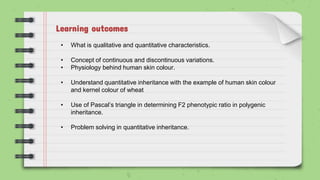
Learning outcomes
• What is qualitative and quantitative characteristics.
• Concept of continuous and discontinuous variations.
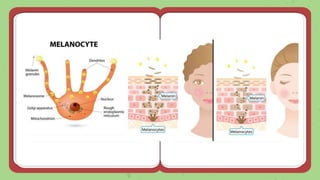
• Physiology behind human skin colour.
• Understand quantitative inheritance with the example of human skin colour
and kernel colour of wheat
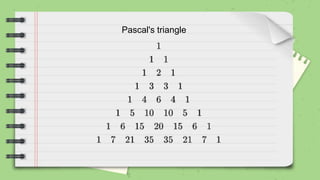
• Use of Pascal’s triangle in determining F2 phenotypic ratio in polygenic
inheritance.
• Problem solving in quantitative inheritance.
Arabinda Samanta
Assistant Professor
Dept. of Botany
Jhargram Raj College
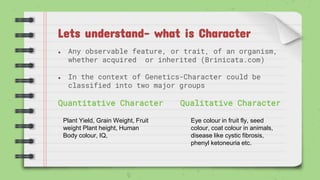
Lets understand- what is Character
● Any observable feature, or trait, of an organism,
whether acquired or inherited (Brinicata.com)
● In the context of Genetics-Character could be
classified into two major groups
Quantitative Character Qualitative Character
Plant Yield, Grain Weight, Fruit
weight Plant height, Human
Body colour, IQ,
Eye colour in fruit fly, seed
colour, coat colour in animals,
disease like cystic fibrosis,
phenyl ketoneuria etc.
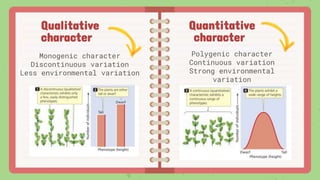
Qualitative
character
Monogenic character
Discontinuous variation
Less environmental variation
Polygenic character
Continuous variation
Strong environmental
variation
Quantitative
character
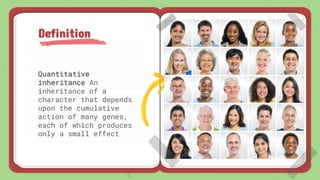
Quantitative
inheritance An
inheritance of a
character that depends
upon the cumulative
action of many genes,
each of which produces
only a small effect
Definition
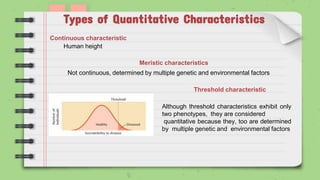
Types of Quantitative Characteristics
Continuous characteristic
Meristic characteristics
Threshold characteristic
Human height
Not continuous, determined by multiple genetic and environmental factors
Although threshold characteristics exhibit only
two phenotypes, they are considered
quantitative because they, too are determined
by multiple genetic and environmental factors
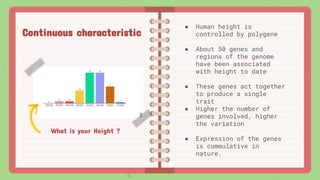
What is your Height ?
● Human height is
controlled by polygene
● About 50 genes and
regions of the genome
have been associated
with height to date
● These genes act together
to produce a single
trait
● Higher the number of
genes involved, higher
the variation
● Expression of the genes
is cummulative in
nature.
Continuous characteristic
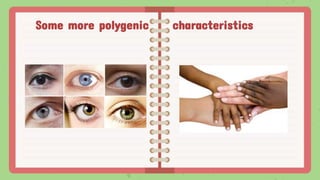
Some more polygenic characteristics
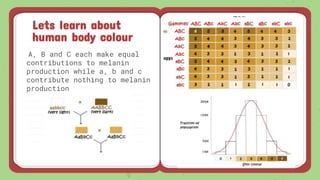
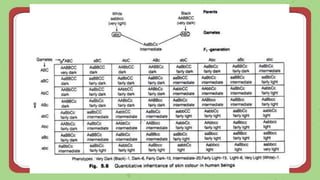
Lets learn about
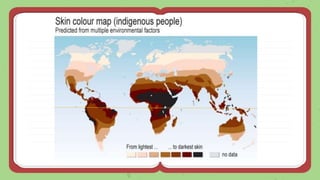
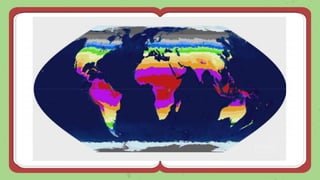
human body colour
A, B and C each make equal
contributions to melanin
production while a, b and c
contribute nothing to melanin
production
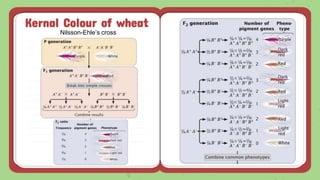
Kernal Colour of wheat
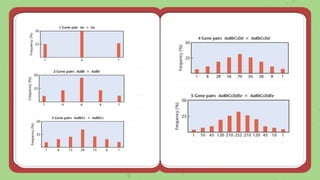
Nilsson-Ehle’s cross
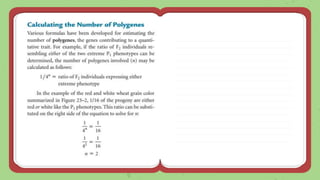
Pascal's triangle
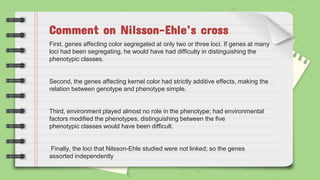
First, genes affecting color segregated at only two or three loci. If genes at many
loci had been segregating, he would have had difficulty in distinguishing the
phenotypic classes.
Second, the genes affecting kernel color had strictly additive effects, making the
relation between genotype and phenotype simple.
Third, environment played almost no role in the phenotype; had environmental
factors modified the phenotypes, distinguishing between the five
phenotypic classes would have been difficult.
Finally, the loci that Nilsson-Ehle studied were not linked; so the genes
assorted independently
Comment on Nilsson-Ehle’s cross

Quantitative Inheritance.pptx

  • 1.
    QUANTITATIVE INHERITANCE Arabinda Samanta AssistantProfessor in Botany W.B.E.S Jhargram Raj College Govt. of West Bengal
  • 2.
    Learning outcomes • Whatis qualitative and quantitative characteristics. • Concept of continuous and discontinuous variations. • Physiology behind human skin colour. • Understand quantitative inheritance with the example of human skin colour and kernel colour of wheat • Use of Pascal’s triangle in determining F2 phenotypic ratio in polygenic inheritance. • Problem solving in quantitative inheritance.
  • 4.
    Arabinda Samanta Assistant Professor Dept.of Botany Jhargram Raj College
  • 5.
    Lets understand- whatis Character ● Any observable feature, or trait, of an organism, whether acquired or inherited (Brinicata.com) ● In the context of Genetics-Character could be classified into two major groups Quantitative Character Qualitative Character Plant Yield, Grain Weight, Fruit weight Plant height, Human Body colour, IQ, Eye colour in fruit fly, seed colour, coat colour in animals, disease like cystic fibrosis, phenyl ketoneuria etc.
  • 6.
    Qualitative character Monogenic character Discontinuous variation Lessenvironmental variation Polygenic character Continuous variation Strong environmental variation Quantitative character
  • 7.
    Quantitative inheritance An inheritance ofa character that depends upon the cumulative action of many genes, each of which produces only a small effect Definition
  • 8.
    Types of QuantitativeCharacteristics Continuous characteristic Meristic characteristics Threshold characteristic Human height Not continuous, determined by multiple genetic and environmental factors Although threshold characteristics exhibit only two phenotypes, they are considered quantitative because they, too are determined by multiple genetic and environmental factors
  • 9.
    What is yourHeight ? ● Human height is controlled by polygene ● About 50 genes and regions of the genome have been associated with height to date ● These genes act together to produce a single trait ● Higher the number of genes involved, higher the variation ● Expression of the genes is cummulative in nature. Continuous characteristic
  • 10.
    Some more polygeniccharacteristics
  • 14.
    Lets learn about humanbody colour A, B and C each make equal contributions to melanin production while a, b and c contribute nothing to melanin production
  • 16.
    Kernal Colour ofwheat Nilsson-Ehle’s cross
  • 19.
  • 20.
    First, genes affectingcolor segregated at only two or three loci. If genes at many loci had been segregating, he would have had difficulty in distinguishing the phenotypic classes. Second, the genes affecting kernel color had strictly additive effects, making the relation between genotype and phenotype simple. Third, environment played almost no role in the phenotype; had environmental factors modified the phenotypes, distinguishing between the five phenotypic classes would have been difficult. Finally, the loci that Nilsson-Ehle studied were not linked; so the genes assorted independently Comment on Nilsson-Ehle’s cross