Submitted To:-
Dr. Pamirelli Ranjith sir
Assistant Professor
(Dept. of Genetics & Plant
Breeding)
Submitted By:-
Klarissa
Hembram(241310039)
Debasis Behera(241310040)
MULTIPLE
FACTOR
HYPOTHESIS
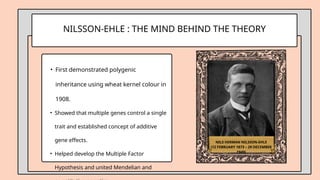
NILSSON-EHLE : THE MIND BEHIND THE THEORY
• First demonstrated polygenic
inheritance using wheat kernel colour in
1908.
• Showed that multiple genes control a single
trait and established concept of additive
gene effects.
• Helped develop the Multiple Factor
Hypothesis and united Mendelian and
NILS HERMAN NILSSON-EHLE
(12 FEBRUARY 1873 – 29 DECEMBER
1949)
• People can have different heights, skin colours, and eye colours.
• These differences come from many genes working together to create
these characteristics. We call this polygenic inheritance.
• Many genes contribute additively to a single trait.Each gene has a small,
additive effect on phenotype.
• Unlike characteristics controlled by one gene, polygenic characteristics
involve multiple genes and a range of possible characteristcs.
INTRODUCTION
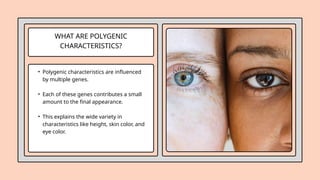
WHAT ARE POLYGENIC
CHARACTERISTICS?
• Polygenic characteristics are influenced
by multiple genes.
• Each of these genes contributes a small
amount to the final appearance.
• This explains the wide variety in
characteristics like height, skin color, and
eye color.
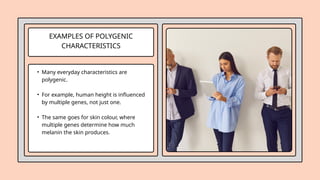
EXAMPLES OF POLYGENIC
CHARACTERISTICS
• Many everyday characteristics are
polygenic.
• For example, human height is influenced
by multiple genes, not just one.
• The same goes for skin colour, where
multiple genes determine how much
melanin the skin produces.
QUALITATIVE CHARACTERISTICS
• Controlled by one or few major genes.
• Show discontinuous variation.
• Traits fall into distinct categories.
• Example: flower color, blood group, seed shape.
QUANTITATIVE CHARACTERISTICS
• Controlled by many genes (polygenes).
• Each gene contributes a small additive effect.
• Show continuous variation.
• Example: height, skin color, grain yield.
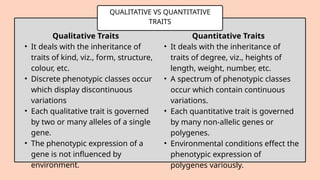
QUALITATIVE VS QUANTITATIVE
TRAITS
Qualitative Traits
• It deals with the inheritance of
traits of kind, viz., form, structure,
colour, etc.
• Discrete phenotypic classes occur
which display discontinuous
variations
• Each qualitative trait is governed
by two or many alleles of a single
gene.
• The phenotypic expression of a
gene is not influenced by
environment.
Quantitative Traits
• It deals with the inheritance of
traits of degree, viz., heights of
length, weight, number, etc.
• A spectrum of phenotypic classes
occur which contain continuous
variations.
• Each quantitative trait is governed
by many non-allelic genes or
polygenes.
• Environmental conditions effect the
phenotypic expression of
polygenes variously.
MULTIPLE FACTOR HYPOTHESIS
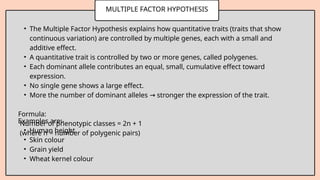
• The Multiple Factor Hypothesis explains how quantitative traits (traits that show
continuous variation) are controlled by multiple genes, each with a small and
additive effect.
• A quantitative trait is controlled by two or more genes, called polygenes.
• Each dominant allele contributes an equal, small, cumulative effect toward
expression.
• No single gene shows a large effect.
• More the number of dominant alleles stronger the expression of the trait.
→
Formula:
Number of phenotypic classes = 2n + 1
(where n = number of polygenic pairs)
Examples are:-
• Human height
• Skin colour
• Grain yield
• Wheat kernel colour
WHEAT KERNEL COLOUR
EXPERIMENT (NILSSON–EHLE)
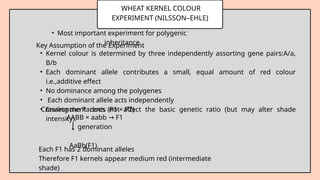
• Kernel colour is determined by three independently assorting gene pairs:A/a,
B/b
• Each dominant allele contributes a small, equal amount of red colour
i.e.,additive effect
• No dominance among the polygenes
• Each dominant allele acts independently
• Environment does not affect the basic genetic ratio (but may alter shade
intensity).
• Most important experiment for polygenic
inheritance
Key Assumption of the Experiment
Crossing the Parents (P1 × P2)
AABB × aabb F1
→
generation
AaBb(F1)
Each F1 has 2 dominant alleles
Therefore F1 kernels appear medium red (intermediate
shade)
WHEAT KERNEL COLOUR
EXPERIMENT (NILSSON–EHLE)
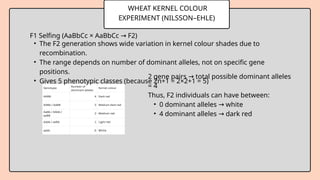
F1 Selfing (AaBbCc × AaBbCc F2)
→
• The F2 generation shows wide variation in kernel colour shades due to
recombination.
• The range depends on number of dominant alleles, not on specific gene
positions.
• Gives 5 phenotypic classes (because 2n+1 = 2×2+1 = 5)
2 gene pairs total possible dominant alleles
→
= 4
Thus, F2 individuals can have between:
• 0 dominant alleles white
→
• 4 dominant alleles dark red
→
WHEAT KERNEL COLOUR
EXPERIMENT (NILSSON–EHLE)
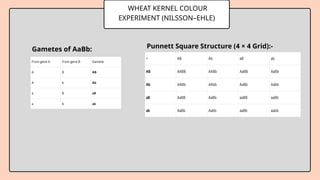
Gametes of AaBb: Punnett Square Structure (4 × 4 Grid):-
WHEAT KERNEL COLOUR
EXPERIMENT (NILSSON–EHLE)
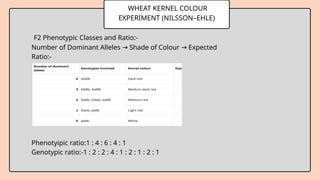
F2 Phenotypic Classes and Ratio:-
Number of Dominant Alleles Shade of Colour Expected
→ →
Ratio:-
Phenotyipic ratio:1 : 4 : 6 : 4 : 1
Genotypic ratio:-1 : 2 : 2 : 4 : 1 : 2 : 1 : 2 : 1
WHEAT KERNEL COLOUR
EXPERIMENT (NILSSON–EHLE)
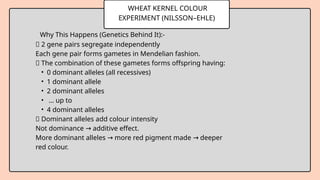
Why This Happens (Genetics Behind It):-
🔸 2 gene pairs segregate independently
Each gene pair forms gametes in Mendelian fashion.
🔸 The combination of these gametes forms offspring having:
• 0 dominant alleles (all recessives)
• 1 dominant allele
• 2 dominant alleles
• … up to
• 4 dominant alleles
🔸 Dominant alleles add colour intensity
Not dominance additive effect.
→
More dominant alleles more red pigment made deeper
→ →
red colour.
WHEAT KERNEL COLOUR
EXPERIMENT (NILSSON–EHLE)
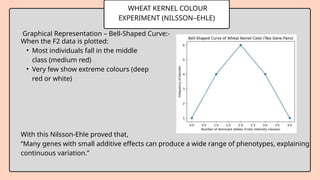
Graphical Representation – Bell-Shaped Curve:-
When the F2 data is plotted:
• Most individuals fall in the middle
class (medium red)
• Very few show extreme colours (deep
red or white)
With this Nilsson-Ehle proved that,
“Many genes with small additive effects can produce a wide range of phenotypes, explaining
continuous variation.”
CONCLUSION
•Multiple genes influence quantitative traits.
•Each gene adds a small effect.
•Results in continuous variation.
•Key concept in plant breeding and quantitative genetics.
Thank You

multiple factor hypothesis presentation pbg.

  • 1.
    Submitted To:- Dr. PamirelliRanjith sir Assistant Professor (Dept. of Genetics & Plant Breeding) Submitted By:- Klarissa Hembram(241310039) Debasis Behera(241310040) MULTIPLE FACTOR HYPOTHESIS
  • 2.
    NILSSON-EHLE : THEMIND BEHIND THE THEORY • First demonstrated polygenic inheritance using wheat kernel colour in 1908. • Showed that multiple genes control a single trait and established concept of additive gene effects. • Helped develop the Multiple Factor Hypothesis and united Mendelian and NILS HERMAN NILSSON-EHLE (12 FEBRUARY 1873 – 29 DECEMBER 1949)
  • 3.
    • People canhave different heights, skin colours, and eye colours. • These differences come from many genes working together to create these characteristics. We call this polygenic inheritance. • Many genes contribute additively to a single trait.Each gene has a small, additive effect on phenotype. • Unlike characteristics controlled by one gene, polygenic characteristics involve multiple genes and a range of possible characteristcs. INTRODUCTION
  • 4.
    WHAT ARE POLYGENIC CHARACTERISTICS? •Polygenic characteristics are influenced by multiple genes. • Each of these genes contributes a small amount to the final appearance. • This explains the wide variety in characteristics like height, skin color, and eye color.
  • 5.
    EXAMPLES OF POLYGENIC CHARACTERISTICS •Many everyday characteristics are polygenic. • For example, human height is influenced by multiple genes, not just one. • The same goes for skin colour, where multiple genes determine how much melanin the skin produces.
  • 6.
    QUALITATIVE CHARACTERISTICS • Controlledby one or few major genes. • Show discontinuous variation. • Traits fall into distinct categories. • Example: flower color, blood group, seed shape.
  • 7.
    QUANTITATIVE CHARACTERISTICS • Controlledby many genes (polygenes). • Each gene contributes a small additive effect. • Show continuous variation. • Example: height, skin color, grain yield.
  • 8.
    QUALITATIVE VS QUANTITATIVE TRAITS QualitativeTraits • It deals with the inheritance of traits of kind, viz., form, structure, colour, etc. • Discrete phenotypic classes occur which display discontinuous variations • Each qualitative trait is governed by two or many alleles of a single gene. • The phenotypic expression of a gene is not influenced by environment. Quantitative Traits • It deals with the inheritance of traits of degree, viz., heights of length, weight, number, etc. • A spectrum of phenotypic classes occur which contain continuous variations. • Each quantitative trait is governed by many non-allelic genes or polygenes. • Environmental conditions effect the phenotypic expression of polygenes variously.
  • 9.
    MULTIPLE FACTOR HYPOTHESIS •The Multiple Factor Hypothesis explains how quantitative traits (traits that show continuous variation) are controlled by multiple genes, each with a small and additive effect. • A quantitative trait is controlled by two or more genes, called polygenes. • Each dominant allele contributes an equal, small, cumulative effect toward expression. • No single gene shows a large effect. • More the number of dominant alleles stronger the expression of the trait. → Formula: Number of phenotypic classes = 2n + 1 (where n = number of polygenic pairs) Examples are:- • Human height • Skin colour • Grain yield • Wheat kernel colour
  • 10.
    WHEAT KERNEL COLOUR EXPERIMENT(NILSSON–EHLE) • Kernel colour is determined by three independently assorting gene pairs:A/a, B/b • Each dominant allele contributes a small, equal amount of red colour i.e.,additive effect • No dominance among the polygenes • Each dominant allele acts independently • Environment does not affect the basic genetic ratio (but may alter shade intensity). • Most important experiment for polygenic inheritance Key Assumption of the Experiment Crossing the Parents (P1 × P2) AABB × aabb F1 → generation AaBb(F1) Each F1 has 2 dominant alleles Therefore F1 kernels appear medium red (intermediate shade)
  • 11.
    WHEAT KERNEL COLOUR EXPERIMENT(NILSSON–EHLE) F1 Selfing (AaBbCc × AaBbCc F2) → • The F2 generation shows wide variation in kernel colour shades due to recombination. • The range depends on number of dominant alleles, not on specific gene positions. • Gives 5 phenotypic classes (because 2n+1 = 2×2+1 = 5) 2 gene pairs total possible dominant alleles → = 4 Thus, F2 individuals can have between: • 0 dominant alleles white → • 4 dominant alleles dark red →
  • 12.
    WHEAT KERNEL COLOUR EXPERIMENT(NILSSON–EHLE) Gametes of AaBb: Punnett Square Structure (4 × 4 Grid):-
  • 13.
    WHEAT KERNEL COLOUR EXPERIMENT(NILSSON–EHLE) F2 Phenotypic Classes and Ratio:- Number of Dominant Alleles Shade of Colour Expected → → Ratio:- Phenotyipic ratio:1 : 4 : 6 : 4 : 1 Genotypic ratio:-1 : 2 : 2 : 4 : 1 : 2 : 1 : 2 : 1
  • 14.
    WHEAT KERNEL COLOUR EXPERIMENT(NILSSON–EHLE) Why This Happens (Genetics Behind It):- 🔸 2 gene pairs segregate independently Each gene pair forms gametes in Mendelian fashion. 🔸 The combination of these gametes forms offspring having: • 0 dominant alleles (all recessives) • 1 dominant allele • 2 dominant alleles • … up to • 4 dominant alleles 🔸 Dominant alleles add colour intensity Not dominance additive effect. → More dominant alleles more red pigment made deeper → → red colour.
  • 15.
    WHEAT KERNEL COLOUR EXPERIMENT(NILSSON–EHLE) Graphical Representation – Bell-Shaped Curve:- When the F2 data is plotted: • Most individuals fall in the middle class (medium red) • Very few show extreme colours (deep red or white) With this Nilsson-Ehle proved that, “Many genes with small additive effects can produce a wide range of phenotypes, explaining continuous variation.”
  • 16.
    CONCLUSION •Multiple genes influencequantitative traits. •Each gene adds a small effect. •Results in continuous variation. •Key concept in plant breeding and quantitative genetics.
  • 17.