TWO FACTOR CROSS AND THREE
FACTOR CROSS
LINKAGE
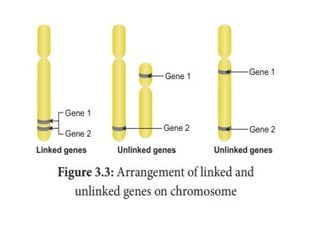
• Linkage is the close association or other DNA
sequences on the same chromosome.
• The closer two gene are to each other on the
chromosome ,the greater the probability that
they will be inherited together.
LINKAGE TYPES
• COMPLETE LINKAGE
• The genes located on the same chromosome do
not separate and are inherited togeather over the
generation due to the absence of crossing over.
• Complete linkage allows the combination of
parental traits to be inherited as such.
• It is rare but has been reported in male drosophila
and some other heterogametic organisms.
• Genes present in the same chromosome have
a tendency to separate due to crossing over
and hence produce recombinant progeny
besides the parental type.
• The number of recombinant individuals is
usually less than the number expected in
independent assortment.
INCOMPLETE LINKAGE
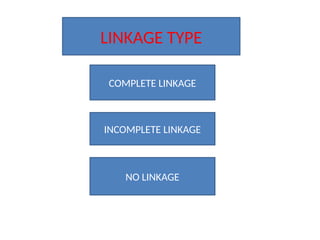
COMPLETE LINKAGE
INCOMPLETE LINKAGE
NO LINKAGE
LINKAGE TYPE
LINKAGE GROUP
• A Linkage group is a linearly arranged group of
linked genes which are normally inherited
together except for crossing over.
• Linkage group, in genetics ,all of the genes on
a single chromosome. They are inherited as a
group; that is during cell division they act and
move as a unit rather than independently.
TWO POINT CROSS
• A two point test cross is done to determine
the recombinant frequency between two
linked genes.
• The classic mendelian dihybrid cross
ratio(round yellow and green wrinkled seeds)
is 1:1:1:1, which shows that genes are not
linked and located on different chromosomes.
THREE POINT CROSS
• A three point cross is used to determine the
loci of three genes in an organism’s genome.
• Important for order of gene and gene
mapping.
• There are three genes a,b,c percentage of
crossing over between a and b is 20%, b and c
is 28% and a and c is 8%. What is the
sequence of genes on chromosome?
• A : b,a,c
• B : a,b,c
• C : a,c,b
• D : none of the above
genetics topic on two factor cross and three factor cross

genetics topic on two factor cross and three factor cross

  • 1.
    TWO FACTOR CROSSAND THREE FACTOR CROSS
  • 2.
    LINKAGE • Linkage isthe close association or other DNA sequences on the same chromosome. • The closer two gene are to each other on the chromosome ,the greater the probability that they will be inherited together.
  • 3.
    LINKAGE TYPES • COMPLETELINKAGE • The genes located on the same chromosome do not separate and are inherited togeather over the generation due to the absence of crossing over. • Complete linkage allows the combination of parental traits to be inherited as such. • It is rare but has been reported in male drosophila and some other heterogametic organisms.
  • 4.
    • Genes presentin the same chromosome have a tendency to separate due to crossing over and hence produce recombinant progeny besides the parental type. • The number of recombinant individuals is usually less than the number expected in independent assortment. INCOMPLETE LINKAGE
  • 5.
  • 7.
    LINKAGE GROUP • ALinkage group is a linearly arranged group of linked genes which are normally inherited together except for crossing over. • Linkage group, in genetics ,all of the genes on a single chromosome. They are inherited as a group; that is during cell division they act and move as a unit rather than independently.
  • 8.
    TWO POINT CROSS •A two point test cross is done to determine the recombinant frequency between two linked genes. • The classic mendelian dihybrid cross ratio(round yellow and green wrinkled seeds) is 1:1:1:1, which shows that genes are not linked and located on different chromosomes.
  • 9.
    THREE POINT CROSS •A three point cross is used to determine the loci of three genes in an organism’s genome. • Important for order of gene and gene mapping.
  • 10.
    • There arethree genes a,b,c percentage of crossing over between a and b is 20%, b and c is 28% and a and c is 8%. What is the sequence of genes on chromosome? • A : b,a,c • B : a,b,c • C : a,c,b • D : none of the above